The Lenten Rose was one of my first infatuations as a child, rising like a phoenix from the leaf mould when little else was braving winter. We had discovered a solitary plant in a wooded clearing of our derelict garden and, though it was nothing special by today’s standards, it had survived the forty years of neglect that had finally overwhelmed the previous owner. I remember the excitement, the elegant outline of the hooded flower and lifting the plum and green reverse to reveal the boss of sheltered stamens.
In the years since, the excitement of their reappearance each February has never dimmed. In fact I depend upon them as their energy gathers and pushes against the last of the winter. Close observation over time has allowed me the opportunity of getting to know them better; the places they like to be, their surprising resilience and longevity and where to use them so that they offer you their very best. I have also developed a keen eye, winkling out the ones that have been superseded in terms of colour and form, so that I am only growing my absolute favourites.
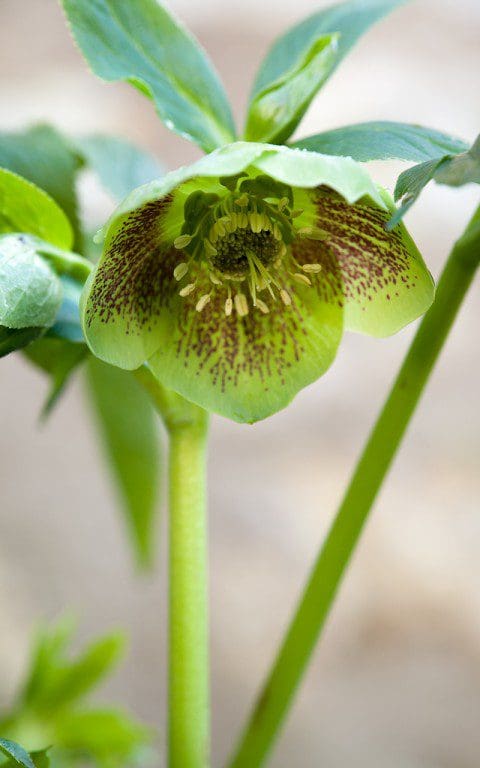 Helleborus x hybridus Single Green Spotted
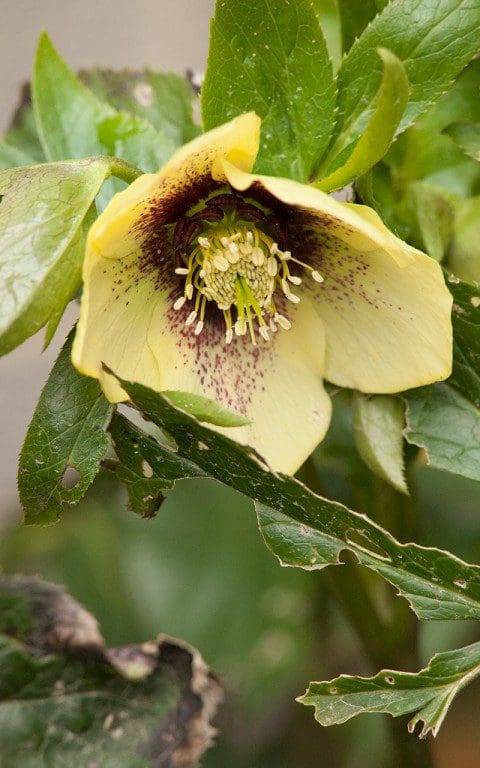 Helleborus x hybridus Single Yellow Spotted Dark Nectaries
I soon learned that it was important to hand select seed-raised Helleborus x hybridus since the variability is immense once they start to cross. Seedlings take about three to four years to flower if you are up for the gamble. The colours range from the darkest of slate-greys and plum purples through mauve and then on into a complexity of reds some of which err towards the pink end of the spectrum and others into apricot or the blush of ripe peaches. The yellows, perhaps the most prized due to their rarity, are a relatively recent development. The best hold a strong primrose for the duration of flower, whilst others fade to lime-green. The whites vary too, some clean, some limey, whilst others are infused palest pink. These base colours are sometimes overlaid with delicate veining or picotee edges of a darker tone, whilst the reverse may differ from the interior with a dusting of bloom or staining that gives away nothing of the world within. This is the stuff of obsession once you bend and cup a flower between your fingers to reveal a flash of another colour, a myriad spots or ink-dark nectaries.
An ark of hellebores came here with us from the Peckham garden. Planted on our south-facing slopes in the shade of a trial bed of shrubby willows, I expected them to struggle, but with summer shade they have loved the rich, deep ground and took some moving when they were relocated to their final positions the autumn before last. Moving Lenten Roses is easy if you do it in autumn, ahead of their period of main root activity. This is also the time to split your plants if you want to propagate a particular form, so that by the time they are pushing flowers they will have already found their feet.
The plants I brought with me were old favourites I have collected along the way. A purple as deep as damsons (main image), a slate-grey with bloom to the reverse and a particularly lovely green that has a freckling of burgundy spots within. I grew them all together in Peckham, the green lifting the darkness of the plum and a smattering of snowdrops to light them still further. I also have a fresh, clean white from Home Farm with green veins, and a creamy white picotee rimmed with deep red-violet and veined within. I parted with the dull reds and soft pinks once I’d visited Ashwood Nurseries and encountered the next level.
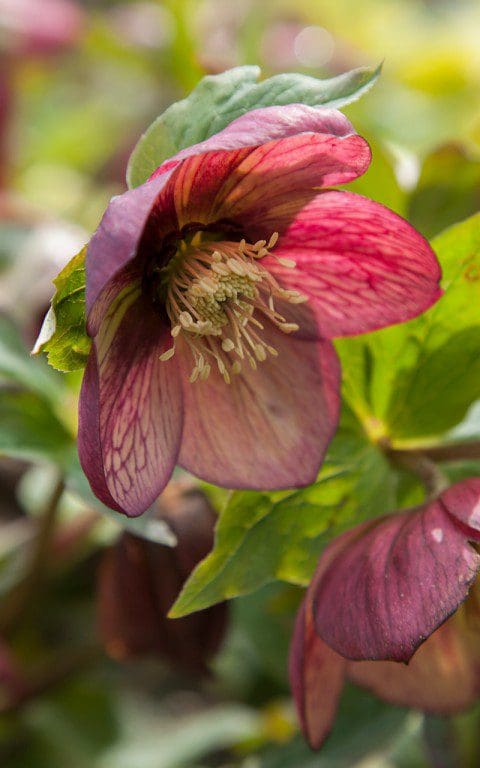 Helleborus x hybridus (Ashwood Evolution Group) Neon Shades
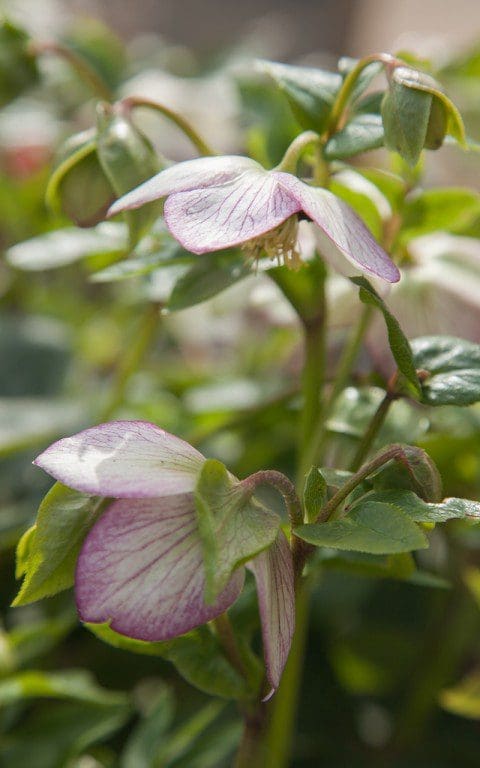 Helleborus x hybridus White Picotee Dark Nectaries
It was February, we had just had our offer accepted on Hillside, and the combination of winter weariness and the prospect of new ground inspired the journey to Ashwood. The nursery is famed for its hellebore selection programme and, within minutes of arriving, it was clear that these plants were far superior. The picotees were more finely drawn, pure whites overlaid with the merest lip of sugar pink, and there were pink and apricot picotees of even greater complexity. After several hours careful deliberation I came away with a number of yellows, selected for their dark plum nectaries, and some clean whites with the same interior stain. In the years since, I have added to the collection with green picotees, yellow spotteds and a number selected specifically for their veining.
As I do not have the luxury of shade, their favoured habitat, I have been winkling my collection in under shrubs or alongside tall, summer perennials that will throw them into cool when their foliage needs protection. Our slopes, however, are ideal for close observation and being able to look up into their blooms is a definite benefit. I have them grouped according to colour, the yellows and the whites alone and the greens and the darkest forms together. Under the medlar I have a collection of deep reds and warm-toned picotees to avoid the collection feeling too much like a sweet box and to allow me the opportunity of stumbling across something different as I move about the garden. Though I am not a fan of the doubles – they feel too cottagey here and too fussy in general – I do have one that is slate-grey which makes the flower very graphic and reminds me of a Louis Poulsen lamp. It has a place of its own under the wintersweet, where I can visit with a different mind-set.
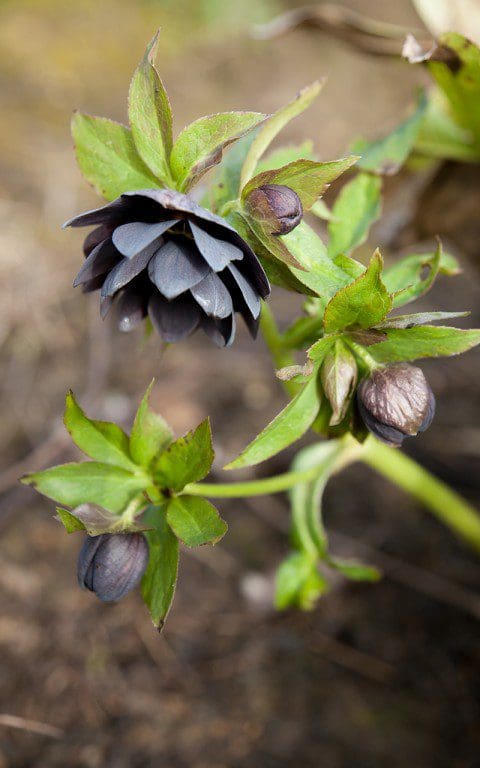 Helleborus x hybridus Double Black
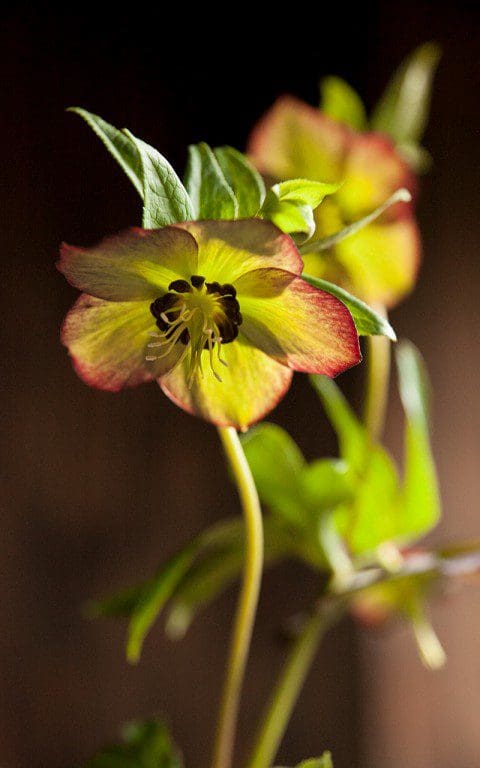 Helleborus x hybridus Single Green Picotee Shades Dark Nectaries
The Lenten Roses are sometimes affected by a blackening on the foliage caused by hellebore leaf spot, which can be debilitating if it gets a hold. Best advice is to remove the foliage in the early winter and burn any affected leaves before the flower stems appear in January. I prefer to let plants settle in for a year or two before removing any foliage, but stripping them back does allow you to see the flower against a clean backdrop. Mulching after the leaves are removed also helps keep the plants moist, but basal rot can be a problem in damp years, so I prefer not to mulch right around the growth to keep the base airy.
For the first time this year, we have been plagued by mice which have stripped the buds of the earliest flowers and robbed me of this year’s respite from the last of the winter. The discovery left me fuming, but there are just enough to pick and float in water. The Lenten rose is not a good cut flower, but the stems are less prone to the flagging if you steep them for thirty seconds in boiling water. We prefer to float the flowers like boats in a shallow dish of water where you can savour their interiors and appreciate the gift they provide in these last few weeks of the season.
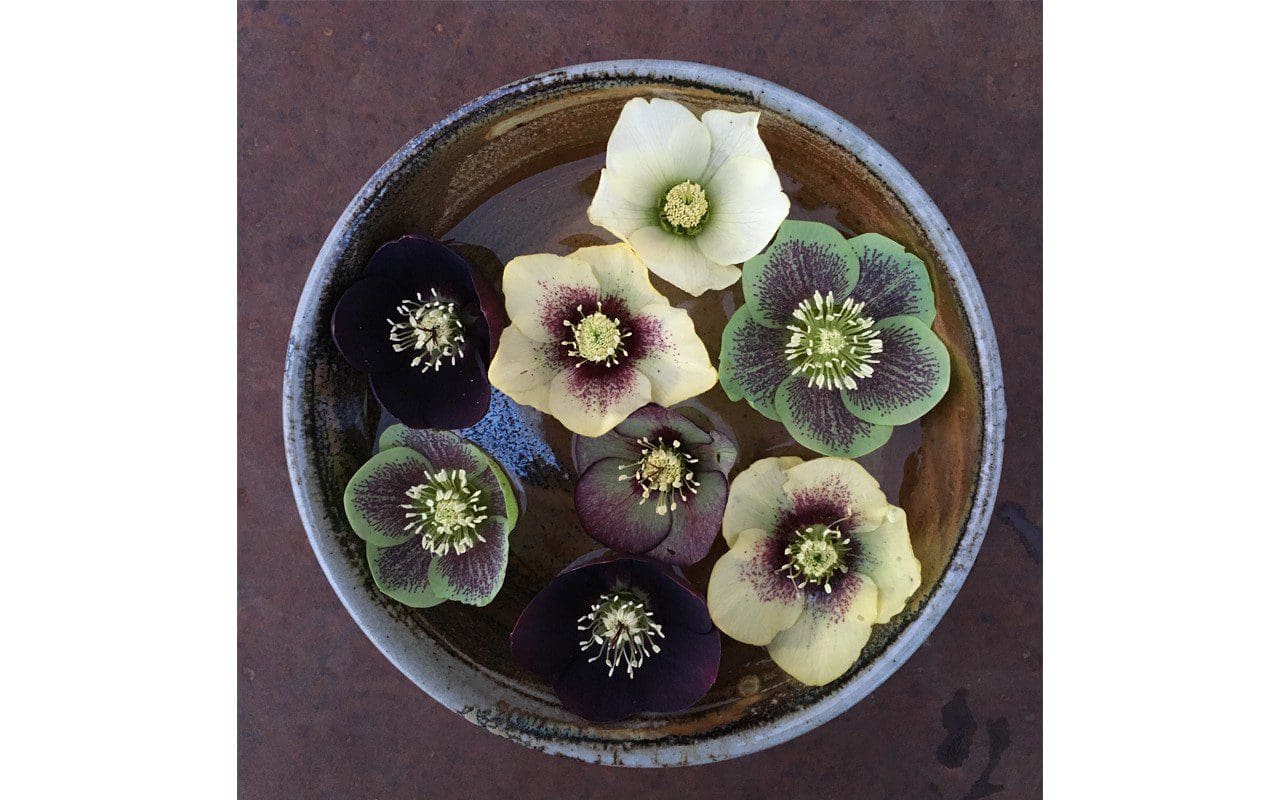
Words: Dan Pearson / Photographs: Huw Morgan
Published 10 February 2018
The hamamelis have burst their tight, velvety buds. Huddled darkly along bare branches, it is as if they have waited until we are hungry, our appetites pining for a break with winter. Welcome for the absence of life elsewhere, I fall under their spell again yearly, without fail and willingly. I first encountered them in maturity at Wisley, where in winter they were a mainstay of the winter plant idents, but it was not until my early twenties that I saw the true potential of the witch hazels. My friend Isabelle had taken me to Kalmthout Arboretum in Belgium to meet the owner, Jelena de Belder, the grower of many witch hazels and breeder of several of the best. The first, ‘Ruby Glow’ amongst them, were planted at the arboretum in the 1930s and the De Belders started their own breeding programme in the ’50’s. By the time we saw her collection in the early eighties, they were reaching out in maturity to touch one another, their fiery limbs, on a deep February winter’s day, an unforgettable understorey. The branches were bare and filled with the light of a million tiny filaments. The darkest as deep and red as rubies, and from there running through fire colours from the glow of smouldering embers to incandescent gold, flame yellow and palest sulphur. Writing now with a sprig of ‘Barmstedt Gold’ on the table in front of me, so that I can look in close detail, I remember further back to Geraldine’s Hamamelis mollis. Our neighbour, and my gardening mentor when I was a child, always picked a sprig to enliven her winter table. We would marvel at the strength of the perfume and its combination of delicacy and brazenness pitted against the odds of winter. So my witch hazel affair goes far back, but now is the first real opportunity I’ve had to put a shrub in open ground and be happy in the expectation of its future.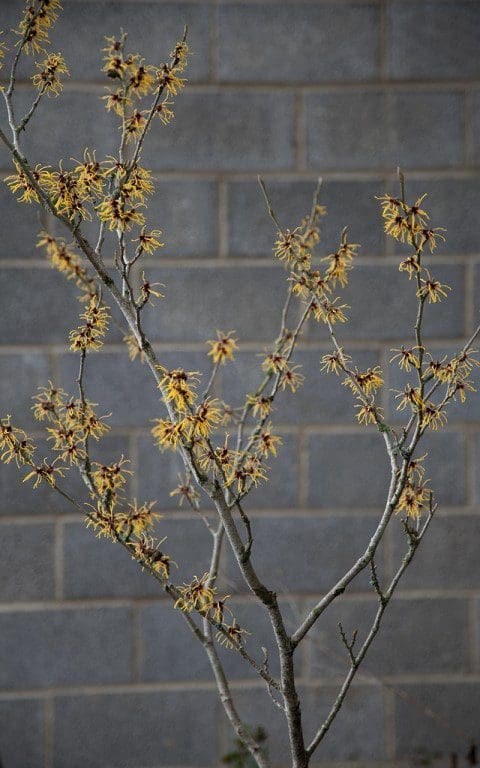
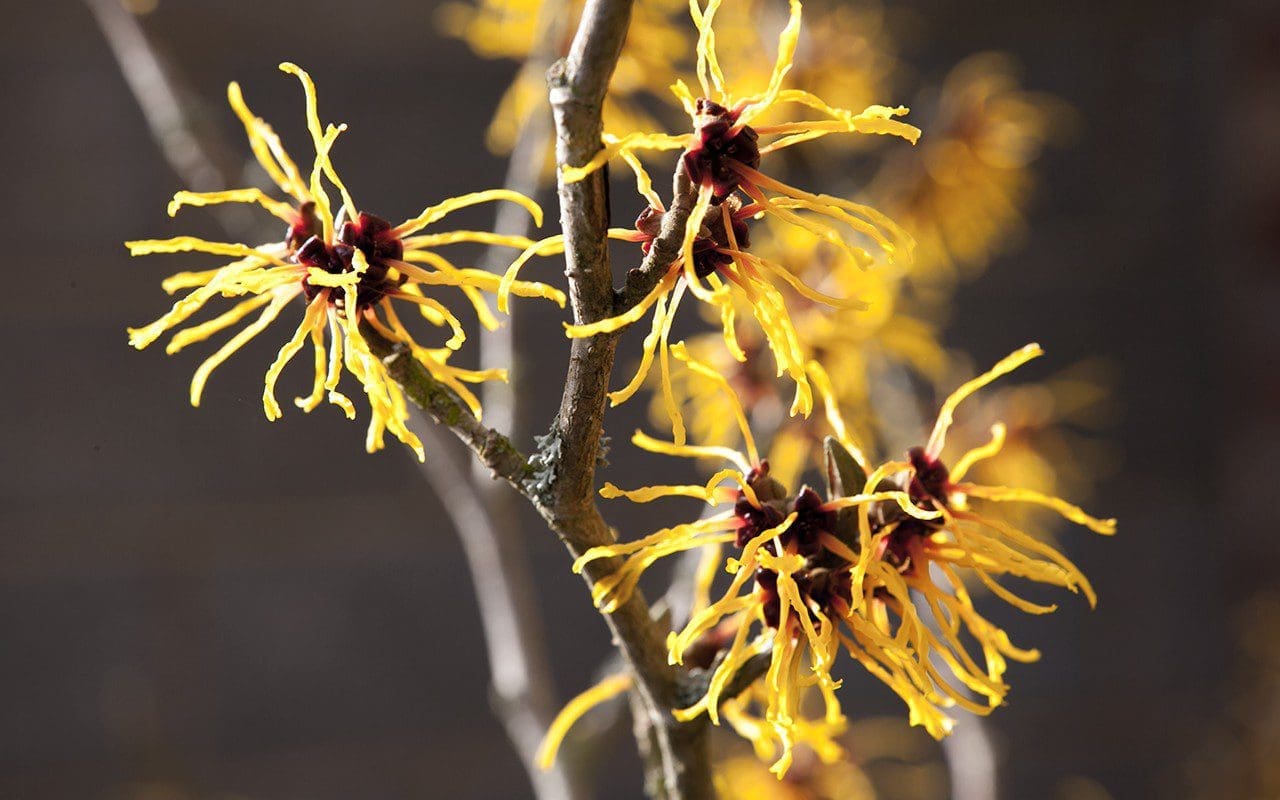 Hamamelis x intermedia ‘Barmstedt Gold’
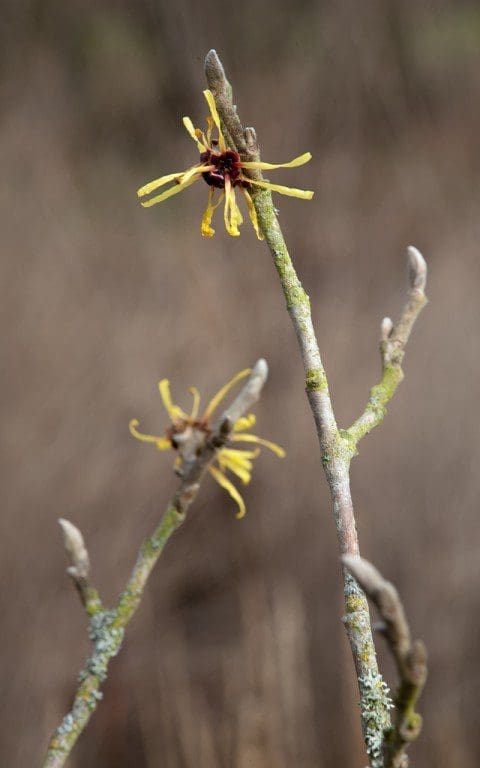 Hamamelis mollis
Before here, in the Peckham garden, I grew hamamelis in pots, because there simply wasn’t space in the beds. They were surprisingly tolerant and it afforded me the opportunity of bringing them up close to the house in the winter to watch their buds unravel at close proximity. ‘Jelena’, a soft orange Hamamelis x intermedia hybrid named after Mme. de Belder, was always the first to flower, before Christmas in London and running through the length of January. It outgrew me, its limbs reaching wide and elegantly in a stretch that became harder and harder to accommodate when I moved it back into the semi-shade at the end of the garden. In the end I gave it away to Nigel Slater when creating a secret garden for him. A good home where I knew he would enjoy it, and every year I am delighted to see him post pictures of the first flowers on Instagram.
H. x intermedia ‘Gingerbread’ (main image) and ‘Barmstedt Gold’, together with a plant of Hamamelis mollis, a gift from Geraldine, came with me from Peckham to here in pots. The intermedia hybrids produce the greater bulk of the coloured varieties but, though they are scented, not all have the pervasive scent of the straight H. mollis. It is often something you have to find and put your nose to, which is why it is worth placing them in a sheltered corner which will hold the perfume, or upwind of where you know you are going to pass. Growing most happily in open woodland, they are adaptable to being out in the open as long as their roots are kept cool and moist in the summer months, and will flower more heavily in the light. Scorched edges to the foliage will show you that they have been under stress and if, like me, you have no choice but to grow them in an open position, this can be alleviated with a summer mulch and long, deep watering when it gets dry.
The books will tell you that they prefer acid soil, but I have found them to be tolerant of alkaline conditions, as long as they have plenty of organic matter in the ground, do not dry out in summer nor lie wet in winter. However, what few books tell you is that they can be short-lived if they find themselves under stress. A tree of thirty years is doing well if you force them too far beyond their comfort zone. They are also slow to attain size, or feel slow because you have an image of wide-spreading limbs in your mind, not the stark twiggery of a young plant. In five to seven years you can begin to see the plant as you want it to be, but if you spend a little more than you’re comfortable with, seeking out a 10 or 15 litre plant that has some substance, the immediate payback is worth it. This year’s purchases – I find it very difficult to resist extending my experience of witch hazels – saw the instant benefits of a waist high ‘Aphrodite’ for nearly £40 and a twig of ‘Orange Peel’ for £15.
Hamamelis mollis
Before here, in the Peckham garden, I grew hamamelis in pots, because there simply wasn’t space in the beds. They were surprisingly tolerant and it afforded me the opportunity of bringing them up close to the house in the winter to watch their buds unravel at close proximity. ‘Jelena’, a soft orange Hamamelis x intermedia hybrid named after Mme. de Belder, was always the first to flower, before Christmas in London and running through the length of January. It outgrew me, its limbs reaching wide and elegantly in a stretch that became harder and harder to accommodate when I moved it back into the semi-shade at the end of the garden. In the end I gave it away to Nigel Slater when creating a secret garden for him. A good home where I knew he would enjoy it, and every year I am delighted to see him post pictures of the first flowers on Instagram.
H. x intermedia ‘Gingerbread’ (main image) and ‘Barmstedt Gold’, together with a plant of Hamamelis mollis, a gift from Geraldine, came with me from Peckham to here in pots. The intermedia hybrids produce the greater bulk of the coloured varieties but, though they are scented, not all have the pervasive scent of the straight H. mollis. It is often something you have to find and put your nose to, which is why it is worth placing them in a sheltered corner which will hold the perfume, or upwind of where you know you are going to pass. Growing most happily in open woodland, they are adaptable to being out in the open as long as their roots are kept cool and moist in the summer months, and will flower more heavily in the light. Scorched edges to the foliage will show you that they have been under stress and if, like me, you have no choice but to grow them in an open position, this can be alleviated with a summer mulch and long, deep watering when it gets dry.
The books will tell you that they prefer acid soil, but I have found them to be tolerant of alkaline conditions, as long as they have plenty of organic matter in the ground, do not dry out in summer nor lie wet in winter. However, what few books tell you is that they can be short-lived if they find themselves under stress. A tree of thirty years is doing well if you force them too far beyond their comfort zone. They are also slow to attain size, or feel slow because you have an image of wide-spreading limbs in your mind, not the stark twiggery of a young plant. In five to seven years you can begin to see the plant as you want it to be, but if you spend a little more than you’re comfortable with, seeking out a 10 or 15 litre plant that has some substance, the immediate payback is worth it. This year’s purchases – I find it very difficult to resist extending my experience of witch hazels – saw the instant benefits of a waist high ‘Aphrodite’ for nearly £40 and a twig of ‘Orange Peel’ for £15.
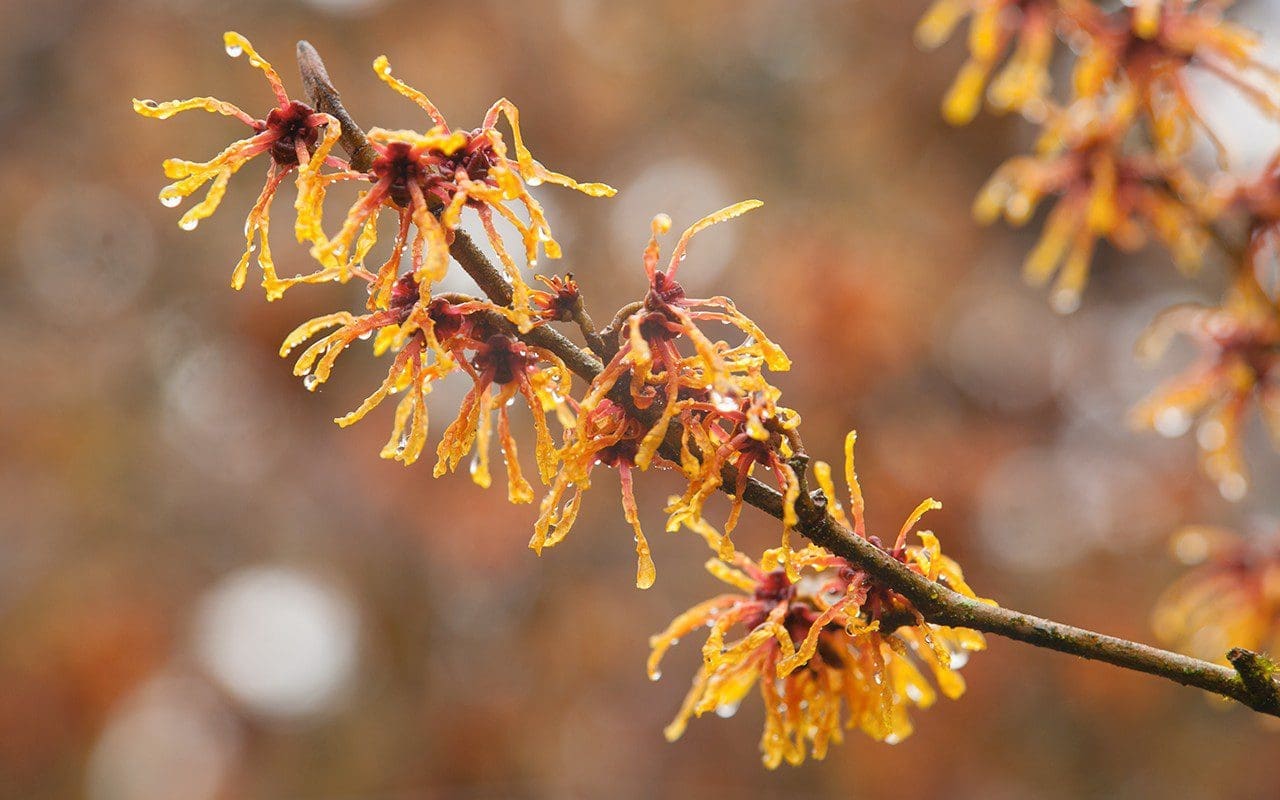 Hamamelis x intermedia ‘Aphrodite’
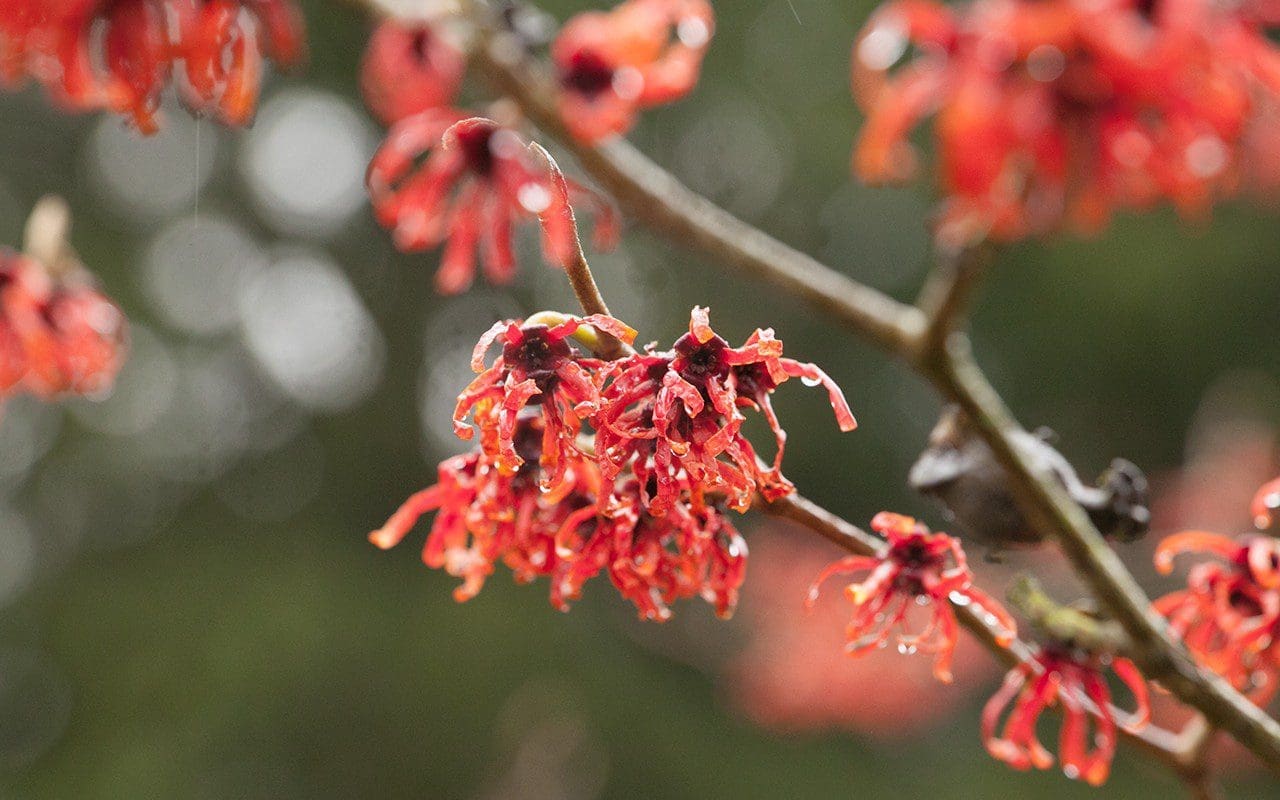 Hamamelis x intermedia ‘Diane’
Choosing the very best of a bewilderingly beautiful bunch is not easy, but my dabbling over the years has been worth it, for the named varieties have very differing habits. Being red-green colour blind, and losing some but not all reds, I must try hard to find ‘Diane’ when planted out in a garden. Up close I can see it is a wonderful colour and often use it for clients, but it is not one that I gravitate to for myself. It has a well-behaved, rounded habit and reliably scarlet autumn foliage, which singles it out as a variety to return to for two seasons of interest.
Several of the intermedia hybrids are problematic in my opinion for not losing leaves in winter, hanging on too long, like hornbeam or beech, to clutter what should be a naked stage of branches for the flowers. I have found that they do this in some gardens and not others and often they grow out of it as they mature, but I prefer the varieties that drop properly and most enjoy those that colour well in the autumn.
Hamamelis x intermedia ‘Diane’
Choosing the very best of a bewilderingly beautiful bunch is not easy, but my dabbling over the years has been worth it, for the named varieties have very differing habits. Being red-green colour blind, and losing some but not all reds, I must try hard to find ‘Diane’ when planted out in a garden. Up close I can see it is a wonderful colour and often use it for clients, but it is not one that I gravitate to for myself. It has a well-behaved, rounded habit and reliably scarlet autumn foliage, which singles it out as a variety to return to for two seasons of interest.
Several of the intermedia hybrids are problematic in my opinion for not losing leaves in winter, hanging on too long, like hornbeam or beech, to clutter what should be a naked stage of branches for the flowers. I have found that they do this in some gardens and not others and often they grow out of it as they mature, but I prefer the varieties that drop properly and most enjoy those that colour well in the autumn.
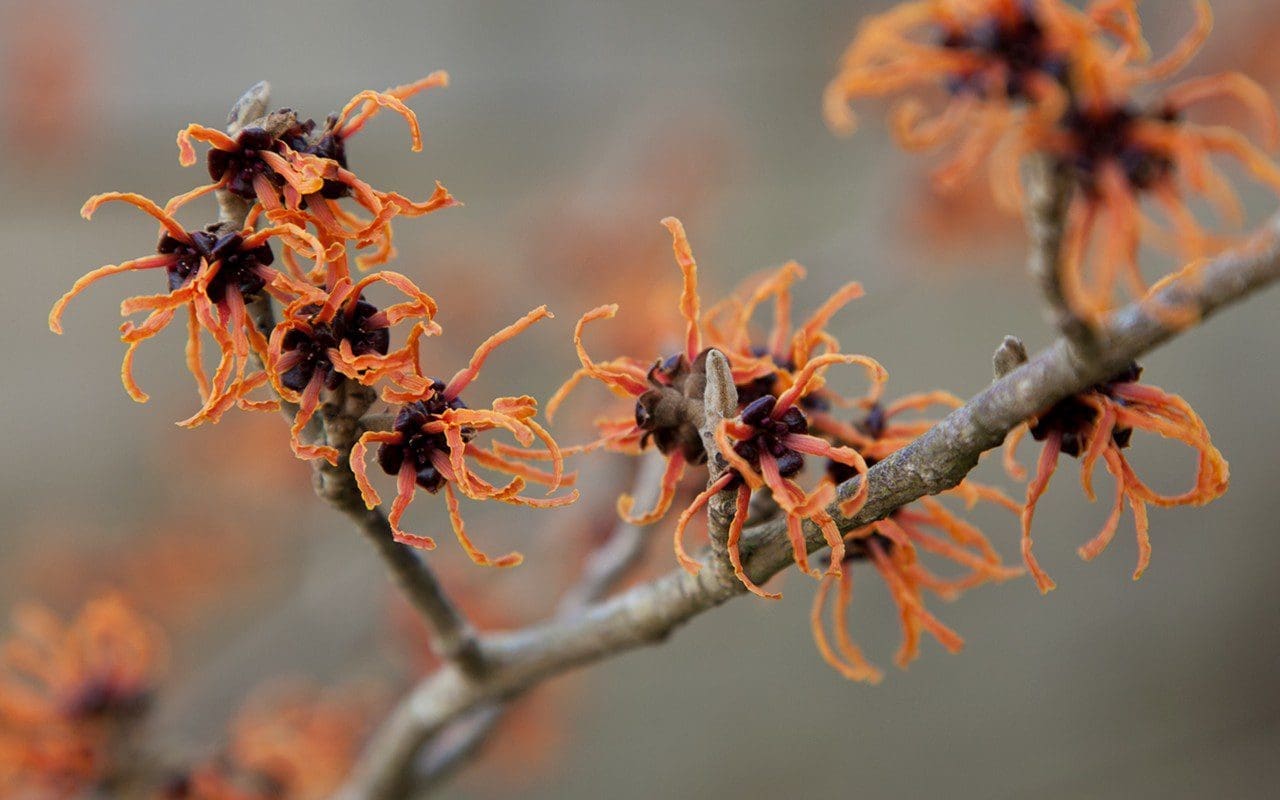 Hamamelis x intermedia ‘Gingerbread’
My plants here will be happy in our retentive loam despite the exposure, but I do mulch heavily with compost to emulate their natural wooded habitat. They have been planted here not only for the winter draw they provide, but also for the benefit of shade they bring to plants around them come summer. Rooting lightly and without heavy competition, they will provide home to spring flowering pulmonaria and erythronium which will come as they fade. The foliage of ‘Gingerbread’ has a copper flush as it comes into leaf, which is good with the Bath Asparagus planted beneath it, but later in the summer the branches provide a frame for Tropaeolum speciosum. The Flame Flower makes the branches flare again, when I have all but forgotten the winter spell that I am bewitched by today.
Words: Dan Pearson / Photographs: Huw Morgan
Published 27 January 2018
Hamamelis x intermedia ‘Gingerbread’
My plants here will be happy in our retentive loam despite the exposure, but I do mulch heavily with compost to emulate their natural wooded habitat. They have been planted here not only for the winter draw they provide, but also for the benefit of shade they bring to plants around them come summer. Rooting lightly and without heavy competition, they will provide home to spring flowering pulmonaria and erythronium which will come as they fade. The foliage of ‘Gingerbread’ has a copper flush as it comes into leaf, which is good with the Bath Asparagus planted beneath it, but later in the summer the branches provide a frame for Tropaeolum speciosum. The Flame Flower makes the branches flare again, when I have all but forgotten the winter spell that I am bewitched by today.
Words: Dan Pearson / Photographs: Huw Morgan
Published 27 January 2018
It took time after moving here to get used to the focal point of Freezing Hill. Scoring one of the few horizontals in a landscape that dips and sweeps and undulates, our horizon to the west is drawn more keenly for the line of trees that teeter on the ridge. A dark score mark perched between land and sky, which focusses the eye and draws you back.
We gaze upon them daily, several times a day, and always last thing before closing the house for the night. However, to start with I found the horizontal difficult, until it was grounded by the addition of the new footprint around the house. Our own landform of flatness, even the little we have, helps to make sense of it and the granite troughs echo the line and frame the land between and the sky above and beyond.
Last winter, the sixth we had been here, for the first time we walked the fields between us and there to bring our focal point into a new perspective. It was Christmas Day and, as we scaled the hill, the beeches reared up like giants above us. The air was still on the leeward slopes that protected us from the westerlies, but the roar of the wind coming from the valley beyond was in their branches. It was deafening where we stood in the beech mast at their feet and saw for the first time that they were pitched along the top of an earthwork* running along the ridge and now held in place by the clutch of their roots.
Over the year, drawn back to the shifting scene that they give focus to, we witness change. The transparency in their branches in the winter. A sometimes-near sometimes-farness, depending on the moisture in the air. The sweep of emerald field in spring. The piping line of ochre hay as the harvest is cut and then dried and bailed, the lines appearing and vanishing over the course of 48 hours in August. The line at its strongest on the chill, white days of frost and snow, when the trees and hedges score charcoal marks on the landscape. We see the sky differently for the anchor the trees provide between land and cloudscape over the course of the year. They act as a guide to the position of the setting sun, which dips far to their right in June and then, in a quickening progression as the summer slips, to their left and then so much further that you find it hard to imagine that it ever set behind them.
*Freezing Hill is the site of a Bronze Age earthwork and is a Scheduled Ancient Monument.
 19 January | 13:34
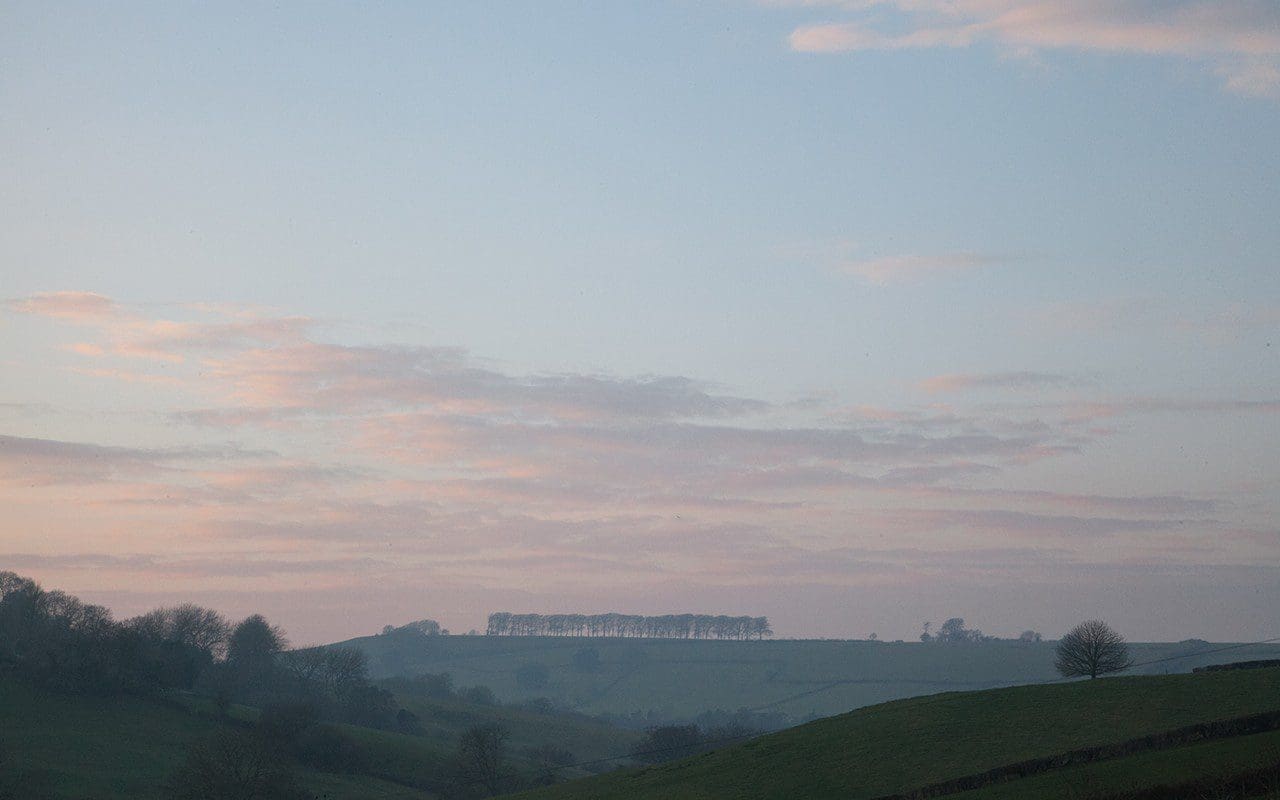 8 February | 17:12
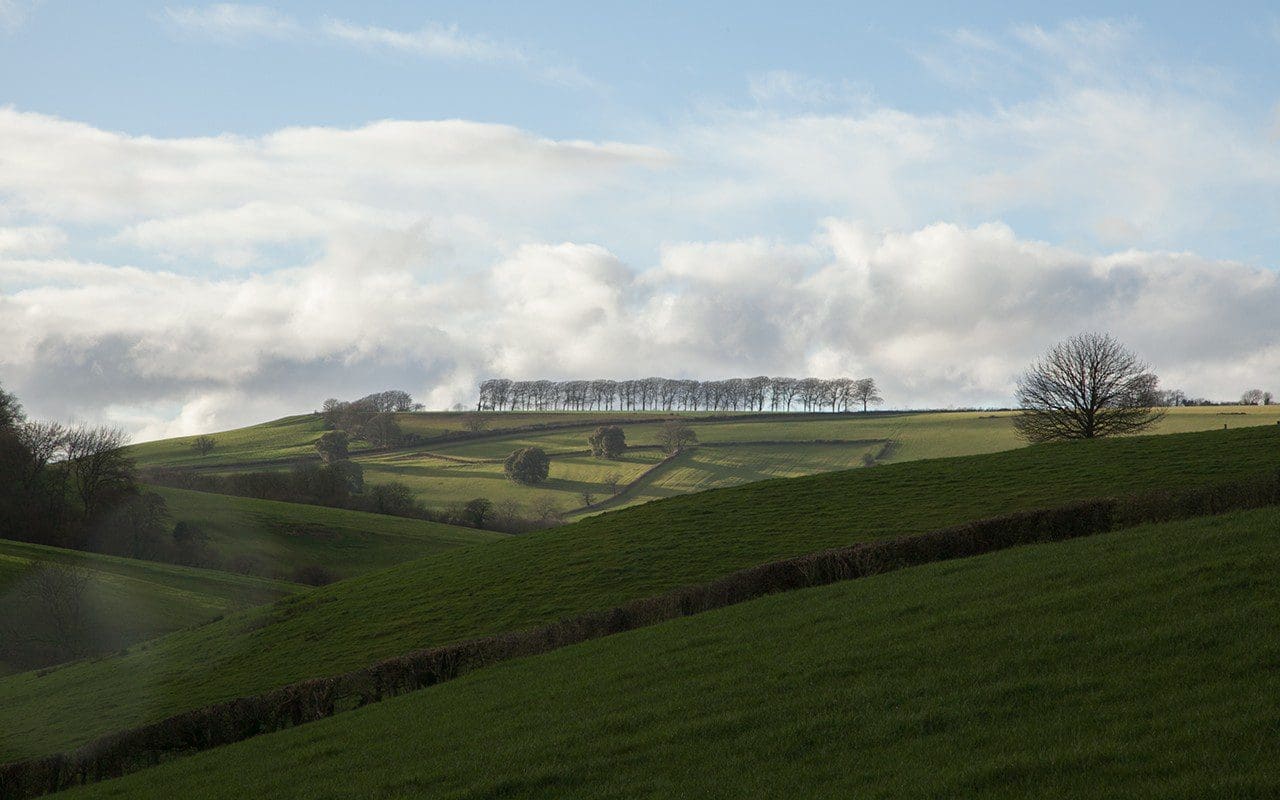 4 March | 17:18
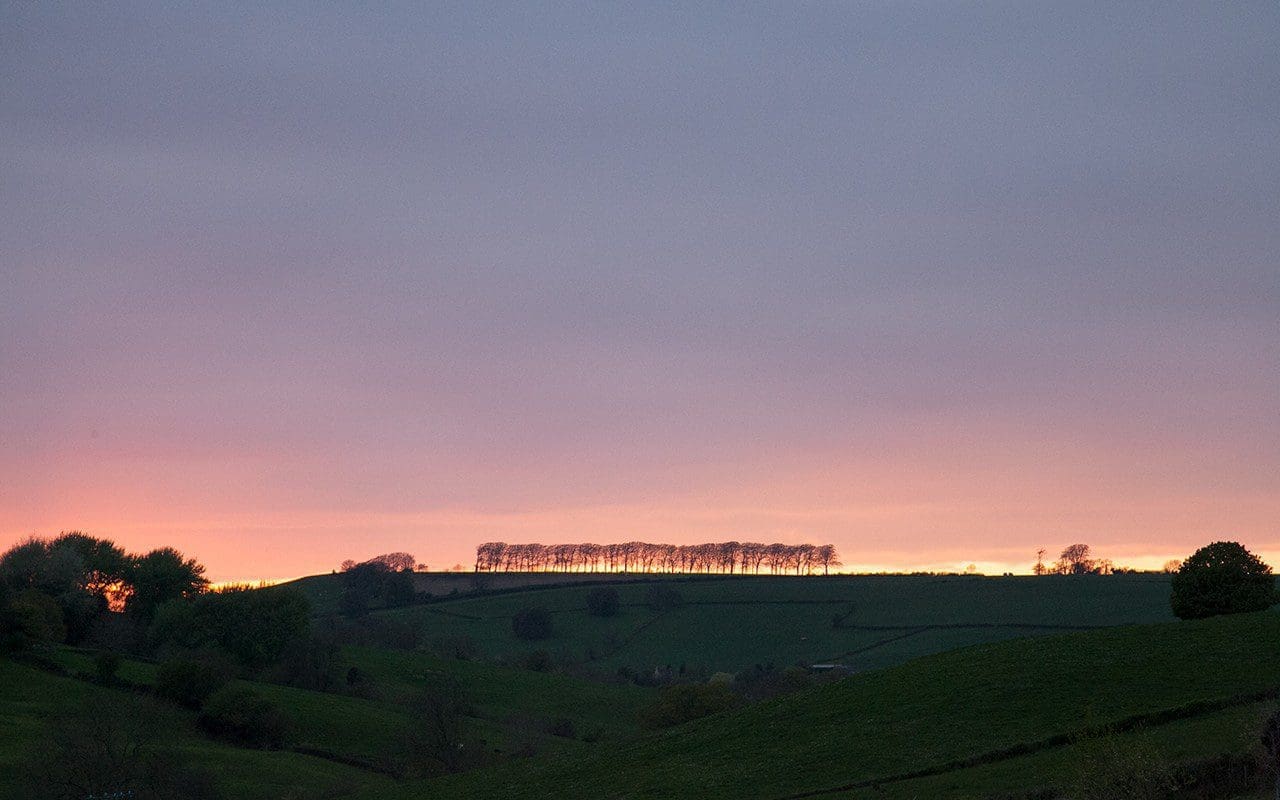 19 April | 19:53
 16 May | 20:30
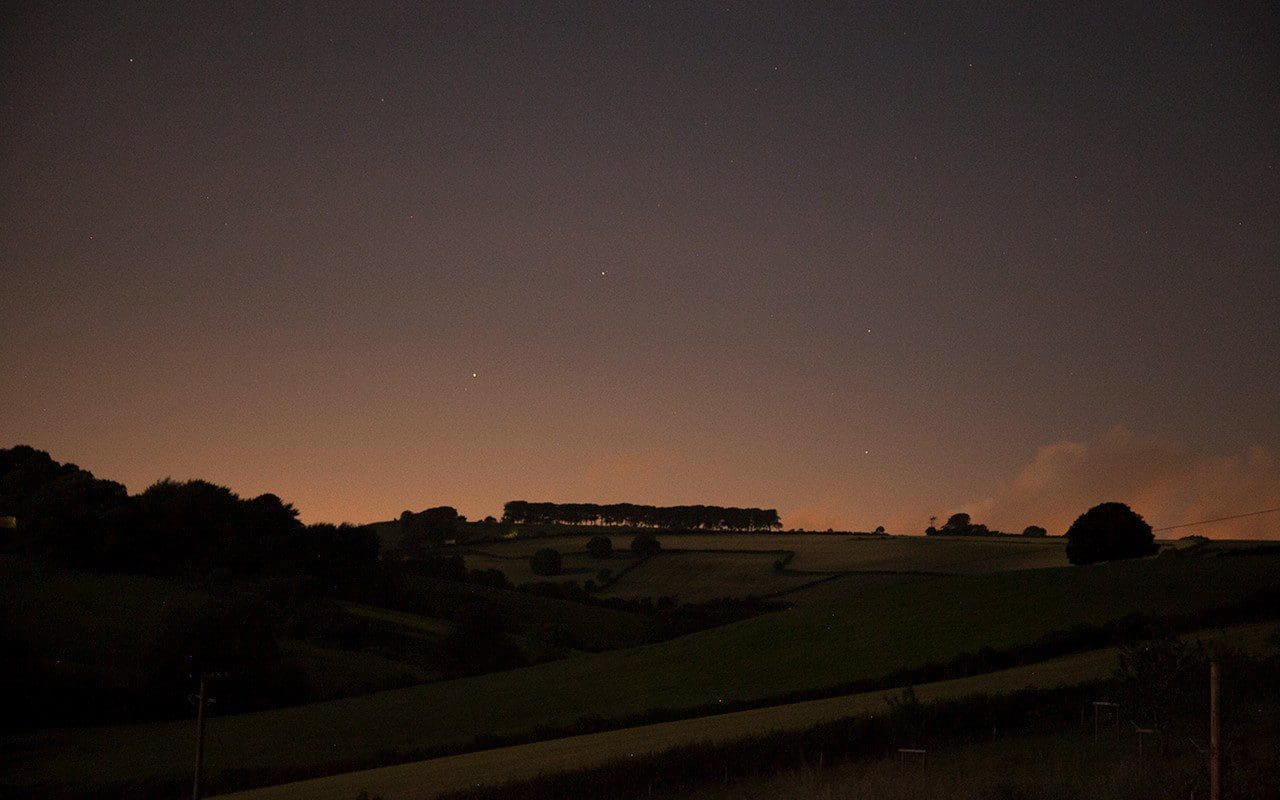 9 June | 01:10
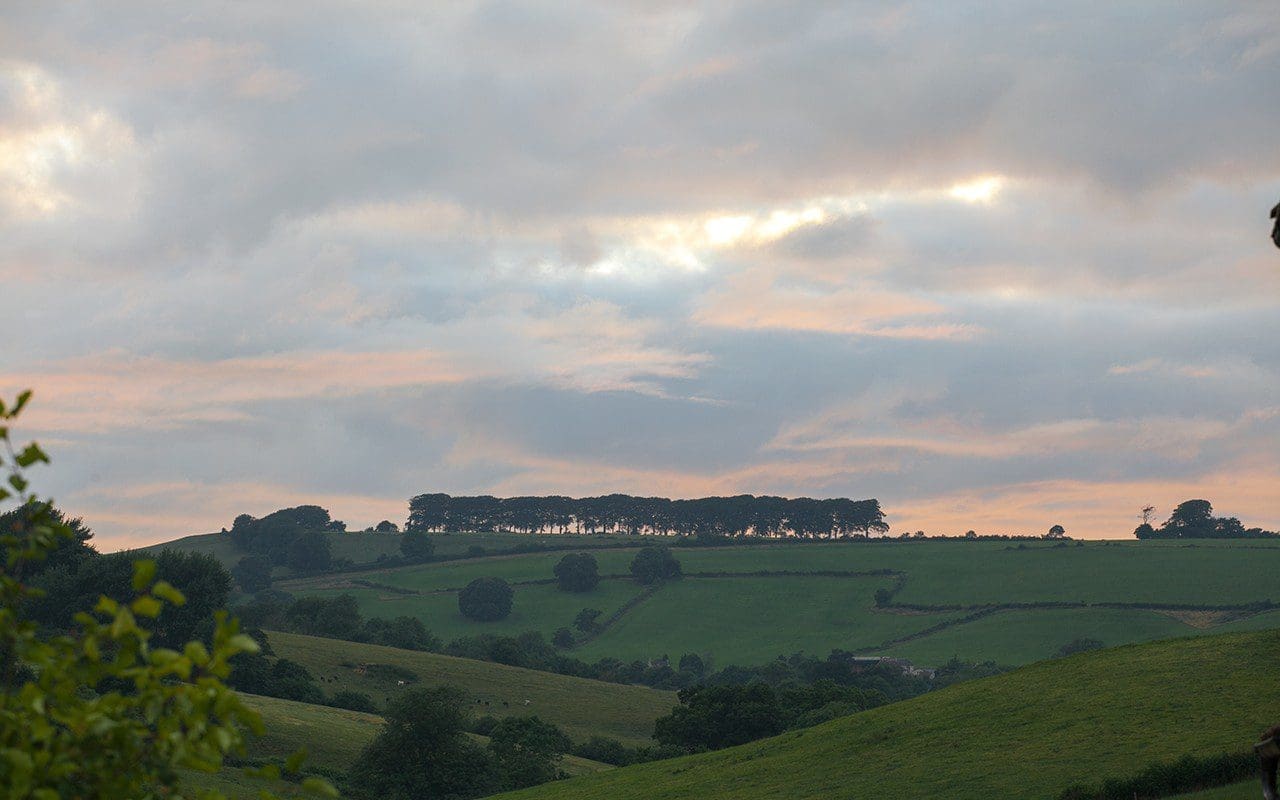 16 July | 20:40
 7 August | 20:34
 3 September | 18:32
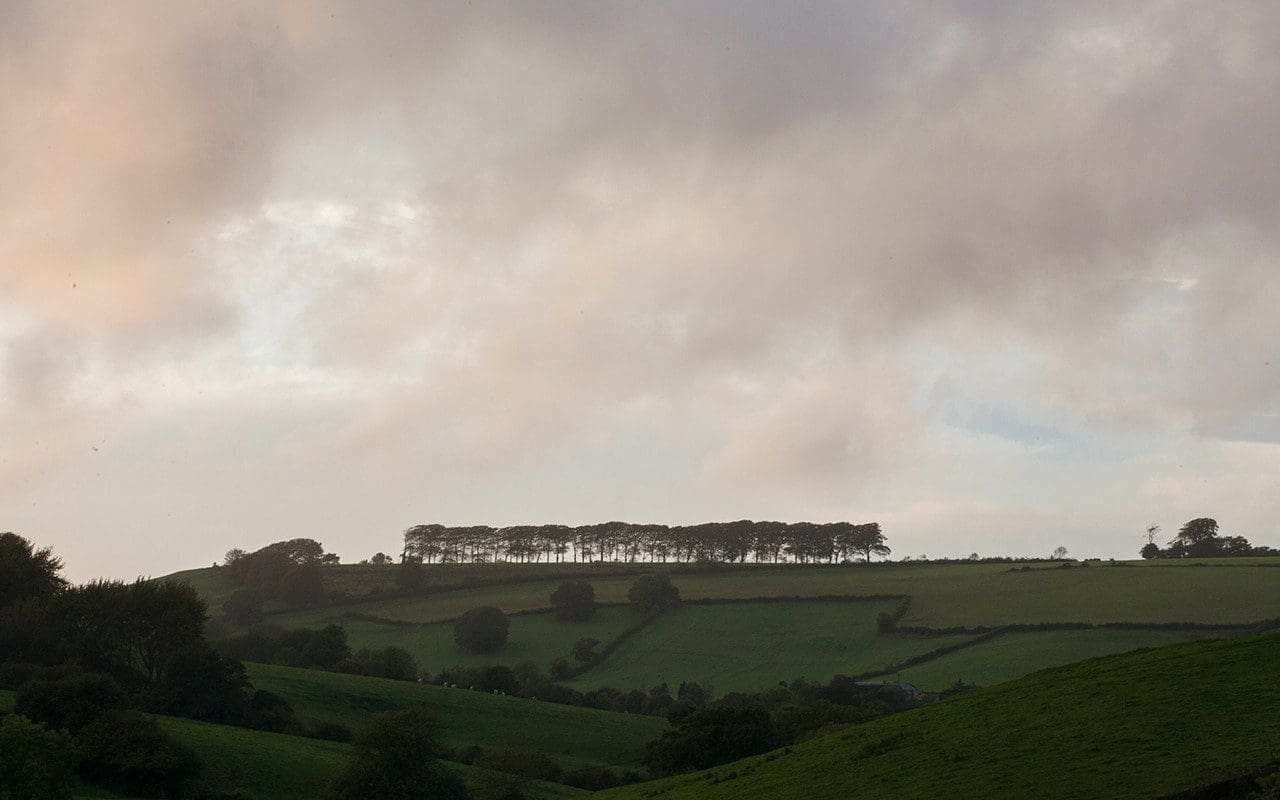 1 October | 18:08
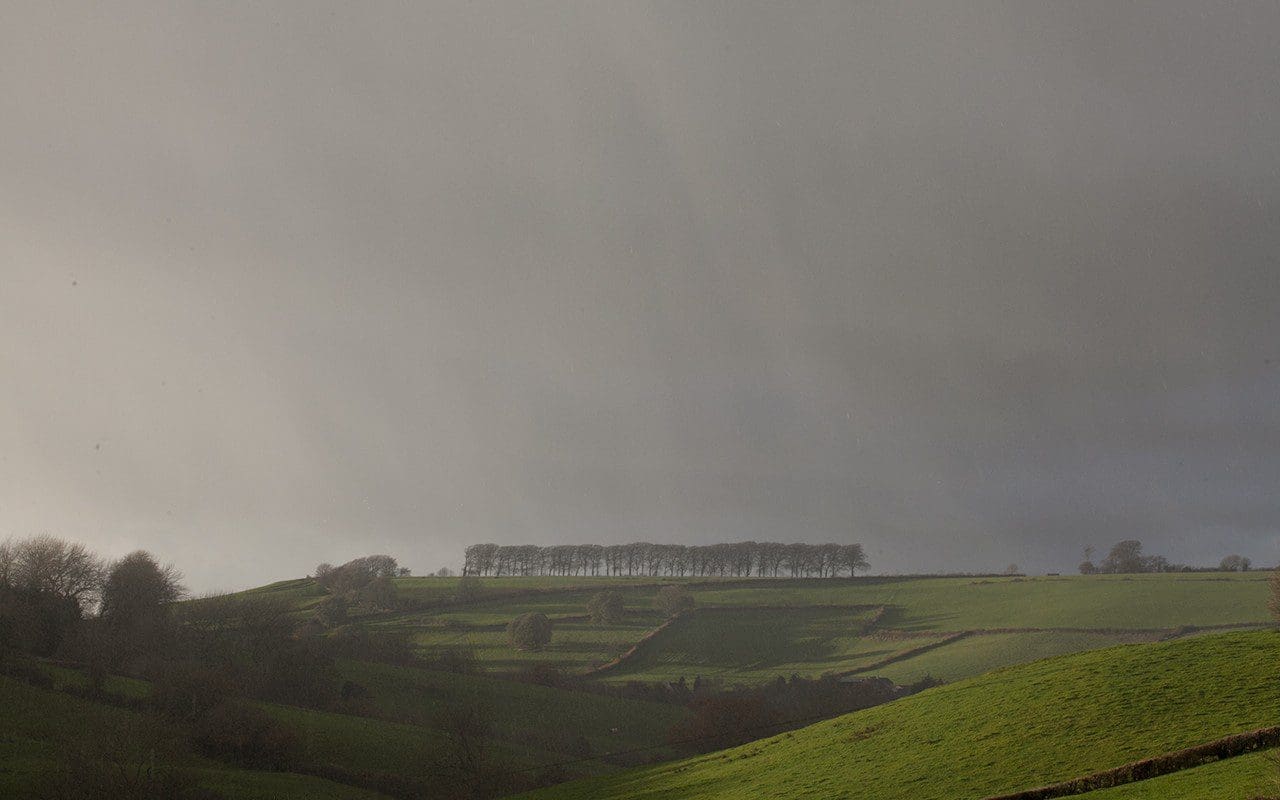 25 November | 15:57
 10 December | 16:14
Words: Dan Pearson | Photographs: Huw Morgan
Published 16 December 2017
Although the garden has its carefully drawn boundary – the fence that keeps the sheep out and my garden domain within manageable bounds – I want the eye to move freely up onto the Tump and then down to follow the ditch below it. The gates where the paths terminate give access to the pasture beyond, but they also provide a visual draw to the garden’s edge, where you can lean and contemplate the prospect of the wilder places.
I had planned for an engagement with the ditch for some time before the garden went in, but until this summer this damp crease in the land was a place that required a pair of watertight boots and a sense of adventure. When we came here its steep, muddy banks were deep with ruts where the cows had made their way down to the water that all year runs freely and constantly from the springs above us. The sedge was the indicator that the ditch had a wetland flora and, since it was fenced to protect it from grazing, this has evolved and diversified. We have the best of the primroses here in the spring, large self-sown communities that are happy on the cool slopes and remarkable for their ability to survive beneath the total eclipse of summer growth, which starts soon after they have peaked. First come ragged robin and campion, followed by the brutish and deadly hemlock water dropwort (which we are controlling by cutting as the flower spikes rise) and then meadowsweet, great willowherb and wild angelica.
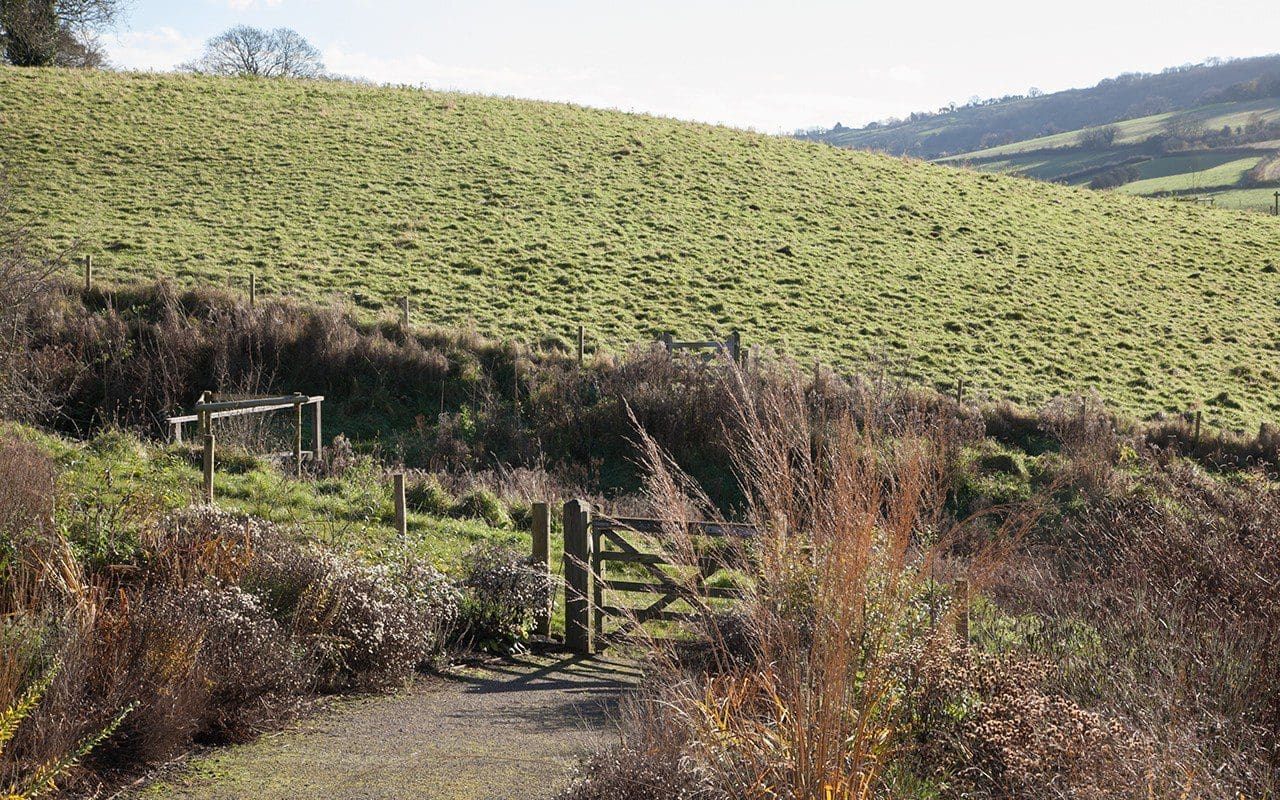 The gate from the garden into the pasture with the gate to the Tump on the slope above the ditch beyond
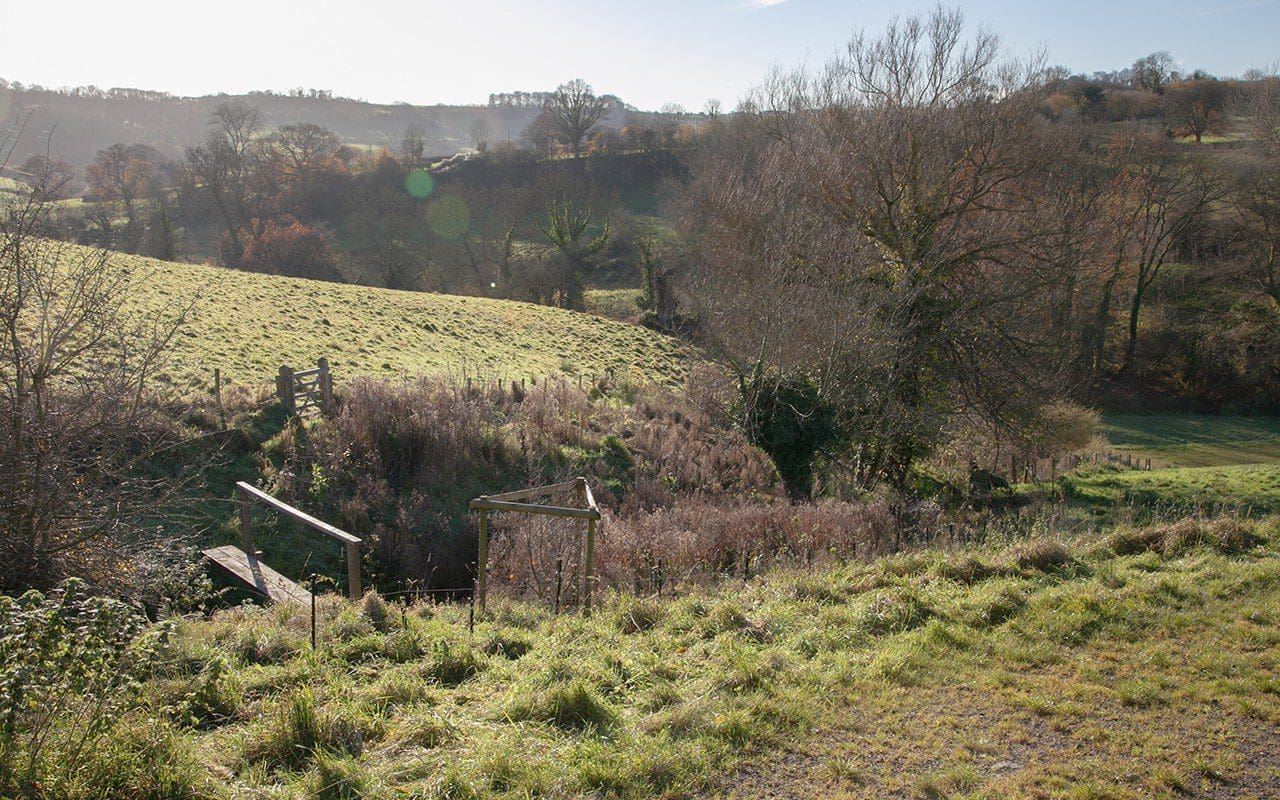 The ditch forms a crease below the Tump, with a pollard ash and large crack willow at the bottom of the left bank
As we have been getting on top of the brambles, which have been kept in check with strimming in February, I have been carefully adding to the ditch banks to provide another layer of interest; snowdrops for winter, marsh marigolds and our Tenby daffodil to kick-start the spring and, in summer, the upper reaches are now populated by a community of Inula magnifica. Salix purpurea ‘Nancy Saunders’ (which I also have on the garden boundary to help the eye jump the fence) runs in stops and starts along its length and, in the shade of the crack willow, we have the surprise of Gunnera manicata.
I had always imagined switching back and forth from bank to bank to enjoy this environment and, once the shaping of the garden was complete, the next logical step was to make it more accessible. Over several seasons I identified four positions for crossings that would each provide a different experience. A link from the garden directly up onto the Tump draws a line through the Cornus mas I’ve grouped below where we keep the bees. The cut in the land is steepest here, with the water falling unseen beneath growth in the summer, but the rocky streambed provides a good acoustic that makes you aware of the source. The rivulet reveals itself again in the winter to sparkle in sunshine. The prospect is good here so we made a sleeper crossing (main image) with a handrail to lean on that is suspended well above the water. I have planned for a bench to go on the far bank next summer, so that from there you can look back over the garden before moving on.
Once through the far gate you can walk up onto the meadow of the Tump or downhill to a lower gate behind the crack willow which allows you onto the slope above the ditch again. The path pushes into the shade where in time, as the gunnera grow and meet overhead, you will be able to duck under their canopy and cross the water on a simple stone sleeper bridge where the banks splay and slacken out under the tree.
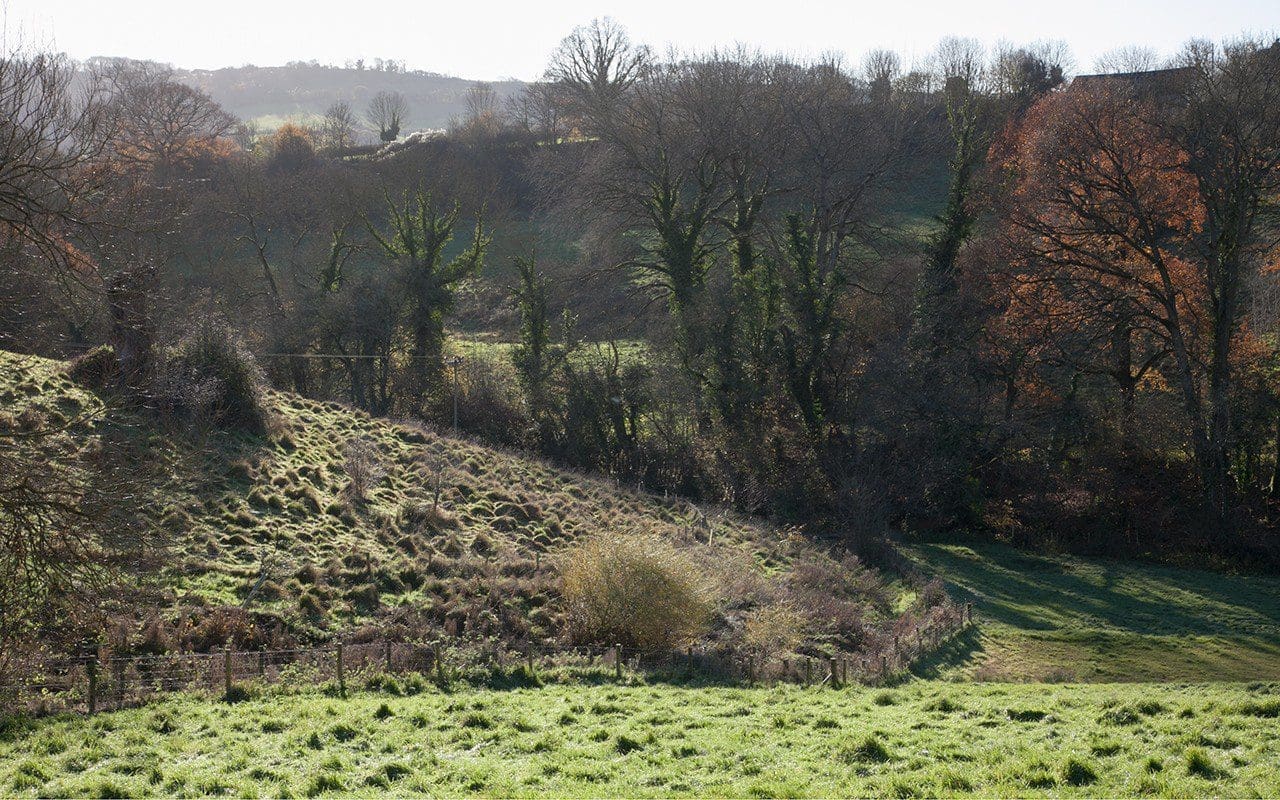 The banks below the crack willow ease where the slope flattens into the field
 The stone sleeper bridge beneath the crack willow
 The second stone slab crossing further down the ditch
Before the land eases where the fields flatten in the stream basin there is a stile and another slab crossing to take you back across where the primroses grow most strongly. From here you push into a track cut in the wet meadow of angelica and meadowsweet and then on and down to the ankle of the slopes where the ditch forms a marshy delta before dropping into the stream. Here between the fields the farmer before us had made a ford of sorts for easy droving so, when we first got here, we made a makeshift crossing with logs and stones that required a number of leaps to traverse it.
I had always envisioned a bridge here that changed direction, to echo the journey back and forth across the ditch. In Japan these bridges are kinked to confound devils that can only move in a straight line, but here the change in direction would slow your passage and make you pause.
As luck would have it, one of the bridges we made for the 2015 Chelsea Flower Show was not required when the garden was relocated to Chatsworth, and Mark Fane of Crocus kindly gifted it to me. So in August of this year long-term collaborator Dan Flynn of Gardenlink came down to install it. The ditch delta was temporarily drained in order to make the pilings that support the bridge, and the carefully planned installation went more smoothly than expected. It immediately looked like it was meant to be there.
 Dan Flynn installing the wooden bridge from the 2015 Chelsea Flower Show garden
 The newly installed bridge
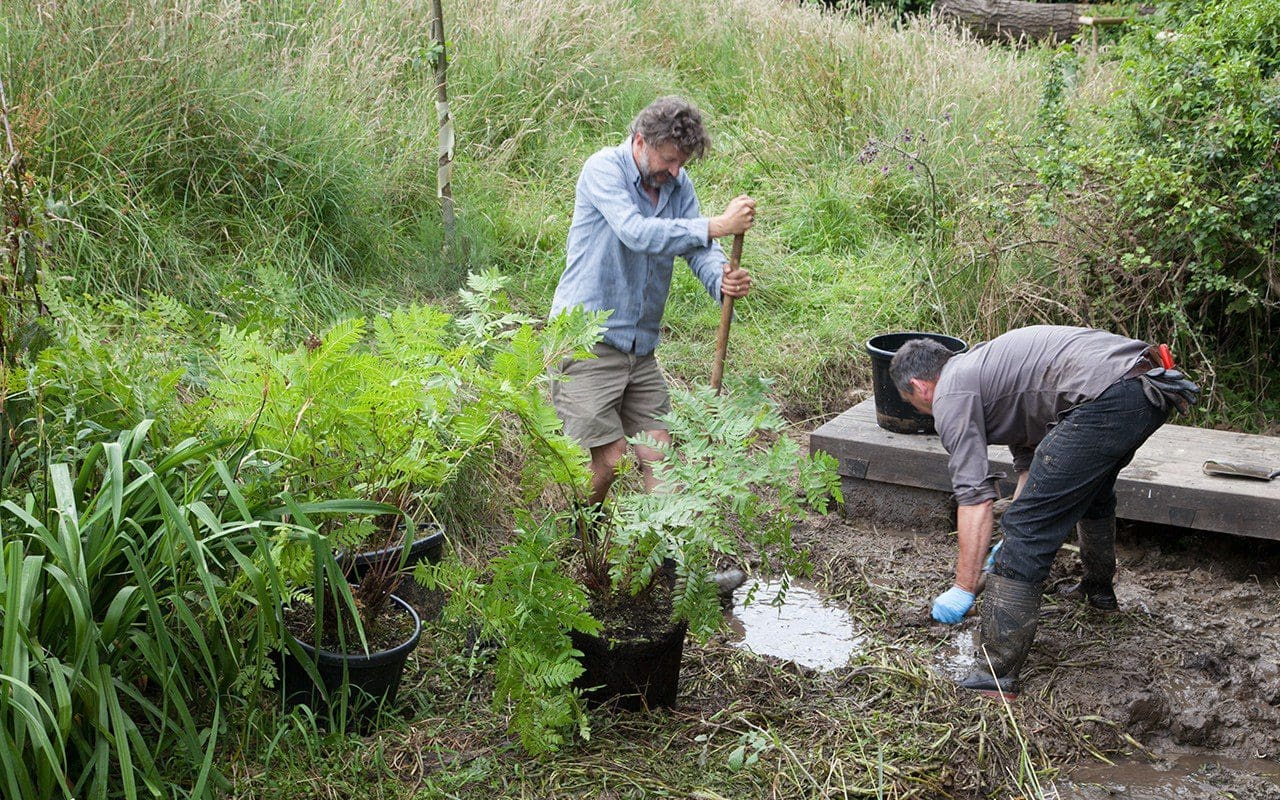 Dan and Ian planting Osmunda regalis ‘Purpurascens’ and Iris x robusta ‘Dark Aura’
The zig-zag bridge has been the making of a place that was previously damp and difficult to traverse. It has turned a swampy stumble between one field and the next into somewhere you now want to head for. I like it for being the only intervention you are aware of here and for the fact that it lifts you above the ground to give new perspective. I have worked Osmunda regalis ‘Purpurascens’ and Iris x robusta ‘Dark Aura’ into the wet ground to either side. And I have planned for another gate from the field side, which will catch the eye from the garden above and serve as a focus to draw you down to the end of this journey or, if you are tempted to continue into the coppice beyond, the beginning of the next.
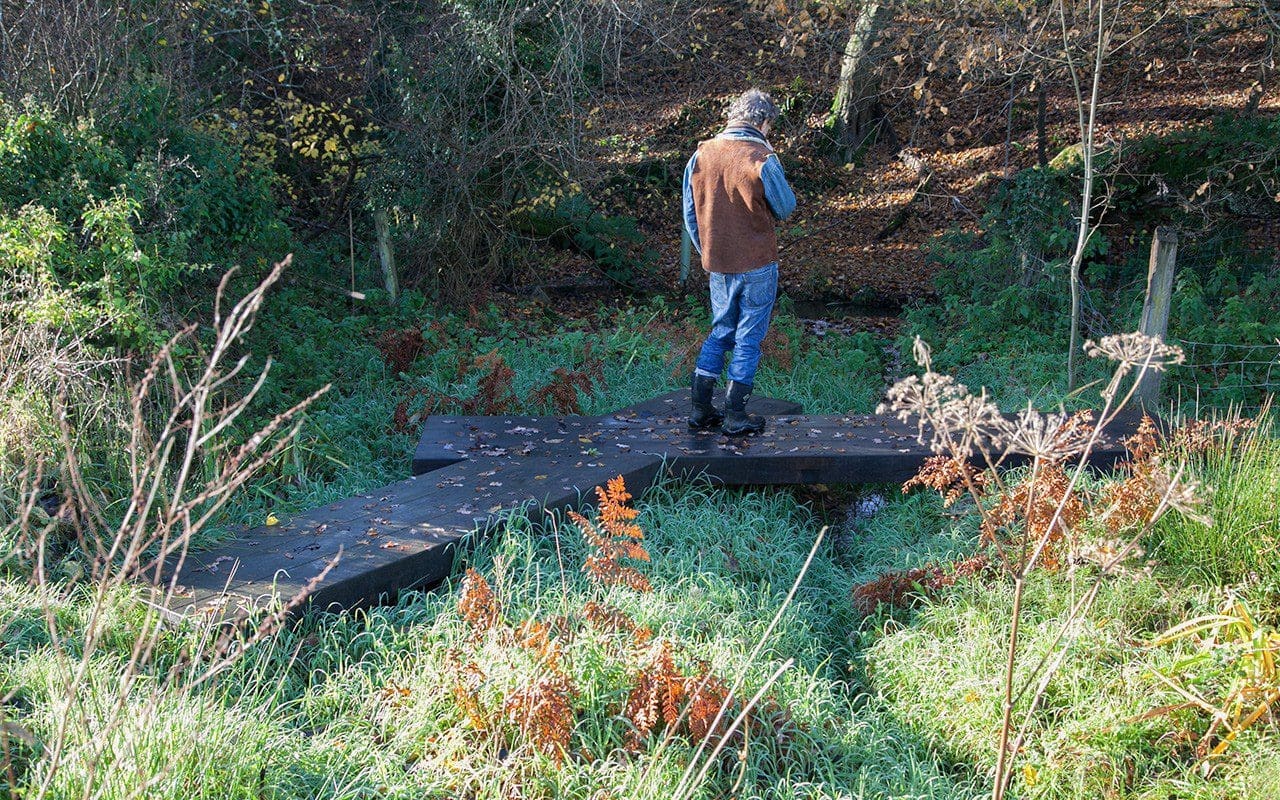

Words: Dan Pearson / Photographs: Huw Morgan
Published 25 November 2017
Sandwiched between storms and West Country wet, a miraculous week fell upon the final round of planting. We’d been lucky, with the ground dry enough to work and yet moist enough to settle the final splits from the stock beds. It took two days to lay out the plants and then two more to plant them and the weather held. Still, warm and gentle.
I’ve been planning for this moment for some time. Years in fact, when I consider the plants that I earmarked and brought here from our Peckham garden. They came with the promise and history of a home beyond the holding ground of the stock beds, and now they are finally bedded in with new companions. There are partnerships that I have been long planning for too but, as is the way (and the joy) of setting out a garden for yourself, there are always spontaneous and unplanned for juxtapositions in the moment of placing the plants.
The autumn plant order was roughly half that of the spring delivery, but the layout has taken just as much thought in the planning. I did not have a formal plan in March, just lists of plants zoned into areas and an idea in my head as to the various combinations and moods. It was the same this autumn, but forward thinking was essential for the combinations to come together easily on the day. Numbers for the remaining beds were calculated with about a foot between plants. I then spent August refining my wishlist to edit it back and keep the mood of the garden cohesive. The lower wrap, with its gauzy fray into the landscape, allows me to concentrate an area of greater intensity in the centre of the garden. The top bed that completes the frame to this central area and runs along the grassy walk at the base of the hedge along the lane, was kept deliberately simple to allow the core of the garden its dynamism.
 The zoning plan for the central section of the garden
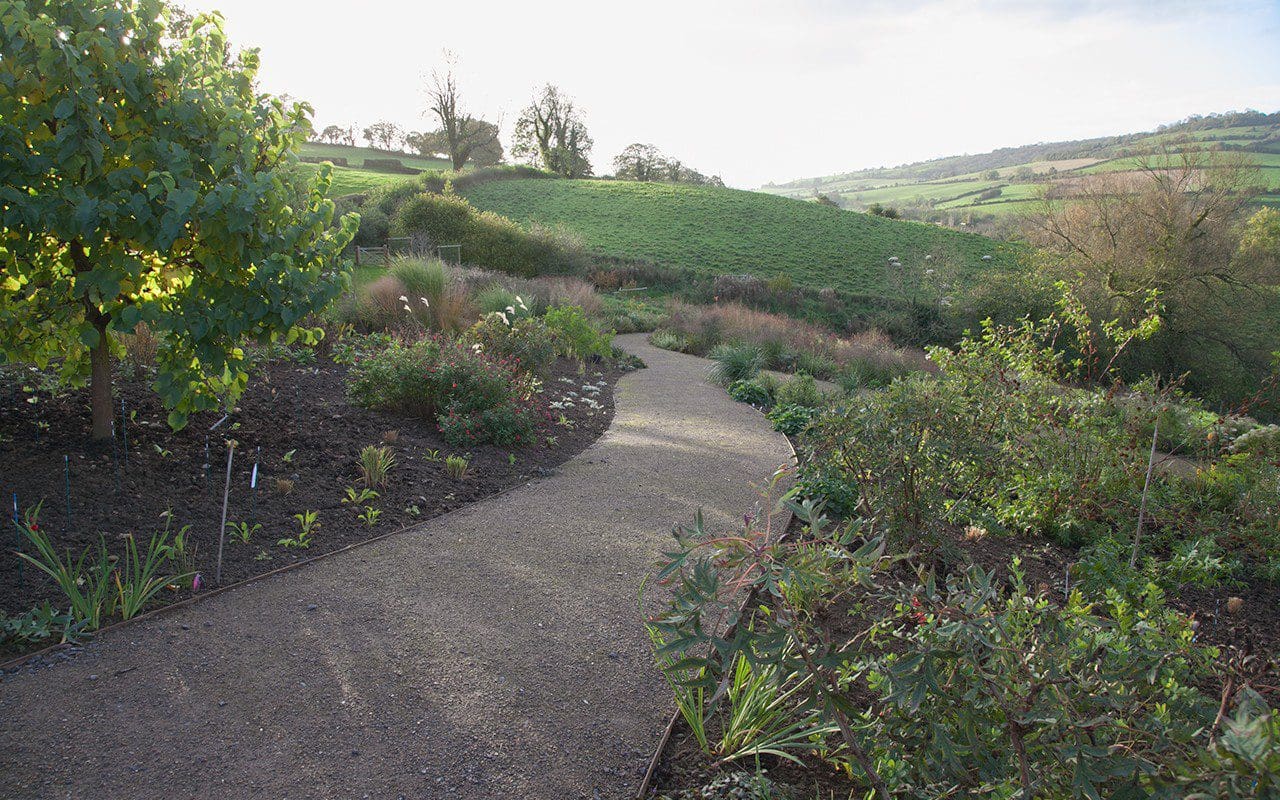 The central path with the top and central beds to either side
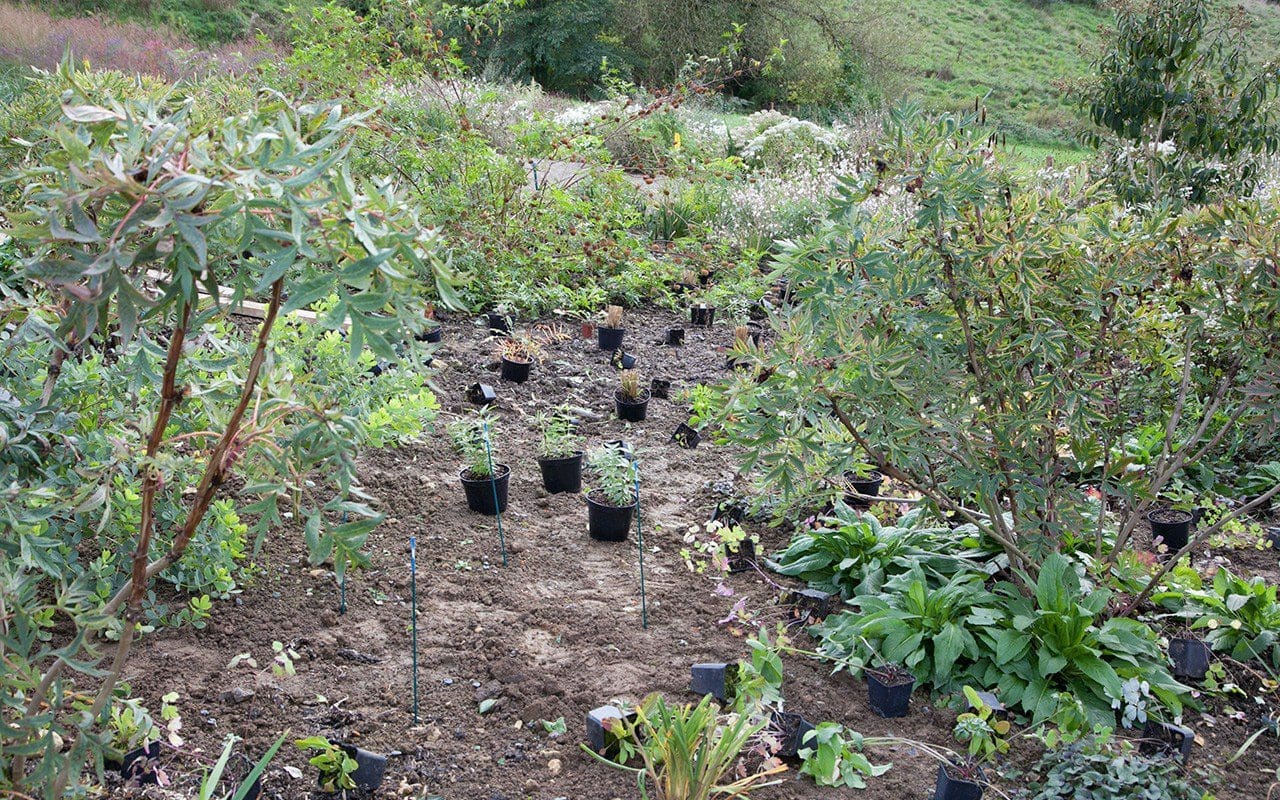 The top of the central bed
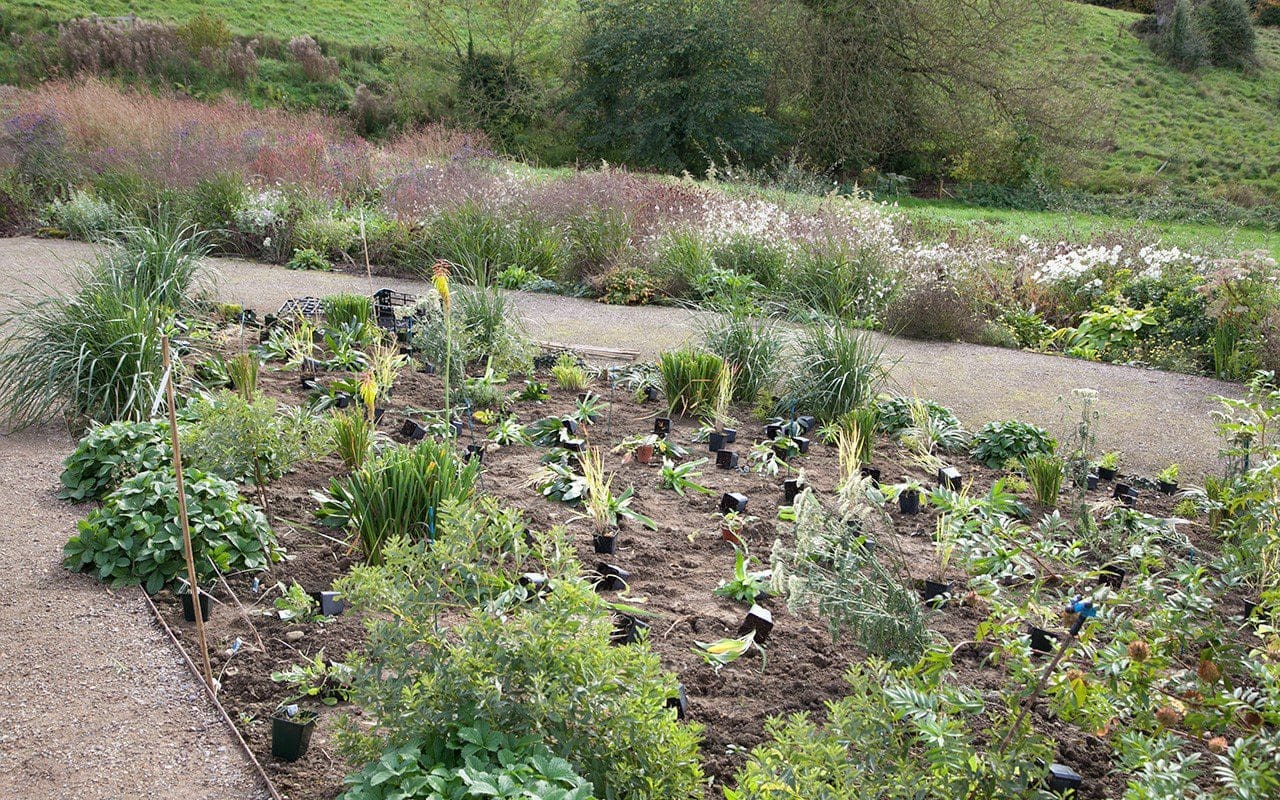 The end of the central bed
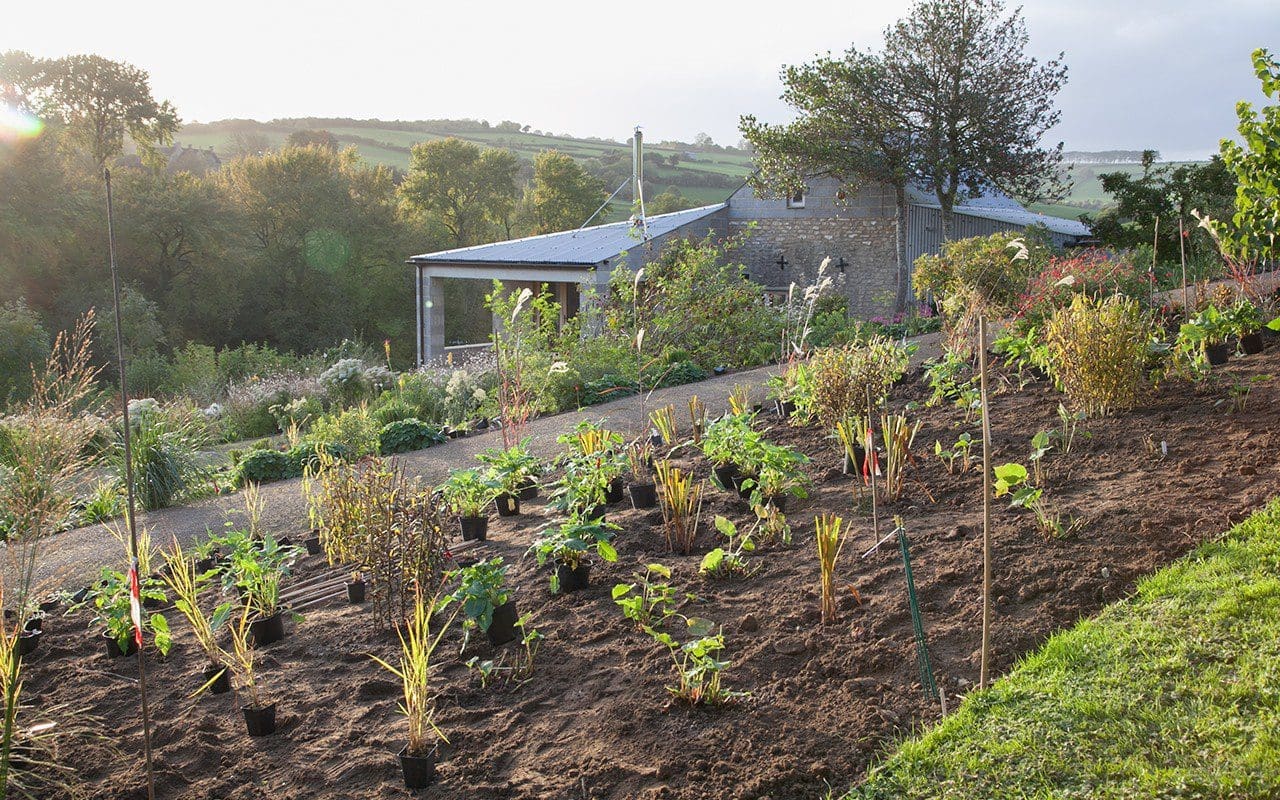 The middle of the top bed
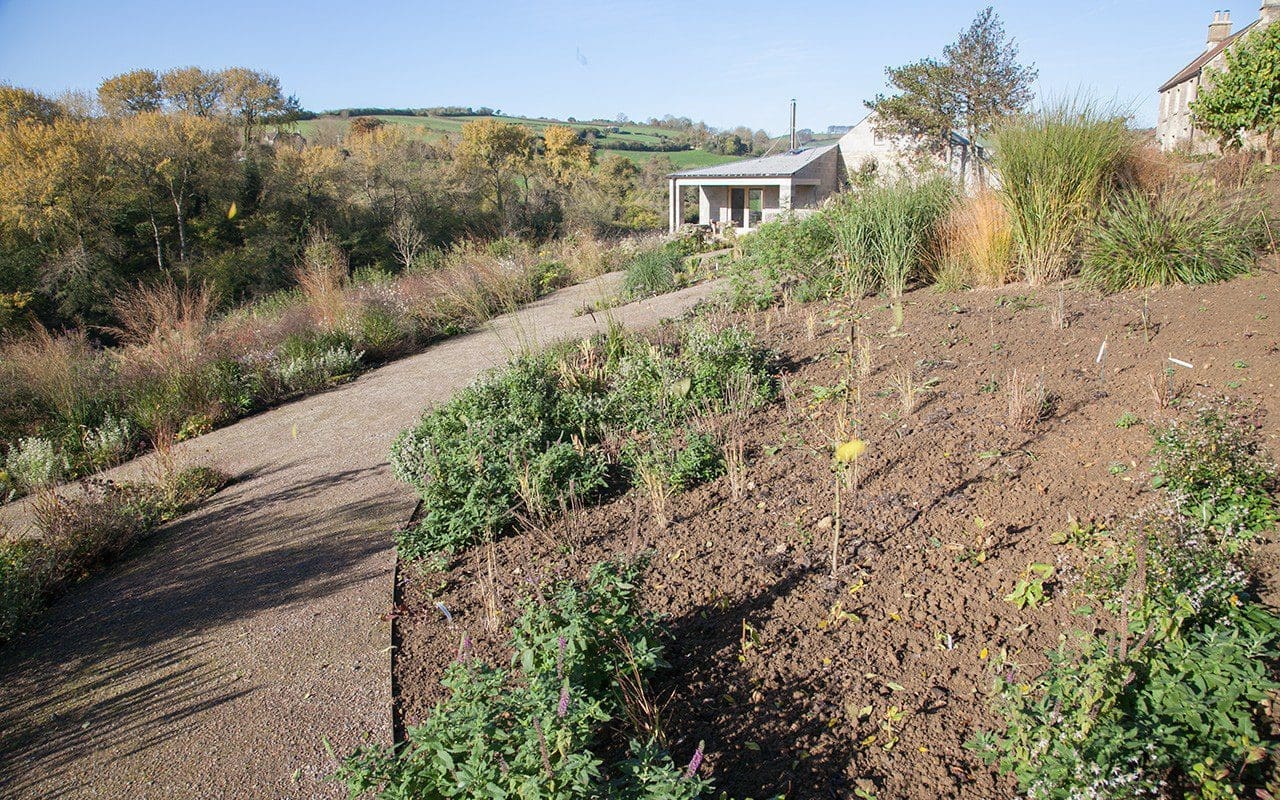 The end of the top bed
My autumn list was driven by a desire to bring brighter, more eye-catching colour closer to the buildings, thereby allowing the softer, moodier colour beyond to recede and diminish the feeling of a boundary. The ox-blood red Paeonia delavayi that were moved from the stock beds in the spring and now form a gateway to the garden, were central to the colour choices here. They set the base note for the heat of intense, vibrant reds and deep, hot pinks including Hemerocallis ‘Stafford’, Crocosmia ‘Hellfire’ and Salvia ‘Jezebel’ on the upper reaches. The yolky Kniphofia ‘Minister Verschuur’, lime-green euphorbias and the primrose yellow of Hemerocallis altissima drove the palette in the centre of the garden.
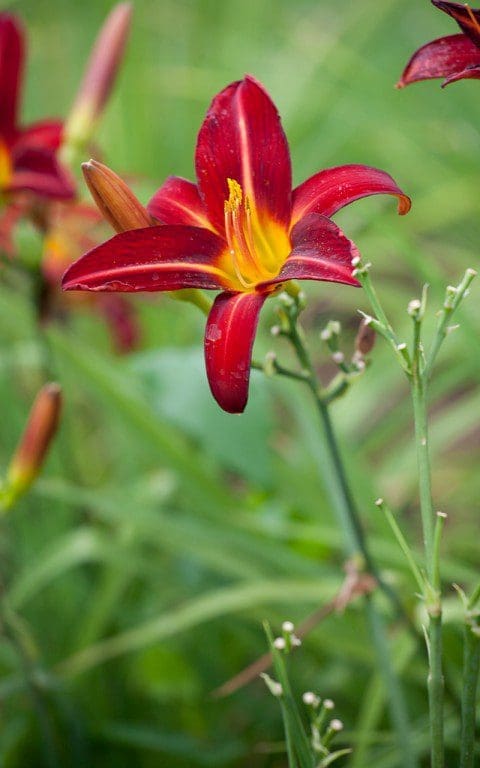 Hemerocallis ‘Stafford’
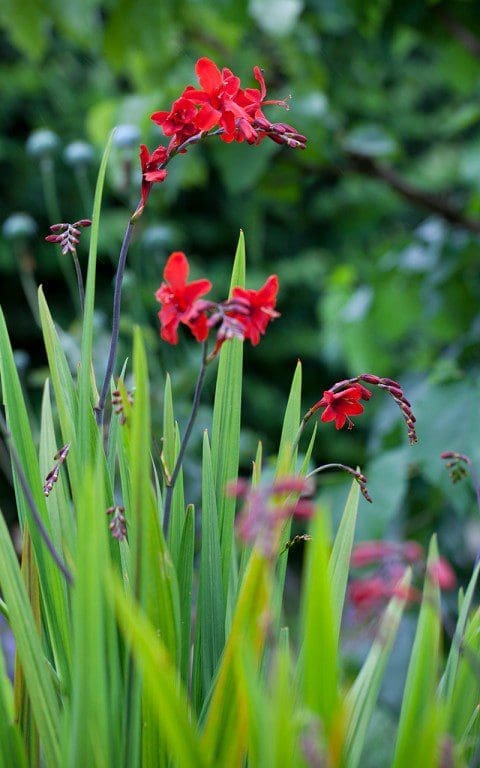 Crocosmia ‘Hellfire’
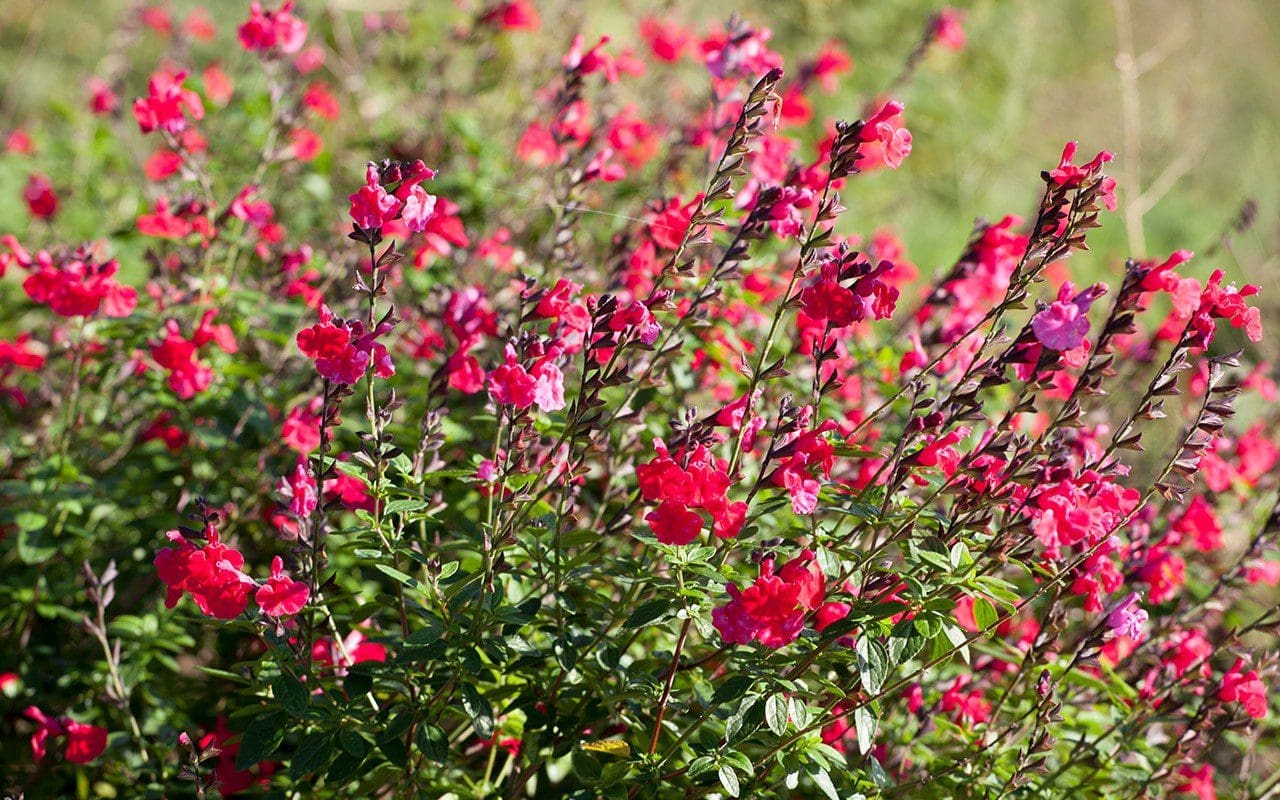 Salvia ‘Jezebel’
Once you have your palette in list form, it is then possible to break it down again into groups of plants that will come together in association. Sometimes the groups have common elements like the Panicum virgatum ‘Shenandoah’, which link the new beds to the ones below them. Although I don’t want the garden to be dominated by grasses, they make a link to the backdrop of the meadows and the ditch. They are also important because they harness the wind which moves up and down the valley, catching this unseen element best. Each variety has its own particular movement; the Molinia caerulea ‘Transparent’, tall and isolated and waving above the rest, registers differently from the moody mass of the ‘Shenandoah’, which run beneath as an undercurrent.
To play up the scale in the top bed, so that you feel dwarfed in the autumn as you walk the grassy path, I have planned for a dramatic, staggered grouping of Panicum virgatum ‘Cloud Nine’. They will help to hold the eye mid-way so the planting is revealed in chapters before and then after. This lofty grass with its blue-grey cast will also separate the red and pink section from the violets and blues that pick up in the lower parts of the walk to link with the planting beyond that was planted in the spring. These dividers, or palette cleansers, are important, for they allow you to stop one mood and start another without it jarring. One combination of plants can pick up and contrast with the next without confusion and allow you to keep the varieties in your plant list up for interest and diversity, without feeling busy.
Each combination within the planting has its own mood or use. Spring-flowering tellima and pulmonaria will drop back to ground-cover after the mulberry comes into leaf and the garden rises up around it. Aster ericoides ‘Pink Cloud’ and Schizostylis coccinea ‘Major’ beneath the Paeonia delavayi for late season colour and interest. The associations that are designed to jump the path from one side to the other in order to bring the plantings together are key to cohesiveness. The sunny side of the path favours the plants in the mix that like exposure, the shady side, those that prefer the cool, and so I have had to be aware of selecting plants that can cope with these differing conditions. Consequently, I have included plants such as Eurybia divaricata that can cope with sun or shade, to bring unity across the beds. The taller groupings, which I want to feel airy in order to create a feeling of space and the opportunity of movement, always have a number of lower plants deep in their midst so that there is room and breathing space beneath. Sometimes these are plants from the edge plantings such as Calamintha sylvatica ‘Menthe’, or a simple drift of Persicaria amplexicaulis ‘Blackfield’, which sweeps through the tall tabletop asters (Aster umbellatus). This undercurrent of the adaptable persicaria, happy in sun or shade, maintains a fluidity and movement in the planting.
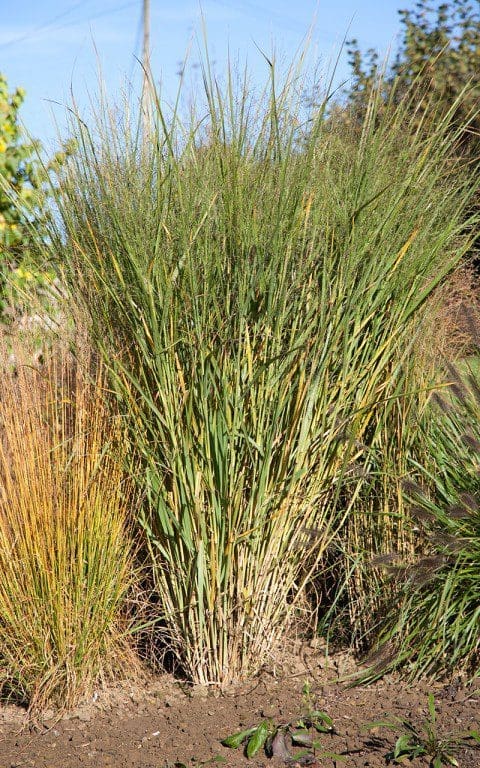 Stock plants of Panicum virgatum ‘Cloud Nine’
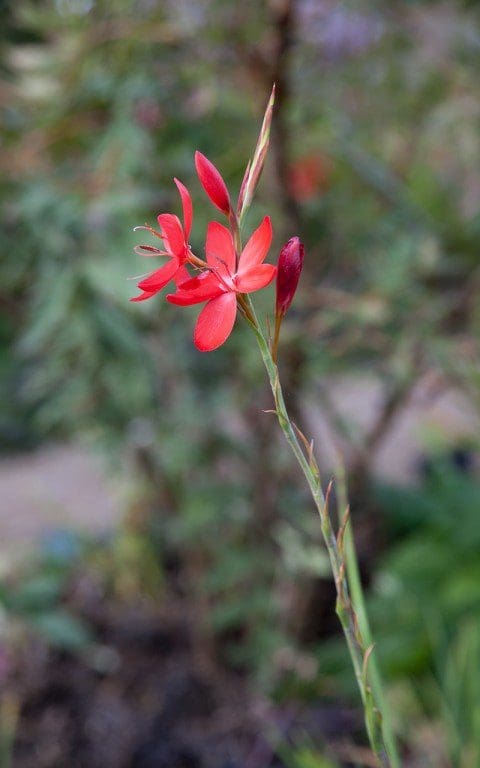 Schizostylis coccinea ‘Major’
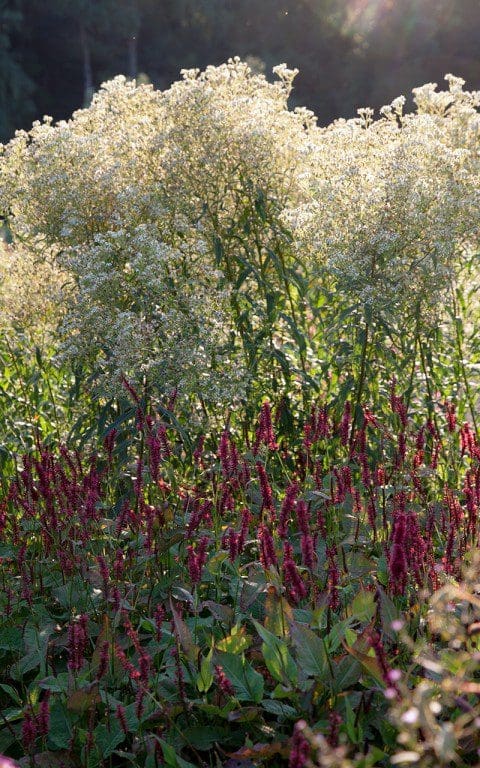 Aster umbellatus and Persicaria amplexicaulis ‘Blackfield’
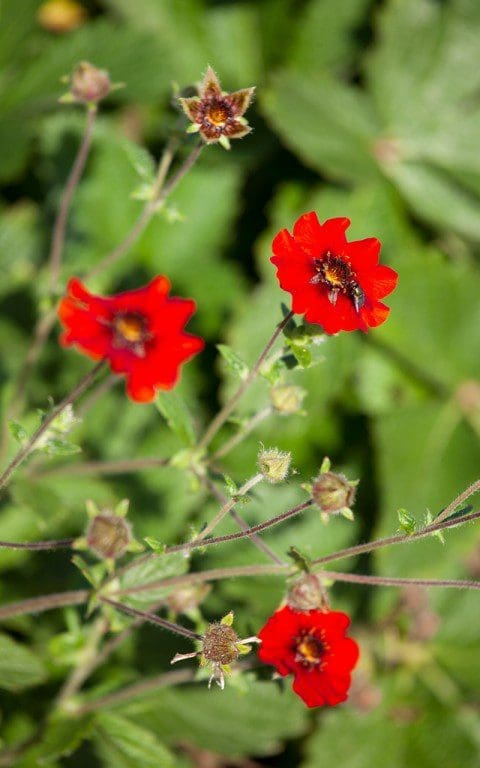 Potentilla ‘Gibson’s Scarlet’
The combinations, sixteen in total, were then focused by zoning them on a plan. The plan allowed me to group the plants by zone in the correct numbers along the paths for ease of placement. Marking out key accent plants like the Panicum ‘Cloud Nine’, Glycyrrhiza yunnanensis, Hemerocallis altissima and the kniphofia were the first step in the laying out process. Once the emergent plants were placed, I follow through with the mid-level plants that will pull the spaces together. The grasses, for instance, and in the central bed a mass of Euphorbia ceratocarpa. This is a brilliant semi-shrubby euphorbia that will provide an acid-green hum in the centre of the garden and an open cage of growth within which I can suspend colour. The luminous pillar-box red of Potentilla ‘Gibson’s Scarlet’ and starry, white Dahlia merckii ‘Alba’. Short-lived Digitalis ferruginea were added last to create a level change with their rust-brown spires. However, I am under no illusion that they will stay where I have put them. Digitalis have a way of finding their own place, which isn’t always where you want them and, when they re-seed, I fully expect them to make their way to the edges, or even into the gravel of the paths.
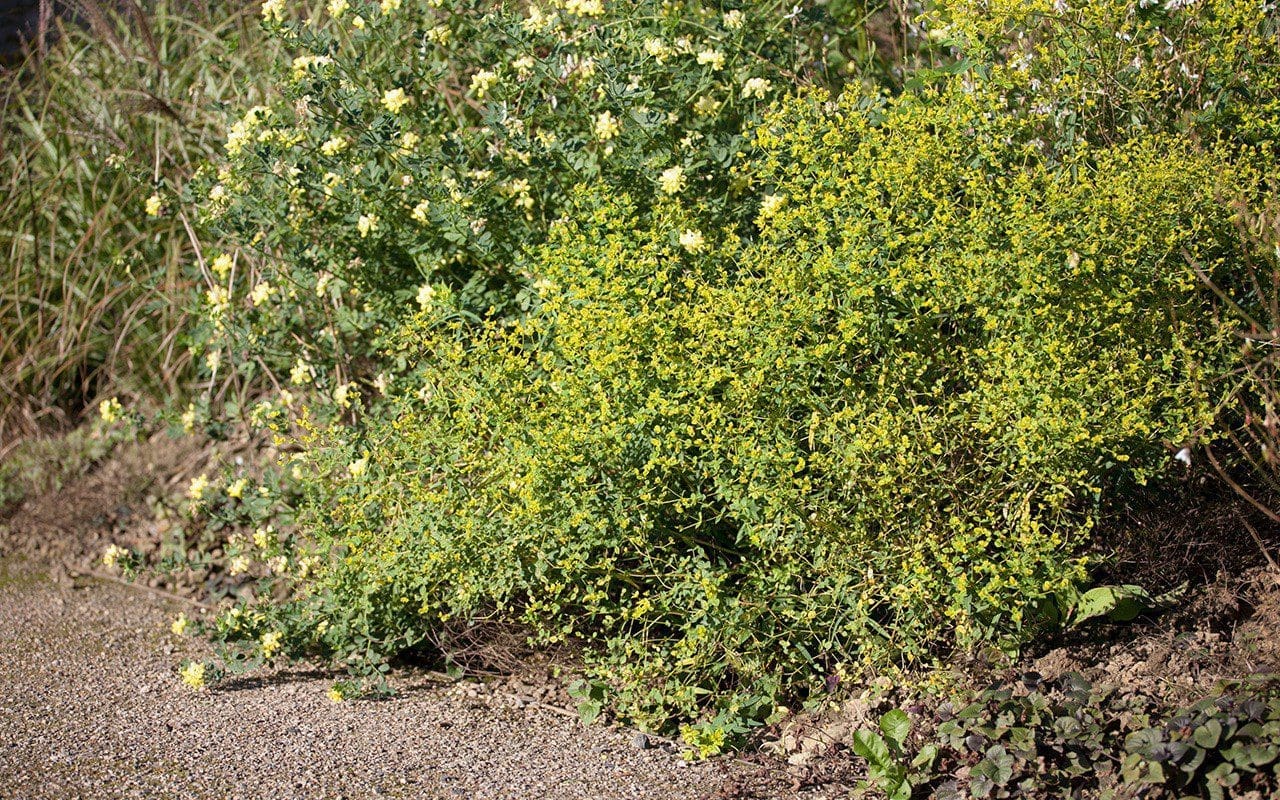 Euphorbia ceratocarpa
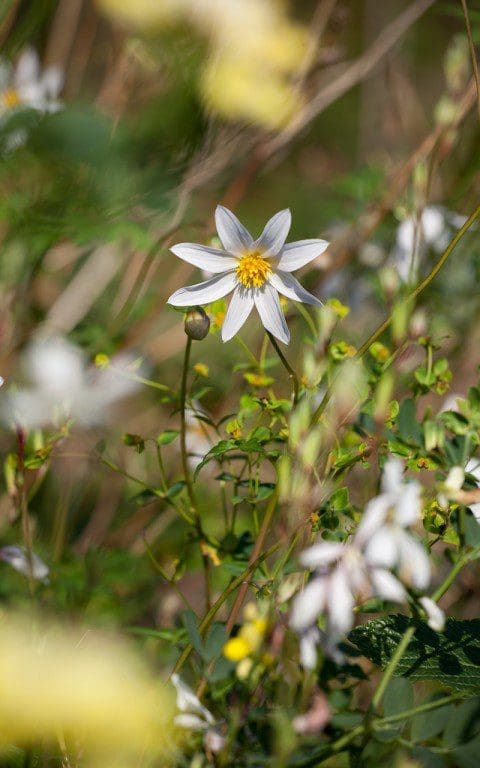 Dahlia merckii ‘Alba’
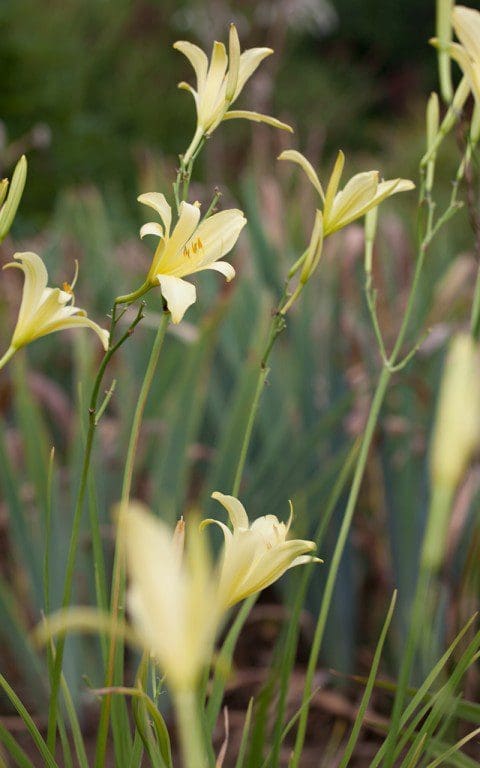 Hemerocallis altissima
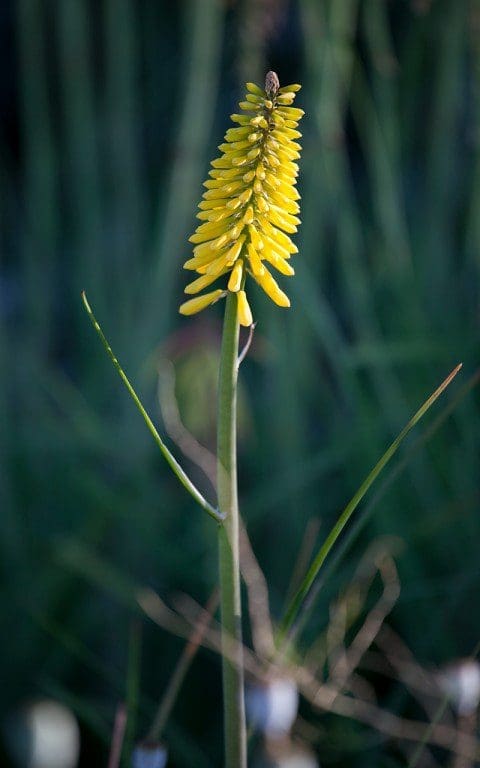 Kniphofia ‘Minister Verschuur’
Over the summer, I have been producing my own plants from seed and it has been good to feel uninhibited with a couple of hundred Bupleurum longifolium ‘Bronze Form’ at my disposal to plug any gaps that the more calculated plans didn’t account for. Though I am careful not to introduce plants that will self-seed and become a problem on our hearty soil, a few well-chosen colonisers are always welcome for they ensure that the garden evolves and develops its own balance. I’ve also raised Aquilegia longissima and the dark-flowered Aquilegia atrata in number to give the new planting a lived-in feeling in its first year. Aquilegia downy mildew is now a serious problem, but by growing from seed I hope to avoid an accidental introduction from nursery-grown stock. The columbines are drifted to either side of the path through the blood-red tree peonies and my own seed-raised Hesperis matronalis var. albiflora. For now they will provide me with an early fix. Something to kick-start the new planting and then to find their own place as the garden acquires its balance.
Words: Dan Pearson / Photographs: Huw Morgan
Published 28 October 2017
The self-sown sunflowers from the previous incarnation of the garden were the reminder that, just a year ago, we were growing the last of the vegetables here. I had allowed them the territory in the knowledge that this would be the end of their era, for they were in the bed that I now need back to complete the planting of the garden.
Felling them before they were finished was a relief, for suddenly, once they were gone, there was breathing space and the room to imagine the new planting. I’d also left the aster trial bed until the very last minute, eking out the weeks and then the days of its final fling. On the bright October day before we were due to lift, the bed was alive with honeybees, making the final selection of those that were to be kept for the garden that much more difficult. It was time to liberate the last of the stock beds, though, and to prepare the ground they occupied for a new planting.
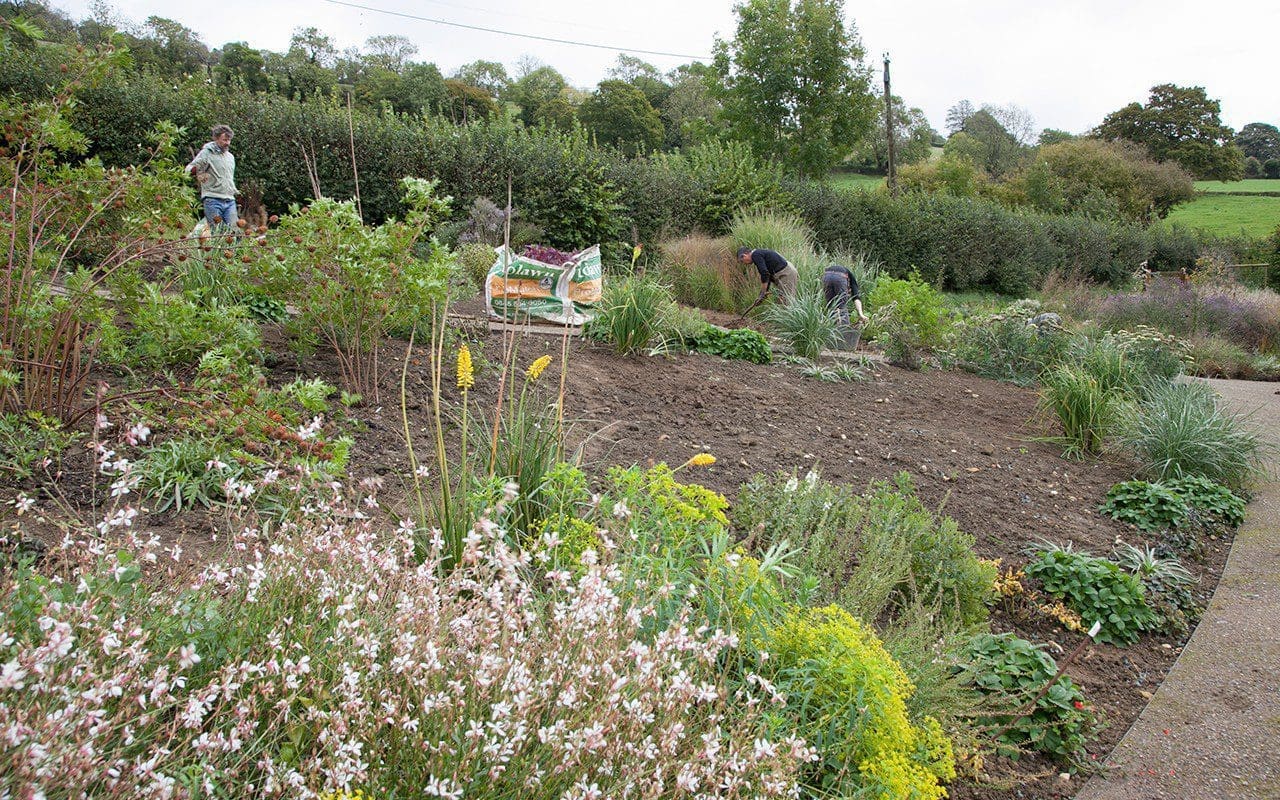 The central bed cleared of sunflowers and ready for planting. The edge planting went in in April
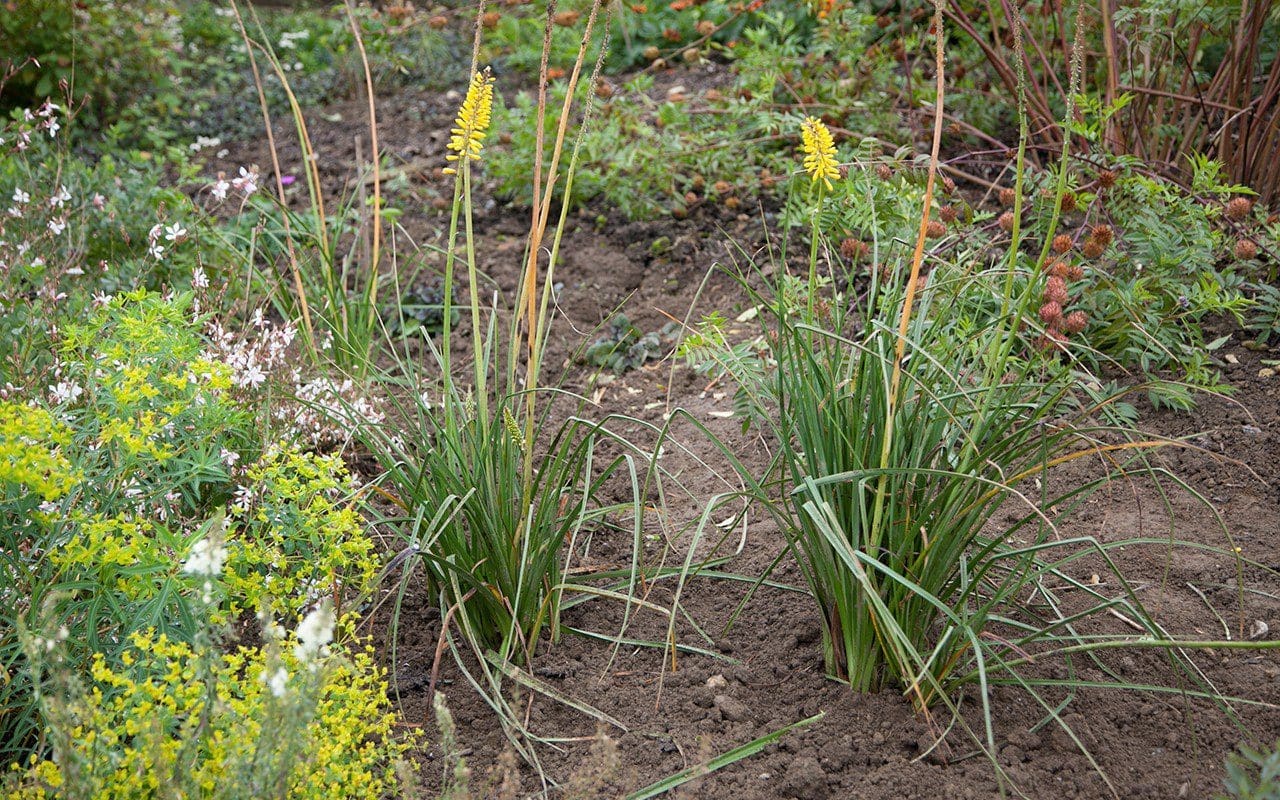 Newly planted divisions of Kniphofia ‘Minister Verschuur’ in the cleared central bed
Planning what to keep and what to part with is difficult until the moment you make the first move. Over the last three years we have been keeping a close eye on the asters that will make it into the new planting. Keeping the best is the only option, for we do not have the space elsewhere and the overall composition is dependent upon every choice being right for the mood and the feeling that we are trying to create here. So gone are the Symphyotrichum ‘Little Carlow’ which, although a brilliant performer, needing no staking and being reliable and clump-forming, are altogether too dominant in volume and colour. Aster novae-angliae ‘Violetta’ is gone too. Despite my loving the richness of its colour, having got to know it in the trial bed I find it rather stiff and heavy and I want the asters here to dance and mingle and not weight the planting down.
The Aster turbinellus, for instance, has been retained for the space and the air between the flowers, as has Symphyotrichum ericoides ‘Pink Cloud’ for its sprays of tiny, shell-pink flowers. I have also kept the late-flowering Aster trifoliatus subsp. ageratoides ‘Ezo Murasaki’ for its modest habit and almost iridescent violet stars held on dark, wiry stems. I have always known that Aster umbellatus would feature in the planting, and so I lifted and split my three year old trial plant last autumn and divided it into six to bulk up this summer. There were many more that didn’t make the grade though, and I was torn about losing them, my self-discipline wavering at times. However, Jacky and Ian who help us in the garden eased my conscience by taking a number of the rejects home with them, and the space left behind, now that they are gone and I have finally committed, is ultimately more inspiring.
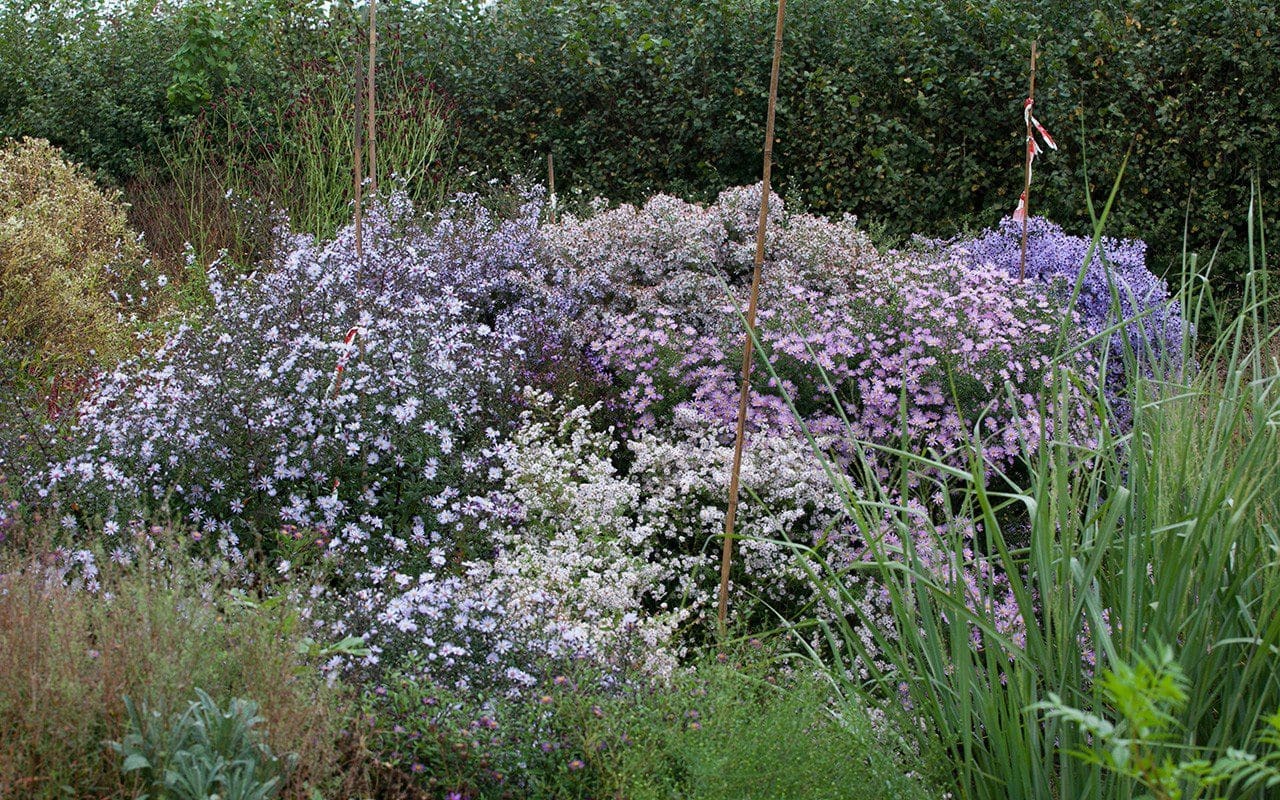 Asters to be kept were marked with canes
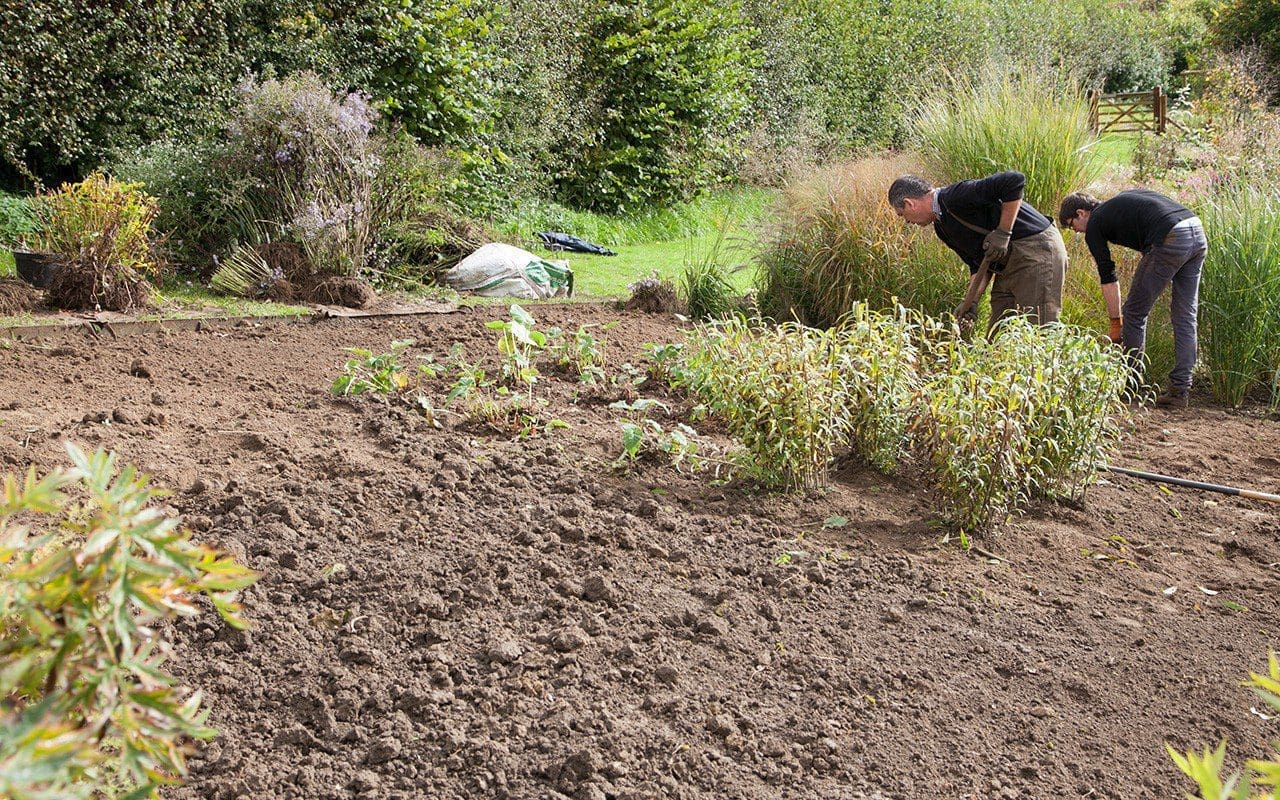 Ian and Sam digging over the upper bed after removal of the asters. The Aster umbellatus divisions and Sanguisorba ‘Blackfield’ stock plants in the middle of the bed await replanting
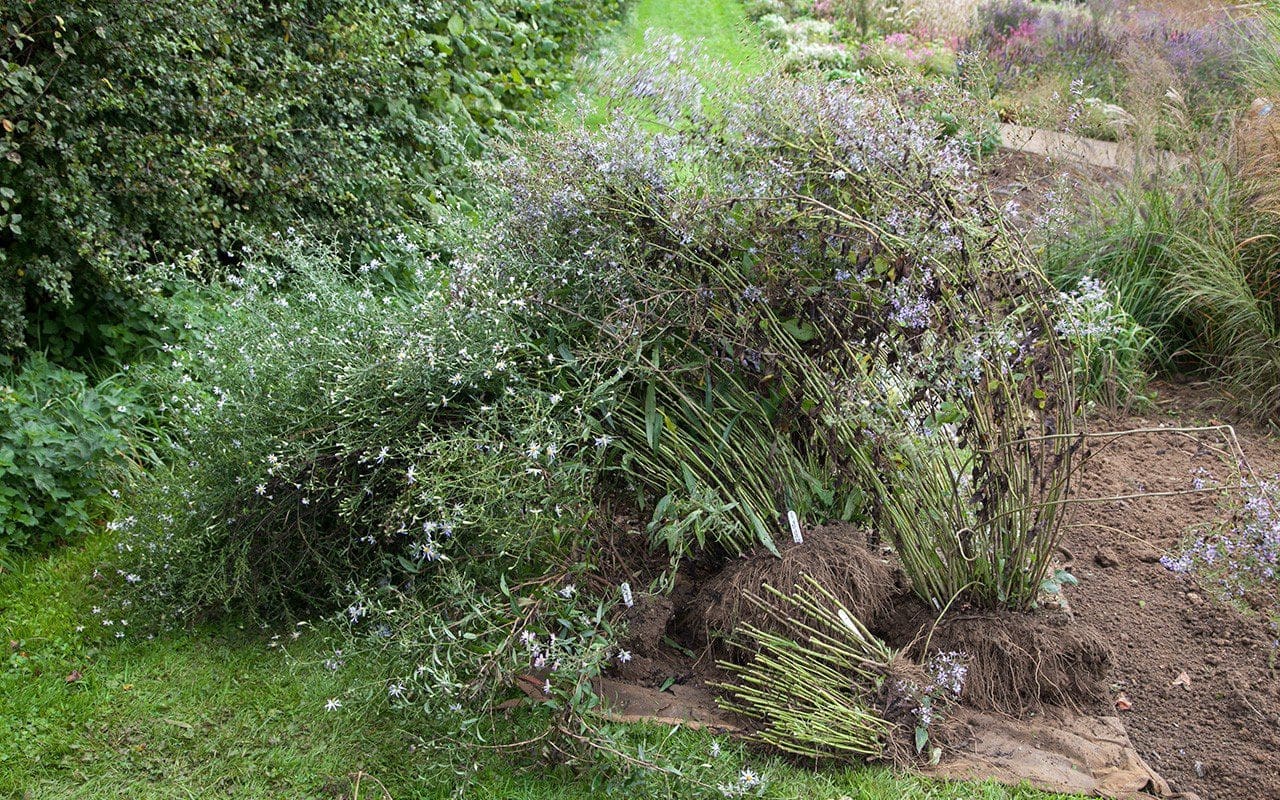 The reject asters
This is the second phase of rationalising the stock beds. In the spring, and to enable the preparation of the central bed, I split and divided the plants that I knew I would need more of come autumn, and lined these out in the top bed to bulk up; the lofty Hemerocallis altissima, brought with me from Peckham and prized for its delicate, night-scented flowers, the refined Hemerocallis citrina x ochroleuca, and the true form of Hemerocallis ‘Stafford’, originally divisions from plants in the Barn Garden at Home Farm which I planted in 1992.
I have not found a red day-lily I like more for its rustiness and elegance, and some of the ‘Stafford’ I have been supplied with more recently have notably less refined flowers and a brasher tone. I have planned for it to go amongst molinias so that the flowers are suspended amongst the grasses. Hemerocallis are easily divided and in the spring the stock plants were big enough to split into ten or so; the numbers I needed for their long-awaited integration into the planting. In readiness for setting out, and with the asters gone, we have now reduced the foliage of the daylilies by half, lifted them and then left them heeled in for ease of lifting and replanting.
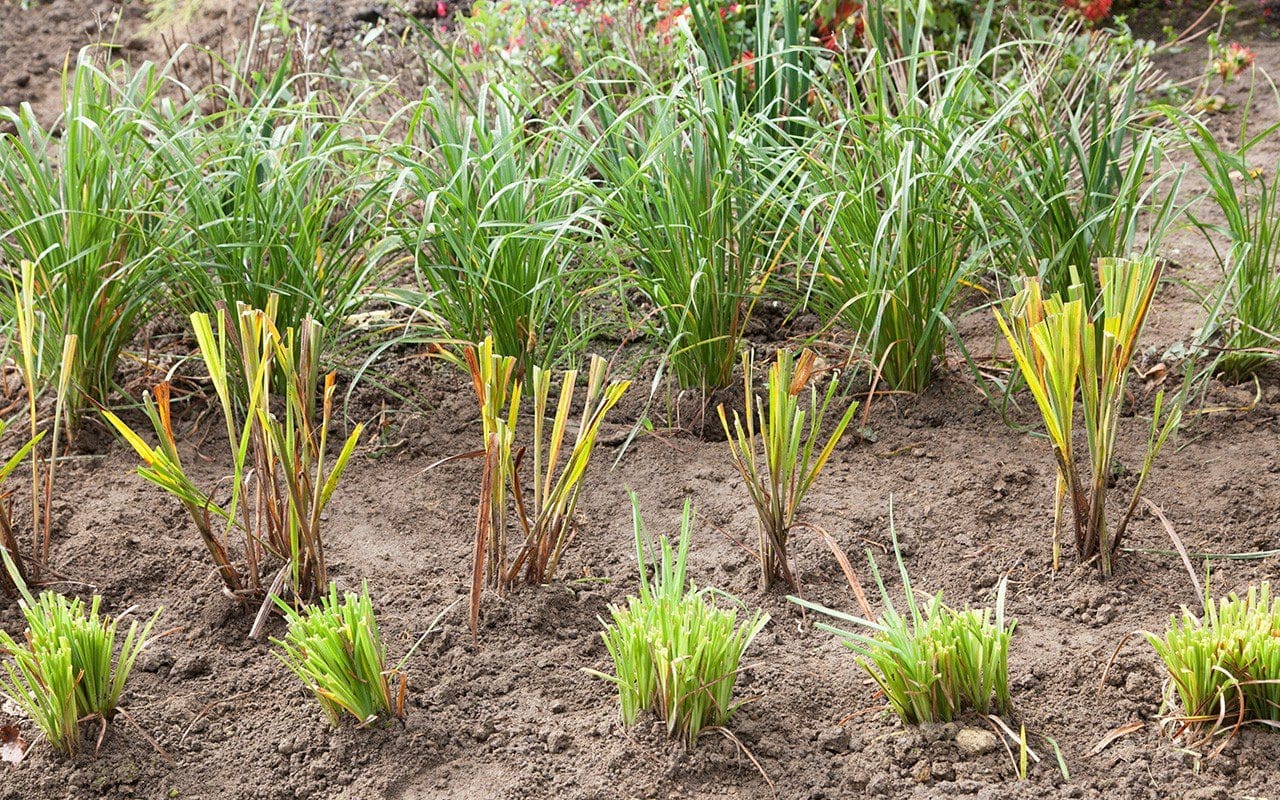 Hemerocallis, crocosmia and kniphofia stock plants cut back, heeled in and ready for replanting
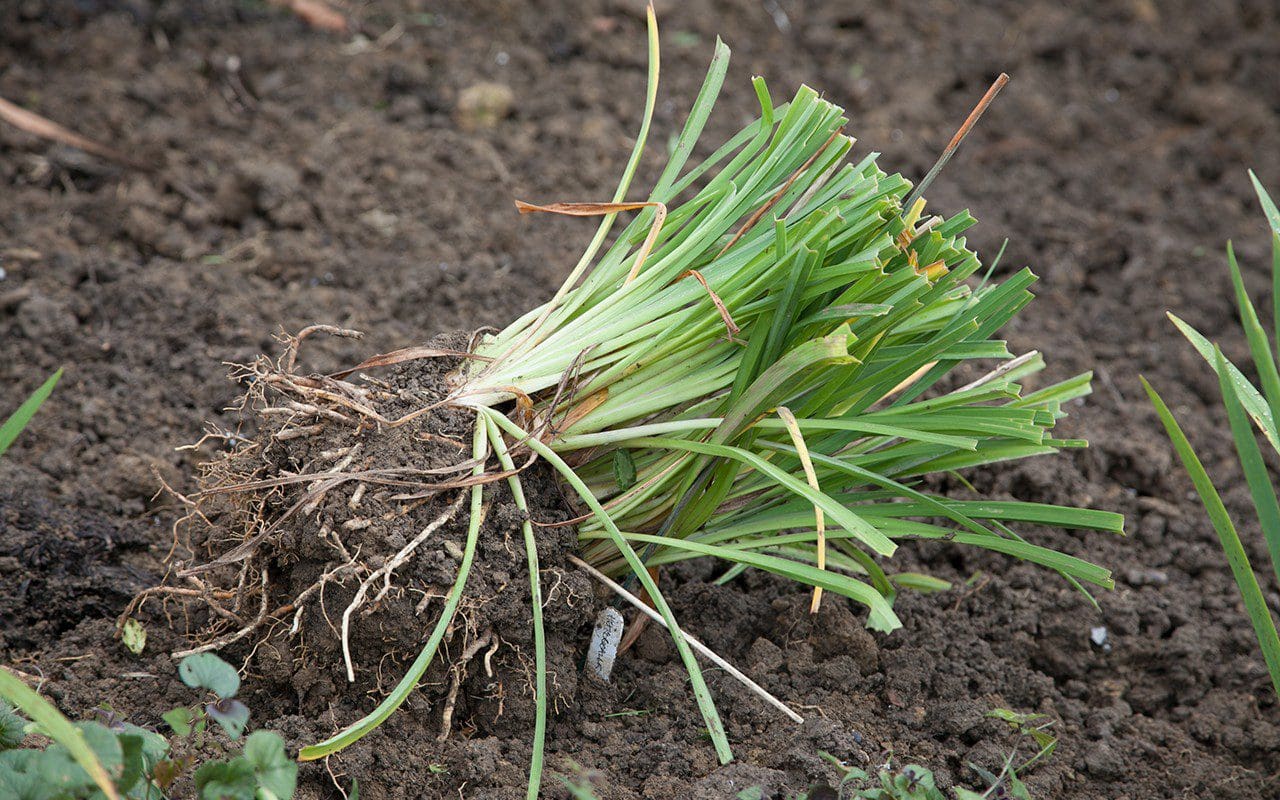 A division of Hemerocallis ‘Stafford’ laid out for planting
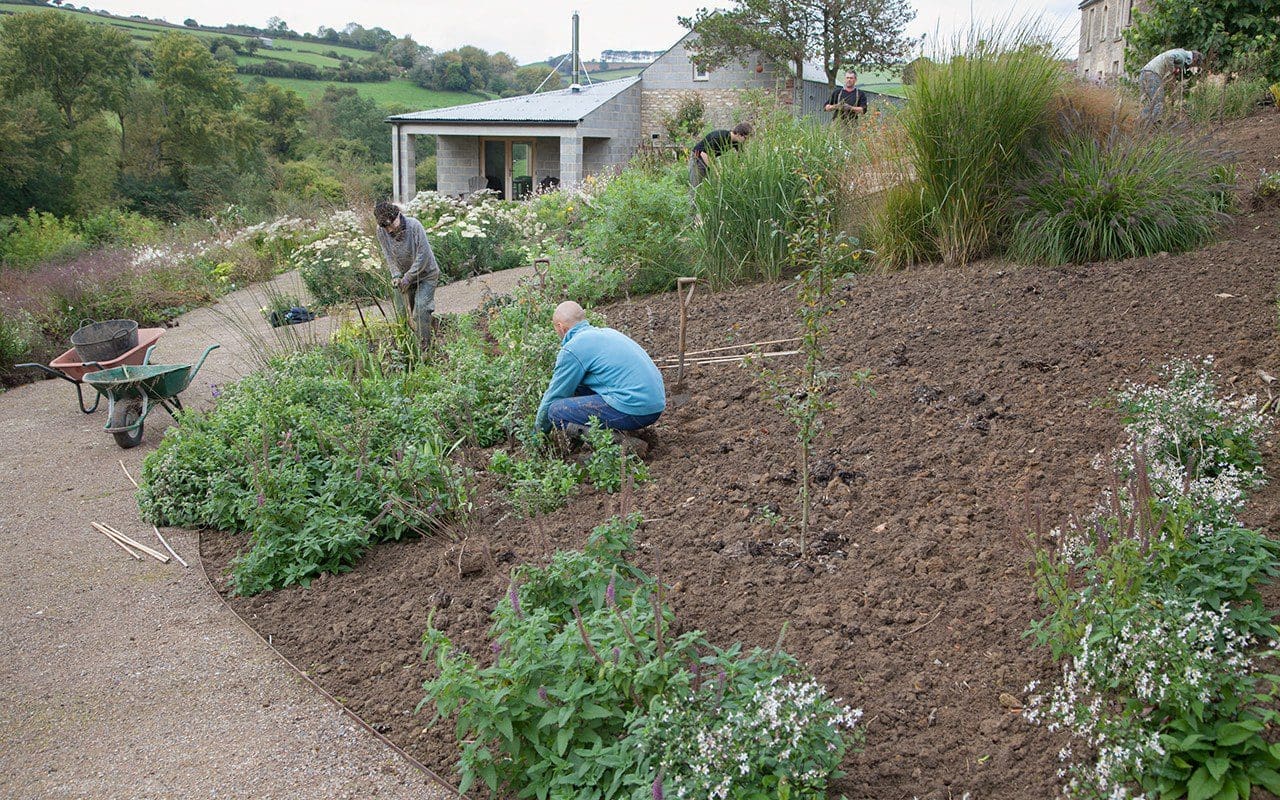 Jacky and Ray clearing and preparing the end of the upper bed
The kniphofia and iris I had decided to keep went through the same process in March, and so the Kniphofia ‘Minister Verschuur’ and Iris magnifica were moved directly into their new positions where, just a week before, the sunflowers had towered. Similarly, the Gladiolus papilio ‘Ruby’ and Crocosmia ‘Hellfire’, which have both increased impressively, were lifted and moved into their new and final positions. This was in order to clear the old stock beds to make way for the autumn splits and keep the canvas as empty as possible so that I can see the space without unnecessary clutter when setting out.
The remaining trial rows – some Persicaria amplexicaulis ‘Blackfield that I want in number and two white sanguisorba that will provide height and sparkle in the centre of the garden – were cut back to knee height, lifted and then split in text-book fashion with two border forks back to back to prise the clumps apart. Where the plants were not big enough I was careful not to be too greedy with my splits, dividing them into thirds or quarters at most.
 Dan splitting a stock plant of sanguisorba with two border forks
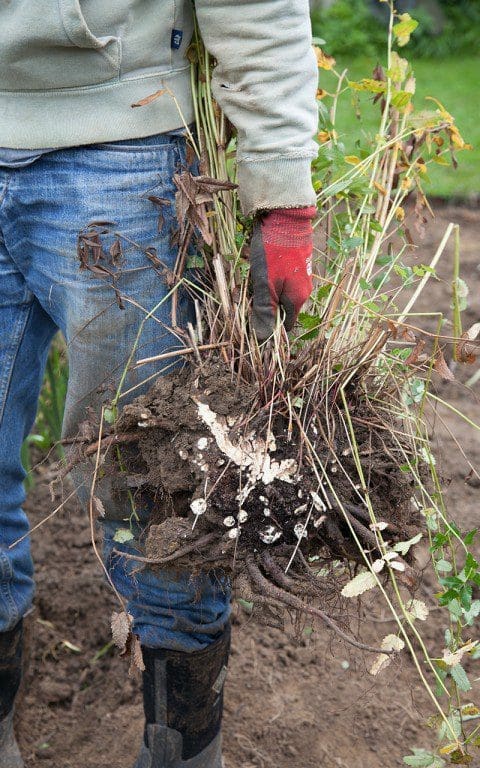 A sanguisorba division ready for heeling in
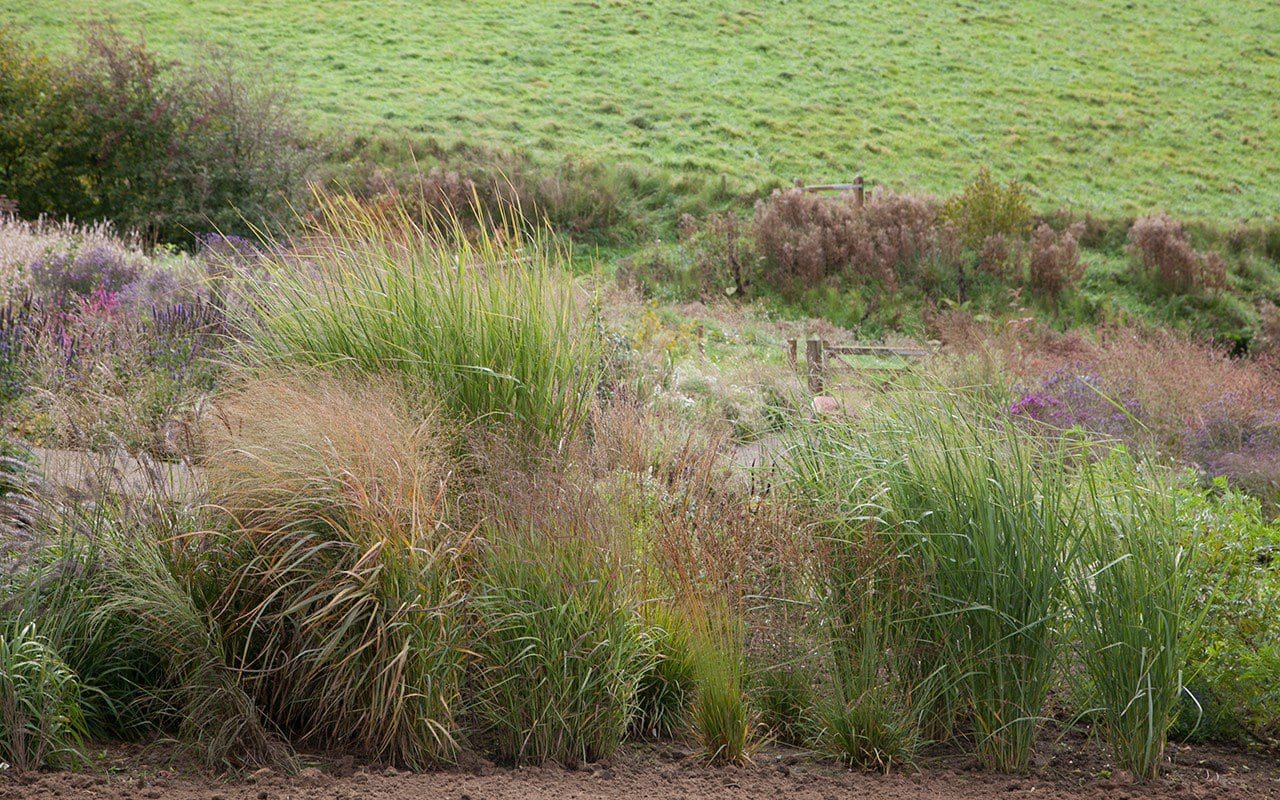 The grasses to be reused from the trial bed will be divided and planted out next spring
Although October is the perfect month for planting, with warmth still in the ground to help in establishing new roots before winter, I have had to work around the trial bed of grasses and they now stand alone in the newly empty bed. Although I will be planting out pot-grown grasses next week, autumn is not a good time to lift and divide grasses as their roots tend to sit and not regenerate as they do with a spring split.
The plants I put in around the Milking Barn this time last year are already twice the size of the same plants I had to wait to put in where the ground wasn’t ready until the spring. I hope that the same will be true of this next round of planting, which will sweep the garden up to the east of the house and complete this long-awaited chapter.
Words: Dan Pearson / Photographs: Huw Morgan
Published 21 October 2017
I am currently readying myself for the push required to complete the final round of planting in the new garden. The outer wrap went in at the end of March to provide the frame that will feather the garden into the landscape and, with this planting still standing as backdrop, I have been making notes to ensure that the segue into the remaining beds is seamless.
The growing season has revealed the rhythms and the plants that have worked, and the areas where tweaking is required. Whilst there is still colour and volume in the beds I want to be sure that I am making the right moves. The Gaura lindheimerei were only ever intended as a stopgap, providing dependable flower and shelter for slower growing plants. They have done just that, but at points over the summer their growth was too strong and their mood too dominant, going against much of the rest of the planting. This resulted in my cutting several to the base in July to give plants that were in danger of being swamped a chance, and so now they will all be marked for removal. Living fast and dying young is also the nature of the Knautia macedonica and they have also served well in this first growing season. However, their numbers will now be halved if not reduced by two-thirds so that the Molly-the-Witch (Paeonia mlokosewitschii) are given the space they need for this coming year and the Panicum virgatum ‘Shenandoah’ the breathing room they require now that they have got themselves established.
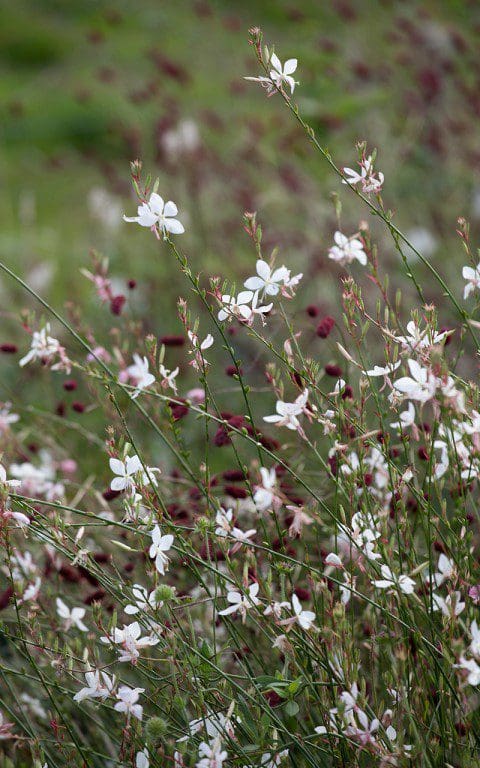 Gaura lindheimerei
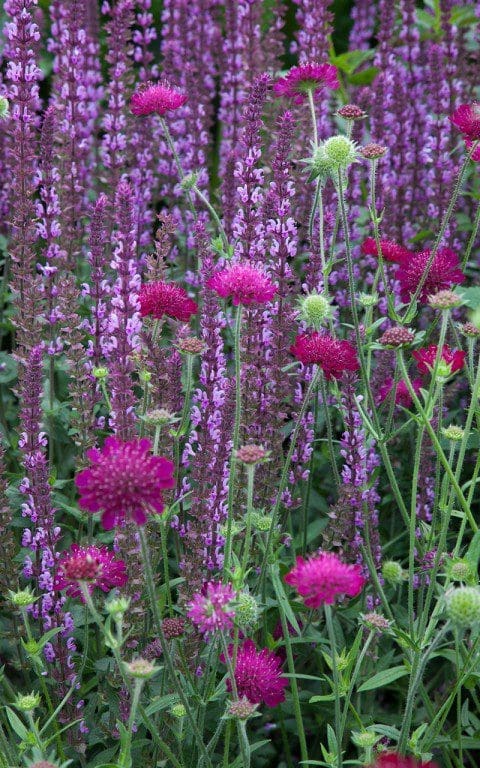 Knautia macedonica with Salvia nemerosa ‘Amethyst’
I will also be removing all of the Lythrum salicaria ‘Swirl’ and replacing it with Lythrum virgatum ‘Dropmore Purple’. I was so very sure when I had them in the stock beds that both would work in the planting but, once it was used in number, ‘Swirl’ was too dense and heavy with colour. The spires of ‘Dropmore Purple’ have air between them and this is what is needed for the frame of the garden not to be arresting on the eye and so that you can make the connection with softer landscape beyond.
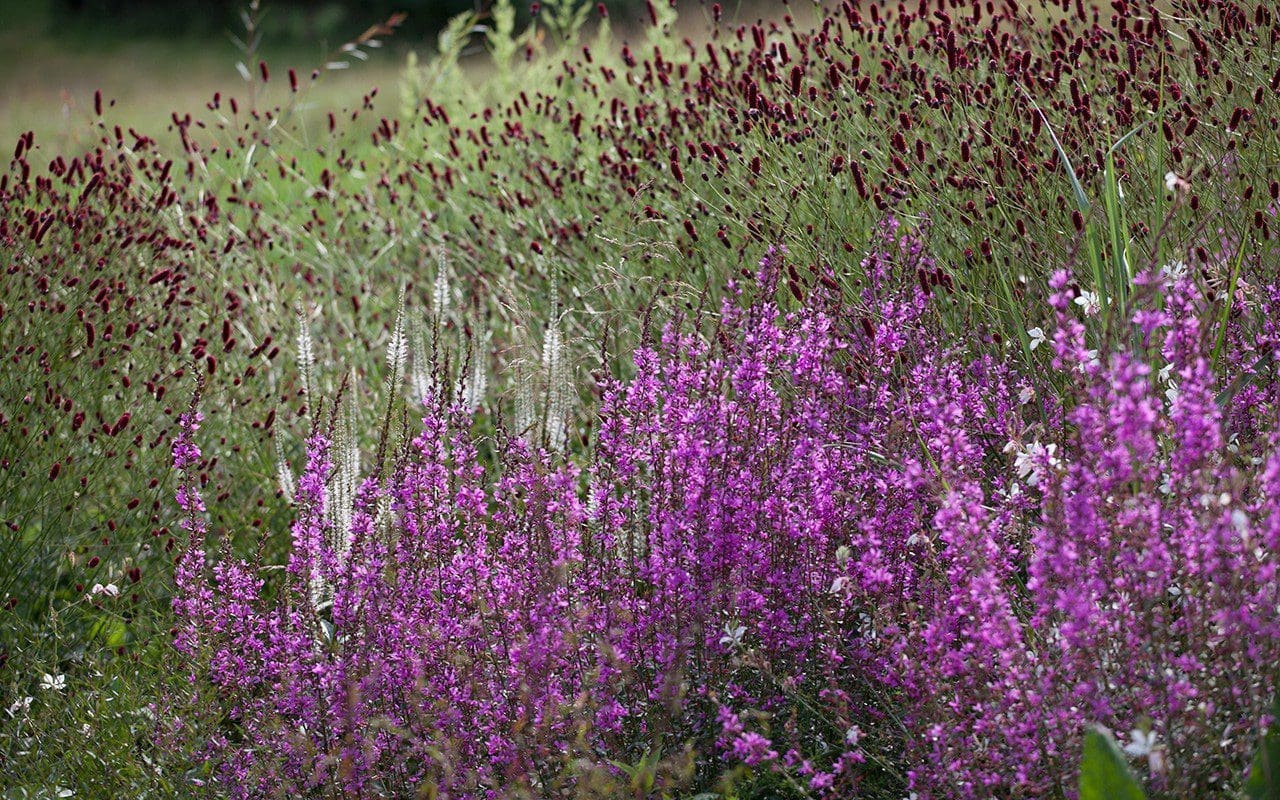 Lythrum virgatum ‘Dropmore Purple’ (front) with Veronicastrum virginicum ‘Album’ and Sanguisorba officinalis ‘Red Thunder’ (behind)
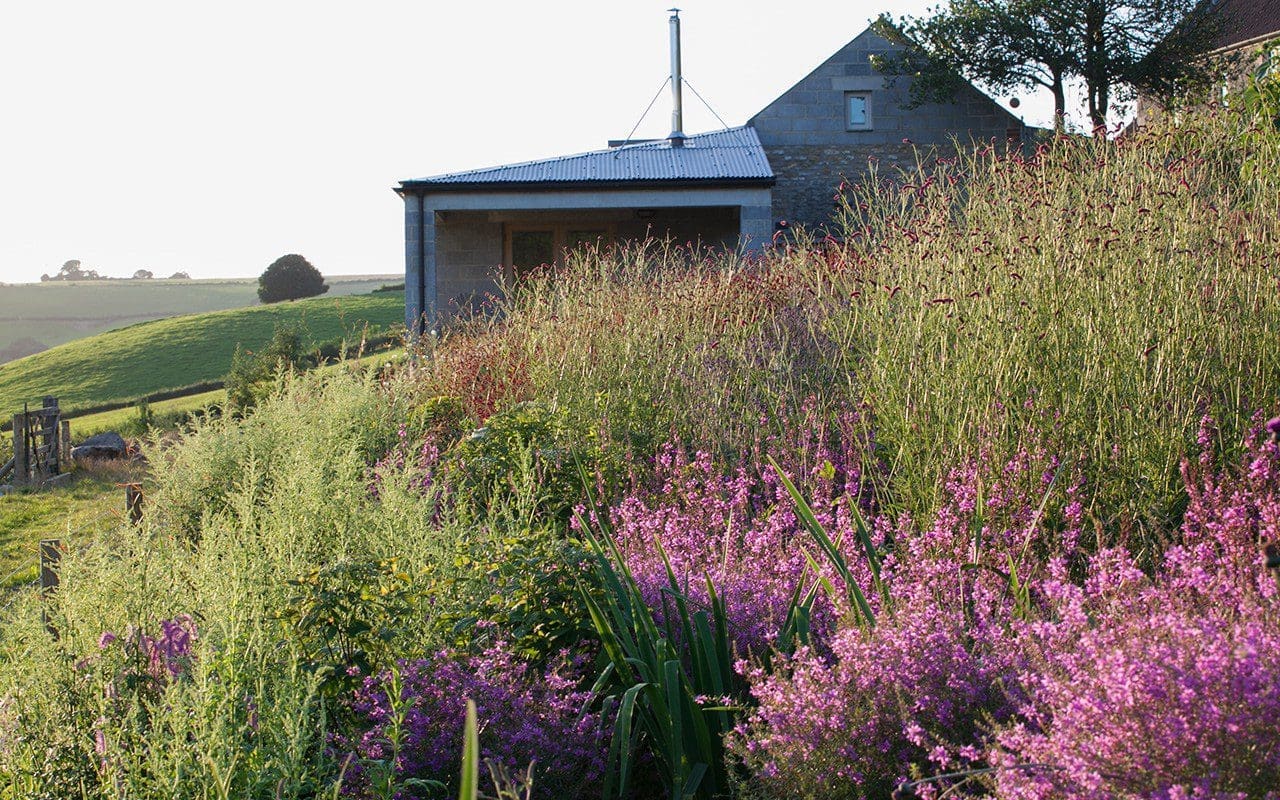 The larger volumes of Lythrum salicaria ‘Swirl’ can be seen at the front of this image
As a gauzy link into the surroundings and as a means of blurring the boundary the sanguisorba have been very successful. I trialled a dozen or so in the stock beds to test the ones that would work best here. I have used Sanguisorba officinalis ‘Red Thunder’ freely, moving them across the whole of the planting so their veil of tiny drumsticks acts like smoke or a base note. A small number of plants to provide cohesiveness in this outer wrap has been key so that your eye can travel and you only come upon the detail when you move along the paths or stumble upon it. Sanguisorba ‘Cangshan Cranberry’, perhaps the best of the lot for its finely divided foliage, picked up where I broke the flow of the ‘Red Thunder’ and, where variation was needed, Verbena macdougalii ‘Lavender Spires’ has proved to be tireless. Smattered pinpricks, bright mauve on close examination but thunderous and moody at distance, are right for the feeling I want to create and allow you to look through and beyond.
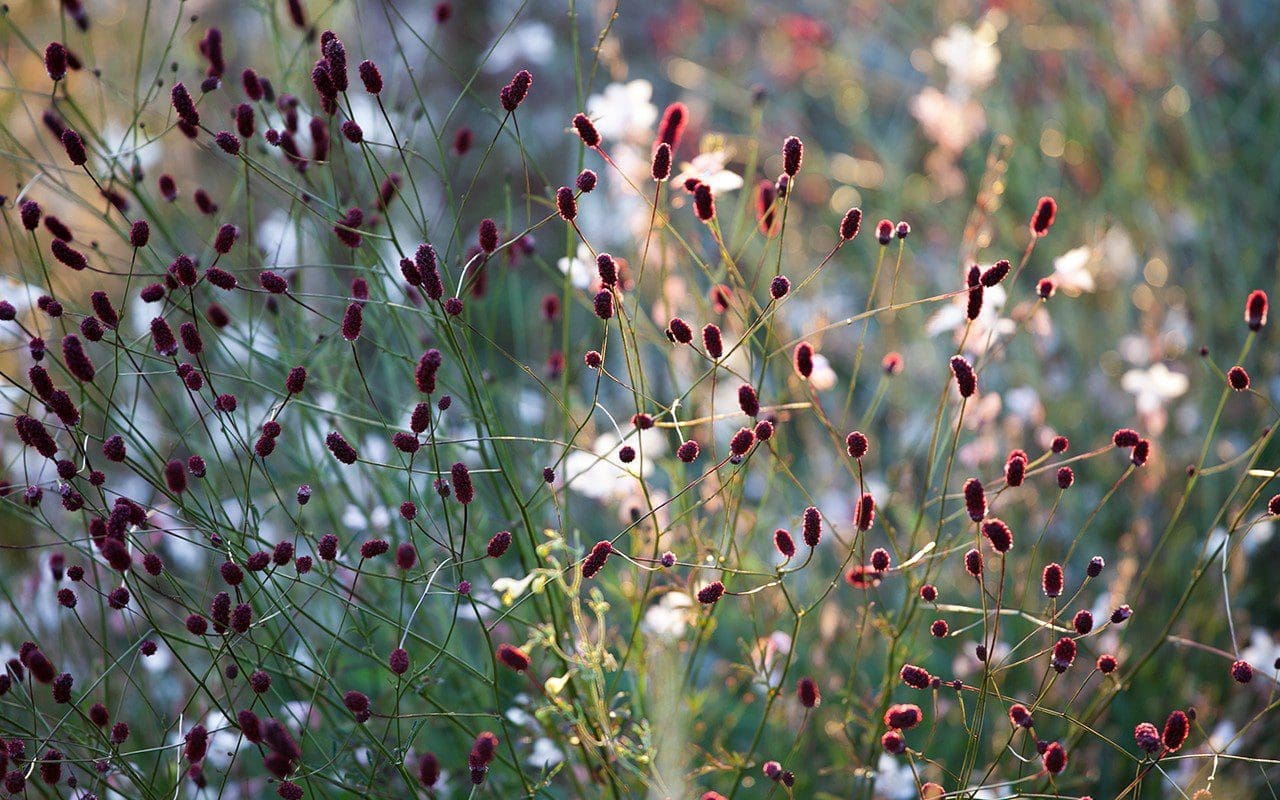 Sanguisorba officinalis ‘Red Thunder’
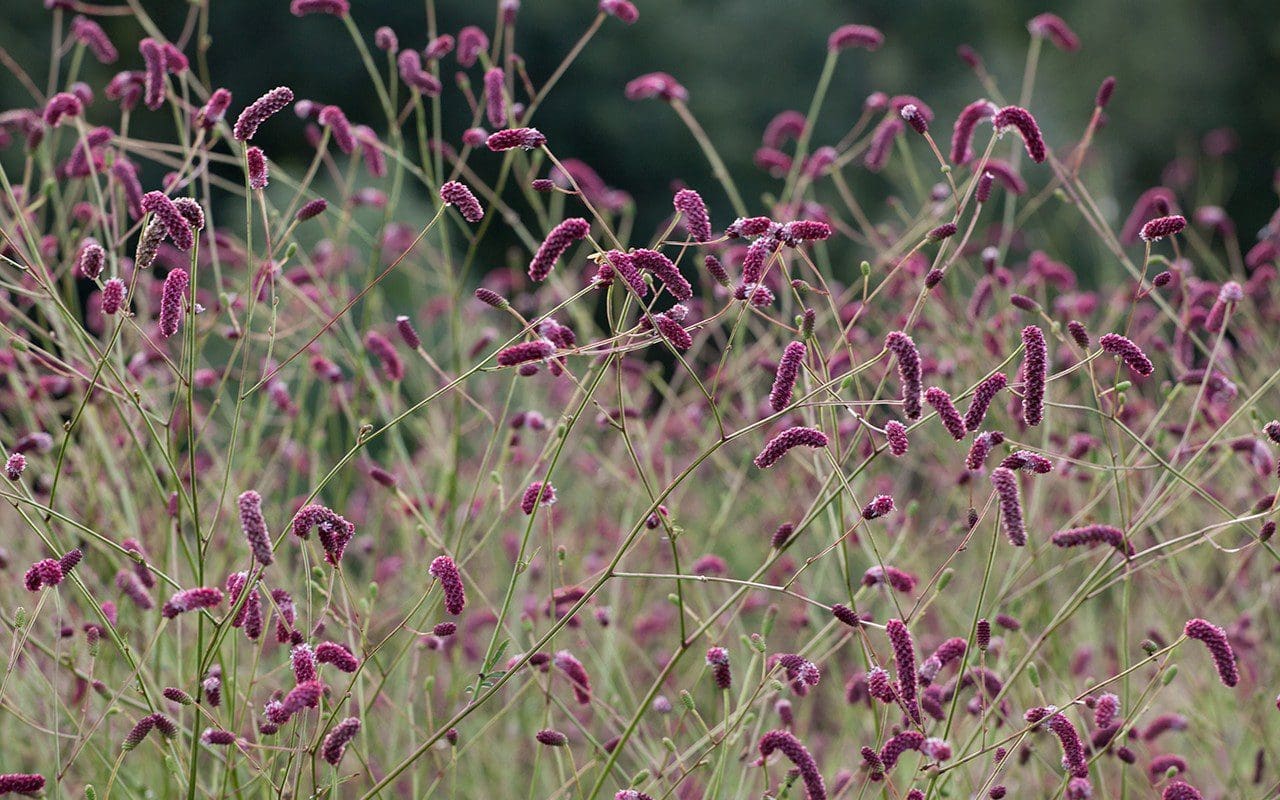 Sanguisorba ‘Cangshan Cranberry’
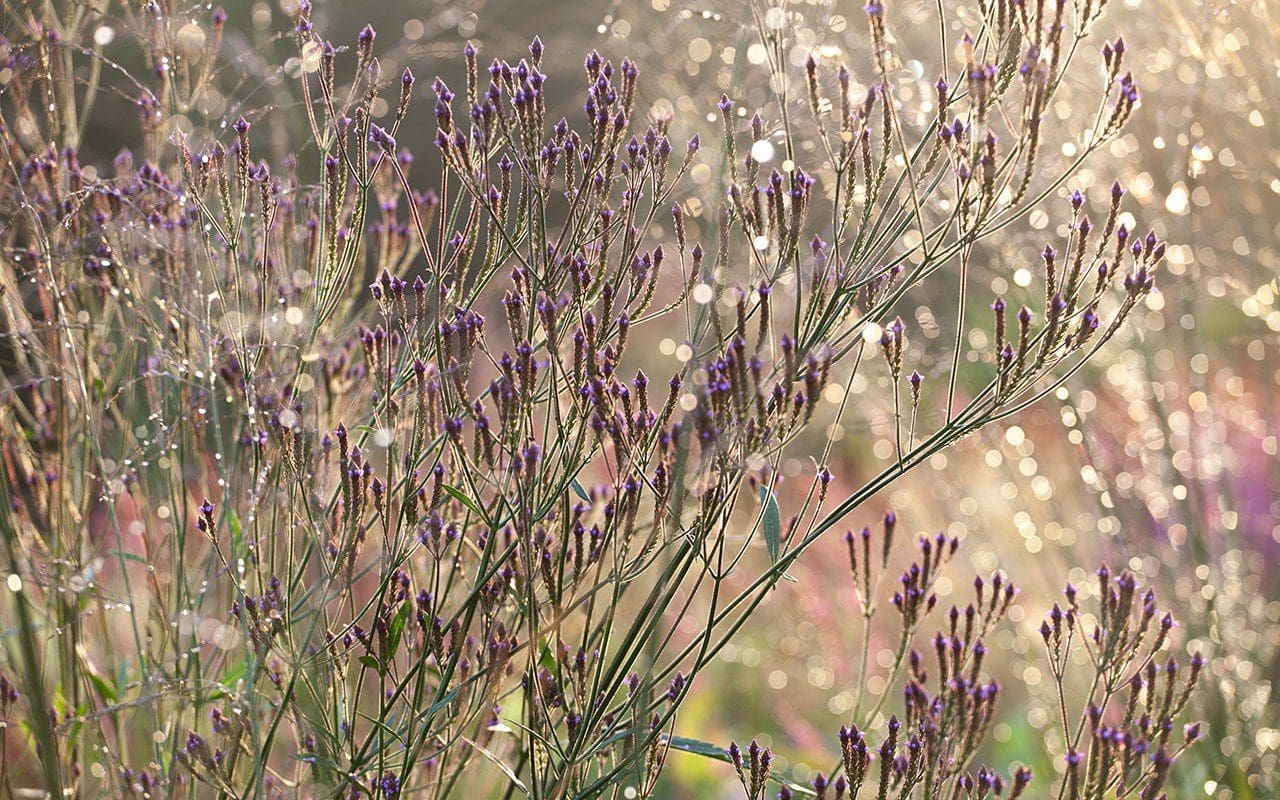 Verbena macdougalii ‘Lavender Spires
The gauze has been broken by plants that draw attention by their colour being brighter or sharper or the flowers larger and allowing your eye to settle. Sanguisorba hakusanensis (raised from seed I brought back from the Tokachi Millennium Forest) with its sugary pink tassels and lush stands of Cirsium canum, pushing violet thistles way over our heads. The planting has been alive with bees all summer, the Salvia nemerosa ‘Amethyst’, now on its second round of flower after a July cutback, and the agastache only just dimmed after what must be over three months ablaze. Agastache ‘Blackadder’ is a plant I have grown in clients’ gardens before and found it to be short-lived. If mine fail to come through in the spring, I will replace them regardless of its intolerance to winter wet, as it is worth growing even if it proves to be annual here. Its deep, rich colour has been good from the moment it started flowering in May and, though I can tire of some plants that simply don’t rest, I have not done so here.
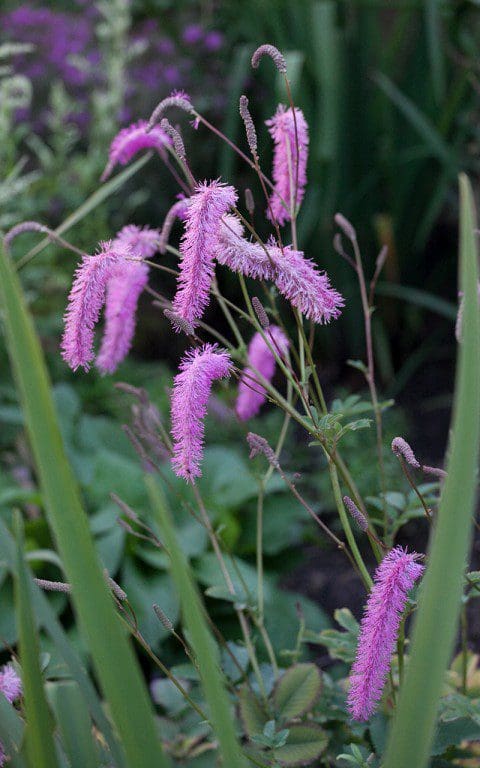 Sanguisorba hakusanensis
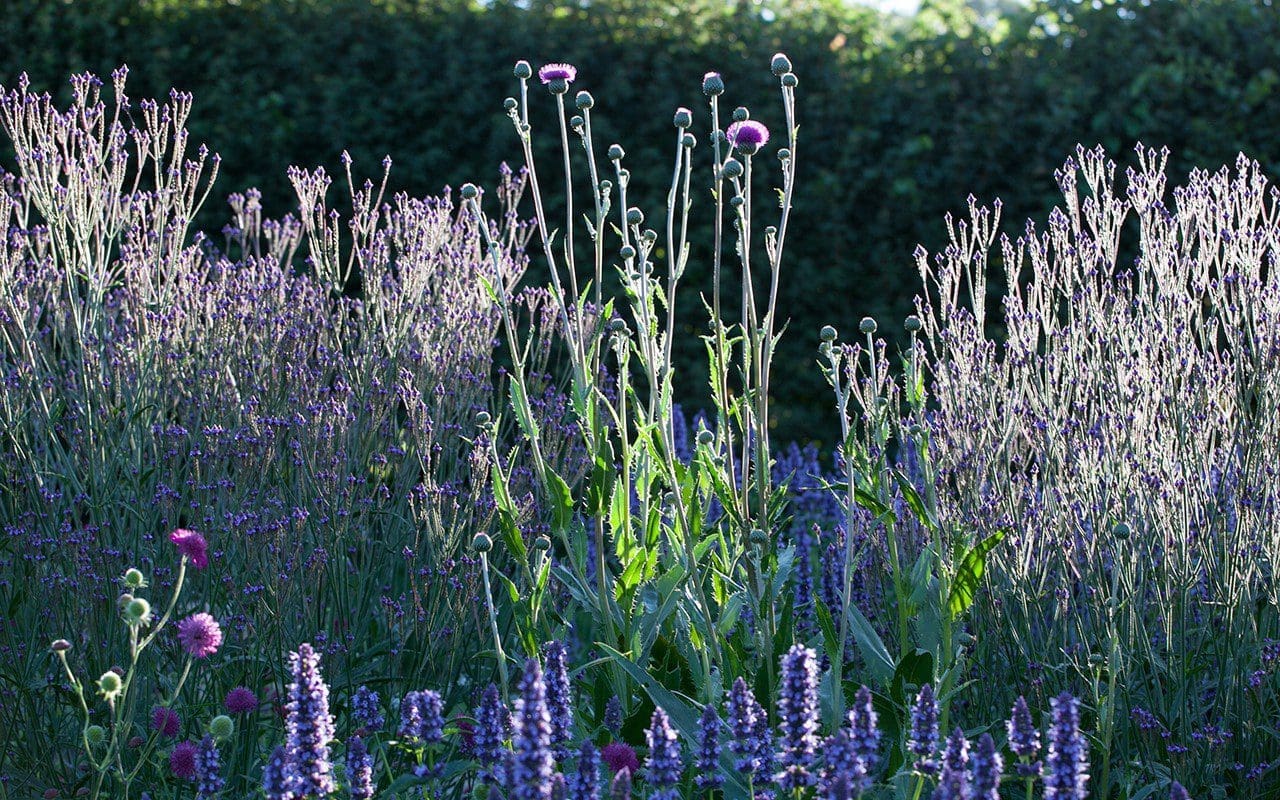 Cirsium canum (centre) with Verbena macdougalii ‘Lavender Spires and Agastache ‘Blackadder’
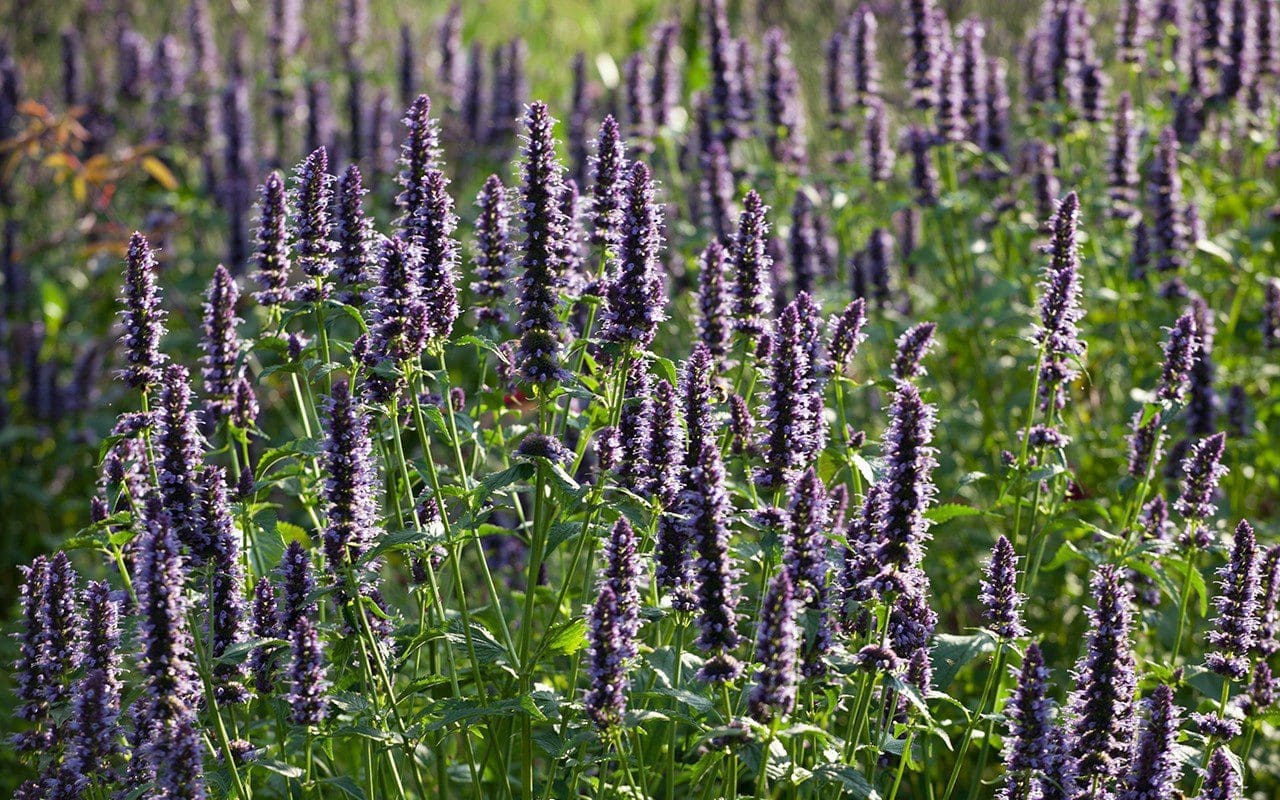 Agastache ‘Blackadder’
The lighter flashes of colour amongst the moodiness have been important, providing a lift and the key into the brighter palette in the plantings that will be going in closer to the house in a fortnight. More on that later, but a plant that will jump the path and deserves to do so is the Nepeta govaniana. I failed miserably with this yellow-flowered catmint in our garden in Peckham and all but forgot about it until I re-used it at Lowther Castle where it has thrived in the Cumbrian wet. It appears to like our West Country water too and, though drier here and planted on our bright south facing slopes, it has been a truimph this summer.
Nearly all the flowers in the planting here are chosen for their wilding quality and the airiness in the nepeta is good too, making it a fine companion. I have it with creamy Selinum wallichianum, which has taken August and particularly September by storm. It is also good with the Euphorbia wallichii below it, which has flowered almost constantly since April, the sprays dimming as they have aged, but never showing any signs of flagging.
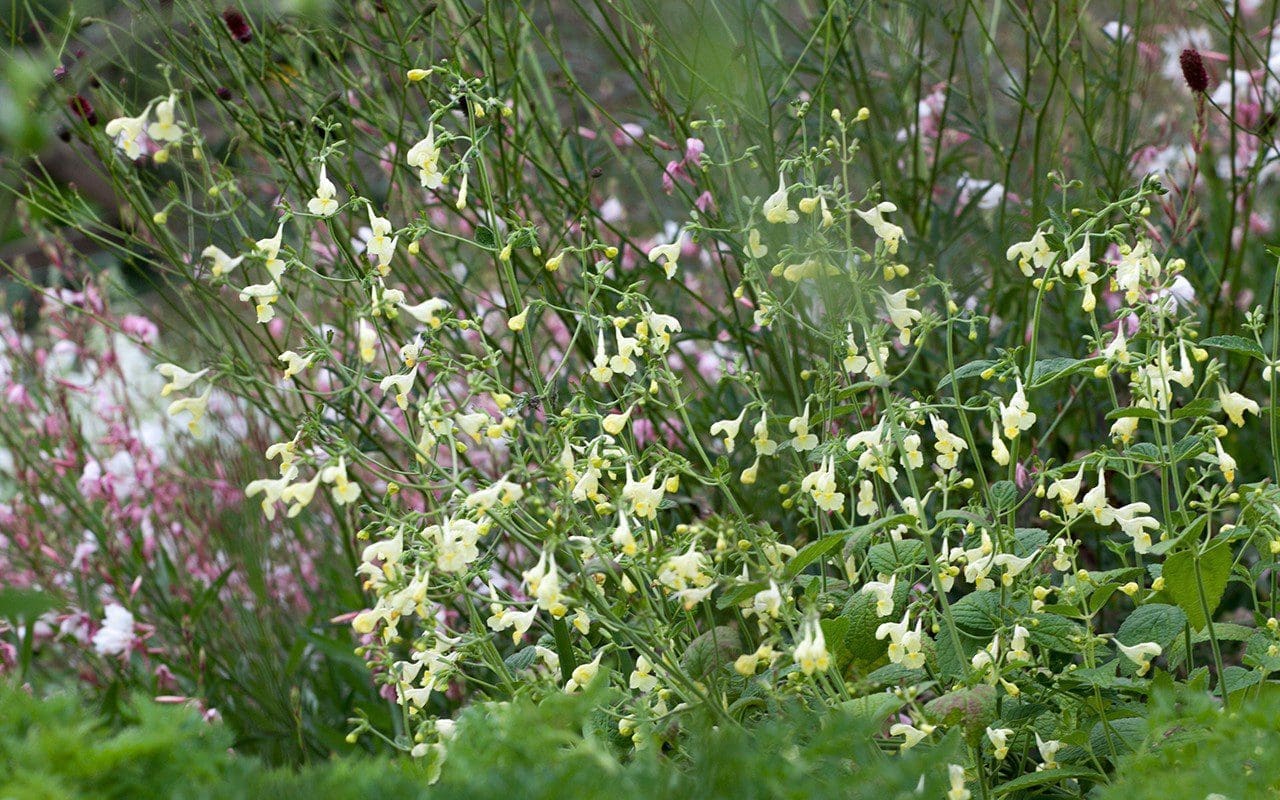 Nepeta govaniana
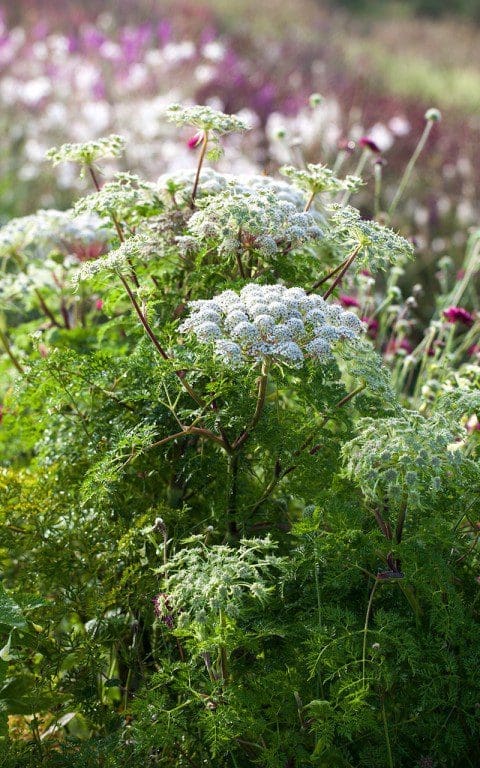 Selinum wallichianum
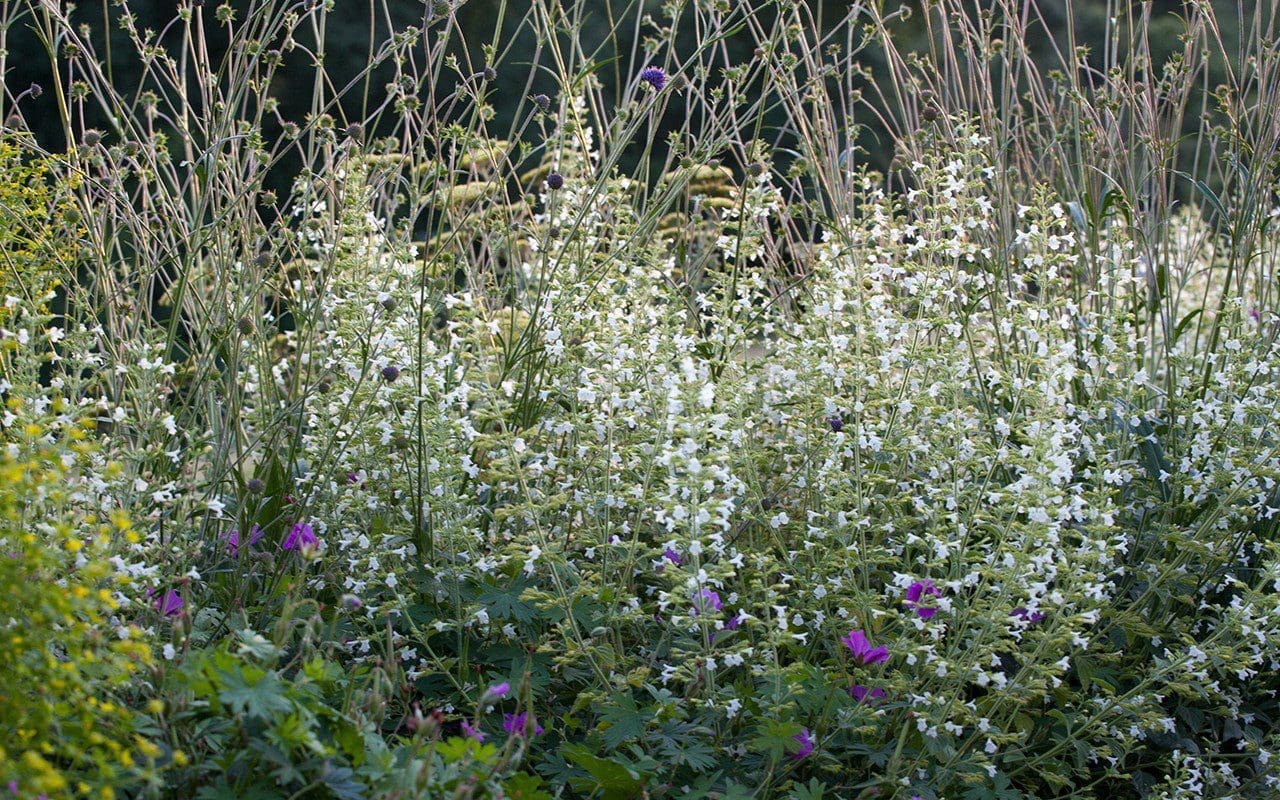 Calamintha sylvatica ‘Menthe’
I have rather fallen for the catmints in the last year and been very successful in increasing Nepeta nuda ‘Romany Dusk’ from cuttings from my original stock plant. I plan to use the softness of this upright catmint with the Rosa glauca that step through the beds to provide another smoky foil.
Jumping the path and appearing again in the planting that will be going in in a fortnight are more of the Calamintha sylvatica ‘Menthe’. True to its specific name, this pretty, white calamint seems happy to seed around in cool places and I have used it, as I have the Eurybia diviricata, as a pale and cohesive undercurrent. They weave their way through taller groupings to provide an understory of lightness, breathing spaces and bridges. Both of these are on the autumn order and will jump again into the new palette I have assembled to provide a connection between the two.
Words: Dan Pearson / Photographs: Huw Morgan
Published 14 October 2017
For the first three or four years here we grew row upon row of dahlias in the old vegetable garden. They soaked up the light in the first half of summer and flung it back again in a riot of colour later. We grew upwards of fifty, with rejects making way for new varieties from one year to the next to test the best and the most favoured. The dahlias were completely out of character with what I knew I wanted to do here but, like children in a sweetshop, we had the space to play and so we indulged.
Three years of experimentation left us gorged and satiated, but a handful made it through to become keepers. All singles, and delicate enough to be worked into the naturalism of the new planting, we kept Dahlia coccinea ‘Dixter’ for sheer stamina of performance, Dahlia merckii ‘Alba’, the most delicate of all, and the demurely nodding Dahlia australis. Proving to be perfectly hardy with a straw mulch as insurance against the cold they have made good garden perennials. The exception is a scarlet cactus dahlia that outshone the blaze of competition in the trial. Originally bought as ‘Hillcrest Royal’, but mis-supplied, we grew it in our old garden in Peckham and loved it enough to bring it with us and, then again, to keep it in the cutting garden. Unable to identify it correctly after many years of sleuthing we named it ‘Talfourd Red’ after the south London road we lived on and I cannot imagine an autumn now without its flaring fingers.
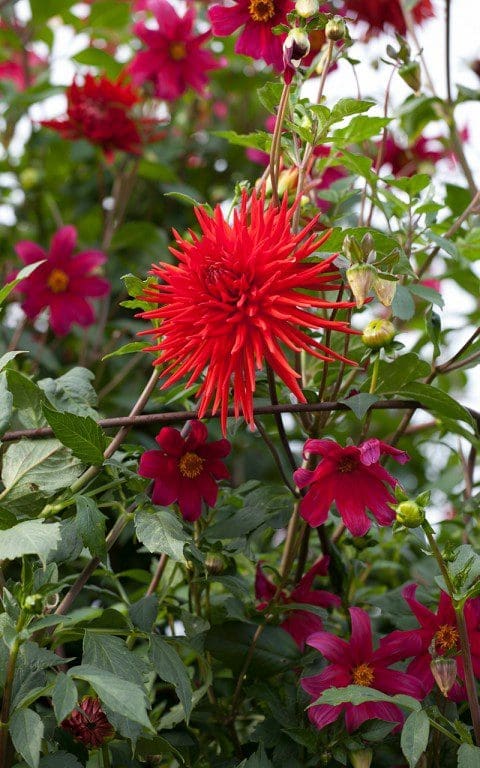 Dahlia ‘Talfourd Red’ and Dahlia coccinea ‘Dixter’
I do like a new plant, and getting to know Tithonia rotundifolia for the first time this year is enabling me to see how it might be used to inject some late summer heat into a planting. We already have a handful of favourites here that are tried and trusted and loved for their intensity of colour, which builds as the growing season wanes. In the case of the Tropaeolum majus ‘Mahogany’, they are almost at their best sprawling and vibrant in the damp cooling days and allowed to climb into their neighbours. The seed originally came from the garden of Mien Ruys at least twenty years ago. I had gone with two friends on an inspirational trip to see what was happening in naturalistic gardens in Holland and Germany and we stopped to meet her in her wonderful garden. The seed was scattered on the pavement over which it was sprawling and a few found their way, with her consent, into my pocket.
This ‘Mahogany’ is not what you will get if you look for it in the seed catalogues. Indeed, it now seems to be unavailable apart from in the United States and ‘Mahogany Gleam’ is a different thing altogether. The leaves are a brighter more luminous green than usual and the flowers a jewel-like ruby red. I have been territorial ever since I started to grow it and winkle out any that come up with a darker leaf or paler flower. It self-seeds willingly every spring, letting you know when the soil is warm enough to sow and where the warmest parts of the vegetable garden are. The seedlings exhibit the same bright foliage so it is easy to weed out the occasional rogue, which might have reverted to the darker more typical green. We currently grow ‘Mahogany’ in the kitchen garden amongst the asparagus and use the leaves and flowers to garnish salad.
 Tithonia rotundifolia ‘Torch’
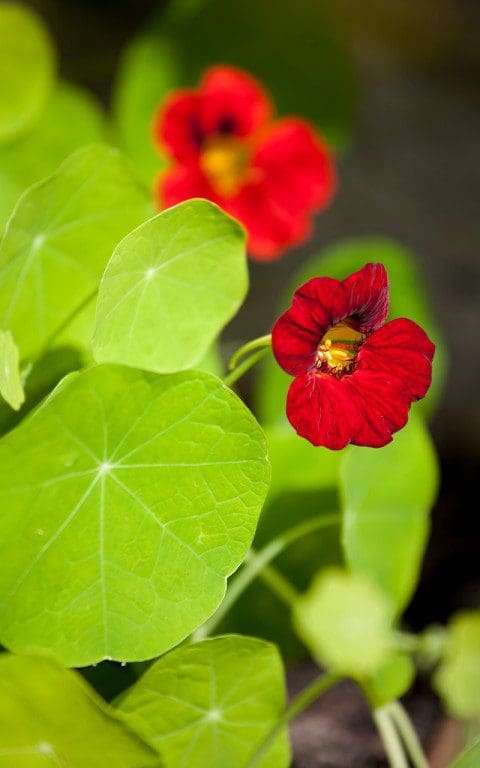 Tropaeolum majus ‘Mahogany’
Close by, and growing this year in two old stoneware water filters, is Tagetes patula. This wild form will grow up to three or four feet with a little support or something to lean on and flowers from June until it is frosted. The colour is absolutely pure and as vibrant and saturated a saffron yellow as you can find. It is easily germinated from seed under cover in spring and fast, so best to wait until mid-April to sow. I harvest my own seed and keep it apart from the dark, velvety Tagetes ‘Cinnabar’ (main image), which it will taint. Seedlings that have crossed will no longer have the deep richness that makes this latter plant so remarkable. I was disappointed to find this spring that the mice had eaten all the seed I’d left out in the tool shed and was expecting to have the first of many years without it. However, as luck would have it and quite out of the blue, they somehow found their way some distance into the new herb garden. Maybe it was mice doing me a favour with the plants I left standing in the kitchen garden last winter. Another lesson learned.
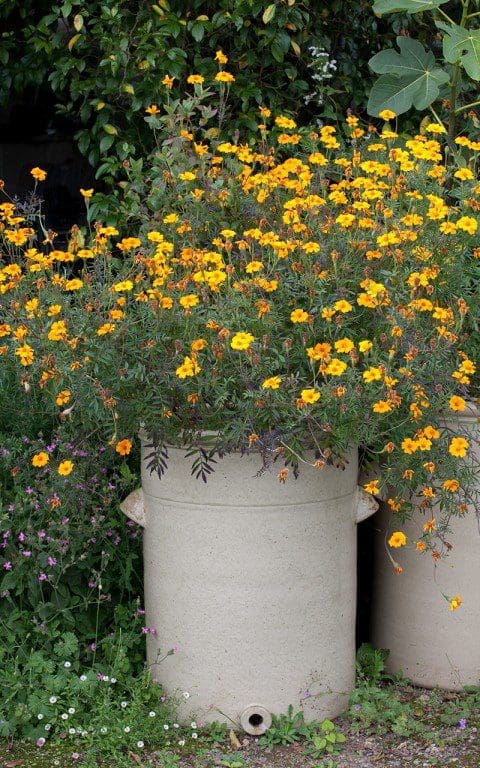
 Tagetes patula
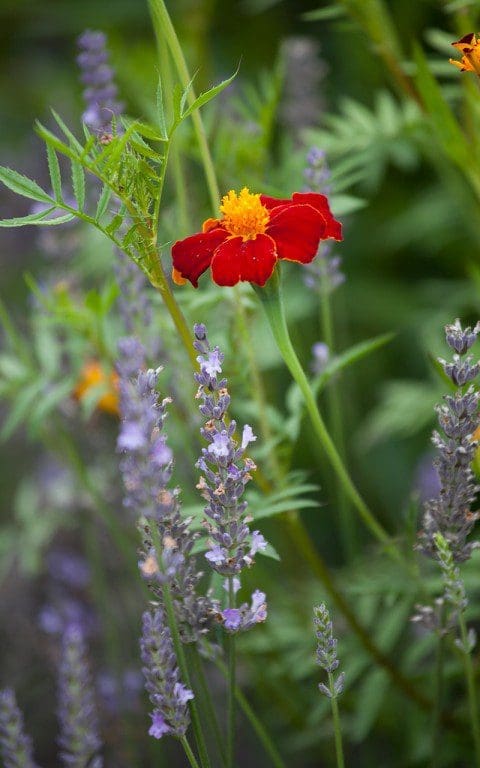 Tagetes ‘Cinnabar’
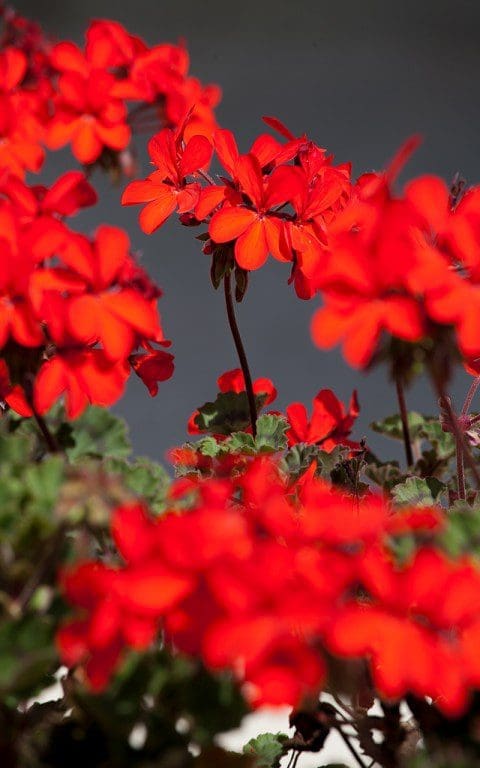 Pelargonium ‘Stadt Bern’
My father was never afraid of colour and always commented on the brilliance of Pelargonium ‘Stadt Bern’, which is the best, most brilliant red I have ever come across. Purer for the flowers being properly single, with elegant tear-shaped petals and thrown into relief against darkly zoned foliage. I bought a tray of plants from Covent Garden Market twenty five years ago for my Bonnington Square roof garden and have managed to keep them going ever since. Given how archetypal it is for a pot geranium I have no idea why it is not more freely available, but there are always a handful of cuttings in the frame which are for giving away to friends, who are given these precious things on the understanding they are part of keeping a good thing going, and that they are my insurance for any unexpected losses.
Words: Dan Pearson / Photographs: Huw Morgan
Published 23 September 2017
Planting the fruit orchard was one of our first major projects the winter we arrived here. I knew where I wanted to see it almost immediately, on the south-facing slopes beyond the barns to the west. Nestled into the hill, it was to continue the spine of productivity that runs along this contour. House, vegetable garden, barns, compost heaps and then orchard. It had a rhythm to it that felt comfortable.
Later, and after it was planted, neighbours told us that there had once been fruit trees growing on the same slopes, so it was right to have made the move so quickly. I’d been wanting to plant an orchard for myself for years and made my lists with relish, choosing West Country apples, both cookers and eaters, and a number of pears and plums. I paced out the planting stations in an offset grid with 8 metres between the trees. Doing it by eye meant that it went with the slope and the grid took on a more informal feeling that was less rigid.
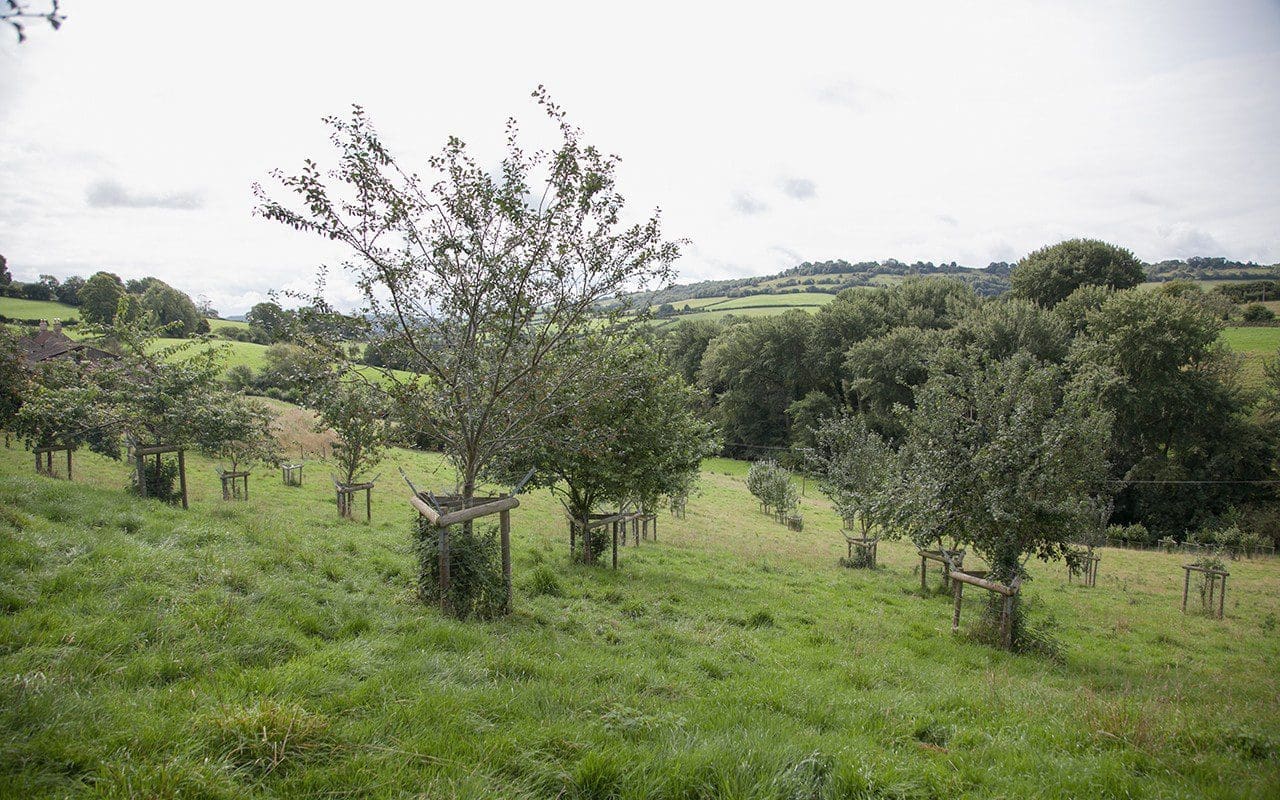 The Plum Orchard
Thirteen apples were set on their own on the lower slope, whilst five pears and then the plums sat above them. In making the decision as to how the orchard should step across the slope, I noted how the frost settled and where the cold air drained as it pooled lower in the hollow. The pears, which like a warm, sheltered position, were planted up close to the barns in the lea provided by the hedge and the buildings. The later-flowering apples were placed lower down the slope in the hope that the frosts, which tend to hang low, were mostly over by the time they were in blossom. The early-to-flower plum orchard was put on the highest ground that linked to the blossom wood in the next field above, as they also prefer a warm, free-draining position. Here they have so far escaped the frosts. To date, for there is still always time to learn, I am happy to have gone with my intuition.
The plum orchard is a loose term for the collection of a dozen or so trees that now inhabit this top corner of the field. I say loose because they all have different characteristics that are driven by the original species from which they have been selected, or from the cross between the edible species. So, to explain, the plum orchard includes true plums, mirabelle plums, damson plums and greengages. We also have two bullace, an old term for a wild plum. Three yellow ones, given to us by a local farmer who has them growing in the hedgerows above our land, are planted in the hedge between the plum orchard and the blossom wood. They may be ‘Shepherd’s Bullace’ or ‘Yellow Apricot Bullace’, two old named varieties that were once very commonly grown. These make a link to an ancient, gnarled tree by the barns, which is dark violet and eats like a damson. The cherry plums (Prunus cerasifera) sit in the blossom wood itself.
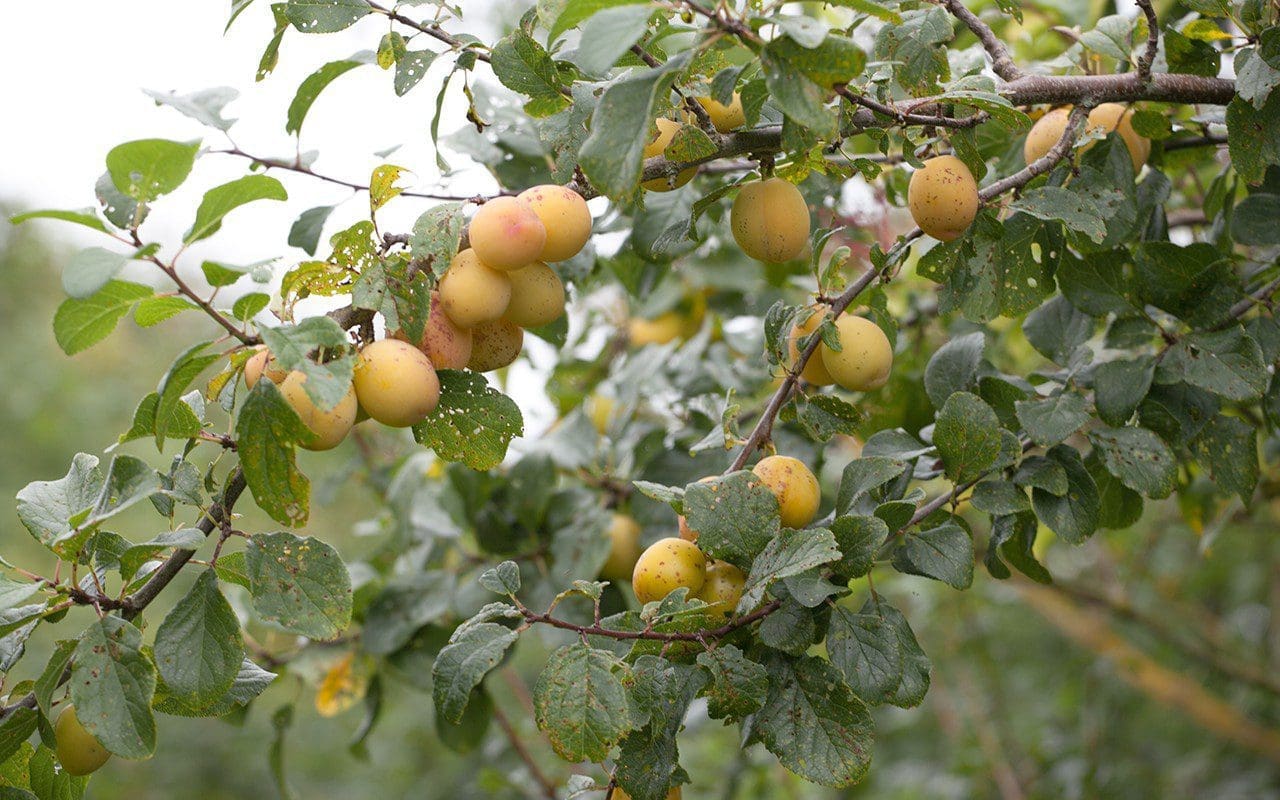 Yellow bullace
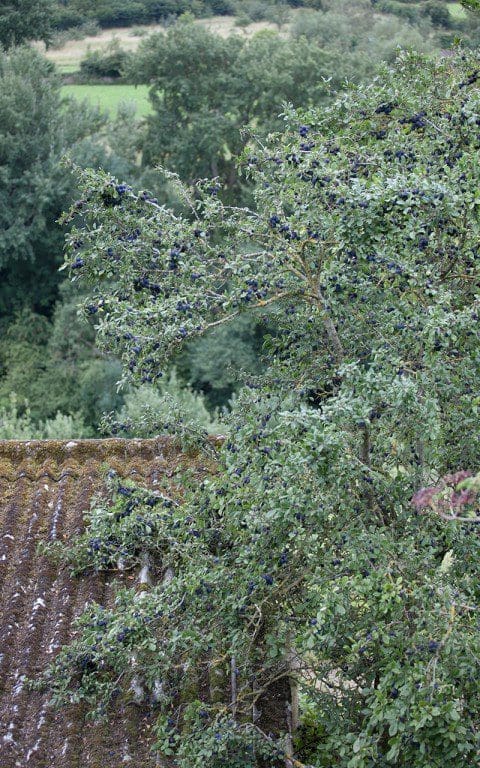
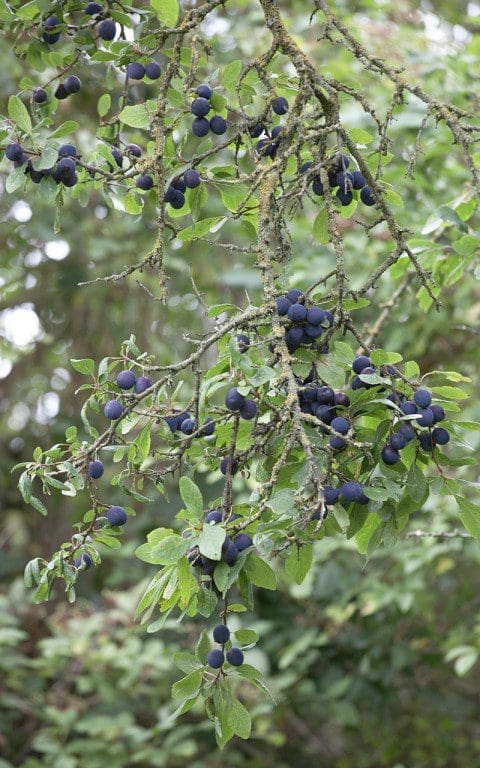 The old black bullace by the barns
First to flower, and indeed to fruit, are the cherry plums, which are good both for February blossom and jam making. Their flavour reminds me of the perfumed Japanese ume plums and we have in the past made a delicious plum brandy from them. In the orchard it is the mirabelle plums (first recommended to me by Nigel Slater, who grows them at the end of his garden) that are the first to flower and fruit. Originally from Eastern Europe, but grown to perfection in France, this is a small plum, usually with a tart flavour. Generally preferred for cooking, ‘Mirabelle de Nancy’ has marble sized, apricot-coloured fruit which are fragrant and sweet enough to eat off the tree if picked just before they drop. ‘Gypsy’, with larger red fruit, is a cooker and the earliest of them all, ripe almost a month ago. If I were to lose one, it would be ‘Golden Sphere’, whose flavour is bland in comparison, but it is a pretty plum, well-named for its colour.
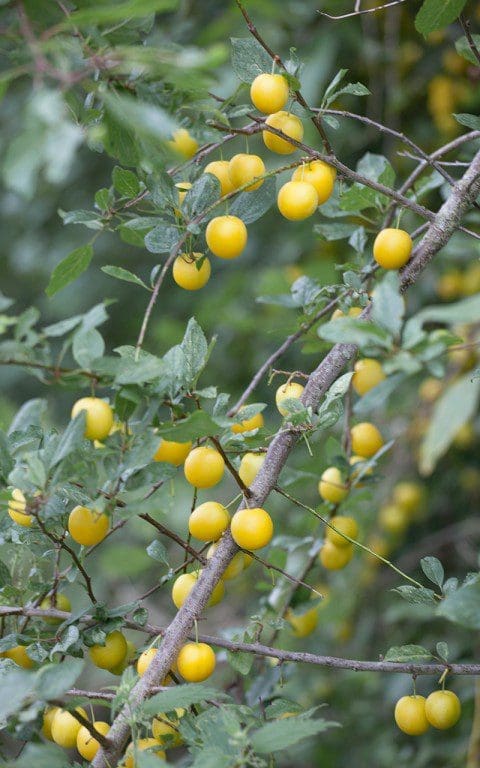 Cherry plums
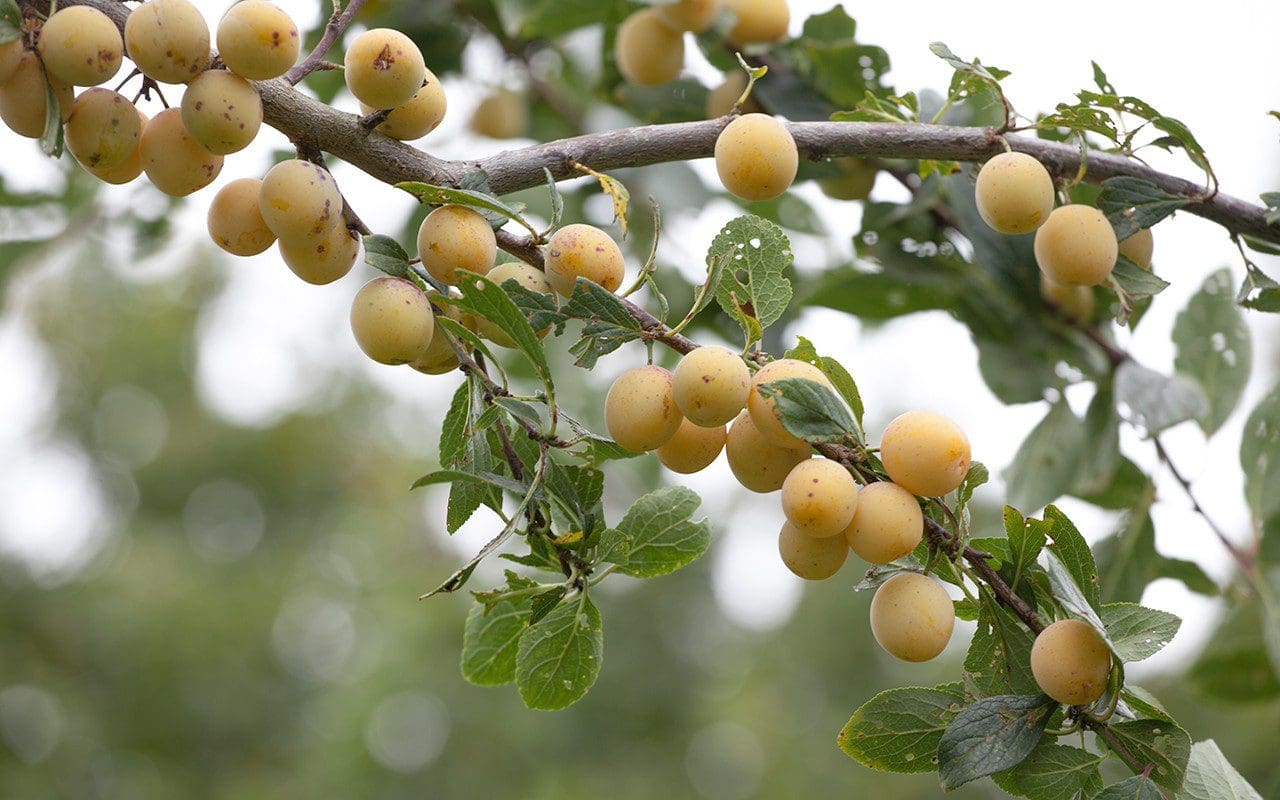 Mirabelle de Nancy
If I were only able to have one plum tree, it would be a greengage. As a rule, the yellow plums are said to have better flavour than the reds, but greengages are the most aromatic and, in our opinion, the most delicious. Of course, there is a small price to pay for such a delicacy, as greengages have a reputation for being shy to fruit. I have five in the orchard. ‘Early Transparent’ is the most reliable and has fruited plentifully. ‘Denniston’s Superb’ fruited well this year too and has the very best flavour. Despite the skins being less than perfect, the greengage perfume and the depth of flavour of this greengage is superlative – as refined and floral as a good ‘Doyenne de Comice’ pear or, if you were living in heat, a freshly picked white peach. I have three more greengages that are yet to prove themselves; ‘Reine Claude de Bavay’, which is famously shy to fruit, ‘Bryanston Gage’ and ‘Cambridge Gage’, which the sheep have managed to reach, pulled at and damaged, so I am waiting patiently for results next year.
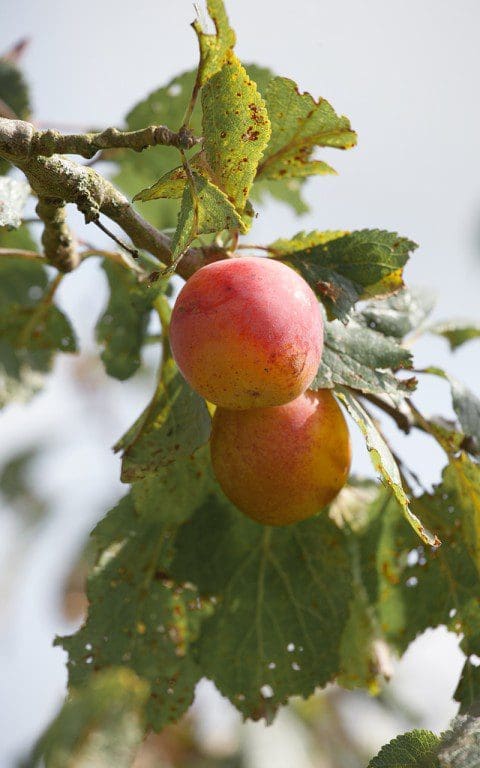 Gage ‘Early Transparent’
We have two true plums in the orchard. ‘Victoria (Willis Clone)’, a selection that is reputedly free of silverleaf, an airborne bacteria to which ‘Victoria’ is prone and which can infect broken branches in the summer. Plums, particularly the heavy fruited ‘Victoria’, are famous for snapping under the weight of their fruit, so I have taken to gently shaking the tree a little earlier in summer to lighten the load that the June Drop hasn’t done for. Though the ‘Victoria’ is a good looking plum – it is next to ripen after the greengages – it is nice but rather ordinary. It is, however, indispensable for freezing for winter crumbles. ‘Warwickshire Drooper’, a vigorous and amber-fruited plum, is better I think. Adaptable for being both an eater and a cooker, and not a plum you can buy off the shelf like ‘Victoria’. It is also a very heavy cropper and makes delicious jam.
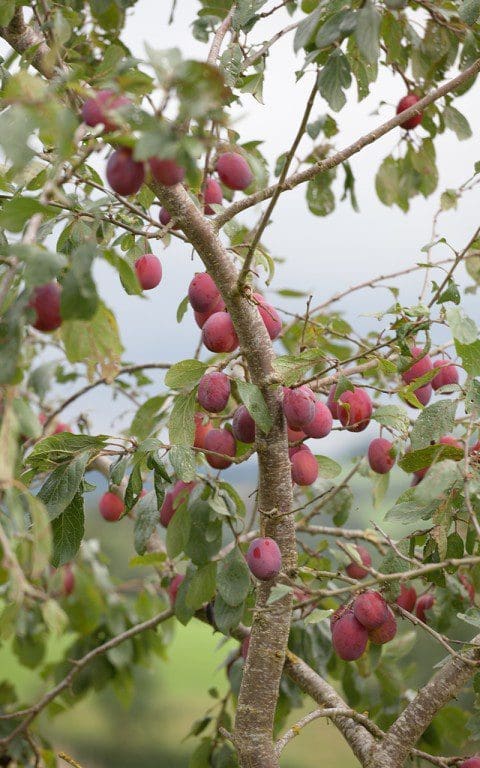 Plum ‘Victoria (Willis Clone)’
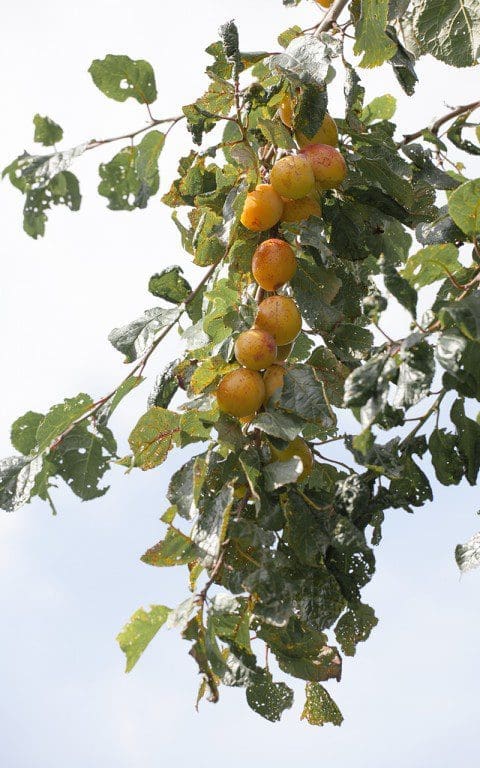 Plum ‘Warwickshire Drooper’
The damsons are perhaps the most beautiful, hanging dark and mysterious, with a violet-grey bloom that, when you reach out and brush the surface, reveals the depth of colour beneath. These are the last to fruit and this year I fear we will miss them in the fortnight we go away on holiday in early September. ‘Shropshire Prune’ (main image) has proven itself to be one of the most reliable fruiters with small, perfumed fruit that are firm and make the strongest flavoured jam. A little earlier and larger of fruit, ‘Merryweather’ also has very good flavour and is one of the only damsons sweet enough to eat from the tree if left to fully ripen.
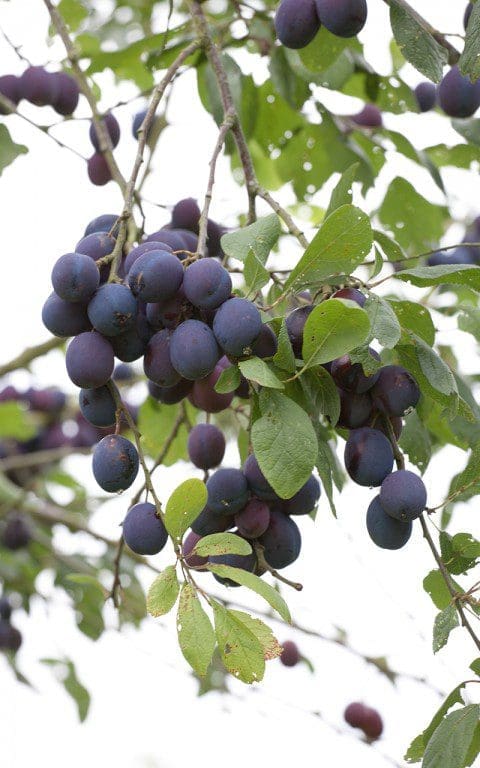 Damson ‘Merryweather’
The plums are something you have to watch as they ripen, for they take some time to ready but, when they do, they all ripen over the space of a fortnight. The range of varieties in the plum orchard helps here in staggering the harvest, but getting to them before the wasps do is always a challenge. This year, however, we are bombarded with fruit which means there is plenty to go round, and I have been heartened to see that the rotting fruit also provides a late summer larder for honeybees and butterflies. I have a long, three-legged ladder with an adjustable third leg ideal for picking on our slopes but, for expediency, it has been quicker to lay down tarps on the hummocky grass and gently shake the trees. The fruit cascades around you and you can pluck the best without reaching into the branches to be stung by the competition.
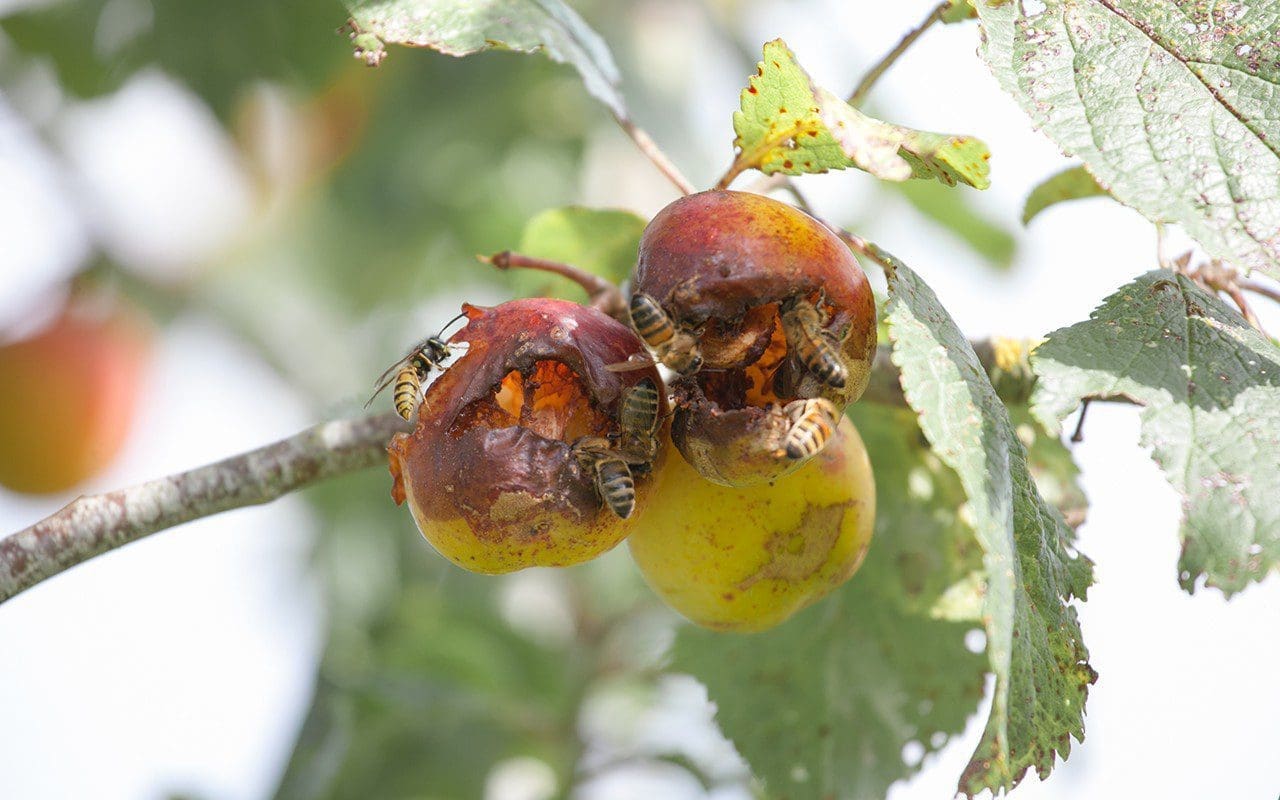
Words: Dan Pearson / Photographs: Huw Morgan
Published 26 August 2017
And so the balance has shifted. The energy of the race to the longest day of the year already dimming. It is a subtle change, but even now it is in evidence with the grasses going to seed in the meadows, May’s vibrant greens flattening and the first of the bindweed replacing the dogroses to light the hedgerows. The last few days of searing heat have pushed this high summer feeling still further and this bunch from the garden reflects something of the new mood.
It is with much excitement that the Romneya coulteri flowered for the first time this year, and no surprise that they chose to do so in weather that must have reminded them of home. See the Californian Tree Poppy in the southern parts of the state where it runs through the rubbly hillsides and you understand why it should be given the hottest, most free-draining position you can offer it. I have it here, facing south, at the base of the barn wall, where the soil is rarely damp for long. It is a choice position – and there are few on our hillside that offer such a baking – but it was not a difficult decision to give the space up to one of my all-time favourites.
I first saw the tree poppy growing in Brighton where it had taken over the tiny front garden of one of my father’s friends and had made the seaward-facing ground its home. Towering at eight feet or so above the pavement and all but obscuring the bay window (there was no need for curtains), from inside the house the crumpled, glistening petals were filled with summer light. The luminosity of the flowers is amplified by a yolk-yellow, globular boss of stamens which dust the petals with pollen as they flutter in the breeze. Hovering on long stalks reaching towards the sun, held amongst finely cut blue-grey foliage, they cannot help but capture all the light that is going. For me the mood they create is the epitome of summer. I have given it the space to claim this moment and have repeated it three times amongst jagged, silver cardoons and ethereal Althaea cannabina.
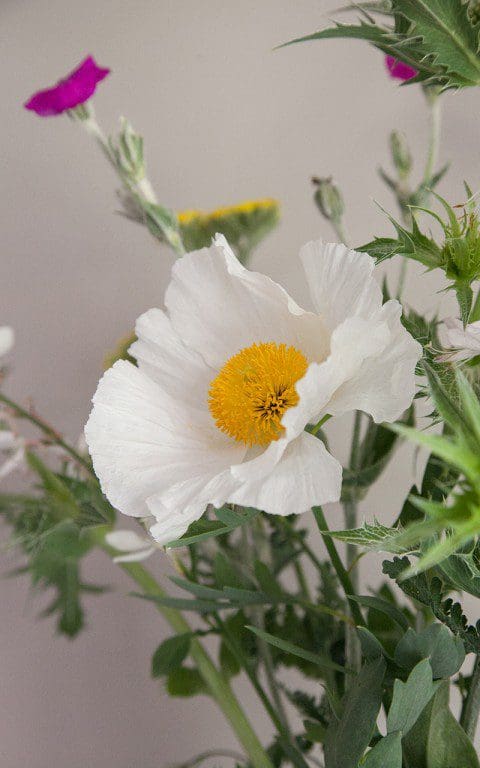 Romneya coulteri
Romneya hate disturbance, so you have to be sure you know where you want it and not succumb to the temptation of moving it, should it decide it likes you. I’ve found they are fickle and can easily succumb to verticillium wilt in our damp climate when they are young, so I usually build in loss and plant more than I need. Hence the repeat along the barn wall but, in this instance, all three plants have so far thrived, sulking a little in their first year, rising up to a metre or so, but remaining blind and without flower. This year they are looking much more like themselves and have begun to take their position. I’II expect them to attain full stature in a couple of years and we will see then if they start to run, as they can and do in search of new territory. However, they are easily curtailed as long as you slice the runners with a spade and are not tempted to pull the runner back to base and disturb the central root system. Although they will regenerate if the winter hasn’t been hard enough to floor last years growth, it is best to cut the stems hard to the base in March after the worst of the winter has run its course. New shoots are rapid and lush and altogether better looking.
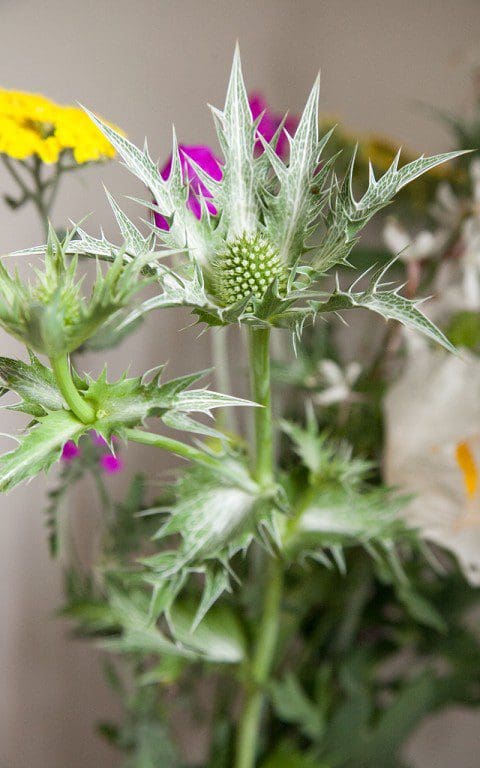 Eryngium giganteum ‘Silver Ghost’
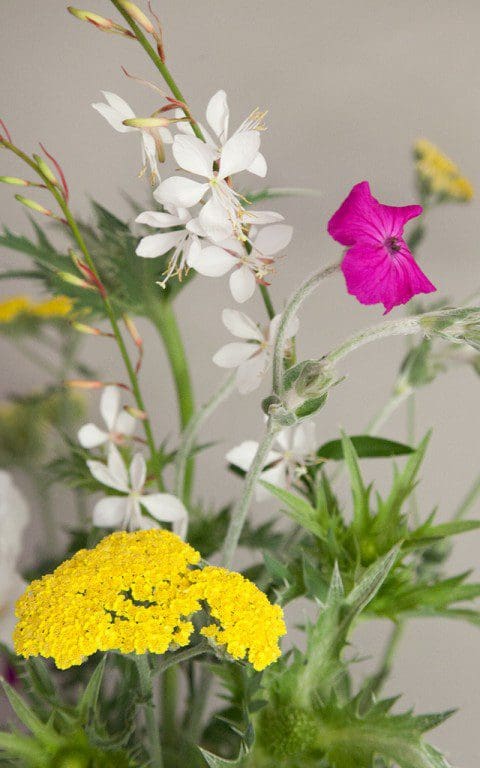 Gaura lindheimerei with Achillea ‘Moonshine’ & Lychnis coronaria
In the gravel, that surrounds the barns, I have been playing with a number of self-seeders to make the buildings feel like the garden has made its home there. Eryngium giganteum ‘Silver Ghost’ is one that I sowed directly from fresh seed given to me by Chris and Toby Marchant of Orchard Dene Nursery. I’d admired the plants at the nursery for their more acutely veined and crested flowers. It is showier than the species, without feeling like it has lost any charm. The common name for Eryngium giganteum, ‘Miss Willmott’s Ghost’, is attributed to Ellen Willmott, the English horticulturist, who was said to have carried seeds in her pockets at all times and distributed them in a trail throughout gardens she visited. If it finds a home that is to its liking, with plenty of sun and no competition to the basal rosette, this biennial is great for never being in the same place and for the chance happenings that come about when you let it find it’s own position. It is good here with the flutter of Gaura lindheimeri that creates a shimmering highlight of white, like the sparkle of light on water.
 Lychnis coronaria & Achillea ‘Moonshine’
Achillea ‘Moonshine’ is a plant that I have not grown since I was a teenager, where I had it in my yellow border. It was short-lived there in the window of light that fell between the trees in our wooded garden, but I hope to keep it longer here on our sunny hillside despite its requirement for regular division. It is dancing now amongst the contrasting magenta of Lychnis coronaria in a strong wind that has kicked up after the past week’s heat, but is all but oblivious to the buffeting. Perfectly flat heads that huddle at about knee height are the ideal receptacle to harvest the high light and long days. The colour is the brightest, most vibrant sulphur yellow and, now that I see them together in a vase, its brightness further enriches the golden boss of the Romneya to saffron. A new combination for the future, perhaps (for they would surely like the same conditions) and one that would set the tone for the height of summer that is still ahead of us.
Words: Dan Pearson / Photographs: Huw Morgan
Published 24 June 2017
