When we arrived here eight years ago, the fields lapped up to the yard at the front. Immediately to the west of the house a run of increasingly decrepit lean-tos made from a haphazard mix of cinder block, brick, stone and corrugated sheeting extended a semblance of domesticity along the slope. A rubble wall held back the track above and, along it, the structures made their way out towards the barns in stops and starts that charted their thrifty evolution; a scullery, an almost outside loo in a stone lean-to, then through a door into the original bathroom. Stand up washes at the sink in the winter, surely, as there was no evidence of heat. A recycled Victorian door then opened into a corrugated tin building where the coal had been stored and then finally, built onto the front of this, the piggery. Every room had a raking floor, pitching at some degrees down the slope. A seedling oak sprung from the brick floor of the coalhouse, the holes under the doors obviously big enough for squirrels or a rat, perhaps, who was planning a return visit, but never made it.
Our first project, the kitchen garden, lay beyond the reach of the lean-tos up around the barns. Several years ago we levelled the ground here in order to make the gardening easier. Two staggered troughs went in on this datum at the same time, echoing the horizontal line of beech on Freezing Hill in the distance and creating an informal gateway to the kitchen garden. By separating the kitchen garden off, when the lean-tos were demolished, we had a new garden space between the end of the house and the troughs. During building it was an area we had to traverse with caution, as it became more and more building site, with deep ruts, bonfires, rubble piles and the remains of the slope.
Although we had to knock down the lean-tos, we repaired and rebuilt the stone building that had previously been the pantry. The rubble wall now stood in splendid isolation, naked but shadowed with the ghosts of each of the buildings that had run along it. The tiles of the old bathroom, the blackened coal house and then, finally, a raggedy end up by the piggery. Word had it that ‘Mother’ had once had a vegetable garden on these slopes immediately beyond the piggery and, with the buildings gone, it was clear that this would be the space for the herb garden. A concrete pad was poured alongside the rubble wall in preparation for an open barn that would become our inside outside space and, in the summer of 2016, with the builders gone, we made a start to reclaim the ground.
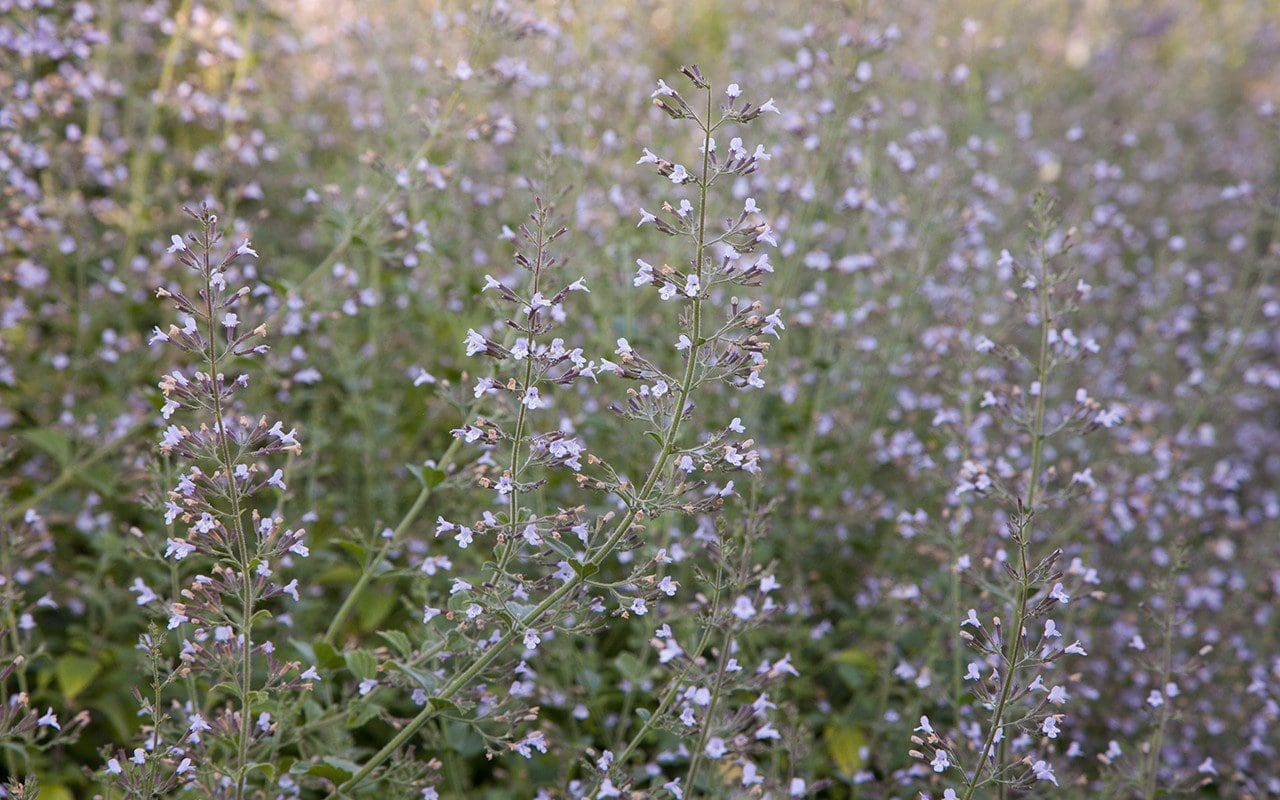 Calamintha nepeta ‘Blue Cloud’
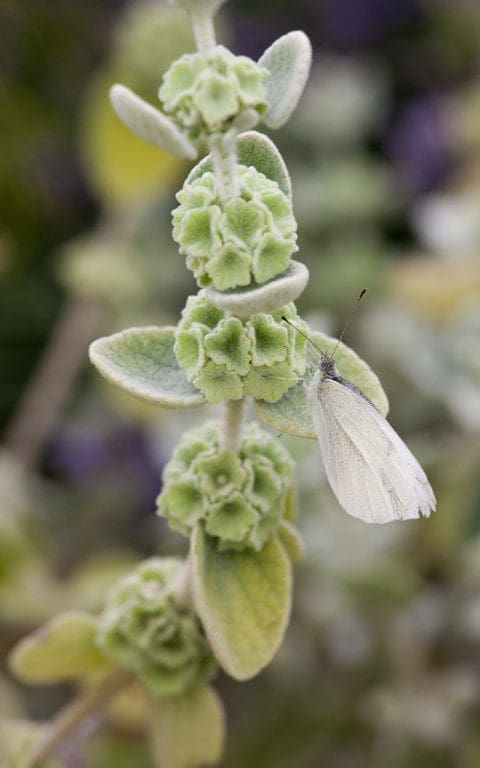 Ballota pseudodictamnus
A cut was required to make the level between the house and the troughs, and the fill from the cut was used to extend the level out and down to form banks that rolled into the field. Where the rubble wall ran out, we extended a breezeblock wall to hold back the banks that had been held together with sheet tin and bedsteads, and the remains of a hedge that was mostly elder and bramble with a couple of sickly plums. I replaced the hedge on top of the new wall, mingling hawthorn with eglantine for its scented foliage, and with wild privet and box for evergreen. Lonicera periclymenum ‘Sweet Sue’ – a short growing form of our native honeysuckle selected by Roy Lancaster, has been added along its length. The wall faces south and heats up in the day to throw the perfume back at night. I planted wild strawberries at the base of the hedge so we have easy pickings at shoulder height on the way to the steps. The perfume from the strawberries has been incredible during this recent run of long, hot days.
A set of new cast concrete steps sit half way along the wall and flare at the top where a landing forms a viewing platform. From here you can survey the kitchen garden to the west and this new space alongside the house. The concrete pour into a shuttered wooden framework took some engineering, but the steps have weight and their gravity is needed where they sit in the space between the troughs. We grow artichokes and the rhubarb here. Plants that need room.
The herb garden was a working title that has stuck. The actual herb beds are a pair of narrow raised beds up by the open barn where we can easily pick the annual herbs that like the morning shade thrown by the building. Coriander, dill, wild rocket, coriander, chervil and parsley, but not basil which needs the all-day heat that lies beyond in the kitchen garden. Further out the perennial herb bed gets the sun and provides us with sage, rosemary, thyme, marjoram, tarragon, summer and winter savory, sorrel and the like. Mint is contained in a pair of old zinc washing dollies in the shade of the building, where it stays lusher and leafier.
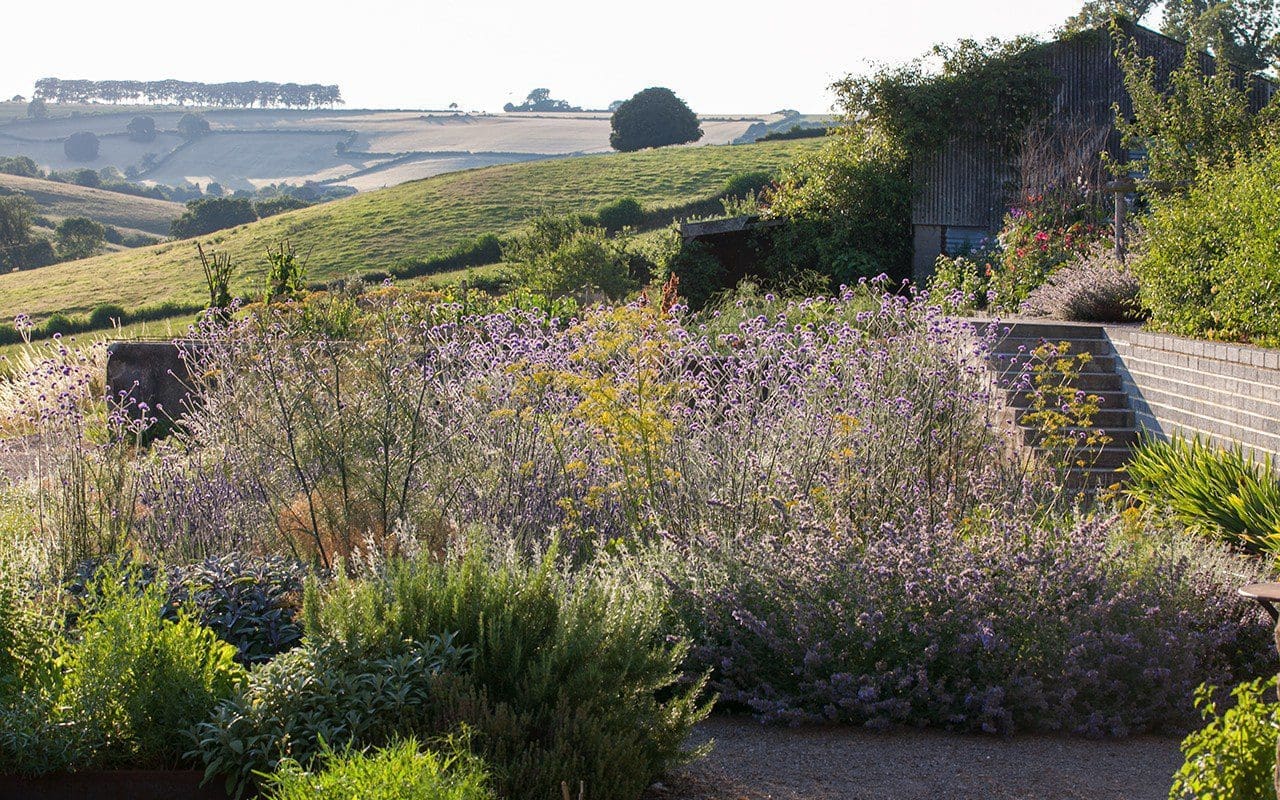
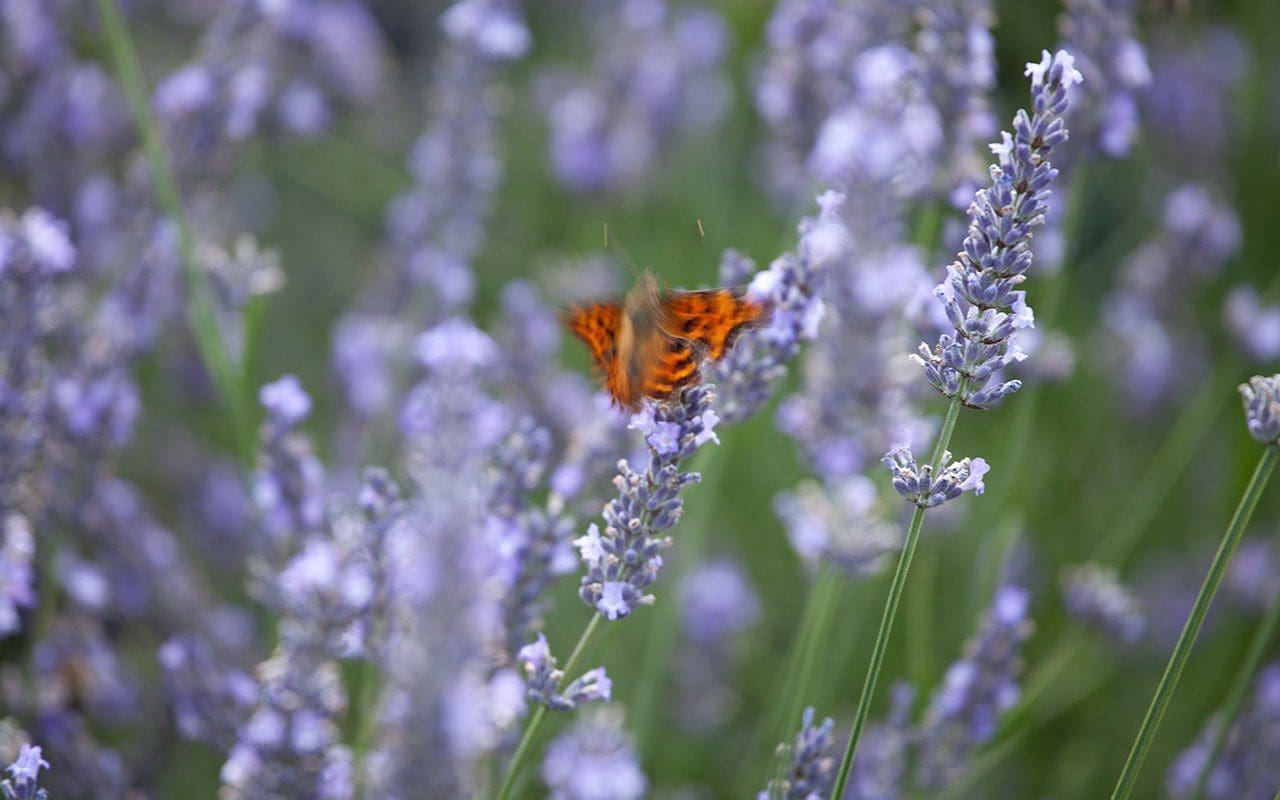
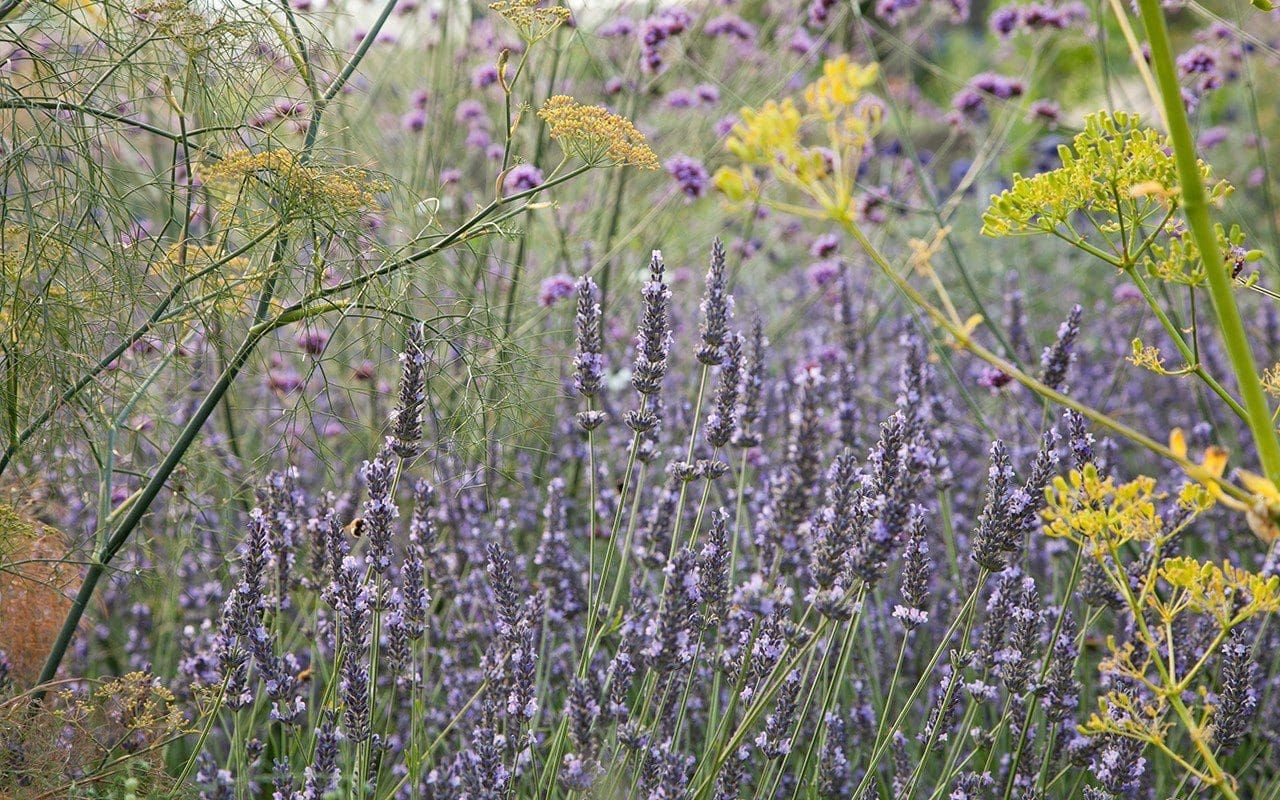 Lavandula x intermedia ‘Sussex’, bronze fennel (left) and Opopanax chrironium (right)
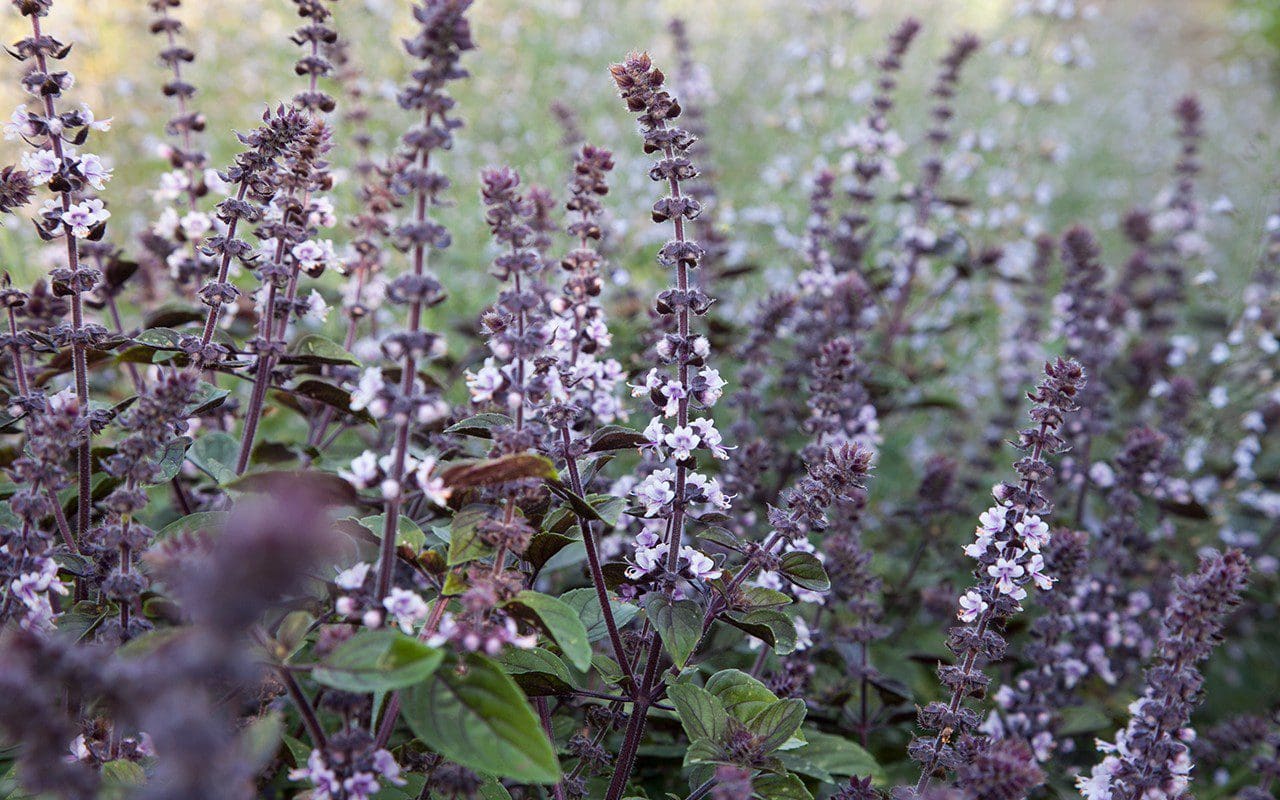 Basil ‘African Blue’
The extent of the planted area between here and the troughs had to be carefully re-soiled once the cut into the land was made into subsoil. I left it fallow the winter before last, as I wanted to see how easily it drained, since the ‘herb garden’ was where I wanted to grow my lavenders and salvias and other plants that associated well alongside them. I am pleased I did, because while the soil was settling down it drained very badly, puddling in the winter. I thought I was going to have to reconsider my palette, but couldn’t think of anywhere the lavenders would feel as right. It was only when the spring sun dried the soil out and natural fissures opened up in our clay subsoil that it started to behave as I wanted it to.
I planted last spring, late in April once the first phase of the main garden was in and mulched. The cut-leaved Ficus afghanistanica ‘Ice Crystal’ was planted close to the bottom of the steps to create a narrowing and a shaded exit point. Though not selected for fruit – they are small and sweet when they come, but require prolonged heat to ripen – I like the fineness of the dissected foliage immensely and, although I have never seen a large plant, I expect it not to take over as figs tend to when they like you. The willow-leaved bay, Laurus nobilis ‘Angustifolius’ anchors the inside corner nearest the house. With elegant, narrow foliage this bay also has a lightness about it. I will keep it loosely clipped into a dome at about shoulder height when, one day, it assumes its position.
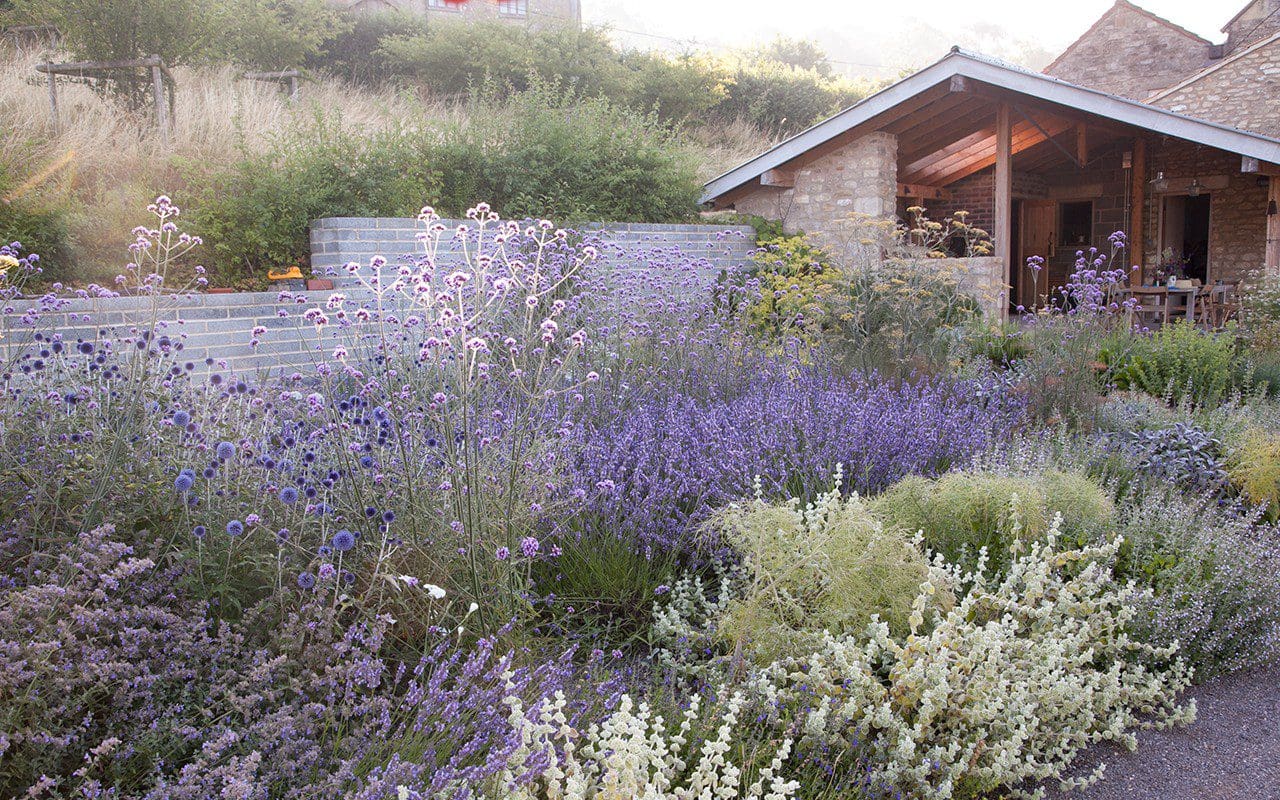
I trialled three different lavenders in the old garden in anticipation of this planting. Lavandula x intermedia ‘Grosso’, a variety used in perfumery in France for its high production of essential oils. I liked it very much. It has good, strong colour and certainly good perfume, but the plants splayed under their weight when in full flower. The best time to harvest lavender for the oil is when the first flowers on the spike are just out, so good for perfumery, but not so good for the garden. L. x intermedia ‘Edelweiss’ came a close second with a camphor tang to the perfume and beautiful white flowers that were much loved by the bees, but they proved to be erratic here, with too many plants failing in winter making me lose confidence in committing to it. Our wet West Country weather was probably their downfall. Not L. x intermedia ‘Sussex’ which, though not as dark as ‘Grosso’, is good in every other respect. Tall, long flower spikes and a good form to the plant that, so far, has proven reliable here.
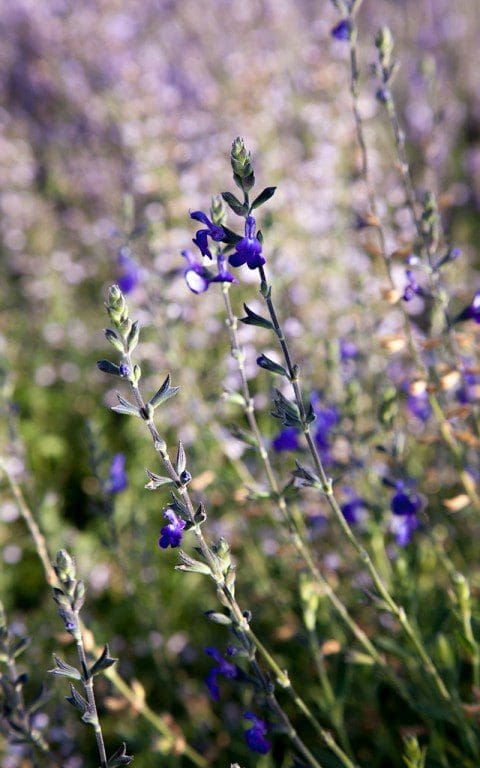 Salvia greggii ‘Blue Note’
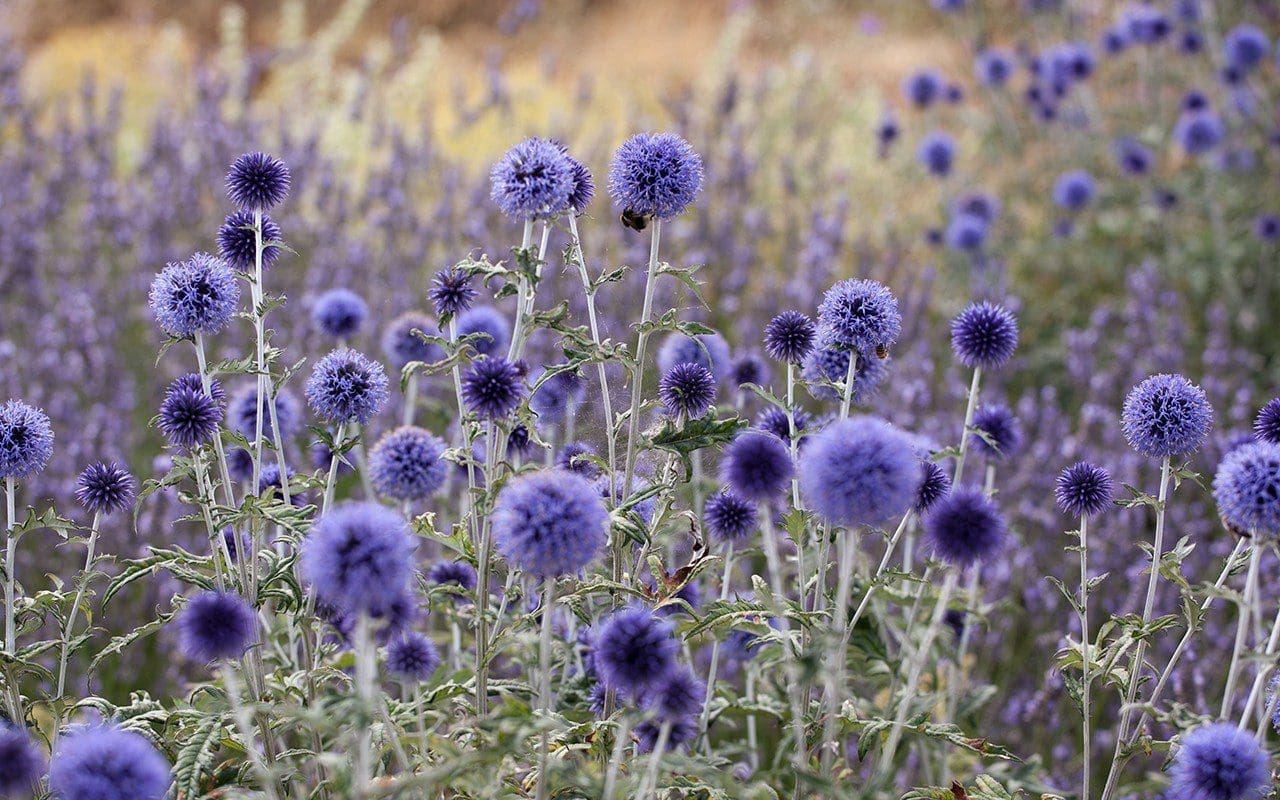 Echinops ritro ‘Veitch’s Blue’
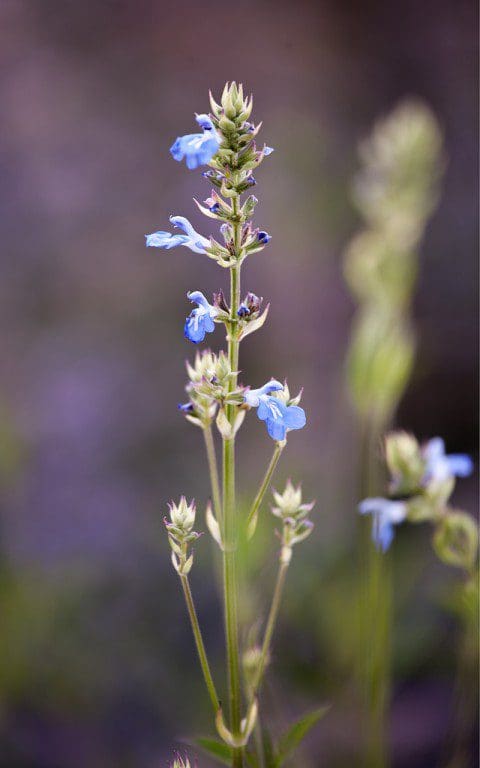 Salvia uliginosa
So, the lavender form the backbone of the planting, thirty plants staggering their way across the space, but with openings left for light-footed emergents; Verbena bonariensis – only here and nowhere else for fear of overuse – and bronze fennel, just five plants to keep the airiness in the planting. I’ve direct sown the acid yellow Ridolfia segetum, bone white corncockle Agrostemma githago ‘Ocean Pearl’ and white Ammi majus to lighten the palette. The sparkle is important amongst the mauves. A darker counterpoint is provided by the purple spires of Basil ‘African Blue’, pot-grown nursery plants that we plant out yearly as annuals.
Rising up in this second year are the Opopanax chironium. A herb used for the incense resin that is extracted from the dried sap, this is another of the many umbellifers gifted to me by Fergus Garrett at Great Dixter. Though they have yet to flower here, the Giant Fennel, Ferula communis, are planted towards the edges of the bed so that it doesn’t overshadow the lavender with its early growth. I hope to see them bolt skyward next year, but for the early part of the growing season their netted leaves have been wonderful.
I wanted this planting to have unity but, like the cloudscape it resembles, I also wanted to be able to find the shifts in tone and form. The palette of recessive mauves and blues also allows us the long view here, which is most important because the planting is all too often eclipsed by what is going on in the sky. I have built on the insect life that the lavender attracts with Nepeta ‘Six Hills Giant’, which is alive with bumblebees from the moment it starts flowering in April. The smaller in scale Calamintha nepeta ‘Blue Cloud’ is delicious by the path where, if you brush against it, you are rewarded with fresh menthol mintiness.
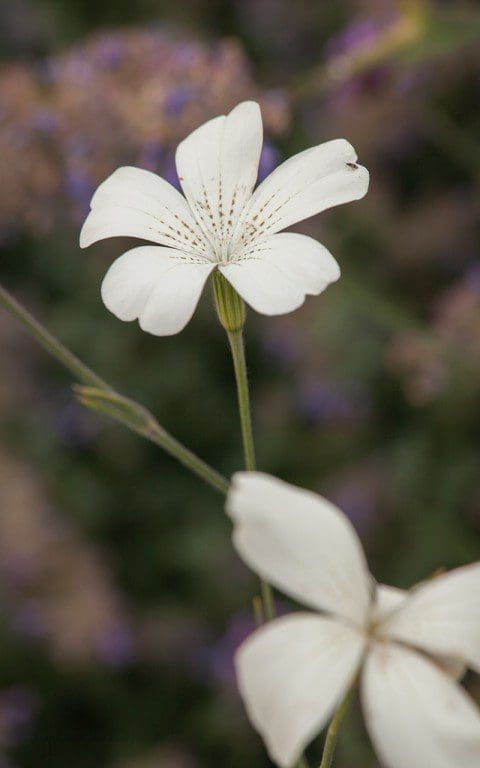 Agrostemma githago ‘Ocean Pearl’
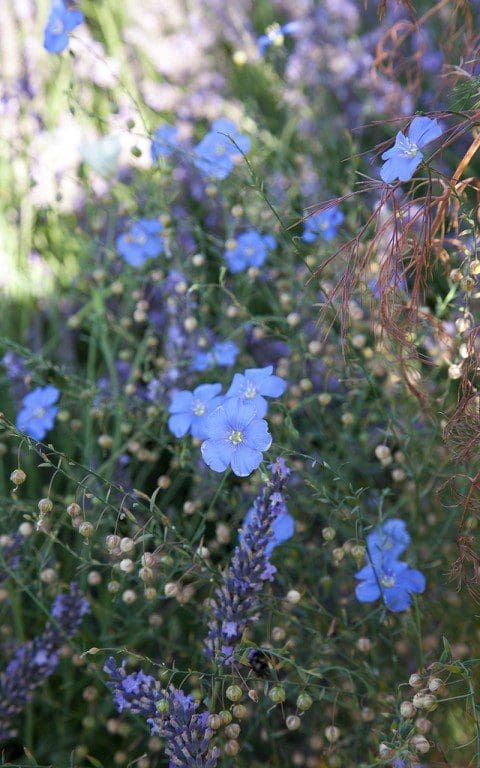 Linum perenne
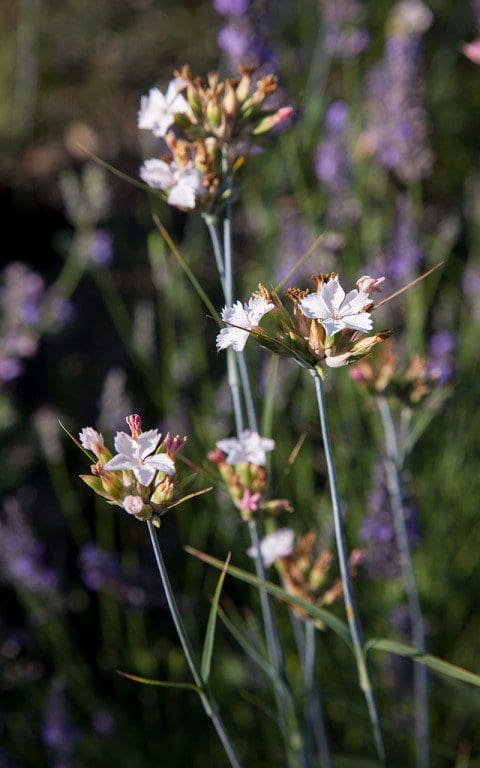 Dianthus ‘Miss Farrow’
The calamint comes later than the catmint and shortly after the Salvia greggii ‘Blue Note’, which starts into flower the last week in June. Its spicily scented leaves and flower spikes are sticky with essential oils and the deeply saturated indigo flowers are neverending from now until the frost. The rich blue globes of Echinops ritro ‘Veitch’s Blue’ run through the planting and, along with the verbena, are the biggest draw for butterflies. Just starting now the cool blue spires of Salvia uliginosa continue the nectar flow until the first frosts. There are incidentals to be found in the undercurrent; Dianthus ‘Miss Farrow’, a D. carthusianorum selection with tiny pinpricks of palest pink flower, and floaty Linum perenne, which brings an underwater movement. I hope it seeds this year as we could have more for the cleanliness of its sky-blue flower.
The lavender will be cut in the last week of the school holidays or thereabouts so that it has time to regenerate before winter. This year I will also be cutting the verbena and fennel before winter to avoid the million seedlings which made their home in the gravel mulch this spring. By then I will be pleased to see the sharp line of the troughs again with the long view of Freezing Hill echoing their horizontal.
Words: Dan Pearson / Photographs: Huw Morgan
Published 28 July 2018
The two best times to look at the garden are to either end of the day. I would be up at four if I had the reserves, but we are up early when the light is soft and before the sun reaches over the hedge. The stillness of first thing is particular for the feeling of awakening, but there is a charge in the air with the day waiting to happen. When the sun breaks the spell, everything changes as the light flattens and the tasks of the day take over. We wait then until the sun dips low in the sky and the light is softened before resuming our observation.
The long evenings are remarkable in this country and particular this year for the brilliance and stillness of this summer. Evenings were always the time that I used to go down the garden at Hill Cottage to the pair of borders that my father and I made there when I was a teenager. His planting to the left in a border of whites and blues and mine to the right with yellows and clashing magentas. We would spend an hour or so talking things through, observing how things could be bettered or moments where briefly things sang. We would talk about the way the colours changed as the light dropped, the blues beginning to pulse and hover as the low light favoured them, and of the way that the brighter, hotter colours, which had flared during the day, dropped away first.
Huw and I do the same here, using the time when you can see best to workshop the planting and to enjoy the elements that have come together or shifted during the day. The slow evenings are in our favour, for they have an altogether different charge from the awakening of dawn. We let the colour go through its metamorphosis, as the reds, pinks and oranges heat up at sundown and then quickly dim to almost nothing. The violet end of the spectrum then takes over as the gloaming hour assumes its residency, the flowers with the most blue in them appearing to lift from their material origins in these fugitive last minutes. Then, in a shift that you feel but do not necessarily see, the colour is gone and you are left with something else. A garden of textures and form, readying for night. More often than not it is ten before we have even begun to think about supper. It is hard drag yourself inside when your senses are retuned and receptive.
This summer, as much out of desire as necessity, Huw has been photographing the night time garden to extend our experience. I will let him take it from here to explain why.
Dan Pearson
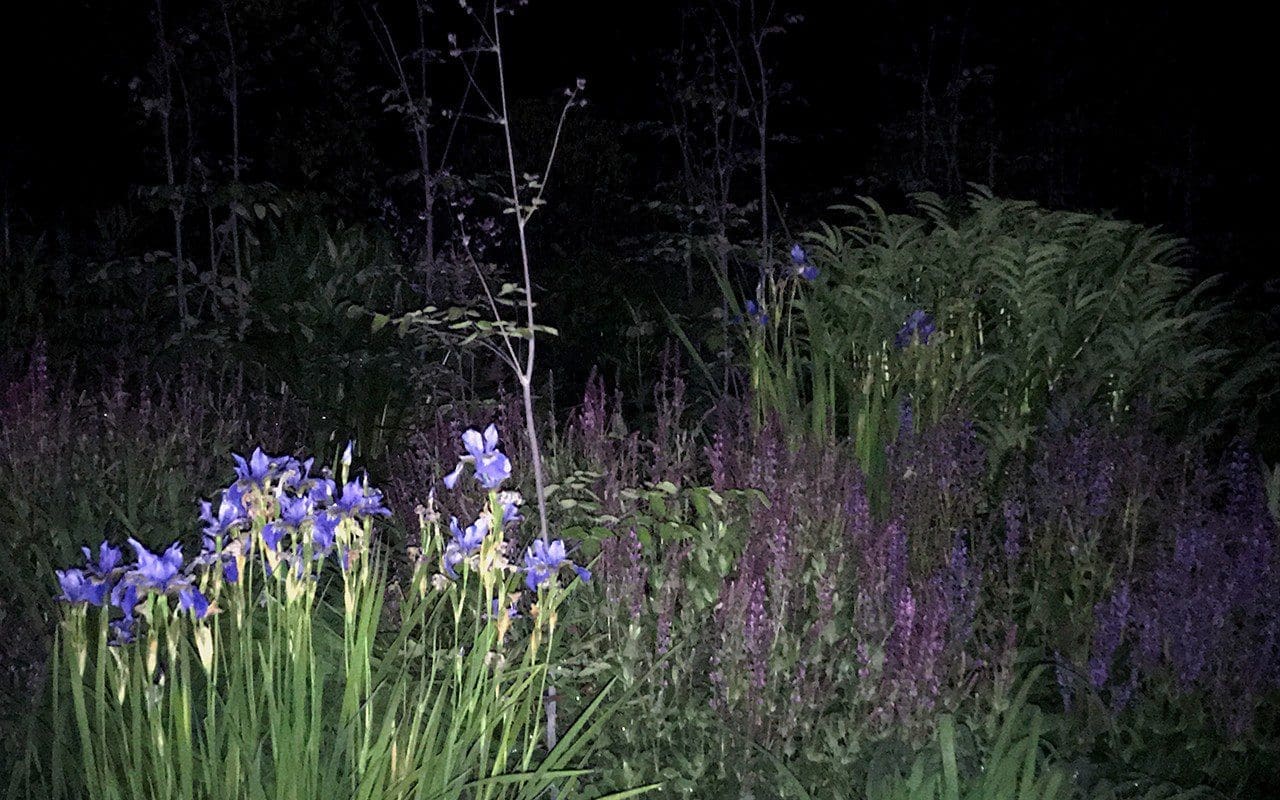
Over the years I have always experimented with my photography. Capturing movement by shooting digital film on a very slow shutter speed and then extracting single frames, selected for the painterly composition of their colour blur. On my old Polaroid camera I would cover the focus sensor, so that images of plantings resembled Impressionist paintings or colour fields. And I have used torches, lanterns and flash to see the garden in a different way by night. With each approach I have been happy, even seeking, to surrender some of my control over the final image to the equipment and technology itself.
However, over the past few years, and so that we can record the garden here properly, I have been actively working to improve my skill with a digital SLR camera and a number of lenses, so it has been a while since I have experimented in this way. At the beginning of June, with the start of the long warm nights, I found myself in the garden at the gloaming hour, having driven down to Somerset after a working day in London. With the warmth, growth had started in earnest and, as the light faded, there were parts of the new garden that it fast became too dark to see clearly. I got out my phone and switched the light on. Suddenly individual plants were thrown into sharp relief against the inky background of hedge, wood and sky. The composition of volumes and heights and the differences in textures became more apparent. Colour was heightened and where, by daylight, the plantings were soft and transparent, now they were graphic and architectural. I immediately started taking photographs on the phone with the flash.
It is a tricky process framing and composing an image when you are, quite literally, shooting in the dark. A series of test shots are necessary to establish the composition and to attain the right distance from the subject so that the flash doesn’t create too much of a hot spot. Even once this has been successfully done, the camera doesn’t always focus accurately in the dark, so each successful shot is arrived at after taking many that do not work. It is then a long process evaluating, editing and then adjusting contrast and colour balance to achieve a satisfactory result.
As the nights grew longer and we wandered the paths later and later each evening, I have been staying out after nightfall to try and capture aspects of the ever-changing picture. As in Tom’s Midnight Garden, the clarity of darkness reveals things invisible by day. The abstraction of the plantings against the velvet black and the fluttering of a thousand moths making of the garden a new mysterious and magical territory.
Huw Morgan
Photographs: Huw Morgan
Published 21 July 2018
It has been an extraordinary run. Day after day, it seems, of clear sky and sunlight. I have been up early at five, before the sun has broken over the hill, to catch the awakening. Armed with tea, if I have been patient enough to make myself one before venturing out, my walk takes me to the saddle which rolls over into the garden between our little barn and the house. From here, with the house behind me and the garden beyond, I can take it all in before beginning my circuit of inspection. It is impossible to look at everything, as there are daily changes and you need to be here every day to witness them, but I like to try to complete one lap before the light fingers its way over the hedge. Silently, one shaft at a time, catching the tallest plants first, illuminating clouds of thalictrum and making spears of digitalis surrounded in deep shadow. It is spellbinding. You have to stop for a moment before the light floods in completely as, when you do, you are absolutely there, held in these precious few minutes of perfection.
Now that the planting is ‘finished’, the experience of being in the garden is altogether different. Exactly a year ago the two lower beds were just a few months old and they held our full attention in their infancy. The delight in the new eclipsed all else as the ground started to become what we wanted it to be and not what we had been waiting for during the endless churn of construction. We saw beyond the emptiness of the centre of the garden, which was still waiting to be planted in the autumn. The ideas for this remaining area were still forming, but this year, for the first time, we have something that is beginning to feel complete.
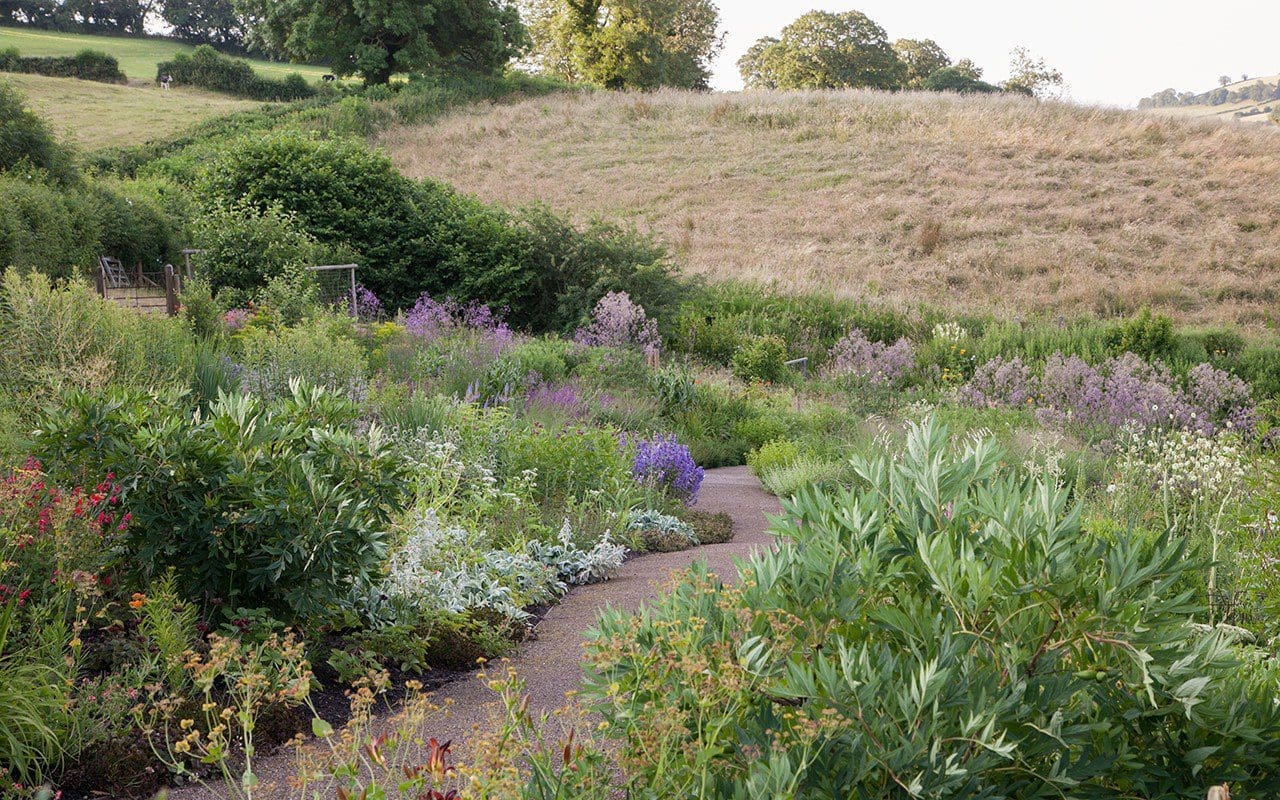 Looking down the central path from the saddle
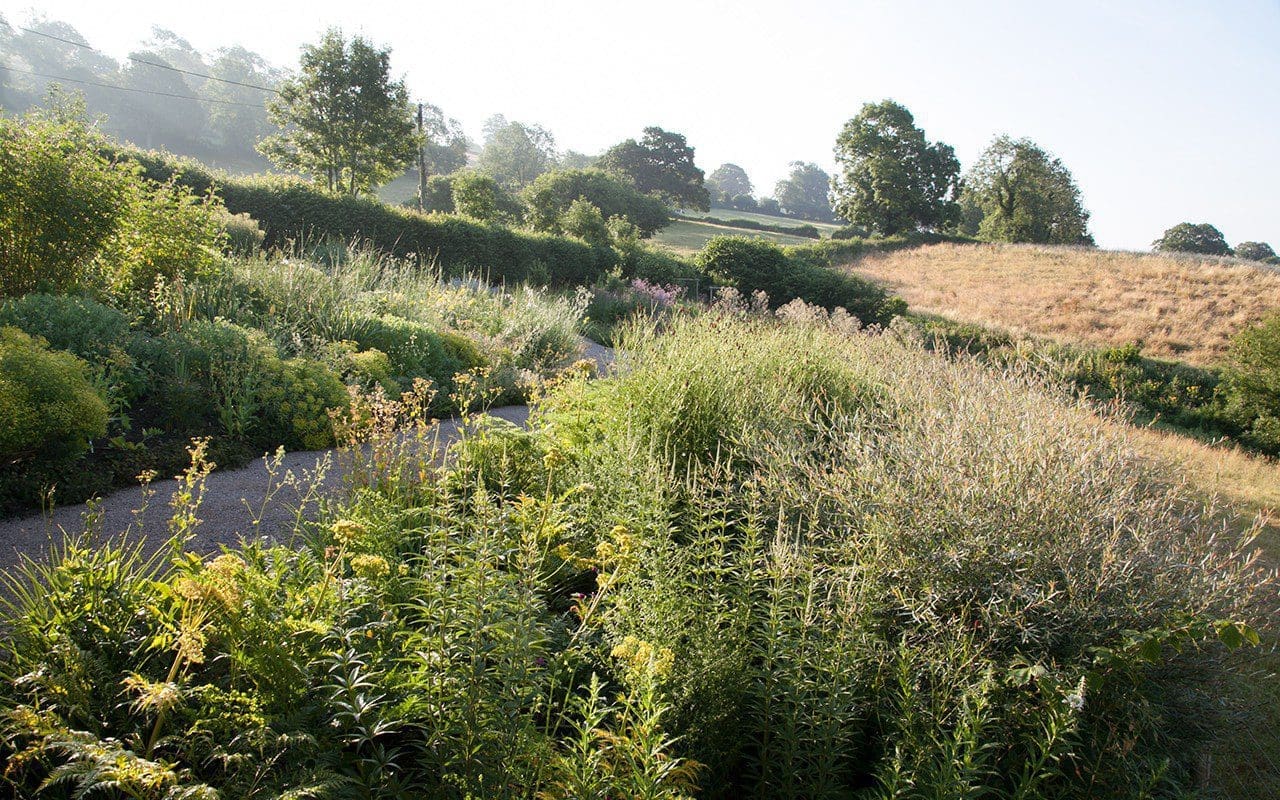 The view from the barn verandah
Of course, a garden is never complete. One of the joys of making and tending one is in the process of working towards a vision, but today, and despite the fact that I am already planning adjustments, I am very happy with where we are. The paths lead through growth to both sides where last year one side gave way to naked ground, and the planting spans the entire canvas provided by the beds. You can feel the volume and the shift in the daily change all around you. It has suddenly become an immersive experience.
An architect I am collaborating with came to see the garden recently and asked immediately, and in analytical fashion, if there was a system to the apparent informality. It was good to have to explain myself and, in doing so without the headset of my detailed, daily inspection, I could express the thinking quite clearly. Working from the outside in was the appropriate place to start, as the past six years has all been about understanding how we sit in the surrounding landscape. So the outer orbit of the cultivated garden has links to the beyond. The Salix purpurea ‘Nancy Saunders’ on the perimeter skip and jump to join the froth of meadowsweet that has foamed this last fortnight along the descent of the ditch. They form a frayed edge to the garden, rather than the line and division created by a hedge, so that there is flow for the eye between the two worlds. From the outside the willows screen and filter the complexity and colour of the planting on the inside. From within the garden they also connect texturally to the old crack willow, our largest tree, on the far side of the ditch.
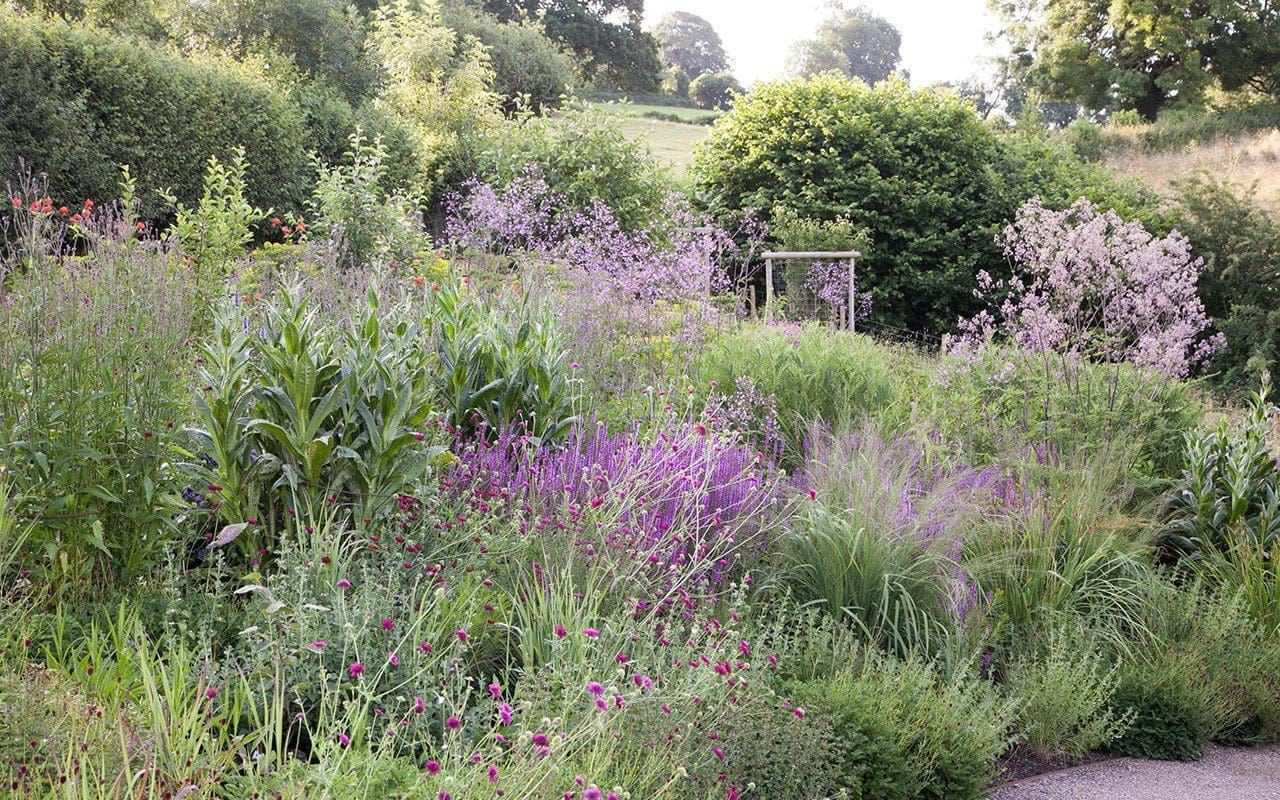 The far end of the garden which was planted in Spring 2017
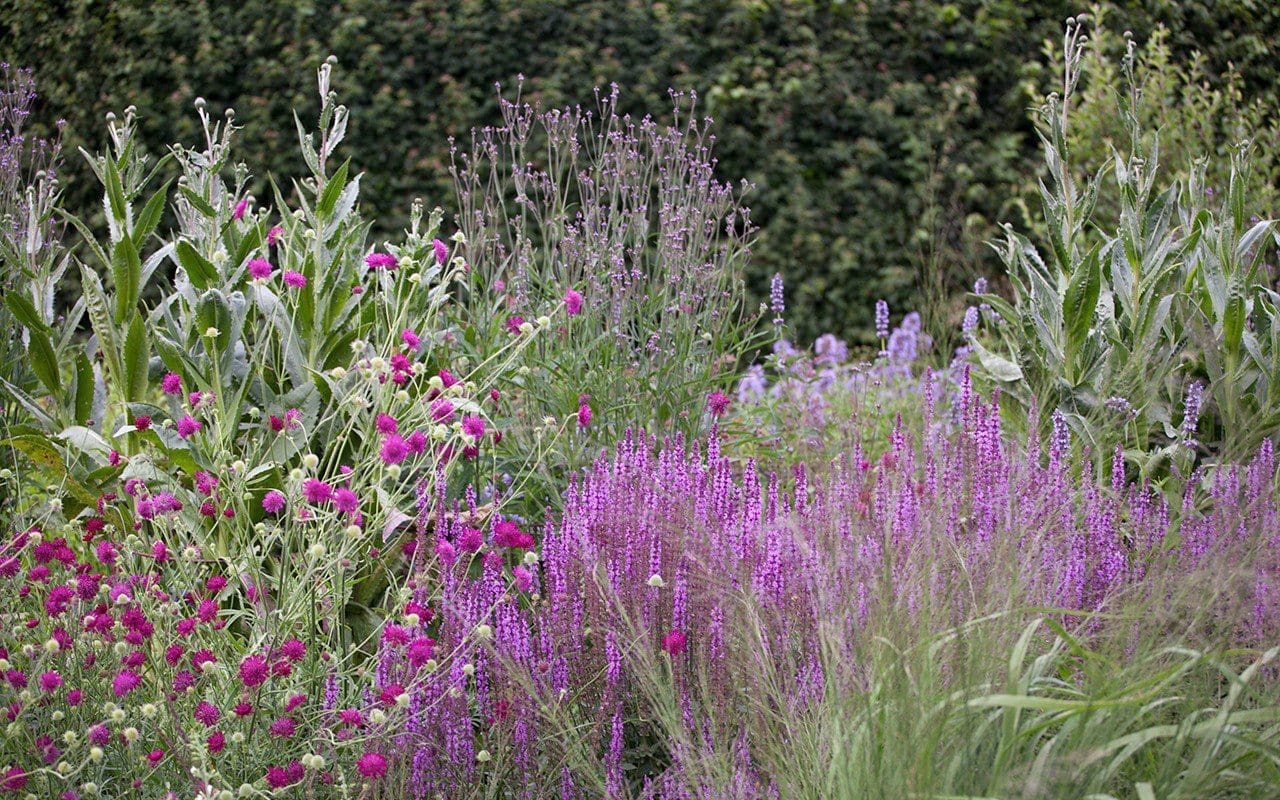 Knautia macedonica, Salvia nemerosa ‘Amethyst’, Cirsium canum and Verbena macdougallii ‘Lavender Spires’
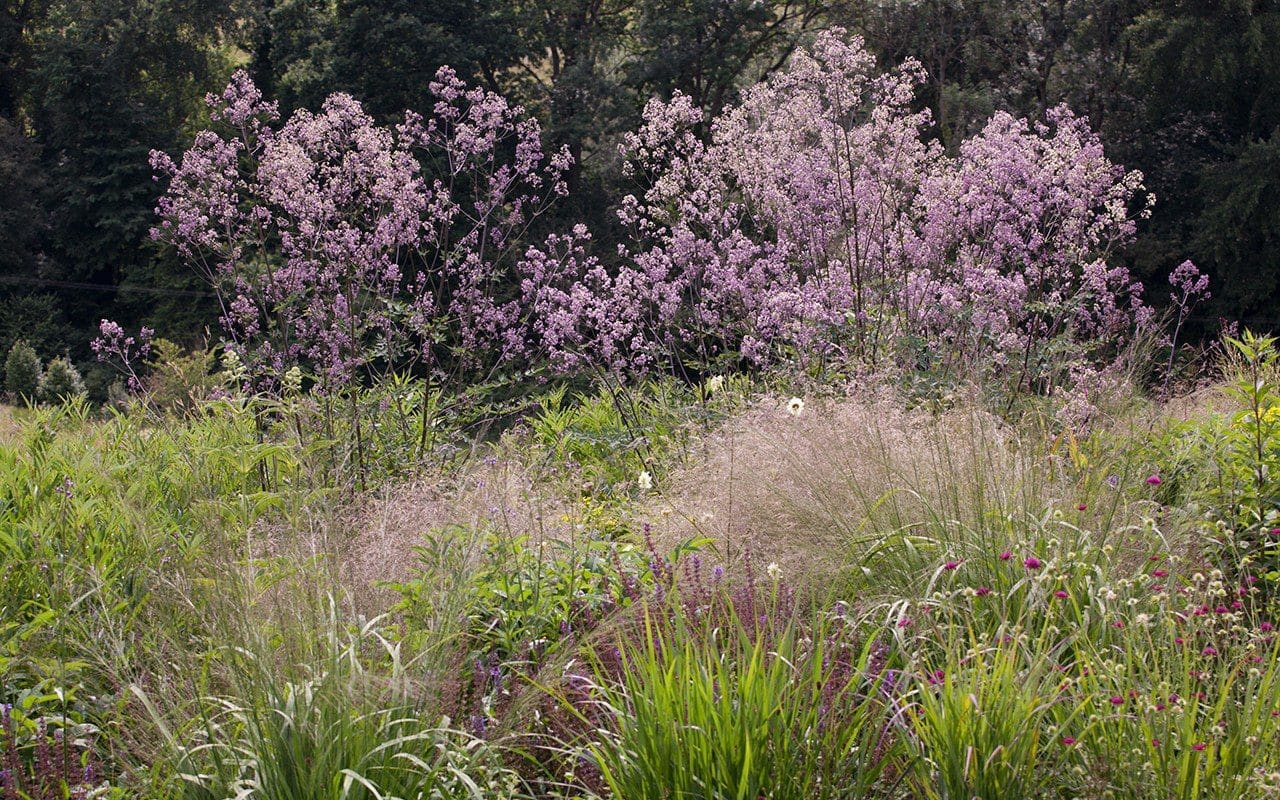 Thalictrum ‘Elin’ above Deschampsia cespitosa ‘Goldtau’
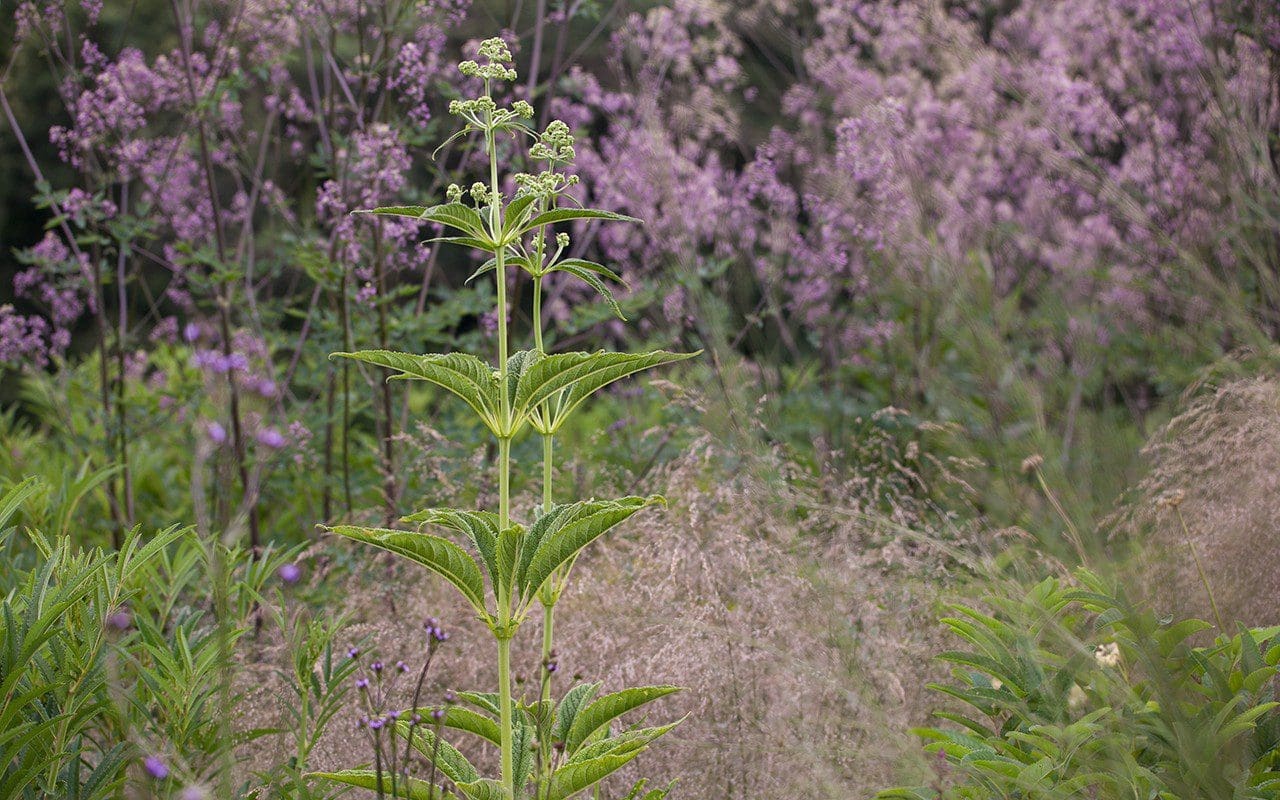 Eupatorium fistulosum f. albidum ‘Ivory Towers’ emerging through Deschampsia cespitosa ‘Goldtau’
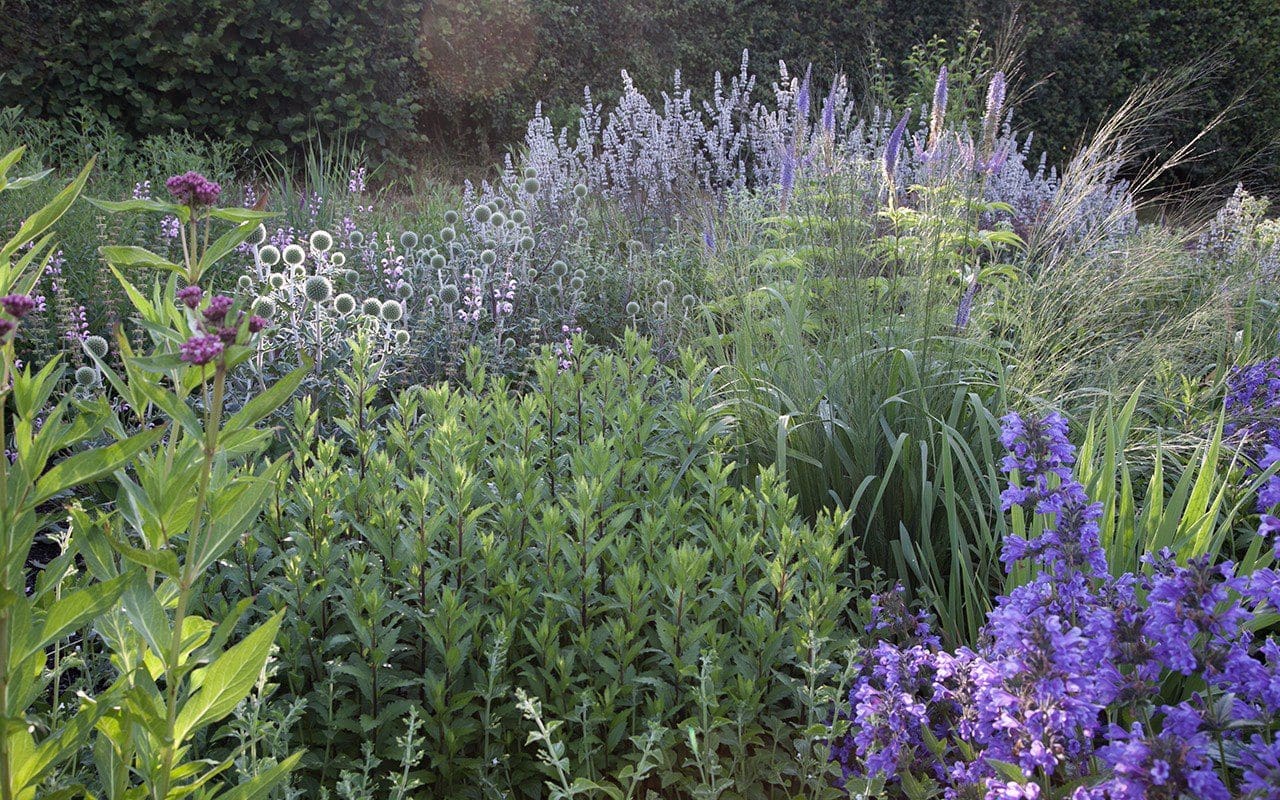 Asclepias incarnata, Echinops sphaerocephalus ‘Arctic Glow’, Nepeta nuda ‘Romany Dusk’ and Nepeta ‘Blue Dragon’
This first outer ripple of the garden is modulated. It is calm and delicate due to the undercurrent of the Deschampsia cespitosa ‘Goldtau’, but strong in its simplicity. From a distance colours are smoky mauves, deep pinks and recessive blues, although closer up it is enlivened by the shock of lime green euphorbia, and magenta Geranium psilostemon and Lythrum virgatum ‘Dropmore Purple’. Ascending plants such as thalictrum, eupatorium and, later, vernonia, rise tall through the grasses so that the drop of the land is compensated for. These key plants, the ones your eye goes to for their structure, are pulled together by a veil of sanguisorba which allows any strong colour that bolts through their gauzy thimbles to be tempered. Overall the texture of the planting is fine and semi-transparent, so as to blend with the texture of the meadows beyond.
The new planting, the inner ripple that comes closer but not quite up to the house, is the area that was planted last autumn. This is altogether more complex, with stronger, brighter colour so that your eye is held close before being allowed to drift out over the softer colour below. The plants are also more ‘ornamental’ – the outer ripple being their buffer and the house close-by their sanctuary. A little grove of Paeonia delavayi forms an informal gateway as you drop from the saddle onto the central path while, further down the slope a Heptacodium miconioides will eventually form an arch over the steps down to the verandah, where the old hollies stand close by the barn. In time I am hoping this area will benefit from the shade and will one day allow me to plant the things I miss here that like the cool. The black mulberry, planted in the upper stockbeds when we first arrived here, has retained its original position, and is now casting shade of its own. Enough for a pool of early pulmonaria and Tellima grandiflora ‘Purpurteppich’, the best and far better than the ‘Purpurea’ selection. It too has deep, coppery leaves, but the darkness runs up the stems to set off the lime-green bells.
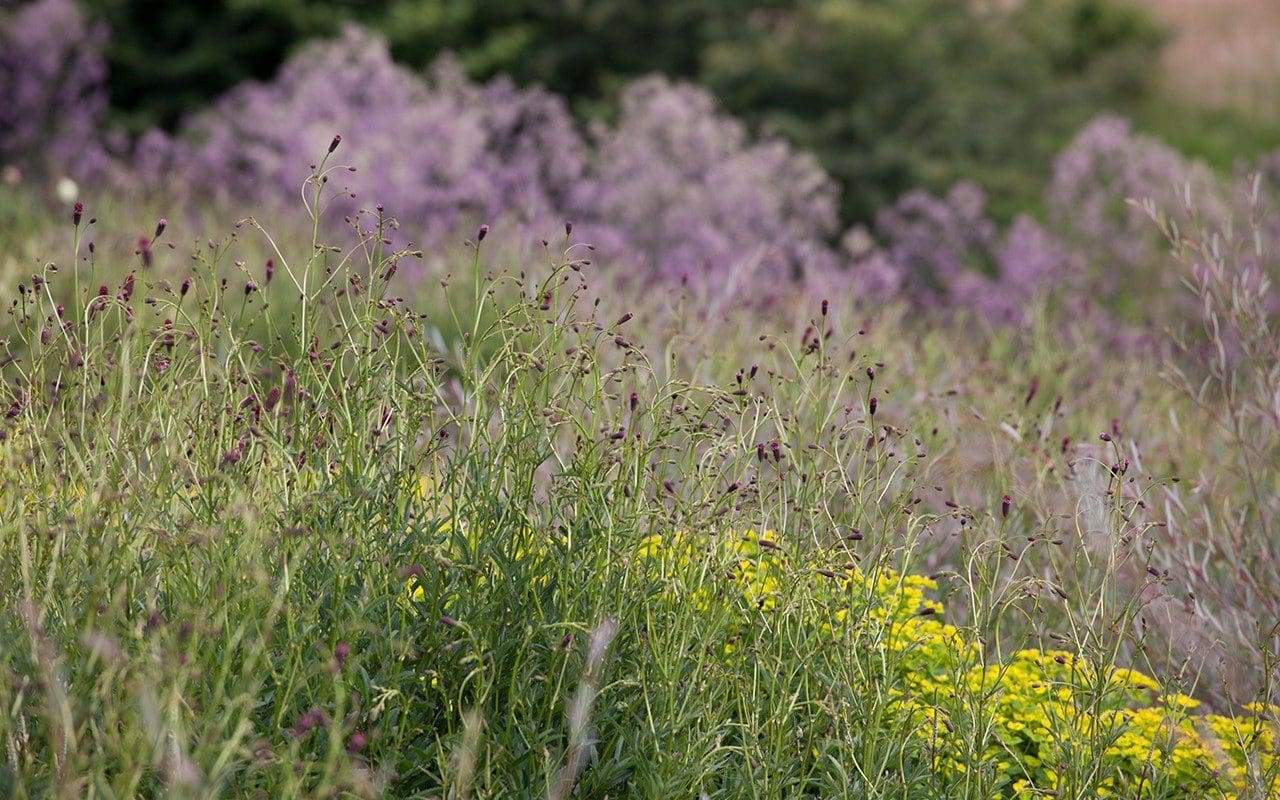 Sanguisorba officinalis ‘Red Thunder’, Euphorbia wallichii and Thalictrum ‘Elin’
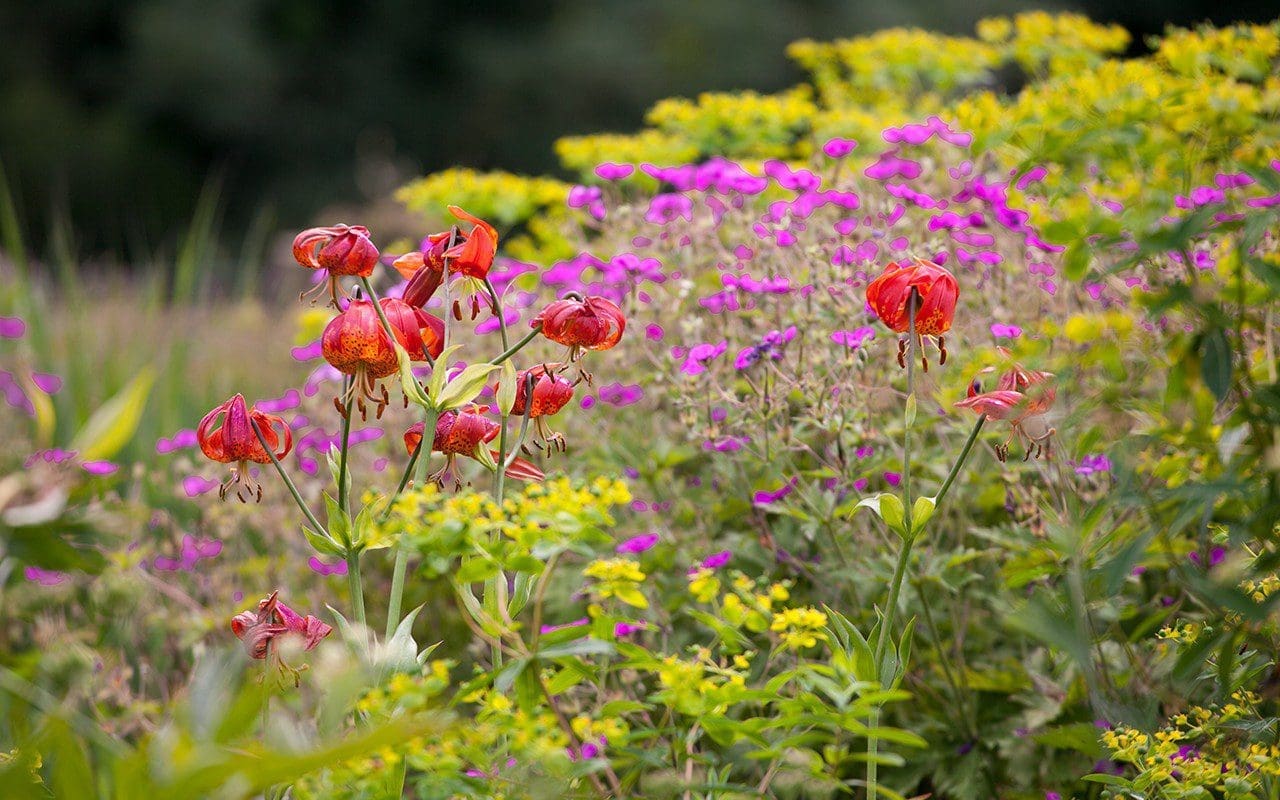 Lilium pardalinum, Geranium psilostemon and Euphorbia cornigera
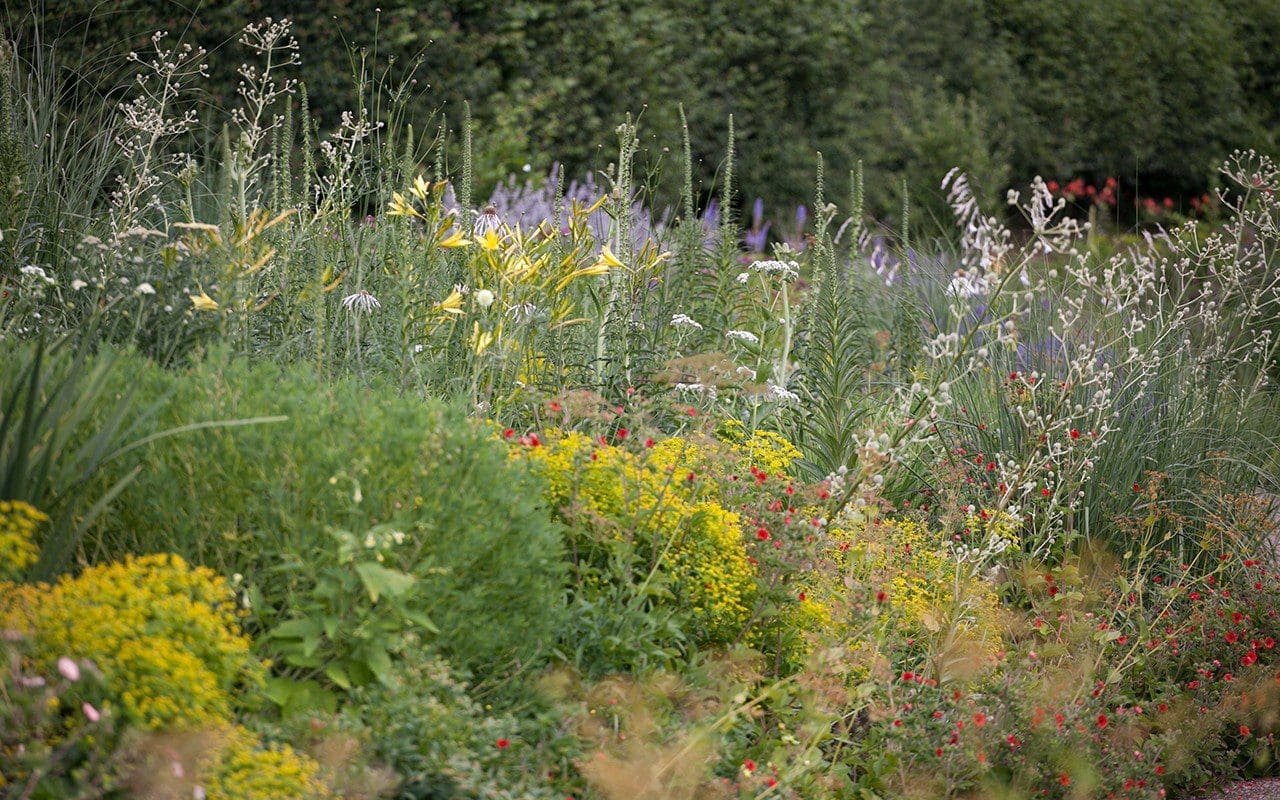 The newly planted central area
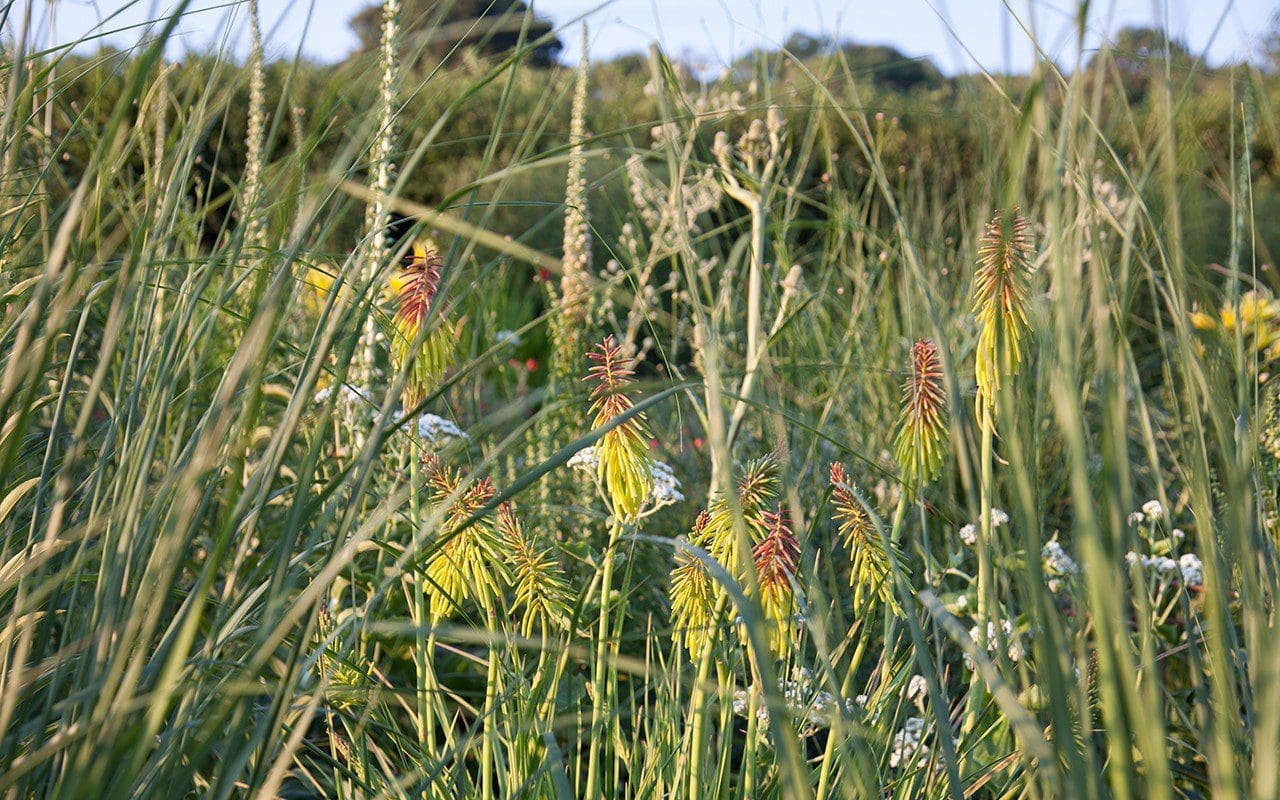 Kniphofia rufa, Eryngium agavifolium and Digitalis ferruginea
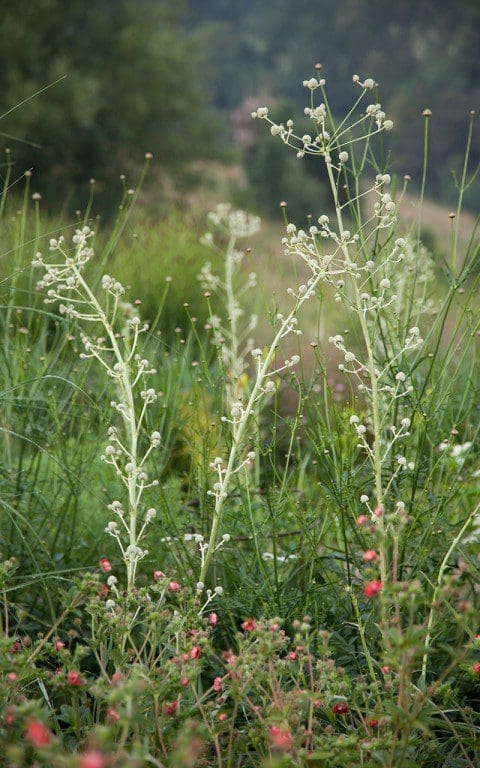 Eryngium eburneum
There is little shade anywhere else and the higher up the site you go the drier it gets as the soil gets thinner. This is reflected in a palette of silvers and reds with plants that are adapted to the drier conditions. I am having to make shade here with tall perennials such as Aster umbellatus so that the Persicaria amplexicaulis ‘Blackfield’, which run through the upper bed, do not scorch. Where the soil gets deeper again at the intersection of paths, a stand of Panicum virgatum ’Cloud Nine’ screens this strong colour so it can segue into the violets, purples and blues in the beds below. I have picked up the reds much further down into the garden with fiery Lilium pardalinum. They didn’t flower last year and have not grown as tall as they did in the shelter of our Peckham garden, but standing at shoulder height, they still pack the punch I need.
The central bed, and my favourite at the moment, is detailed more intensely, with finer-leaved plants and elegant spearing forms that rise up vertically so that your eye moves between them easily. Again a lime green undercurrent of Euphorbia ceratocarpa provides a pillowing link throughout and a constant from which the verticals emerge as individuals. Flowering perennials are predominantly white, yellow and brown, with a link made to the hot colours of the upper bed with an undercurrent of pulsating red Potentilla ‘Gibson’s Scarlet’. Though just in their first summer, the Eryngium agavifolium and Eryngium eburneum are already providing the architecture, while the tan spires of Digitalis ferruginea, although short-lived, are reliable in their uprightness.
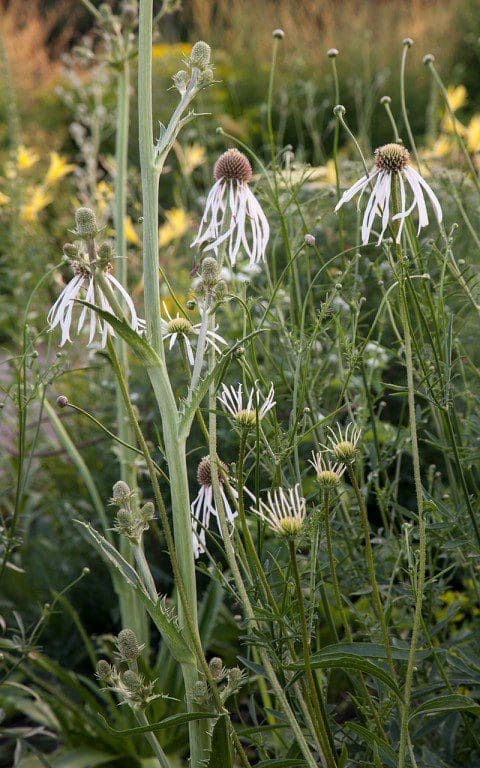 Echinacea pallida ‘Hula Dancer’ and Eryngium agavifolium
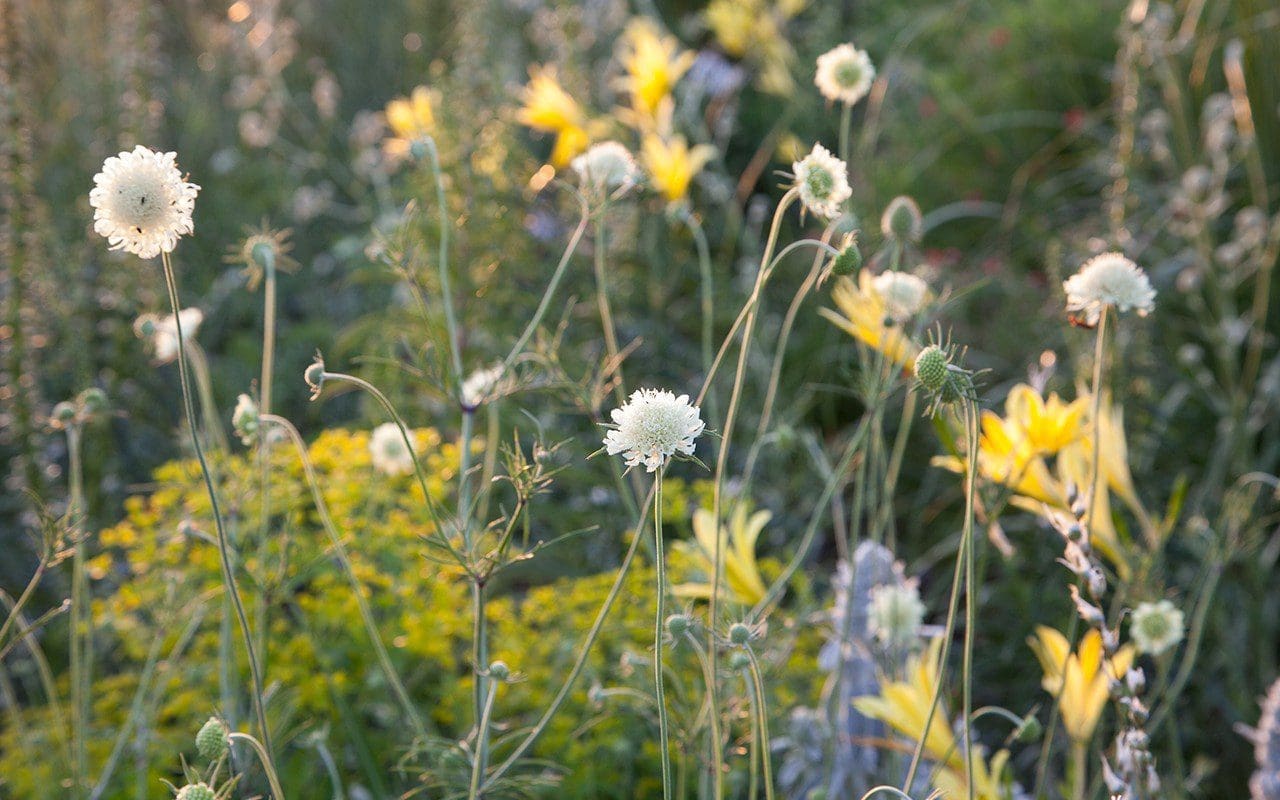 Scabiosa ochroleuca
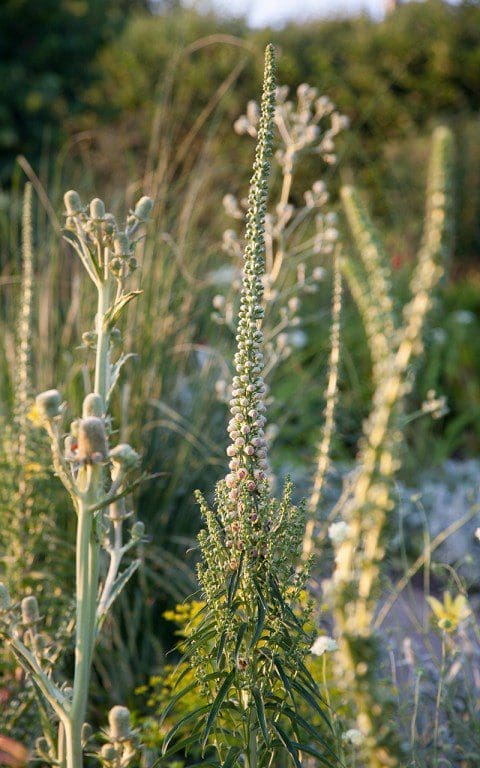 Digitalis ferruginea, Eryngium agavifolium and E. eburneum
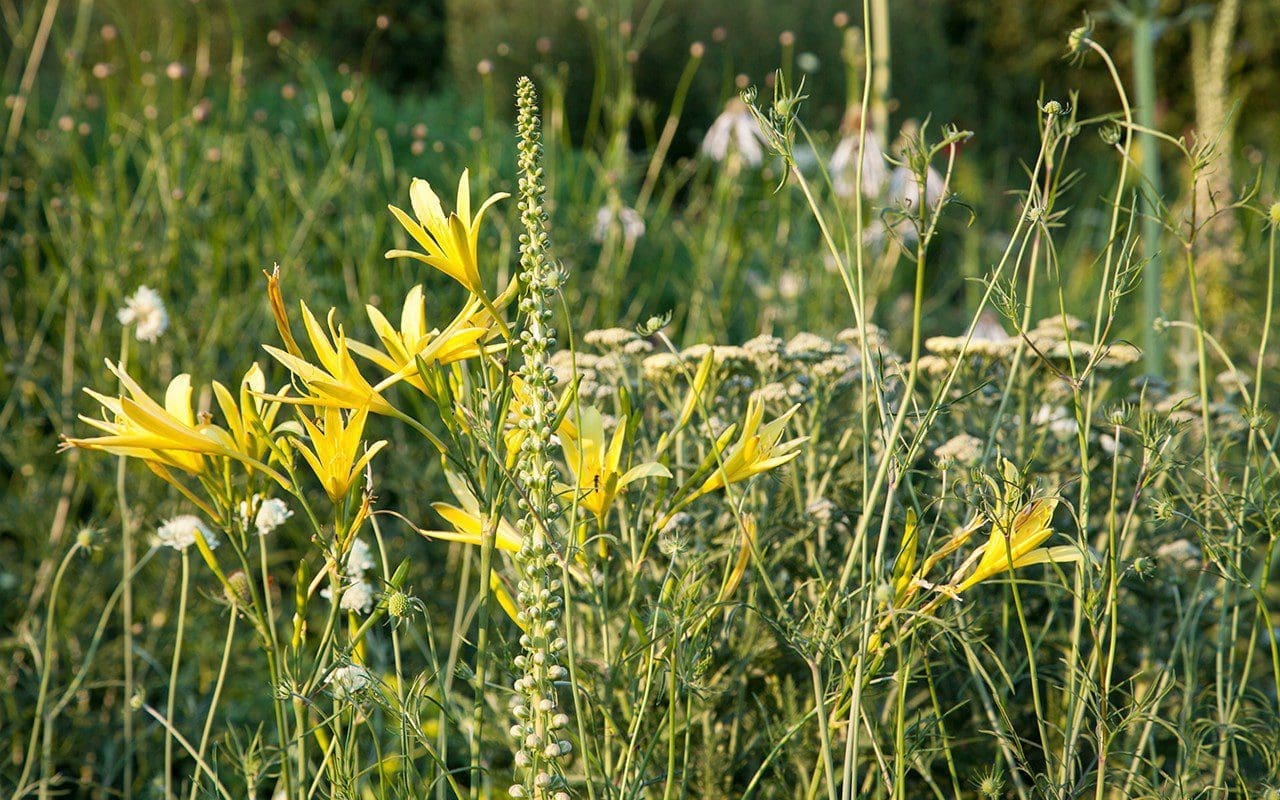 Hemerocallis ochroleuca var. citrina, Digitalis ferruginea, Achillea ‘Mondpagode’ and Scabiosa ochroleuca
It has been good to have had the pause between planting up the outer beds in spring last year, before planting the central and upper areas in the autumn. We are now seeing the whole garden for the first time as well as the softness and bulk of last year’s planting against the refinement and intensity of the new inner section. Constant looking and responding to how things are doing here is helping this new area to sit, and for it to express its rhythms and moments of surprise.
I am taking note with a critical eye. Will Achillea ‘Mondpagode’ have a stay of execution now that it is protected in the middle of the bed ? Last year, planted by the path, it toppled and split in the slightest wind. Where are the Rudbeckia subtomentosa ‘Henry Eilers’ and, if they have failed, how will I get them in again next year when everything will be so much bigger ? Have I put too many plants together that come too early ? Too much Cenolophium denudatum, perhaps ? How can this be remedied ? Later flowering asters and perhaps grasses where I need some later gauziness. Will the Dahlia coccinea var. palmeri grow strongly enough to provide a highlight above the cenolophium and, if not, where should I put them instead ? The season will soon tell me. The looking and the questioning keep things moving and ensure that the garden will never be complete.
Words: Dan Pearson / Photographs: Huw Morgan
Published 7 July 2018
The Thalictrum ‘Elin’ are as spectacular as they ever will be, topped out at what must be almost ten feet in height and clouding a myriad of tiny flower. They are in their second year now and have been good from the day they broke their winter dormancy. Last year they sent up just a couple of spires each but, with roots deep and a year behind them, they have powered a forest of lustrous growth. First, an early mound of feathery foliage of a glaucous, thunderous grey flushed with purple and bronze which, by the end of April, had reached its full expansion and was ready to charge the ascent of muscular vertical stems soaring towards the solstice. Slowing once they had reached their full height, the panicles broadened as the lateral limbs filled out with a million buds. The ascent was every bit as remarkable as the cloud of smoky violet flower. Arguably more so for the dramatic build and anticipation.
‘Elin’ march through the planting in the lower part of the garden to provide punctuation, and I am depending upon them now to stay standing. Last year, when their limbs were heavy with flower, a rain-laden wind toppled them like ninepins, so I staked them with a waist-height hoops in early May to prevent a repeat performance. In our deep, hearty soil with plenty of sunshine and no early competition around their crowns, there has been nothing to hold them back, so I have grown them hard and so far denied them extra water. I am hoping this will mean that they grow more strongly and that their companion sanguisorbas help them to stay true.
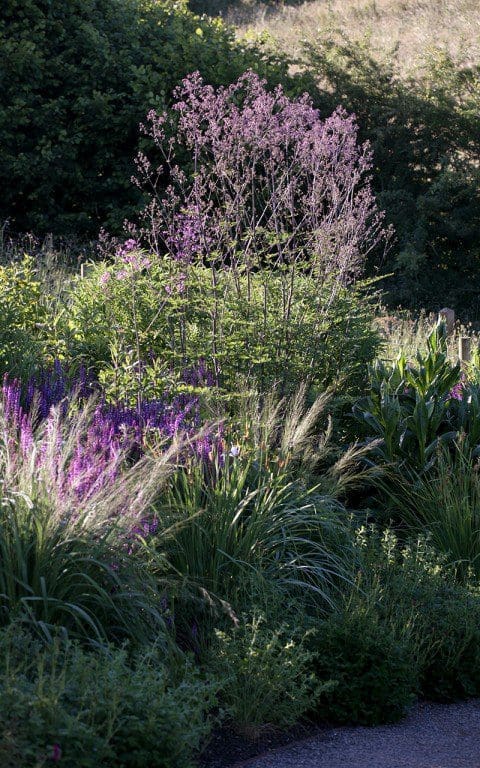
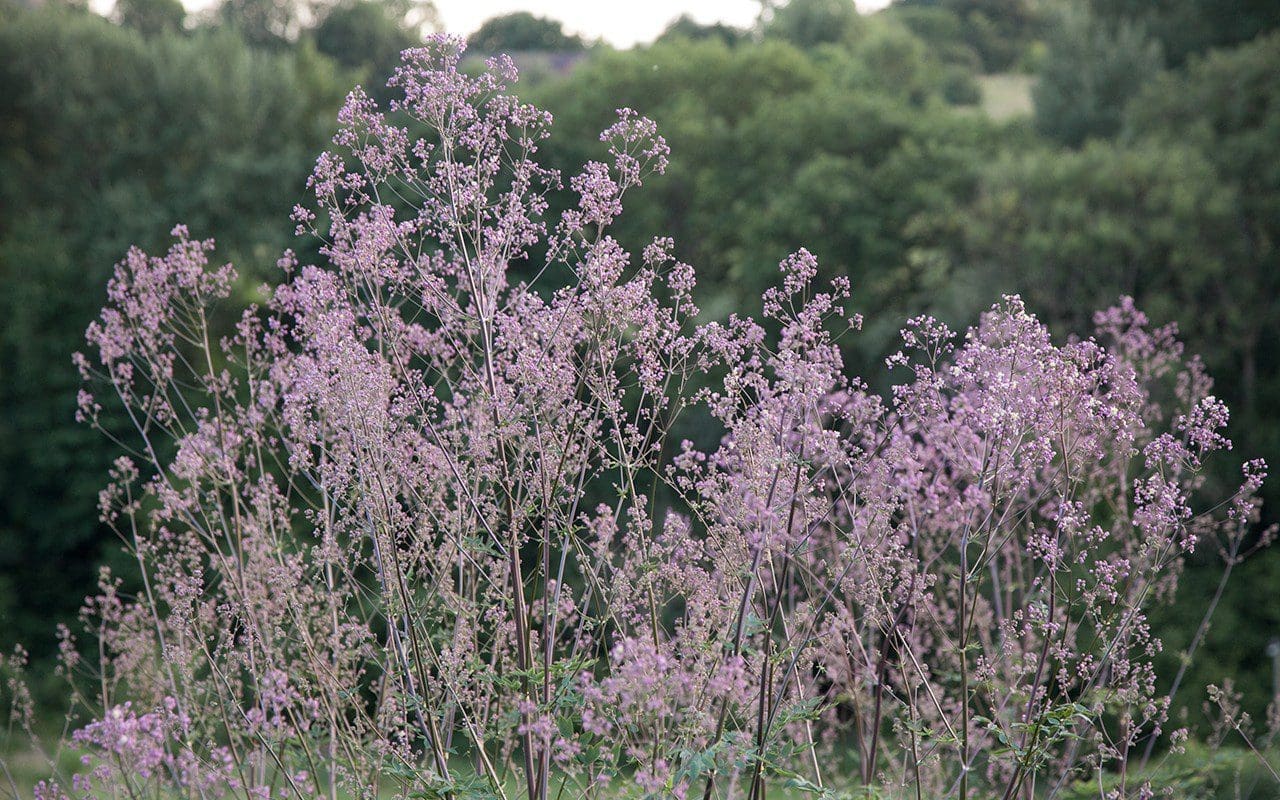 Thalictrum ‘Elin’
I have grown Thalictrum aquilegifolium for years, where it is reliable in both sun or shade. A basal clump of foliage – well named for its similarity to columbine – is an early presence in the spring garden and the flowers are sent up early, ahead of most other perennials, so that there is a clear storey between them and their foliage. The wiry stems support clusters of stamen-heavy flowers which, when they are out, resemble exotic plumage. In the true species, the flowers are an easy mauve, but ‘Black Stockings’ (main image with Salvia nemorosa ‘Amethyst’ and Iris sibirica ‘Papillon’) punches the colour up, with dark-stained stems and buds the colour of unripe grapes that open into flowers that register strong violet-pink. I have the white form too, which is strangely rare in cultivation, but not impossible to get. My plants came from the Beth Chatto Nursery, but I will be saving seed, which is viable if sown fresh, and I’m hoping will come true as they are quite some distance in the garden from their cousins. Seedlings that aren’t true white will easily be spotted for they have the purple stain, when the white form is pale, apple green. I plan to have plenty to play with and want to see if they will take in some open ground under the crack willow, where I let the Galium odoratum loose after it misbehaved and took too well to the garden.
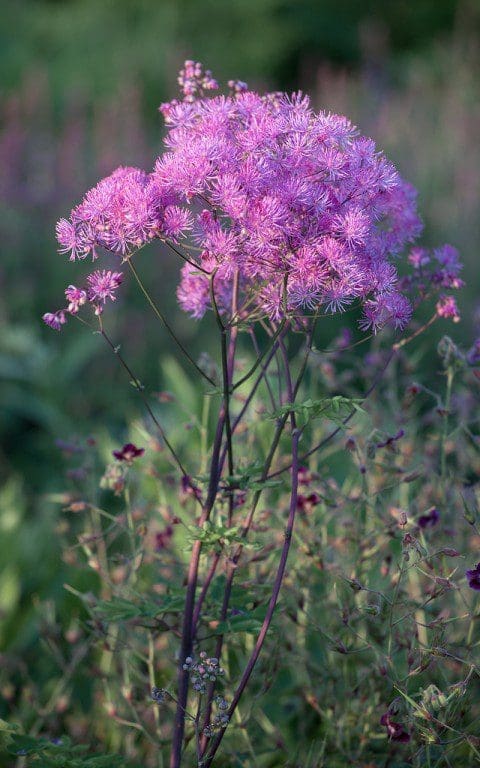 Thalictrum ‘Black Stockings’
Until ‘Elin’ appeared on the scene relatively recently, Thalictrum rochebruneanum was the tallest and most dramatic of the tribe. I saw it first at Sissinghurst, where it towered with Cynara in the purple border. As a teenager I lusted after its rangy limbs, impossibly fine it seemed, and the suspense in the delicate flowers. It languished on our thin acidic ground in my parents’ garden, growing to half the height. I tried it again in the Peckham garden, but it hated the way our soil dried as the water table dropped in summer. However, I have grown it well in California where, with a little extra water and shade from the sun, it seeds freely to spring up spontaneously as ‘volunteer’ seedlings. I hope that it will do the same for me here. So far in year two, it has done well, certainly not as well as ‘Elin’ but, with three or four flowering stems per plant, which have enjoyed the light at the base where they have been planted amongst later-to-emerge persicaria.
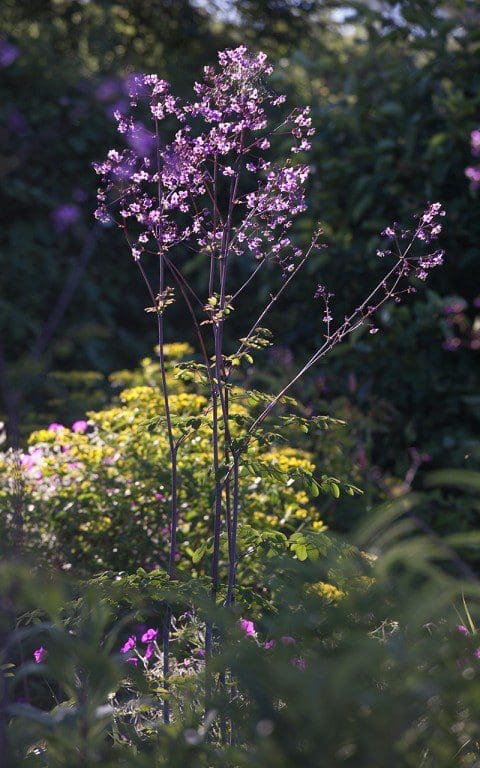
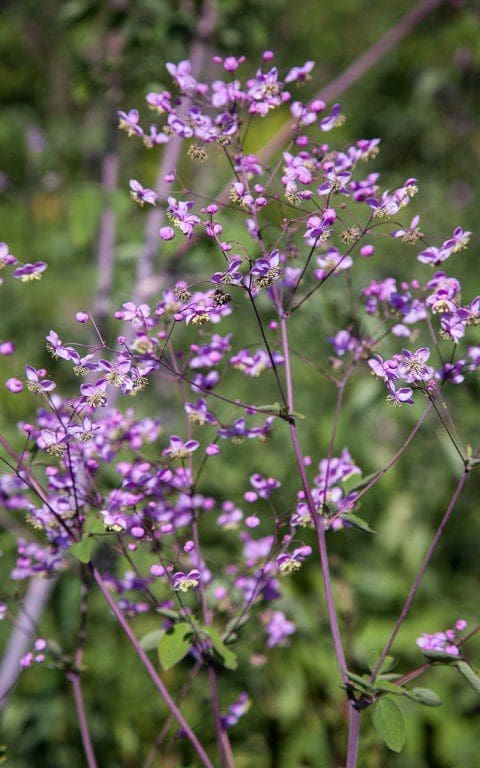 Thalictrum rochebruneanum
Hailing from Japan, where they find a niche amongst other perennials that like a cool, retentive soil, they must be a spectacular sight to come upon. Where ‘Elin’ is all about quantity, the flowers forming a Milky Way when they come together, every flower of Thalictrum rochebruneanum is a jewel. Richly coloured like gemstones, held sparsely so that your eye is drawn to the individual, inviting you to spend some time to take in the space and the colour contrast of the inner parts of the flower. A cup of violet petals holds the gold provided by the pollen and projection of anther within.
Never getting everything completely as I want it to be, I see now that I need to bring a plant or two up closer to the path, so that I can take in the detail and enjoy looking up, for you have to, your neck craned. Being early days in this garden, I can only hope for a volunteer or two to take to this ground and let me know that I have finally found them a place they really want to be.
Words: Dan Pearson / Photographs: Huw Morgan
Published 30 June 2018
The last few weeks of growth have been remarkable, the volume and intensity lusher for the wet start and the thunderous, still growing weather. In this lead up to summer the garden was texturally wonderful, the layering of foliage acute for the absence or scarcity of flower. Finely divided mounds of sanguisorba, spearing iris and mounding deschampsia all readying themselves, but yet to show colour. A sense of expectation and the build up to the first round of early summer perennials we have today in this posy.
The colour in the garden is designed to come in waves, like a swathe of buttercups in a meadow, that leads your eye from one place to the next and builds in intensity and then dims as the next thing takes over. After an awakening of single peonies, the salvias are the next contrast to the foundation of greens, which I like here for their ease in the landscape. Though I have never found our native Meadow Clary (Salvia pratensis) on the land, it felt right to bring it into the garden in its cultivated form. We have two named varieties which are early to show and good for their verticality. Salvia pratensis ‘Indigo’, a rich, well-named blue and Salvia pratensis ‘Lapis Lazuli’, which was planted last autumn and is flowering here for the first time this year.
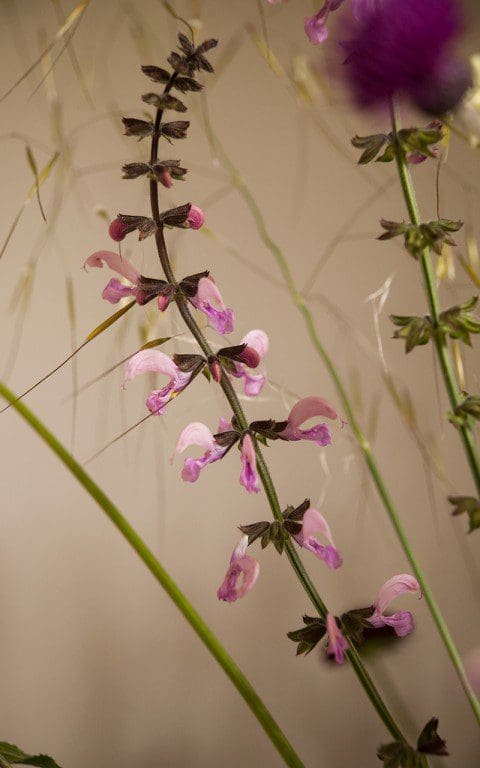 Salvia pratensis ‘Lapis Lazuli’
Where ‘Indigo’ is perfectly named, ‘Lapis Lazuli’ has nothing of the intensity of the stone it is named after, nor of the ultramarine pigment derived from it. I have a nugget on my windowsill which I found once in Greece, sparkling in crystal clear shallows and catching my eye like a magpie’s. Although I was expecting something brighter and cleaner in colour like my find, the clear, soft pink of ‘Lapis Lazuli’ is anything but disappointing. It has been in flower now since early May for a whole three weeks longer than it’s cousin ‘Indigo’, rising up to two feet in widely spaced spires from a rosette of puckered, matt foliage. I expect it to still be looking good at the end of the month, but shortly before it starts to run out of steam, it will be cut to the base to encourage a second flush.
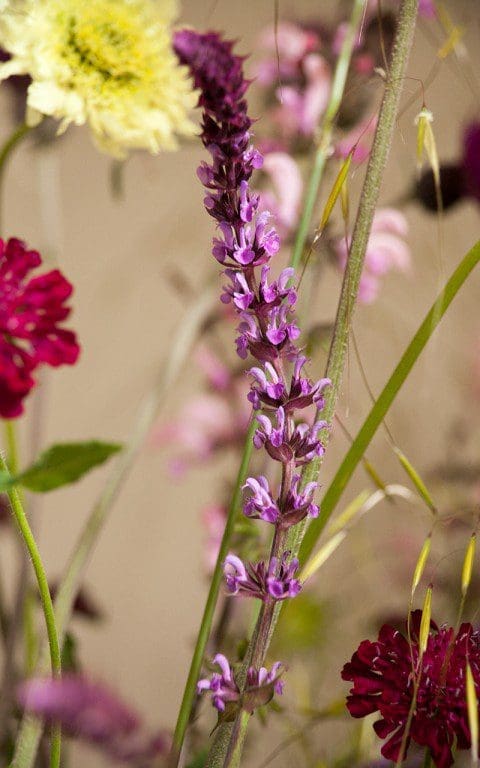 Salvia nemorosa ‘Amethyst’
The first cut back is always hard, because the salvias are a magnet to moths and bees, but we performed the same severity of cut on ‘Indigo’ last year and it rewarded us with a new foliage and then flower in August. Salvia nemorosa ‘Amethyst’, the second of the salvias in this posy and far better named for it’s jewel-like colouring, will also respond to the same treatment, but it is important to act before the energy has gone out of the plant by curtailing its show before it finishes flowering naturally. Energy put into seed will thus be saved and replaced with more flower and the reward of fresh new growth.
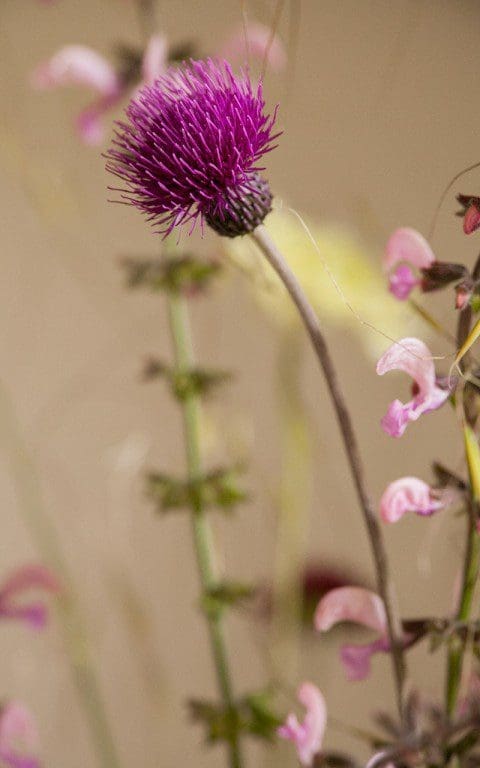 Cirsium rivulare ‘Trevor’s Blue Wonder’
The cirsium and the cephalaria are also encouraged to produce a second round of foliage by cutting them to the base immediately after they flower. Though they are less inclined to throw out more flower, refreshed foliage is just as useful in an August garden, which needs the greens from this early part of the summer to keep the garden looking lively. The Cirsium rivulare ‘Trevor’s Blue Wonder’ in this bunch grows down by the barns, where its early show coincides with baptisia. Though not remotely blue – a theme that is coming through in this posy, it seems – I love the bluer purple of this form just as much as the garnet red of the Cirsium rivulare ‘Atropurpureum’. These early thistles like plenty of light around their basal clump of foliage and look best for having the air you need to appreciate the way their flowers are held high and free of foliage.
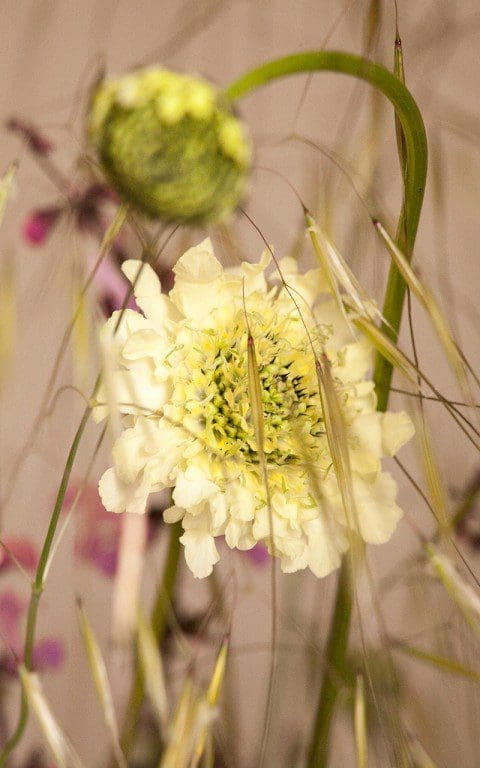 Cephalaria gigantea
Cephalaria gigantea is similar in its requirements and looks best when it can punch into air without competition. I grow it as an emergent amongst low Coreopsis verticillata ‘Moonbeam’ at the Millennium Forest in Hokkaido, where they grow ten feet tall on either side of a winding path. The creamy yellow flowers are delightfully sparse and the terminus of a rangy cage of airy growth. Here on our hillside they grow six or seven feet at most and right now appear head and shoulders above their partners. A single plant will leave a sizable hole in a planting if you choose to fell it after flowering, as I do for fresh growth, so it is wise to combine it with later performing partners that ease its temporary absence. Asters, grasses and sanguisorba cover for me here.
I have two more species that are part of the new planting and will flower for me for the first time here this year. Cephalaria alpina is a smaller cousin which is more delicate in all its parts, terminating at about four feet and forming a low mound of divided foliage. Cephalaria dipsacoides, teasle-like in its naming and also in its vertical nature, is up to six feet tall, but grows upright from the base. Creamy in colour like its cousins, but differing from all the plants in this posy in being later to flower and prolifically seeding if it likes you. Although I love its seed heads and the structure they offer the autumn garden, I will be cutting the plants down prematurely before they seed. A practice I am having to employ here with several of the self-seeders, as I do not have the manpower to manage the progeny.
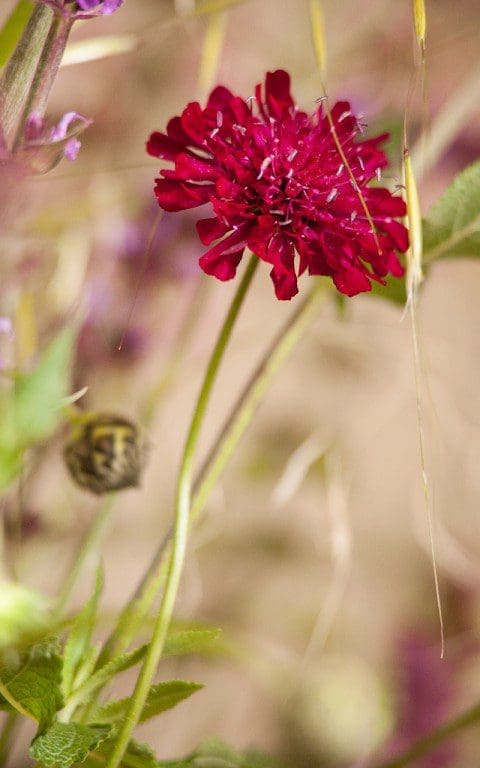 Knautia macedonica
A case in point being Knautia macedonica, that I will now treat as a useful filler where I need something fast and reliable. Our ground is almost too rich for this pioneer and in year two the plants splay fatly where they have been living too well. It too seeds prolifically, and my failure to deadhead them last summer resulted in a rash of seedlings this spring, which showed that it could be a problem if left to go native. A few seedlings on standby, however, will provide me with gap fillers where I need them and a succession of this ruby-red scabious that hovers amongst its neighbours. We pull any pink seedlings, favouring the bloodline of those with darker genes.
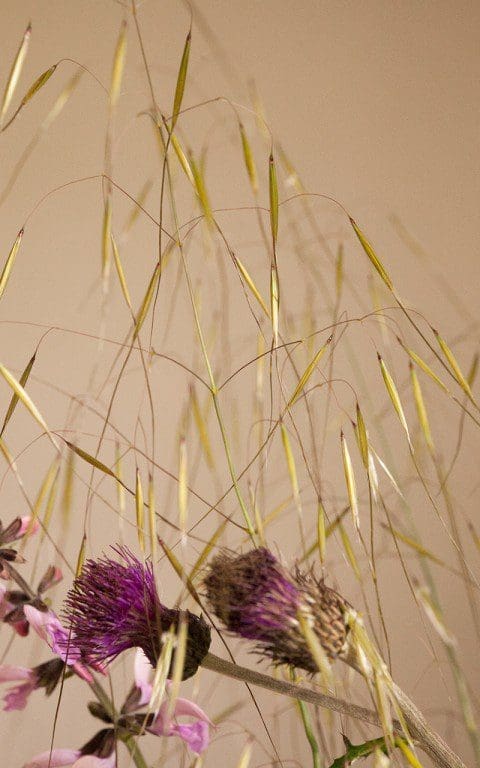 Stipa gigantea
Stipa gigantea, the Giant Oat Grass is a plant that I have not grown since Home Farm, where it was a mainstay of the Barn Garden. For a while this grass became so fashionable that I avoided using it, despite its obvious beauty and, without enough room to grow it in the Peckham garden, I gave myself a breather. However, I am very happy to have it back and have given it the room it needs to look its best and for its low mound of evergreen foliage to get the light it needs. Right now it is at its most captivating, the lofty panicles, pale copper before turning gold and heavy with yellow pollen, dancing lightly to catch the long evening light. It is an early grass, bolting sky-bound plumes in May and taking June in a shower of luminosity and light.
Words: Dan Pearson / Photographs: Huw Morgan
Published 16 June 2018
A year ago now, and with the prospect of planting up the final part of the garden in the autumn, I wanted to add some variety to the range of plants that was available from my favourite nurseries. So, I set about sowing some additions from seed, to feel that I’d grown them from the very beginning and to understand them fully. Bupleurum perfoliatum and Aquilegia longissima were needed in quantity to weave into the new planting and to jump around, as if self-sown. It was also good to revisit plants that have become hard to obtain, such as Aconitum vulparia, a creamy wolfbane from Russia which I’d grown as a teenager and had a hankering for again.
The success stories of the plants I knew and understood were reassuring. Those that I didn’t, vexing but fascinating nevertheless. It is a mistake to throw out a pot of seed that hasn’t germinated within a year, because it may simply be waiting for its moment. The Viola odorata ‘Sulphurea’ needed the freeze of a winter to break dormancy and I learned by chance that Agastache nepetoides needs light to germinate, and so should be surface sown. My usual top dressing of horticultural grit, used to prevent moss and as a slug repellent, was washed from the sides of a pot by a leaky rose, opening up a window of opportunity, the seed germinating there and there only to burn this fact into my memory. Some seed may have been too old by the time it was sown, with very poor germination on the Anemone rivularis, but the small numbers mean that the plants that made it are that much more precious. Although the value of seed-raised plants increases when you have tended them from their vulnerable beginnings, it is also good to feel that you can be generous, because some plants are just so easy.
Having grown the biennial Lunaria annua ‘Chedglow’ the year before, the first plants had all flowered and seeded so an interim generation was needed to set up a continuity. The large, flat seed threw out fat cotyledons in a matter of days and the distinctive purple-tinged foliage was already there in the first true leaves. Where the perennial Anemone rivularis took their time to build up strength for the life ahead of them and had to be watched because they were so slow, the pioneering nature of the Lunaria means that you have to keep up to make the most of the growing season. The seedlings were potted on into 9cm pots as soon as the first true leaf was properly formed, handling the seedlings only by their cotyledons and never their vulnerable stems. With the new opportunity of their own space, they worked up a rosette last summer that was hearty enough to plant in the autumn and bolt the early spring of flower a year after sowing.
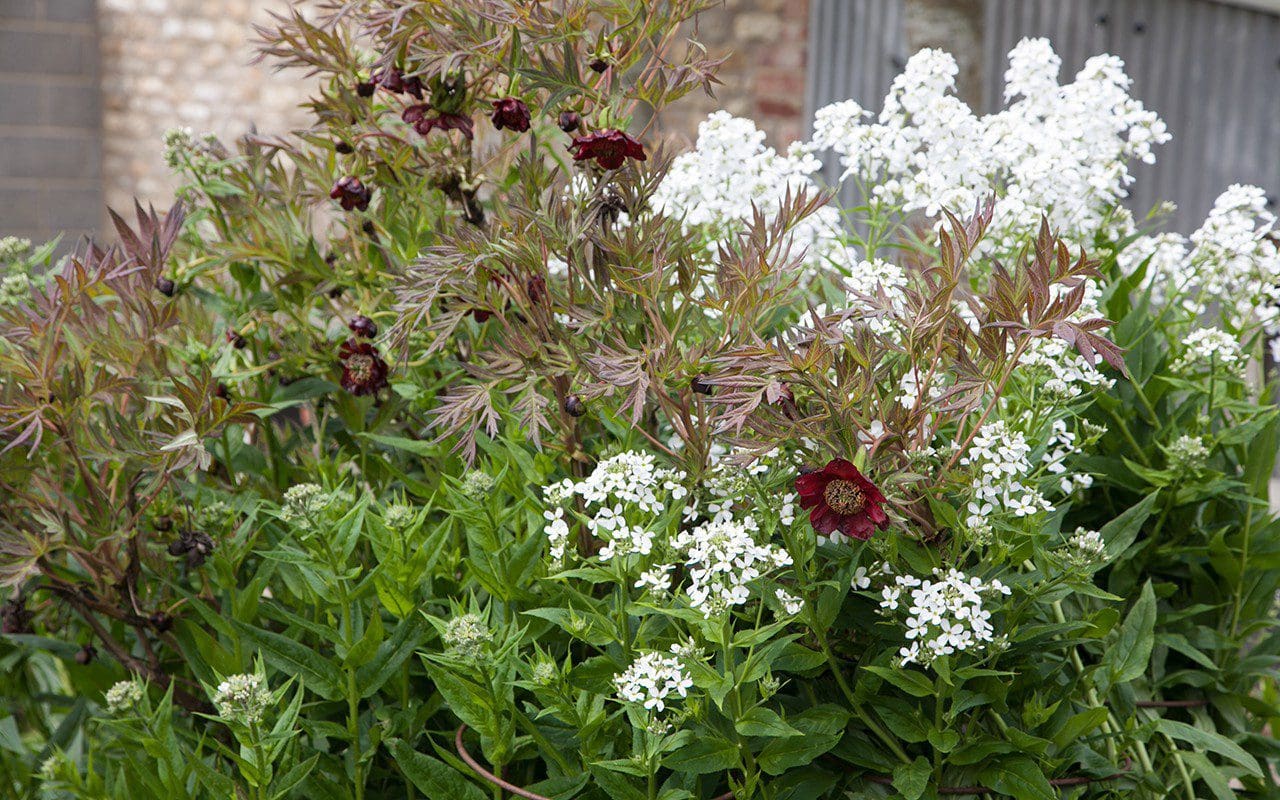 Hesperis matronalis var. albiflora with Paeonia delavayi
Of the short-lived perennials I’ve used to provide for me early on in the life of the establishing garden, the Hesperis matronalis var. albiflora have been good to revisit. The white sweet rocket was a plant of my childhood garden, where it had sprung from the clearances of brambles like a phoenix from the ashes. Rising up fast with the cow parsley and easily as tall, its early flower bridges late spring and early summer. I have not had room to grow it for a while, because its ephemeral nature this early in the season can easily smother neighbours, to leave a summer gap when you cut it back to the rosette once it’s done. Let it seed and you will find a rash of youngsters, for it is also a pioneer that sees seedlings bulking up over summer in readiness to conquer new ground the following spring. This eagerness can easily be tapped, and it is good to leave a couple of limbs to go to seed as the plants are only good for two or three years before they exhaust themselves.
Sweet Rocket are adaptable to both an open position or to dappled shade, but the advantage of a cool position is that they grow less vigorously and take less ground. Mine were interspersed randomly in the planting to perfume the steps that descend to the studio and their distinctive, sweet scent is held in the stiller air caught behind the building. Bulking up fast once they were released from their pots, they have provided me with a rush of new life that has outstripped but complemented their slower growing neighbours. Seed-raised plants are more often variable and this is one of the joys of growing your own. Of the twenty or so plants, I must have almost as many different variants.
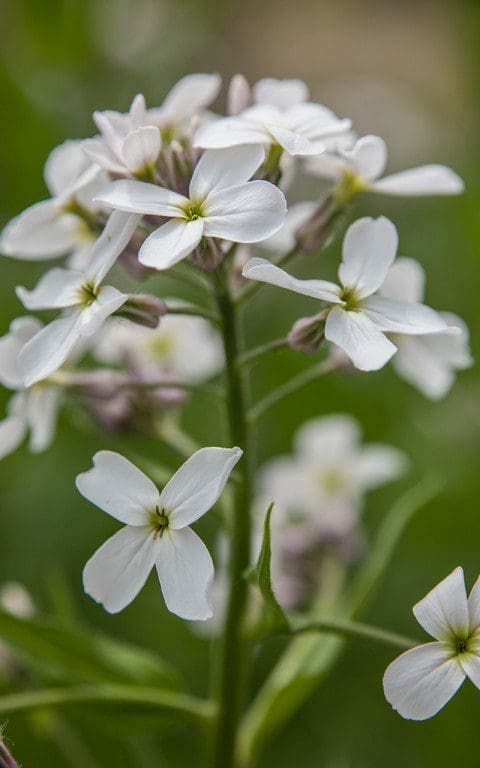
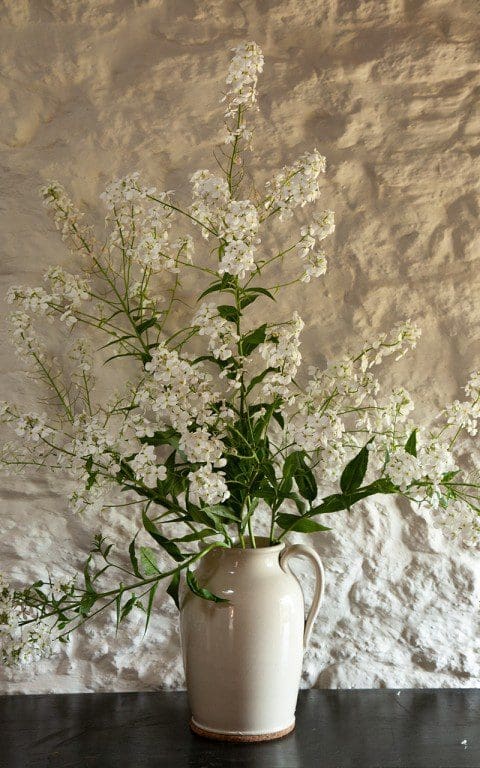
There is a blowsy head girl, brighter and showier than its neighbours and probably the one you would choose as a complement to a Chelsea rose garden, although she leans and topples under her own weight of flower. There is a perfectly behaved plant nearby. Just as white, but smaller and quieter and perfectly happy to stand upright without staking. This is probably the one that you would propagate from spring cuttings if you wanted something showy and reliable. My favourites have a wilder feel though; a grey-pink cast to some and more open flower panicles to others that provides the space I am so keen on and a lightness in the planting that feels less dominant. Head Girl has been used for cutting and will come out when I cut the plants down to prevent it from seeding and allow my slower-growing perennials around them the room they need to fill out later in the summer. Though the Actaea, the Zizia and the peonies are destined to provide a more certain future, the fast sweet rocket will always be just that.
Words: Dan Pearson / Photos: Huw Morgan
Published 26 May 2018
It has been a long, slow start to spring, but at last we have movement. The snakeshead fritillaries are chequering the slopes behind the house and crossing over with early daffodils that this year were a whole two weeks late. The long wait will now see a rush as everything comes together, but reflecting the last few weeks of slim pickings we have kept things simple in this April gathering.
The wet weather has hit hard this year and Tulip Fire has run rampant through the tulip bed. We mass the tulips together in a random mix of six or seven varieties in the kitchen garden and experiment with a new colour palette and untried varieties every year. This year we planned for soft reds, pinks, oranges and apricots with an undercurrent of deep purples. However, we did not plan for the angst that has come with the mistake of replanting too soon in the same place. The Tulip Fire (Botrytis tulipae) probably came in with the bulbs that were grown in the same bed two years ago. A dry spring that year most likely limited its impact and it went unseen. This wouldn’t have been a problem if we’d not replanted in the same place for three to five years.
We will not be making the mistake again, for the majority of this year’s flowers are withered, pock-marked and streaked, the foliage melted on the worst affected. As soon as the flowers that are harvestable have been cut, we will dig up the bulbs and burn them on the bonfire. It has been a hard lesson after a long winter and one never to be forgotten, but we have managed to salvage enough to appreciate close up.
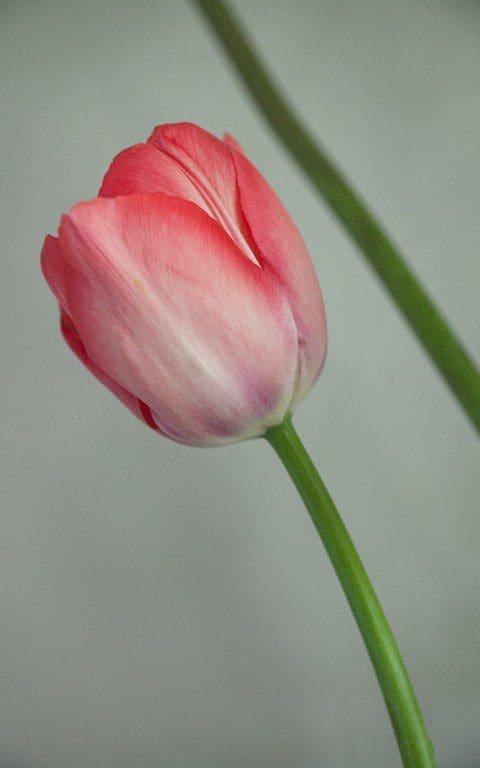 Tulipa ‘Van Eijk’
We will be trying Tulipa ‘Van Eijk’ again, for its faded pink exterior which conceals the surprise of a bright scarlet interior. The flowers enlarge and age gracefully, first to a strong lipstick pink before ending up a washed rose with the texture and shine of taffeta. It is said to be a variety that comes back for several years without the need for lifting, so next year I will try it by itself in some fresh ground. Planting in late November or early December when the weather is colder is said to diminish the impact of the botrytis should it already be in the ground. Grown on their own and not in the mass of different varieties, they may stand a better chance of staying clean. We have now kept a note to move our cutting tulips between beds on a five year rotation.
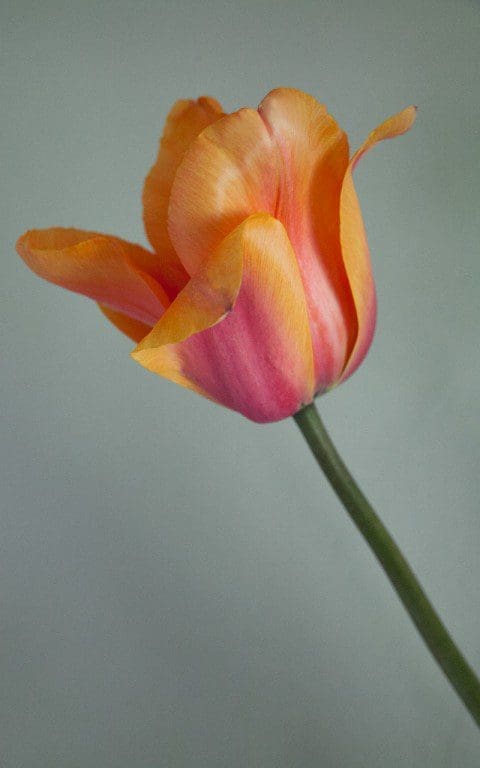 Tulipa ‘Apricot Impression’
Tulips are remarkable for their ability to grow and adjust in a vase. The long-stemmed, large-flowered varieties exaggerate the quiet choreography that sees their initial placement becoming something entirely different as the flowers arc and sway. The complexity of colours in Tulipa ‘Apricot Impression’ is promising. The raspberry pink blush in the centre of each petal is quite marked to start with, but suffuses them as the flowers age creating an overall impression of strong coral pink bleeding out to true apricot. The insides are an intense, lacquered orange with large black blotches at the base and provide voluptuous drama as they splay open with abandon. Though our choice of tulips has been somewhat pared back this year, it is good to have enough to get a taste of the selections we’d planned.
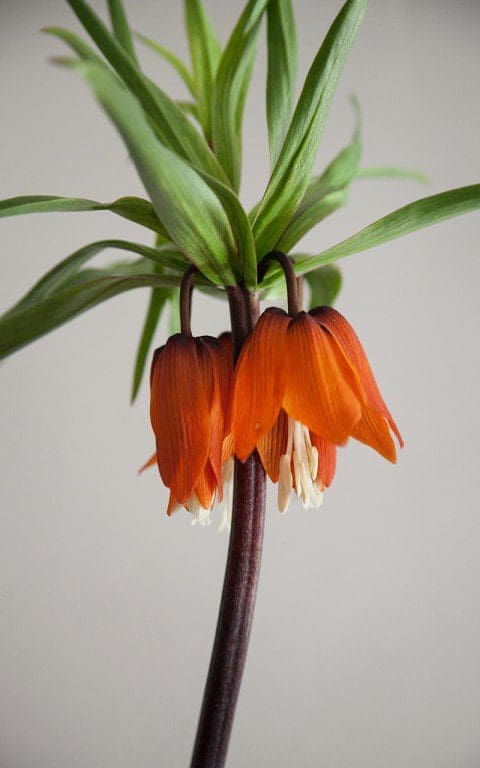 Fritillaria imperialis ‘Rubra’
This is the first time I have grown the Crown Imperial (Fritillaria imperialis) here, and their story has been entirely different. Up early, the reptilian buds spearing the soil in March, and quickly rearing above the dormant world around them, their glossy presence has been so very welcome. I have drifted them in number on the steep slopes at the entrance of the new garden amongst the rangy Paeonia delavayi. Fritillaria imperialis ‘Rubra’ has strong colouring with dark, bronze stems and rust orange flowers that work well with the emerging copper-flushed foliage of the peonies. Although there is an exotic air to the combination, it somehow works here up close to the buildings. It is a combination that you might imagine coming together through the Silk Route, China and the Middle East. However, plant hunters had already introduced the fritillaria from Persia in the mid 1500’s, and so it also has a presence that speaks of a particular kind of old English garden.
At the opening of the Cedric Morris exhibition at The Garden Museum this week Crown Imperials were a key component of Shane Connolly’s floral arrangements, scenting the nave with their appealingly foxy perfume. The smell is said to keep rodents and moles at bay and, though potent, is not unpleasant in my opinion. Morris’ painting Easter Bouquet (1934) captured them exuberantly in an arrangement from his garden at Benton End, which updates the still lives of the Dutch Masters with muscularity and vibrant colour. Rich, evocative and full of vigour, the paintings confirmed to me why we push against the odds to garden.
I planted half the bulbs on their side to see if it is true that they are less likely to rot, and the other half facing up. However, contrary to advice the two failures were bulbs planted on their sides. I also planted deep to encourage re-flowering in future years. The bulbs are as big as large onions, but it is worth planting them at three times their depth since they are prone to coming up blind when planted shallowly. In their homeland in the Middle East, they can be seen in the dry valleys in their thousands after the winter rains, so I am hoping that our hot, dry slopes here suit them. They are teamed with a late molinia and asters, to cover for the gap they will leave when they go into summer dormancy.
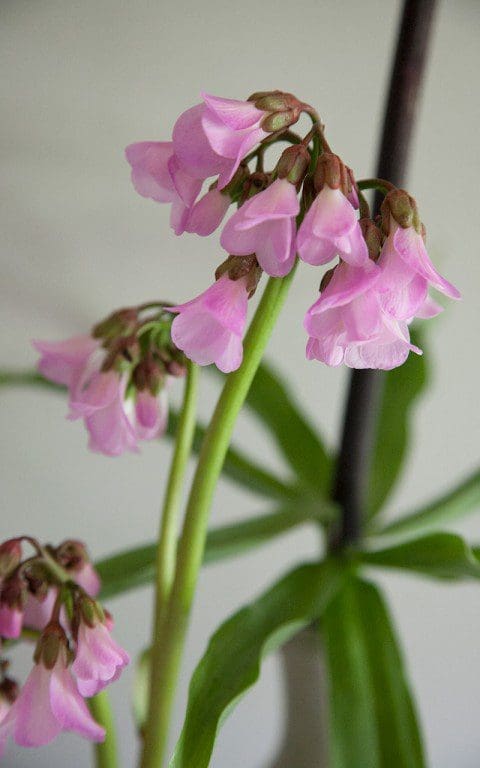 Bergenia emeiensis hybrid
The third component in this collection is a pink hybrid form of Bergenia emeinsis. It was given to me by Fergus Garret, who tells me it was handed down by the great nursery woman Elizabeth Strangman with the words that it was a “good plant”. Sure enough, despite its reputation for not being reliably hardy, it has done well for me and flowered prolifically for the first time this year amongst dark leaved Ranunculus ficaria ‘Brazen Hussy’. However, the combination was far from right, the sugary pink of the bergenia clashing unashamedly with the chrome yellow celandines. A combination Christopher Lloyd may well have admired, but not one that feels right here.
However, the elegant flowers are held on tall stems and the leaves are small and neat, so it has been found a new home in the shade at the studio garden in London, where it can be eye-catching when in season against a simple green backdrop. Though this recently introduced species from China grows in moist crevices in Sichuan, it is happy to adapt and is so prolific in flower that I had to find it a place where its early showiness feels right, rather than getting rid of a good plant. More lessons learned, and more to come now that the tide has finally turned.
Words: Dan Pearson / Photographs: Huw Morgan
Published 21 April 2018
In 1997 I witnessed my first and never to be forgotten hanami. I was in Japan filming a series for Channel 4 and we arrived there at cherry blossom season to witness this important cultural connection to the natural world. The blossom forecast or ‘cherry blossom front’ announced by the weather bureau charted the daily progress as the opening blossom moved up the archipelago, so that parties could be planned in celebration.
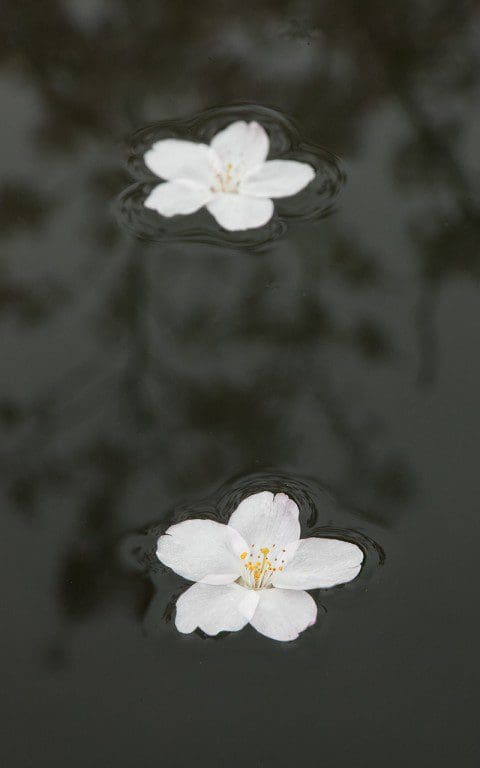
We arrived in Kyoto with perfect timing, just as the first buds were beginning to open. The streets in the old town were lined with the sakura trees and the beautifully manicured limbs reached from behind garden walls and dipped down to hover above the pavements. As the week went on and the buds opened, a skim of petals began to pool on the dark water of the tree-lined canals and, with the mounting crescendo of bloom, came the parties of people that gathered under the branches. During the day the sakura made pale, luminous cloudscapes of blossom in the parks. By evening, for the night viewing of yozakura, they were illuminated with lanterns. Picnic blankets, almost touching like towels on a crowded beach, shadowed the canopies of the trees and the Japanese partied with sake and merriment to welcome the spring.
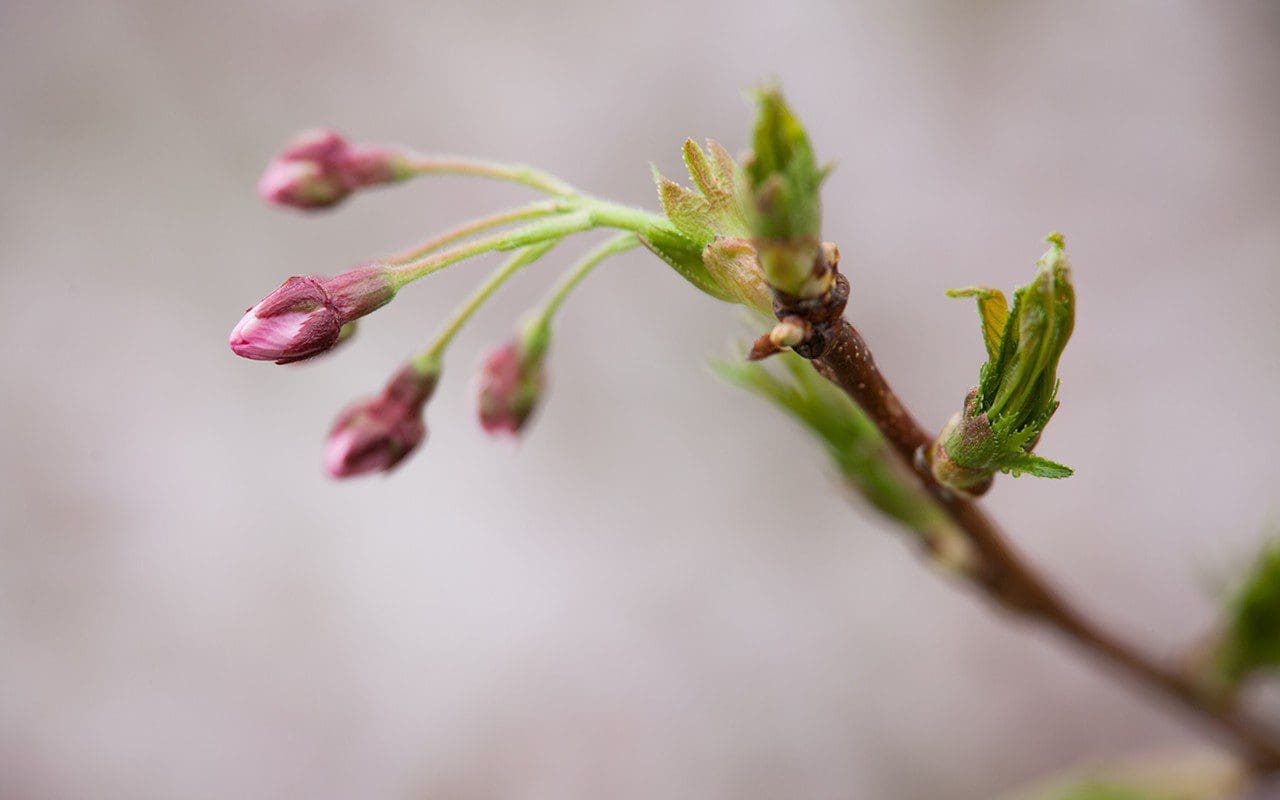
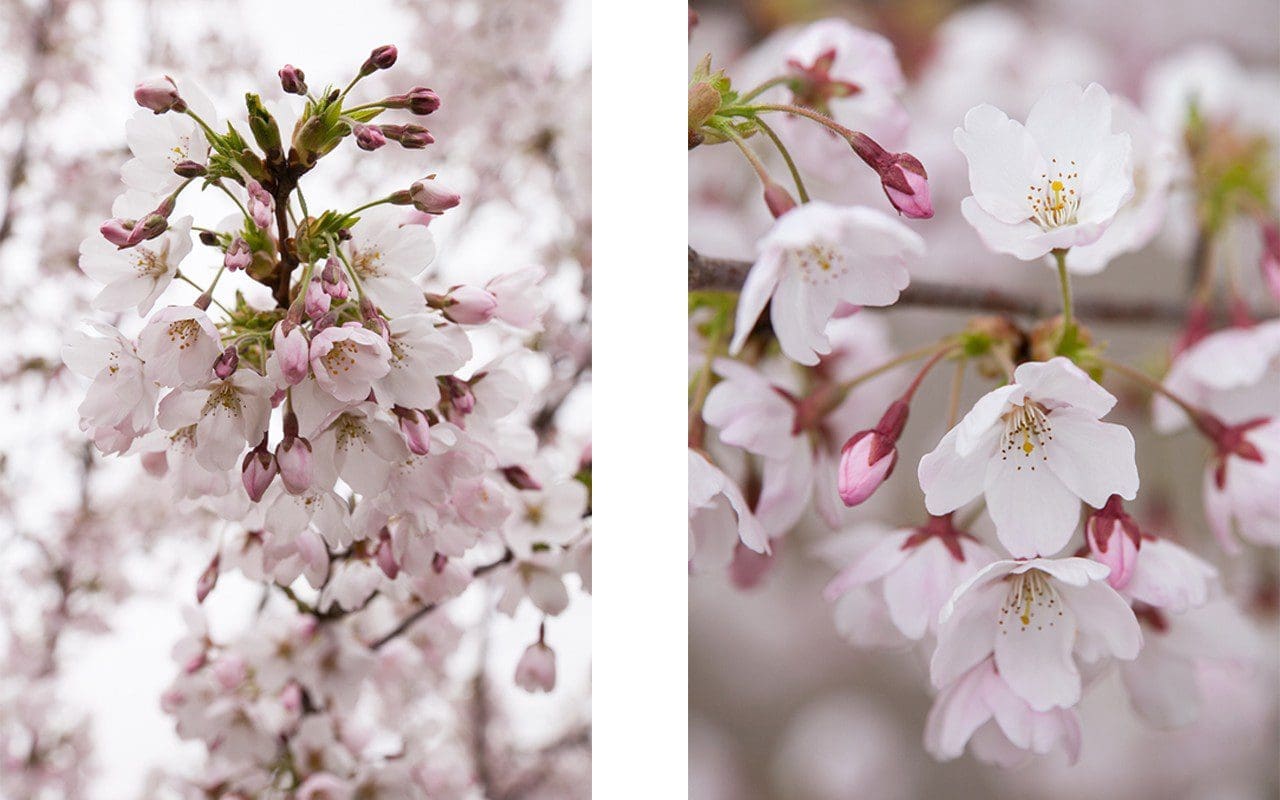
My most memorable blossom viewing was a trip we made to a cherry tree nursery. We had been instructed to visit in the afternoon to look at the trees in the fields and, with perfect timing, at dusk we were escorted to their king tree. This was their most magnificent Yoshino cherry, pruned over decades to form a wonderful canopy of limbs which were illuminated from below by a number of flaming braziers. The flickering light caught the first flower and, as darkness descended beyond the branches, we were held transfixed in a moment of absolute perfection. Sugary pink bud, a scattering of just opened flower and all the promise of what was yet to come in the season’s change. A metaphor for life that everyone there understood. Intense, breath-taking beauty, yet fleeting and ephemeral.
The Yoshino cherry (Prunus x yedoensis) is perhaps my favourite of all cherries and I have made room for one here, so that we too can celebrate the arrival of spring. Last weekend was our equivalent moment, with bud and expectation of flower. Today as I write, it is in full blossom and droning with honeybees. Though it is undoubtedly ornamental, with a live, bright pink to the bud, this rapidly pales as the flowers open. They are single, but massed on elegant growth, which reaches to form a widely-domed tree. I have planted a multi-stemmed tree here by the trough in front of the house so that, for the two weeks that it is in season, it is free to take centre stage. In time its limbs will reach out so that it can be doubly appreciated in the water. First in reflection and then with the petals scattered on the surface.
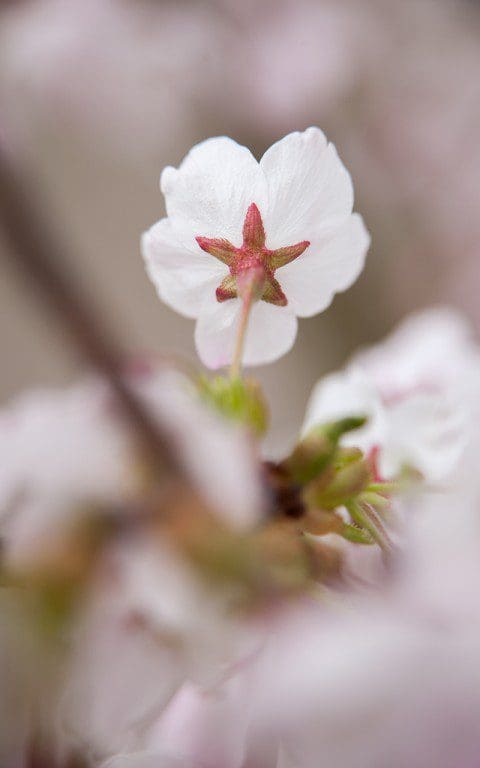

Although as a general rule I prefer to plant small, I invested in an air-pot grown specimen from Deepdale Trees for this key position. The airpot system encourages a dense and fibrous root system and, as a consequence, results in quick establishment. The Yoshino cherry is well-known for its wind tolerance and so far has done well here with our lack of shelter. Where the habit of some cherries can be stiff, the movement in the limbs and its arching growth make this a supremely elegant tree. It has a second season too with tiny cherries that the birds strip fast when they are ready and, in a good autumn, bright foliage of orange, russet and red.
It is important to dedicate some time to be with the tree when it has this moment. Stopping to look up into the energy caught in the blossom, take in the gentle perfume and the industry of the bees making the most of this early larder, time slows and the abundance and energy of spring are brought sharply into focus.
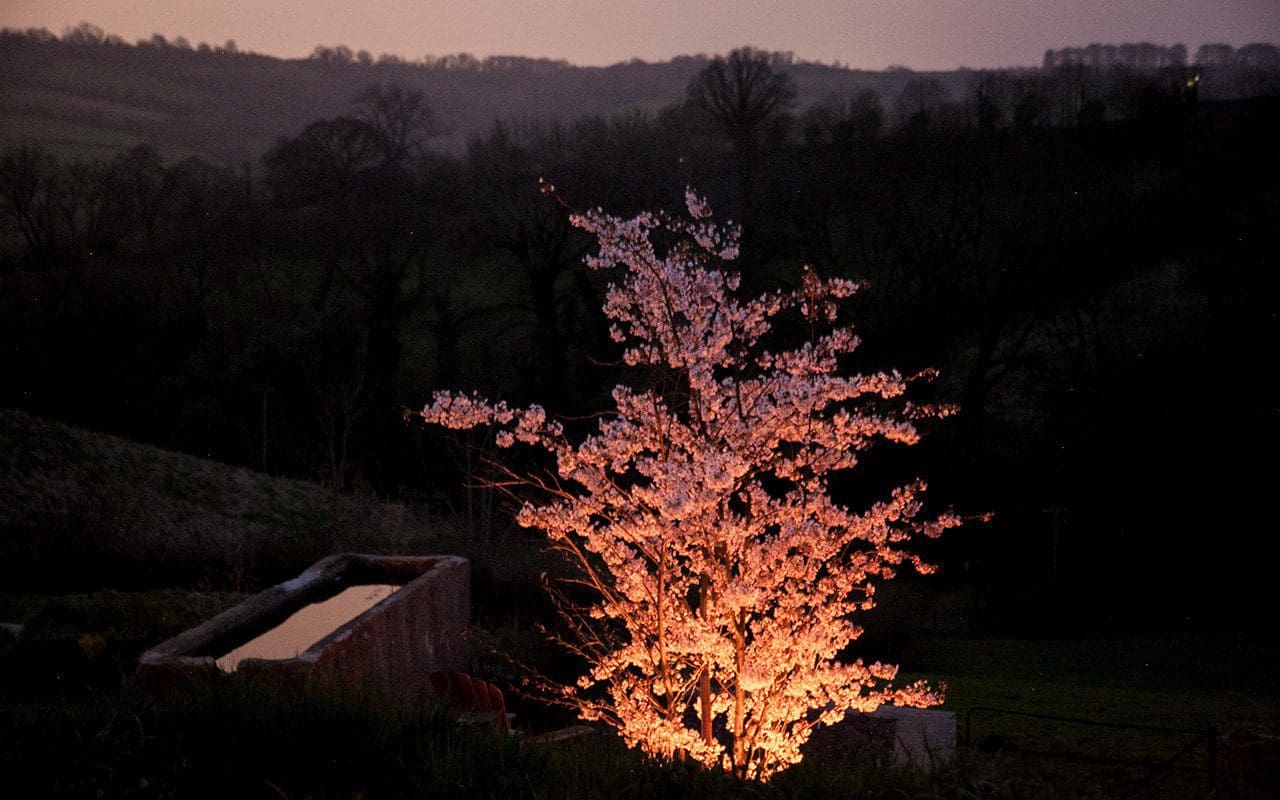
Words: Dan Pearson / Photographs: Huw Morgan
Published 14 April 2018
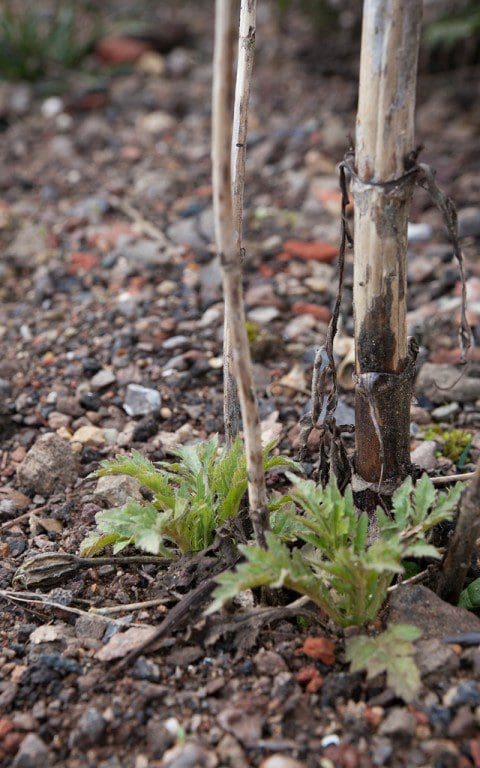
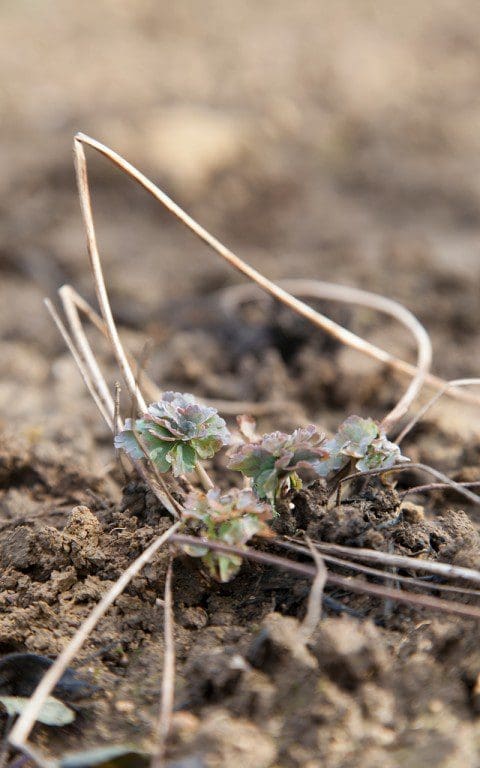
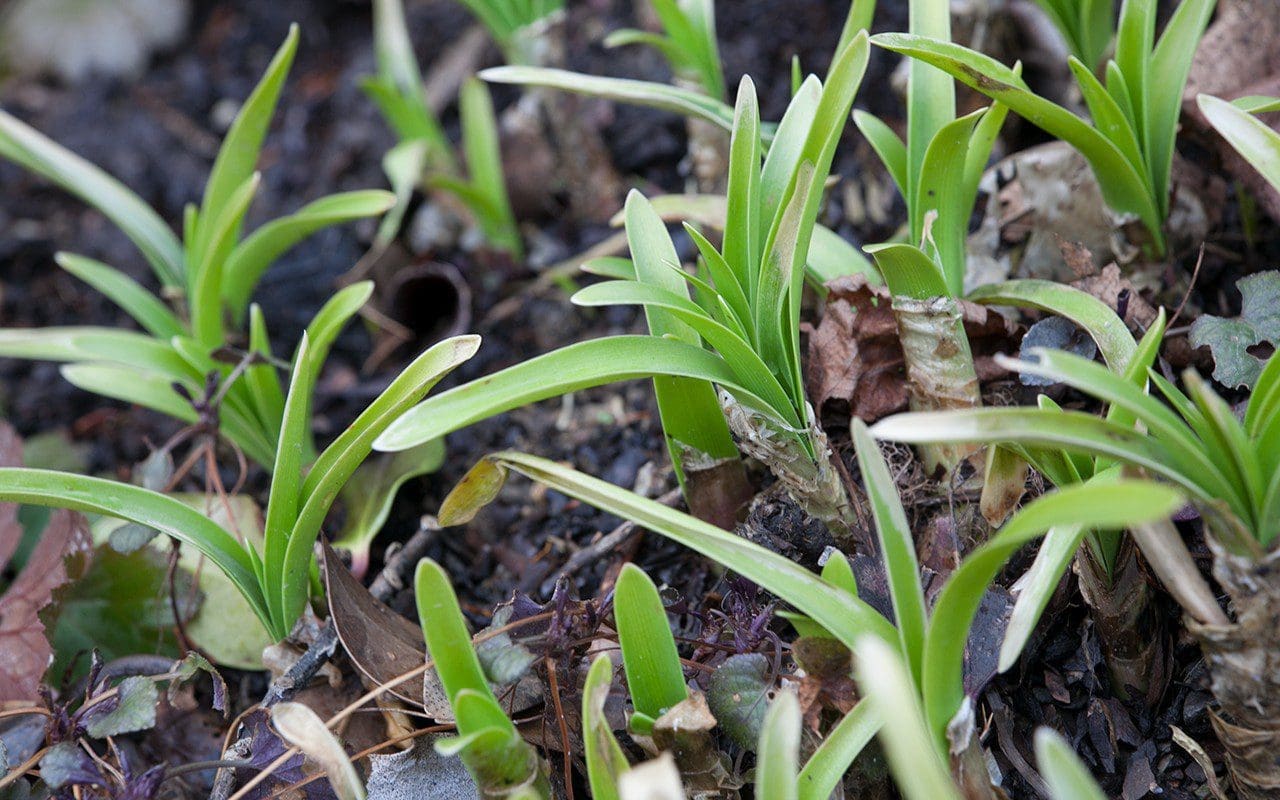
The last of the perennial skeletons have now been cut to the base to make way for the turn in the season. It is just in the nick of time. Where just a fortnight ago the newly cleared ground gave away no more than a hint of what had been there before, we now have the evidence that spring is finally here. Held tight and close still, the flushed rosettes of embryonic foliage are bursting with energy.
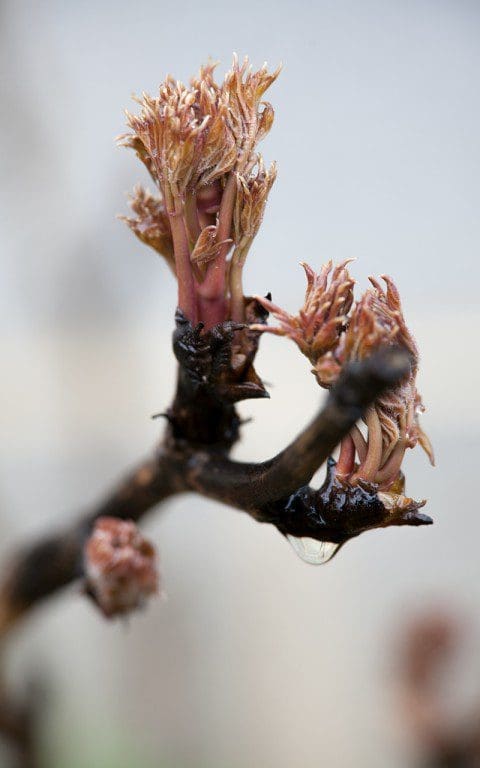
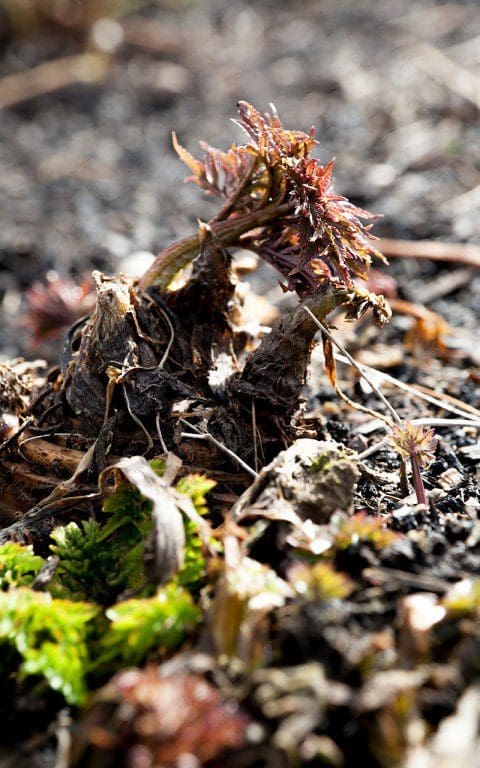
This new life is remarkable for its break with dormancy and so begins our morning routine of combing the border for change. Sometimes, in the case of the lipstick red shoots on the peonies, it is a moment that is arguably as good as what comes later. The colour is strong and meaty and welcome against the dark ground. Team their flaming shoots with ‘Brazen Hussy’ celandines, which are up early too and done by the time the peony foliage shades them out, and you have a moment that is worthy of the weeks we have waited for such activity.
There is also the excitement of the appearance of new things. The autumn-planted Fritillaria imperialis ‘Rubra’ (main image) have speared the bare soil of the new garden with priapic vigour. We will be watching them closely for the first sign of lily beetle, which makes its appearance much earlier than expected with the first warmth of the sun. I always try and plant those bulbs that are prone to beetle attack close to the paths so that it is possible to pick them off without trampling into the beds.
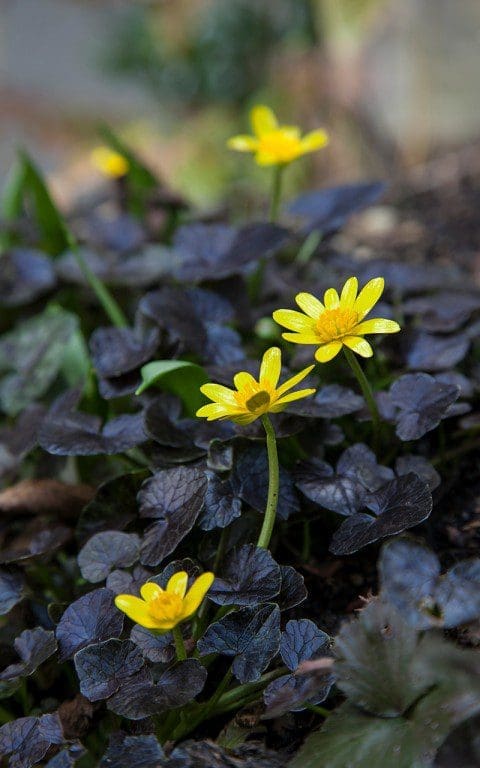 Ranunculus ficaria ‘Brazen Hussy
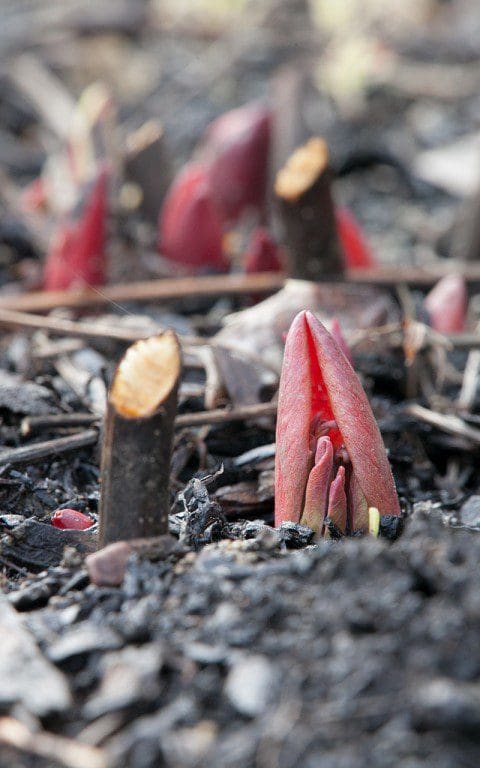 Paeonia mlokosewitschii
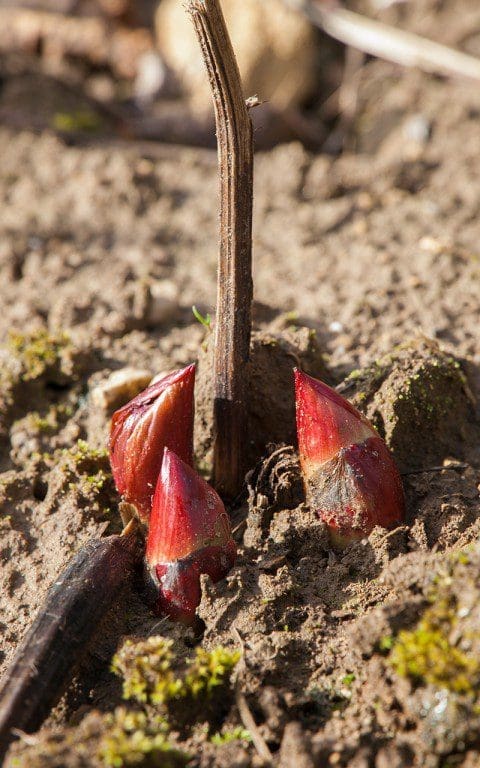 Paeonia mascula
The rhubarb are at their best too and showing us now the huge reserves that they have built and stored in their crowns. The leaves, flushed copper, puckered and ready to expand, the crimson stems just waiting to push them to the light and the warmth that will very soon be in the sun. The rhubarb was moved just eighteen months ago, the autumn before last, and though I should be leaving it to build another year before forcing, it is clear that it has the heft. A quarter of the crown has been covered so that we can enjoy some early spears.
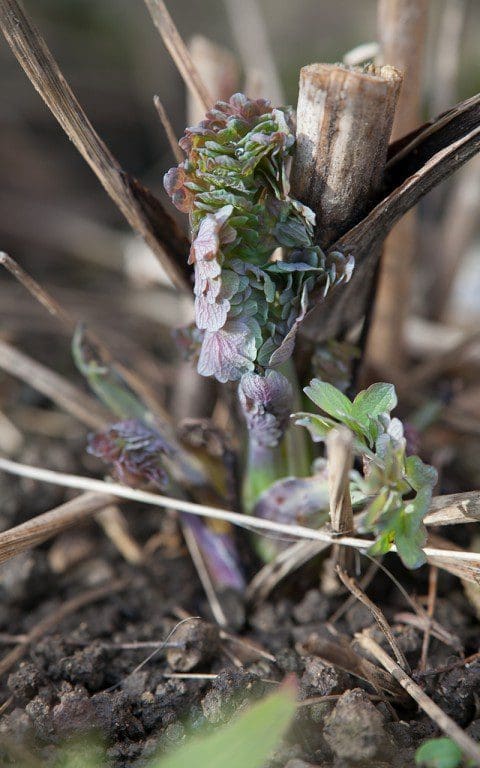
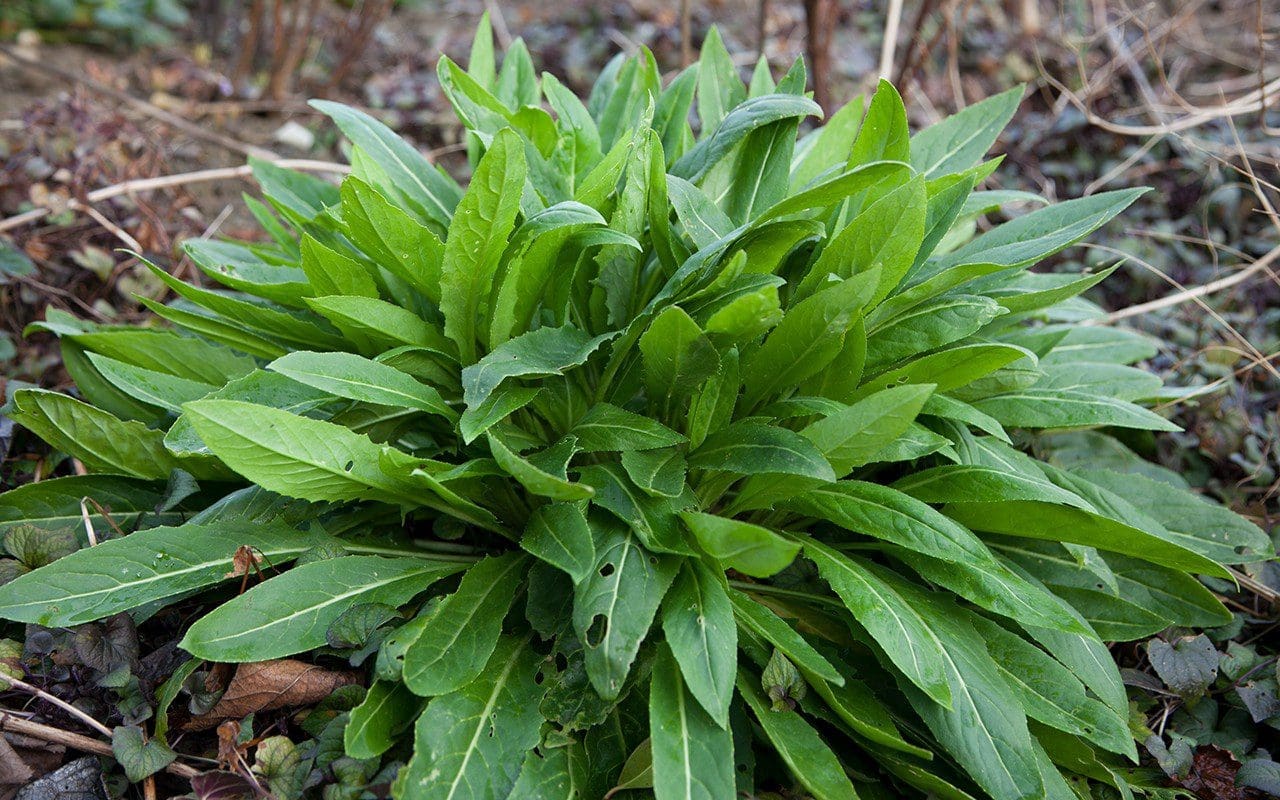
It is also a time to check that everything has made it. Just a week ago the fickle agastache, which easily succumb to winter wet, were looking like they might have done just that, but this morning I could see they have mostly made it through. Embryonic clusters of shoots held tight to the old wood, blue-purple and intensified in colour, but clearly identifying the plant that is yet to come. The pigmentation in new foliage is richest this early in the year with coppers, purples, blacks, reds and pale citrus greens. In the case of the Iris x robusta ‘Dark Aura’, the inky new growth is almost its best moment. New life, concentrated and full of anticipation.
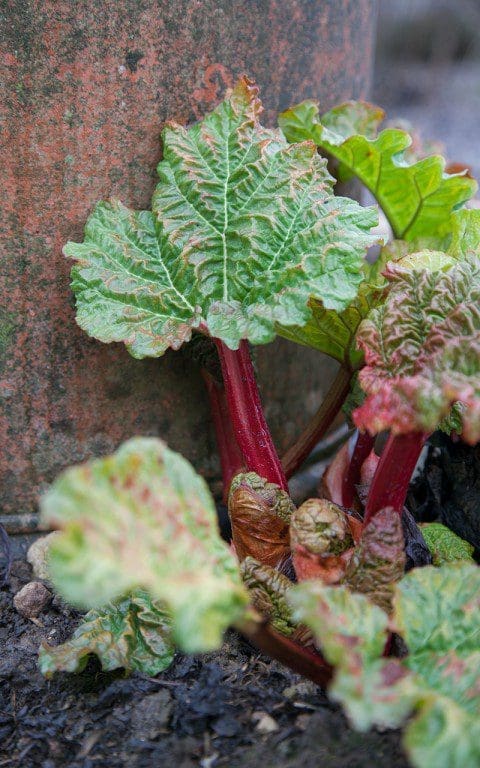 Rhubarb ‘Timperley Early’
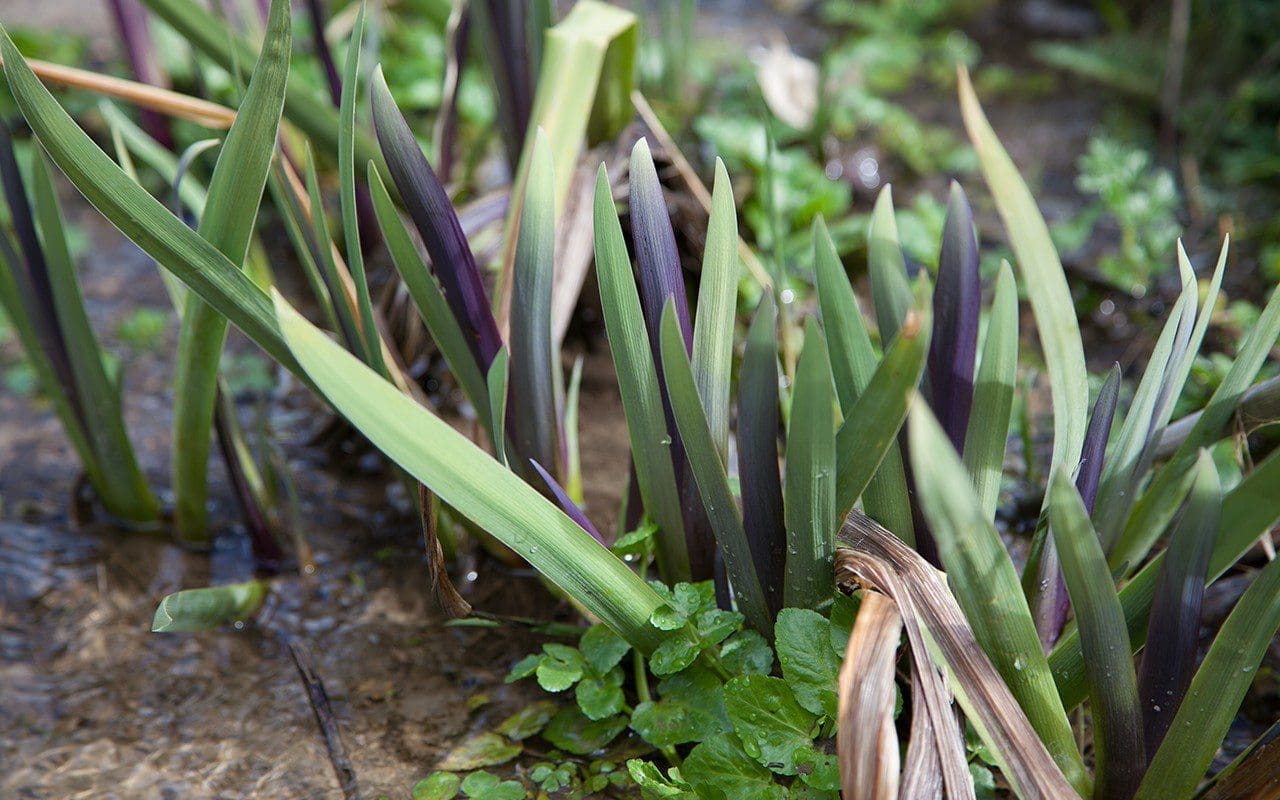 Iris x robusta ‘Dark Aura’
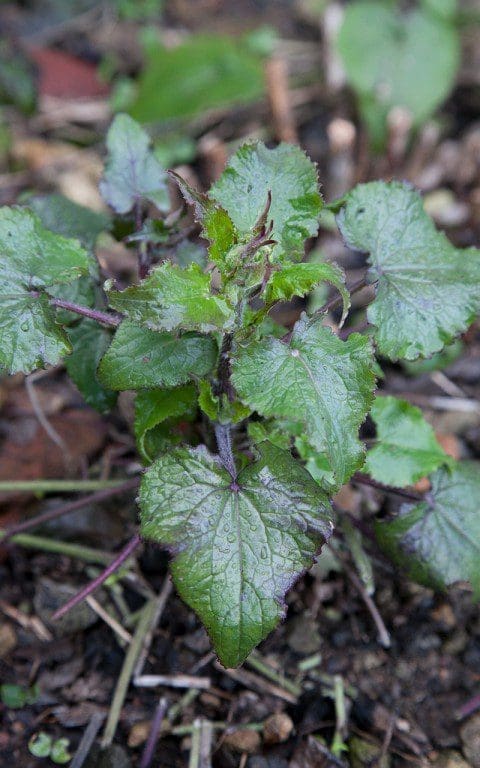
Other rosettes reveal an exponential increase, more than you can imagine might have been possible between autumn and now, but one that shows that the plants are happy. Coppery Zizia aurea doubled, if not trebled, in size from last year and angelicas erupting to let you know that they have got their roots down. This year, I can see it already, they mean business and in some cases will be sure to overwhelm their neighbours.
Understanding the rush of early season growth and the impact it can have on later-to-emerge neighbours is key to achieving balance when you are mingling plants. The late-season grasses for instance will see panicum smothered, if it is not teamed with neighbours that are also late risers – asters and rudbeckias – companions that will allow them the time to catch up. This early-season flush is wonderful for the way it marks the break with winter, but it can easily leave a hole when early energy is expended and there is still the bulk of the growing season to come. Although it feels far too soon to even be thinking about it, a late June cut-back of early geraniums and the Anthriscus sylvestris ‘Ravenswing’ will be sure to provide a second crop of foliage.
The shift, mapped in these fingers of new life, and the clues to the growing season ahead, is a gathering tide. One that, if we photographed the garden again next weekend, would reveal something altogether different. Although I have savoured it this year, it is good to feel that we have finally reached the end of winter. A new year awaits in the joy of observing.
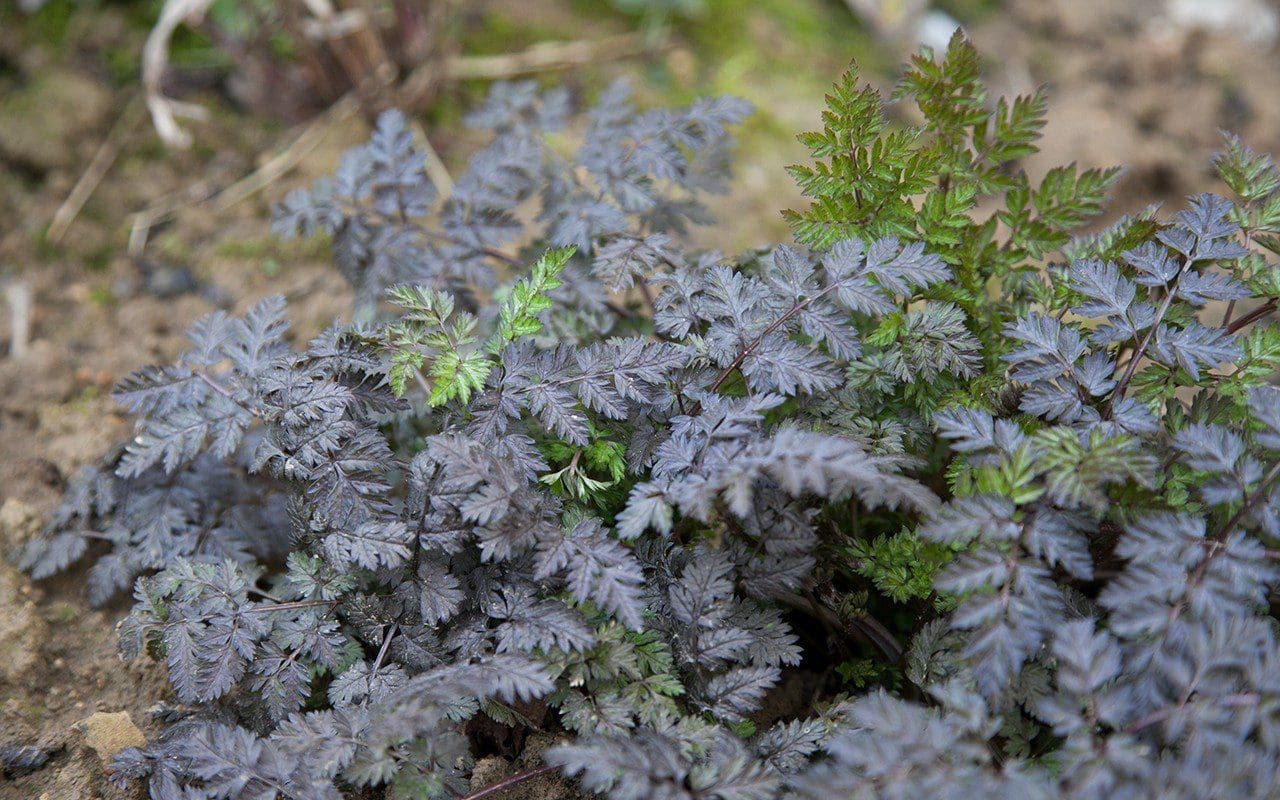 Anthriscus sylvestris ‘Ravenswing’
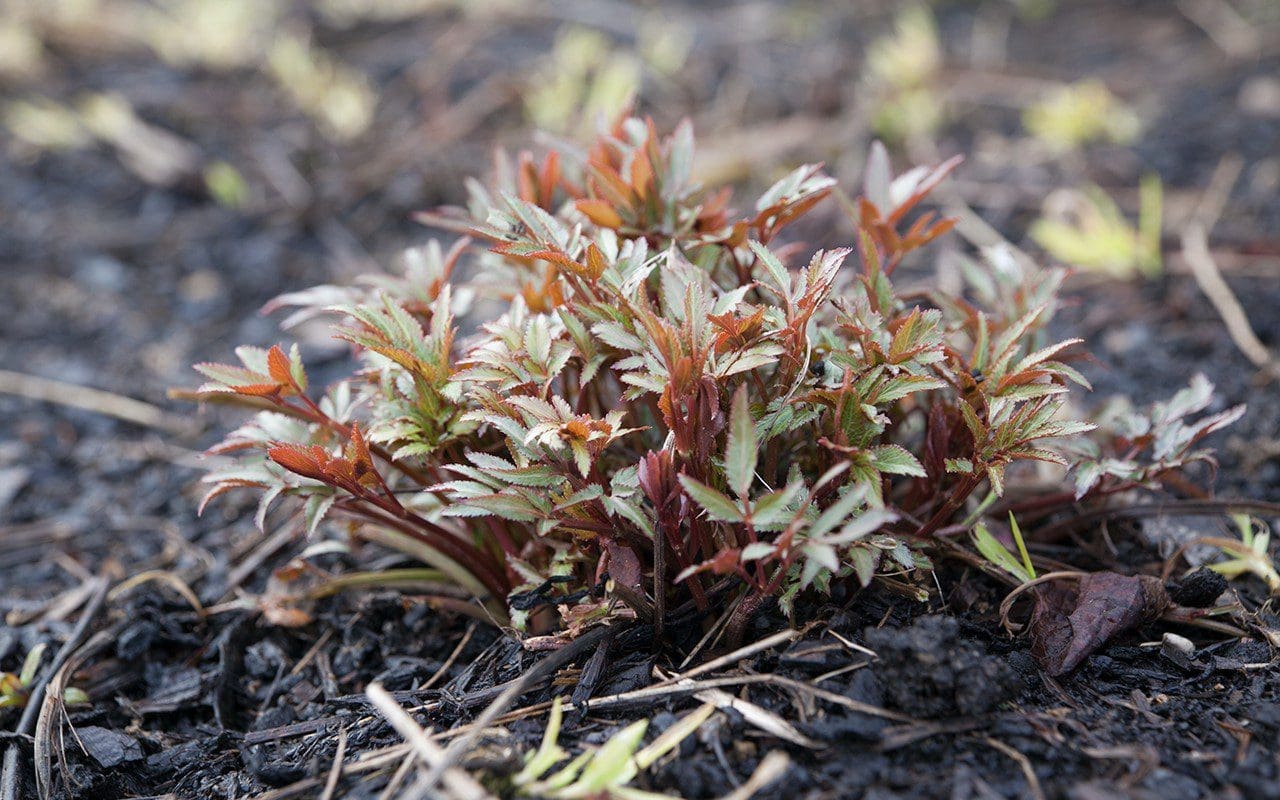 Zizia aurea
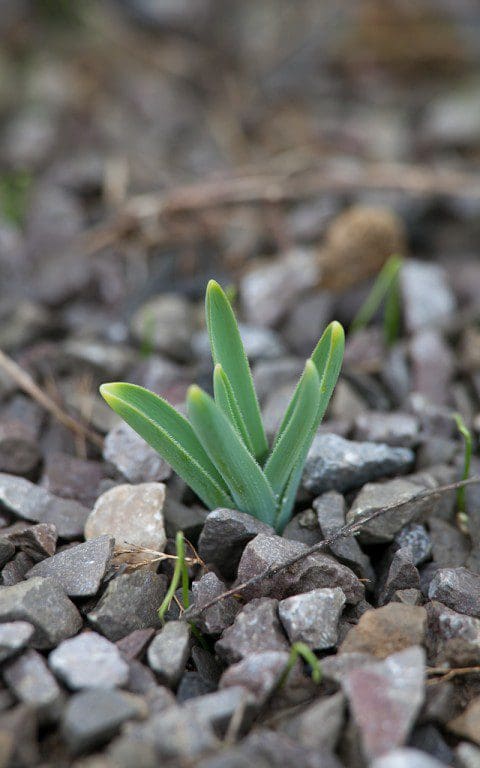 Allium christophii
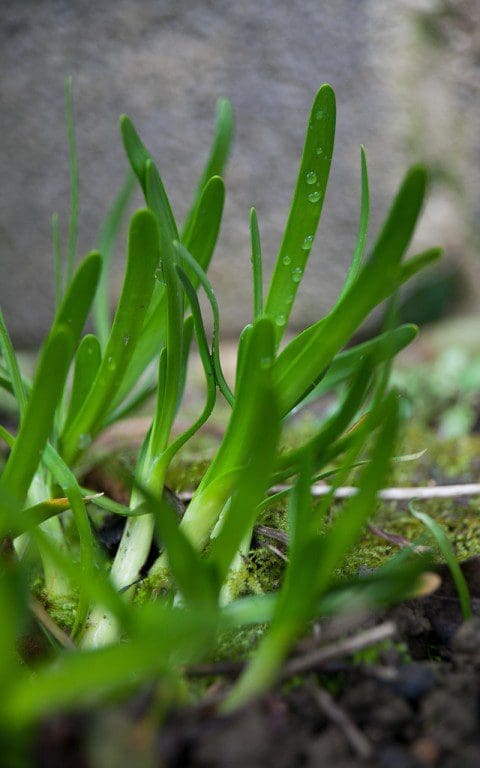 Allium angulosum
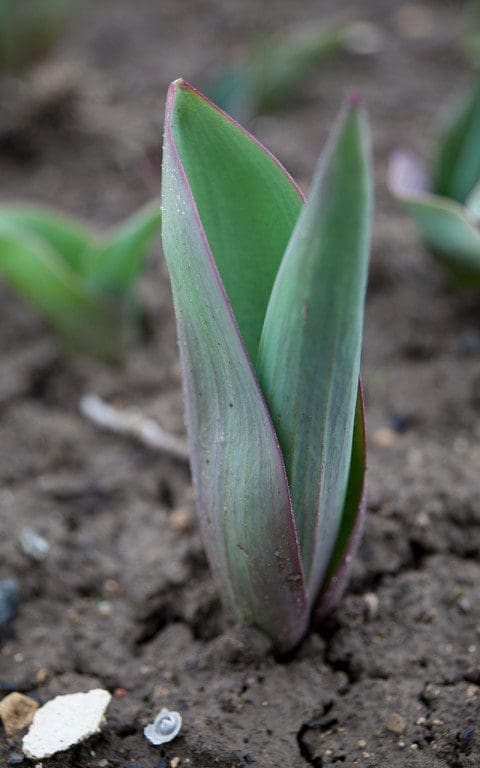 Tulip ‘Apricot Impression’
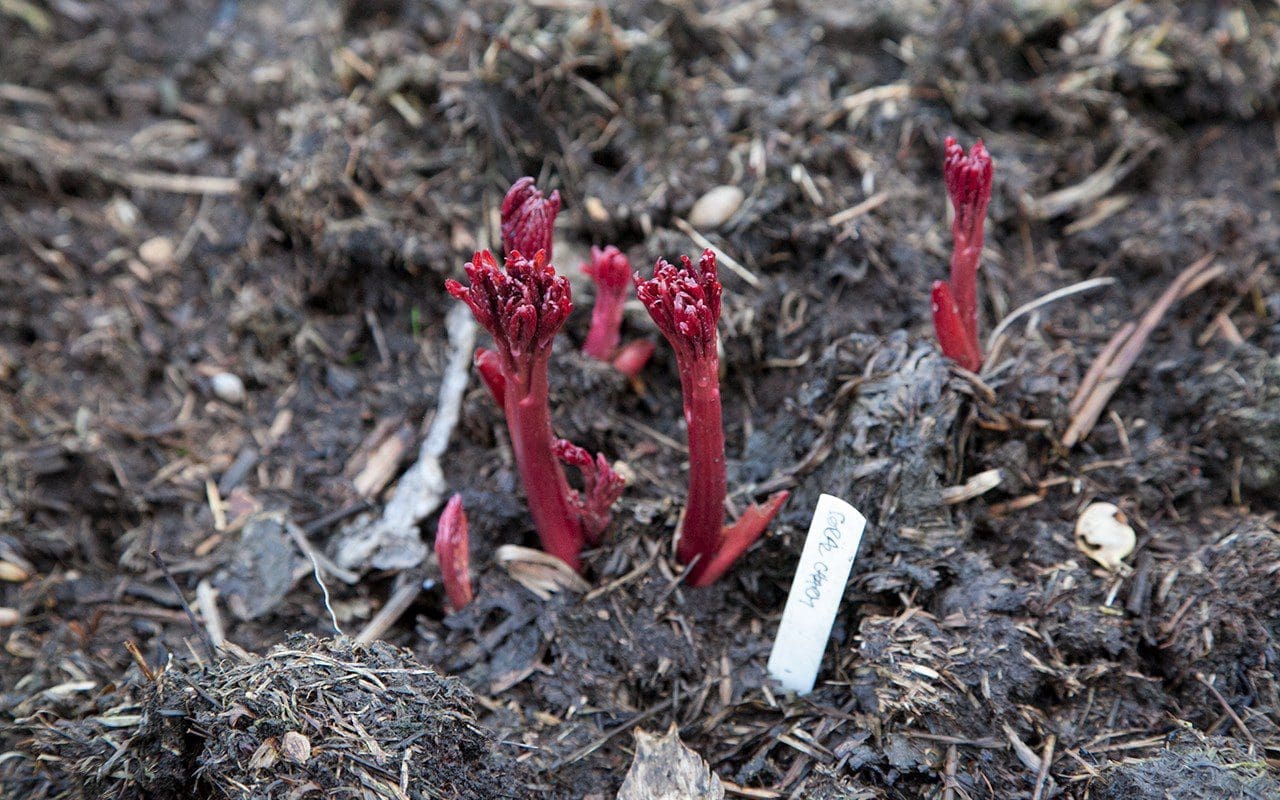 Paeonia ‘Coral Charm’
 Paeonia rockii
 Angelica sp.
 Lunaria annua ‘Corfu Blue’
 Thalictrum flavum ssp. glaucum
 Patrinia scabiosifolia
 Aquilegia chrysantha ‘Yellow Queen’
 Hesperis matronalis var. albiflora
 Nerine bowdenii
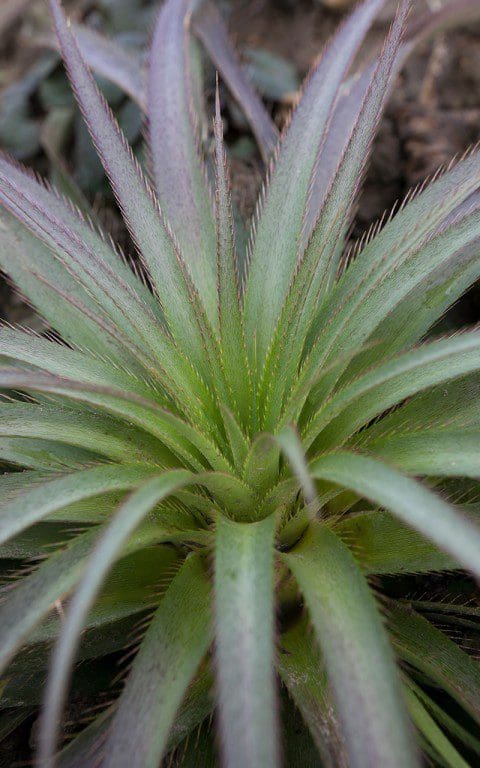 Eryngium eburneum
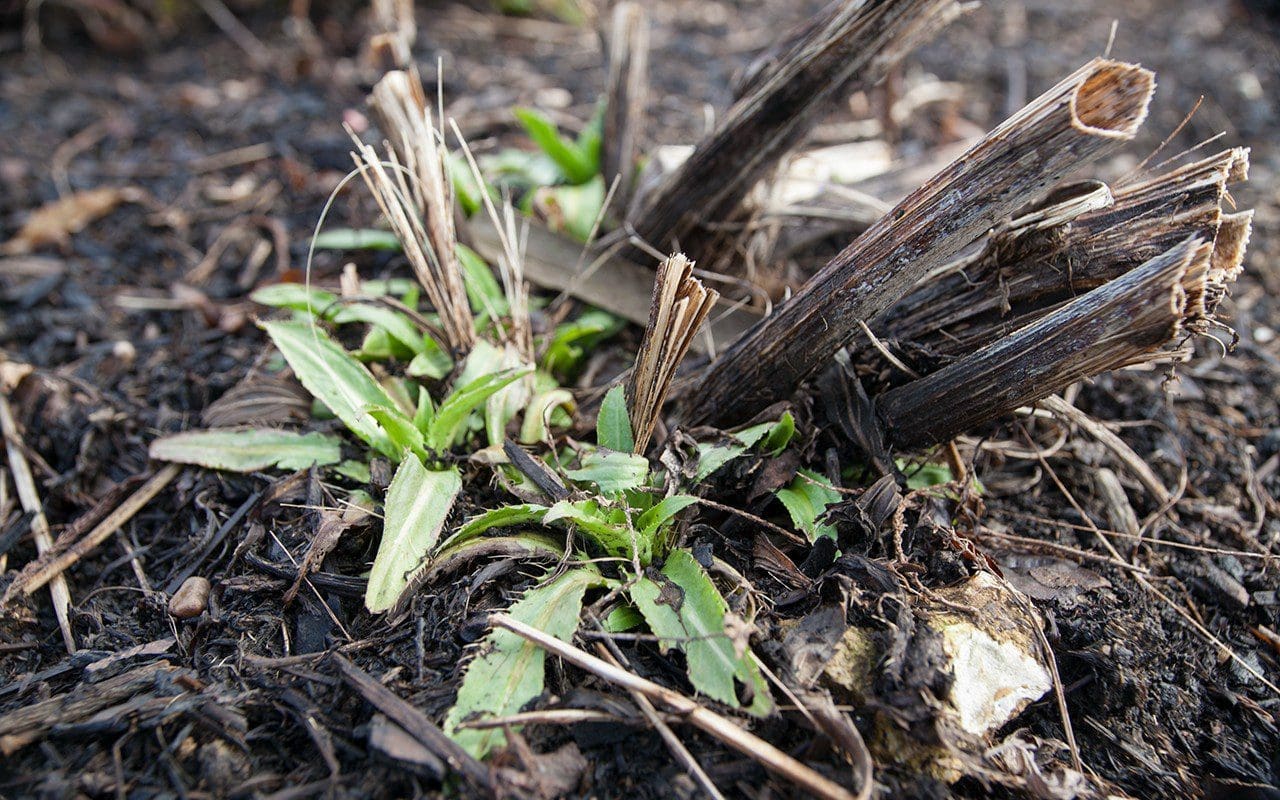 Cirsium canum
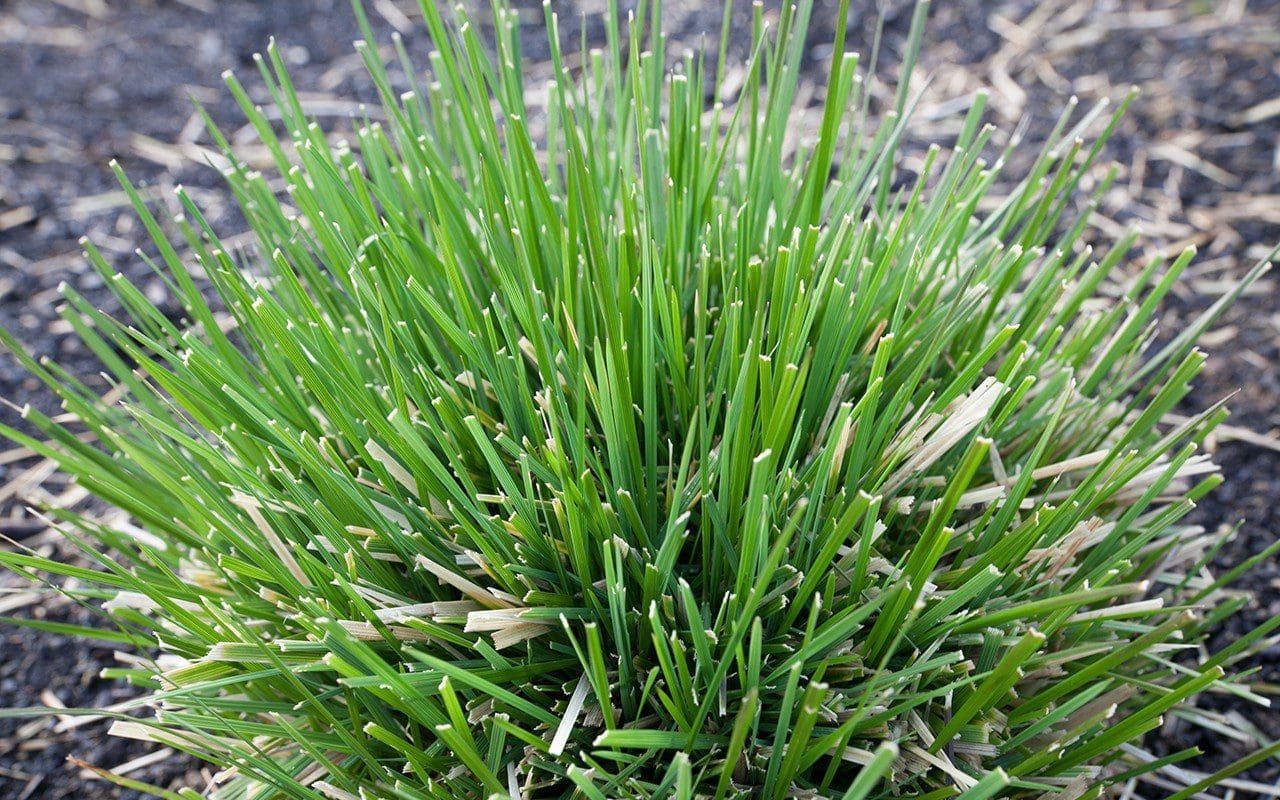 Deschampsia cespitosa ‘Goldschleier’
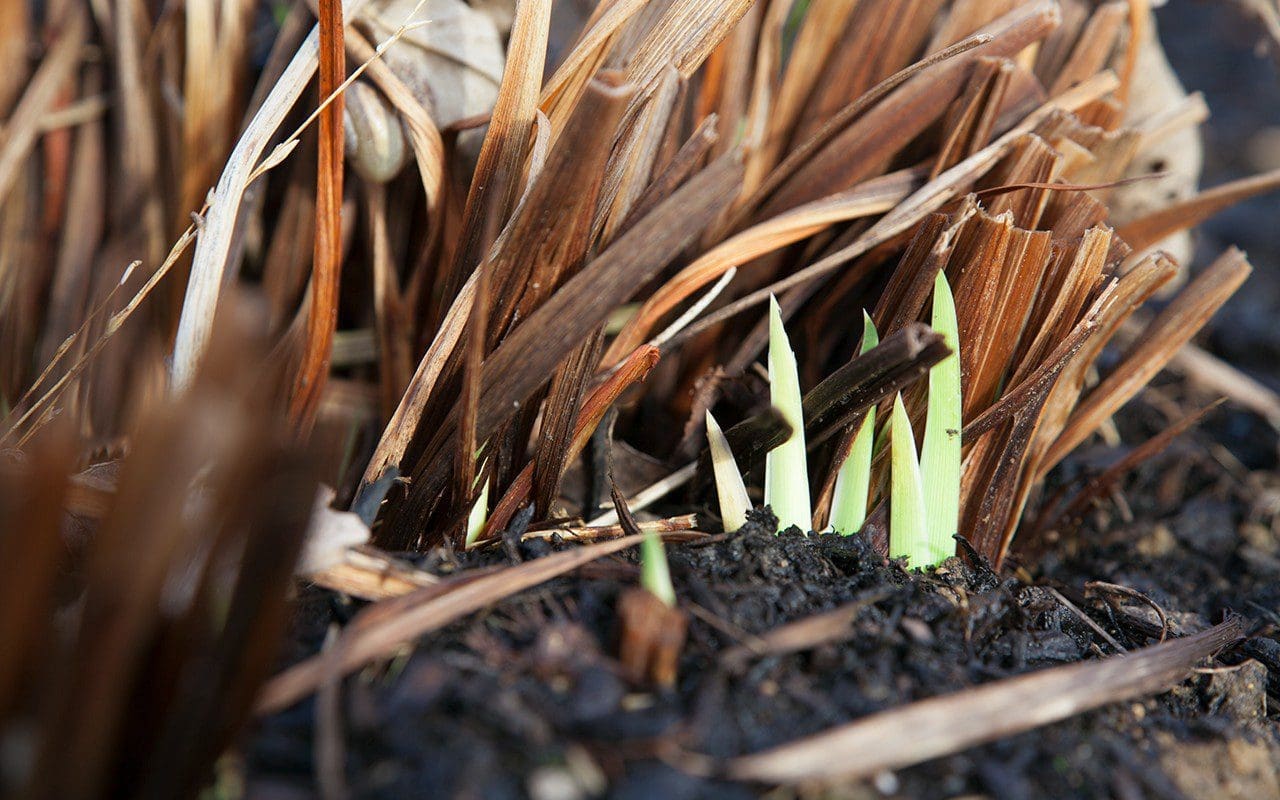 Iris sibirica ‘Papillon’
Words: Dan Pearson / Photographs: Huw Morgan
Published 17 March 2018
The first posy of March was picked last week, ahead of the cold north-easterlies and the snow that plunged us back into winter. The galanthus, the primroses and the wild narcissus that just last week were tilted in bud, are buried now in snowdrifts as March comes in, roaring like a lion. In the garden the hunt for new life has also been halted, but we have gained the time to seek out the minutiae of change. Newly visible buds, stark and green against the whiteout on the hawthorn and the Cornus mas in full and oblivious flower.
The Pulmonaria rubra stirred early in January and, beneath the snow they are already flushed with bloom. I was given a clump by our neighbour Jane and, having never grown it before, I can confirm that it is a doer. The silvered and spotted-leaved lungworts are arguably more dramatic, for they provide a textured foil and foliage that is easily as valuable as their spring show of flower. Give them shade and summer moisture and they will reward you, but the slightest sign of drought and they will sadly succumb to mildew. It is important, therefore, to find them a place that keeps cool. Pulmonaria rubra, however, seems altogether more adaptable and when the thaw comes they will flower unhalting until summer.
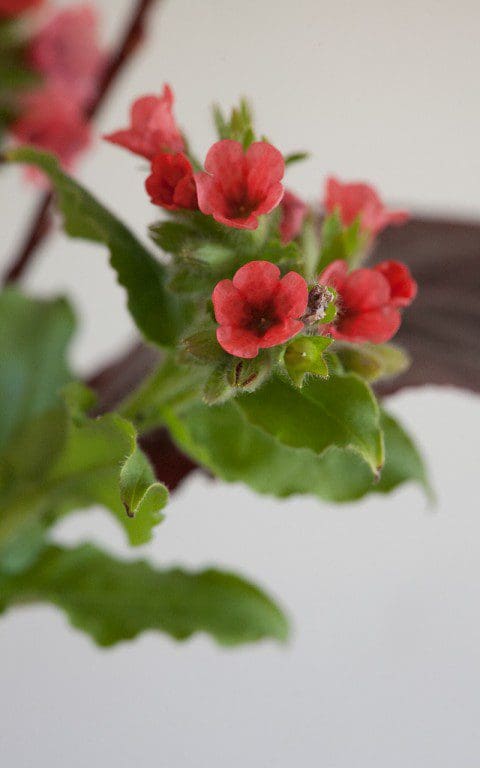 Pulmonaria rubra
Despite its modest presence – it has plain, green foliage and soft, coral flowers – I have enjoyed its willingness and ease on the sunny banks close to the studio where, from the veranda, you can hear the buzz of bumblebees. They love it, as do the first early honeybees and the heavy soil there suits it too. So far it has taken the sun and dry summer weather with no more than a little flagging in midday heat. I have planned for shade with the young Salix purpurea ‘Nancy Saunders’ that grow alongside and for there to be hellebores there when I have the shade for sure. The lungwort and the Lenten roses will be good in combination and we have experimented here in the bunch with a spotted dusky pink hybrid, whose colouring makes something more of the lungwort. This year it became clear that the red hellebores are just that bit later than the blacks, greens, yellows and picotees, whose earlier buds were ravaged by mice. Sometimes disasters teach you as much as triumphs.
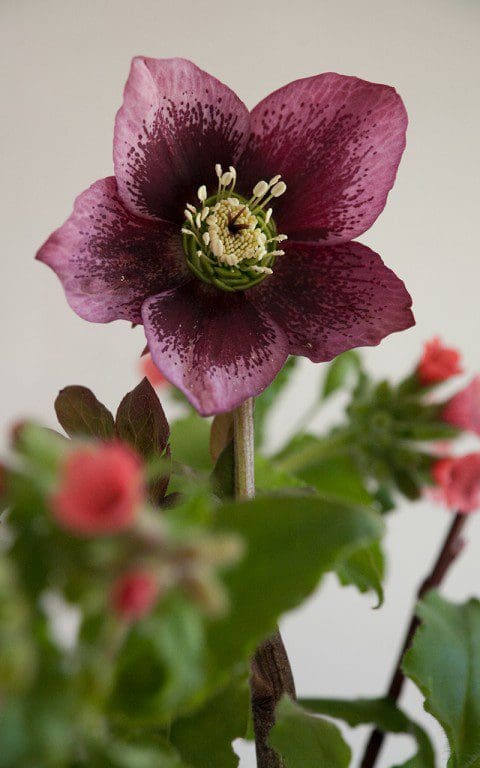 Helleborus x hybridus Single Pink Blotched
The last of the winter is held in the Bergenia purpurascens which colours from a deep, coppery green to the colour and shine of oxblood leather in the cold months. This form, which I first saw growing in Beth Chatto’s gravel garden, was initially called ‘Helen Dillon’ after the Irish plantswoman and gardener, but has now been renamed ‘Irish Crimson’. I like it for the scale of the leaf which is finely drawn and held upright to catch the winter sun.
Though bergenia are a stalwart of shade, it is worth finding Bergenia purpurascens a position in sunshine so that the leaves can be backlit in winter. The glowing foliage makes up for the absence of flower elsewhere and is a foil to the first bulbs. I have just one clump which is slowly increasing, but I plan to split it on a year on/year off basis to have enough to mingle it with fine stemmed Narcissus jonquilla and white violets. Though bergenias are tough and reliable, I have found that they are magnets for vine weevil. The tell-tale notches to the edge of the leaf are made by the adult and these signs will show you that there are grubs eating the roots. An autumn application of nematodes should help in controlling the problem if it develops.
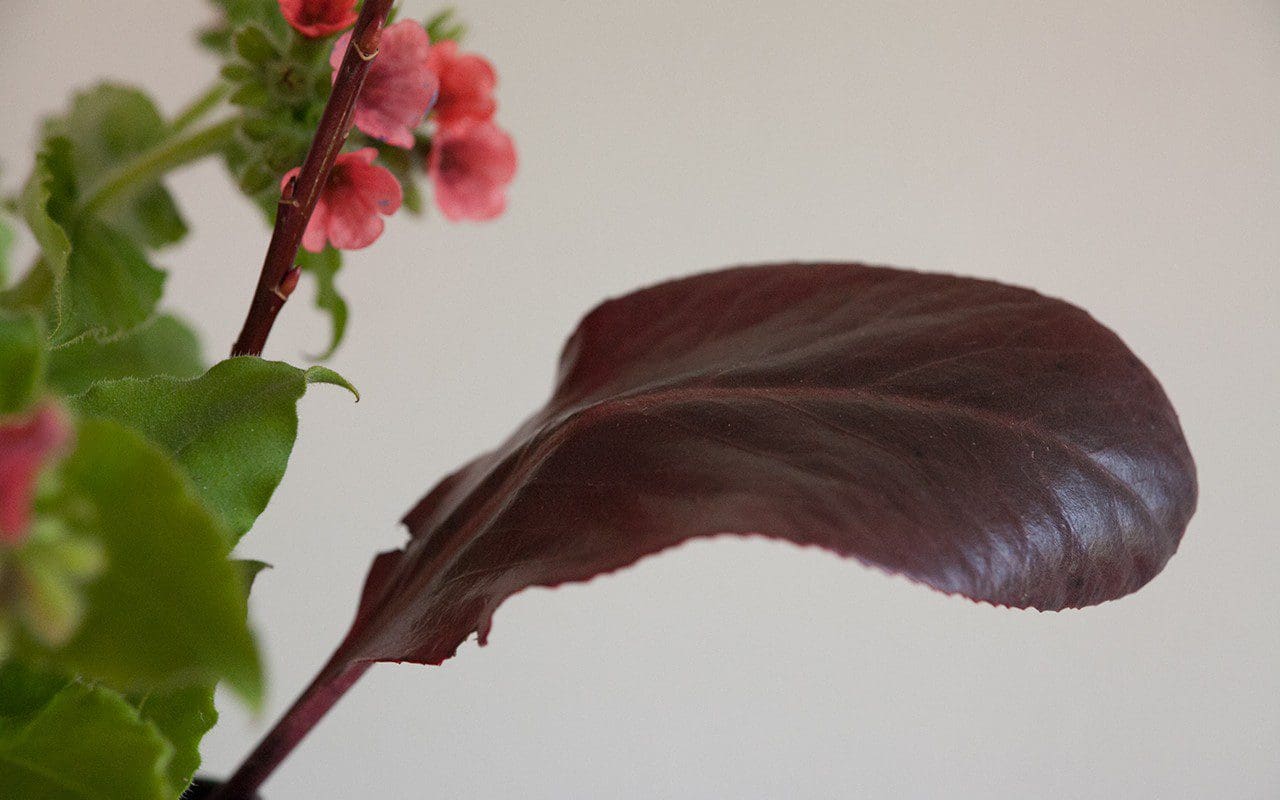 Bergenia purpurascens ‘Irish Crimson’
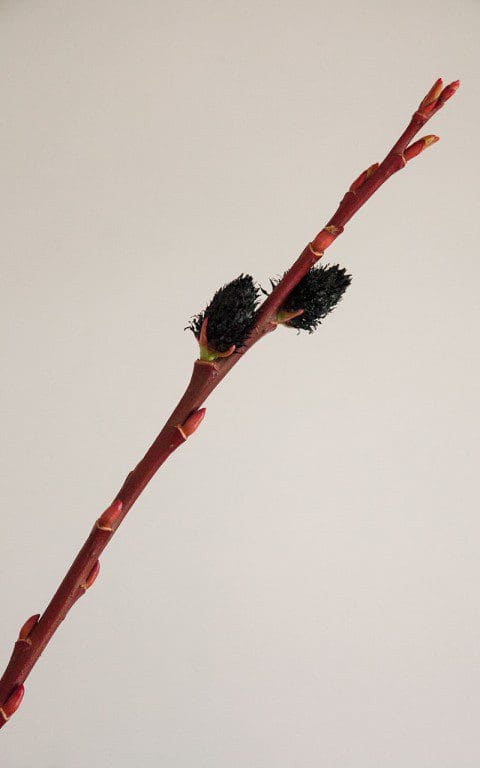 Salix gracilistyla ‘Melanostachys’
Salix gracilistyla ‘Melanostachys’ is an easy, compact plant which I’ve chosen to grow hard in the gravel surrounding the drive. It has lustrous stems that start out green before turning blood red and throwing out coal-black catkins from early February. They are a surprise and a delight and, some time in the next couple of weeks, each will push out a glowing halo of red anthers. For now, they are planted up at their base with Erigeron karvinskianus to cover until they bulk up. They won’t take long to reach a metre or so in all directions. As they shade out the erigeron, I have also included Viola odorata for its willingness to take their place in the shade. Next year I will add snowdrops to provide a contrast to the darkness of the willow. They will be easy to keep to a waist high bush with the longest growth being pruned out for catkins as an accompaniment to the last of the winter or the first of the spring pickings.
___________________________________
In memory of
Enid Brett Morgan
28 March 1937 – 28 February 2018
I picked this posy last Sunday with mum on my mind. My brother was looking after her, giving me a day’s respite from sharing the care of her at home at the end of her life. I didn’t know then that she would leave us so quickly this week. However, looking at the spareness and sombreness of this arrangement now, shows me that somewhere deep down I did. Mum loved hellebores. Coral and old rose were two of her favourite colours.
Huw Morgan
Words: Dan Pearson / Photographs: Huw Morgan
Published 3 March 2018
We are sorry but the page you are looking for does not exist. You could return to the homepage