ALREADY A PAID SUBSCRIBER? SIGN IN
In 2014 I was appointed as Garden Advisor to Sissinghurst, which was then under the careful guiding hand of Head Gardener, Troy Scott-Smith. The role involved an annual walk round the gardens with Troy, acting as a sounding board for his plans to relax the garden and to steer it gently towards its original vision. Over time, and without the owners at the helm, the gardens had been managed to provide their very best for the swell of visitor numbers. I agreed they no longer resembled the gardens of Vita’s writings or her freedom of spirit.
Troy had spent hours immersing himself in Vita’s imaginings, hopes and plans for the gardens, and had written a manifesto that called for a return to a more relaxed and wild, romantic vision closer to Vita and her husband, Harold Nicolson’s, original intentions.
Every time I visited we skirted around Delos, a garden that had originally been built in response to a visit that Harold and Vita had made in 1935 to the ruins of the Greek island of this name in the Cyclades. The garden had been lost, planted in the wrong place, facing north on heavy Wealden clay. It was a place that had come to be more suited to the site and was now part woodland, part lawn with rose beds lining the boundary. The very name felt like an anomaly.
It was in 2018 that Troy asked me if I would work with him and his team to re-imagine the garden. It was daunting making changes to a garden as universally loved as Sissinghurst, but we set to and looked carefully into the history to understand why Harold and Vita had felt compelled to bring something of the ruined island back to Sissinghurst. Troy had sent two members of his team on a field trip to study the vegetation and record the mood of Delos. The time that I too have spent in Greece provided rich inspiration with regard to the planting. We worked carefully with the National Trust historians to test our ideas as they emerged and spent the best part of a year planning. Visiting a local quarry with Nigel Froggatt, the masterful craftsman who built the garden and taking time to mock up the walls so that they felt authentically of the island.
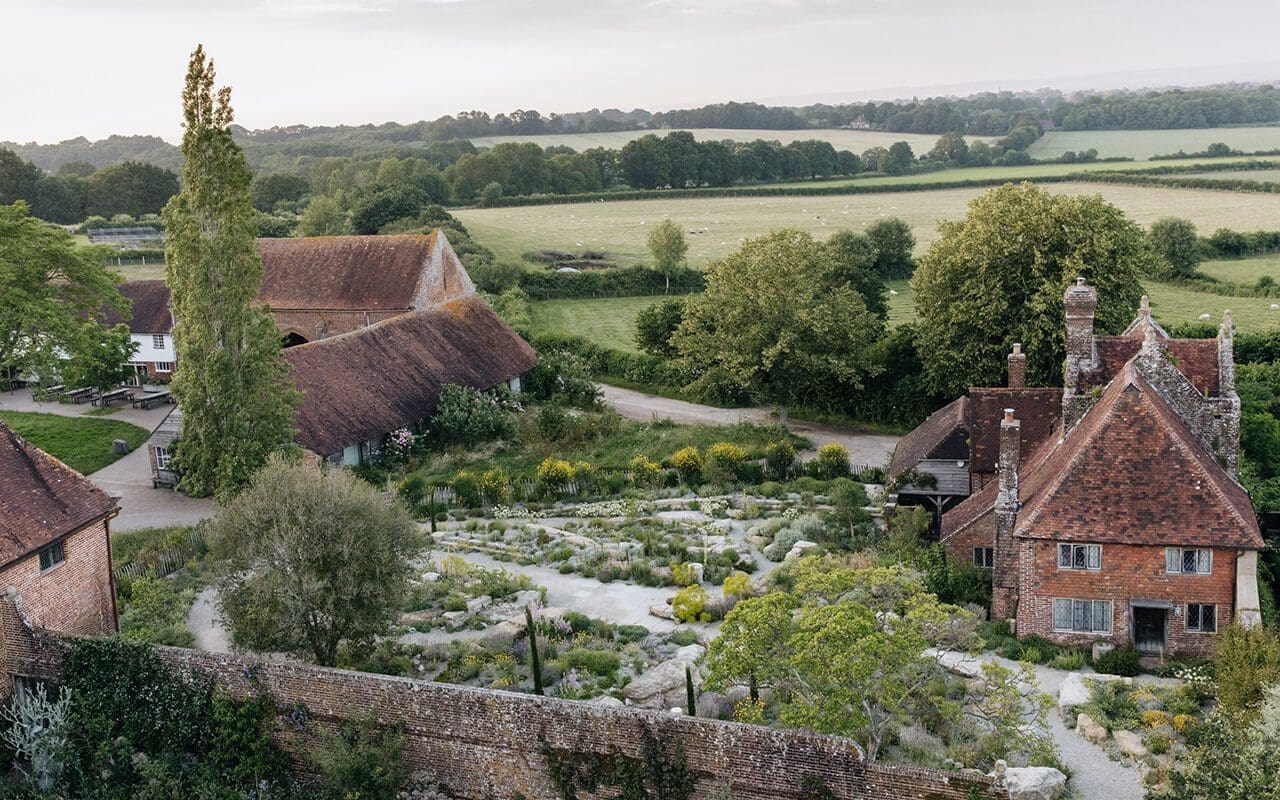
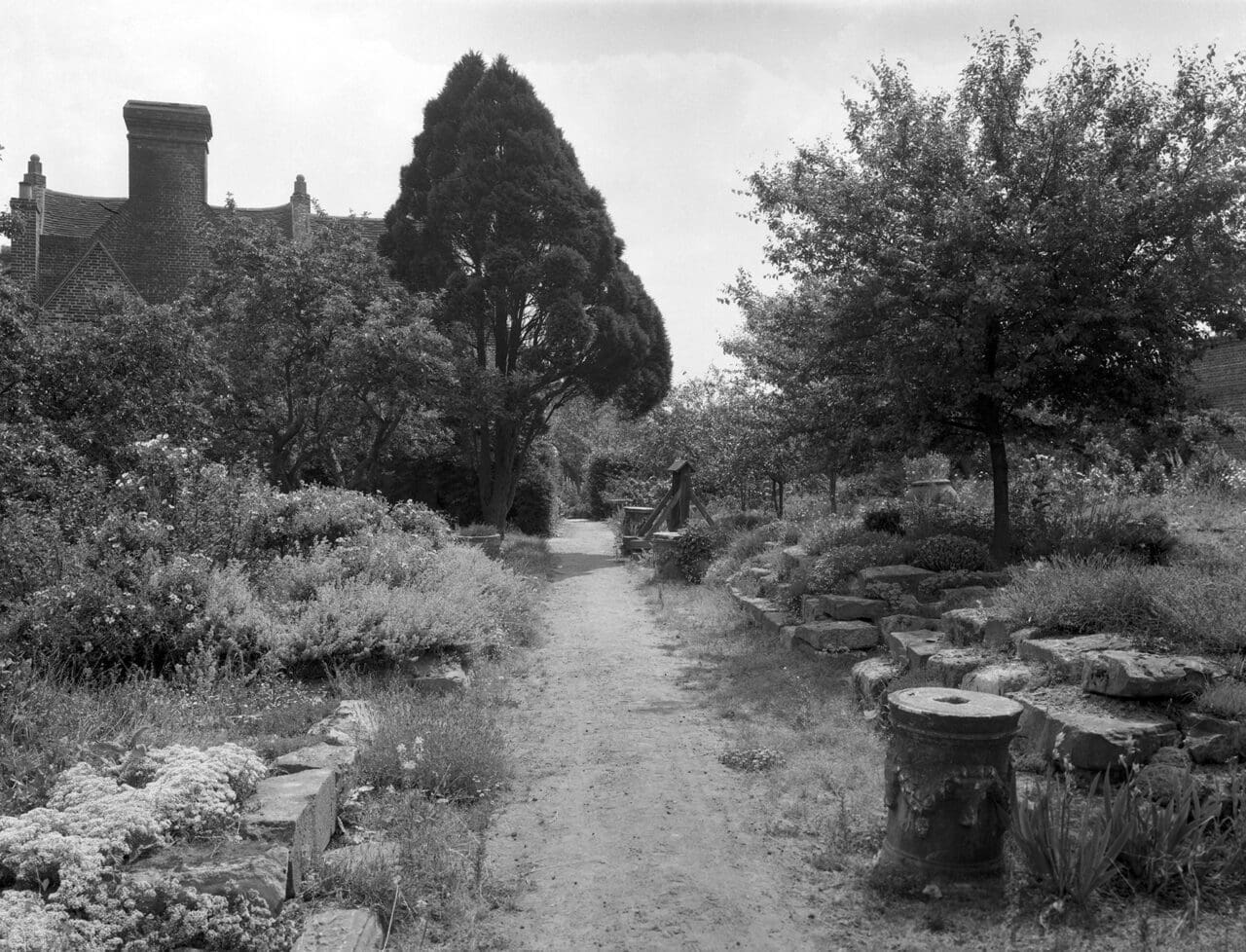
The design made some bold moves that perhaps Harold and Vita did not have the know-how to make at the time. We made light by editing the existing trees back to a Quercus coccifera from the original planting and harvested the sun by battering a number of terraced walls back into the sun to face south. The original axis was reworked to feel like the stepped ruins we had seen in photographs of the garden taken not long after it was made. The terraces that moved away from it became rougher to invoke the hillsides into which the ruins had fallen. We made the old well the centre of the garden, a communal meeting place as it would be in a Greek village and made a seating place amongst columns where Vita had imagined that the blue of the distance could conjure the sea.
I went on my own research trip to workshop the palette of Greek natives with Olivier Filippi at his nursery in the south of France. His knowledge and plant selection is superlative. Some plants were untested in this country, others entirely familiar. On returning to the UK I worked up the planting areas. Goat paths where the aromatic plants would brush your legs and shade-loving drought lovers that would sit happily in the shadow of Judas trees. A mature pomegranate forms a gateway from the White Garden. A fig and the rough twist of cork oaks will, in time, provide height and volume. Aromatic evergreens are already hugging the terraces and perfuming the garden on a hot day and the ephemerals, the annuals that make a Greek spring the spectacle it is, are already beginning to find their niches to make the garden feel lived-in.
Last week, over a year since my last visit for the final planting day in the week before the first lockdown, I returned for the official opening. The garden felt settled and possibly better for the enforced pause of the lockdown and Saffron Prentis, who has been in charge of the garden, has tended it beautifully. The volunteers who man the garden every day have been there to communicate the story behind it and its reimagining.
In 1953, Vita wrote of Delos, ‘This has not been a success so far, but perhaps someday it will come right.’ I know that the changes have not been liked by all who have seen the garden in the flesh or online, but when I returned last week with the planting already looking established after just 18 months, it was possible to see that Vita and Harold’s vision of a Grecian isle transported to the Kentish Weald is once again alive at Sissinghurst and coming right.
_._._._._._._._._._._._._._
When we first started work, Adam Nicolson, Vita and Harold’s grandson, was immensely helpful in facilitating our understanding of the deep-seated cultural motivations of both Harold and Vita to create this garden. At the opening last week he very kindly offered to write a piece giving his perspective on Delos, then and now and I am delighted to share it with you here.
Dan Pearson, Hillside, 8 July 2021
The official opening of the new Delos at Sissinghurst last week is only a beginning. The new cypresses will soon stretch and thicken, the new figs will sprawl and lounge across their neighbouring boulders and walls and the individual plants of Dianthus cruentus will spread and merge into rivers of deep pink, bee-happy colour. A long future awaits this garden, as something to take its place alongside the Purple Border and the White Garden as the brightest of stars in the Sissinghurst constellation.
It has been a long time coming. Throughout my childhood at Sissinghurst, we always knew that in the 1930s Vita and Harold had wanted to make a Greek garden in this most unpromising of clay-wet, north-facing and very very Kentish corners. They attempted it, assembling some of the Elizabethan stones they found lying there into stepped platforms that vaguely recalled temple foundations in the drought of the Aegean. But the soil was wrong, the site was wrong and over the years a series of efforts were made to redeem it. My father removed all those stones to make the foundations of his gazebo; a very American grove of birch-like magnolias was planted to preside over a carpet of scillas and chionodoxias through which a few peonies poked their heads; new brick paths were laid. Delos had essentially been lost.
It has now been found and in the richest possible way: the silhouette of a flowery garrigue billows up in front of big country rocks; rubble-terrace walls firm up into what might be the foundations of buildings along the central street of this forgotten city; the half columns of an abandoned temple stand on the slope above.
It is pure theatre, as it was always intended to be, entirely dependent on a big, hidden drainage system and an especially free-running soil, with plenty of grit and crushed brick to make the Mediterranean plants feel at home. Clay is nowhere to be seen.
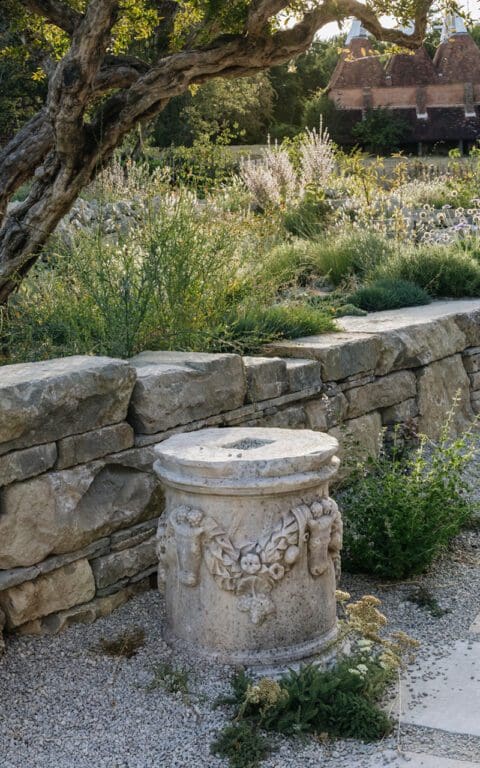
There is one element that reaches further back into history than the dreams of the 1930s: three cylindrical Greek marble altars, originally carved in the 3rd or 4th century BC, decorated around their waists with swags of grape, pomegranate and myrtle suspended between garlanded bull-heads — boukrania—which now stand at key intervals along the central street of the garden. Perhaps almost unnoticed among the blaze of life and colour around them, these altars remain the core of the garden and its meaning. They are the reason it is called Delos, as they came originally from that famous island in the Cyclades, sacred to Apollo, and represent an element of the story that was undoubtedly close to Harold Nicolson’s heart.
His mother’s grandfather was Commodore William Gawen Rowan Hamilton, a naval commander in the first years of the nineteenth century, a heroic and romantic figure and passionate Philhellene, who spent the years from 1820 onwards in the eastern Mediterranean, winning the title of ‘Liberator of Greece’ by protecting the Greek rebels against the Turks and spending much of his private fortune in their cause. There is still a street in Athens named after him in gratitude.
From time to time during his cruises attacking pirates and fending off the Turk, he would land on an island or a piece of the Turkish-occupied mainland and quietly liberate an antiquity or two, sending them back to his liberal father-in-law in Ireland, Major-General Sir George Cockburn, a flamboyant antiquary who had made a collection of Greek statuary at Shanganagh, his castle outside Dublin.
These Delian altars arrived there in the late 1820s, dripping with Greek-loving, liberty-loving significance, and when in 1832 the British government promised in the Great Reform Bill to democratise the corrupt state of British politics, Sir George erected them in a column to Liberty outside his front door. They stood there for six long years, during which the government entirely failed to reform the basis of British politics, and in rage and frustration, Cockburn had carved on the base of the monument the grand reproach: ALAS, TO THIS DATE A HUMBUG.
In 1936, when the contents of Shanganagh were sold up, Harold Nicolson bought the elements of his great-great-grandfather’s column and had them transported to Sissinghurst. The HUMBUG base and one altar is still in the orchard; the three others are in Dan’s new Delos, still in my mind radiating everything which that long, Rowan-Hamilton-Nicolson tradition valued most: a love of liberty; an internationalist, pan-European vision; a cosmopolitan grasp of and engagement with world culture; and a treasuring of those dry, beautiful, ruin-scattered landscapes sacred to Apollo which this Kentish garden now recalls.
Adam Nicolson, Perch Hill, 3 July 2021
Photographs | Eva Nemeth
Published 10 July 2021
Fleur Olby first came to our attention in the 1990’s with her striking abstract plant portraits which illustrated Monty Don’s gardening column in The Observer Life Magazine. Her interest in shooting in low light prompted us to invite her to photograph the winter garden. So, early this year, and just weeks before lockdown, Fleur came to spend a day and a night at Hillside. As the clocks go back we revisit her vision of the penumbral garden.
Tell me about your interest in nature. When did it begin and were there any key experiences that shaped your relationship to the natural world and plants in particular?
During childhood I became ill with double pneumonia and had to be in an oxygen tent. My Mum brought an oak leaf into the hospital as a gift to look at something beautiful and magical from a tree close to where we lived and the thought of visiting it when I was better. I remember visiting the tree later, although now it all feels dreamlike. There was something then that I still question in the shift in perception of looking at something small in isolation to seeing it in its context of growing on a tree. The enlarged gaze of a child was full of wonder, magic and intrigue, something I have tried to recreate in my still life photography.
How did you realise you wanted to become a photographer?
During my MA in Graphic Design at Central St Martins (1992), I spent a lot of time colour printing in the darkroom, my degree show became purely photographic – Images of environmental and flower still life. My thesis explored the different ways of looking at Nature from abstraction, the single image, still life, the object in its environment, the concept of the Wilderness and a Garden and their uses within the industries of Art, Design and Photography.
I wanted to be able to work within the landscape I grew up in and the magazine aesthetics of still life. At this time, I was entranced by looking at detail, but importantly when I first started making pictures in wilderness places there is an unexplainable feeling found through the camera.

Your work for The Observer Magazine was groundbreaking at the time. Can you explain how your view of plants differed from the norm then?
I was inspired by Monty Don’s writing and both degrees were fine art graphic design – lighting and composition were always experimental. Nick Hall was my first commissioning editor at the Observer and then Jennie Ricketts. He commissioned the garden articles to be an abstraction in still life. The concept of the garden as a still life representation was different then. It was a unique time when my imagery was young and given total creative freedom. For the articles, I would regularly be at the flower market at 4 am and in the lab processing the work at midnight ready for the morning.
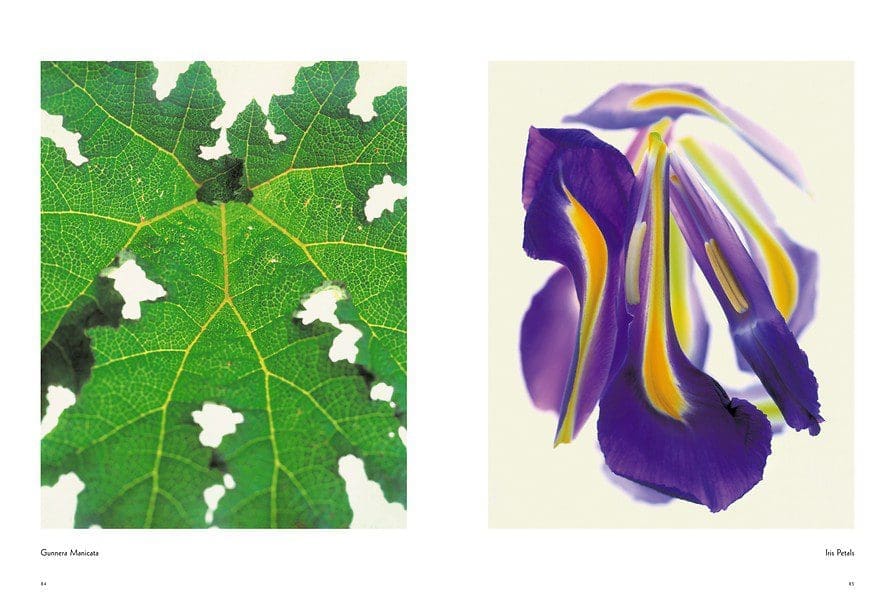
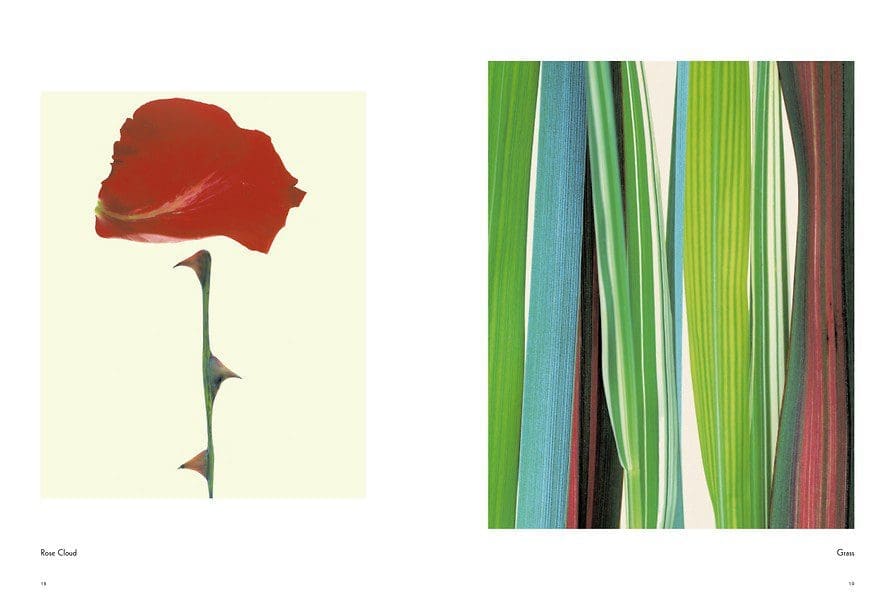
Although you were working commercially what made your photography stand out then was that it was clearly the vision of an artist. Can you describe you and your photography’s relationship with the worlds of art and commerce and do you still produce commercial work?
I had a good mix of editorial design and advertising and the two books were the fine art application of my work. After the 2008 financial crash and the evolution of digital capture still-life Photography commissions changed and lifestyle photography replaced a lot of the still life work. After 15 years of commissioned work, I had to change my practice as it became unviable to run a still life studio. I consolidated my archives and started to make personal work. The series are ongoing, but I would also like to work on plant collections again and garden stories.
How did your work develop after your time at The Observer ? I have read that some of the images were used in installations. Now you produce limited edition imprints alongside prints.
The Observer gardening editorial was amongst editorials I contributed to regularly for food and health and beauty. When I stopped shooting for the gardening articles in 2002 the food still life increased and I also worked for some fashion companies for still life and jewellery, perfume and interior still life.
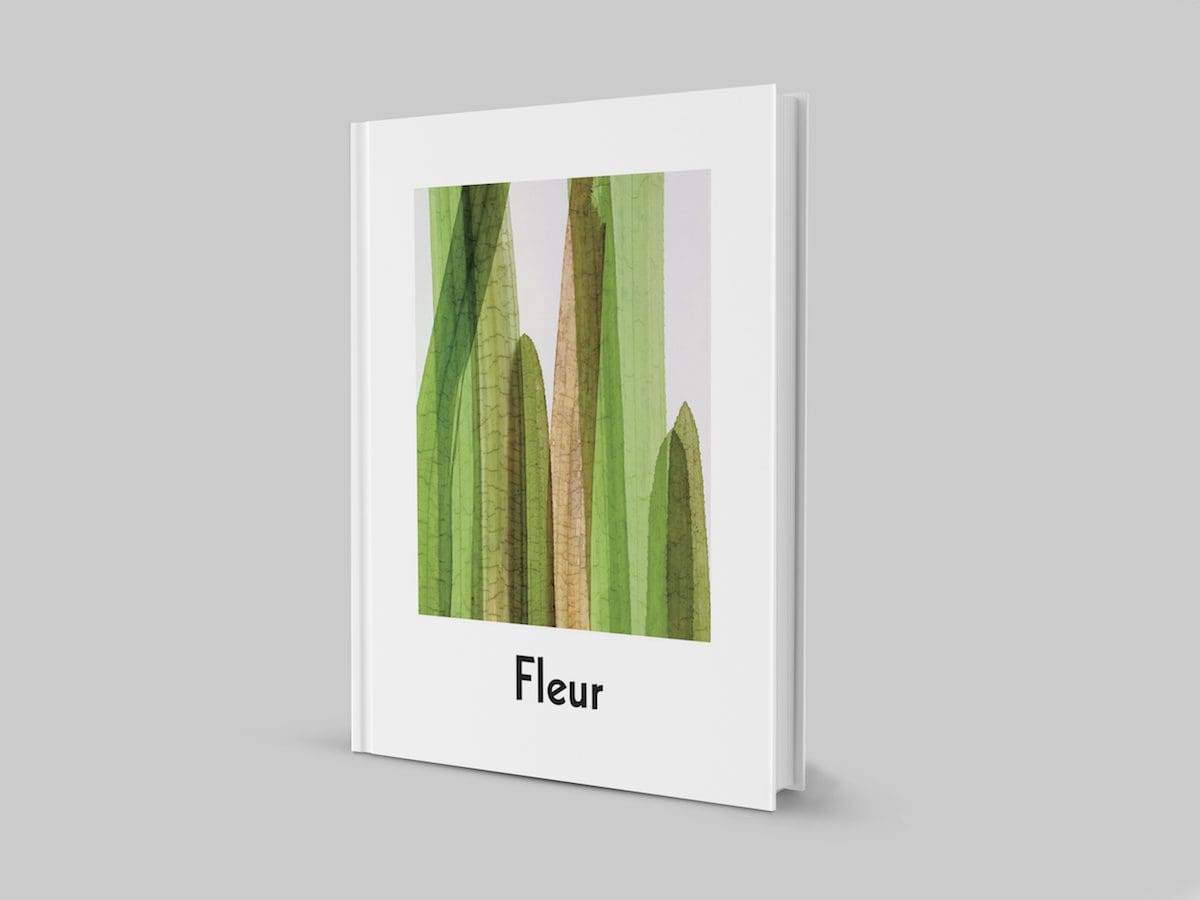
My monograph Fleur: Plant Portraits by Fleur Olby with a foreword by Wayne Ford, was published by FUEL Publishing in 2005, a combination of commissioned and personal work from ten years of floral still life. It was in the Tate Modern and The Photographers’ Gallery bookshops and distributed internationally with DAP and Thames and Hudson.
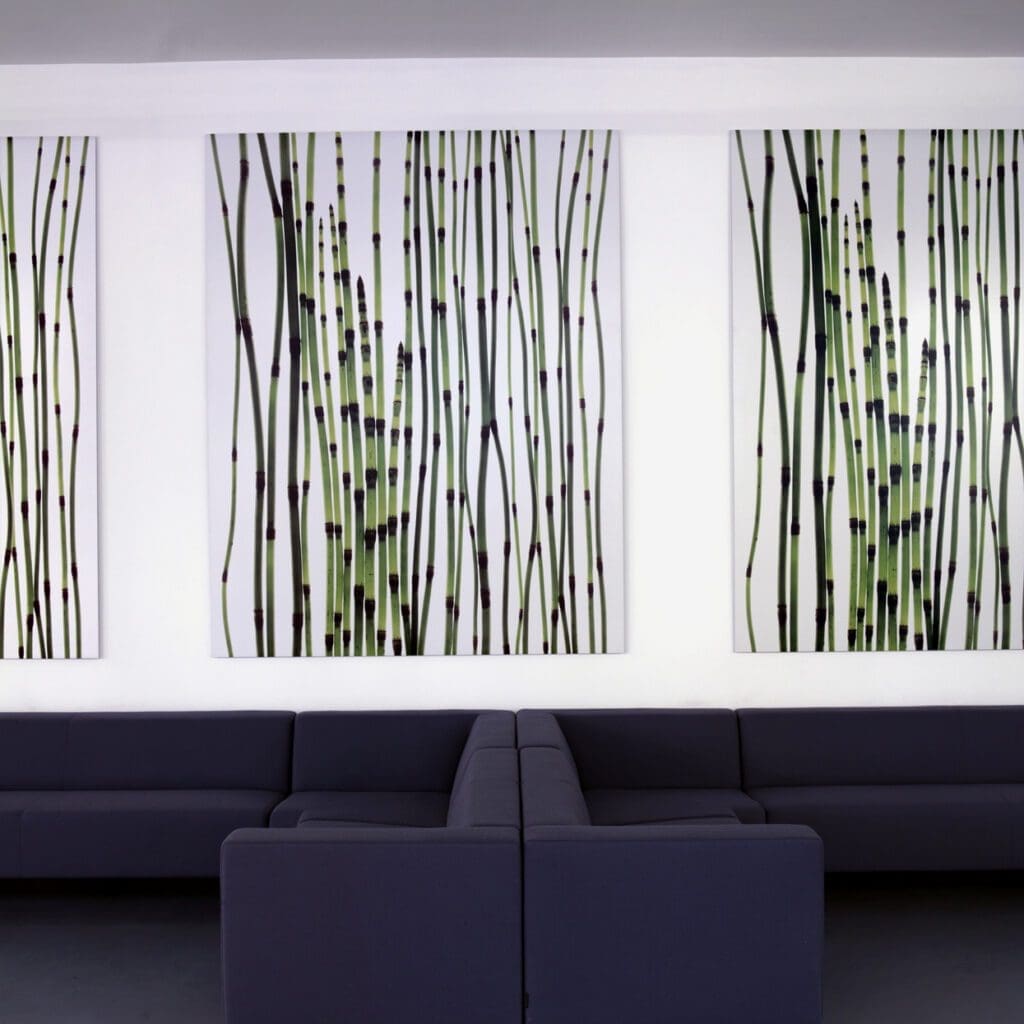
But after 2008 with two client insolvencies causing further problems after the financial crash, it took me a long time to find a way forward with my archives. The two commissions, Horsetail Equisetum for Gollifer Langston Architects and a textile collaboration with Woven Image in Australia were the archival commissions from that time that enabled me to move forward.
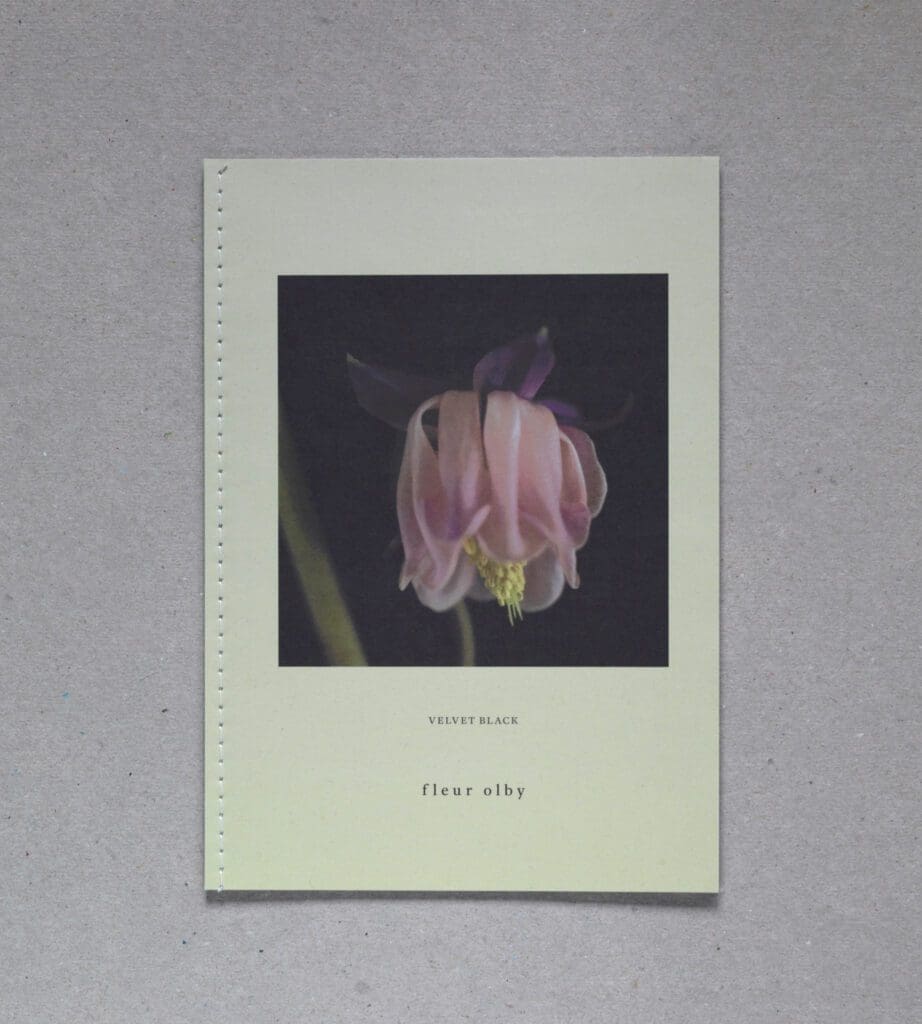
I had started a long-term project about the connection with Nature, Colour from Black. My Imprint has the first publication from these series, Velvet Black and limited edition prints that have exhibited at the Photography Gallery in the Museum of Gdansk and my solo show earlier this year at The Garden Museum, London. The A5 publication launched at Impressions Gallery Photobook Fair in Bradford and the A5 and A6 special edition are currently also at The Photographers’ Gallery bookshop in London. I aim to continue with self-publishing the series in small books and work in collaboration on the projects that evolve from them. Images from other series have also been shown in group shows in the UK and abroad.
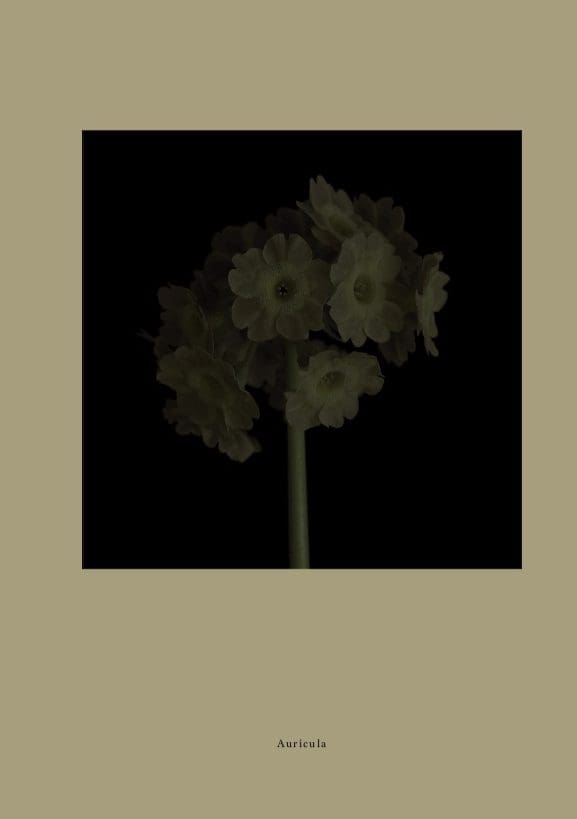
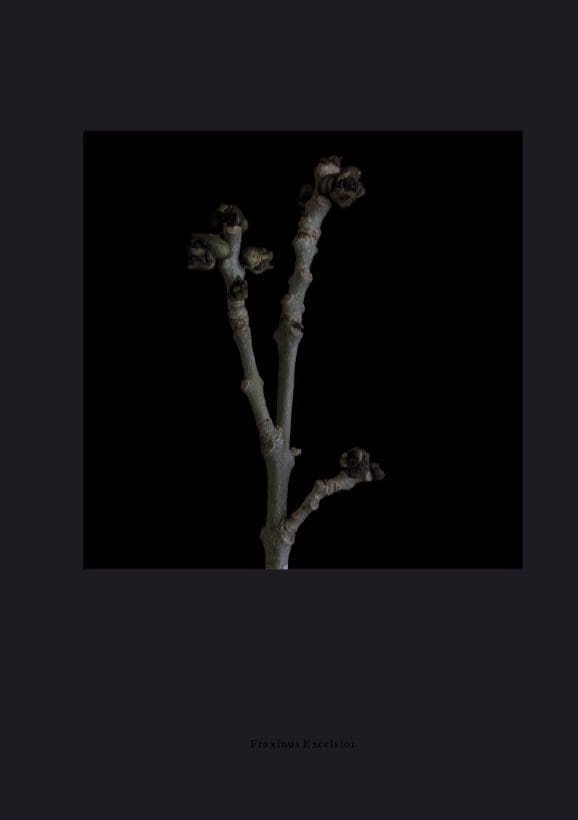
Can you describe your process, and how your choice of film stocks, different formats and use of low light levels create the particular viewpoint you are interested in capturing?
The series artistic aim is to connect dreams and reality and through this work I have experimented with different mediums. It is less about the impact of a single image, my interest is in the pace and change of the narrative. The personal aim is to conserve plants and the elemental feeling of beauty in Nature. My commercial work was studio light, mostly shot on 5/4 Velvia and Provia film.
In my long-term series, the colour is subtle but fully saturated, in natural light. The low light started with the series Velvet Black as a present-day ode back to Victorian plant theatricals, collections and plants from a garden – the correlation between the transience of daylight and blooms.
I was also experimenting with my iPhone as I was trying to capture the spontaneity of feeling from walking. My working process has evolved: It begins with walking and pictures that I revisit on medium format for a different kind of precision that allows long exposure. I am now mixing instant images and film from Black and white and colour. The series made at Hillside was the first time I combined the different mediums and shot Dusk, Dawn, Dusk in succession. I used Instax and my phone to find viewpoints from the paths. I remade some of the images on the Ipad to map out the plan.
Then I shot with a Polaroid camera in reasonable light and shot film and digital on medium format at Dusk and Dawn. The film was mostly Ilford, HP5, FP4 and XP2.
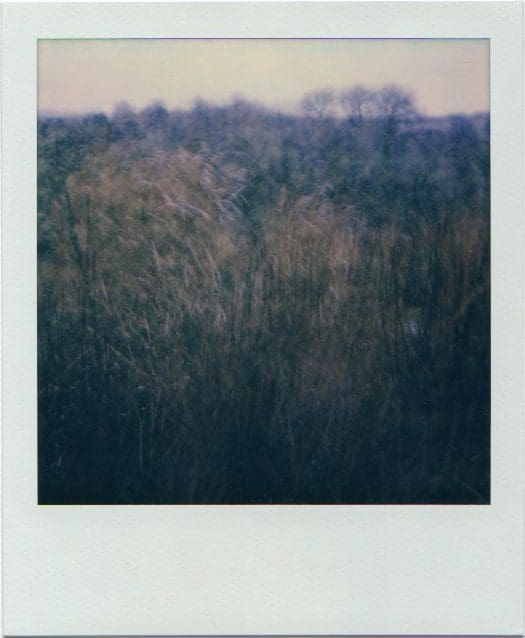
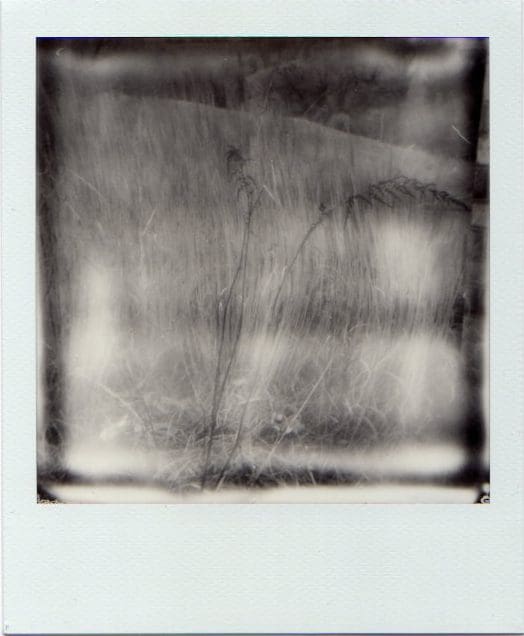
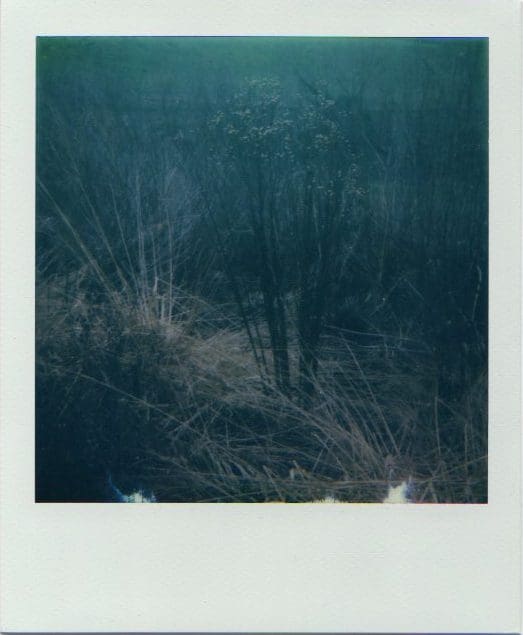
There is a quiet intensity to all of your work, a feeling of being tuned in to a different way of seeing the familiar. The fact that you work in series also gives a very strong narrative quality to your images. What would you like us to see in them?
Thank you, that means a lot to me! The quiet intensity was what I needed to reconnect with when I began to revisit childhood places that inspire me on the moors, on the hills, in the garden.
With the narratives about Nature, I wanted to slow down the viewing process and to question the feeling of Beauty through light and repetition within the series. In the book Velvet Black I use the smell of the ink, the texture of the paper and the folded pages to slow down the process in a similar way to a flower press. And the printed absorptance of the page makes the transient process of nature into a permanent object.
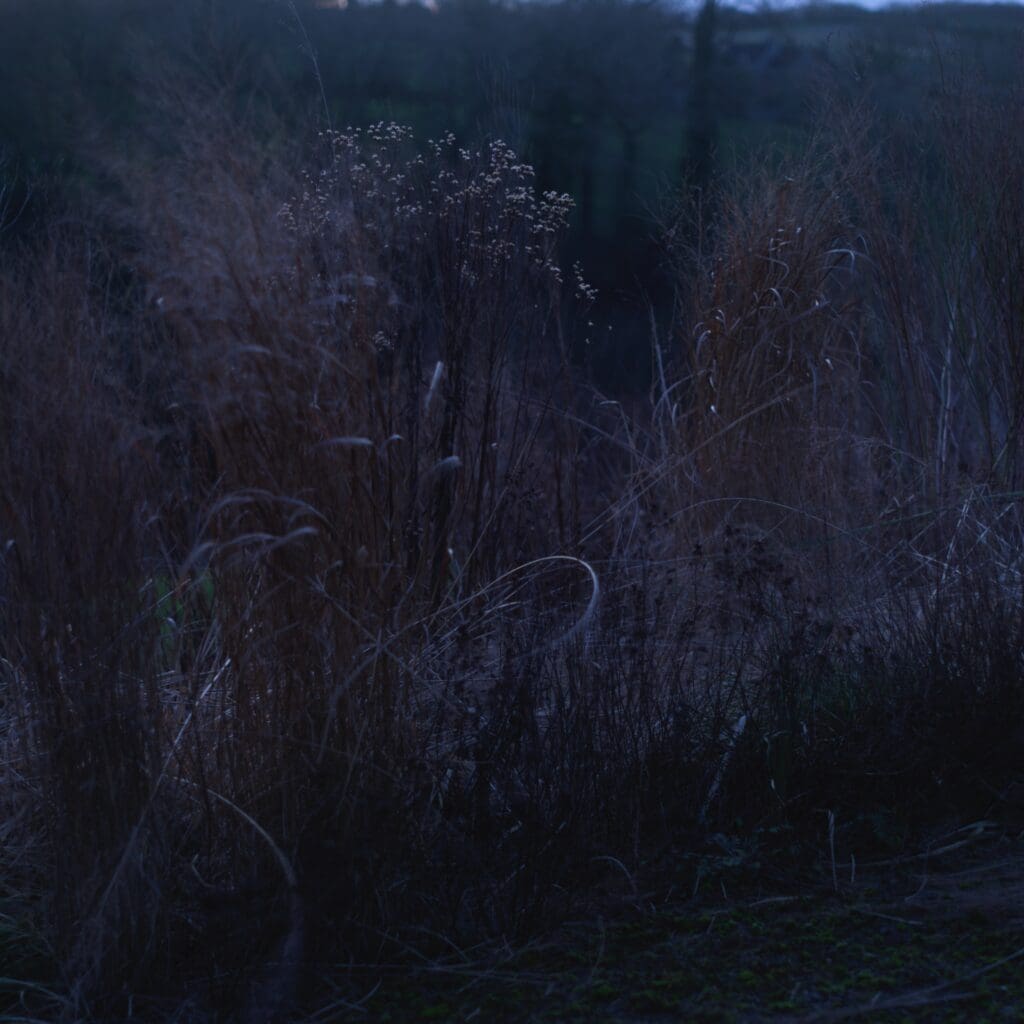
There is a distinct balance in your work between wild, elemental landscape and the intimacy and perfection of a single cut flower. What is the relationship between these two worlds for you?
I think this is the path I am trying to narrate between the perfect oak leaf from my childhood to the tree out on the hills.
When we asked you to come and take photographs at Hillside what were your first thoughts ? When you were here were there any particular observations you made about photographing a garden set in landscape?
It was great to hear from you both. I was excited about the thought of visiting Hillside. I remember our conversations about the work you were inviting artists to make and what aspects of the garden they were focusing on. But on arriving I couldn’t think how to divide it up into one particular interest and I knew I wanted to convey feeling.
I arrived between the storms of February, the quiet calm lull in the garden was breathtakingly beautiful. No-one was there until later today.
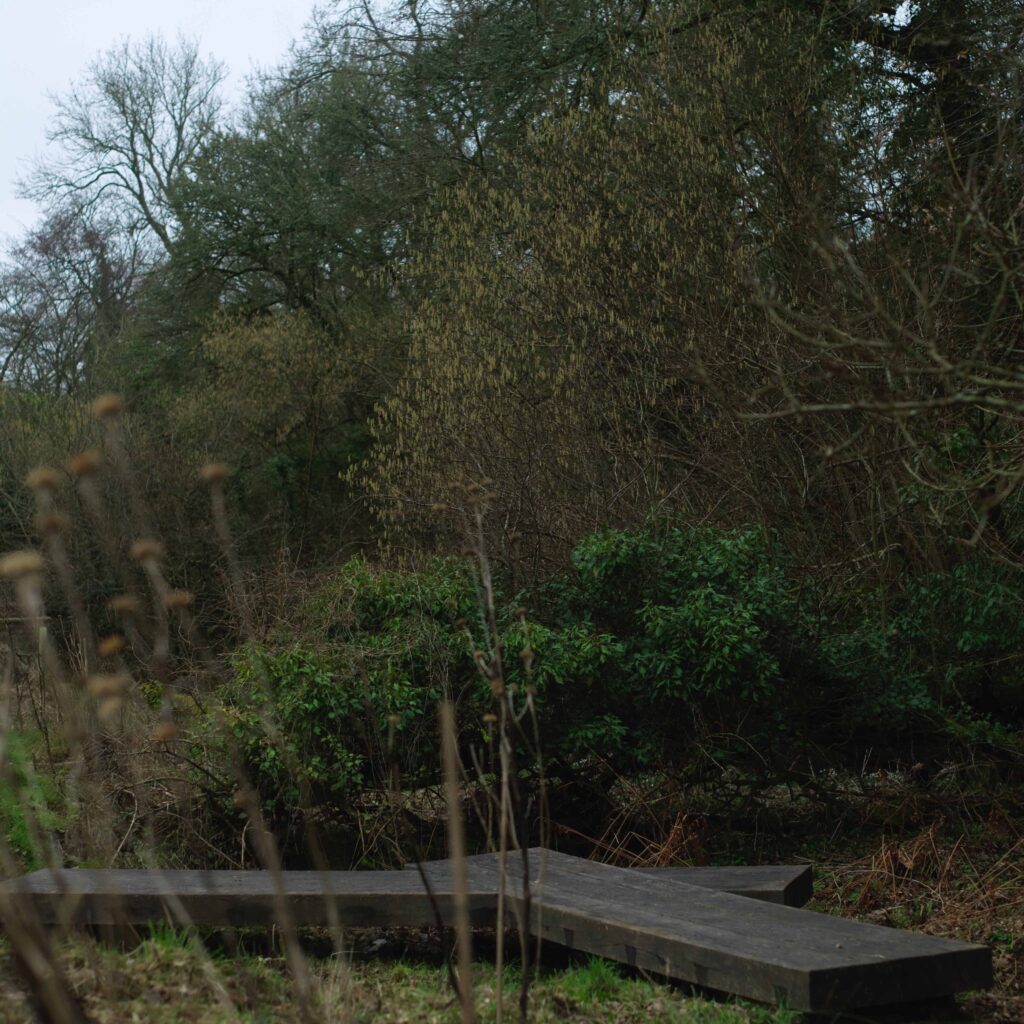
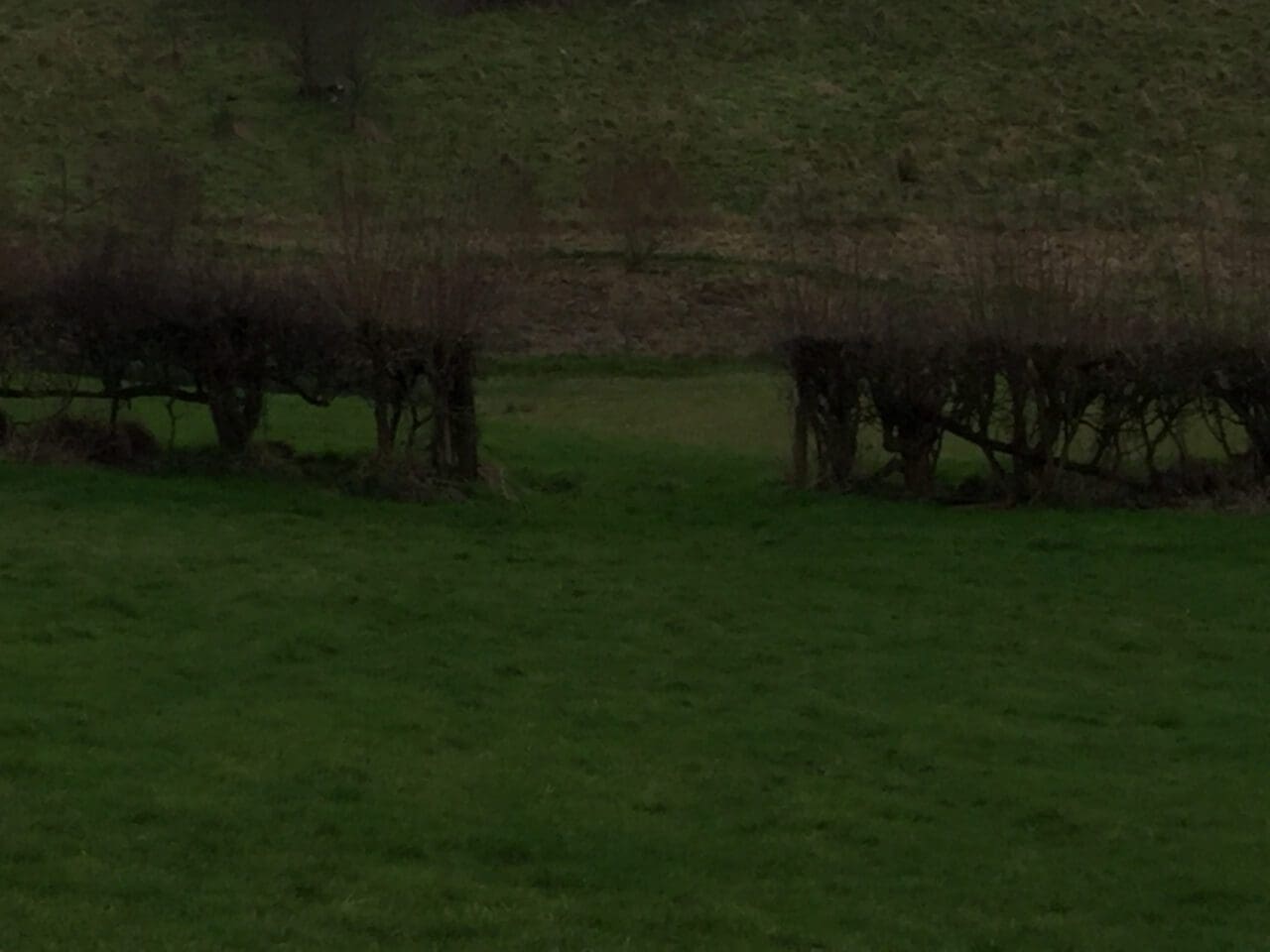
I started to walk – the paths led me everywhere. Enclosed and defined by the garden in and out of the landscape. I did not know this terrain, the feeling and scale are different, the quiet remains the same – the shape of the hill on the left is gentle and round, it stretches out into another at the front with incredible mature trees. The main garden is perched high up within the undulation of the hills. How will I capture this?
I felt I was intruding the serenity of the place, I stood amongst the plants’ skeletons taller than me and thanked them for remaining standing despite the storm – looked out at the echo of the trees beyond, walked down the hill towards them and looked back up to where I’d been standing – It is like a painting, brushstrokes of layered texture highlighted by the time of the year and the trees and hedges beyond it, darker shapes in repetition above. Light in colour as its ready to be cut for new planting and the two gates take me in and out of place and garden and into wonderment. I’m not sure I can express this.
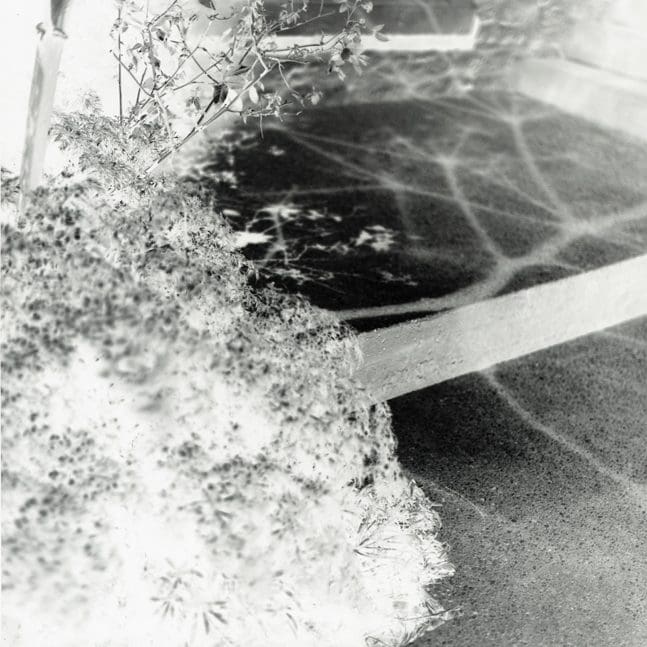
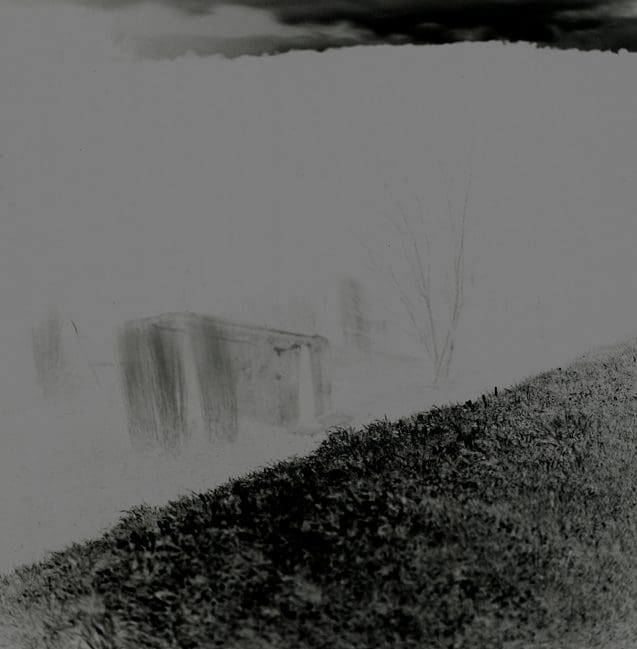
Then there’s the bridge at the bottom of the stream with wrapped up plants on the edge that I could spend all day shooting, the vegetable garden! The artichokes! The Cavolo Nero – The two architectural stone troughs define the scale of the outdoor space and feel spiritual, a verbascum ode nearby reminds me of my Dad and makes me smile, the hedges, the orchards and the young woodland at the back. Flowers resiliently here and there touched me – intricate planting inspired me. I had to process a plan and start.
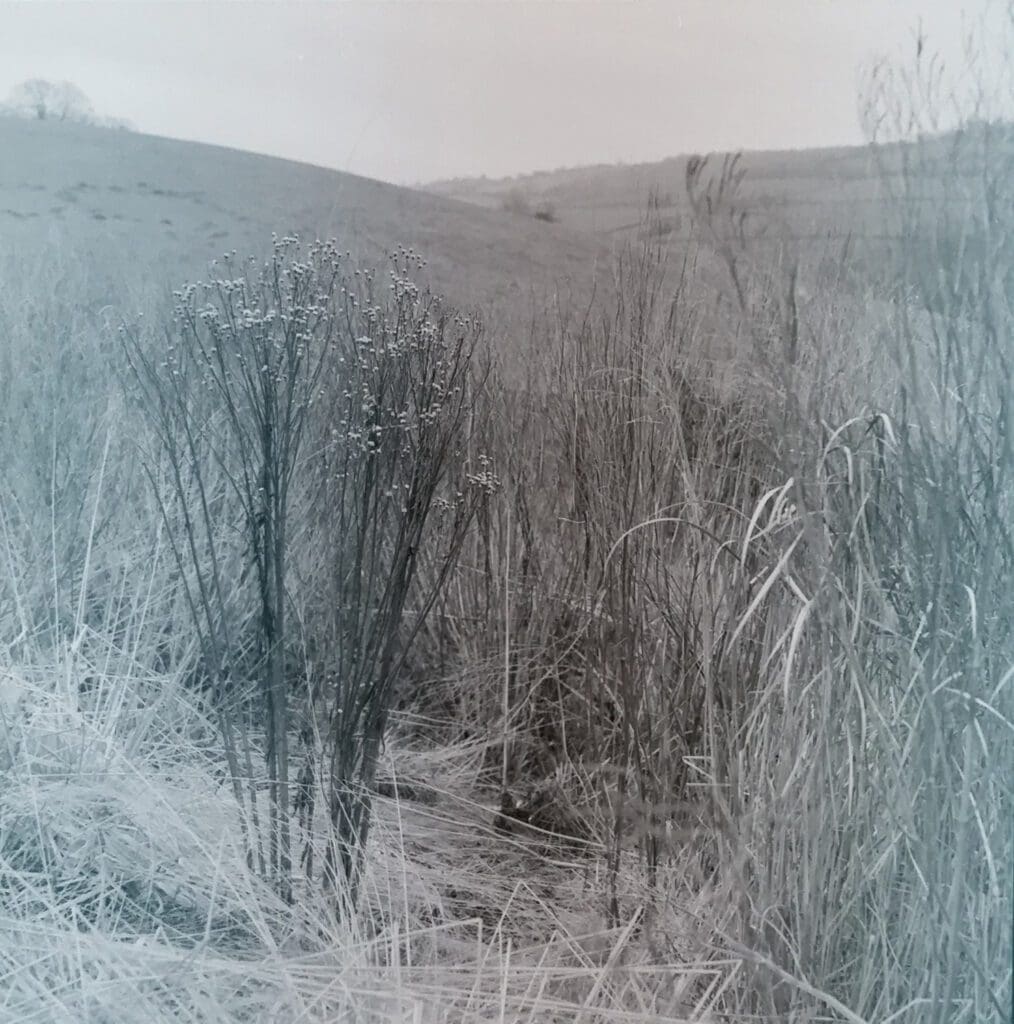
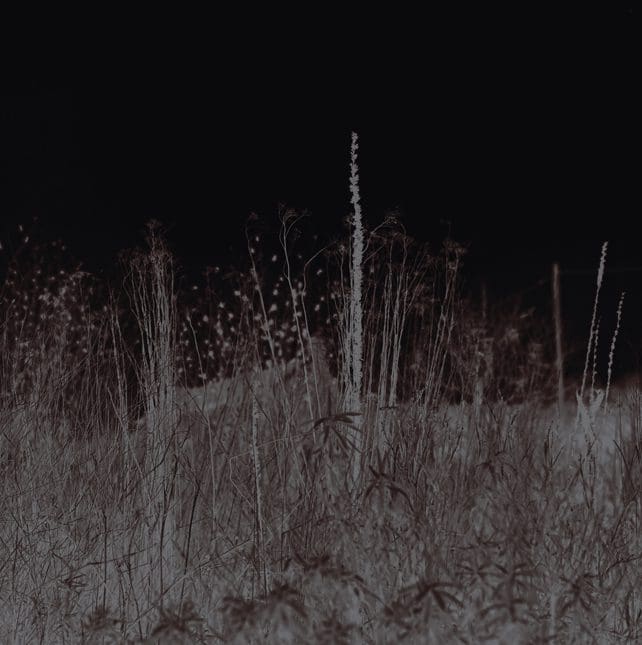
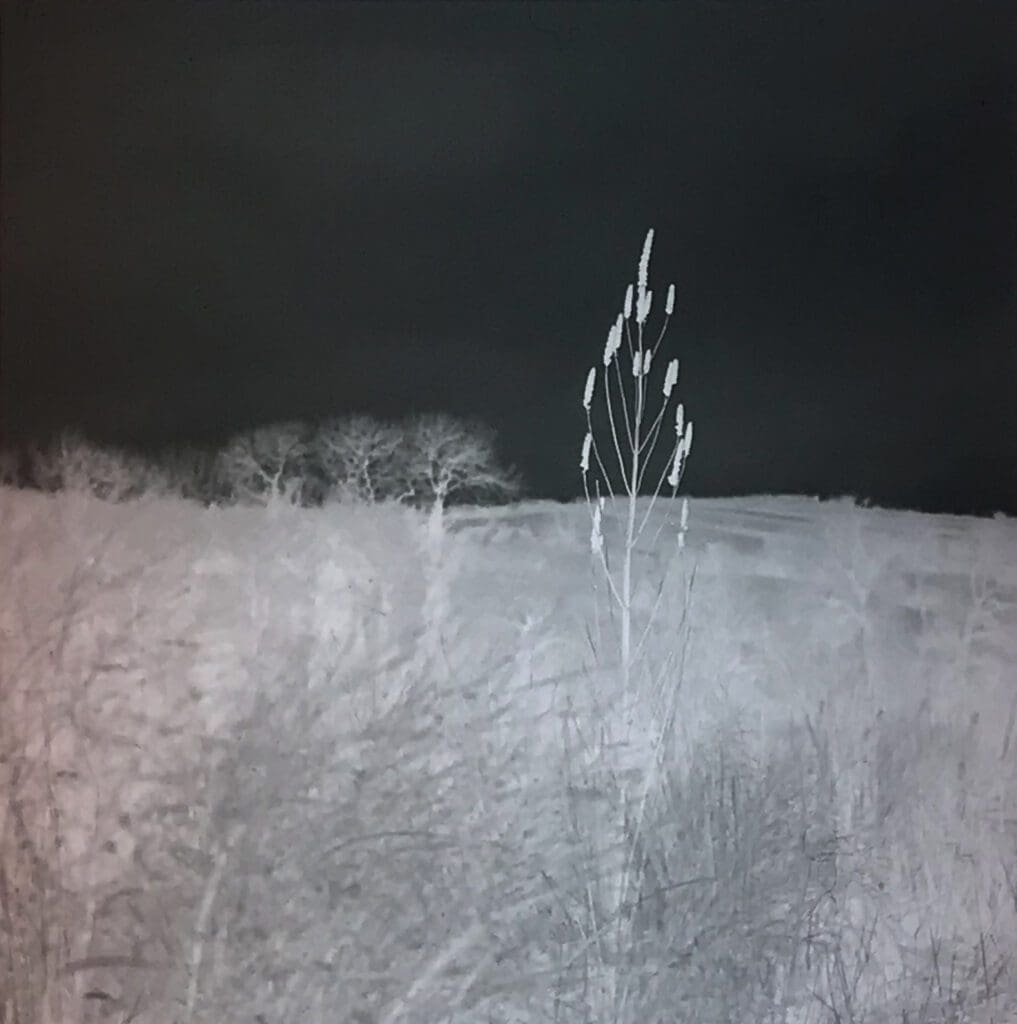
I wanted to try and capture this movement, the feelings from walking this dreamworld and its reality. I worked on different cameras in repetition in positive and negative to intensify the shapes and colour and black and white to intensify the feeling and pictorially play with resonance.
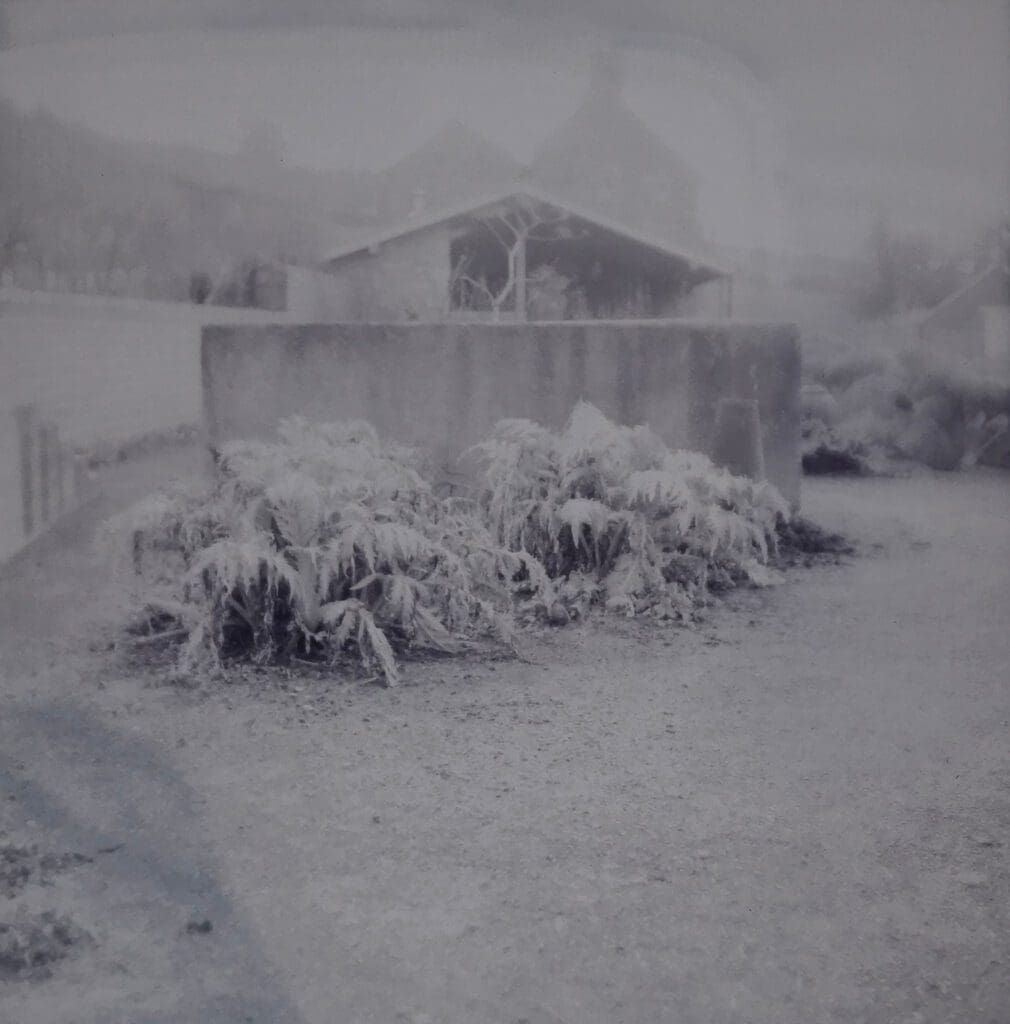
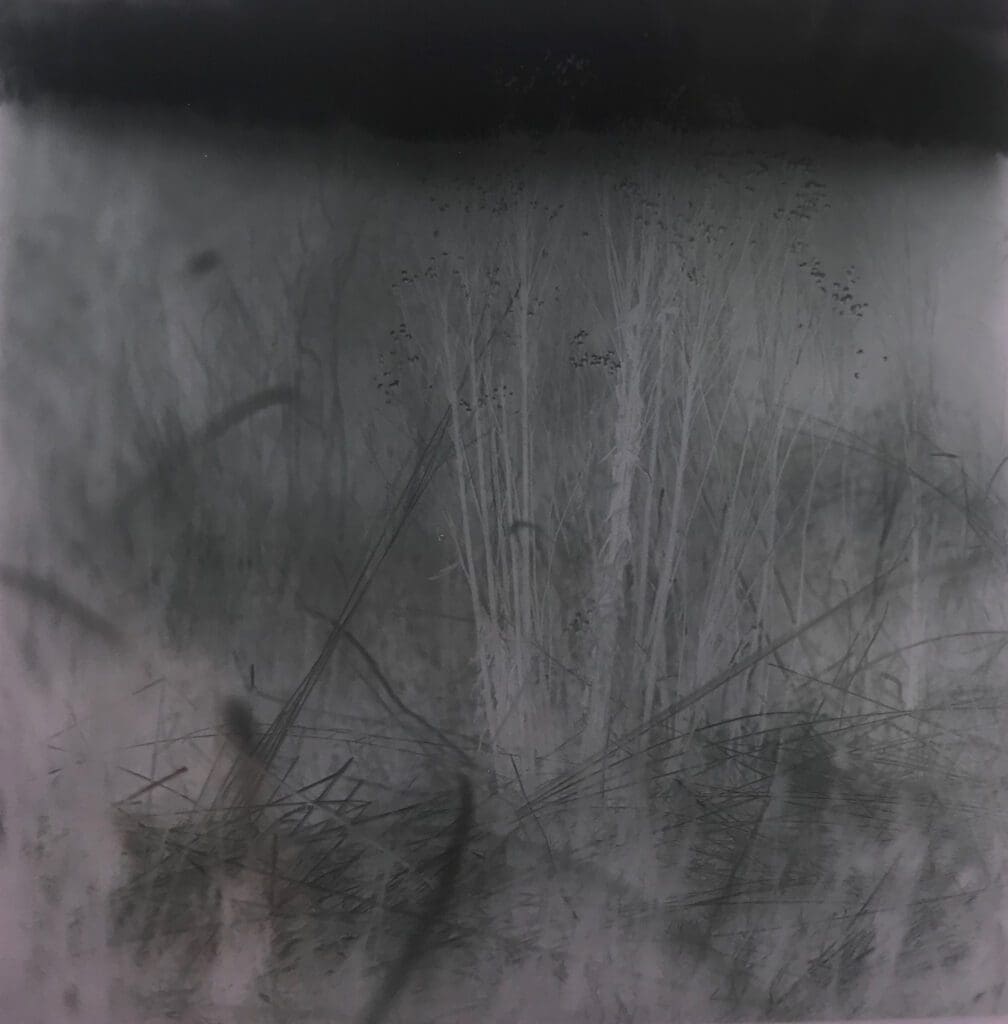
Do you feel that you learnt anything new from the time you spent photographing here?
It was immensely helpful to be invited to work like this, and I enjoyed the intensity of making the work. I made a new working process shooting 3 formats and running between captures to put the instant film to process inside and continue with the film outside. I made quite a lot of work in the time and it was the first time I shot constantly connecting dusk and dawn.
It enabled me to see how my work has progressed more clearly and how I can put it together because it was the perfect balance of how the garden and landscape coexist.
How was lockdown for you creatively?
Lockdown happened during my show at The Garden Museum.
I contributed to Quarantine Herbarium’s cyanotype project and the Trace Charity Print Sale which raised money for the charities Crisis and Refuge.
I listened more to the birds, watched the animals’ paths and felt exceptionally close to them and that continues. I was also busy shielding family, and I spent more time growing vegetables which I do as much as possible.
I stopped shooting and started to edit more.
What are you working on now and can you share any ideas you have for future projects?
I have had to revise my plans for this year, events I had committed to were cancelled. I am reworking everything and plan to bring the next series out in 2021.
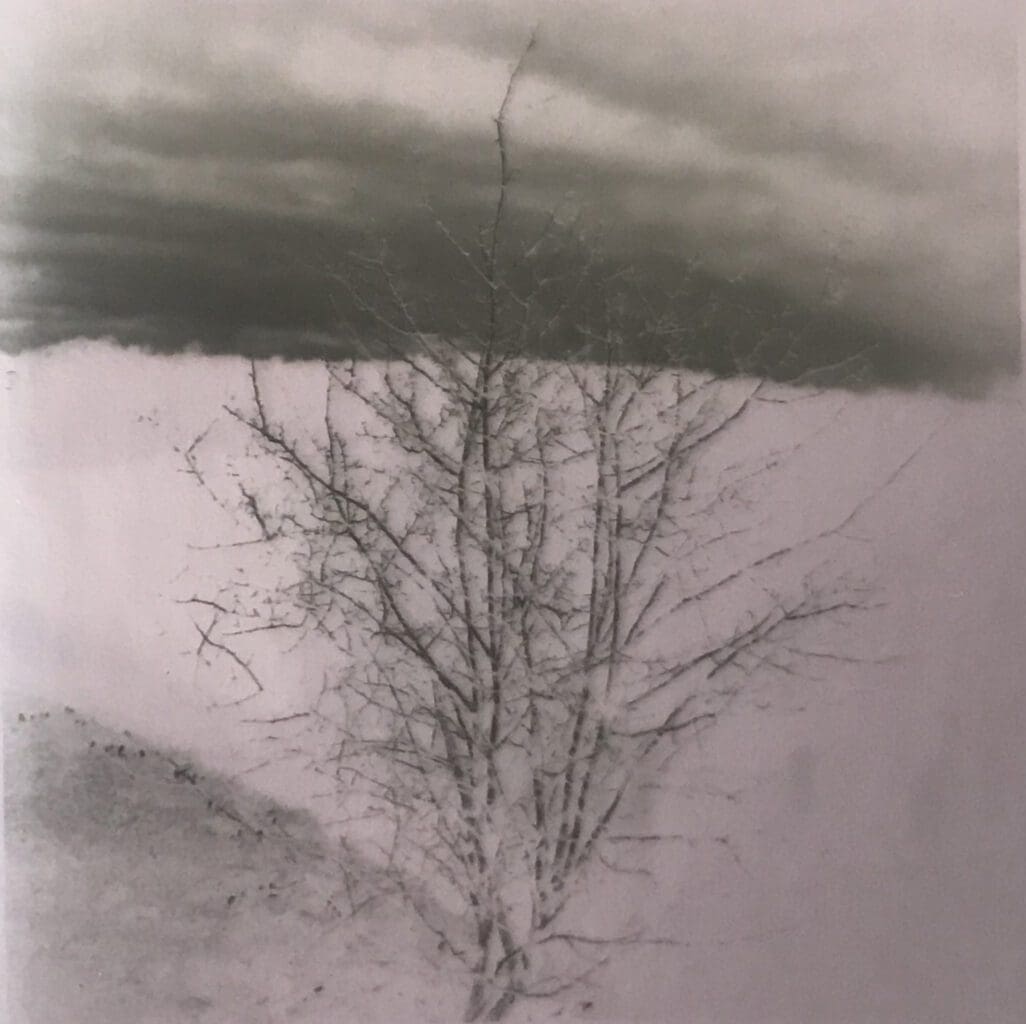
The full edit of the photographs Fleur took can be seen on her website.
Interview: Huw Morgan | Portrait: Howard Sooley
All other photographs: Fleur Olby
Published 24 October 2020
In 2015 I was approached to work as the landscape designer for a new extension at the Garden Museum. The renovations were extensive and it was the second phase of the project for Dow Jones Architects. The first, in 2008, had been to create a series of freestanding structures that moved lightly through the heritage building. This final push would see a new extension reaching out into the garden to create spaces for education, events and a new cafeteria.
The plan for the extension sailed over the footprint of the old knot garden which previously occupied the site, to enclose a new courtyard where the tombs of the Tradescants (father and son) and Captain Bligh take centre stage. The achievements of these three men provided a strong brief for the garden, which reflects their pioneering spirit as adventurers, plant hunters and educators. The Tradescants, once residents of Lambeth, had conceived their garden as a reflection of Eden and so the new cloister was also intended to be a place of sanctuary, where the seasons are brought into close perspective in the centre of the city and the planting is the focus of learning.
We pondered for some time over the removal of the well-loved knot garden, which Lady Salisbury had designed for the museum in 1980, three years after it first opened as the Museum of Garden History. Initially we worked up a series of iterations to abstract the knot garden to see if its memory could be glimpsed in the new design, but the architecture required a more confident forward-looking approach to move the garden, with the museum, into a clearly defined, bold new chapter. However, drawing from the existing sense of place was also important, so the ledger stones from the old graveyard and the bricks from the knot garden were integrated into the path that creates a frame from which to look into the planting. In the corner, where the tombs were close to the path, we extended its reach to allow closer observation of the detailed carvings and inscriptions. An old mulberry and an arbutus were retained in the new design, while an old fig and medlar were carefully moved to beds at the other end of the church. The street-side plane trees, which are protected and provide the museum with its leafy, woodland feeling, were able to have the building so close thanks to a piling system which floats the extension carefully over their root plates.
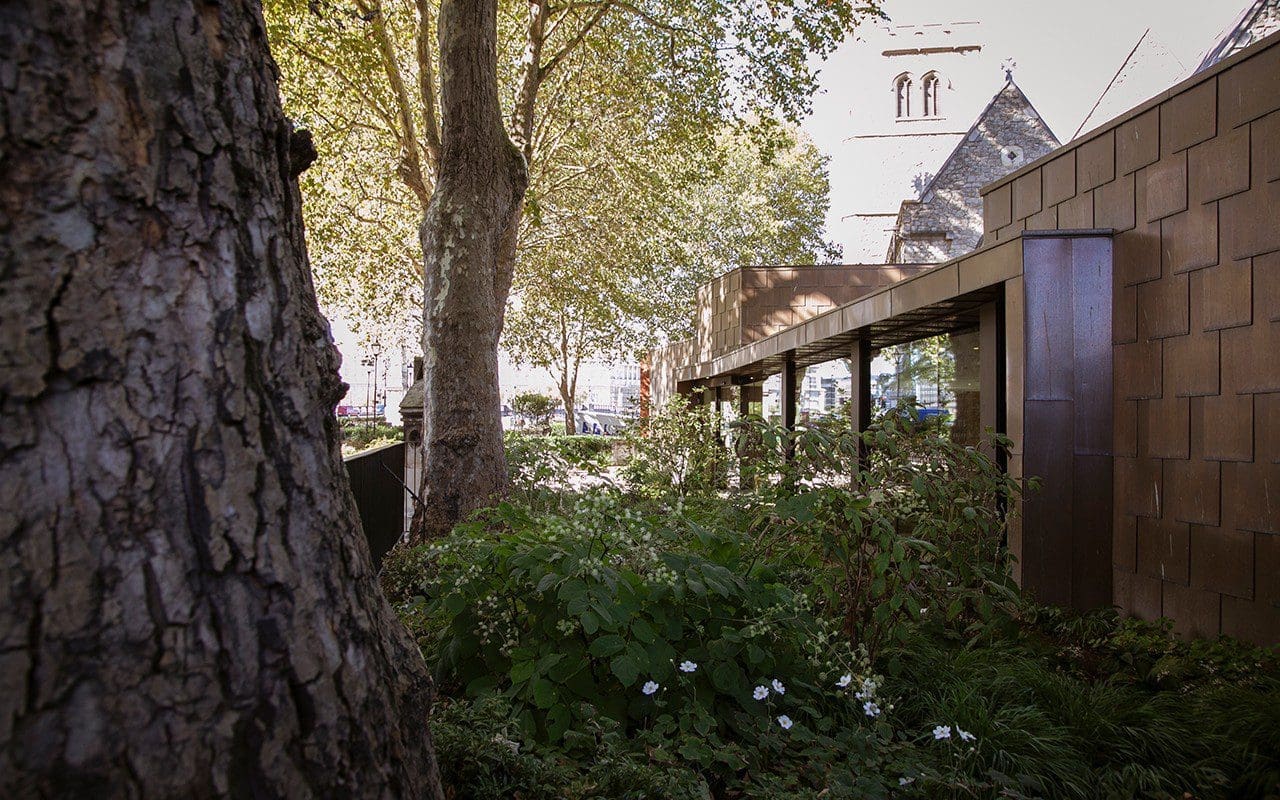
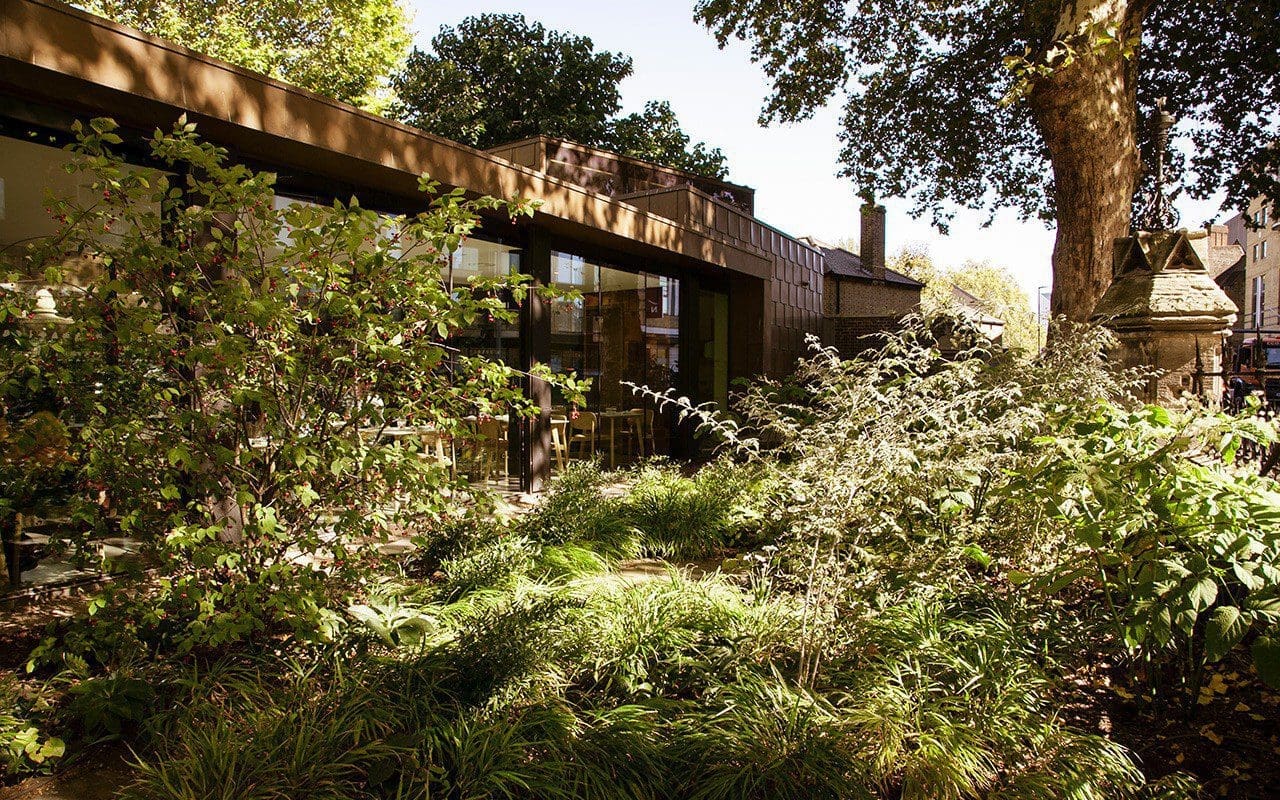 The street-side planting beneath the London Planes with Euonymus planipes on the left
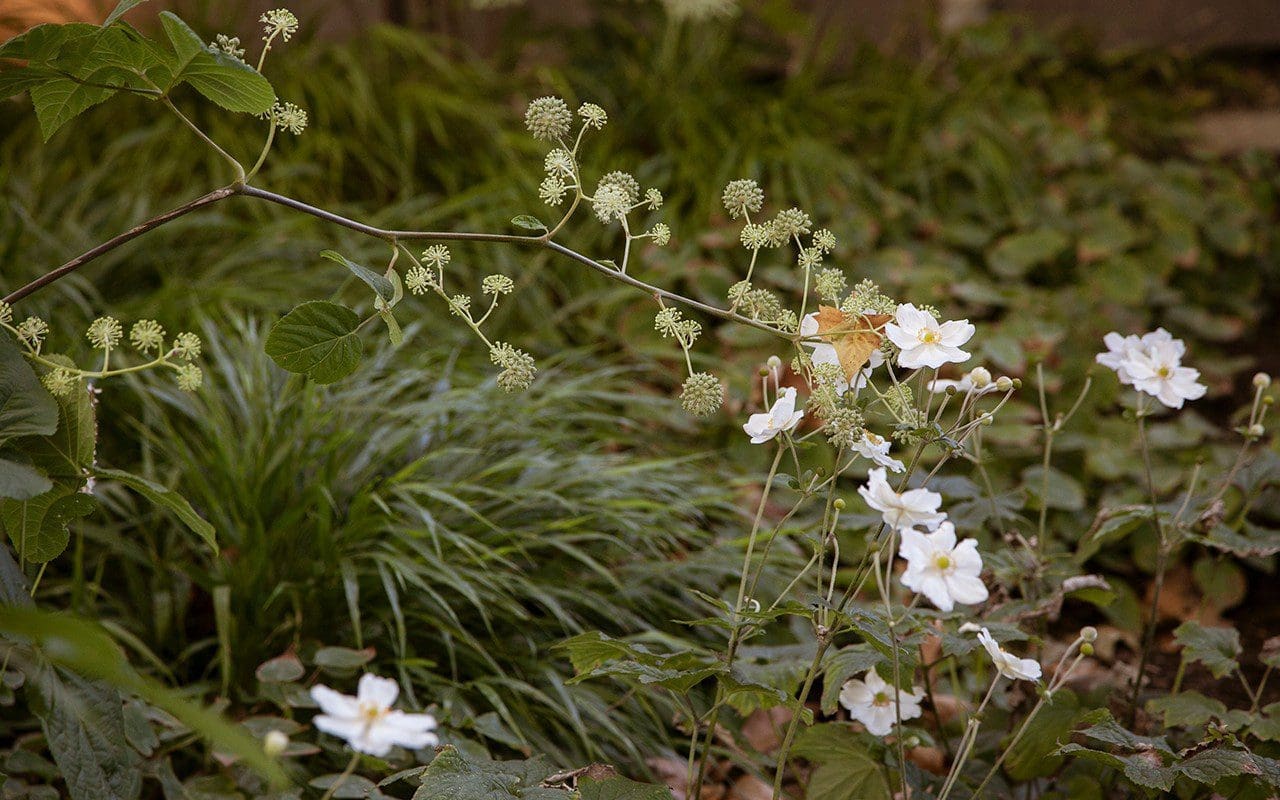 Aralia cordata, Hakonechloa macra and Anemone x hybrida ‘Honorine Jobert’
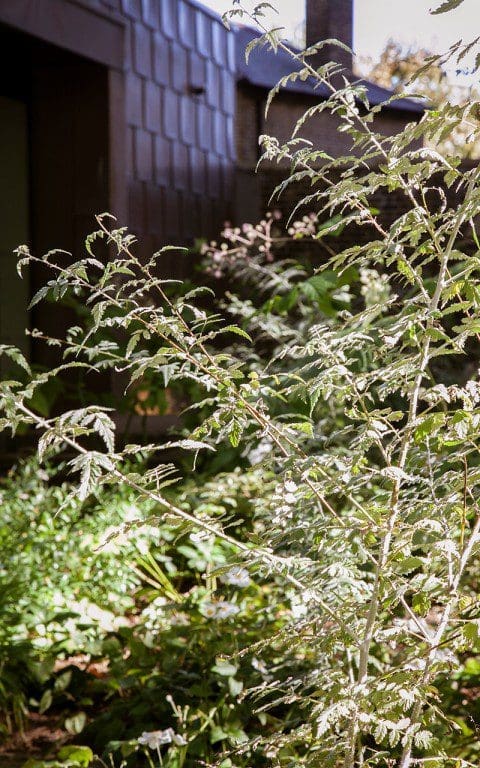 Rubus thibetanus ‘Silver Fern’
Viewed from four sides (through glass on three and an open, covered walkway on the fourth) the courtyard garden – called the Sackler Garden after a generous donation from the Sackler Foundation – would become a point of focus within the cloistered enclosure. The new glazed walls would also enhance the London microclimate and help buffer the garden from the wind that uses the River Thames as a corridor in this location. With the exploits of the Tradescants as inspiration, it was a small step to imagine this courtyard as a giant Wardian case – an aquarium-like structure invented in the 19th century to transport exotic and delicate new plant discoveries long distances by sea in a protected environment. The glassy cloister, our metaphorical Wardian case, allowed us to present a garden of curiosities and treasures.
Though an oasis, as a space it is far from hermetic. The planting continues on the street side of the café beneath the planes with a shady carpet of hardy evergreens and woodlanders including Hakonechloa macra and Epimedium sulphureum. A specimen Euonymus planipes was planted to frame the cafeteria door and emerging perennials such as Danae racemosa, Aralia cordata and white persicaria and wind anemone provide the planting with seasonal flux and help make the connection to the green world within. From the street the transparent walls of the café allow an intriguing glimpse of the jungly courtyard planting.
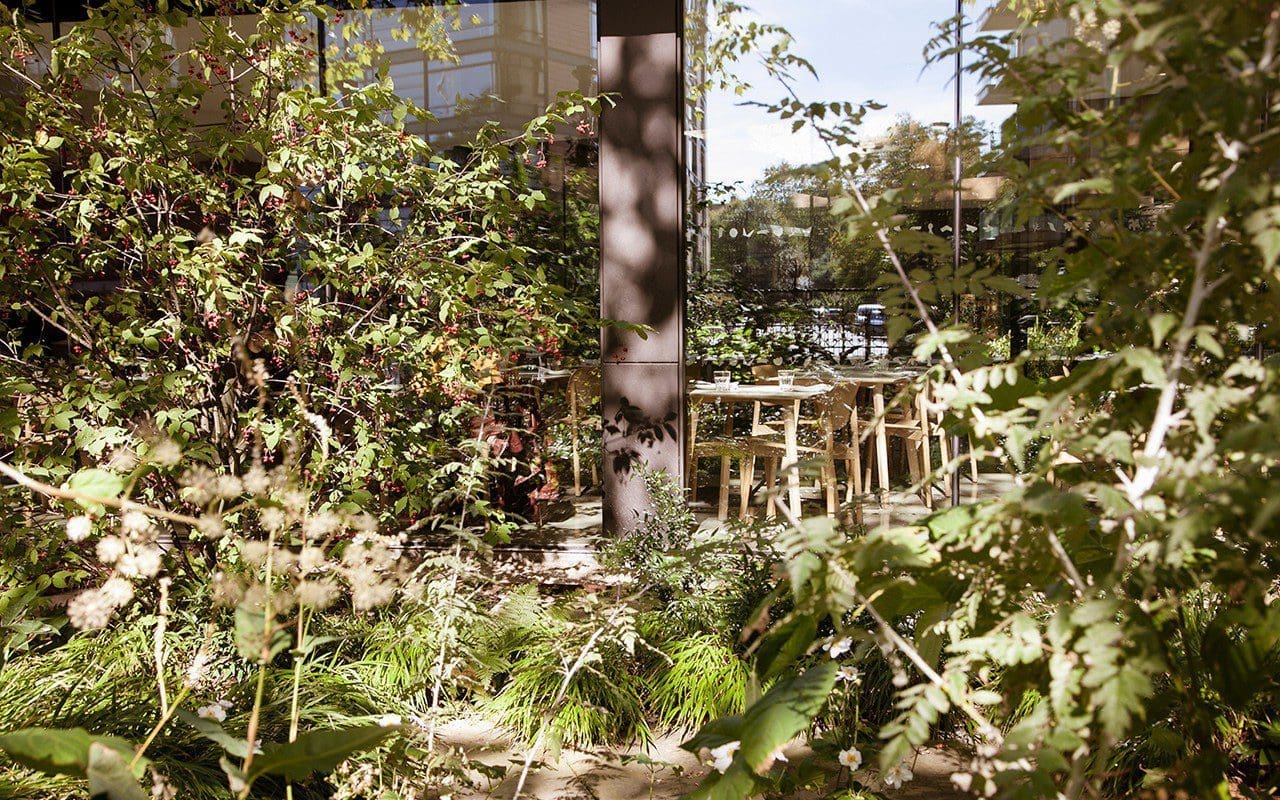 Looking into the cafe across the woodland planting from the street
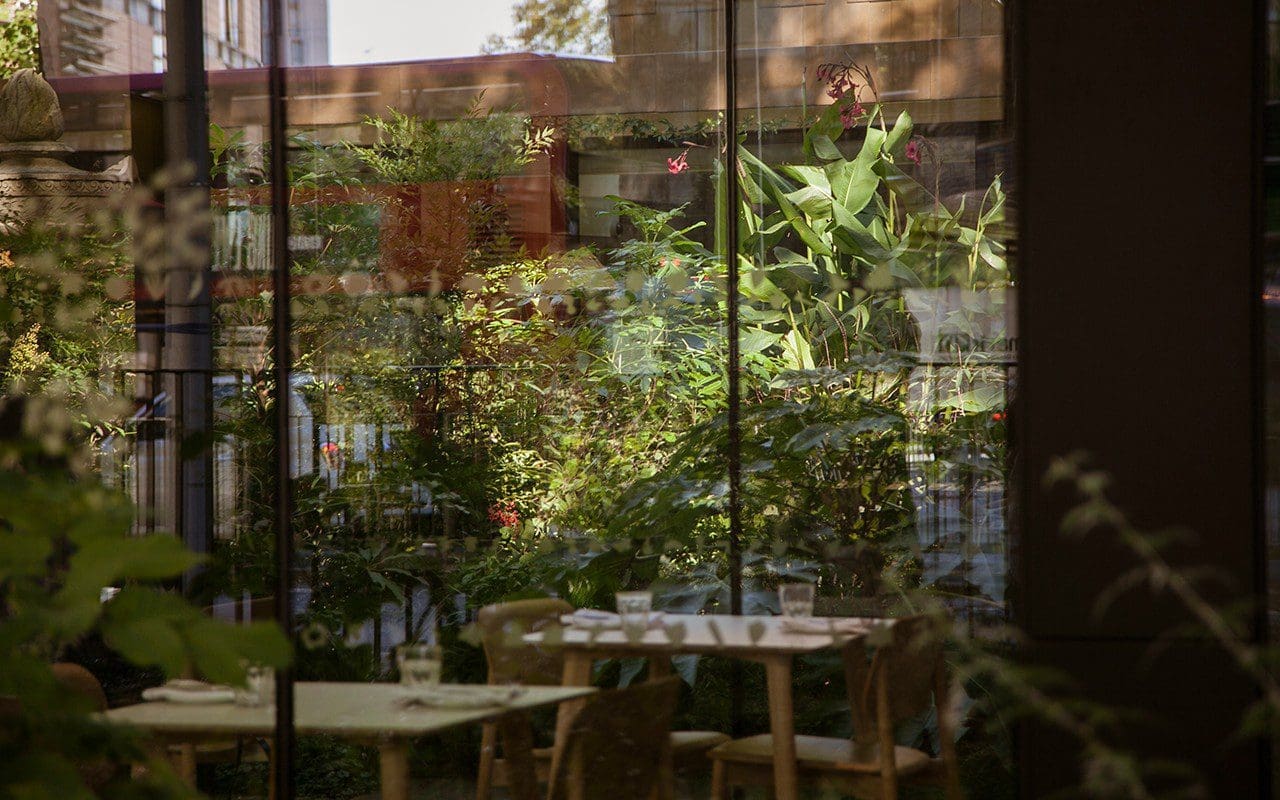 The courtyard garden can be seen from the street through the glass walls of the cafe
As the courtyard is a deliberately acute focus, it was important that it be a dynamic space that works on every day of the year. When choosing the plants, I felt it was important to continue the spirit of discovery exemplified by the Tradescants and for the plants to tell a story of horticultural history. I also wanted the composition and plant choices to capture the magic of an 18th century botanical engraving and key into the gothic mood of the churchyard and its tombstones.
Modern day plant hunters, such as Sue and Bleddyn Wynn-Jones of Crûg Farm Plants helped provide us with some of the curiosities. Fatsia polycarpa, a rarely seen castor oil plant with deeply divided, elegant fingered foliage, and a Schefflera from Taiwan, complete with precise location notes to bring their provenance to life. Nick Macer of Pan-Global Plants also provided us with some of his wild collections. A giant foliage Dahlia from a trip to Mexico, and flowering gingers for points of exotic interest. I wanted the planting to feel eclectic – a collection – and the exotic edge was important to conjure the feeling of awe and wonder that must be felt by all plant hunters. Canna x ehmannii and Tetrapanax papyrifer have done this at scale and made an immediate impact, whilst more demure curiosities such as Disporum cantoniense ‘Night Heron’ and Epimedium washunense ‘Caramel’ provide the detail once you start to look deeper.
It was of prime importance to the museum that the garden provided a centre of horticultural excellence and the planting has been layered to create an ecosystem where each component in the composition provides a microclimate for its neighbours. The layering has also allowed the play of form and texture to work in combination and, importantly, for the sequencing over the course of the year to reveal change so that the garden is different each time that you visit.
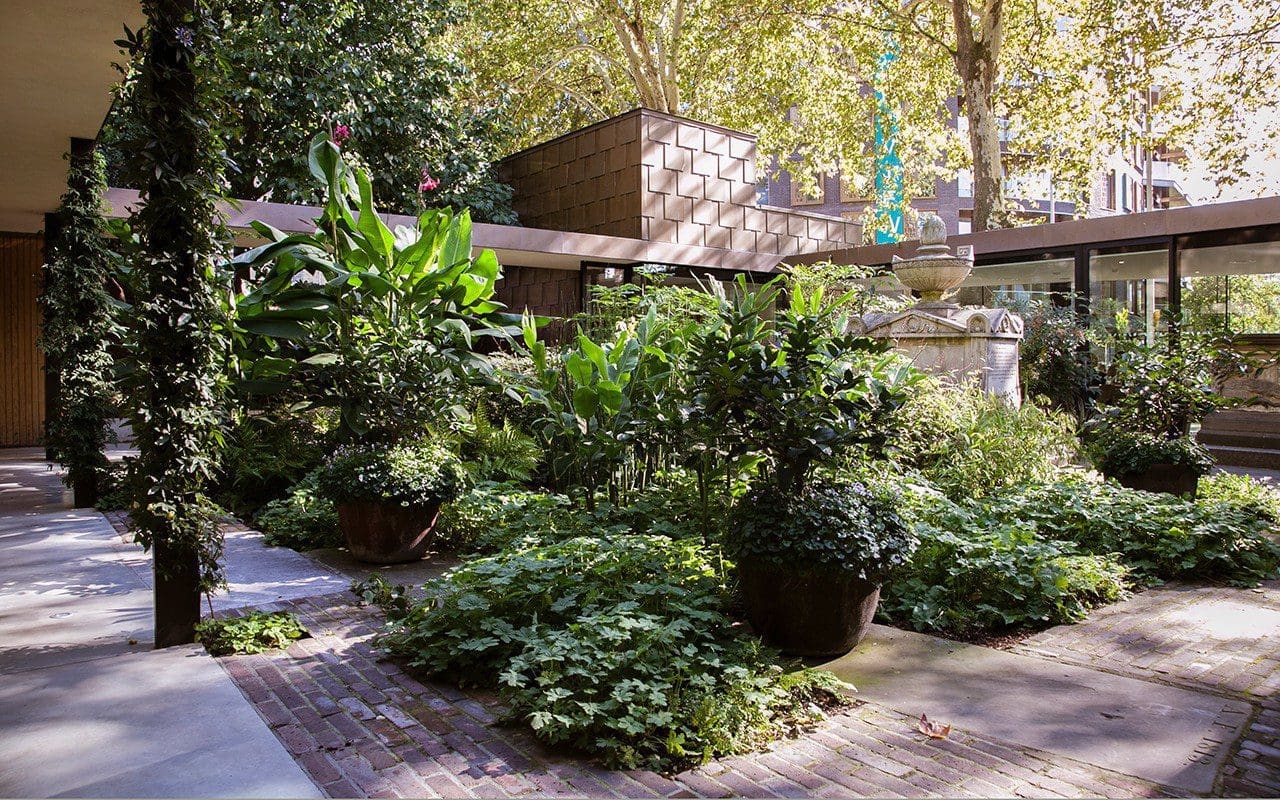 The Sackler Garden at the centre of the new extension. William Bligh’s tomb is in the centre, that of the Tradescants can just be seen on the far right
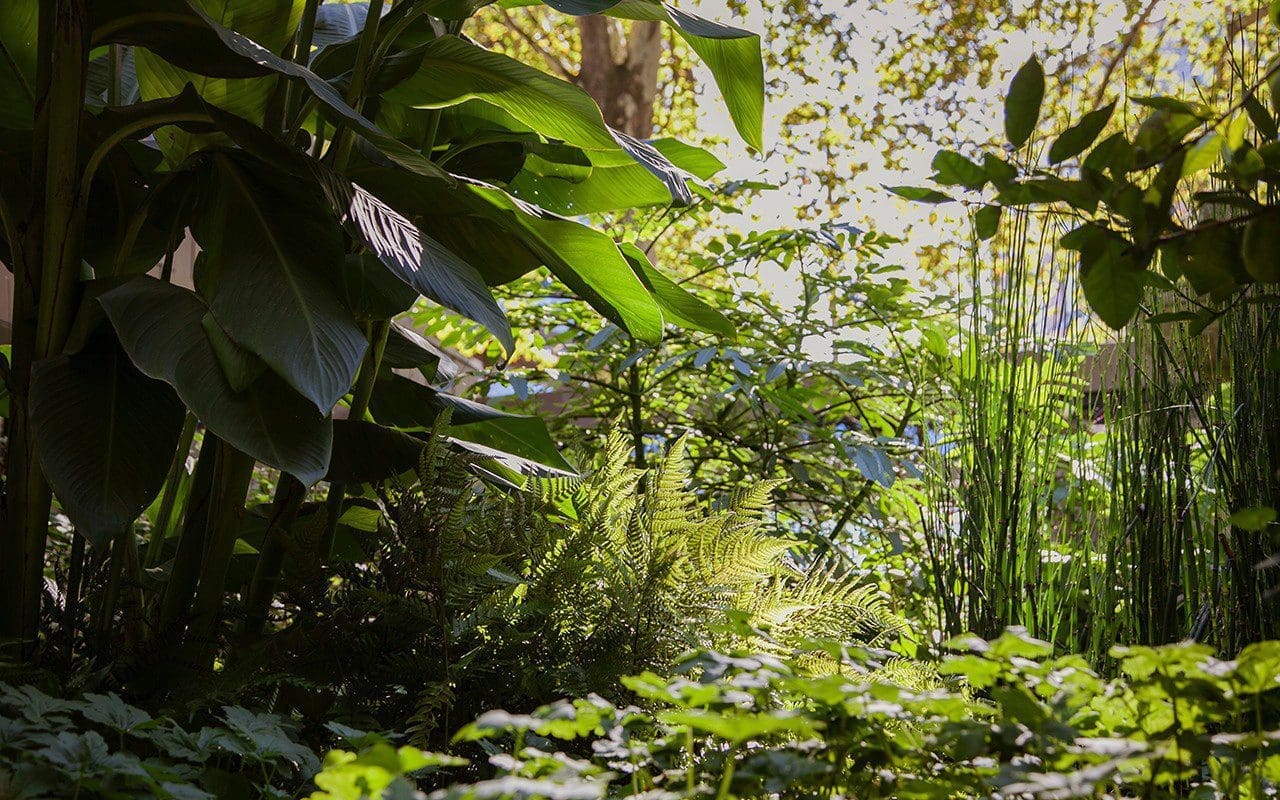 The layered planting includes, from left, Canna x ehemannii, Dryopteris erythrosora and Equisetum hyemale. Behind is a seed-collected species Dahlia from Pan-Global Plants. The groundcover is Geranium maccrorhizum ‘White Ness’, a 20th century discovery.
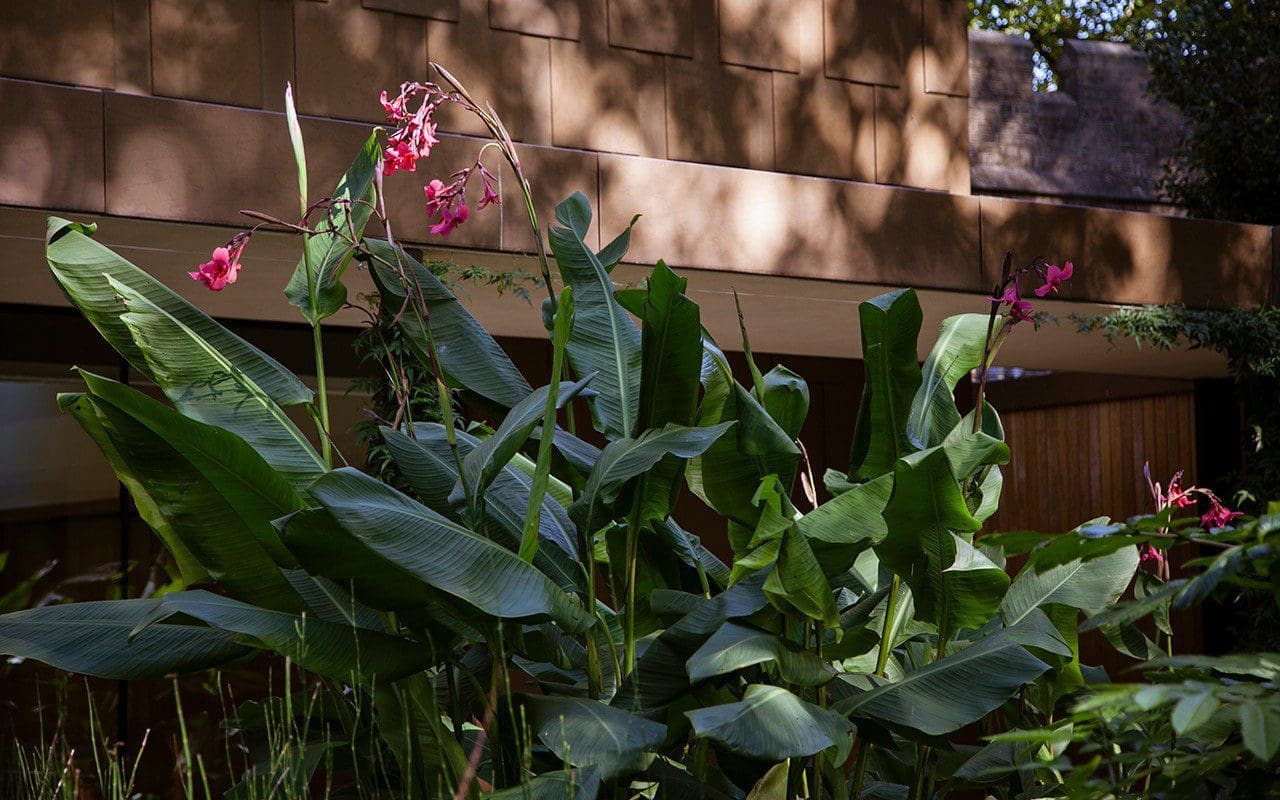 Canna x ehemannii
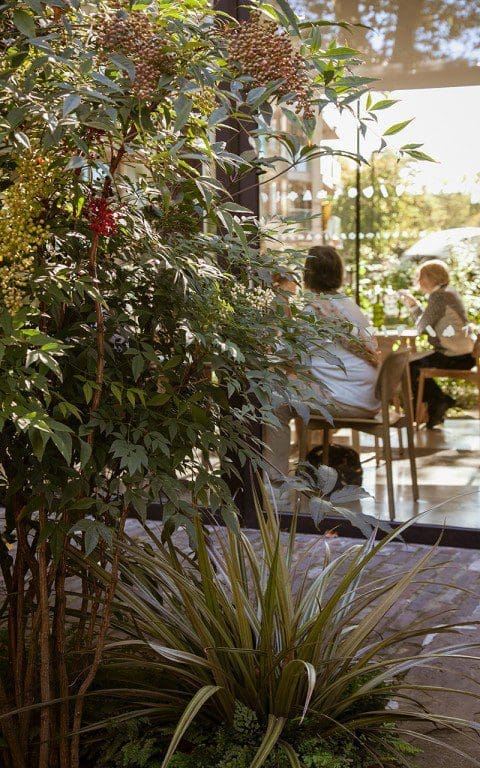 Nandina domestica and Astelia nervosa
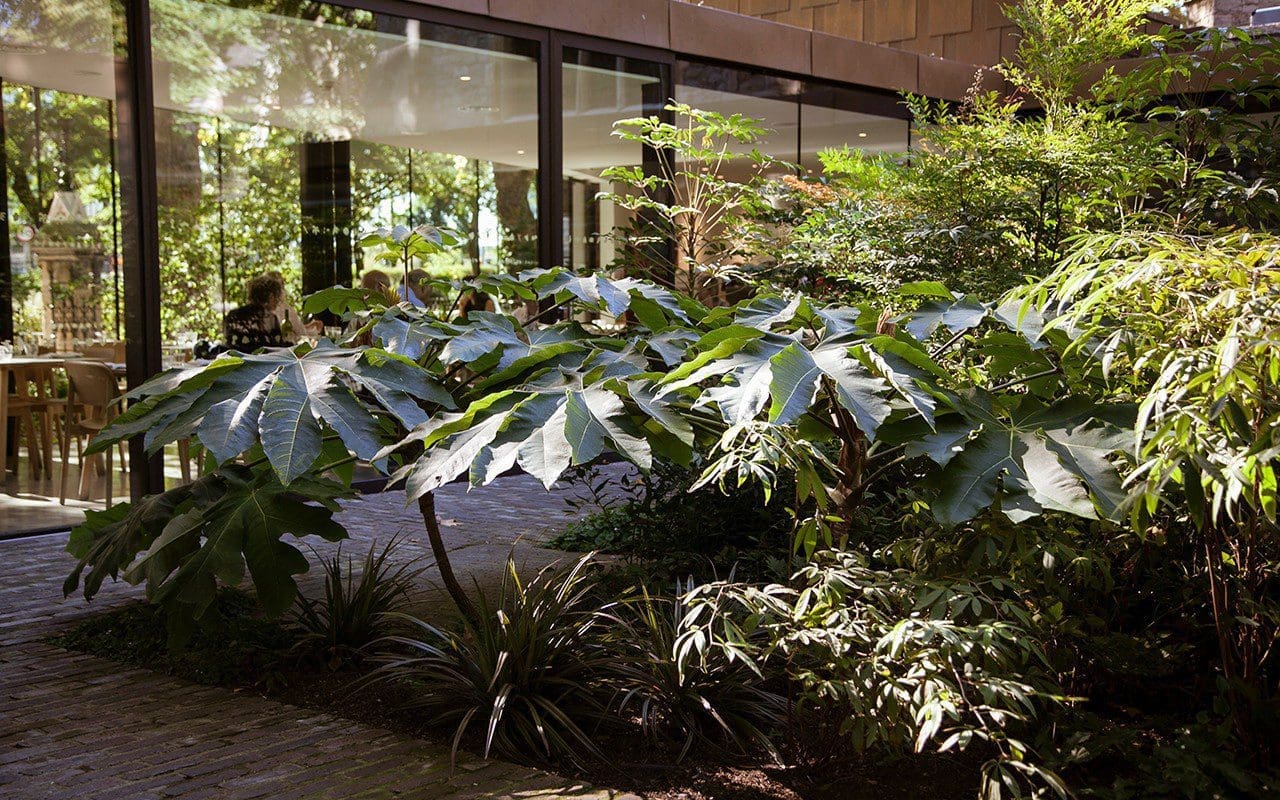 On the left Tetrapanax papyrifer with Astelia nervosa beneath and Rubus lineatus to the right. Behind are a Schefflera species from Crûg Farm Plants with Nandina domestica
Nandina domestica has been planted around the tombstones to reflect its auspicious use as a welcome plant in China, but look carefully and in amongst its stems, like the layers in a rainforest, there is a mingling. Pewter Astelias from the Chatham Islands, delicate maidenhair ferns, the Australian violet, Viola hederacea, and black-leaved Ophiopogon nigrescens in their shadows. I wanted the garden to have plants that had a recognisable use amongst the curiosities too. Wild strawberries, that once would have grown locally in Lambeth, alongside Meyer lemons and passionfruit to remind us how we too often take the provenance of our food for granted.
Having just completed its second summer, the garden is settling in and taking shape in the careful hand of Matt Collins, the museum’s head gardener, a horticultural trainee and a number of volunteers. A planting of deliberate complexity needs a well-informed eye to keep it looking good and it is a delight to return and to see it evolving. The potentially invasive Equisetum hyemale is kept in check and in its place to score its vivid green vertical and exotic climbers scale the cloister pillars.
It has been a privilege to be part of this exciting new chapter and now also to help in developing the next. On Thursday this week the Garden Museum announced Lambeth Green, a new initiative to turn St. Mary’s Gardens alongside the Museum into a community hub, a village green for Lambeth, and also to reach its green tentacles further out into the streets to reconnect to the river and nearby Old Paradise Gardens. With the new incarnation of the Museum as a catalyst, it is now easy to see these exciting possibilities being realised.
Words: Dan Pearson / Photos: Huw Morgan Published 10 November 2018
I have recently returned from the opening of one of my biggest projects to date and feel the need to tell the story, as it is remarkable for its scale and farsightedness. Mr. Ma, our client and the visionary behind the forty-five acre development, started the journey over fifteen years ago. A dam was about to be built near his hometown in Jiangxi province south-west of Shanghai, and with its construction came the loss of the valley’s ancient camphor trees and Ming and Qing dynasty settlements of merchants’ houses. By the time I came into the story, and indeed it was the reason that I did, Mr. Ma had moved over ten thousand camphor trees to their new home in Shanghai.
Their journey was an extraordinary one. Some are believed to be almost two thousand years old and were so big that they had to be transported the 600 kilometres on army tanks. Bridges had to be made to get them across rivers, and tunnels excavated so that the cargo could pass. The trees were planted in a nursery on the outskirts of Shanghai, very close to a site which Mr. Ma had secured for a new development. Here a series of old warehouses were also repurposed for storage of the merchants’ houses which had been dismantled brick by brick and painstakingly repaired from the damage they had sustained during the Cultural Revolution.
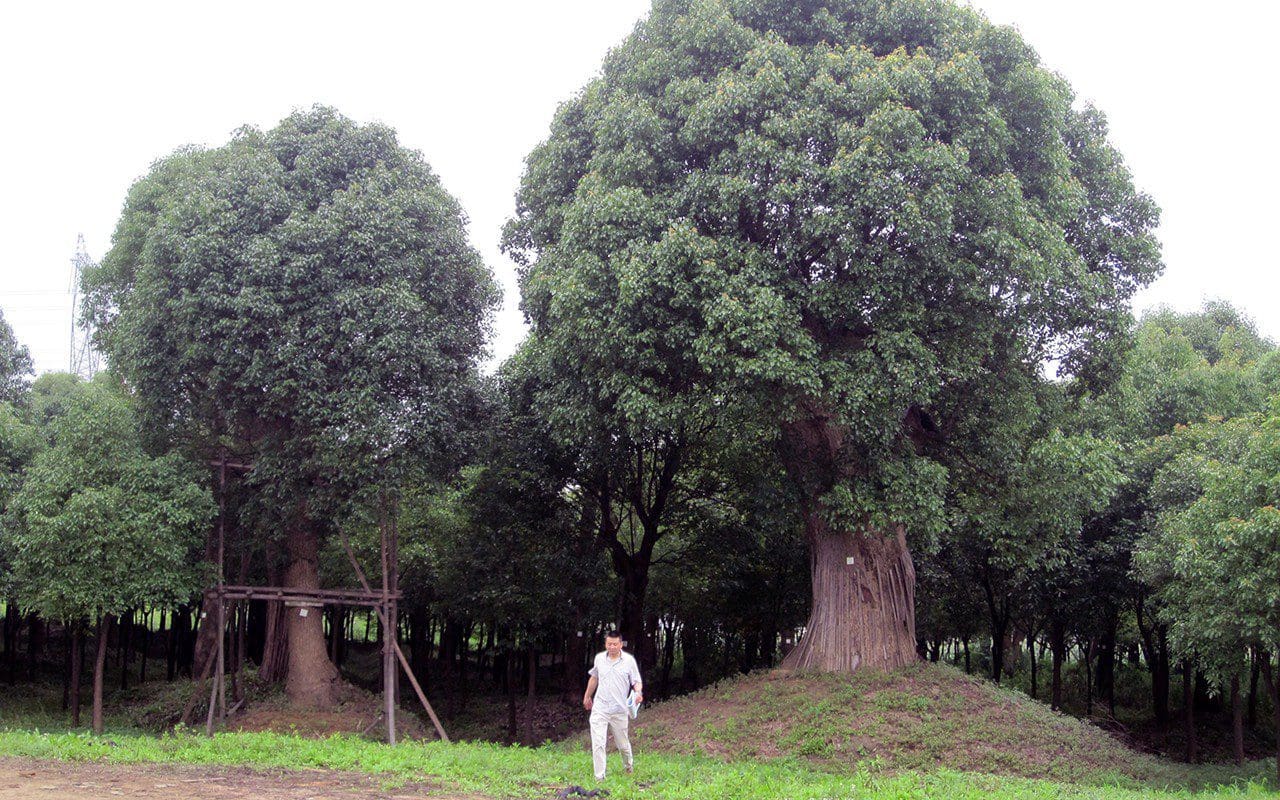 Mr. Ma with some of the rescued and replanted camphor trees
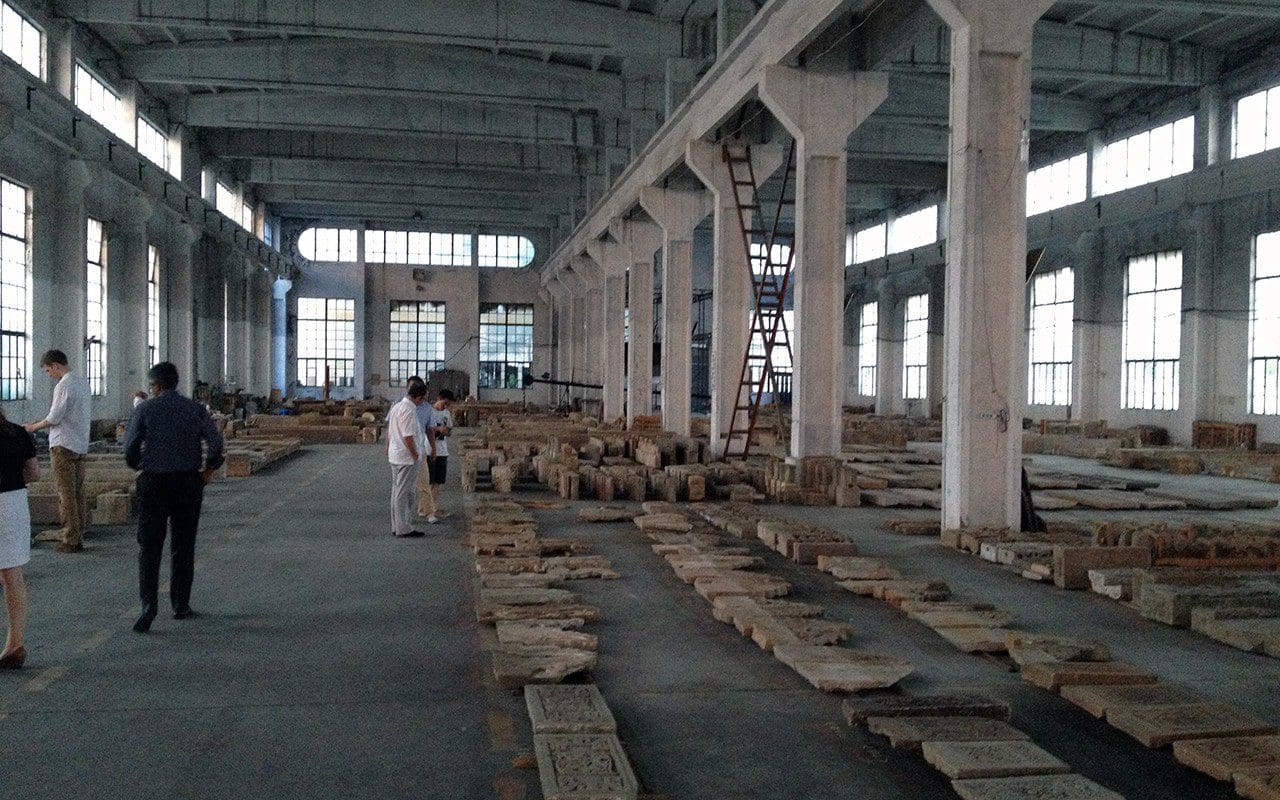 A warehouse containing some of the dismantled Ming and Qing dynasty merchant’s houses
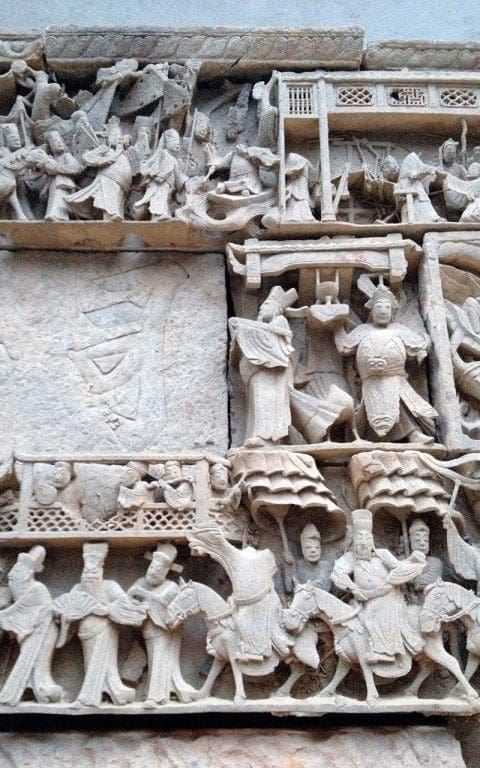 A detail of the stone carving on one of the antique villas
I was introduced to Mr. Ma in 2012 by his friend and collaborator Han Feng, who had been tasked with helping to find a landscape designer to design the grounds. Han Feng and I had met at the Design Indaba in Cape Town earlier that year, where we had both been invited to speak and we met in London to talk about the project. I was inspired by the story of the rescued camphors and the idea of making them a new home, so we agreed to meet Mr. Ma when I was next in Japan at the Millennium Forest so that he could see my work there.
By this point Aman Resorts were collaborating with Mr. Ma to make a hotel and associated grounds and Kerry Hill Architects had worked up a masterplan for the site. Once I was on board we were tasked with detailing the whole site from the hotel to the streetscapes and a series of garden blueprints that would be used to furnish the gardens of 44 private villas; 26 antique merchant’s houses and 18 contemporary interpretations of them.
Mr. Ma was busily working away in the background with the government to secure a site of double the size that would become the backdrop to the development and allow the green lung of the camphor forest to reach out and take on this new ground. We were also tasked with designing the masterplan for the park, repurposing one of the agricultural canals to form a dividing lake and masterminding a wetland of considerable scale that would allow us to recycle and purify all the water that would be needed for the water features on the site. It was an extraordinary opportunity to create a public park that would also act as an environment to include wetland walks, meadows and a considerable acreage of woodland. A green heart for a new city that was quickly sweeping up and around the site, as the agricultural land was repurposed for the urban sprawl.
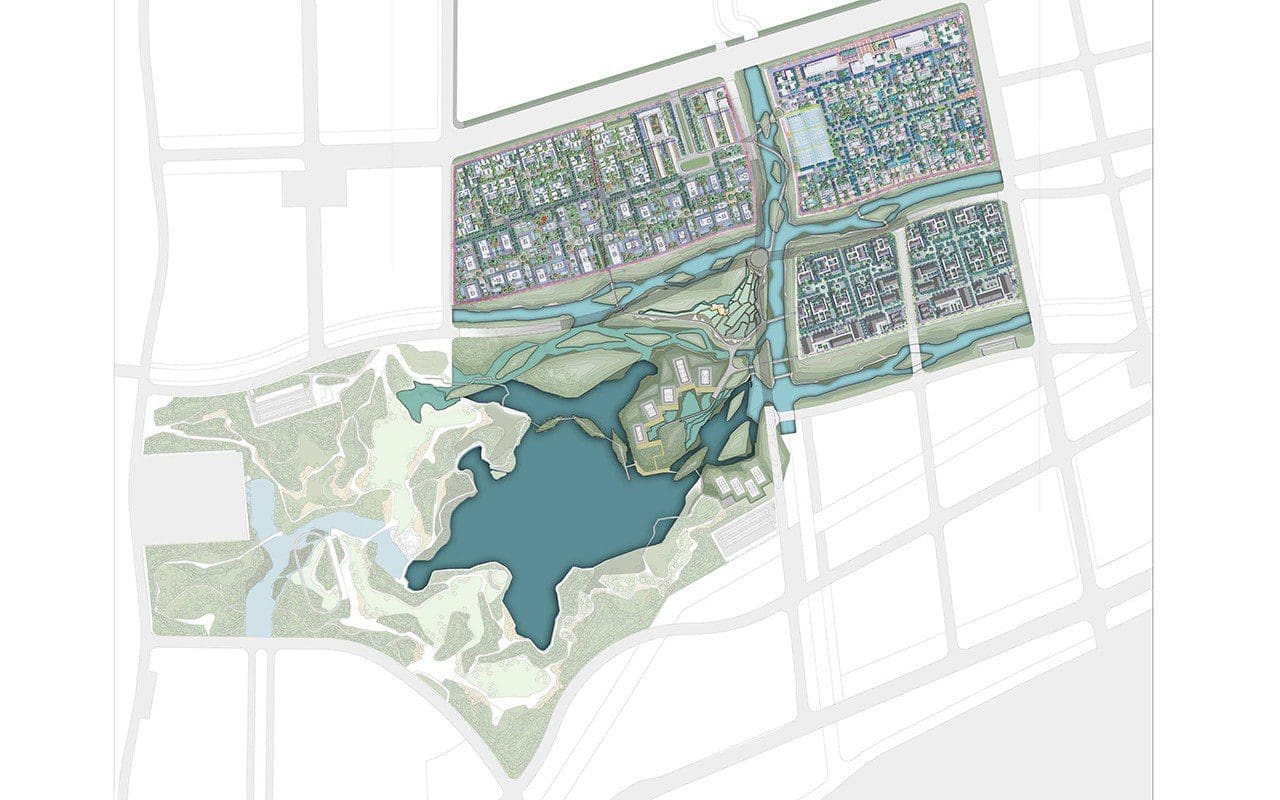
The site masterplan with Amanyangyun in the north and east and the forest park to the south west
Once it was complete we passed the park masterplan on to a local firm of landscape architects and concentrated our energies on the Amanyangyun site. However, it is gratifying now to know that the first phase – the lake, the wetland and the woodland that links the two sites – is already in place. In China things happen at an alarming pace and at a scale that we are unaccustomed to here, so in many ways it was good to pull back at this stage after securing the big ideas and concentrate on the detail of Mr. Ma’s site.
It took two years of careful collaboration with the architects, who were a delight to work with, clear in their thinking and open to the contrast of an informal overlay on the rigorous grid that defined their masterplan. My own journey, and that of the team that works with me in the studio, was put on a very steep learning curve. We had to learn fast about the very different cultures and way of doing things and we couldn’t have done that without the trust and thoughtfulness of our client who had put a team in place that helped to translate our ideas.
We were taken to see traditional Chinese gardens to understand their ethos, aesthetics and cultural importance. They were completely new to me, the precursor to the Japanese gardens which I have come to know well from my time spent there, but entirely different in their aesthetic. I was keen not to emulate the Chinese garden at the villas on the site, but it was important to understand the culture and how we could create something naturalistic that would sit comfortably in Shanghai and not feel out of place.
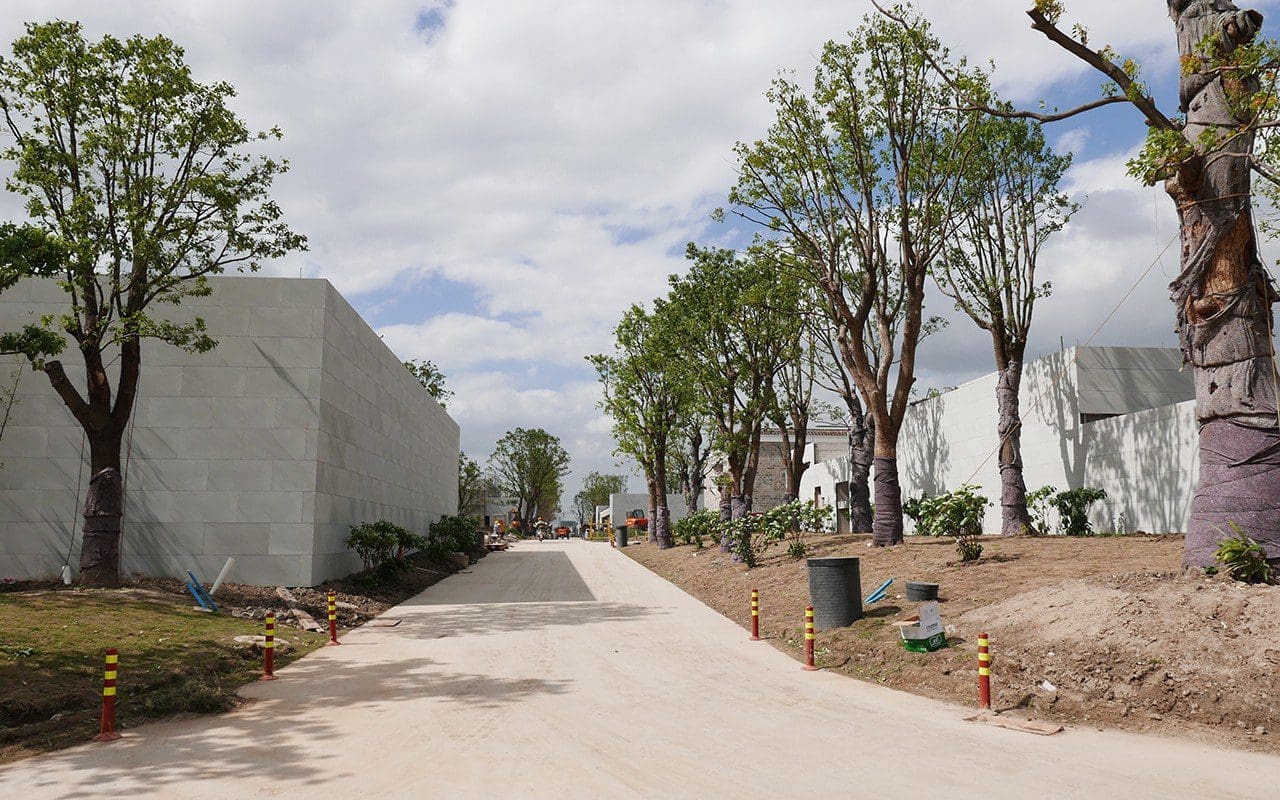 One of the camphor-lined streets during construction in 2016
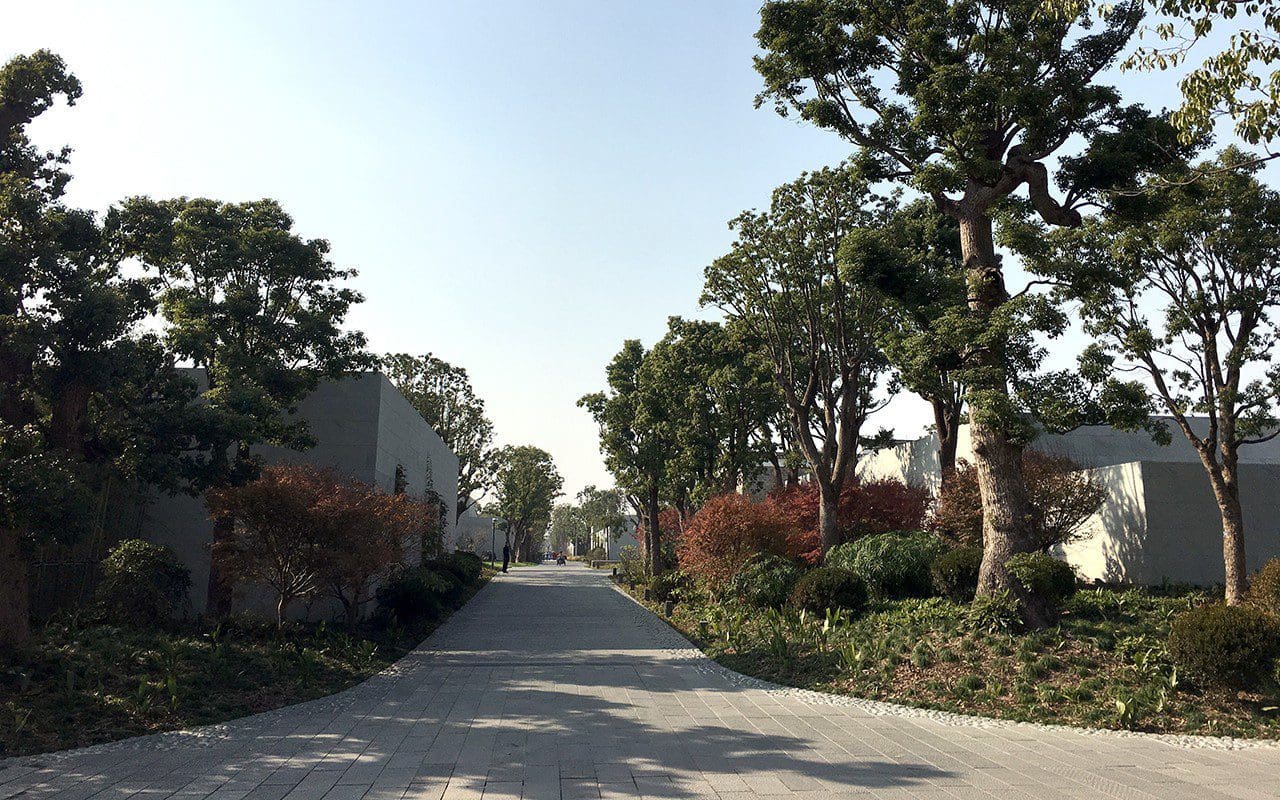 The same view this year
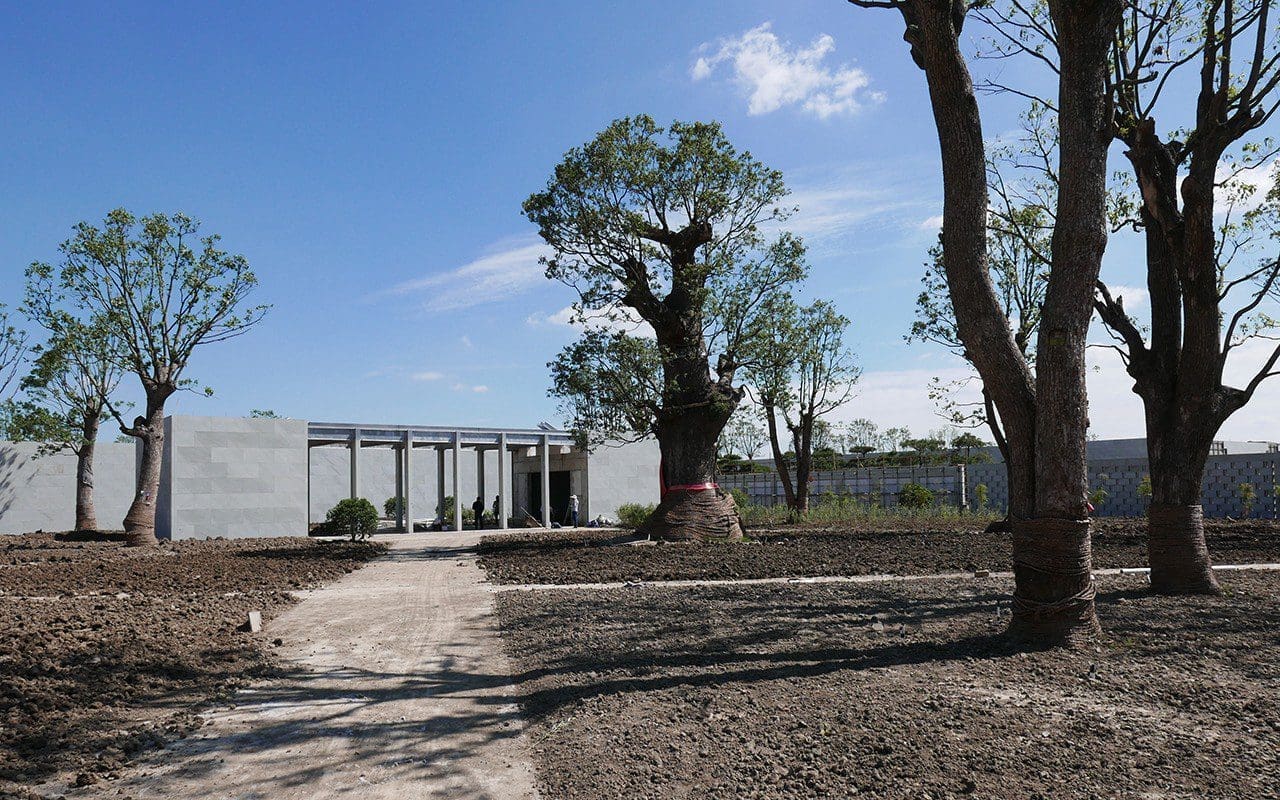 The king camphor tree at the heart of the construction site has a red ribbon tied round it
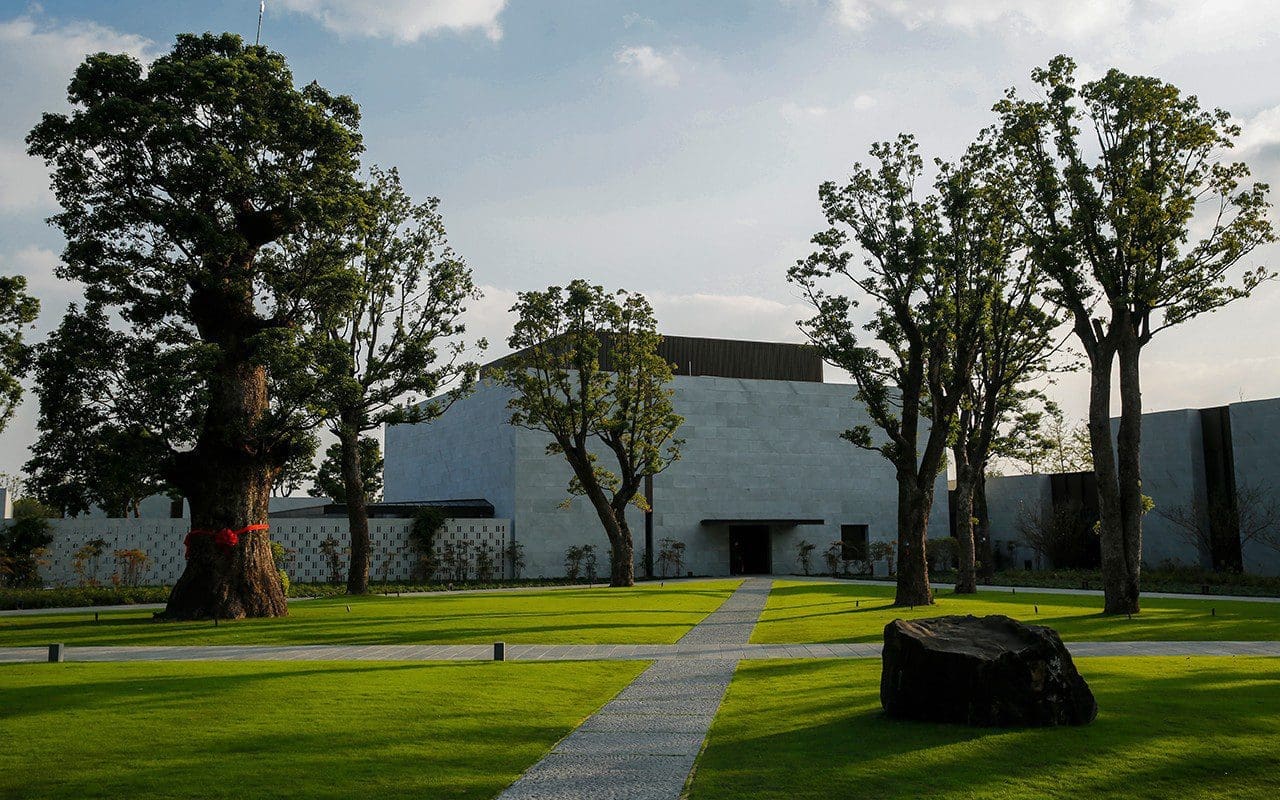 A different view of the same area after completion
 Mr. Ma and the king camphor tree at the opening ceremony in April
We soon found that, despite the vast range of Chinese plants that we grow and depend upon in the west, our choices on site were very limited. The Chinese garden depends upon a tiny palette compared to a western garden and thus the nursery trade there is very limited. Bamboos, from ground covering forms to timber bamboos, were not in short supply, neither were Nandina and Osmanthus, but our tree palette was narrow, with only two magnolias to choose from, M. grandiflora and the beautiful M. denudata. We had flowering Malus and plums, camellias and a number of auspicious fruits that we used close to the buildings. And there was no shortage of Chimonanthus so the building blocks were enough. It was what we did with them that made the difference.
Modern landscape design in China sees the groundcover layer packed densely with blocks of low level shrubs, such as azalea and Fatsia, but I wanted breathing space between a multi-stemmed layer of flowering trees that would sit under the canopy of the camphors and keep the space at human level feeling airy and light. We designed a number of groundcover mixes that mingled the staples together informally. Ophiopogon and Liatris sweeping through in a gently shifting constant with runs of Aspidistra in the deepest shade, which was replaced by the likes of Iris sibirica and Chasmanthium latifolium out in the glades, where we had made room for the light to break the overarching canopy.
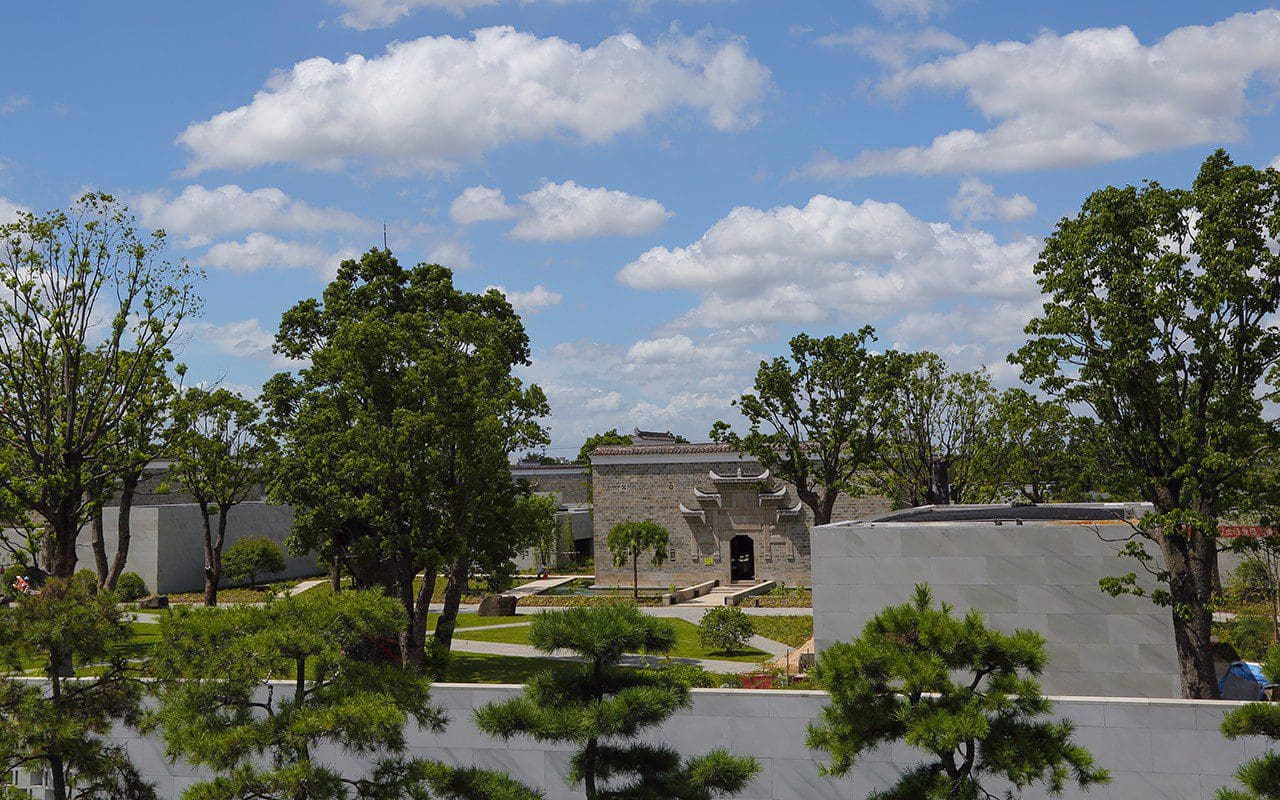 Overview of the villa complex
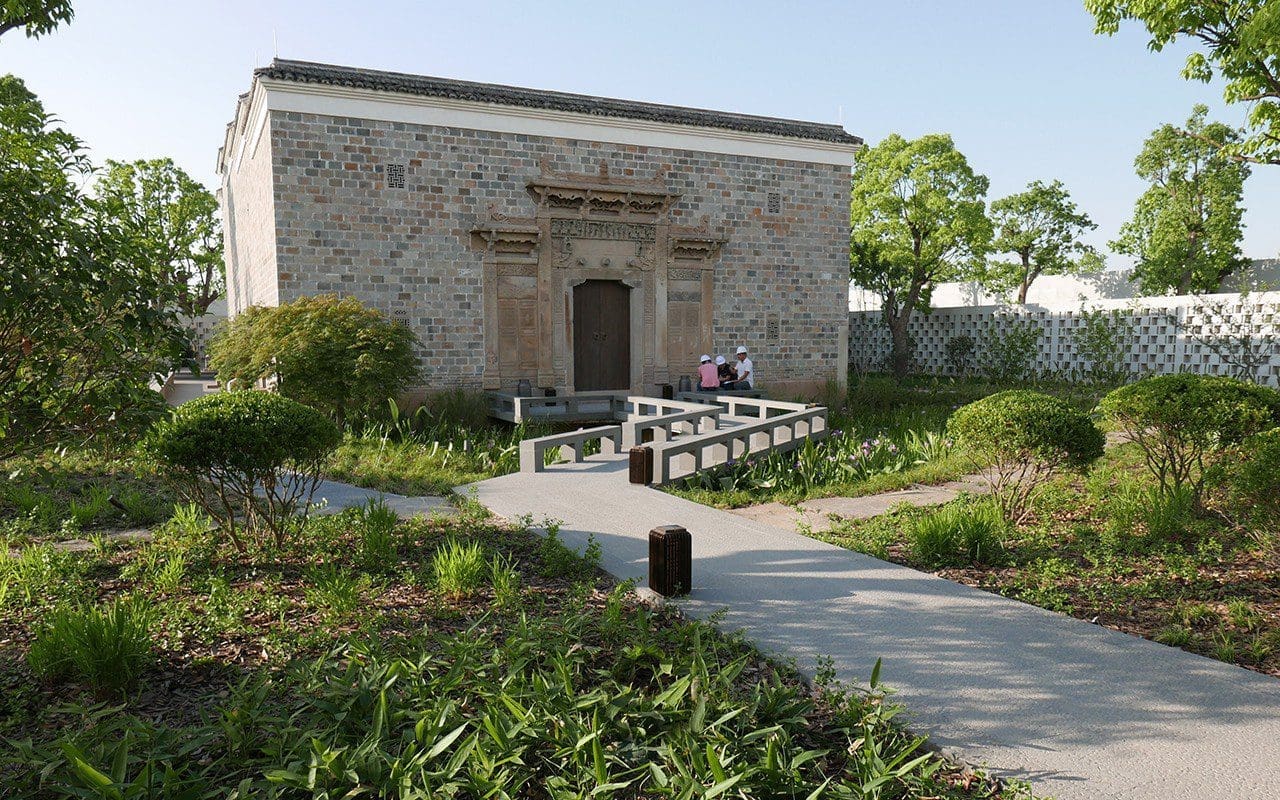 Entrance garden of an antique villa the first spring after planting
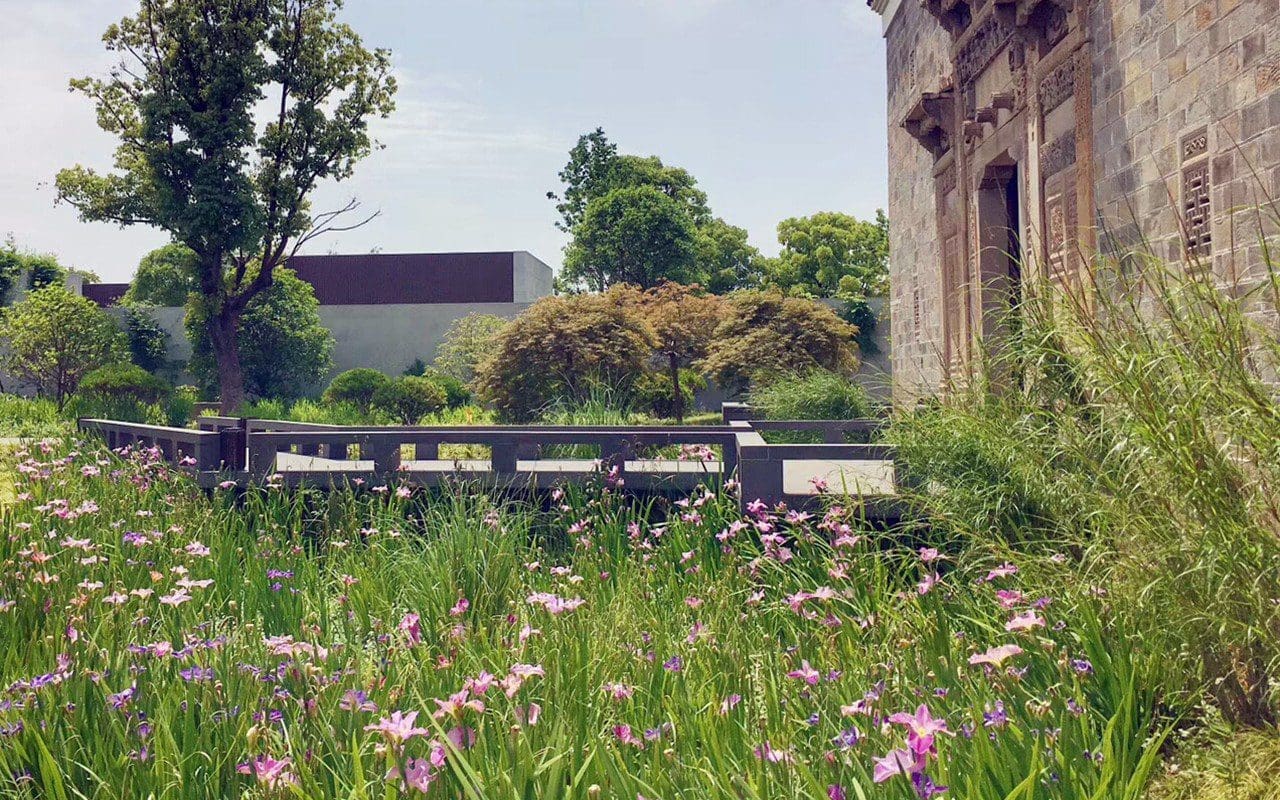 Entrance walkway iris planting
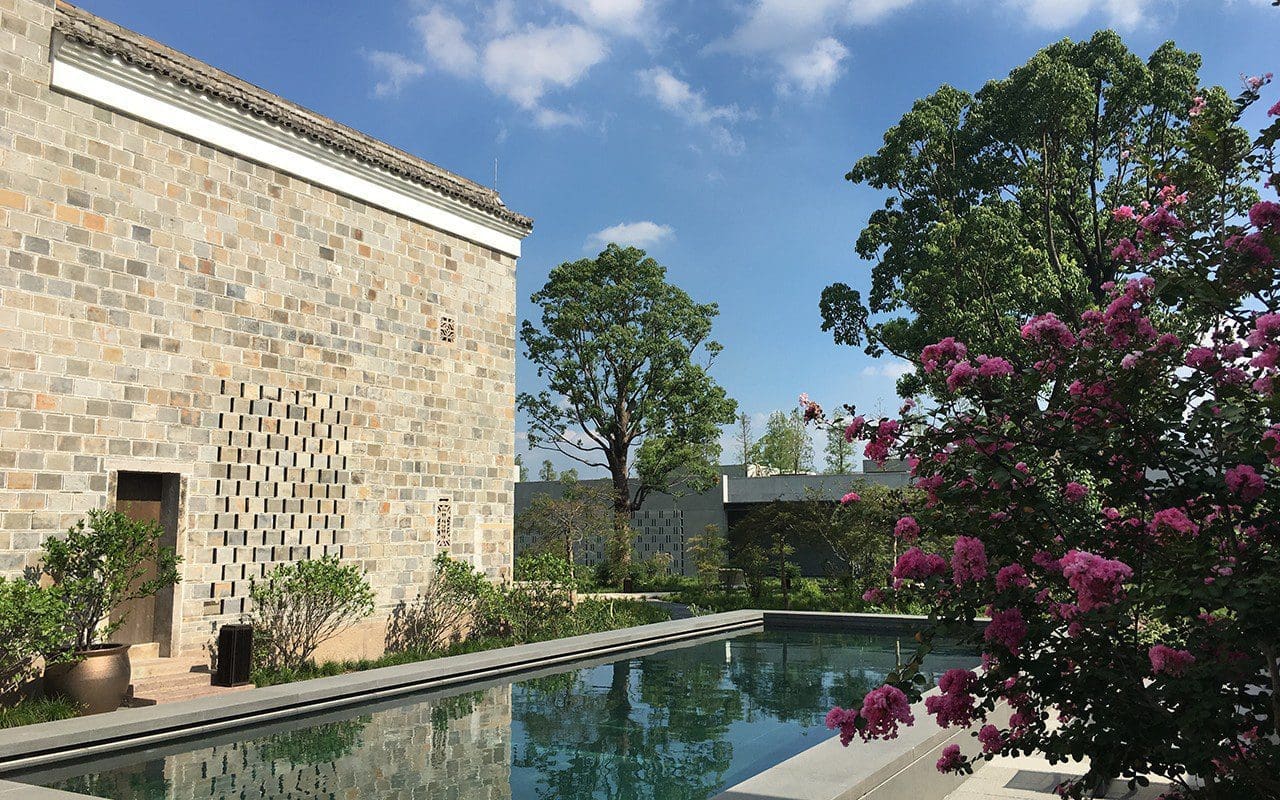 Rear private pool garden of an antique villa
We used a palette of Chinese natives and local wetland species to encourage wildlife, but pumped up the volume amongst the restful sweeps of green with lotus ponds that sat close to the buildings, coloured Nymphaea in water bowls on the terraces and highly scented Gardenias by doorways. The climate, though temperate, is just that bit warmer than London so we were able to include bananas in sheltered corners and Trachycarpus for the grandeur of architectural foliage.
After my initial dismay at the apparent limitations of choice, our palette soon felt big enough to do something interesting, but I did choose to import Hydrangea serrata from Japan, as we only had access to hortensia and H. quercifolia. By including the H. serrata we were able to ring the changes and make the development singular. Pink, white and ‘Macrobotrys’ Wisteria floribunda were also imported as we only had access to Wisteria sinensis, which is the shorter-flowered of the two species. These additions to the staples and the commitment to breathing spaces in the planting soon made the difference.
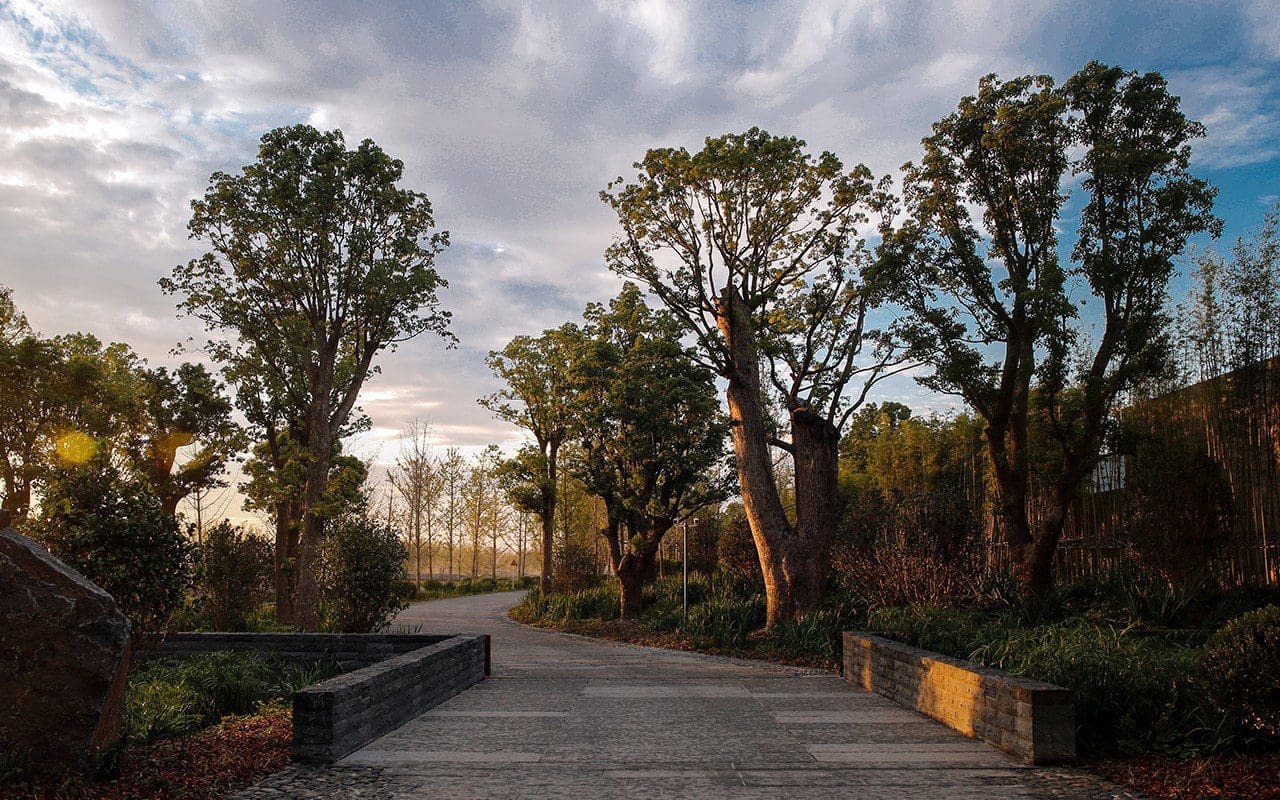 The main riverside entrance
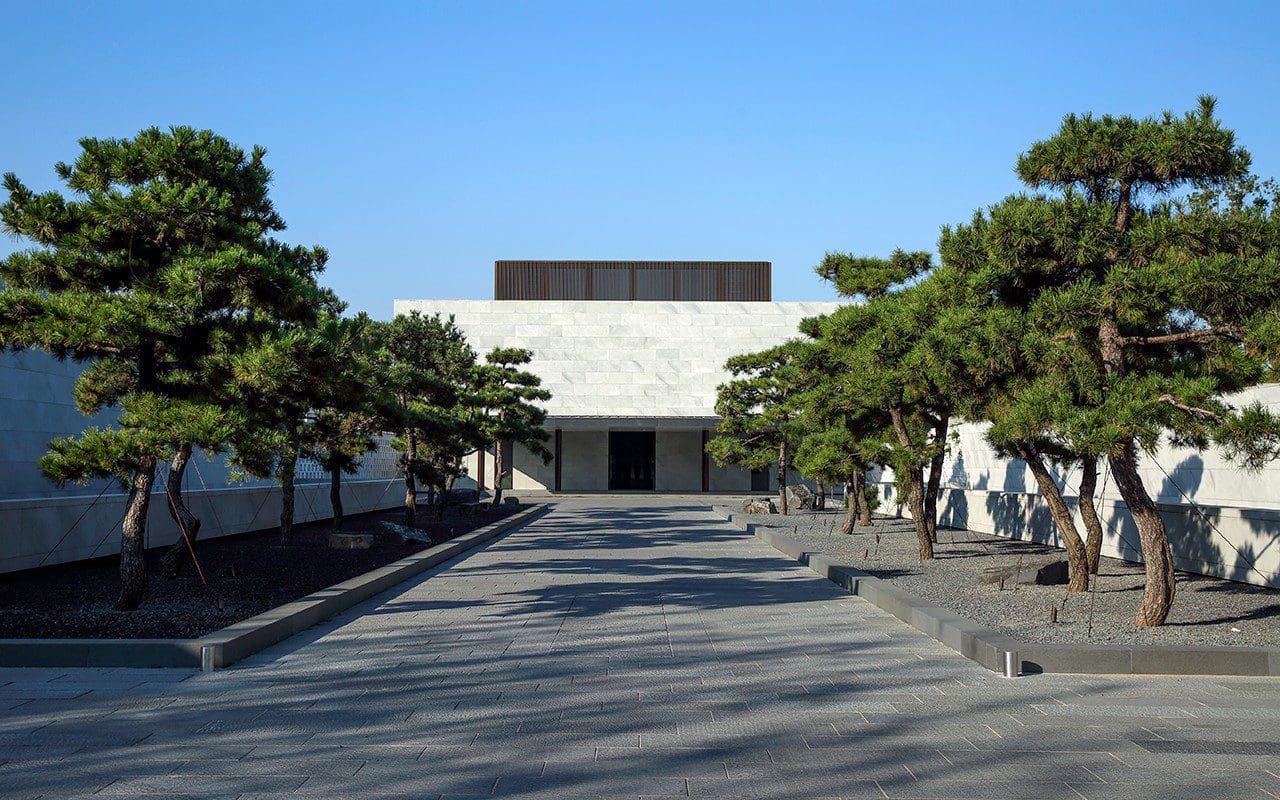 The hotel entrance
We honoured the Chinese traditions with an auspicious fruit tree by every door and trees and shrubs that represented welcome or well-being and were well known for this layer of storytelling in the landscape. Our plans were all vetted by a feng shui master before anything was built – and we had to make some changes, but most of the moves in geomancy are based on good common sense and the changes were few. I suspect we were lucky.
There are numerous tales to tell about how we got to the point that the hotel and the grounds of the first villas were finally opened this spring, but they finally are and behind the scenes work continues to complete the remaining parts of the site. Though the planting has been in a year at most, it is already beginning to pull the buildings together. You look up to see the camphor trees regenerating, the King tree in the main courtyard already assuming presence. It will be a time before their branches reach to touch and cast shade, but it is good to have been part of helping them to do so.
Words: Dan Pearson / Photos: Dan Pearson and Sean Zhu
Published 2 June 2018
We are sorry but the page you are looking for does not exist. You could return to the homepage