The Chinese meadow rue has been steadily working towards this moment. My favourite of first buds open and the majority yet to come. The plants grow close to the path and stand between the veranda and the garden. Deliberately, so that we are able to take in their delicacy and for the veil they draw between the immediate and the beyond.
Thalictrum ‘Splendide White’ is the albino form of its equally beautiful parent Thalictrum ‘Splendide’ which is mauve and yellow anthered. The white form is pale in all its parts. A clean, bright white with palest greenish-yellow anthers and apple green foliage which is as fine and as easy on the eye as maidenhair fern. Awakening later than most and coming into its own once its cousins have already peaked, the refined nature of its growth makes easy company, spearing through Bowles’ Golden Grass and providing a foil for the black Iris chrysographes that it goes on to eclipse. It is a good companion, taking very little room at ground level and light on its feet in the ascent. This year has seen it rising to six feet with midsummer moisture.
Though I know Thalictrum minus var. hypoleucum from the open woods of the Tokachi Millennium Forest in Hokkaido, I have never seen the Chinese meadow rue in the wild. I imagine they favour similar conditions in retentive ground in woodland glades or forest edges. Here our rich soil and the microclimate of company helps to emulate the coolness at the root that they desire. Teamed now with the dark thimbles of Sanguisorba officinalis ‘Red Thunder’ and – where I’m trying to keep it within bounds – the white willow herb, a little staking to prevent a topple once their flowers are fully open and weighting the stems keeps them holding the vertical.
Look into their wiry cage and countless perfectly spherical buds each hover in their own space forming, en masse, a pale and luminous cloud. Opening gradually from the inner parts of the veil, the pea-sized flowers cup long anthers that are thrust forward and hint at green. Though you might think its delicate nature would indicate an ephemeral presence, ‘Splendide White’ is anything but, the plants returning reliably come spring to spangle this part of the garden for four to six weeks of quiet glory.
Words: Dan Pearson | Photographs: Huw Morgan
Published 11 July 2020
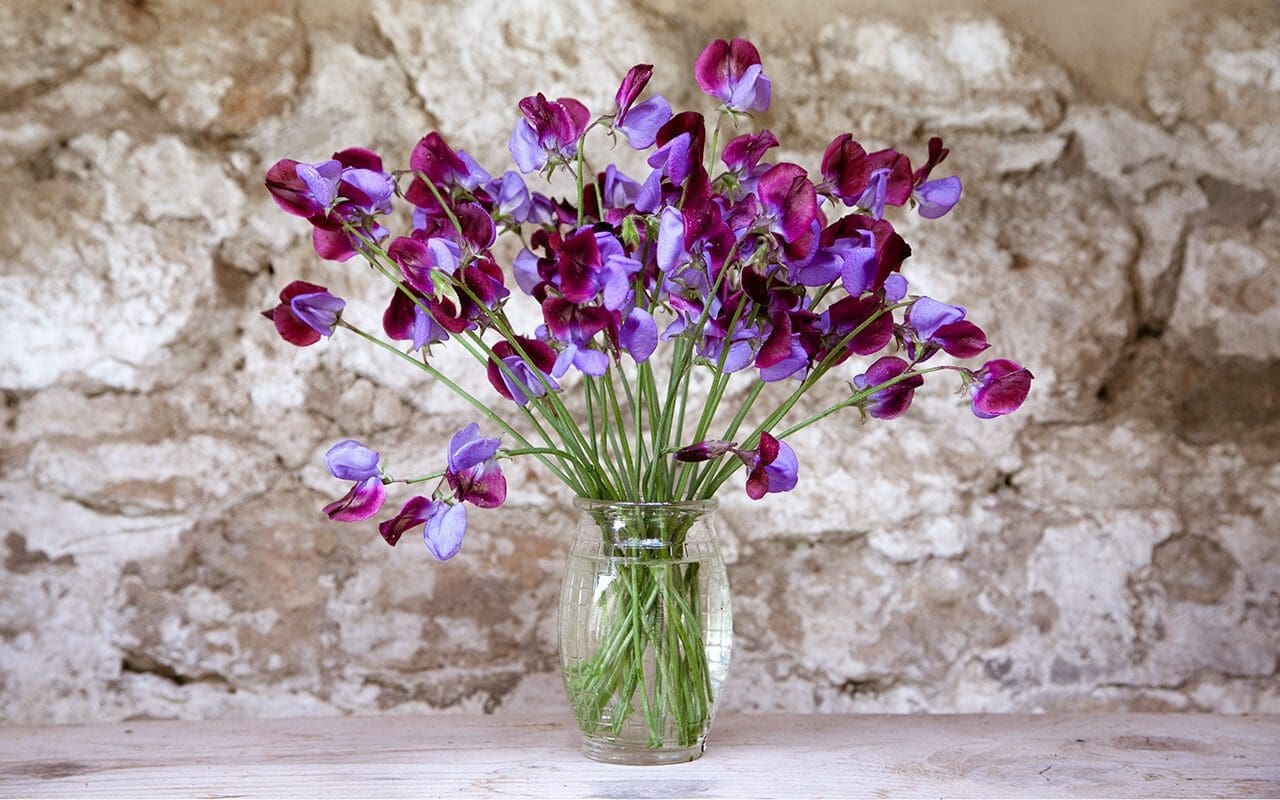
The sweet peas are an investment. A good one with the promise of marking summertime, but one that is not without a requirement for continuity and a little-and-often attention. The rounded, manageable seed is easy. A finger pushed into compost and three seeds per pot for good measure. Sown either in the autumn and overwintered in the frame for a little protection for the strongest plants and earliest flower or, alternatively, at the first glimmer of spring in February. You have to watch if the mice are not to eat the freshly sown seed before it has even germinated and, although perfectly hardy, they like good living once ready to go out in April. They require good ground, with manure or compost and plenty of moisture to send their searching growth up into a carefully managed cage of supports. We use hazel twiggery from the coppice here. Helping their ascent, so that their soft tendrils are trained within easy reach for picking, another part of the daily vigil. And finally, once they start to bloom, you need to keep on picking to keep the flowers coming if they are not to go to seed.
All in all the rewards are forever worth it and the jug sitting beside me, with the whole room perfumed of summertime is testament. Their vibrancy is the personification of long days spent outside doing and the elongated evenings that stretch ahead until bedtime. We spend this valuable time looking and find the evenings and early morning the best time to pick them, for the cool flushes their flower and helps in keeping for longer. The evening bunch for the bedside and the morning bunch for the kitchen table. Pick and you can keep on picking every other day and, when the plants finally begin to run out of energy in August, you will be sure to feel the next season coming. The weight of harvest and in the case of the Lathyrus, the desire to go to seed, which we make allowance for when the stems get too short to pick so that we can save some.
We grow two batches of sweet peas now. Named varieties of the Old Fashioned sweet peas, which we buy new every year from Roger Parsons and Johnson’s. Selected for their perfume and not length of stem we grow them up informal hazel wigwams in a strip of land we call the cutting garden. These are an ever-changing selection as we add to and subtract from a variable list as we move through new varieties and revisit ones we’ve grown to love. These selections have plenty of Lathyrus odoratus blood coursing through their veins and we like the fact that you can feel the parent and that they have not been overbred at the expense of their stem length, flower size or perfume.
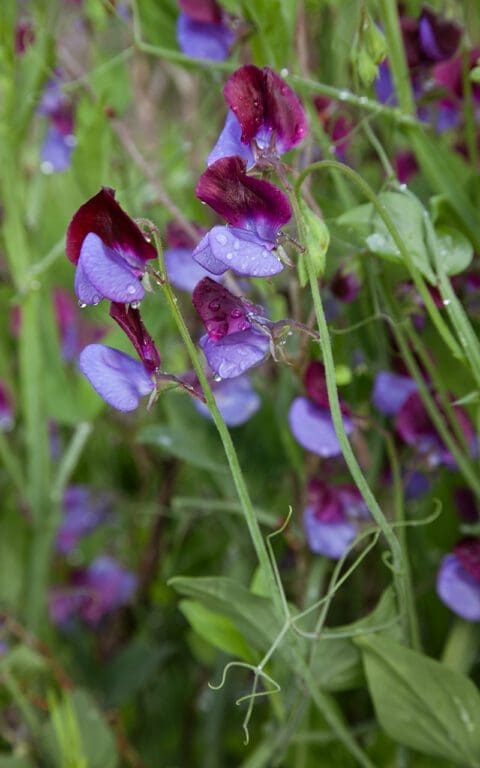
Set to one side and grown amongst the perennials in the main garden are the pure Lathyrus odoratus. We keep them apart because the seed was collected by the plantsman and painter Cedric Morris on one of his journeys to Sicily. The direct line has been carefully handed down to custodians who knew the importance of continuity. First, directly from Cedric to his friend Tony Venison, former Gardens Editor of Country Life, and then from Tony to his friend Duncan Scott. Meeting Duncan was a chance happening, as he is the neighbour of a client who thought we should connect. Duncan knew of my friendship with Beth Chatto, who in turn had learned directly from Cedric and had many of his plants in her nursery.
Duncan’s seed was handed over in a brown paper bag with the inscription ‘Cedric’s Pea. Lathyrus odoratus, collected in Sicily’. In turn I have recently had the pleasure of sending seed on to Bridget Pinchbeck who has taken on the responsibility of restoring Benton End, Cedric’s house and garden in Suffolk, to become a creative outpost of The Garden Museum. A full circle made in not too many leaps of the gardeners’ weave and easy generosity.
I am very happy to help keep the line alive and to pass it on, as we have spent much time looking through Cedric’s eyes over the years. First with plants that Morris gave with stories of their provenance to Beth Chatto and her in turn to me. And then through his dusky almost-grey and pink selections of Papaver rhoeas and latterly his Benton Iris which we grow here and treasure. Lathyrus odoratus was first introduced in 1699 by the monk Francis Cupani, the name which you will often find the pea listed under. I wonder whether Morris made his trip to Sicily in Cupani’s footsteps to find the pea for himself ? Regardless, it is good to imagine the find and relive his undoubted excitement at it. The vibrancy of the flower, with its vivid coupling of purple falls, wine red standards and the halo of unmistakable perfume.
It is Cedric’s lathyrus which is the first of our sweet peas to flower. A whole two weeks earlier than the named varieties and still the most perfumed of all. When we walk the garden in the late half-light of June, it is with an invisible orbit of scent that stops you on the path. The late light or early morning are the best times to see their colour. Clear and sumptuous and well worth the effort of continuity.
Words: Dan Pearson | Photographs: Huw Morgan
Published 19 June 2020
I first encountered Bupleurum longifolium ‘Bronze Beauty’ around twenty years ago at Stoneacre in Kent. At the time our recently made friends Richard Nott and Graham Fraser were the National Trust’s tenants and, as its custodians, they had woven a thoughtful new layer into the garden that played to their interest in colour. They had recently exchanged their lives running Workers For Freedom, their successful fashion label, for a new life in the country. Richard was studying painting and Graham, the history of both the garden and the house, which was restored in the 1920’s by Aymer Vallance, the Arts & Crafts architect and biographer of William Morris.
Together they took to the garden, moving easily from one creative discipline to the next, enjoying the fact that the worlds were easily interchangeable. It was precious time that we spent there and, with weekends away from our south London lives, in the idyllic setting of this place it felt like there was time to talk. We workshopped the planting and in the easy world of this garden the conversations moved effortlessly back and forth to cover all manner of territories. With life experience that we were yet to have, our new friends provided good council and helped build confidence about doing what was right for us and being sure of our direction.
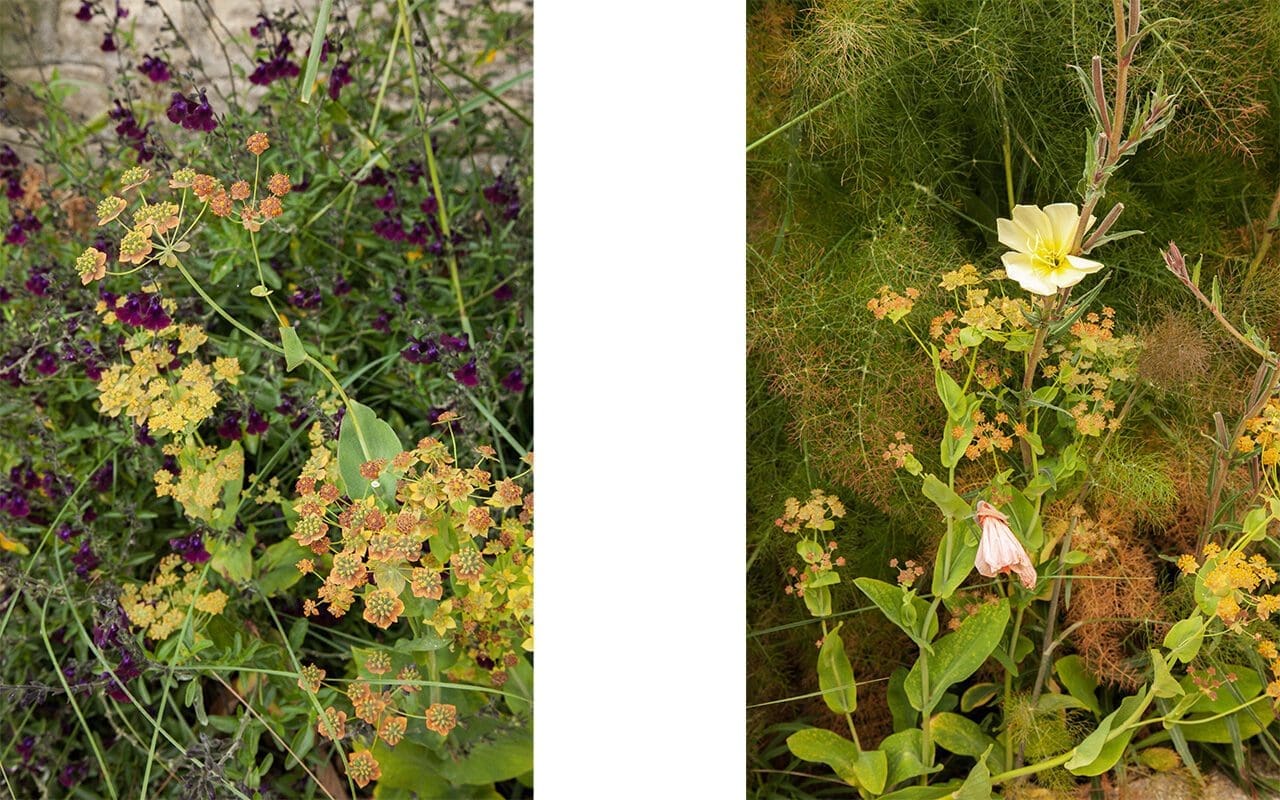
Stoneacre is a garden of rooms that give way one from the other as you walk around the half-timbered hall house. A straight stone path sloped gently to the front door and they had dug up the lawn to either side and planted a pair of gauzy, golden borders that rose in early June to shoulder height with the shimmer of giant oat grass (Stipa gigantea). As you walked the path the detail in the planting revealed itself. Hemerocallis ‘Corky’, a delicate daylily with a dark reverse to the petal, provided the base note of gold. There was saffron Crocosmia × crocosmiiflora ‘George Davison’ and later Rudbeckia fulgida var. sullivantii ‘Goldsturm’, but there was a secret ingredient that provided the planting with a burnish. The bupleurum hovered amongst it all as a mutable undercurrent, a presence that was hard to detect at first until you had tuned your eye, but once you had it, it was the thing that drew you in and held you.
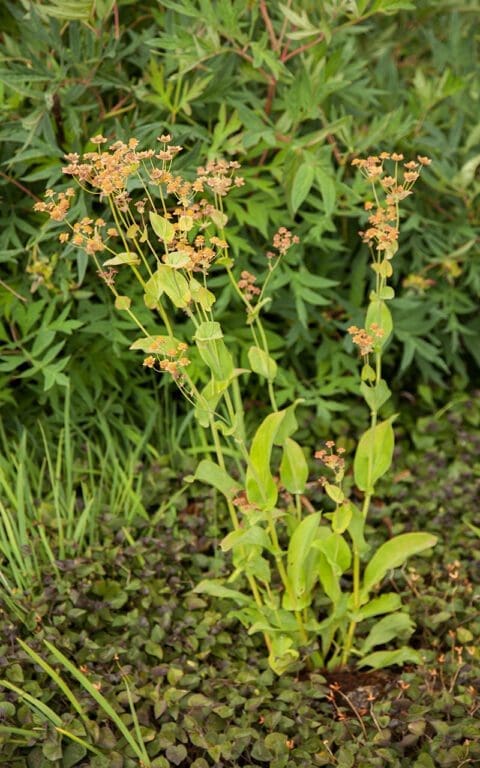
A clutch of seedlings found their way back to the garden in Peckham where they seeded about obligingly. Never moving further than the cast from a bent stem in high summer, but finding their niche wherever they like the territory, the tiny seedlings are easily distinguished in spring. Brilliant lime green cotyledons, two narrow slashes, appear early in the season. They arrive in a rash where they find open ground and soon form a bright first leaf the shape of a paddle. Where there is light and not too much competition they spend their first year hunkering to form a neat rosette. In the second year they throw the first flowering growth, sending up slender stems in early summer with a dusty bloom that softens their presence. By the middle of May the first umbels are filled out and standing tall and free of foliage. Finely spoked they throw just enough florets skywards, each with a neatly cut ruff and an inner button of stamens.
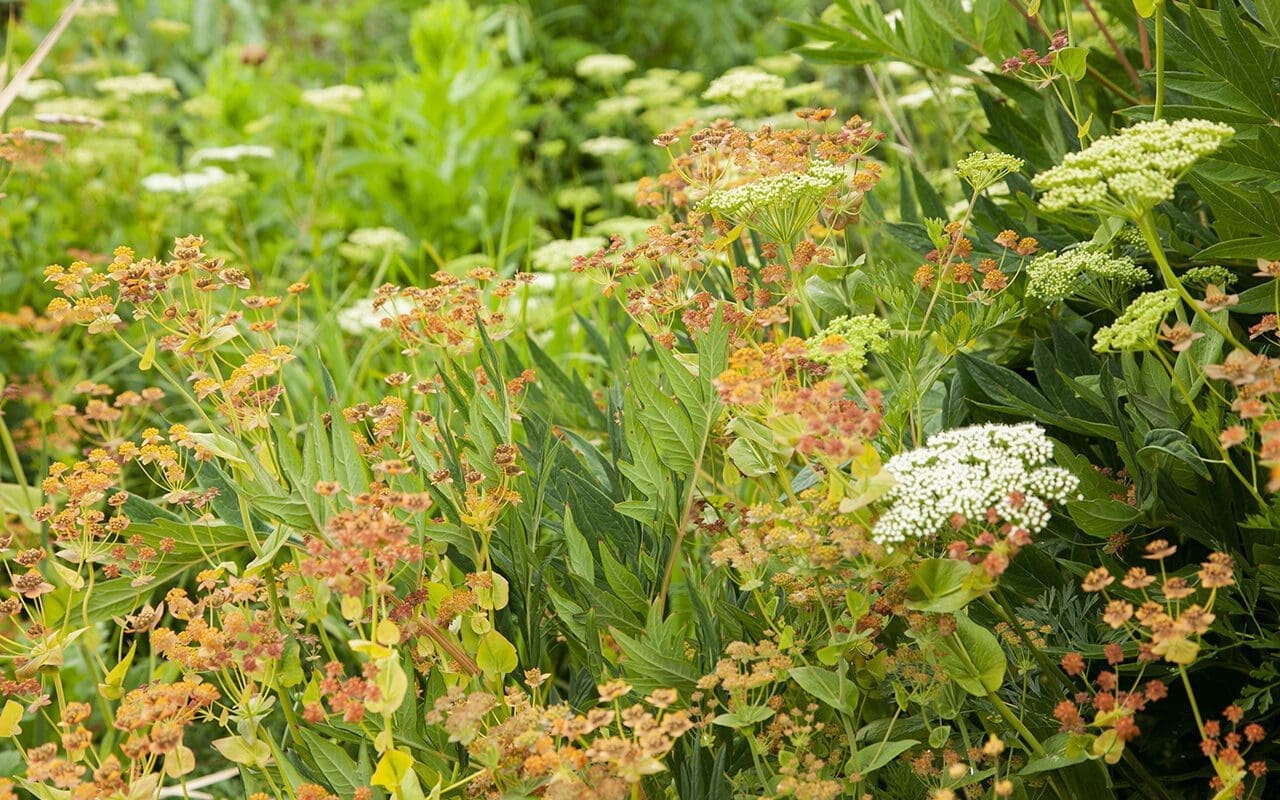
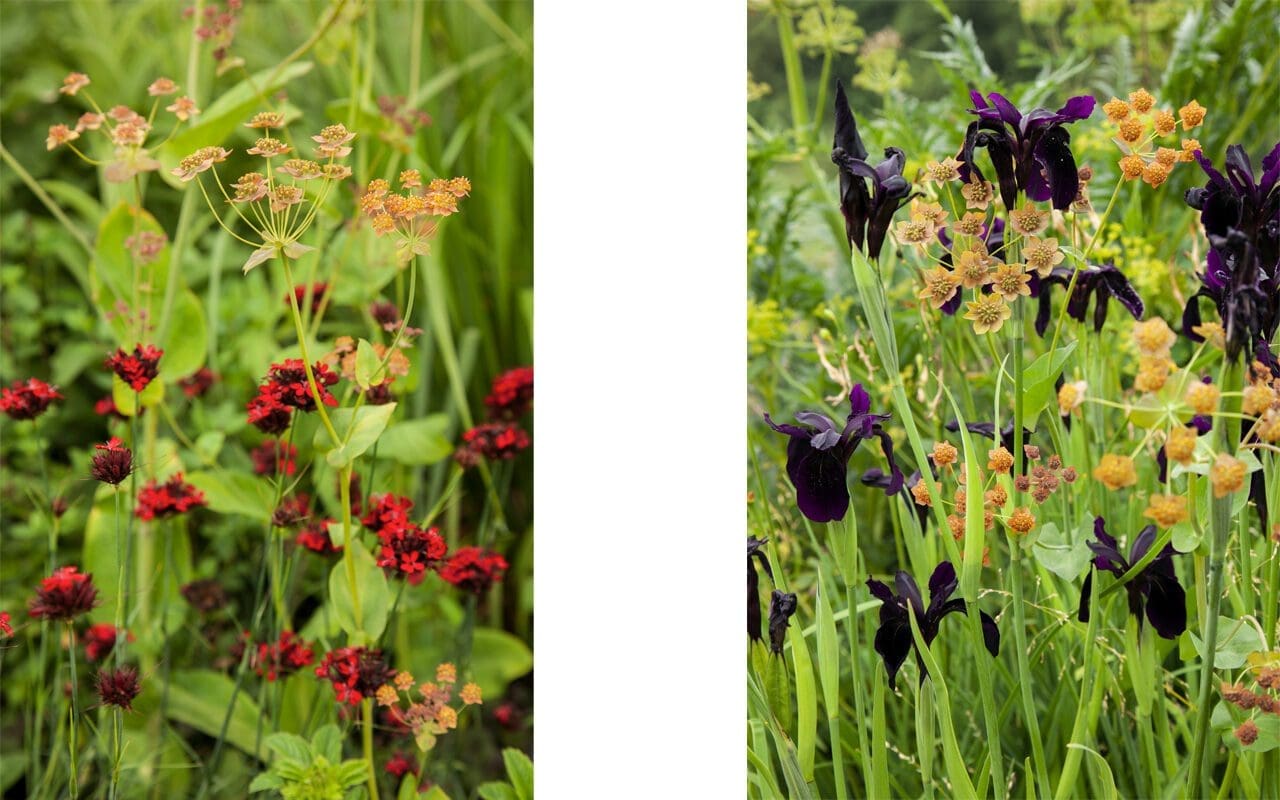
The shifting colour of ‘Bronze Beauty’, the form most commonly available, is hard to pin down ranging as it does from cinnamon to ochre to tan, but it compliments everything. I have not found a companion I do not like it with. I will determine a combination that I think will work well, but its easy nature will throw it into new territory together with something you simply hadn’t or wouldn’t have thought of. I am very particular about colour, but I rarely find it appearing anywhere that I find it jarring or out of place.
Advice if you are reading up about Bupleurum longifolium is to plant it in an open, sunny position. Yes, the low rosette enjoys light and suffers if it is overhung by neighbours, but we have found here, where we have all day sunshine, that it prefers to set seedlings on the shady side of the bed and those in full glare do less well. I think ‘open meadow’ when I plant it, so that it can rise up in company, but not so much that it feels overcrowded.
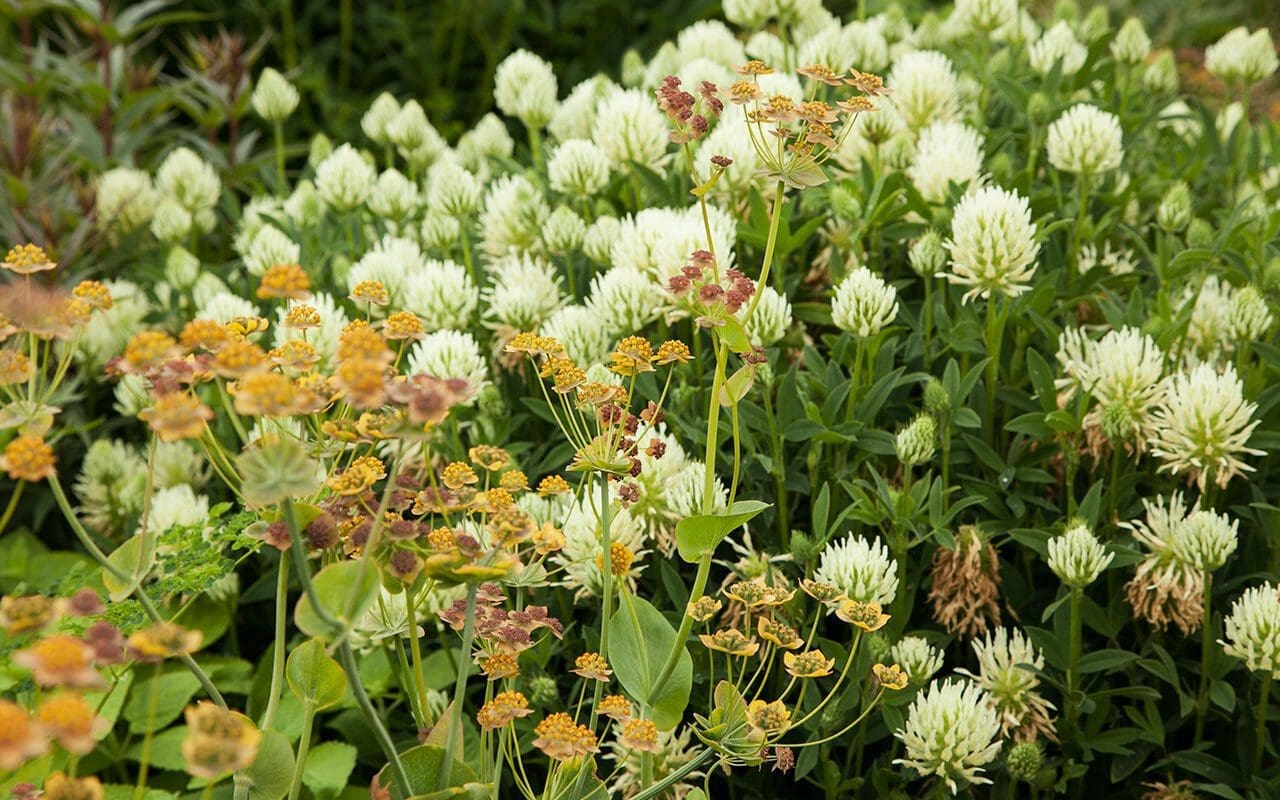
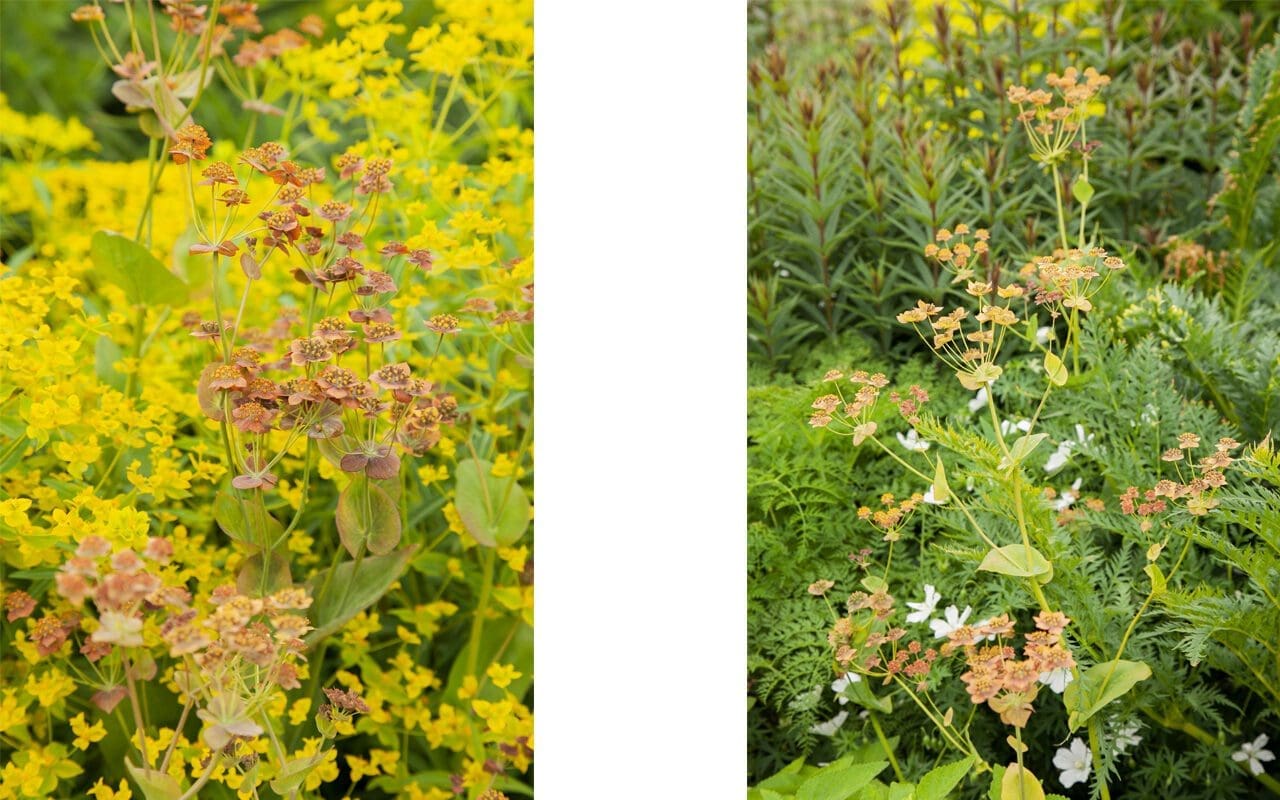
Although it is now finding its own way in the garden and is never competitive like its acid-yellow cousin, Bupleurum falcatum, which we also grow, the plants last three to five years and then hand over to the next generation. I always have a pot full of seedlings in the frame for good measure. They make easy additions where you might suddenly find yourself with a gap come spring. Always sow fresh, as all umbellifers (Apiaceae) do not last if kept and overwinter with a little protection. It was one of these pots of seedlings that found their way back to Richard and Graham a few years ago when they left Stoneacre to make their own garden at a new home on the south coast. An easy gift to return for such a treasured introduction.
Words: Dan Pearson | Photographs: Huw Morgan
Published 13 June 2020
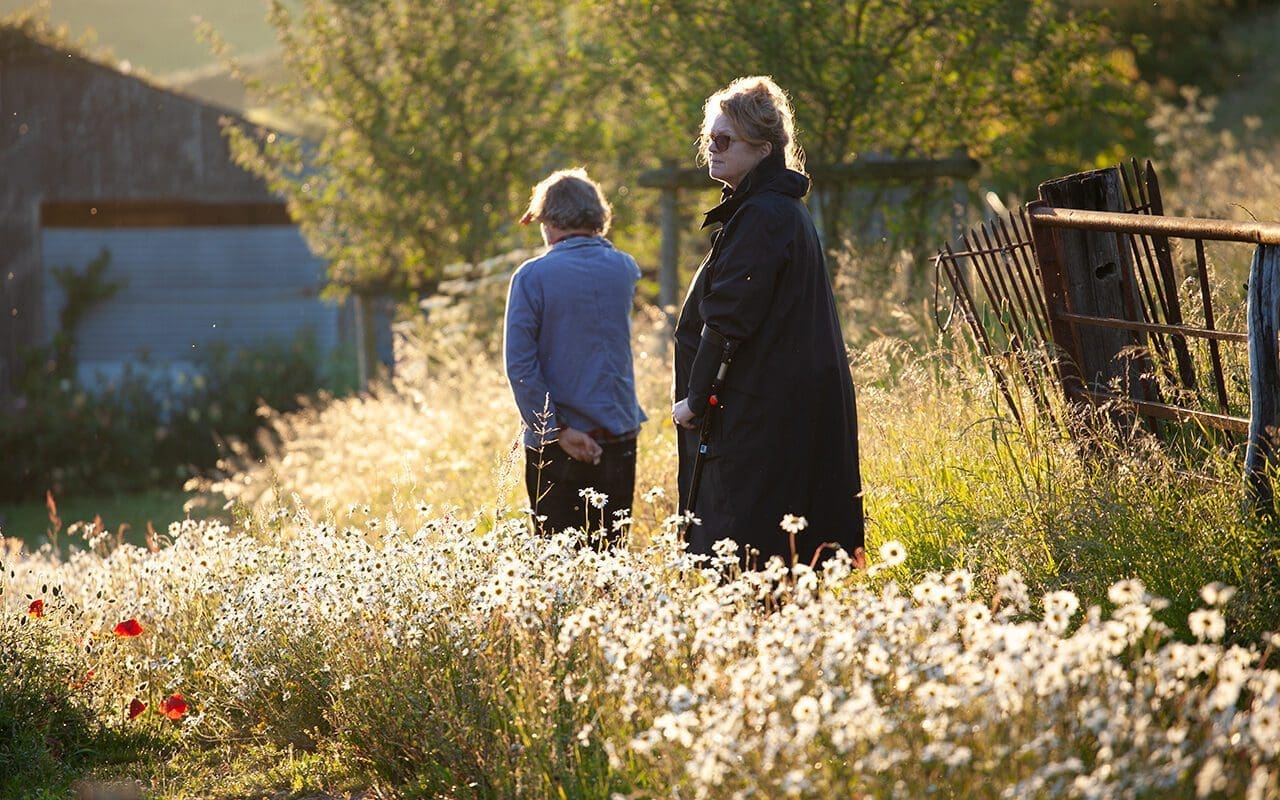
A tide of ox-eyes have surrounded us, lapping up the banks that come to meet the house at the front and running down the centre of the track at the back to make it impassable. I cannot bring myself to mow the strip that runs to the barns when the meadows are up, in part because they mark this moment. They stand bright, aloft and alone on stalks that raise them into their own space in the meadow. Moving as one when caught in the breeze, each flower is a point of individual brightness but together they flare, so that all you see is whiteness.
Leucanthemum vulgare is a simple plant, happiest when pioneering and taking new ground. The profligate seed, produced on youngsters that are often not even a year old, is light enough to travel, perhaps not far but far enough to seize open ground. Germinating as soon as the weather dampens with September dews, this year’s seed will already be hunkered down and big enough to cope with winter. They have the start they need to be ahead of the race the following summer and their precocious behaviour will see an explosion of daisies for two years or so. Then the knit they have so helpfully made to seal bare soil will be colonised by the slower to establish meadow plants which ease their hold and dim their presence.
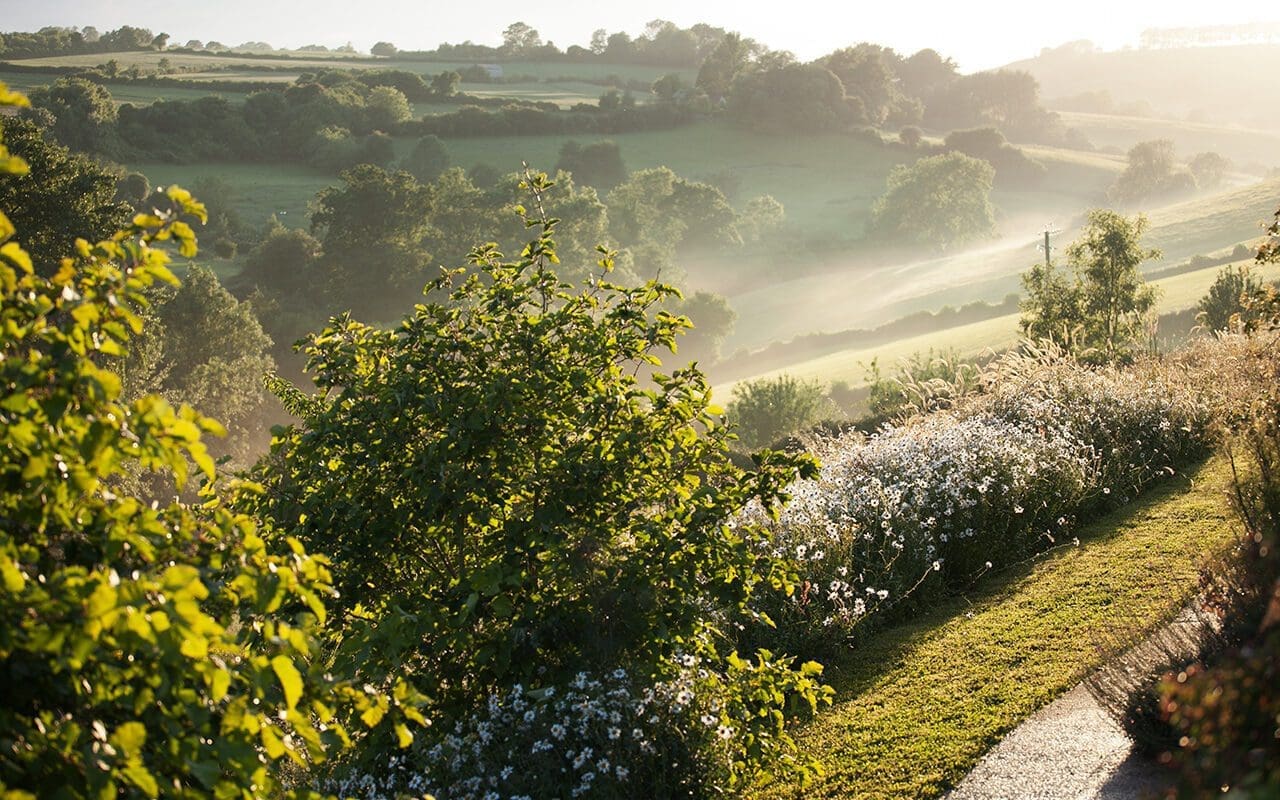
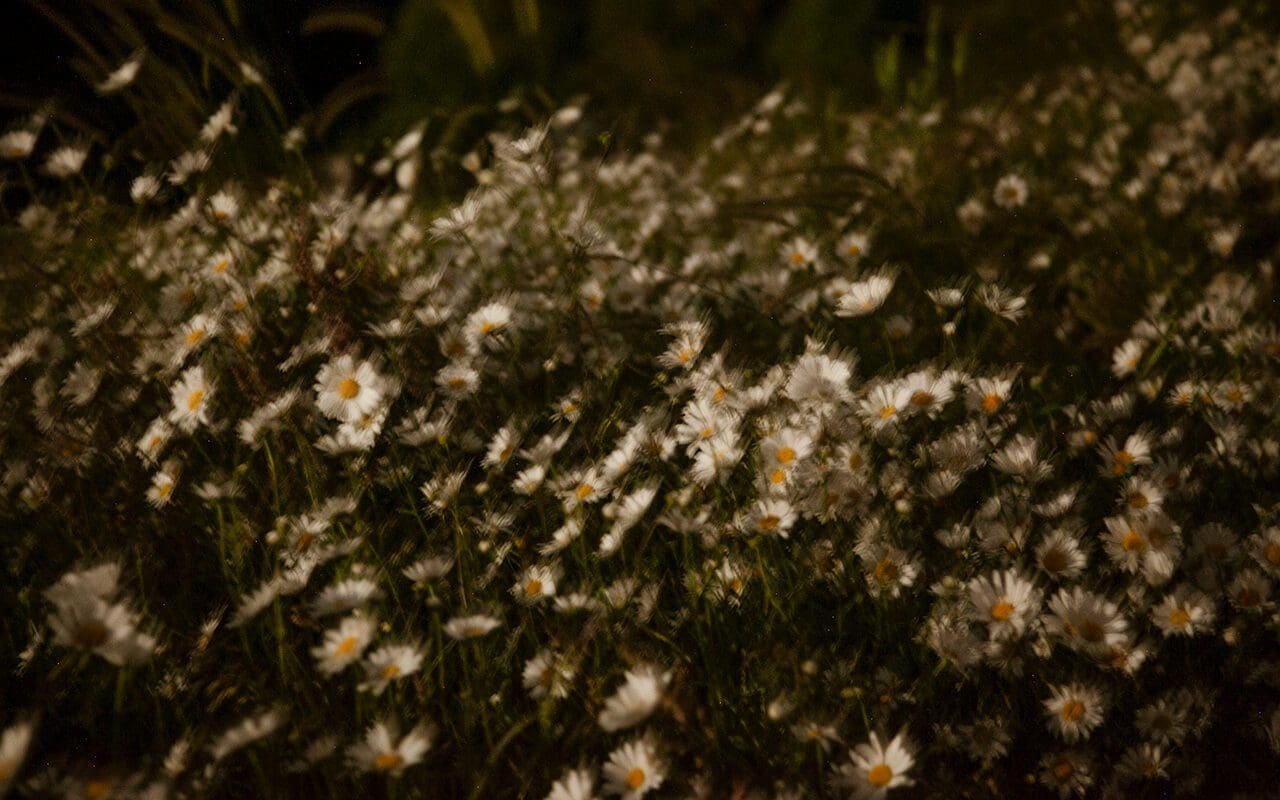
We seeded the ground around us after the landscaping was complete in the autumn of 2016 so the daisies are still in their dominant period. They grow so densely in parts that you have to squint on a bright day. By night they bounce the moonlight, brightening the ceilings in the house and earning my favourite name, the Moon Daisy. When growing as thickly as they do in the early years, you begin to wonder if anything else has the room to form an association, but they live fast and die young and are then content to have a lighter presence.
I used their easy nature to my advantage when we were addressing the ground that had been thrown up after making the pond at Home Farm. Frances, my friend, client and collaborator, was keen to blend the pond seamlessly with the landscape beyond and so we sowed meadow to the rear of the pond and took the gravel from the drive down over the gentle slope that met the pond in the hollow which we softened by seeding the ox-eyes were directly into it. We let it have its reign and within a year the pond sat in a sea of whiteness that met easily with the meadow and the wild carrots that proliferated there. It was an extraordinary place to pick your way through to the dark water. So simple and yet with so much life, return and generosity on the part of the daisies. We left them to blacken once they waned so that you saw the water again through the ghost of spent stems and then cut them back in September. An easy job with a strimmer or a scythe. A gentle weed in the autumn to remove seedling grasses was all we needed to do to retain the grand gesture.
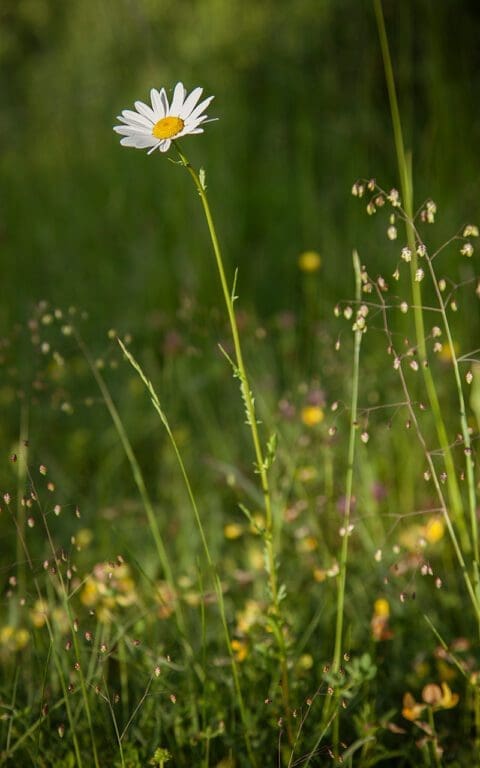
Where we have over-seeded the old pasture here, their presence is entirely different. Seizing a window in the meadow is more difficult, so they smatter lightly where the Yellow Rattle diminishes the dominance of the grasses. The old pasture keeps the daisies in their place though, the closed system preventing the pioneer’s behaviour. They appear here and there and in lighter colonies where they find an opportunity, but are every bit as beautiful for fitting in and being happy to not even hint at world dominance.
Words: Dan Pearson | Photographs: Huw Morgan
Published 6 June 2020
The opium poppies have been growing into the lengthening evenings, to race skyward and seize this early window of first summer. They come from nowhere it seems and typify the current feeling of the garden burgeoning.
Their seedlings are already visible in March and one of the first to germinate into open ground. Blue-green and easily distinguished, they take the disturbed places where there will be a gap to ascend into the very moment the weather warms. Being winter hardy and germinating the moment the season turns with the promise of spring, they have the advantage, hunkering down and establishing good roots and core strength. In truth there are several rounds of germination as seed is brought to the surface whilst cultivating, weeding or clearing the winter garden to expose fresh ground, but the first are the strongest, bulking up in April and muscling out anything nearby that might show a glimmer of tardiness. Their precocious behaviour extends to their siblings and you will need to thin a colony if you are after plants that are muscular and soaring.
I grow a black opium poppy here and it is my one and only. A single form and a chance find that I made when cycling to work once in my early twenties. They were standing tall alongside a black wooden bungalow in Hampshire. Black on black, fluttering against the stained shiplap. If I hadn’t been looking in the way that you do when you are under your own steam, I would have missed them completely. It was immediately clear, even at distance, that they were special so I plucked up the courage and knocked at the door to ask for seed. The owner, seeing I was smitten, took my name and address and later that summer an envelope arrived with the beginnings of a now very long association. It is one that I have nurtured annually, seeding a few every year in a new place for good measure and gifting to friends and clients that I know will keep the strain pure.
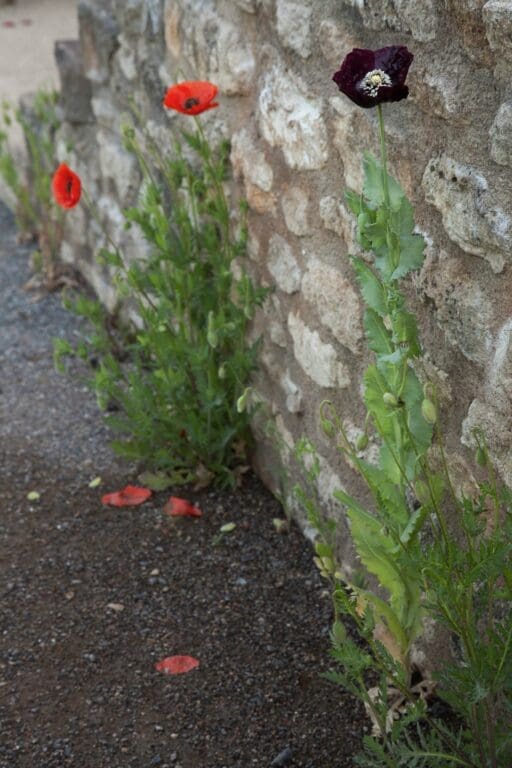
Although there are other named forms of dark opium poppy, several double blacks and the deep plum ‘Lauren’s Grape’ for instance, I’ve not seen another that is quite as dark and inky throughout. To maintain the strain, I have been territorial. I have never introduced another coloured opium poppy into a garden where I have been cultivating them and any that show the remotest sign of reverting are pulled before they can pollinate a dark one nearby. I look nervously on to neighbours up the lane who have them growing freely in their garden in every shade of mauve and pink, but breathe easy that, in the ten years we’ve been here, the bees that busy themselves there must be on another flight path.
After moving them here from Peckham, I cast the seed down into the freshly turned ground of our virgin plot. Broadcast in February, the plants were up in flower by June and providing me with a new and plentiful seedbank by the middle of July. Those seeds have now found their way into the compost heap where they are content to sit dormant until they are exposed again to light and potentially new places to conquer. We had a good colony in the asparagus bed a couple of years ago, amongst the roses and throughout the kitchen garden and I am now finding seedlings in the paths that must have been dropped whilst we were clearing the garden.
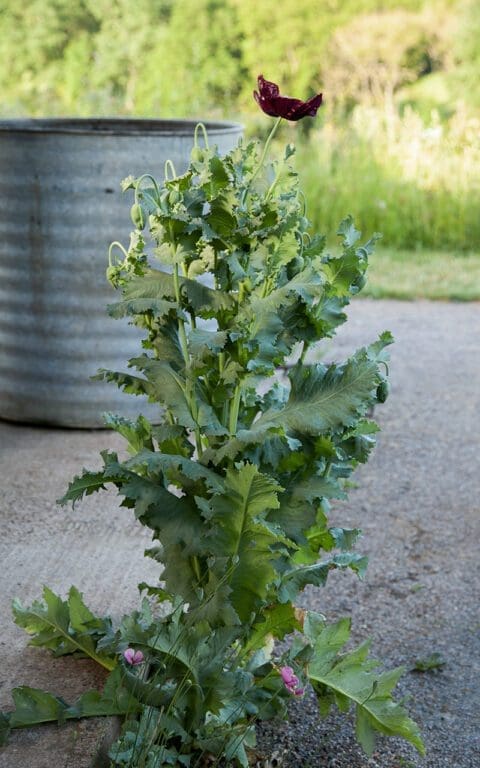
The chance happening of the pioneer seedling is always heartening and we leave a few in a new place every year for the delight in the new. The first seedling to flower this year has been living with us closely alongside our covered terrace. I saw the seedling had found a home in the late winter and wondered if it would be one that would survive our lines of desire into the garden. It has, soon growing big enough to negotiate and with the promise of this very moment that is seeing it suddenly present. A filling out of blue-green buds and then, one day, a tilt in the neck of the bud to indicate readiness.
The mornings bring the flowers, crumpled at first and then expanding like dragonfly wings do when they hatch. Dark satin petals cup pale stamens and bees soon find them, noisily working in laps, the enclosure of petals amplifying the sound of their frenzy. The flowers last two to three days at most, but there are enough to run a glorious fortnight whilst the balance shifts from buds to seedpods pods fattening and tilting skyward to show you that they have nearly reached their goal. When the leaves suddenly wither and the life force of the plant is gone you see that the pepper-pot seedpods are ripe and beginning to rupture. We leave a few standing for the joy of continuity, the mission accomplished, and scatter the rest for the pleasure of helping them extend their territory.
Words: Dan Pearson | Photographs: Huw Morgan
Published 30 May 2020
When we arrived here the smallholding aesthetic, with its ad hoc manner of making-do, ran right up to the buildings to keep anything growing at bay. A brutal concrete slab sloping down and away from the lane surrounded the end of the house, diving steeply between it and the little barn below, where the cows were once milked, to form a yard. From there more concrete ran along the field before climbing steeply again towards the big barns, where the troughs now screen the kitchen garden from the house.
The track had been made in sections, as and when materials were available and potholes needed filling, so your first experience as you arrived off the lane was dominated by negotiating this necessary evil. You either had to park your car at an angle that spilled the contents when you opened the doors or prepare yourself for a vertiginous descent if you drove down into the yard. You certainly weren’t getting back up easily if the weather turned in the winter.
We muddled on for the first five years of being here and partly liked the authentic feeling of it, but I knew that it would eventually have to go so that the house could be cushioned in green again and not divided from it. After we renovated in 2016, we removed the concrete and reoriented the track behind the buildings and built a level platform at the end of the house. Flat ground is limited here, but even the smallest amount helps you to feel grounded enough to lift up your eyes and take in the view.
I wanted this pull-in from the high-hedged lane to be a little breathing space, to not give too much away of what was to come and to welcome you into an eddy, a pause with a feeling of rightness. I planted black-catkinned willow to form a semi-permeable boundary, so that you only got glimpses of the garden beyond and encouraged Erigeron karvinskianus, Centranthus lecoqii and white linaria to self-seed in the gravel. Viola odorata, which doesn’t mind the exposed position because it has company, reappears when the Mexican daisy is dormant in winter and when the sun shines in February they liberate their perfume to catch you unawares .
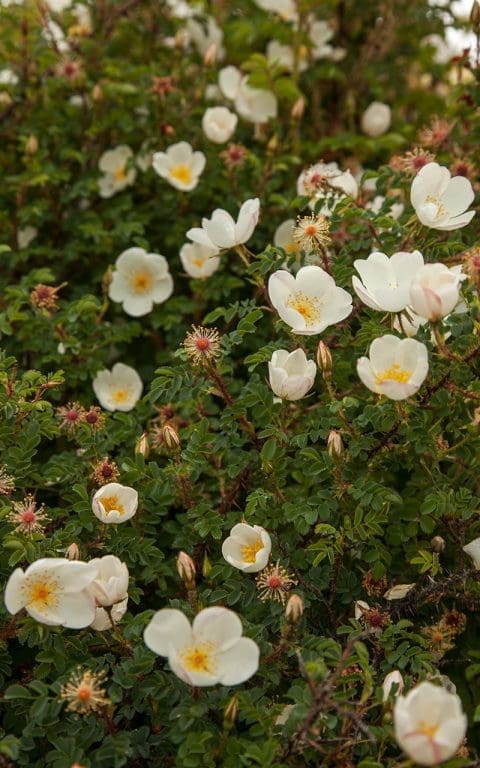
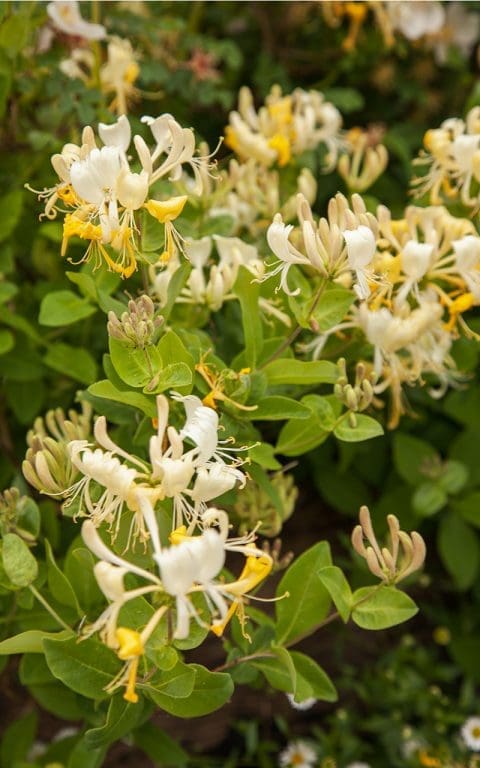
Perfume was an important consideration for this first impression and a scented ambush shoulders your descent down the steps to the front of the house. A seed-raised Rosa spinosissima, which we collected from Oxwich Bay on the Gower peninsula, sits to one side and hunkers down to form a little thicket. The first flowers opened in the last week of April this year and, although the perfume is delicate, it is delicious when you catch it for the month the bush is in flower. I’ve been training a honeysuckle along a log we’ve used to define the edge of the entrance platform, but now the briar is large enough I’m letting the two intertwine. The honeysuckle is a selection of our native Lonicera periclymenum called ‘Scentsation’. It’s not the best of names, but I have not seen a form that flowers as freely or grows as compactly. And it does live up to its name, perfuming the air sweetly and causing you to stop and linger when the wind stills in the evenings.
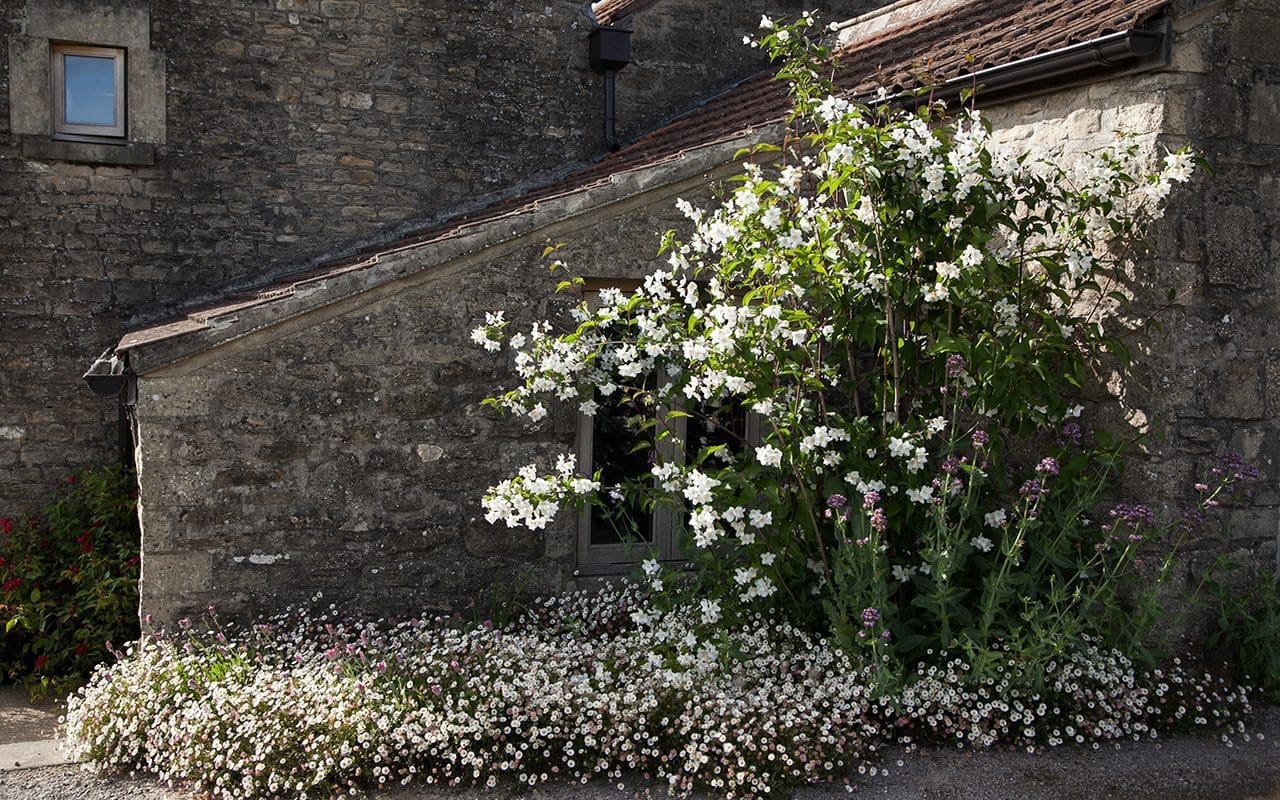
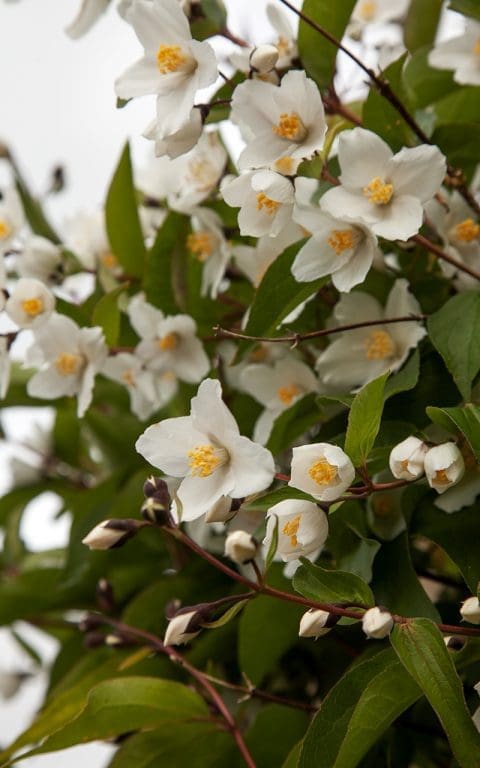
The second perfumed shoulder by the steps, held in the angle of the building to the other side is Philadephus ‘Starbright’. In its third year and beginning to have enough impact to create a presence here, we now have enough flower to perfume the breeze. In terms of scent, mock orange is a perfect description and is placed for best effect so that the wind blows it towards you. I don’t expect it to get much taller than it is now, topping out at about eight feet and six or so across for this P. delavayi x lewisii cross is modestly sized. The larger growing Philadelphus coronarius is beautiful in June with clouds of fugitive blossom but, for the remainder of the year, they are not the most interesting of shrubs.
‘Starbright’ has an open habit, never heavy, is upright but not stiff and remains open. Though it also settles into a quiet shrub for the rest of the summer, it is good in the lead up to flower, pushing plum coloured growth and first foliage. The dark staining travels into the calyces of the flowers which, against their brilliant, pure white, appear as dark as if they had been charred. Now that our ‘shoulders’ are large enough to spare some for the house, this week we have been picking combined bedside posies of mock orange and honeysuckle. Both have a fresh, zesty perfume, but the philadelphus is easily distinguished in a posy. It is evenly scented both day and night, while the honeysuckle is strongest after dusk and through into early morning. It has been waking me throughout the night, breaking my sleep with waves and pulses of perfume. I like the thought of it seeking the attention of night time pollinators and am happy that we now have enough to bring into the house to feel the full benefit ourselves.
Words: Dan Pearson | Photographs: Huw Morgan
Published 23 May 2020
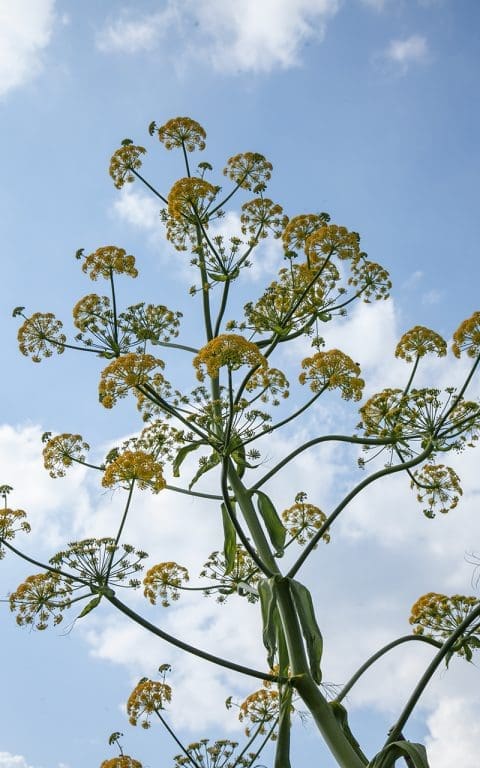
The Ferula communis came to fruition last year after two seasons in the ground readying themselves. They bolted skyward like Roman candles and we stood in their shadow to wonder at the enormous surge of energy, summoned from the deep and tracking the awakening spring. The expenditure of those that flowered last year sees them resting now, hunkering down to nothing but foliage to build their reserves. It is too early to say how many cycles they can sustain here before they give up and make way for a new generation, but for now I am pleased that they have staggered themselves and will ensure I do not go without a spring in their company.
As if the group in the herb garden had been in silent conversation, this year’s flowering plants have distributed themselves rather nicely, throwing four fresh spikes to articulate an easy distribution. New leaves were already pushing from dormancy in November and they sailed through the wet winter with our slopes draining easily. Mounding slowly through the cold season and pushing against the stillness elsewhere, the netted foliage remained untouched, easily coping with wind and bowing gently but recovering after the frost. They kept their fine structure, the snowless winter sparing them its potentially damaging weight. So, by late February, we were already parting the growth to check for the fattened, flowering stems which were already preparing to move with the lengthening days.
It is easy to spend time with the giant fennels, for their rapidly moving architecture has an animalistic quality. Armature and sheath unfolding, tendoned limbs extending as they move always upwards, the day they peak is the day you see the beginning of summer. Buttercups rising above the grass. The first poppies and leaves flushed on the trees. We are lucky to have the room here for several colonies to test different varieties and in differing situations. We are bathed throughout the day in sunshine, for they would not do well without it.
The Tangier fennel, Ferula tingitana ‘Cedric Morris’, is the first into flower and grows against the espalier wall that it shares with the pears. They are taking a fallow year this year after flowering plentifully last, but their distinctive, shiny foliage is good even when they are taking some downtime. Although the giant fennels are said to be short-lived as a tribe, they are proving to be reliable here where they are never overshadowed in a planting and this seems to be a general rule for their well-being. The ‘Cedric Morris’ came with me as seed from the Peckham garden and establishing seedlings when they are young is the best way to ensure happiness. I keep a few generations on the go in the cold frame so as to always have a spare or two to keep an age-range but, as with most umbellifers, their roots dive deep to provide the foundations for their great bolt of flower, so they should never be allowed to become pot-bound before planting out.
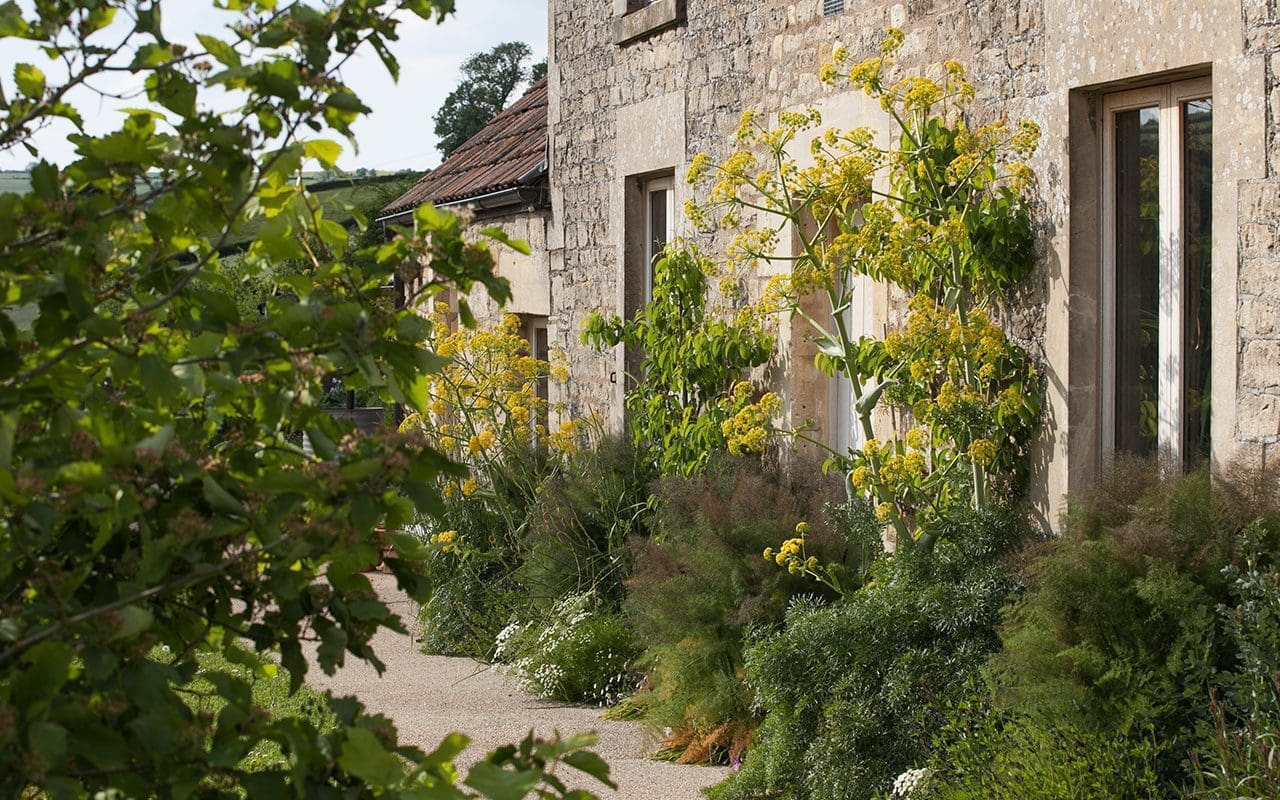
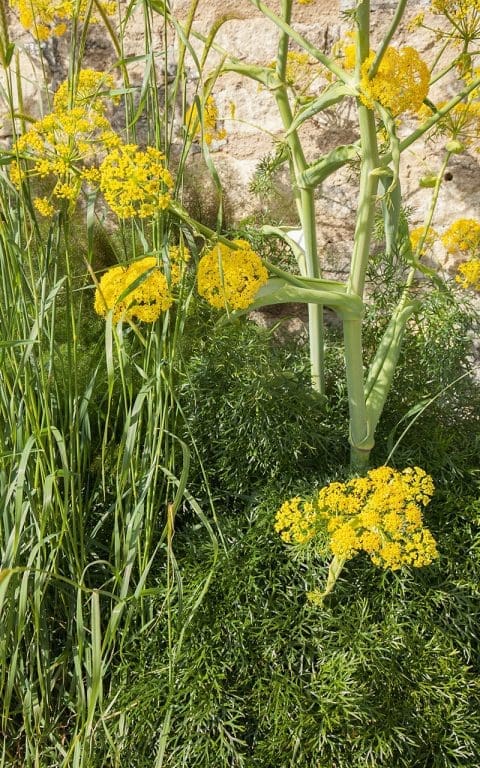
I have several forms of Ferula communis, the larger-growing cousin and close relative to the Tangier fennel, all of which were given to me by Fergus Garrett at Great Dixter. Immediately in front of the house and in the yard below it we have Ferula communis subsp. glauca. This is the most elegant of all, in my opinion, for its slender limbs and burnished dark green leaf. I have planted it amongst the rockscape of the re-imagined Delos Garden I recently designed at Sissinghurst. We sourced the plants from Olivier Filippi in southern France and, although young when we planted them in the autumn, I could immediately see that his form of F. c. subsp. glauca was distinct from the Dixter form. Finer, more wiry and exhibiting a variable trait, which is common in a plant that has such a wide distribution across southern Europe and into Eurasia.
The straight Ferula communis we have growing in the herb garden (main image) has paler, more netted foliage. It is the largest growing, the flowering stems being as thick as my wrist and rising to three metres tall over the course of a month. Despite their open position here on our hillside, they still search for the light and the stems each chart the sun’s movement due south to show you their desire. After a heavy West Country drizzle last week we woke to find the tallest two having toppled. Grown too fast and furious on our fertile ground, they have probably just been a little spoiled and lacked the stamina of the plants that find their way into crevices on the rocky slopes of their homelands. We spent an hour before breakfast carefully staking and hope that, as the acid-yellow flowers go on to produce the weight of paddle-shaped seed, our endeavours will not be further challenged.
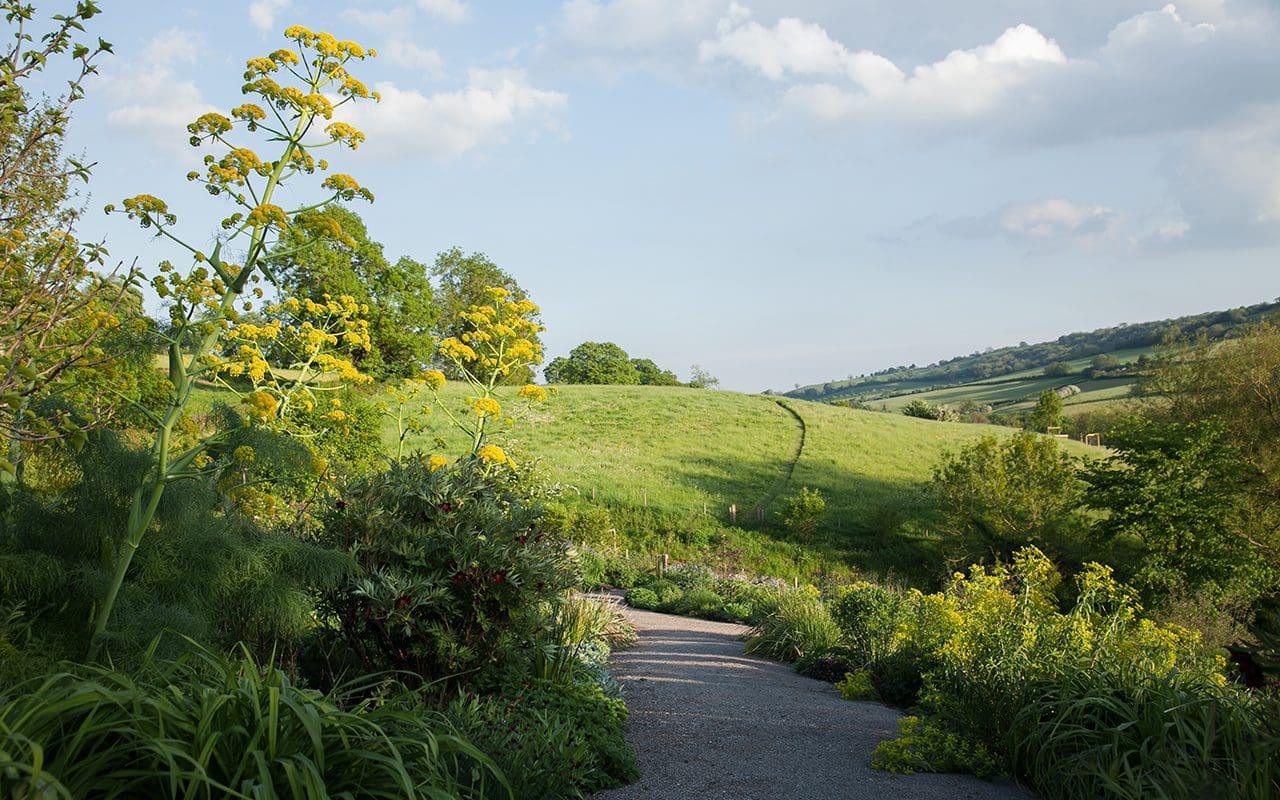
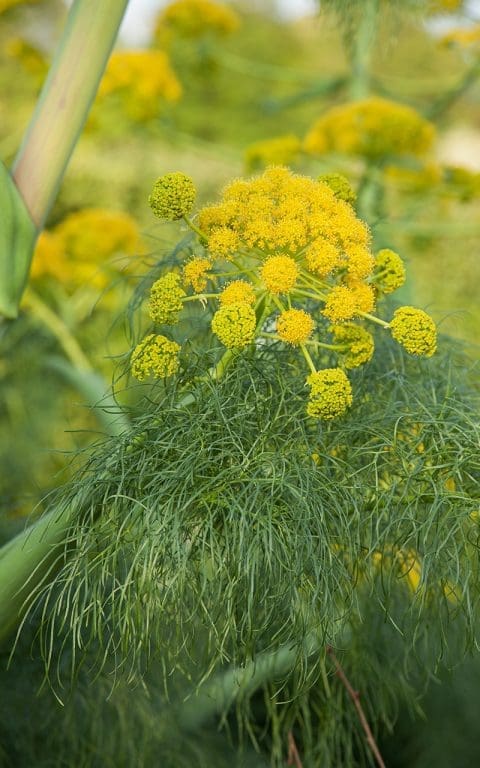
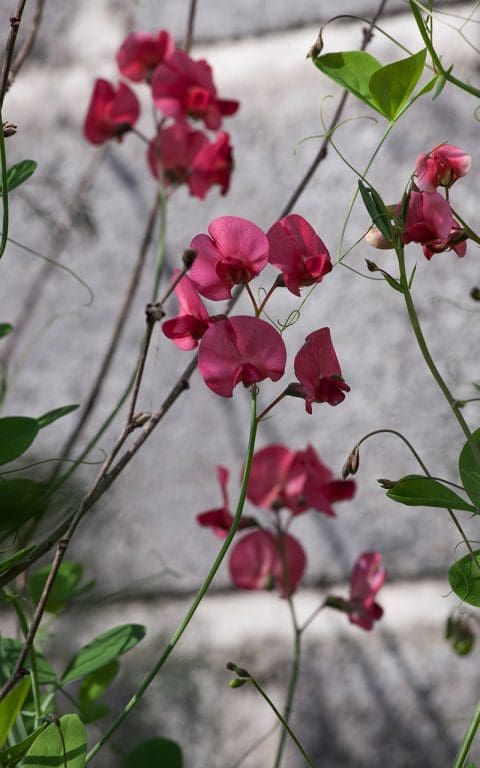
In the main garden we have a possible cross between Ferula communis and F. tingitana. Passed to me in a brown paper bag by Michael Wachter, one of the Great Dixter gardeners, with words on the bag stating “From Fergus. F. communis. Tingitana blood”. It has risen to flower this year for the first time. The foliage is more feathery again that F. communis and consistently so across all the seedlings. I have planted it with scarlet oriental poppies pushing up through the foliage to remind me of the first time I ever saw giant fennel in the Golan Heights with scarlet Anemone pavonina. Planted on the south side of the fennel foliage so that they do not get overshadowed too early in the season, I have added an early flowering pea, Lathyrus rotundifolia. With Turkish origins (which means that it is also an early riser) I plan for the pea to rise up into the net of the fennel foliage and then go on to scale the lofty tower of flower. The pea, I am hoping, will climb tall enough for the soft, carmine flower to mingle with the sharp brilliance of the fennel in flower during May and June. Both the pea and the fennel will be over and gone to seed by the time the rest of the garden has taken over in July. The pea rupturing its drying pods on a hot day with a distinctive crack and patter of far flung seed. The fennel foliage withered, to leave nothing but the architecture of the flowering stem and seed held high to be caught in late summer by wind and distributed. You have to be ready for the hole when this happens and plan for it not being a gaping one. We have Salvia ‘Jezebel’ planted in front to make late cover for the small inconvenience of bare ankles.
Words: Dan Pearson | Photographs: Huw Morgan
Published 9 May 2020
Molly is having a moment. One that has been building in anticipation since the shoots rudely broke ground at the end of winter. Lipstick-pink sheaths, bright as forced rhubarb, then smoky growth with its downy bloom like plums. Fists clenched and reaching fast in March letting you know that they are on the move, then expanding to take the early sunshine. As the buds become visible, the foliage, now apple green and glaucous, fills to form a ruff around fattening buds. Another fortnight, which tracks the plum blossom coming and going, hedgerows flushing green and the cow parsley rising to first flower, sees the buds plumping and expanding to the first glimpse of yellow. You watch daily at this point, returning again and again in the vigil for first flower. A journey that has marked the progress of spring.
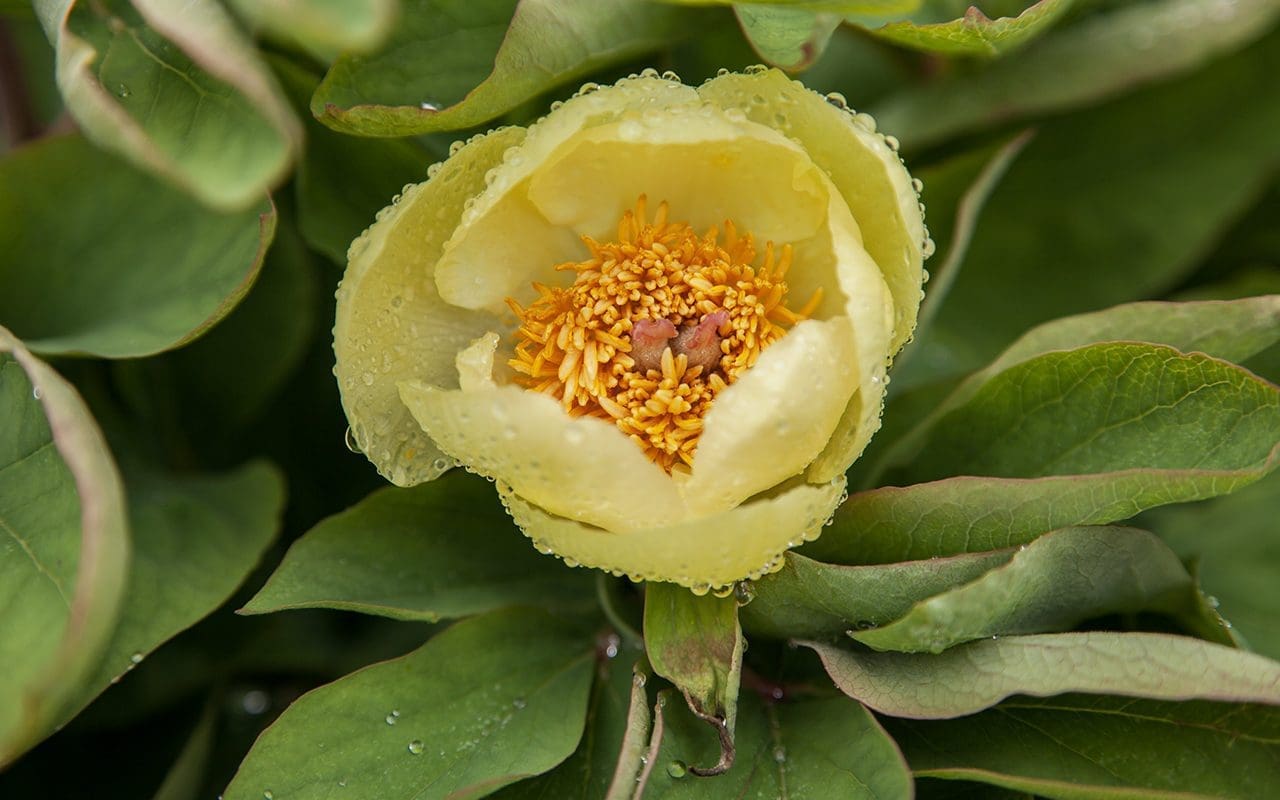
This year, they came at the end of a glorious ten days of sunshine that has seen our slopes crisp with frost in the morning, then baking, the ground opening up and cracking, so that we worried for lack of rain. It is typical of April, this changeable month, but the Paeonia mlokosewitchii are dependable timekeepers. Setting their path towards a glorious week of flower – ten days if you are lucky – then gone as the garden rises around them and your attention is drawn elsewhere.
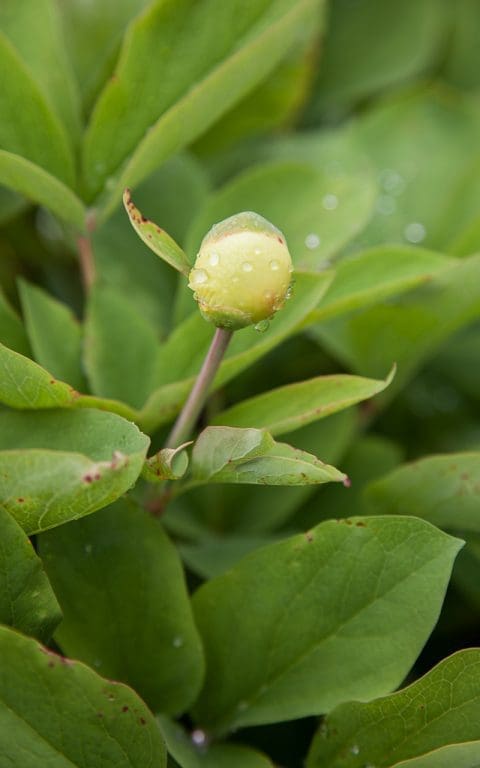
It takes time to build a good plant, for ‘Molly the Witch’ is slow and measured in her progress. Fortunately she is reliable if you find the right position and will survive for decades with no fuss. Growing in the wild in the Caucasus between the Black and the Caspian Seas, Paeonia mlokosewitchii favours rocky slopes in woods of oak and hornbeam, sometimes beech. I’d love to see them there and imagine that they must find the glades where early light penetrates and where they occupy the good ground away from too much root competition.
My eldest plants here are now about twenty years old and represent a long-held desire to grow them. I fell under their spell as a student at Wisley, but until I had my own garden had never had a place, and consequently the time, to invest in growing them for myself. When I finally did get a large enough garden in Peckham I bought five year-old seedlings from a trusted supplier and planted them in the garden where they flowered and thrived amongst the coyote willow. I layered them with scarlet Tulipa sprengeri, clumping grasses, Crocosmia ‘Lucifer’ and evening primrose for later. I left a parent plant there when we moved in 2010, but they were the most treasured of the Ark that I brought with us to start the making of a garden here. I lifted them in autumn – when peonies should be moved, as they make their root growth when going into dormancy above ground and ahead of the fast spring emergence – the parent plants were put into a holding bed on the shady side of taller perennials whist I was planning the future garden. It is important to plant peonies at just the right depth, never too deep as this will cause a plant to be blind and not flower. For this reason I keep the mulch away from their crowns, though they do love an eiderdown of goodness to protect their tuberous roots from desiccation.
Although they probably have more sun than they would like on our south-facing slopes, our heavy ground suits them as it retains moisture. They also have the summer shade of taller perennials that grow up around them to emulate their natural woodland habitat. Right now they sit amonst shimmery Melica altissima ‘Alba’, Zizia aurea and Lunaria annua ‘Chedglow’, the lustrous, dark foliage of the Honesty throwing the luminous flowers of Molly into prominence. Veronicastrum, white willow herb and late aster will cast shadow and keep them nestled once the summer gets underway.
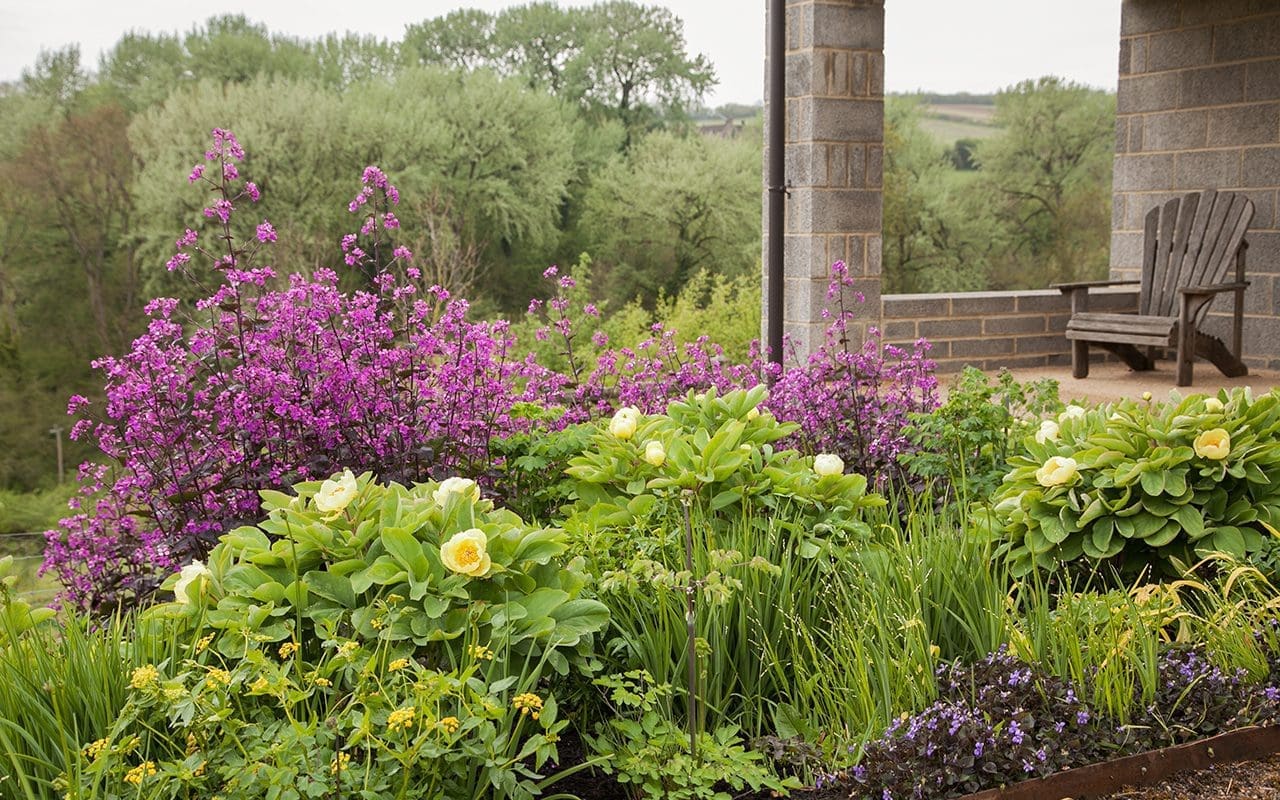
Collectively, my Mollies make a sizable group, the twenty year olds filling out to at least two feet across and bearing up to a dozen flowers each. I cannot help counting as each year brings more. One plant would have just as much magic, but an intergenerational mix with youngsters gives the impression that they are a colony that has increased over time. I am doing this more and more in the garden, dividing perennials but leaving some in the group to hint to the succession you’d find in the wild.
The plants that set seed remind you to revisit in the autumn to find the fat pods rupturing to reveal satin pink interiors and inky black seed, the size of peas. The seed must be sown fresh otherwise it goes into an enforced dormancy that is hard to break. The reserves in the seed are needed for the two years they take to germinate above ground The root develops in the first year to find its feet, waiting another before sending up a distinctive pinkish leaf. You have a wait ahead of you if you start from seed, but I can assure you that the prospect of building my family of plants has never felt like an uncomfortable wait. It has been one with a reward that never dims.
Words: Dan Pearson | Photographs: Huw Morgan
Published 18 April 2020
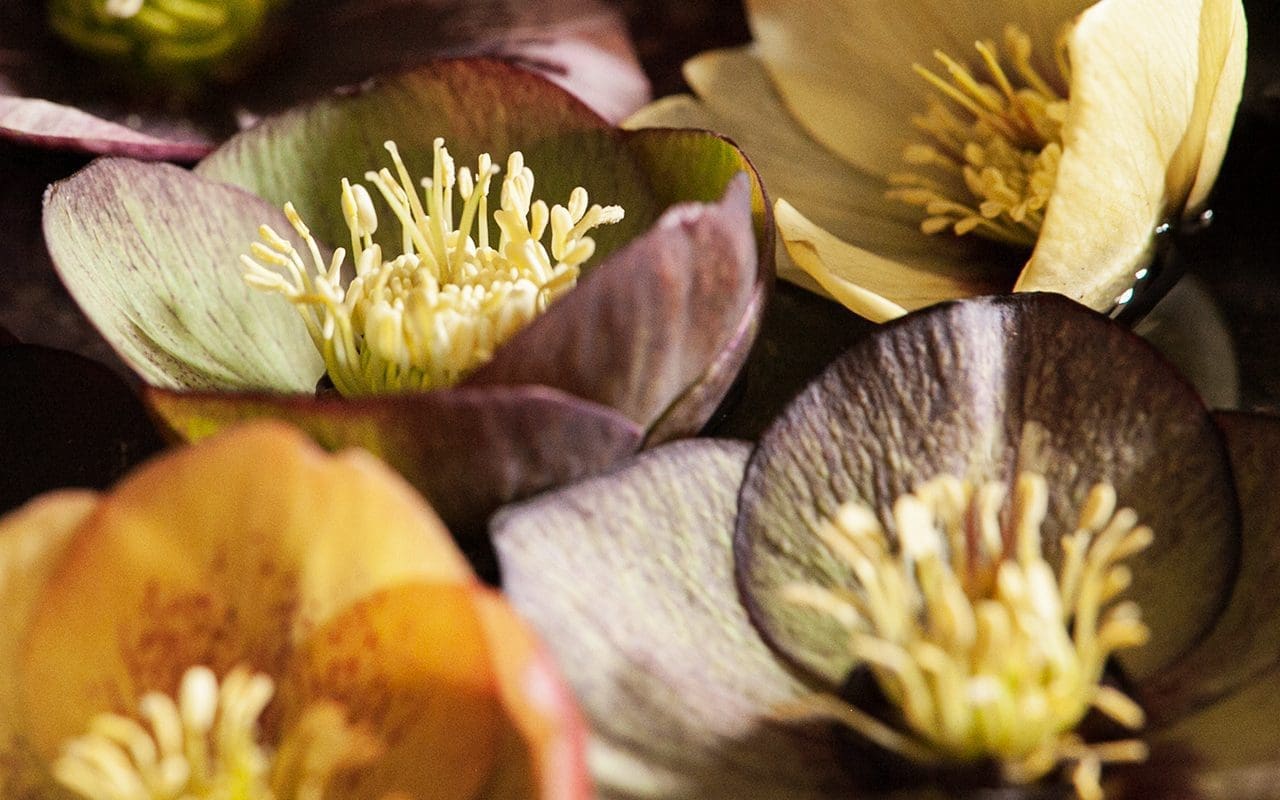
The Lenten roses were early, showing their buds prematurely at the new year as a mark of the mild winter. They have been gathering pace in these damp weeks since to arrive on cue where they should rightly be to brighten February. This is their month and their new life is my trigger to make a start clearing around them.
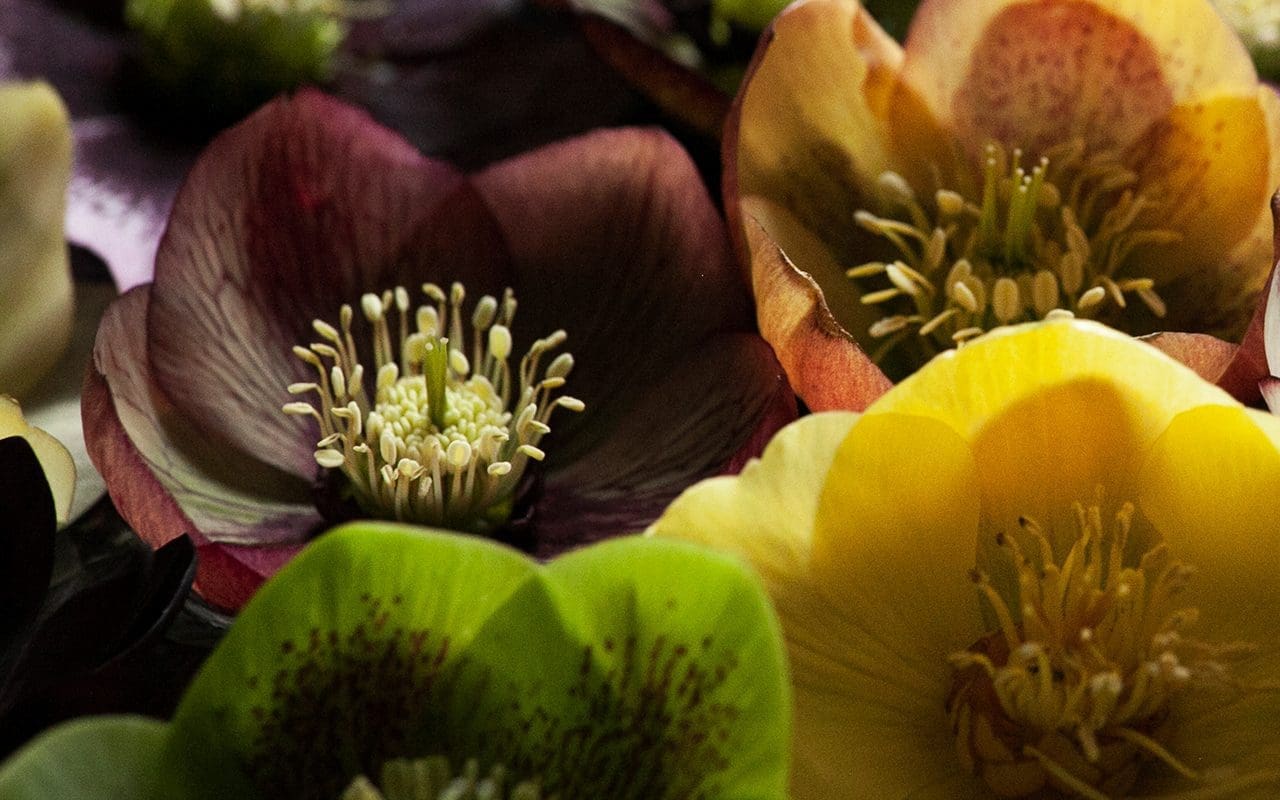
Revealed again, free of last year’s debris, they rise to their full potential to stand elegantly poised on slender stems. Their flowers, bowed and hooded against the elements, give little away and remain mysterious until you upturn them in your hand to glimpse the complexity of their interiors. We group them in shadowy places alongside the steps and are lucky here with our slopes, which allow you a glimpse from the underside into their secret interiors.
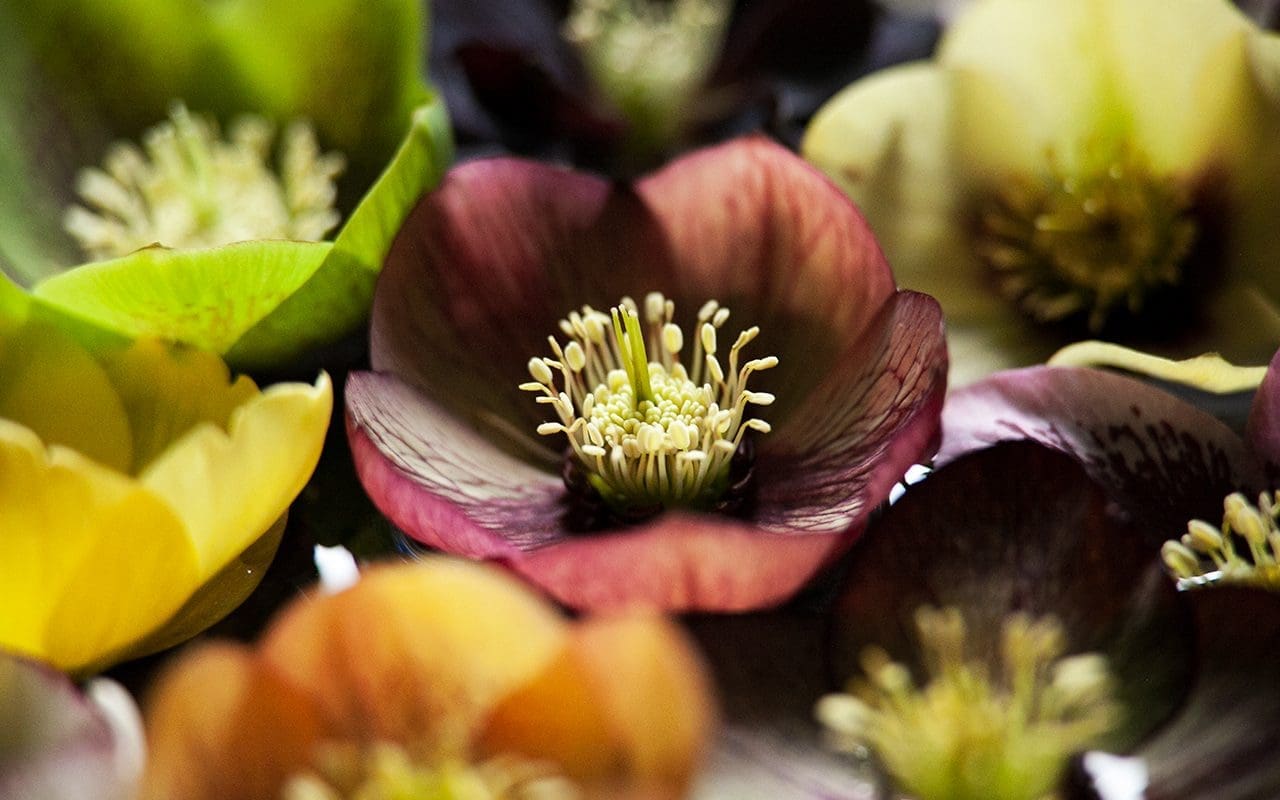
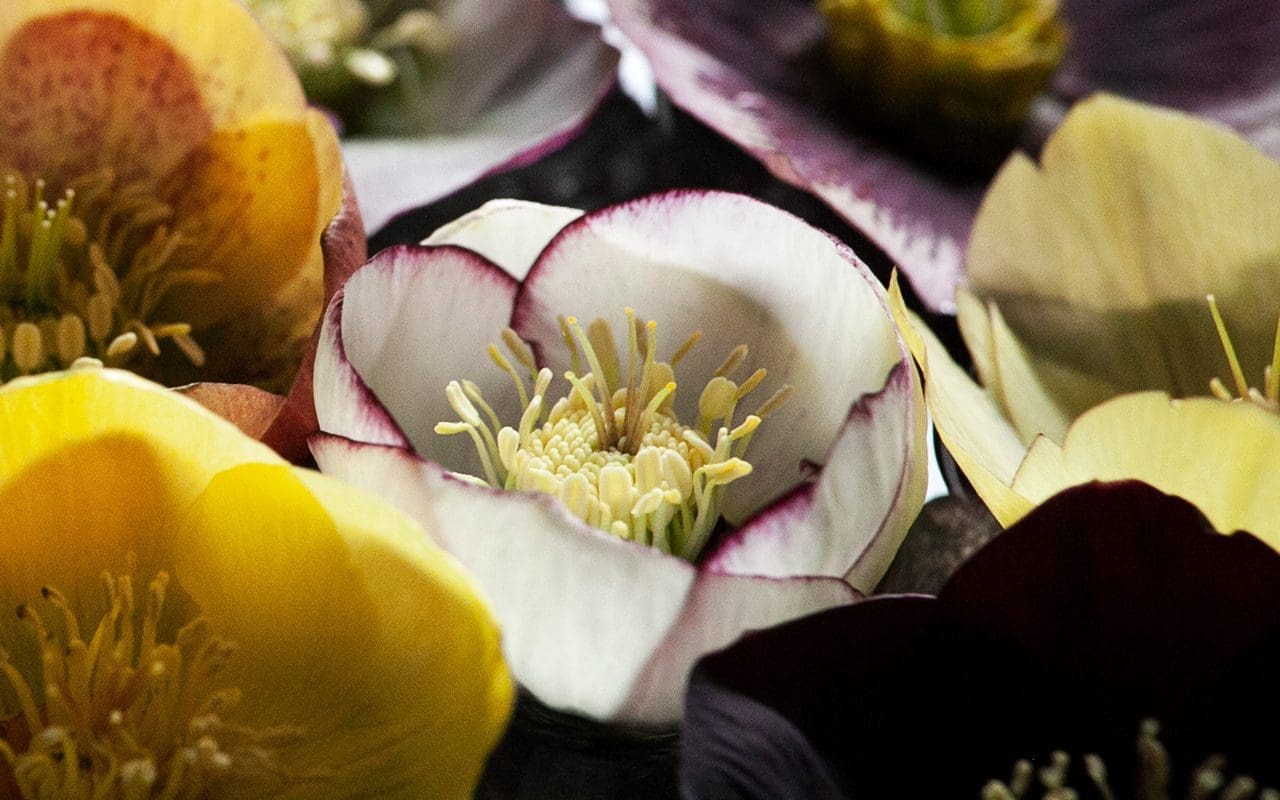
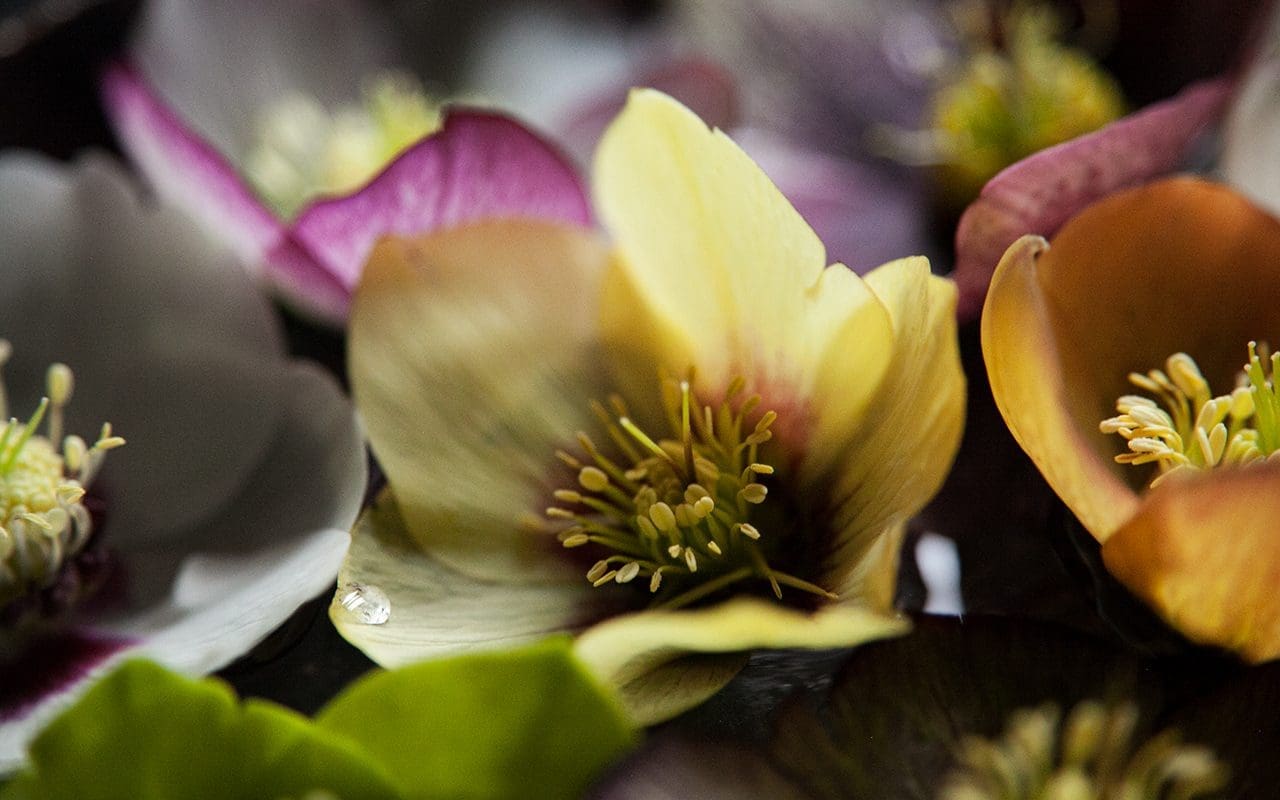
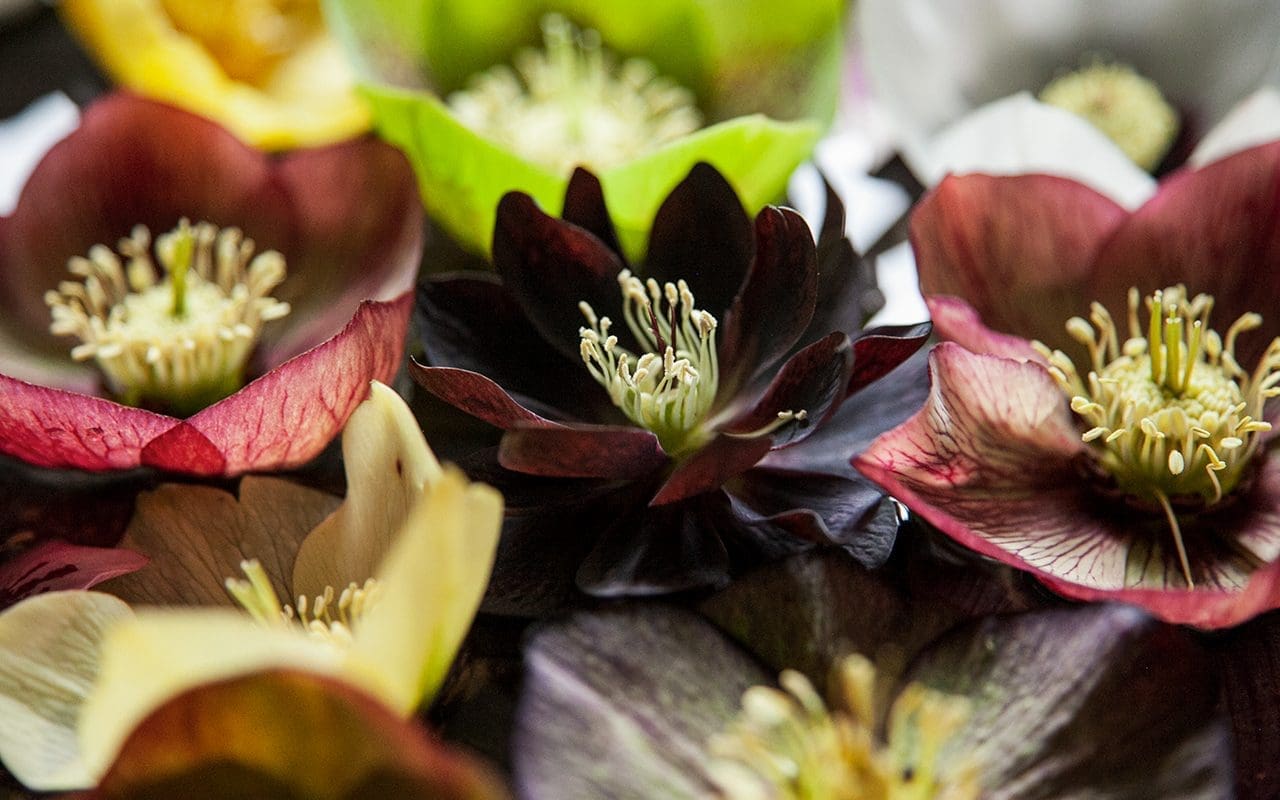
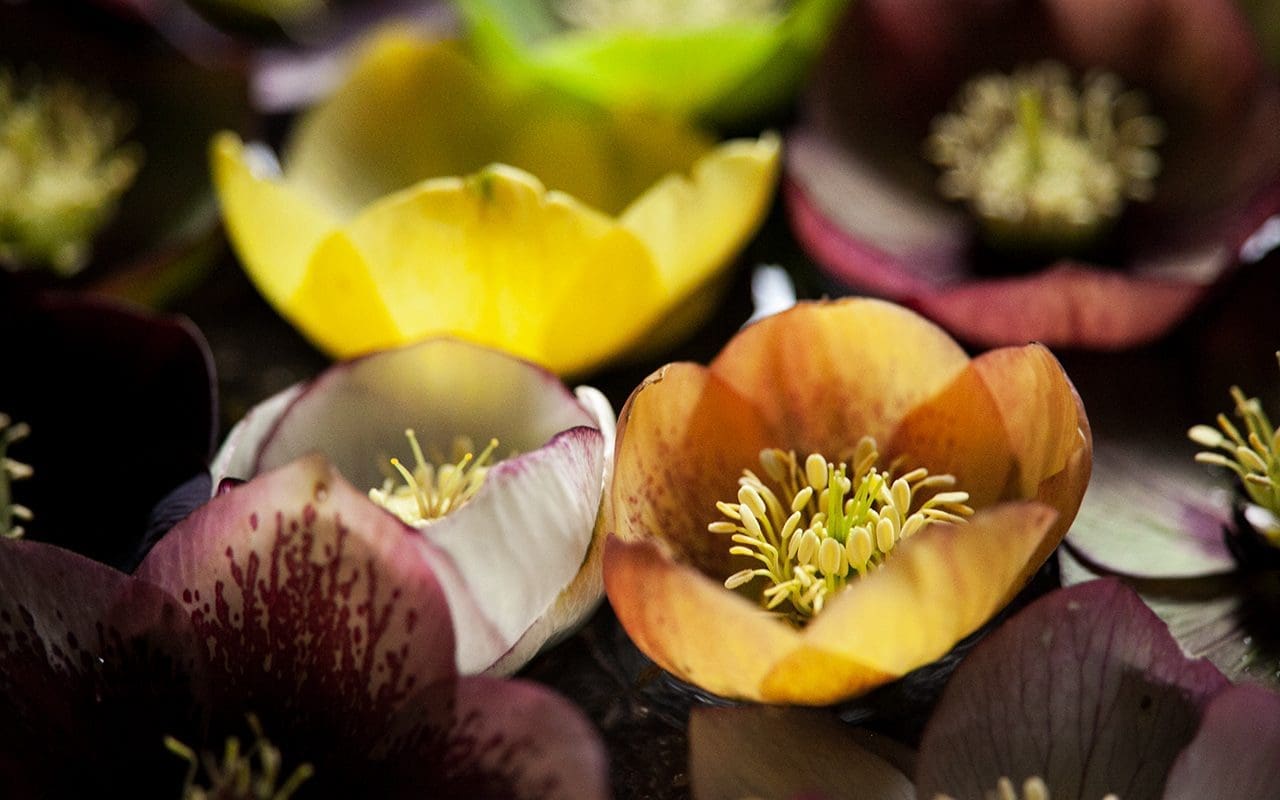
My childhood gardening mentor and friend, Geraldine, always had a bowlful on her kitchen table at this time of year. She had learned that, since the stems do not cut well, this is the best way to enjoy them up close, floating on water like offerings. Back when I was a child and Geraldine and I were swapping seedlings, we were quite content with what I would now see as murky pinks and impure whites. We had no idea then that Elizabeth Strangman and Helen Ballard were already selecting and refining the beginnings of the first good forms, many of which led to the choice we have today. Ashwood Nurseries have made an art of selection and are my go-to nursery for hellebores, but I am always on the look out at this time of year, because there is nothing like finding a new favourite.
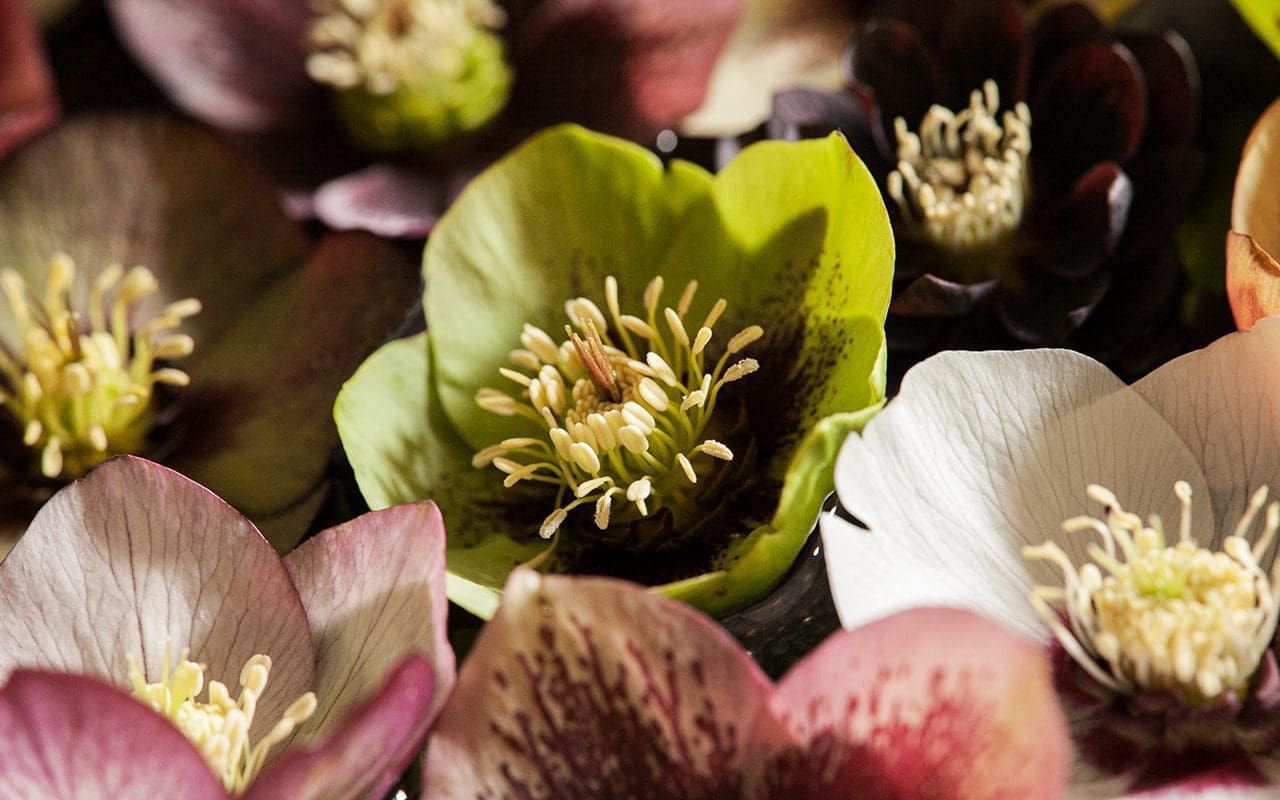
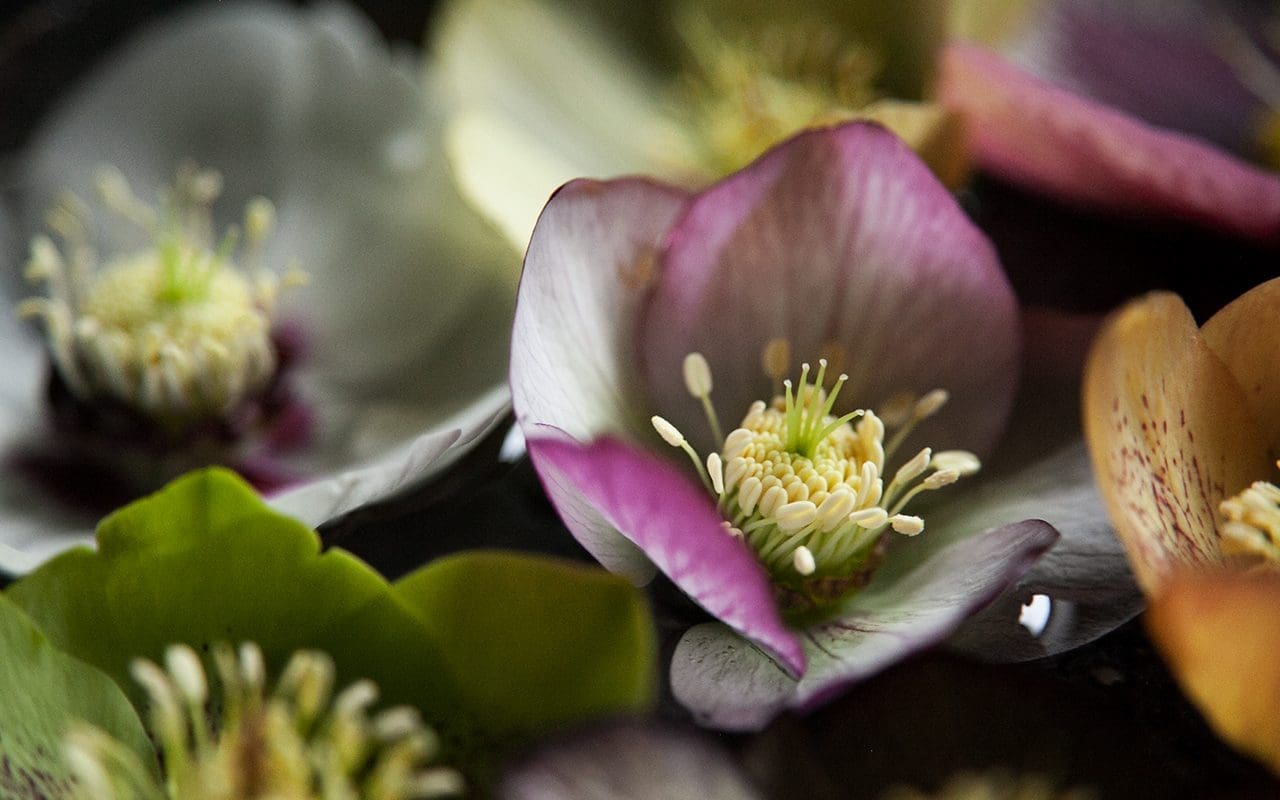
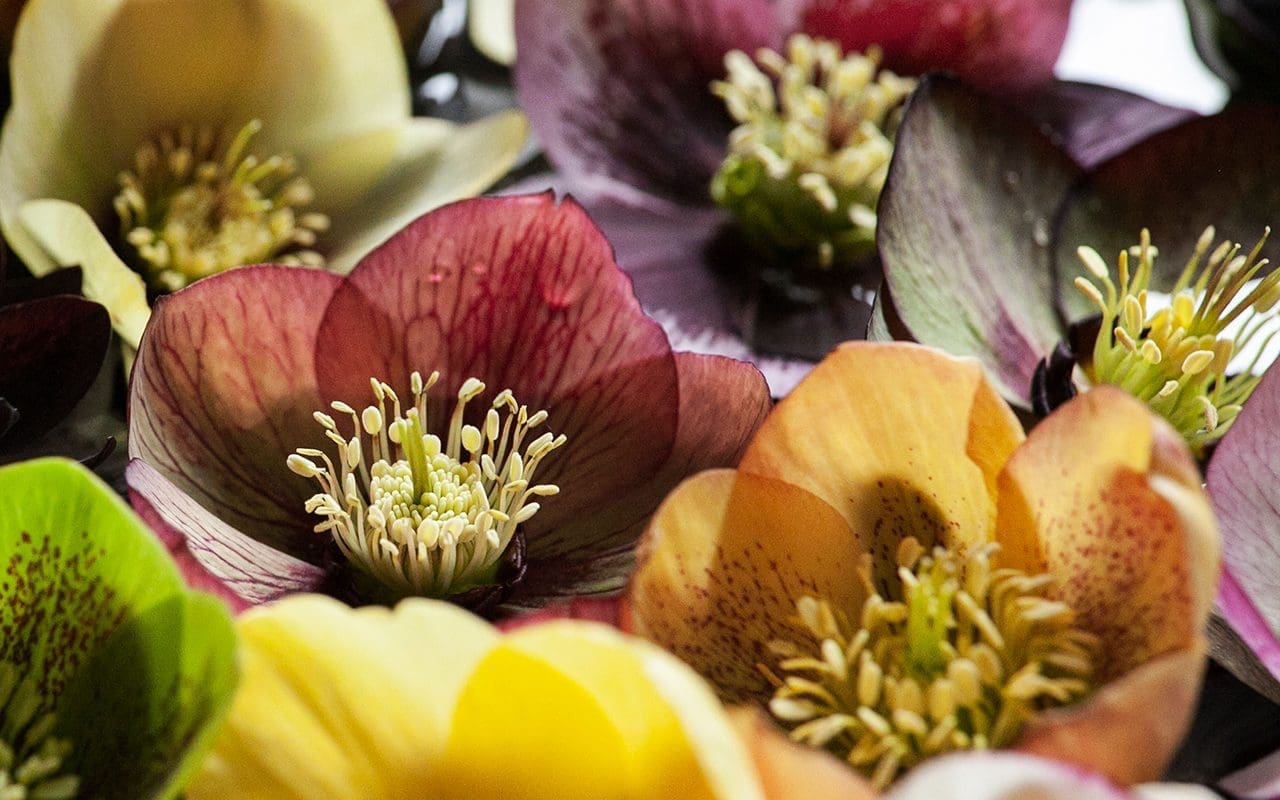
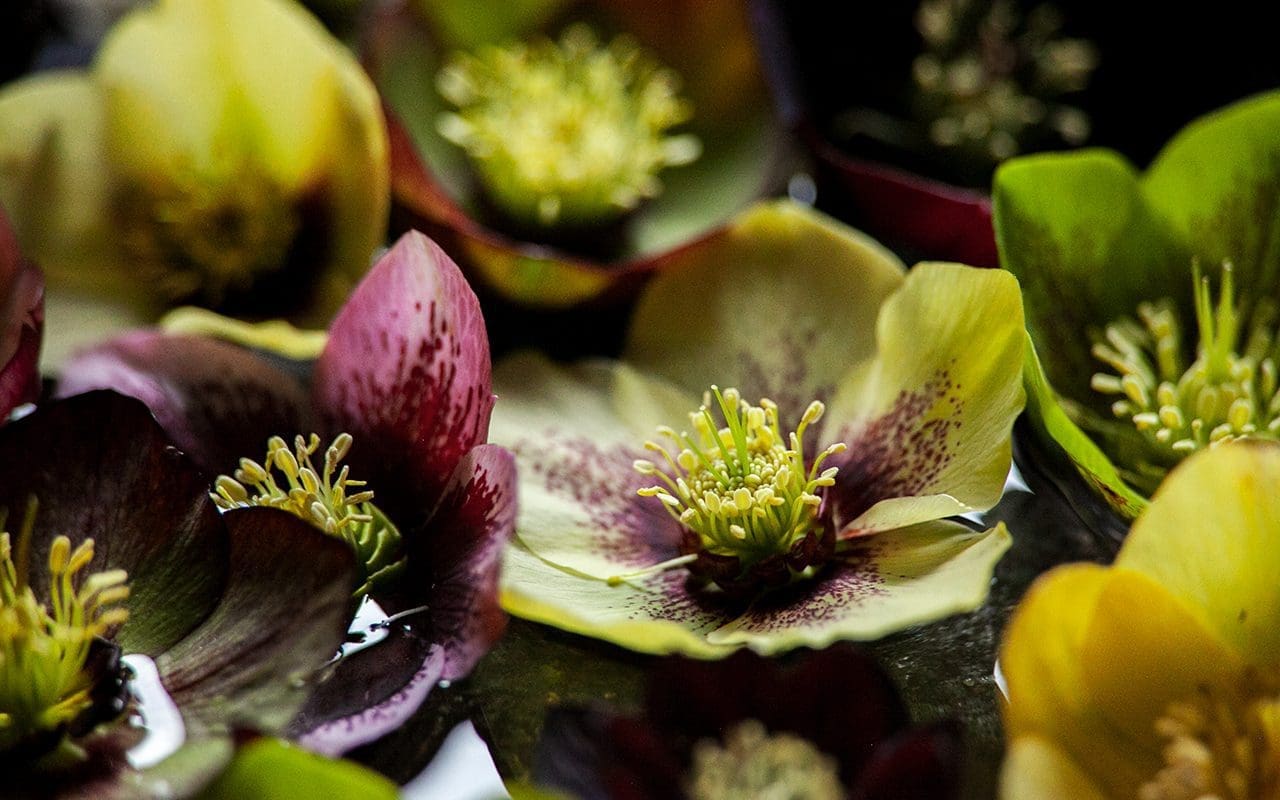
As with any infatuation, I have become very particular about the forms I grow here. I favour the singles, which sit better with the naturalistic mood of the garden and look for good poise and well-proportioned flower. You know when you see it once you get your eye in.
The cool conditions that the hellebores need in summer are rare on our slopes and the pools of shadow that I am nurturing under the trees have to be rationed. The hellebores come high on the list of shade-lovers I provide for and I have grouped them according to colour, moving from tree to tree and changing the mood accordingly. Lime-green selections to throw the black forms into relief under the Hamamelis x intermedia ‘Gingerbread’, meaty reds and plums together with the bronze foliage of Viola riviniana var. purpurea beneath the medlar. Yellows completely on their own or with the green of ferns, so that their brightness shines out in the way that primroses do on a shady bank.
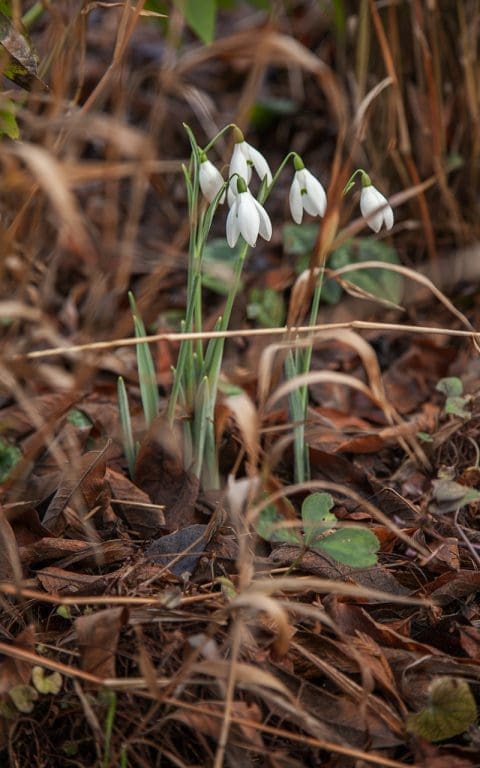
The whites get their own place too as they project a clean mood and are good with snowdrops and I like to see the picotee selections together so that the fineness of their markings is not lost in a crowd. Although I am not an admirer of the double forms, particularly the pastels, which feel overbred and out of place at this time of year, I do treasure a dark plum double of good form. We have it growing on its own under the wintersweet and I like it for its ancient, medieval feeling. When afloat it looks like an exotic waterlily.
Once the hellebores begin to go to seed, I remove all but an occasional stem in each group to curb their offspring. The parent plants can live many years, decades even, and are best without the competition of juveniles, but I am keen to see, by grouping my plants carefully, if they will spawn the odd treasure. Most will be inferior to their hand-selected parents, but some may have a special something. The seedlings retain a certain charge of expectation. The excitement of a possible new addition to the spectrum.
Words: Dan Pearson | Flowers & Photographs: Huw Morgan
Published 8 February 2020
The January garden rarely sleeps. It continues to draw itself back, the skeletons that do not have the stamina already toppled, the fallen foliage and fleshy limbs pulled back to earth by the worms. It is an endlessly fascinating watch, observing this cycle and it changes weekly. Today it is the Sanguisorba officinalis ‘Tanna’ which caught my eye, collapsed and whorled against the dirt like monochrome Catherine wheels. Close by the silvery-grey willow leaves are strewn under branches that are already plump with catkin. The old and the new starkly side by side.
Every day there is more transparency, the ground plane becoming visible again where just a month ago your eye was held still in the remains of the last growing season. The glossy tussocks of deschampsia reveal their winter green, marching amongst their now naked companions. Vernonia and thalictrum towering overhead and standing tall and well as skeletons, but better for an undercurrent of foliage. The plants that remain wintergreen are clear to see. Waldstenia ternata proving its worth as it shimmies amongst buff miscanthus and flows down the steps by the Milking Barn. Its evergreen carpet is broken by cyclamen with a push of marbled foliage and the first of the Ranunculus ficaria ‘Brazen Hussey’ and the Bergenia purpurascens ‘Irish Crimson’ which have now coloured, their ox-blood leaves burnished and light reflecting.

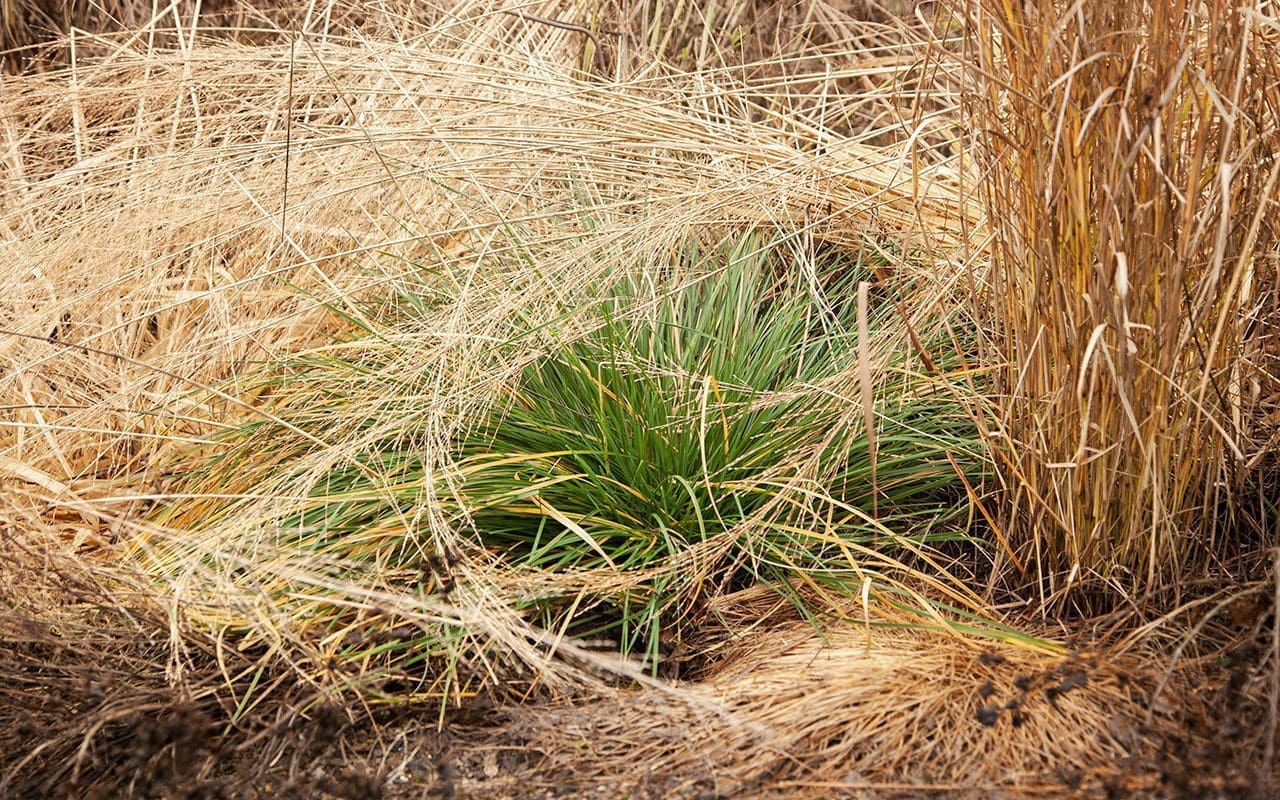
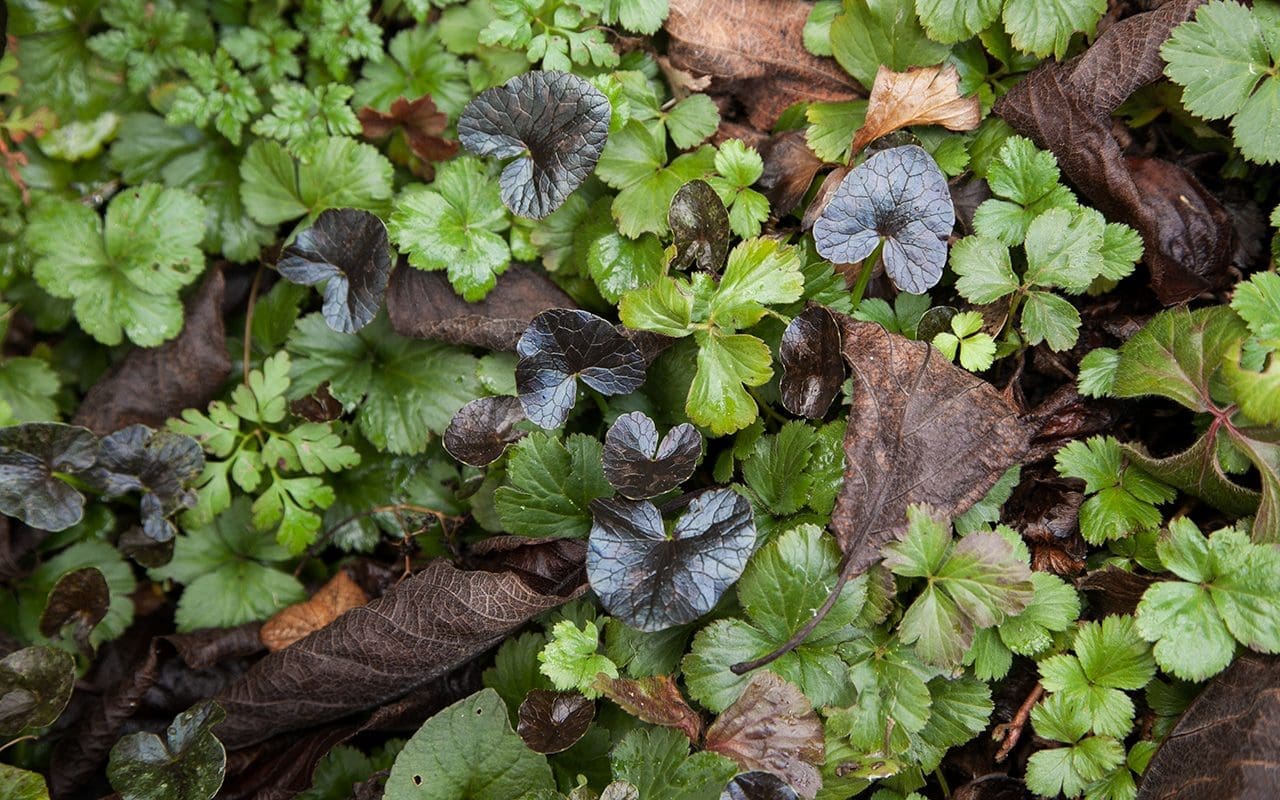
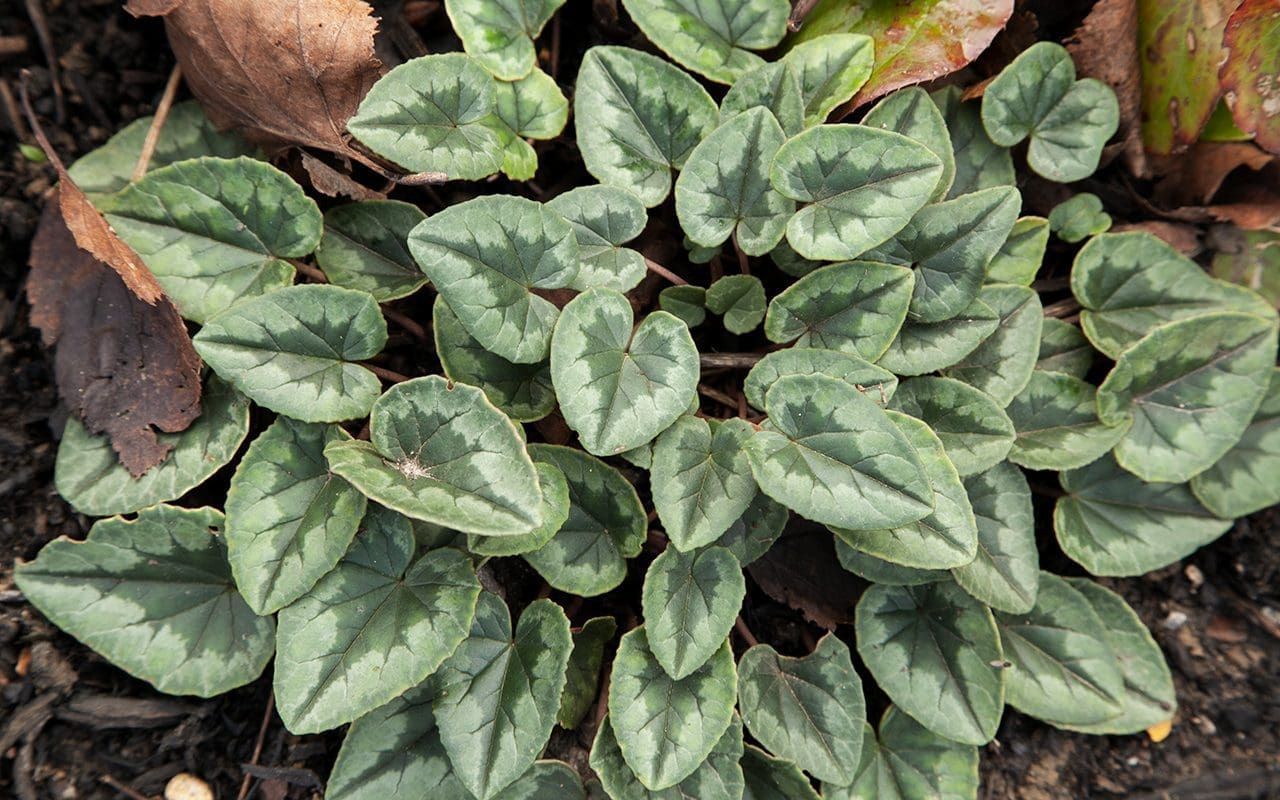
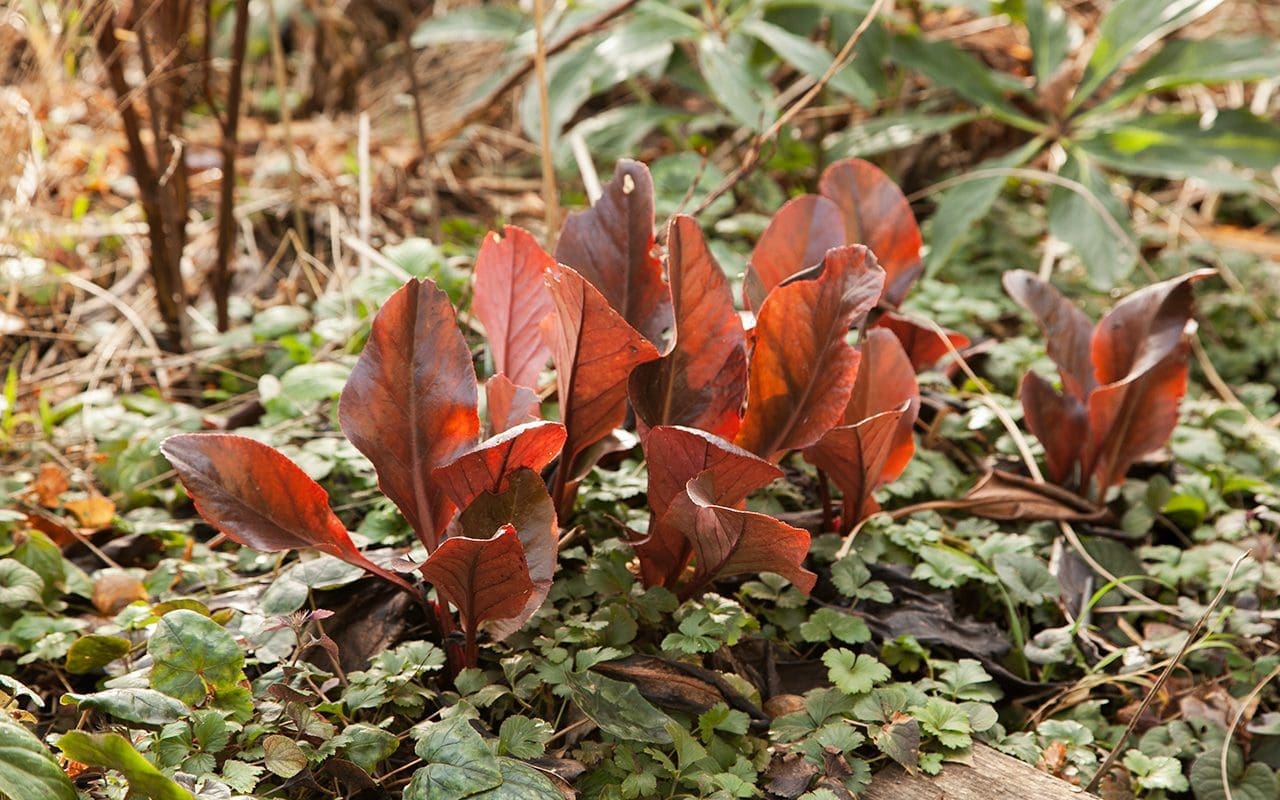
The layering in a perennial garden and under deciduous shrubs is more important than ever in the winter and where the soil is left open to the elements you can see that it is looking exposed and battered. My aim in time is for the greater majority of the garden to be cushioned throughout with plants that are happy to live in the understorey, much as the primroses and violets do in the shadow of the hedgerows. I have taken their lead and brought them into the garden. The violets are more than happy to disappear amongst the summer froth of Erigeron, but as soon as winter hits they come into their own again with evergreen foliage and the perfume of flower as soon as the weather warms. These shade-loving groundcovers also make a stable environment for groupings of bulbs which you can leave there undisturbed and safe from cultivation.
The reveal of plants that you haven’t seen since the cover of summer becomes a new point of interest. Epimedium sulphureum, so wonderfully reliable in the shadows and Heuchera villosa var macrorhiza with its emerald, light-absorbing leaves. I have started to group erythronium amongst the heuchera for the sanctuary of its long-lived cover, in the hope that the shadow of summer perennials that rise in turn above them will be enough to cool the Dog’s Tooth Violets on our sunny slopes. I have done much the same under the mulberry, where the pool of spotted Pulmonaria saccharata ‘The Leopard’ is somewhere I look onto and enjoy for now, but also for the prospect that is held there for the spring.
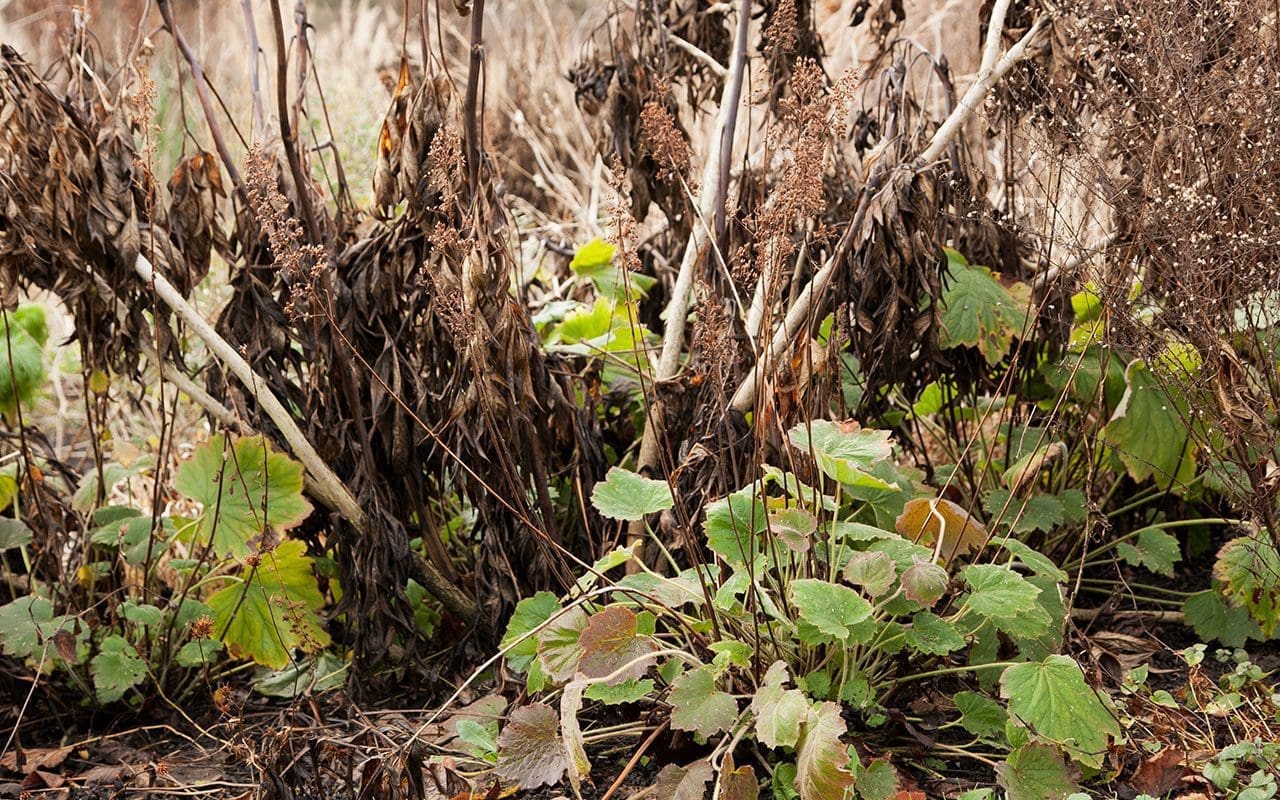
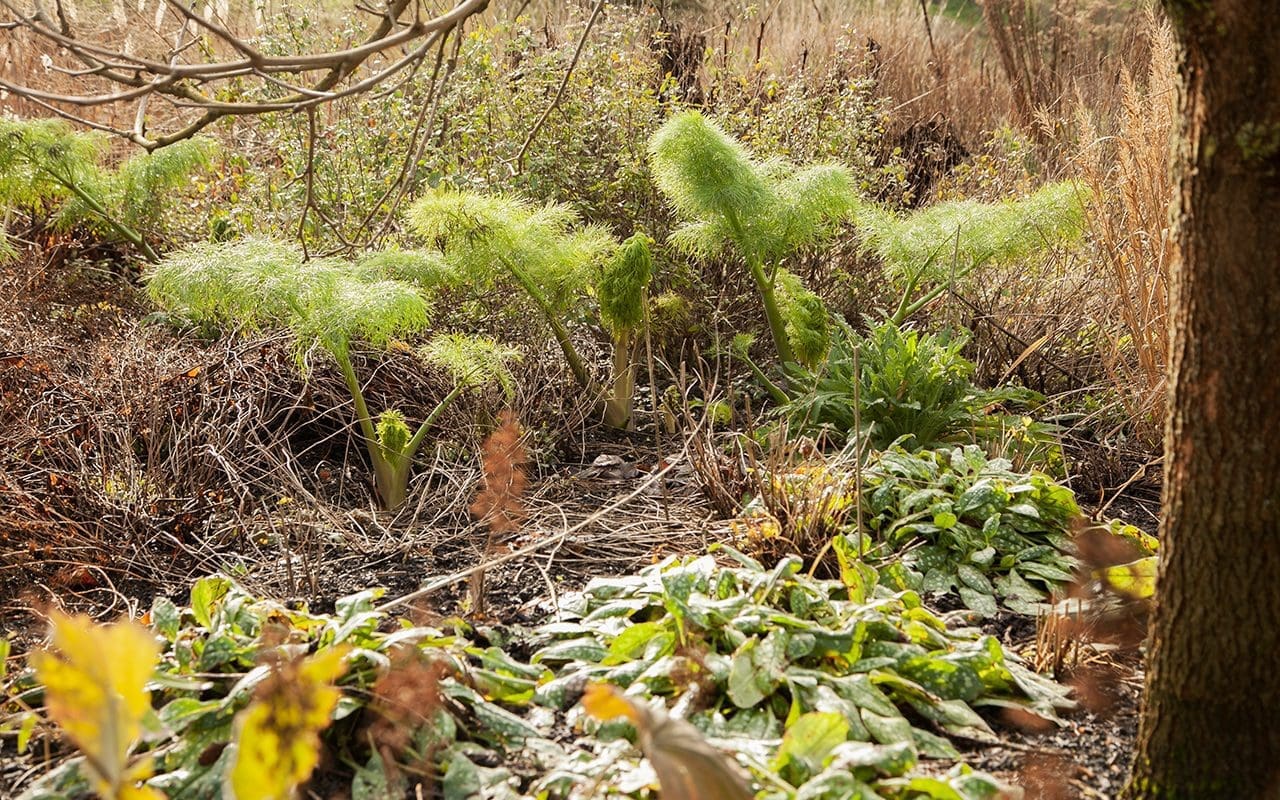
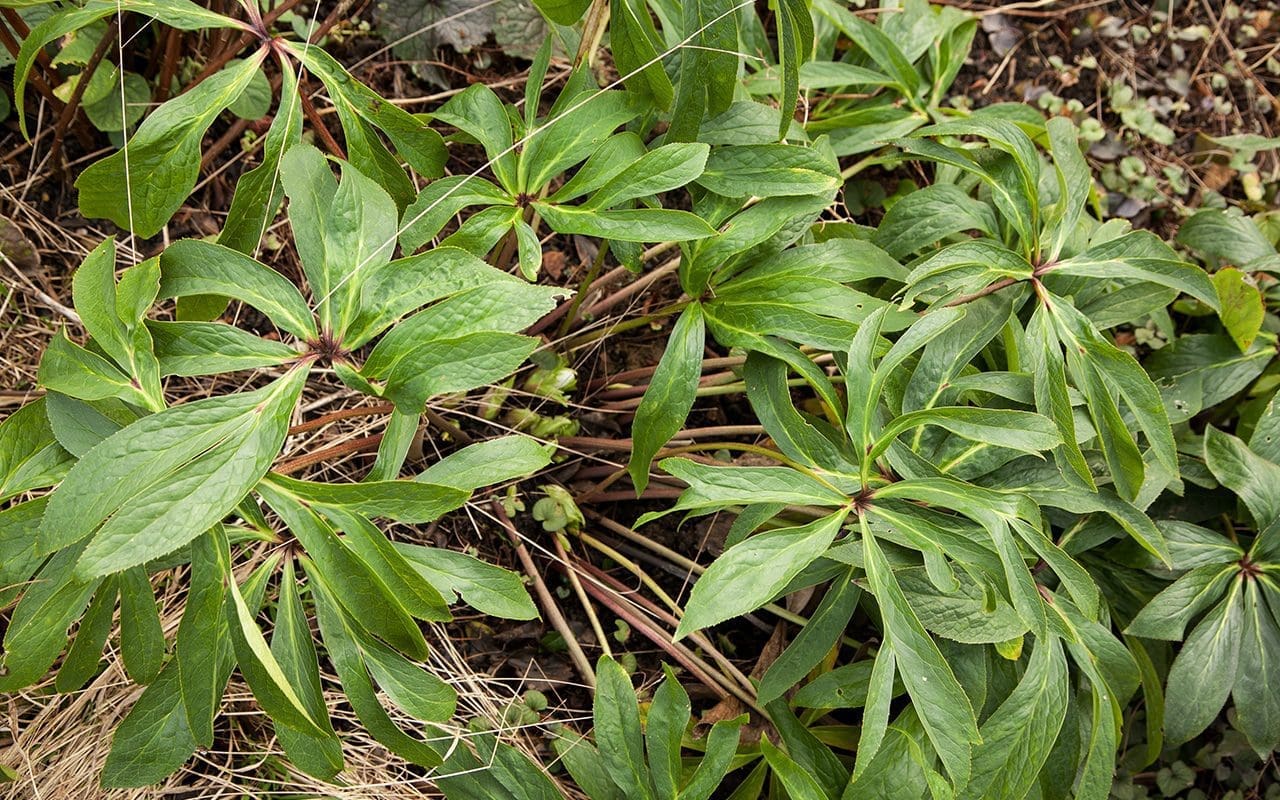
I leave the whorls of hellebore foliage until the very last minute before cutting back, enjoying their leatheriness and the hunkered-down feeling the Lenten Roses bring to a garden. Though I know it is ‘good practice’ and easier to cut away old foliage before the flowers start to rise, the sense of loss is greater than the inconvenience of removing the leaves once the flowers push and have momentum. I am pairing the Hellebores with Corydalis ochroleuca in the shade and Viola riviniana ‘Purpurea’ where there is the winter sunshine the violet needs to keep the foliage coloured strongly purple.
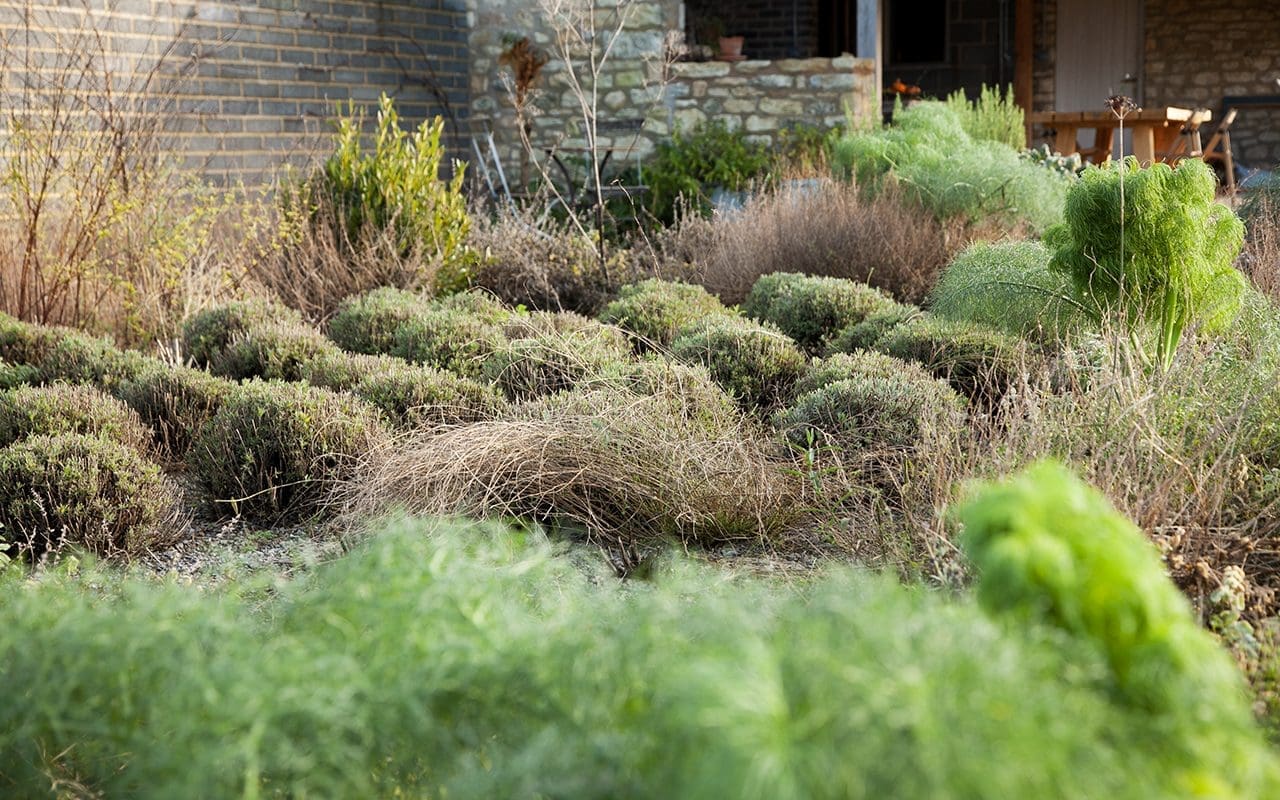
The sun is important to some winter greens and, where the planting is not layered to such a degree, they play an equally important role. The felted silver of Ballota pseudodictamnus and neatly pruned cushions of lavender are the making of the herb garden in the winter. On the damp days, when there is moisture in the air, the Salvia candelabrum hunkered against the trough (main image) shimmers with an outline marked by a million droplets of water.
The giant fennels take this winter season to make their growth, pushing dangerously yet fearlessly against the tide it seems. Last February snow took its toll, crushing and blackening their finely-spun nets and making me wince when I looked at them until they regrew. For now, however, their fresh verdance is welcome. Life in the green and a good feeling with it.
Words: Dan Pearson | Photographs: Huw Morgan
Published 11 January 2020
We are sorry but the page you are looking for does not exist. You could return to the homepage