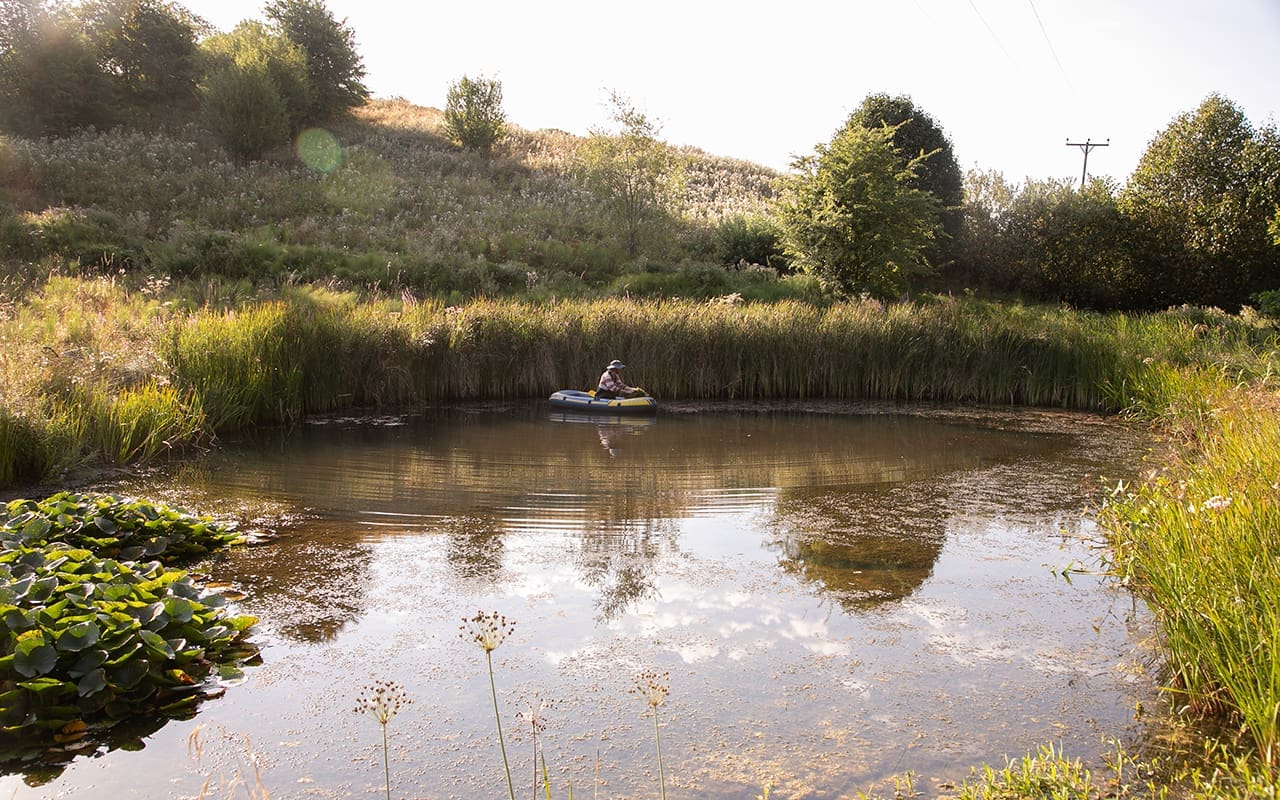
The pond has provided such respite this summer. With a gravity all its own and a cool place of apparent calm and consistency. Descend the slopes into its orbit and the temperature drops as the smell of green hangs in the air. You feel instantly that you are an intruder upon a place that has rapidly attained its own order and it is hard to believe that the pond is just in its fifth summer, with its soft edges and thrum of wildlife.
Five years ago this August we were midway into the project. We worked in the driest months for the excavation, choosing the lowest hollow of the field and a place where it felt like still water might naturally congregate. We’d witnessed pooling here in the years of imagining this place, but the water never stayed for long after deluge so it was necessary to roll out a bentonite clay liner once we’d excavated the hole. We tapped a spring to feed the pond and as the water brimmed, a still descended that has never left this place. Within days there were water boatmen and late season dragonflies scoping its potential. That September, after rain and whilst the soil was still warm, we sowed the margins with three seed mixes to inoculate the disturbed ground. A wetland seed mix from Emorsgate Seeds where the water wicked on the banks, the immediate flanks with seed harvested from Clattinger Meadows, which are famed for their fritillaries and marsh orchids and the St. Catherine’s Valley mix from our neighbouring valley to feather the disturbed ground back into the slopes above.


The haze of green from the sowing was with us by the time the autumn had run its course, but we waited until May of the following year to plant the native marginals. Tiny plug plants were pushed into the warm mud and quickly formed an impression in the first summer. We had flowering rush (Butomus umbellatus) within weeks and slower growing perennials such as the marsh marigold already performing the next spring. But today the sown marginals have come to fruition, with first orchids and the summer long a succession of natives that have outstripped the meadows in their longevity and haven’t flinched in the heat. The yellow daisies of common fleabane (Pulicaria dysenterica) telling you where the moisture wicks and the purple loosestrife (Lythrum salicaria) rising head and shoulders to score bright verticals. The wild angelica have found their way into the mix now and for the first time this year we are seeing the Devil’s Bit Scabious that I sowed later from plants growing up in the garden, but would rather be where the moisture is.
The reason we feel like an observer than the conductor of the pond, is that the water has a life force that is altogether less manageable than the time we have to hand. So after the initial energies of making the pond our time and inputs are measured now to sit alongside the life cycles that dictate when we can intervene. We cut only one bank each winter and alternate from year to year before frog spawning so that there is cover on the one left standing. We remain hands-off then until late summer. Interlopers such as the alders that seed into the margins from trees I planted nearby to stabilise the stream margins are winkled out before they get a hold and the most aggressive interloper, the Canadian pondweed (Elodea canadensis) is pulled now on an annual basis.


We think Elodea must have arrived on water birds’ feet from a fishing pond up the valley. Throughout the growing season, it takes every square inch of water it can consume, rising to the surface to break the reflective surface and forms a layer of rotted material at the bottom of the pond that drives the nitrogen levels up to produce even more growth. We accept it is also a habitat for the caddis fly larvae and a raft that the moorhens can scurry across, but in time it will silt up the pond, so if we did nothing, we would lose the diversity that comes with clearer water. We did introduce grass carp to try grazing the elodea back into balance, but in creating the pond we have also attracted a local otter, herons and peregrines, which together have dispatched the carp in a swift and efficient eradication. It is good to know we have these other creatures, but the environment we have made has to be accepted as a battle ground we should learn from, but will ever will be able to conquer.
Our late summer task for now is to pull the elodea, which was done this year with the help of Johnny (main image) and Suzanne, one in a rubber dingy, the other on the bank. The pondweed is left on the edge of the pond on a palette for long enough for any pondlife that may be entangled in its tresses to crawl back to the water’s edge. We then make an eco-pile just a few metres away that is allowed to rot down for a year and converts into the richest, crumbliest compost. A mulch that is applied to trees and shrubs that are growing in the wilder areas and need a helping hand to get their head and shoulders above a world that is way beyond our control and, if truth be told, is all the better for it.
Words: Dan Pearson | Photographs: Huw Morgan
Published 22 August 2026