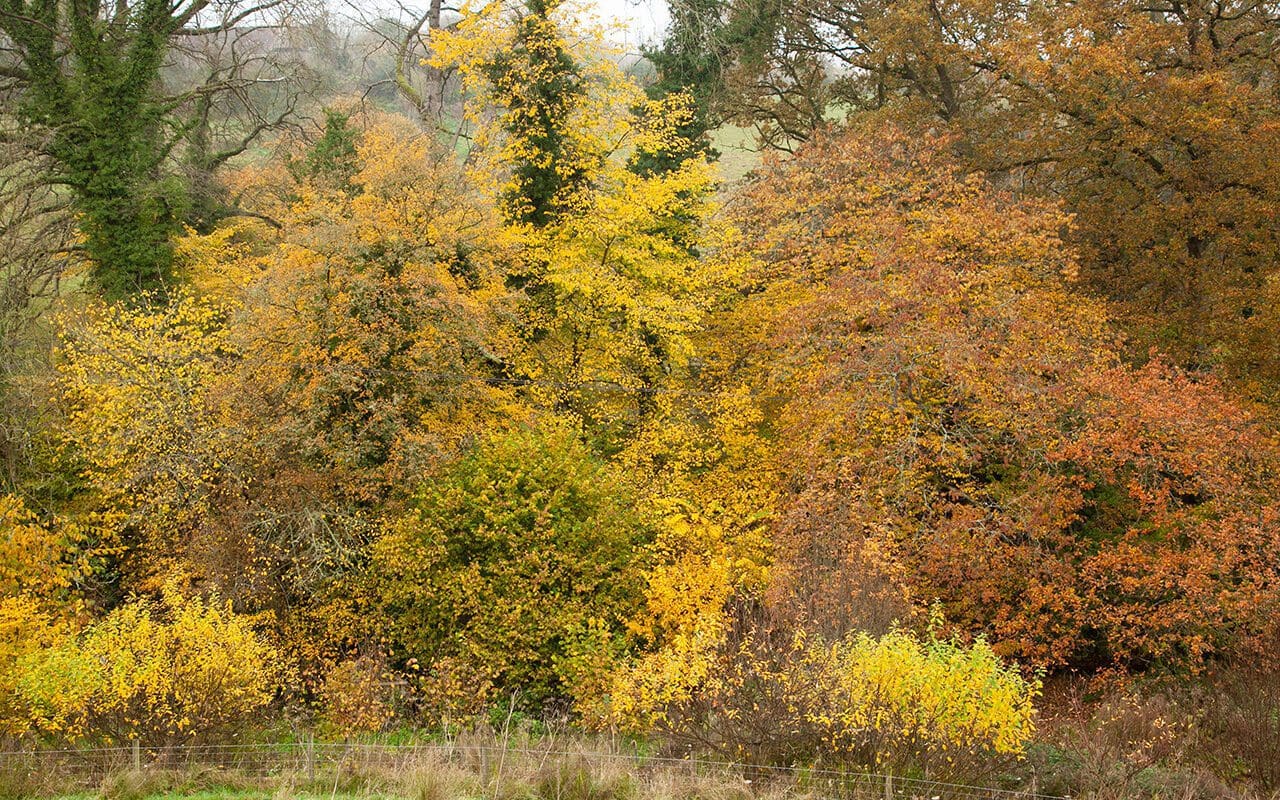
A benign autumn has drawn this beautiful season out and the wood below us, our backdrop and litmus for seasonal change, has taken its time. The poplars are the first to return to bare bones, their sage-green plumage blackening before it falls the distance. Standing grey-limbed and newly naked, their retreat into dormancy reveals the relationships in the wood. A pool of yellow where the hornbeam are happy under the poplar’s influence and the luminous understorey of hazel. Casting my mind back to spring, the Corylus were last visible when they stirred with creamy catkin and it has been the summer since we were aware of them on all but the fringes. As late to lose their leaves as they were early to catkin, the last fortnight has seen them flare a second time, but it won’t be long before the winter sun once again falls to earth to graze the contours and the silvery line of the stream.
Although the wood is separated from our perch on the hillside by the slopes that run below us, when you are immersed in the garden, the wood is drawn deliberately close. Walking the paths in the tall autumn garden, the two become one, working at different scales but on the same principles. The layering of taller plants revealing the understories and movements of plants that now come into their second season. Panicum that ignite as they colour and the butteryness of the Euphorbia that step through the planting and bring it together as the hazel does in the wood.
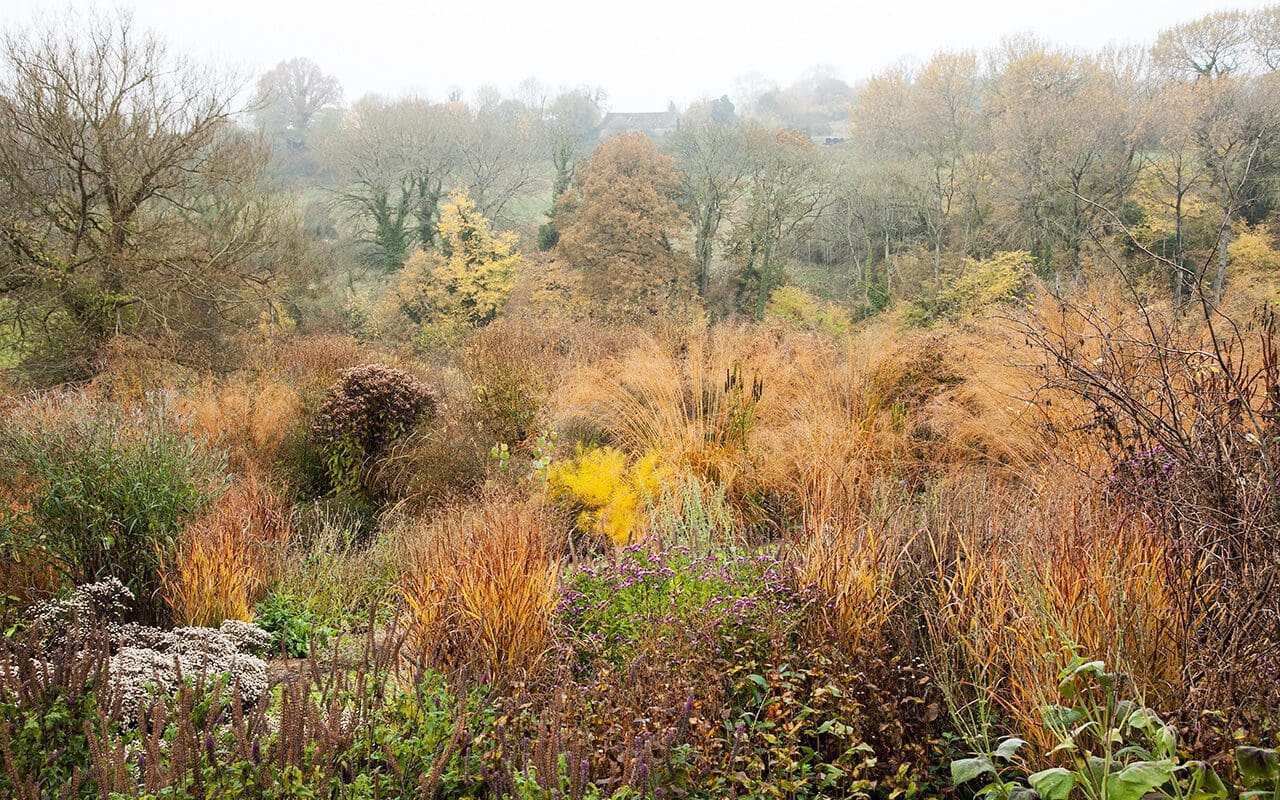
Brightest of them all in this last run of colour are the Amsonia hubrichtii, the Narrow Leaved Bluestar from Arkansas. Their first moment is in early summer when they break a late dormancy and race to flower when the garden is flooded with energy. At this point they are more flower than foliage, clusters of blue-grey stars appearing around knee height and at the reach of their stems. Though undeniably pretty, they are modest plants and are the support act to the Iris sibirica through which they are planted. Once their flowers dim you all but forget about them as they quietly fill out to form a mound of needle-fine foliage.
I have kept the plants deliberately close to the path so that they have enough sunshine to remind them of home and their place in open grassland. They are staggered on both sides of the path so that the path and the repetition allows your eye to carry as it does in the woods with the glowing hazel. Those that catch the best of the light have done better than those that get overshadowed, so it is worth remembering to keep them in the company of plants that come later in the season and do not crowd them out when they are building up their strength for seed production and another year. When they are happy, Amsonia are long lived plants, happy to sit in one position like a peony or a baptisia, going without division or additional cosseting.
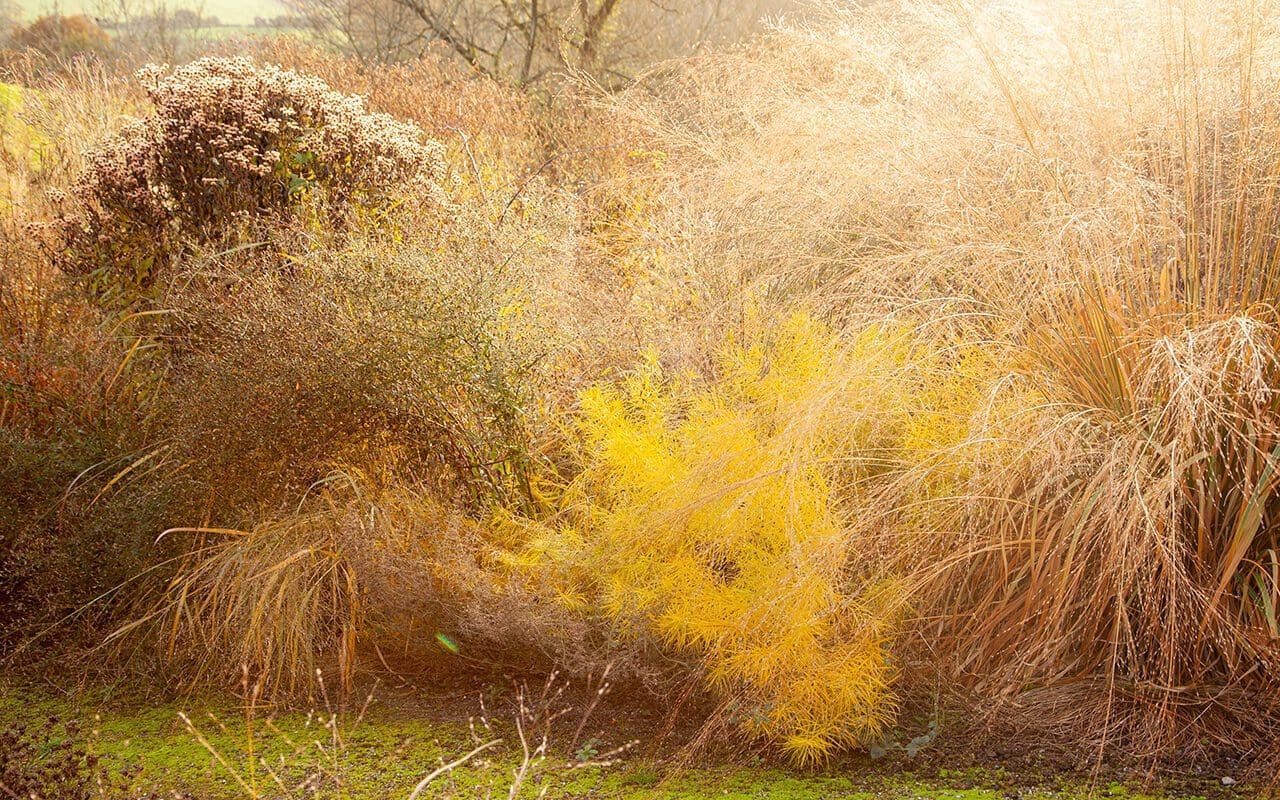
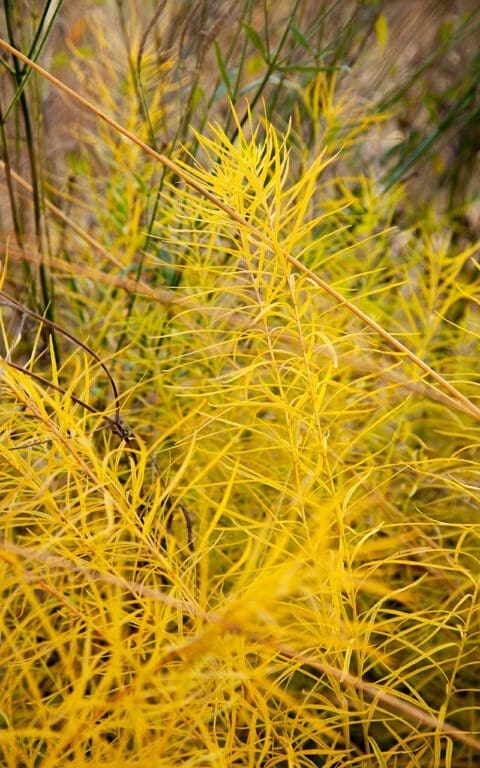
In tandem with the last colour in the woods, the Amsonia have become more luminous in this final fling. Lighting up as if from within, they are visible again under the Molinia, giving the last of the asters the company they need to not feel alone. If their autumn blaze had a function other than to bring us pleasure, you could say that they were quietly planning for this moment. Their flash of glory before winter finally takes hold.
Words: Dan Pearson | Photographs: Huw Morgan
Published 20 November 2021
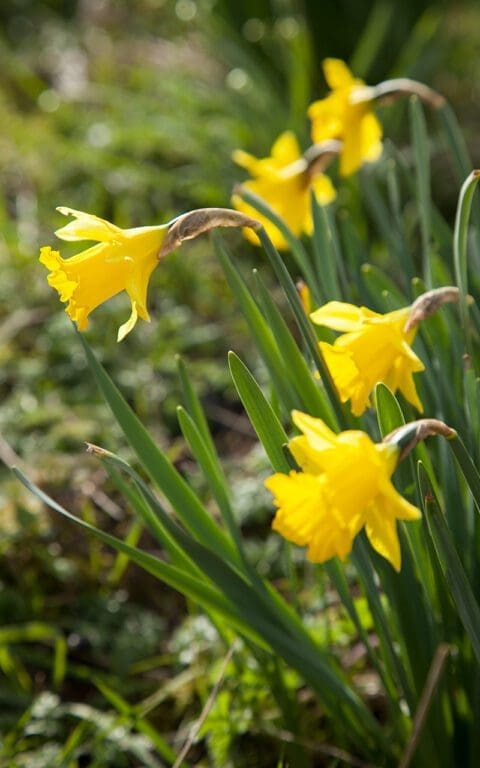
The Tenby daffodils are flaring on the banks that fall steeply into the ditch. Backlit by morning sun they are the purest of yellows, brilliant and bright and so very full of life. The tilted buds are already visible breaking their sheaths as the snowdrops dim and the primroses take over and begin their moment. The narcissus join them then, not to overshadow as you might think, but in a partnership of yellows, the colour of spring and new life.
Now considered a subspecies of our native daffodil, N. pseudonarcissus subsp. obvallaris is found locally near Tenby in Dyfed, South Wales, where they have a small range of natural distribution. Their cousin, N. pseudonarcissus, is variable, with a soft yellow trumpet and palest yellow petals, so a group registers quite differently and they have a softness that sits easily. Not so the Tenby daffodil which is brazen and to the point, being bright chrome yellow throughout. Though this might not be easy in a larger daffodil, the Tenby is no more than a foot tall and everything is perfectly proportioned and neat. Thus they weather the March storms and stand like a person with innate confidence that is happy in their own skin.
The crease in the land that we call the Ditch is far more than that. It is the divide between the ground that we garden and the rounded rise of the Tump that we look out upon and forms our backdrop to the east. The spring-fed rivulet that runs quickly down it is constant and gurgling, even in summer. The silvery slip of water was revealed when we cleared the brambles 10 years ago and fenced it on both sides so that this distinct habitat could become an environment of its own. We have been building upon the nature of this place ever since. Splitting the primroses that sit happy in the heavy, wet ground and stepping plants through it that are either closely related to the wild plants that thrive there or feel right and can cope with the competition.
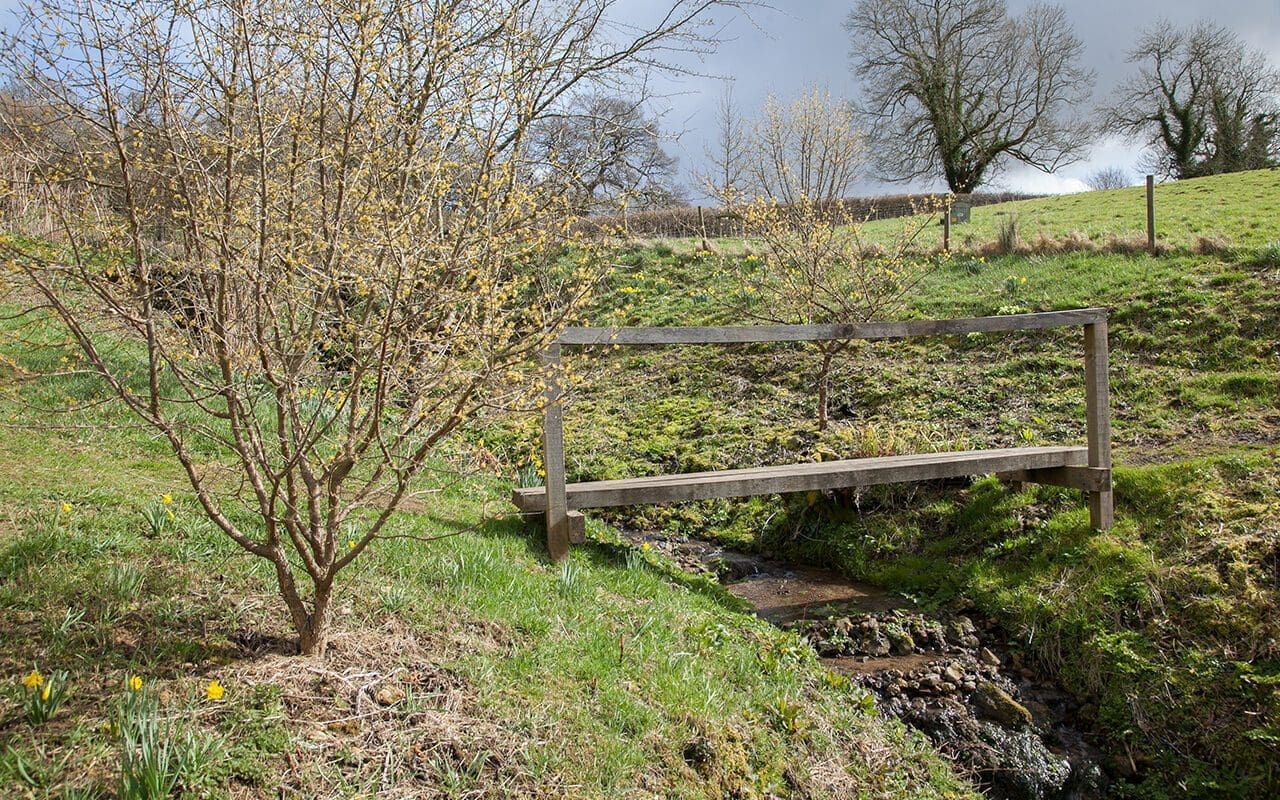
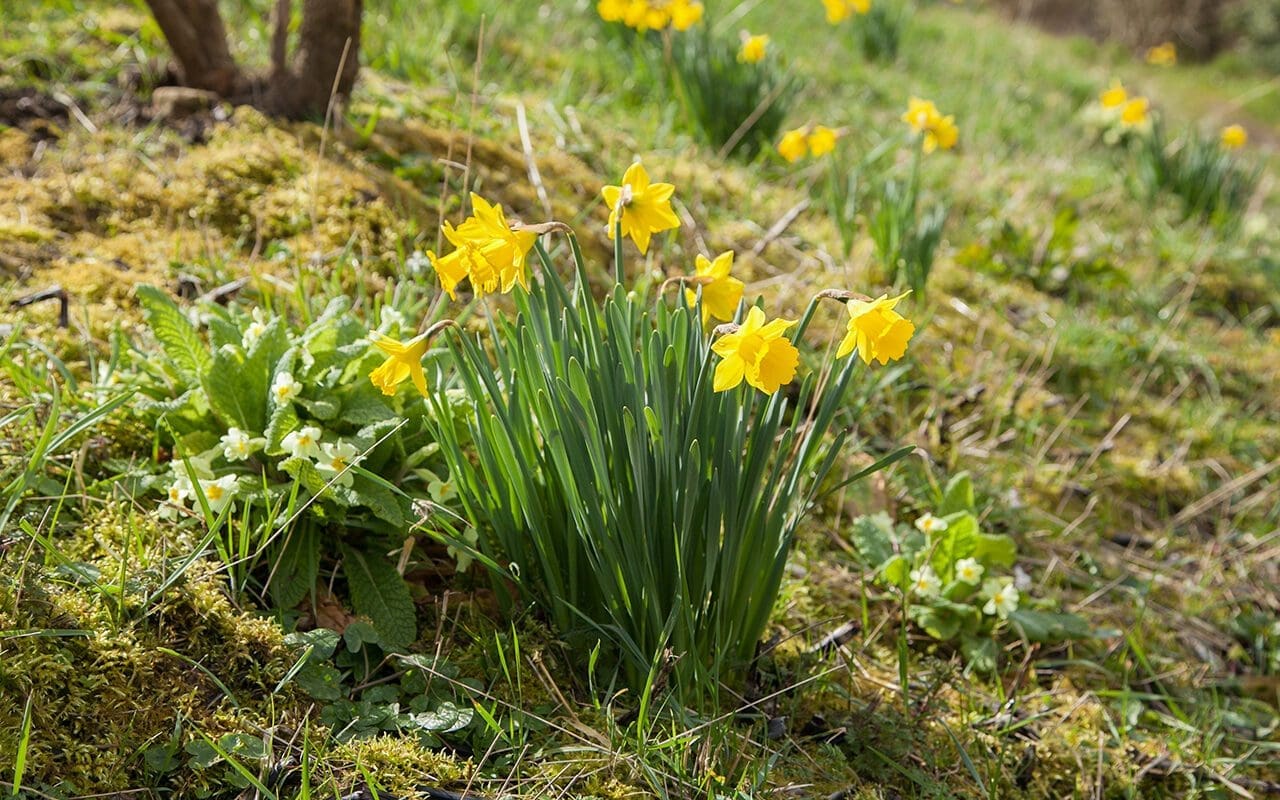
The Ditch is a place that we garden lightly and the plan is to one day have it naturalised with bulbs that like the conditions here. Snowdrops and aconites to start the year and snakeshead fritillaries and camassia to follow. The Narcissus obvallaris are grouped loosely around a staggering of Cornus mas, which start to bloom when you can feel the winter easing.
So far the Tenbys have not started to seed, but I hope that our man-made imprint can be softened with seedlings that find where they want to be. This has begun already with the straight Narcissus pseudonarcissus, which I’ve been planting lower down the slopes and, in an echo of the ones we found higher up the valley, growing on little tumps that run alongside the stream where the hazel grows. They sit there with the young Dog’s Mercury as a marker of this ancient woodland and looking down on all they survey. The way they grow in the wild is a good measure for where they want to be when you find them their home. Cool, but not in the wet hollows and with a little shadow later to ease up the competition of the more thuggish grasses.
Having been stung a couple of times with narcissus orders that were incorrectly supplied, I started three years ago by potting up a hundred bulbs, two to a pot, as I needed to know that we were putting the real thing into this wild place. It was the year that Huw’s mother passed away and, as his family are from Swansea, it felt fitting to be planting them out just a fortnight after she died. The Tenbys start to bloom around St. David’s Day and, when the first yellow shows, we add another round of plants potted up the previous autumn. Midori and Shintaro from Tokachi Millennium Forest took part one year when they were here to stay on a ‘gardening holiday’ from snowbound Hokkaido, and it has now become something of a tradition to plant a number round about now to find the places in the ditch where we feel the light needs capturing.
Words: Dan Pearson | Photographs: Huw Morgan
Published 13 March 2021
Yellow breaks with winter. Soft catkins streaming in the hazel. Brightly gold and blinking celandines studding the sunny banks. They are shiny and light reflecting and open with spring sunshine. As strong as any colour we have seen for weeks and welcome for it.
There is more to come, and in rapid succession, now that spring is with us. The first primroses in the hollows and dandelions pressed tight in grass that is rapidly flushing. Daffodils in their hosts, pumping up the volume and forsythia, of course, at which point I begin to question the colour, for yellow has to be handled carefully.
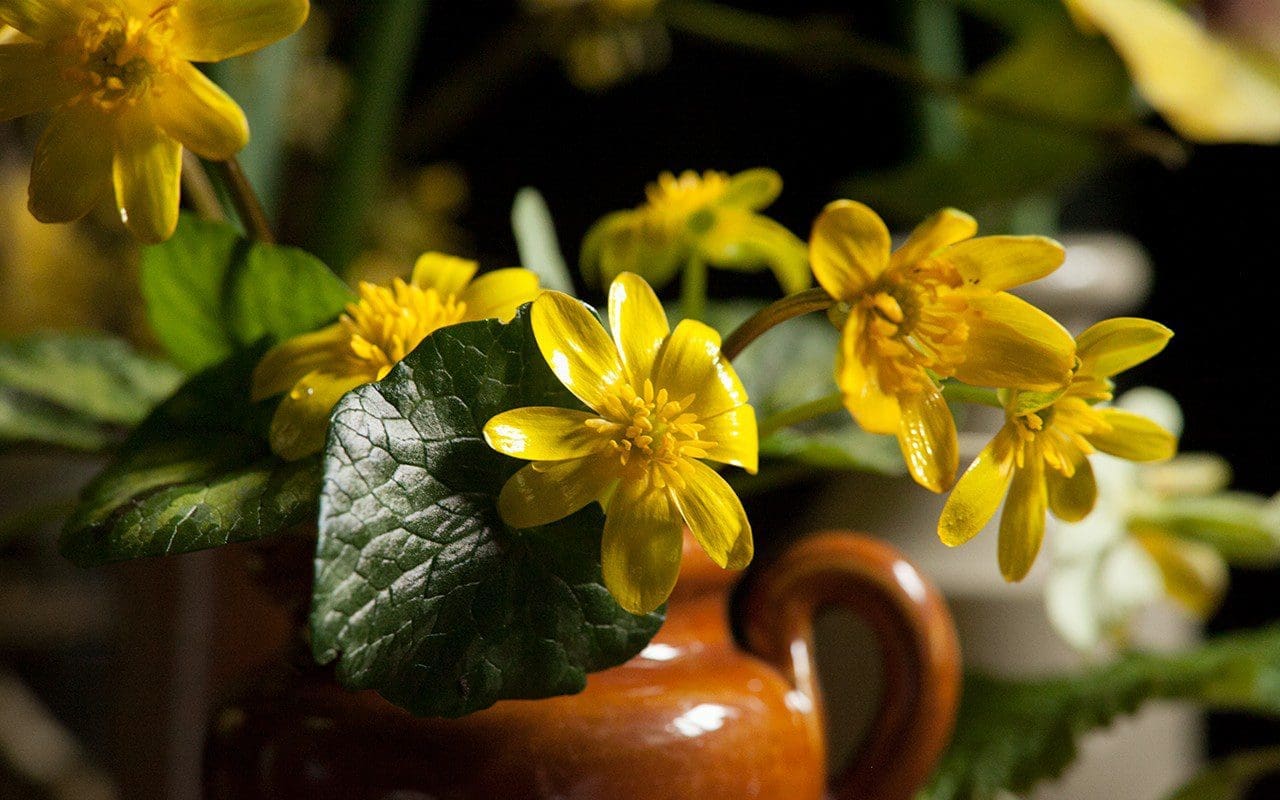 Lesser Celandine – Ranunculus ficaria
In all my years of designing it is always yellow that clients most often have difficulty with. ‘I really don’t like it’. ‘I don’t want to see it in the garden’. ‘Only in very small amounts’. Strong language which points to the fact that it prompts a reaction. Colour theory suggests the yellow wavelength is relatively long and essentially stimulating. The stimulus being emotional and one that is optimistic, making it the strongest colour psychologically. Yellow is said to be a colour of confidence, self-esteem and emotional strength. It is a colour that is both friendly and creative, but too much of it, or the wrong shade, can make you queasy, depressed or even turn you mad.
Whether I entirely believe in the thinking is a moot point, but I have found it to be true that yellow is a positive force when used judiciously. My first border as a teenager was yellow. I experimented with quantity and quality and by contrasting it with magenta and purple, it’s opposites. Today I weave it throughout the garden, using it for its ability to break with melancholy; a flash of Welsh poppy amongst ferns or a carefully selected greenish-yellow hellebore lighting a shaded corner.
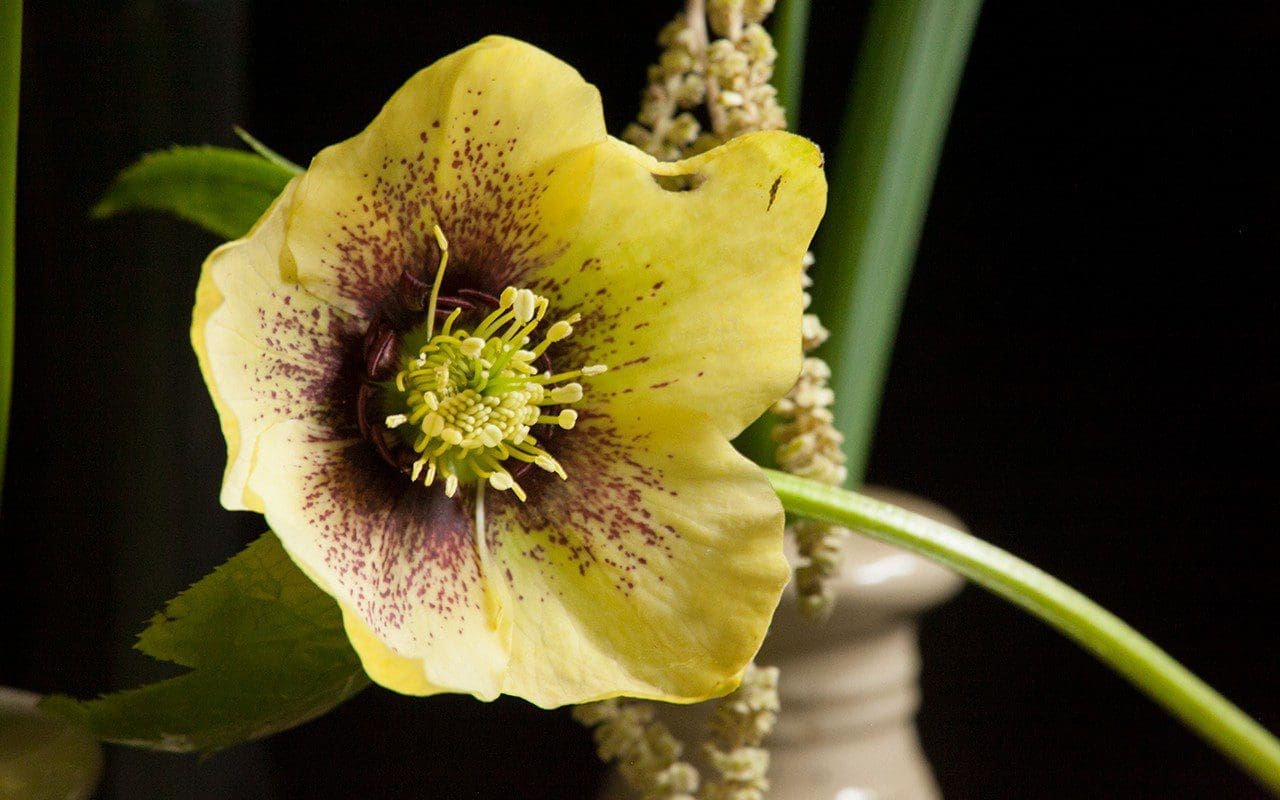 Helleborus x hybridus Ashwood Selection Primrose Shades Spotted
I remember talking to the textile designer, Susan Collier, about the use of yellow in her garden in Stockwell. She had repeated the tall, sulphur-yellow Thalictrum flavum ssp. glaucum throughout the planting and explained how she used it to draw the eye through the garden. ‘Yellow in textile design is extraordinarily persistent. It is noisy, but it lifts the heart. It causes the eye to wander, as the eye always returns to yellow.’
At this time of year, I am happy to see it, but prefer yellow in dashes and dots and smatterings. I will use Cornus mas, the Cornelian cherry, rather than forsythia, and have planted a little grove that will arch over the ditch in time and mingle with a stand of hazel. The fattening buds broke a fortnight ago, just as the hazel was losing its freshness. Ultimately, over time, my widely spaced shrubs will grow to the size of a hawthorn, the cadmium yellow flowers, more stamen than petal, creating a spangled cage of colour, rather than the airless weight of gold you get with forsythia.
We have started splitting the primroses along the ditch too. I hope they will colonise the ground beneath the Cornus mas. I have a hundred of the Tenby daffodil, our native Narcissus obvallaris, to scatter amongst them. The flowers are gold, but they are small and nicely proportioned. Used in small quantity and widely spaced to avoid an obvious flare, they will bring the yellow of the cornus to earth.
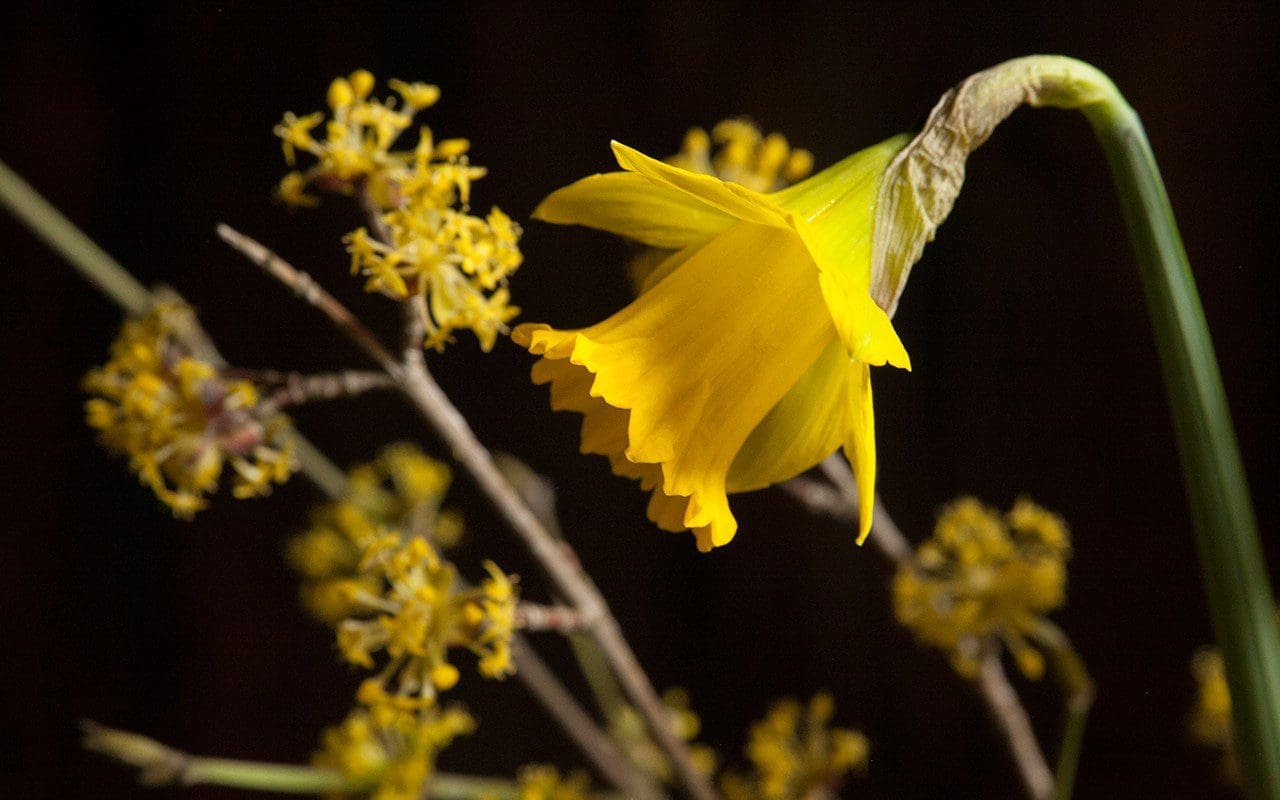 Narcissus obvallaris with Cornus mas (Cornelian cherry)
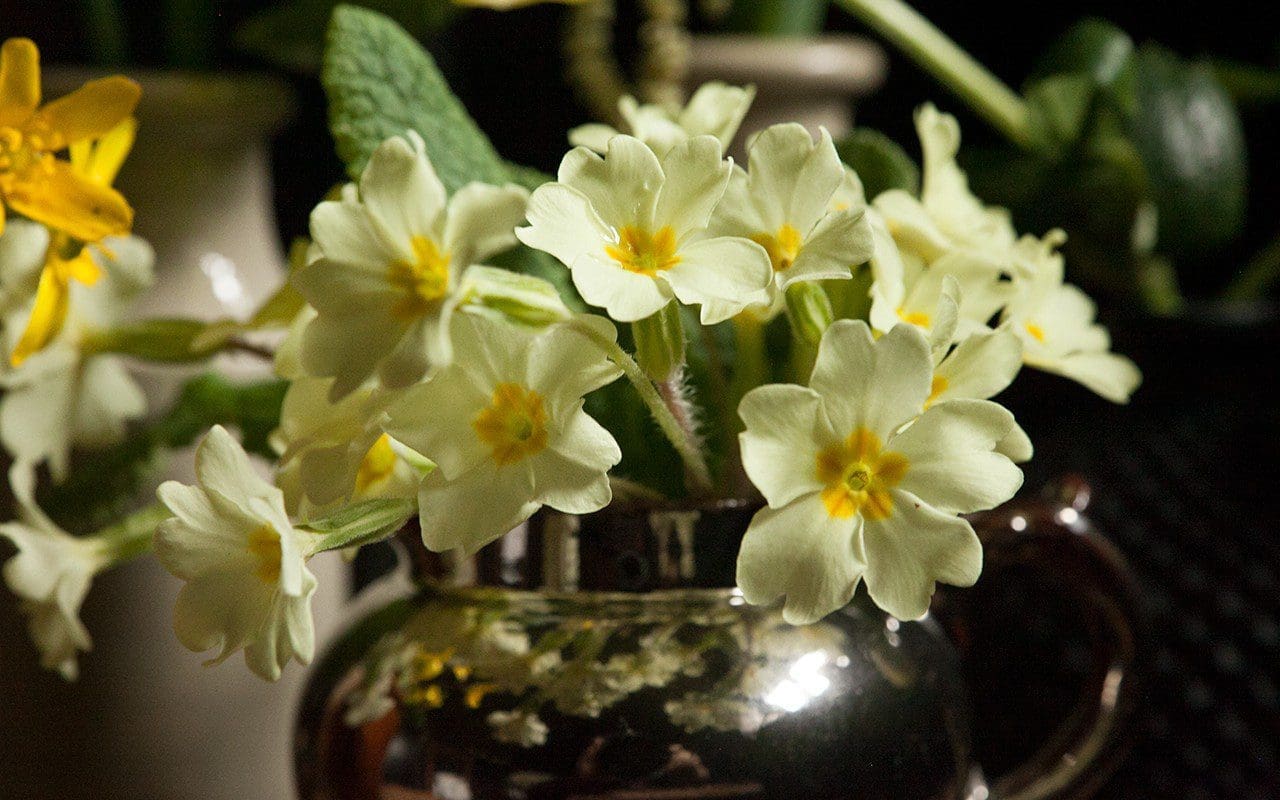 Primrose – Primula vulgaris
After several years of experimenting with narcissus, I have found that they are always best when used lightly and with the stronger yellows used as highlights amongst those that are paler. N. bulbocodium ‘Spoirot’, a delightful pale hoop-petticoat daffodil is first to flower here and a firm favourite. I have grown them in pans this year to verify the variety, but will plant them on the steep bank in front of the house where, next spring, they will tremble in the westerly winds.
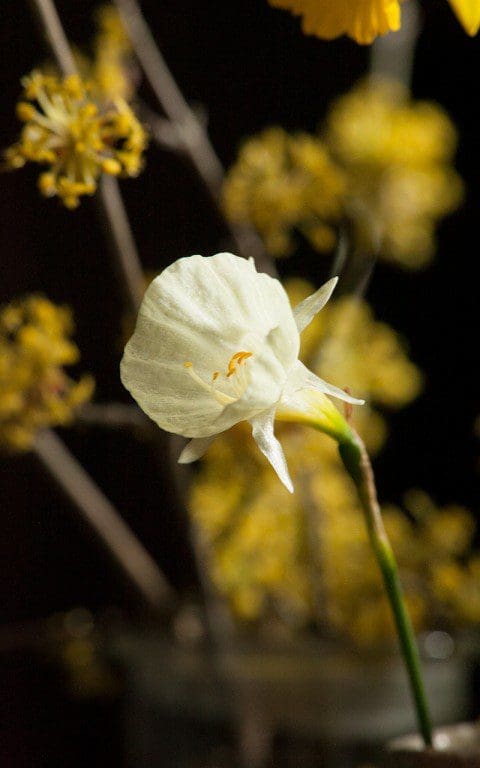 Narcissus bulbocodium ‘Spoirot’
The very first of the Narcissus x odorus and Narcissus pallidiflorus are also out today, braving a week of overcast skies and cold rain. The N. pallidiflorus were a gift from Beth Chatto. She had been gifted them in turn by Cedric Morris, who had collected the bulbs on one of his expeditions to Europe. The flowers are a pale, primrose yellow, the trumpet slightly darker, and are distinguished by the fact that they face joyously upwards, unlike their downward-facing cousins.
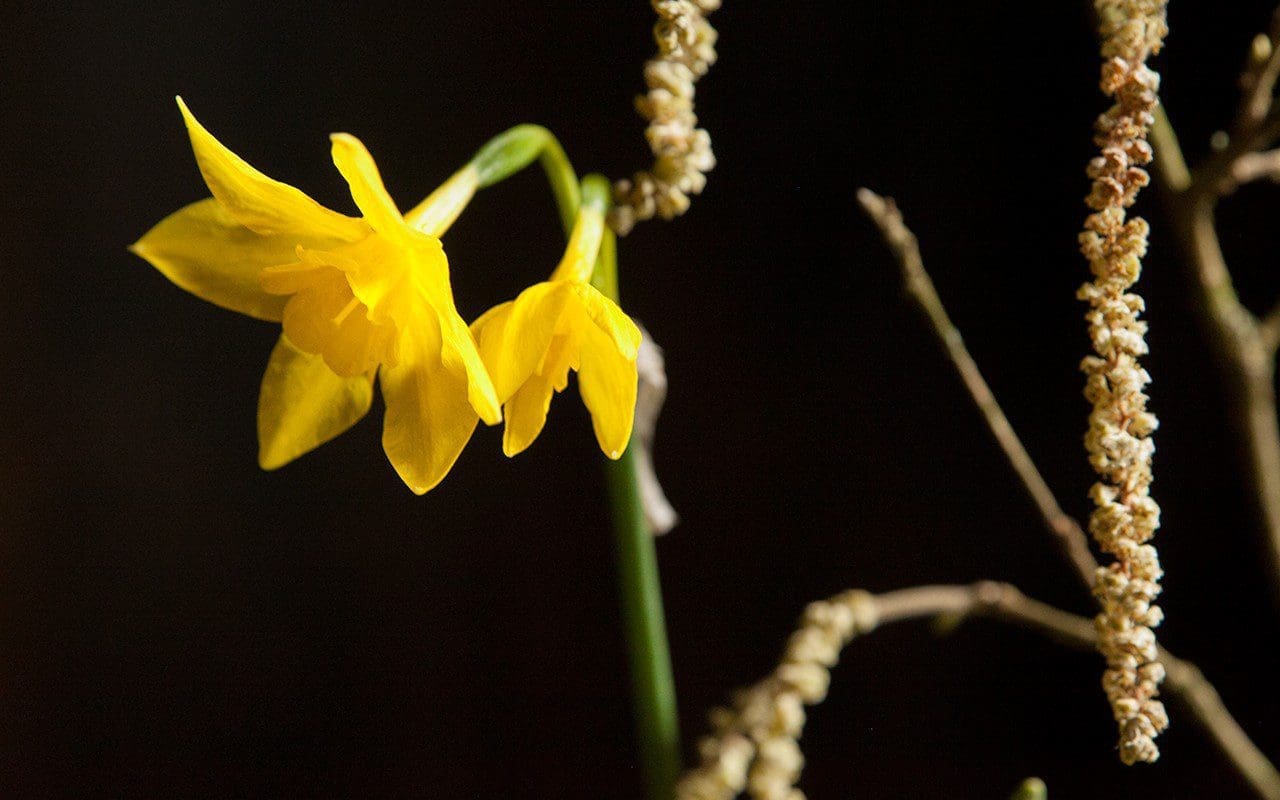 Narcissus x odorus
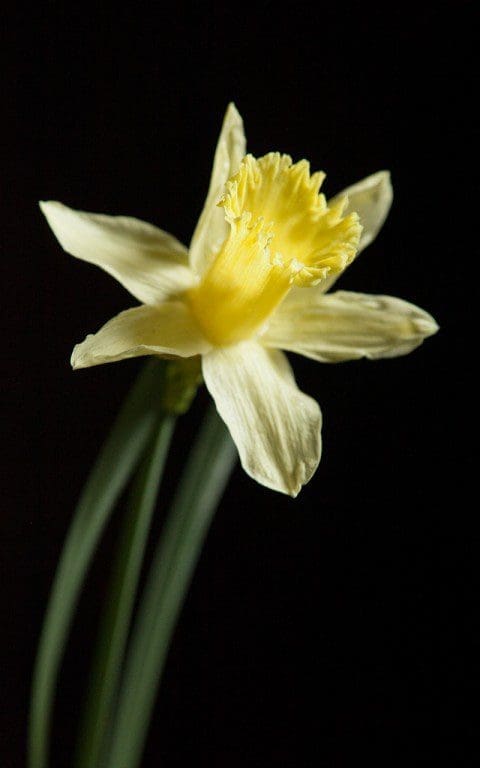 Narcissus pallidiflorus
Our other native daffodil Narcissus pseudonarcissus has a trumpet the same gold as N. obvallaris, but with petals the pale lemon hue of N. pallidiflorus. It has an altogether lighter feeling than many of the named hybrids for this gradation of colour. We were thrilled to see a huge wild colony of them in the woods last weekend, spilling from high up on the banks, the mother colony scattering her offspring in little satellites. This is how they look best, in stops and starts and concentrations. I am slowly planting drifts along the stream edge and up through a new hazel coppice that will be useful in the future. A move that feels right for now, with all the energy and awakening of this new season.
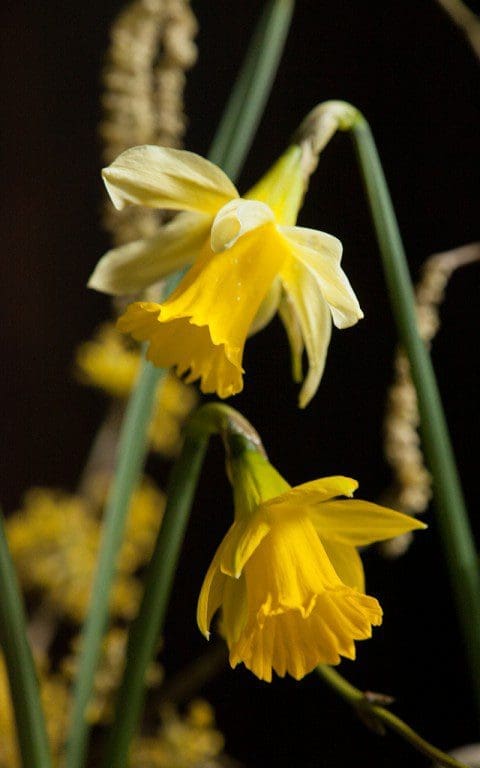 Narcissus pseudonarcissus (top), Narcissus obvallaris (bottom)
Words: Dan Pearson / Photographs: Huw Morgan
We are sorry but the page you are looking for does not exist. You could return to the homepage