ALREADY A PAID SUBSCRIBER? SIGN IN
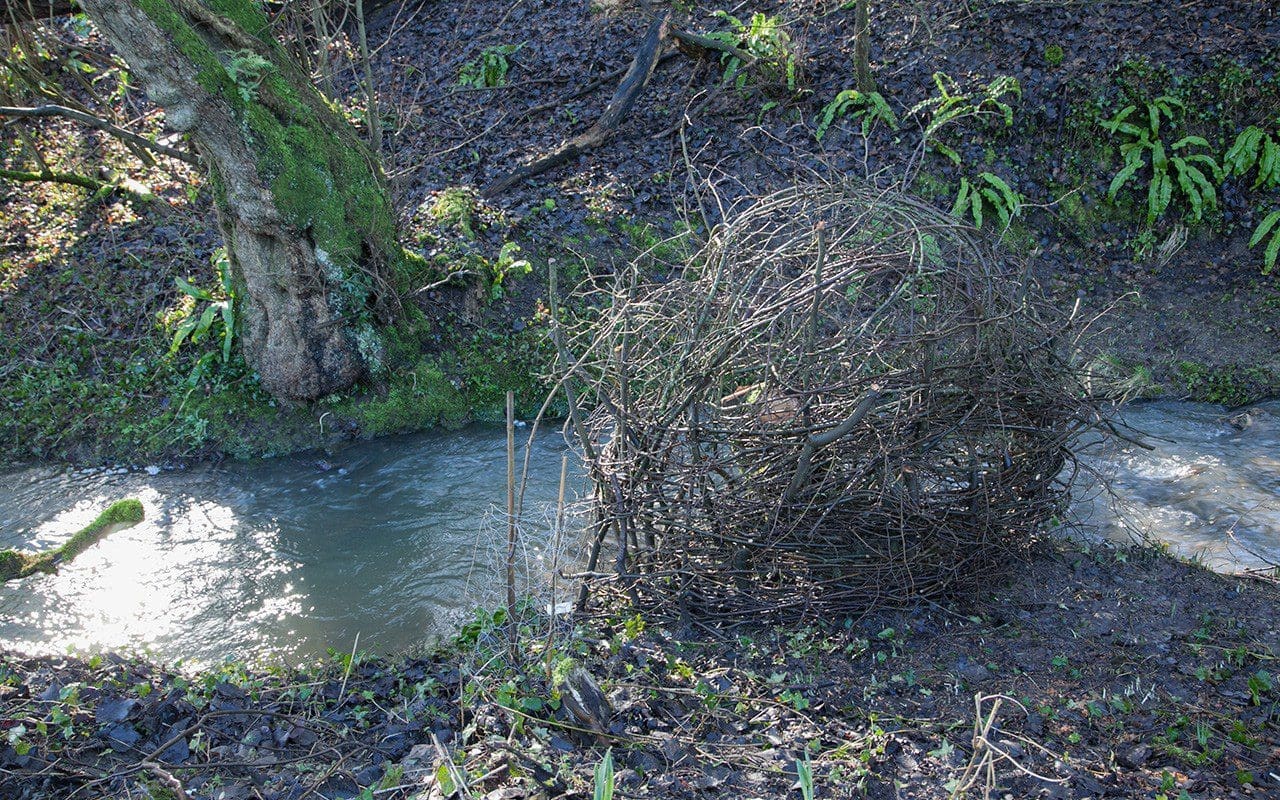 A coppiced hazel protected from deer by a cage of offcuts
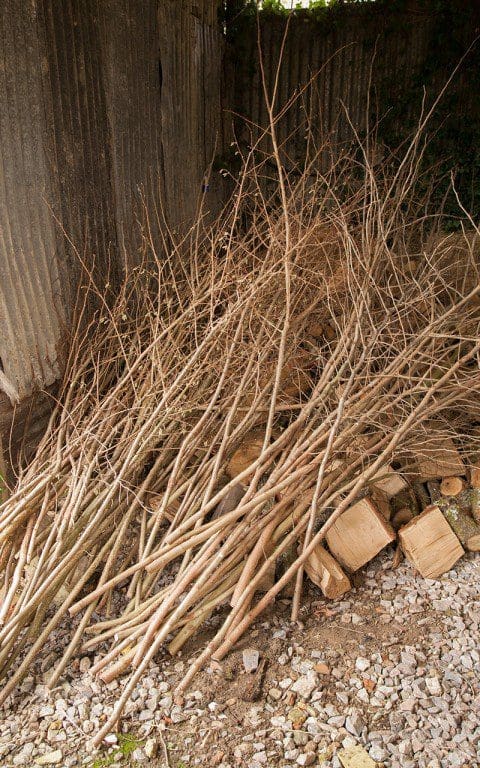 Hazel poles harvested from the hedgerows
Though we complain here about the winter’s duration, I cannot help but compare these few fairly benign months to the harsh conditions at my project in Hokkaido. There the gardeners have to leave the frozen landscape in search of work whilst the garden lies beneath deep snow until late April. The rush of tasks to either side – in preparation for the slumber and then the great surge of activity in spring – is palpable in head gardener Midori’s communications. Meanwhile, here we are free to dig and prune and plant. What luxury it is to get things in order with these few weeks of down time on our hands.
Hazel poles harvested from the hedgerows
Though we complain here about the winter’s duration, I cannot help but compare these few fairly benign months to the harsh conditions at my project in Hokkaido. There the gardeners have to leave the frozen landscape in search of work whilst the garden lies beneath deep snow until late April. The rush of tasks to either side – in preparation for the slumber and then the great surge of activity in spring – is palpable in head gardener Midori’s communications. Meanwhile, here we are free to dig and prune and plant. What luxury it is to get things in order with these few weeks of down time on our hands.
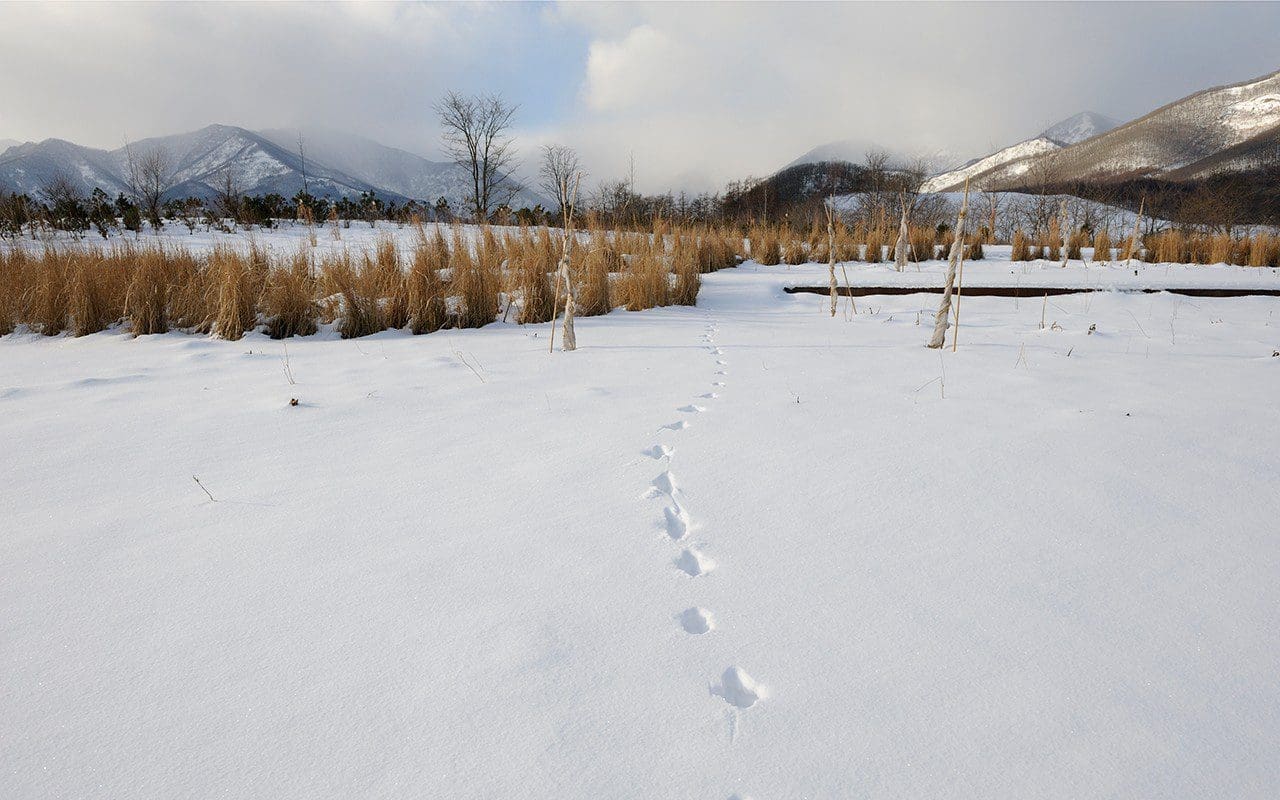 The Meadow Garden at the Tokachi Millennium Forest in Hokkaido is under snow until late April. Photograph: Syogo Oizumi
It has been a busy winter for I am readying myself to plant up the first sections of the new garden that was landscaped last summer. This time last year the same ground lay fallow with a green manure crop protecting it from the leaching effect of rain and to keep it ‘clean’ from the cold season weeds that colonise whenever there is a window of growing opportunity. The winter rye grew thick and lush, except where the diggers had tracked over the ground during the previous summer’s building works, where it grew sickly and thinly, indicating that something needed addressing before going any further.
When we started the winter dig, the problem that the rye had mapped became clear. Not far beneath the surface the soil had become anaerobic, starved of air by the compaction and with the tell-tale foetid smell as you turned it. The organic matter in the soil had turned grey where the bacteria were unable to function without oxygen and the water ran off and not through as it should. Turned roughly at the front end of winter, like a ploughed field, the frost has since teased and broken this layer down and the air has made its way back into the topsoil to keep it alive and functioning. Though it is still too wet to walk across, you can see that the winter freeze and thaw has worked its magic and that, as soon as we have a dry spell, it will knock out nicely like a good crumble mix, in readiness for planting.
The Meadow Garden at the Tokachi Millennium Forest in Hokkaido is under snow until late April. Photograph: Syogo Oizumi
It has been a busy winter for I am readying myself to plant up the first sections of the new garden that was landscaped last summer. This time last year the same ground lay fallow with a green manure crop protecting it from the leaching effect of rain and to keep it ‘clean’ from the cold season weeds that colonise whenever there is a window of growing opportunity. The winter rye grew thick and lush, except where the diggers had tracked over the ground during the previous summer’s building works, where it grew sickly and thinly, indicating that something needed addressing before going any further.
When we started the winter dig, the problem that the rye had mapped became clear. Not far beneath the surface the soil had become anaerobic, starved of air by the compaction and with the tell-tale foetid smell as you turned it. The organic matter in the soil had turned grey where the bacteria were unable to function without oxygen and the water ran off and not through as it should. Turned roughly at the front end of winter, like a ploughed field, the frost has since teased and broken this layer down and the air has made its way back into the topsoil to keep it alive and functioning. Though it is still too wet to walk across, you can see that the winter freeze and thaw has worked its magic and that, as soon as we have a dry spell, it will knock out nicely like a good crumble mix, in readiness for planting.
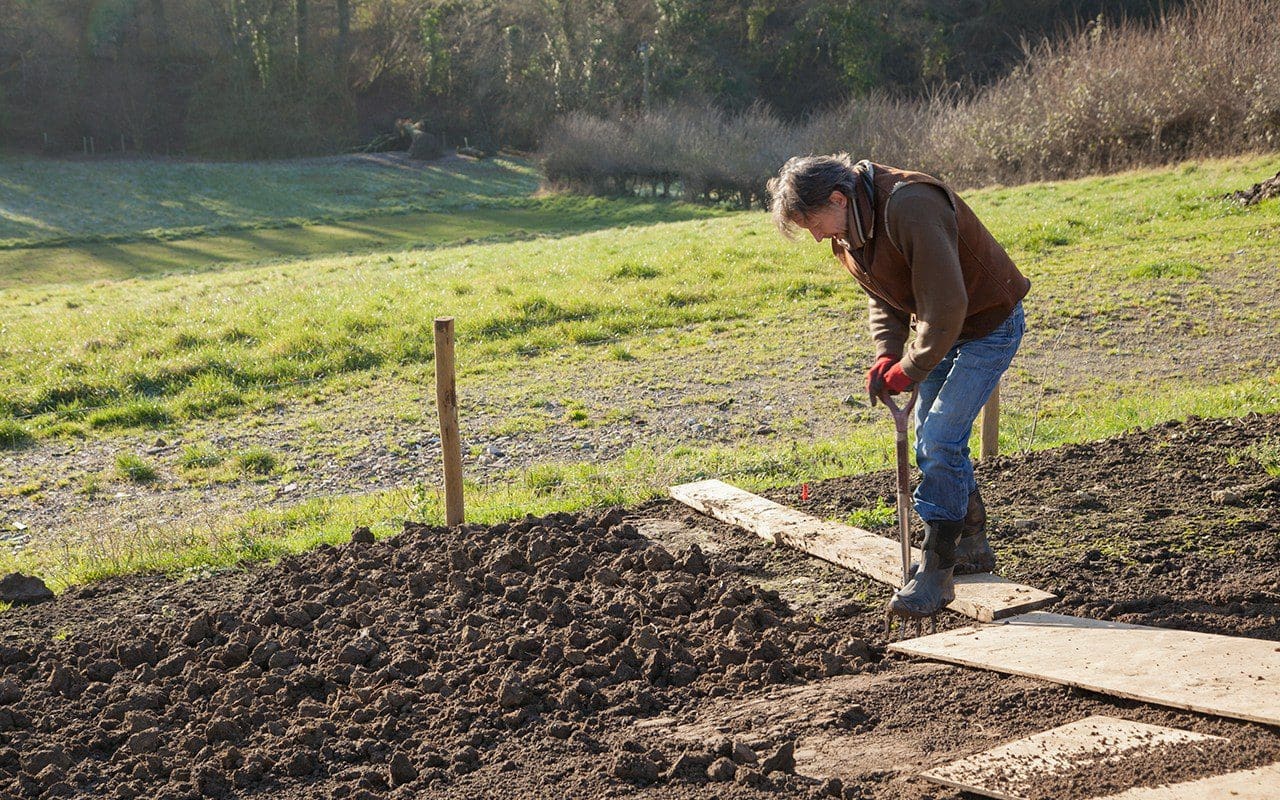 Digging over the compacted soil, working from boards to prevent further compaction
Time taken in preparation is never time wasted and it is a good feeling to give new plants the best possible start in their new positions. As the soil was previously pasture and we have the advantage of heartiness, the organic content is already good enough, so we will not be digging in compost this year. I want the plants to grow lean and strong so that they can cope with the openness and exposure of the site rather than be overly cosseted or encouraged to grow too fast and fleshy. Organic matter will slowly be introduced after planting in the form of a weed-free compost mulch to keep the germinating weeds down and to protect the soil from desiccation. The earthworms, which are now free to travel through the previously compacted ground, will pull the mulch into the soil and do the work for me.
Digging over the compacted soil, working from boards to prevent further compaction
Time taken in preparation is never time wasted and it is a good feeling to give new plants the best possible start in their new positions. As the soil was previously pasture and we have the advantage of heartiness, the organic content is already good enough, so we will not be digging in compost this year. I want the plants to grow lean and strong so that they can cope with the openness and exposure of the site rather than be overly cosseted or encouraged to grow too fast and fleshy. Organic matter will slowly be introduced after planting in the form of a weed-free compost mulch to keep the germinating weeds down and to protect the soil from desiccation. The earthworms, which are now free to travel through the previously compacted ground, will pull the mulch into the soil and do the work for me.
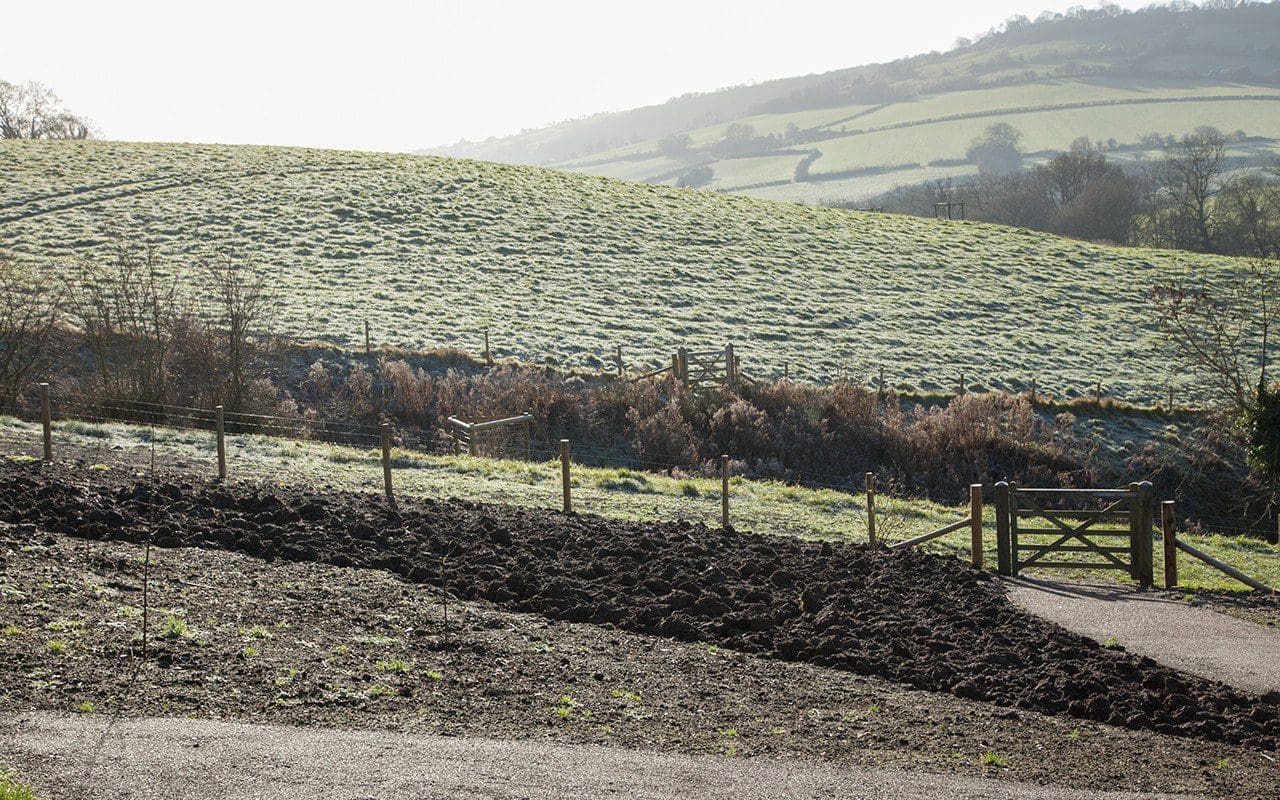 One of the planting beds in the new garden half dug over to allow the frost to do its work
In the vegetable beds, where we have been working the soil and demanding more from it, the organic matter is replenished annually to keep the fertility levels up. Our own home made compost is dug in now that the heaps are up and running. The compost is left a whole year to break down so that one bay is quietly rotting whilst the other is being filled. If I had more time, or a forklift to turn it, I would have a better, more friable compost in just six months. Turning allows air into the heap and the uncomposted material moved to the centre heats the heap more efficiently to help to kill weed seeds.
One of the planting beds in the new garden half dug over to allow the frost to do its work
In the vegetable beds, where we have been working the soil and demanding more from it, the organic matter is replenished annually to keep the fertility levels up. Our own home made compost is dug in now that the heaps are up and running. The compost is left a whole year to break down so that one bay is quietly rotting whilst the other is being filled. If I had more time, or a forklift to turn it, I would have a better, more friable compost in just six months. Turning allows air into the heap and the uncomposted material moved to the centre heats the heap more efficiently to help to kill weed seeds.
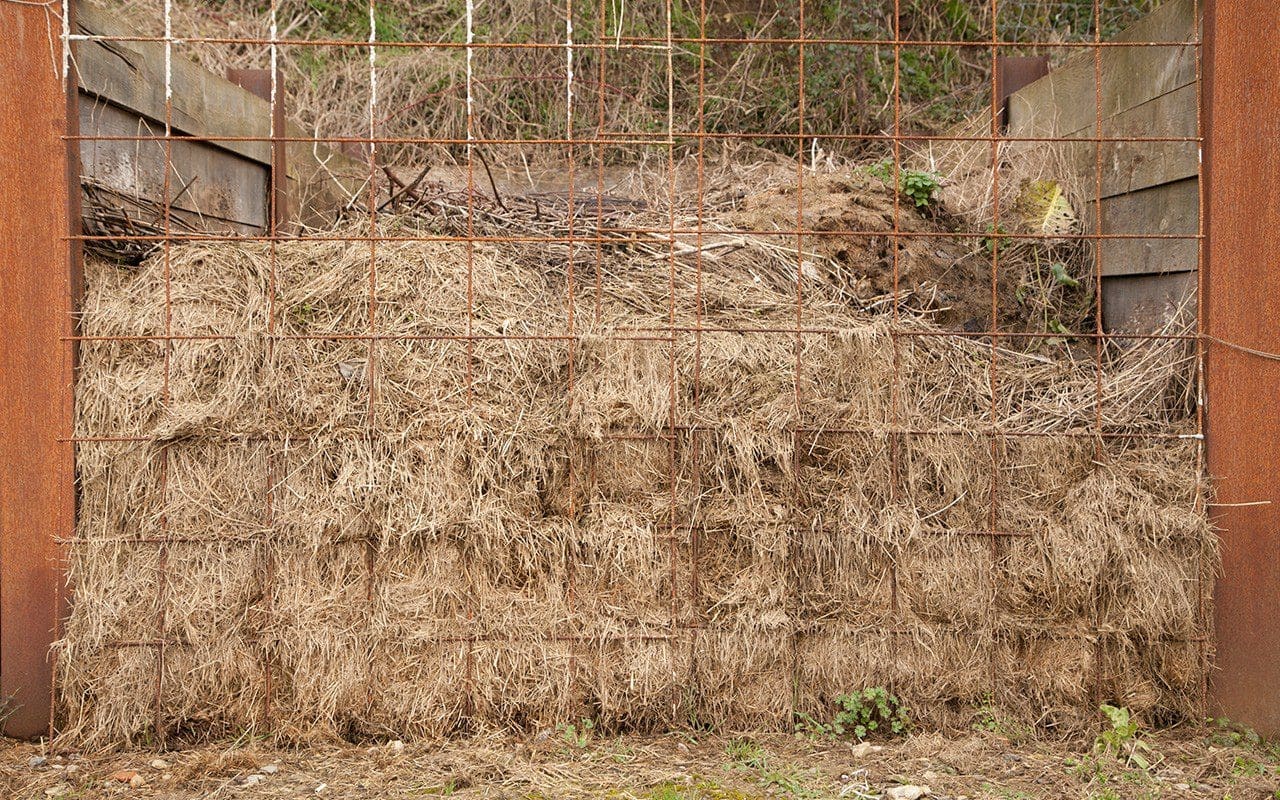 One of the compost bays
My year old compost is only really good for turning in as it springs a fine crop of seedlings from the hay we rake off the banks in the summer. There are also rashes of garden plants; euphorbias that were thrown on the heap after their heads were cut in seed, bronze fennel, Shirley poppies, phacelia and a host of other plants that have lain dormant. No matter. Since the heaps sit directly on the earth the compost is full of worms, and this can only be good for the soil and its future aeration. You can see the soil in the garden getting better and darker, more friable and more retentive with every year that passes. A reward for the hard work and payback for the bounty that we take from it.
Words: Dan Pearson / Photographs: Huw Morgan I first encountered wintersweet on a memorable day in the long overgrown wilderness of my childhood garden. Miss Joy, the maker of that acre which had finally overwhelmed her, had clearly been quite a plantswoman and we unearthed many hidden treasures as we cleared forty years of neglect. We had found a colony of trillium surviving in the leaf mould beneath a fallen amelanchier and scarlet peonies pushing through a glade of dim nettle. On this still winter’s day we discovered the wintersweet.
We were slowly freeing the orchard of bramble to make a clearing. The source of a spicy and pervasive perfume eluded us while we worked but, as we cleared deeper into the thicket, we became aware of its origin. Scent triggers the strongest memories and I remember quite clearly the cut and the pull and getting closer to the prize as we tore at the thicket that surrounded and mounted the limbs of the mysterious shrub. Being the most nimble, and with the light of the day failing, the last few feet required a contortion to reach an accessible limb and pull a twig of flowers, which were hardly visible in the half-light, pallid and speckled on the gaunt branches.
I know the smell in an instant now, but then its strength on the cool air was intoxicating for the discovery of something new. Later, in the heat of the kitchen, the perfume from this single twig filled the entire room. Geraldine, our neighbour and my gardening friend from across the lane, shared in the excitement and identified it as Chimonanthus praecox. We studied the waxiness of the translucent blooms. Starry, but cupped like an open hand with fingers facing forward, a second layer revealed an inner boss of petals stained plum-red.
One of the compost bays
My year old compost is only really good for turning in as it springs a fine crop of seedlings from the hay we rake off the banks in the summer. There are also rashes of garden plants; euphorbias that were thrown on the heap after their heads were cut in seed, bronze fennel, Shirley poppies, phacelia and a host of other plants that have lain dormant. No matter. Since the heaps sit directly on the earth the compost is full of worms, and this can only be good for the soil and its future aeration. You can see the soil in the garden getting better and darker, more friable and more retentive with every year that passes. A reward for the hard work and payback for the bounty that we take from it.
Words: Dan Pearson / Photographs: Huw Morgan I first encountered wintersweet on a memorable day in the long overgrown wilderness of my childhood garden. Miss Joy, the maker of that acre which had finally overwhelmed her, had clearly been quite a plantswoman and we unearthed many hidden treasures as we cleared forty years of neglect. We had found a colony of trillium surviving in the leaf mould beneath a fallen amelanchier and scarlet peonies pushing through a glade of dim nettle. On this still winter’s day we discovered the wintersweet.
We were slowly freeing the orchard of bramble to make a clearing. The source of a spicy and pervasive perfume eluded us while we worked but, as we cleared deeper into the thicket, we became aware of its origin. Scent triggers the strongest memories and I remember quite clearly the cut and the pull and getting closer to the prize as we tore at the thicket that surrounded and mounted the limbs of the mysterious shrub. Being the most nimble, and with the light of the day failing, the last few feet required a contortion to reach an accessible limb and pull a twig of flowers, which were hardly visible in the half-light, pallid and speckled on the gaunt branches.
I know the smell in an instant now, but then its strength on the cool air was intoxicating for the discovery of something new. Later, in the heat of the kitchen, the perfume from this single twig filled the entire room. Geraldine, our neighbour and my gardening friend from across the lane, shared in the excitement and identified it as Chimonanthus praecox. We studied the waxiness of the translucent blooms. Starry, but cupped like an open hand with fingers facing forward, a second layer revealed an inner boss of petals stained plum-red.
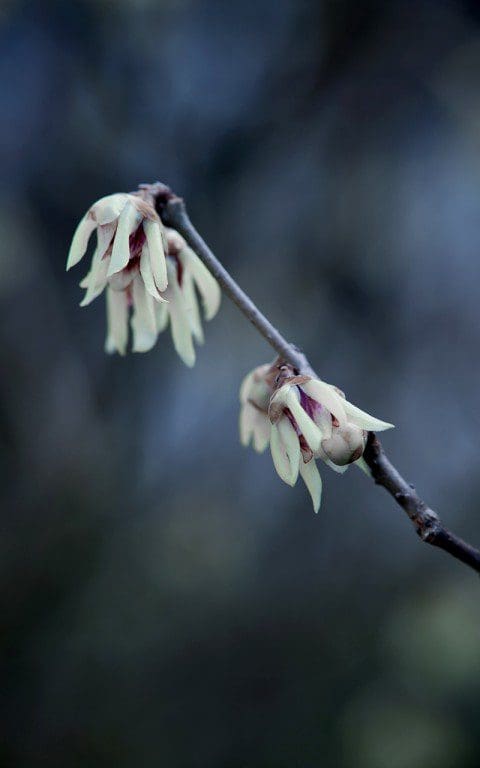 Chimonanthus praecox
Until recently I have not had the place to plant one for myself, so I have gone out of my way to find wintersweet a home in clients’ gardens in the knowledge that they too will reap the rewards in January and February. This vicarious pleasure has been lived out fully at a project I am working on in Shanghai where I have designed a series of gardens that seat a number of restored Ming and Qing dynasty merchant’s houses within a forest of ancient camphor trees.
In the process of understanding how to interpret the planting, my research into Chinese gardens revealed that wintersweet was one of the natives used repeatedly in the pared-back palette of auspicious plants. The winter perfume was revered and the dried flowers were used to scent linen much as we use lavender here. Come the summer the long, lime green leaves are also scented when crushed. I have used them throughout the site as free-standing shrubs, placed close to the junction of paths where you are already pausing, but are then halted by the surprise of perfume.
Chimonanthus praecox
Until recently I have not had the place to plant one for myself, so I have gone out of my way to find wintersweet a home in clients’ gardens in the knowledge that they too will reap the rewards in January and February. This vicarious pleasure has been lived out fully at a project I am working on in Shanghai where I have designed a series of gardens that seat a number of restored Ming and Qing dynasty merchant’s houses within a forest of ancient camphor trees.
In the process of understanding how to interpret the planting, my research into Chinese gardens revealed that wintersweet was one of the natives used repeatedly in the pared-back palette of auspicious plants. The winter perfume was revered and the dried flowers were used to scent linen much as we use lavender here. Come the summer the long, lime green leaves are also scented when crushed. I have used them throughout the site as free-standing shrubs, placed close to the junction of paths where you are already pausing, but are then halted by the surprise of perfume.
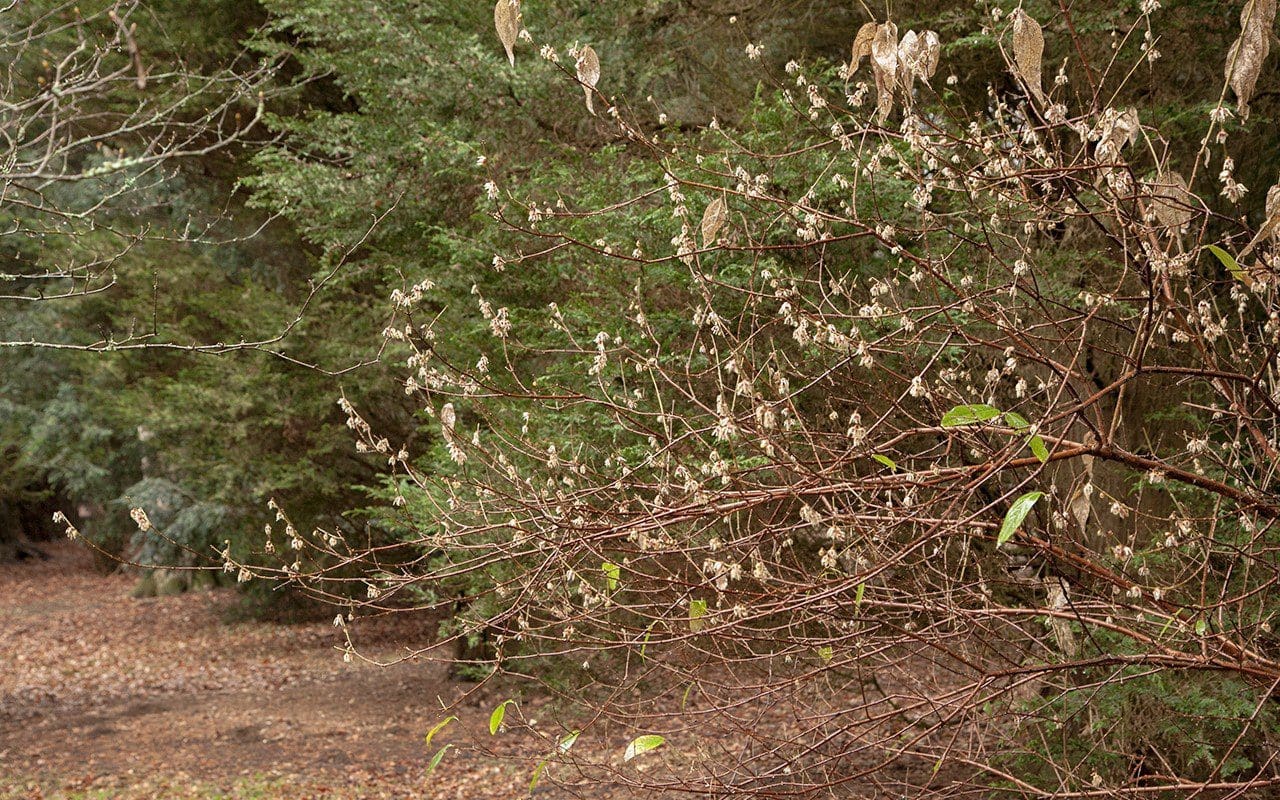
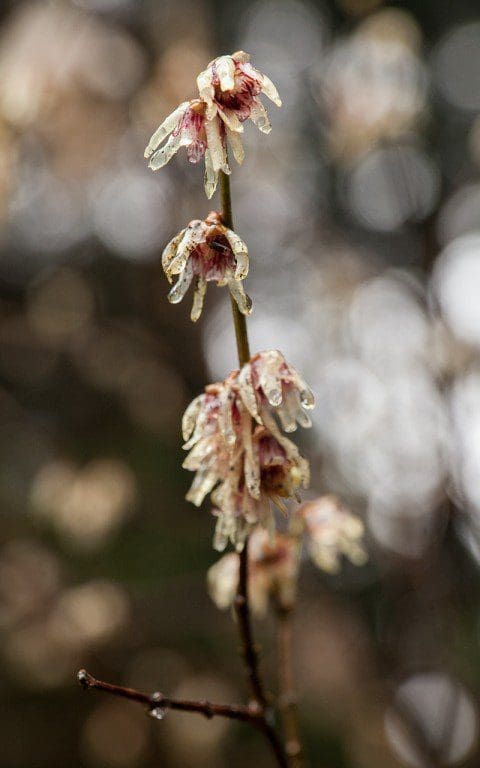 Chimonanthus praecox at Westonbirt Arboretum
In its native habitat in open woodland Chimonanthus praecox can grow to as much as thirteen metres. In cultivation it forms a nicely branched shrub of three by three metres and, being well-behaved, it has been a mainstay of Chinese gardens for more than 1000 years. It was first introduced to Japan in the late 17th century as a garden plant and then to Britain a century later, arriving at Croome Court in 1766.
If you read up about it, books repeatedly state that it needs the radiated heat of a south or west wall to ripen its wood sufficiently to flower well. The half-radius of Lutyens’ Rotunda at Hestercombe House, where Gertrude Jekyll’s original planting of 1904 still survives, beautifully demonstrates its use as a wall-trained shrub. Indeed, you see it flowering most prolifically on the hottest part of the wall.
As it is hardy to -10°C it is happy out in the open and I have found it to be far more adaptable in this country where not too far north. The specimen at Westonbirt Arboretum, for instance, is flowering well in open woodland, so it is worth breaking the rules if you dare.
Chimonanthus praecox at Westonbirt Arboretum
In its native habitat in open woodland Chimonanthus praecox can grow to as much as thirteen metres. In cultivation it forms a nicely branched shrub of three by three metres and, being well-behaved, it has been a mainstay of Chinese gardens for more than 1000 years. It was first introduced to Japan in the late 17th century as a garden plant and then to Britain a century later, arriving at Croome Court in 1766.
If you read up about it, books repeatedly state that it needs the radiated heat of a south or west wall to ripen its wood sufficiently to flower well. The half-radius of Lutyens’ Rotunda at Hestercombe House, where Gertrude Jekyll’s original planting of 1904 still survives, beautifully demonstrates its use as a wall-trained shrub. Indeed, you see it flowering most prolifically on the hottest part of the wall.
As it is hardy to -10°C it is happy out in the open and I have found it to be far more adaptable in this country where not too far north. The specimen at Westonbirt Arboretum, for instance, is flowering well in open woodland, so it is worth breaking the rules if you dare.
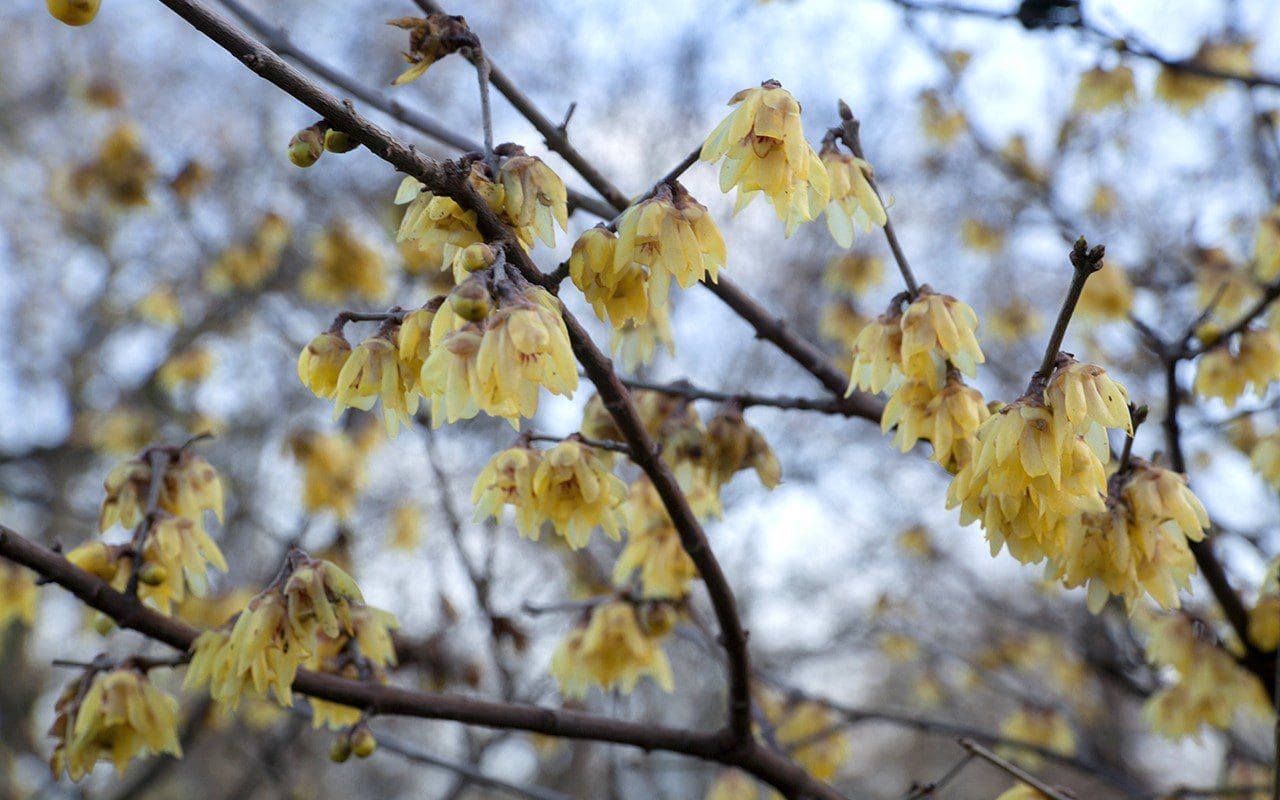 Chimonanthus praecox ‘Luteus’
Grown from seed wintersweet can take up to fifteen years to flower, a containerised plant five or eight after planting, much like a wisteria. As a species Chimonanthus praecox is variable, but there are a small number of named forms commercially available.
In the Winter Garden I designed at Battersea Park (main image) I have used C. p. ‘Luteus’ as a perfumed welcome by the Sun Gate at the garden’s entrance to draw people in. I am not completely sure the plant supplied is the real ‘Luteus’. Although the flowers register a strong beeswax yellow they have a very slight staining to the central boss, which ‘Luteus’ is not supposed to have. ‘Sunburst’ is yellower still, whilst C. p. ‘Grandiflorus’ has a larger, more open flower which is paler and more translucent. A red stain suffusing the central boss is more typical of the species, which is also reputed to be more heavily scented than the above selections, although I’ve never been able to compare them.
Chimonanthus praecox ‘Luteus’
Grown from seed wintersweet can take up to fifteen years to flower, a containerised plant five or eight after planting, much like a wisteria. As a species Chimonanthus praecox is variable, but there are a small number of named forms commercially available.
In the Winter Garden I designed at Battersea Park (main image) I have used C. p. ‘Luteus’ as a perfumed welcome by the Sun Gate at the garden’s entrance to draw people in. I am not completely sure the plant supplied is the real ‘Luteus’. Although the flowers register a strong beeswax yellow they have a very slight staining to the central boss, which ‘Luteus’ is not supposed to have. ‘Sunburst’ is yellower still, whilst C. p. ‘Grandiflorus’ has a larger, more open flower which is paler and more translucent. A red stain suffusing the central boss is more typical of the species, which is also reputed to be more heavily scented than the above selections, although I’ve never been able to compare them.
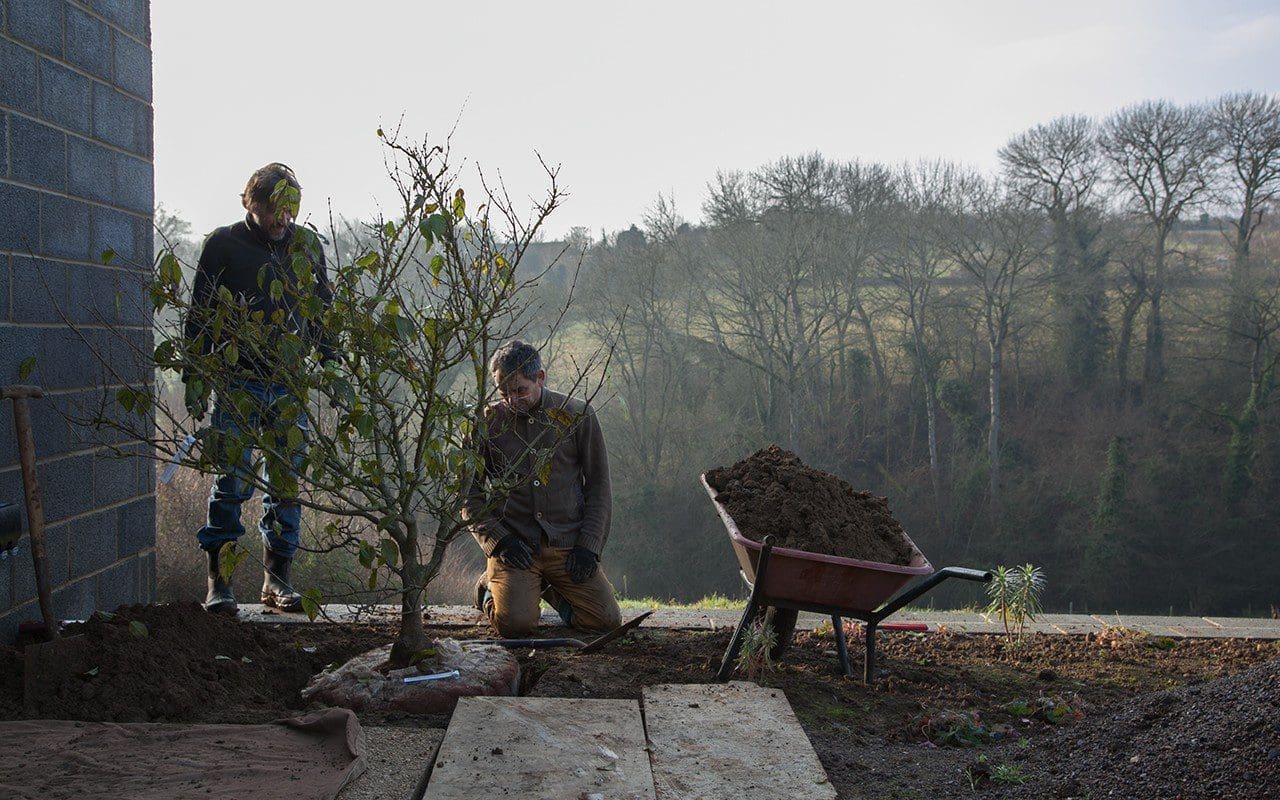 Planting the new wintersweet at Hillside
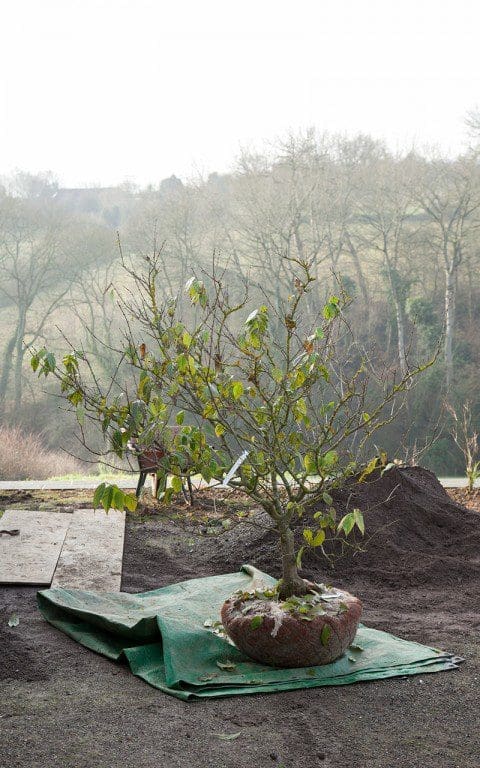
As I have waited this long to be able to plant one for myself and am impatient for flower, I went to Karan Junker for a mature, field-grown specimen. Her seed came to her via Roy Lancaster from a batch originally selected by the great Japanese botanist and plant collector Mikinori Ogisu. There is a fabled pinky-red clone in Japan and the seed potentially included these genes. Just before Christmas I planted my ten-year-old by the studio door so that the perfume is not wasted and today it has broken the first of a half dozen buds to reveal a form that is clear waxy yellow. There are no dark markings, but the scent – my February fix and instant reminder of my childhood discovery – is bewitching. A winter without wintersweet would be a duller season, unmarked by this strange, scented treasure.
Planting the new wintersweet at Hillside
As I have waited this long to be able to plant one for myself and am impatient for flower, I went to Karan Junker for a mature, field-grown specimen. Her seed came to her via Roy Lancaster from a batch originally selected by the great Japanese botanist and plant collector Mikinori Ogisu. There is a fabled pinky-red clone in Japan and the seed potentially included these genes. Just before Christmas I planted my ten-year-old by the studio door so that the perfume is not wasted and today it has broken the first of a half dozen buds to reveal a form that is clear waxy yellow. There are no dark markings, but the scent – my February fix and instant reminder of my childhood discovery – is bewitching. A winter without wintersweet would be a duller season, unmarked by this strange, scented treasure.
 Words: Dan Pearson / Photographs: Huw Morgan
 At the height of summer, when all you want to be eating are salad, peas, broad beans and cucumbers, it is easy to resent the space taken up by the winter vegetables. But the time spent sowing, weeding, hoeing and watering them through the hot months is amply repaid come this time of year. We have been eating beetroot, parsnips, turnips, swedes, celeriac and carrots for several months now and, together with our stored potatoes and onions and a wide assortment of brassicas, we have been almost self-sufficient for vegetables. The greengrocer only sees me if I need lemons, oranges or some of the more exotic fruits available at this time of year like pomegranates, persimmons or Seville oranges.
The brassicas and roots are our winter bounty but, although we have enjoyed the hearty roast vegetables and mash, there comes a point when we pine for a crunch and for fresh, clean flavours. Without a polytunnel or greenhouse winter salad hasn’t been possible here yet, and I refuse to buy tasteless bags of salad so we rely upon the radicchio and chicory that were sown last spring, eaten in the summer and then left in the ground. We always miss the chance to sow them for a winter harvest, but these rogues from the summer are hearting up now, and add to this salad of raw winter roots.
The freckled leaves of ‘Castelfranco’ make a pretty addition to the plate, but any of the more common dark red forms would provide a dramatic contrast. The wider a variety of shape and colour you can get in your selection of vegetables the more attractive the salad will look. Here I have used the striped beetroot ‘Chioggia’ and orange ‘Burpee’s Golden’. The varied colours of heritage carrots also add to an appealing mix.
The balance of sweet, savoury, earthy, bitter and peppery flavours provided by the vegetables selected here makes for a varied eating experience, but the salad could be made with any combination of three of the roots if you do not have access to them all. Thinly sliced fennel would also be a good addition and, although the frost has ravaged our winter crop of bulbs, the remaining foliage is still delicious for its aniseed flavour and addition of green. Radish, mooli or kohlrabi could also be substituted.
Seville oranges are just coming to the end of their season. When unavailable replace with a 50/50 mix of lemon and orange.
This salad is particularly good with roast chicken, roast pork, sliced ham or a cold chicken and ham pie.
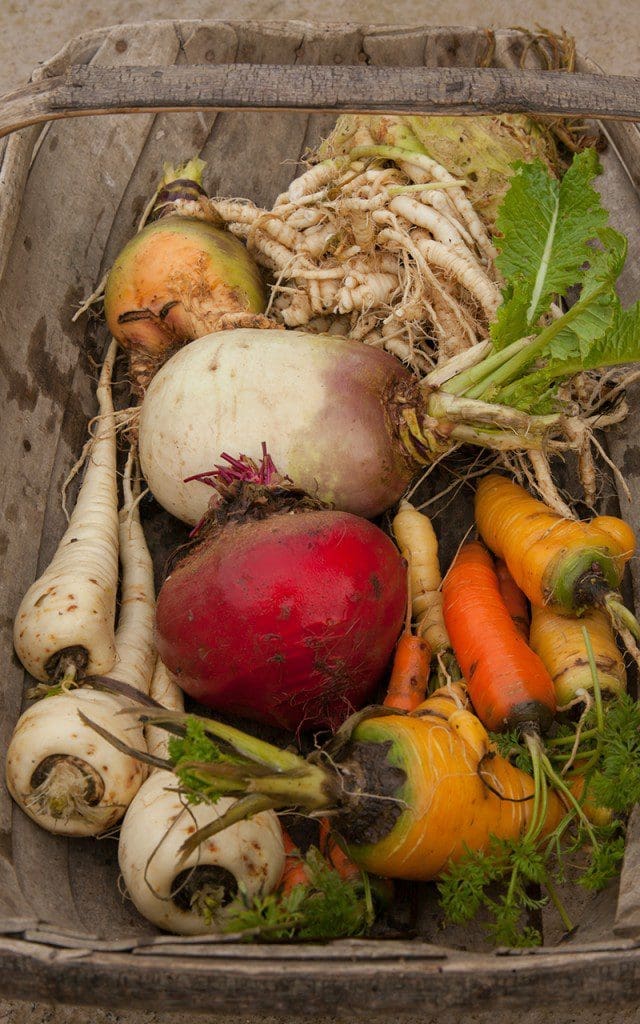
Ingredients
SALAD
Juice of 1 lemon
2 medium carrots – different colours if possible
1 small parsnip
2 small beetroot – different colours if possible
½ small turnip
½ small swede
1 Cox’s apple
¼ medium celeriac
1 small head radicchio
2 tbsp finely chopped parsley
2 tbsp fresh fennel or dill herb fronds
DRESSING
50ml soured cream
1 egg yolk
2 tsp honey
1 tsp finely grated horseradish or English mustard
25ml rapeseed or other light oil
Juice of 1 Seville orange
Very finely grated zest ½ Seville orange
Salt
Some reserved fennel fronds
3 tbsp tablespoons pomegranate seeds
3 tbsp broken walnuts
Serves 6
Method
First prepare two bowls of iced water. Add the lemon juice to one of them.
Trim and peel the carrots and parsnip, then shave thin ribbons off the length of each with a vegetable peeler. Put them all into the bowl of plain iced water. If you are using dark red or purple carrots put them in a separate bowl of iced water.
Trim and peel the beetroot. Using a mandolin or very sharp knife slice as thinly as possible into rounds. Striped or pale coloured beetroot (orange, yellow or white) can be added to the water bowl containing the carrots and parsnip. Purple beetroot will need a separate bowl of iced water or can be added to that containing the purple or red carrots.
Peel the turnip and swede and grate coarsely.
Slice the apple as thinly as possible and put into the bowl of acidulated water.
Peel the celeriac. Cut into slices about a centimetre thick. Using a mandolin or very sharp knife slice as thinly as possible. Add to the bowl of acidulated water.
Remove the leaves from the radicchio and tear the soft part of the leaves away from the coarse ribs, which aren’t used. Tear the leaves into pieces roughly 4cm square.
To make the dressing put the egg yolk in a bowl, whisk with a fork, then add all of the other ingredients and whisk again until well combined. Taste for seasoning. You may need to add more honey, salt or horseradish to taste. The dressing needs to be fairly strongly seasoned as the flavour is diluted once mixed with the salad. Finally stir in the finely chopped parsley.
Heat a small heavy frying pan. Add the walnuts and allow to scorch on one side. Remove from the pan and allow to cool.
Drain the vegetables and apple and pat dry on a clean tea towel. Put in a large bowl. Keep the dark roots to one side. Add the radicchio and fennel fronds to the bowl. Using your hands toss the salad very gently to distribute the different vegetables evenly. Pour over two thirds of the dressing and use your hands again to gently mix the salad ensuring everything is well coated. Add more dressing if required, however the vegetables should just be lightly coated, not swimming. Now add the dark beetroot and carrots and toss the salad again very quickly to avoid turning the whole salad pink.
Transfer the salad to a serving plate or divide between individual plates. Spoon on a little more dressing then scatter over the pomegranate seeds, scorched walnuts and reserved fennel fronds.
Recipe & Photographs: Huw Morgan
The Lonicera fragrantissima broke the first flower buds in the last week of December, closing the year with a perfumed offering on the cool air. At the moment, for this is still a young garden, it is one of the few flowers that brave the shortest days. Also flowering now is the witch hazel, Hamamelis x intermedia ‘Barmstedt Gold’. Its spidery yellow flowers have a light bergamot fragrance and some sprigs for the house are precious for their scarcity. Winter honeysuckle itself is an easy thing. Indeed, it will grow in the toughest of places on next to nothing. It was one of the solitary survivors amongst the undergrowth when I moved to the garden in Peckham almost twenty years ago. I dug it out, saving a layering to pass on and not erase it completely from memory. With limited space I wanted something more choice in its place back then and so enjoyed it vicariously in client’s gardens until we moved here and had room for it.
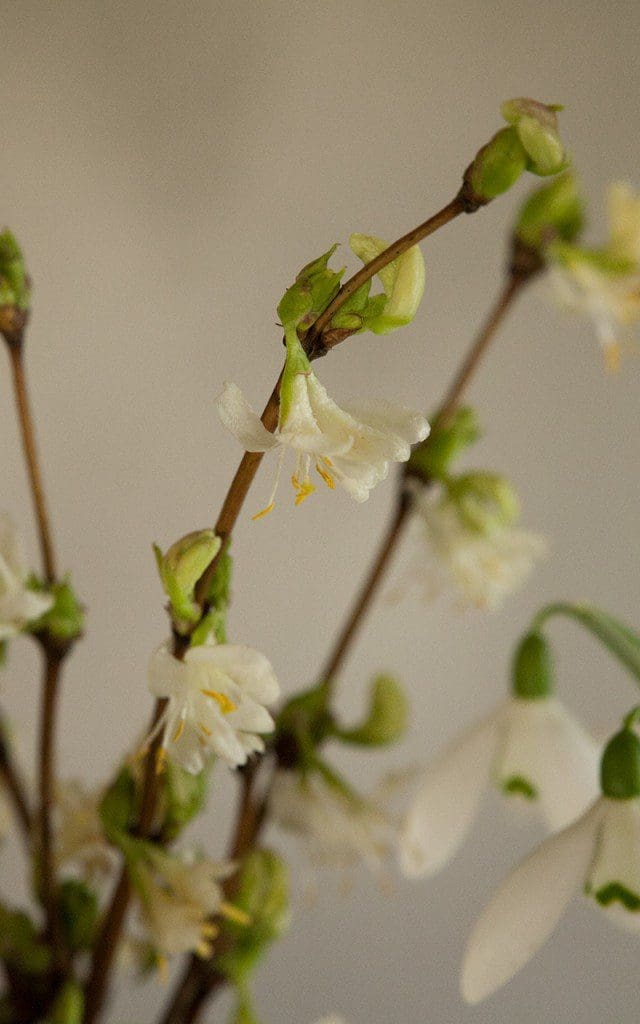 Lonicera fragrantissima
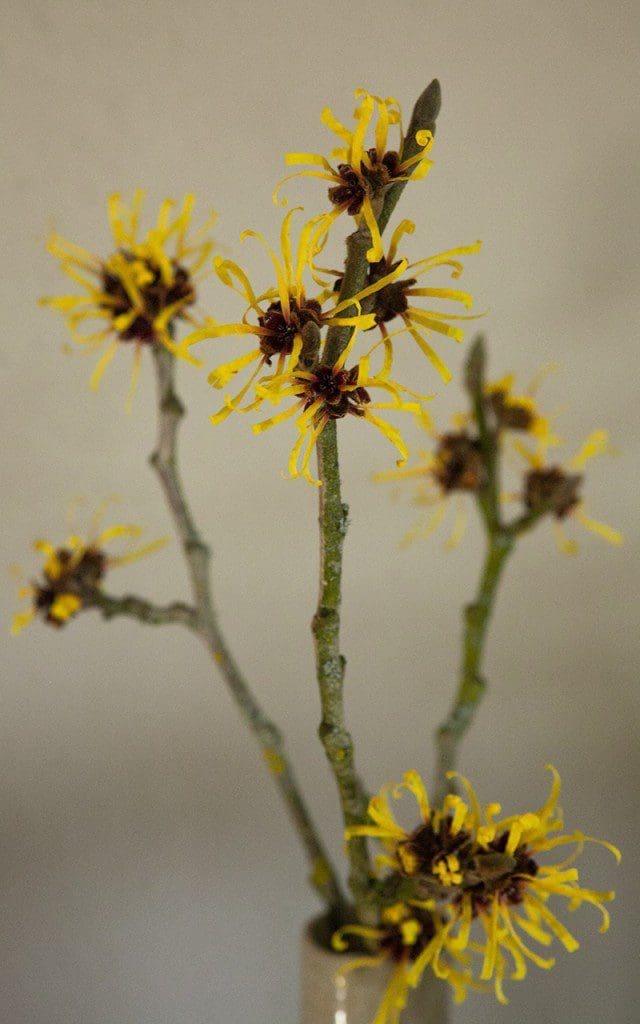 Hamamelis x intermedia ‘Barmstedt Gold’
Though its ease of cultivation and eagerness to take its own territory, like lilac, is less welcome where space is limited, where you can afford to give it the opportunity to flourish, it is a thing to treasure. I’m pleased to have it at my fingertips for its refusal to bow to the season and have planted it at the end of the barns, on a rubbly mound where an aged bullace stands next to the compost heaps. Little grew there except nettles, but I saw in this leftover place a perfect position to let it take hold.
A little plant, from an easily taken cutting, went in two winters ago and it already has a presence, one arching limb bigger and more fully formed than the next and the flowers springing from the lateral growth of the previous year. It is never fully deciduous until the push of bright new leaves in the spring and the pale, waxy flowers are held amongst a scattering of yellowing foliage. Look closely and the blooms with their splayed yellow anthers are clearly those of honeysuckle and they smell like it too. I will leave the shrub to attain full size at 3 metres and not curtail it by regular pruning, although it responds well to the clippers and makes a fine scented hedge. In time I plan to remove whole branches and bring them into the house. Captured indoors the perfume is pervasive, but never overpowering like that of paperwhites.
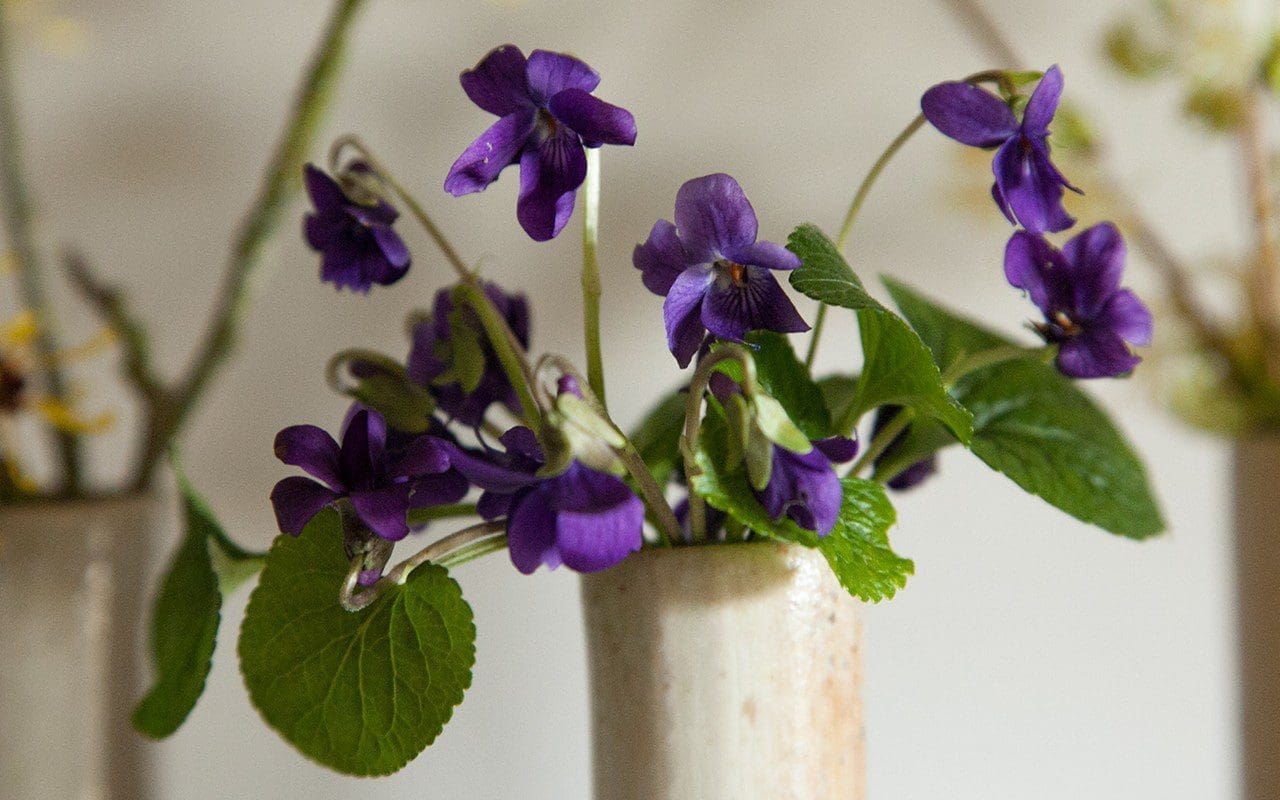 Viola odorata
I have never quite fathomed why so many winter-flowering plants possess a perfume because, although the scent is designed to attract pollinators from a distance, the majority of insects are in hibernation when they are in flower. However, it is a lovely thing to come upon when you are expecting less. Placing is all important where these moments can be fugitive on winter air, and the perfume of the lonicera is held in the stillness around the barns. As it is hungry at the root I have planted a drift of Viola odorata at its base. I believe them to be florist’s violets from the time when the land here was a market garden. There was a self-seeded colony in the lawn in front of the house, which I saved when the re-landscaping took place last year. Rummage amongst the foliage and the very first flowers are already present, their inimitable powdery scent providing a foretaste of spring. Amongst the viola I am going to add one of the earliest of the snowdrops, Galanthus elwesii ‘Mrs. McNamara’, which also started flowering at the turn of the year and is sweetly scented of honey. Another layer to this winter collection and one that is always welcome at this fallow time.
 Galanthus elwesii ‘Mrs. McNamara’
Words: Dan Pearson / Photographs: Huw Morgan
This winter’s notable run of frosts has already marked this year as distinct from the mild run we’ve had of late. We have woken again and again to a glistening world where footfall comes with a crunch and the fields and hedges are unified by the white freeze. The frost has come with clear blue skies and, as the sun has crept over the folds in the land, the colours of winter have bled back in with the thaw of its extending fingers. These are the days when I am pleased for the skeletons of the last growing season. This early into the winter most are still standing and those that will continue to do so are already showing their stamina. The bronze fennel is one of the best. It is already naturalising here, seeding around the rusty barns and even where last year’s bonfire saw them burn in the spring clear up. I have them at the front of the house with the twisted remains of the apricot evening primrose and they have been alive with birds. A flitting wren and robins rummaging around amongst their stems where the seed has fallen and great tits stripping the seed from the architecture of umbels.
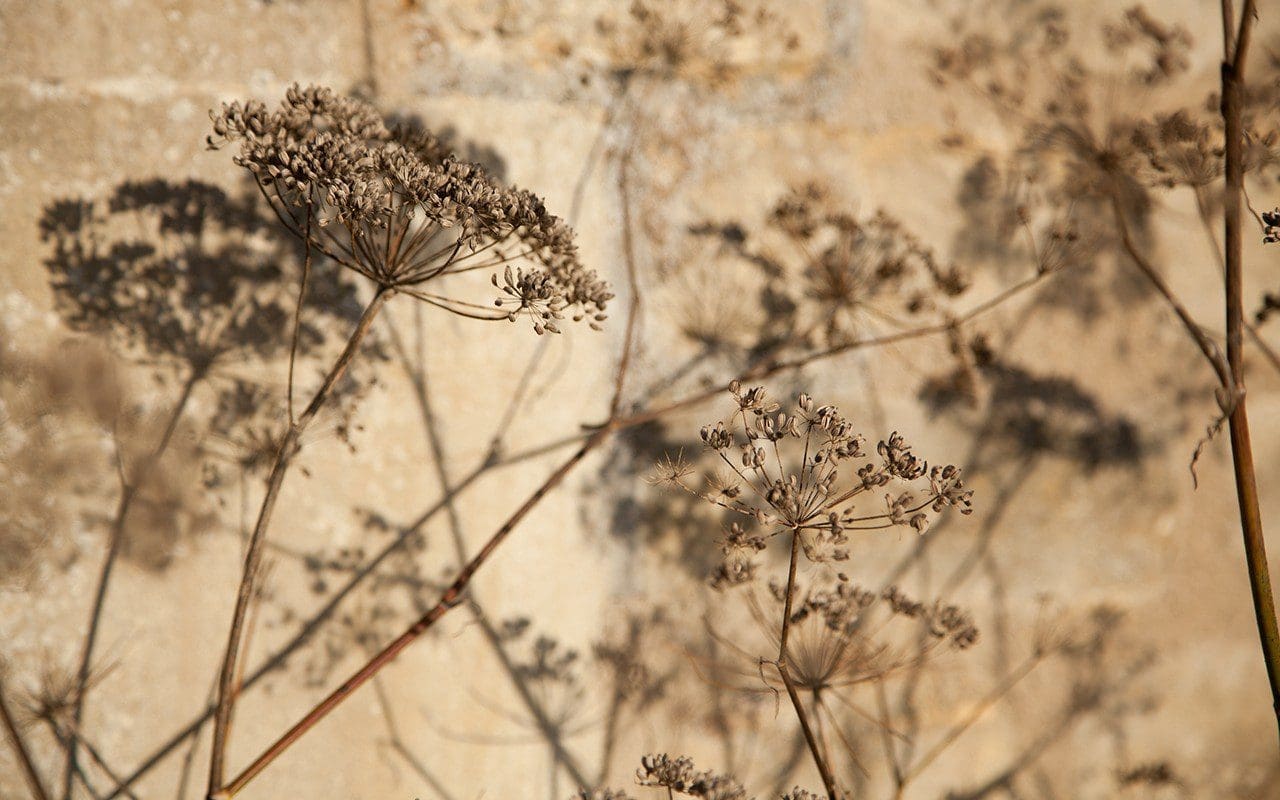 Bronze fennel
In the new garden, where I am working around the old stock beds for now, I am grateful for the reminder that I must plan for these bare bones in its winter incarnation. I want it to be a place that is as fascinating and beautiful in its death throes – and whilst resting – as it is in summer. The volunteer sunflowers left from the garden’s previous chapter, and whose seeds are stripped by the birds, are also a prompt that the garden should be as much a feeding ground as a place to study the decay and drawing back of winter. Where the ground now lies fallow, waiting and empty we will have life and light and change as the skeletons age and bleach and topple towards spring.
Bronze fennel
In the new garden, where I am working around the old stock beds for now, I am grateful for the reminder that I must plan for these bare bones in its winter incarnation. I want it to be a place that is as fascinating and beautiful in its death throes – and whilst resting – as it is in summer. The volunteer sunflowers left from the garden’s previous chapter, and whose seeds are stripped by the birds, are also a prompt that the garden should be as much a feeding ground as a place to study the decay and drawing back of winter. Where the ground now lies fallow, waiting and empty we will have life and light and change as the skeletons age and bleach and topple towards spring.
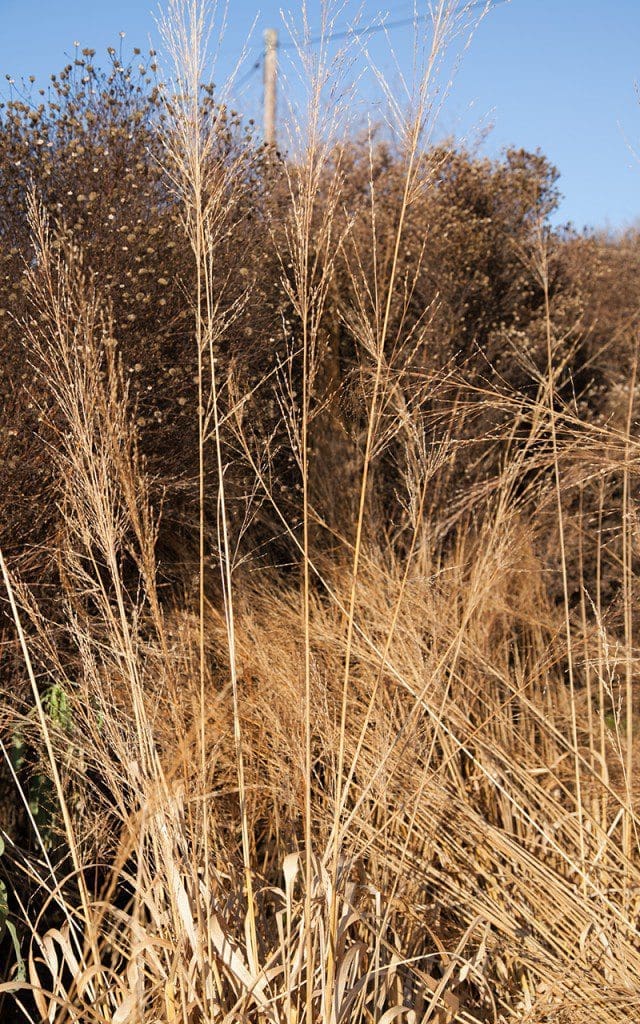 Molinia caerulea ssp. arundinacea ‘Transparent’
The Molinia caerulea ssp. arundinacea ‘Transparent’ that were standing until so very recently have already given way to the weather and lie strewn. I will remember their habit and plant them away from the path so that, when they do fall, their sheaves can be enjoyed akimbo. Their lack of endurance as skeletons can be forgiven if they are in association with plants that keep it together and stand for longer. A drift of the buff powder-puffs of Aster pyrenaeus ‘Lutetia’ or A. x herveyi with its seed now blown free to reveal their light-reflecting starry calyces. Another grass perhaps, such as the Panicums, to arrest the sun in their plumage. The aptly named P. ‘Cloud Nine’ is showing itself to be one of the best I have here, standing tall, the elegant foliage now the colour of straw and parchment, the seedheads large and open. Pale on a dry day, yellowed when it is damp.
Molinia caerulea ssp. arundinacea ‘Transparent’
The Molinia caerulea ssp. arundinacea ‘Transparent’ that were standing until so very recently have already given way to the weather and lie strewn. I will remember their habit and plant them away from the path so that, when they do fall, their sheaves can be enjoyed akimbo. Their lack of endurance as skeletons can be forgiven if they are in association with plants that keep it together and stand for longer. A drift of the buff powder-puffs of Aster pyrenaeus ‘Lutetia’ or A. x herveyi with its seed now blown free to reveal their light-reflecting starry calyces. Another grass perhaps, such as the Panicums, to arrest the sun in their plumage. The aptly named P. ‘Cloud Nine’ is showing itself to be one of the best I have here, standing tall, the elegant foliage now the colour of straw and parchment, the seedheads large and open. Pale on a dry day, yellowed when it is damp.
 Aster pyrenaeus ‘Lutetia’
 Aster x herveyi
 Panicum ‘Cloud Nine’
Remarkable now, and noteworthy for being at its very best in the winter, is Glycyrrhiza yunnanensis. The Yunnan liquorice is perfectly hardy here and has taken well to our sunny slopes. I first saw it on an autumn visit to Piet Oudolf’s garden with my friend and gardener from the Millennium Forest, Midori. In typical fashion Piet offered us the seed and we both took a handful of the extraordinary pods. The following spring we sowed the seed, Midori in Hokkaido and me back here back in Somerset. The plants in Japan have struggled to attain stature, despite coming through a winter beneath an eiderdown of snow, but mine have soared to well over head height and have spawned further generations which I am now nurturing in the frame for the spring planting of the new garden.
Panicum ‘Cloud Nine’
Remarkable now, and noteworthy for being at its very best in the winter, is Glycyrrhiza yunnanensis. The Yunnan liquorice is perfectly hardy here and has taken well to our sunny slopes. I first saw it on an autumn visit to Piet Oudolf’s garden with my friend and gardener from the Millennium Forest, Midori. In typical fashion Piet offered us the seed and we both took a handful of the extraordinary pods. The following spring we sowed the seed, Midori in Hokkaido and me back here back in Somerset. The plants in Japan have struggled to attain stature, despite coming through a winter beneath an eiderdown of snow, but mine have soared to well over head height and have spawned further generations which I am now nurturing in the frame for the spring planting of the new garden.
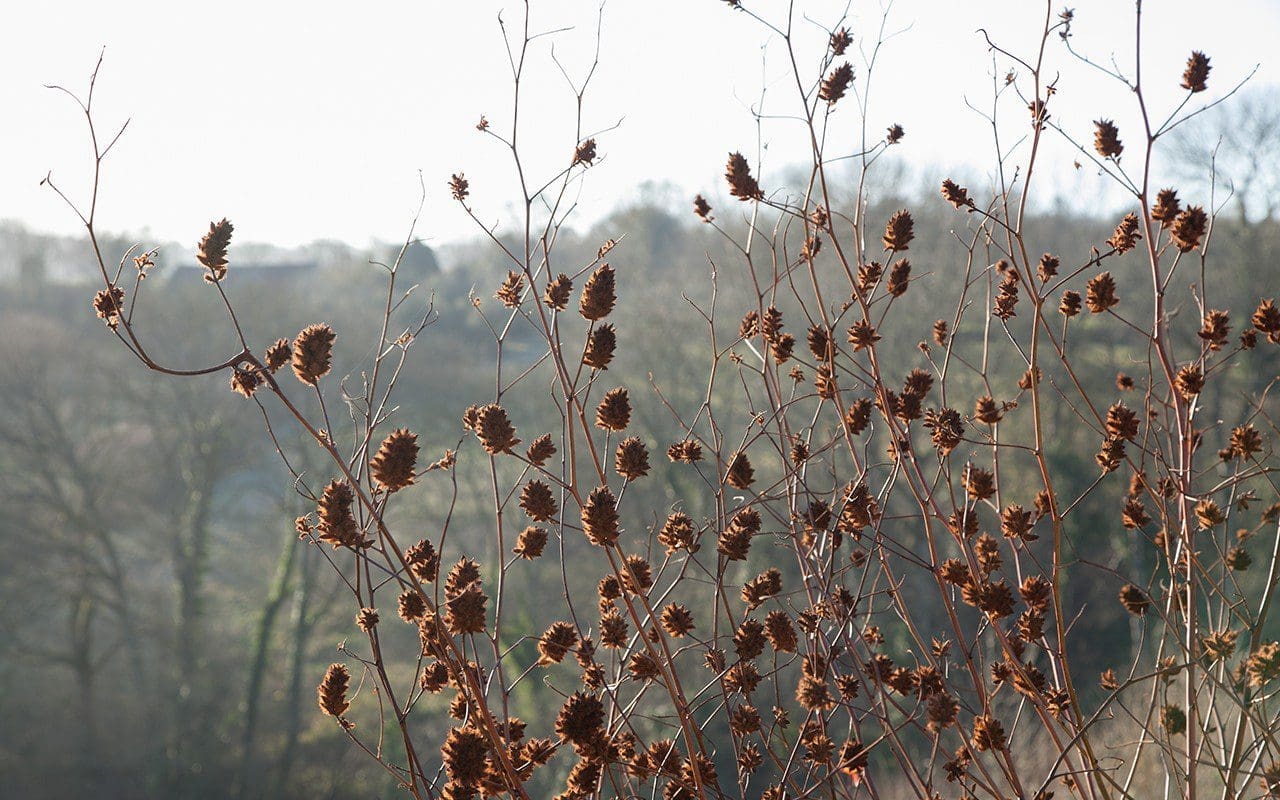 Glycyrrhiza yunnanensis
Their skeletons have been almost immune to the winter. Last year we had to fell them in the spring and cut their glory short to make way for the new growth. The cinnamon-coloured stems, which in summer are clothed with fine, pinnate foliage, stand at over two metres. The seedpods, which are the end result of a pretty but rather insignificant clutch of lilac, pea-like flowers, are as good as any seedpod gets. The size of a hens egg, and like a spiny fir cone in appearance, they are covered in rust-brown hairs that are bristly to the touch and hold the hoar frost as though it was designed for their armature. I will march them through the new garden where they can shine in the cold months and provide us with a place that will celebrate this apparent down time.
Glycyrrhiza yunnanensis
Their skeletons have been almost immune to the winter. Last year we had to fell them in the spring and cut their glory short to make way for the new growth. The cinnamon-coloured stems, which in summer are clothed with fine, pinnate foliage, stand at over two metres. The seedpods, which are the end result of a pretty but rather insignificant clutch of lilac, pea-like flowers, are as good as any seedpod gets. The size of a hens egg, and like a spiny fir cone in appearance, they are covered in rust-brown hairs that are bristly to the touch and hold the hoar frost as though it was designed for their armature. I will march them through the new garden where they can shine in the cold months and provide us with a place that will celebrate this apparent down time.
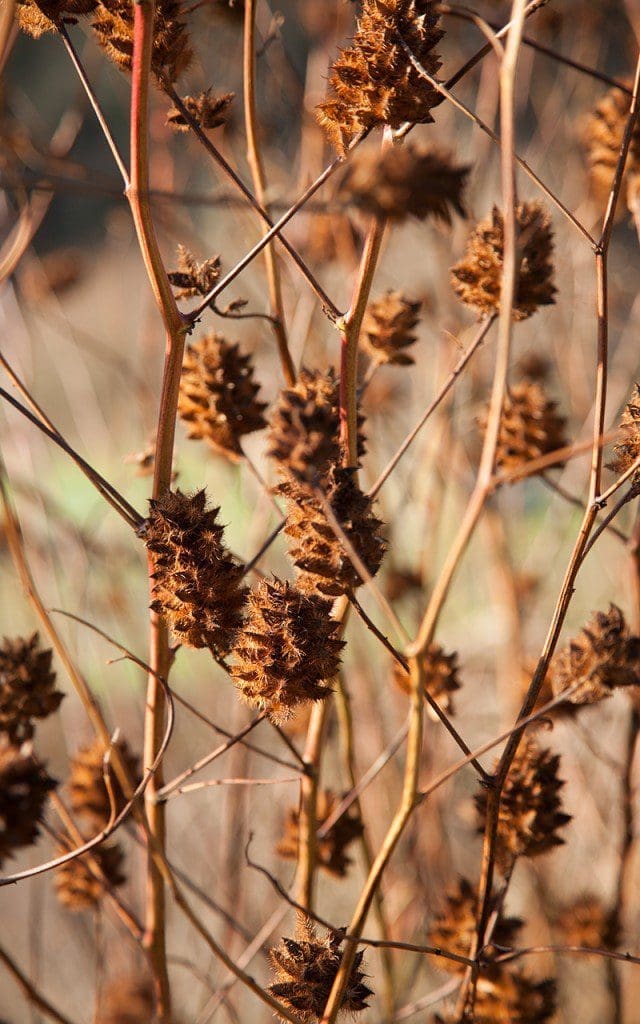 Glycyrrhiza yunnanensis seedheads
Words: Dan Pearson / Photographs: Huw Morgan
Glycyrrhiza yunnanensis seedheads
Words: Dan Pearson / Photographs: Huw Morgan This year we have based ourselves here for three full weeks to see out the last of December and welcome in the new year. Your eye is free to travel further in this wintry landscape and it has been good to follow by venturing beyond our boundaries. Slowly – for it took a few days to get into the routine of it – a walk has started the day. We have been both up and down the valley and high onto the exposed ground of Freezing Hill to experience the roar of the wind in the beeches and to understand why it has its name, as it whips up the slopes that run down the other side to Bristol. Always looking back to see how we fit into the folds, we have contributed to our knowledge of muddy ways, well-worn tracks, breaks in hedges and crossing points back and forth across the ditches and streams. Marking our way – for nearly every field has at least one – are the ancient ash pollards.
Ash wood burns green so the trees have value and owning enough pollards would keep you in firewood if you attended to them in rotation. The pollards regenerate easily from cuts made above the grazing line, so that they can grow away again unhindered by the cattle. Usually standing solitary on a steeply sloping pasture (where they add to their usefulness by providing summer shade for livestock) the pollards are stunted by decades of decapitation and, in combination, make an extraordinary trail of characters in the landscape.
We have stopped at each one to take in their histories and their winter slumbers that expose their distinct personalities. Some are hollow to the core, the new limbs surviving on little more than a thin rim of bark. Inside the hollows map the decay and hold the damp and the smell of it even in the dry months. The halo of new growth that breaks from the old forms a crown of fresh limbs that in ten or twelve years are big enough for harvesting. To date the cycle has continued until the trees are exhausted and split and fail.
Of course, we are waiting patiently to see if the pollards survive the chalara dieback that is moving across the country and is already in the valley. Neighbours who have lived here a lifetime recount how different the landscape was when the elms rose up in the hedgerows, but it is the ash and their potential demise that will now be cause for a new perspective.
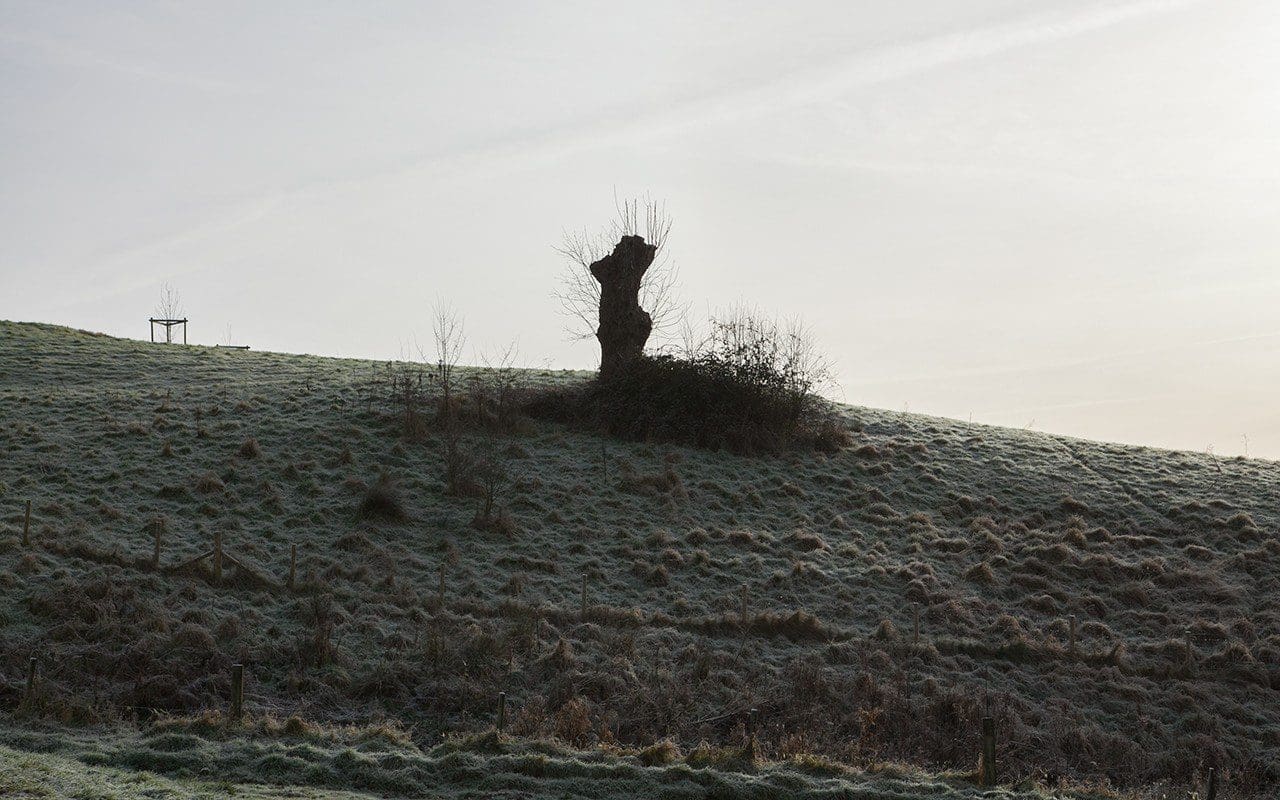 The solitary ash pollard on The Tump
We have a solitary pollard on the west facing slopes of The Tump. The farmer who lived here before us climbed the tree to harvest the wood in the year he died. The tree must have been huge once, the trunk striking the form of an imposing female torso. An interesting presence given the fact that the ash was once seen as the feminine counterpart to the father tree, the oak. When we arrived here there was just a summer’s regrowth and I set to immediately planting thirty new ash in the hedgerows to provide us with our own rotation. So far – and I remain hopeful – they have done well, despite our mother tree showing a reluctance to throw out another set of limbs and the forecasts that estimate a five percent survival for ash in this country.
We have let the grass grow long on the slopes that are too steep for haymaking around our pollard and in six years there are the beginnings of a new habitat. An elder has sprung from high in her crown and a black and sinister fungus from the side that has refused to regrow branches. Around her there is a skirt of bramble and young hawthorns where the birds have previously settled in her branches and stopped to poop. I plan to plant an oak I grew from an acorn amongst them. New life around the old and a suitable partner, I hope, for a changeable future.
Words: Dan Pearson / Photographs: Huw Morgan
December reveals the bones of the landscape. Mud where there was grass, bare stems where there was foliage and, by this late in the year, almost everything drawn back and in retreat. Not so the Glastonbury Thorn. Missing the winterising gene that triggers dormancy and stirring when there is barely enough light or warmth to sustain growth above ground, Crataegus monogyna ‘Biflora’ is pushing against the flow. A scattering of young foliage is greening limbs that only recently were fully clothed and a push of pale flowers braving the elements.
Flowering twice, once in spring in celebration of the resurrection and then again at Christmas to mark the birth of Jesus, the habits of the Glastonbury Thorn are understandably surrounded by legend. Joseph of Arimathea was reputed to have visited Glastonbury with the Holy Grail. Thrusting his staff into Wearyall Hill it sprouted and grew into the original tree which, for superstitious reasons, was cut down and burned during the English Civil War. A subsequent tree (planted from cuttings taken by locals and fostered since then in the area) replaced it in 1951, only to be vandalised in December 2010. Its limbs were crudely dismembered and subsequent growth the following March was mysteriously rubbed out. Then, on 1st April 2012 a sapling grafted from a descendant of the pre-1951 specimen was planted again on the site, only to be snapped in half and irreparably damaged sixteen days later.
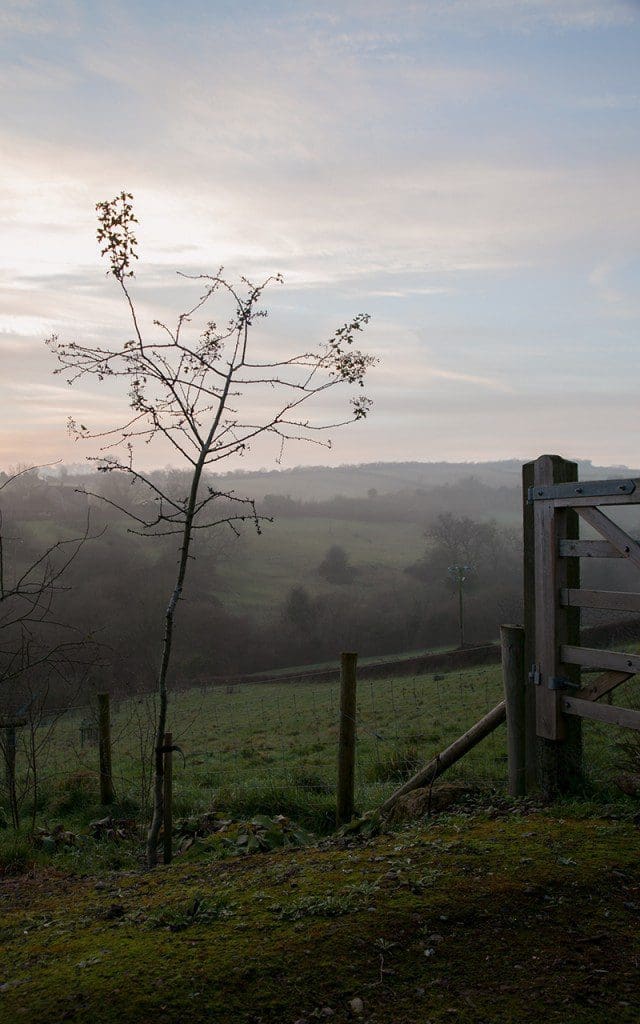 The Glastonbury Thorn by the orchard gate
As I like a story, and the thought of sweetening a sad one, I set out to find a tree when we moved here to give the magical thorn another stronghold. As all the plants are reputed to come from grafts taken from the original tree, the search revealed how few people grow it and how hard it is to find. Our friend and fellow gardener, Hannah, made me a present of one for my fiftieth birthday and now here it is, by the gate to the pear orchard, in all it’s curiosity.
Though a branch growing in the Churchyard of St. John’s, Glastonbury is taken to the Queen every year on December the 8th by the Vicar and Mayor of Glastonbury, I am too superstitious myself to pick a sprig for the house. Folklore has it that it is unlucky to bring hawthorn over the threshold and, to compound the story, they say the original tree took out the eye of the man who felled it during the Civil War. I like my tree where it is because the flowers draw me out into a closing-down landscape, which is charged just a little by their miraculous show on the darkest days of the year.
Words: Dan Pearson / Photographs: Huw Morgan
The bare-root plants arrived at the end of November, bagged up at the nursery as soon as the foliage fell from the branches and bundled together ready to make the move to new ground. Just an hour after delivery the roots were plunged in the trough to rehydrate them and then the bundles lined out in a trench in the kitchen garden until I was ready to plant them in their final positions. I love this moment, which marks the transition between the activity of a garden tended through the growing season to the industry of winter preparation. It is now that the real work is happening. As we turn the soil to let the frost do the work of preparing it for spring planting, or spend an hour shaping the future of a new tree so that its branches are given the best possible opportunity, we imagine the growing garden fully-clothed and burgeoning.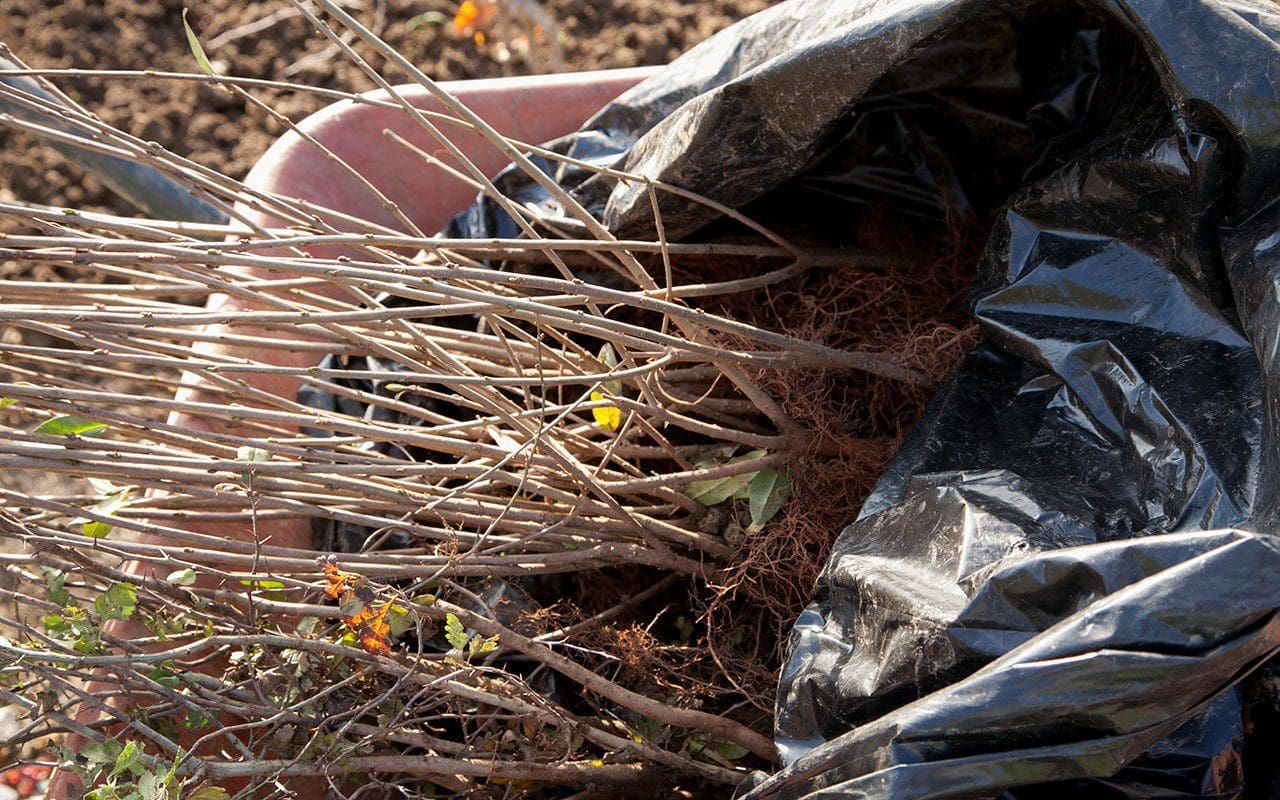 Bare-root whips of hawthorn and wild privet
I buy my bare-root plants from a local wholesale nursery just fifteen miles from here and welcome the fact that they haven’t had to travel far to their new home. This year the two-year-old whips are the bones of a new hedge that will hold the track which runs behind the house and along the contour of the slope to the barns. It replaces a worn out hedge of bramble and elder that was removed when we built the new wall and will provide shelter to the herb garden below when we get the cold north-easterlies. It will also connect with the ribbons of hedges that make their way out into the landscape. Keeping it native will allow it to sit easily in the bank and to play host to birds up close to the buildings.
This year my annual ambition to get bare-root material in the ground before Christmas has been achieved for the very first time. It is best to get bare-root plants in the ground this side of winter if at all possible. They may not look like they are doing much in the coming weeks but, if I were to lift a plant from my newly planted hedge at the end of January, it would already be showing roots that are active and venturing into new ground. With this advantage, when the leaves pop in the spring the plants will be more independent and less reliant on watering than if planted at the back end of winter.
Bare-root whips of hawthorn and wild privet
I buy my bare-root plants from a local wholesale nursery just fifteen miles from here and welcome the fact that they haven’t had to travel far to their new home. This year the two-year-old whips are the bones of a new hedge that will hold the track which runs behind the house and along the contour of the slope to the barns. It replaces a worn out hedge of bramble and elder that was removed when we built the new wall and will provide shelter to the herb garden below when we get the cold north-easterlies. It will also connect with the ribbons of hedges that make their way out into the landscape. Keeping it native will allow it to sit easily in the bank and to play host to birds up close to the buildings.
This year my annual ambition to get bare-root material in the ground before Christmas has been achieved for the very first time. It is best to get bare-root plants in the ground this side of winter if at all possible. They may not look like they are doing much in the coming weeks but, if I were to lift a plant from my newly planted hedge at the end of January, it would already be showing roots that are active and venturing into new ground. With this advantage, when the leaves pop in the spring the plants will be more independent and less reliant on watering than if planted at the back end of winter.
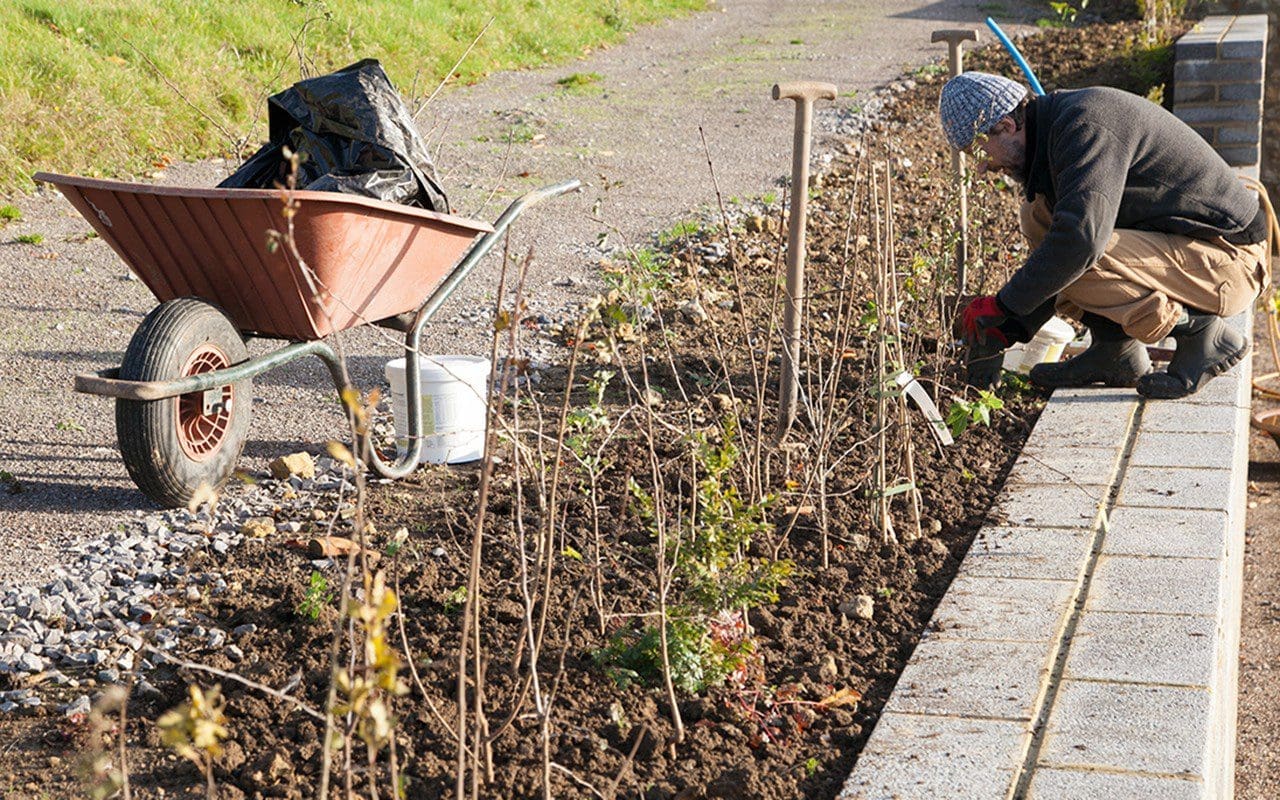 The new hedge will hold the track behind the house and act as a windbreak for the herb garden below the wall
Slit planting whips could not be easier. A slot made with a spade creates an opening that is big enough to feed the roots into so that the soil line matches that of the nursery. I have been using a sprinkling of mycorrhizal fungus on the roots of each new plant to help them establish – the fungus forms a symbiotic relationship with the roots and mycorrhiza in the soil, enabling them to take in water and nutrients more easily. A well-placed heel closes the slot and applies just enough pressure to firm rather than compact the soil. The plants are staggered in a double row for density with a foot to eighteen inches or so between plants.
The new hedge will hold the track behind the house and act as a windbreak for the herb garden below the wall
Slit planting whips could not be easier. A slot made with a spade creates an opening that is big enough to feed the roots into so that the soil line matches that of the nursery. I have been using a sprinkling of mycorrhizal fungus on the roots of each new plant to help them establish – the fungus forms a symbiotic relationship with the roots and mycorrhiza in the soil, enabling them to take in water and nutrients more easily. A well-placed heel closes the slot and applies just enough pressure to firm rather than compact the soil. The plants are staggered in a double row for density with a foot to eighteen inches or so between plants.
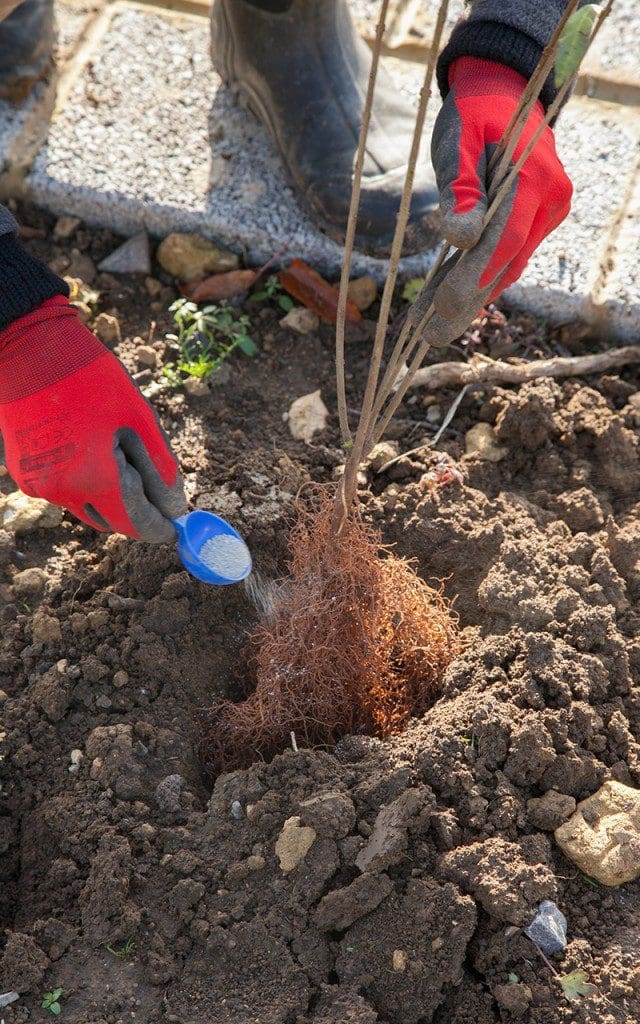 Adding mychorrizal fungi to newly planted hedging whips
I have planted a new hedge or gapped up a broken one every winter since we moved here and I have been amazed at how quickly they develop. They are part of our landscape, snaking up and over the hills to provide protection in the open places and it is a good feeling to keep the lines unbroken. This one has been planned for about three years, so I have been able to propagate some of my own plants to provide interest within the foundation of hawthorn and privet. Hawthorn is a vital component for it is fast and easily tended. It provides the framework I need in just three years and the impression of a young hedge in the making not long after it first comes into leaf. I have planted two hawthorn whips to each one of Ligustrum vulgare, which is included for its semi-evergreen presence. I like our wild privet very much for its delicate foliage, late creamy flowers, shiny black berries and the fact that it provides welcome winter protection for birds.
Woven amongst this backbone of bare-roots plants, and to provide a piebald variation, are my own cuttings and seed-raised plants. A handful of holly cuttings – taken from a female tree that holds onto its fruit until February – and box for more evergreen. The box were rooted from a mature tree in my friend Anna’s garden in the next valley. I do not know it’s provenance, but it is probably local for there is wild box in the woods there. I like a weave of box in a native hedge as it adds density low down and an emerald presence at this time of year.
Adding mychorrizal fungi to newly planted hedging whips
I have planted a new hedge or gapped up a broken one every winter since we moved here and I have been amazed at how quickly they develop. They are part of our landscape, snaking up and over the hills to provide protection in the open places and it is a good feeling to keep the lines unbroken. This one has been planned for about three years, so I have been able to propagate some of my own plants to provide interest within the foundation of hawthorn and privet. Hawthorn is a vital component for it is fast and easily tended. It provides the framework I need in just three years and the impression of a young hedge in the making not long after it first comes into leaf. I have planted two hawthorn whips to each one of Ligustrum vulgare, which is included for its semi-evergreen presence. I like our wild privet very much for its delicate foliage, late creamy flowers, shiny black berries and the fact that it provides welcome winter protection for birds.
Woven amongst this backbone of bare-roots plants, and to provide a piebald variation, are my own cuttings and seed-raised plants. A handful of holly cuttings – taken from a female tree that holds onto its fruit until February – and box for more evergreen. The box were rooted from a mature tree in my friend Anna’s garden in the next valley. I do not know it’s provenance, but it is probably local for there is wild box in the woods there. I like a weave of box in a native hedge as it adds density low down and an emerald presence at this time of year.
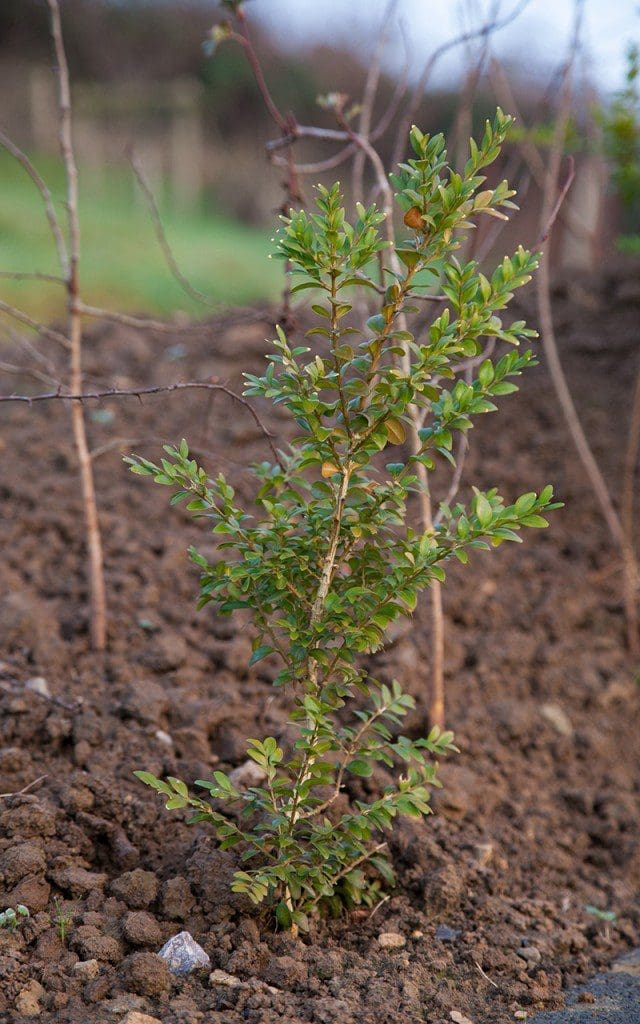 A home-grown box cutting
Raised from seed sown three years ago, taken from my first eglantine whips, are a handful of Rosa eglanteria. They make good company in a hedge, weaving up and through it. A smattering of June flower and the resulting hips come autumn earn it a place, but it is the foliage that is the real reason for growing it. Smelling of fresh apples and caught on dew or still, damp weather, they will scent the walk as we make our way to the barns.
The final addition are part of a trial I am running to find the best of the wild honeysuckle cultivars. I have ‘Graham Thomas’ and the dubiously named ‘Scentsation’, but Lonicera periclymenum ‘Sweet Sue’ is the one I’ve chosen for this hedge, as it is supposed to be a more compact grower and freer-flowering. There are three plants, which should wind their way through the framework of the hedge as it develops and add to the perfumed walk. Wild strawberries will be planted as groundcover in the spring to smother weeds and to hang over the wall where they will make easy picking.
A home-grown box cutting
Raised from seed sown three years ago, taken from my first eglantine whips, are a handful of Rosa eglanteria. They make good company in a hedge, weaving up and through it. A smattering of June flower and the resulting hips come autumn earn it a place, but it is the foliage that is the real reason for growing it. Smelling of fresh apples and caught on dew or still, damp weather, they will scent the walk as we make our way to the barns.
The final addition are part of a trial I am running to find the best of the wild honeysuckle cultivars. I have ‘Graham Thomas’ and the dubiously named ‘Scentsation’, but Lonicera periclymenum ‘Sweet Sue’ is the one I’ve chosen for this hedge, as it is supposed to be a more compact grower and freer-flowering. There are three plants, which should wind their way through the framework of the hedge as it develops and add to the perfumed walk. Wild strawberries will be planted as groundcover in the spring to smother weeds and to hang over the wall where they will make easy picking.
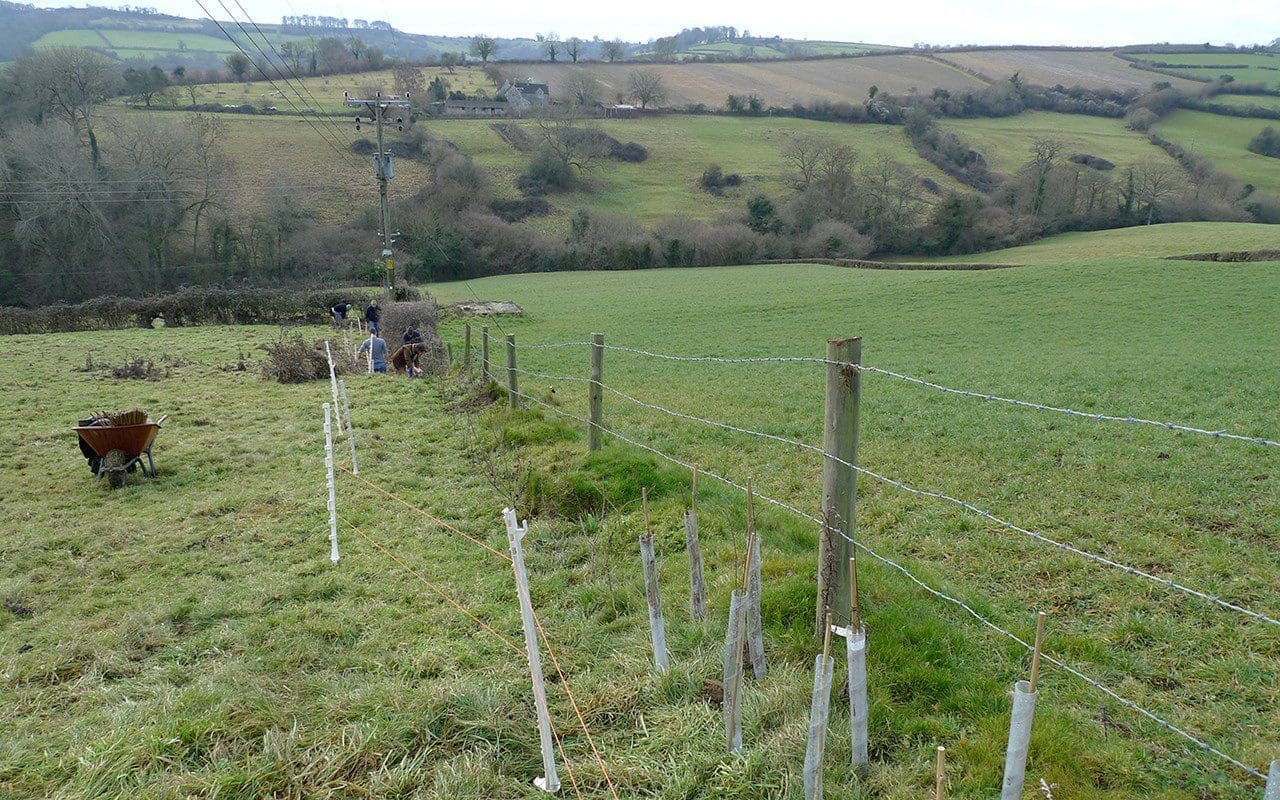 Planting a new field boundary hedge on new year’s day 2011
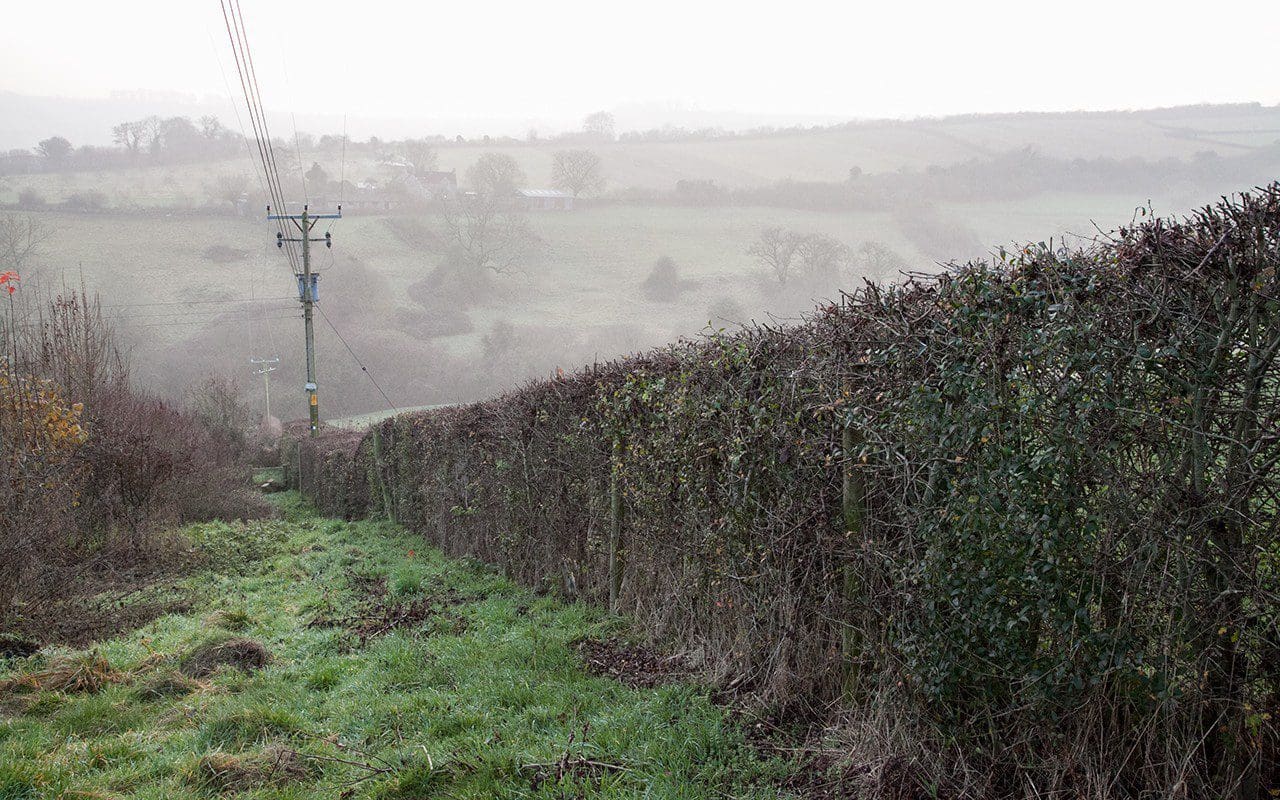 The same hedge six years later
Words: Dan Pearson / Photographs: Huw Morgan
The same hedge six years later
Words: Dan Pearson / Photographs: Huw Morgan As Dan wrote recently, at this time of year we often find that some of our pumpkins have started to deteriorate in storage. These are usually the varieties that contain more water. Unless damaged or frosted, those higher in dry matter generally have a longer storage life.
Last year, and due to a lack of storage space while our building works were taking place, we were faced with a depressingly large number which were fast heading in only one direction. The compost heap. Determined not to lose such a good harvest I resolved to find a way of preserving them. However, there is only so much soup and puree that the freezer can take. Or that you want to eat.
I had had success the previous year developing a recipe for brown sauce, which had been initiated by a similar desire to make the most of the windfall apples from the old orchard in our top fields. Traditional brown sauce recipes are based on tomato, but I thought that both the sweetness and texture of apples could stand in for them, particularly when brown sauce is primarily a vehicle for full-flavoured spices. And so came the idea of a making a spiced ketchup where the sweetness and texture of tomato are replaced with those of pumpkin.
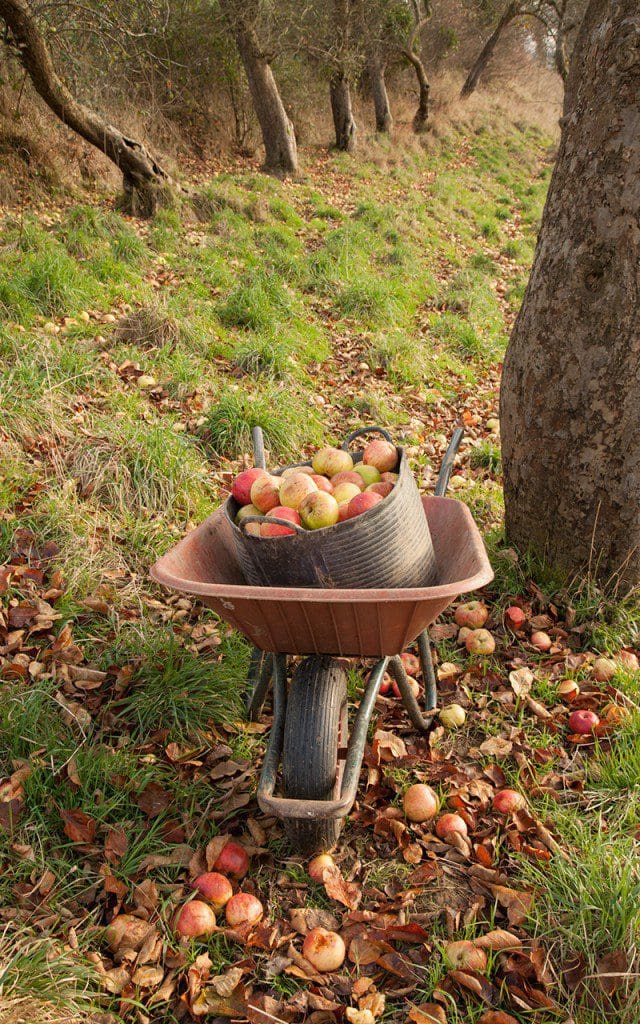 Windfall apples in the old orchard
Historically ketchups were developed from fermented fish-based sauces from the Far East which were brought to the west by the British. In 18th century England they started as dark, savoury table sauces made with mushrooms, anchovies and even walnuts. The development of tomato ketchup took place in America in the early 19th century and this is when recipes for the sauce that we recognise as ketchup today first appeared. Traditional flavourings for tomato ketchup included allspice, mace, ginger, nutmeg and coriander seed. Since all of these, and more, feature in the Moroccan spice mix Ras el Hanout, I decided to use this as the basis of the spicing for this ketchup.
I enjoy the process of making my own spice mixes with a mortar and pestle. The gradual change of texture as the whole seeds and ground spices combine into a fragrant powder is a gratifying experience. You can also balance the proportions of the spices to suit your own tastes rather than relying on a pre-made spice mix which may be a little stale, too heavy on the cloves or cinnamon or lacking the pricier components like mace.
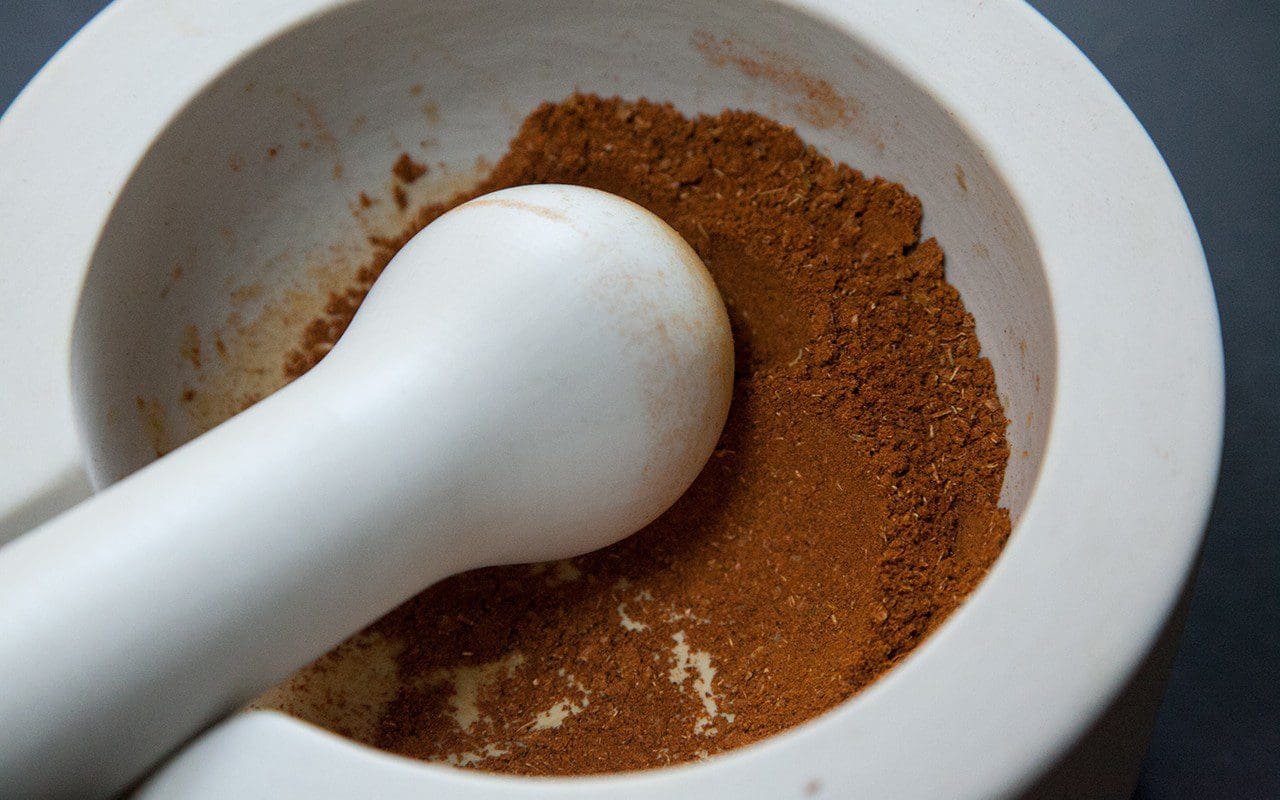 Ras el Hanout
To counteract the sweetness this ketchup needs a good kick of heat. Last year, in keeping with the Moroccan flavourings, I used a combination of harissa and smoked paprika, adding the harissa separately from the spice mix. Earlier this year I was given a large bag of fresh chipotle chilli powder by a friend who had been to Mexico and, since both pumpkin and chilli are native to this part of North America, they seemed a natural pairing. If using ready made Ras el Hanout check that it contains chilli, as some varieties don’t. If so you will need to add the chilli separately.
As with all preserves containing vinegar this ketchup needs to mature before use. However, since the amount used is relatively low in proportion to the other ingredients, it can be used within 2-3 weeks, so there is still time to make a batch for Christmas presents. The flavour improves and develops the longer it is kept.
Use as you would tomato ketchup or brown sauce with fry ups, burgers and sausages, as a marinade for chicken, lamb and pork, or as a seasoning for soups and stews.
Ingredients
1.5kg pumpkin
500g cooking or eating apples
500g onion
1 head of garlic or 7 large cloves
Zest of 1 lemon
3 teaspoons salt
250ml apple cider vinegar
250 g soft brown sugar
Water
RAS EL HANOUT
1/2 teaspoon fennel seed
1/2 teaspoon cumin seed
1/2 teaspoon ground ginger
1/2 teaspoon coriander seed
1/2 teaspoon ground allspice
1/2 teaspoon ground turmeric
1/2 teaspoon ground cinnamon
1/2 teaspoon freshly grated nutmeg
1/2 teaspoon ground mace – 3 blades
1/4 teaspoon ground cloves – about 10 cloves
1/4 teaspoon cardamon seed – contents of about 5 pods
2 teaspoons chilli flakes, smoked paprika, chipotle chilli or harissa
OR
6 teaspoons of ready made Ras el Hanout
Method
Cut the pumpkins in half. Scoop out the seeds and peel, removing any parts that are soft. Chop into pieces and put into a large preserving pan with the peeled, cored and chopped apples, coarsely chopped onion and peeled, trimmed garlic cloves.
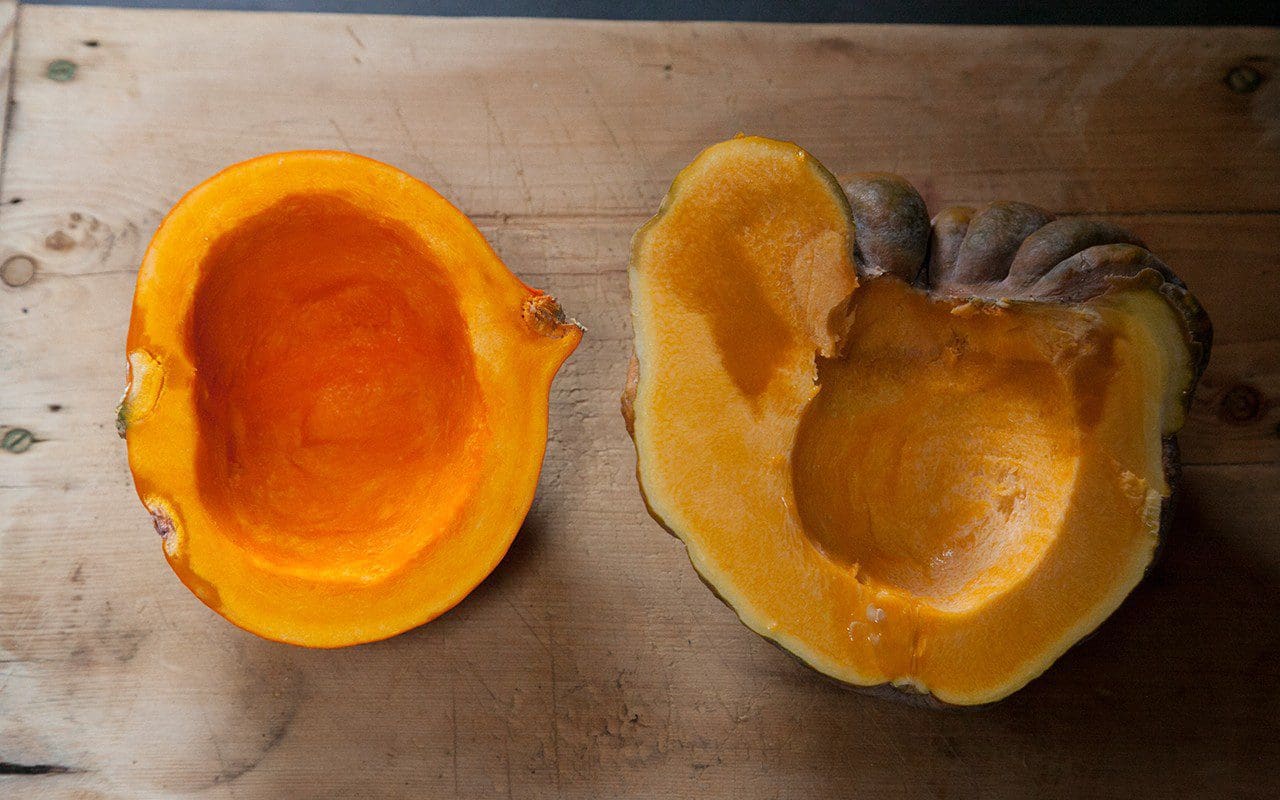 Any parts of the pumpkin that are soft or starting to rot are removed
Lightly toast the fennel, cumin, coriander and cardamom seeds in a small frying pan. Put with the remaining spices into a mortar and pestle or spice mill and grind to a fine powder. Add to the pan with all of the remaining ingredients, apart from the vinegar and sugar. Pour in just enough water to initially prevent the vegetables from catching. They will produce plenty of liquid as they start to cook.
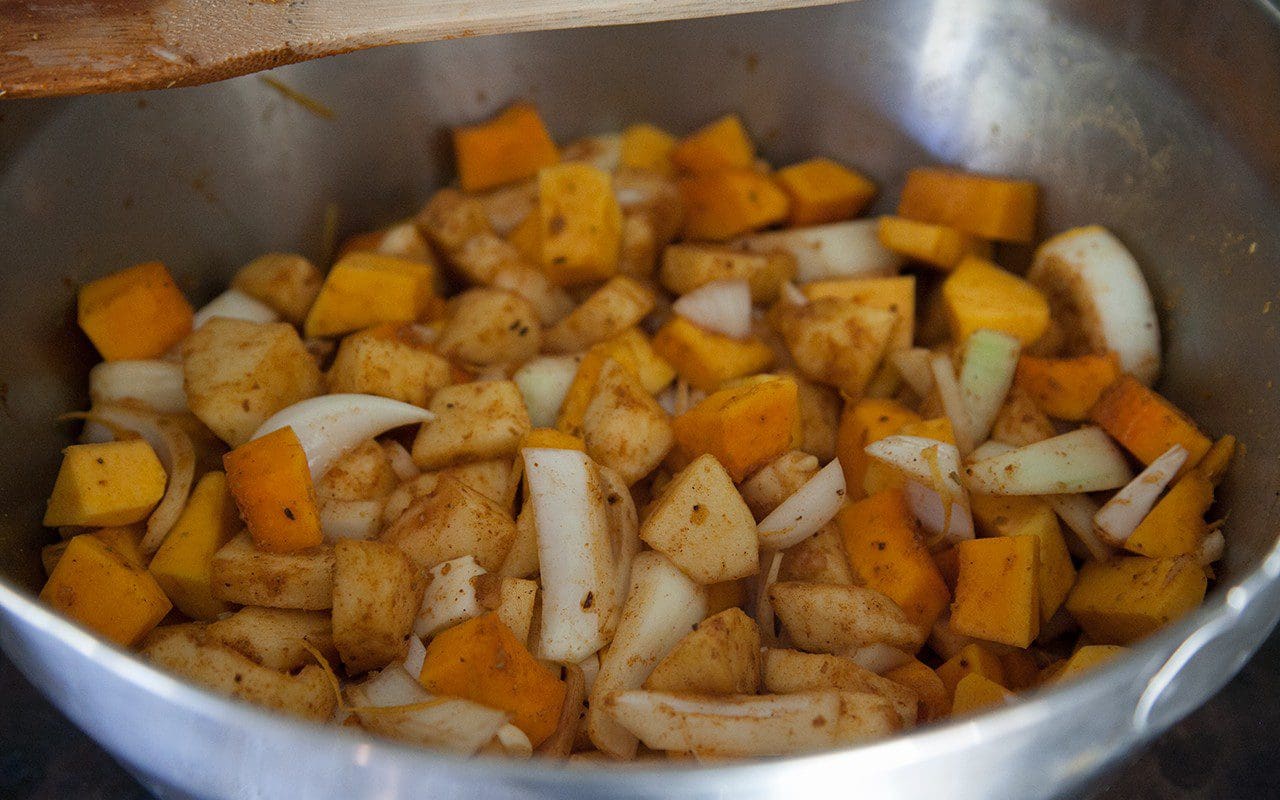
Put the pan over a moderate heat. Cover and cook gently, stirring from time to time, until the vegetables are soft and broken up. Pass the cooked vegetables through a food mill, or process to a smooth puree with a stick blender.
Add the sugar and vinegar and return the pan to a high heat. Cook, stirring continuously, until the mixture thickens. The sauce has a tendency to splutter, so it is advisable to use an oven glove or wrap your hand in a tea towel while stirring. The type of pumpkin you use will determine how much water is given up during cooking. You want to boil it until you have a homogenous sauce with no liquid separated from the solids. The consistency should be a little looser than you want it on the plate, as it continues to thicken as it cools after bottling.

Using a funnel pour into sterilised, heated glass bottles or jars with rubber seals and vinegar-proof lids. Close immediately.
Once cold label and store in a cool, dark place. It will keep for a year or longer.
Makes about four 500ml bottles.
Recipe & photographs: Huw Morgan
We are sorry but the page you are looking for does not exist. You could return to the homepage