It has been a long, slow start to spring, but at last we have movement. The snakeshead fritillaries are chequering the slopes behind the house and crossing over with early daffodils that this year were a whole two weeks late. The long wait will now see a rush as everything comes together, but reflecting the last few weeks of slim pickings we have kept things simple in this April gathering.
The wet weather has hit hard this year and Tulip Fire has run rampant through the tulip bed. We mass the tulips together in a random mix of six or seven varieties in the kitchen garden and experiment with a new colour palette and untried varieties every year. This year we planned for soft reds, pinks, oranges and apricots with an undercurrent of deep purples. However, we did not plan for the angst that has come with the mistake of replanting too soon in the same place. The Tulip Fire (Botrytis tulipae) probably came in with the bulbs that were grown in the same bed two years ago. A dry spring that year most likely limited its impact and it went unseen. This wouldn’t have been a problem if we’d not replanted in the same place for three to five years.
We will not be making the mistake again, for the majority of this year’s flowers are withered, pock-marked and streaked, the foliage melted on the worst affected. As soon as the flowers that are harvestable have been cut, we will dig up the bulbs and burn them on the bonfire. It has been a hard lesson after a long winter and one never to be forgotten, but we have managed to salvage enough to appreciate close up.
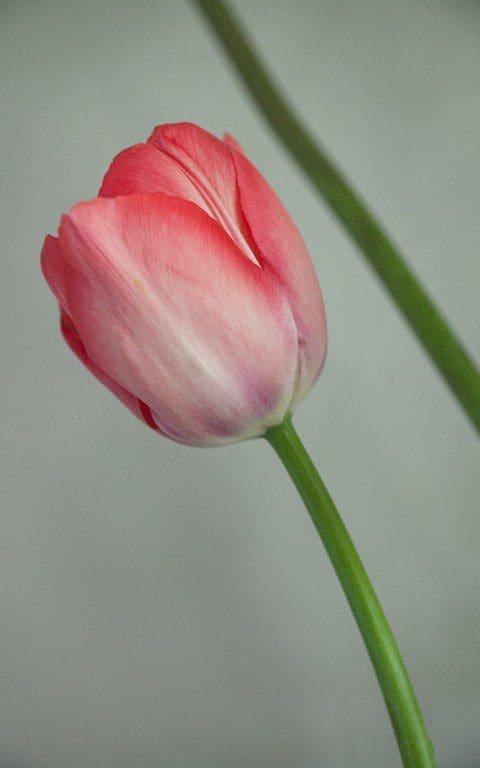 Tulipa ‘Van Eijk’
We will be trying Tulipa ‘Van Eijk’ again, for its faded pink exterior which conceals the surprise of a bright scarlet interior. The flowers enlarge and age gracefully, first to a strong lipstick pink before ending up a washed rose with the texture and shine of taffeta. It is said to be a variety that comes back for several years without the need for lifting, so next year I will try it by itself in some fresh ground. Planting in late November or early December when the weather is colder is said to diminish the impact of the botrytis should it already be in the ground. Grown on their own and not in the mass of different varieties, they may stand a better chance of staying clean. We have now kept a note to move our cutting tulips between beds on a five year rotation.
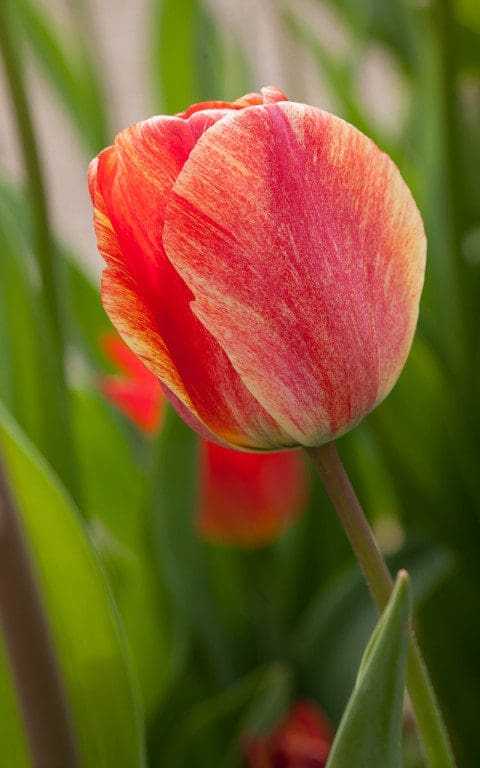
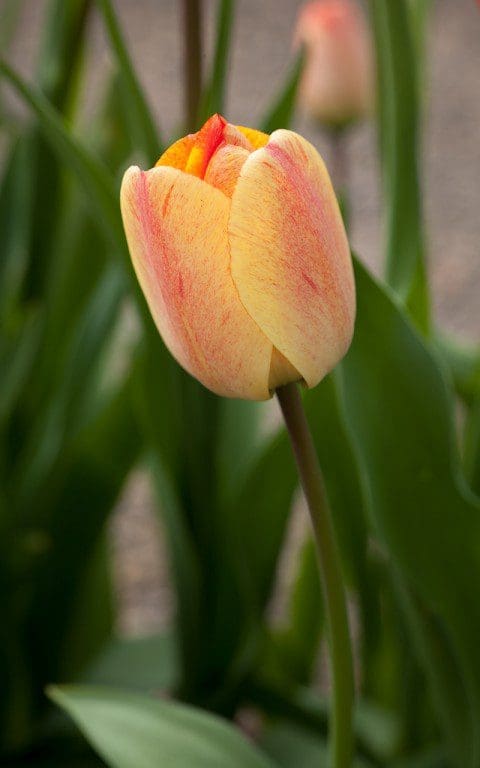
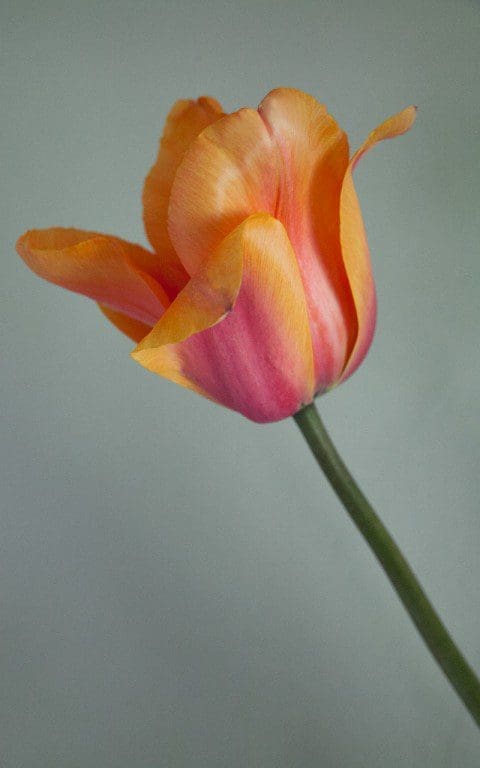 Tulipa ‘Apricot Impression’
Tulips are remarkable for their ability to grow and adjust in a vase. The long-stemmed, large-flowered varieties exaggerate the quiet choreography that sees their initial placement becoming something entirely different as the flowers arc and sway. The complexity of colours in Tulipa ‘Apricot Impression’ is promising. The raspberry pink blush in the centre of each petal is quite marked to start with, but suffuses them as the flowers age creating an overall impression of strong coral pink bleeding out to true apricot. The insides are an intense, lacquered orange with large black blotches at the base and provide voluptuous drama as they splay open with abandon. Though our choice of tulips has been somewhat pared back this year, it is good to have enough to get a taste of the selections we’d planned.
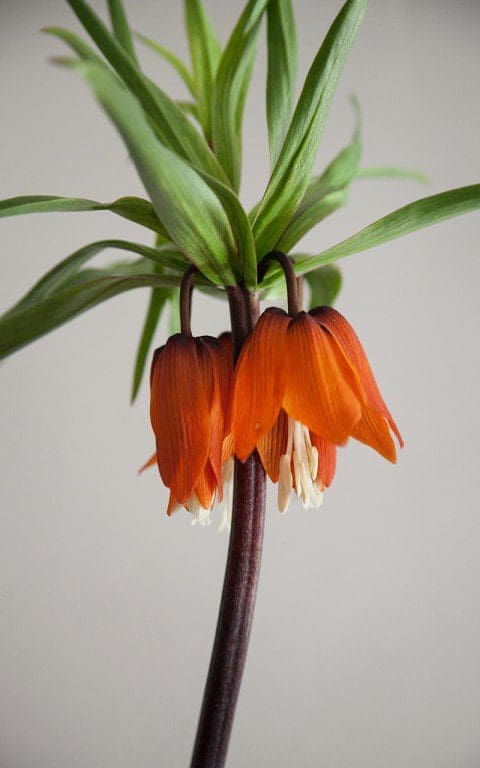 Fritillaria imperialis ‘Rubra’
This is the first time I have grown the Crown Imperial (Fritillaria imperialis) here, and their story has been entirely different. Up early, the reptilian buds spearing the soil in March, and quickly rearing above the dormant world around them, their glossy presence has been so very welcome. I have drifted them in number on the steep slopes at the entrance of the new garden amongst the rangy Paeonia delavayi. Fritillaria imperialis ‘Rubra’ has strong colouring with dark, bronze stems and rust orange flowers that work well with the emerging copper-flushed foliage of the peonies. Although there is an exotic air to the combination, it somehow works here up close to the buildings. It is a combination that you might imagine coming together through the Silk Route, China and the Middle East. However, plant hunters had already introduced the fritillaria from Persia in the mid 1500’s, and so it also has a presence that speaks of a particular kind of old English garden.
At the opening of the Cedric Morris exhibition at The Garden Museum this week Crown Imperials were a key component of Shane Connolly’s floral arrangements, scenting the nave with their appealingly foxy perfume. The smell is said to keep rodents and moles at bay and, though potent, is not unpleasant in my opinion. Morris’ painting Easter Bouquet (1934) captured them exuberantly in an arrangement from his garden at Benton End, which updates the still lives of the Dutch Masters with muscularity and vibrant colour. Rich, evocative and full of vigour, the paintings confirmed to me why we push against the odds to garden.
I planted half the bulbs on their side to see if it is true that they are less likely to rot, and the other half facing up. However, contrary to advice the two failures were bulbs planted on their sides. I also planted deep to encourage re-flowering in future years. The bulbs are as big as large onions, but it is worth planting them at three times their depth since they are prone to coming up blind when planted shallowly. In their homeland in the Middle East, they can be seen in the dry valleys in their thousands after the winter rains, so I am hoping that our hot, dry slopes here suit them. They are teamed with a late molinia and asters, to cover for the gap they will leave when they go into summer dormancy.
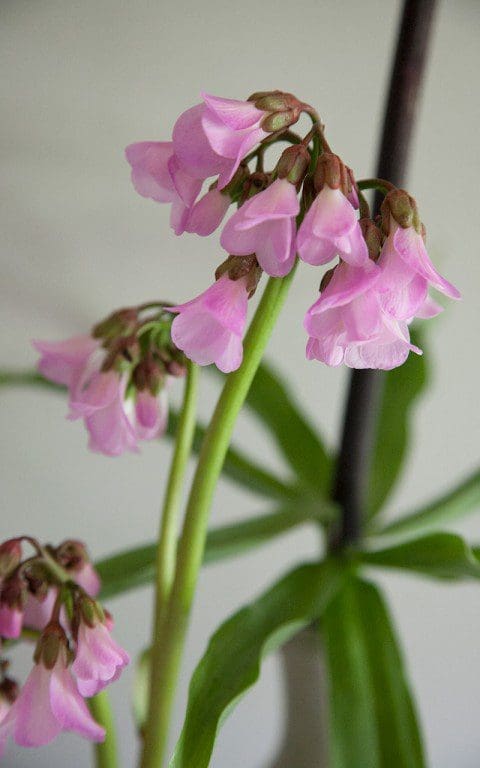 Bergenia emeiensis hybrid
The third component in this collection is a pink hybrid form of Bergenia emeinsis. It was given to me by Fergus Garret, who tells me it was handed down by the great nursery woman Elizabeth Strangman with the words that it was a “good plant”. Sure enough, despite its reputation for not being reliably hardy, it has done well for me and flowered prolifically for the first time this year amongst dark leaved Ranunculus ficaria ‘Brazen Hussy’. However, the combination was far from right, the sugary pink of the bergenia clashing unashamedly with the chrome yellow celandines. A combination Christopher Lloyd may well have admired, but not one that feels right here.
However, the elegant flowers are held on tall stems and the leaves are small and neat, so it has been found a new home in the shade at the studio garden in London, where it can be eye-catching when in season against a simple green backdrop. Though this recently introduced species from China grows in moist crevices in Sichuan, it is happy to adapt and is so prolific in flower that I had to find it a place where its early showiness feels right, rather than getting rid of a good plant. More lessons learned, and more to come now that the tide has finally turned.
Words: Dan Pearson / Photographs: Huw Morgan
Published 21 April 2018
The tulips are finally over or, more to the point, we are taking control this weekend and will bring their extraordinary display to a close by lifting the bulbs and clearing the bed. As is the way with Christmas decorations, I feel almost as much pleasure in finally stripping away their ornamentation after the period of illumination and, for a moment, for there to be quiet. And, with the cool, dry weather this year, they have been flowering for a full six weeks.
We started growing tulips in earnest in the garden in Peckham, ordering a handful of varieties to fill the pots on the terraces. Each year, a favourite was kept on to get to know it better and winkled into the beds to see if it would last in the ground. That was how we discovered that we preferred ‘Sapporo’ to ‘White Triumphator’, for the fact that it ages from primrose to ivory, and it has been hard to match the perfume and vibrant tangerine of ‘Ballerina’.
When we moved here we continued to experiment, upping the number of varieties and planting the tulips in rows in the vegetable garden to slowly build an armoury of favoured varieties. As we became more confident with our experimentations and learned how to extend the season by including early, mid and late season tulips, we began a to grow them altogether differently.
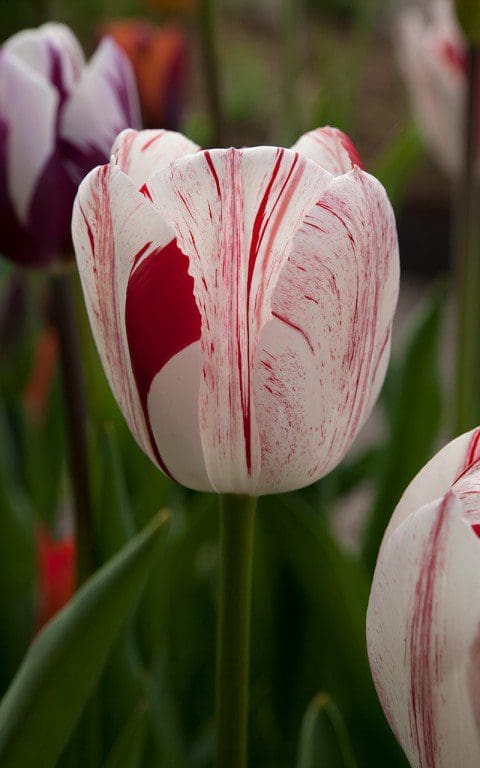 Tulipa ‘Sorbet’
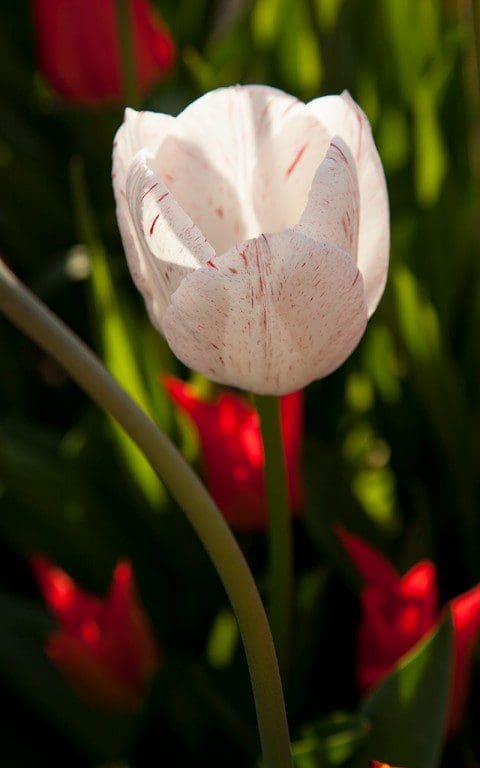 Tulipa ‘Sorbet’
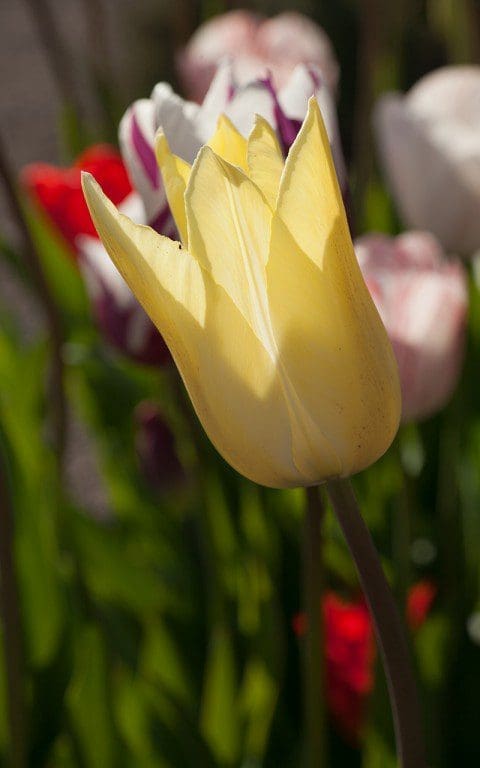 Tulipa ‘First Proud’
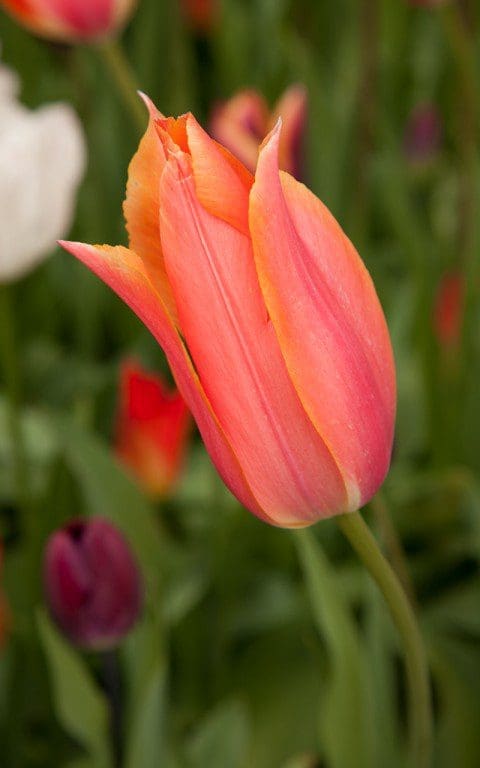 Tulipa ‘Perestroyka’
I was in the process of planting up a client’s walled garden and, for cutting as much as display, we created a series of mixes to play with the sheer breadth of varieties. We chose colour combinations to conjour a series of moods and colour fields, some dark, some pale or pastel, but always with a top or bottom note of vibrancy or depth to offset the predominating mood. The flowering groups were combined together to lengthen the season so that the early varieties were covered for by the late, and short with tall so that the combinations were layered. We also included differing types – doubles, parrots, flamed, fringed and picotee – for that sweetie box feeling of delight in variety.
At home, this has now become the favoured way of keeping up the experiment. Each year we buy thirty or fifty bulbs of up to eight varieties and dedicate a bed in the kitchen garden exclusively to a spring display. We have moved them from bed to bed to avoid Tulip Fire. Tulips are most prone to the fungal infection when repeatedly grown in the same ground, but rotate on a three or five year cycle and you will diminish the chance of infection. In combination with our thirst to try new varieties, it has also been the reason that, at the end of the season, we discard the bulbs and start again with a new batch for November planting. The bulbs, which are cheap enough to buy in quantity wholesale, are planted late at the end of the bulb planting season. They are debagged and thoroughly mixed on a tarpaulin before being spread evenly on the surface of the bed and winkled in with a trowel a finger’s width apart so that they are not touching.

 Three forms of Tulipa ‘Gudoshnik’
This year we have also started growing the Broken and Breeder tulips from the Hortus Bulborum Foundation. This range of old varieties – some of which date back to the 17th century – fell out of popularity in the 1920’s because, in the main, they are late flowering, and the quest for colour to break with winter began to favour the earlier flowering varieties. Their lateness has been a delight, as they have come just as we have begun to tire of the resilience of the modern tulips. Because they are choice (and expensive) we bought just three or five of each, combining them in pans and planting an individual specimen of each in 5 inch clay pots, so that they could be brought into the house for close observation.
Inside, they last for a week in a cool room and continue to evolve whilst in residence, their more subtle colouring, feathering and breaks filling out and flushing in the maturing process. They feel precious and not disposable like the Dutch tulips, so we plan to try and keep the bulbs when they are over. I will grow them on to feed the bulbs for six weeks after they have flowered, before drying and storing the bulbs in the shed until the autumn. I am hoping they will come to more than just leaf next year.
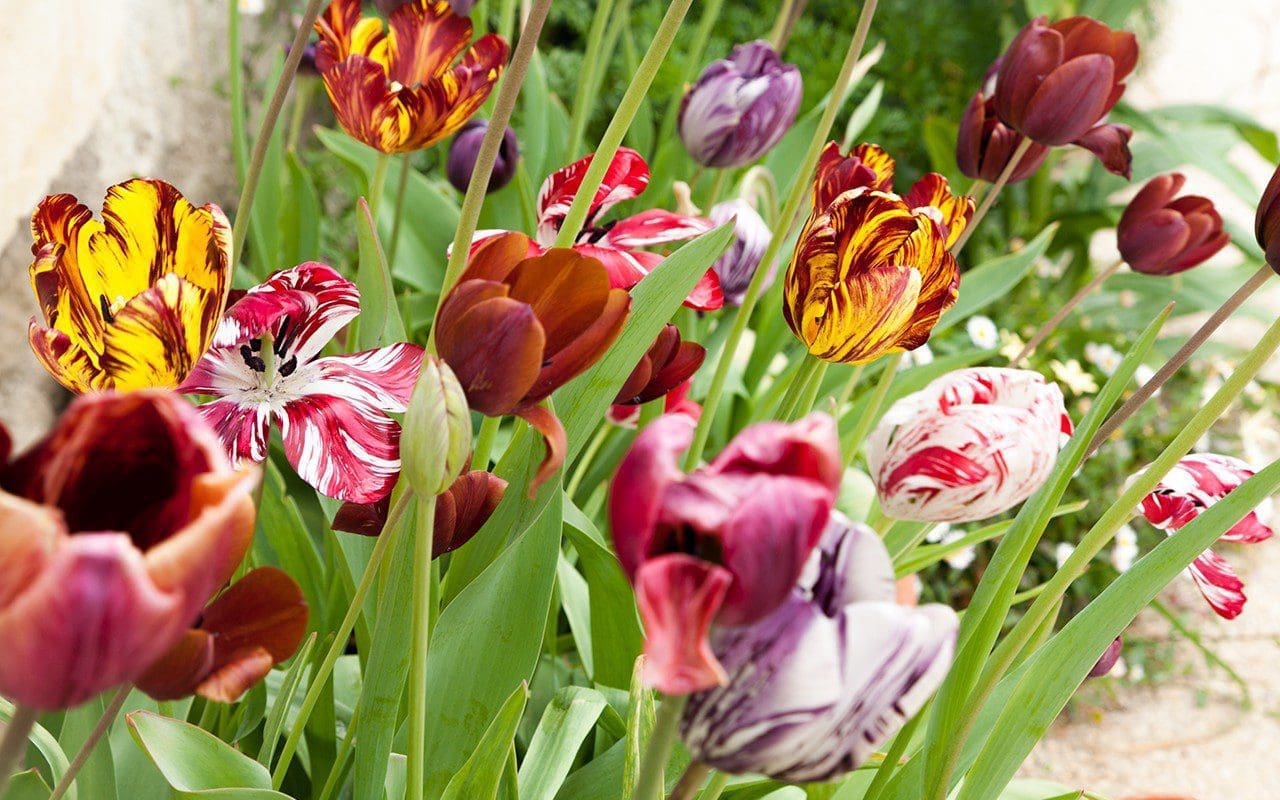 A mix of Broken and Breeder tulips from Hortus Bulborum
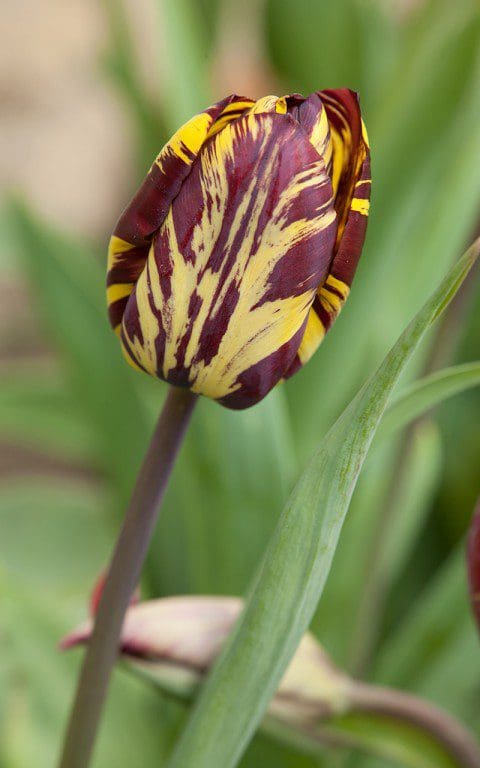 Tulipa ‘Absalon’
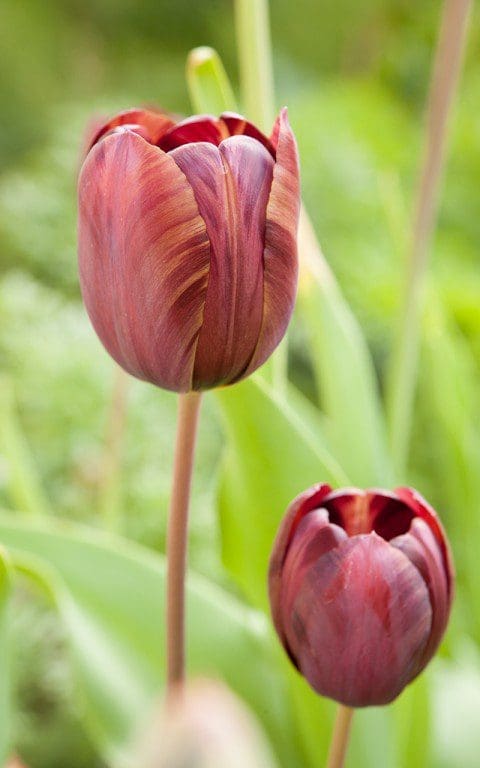 A more subtly marked form of Tulipa ‘Absalon’
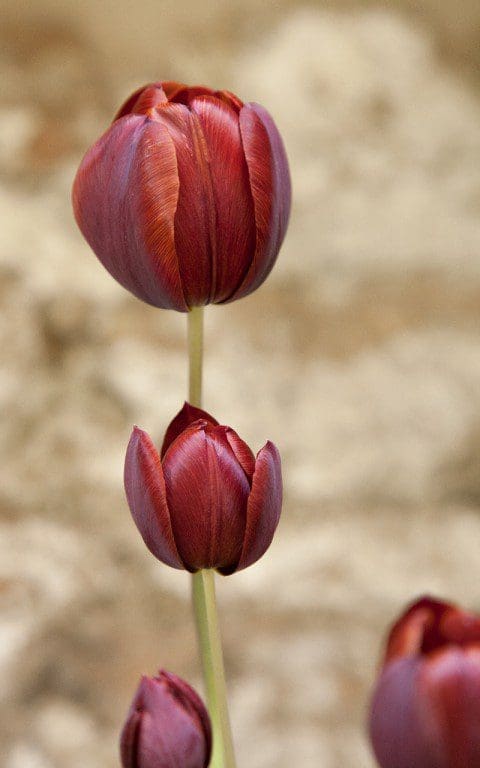 Tulipa ‘Prince of Wales’
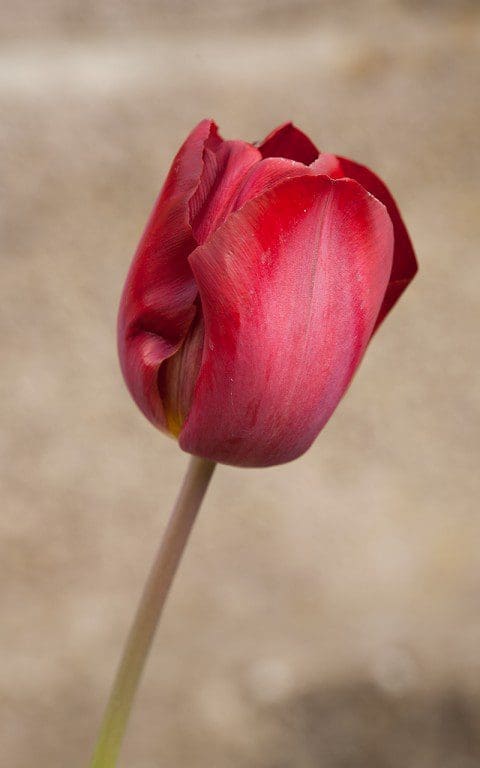 Tulipa ‘Lord Stanley’
As cut flowers tulips continue to grow, their stems often lengthening as much as a foot or more in a tall-flowered variety such as ‘First Proud’. This has been a new favourite this year, rising up to 90cm; as tall as, but later than, ‘Perestroyka’. A mixed selection of varieties is also good in a bunch and, as they age, the stems arch and lean, sensing each other it seems, so that a vase full will fan out like a firework exploding. The flowers change too, opening and closing with the heat and light and changing colour, sometimes intensifying, sometimes bruising from tone to tone as they fade. The mercurial colour changes are the most interesting and offer far more in terms of value than those that change less, and a new personal favourite this year has been ‘Gudoshnik’, the flowers of which you would swear were different varieties; some are pure vermilion, others red with yellow feathering, others yellow with red streaks. We have also enjoyed the raspberry ripple breaks and freckling of ‘Sorbet’.
If you are experimenting as we are the mixes can be hit or miss, and this year’s wasn’t one of the best, because we didn’t warm to a couple of varieties that have thrown the colour off. We won’t be growing ‘Zurel’ again. The flowers are boxy, the petals stiff and waxy and the flaming is rather coarse. ‘Slawa’ was worth a try, because it looked interesting when we ordered from the catalogue, but it felt too graphic in the mix. The colour combination of peach and plum needs careful placing, and the flowers are less graceful than some. Harsh criticism, perhaps, but a good combination is easily let down by an element that isn’t quite right.
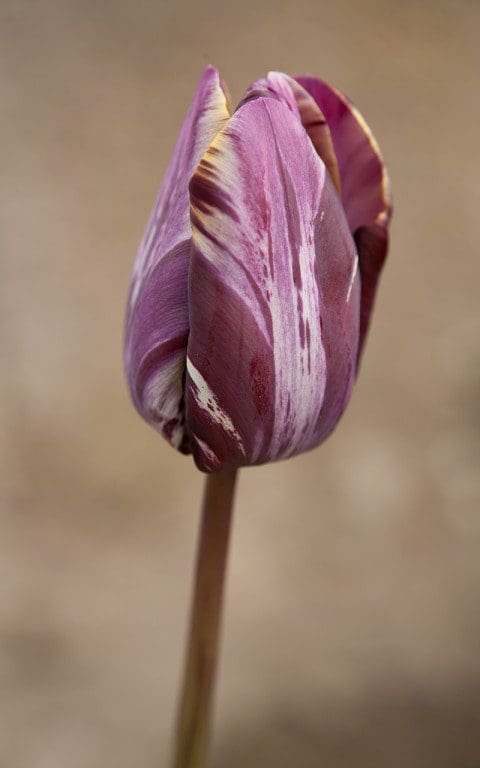 Tulipa ‘Insulinde’
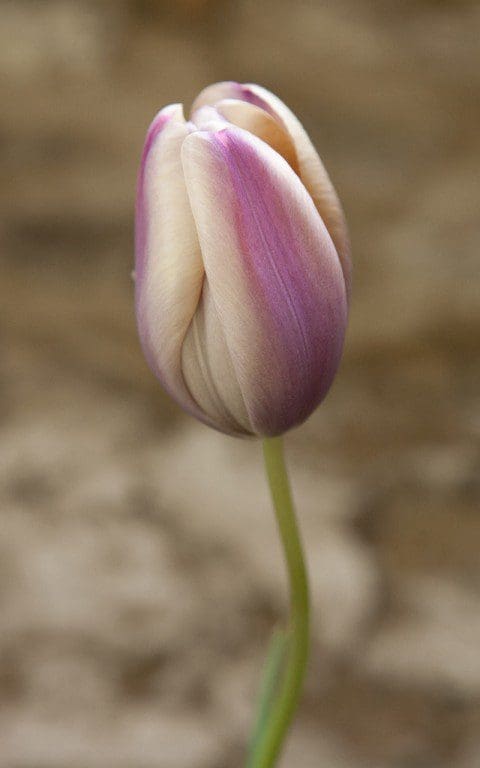 Tulipa ‘Marie-Louise’
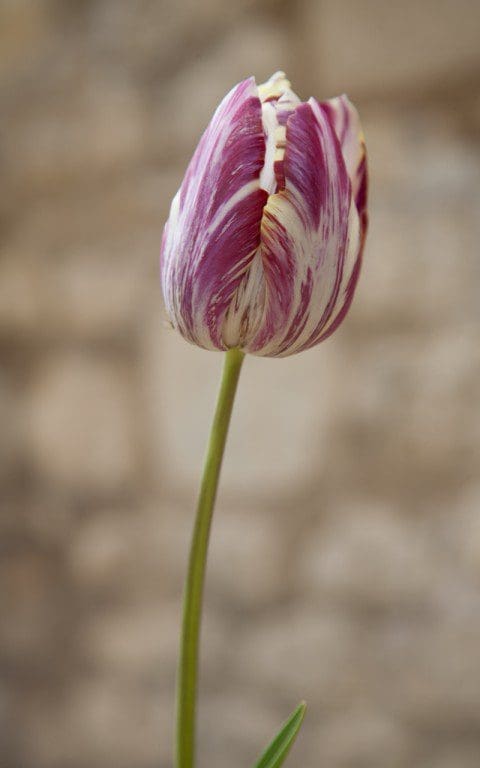 Tulipa ‘Beauty of Bath’
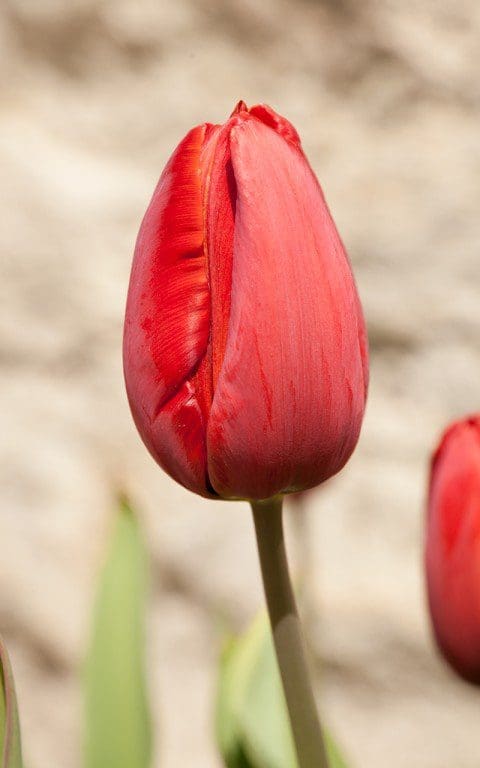 Tulipa ‘Panorama’
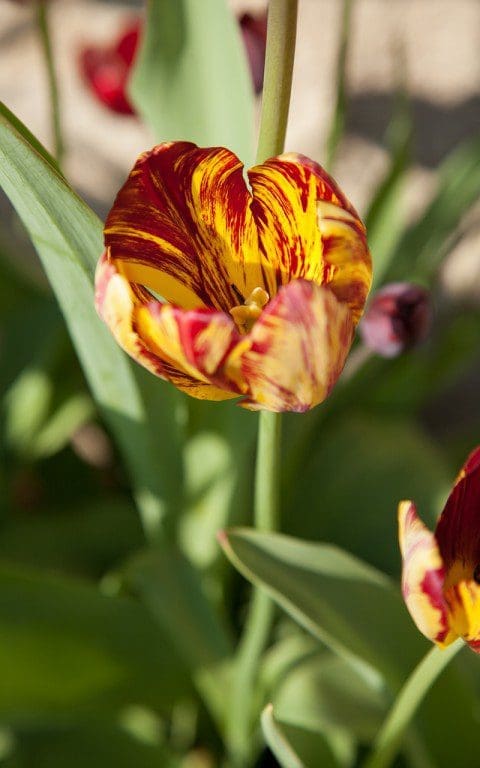 Tulipa ‘Royal Sovereign’
The less successful varieties were also shown in a new light by the older varieties. The breaks, feathering and flaming of the Broken tulips, and the rich tones and pastel gradations of the Breeder tulips are altogether more sophisticated. Put side by side the latter are certainly a rather superior race. Not without their problems I’m guessing, because they are less robust in appearance when compared to the modern hybrids. Particular favourites have been ‘Insulinde’, streaked the colours of blackcurrant fool, ‘Marie Louise’, a Breeder of a delicate, graduated lavender pink, ‘Panorama’, a Breeder of a strong copper orange and ‘Absalon’, a Broken tulip (and one of the original Rembrandt tulips) which has ranged from the flamed, blood-red and yellow you see in illustrations to a more subtle mix of mahogany streaked with tan, like an old-fashioned humbug.
Though we have heard much about their growing popularity, seeing them in the flesh has been a little like discovering really good chocolate. I fear we have now been spoiled and it won’t be possible to be without them.
Words: Dan Pearson / Photographs: Huw Morgan
Published 13 May 2017
ALREADY A PAID SUBSCRIBER? SIGN IN
