Stirring early from the dark mud, whilst almost everything else is sleeping, come the marsh marigolds. They were with us at the beginning of March this year, alone and lush and startlingly gold for their precociousness. Taking over just as the snowdrops are dimming, Caltha palustris is more than welcome when you are pining for momentum, their cupped blooms glossy and facing upwards to catch sunshine. Their growth is fast and out of kilter with the slowly waking world around them, their limbs arching out and splaying away from the rosette of lush foliage. Fat buds weigh the long flowering limbs, which hover just above water as if they feel their own reflection.
I started our colony here with a little clutch of plants that our neighbours gave me from their wet alder woodland. The deer population – or their passage through the woods – must have changed since then, because the colony has diminished through increased grazing. Where there is a decline in one place, there is often a countermove in another and I have made it my business to give them a place here at the head of the ditch, where a constantly running stream animates the crease between our fields.
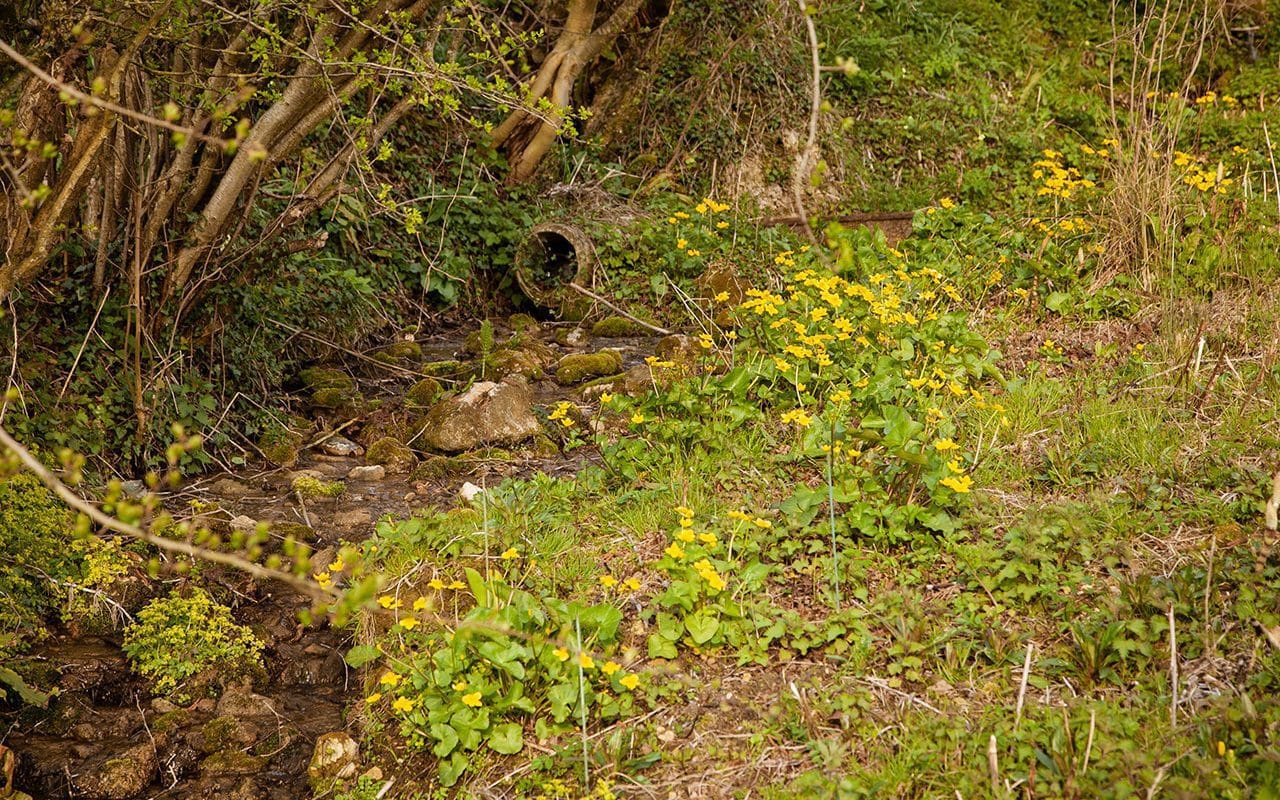
When we came here the ditch was just that, a place that was fenced off to keep the cattle from getting lost in the mud and where bramble had taken over from barbed wire. We have cleared it since then, letting the hazels grow out and uncovering a surprisingly pretty rivulet of water that sparkles when it is free of growth in the winter.
Four years ago I planted a batch of 40 plugs, which arrived from British Wild Flowers just as the winter was turning to spring. Marshland plants and aquatics are best planted with the opening of the growing season rather than at the close, so that their roots can take advantage of soil that is rapidly warming rather than doing the opposite in the winter months. Planting plugs is always easy with a thumb sized knot of roots easily inserted with a dibber, but you have to have faith if you are introducing them into a ‘natural’ situation, for in no time the plants are overwhelmed by the growth of established natives and you loose them from sight for the summer.
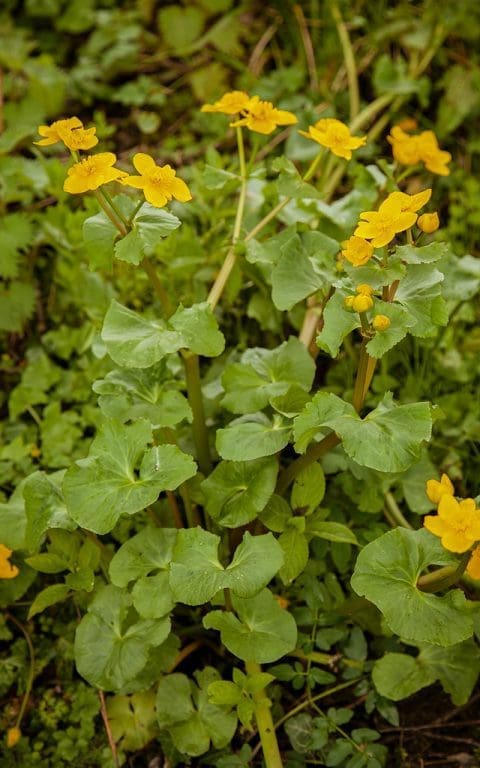
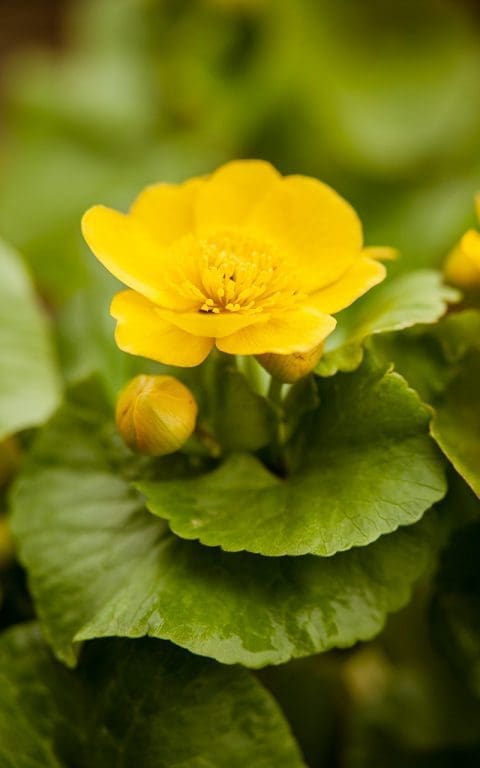
I followed the mud and the smell of dormant water mint as I planted, pushing the plugs into soil that was almost liquid and avoiding the areas that I could see would dry out as soon as summer came. Caltha will grow in shallow water too, but the margins that maintain constant moisture are their preferred domain. They are surprisingly tolerant of competition and, to prepare for it, their early start means that they have set seed and the rosette has fed all it needs to before being plunged into shadow of wild angelica, meadowsweet and hemlock water dropwort. In summer they go into a resting period, the lush foliage of spring collapsed but not dormant, taking in all it needs to keep things ticking over.
The spring after planting I followed the watercourse to retrace my steps from the year before. Given the fecundity of the summer growth here, it came as no surprise that just one plant had made enough energy to flower, but to my delight I found the rest of the 40, which in three years were all flowering and tracing a line of early gold, providing first forage for the bees, whose hive sits on the ground immediately above them.
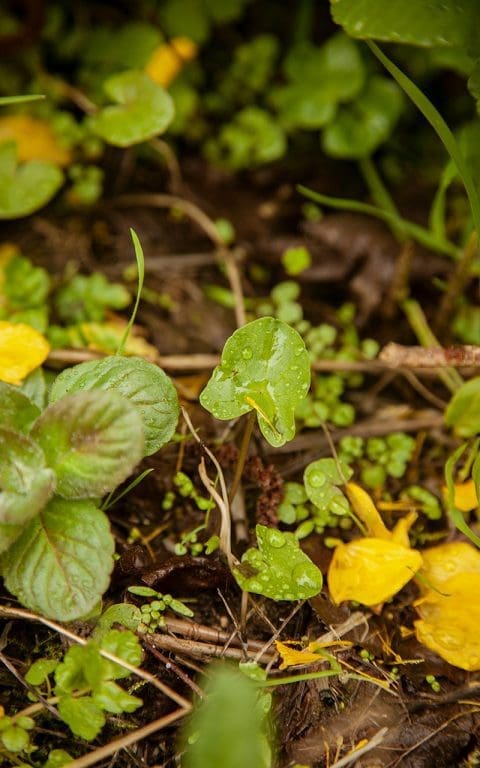
This year I have found the first seedlings, which have tucked themselves close to their parents in the mud where the conditions are controlled by the lush growth above them. The seed, which is heavy, germinates where it falls and does not move very far, but I imagine if it falls into water, it will wash and tumble a fair distance before finding purchase. To help in this process, and now that the youngsters are proof of the fact that they have found a niche, I have extended the colony downstream. Another forty plants went in this winter, just as the first signs of growth were showing, stopping and starting so that they look like they have found their own way in the watery margins.
A bridge now crosses the water where we connect from the garden to the rise of The Tump and I increased the Caltha to either side here so that we can look down on them and meet their upward-facing gaze. Looking downstream from the bridge, I can already imagine the colony extending its reach still further, finding the hollows and the wet puddles of mud that provide it with the opportunity of an early start and us the joy of seeing these wild plants naturalise.
Words: Dan Pearson/Photographs: Huw Morgan
Published 6 April 2019
The leaves are nearly all down in the wood, winter light fallen to the floor for the first time in half a year. A new horizon meets us as we look out from the house. Not onto the weight of the poplars and their understory, but through to the slopes beyond. The tracery of branches clearly identifying one tree’s character from the next, the tilt of trunks, the hug of shining ivy.
Everywhere the scale change is remarkable and we find ourselves drawn out into the landscape with refreshed curiosity. Much of this is simply to do with a season’s growth dropping back into dormancy. Under the elderly field maple in the clearing by the stream a coppery skirt lies in a circle where the leaves fell in the still air there. Looking up into the newly naked branches a world of lichens and moss – grey, silver and green – has made them home. The nettles that just a month ago were lush and keeping us from the stream have half their volume. With continued frosts in the hollow they will be nothing but brittle stem in a month and we will be free to walk its length once again.
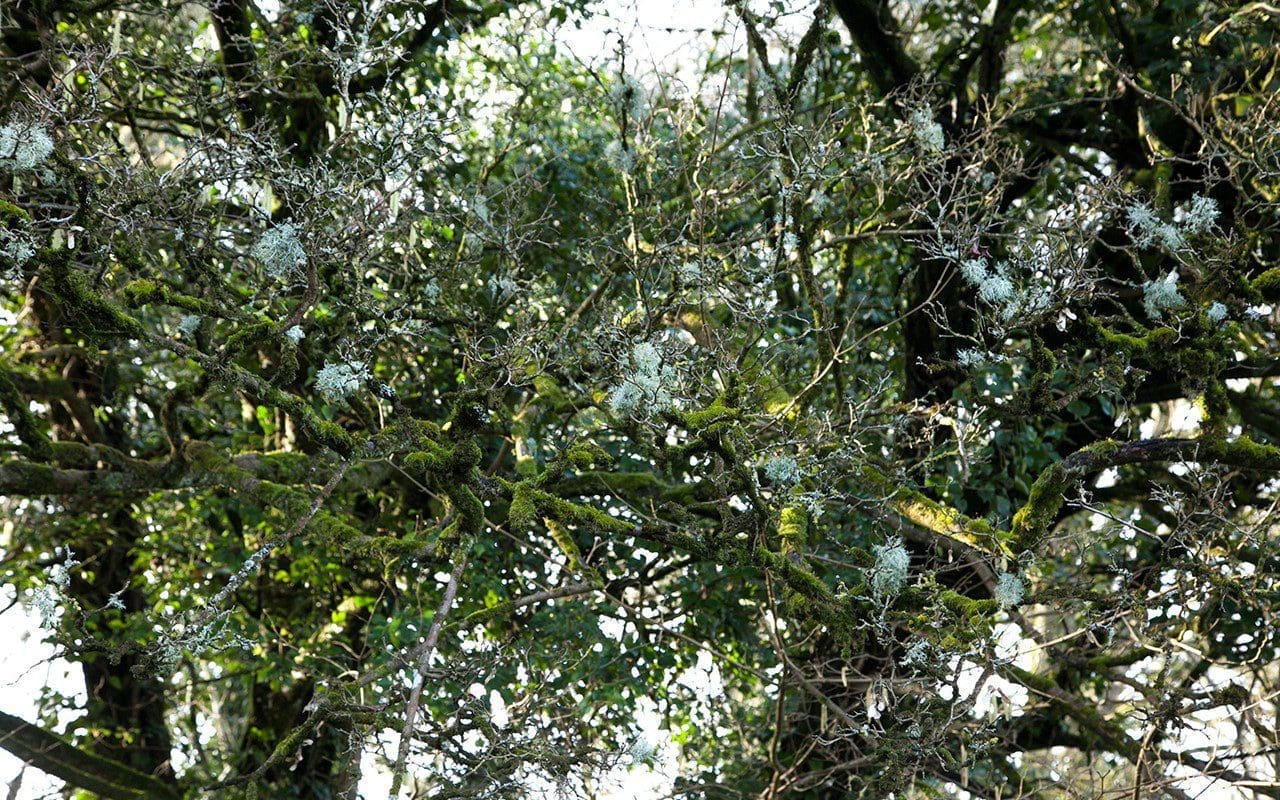 Lichen and moss on the old field maple
The stream is audible from up by the house in all but the driest weeks, but now it is charged with winter rain and the noise pulls us down to look. You can easily lose an hour or more if you start to explore the mud and shingle banks, as the stream landscape is always changing. A log from higher up, driven down by storm water, causing damming and silting up, contrasts with the constancy of a favourite boulder, marooned in a pool of its own influence, a home to moss and liverworts.
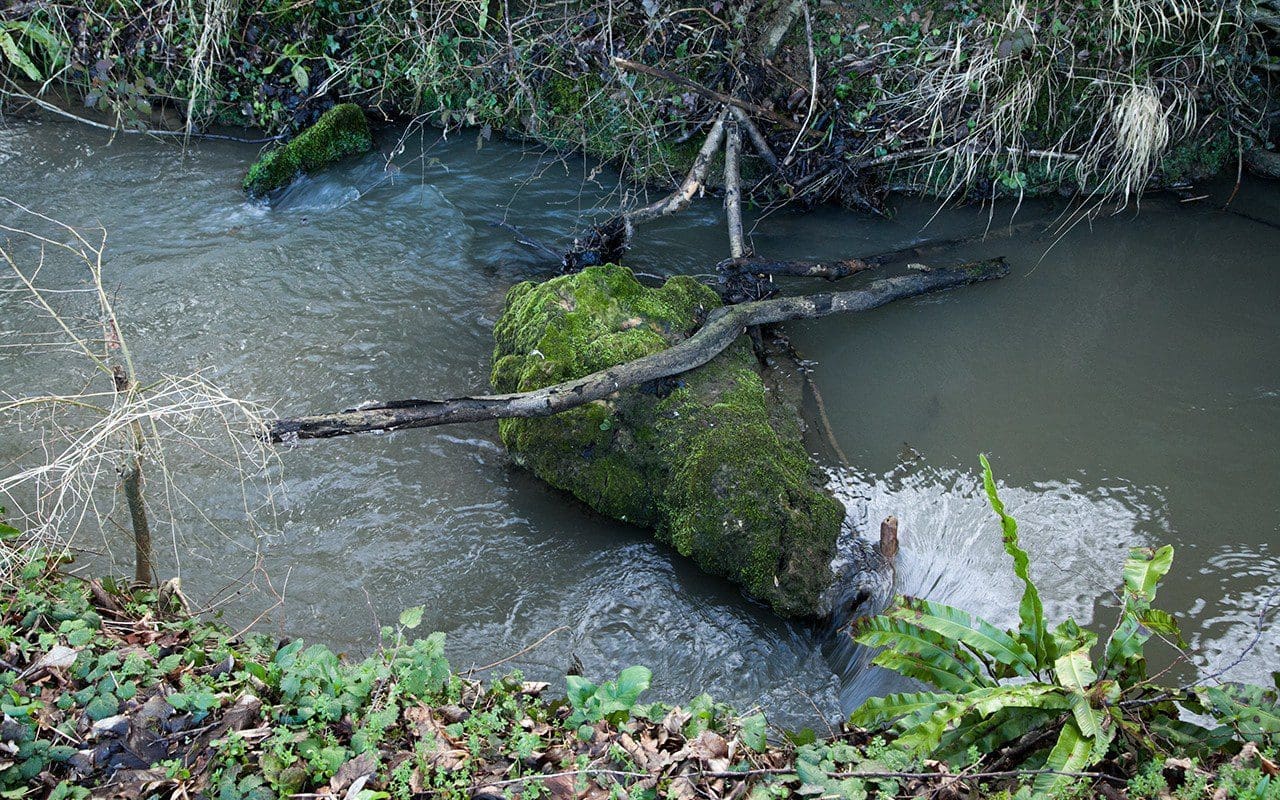 The moss-covered boulder
Although the stream is small and at times hidden, it is a favourite part of the property. Soon after moving here at about this time of year we started bank clearance and every year we have done a little more. A barbed wire fence that ran its length to keep the animals in the fields is all but removed now, the rusty coils disentangled and pulled free of the undergrowth and the rotten fence posts removed. As a reminder a number of oak posts that outlived the softwood ones were left to mark the old fence-line. They are now cloaked in emerald moss and, when working in the hollows, are perches for watchful robins.
In places the stream disappeared into a thicket of bramble to emerge again lower down without revealing its journey. The child in me had to know what lay within and the mounds of bramble that bridged the banks were cleared to reveal, in one case, a lovely bend and, in another, a pretty fall and outlook where I have planted a small Katsura grove. I have plans to make a shelter there for watching the water when the trees are grown up, but for now it is simply enough to have the plan in mind as a potential project.
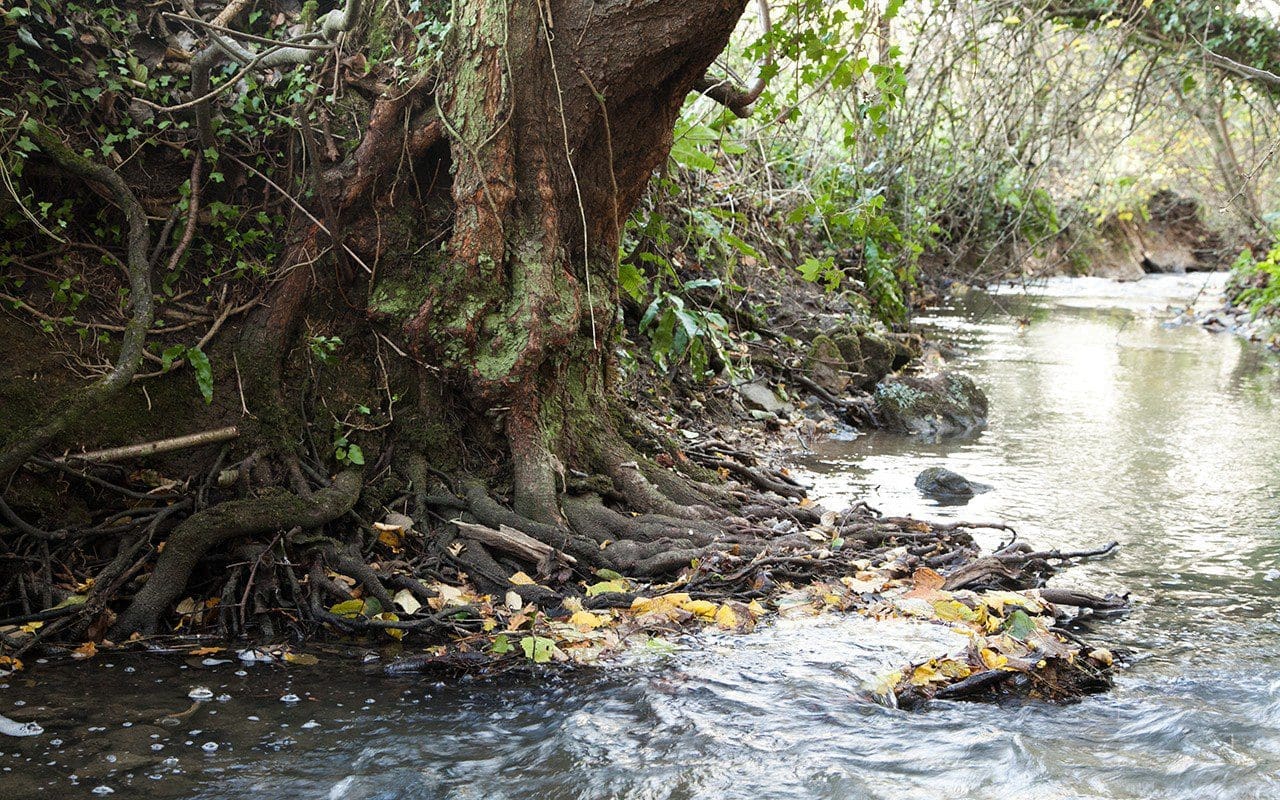 The matted root plate of a mature alder holds the stream bank
Slowly, and in tandem with the clearances, I have started to plant the banks on our side where the farmer had taken the grazing right to the very edges. Although we do not want to lose the stream behind trees for its entire length, it is good to balance the volume of our neighbour’s wood on the other side and, in places, to protect the banks. The new trees, just sapling whips at the moment, have been planted so that we can weave in and out of their trunks on the walk up or down the stream and with or against the flow.
Tree planting is one of my favourite winter tasks. The young whips are ordered in the autumn and are with us from the nursery not long after the leaves are down when the lifting season starts. If I can I like to get them all in before the end of the year so that their feeding roots are up and running by the spring when top growth resumes.
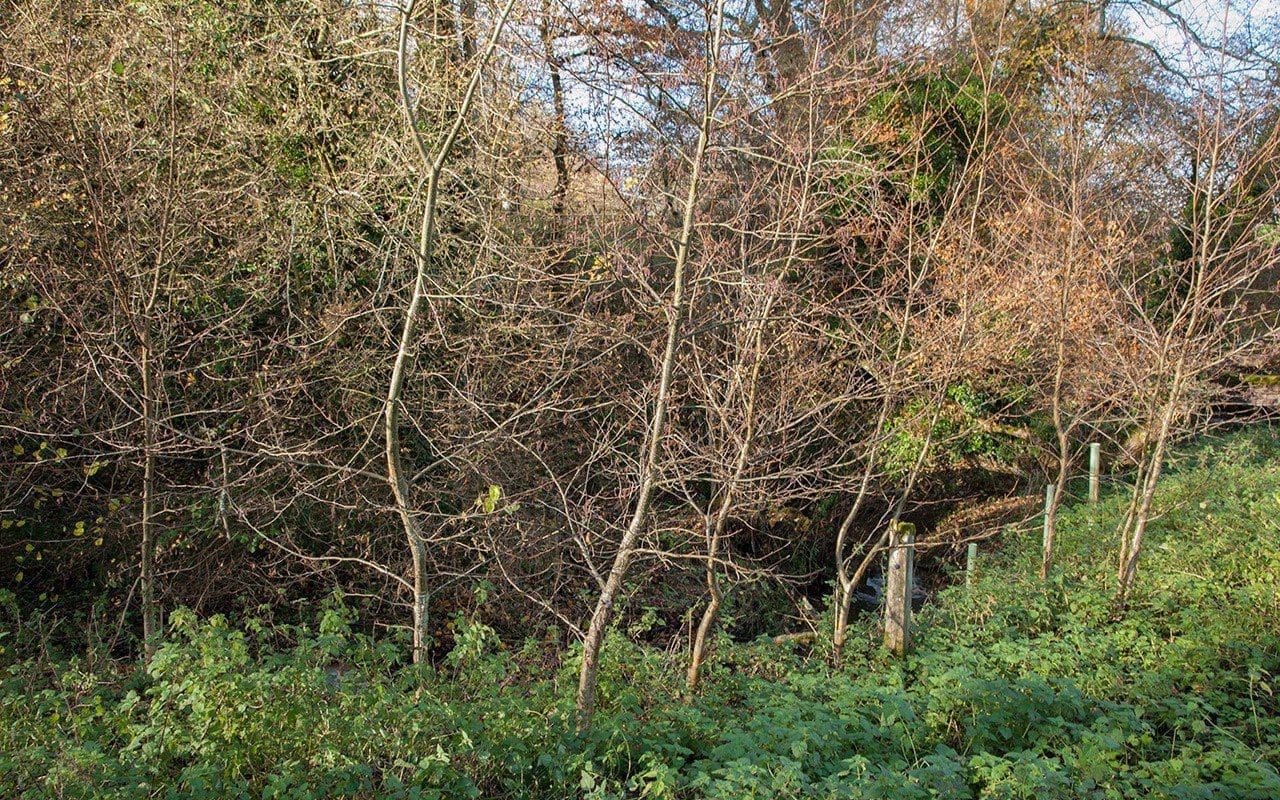 Three year old alders on the stream bank
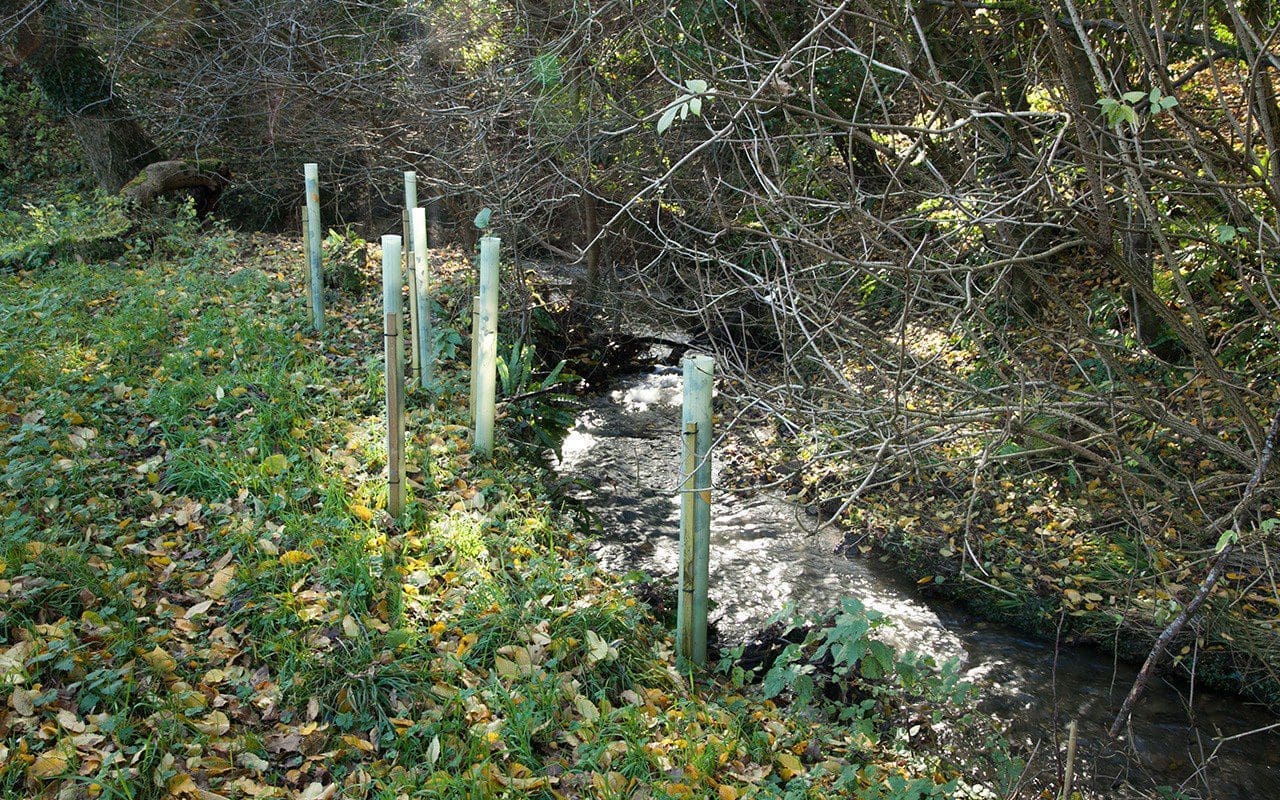 Alder whips protected from deer with cylindrical tree guards
Alder (Alnus glutinosa), a riverine species that likes to dip its feet into the water, is one of the best for stablilising the banks. The roots, which produce their own nitrogen and charge young trees with vigour, are dense and mat together to form a secure edge where the banks are crumbling from having no more than pasture to hold them together. The deer that have a run in the woods have loved the young growth so, after a year of grazing which left them depleted, I have resorted to using more than spiral guards to protect them. The cylindrical guards are not pretty to look at, but give the saplings long enough to jump up above the grazing line and gain their independence.
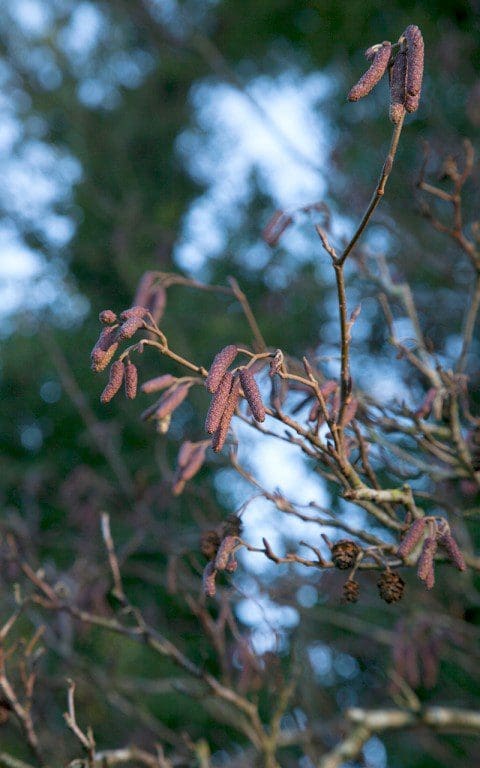 Alder catkins
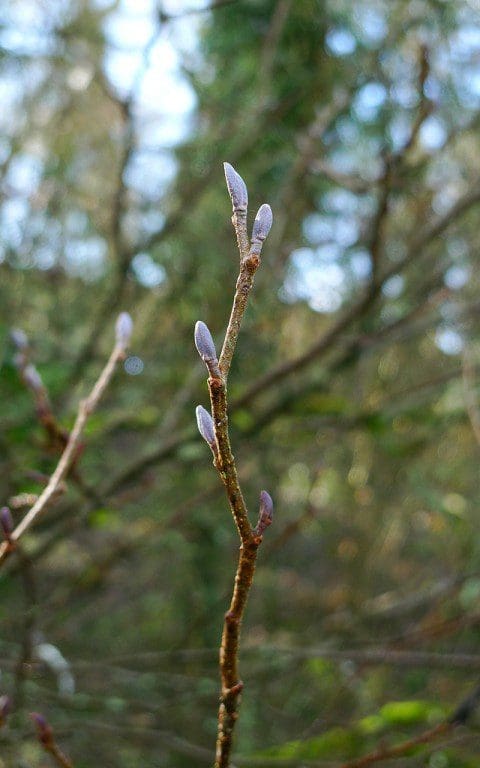 Alder leaf buds
In the deeper shade of the overhanging wood, and where the alders have proven to be less successful, I have used our native hornbeam (Carpinus betulus), encouraged by a mature specimen that, together with an oak, teeters on the water’s edge. It too has a dense root system and loves the heavy clay soil on the banks that lead to the water. Both the Carpinus and the Alnus have good catkins, which are in evidence already on the alders. Purple-brown and already tightly clustered, with hazel they are the first to let you know that things are already on the move in early winter. The alder buds are also violet and your eye is pleased for the colour which is intense in the mutedness of December. The keys of the mature hornbeam are still hanging in there and glow russet in the slanting sun that makes its way down the wooded slopes.
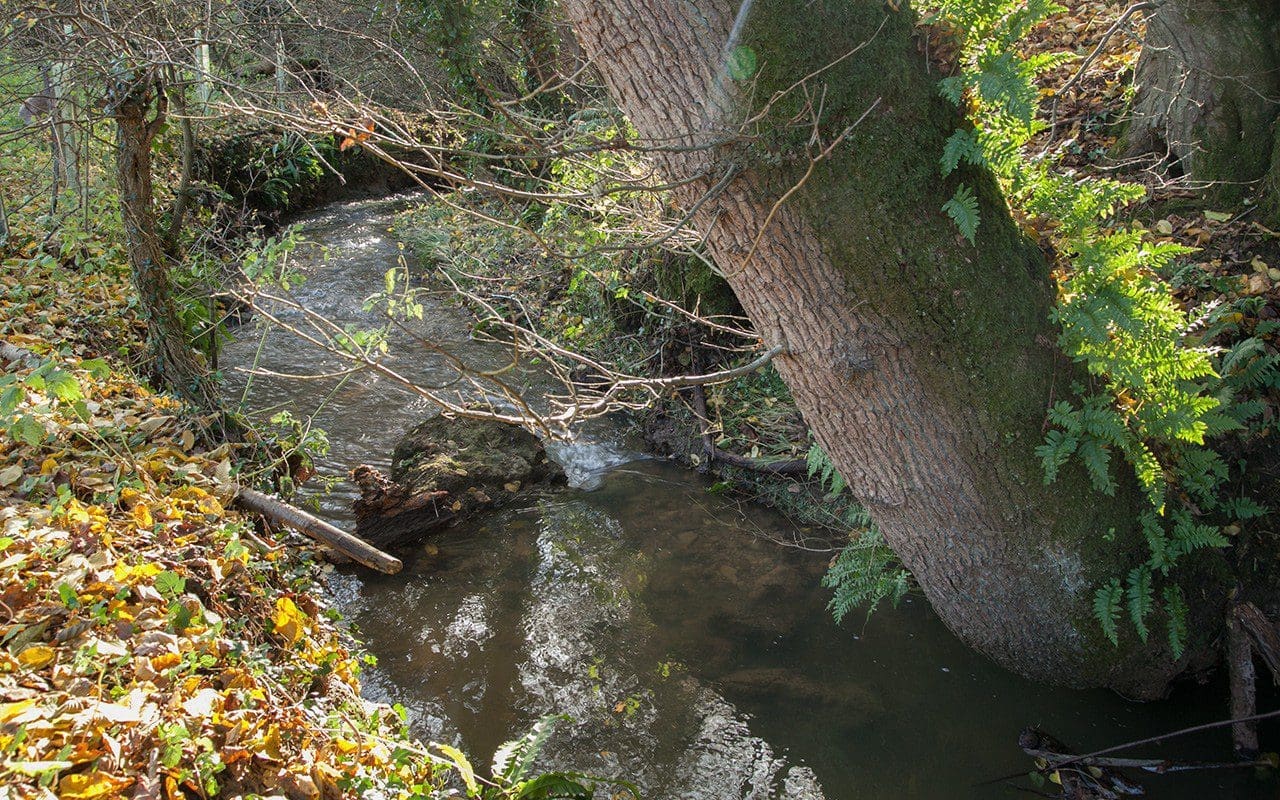 The trunk of the oak on the opposite stream bank
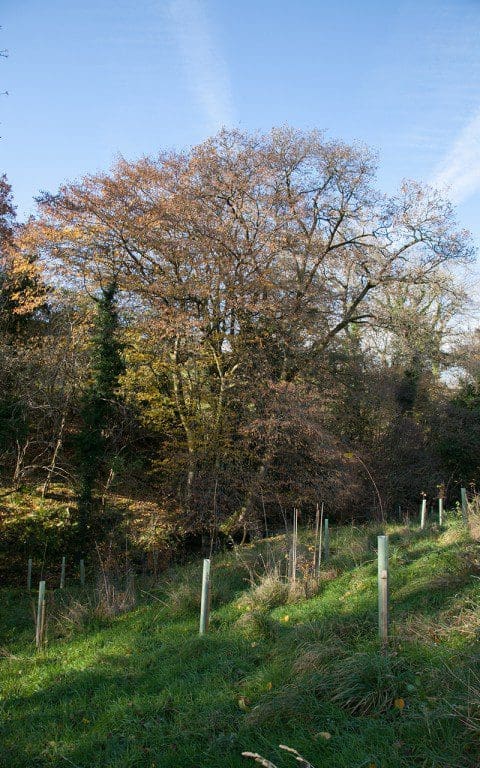 Hornbeam whips on the stream slope with the mature hornbeam beyond
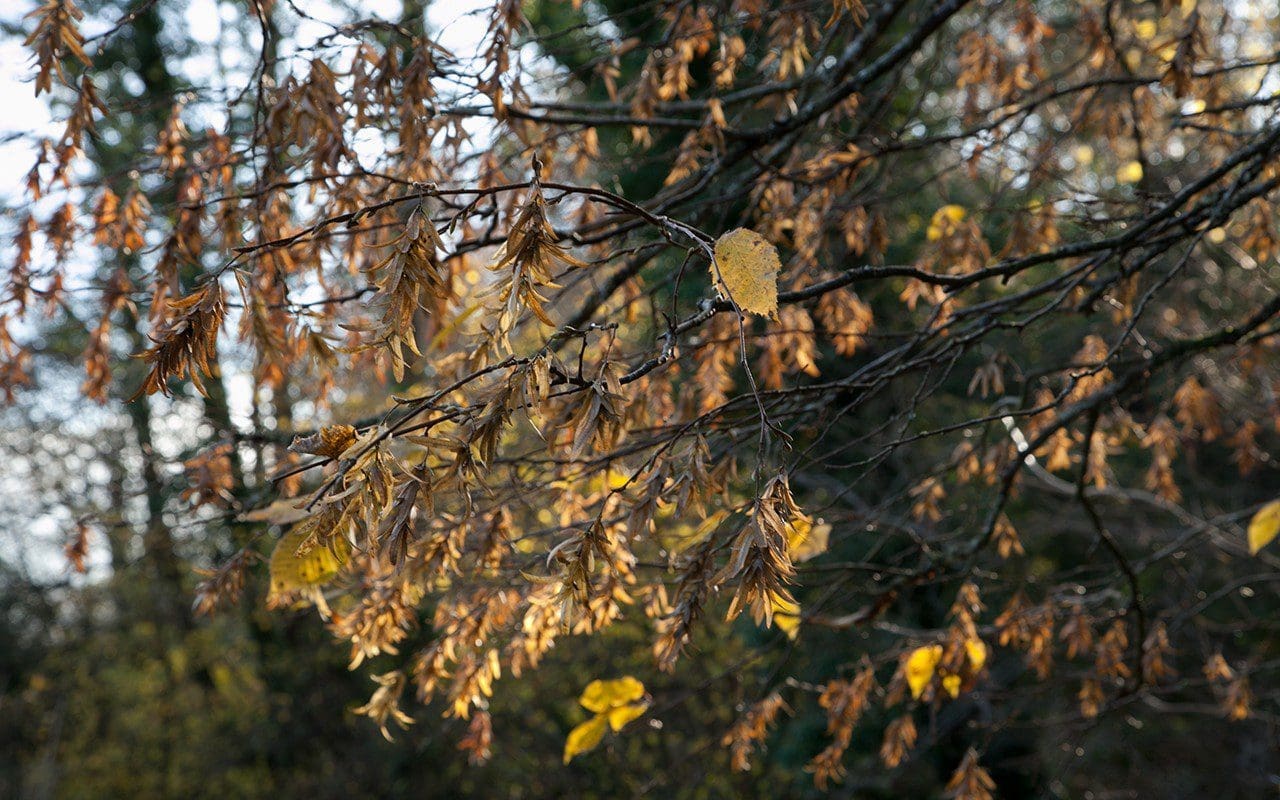 Keys on the mature hornbeam
After winter rains the stream rushes in a torrent that would sweep you away if you tried to wade across it, so this winter the stream work will turn to the bridges. Firstly to clear the remains of a stately oak that fell under the weight of its June foliage and then on to repair the clapper bridge that we made a couple of years ago and which was washed away in the heavy rains just recently. For now the fallen poplars, with their perilously mossy trunks, provide the link to the wood from which they fell. One came down the first summer we were here, and another two years later. Now the fallen oak has changed the stream once again and with it our winter diversions.
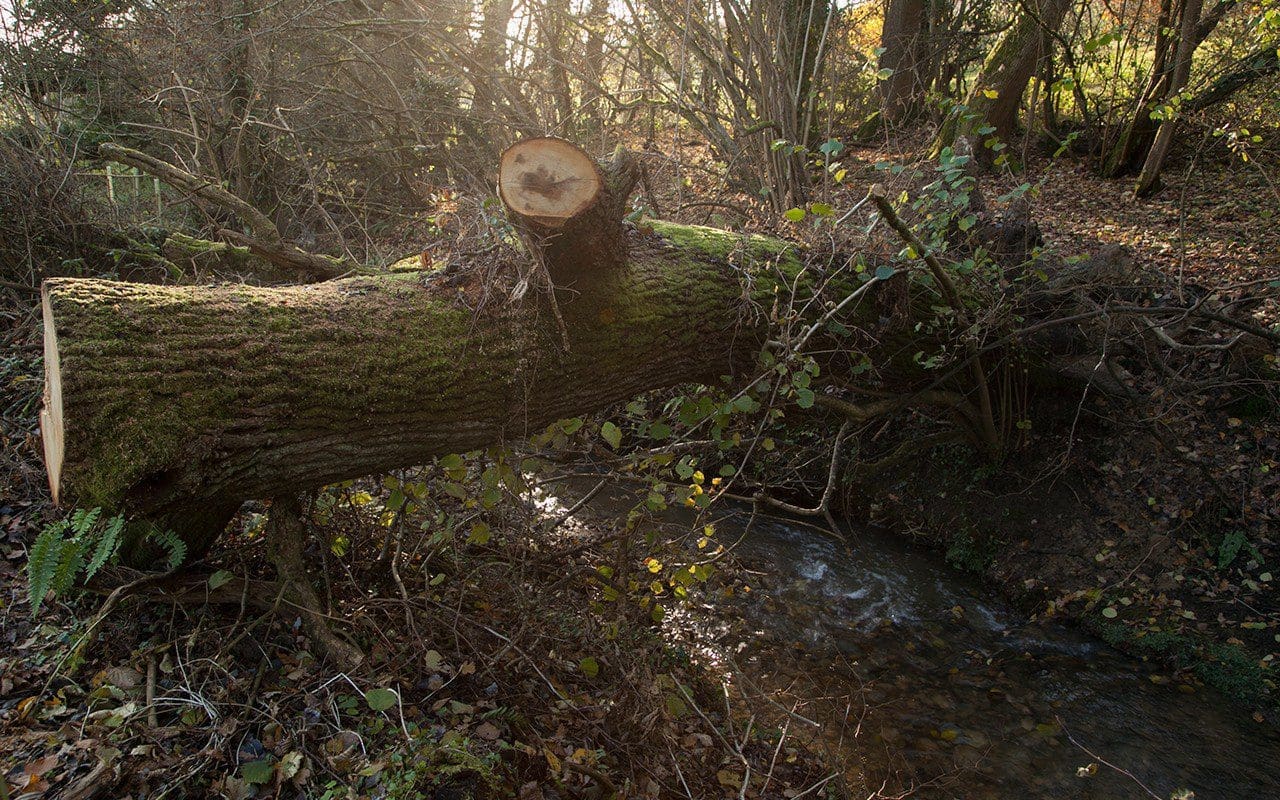 The fallen oak
Words: Dan Pearson / Photographs: Huw Morgan
Published 2 January 2017
We are sorry but the page you are looking for does not exist. You could return to the homepage