As September light casts its autumnal influence, the hips have lit up the hedges. Though it would be easier to get on the land to cut the hedges whilst it is still dry, we choose to wait until February in order to preserve their bounty. The birds work the heavy trusses of elder first, then move onto the wild privet before starting on the rosehips. Their fruits are still taut and shiny and it will be a while yet before they start to wrinkle and soften to something more palatable. If you are quick enough to get there before the birds, this is the perfect time to harvest them, the hips coming away easily to sticky your hands and stain fingertips scarlet.
Although I planted a couple of dozen eglantine whips (Rosa rubiginosa) to gap up the hedges when we arrived, I raised a batch of seedlings from the first hips they bore. An autumn sowing spawned more seedlings than I could deal with after the winter chill they need to break dormancy. I potted up a hundred seedlings and grew them on for a summer so that, a year after sowing, they were ready for planting out. Two years in pots (with potting on) would have made them stronger and probably more resilient to the fierce competition of being out in the wild, but the seedlings that did make it through are now doing handsomely.
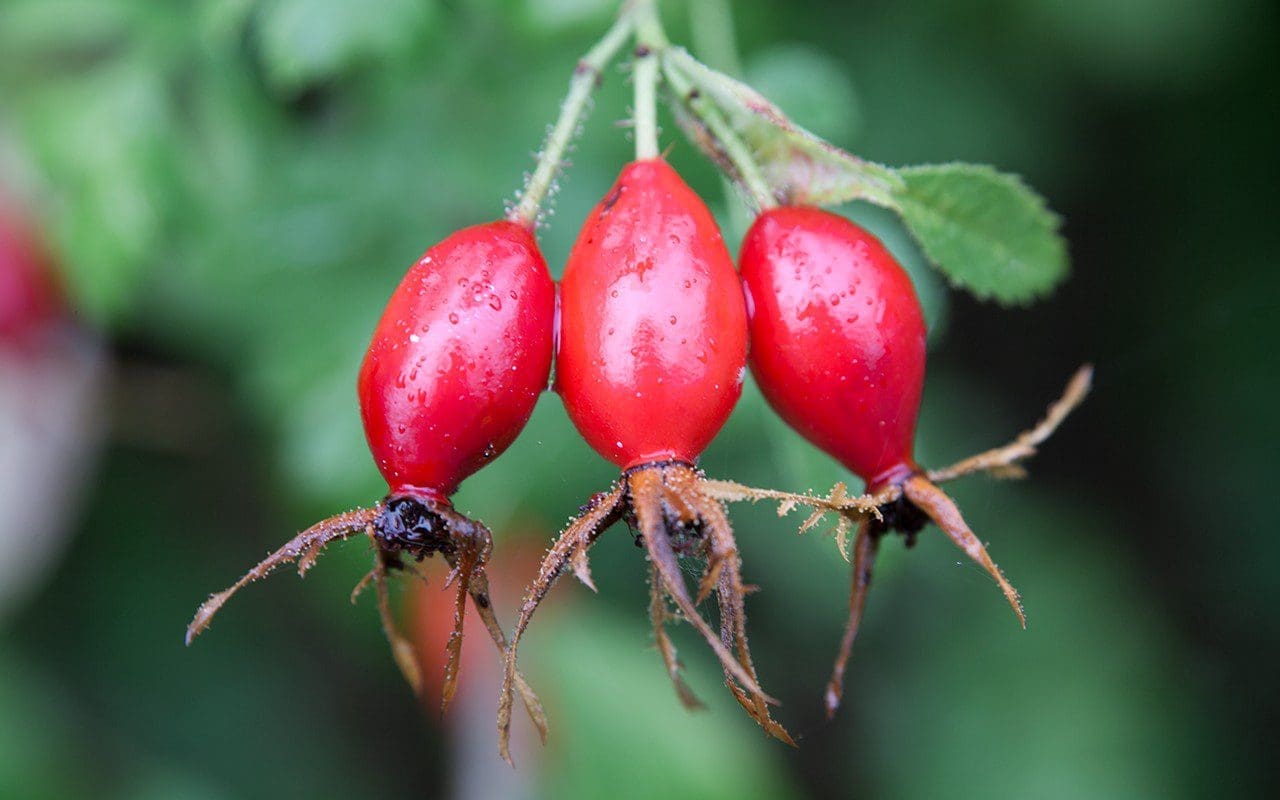 Rosa rubiginosa
The eglantine seedlings were planted widely, so that their perfumed foliage accompanies us on the walks we make over the land. They appear close to the gates and the stiles in the hedges, so that their apple-y perfume catches you unexpectedly and where they break free into the meadows. Six years after sowing, the best plants are now as tall as I am and weighted with fruit. Where we have deer down in the hollow above the brook, they have been left completely alone where other plants have been grazed, so I have also started to use them around the garden and as perfumed hedges in the hope that their scented foliage acts as a deterrent. Deer love roses as a rule, but dislike perfumed foliage, so the eglantines may be prove to be as useful as they are beautiful.
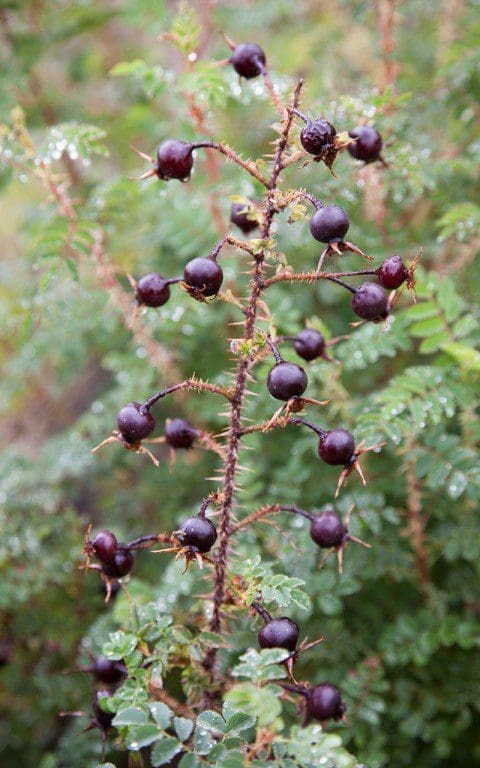 Rosa spinossisima
We have several forms of Rosa spinosissima now throughout the garden, but my favourite are the plants I raised from those I found in the sand dunes of Oxwich Bay on the Gower Peninsula. Growing to not much more than a foot, which is small for a Scots briar, the plants were growing sparsely and in pure sand amongst bloody cranesbill and sea holly. Their flowers had long gone, as it was late summer, but the round fruits were black and shiny. I gathered a couple and the resulting seedlings were set out two years ago now in an exposed position on our rubbly drive. Though the plants are heartier, growing to twenty four inches to date in our easier growing conditions, I am pleased to see they have retained their diminutive presence. We will see over time if they form thickets to the exclusion of the violets and crocus I’ve paired them with, as the briar is prone to move and colonise ground by runners. The creamy cupped flowers run up the vertical stems in early May, but the inky hips have been good since mid-summer and are only just this week starting to wrinkle and lose their gloss.
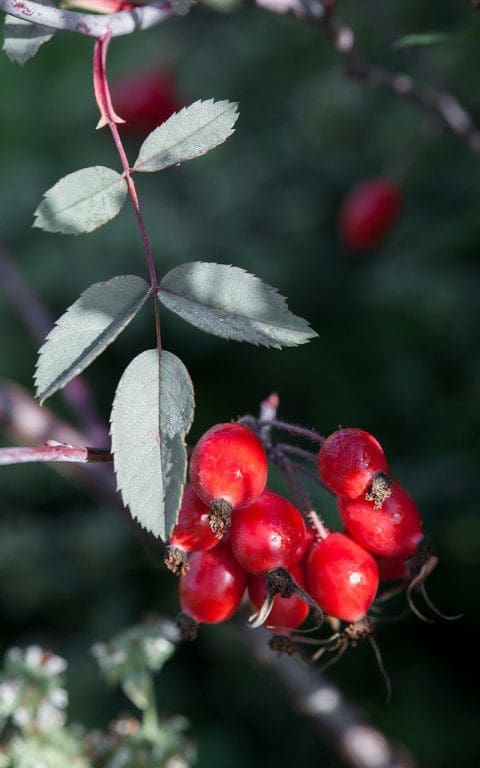 Rosa glauca
Though young and not yet expressing their stature in the garden, the Rosa glauca (main image) are sporting their first hips this year. The single flowers, which are small but always delightful, come on the previous year’s wood, so I will be making sure to always have some old wood for fruit. This is a foliage rose first and foremost and some books recommend coppicing every two to three years to encourage the best smoky-grey leaves, which are a perfect foil to the hips. I prefer to prune a third of the eldest limbs to the base at the end of winter to retain wood that will flower and fruit the following year. Ripening early for rosehips, they are bright and luminous, aging from scarlet to mahogany, and are some of the first to be stripped by the birds.
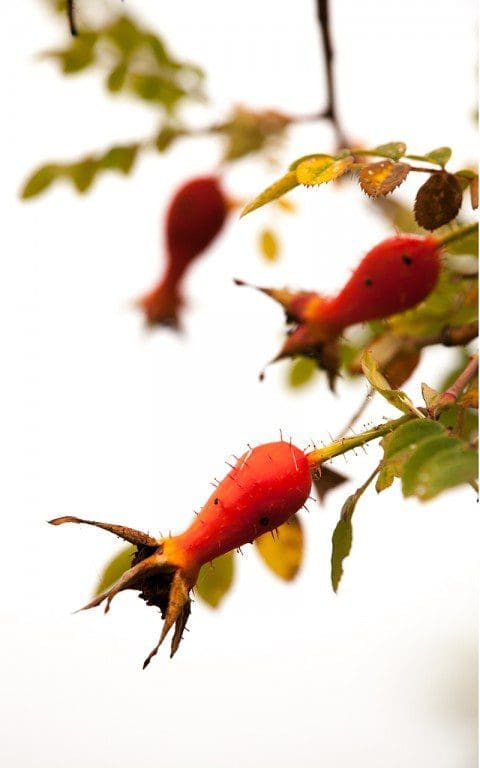 Rosa moyesii
The young Rosa moyesii on the banks behind the house are also showing good hips for the first time this year. These scarlet dog-roses are good amongst the cow parsley and meadow grasses that spill from the hedgerows in June, but their flagon-shaped hips are arguably their best asset, making this rose easily identifiable when fruiting. With arching growth and fine apple-green foliage, I will let the shrubs run to full height, which may well be ten foot or so if they decide that they like the position I have given them. They have room here on the banks and this is the best way to appreciate them, from every angle and with the yellowing autumn sun in their limbs.
Words: Dan Pearson / Photographs: Huw Morgan
Published 15 September 2018
Half the hedges on the land are allowed a year off between cuts so that, on rotation, we always have some for flower and fruit. Allowed to grow out softly from the rigour of a yearly cut the fray of last year’s wood spawns sprays of blossom as the prelude to later bounty. When the hedges are still darkly limbed the stark white of blackthorn and then wild plum is forage for early bees. Later, freshly clothed spumes of hawthorn let you know where you have the Crataegus. This is one of the most steadfast hedge components and easily tended.
Guelder rose (Viburnum opulus) follows where there is damp to sustain its particular preference, the lacy flowers like bonnets, brilliantly white amongst summer greenery. Sprays of dog rose (Rosa canina), arching free to present themselves later in June and July, start the relay between the three hedge rose species that are native. First R. canina (main image), then the Eglantine (R. eglanteria) with foliage smelling of green apples and finally the Field Rose, R. arvensis.
Come the autumn all of the above yield berries and hips, peppering the hedges with colour and providing feasting opportunities for wildlife. It is a vicarious pleasure to be able to contribute to this rich and connected network, linking one field with another, woods with fields beyond and shelter out in the open.
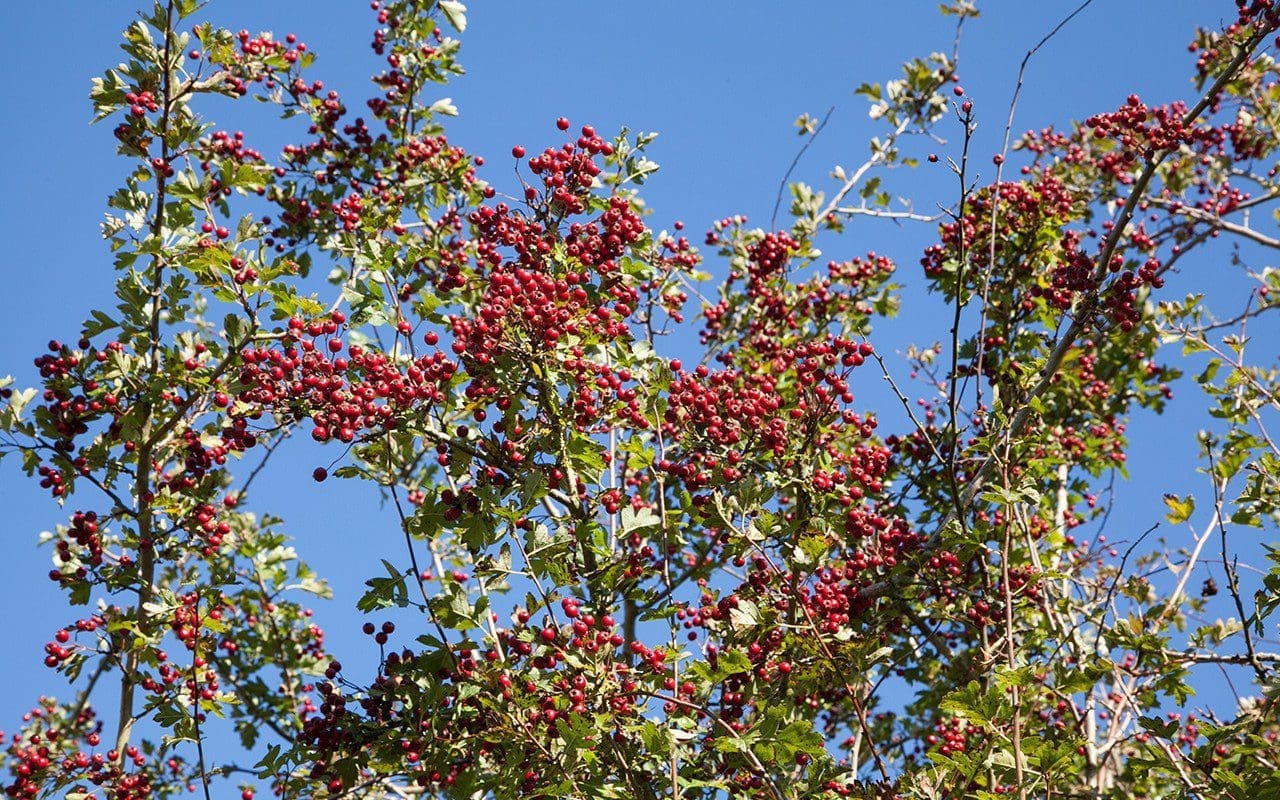 Crataegus monogyna – Hawthorn
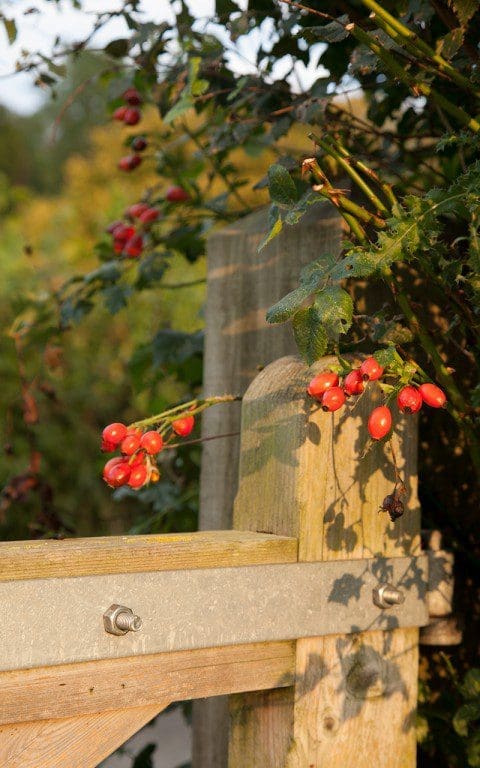
Rosa eglanteria – Eglantine Rose
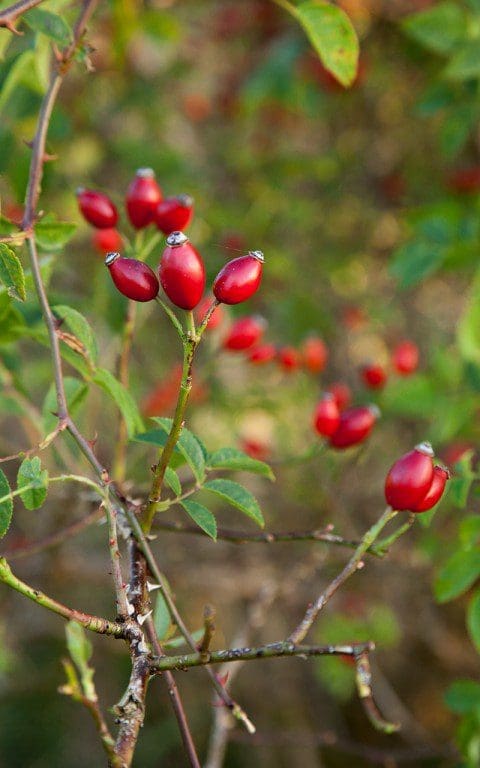
Rosa canina – Dog Rose
When we arrived here the hedges were not in good condition. Neatly trimmed on a yearly basis, the ‘broken teeth’ (where fast-growing elder had seeded in, outcompeted its neighbours and then died) were now home to bramble. A little bramble in a hedge is not a bad thing but, come the winter, their open cages offer little protection and their advance, like the rot in a tooth, is to the detriment of the whole. Since moving here I have slowly been improving the hedges by gapping up to remove the weak sections and interplanting with new whips of fruiting species to make good the mix; common dogwood (Cornus sanguinea) and guelder rose where the ground lies wet, and wild privet, the wayfaring tree (Viburnum lantana), roses and spindle (Euonymus europaeus) where it is drier. I am happy with the hawthorn almost everywhere, but I’ve learned that the blackthorn should only go into a hedge that is easily cut from both sides.
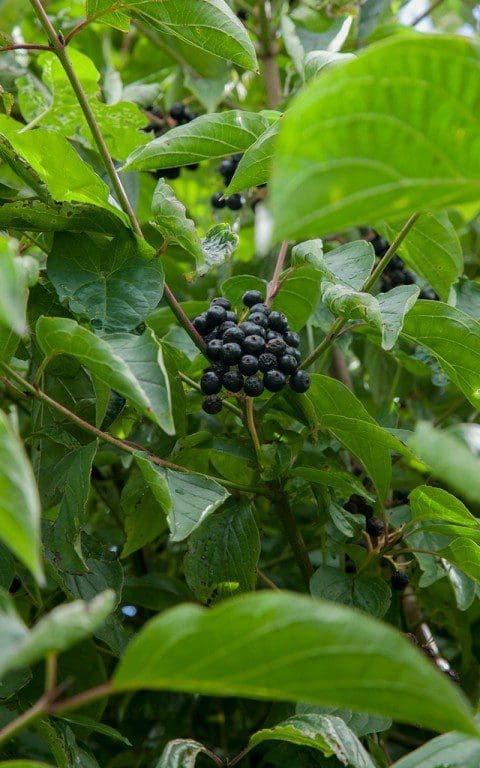 Cornus sanguinea – Common Dogwood
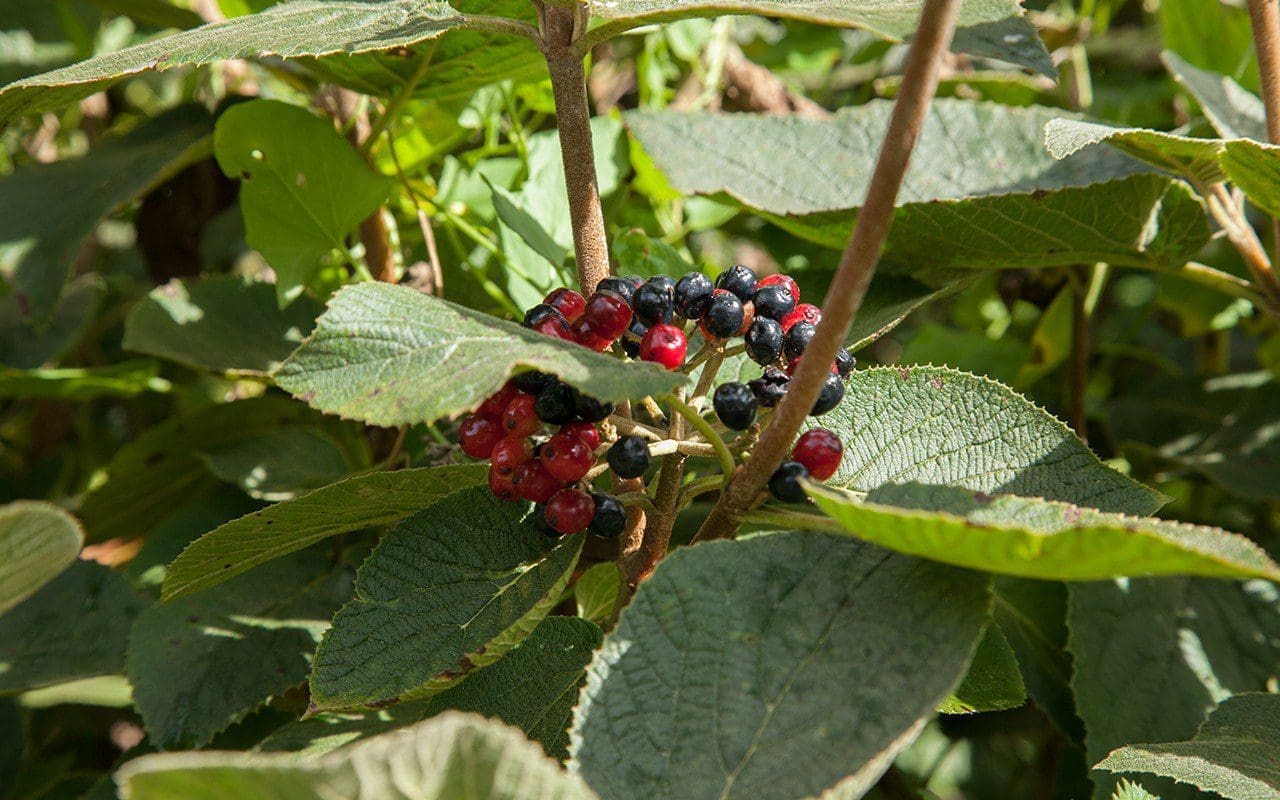 Viburnum lantana – Wayfaring tree
Blackthorn (Prunus spinosa) – or the Mother of the Woods – is a runner and it’s thorny cage quickly forms an impenetrable thicket. Over many years the centre dies out and, because the thorns are wicked (indeed, a wound from them can quickly turn septic, so best to wear leather gloves when pruning), the centre of the enclosure is somewhere that becomes free of predators. Acorns transported by rodents or ash keys blown into the protected eye will be the start of a slower and ultimately outcompeting layer that, in time, pushes the blackthorn out to the very edges of the hedge and out into the fields to claim more ground. For this reason I have planted only a handful on the land, both for their early blossom and for the inky sloes that make a good addition to hedgerow jelly or for sloe gin, a favourite winter tipple.
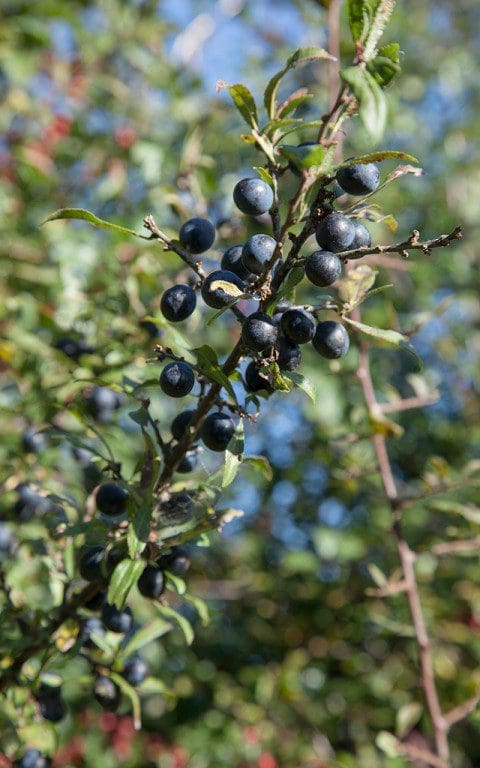 Prunus spinosa – Blackthorn
Now that we have been here long enough for my originally purchased whips to have yielded fruit, I have started to collect the berries before the birds have them all in order to grow my own plants from seed and so that I can continue to plug gaps with my home-grown material. The seedlings of the Viburnum opulus, the roses and the spindle have been added to the edges of the Blossom Wood as the trees have grown up and begun to shade the original shrubs I planted there as shelter.
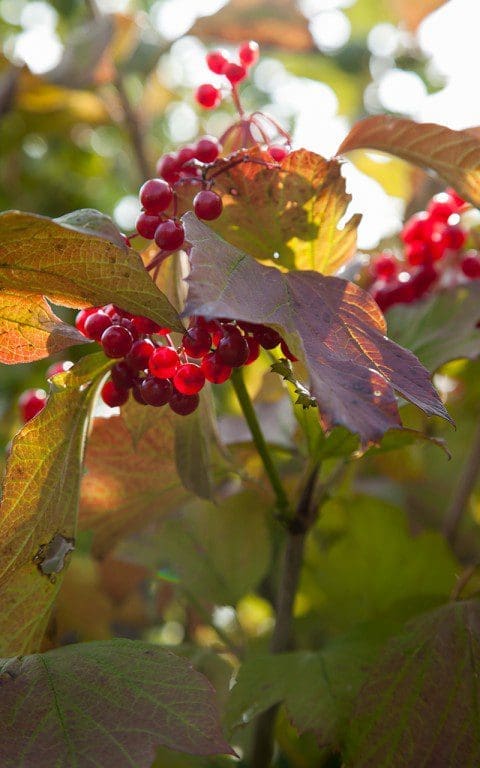 Viburnum opulus – Guelder Rose
The viburnum is a particular favourite, the translucent, bright scarlet drupes lighting up wherever the plants have taken hold. The Eglantine roses have also been good to have to hand as their perfumed foliage is a delight on a damp morning when the smell of apples lingers on the still air. They have been planted by gates, into hedges that we walk past frequently and upwind of wherever there is a place we use that is downwind of them. Interestingly – for deer generally target roses first of anything – the Eglantines have so far remained untouched. Is this just luck or is it the scented foliage that acts as a deterrent ? I have planted them by the entrance to the vegetable garden to see if they have the desired effect.
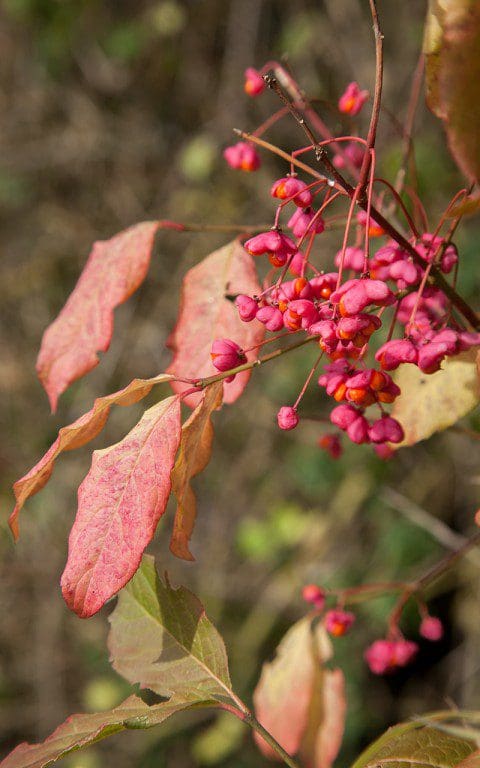 Euonymus europaeus – Spindle
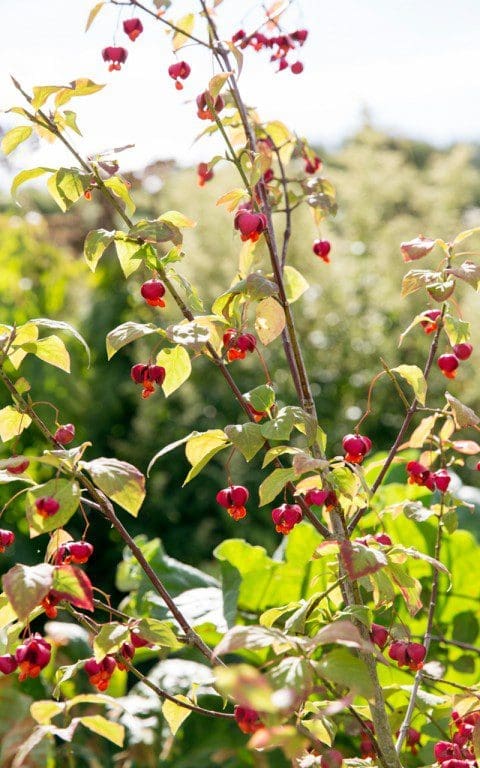 Euonymus planipes – Photo by Emli Bendixen
Our native spindle (Euonymus europaeus) is one of my favourite fruiting hedge plants. The pink turban-shaped fruits rupture in October to reveal the contrast of tangerine seeds suspended within. It is a dramatic combination and my original whips have shown that there are many different forms, some with fruits a brighter colour, others a paler pink but with more prolific fruit. Raising from seed is always interesting for this variation and I’ve selected the best for those that will make a link to the garden. The garden is also going to be home to shrubs that fruit, such as Euonymus planipes, which will blend the ornamental into the land beyond it where things run wilder. There is another story to be told here, but it is hard not to mention this wonderful shrub. I have two plants, both seed-raised, and they too are showing differences. The deep magenta fruits – more elegantly winged than the native – and vibrant orange seed hang in foliage that colours apricot and the colour of melted butter.
Words: Dan Pearson / Photographs: Huw Morgan
We are sorry but the page you are looking for does not exist. You could return to the homepage