When we arrived here the smallholding aesthetic, with its ad hoc manner of making-do, ran right up to the buildings to keep anything growing at bay. A brutal concrete slab sloping down and away from the lane surrounded the end of the house, diving steeply between it and the little barn below, where the cows were once milked, to form a yard. From there more concrete ran along the field before climbing steeply again towards the big barns, where the troughs now screen the kitchen garden from the house.
The track had been made in sections, as and when materials were available and potholes needed filling, so your first experience as you arrived off the lane was dominated by negotiating this necessary evil. You either had to park your car at an angle that spilled the contents when you opened the doors or prepare yourself for a vertiginous descent if you drove down into the yard. You certainly weren’t getting back up easily if the weather turned in the winter.
We muddled on for the first five years of being here and partly liked the authentic feeling of it, but I knew that it would eventually have to go so that the house could be cushioned in green again and not divided from it. After we renovated in 2016, we removed the concrete and reoriented the track behind the buildings and built a level platform at the end of the house. Flat ground is limited here, but even the smallest amount helps you to feel grounded enough to lift up your eyes and take in the view.
I wanted this pull-in from the high-hedged lane to be a little breathing space, to not give too much away of what was to come and to welcome you into an eddy, a pause with a feeling of rightness. I planted black-catkinned willow to form a semi-permeable boundary, so that you only got glimpses of the garden beyond and encouraged Erigeron karvinskianus, Centranthus lecoqii and white linaria to self-seed in the gravel. Viola odorata, which doesn’t mind the exposed position because it has company, reappears when the Mexican daisy is dormant in winter and when the sun shines in February they liberate their perfume to catch you unawares .
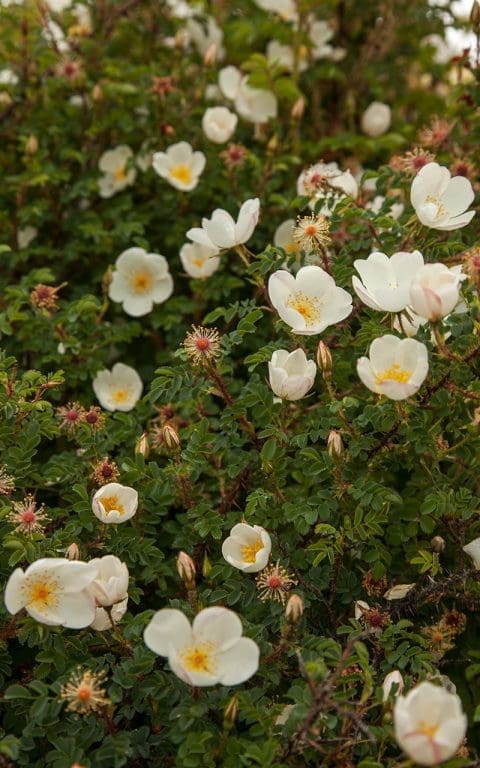
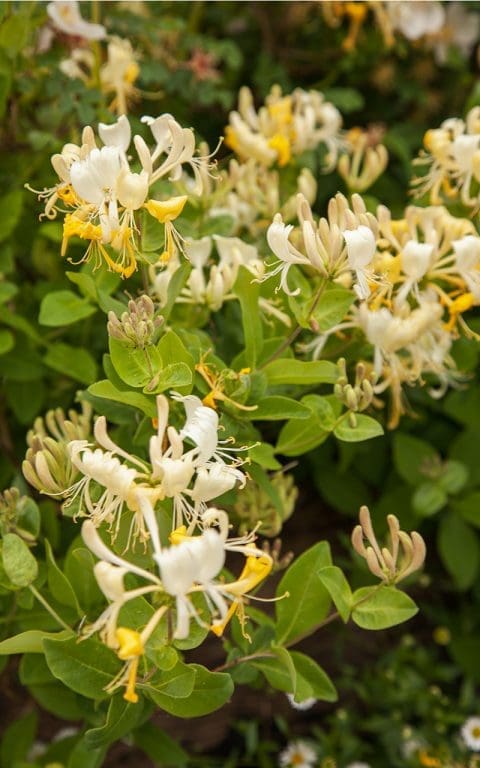
Perfume was an important consideration for this first impression and a scented ambush shoulders your descent down the steps to the front of the house. A seed-raised Rosa spinosissima, which we collected from Oxwich Bay on the Gower peninsula, sits to one side and hunkers down to form a little thicket. The first flowers opened in the last week of April this year and, although the perfume is delicate, it is delicious when you catch it for the month the bush is in flower. I’ve been training a honeysuckle along a log we’ve used to define the edge of the entrance platform, but now the briar is large enough I’m letting the two intertwine. The honeysuckle is a selection of our native Lonicera periclymenum called ‘Scentsation’. It’s not the best of names, but I have not seen a form that flowers as freely or grows as compactly. And it does live up to its name, perfuming the air sweetly and causing you to stop and linger when the wind stills in the evenings.
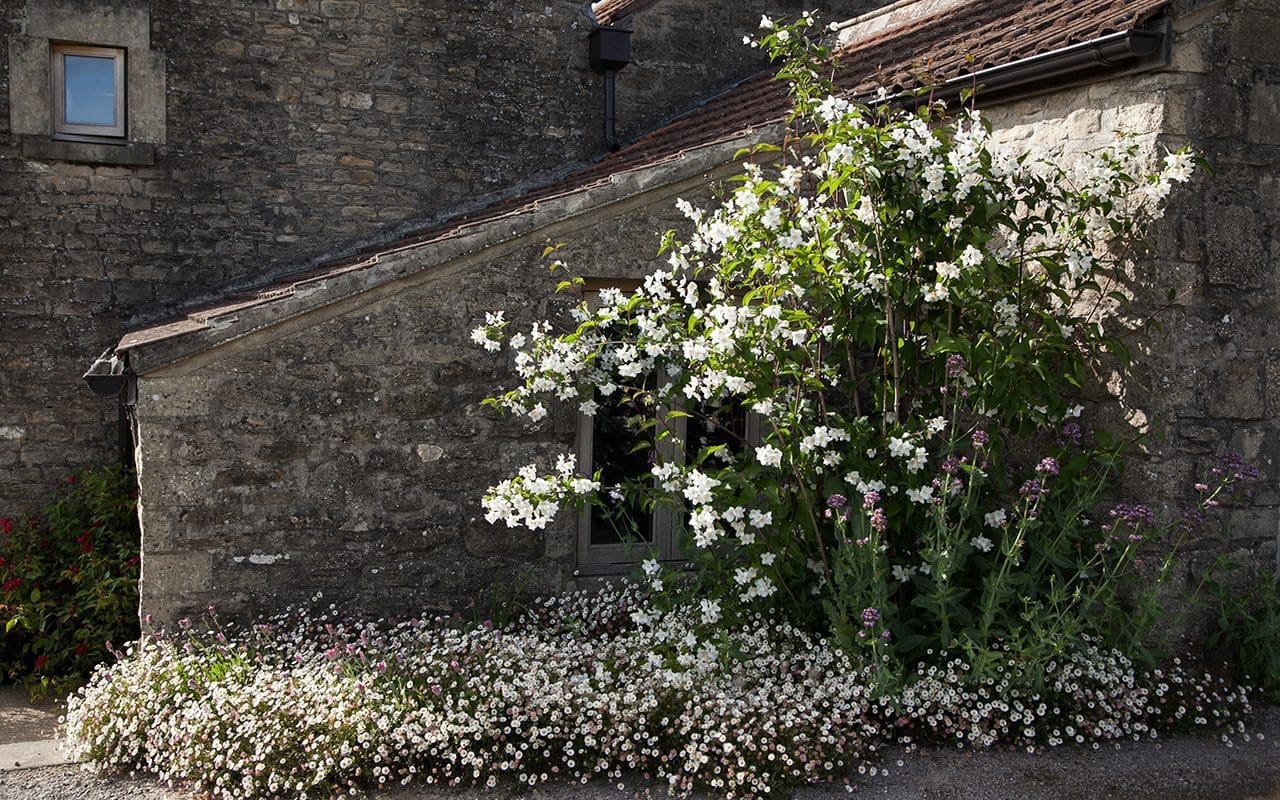
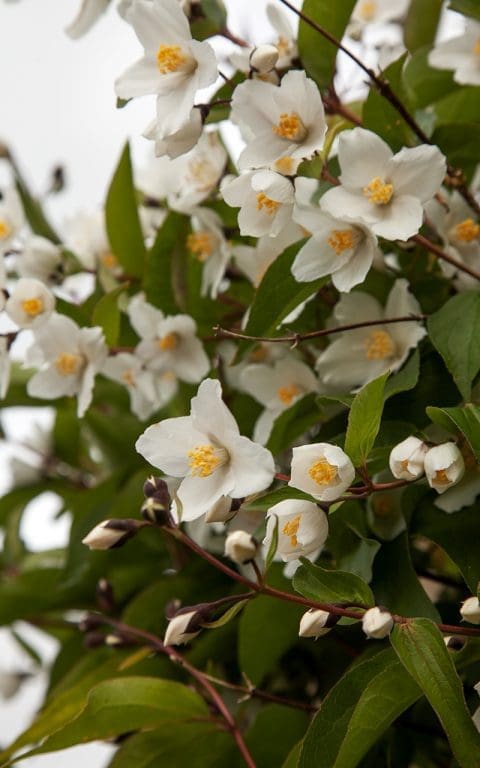
The second perfumed shoulder by the steps, held in the angle of the building to the other side is Philadephus ‘Starbright’. In its third year and beginning to have enough impact to create a presence here, we now have enough flower to perfume the breeze. In terms of scent, mock orange is a perfect description and is placed for best effect so that the wind blows it towards you. I don’t expect it to get much taller than it is now, topping out at about eight feet and six or so across for this P. delavayi x lewisii cross is modestly sized. The larger growing Philadelphus coronarius is beautiful in June with clouds of fugitive blossom but, for the remainder of the year, they are not the most interesting of shrubs.
‘Starbright’ has an open habit, never heavy, is upright but not stiff and remains open. Though it also settles into a quiet shrub for the rest of the summer, it is good in the lead up to flower, pushing plum coloured growth and first foliage. The dark staining travels into the calyces of the flowers which, against their brilliant, pure white, appear as dark as if they had been charred. Now that our ‘shoulders’ are large enough to spare some for the house, this week we have been picking combined bedside posies of mock orange and honeysuckle. Both have a fresh, zesty perfume, but the philadelphus is easily distinguished in a posy. It is evenly scented both day and night, while the honeysuckle is strongest after dusk and through into early morning. It has been waking me throughout the night, breaking my sleep with waves and pulses of perfume. I like the thought of it seeking the attention of night time pollinators and am happy that we now have enough to bring into the house to feel the full benefit ourselves.
Words: Dan Pearson | Photographs: Huw Morgan
Published 23 May 2020
As September light casts its autumnal influence, the hips have lit up the hedges. Though it would be easier to get on the land to cut the hedges whilst it is still dry, we choose to wait until February in order to preserve their bounty. The birds work the heavy trusses of elder first, then move onto the wild privet before starting on the rosehips. Their fruits are still taut and shiny and it will be a while yet before they start to wrinkle and soften to something more palatable. If you are quick enough to get there before the birds, this is the perfect time to harvest them, the hips coming away easily to sticky your hands and stain fingertips scarlet.
Although I planted a couple of dozen eglantine whips (Rosa rubiginosa) to gap up the hedges when we arrived, I raised a batch of seedlings from the first hips they bore. An autumn sowing spawned more seedlings than I could deal with after the winter chill they need to break dormancy. I potted up a hundred seedlings and grew them on for a summer so that, a year after sowing, they were ready for planting out. Two years in pots (with potting on) would have made them stronger and probably more resilient to the fierce competition of being out in the wild, but the seedlings that did make it through are now doing handsomely.
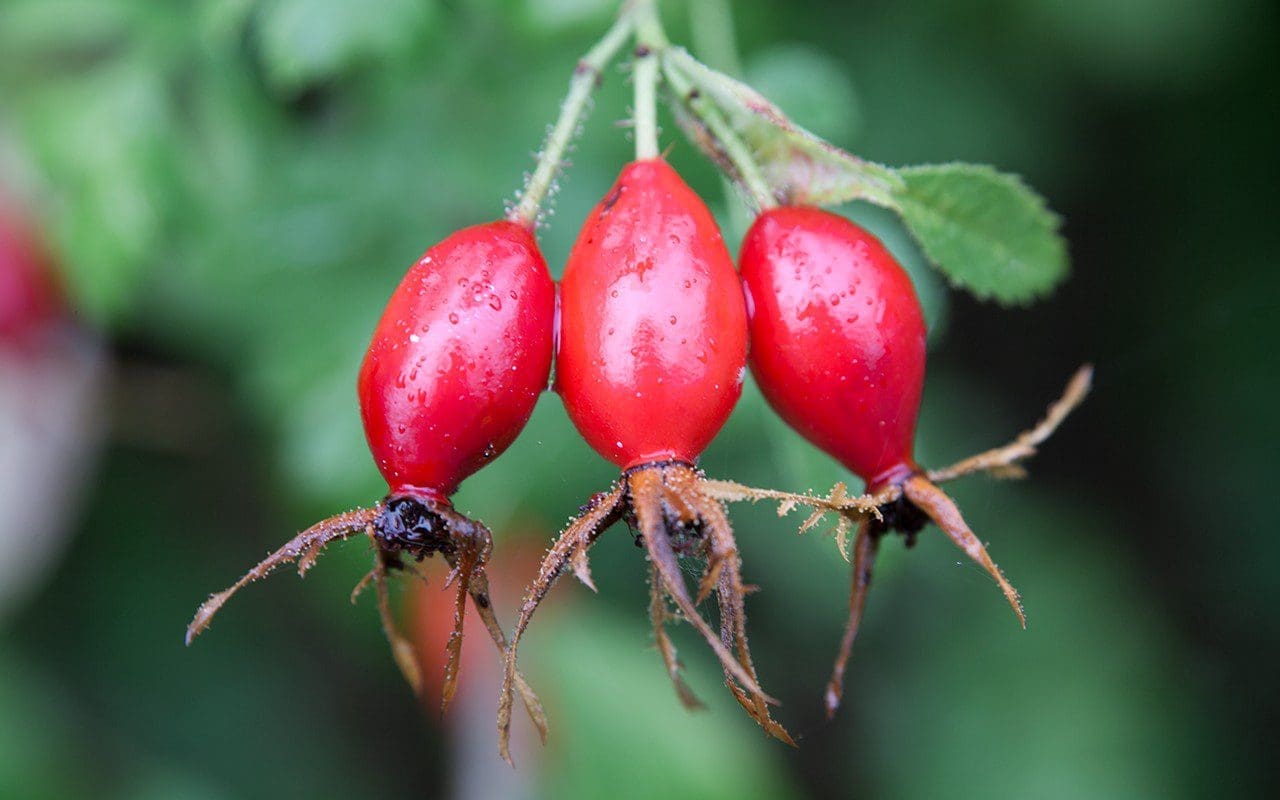 Rosa rubiginosa
The eglantine seedlings were planted widely, so that their perfumed foliage accompanies us on the walks we make over the land. They appear close to the gates and the stiles in the hedges, so that their apple-y perfume catches you unexpectedly and where they break free into the meadows. Six years after sowing, the best plants are now as tall as I am and weighted with fruit. Where we have deer down in the hollow above the brook, they have been left completely alone where other plants have been grazed, so I have also started to use them around the garden and as perfumed hedges in the hope that their scented foliage acts as a deterrent. Deer love roses as a rule, but dislike perfumed foliage, so the eglantines may be prove to be as useful as they are beautiful.
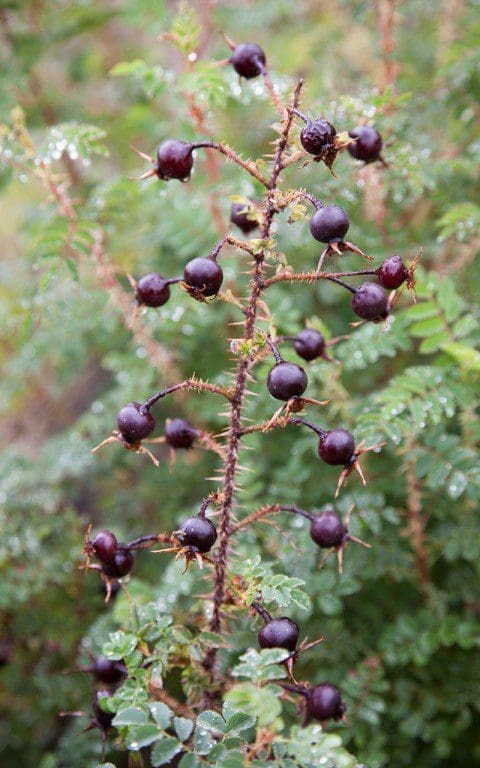 Rosa spinossisima
We have several forms of Rosa spinosissima now throughout the garden, but my favourite are the plants I raised from those I found in the sand dunes of Oxwich Bay on the Gower Peninsula. Growing to not much more than a foot, which is small for a Scots briar, the plants were growing sparsely and in pure sand amongst bloody cranesbill and sea holly. Their flowers had long gone, as it was late summer, but the round fruits were black and shiny. I gathered a couple and the resulting seedlings were set out two years ago now in an exposed position on our rubbly drive. Though the plants are heartier, growing to twenty four inches to date in our easier growing conditions, I am pleased to see they have retained their diminutive presence. We will see over time if they form thickets to the exclusion of the violets and crocus I’ve paired them with, as the briar is prone to move and colonise ground by runners. The creamy cupped flowers run up the vertical stems in early May, but the inky hips have been good since mid-summer and are only just this week starting to wrinkle and lose their gloss.
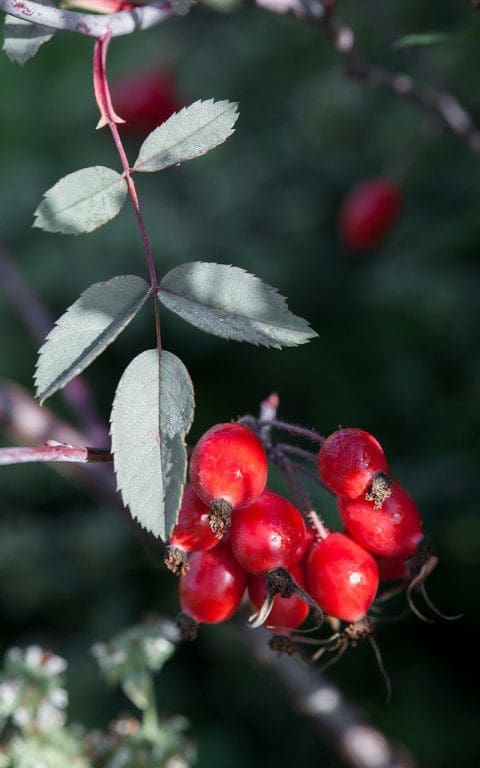 Rosa glauca
Though young and not yet expressing their stature in the garden, the Rosa glauca (main image) are sporting their first hips this year. The single flowers, which are small but always delightful, come on the previous year’s wood, so I will be making sure to always have some old wood for fruit. This is a foliage rose first and foremost and some books recommend coppicing every two to three years to encourage the best smoky-grey leaves, which are a perfect foil to the hips. I prefer to prune a third of the eldest limbs to the base at the end of winter to retain wood that will flower and fruit the following year. Ripening early for rosehips, they are bright and luminous, aging from scarlet to mahogany, and are some of the first to be stripped by the birds.
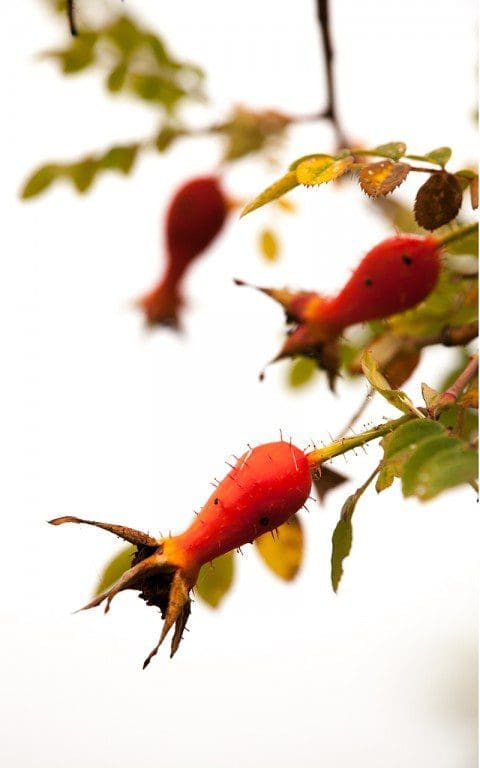 Rosa moyesii
The young Rosa moyesii on the banks behind the house are also showing good hips for the first time this year. These scarlet dog-roses are good amongst the cow parsley and meadow grasses that spill from the hedgerows in June, but their flagon-shaped hips are arguably their best asset, making this rose easily identifiable when fruiting. With arching growth and fine apple-green foliage, I will let the shrubs run to full height, which may well be ten foot or so if they decide that they like the position I have given them. They have room here on the banks and this is the best way to appreciate them, from every angle and with the yellowing autumn sun in their limbs.
Words: Dan Pearson / Photographs: Huw Morgan
Published 15 September 2018
We are sorry but the page you are looking for does not exist. You could return to the homepage