Life has begun to stir, the snowdrops suddenly visible and lighting the gloom. Over the last ten years I have been adding to a ribbon that is designed to draw us out into the landscape. It starts in the hedges close to the house and skips down the ditch in a stop-start rhythm where I have found the places that they like to be. Not too wet and with just enough shadow to keep the grass down once they have come into leaf and do their bulking. They reappear then down by the stream to run its length and ensure we walk our stretch whilst we can still get to the water in winter. The gesture demands generosity and commitment to adding to the trail, like a conversation you come back to, but is never really done.
We need to think expansively beyond the curtilage of the garden, where the land takes over and we could never nor want to control all that we see. Although the touch by necessity needs to be light in these wilder places, it should also feel generous. Not in a conspicuous way, but right because you have found a niche and then followed it. The big moves always start with a small one. Finding the place that a plant likes to be and understanding why and then going with it.
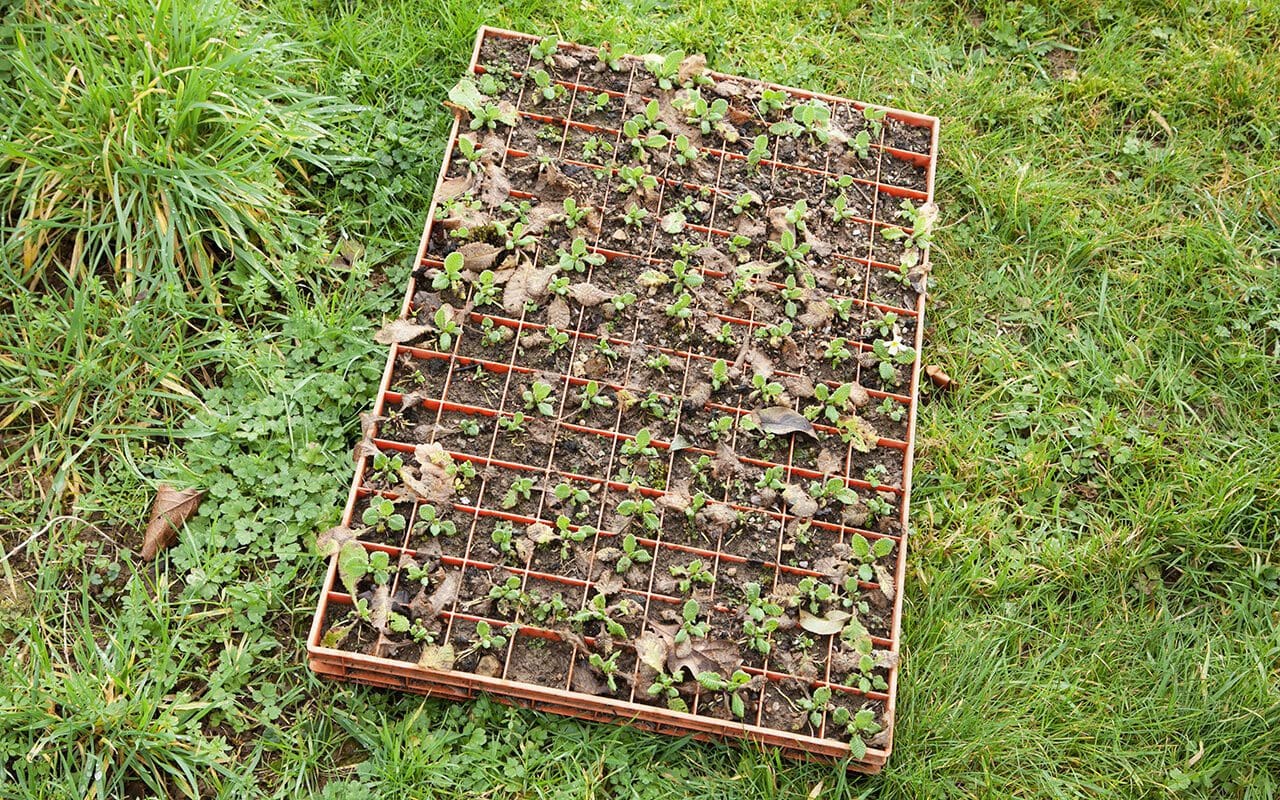
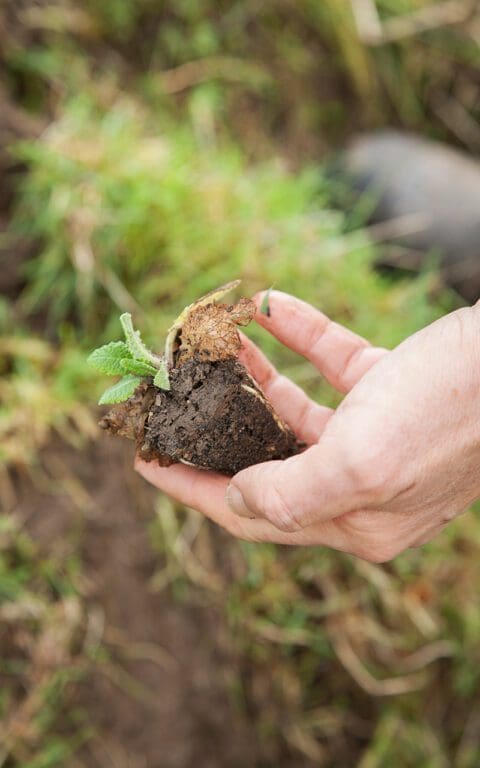
Working at scale in these wilder places demands both patience and persistence. Neither feel forced or hard won when the mother plants begin to seed. The primrose splits from five years ago came from a colony that was hiding amongst a cage of brambles. We fenced the ditch to keep out the livestock, cut away the brambles and the primroses proliferated on the hummocky slopes where each had its little microclimate. The splits – taken early in April not long after the primroses had peaked – were found a similar position and, where we hit the sweet spot, they are showing their happiness there in seedlings. The seedlings slowly erase your hand. The regular rhythm you try to avoid when planting, but cannot help but read when you look back on what you have done. The seedlings skip a beat, their seed taken to a new place by ants. The ones that come through feel right for having found their own place.
By its very nature my role as the ‘gardener’ of these natural processes cannot help but want for a little more. So where splits have proved to be too slow – the mother plants taking time to bulk – I have taken to collecting seed. This is ripe in June, but you have to watch carefully then as the plants are often consumed in the shadow of summer vegetation. The seed is best sown fresh or it begins to enter a period of dormancy that is hard to break. Fresh seed germinates erratically, some in the late summer and over autumn, but the majority in the spring after it has had time for the frost to do its work.
I sow three or four plug trays each year (between 300-400 plants) casting the seed over the tray and then top-dressing with sharp grit to protect it. Sowing annually means that I have a relay of seedlings on the go. Seedlings are left in the trays for 18 months and planted out just about now, when there is time for their early growth to get ahead of the competition. This year the seedlings are going into the steep banks up behind the house, where the sheep have opened up the ground with heavy grazing and poaching. The slope is south-facing and primroses love to bask in early sunshine. Here the bees find them early too. The summer cover of the grassland that rises up around them will keep them in the shade they like later.
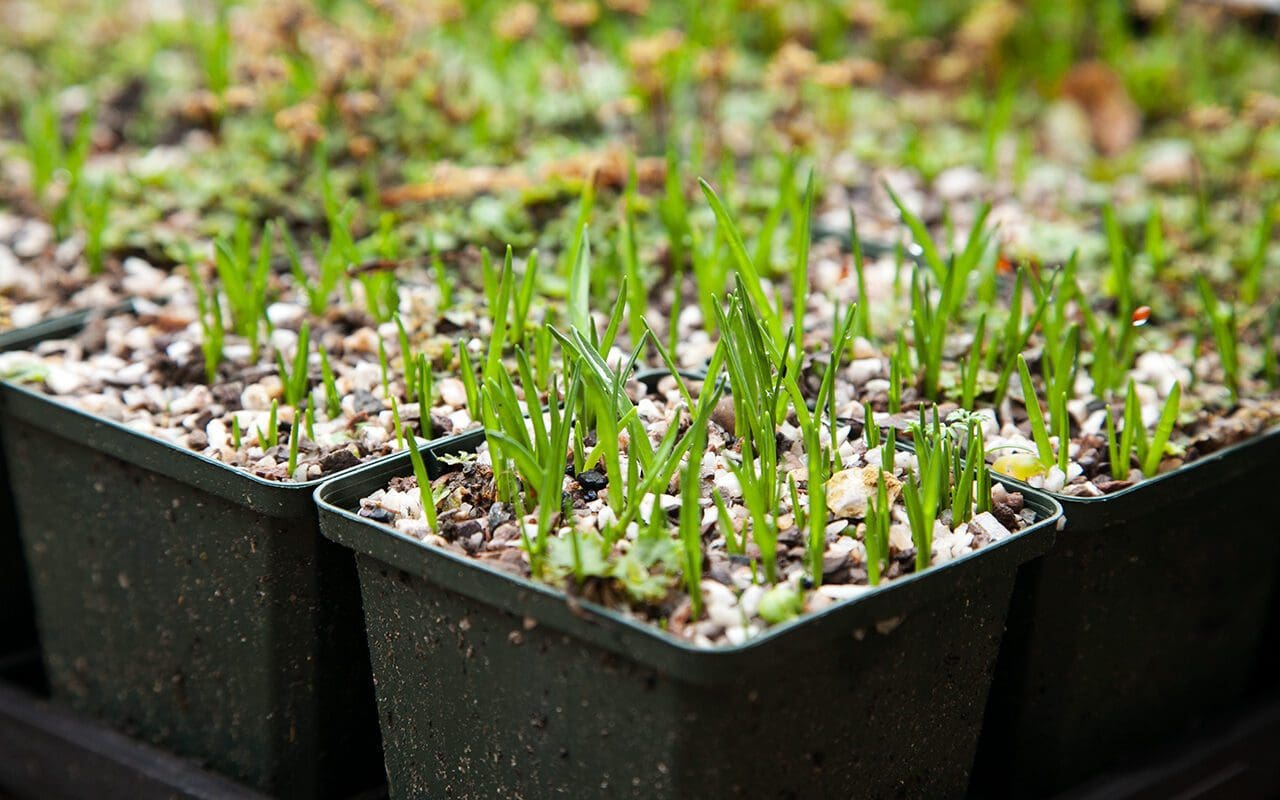
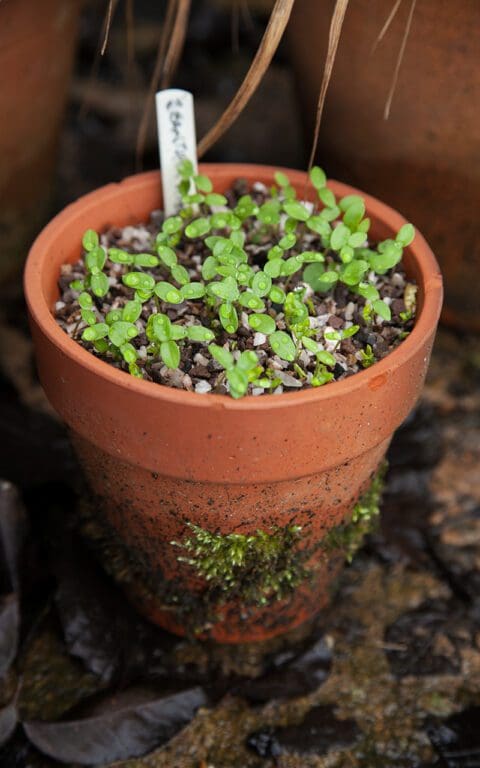
Also in mass production and destined for the wilder places are some locally sourced bluebells grown from seed. This is not bluebell country, their niche here being on the heaviest clay in the woods and not where it is too rich and competitive. I have been studying our ground to find the place where I imagine they might thrive, even just in pockets so that we have some pools of blue in the coppice.
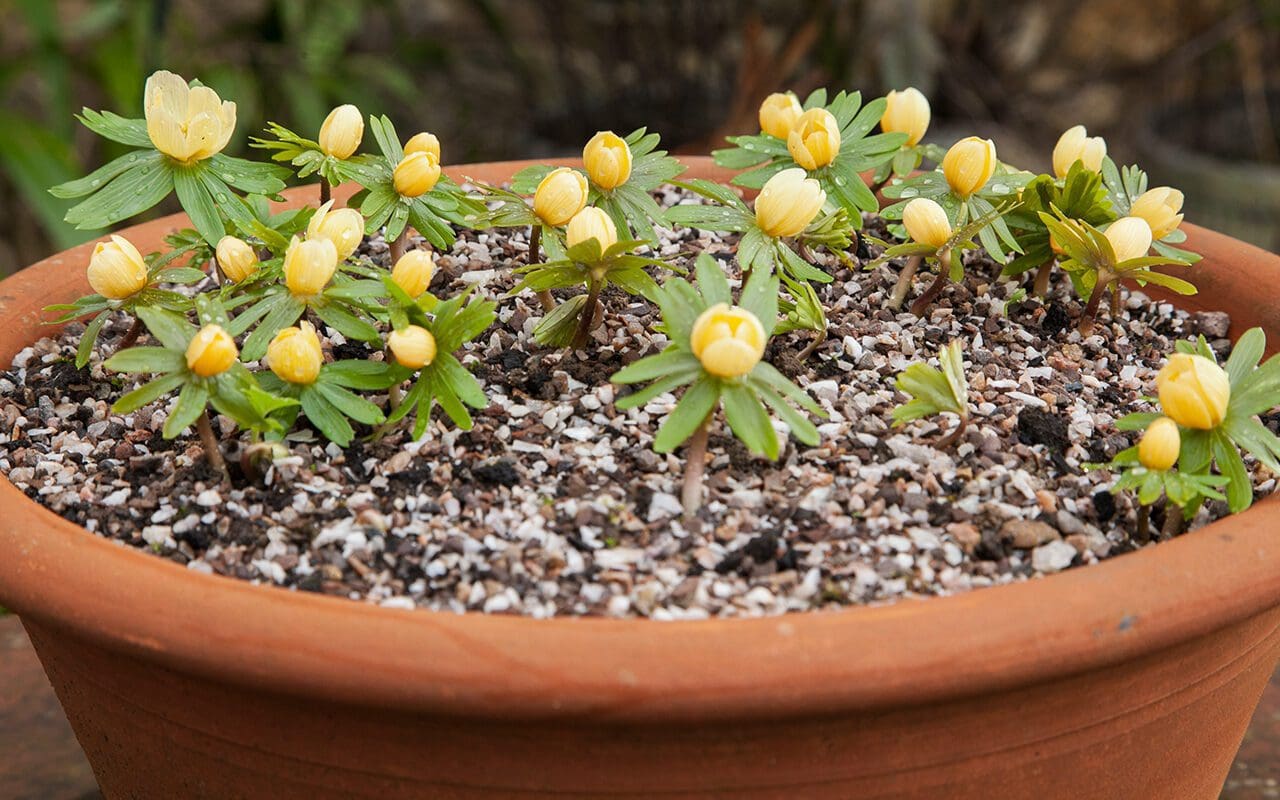
Then there are the bulbs that are too expensive to buy in bulk and that I hanker for en masse. Camassia leichtlinii originally bought as ‘Amethyst Strain’ from Avon Bulbs and now renamed Avon Stellar Hybrids, are destined for the ditch. Well-named for their colour range of mauves and lavenders, their propensity to rampant seeding in the open ground of the garden will be mediated by the competition of grass. Tulipa sprengeri (at a prohibitive £5 a bulb) comes easily from seed if you are prepared to wait, as does the pale-flowered form of the native early winter aconite, Eranthis hyemalis ‘Schwefelglanz’. I plan for sheets of this butter-yellow form one day, in the places that are too damp for the snowdrops, but on the same trail and flowering with them in January. Though the wait is usually five years to flower for most of the bulbs, the beauty of sowing every year means that there is always a tray finishing the relay and ready to join the land of plenty.
Words: Dan Pearson | Photographs: Huw Morgan
Published 30 January 2021
The farmer here before us had grazed the land hard with the precious pasture or ‘grub’ taking precedence over the trees. Our neighbour has shown us photos of the valley when she was a girl, unrecognisable for the majestic elms in every hedge. When the elms came down during the 1960’s and ’70’s, their demise opened up the landscape and, save a handful of mature ash that run along the lane, the hedges have remained low and uninterrupted. On his last winter here, the year before we took over the land in 2010, the farmer scaled the solitary ash that stands proud on the slopes of The Tump and pollarded it back to its torso. The ancient pollards are a feature of the valley, for ash (Fraxinus excelsior) burns green and so is a valuable wood for winter fires. Our limbless pollard stood starkly that first November, just a small amount of regrowth marking the time the property had taken to come into our hands. Representing, as it did, the end of an era and the start of a new chapter, we immediately marked about thirty hedgerow ash so that, when the hedges were cut, they would be left to rise up and away to become new hedge trees. Though not a brilliant hedging plant, ash in a hedge are more than happy to take a yearly cut and, with the advantage of being already established in the hedge, they have raced away. In that first winter I planted another thirty ash whips that were winkled in where gaps opened up after removing elder and bramble. The young whips have to be watched for the first three years as they have competition for light and water from the hedge to either side, but as soon as they were tall enough I tied a ribbon to their leader so that the farmer who cuts our hedges can work around them.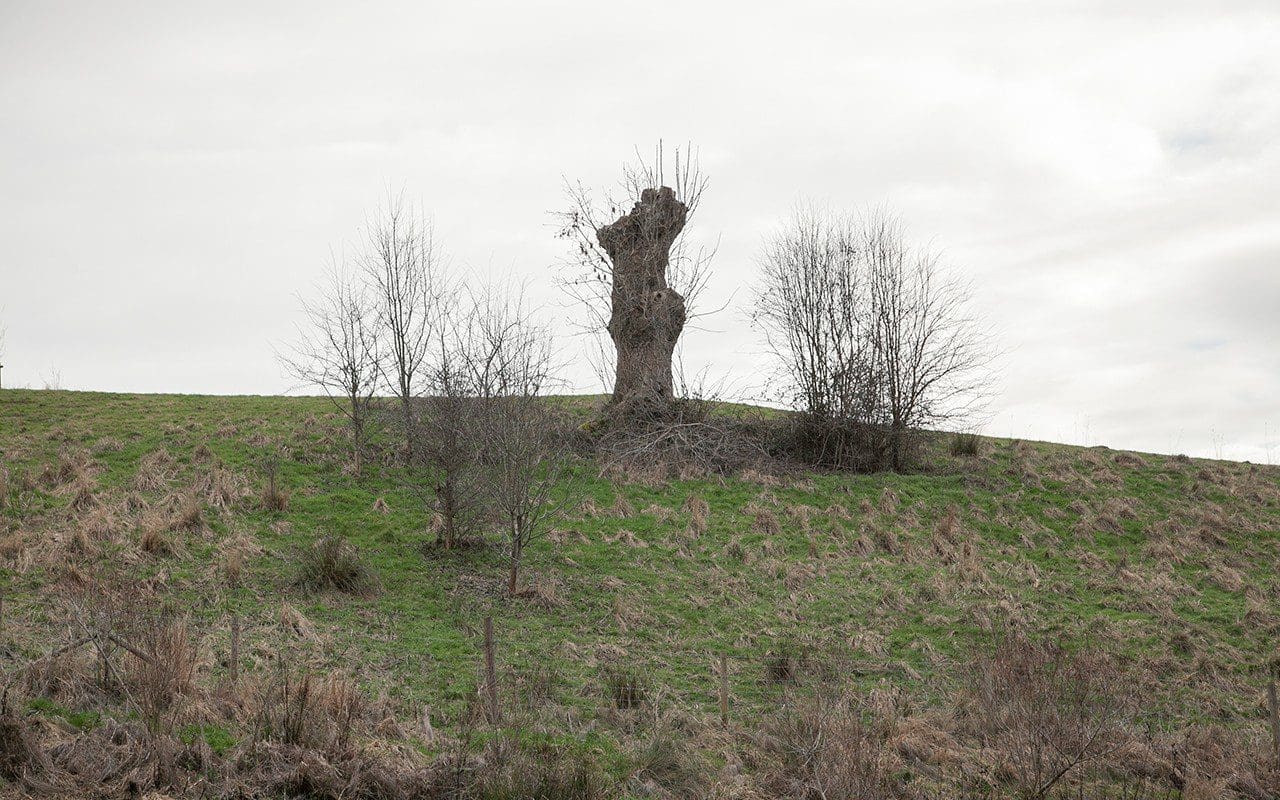 The old ash pollard on The Tump has now been joined by a number of self-seeded hawthorns
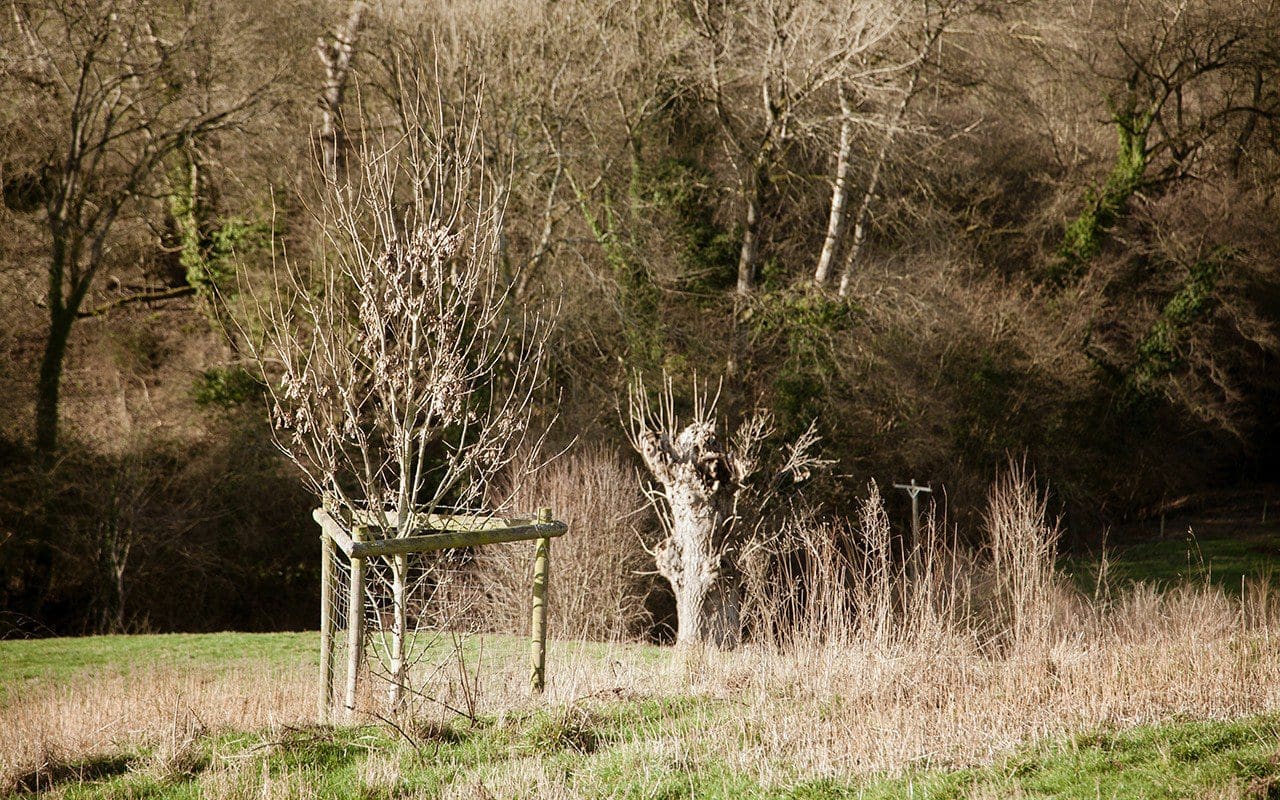 One of the ash planted eight years ago on the slopes above the old pollard, the top of which can be seen in the background
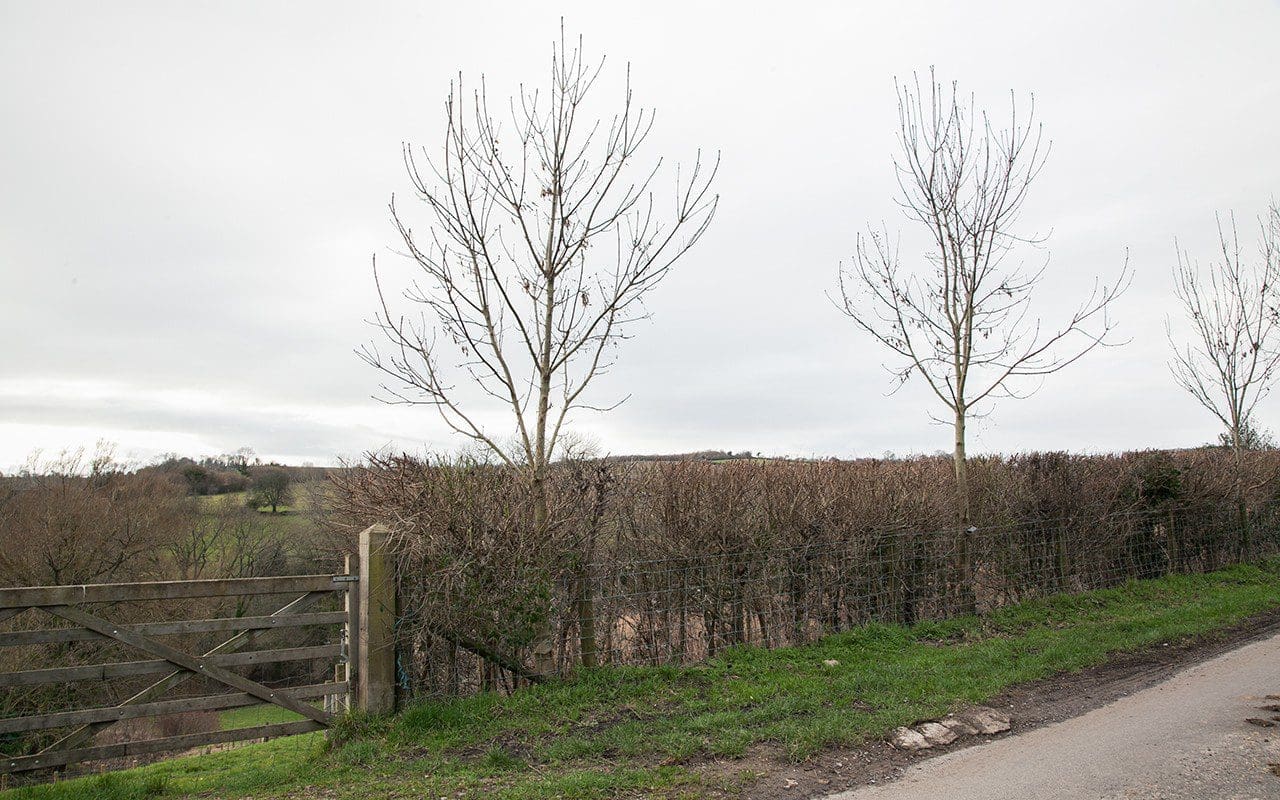 Three of the ash planted eight years ago into the hedge on the lane
It was a good plan, or so I thought, to have my hedge trees on a ten year rotation and pollard enough every year to fuel our wood burners. The spectre of ash dieback was first confirmed in the UK just two years later in 2012 and it is now sobering to think how quickly things can change. We discovered the first signs in some seedling trees about three years later and, although none of the trees I planted have been affected yet, my own plans of ash pollards are now in question. And then, as with the disappearance of the elms, there is the visual change we will inevitably see in the landscape, since ash is such a key and widespread component of our woodlands.
The initial panic that circulated in the press soon after the discovery of Chalara eased a little while we waited to see what happened. However, caused as it is by a fungus with wind-borne spores, it has taken only 6 years to become widespread and is now present in most of the country, bar the north of Scotland. What has become clear is that, once a tree is infected, the disease is usually fatal. However, mature trees can survive for some time and during that time they continue to make a valuable contribution to the local ecology and landscape. Ash are also profligate with their seed and scientific study into variability has already shown that a small number of trees are able to tolerate or resist infection.
Hopefully the strong will win out and, with that belief, my plans seem not entirely without hope. But what is becoming increasingly clear is that diversity is important and that no one environment should have all its eggs in the same basket. With this in mind, I have been widening my net and, every year since we came, I have made it a mission to broaden the palette of native trees on the land. There are several projects on the go and winter work includes hedge improvement and extension and the finding of places for long-termers that can step into the fields without making them difficult to manage with machinery.
Three of the ash planted eight years ago into the hedge on the lane
It was a good plan, or so I thought, to have my hedge trees on a ten year rotation and pollard enough every year to fuel our wood burners. The spectre of ash dieback was first confirmed in the UK just two years later in 2012 and it is now sobering to think how quickly things can change. We discovered the first signs in some seedling trees about three years later and, although none of the trees I planted have been affected yet, my own plans of ash pollards are now in question. And then, as with the disappearance of the elms, there is the visual change we will inevitably see in the landscape, since ash is such a key and widespread component of our woodlands.
The initial panic that circulated in the press soon after the discovery of Chalara eased a little while we waited to see what happened. However, caused as it is by a fungus with wind-borne spores, it has taken only 6 years to become widespread and is now present in most of the country, bar the north of Scotland. What has become clear is that, once a tree is infected, the disease is usually fatal. However, mature trees can survive for some time and during that time they continue to make a valuable contribution to the local ecology and landscape. Ash are also profligate with their seed and scientific study into variability has already shown that a small number of trees are able to tolerate or resist infection.
Hopefully the strong will win out and, with that belief, my plans seem not entirely without hope. But what is becoming increasingly clear is that diversity is important and that no one environment should have all its eggs in the same basket. With this in mind, I have been widening my net and, every year since we came, I have made it a mission to broaden the palette of native trees on the land. There are several projects on the go and winter work includes hedge improvement and extension and the finding of places for long-termers that can step into the fields without making them difficult to manage with machinery.
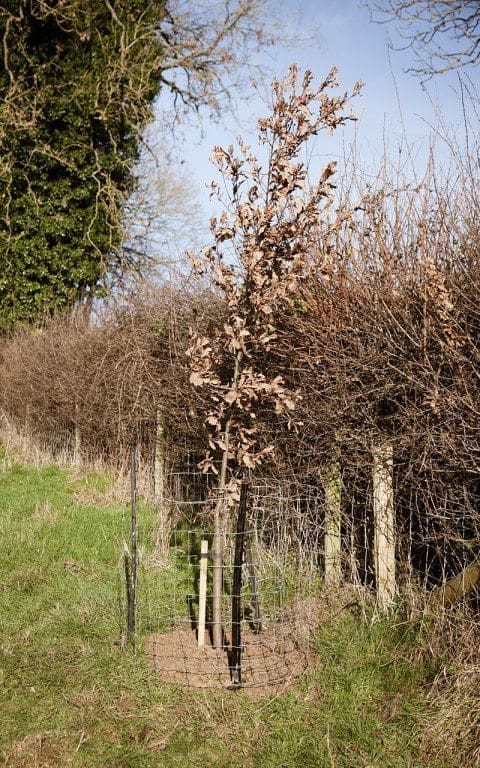 A newly planted oak has a temporary tree guard
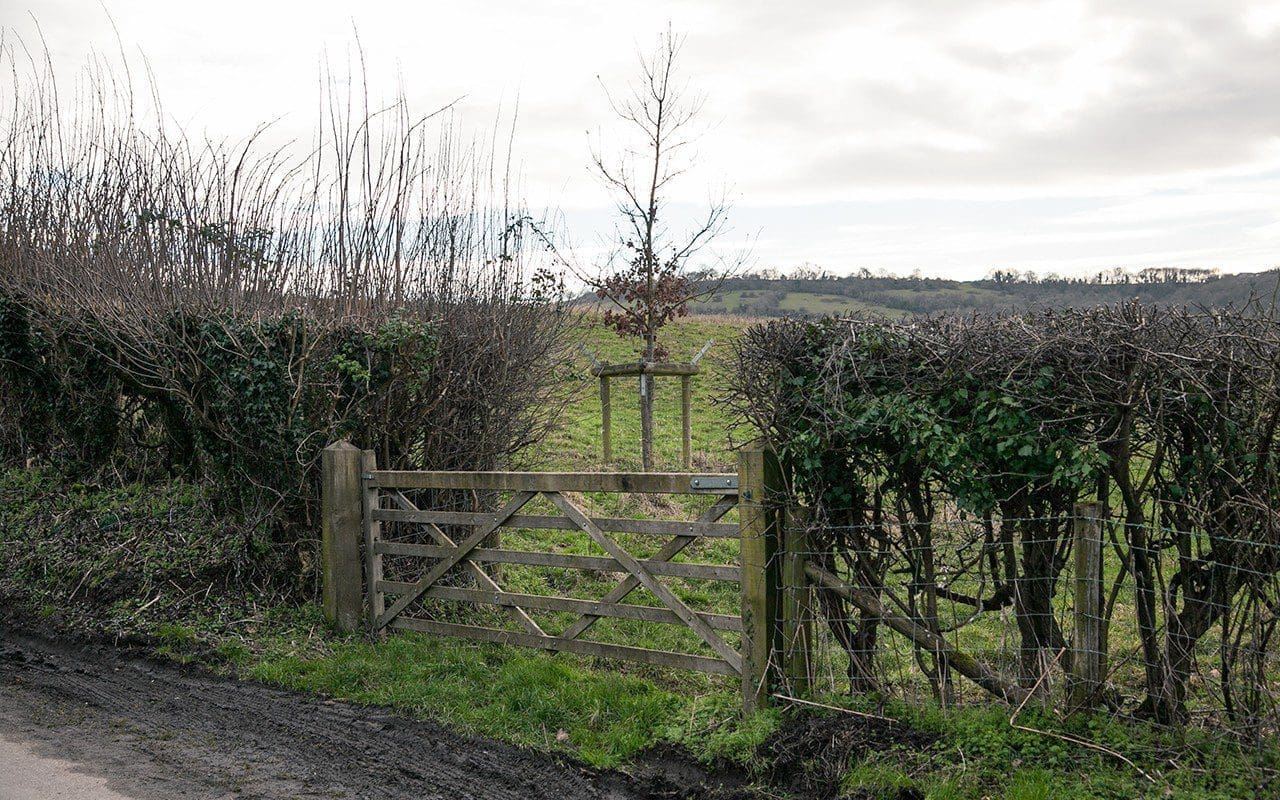 A gate marker oak planted 4 years ago
Every year I have planted a handful of English oaks (Quercus robur), using them as markers by gates (main image, the large trees are ash) so that you can both locate the breaks in the hedges from a distance and to make a place of the gate; a place to stop in the shade or somewhere for the animals to gather in the heat of the day. Although with climate change there is some speculation as to the long-term suitability of oak in Southern England, my hope is that the combination of our hearty soil and the spring lines that run through the slopes will give them their best chance. Oak has the highest biodiversity count of all native trees and so I am also planning for the life that comes with them.
As gaps have opened up as I upgrade our old hedgelines by stripping them of dominant runs of bramble, elder and old man’s beard, I have been adding common lime to replace the ash should they fail as hedge trees. Tilia x europaea is a beautiful tree if you have the room, not just for its vibrant leaf colour, but for the perfume of the flowers and the benefit these have for the bees and us, as it comes in quantity and makes a delicious tea. Once again, the trees will need extra care and, with this in mind, I made sure they were all planted before the end of the year so that their hair roots can get the best possible chance of being in contact with the soil before the spring. The trees were also given a good mulch of compost to hold in the moisture.
A gate marker oak planted 4 years ago
Every year I have planted a handful of English oaks (Quercus robur), using them as markers by gates (main image, the large trees are ash) so that you can both locate the breaks in the hedges from a distance and to make a place of the gate; a place to stop in the shade or somewhere for the animals to gather in the heat of the day. Although with climate change there is some speculation as to the long-term suitability of oak in Southern England, my hope is that the combination of our hearty soil and the spring lines that run through the slopes will give them their best chance. Oak has the highest biodiversity count of all native trees and so I am also planning for the life that comes with them.
As gaps have opened up as I upgrade our old hedgelines by stripping them of dominant runs of bramble, elder and old man’s beard, I have been adding common lime to replace the ash should they fail as hedge trees. Tilia x europaea is a beautiful tree if you have the room, not just for its vibrant leaf colour, but for the perfume of the flowers and the benefit these have for the bees and us, as it comes in quantity and makes a delicious tea. Once again, the trees will need extra care and, with this in mind, I made sure they were all planted before the end of the year so that their hair roots can get the best possible chance of being in contact with the soil before the spring. The trees were also given a good mulch of compost to hold in the moisture.
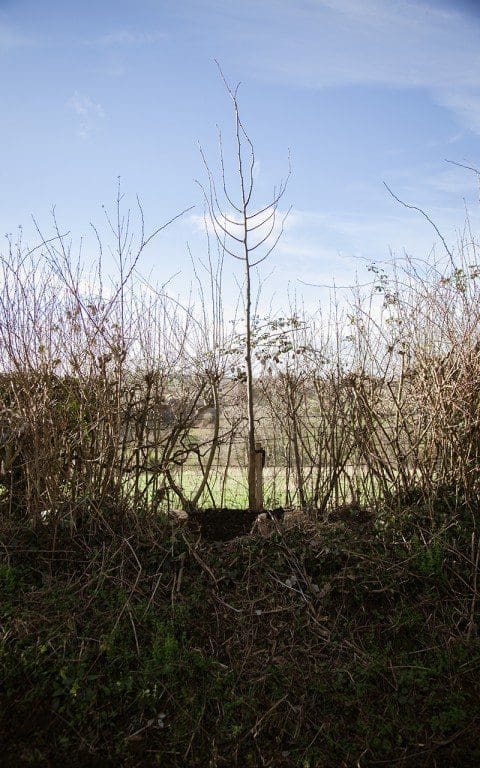 One of the new limes planted as hedge trees
Hedge trees are space efficient and their presence along the lanes as another storey above the hedgeline produces protected microclimates and a stillness that harbours insects. The bats run through these fertile air pockets, using them as feeding corridors, as do the birds that benefit from cover from predators. When we first arrived here one of the first things we noticed was the lack of birdlife near the house, with no trees and scalped hedges. We have quickly seen them return, as the trees have risen up to provide shelter, shade and perches for chatter or prey-watching.
One of the new limes planted as hedge trees
Hedge trees are space efficient and their presence along the lanes as another storey above the hedgeline produces protected microclimates and a stillness that harbours insects. The bats run through these fertile air pockets, using them as feeding corridors, as do the birds that benefit from cover from predators. When we first arrived here one of the first things we noticed was the lack of birdlife near the house, with no trees and scalped hedges. We have quickly seen them return, as the trees have risen up to provide shelter, shade and perches for chatter or prey-watching.
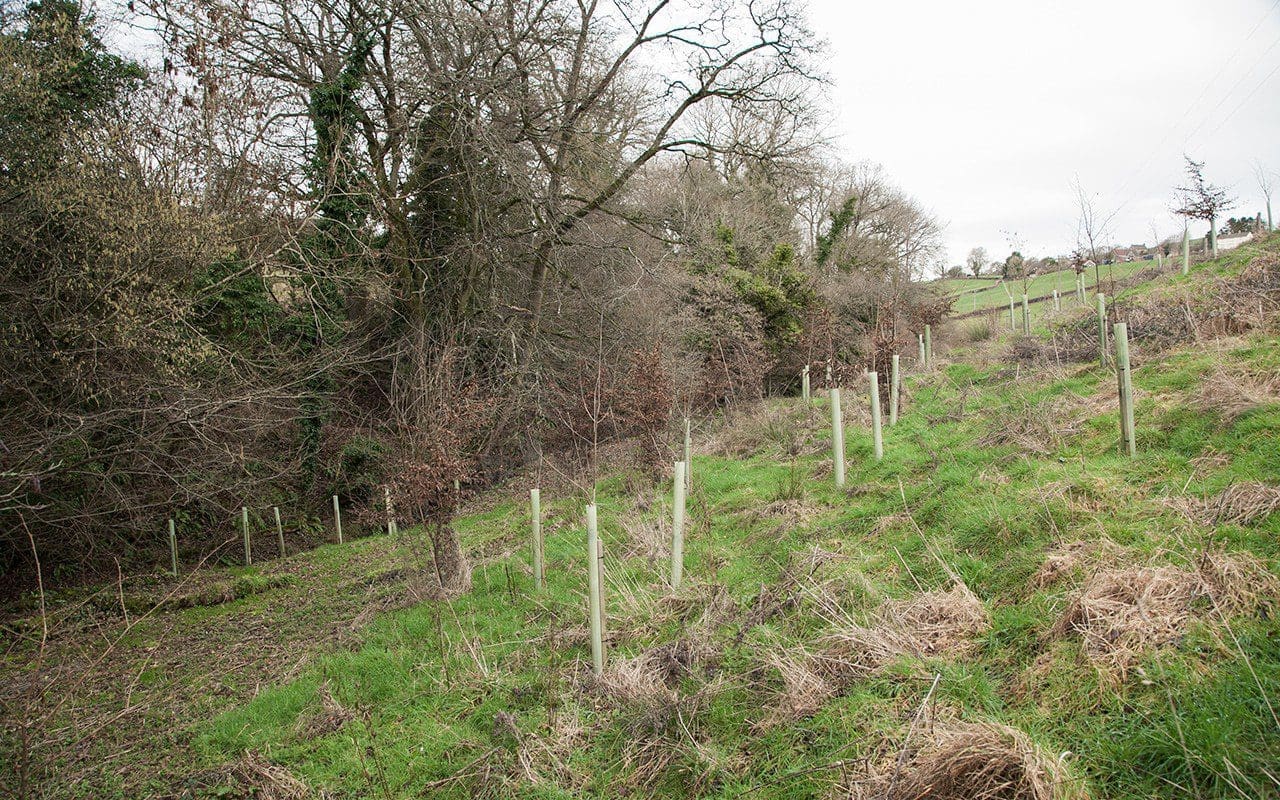 Part of the area of hornbeam and hazel coppice on the lower slopes of The Tump above the stream, which were planted 4 and 5 years ago
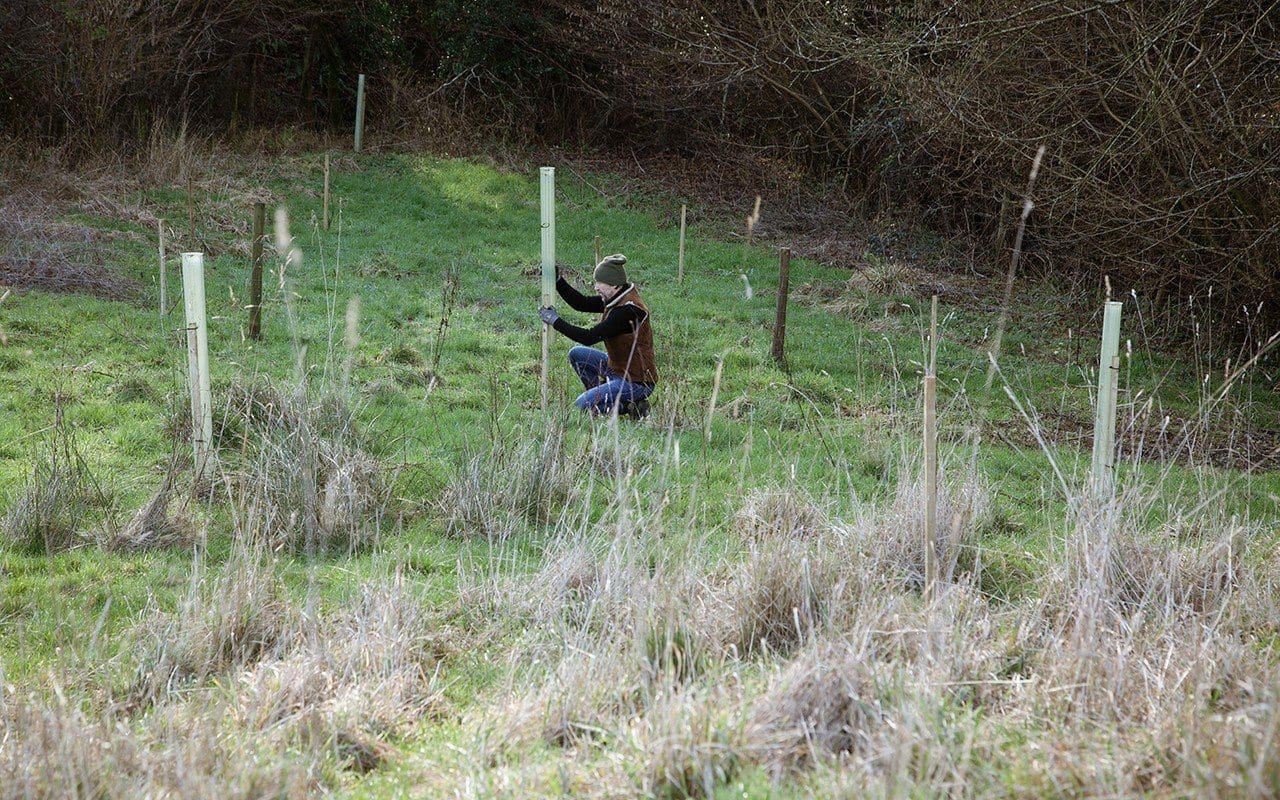 Dan putting tree guards on the newly planted coppice of hazel and sweet chestnut
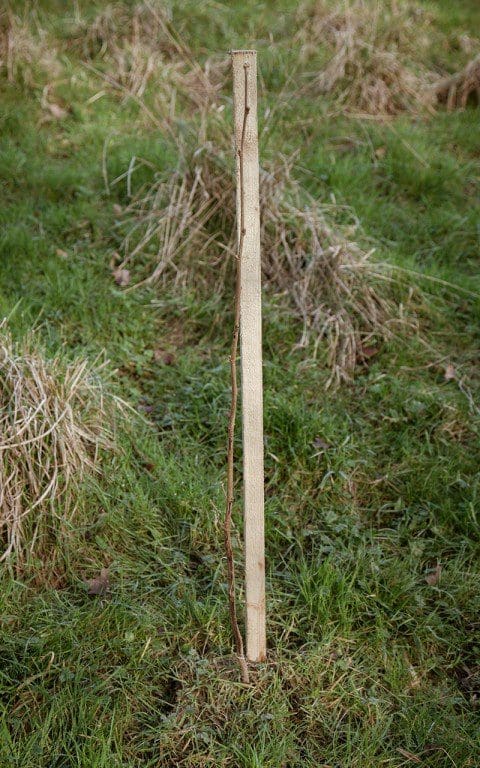
For the last five years I have been slowly extending a new coppice in the hollow where the field dips away too steeply to the stream edge for haymaking. Thirty trees a year now sees the beginnings of something. Oak, to form a high canopy, and hornbeam and hazel, which will be put on a coppice rotation of twelve and eight to ten years respectively. This year I added some sweet chestnut to see if we can harvest our own poles for fencing in years to come. The coppice will provide the firewood I might be short of should the ash fail, and species variation within it will be good for ringing the changes in the ecology as we work from end to end over the course of a cycle.
It is a good feeling to this year have reached the end of the planted area and to be able to look back from the little whips which have just gone in to the progress mapped in year-on-year growth on the slopes beyond. This next chapter is begun.
Dan putting tree guards on the newly planted coppice of hazel and sweet chestnut
For the last five years I have been slowly extending a new coppice in the hollow where the field dips away too steeply to the stream edge for haymaking. Thirty trees a year now sees the beginnings of something. Oak, to form a high canopy, and hornbeam and hazel, which will be put on a coppice rotation of twelve and eight to ten years respectively. This year I added some sweet chestnut to see if we can harvest our own poles for fencing in years to come. The coppice will provide the firewood I might be short of should the ash fail, and species variation within it will be good for ringing the changes in the ecology as we work from end to end over the course of a cycle.
It is a good feeling to this year have reached the end of the planted area and to be able to look back from the little whips which have just gone in to the progress mapped in year-on-year growth on the slopes beyond. This next chapter is begun.
 Words: Dan Pearson / Photographs: Huw Morgan
Published 19 January 2019
Words: Dan Pearson / Photographs: Huw Morgan
Published 19 January 2019 Although the snow from last weekend has all but gone, the drifts that stubbornly mark the lee of the hedges on the coldest slopes are a reminder that winter’s grip is still apparent. The primroses, however, have a schedule to keep and have responded with gentle defiance. The first flowers were out just days after the first thaw to light the dark bases of the hedgerows, and now they are set to make this first official week of spring their own.
Since arriving here, we have done our best to increase their domain. Although they stud the cool, steep banks of the lanes, they were all but absent on the land where the cattle had grazed them out. Save for the wet bank above the ditch where they were protected from the animals by a tangle of bramble. We noted that they appeared in this inaccessible crease with ragged robin, angelica and meadowsweet. Four years ago we fenced the ditch along its length to separate the grazing to either side and since then have done nothing more than strim the previous season’s growth in early January to keep the brambles at bay.
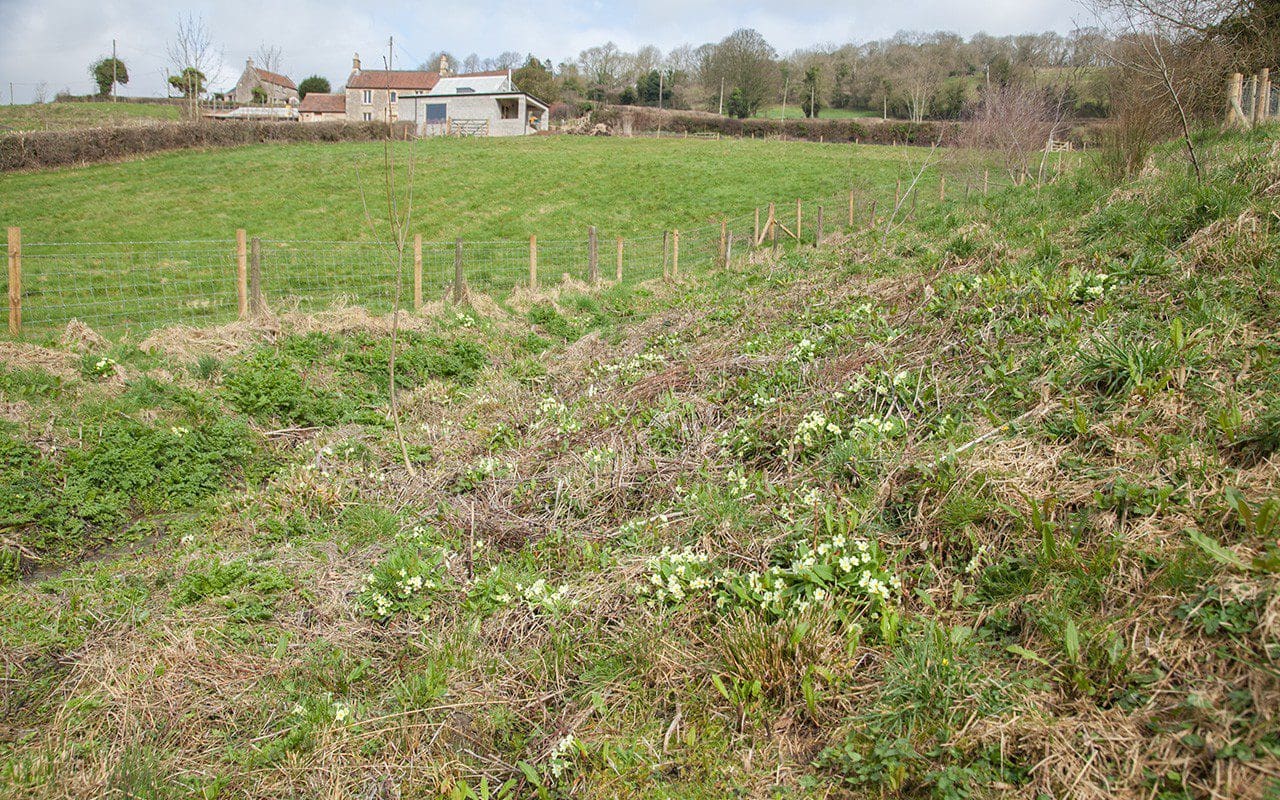
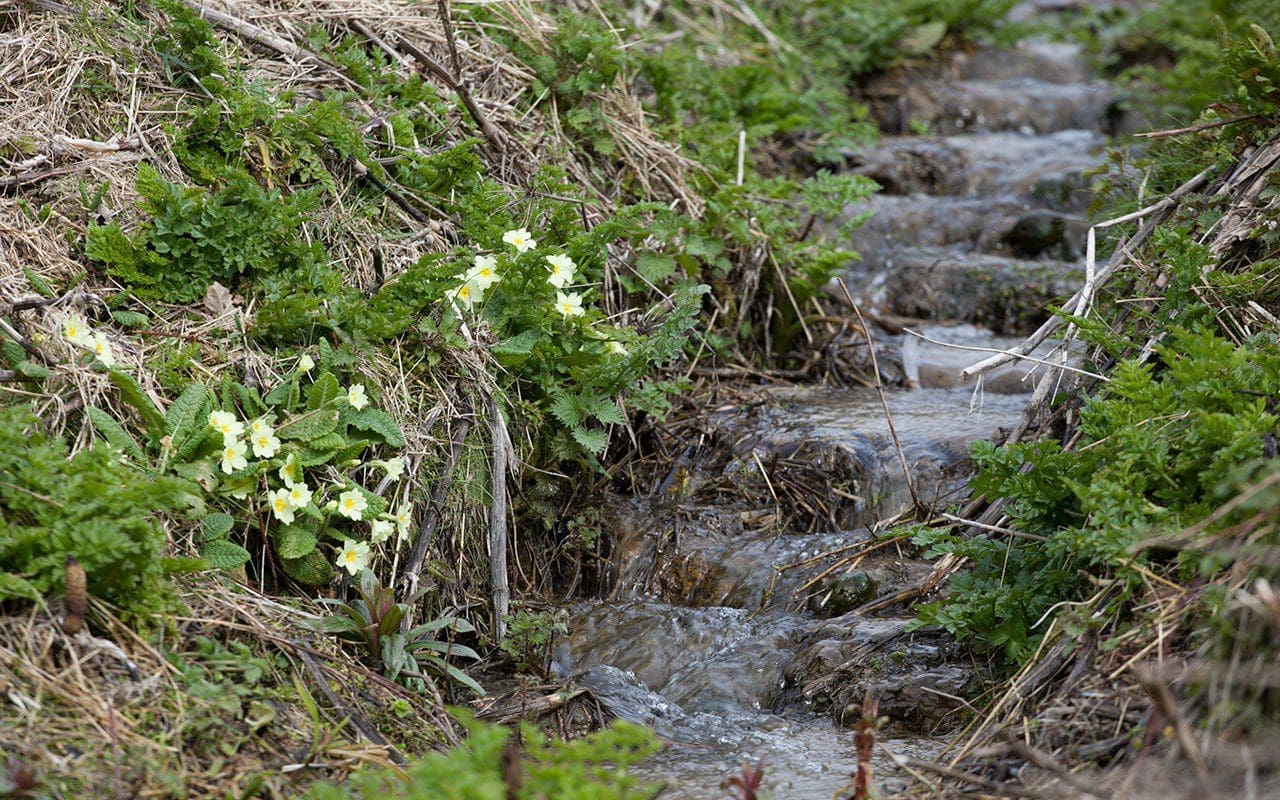
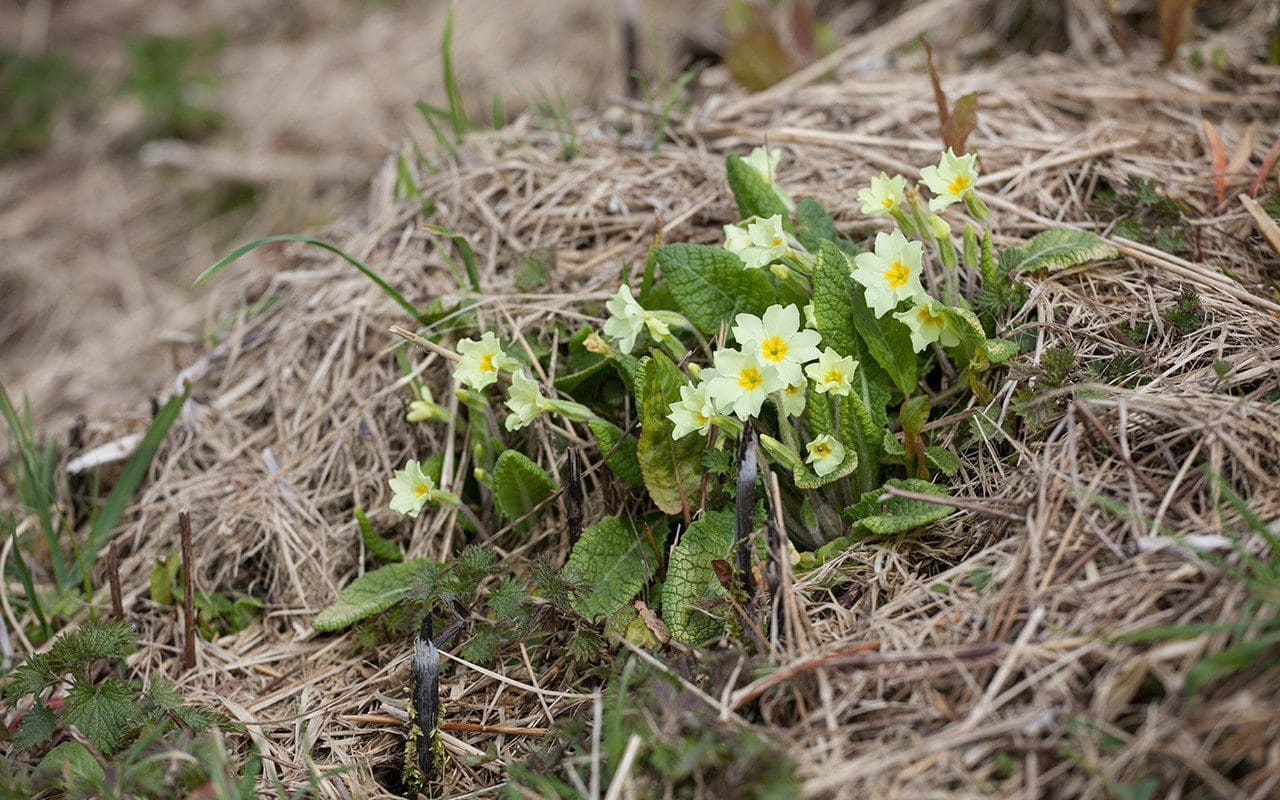 Primroses (Primula vulgaris) colonise the banks above the ditch
The new regime has seen a slow but gentle shift in favour of increased diversity. Though the brambles had protected them in the shade beneath their thorny cages, now that they have been given headroom the primroses have flourished. Their early start sees them coming to life ahead of their neighbours and, by the time they are plunged once more into the shade of summer growth, they have had the advantage. Four years on we can see them increasing. The mother colonies now strong, hearty and big enough to divide and distinct scatterings of younger plants that have taken in fits and starts where the conditions suit them.
Each year, as soon as we see the flowers going over, we have made a point of dividing a number of the strongest plants. It is easy to tease them from their grip in the moist ground with a fork. However, I always put back a division in exactly the same place, figuring they have thrived in this spot and that it is a good one. A hearty clump will yield ten divisions with ease, and we replant them immediately where it feels like they might take. Though they like the summer shade, the best colonies are where they get the early sunshine, so we have followed their lead and found them homes with similar conditions.
The divisions taken from the heavy wet ground of the ditch have been hugely adaptable. The first, now six years old and planted beneath a high, dry, south-facing hedgerow behind the house, have flourished with the summer shade of the hedge and cover of vegetation once the heat gets in the sun. It is my ambition to stud all the hedgerows where we have now fenced them and they have protection from the sheep. Last year’s divisions, fifty plants worked into the base of the hedge above the garden, have all come back despite a dry spring. Their luminosity, pale and bright in the shadows, will be a good opening chorus in the new garden. The tubular flowers can only be pollinated by insects with a long proboscis, so they make good forage for the first bumblebees, moths and butterflies.
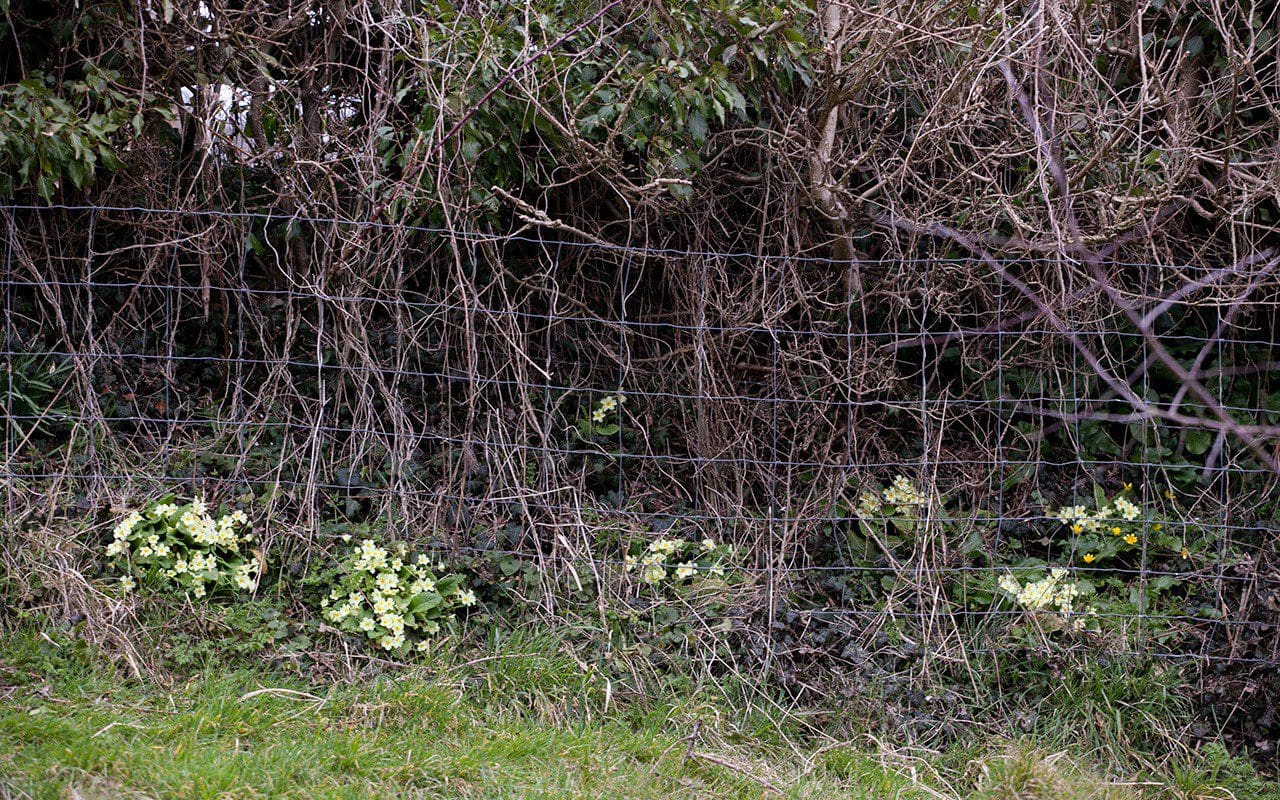
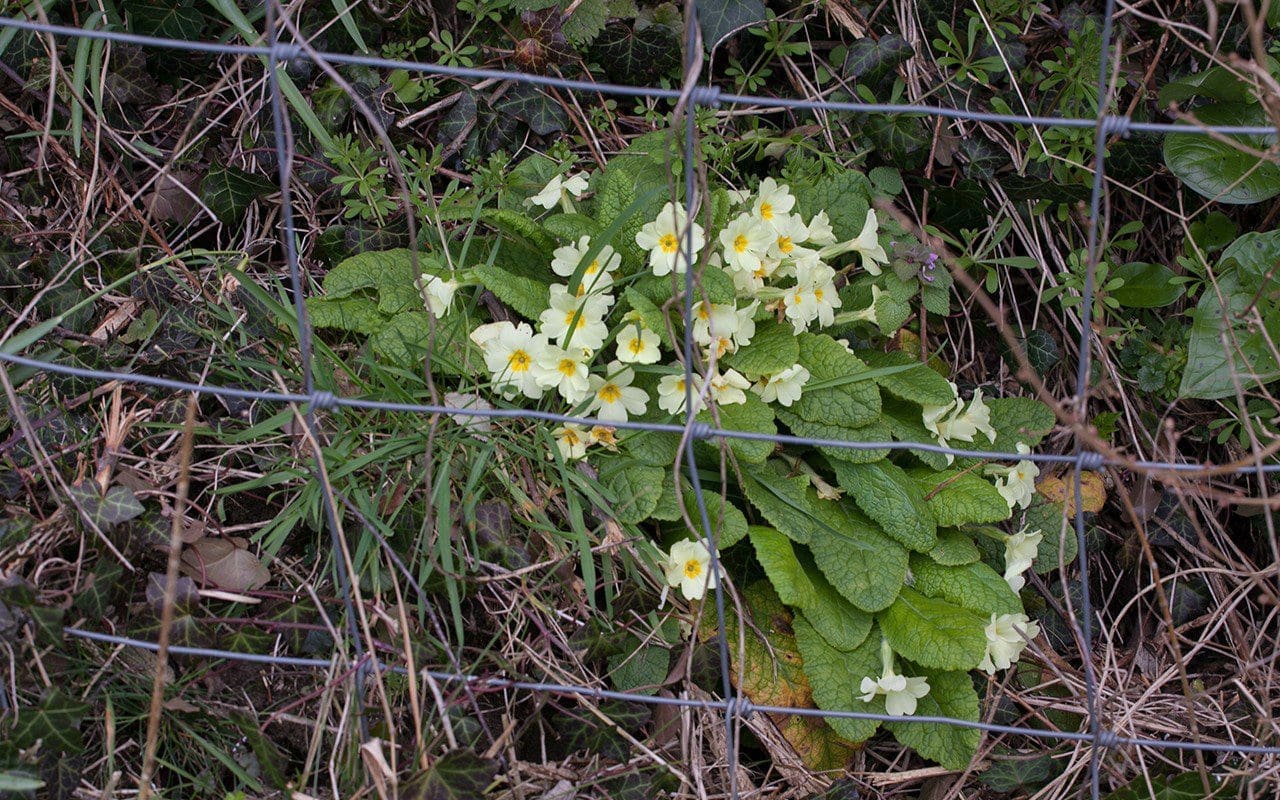 The six year old divisions at the base of the south-facing hedge behind the house
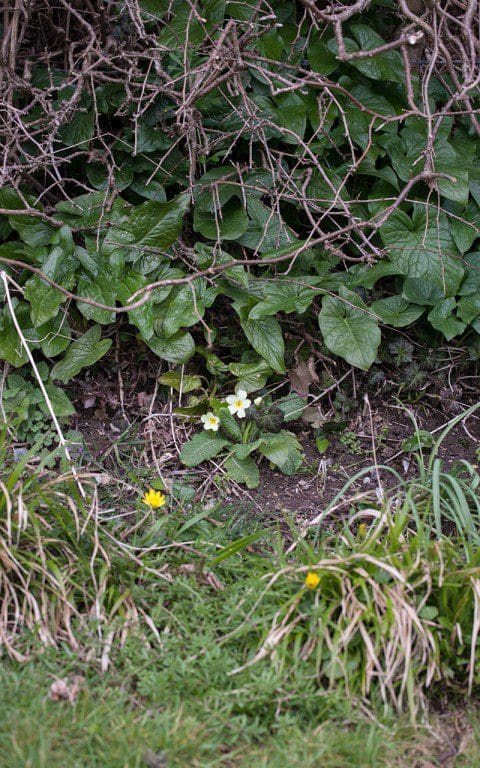 A one year old division at the base of the hedge above the garden
By the time the seed ripens in early summer, the primroses are usually buried beneath cow parsley and nettles, so harvesting is all too easily overlooked. However, last year I remembered and made a point of rootling amongst their leaves to find the ripened pods which are typically drawn back to the earth before dispersing. The seed, which is the size of a pinhead and easily managed, was sown immediately into cells of 50:50 loam and sharp grit to ensure good drainage. The trays were put in a shady corner in the nursery area up by the barns and the seedlings were up and germinating within a matter of weeks. As soon as the puckered first leaves gave away their identity, I remembered that it was a pod of primrose seed that had been my first sowing as a child. Though I cannot have been more than five, I can see the seedlings now, in a pool of dirt at the bottom of a yoghurt pot. The excitement and the immediate recognition that, yes, these were definitely primroses, was just as exciting last summer as it was then.
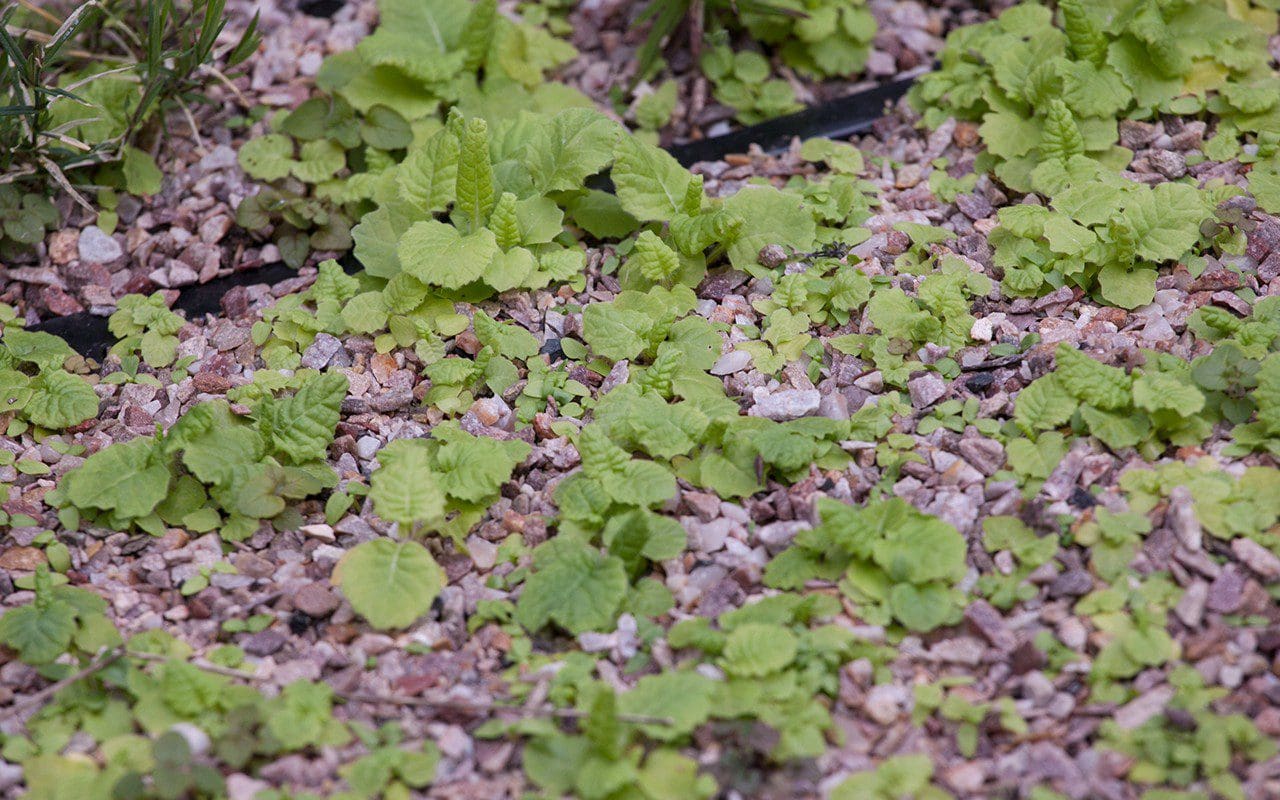 Primrose seedlings
The young plants will be grown on this summer and planted out this coming autumn with the promise of winter rain to help in their establishment. I will make a point of starting a cycle of sowings so that, every year until I feel they are doing it for themselves, we are introducing them to the places they like to call their own. The sunny slopes under the hawthorns in the blossom wood and the steep banks at the back of the house where it is easy to put your nose into their rosettes and breathe in their delicate perfume. I will plant them with violets and through the snowdrops and Tenby daffodils, sure in the knowledge that, whatever the weather, they will loosen the grip of winter.
Words: Dan Pearson / Photographs: Huw Morgan
Published 24 March 2018
Now that the garden is resting and the woods drop back into winter nakedness we are drawn out into the landscape. Mosses greener than ever, now that the winter wet is here again, lighting up the tree trunks brilliant emerald where sunshine slides through bare branches. The north side of the trunks colonised by the green algae, Pleurococcus, act as a woodland wayfinder and, on the eldest limbs and marking their age, the colonies of polypody are once again thrown into focus.
I am happy to see them now that it is winter and enjoy the primitive feeling the ferns bring to the woods and stream edges. Higher up on the slopes, where we garden almost exclusively in sunshine, is not the place they want to be. I have planted for shade but, until I have the cover, ferns will have to have their place out of the garden season and we in turn the opportunity to visit them where they choose to be.
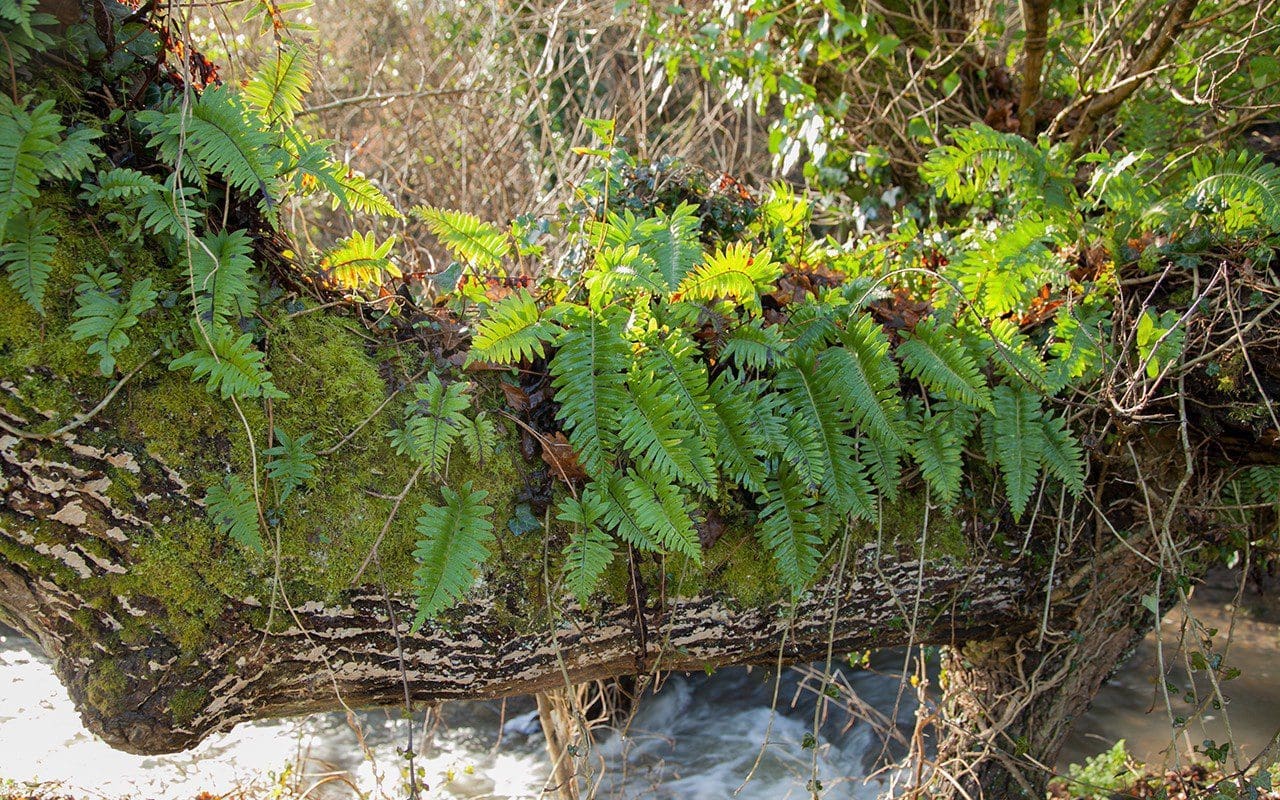 Polydpodium vulgare
There are three main species in the woods around us. Polypodium vulgare is perhaps the most adaptable, choosing in the main to live up in the branches, inhabiting the places where moisture is harboured. Clefts in branches, where the moss holds accumulated dampness, is where you will find them making home and, from there, they travel slowly outwards forming a matt of fibrous root that in turn collects the moss and the accumulated leaf mould so extending their reach.
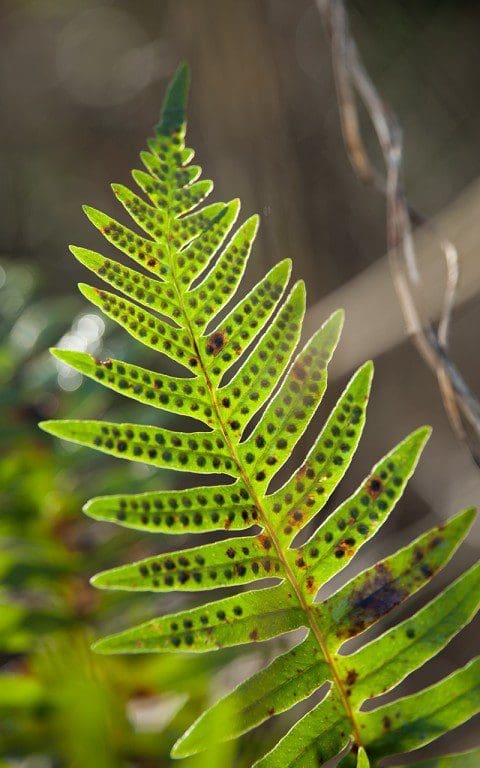 Polydpodium vulgare
The finest colonies sit on the topside of the oaks that, over the years, have leaned from the slopes to strike informal bridges across the streams. Running along their branches like feathered epaulettes, the polypody strikes an exotic mood that you might more usually associate with the epiphytic bush of New Zealand or cool temperate rainforest. They are an adaptable fern, shrivelling and browning in dry summer weather to return again with the autumn wet and remain evergreen throughout the dark months. I harvested a number of plants that arrived in the wood where we logged a fallen tree by the stream and have simply laid them down in one of the few shady places up by the barn, where they have taken root. I have plans to add them to the north side of the house where I will insert them into a wall close to where I keep the epimediums so that we can enjoy them at closer quarters.
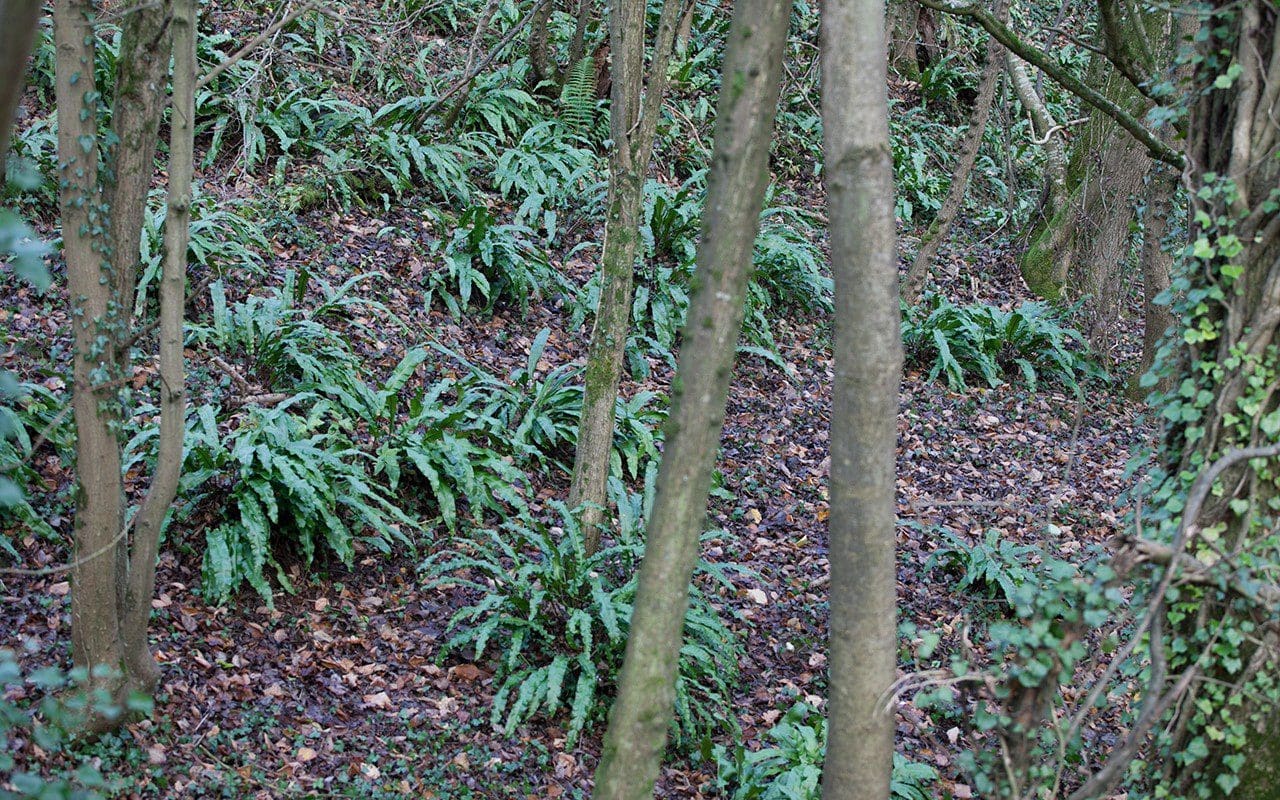 A colony of Asplenium scolopendrium
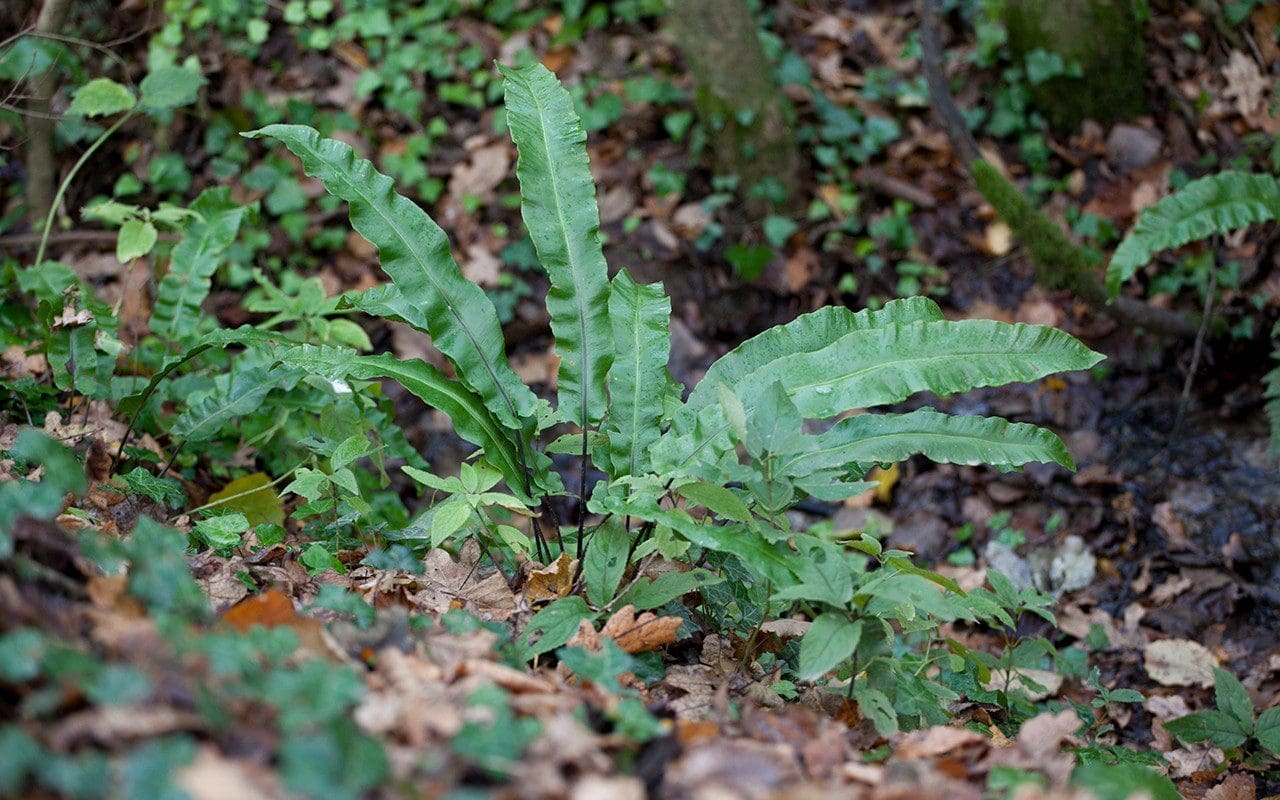 Asplenium scolopendrium
The hart’s tongue fern (Asplenium scolopendrium) is one of the key plants you register on the ground in the winter woodland. Clinging to the steep banks of the ditches and streams where the soil is thinnest, they make fine colonies with mature plants almost touching, but not so much that you can’t appreciate their architecture. The simplicity of their foliage, each tongue arching elegantly downward, is a feature of limestone woodland and around here it is the most prevalent fern. The Victorian pteridoligists collected the hart’s tongue ferns with great fascination, naming and selecting the occasionally crested, fasciated and undulating variants. Several are still available today and are good in the winter garden for their long season of interest. The fronds last right through the winter to the point at which the new croziers unfurl in spring. You will know exactly when to cut them and refresh the plants, as the winter foliage begins to look tired with the contrast of spring around it.
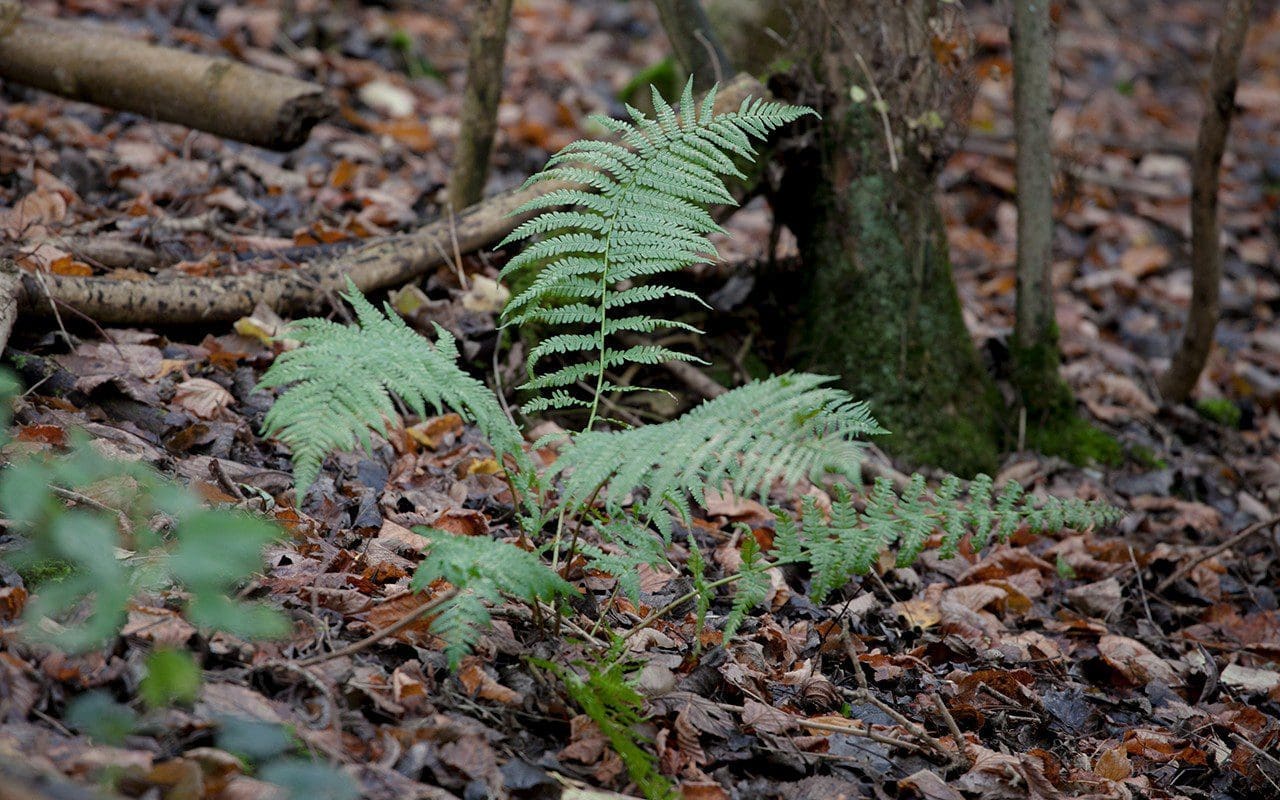 Dryopteris filix-mas
The male fern (Dryopteris filix-mas) is less common here, where our soil lies heavy at the bottom of the slopes, but they do occur and I aim to introduce more when the hazel coppice matures. When I was a child, gardening in the thin, acidic woodland that faced the South Downs, Dryopteris filix-mas was a staple of the woodland and the clumps were many crowned, some as much as a metre across and aged. Where the polypody and the hart’s tongue last the winter, the male fern tends to brown and eventually collapse as the frosts work at the growth of the previous growing season. But they are beautiful in death and more so for the contrast of old and new as the dramatic unravelling of croziers happens in the spring. Brilliantly soft and scaled dark green over light, the fronds unfurl to reach waist height before filling out and relaxing for the summer.
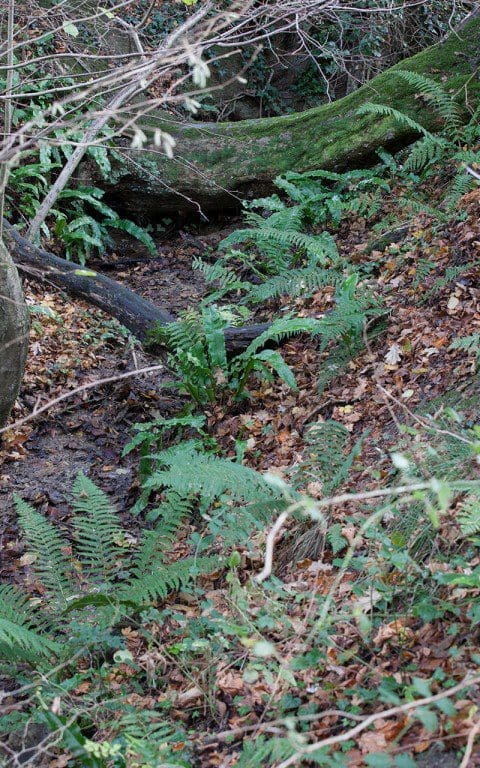 A colony of Dryopteris filix-mas
Osmunda regalis, the royal fern, is the most spectacular of our native ferns rising up to shoulder height as the croziers reach and teeter before expanding lushly to lie back in a tropical splay of fronds. The royal fern is now rare in the wild due to pillaging by Victorian fern-lovers but, where it does occur naturally in parts of Ireland, you find it in wet, boggy ground or on the edges of ditches.
Whereas I have not been able to include the ferns as part of the palette in the exposed new garden, I have introduced the Osmunda around the new bridge at the end of the ditch. The plants have a horticultural edge, in that they are the dark form, Osmunda regalis ‘Purpurascens’. Though not as voluminous as the regular green form, this selection is notable for the extraordinary purplish-bronze colouring of the young croziers and the tint to the unfurling leaves. I have them in the delta of wet ground to either side of the zig-zag bridge as a companion to the ink-stained foliage of Iris x robusta ‘Dark Aura’.
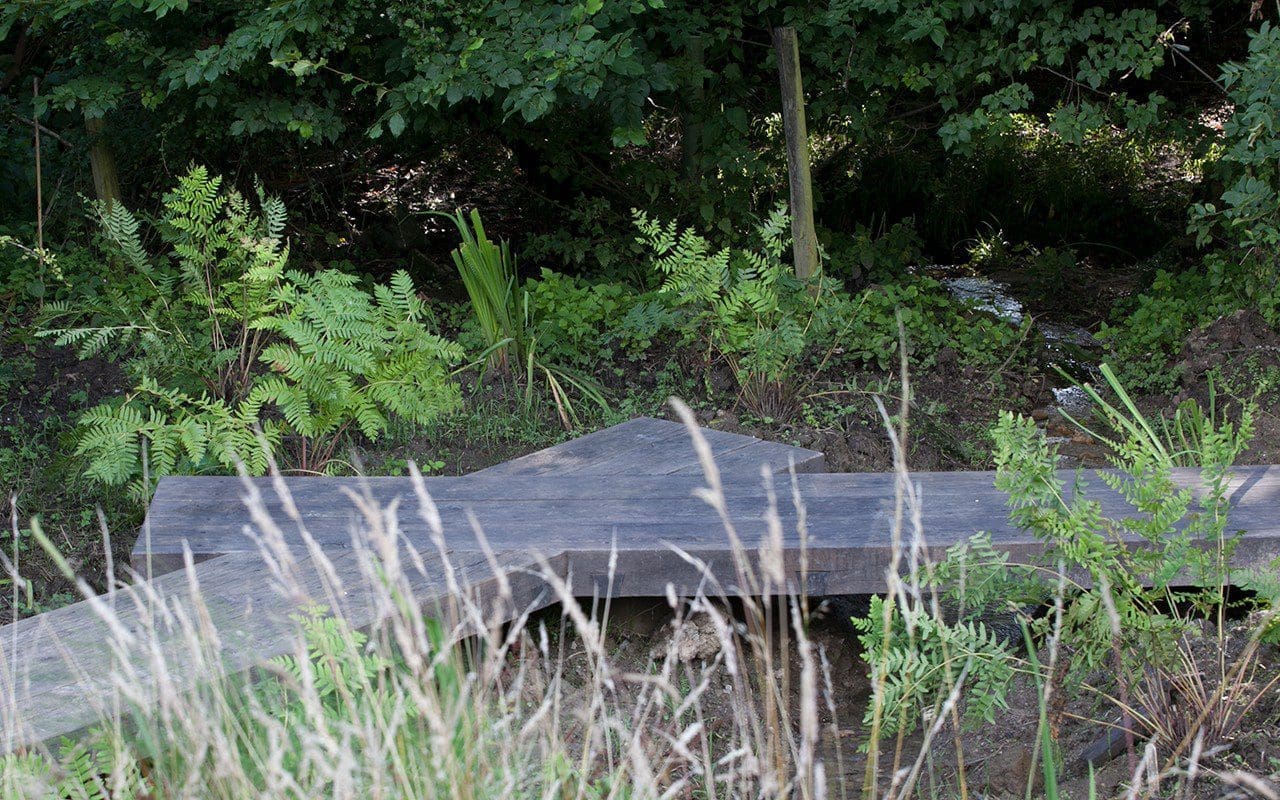 Recently planted Osmunda regalis ‘Purpurascens’ around the new bridge in July
New life appears in April from the knobbly knuckles that have been waiting out the winter in rafts of spongy root, once prized as a growing medium by orchid growers. It is a fast and marvellous ascent when the weather turns at the other side of the winter, the new growth the colour of Victoria plums and then copper as the fronds expand. At this point a daily vigil is necessary for there is not a moment to be missed. For now, however, I am happy for the wait that is made easier by their friends in the woods.
Words: Dan Pearson / Photographs: Huw Morgan
The last week has seen a subtle shift, with a hint of the next season in the air. With cool nights and mist lolling in the hollows, the garden is between two seasons. The brilliant lythrum spires have finally run out of bud and, like sparklers fizzing their length, are suddenly extinguished. The dry days have been spun with the flock from the white rosebay willow herb caught on the breeze. I have planted it on the edges of the garden to blur the boundaries and, after weeks of flower, it is finally running to seed. I know it will need managing as it is a prodigious runner, but thank goodness it is not like our pink native Chamaenerion angustifolium, for the the seed is sterile.
This week’s bunch is a push against this mood, which can all too easily descend as summer runs out of steam and autumn is yet to take over. Over the years I’ve learned to plan for the between seasons lull and now no longer fear it. The Angelica sylvestris is a perfect example of a plant that steps in to fill the gap. In the ditch where we have cleared the damp ground of bramble they are now seeding freely. Although this wetland native has been wonderful since the spring, with it’s coppery foliage and architectural loftiness, the month of August is really its moment. It has been all but invisible for a while, with the grasses staking their position earlier on, but now the pristine umbels are held amongst their spent, tawny seedheads.
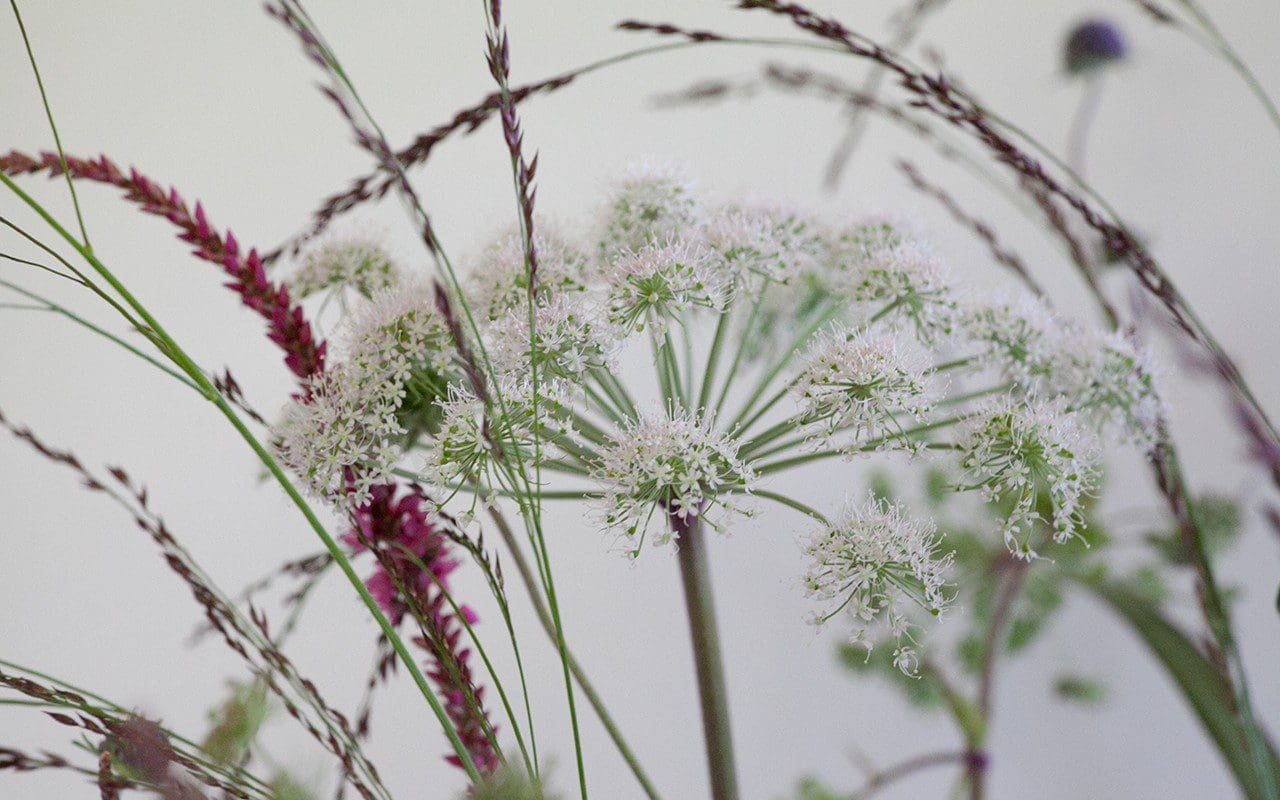 Angelica sylvestris
Some years, when we walk the ditch early in the season, you can spot a particularly fine form with dark, plum-coloured foliage. The dark stems are always a lovely feature of the Angelica but, coupled with dark leaves, they can not be bettered. Each year I mean to save seed of the best forms, but have never remembered to mark the plants before they are over and browned to skeletons. This autumn I plan to bring a selection called ‘Vicar’s Mead’ into the damper, lower slopes of the new garden. I have grown it without success in London, where it was too dry for it and mildew took its toll, but I trust the ground to be hearty enough here. Though biennial Angelica sylvestris will seed freely and, as long as you leave a number of seedlings, you will always get a succession.
In the garden, I have a particularly lovely form of the perennial Angelica edulis, which is planted through the white Persicaria amplexicaule. The substance and loftiness of the umbels with their horizontal conclusion is a good compliment to the finely drawn verticals, which echo the now spent grasses that surround the angelicas in the ditch. Persicaria is a mainstay of my plantings, which I have depended on for years. Happy with the cool of company at the root and with its head out in the sun, its lush foliage is an excellent team player. Good for the first half of the summer with its overlapping shield-shaped leaves, you know the season is progressing when the first spires arrive at the end of July. Again, August is their month, but they will sail through September and still be firing away in October with the asters. Here, for contrast with the blue, is a new favourite, Persicaria amplexicaule ‘September Spires’, which is tall enough to be making its way through the Verbena macdougalii ‘Lavender Spires’, and is an enlivening shade of hot pink.
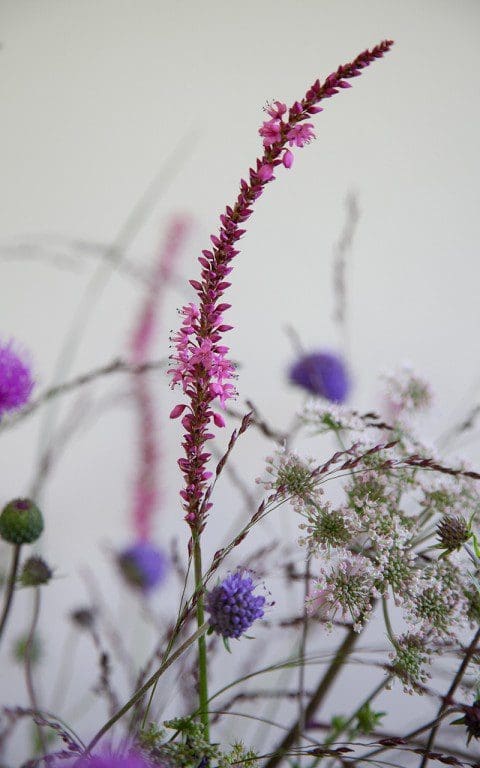 Persicaria amplexicaule ‘September Spires’
The Panicum virgatum ‘Rehbraun’ is a late-season grass. Slow to get started in the early summer and needing space early on so as not to be overwhelmed by early-into-leaf companions. An American native known as Switch Grass, it is happiest on lean ground and in bright conditions. Here it is better in soil that is drier or it will lean and topple. I have it on the upper, free-draining slopes where it is already showing colour with reddened tips to the foliage. The plum-coloured flowering panicles are so fine and delicate that you can see through their dusky framework. By the end of the month they will ascend to a final height of about a metre and will then go on to colour brilliantly in October, fiery and lit with their own inner light it seems.
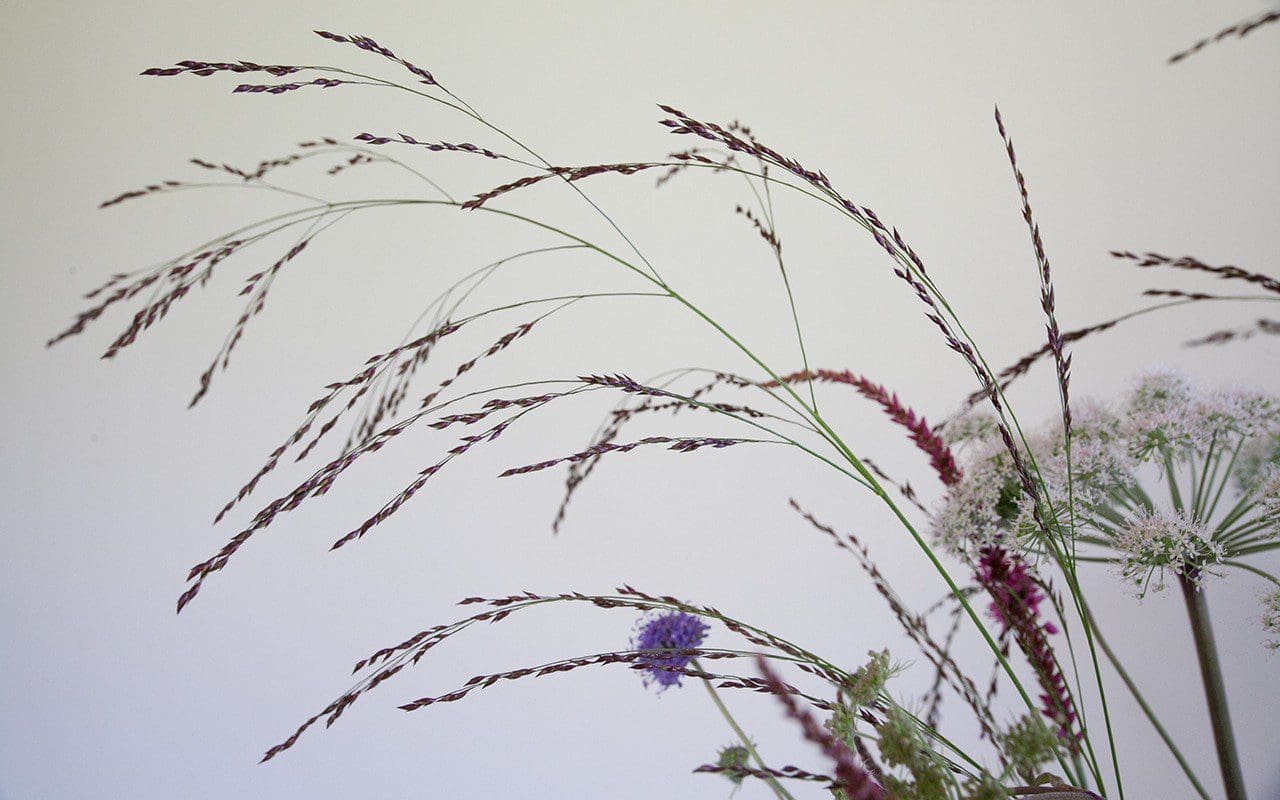 Panicum virgatum ‘Rehbraun’
I have them planted close, but not too close, to the Cirsium canum, which is as lush as the grass is fine. I bought this perennial thistle from Special Plants where Derry Watkins has it growing in her garden. She swore then that it wasn’t a seeder, as I had been stung by its similar cousin, the native Cirsium tuberosum. The latter has now been banished from the garden to the ditch banks for bad behaviour in the seeding department and, for the past three years, has been kept in check by the competition. When I last saw Derry and asked her if her C. canum had started to seed she said, “a little”, which was due caution, so I will raze my plants when the main show is over to avoid the inevitable. Their stature, reach and poise are beautiful though, the brilliant pink thimbles of flower spotting colour in mid-air just above our heads and humming with bees.
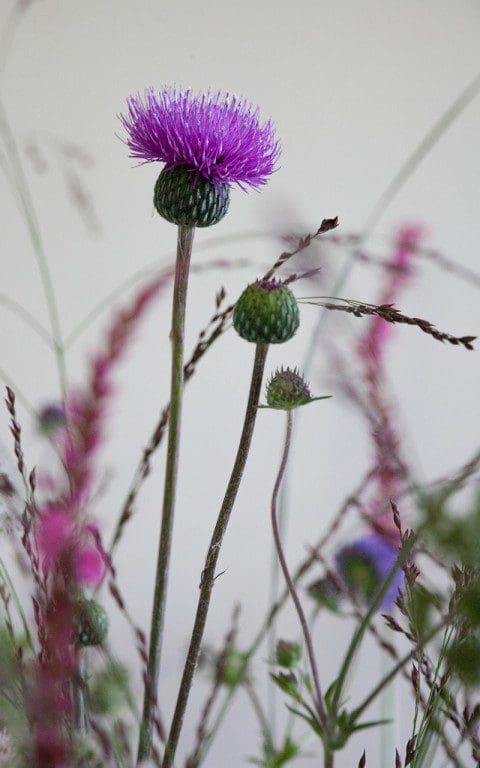 Cirsium canum
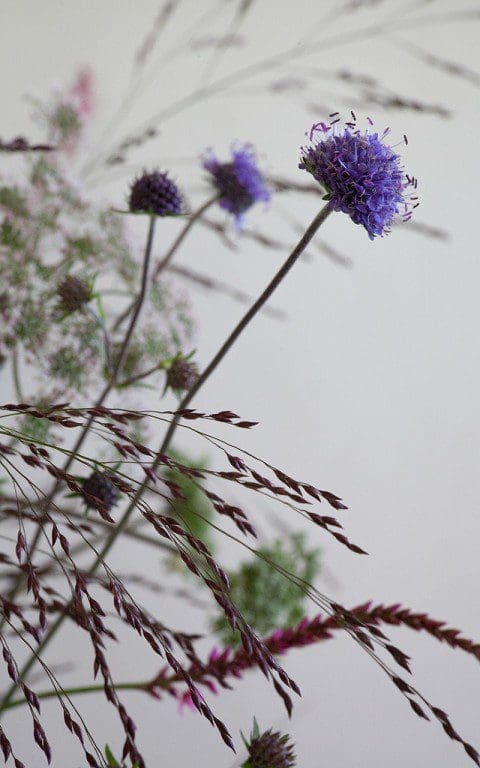 Succisa pratensis
Though at an altogether smaller scale, the Devil’s Bit Scabious has a similar feeling in the suspension of flower on wiry stems. Another native, Succisa pratensis is a late-performing meadow dweller, happiest where the soil is moist and picking up where many other natives have gone over in August. My original plant, a dark blue selection called ‘Derby Purple’ was the parent of the seedlings in this bunch. They came easily from seed, germinating the same autumn they were sown and flowering just a year later in the new plantings. Although the flowers are darker than the native, they are not as rich as their parent, but they are a wonderful thing to have hovering around in this between season moment. A neat rosette of foliage, that will slowly increase and clump, is easily combined in well-mannered company. I will keep them away from the Cirsium and run them instead through the openly spaced Switch Grass and be happy in the knowledge that their contribution will help to bridge the season.
Words: Dan Pearson / Photographs: Huw Morgan
Published 19 August 2017
The meadows that were cut for hay in the middle of July are already green and lush after the August rains. The hay needs to be cut before the goodness goes out of it, but we leave it until the yellow rattle rattles in its seedpods and has dropped enough seed for next year. With the cut go a host of summer wildflowers which have already set seed. Those that mature later are lost with the cut. So in the fields that are put to grazing when the grass regenerates after the hay cut, we will not see the scabious or the knapweeds. If they are present at all, they will not get the chance to seed and, if we were to have orchids, (one day, hopefully) their cycle would also be curtailed as they are only now ripening.
Where the land is too steep for the tractor, we find ourselves with rougher ground and other habitats. The steep slopes dipping away and down from The Tump are left uncut and, with the sheep shaping their ecology, they have become tussocked and home to a host of wildlife that has made this protected place home. The marsh thistle likes it there and can compete, and slowly we are seeing the first signs of woodland, with hawthorn and ash sheltering in the creep of bramble. We will have to make a decision as to where we apply a hand in preventing the woody growth from encroaching upon the grassland, as all the habitats have their merit.
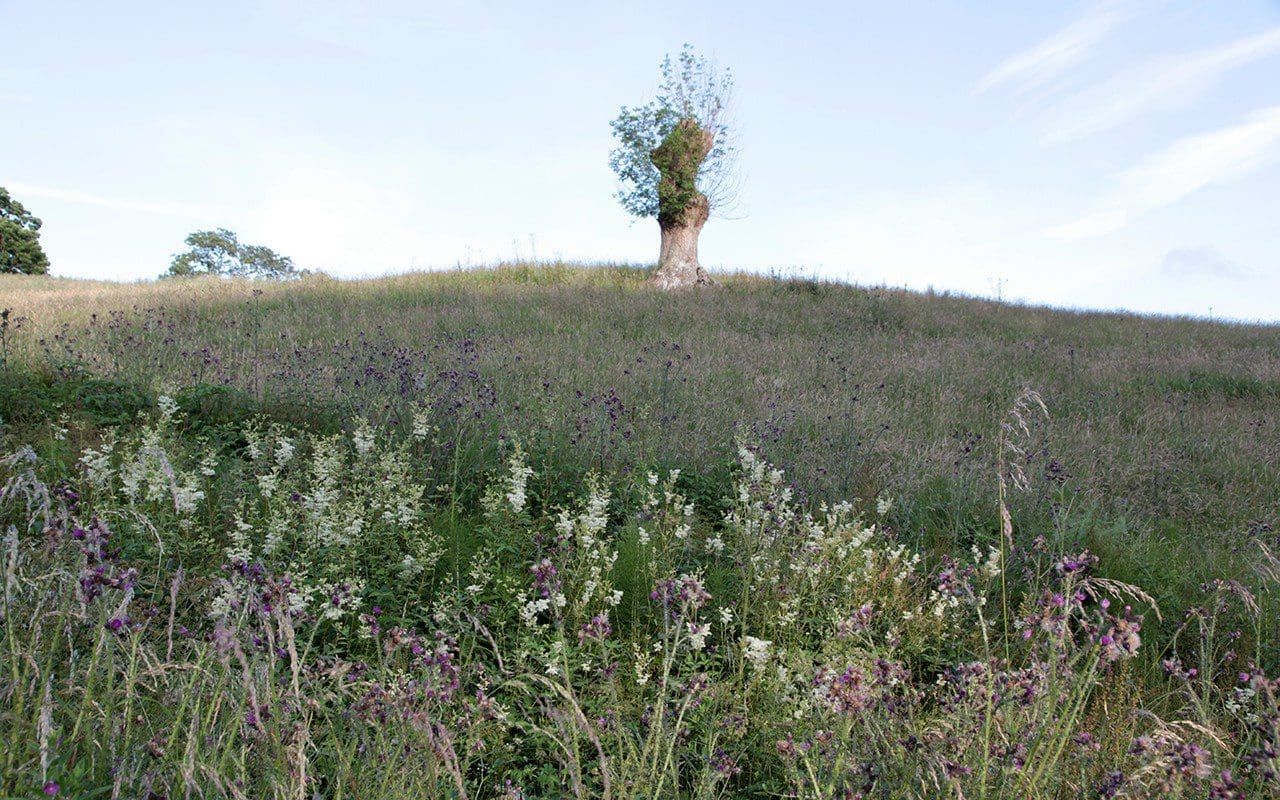 The lower slopes of the Tump above the ditch where the meadowsweet grows are colonised by marsh thistle
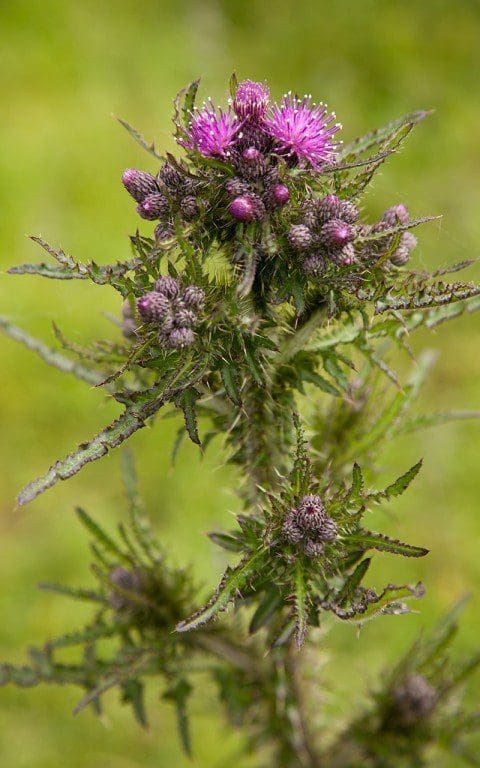 Marsh Thistle (Cirsium palustre)
The field that climbs steeply immediately behind the house is raked off by hand after the farmer mows it for us. It is too steep to bale so it is cut late to allow an August flush of meadow life. It is a task raking the cuttings to keep the fertility down, but one that is getting easier each year with concerted efforts to colonise the grass with the semi-parasitic rattle. This field and the newly seeded banks that sweep up to the house are valuable for being late and, as I write on a breezy bright day in a wet August, it is alive with the latecomers and the host of wildlife that retreats to find sanctuary there.
The ‘between places’ that are formed by banks that are just too steep to manage occur along the contours and below the hedges that run along them. The precipitous slope (main image) between our two top fields (The Tynings) has been something of a revelation and, seven summers in, we are seeing the rewards of making an effort with its management. A neighbour told us that every twenty years or so the farmer before us would fell the ash seedlings that took the banks as their domain. This must have last happened five or six years before we arrived and, although it was then covered in young ash and bramble, it was clear that this south-facing slope had the potential to be more than just scrub, and provide a contrast to the grazed meadows. The second winter we were here, we cleared the bramble, cutting off great mats and rolling them down to the bottom of the slope like thorny fleeces.
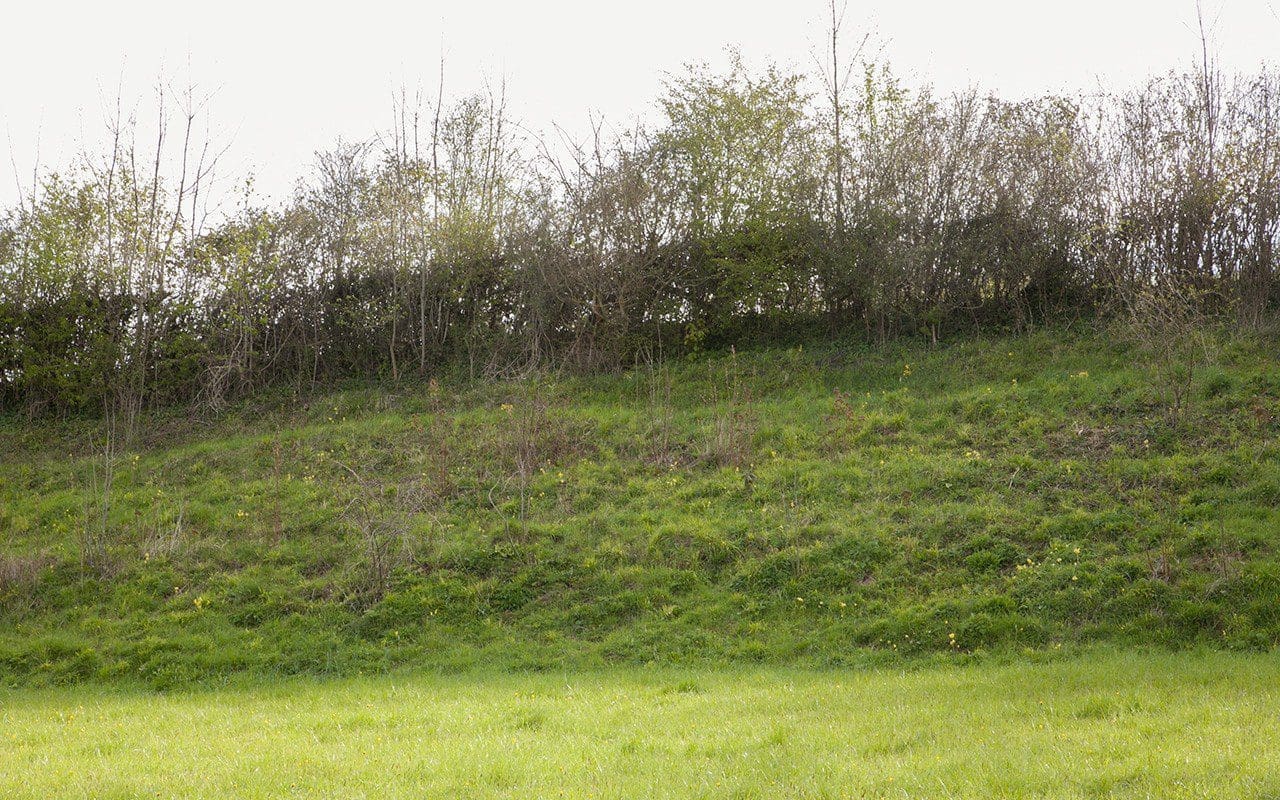 The Tynings bank in April with cowslips showing
That spring the newly exposed ground immediately gave way to cowslips and violets that had been sheltering amongst the brambles. In the summer they were followed by smatterings of wild marjoram, field scabious, common St. John’s Wort, crow garlic, hedge bedstraw and agrimony, indicating the limey ground and the south-facing position.
Why the field levels vary so dramatically to either side of the contour-running hedge is intriguing. The ground in the valley is prone to slipping and the twenty-foot slope between these two fields suggests the occurrence of something of that nature in the past. The steepness of the bank and the shale and the clay that has been exposed in the underlying strata make it incredibly free-draining and the plants that have colonised here are specific and a contrast to those found on flatter ground. If you walk along the bank on a hot day now it is full of marjoram and you can hear it hum with life and crack and pop as vetch pods scatter their seed.
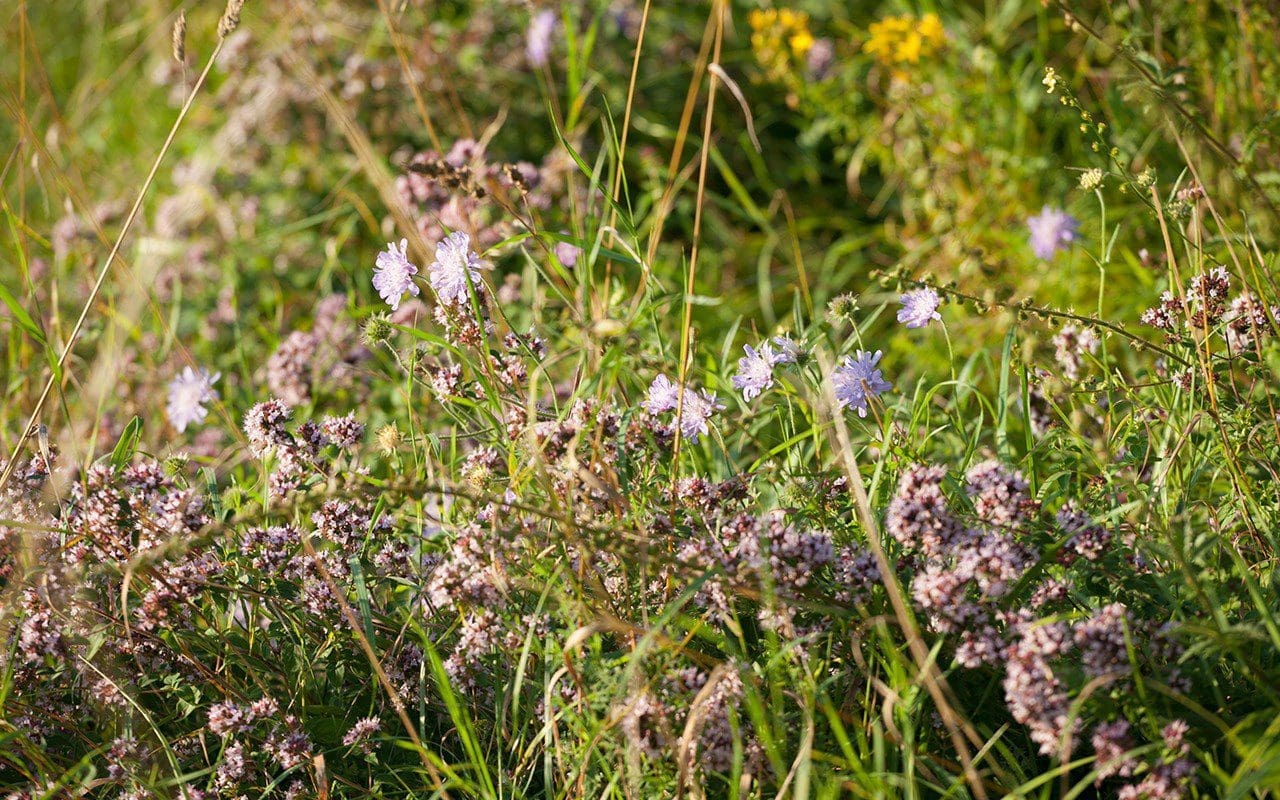 Field Scabious (Knautia arvensis) and Wild Marjoram (Origanum vulgare)
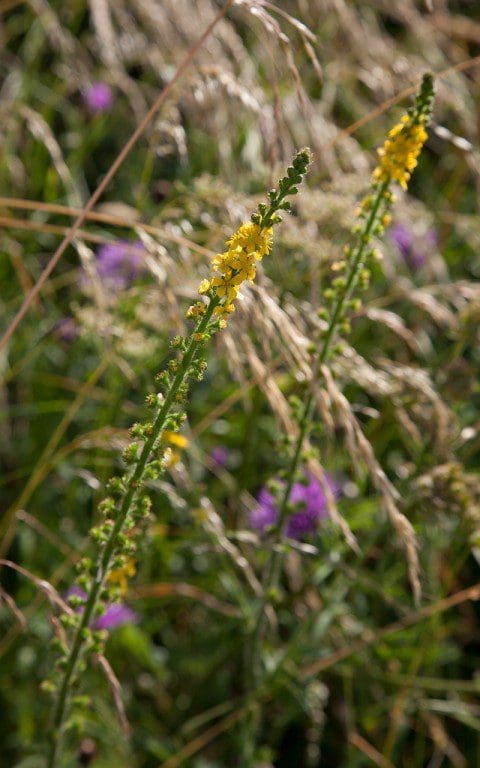 Agrimony (Agrimonia eupatoria)
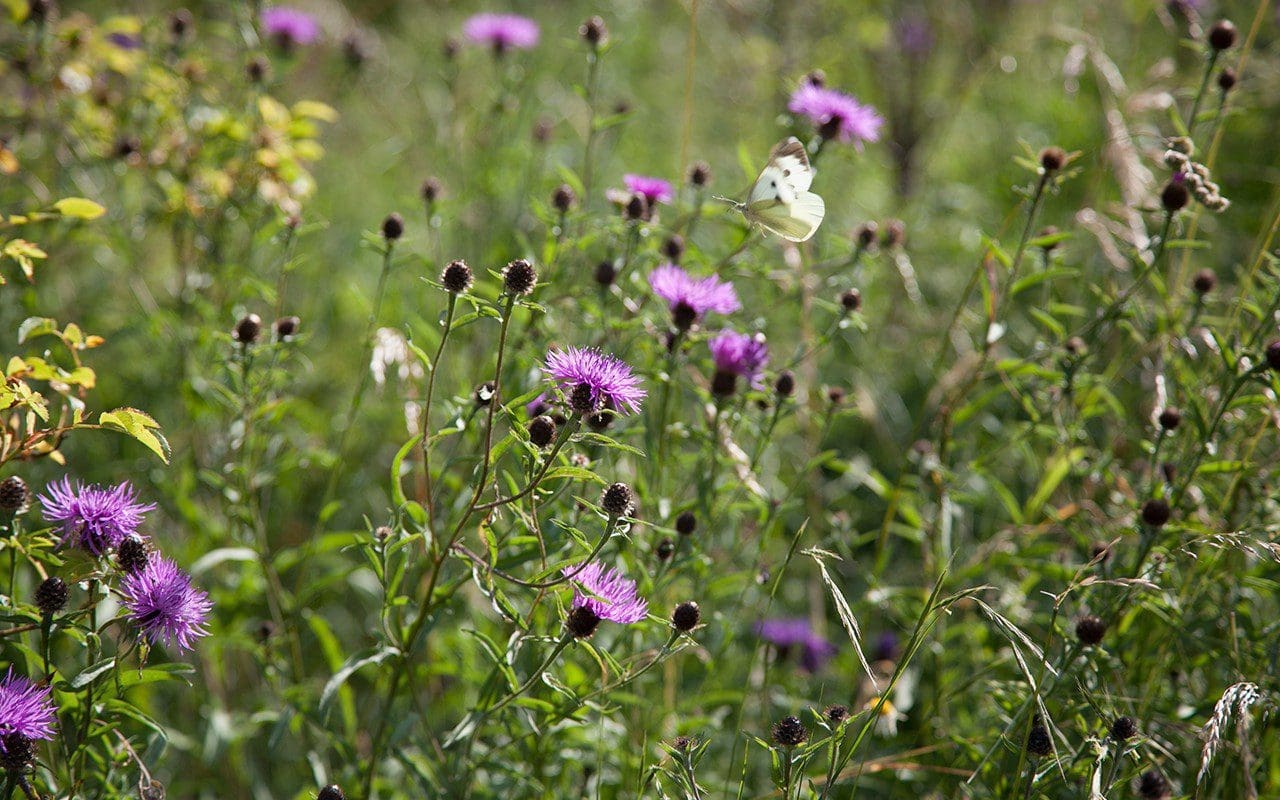 Common Knapweed (Centaurea nigra)
We have given the bank a ‘year on, year off’ cut, strimming in the depths of winter when the thatch is at its least resistant. All the cuttings are roughly raked to the bottom of the slope (and then burned) so that there is plenty of light and air for regeneration. We leave the spindle bushes, the wild rose and a handful of ash seedlings, but the sycamore seedlings that proliferate from the large trees in the hedgerow are cut to the base to keep them from getting away. After three cuts over six years the bank is now thick with marjoram and scabious, hedge bedstraw, common and greater knapweeds and this year, wild carrot, one of my favourite umbellifers for late summer. It is abuzz with honeybees, bumblebees, hoverflies and butterflies.
This bank has been the inspiration for the newly-seeded slopes around the house and last year I gathered seed from here to grow on as plugs to bulk up the St. Catherine’s seed mix that went down last September. The seed is sown fresh, as soon as it is gathered, into cells and left in a shady place for a year. I have not thinned the seedlings and have deliberately grown them tough so that they are able to cope with the competition. Last year’s batch was planted out not long after the banks were sown to add early interest, and some are visible and flowering already.
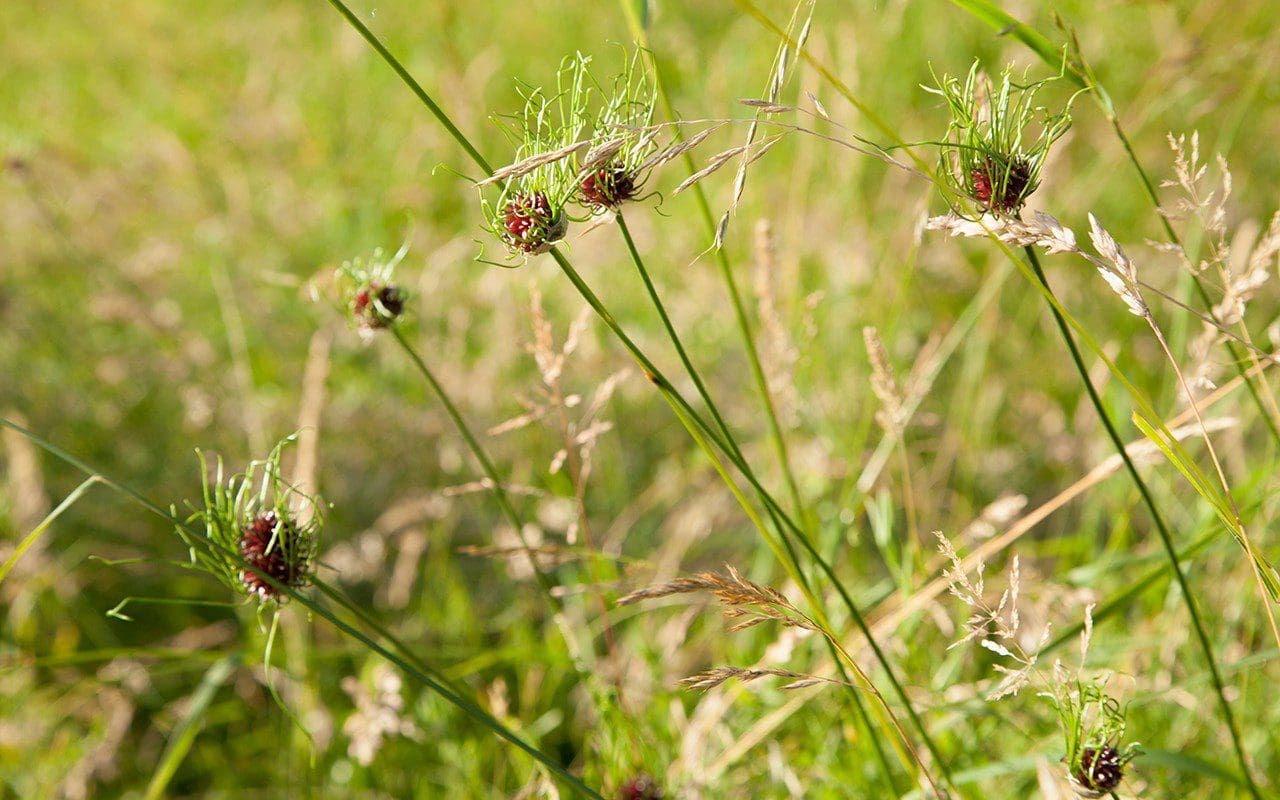 Crow garlic (Allium vineale)
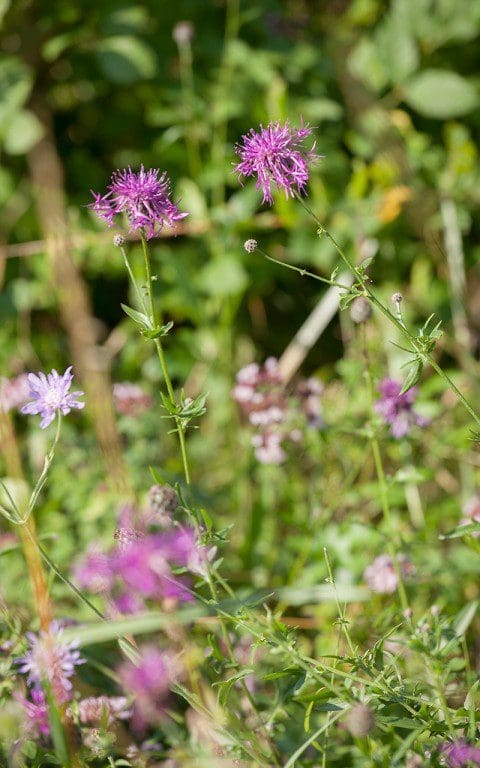 Greater Knapweed (Centaurea scabiosa)
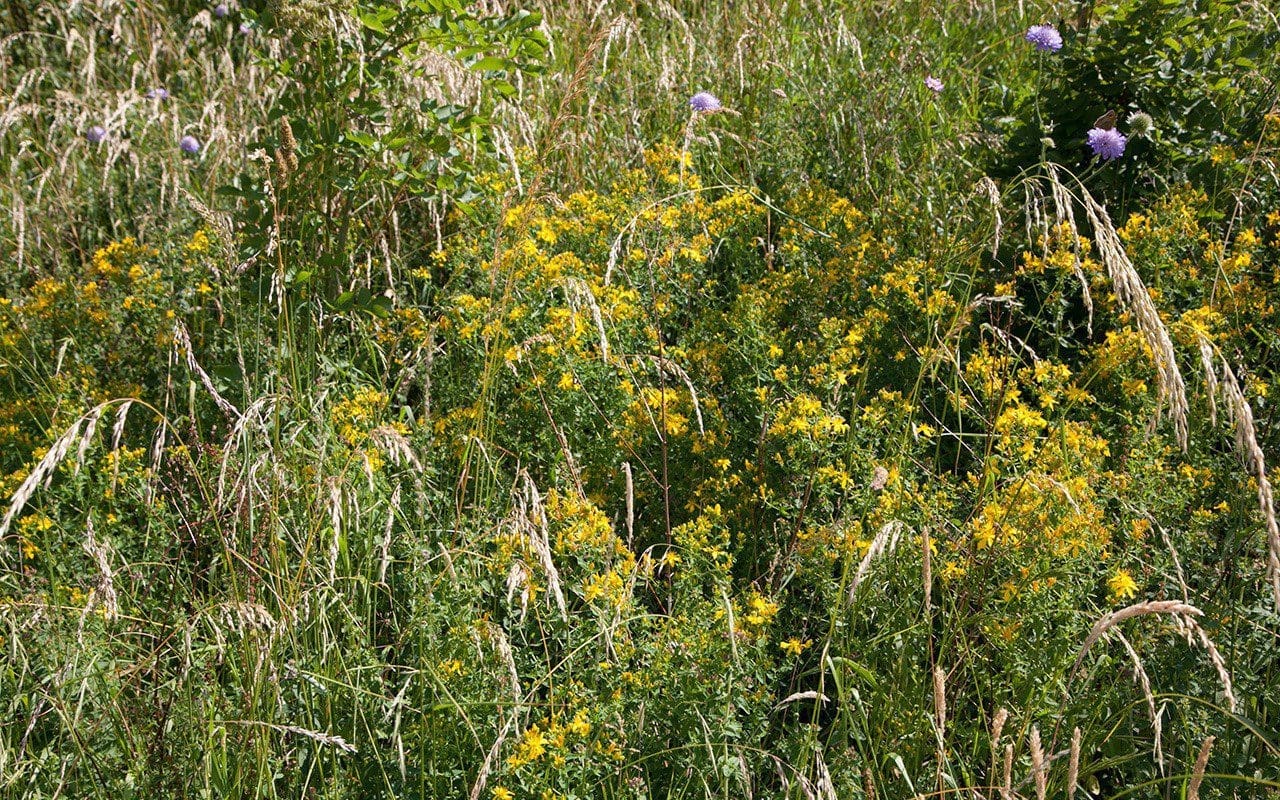 Common St. John’s Wort (Hypericum perforatum)
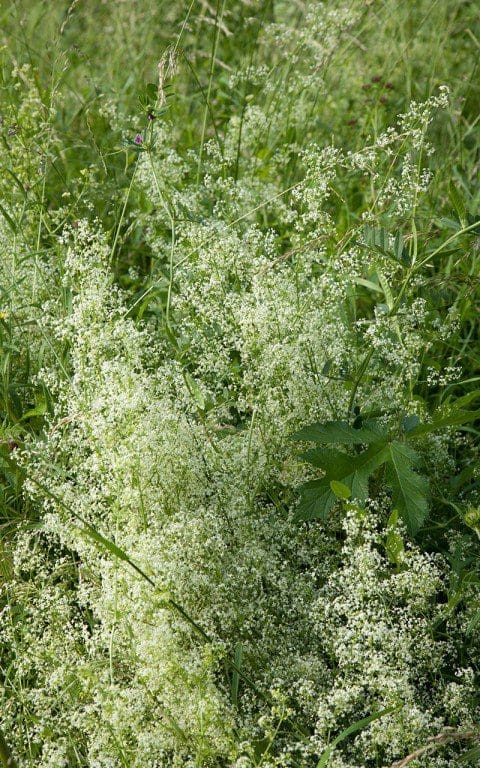 Hedge Bedstraw (Galium album)
This year’s plugs, which are destined for the late meadow behind the house, will be put out in September, straight after the banks have been cut. We have already seen a difference in the wildlife since creating these wilder spaces up close to the buildings, with more swallows than before swooping low for insects, the increased presence of a pair of breeding kestrels, a red kite that formerly kept itself to the farther end of the valley, more bats and, a couple of weeks ago, an exciting moment when a barn owl came sweeping low over the banks as dusk fell. Every year, with careful management, we will see a successive layer of change, and one year in the not too distant future, a sure but certain enrichment.
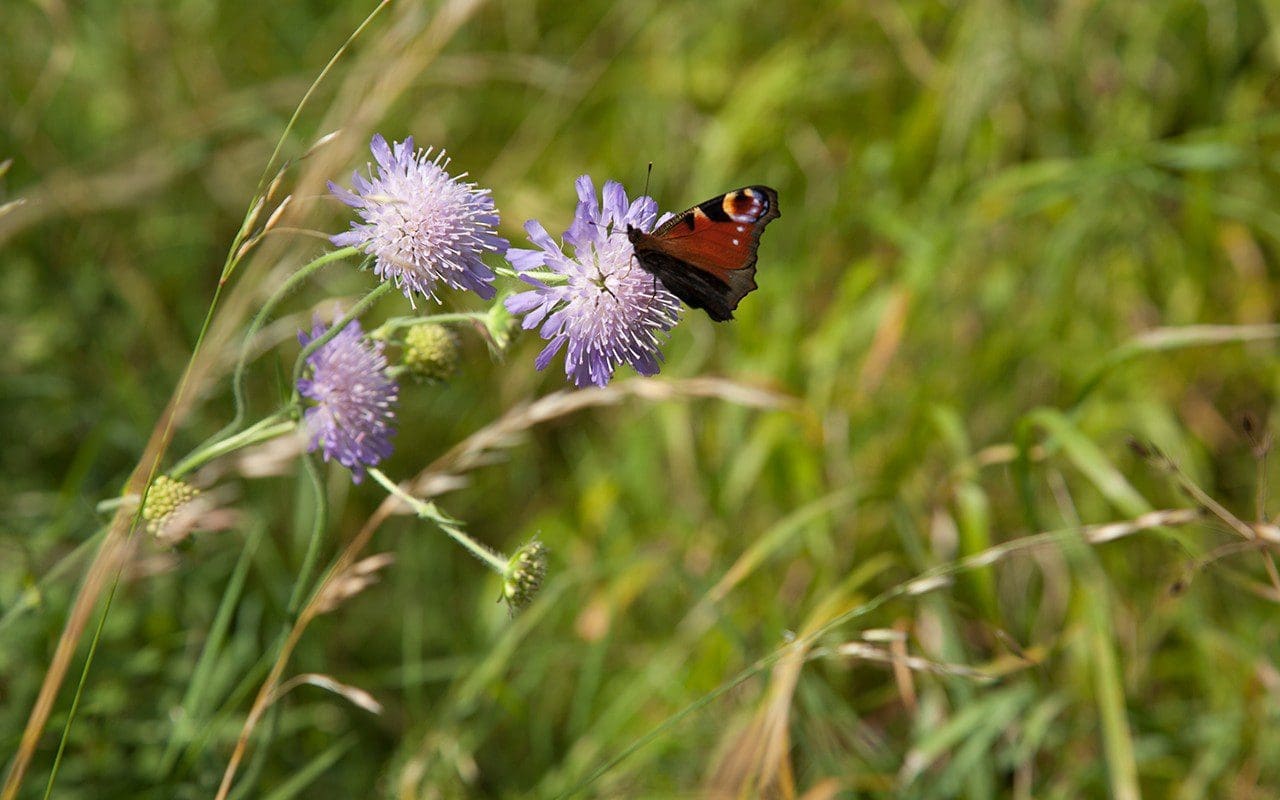
Words: Dan Pearson / Photographs: Huw Morgan
Published 12 August 2017
The Blossom Wood was one of my first projects here. Plant trees at the beginning of a project and by the time you have started to round the corner, you have time mapped in growth and your efforts rewarded in the satisfaction of being able to stand in the beginnings of their shadow. Such has been the case here and now, in the sixth spring after planting, we can already walk into the corner of our top field and find a place transformed into the start of somewhere new.
The idea behind the little wood was that it be a sanctuary; for birds, insects, mammals and ourselves. The fields were all but empty when we arrived. You could see from corner to corner and there was no shade other than the fingers borrowed from our neighbour’s trees across the stream. The birds had to hop from hedge to hedge and it was quickly clear that we needed somewhere that they could call home on our side of the stream.
Save the occasional hawthorns that have matured into trees where they have been left in the hedgerows, we all but miss the blossom season and the celebration of spring that comes with it. So all the trees and their associated understorey are native and I have aimed for everything (save a handful of field maples, some spindle and an oak or two) to flower conspicuously and then provide berries for autumn.
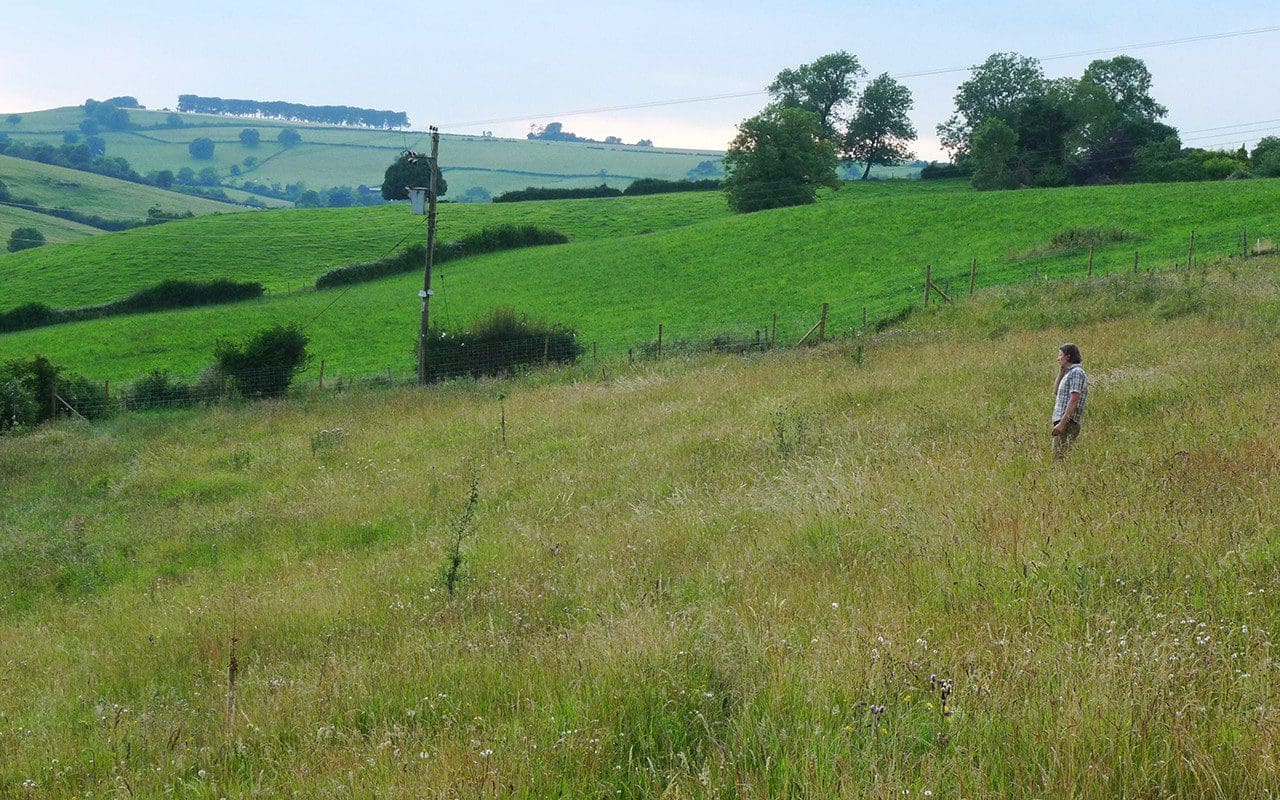 The site of the Blossom Wood in 2011
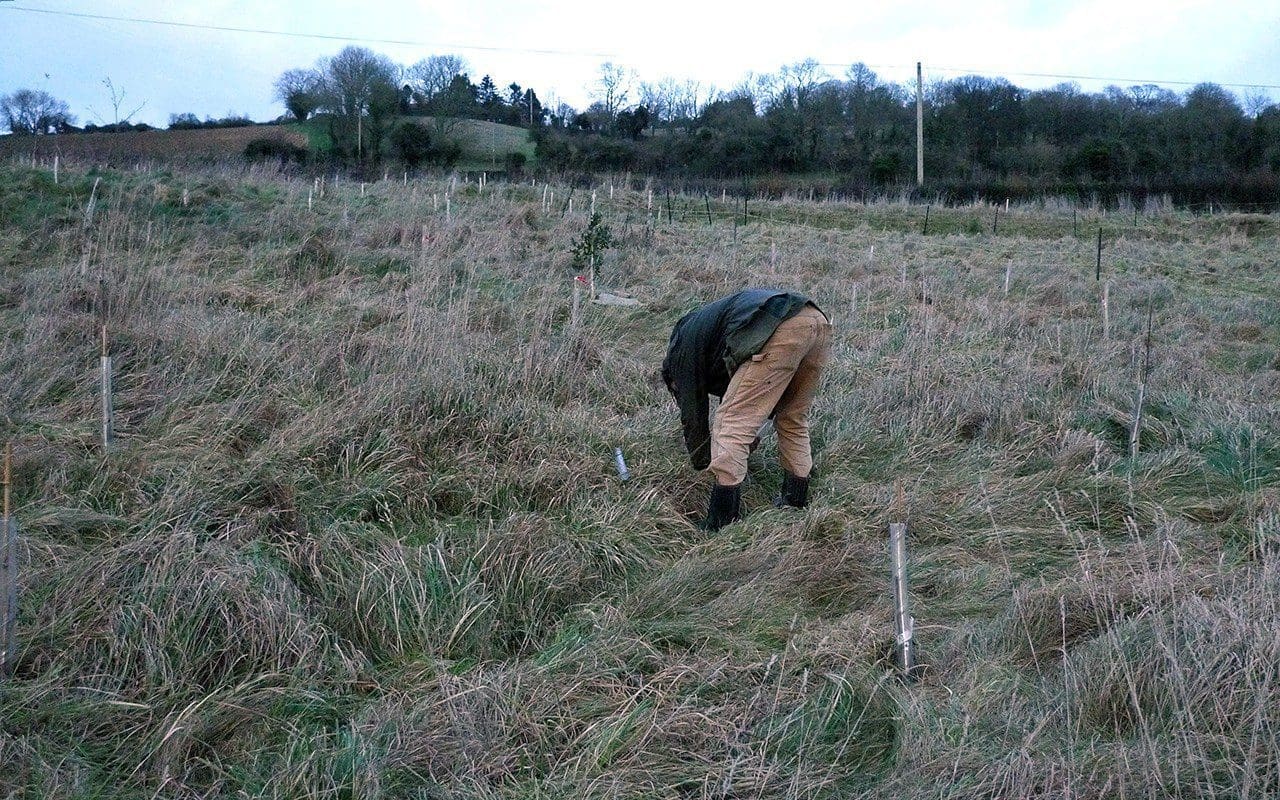 Planting the whips in January 2012
 The Blossom Wood in spring 2016
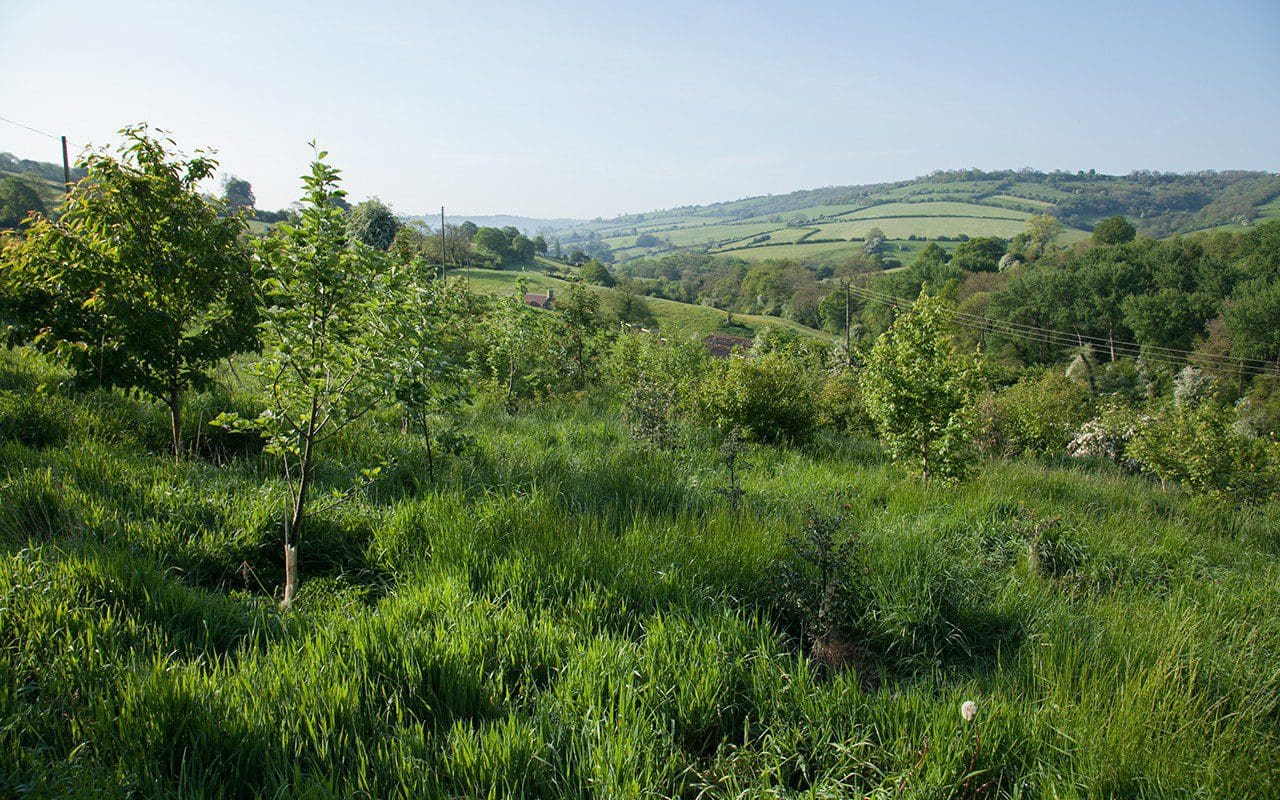 The Blossom Wood in 2014
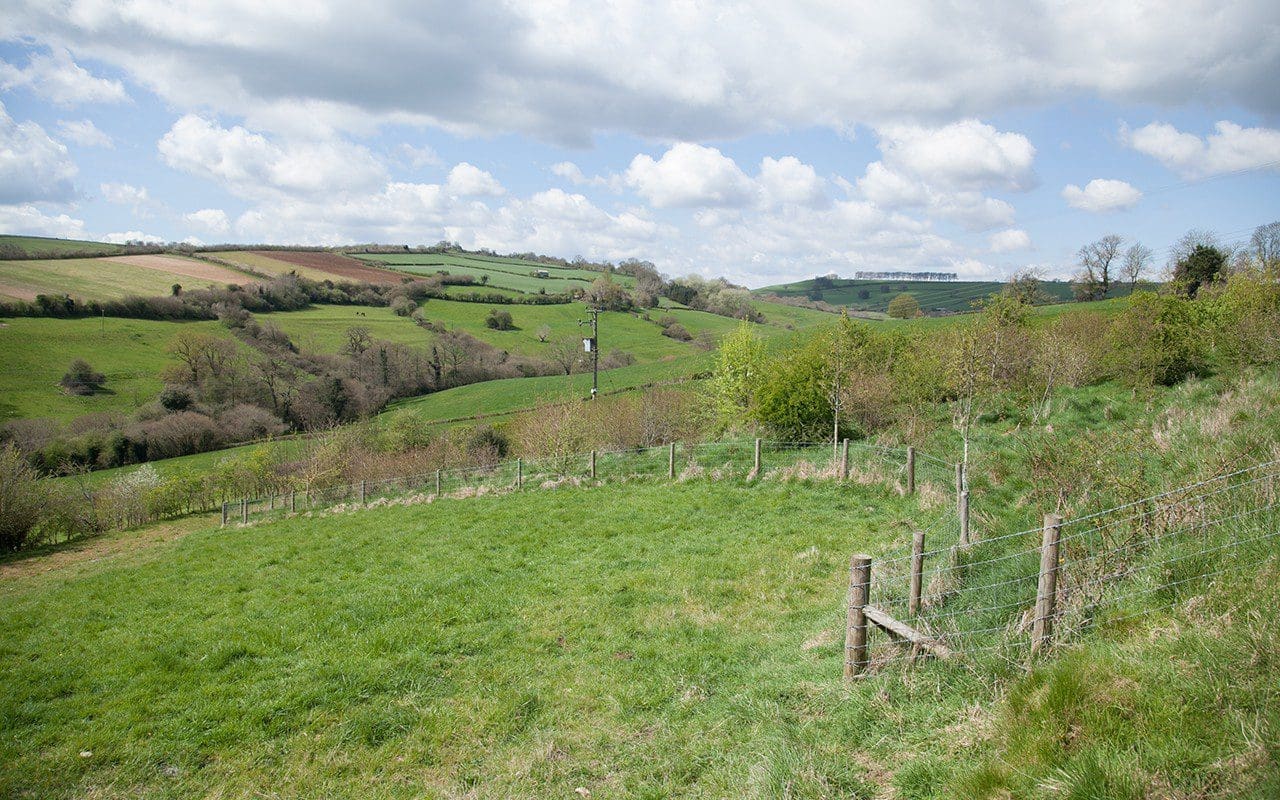
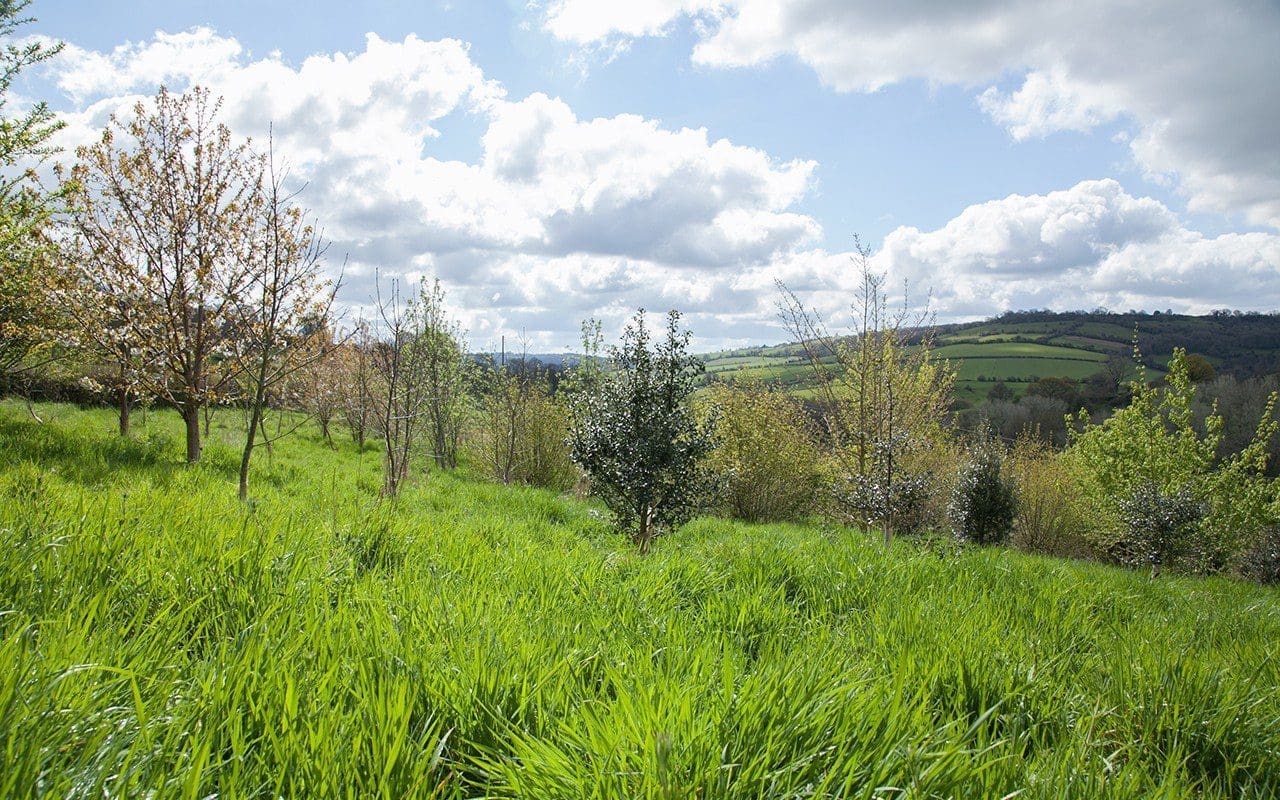 The same view in 2016
The cherry plum, Prunus cerasifera (main image), breaks with winter. The buds, pinpricks of hope, swell at snowdrop time. Early on we picked twigs and, now that they are grown, whole branches to bring into the house to force with willow and hazel catkins. After a couple of days in the warmth they pop, pale on dark twiggery and smelling of almonds. Prunus cerasifera is the parent of the Mirabelle plum, which is the first tree to flower in the plum orchard too. It is so worth this early life, which can sometimes appear in the last week of February, but the trees are always billowing by the middle of March.
Rather than the wood erupting all at once the flowering sequence is staggered and broken so that, from the cherry plum now, until June when the wayfaring tree, guelder rose and sweetbriar are flowering, there is always something to visit. If I had left blackthorn in the mix it would be the next to flower, but I removed them after they showed early signs of running. Better to have them in a hedge that can be cut from both sides and where their tiny sprays of creamy flower appear with the most juvenile pinpricks of green on the breaking hawthorn. The hawthorn and the native Cornus sanguinea are fast and have been used as nurse companions to provide shelter to the slower growing species. I want to see how this place evolves unaided, so have decided not to intervene, but I will probably coppice a number to make some more space if I see anything suffering that I need for the long term.
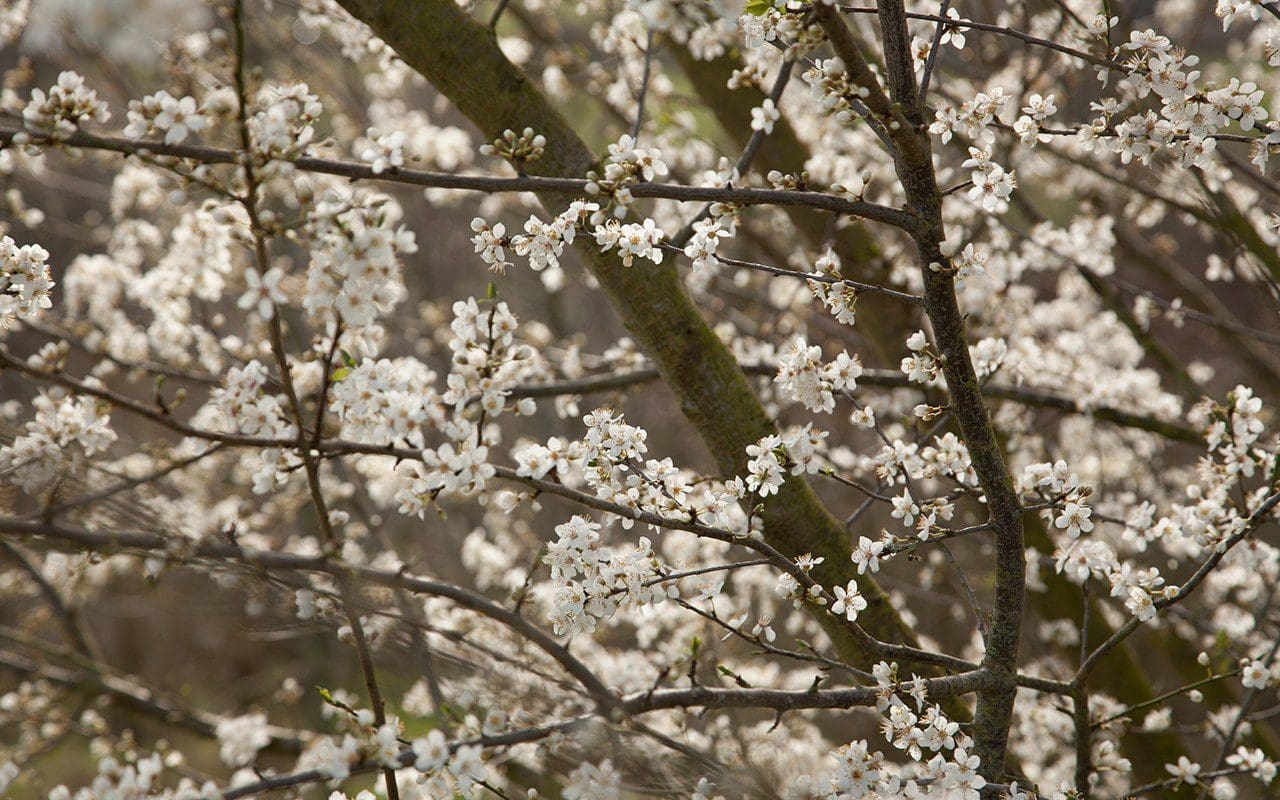 Cherry Plum – Prunus cerasifera
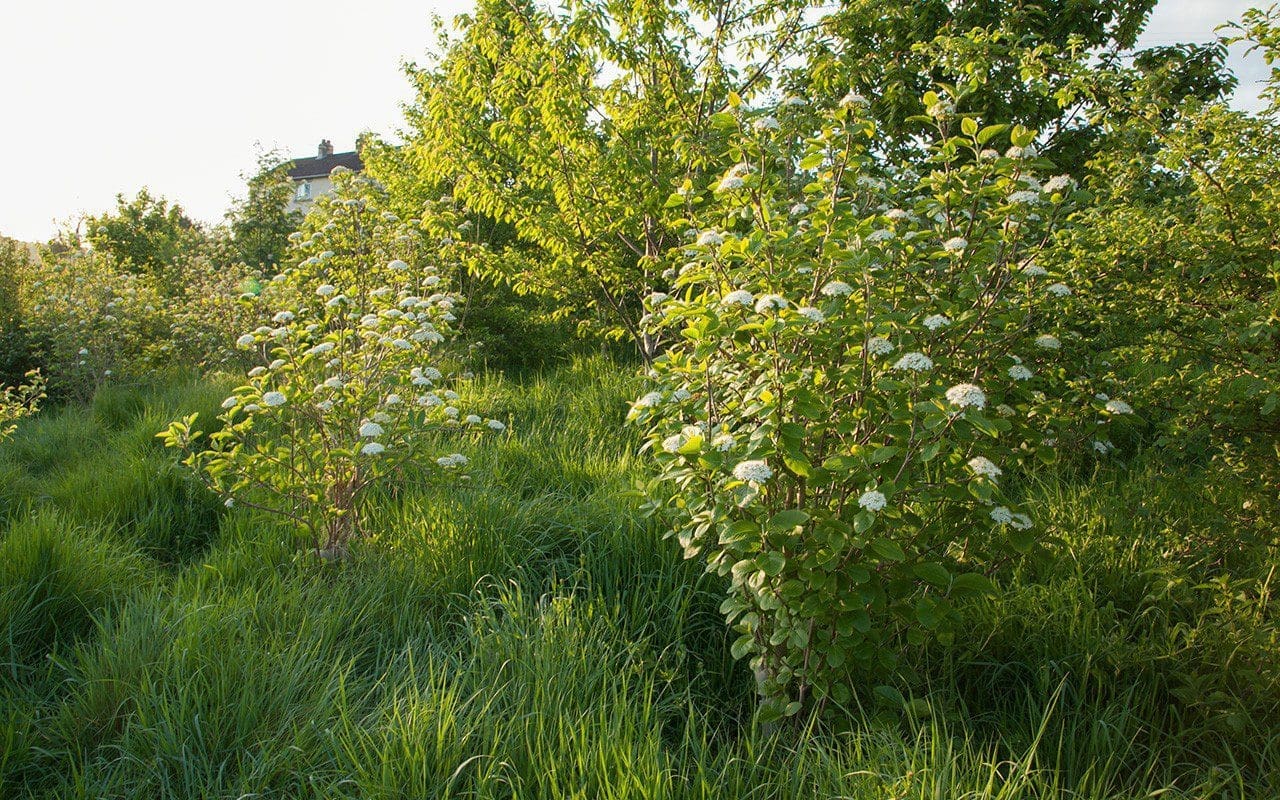
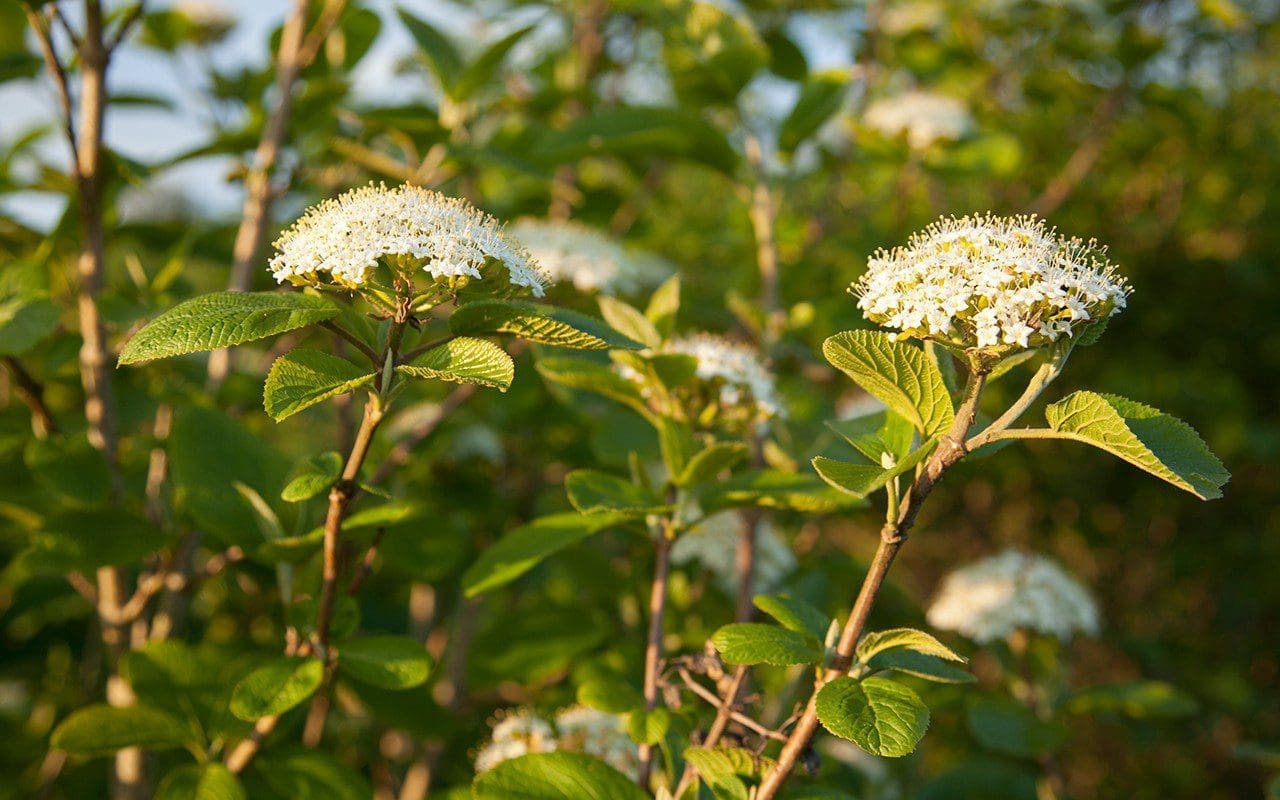 Wayfaring Tree – Viburnum lantana
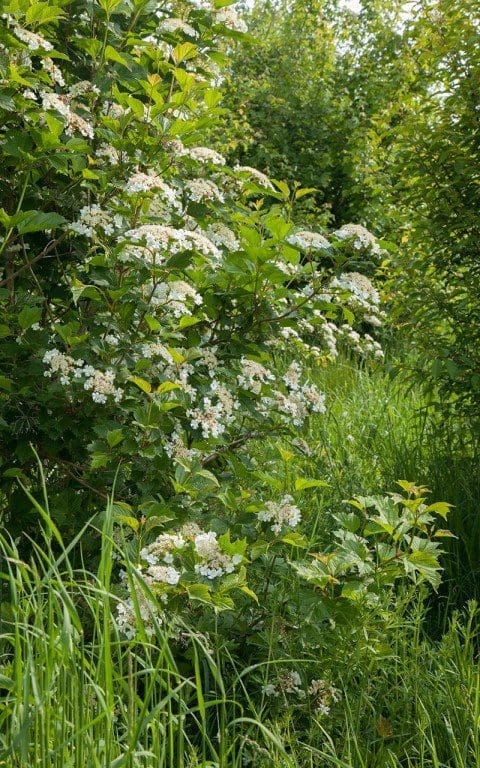
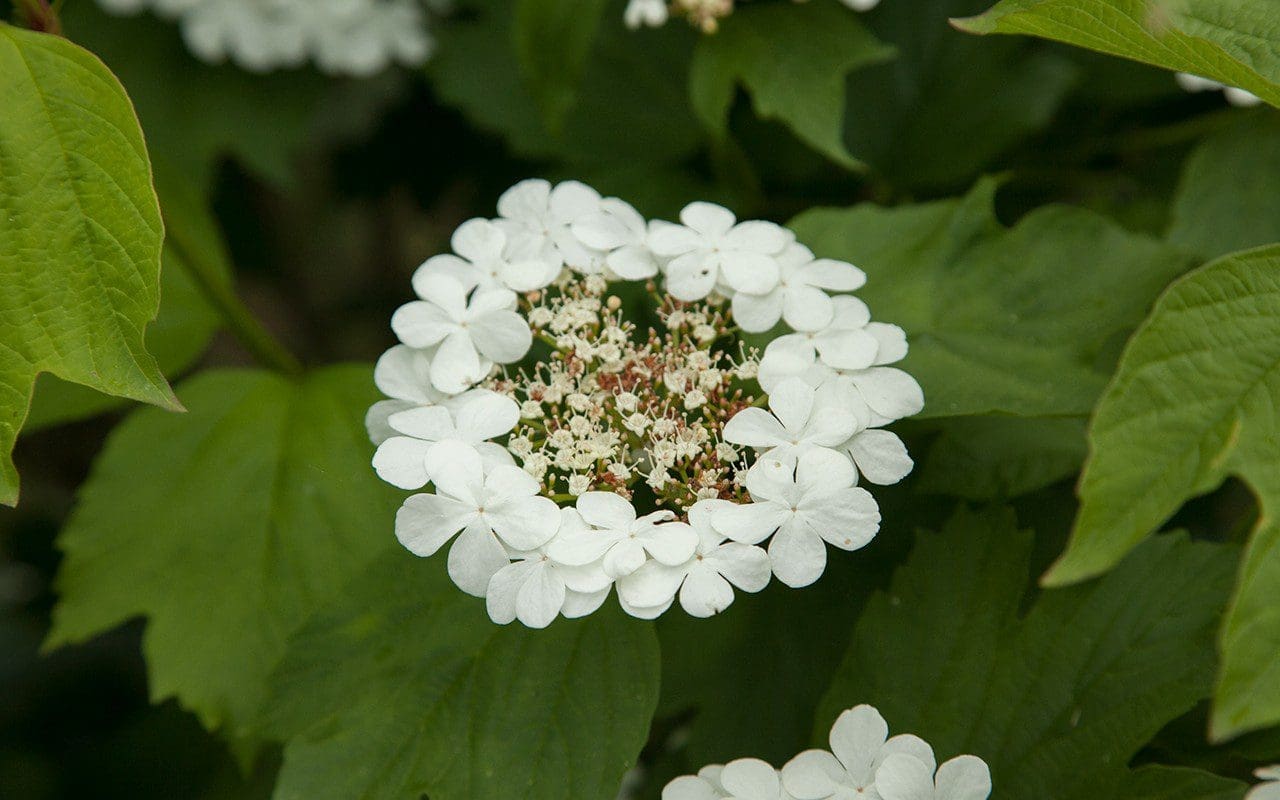 Guelder Rose – Viburnum opulus
The wild pear, Pyrus pyraster, is a tree I do not know well but have already learned to love. It flowered for the first time last year, a smattering here and there, but I hope for more this spring. Pear flowers are one of the most exquisite of all spring blossoms, the milky flowers, round and ballooning fat in bud and then cupped and beautifully drawn with stamens. The flowers often occur with the very first leaves, lime green and creamy white together. You can see the trees are going to be something. ‘Plant pears for your grandchildren’ they say, for they take time to fruit and go on to live to a very great age. My youngsters, which I planted with all the other trees as whips, are well over twice my height, stocky at the base and showing stamina.
As spring opens up and first foliage flushes, we have wild gean, Prunus avium, to make the transition from leaflessness. The trees are racing up, bolting visibly with each year’s extension growth and already taller than most in the mix. The flowers are fleeting, lasting just half the time of the beautiful double selection ‘Alba Plena’. The wild gean is beautiful though, whirling at the ends of the branches, the flowers are finely held on long pedicels and dance in the breeze. Next comes the bird cherry, Prunus padus, with long sprays of creamy blossom. I have it on the lower, damper ground where it is happiest.
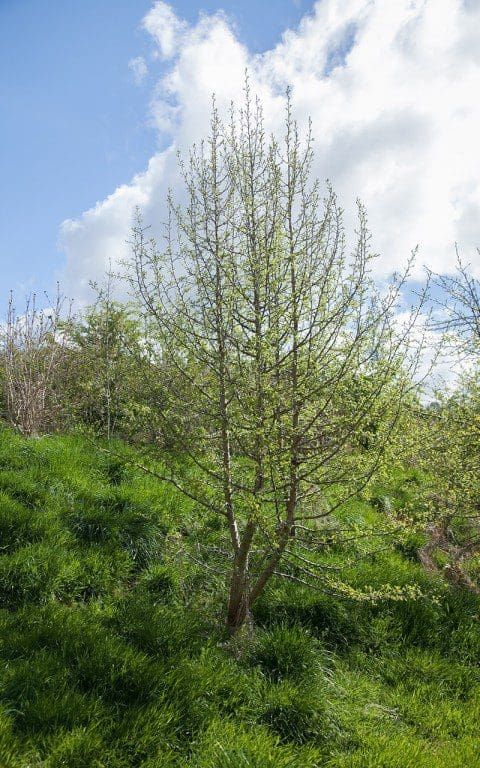
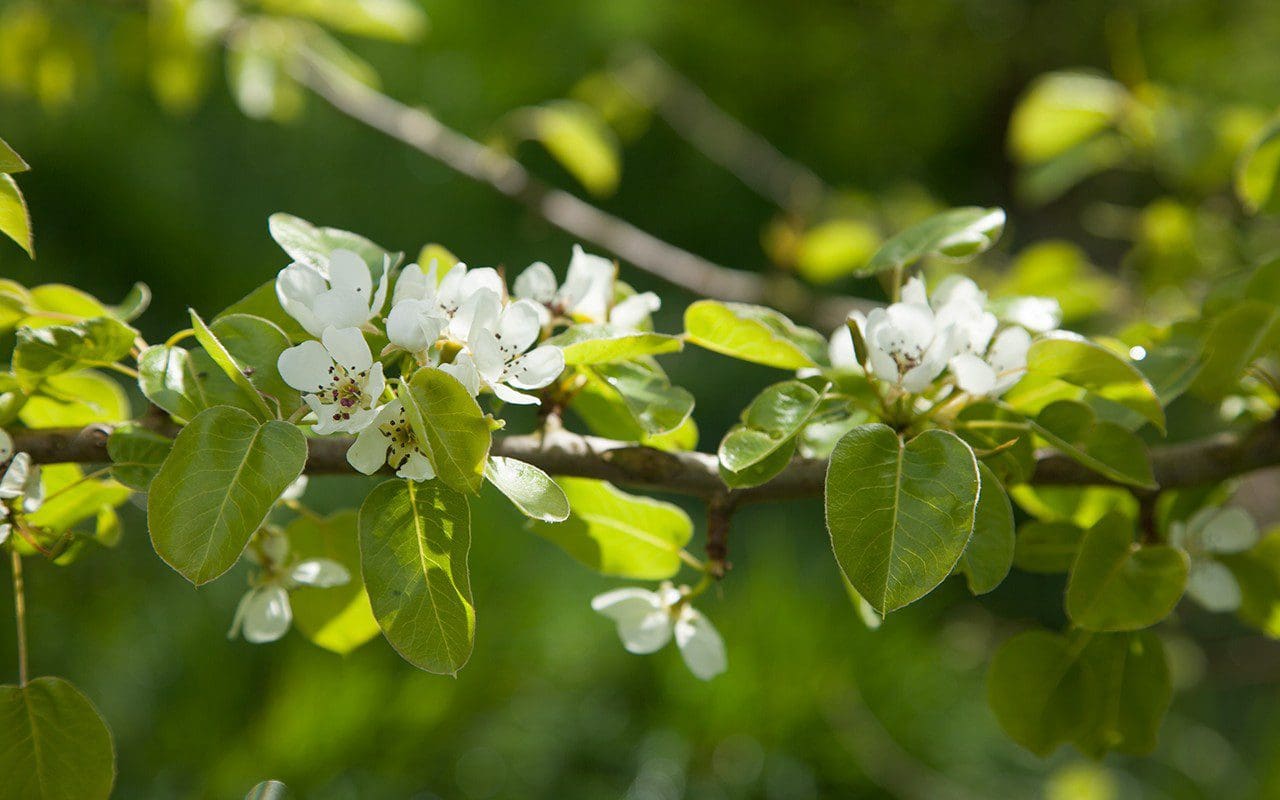 Wild Pear – Pyrus pyraster
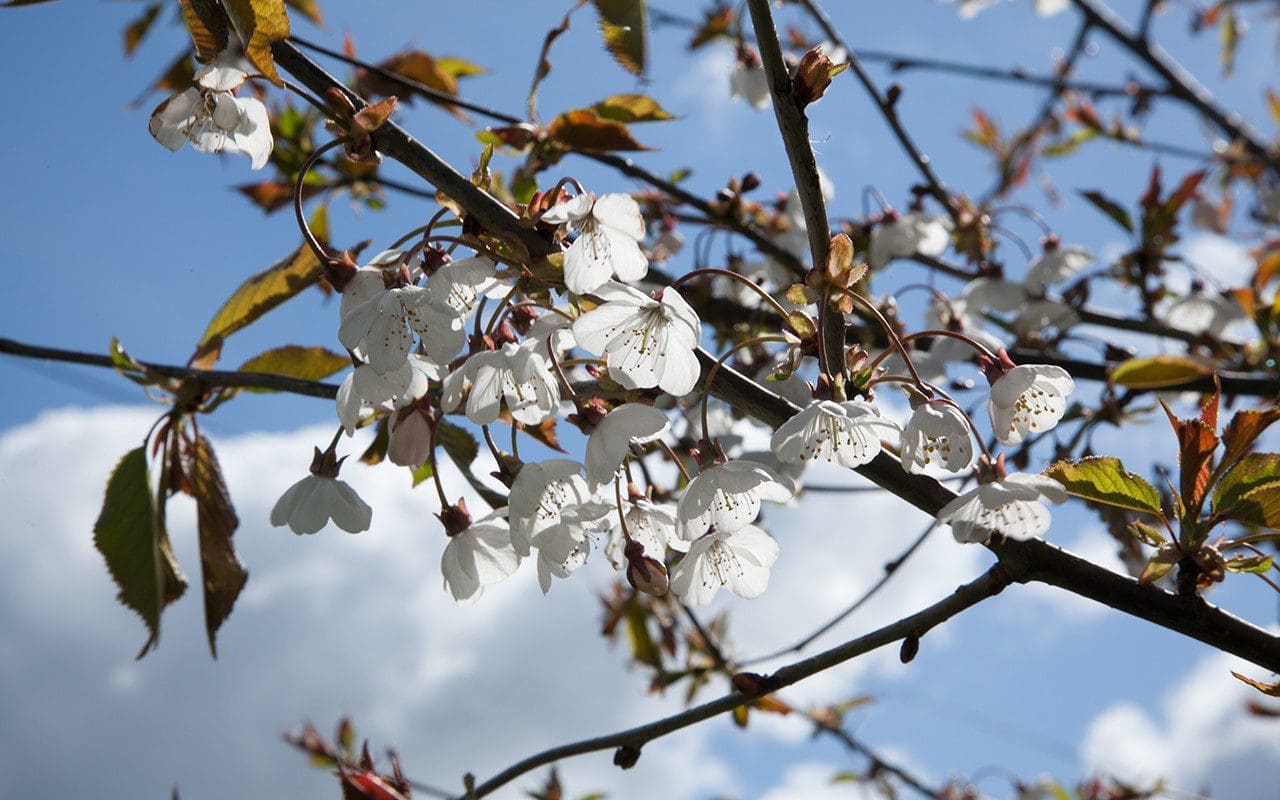 Wild Gean – Prunus avium
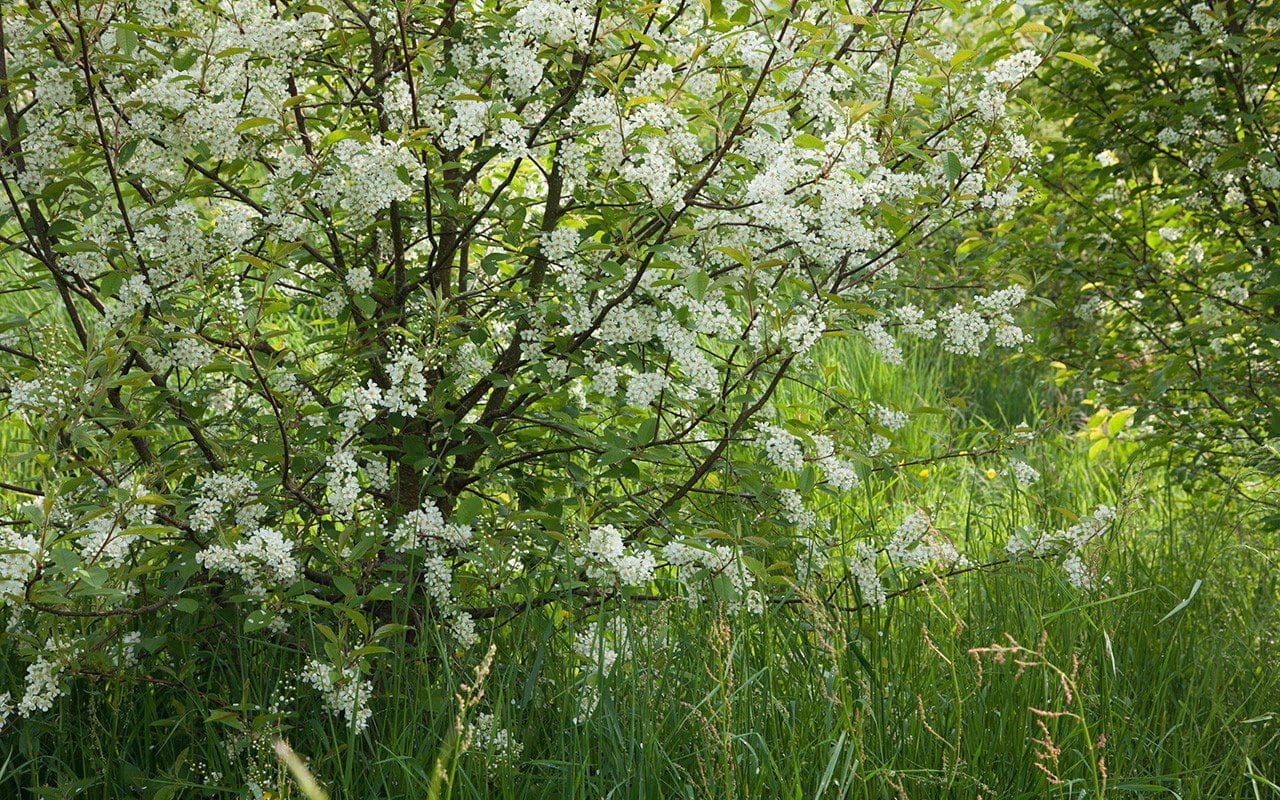
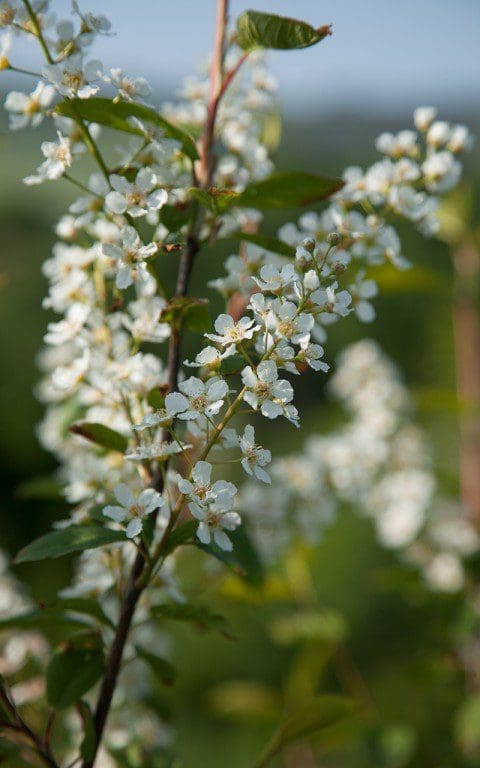 Bird Cherry – Prunus padus
Three sorbus follow and come into flower once the wood has flushed with leaf. Rowan (Sorbus aucuparia) with its feathery foliage is planted close to the pears, which will eventually take over. Despite the fact that rowan are said to be long-lived, in my experience, on rich ground and in combination with other species, I have found them to be quick off the mark at first, but affected by the competition later. I wanted to plant whitebeam (Sorbus aria) with the gean because I love the blossom and silveryness of the newly emerging sorbus foliage together. However, now that these trees are maturing and fruiting, I see that I have been mis-supplied with Sorbus x intermedia, a Swedish native. No matter, they are magnificent fruiters, bright scarlet in autumn. The chequer, or wild service, tree (Sorbus torminalis) is the third. Now a very rare tree in the wild, mainly confined to ancient oak and ash woodland, it is a delightful thing, with leaves more like a maple and marble-sized russet fruit that, from medieval times until fairly recently, were bletted and used as dessert fruit (reputed to taste like dates) or to make beer. My young trees are slender and have only just started flowering, but I have a feeling they will become a favourite. I have given them room to fill out and mature without competition.
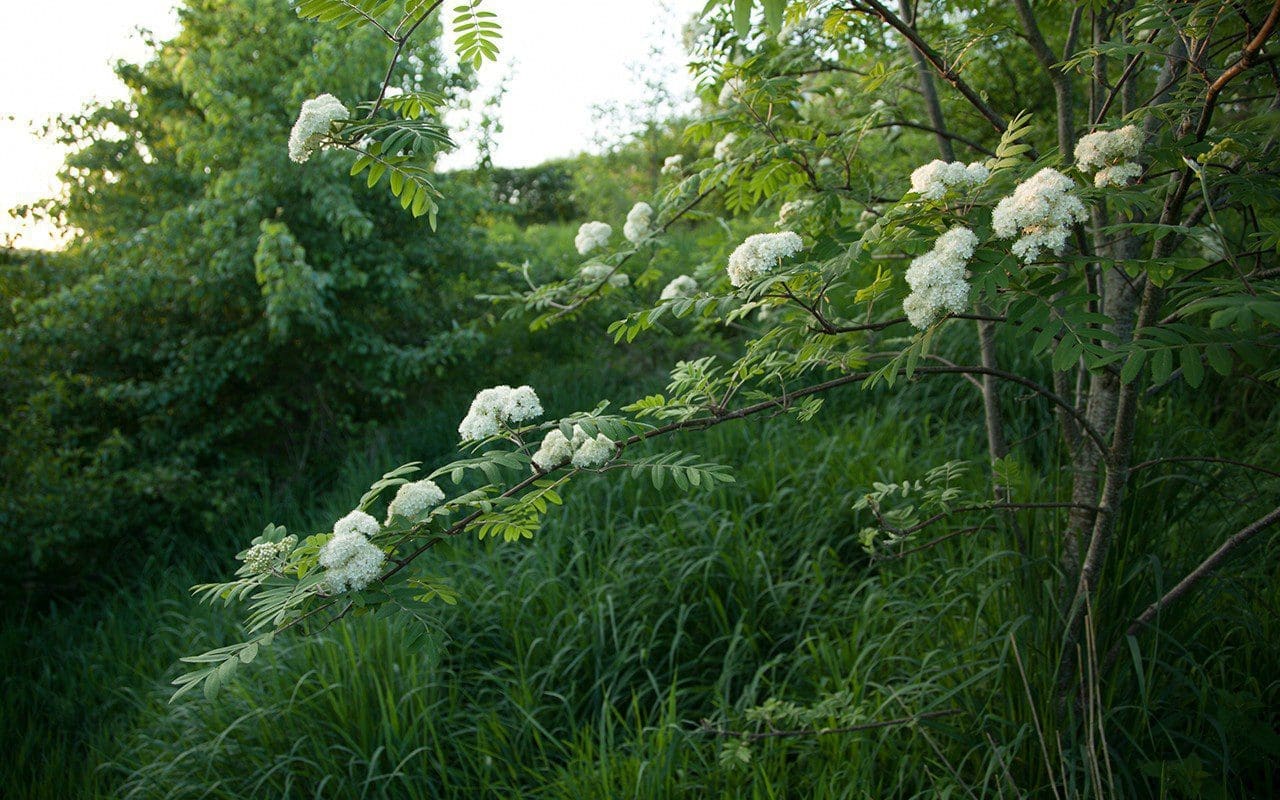 Rowan – Sorbus aucuparia
My childhood friend Geraldine left me a few hundred pounds in her will when she died and I put it into planting the wood. A naturalist to the core, I know she would approve of this place which is the domain of wildlife and where the gardener is just a visitor. We find ourselves very much the interlopers here when we visit, disturbing flurries of the birds I’d hoped for, and seeing the tell-tale signs of unseen badgers and of deer seeking cover in the soft beds of grass where I have deliberately left a couple of clearings. I know already that I will be cursing them when they become bolder and find the garden, but it is good to see that, in less than a decade, we have a place that lives up to its name.
Words: Dan Pearson / Photographs: Huw Morgan
Half the hedges on the land are allowed a year off between cuts so that, on rotation, we always have some for flower and fruit. Allowed to grow out softly from the rigour of a yearly cut the fray of last year’s wood spawns sprays of blossom as the prelude to later bounty. When the hedges are still darkly limbed the stark white of blackthorn and then wild plum is forage for early bees. Later, freshly clothed spumes of hawthorn let you know where you have the Crataegus. This is one of the most steadfast hedge components and easily tended.
Guelder rose (Viburnum opulus) follows where there is damp to sustain its particular preference, the lacy flowers like bonnets, brilliantly white amongst summer greenery. Sprays of dog rose (Rosa canina), arching free to present themselves later in June and July, start the relay between the three hedge rose species that are native. First R. canina (main image), then the Eglantine (R. eglanteria) with foliage smelling of green apples and finally the Field Rose, R. arvensis.
Come the autumn all of the above yield berries and hips, peppering the hedges with colour and providing feasting opportunities for wildlife. It is a vicarious pleasure to be able to contribute to this rich and connected network, linking one field with another, woods with fields beyond and shelter out in the open.
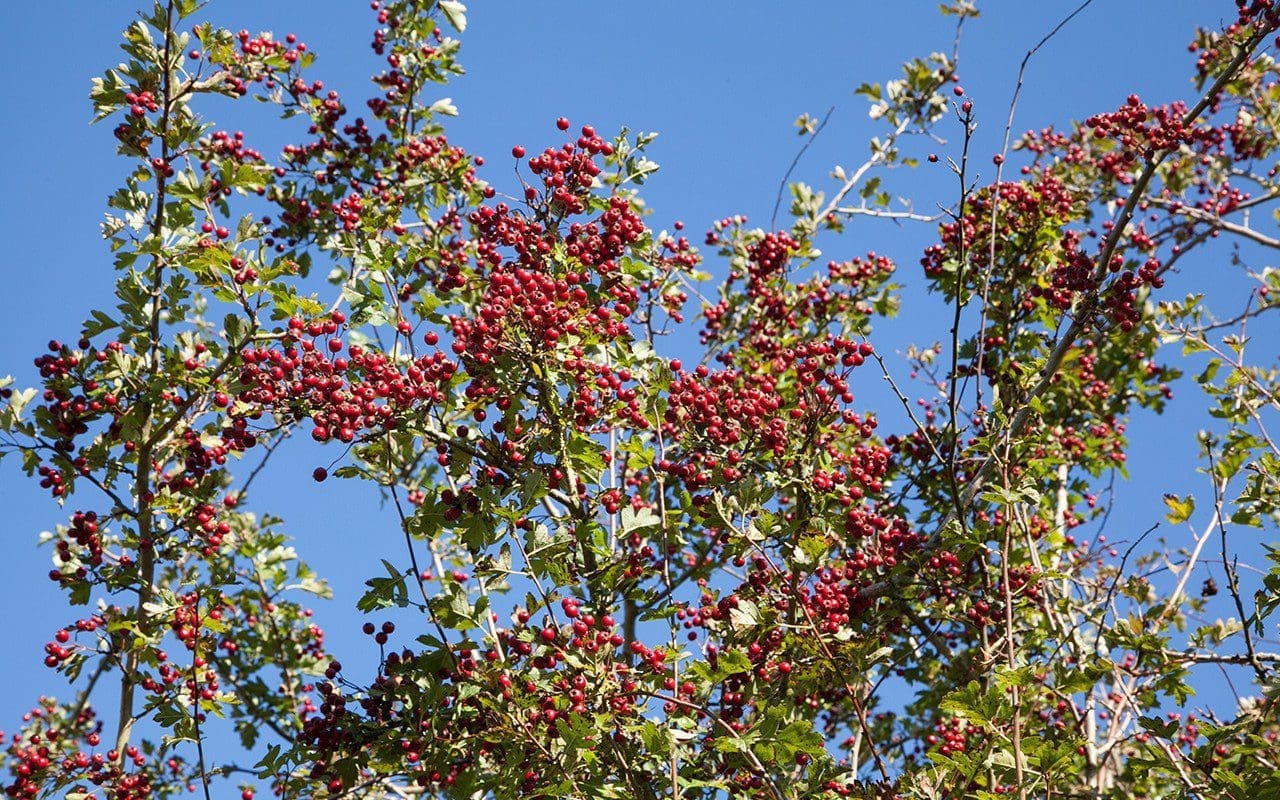 Crataegus monogyna – Hawthorn
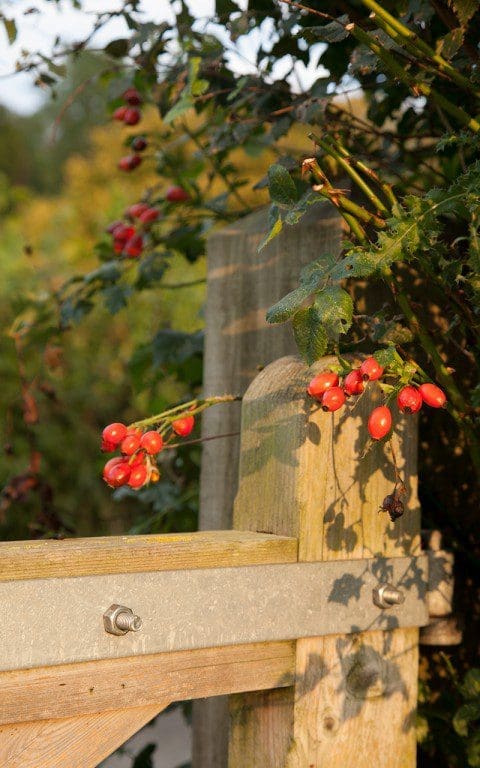
Rosa eglanteria – Eglantine Rose
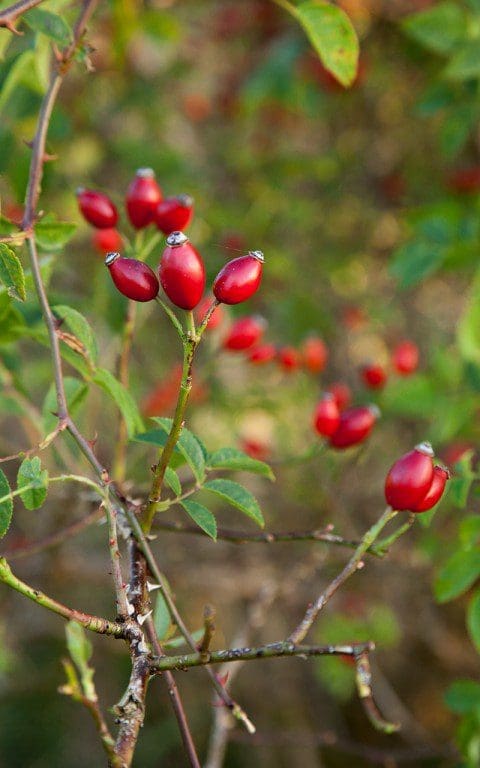
Rosa canina – Dog Rose
When we arrived here the hedges were not in good condition. Neatly trimmed on a yearly basis, the ‘broken teeth’ (where fast-growing elder had seeded in, outcompeted its neighbours and then died) were now home to bramble. A little bramble in a hedge is not a bad thing but, come the winter, their open cages offer little protection and their advance, like the rot in a tooth, is to the detriment of the whole. Since moving here I have slowly been improving the hedges by gapping up to remove the weak sections and interplanting with new whips of fruiting species to make good the mix; common dogwood (Cornus sanguinea) and guelder rose where the ground lies wet, and wild privet, the wayfaring tree (Viburnum lantana), roses and spindle (Euonymus europaeus) where it is drier. I am happy with the hawthorn almost everywhere, but I’ve learned that the blackthorn should only go into a hedge that is easily cut from both sides.
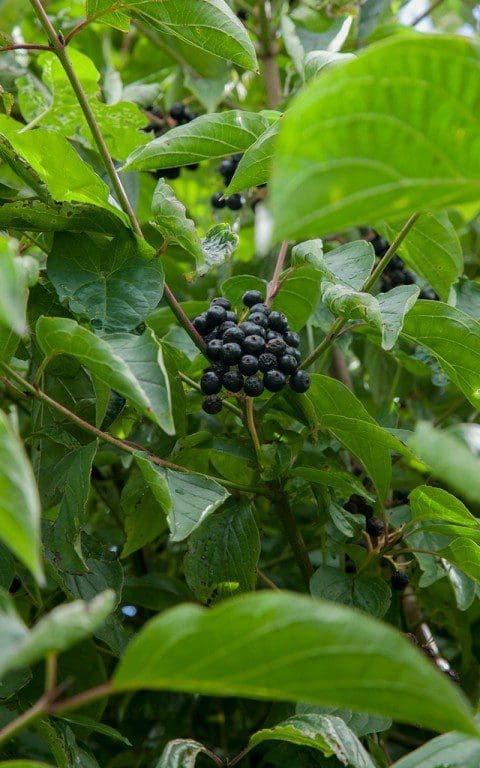 Cornus sanguinea – Common Dogwood
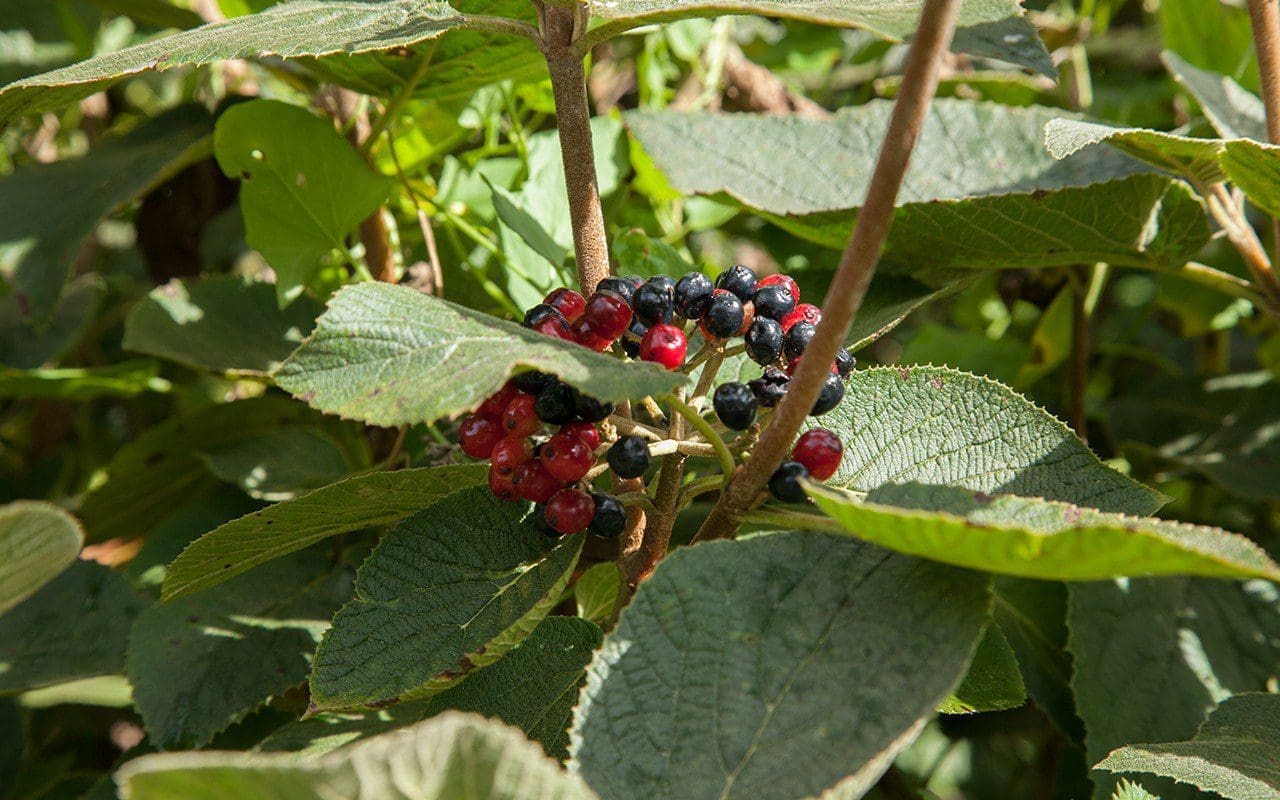 Viburnum lantana – Wayfaring tree
Blackthorn (Prunus spinosa) – or the Mother of the Woods – is a runner and it’s thorny cage quickly forms an impenetrable thicket. Over many years the centre dies out and, because the thorns are wicked (indeed, a wound from them can quickly turn septic, so best to wear leather gloves when pruning), the centre of the enclosure is somewhere that becomes free of predators. Acorns transported by rodents or ash keys blown into the protected eye will be the start of a slower and ultimately outcompeting layer that, in time, pushes the blackthorn out to the very edges of the hedge and out into the fields to claim more ground. For this reason I have planted only a handful on the land, both for their early blossom and for the inky sloes that make a good addition to hedgerow jelly or for sloe gin, a favourite winter tipple.
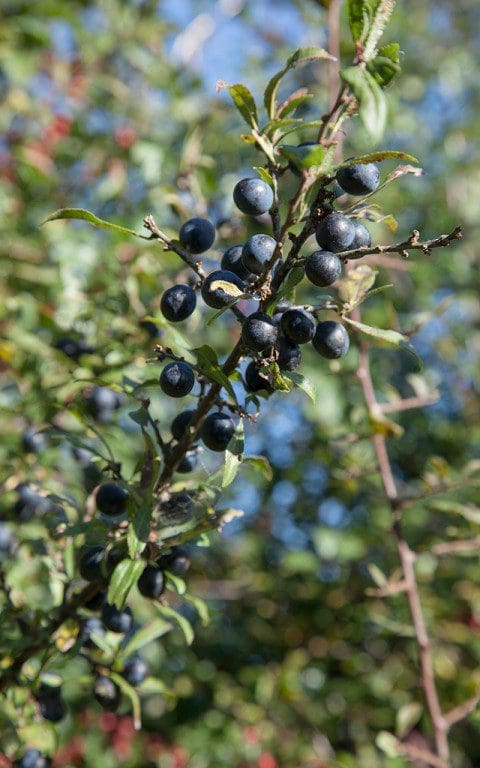 Prunus spinosa – Blackthorn
Now that we have been here long enough for my originally purchased whips to have yielded fruit, I have started to collect the berries before the birds have them all in order to grow my own plants from seed and so that I can continue to plug gaps with my home-grown material. The seedlings of the Viburnum opulus, the roses and the spindle have been added to the edges of the Blossom Wood as the trees have grown up and begun to shade the original shrubs I planted there as shelter.
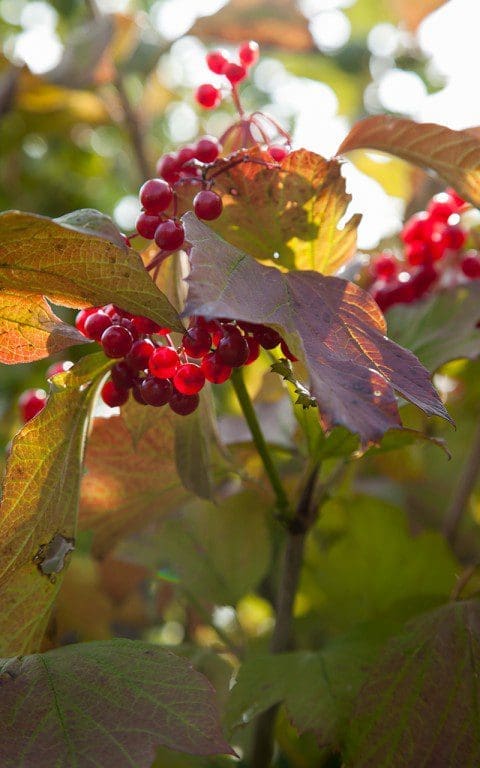 Viburnum opulus – Guelder Rose
The viburnum is a particular favourite, the translucent, bright scarlet drupes lighting up wherever the plants have taken hold. The Eglantine roses have also been good to have to hand as their perfumed foliage is a delight on a damp morning when the smell of apples lingers on the still air. They have been planted by gates, into hedges that we walk past frequently and upwind of wherever there is a place we use that is downwind of them. Interestingly – for deer generally target roses first of anything – the Eglantines have so far remained untouched. Is this just luck or is it the scented foliage that acts as a deterrent ? I have planted them by the entrance to the vegetable garden to see if they have the desired effect.
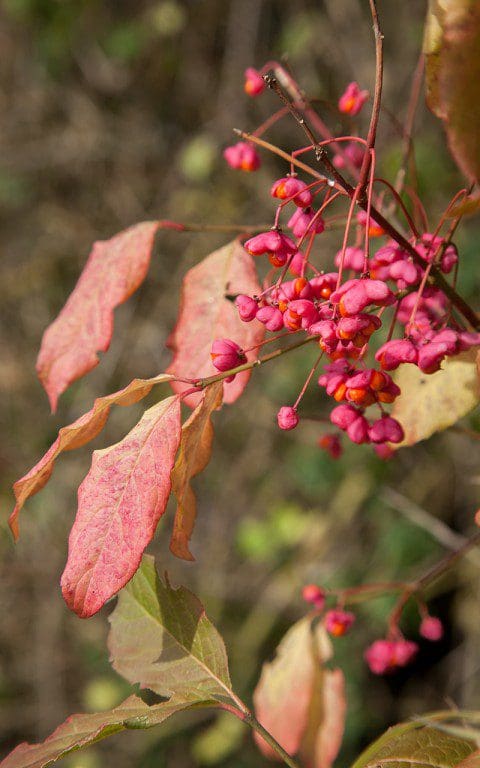 Euonymus europaeus – Spindle
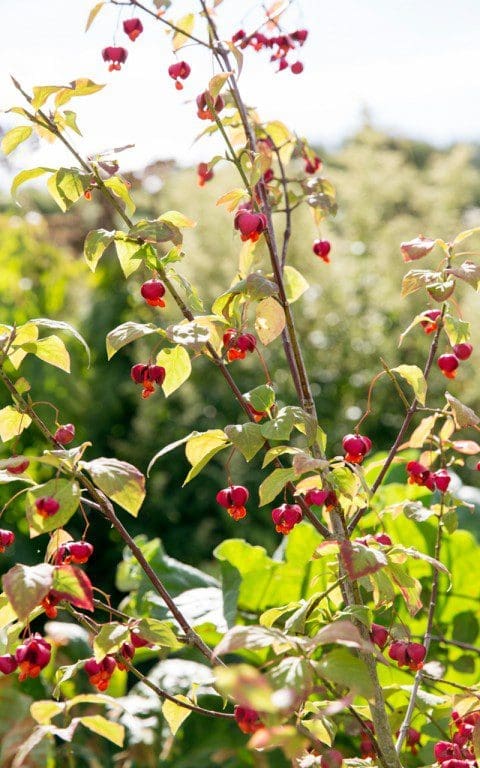 Euonymus planipes – Photo by Emli Bendixen
Our native spindle (Euonymus europaeus) is one of my favourite fruiting hedge plants. The pink turban-shaped fruits rupture in October to reveal the contrast of tangerine seeds suspended within. It is a dramatic combination and my original whips have shown that there are many different forms, some with fruits a brighter colour, others a paler pink but with more prolific fruit. Raising from seed is always interesting for this variation and I’ve selected the best for those that will make a link to the garden. The garden is also going to be home to shrubs that fruit, such as Euonymus planipes, which will blend the ornamental into the land beyond it where things run wilder. There is another story to be told here, but it is hard not to mention this wonderful shrub. I have two plants, both seed-raised, and they too are showing differences. The deep magenta fruits – more elegantly winged than the native – and vibrant orange seed hang in foliage that colours apricot and the colour of melted butter.
Words: Dan Pearson / Photographs: Huw Morgan
We are sorry but the page you are looking for does not exist. You could return to the homepage