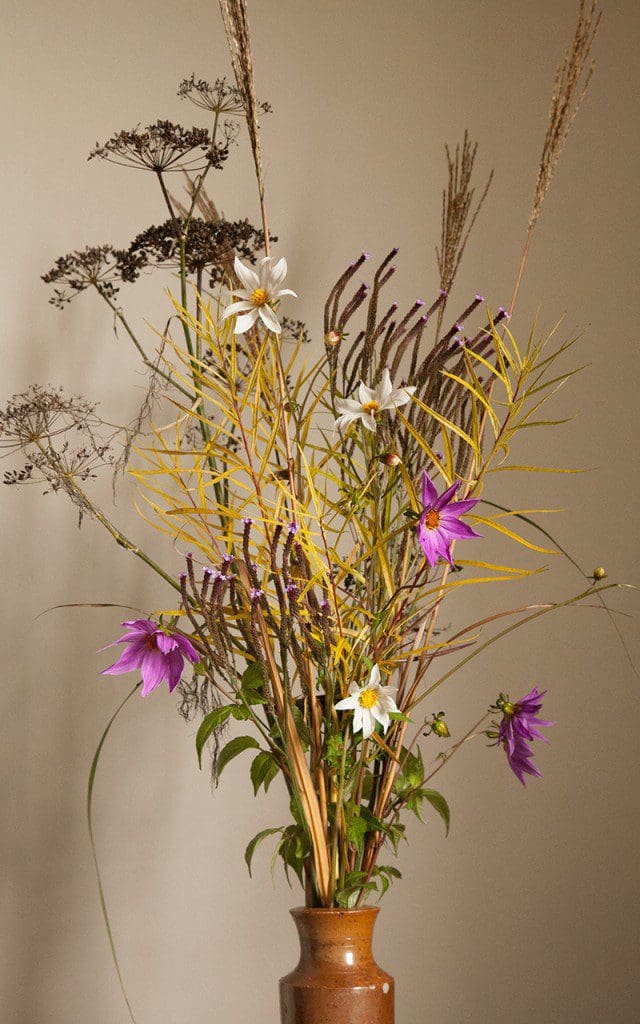
I try hard to ensure that these posies picked from the garden are done in real time, but last weekend I flew off to the States for a week’s work. So this bunch I picked last Saturday before the frost, which till then had kept itself to the hollows down by the stream, made its way up into the garden for the first time on Sunday morning. These are the very last of the dahlias, pushing against the tide of decay, but dwindling daily with the increasing cold at night. Blackened the instant the frost arrives and heralding the coming of winter.
Usually this is the time to lift dahlias. The tender foliage is seared back to the stem. Dig down and the fleshy tubers are rude with a summer’s feeding and full of the energy they need to sustain them through the winter. The two species I have selected here have so far proven themselves to be just as happy in the ground with a little help in the form of a mulch of compost to keep them through the cold season.
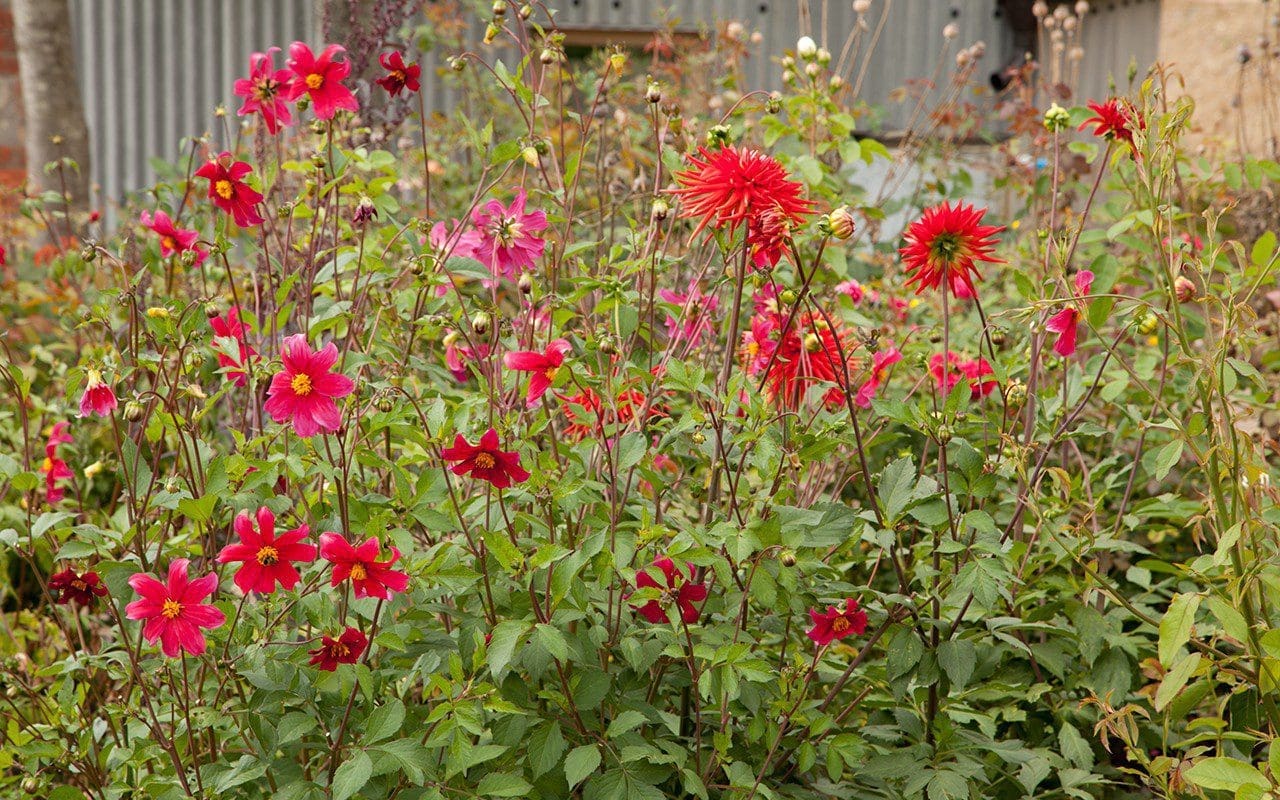
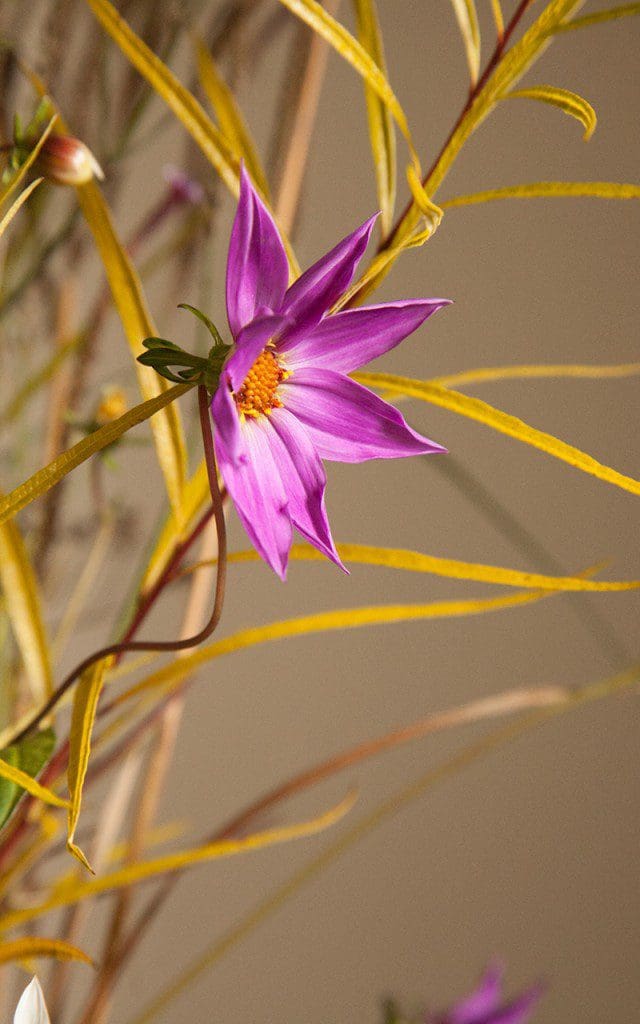 Dahlia australis
Despite the elegance of its finely divided leaves and sharply drawn flowers, Dahlia australis is a plant that needs room at the root in company. Try to lift the tuber and you find that it is easily a two-man job and this is why the push of growth is strong and constant from the moment it comes through in the spring.
Standing now at shoulder height and a stretch of the arms across this is not, however, a plant that feels demanding of space. With delicate growth and single flowers on wiry stems, there is a lightness about it that tends to be lost in the hybrids. For this reason I have decided to keep it in the garden as it will sit well with the wild feel of its companions. I plan to have it amongst Verbena macdougalii ‘Lavender Spires’, which you can see here at the very end of its flowering season. The tiny violet flowers, which leave behind them a sterile taper, have been flowering for months, but now have nowhere left to go. Three or four plants spread widely in a bed provide a vertical accent and the dahlia will be good pushing its way through this floral cage.
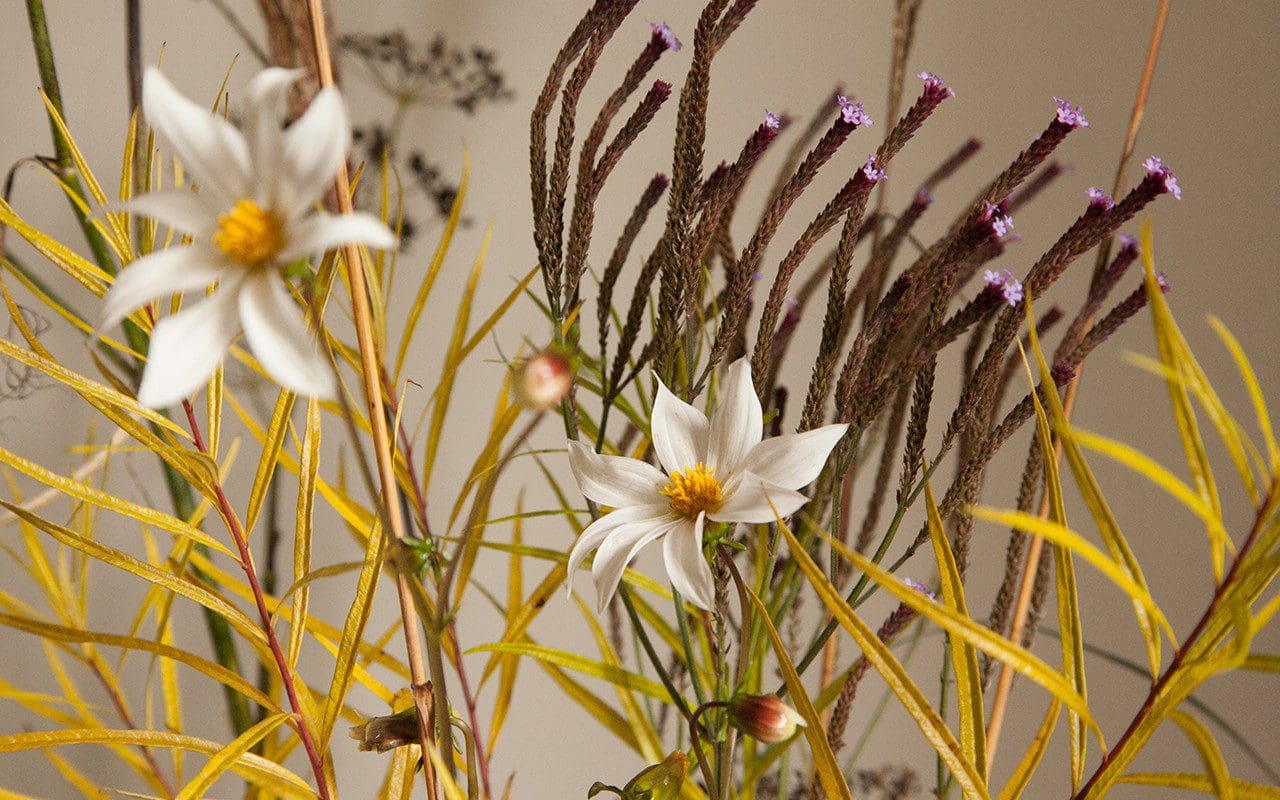 Dahlia merckii ‘Alba’, Verbena macdougalii ‘Lavender Spires’ and Amsonia hubrichtii
Dahlia merckii ‘Alba’ is of an altogether lighter weight and more delicate disposition. Standing at no more than chest height, with delicate growth and foliage, this is a delectable dahlia. Despite its appearance, it seems to be perfectly hardy, and I would not want to be without it for its constancy of flower. These are pure white, small and widely-spaced and dance like butterflies in wind, but if the plant is not in good company it will snap and break. Teaming it with low perennials that will not overwhelm its foliage is better than staking. Far less fiddly and better for the dahlia to find its own way, since the spaciousness in the plant comes out in several directions from the crown. In the stock beds I have it with a herbaceous Salvia pratensis, but when I use it in the new garden I will team it with the Amsonia hubrichtii that you see colouring gold in this posy. They are both sun loving and, after its early flower, the amsonia will leave room for the dahlia to get away in the first half of the growing season.
The flowers of both these dahlia species die well by simply dropping their petals and, as they seem happy to continue to produce without throwing all their energy into seed, there is no need to dead head as you might their more flamboyant relatives. The singles also have the added benefit of being accessible to pollinating insects.
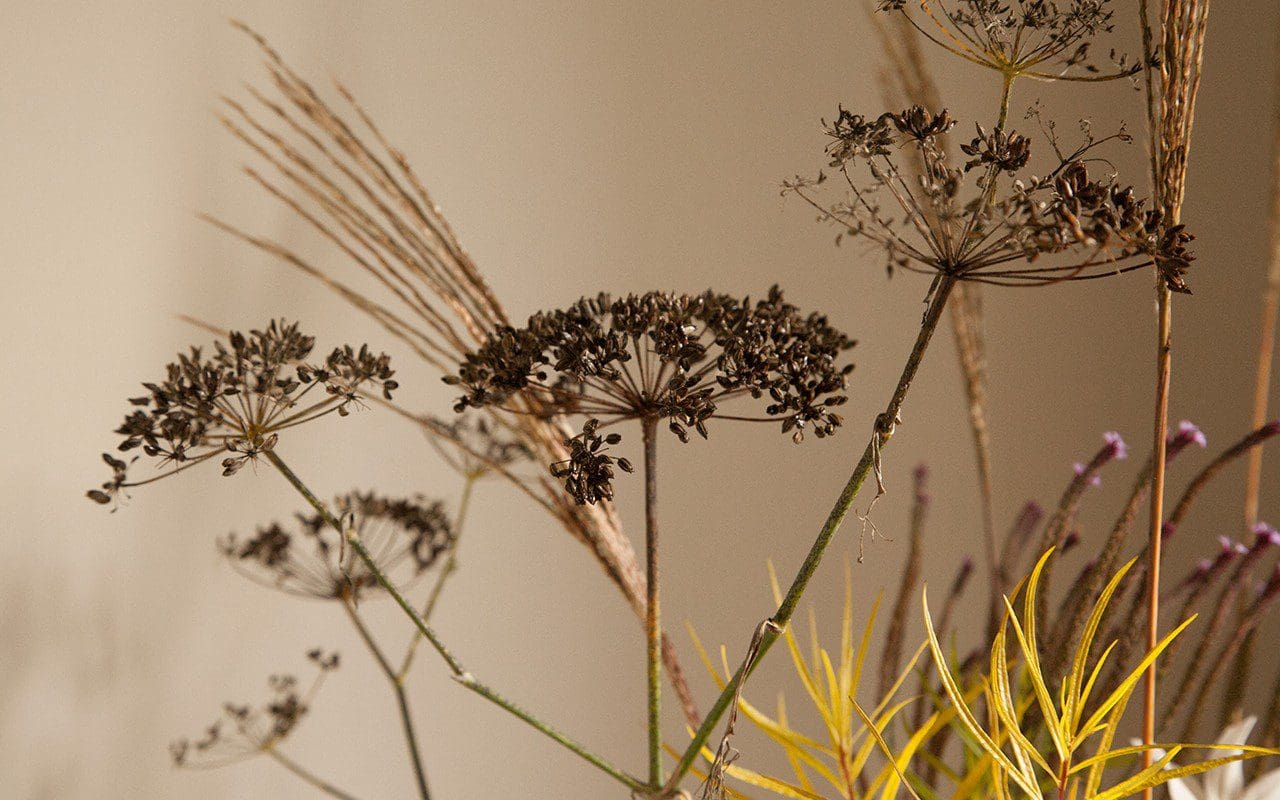 Bronze fennel (Foeniculum vulgare ‘Purpureum’)
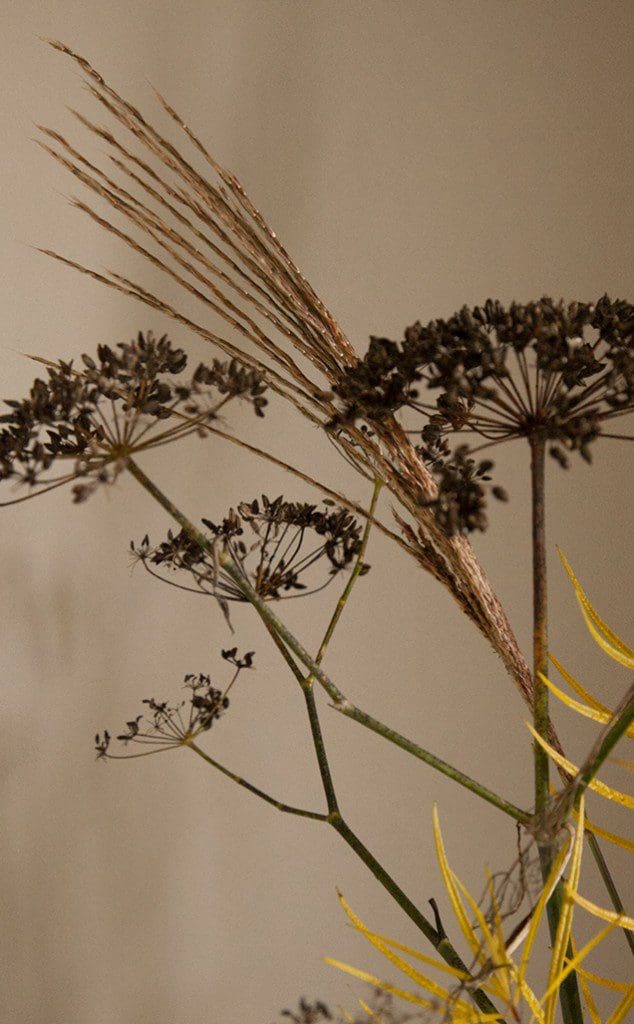 Miscanthus ‘Dronning Ingrid’ and Bronze fennel (Foeniculum vulgare ‘Purpureum’)
I have included the bronze fennel in the bunch for its darkness now that it is in seed and the miscanthus for its ability to harness the light in its inflorescence. I am finding the miscanthus difficult to place in the garden because they have such a strong atmosphere which smacks too much of somewhere else to sit easily in this landscape. I have seen them growing wild in Japan, where their plumage is the emblem of the autumn season and their clumps illuminate autumnal verges. Miscanthus sinensis ‘Dronning Ingrid’ is a new variety to me with foliage that colours with flashes of red and orange at the end of the season. The flowers, which are not as dark as some but emerge with a red flush nonetheless, soon pale to silvery bronze. The flower, held free to catch the breeze, is more tapering than many miscanthus but, come the winter, it lives up to its common name of Silver Grass as it flares in the low light.
Words: Dan Pearson / Photographs: Huw Morgan
This is the third year of my aster trial and a good point to judge how they have performed. The collection, which I set up to broaden my palette, has scratched the very tip of an iceberg, which must run to hundreds of varieties. I currently have just twenty-six and I am at the point now of wanting to reduce them to a dozen or so. Some I have grown before, but the greater number have been selected from plant fairs and on trips to see the well-known collections at Waterperry Gardens and the Picton Garden.
Asters are some of the best late-flowering perennials, the first flowers to hint at the next season in late August, and some of the very last to see the autumn out, their flowers hanging in suspension as the colour drains from everything around them. Aster borders were once celebrated in Victorian and Edwardian gardens, but they became unpopular for a period and with good reason. Many of the older varieties were prone to mildew and those that run could take a border over in the same time that I have been running my trial. I suspect this is one of the reasons that you see them naturalised along railway embankments, where they were thrown over garden fences in frustration, and where the strongest can compete with the buddleia and brambles.
Frustratingly, asters have recently been renamed; A. novae-angliae, A. novi-belgii, A. laevis, A. dumosus, A. lateriflorus, A. cordifolius and A. ericoides have become Symphyotrichum, while A. divaricatus and A. schreberi are now Eurybia. Whatever you call them, aster enthusiasts and nurserymen who are selecting and naming new varieties have honed them for their mildew resistance. This means that in the summer wait for their moment of glory, they help provide a sense of healthy expectation in the borders. They have also been selected for their clump-forming ability and the majority stay put until they need division. Depending upon the variety, this can be in four to six years. They show you when they need this by developing a monkish bald patch in the middle. Division of the strongest growth to the outer edges in the spring renews their vigour. 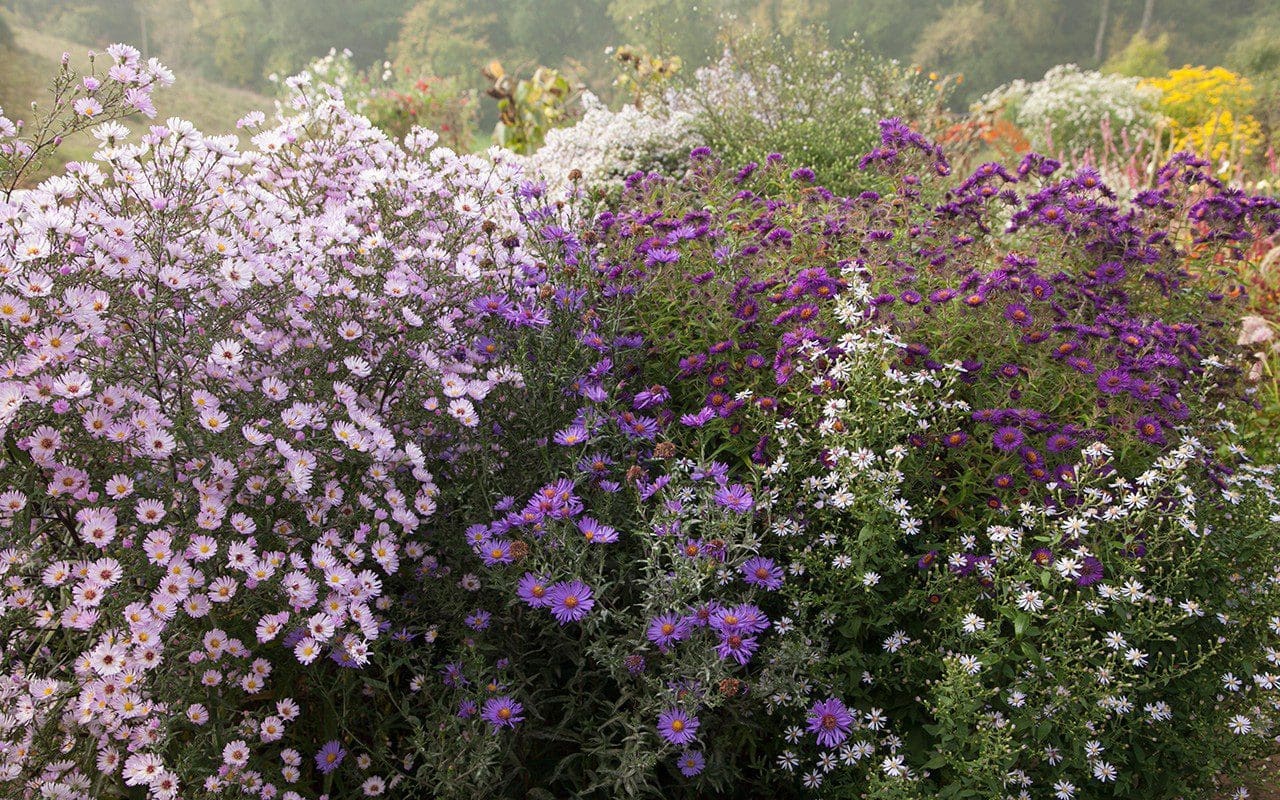 The aster trial with from left to right, A. ‘Vasterival’, A. ‘Calliope’, A. ‘Violetta’ and A. ‘Primrose Path’
As I write, the sun is streaming down the valley at an ever-decreasing angle, having burned its way through a morning mist. We had the first frost in the hollows today, so I would say this was perfect weather for looking at my collection. In the penultimate week of October they are in their prime and they look their best in the softened light with the garden waning around them. I have spent the morning amongst them, taking notes and pushing my way through the shoulder high flower to trace them from top to bottom. I want to see if they have stayed put in a clump, and which ones can do without staking, as I’m aiming for there to be as little of that here as possible.
I am smarting, however, as I have committed the ultimate sin when running a trial, for six of the labels are missing, buried within the basal foliage (I’m hoping) or – less helpfully – snapped off when weeding. Of these six I am going to keep two that have shown themselves to be special and, through a process of elimination from studying photographs and my garden diary, I will find out what they are. The others will be found a metaphorical railway embankment. In this case a rough patch of ground where the sheep won’t get them, but where they can provide some late nectar for the bees.
I have just a small number of creeping varieties which I tolerate for their informality. Although most asters prefer to be out in the open with plenty of light, the first three here are happy to live under the skirts of shrubs or in dappled shade. Aster divaricatus, a plant that Gertrude Jekyll famously used to cover for the naked patch the colchicum foliage leaves behind in summer, is one of my favourites. I have seen it in North American woodland where it lives happily amongst tree roots and spangles the dappled forest floor in autumn. Although it will not dominate here, as it does in the States, and runs slowly, it does move about, the dark, wiry stems leaning and sprawling and pushing pale, widely-spaced flowers to a foot or so from the crown. Aster schreberi is similar to look at, with single starry flowers, though it is stronger and has taken off in my hearty soil. I will put it amongst hellebores, which should be man enough to fight it out in the shade under the hamamelis. I will let you know who wins in a couple of years.
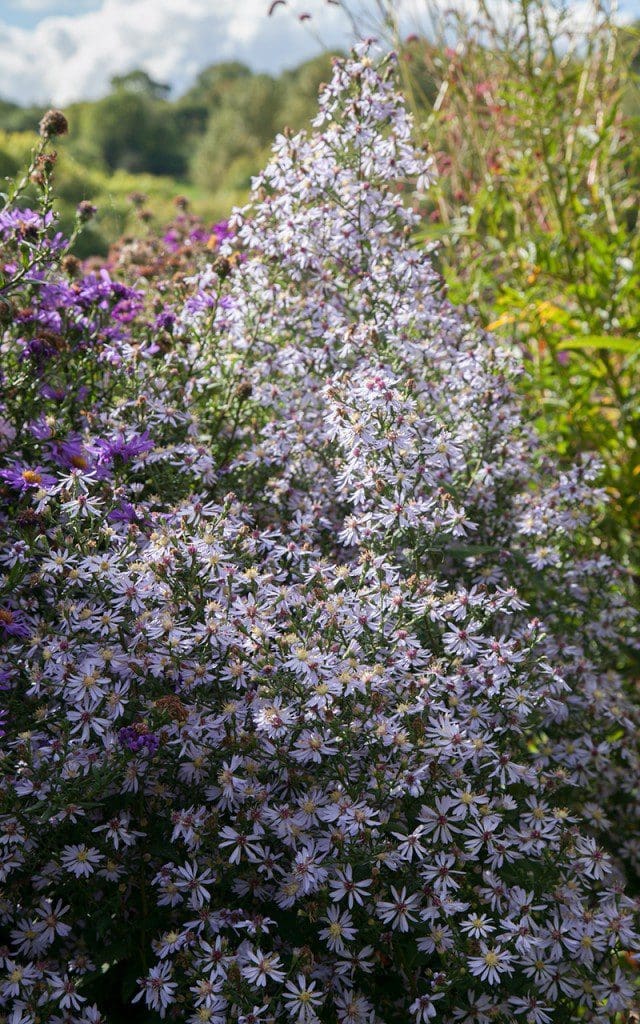 Aster ‘Primrose Path’
Strictly speaking, I should be wary of Aster ‘Primrose Path’ for not only does it double itself in size every year, it also seeds. However, it is not a hefty plant, growing to just 75cm and, as it is also happy in a little shade, I am keen to keep it and use its ability to move around in the shadier parts of my gravel plantings around the barns. The flowers, which are small, but not the smallest, are a delicate lilac, each with a lemon-yellow centre.
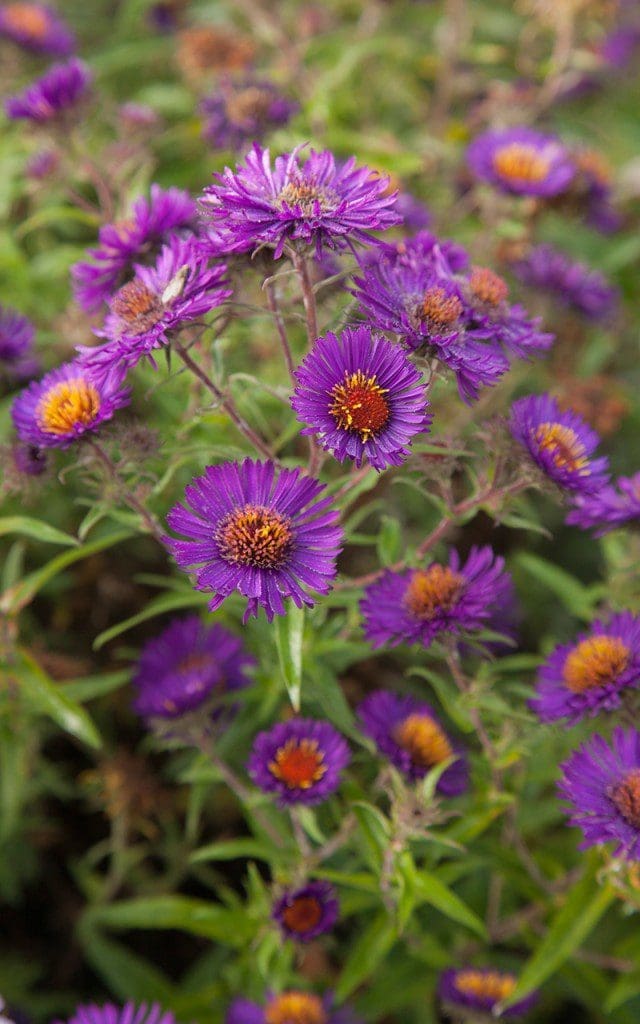 Aster ‘Violetta’
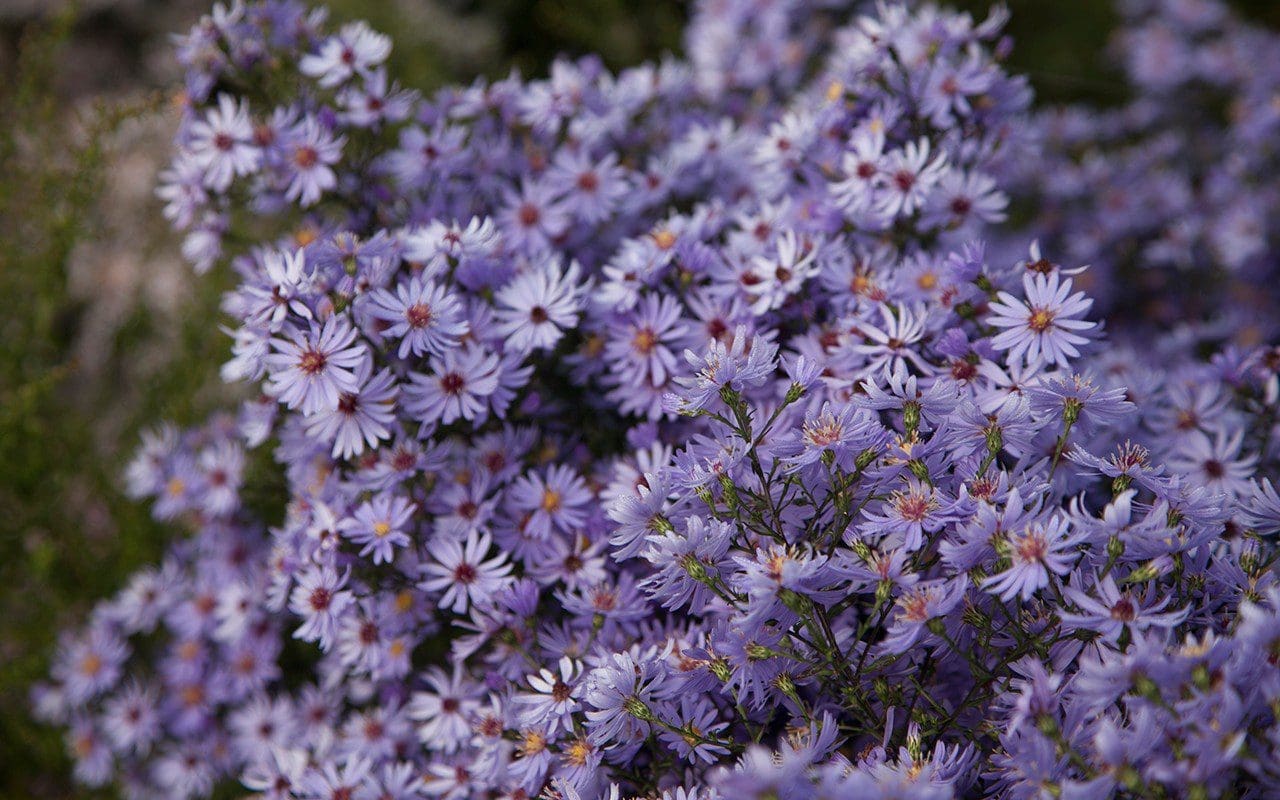 Aster ‘Little Carlow’
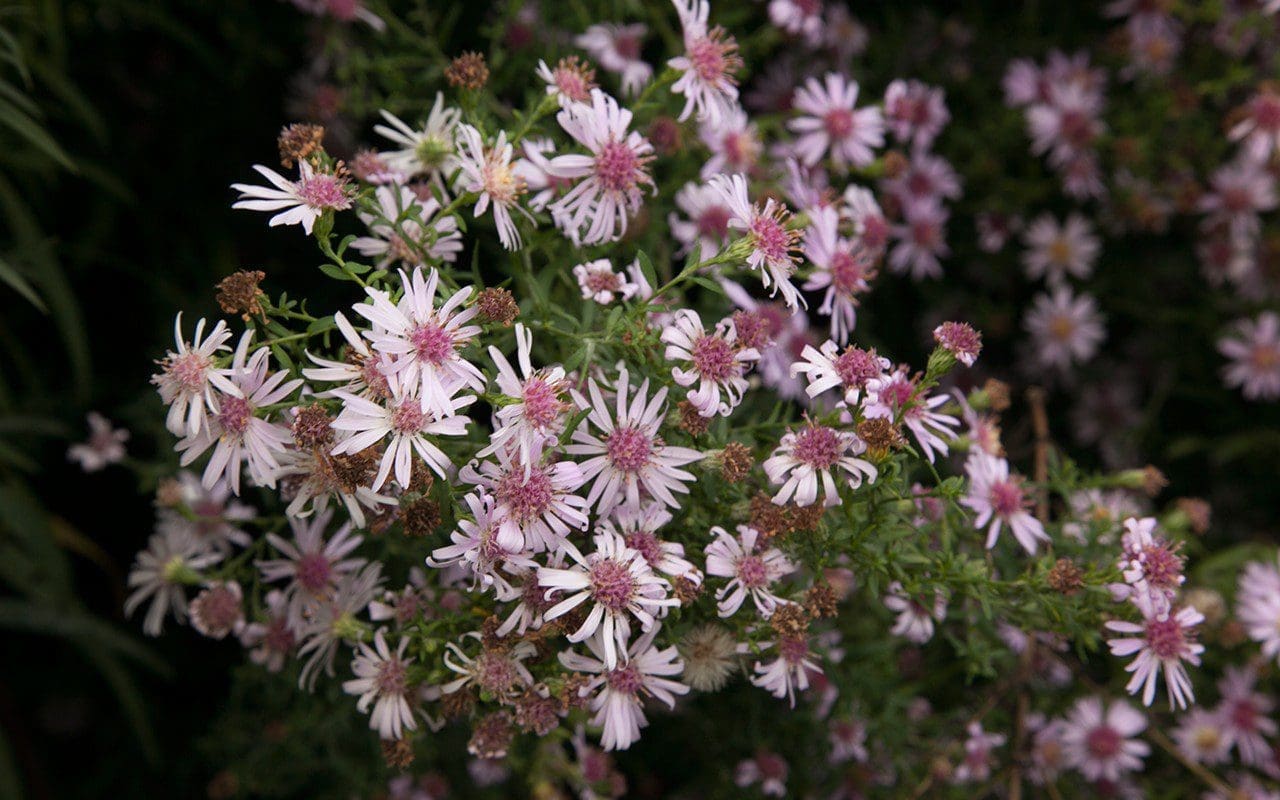 Aster ‘Coombe Fishacre’
Most of the asters for the new garden have been selected for lightness of growth and flower, as I want the plantings to be transparent, allowing views of the far landscape into the garden. All, with the exception of the semi-double ‘Violetta’, are single. I like to see the centre of the flowers and I want them to to dance or to sit like a constellation in space rather than blaze in a solid mass like ‘Little Carlow’. Growing to well over a metre for me here, this is a really good plant, needing little staking and being thoroughly reliable, but it is too floriferous for me, the flowers bunched tight with little space between them so that the weight of flower seems impenetrable. ‘Coombe Fishacre’, though also densely flowered, is certainly a keeper, the centres of the soft pink flowers age to a darker grey-pink to throw a dusky cast over the whole plant. It is good for being shrubby in appearance and self-supporting.
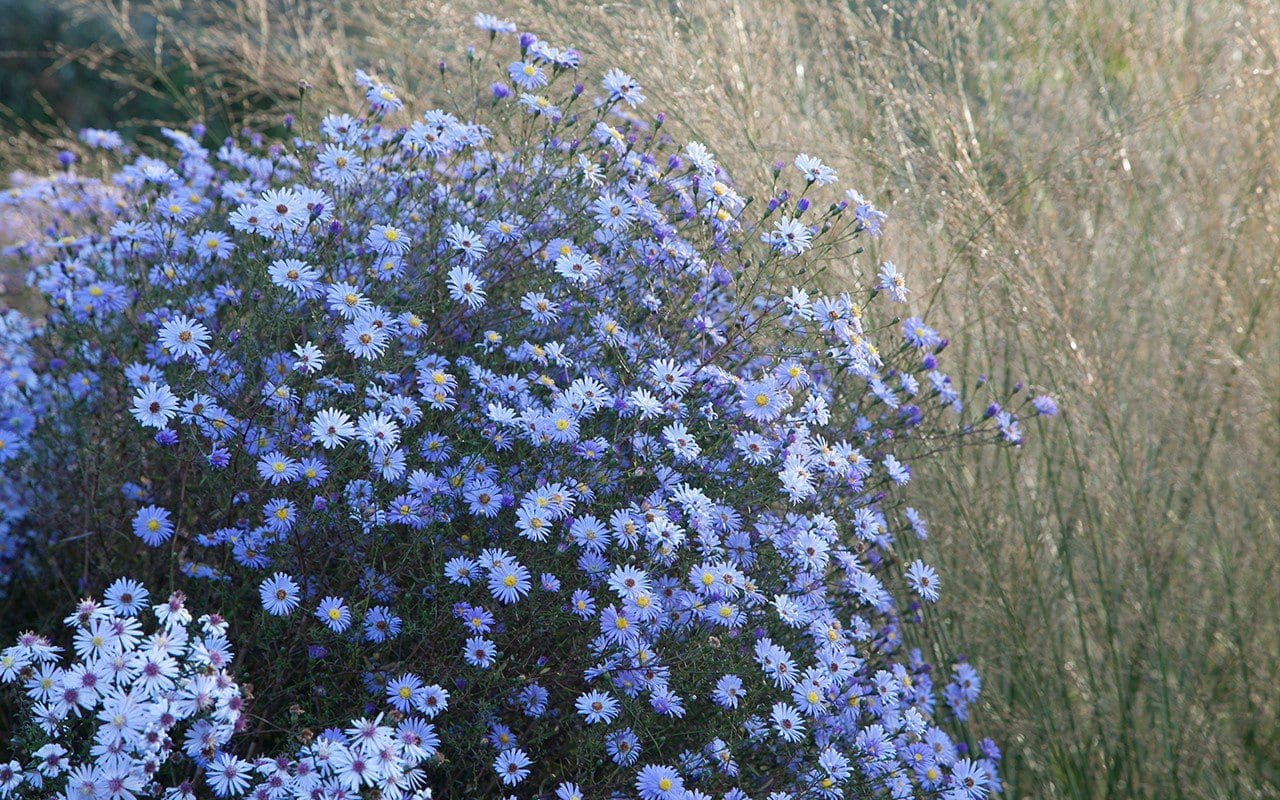 Aster turbinellus hybrid
My absolute favourite Aster turbinellus (the Prairie Aster), is one of the latest to flower, its season running from October into November if the weather holds out. It is exquisite for the air in the plant, the foliage being reduced to narrow blades and the stems wiry and widely-spaced so that it captures the wind and moves well. I’ve used it in great open sweeps in the Millennium Forest planting as the finale to the season there. The flowers, which are a bright lilac and finely rayed, have a gold button eye. I have a form simply named Aster turbinellus hybrid that has darker stems and dark buds that may be proving to be almost better than the straight species. I will keep them both for now and they may well be lovely planted together for the feeling that they are related yet different.
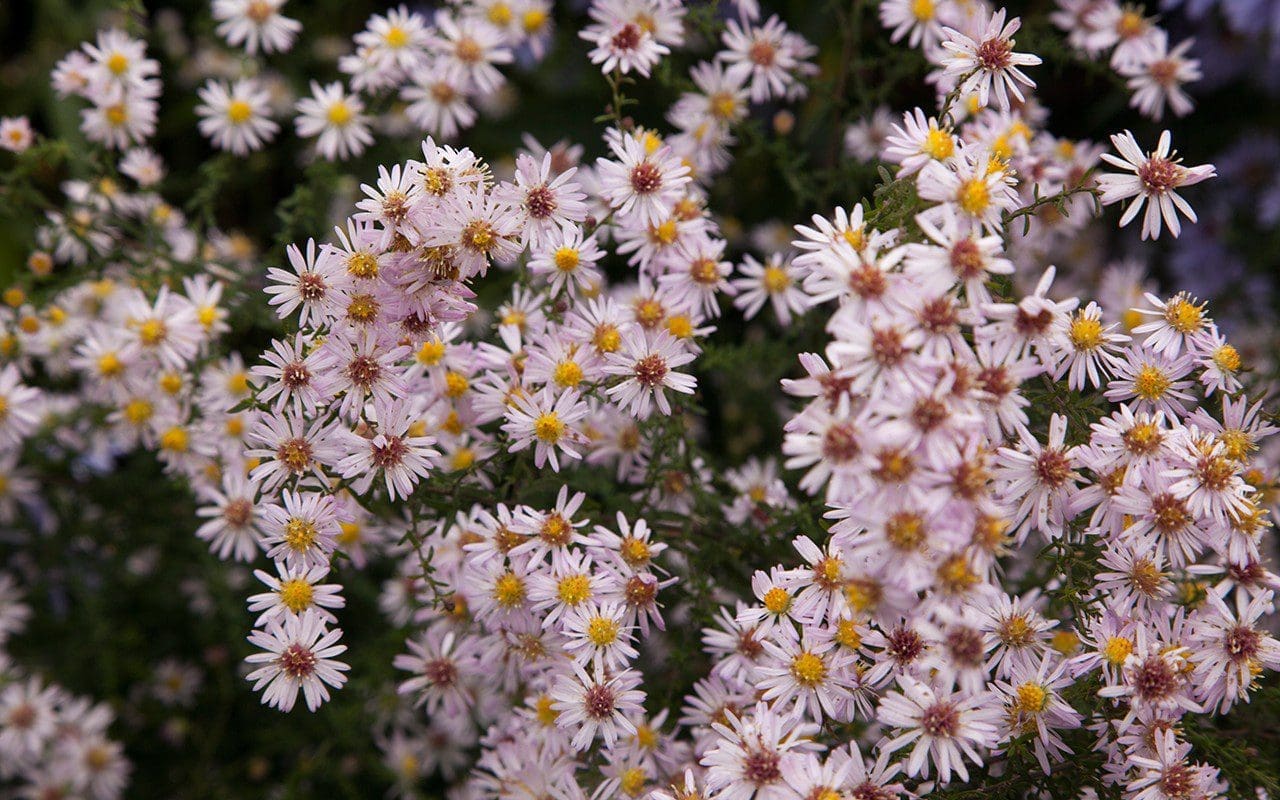 Aster ericoides ‘Pink Cloud’
Aster ericoides ‘Pink Cloud’ also has a reduced leaf, although it is altogether more dense and arching in growth. It is proving a valuable contrast for the size of the flowers, which are tiny and held thousand upon thousand in arching sprays. Palest pink, this should almost be too pretty, but I have enjoyed the scale shift when it appears with the larger-flowered forms. Together they layer and billow like clouds and I’d like to see them take the garden in a storm of their own making. Come the spring, it is all too easy to forget about including these late season performers in a planting. The notes I am taking now will remind me of their importance at this time of year and will be a useful reminder when I make the divisions for inclusion in the new plantings.
Words: Dan Pearson / Photographs: Huw Morgan
A new month today and there is a chill in the air and the grass is heavy with dew. The trees are yet to show colour, but the autumn bulbs are up and pushing a flare of brilliance against the drawing back that is happening around them.
Today’s posy, the first of October, captures some of this late vibrancy. I have known and grown Nerine bowdenii since I was a teenager. Geraldine, our neighbour, had them growing in the root zone of a huge fig at the foot of a south-facing wall. The fig had long outgrown any ambitions to be trained, but its lofty frame allowed you to walk underneath it and the sun to slide in and bake the ground at its feet. A good baking is what Nerine like as it makes them feel like they are not so far from their origins in the Drakensburg Mountains of South Africa. They grow there in rocky ground and, though they are capable of surviving a -15°c chill, a free-draining soil and reflected heat will help them to flower better here in Britain.
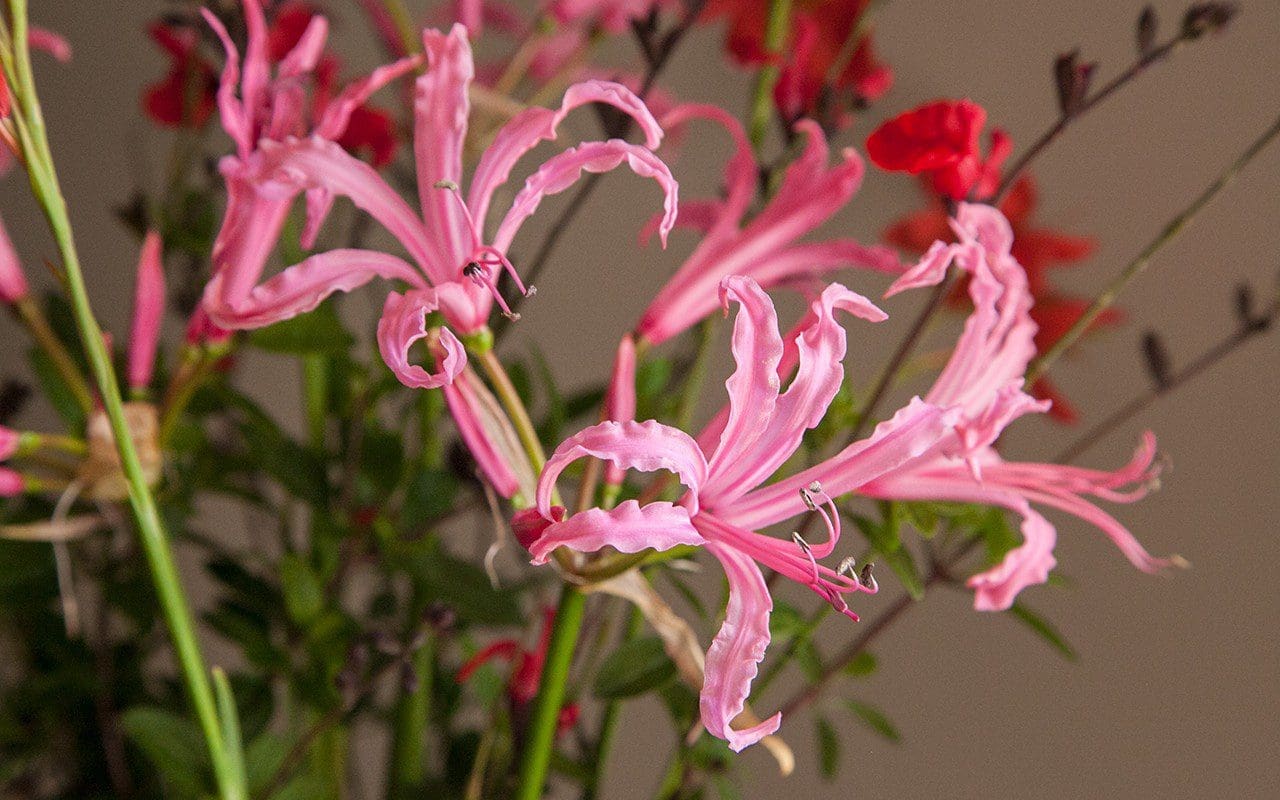 Nerine bowdenii
I have a collection of plants gathered from here and there as I have come across good forms. The best – the pure white ‘Blanca Perla’ and palest shell pink ‘Ostara’ – are kept in pots and brought up to the side door to keep us company when they are in flower. A mixed batch, which I bought unnamed and which range from white through to a hot sugary bubble-gum pink, are planted at the base of my espaliered pears in the Kitchen Garden. They get the benefit of a south-facing position, the radiated heat from the wall and, importantly, an absence of competition. Their foliage, which needs all the light it can get, hates to be overshadowed by neighbours so keep them to the front of a sunny bed if you want to grow them in company.
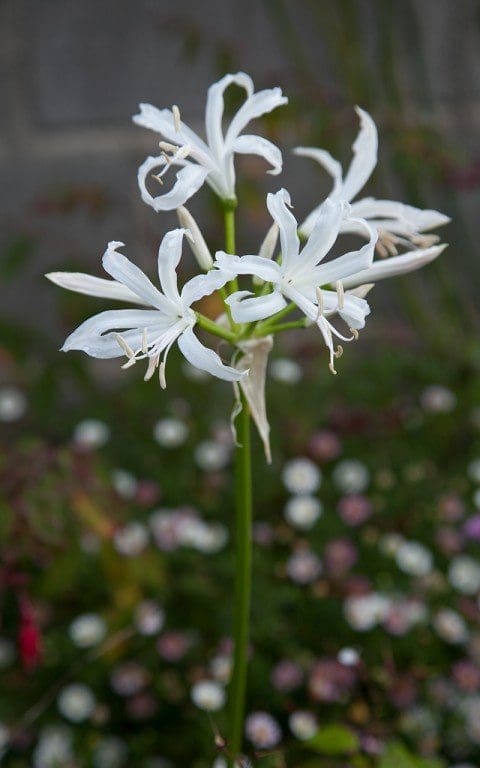 Nerine bowdenii ‘Blanca Perla’
A row of Geraldine’s bulbs, which I have moved about with me from garden to garden over the years, are shortly to be transplanted to their new position from the stock beds. The best time to move them is immediately after they have finished flowering as their foliage is becoming dormant then. I will move entire clumps and not divide them, as they flower best when in a tight community. Established clumps will tell you how they like to live, for the bulbs will mound up out of the ground to sunbathe rather than dwell below the surface as most bulbs do. I will plant the clumps on a hot, south-facing slope where the sun slides in under a limbed-up holly. Though there is the necessary light for baking the conditions are tougher there and the bulbs will put more energy into flower than leaf.
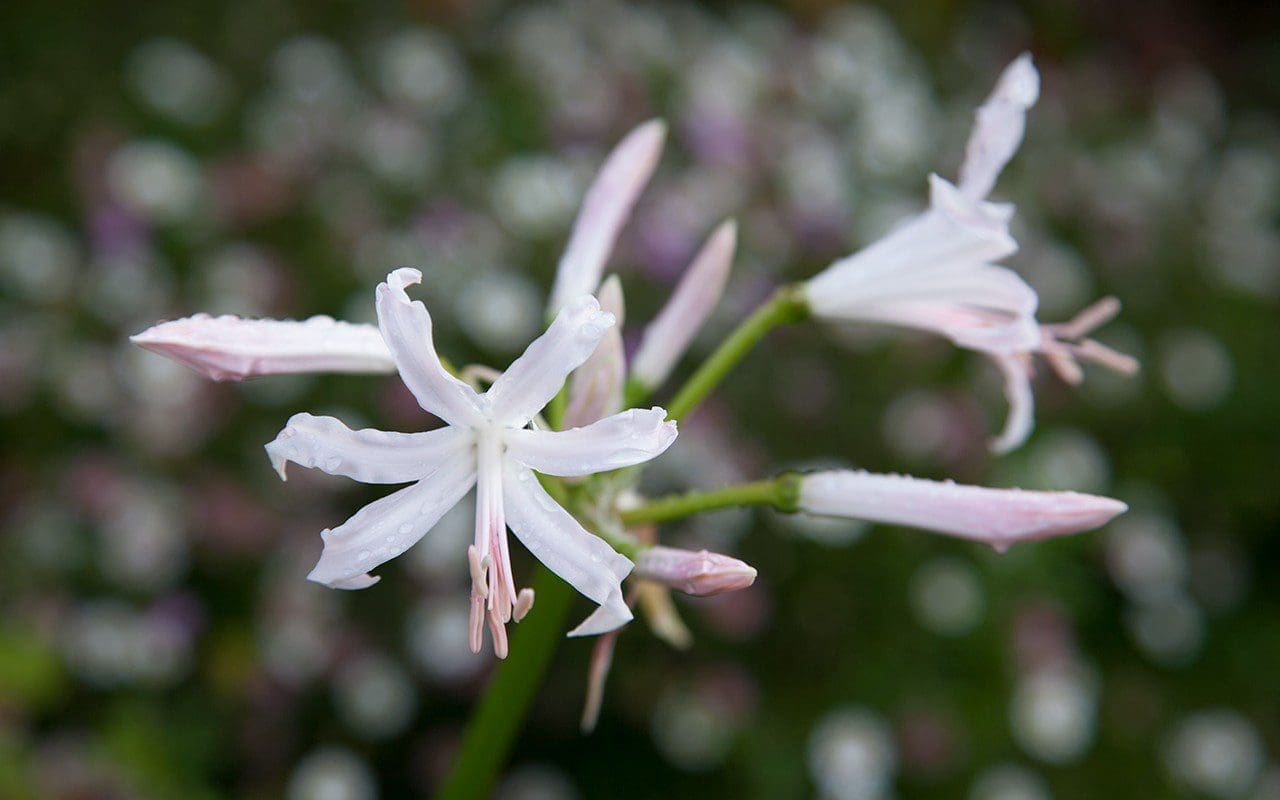 Nerine bowdenii ‘Ostara’
The flowers rise up as the summer foliage is waning and sap the last of its strength in the process. Tall stems – sometimes as much as a couple of feet – stand alone by the time the flower sheaths split in response to the flowers’ swelling. They are in flower for weeks, from early in September in some years, running on well into November if the weather is kind. As cut flowers they can last a good fortnight in a vase.
Schizostylis also hail from South Africa. In contrast to Nerine their foliage is almost evergreen, but they also hate competition and will fail to flower if overshadowed. However, here the parallel ends. They prefer damp ground or certainly moisture-retentive soil, so the posy makes a combination that is good for colour contrast, but not really achievable in the garden. That said, I have them here on the south-facing slopes and the plants have not complained in our hearty loam. They were given to me as spring divisions by Josie and Rachel, our neighbours up the lane. They run through their garden in drifts, appearing with asters and colchicum. So far, in the four years I have grown them in one place they have not needed dividing, but everything points to the plants needing it soon and they let you know when with shy flowering.
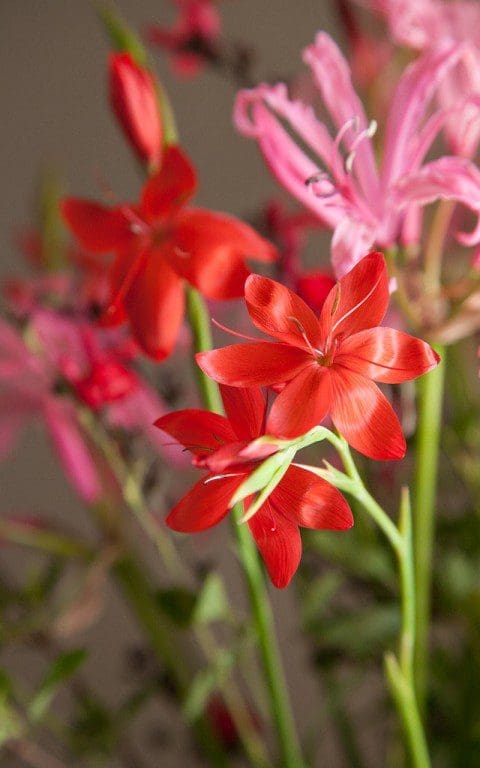 Schizostylis coccinea ‘Major’
Schizostylis coccinea ‘Major’ is probably the best and most commonly available form. The satiny flowers are a gleaming brilliant red. In the past I have experimented with ‘Sunrise’, a soft apricot-pink, and have ‘Mrs. Hegarty’ – a pale shell pink – from the same neighbours, but both seem to be shy-flowering in comparison. I may simply have not found them a home that suits yet. My rule is that you have to move a plant at least three times to give it a chance of finding its niche, so I’m holding on final judgement for the moment.
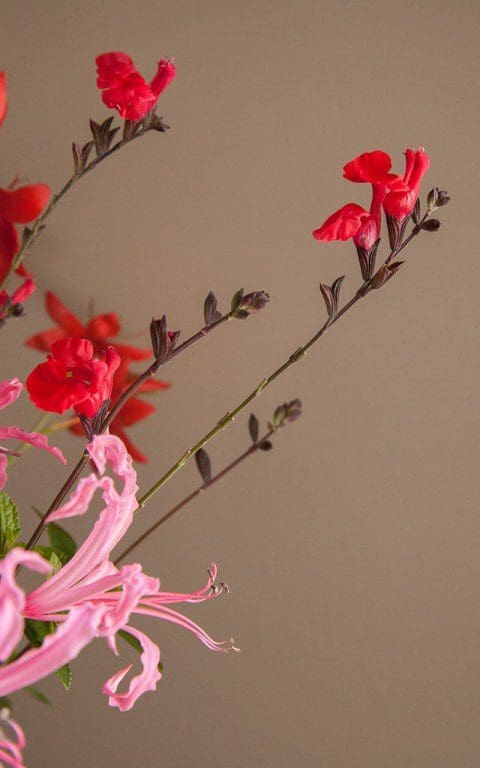 Salvia ‘Jezebel’
The Salvia ‘Jezebel’ is part of a salvia trial I’m running to find the good forms of Salvia greggii and it’s closely related cousins. The plants were selected from Dyson’s Nurseries three years ago now at the Dixter Plant Fair (running this weekend) and the best have proved themselves already. Bushy by nature and happy to live in your hottest, driest position, I have found they are excellent in pots or for prolonging the flowering period of a woody herb or mediterranean combination. ‘Jezebel’ has outgrown her neighbours, rising up to 90cm over the summer and flowering continuously since July. If you brush against them the sticky foliage and bronze calyces smell of blackcurrants and spice. The flowers age from a vivid cherry-red to a slightly softer pink before they fall. The bees love it and I know already that it’s a keeper.
Words: Dan Pearson / Photographs: Huw Morgan
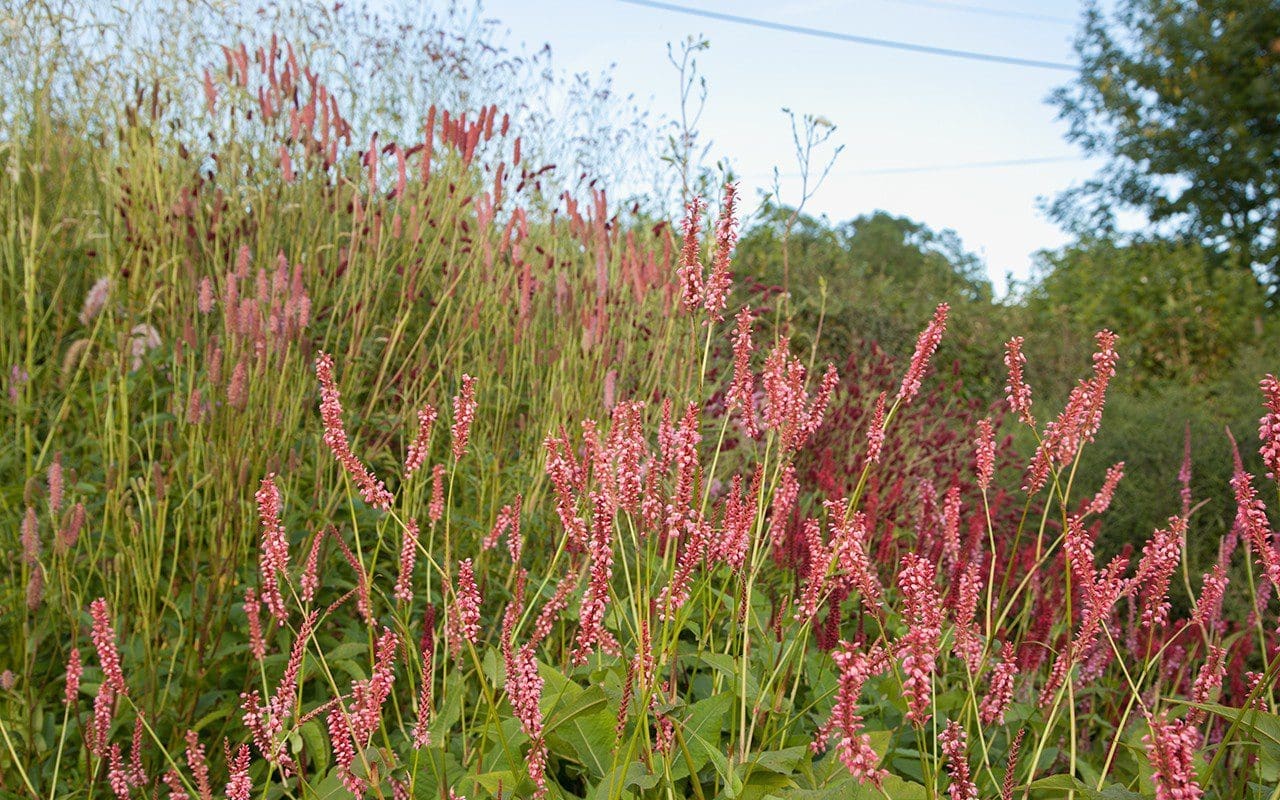
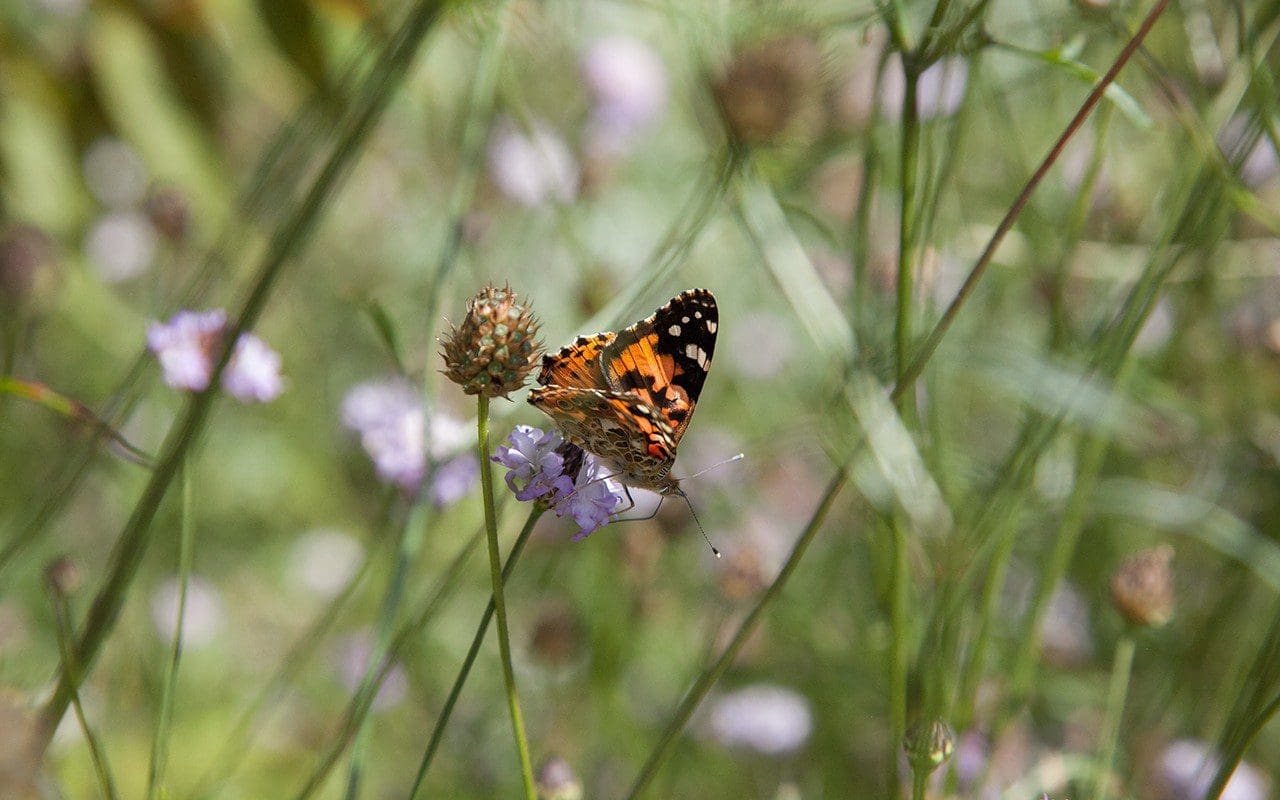
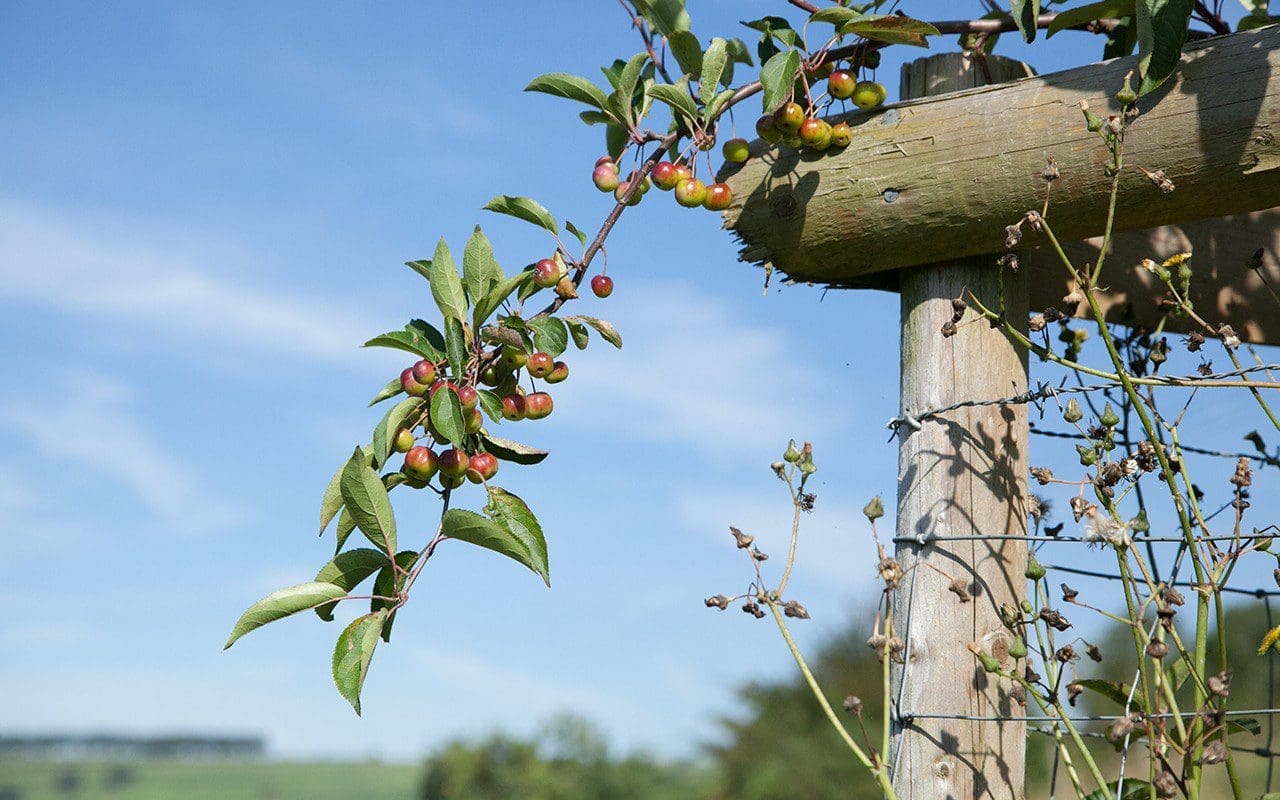
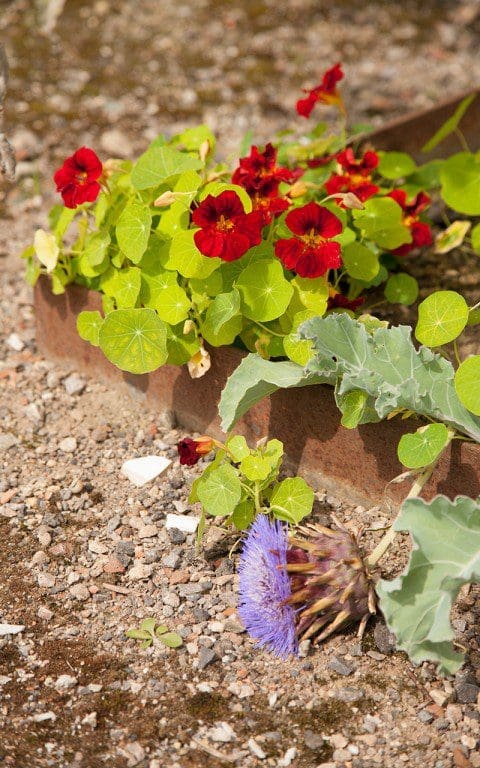
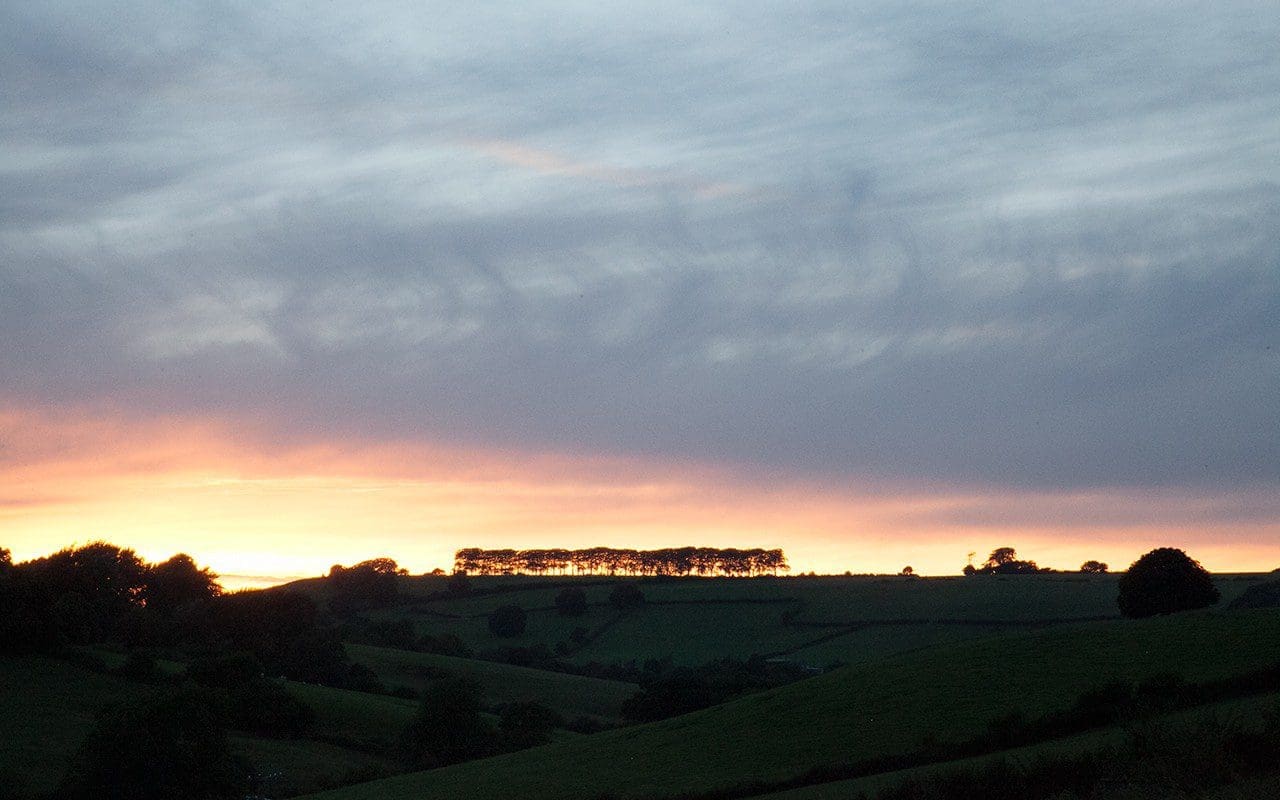
As the sun starts its descent towards autumn we are chasing it to Greece for a well-deserved holiday. By the time we return the spiders will be spinning, the apples will need picking and the garden will have begun it’s slow decline. We leave you with some late summer pictures of the garden at Hillside and the surrounding countryside to tide you over until we are back.

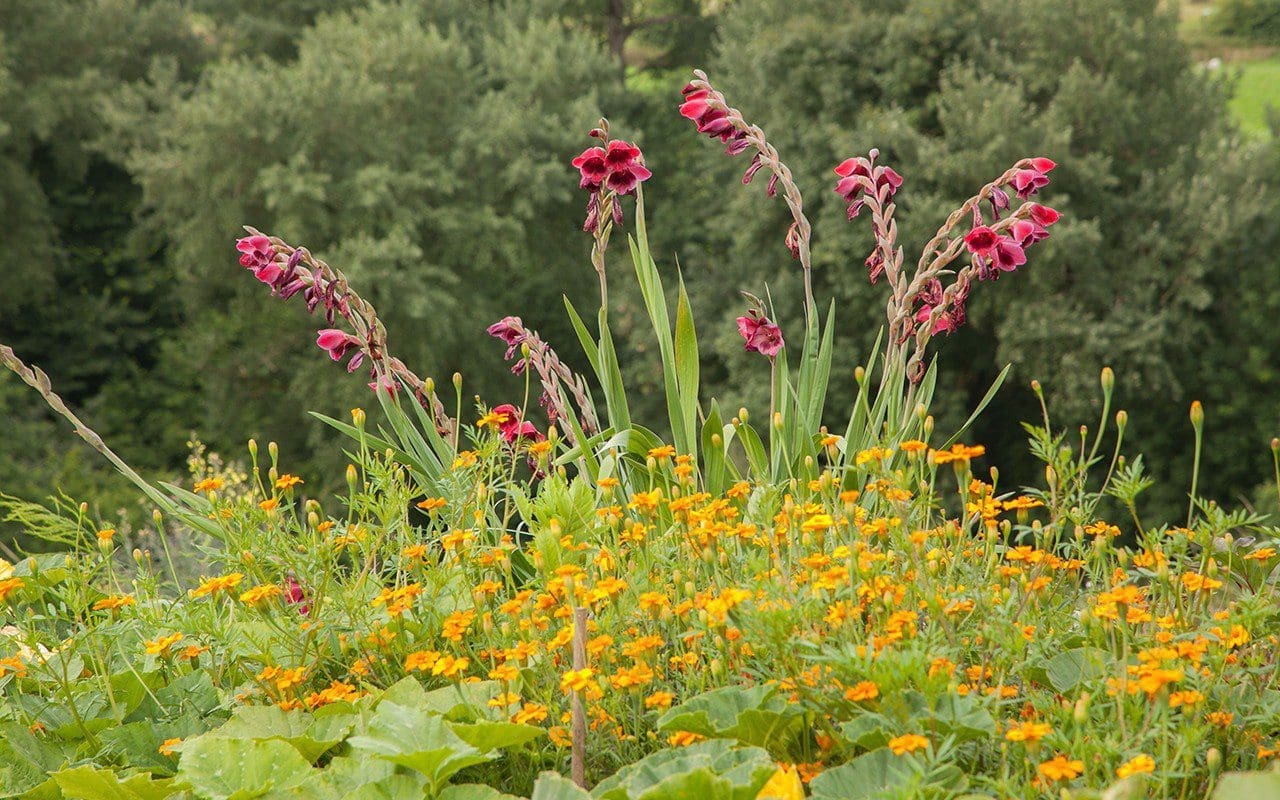
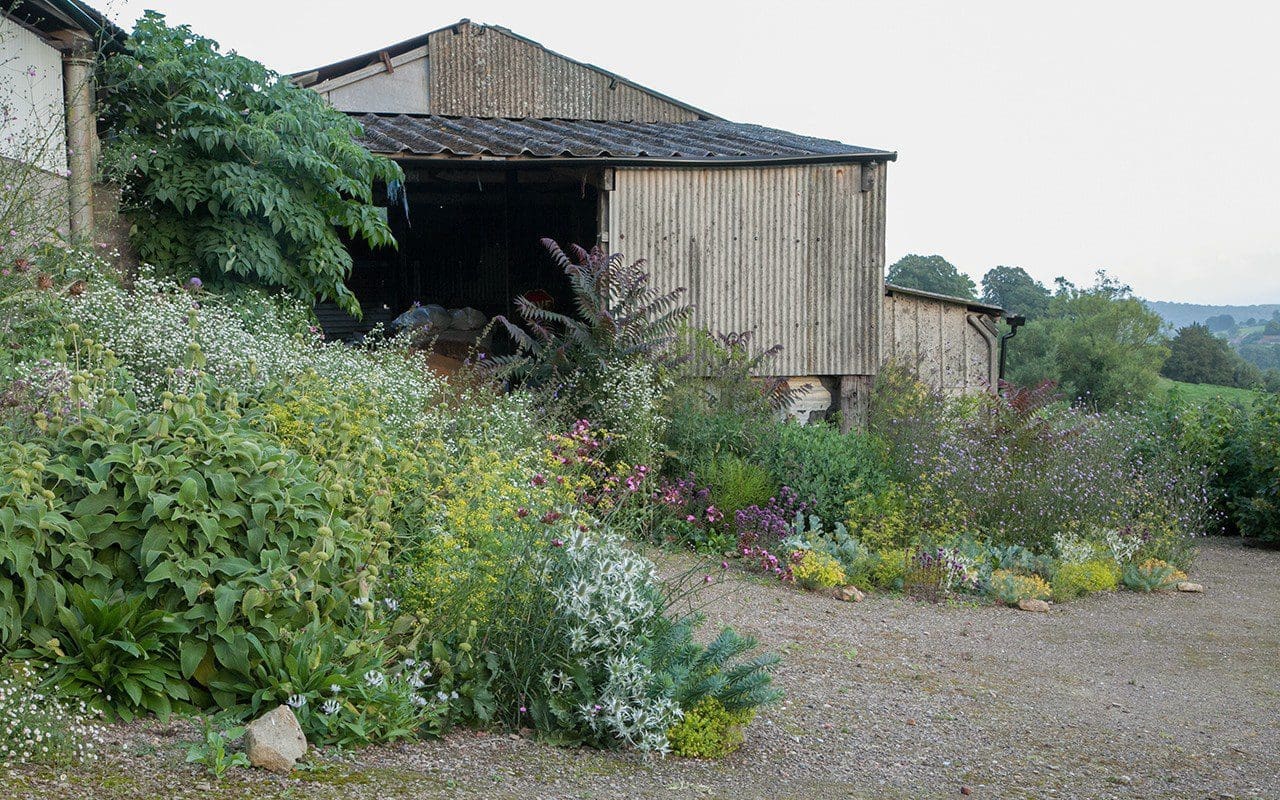
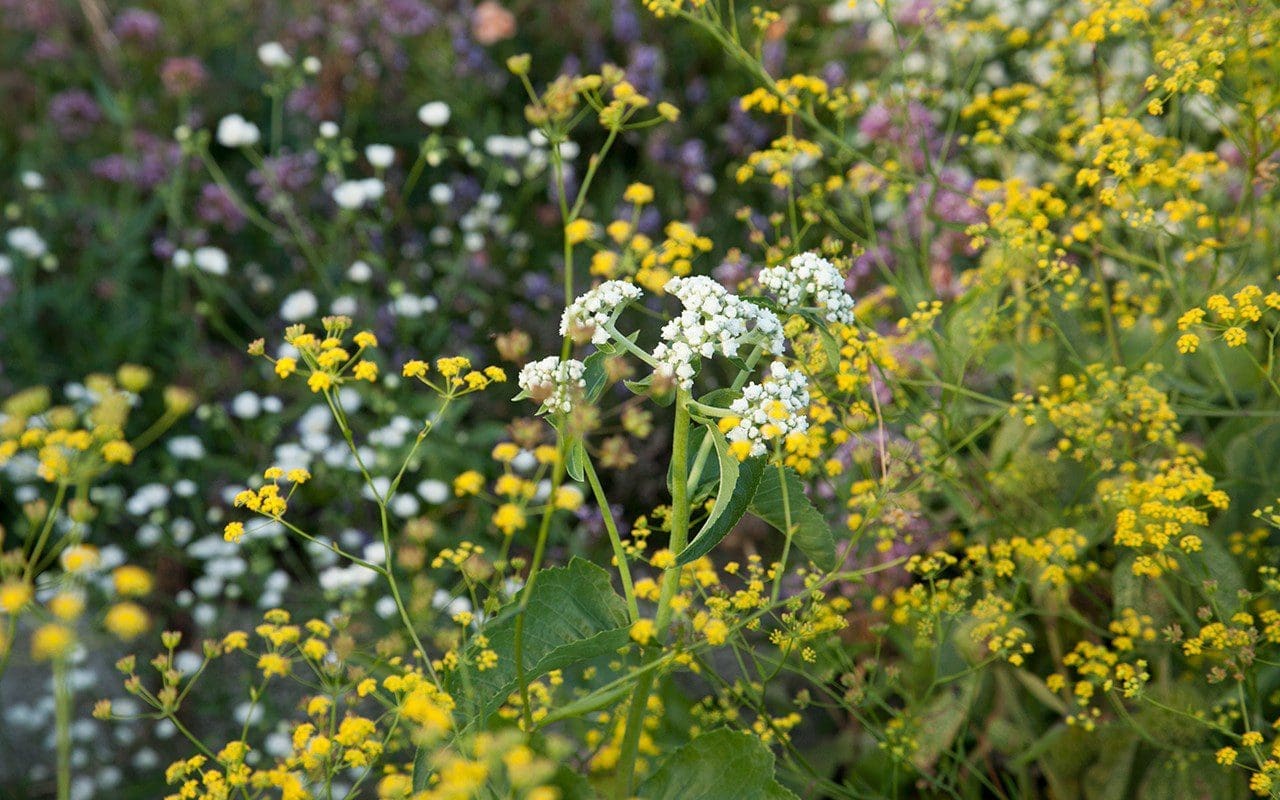
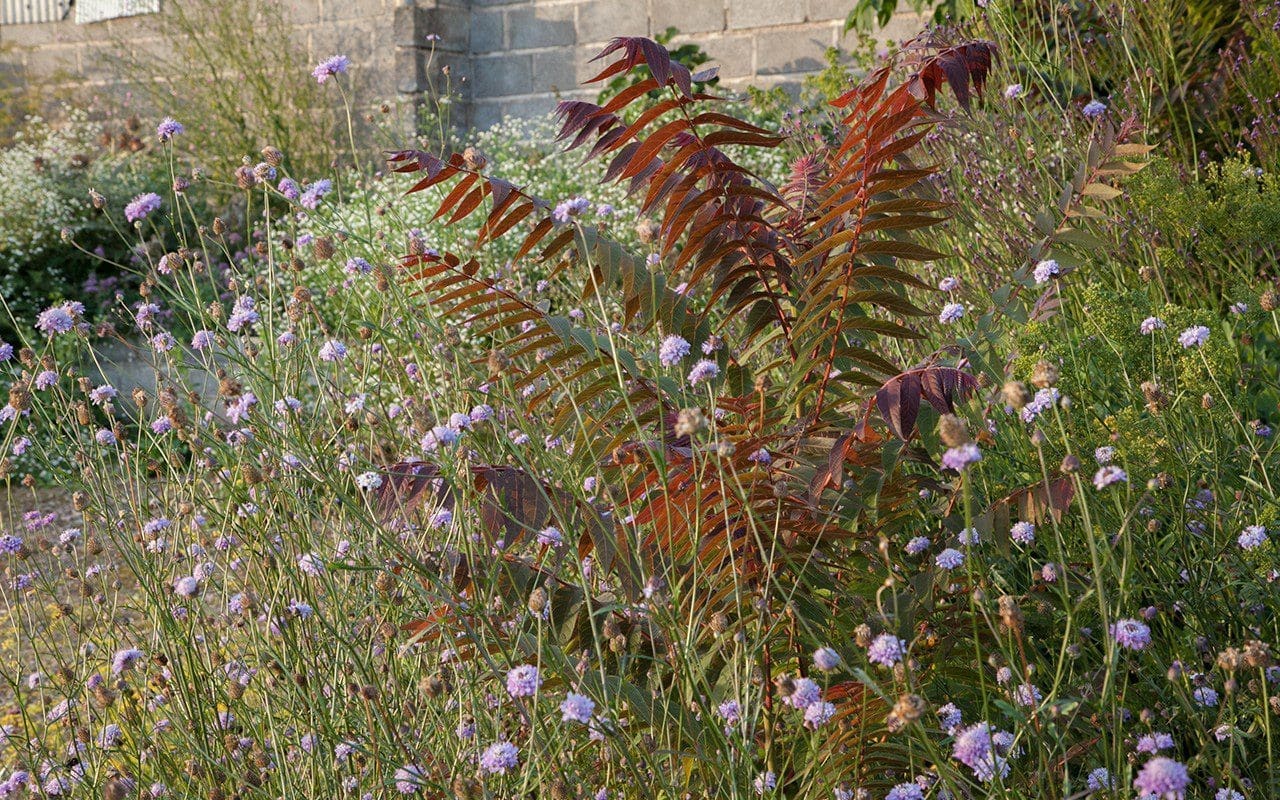
Photographs: Huw Morgan
The late summer perennials are upon us. The components of this bunch have all been out for a fortnight and have steadied the garden through the latter part of August, a difficult month that can all too easily see gaps opening up where earlier performers are spent.
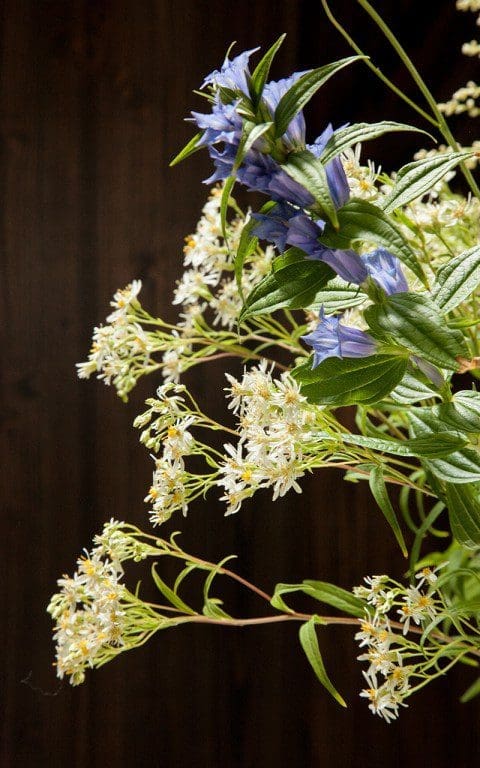 Gentiana asclepiadea with Aster umbellatus
Gentiana asclepiadea is the best-known to me. In fact this original plant is one that I have moved about with me since my Home Farm days, where I first used it. It is always listed as autumn-flowering, which is somewhat misleading, but I know when I start to see its colour that summer is ebbing.
Gentians are usually picky plants. We treated them casually when I worked on the Rock Garden as a student at the Royal Botanic Garden Edinburgh, but once back down south I soon learned that the majority prefer a cool, moist atmosphere with a humus-rich, acidic soil. Not so this lovely perennial. Grow it in retentive ground on the north side of something taller to give it a little shade in the hottest part of the day and it is remarkably adaptable.
It is a beautiful thing from the moment it emerges in spring, the leaves folded and shiny, like armour. The growth rises to no more than a couple of feet before arching under the weight of bud and revealing why it’s common name is Willow Gentian. The arching habit is what makes it such a delightful companion, for it covers the ground gently without overwhelming smaller partners. Since Home Farm this plant has travelled with me for twenty years and was moved a third time this spring to make way for the new landscaping. I was surprised to find it had grown into a clump that was difficult to manhandle alone. I will divide it in April and put it amongst hellebores on the cool side of the little barn. Here it is teamed with the lofty Aster umbellatus, but in the garden the smaller growing Aster schreberi will add the lightness it benefits from.
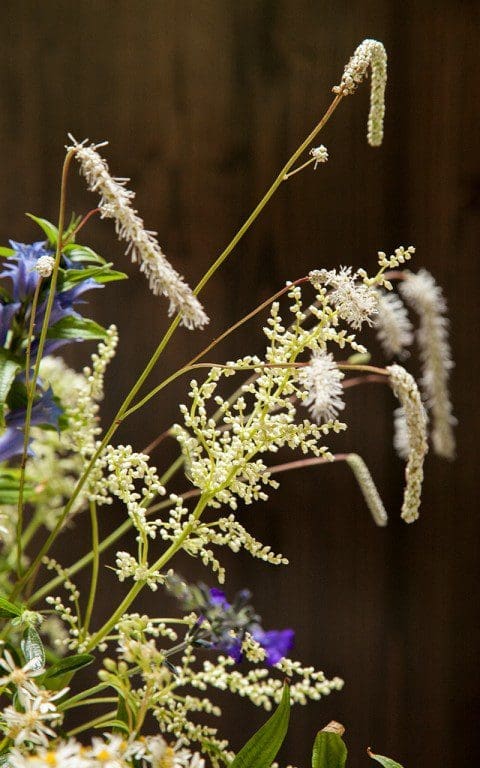
Sanguisorba tenuifolia ‘All Time High’ and Artemisia lactiflora ‘Elfenbein’
I grew the Aster umbellatus from seed Piet Oudolf gave me when I visited his garden late one autumn. It was out of flower, but stood proud and plateau-flat at two metres. This is its habit and why in America it is called the Flat-Top Aster. In the five years I’ve been getting to know it, it has never run from its clump or toppled or needed support. It is the first of the asters to flower here and I plan to use it with Sanguisorba tenuifolia ‘All Time High’, a Japanese burnet which has emerged as a good one in my sanguisorba trial. Its leaves are finely divided and help to keep the overall impression light and lacy. The flowers, dangling and scored like graffiti in bud, produce fine white filaments as they mature, like those of plantain flowers. They will hover around the aster’s tabletop.
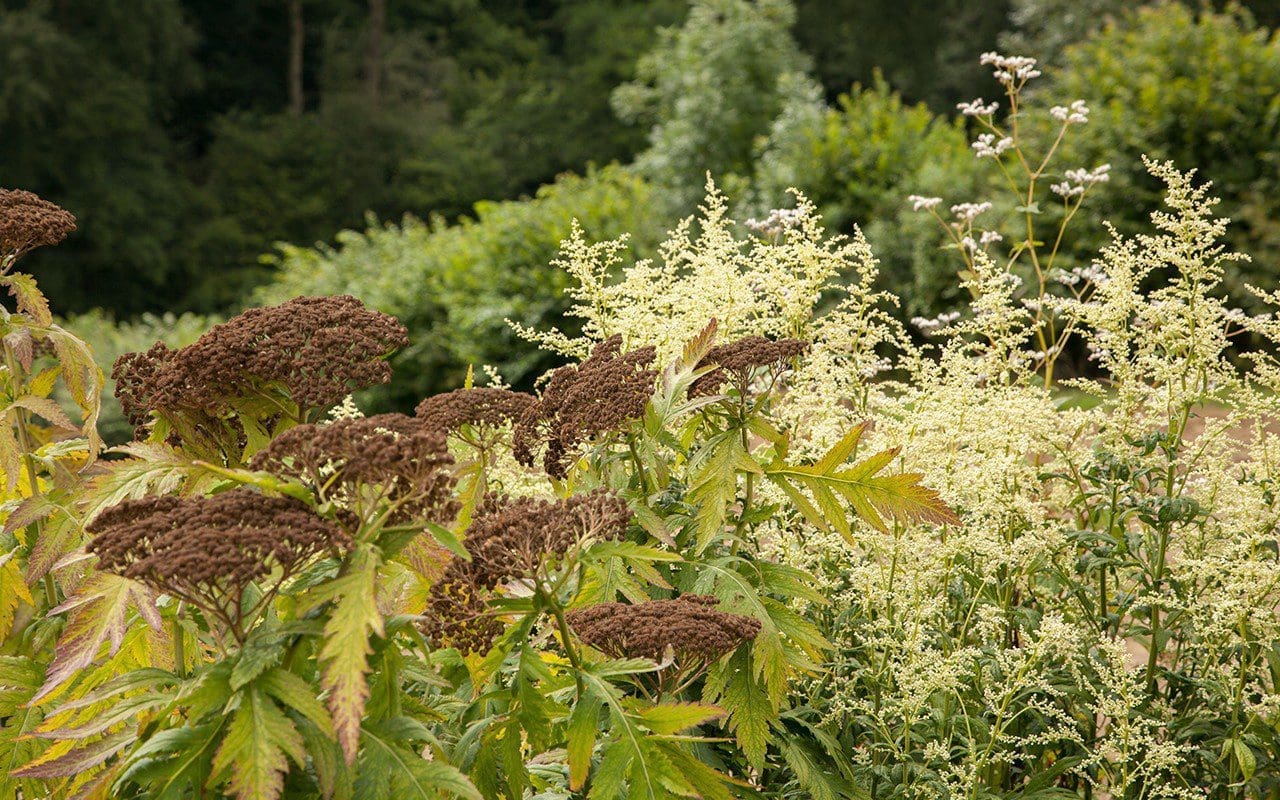
I must admit to having given up on Artemisia lactiflora ‘Guizhou’. I liked the idea of its creamy verge-side appearance and the dark, finely-cut foliage, but it always got burnt and has never done well for me. So, it was a surprise to be given this form – Artemisia lactiflora ‘Elfenbein’ – by Chris & Toby Marchant at Orchard Dene Nurseries. Dark green foliage, finely divided again, is the foil to the creamy flowers. It is has been well-behaved to date, happy on our retentive ground and nicely clump-forming. As I look out of the window now, it is filled with afternoon light, caught in its inflorescence and allowing your eye to travel from one cream grouping to another.
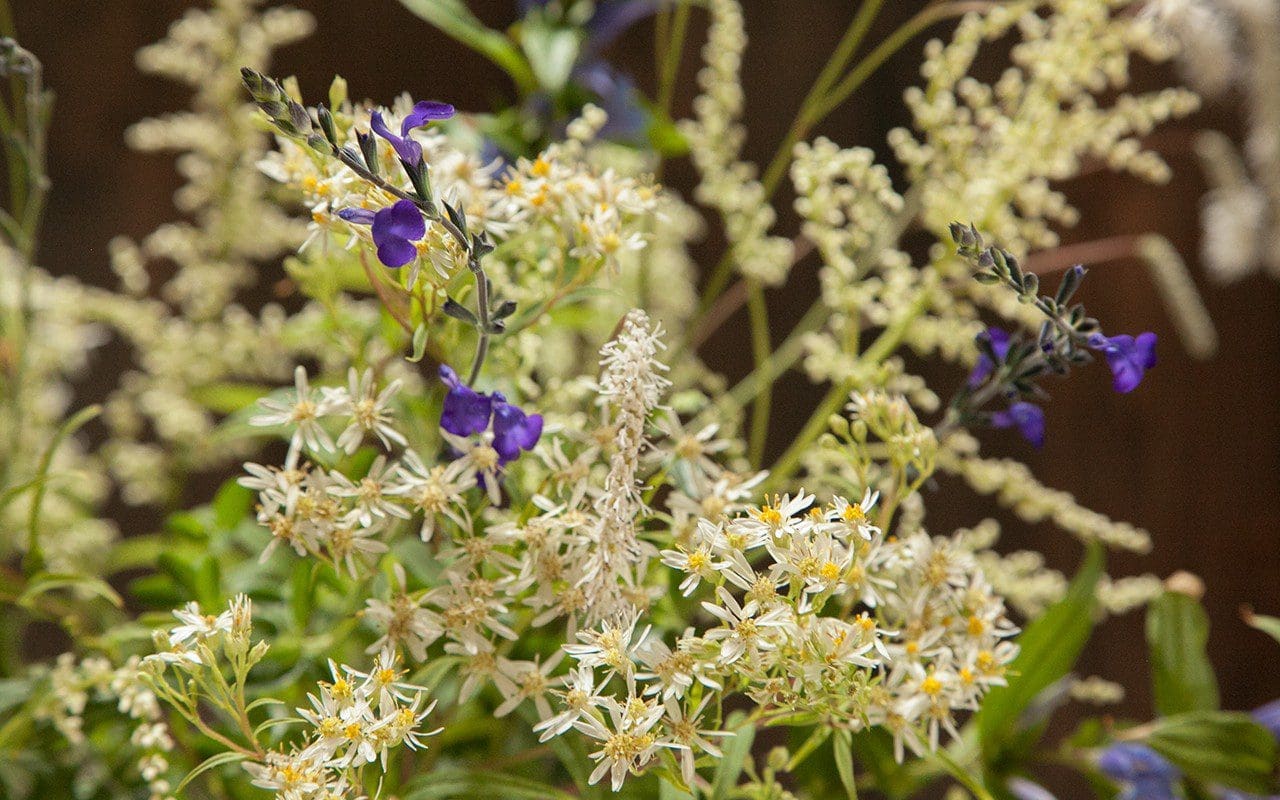 Salvia greggii ‘Blue Note’ and Aster umbellatus
Salvia greggii ‘Blue Note’ is not a plant I will combine with any of the above as it likes a hot, dry spot and is low-growing, but it does illustrate the importance of contrast and I like its inky darkness with the off-whites here. It is a great little plant, layering gently where it touches down and smelling muskily of blackcurrants when you brush the foliage. I see it combined with lavenders and have made a note to myself as a reminder to make the coupling next year.
Words: Dan Pearson / Photographs: Huw Morgan
This week has been an important one. The digger men are here, carving out the new garden and shaping the land around the house. A great divide of mud has marooned us. Venture out in any direction and you are met by instability.
There is nothing like the crunch of a decision having to be made to focus the attention on what you really need to keep. I have been taking out roses in full bloom to make way for new paths. After holding on for as long as I could, it was strangely liberating. A running rudbeckia and the bolting boltonia are now on the compost heap. I’ve been curtailing their spread since they came here, despite knowing that they were trouble. The inulas that were grown from seed are sitting in a heavy un-liftable knot that was levered by the digger and covered with damp hessian ready to be divided and potted up this weekend. Their removal has tuned my mind to decide where I eventually want them.
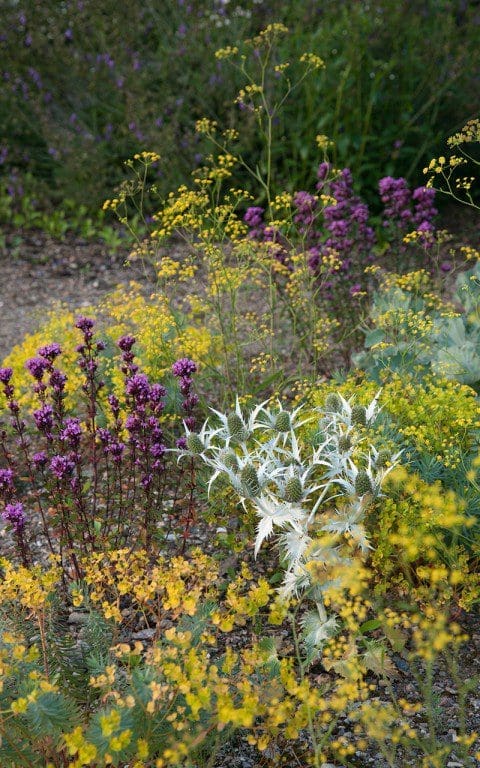
In planning for this moment I planted a sanctuary bed that runs at the front of the house, locked in by the path. Most of the plants here were grown from seed. You care more for seed-raised plants somehow and their volunteer seedlings have shown that they like it in this spot. Today’s posy illustrates something of the transparency in the planting. I want to see through it, for it to be light and for it to shift against the weight of the walls of the house. Yellows and greens and browns are the backbone of the planting. Of the half dozen in the bunch, the greater number are umbellifers. They make wonderful companions in associations that are naturalistically driven and bring the same feeling into a bunch.
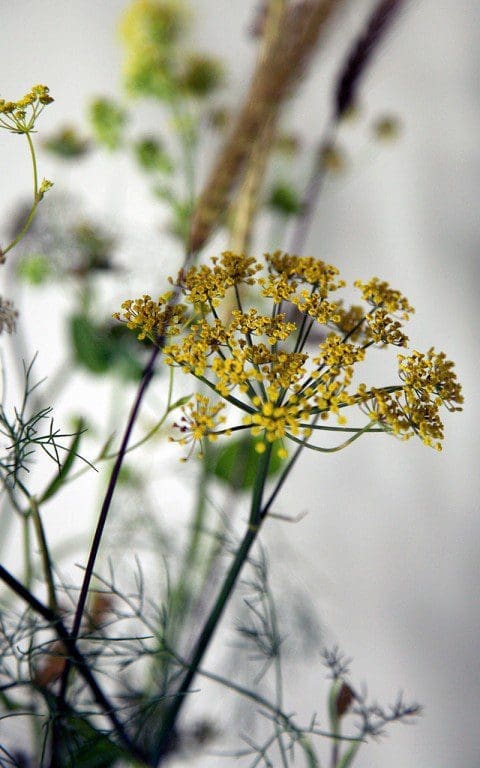 Foeniculum vulgare ‘Purpureum’
I have grown bronze fennel forever, liking the way it is from the moment its new growth pushes through to the point at which I have to cut away last year’s skeletons to make way for it. It loves our ground here, the sunshine and the free draining soil, so I only leave the plants standing over winter where I know the smoky haze of new seedlings can be managed. Now they are just showing flower, which has pushed free from the net of dark foliage. Foeniculum vulgare ‘Purpureum’ looks good with almost anything and I love the horizontality of the gold umbels when they mass more strongly later in the month.
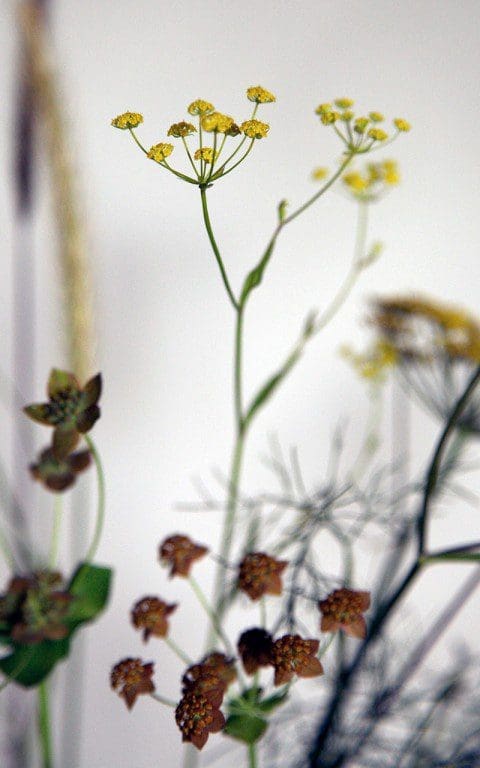 Bupleurum falcatum
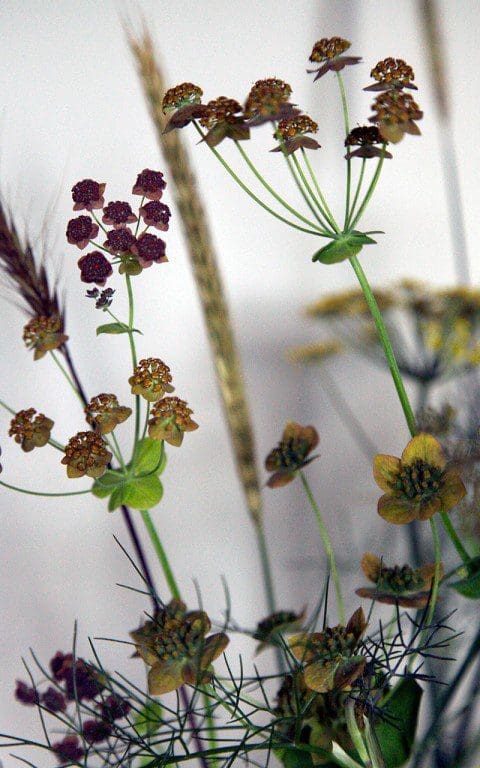 Bupleurum longifolium ‘Bronze Beauty’
The acid-yellow umbel in the mix is the biennial Bupleurum falcatum. I threw fresh seed into the rubble around the barns and potted some up to plant them where I wanted them. They have just started to flower and will continue to form a bright cage of flower, so small and filamentous that it creates a haze of vibrancy. Bupleurum longifolium ‘Bronze Beauty’ is it’s perennial cousin. I shall write more on this later as it is an old favourite that deserves more time.
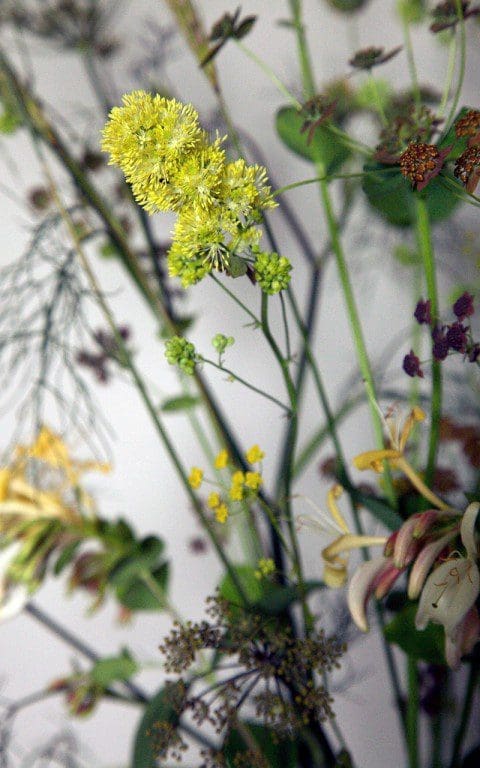 Thalictrum flavum ssp. glaucum
Thalictrum flavum ssp. glaucum rises up and above most of its companions on wire thin stems which catch our breezes, but there is no need for staking until they hang heavier with seed. I cut them to the base to avoid the seedlings at this point as the clumps are long-lived and you need just a handful to make an impression. The fluffy flowers are a pure sulphur-yellow and the leaves are the blue green of cabbages but fine, like lace.
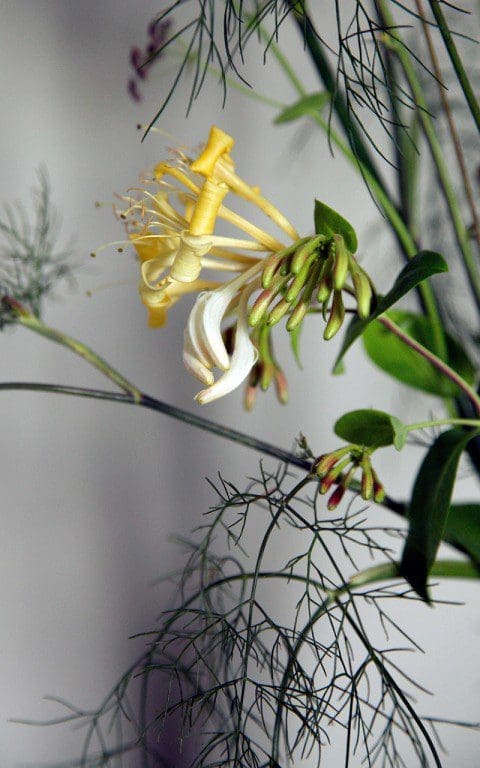 Lonicera periclymenum ‘Graham Thomas’
This is a good selection of the wild honeysuckle called ‘Graham Thomas’. I first saw it growing on his house when we were taken to meet him as Wisley students. I had no idea then how influential a plantsman he was, nor how much I would have enjoyed his namesake all these years later. I much prefer it to the brickier, shorter-flowering varieties such as ‘Belgica’ and ‘Serotina’. It also flowers far longer than its native parent and, after its first July flush, continues off and on into September.
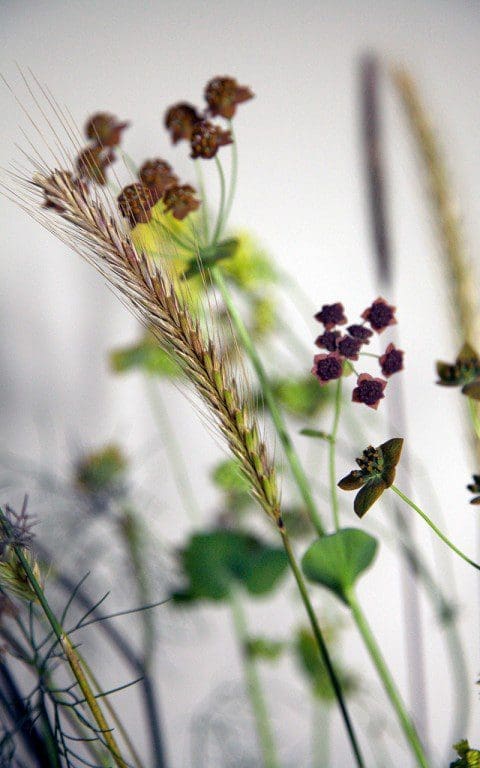 Hordeum bulbosum
The bulbous barley, Hordeum bulbosum, was collected on a trip to Greece a few years ago. It has proven to be completely perennial, retreating to a basal cluster of storage organs after flowering. I cut it before it seeds to limit its spread, as it germinates freely. In Greece the storage organs (which give it its species name) would keep it alive during a summer without rain to reactivate growth in the autumn. Here, without a water shortage to speak of, it is happy to return with a second flush in September. The flowers are early, rising in April, to trace every breath of wind outside the windows.
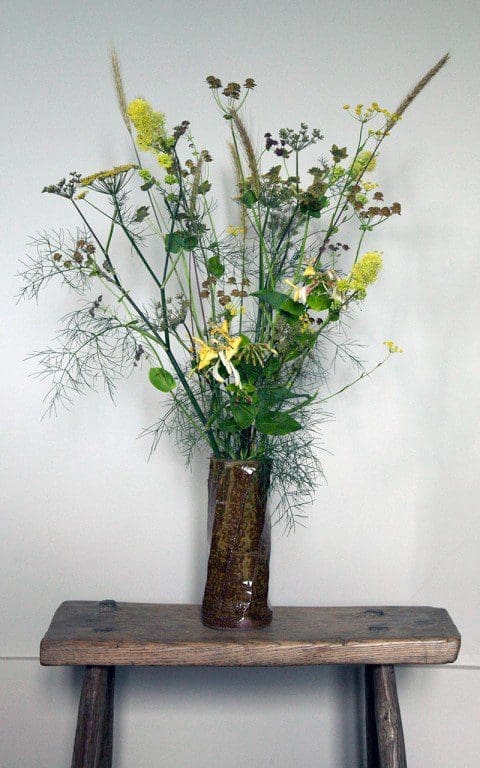
Words: Dan Pearson / Photographs: Huw Morgan
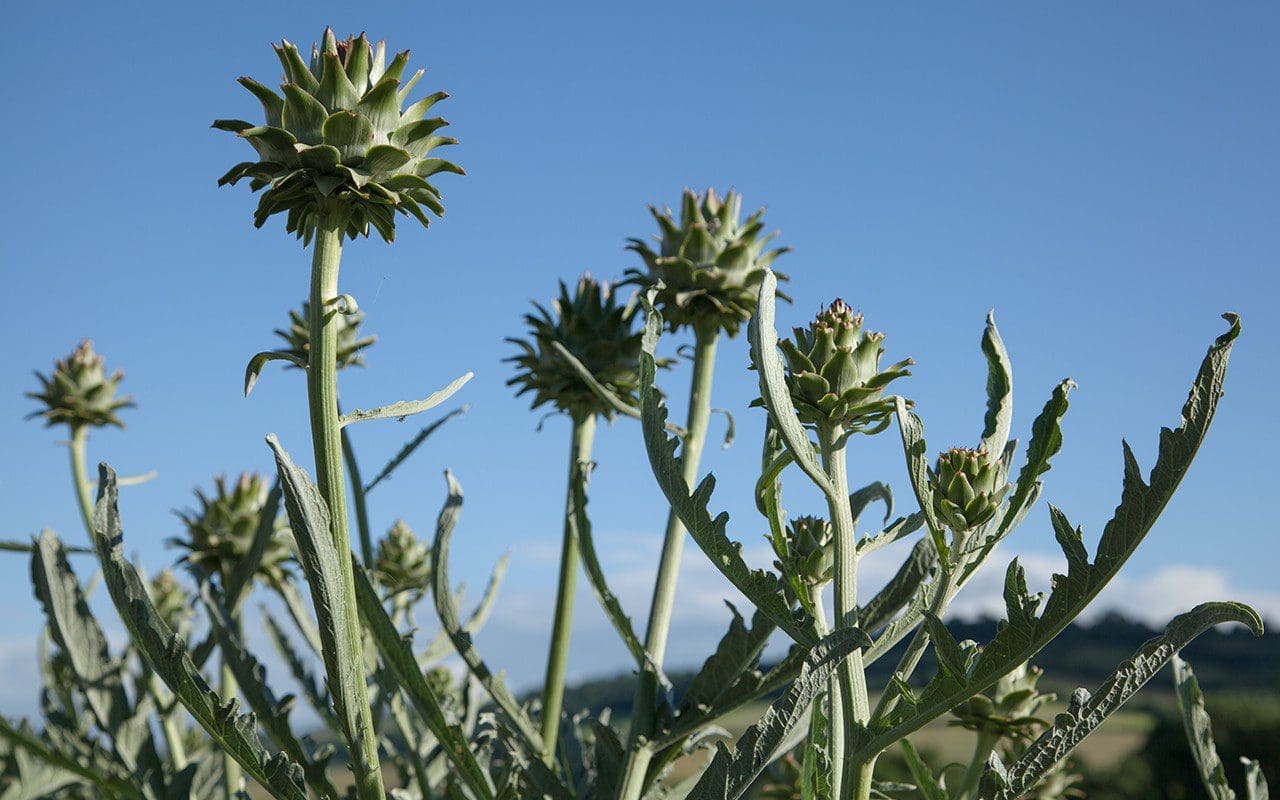
The globe artichokes (Cynara cardunculus Scolymus Group) were some of the first plants to go into the new kitchen garden. They are a luxury vegetable, taking far more space than they provide reward for and shading their neighbours if, indeed, there is room left in their shadow. Nevertheless, I gave them a bed to themselves, in prime position and against the radiated heat of the newly built wall.
They have grown in spectacular fashion – which is the greater part of the reason for having them – doubling and trebling their bulk in the course of the first summer and continuing onward to take all the space which was offered them. Cold weather in combination with winter wet is their nemesis but, since they were planted, both winters have been mild and they have only had a brief down time in the darkest months when they retreat to a core cluster of leaves.
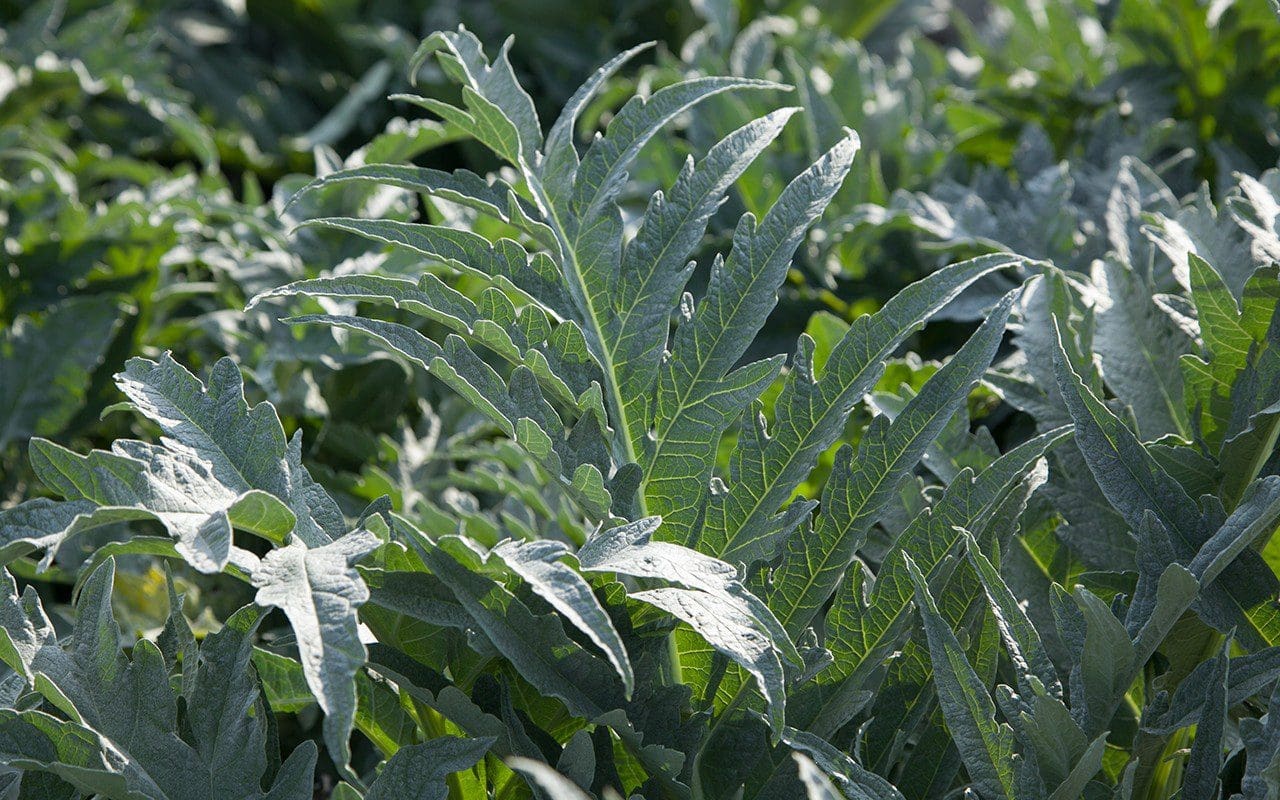
Their aluminium foliage is wonderful in its ascendancy and as good as acanthus in its architecture. As soon as the weather warms in March it reaches from the clump, each leaf larger and more dramatic than the last, scrolling and bulking steadily until you see that, some time in May, the parent foliage has gathered enough energy for the flower spikes. These push proud of the forest of leaves, but it is whilst the heads are small that you need to curtail their reach and harvest the artichokes.
We grow a variety called ‘Bere’, which Paul Barney of Edulis Nursery offers, and is the selection his father found growing in the walled garden there in the 1950’s. It is spinier than some of the named varieties, but Paul says it is the best tasting of them all. Indeed, it is a wonderful plant if you pick the heads whilst they are still young and before they are fully armoured. The best and meatiest parts are still soft when the leaf spines are forming, but leave them to harden and fulfil their thistly leanings and you end up with an impossibly fibrous mouthful.
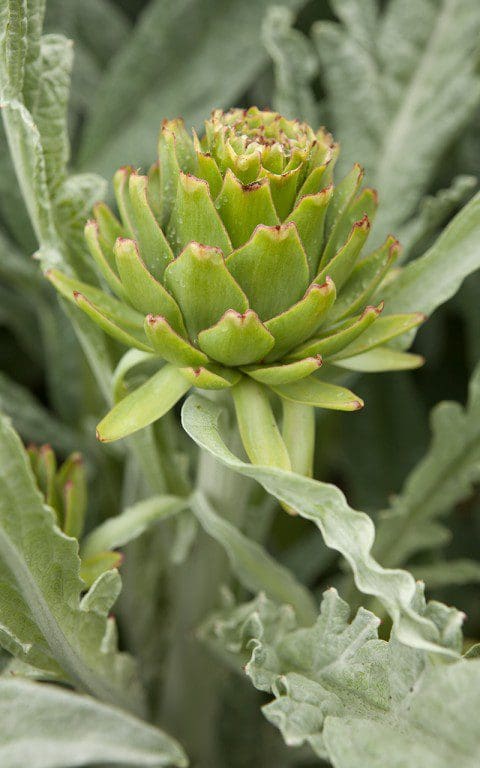 Cynara cardunculus Scolymus Group ‘Bere’
I plan to split my clumps in the spring, when growth is on the move and the crowns are manageable. Being mediterranean, they start life as soon as there is warmth and moisture in combination but, being sensitive to the cold, you have better chances in spring than if you move them at end of the season. It is a two-man job to lift the clumps and then prise a division, with root, from the clump. The divisions or ‘starts’ will be planted in the new herb garden, where they will provide ornamental architectural structure amongst the herbs.
I have six plants now, far too many of the same variety, so the plan is to thin the ‘Bere’ to three and equal it with the same number of purple-tinged ‘Romanesco’ to make up the half dozen. ‘Romanesco’ is an altogether friendlier plant without spines, and the scales that form the thistle head are soft and can easily be harvested and prepared without the need for gloves.
Each plant will be spaced a metre apart and inter-planted with stands of bronze fennel, which will cover for the artichokes’ collapse, which happens in high summer once all their energy has gone into flower production. At this point, once the old leaves start to fail revealing bare ankles, it is best to cut the lot to the ground and let the foliage regenerate. It will be back for the autumn, whilst the fennel covers during the recovery period.
In Italy the cardoon is also prized in the early spring for its edible leaves. The midribs, which look like celery, are stripped of the leaves and fibres, and then blanched and buttered, or baked in a gratin. You need rhubarb amounts of room for such a short season vegetable, but if you do have a spare corner in sunshine they are sure to provide you with drama at the very least.
I first grew the ornamental cardoon (Cynara cardunculus) as a border plant at Home Farm. Innocent looking divisions arrived from Beth Chatto, as beautifully wrapped in damp newspaper as they are described in her catalogue. They were planted in an ambitious group of three on a sunny slope and took their position, rearing up in a mound of metallic foliage. Tapering in August to a magnificent pinnacle of branching flower, the plants reach about three metres in height, and need staking if they are not to topple once the flowers break colour. Look up and you see bees staggering about drunk on the fist-wide pools of neon violet filaments.
The butterflies love them too, but the giant needs to be felled if it is not to leave you with a gaping hole once the collapse starts to happen. At Home Farm I planted it within a corral of late summer perennials, spaced at a sensible distance so that they can swallow the hole whilst it regenerates. Asters and rudbeckia will do the job, but you have to give the cardoon space in spring as it is an early season riser.
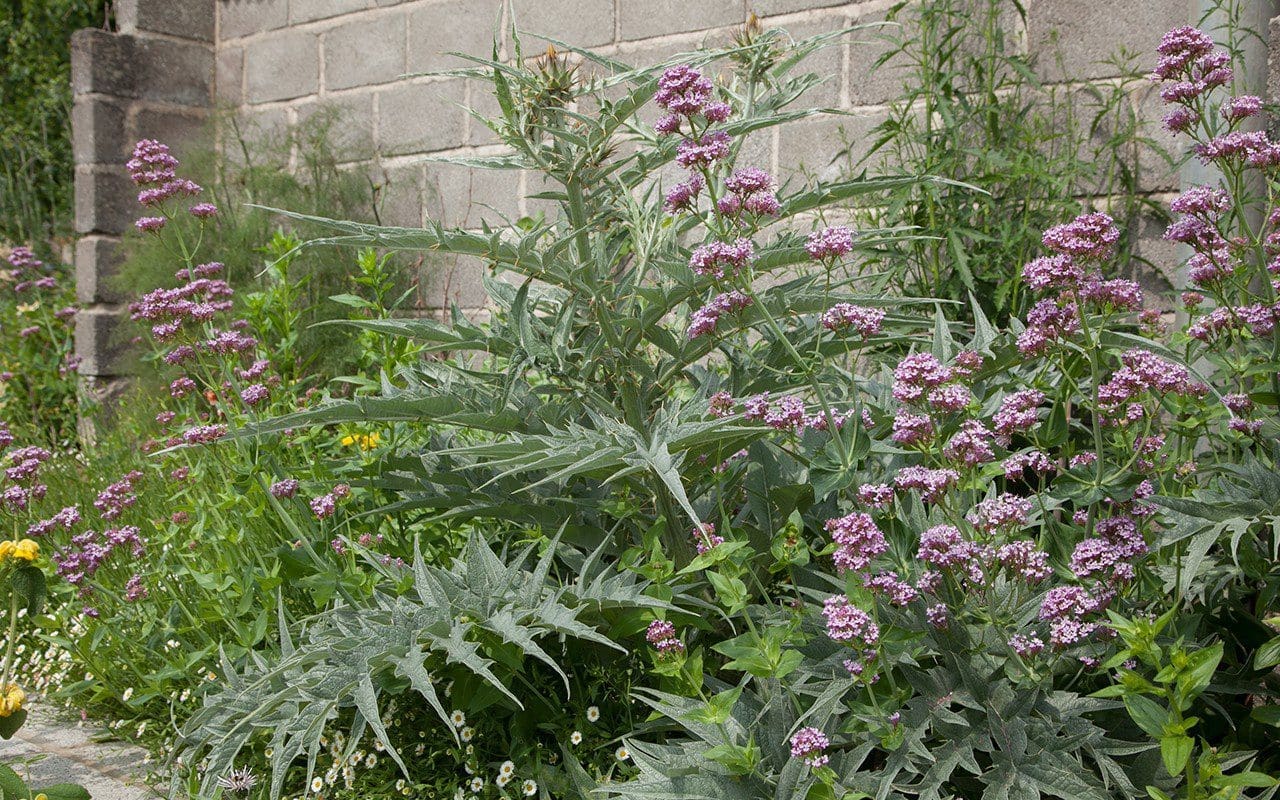 Cynara cardunculus ‘Dwarf Form’ with Centranthus lecoqii
Fergus Garret pointed me to a dwarf form that they have in the garden at Great Dixter and I grow it here against the barn. I am not usually a fan of plants selected for dwarfism, but this cardoon makes for a better-behaved plant. It is distilled in all it’s parts, and more evil to the touch, the undersides of every leaf defended with an armoury of needle-sharp spines. Its foliage is as beautiful, possibly more finely divided, and certainly more compact. It tops out at about a metre and so avoids the need for staking. In the border where I grow it with Centranthus lecoqii and Romneya coulteri it has taken it’s territory, but the repercussions are altogether more manageable, and I still feel I have the drama I am looking for.
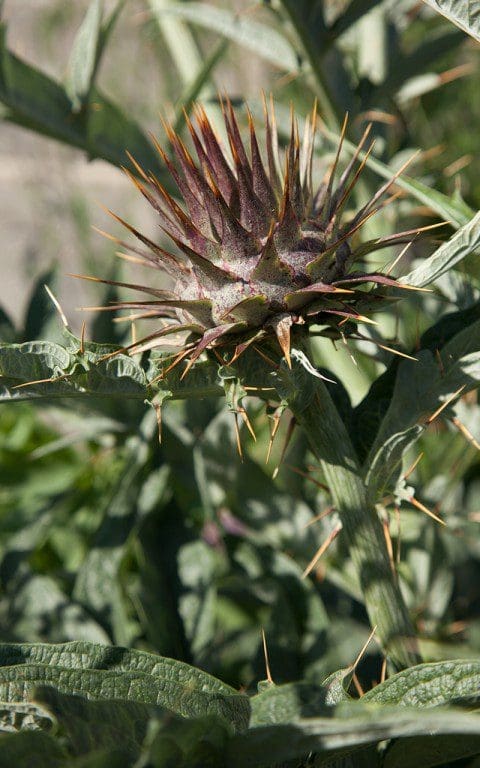 Cynara cardunculus ‘Dwarf Form’
Words: Dan Pearson / Photographs: Huw Morgan
The third week in June, around the solstice, is when the roses are at their best – first flowers opened and buds yet to come. The week usually coincides with weather and this bunch was picked just before a black sky gave way to thunder, lightning and downpour.
The roses are part of my trial of getting to know good garden plants. There was never room to indulge their showiness in the Peckham garden and, when we arrived here, they were one of the first things that were planted. I felt I could get away with them if they were treated as part of a productive garden. They push against the flow of what we want to do here and couldn’t be more out of place with the landscape backdrop. But a bunch brought in for the house is an opulent indulgence.
They are now in their sixth summer and I am beginning to see which are the good ones and which are the weaklings. There are twenty four varieties in total, all David Austin selections and each was chosen for their perfume, colour, flower shape and general mood. Here are a bunch of a half dozen.
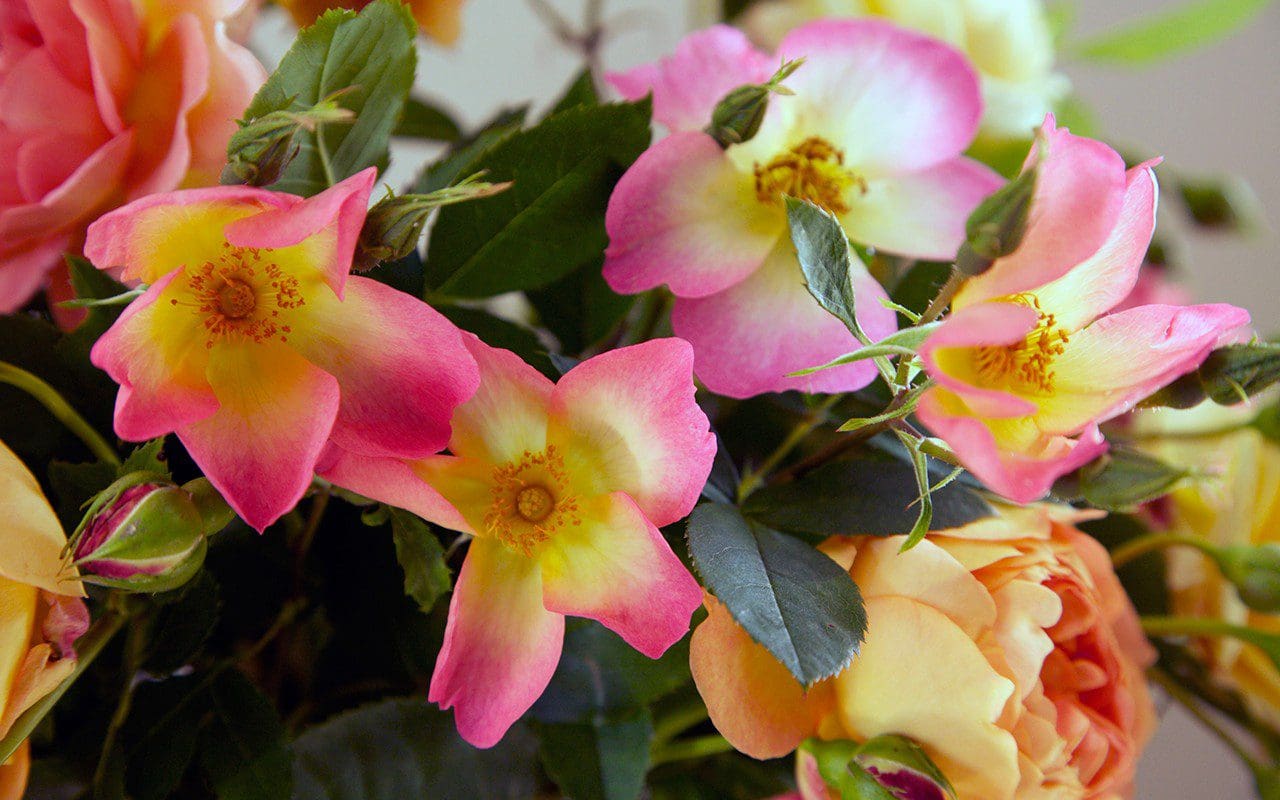 The Alexandra Rose
I like to have singles in the mix as they bring a little of the wild as a contrast to the doubles. The Alexandra Rose is one of my favourites, making a relaxed bush and open sprays of flower that fade as they age.
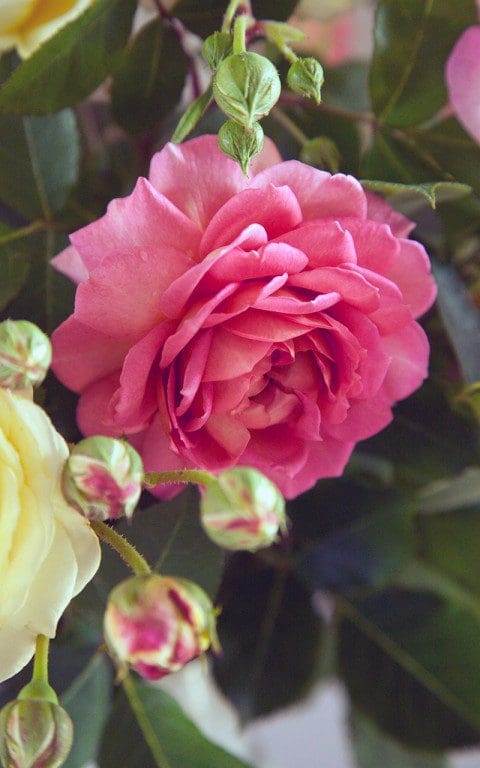 Jubilee Celebration
Jubilee Celebration is perhaps the weakest plant, but not unhealthy, and it has a strong true rose scent. The colour is a very distinctive old rose which ages to apricot. It is also a wonderful shape with backward curled petals.
 From the top; Pat Austin, Lady of Shallott & The Lark Ascending
Pat Austin is a rangy grower, but healthy and consistent. The flowers are a golden peach, slightly pendulous on the bush and smell of Earl Grey tea.
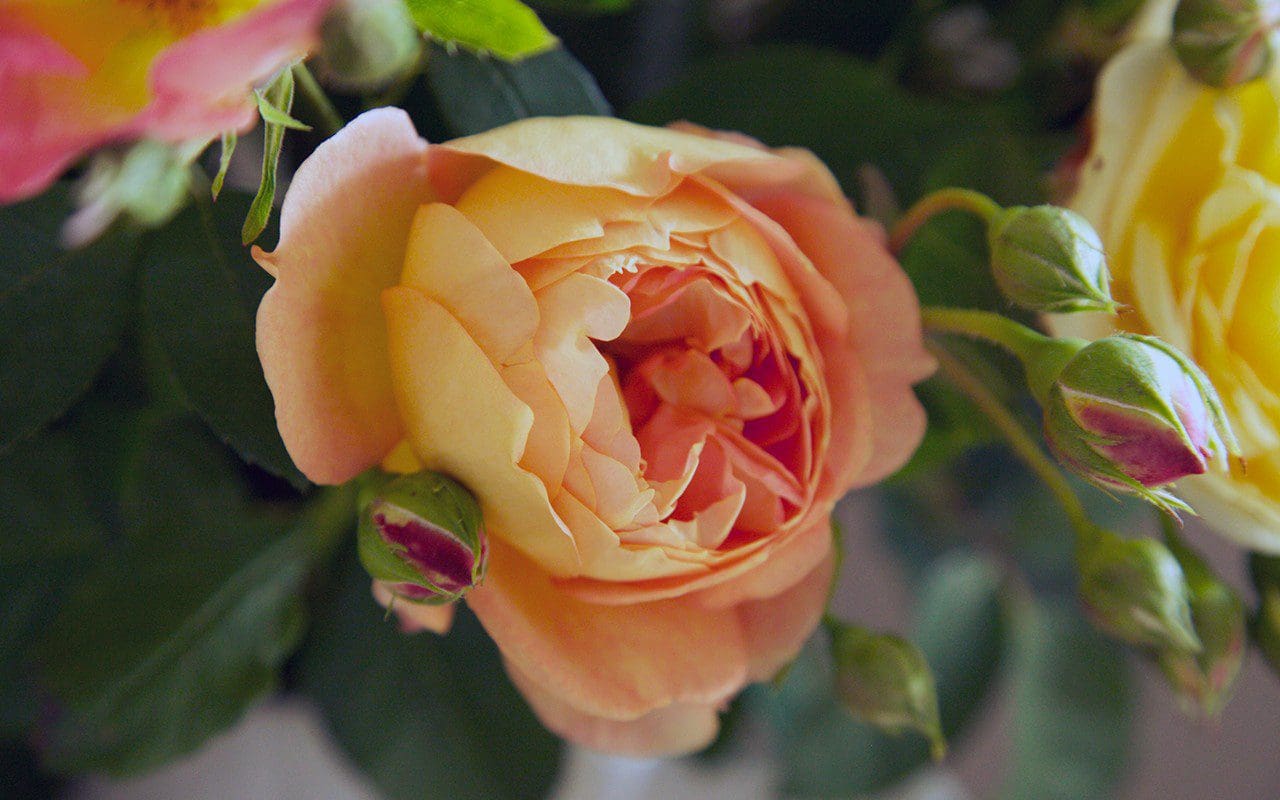 Lady of Shallott
Lady of Shallot’s bowl-shaped blooms are shot pink over apricot. The colour is duller than Pat Austin but no less lovely.
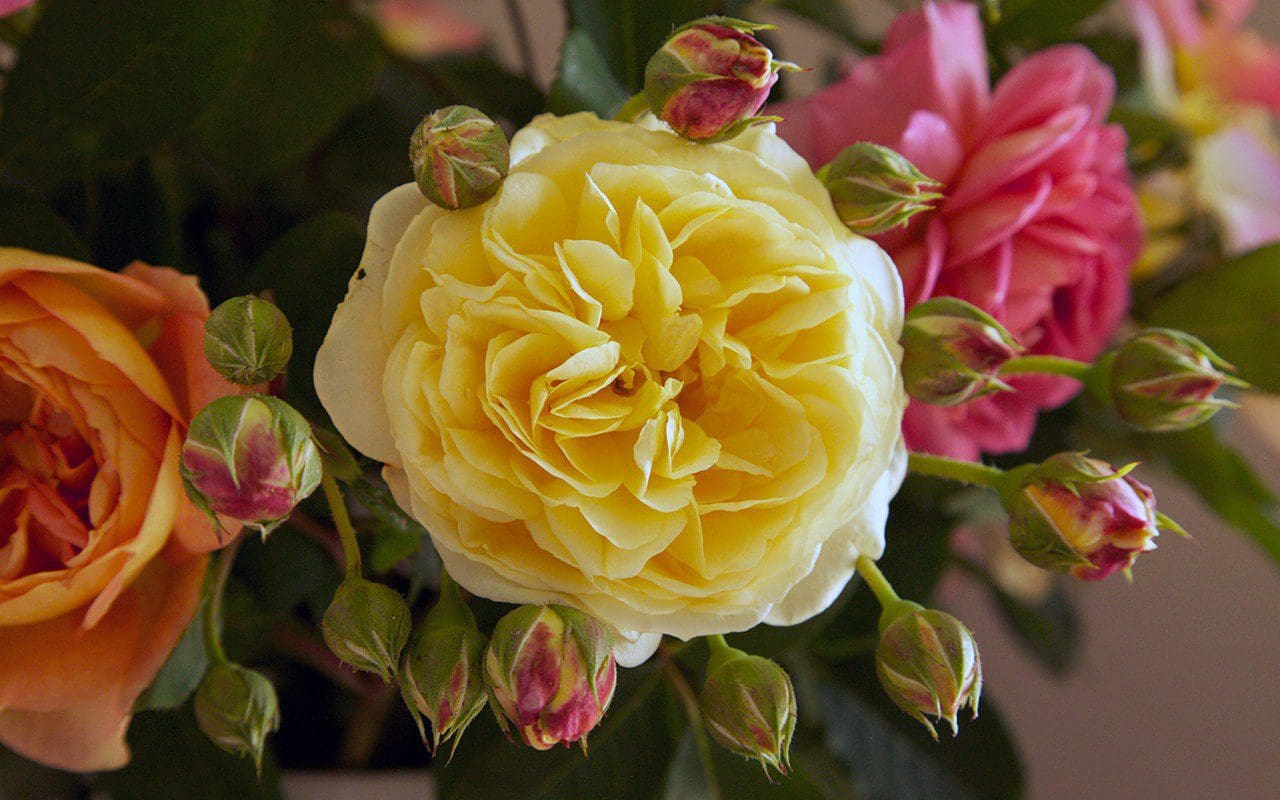 Teasing Georgia
Teasing Georgia is the most yellow of this bunch. It is a really good rose with plenty of vigour, which can be put to a wall and trained as a climber. The flowers are the most quartered of this selection and open flat.
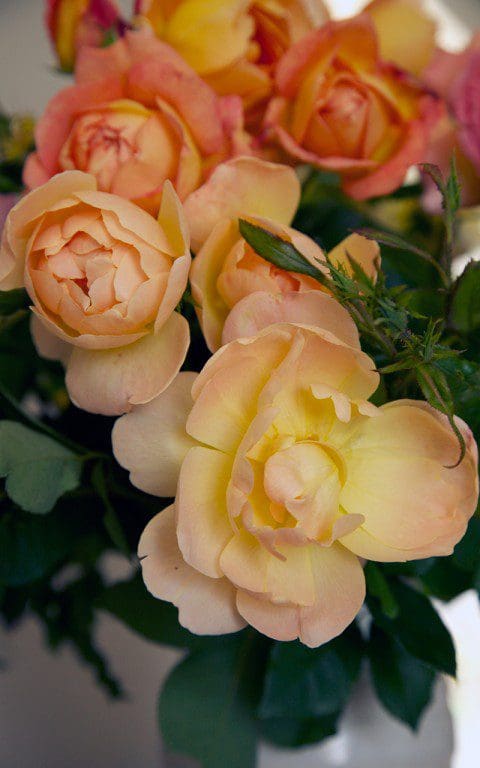 The Lark Ascending
The Lark Ascending is not such a good picker as it drops quickly, but I love it’s loose pale peach flowers which seem to tumble from the bush. It has fewer petals and it is a pretty grower, never stiff and therefore a good candidate for a mixed planting in a border. Not that this will be the case here. The cutting garden is the cutting garden where I can break my own rules and simply enjoy the flowers.

Words: Dan Pearson / Photographs: Huw Morgan
When my friend Anna gave me a seedling of ‘Bill Wallis’ a few years ago she said, “You may hate me for giving you that !”. I had admired it seeding about in the gravel that wrapped her house and thought it’s willingness to perform would be good in the rubbly ground at the base of the tin barns. In the early summer, we see Geranium pyrenaicum (Hedgerow or Mountain Cranesbill) clambering up into the cow parsley where it smatters the fresh June greenery with pinpricks of the brightest magenta.
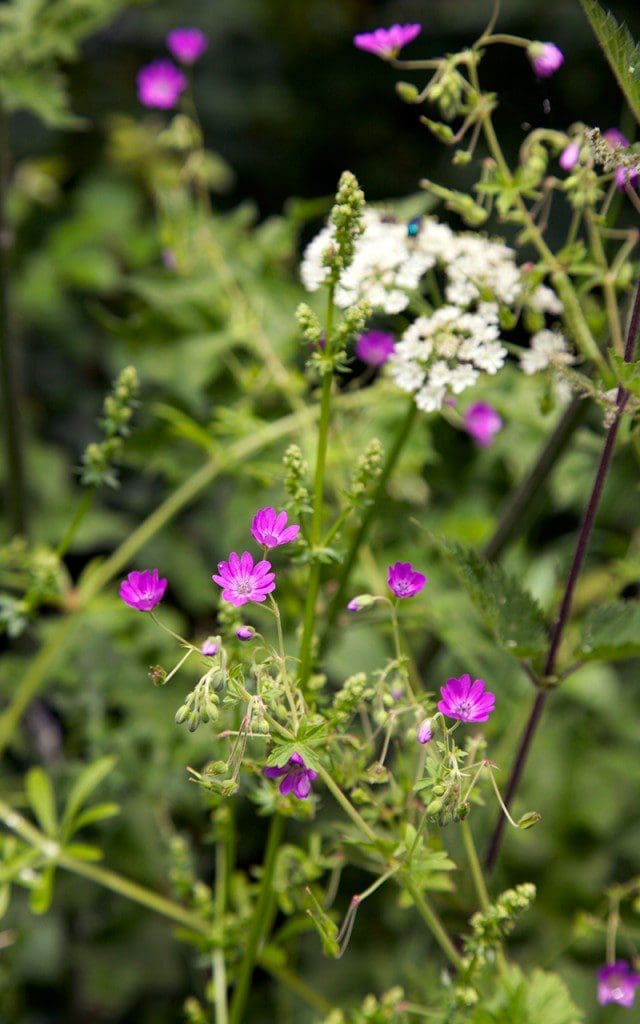 Geranium pyrenaicum
Now so common in southern England that it is considered a native, this geranium was not recorded in the wild in Britain until 1762. As the verges grow out we seem to lose sight of it, but not ‘Bill Wallis’.
Bill Wallis was a passionate plantsman who set up The Useful Plant Company after his retirement in 1979. He chanced upon the original seedling (with flowers of a more electric violet than the wildling’s pinker hue) in a neighbour’s garden, and it was named after him by Joe Sharman of Monksilver Nursery, who propagated the cultivar and launched it at the Chelsea Flower Show.
The earliest flowers, which appear in April, are only about the size of a halfpenny but, by the solstice, they have massed in number clambering through their neighbours to pepper them with colour. A low basal rosette is the origin of this energy and, some time late in June, it is wise to cut them to the base and let them start again. The plentiful seed, like that of all cranesbills, is catapulted far and wide, and it is prudent to diminish the number of volunteers if you find that it likes you. Regrowth brings with it fresh foliage and new flower for the latter half of summer and the seedlings that have got a foothold are easily weeded out when they are young.
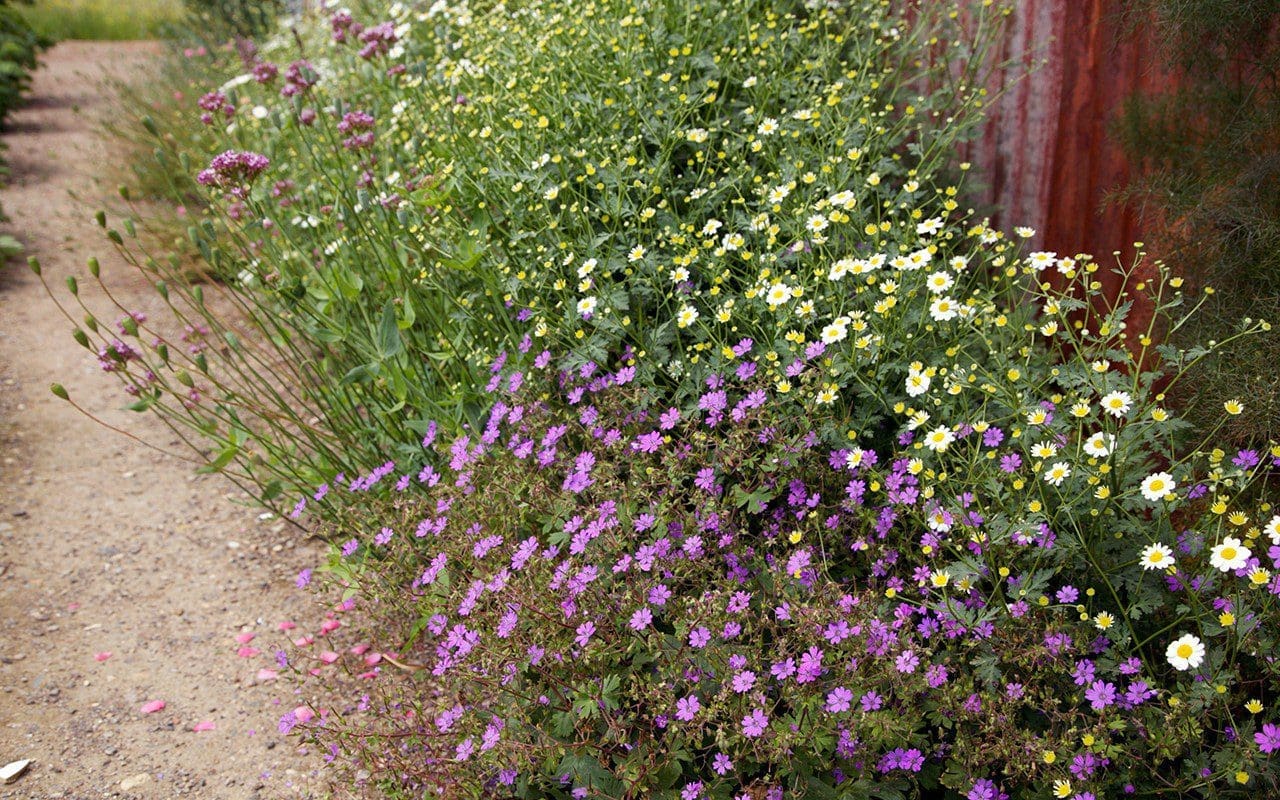
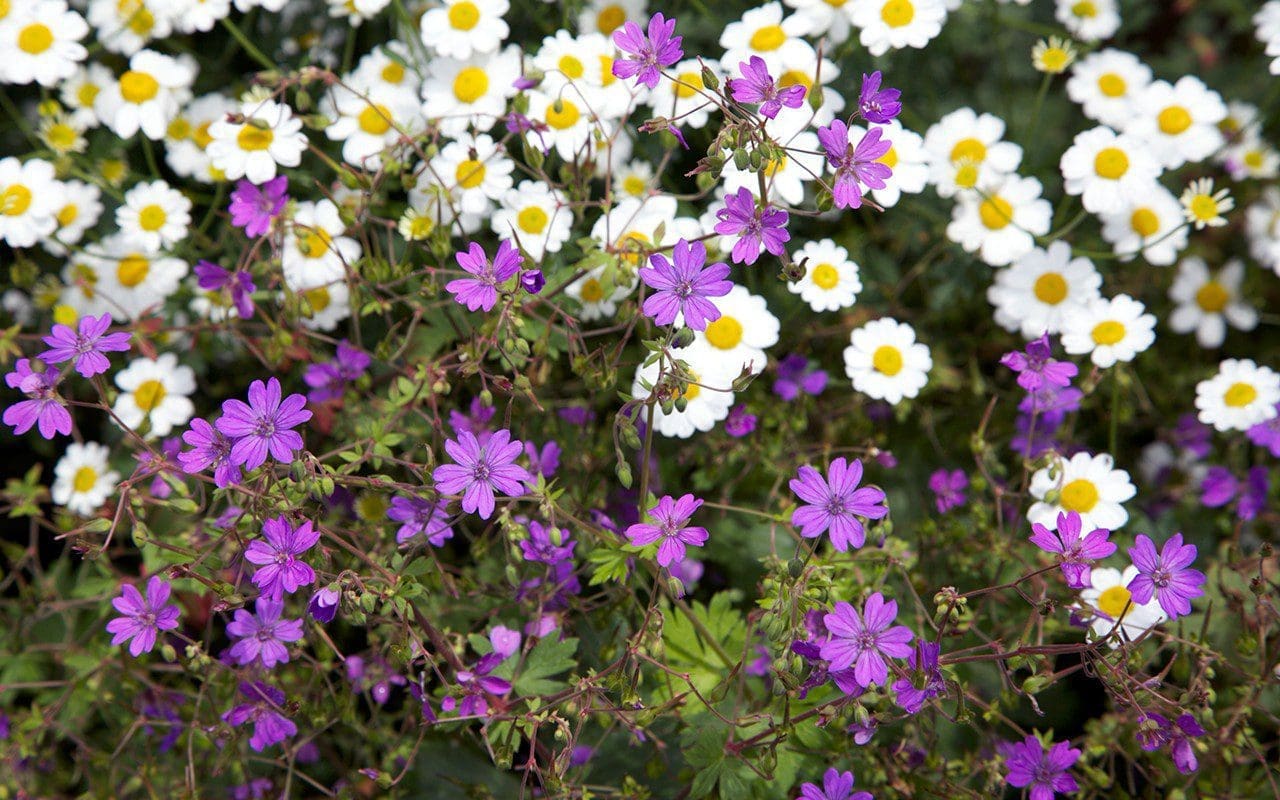 Geranium p. ‘Bill Wallis’ and Tanacetum niveum
‘Bill Wallis’ seems happy out in bright sunshine, but you get a little more out of it, and the colour is more luminous, when grown in a little shade, as if on a verge or popping out from beneath a hedge. It is not averse to dry ground, so for now I have it growing up into the limbs of white tree lupin and Tanacetum niveum, where it spills out to soften the edges of the path. Competing for the open ground with Papaver rupifragum, Erigeron karvinskianus and Matthiola perennis ‘Alba’ these self-seeding pioneers provide me with chance combinations that I can then call my own. We will see where it ends up next year.
I may find that, in time, I will concur with Anna’s warning, but for now I am prepared to manage its spontaneity. Such is the joy of a plant that has a mind of its own.
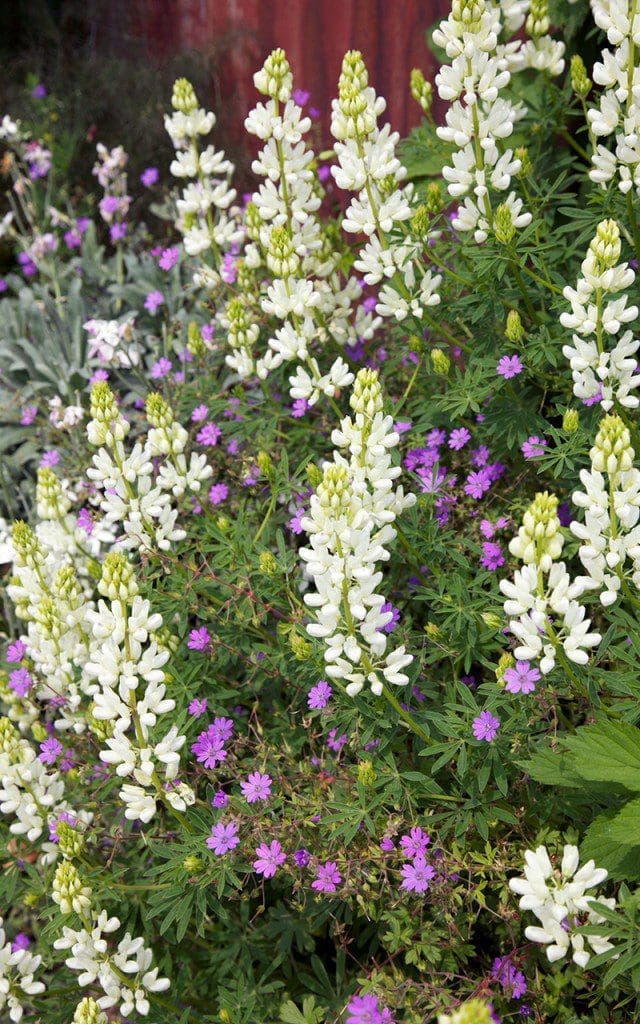 Geranium p. ‘Bill Wallis’ growing through white tree lupin
Words: Dan Pearson/Photographs: Huw Morgan
When we arrived here the flat ground was literally no more than a strip in front of the outbuildings. We perched a table and chairs there to make the most of not being on the angle. The floor of the boot room and those of the outhouses, the barns and levels of the farmyards were a patchwork of concrete, poured in mismatched batches and at a rake with the slope. The acuteness of the land had been diminished to create these spaces, but only enough to ease the grade. I didn’t know until we set out to create a new level why the farmer before us had minimised his excavations. Cut into the land and you quickly find the spring line.
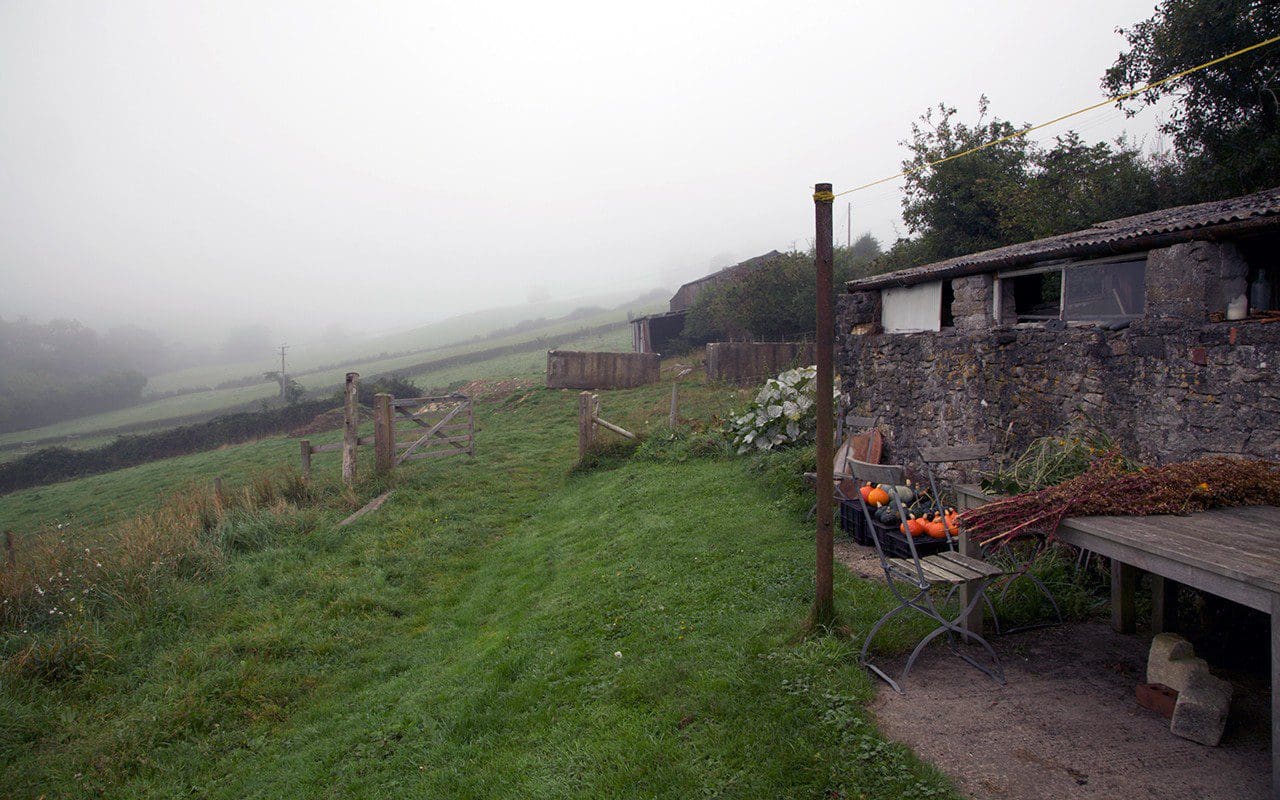
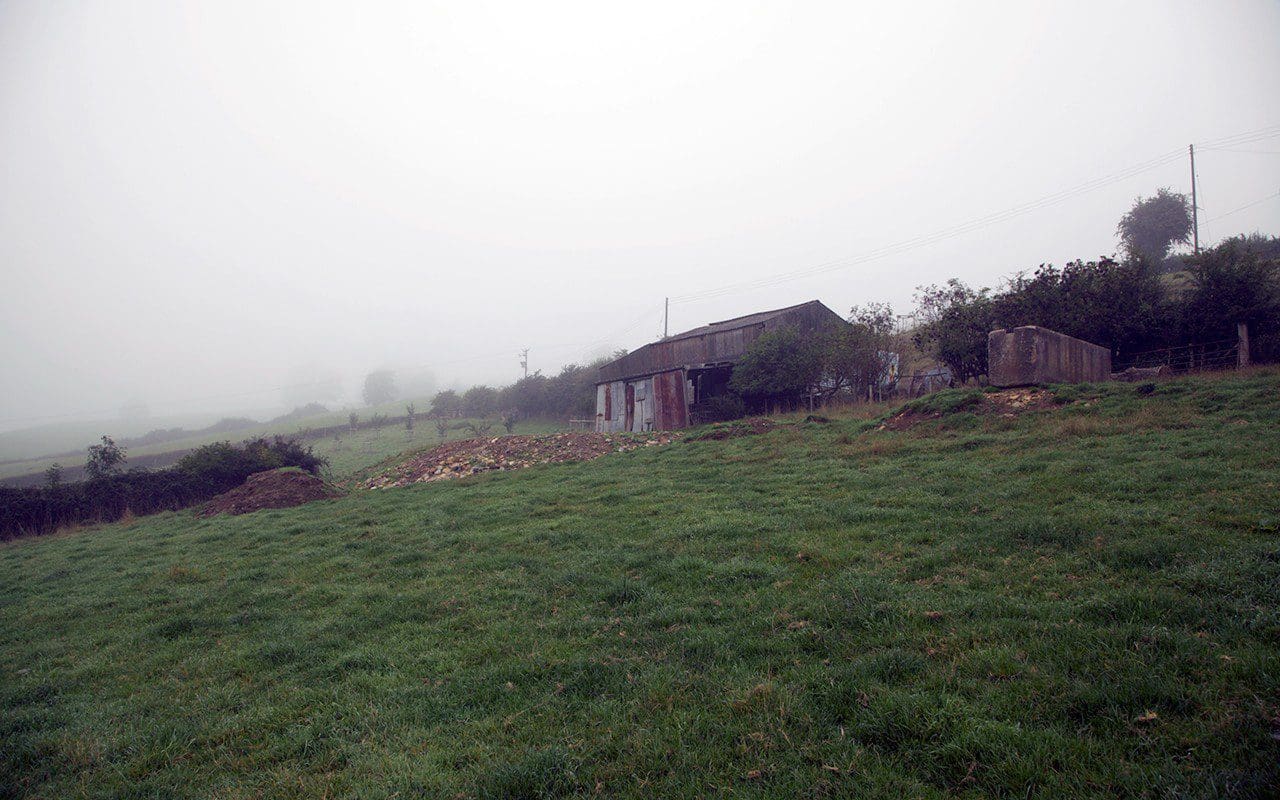 Autumn 2012
Two summers in it was clear that we needed a dedicated garden for fruit and vegetables. They were being challenged for space in the trial garden and we had become tired of negotiating the slopes for the detailed work that is part of growing your own. Sowing, thinning, weeding and harvesting on a slope were all that much harder with one leg shorter than the other and tools and buckets balanced. Beyond the tin barns the newly planted orchard was beginning to show, and the barns were the natural anchor point for a productive garden. We planned to grow figs and espaliered pears against the south facing breeze block walls of the barns and, on newly flat ground, soft fruit and vegetables, both annual and perennial.
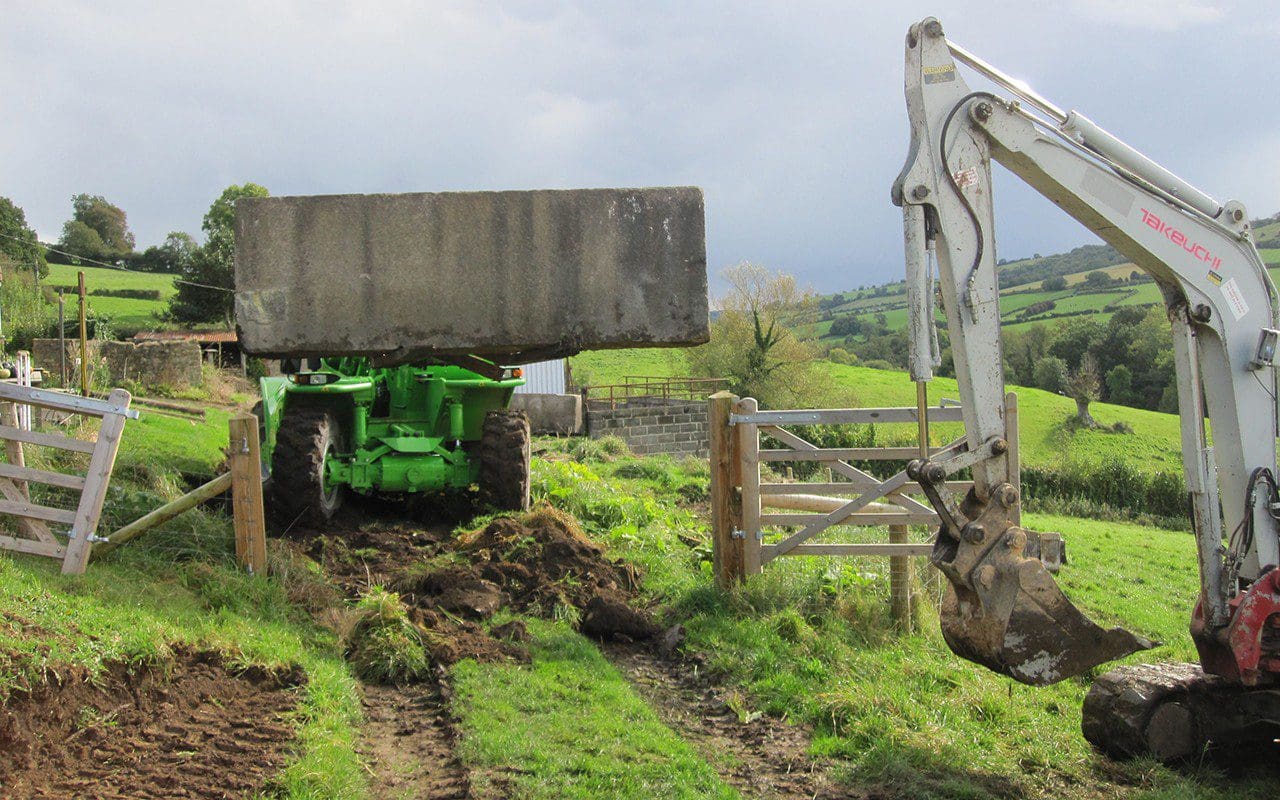 October 2012
The first step in the process was made in October 2012 with the installation of a pair of monolithic 18th century granite troughs. I had three in total, brought all way from Yorkshire, but originally from eastern Europe where they had been used for tanning leather. They were magnificent things and I planned a pair as a division between the house and the long view west to the new kitchen garden. It was a Herculean task to get them in place. Each weighed four and a half tonnes and, in combination with the fifteen tonne fork-lift used to move them, the track collapsed and the concrete farmyard literally buckled under their weight. In the process we lost the drains from the house as the fork-lift crushed them, but my landscaper who was driving never flinched as the trough tilted the machine at a perilous angle. We threw rubble into the ruts and started again and, though it took all day to inch them to where I wanted them, they eventually reached their positions.
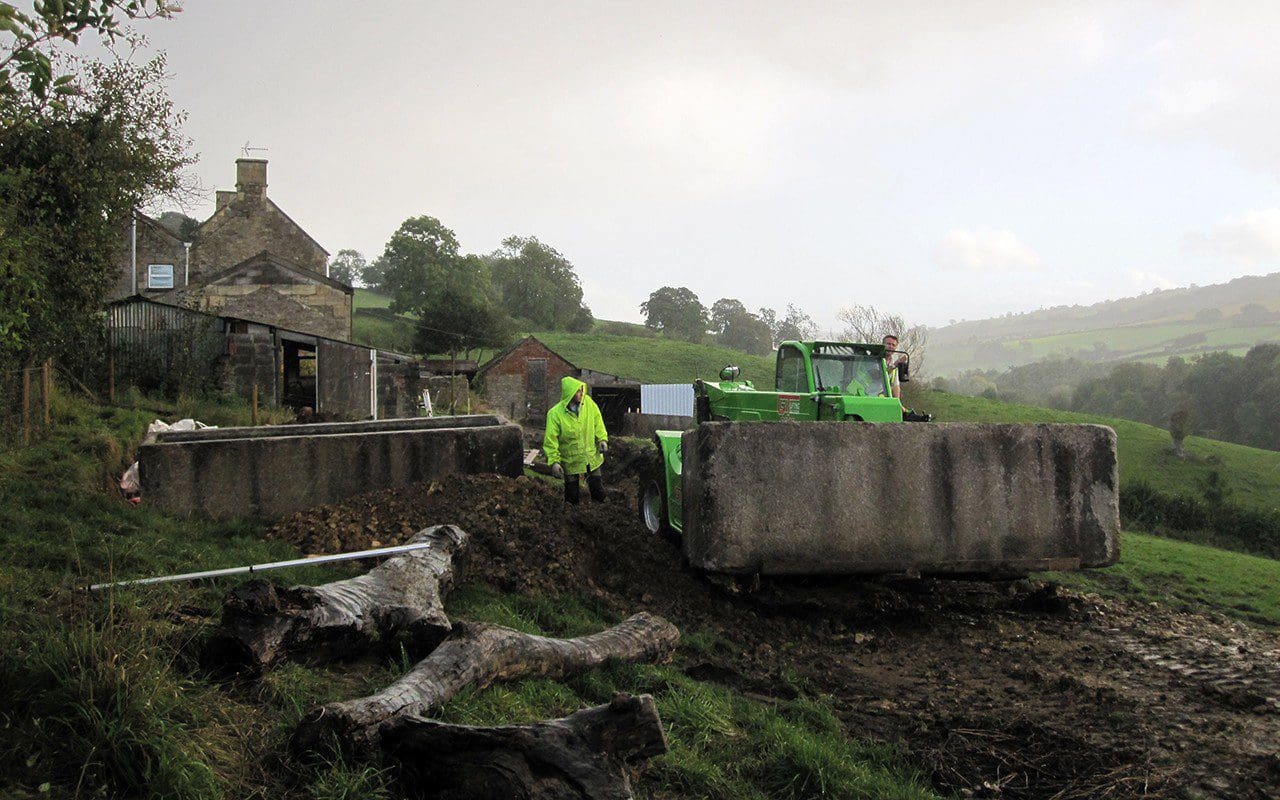
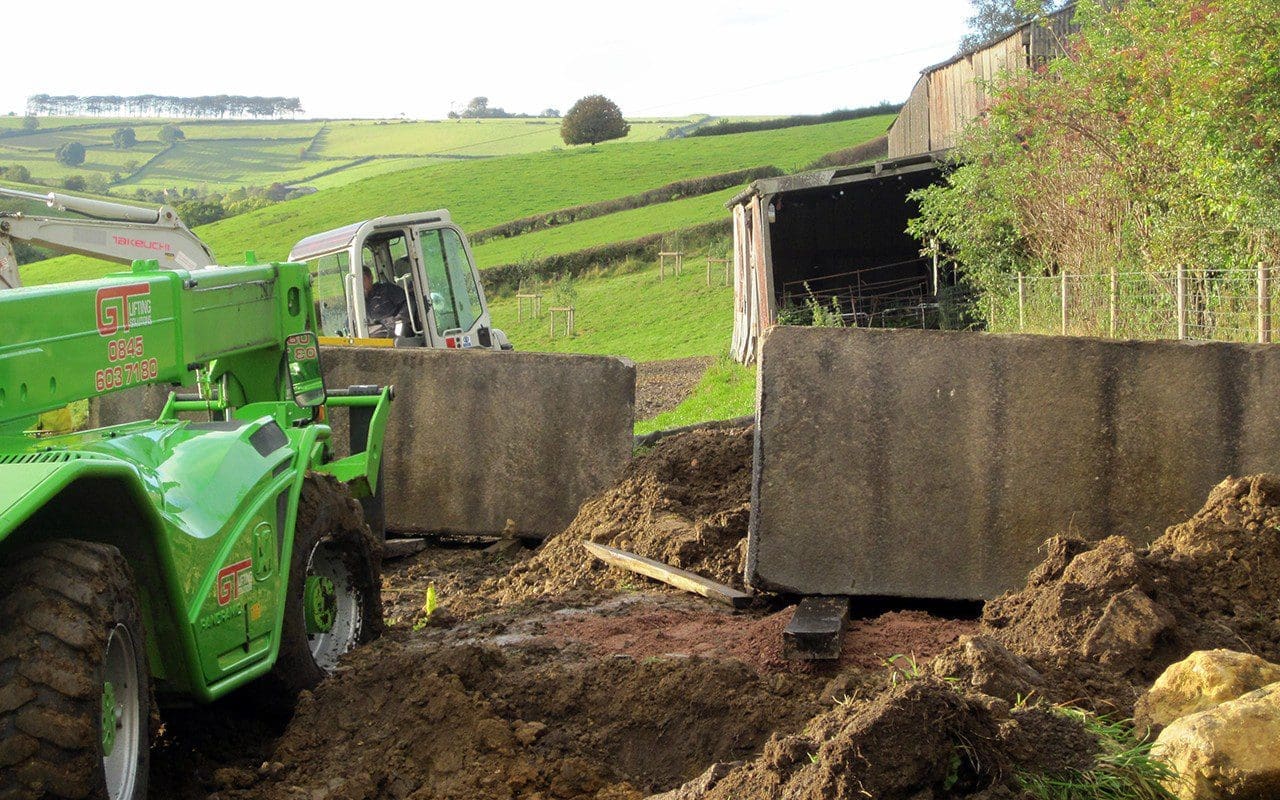 October 2012
I wanted the troughs to sit as an offset pair, running across the spine of the new level that links the house with the barns. Here they would act as a gateway to the vegetable garden, while also screening it from the house and defining the space. Their bold outline would echo the straight line of trees on the distant horizon. One would be filled with rainwater from the roofs for hand-watering, the other would eventually be fed by the disused hydraulic ram pump down by the brook in a long-term plan to refurbish it. When you passed between them, an orderly set of beds would run like ribs north south off the east, west axis. The orientation of the beds would allow for the best and most even light for each of the crops.
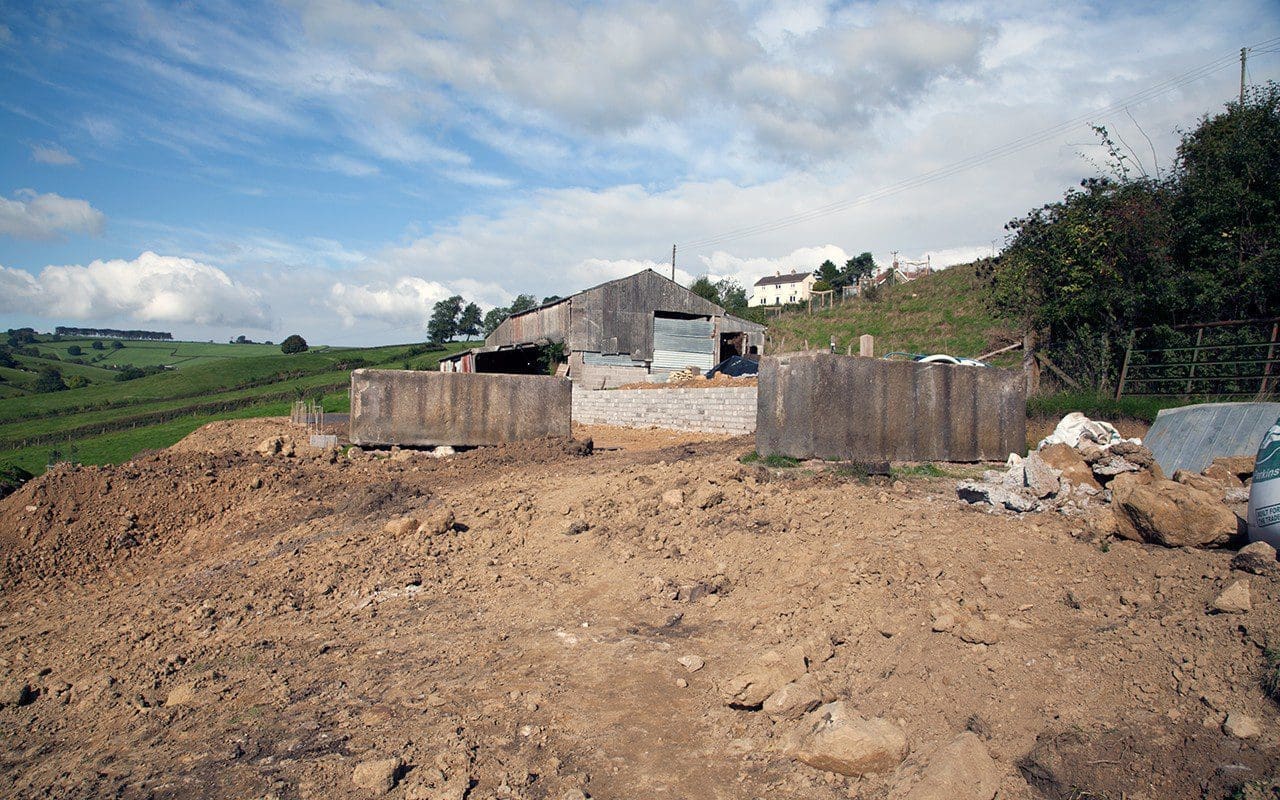 September 2013
Nearly a year later in the last week of August and riding good weather for the best part of three weeks, we started the land-forming to create the garden beyond the troughs. The digger scraped back the slope to make a spine of flat land between the house and the barns, while another cut made to level a sloping track in the field above the house provided the subsoil to make up the level from the barns. A breeze block wall was made to hold the land to the upper side of the spine, and provided the garden with a wall for espaliered pears and shelter for vegetables that would like the radiant heat – an asparagus bed, globe artichokes, courgettes and climbing beans. Breeze block felt like the right material to use as it sat well with the agricultural aesthetic in which things had been built in the past.
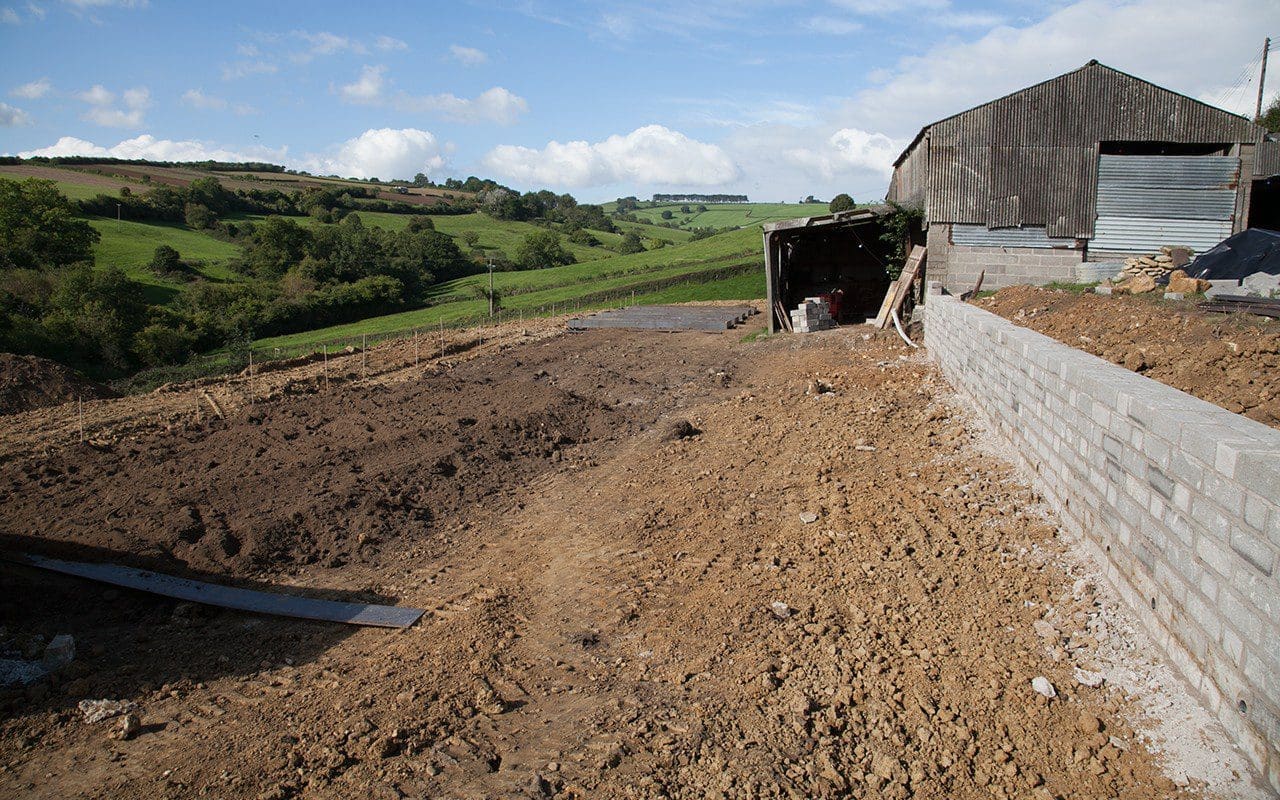 September 2013
The topsoil, and the turf that came with it, were harvested and piled in the field below the new garden. It was stacked wider than it was high at 4’ or so, because if you stack soil higher the soil bacteria at the bottom of the pile get smothered and the soil becomes infertile. The sod rotted down to add organic matter, as the pile had to stay where it was until the following summer for, in mid-September, the rains came and made the site unworkable.
The scraping revealed the rubbly limestone brash that was perfect for making up the levels, but the brash sat on clay and, as soon as the rains came, a number of springs that had been moving through the slopes unseen, began running over the surface. As luck would have it, we had poured the footings for the wall by this point, but the workmen suffered, moving through the mud in slow motion to build the wall and then constructing a series of steel-edged beds. Mud stopped play not long after but, as soon as the weather was dry enough the following spring, the beds were soiled up to the depth of a generous spit.
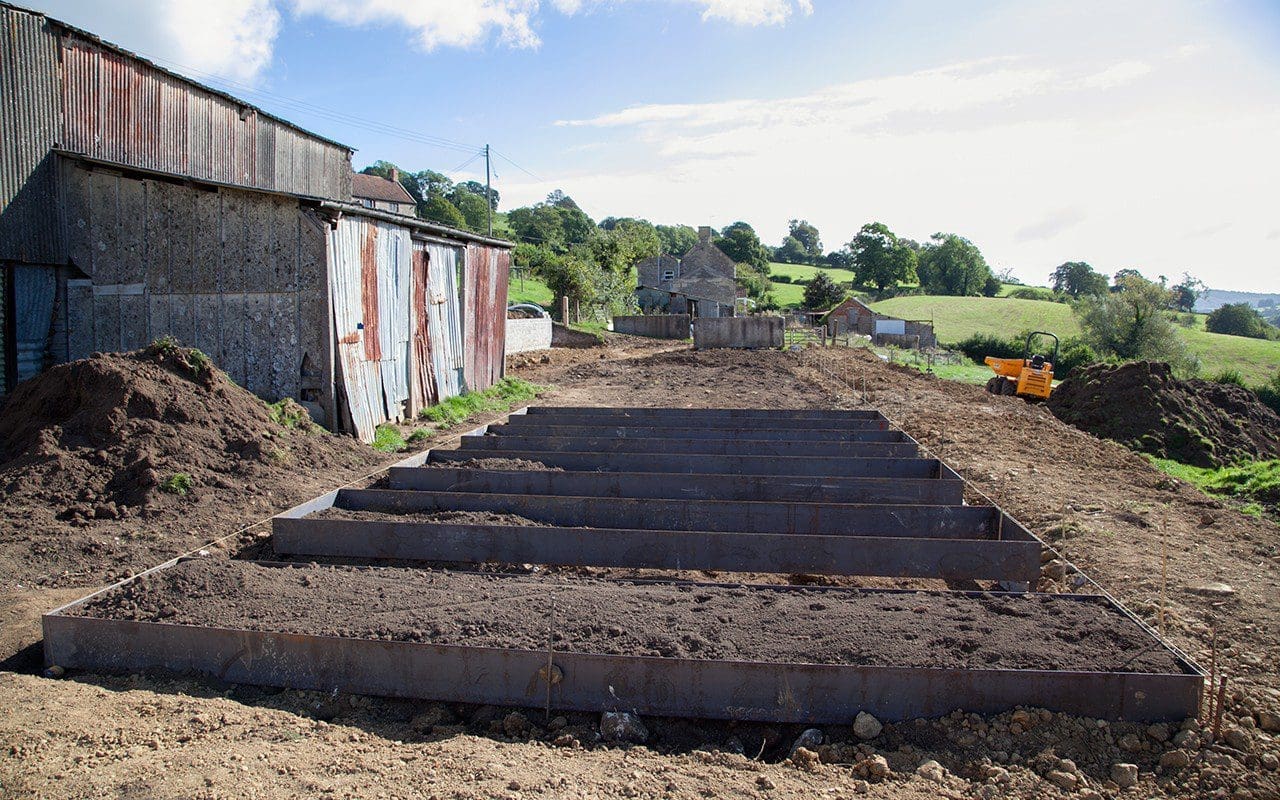 September 2013
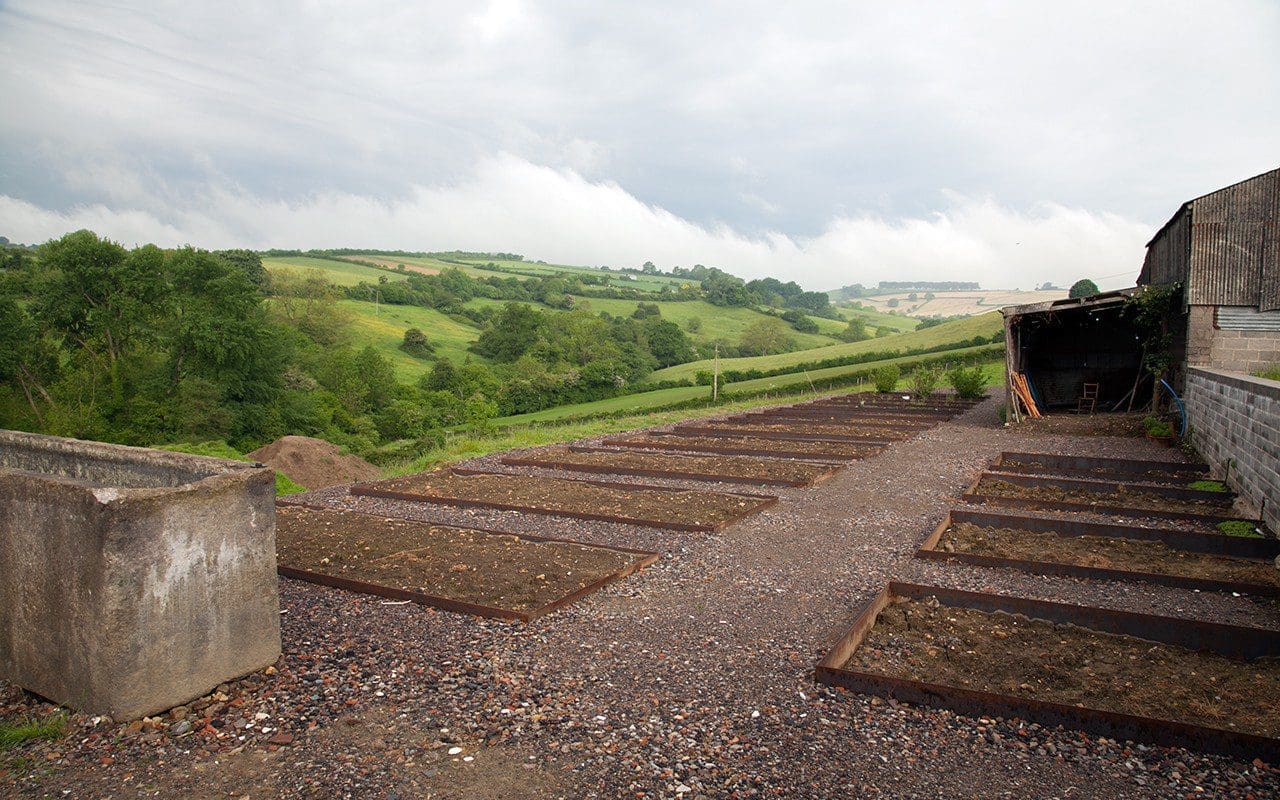 Spring 2014
I graded the beds, starting with narrow metre wide beds at the windward westerly end of the garden. These were planted with the woody currants, gooseberries and raspberries to provide some wind protection. All the paths between the beds are a metre twenty wide to allow plenty of room for a barrow and growth to encroach from either side. The beds scale up in size to one and a half metres and then two metres wide, but no more, so that it is easy to work the beds from either side without having to tread on the soil more than necessary. That first summer we left the majority of the beds fallow, removing perennial weeds and mulching them with manure, which we dug in over the winter. We did plant a couple of the beds with brassicas and winter sown broad beans to make us feel like we were moving in the right direction.
Last year was our first summer growing in this new space and we are learning again with a new position and the challenges that come with it. Our knees and backs are certainly better for the flat ground – we can move about freely without having to watch our step – but we are finding that some crops are missing the protection afforded by the hedge in the old garden. We are working on the soil with our own compost this year and talking about making a couple of the beds no dig next year. But for now, the summer and whatever it will teach us, lies in waiting.
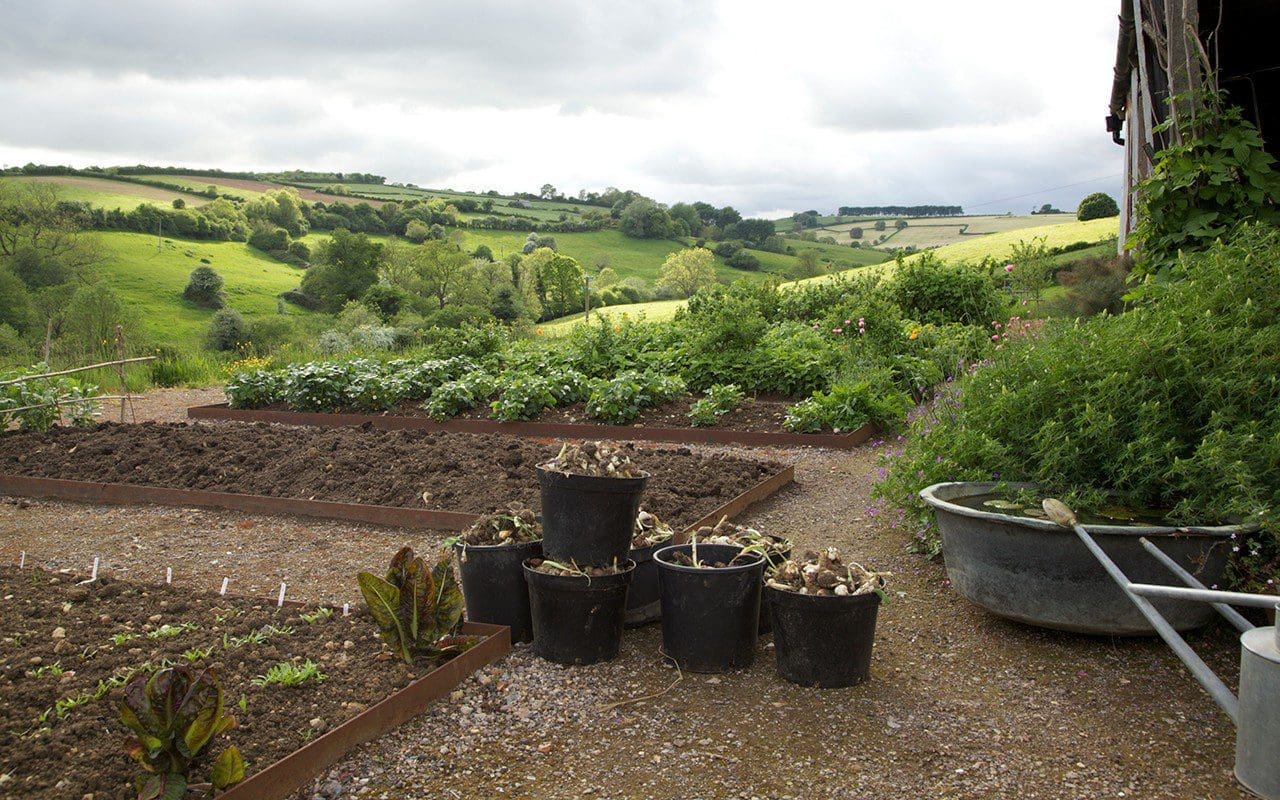 Spring 2016
Words: Dan Pearson / Photographs: Dan Pearson & Huw Morgan
We are sorry but the page you are looking for does not exist. You could return to the homepage