The new planting went in on the spring equinox, a week that saw the energy in the young plants shifting. Just seven days later the emerging fans of the hemerocallis were already splayed and flushed, and the signs were also there in the tightly-clasped crowns of the sanguisorba. The chosen few from my trial in the stock beds had to be split to make up the numbers I needed, but energy was on their side and, once in their new home, they seized life quickly to push new foliage.
We mulched the beds immediately after planting to keep the ground clean and to hold in the moisture whist the plants were establishing. Mulching saves so much time in weeding whilst a garden is young and there is more soil than knit of growth. This year I was also thankful because we went into five long weeks without rain. I watered just once, so that the roots would travel down in search of water, but once only so that they did not become reliant. The mulch held this moisture in the ground and the contrast to the old stock beds that went without has been is remarkable. Spring divisions that went without mulch have put on half as much growth and have needed twice as much water to get the same purchase. I can see the rigour of my Wisley training in this last paragraph, but good habits die as hard as bad ones.
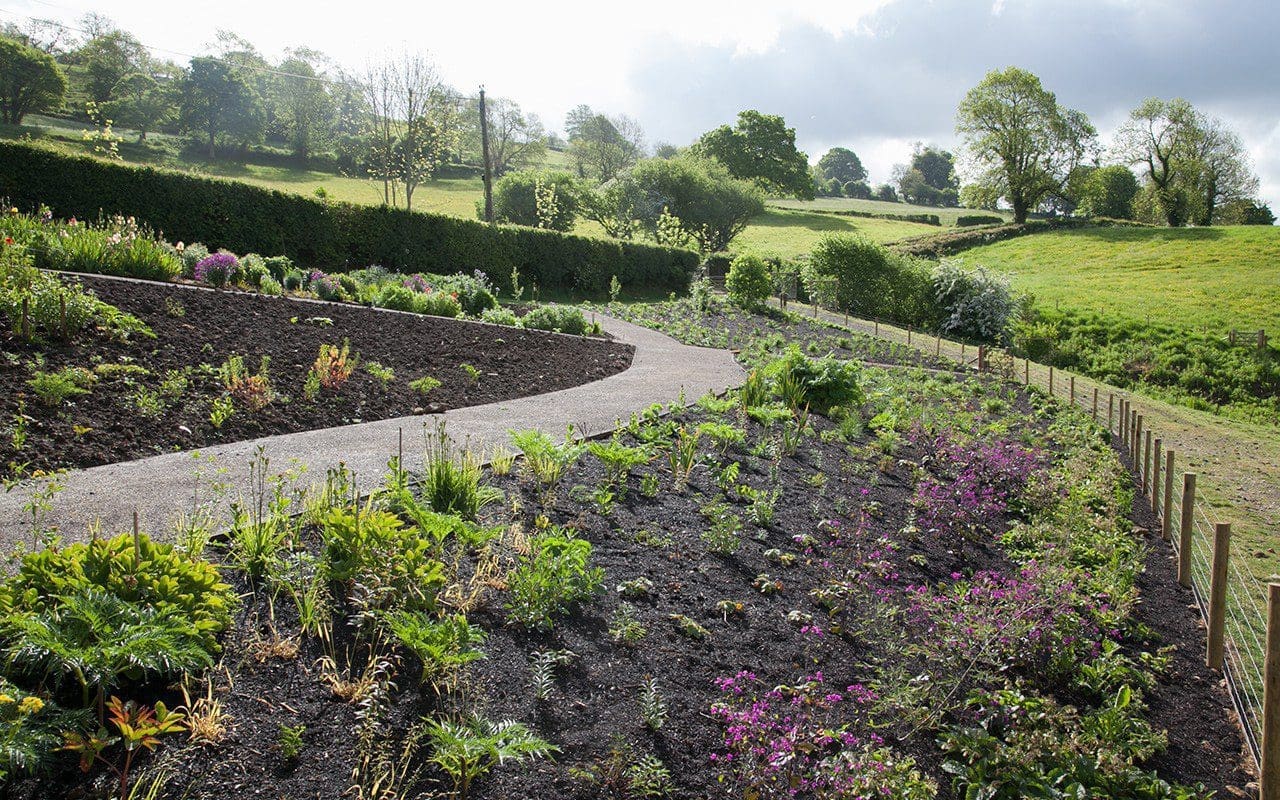 14 May 2017
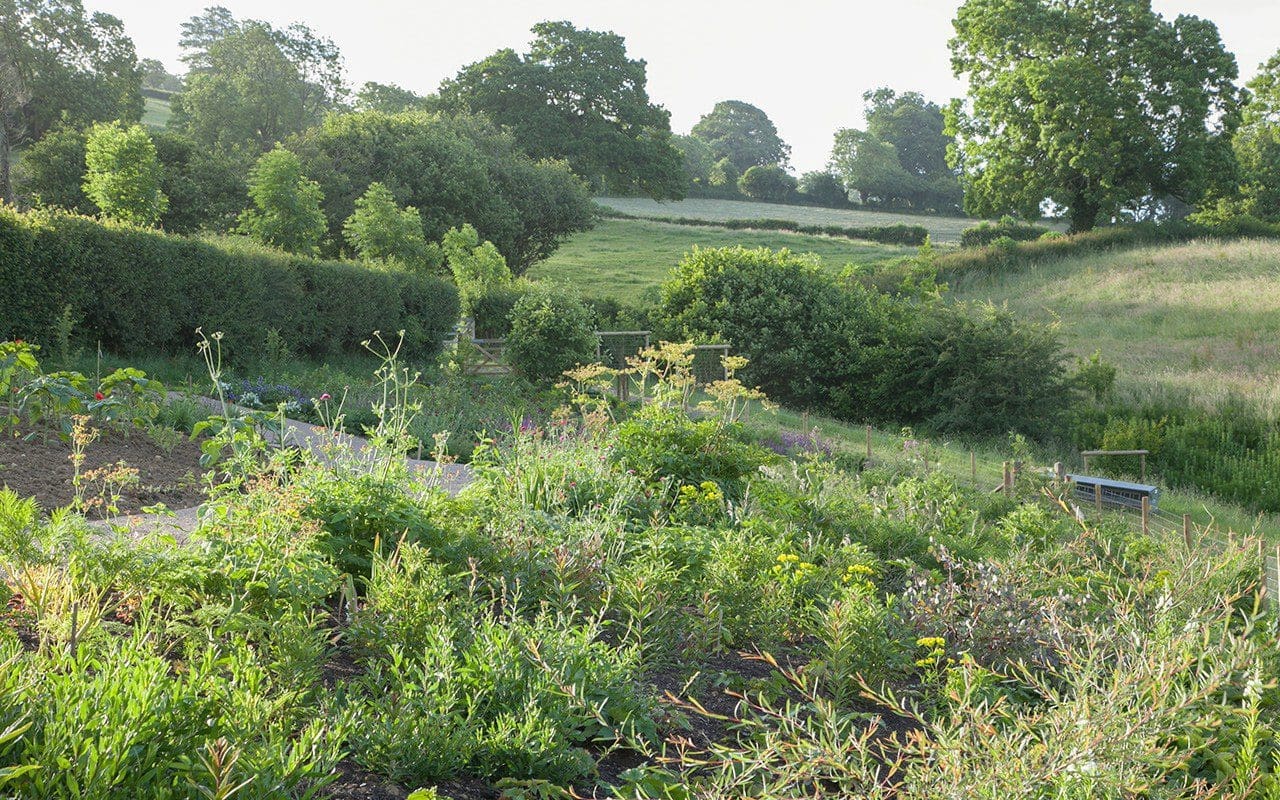 17 June 2017
Since it rained three weeks ago, the growth has burgeoned. As the summer solstice approaches the dots of newly planted green that initially hugged the contours of our slopes have become three dimensional as they have reared up and away into early summer. I have been keeping close vigil as the new bedfellows have begun to show their form, noting the new combinations and rhythms in the planting. Information that I’d had to hold in my head while laying out the hundreds of dormant plants and which, to my relief, is beginning to play out as I’d imagined.
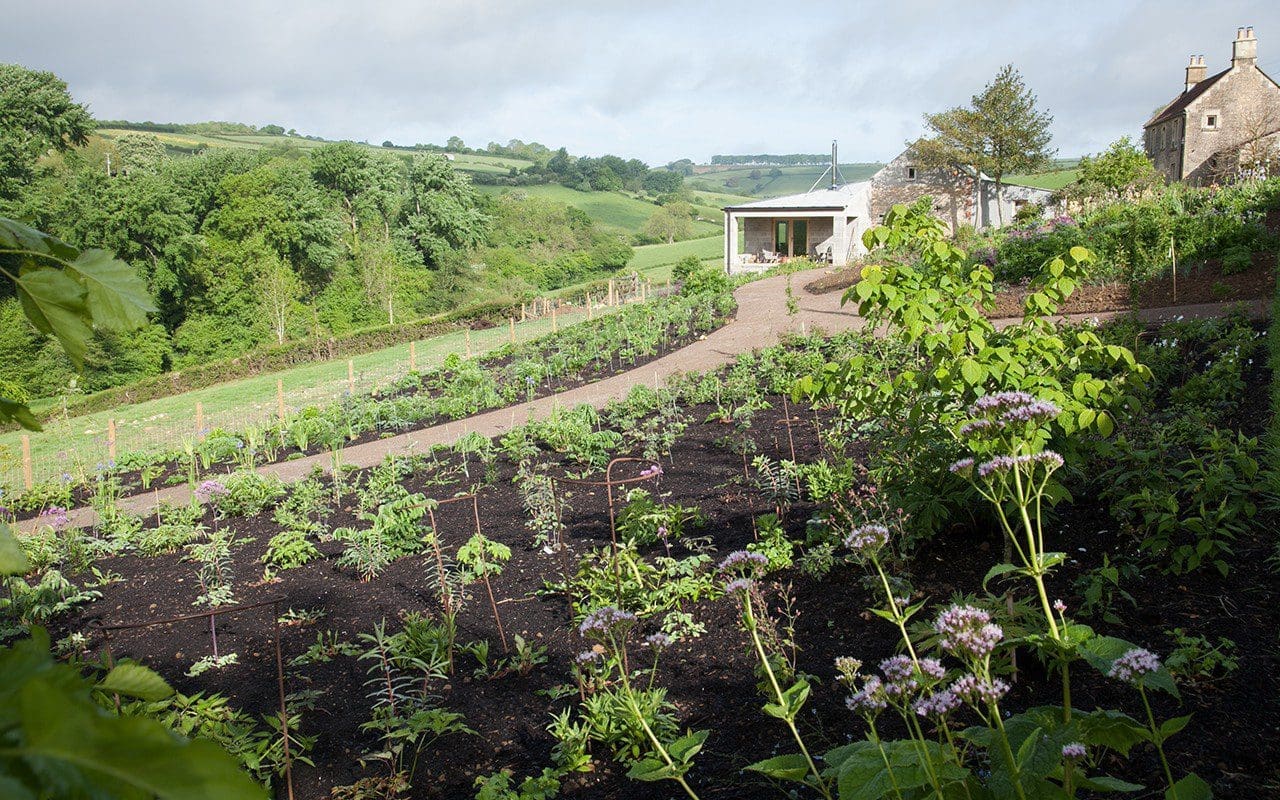 14 May 2017
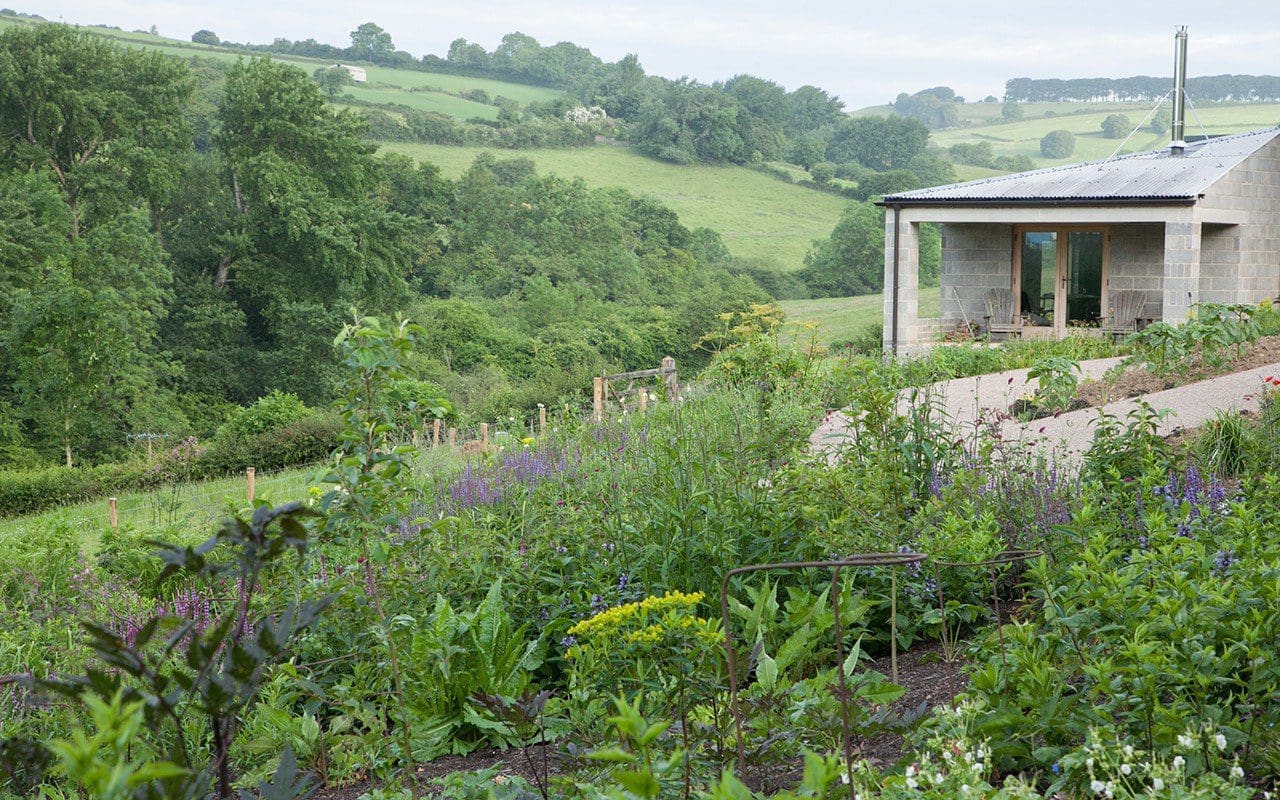 16 June 2017
Of course, there are gaps where I am waiting for plants that were not then available, and also where there were gaps in my thinking. There are combinations that I can see need another layer of interest, and places where the plants are already showing me where they prefer to be. The same plant thriving in the dip of a hollow, but not on a rise, or vice versa. Plants have a way of letting you know pretty quickly what they like. At the moment I am just observing and not reacting immediately because, as soon as the foliage touches, the community will begin to work as one, creating its own microclimate that will in turn provide influence and shelter. I lost my whole batch of Milium effusum ‘Aureum’, which I put down to the exposure on our south-facing slopes. However, most of them have managed to set seed, so I am hoping that next spring the seedlings will find their favoured positions to thrive in the shade of larger, more established perennials.
The wrap of weed-suppressing symphytum that I planted along the boundary fence is already knitting together, and I’m happy to have this buffer of evergreen foliage to help prevent the landscape from seeding in. However, a flotilla of dandelion seed sailed over the defence and are now germinating in the mulch. We saw them parachuting past one dry, breezy day in April as if seeking out this perfect seedbed. They are easy to weed before they get their taproot down and will be less of a problem this time next year when there will be the shade of foliage, but they will be a devil if they seed into the crowns of plants before they are established. A community of cover is what I am aiming for, so that the garden starts to work with me, and time spent protecting it now is time well spent.
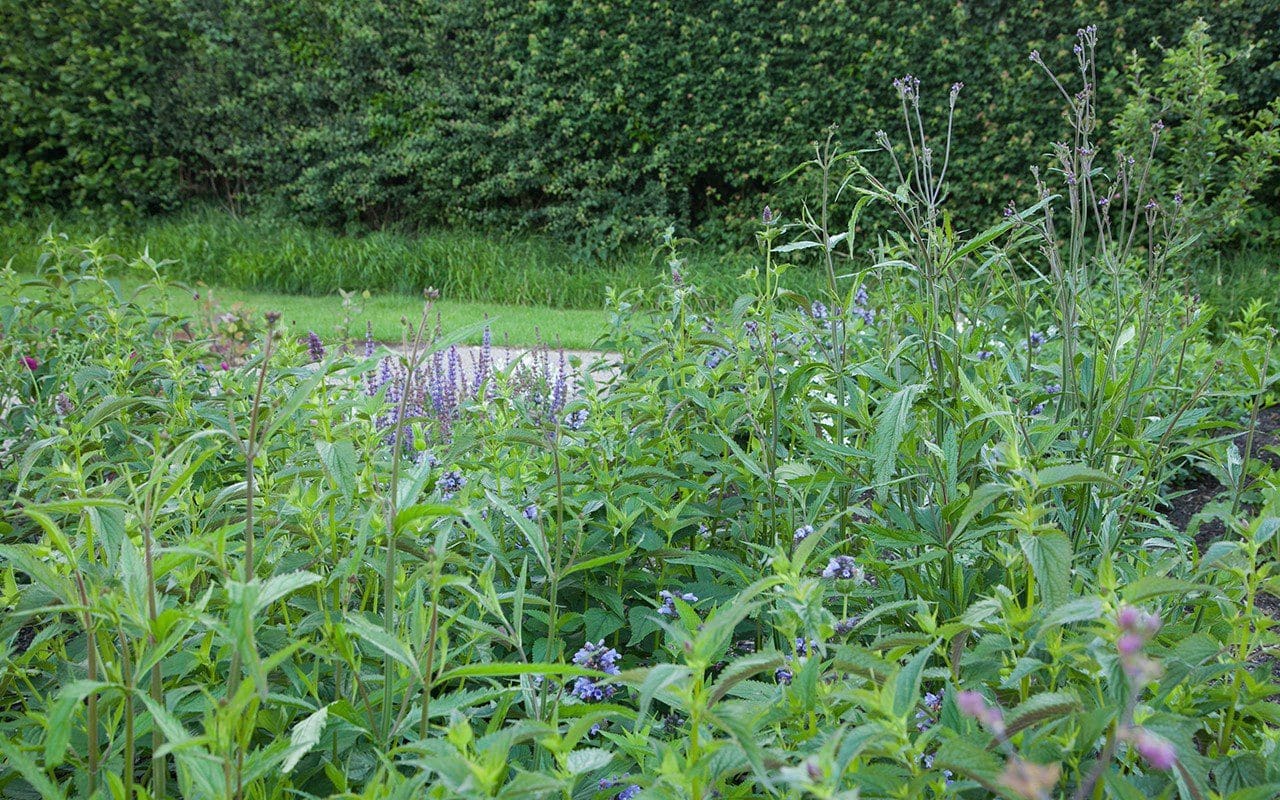
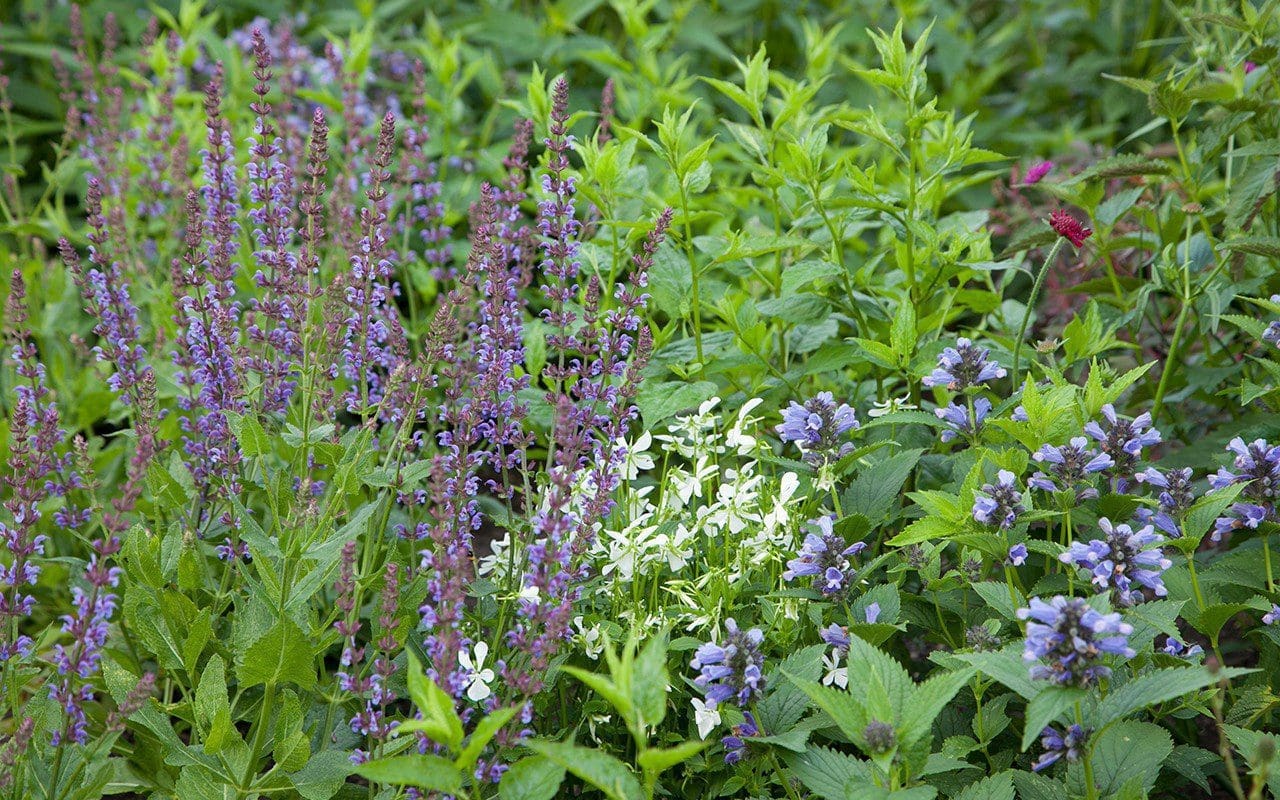 Salvia pratensis ‘Indigo’, Nepeta subsessilis ‘Washfield’, Viola cornuta ‘Alba’ & Knautia macedonica
The comfrey is planted in three drifts. Symphytum grandiflorum, S. ‘Hidcote Blue’ and S. g. ‘Sky Blue Pink’. The latter is new to me and I’m watching carefully that they aren’t too vigorous. I’ll have to keep an eye on the next ripple of plants that are feathered into the comfrey from deeper into the garden as the symphytum can also be an aggressive companion. The Sanguisorba hakusanensis should be able to hold their own, as they form a lush mound of foliage, and the Epilobium angustifolium ‘Album’ should be fine, punching through to take their own space. I’ll clear the young runners where the creep of the comfrey meets the gentler anemone and veronicastrum.
The ascendant plants were placed first when laying out and will form a skyline of towers through which the other layers wander. They are already standing tall and providing the planting with a sense of depth. Thalictrum ‘Elin’ is my height already, a smoky presence of foliage and stems picking up the grey in the young Rosa glauca and proving, so far, to not need staking. This is important, because our windy hillside provides its challenges on this front. Thalictrum aquilegifolium ‘Black Stockings’ has also provided immediate impact, its limbs inky dark and the mauve of the flowers giving early colour and contrast to the clear, clean blue of the Iris sibirica ‘Papillon’. Next year the garden will have knitted together so that the contrasts will work against foliage or each other, but for now the eye naturally focuses not on the gappiness, but where things are beginning to show promise.
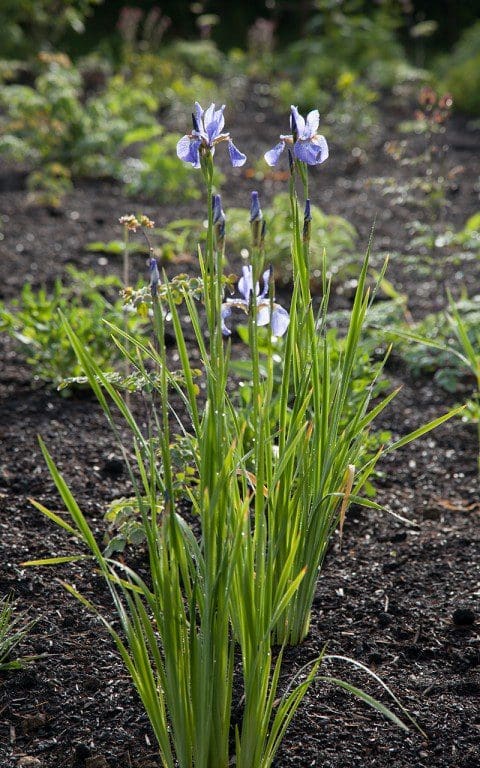 Iris sibirica ‘Papillon’
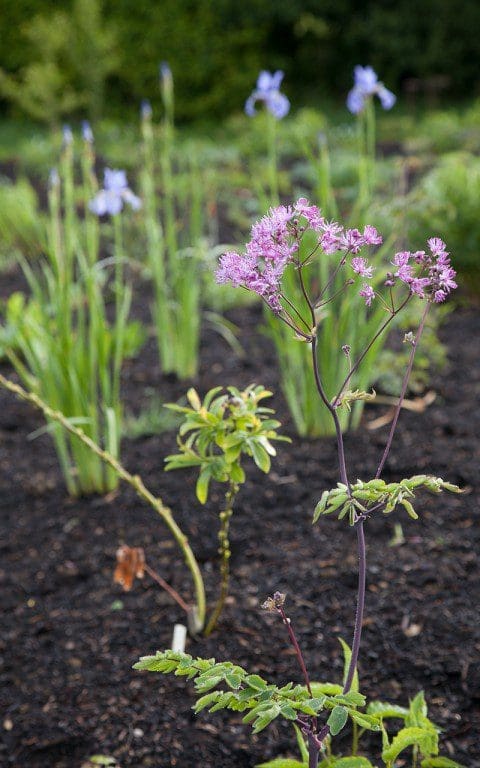 Thalictrum aquilegifolium ‘Black Stockings’ with Iris sibirica ‘Papillon’ behind
There have been a couple of surprises already, with a fortuitous mix up at the nursery reavealing a new combination I had not planned for with a drift of Salvia pratensis ‘Indigo’ coming up as S. nemorosa ‘Amethyst’. I am very particular about my choices and I’d planned for ‘Indigo’ since growing it in the stockbeds, but the unexpected arrival of ‘Amethyst’ has, after my initial perplexity, been a delight. I’ve not grown it before, and I like its earliness in the planting and how it contrasts with the clear blue of the Iris sibirica with a little friction that makes the eye react more definitely than with the blue of ‘Indigo’. I like a little contrast to keep zest in a planting. The Euphorbia cornigera, with their acid green flowering bracts, are also great for this reason with the first magenta of the Geranium psilostemon.
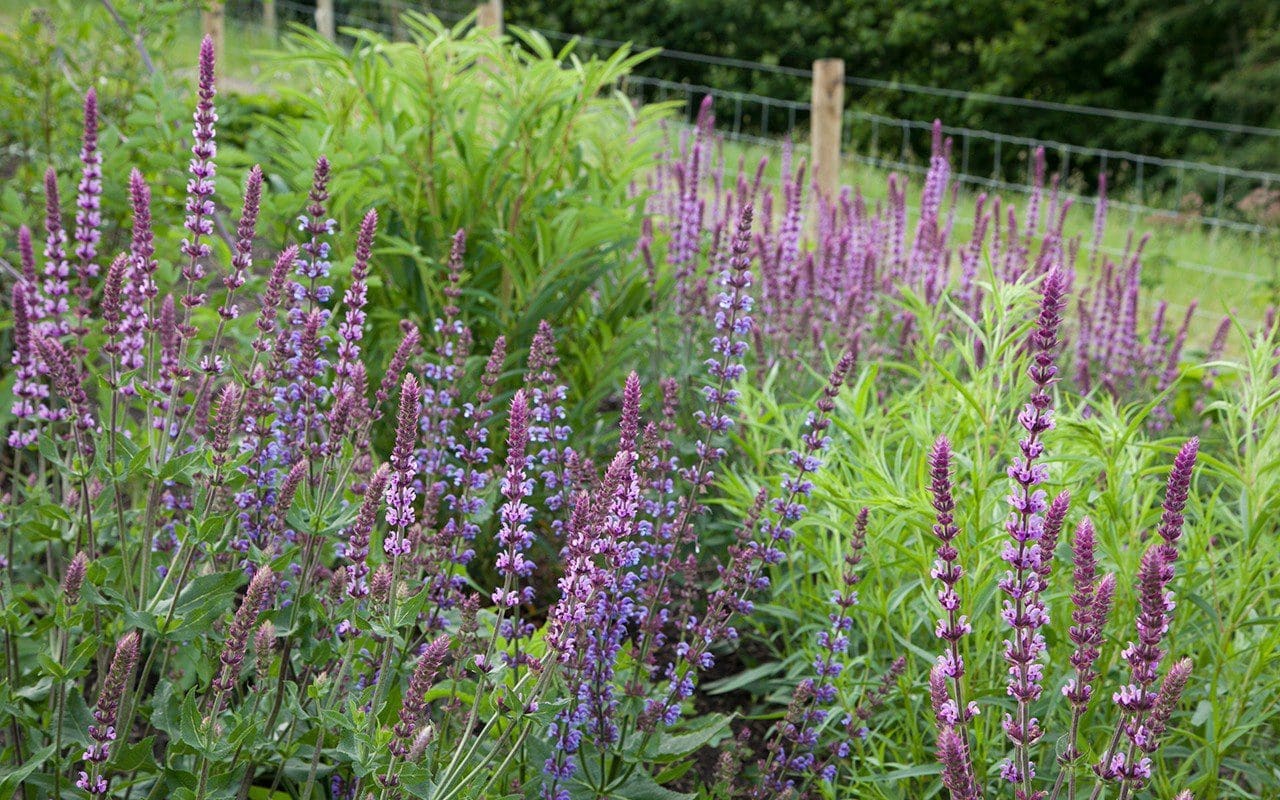 Salvia nemerosa ‘Amethyst’ and Salvia pratensis ‘Indigo’
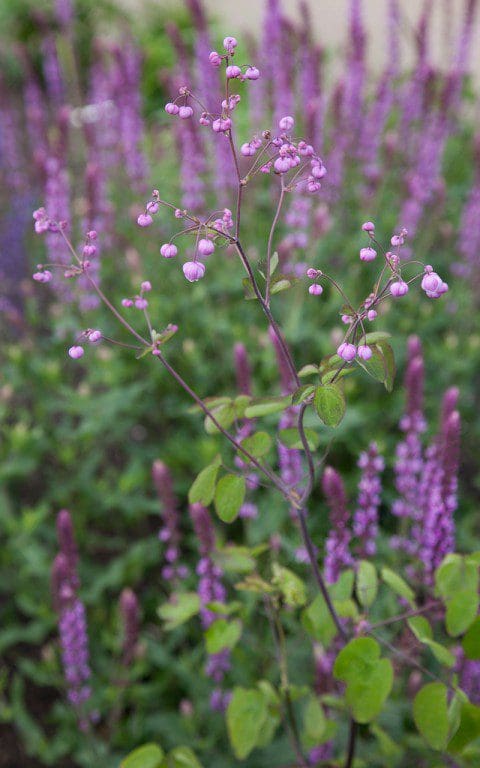 Thalictrum rochebrunianum with Salvia nemerosa ‘Amethyst’ behind
As the last few plants that weren’t ready in the nursery become available, I’m wading back into the beds again to find the markers I left there when setting out so that I can trace my original thinking. I am pleased to have done this, because it is very easy to start to reshuffle, but the original thinking is where cohesiveness is to be found. Changes will come later, after I’ve had a summer to observe and see where the planting is lacking or needing another seasonal lift. I can already see the original perennial angelica has doubled in diameter, and I’ve added eight new seedlings which, if left, will be far too many so a few removals will be necessary comer the autumn. Patience will be the making of this coming growing season, followed by action once I can see my plans emerging.
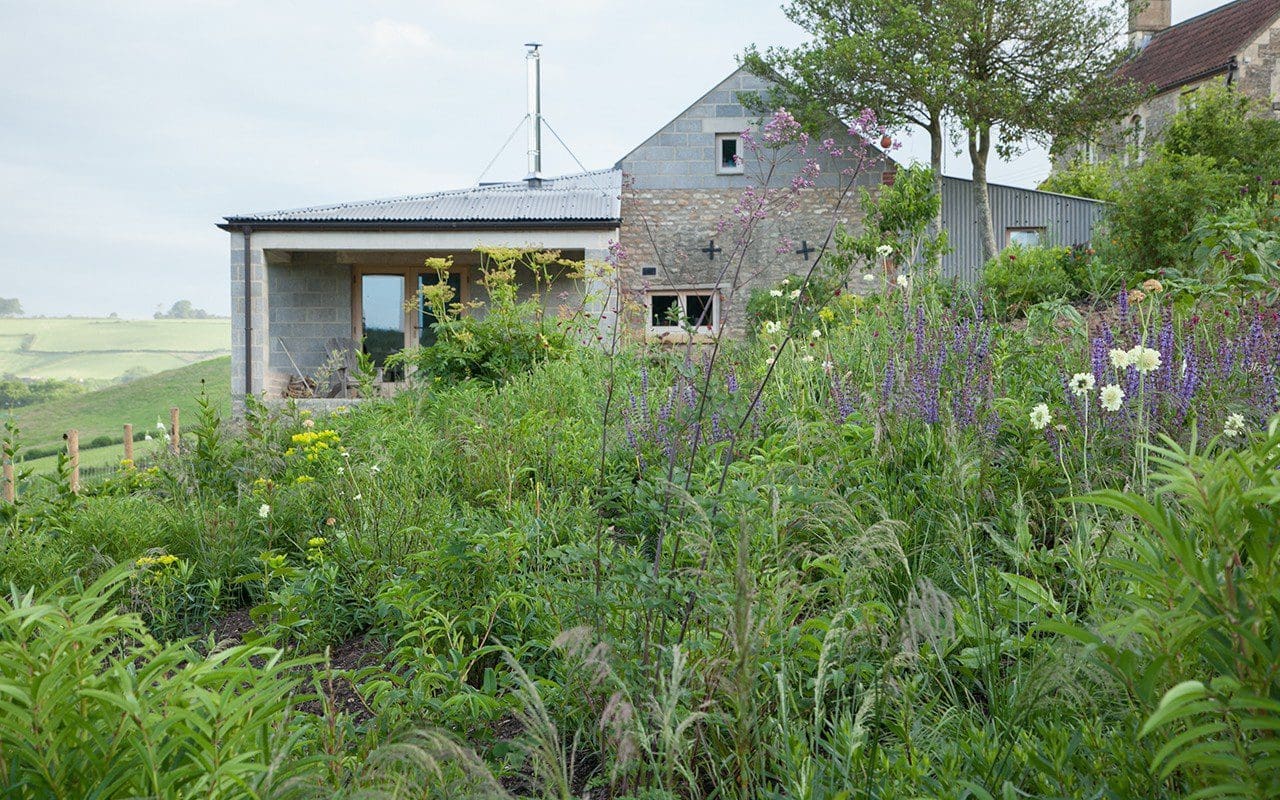
Words: Dan Pearson / Photographs: Huw Morgan
Published 17 June 2017
The tulips are finally over or, more to the point, we are taking control this weekend and will bring their extraordinary display to a close by lifting the bulbs and clearing the bed. As is the way with Christmas decorations, I feel almost as much pleasure in finally stripping away their ornamentation after the period of illumination and, for a moment, for there to be quiet. And, with the cool, dry weather this year, they have been flowering for a full six weeks.
We started growing tulips in earnest in the garden in Peckham, ordering a handful of varieties to fill the pots on the terraces. Each year, a favourite was kept on to get to know it better and winkled into the beds to see if it would last in the ground. That was how we discovered that we preferred ‘Sapporo’ to ‘White Triumphator’, for the fact that it ages from primrose to ivory, and it has been hard to match the perfume and vibrant tangerine of ‘Ballerina’.
When we moved here we continued to experiment, upping the number of varieties and planting the tulips in rows in the vegetable garden to slowly build an armoury of favoured varieties. As we became more confident with our experimentations and learned how to extend the season by including early, mid and late season tulips, we began a to grow them altogether differently.
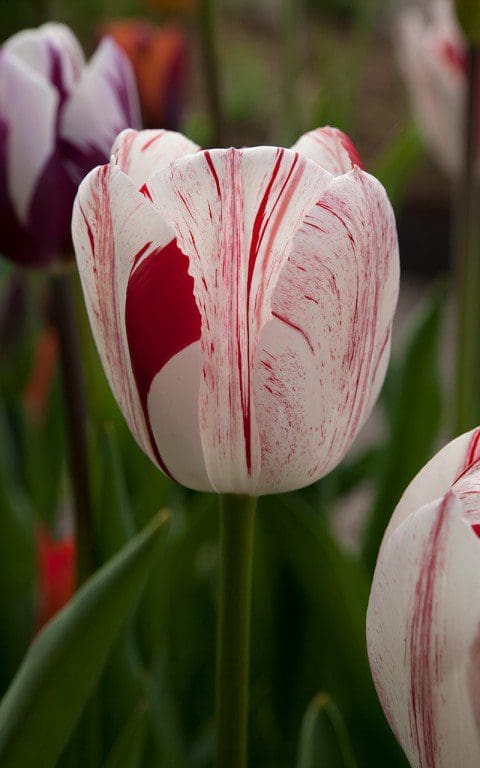 Tulipa ‘Sorbet’
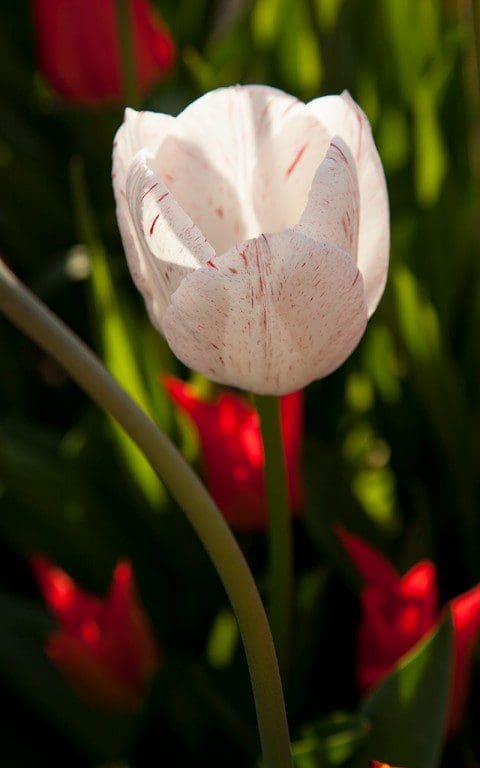 Tulipa ‘Sorbet’
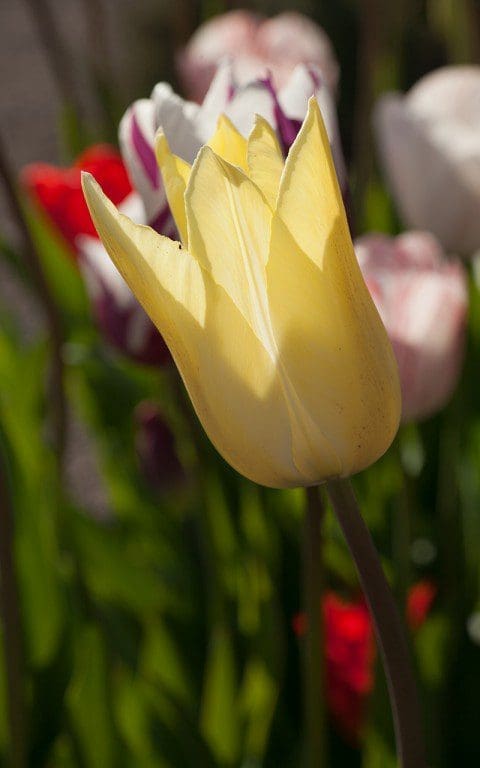 Tulipa ‘First Proud’
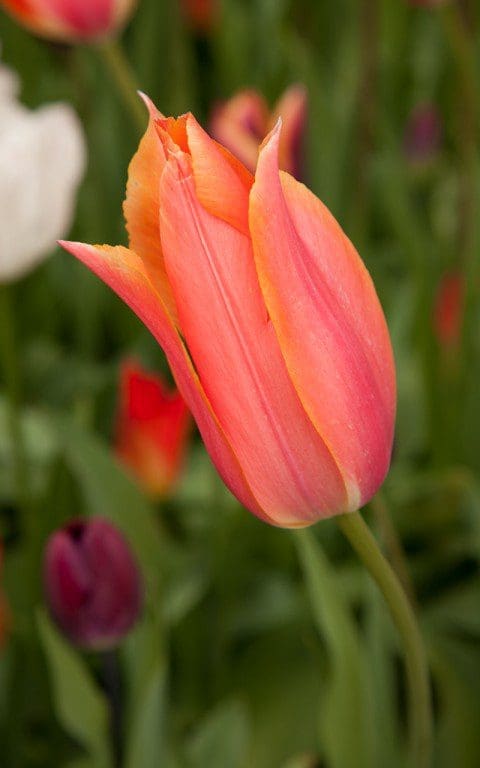 Tulipa ‘Perestroyka’
I was in the process of planting up a client’s walled garden and, for cutting as much as display, we created a series of mixes to play with the sheer breadth of varieties. We chose colour combinations to conjour a series of moods and colour fields, some dark, some pale or pastel, but always with a top or bottom note of vibrancy or depth to offset the predominating mood. The flowering groups were combined together to lengthen the season so that the early varieties were covered for by the late, and short with tall so that the combinations were layered. We also included differing types – doubles, parrots, flamed, fringed and picotee – for that sweetie box feeling of delight in variety.
At home, this has now become the favoured way of keeping up the experiment. Each year we buy thirty or fifty bulbs of up to eight varieties and dedicate a bed in the kitchen garden exclusively to a spring display. We have moved them from bed to bed to avoid Tulip Fire. Tulips are most prone to the fungal infection when repeatedly grown in the same ground, but rotate on a three or five year cycle and you will diminish the chance of infection. In combination with our thirst to try new varieties, it has also been the reason that, at the end of the season, we discard the bulbs and start again with a new batch for November planting. The bulbs, which are cheap enough to buy in quantity wholesale, are planted late at the end of the bulb planting season. They are debagged and thoroughly mixed on a tarpaulin before being spread evenly on the surface of the bed and winkled in with a trowel a finger’s width apart so that they are not touching.

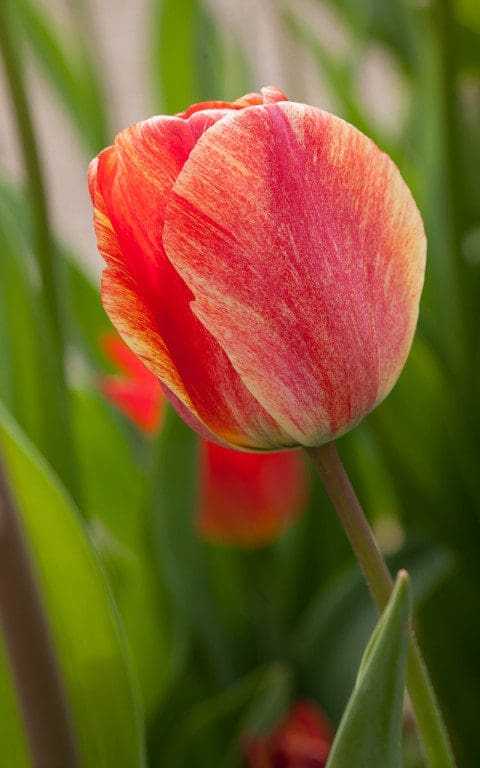
 Three forms of Tulipa ‘Gudoshnik’
This year we have also started growing the Broken and Breeder tulips from the Hortus Bulborum Foundation. This range of old varieties – some of which date back to the 17th century – fell out of popularity in the 1920’s because, in the main, they are late flowering, and the quest for colour to break with winter began to favour the earlier flowering varieties. Their lateness has been a delight, as they have come just as we have begun to tire of the resilience of the modern tulips. Because they are choice (and expensive) we bought just three or five of each, combining them in pans and planting an individual specimen of each in 5 inch clay pots, so that they could be brought into the house for close observation.
Inside, they last for a week in a cool room and continue to evolve whilst in residence, their more subtle colouring, feathering and breaks filling out and flushing in the maturing process. They feel precious and not disposable like the Dutch tulips, so we plan to try and keep the bulbs when they are over. I will grow them on to feed the bulbs for six weeks after they have flowered, before drying and storing the bulbs in the shed until the autumn. I am hoping they will come to more than just leaf next year.
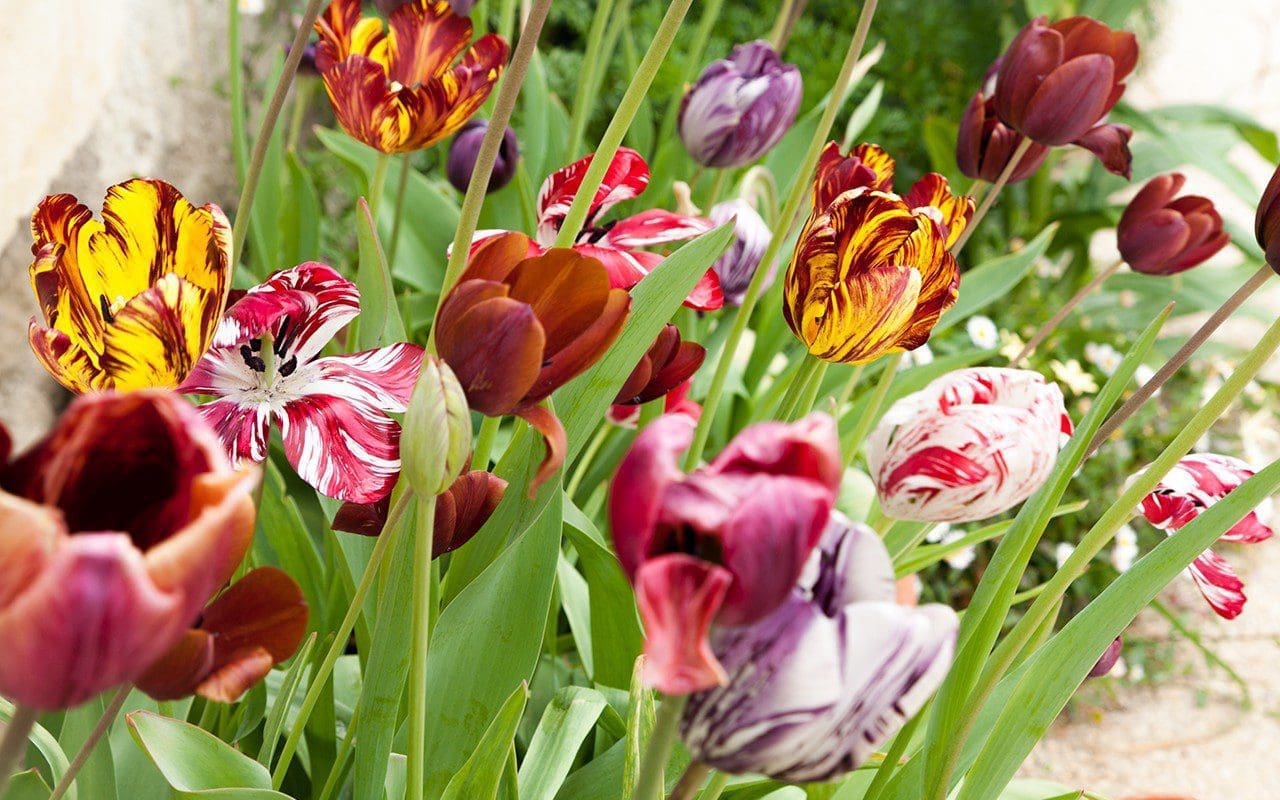 A mix of Broken and Breeder tulips from Hortus Bulborum
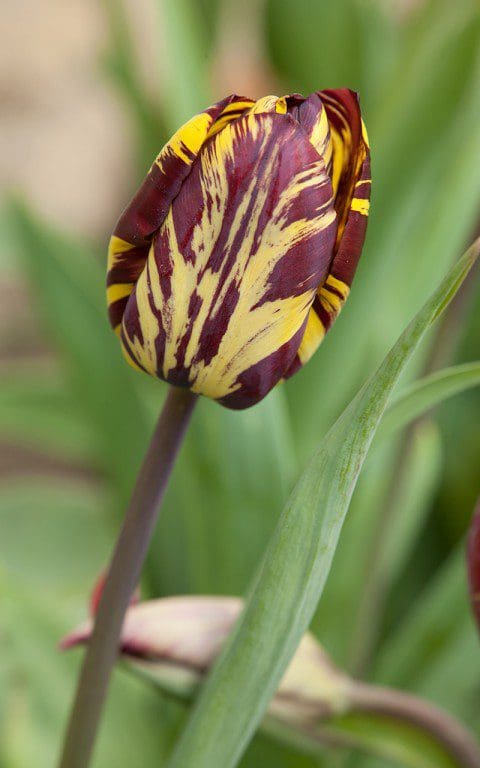 Tulipa ‘Absalon’
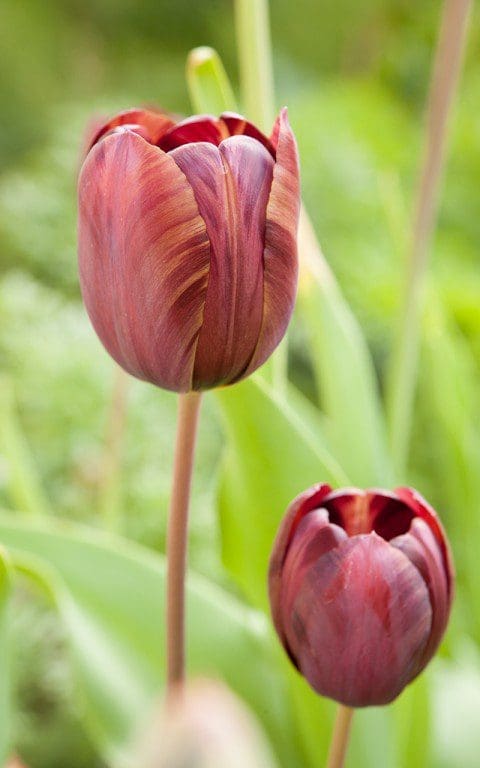 A more subtly marked form of Tulipa ‘Absalon’
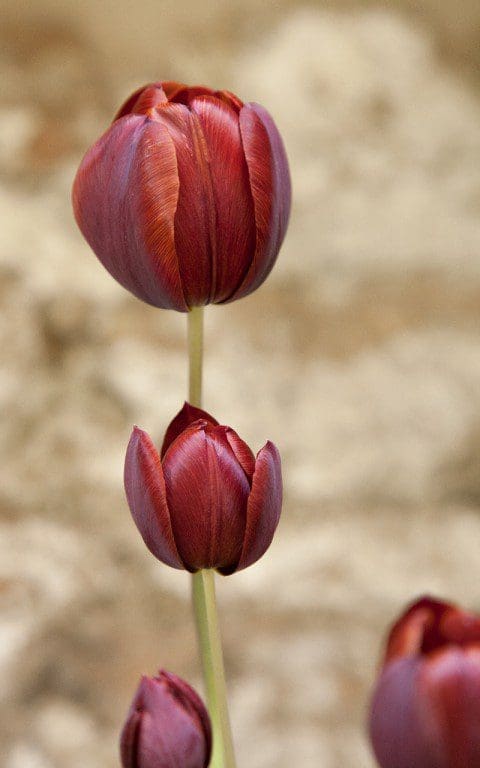 Tulipa ‘Prince of Wales’
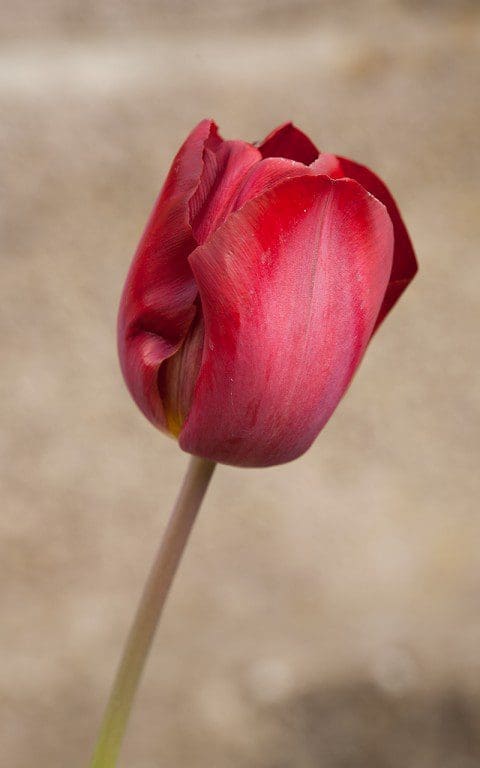 Tulipa ‘Lord Stanley’
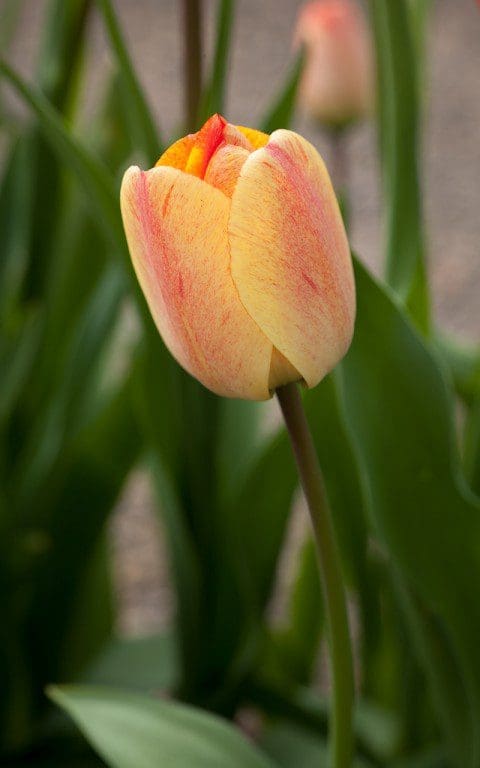
As cut flowers tulips continue to grow, their stems often lengthening as much as a foot or more in a tall-flowered variety such as ‘First Proud’. This has been a new favourite this year, rising up to 90cm; as tall as, but later than, ‘Perestroyka’. A mixed selection of varieties is also good in a bunch and, as they age, the stems arch and lean, sensing each other it seems, so that a vase full will fan out like a firework exploding. The flowers change too, opening and closing with the heat and light and changing colour, sometimes intensifying, sometimes bruising from tone to tone as they fade. The mercurial colour changes are the most interesting and offer far more in terms of value than those that change less, and a new personal favourite this year has been ‘Gudoshnik’, the flowers of which you would swear were different varieties; some are pure vermilion, others red with yellow feathering, others yellow with red streaks. We have also enjoyed the raspberry ripple breaks and freckling of ‘Sorbet’.
If you are experimenting as we are the mixes can be hit or miss, and this year’s wasn’t one of the best, because we didn’t warm to a couple of varieties that have thrown the colour off. We won’t be growing ‘Zurel’ again. The flowers are boxy, the petals stiff and waxy and the flaming is rather coarse. ‘Slawa’ was worth a try, because it looked interesting when we ordered from the catalogue, but it felt too graphic in the mix. The colour combination of peach and plum needs careful placing, and the flowers are less graceful than some. Harsh criticism, perhaps, but a good combination is easily let down by an element that isn’t quite right.
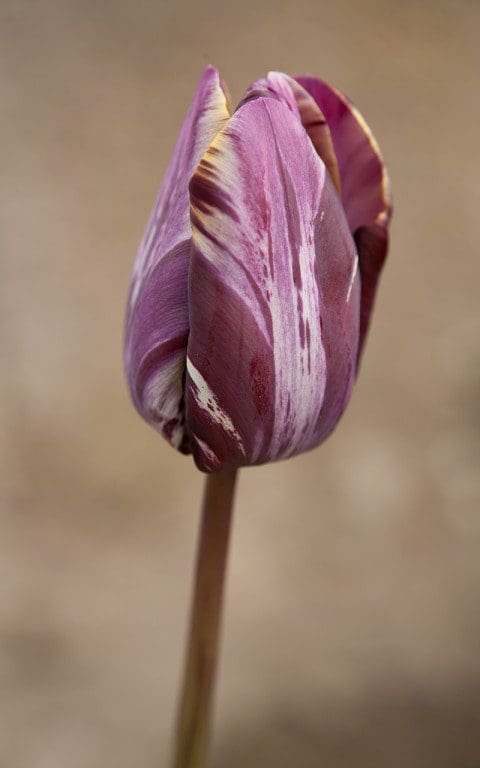 Tulipa ‘Insulinde’
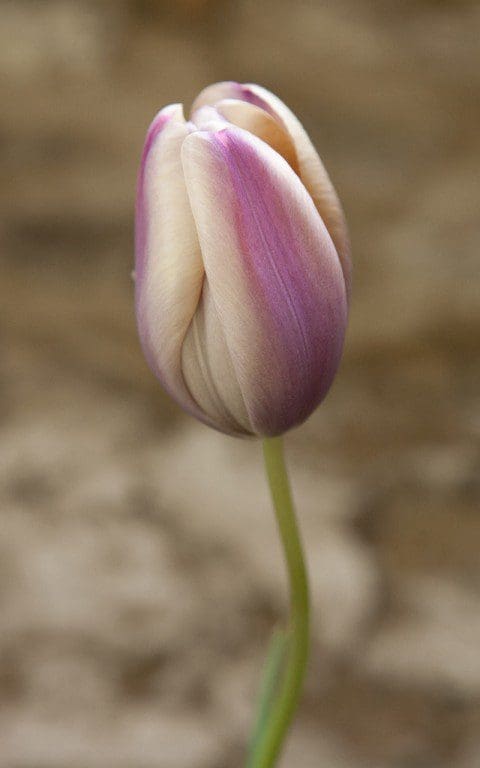 Tulipa ‘Marie-Louise’
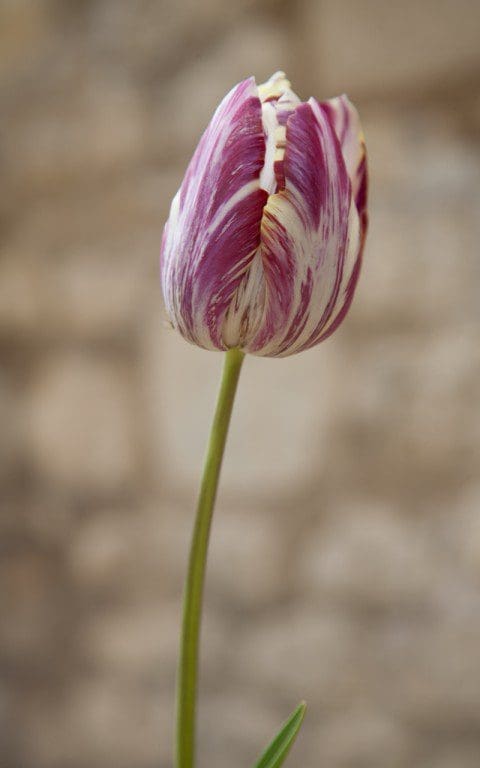 Tulipa ‘Beauty of Bath’
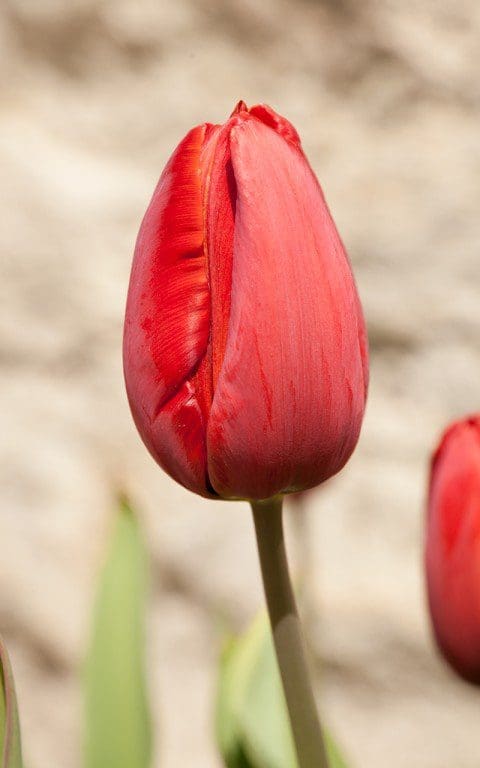 Tulipa ‘Panorama’
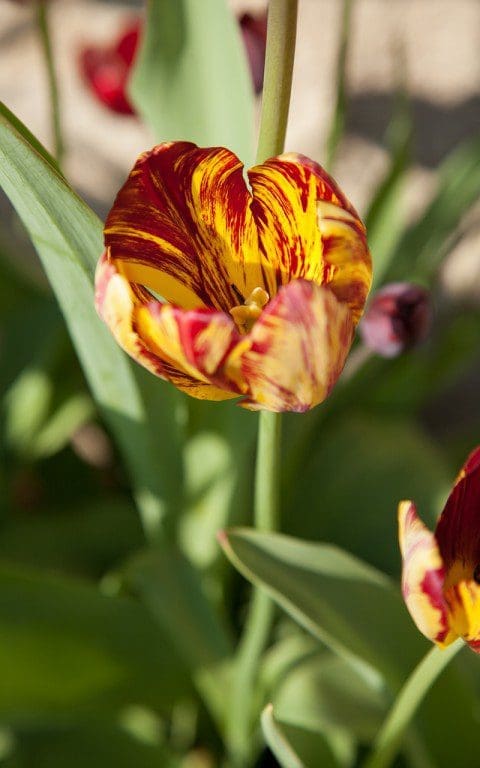 Tulipa ‘Royal Sovereign’
The less successful varieties were also shown in a new light by the older varieties. The breaks, feathering and flaming of the Broken tulips, and the rich tones and pastel gradations of the Breeder tulips are altogether more sophisticated. Put side by side the latter are certainly a rather superior race. Not without their problems I’m guessing, because they are less robust in appearance when compared to the modern hybrids. Particular favourites have been ‘Insulinde’, streaked the colours of blackcurrant fool, ‘Marie Louise’, a Breeder of a delicate, graduated lavender pink, ‘Panorama’, a Breeder of a strong copper orange and ‘Absalon’, a Broken tulip (and one of the original Rembrandt tulips) which has ranged from the flamed, blood-red and yellow you see in illustrations to a more subtle mix of mahogany streaked with tan, like an old-fashioned humbug.
Though we have heard much about their growing popularity, seeing them in the flesh has been a little like discovering really good chocolate. I fear we have now been spoiled and it won’t be possible to be without them.
Words: Dan Pearson / Photographs: Huw Morgan
Published 13 May 2017
I was watching closely this year as the buds on the tree peonies started to swell. My plants needed to be moved from the stock-bed to their final positions in the new garden and it was critical that the timing was right. They have sentimental value, for I collected the originals as seedlings that were springing up under their parents at the Edinburgh Botanic Gardens. I was 19 and working under Ron McBeath, a great adventurer and plant collector in his own right and a man who understood that, if you fell for a plant, it was an all-consuming thing. It was tacitly acknowledged that a certain amount of ‘pockle’ (the term for spare plants for the taking) was tolerated. In fact, I had an orange crate strapped to the back of my bike for such booty. The seedlings were our morning’s weeding so a clutch made their way back to my digs, and then to my parents’ garden, before I was able to take them on to my garden in Peckham a good fifteen years later.
From there they came here as a new generation of seedlings which I’d been growing on just in case. Although they take up to five or six years to flower, growing from seed is easy enough if you sow it fresh as soon as it drops. Germination happens six weeks or so afterwards, but only underground. The first leaves don’t show themselves above ground until the following spring. I left them in the cold frame for a couple of years, as the young roots resent disturbance, and they were lined out here in the stock beds and flowered a couple of years after we moved in. Each plant has subtle differences – the joy of raising from seed – but all are as captivating as the original I now saw thirty-four years ago.
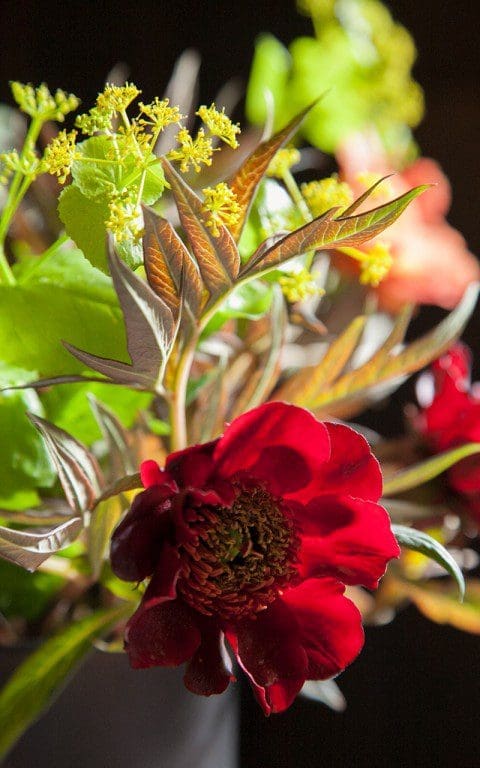 Paeonia delavayi and Smyrnium perfoliatum
I have half a dozen Paeonia delavayi in their new positions, stepped through the entrance to the garden from the house to form a gateway of sorts. Although I wasn’t ready to move the plants until the end of winter, they were dug carefully with a decent root-ball to minimise disturbance. The move happened as soon as I saw the buds swelling, so that they would have the energy of growth on their side and not sit and sulk in wet soil.
Read up about moving peonies and most literature says they are hypersensitive and prone to failure and, if you do succeed, they take a long time to establish. It is also recommended to move them in the autumn, so that the early growth is supported by roots which have been active the winter long and can support this early flush of activity. However, my plants have proven all of the above to be rules worth bending.
Growth is famously early, fat buds breaking ahead of almost everything else and making them vulnerable, you might think, to the cruelty of March and April weather. Again, according to the books, you are supposed to plant tree peonies in positions where the early growth isn’t caught by morning sunshine which, in combination with a freeze, is lethal. A slow thaw is better but, miraculously, our plants were all untouched by a vicious frost last week that toasted the Katsura down by the stream and wilted the early growth on the campion in the hedgerow, so I believe them to be tougher than the hybrid Moutan peonies, their more exotic cousins.
Growing in pine clearings in Yunnan and Eastern Asia, Paeonia delavayi is more adaptable than you might first imagine. Edge of woodland conditions suit it best, but here, on our retentive soil, it has been happy out in the open with all-day sun and freely moving air on the slopes to confound best-practice positioning. I do like contradictions and the ever-evolving learning curve when you get to know your plants and their limits.
Standing in glorious isolation, and ahead of the planting which will join them in this part of the garden in the autumn, I am free to admire their form and am imagining their companions; the things that will complement their moody atmosphere and rich colouring when it comes to planting time. Tall, rangy stems, that will eventually reach six foot or so and as much across as they mature, give way to elegantly furling growth at the tips. The flowers, of darkest blood-red and with stiff, waxy petals, appear before the leaves are fully expanded, hanging at a tilt to hide the boss of red-flushed stamens which age to gold. The beautifully dissected foliage is coppery-bronze at this stage with a damson-grey bloom that fades to a matt neutral green as it fills out.
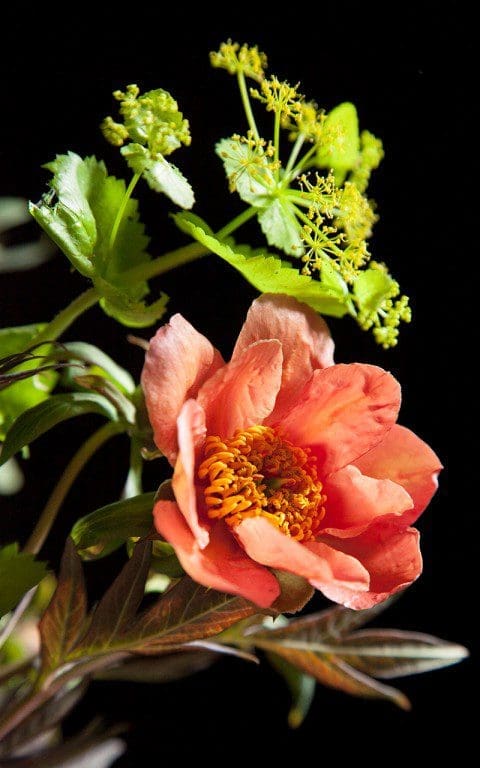 Paeonia potaninii and Smyrnium perfoliatum
Paeonia potaninii, which hails from Western China and Tibet and is thought by some to be a subspecies of P. delavayi, is similar in its growth, but differs in its gently suckering habit. My original seedling, still growing in the dappled shade of my parents’ orchard, is now several feet across. It looks happy in the clearing and is competitive enough to deal with the infestation of ground elder and ferns that have made the orchard their territory.
Here conditions couldn’t be more different, but my plants show their adaptability by flowering more profusely and being less lush in leaf out in the open. The flowers are the most extraordinary confection of apricot overlaid with burnt sugar, like shot silk surrounding decorative saffron stamens. The flowers hang heavy amongst the new leaves and cast a strong perfume as you pass on the path. The distinctive scent has something of the citrus spice of witch hazel, but overlaid with an exotic, grassy sweetness. Cut, in a vase, their perfume is more easily savoured.
We have them here with the acid-yellow Smyrnium perfoliatum, which lifts the subtlety of the colour and throws it into relief. I’ll need to do this in the garden too and plan to have the darkness of P. delavayi amongst Anthriscus sylvestris ‘Raven’s Wing’, with P. potaninii floating above the ruby-red droplets of Dicentra formosa ‘Bacchanal’.
Though the brilliance of the Smyrnium is perfectly pitched with these rich, warm colours, I take heed from Beth Chatto’s words when I told her it hadn’t yet taken off in my garden in Peckham. ‘Just you wait !’, she said. And I, not wanting to break all the rules, have remembered her advice and have only set it free on the rough ground behind the barns with the comfrey.
Words: Dan Pearson / Photographs: Huw Morgan
There is a point when winter turns and spring takes over. It inches at first, and then that false feeling – that you have time on your hands – begins to evaporate. This year I have been watching for the change more intently than usual, because we had a date in the diary to plant up the first phase of the new garden; the week of the spring equinox which, this year, proved to be perfect timing. One week later and the peonies were already a foot high and the tight fans of leaf on the hemerocallis were flushed and beyond moving without setting them back.
I have been planning for this moment for three years, perhaps longer in refining the idea of the way I wanted the planting to nestle the buildings and blend with the land beyond. I procrastinated over the final plant list for as long as it was possible, but in January it finally went out to the nurseries in time to get the stock I needed for spring.
The process of refining a plant palette is one that I know well, but committing a plan to paper is an altogether more difficult thing to do for yourself than for a client. I decided not to make an annotated plan, but instead to map a series of areas that shift in mood as you walk the paths. I paced the space again and again to understand where the ground was most exposed, where it was free-draining and to note that, in the hollow where the ground swung down to the track, there was running water a spit deep this winter. I imagined where I would want height and where I would need the planting to dip, sometimes deep into the beds, to give things breathing space. There would also need to be countermovements across the site, with tall emergent plants brought to the foreground, close to the paths.
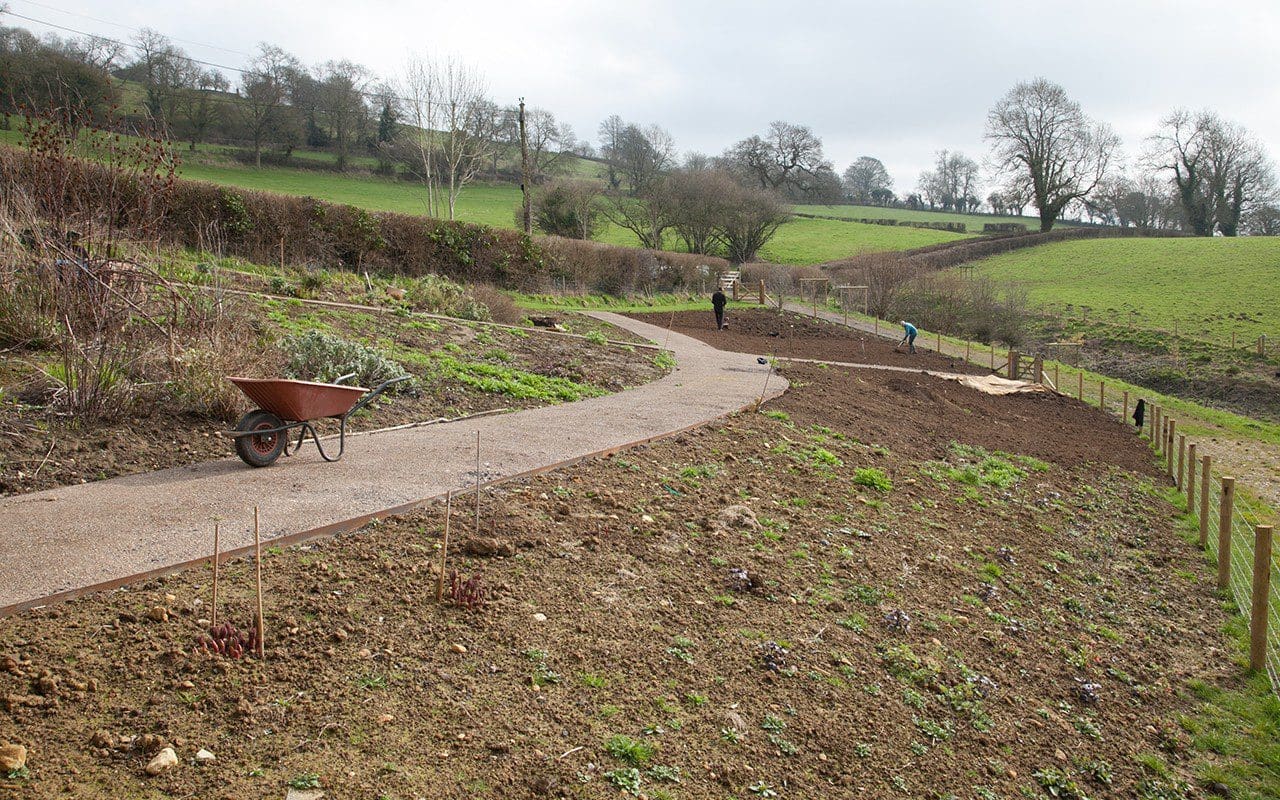
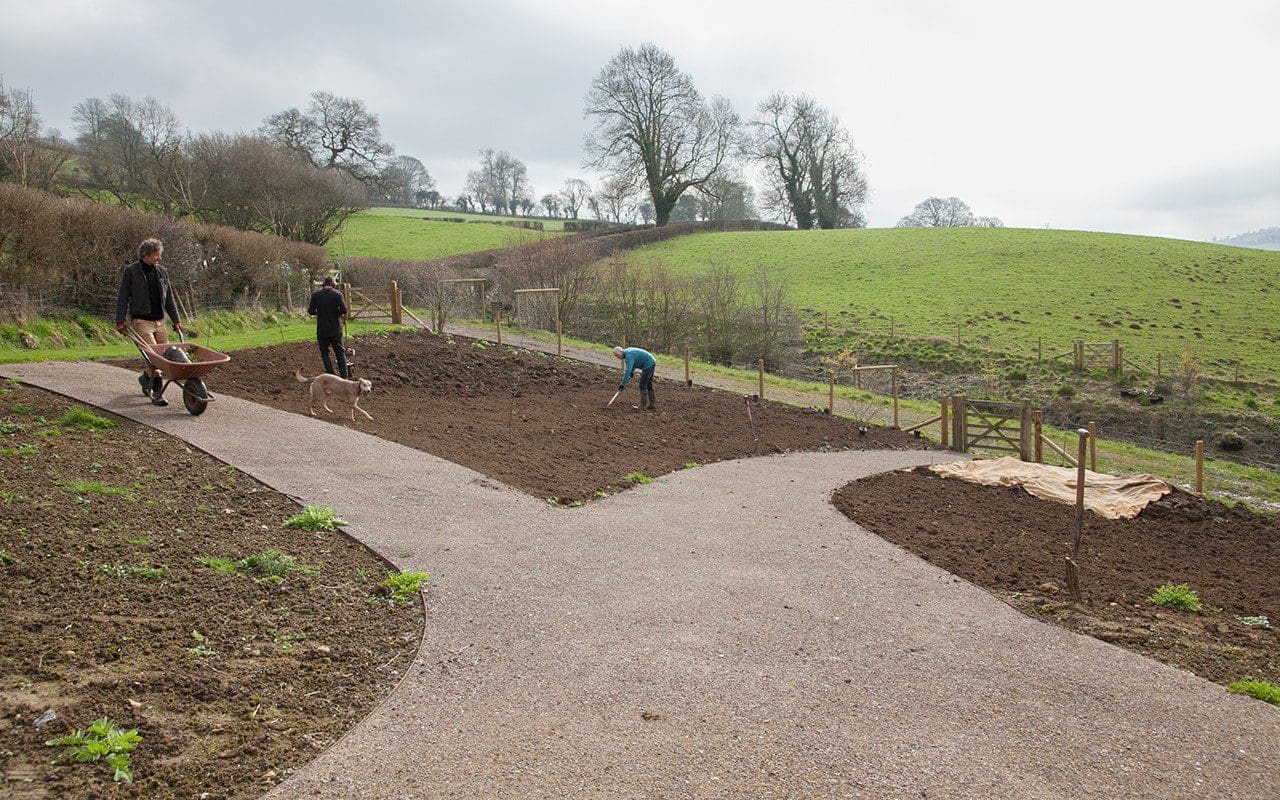 The final stages of soil preparation in early March
The preparation was completed the week before the plants arrived; the soil dug in the windows when it was dry enough and then knocked out level just in time. We prayed that the weather would dry up, because the soil had lain wet all winter and would not stand footfall if it stayed that way. In tandem with the soil preparation we moved some favourites that I have been bulking up, like the Paeonia mlokosewitschii and Paeonia emodii ‘Late Windflower’, both of which came with us from Peckham, and split those plants that had passed the test in the trial garden. A three year old Sanguisorba ‘Cangshan Cranberry’ was easily divided into eight, and so three plants gave me twenty four to play with; enough to move from bed to bed and to jump the path. The same with the persicarias, the Iris x robusta ‘Dark Aura’, the Aster turbinellus and a long list of others. These were bagged up individually so that I could afford to leave them laid out when shifting the planting around on the day of laying out.
Due to the size of the site this was just the first round of planting, and of only half the garden. The remaining half will be planted this autumn. The plan for this lower half comprises a dozen interlocking areas, which allow my combinations to vary subtly across the site and flow into one another to form a related whole. Before starting, the boundaries were sprayed onto the soil with a landscape marker, although I break these boundaries during setting out, jumping plants across to knit them together.
Shrubs and woody plants were positioned first to articulate the space. Trees by the gates including Hamamelis x intermedia ‘Barmstedt Gold’ and Crataegus coccinea, some Malus transitoria and Rosa glauca breaking in from high up, and home-grown whips of Salix purpurea ‘Nancy Saunders’ and Salix gracilistyla fraying the edges alongside the field. Molinia caerulea ssp. arundinacea ‘Transparent’, the largest of the clump forming grasses, was also given its position early to tie the meeting point of the paths together.
 Plan showing the twelve interlocking planting zones
 Dan’s hand-drawn zoning plan with developing plant lists
 Plant lists and orders
For each of the zones I made a list that quantified all of the plants I would need to make it special. A handful of emergents to rise up tall above the rest; Thalictrum ‘Elin’, Vernonia crinata, sanguisorbas and perpetual angelicas. When laying out these were the first perennials placed to articulate the spaces between the shrubs and key grasses.
Next, the mid-layer beneath them, with the verticals of Veronicastrum virginicum ‘Album’ and Persicaria amplexicaule ‘Rowden Gem’, and the mounding forms of aster (A. divaricatus) or geranium (G. phaeum ‘Samobor’, G. psilostemon and G. ‘Salome’). The plants that will group and contrast. And finally, the layer beneath and between, to flood the gaps and bring it all together. These were a freeform mix; fine Panicum ‘Rehbraun’ with Sanguisorba officinalis ‘Tanna’, or Viola cornuta ‘Alba’, Coreopsis verticillata ‘Moonbeam’ and the white bloody cranesbill, Geranium sanguineum ‘Album’.
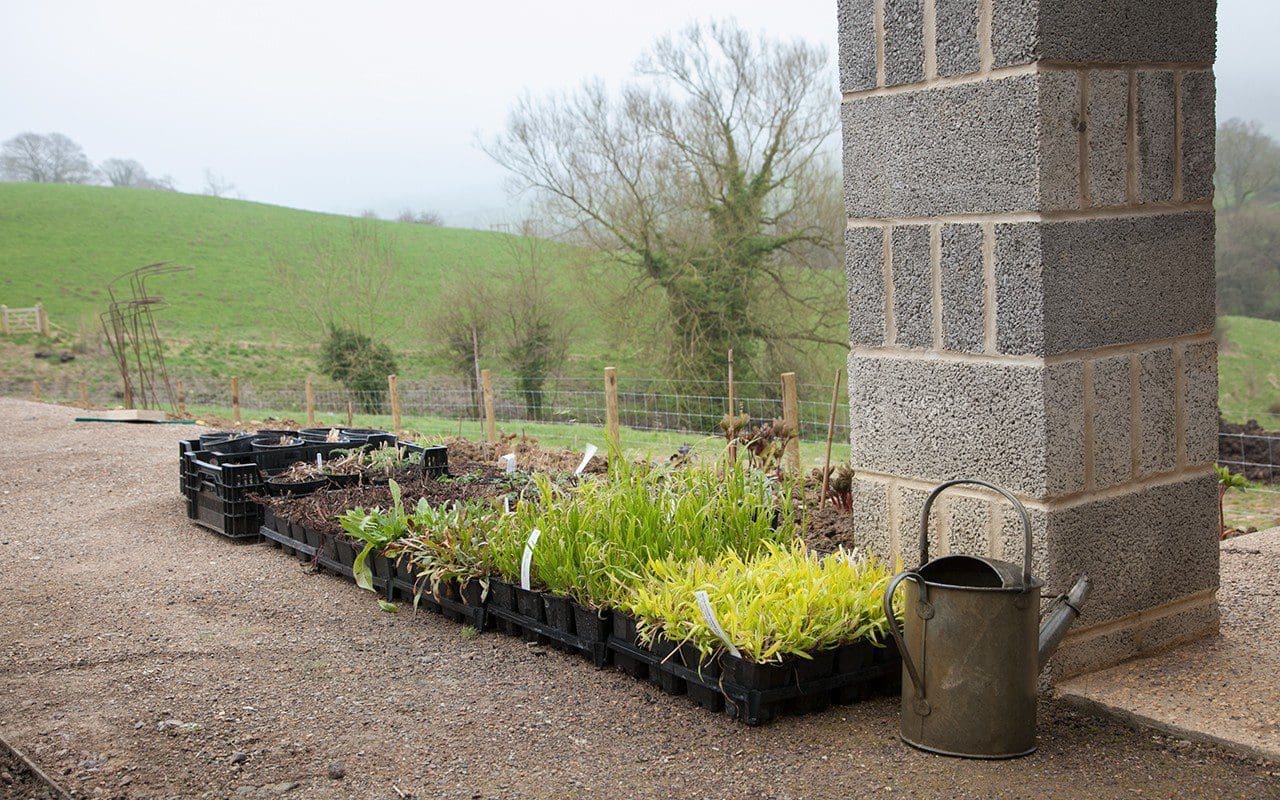
The plants arrived from Orchard Dene Nurseries and Arvensis Perennials on the Friday. Immaculate and ready to go and filling up the drive. I like to plant small with nine centimetre pots. If you get the timing right, and don’t have to leave them sitting around, this size is easily trowelled in with minimum soil disturbance. At close spacing this makes planting easier and faster than having to spade in a larger plant.
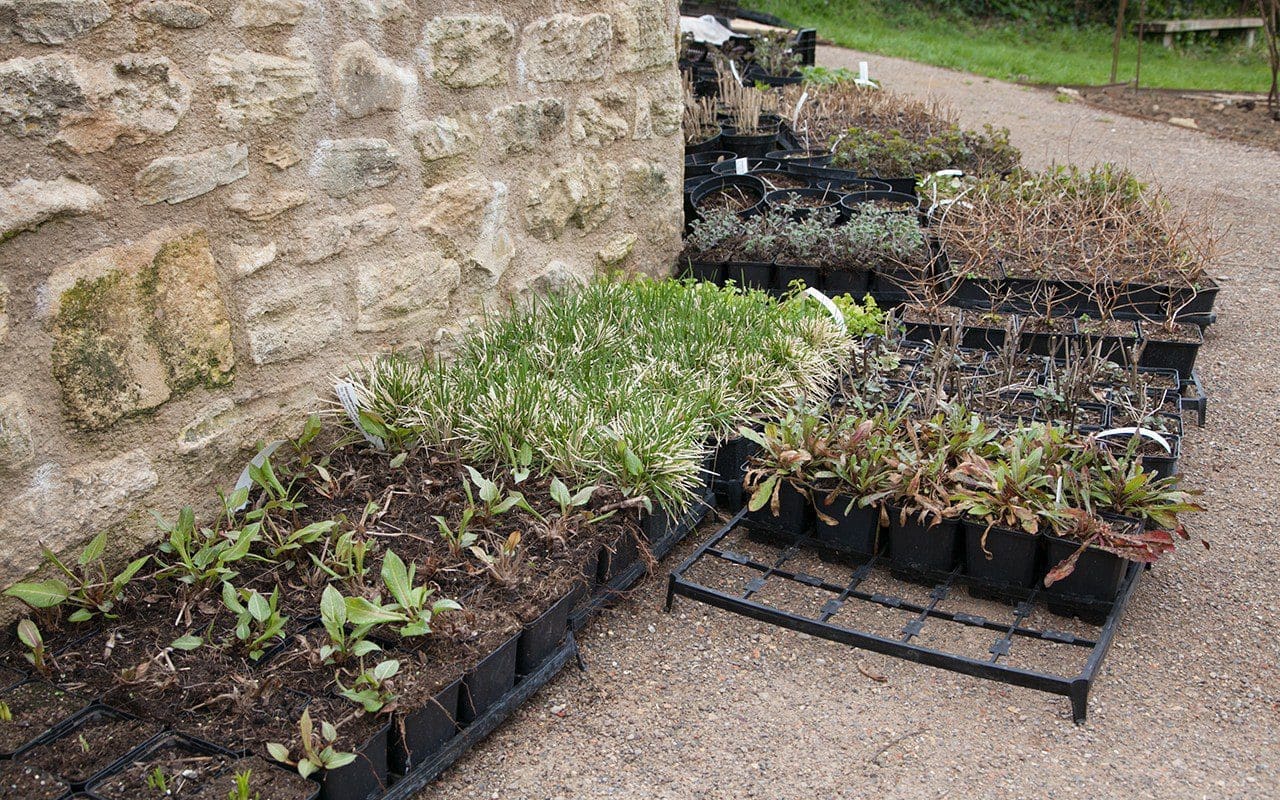 Plants waiting to be put in position along the paths
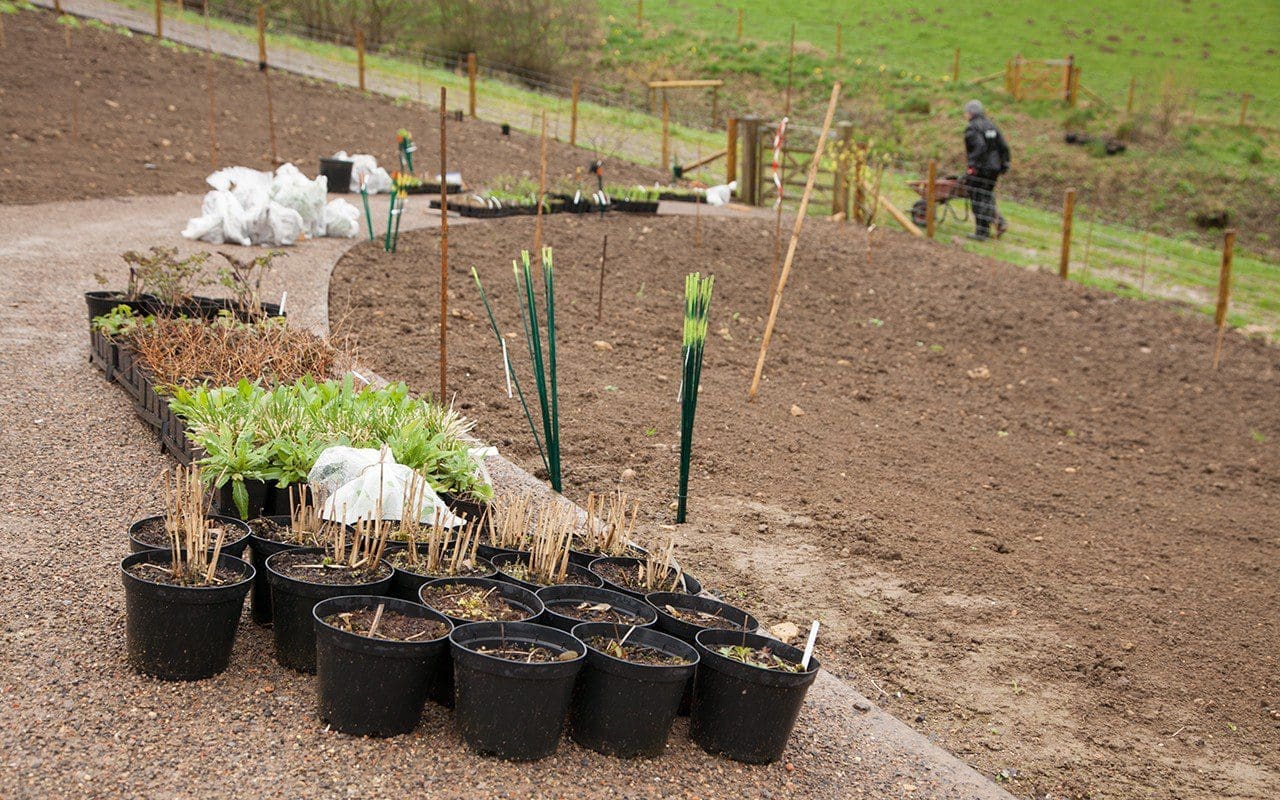 Plants grouped by planting zone
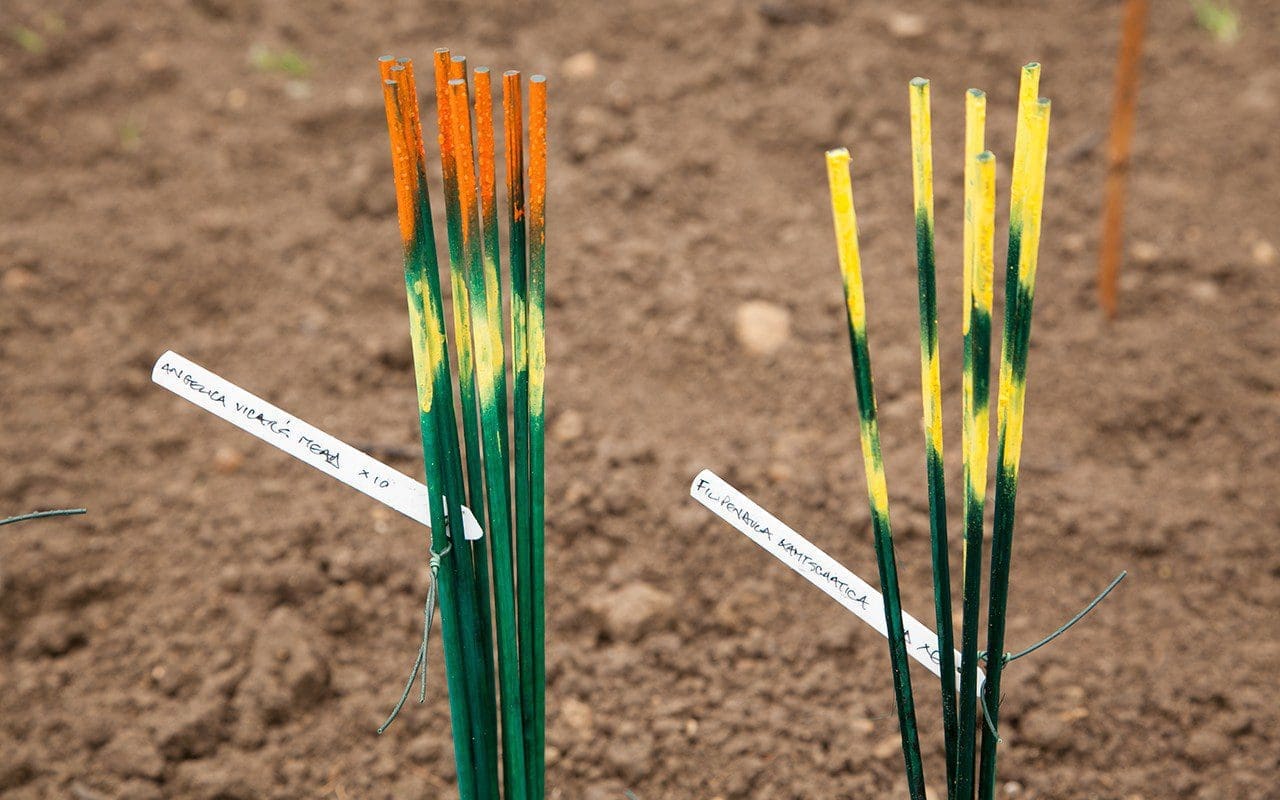 Colour-coded sticks were used to mark the positions of plants yet to be supplied
It took us two days to complete the lifting and dividing of my stock plants and to set the plants on the paths in their groups. And the process was prolonged as I started adding last minute choices from the stock beds. On the Sunday high winds whistled through the valley to dry the soil, so I started setting out and hoped that the pots didn’t blow into one corner overnight, as once happened in a client’s garden. On the Monday, and ahead of my team of planters who were arriving the next day, I continued to populate the spaces, between the heavens opening up and pouring stair-rods. It was hard, and there was a moment I despaired of us being able to get the plants in the ground at all.
Setting out plants is one of the most all-consuming and taxing activities I know. It feels like it uses every available bit of brain-space. You not only have to retain and visualise the various volumes, cultural requirements and habits of the individual plants, but also the sequencing and rhythm of a planting, how it rises and falls, ebbs and flows, and then how each area of planting relates to the next, in three dimensions and from all angles. Add to this the aesthetic considerations of colour relationships both within and between areas and the time-travel exercise of imagining seasonal changes and there is only so much I can do in one session. However, I was ahead of my planters and, as long as I could hold my concentration once they arrived, it would stay that way with them coming up behind me. The rains abated, the wind continued and the following day the soil was dry enough for planting.
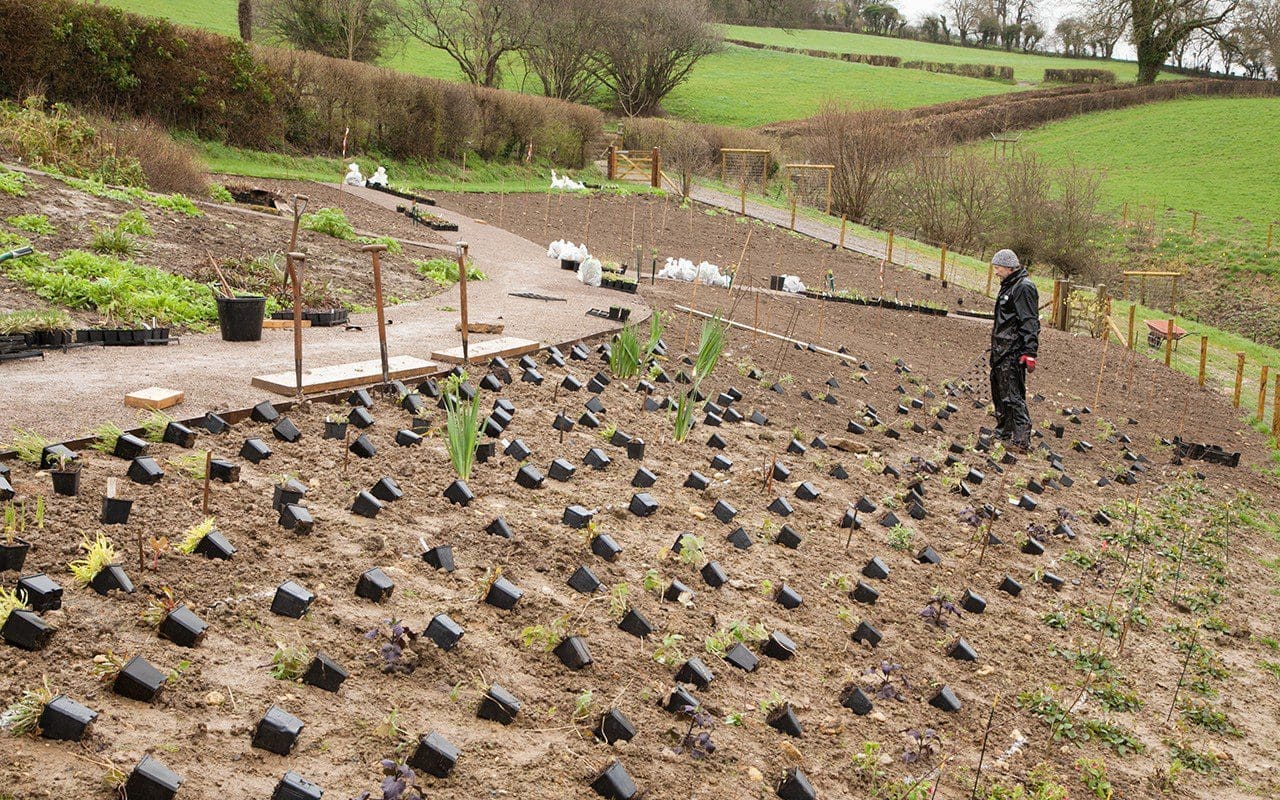 Dan concentrating on plant layout
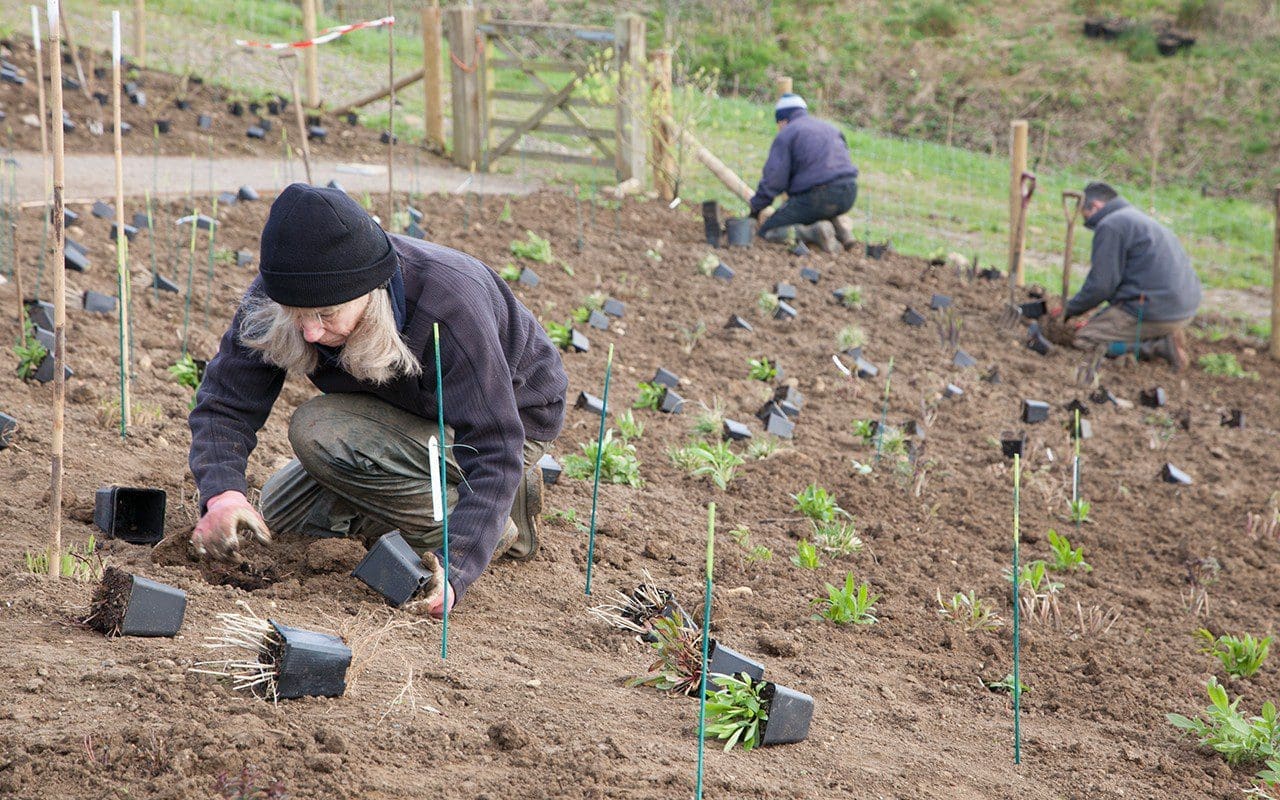 Jacky Mills
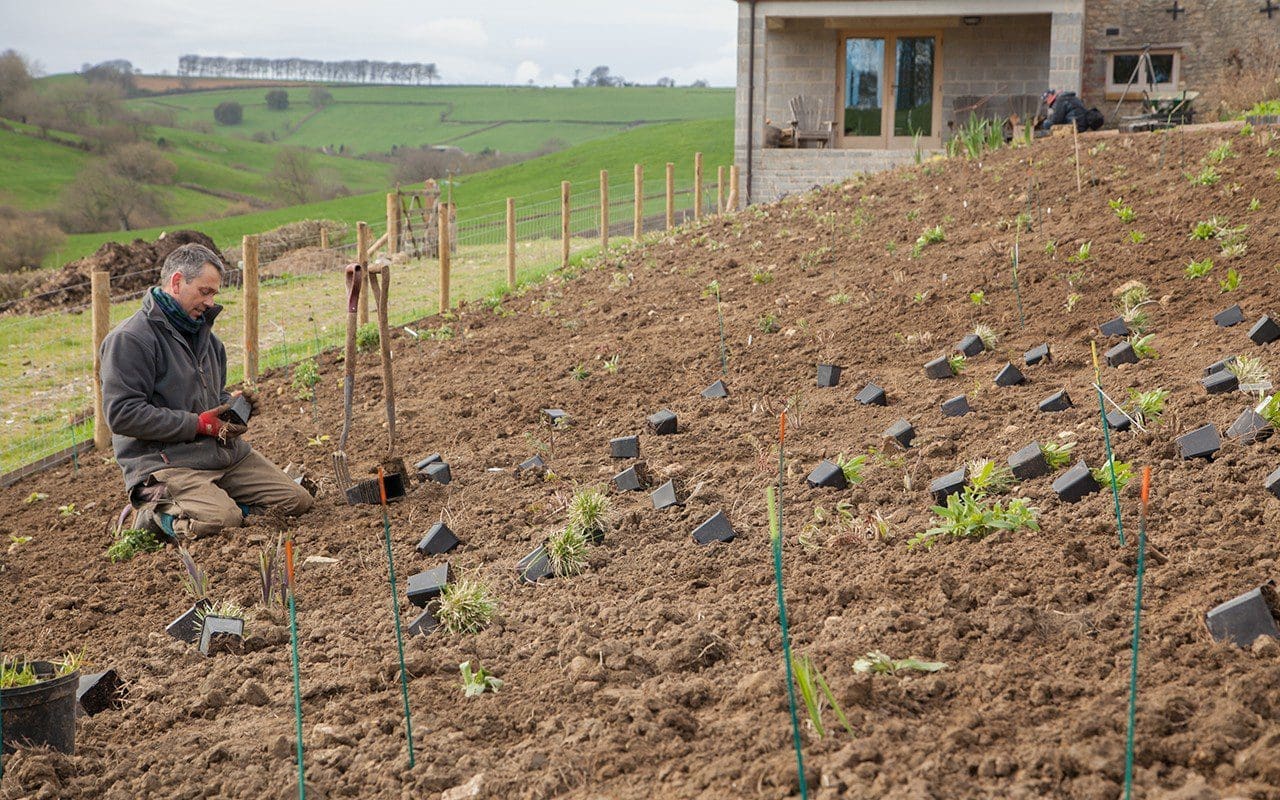 Ian Mannall
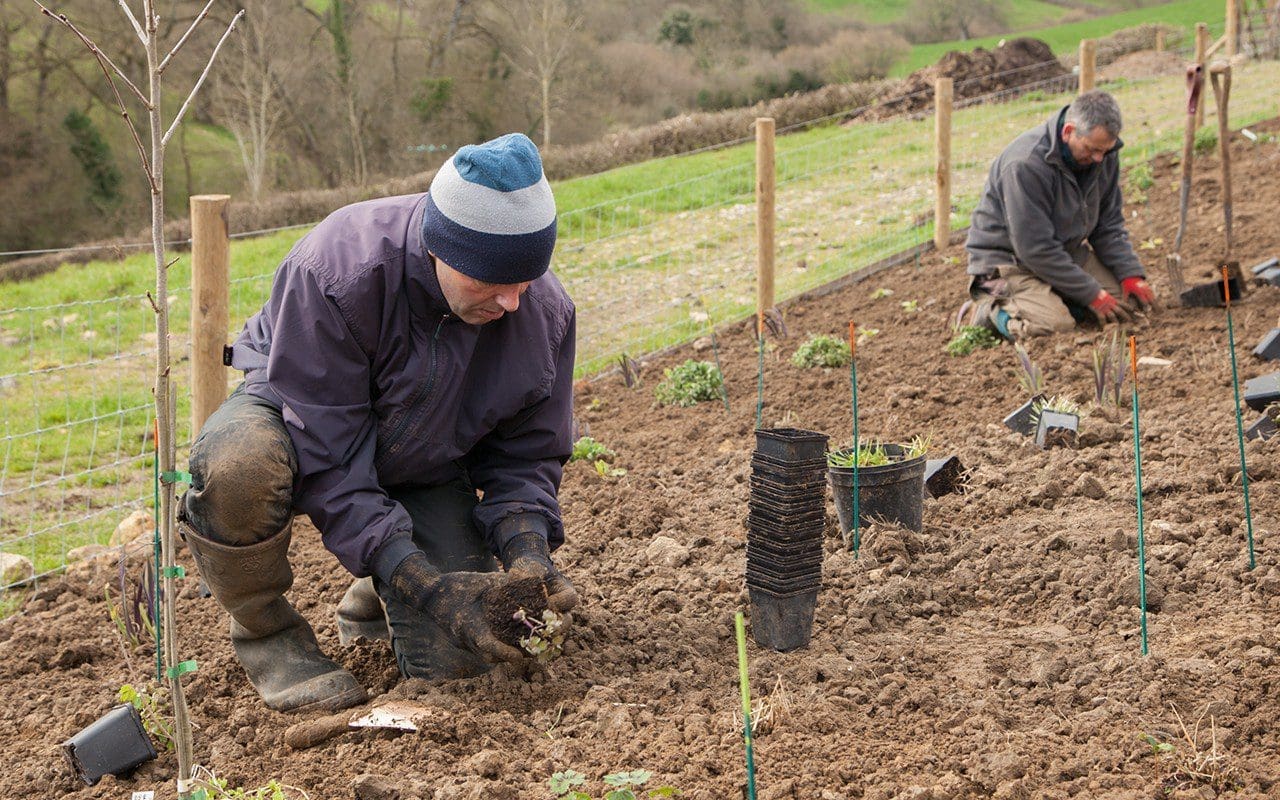 Ray Pemberton
On the 21st, the sun broke through not long after it was up. A solitary stag silhouetted against the sky looked down on us from the Tump as we readied for the day. Clearly word had already got out that there were going to be rich new pickings in the valley.
Over the course of two days about twelve hundred plants went in the ground. Three people planting and myself managing to stay ahead, moving the plants into position in front of them. Thank you Ian, Jacky and Ray for your hard work, and Huw for supplying a constant supply of necessary vittles.
I cannot tell you – or perhaps I can to those who know this feeling too – what a huge sense of excitement is wrapped up in a new planting. Plans and imaginings, old plants in new combinations, new plants to shift the balance. All that potential. All those as yet unknown surprises.
Already, the space is changed. We will watch and wait and report back.
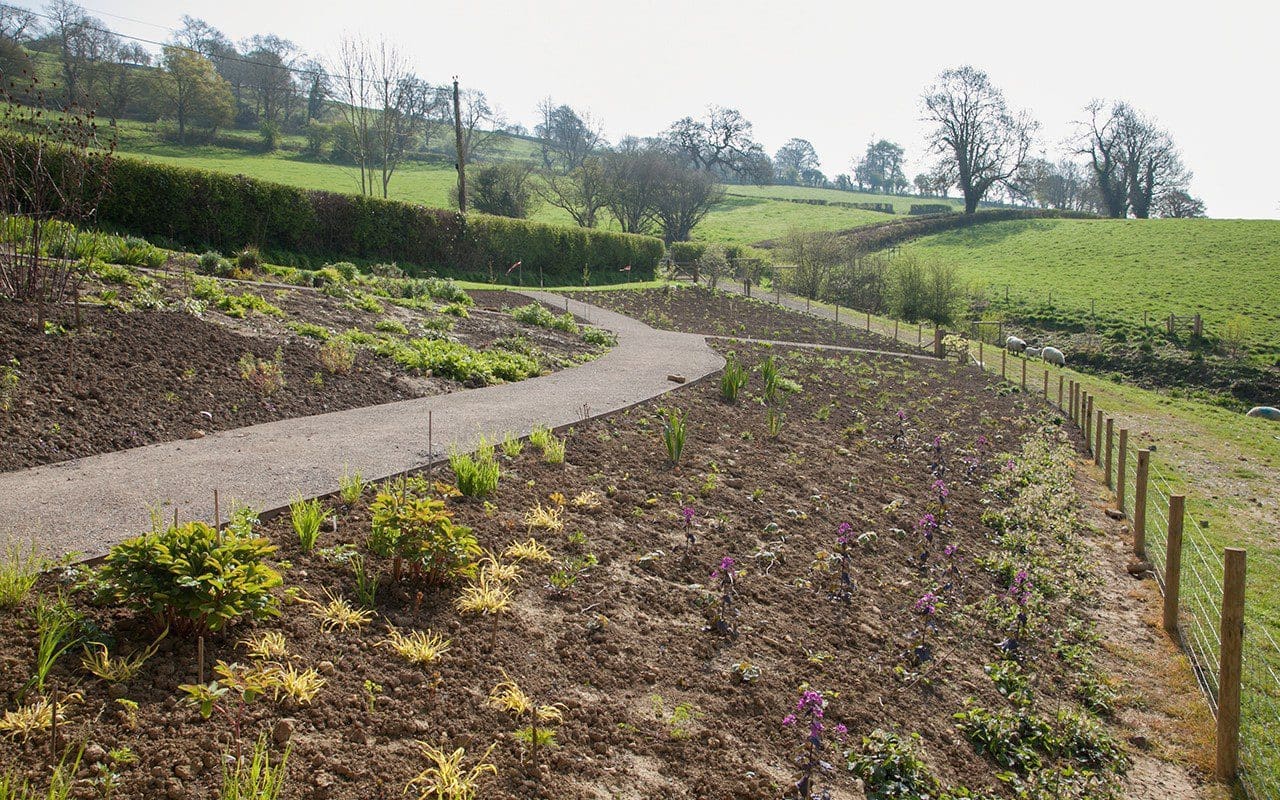 6 April 2017, two weeks after planting
Words: Dan Pearson / Photographs: Huw Morgan
ALREADY A PAID SUBSCRIBER? SIGN IN
This year we have based ourselves here for three full weeks to see out the last of December and welcome in the new year. Your eye is free to travel further in this wintry landscape and it has been good to follow by venturing beyond our boundaries. Slowly – for it took a few days to get into the routine of it – a walk has started the day. We have been both up and down the valley and high onto the exposed ground of Freezing Hill to experience the roar of the wind in the beeches and to understand why it has its name, as it whips up the slopes that run down the other side to Bristol. Always looking back to see how we fit into the folds, we have contributed to our knowledge of muddy ways, well-worn tracks, breaks in hedges and crossing points back and forth across the ditches and streams. Marking our way – for nearly every field has at least one – are the ancient ash pollards.
Ash wood burns green so the trees have value and owning enough pollards would keep you in firewood if you attended to them in rotation. The pollards regenerate easily from cuts made above the grazing line, so that they can grow away again unhindered by the cattle. Usually standing solitary on a steeply sloping pasture (where they add to their usefulness by providing summer shade for livestock) the pollards are stunted by decades of decapitation and, in combination, make an extraordinary trail of characters in the landscape.
We have stopped at each one to take in their histories and their winter slumbers that expose their distinct personalities. Some are hollow to the core, the new limbs surviving on little more than a thin rim of bark. Inside the hollows map the decay and hold the damp and the smell of it even in the dry months. The halo of new growth that breaks from the old forms a crown of fresh limbs that in ten or twelve years are big enough for harvesting. To date the cycle has continued until the trees are exhausted and split and fail.
Of course, we are waiting patiently to see if the pollards survive the chalara dieback that is moving across the country and is already in the valley. Neighbours who have lived here a lifetime recount how different the landscape was when the elms rose up in the hedgerows, but it is the ash and their potential demise that will now be cause for a new perspective.
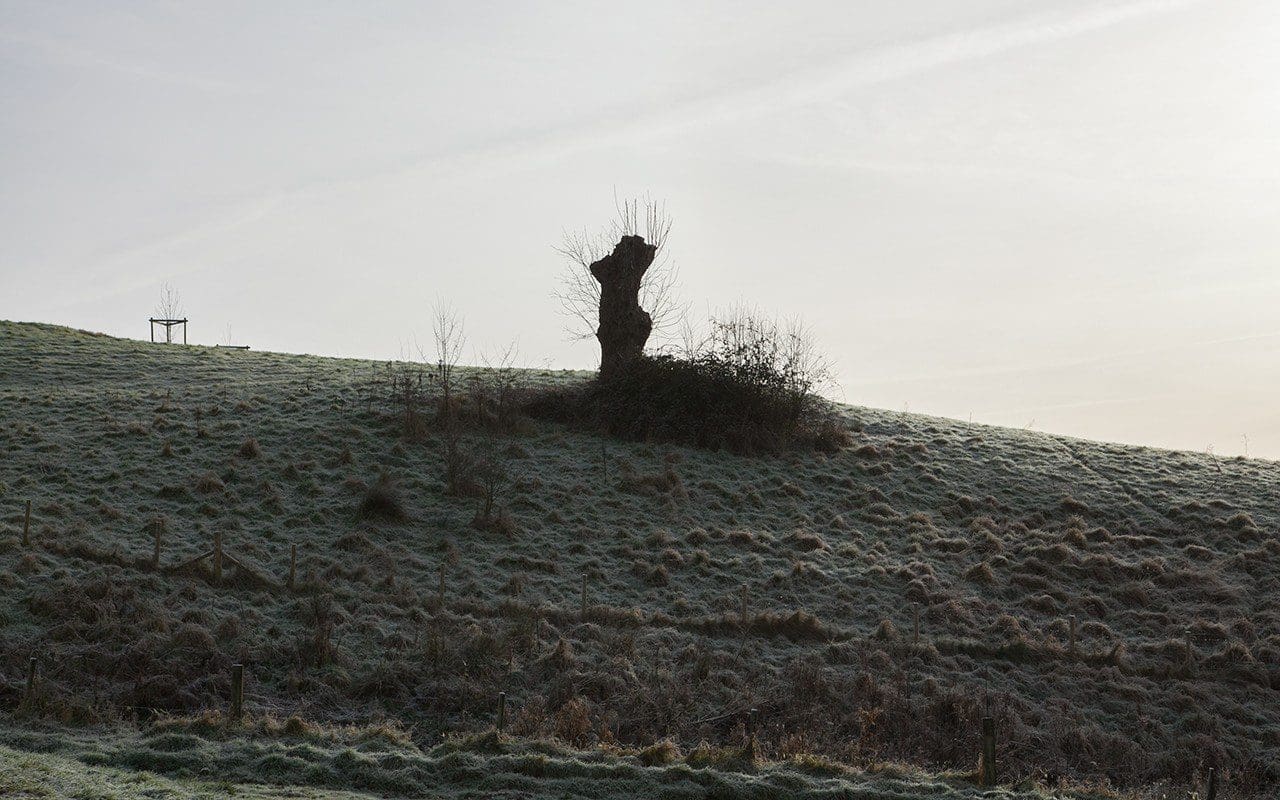 The solitary ash pollard on The Tump
We have a solitary pollard on the west facing slopes of The Tump. The farmer who lived here before us climbed the tree to harvest the wood in the year he died. The tree must have been huge once, the trunk striking the form of an imposing female torso. An interesting presence given the fact that the ash was once seen as the feminine counterpart to the father tree, the oak. When we arrived here there was just a summer’s regrowth and I set to immediately planting thirty new ash in the hedgerows to provide us with our own rotation. So far – and I remain hopeful – they have done well, despite our mother tree showing a reluctance to throw out another set of limbs and the forecasts that estimate a five percent survival for ash in this country.
We have let the grass grow long on the slopes that are too steep for haymaking around our pollard and in six years there are the beginnings of a new habitat. An elder has sprung from high in her crown and a black and sinister fungus from the side that has refused to regrow branches. Around her there is a skirt of bramble and young hawthorns where the birds have previously settled in her branches and stopped to poop. I plan to plant an oak I grew from an acorn amongst them. New life around the old and a suitable partner, I hope, for a changeable future.
Words: Dan Pearson / Photographs: Huw Morgan
The bare-root plants arrived at the end of November, bagged up at the nursery as soon as the foliage fell from the branches and bundled together ready to make the move to new ground. Just an hour after delivery the roots were plunged in the trough to rehydrate them and then the bundles lined out in a trench in the kitchen garden until I was ready to plant them in their final positions. I love this moment, which marks the transition between the activity of a garden tended through the growing season to the industry of winter preparation. It is now that the real work is happening. As we turn the soil to let the frost do the work of preparing it for spring planting, or spend an hour shaping the future of a new tree so that its branches are given the best possible opportunity, we imagine the growing garden fully-clothed and burgeoning.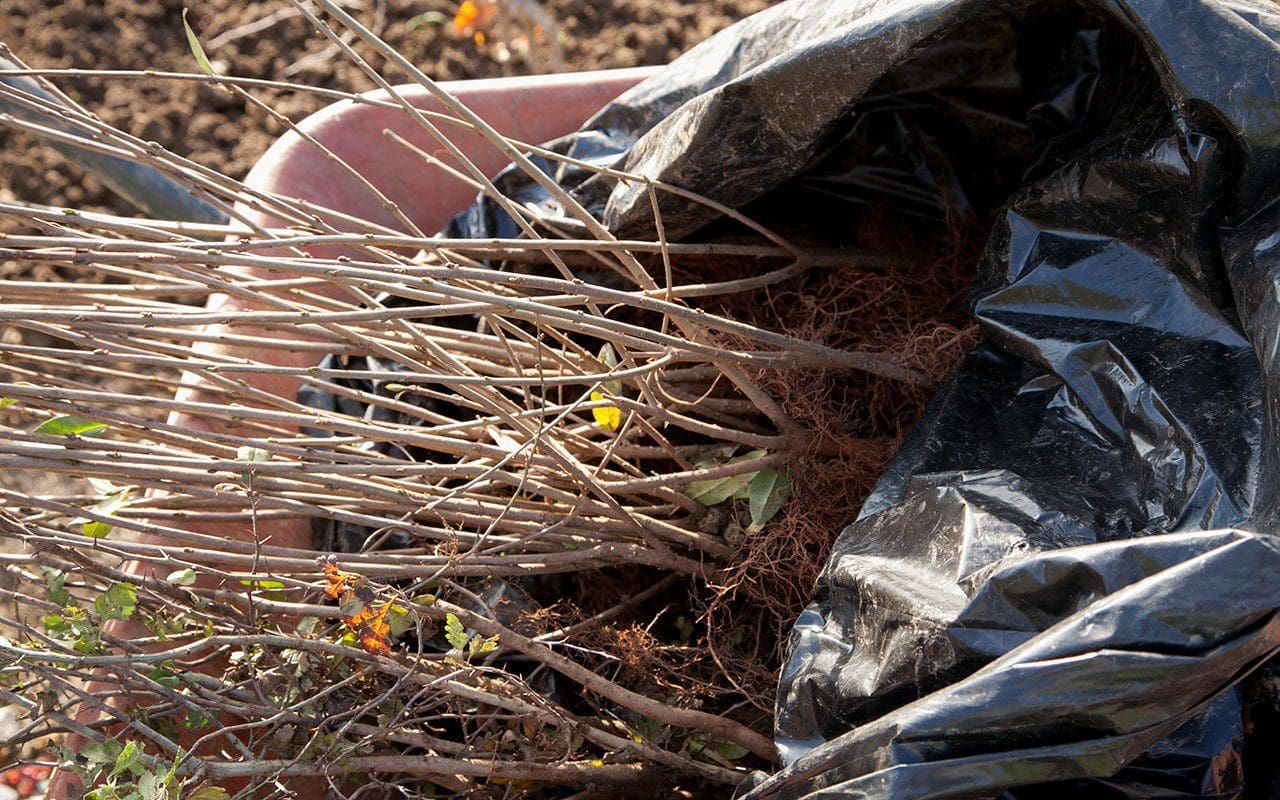 Bare-root whips of hawthorn and wild privet
I buy my bare-root plants from a local wholesale nursery just fifteen miles from here and welcome the fact that they haven’t had to travel far to their new home. This year the two-year-old whips are the bones of a new hedge that will hold the track which runs behind the house and along the contour of the slope to the barns. It replaces a worn out hedge of bramble and elder that was removed when we built the new wall and will provide shelter to the herb garden below when we get the cold north-easterlies. It will also connect with the ribbons of hedges that make their way out into the landscape. Keeping it native will allow it to sit easily in the bank and to play host to birds up close to the buildings.
This year my annual ambition to get bare-root material in the ground before Christmas has been achieved for the very first time. It is best to get bare-root plants in the ground this side of winter if at all possible. They may not look like they are doing much in the coming weeks but, if I were to lift a plant from my newly planted hedge at the end of January, it would already be showing roots that are active and venturing into new ground. With this advantage, when the leaves pop in the spring the plants will be more independent and less reliant on watering than if planted at the back end of winter.
Bare-root whips of hawthorn and wild privet
I buy my bare-root plants from a local wholesale nursery just fifteen miles from here and welcome the fact that they haven’t had to travel far to their new home. This year the two-year-old whips are the bones of a new hedge that will hold the track which runs behind the house and along the contour of the slope to the barns. It replaces a worn out hedge of bramble and elder that was removed when we built the new wall and will provide shelter to the herb garden below when we get the cold north-easterlies. It will also connect with the ribbons of hedges that make their way out into the landscape. Keeping it native will allow it to sit easily in the bank and to play host to birds up close to the buildings.
This year my annual ambition to get bare-root material in the ground before Christmas has been achieved for the very first time. It is best to get bare-root plants in the ground this side of winter if at all possible. They may not look like they are doing much in the coming weeks but, if I were to lift a plant from my newly planted hedge at the end of January, it would already be showing roots that are active and venturing into new ground. With this advantage, when the leaves pop in the spring the plants will be more independent and less reliant on watering than if planted at the back end of winter.
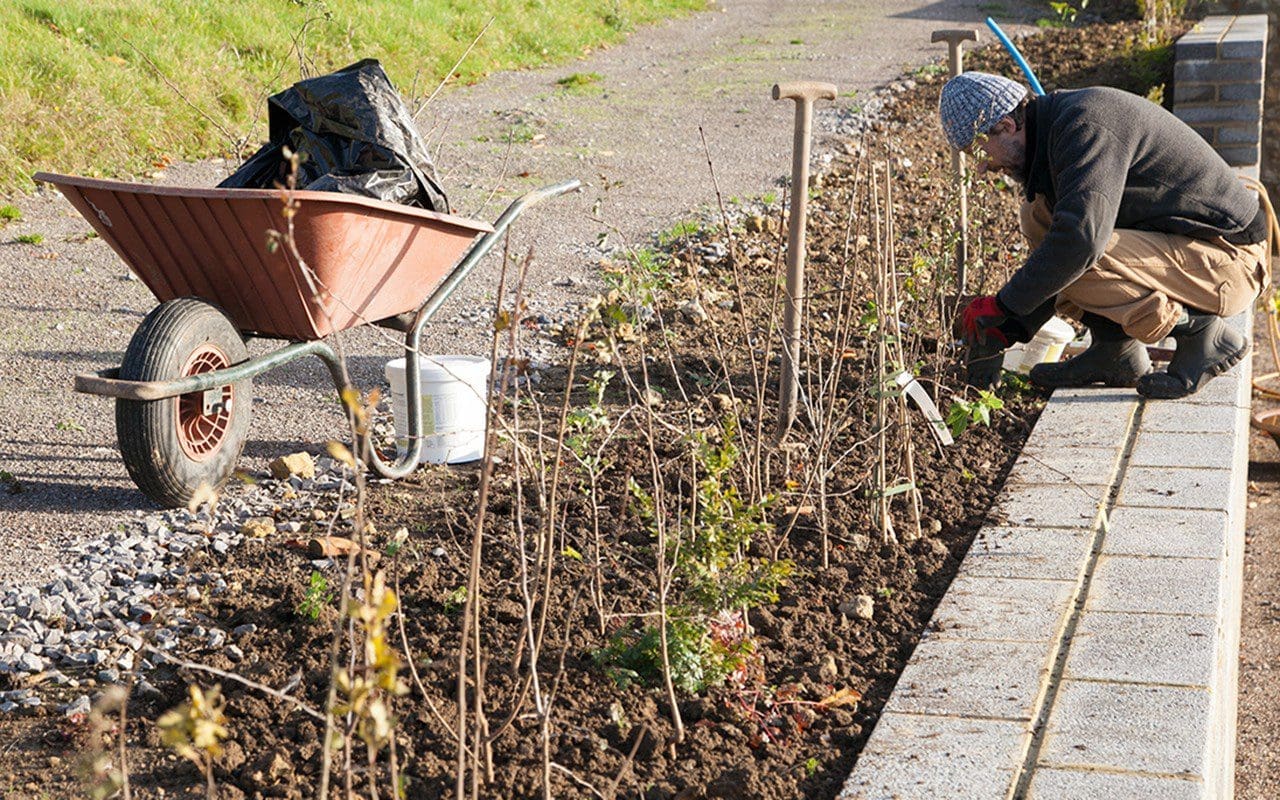 The new hedge will hold the track behind the house and act as a windbreak for the herb garden below the wall
Slit planting whips could not be easier. A slot made with a spade creates an opening that is big enough to feed the roots into so that the soil line matches that of the nursery. I have been using a sprinkling of mycorrhizal fungus on the roots of each new plant to help them establish – the fungus forms a symbiotic relationship with the roots and mycorrhiza in the soil, enabling them to take in water and nutrients more easily. A well-placed heel closes the slot and applies just enough pressure to firm rather than compact the soil. The plants are staggered in a double row for density with a foot to eighteen inches or so between plants.
The new hedge will hold the track behind the house and act as a windbreak for the herb garden below the wall
Slit planting whips could not be easier. A slot made with a spade creates an opening that is big enough to feed the roots into so that the soil line matches that of the nursery. I have been using a sprinkling of mycorrhizal fungus on the roots of each new plant to help them establish – the fungus forms a symbiotic relationship with the roots and mycorrhiza in the soil, enabling them to take in water and nutrients more easily. A well-placed heel closes the slot and applies just enough pressure to firm rather than compact the soil. The plants are staggered in a double row for density with a foot to eighteen inches or so between plants.
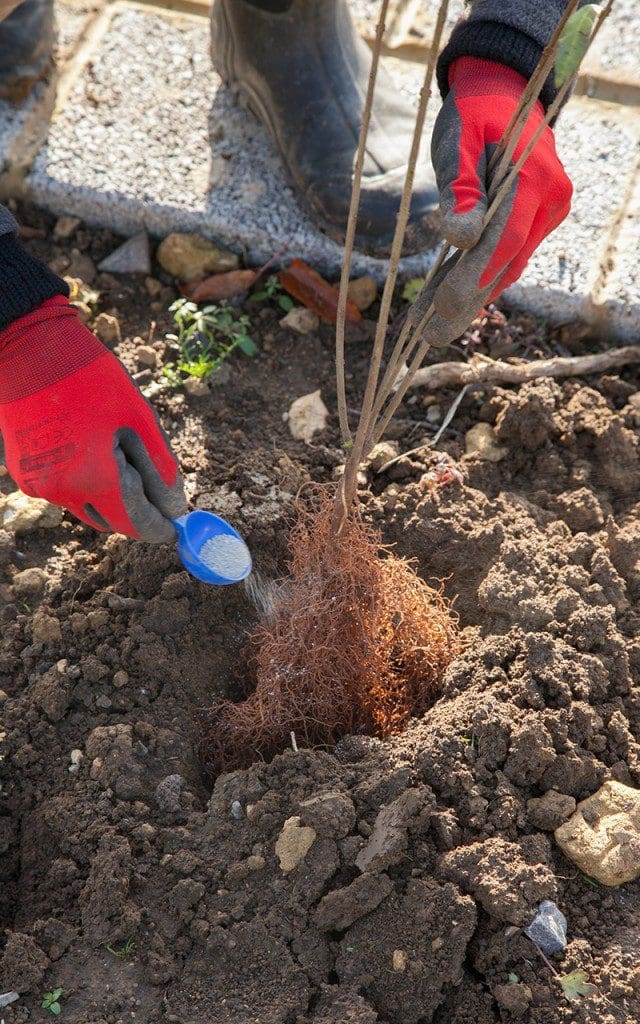 Adding mychorrizal fungi to newly planted hedging whips
I have planted a new hedge or gapped up a broken one every winter since we moved here and I have been amazed at how quickly they develop. They are part of our landscape, snaking up and over the hills to provide protection in the open places and it is a good feeling to keep the lines unbroken. This one has been planned for about three years, so I have been able to propagate some of my own plants to provide interest within the foundation of hawthorn and privet. Hawthorn is a vital component for it is fast and easily tended. It provides the framework I need in just three years and the impression of a young hedge in the making not long after it first comes into leaf. I have planted two hawthorn whips to each one of Ligustrum vulgare, which is included for its semi-evergreen presence. I like our wild privet very much for its delicate foliage, late creamy flowers, shiny black berries and the fact that it provides welcome winter protection for birds.
Woven amongst this backbone of bare-roots plants, and to provide a piebald variation, are my own cuttings and seed-raised plants. A handful of holly cuttings – taken from a female tree that holds onto its fruit until February – and box for more evergreen. The box were rooted from a mature tree in my friend Anna’s garden in the next valley. I do not know it’s provenance, but it is probably local for there is wild box in the woods there. I like a weave of box in a native hedge as it adds density low down and an emerald presence at this time of year.
Adding mychorrizal fungi to newly planted hedging whips
I have planted a new hedge or gapped up a broken one every winter since we moved here and I have been amazed at how quickly they develop. They are part of our landscape, snaking up and over the hills to provide protection in the open places and it is a good feeling to keep the lines unbroken. This one has been planned for about three years, so I have been able to propagate some of my own plants to provide interest within the foundation of hawthorn and privet. Hawthorn is a vital component for it is fast and easily tended. It provides the framework I need in just three years and the impression of a young hedge in the making not long after it first comes into leaf. I have planted two hawthorn whips to each one of Ligustrum vulgare, which is included for its semi-evergreen presence. I like our wild privet very much for its delicate foliage, late creamy flowers, shiny black berries and the fact that it provides welcome winter protection for birds.
Woven amongst this backbone of bare-roots plants, and to provide a piebald variation, are my own cuttings and seed-raised plants. A handful of holly cuttings – taken from a female tree that holds onto its fruit until February – and box for more evergreen. The box were rooted from a mature tree in my friend Anna’s garden in the next valley. I do not know it’s provenance, but it is probably local for there is wild box in the woods there. I like a weave of box in a native hedge as it adds density low down and an emerald presence at this time of year.
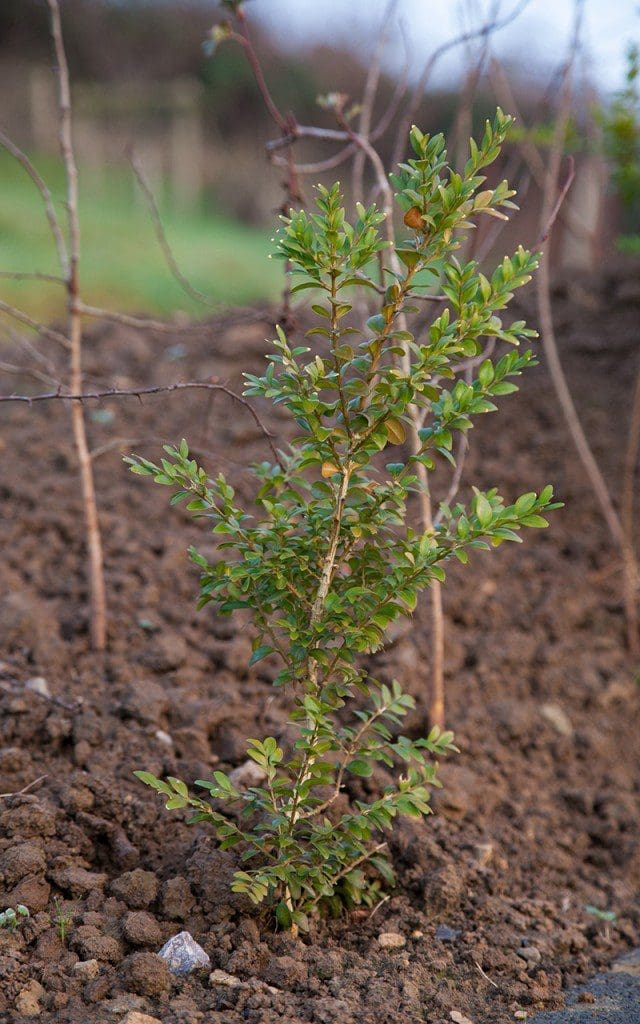 A home-grown box cutting
Raised from seed sown three years ago, taken from my first eglantine whips, are a handful of Rosa eglanteria. They make good company in a hedge, weaving up and through it. A smattering of June flower and the resulting hips come autumn earn it a place, but it is the foliage that is the real reason for growing it. Smelling of fresh apples and caught on dew or still, damp weather, they will scent the walk as we make our way to the barns.
The final addition are part of a trial I am running to find the best of the wild honeysuckle cultivars. I have ‘Graham Thomas’ and the dubiously named ‘Scentsation’, but Lonicera periclymenum ‘Sweet Sue’ is the one I’ve chosen for this hedge, as it is supposed to be a more compact grower and freer-flowering. There are three plants, which should wind their way through the framework of the hedge as it develops and add to the perfumed walk. Wild strawberries will be planted as groundcover in the spring to smother weeds and to hang over the wall where they will make easy picking.
A home-grown box cutting
Raised from seed sown three years ago, taken from my first eglantine whips, are a handful of Rosa eglanteria. They make good company in a hedge, weaving up and through it. A smattering of June flower and the resulting hips come autumn earn it a place, but it is the foliage that is the real reason for growing it. Smelling of fresh apples and caught on dew or still, damp weather, they will scent the walk as we make our way to the barns.
The final addition are part of a trial I am running to find the best of the wild honeysuckle cultivars. I have ‘Graham Thomas’ and the dubiously named ‘Scentsation’, but Lonicera periclymenum ‘Sweet Sue’ is the one I’ve chosen for this hedge, as it is supposed to be a more compact grower and freer-flowering. There are three plants, which should wind their way through the framework of the hedge as it develops and add to the perfumed walk. Wild strawberries will be planted as groundcover in the spring to smother weeds and to hang over the wall where they will make easy picking.
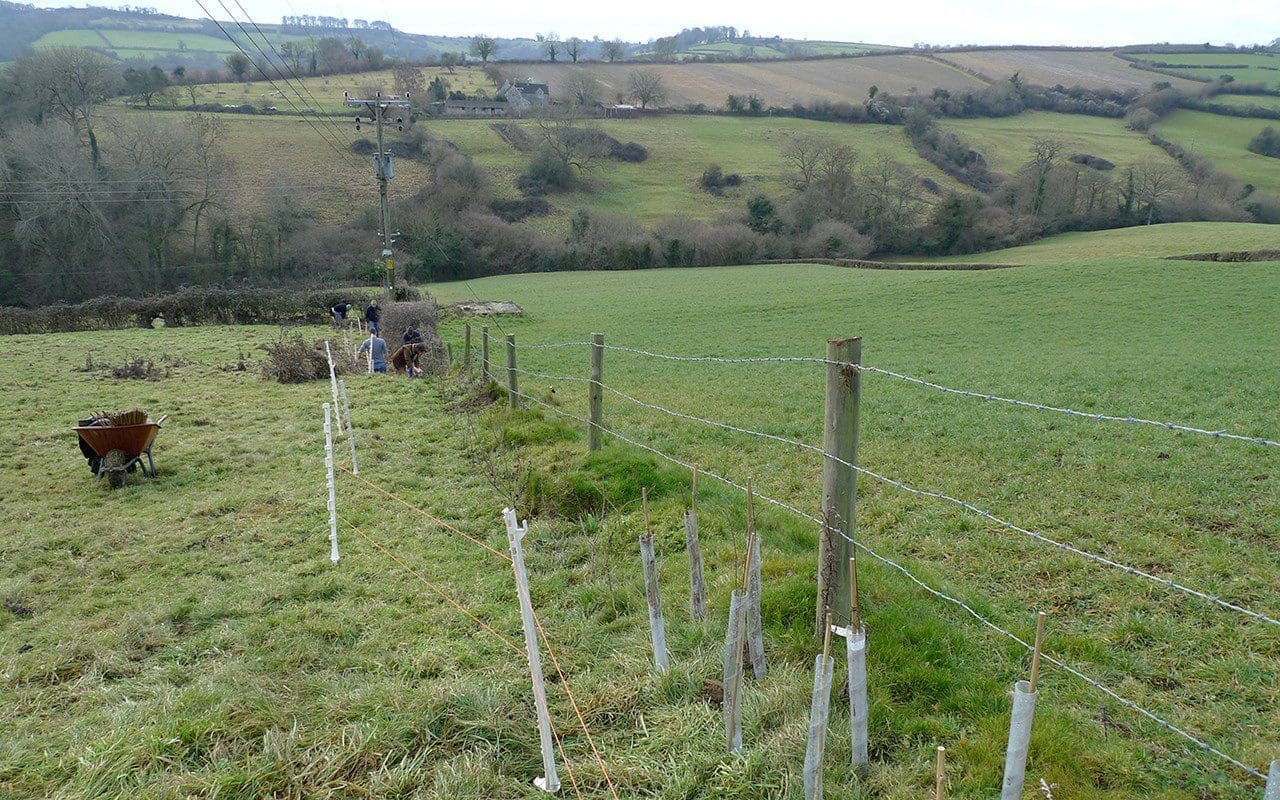 Planting a new field boundary hedge on new year’s day 2011
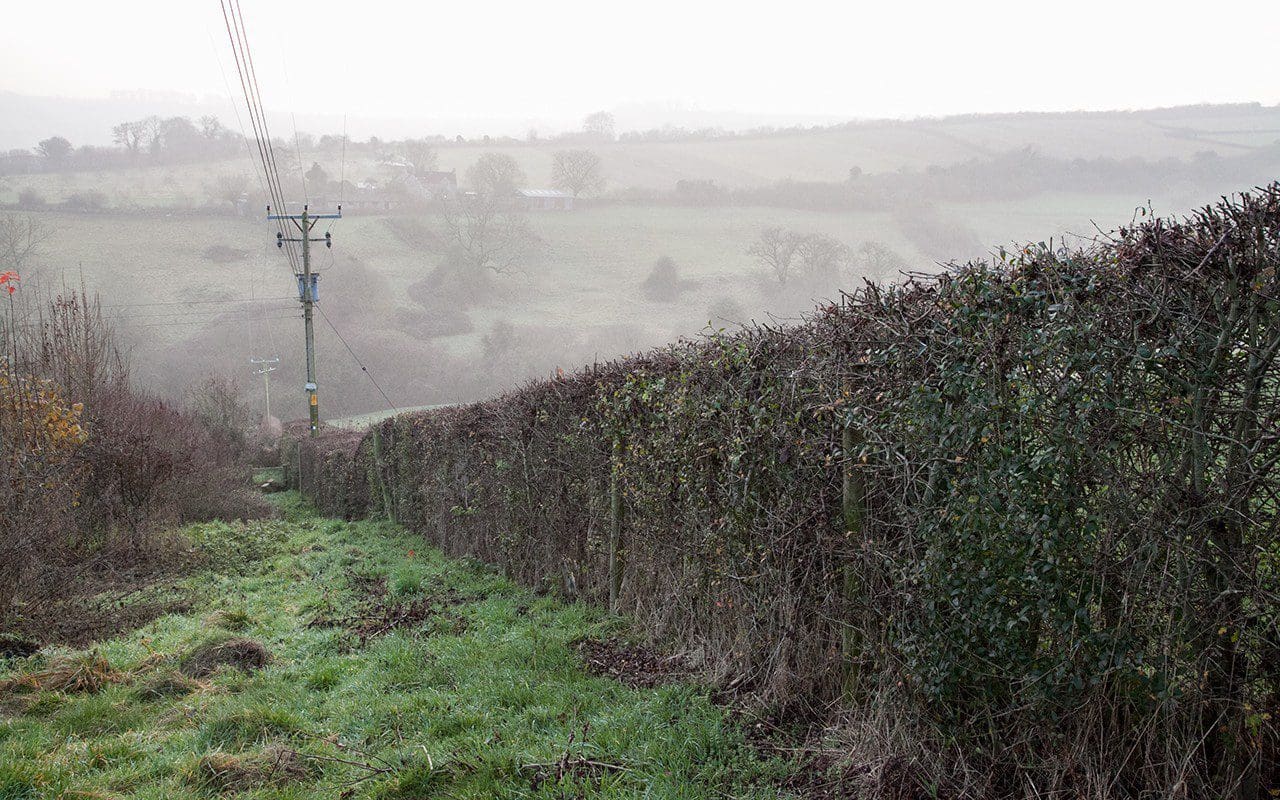 The same hedge six years later
Words: Dan Pearson / Photographs: Huw Morgan
The same hedge six years later
Words: Dan Pearson / Photographs: Huw Morgan The leaves are nearly all down in the wood, winter light fallen to the floor for the first time in half a year. A new horizon meets us as we look out from the house. Not onto the weight of the poplars and their understory, but through to the slopes beyond. The tracery of branches clearly identifying one tree’s character from the next, the tilt of trunks, the hug of shining ivy.
Everywhere the scale change is remarkable and we find ourselves drawn out into the landscape with refreshed curiosity. Much of this is simply to do with a season’s growth dropping back into dormancy. Under the elderly field maple in the clearing by the stream a coppery skirt lies in a circle where the leaves fell in the still air there. Looking up into the newly naked branches a world of lichens and moss – grey, silver and green – has made them home. The nettles that just a month ago were lush and keeping us from the stream have half their volume. With continued frosts in the hollow they will be nothing but brittle stem in a month and we will be free to walk its length once again.
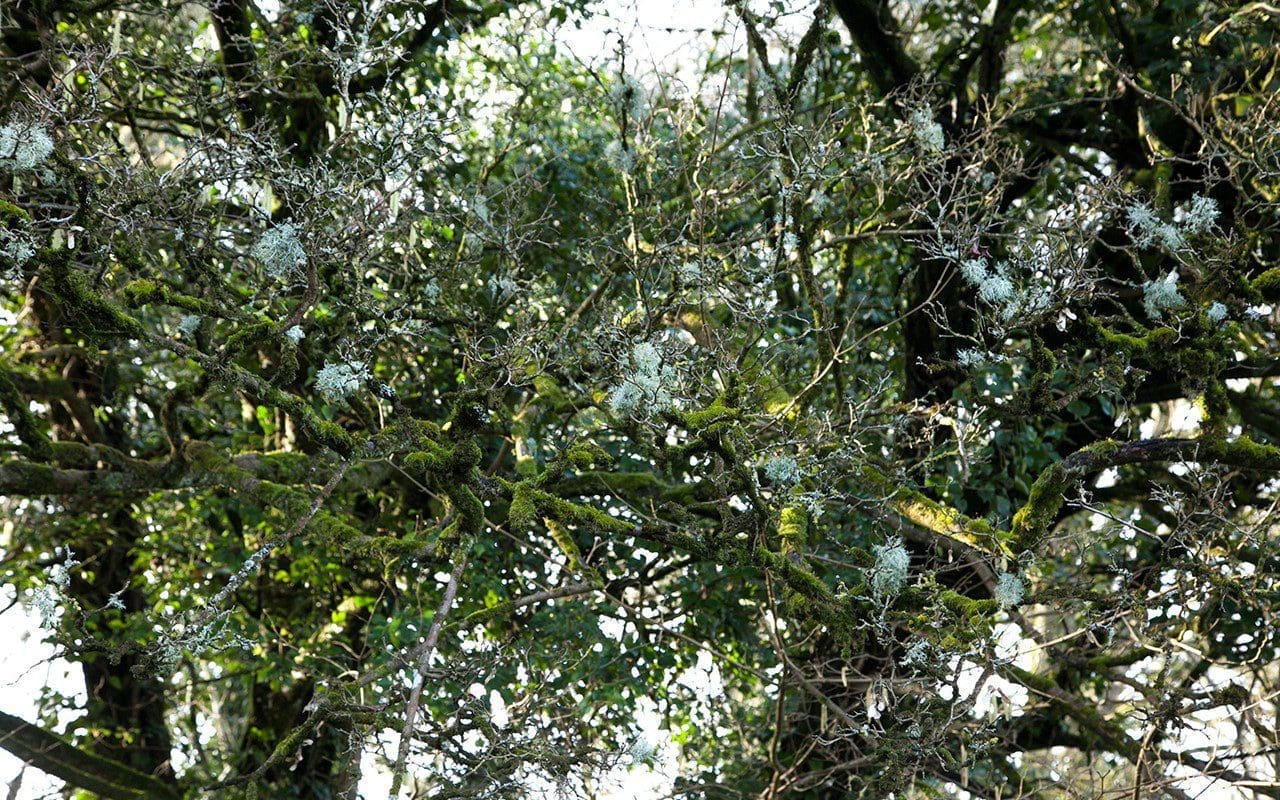 Lichen and moss on the old field maple
The stream is audible from up by the house in all but the driest weeks, but now it is charged with winter rain and the noise pulls us down to look. You can easily lose an hour or more if you start to explore the mud and shingle banks, as the stream landscape is always changing. A log from higher up, driven down by storm water, causing damming and silting up, contrasts with the constancy of a favourite boulder, marooned in a pool of its own influence, a home to moss and liverworts.
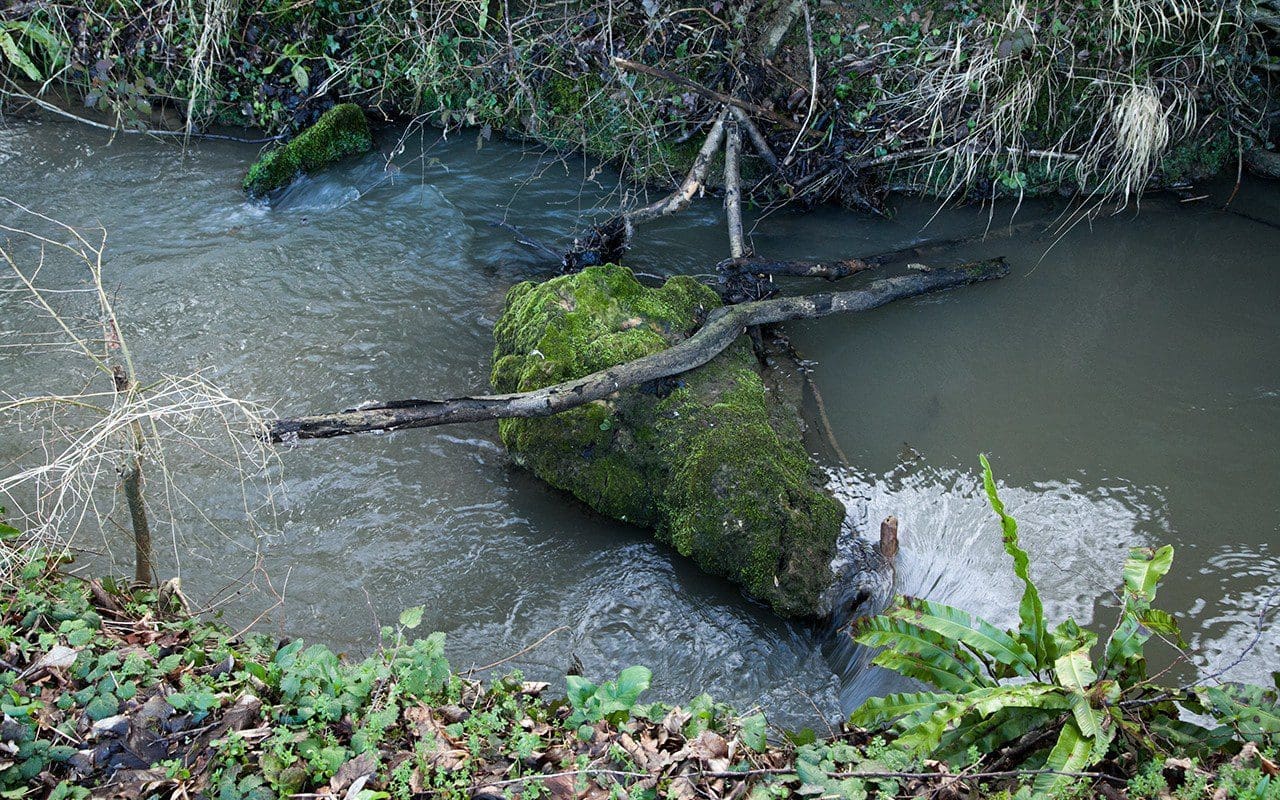 The moss-covered boulder
Although the stream is small and at times hidden, it is a favourite part of the property. Soon after moving here at about this time of year we started bank clearance and every year we have done a little more. A barbed wire fence that ran its length to keep the animals in the fields is all but removed now, the rusty coils disentangled and pulled free of the undergrowth and the rotten fence posts removed. As a reminder a number of oak posts that outlived the softwood ones were left to mark the old fence-line. They are now cloaked in emerald moss and, when working in the hollows, are perches for watchful robins.
In places the stream disappeared into a thicket of bramble to emerge again lower down without revealing its journey. The child in me had to know what lay within and the mounds of bramble that bridged the banks were cleared to reveal, in one case, a lovely bend and, in another, a pretty fall and outlook where I have planted a small Katsura grove. I have plans to make a shelter there for watching the water when the trees are grown up, but for now it is simply enough to have the plan in mind as a potential project.
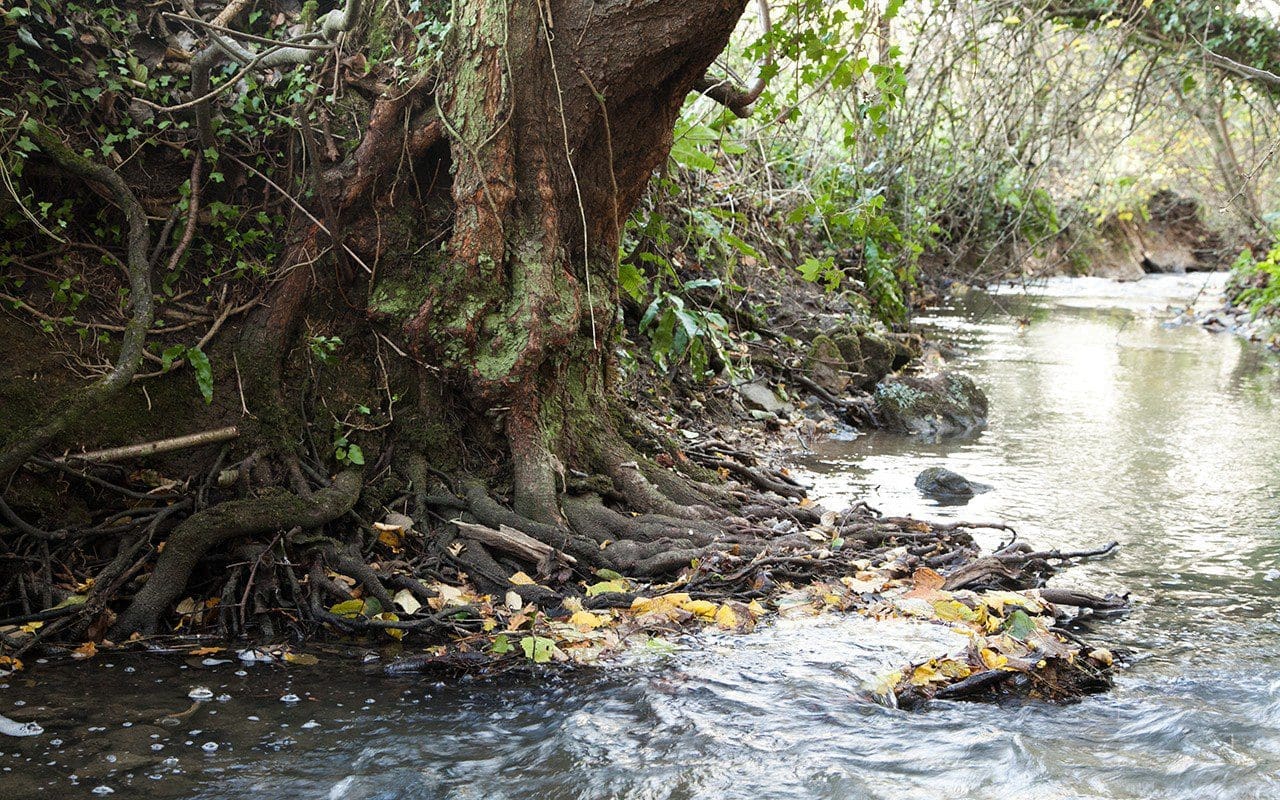 The matted root plate of a mature alder holds the stream bank
Slowly, and in tandem with the clearances, I have started to plant the banks on our side where the farmer had taken the grazing right to the very edges. Although we do not want to lose the stream behind trees for its entire length, it is good to balance the volume of our neighbour’s wood on the other side and, in places, to protect the banks. The new trees, just sapling whips at the moment, have been planted so that we can weave in and out of their trunks on the walk up or down the stream and with or against the flow.
Tree planting is one of my favourite winter tasks. The young whips are ordered in the autumn and are with us from the nursery not long after the leaves are down when the lifting season starts. If I can I like to get them all in before the end of the year so that their feeding roots are up and running by the spring when top growth resumes.
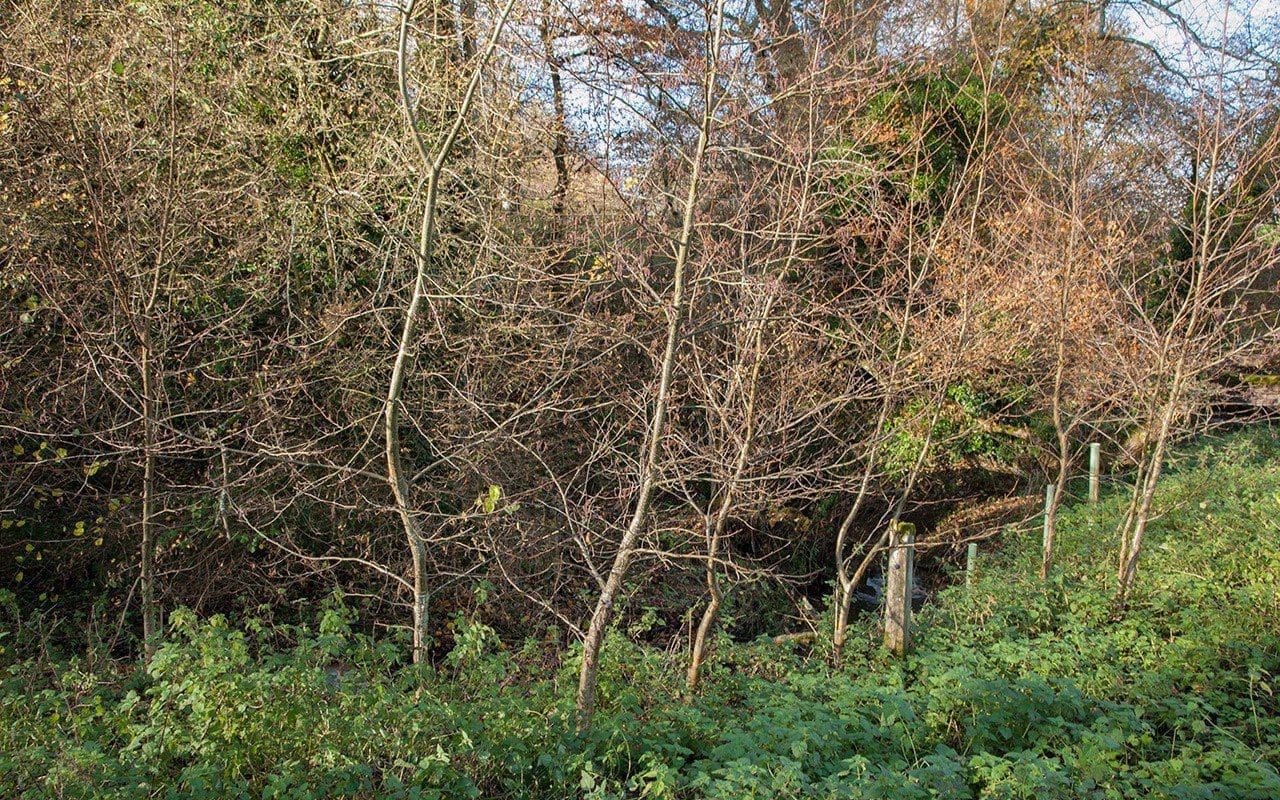 Three year old alders on the stream bank
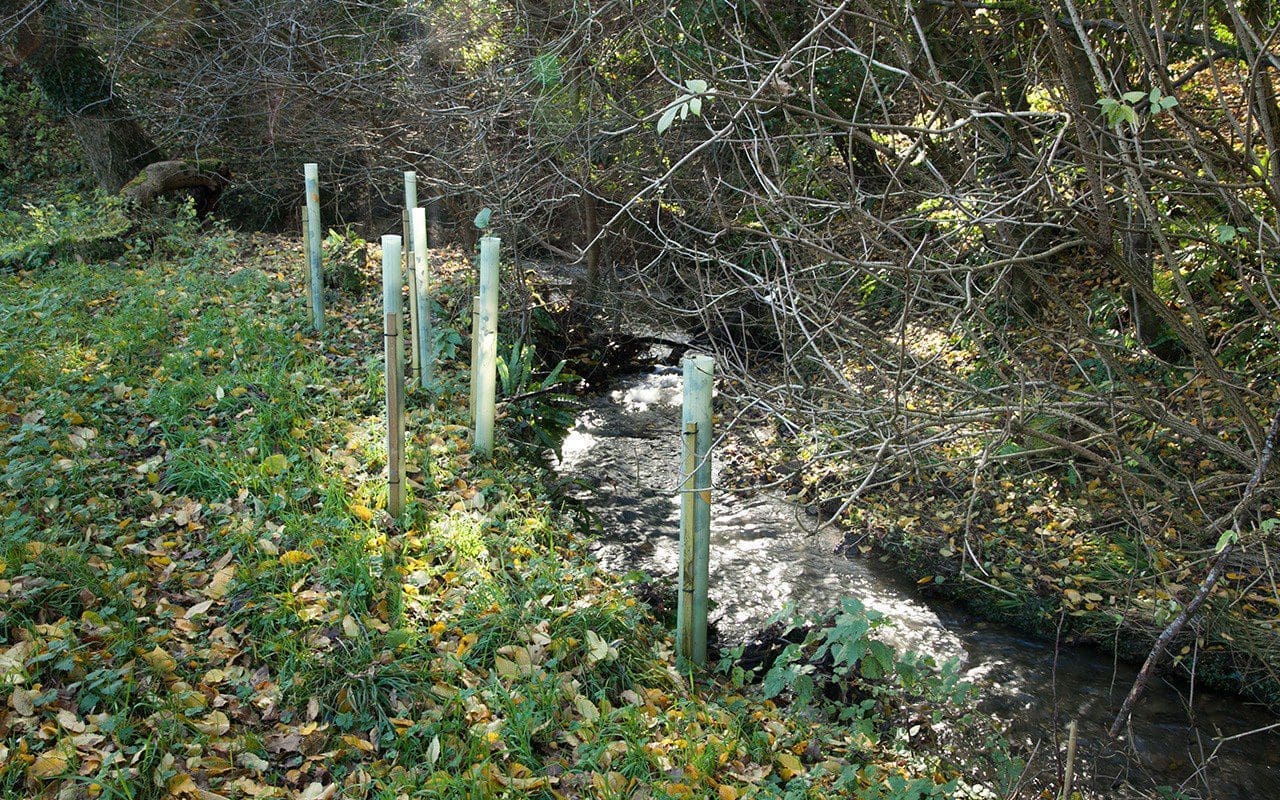 Alder whips protected from deer with cylindrical tree guards
Alder (Alnus glutinosa), a riverine species that likes to dip its feet into the water, is one of the best for stablilising the banks. The roots, which produce their own nitrogen and charge young trees with vigour, are dense and mat together to form a secure edge where the banks are crumbling from having no more than pasture to hold them together. The deer that have a run in the woods have loved the young growth so, after a year of grazing which left them depleted, I have resorted to using more than spiral guards to protect them. The cylindrical guards are not pretty to look at, but give the saplings long enough to jump up above the grazing line and gain their independence.
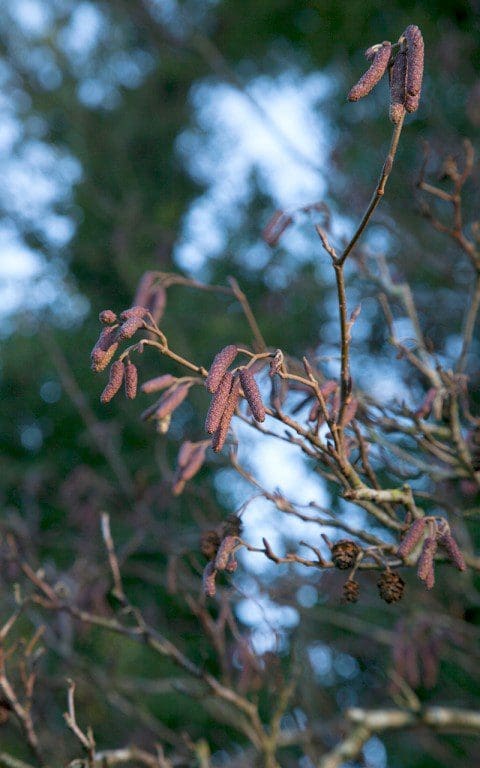 Alder catkins
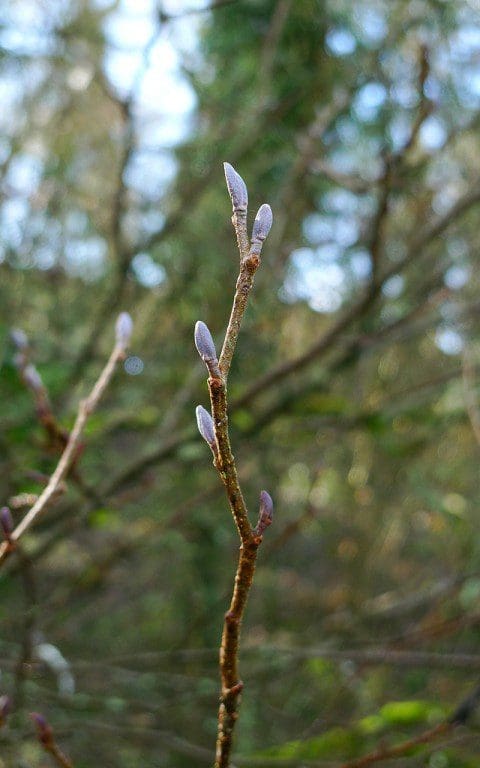 Alder leaf buds
In the deeper shade of the overhanging wood, and where the alders have proven to be less successful, I have used our native hornbeam (Carpinus betulus), encouraged by a mature specimen that, together with an oak, teeters on the water’s edge. It too has a dense root system and loves the heavy clay soil on the banks that lead to the water. Both the Carpinus and the Alnus have good catkins, which are in evidence already on the alders. Purple-brown and already tightly clustered, with hazel they are the first to let you know that things are already on the move in early winter. The alder buds are also violet and your eye is pleased for the colour which is intense in the mutedness of December. The keys of the mature hornbeam are still hanging in there and glow russet in the slanting sun that makes its way down the wooded slopes.
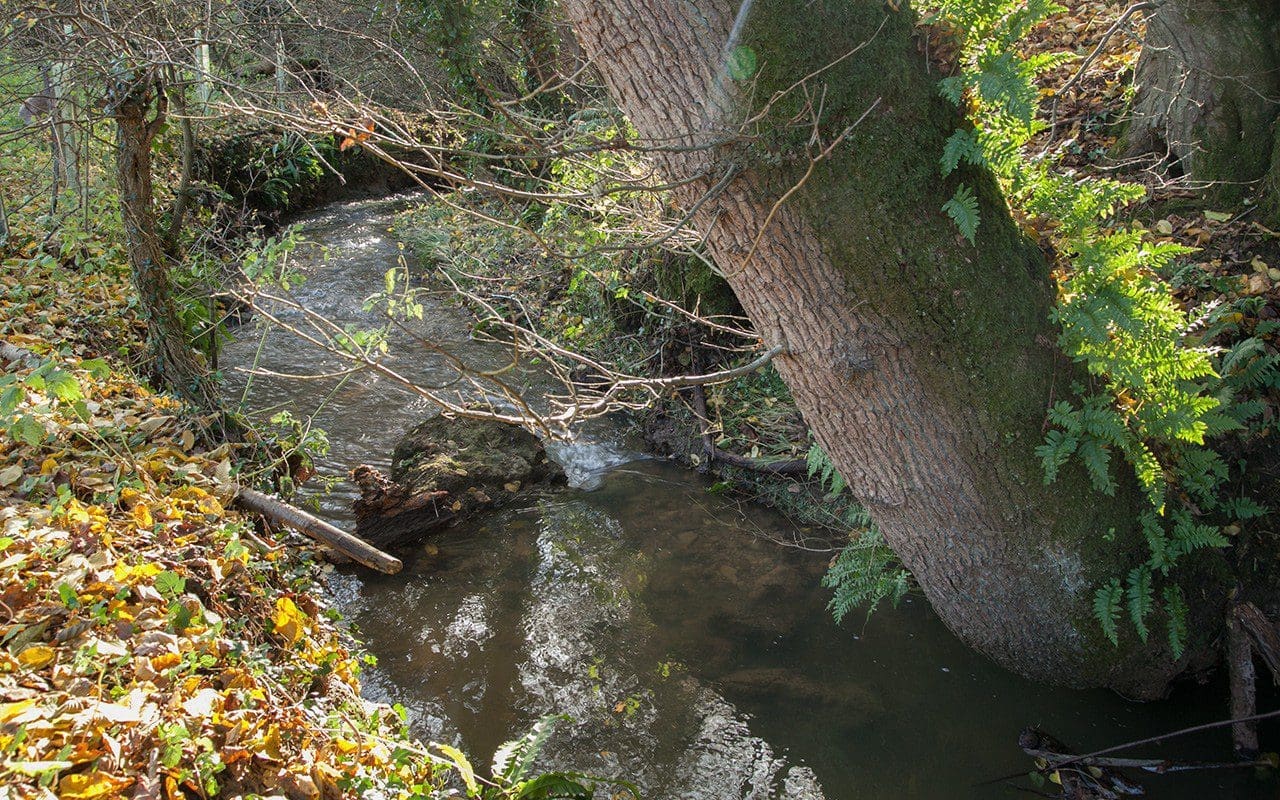 The trunk of the oak on the opposite stream bank
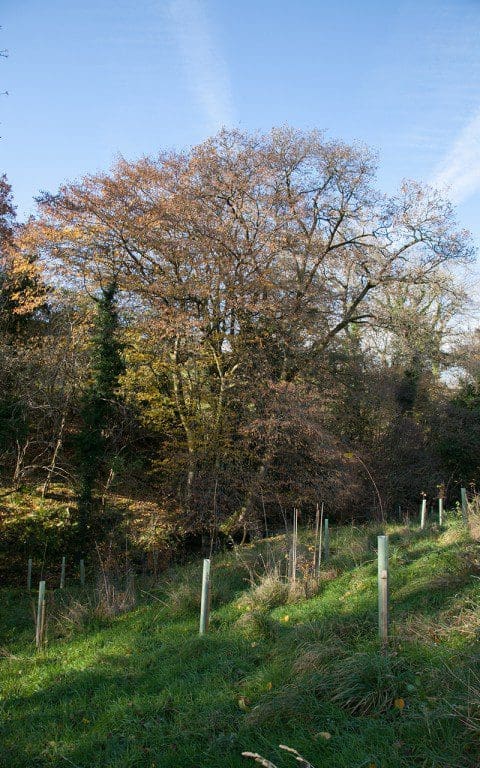 Hornbeam whips on the stream slope with the mature hornbeam beyond
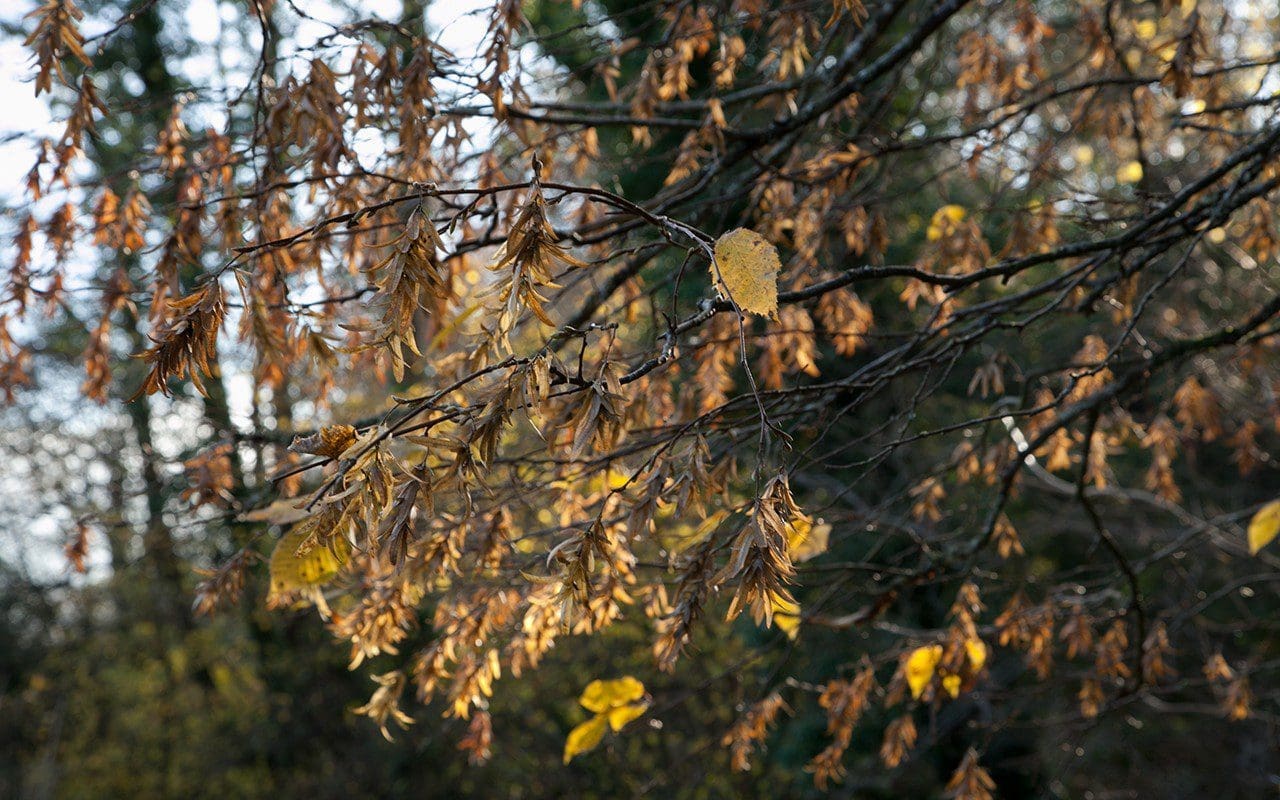 Keys on the mature hornbeam
After winter rains the stream rushes in a torrent that would sweep you away if you tried to wade across it, so this winter the stream work will turn to the bridges. Firstly to clear the remains of a stately oak that fell under the weight of its June foliage and then on to repair the clapper bridge that we made a couple of years ago and which was washed away in the heavy rains just recently. For now the fallen poplars, with their perilously mossy trunks, provide the link to the wood from which they fell. One came down the first summer we were here, and another two years later. Now the fallen oak has changed the stream once again and with it our winter diversions.
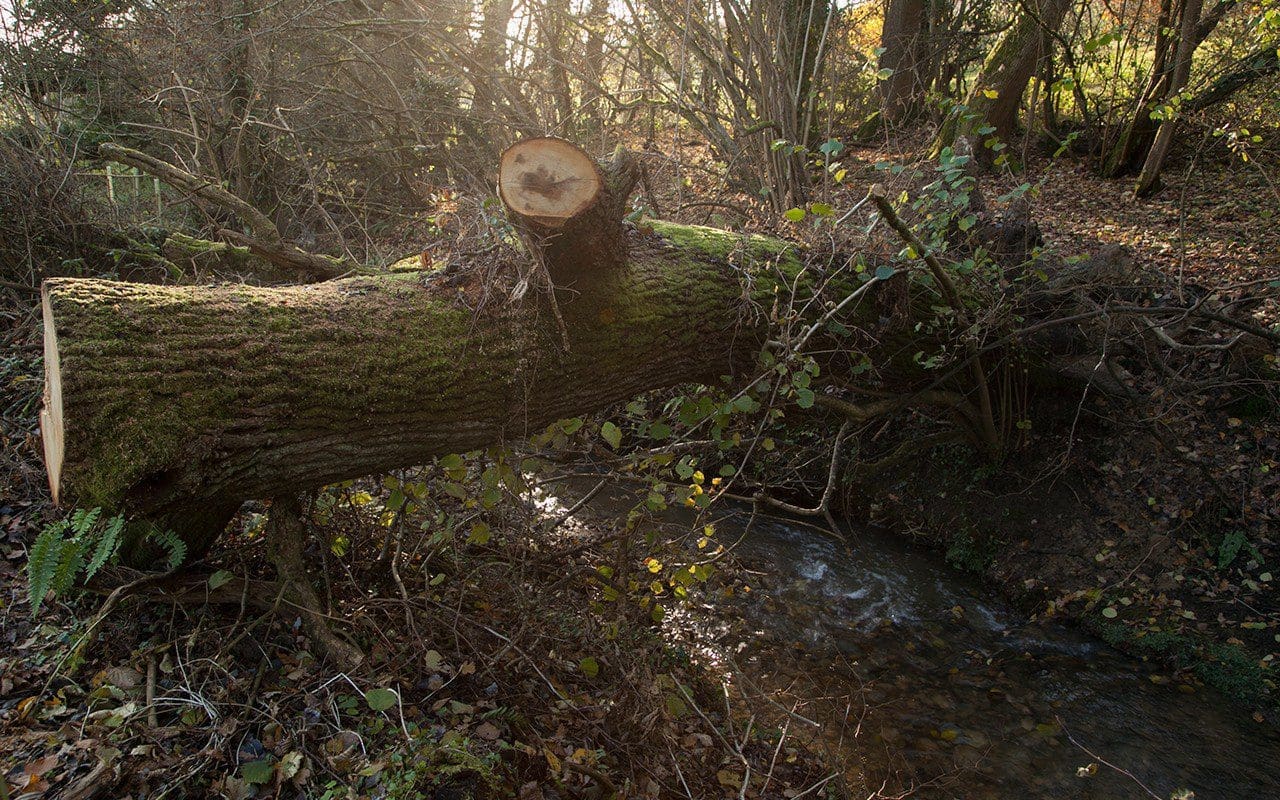 The fallen oak
Words: Dan Pearson / Photographs: Huw Morgan
Published 2 January 2017
We always grow too many pumpkins. Such has been the luxury of having the space to do so. They have found themselves in a different position every year to give them the opportunity to reach. In the first summer they were in the virgin ground where we had turned field over to garden and the flush of weeds that had been disturbed by the change were kept in check by their coverage. The next year they were out in front of the house, each plant perched on a barrowload of muck on the banks. But it was too exposed there, we had a wet summer and learned their limits, for they made not much more than leaf. The disappointment of not having them in storage lasted the whole winter. Consequently, as the best way to learn is by your mistakes, I have taken their needs more seriously.
Six summers’ worth of trial, error and experimentation have taught us the good producers, the best keepers and those that under-produce in relation to their enormous appetite for space. A Californian friend and gardener, who grows the giant pumpkins you only find in the country where everything is bigger, was amazed that I was giving my plants so little room to grow. His pumpkin patch is the size of my whole garden, so he was not surprised that I hadn’t done better in terms of size and yield. A big plant with a rangy nature can easily take over a plot of nine or more square metres to provide the optimum ratio of leaf to fruit and, now that I have started planting up the garden, space for pumpkins is becoming more limited. So next year’s selection is due an edit. The giants will be separated from those that are happy with less space and the neater, more economical growers will have a bed to themselves in the kitchen garden with plenty of muck and sunshine. The big growers will be given the top of this year’s compost heap so that they can enjoy a romp and tumble over the edges unencumbered.
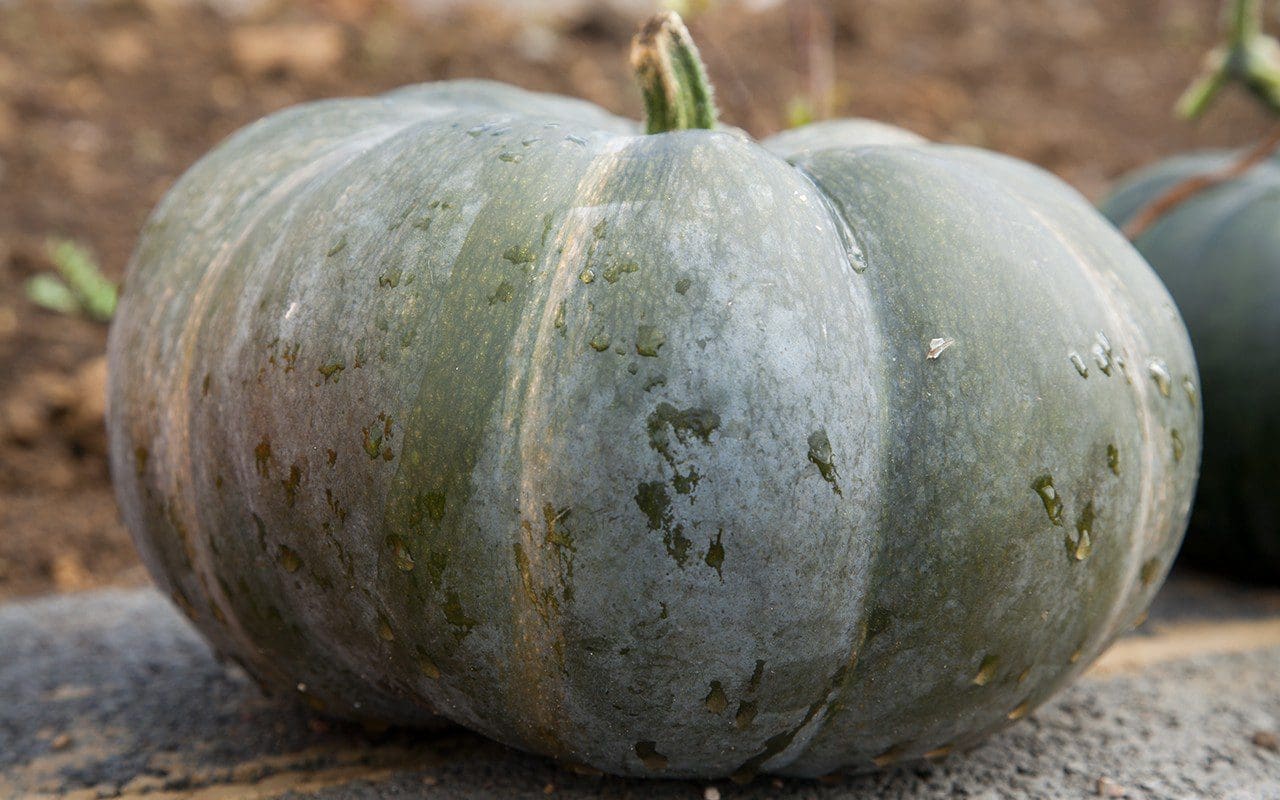 ‘Musquée de Provence’
Of the big growers that produce more leaf than fruit, we will not be growing ‘Musquée de Provence’ again, after three years of trying. The deep-green, lobed fruit, though handsome, are supposed to ripen to a rich tan colour, but even on our south-facing slopes we just don’t have enough sun to do so. Consequently, the skin doesn’t cure fully and they have been poor keepers. Our average of one fruit per plant is also not worth the investment of space. Although a single pumpkin can easily feed twelve, there are only so many times you require a pumpkin that large.
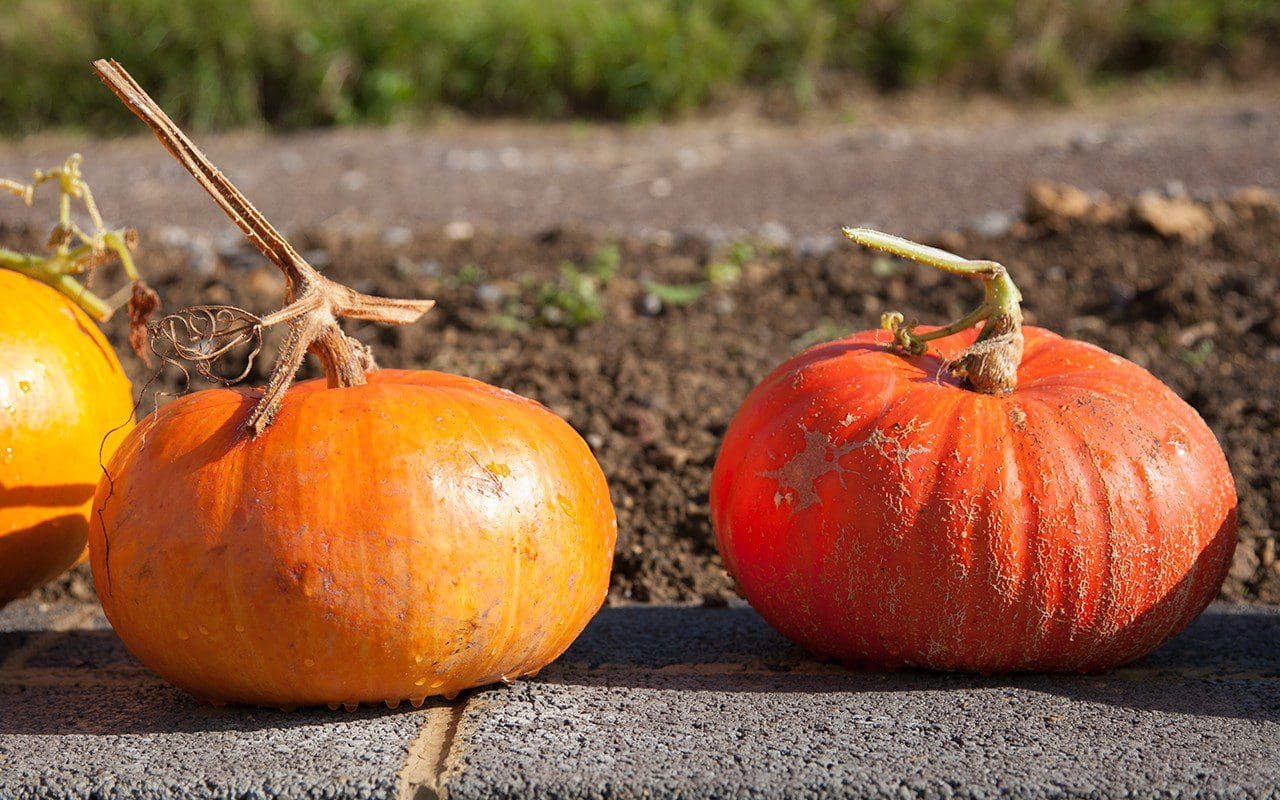 ‘Rouge Vif d’Étampes’
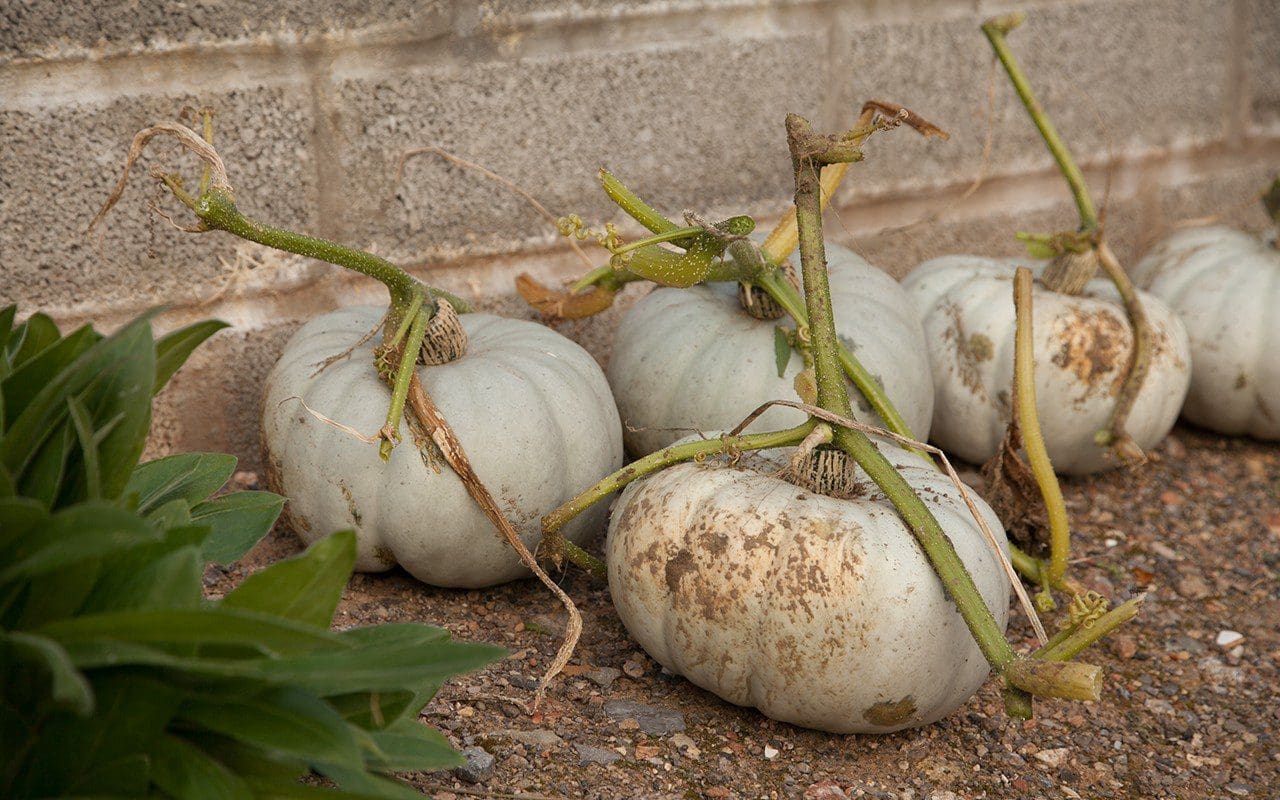 ‘Crown Prince’
We have had a similar experience this year with ‘Rouge Vif d’Étampes’, another French variety with large fruits of a strong red-orange. It also appears to need more heat to crop heavily and ripen fully. These two have been the first to be eaten, as we try and keep pace with the rot. All pumpkins and squash like heat and good living and our cool, damp climate sorts out those that are clearly missing the Americas. In contrast, ‘Crown Prince’ has been more adaptable here and one of the best croppers for a plant that needs space. It is also an excellent keeper. The saffron flesh is firm and sweet while the thick, grey-green skin means that they can keep into March in a cool, frost-free shed.
The varieties with dry, firm flesh are better for storing than the wetter ones, which I presume is due to their higher sugar content. We also prefer them for eating. Of the smaller growing varieties we have found the Japanese pumpkins to be the most consistent, with the highest yield for their economical growth and the most delicious flesh. They produce fruit of a moderate size, which is far more convenient to eat than opening up a Cinderella-sized pumpkin that feeds a horde and then sits on the side, the remainder unused, making you feel guilty.
 ‘Uchiki Kuri’
Of the Japanese varieties ‘Uchiki Kuri’, or the red onion squash, is the one you see most often in Japan and the one I will eat on an autumn visit to Hokkaido where it is grown extensively. It is a moderate grower, with smallish foliage and an even and reliable yield, with each plant producing 8 or more 1-2kg pumpkins. The deep orange teardrop-shaped fruit are small enough to provide for one family meal and, with a good balance of flesh to seed, there is little waste. Kuri means chestnut in Japanese, and the flavour and texture of this and the other kuri varieties explains why. They are excellent baked, with a rich, floury texture that also makes superlative mash and soup with plenty of body.
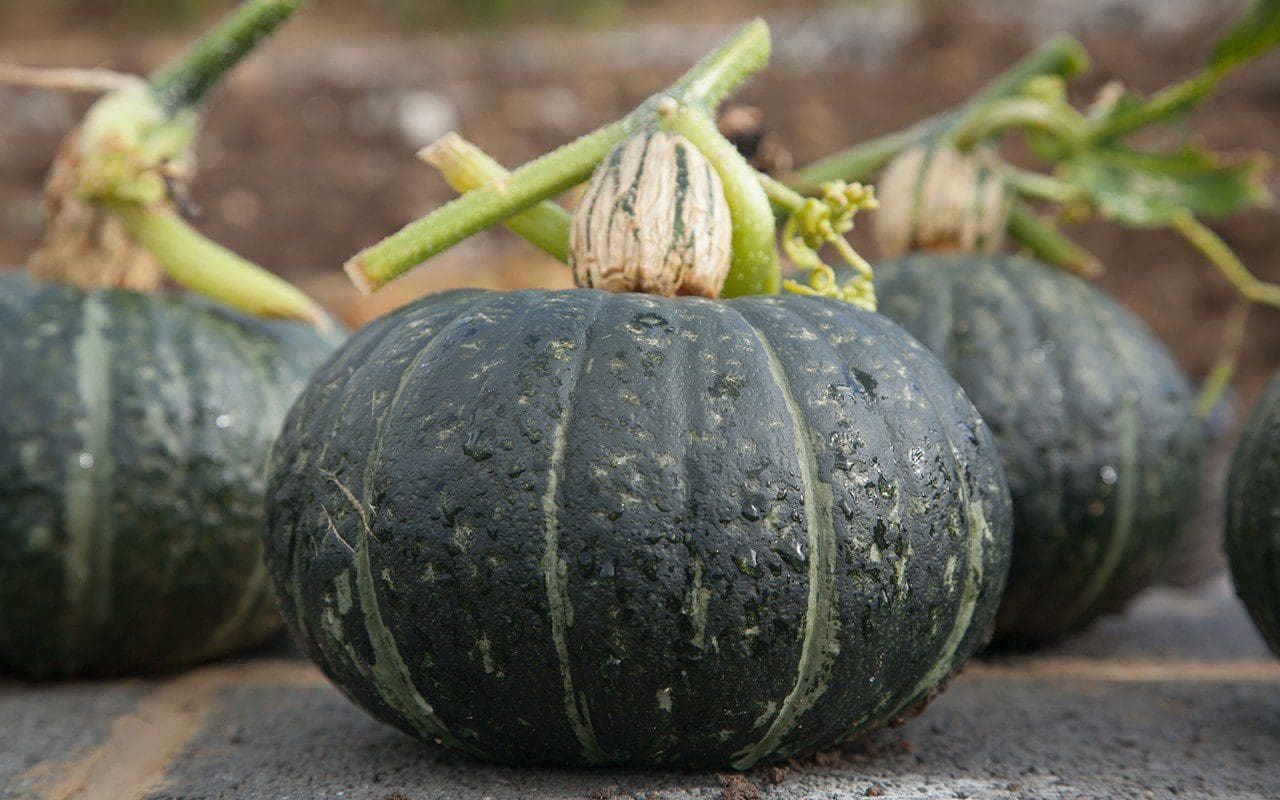 ‘Cha-cha’
Kabocha is the Japanese word for pumpkin, derived from the corruption of the Portugese name for them, Cambodia abóbora, since they were brought to Japan from Cambodia by the Portugese in the 16th century. This year we grew ‘Cha-cha’, which closely resembles ‘Blue Kuri’, a Japanese kabocha variety we have previously had success with. It has also proven to be very good. Slightly larger than ‘Uchiki Kuri’ the flesh is also dry, rich and sweet, and the thin skin is edible when roasted.
 ‘Black Futsu’
‘Black Futsu’, another Japanese variety with sweet, nutty flesh, is of a similar size. The fruits are heavily ribbed and dark, black-green when picked, quickly developing a heavy grey bloom, beneath which they ripen to a tawny orange. Though beautiful to look at, the ribbing does mean they are more work to cut and peel, but it is a small hardship in terms of yield and substance.
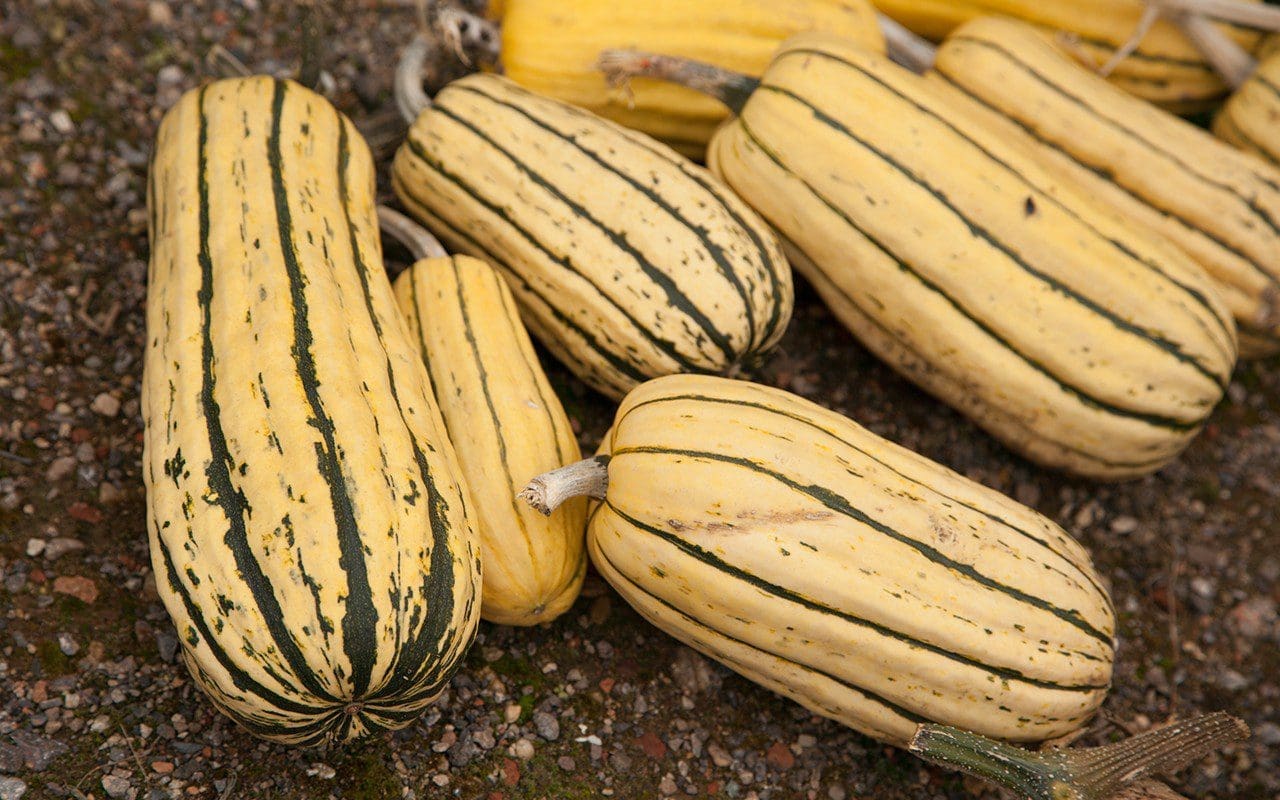 ‘Delicata’
Another heavy cropper, although not such a good keeper, is ‘Delicata’, also known as the sweet potato squash due to it’s mild, sweet flesh which is moister than the varieties described above. Although kept and eaten as a winter squash ‘Delicata’ is of the summer squash species with a very thin skin (hence its name) and so has a propensity to soften quickly in storage. However, it needs no peeling as the skin is edible, so it has its uses in the earlier part of the season. The beauty of this very decorative variety is its high yield of long, cylindrical fruits (perfect for stuffing) in a range of manageable sizes, some the perfect size for one, which makes it a very practical choice.
Although in the past I have let the first frost strip the summer foliage before harvesting, it is best to remove it by hand in September when the plants have done their growing and there is a little heat left in the sun to do a final ripening. It is best to pick the fruits before they get frosted or they don’t keep well, and care must be taken not to damage the hard, waxy skin which keeps them airtight through the winter. The stalks should be left intact for the same reason, as any wound quickly leads to rot.
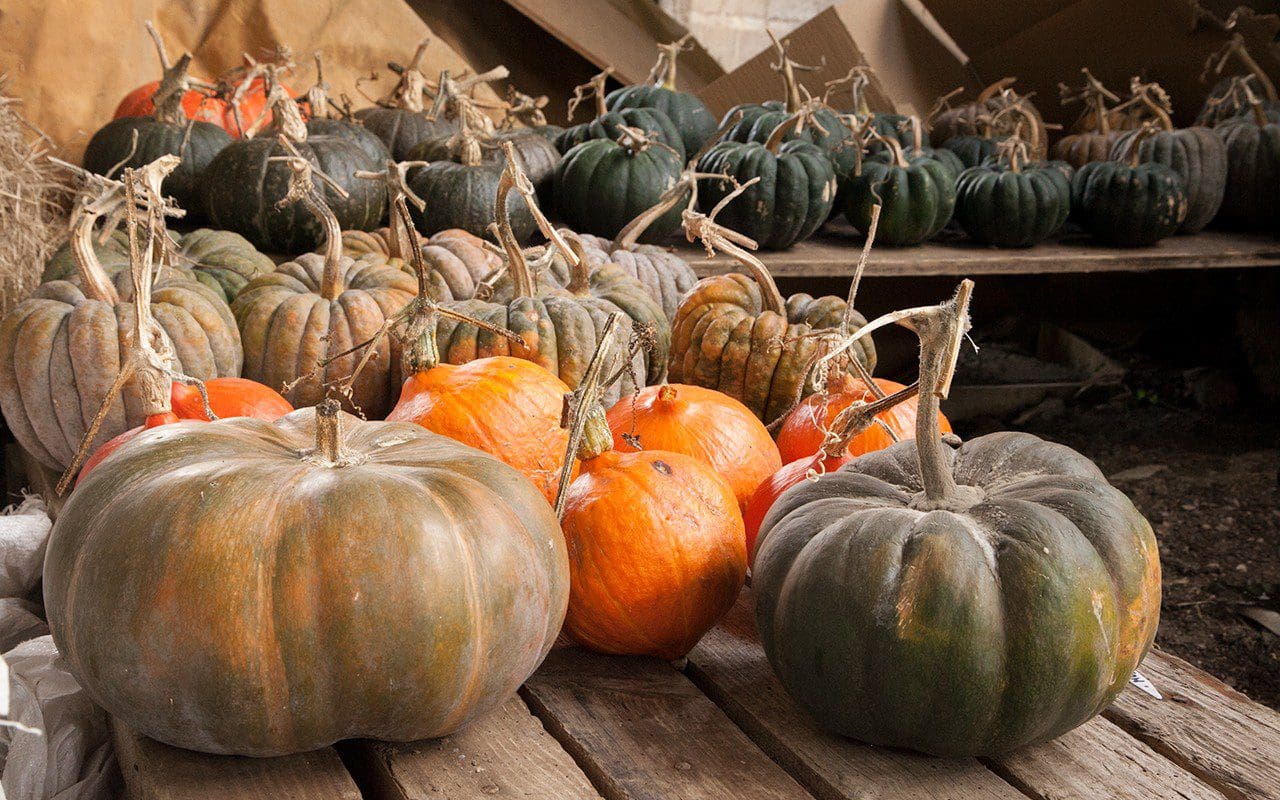
Left in a warm, sunny place for a couple of weeks after picking the carbohydrates in the flesh turn to sugar and the skin hardens. The colour also changes, but this continues to develop in storage. When ripe they should be stored in a shed or outhouse on wire racks or a bed of straw to allow air to circulate beneath them. For now, I have them on old palettes in an airy barn, but when it gets colder they will be put into perforated plastic plant trays and moved to the frost-free tool shed.
We are gradually making our way through this year’s crop with roast, mash, soup and finally preserves, before the rot sets in. It nearly always does and, although the decay has its own beauty, I’d rather not waste a summer of effort. Both ours and the pumpkins’.

Words: Dan Pearson / Photographs: Huw Morgan
It has been an exciting autumn, and one that I have looked forward to and been planning towards for the past six years. It has taken this long to resolve the land around the house. First to feel the way of the place and then to be sure of the way it should be.
Though the buildings had charm, (and for five years we were happy to live amongst the swirly carpets and floral wallpapers of the last owner) the damp, the white PVC windows and the gradual dilapidation that comes from years of tacking things together, all meant that it was time for change. Last summer was spent living in a caravan up by the barns while the house was being renovated. We were sustained by the kitchen garden which had already been made, as it provided a ring-fenced sanctuary, a place to garden and a taste of the good life, whilst everything else was makeshift and dismantled.
This summer, alternating between swirling dust and boot-clinging mud, we made good the undoings of the previous year. Rubble piles from construction were re-used to make a new track to access the lower fields and the upheavals required to make this place work – landforming, changes in level, retaining walls and drainage, so much drainage – were smoothed to ease the place back into its setting.
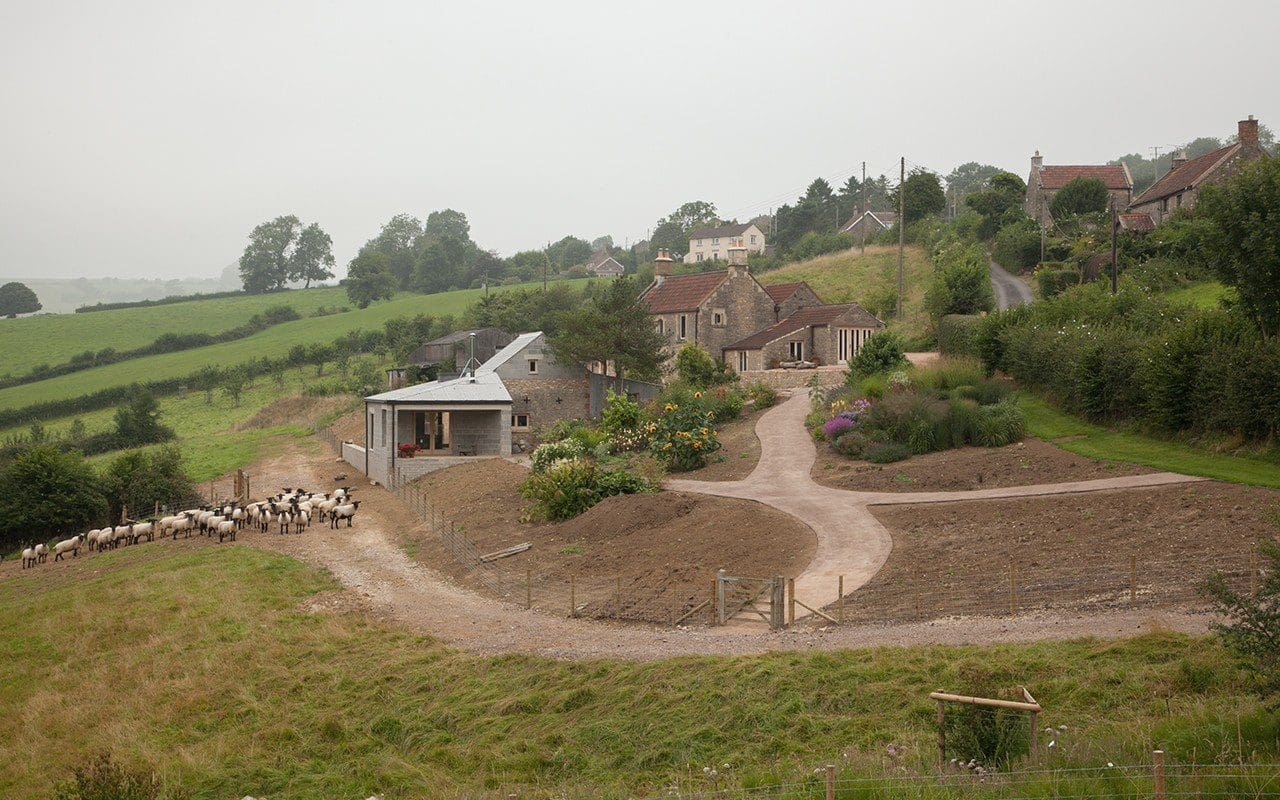 The newly fenced ornamental garden and the new track to the east of the house viewed from The Tump
Of course, it has not been easy. The steeply sloping land has meant that every move, even those made downhill, has been more effort and, after rain, the site was unworkable with machinery. We are fortunate that our exposed location means that wet soil dries out quickly and by August, after twelve weeks of digger work and detail, we had things as they should be. A new stock-proof fence – with gates to The Tump to the east, the sloping fields to the south and the orchard to the west – holds the grazing back. Within it, to the east of the house and on the site of the former trial garden, we have the beginnings of a new ornamental garden (main image). An appetising number of blank canvasses that run along a spine from east to west
The plateau of the kitchen garden to the west has been extended and between the troughs and the house is a place for a new herb garden. Sun-drenched and abutting the house, it is held by a wall at the back, which will bake for figs and cherries. The wall is breezeblock to maintain the agricultural aesthetic of the existing barns and, halfway along its length, I have poured a set of monumental steps in shuttered concrete. They needed to be big to balance the weight of the twin granite troughs and, from the top landing, you can now look down into the water and see the sky.
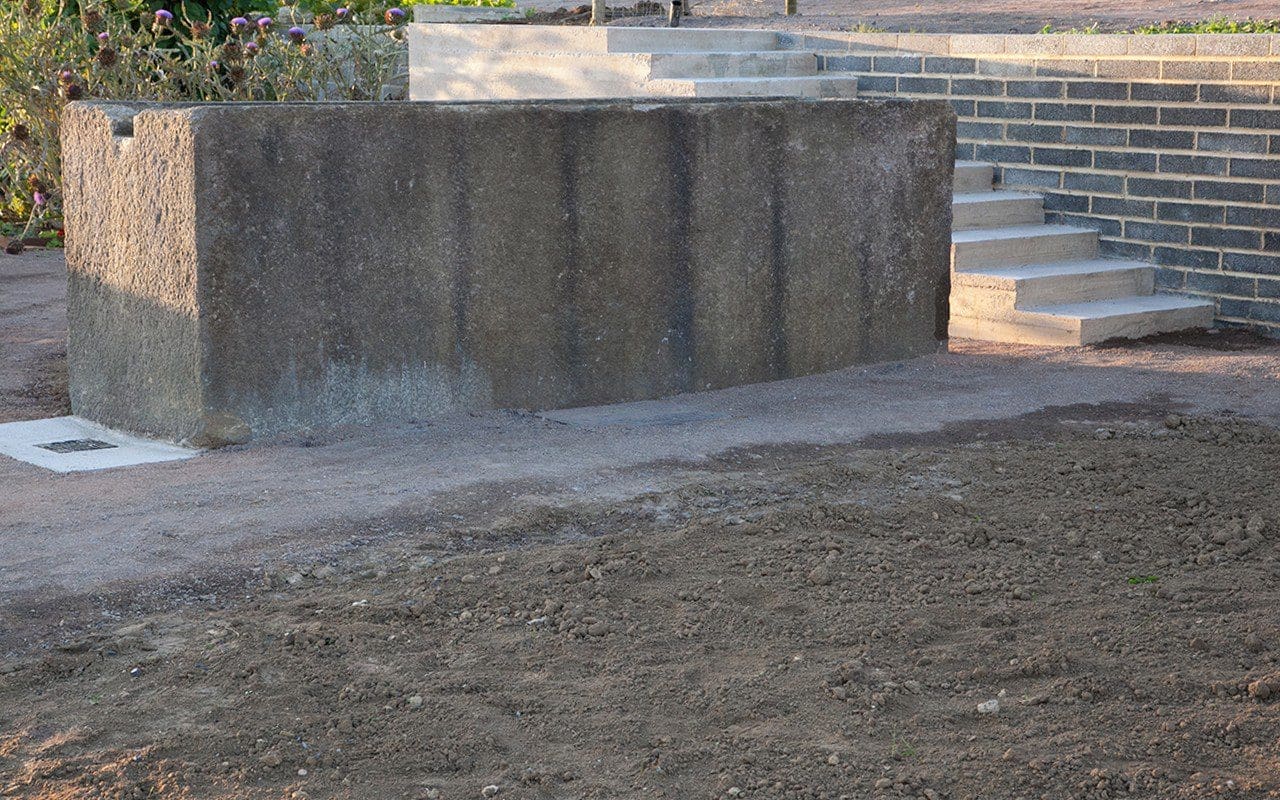 The end of the herb garden is defined by a granite trough, with the shuttered concrete steps behind
 The sky, and sometimes the moon, are reflected in the troughs
On the lower side of the new herb garden, continuing the bank that holds the kitchen garden, the landform sweeps down and into the field. Seeded at an optimum moment in early September, it has greened up already. Grasses were first to germinate, and there are early signs of plantain and other young cotyledons in the meadow mix that I am yet to identify. I have not been able to resist inserting a tiny number of the white form of Crocus tommasinianus on the brow of the bank in front of the house. There will be more to come next year as I hope to get them to seed down the slope where they will blink open in the early sunshine. I have also plugged the banks with trays of homegrown natives – field scabious (Knautia arvensis) and divisions of our native meadow cranesbill (Geranium pratense) – to speed up the process of colonisation so that these slopes are alive with life in the summer.
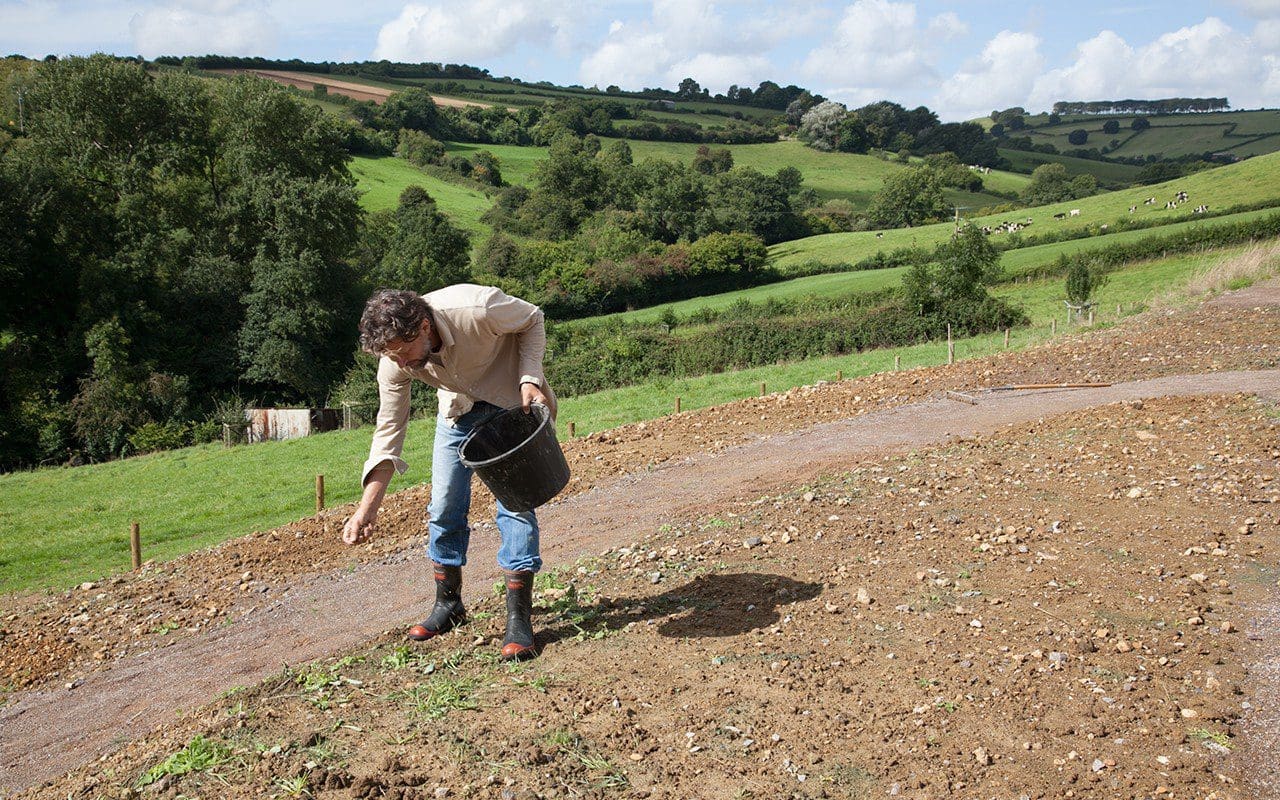 Seeding the new banks in front of the house in September
Below the house, the landform divides to meet a little ha-ha that holds the renovated milking barn and a yard which will be its dedicated garden space. This barn is our new home studio and from where I am planning the new plantings. I have placed a third stone trough in this yard – aligned with those on the plateau above – with a solitary Prunus x yedoensis beside it for shade in the summer. There are pockets of soil for planting here but, beyond the two weeks the cherry has its moment of glory, I do not want your eye to stop. This is a place to look out and up and away.
That said, I have been busily emptying my holding ground of pot grown plants that have been waiting for a home, and some have gone in close to the milking barn to ground it; a Hamamelis x intermedia ‘Gingerbread’ from the old garden in Peckham, a Paeonia rockii, a gift from Jane for my 50th, and the beginnings of their underplantings, including Bath asparagus and some favourite hellebores that I’ve had for twenty years or more. The spaces here are tiny and they will need to work hard so as not to compete with the view out, nor disappoint when you get up close on your way to the barn. The bank sweeps up to wrap the milking barn above and to the east and the planting with it, so that it is nestled in on both sides. Below the barn there is the contrast of open views out into the fields, so when inside I can keep a clear head from the window.
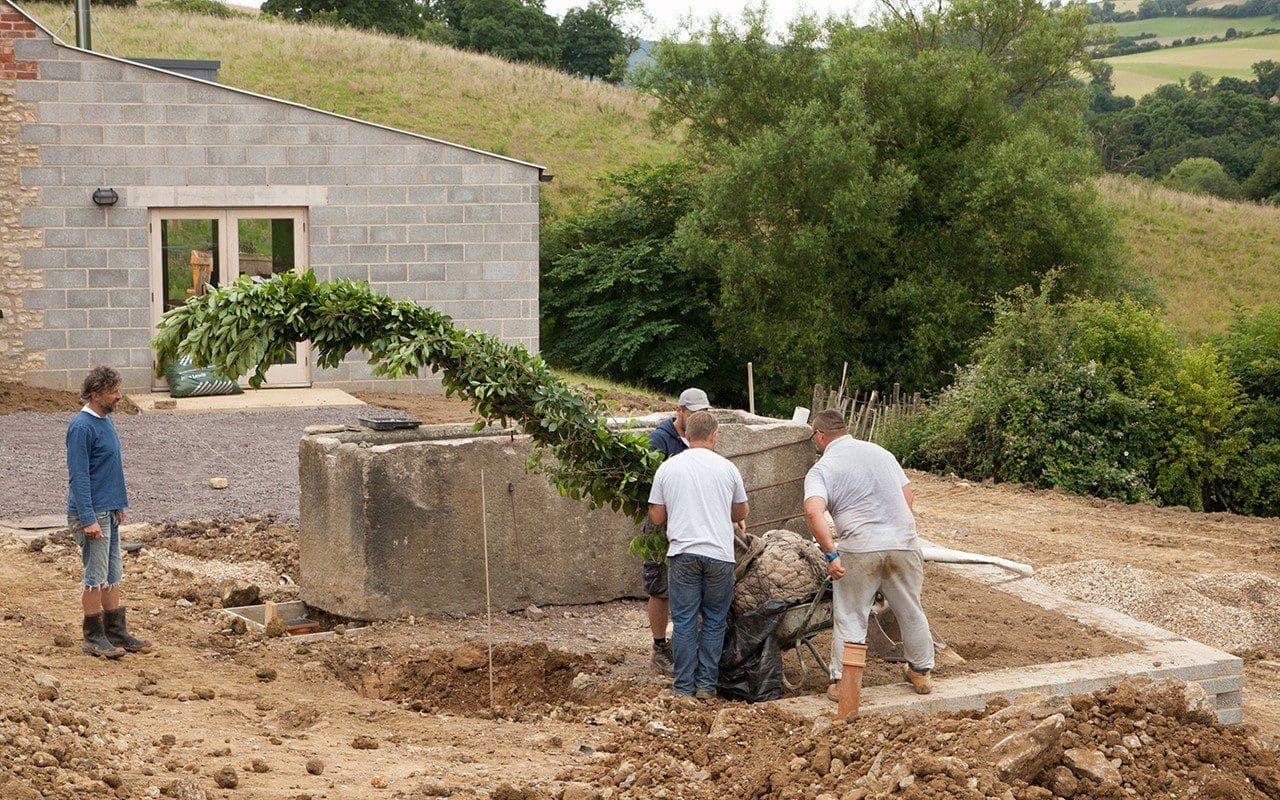 Planting the Prunus x yedoensis in the milking barn yard in July
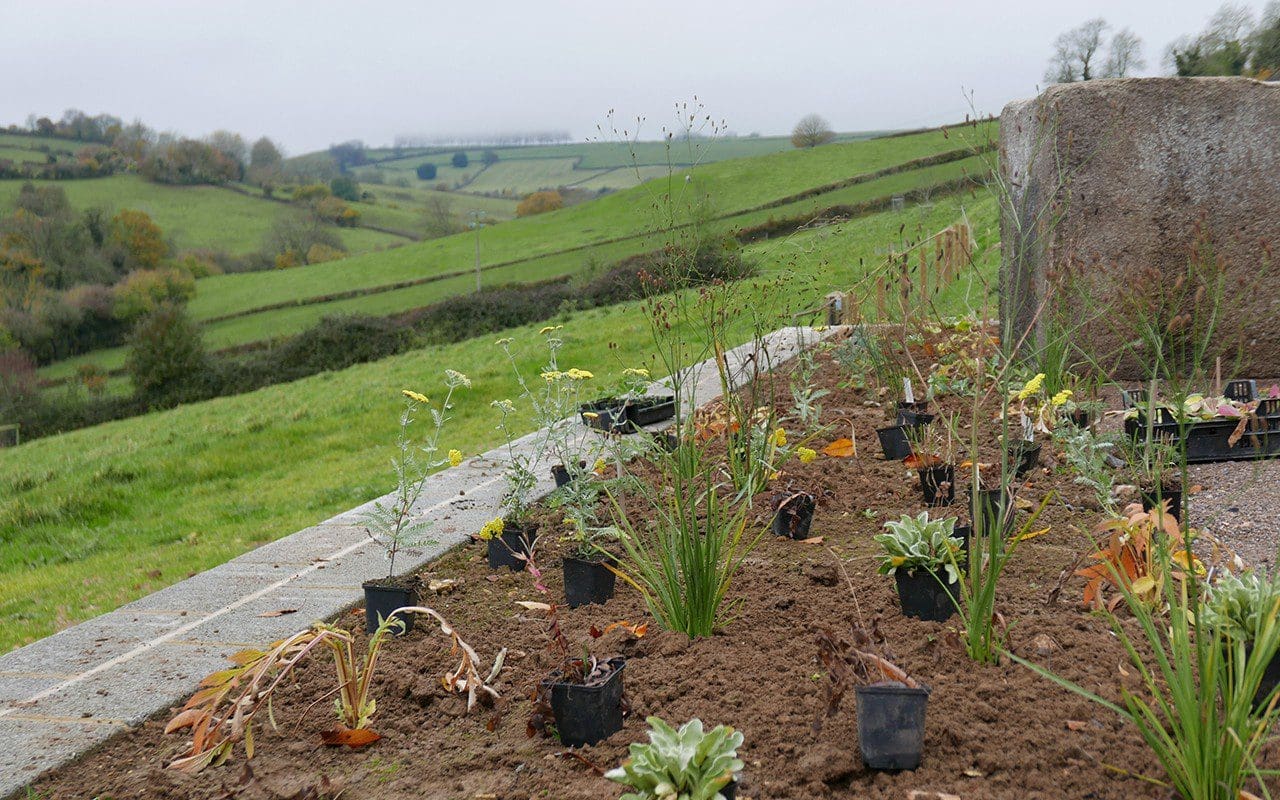 Plants laid out on the edge of the ha-ha in November
To help me see my new canvasses in the new ornamental garden clearly I have started dismantling the stock beds. The roses, which have been on trial for cutting, will be stripped out this winter and the best started again in a small cutting garden above the kitchen garden. I’ve also been moving the perennials that prefer relocation in the autumn. Jacky and Ian, who help in the garden, spent the best part of a day relocating the rhubarbs to the new herb garden. It is the third time I have moved them now (a typical number for most of my plants), but this will be the last. In our hearty soil, they have grown deep and strong and the excavations required to lift them left small craters.
The perennial peonies, which go into dormancy in October, also prefer an autumn move, as do the hellebores so that their roots are already established for an early start in the spring. They both had a firm grip and I had to lift them as close to the crowns as I dared so that they were manageable. The hellebores have been found a new home in a rare area of shade cast by a new medlar tree that I planted when the landscaping was being done. I rarely plant specimen trees, preferring to establish them from youngsters, but the indulgence of a handful, which included the cherry and a couple of Crataegus coccinea on the upper banks near the house, have helped immeasurably in grounding us in these early days. To enable a July planting these were all airpot grown specimens from Deepdale Trees which, as long as they are watered rigourously through the summer, establish extremely well. Usually right now is my preferred (and the ideal) time to plant anything woody.
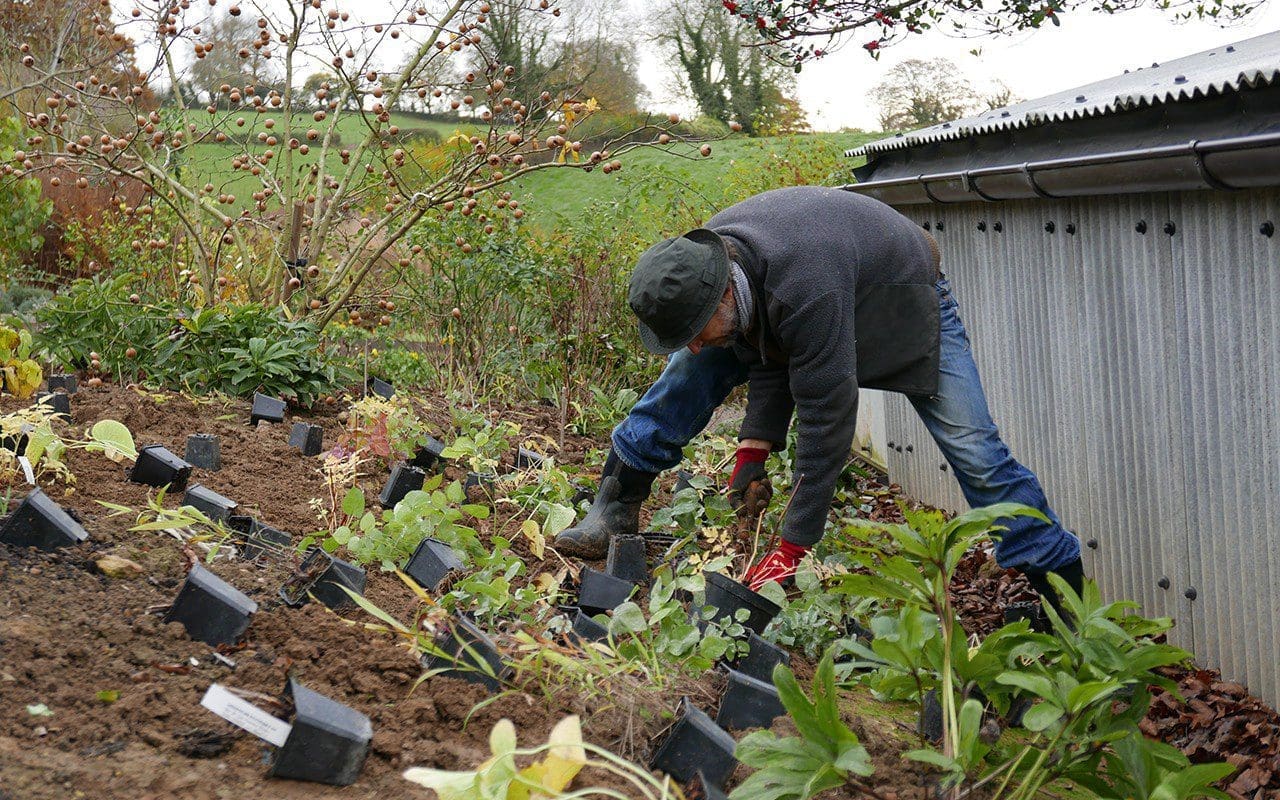 Planting up the area behind the milking barn with the new medlar in the background
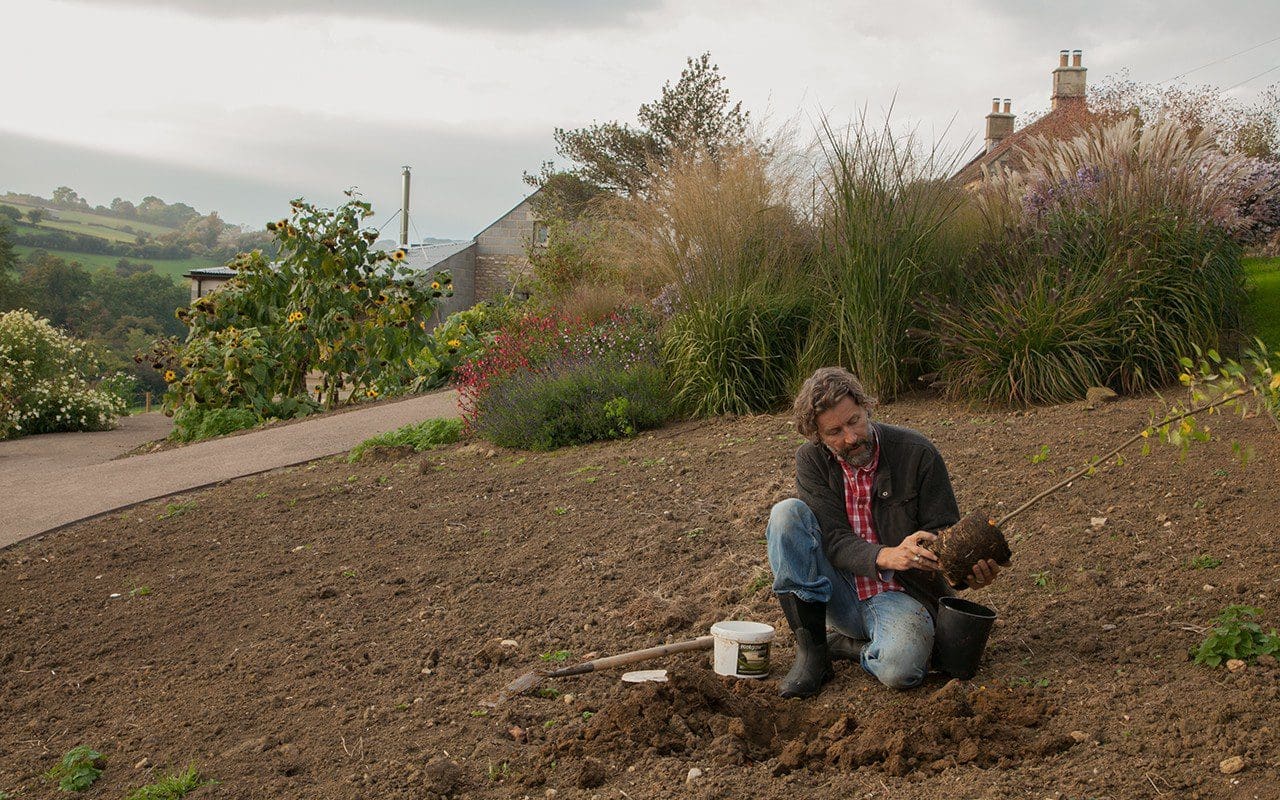 Planting seed-raised Malus transitoria in the new garden in October. In the background are the trial and stock beds, which are gradually being dismantled. The best trial plants will be divided and used in the new plantings.
It is such a good feeling to have been planting things I have raised from seed and cuttings for this very moment; a batch of seedlings grown on from my Malus transitoria to provide a little grove of shade in the new garden, rooted cuttings of Salix purpurea ‘Nancy Saunders’ to screen the new garden from the field below, and a strawberry grape (Vitis vinifera ‘Fragola’), a third generation cutting from the original given to me thirty years ago by Priscilla and Antonio Carluccio, is finally out of its pot and on the new breezeblock wall. Close to it I have a plant of the white fig (Ficus carica ‘White Marseilles’), a cutting from the tree at Lambeth Palace, where I am currently working on the landscaping around a new library and archive designed by Wright & Wright Architects. The cutting was brought from Rome by the last Roman Catholic Archbishop of Canterbury, Cardinal Reginald Pole, in 1556. In 2014 a cutting made the return journey to Pope Francis, a gift of the current Archbishop of Canterbury, Justin Welby. The tree reaches out from the palace wall in several directions to touch down a giant’s stride away. It is probably as big as our little house on the hill, and my cutting is full of promise. It is so very good, finally, to be making this start.
Words: Dan Pearson / Photographs: Huw Morgan, Dan Pearson & Jacky Mills
We are sorry but the page you are looking for does not exist. You could return to the homepage