ALREADY A PAID SUBSCRIBER? SIGN IN
The Giant Oat Grass inhabits high, dry ground in southern Europe and, although I have never seen it in the wild, I can imagine them rising above their companions in the steppe. This is how they like to be, in the company of plants that do not overshadow the tussock of evergreen foliage and where in the longest days of the year they take the light and hold it in a hovering suspension of coppery awns.
The stipa is an old favourite. I grew it first and en masse as an early emergent in the Barn Garden at Home Farm. We used the pockets amongst the old cobbles where previous buildings had been razed to the ground and allowed the oat grass to lead the mood in June. I let the Californian poppy seed through a sprawl of Potentilla ‘Gibson’s Scarlet’ at its feet and the rusty spears of Digitalis ferruginea ascended up into the cloud to score the vertical. I have the Stipa here too, also by our barns and growing in nothing but rubble and subsoil where they stand head and shoulders above their companions. To play on the dilapidated mood of the rusty buildings they are teamed with evening primrose and the tiny pinpricks of a wild dianthus.
Spearing at speed from the basal foliage as the days lengthen, the stipa are a litmus in this race to the longest day. Angling up and out so that there is sufficient room for the flowers to take their own space when they break the tall tapers, they head into a miraculous fortnight of flower. The panicles open out at head height to form a cage through which the wind can easily pass. The golden moment is the week the anthers furnish themselves with pollen, dangling free and on tiny hinges for mobility and ease of distribution for wind-blown pollen.
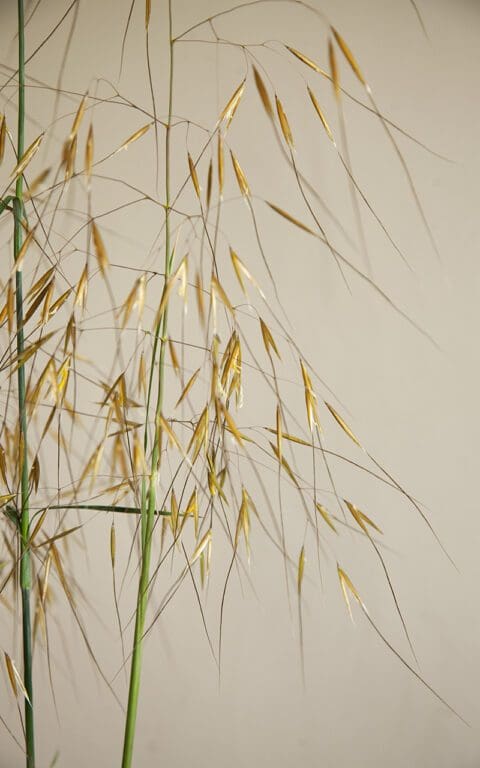
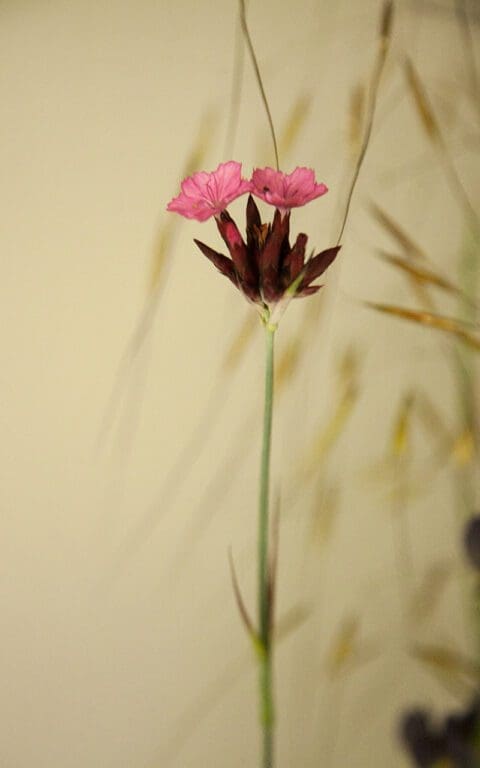
Though it strikes a particular mood of dry airiness in the garden, Stipa gigantea goes with almost anything if you pick it and bring it inside for closer observation. We have it here with a couple of neighbours from the planting. A tall Dianthus giganteus from the Balkans, which favours the same conditions and seeds about in the open places. It has proven to be long-lived here where the ground drains freely and has seeded easily but not annoyingly amongst but not into the crowns of neighbouring plants. Rising to almost a metre here, it is an easy companion, content to find its place on the edge of the planting and rising through the stipa to provide an undercurrent of colour. With blood red calyces and magenta buds that deepen the mood, the flowers open a soft rose-pink.
Close by, but very much in their own space, are the Baptisia x variicolor ‘Twilite Prairieblues’. Where many perennials are happy to be moved if you don’t find them the right position, you need to place the False Indigo in the right place the first time, because they like to put their feet down and hate disturbance thereafter. Being leguminous they fix their own nitrogen and are happy in the rubbly soil. As prairie-dwellers they hate to be overshadowed and will dwindle if a neighbour throws shade, but given a place they like with the surround of good light, they are long-lived and easy.
I have been experimenting with several of the hybrids for their longevity and their curious in-between colours and this one is a beauty. The female parent is the more usual indigo blue B. australis, but the male parent here is the yellow flowered B. sphaerocarpa and this provides the yellow keel. The colour of the standards is neither one thing nor another. A smoky violet-purple, without being muddied.
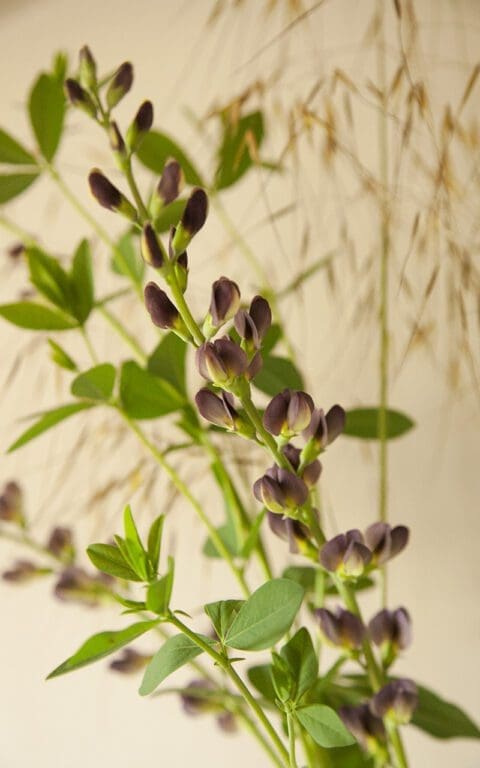
Rising fast and tall and again racing to the solstice, the lupin-like flowers strike a vertical accent whilst in flower. As they go to seed the plant becomes a rounded form that you need to allow room for as it fills out as it matures. The presence in summer is strong and definite, with good healthy glaucous foliage and, later, long-lasting seedpods that darken in winter to charcoal-black.
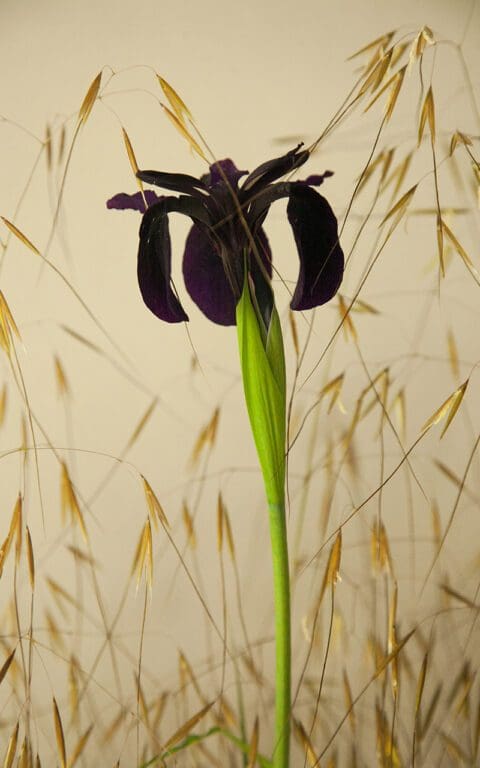
Though from the altogether different growing conditions of the cool damp meadows of southern China, the Iris chrysographes ‘Black Form’ refers here to the winter colours of those baptisia seedpods. Though iris could become a serious obsession, the reappearance of this one every June is always spellbinding. Black on first appearance, but the deepest royal purple on closer observation, they are worthy of a backdrop against which they will not be lost. In the garden they are allowed to hover in the paler suspension of Bowles’ Golden Grass, where their beautiful form is made all that much clearer. And here too, the stipa shows us that it is worth experimenting with associations you might not choose for their cultural compatability, but for what they might inspire beyond their place in the garden.
Words: Dan Pearson | Flowers and photographs: Huw Morgan
Published 19 June 2021
This is a particularly special moment of late garden and first autumn colour. On the front line to protect from the westerlies, I’ve planted the Scarlet Hawthorn (Crataegus coccinea) and a medlar. They both provide blossom and now fruit and, in the short time they have been there, a pool of stillness for the company that needs it at their feet.
Held and protected here, the Wood Oat, or aptly named Shimmer Grass, have found their niche amongst the wind anemones. I planted them throughout the bed. but towards the edges, so that we could enjoy their autumnal arc and mobility. To test their preference, because every garden has rules that do and don’t apply, a few were scattered to the windward side, because the breeze in their growth is what they need to shimmer. I know them to do best in a little shade, or more precisely on the edge of things, and sure enough those on the front line are a shadow of the plants that have thrived with the microclimate of company. Seeding about gently now, they have alighted where they tell me they want to be. On the leaward side and on the margins where, to be honest, they are most easily admired.
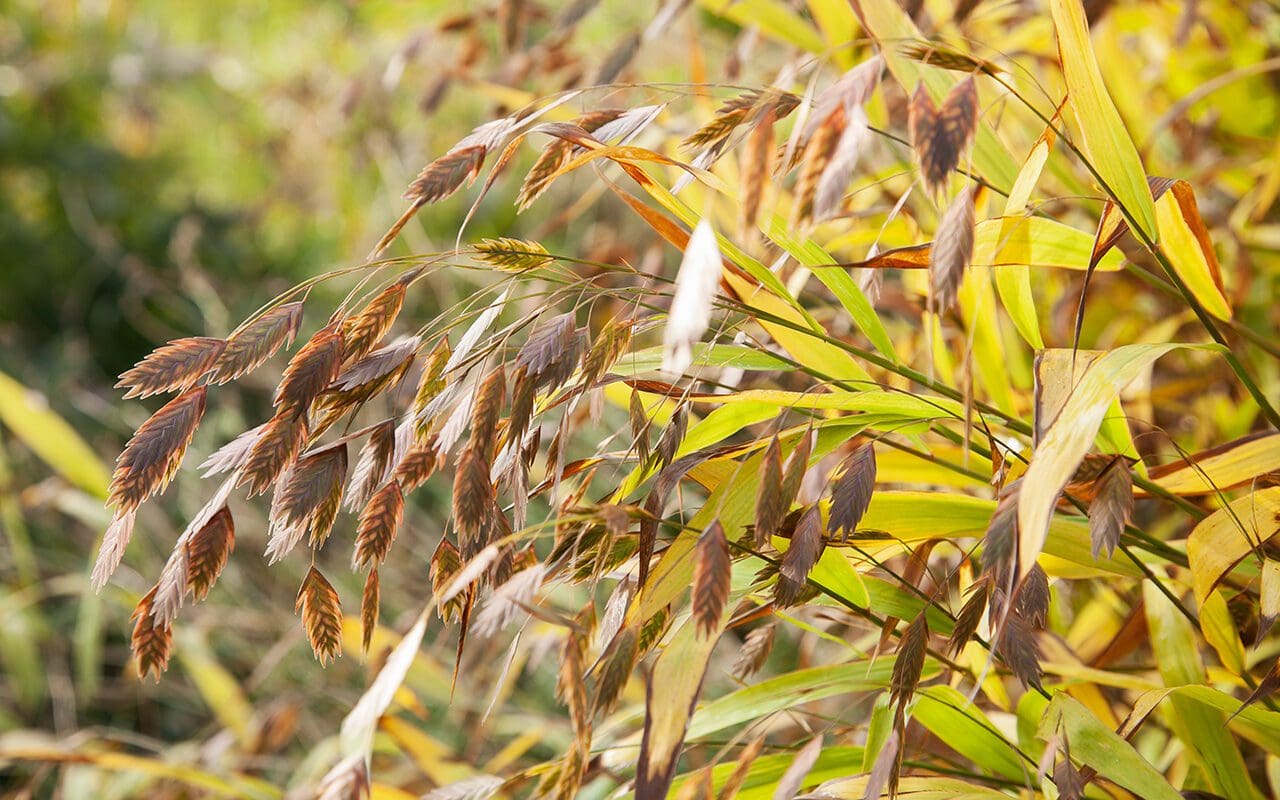
If you are to look Chasmathium up, their many common names probably result from their wide distribution, which dips into northern Mexico and travels north up the States in the shelter of wooded places. Though Wood Oats are certainly not of these shores they do not immediately make you think of somewhere else, like Miscanthus do of the orient. Feeling similar to our woodland Melica and preferring the same places I can see them becoming very much part of this garden. The sun loving Panicum virgatum ‘Shenandoah’ that have splayed over the paths this year where they have been overshadowed by plants that have done better than I thought, will be moved to make way for a more suitable grass. The Chasmanthium will be perfect here, happy to tick along in company and rewarding us with good behaviour and poise and well-paced growth that peaks so beautifully now.
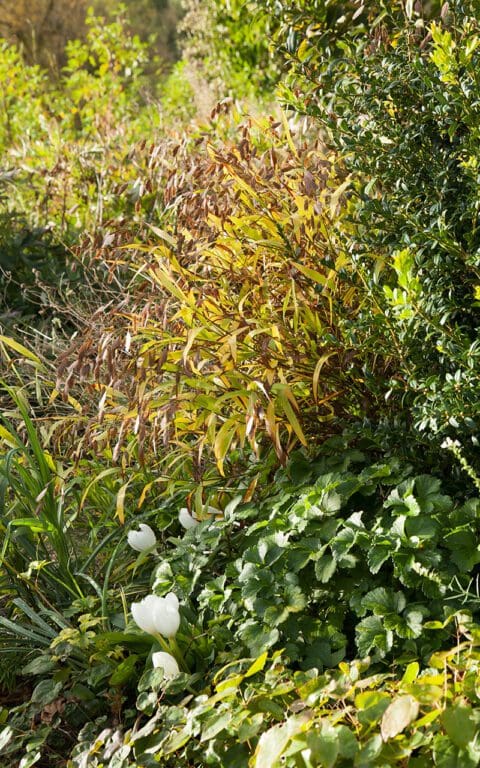
Clumping, not running and a reliably long-lived grass, I enjoy their windswept forms over the winter and cut them back to make way for snowdrops early in the new year. Wide blades, a finger’s width of a cool bright green, then stagger their way up dark stems to about knee height before they begin to throw flower in high summer. There is nothing ungainly about the Shimmer Grass and this is when they begin to, with the first sighting of flower. Firstly tiny darkened versions of what they are working towards and then slowly gaining more presence as the foliage colours butter yellow and the Asters, Colchicum and Anemone begin to provide their backdrop. Completely flat, as if they have been pressed between the leaves of a book and catching, they need the breeze, just enough to make them dart on their wire thin stems like shoals of fish darting and shimmering in the sea.
Words: Dan Pearson | Photographs: Huw Morgan
Published 10 October 2020
Stripping away the last season’s skeletons comes with mixed feelings and I judge the moment carefully. There has been joy in the leftovers and I have savoured the falling away, with each week revealing a new level of transparency, but no less complexity. Light arrested where it would have fallen without charge or definition if we had cut the garden earlier and the feeling that we are more in tune for standing back and going with the winter.
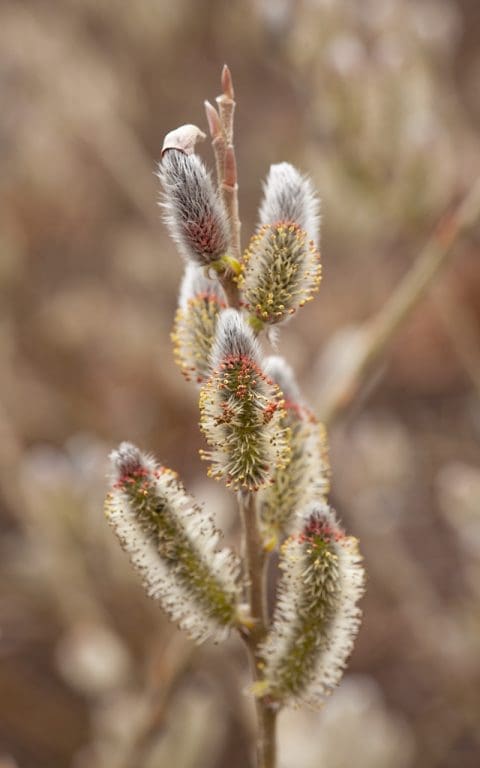
It has all been worth the wait, but by mid-February, when the snowdrops were drifting in the lane, the need to move became clear. The tiny constellations of spent aster were suddenly joined by the willow catkins on the Salix gracilistyla that nestle by the gate. Grey buds like moleskin, soft, glistening and alive with bees. The old growth alongside them was made immediately apparent and the need to embrace the change an easy step to make.
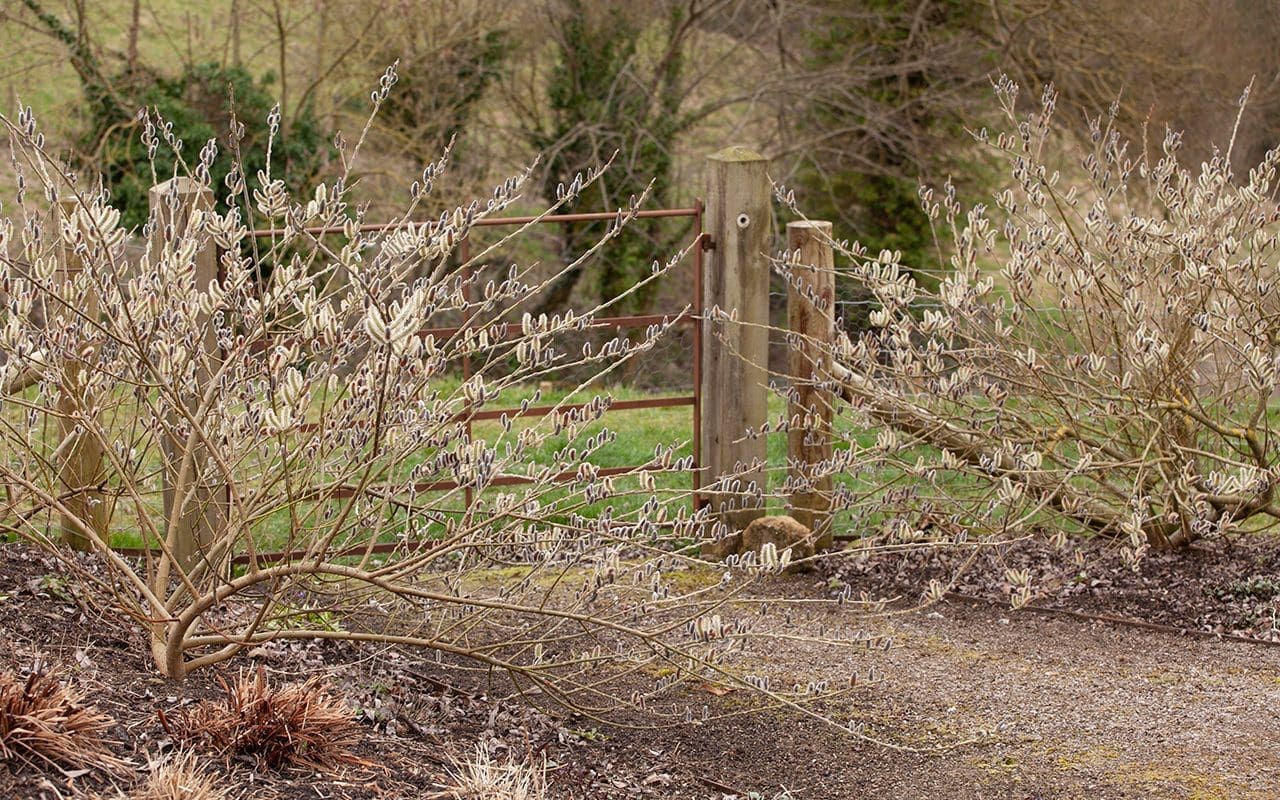
This spring, after completing the planting the autumn before last, we have twice as much garden to clear. This time last year two working days with three pairs of hands saw the skeletons razed and taken back to base. With more to wade through this year four of us made a day of it the first weekend to break into the oldest parts where the perennials have now had two summers of growth. The weather had been dry and the soil was good to walk on without feeling like you were straying from the path. The sun came out to fool us into thinking it was April and, sure enough, at the base of the remains there were clear and definite signs of life. Buds red and rudely breaking earth already on the peonies and emerald spears of new foliage marking the hemerocallis.
I worked ahead of the team, stepping into the planting where I’d spent the winter analysing the plants that needed changing or adjusting. Last year it was to remove all the Lythrum salicaria ‘Swirl’, which were replaced by Lythrum virgatum ‘Dropmore Purple’, a form that feels closer to the wild loostrife. This year, I have lifted a stand of Panicum virgatum ‘Rehbraun’ by the lower path that were shielding the planting below them. They have done better than I had thought, so half were tied in a topknot to make them easier to move and then staggered through the beds where I need this accent and volume for late summer and then winter. I left them standing to check how they marched and jumped through the planting to bring it together. Now is the time to move grasses, for they engage fully with dormancy early in autumn and with life in root activity in early spring. Being late season grasses, I have placed the panicum where they will not be overshadowed too early by their neighbours. The two year old plants were a handful to heave, but with a sturdy root ball they will not look back. With spring now on our side, the timing should be perfect.
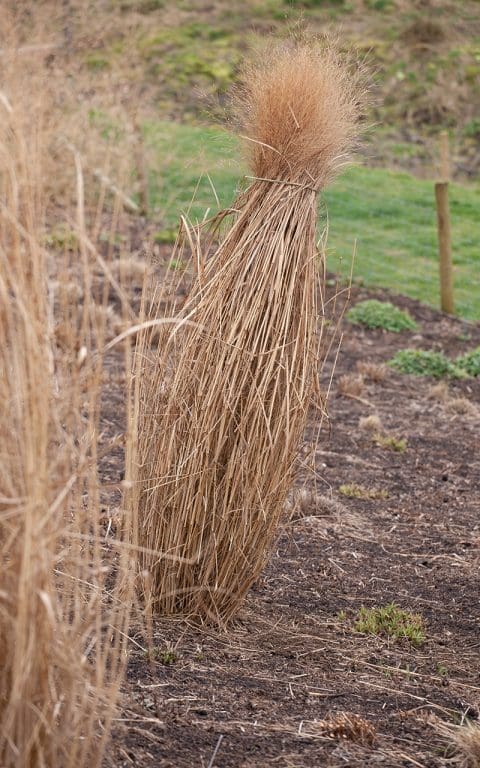
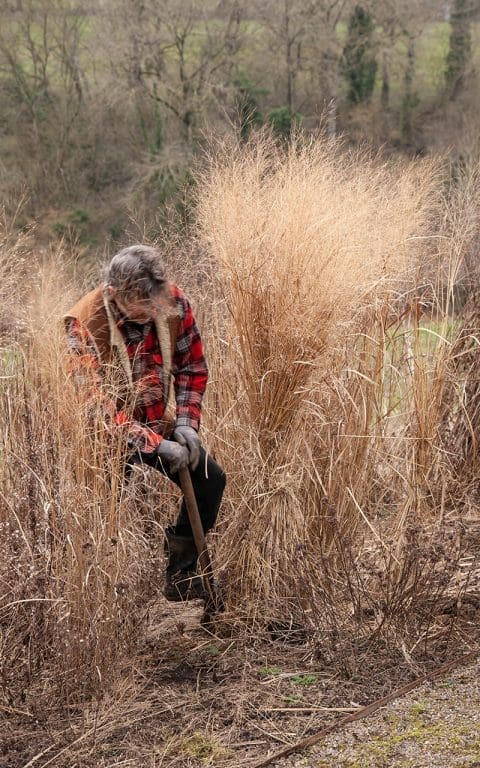
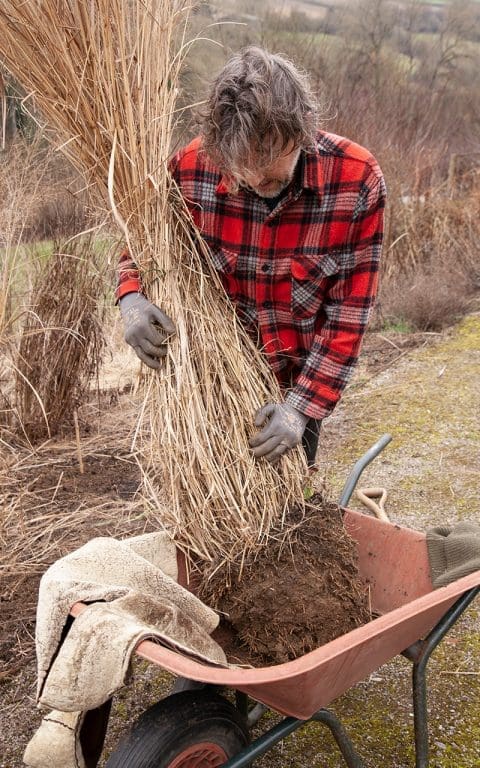
I have not planted bulbs yet, or not as many as I am ultimately planning for once I have more maturity in the planting. I will keep them in groups under the trees and shrubs where their early season presence can be allowed for. Planted too extensively amongst the perennials and I would have to cut the garden back sooner, at least two weeks earlier, so as to not trample their emerging shoots. As the willow catkins are my litmus, I will let them determine the date that the skeletons are cleared and not be driven by the march of bulbs. That said, there will be exceptions. I have a tray of potted Camassia leichtlinii ssp. suksdorfii ‘Electra’ that were impossible to plant in the autumn when the garden was still standing. They will find a home where I have lost deschampsia to voles. This is the second year running that their homes have undermined this layer in the planting and it feels more appropriate to bend and change direction.
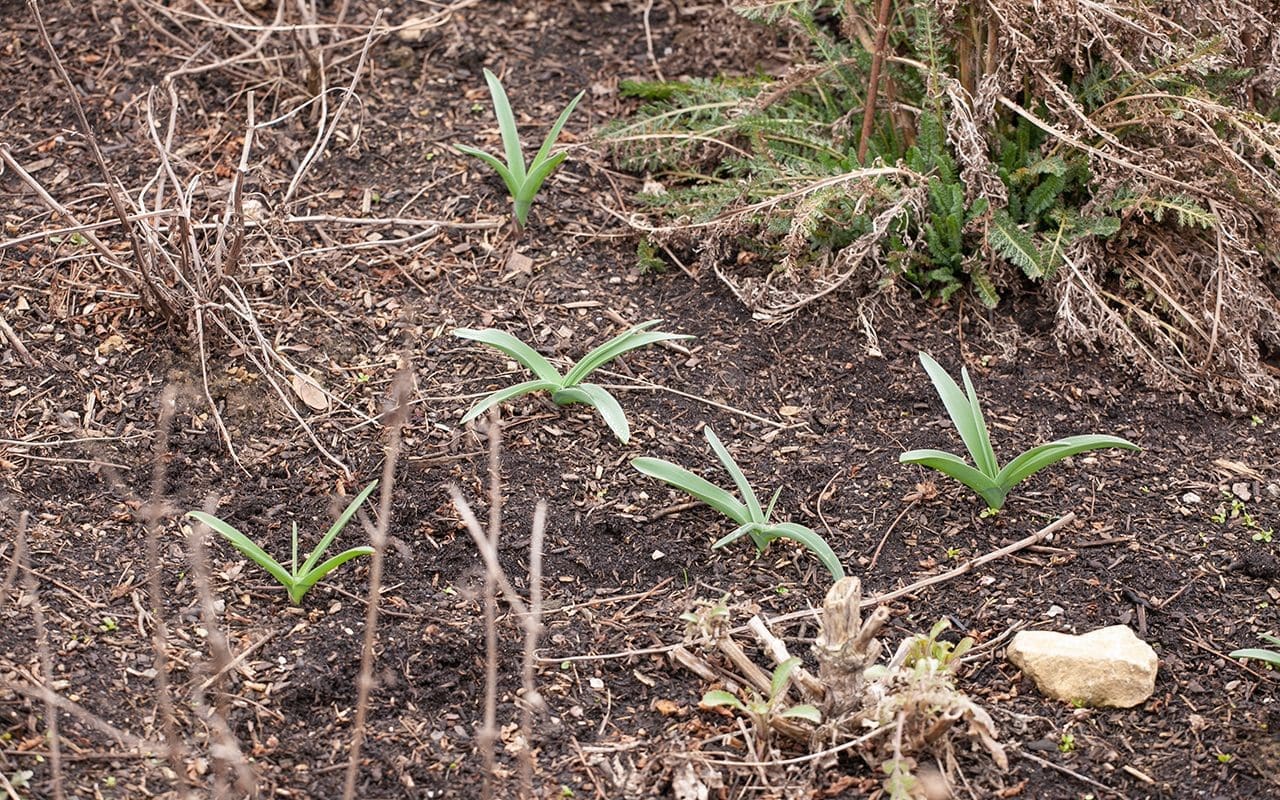
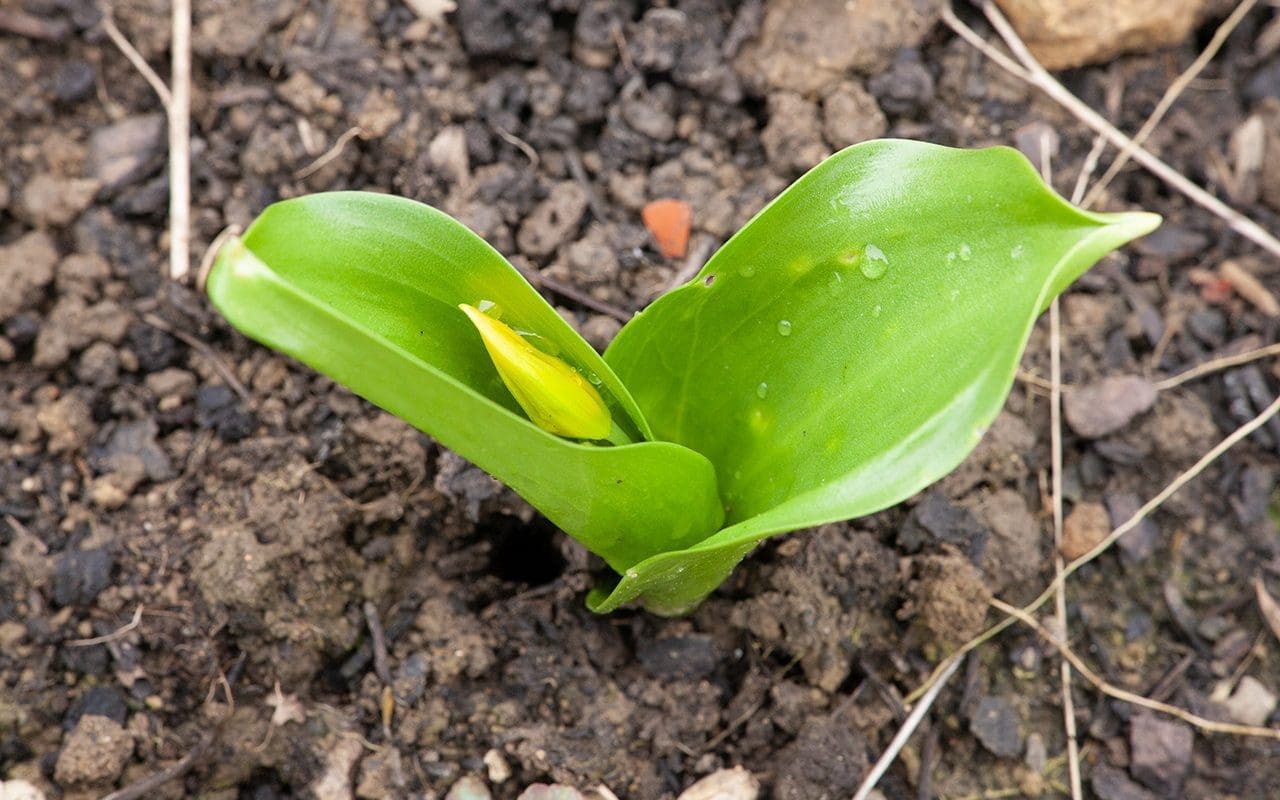
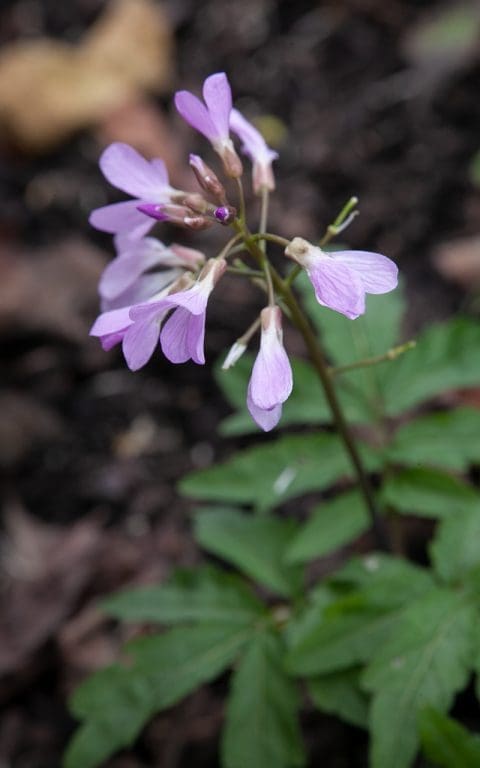
The new start with a clean palette reveals a gap in this new garden. One that, with time to get to know the new planting, I can now plan for. Early pulmonarias are already bridging the space beween the winter skeletons and the real beginning of spring. I have planned for more P. ‘Blue Ensign’ so that it’s gentian blue flowers can hover under the willows. Shade tolerant ephemerals such as Cardamine quinquefolia and Anemone nemorosa will also be useful to weave amongst later clumping perennials that can take a little well-behaved company in the spring whilst they are still just awakening. The layering will be important as I get to know more and, in turn, become more demanding.
Words: Dan Pearson / Photographs: Huw Morgan
Published 2 March 2019
Our hillside position comes with the weather and, perched as we are above the shelter of the woods below us, the wind is free to whistle. Our usual breeze, which brings most of the rain from the south-west, comes down the valley, whilst the chill winds that so often hit when the garden is coming to life, pushup the valley from the east. Unseen until you give it something to move through, the wind is something I set out to harness in the planting. The slopes behind us are allowed to run to meadow in the summer and the landform that we made to hold the buildings and the kitchen garden is also seeded to meadow. Look up the valley from the house and you can often see a breeze before it arrives, rippling towards us and making the wind visible.
The inclusion of ornamental grasses brings the meadows and their movement into the garden and it was important when trialling the grasses that they felt in tune and part of this setting. The deschampsia, molinia and panicum all had the modesty and grace I was looking for, but it was hard to have a grasses trial without including miscanthus. Silvergrass, clumping by nature and forming a distinctive mound of foliage before showy autumnal plumage, are not grasses that you use as a backdrop or a gauzy support. They are the stars when they are out and demand your attention.
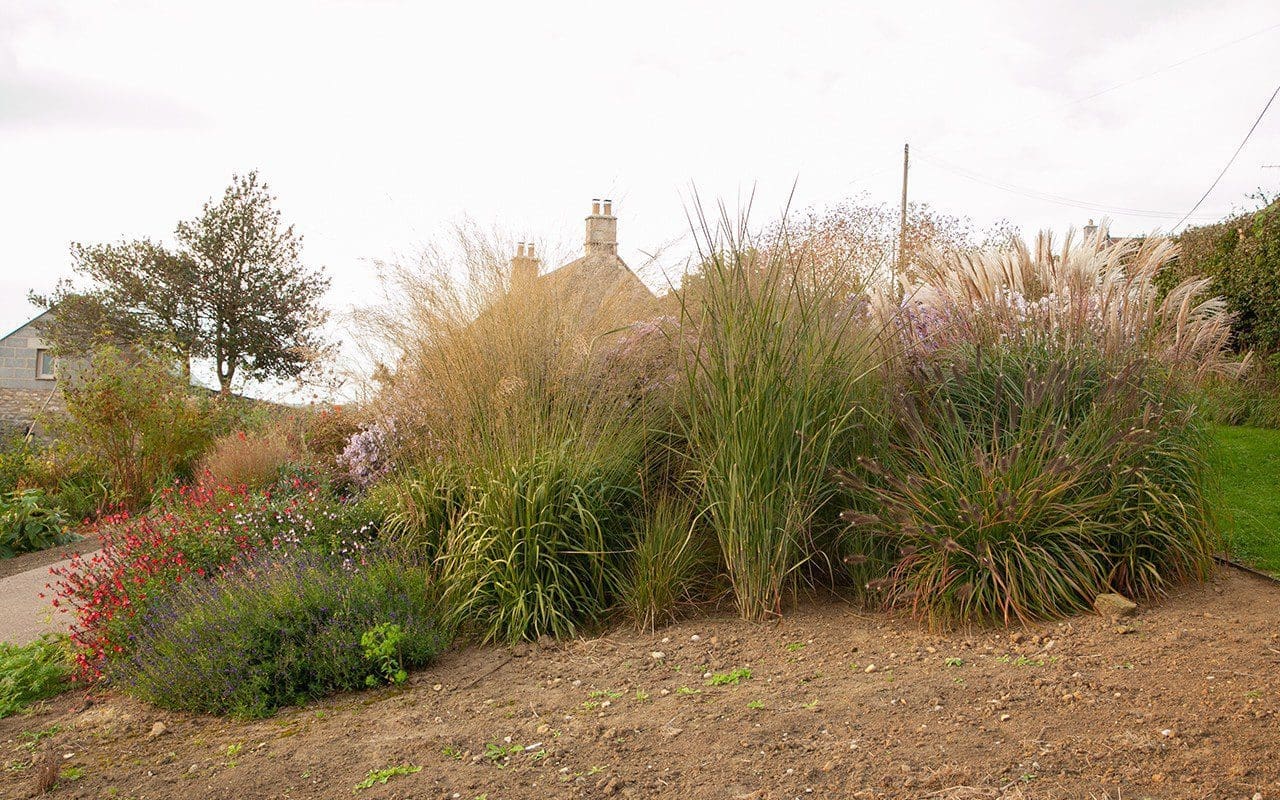 The grass trial in 2016 with the miscanthus to the right
When I first started gardening miscanthus were perhaps more fashionable and the domain of designers such as John Brookes and Oehme and Van Sweden. My first encounter as a teenager was with Miscanthus sinensis ‘Silberfeder’ and at home I teamed it with Rudbeckia laciniata ‘Herbstsonne’. Together they soared to two and a half metres to fill our kitchen windows with artificial sunlight. The golden flowered black-eyed-Susan and silver feathers of the miscanthus provided for a full three months of autumn. I have played with miscanthus fairly consistently since then, slowly working my way through a plethora of species and cultivars. In the early years Miscanthus sacchariflorus was a favourite for its three metre stands of rustling sugar-cane foliage and then M. sinensis ‘Zebrinus’ for its distinctive horizontal stripes of bright lime green. These plants were selected for their structural presence, but we are spoiled today with a wealth of forms selected for their silky flower.
When I had enough space of my own in our old Peckham garden I toyed with several different varieties over the fourteen years we were there. Getting to know a plant for three or four years and then moving on to try a new variety kept the garden moving and my knowledge and appetite replenished. Miscanthus nepalensis was perhaps the most exotic, a relatively tender species with pendant, burnished plumage like a golden fleece. Though beautiful it proved to be less reliable than others. This was possibly due to the fact that I tried to insert them when the planting was well-established, casting too much shade and competition. One of the great positives about miscanthus are that they are reliably clump forming and long-lived too, if you give them the room and the light they need to perform.
The best of those that I have experienced for myself combine a good balance of foliage and an ability to stand well once they come into flower. The lofty ‘Silberfeder’, for instance, leans as the flowers develop. Varieties such as ‘Yakushima Dwarf’ and ‘Kleine Silberspinne’ have been specifically selected not to take space, their fountain of foliage being neat and their flowers losing none of their grace for being upright and self-supporting. A good plant is one that you can leave more-or-less alone from the point it is taken back to base in February. It will pull away with a fresh mound of strappy leaf and then need no corralling as it comes into flower.
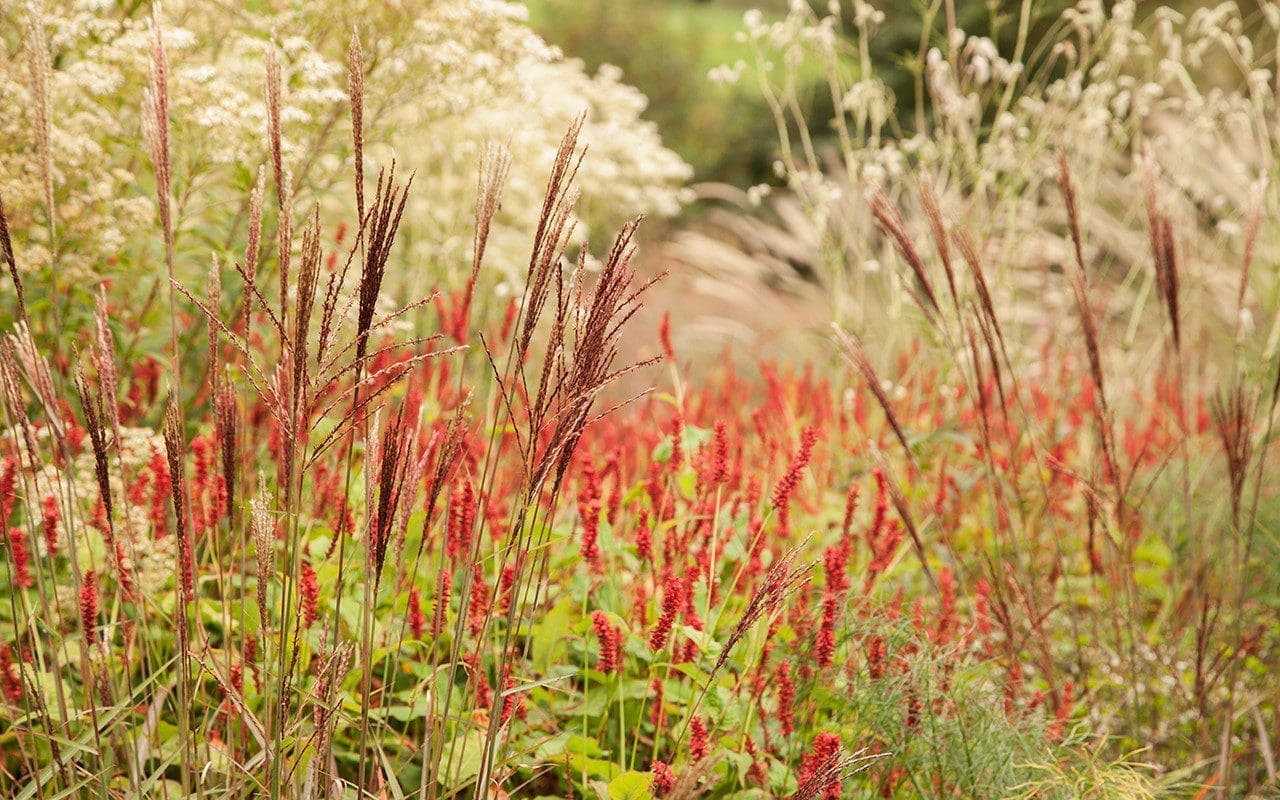 Miscanthus sinensis ‘Dronning Ingrid’ with Persicaria amplexicaulis ‘Blackfield’, Aster umbellatus and Sanguisorba ‘Stand-up Comedian’ in September
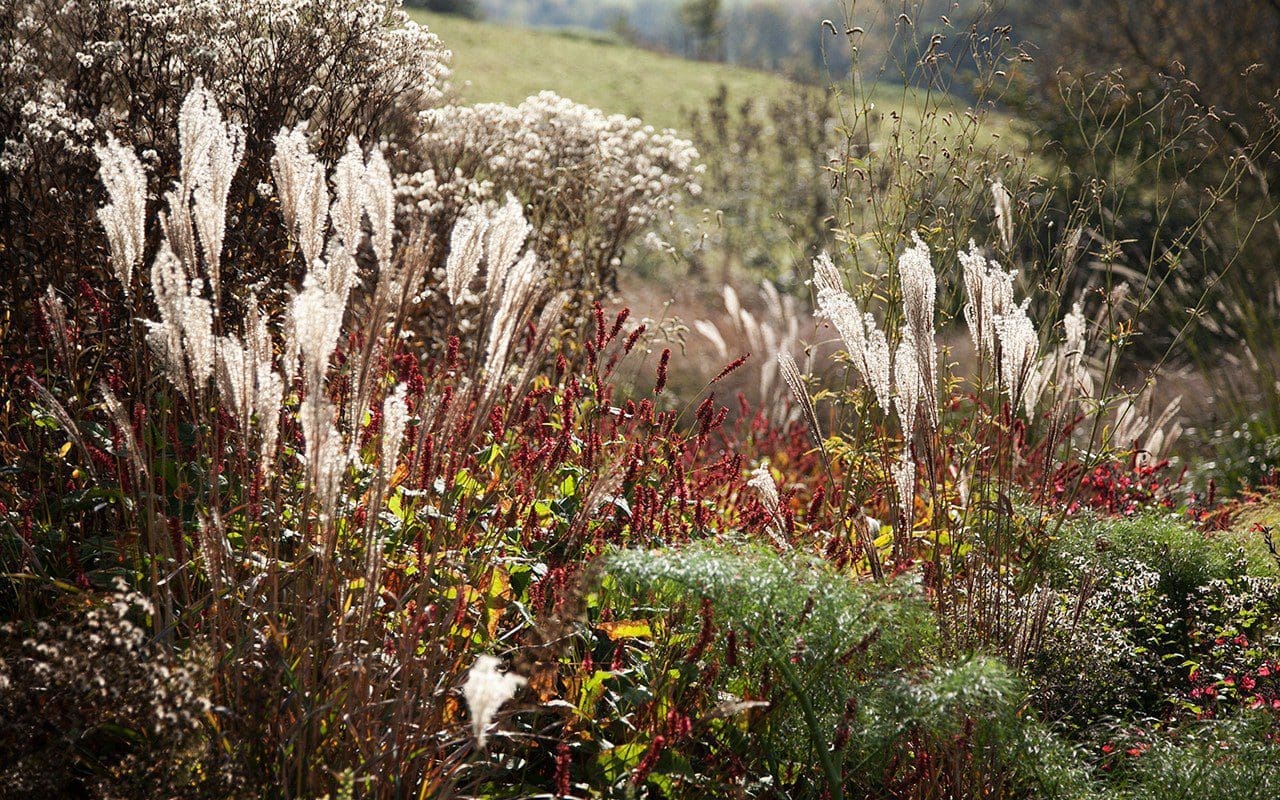 The same combination in late October
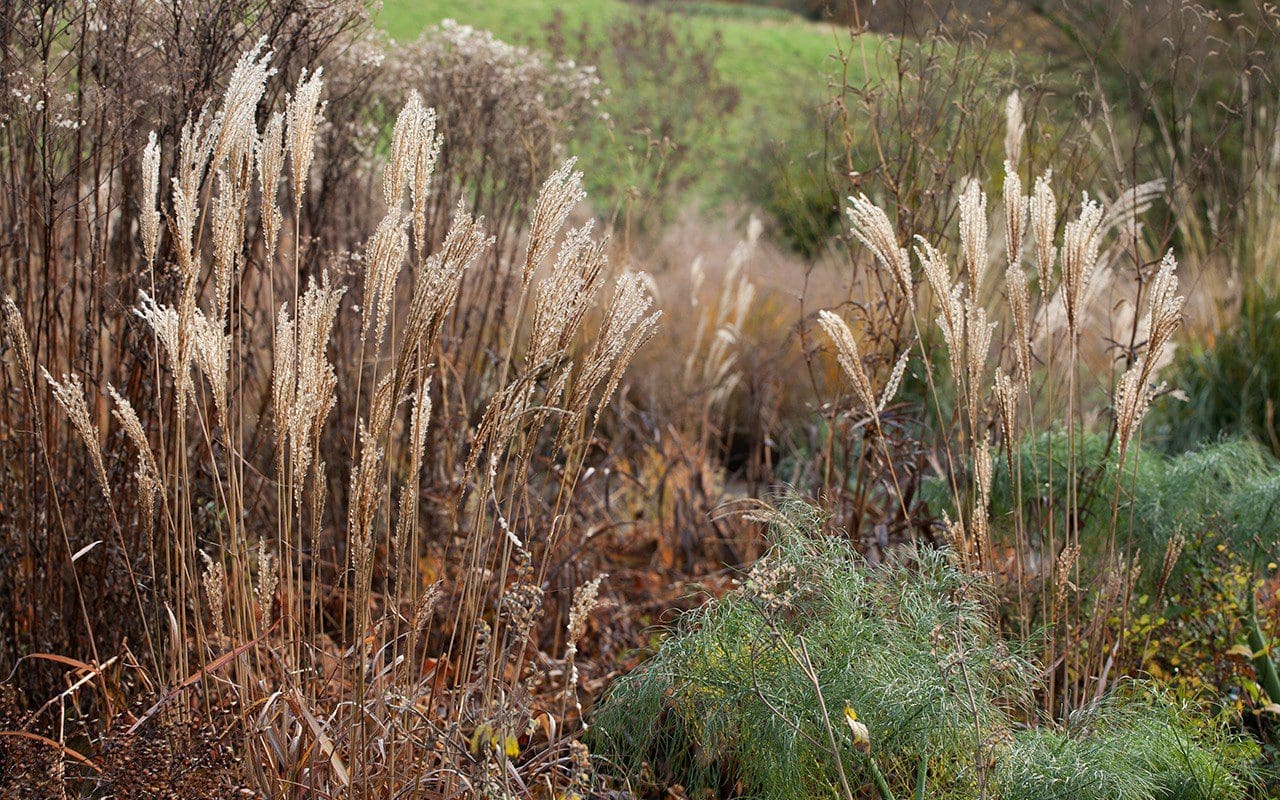 And again in late November
Whether they are tall or short, miscanthus always have a presence and it is no surprise that in Japan, where you will see their silvery plumage animating roadsides, they are celebrated as the harbinger of autumn. This is their real season and, though I always enjoy the reliable companionship of their foliage in summer, the moment their flowering stalks begin to rise, you know that the next season is in the air.
The flower colour of the named forms varies enormously, the silver plumage of the wild M. sinensis being the colour you see most often. Those selected for the pink in the flower, such as ‘Flamingo’, are undeniably beautiful, but they set a very particular tone, which is rather unnatural. My favourites are the darkest with thunderous reds and browns in the emerging flower. ‘Ferne Osten’ is one of the first to appear in August with dark red flowers, but this earliness brings the autumn feeling into the garden too soon, as the flowers ripen and pale in September. I am happy to see the flower spikes breaking free of the mounding foliage in August, but over the years I have come to prefer pushing autumn the other way and to only now be feeling that we have seen the last of it and that winter is upon us.
Of the five or six miscanthus I trialled for the garden here, I had to be strict. In fact I almost discounted them altogether as being too showy for this rural location. The ornamental mood of the Silvergrass requires them to be close to the buildings or where the garden can afford to feel less connected to the meadows beyond us. I kept two, the first to come to flower being ‘Dronning Ingrid’. This is a delightful plant (main image), good for being modestly sized both in the scale of the leaf and the mound it creates as it gathers in strength during the summer. The flowers started to push up in August here, showing their dark, wiry filaments by the end of the month, their upright form retaining space between the plumage. I like this very much because the flowers act as weather vanes, describing the wind in each of their outlines. The deep mahogany in the flower is set against pale Aster umbellatus and the redness picked up in an undercurrent of Persicaria amplexicaulis ‘Blackfield’. They retain a sleek darkness for the best part of six weeks, before the foliage reddens and the flower ripens and pales as it becomes more feathery.
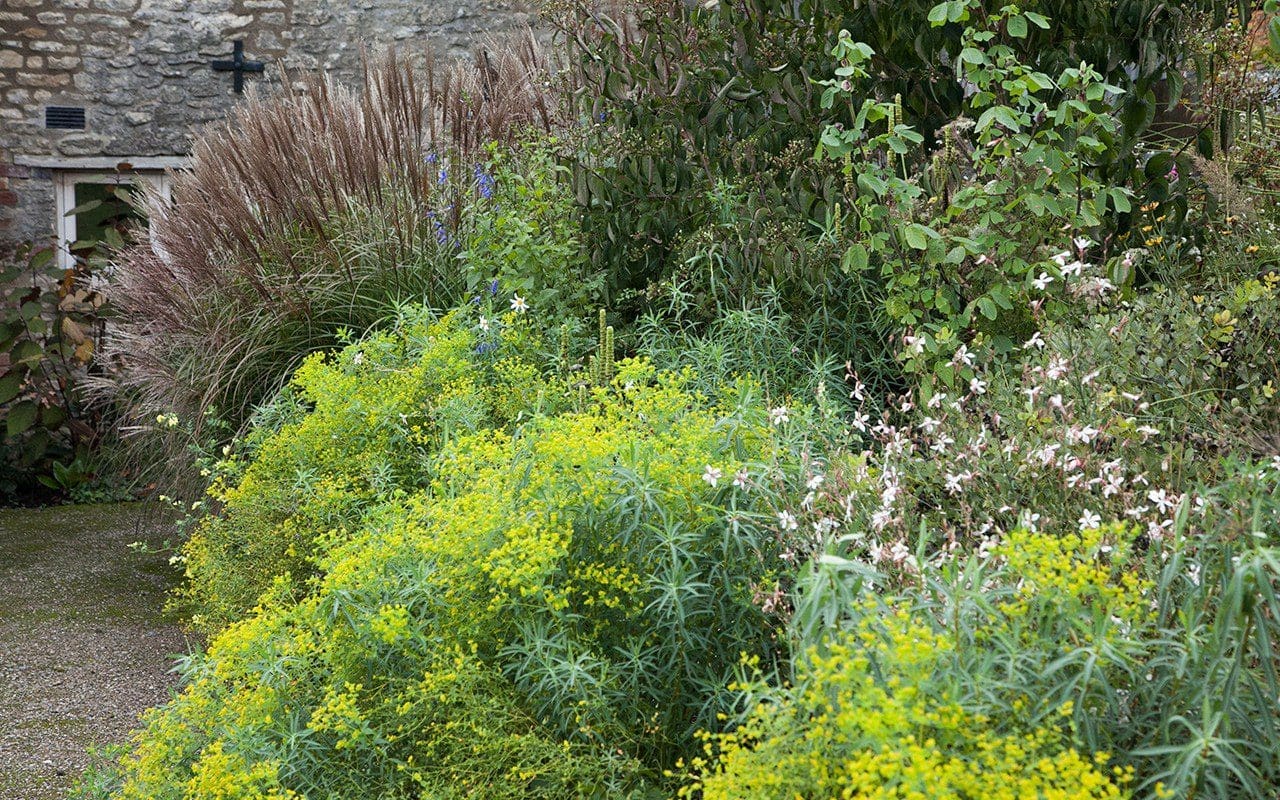 Miscanthus ‘Krater’ holds the bottom of the steps that lead down to the studio
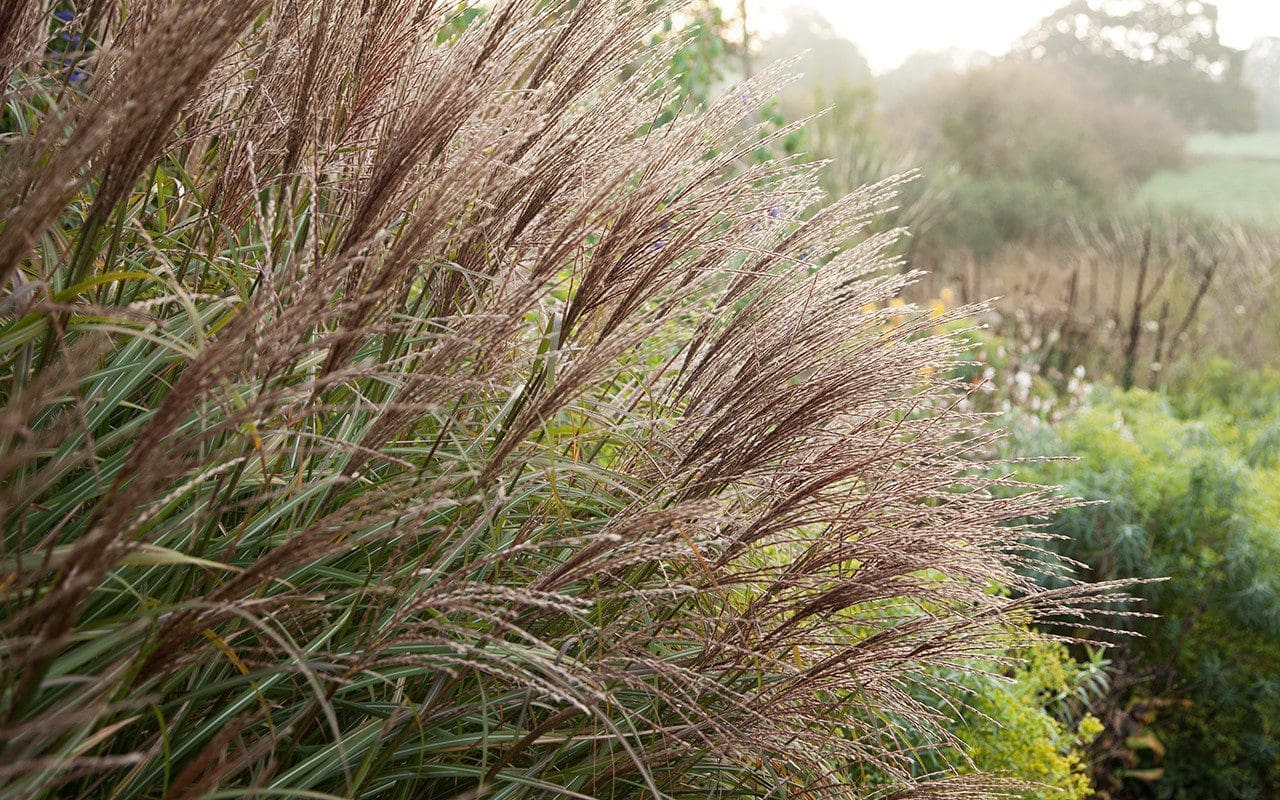 Miscanthus s. ‘Krater’ in early October
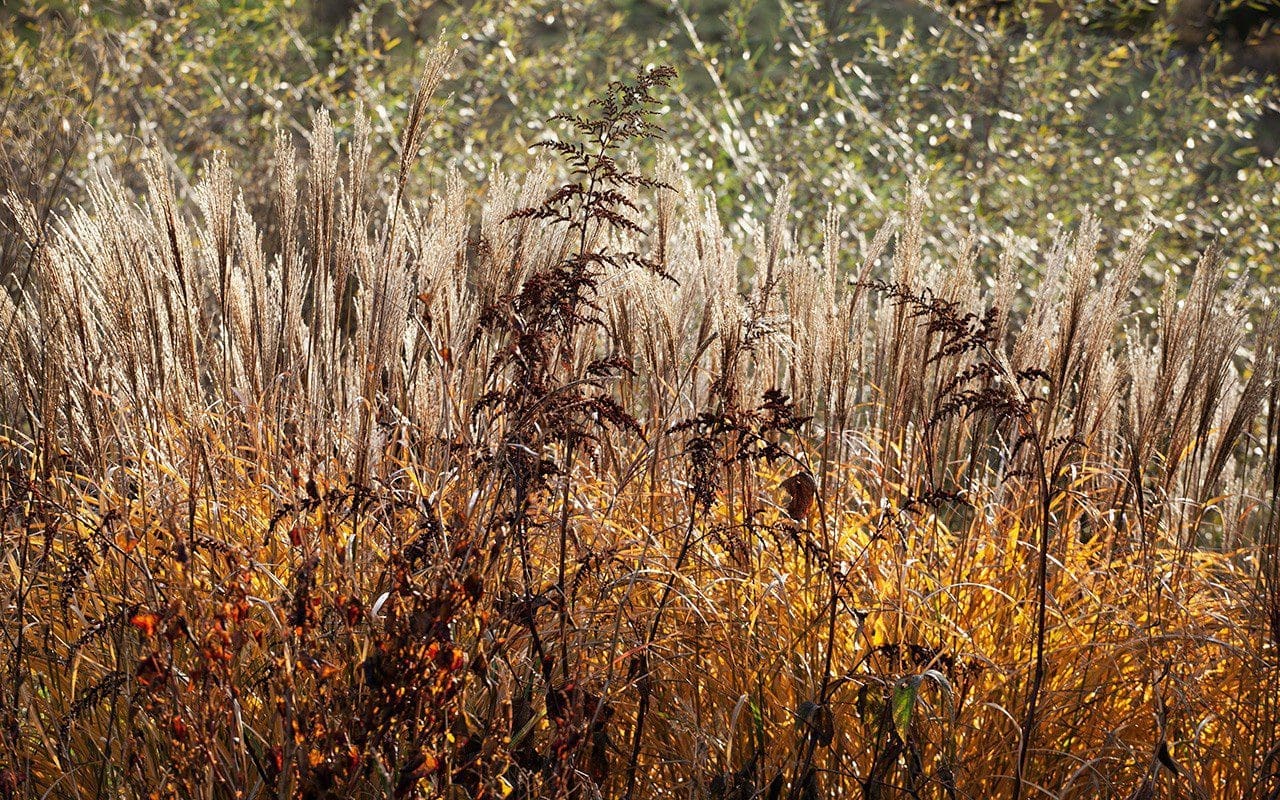 Miscanthus s. ‘Krater’ with the dark seedheads of Astilbe rivularis in November
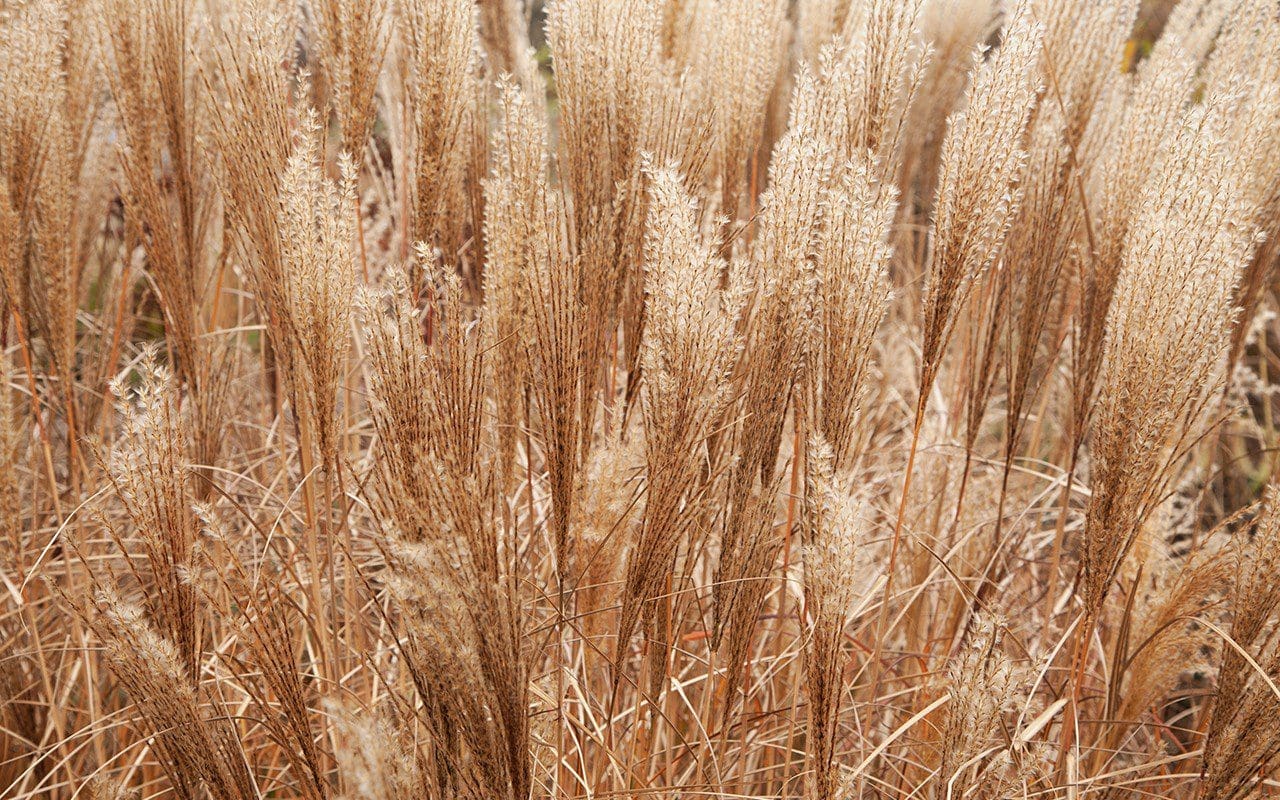 Miscanthus s. ‘Krater’ in early December
‘Krater’ is the bigger of the two, but still compact and orderly. It is planted here to hold the corner at the bottom of the steps down to the studio where the foliage mounds to waist height before pushing up flowers in September. The original clump was quartered two years ago (in March, the time to split grasses) and I do not expect to have to divide them again for seven or eight years. They take the full brunt of sunshine in this position and provide shadow for hellebores I’ve planted on their north side. This ability to use miscanthus like shrubs for structure and shade is one of their greatest assets. ‘Krater’ also starts dark and moody in flower, but the flowerheads are both a more subdued grey-brown and more open and tasselled than ‘Dronning Ingrid’. As the season progresses the foliage flares yellow and orange before bleaching to parchment for the winter. As the flowers age and the dark cloud silvers, they provide us with light catchers to arrest the low rays as they glance through the garden.
By the end of February, when we start to clear the perennials, I will have had enough and will take a serrated Turkish knife and fell them to the ground. This will mark the end of the period we are now just entering, a winter endured and mapped in a grass that I will always take time to make room for.
Words: Dan Pearson / Photographs: Huw Morgan Published 8 December 2018
We have just returned from Greece and a browned and dusty landscape that had not seen water since April. We arrived back to a season changed. Fields deep and lush with grass, hedges flashing autumn colour, dimmed as they reached into a shroud of drizzle. Our distinctive line of beech at the end of the valley all but hidden by cloud and windfalls shadowing the slopes beneath the apple trees in the orchard where, just a fortnight before, the branches had been weighted. It took a day to retune the eye, but here I sit not a week later with the sun streaming in over my desk and the studio doors wide open to the garden. It is the stillest, most perfect day of autumn and the garden has weathered well. Aged too by the window of time we have been away, but certainly not lesser now that we are in step again with the season.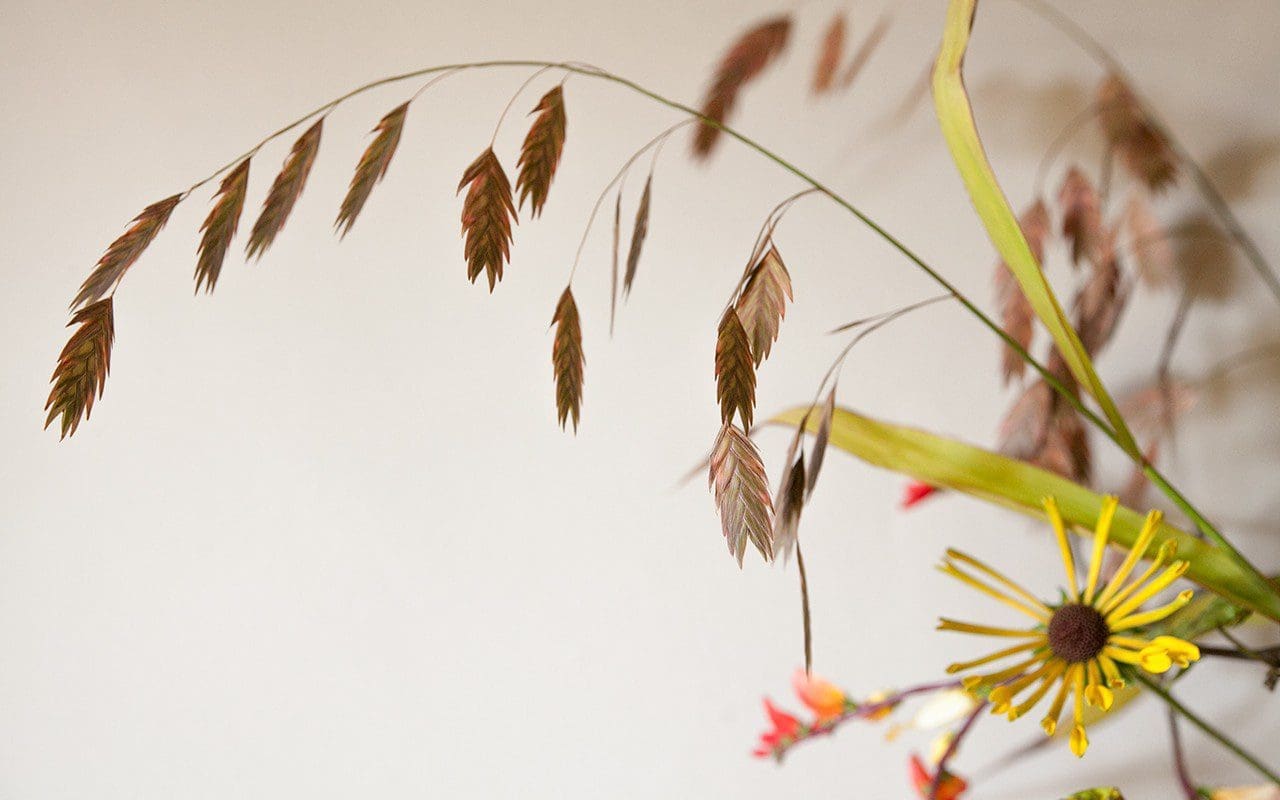 Chasmanthium latifolium
As a way back into the garden this morning we have picked a posy to mark a feeling of this change. The Chasmanthium latifolium are probably at their best, coppery-bronze and hovering above their still lime-green leaves. The perfectly flat flowers appear to have been pressed in a book. Like metallic paillettes they shimmer and bob in the slightest of breezes. I must admit to not having understood the requirements of this plant until recently and, though it is adaptable to a little shade and sun, it likes some shelter to flourish. Where I have used it in China in the searing heat of a Shanghai summer it has done superbly, spilling in a fountain of flower held well above the strappy foliage. It must like the humidity there. In the UK I have found it does best with some protection from the wind. My best plants here are on the leeward side of hawthorns, those in the same planting to the windward side have all but failed. It is a grass that is worth the time and effort to make its acquaintance.
Though the seedheads which mark the life that come before them now outweigh the flower in the garden, we have plenty to ground a posy. Scarcity makes late flower that much more precious and I like to make sure that we have smatterings amongst the late-season grasses. Brick-red schizostylis, flashes of late, navy salvia and clouds of powder blue asters pull your eye through the gauziness. The last push of Indian summer heat has yielded a late crop of dahlia, which have yet to be tickled by cold. I have three species here in the garden specifically for this moment. All singles and delicate in their demeanour. The white form of Dahlia merckii and the brightly mauve D. australis have shown their cold-hardiness and remain in the ground over winter with a mulch, but the Dahlia coccinea var. palmeri in this posy is new to me.
Chasmanthium latifolium
As a way back into the garden this morning we have picked a posy to mark a feeling of this change. The Chasmanthium latifolium are probably at their best, coppery-bronze and hovering above their still lime-green leaves. The perfectly flat flowers appear to have been pressed in a book. Like metallic paillettes they shimmer and bob in the slightest of breezes. I must admit to not having understood the requirements of this plant until recently and, though it is adaptable to a little shade and sun, it likes some shelter to flourish. Where I have used it in China in the searing heat of a Shanghai summer it has done superbly, spilling in a fountain of flower held well above the strappy foliage. It must like the humidity there. In the UK I have found it does best with some protection from the wind. My best plants here are on the leeward side of hawthorns, those in the same planting to the windward side have all but failed. It is a grass that is worth the time and effort to make its acquaintance.
Though the seedheads which mark the life that come before them now outweigh the flower in the garden, we have plenty to ground a posy. Scarcity makes late flower that much more precious and I like to make sure that we have smatterings amongst the late-season grasses. Brick-red schizostylis, flashes of late, navy salvia and clouds of powder blue asters pull your eye through the gauziness. The last push of Indian summer heat has yielded a late crop of dahlia, which have yet to be tickled by cold. I have three species here in the garden specifically for this moment. All singles and delicate in their demeanour. The white form of Dahlia merckii and the brightly mauve D. australis have shown their cold-hardiness and remain in the ground over winter with a mulch, but the Dahlia coccinea var. palmeri in this posy is new to me.
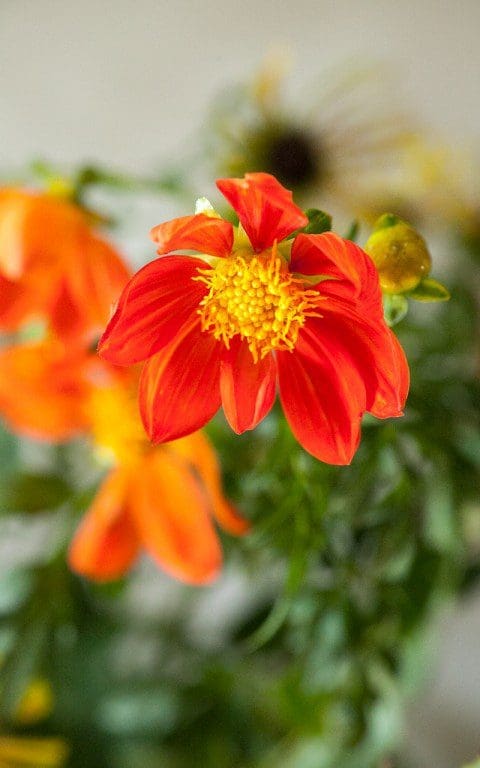 Dahlia coccinea var. palmeri
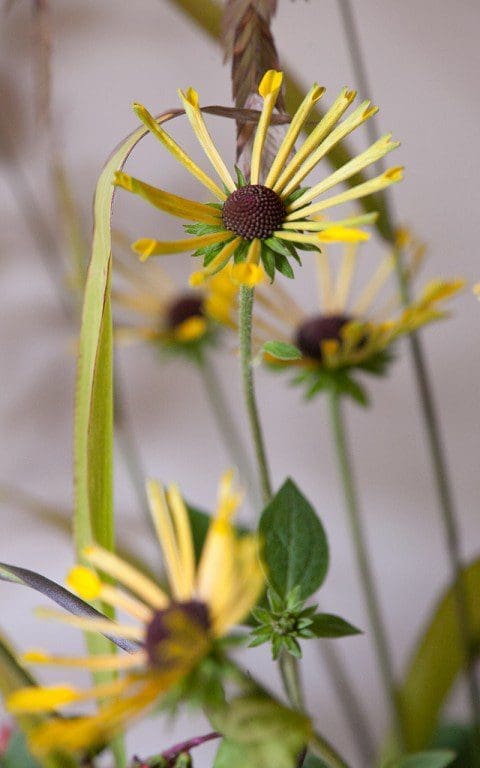 Rudbeckia subtomentosa ‘Little Henry’
I hope it is hardy enough to stay in the ground here. As soon as frost blackens the foliage, each plant will be mulched with a mound of compost to protect the tubers from frost. Distinctive for its feathered, ferny foliage and reaching, wiry limbs, this first year has shown my plants attaining about a metre, two thirds of their promise once they are established. This is not a showy plant, the flowers sparse and delicately suspended, but the colour is a punchy and rich tangerine orange, the boss of stamens egg-yolk yellow. We have it here with Rudbeckia subtomentosa ‘Little Henry’, which is also how it is teamed in the garden. ‘Little Henry’ is a shorter form of R. s. ‘Henry Eilers’ and, at about 60 to 90cm, better for being self-supporting. Usually I shy away from short forms, the elegance of the parent often being lost in horticultural selection, but ‘Little Henry’ is a keeper. They have been in flower now since the end of August and will only be dimmed by frost. Where you have to give yourself over to a Black-eyed-Susan and their flare of artificial sunlight, the rolled petals of ‘Little Henry’ are matt and a sophisticated shade of straw yellow, revealing just a flash of gold as the quills splay flat at the ends.
Rudbeckia subtomentosa ‘Little Henry’
I hope it is hardy enough to stay in the ground here. As soon as frost blackens the foliage, each plant will be mulched with a mound of compost to protect the tubers from frost. Distinctive for its feathered, ferny foliage and reaching, wiry limbs, this first year has shown my plants attaining about a metre, two thirds of their promise once they are established. This is not a showy plant, the flowers sparse and delicately suspended, but the colour is a punchy and rich tangerine orange, the boss of stamens egg-yolk yellow. We have it here with Rudbeckia subtomentosa ‘Little Henry’, which is also how it is teamed in the garden. ‘Little Henry’ is a shorter form of R. s. ‘Henry Eilers’ and, at about 60 to 90cm, better for being self-supporting. Usually I shy away from short forms, the elegance of the parent often being lost in horticultural selection, but ‘Little Henry’ is a keeper. They have been in flower now since the end of August and will only be dimmed by frost. Where you have to give yourself over to a Black-eyed-Susan and their flare of artificial sunlight, the rolled petals of ‘Little Henry’ are matt and a sophisticated shade of straw yellow, revealing just a flash of gold as the quills splay flat at the ends.
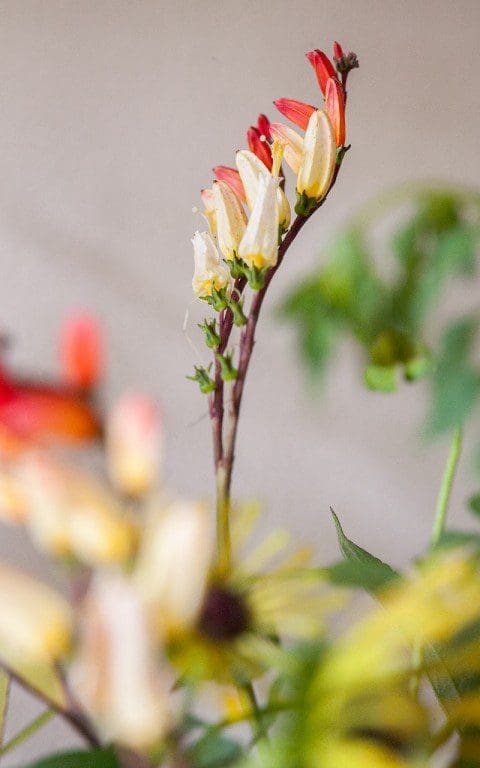 Ipomoea lobata
We have waited a long time this year for the Ipomoea lobata as it sprawled, then mounded and all but eclipsed the sunflowers. We always had a pot of this exotic-looking climber in our Peckham garden, but I have not grown it here yet and have been surprised by the amount of foliage it has produced at the expense of flower. Nasturtiums do this too in rich soil and, if I am to have earlier flower in the future, I will have to seek out an area of poorer ground. That will not suit the sunflowers, but I will find it a suitable partner that it can climb through. It is very easy from seed. Sown in late April in the cold frame and planted out after risk of frost, this is a reliable annual, or at least I thought so until I presented it with my hearty soil. Though late to start flowering this year, it also keeps going till the first frosts, its lick and flame of flower well-suited to the seasonal flare.
Ipomoea lobata
We have waited a long time this year for the Ipomoea lobata as it sprawled, then mounded and all but eclipsed the sunflowers. We always had a pot of this exotic-looking climber in our Peckham garden, but I have not grown it here yet and have been surprised by the amount of foliage it has produced at the expense of flower. Nasturtiums do this too in rich soil and, if I am to have earlier flower in the future, I will have to seek out an area of poorer ground. That will not suit the sunflowers, but I will find it a suitable partner that it can climb through. It is very easy from seed. Sown in late April in the cold frame and planted out after risk of frost, this is a reliable annual, or at least I thought so until I presented it with my hearty soil. Though late to start flowering this year, it also keeps going till the first frosts, its lick and flame of flower well-suited to the seasonal flare.
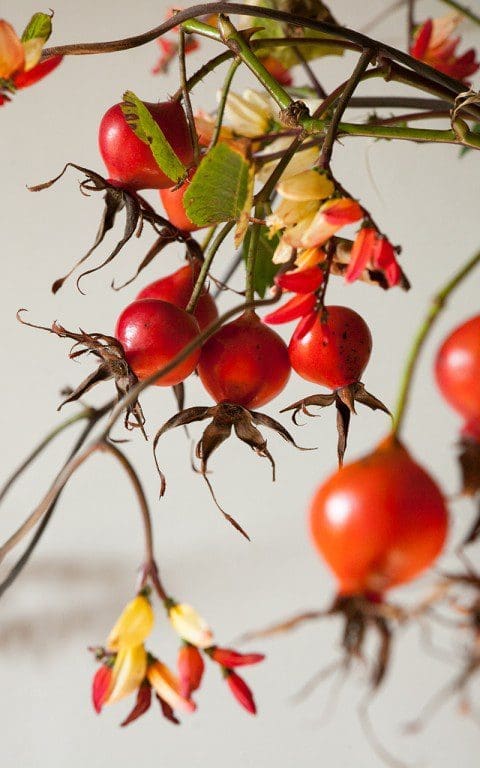 Rosa ‘Scharlachglut’
Roses that flower once and then hip beautifully are worth their brevity and we have included R. ‘Scharlachglut’ here, a single rose that I wrote about in flower earlier this year. The hips are much larger than a dog rose, but retain their elegance due to the length of the calyces, which put a Rococo twist on these pumpkin-orange orbs. Despite its ornamental quality when flowering, it is a plant that I am happy to use on the periphery of the garden and one that, in its second incarnation, I can be sure of seeing the season out.
Words: Dan Pearson / Photographs: Huw Morgan
Published 20 October 2018
Rosa ‘Scharlachglut’
Roses that flower once and then hip beautifully are worth their brevity and we have included R. ‘Scharlachglut’ here, a single rose that I wrote about in flower earlier this year. The hips are much larger than a dog rose, but retain their elegance due to the length of the calyces, which put a Rococo twist on these pumpkin-orange orbs. Despite its ornamental quality when flowering, it is a plant that I am happy to use on the periphery of the garden and one that, in its second incarnation, I can be sure of seeing the season out.
Words: Dan Pearson / Photographs: Huw Morgan
Published 20 October 2018 Grasses were always going to be an important part of the garden. They make the link to the meadows and fray the boundary, so it is hard to tell where garden begins and ends. On our windy hillside, they also help in capturing this element, each one describing it in a slightly different way. The Pennisetum macrourum have been our weather-vanes since they claimed the centre of the garden in August. Moving like seaweed in a rock pool on a gentle day, they have tossed and turned when the wind has been up. The panicum, in contrast, have moved as one so that the whole garden appears to sway or shudder with the weather.
Though the pennisetum took centre stage and needed the space to rise head and shoulders above their companions, they are complemented by a matrix of grasses that run throughout the planting and help pull it together from midsummer onwards. Choosing which grasses would be right for the feeling here was an important exercise and the grass trial in the stock beds helped reveal their differences. At one end of the spectrum, and most ornamental in their feeling, were the miscanthus.
Clumping strongly and registering as definitely as a shrub in terms of volume, I knew I wanted a few for their sultry first flowers and then the silvering, late-season plumage. It soon became clear that they would need to be used judiciously, for their exotic presence was at odds with the link I wanted to make to the landscape here. At the other the end of the spectrum were the deschampsia and the melica, native grasses which we have here in the damp, open glades in the woodland. We have used selections of both and they have helped ground things, to tie down the garden plants which emerge amongst them.
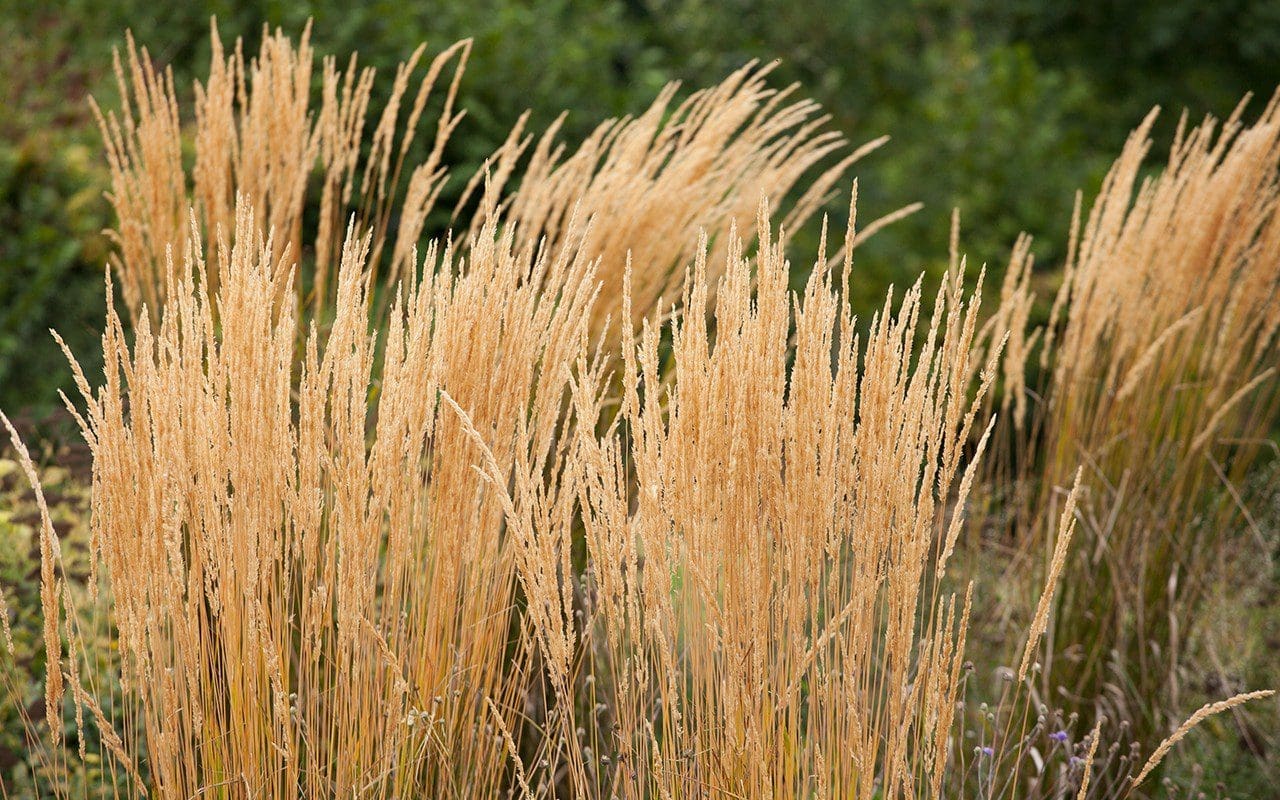 Calamagrostis x acutiflora ‘Karl Foerster’
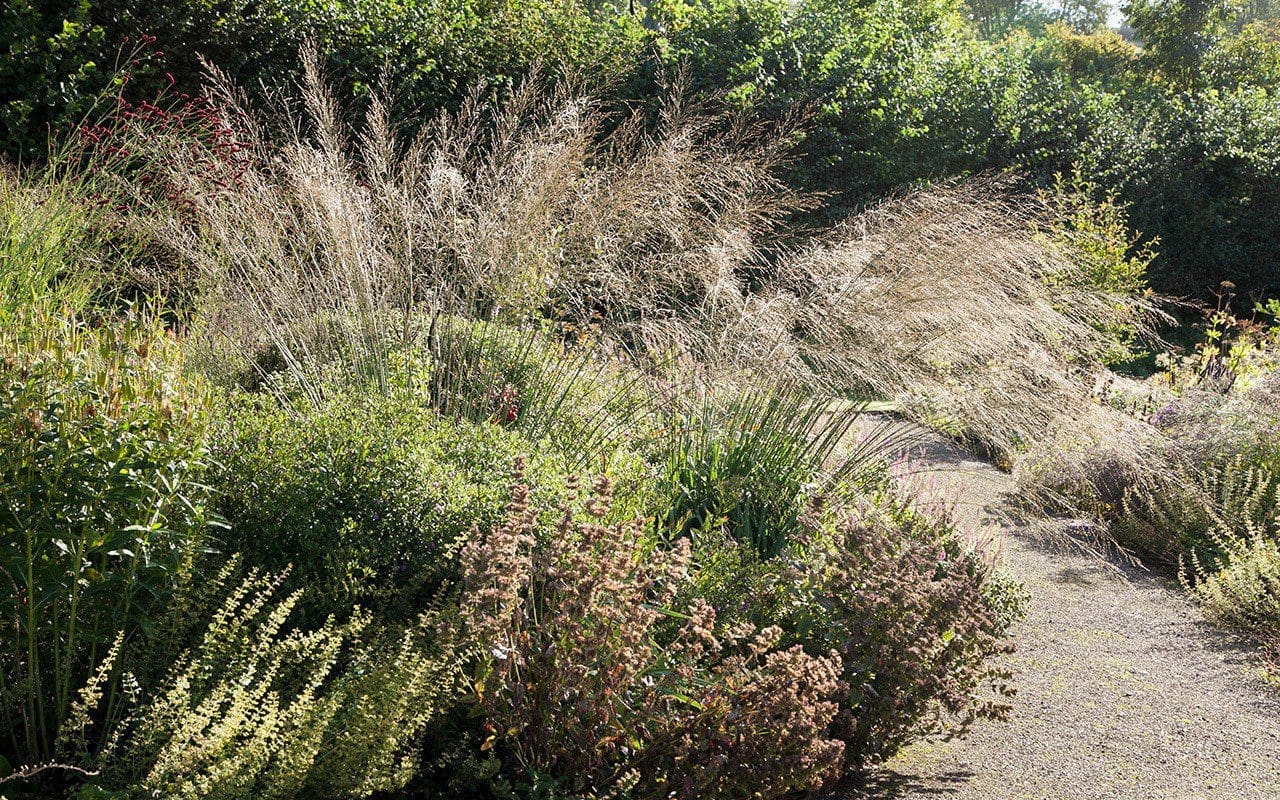 Molinia arundinacea ssp. caerulea ‘Transparent’
Falling between to two ends of the shifting scale, we experimented with a range of genus to find the grasses that would provide the gauziness I wanted between the flowering perennials. As it is easy to have too many materials competing when choosing your building blocks for hard landscaping, so it is all too easy to have too many grasses together. Though subtle, each have their own function and I knew I couldn’t allow more than three to register together in any one place. Tall, arching Molinia caerulea ssp. arundinacea ‘Transparent’ that is tall enough to walk through and yet not be overwhelmed by would be the key plant at the intersection of paths. The fierce uprights of Calamagrostis x acutiflora ‘Karl Foerster’, scoring thunderous verticals early in the season and then bleaching to longstanding parchment yellow, would need to be given its own place too in the milking barn yard. I needed something subtler and less defined as their complement in the main garden.
Our free-draining ground and sunny, open position has proved to be perfect for cultivars of Panicum virgatum or the Switch Grass of American grass prairies. We tried several and soon found that, as late season grasses, they need room around their crowns early in the season if they are not to be overwhelmed. Late to come to life, often just showing green when the deschampsia are already flushed and shimmering with new growth, it is easy to overlook their importance from midsummer onwards. I knew from growing them before that they like to be kept lean and are prone to being less self-supporting if grown too ‘soft’ or without enough light, but here they have proven to be perfect. Bolting from reliably clump-forming rosettes, each plant will stay in its place and can be relied upon to ascend into its own space before filling out with a clouding inflorescence.
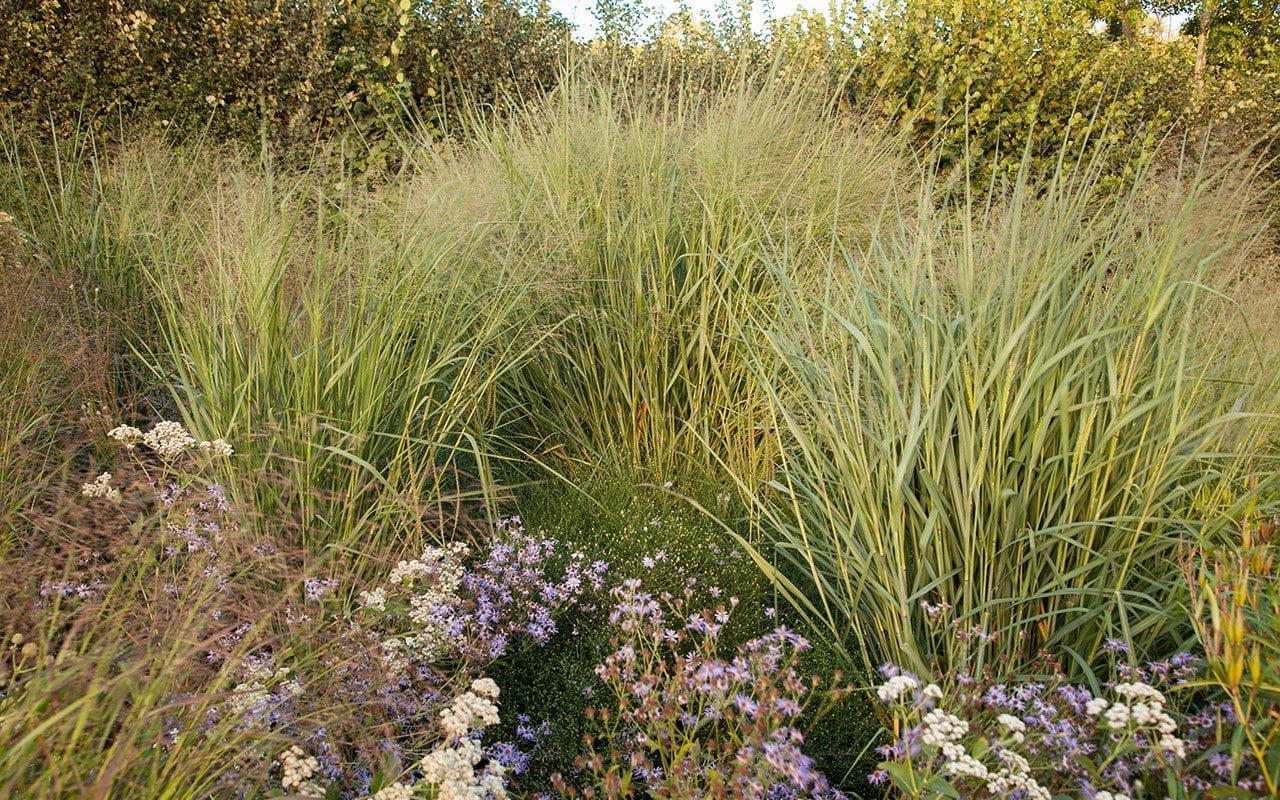 Panicum virgatum ‘Cloud Nine’. The original stock plant is in the centre.
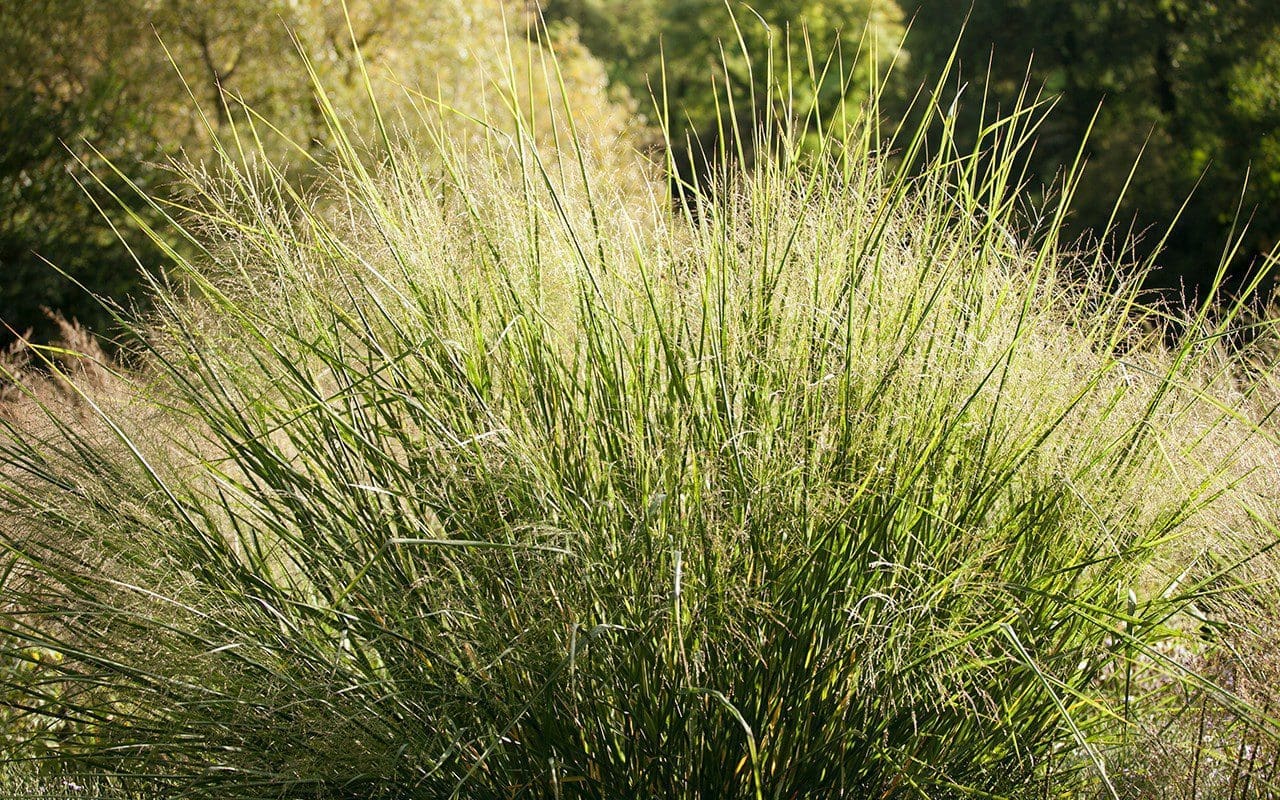 Panicum virgatum ‘Cloud Nine’
I tried several and, with the luxury of having the space to do so, some proved better than others. The largest and most dramatic is surely ‘Cloud Nine’. My eldest plant, the original, remains in the position of the old stock bed and the garden and younger companions were planted to ground it. This was, in part, due to it already being in the right place, for I needed a strong presence here where I’d decided not to have shrubs and they have helped with their height to frame the grass path that runs between them and the hedge along the lane. By the time the stock beds were dismantled we were pleased not to have to move it, because the clump is now hefty, and a two man job to lift and move it.
I first saw this selection in Piet Oudolf’s stock beds several years ago, where it stood head and shoulders above his lofty frame. Scaled up in all its parts from most other selections, the silvery-grey leaf blades are wider than most panicum and very definite in their presence. Standing at chest height in August before showing any sign of flower, it is the strongest of the tribe. Now, in early autumn, its pale panicles of flower have filled it out further, broadening the earlier bolt of foliage. If it was a firework in a firework display of panicum, it would surely be the last, the scene-stealer that has you gasping audibly. I like it too for the way it pales as it dies and it stands reliably through winter to arrest low light and make a skeletal garden flare that is paler in dry weather and cinnamon when wet.
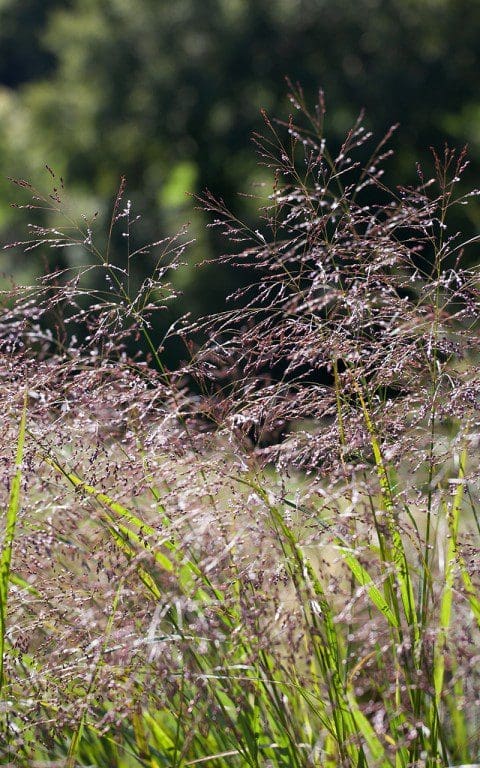 Panicum virgatum ‘Rehbraun’
I have three other panicum in the garden, which are entirely different in their scale and presence. Though it has proven to be larger than anticipated in our hearty ground and will need moving about in the spring to get the planting just right, I am pleased to have selected ‘Rehbraun’. Calm, green foliage rises to about a metre before starting to colour burgundy in late summer. The base of redness is then eclipsed by a mist of mahogany flower, which when planted in groups, moves as one in the breeze. I have it as a dark backdrop to creamy Ageratina altissima ‘Braunlaub’ (main image) and Sanguisorba ‘Cangshan Cranberry’, which are wonderful as pinpricks of brightness held in its suspension. It is easily 1.2 metres tall here and, weighed down by rain, it can splay, and I have found that several are too close to the path, but I like it and will find them a place deeper within the borders.
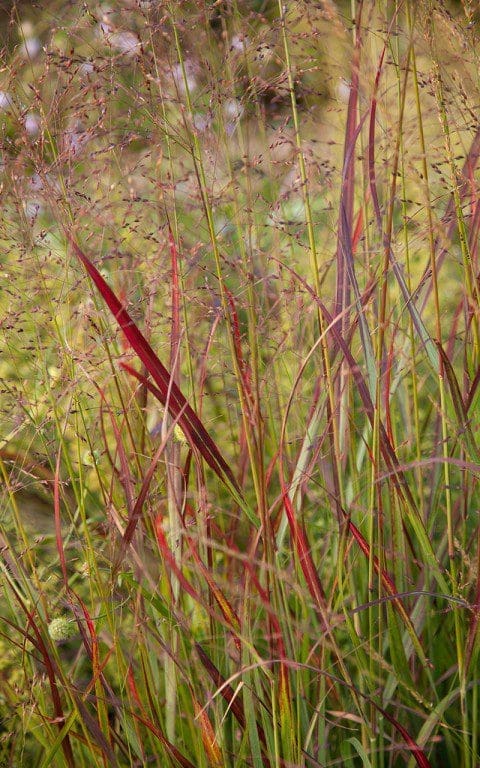 Panicum virgatum ‘Heiliger Hain’
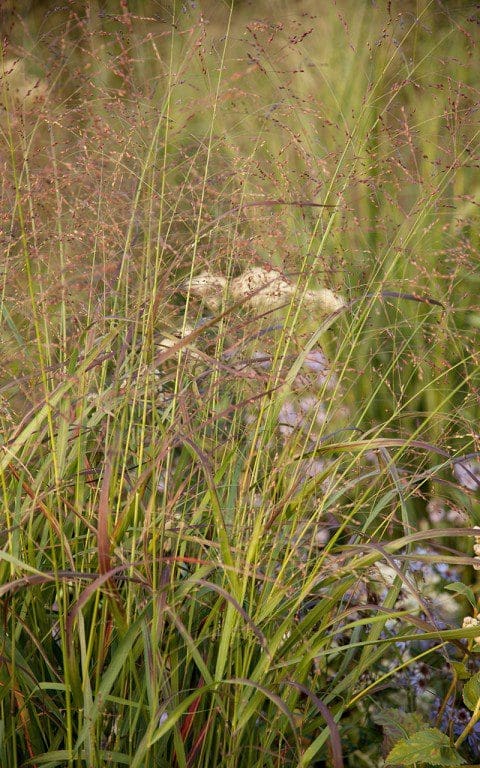 Panicum virgatum ‘Shenandoah’
Though it has not done as well for me here – it may well be that it is a selection from a drier part of the States – ‘Heiliger Hain’ has been beautiful. Silvery and fine, the leaf tips colour red early in summer and are strongly blood red by this point in the season. It is small, no more than 80cm tall when in flower, and so I have given it room to rise above Calamintha sylvatica ‘Menthe’ and the delicate Succissella inflexa. Similar in character, though better and stronger, is ‘Shenandoah’ which I have drawn through most of the upper part of the garden. Blue-grey in appearance as it rises up in the first half of summer, it begins to colour in late August, bronze-red becoming copper-orange as it moves into autumn. Neil Lucas of Knoll Gardens says it has the best autumn colour of all panicum. It also stands well in winter to cover for neighbours that have less stamina. Where in the right place, with plenty of light and no competition at the base whilst it is awakening, it is proving to be brilliant and will be the segue from the summer garden, slowly making its presence felt above an undercurrent of asters to finally eclipse everything in a last November burn.
Words: Dan Pearson / Photographs: Huw Morgan
Published 29 September 2018
It has been an extraordinary run. Day after day, it seems, of clear sky and sunlight. I have been up early at five, before the sun has broken over the hill, to catch the awakening. Armed with tea, if I have been patient enough to make myself one before venturing out, my walk takes me to the saddle which rolls over into the garden between our little barn and the house. From here, with the house behind me and the garden beyond, I can take it all in before beginning my circuit of inspection. It is impossible to look at everything, as there are daily changes and you need to be here every day to witness them, but I like to try to complete one lap before the light fingers its way over the hedge. Silently, one shaft at a time, catching the tallest plants first, illuminating clouds of thalictrum and making spears of digitalis surrounded in deep shadow. It is spellbinding. You have to stop for a moment before the light floods in completely as, when you do, you are absolutely there, held in these precious few minutes of perfection.
Now that the planting is ‘finished’, the experience of being in the garden is altogether different. Exactly a year ago the two lower beds were just a few months old and they held our full attention in their infancy. The delight in the new eclipsed all else as the ground started to become what we wanted it to be and not what we had been waiting for during the endless churn of construction. We saw beyond the emptiness of the centre of the garden, which was still waiting to be planted in the autumn. The ideas for this remaining area were still forming, but this year, for the first time, we have something that is beginning to feel complete.
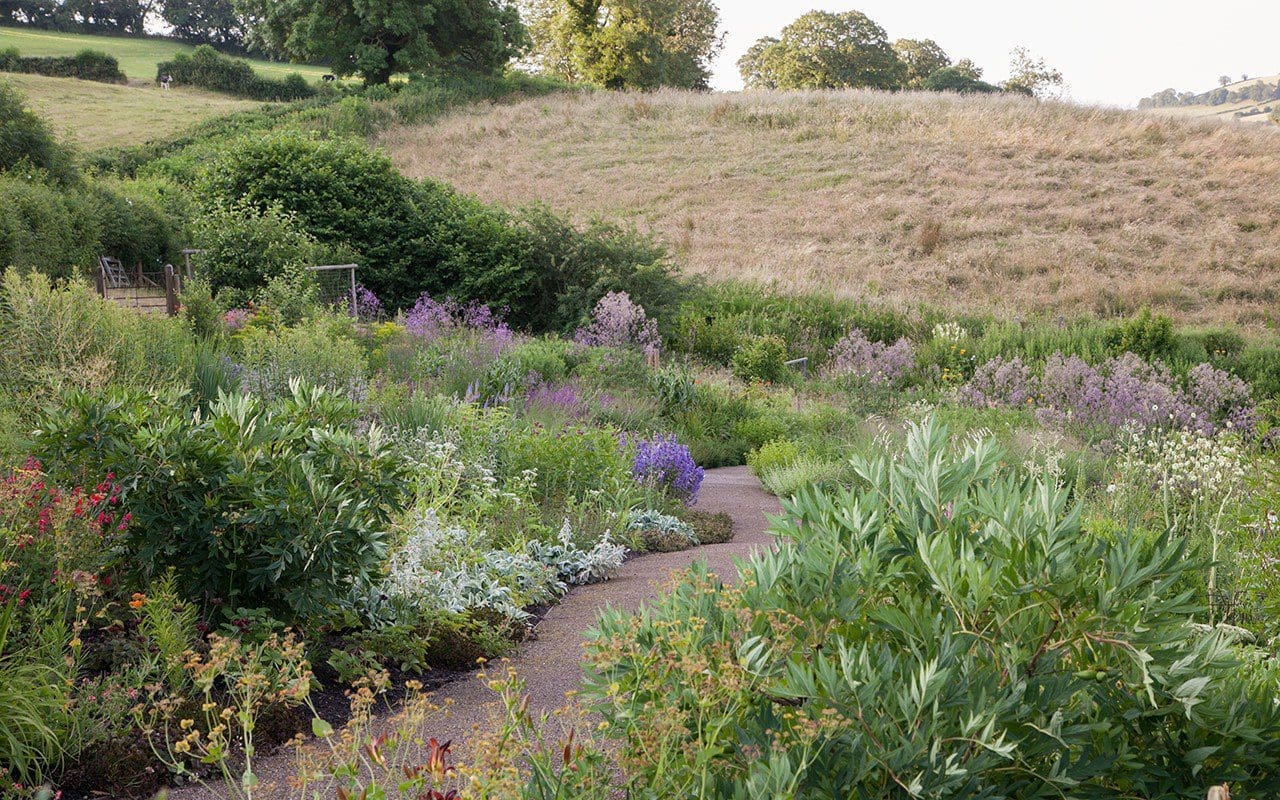 Looking down the central path from the saddle
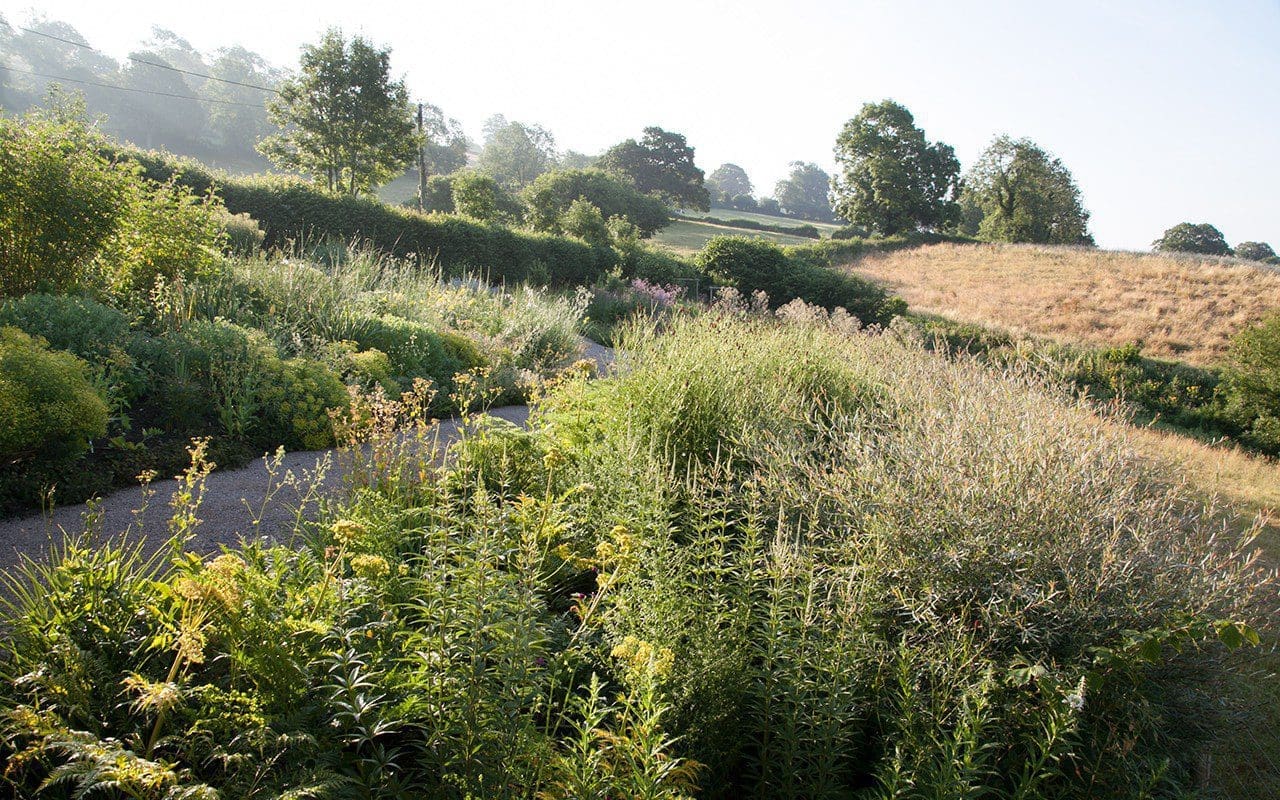 The view from the barn verandah
Of course, a garden is never complete. One of the joys of making and tending one is in the process of working towards a vision, but today, and despite the fact that I am already planning adjustments, I am very happy with where we are. The paths lead through growth to both sides where last year one side gave way to naked ground, and the planting spans the entire canvas provided by the beds. You can feel the volume and the shift in the daily change all around you. It has suddenly become an immersive experience.
An architect I am collaborating with came to see the garden recently and asked immediately, and in analytical fashion, if there was a system to the apparent informality. It was good to have to explain myself and, in doing so without the headset of my detailed, daily inspection, I could express the thinking quite clearly. Working from the outside in was the appropriate place to start, as the past six years has all been about understanding how we sit in the surrounding landscape. So the outer orbit of the cultivated garden has links to the beyond. The Salix purpurea ‘Nancy Saunders’ on the perimeter skip and jump to join the froth of meadowsweet that has foamed this last fortnight along the descent of the ditch. They form a frayed edge to the garden, rather than the line and division created by a hedge, so that there is flow for the eye between the two worlds. From the outside the willows screen and filter the complexity and colour of the planting on the inside. From within the garden they also connect texturally to the old crack willow, our largest tree, on the far side of the ditch.
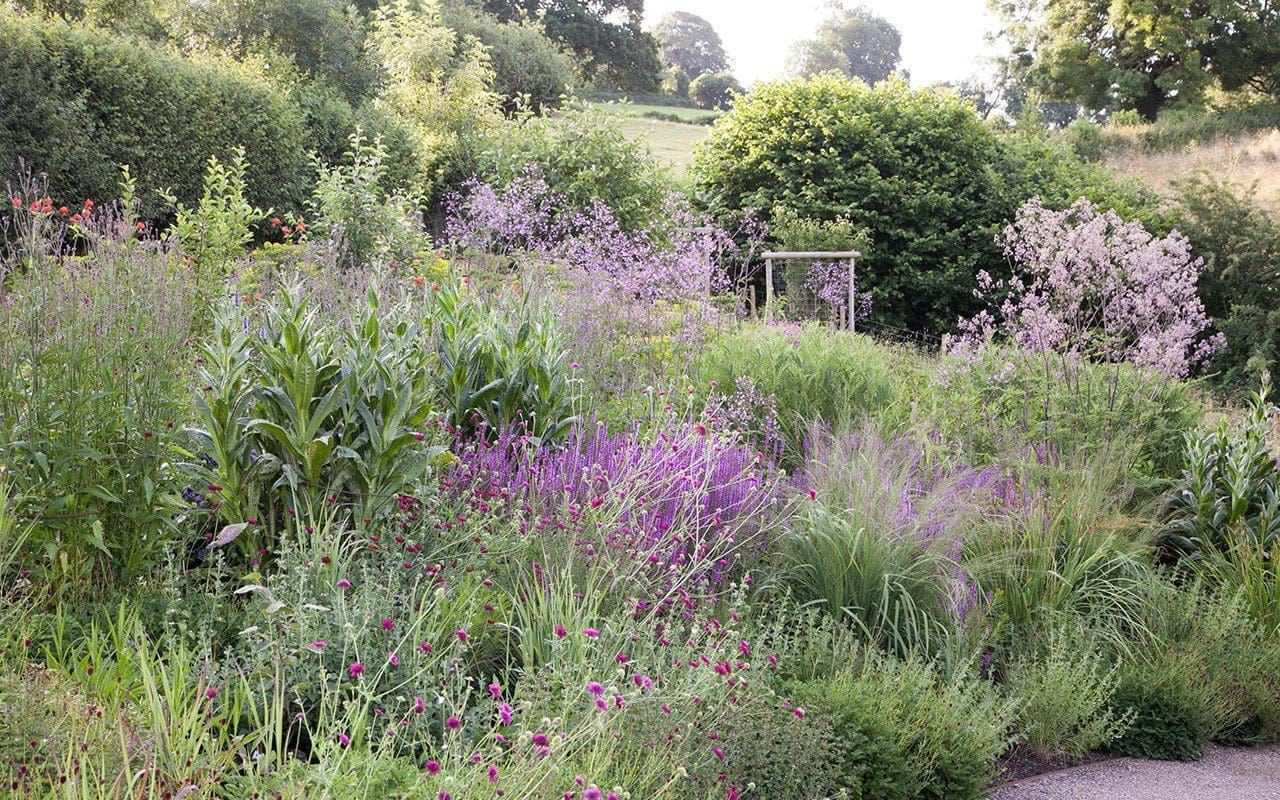 The far end of the garden which was planted in Spring 2017
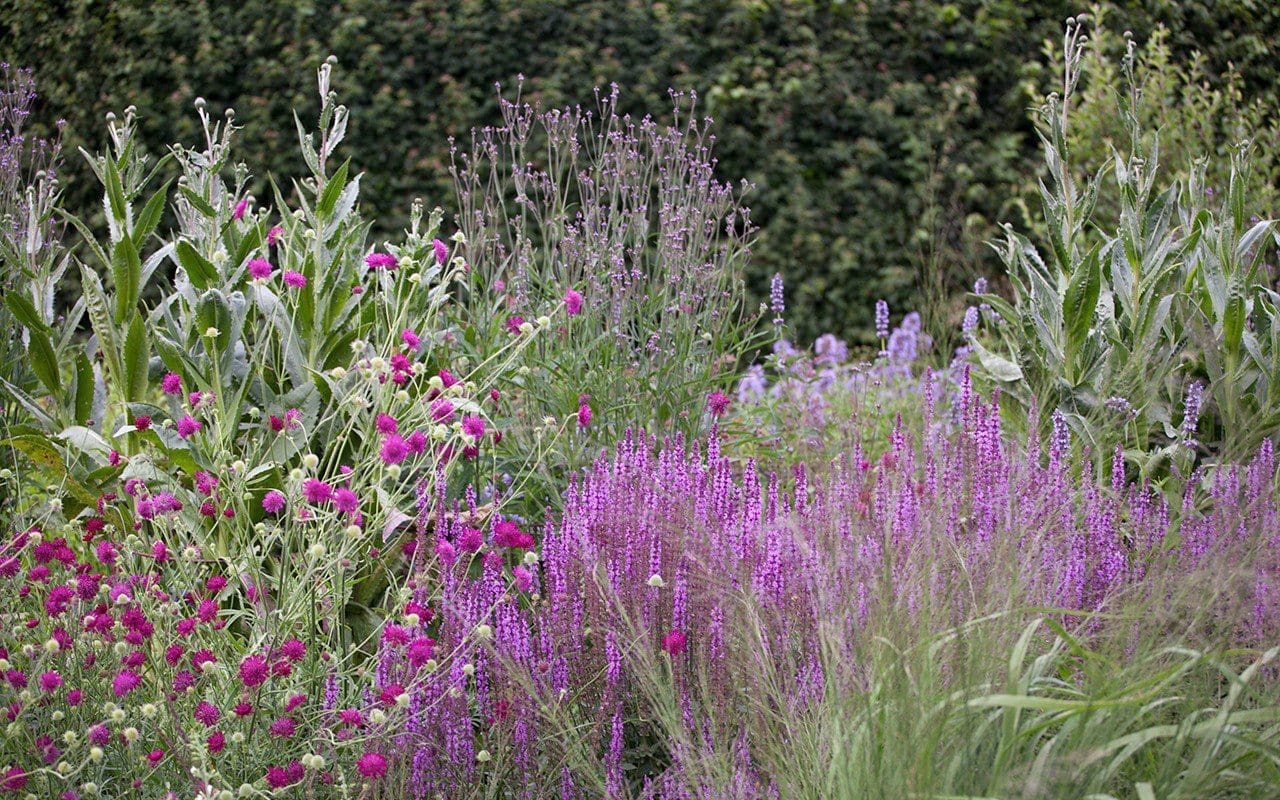 Knautia macedonica, Salvia nemerosa ‘Amethyst’, Cirsium canum and Verbena macdougallii ‘Lavender Spires’
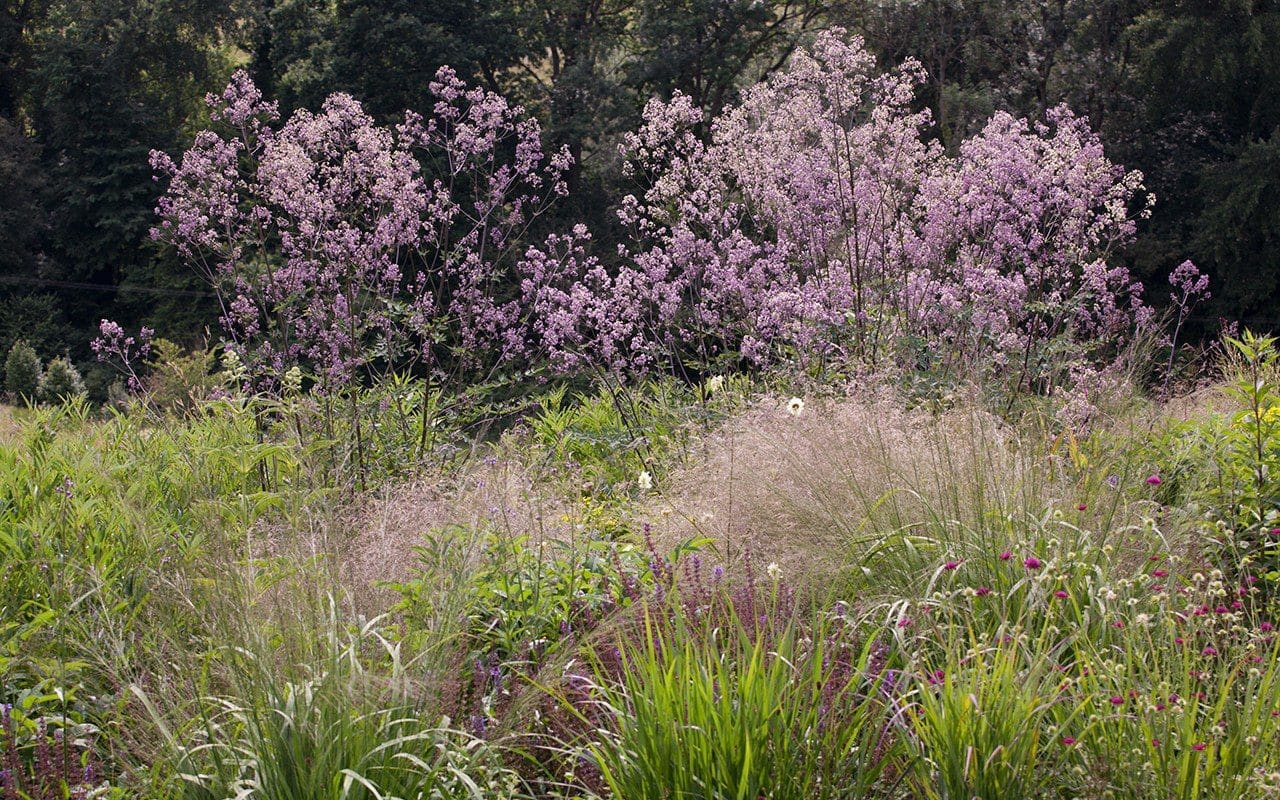 Thalictrum ‘Elin’ above Deschampsia cespitosa ‘Goldtau’
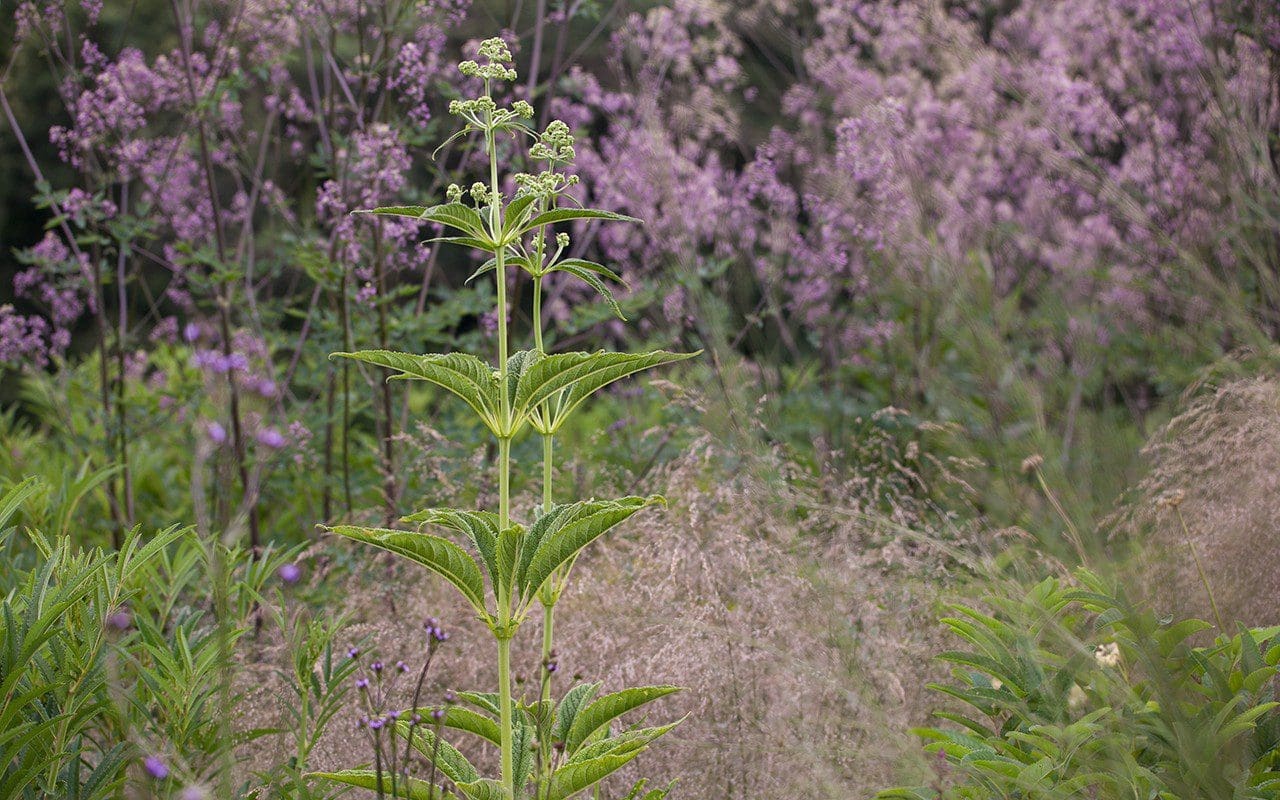 Eupatorium fistulosum f. albidum ‘Ivory Towers’ emerging through Deschampsia cespitosa ‘Goldtau’
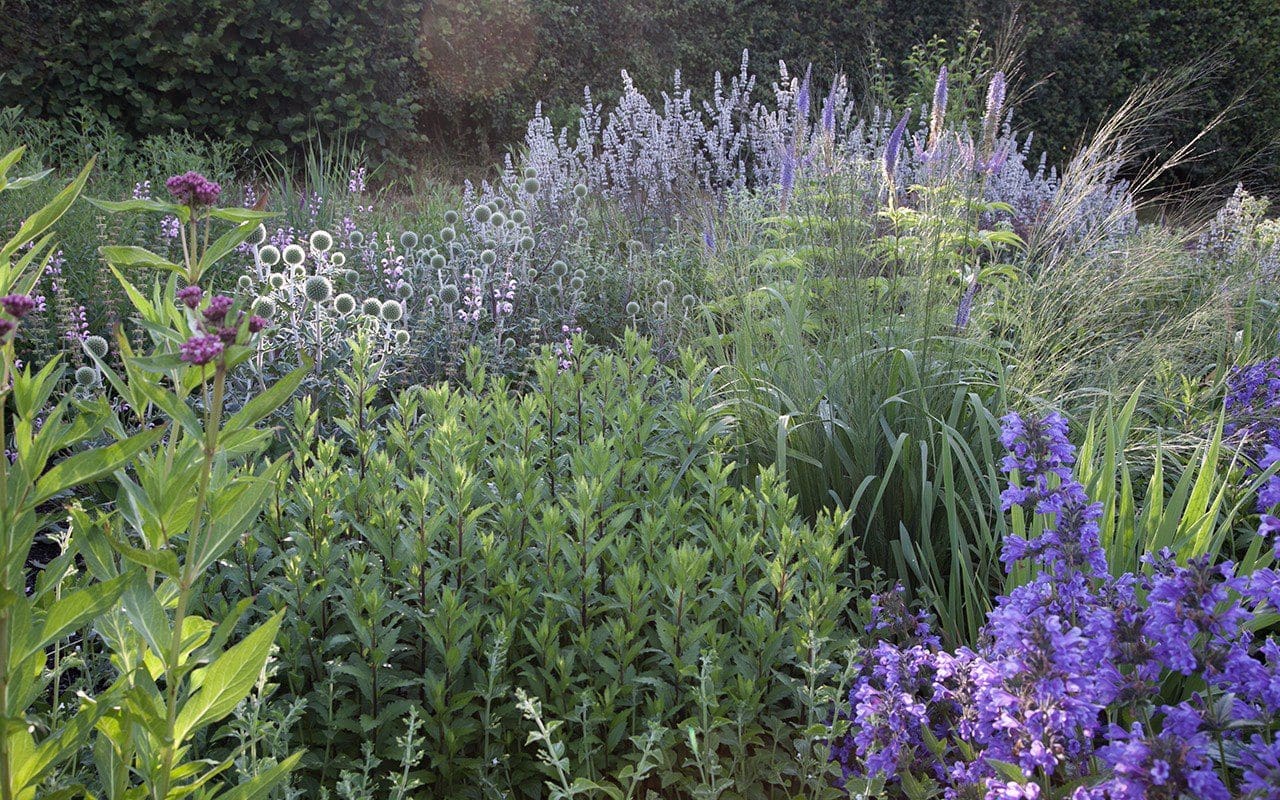 Asclepias incarnata, Echinops sphaerocephalus ‘Arctic Glow’, Nepeta nuda ‘Romany Dusk’ and Nepeta ‘Blue Dragon’
This first outer ripple of the garden is modulated. It is calm and delicate due to the undercurrent of the Deschampsia cespitosa ‘Goldtau’, but strong in its simplicity. From a distance colours are smoky mauves, deep pinks and recessive blues, although closer up it is enlivened by the shock of lime green euphorbia, and magenta Geranium psilostemon and Lythrum virgatum ‘Dropmore Purple’. Ascending plants such as thalictrum, eupatorium and, later, vernonia, rise tall through the grasses so that the drop of the land is compensated for. These key plants, the ones your eye goes to for their structure, are pulled together by a veil of sanguisorba which allows any strong colour that bolts through their gauzy thimbles to be tempered. Overall the texture of the planting is fine and semi-transparent, so as to blend with the texture of the meadows beyond.
The new planting, the inner ripple that comes closer but not quite up to the house, is the area that was planted last autumn. This is altogether more complex, with stronger, brighter colour so that your eye is held close before being allowed to drift out over the softer colour below. The plants are also more ‘ornamental’ – the outer ripple being their buffer and the house close-by their sanctuary. A little grove of Paeonia delavayi forms an informal gateway as you drop from the saddle onto the central path while, further down the slope a Heptacodium miconioides will eventually form an arch over the steps down to the verandah, where the old hollies stand close by the barn. In time I am hoping this area will benefit from the shade and will one day allow me to plant the things I miss here that like the cool. The black mulberry, planted in the upper stockbeds when we first arrived here, has retained its original position, and is now casting shade of its own. Enough for a pool of early pulmonaria and Tellima grandiflora ‘Purpurteppich’, the best and far better than the ‘Purpurea’ selection. It too has deep, coppery leaves, but the darkness runs up the stems to set off the lime-green bells.
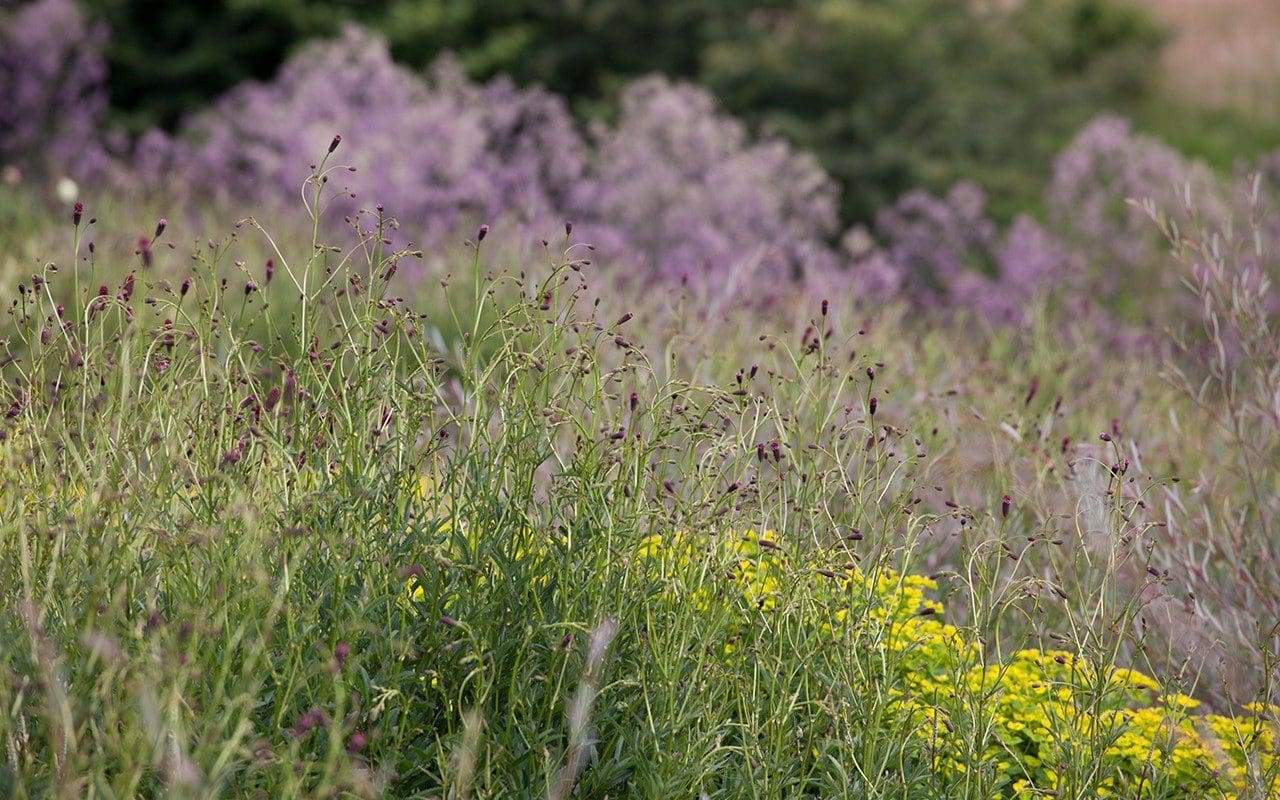 Sanguisorba officinalis ‘Red Thunder’, Euphorbia wallichii and Thalictrum ‘Elin’
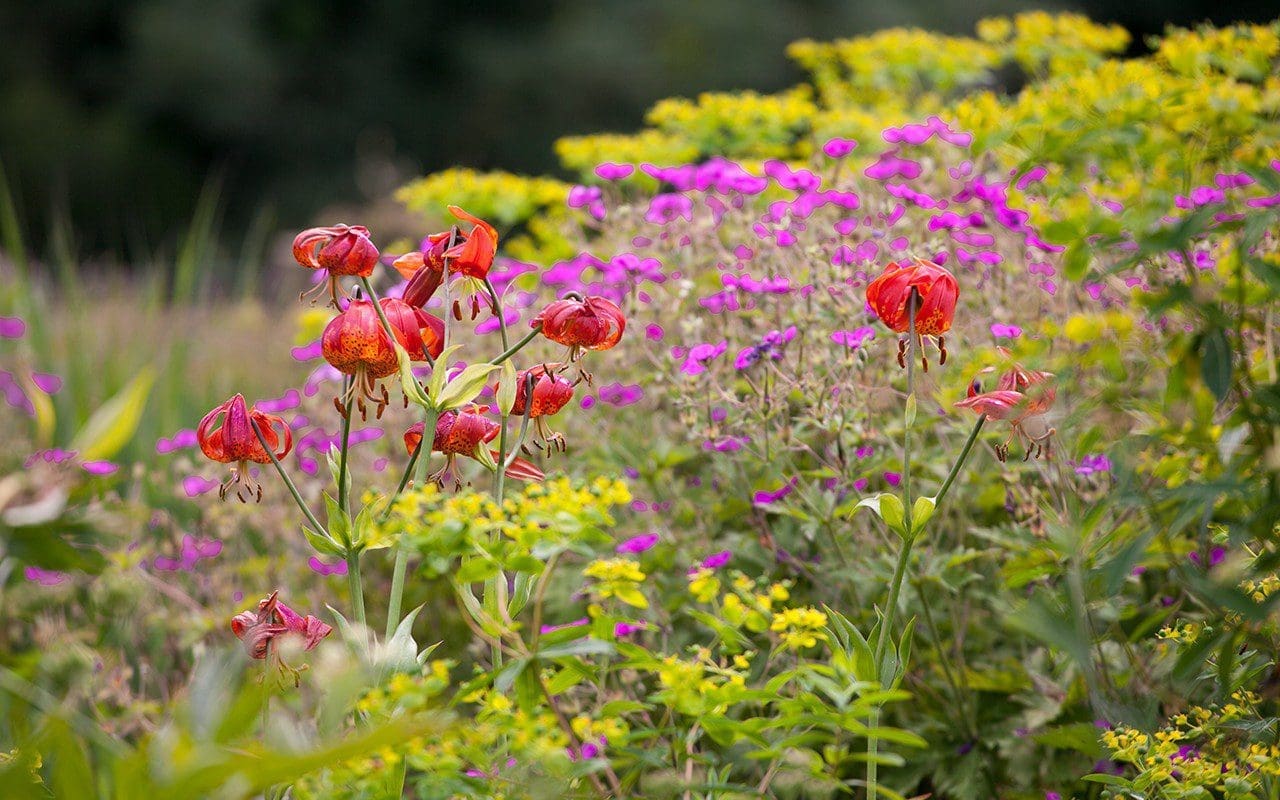 Lilium pardalinum, Geranium psilostemon and Euphorbia cornigera
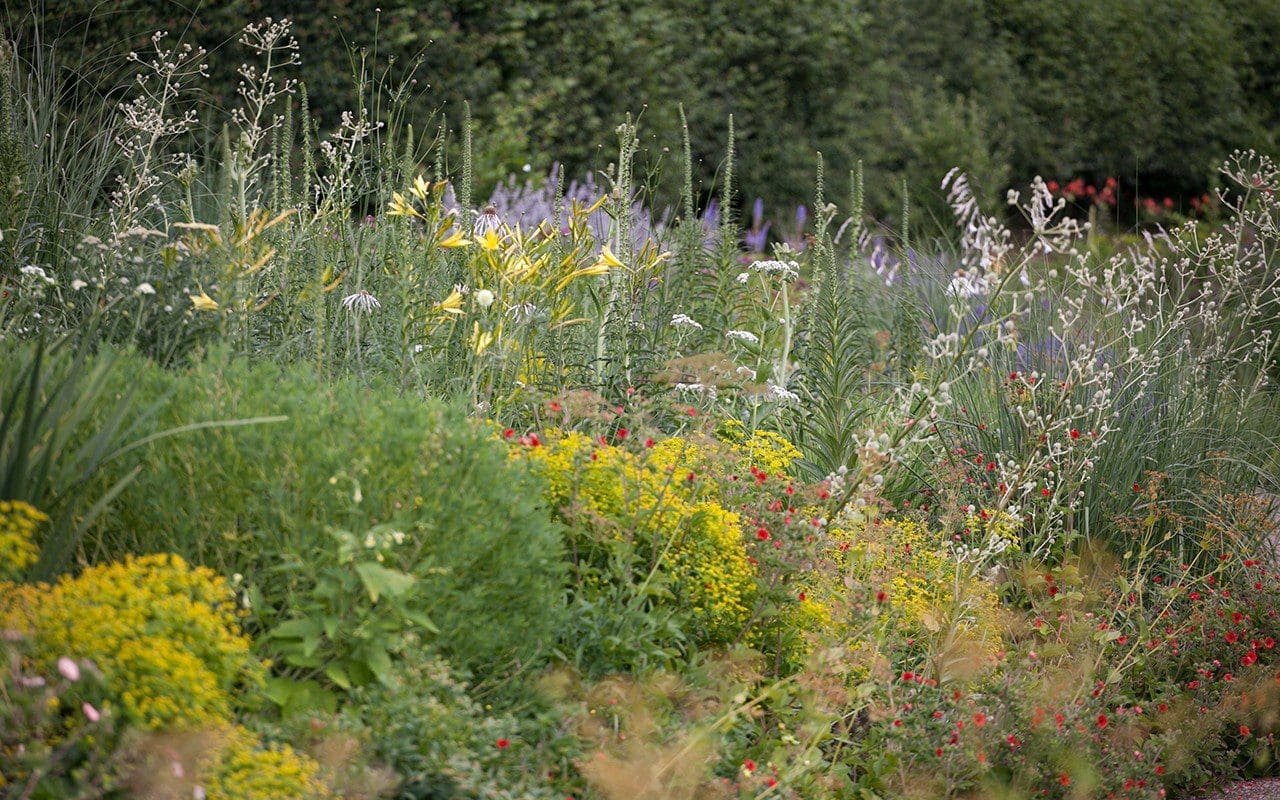 The newly planted central area
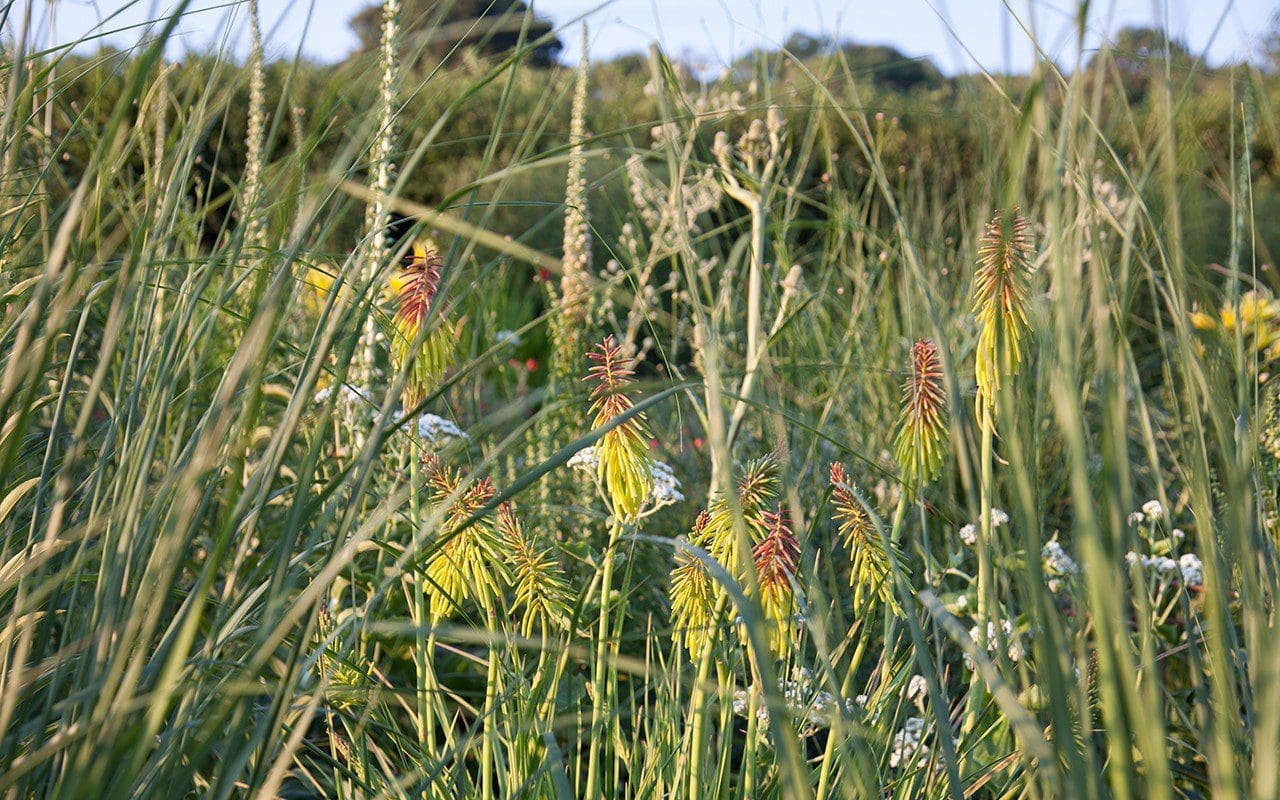 Kniphofia rufa, Eryngium agavifolium and Digitalis ferruginea
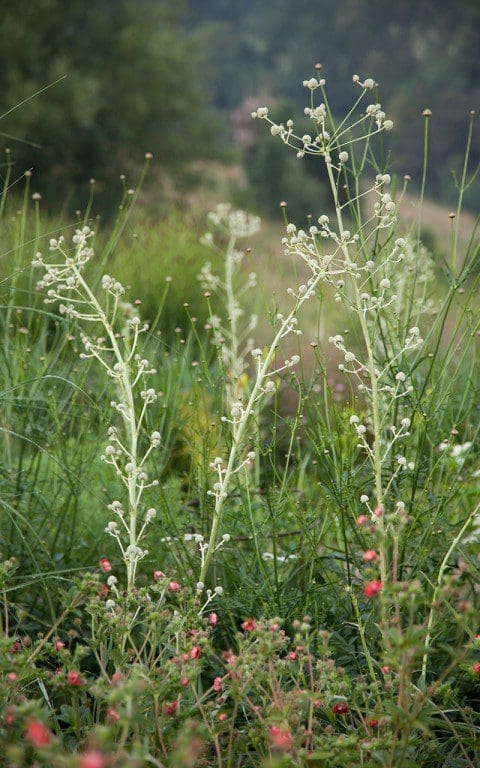 Eryngium eburneum
There is little shade anywhere else and the higher up the site you go the drier it gets as the soil gets thinner. This is reflected in a palette of silvers and reds with plants that are adapted to the drier conditions. I am having to make shade here with tall perennials such as Aster umbellatus so that the Persicaria amplexicaulis ‘Blackfield’, which run through the upper bed, do not scorch. Where the soil gets deeper again at the intersection of paths, a stand of Panicum virgatum ’Cloud Nine’ screens this strong colour so it can segue into the violets, purples and blues in the beds below. I have picked up the reds much further down into the garden with fiery Lilium pardalinum. They didn’t flower last year and have not grown as tall as they did in the shelter of our Peckham garden, but standing at shoulder height, they still pack the punch I need.
The central bed, and my favourite at the moment, is detailed more intensely, with finer-leaved plants and elegant spearing forms that rise up vertically so that your eye moves between them easily. Again a lime green undercurrent of Euphorbia ceratocarpa provides a pillowing link throughout and a constant from which the verticals emerge as individuals. Flowering perennials are predominantly white, yellow and brown, with a link made to the hot colours of the upper bed with an undercurrent of pulsating red Potentilla ‘Gibson’s Scarlet’. Though just in their first summer, the Eryngium agavifolium and Eryngium eburneum are already providing the architecture, while the tan spires of Digitalis ferruginea, although short-lived, are reliable in their uprightness.
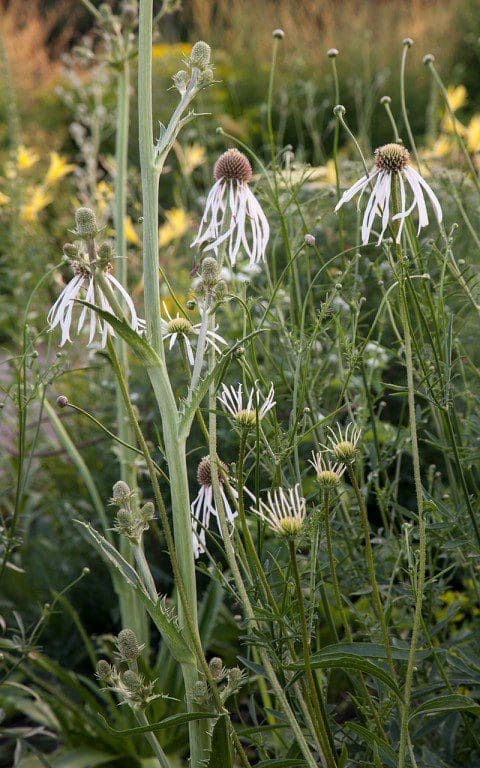 Echinacea pallida ‘Hula Dancer’ and Eryngium agavifolium
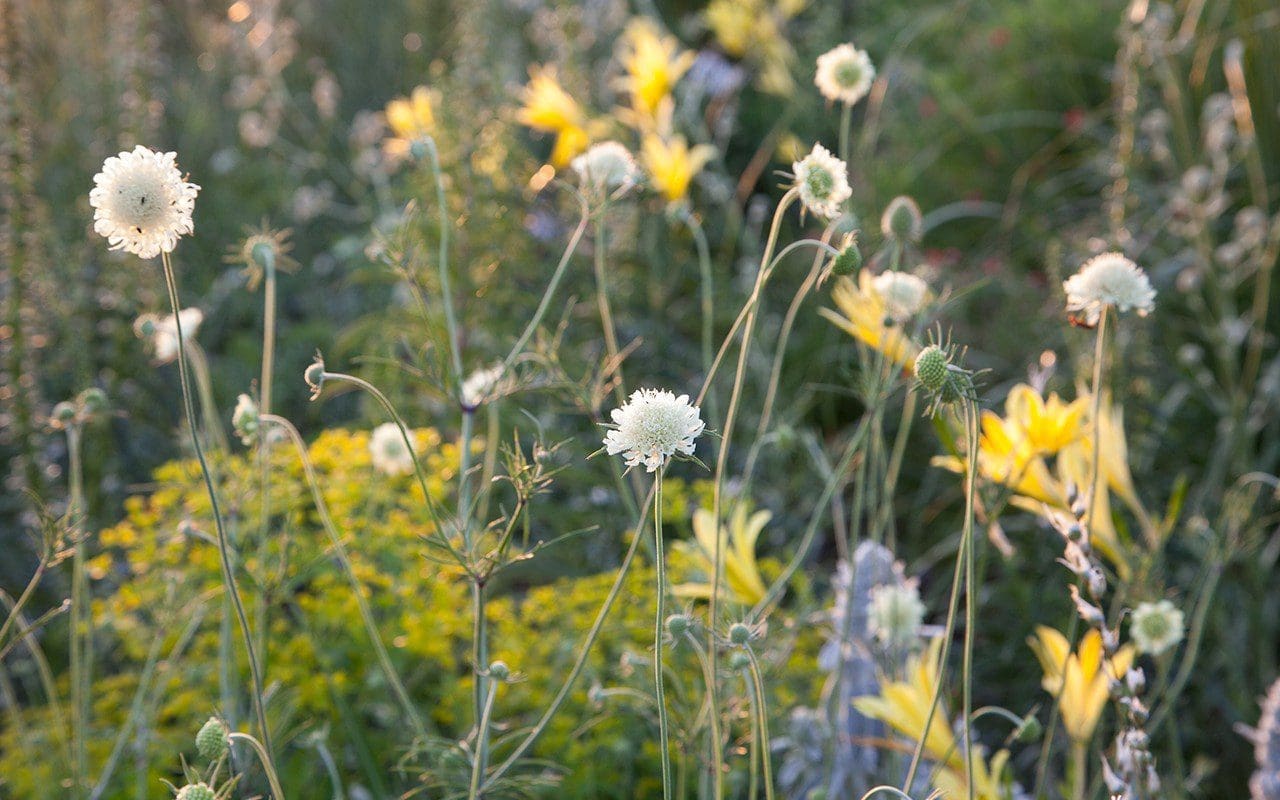 Scabiosa ochroleuca
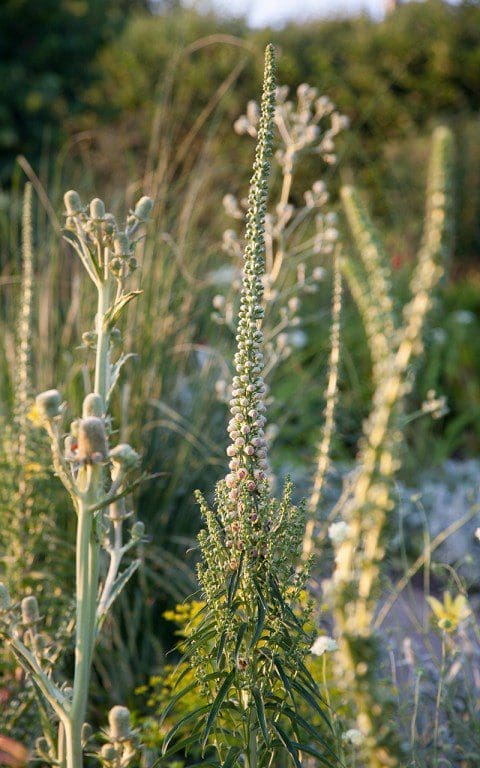 Digitalis ferruginea, Eryngium agavifolium and E. eburneum
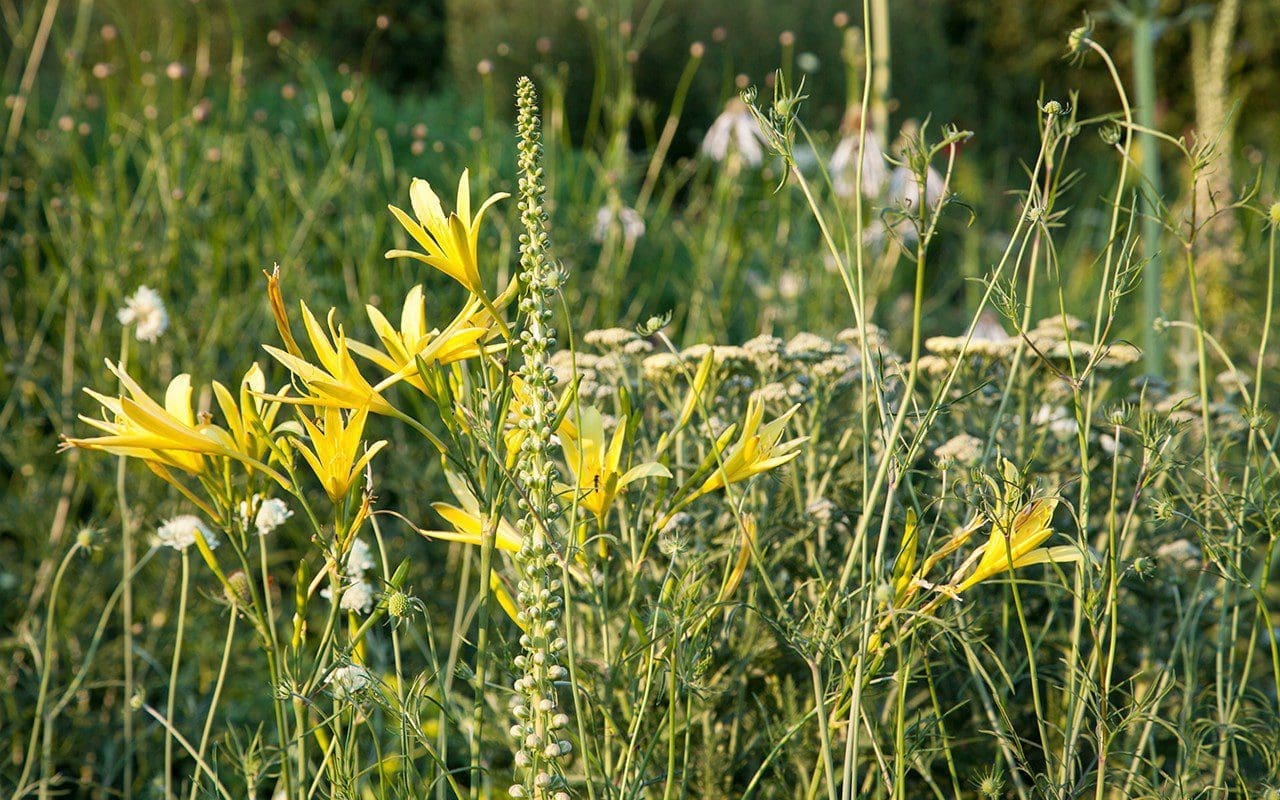 Hemerocallis ochroleuca var. citrina, Digitalis ferruginea, Achillea ‘Mondpagode’ and Scabiosa ochroleuca
It has been good to have had the pause between planting up the outer beds in spring last year, before planting the central and upper areas in the autumn. We are now seeing the whole garden for the first time as well as the softness and bulk of last year’s planting against the refinement and intensity of the new inner section. Constant looking and responding to how things are doing here is helping this new area to sit, and for it to express its rhythms and moments of surprise.
I am taking note with a critical eye. Will Achillea ‘Mondpagode’ have a stay of execution now that it is protected in the middle of the bed ? Last year, planted by the path, it toppled and split in the slightest wind. Where are the Rudbeckia subtomentosa ‘Henry Eilers’ and, if they have failed, how will I get them in again next year when everything will be so much bigger ? Have I put too many plants together that come too early ? Too much Cenolophium denudatum, perhaps ? How can this be remedied ? Later flowering asters and perhaps grasses where I need some later gauziness. Will the Dahlia coccinea var. palmeri grow strongly enough to provide a highlight above the cenolophium and, if not, where should I put them instead ? The season will soon tell me. The looking and the questioning keep things moving and ensure that the garden will never be complete.
Words: Dan Pearson / Photographs: Huw Morgan
Published 7 July 2018
Last Monday we awoke to a pristine frost, the first of the year. It lay heavy, sweeping up to tickle the grassy banks, but sparing the giant dahlia in the shelter of the barn. For now. I was up early, the moon still in the sky, to check on the pelargoniums which I’d moved in under cover of the open barn the night before. It was the beginning of the season’s change. From now on the garden will drop back and recede into winter.
In the seven years we have been here this shift has happened almost exactly to the week, but with every year there has been increasingly more to draw from in the garden. Despite the freeze that saw tender nasturtiums wilted and the dahlias in the open blackened, we are far from done in terms of interest. The grasses have come into their own as the colour of flower fades elsewhere. Panicum virgatum ‘Rehbraun’ is of particular note, but it has taken this long to reach its current perfection. The last few weeks have seen this late season grass at its best, the smoky panicles forming a mist amongst the perennials. As the weather has cooled, the foliage has now coloured too, a deep mahogany red.
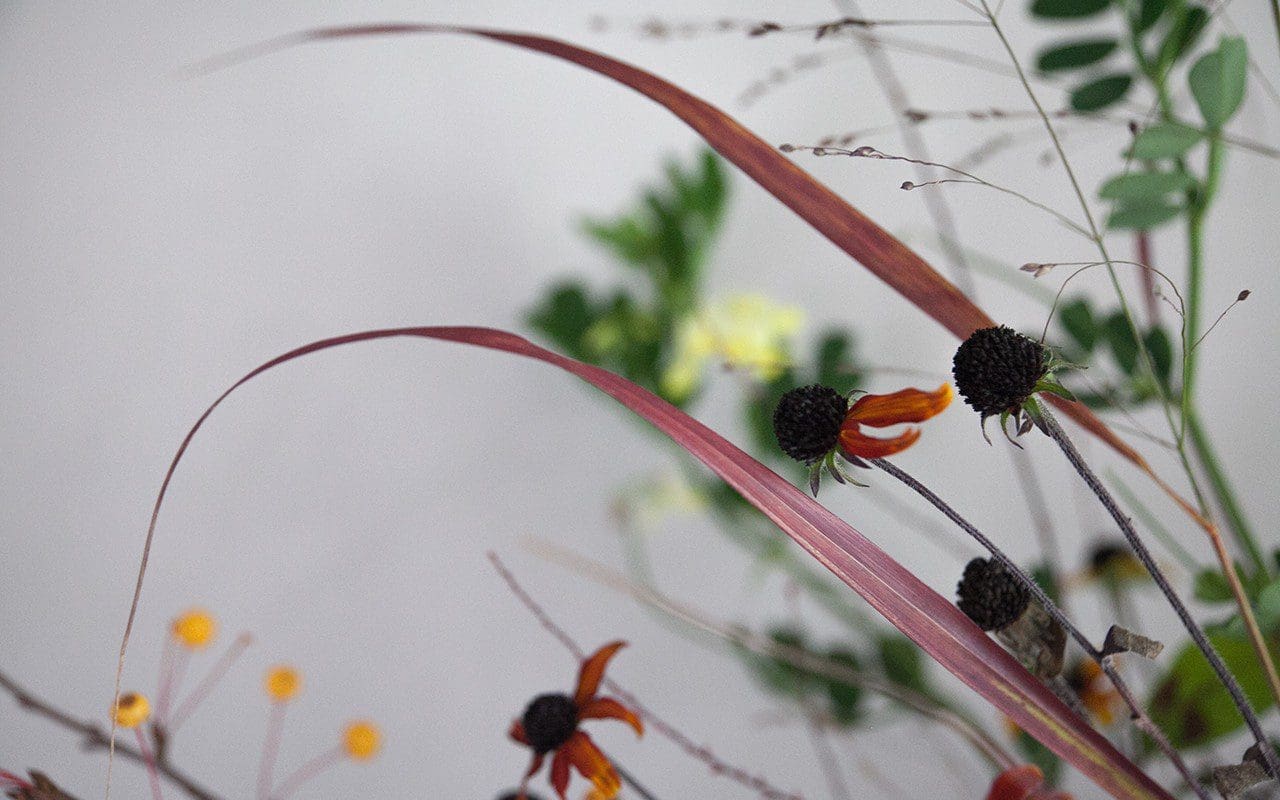 Foliage of Panicum virgatum ‘Rehbraun’
Picked in a bunch the flowers of the panicum act much as they do in the planting to veil their companions and create graphic sweeps with their flamed foliage. Almost anything works in this moody suspension of colour and here we have it with the very last of the Rudbeckia ‘Prairie Glow’. This short-lived perennial is easily raised from seed. Indeed, the plants that I have in the picking beds are variable for exactly this reason. A mix of embers and charcoal, black over red or orange, with some more fiery than others. Desite the strength of colour the impression is light for the flowers are small and held freely with room between each other. In my experience the freer draining the ground in the winter, the more likely you are to keep it. A pinch of seed, taken now and sown early under cover, will ensure that you have it next year.
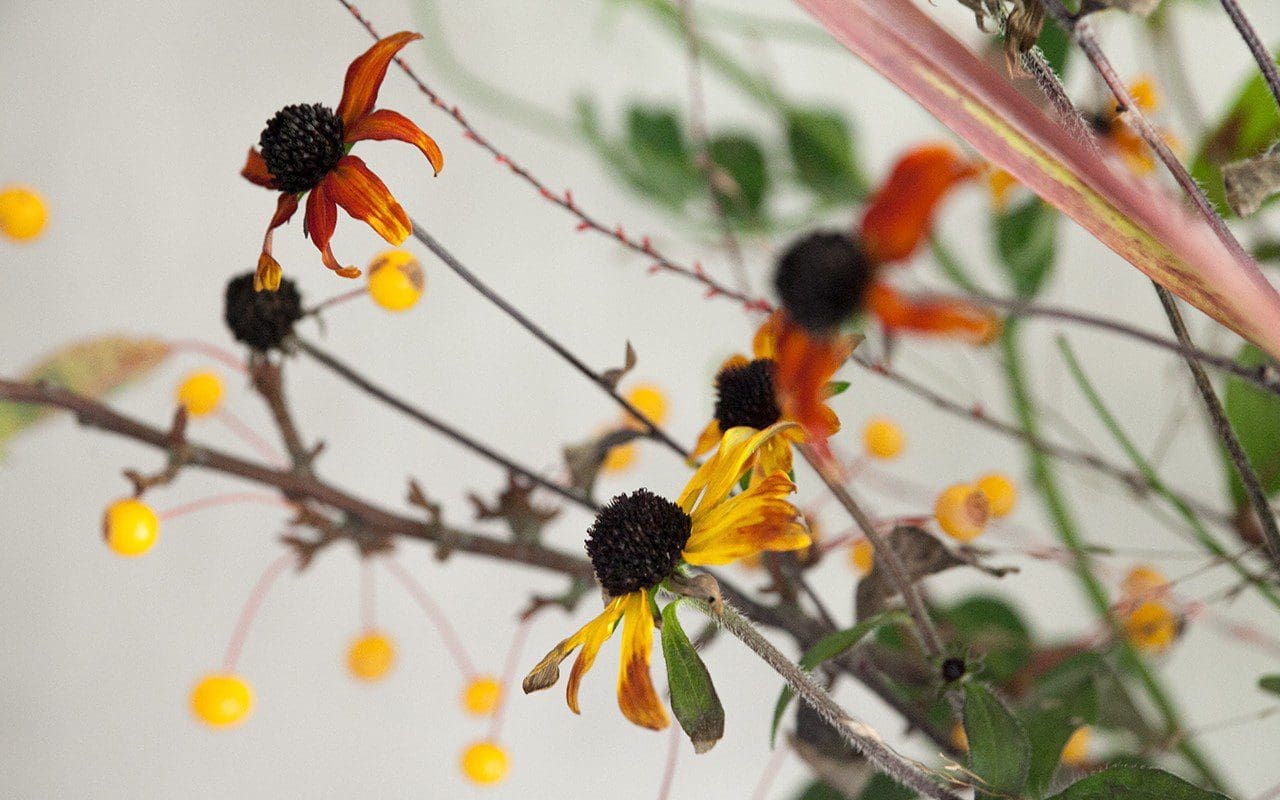 Rudbeckia ‘Prairie Glow’
The Coronilla valentina subsp. glauca ‘Citrina’ has a second season of flower once the weather starts cooling, its honeyed perfume noticeable quite some distance away. I have it planted by the path so that it is easy to inhale a big lungful. This modest, woody perennial is usually at its best in early spring, flowering prodigiously in March and April and then on into early summer after a warm winter. I put this second push down to youthful exuberance and do not expect the plants to keep this up for more than three years. In the third summer I will take cuttings and replace them in new positions for they are sure to exhaust themselves. Their presence is always light and delightful, the pale yellow pea flowers darker on the lip than the keel. If you can find them a sunny free-draining position, they are easy.
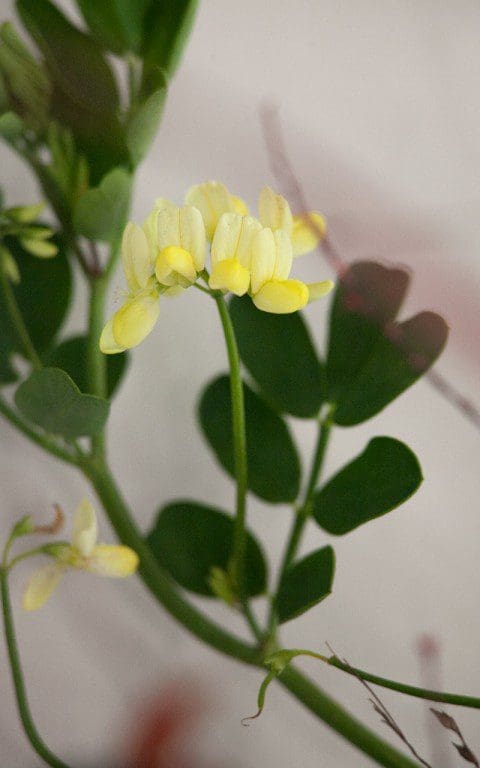 Coronilla valentina subsp. glauca ‘Citrina’
Persicaria virginiana var. filiformis is one of my favourite late season perennials. I grew them first in the Peckham garden, where they seeded freely into the shale I used for the paths. Their presence is light early in the year and, like the panicums, they take some time to come into their own in the latter half of the growing season. Grow them in a little shade or on the cool side of a building for the emerald green in the leaf to set off the maroon chevron of warpaint to best advantage. Out in the sun, the green pales and can look insipid and, as the greater part of the joy in this plant is the foliage, it is worth finding it just the right place. That said, the spires of tiny flowers are worth the wait, forming a pink haze that is hard to pin down at first, but bright and easily detectable once you find the miniature flowers scaling their wiry spires.
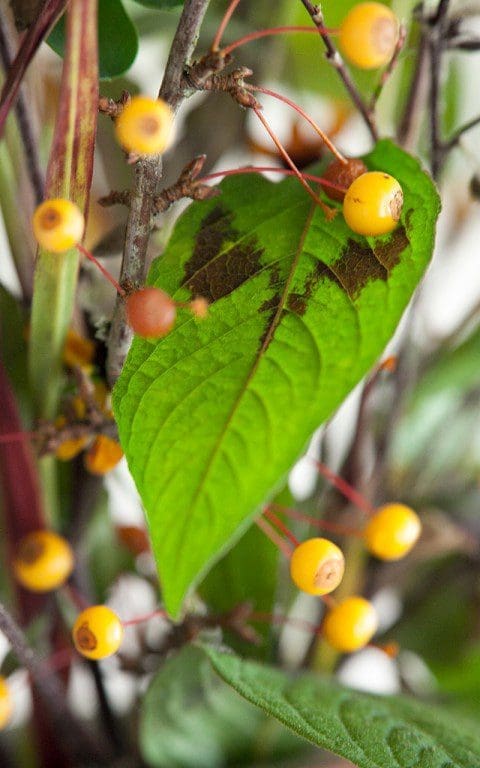 Foliage of Persicaria virginiana var. filiformis
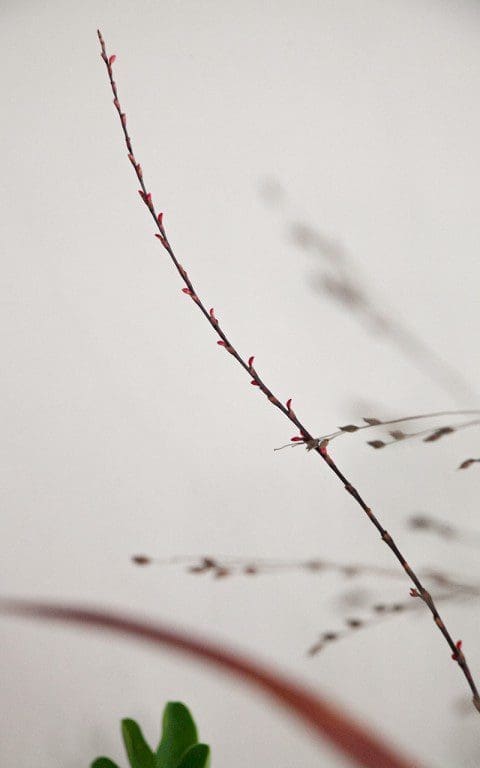 Flower spike of Persicaria virginiana var. filiformis
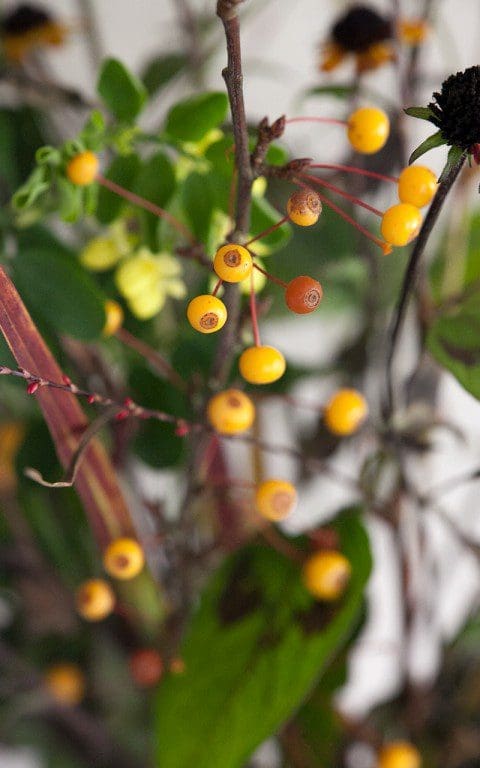 Berries of Malus transitoria
Our Malus transitoria coloured a bright, buttery yellow this year, before the leaves were stripped by gales to leave the berries hanging delicately in their thousands. The tiny amber beads, which darken to a reddish tan as they ripen, are perfectly bite-sized for the birds and every morning they are full of fluttering life. At this teetering point between the seasons this is a moment worth eking out and savouring. A last flash of life before winter gets its grip and competition for the berries will see them vanish with the last of the flowers.
Words: Dan Pearson / Photos: Huw Morgan
Published 11 November 2017
Sandwiched between storms and West Country wet, a miraculous week fell upon the final round of planting. We’d been lucky, with the ground dry enough to work and yet moist enough to settle the final splits from the stock beds. It took two days to lay out the plants and then two more to plant them and the weather held. Still, warm and gentle.
I’ve been planning for this moment for some time. Years in fact, when I consider the plants that I earmarked and brought here from our Peckham garden. They came with the promise and history of a home beyond the holding ground of the stock beds, and now they are finally bedded in with new companions. There are partnerships that I have been long planning for too but, as is the way (and the joy) of setting out a garden for yourself, there are always spontaneous and unplanned for juxtapositions in the moment of placing the plants.
The autumn plant order was roughly half that of the spring delivery, but the layout has taken just as much thought in the planning. I did not have a formal plan in March, just lists of plants zoned into areas and an idea in my head as to the various combinations and moods. It was the same this autumn, but forward thinking was essential for the combinations to come together easily on the day. Numbers for the remaining beds were calculated with about a foot between plants. I then spent August refining my wishlist to edit it back and keep the mood of the garden cohesive. The lower wrap, with its gauzy fray into the landscape, allows me to concentrate an area of greater intensity in the centre of the garden. The top bed that completes the frame to this central area and runs along the grassy walk at the base of the hedge along the lane, was kept deliberately simple to allow the core of the garden its dynamism.
 The zoning plan for the central section of the garden
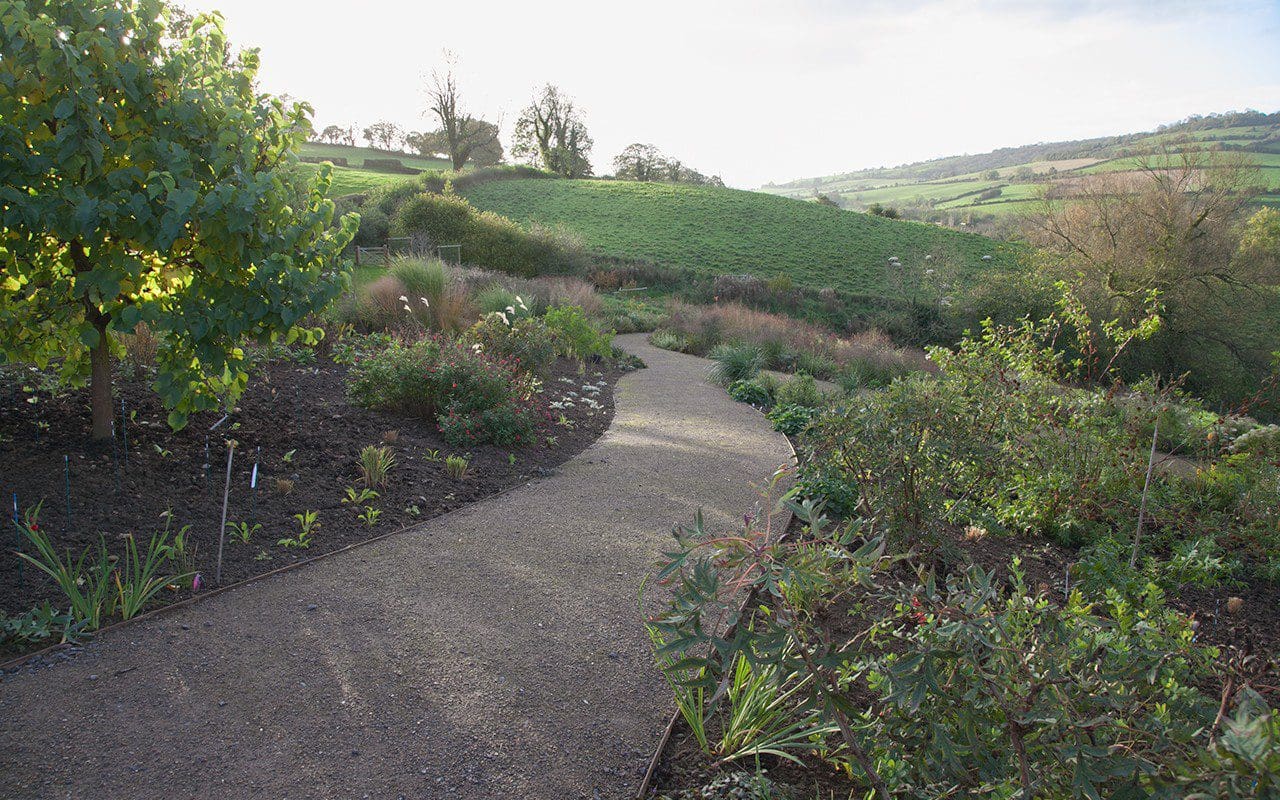 The central path with the top and central beds to either side
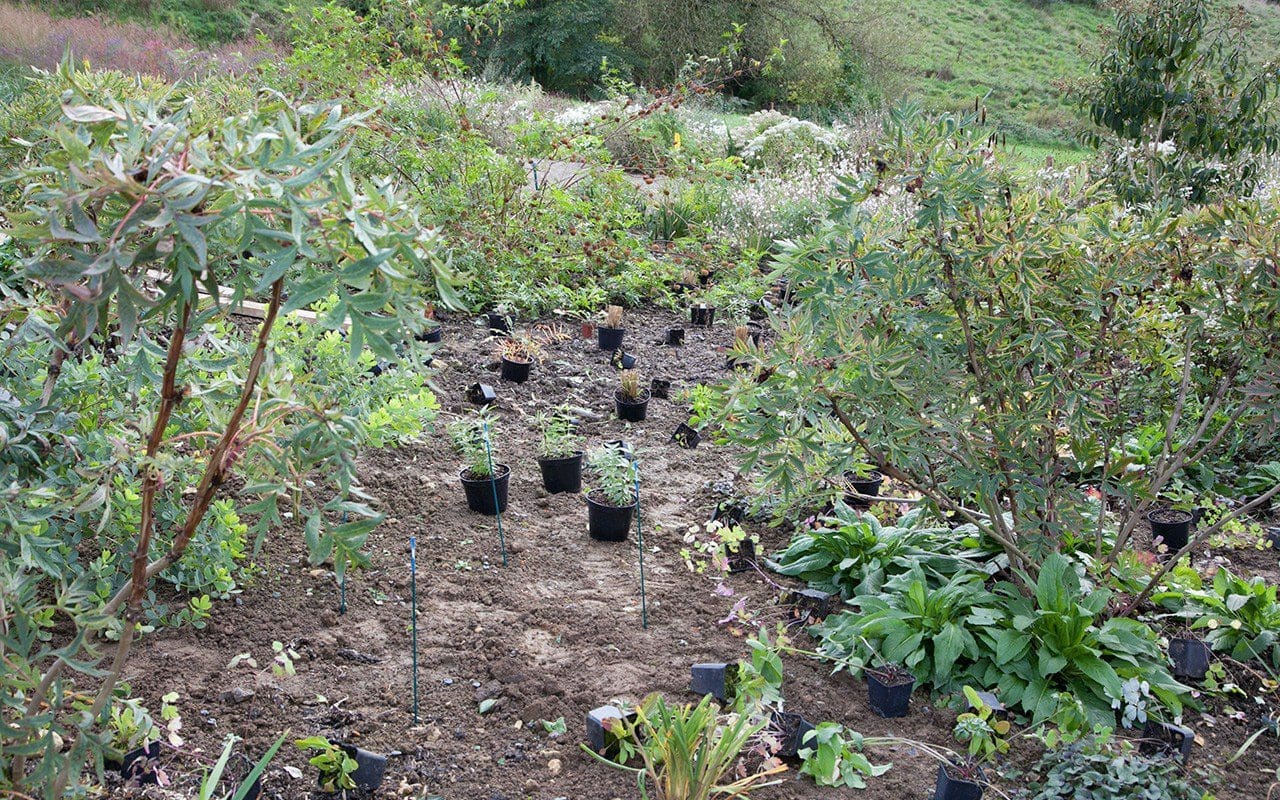 The top of the central bed
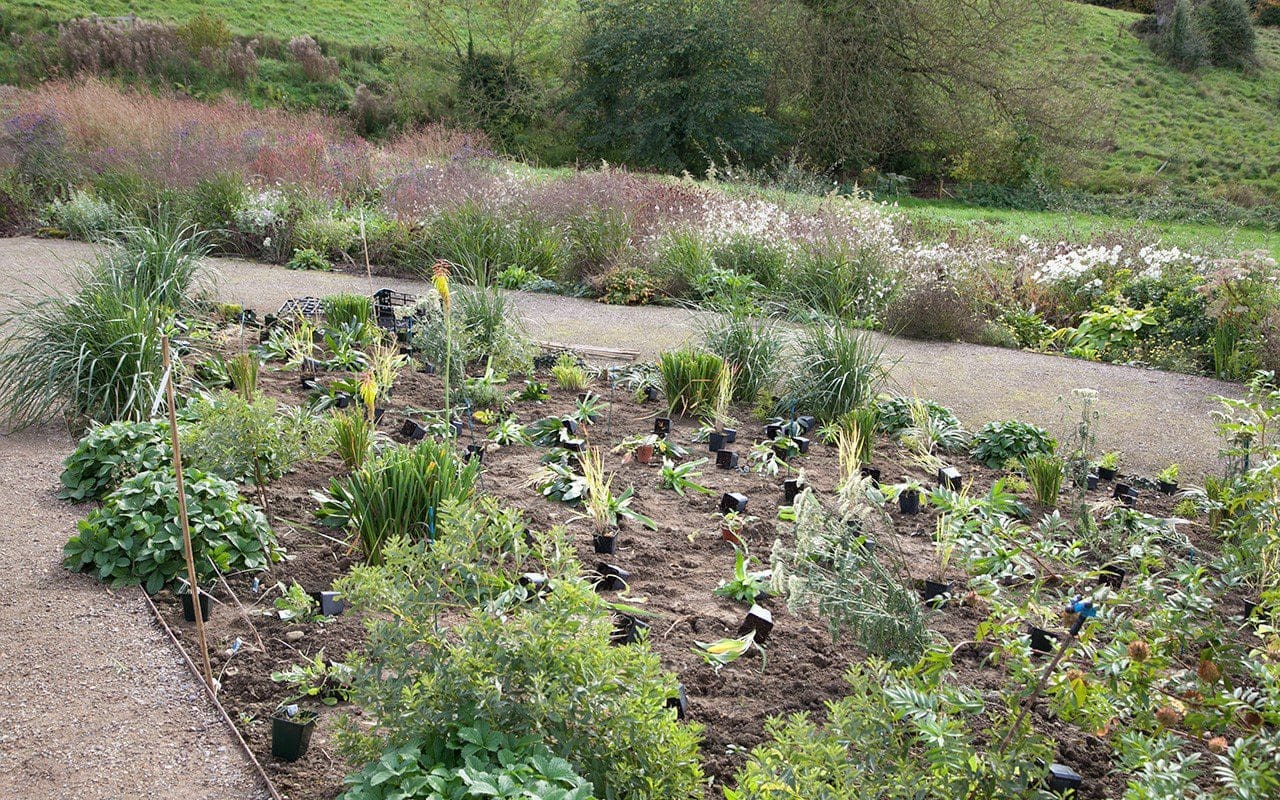 The end of the central bed
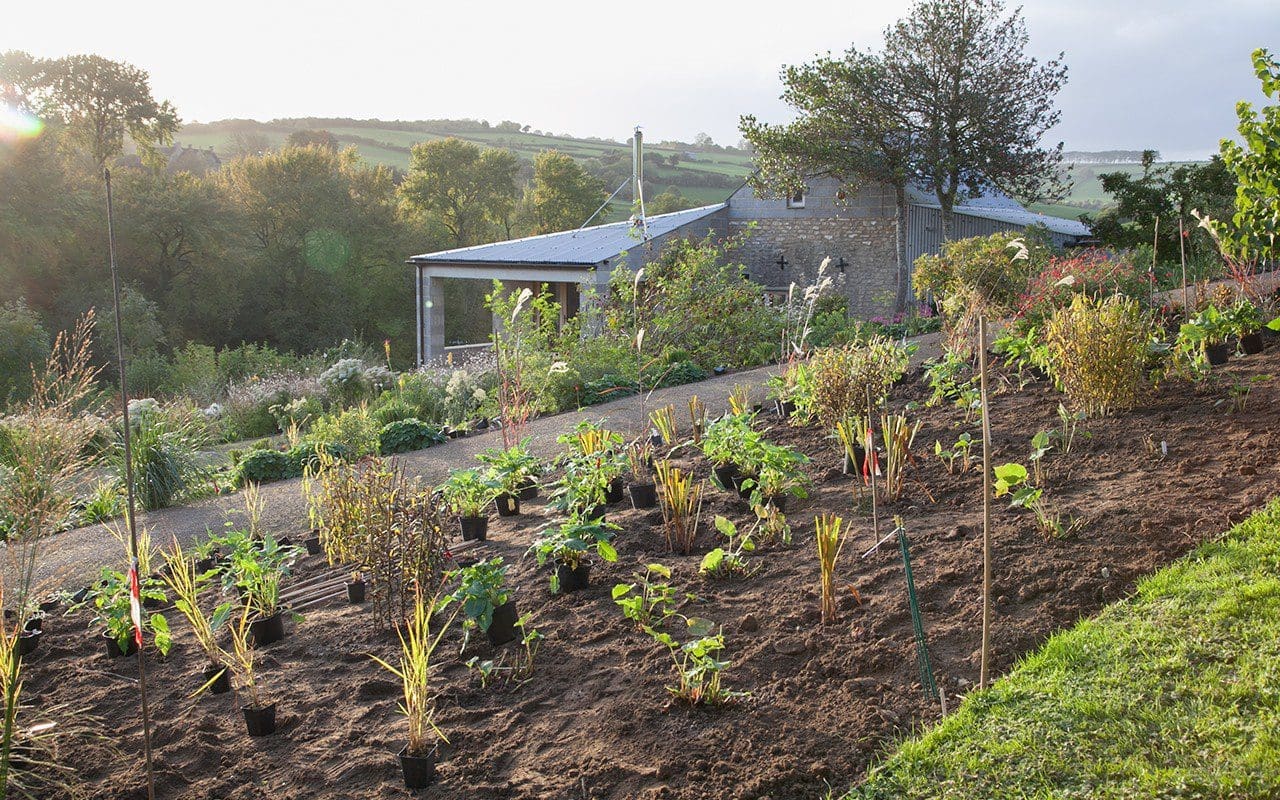 The middle of the top bed
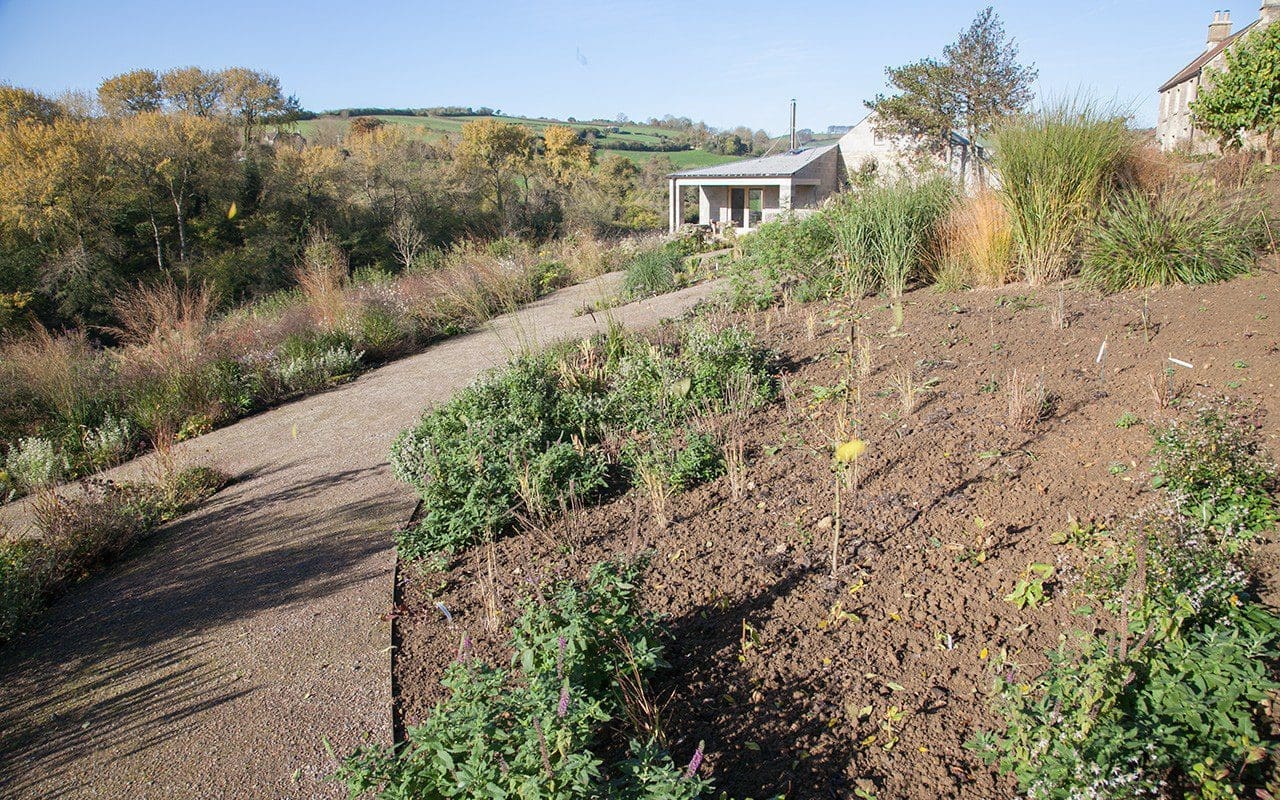 The end of the top bed
My autumn list was driven by a desire to bring brighter, more eye-catching colour closer to the buildings, thereby allowing the softer, moodier colour beyond to recede and diminish the feeling of a boundary. The ox-blood red Paeonia delavayi that were moved from the stock beds in the spring and now form a gateway to the garden, were central to the colour choices here. They set the base note for the heat of intense, vibrant reds and deep, hot pinks including Hemerocallis ‘Stafford’, Crocosmia ‘Hellfire’ and Salvia ‘Jezebel’ on the upper reaches. The yolky Kniphofia ‘Minister Verschuur’, lime-green euphorbias and the primrose yellow of Hemerocallis altissima drove the palette in the centre of the garden.
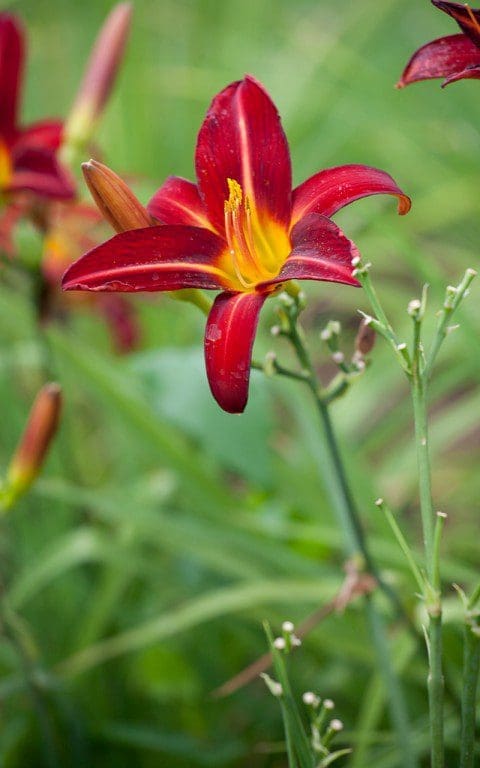 Hemerocallis ‘Stafford’
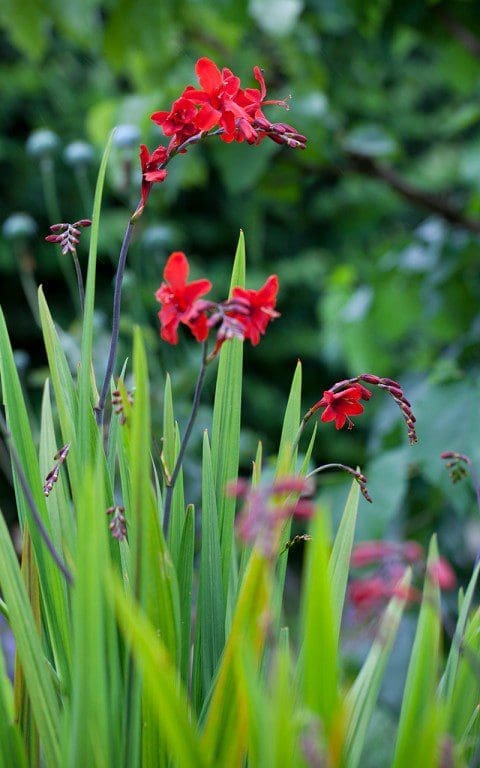 Crocosmia ‘Hellfire’
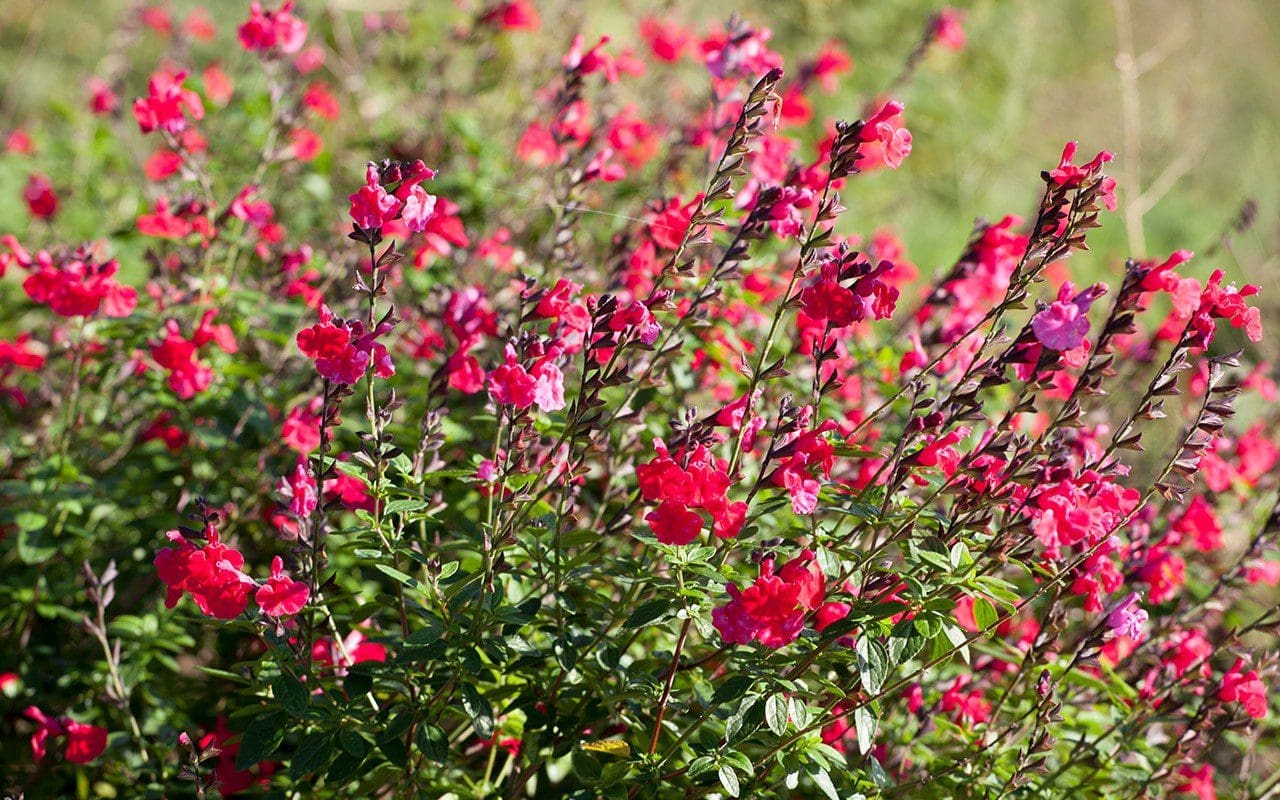 Salvia ‘Jezebel’
Once you have your palette in list form, it is then possible to break it down again into groups of plants that will come together in association. Sometimes the groups have common elements like the Panicum virgatum ‘Shenandoah’, which link the new beds to the ones below them. Although I don’t want the garden to be dominated by grasses, they make a link to the backdrop of the meadows and the ditch. They are also important because they harness the wind which moves up and down the valley, catching this unseen element best. Each variety has its own particular movement; the Molinia caerulea ‘Transparent’, tall and isolated and waving above the rest, registers differently from the moody mass of the ‘Shenandoah’, which run beneath as an undercurrent.
To play up the scale in the top bed, so that you feel dwarfed in the autumn as you walk the grassy path, I have planned for a dramatic, staggered grouping of Panicum virgatum ‘Cloud Nine’. They will help to hold the eye mid-way so the planting is revealed in chapters before and then after. This lofty grass with its blue-grey cast will also separate the red and pink section from the violets and blues that pick up in the lower parts of the walk to link with the planting beyond that was planted in the spring. These dividers, or palette cleansers, are important, for they allow you to stop one mood and start another without it jarring. One combination of plants can pick up and contrast with the next without confusion and allow you to keep the varieties in your plant list up for interest and diversity, without feeling busy.
Each combination within the planting has its own mood or use. Spring-flowering tellima and pulmonaria will drop back to ground-cover after the mulberry comes into leaf and the garden rises up around it. Aster ericoides ‘Pink Cloud’ and Schizostylis coccinea ‘Major’ beneath the Paeonia delavayi for late season colour and interest. The associations that are designed to jump the path from one side to the other in order to bring the plantings together are key to cohesiveness. The sunny side of the path favours the plants in the mix that like exposure, the shady side, those that prefer the cool, and so I have had to be aware of selecting plants that can cope with these differing conditions. Consequently, I have included plants such as Eurybia divaricata that can cope with sun or shade, to bring unity across the beds. The taller groupings, which I want to feel airy in order to create a feeling of space and the opportunity of movement, always have a number of lower plants deep in their midst so that there is room and breathing space beneath. Sometimes these are plants from the edge plantings such as Calamintha sylvatica ‘Menthe’, or a simple drift of Persicaria amplexicaulis ‘Blackfield’, which sweeps through the tall tabletop asters (Aster umbellatus). This undercurrent of the adaptable persicaria, happy in sun or shade, maintains a fluidity and movement in the planting.
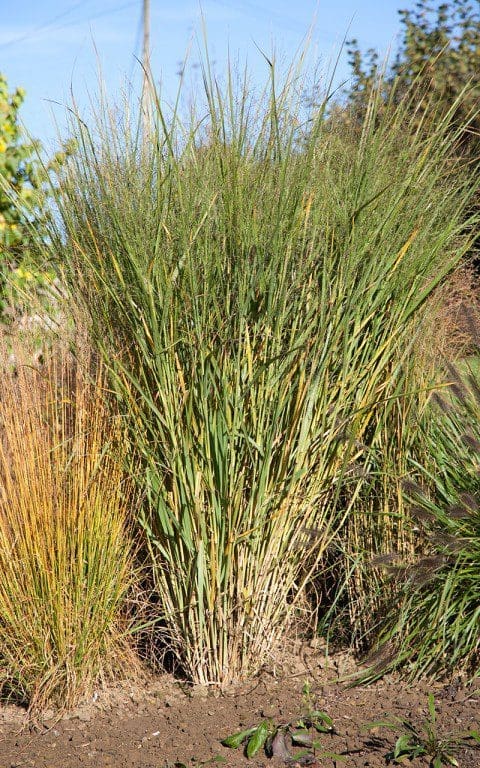 Stock plants of Panicum virgatum ‘Cloud Nine’
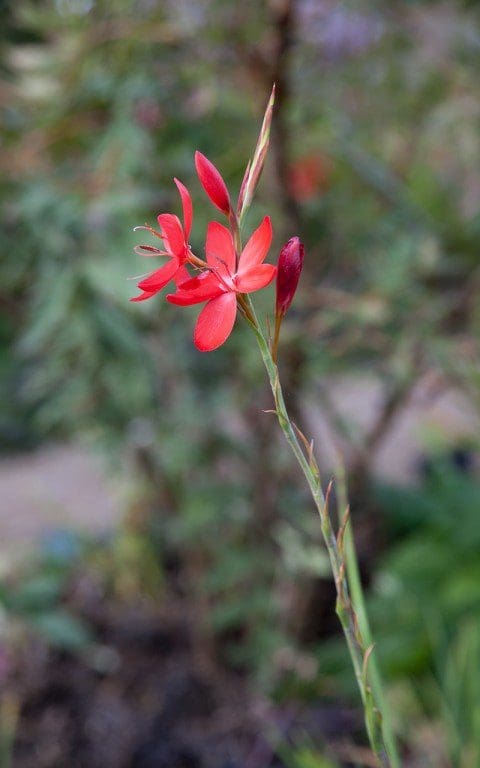 Schizostylis coccinea ‘Major’
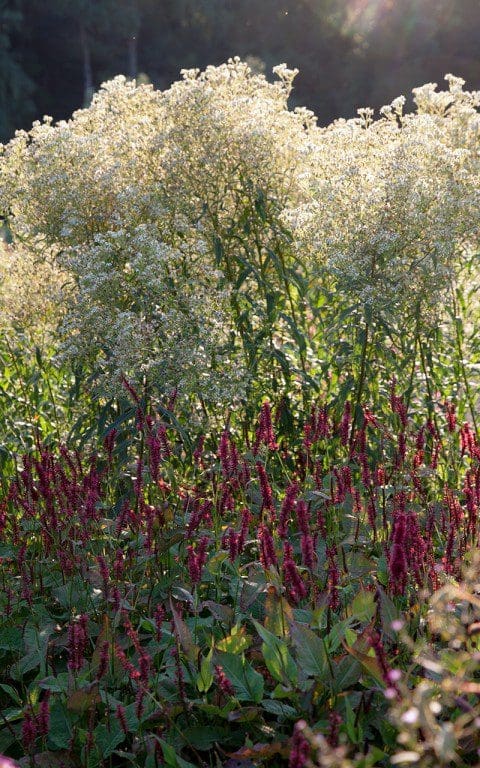 Aster umbellatus and Persicaria amplexicaulis ‘Blackfield’
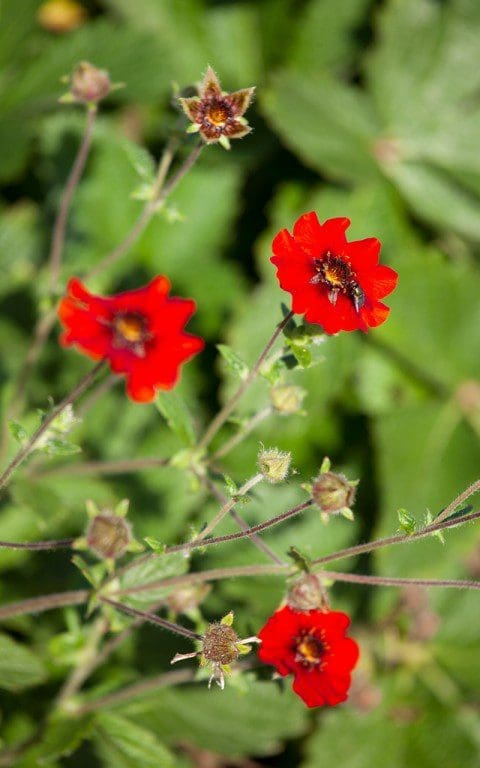 Potentilla ‘Gibson’s Scarlet’
The combinations, sixteen in total, were then focused by zoning them on a plan. The plan allowed me to group the plants by zone in the correct numbers along the paths for ease of placement. Marking out key accent plants like the Panicum ‘Cloud Nine’, Glycyrrhiza yunnanensis, Hemerocallis altissima and the kniphofia were the first step in the laying out process. Once the emergent plants were placed, I follow through with the mid-level plants that will pull the spaces together. The grasses, for instance, and in the central bed a mass of Euphorbia ceratocarpa. This is a brilliant semi-shrubby euphorbia that will provide an acid-green hum in the centre of the garden and an open cage of growth within which I can suspend colour. The luminous pillar-box red of Potentilla ‘Gibson’s Scarlet’ and starry, white Dahlia merckii ‘Alba’. Short-lived Digitalis ferruginea were added last to create a level change with their rust-brown spires. However, I am under no illusion that they will stay where I have put them. Digitalis have a way of finding their own place, which isn’t always where you want them and, when they re-seed, I fully expect them to make their way to the edges, or even into the gravel of the paths.
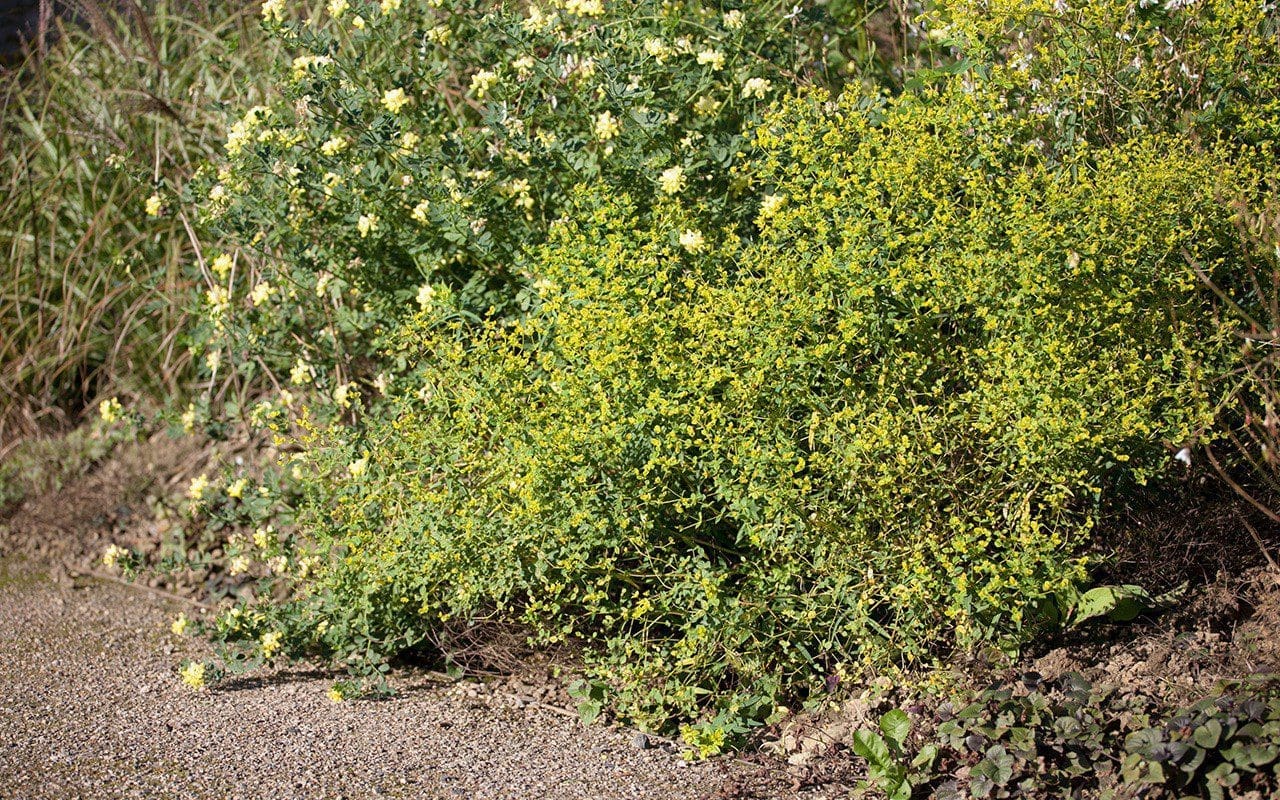 Euphorbia ceratocarpa
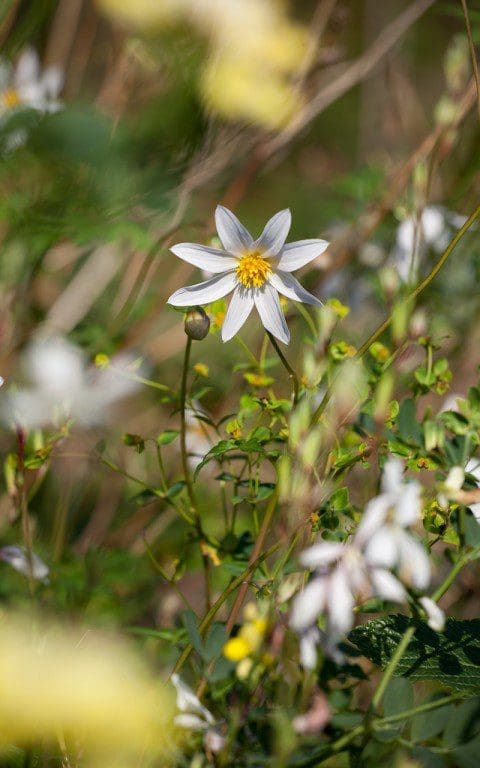 Dahlia merckii ‘Alba’
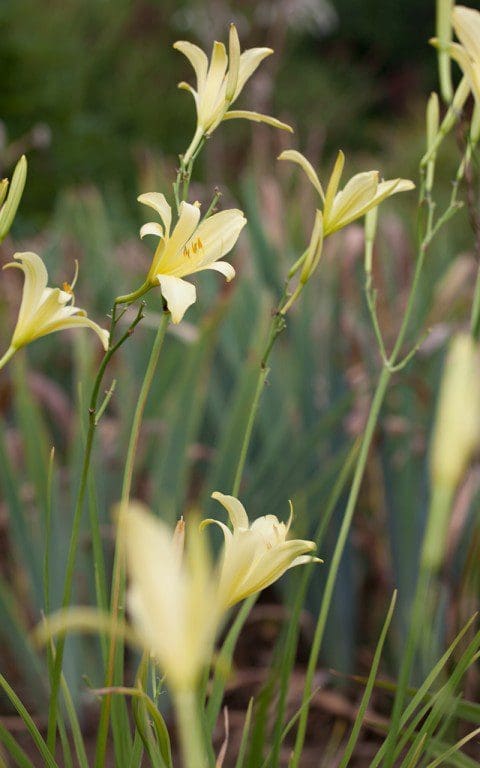 Hemerocallis altissima
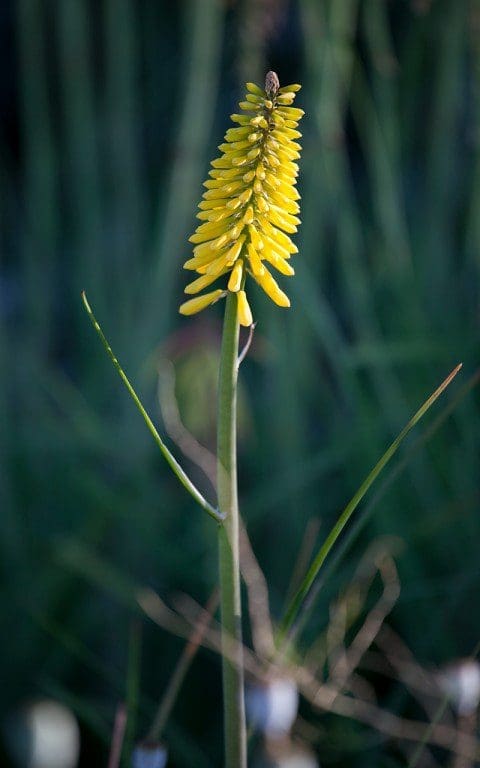 Kniphofia ‘Minister Verschuur’
Over the summer, I have been producing my own plants from seed and it has been good to feel uninhibited with a couple of hundred Bupleurum longifolium ‘Bronze Form’ at my disposal to plug any gaps that the more calculated plans didn’t account for. Though I am careful not to introduce plants that will self-seed and become a problem on our hearty soil, a few well-chosen colonisers are always welcome for they ensure that the garden evolves and develops its own balance. I’ve also raised Aquilegia longissima and the dark-flowered Aquilegia atrata in number to give the new planting a lived-in feeling in its first year. Aquilegia downy mildew is now a serious problem, but by growing from seed I hope to avoid an accidental introduction from nursery-grown stock. The columbines are drifted to either side of the path through the blood-red tree peonies and my own seed-raised Hesperis matronalis var. albiflora. For now they will provide me with an early fix. Something to kick-start the new planting and then to find their own place as the garden acquires its balance.
Words: Dan Pearson / Photographs: Huw Morgan
Published 28 October 2017
We are sorry but the page you are looking for does not exist. You could return to the homepage