ALREADY A PAID SUBSCRIBER? SIGN IN
Everything is different after rain. The new plantings in the garden went without for almost a month. Sitting tight and not moving. I kept a close eye and watered just once to help them break into the new ground without becoming reliant. The ground opened up with cracks wide enough to put your fingers into and the fields dulled when, at this turning point from spring to summer, they are usually luminous.
Then a fortnight ago, and just in time, the heavens opened. Wetting deep and gently and flushing thirsty growth, which responded overnight with a new vivacity. Only rain has that effect, the growth transformed with a charge and vitality that can only be described as a post-coital glow. The metaphor ends there but, true to say, we are now surrounded with the surge of new vigour, which has touched everywhere and everything, save the wild garlic in the woods, which is receding now in its counter-movement.
Most dramatic was the response in the meadows, which kicked into growth. The camassias, twinkling above the grass, were soon left behind and the little yard beneath the banks in front of the house vanished from view. I seeded the newly graded slopes last September, casting down a St. Catherine’s mix from the valley next door, and adding to it with some sheaves of the wild barley that we collected in Greece a few years ago. I wanted to see if it would cope with the conditions and, to date, it is the first delight in the mix.
We first saw the barley (Hordeum bulbosum) growing by the side of the road on an early April trip to the Dodecanese. It was at exactly this point of growth then, rising up above the last of the spring flowers and shining in the first heat in the sun. The feathered seedheads were swaying in the wind and I was enchanted by its languorous movement. I have always found plants that harness the wind to be captivating and immediately saw it on our breezy hillside.
Friends who live on the island harvested some seed and sent it in the post. It was sown immediately that autumn and bulked up rapidly over the winter to be ready for the spring and then complete its life cycle before the drought of summer. Here, my concern was that it would not be able to cope with as much water as we get in England, but it has shown me to be wrong, flowering heartily in its first summer and proving to be perennial these last four years. The species name refers to the bulbous swellings, the size of an onion set, at or just below ground level. These storage organs keep the parent plant going when seedlings fail in a drought year in the Mediterranean, where it is one of the most common perennial grass species.
The original plants are dwindling now in their fourth summer, but they have seeded freely. Although the seedlings are easy to pull and have not been problematic in an easy to tend strip of ground, I would not want to let them loose in a perennial planting unless their companions were tough enough to cope with their ability to seize a gap. In the narrow bed in front of the house I have it with Digitalis lutea, Thalictrum flavum ssp. glaucum and early-to-rise bronze fennel. Clump-forming cephalaria and crambe might be good company but, for now, I am trying them in more relaxed company.
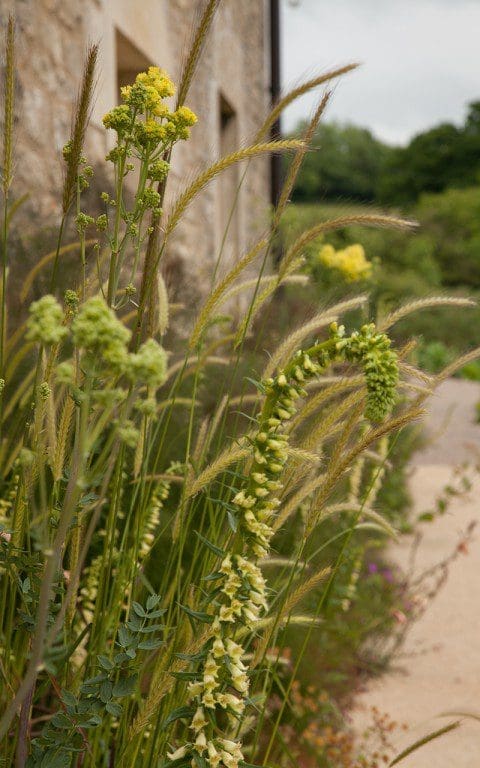 Hordeum bulbosum with Digitalis lutea and Thalictrum flavum ssp. glaucum at the front of the house
So it looks like their new home, in the containment of our hottest steepest, most freely draining bank, might be a good one. We will see if they can cope with our native grasses which, as they establish, may outcompete them when they are no longer the pioneers. I will let them run to seed again and see how they perform. If they dwindle, the seed is easily collected and may make a nice component to an autumn sown hardy annual mix of eschscholzia, white corncockle and orlaya. An experiment perhaps, if this one is just fugitive, but I’ll find a reason to make sure that this hypnotic beauty is always with us somewhere to celebrate the first weeks of summer.
Words: Dan Pearson / Photographs & Film: Huw Morgan
Published 3 June 2017
