ALREADY A PAID SUBSCRIBER? SIGN IN
Today’s In The Garden is the result of an extremely busy week. In fact, we almost thought about not doing Dig Delve today but, having thrown myself at work this morning, I took a deep breath after lunch and it has been a pleasure to gather all of the colour in the garden and arrange it on the mantelpiece for us and you. However busy I am, as soon as I put my head in the right space for flowers, everything else falls away.
First thought is, ‘What is the story?’ Despite the glowering cloud and torrential rain, it is the colour that draws me into the garden. Then, ‘Which containers?’ ‘More colour.’ I think. So down from the shelf in the boot room comes my collection of Italian, coloured glass vases, covered in months of dust and cobwebs. The first job was to wash and dry them, before arranging them on the mantelpiece, looking at a good distribution of form and colour, while also considering a range of heights spread evenly to ensure a good rhythm. Without anything in them this can be a bit hit and miss and, once the vases are in position and filled with water, with the first stems arranged, it can be nerve-wracking or foolhardy to try and re-arrange them.
Then the selecting and cutting of flowers. This takes longer than you might think. Judging whether a plant can spare the bloom. Should I just take one, or several? Sometimes one perfect flower means sacrificing several buds still to mature. Will it stand upright in the vase? If not, how will I get it to face the way I want it to? Then, how to get them back to the house undamaged? Some flowers are far more fragile than others. The hemerocallis are a case in point with their fleshy, snappable petals. Three ‘Stafford’ were cut to get the one perfect one in the arrangement, while I had to give up on the Hemerocallis altissima every one of which was broken just getting it into the trug. There were meant to be poppies, but they shed all their petals long before I could get them into position.
I picked a few at a time, going round the garden methodically, starting down by the barns and working my way through to the end of the main garden. Each trugful contained perhaps just five flowers to prevent squashing. I placed each batch where I felt they would start to create the right composition of colour and form. By chance the softer colours came first – blues, mauves, pinks – then the yellows, followed by the strong pinks, reds, saffrons and oranges.
Stand back and evaluate. Are any flowers hidden? Is there enough space to see most or all of them clearly? Is the colour rhythm working? Does it need more yellow? More red? More height? Are the vases pleasingly spaced? These questions come as observations, not concrete thoughts, and once they have been answered it is time to take the first photographs.
Picture this. I slip off my Birkenstocks and climb onto the dining table, over which hang two pendant lamps. The one at the mantelpiece end is right where I need to be to get my framing right. So I carefully balance it on the nape of my neck and then try not to make any sudden movements, otherwise it comes swinging round to hit the front of my face and my camera, and it is made of metal and has sharp edges. Years of practice mean that this fortunately seldom happens.
Then the light needs to be right. Today has been particularly gloomy, so I had to use a low aperture setting and high ISO to get the exposure right, but this also means the images are far more prone to camera shake. I can’t use a tripod, due to the dining table and pendant lamp issues, so I brace myself, keeping my elbows close to my sides as I grip the camera and hold steady while kneeling on the hard table top. Then I just keep shooting, making tiny adjustments to the framing and hoping that one of the images will be good enough.
I check the composition in the playback screen, but it is not until I download the images that I can see whether there is a problem with the arrangement, the composition or the image. If there is, further adjustments are made and then back up on the table to take some shots.
So, that is how the image you see at the top of this page came together today. It is how all of these mantel arrangements come into being. It took the best part of the afternoon, and I enjoyed every minute, but now, it’s time for a glass of wine.
Flowers, words and photograph: Huw Morgan
Published 31 July 2021
Huw Morgan | 28 February 2020
When we last saw each other in October Flora and I had planned on her returning to Hillside in the very depths of winter to see what she could create with the skeletons of last year’s growth when there was hardly a flower to be seen in the garden. We pencilled in a late January date in the diary. However, I was taken ill after Christmas and was out of action until early February. This meant that the next available date for us to meet was at the end of last week, when the season was definitely starting to tip into spring.
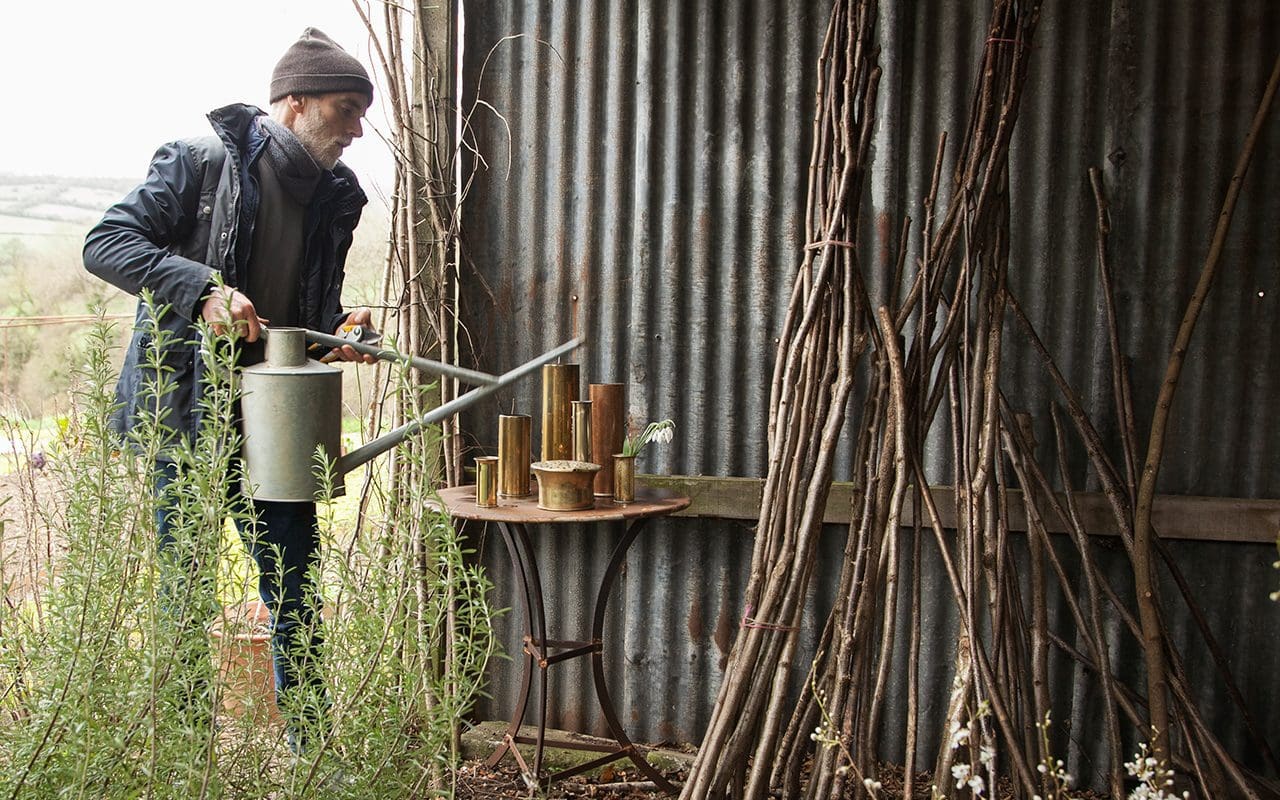
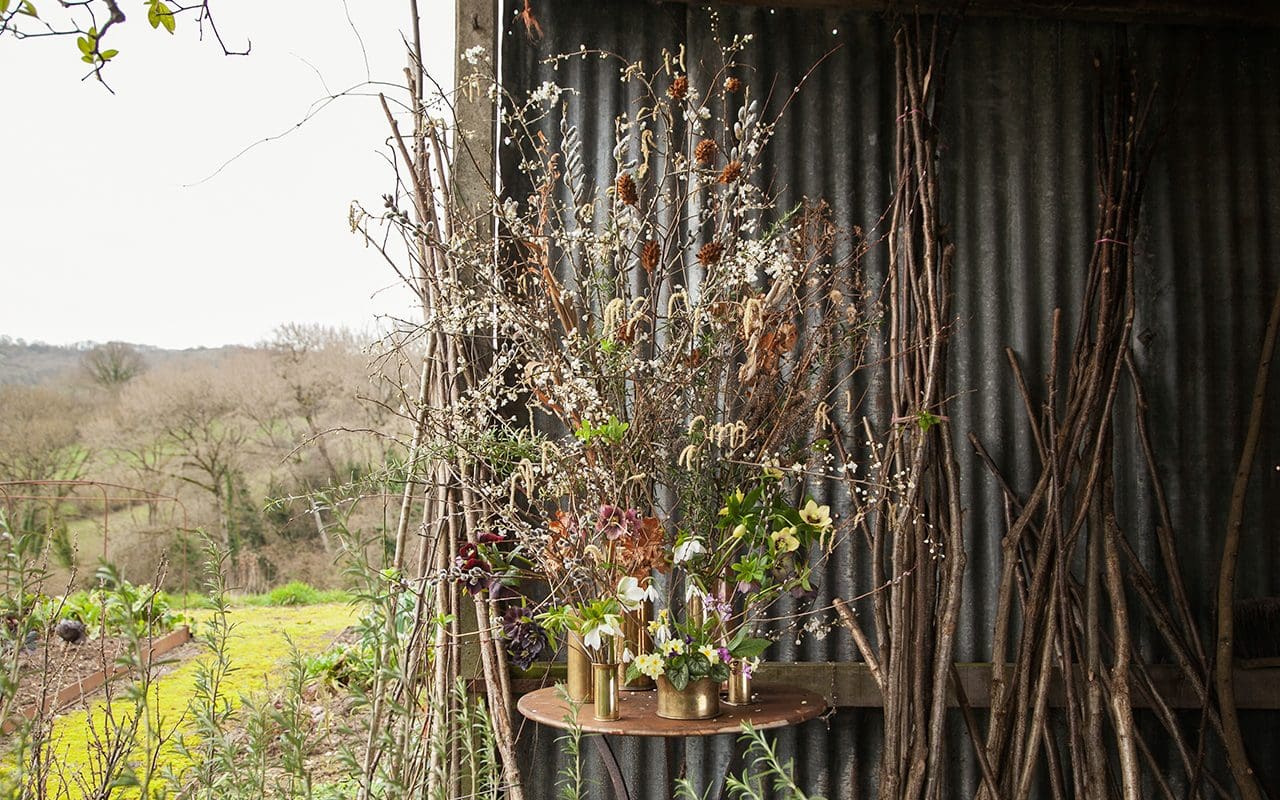
Flora arrived on Thursday evening with her good friend Paul, who gardens with her at Westhill Farm. He has assisted Flora on the last two shoots here, cutting and conditioning flowers, organising and filling containers and clearing up afterwards, not to mention the laughter and banter. We could not have done any of them without his help. We were all up early on Friday morning, wary of the weather forecast with its warnings of another approaching storm. I had gathered some woody material – hazel, willow and cherry plum – from the hedgerows, woods and garden the previous day, and there was a wide selection of dead material in the tractor barn that I had saved from the garden before Christmas. After breakfast Flora and Paul took a tour of the garden to select the things that took their fancy to bring colour and a feeling of hope to the arrangement.
With storm clouds gathering and wind gusting erratically, and despite the fact that we had decided to make the arrangement under cover, the weather conditions were challenging. On more than one occasion the entire, and nearly completed, arrangement almost blew over. Fortunately Paul was quick off the mark and managed to catch it, preventing it from needing to be entirely remade. Just moments after I had taken the last shot of the finished arrangement a great easterly gust blew into the barn and sent everything flying. We all laughed and understood that the shoot was well and truly over.
Although it was testing working and photographing in these conditions it felt like a very authentic engagement with and recording of the reality of the season.
Flora Starkey | 28 February 2020
It is winter at Hillside and there’s a new quieter beauty in the garden. Again, I’m happy to be here on the cusp of the season as spring starts to show beneath the fallen grasses and branches that are bare of leaves.
The rains held off for a few hours on Friday morning, but the winds still blew. Huw and I decided it would be impossible to try and continue our series in front of our usual rusted barn background so we moved behind and into the inside corner of the barn. We both liked the light there and hoped we’d be more sheltered from the elements, but there were still times the wind caught us from the side – all adding to the fun.
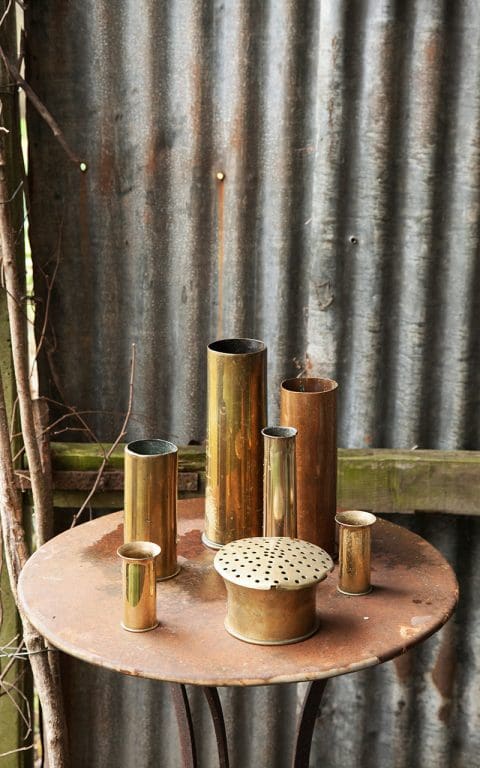
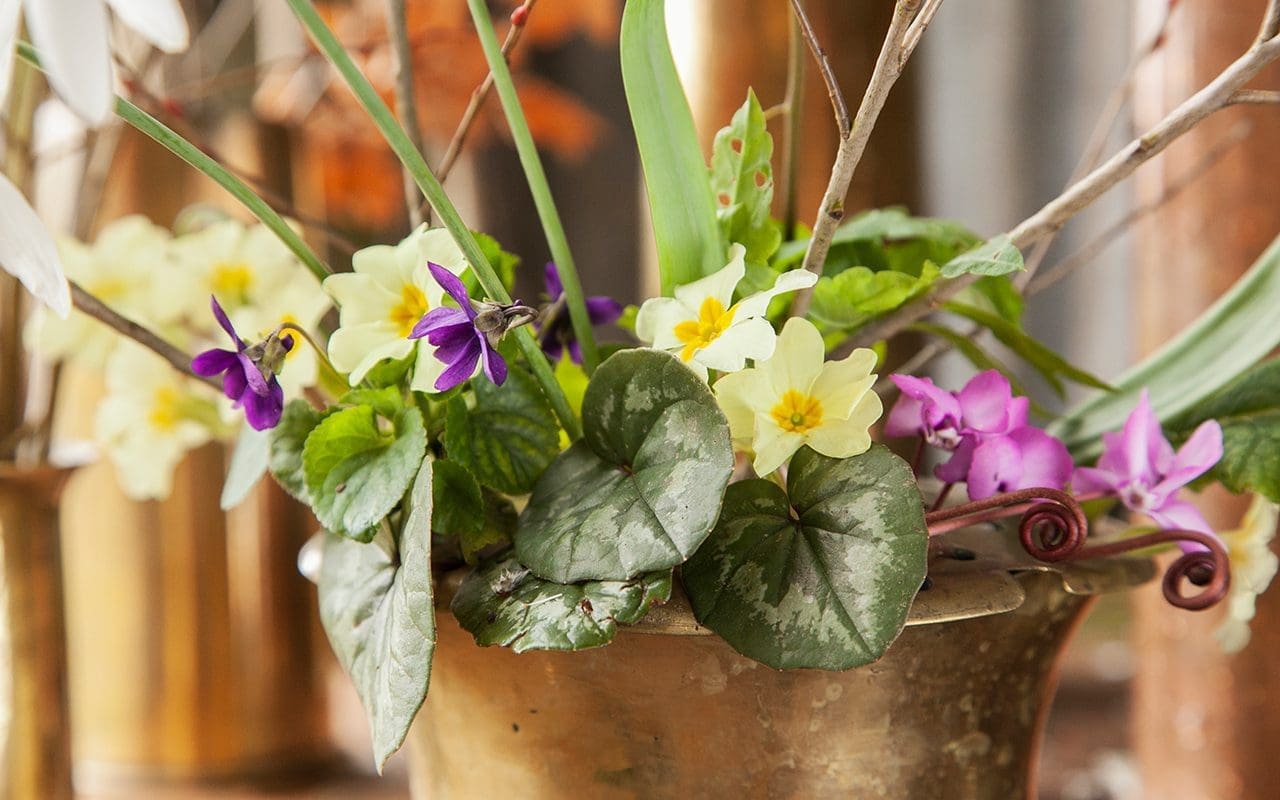
I’d used ceramic and glass vessels in the summer and autumn arrangements and so this time I was drawn to the idea of metal. Specifically vases made from old mortar shell casings. I brought a small collection with me, including a bowl with a drilled lid gifted to me by my friend Paul. A remnant of World War 1 and life in the trenches. I like the idea of using flowers to reflect, remember and bring beauty from the darkness. I guess it seemed especially fitting for the season with the violets and primroses showing up and braving the end of winter.
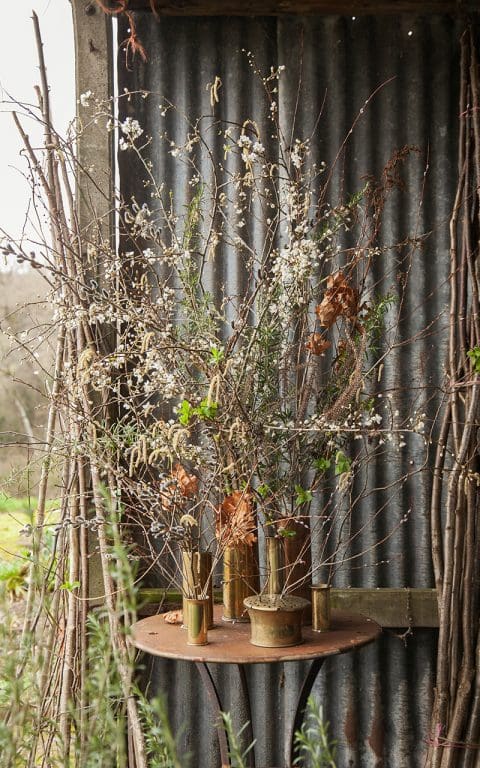
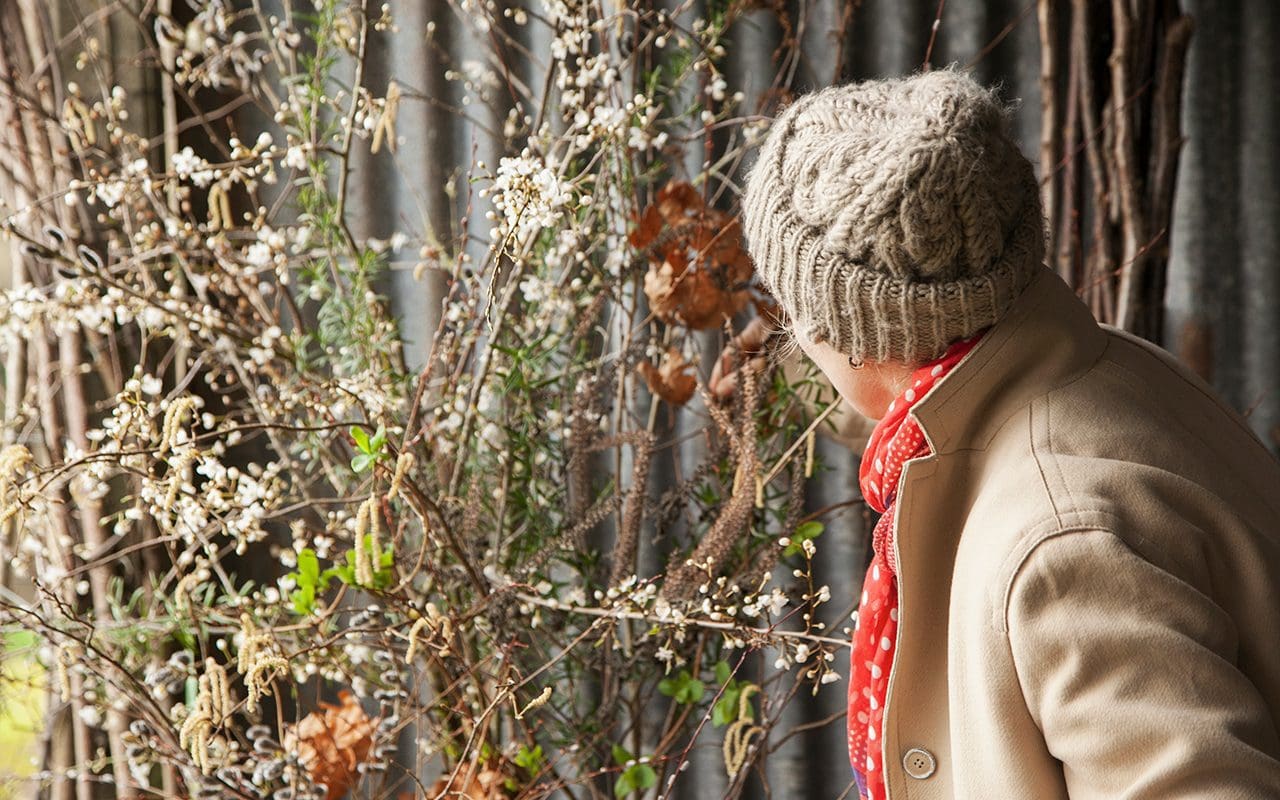
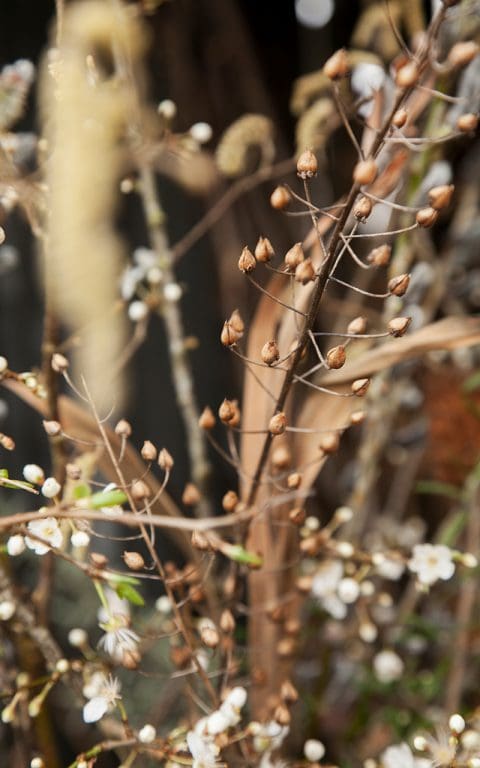
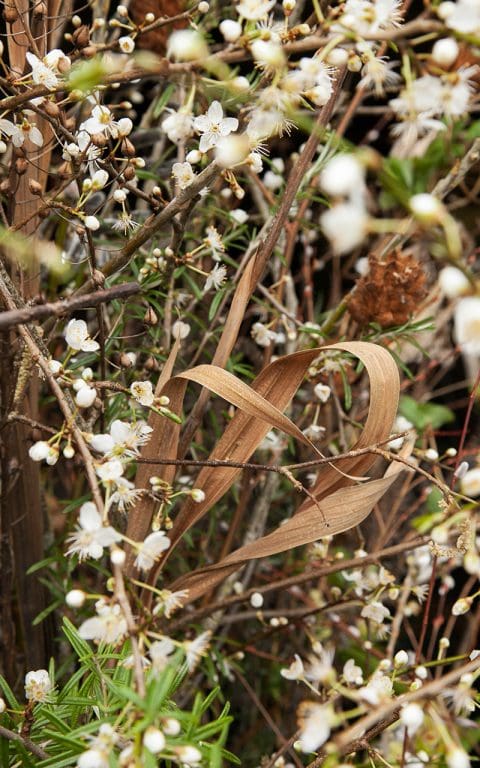
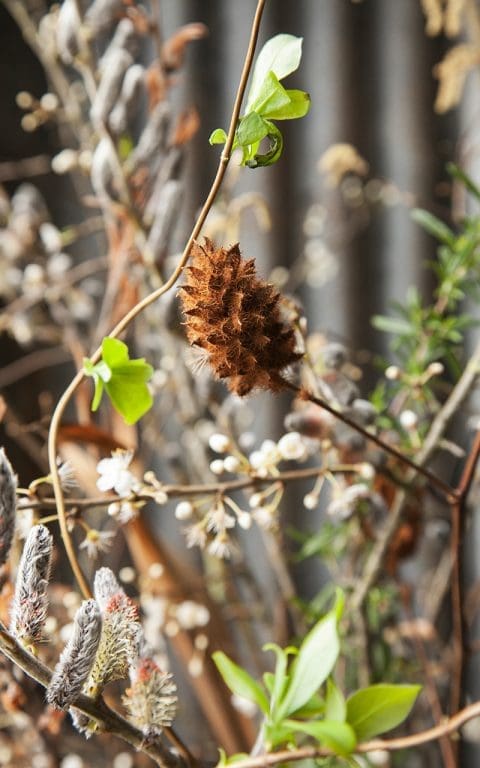
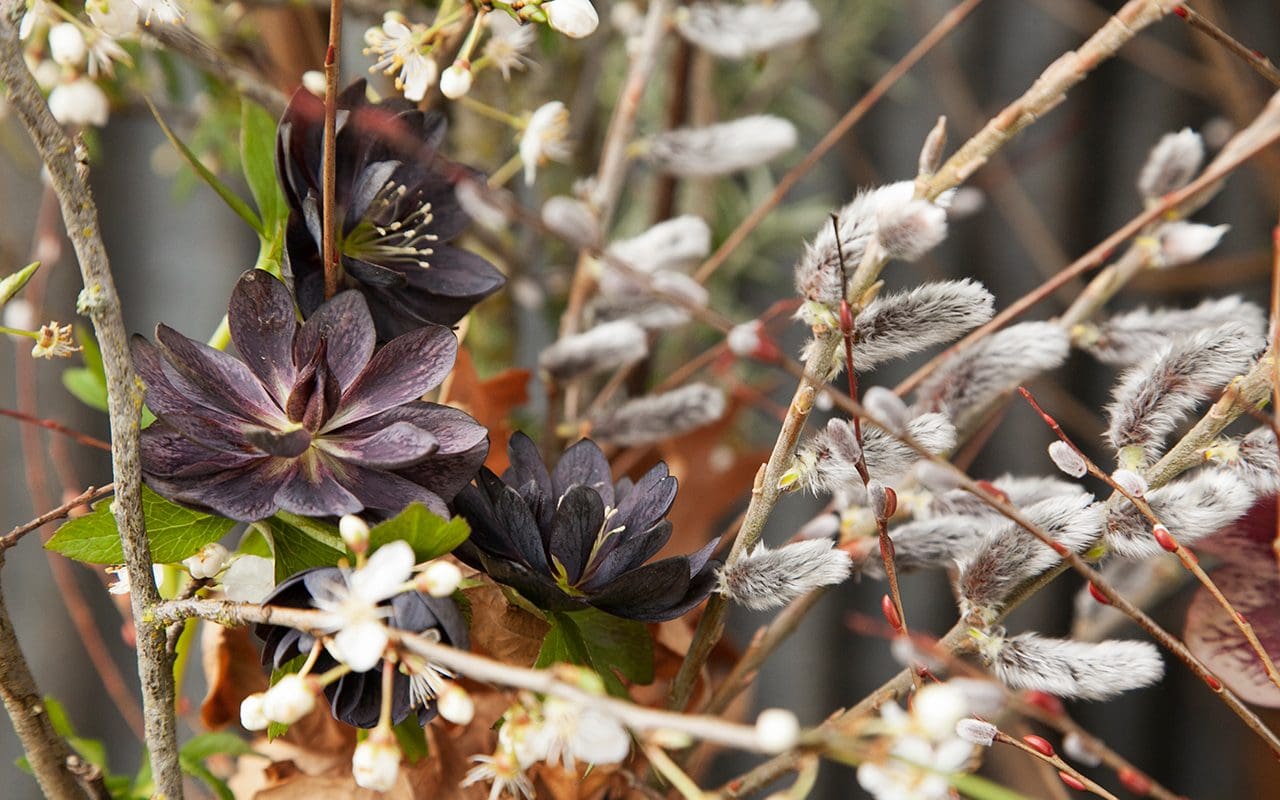
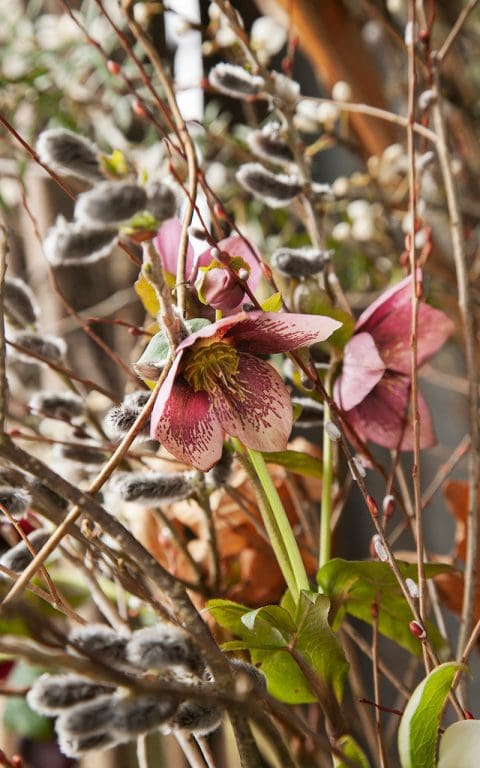
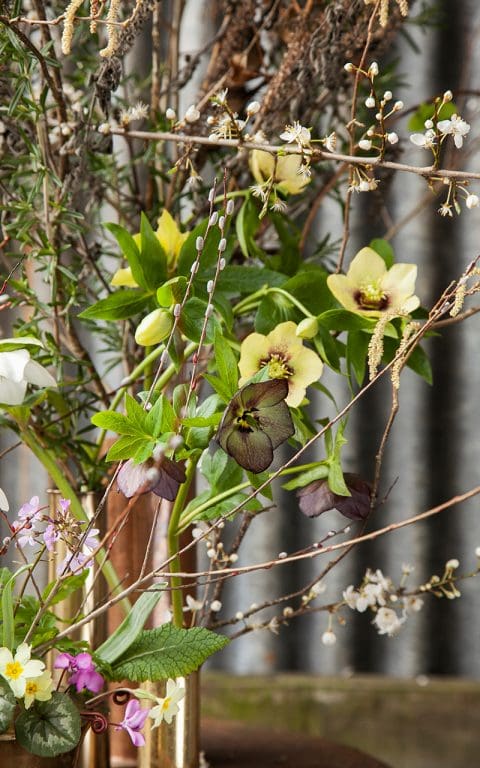
Despite the fact that much of the garden was dormant, Huw cut some beautiful single flowering Prunus from the border hedgerows. These, along with hanging hazel lambs’ tails and a few varieties of silvery, soft catkins formed the base of the shape. I especially loved the snowy delicacy of the Salix purpurea ‘Nancy Saunders’.
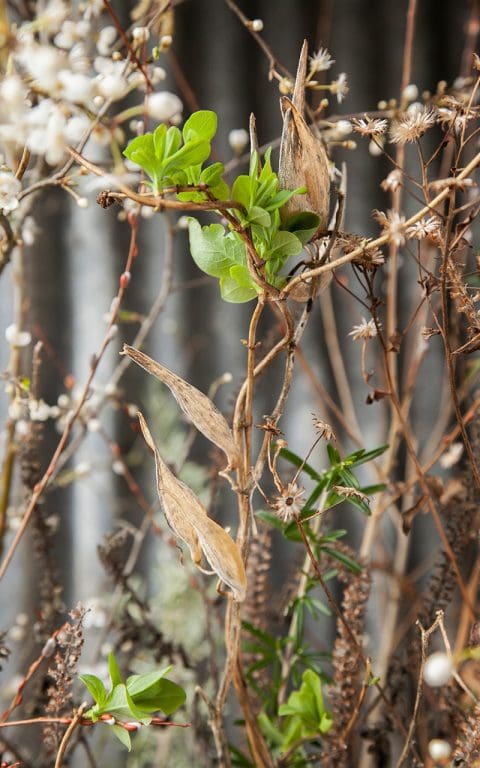
Some tall but delicate stems of rosemary and a twist of honeysuckle coming into leaf added some essential green. These were followed pretty quickly by a frame of dried beauties that Huw had saved for me last autumn – some wonderful silver stars of aster and rusty licorice seedheads. It has been interesting for me to recognise how important the dried elements from the season before have felt every time I’ve come here.
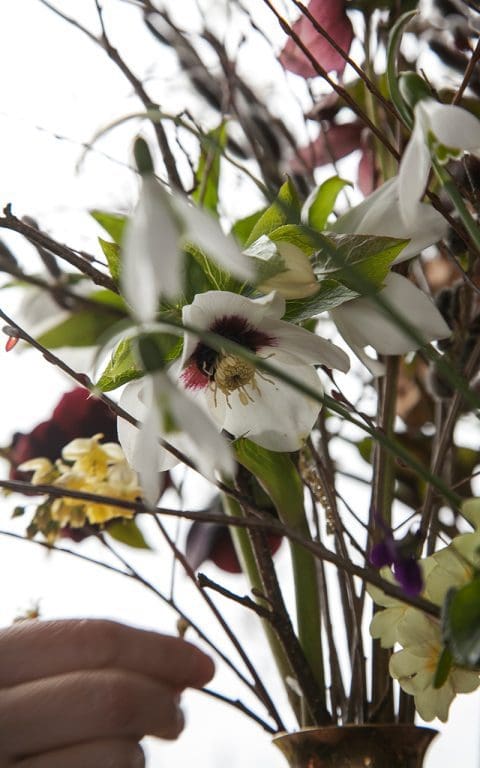
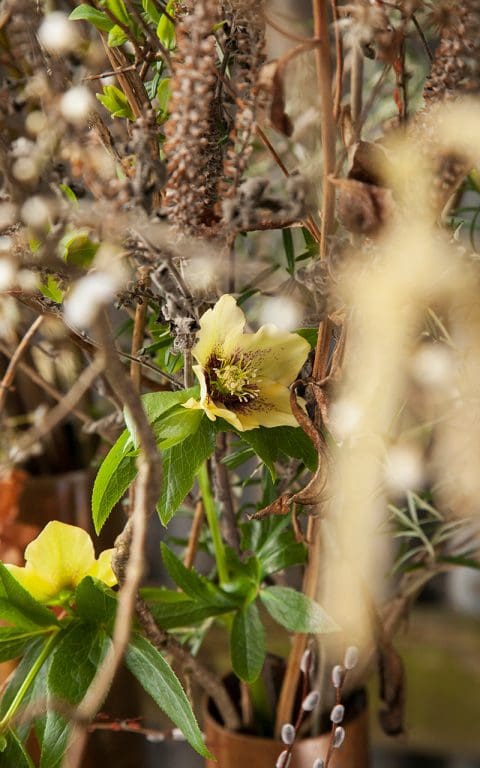
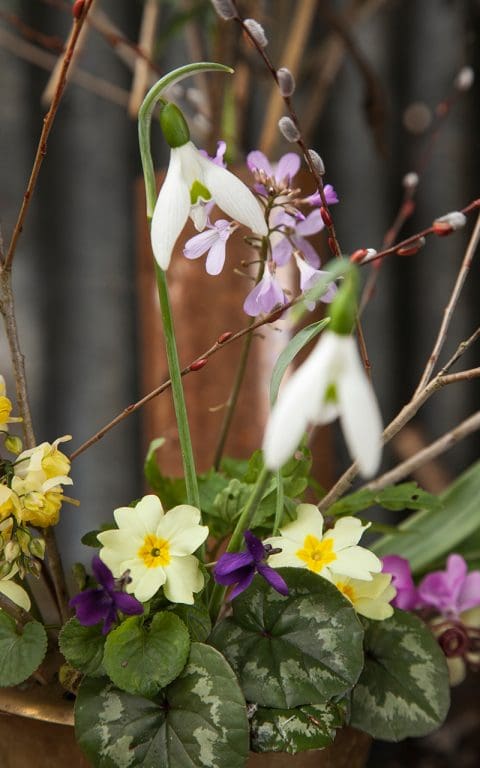
With the taller elements in place, I moved to the flowers below the canopy – a single snip from several varieties of hellebore including a double black that I was particularly taken with. With the winds picking up again, it was time to focus on my favourite low lidded vase at the front. This held a tiny carpet of primroses, snowdrops, Cyclamen coum and a violet complete with leaves.
I had wondered how much of a challenge our winter arrangement would be. It might be that it’s my favourite yet.

Asclepias tuberosa
Cardamine quinquefolia
Corylus avellana
Cyclamen coum
Epimedium x versicolor ‘Sulphureum’
Eurybia x herveyi
Galanthus elwesii ‘Cedric’s Prolific’
Gladiolus papilio ‘Ruby’
Glycyrrhiza yunnanensis
Helleborus hybridus Double black
Helleborus hybridus Single black
Helleborus hybridus Single Dark Pink Spotted
Helleborus hybridus Single Green Picotee Shades Dark Nectaries
Helleborus hybridus Single white dark nectaries
Helleborus hybridus Single yellow spotted dark nectaries
Lonicera periclymenum ‘Graham Thomas’
Primula vulgaris
Prunus cerasifera
Quercus robur
Rosmarinus officinalis
Salix gracilistyla
Salix purpurea ‘Nancy Saunders’
Teucrium hircanicum ‘Paradise Delight’
Verbascum phoenicium ‘Violetta’
Viola odorata
Photographs | Huw Morgan
Published 28 February 2020
We are sorry but the page you are looking for does not exist. You could return to the homepage