ALREADY A PAID SUBSCRIBER? SIGN IN
The Iris unguicularis arrive at precisely the moment it becomes apparent that winter is here to stay. Spearing clear of their strappy foliage whilst the world around them is in retreat, the tightly rolled buds provide untold good feeling. Their intermittence is welcome, the flowers appearing in the mild weeks and not in the cold ones from now until February snowdrops.
Although I have never seen the Algerian iris growing in the wild, I hanker to do so. To follow them one day on a journey through Greece, on into Turkey and all the way through to Tunisia. It would be good to see exactly where they grow in these rocky landscapes and why the best advice in this country is to plant them at the base of a south-facing wall with their backs against the reflected heat and their foliage basking in sunshine. This was exactly how my great friend Geraldine grew them, close to but not in the shade of a twisted fig and with nerines that shared their need for a baking. This was a treasured spot in her garden and I remember her justifying their neglect as she pulled me up a piece one autumn, conjuring, as she did so, their homelands and intolerance of cosseting. No food, no water and certainly no shadow. They prefer, she said, to be growing in rubble.
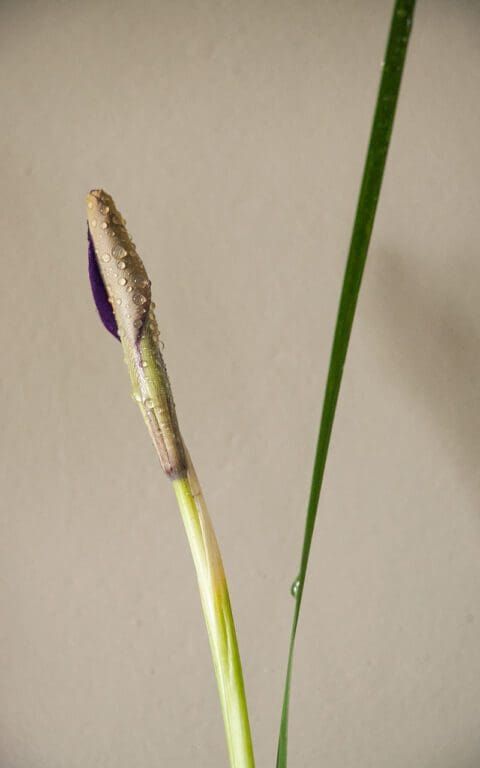
Although I have long since lost the original plant she gave me when I was a teenager, I can see them like yesterday on her kitchen table. Plucked in bud, to get the benefit of a long stalk and savoured expectation, they sat on their own in December and then, as the winter deepened, with witch hazel, pussy willow and wintersweet. The pale buds, with their picotee edging and tease of the sumptuous interiors, unroll in a matter of minutes once brought inside into the warmth. If you are lucky, you will witness the unfurling, but unless you make the time the transformation happens when you have your back turned.
Up close and inside in the warmth, their delicate perfume makes you wonder why they are happy to live with our wet and grey, scowling winters. In the wild, of course, where wet days are reliably followed by a week of bright sunshine, they are forage for bees when little else is blooming.

The plants I have here in Somerset came by way of a gift from the great nurseryman Olivier Filippi. I had been tasked by the National Trust to re-imagine the Delos garden at Sissinghurst and I had gone to see him in France to seek advice about the best plants for the job. The climate near Montpellier could not be more different from Kent, with low rainfall in the winter and months without it during a long summer. The garden alongside the nursery is remarkable and it was here that I came upon the Algerian iris providing their bright wintery flower under pines on the periphery of the garden. It was a surprise to see them out of my imagined context, not amongst rocks, but growing through pine needles so, where we augmented the soil at Sissinghurst with 50% grit, I have experimented with them in a range of conditions, including open shade.
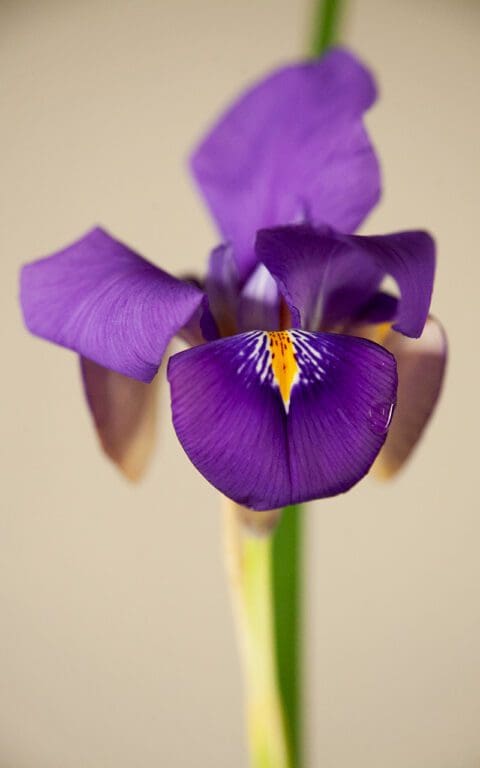
My plants from Olivier are his own selections, a pale mauve-pink called ‘Bleu Clair’ and the much darker ‘Lucien’ which is the bud we plucked today. The old gold reverse gives the merest hint of the darkly rich flowers in the finely drawn edge to the reverse of the petals. More readily available here is a fine form called ‘Walter Butt’, which is truer to the species and the colour of a clear wintery sky. I have this plant at the London studio and plan to bring some here and find it a place nearby so I can enjoy them together.
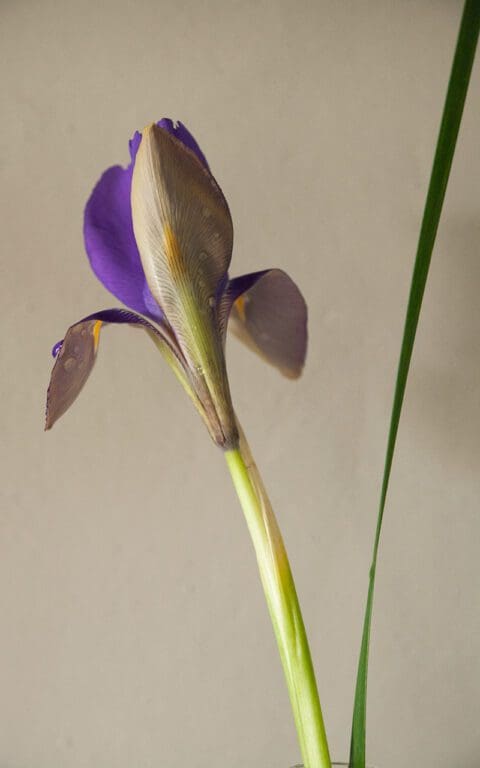
Here, on our hearty loam, I have not been tempted to grow them in anything but full sunshine for fear of our West country wet being their downfall. They are planted in a free-draining position, with plenty of air and paired only with plants that do not smother their growth in summer because their rhizomes need the opportunity to store energy for winter flower. Erigeron karvinskianus and violets make good company. I have also not been tempted to do as the books advise and cut their evergreen leaves in the autumn to reveal the flowers clear of their foliage. Although it is often described as tatty, I like the flowers sitting pure and wild amongst it.
So, here they are on the gravel drive to lighten our daily movements on this well-trodden path. When darkness descends and it is still the afternoon, these small things count.
Words: Dan Pearson | Photographs: Huw Morgan
Published 12 December 2020
It has rained every day but one over the last fortnight. Not just a passing shower, but the whole day, like the ones you remember confining you to the house during the school holidays. The ground is wet, as saturated as it can be, and the stream has been rushing driftwood into dams, scouring the banks and rumbling stones into new places.
I have ventured carefully onto the beds just twice whilst we have been here over the Easter period to pull bittercress and winter-growing speedwells. They have seized the no-go zone and have made growth despite the cold. Hardy celandines have flushed the hedgerows with leaf, but they have not been showing their lacquered petals because the sun has stayed behind cloud. Elsewhere, there is half as much growth as this time last year and I find myself yearning for the chance to fill a jug with spring things, for the excitement of the new.
With the winter refusing to loosen its grip, the pickings have been slim, but this is compounded by the fact that this is a new garden. The tardy spring is a also a clear reminder that when you start from scratch, a garden is a commitment to waiting and though I know it will ease as soon as the weather warms, right now I am feeling the hunger.
I have started a list of early to bloom flowers that I’d like to see more of next year. The garden could take more pulmonarias in several places and in quantity for that early colour, and so that I can lace them with early bulbs. Right now, this is a garden without bulbs, because I like to feel settled for at least a year before introducing a layer that can complicate change if you need to make it early on. We have bulbs in the meadow banks that are slowly establishing, but their absence amongst the new life of the garden is stark. I want to see erythroniums where there will be a little shade, Ipheion where the sun can spring open their flowers and early Corydalis to make their way through the groundcovers as they mesh together.
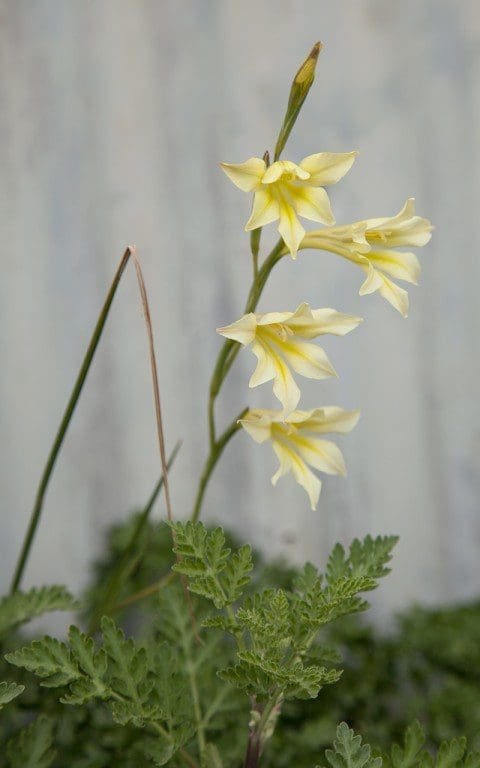 Gladiolus tristis
Up by the house and alongside the barn where we are a couple of years ahead and have already started to introduce the bulb layer, I have planted Crocus speciosus, Nerine bowdenii and Amaryllis belladonna for the autumn, but right now and rising above them all at the other end of winter is Gladiolus tristis. This willowy South African is a week or so later this year, but miraculous enough in its emerging form to stave off my hunger. Awakening from summer dormancy in the autumn, their needle like leaves push through the receding growth of their neighbours to stand tall already through the dark months. Reading will tell you that they need a sheltered spot and yes, I have seen this winter green foliage damaged in a frost pocket, but they have stood unscathed by this year’s winter on our exposed slopes. Literature will also tell you that the Marsh Afrikaner is to be found in wetland areas and on banks above streams in high grassland in the wild, but here free-draining ground and full sun provide their favoured position.
The flowers, which unfold themselves like bony fingers from their slender glove of foliage, are delicately balanced on almost invisible stems. Their necks tilt upward to suspend the flowers as they develop and there is room between each, flushing later in April first green then a luminous primrose to cream as they age. Standing at almost three feet by this point the hooded blooms will catch the slightest breeze to sway, tall and elegantly. At Great Dixter, where I first saw it in the Sunk Garden, I imagine its night perfume would be caught on still air held by the surrounding buildings. Here on our breezy slopes, we have it by the path so that you can dip your nose to the flowers at twilight.
Staking the rangy limbs is necessary if they strain and topple for light, so I like to grow it hard in a bright, airy place to keep strength in the limbs. Staking it once it is grown is almost impossible, however, as its foliage is every bit as delicate as the reeds it resembles and will bend irreparably once it falters. A network of hazel twigs, inserted if you can remember in the autumn, will allow it to grow into position and not to distract from its finely drawn outline. One that in every move of its early awakening will help in staving off the hunger pains brought on by a reluctant spring.
Words: Dan Pearson / Photographs: Huw Morgan
Published 7 April 2018
We are sorry but the page you are looking for does not exist. You could return to the homepage