ALREADY A PAID SUBSCRIBER? SIGN IN
ALREADY A PAID SUBSCRIBER? SIGN IN
ALREADY A PAID SUBSCRIBER? SIGN IN
A chill is in the air. Mist in the valley. The wood tawny and bronzing. This is one of the most beautiful moments in the garden, standing still and voluminous, but beginning the decline. A decline suggests something lost, but the turn from the growing season is anything but. Colour in the grasses, the tail ends of the Verbena ‘Lavender Spires’ smattering violet.
Running in an undercurrent much like the cool air that sits in the hollows, the asters claim this moment. Softly spoken as flowers but enduring, they have been mustering quietly. The feeling of potential they provide is valuable as the summer plants fade around them in August, a month that often feels suspended between two seasons. Energy yet to be spent is good then and this is when the first of the asters begin their relay, one handing over to the next until frost finally does for them in November.
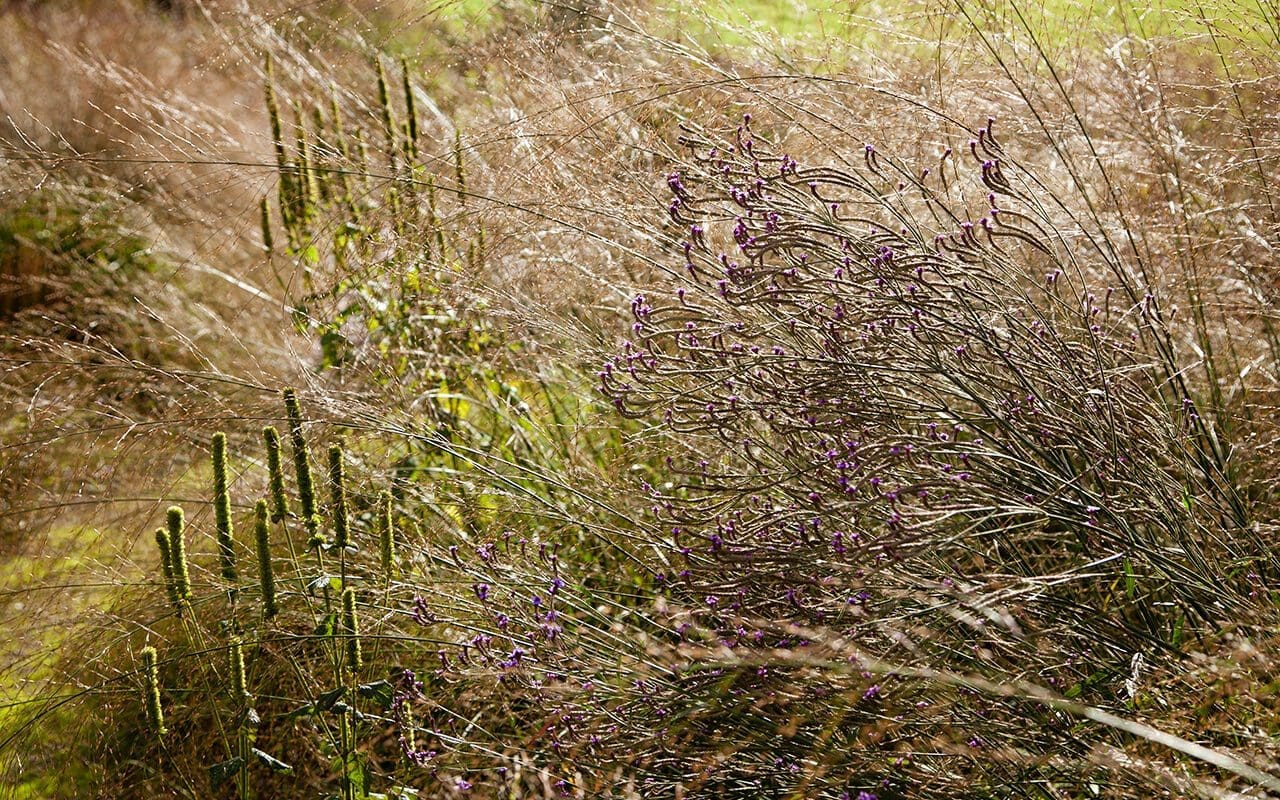
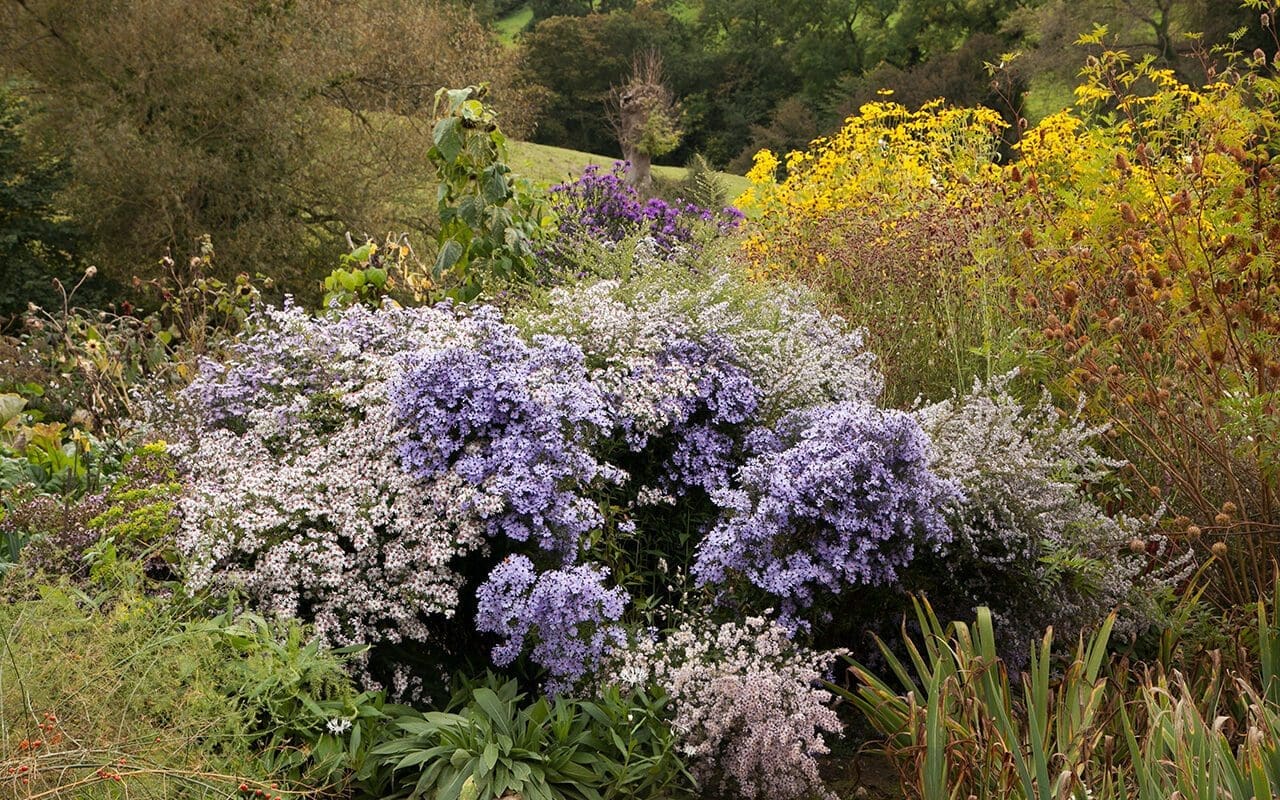
I made a trial of asters before making the garden here, testing a couple of dozen varieties to find the ones that felt ‘wild’ enough in the planting. I was looking for forms that were light on their feet, with air in the sprays and not too heavy with flower. It was also important that they were reliably clump-forming and without the tendency to run so prevalent in many, though I have been prepared to make the exception for Eurybia x herveyi ‘Twilight’. This is one of the earliest to flower here in late July and I always forget then the time I have to spend in March keeping them within bounds. I am probably going to move them to a corner where they can have a space amongst other plants that can deal with their wandering habits. Somewhere that feels akin to their home in Eastern North America, on the edge of woodland and reaching through grasses and scrub towards the light.
Symphyotrichum ‘Photograph’ was moved back into the garden last year from the stock beds, where I had kept the best of those from the original trial not used in the garden to further get to know them. A stock bed is a wonderful luxury. It is a practical place where one of each plant sits cheek by jowl with an unlikely neighbour and can be observed more closely than in the mind’s eye. It was this time last year when we felt we needed a lift amongst the Molinia ‘Transparent’ in the lower part of the garden. We picked a number of sprays from the stock plant and set them there to see how they felt. Then four canes were pushed into the beds with a label to remind me on the other side of winter what they were for. In March, after the garden was cleared, the original stock plant was split into four in text-book fashion with two forks placed back to back and levered apart to quarter the clump.
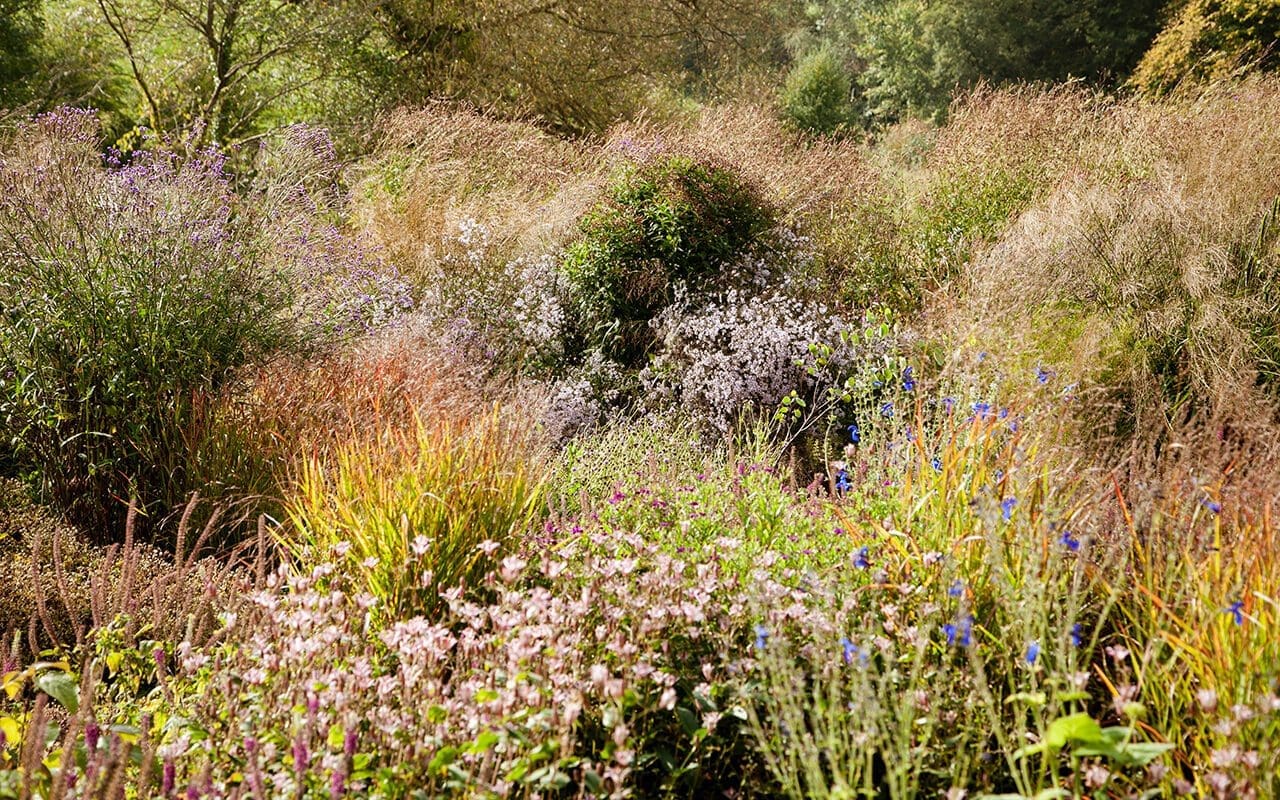
Symphyotrichum cordifolium, the Heartleaf Aster or Common Blue Wood Aster, is the parent of several good plants; ‘Chieftain’, ‘Little Carlow’ and ‘Primrose Path’ to name three in my original trial. The first two were rejected because they were too dense in flower and too showy. ‘Primrose Path’, which is lighter in feeling, made it briefly into the garden, until the fact that it was a seeder looked like it might become a problem.
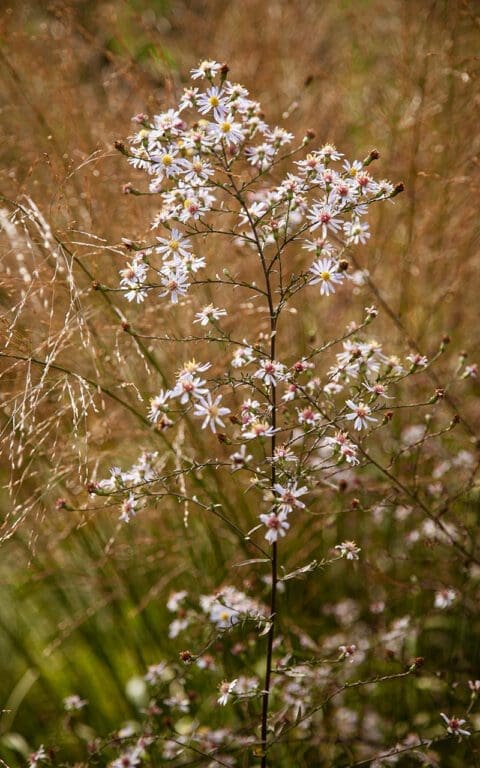
‘Photograph’, a 1920’s S. cordifolium hybrid raised by Ernest Ballard, is tall at 1.2 m and needs a little staking if you do not have the room to let it sprawl. A Chelsea Chop in mid-May to reduce it to knee height encourages branching and curbs the tendency to lean. We have found it the room is has been waiting for, the benefit of patience and observation allowing it the opportunity to light up the molinia at this tail end of the season. Arching with the sweep of the grasses, the constellations of just-violet flower are alive with pollinators and capture the low October light to illuminate a garden that is on the wane. Falling away yes, but far from yet spent.
Post Script:
Asters, lamentably, have been reclassified and renamed in recent years. Retain the original name in your mind and forgive the awkwardness of the new names – Symphyotrichum, Eurybia, Doellingeria – which capture (to the non-botanist’s mind) nothing of the magic and rightness of Aster, which means ‘star’.
Words: Dan Pearson | Photographs: Huw Morgan
Published 23 October 2021
Autumn came early this year and before the month of August was out. Refusing to go inside until bed time, we’ve been huddled in blankets, wondering if it is also too cold for the courgettes to throw one last crop and whether the tomatoes in the polytunnel will be more green than red now the evenings are shortening.
We have taken two weeks off to harvest. The last of August and this first week of the golden month. Timed perfectly to not miss the plums that escaped our late spring frosts, as those that did set fruit have been plentiful. ‘Warwickshire Drooper’, appropriately weighting the branches and a fine crop of damsons. Inky ‘Merryweather’ and ‘Shropshire Prune’, the smaller and ‘wilder’ of the two. The pears decided to drop in sequence, one fruit first, to warn you of the coming deluge and then suddenly, everything all on the ground. Get there on the day after the scout that fell and a quarter turn will yield the ripe ones the day before they drop and bruise. ‘Beth’ with her must-eat-immediately creaminess comes first and then ‘Williams’. Firm and then, when just perfect, melting. Countless numbers from the espaliers and fortunately a pause now before ‘Beurre Hardy’ and then a longer wait for the October ‘Doyenne du Comice’, the finest of all and the grand finale here.
The kitchen garden is now in its fifth summer and we have an embarrassment of riches. What to do with such plenty ? In times gone by we would have pulled together to bring in the fruits of the growing season, but in this unusual year, we are missing the many hands and accompanying banter of sharing this time picking and the community effort of preparing and preserving.
To stop and put aside the feeling of guilt that some of your efforts will inevitably go to waste is part of letting the autumn happen. Nothing really does get squandered and we have learned to step back at a certain point and try to take things in. The surfeit of pears and apples that lie strewn in the grass will not have time to moulder before the birds and the critters have them. You need to make time to take these moments in.
This is what this week’s mantlepiece is about. The beginnings of a winding down that will surely leave the growing season behind. Slowed, but far from static, the garden has plenty yet to give. Tagetes and morning glories arguably better than ever in the soft days. There are the autumn performers too, the flowers that are here to complement the senescence. Dahlias and cyclamen, schizostylis and amaranthus designed for now and making September their own. The last push of roses and a final flurry of clematis, surrounded already with a gathering backdrop of silken seed and the rewards of a growing season coming to a close.
Words: Dan Pearson | Photographs: Huw Morgan
Published 5 September 2020
Huw Morgan | 31 October 2019
It is almost three months since Flora first came to Hillside to work with material taken from the garden here. That summer visit was an introductory and learning experience for us both. Flora’s first time in the garden here, time needed to get to know the garden, time to find a setting to shoot in, the challenges of working outside and to be photographed in process when she is usually unseen, off stage. For me there was the self-imposed pressure to do Flora’s art justice in my photographs and to capture those moments of consideration, reflection, decisiveness, choice, care, which I was witness to as she worked.
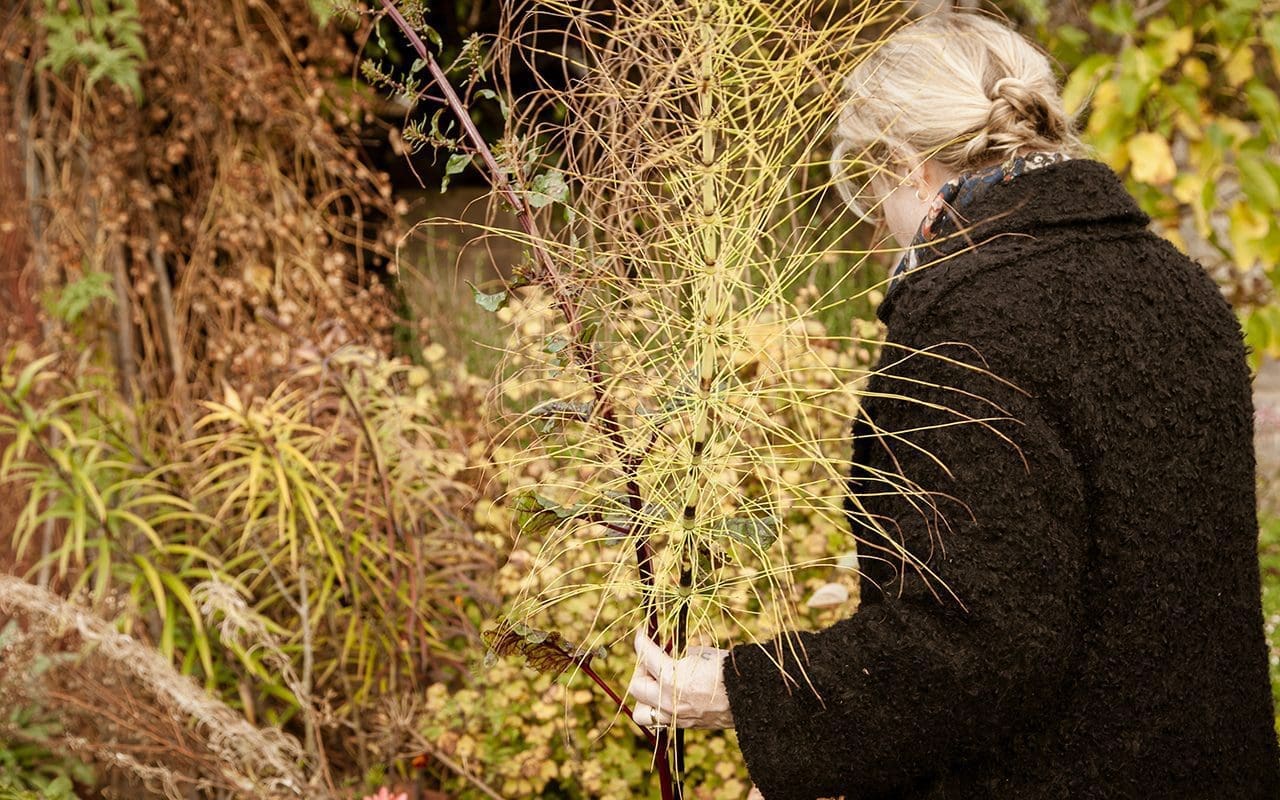
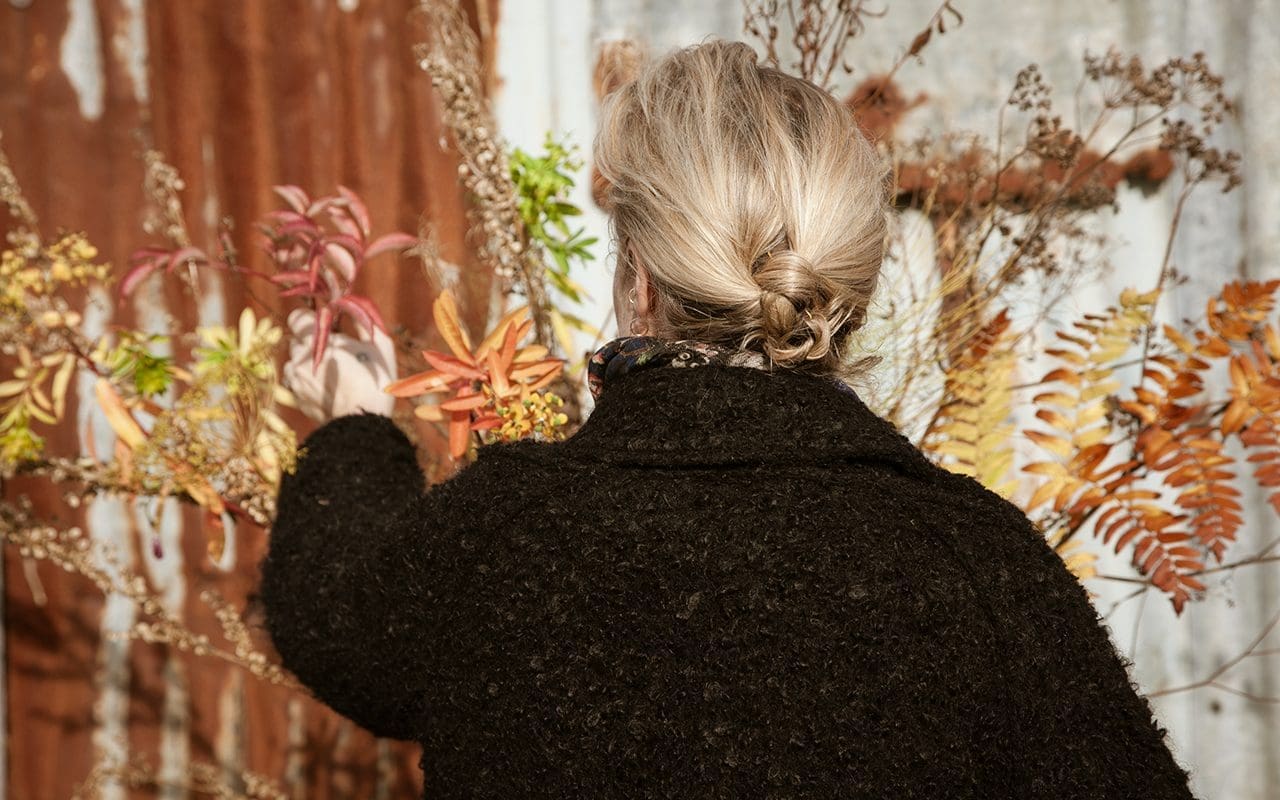
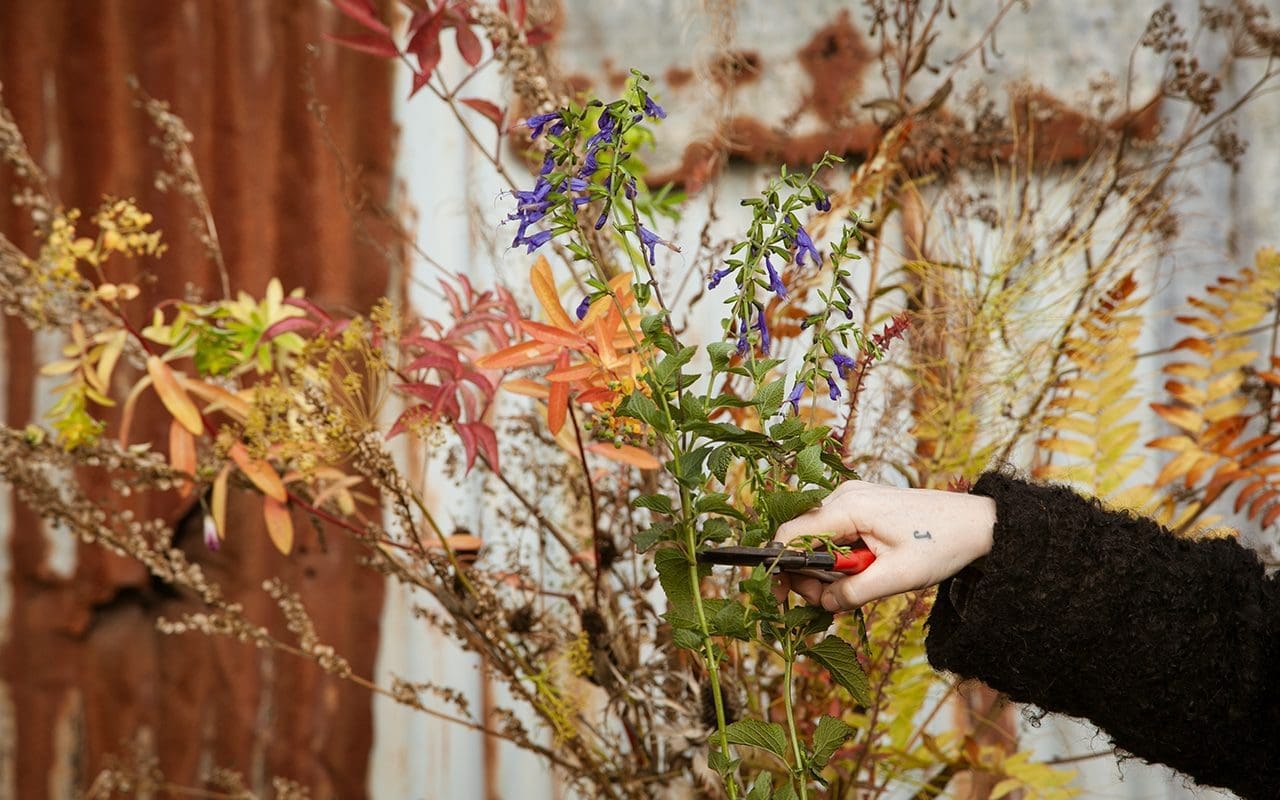
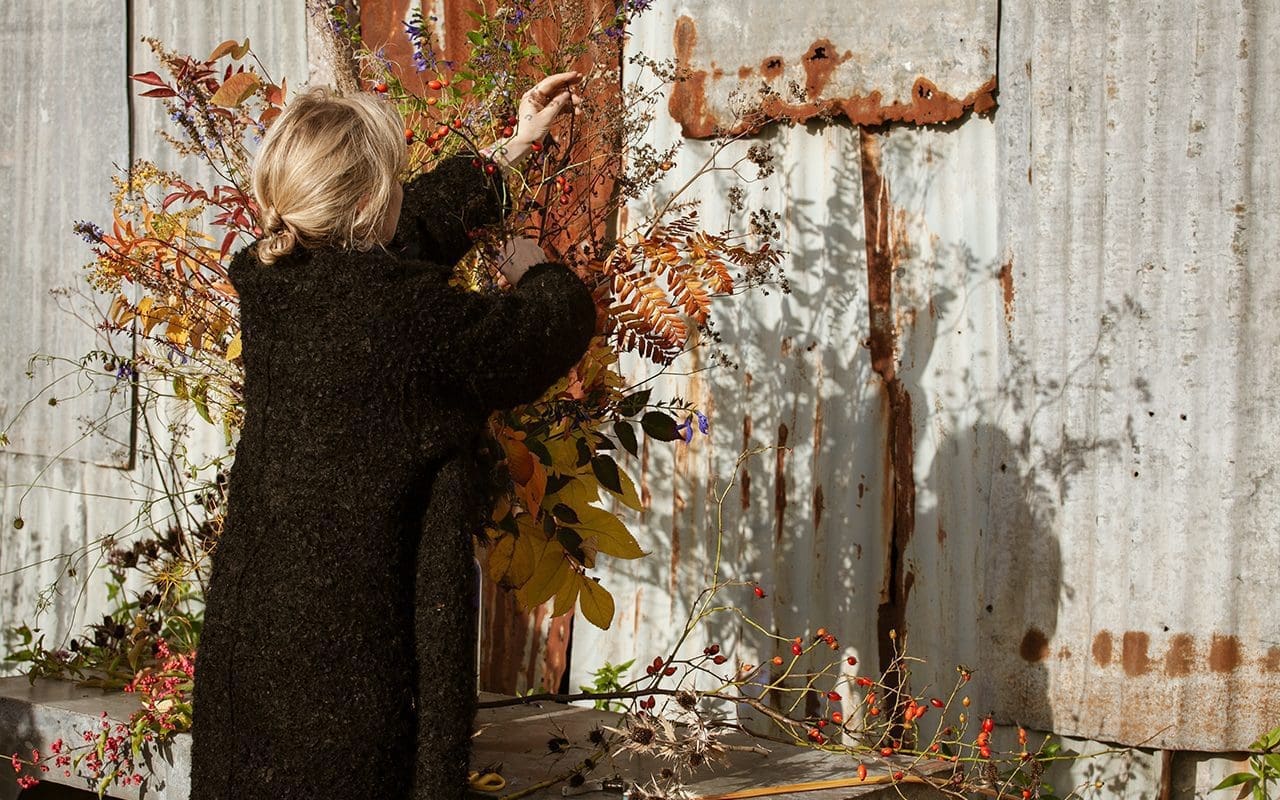
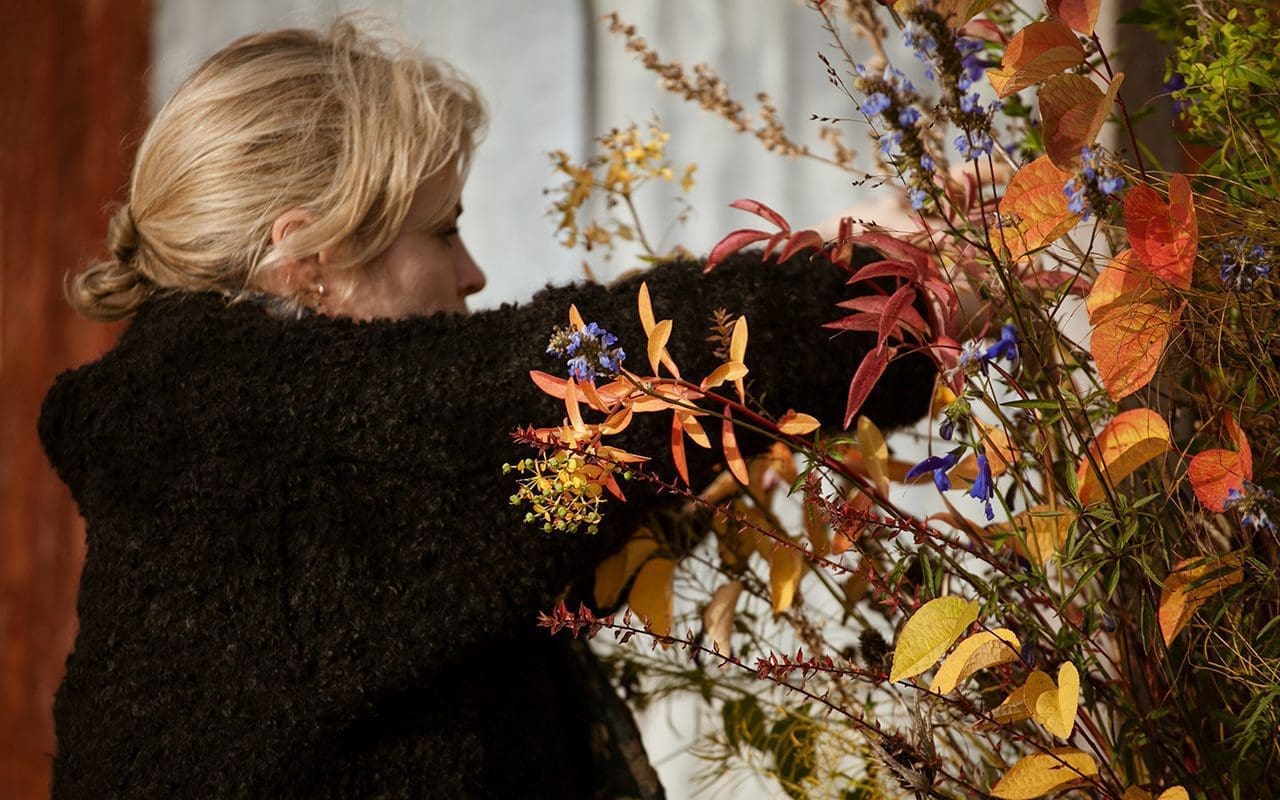
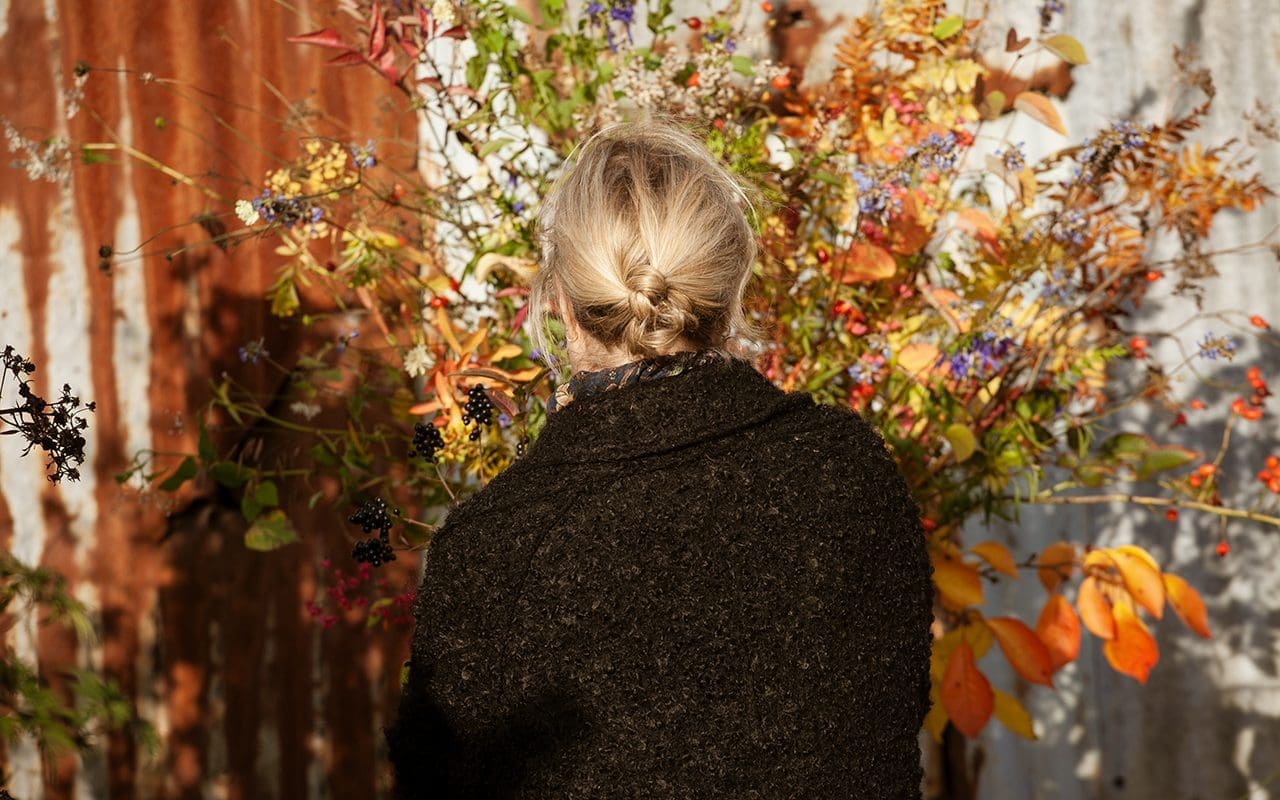
As she worked this time I started to notice the ways in which Flora relates physically to the space in which the flower arrangement was being made. Standing with her back to me I could tell that she was judging, evaluating, balancing, deciding, framing, all of which could be read from the set of her jaw or the angle of a shoulder. The delicacy with which she would select a stem, find a location for it, and then gently and firmly aid and guide it into position. The final stroking of the plant to allow it to fall naturally and also the sensual pleasure of engaging with plants this intimately.
It reminded me of something Midori, the head gardener at Tokachi Millennium Forest said to us when she was staying here early last autumn, which is that the last flower arrangements of the year should be relished as they are the last opportunity for ‘touching green’ before the winter comes.
Flora Starkey | 1 November 2019
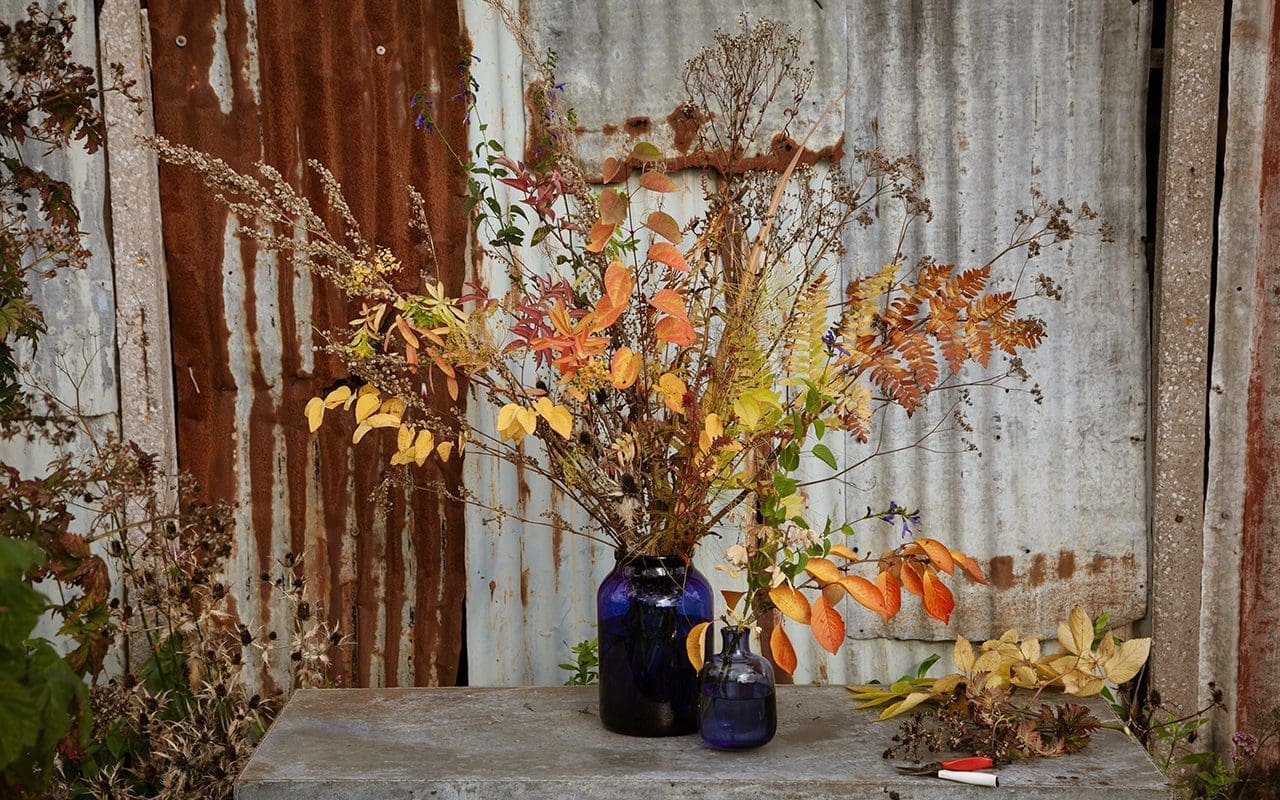
The last time I came to Hillside, Summer was making way for Autumn. This visit Autumn is peaking and the gardens are more subdued, but no less splendid.
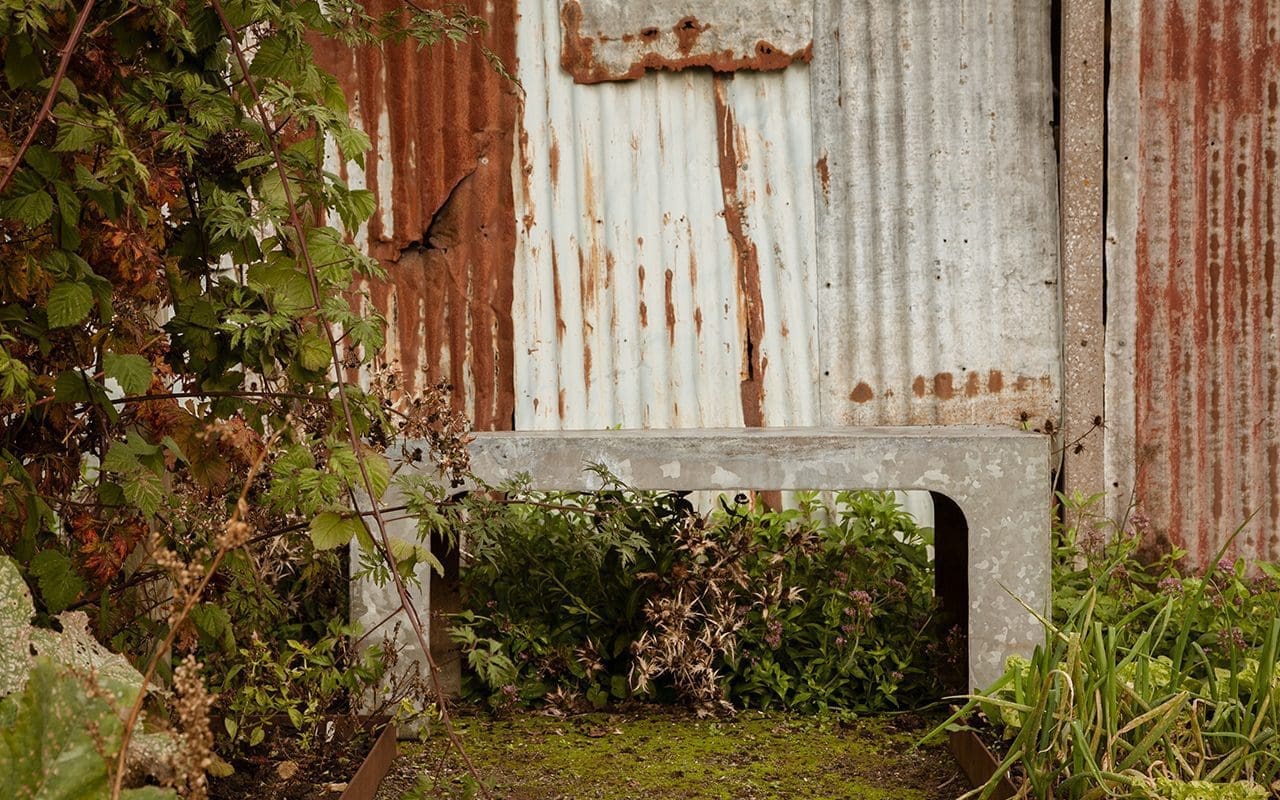
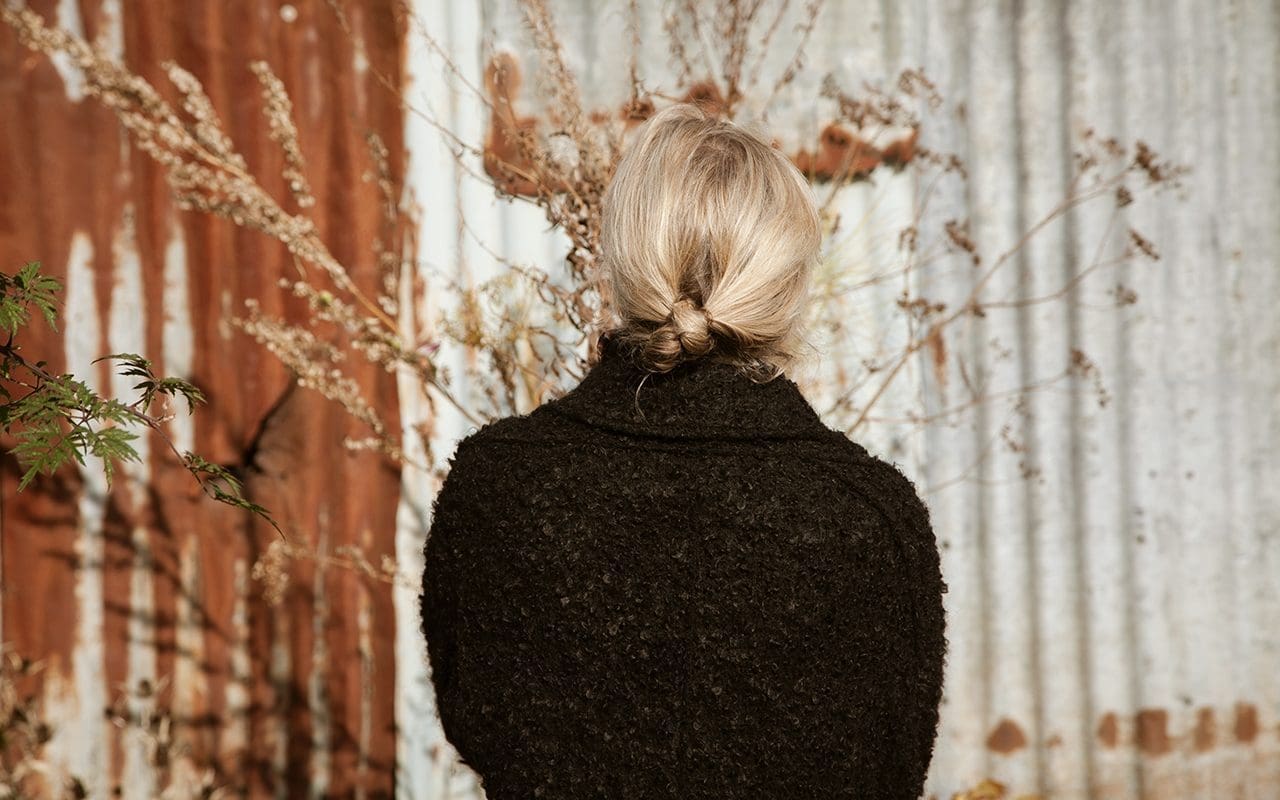
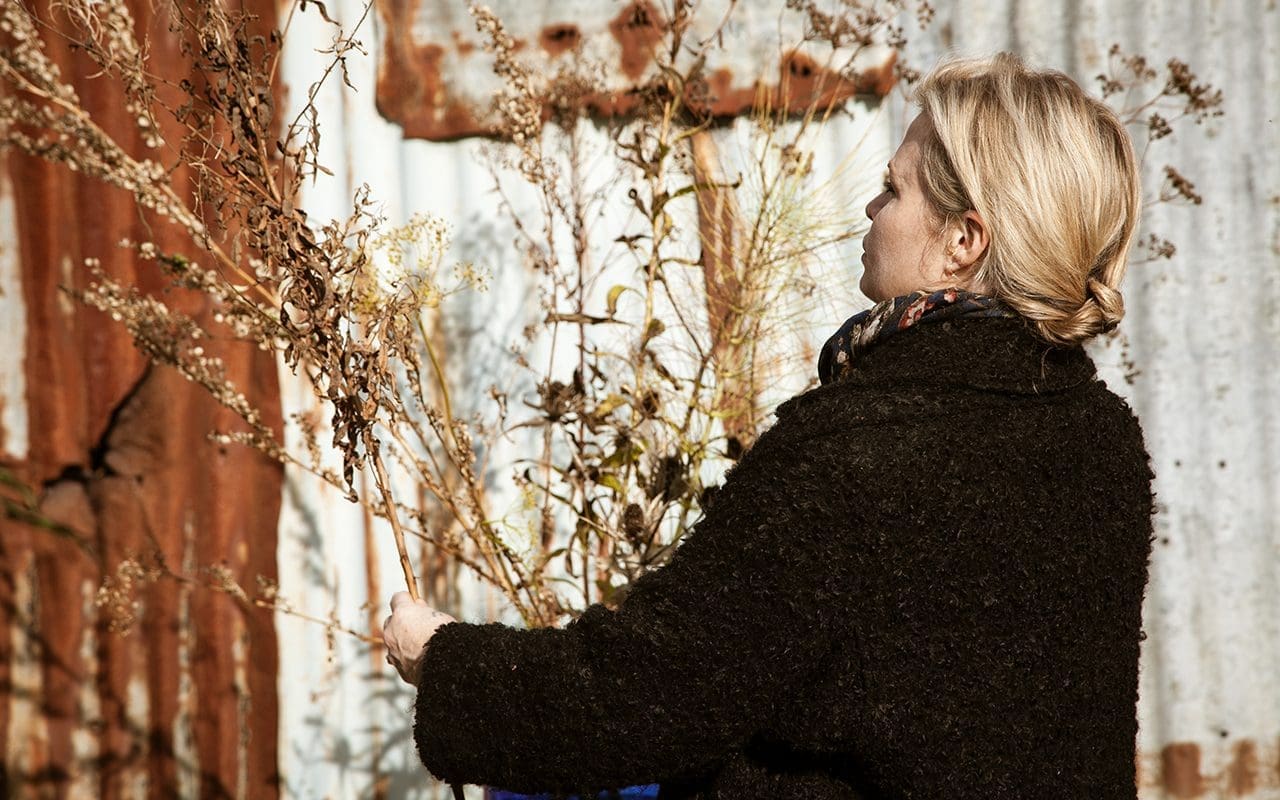
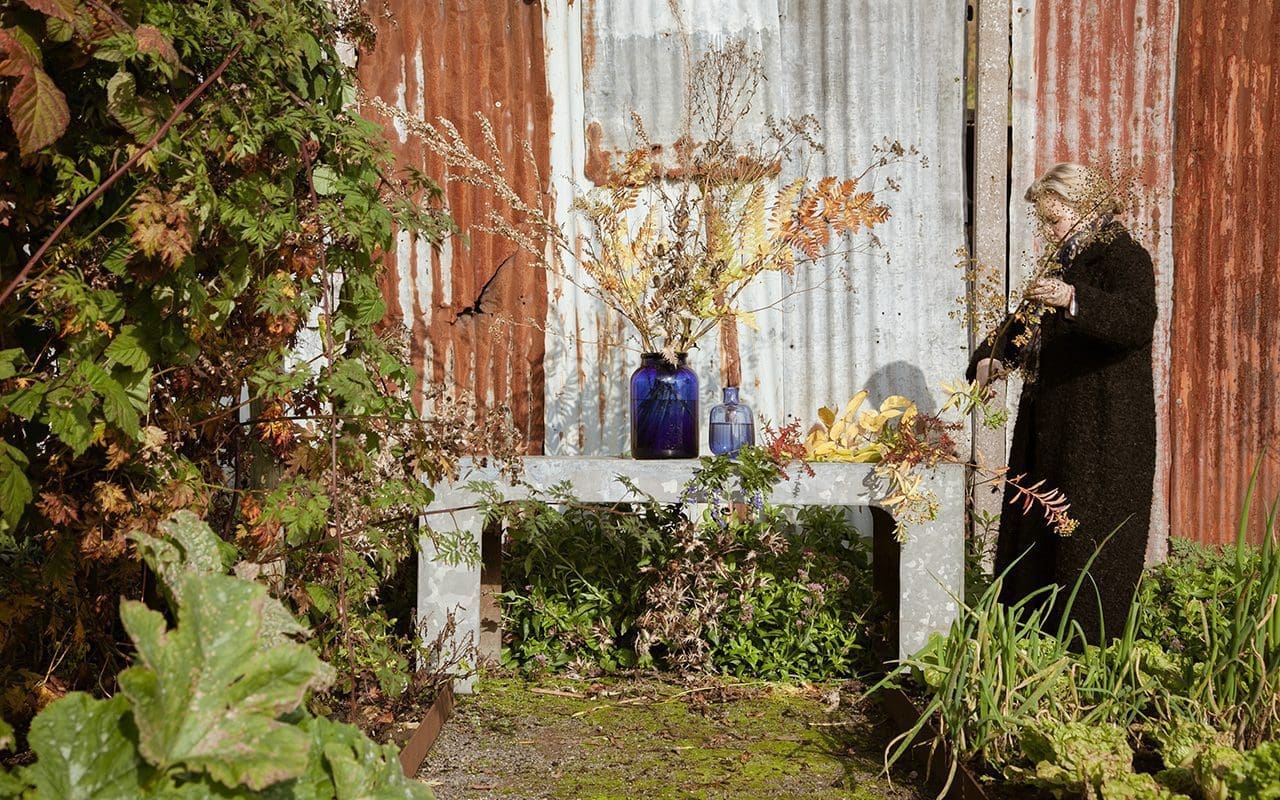
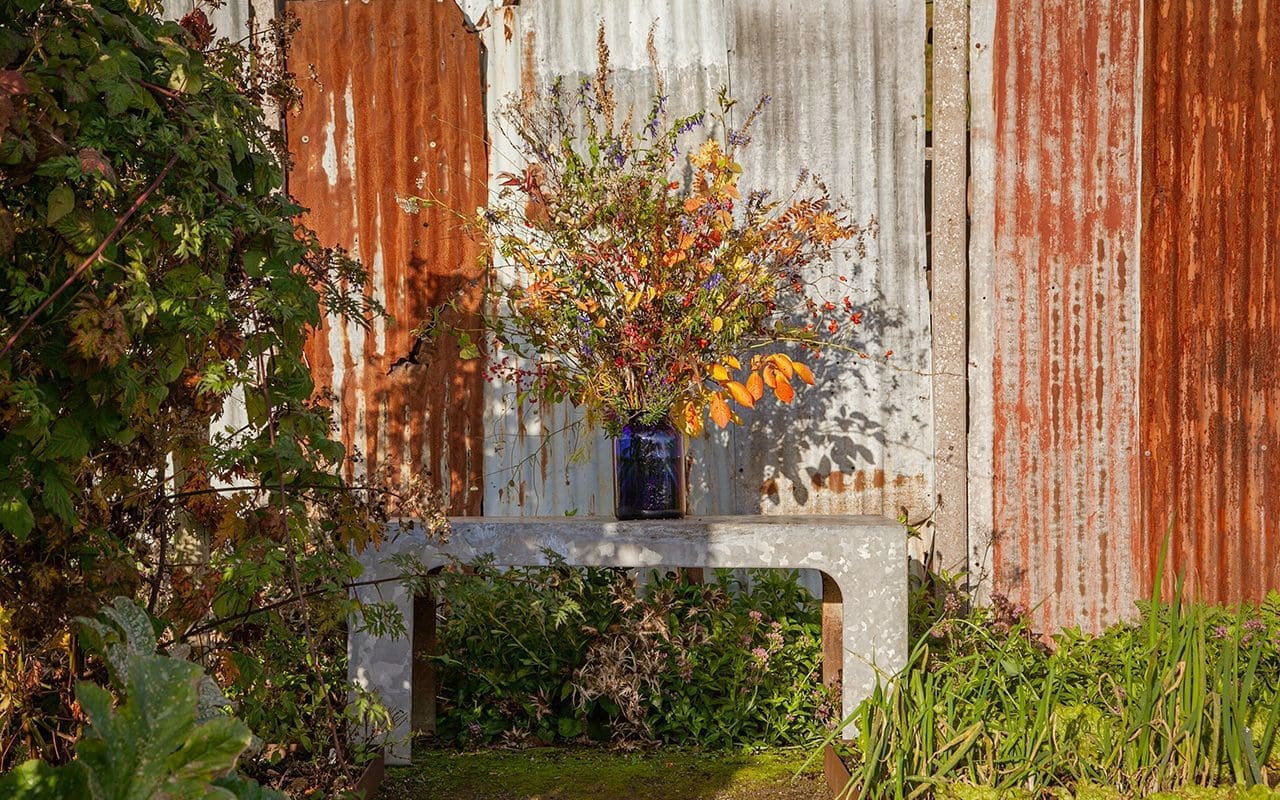
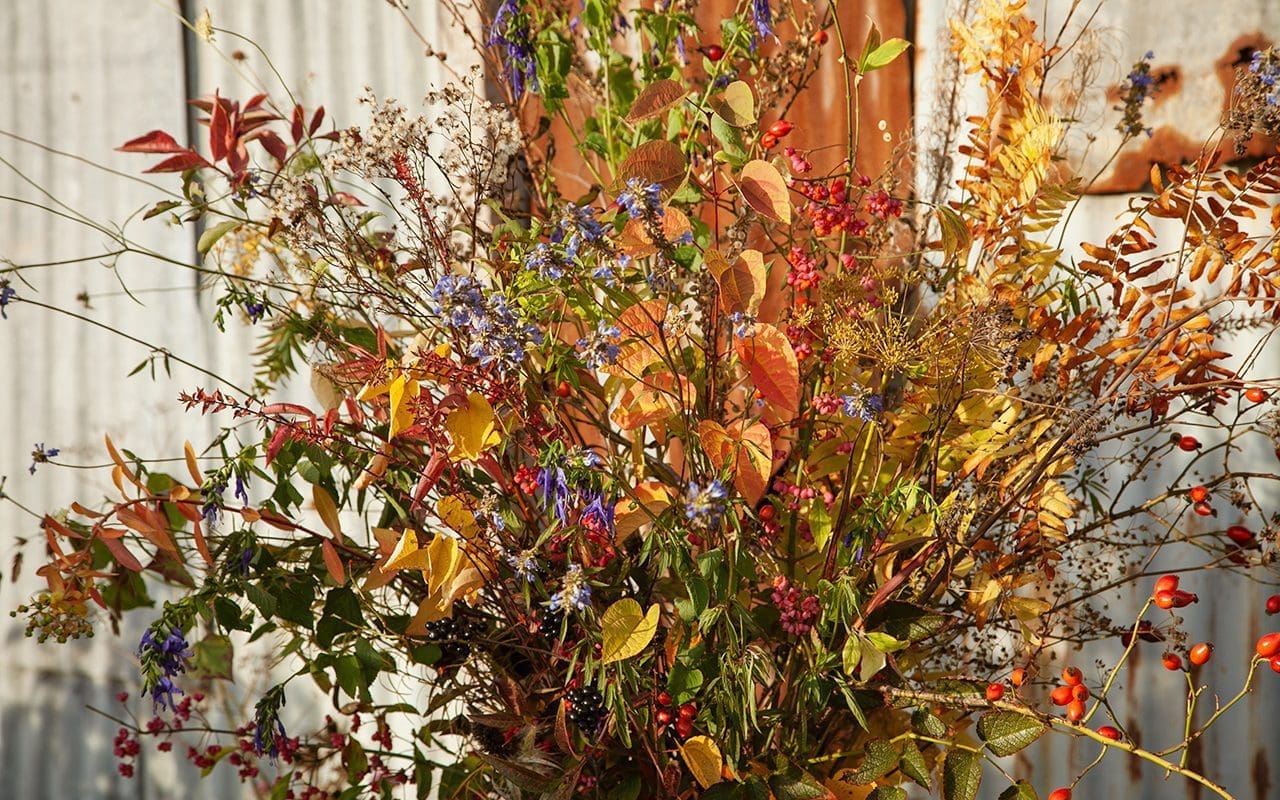
We decided to shoot in the same location as before, in front of the beautifully rusted corrugated iron barn. I’m interested to see how the four images will sit together by the end of the year and like the idea of them being in the same place.
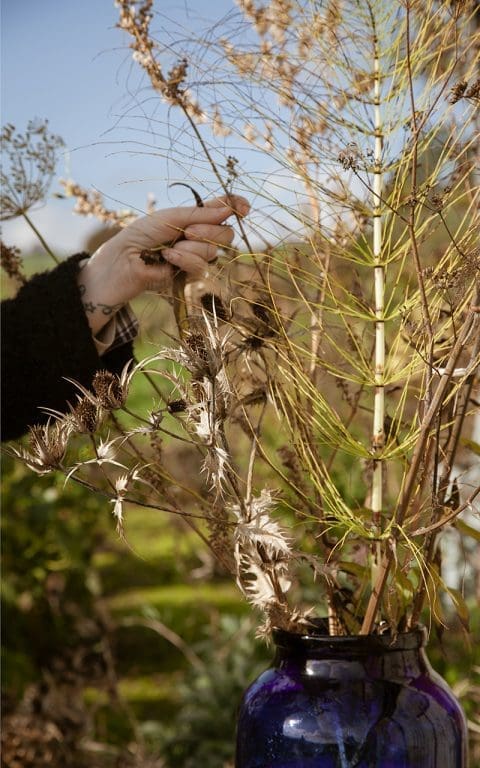
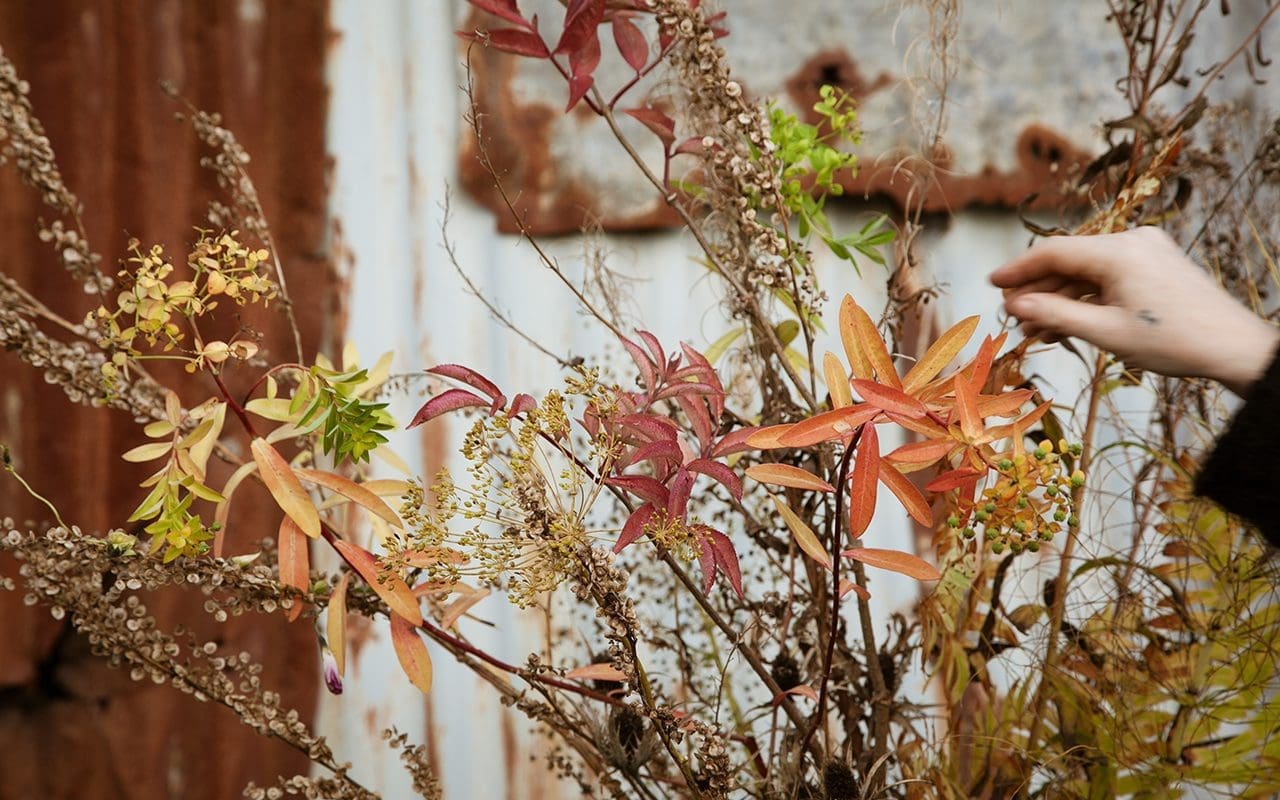
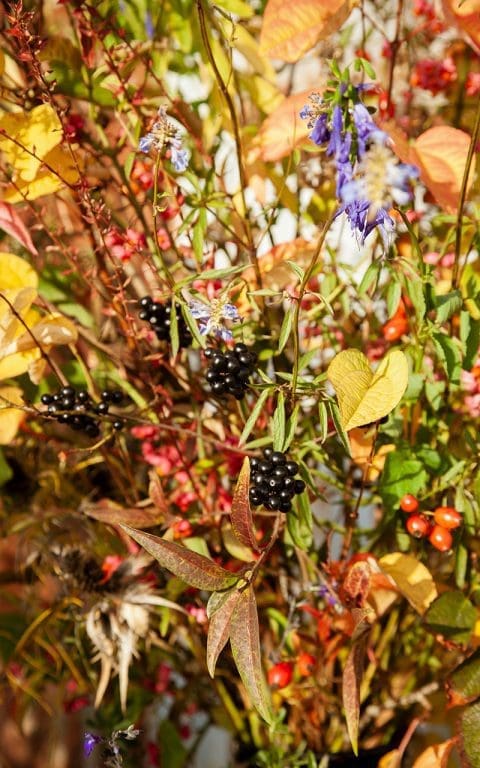
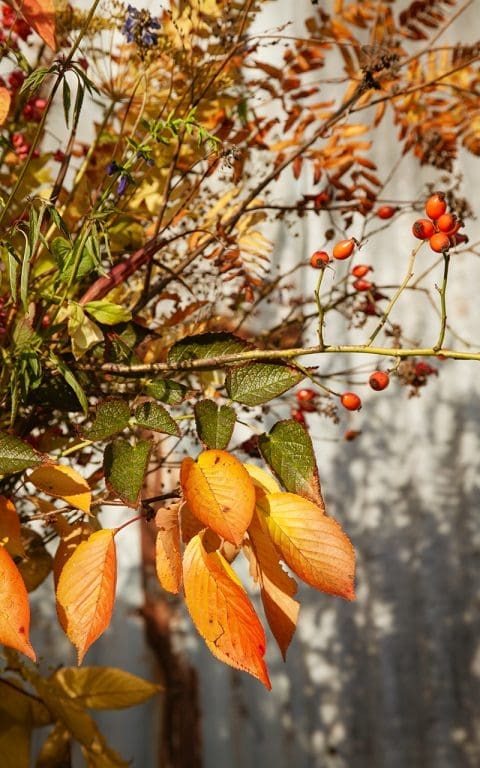
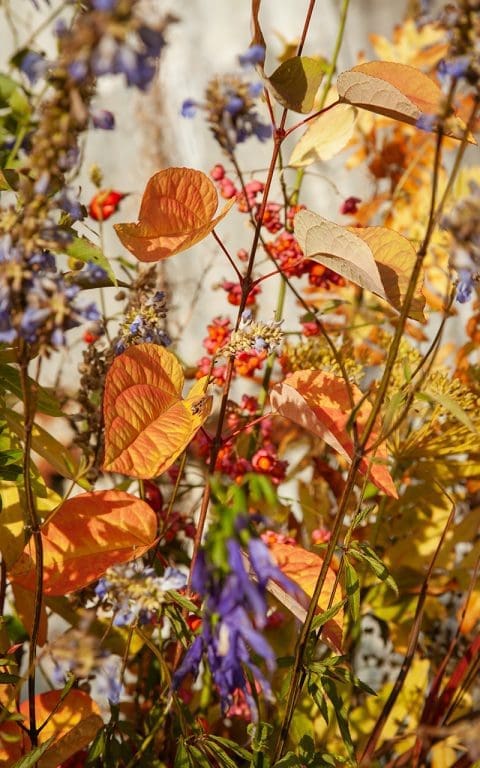
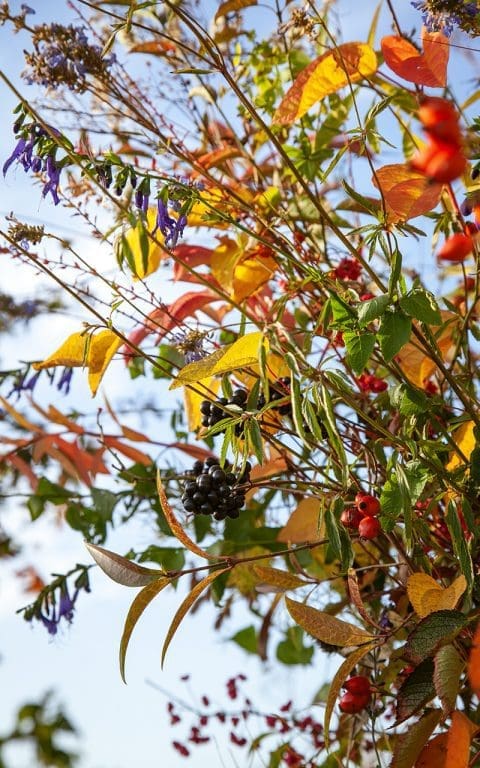
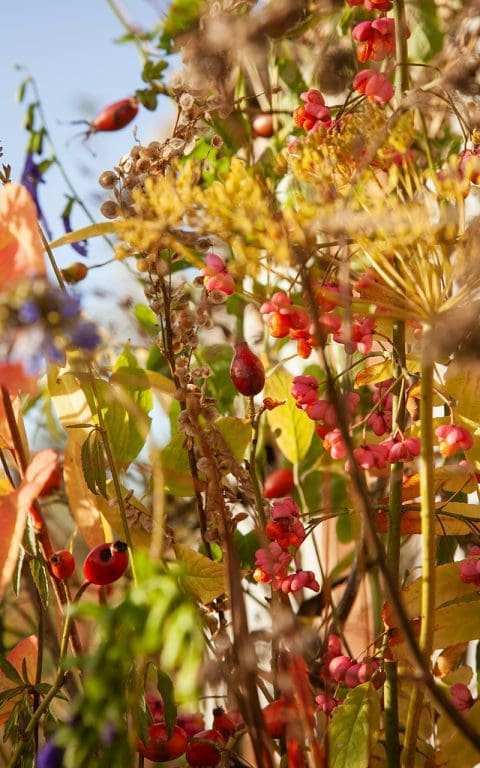
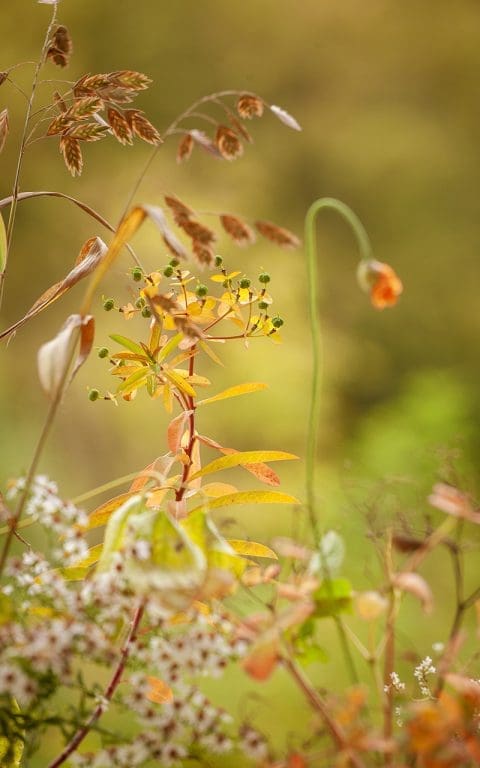
As before, we cut sparingly – no more than a few stems from each plant. This time I chose a lot of dried structure – dill, red orache, fluffy willow herb and a stem of Thalictrum ‘White Splendide’ with its delicate mottled yellow leaves. And of course, some essential autumnal colour in the form of Euphorbia cornigera and a snipping from the fiery Prunus x yedoensis.
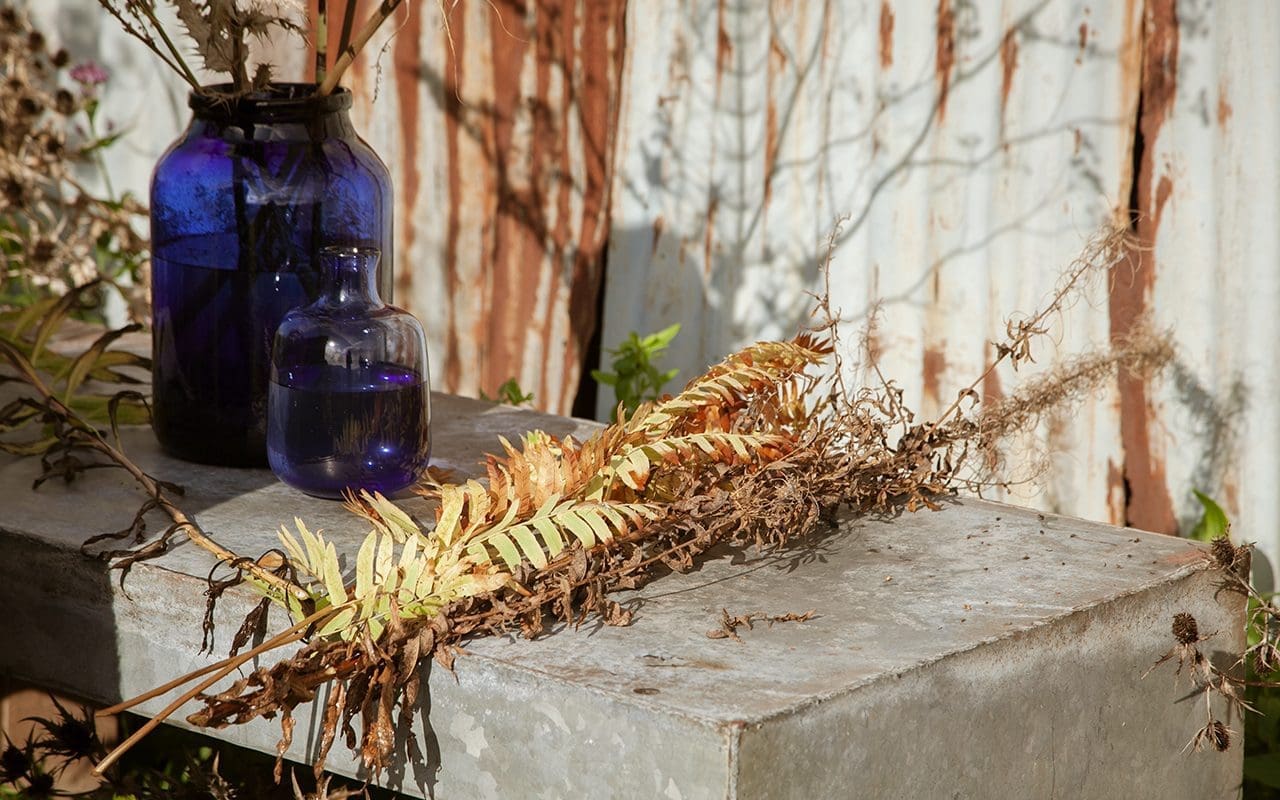
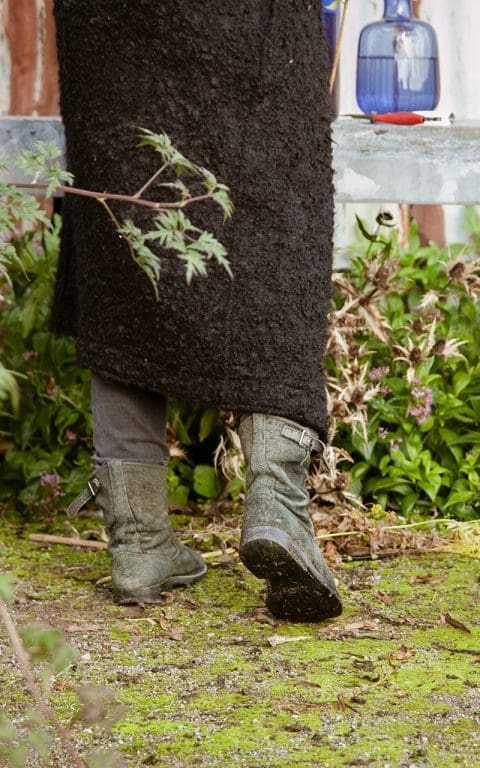
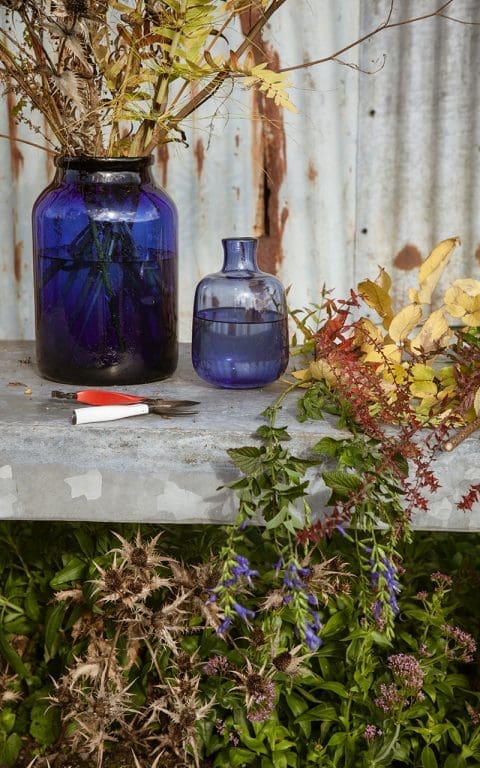
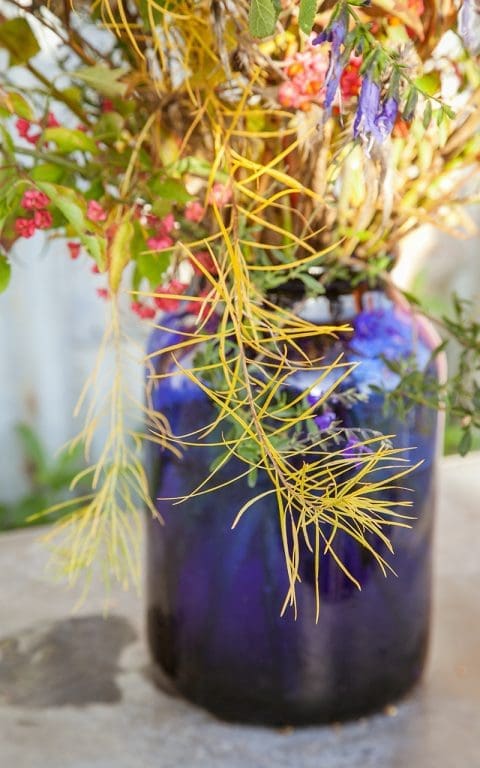
Moving back to the barn, we pick some blue glass jars from the house & get to work. The space will always dictate the arrangement in terms of scale and the zinc table outside calls for size, not least because of the October wind.
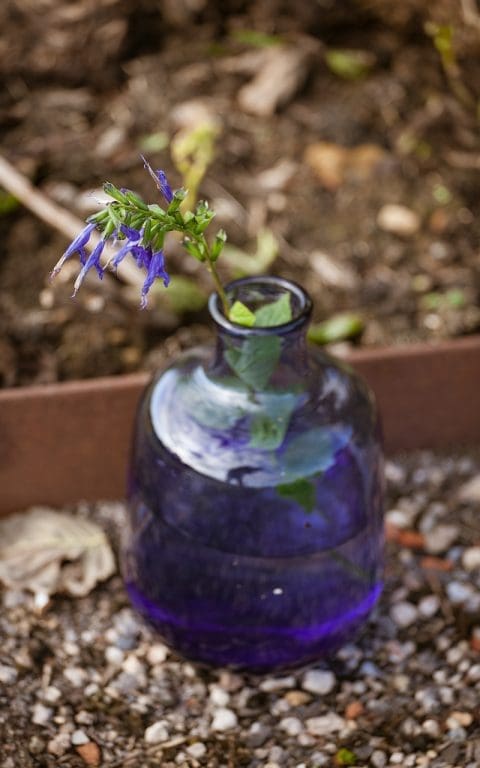
The tall dried pieces were placed first creating the framework, a beautiful Aster umbellatus towering over the others. A few leaves of royal fern quickly followed, adding a myriad of colours in each stem. I carried on building the colour with warm tones before offsetting with the deep blues and violets of a few varieties of salvia.
Even though the stems keep get buffeted by the wind and moving around, I like this way of working. It’s spontaneous & can’t be too precious. After a while, I feel like we’re missing some pops of brighter colour and go foraging for rosehips, finding some spindleberry on the way.
As these are more structural branches, I end up taking the arrangement apart & starting again, adding these elements earlier. Some of the salvia had also started to wilt by the time we got back so we cut a little more. If I were to use this again, I’d try & sear it to make it last longer. I finish with a curling tail of yellow amsonia, a shock of pale yellow scabious and some shiny black berries of wild privet.
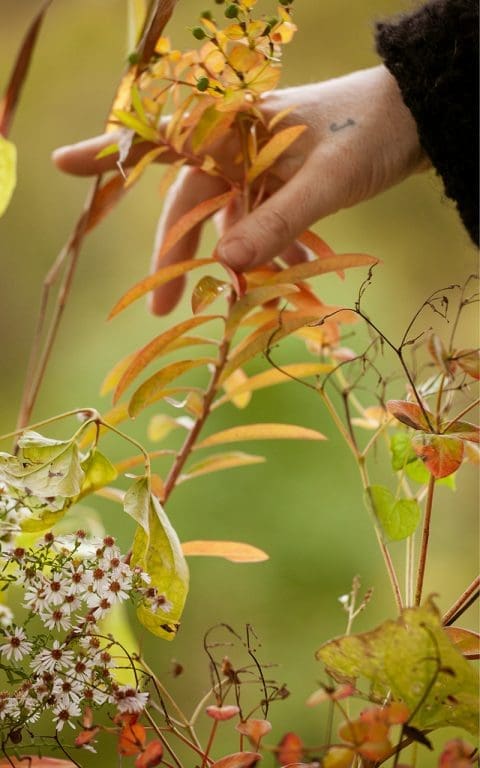
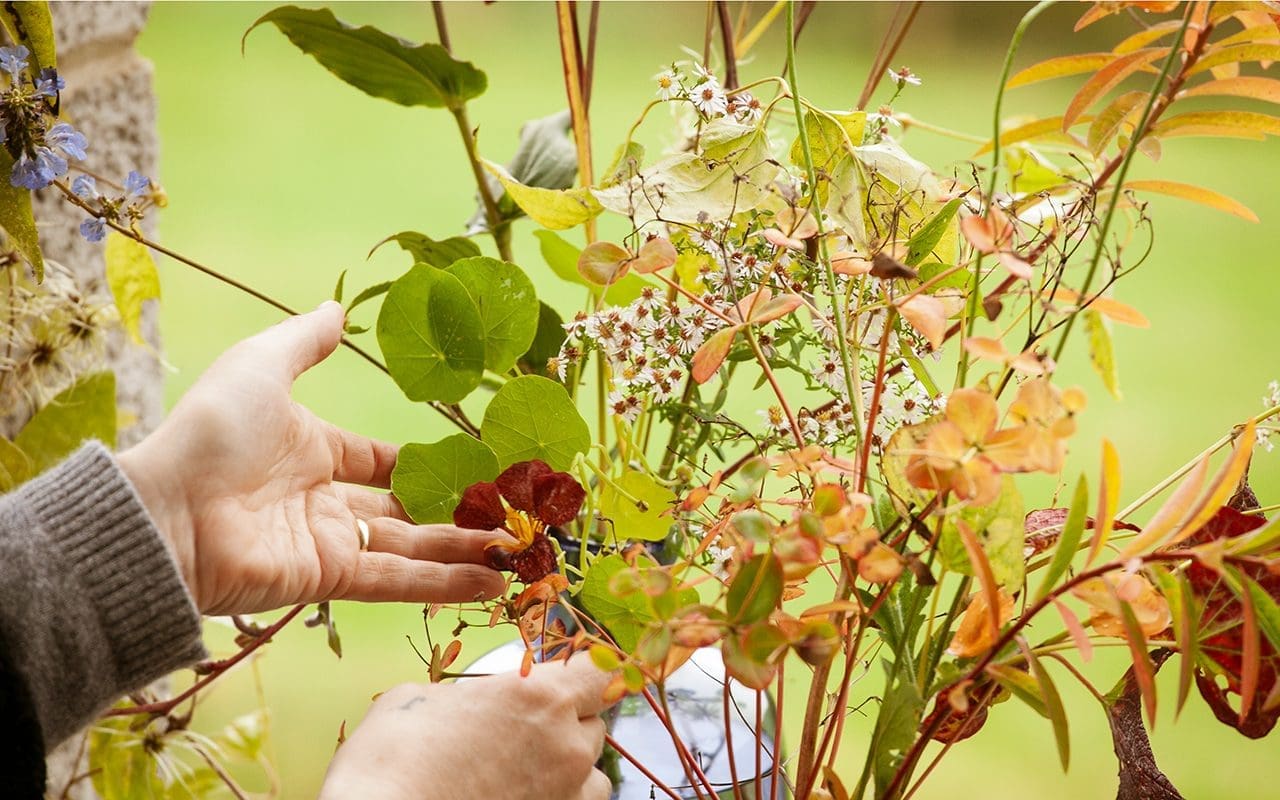
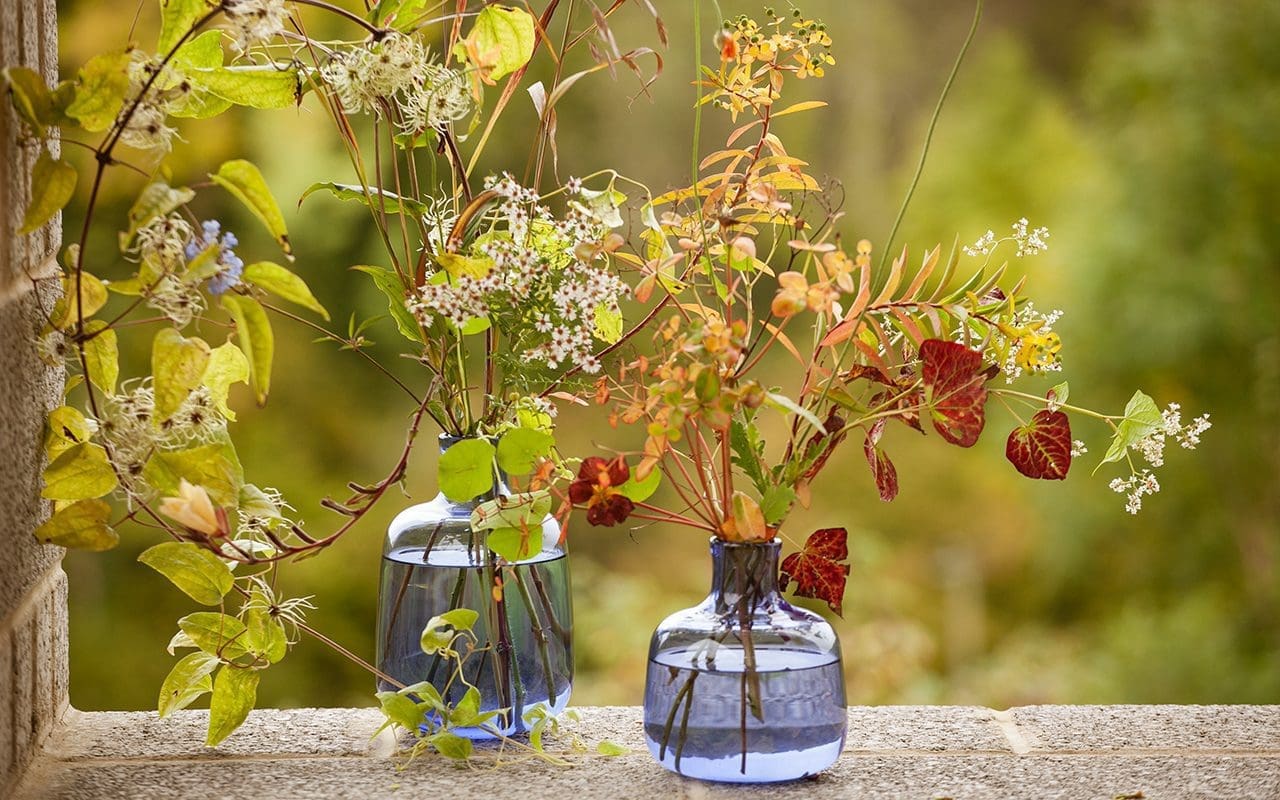
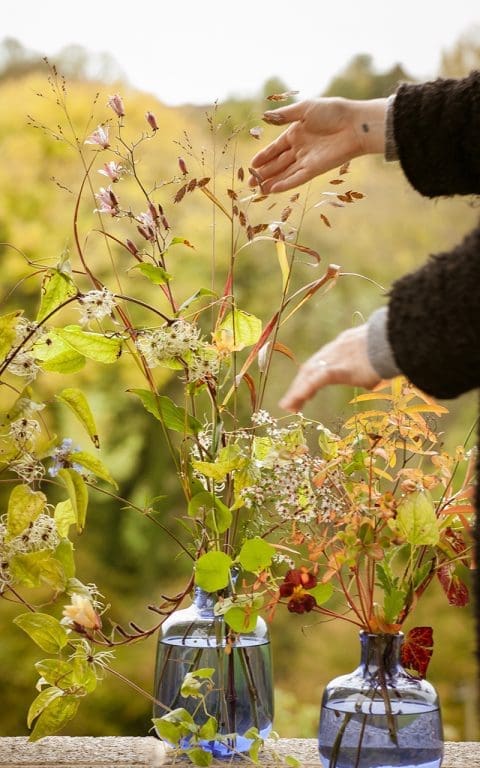
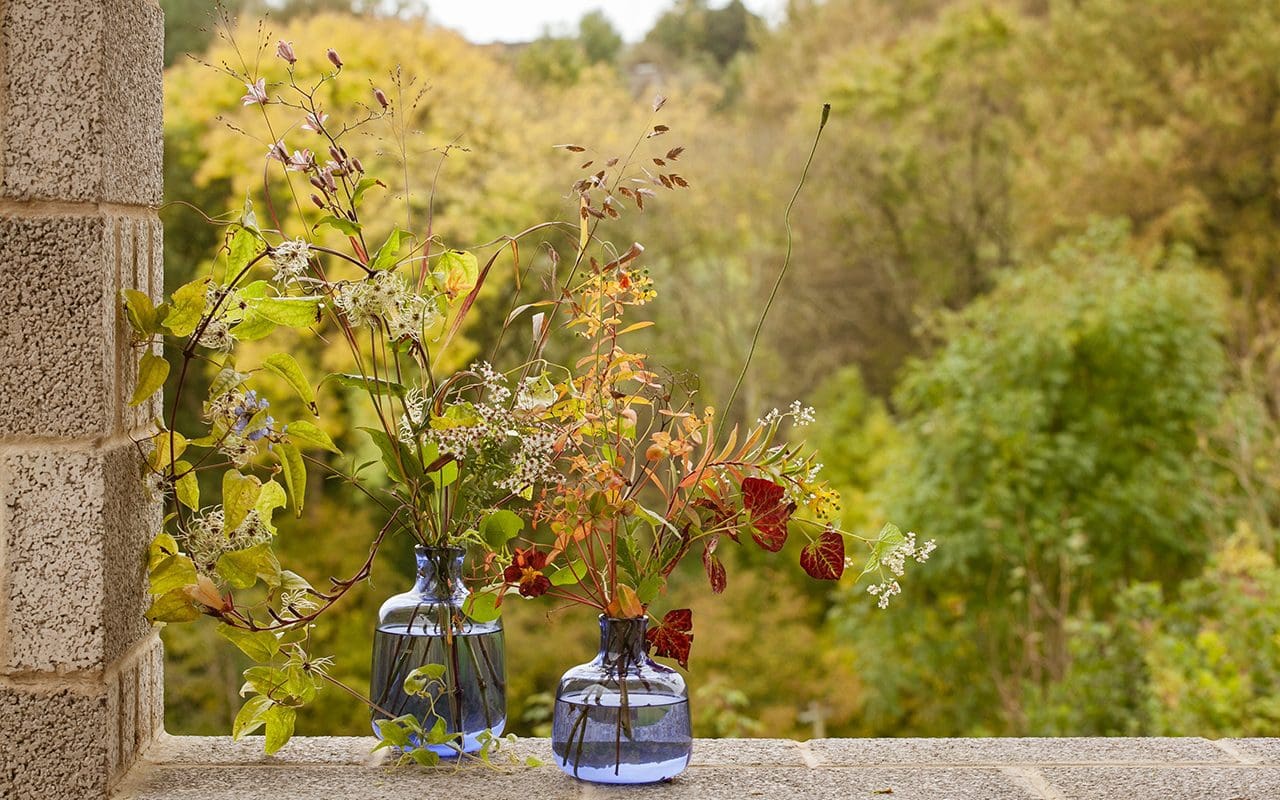
As well as wanting to represent the garden in all her autumnal glory, I was also keen to make a smaller and simpler arrangement – something quieter that allows the stems their space to shine. It’s probably how I’m happiest working.
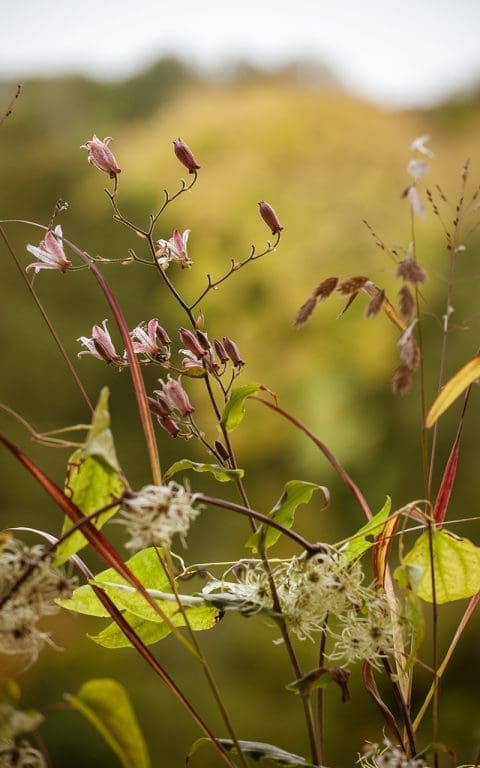
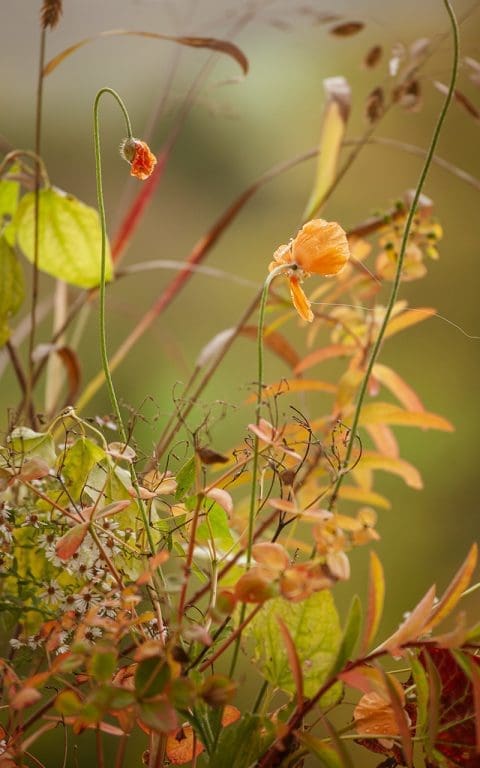
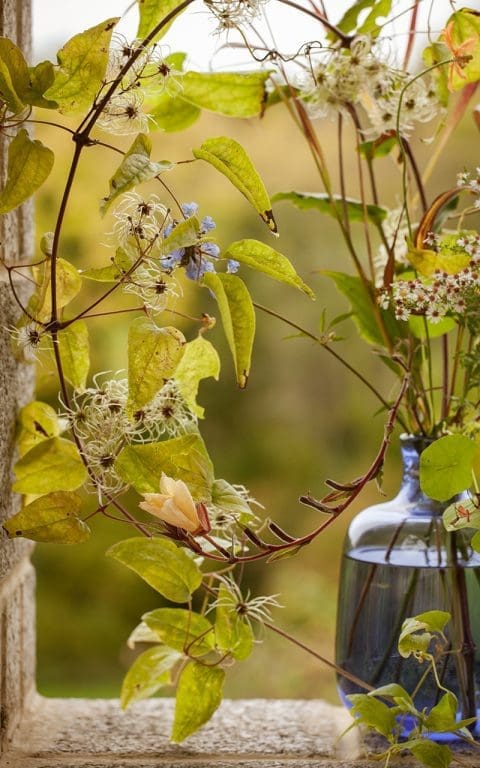
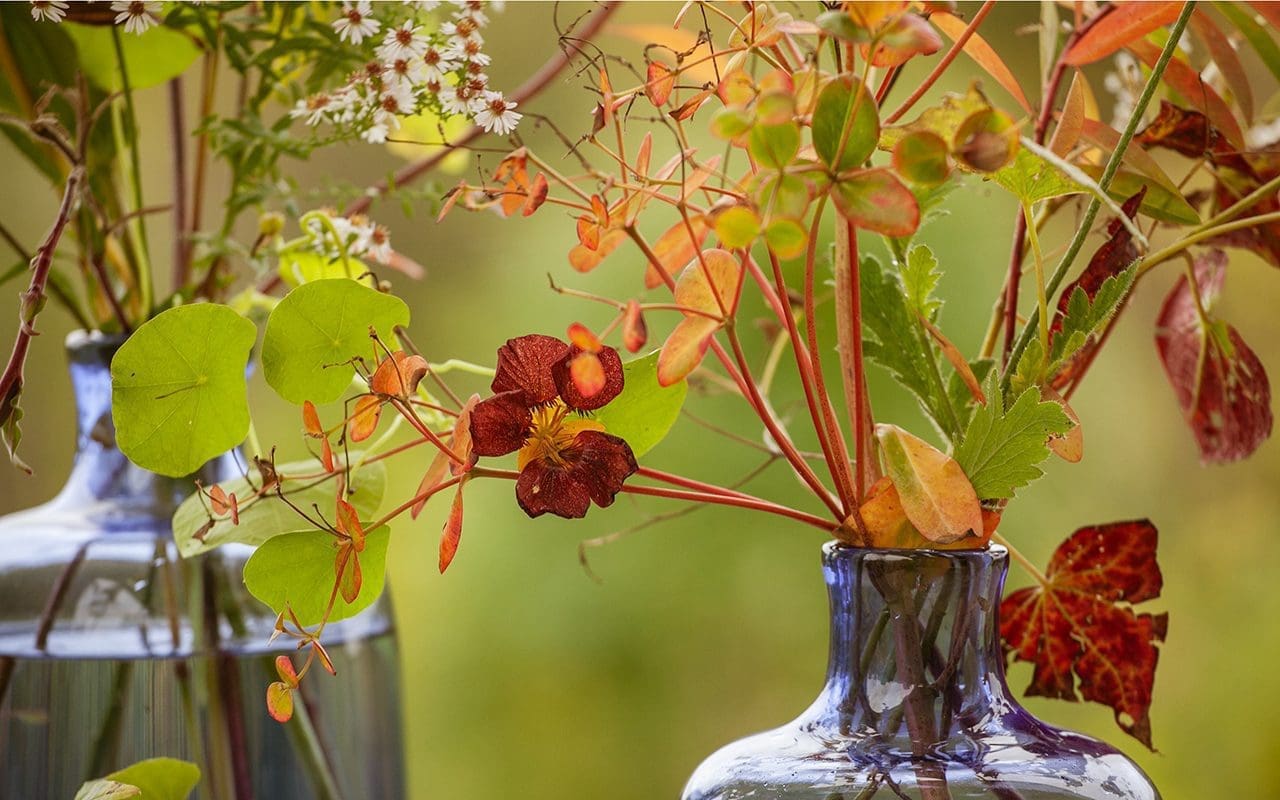
The picture window outside the milking barn provides the setting and frames the vases with the changing landscape behind. I start with a length of old man’s beard and some more euphorbia. A few stems of panicum & chasmanthium add height along with a speckled toad lily. A sprinkling of dainty white asters were added lower down and some oxblood red leaves of fagopyrum trail off to the side, slightly broken but more beautiful for it.
Back in the garden & you can see the silhouettes of winter beginning to appear. Huw & I spent a little time looking at the plants that we’d like to dry and preserve for our next shoot. I’m looking forward to the change of the season already
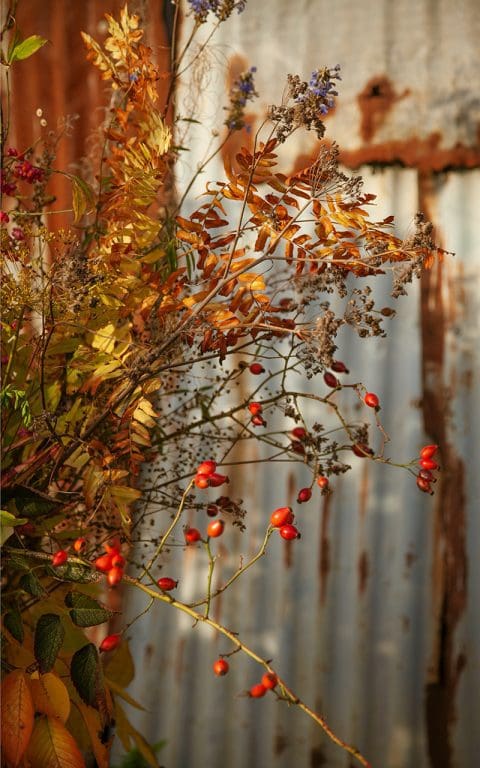
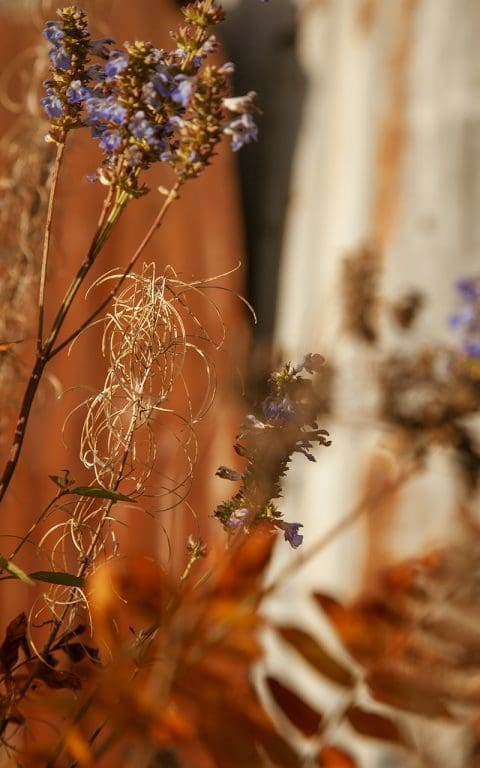

Anethum graveolens
Aster umbellatus
Astilbe rivularis
Atriplex hortensis
Cercidiphyllum japonicum
Chamaenerion angustifolium ‘Album’
Chasmanthium latifolium
Euonymus europaeus
Euphorbia cornigera
Ligustrum vulgare
Lythrum virgatum ‘Dropmore Purple’
Osmunda regalis
Prunus x yedoensis
Rosa eglanteria
Salvia ‘Blue Enigma’
Salvia ‘Blue Note’
Salvia uliginosa
Sambucus nigra
Scabiosa ochroleuca
Thalictrum ‘White Splendide’
Thalictrum ‘
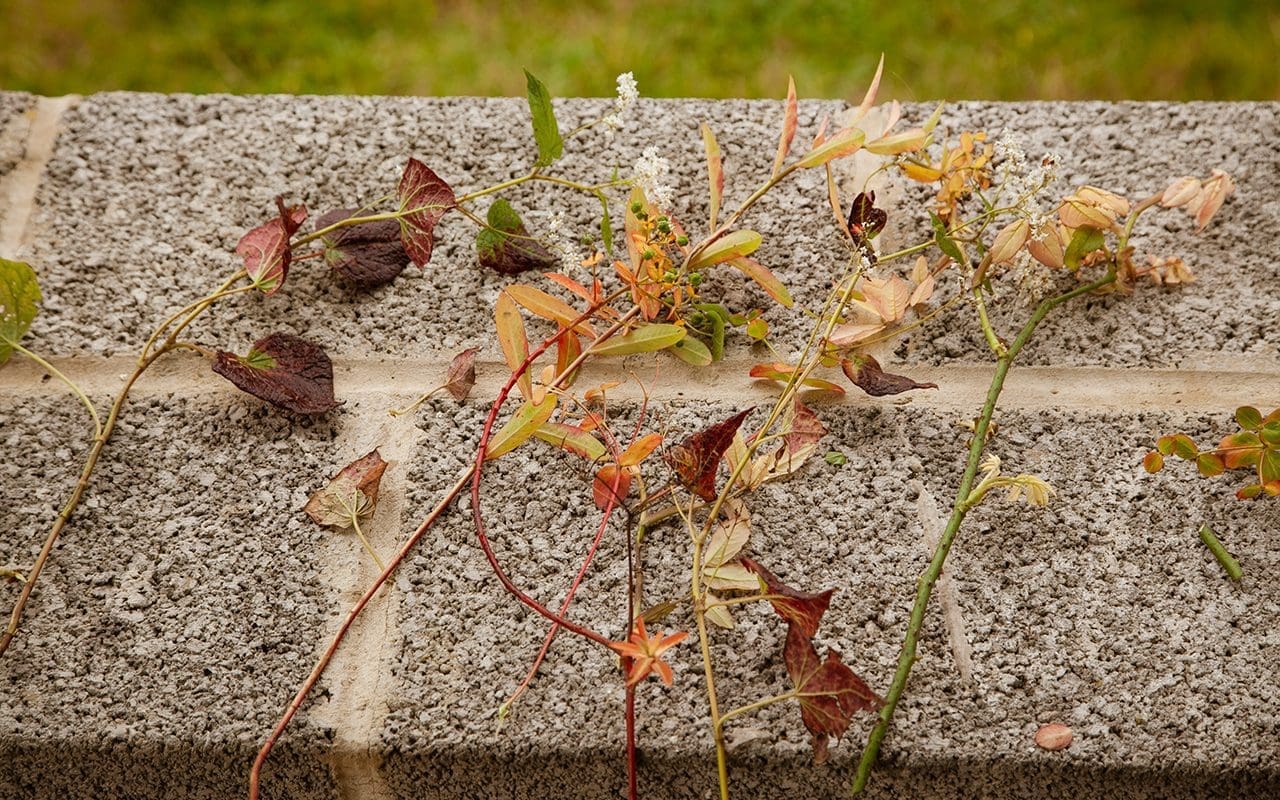
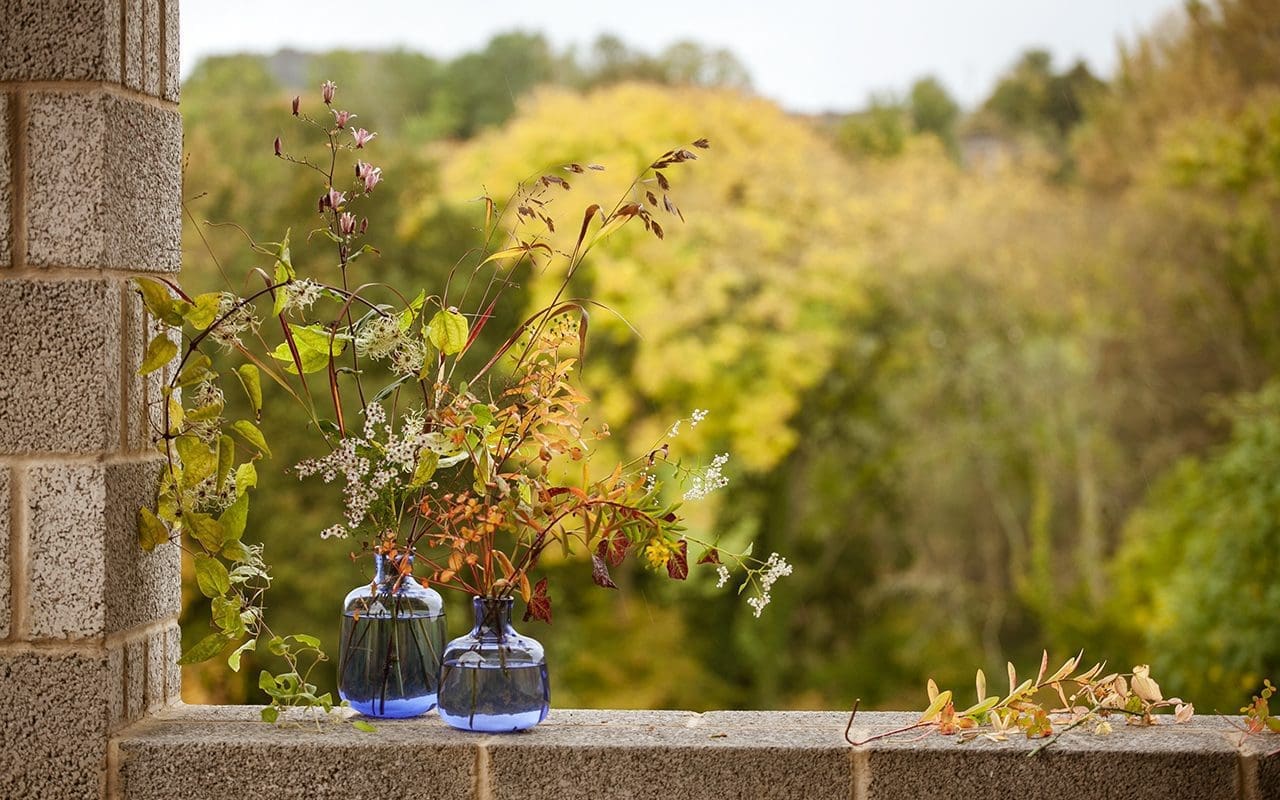
Aster unnamed white
Chasmanthium latifolium
Clematis vitalba
Euphorbia cornigera
Fagopyrum dibotrys
Oenothera stricta ‘Sulphurea’
Panicum virgatum ‘Heiliger Hain’
Papaver rupifragum
Rosa ‘The Lady of Shallot’
Salvia uliginosa
Tricyrtis formosana ‘Dark Beauty’
Tropaeolum majus ‘Mahogany’
Photographs | Huw Morgan
Published 3 November 2019
We have just returned from Greece and a browned and dusty landscape that had not seen water since April. We arrived back to a season changed. Fields deep and lush with grass, hedges flashing autumn colour, dimmed as they reached into a shroud of drizzle. Our distinctive line of beech at the end of the valley all but hidden by cloud and windfalls shadowing the slopes beneath the apple trees in the orchard where, just a fortnight before, the branches had been weighted. It took a day to retune the eye, but here I sit not a week later with the sun streaming in over my desk and the studio doors wide open to the garden. It is the stillest, most perfect day of autumn and the garden has weathered well. Aged too by the window of time we have been away, but certainly not lesser now that we are in step again with the season.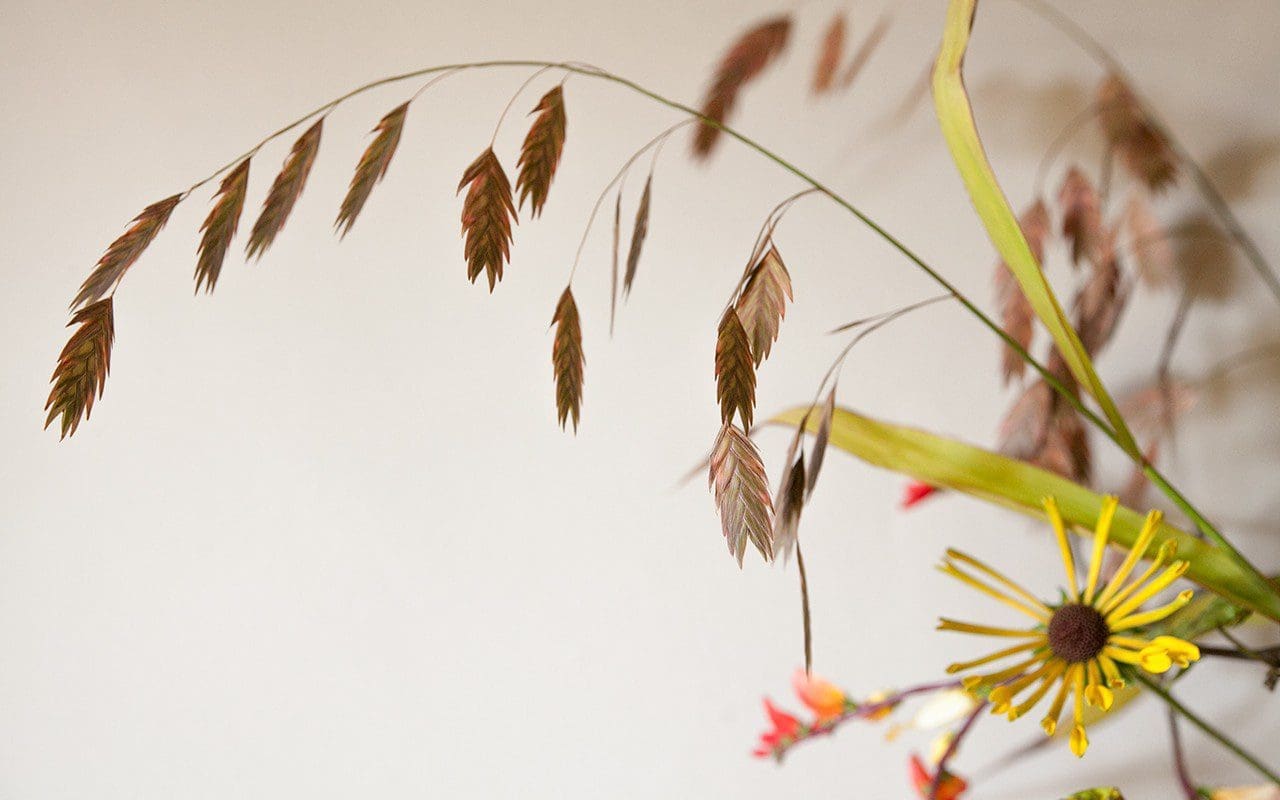 Chasmanthium latifolium
As a way back into the garden this morning we have picked a posy to mark a feeling of this change. The Chasmanthium latifolium are probably at their best, coppery-bronze and hovering above their still lime-green leaves. The perfectly flat flowers appear to have been pressed in a book. Like metallic paillettes they shimmer and bob in the slightest of breezes. I must admit to not having understood the requirements of this plant until recently and, though it is adaptable to a little shade and sun, it likes some shelter to flourish. Where I have used it in China in the searing heat of a Shanghai summer it has done superbly, spilling in a fountain of flower held well above the strappy foliage. It must like the humidity there. In the UK I have found it does best with some protection from the wind. My best plants here are on the leeward side of hawthorns, those in the same planting to the windward side have all but failed. It is a grass that is worth the time and effort to make its acquaintance.
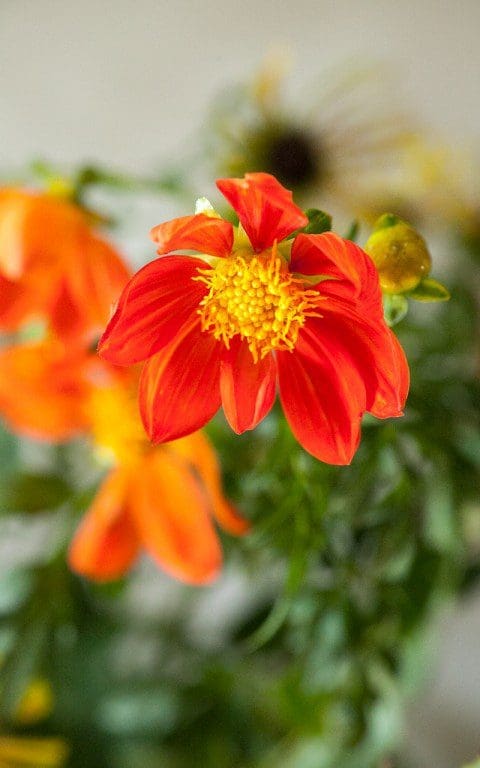
Though the seedheads which mark the life that come before them now outweigh the flower in the garden, we have plenty to ground a posy. Scarcity makes late flower that much more precious and I like to make sure that we have smatterings amongst the late-season grasses. Brick-red schizostylis, flashes of late, navy salvia and clouds of powder blue asters pull your eye through the gauziness. The last push of Indian summer heat has yielded a late crop of dahlia, which have yet to be tickled by cold. I have three species here in the garden specifically for this moment. All singles and delicate in their demeanour. The white form of Dahlia merckii and the brightly mauve D. australis have shown their cold-hardiness and remain in the ground over winter with a mulch, but the Dahlia coccinea var. palmeri in this posy is new to me.
Chasmanthium latifolium
As a way back into the garden this morning we have picked a posy to mark a feeling of this change. The Chasmanthium latifolium are probably at their best, coppery-bronze and hovering above their still lime-green leaves. The perfectly flat flowers appear to have been pressed in a book. Like metallic paillettes they shimmer and bob in the slightest of breezes. I must admit to not having understood the requirements of this plant until recently and, though it is adaptable to a little shade and sun, it likes some shelter to flourish. Where I have used it in China in the searing heat of a Shanghai summer it has done superbly, spilling in a fountain of flower held well above the strappy foliage. It must like the humidity there. In the UK I have found it does best with some protection from the wind. My best plants here are on the leeward side of hawthorns, those in the same planting to the windward side have all but failed. It is a grass that is worth the time and effort to make its acquaintance.
Though the seedheads which mark the life that come before them now outweigh the flower in the garden, we have plenty to ground a posy. Scarcity makes late flower that much more precious and I like to make sure that we have smatterings amongst the late-season grasses. Brick-red schizostylis, flashes of late, navy salvia and clouds of powder blue asters pull your eye through the gauziness. The last push of Indian summer heat has yielded a late crop of dahlia, which have yet to be tickled by cold. I have three species here in the garden specifically for this moment. All singles and delicate in their demeanour. The white form of Dahlia merckii and the brightly mauve D. australis have shown their cold-hardiness and remain in the ground over winter with a mulch, but the Dahlia coccinea var. palmeri in this posy is new to me.
 Dahlia coccinea var. palmeri
 Rudbeckia subtomentosa ‘Little Henry’
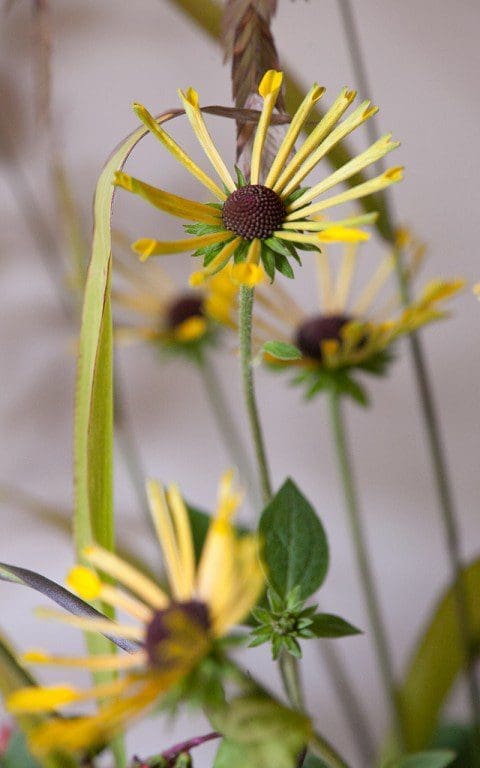
I hope it is hardy enough to stay in the ground here. As soon as frost blackens the foliage, each plant will be mulched with a mound of compost to protect the tubers from frost. Distinctive for its feathered, ferny foliage and reaching, wiry limbs, this first year has shown my plants attaining about a metre, two thirds of their promise once they are established. This is not a showy plant, the flowers sparse and delicately suspended, but the colour is a punchy and rich tangerine orange, the boss of stamens egg-yolk yellow. We have it here with Rudbeckia subtomentosa ‘Little Henry’, which is also how it is teamed in the garden. ‘Little Henry’ is a shorter form of R. s. ‘Henry Eilers’ and, at about 60 to 90cm, better for being self-supporting. Usually I shy away from short forms, the elegance of the parent often being lost in horticultural selection, but ‘Little Henry’ is a keeper. They have been in flower now since the end of August and will only be dimmed by frost. Where you have to give yourself over to a Black-eyed-Susan and their flare of artificial sunlight, the rolled petals of ‘Little Henry’ are matt and a sophisticated shade of straw yellow, revealing just a flash of gold as the quills splay flat at the ends.
Rudbeckia subtomentosa ‘Little Henry’
I hope it is hardy enough to stay in the ground here. As soon as frost blackens the foliage, each plant will be mulched with a mound of compost to protect the tubers from frost. Distinctive for its feathered, ferny foliage and reaching, wiry limbs, this first year has shown my plants attaining about a metre, two thirds of their promise once they are established. This is not a showy plant, the flowers sparse and delicately suspended, but the colour is a punchy and rich tangerine orange, the boss of stamens egg-yolk yellow. We have it here with Rudbeckia subtomentosa ‘Little Henry’, which is also how it is teamed in the garden. ‘Little Henry’ is a shorter form of R. s. ‘Henry Eilers’ and, at about 60 to 90cm, better for being self-supporting. Usually I shy away from short forms, the elegance of the parent often being lost in horticultural selection, but ‘Little Henry’ is a keeper. They have been in flower now since the end of August and will only be dimmed by frost. Where you have to give yourself over to a Black-eyed-Susan and their flare of artificial sunlight, the rolled petals of ‘Little Henry’ are matt and a sophisticated shade of straw yellow, revealing just a flash of gold as the quills splay flat at the ends.
 Ipomoea lobata
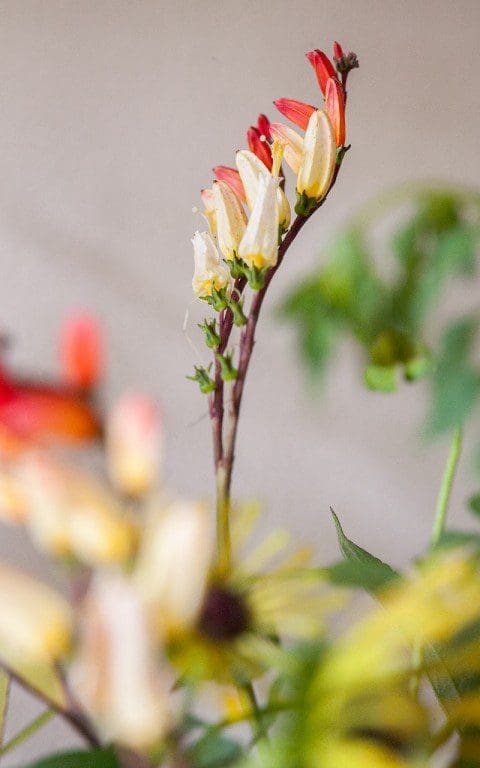
We have waited a long time this year for the Ipomoea lobata as it sprawled, then mounded and all but eclipsed the sunflowers. We always had a pot of this exotic-looking climber in our Peckham garden, but I have not grown it here yet and have been surprised by the amount of foliage it has produced at the expense of flower. Nasturtiums do this too in rich soil and, if I am to have earlier flower in the future, I will have to seek out an area of poorer ground. That will not suit the sunflowers, but I will find it a suitable partner that it can climb through. It is very easy from seed. Sown in late April in the cold frame and planted out after risk of frost, this is a reliable annual, or at least I thought so until I presented it with my hearty soil. Though late to start flowering this year, it also keeps going till the first frosts, its lick and flame of flower well-suited to the seasonal flare.
Ipomoea lobata
We have waited a long time this year for the Ipomoea lobata as it sprawled, then mounded and all but eclipsed the sunflowers. We always had a pot of this exotic-looking climber in our Peckham garden, but I have not grown it here yet and have been surprised by the amount of foliage it has produced at the expense of flower. Nasturtiums do this too in rich soil and, if I am to have earlier flower in the future, I will have to seek out an area of poorer ground. That will not suit the sunflowers, but I will find it a suitable partner that it can climb through. It is very easy from seed. Sown in late April in the cold frame and planted out after risk of frost, this is a reliable annual, or at least I thought so until I presented it with my hearty soil. Though late to start flowering this year, it also keeps going till the first frosts, its lick and flame of flower well-suited to the seasonal flare.
 Rosa ‘Scharlachglut’
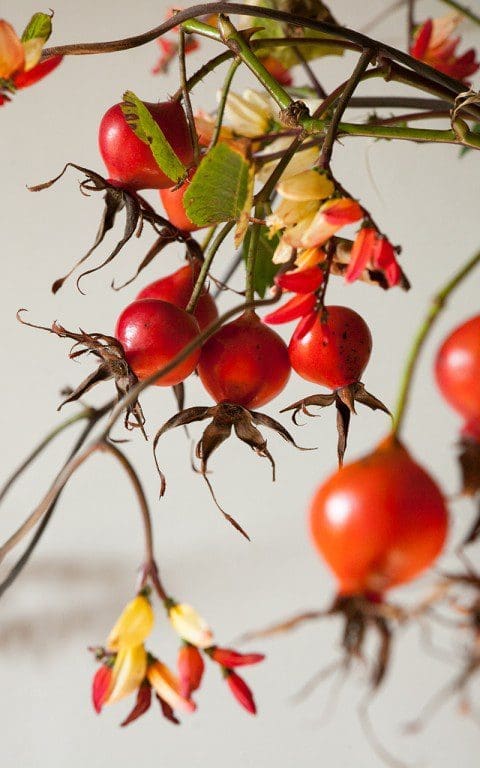
Roses that flower once and then hip beautifully are worth their brevity and we have included R. ‘Scharlachglut’ here, a single rose that I wrote about in flower earlier this year. The hips are much larger than a dog rose, but retain their elegance due to the length of the calyces, which put a Rococo twist on these pumpkin-orange orbs. Despite its ornamental quality when flowering, it is a plant that I am happy to use on the periphery of the garden and one that, in its second incarnation, I can be sure of seeing the season out.
Words: Dan Pearson / Photographs: Huw Morgan
Published 20 October 2018 We are sorry but the page you are looking
for does not exist.
You could return to the homepage
Rosa ‘Scharlachglut’
Roses that flower once and then hip beautifully are worth their brevity and we have included R. ‘Scharlachglut’ here, a single rose that I wrote about in flower earlier this year. The hips are much larger than a dog rose, but retain their elegance due to the length of the calyces, which put a Rococo twist on these pumpkin-orange orbs. Despite its ornamental quality when flowering, it is a plant that I am happy to use on the periphery of the garden and one that, in its second incarnation, I can be sure of seeing the season out.
Words: Dan Pearson / Photographs: Huw Morgan
Published 20 October 2018 We are sorry but the page you are looking
for does not exist.
You could return to the homepage
