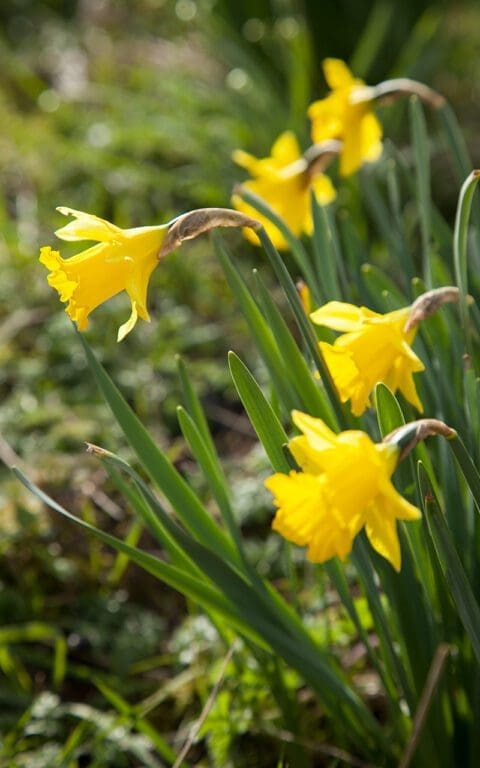
The Tenby daffodils are flaring on the banks that fall steeply into the ditch. Backlit by morning sun they are the purest of yellows, brilliant and bright and so very full of life. The tilted buds are already visible breaking their sheaths as the snowdrops dim and the primroses take over and begin their moment. The narcissus join them then, not to overshadow as you might think, but in a partnership of yellows, the colour of spring and new life.
Now considered a subspecies of our native daffodil, N. pseudonarcissus subsp. obvallaris is found locally near Tenby in Dyfed, South Wales, where they have a small range of natural distribution. Their cousin, N. pseudonarcissus, is variable, with a soft yellow trumpet and palest yellow petals, so a group registers quite differently and they have a softness that sits easily. Not so the Tenby daffodil which is brazen and to the point, being bright chrome yellow throughout. Though this might not be easy in a larger daffodil, the Tenby is no more than a foot tall and everything is perfectly proportioned and neat. Thus they weather the March storms and stand like a person with innate confidence that is happy in their own skin.
The crease in the land that we call the Ditch is far more than that. It is the divide between the ground that we garden and the rounded rise of the Tump that we look out upon and forms our backdrop to the east. The spring-fed rivulet that runs quickly down it is constant and gurgling, even in summer. The silvery slip of water was revealed when we cleared the brambles 10 years ago and fenced it on both sides so that this distinct habitat could become an environment of its own. We have been building upon the nature of this place ever since. Splitting the primroses that sit happy in the heavy, wet ground and stepping plants through it that are either closely related to the wild plants that thrive there or feel right and can cope with the competition.
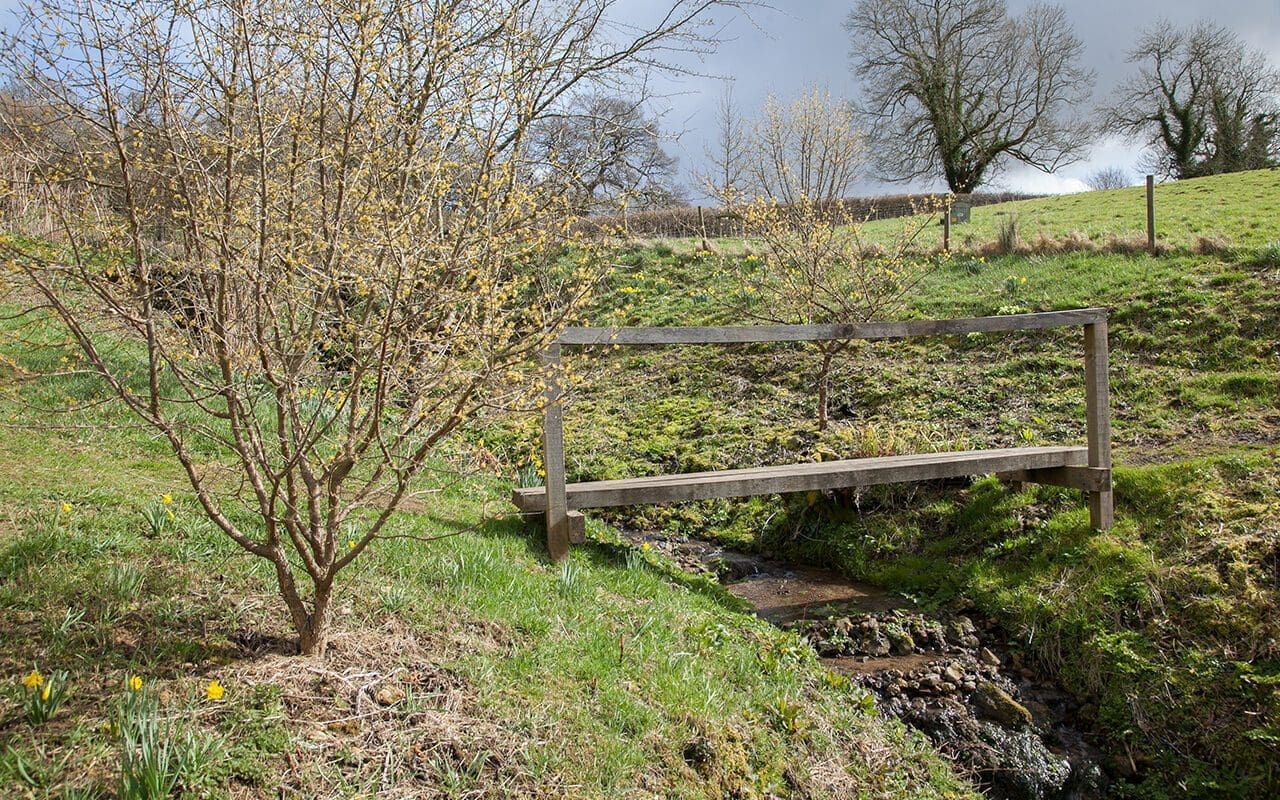
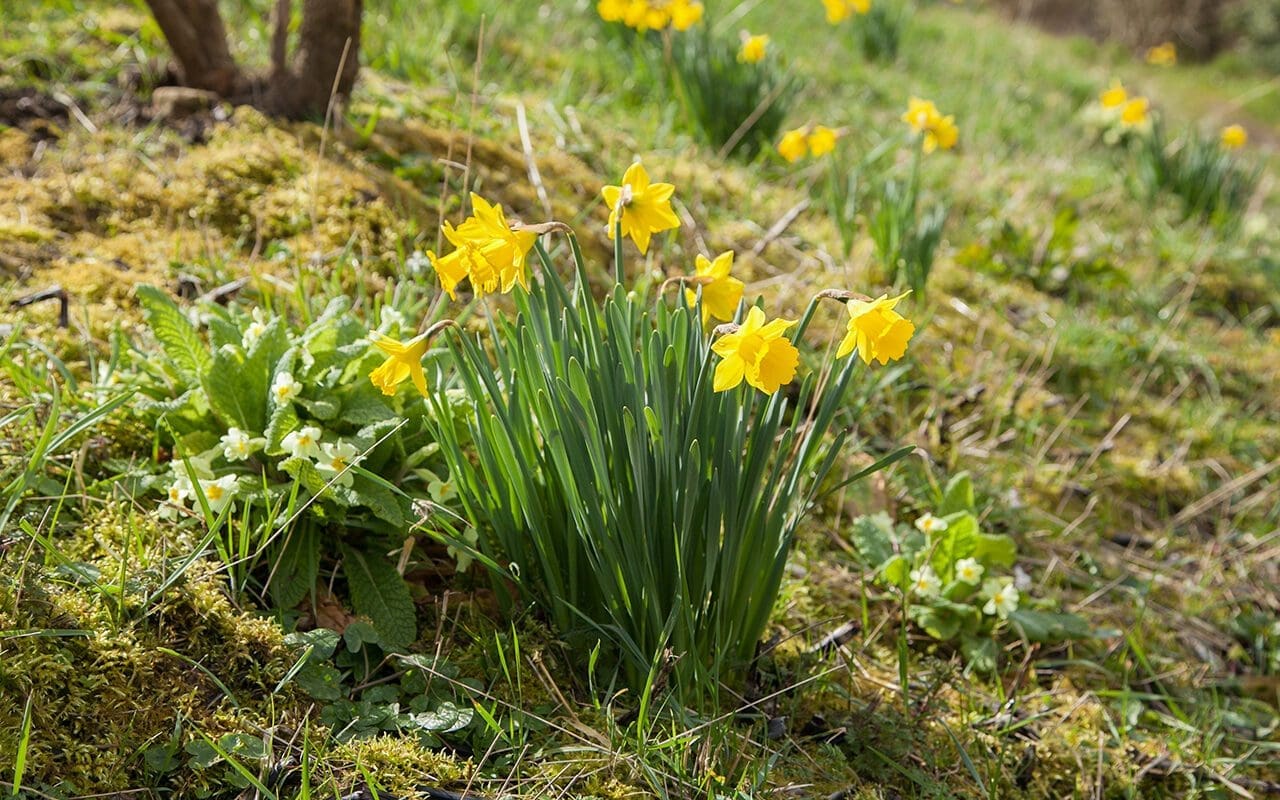
The Ditch is a place that we garden lightly and the plan is to one day have it naturalised with bulbs that like the conditions here. Snowdrops and aconites to start the year and snakeshead fritillaries and camassia to follow. The Narcissus obvallaris are grouped loosely around a staggering of Cornus mas, which start to bloom when you can feel the winter easing.
So far the Tenbys have not started to seed, but I hope that our man-made imprint can be softened with seedlings that find where they want to be. This has begun already with the straight Narcissus pseudonarcissus, which I’ve been planting lower down the slopes and, in an echo of the ones we found higher up the valley, growing on little tumps that run alongside the stream where the hazel grows. They sit there with the young Dog’s Mercury as a marker of this ancient woodland and looking down on all they survey. The way they grow in the wild is a good measure for where they want to be when you find them their home. Cool, but not in the wet hollows and with a little shadow later to ease up the competition of the more thuggish grasses.
Having been stung a couple of times with narcissus orders that were incorrectly supplied, I started three years ago by potting up a hundred bulbs, two to a pot, as I needed to know that we were putting the real thing into this wild place. It was the year that Huw’s mother passed away and, as his family are from Swansea, it felt fitting to be planting them out just a fortnight after she died. The Tenbys start to bloom around St. David’s Day and, when the first yellow shows, we add another round of plants potted up the previous autumn. Midori and Shintaro from Tokachi Millennium Forest took part one year when they were here to stay on a ‘gardening holiday’ from snowbound Hokkaido, and it has now become something of a tradition to plant a number round about now to find the places in the ditch where we feel the light needs capturing.
Words: Dan Pearson | Photographs: Huw Morgan
Published 13 March 2021
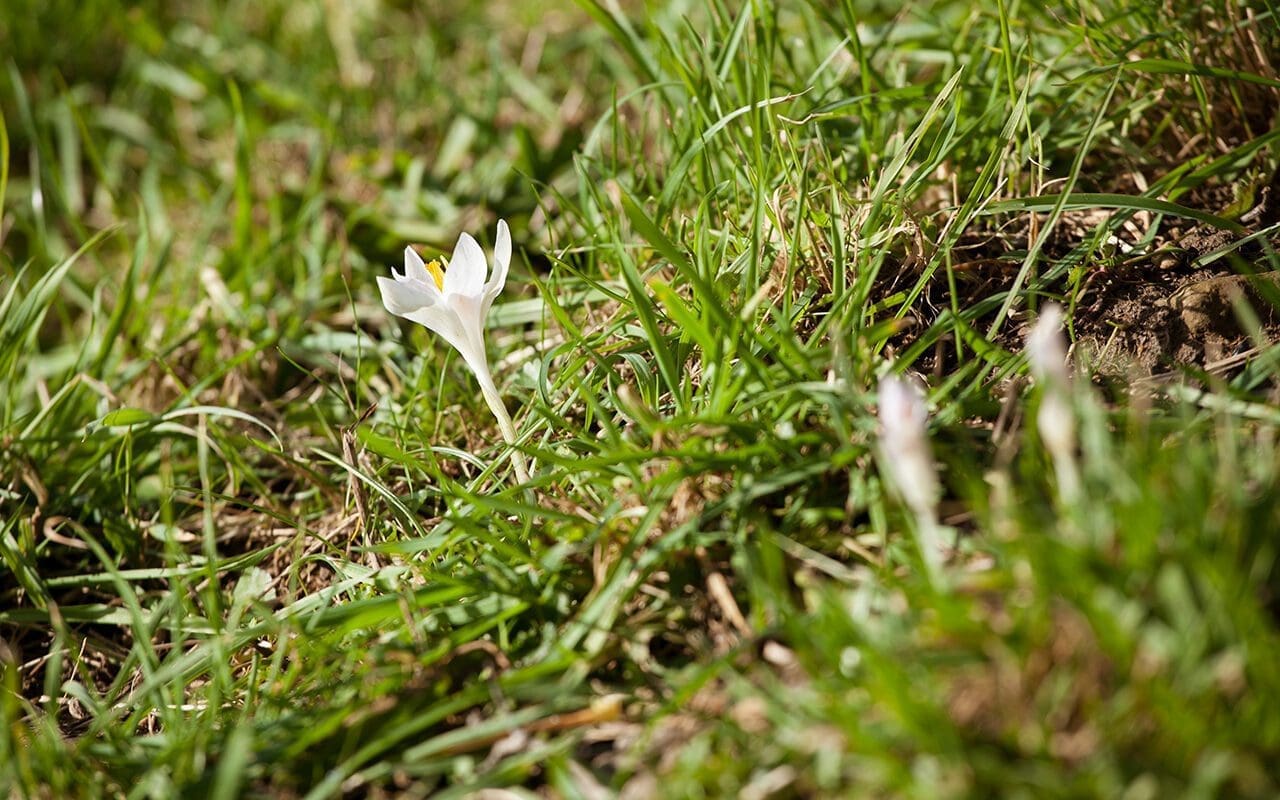
Against the odds, the delicate Crocus tommasinianus ‘Albus’ spear the turf on the bank in front of the house. When you first become aware of their presence earlier in the month it is easy to mistake their pale tapers for the light reflecting off blades of grass, but suddenly and all at once they are free. Standing tall enough above the sward to shiver in the slightest of breezes and opening wide in a sunny interlude to reveal orange stamens, yellowed throats and nectar for the early bees.
I first grew Crocus tommasinianus in the Peckham garden and learned to love it there for being the superior cousin to the ‘Dutch’ Crocus vernus which stud front lawns in spring like spilled tins of Quality Street. I did not know it then, but I had been supplied with the true species, which has the palest silvery-lilac reverse to the petals with the colour held within. I have since repeated my orders, again and again and from different places, only to find I have planted a thousand ‘Ruby Giant’ here or two thousand ‘Whitewell Purple’ there. These darker selections are often mis-supplied and sit less lightly for their weight of saturated colour.
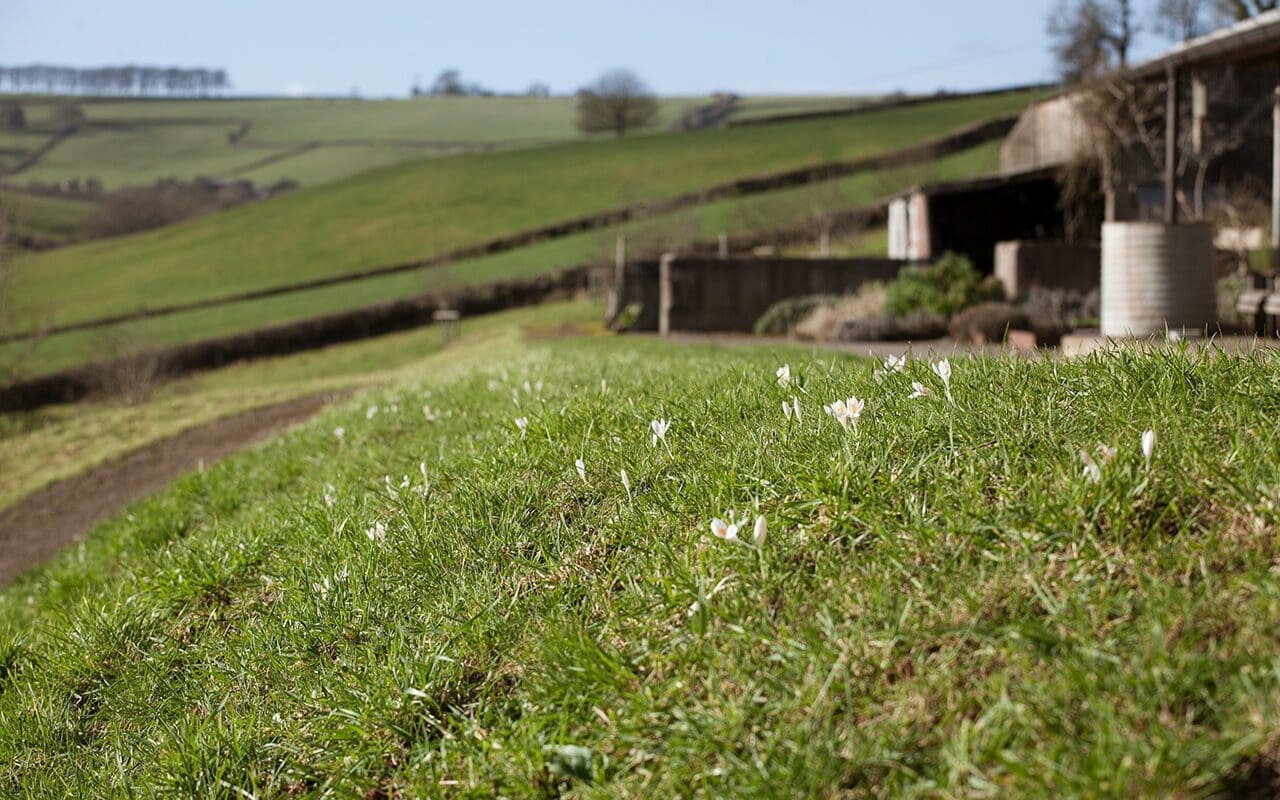
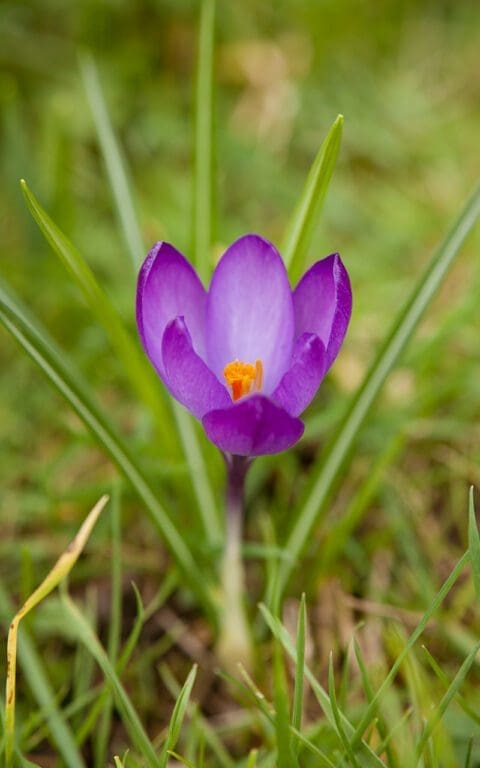
Just up the lane and making the point that they are happy there, the true form has taken over our neighbours’ garden. The sisters that live there are natural gardeners and have been tending theirs now for decades. Without competition the crocus have seeded freely, to the point of flooding the open ground of their borders, seeding into the crowns of all the plants and seizing every niche between paving stones. The garden is free and joyous and Josie and Rachel never see their occupancy as a problem.
We have struck up a friendship and Rachel has generously allowed me to dig them in-the-green immediately after flowering so that I do not have to depend upon the vagaries of the bulb suppliers. I am going to keep them out of the beds here, however, as I want to work in the garden just as they come into leaf when I’m preparing the garden for spring. The sunny banks at the back of the house are where I am hoping they will naturalise. The free-draining slope there is ideal, because they like dry ground when they are dormant and the sunshine ensures that their flowers, which are light sensitive, open to reveal their interiors. When they do, you feel your heart lift and the long dark winter retreat.
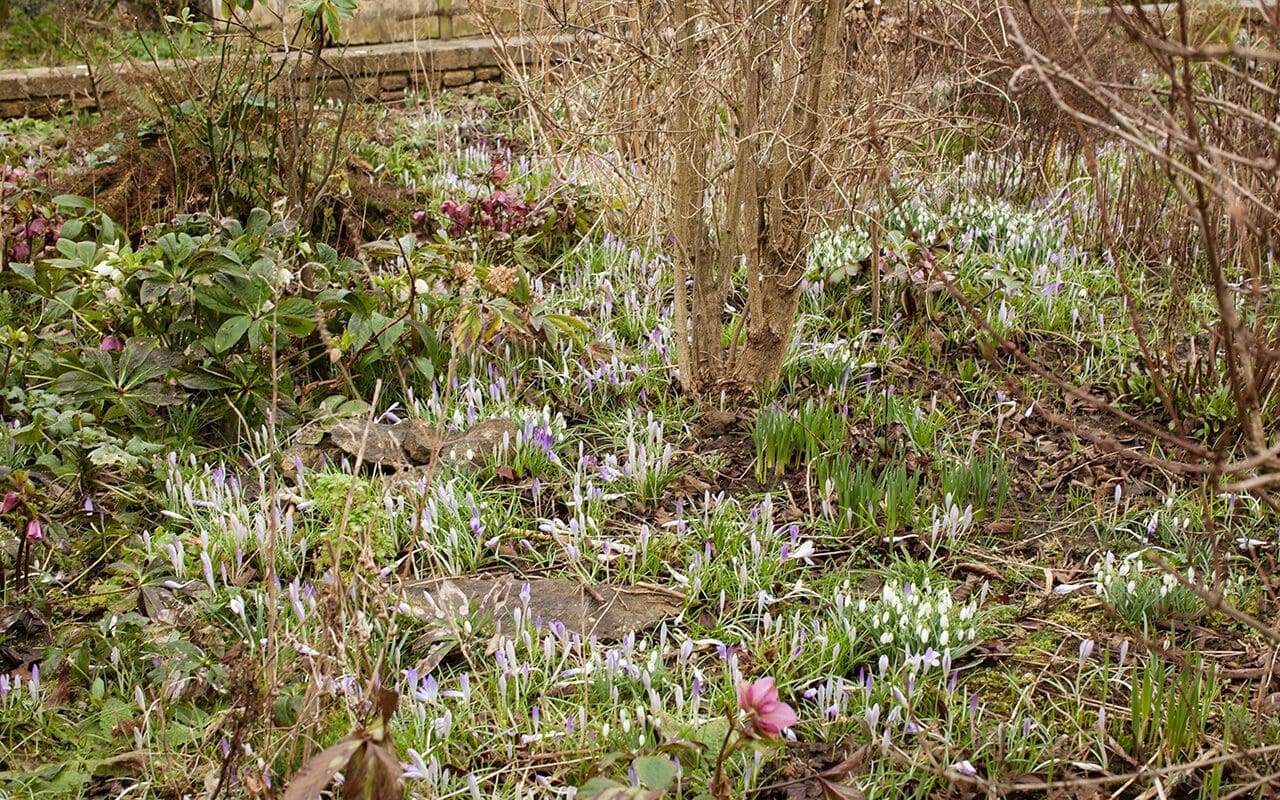
I can already see from their behaviour in the grass under the young crab apples that they will not seed as freely as they have in the open ground of Josie and Rachel’s garden. Though happy in grass, the lushness of our meadows is probably too much for the young seedlings to take a hold. I hope in time, and once the grass thins as the crab apples assert themselves, that they will take to a lighter sward and begin to make the place their own. This is worth waiting for and every year I am adding a few more with Narcissus jonquilla and Anemone blanda to follow after their early blaze is over.
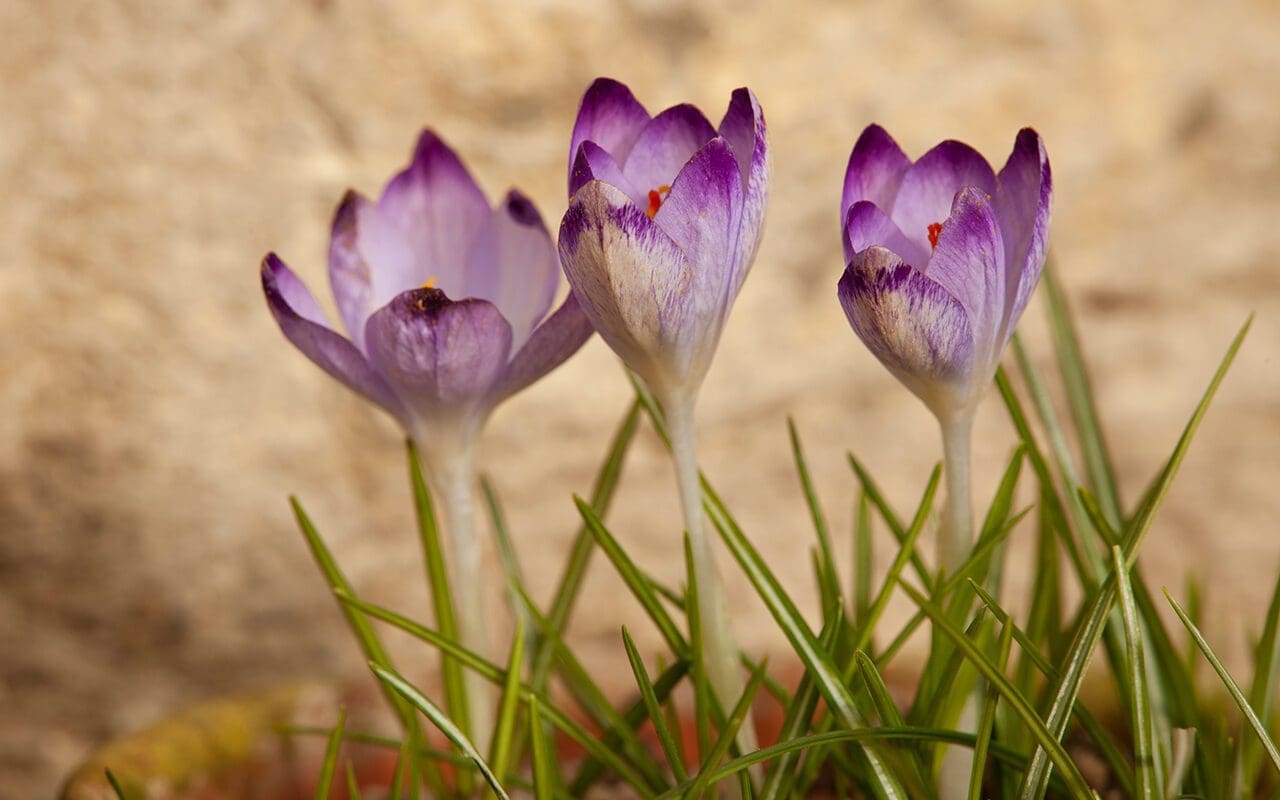
Shipton Bulbs stock a number of special selections that are subtler than the named varieties above. The rosy Crocus tommasinianus ‘Roseus’ (main image) and C. t. ‘Pictus’ which looks as though the tips of the petals have been dipped in ink. The white form, Crocus tommasinianus ‘Albus’, is very choice and, as they do not come as cheap, I ordered a couple of handfuls and gave them their own place on on the bank at the front of the house in the hope that they will not cross with the others at the back. The position here is exposed to our winds that whip across the open ground, but they stand bravely and mark the shift in the season with the snowdrops and the promise of what lies just around the corner.
Words: Dan Pearson | Photographs: Huw Morgan
Published 20 February 2021
I first grew the stinking hellebore as a child on thin acidic sand in the shadowy stillness of woodland. We were surrounded on all sides and the woods were always on the advance to the point that, when we moved there in the mid 1970s, the vegetation was pressing against the windows. Our acre was a long-forgotten garden and we made clearings and pushed back against the brambles and the saplings as we unpicked what had once been there before.
The Helleborus foetidus was one of the plants that thrived for me there as a young gardener. My first plant was ordered from Beth Chatto and I watched its every move. The first year’s reach to establish its long-fingered greenery and the wait for the second for it to throw its mass of pale jade flower. The bladdery seedpods that followed in early summer and, the following spring, the rain of seedlings and the places that they preferred to be. Being easy in our setting, they taught me that, if you find the right place for a plant, it will sing for you. I can see those plants in my mind’s eye now. Quietly architectural, poised yet slightly melancholy, but holding so much promise when the leaves on the trees were down.
With my eyes newly opened and hungry for life in the winter I began to see it everywhere both in the wild and sitting happily in a garden setting. On the thin chalky soil of the South Downs I found it running through ancient woodland with lustrous hart’s tongue ferns, dog’s mercury and, later, bluebells. This was its territory according to the books, but one that couldn’t be more different from the rhododendron country we lived in just a short cycle ride away. I saw it then pushing onto a verge from a hedge and happy in sunshine where it was escaping a garden. Just a stone’s throw away the parent plant sat contentedly against the base of a bright flinty wall to challenge my feeling that I already knew this plant. Of course, I didn’t know from just growing it once that it is a plant that is happy to compromise if it likes you.
I have not grown Helleborus foetidus for myself again until fairly recently, living vicariously in the interim years through my clients’ gardens and conducting an erratic relationship, like you do with faraway friends. You have to fill in the gaps of influence when you see a plant, or indeed a friend from only time to time, but I have learned through time about its longevity. If the conditions are too good, it will live fast and move on after a handful of years. If you give it too much direct competition and immediate shadow it will dwindle and if you grow it hard, with plenty of light, be it a cool north light or the brightness of an open position, it will provide you with the most handsome growth. Handsome and all-year-round is what Helleborus foetidus does best.
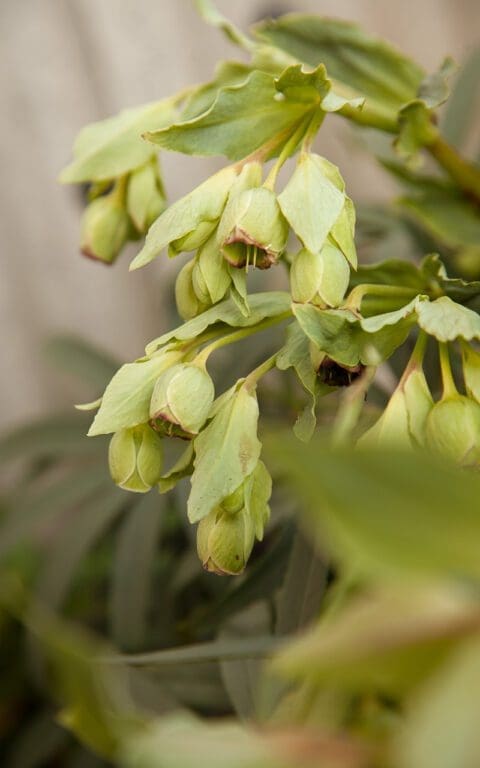
The Lenten roses (Helleborus hybridus) are ultimately longer-lived and better adapted to a long distance relationship or the vagaries of their custodian’s gardening knowledge. So, the steadfast Helleborus hybridus were favoured in the Peckham garden where I didn’t have room for both. The Lenten Roses came from Peckham to here and until recently I hadn’t thought about rekindling my acquaintance with the stinking hellebore, because we are as exposed and open to sun as I was huddled in trees as a teenager. But just down the hill in a farmer’s garden, there is a colony growing contentedly where his intolerance of anything but grass has pushed them into a rugged bank that is too steep to mow. Seeing them happily flowering in the bright open sunshine amongst primroses reminded me it was time to live with them again.
I have put them in two places here, one in more shadow, amongst the rangy limbs of the black-catkinned Salix gracilistyla ‘Melanostachys’ and another group against the potting shed where the ground is dry and free draining and there is plenty of light under a lofty holly. They face east here and receive a blast of morning sunshine, so they have grown stockily amongst Butcher’s Broom (Ruscus aculeatus) and Cyclamen coum. Their leaves are also more metallic and light resistant than those growing in the shade of the shrubby willow. The two groups couldn’t be more different but they are coming into bloom together.
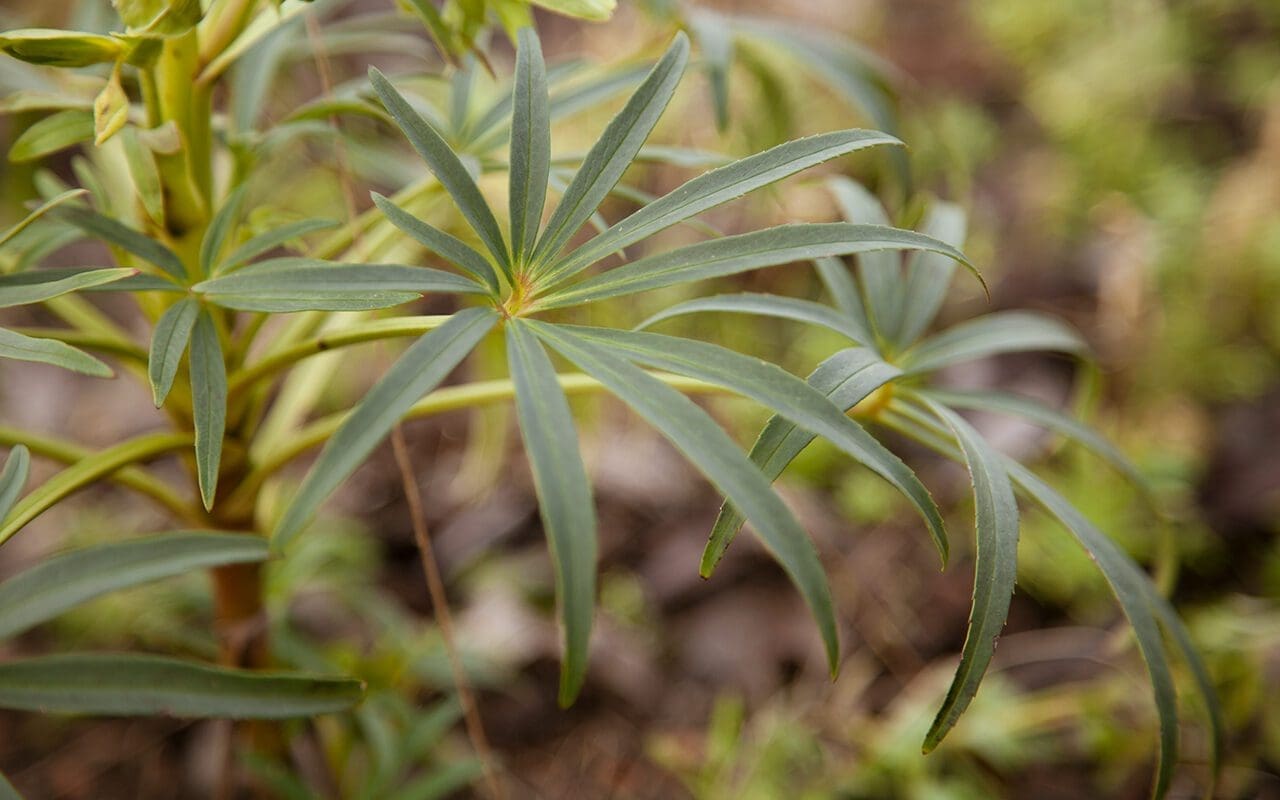
The plants take a year to get up the strength they need to throw their prodigious flowering head. This is held aloft and above the ruff of leafage beneath them. As they mature they branch again and again so that there are tens or even hundred at their zenith in March . The first opened here in the first week of the new year and the unravelling as one joins another is good to mark the passing of wintery time. The flowers are known for being slightly warmer when they are producing pollen and make a good early plant for pollinators. They will produce plentiful amounts of seed if you let them, but I prefer to leave just one limb to seed in a group and cut the rest to the base to save energy once you begin to see the plant has peaked in the middle of March or a little later. You will know when it is time as your focus goes to other spring flowers, which by this time are fresher.
One limb saved will rain all the seed you need for youngsters. All the remaining energy goes into the new growth, which comes from the base to mound architecturally over the summer. Though there is a fine, scented form called ‘Miss Jekyll’, the stink in the stinking hellebore comes from the foliage when crushed. It is when you are cutting this old growth away that you first encounter the beefy smell that you instinctively know will not be good for you. All parts of the plant are toxic if eaten and cause violent vomiting and delirium, sometimes death. Interestingly, in times past they were used, in miniscule quantity, to treat worms. Note, however, that the 18th Century herbalist Gilbert White called this ‘cure’: “a violent remedy … to be administered with caution”.
Words: Dan Pearson | Photographs: Huw Morgan
Published 15 January 2021
The shift has happened. Last leaves down to reveal the trunks and tracery of branches. Winter outlines and the definition of reading individuals, their structures and differing characters against the sky. Hidden by the cloak of the growing season, but ever present, is the ivy. Where it grows uninterrupted and using the frame of another tree to make its way, a shadowy presence or a life within throws its winter outline. Dark and glossy and a refuge for the birds.
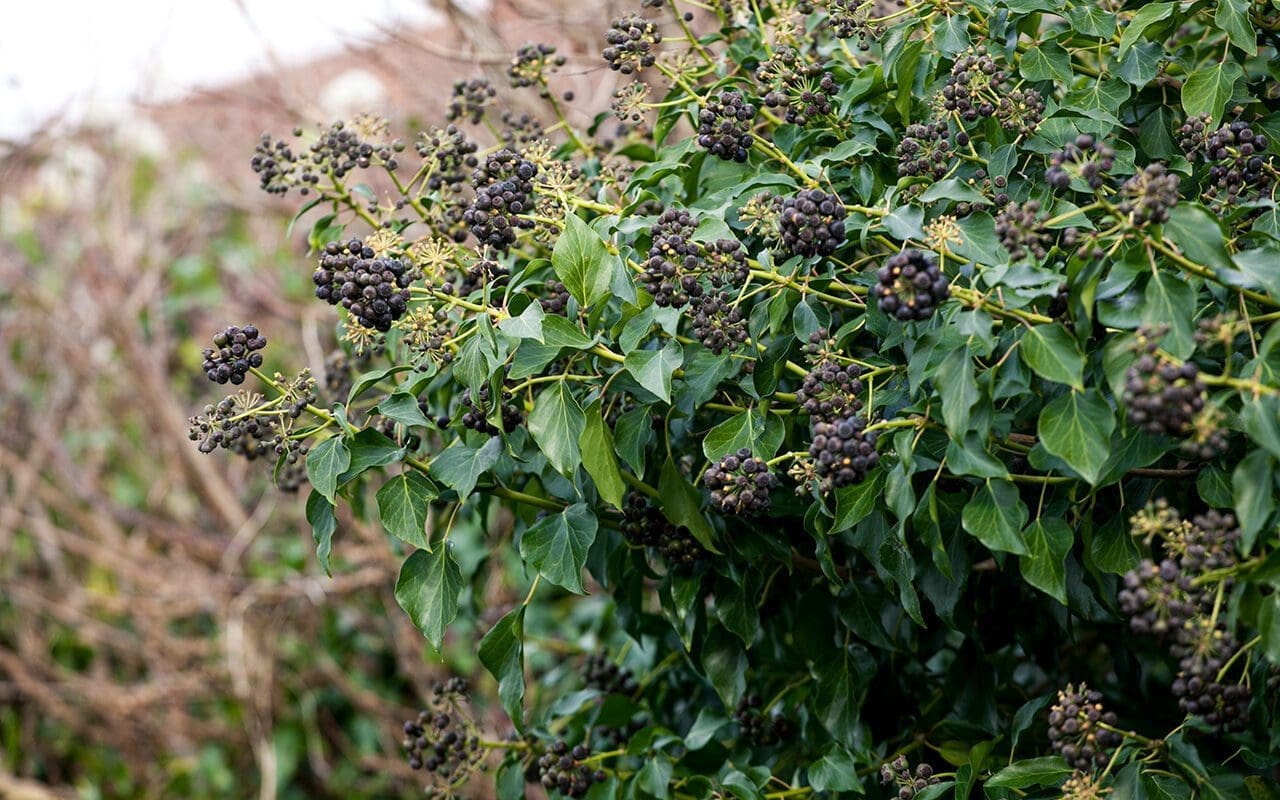
The oldest plants sit just inside the halo of their host, the growth becoming arborescent once it meets its reach. The mature ivy wood is entirely different from the juvenile, branching like antlers and without the need for the suckers that attach the young plant on its ascent. This wood, throws flowers in November, the very last forage for bees, and then goes on to weight itself with darkening, inky green berries. Fruits that at the very end of winter are ripe and ready for hungry birds. If you propagate the arborescent wood, the resulting plant retains this character and makes a fine winter evergreen if you grow it without the temptation of a support nearby. A wall or a trunk will trigger its innate desire to climb and conquer and it will revert to type if it senses an opportunity.
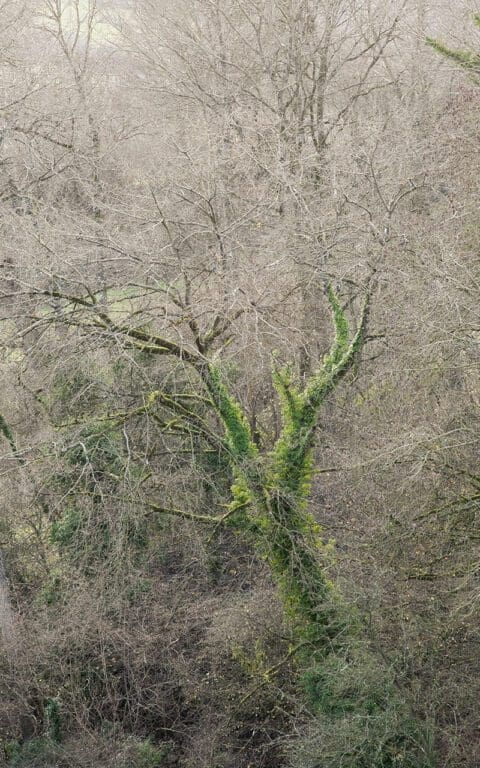

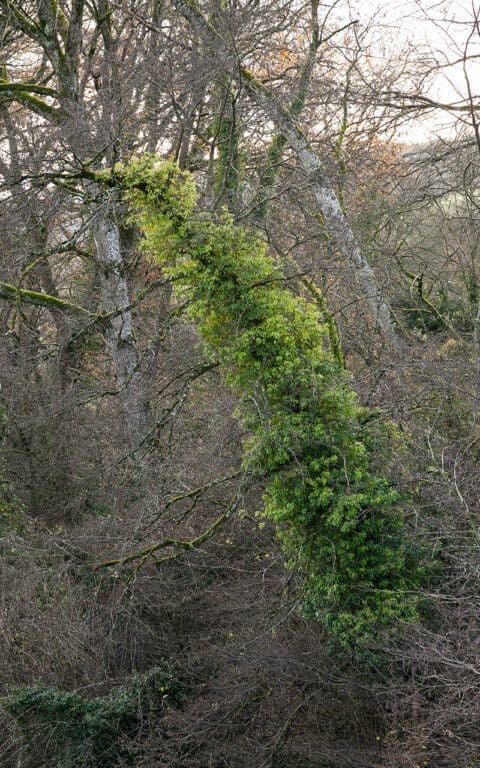
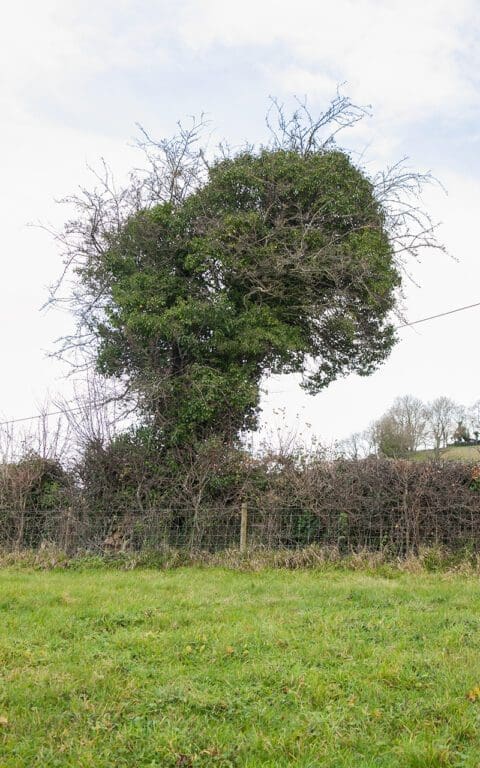
There are mixed feelings about the damage ivy can do. I prefer not to let it loose on buildings for it will forever be in the gutters and having a go at crumbly mortar and window frames, but I am relaxed about it growing into trees. That said, a mature plant can eventually bring a tree down, the weight of foliage providing a sail the host had never allowed for. We have an old hawthorn in the top hedge and at this time of year you can see it is more ivy than tree. Every year after a winter storm I expect it to topple, but I am happy to see the association for now striking a balance and making more of the hawthorn. Walk by it now the foliage is down elsewhere and it is alive with chatter.
Look into the winter hedges and you see that they are also laced throughout with ivy, which in turn provides the hedges with a winter opacity and shelter. The seedlings arrive there from the birds that have gorged upon a mother plant and then paused to poop and this is how they appear in the garden too. Showing you where the perches are and mapping the birds’ movements.
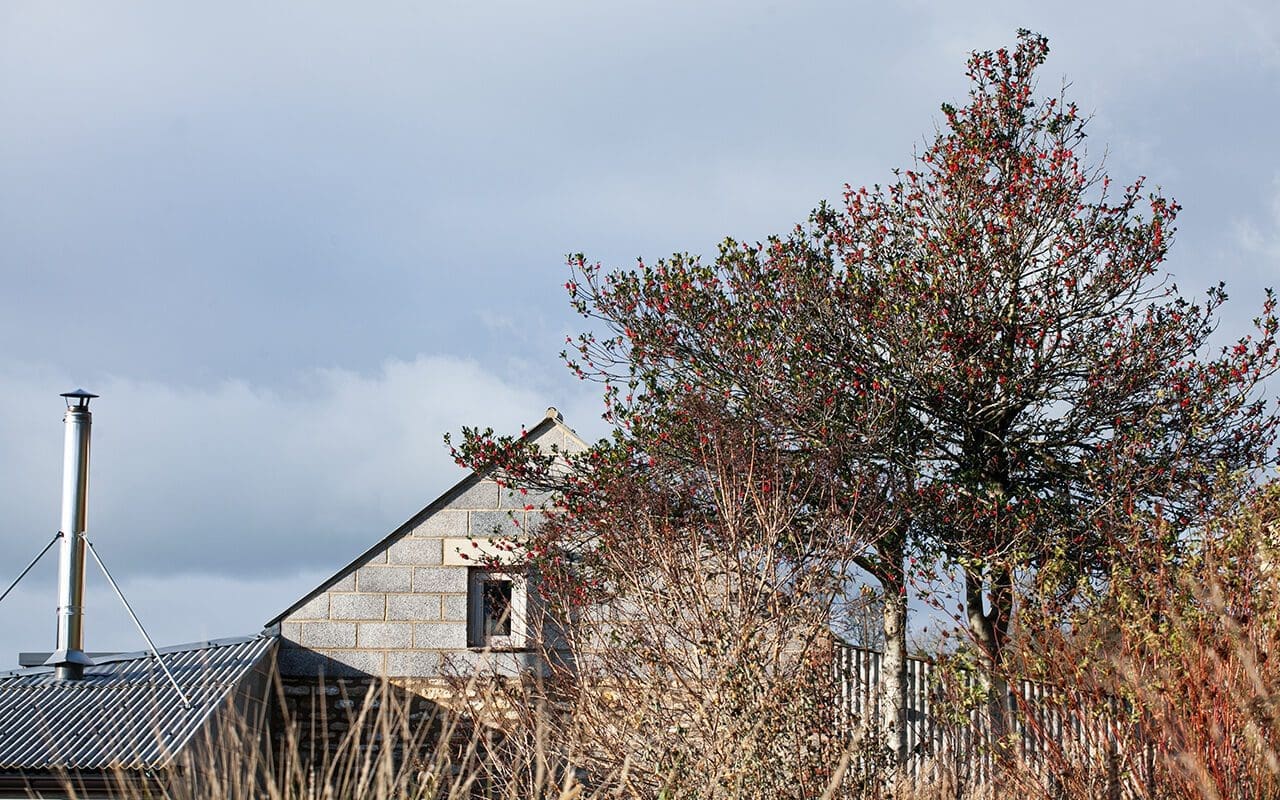
Holly does not do as well here in the hedges as it might on the lighter ground of acidic heathland. I have tried to introduce it, but the plants dwindle and have come to nothing, presumably due to our hearty ground and the advantage it gives to competition. The hollies do better here in isolation and out in the open and we have a pair of old trees by the potting shed that were planted when the land was once a market garden. A neighbour told us that the family who lived and worked here made Christmas wreaths from it for Bath market. Though it is now dwindling, this female tree is a good form, thornless and holding on to her berries for far longer than usual. Not far away in Batheaston a colony of suffragettes who lived in Eagle House planted a collection of hollies each one celebrating a woman who had fought for the cause. An emblem that perhaps also drew upon the ancient appreciation of the constancy provided by this plant and representing, in its winter steadfastness, an image of eternity. We wonder, a little romantically, if our plant might have originally come from the same collection and I have propagated autumn cuttings with the thought that she should have life elsewhere on the land and a new generation.
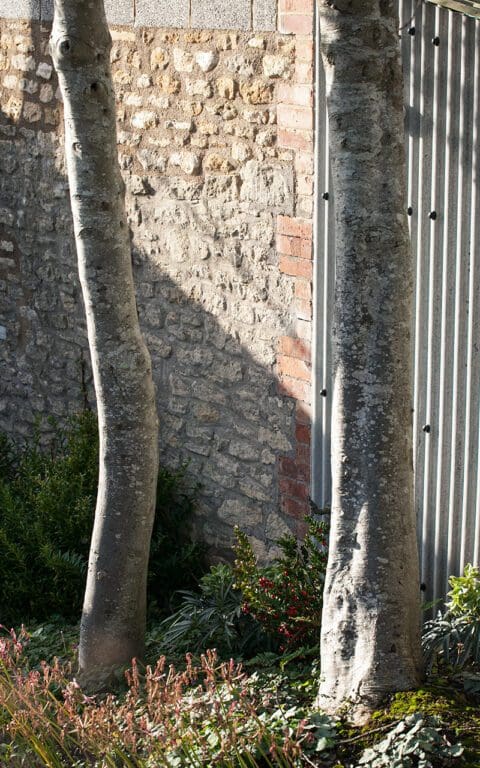
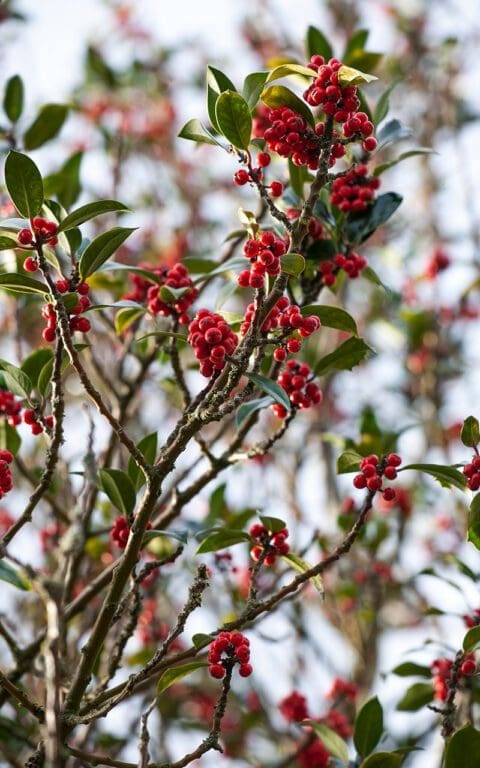
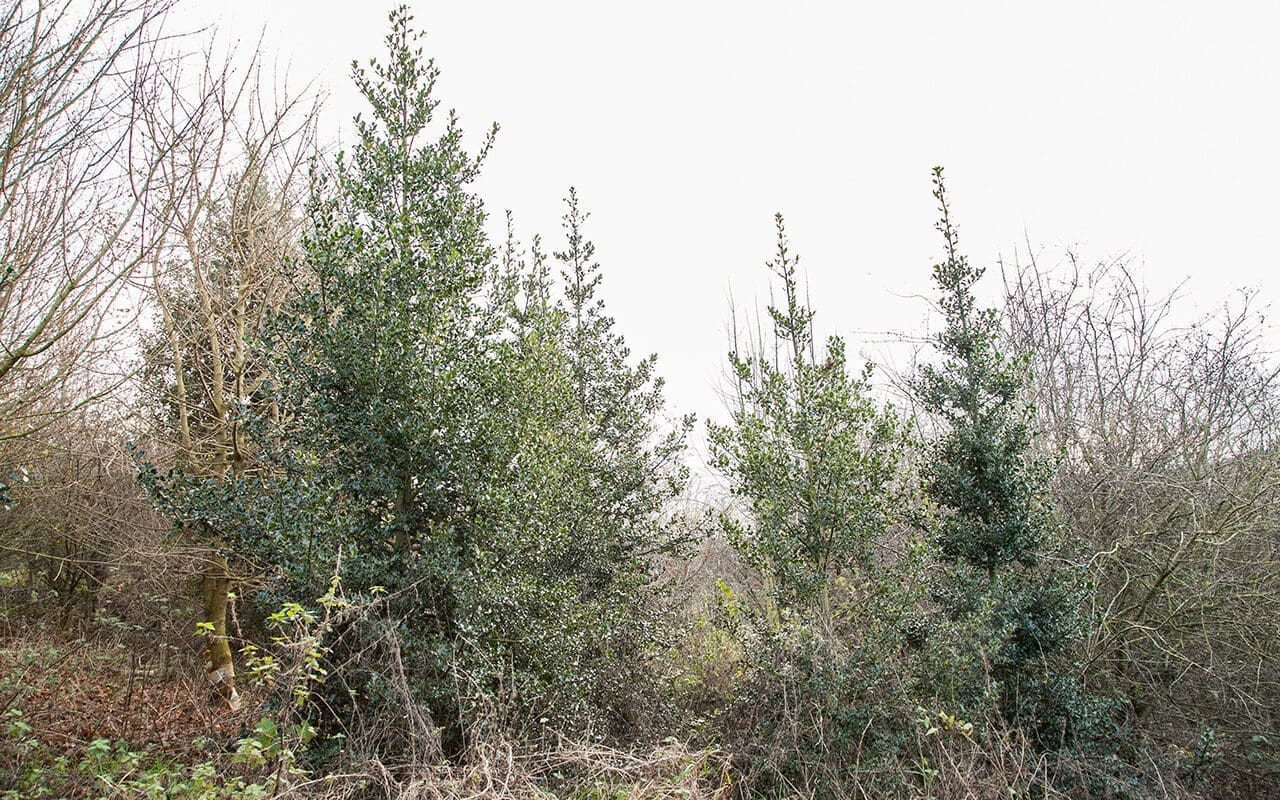
Unless you specifically buy a named female or a self-fertile tree such as ‘J. C. Van Tol’ it is pot luck whether you have bought a female or a male. Though one male can service many trees and from quite some distance when the bees are active, I have planted tens in groups where the sheep cannot get to them. One day, for they are slow, I hope they will provide our land with some weight and heft of winter evergreen.
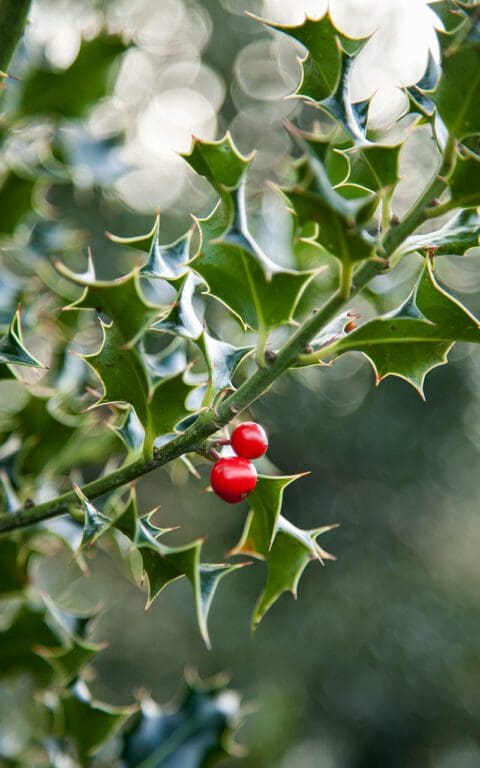
Just this year, seven years after planting, the females are beginning to fruit. Bright and clean. Red against ink green, foliage shimmering, the leaves as reflective as mirrors when basking in winter sunshine. It is then, in this stark season that you see the holly in another light altogether. Not a tree of darkness and sobriety, but one of light and joyfulness.
Words: Dan Pearson | Photographs: Huw Morgan
Published 5 December 2020
The gales have torn at the last of the autumn colour, the rain is with us again with apparently no let-up, but open the door to the polytunnel and you enter a world that is stilled. Immediately calmed and weather-protected. The drum of the storm amplified yet distanced.
This is a place we are getting to know and learning about through growing. Ordered in the first lockdown and erected just before we came out of it at the end of May, the summer’s crop of tomatoes, cucumbers, basil and chillis is now replaced by winter salad. Hunkering down in an environment that takes more than the edge off the winter, we can already see the benefits in the enabled growth. The complement to the hardy winter vegetables in the kitchen garden.
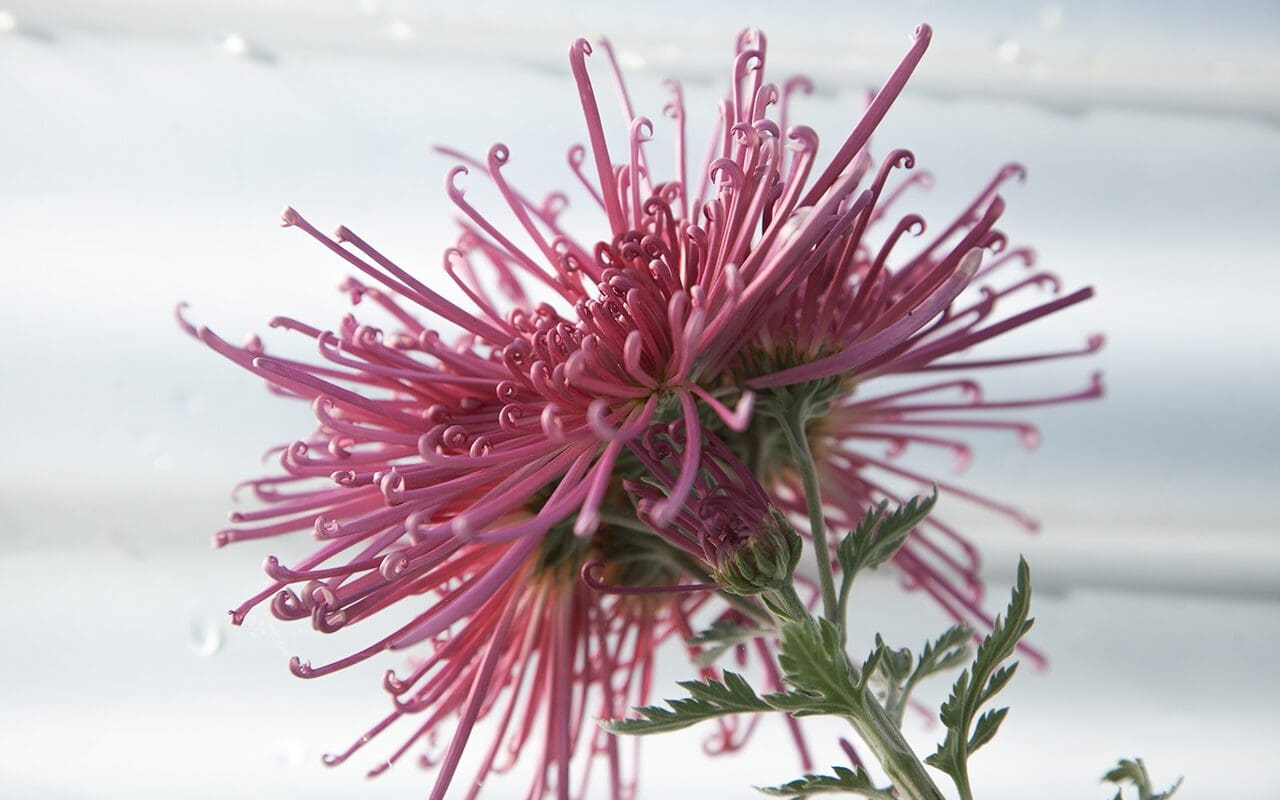
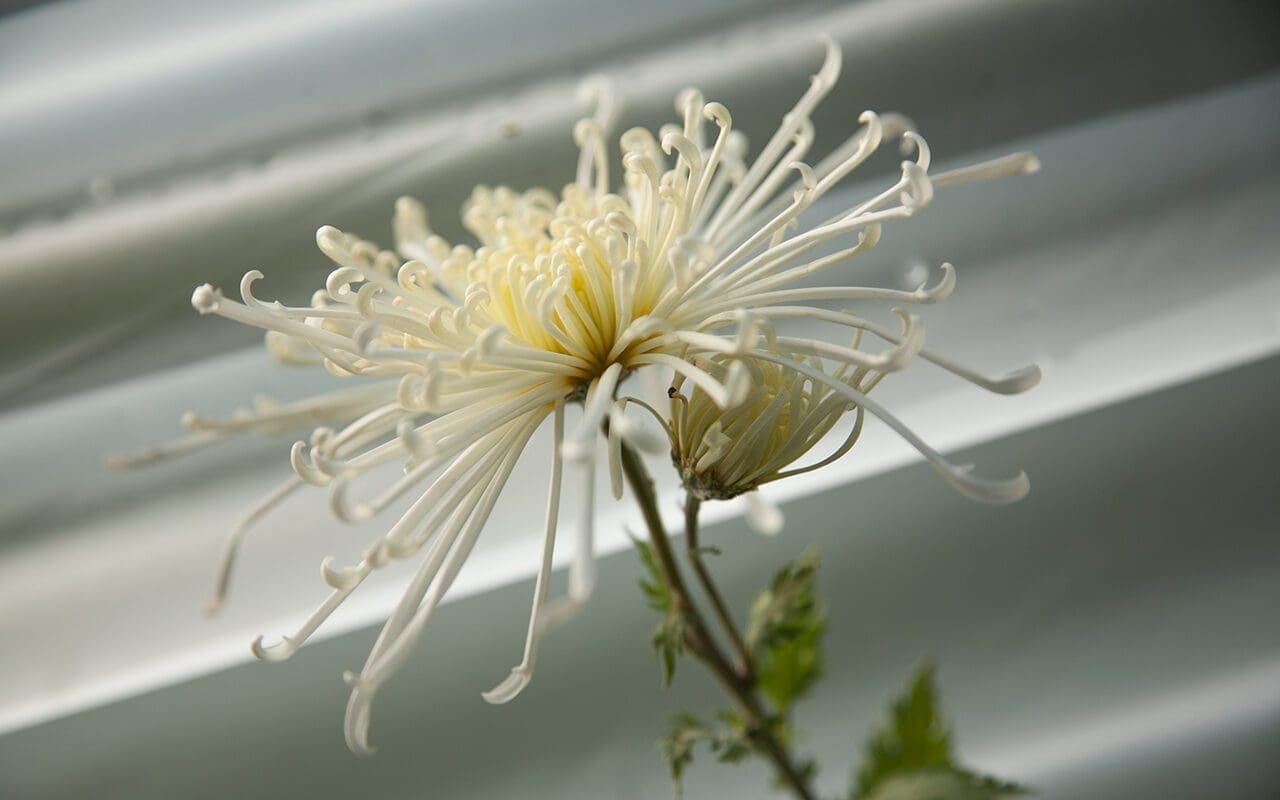
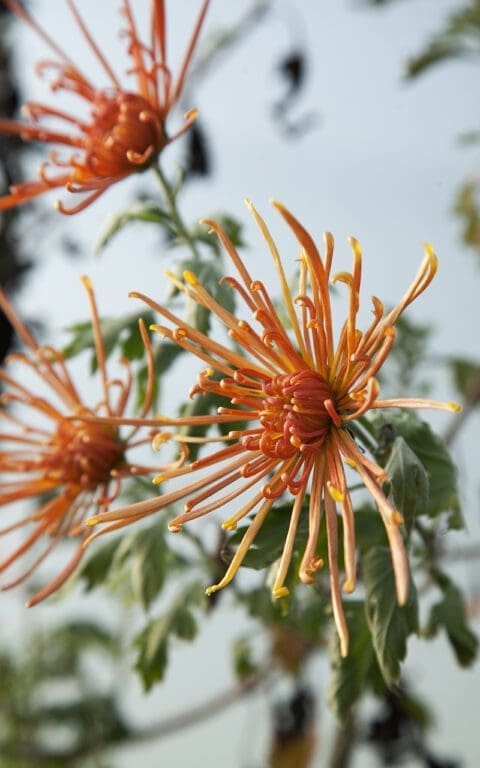
The polytunnel is also providing sanctuary for another crop we are growing to keep us buoyant as the evenings lengthen and the growing season retreats for good. Brought inside at the beginning of October to escape the elements, the spider chrysanthemums are at their very best and, indeed, most vulnerable as the weather turns. Though I grew them successfully for a couple of years in the microclimate of our London garden, last year’s attempt at growing them outside here ended in tears. Months of care and promise were destroyed by November frosts, the very first flowers left in ruins and buds blackened beyond hope.
Not to be daunted, an order was placed with Halls of Heddon last year without a specific plan for their autumn protection. Such is the way with failure in a garden, it often spurs you on to succeed. The rooted cuttings arrived in the spring, this year with the promise of the polytunnel as an autumn retreat, so they were potted on and placed in the lea of the barns up in my growing area. Here, they received morning light – the four to six hours they need to set flower – and then afternoon shade. They were carefully staked and given not much more attention than a regular liquid feed to help flower production.
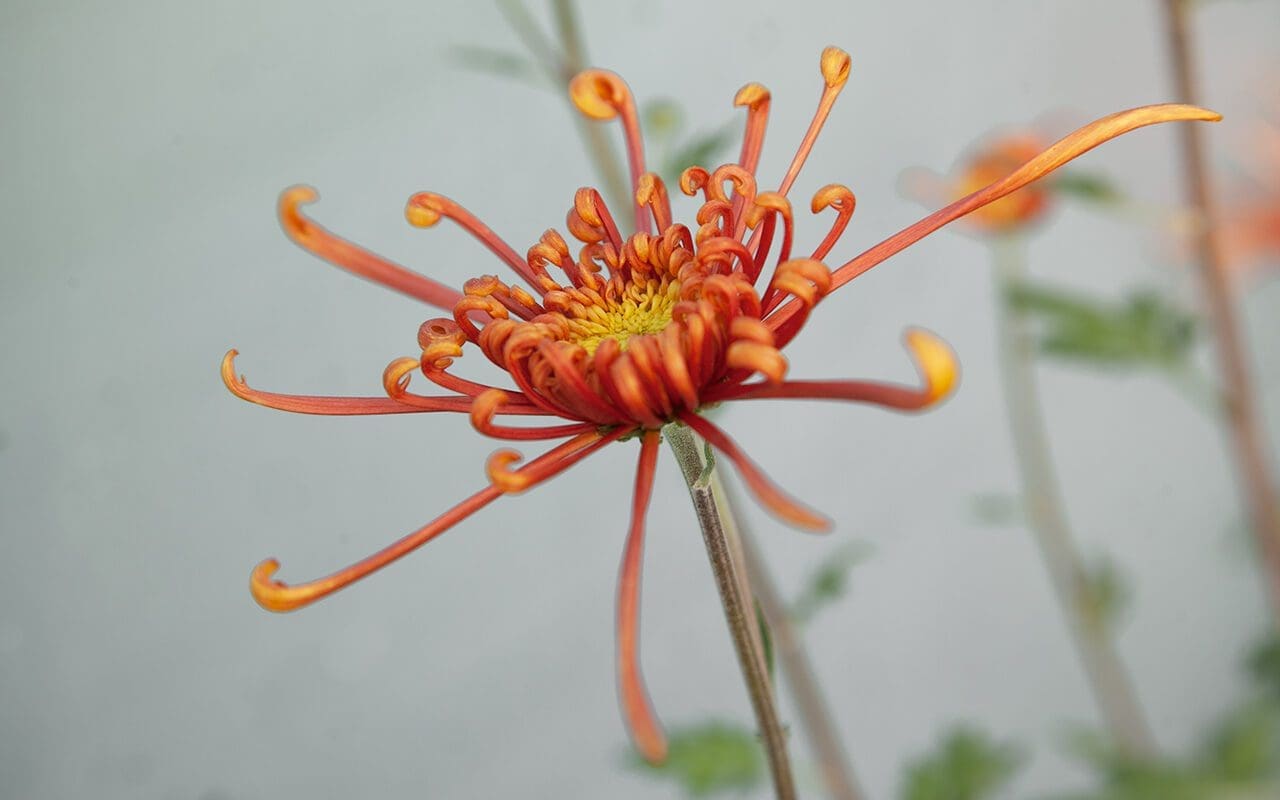
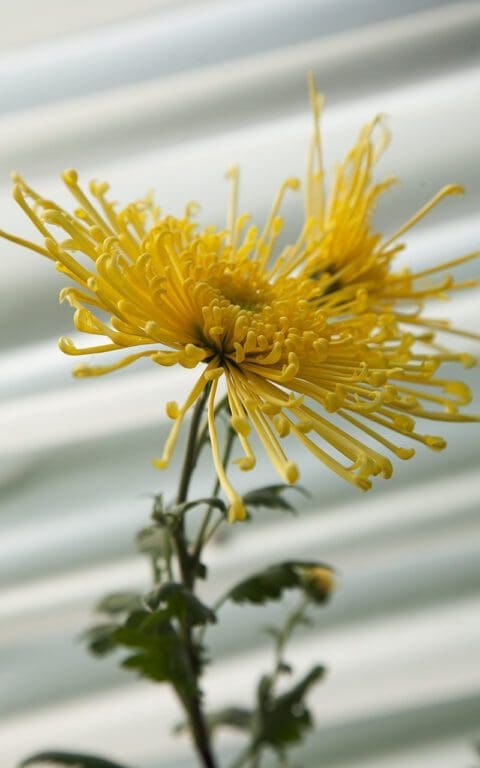
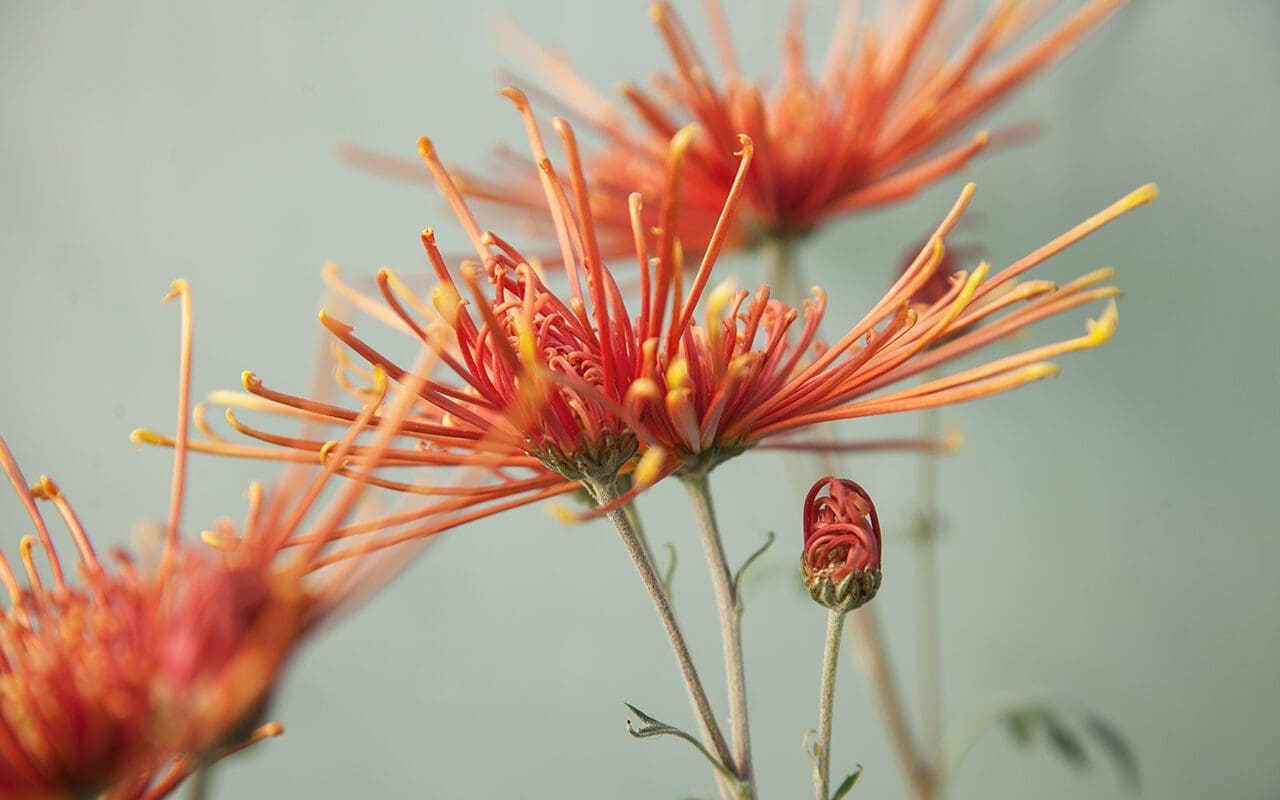
I confess to preferring plants that one can nurture towards independence to those that are reliant on human intervention, but the chrysanthemum festivals in Japan are enough to subvert my self-imposed rules. Once the leaves are down on the fiercely coloured maples and twiggery presents itself again to grey skies, they take a special place in the descent into winter. Grown often just one flower to a stem, displayed on a plinth and often against a dark backdrop, the blooms are naturally likened to fireworks.
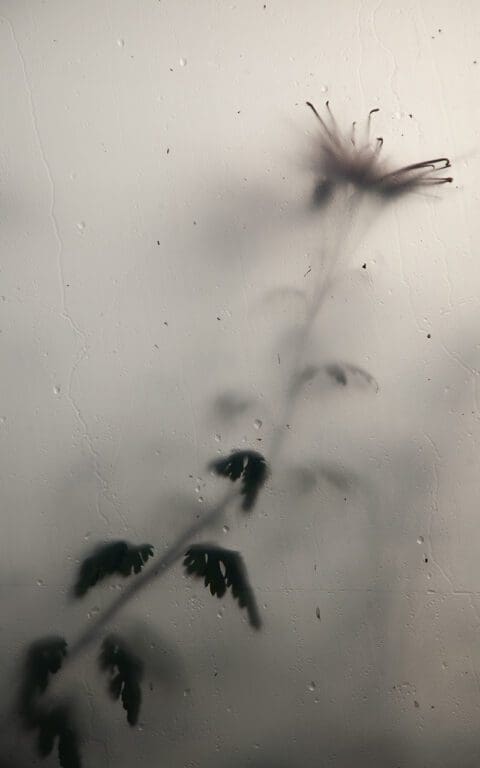
My plants this year have, by contrast, been neglected. They were not pinched out to promote appropriately spaced branching, nor dis-budded to select a number that can put all their energy into flower. They have had the minimum of care. A chrysanthemum grower would say mistreatment. But here they are, in the shelter of the polytunnel, coming into their ethereal own as the rest of the world outside begins its slumber.
Words: Dan Pearson | Photographs: Huw Morgan
Published 20 November 2020
This is a particularly special moment of late garden and first autumn colour. On the front line to protect from the westerlies, I’ve planted the Scarlet Hawthorn (Crataegus coccinea) and a medlar. They both provide blossom and now fruit and, in the short time they have been there, a pool of stillness for the company that needs it at their feet.
Held and protected here, the Wood Oat, or aptly named Shimmer Grass, have found their niche amongst the wind anemones. I planted them throughout the bed. but towards the edges, so that we could enjoy their autumnal arc and mobility. To test their preference, because every garden has rules that do and don’t apply, a few were scattered to the windward side, because the breeze in their growth is what they need to shimmer. I know them to do best in a little shade, or more precisely on the edge of things, and sure enough those on the front line are a shadow of the plants that have thrived with the microclimate of company. Seeding about gently now, they have alighted where they tell me they want to be. On the leaward side and on the margins where, to be honest, they are most easily admired.
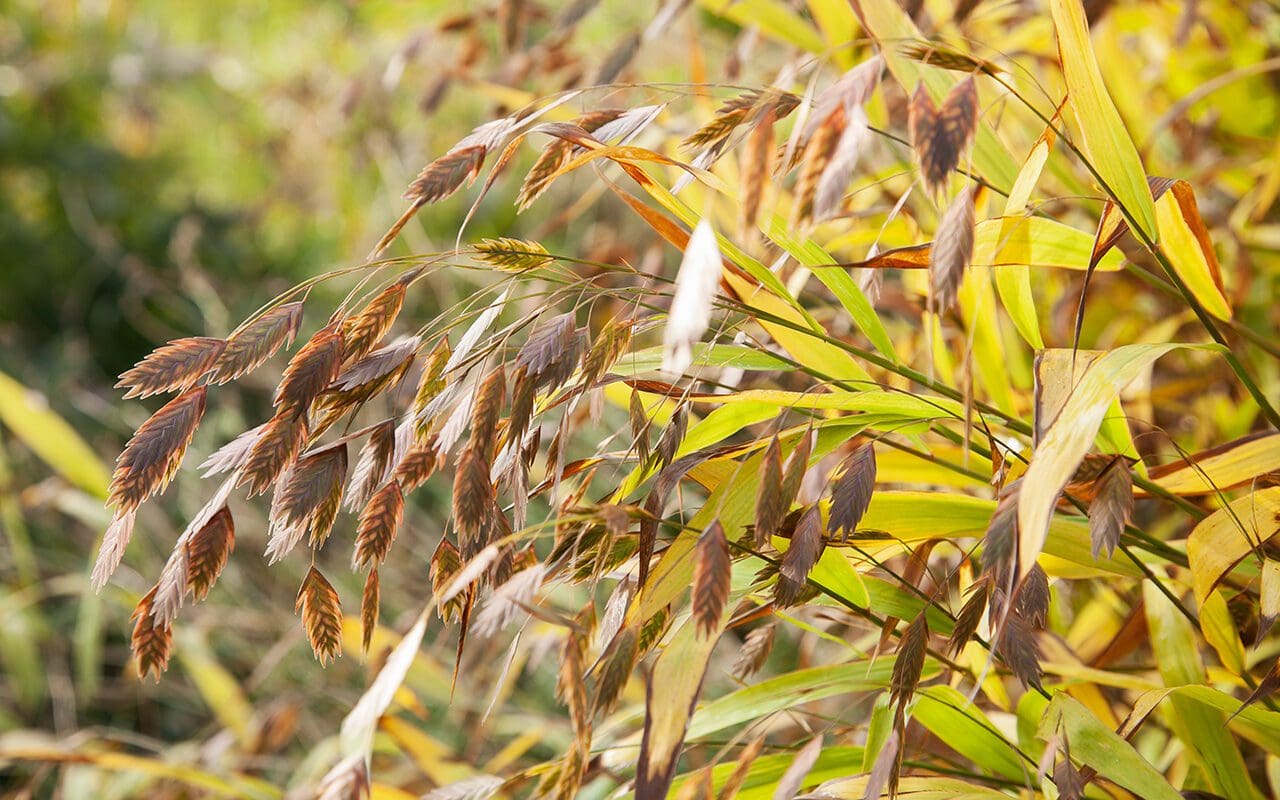
If you are to look Chasmathium up, their many common names probably result from their wide distribution, which dips into northern Mexico and travels north up the States in the shelter of wooded places. Though Wood Oats are certainly not of these shores they do not immediately make you think of somewhere else, like Miscanthus do of the orient. Feeling similar to our woodland Melica and preferring the same places I can see them becoming very much part of this garden. The sun loving Panicum virgatum ‘Shenandoah’ that have splayed over the paths this year where they have been overshadowed by plants that have done better than I thought, will be moved to make way for a more suitable grass. The Chasmanthium will be perfect here, happy to tick along in company and rewarding us with good behaviour and poise and well-paced growth that peaks so beautifully now.
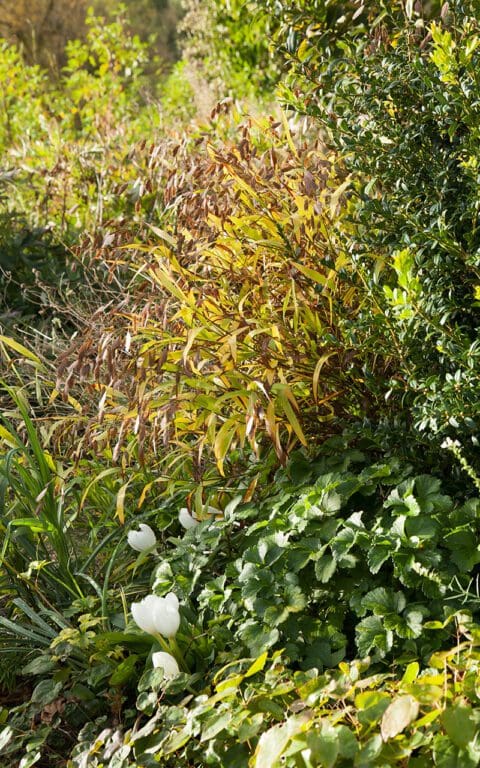
Clumping, not running and a reliably long-lived grass, I enjoy their windswept forms over the winter and cut them back to make way for snowdrops early in the new year. Wide blades, a finger’s width of a cool bright green, then stagger their way up dark stems to about knee height before they begin to throw flower in high summer. There is nothing ungainly about the Shimmer Grass and this is when they begin to, with the first sighting of flower. Firstly tiny darkened versions of what they are working towards and then slowly gaining more presence as the foliage colours butter yellow and the Asters, Colchicum and Anemone begin to provide their backdrop. Completely flat, as if they have been pressed between the leaves of a book and catching, they need the breeze, just enough to make them dart on their wire thin stems like shoals of fish darting and shimmering in the sea.
Words: Dan Pearson | Photographs: Huw Morgan
Published 10 October 2020
I lay awake in the night trying not to worry about the garden. The house shuddered for the second time this week as rain-laden westerlies hit the end gable. In my mind’s eye the runner beans lay toppled and our old tin barns, held together with not much more than common sense and bailer twine, were strewn about the hillside. I imagined the garden, now at its fullest, with the weight of a wet storm pushing through it, tearing indiscriminately and leaving the footprints of an invisible giant.
It is not the first time I have awoken to find things ruffled yet still standing, but where, just a week ago, we were bathed in sunshine that liberated the perfume of lavender, the storms have invited the autumn in. The month of August leans always towards the next season, the ground wet again underfoot and the associated smells of spent growth rotting. Already there are cyclamen flowering in the shadows and the first of the asters marking the tipping point and shortening evenings.
Although it is a long and plentiful season, when planning a garden I always work back from autumn so that everything leads to something celebratory. Just about now, and providing a fresh and pristine complement to the plants that have come and gone or are starting to wane, is a wave of creams and whites. I have planted several that repeat and provide this levity.
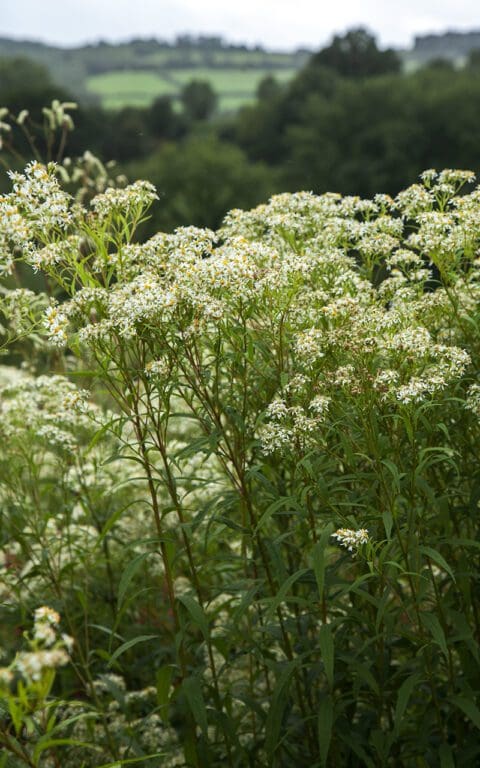
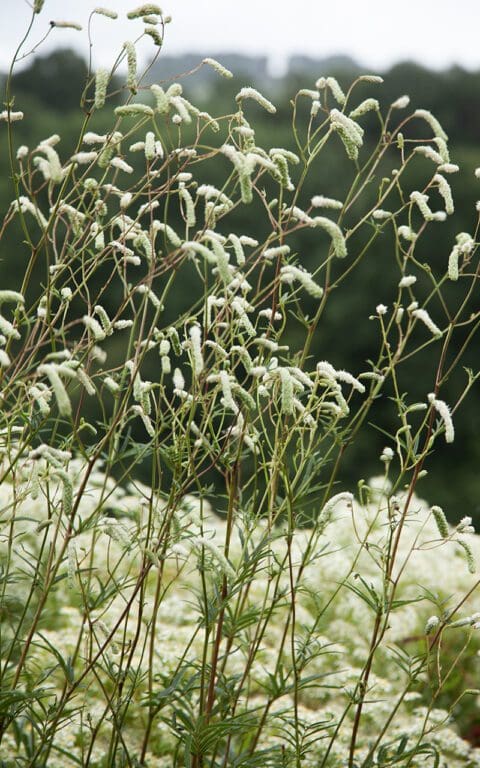
The flat-topped aster, now named Doellingeria umbellata, has considerable presence, rising up to shoulder height before giving way to creamy flower. It stands well without staking and bounces back after a storm to provide a luminous horizontal. It is teamed with Sanguisorba tenuifolia ‘Stand Up Comedian’, which rise above and pepper the air around it. Throughout the seasons I like to walk up onto the Tump and look back on the garden and, in the month of August, the doellingeria hold the upper ground and provide light that runs from here to reappear in rivulets elsewhere.
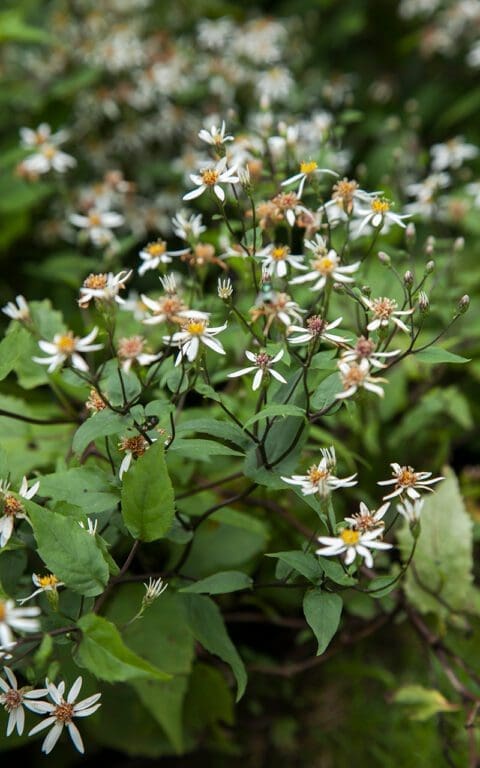
A spume of Eurybia divaricata lines the lower paths and provides a stop/start undercurrent. This is the more typical form which is brighter white and more mounding than a dark-stemmed form selected by Beth Chatto (and named after her) which I repeat along the length of the grass path at the top of the garden. Their foaming presence is rewarding on even the dullest of days and, being happy in shadow, they make a pale and light-giving understory. Both the flat-topped and wood aster keep perfect timing to ease the summer into the next season.
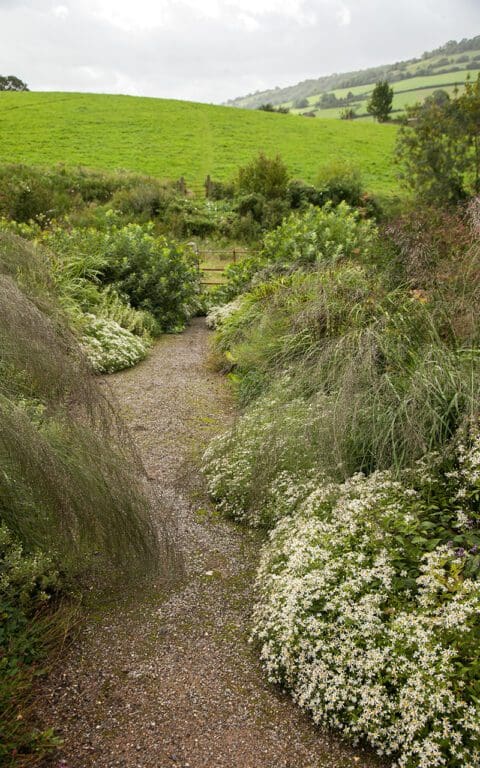
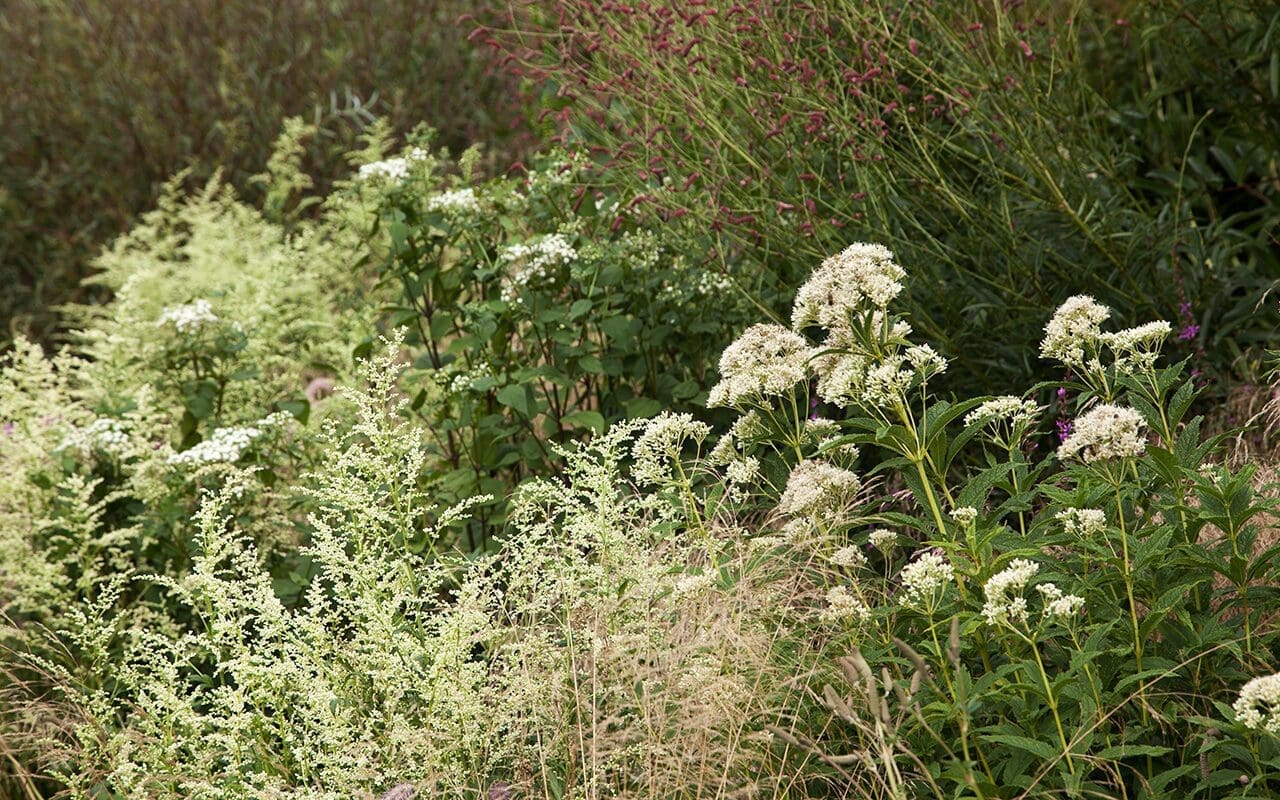
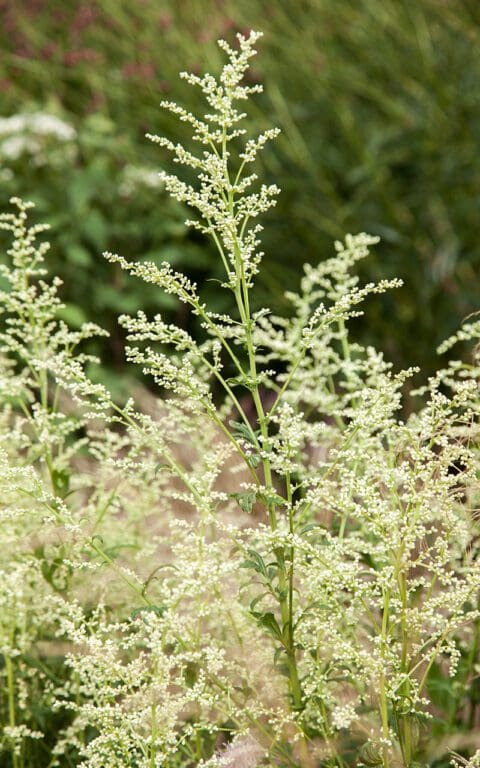
On the edges of the garden, and making a subliminal link to the run of the ditch with its meadowsweet, old man’s beard and white-flowered bindweed, I have grouped the creamy wormwood, Artemisia lactiflora ‘Elfenbein’ (meaning ‘ivory’). It is well placed here. Happy to take on the elements and standing tall and upright without ever needing support, it rises through the now spent Deschampsia cespitosa ‘Goldtau’ to bring a new wave of life and energy. When seen against the differing whites of two eupatorium nearby, the feathered plumes of the wormwood make interesting contrast for their creaminess. The ‘Elfenbein’ will flower for a good month whilst the shining white Anemone x hybrida ‘Honorine Jobert’ gather their strength for full blown autumn.
Words: Dan Pearson | Photographs: Huw Morgan
Published 22 August 2020
Angelica sylvestris mark the damp hollow and stand tall to either side of the ditch. The ground here is always damp, fed by springs which keep the water running even in the driest of summers. The mud close to the water’s edge is boot-grabbing and deep and the angelica are as happy there as they are in the firmer ground above it. But their preference is mapped clearly, the stems towering head height where they get the moisture they need and diminishing and then vanishing entirely where the wetland gives way to the drier pasture.
August is their season and when they are at their finely-spun best. A bolt of slender stem, leaves evenly spaced and then left behind as a tightly held fist of flower bolts up and then out to strike a series of horizontals. Creamy rays tinged with pink and receptive to all pollinating insects, they stand head and shoulders above the grasses that are now tawny around them.
Though this is their time, they have been present since late winter when we raked away the thatch and the tall woody skeletons of the ones that came before. They take two years to flower from seed. The seedlings bright and already forging a way before mud gives way to growth. Growth that will put them in the roughest of company. Marsh thistle and horsetail and tussocky grasses that it is hard to believe will tolerate company.
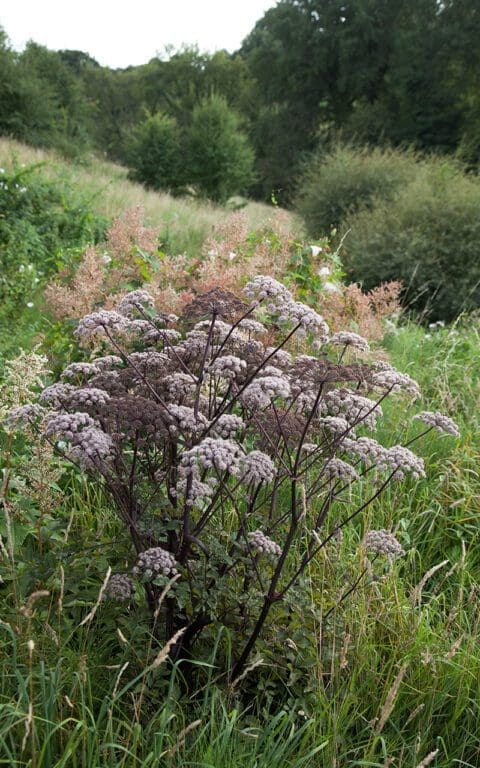
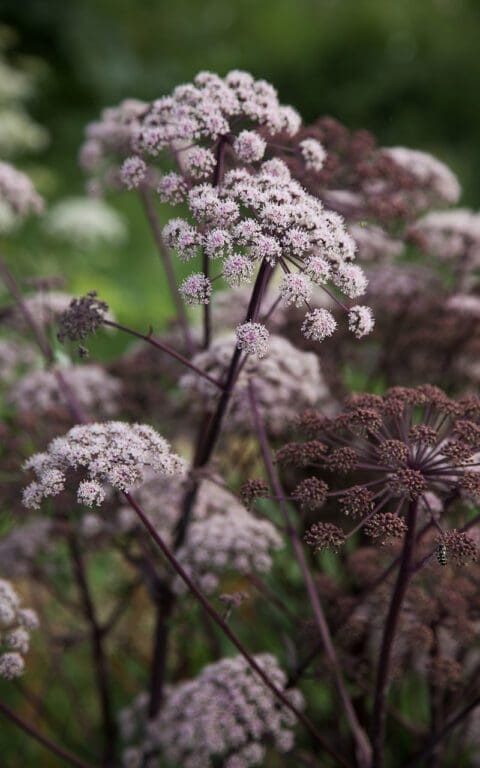
The seedlings disappear beneath the wetland growth and are happy to be eclipsed in shadow, but last year’s seedlings have sent down a strong tap root and from this they rear strong and early growth. Distinctly angelica, slender and reaching, some of the youngsters already show a variance in colour. The darkest are a rich plum purple and carry this through into their adult incarnation with flowers that are also stained dark throughout. ‘Vicar’s Mead’ or ‘Ebony’ are garden selections that maintain good colour and, though I would be happy to have them in the garden, I am more delighted to have their natural spontaneity in these wild places.
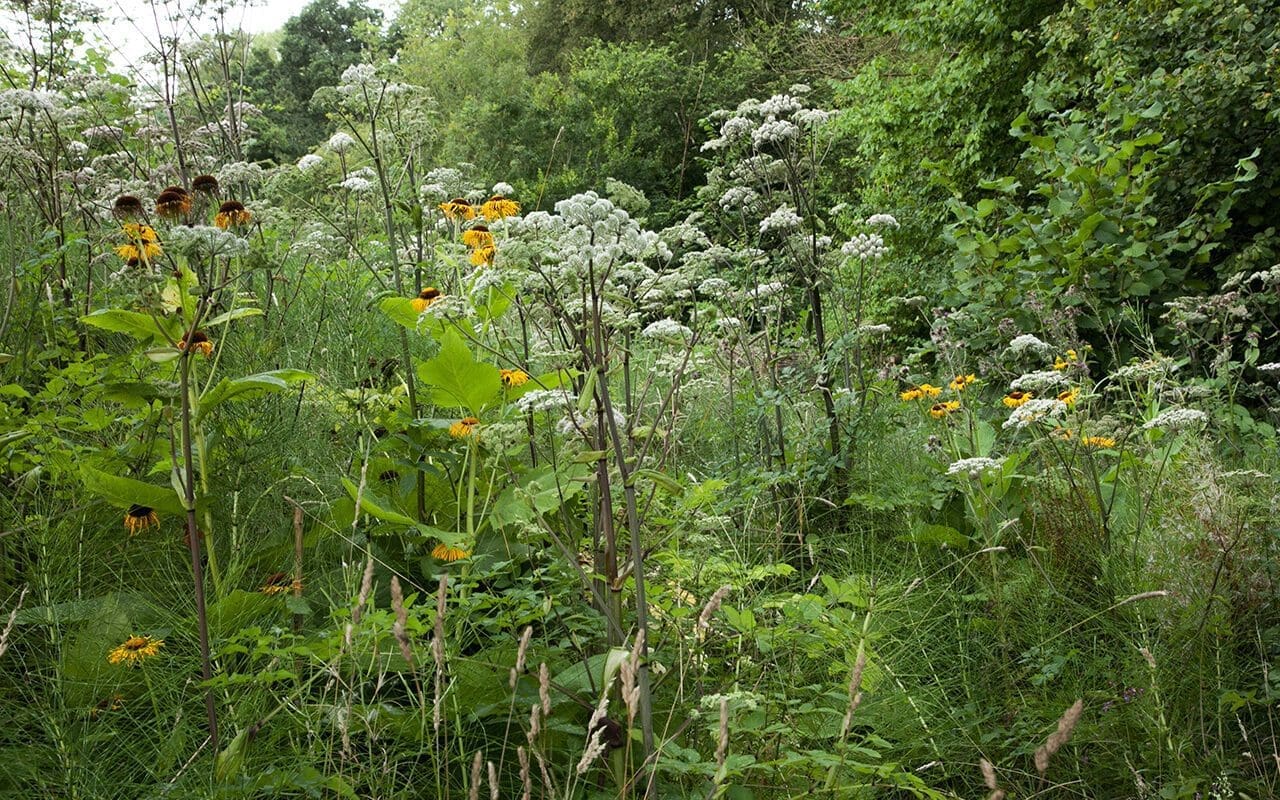

In the garden and to make the leap between the wildness of the ditch I have used the perennial Angelica anomala, which is easier to manage than the biennial Angelica sylvestris for knowing where it will appear every year. Too many self-seeders in the garden make for hours of editing in the spring, but the spontaneity of the wild angelica is delightful in the ditch for finding its own place, which from year to year is never the same.
In the lower parts of the water course and close to the fourth and final crossing that weaves a way back and forth in its descent, the angelicas appear amongst the Telekia speciosa. This robust perennial is strong enough to stand its own once established and it teams very handsomely with the angelica. Both revelling in the heavy wet ground, they take the feeling of the garden deep out into the landscape and, at this time of year, it is the angelicas that you follow to find yourself there.

Words: Dan Pearson | Photographs: Huw Morgan
Published 15 August 2020
An inevitable shift happens when the Tump, our plumpest field and the backdrop to the garden, is cut for hay. In the days that follow, the path that was mown into the meadow marks a bright green line in the stubble and stands as a memory of the daily walk we made through waist-high grasses. It takes a week or maybe two depending on the year for the land to re-green and with it the path slowly vanishes. The garden, meanwhile, tips from its high summer glory, the vibrancy of July infused with the feeling of the next season. In a countermovement, the grasses in the garden rise up amongst the perennials as if to compensate for the loss of the meadow beyond and with them the thistles that mark the month of August appear. The neon of the artichokes we left to flower in the kitchen garden and the echinops or globe thistles, of which we have three.
The first to become present is Echinops ritro ‘Veitch’s Blue’, which steps through the lavenders in an area we call the Herb Garden. It is the best behaved of those we grow here, standing at around a metre and never seeding like the majority of its cousins. The long-lived rosettes of thistly foliage, green on the upper side and silvery beneath, become completely dormant in winter and are relatively late to stir in spring. The leaves have a ‘look-but-don’t-touch’ quality about them, but they are perfectly easy to work amongst. Being sun lovers, the one thing they do not like is competition before they get head and shoulders above their neighbours. And this is why they do well here, the rosettes having the room to muster before the tightly clipped domes of the lavender start stirring.
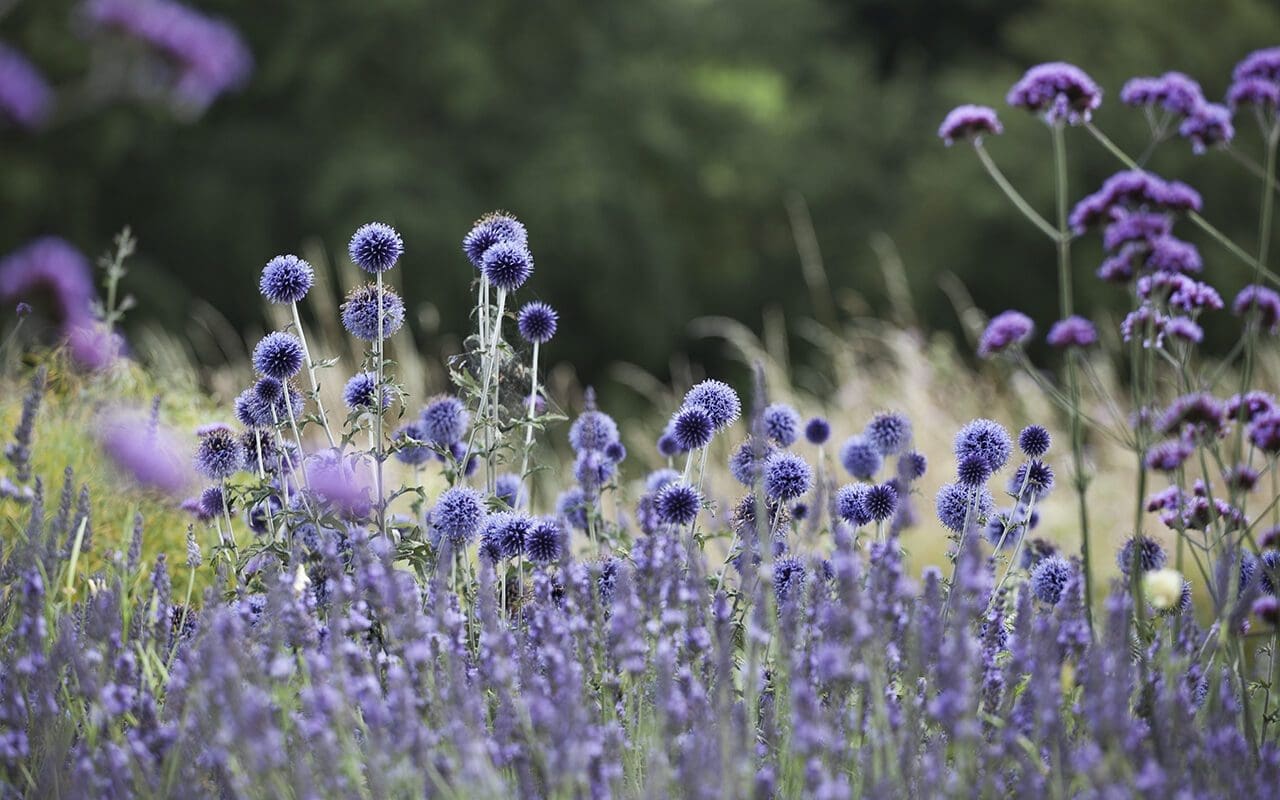
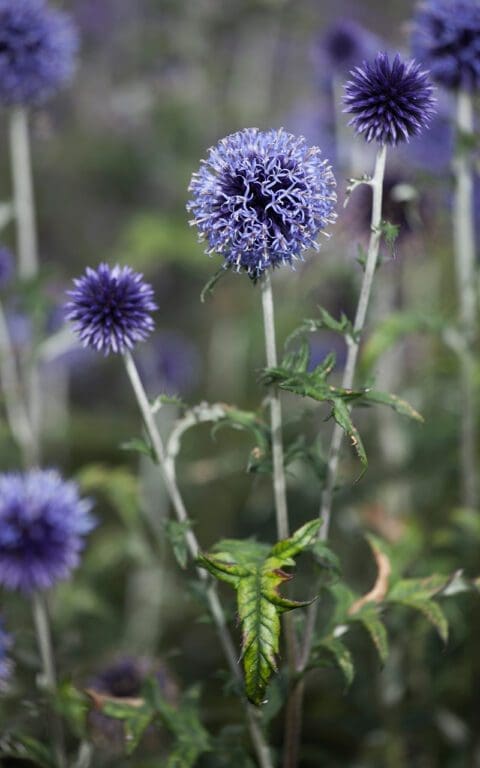
The interest starts early as soon as the flowering growth shows itself in June. The depth of colour comes from the deepest indigo calyces, which are repeated countless times to form a mathematically perfect sphere. Being composites, each sphere is composed of many individual flowers, which open from the top down as they come into flower. A flowering stem will suspend each of the orbs in a galaxy that is particular to each plant. I have clustered several plants together in a mother colony with breakaway satellites amongst the lavender so that the intensity of one against the next varies as the flowers work against each other. The dark buds finally give way to denim blue as the globes are enlivened by flower.
One of the remarkable features of all echinops is their attractiveness to pollinators and they are alive with bees and nectar seeking insects, never more so than now when the meadows are down and our native wildflowers are on the wane. With this in mind, we have two more globe thistles in the main garden. I used to grow Echinops sphaerocephalus ‘Arctic Glow’ (main image) when I was a teenager where it threw rangy stems to shoulder height in the clearing we gardened amongst the trees of our woodland garden. I pined for sun then and the light we have here on our sunny slopes have yielded another plant all together, hunkered and stocky with no need for staking and rarely more than waist height.
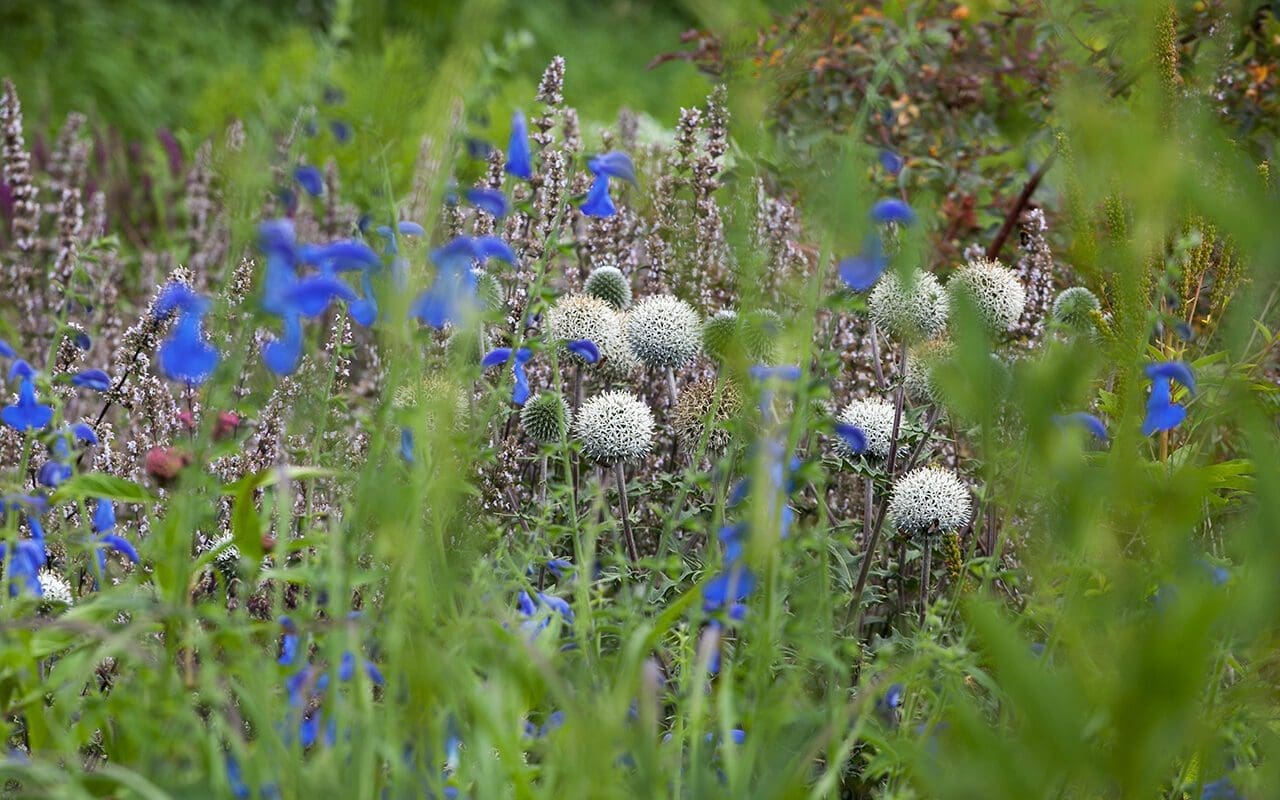
‘Arctic Glow’ does have a mind of its own, though not horribly so, and its foliage is thistly. The rosettes take about a year to muster the strength to throw up a flowering stem once they have seeded, and seed they do. Prolifically and with the precision of a dart player. If you miss a seedling in the spring, do not underestimate the speed with which it sends down a taproot and takes hold in a neighbouring plant’s basal rosette. Once the taproot is in place the foliage is strong enough to muscle its way in and outcompete its host. However, this is to focus on the wrong qualities of the plant, as the decision to invite ‘Arctic Glow’ into the garden has also been a good one. The silvery buds give way to a grey-white sphere of flower, which contrasts here very beautifully with the smokiness of Nepeta nuda ‘Romany Dusk’. Seeding can be diminished by taking the whole plant to the ground after flowering, so you need to plan for the potential gap. The asters and the late arrival of Dahlia australis cover for it here, but I do leave a couple standing as they have proven themselves to be as short-lived here as they are pioneering.
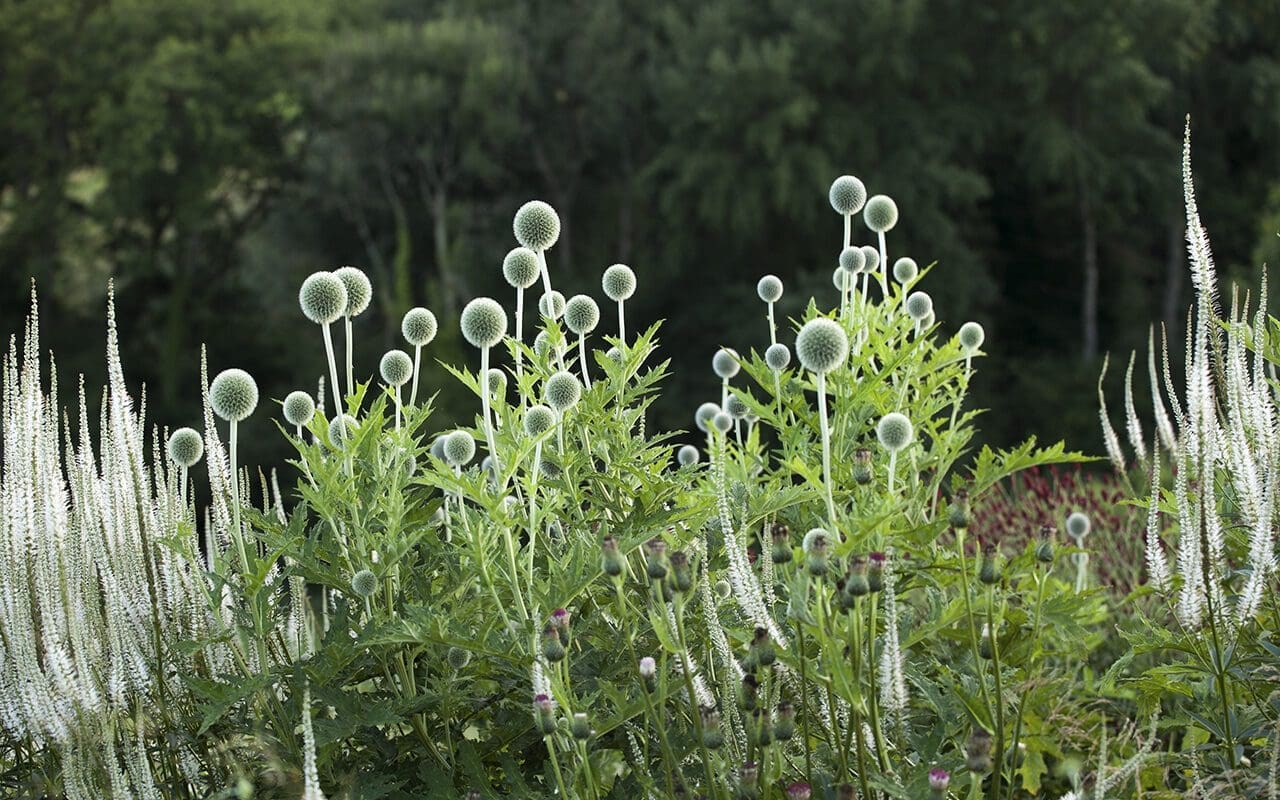
This habit needs to be managed and the same can be said of the Russian globe thistle, Echinops exaltatus. This plant needs space and commitment and though I love it for its presence, I would not trust it to seed throughout the garden so it is also felled before it seeds. Lush green foliage, which fortunately is more or less devoid of spines, amasses volume early in the season and balloons exponentially as it races to flower. This is very exciting. The books say it stands at about 1.5m but on our rich ground here, it grows to two metres or more so it is gently staked with a hoop to prevent it from leaning. You do need to plan for it throwing shade on its neighbours that might not be up to rubbing alongside such a vigorous companion. I do this with earlier flowering Cenolophium and cover for the gap post-flowering with Japanese wind anemone and actaea.
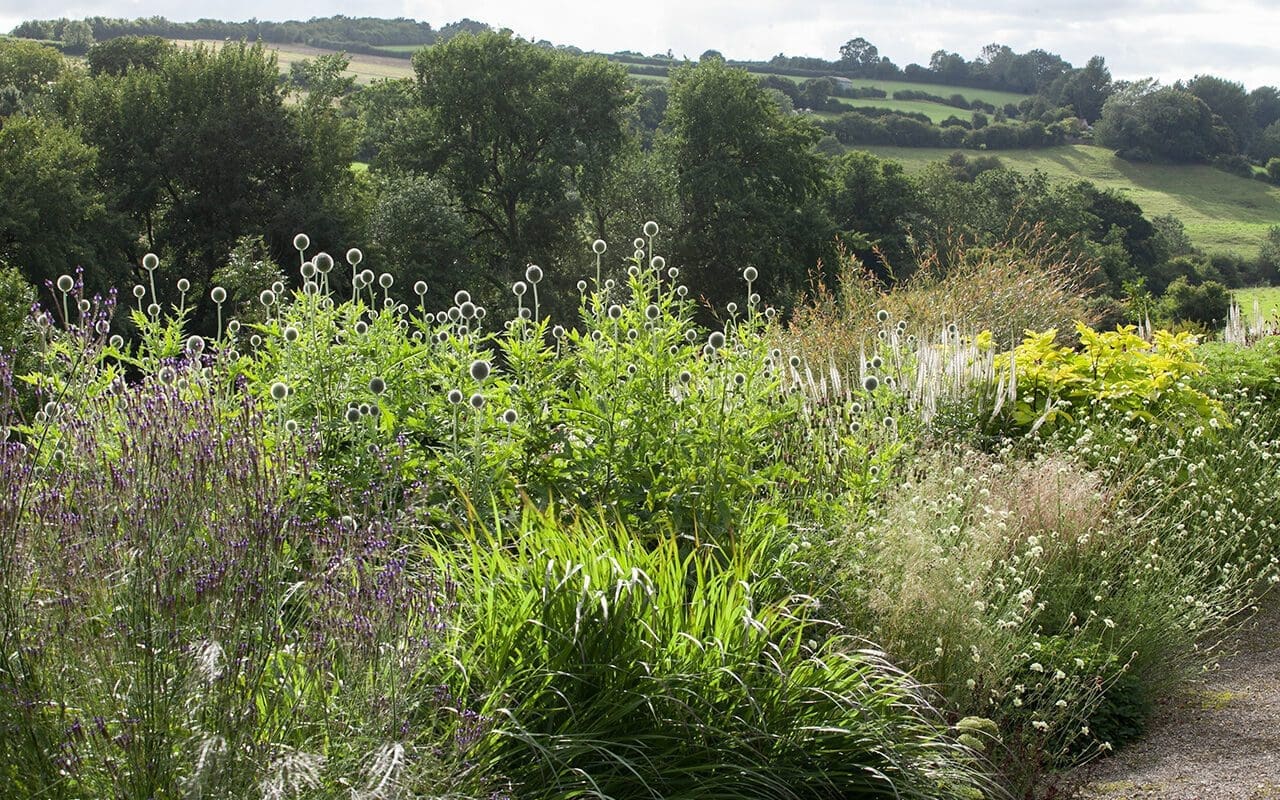
Echinops exaltatus is is the last to flower here. The pale green spheres are luminous, tipped with silver and, just before the flowers open, the perfection of their symmetry repays close study. Slowly, this first week in the month, the orbs break into flower. First one and then another, the bees, hoverflies and beetles flocking to feast as more come on stream. I have them here with the fine spires of white Veronicastrum virginicum ‘Album’ and the August darkness of trees as their backdrop.
One day, I dream of having the space to let them go, to let them stand into the winter and lead a planting of pioneers that works on a grand and autonomous scale with white willow herb, romping cardoons, Alcea cannabina and and wild carrot as companions. For now, though, I am happy to put the time in to curtail their natural tendencies to roam and am happy that they are here to set the tone for beginning of the last fling of summer.
Words: Dan Pearson | Photographs: Huw Morgan
Published 1 August 2020
When we moved here from our Peckham garden with space to try a new plant palette, we set aside a section of the old trial garden to get to know a number of the David Austin Roses. I wanted to live with them day to day rather than vicariously through my clients’ gardens, so I took a trip up to the David Austin rose garden in Albrighton and spent an afternoon in the third week of June in the generous company of Michael Marriott, their rosarian. There is nothing like time spent with experts, or in seeing the plants right there in front of you, each with its own character and, once you had buried your nose in flower, its own perfume. Some spicy, others tangy and smelling of citrus or as fresh and clean as tea.
I had several requirements. I knew I would be using species roses in the wider landscape where they would sit more happily, but for cutting it was important that the roses were good performers and had a long season. I wanted plants that were disease-resistant, because I didn’t want to spray, and it was imperative that they had scent. What would be the point in having a bedside rose that simply sat prettily ?
I came away with a list of twenty four varieties ranging from white through cream and yellow, and then all shades of pink and on into apricot, orange and reds. Most were doubles with quartered blooms, because I wanted to have a little opulence, and it was also important that the foliage had good character. The first plants had five years in the old garden when I dismantled the trial beds to make way for the garden landscaping. At that point I rejected a few that were weak or not right here and replanted with new plants and a few new varieties up by the old barns. I like them here against the corrugated tin, planted in practical rows which suggest and allow for ease of picking.
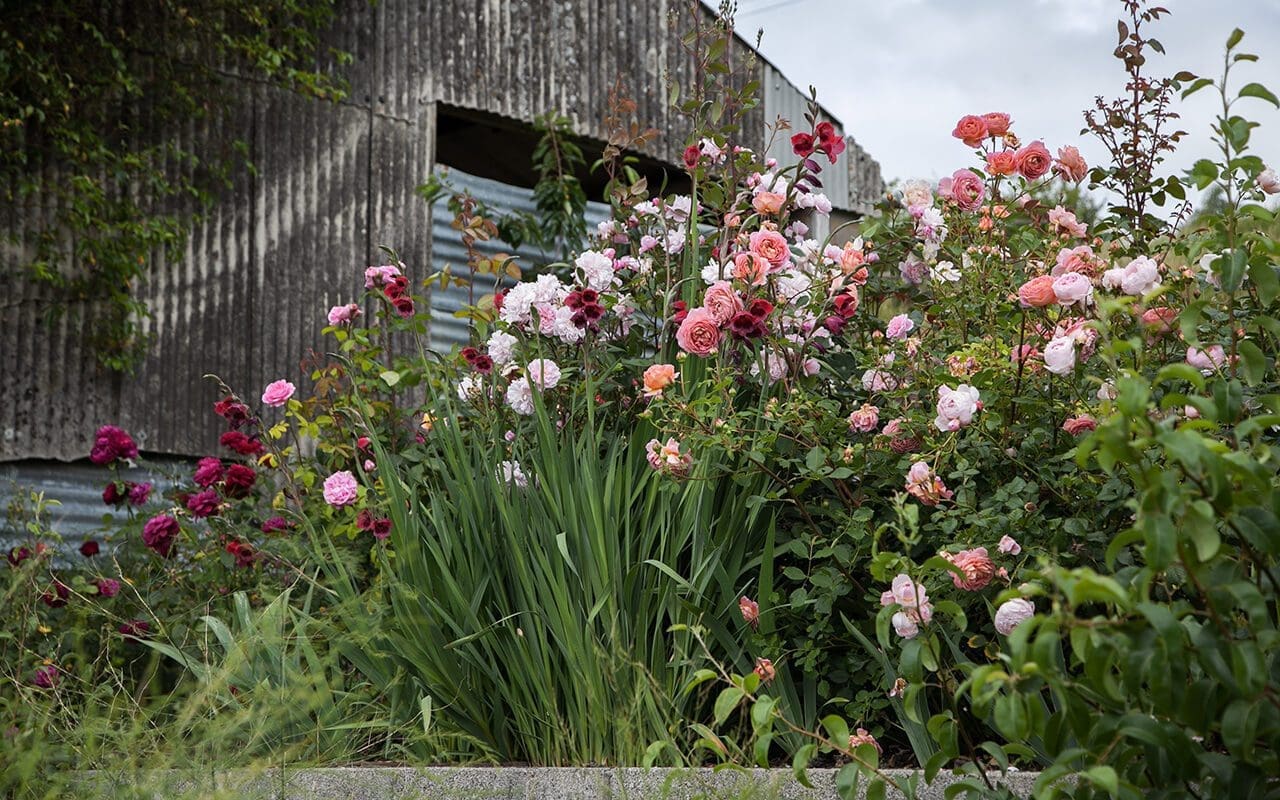
The last nine years here they have shown me what they are made of. In general the yellows have done less well for us, but our West Country climate, with its heavy dews and year round dampness, may be the reason that a few have been prone to blackspot. The beautiful clear yellow ‘Graham Thomas’ succumbed here, though it has done well and been ‘clean’ for friends. ‘Charlotte’ has also failed and neither have been replaced because there is simply no point in having a sick rose when there are a host of others that are strong and healthy. I have struggled to keep a couple of reds and oranges too, but have been happy to spray twice with a sulphur-based fungicide early and mid-season to keep ‘Munstead Wood’ and ‘Summer Song’.
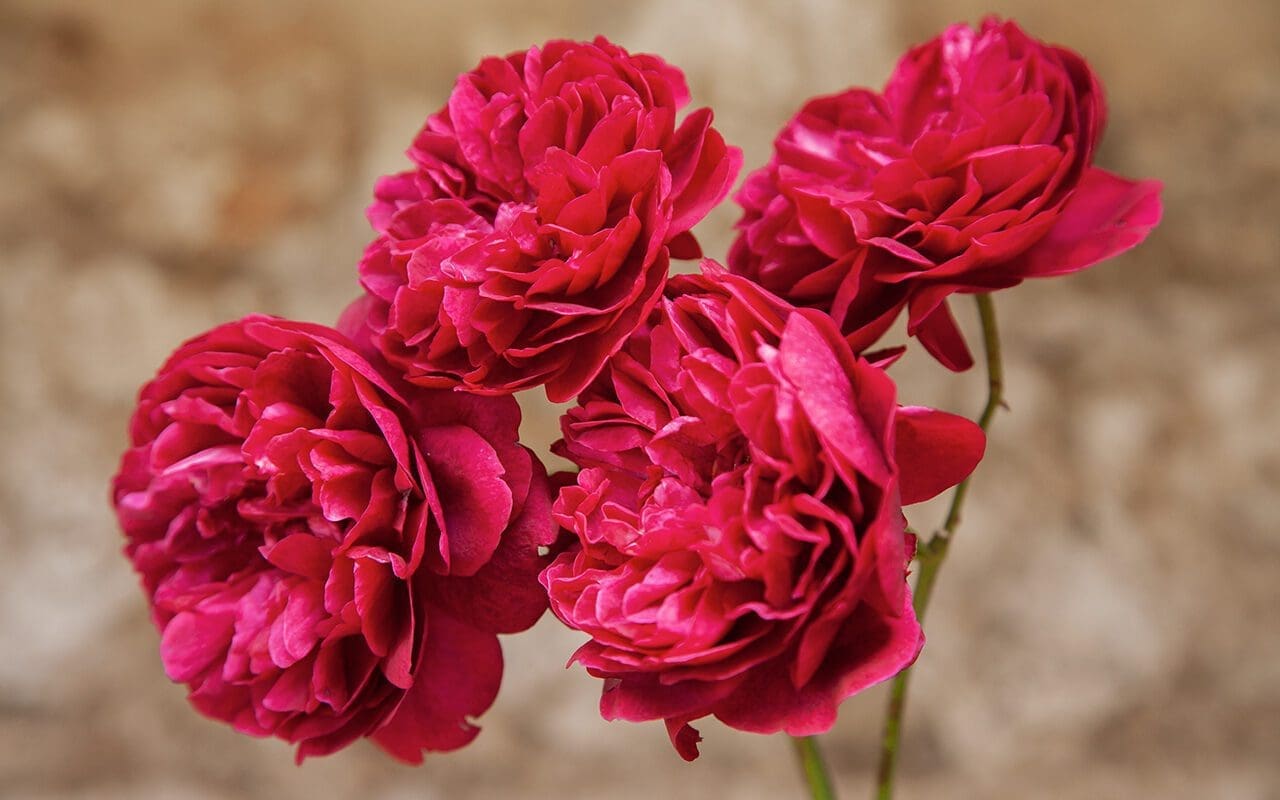
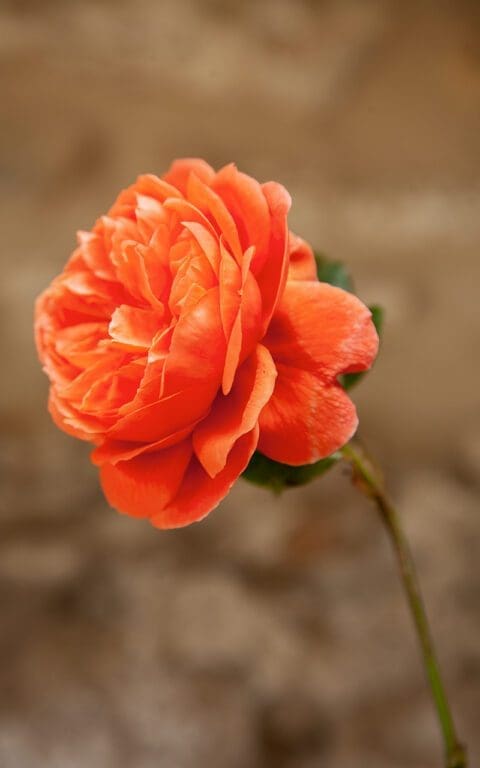
‘Munstead Wood’ is simply the best of the reds, deep and lustrous and beautifully perfumed like your memory of what a rose should smell like. Though not a strong grower, it responds well to being nurtured and I am prepared to do so for the reward. ‘Summer Song’ is perhaps my favourite of all in terms of colour, with a burnt orange flower and delicious zesty perfume. It too is weak and I would never recommend it in a planting scheme, but it can be forgiven for its less than athletic figure in the cutting garden. Cutting the roses regularly is a good opportunity to check on health and vigour. We dead head as we go to keep the flowers coming. I feed with organic chicken manure pellets after their first flush and this helps to keep them in good condition and plentiful right through to November. We have found that the Austin roses take a couple of years to settle in, but are fully up and running in year three.
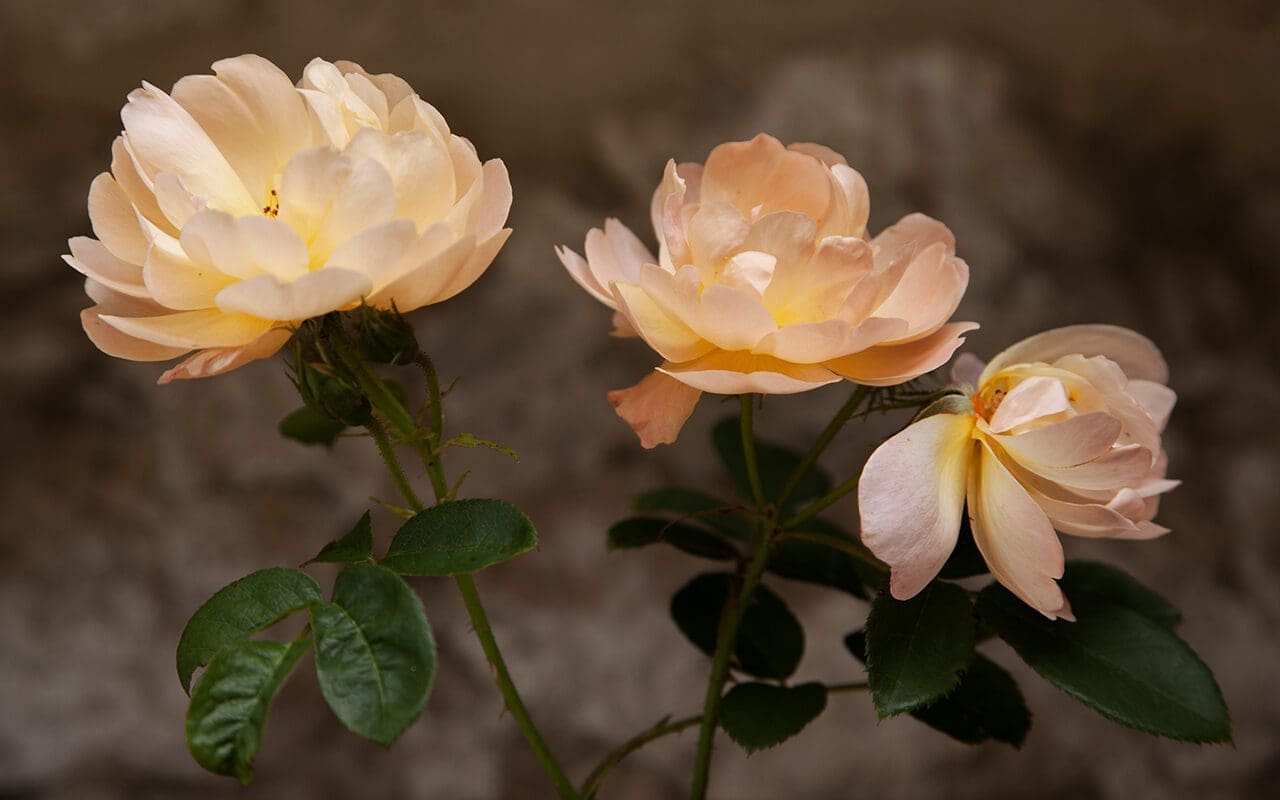
Of those that have done well, ‘The Lark Ascending’ is by far the strongest and a firm favourite. Healthy and amassing a good six feet in a season, the foliage has the mattness of an old-fashioned rose. The flowers are delightful, semi-double, cupping open to reveal a boss of stamens they deteriorating elegantly. The semi-doubles and the singles last less well as cutting flowers but are better for pollinators and this combination of elements make it a good candidate for a mixed planting. The tea-rose scent is delicate, but its habits make it worth this minor compromise.
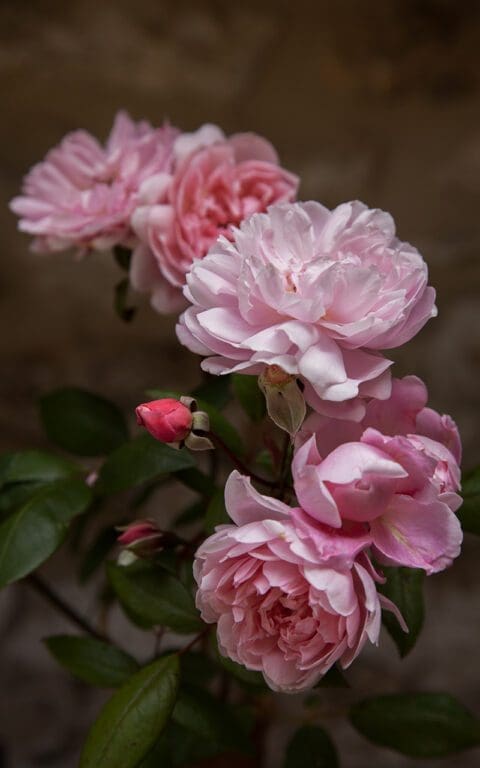
‘Mortimer Sackler’ is also open in character, with loose-petalled, shell pink flowers and an airy personality. Dark stems, delicate growth and fine foliage are more reminiscent of a chinensis rose. The scent is light, but it is a singularly graceful plant. Of all the David Austin roses that we grow, these last two are most relaxed in habit and would be easy in combination with plants like gaura or cenolophium. ‘Mortimer Sackler’ would also take well to being wall-trained.
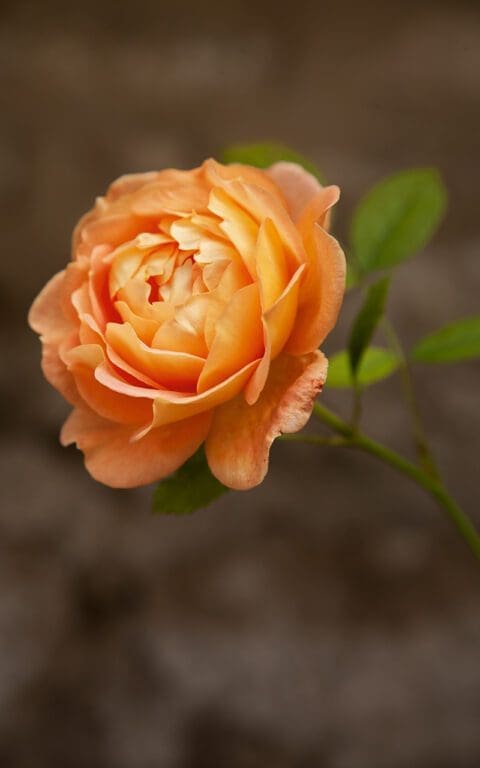
‘The Lady of Shallot’ is one of the best cutting roses, strong and reliable and balanced as a shrub of about four feet. Lasting some time in a vase and beautifully proportioned, the soft orange is easy to use alongside pinks and yellows and its perfume, though recessive, is a fruity tea scent.
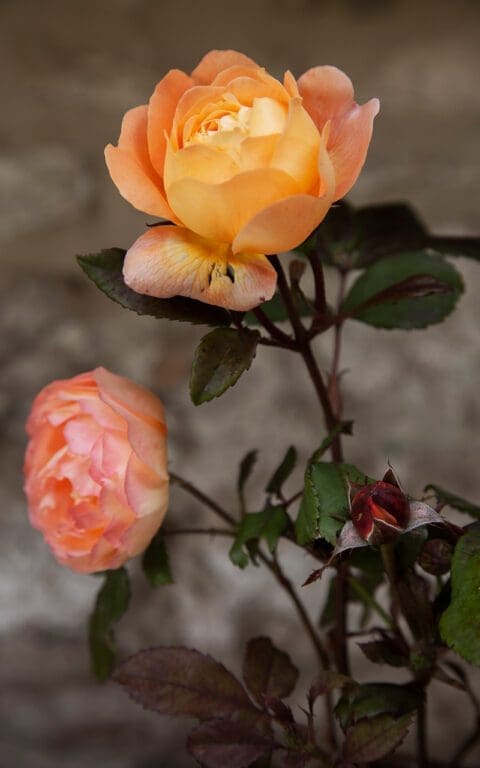
‘Lady Emma Hamilton’ is an excellent, strong-growing plant of similar colour to ‘The Lady of Shallot’, though a little more golden. However, it differs in the dark plum colouring that runs through the new foliage and tints the outside of the buds and then then suffuses the edges of each petal as the flowers age. The overall impression is rich and warm, while the zesty scent is strong and delicious.
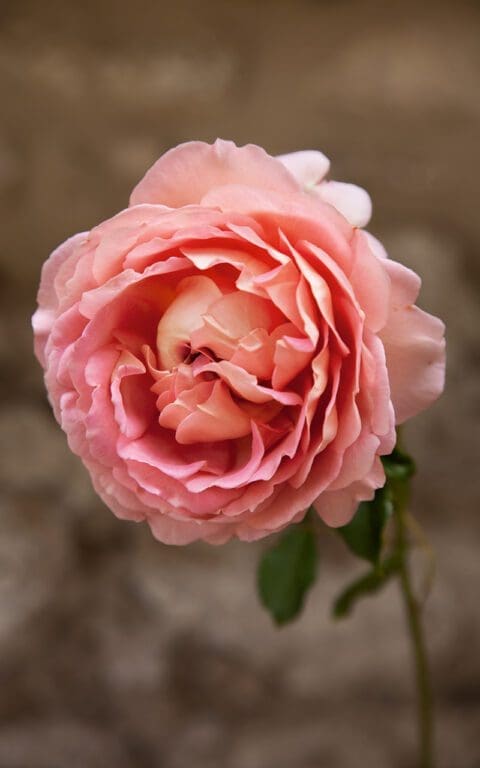
‘Julbilee Celebration’ is an opulent rose and, although the weight of the flower tends to make for a plant that hangs its head (and more so in damp weather), its faded rose colour is unusual. There is enough salmon in it to bridge the pinks, but also a little yellow to act as a mediator between the yellows, apricots and oranges. The scent is proper old rose and, though it is a stiff, stocky grower, I like it immensely once it gets going.
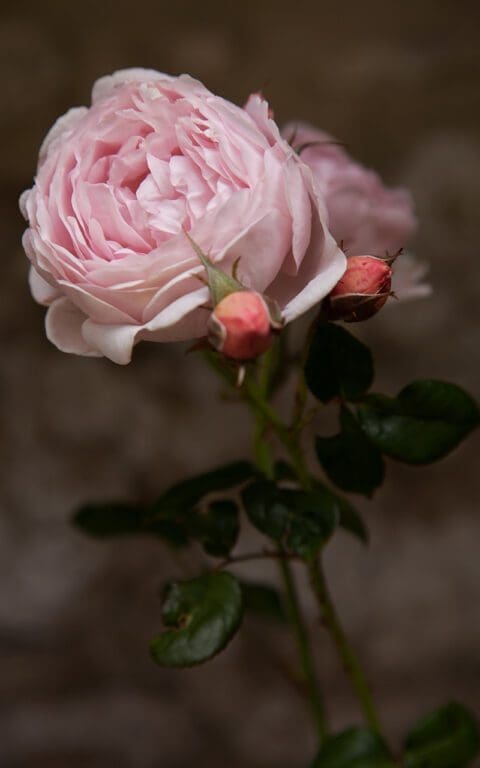
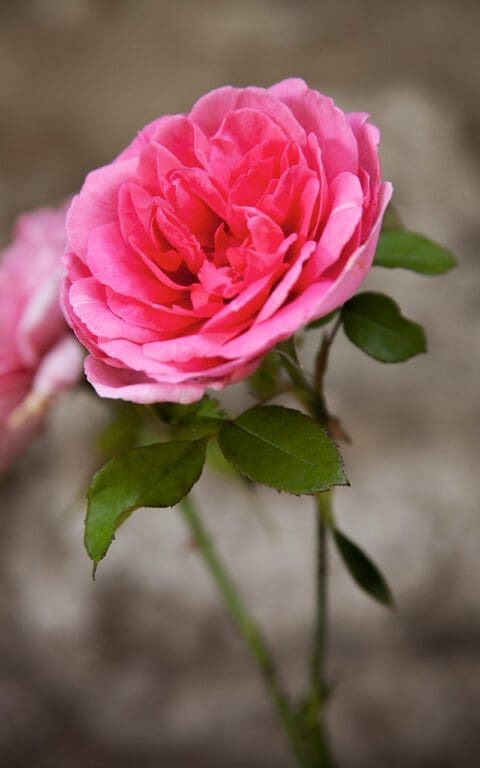
I prefer strong pinks in a garden, campion pink or the electric pink of Dianthus carthusianorum. I do not gravitate towards soft, pale pinks but ‘Scepter’d Isle’ is a good clean pink and a very pretty rose in a bunch, although its scent, described as ‘myrrh’ is hard to pin down. ‘Gertrude Jekyll’ starts a strong deep pink fading as it ages and, although not such an attractive form as others, is by far the best of the roses for perfume. Pure rose and transporting. You only need a bud in a jar to work a room. She is the first of the roses to flower every year and reliable throughout the season.
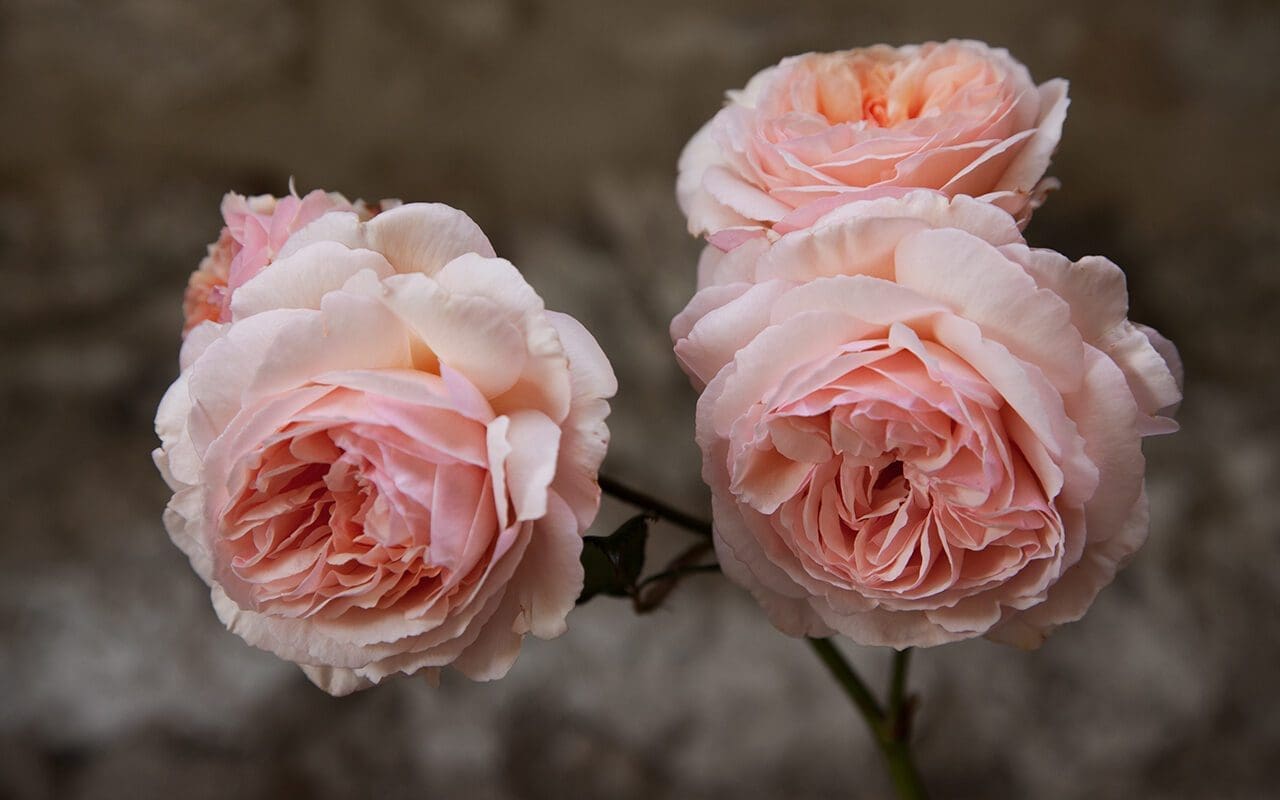
‘A Shropsire Lad’ is by far the most vigorous with limbs that can easily reach six feet in a season and I suspect would make a better climber than a shrub. The flower is fully quartered when it is young, but loosens as it opens, with delicate, creamy flesh tones and a traditional tea rose scent.
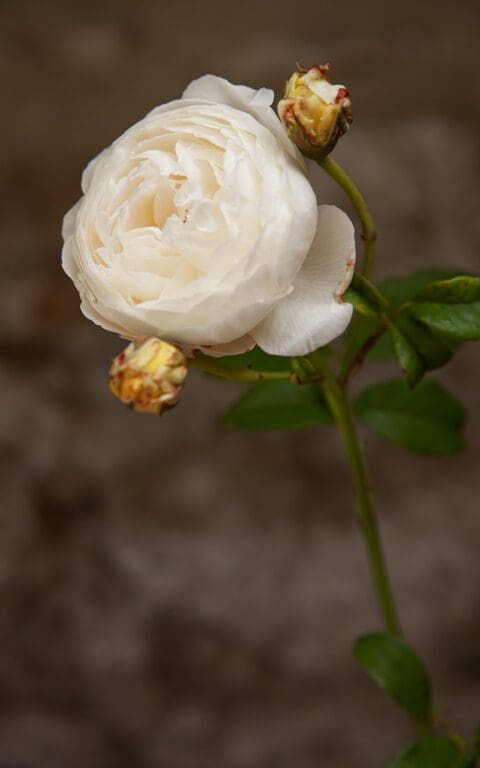
Reaching to eight feet or so the clean, apple green foliage of ‘Claire Austin’ is a fine foil for the creamy white flowers, which are elegant and poised, but do bow gently under their own weight, so it makes for a better climber. I have grown it as such with some success in clients’ gardens, but it also makes a good, rangy shrub that would benefit from some support in a garden setting. The perfume is green and fresh and not remotely heady.
Although we grow two dozen of the extensive Austin range, my aim is to refine down to half that number, slowly letting the ones that reveal themselves to be right for our tastes to gently assert themselves. Cutting is a very nice way to do that. A regular connection and intimacy is always the best way to get to know the keepers.
Main image, left to right: The Lark Ascending, Claire Austin, Munstead Wood, The Lady of Shallot, Jubilee Celebration, Gertrude Jekyll (front), Scepter’d Isle (back), A Shropshire Lad, Lady Emma Hamilton, Summer Song, Mortimer Sackler

Words: Dan Pearson | Photographs: Huw Morgan
Published 25 July 2020
We are sorry but the page you are looking for does not exist. You could return to the homepage