The first of the early season snowdrops are already brightening these darkened days and the season is made that much lighter for their companionship. A winter without them would be a very different thing and I freely admit to being thrown under their spell. A charm that was cast a few years ago with a handful of treasures that were kindly gifted to me by Mary Keen at one of her snowdrop lunches. Snowdrops that she took us to meet in her wintery garden and plants she had taken her time to get to know and were different enough from the usual Galanthus. Plants that gently entice you from the standing position to slow and ponder their particular qualities. A nod that distinguishes them from the crowd, a green tip to the outer petal perhaps, a puckering like seersucker or a completely albino or even gold interior.
I have never been a collector for the sake of collecting and I know from friends who have also found themselves spellbound, that galanthophilia is a slippery slope that can easily lead to a world of obsession and acquisition. That said, and knowing that I wanted to get to know more than a couple of hands full, I struck a pact with myself. To only grow good garden plants. Those which ‘do’ and not those that are fussy and fail on me. I want to be able to see the character of a plant from several paces when it is established and doing what it does best and for each one to offer something distinct. I also want to extend the season forward from February, the main snowdrop season, and to have the company of snowdrops in every week of the winter. Just as I do not want to have hundreds of friends – and bearing in mind that there are 900 or so varieties of galanthus – I just want the ones I can build a relationship with and rely upon. I want the keepers.
It takes time to get to know a plant, so over time I will share with you what I have learned with forms and varieties that are still new to me. The autumn flowering Galanthus reginae-olgae which I have only known for the last three years for instance, which prefer a sunnier, free draining position. It takes three years or so for a single bulb to start to clump and really five before you can see its specific character. How it does in a garden and feels as an individual. A plant such as ‘Fly Fishing’ (kindly gifted, thank you, by our friend Marcia) needs air around it to allow its suspended flowers to dance on elongated pedicels. Timing is also all important, so pairing a variety to coincide with a winter-flowering companion gives a red hamamelis or dark hellebore a bright undercurrent whilst having its moment.
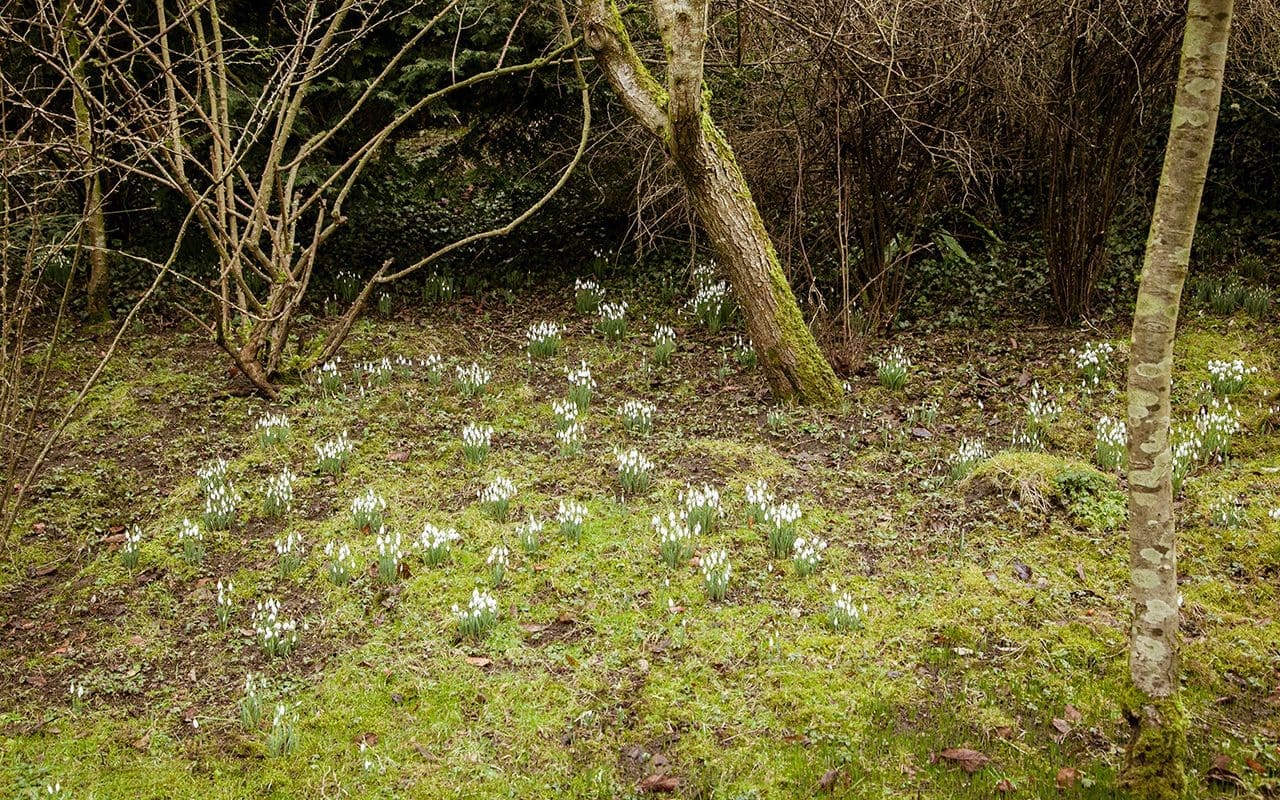
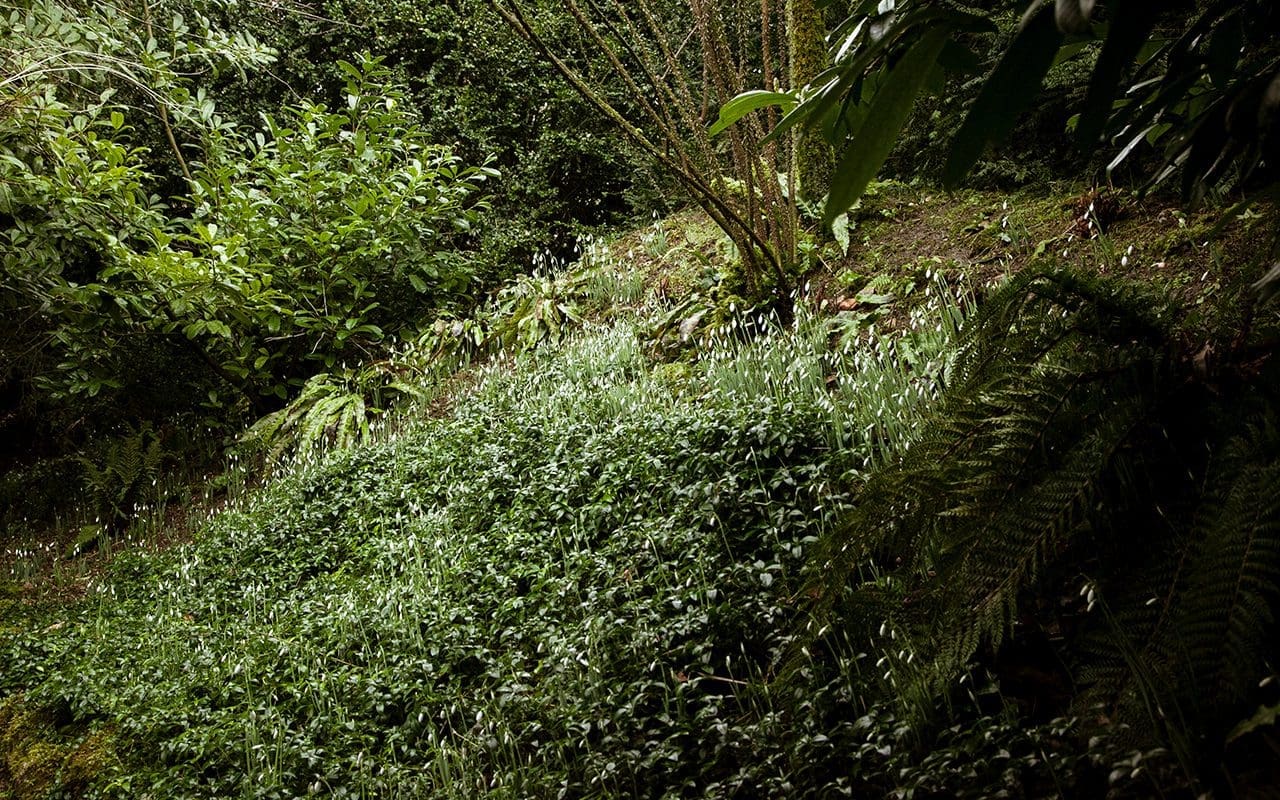
Galanthus are the same as any garden plant. You get a better result for knowing their requirements and how that can be played to best effect in company. As a rule, galanthus like good living and a retentive ground that drains freely and does not lie wet. I planted part of my snowdrop trail in the heavy wet soil at the bottom of the hill where the ground never dries out in summer. The bulbs there failed in the wet areas where the juncus thrived, but the very same soil at the base of trees yielded entirely different results where the trees used the moisture in the summer to give the dormant galanthus a rest. On heavy ground slopes are ideal and hedge banks often provide an ideal position. Lighter soils that are free-draining will benefit from the addition of humus.
Getting to know my collection of ‘specials’ is a learning curve that I am happy to take my time to understand. I buy one bulb of each variety, ideally at the beginning of the growing season so that I can see them complete a life cycle. Paul Barney at Edulis Nursery has a distractingly good collection. I grow them in a stock bed at the base of a hawthorn hedge where in summer they can retreat into safe dormancy. Once they have started bulking, in the third year or so, the clumps are lifted as soon as they have flowered and moved to where I want them to be in the garden. Somewhere close to a path so that I can get to them easily and planted in good company so that they are not overwhelmed too early by precocious pulmonarias or cow parsley.
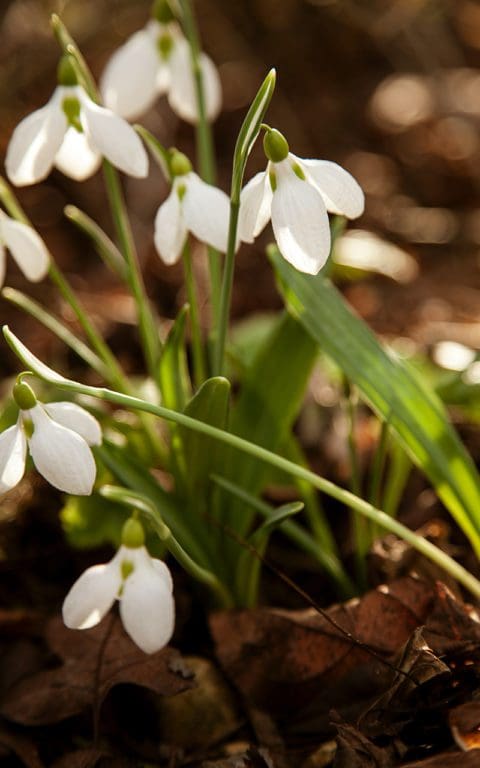
Of the three plants I am sharing with you this early into my chapter of snowdrop distraction, Galanthus plicatus ‘Three Ships’ (main image) is the first to flower after the relay of autumn snowdrops. ‘Three Ships’ was found under an ancient cork oak by John Morley in Suffolk and is reliably in flower at Christmas. Rare for G. plicatus to flower this early, it sits low to the ground over broad widely-spreading foliage, the rounded petals puckered and distinctly textured to capture dew or low, raking light.
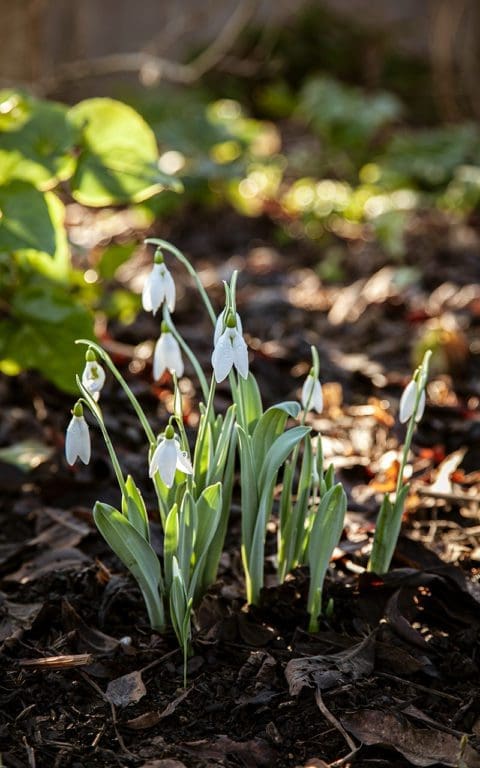
Galanthus elwesii ‘Maidwell L’ was kindly gifted by Simon Bagnall, head gardener at Worcester College, Oxford, once again with the generosity of one galanthus lover to another (thank you). This is an early flowering form of G. elwesii, the broad-leaved species that has spawned a number of early to rise varieties. This is a good one, welcoming the first of January this year and showing vigour and willingness to do well on our heavy ground. I have loved this plant for the graceful unfurling of grey-green foliage, leaves which are broad and unroll like a scroll. A selection from Maidwell Hall, Northamptonshire made by Oliver Wyatt, the flowers stand tall at about 22cm and hold good poise.
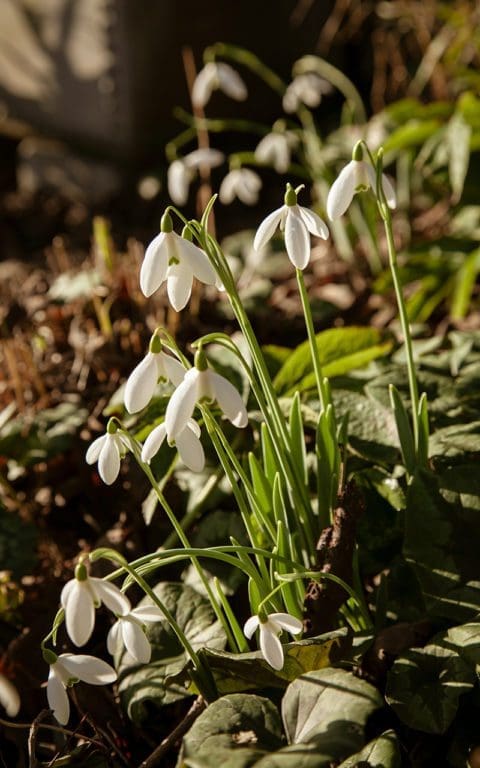
Nearby, under the medlar I have a group of Galanthus elwesii ‘Mrs Macnamara’ (thank you Mary). Named after Dylan Thomas’s mother-in-law who grew it in her garden, it is reliably early and well known for good behaviour. Again, in flower by the first of the month or sometimes a little earlier, this is a nicely proportioned plant that you can recognise from a distance. Narrow, glaucous foliage is not as much part of the mood as it is with ‘Maidwell L’, but it all sits together very pleasingly, the large, slender flowers held perfectly, each in their own space like a drawing of a perfect snowdrop, but with perhaps a little more of everything.
Snowdrops should be split every five or six years to retain vigour in the clumps. I like to plant a couple of bulbs together or three for company as some sit and sulk and are slow to increase if planted alone. Do not ask me why and this is not the case for everybody. Divisions are best made after flowering or as the leaves fade into dormancy and before your attention is drawn elsewhere in spring and the spell they have cast over the winter is broken. As you lift and divide and extend the reach of the plant in question you are left with nothing but good feeling, as you pat the soil and say a little prayer that you will see them again after the commotion of a growing season is spent and done and quietened to allow them their glory.
Words: Dan Pearson | Photographs: Huw Morgan
Published 15 January 2022
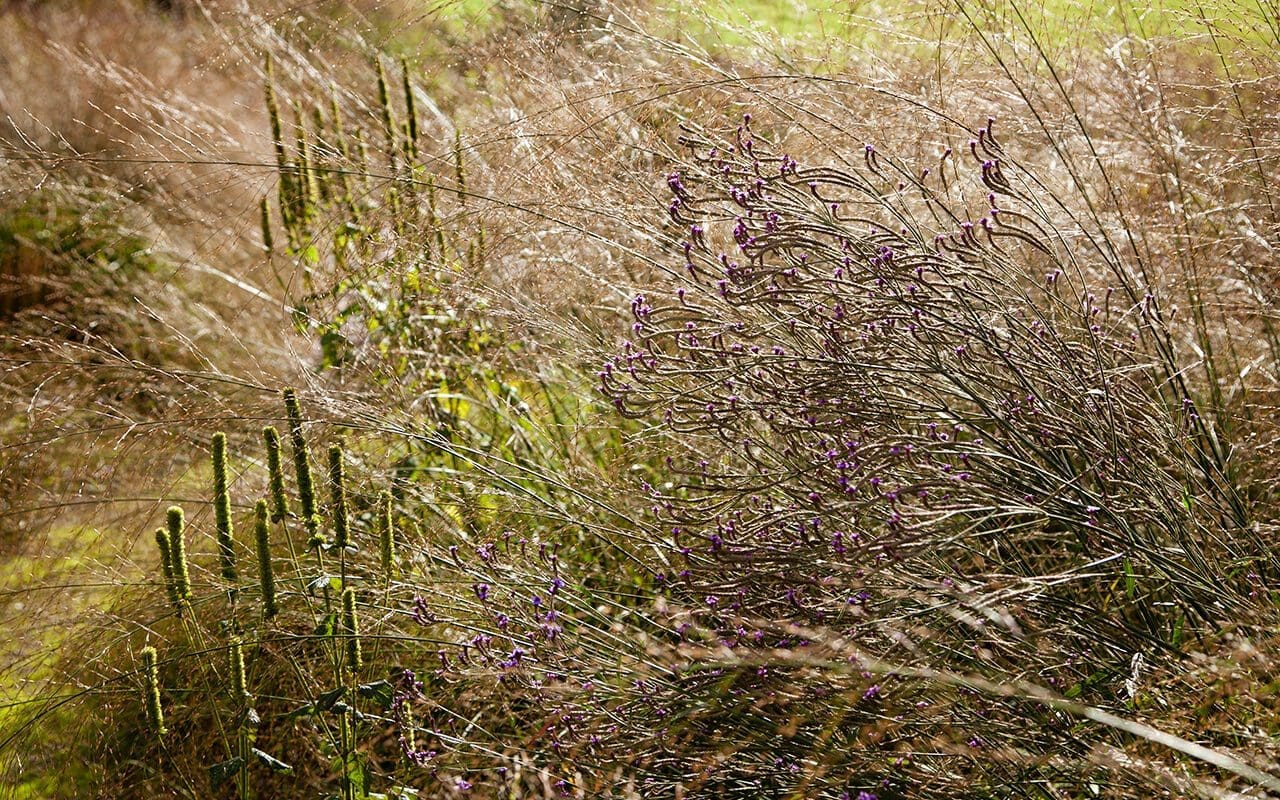
A chill is in the air. Mist in the valley. The wood tawny and bronzing. This is one of the most beautiful moments in the garden, standing still and voluminous, but beginning the decline. A decline suggests something lost, but the turn from the growing season is anything but. Colour in the grasses, the tail ends of the Verbena ‘Lavender Spires’ smattering violet.
Running in an undercurrent much like the cool air that sits in the hollows, the asters claim this moment. Softly spoken as flowers but enduring, they have been mustering quietly. The feeling of potential they provide is valuable as the summer plants fade around them in August, a month that often feels suspended between two seasons. Energy yet to be spent is good then and this is when the first of the asters begin their relay, one handing over to the next until frost finally does for them in November.
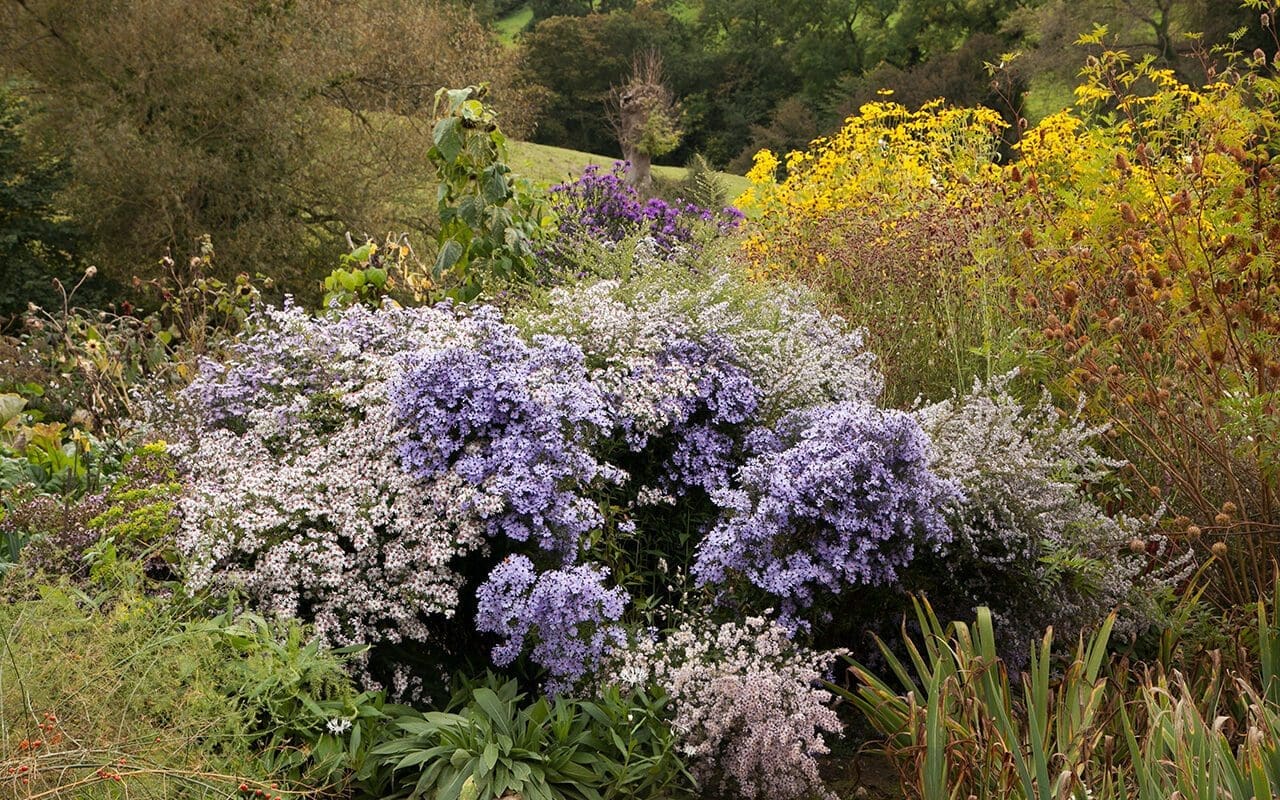
I made a trial of asters before making the garden here, testing a couple of dozen varieties to find the ones that felt ‘wild’ enough in the planting. I was looking for forms that were light on their feet, with air in the sprays and not too heavy with flower. It was also important that they were reliably clump-forming and without the tendency to run so prevalent in many, though I have been prepared to make the exception for Eurybia x herveyi ‘Twilight’. This is one of the earliest to flower here in late July and I always forget then the time I have to spend in March keeping them within bounds. I am probably going to move them to a corner where they can have a space amongst other plants that can deal with their wandering habits. Somewhere that feels akin to their home in Eastern North America, on the edge of woodland and reaching through grasses and scrub towards the light.
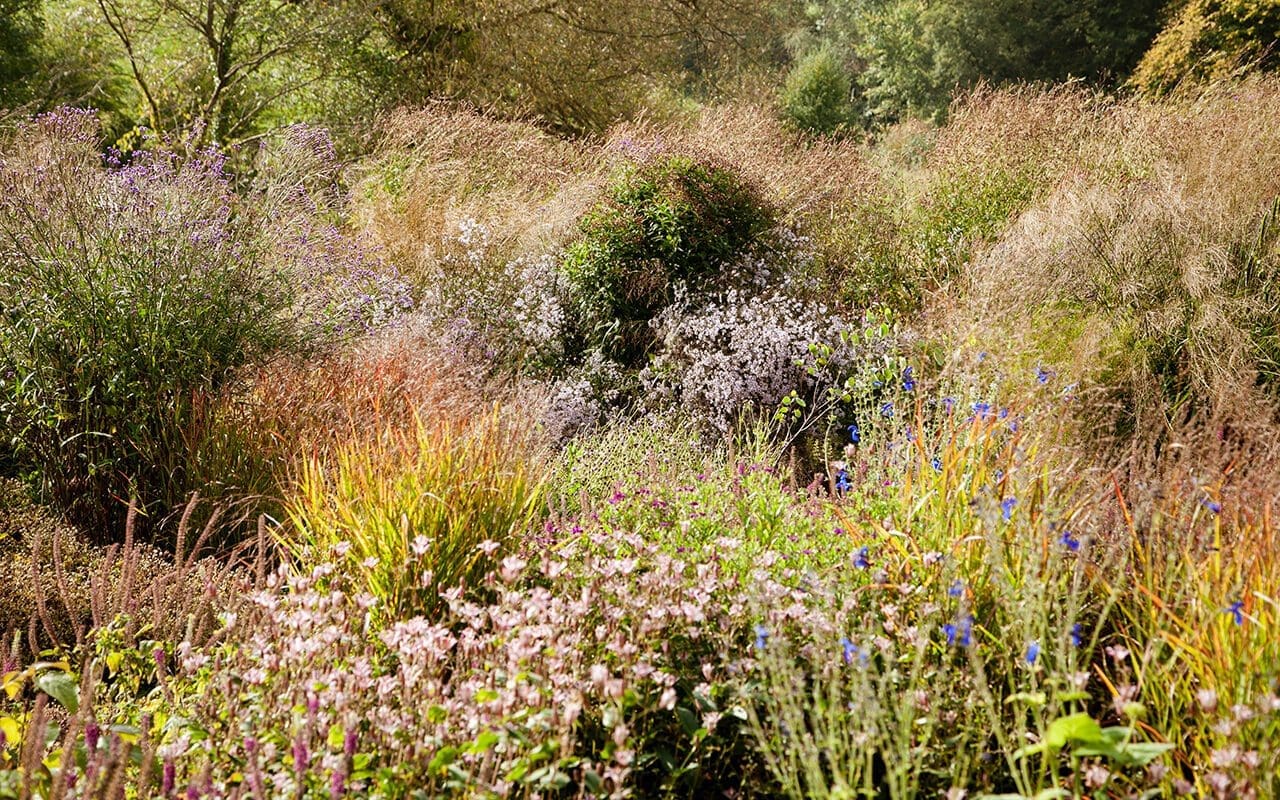
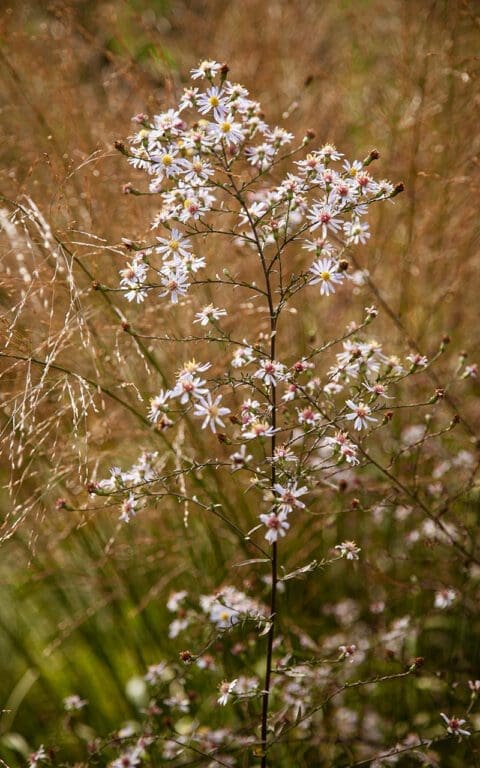
Symphyotrichum ‘Photograph’ was moved back into the garden last year from the stock beds, where I had kept the best of those from the original trial not used in the garden to further get to know them. A stock bed is a wonderful luxury. It is a practical place where one of each plant sits cheek by jowl with an unlikely neighbour and can be observed more closely than in the mind’s eye. It was this time last year when we felt we needed a lift amongst the Molinia ‘Transparent’ in the lower part of the garden. We picked a number of sprays from the stock plant and set them there to see how they felt. Then four canes were pushed into the beds with a label to remind me on the other side of winter what they were for. In March, after the garden was cleared, the original stock plant was split into four in text-book fashion with two forks placed back to back and levered apart to quarter the clump.
Symphyotrichum cordifolium, the Heartleaf Aster or Common Blue Wood Aster, is the parent of several good plants; ‘Chieftain’, ‘Little Carlow’ and ‘Primrose Path’ to name three in my original trial. The first two were rejected because they were too dense in flower and too showy. ‘Primrose Path’, which is lighter in feeling, made it briefly into the garden, until the fact that it was a seeder looked like it might become a problem.
‘Photograph’, a 1920’s S. cordifolium hybrid raised by Ernest Ballard, is tall at 1.2 m and needs a little staking if you do not have the room to let it sprawl. A Chelsea Chop in mid-May to reduce it to knee height encourages branching and curbs the tendency to lean. We have found it the room is has been waiting for, the benefit of patience and observation allowing it the opportunity to light up the molinia at this tail end of the season. Arching with the sweep of the grasses, the constellations of just-violet flower are alive with pollinators and capture the low October light to illuminate a garden that is on the wane. Falling away yes, but far from yet spent.
Post Script:
Asters, lamentably, have been reclassified and renamed in recent years. Retain the original name in your mind and forgive the awkwardness of the new names – Symphyotrichum, Eurybia, Doellingeria – which capture (to the non-botanist’s mind) nothing of the magic and rightness of Aster, which means ‘star’.
Words: Dan Pearson | Photographs: Huw Morgan
Published 23 October 2021
When we arrived here, we took back some of the field to make a trial garden. It was workmanlike in its layout, with dirt paths between manageably sized beds and functioned as a test ground to see what the conditions here were capable of. We grew a range of perennials to see what would feel right and do well on our south-facing slopes as well as vegetables and flowers for cutting for immediate rewards in that first exciting growing season.
The annuals were the immediate litmus, rearing out of virgin ground where they were bathed in sunshine. The response was immediate and immediately rewarding, the cabbages bulking up to a couple of feet across and letting us know exactly why this had once been a market garden and that, yes, it was right to turn field back to garden. For fun, and as a celebration of this new space, we planted a bed of five or six types of sunflower. They grew like you remember things growing as a child, the seedlings popping through the newly turned dirt and not looking back as they raced skyward. I hadn’t seen growth like it and before long they were standing literally twice as tall as me and rejoicing as we were in this wonderful new ground.

We picked them by the bucket and took vigorous bunches back to the studio in London to tide us over during the week and stop us pining for the hillside. They kept us going through July and were at their peak in August, reminding me by the end of the month of that back to school feeling. The time of the year when the summer is nearly done, but still caught in their energy.
In September we let them form seed and those that didn’t get ravaged by an October storm stood blackened by frost, the seed cases scattered at their feet where the birds had feasted. Seedlings returned in the garden and I left them where I could work around them in the following years, but when we developed the kitchen garden to the east of the house and then the perennial garden to the west, they temporarily lost their home.
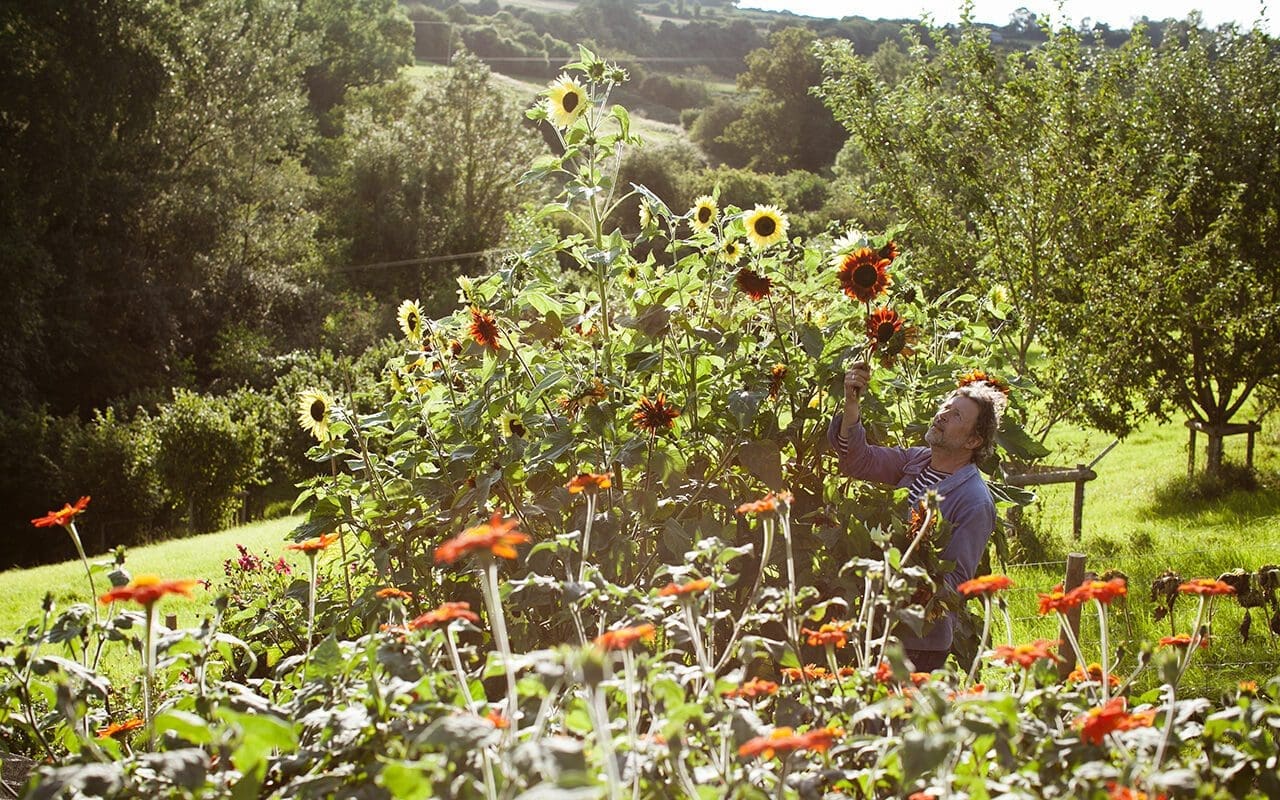
Last year’s response to the pandemic saw us putting up a polytunnel so that we could extend our season of growing to eat. This year I extended a new growing area around it to make an area for continued trials and a spill over for vegetables that need more space. Potatoes were planted to ‘clean’ the ground in this first year of transition from pasture and to repeat the experiments from our first years here we planted a new bed of dahlias, annuals for cutting and sunflowers. It has been so very good to have them back and in generous amount, once again letting us know that, yes, this is a good place for growing.
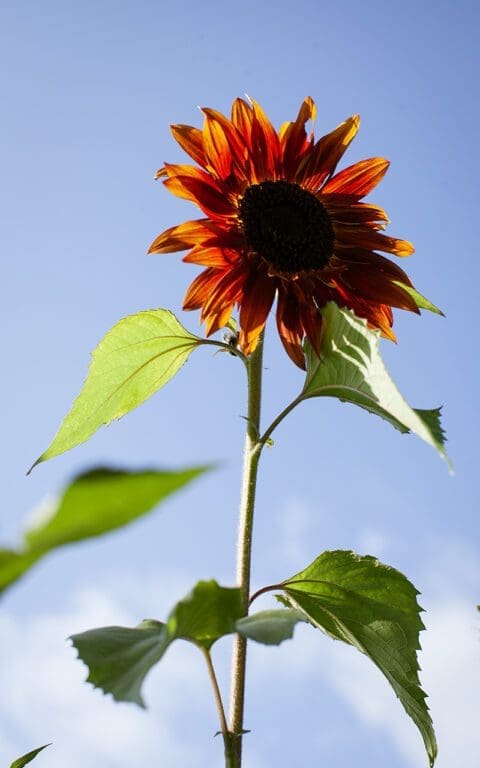
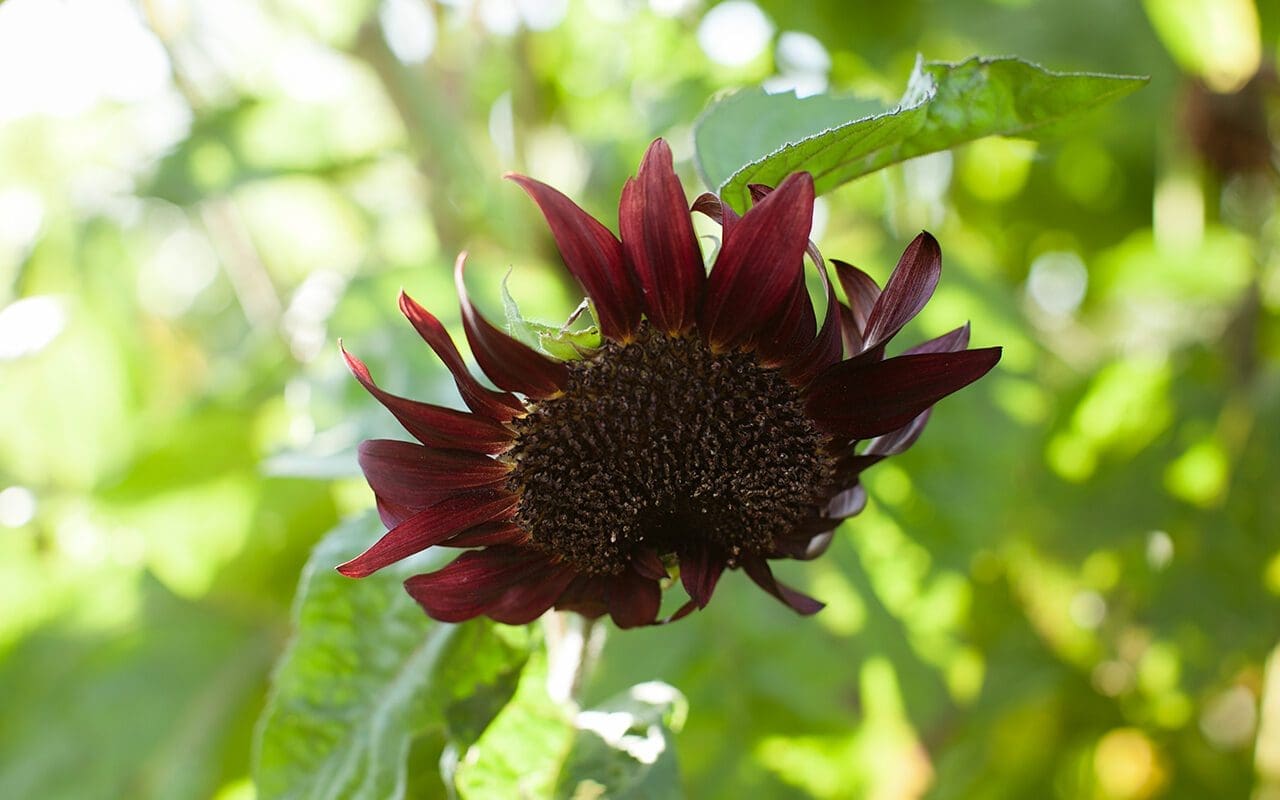
We have three varieties of Helianthus annuus that have done splendidly. ‘Lemon Queen’, ‘Velvet Queen’ and ‘Chocolate Cherry’. This will be the last year though that we grow ‘Italian White’, a more demure variety that has proven once again to be a shadow of its cousins. Perhaps it is my own experience and I have been unlucky, but every time it germinates poorly and then limps through life. Shy is appealing sometimes, but when you have such boisterous cousins that literally throw you into shade, it makes comparison difficult.
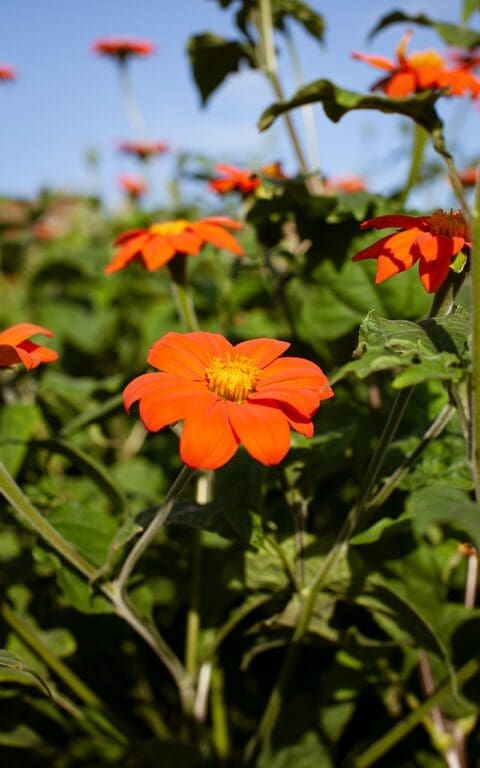
As a complement and for the saturation of pure orange, the Mexican Sunflower, Tithonia rotundifolia, has been easy and rewarding. Grown from seed sown inside and planted out after frost, we have combined it with lime green Nictotiana langsdorfii. The new ground is here to spur ideas and a few plants, the Tithonia included, have already found their way into the perennial garden to punch some late indelible colour. Annuals are good for that, taking this month as their own with no apologies and covering for anything that tends to that back to school feeling.
Words: Dan Pearson | Photographs: Huw Morgan
Published 21 August 2021
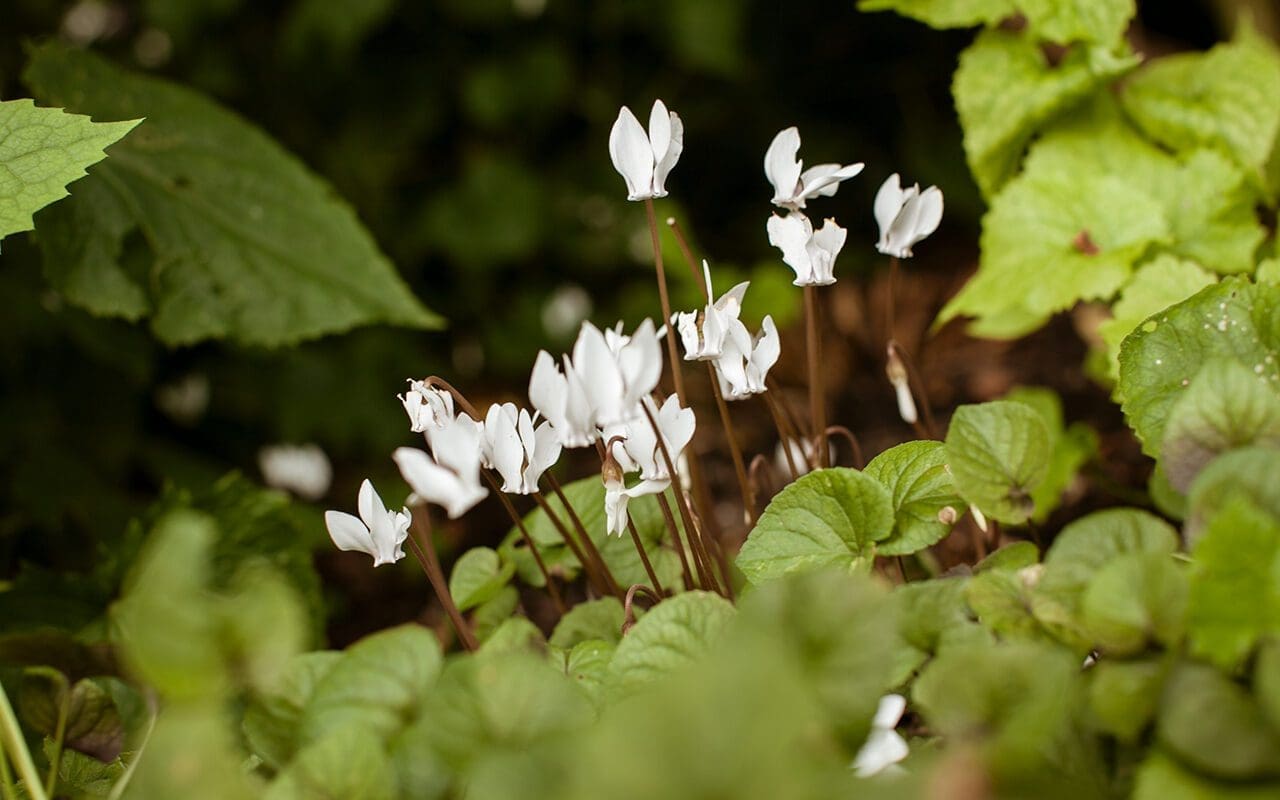
The first Cyclamen hederifolium are already in flower and letting us know that autumn isn’t far off. Although I love their coil from bare earth, their arrival always triggers a pang of melancholy. Surely it cannot already be this time and summer already waning ?
In truth I find August one of the most difficult of months and always have, time showing in the garden where you haven’t quite got it right or where you haven’t built in a degree of expectation to keep the energy up. Knowing myself, I have learned to not give the mood purchase and plan for it with an undercurrent of asters and a stride of late-flowering grasses that still have energy in them and are yet to come into their own.
Where we leave the meadows long on the banks beneath the house, they have mostly run to seed and lie akimbo after summer storms. Wild carrot, a good latecomer and a reason to leave the meadows long until the end of the month in places, offer their flat creamy heads for the wealth of life that still occupies this place. The late cut allows for the last of the scabious, the knapweed and the late-blooming wild origanum and I have added to the banks with a slow but measured introduction of everlasting peas.
Lathyrus latifolius is a long-lived perennial usually seen in a bright magenta and often taking hold on the sunny sides of railway embankments. Perhaps these plants, often seen with running asters, were originally an escapee, hurled over a fence for being too vigorous in garden company. They could just as easily have been flung over the fence naturally, their seedpods splitting on a hot day, cracking open and catapulting their contents.
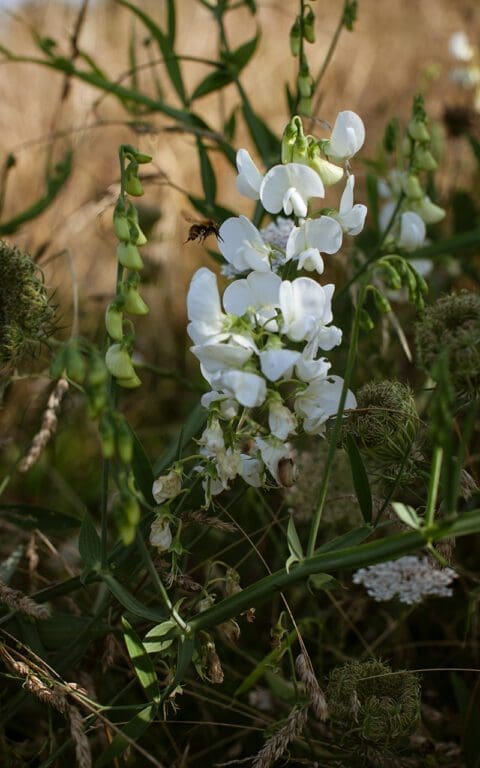
I have ‘White Pearl’, a clean creamy form here and I plan for there to be a flotsam of lathyrus to sit amongst the choppy hollows of the spent meadows. I plant twenty or so every year, which I raise from seed to extend their domain. You have to get to the seed as the pods dry and brown, but before they rupture and the seeds are jettisoned. Sown fresh they are often up in the autumn to overwinter in the frame to be the right size to plant out the following spring.
Being nitrogen fixing, the peas are happy to take to poor ground and where the company isn’t too vigorous on the dry banks they rise up and take hold as the meadows around them begin to fade. We have the narrow-leaved everlasting pea, Lathyrus sylvestris here also. The seed originally came as a gift from my friend Jane who collected it on the cliffs above Branscombe Bay in Devon. Though it is naturalised in many parts of Britain it is speculated that it wasn’t also an escapee originally. It is a pretty thing with small flowers of a dull rose-pink and growth that reminds me of a stick insect. Long, straight limbs to rise up and above the competition and tendrils that allow it to attach and suspend itself in a scaffolding of growth using nothing more than the spent stems of the grasses to provide purchase. Touch the plant and you can feel how structural its cage of growth becomes despite its delicate appearance.
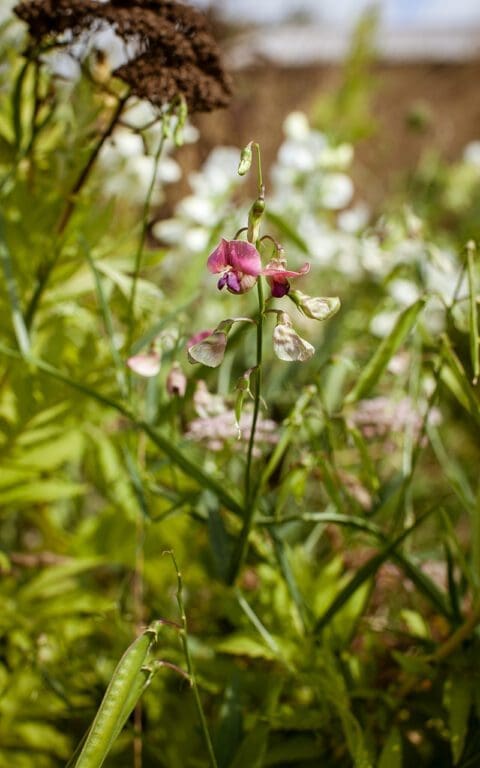
I would not plant either pea in the garden for fear of being over-run, as they are more than capable of growing to 2 metres in a season. Neither have scent, but this is a small price to pay for such a welcome interlude in the high and teetering summer.
Words: Dan Pearson | Photographs: Huw Morgan
Published 7 August 2021
Nothing smells like early summer quite like a sweet pea. Fresh and intoxicating, innocent and sensual in equal measure. The scent of my grandparent’s garden, which wafted through the windows of my bedroom on hot summer nights in Swansea. The vines planted at the ends of the runner bean supports, which brought the sweet peas down to earth while exalting the beans. They were never cut for the house, just allowed free reign to scramble and scent the vegetable patch. Now that I grow my own the house is filled with their scent as long as I can keep up with picking them, although there is always a point in the summer where the stems get so short or you have better things to do (like bottling tomatoes, freezing soft fruit, making jams and chutneys) that it is finally better to leave them on the plant and allow them their natural decline.
This year, for the first time we got our sweet pea seeds sown early. Before the arrival of the polytunnel we had always waited until late March before sowing, but we got a head start this year and planted them in early-February. The seeds were soaked in cold water overnight, which is reputed to make them faster to germinate, although it is difficult to ascertain whether this is the case or not. Three seeds of each were sown in a 9cm pot with two pots of each variety and put into our unheated toolshed, which has the frost kept from it by virtue of also being where the boiler is located. When we posted news of the seed sowing on Instagram some queried why we weren’t using root trainers and, although it is true that all legumes tend to benefit from deep pots due to their searching root growth, we have never had an issue with pot-grown sweet peas, as long as you get them in the ground before they become pot-bound. That said we have been collecting the insides of our toilet rolls to use next year to see if it makes a difference.
As soon as the seeds started to germinate they went into the Milking Barn, where we have a dedicated propagation shelf set up in the picture window, which gets direct light for most of the day. A week after germination, to prevent them becoming etiolated, I would ferry them down to the polytunnel every morning to get as much light as possible, before bringing them back up to the heated barn every evening. By early March the polytunnel was warm enough to leave them in there overnight and soon they were large enough – with four sets of true leaves – to pinch out the tops, which encourages strong root growth and stockier plants.
Once the seedlings had reached a height of 15cm they were brought up to the cold frames by the barns and hardened off for a week before planting out. However, this was delayed by the prolonged frosts in late March and early April and so, when we did eventually get them in the ground in the second week of April, they were protected with fleece for a few days until the cold snap had passed. Sweet peas are hardier then they look and although one frost was hard enough to get through the fleece, despite their wilted appearance the plants recovered very quickly.
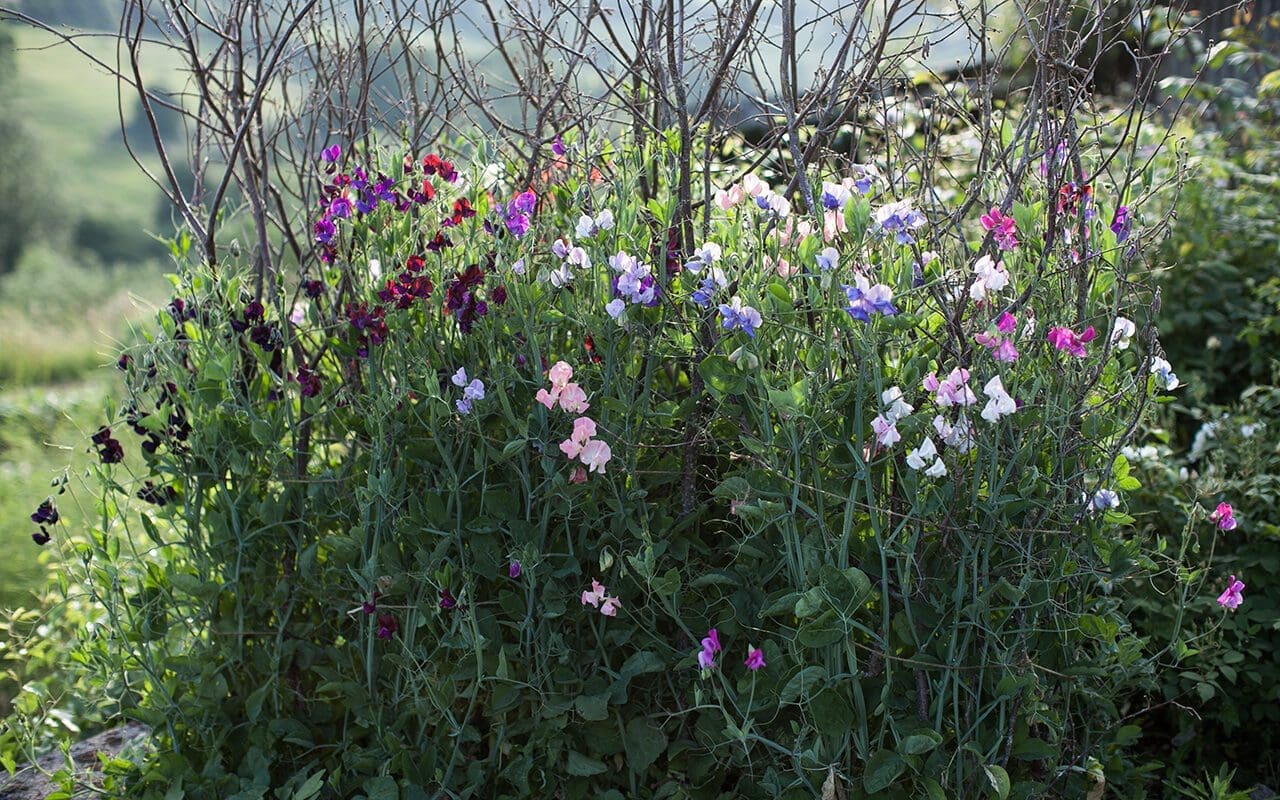
We have grown sweet peas every year since we moved here and have tried a wide range of varieties, but we always return to the Old Fashioneds and Grandifloras. These are the smaller flowered varieties, many of which are very old, and which have the strongest scent. They have a tendency to shorter stems, which means that they are not so popular with flower arrangers and florists, but I simply cut longer stems from the plants with leaves and tendrils intact. The Modern Grandiflora varieties were bred in the 20th century to provide the scent of the old varieties with the larger flowers and longer stem length of the more popular Spencer types, which have large, more ruffled flowers and long stems, but little scent. As with roses there seems little point in growing sweet peas unless they overpower with perfume.
I’ve tried several of the text book methods for prolonging the flowering season, including one year following the wisdom of the professionals and pinching out every single side shoot to encourage upward growth which, when it reaches the top of the hazel poles, is then trained down the neighbouring pole to double the height of the plant and, therefore, the number of flowers it produces. All very educational, but frankly life’s too short. Now I simply ensure that each time I pick a flower (and regular, daily, picking is the best way to ensure longevity) I snip out the side shoot that develops at its base, as the energy required for these prevents the main stem from reaching its full height and the flowers produced on them always have much shorter stems.
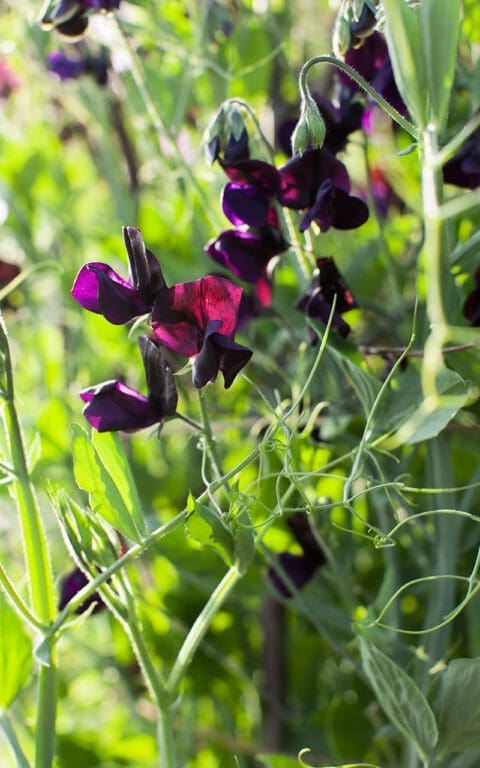
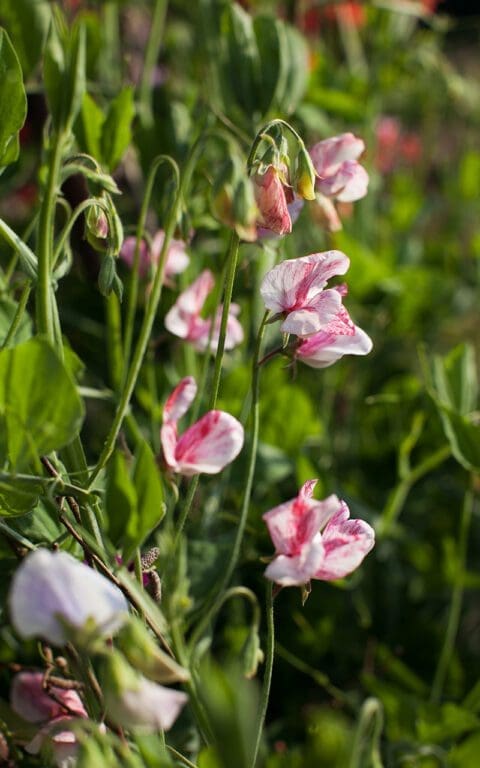
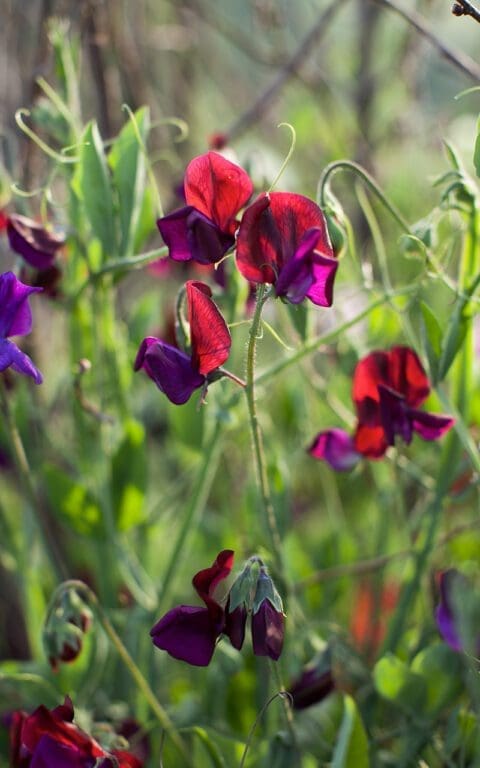
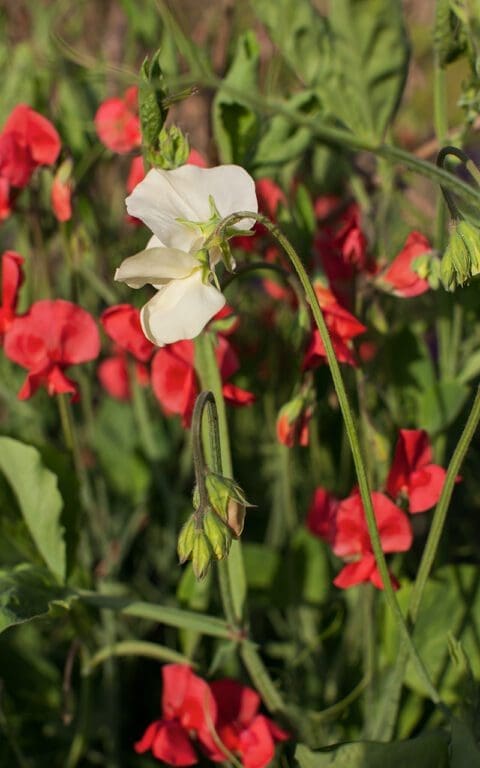
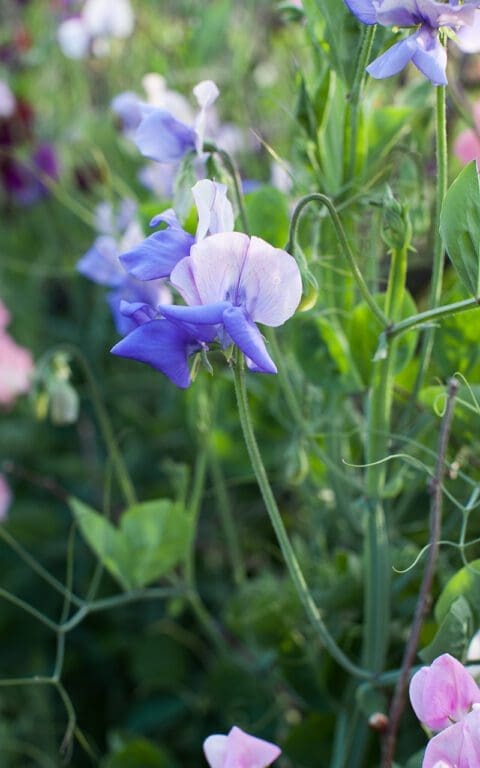
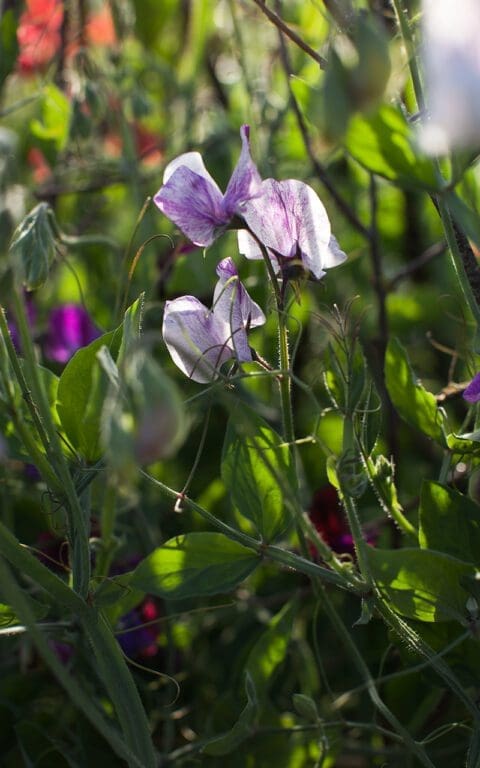
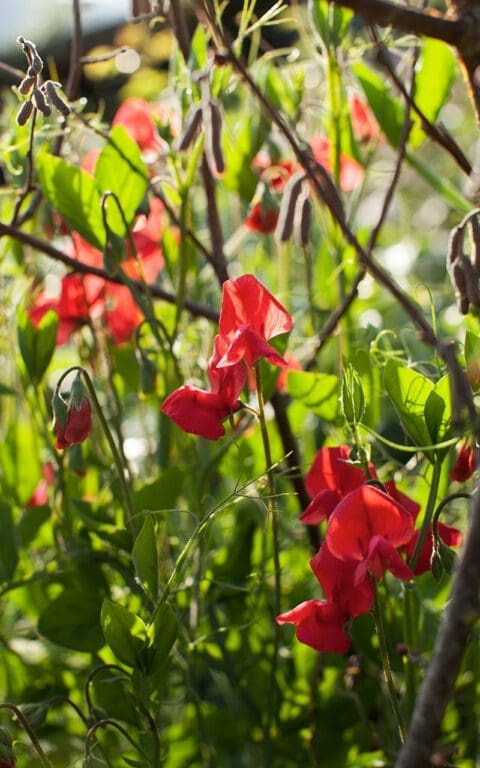
Each year we plant a range of colours and, although we have some stalwart favourites like ‘Cupani’, ‘Painted Lady’, ‘Almost Black’ and ‘Lord Nelson’, we always trial some new varieties. Here is this year’s selection.
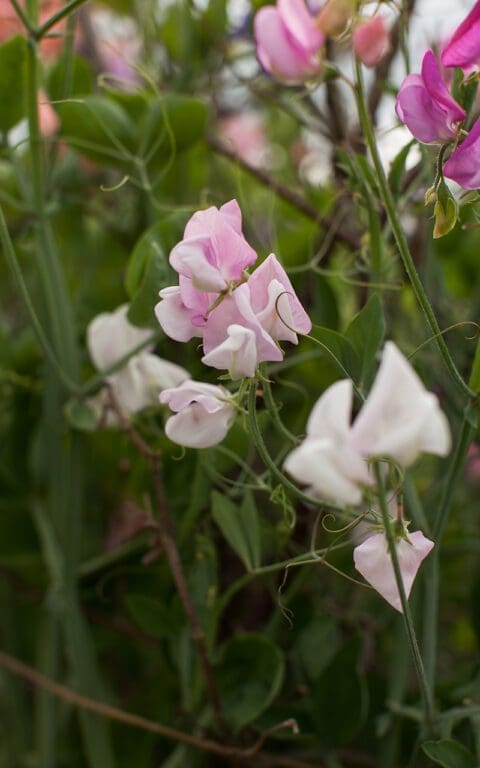
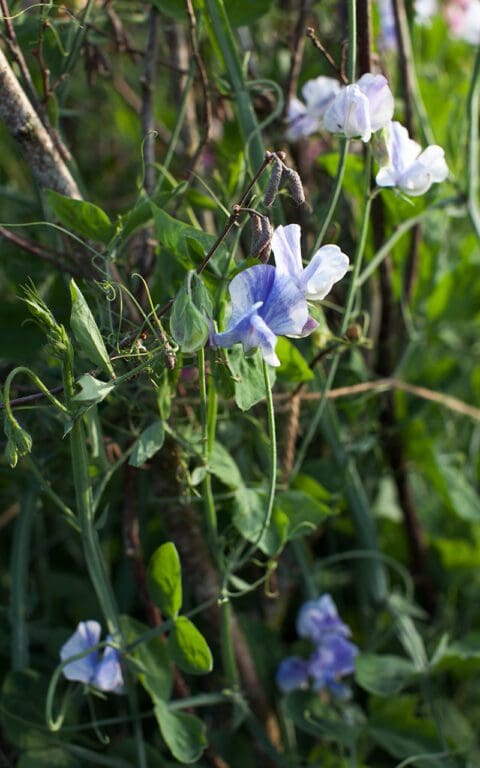
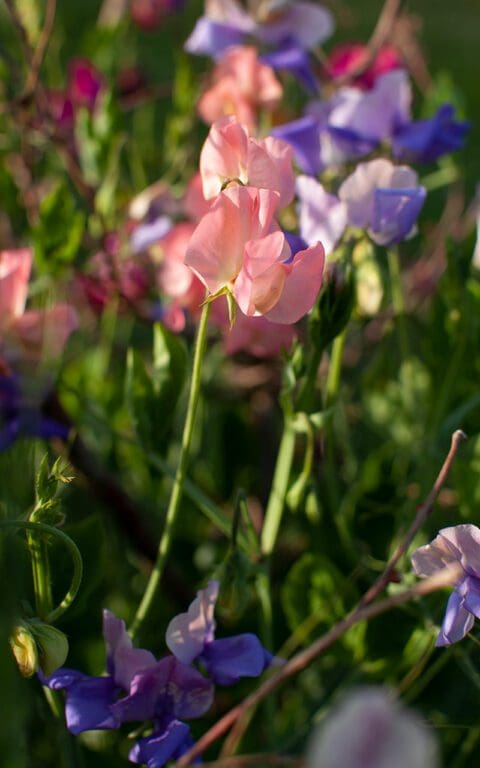
Words and photographs: Huw Morgan
Published 26 June 2021
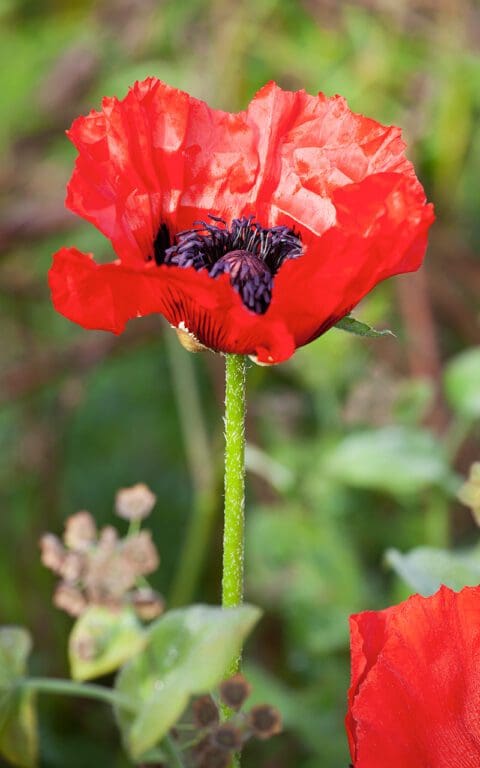
The oriental poppies have broken the green, rearing above the rush of June foliage. They are the first true colour in the garden, save the Tulipa sprengeri that teetered neatly on the last week of spring and preceeded them. Red is a jolt this early in our verdant landscape, but we are ready for it now, the first slash of summer.
I have planted the poppies in homage to several memories. The first, a plant I remember from being about the same height, gazing into their interiors in our childhood garden. It grew with ferns and sprawled beyond the borders to offer up bristly buds, the casing breaking into two under the pressure of soon to be uncrumpled flower. I am red-green colour blind, but not completely and those poppies are an early memory of being able to see red fully, for they present it without compromise. Luminous and as red as anything can be, heightened by black-blotched bases and turquoise stamens.
The second memory, and one that I have planted into this garden, refers not to poppies at all but to meeting scarlet Amenone pavonina flaring amongst euphorbia and the march of giant fennel on the Golan Heights in Israel. I was there for a year working in the Jerusalem Botanical Gardens and the brilliant Michael Avishai, then Director of the gardens, would take me on weekend excursions to look at the flora of Israel. A fearless and terrifying driver, we would leave at 4am, to arrive at a site, spot on time for a happening in the landscape. This one came with his advice to not stray too far from the road. If you stepped over the wire marked “Land mines. Do not enter !”… The red of anemone I can see too and I shall never forget its shimmer amongst its opposite acid greens and the sun rising over an army of fennel stretching into a dangerous distance.
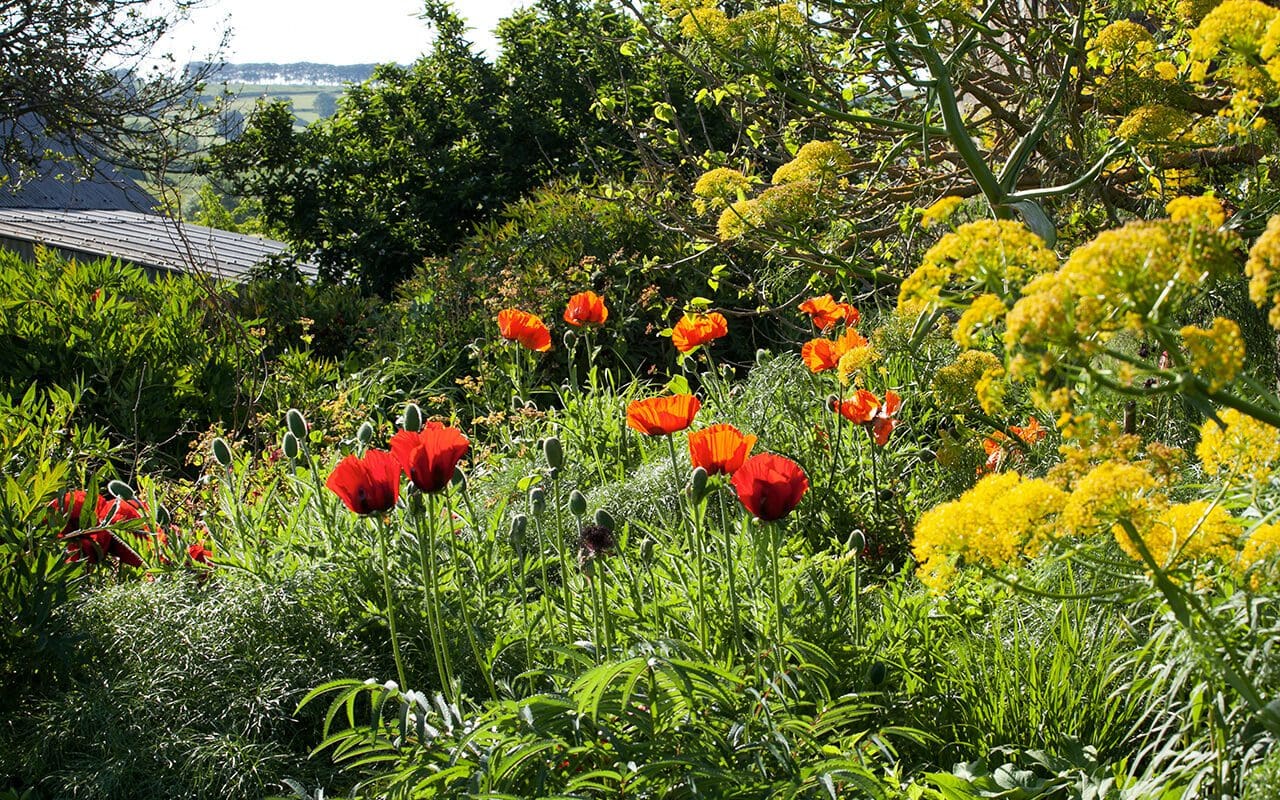
So, this particular memory comes with a charge and the oriental poppies that step through the giant fennels in the garden here take the place of the anemone. We have two varieties by default, not design. The requested ‘Beauty of Livermere’ (Goliath Group) are pillar box red, while there are three plants of a tangerine orange one that were substituted and planted without knowledge of their difference. I do not have the heart nor the desire to take out one or the other. The reds are good together and if I were to try and remove the plants to only have one, they would still likely regrow from root cuttings. This is the way to propagate oriental poppies for they do not come true from seed.
The rush into life in the spring, first with a mound of hairy, lime-green foliage and then the reach to flower is made possible by energy stored in thick, deeply searching roots. Hailing from Central Asia, their habit of disappearing once they have flowered and set seed is a survival mechanism against the drought of summer. The gap they leave will need to be negotiated by cutting the plants back to the base as soon as they begin to wane and in combining them with later-to-come perennials that will cover for the gap they leave behind. Asters and late flowering grasses make good couplings.
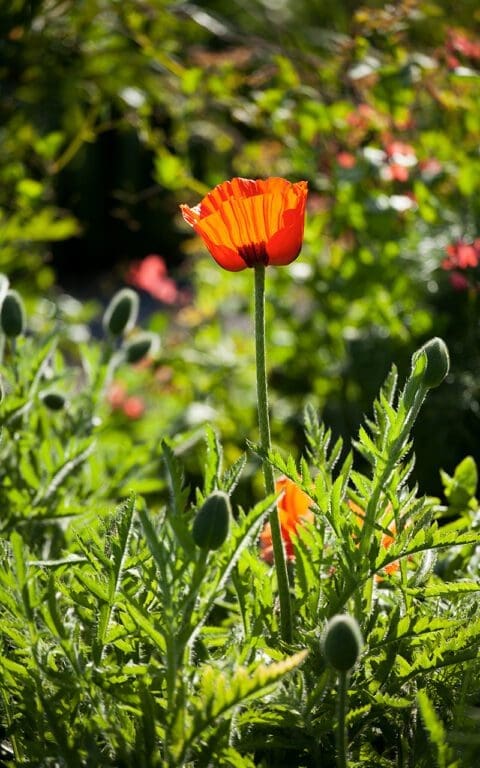
The reserve in the root can also be used to advantage in the fringe of the garden in rough grass and amongst cow parsley for the early growth will also outcompete grass in spring. The secret is to introduce them as established plants and keep them clear of competition in the first year whilst they are building their root system. Their dwindling summer growth will be disguised by the meadow and the autumn regrowth can be mowed around once it returns with summer rains.
Though I do not grow more varieties here, for the oriental poppies set an opulent tone and demand your attention whilst they are in flower, I have grown several in the past. At Home Farm I set ‘Perry’s White’, with its contrasting dark blotch, amongst gallica roses and inky bearded iris. I used the wood aster, Eurybia diviricata to cover for them later. For a while I also grew ‘Patty’s Plum’ for its thunderous bruised grey-mauve flower though it was never a keeper and dwindled for me. Then there was Saffron’, with wide open flowers of pale tangerine.
Burned into the June green, I will be there as I was aged five this coming weekend to witness their awakening. Never dimmed, always welcome.
Words: Dan Pearson | Photographs: Huw Morgan
Published 12 June 2021
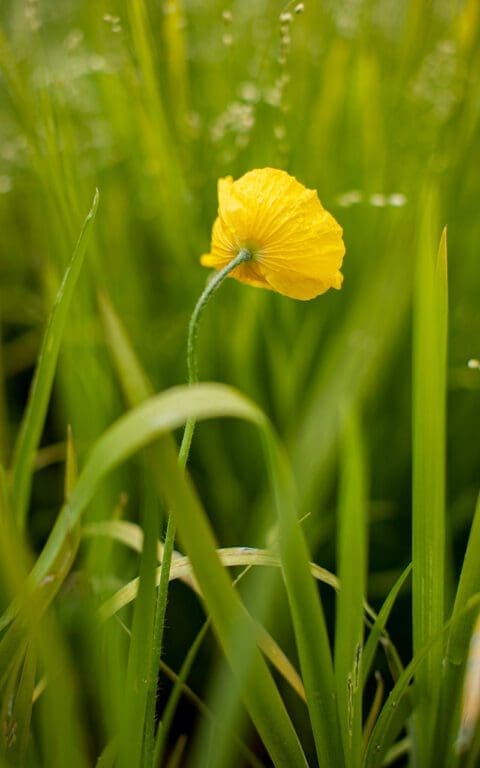
Bright as sunlight and illuminating these wet, windswept days, the Welsh poppies are dancing down the steps. This is their way, seeding into cracks and crevices and taking advantage of any window of opportunity. This is usually in bare ground but, being adaptable, it could also be in the centre of a later-to-emerge perennial. The seedlings, which are happy in cool shade, take the initiative, sending down a sturdy taproot and then bolting up unexpectedly the following year without you so much as noticing.
This is how they arrived here, as stowaways in the ark of plants that I brought with me from the Peckham garden. Probably wedged in the roots of the Molly-the-witch peonies or amongst the hellebores which, in turn, hitched a ride in the plants that I brought with me from Home Farm years before. Now that I cast my mind back, hopping and skipping from one garden to the other, I can trace them back to a trip I made to the Picos de Europa in northern Spain when I was in my early twenties. They were a highlight on the way there, growing with wild goat’s beard and Mourning Widow geranium on the cool, shaded side of the Pyrenees. Their bright, gold flowers were the reason we stopped and climbed amongst the rocks to see where they grew and with what companions. Beguiled, the seedpod I slipped into my pocket marked the beginning of their journey here.
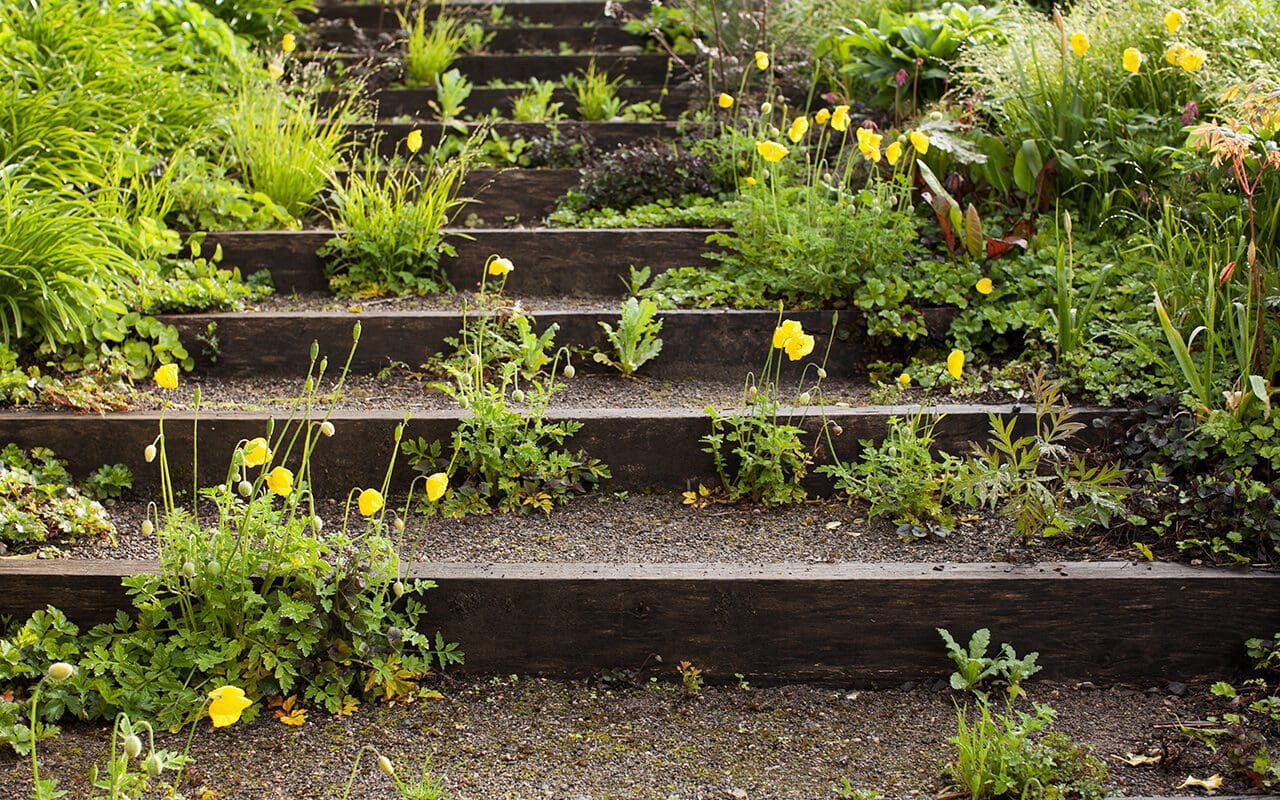
Meconopsis cambrica is wide-spread in upland areas of Western Europe and appears here in south west England, parts of Ireland and Wales, hence our common name the Welsh Poppy. Though in the wild you will find it, as I did, in the cool crevices of rocky places, a garden setting can emulate these conditions readily. So readily sometimes that you have to be careful where you let it seed. One plant that I couldn’t bring myself to remove that had found its way into a crack in the concrete in my growing area behind the barns has seeded repeatedly into the trays of seedlings and pots nearby. This is how many of our plants have found their way into the garden.
Being thoroughly perennial and happy to find a niche, their spring to early summer flower is welcome now before the garden gets into full swing. From bright green, ferny foliage the fine yet sturdy stems rise and stand free in their own space. The hairy cases are cast aside as the buds tilt upright to reveal the crinkle of bright petals. Each flower lasts just a day or two, but there is a relay of buds that will throw colour for quite some time. The secret to keeping them within bounds is to cut them back, leaves and all before they seed. A second refreshed crop of foliage and sometimes flower will return and these are usually the plants that catch you out to throw their seed when your eye is then firmly set on the summer.
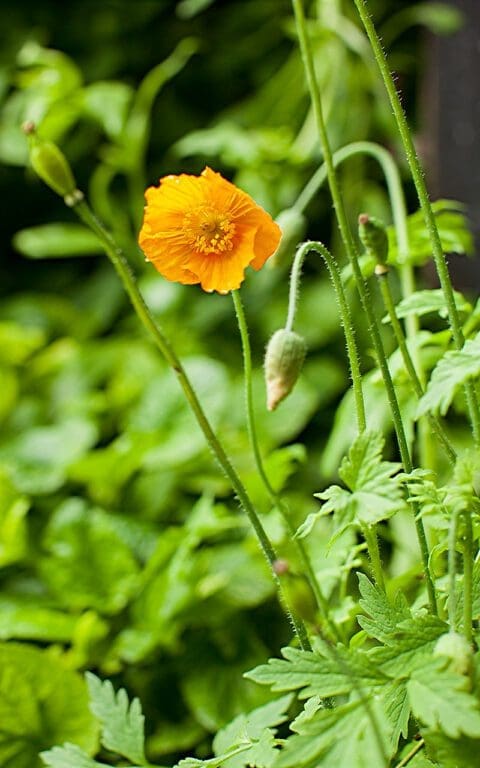
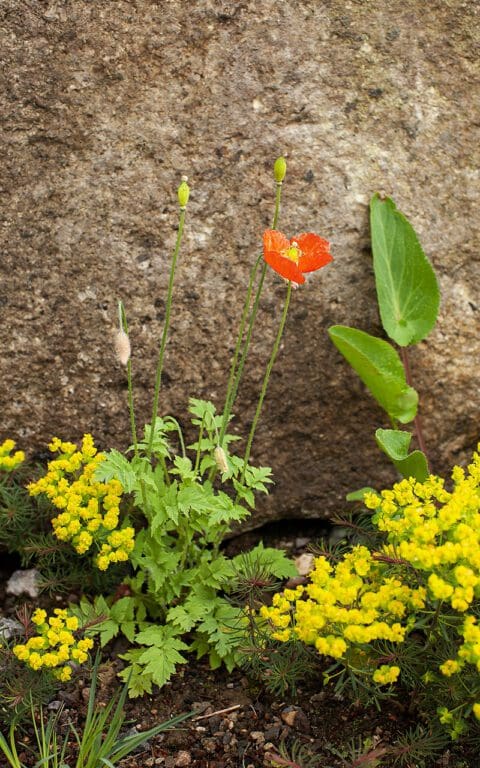
We have a naturally occurring soft orange form that I’ve let run on the other side of the barns, but I do not want it to pollute the pure chrome yellow of those that enliven the garden. Away from both, by the trough in the milking barn yard, I am building up a colony of the variety ‘Frances Perry’. Though more diminutive in stature, the dark tangerine flowers are quite my favourite thing of the moment. Flowering for a month to six weeks they coincide with the acid green of Euphorbia cyparissias ‘Fens Ruby’. Opposites on the colour wheel which vibrate one against the other.
Apparently, this form is less profligate as a self-seeder, but my pot of seedlings that were sown when ripe last summer and overwintered so they got the frost are looking like they are far from difficult. Difficult is not a word I would apply to the Welsh Poppy which, if it decides it likes you, will probably be with you for the long haul. Here and there and, if you are not a little careful, everywhere there is a cool corner and opportunity.
Words: Dan Pearson | Photographs: Huw Morgan
Published 22 May 2021
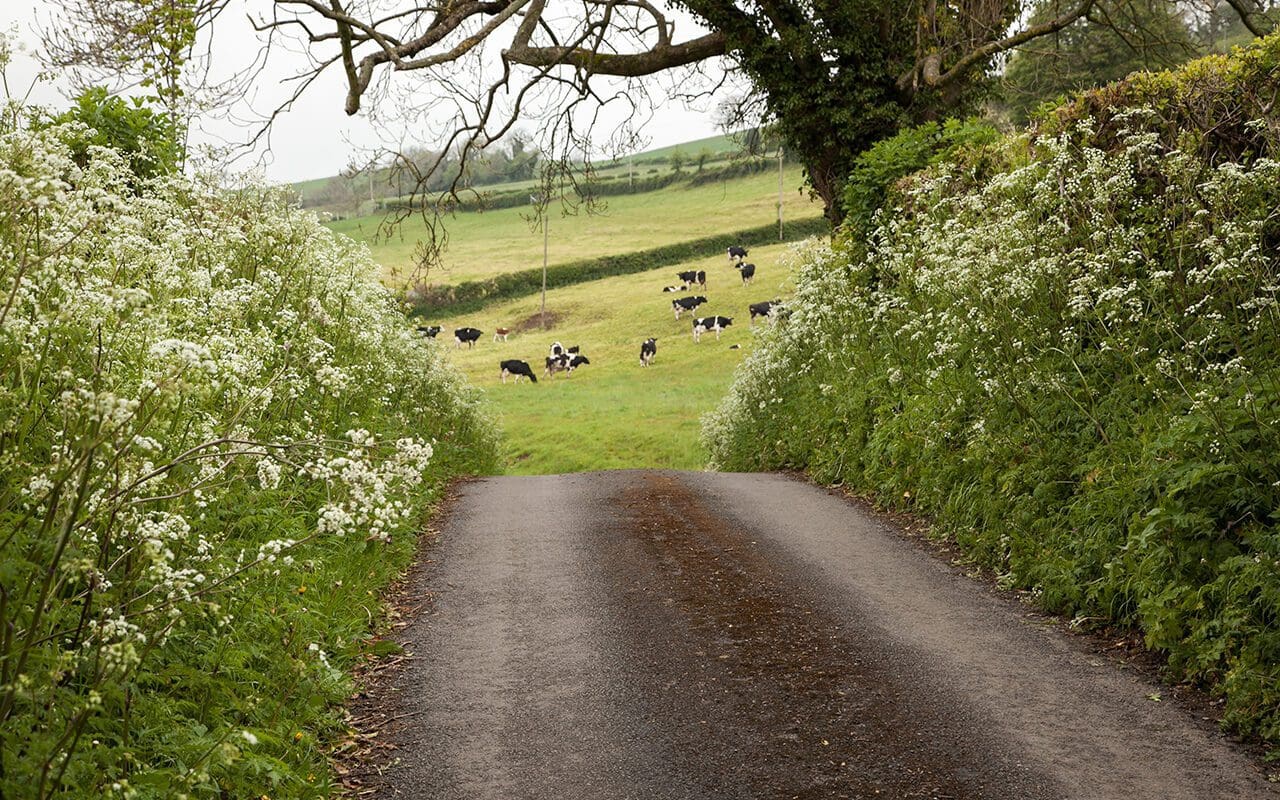
This week has seen a quantum shift happen all around us. The crab apples in full sail like cumulo nimbus and the meadows flashing chrome-yellow as the buttercups push above the sward. The lane has suddenly narrowed with the cow parsley rising up and racing to flower. It is that moment we have been waiting for, the ground wet again from rain, warmth finally in the sun and growth with no excuse but to burgeon.
The lanes here are miraculous for a fortnight. Walk them in the morning and the verges reach out to touch you, dripping from the night before and spangled with starry speedwell, stitchwort and the first pinpricks of campion. All suspended in an extraordinary moment of aptly named ‘Queen Anne’s Lace’. Fresh and reaching and smelling of newness this interlude between spring and summer is dashed by the local farmer who brings out the flail to raze the cow parsley as it comes into full bloom. It taints the milk he says, but since he no longer droves the cows along the lane I think it is more about order and control. The carnage makes me smart. He doesn’t touch the verge on our side – rules are rules – which we leave long and unkempt and brushing the windscreens.
I have invited the cow parsley into the garden in its cultivated form Anthriscus sylvestris ‘Raven’s Wing’. Darker for the contrast of pale flower as they begin to expand and lace, I watch the new growth closely from the moment it begins to muster. This is usually just as the snowdrops fade and you become ready for something new. The filigree newness of ‘Raven’s Wing’ shows its true colours early and the best of the seedlings are dark from the moment they produce the first true leaves. Our lane-side population have their influence though and many seedlings begin their reversion back to type, turning first chocolatey instead of the deep plum purple and then green. The early vigil to winkle out the plants that revert is important so that I am marking the difference between the hedgerows and the garden proper. An echo of our surroundings, a segue and a gentle transition between the wild and the cultivated.
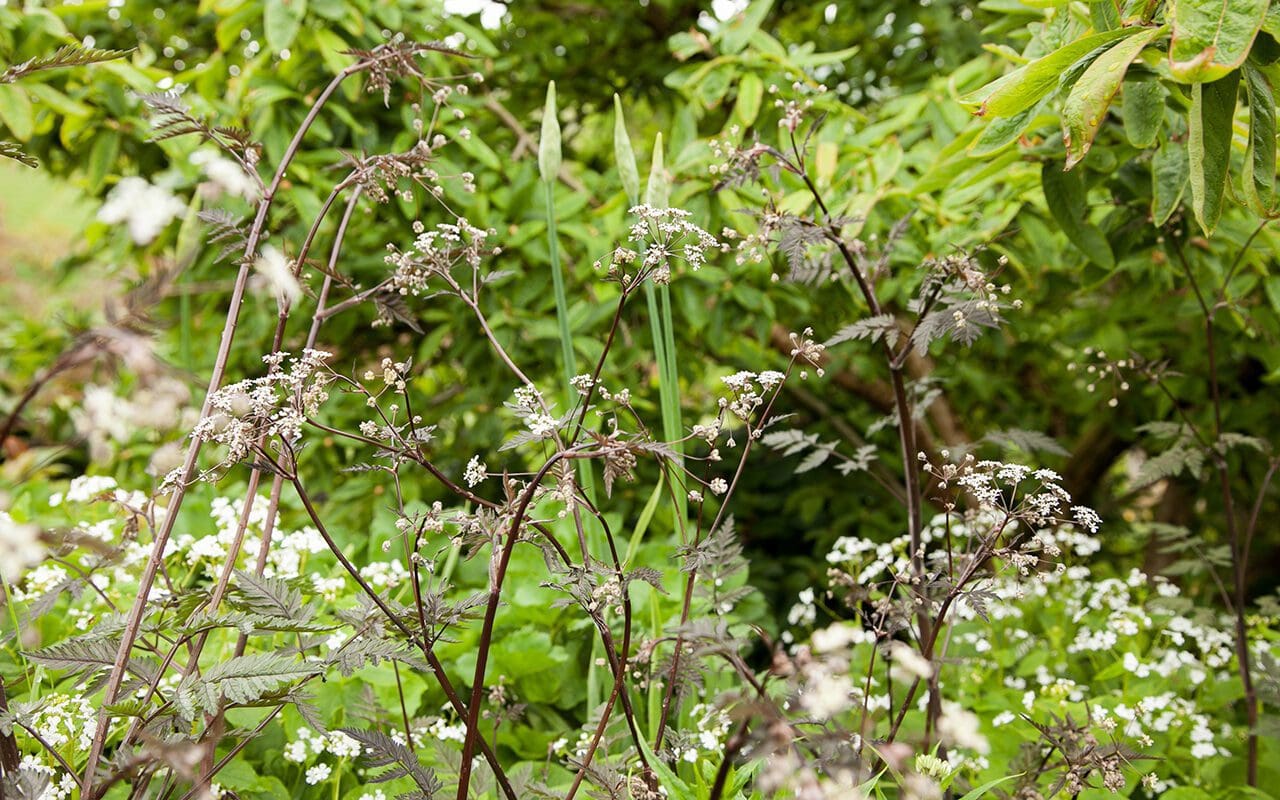
Derry Watkins has a darker version named Anthriscus sylvestris ‘Dial Park’, which I will try here too because cow parsley goes with almost anything. Go to Great Dixter at this particular zenith in a fortnight and you will see how extraordinary it is where Fergus has invited the wild form into the borders. I have to exercise control here, leaving just a single plant, the best of the dark-leaved forms to seed where I want the lace amongst slower-to-rise perennials. The majority are cut as soon as I see the seed ripening, since they are profligate seeders. Being hedgerow plants anthriscus are as happy in sun as they are in shade and use their tolerance of the latter to take their time under the cover of summer growth to send down taproots into the crowns of plants you’d rather they didn’t. Their early growth can be the undoing of a later-to-rise aster or sun-loving iris or nerine.
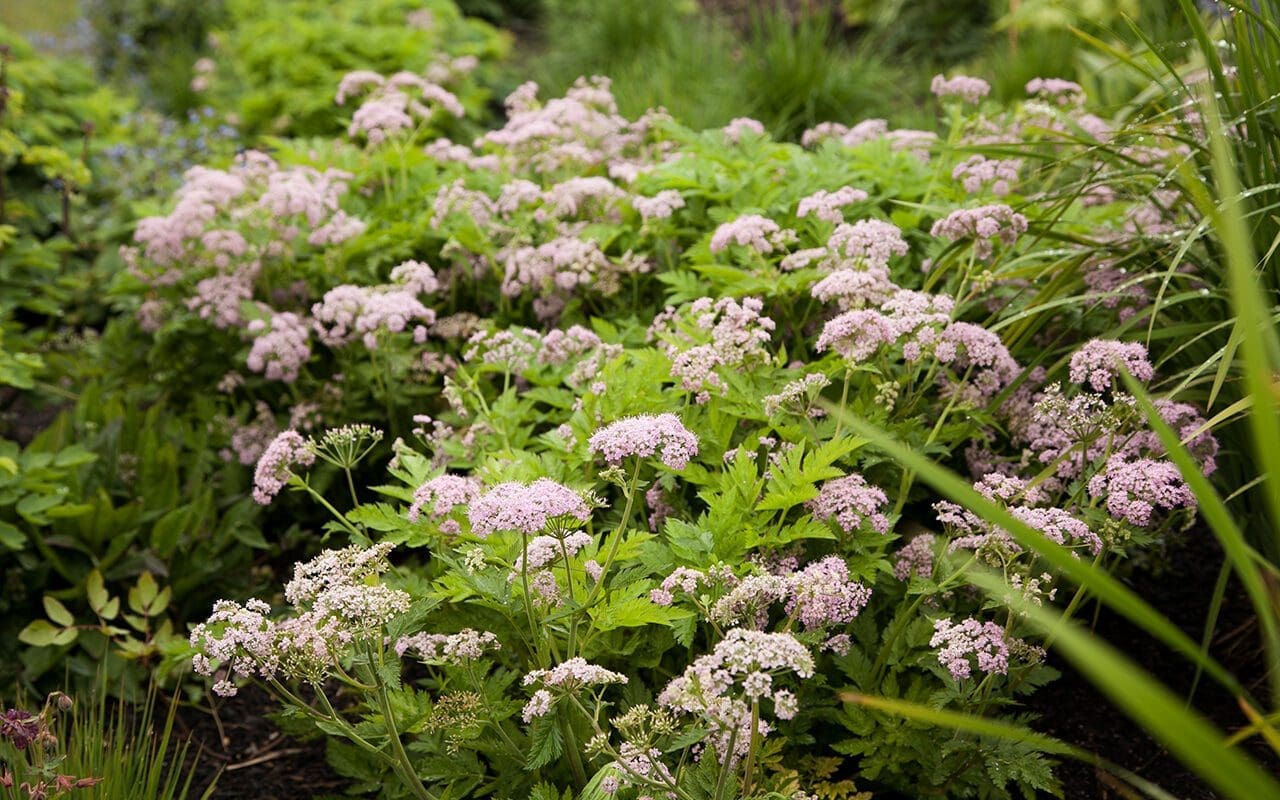
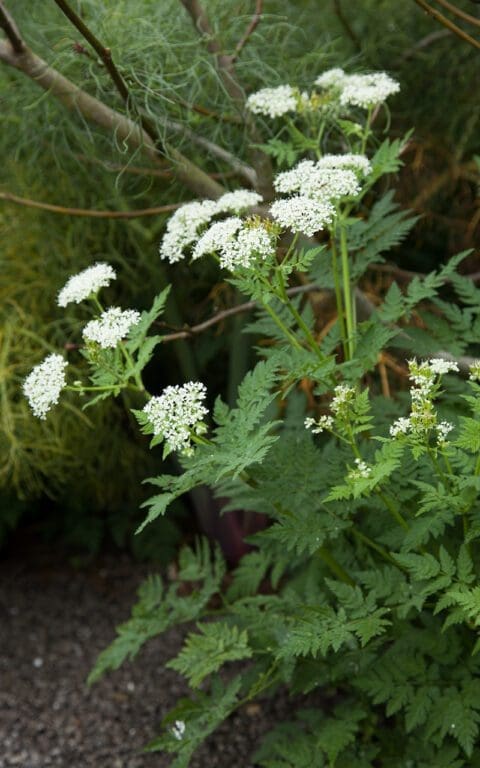
Cow parsley, also known as wild chervil, opens the season of umbellifers here and the laciness of the umbels is something I love and include for their loftiness and suspension. Chaerophyllum hirsutum ‘Roseum’ is already in flower too, a pink form of Hairy Chervil with a flowering season of about a month. The flowers start low and on a level with brunnera, but rise up to hip height to accompany the first of the Iris sibirica. Another related umbellifer which flowers at the same time is Myrrhis odorata. Before sugar was freely available the leaf and seed of Sweet Cicely were used to sweeten cakes. We have it here in the herb garden, where it is happy in the shadows of the Afghan fig and giant fennels. Its filigree of aromatic early growth is good beneath plants that take over later, but if you are not to have a thousand seedlings it is best to remove the seed heads once you have enjoyed them green and before they start to drop and conquer all they survey.
Words: Dan Pearson | Photographs: Huw Morgan
Published 15 May 2021
The spring this year has been slow. A wet winter finally giving way at the end of February to a long and testing period without rain. This came with a relenting fortnight of frosts that saw us fleecing the wall-trained fruit nightly and praying for the plum orchard, which at the time was in full and vulnerable flower. It has been too cold to direct sow in the kitchen garden and the self-sowers, which I like here to make the garden feel lived-in, are looking sparse, the seedlings dwindling without the water in the top layer of soil in this critical period.
We knew the garden would find the water with well-established roots searching it out, but new growth needs rain and it began to show it in tardiness and a reluctance to get out of the blocks. This spring we have pined for the burgeoning that is so much part of an April landscape.
Cue the tulips which, although slower to appear than usual, have sailed through unscathed and oblivious. Miraculous for their ability to cover for the pause between the narcissus waning and the cow parsley filling the hedgerows, we would not be without their impeccable timing.
Despite the hiatus in the garden and their ability to plug the gap, I have deferred from including tulips there due to their immediately ornamental nature. Preferring the slow unravelling of greens against our rural backdrop, we have, instead, grown the tulips in the kitchen garden for picking where, in this productive setting, their flamboyance can sing and not shout.
It was on a trip to see the Dutch bulb fields while a student at Kew that I first saw tulips jumbled together en masse. They were in an old orchard at the back of a bulb farm where the spares had been thrown and provided (for me at least, desperate for naturalism) a relief from the rigour of the regimented rows in the fields. It was an unforgettable sight. Free and liberated and multi-layered with colour and juxtaposition of forms. We grow them together here in homage to that memory and to ease the tulips’ innate formality.
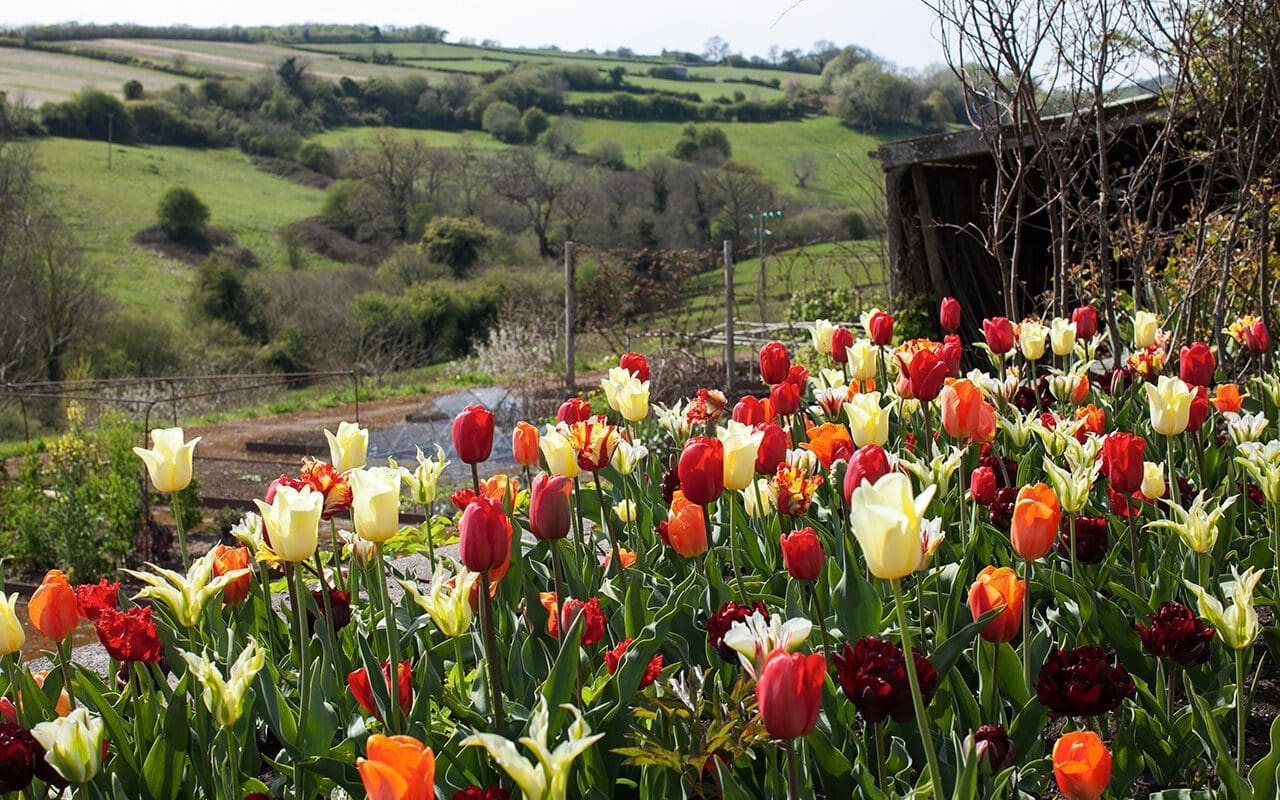
Each year we put together a collection that explores a particular colourway using early, mid-season and late varieties so that we have a month to six weeks of flower. Thirty of each and usually ten varieties planted randomly about 6” apart in November. We move the tulips from bed to bed so that they appear in a different place in the kitchen garden to avoid Tulip Fire, which builds up if you replant the tulips in the same ground repeatedly. A five to seven-year cycle means that the fungal disease goes without its host and, by the time they return to their original position, the ground should be ‘clean’ and ready to receive them again.
The annual selection sees us experimenting with new varieties, and returning to old ones that we favour. Inevitably, because one tulip bulb looks roughly like another, we curse the bulb suppliers who substitute one or two without letting us know so that there are some wild surprises. This would matter if you were planting them into a scheme, but it rarely matters in the mix and sometimes throws up an oddly welcome guest.
After ten years of enjoying growing the tulips in the knowledge that they provide us with a guaranteed respite after winter and a kickstart in spring, we are beginning to feel less easy about their disposability. We are particular here about reusing what we can and not more than we need and it goes against the grain to discard the bulbs, because we don’t have the room to keep them. So, a new place, which will be our equivalent of the Dutch orchard, will be found by the polytunnel for the bulbs to have another life and show us which ones have the potential to be recurring in our heavy, winter-wet ground. This may take some time, but it feels the right time to apply this rigour.
In the search for varieties that do well year after year, we are going to try a few in the garden, but only close to the buildings and used very sparingly so that they do not compete for attention. They will be worked in amongst the volume of the Paeonia delavayi at the garden’s entrance, so that the early flower coincides with the unfurling plum foliage of the tree peonies. We are referring back to our 2019 selection that focused on dark reds and plums. The moodiness of the almost brown ‘Continental’ and the glowing cardinal red of ‘National Velvet’ will sit well here. We will let you know next year how the association fairs amongst the peonies.
In order of flowering our selection was as follows:
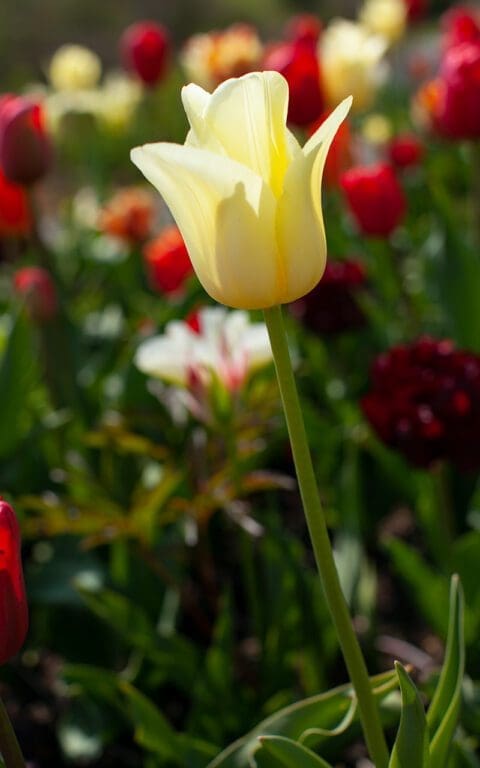
First to flower in early April and with a long season of over a month. Tall, straight stems. Uncommon shade of lemon sorbet yellow. Widely listed as growing to 40cm, we found it to be one of the tallest at 55-60cm.
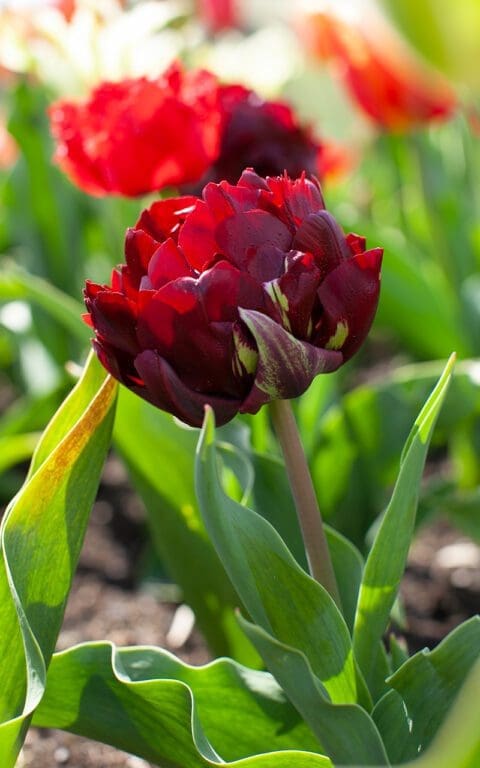
Difficult in a garden setting as the flower is so out of scale with the stem length, for cutting this wine-dark tulip is rich and lustrous. Almost as good as the peonies it precedes. Long flowering season. The shortest for us at 30cm, although listed at 45cm.
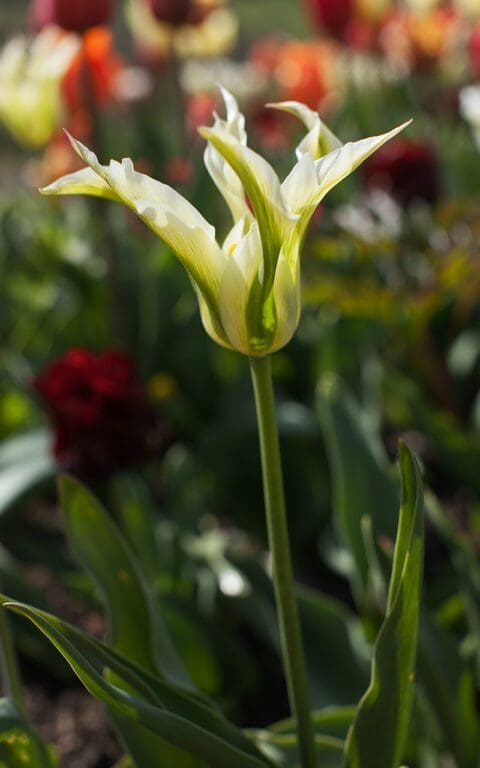
Opening primrose yellow with dramatic green flaming this lily-flowered tulip fades to cream and twists extravagantly as it ages. 40cm.
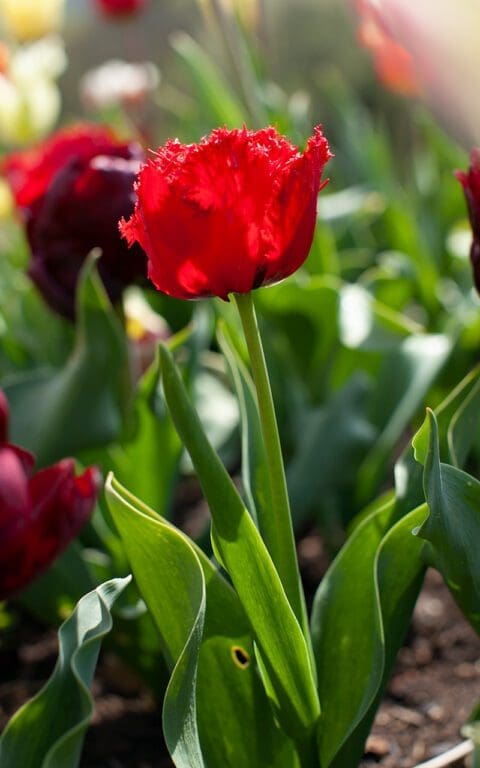
Another diminutive tulip better suited to a pot. A boxy shape we were not so keen on and a rather violent shade of scarlet in the garden. This mellows when cut and brought indoors though, where the exaggerated fringing and black eye can also be seen to best advantage. 30cm.
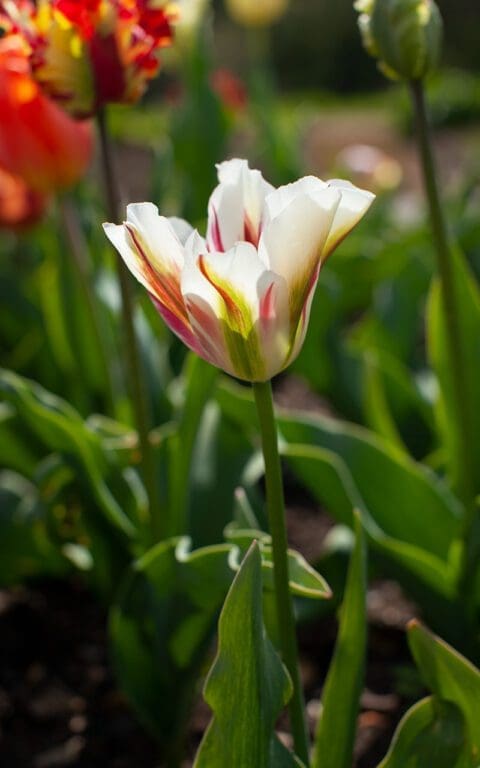
Delightfully elegant Viridiflora tulip with green flaming on gently waved petals of off-white, broadly streaked with raspberry red. 45cm.

Similar in colour to ‘Orange Sun’ which we have grown before, this Darwin tulip is taller and more elegant. The pure, citrus orange flowers have a satin sheen and a clear yellow centre, which is shown when the flower opens in sunshine. 50cm.
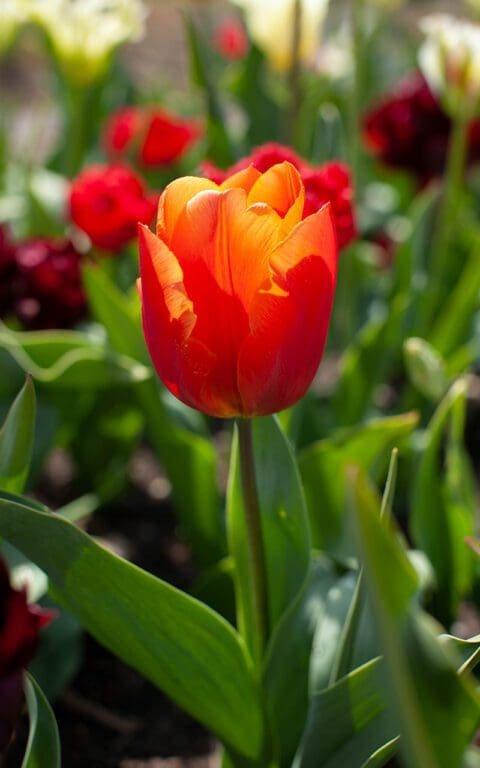
A more sombre shade of burnt orange which is accentuated by the matt petals, which age to faded apricot-gold at the margins. Deliciously sherbet-scented. For us this was the shortest lived at just two weeks. 45cm.
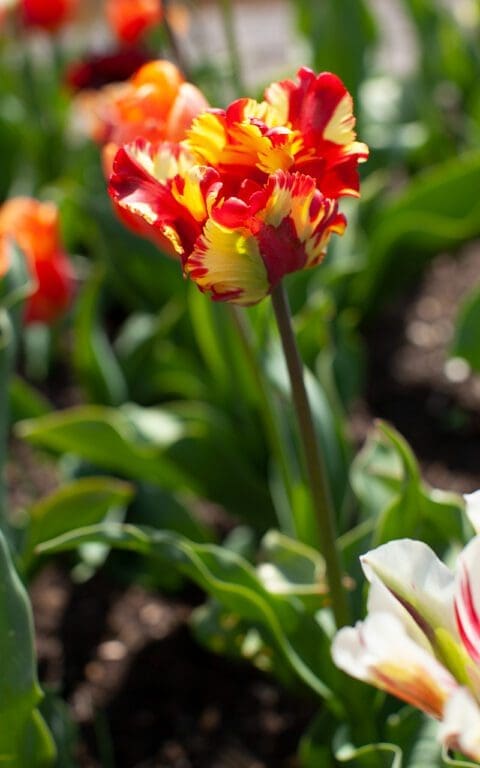
The court jester of parrot tulips. The flaming of primary red and yellow is utterly joyful. The yellow fades to a more subdued clotted cream as they age. 50cm.
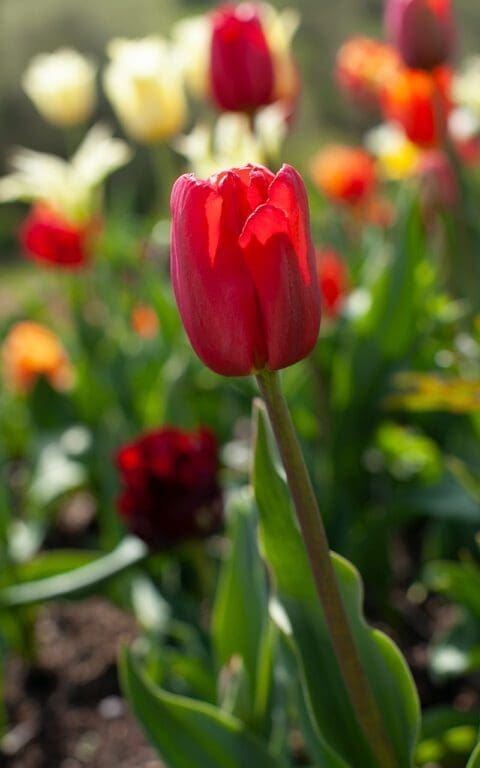
Late and tall this tulip has huge flowers the size of a goose egg in a rich shade of deep crimson. With sturdy, ramrod straight stems it is ideal for a windy site such as ours or for picking. 55-60cm
The scarlet lily-flowered tulip in the main image is ‘Red Shine’, which we grew last year and would seem to be a good contender for perennial flowering.
Words: Dan Pearson | Photographs & captions: Huw Morgan
Published 8 May 2021
This is the fifth spring since Dan oversowed the newly landscaped banks at the front of the house with native meadow seed and now the cowslips (Primula veris) are really starting to show themselves. This year we have counted over fifty individuals on the bank immediately in front of the house.
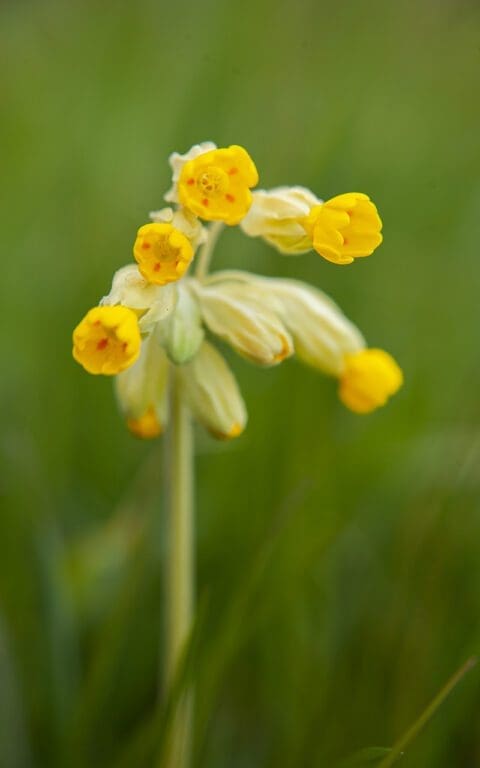
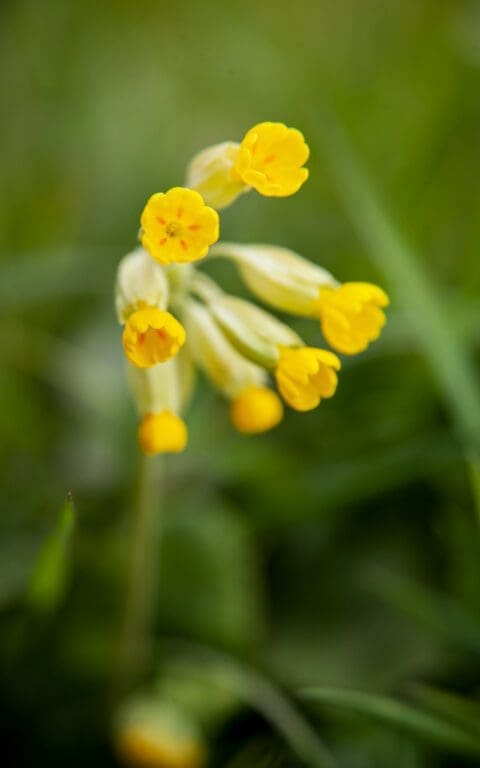
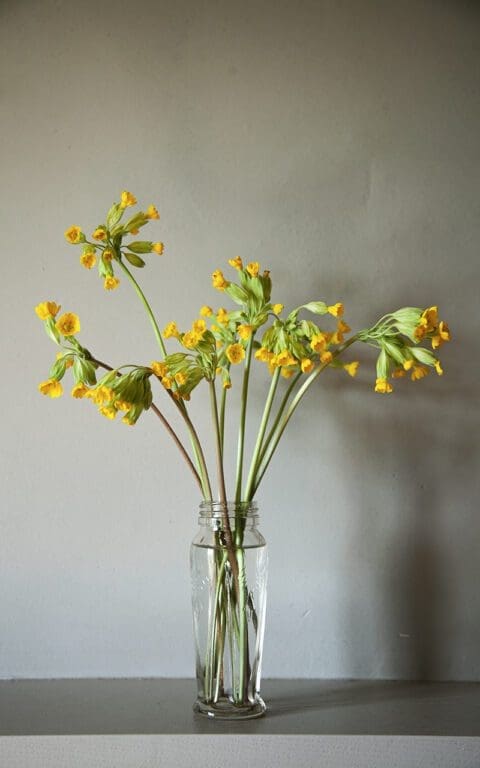
Their luminous, pale green calcyes, like tiny inflated bladders, announced their presence long before the golden flowers unfurled from within them. The sturdy, felted stems rise up from a basal rosette of heavily textured foliage and can hold up to thirty scalloped flowers, each marked with five orange spots, on wire-thin stalks in a loose umbel. Their resemblance to a bunch of keys gives them another common name of Key Flower. They have a notably long season of three to four weeks, as the flowers open in succession in each cluster and with a relay of flowering stems as newer ones rise up to replace those that fade. They come on stream just as their cousins, the primroses, start to dim and so continue to provide early nectar for long-tongued bees, butterflies and moths. I picked some last weekend and they have been unexpectedly long-lasting in a vase and with the most delicious spiced apricot scent. I imagine this perfume is one of the notable attractions of cowslip wine, the romance of which haunts the hedgerows of Thomas Hardy and Laurie Lee.
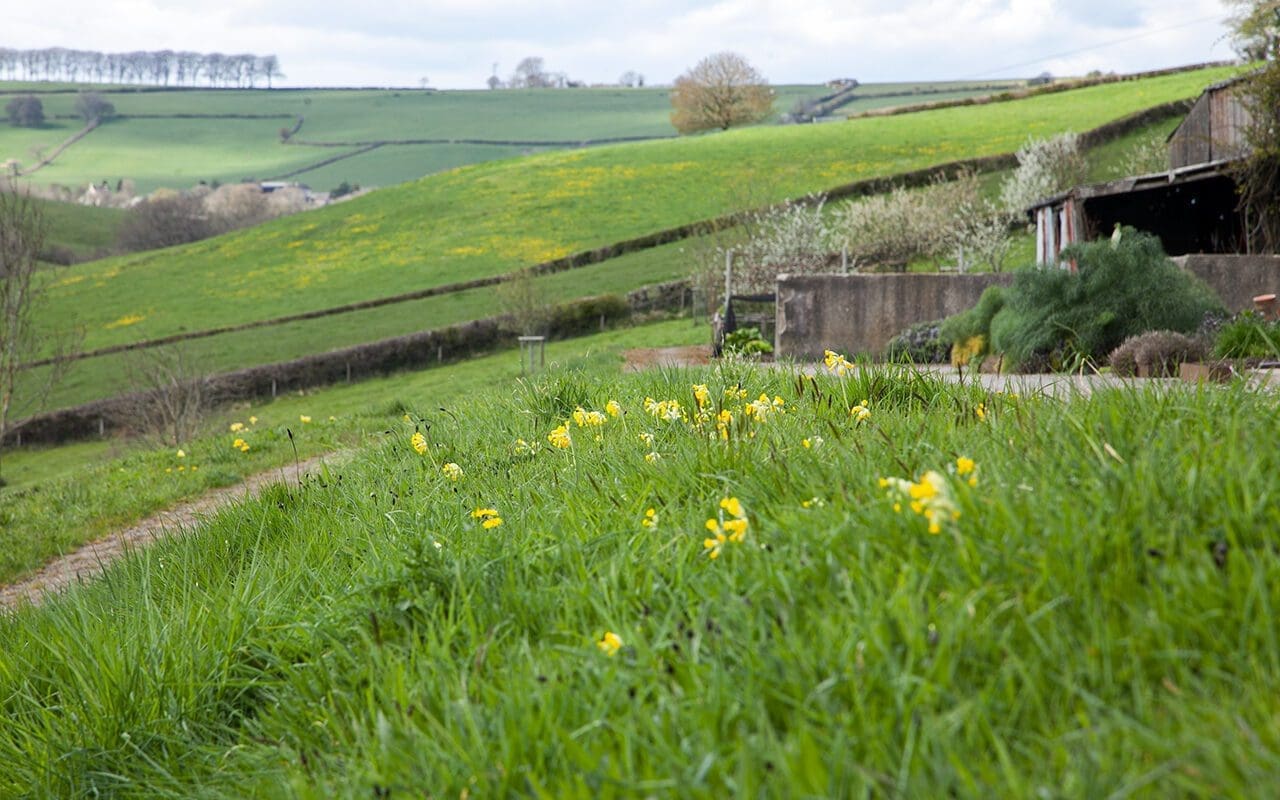
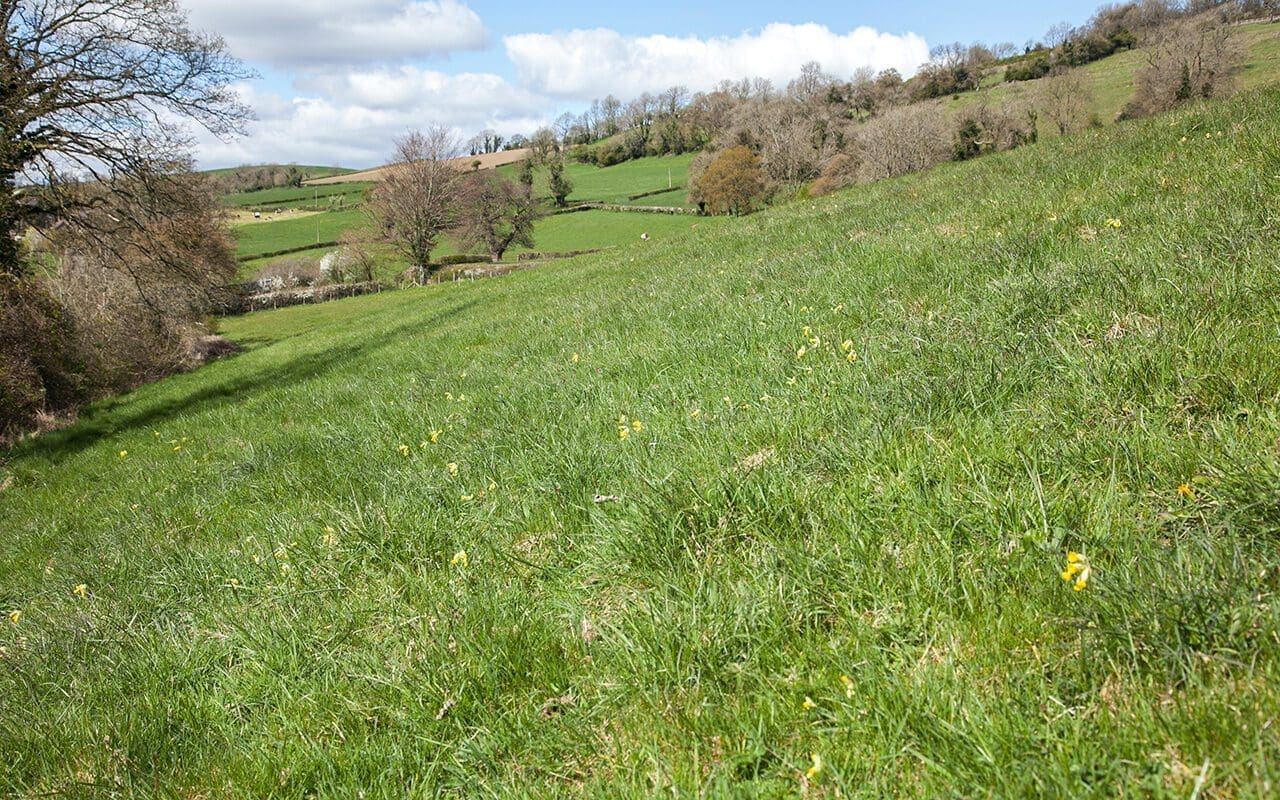
The farmer who lived here before us grazed the fields with cattle, but after we relaxed the grazing regime we were delighted to find that a large colony of cowslips was still intact in the Tynings, the fields that our neighbours call the Hospital Fields. Although the colony has not proliferated quickly we have seen definite evidence of an increase in numbers and the start of an expansion of the main colony. Fine-tuning the mowing and grazing regime to increase the presence of flowering plants such as these is one of our constant challenges.
Due to bad agricultural practice in the 1970’s and ‘80’s the cowslip almost became an endangered species, but its inclusion in commercial meadow mixes over the last twenty years and more has seen it make a resurgence on motorway embankments and in new meadow creation schemes.
Plantlife, the British charity that supports native wild plant conservation, is currently running a Cowslip Survey. Cowslips come in two forms, ‘S-Morph’ and ‘L-Morph’. In the former the plural stamens (male) are presented foremost in the corolla, while in the latter form it is the singular stigma (female) that is seen. In healthy cowslip populations there should be around a 50/50 mix of forms, however this gets out of balance if there is a change in agricultural practice, land or habitat management. The survey has been launched to gain a broader understanding of how healthy British cowslip populations are and, consequently, the wider health of our native grasslands. On a cursory visual check today it would appear that our colonies, both new and long-established, are pretty well balanced, but I will definitely be taking a more detailed look for the survey to get a better understanding of how we can maximise the species diversity in our meadows.
Words and photographs: Huw Morgan
Published 17 April 2021
We are sorry but the page you are looking for does not exist. You could return to the homepage