Late in December, and before I expected such a prompt return, the Cyclamen coum made their re-appearance. The tiny beaks of magenta broke bare earth, buds soon reflexing to flower, sturdy and gathering in number and oblivious, it seemed, to the winter. Of all the flowers that come in these darkest weeks Cyclamen coum seem to have the most stamina, flowering for what must be the best part of three months and, in that time, providing a continuity of hope. During their season, they will see the snowdrops in and out and be companion to witch hazel and wintersweet and be happy to be in the root zone where little else will grow.
The rooty places where the ground is already taken are where they prefer to be. Here they will spend their summer dormancy underground, their tubers kept cool but on the dry side and in perfect stasis. Come the autumn rains their season is activated and, without the competition of summer growth either above or around them, they are free to flower and build up a colony. Choosing the place where they can be allowed to reign is the secret and it has taken a while for me to find the perfect spot under the old hollies. The ground is steeply sloped here and the trees, with their high dense canopy and fibrous roots, make for strong competition.
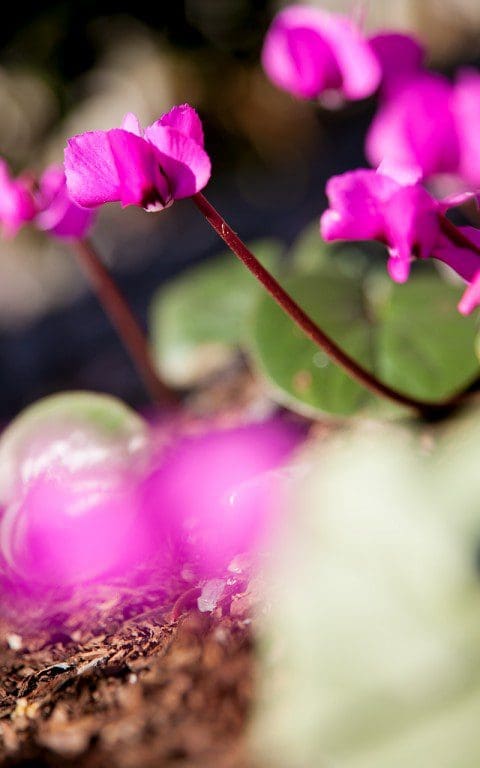 Cyclamen coum
Cyclamen are always best planted when in growth and not bought as dormant tubers, which have often been kept too dry for too long by the suppliers. Hailing as they do from the Caucasus, Turkey, the Lebanon and Israel Cyclamen coum prefer to be kept on the dry side when dormant, which is easier and less disruptive in a pot. The second advantage to planting when they are in growth is that you can hand-pick for best leaf variation and flower colour. The leaves are as variable as pebbles on a beach. Some, often sold as the ‘Pewter Group’, are almost completely silvered, others are green overlaid with silver, and others almost entirely bottle-green. The foliage, which is the size of a chocolate coin and held close to the ground, doesn’t like competition and you have to be careful not to team them with the leafier Cyclamen hederifolium which is more vigorous and will smother them or with other winter flowering bulbs such as Eranthis, which are prone to leafiness once they start to form seed.
A dozen plants were winkled in where I could find gaps between the holly roots last winter and top-dressed with a mix of gravel and bark to do no more than cover the tubers. I hand-picked my plants for the strong magenta forms, as I prefer the punch of their pure, bright colour to the softening influence of the paler pinks and white, which is what you more often see where they have naturalised. Last year’s plants have all returned with a clutch of seedlings held tight within their crowns. These miniature new plants look true to type (or more-of-less) in terms of leaf marking, but I will see in three years or so if the flowers are true to their magenta parents.
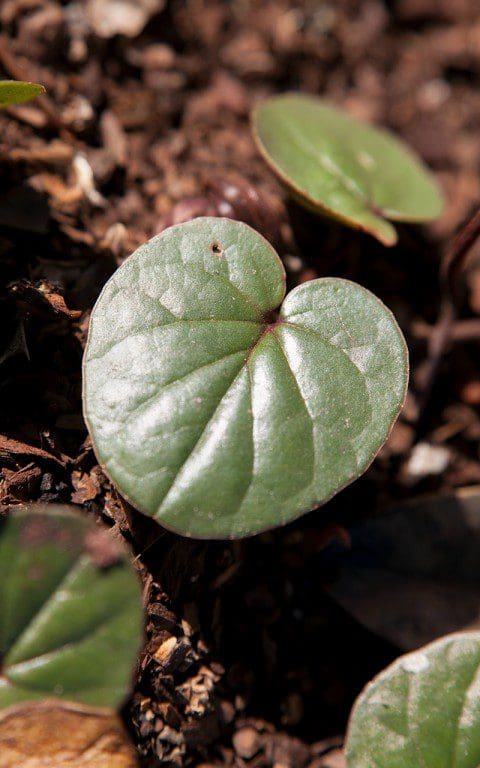
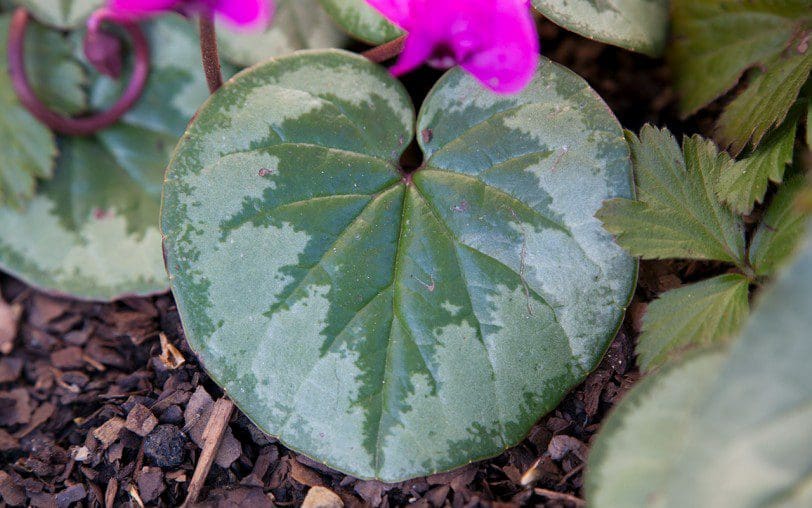
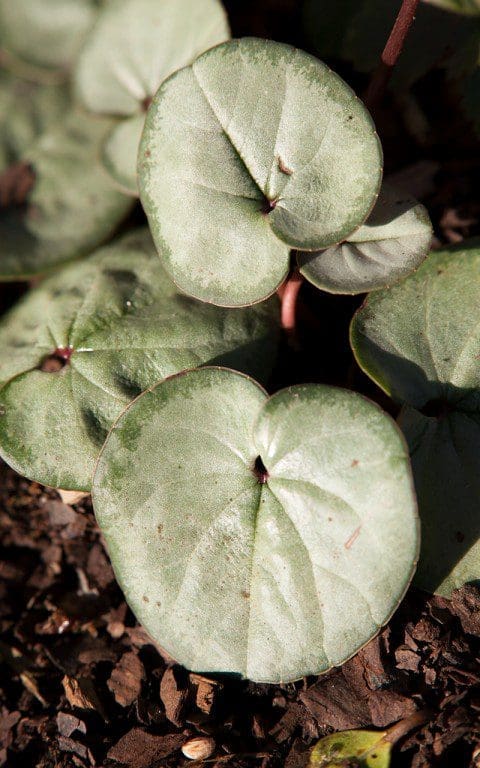 Various foliage colouration
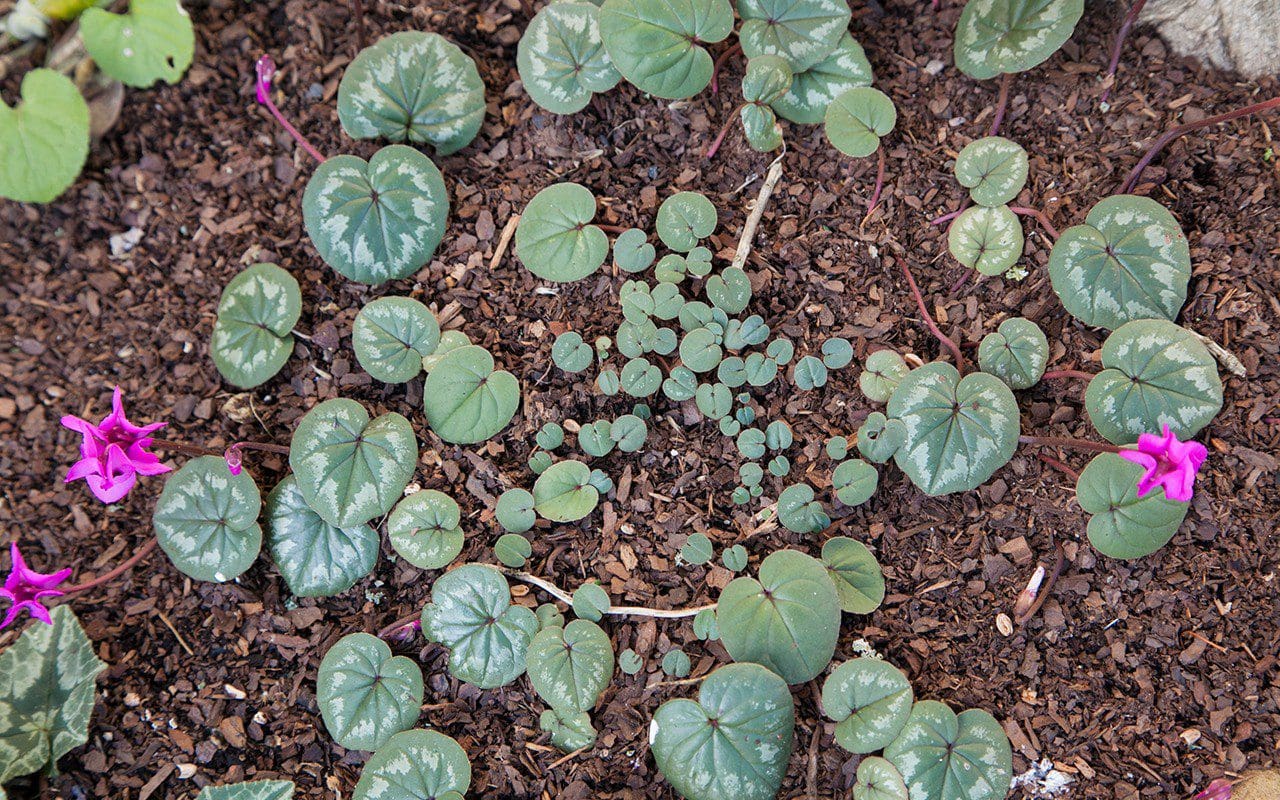 Seedlings have appeared in the crowns of last year’s plants
Tania Compton has raved to me about her Cyclamen coum naturalising best in pure gravel and I have hopes that mine will break free from their mound under the holly and venture into the sleeper steps that run alongside, their rubbly treads being the perfect habitat for them to run free. Cyclamen are prolific seeders if they decide they like you and a sweet coating on the seed makes them a delicacy for ants which will carry them quite some distance, so that they often appear in surprising and unexpected places. I have an image of the steps in a few years’ time being somewhere that you have to pick your way down in the winter as though on a glowing magenta runner, threadbare where our footfall influences where the cyclamen appear and where they don’t.
Words: Dan Pearson / Photographs: Huw Morgan
Published 13 January 2018
Now that the garden is resting and the woods drop back into winter nakedness we are drawn out into the landscape. Mosses greener than ever, now that the winter wet is here again, lighting up the tree trunks brilliant emerald where sunshine slides through bare branches. The north side of the trunks colonised by the green algae, Pleurococcus, act as a woodland wayfinder and, on the eldest limbs and marking their age, the colonies of polypody are once again thrown into focus.
I am happy to see them now that it is winter and enjoy the primitive feeling the ferns bring to the woods and stream edges. Higher up on the slopes, where we garden almost exclusively in sunshine, is not the place they want to be. I have planted for shade but, until I have the cover, ferns will have to have their place out of the garden season and we in turn the opportunity to visit them where they choose to be.
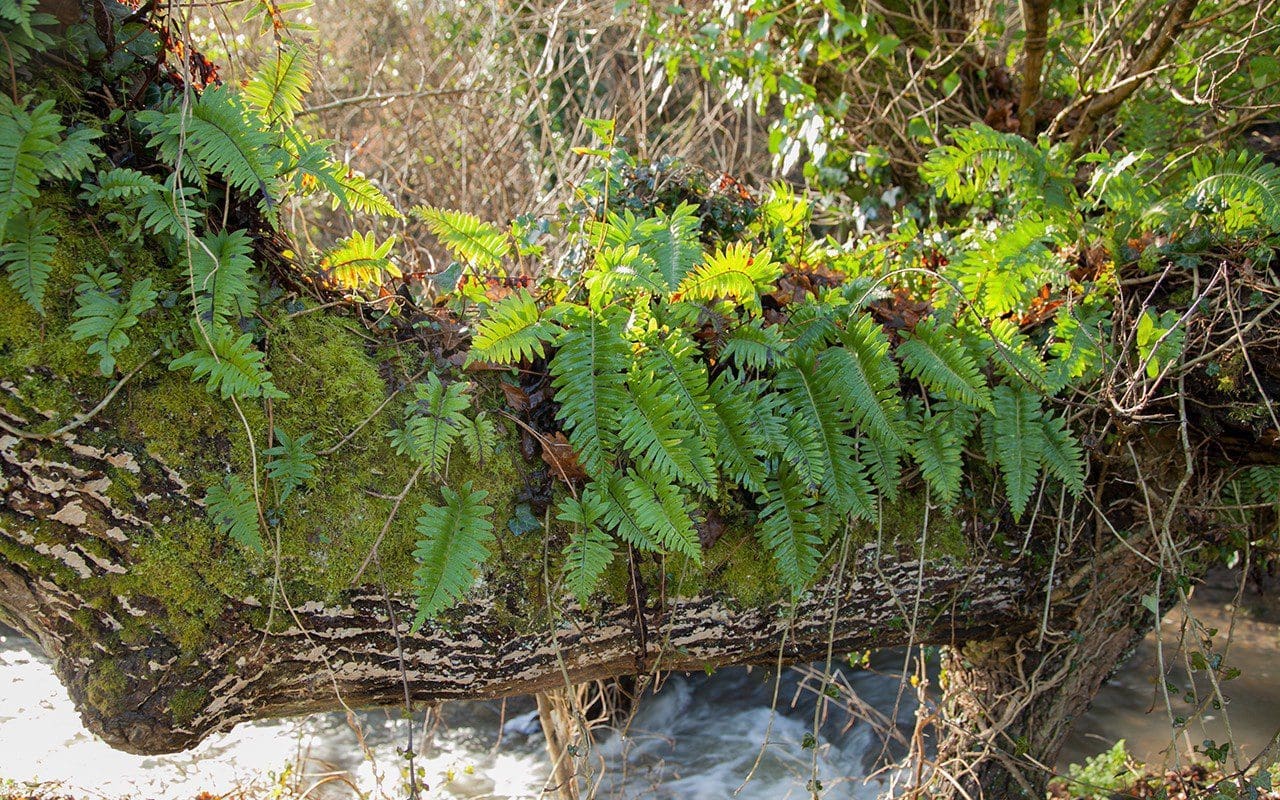 Polydpodium vulgare
There are three main species in the woods around us. Polypodium vulgare is perhaps the most adaptable, choosing in the main to live up in the branches, inhabiting the places where moisture is harboured. Clefts in branches, where the moss holds accumulated dampness, is where you will find them making home and, from there, they travel slowly outwards forming a matt of fibrous root that in turn collects the moss and the accumulated leaf mould so extending their reach.
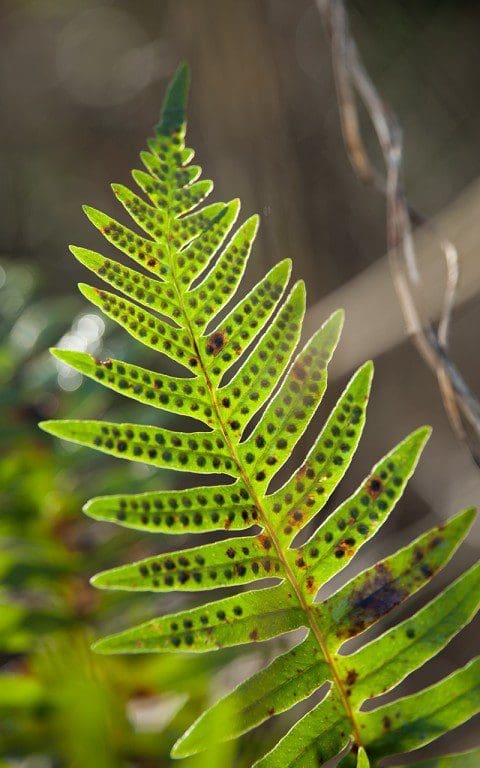 Polydpodium vulgare
The finest colonies sit on the topside of the oaks that, over the years, have leaned from the slopes to strike informal bridges across the streams. Running along their branches like feathered epaulettes, the polypody strikes an exotic mood that you might more usually associate with the epiphytic bush of New Zealand or cool temperate rainforest. They are an adaptable fern, shrivelling and browning in dry summer weather to return again with the autumn wet and remain evergreen throughout the dark months. I harvested a number of plants that arrived in the wood where we logged a fallen tree by the stream and have simply laid them down in one of the few shady places up by the barn, where they have taken root. I have plans to add them to the north side of the house where I will insert them into a wall close to where I keep the epimediums so that we can enjoy them at closer quarters.
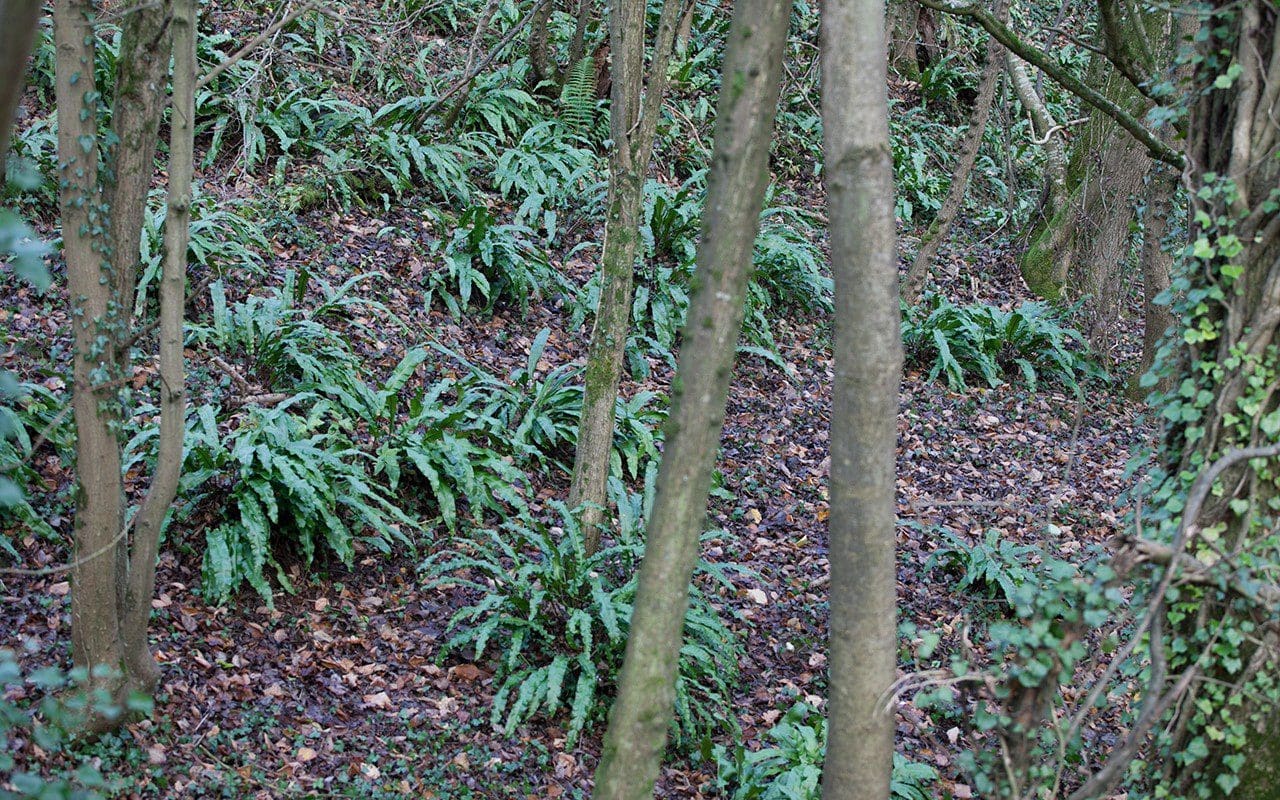 A colony of Asplenium scolopendrium
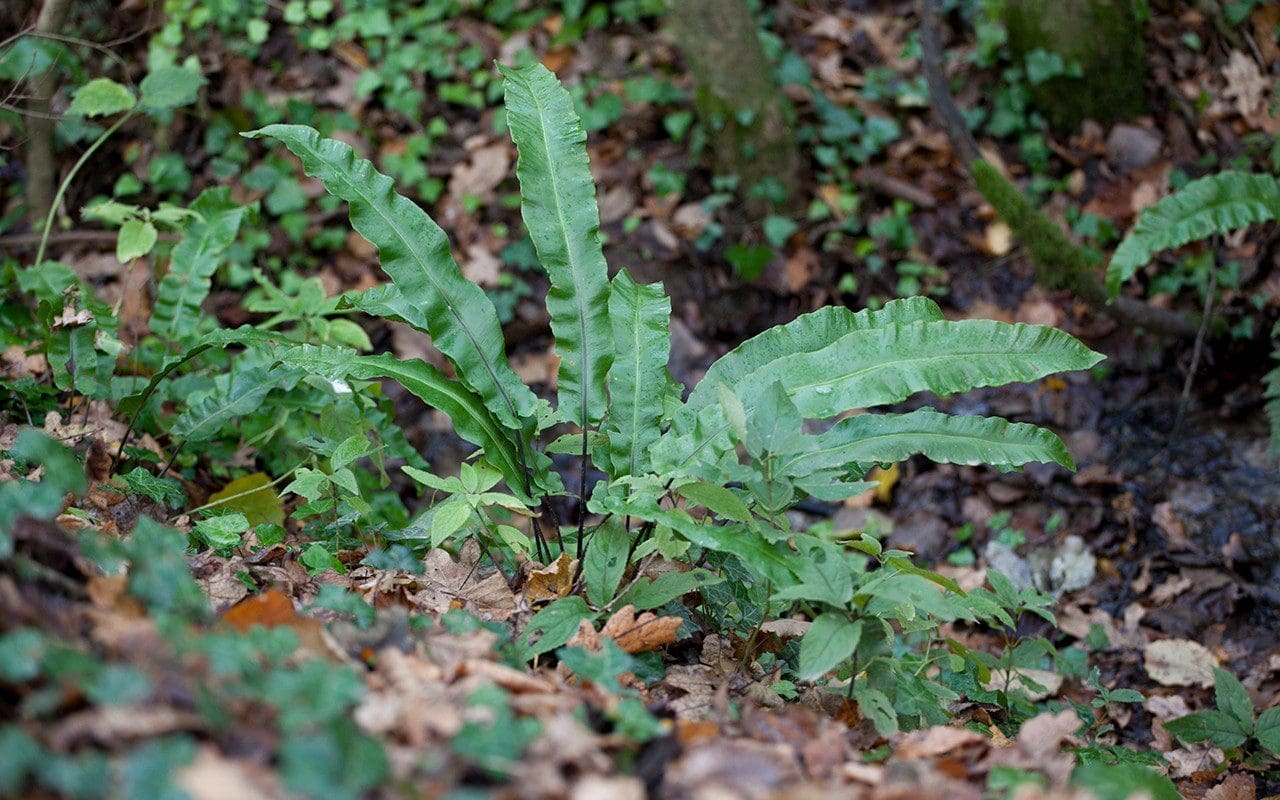 Asplenium scolopendrium
The hart’s tongue fern (Asplenium scolopendrium) is one of the key plants you register on the ground in the winter woodland. Clinging to the steep banks of the ditches and streams where the soil is thinnest, they make fine colonies with mature plants almost touching, but not so much that you can’t appreciate their architecture. The simplicity of their foliage, each tongue arching elegantly downward, is a feature of limestone woodland and around here it is the most prevalent fern. The Victorian pteridoligists collected the hart’s tongue ferns with great fascination, naming and selecting the occasionally crested, fasciated and undulating variants. Several are still available today and are good in the winter garden for their long season of interest. The fronds last right through the winter to the point at which the new croziers unfurl in spring. You will know exactly when to cut them and refresh the plants, as the winter foliage begins to look tired with the contrast of spring around it.
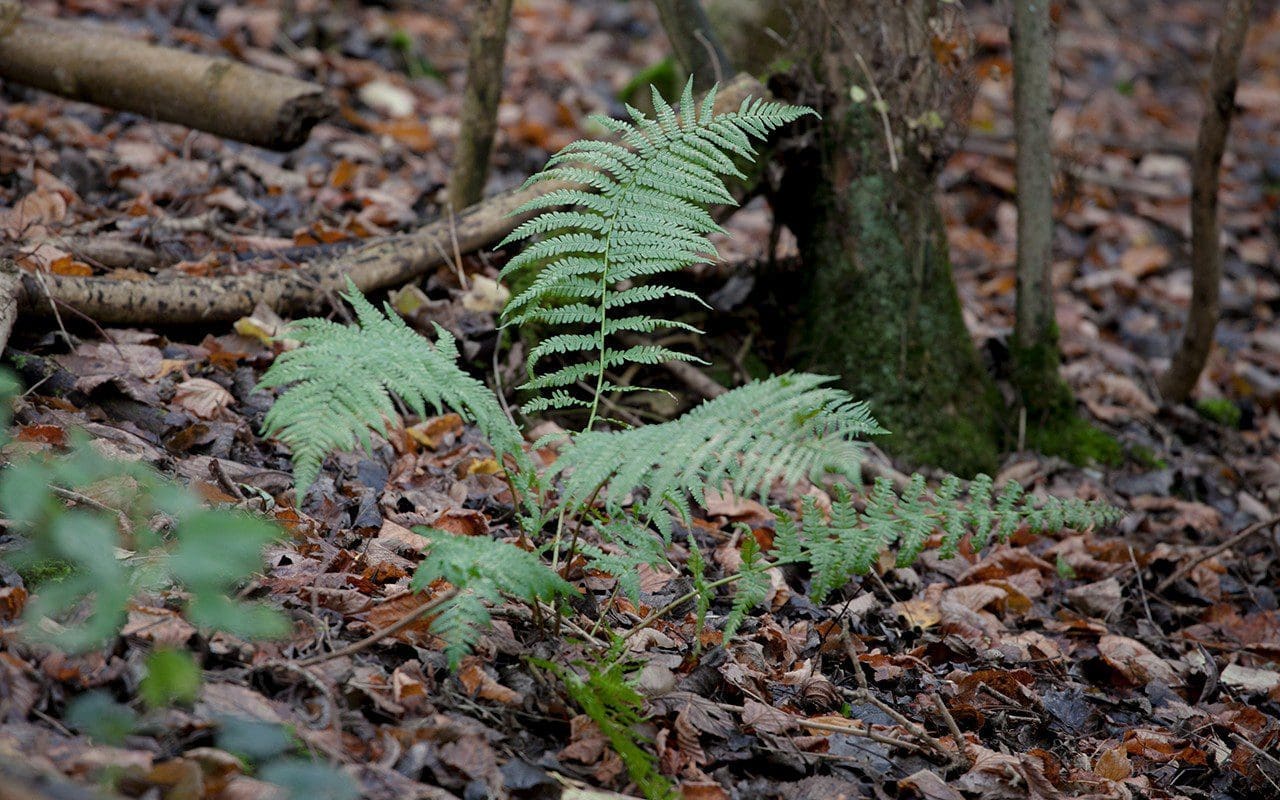 Dryopteris filix-mas
The male fern (Dryopteris filix-mas) is less common here, where our soil lies heavy at the bottom of the slopes, but they do occur and I aim to introduce more when the hazel coppice matures. When I was a child, gardening in the thin, acidic woodland that faced the South Downs, Dryopteris filix-mas was a staple of the woodland and the clumps were many crowned, some as much as a metre across and aged. Where the polypody and the hart’s tongue last the winter, the male fern tends to brown and eventually collapse as the frosts work at the growth of the previous growing season. But they are beautiful in death and more so for the contrast of old and new as the dramatic unravelling of croziers happens in the spring. Brilliantly soft and scaled dark green over light, the fronds unfurl to reach waist height before filling out and relaxing for the summer.
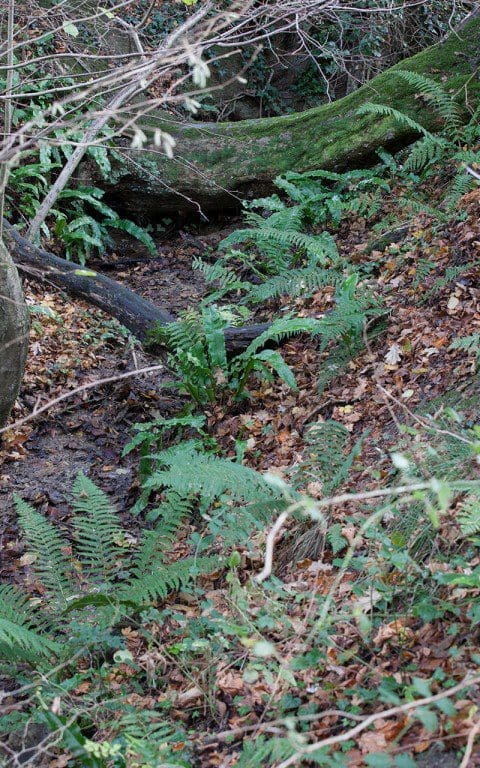 A colony of Dryopteris filix-mas
Osmunda regalis, the royal fern, is the most spectacular of our native ferns rising up to shoulder height as the croziers reach and teeter before expanding lushly to lie back in a tropical splay of fronds. The royal fern is now rare in the wild due to pillaging by Victorian fern-lovers but, where it does occur naturally in parts of Ireland, you find it in wet, boggy ground or on the edges of ditches.
Whereas I have not been able to include the ferns as part of the palette in the exposed new garden, I have introduced the Osmunda around the new bridge at the end of the ditch. The plants have a horticultural edge, in that they are the dark form, Osmunda regalis ‘Purpurascens’. Though not as voluminous as the regular green form, this selection is notable for the extraordinary purplish-bronze colouring of the young croziers and the tint to the unfurling leaves. I have them in the delta of wet ground to either side of the zig-zag bridge as a companion to the ink-stained foliage of Iris x robusta ‘Dark Aura’.
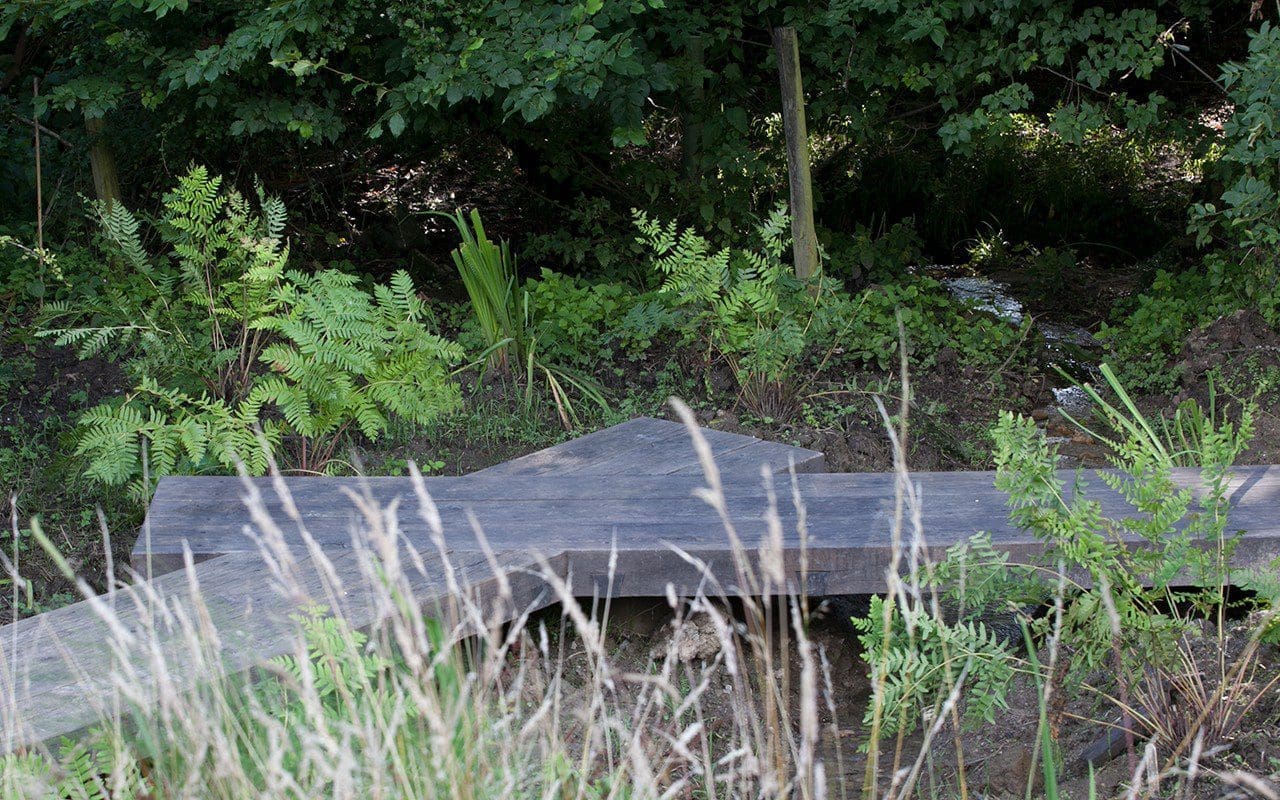 Recently planted Osmunda regalis ‘Purpurascens’ around the new bridge in July
New life appears in April from the knobbly knuckles that have been waiting out the winter in rafts of spongy root, once prized as a growing medium by orchid growers. It is a fast and marvellous ascent when the weather turns at the other side of the winter, the new growth the colour of Victoria plums and then copper as the fronds expand. At this point a daily vigil is necessary for there is not a moment to be missed. For now, however, I am happy for the wait that is made easier by their friends in the woods.
Words: Dan Pearson / Photographs: Huw Morgan
The various utensils, paper bags and home-made envelopes that have been accumulating all summer were grouped together recently for examination. I find it hard to resist when seed is there for the taking and it is something that I want or could do with more of. If I am lucky and have had a pen handy, the makeshift envelopes are scrawled with notes to make identification easy. The unmarked vessels might need a rattle and a closer look to remind me, but the excitement of a haul usually burns the find into the memory, as long as I act before winter blurs the clarity of this past growing season.
Fortuitously, autumn is the best time to sow the hardy plants and I would rather have them in the cold frame, labelled up and ready to go than degrading and waiting until the spring. In the wild, seed will start its cycle within the same growing season, so emulating the natural rhythm makes perfect sense. Most seed will now sit through the winter to have dormancy triggered by the stratification of frost, but some will seize the damp and comparative mild of autumn to germinate before winter and begin their grip on life.
The giant fennel are a good example. In the Mediterranean and Middle East where they are dependent upon the winter rainfall for growth, summer-strewn seed is now germinating with the first rains. My own sowings from August have already produced their second true leaf and are now potted on in long toms so that they can continue to establish their strong tap roots in the mild periods ahead of us. The winter green of Ferula communis (main image) is remarkable for this late season regeneration, gathering strength when it isn’t too cold and pushing against the general retreat elsewhere.
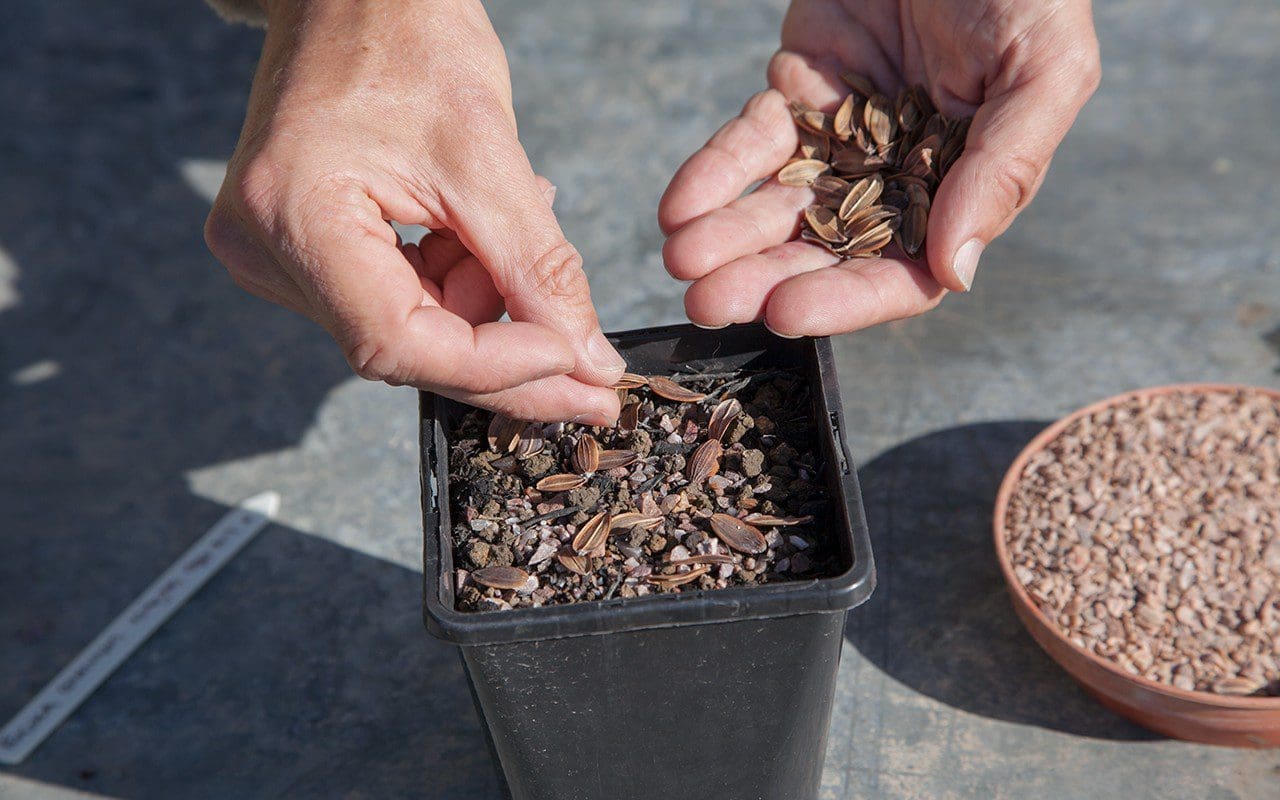 Sowing seed of Ferula communis in Autumn
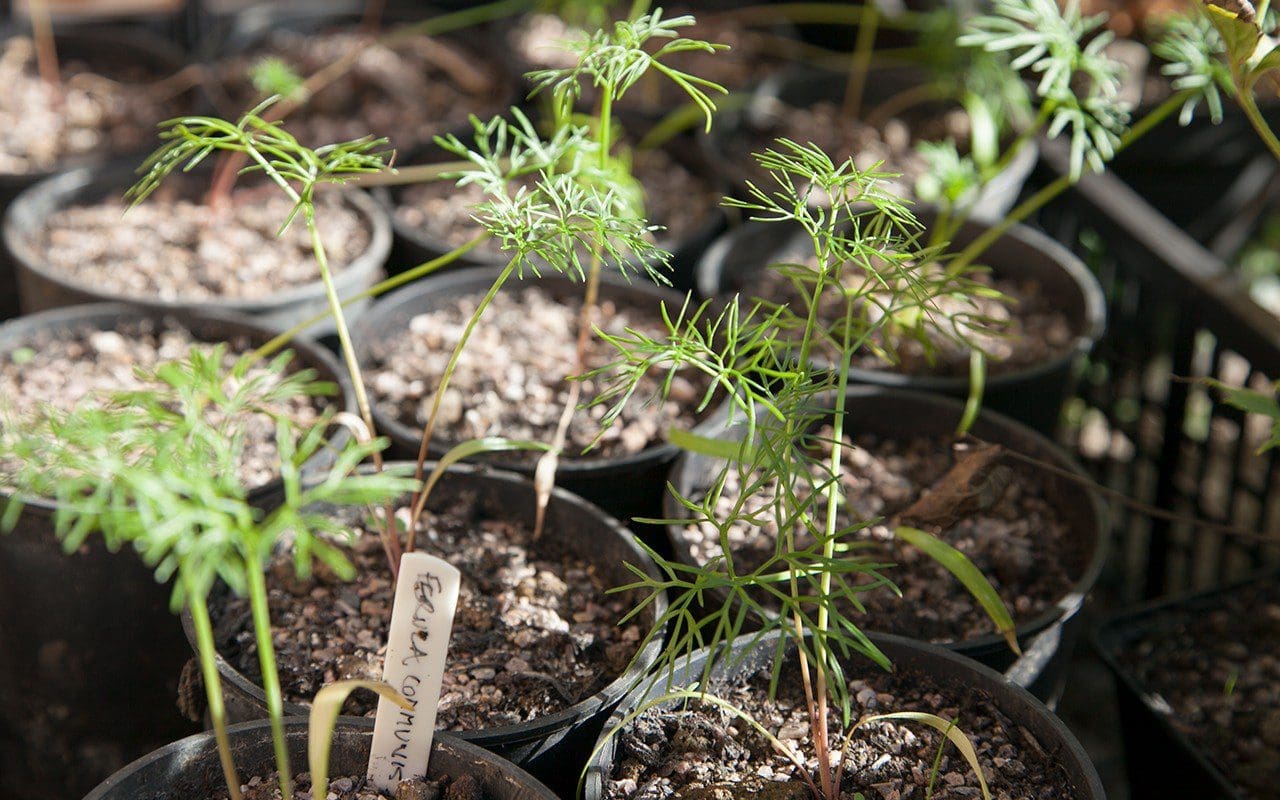 Seedlings of August’s sowing of Ferula communis in the cold frame
I first saw giant fennel in my early twenties when I was a student at the Jerusalem Botanical Gardens. Michael Avishai, the Director, had driven me to the Golan Heights to see them in the minefields where they grew freely and undisturbed. We stood at the roadside, taking heed of the sign saying ‘DANGER MINES! Go no further.’ Mile upon mile of cordoned-off ground, back-dropped by the mountains of Syria, was populated by a legion of uprights which bolted skyward in a scoring of perfect verticals. You understood why the Romans had used them as ferules, their stems making a lightweight measuring rod. Amongst their feathery mounds of basal foliage, a flood of acid-green euphorbia and scarlet anemone scattered the rocky ground between them.
You need open ground and the room to be able to let giant fennel have its reign in the garden. Whilst the plants are gathering strength, the early foliage needs the air and light they are accustomed to. Once they have bolted all their energy into the lofty flower stem, the foliage withers to leave a space, so you need to plan for a companion such as Ballota pseudodictamnus that can take a little early shade, but will cover for the gap in high summer.
I first flowered Ferula tingitana ‘Cedric Morris’ in my garden in Peckham and brought seed from there to here. It is the first of several giant fennels to have flowered here and did so in its third year after planting out. This lustrous form of the Tangier fennel is spectacular for its early growth, which is as shiny as patent leather, but finely-cut like lace. The flowering stem, which is shorter than F. communis, which can grow to 3 metres, holds an inflorescence that is just as flamboyant, despite reaching just half that height. My plants originally came from Beth Chatto where it appears in her gravel garden and this is how they like to live, with guaranteed good drainage in winter. I mean to ask if she was given the plant by the great man himself, for I am amassing quite a number of his selections and enjoy the connection of these horticultural hand-me-downs.
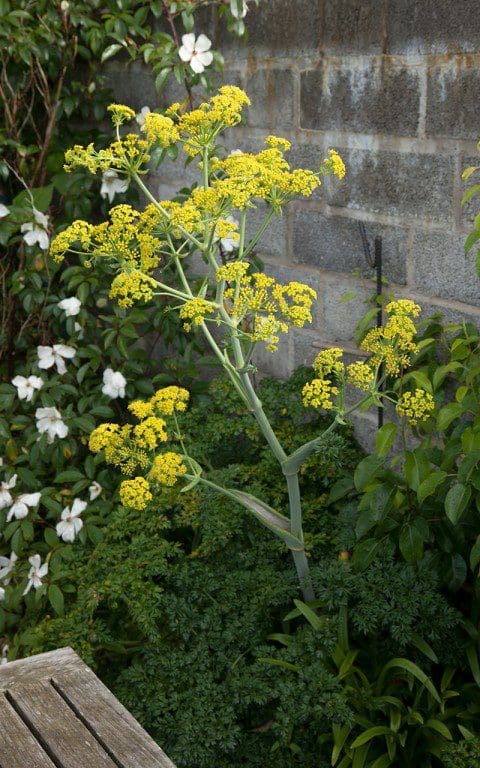 Ferula tingitana ‘Cedric Morris’ flowering in late May
Coincidentally, I was given a brown paper bag with ‘Ferula tingitana blood’ scrawled on it by one of the gardeners from Great Dixter at a lecture that I gave for the Beth Chatto Education Trust earlier this summer. It is one of several ferula that Fergus Garret has passed on to me over the years. He too is under their spell and has given me seed of several of his wild collections from his homeland in Turkey. Once, when I asked him what the mother plant was like, he said, ‘No idea. It’s bound to be good though. Try it !’. And with giant fennels I am very happy to take him on trust.
Fergus uses them as punctuation marks in the garden where they bolt above moon daisies and rear over the hedges like giraffes. They have started to hybridise there and, when they are established enough to plant out next spring, the ‘tingitana blood’ seedlings are destined for my new planting. The secret to growing them successfully is to plant them out before the long tap roots wind around the pot for, to support the huge flowering stem, they need their purchase deep in the ground like a skyscraper needs its footings.
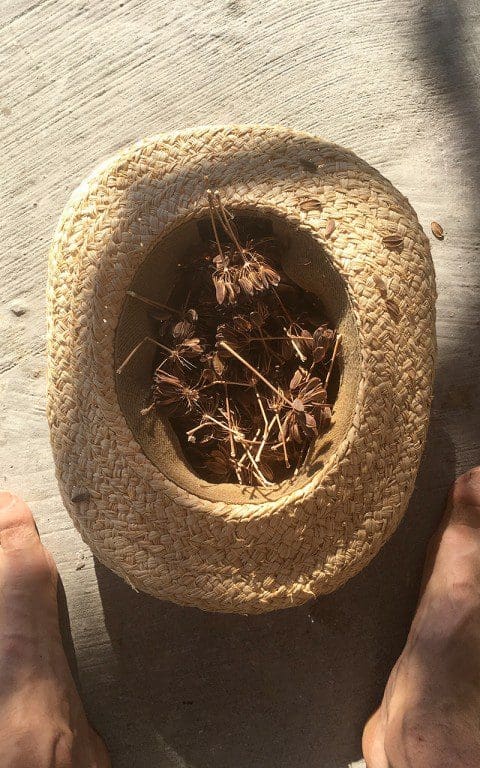 A hatful Ferula communis seed gathered in Greece
This summer, whilst on holiday in the Dodecanese, I collected a hatful of Ferula communis that had flowered beside the road and somehow escaped the ravages of the island goats. Though I had not seen it in flower, it was impossible to pass it by and the thought of it reappearing as a memory in the garden here will allow me to relive this find when it comes to flower. The seed left after my own sowing is now sitting in a bag waiting to go to Fergus, with a scrawled message of well wishes and the happy thought that they will soon be on their way to another good home.
Words: Dan Pearson / Photographs: Huw Morgan & Dan Pearson
Published 7 October 2017
For the first three or four years here we grew row upon row of dahlias in the old vegetable garden. They soaked up the light in the first half of summer and flung it back again in a riot of colour later. We grew upwards of fifty, with rejects making way for new varieties from one year to the next to test the best and the most favoured. The dahlias were completely out of character with what I knew I wanted to do here but, like children in a sweetshop, we had the space to play and so we indulged.
Three years of experimentation left us gorged and satiated, but a handful made it through to become keepers. All singles, and delicate enough to be worked into the naturalism of the new planting, we kept Dahlia coccinea ‘Dixter’ for sheer stamina of performance, Dahlia merckii ‘Alba’, the most delicate of all, and the demurely nodding Dahlia australis. Proving to be perfectly hardy with a straw mulch as insurance against the cold they have made good garden perennials. The exception is a scarlet cactus dahlia that outshone the blaze of competition in the trial. Originally bought as ‘Hillcrest Royal’, but mis-supplied, we grew it in our old garden in Peckham and loved it enough to bring it with us and, then again, to keep it in the cutting garden. Unable to identify it correctly after many years of sleuthing we named it ‘Talfourd Red’ after the south London road we lived on and I cannot imagine an autumn now without its flaring fingers.
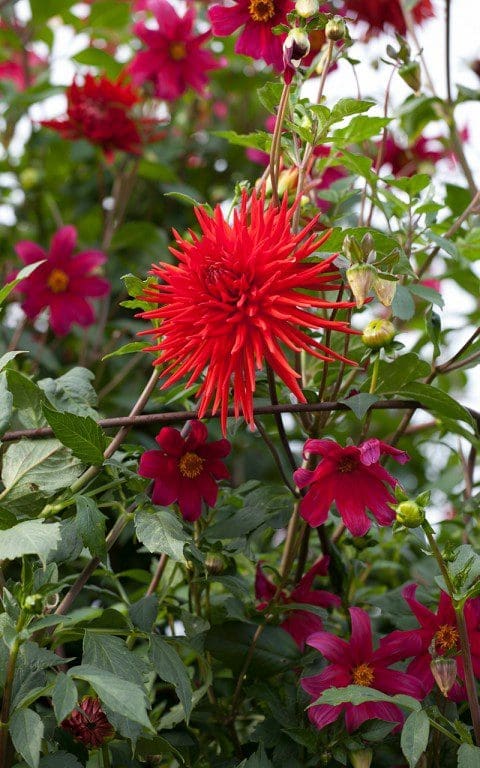 Dahlia ‘Talfourd Red’ and Dahlia coccinea ‘Dixter’
I do like a new plant, and getting to know Tithonia rotundifolia for the first time this year is enabling me to see how it might be used to inject some late summer heat into a planting. We already have a handful of favourites here that are tried and trusted and loved for their intensity of colour, which builds as the growing season wanes. In the case of the Tropaeolum majus ‘Mahogany’, they are almost at their best sprawling and vibrant in the damp cooling days and allowed to climb into their neighbours. The seed originally came from the garden of Mien Ruys at least twenty years ago. I had gone with two friends on an inspirational trip to see what was happening in naturalistic gardens in Holland and Germany and we stopped to meet her in her wonderful garden. The seed was scattered on the pavement over which it was sprawling and a few found their way, with her consent, into my pocket.
This ‘Mahogany’ is not what you will get if you look for it in the seed catalogues. Indeed, it now seems to be unavailable apart from in the United States and ‘Mahogany Gleam’ is a different thing altogether. The leaves are a brighter more luminous green than usual and the flowers a jewel-like ruby red. I have been territorial ever since I started to grow it and winkle out any that come up with a darker leaf or paler flower. It self-seeds willingly every spring, letting you know when the soil is warm enough to sow and where the warmest parts of the vegetable garden are. The seedlings exhibit the same bright foliage so it is easy to weed out the occasional rogue, which might have reverted to the darker more typical green. We currently grow ‘Mahogany’ in the kitchen garden amongst the asparagus and use the leaves and flowers to garnish salad.
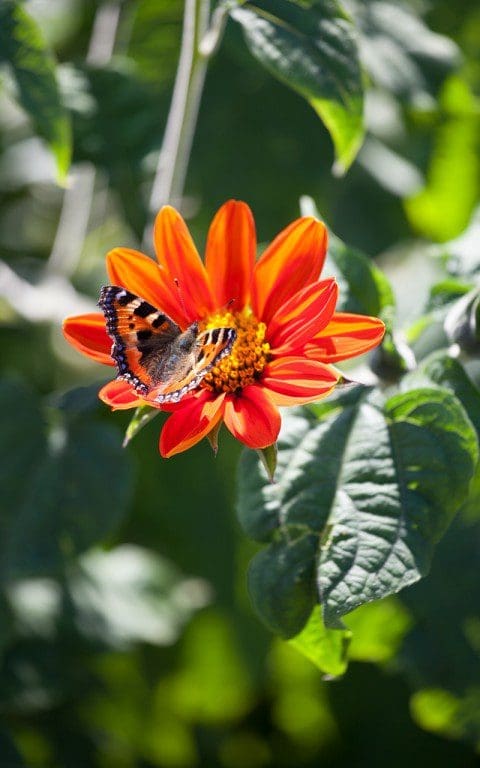 Tithonia rotundifolia ‘Torch’
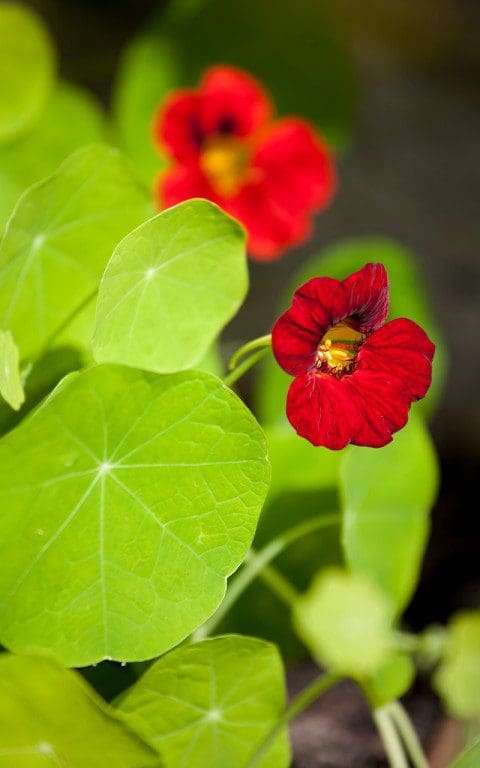 Tropaeolum majus ‘Mahogany’
Close by, and growing this year in two old stoneware water filters, is Tagetes patula. This wild form will grow up to three or four feet with a little support or something to lean on and flowers from June until it is frosted. The colour is absolutely pure and as vibrant and saturated a saffron yellow as you can find. It is easily germinated from seed under cover in spring and fast, so best to wait until mid-April to sow. I harvest my own seed and keep it apart from the dark, velvety Tagetes ‘Cinnabar’ (main image), which it will taint. Seedlings that have crossed will no longer have the deep richness that makes this latter plant so remarkable. I was disappointed to find this spring that the mice had eaten all the seed I’d left out in the tool shed and was expecting to have the first of many years without it. However, as luck would have it and quite out of the blue, they somehow found their way some distance into the new herb garden. Maybe it was mice doing me a favour with the plants I left standing in the kitchen garden last winter. Another lesson learned.
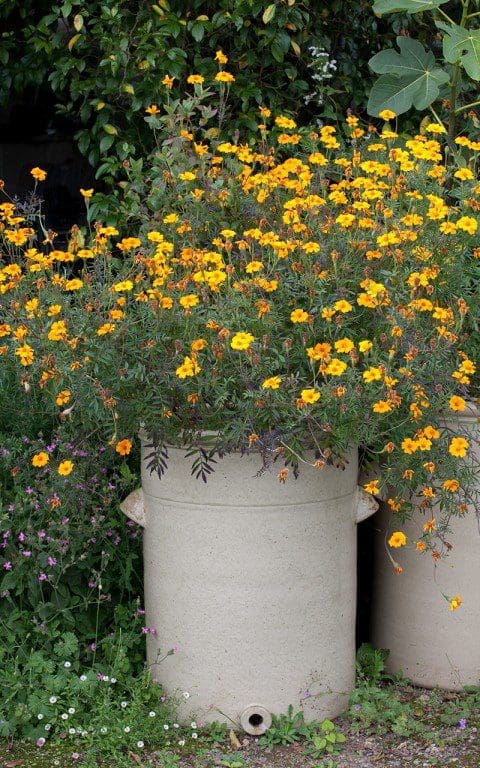
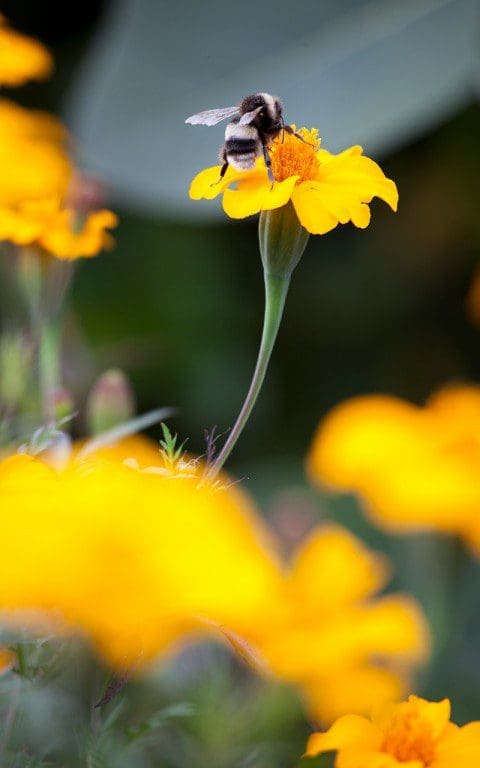 Tagetes patula
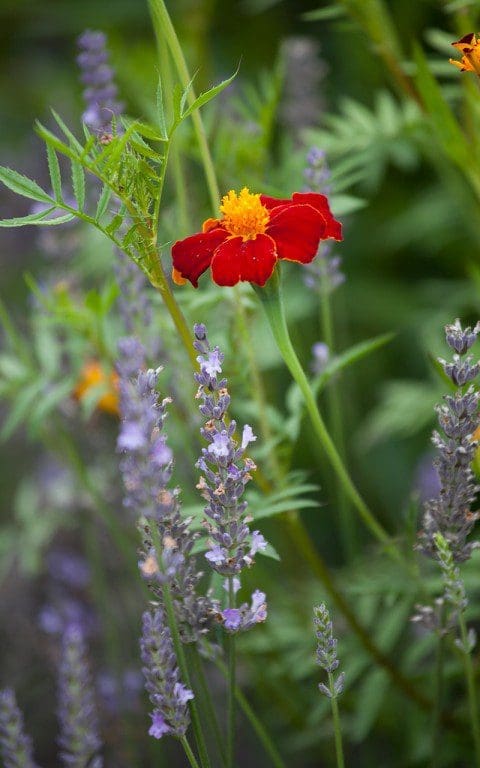 Tagetes ‘Cinnabar’
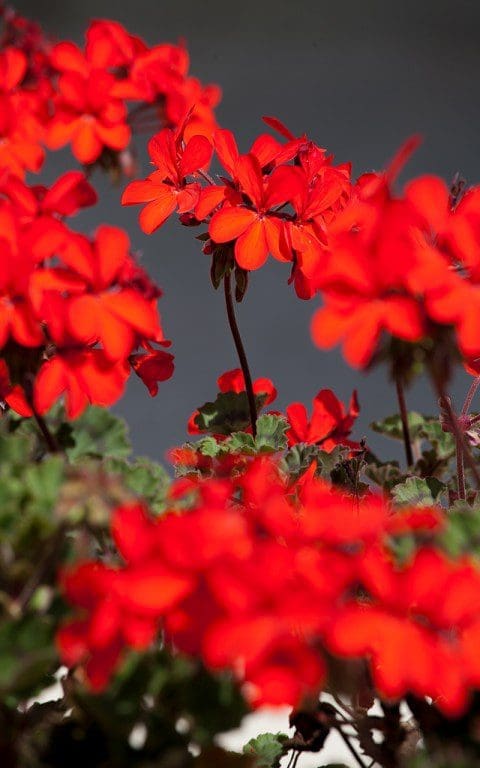 Pelargonium ‘Stadt Bern’
My father was never afraid of colour and always commented on the brilliance of Pelargonium ‘Stadt Bern’, which is the best, most brilliant red I have ever come across. Purer for the flowers being properly single, with elegant tear-shaped petals and thrown into relief against darkly zoned foliage. I bought a tray of plants from Covent Garden Market twenty five years ago for my Bonnington Square roof garden and have managed to keep them going ever since. Given how archetypal it is for a pot geranium I have no idea why it is not more freely available, but there are always a handful of cuttings in the frame which are for giving away to friends, who are given these precious things on the understanding they are part of keeping a good thing going, and that they are my insurance for any unexpected losses.
Words: Dan Pearson / Photographs: Huw Morgan
Published 23 September 2017
It is good to have the Inula back and finally given the domain they deserve. I have a vague memory about the provenance of my original plant, but am pretty sure it came from a trip that I made to see Piet Oudolf when he and his wife Anja were still running their nursery in Hummelo. My 1999 copy of Piet’s book Méér Droomplanten, which he signed for me at the time, has the words ‘THE BEST !’ written beneath the entry. By then we had already planted the greater majority of the garden at Home Farm, however, it was love at first sight, and so the inula were brought back without a specific home to go to.
Inula magnifica is native to the eastern Caucasus and I. m. ‘Sonnenstrahl’ (main image) is a selection originally made by Ernst Pagels (1913-2007), the influential German nurseryman responsible for the introduction of a huge number of garden cultivars, many of which have become synonymous with the new perennial movement, most notably those of Miscanthus sinensis and Salvia nemerosa. The Oudolf nursery was only about 100 miles away from Pagels’ nursery and the two became friends in the last twenty years or so of Pagels’ life, which must be how Piet came to know this cultivar.
Pagels chose this inula due to its vigour and the fact that it has particularly long rays to the flowers. Long enough to flutter in the wind and increase the already imposing feeling of the plant, where its wide branching flowerheads reach for the sky. This movement in the petals also adds a lightness and delicacy to a plant that is something of a giant. When you see ‘Sonnenstrahl’ alongside the straight species – more on that later – it has star quality. It is a plant that you want to make room for.
So, at Home Farm my original plants were given a space in the vegetable garden on the other side of the Barn Garden wall, whilst I wondered where they could go. Looking back at pictures of the Barn Garden now they peer a good head and shoulders above the wall, for they easily make two metres or more in stature and can take a couple of square metres at ground level with their relaxed splays of giant foliage. The growth is hoary to the touch and the paddle shaped leaves rasp as they brush upon themselves when you get close.
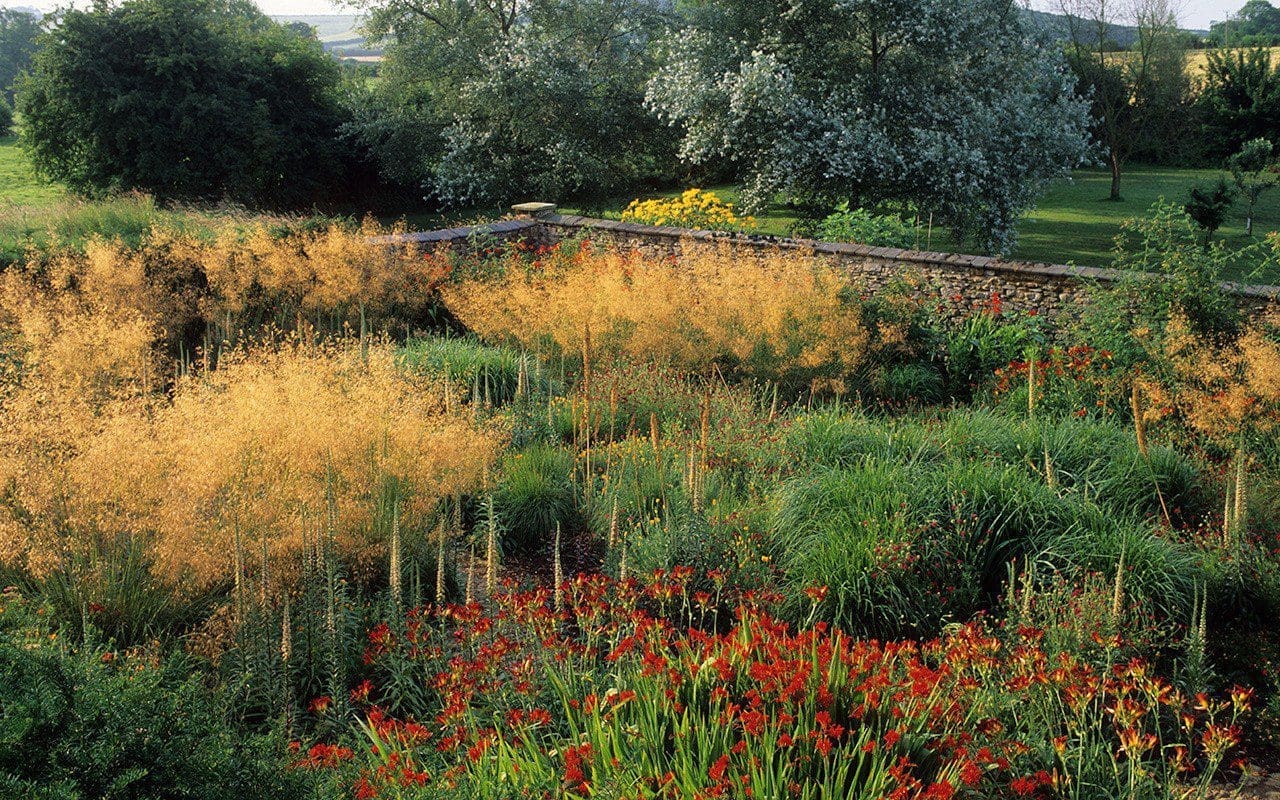 The Barn Garden at Home Farm in 1999. The Inula can be seen poking above the wall in the centre of the image.
Photo: Nicola Browne.
When Home Farm was sold in 2000, the plants were still in their position, waiting for a place to call home. I took a handful of favourite things from the garden of which they were one and, without the room to keep them myself, I gave the crown I dug up to Chris and Toby Marchant at Orchard Dene Nurseries, who kindly offered to foster it and give it a home in their stock beds. Although I am rarely fearful of big plants in small spaces, a single specimen would have taken far too much ground in the Peckham garden. I made do with visiting the wonderful grove of plants at Great Dixter that Fergus has set free in the grass in the lower reaches of the garden near the nursery and pined a little each time, until we moved here and once again had the opportunity of space.
About five years ago I made a return visit to Piet’s with my friend Midori from the Millennium Forest in Hokkaido and collected the seed of the plants he still had growing in the garden. The nursery had gone by then, but I was delighted with the seed until, three years later, they flowered in my stockbeds. It was hard to tell at first, because I only had memory as comparison, but the plants seemed inferior, not exactly a shadow of the parent selection, but certainly a poor cousin, with shorter rayed flowers and, consequently, less star quality. Nevertheless, when we were landscaping the new garden last summer, I dug up the seedlings with the help of a small excavator. It was summer so I cut the foliage and flowers back and split the vast crowns unceremoniously with a sharp spade into a dozen plants and potted them on for later.
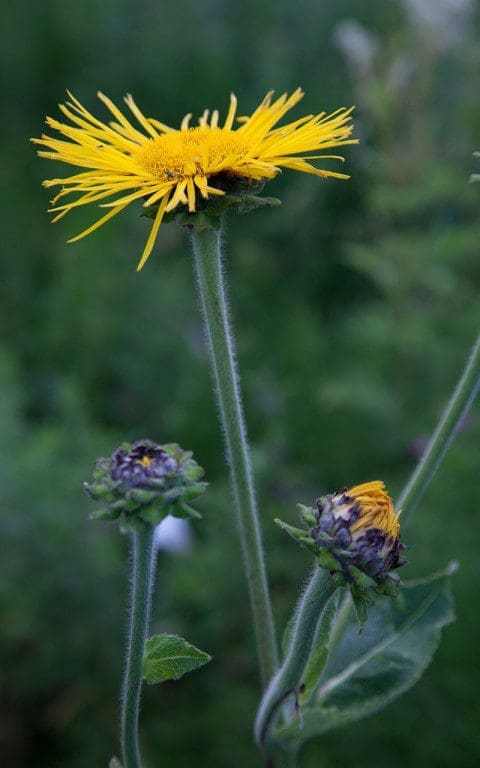 The shorter rayed flowers of the seed-raised inula
About the same time, we were invited to visit Shute House by Tania and Jamie Compton and afterwards, when we walked their own garden nearby, there was ‘Sonnenstrahl’ towering above us. The two of them have an eye for a good plant and, for sure, when I asked it was the superior beast. Jamie promised me a root cutting and, later, so did Toby Marchant from the original plant in their stock beds as a comparison. They both proved to be the same thing and so, eighteen years later, I have them once again, grouped around our cesspit so that their huge basal clumps of foliage will disguise this ungainly and ugly necessity. I have no fear that they will, nor any doubt that their presence will also make the cesspit something of a destination.
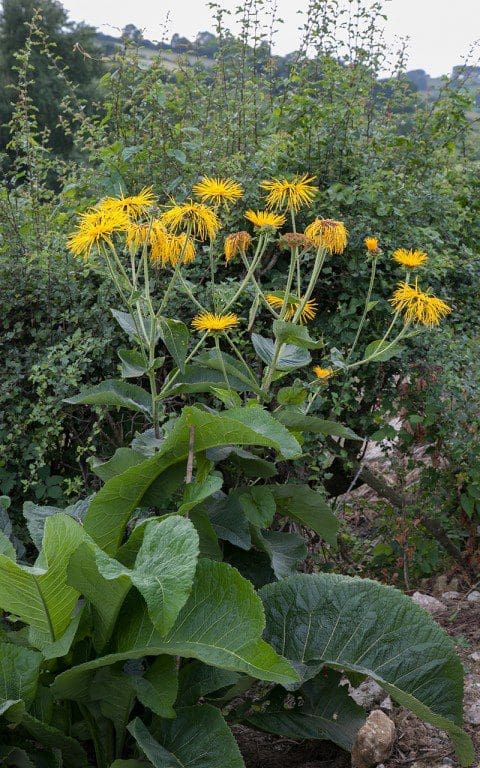 Inula magnifica ‘Sonnenstrahl’ by the cesspit
Close by, on the banks of the ditch, I have made space for my clutch of seedlings. The ground here is deep and moist from the spring water that feeds into the ditch. Although inula are known for their tolerance of damp conditions the splits, each filling a ten litre pot, were planted in the spring so that they wouldn’t sit wet. The growth around the base of the new plants has been kept clear by strimming to allow them the opportunity to get away and establish while they are still the newbies. Our grass in this country continues to grow in the winter and will overwhelm introductions that are not native and become winter dormant. Although their oversized foliage will compete once established, they need to get their strong taproots down and the reserve in the woody crown in the first year to be able to punch through and hold their own in the future.
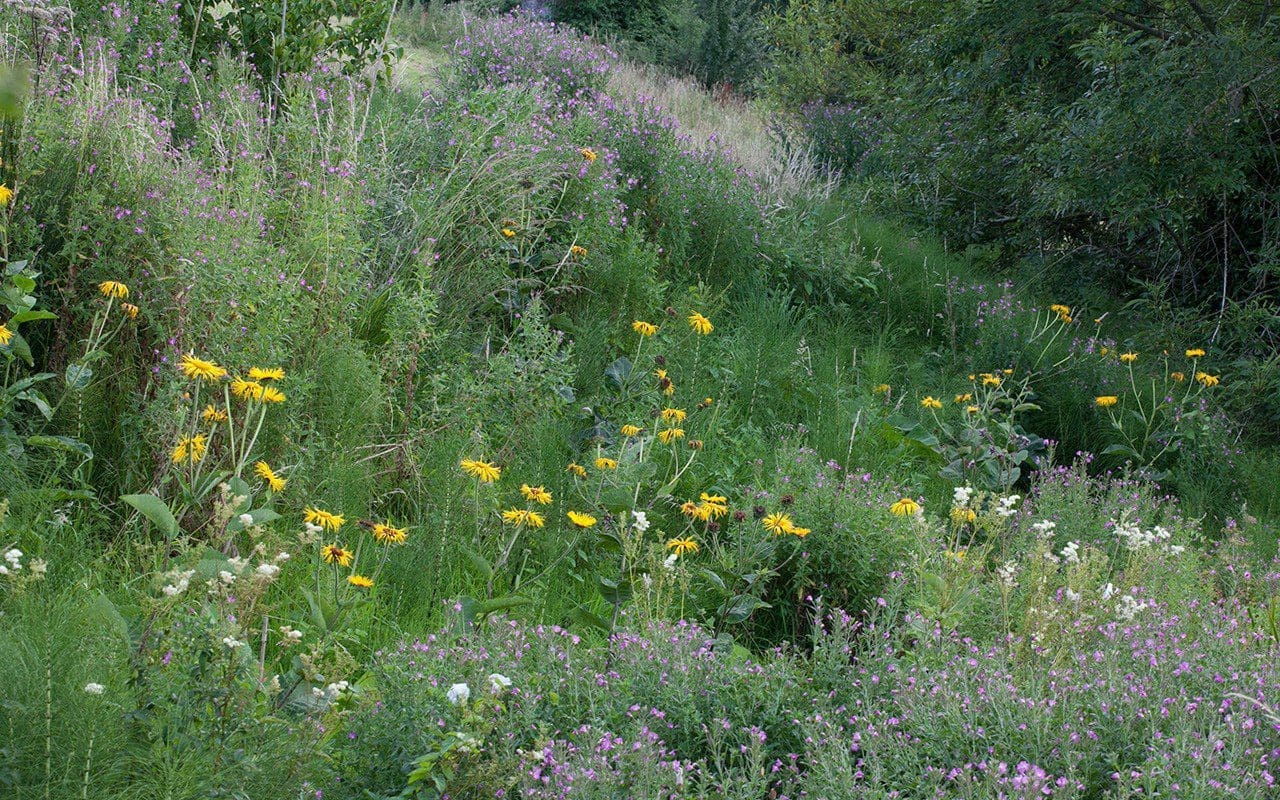 The seed-raised Inula magnifica on the banks of the ditch, growing with meadowsweet, great willowherb and horsetail
They have done well so far, the flowers rising up to carry the eye to the ditch banks beyond the garden and pump up the volume a little amongst the creamy meadowsweet and pink great willowherb. Sure enough the flowers are less dramatic and do not create the spectacle of the original plants nearby, but their lack of refinement feels more appropriate with the natives. Together with my gifted originals they help tell another chapter in the story.
Words: Dan Pearson / Photographs: Huw Morgan
Published 29 July 2017
The herb garden lies between the house and the water troughs which screen and divide off the kitchen garden beyond. Its formation was part of last summer’s push to get the ground around the house squared up after the building works and in use again as a garden. The flat ground here was something we had dearly needed and it has made an enormous difference in how we negotiate the areas immediately around the house because, although the slopes provide their drama, it is so much easier to get around and to look when you don’t have to concentrate on your feet.
This garden is all about looking and I wanted the planting to hold your eye before it naturally travelled on and up the valley. It was the last area to be planted this spring, in part because I had inadvertently introduced horsetail when bringing up topsoil from further down in the field. I did not want a single trace of the horsetail in the garden and was happy to take the time over winter to track its growth back to the tiny slivers of black wiry root that were going to set it off in a new position if it wasn’t dealt with. The ground had also become compacted with the tracking of the diggers and I needed it to be free draining so that the herbs would be happy and not lie wet in our West Country winters. This required waiting until March to dig the ground over and introduce some sharp sand and grit.
The extra care that went into preparing the soil meant that the garden was not planted until the middle of April. Lavender, verbena, salvias, a cut-leaved fig and a willow-leaved bay laurel were planted small, with plenty of space so that the air could circulate and for the plants to have the opportunity to bake against the gravel mulch. The space between the plants will close over in the next year or so, but in the meantime I have inter-sown the gaps with a smattering of annuals to give the new planting a lived-in feeling in this prominent position.
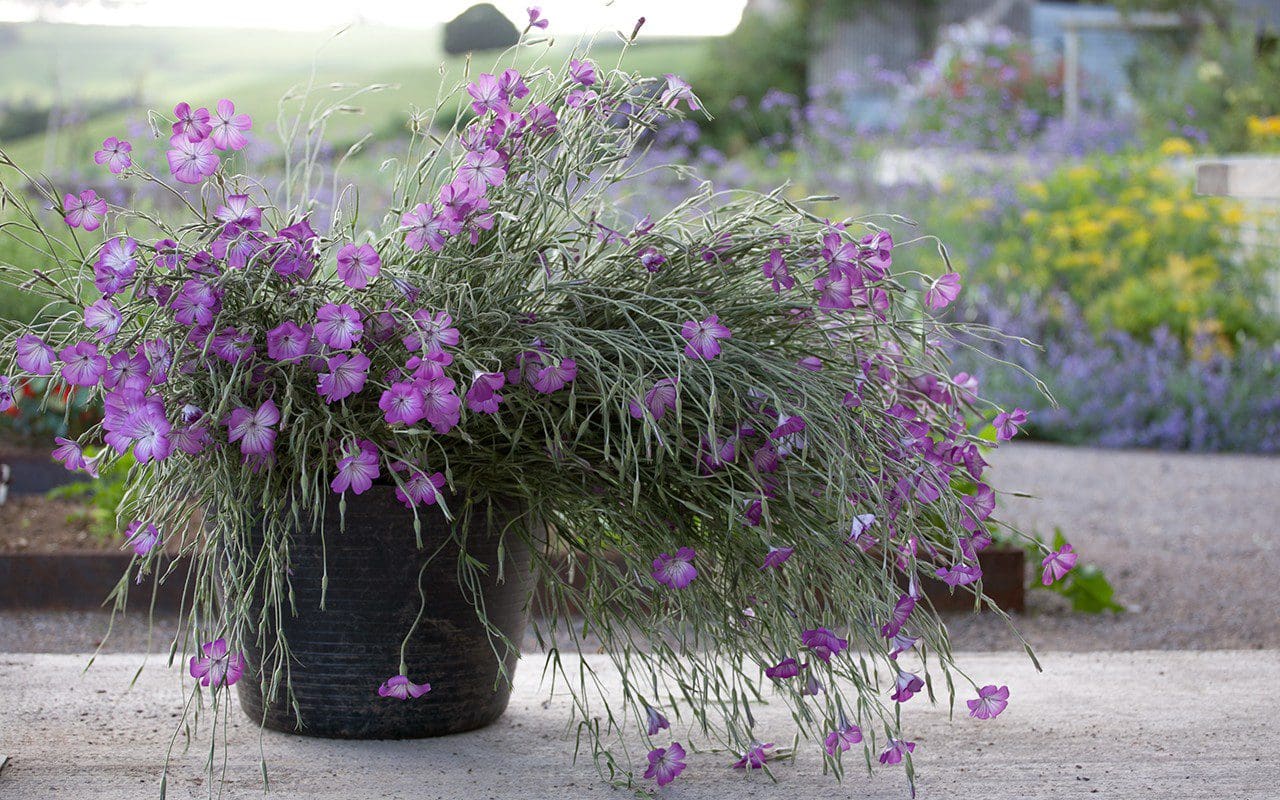
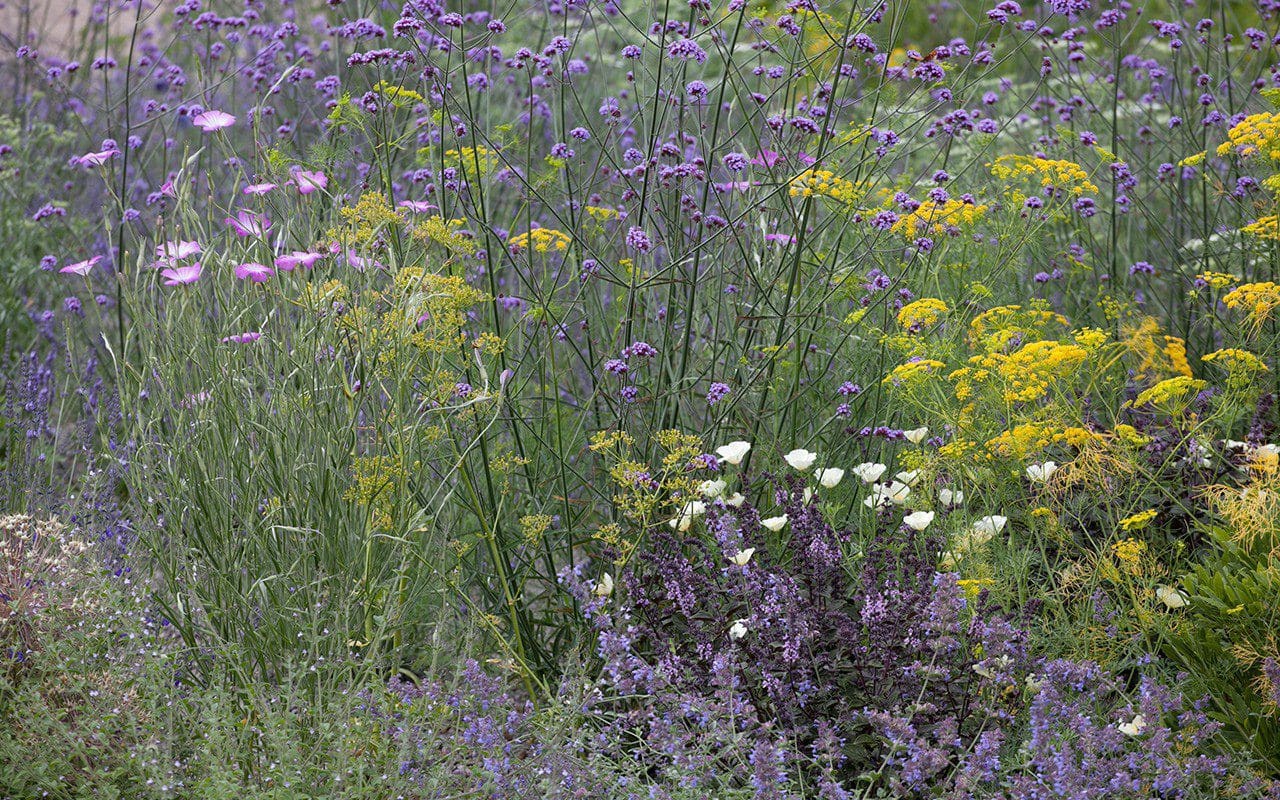 Part of the new herb garden planting with Agrostemma, Eschscholzia and Ridolfia
The opportunistic nature of annuals is something that I enjoy, particularly when they find their way by self-seeding and letting you know, sometimes a little too eagerly, that they like you. I am going to have to watch that here, because the majority of the herbs will hate to be overshadowed, their Mediterranean heritage not liking the damp that comes with close company or the lack of sunlight. So the annuals here may well be short-term and I will diminish the impact of their seeding by pulling them before they drop.
All of this year’s additions were sown direct from seed, a pinch to each planting station that was marked carefully with a cane so that the youngsters wouldn’t be trampled or mistakenly pulled when weeding. Seed is one of the most economical ways of introducing plants into the garden, but sowing is all in the timing. Sow too late with poppies, for instance, and unless we have a damp summer you will lose the energy of the spring and the bulking up they need to send flower soaring when the weather warms. But some are more adaptable and a succession of sowing can mean that, like salad, you have a relay as one generation goes over and is replaced by the next.
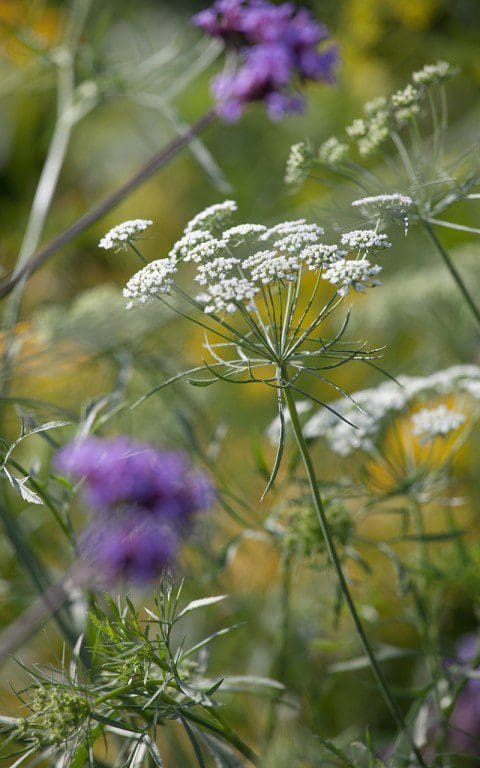 Ammi majus
The Ammi majus are a good example and two sowings – one in late March, the next a month later – will keep you in flower until the autumn. Otherwise known as Bishop’s weed, Ammi originates in the Nile Valley, but is adaptable to our climate and will repeat itself gently from year to year wherever the seedlings can find recently disturbed, bare ground. Though it is often used now as a cut flower, the sap can cause phytophotodermatitis, a chemical reaction which makes the skin hypersensitive to ultraviolet light causing burning, itching and, in severe cases, large blisters. So far I have not been susceptible but, having been burnt once after handling Giant Hemlock, I recognise the risk and work around it in long sleeves and on a dull day.
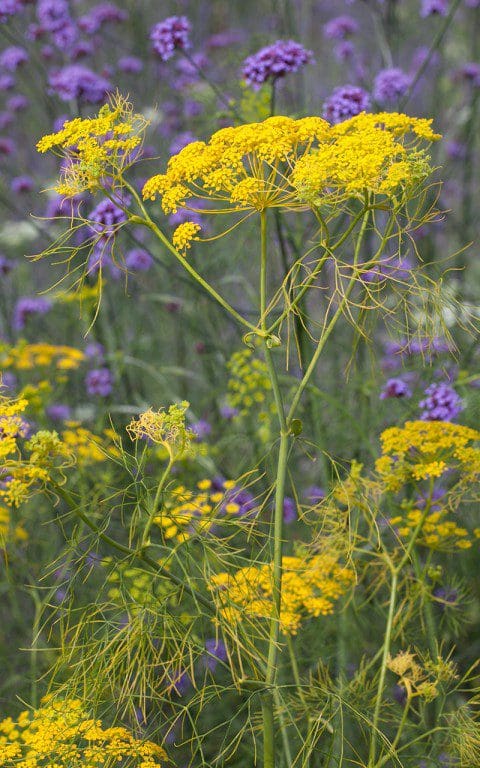 Ridolfia segetum
Risks aside, it is a beautiful thing, rising up tall on wiry stems, to a metre or 1.2m at full stretch. I like it for introducing light which is soft in tone into a planting, a sparkle that is repeated again, but rather differently, in the glowing, acid-yellow of Ridolfia segetum (main image) . This is the first year that we have grown the Corn Parsley. A Mediterranean annual that could easily be mistaken for dill, but its flowers are brighter and brightening still as the flowers mature. I like the zing and zest amongst the blues and the little bit of friction that prevents the Verbena from feeling too pretty. I want the planting to feel informal, but I want the colour to be sharp.
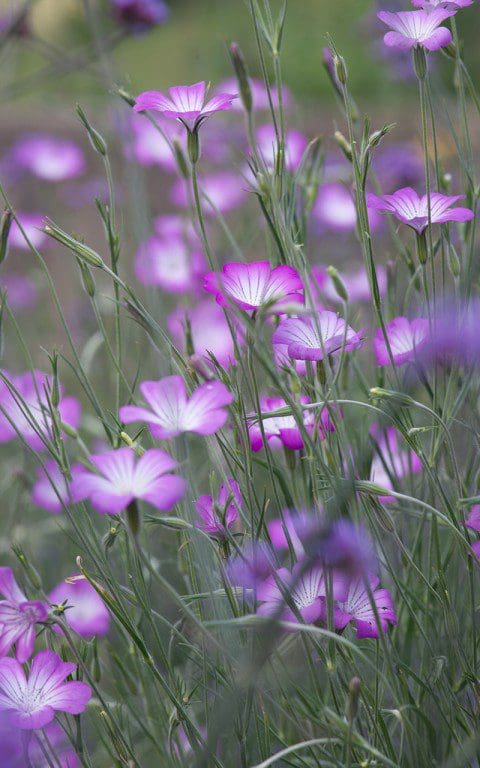 Agrostemma githago ‘Milas’
The Agrostemma githago ‘Milas Snow Queen’ are a case in point. We have enjoyed the willowy growth as it has raced up to flower, silvery-soft and catching the breeze to shimmer. I looked forward to the creaminess of the simple, upward-facing flowers, but the seed we were supplied must be ‘Milas’, its very pink and very showy cousin. Having grown them from seed I gave them the benefit of the doubt but, as the volume of flower has increased, the colour in the bed is altogether wrong and makes the couplings of lavenders, sages and delicate umbellifers saccharine and cottagey. They draw the eye from a palette which, although it has its contrasts, is harmonious in shades of blue, white and yellow. The white corncockle I had planned for would have added a shimmer and flutter without the confusion of another colour. Clarity has been regained easily enough as we have been cutting down whole plants and bringing them into the house for cut flowers. Today, however, the tipping point of pink was reached, and we took out the whole lot. Brutal perhaps, but it is important to be disciplined and stick to your vision, as a single element can all too easily change the mood and success of a planting entirely. Next year I shall try again undaunted with Agrostemma githago ‘Ocean Pearl’, which may also be better as it is smaller flowered.
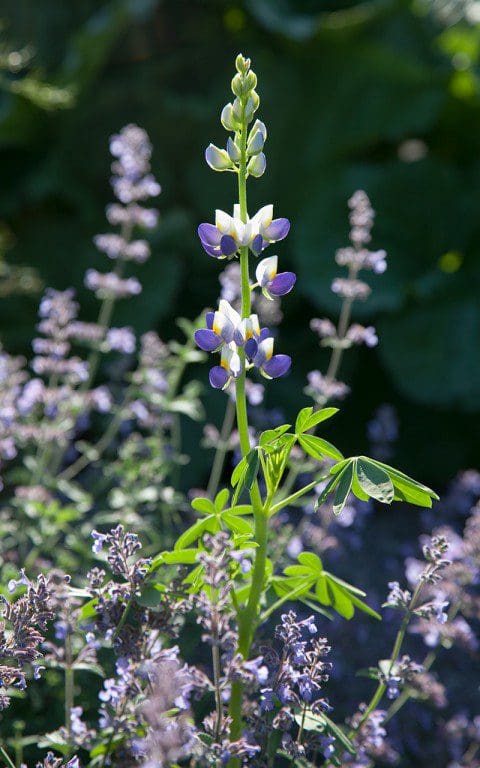 Lupinus ‘Blue Javelin’
The Lupinus ‘Blue Javelin’ have been beautiful in the planting and have been the making of the corner where they rise up through the catmint, Nepeta ‘Six Hills Giant’. However, next year I’d like to try the pure gentian blue of Lupinus pilosus. I first saw this remarkable plant as a spring ephemeral in Jerusalem and then, more latterly, amongst acid-green Smyrnium perfoliatum in Greece. The colour would be a better match to the indigo of Salvia x greggii ‘Blue Note’ and, combined with the Ridolfia, the electric contrast is something I want to keep up in the planting so that it has a charge.
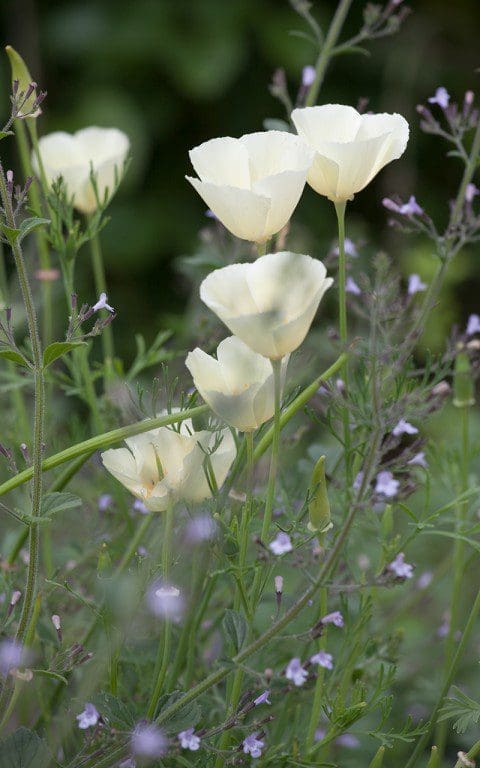 Eschscholzia californica ‘Ivory Castle’
The Eschscholzia californica ‘Ivory Castle’ were the last of the annuals to go into this planting, but one that I will certainly keep feathered at the margins in the future. This a good selection, creamy white and small-flowered and a pretty contrast when the sun prompts the flowers to unroll their scrolls revealing a buttery yellow centre. The scale of the flowers and their lightness is good with the tiny flowers of the Calamintha nepeta ‘Blue Cloud’, but you have to watch this apparently humble annual. Californian poppies take their position by stealth, slowly spreading over the season to smother their neighbours. Being a new planting, and grateful though I am for their immediate participation, I am watching out for their neighbours and keeping an eye on the balance between short and long term gains.
Words: Dan Pearson / Photographs: Huw Morgan
Published 15 July 2017
Everything is different after rain. The new plantings in the garden went without for almost a month. Sitting tight and not moving. I kept a close eye and watered just once to help them break into the new ground without becoming reliant. The ground opened up with cracks wide enough to put your fingers into and the fields dulled when, at this turning point from spring to summer, they are usually luminous.
Then a fortnight ago, and just in time, the heavens opened. Wetting deep and gently and flushing thirsty growth, which responded overnight with a new vivacity. Only rain has that effect, the growth transformed with a charge and vitality that can only be described as a post-coital glow. The metaphor ends there but, true to say, we are now surrounded with the surge of new vigour, which has touched everywhere and everything, save the wild garlic in the woods, which is receding now in its counter-movement.
Most dramatic was the response in the meadows, which kicked into growth. The camassias, twinkling above the grass, were soon left behind and the little yard beneath the banks in front of the house vanished from view. I seeded the newly graded slopes last September, casting down a St. Catherine’s mix from the valley next door, and adding to it with some sheaves of the wild barley that we collected in Greece a few years ago. I wanted to see if it would cope with the conditions and, to date, it is the first delight in the mix.
We first saw the barley (Hordeum bulbosum) growing by the side of the road on an early April trip to the Dodecanese. It was at exactly this point of growth then, rising up above the last of the spring flowers and shining in the first heat in the sun. The feathered seedheads were swaying in the wind and I was enchanted by its languorous movement. I have always found plants that harness the wind to be captivating and immediately saw it on our breezy hillside.
Friends who live on the island harvested some seed and sent it in the post. It was sown immediately that autumn and bulked up rapidly over the winter to be ready for the spring and then complete its life cycle before the drought of summer. Here, my concern was that it would not be able to cope with as much water as we get in England, but it has shown me to be wrong, flowering heartily in its first summer and proving to be perennial these last four years. The species name refers to the bulbous swellings, the size of an onion set, at or just below ground level. These storage organs keep the parent plant going when seedlings fail in a drought year in the Mediterranean, where it is one of the most common perennial grass species.
The original plants are dwindling now in their fourth summer, but they have seeded freely. Although the seedlings are easy to pull and have not been problematic in an easy to tend strip of ground, I would not want to let them loose in a perennial planting unless their companions were tough enough to cope with their ability to seize a gap. In the narrow bed in front of the house I have it with Digitalis lutea, Thalictrum flavum ssp. glaucum and early-to-rise bronze fennel. Clump-forming cephalaria and crambe might be good company but, for now, I am trying them in more relaxed company.
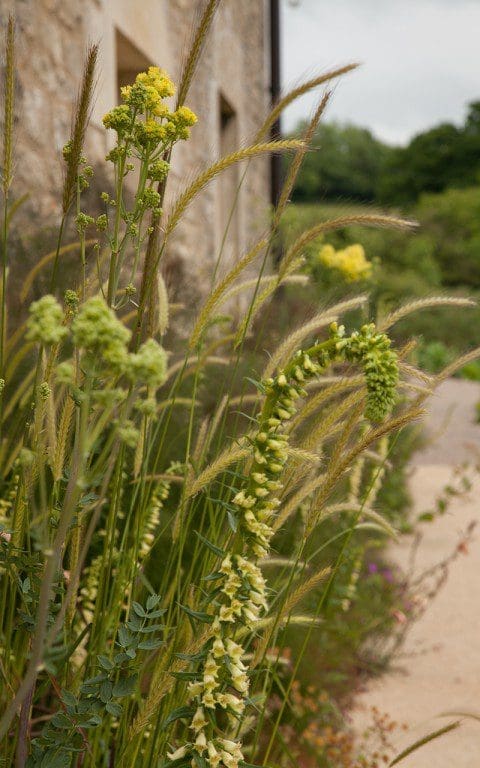 Hordeum bulbosum with Digitalis lutea and Thalictrum flavum ssp. glaucum at the front of the house
So it looks like their new home, in the containment of our hottest steepest, most freely draining bank, might be a good one. We will see if they can cope with our native grasses which, as they establish, may outcompete them when they are no longer the pioneers. I will let them run to seed again and see how they perform. If they dwindle, the seed is easily collected and may make a nice component to an autumn sown hardy annual mix of eschscholzia, white corncockle and orlaya. An experiment perhaps, if this one is just fugitive, but I’ll find a reason to make sure that this hypnotic beauty is always with us somewhere to celebrate the first weeks of summer.
Words: Dan Pearson / Photographs & Film: Huw Morgan
Published 3 June 2017
I have just cleared the remains of last year’s growth from the planting around the tin barns (main image). What has not stood the test of the winter westerlies is scattered now, the new rosettes pushing away amongst the tatters. The old stems pull with a satisfying snap and where they resist they are cut to the very base to avoid the sharpened stubs which can catch you out when weeding. Underneath, and vital with spring energy, are the beginnings of new life; a scatter and patterning of seedlings that have found their way and are already asserting their own direction.
What to weed and what to save will be the making of this area come summer. I have deliberately planted the gravel around the barns with a mix of reliably clump-forming perennials, and set amongst them a few wild cards in the form of the self-seeders. The perennials are the bones and will stay put to provide the structure whilst the short-lived perennials and biennials, such as the Verbascum phoeniceum ‘Violetta’, are the colonisers that make it their business to find their niche and so give the area a lived-in look that very quickly feels established.
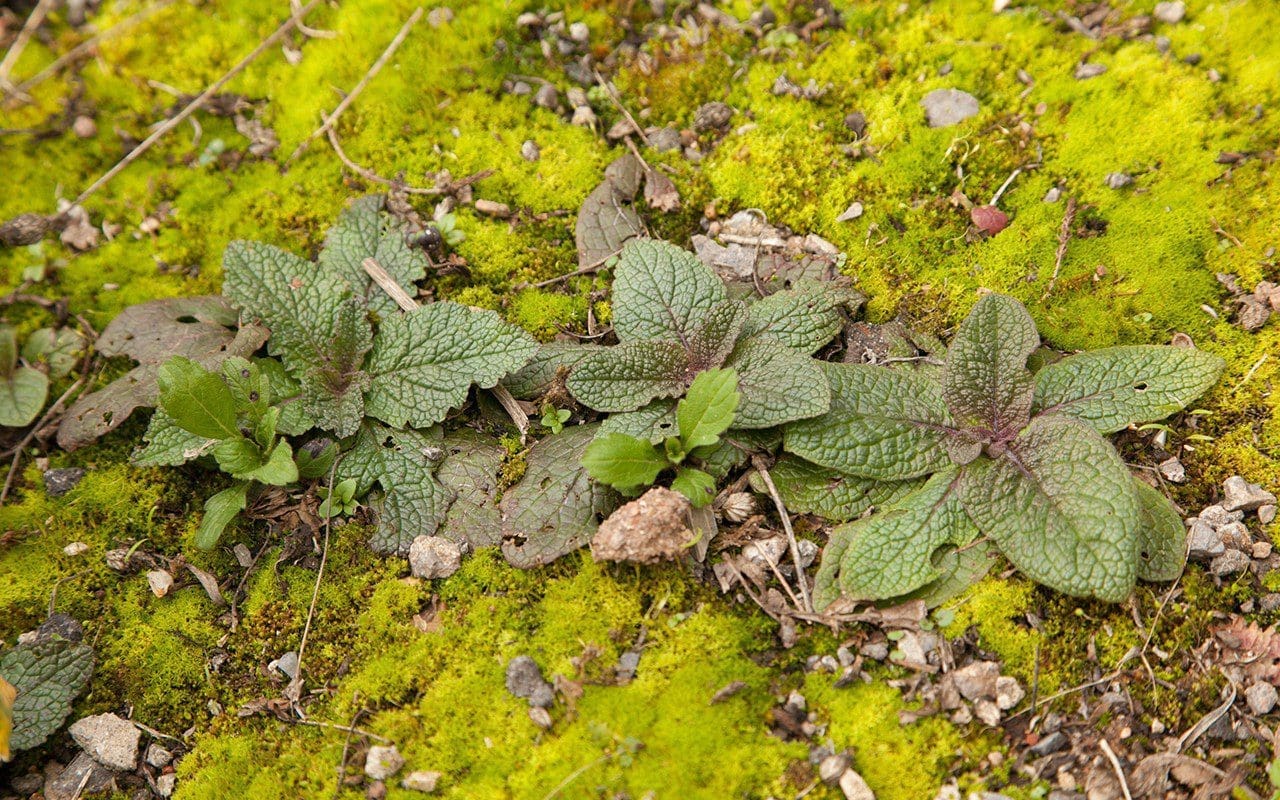 Seedlings of Verbascum phoeniceum ‘Violetta’
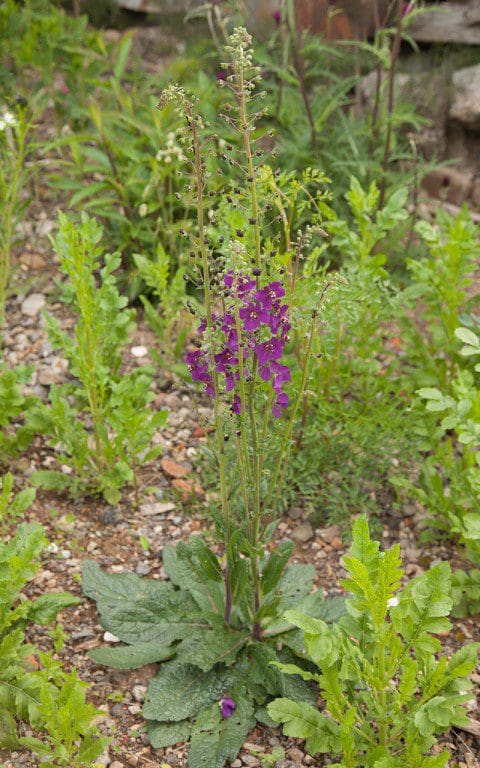 Verbascum phoeniceum ‘Violetta’
The seeders are part of an experiment, and with any experiment you have to accept both successes and failures. The Erigeron annuus is a beautiful thing in it’s finely-rayed profusion, but they have already proven themselves to be dangerous in this position and will be winkled out now to avoid trouble later. Two plants from the summer before last have already thrown down a multitude of seedlings in any open space that isn’t already taken. I am put in mind of a project I am working on in Shanghai, where they were billowing on the newly turned ground like flotsam and jetsam. They were the pioneers there, the equivalent of fireweed or milk thistle here, and they show no sign of altering their habits. If I were to leave them their apparently light frame would double, treble and bolt to ultimately overwhelm their neighbours.
This might not be the case in another part of the garden, for the crushed concrete that I have used to mulch the bare ground is proving itself to be the perfect seed bed. This is not an issue with those plants that are better behaved. For instance, I would like the crimson Dianthus cruentus to be more prolific in its habits, but it is clear that it likes to live on the edge of a colony of other plants with light and air around it’s basal rosette. Other seedlings have already left the parent behind as their reach has extended into the gravel. A rash of the blue-flowered annual Cephalaria transylvanica has rained beyond last year’s colony and is showing why you only find it listed as an Eastern European arable weed. The difference between a weed and garden plant is made in just half an hour thinning the seedlings so that they do not overpower their neighbours and create the space that will allow the flowers to dance.
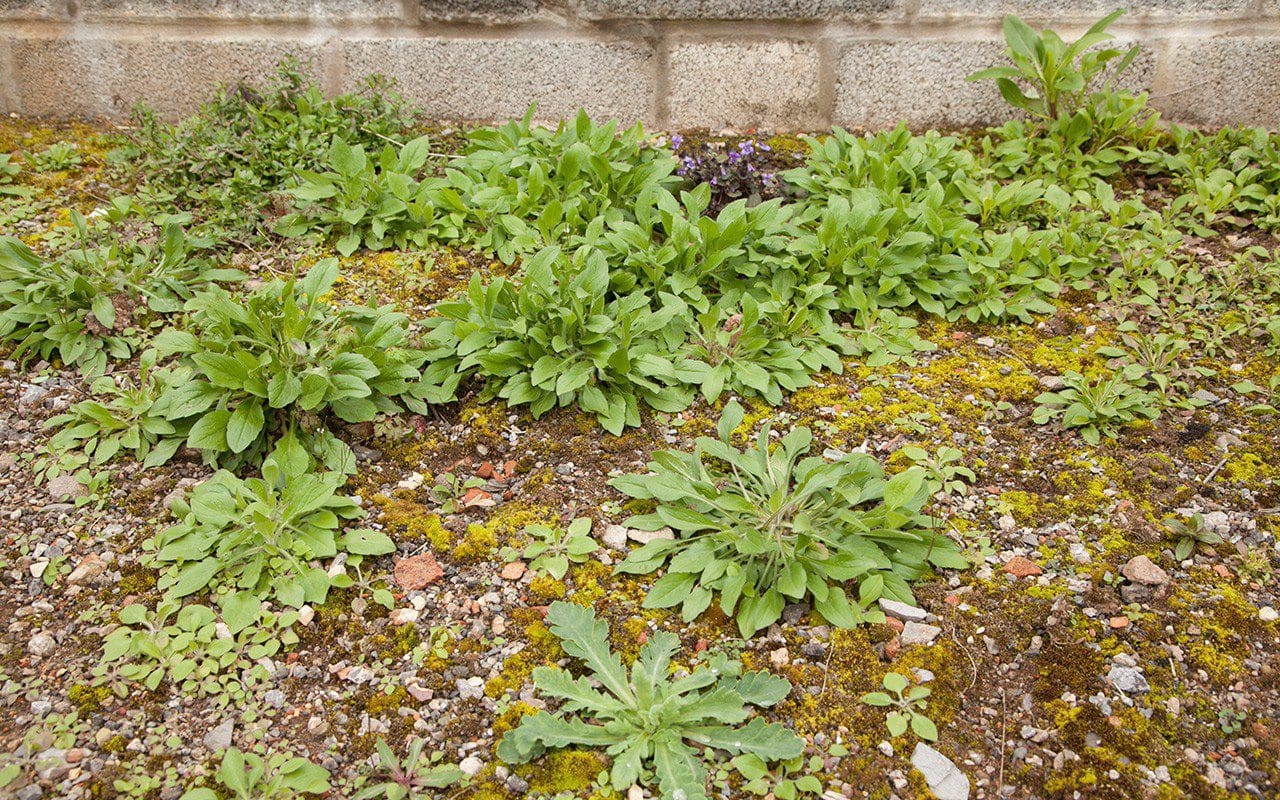 Seedlings of Erigeron annuus
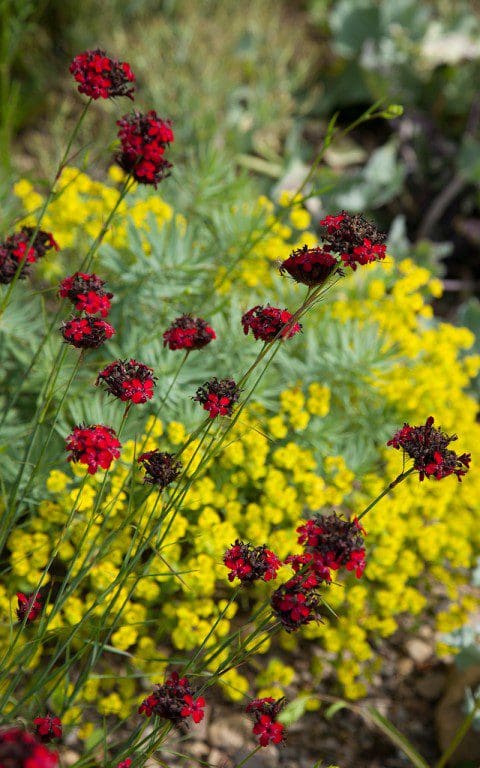 Dianthus cruentus
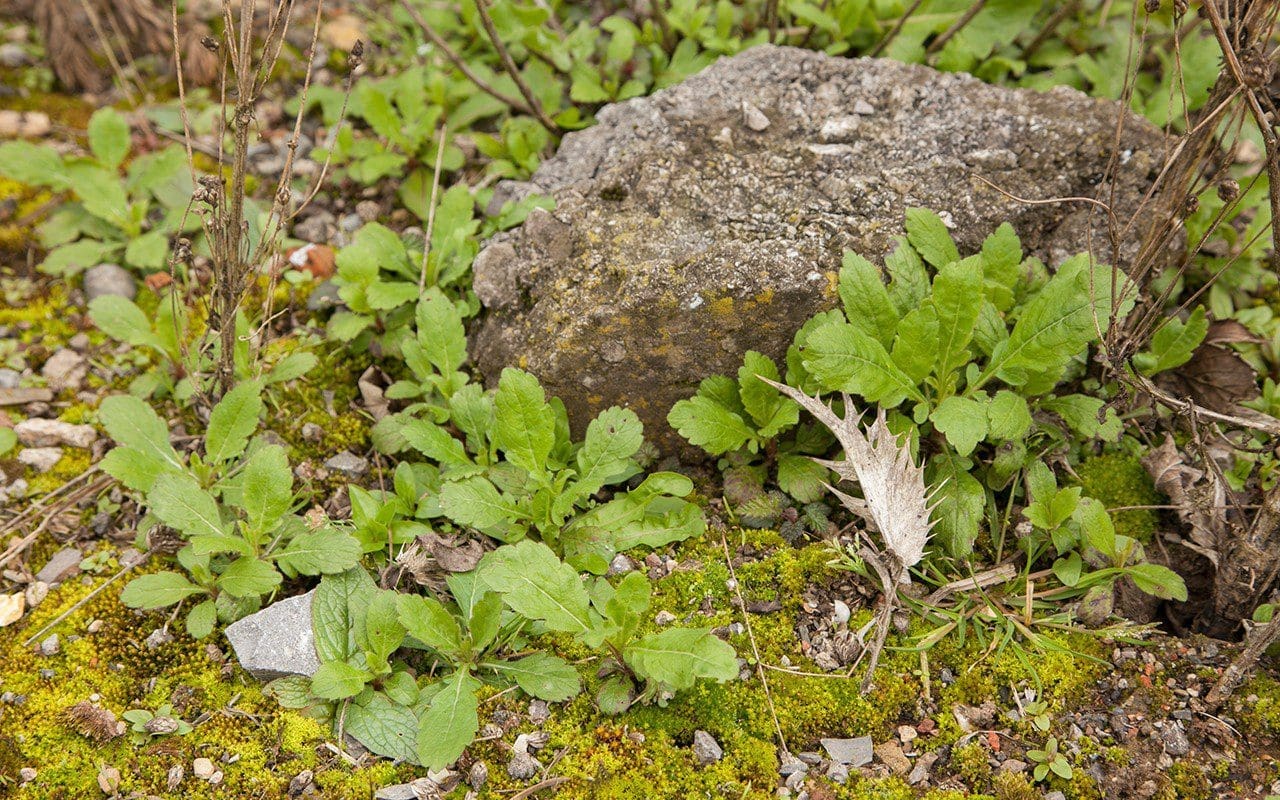 Seedlings of Cephalaria transylvanica
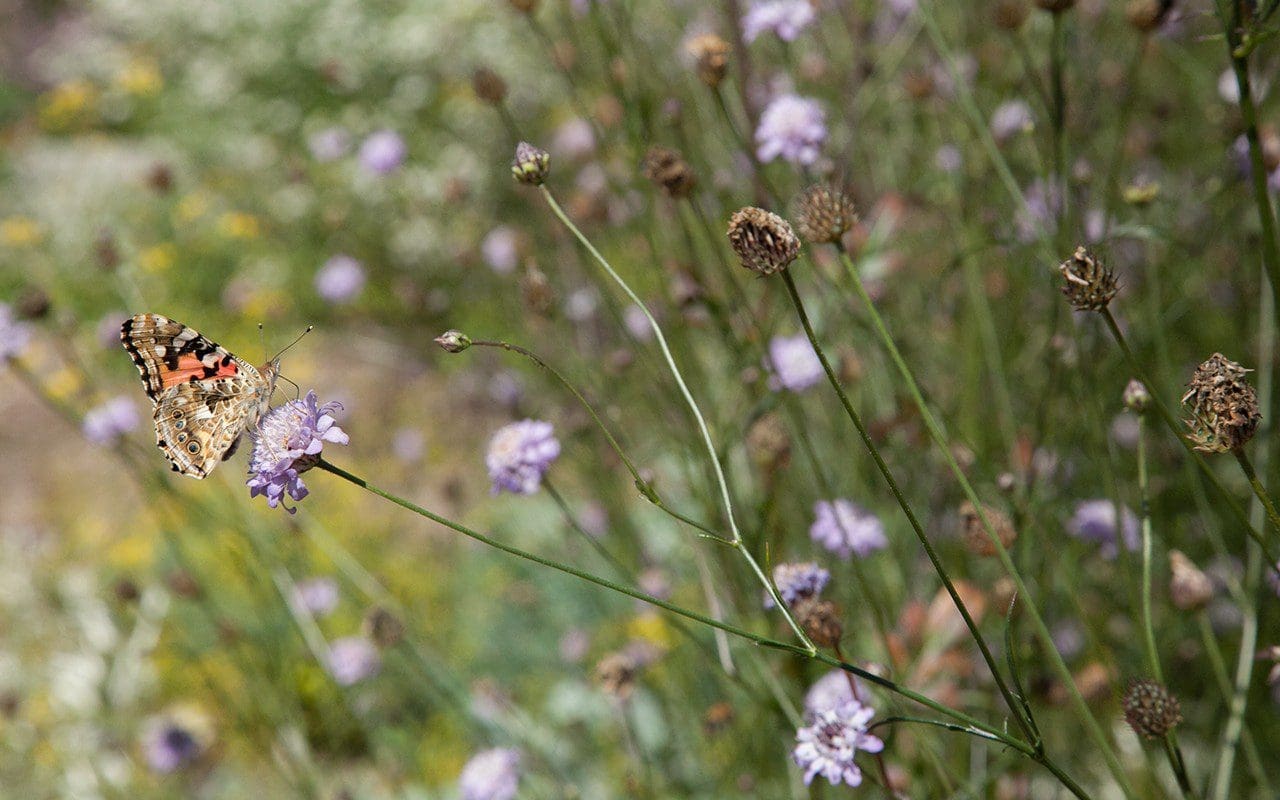 Cephalaria transylvanica
Orlaya grandiflora, the biennial Bupleurum falcatum and the progeny of last year’s Eryngium giganteum ‘Miss Willmott’s Ghost’ will be given the same treatment, measuring as I weed to leave just enough of each to give the desired effect. It takes time to recognise the tiny seedlings when they first emerge, but once you get your eye in they always have something of the character of the mature plant; the tiny bupleurum seedlings with their lime green cotyledons, almost the exact colour of the umbels, and the fleshy Lunaria annua ‘Corfu Blue’, the first true leaf exactly like that of the parent.
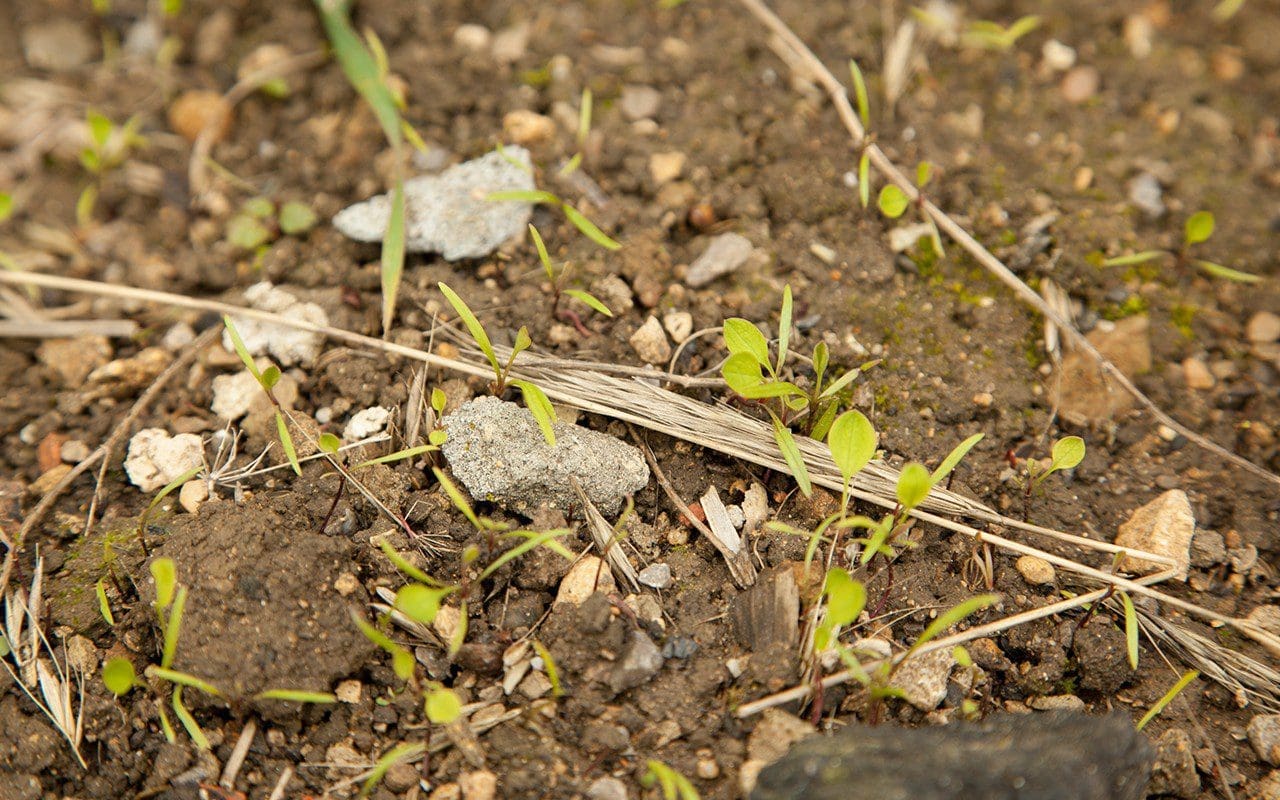 Seedlings of Bupleurum falcatum
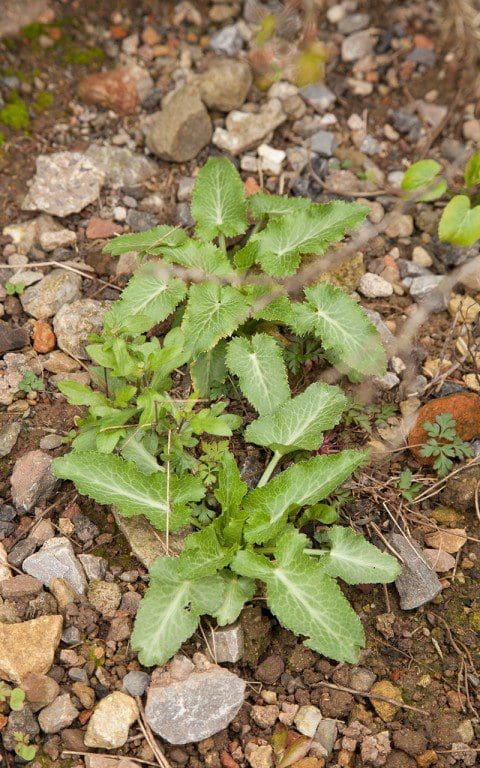 Seedlings of Eryngium giganteum ‘Miss Wilmott’s Ghost’
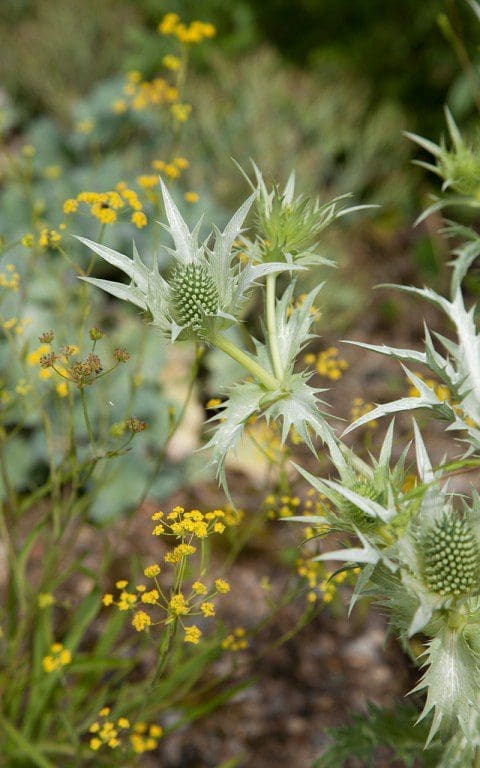 Eryngium giganteum ‘Miss Wilmott’s Ghost’ with Bupleurum falcatum
It has taken a few years to build the confidence to be so ruthless this early in the season. Too many years misjudging the reach of an apparently harmless rash of Eschscholzia californica seedlings, or a Shirley poppy that didn’t look like it was going to put a dent in the lavender and then did, have taught me my lessons. As you are weeding you have to imagine the scale and bulk of the mature plant and leave a bigger gap than you might like this early. A second pass in two or three weeks time allows room for manoeuvre, so that you can rectify any overcrowding. My third pass is when everything is perfect and just about to lift off in early June. It might leave an uncomfortable gap as you pull the fleshy growth from its hard-won foothold, but to keep the balance takes a little bravery.
Words: Dan Pearson / Photographs: Huw Morgan
Not long after moving here, Jane, our friend and neighbour, took us for a walk into the woods in a nearby valley to see the green hellebore. We pulled off the lane and set off on foot along a well-worn way up into the trees. The north-facing slope had an inherent chill that set it apart from our south-facing slopes and the tree trunks and every stationary object were marked with a sheath of emerald moss.
The track made its way up steeply into ancient coppice. Land too steep to farm and questionably accessible even for sheep. Fallen trunks from a previous age and splays of untended hazels marked the decades that the land had been left to go wild. At least wild in the way that nowhere is truly wild on our little island of managed land. I knew the woods, for we had been here before in summer to look at the fields of orchids that colonise the open grassland above, where the hill flattens out into fenced paddocks. The woods are not extensive, but large enough to have their own environment in this steep fold in the land.
Somewhere near the top of the hill, with the light from the field above us just visible through the tangle of limbs, we set off sideways onto the slopes. The angle was steep enough not to have to bend too far to steady yourself with your hands, but consequently required a firm foothold when inching along the contour. Deep into the trees we came upon our goal. Nestled in under the roots of ancient coppiced hazel and up and out with the very first catkins, the Helleborus viridis.
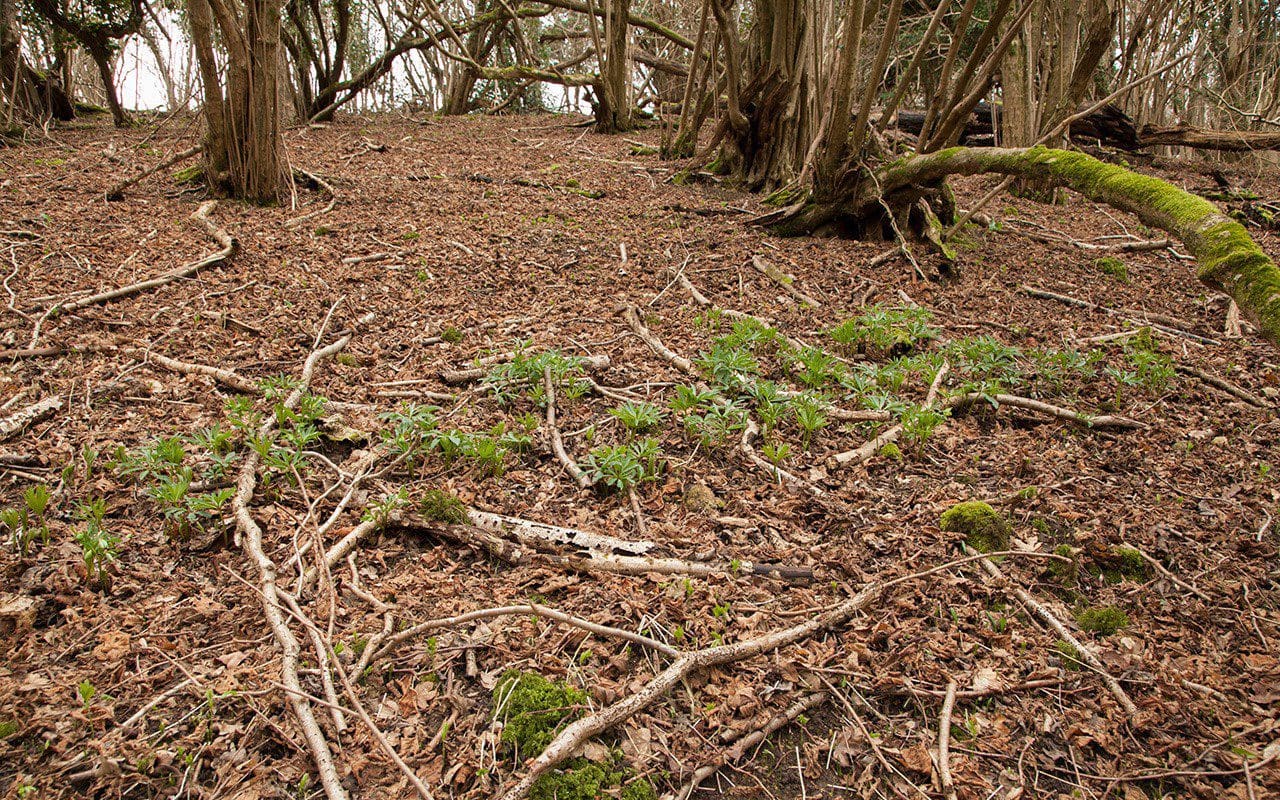
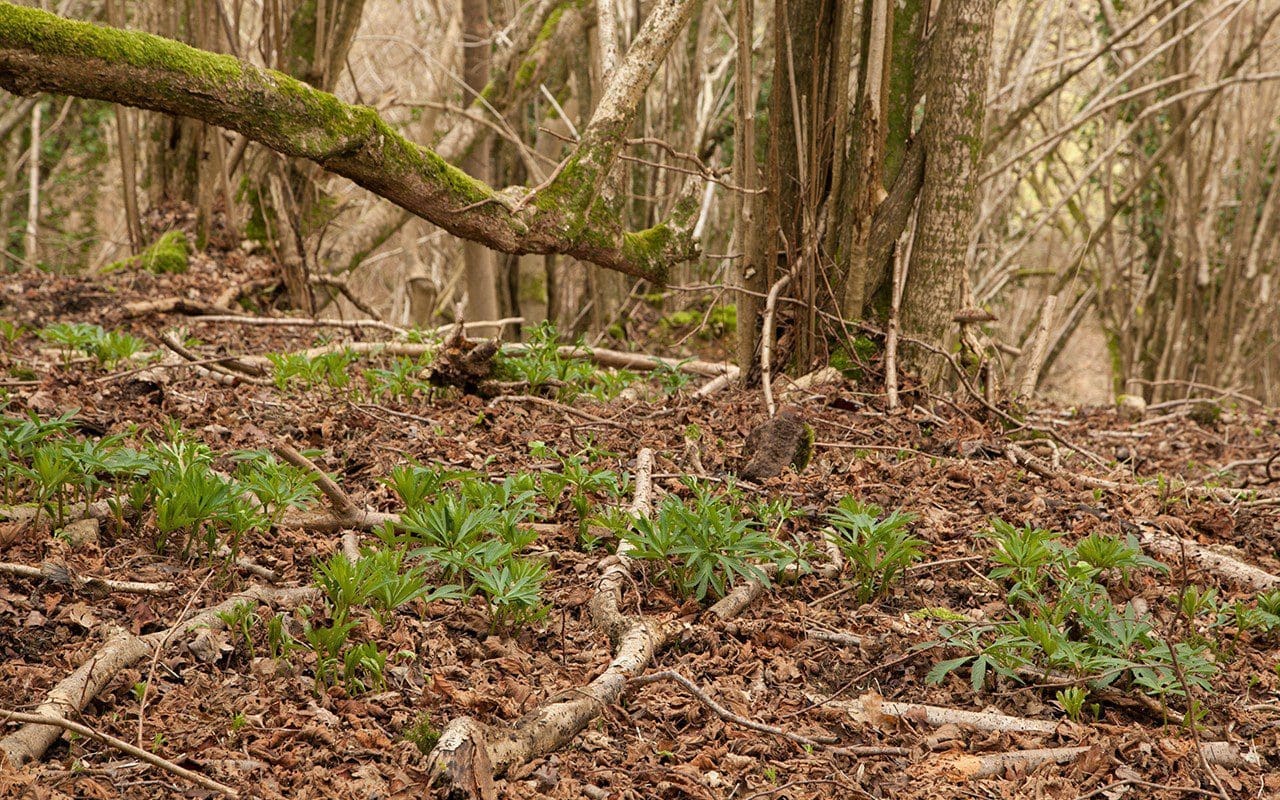 A wild colony of green hellebore in the local woods
To find a plant growing in the wild where it has found it’s niche is to truly understand its habits and requirements. Dry descriptions of habitats and associations in books instantly give way to a greater knowledge, for you never forget when you see a plant looking right in its place. In the cool of the north-facing slope and shaded not only by the deciduous canopy above, but also by the bole of the hazel and its influence, the hellebore was at home. With no competition to speak of, protected by damp leaf mould and with its roots firmly holding in the limestone of the hill, it was king of its place. New foliage, soft and emerald green, splayed fingers of early life. The nodding flowers, concealing the stamens, held free of the ground foliage on arching stems. Viridis, meaning green, is the colour of all its parts; a welcome one at the end of a long winter and a sure sign that the season is ebbing.
Several weeks later I returned in search of seed. The woods were flushed with first leaf which darkened the slopes. Nettles, already fringing the woodland edge where the light penetrated alongside the path, were ready to sting. But deep where the hellebores were growing, they were still in glorious isolation with little more than a few celandine and wood anemone for company. The flowers were transformed, the lanterns replaced by a rosette of bladders which were just turning from green to brown. I cupped my hand underneath and tapped. A slick trickle of ebony seed settled into the crease of my palm.
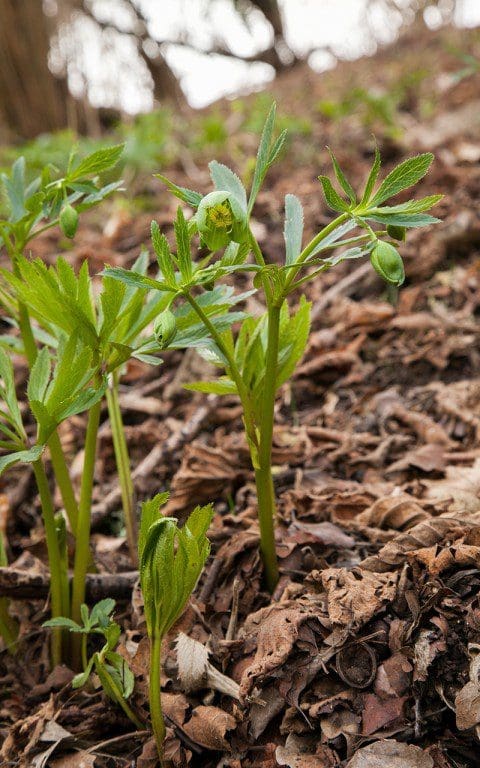 Green hellebore – Helleborus viridis ssp. occidentalis
The seed of plants in the family Ranunculaceae is famously short-lived so I sowed it on the same day it was harvested, covered with grit and put in a shady place out of harm’s way. Three seasons later, the following March, it germinated with some success. I kept it in the shade on the north side of the house to throw its first leaves without disturbance. A year later I had seedlings that were ready to pot up and a year after that, to plant out. Jane took a number of the seedlings to start a colony on the north-facing wooded slopes that run up from our shared boundary, the stream. I planted the banks on our side, where the tree canopy provides the shelter, summer shade and leaf litter they need to do well. This year they are flowering for the first time in earnest and, with luck, will set seed and start spreading.
Though they were once used for their purgative qualities (as a folk remedy for worms and the topical treatment of warts), Gilbert White pointed to the fact that it is toxic in all its parts. ‘Where it killed not the patient, it would certainly kill the worms; but the worst of it is, it will sometimes kill both.’ With this in mind, I have kept it away from the sheep and have noted that, even down by the stream where the deer have their run, it remains completely untouched despite its lush, early growth.
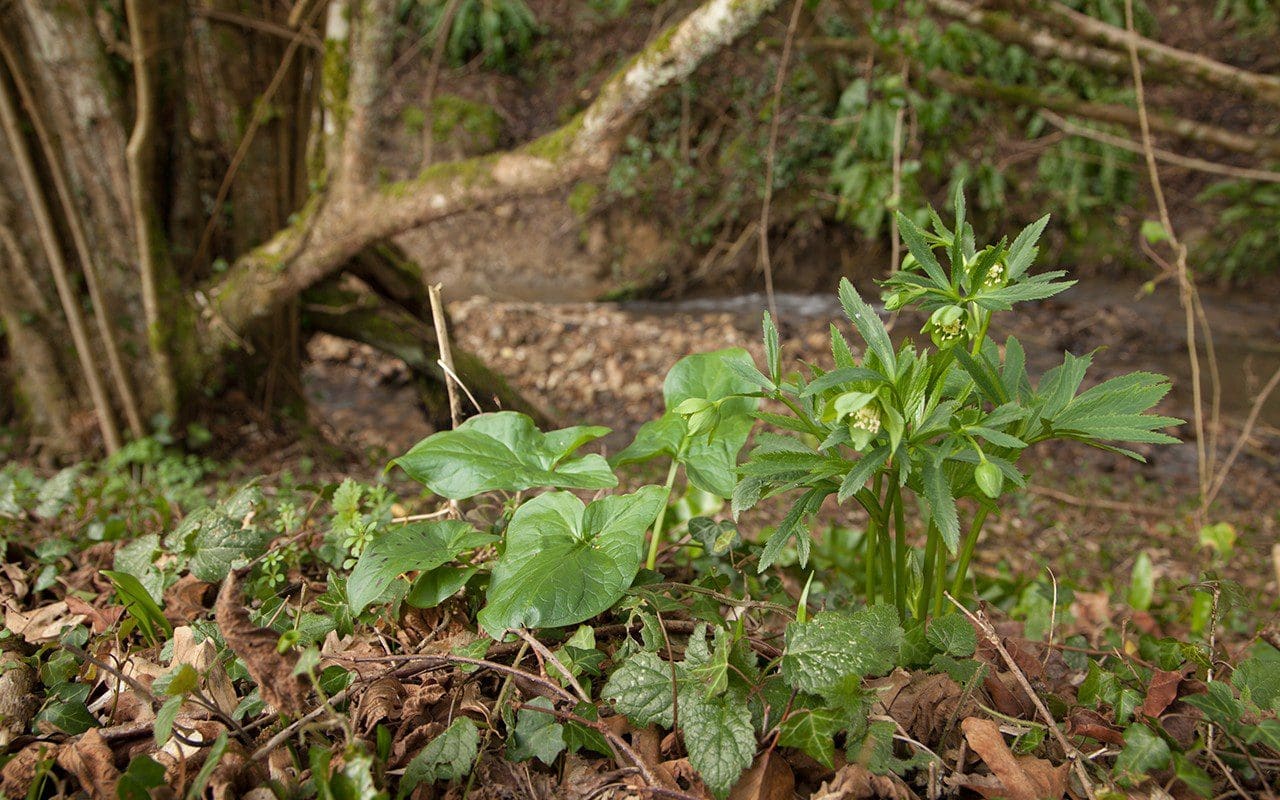 One of the young seed grown green hellebores down by the stream
Though rare in limestone woods in southern England, it is more common in parts of mainland Europe*. Cedric Morris found them in the Picos de Europa growing with a dark form of Erythronium dens-canis; a companion planting it would be hard to emulate here, because of the rush of growth that happens after snowmelt when everything comes at the same time. Its demure nature does not make it a match for the Lenten roses I have here in the garden, which feel rather opulent in comparison. However, I like it very much for its earliness, for its modest break with winter and particularly for the fact that it is native. Where my plants are establishing themselves amongst the newly emerging Arum italicum and an occasional primrose I find great excitement in the thought that spring is now unstoppable.
Words: Dan Pearson / Photographs: Huw Morgan
I first encountered wintersweet on a memorable day in the long overgrown wilderness of my childhood garden. Miss Joy, the maker of that acre which had finally overwhelmed her, had clearly been quite a plantswoman and we unearthed many hidden treasures as we cleared forty years of neglect. We had found a colony of trillium surviving in the leaf mould beneath a fallen amelanchier and scarlet peonies pushing through a glade of dim nettle. On this still winter’s day we discovered the wintersweet. We were slowly freeing the orchard of bramble to make a clearing. The source of a spicy and pervasive perfume eluded us while we worked but, as we cleared deeper into the thicket, we became aware of its origin. Scent triggers the strongest memories and I remember quite clearly the cut and the pull and getting closer to the prize as we tore at the thicket that surrounded and mounted the limbs of the mysterious shrub. Being the most nimble, and with the light of the day failing, the last few feet required a contortion to reach an accessible limb and pull a twig of flowers, which were hardly visible in the half-light, pallid and speckled on the gaunt branches. I know the smell in an instant now, but then its strength on the cool air was intoxicating for the discovery of something new. Later, in the heat of the kitchen, the perfume from this single twig filled the entire room. Geraldine, our neighbour and my gardening friend from across the lane, shared in the excitement and identified it as Chimonanthus praecox. We studied the waxiness of the translucent blooms. Starry, but cupped like an open hand with fingers facing forward, a second layer revealed an inner boss of petals stained plum-red.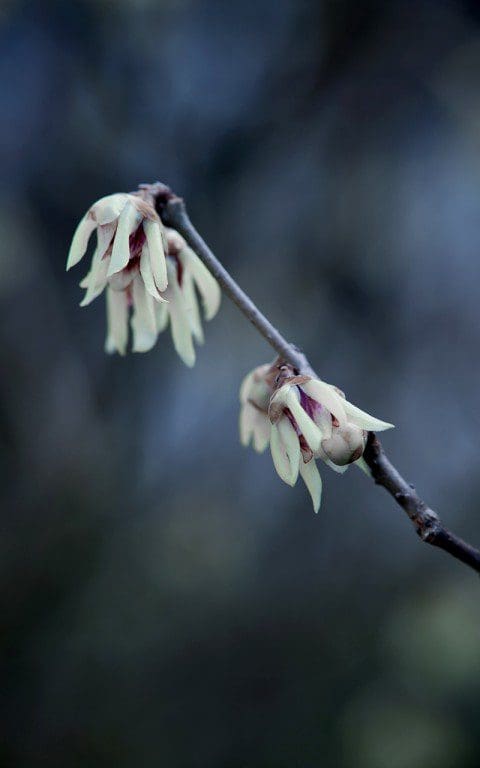 Chimonanthus praecox
Until recently I have not had the place to plant one for myself, so I have gone out of my way to find wintersweet a home in clients’ gardens in the knowledge that they too will reap the rewards in January and February. This vicarious pleasure has been lived out fully at a project I am working on in Shanghai where I have designed a series of gardens that seat a number of restored Ming and Qing dynasty merchant’s houses within a forest of ancient camphor trees.
In the process of understanding how to interpret the planting, my research into Chinese gardens revealed that wintersweet was one of the natives used repeatedly in the pared-back palette of auspicious plants. The winter perfume was revered and the dried flowers were used to scent linen much as we use lavender here. Come the summer the long, lime green leaves are also scented when crushed. I have used them throughout the site as free-standing shrubs, placed close to the junction of paths where you are already pausing, but are then halted by the surprise of perfume.
Chimonanthus praecox
Until recently I have not had the place to plant one for myself, so I have gone out of my way to find wintersweet a home in clients’ gardens in the knowledge that they too will reap the rewards in January and February. This vicarious pleasure has been lived out fully at a project I am working on in Shanghai where I have designed a series of gardens that seat a number of restored Ming and Qing dynasty merchant’s houses within a forest of ancient camphor trees.
In the process of understanding how to interpret the planting, my research into Chinese gardens revealed that wintersweet was one of the natives used repeatedly in the pared-back palette of auspicious plants. The winter perfume was revered and the dried flowers were used to scent linen much as we use lavender here. Come the summer the long, lime green leaves are also scented when crushed. I have used them throughout the site as free-standing shrubs, placed close to the junction of paths where you are already pausing, but are then halted by the surprise of perfume.
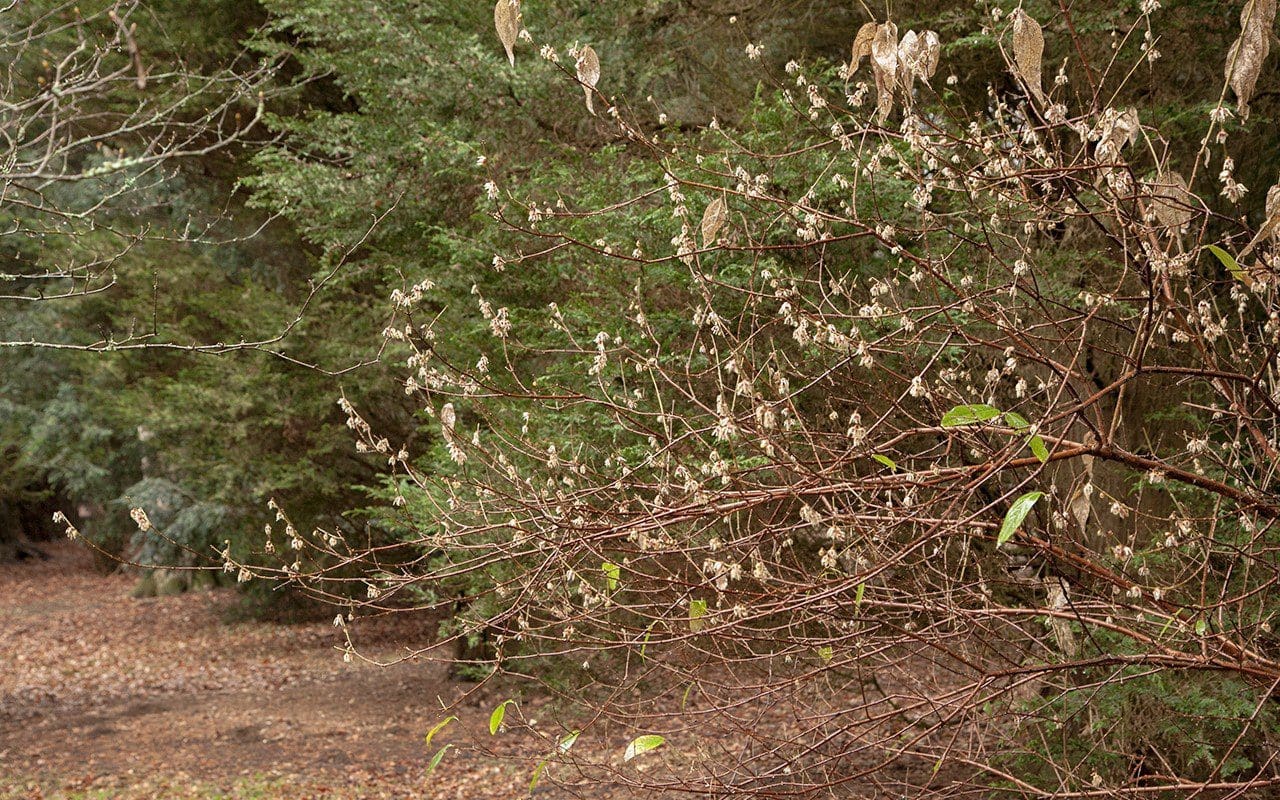
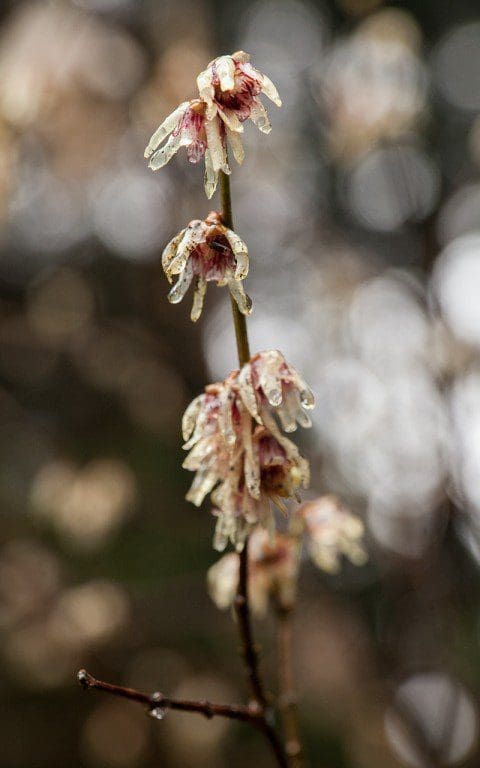 Chimonanthus praecox at Westonbirt Arboretum
In its native habitat in open woodland Chimonanthus praecox can grow to as much as thirteen metres. In cultivation it forms a nicely branched shrub of three by three metres and, being well-behaved, it has been a mainstay of Chinese gardens for more than 1000 years. It was first introduced to Japan in the late 17th century as a garden plant and then to Britain a century later, arriving at Croome Court in 1766.
If you read up about it, books repeatedly state that it needs the radiated heat of a south or west wall to ripen its wood sufficiently to flower well. The half-radius of Lutyens’ Rotunda at Hestercombe House, where Gertrude Jekyll’s original planting of 1904 still survives, beautifully demonstrates its use as a wall-trained shrub. Indeed, you see it flowering most prolifically on the hottest part of the wall.
As it is hardy to -10°C it is happy out in the open and I have found it to be far more adaptable in this country where not too far north. The specimen at Westonbirt Arboretum, for instance, is flowering well in open woodland, so it is worth breaking the rules if you dare.
Chimonanthus praecox at Westonbirt Arboretum
In its native habitat in open woodland Chimonanthus praecox can grow to as much as thirteen metres. In cultivation it forms a nicely branched shrub of three by three metres and, being well-behaved, it has been a mainstay of Chinese gardens for more than 1000 years. It was first introduced to Japan in the late 17th century as a garden plant and then to Britain a century later, arriving at Croome Court in 1766.
If you read up about it, books repeatedly state that it needs the radiated heat of a south or west wall to ripen its wood sufficiently to flower well. The half-radius of Lutyens’ Rotunda at Hestercombe House, where Gertrude Jekyll’s original planting of 1904 still survives, beautifully demonstrates its use as a wall-trained shrub. Indeed, you see it flowering most prolifically on the hottest part of the wall.
As it is hardy to -10°C it is happy out in the open and I have found it to be far more adaptable in this country where not too far north. The specimen at Westonbirt Arboretum, for instance, is flowering well in open woodland, so it is worth breaking the rules if you dare.
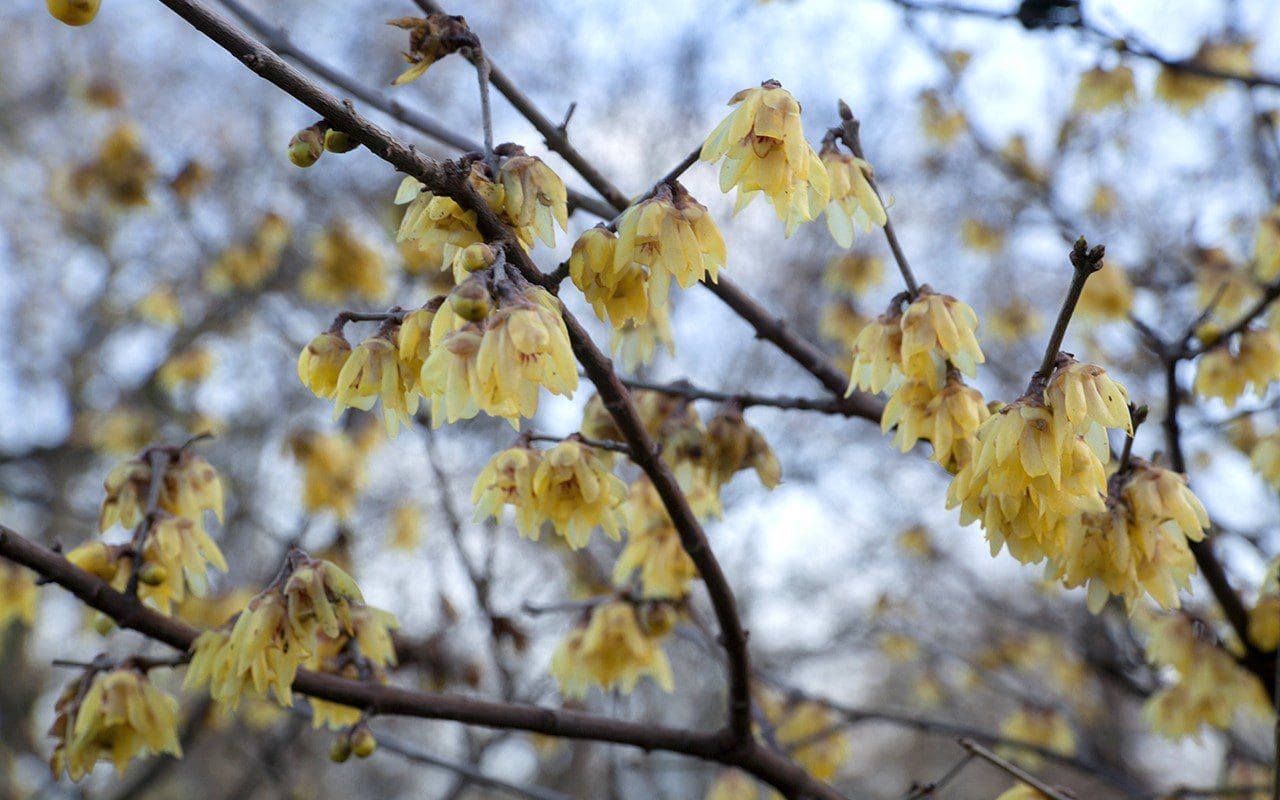 Chimonanthus praecox ‘Luteus’
Grown from seed wintersweet can take up to fifteen years to flower, a containerised plant five or eight after planting, much like a wisteria. As a species Chimonanthus praecox is variable, but there are a small number of named forms commercially available.
In the Winter Garden I designed at Battersea Park (main image) I have used C. p. ‘Luteus’ as a perfumed welcome by the Sun Gate at the garden’s entrance to draw people in. I am not completely sure the plant supplied is the real ‘Luteus’. Although the flowers register a strong beeswax yellow they have a very slight staining to the central boss, which ‘Luteus’ is not supposed to have. ‘Sunburst’ is yellower still, whilst C. p. ‘Grandiflorus’ has a larger, more open flower which is paler and more translucent. A red stain suffusing the central boss is more typical of the species, which is also reputed to be more heavily scented than the above selections, although I’ve never been able to compare them.
Chimonanthus praecox ‘Luteus’
Grown from seed wintersweet can take up to fifteen years to flower, a containerised plant five or eight after planting, much like a wisteria. As a species Chimonanthus praecox is variable, but there are a small number of named forms commercially available.
In the Winter Garden I designed at Battersea Park (main image) I have used C. p. ‘Luteus’ as a perfumed welcome by the Sun Gate at the garden’s entrance to draw people in. I am not completely sure the plant supplied is the real ‘Luteus’. Although the flowers register a strong beeswax yellow they have a very slight staining to the central boss, which ‘Luteus’ is not supposed to have. ‘Sunburst’ is yellower still, whilst C. p. ‘Grandiflorus’ has a larger, more open flower which is paler and more translucent. A red stain suffusing the central boss is more typical of the species, which is also reputed to be more heavily scented than the above selections, although I’ve never been able to compare them.
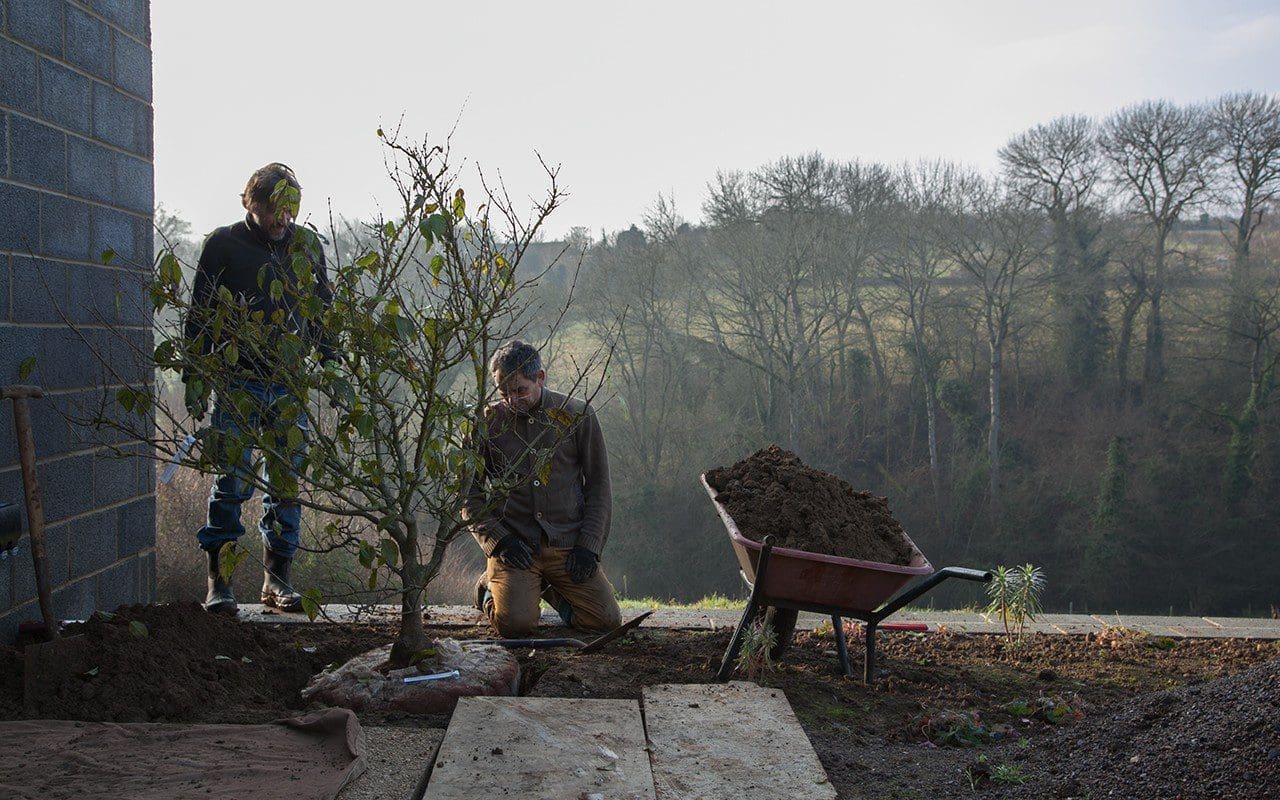 Planting the new wintersweet at Hillside
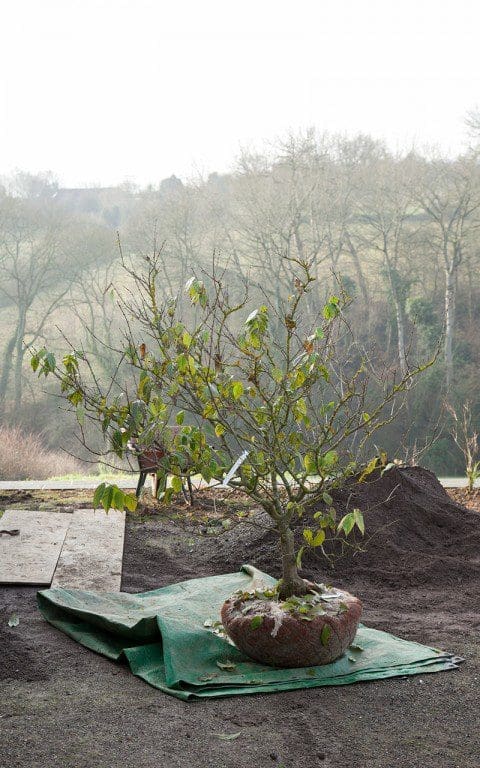
As I have waited this long to be able to plant one for myself and am impatient for flower, I went to Karan Junker for a mature, field-grown specimen. Her seed came to her via Roy Lancaster from a batch originally selected by the great Japanese botanist and plant collector Mikinori Ogisu. There is a fabled pinky-red clone in Japan and the seed potentially included these genes. Just before Christmas I planted my ten-year-old by the studio door so that the perfume is not wasted and today it has broken the first of a half dozen buds to reveal a form that is clear waxy yellow. There are no dark markings, but the scent – my February fix and instant reminder of my childhood discovery – is bewitching. A winter without wintersweet would be a duller season, unmarked by this strange, scented treasure.
Planting the new wintersweet at Hillside
As I have waited this long to be able to plant one for myself and am impatient for flower, I went to Karan Junker for a mature, field-grown specimen. Her seed came to her via Roy Lancaster from a batch originally selected by the great Japanese botanist and plant collector Mikinori Ogisu. There is a fabled pinky-red clone in Japan and the seed potentially included these genes. Just before Christmas I planted my ten-year-old by the studio door so that the perfume is not wasted and today it has broken the first of a half dozen buds to reveal a form that is clear waxy yellow. There are no dark markings, but the scent – my February fix and instant reminder of my childhood discovery – is bewitching. A winter without wintersweet would be a duller season, unmarked by this strange, scented treasure.
 Words: Dan Pearson / Photographs: Huw Morgan We are sorry but the page you are looking
for does not exist.
You could return to the homepage
Words: Dan Pearson / Photographs: Huw Morgan We are sorry but the page you are looking
for does not exist.
You could return to the homepage
