The first frost of the season came on the night the clocks reverted from summertime. On the still, bright morning that followed, it hung in the hollows, the first fingers of sunshine liberating plumes of mist. We walked down to where they were moving between the yellowed ash and buttery hornbeam to find the leaves falling wet with thaw. Autumn in fast forward now and glorious for it.
Walking back up the ditch to where I had feared the worst for the Gunnera, we found them still standing. Their huge rough leaves had bowed a little, but it was good to find they were still in one piece and that there was time to put them to bed whilst the foliage was intact.
I have a special relationship with these giants, which are splits from a plant I bought with my Saturday earnings, aged ten. The mother plant, which grew in the nearby combe, was a thing of pilgrimage and I would cycle there summer and winter to marvel at its transformation. It sat on a bank where a spring broke to form a little pond at the roadside. In the growing season the water would be all but invisible, dwarfed by the enormous splay of foliage. Broken by winter, a skeleton collapsed and rotting in the water, it struck a sinister mood and I loved it for that.
I wanted to have some really quite badly, to live through the giant’s rise and fall during a year and to grow myself a colony that, one day, I could get lost in. Our thin, acidic sand at the top of the hill was no place for it but, undeterred, I dug a pit and filled it with a plastic liner in readiness. It took a while to pluck up the courage to cycle there with a spade strapped to my bike and to walk up to a stranger’s front door to ask if I could buy some. I remember quite clearly offering the owner a ‘fiver’ and the surprise on his face (it must have been a good sum in the mid ‘70’s) as he said, “Yes. Help yourself !”. I have no recollection of wrestling a growing tip from the mud, but I do recall smiling all the way home with my hard-earned booty strapped to my bike.
Needless to say, and despite my attentiveness with watering, it didn’t do well until I found it a place in the overflow of the cesspit. Beth Chatto’s advice to “Feed the beast” was my inspiration and, as Gunnera really needs its roots in a steady supply of water, the richness here was the answer. In the years after I left home it grew and it grew and it grew and became quite the focal point in the orchard. Many years later when the photographer, Tessa Traeger, asked me to choose a place that meant something to me for a portrait I asked to be photographed beneath it.

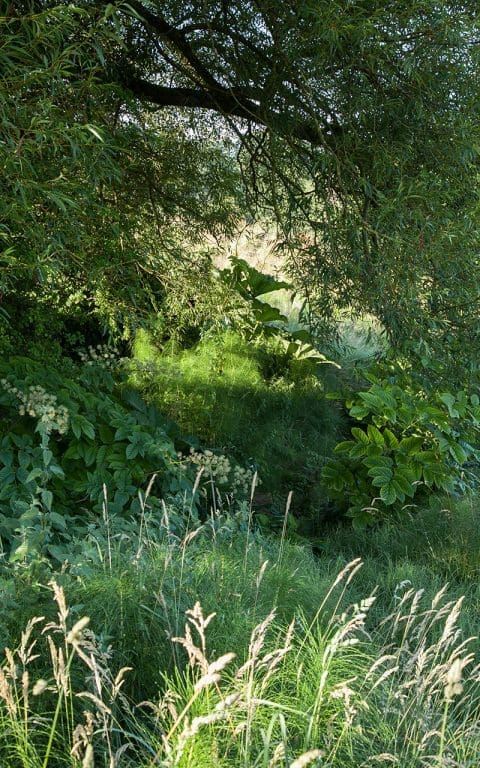
So, after moving here, I was presented with the perfect opportunity to be reunited and relive the drama, the life and death throes of the giant rhubarb. Our wet, oozing ditch and boot-sucking mud where the springs burst from the hillside have made it the perfect home. I have planted about ten offsets which, five years later, are beginning to provide some bulk, since they take a while to settle. A little shelter from the wind provided by the crack willow sees it do best where the plants sit outside the canopy. They grow half as well and rangily in the shadows. Although they should easily double in size with time, the colony is already a place I have dreamed about for some time. A scale change in every way. Somewhere you can walk into and get lost in, the giant parasols throwing a green light as you move amongst them. The prehistoric foliage rasping and textured above you.
Hailing from highlands in Brazil, Gunnera manicata is all but hardy, but it is safest to protect the hoary crowns in winter. Old plants can come through a winter without a cloak of shelter, but two years ago in our heaviest winter here I lost all the main crowns where the frost hung in the hollows. Folding the foliage over the crowns, like a thatch or multi-layered hat is usually sufficient, but until my plants grow strong, they are insulated first with a layer of hay. Cutting the foliage before it is frosted allows for the sturdiest construction and there are few things as satisfying as winter draws close than putting these wigwams together. Protecting the beast for a sure reward once the clocks change again and it stirs from slumber.
Words: Dan Pearson | Photographs: Huw Morgan
Published 9 November 2019
The garden has taken a distinct and irreversible turn. It is not a sad thing, just the beginning of another season. A slowness in the Morning Glories, that just a fortnight ago were still racing skyward and now stay open well into the afternoon in defiance of their name. Kaffir lilies flaring hot colour and the first spears already pushing on the Nerine.
A gentle countermovement happens alongside the feeling that most things have reached their peak and are now ready to begin standing down. When we lived in London it was the Datura which went for its best and most intoxicating September fling. Primed by the cooling weather and definitely responding to the onset of autumn, it had been readying itself for such a finale, which, in the shelter of our Peckham garden, would run through to November and test my resolve in leaving the plant out just for one more night. I have an offspring of the very same plant here, treasured but never thriving on our windy hillside. Though I have moved the pot around to try and find it the shelter it needs, this hothouse flower knows its limits and taunts me here rather than rewarding.
Not so the Nicotiana suaveolens which right now is having a moment. This is another plant that I have grown continually for what must be at least twenty years. I first knew it as Nicotiana noctiflora, in reference to its night-flowering habit, and have a niggling half-memory of where it originally came from, which is surprising considering my devotion. Derry Watkins of Special Plants was here recently and said that it was one of her all-time favourites too, but that she never saw it any more. She used to grow it for sale, but the plants were seldom bought. When I asked her why, she said that she thought it was too subtle for most people. Its quiet elegance is exactly why I love it.
I have explored the tobacco plants over the years. Towering Nicotiana mutabilis, with a confetti of tiny flowers, suspended in a cage of branching stems, which age from white through palest pink to deep rose. Where there has been a need for an exotic moment, Nicotiana sylvestris has provided lush foliage, a bolt of white drama and heady perfume. The tiny, green bells of Nicotiana langsdorfii have been mingled amongst perennials to extend the season in the borders and I currently have a little trial of dark-coloured varieties, which I imagine must have some N. langsdorfii in their blood. ‘Tinkerbell’ has lime green trumpets with a rust-ruby face and unexpected blue pollen. ‘Hot Chocolate’ is similar, but a velvety brown-red. Subtle beauties that need to be placed carefully if their colour is not to be lost.
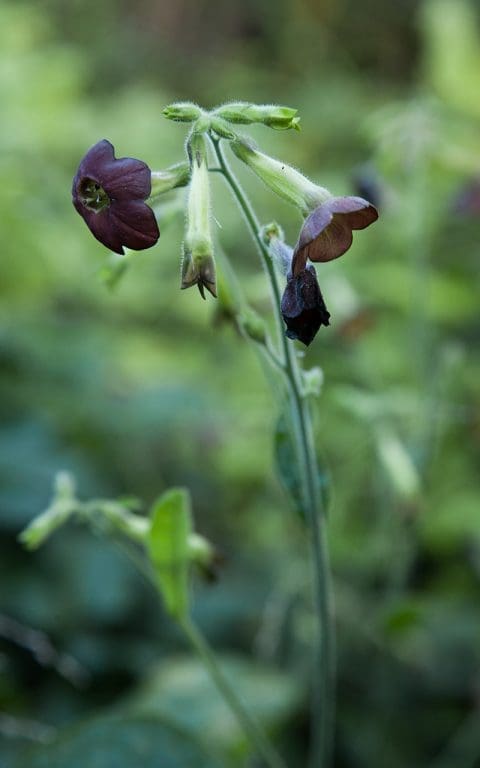
In Peckham we suffered from the dreaded tobacco mosaic virus, which is carried on tomatoes and affects their solanaceous cousins when in full swing. When it hits, the Nicotiana leaves firstly develop the distinctive mosaic patterning, then they begin to twist and melt, leaving the plants failing in high season with a wide open autumn ahead of them and the associated disappointment. Interestingly, the Australian Nicotiana suaveolens was never affected and, even when growing alongside others that did succumb, it soldiered on until the frosts. I brought it here as seed, which is produced in plenty and is easily reared from a March sowing under glass. Where it has seeded into pots that spend their winter in the frames, I’ve found it to germinate spontaneously in April as the weather warms. The seedlings that make their own way without transplanting catch up with those that are pricked out and cossetted.
In London our plants would return for a second and sometimes even a third year if their spring regrowth wasn’t decimated by slugs. Though I plant out a dozen or so as gap fillers close to the paths, we have too much winter here, but our most splendid plant is growing just under the eaves of the open barn. I presume the ground is dry enough in winter to afford it enough protection to have returned a second year and at twice the size from the reserves of a decent set of roots. I noted the frosted rosette looked green in March when winter turned and looked after it accordingly to guard it from slugs.
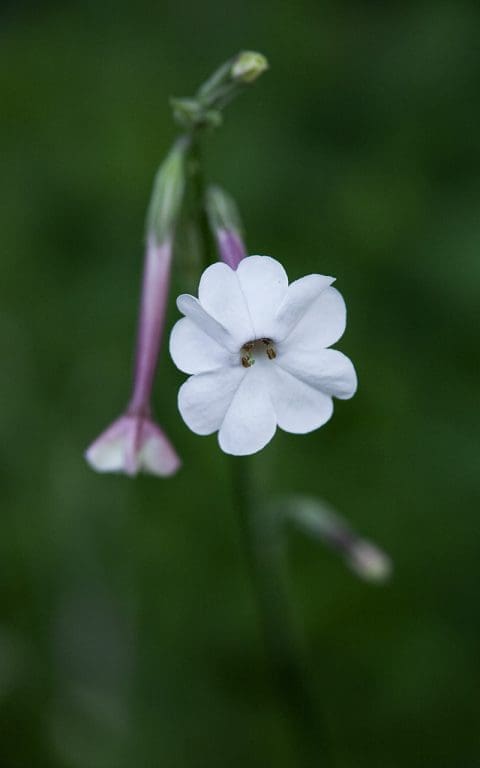
Our barnside plant has been gathering in strength over the summer, pushing out flower since July. The wiry stems set the long trumpets free of the basal foliage and the flowers appear with room between them to hover. During the day, from mid-morning onwards, they hang in repose so that you hardly notice them, but as evening descends they awaken. Part of their nocturnal glory lies in their paleness, which is luminous in darkness and this is when they throw out their lure, pulsing perfume to attract moths and other night time pollinators. When we returned from London on Thursday night, the misty air was still and the open barn had captured this heady, exotic perfume. A smell reminiscent of cloves and jasmine that conjures somewhere very different from our cool, dampening autumn.
Words: Dan Pearson | Photographs: Huw Morgan
Published 14 September 2019
The fields around us are pale and yet to green up after the hay cut. The trees and hedges are fuller and darker than they ever will be – an August green that has lost its earlier vibrancy. Seeds are setting and hips forming in this final month of summer and there, already showing and earlier than I am ever ready to see them, are the Cyclamen hederifolium.
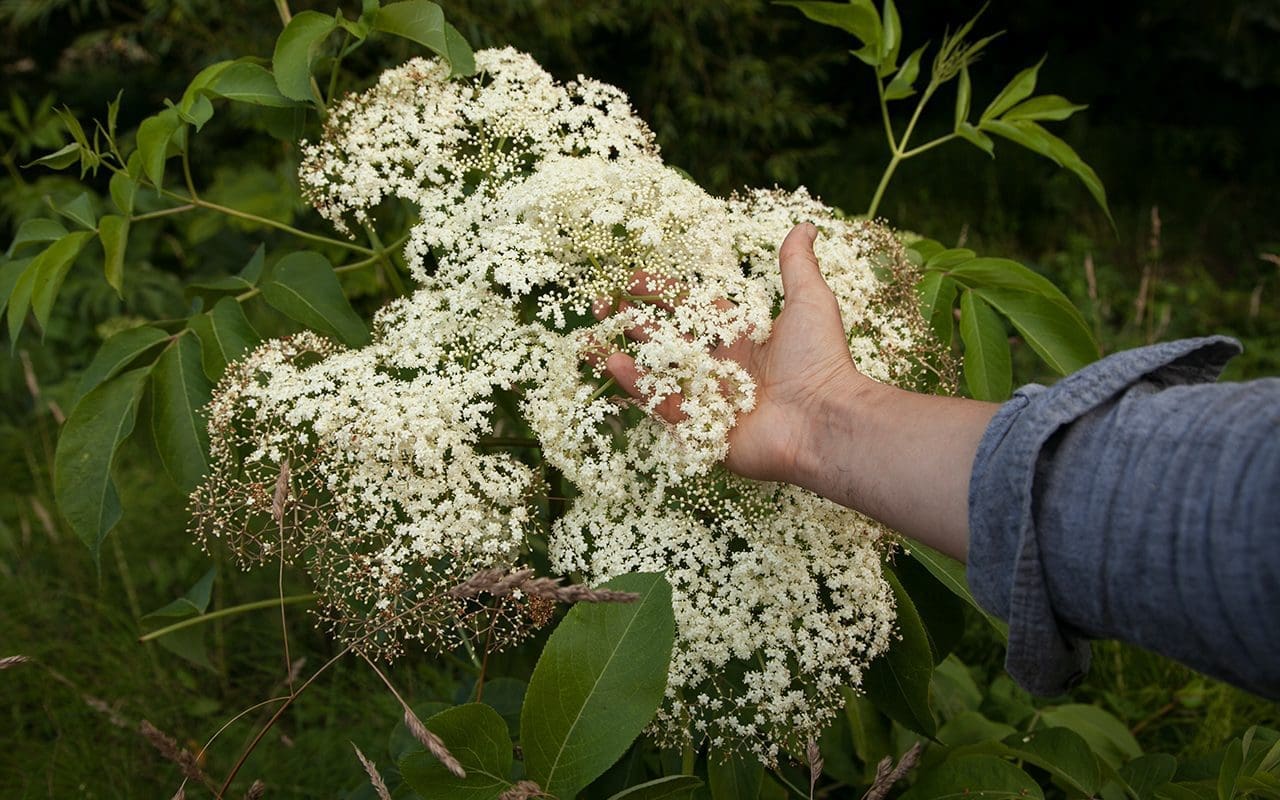
The garden in August can all too easily fall foul of the feeling that summer is ebbing away, but Sambucus nigra subsp. canadensis ‘Maxima’ makes a sure and decisive move against the tide. Where our native elder is already a June memory and hung heavily now with berries, there is a vigour and freshness exuding from this north American which, true to its country of origin, is larger in all its parts. A gently suckering shrub, the growth is still fresh and lush with a push of herculean effort to summon the flowers. These are borne on this year’s wood, which is why, if you choose to do so, you can pollard the plant to encourage a response in growth that is larger flowered and altogether lusher.
It was such a plant that I first encountered at Greatham Mill in Hampshire. Frances Pumphrey, a fine plantswoman and gardener, opened her garden to the public and her cornucopia was meticulously tended. Where she had reached as far as she dared for fear of not being able to manage more, she had extended her garden into a little field alongside the stream where she had planted a modest arboretum. She had the Sambucus growing there and it billowed out from where it had been reduced in winter, the flower heads the size of bicycle wheels. I can see them now as clearly as if it were yesterday, tiered and light-reflectingly creamy amongst the shade of the trees. A scale changing spectacle.
From the age of 10 I had a Saturday gardening job there for the seven years before leaving home and I would willingly spend every penny of my wages in her nursery of treasures. Mrs P. would always give me something to offset the fact that I left with plants and not money. A good haul would not be negotiable on my bicycle and my father would have to come to collect me on days like the one I was given an offset of the Sambucus. Running gently, but not dangerously, it is easily propagated from a rooted sucker. On our thin, acidic sand at the top of the hill though, my plant never did as well as those in the heavy soil of Greatham Mill and, until recently, it remained a mythical memory from my teenage years.
‘Maxima’ is a most suitable name and you need enough space to stand back and look when it is in full sail. I have recently planted a small handful where I am adding tough perennials to the lush growth along the ditch. The likes of Inula magnifica, Persicaria alpina (formerly P. polymorpha) and Aralia cordata are proving themselves by coexisting alongside the native meadowsweet and rampaging equisetum in this heavy, damp ground. Mulched heavily for a couple of years to curb nearby growth in spring, the plants are able to build up the reserves they need to hold their own. The Sambucus have done this for the first time this year and, though they are not yet old enough to coppice, the flowers have youthful vigour and are easily the size of serving platters. If I were to leave them as shrubs, they would rise to three or so metres, but I will probably prune them hard, like buddleia, in late winter. A strong framework will allow the plants to hold their heads above the competition and the regrowth will stimulate the lushness I am after.
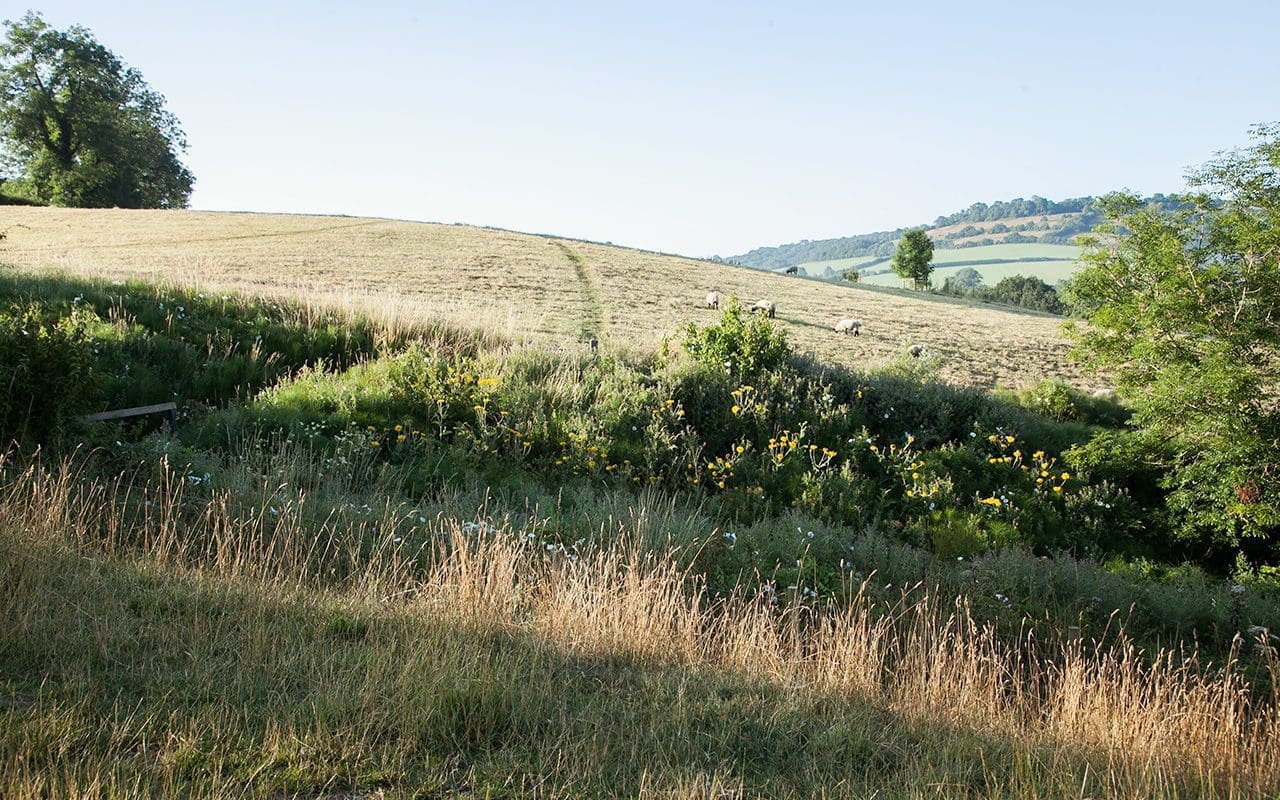
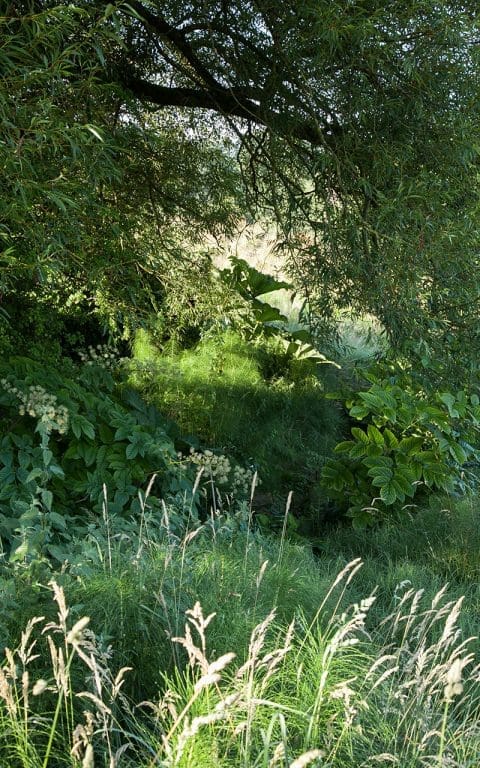
Though I have not yet committed the flowers to make cordial, I imagine a few would go a long way if we ever had a wet June and couldn’t harvest our native. They have the same delicious perfume and hang huge and lacy with the Gunnera as their backdrop under the willow. The drama here plunges you into a world that makes you feel smaller and smaller the deeper you venture into it. Stepping from the open field, where the dry tawniness of August grassland sets the tone, into the damp lushness beneath the willow, my ‘Maximas’ are easily as wondrous as the first time I made their acquaintance
Words: Dan Pearson | Photographs: Huw Morgan
Published 10 August 2019
The elder is spilling from the hedgerows, creamy, heavy with flower and weighted by a deluge of June rain. This is their month and we can see them marching up the valley and foaming from the edges of the copses where they are happy to seed into shadow, but prefer to push out into the sun.
Elder is fast. Their shiny black berries, which are some of the first to be gorged on by birds in the autumn, are deposited wherever there has been a perch. I find them here under the woody shrubs in the garden and where there has been a perennial left standing that has provided a place for a pause. We even have a quite mature elder that has found its way into a humus laden crack high up in an old ash pollard to prove their ease in finding a niche.
They look innocent as seedlings and are easily weeded but if you miss one you will have a sturdy little plant that will jump up and out into the light in its second year and in the third already be demanding space that might have been promised to something else. They go on in life living fast and hungry and, if you have them in a hedge and leave it uncut, they will create a gap there by simply outcompeting their neighbours. They age quickly and fall apart with topweight, so opening up a wedge. It is into these gaps that you will find brambles seeding and then a whole new wave of succession.
I must admit to removing them where I have been repairing the hedges so that I can replace them with hedging plants that retain a more measured growth cycle. Hazel, hawthorn, dogwood, viburnum and eglantine rose. It is bad luck I know, but where I have done it I now have hedges that are opaque in winter and layered from the bottom up with three plants replacing the weight of the interloper. A cut piece of elder wood reveals why its old Anglo Saxon name aeld (meaning fire) was given, because the hollow stems were used to blow air directly into the heart of a fire. Although it is also unlucky to bring elder inside, I suppose there must be room for exceptions.
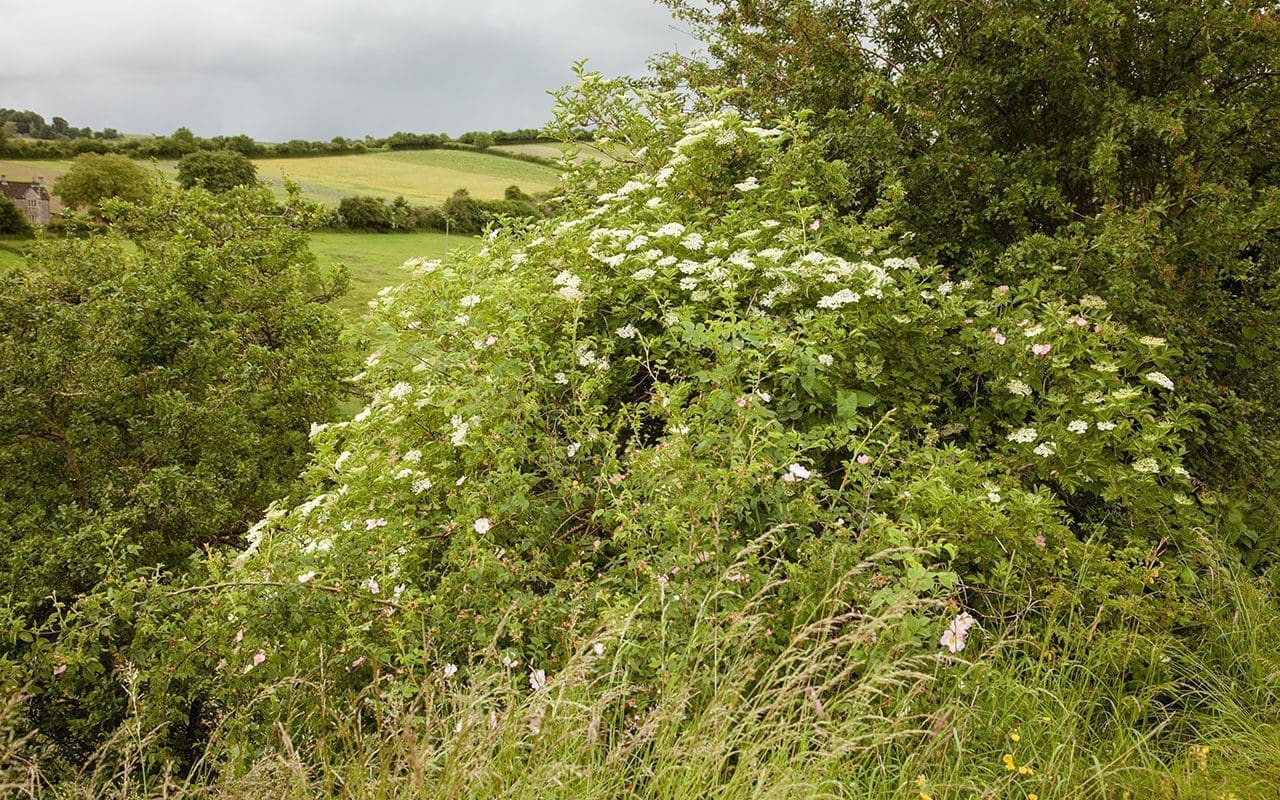
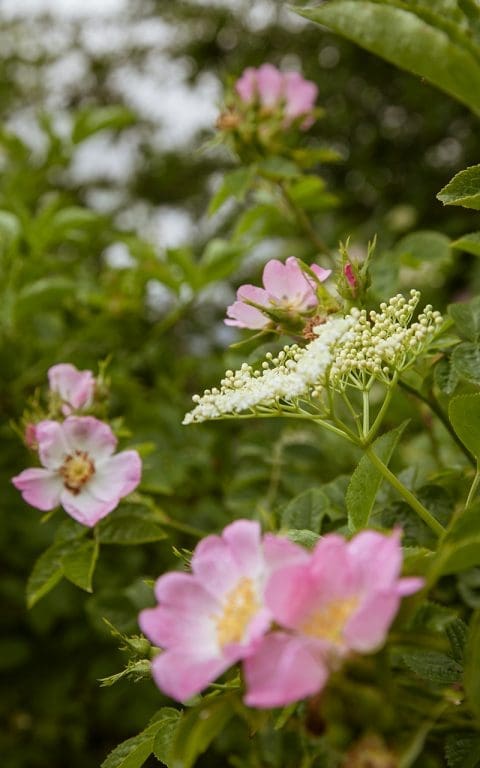
We are lucky enough to have room to let a number of elders have their head here and, only when June weather allows, we steep them and make cordial, since the flowers need to be dry when harvesting. Their heady, sweet perfume is completely distinctive and reminiscent of this time later in the year. A moment of fecund growth and dampness still in a young summer. Where we have let a hedge grow out to make a bat corridor on our high field, a plant that is easy to harvest is paired very beautifully with wild rose, the cream and pink heightened for their company. The coupling has been inspiration for a cordial that Huw is making this week with some of the first roses as a means of capturing this moment.
Where I want to make a quick impression in a garden that needs something evocative of a wilder place, or indeed to segue from garden to landscape, I will often use the cut-leaved Sambucus nigra f. laciniata. This is a lovely plant, strong but lighter on its feet than the straight species and already tall and making an impression in year two. More ornamental selections have given us good dark-leaved forms with cut foliage that are exquisite and easily used. The filigree of ‘Black Lace’ and ‘Eva’ are better I think than ‘Black Beauty’, which has a more simple leaf that can look heavy. The darkness in their genes spawns flowers that are as pink as the species is cream and are a strong influence in the June garden. I haven’t grown the yellow cut-leaved ‘Golden Tower’ which is said to be smaller in stature, but it could be nice in a little shadow to give the impression of artificial sunlight when June days are bringing us (welcome) rain and grey skies.
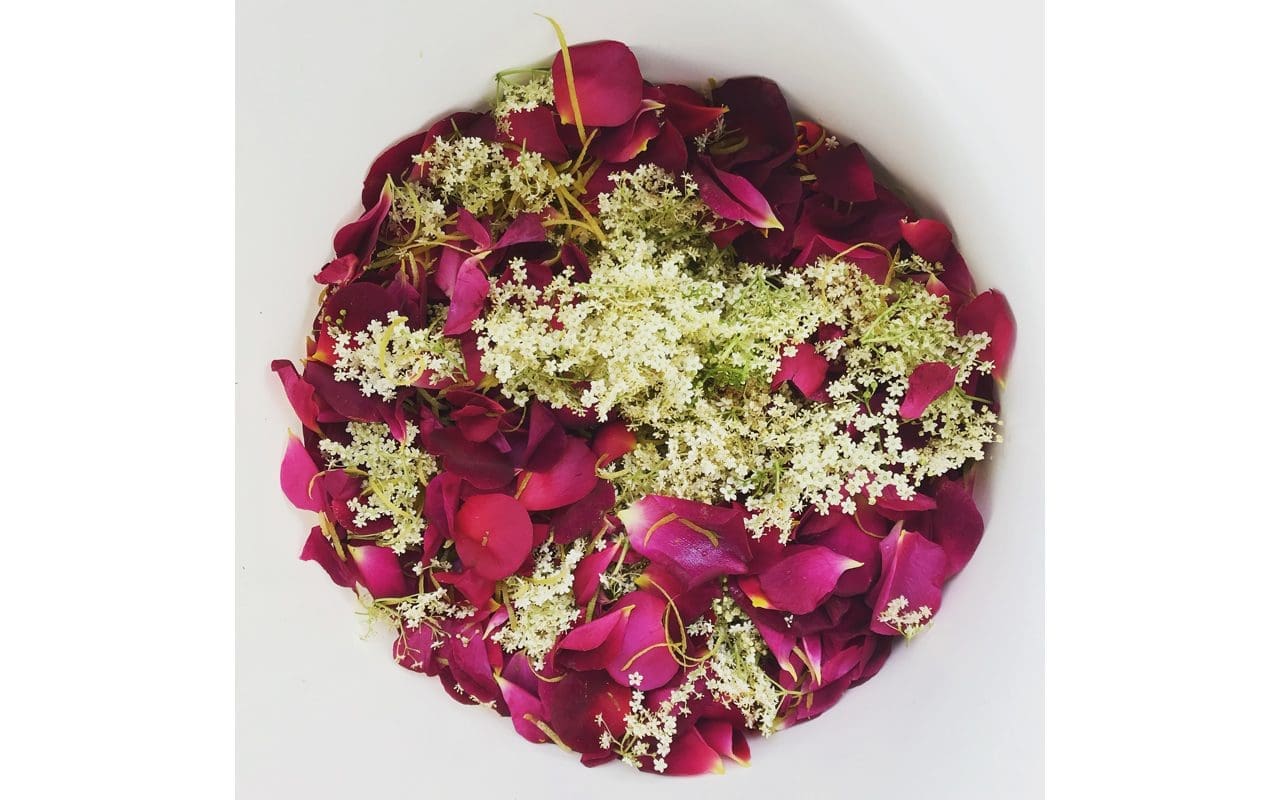
Words: Dan Pearson | Photos: Huw Morgan
Published 15 June 2019
In the last week of April we returned to an island in the Dodecanese that we have been drawn back to more than once. We had been bewitched by the April wildflowers there on our first visit seven years ago, but have never managed to catch them again with life unravelling the best made plans for a spring return. The news of a wet winter in the Mediterranean and encouragement from friends on the island that the flowers had never been better cemented our plans. So, with the garden already awoken and needing attention at Hillside, we did what we could to ready things for the season and left the asparagus crop and instructions to enjoy the blossom to friends who were house and dog sitting.
As the ferry neared, the now familiar outline of the island cleared and sharpened. The last time we had seen them the ancient terraces that scaled the hillsides were browned by summer heat, but the rocky contours were now shrouded and emerald with growth.
Once on shore, the week of wonderment began immediately. Gold and white chrysanthemum (Glebionis coronaria) flurried away into the distance, scaling the rocky outcrop of the monastery as if it were whipped with seahorses. Where we had become used to the sepia September island, the colour was switched back on and everywhere. Banks of perfumed broom (Spartium junceum), chrome yellow and jostling with lilac sea stock (Matthiola sinuata), took the sunny corners on our switchback journey up and out of town. Fluttering silver-pink Convolvulus althaeoides twisted into the chainlink of the school playground, whilst scarlet poppies, cobalt cornflowers and brilliant white daisies took the rough disturbed places. Little walkways leading between the terraces of olives and figs were cushioned by azure lupins and an electric coupling of acid green smyrnium. This was our first impression I might add; the first day when your eye takes in the big picture and not so much the detail.
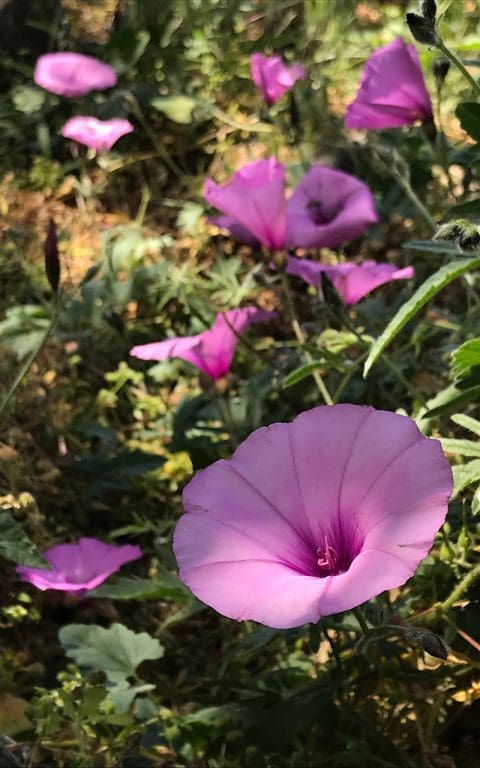
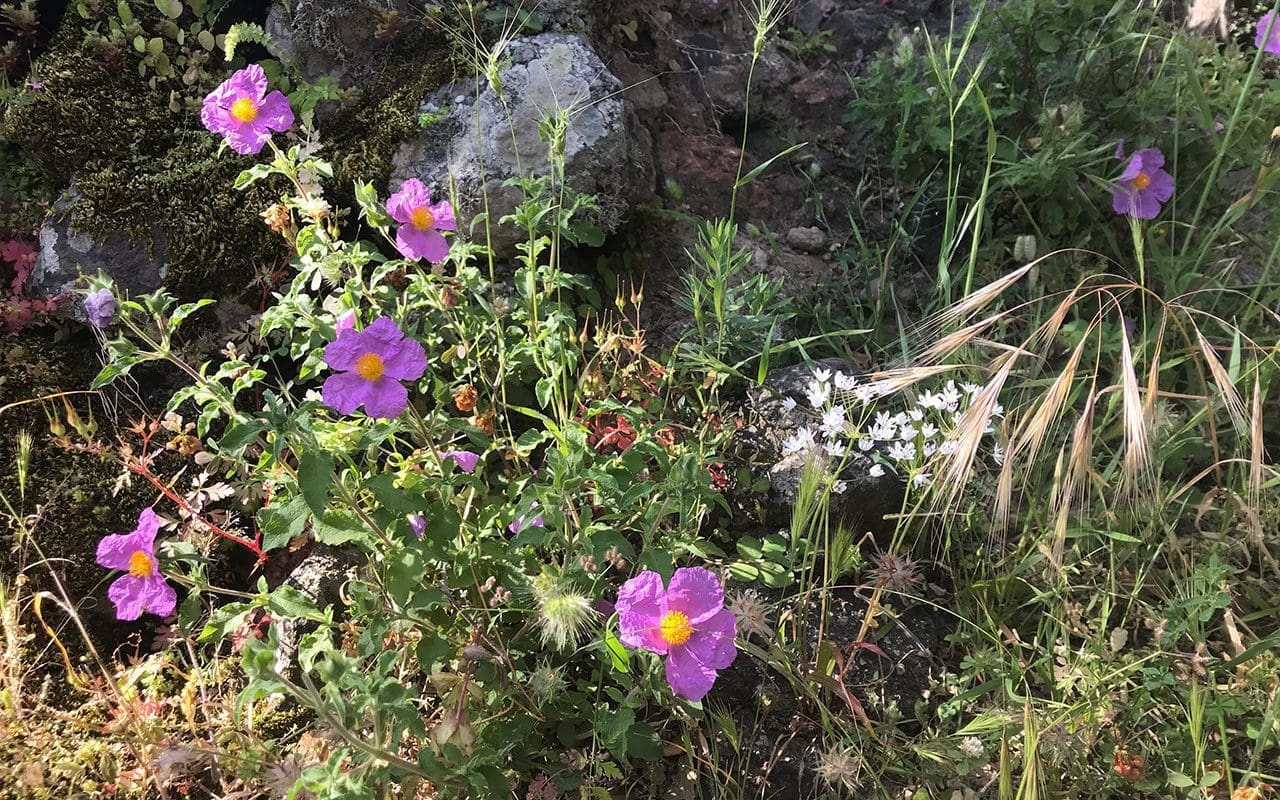

We were staying up and away from the town, a forty-minute walk at a regular pace along one of the narrow monopati that once were used by shepherds and farmers to tend their land. Land that became rougher and wilder and more delicate in its detail the further we walked from the managed influence of the terraces above the town.
The week we were there saw our eyes slowly tuning to a new and different way of seeing. One that was not about looking at a tended and manipulated place, but seeing a landscape that had become settled by neglect. We were surrounded by long disused terraces where the ground you could see had remained untouched for decades. It was clear that wild goats had got the upper hand, for the shrubby oaks had been goat pruned into extraordinary shapes which, with the abundance spawned from a wet winter, saw them hovering like topiaries in a sea of delicate ephemerals.
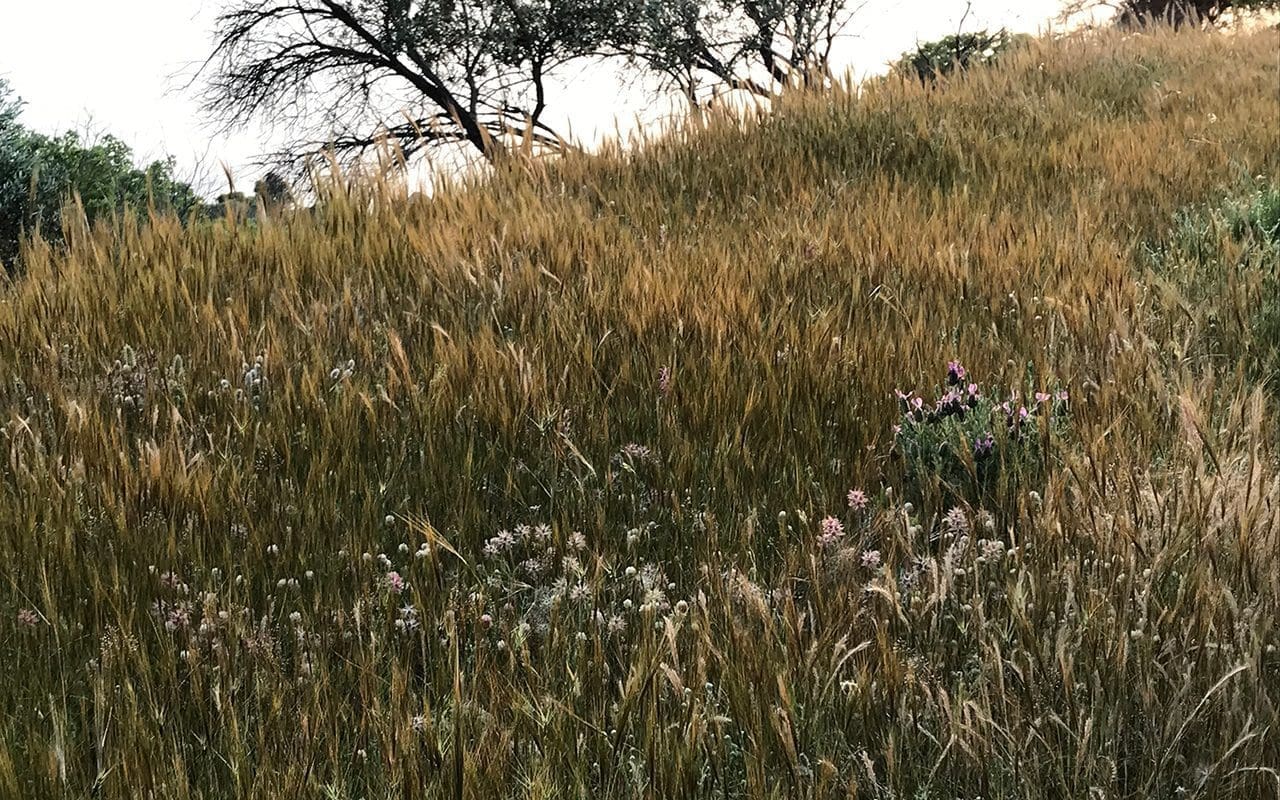
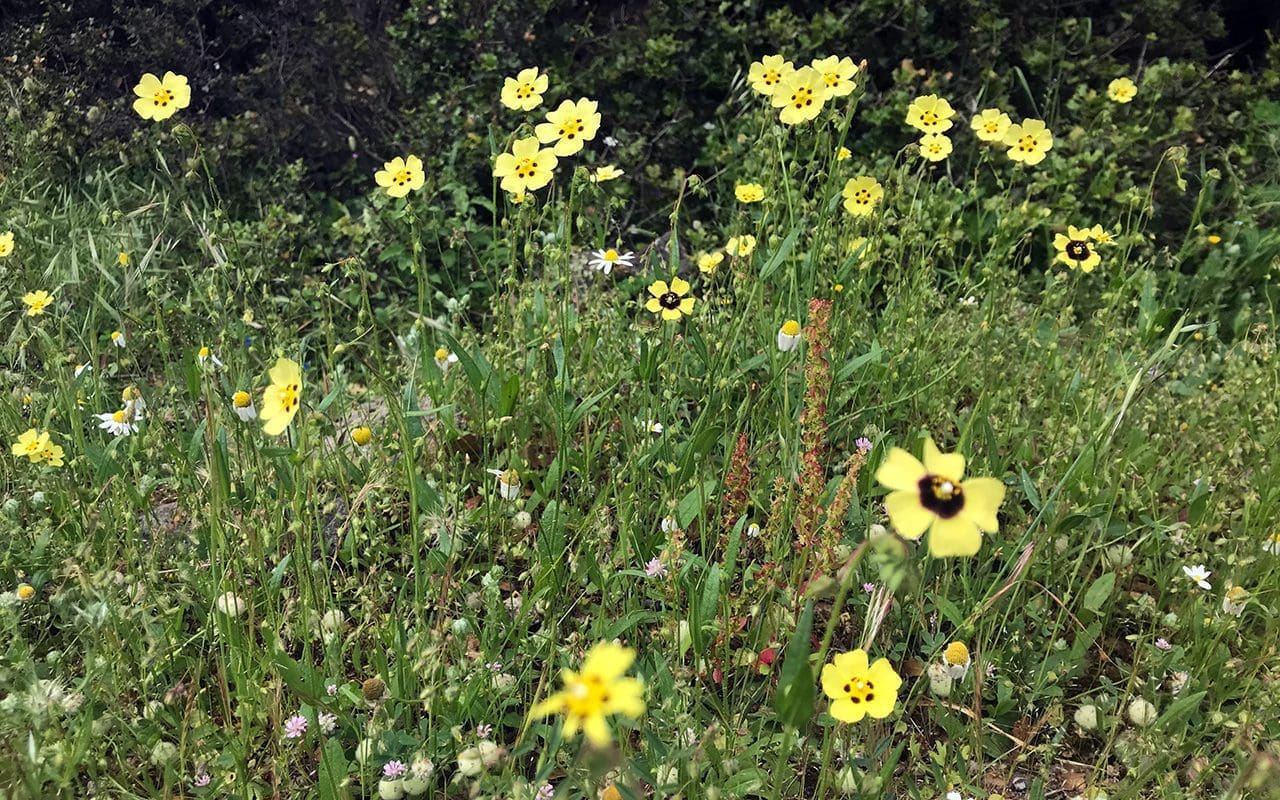
We had decided to travel light, leaving cameras behind and opening ourselves to the luxury of looking and not doing. The images we have pulled together here from our phones only touch on the magic of what we found. Miniature meadows so delicate that they were almost impossible to venture into. So delightful that we stood in each others footsteps to leave the lightest imprint possible. And the more we looked, the more finely spun the intricacy of the associations. Dancing Briza maxima, hovering over a silvered undertow of star clover (Trifolium stellatum). Pinpricks of the tiniest Silene, brilliant pink and suspended on needle thin stems. Fluttering Tuberaria guttata, a miniature yellow rock rose dotted sometimes with a dark central spot, other times simple and without.
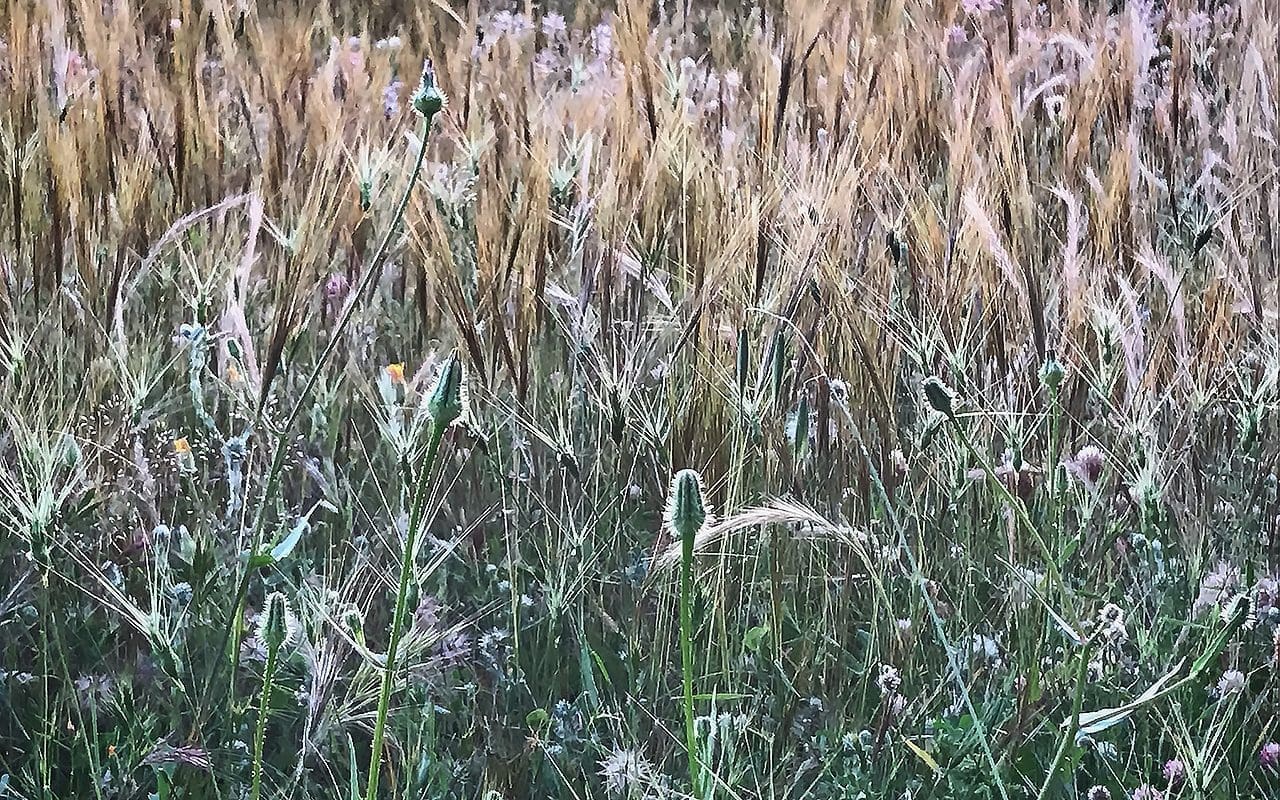
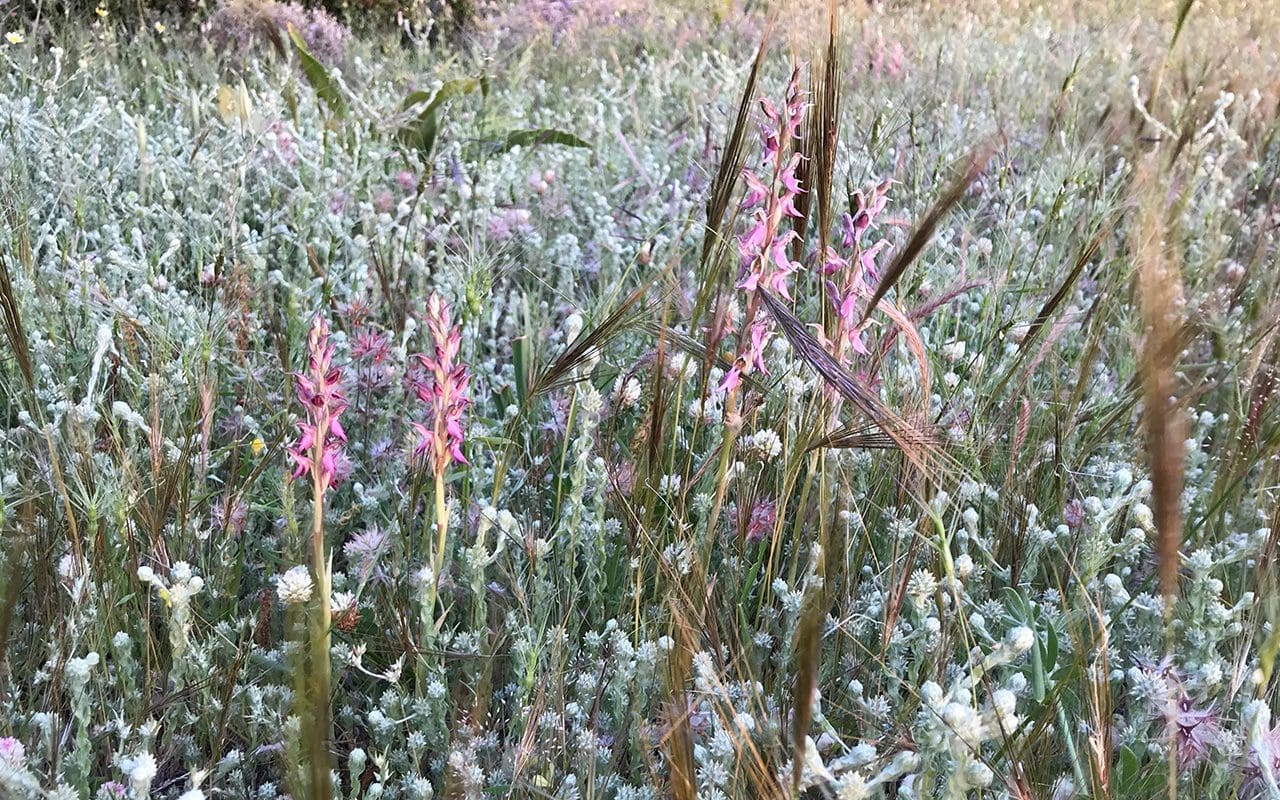
On the old, least accessible terraces there were fleets of Easter orchids (Anacamptis sancta). The childlike excitement of the first and then so many that you were afraid to take a step forwards or backwards.
The liberation of looking and not doing is a good discipline. One that as a trained and committed gardener I find it had to make the space for. But the clarity that comes through a meditation upon natural order runs deep and resonantly. The balance of a plant that has found its niche is not to be forgotten, nor the interdependency of a community that works for negotiating each other’s company and shining for it. The legacy of just a few days will charge the coming weeks of being back to reality. To a garden that needs tending and manipulating into position, but with the knowledge of a true order refreshed and reminded.

Words: Dan Pearson / Photographs: Dan Pearson & Huw Morgan
Published 25 May 2019
Stirring early from the dark mud, whilst almost everything else is sleeping, come the marsh marigolds. They were with us at the beginning of March this year, alone and lush and startlingly gold for their precociousness. Taking over just as the snowdrops are dimming, Caltha palustris is more than welcome when you are pining for momentum, their cupped blooms glossy and facing upwards to catch sunshine. Their growth is fast and out of kilter with the slowly waking world around them, their limbs arching out and splaying away from the rosette of lush foliage. Fat buds weigh the long flowering limbs, which hover just above water as if they feel their own reflection.
I started our colony here with a little clutch of plants that our neighbours gave me from their wet alder woodland. The deer population – or their passage through the woods – must have changed since then, because the colony has diminished through increased grazing. Where there is a decline in one place, there is often a countermove in another and I have made it my business to give them a place here at the head of the ditch, where a constantly running stream animates the crease between our fields.
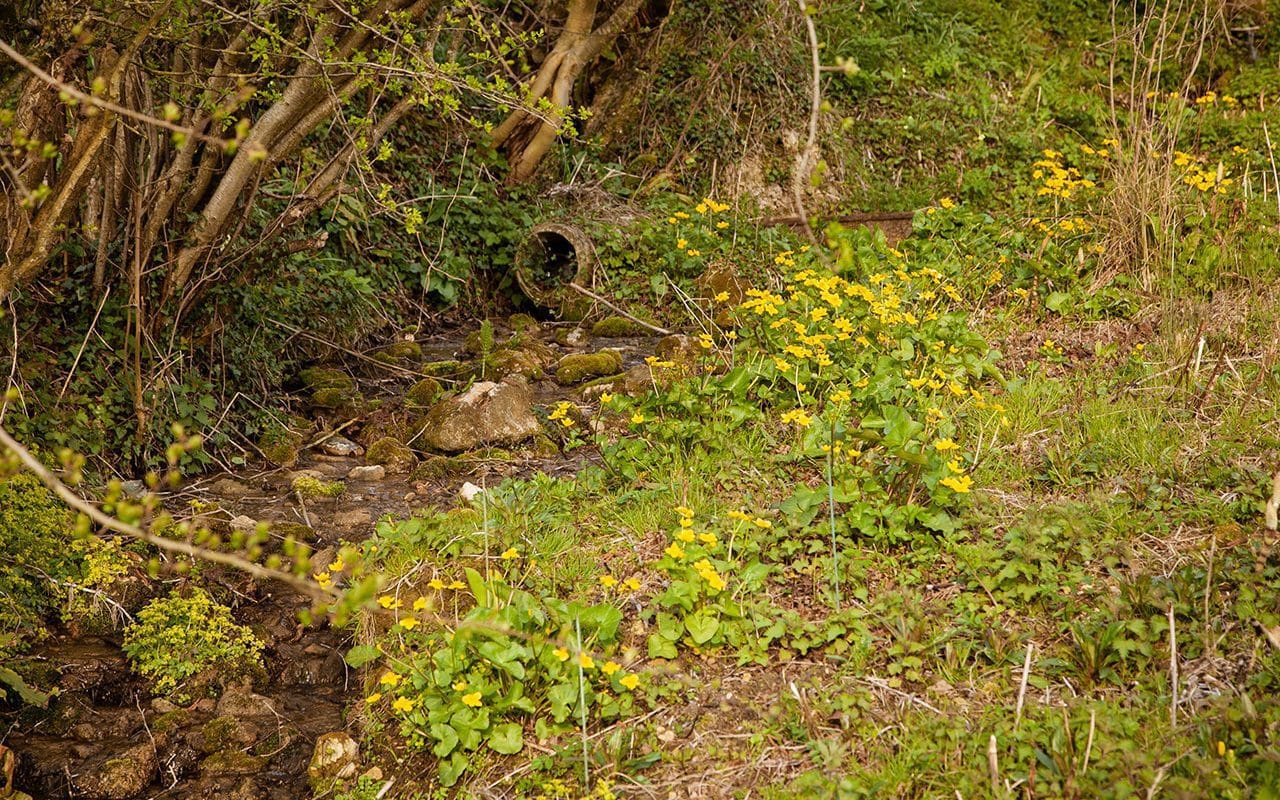
When we came here the ditch was just that, a place that was fenced off to keep the cattle from getting lost in the mud and where bramble had taken over from barbed wire. We have cleared it since then, letting the hazels grow out and uncovering a surprisingly pretty rivulet of water that sparkles when it is free of growth in the winter.
Four years ago I planted a batch of 40 plugs, which arrived from British Wild Flowers just as the winter was turning to spring. Marshland plants and aquatics are best planted with the opening of the growing season rather than at the close, so that their roots can take advantage of soil that is rapidly warming rather than doing the opposite in the winter months. Planting plugs is always easy with a thumb sized knot of roots easily inserted with a dibber, but you have to have faith if you are introducing them into a ‘natural’ situation, for in no time the plants are overwhelmed by the growth of established natives and you loose them from sight for the summer.
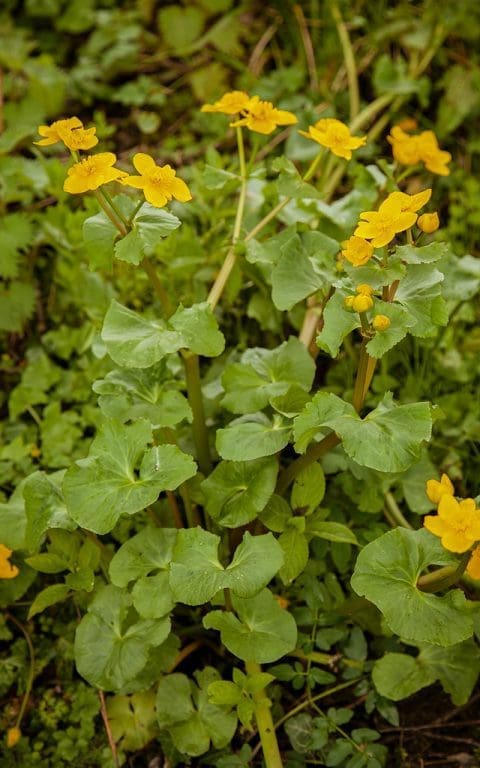
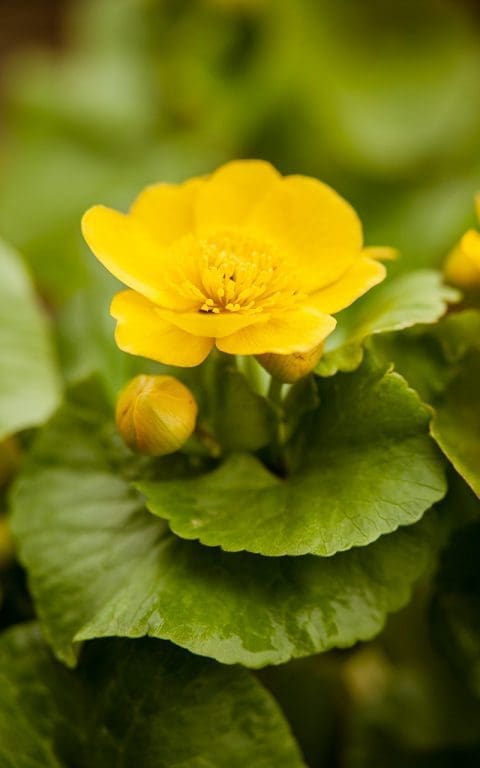
I followed the mud and the smell of dormant water mint as I planted, pushing the plugs into soil that was almost liquid and avoiding the areas that I could see would dry out as soon as summer came. Caltha will grow in shallow water too, but the margins that maintain constant moisture are their preferred domain. They are surprisingly tolerant of competition and, to prepare for it, their early start means that they have set seed and the rosette has fed all it needs to before being plunged into shadow of wild angelica, meadowsweet and hemlock water dropwort. In summer they go into a resting period, the lush foliage of spring collapsed but not dormant, taking in all it needs to keep things ticking over.
The spring after planting I followed the watercourse to retrace my steps from the year before. Given the fecundity of the summer growth here, it came as no surprise that just one plant had made enough energy to flower, but to my delight I found the rest of the 40, which in three years were all flowering and tracing a line of early gold, providing first forage for the bees, whose hive sits on the ground immediately above them.
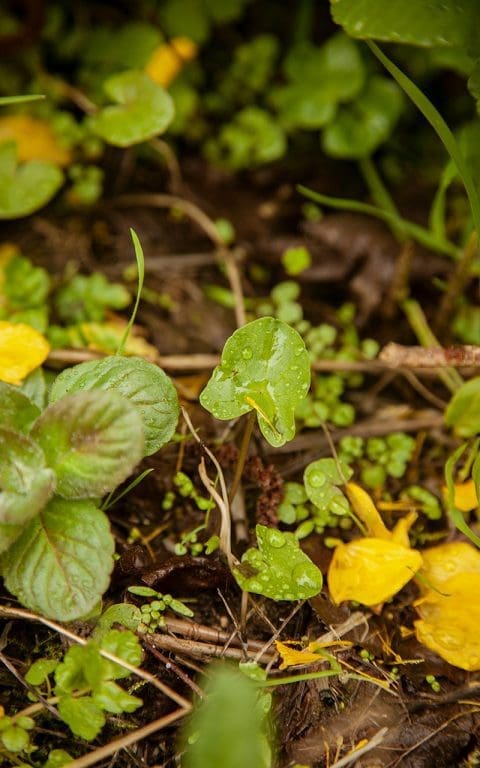
This year I have found the first seedlings, which have tucked themselves close to their parents in the mud where the conditions are controlled by the lush growth above them. The seed, which is heavy, germinates where it falls and does not move very far, but I imagine if it falls into water, it will wash and tumble a fair distance before finding purchase. To help in this process, and now that the youngsters are proof of the fact that they have found a niche, I have extended the colony downstream. Another forty plants went in this winter, just as the first signs of growth were showing, stopping and starting so that they look like they have found their own way in the watery margins.
A bridge now crosses the water where we connect from the garden to the rise of The Tump and I increased the Caltha to either side here so that we can look down on them and meet their upward-facing gaze. Looking downstream from the bridge, I can already imagine the colony extending its reach still further, finding the hollows and the wet puddles of mud that provide it with the opportunity of an early start and us the joy of seeing these wild plants naturalise.
Words: Dan Pearson/Photographs: Huw Morgan
Published 6 April 2019
I have been away for work for just over a week, a week that has seen the buds on the plum orchard break into luminous clouds of flower. I was aware when we scheduled this time away that it would be a small torture knowing that this long-awaited moment was going on without me, but there is nothing like returning to change.
To add to the tension of being away, at the last minute my return plane was rerouted via Beijing for a sick passenger when we were half way across China. It was well after midnight when I pulled into the drive at home. There was a chill in the night air but there to greet me, pale and luminous at the bottom of the steps, were the poised chalices of Arum creticum. I had noted the slim green fingers and promise of flower as I’d left and the time I’d spent away was marked in their transformation.
Rolled back to open throats to the sky, the twist of their creamy sheaths would surely inspire a milliner. Fresh, primrose yellow with a darker, yolky spadix they sit well against the glossy foliage which has been good all winter, but will soon be gone as the energy is drained once the flower is pollinated. Where many arums attract flies with a foul or animal smell, Arum creticum has a sweet perfume that hangs gently in the air on a still, sunny spring day.
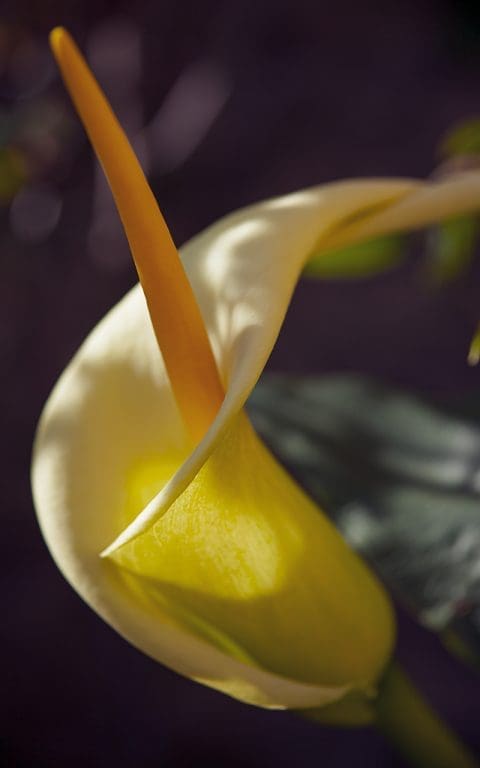
Arum creticum is a plant that has an exotic feeling about it, without making you fear for its hardiness. I have yet to see it in its native habitat in Greece, but have read that it is found in cool crevices in open, deciduous woodland. Though it is perfectly hardy here, rising early in a countermovement to flush fresh green leaf in autumn, it prefers a position where it can bask in winter sunshine and a leaf-mouldy soil that holds moisture in winter and dries out in summer once the plant is dormant.
I moved the rhizomes to Hillside a couple of years ago from a clump that we had growing in the studio garden in London at the base of a south-facing wall. They flowered well for the first couple of years, but my desire for privacy has rapidly seen this one-time hot spot become shadowy, as the limbs of Cornus ‘Gloria Birkett’ have reached up and out to dapple the garden. As the shade made itself felt, so the arums went into a holding pattern of leaf and no flower to let me know that, although in Greece life on the woodland floor might be tolerable, it was not so here where the intensity of spring light is so much less reliable.
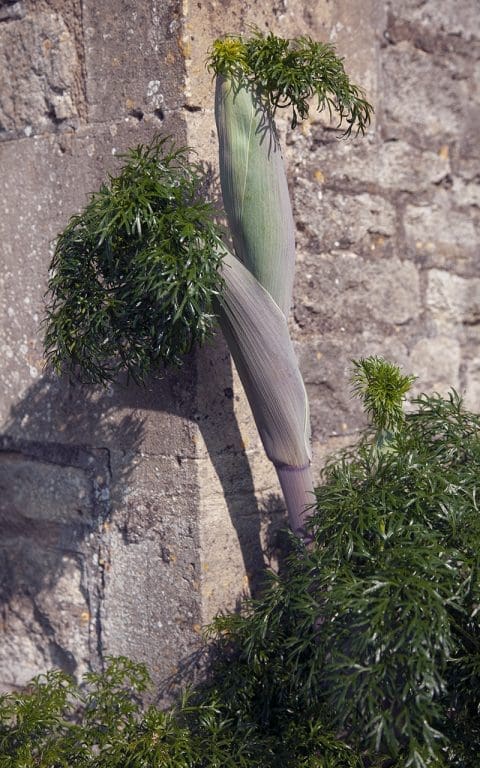
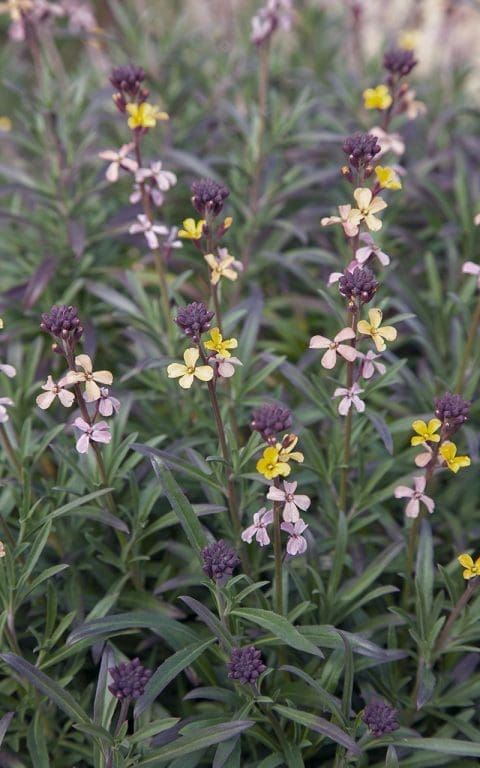
I dug up the rhizomes just as the plants were going into dormancy and put them against an east-facing wall where they have all the light they need, but also, importantly, shelter from our prevailing westerlies. I’ve noticed that I have left some youngsters behind in London, for the rhizomes divide easily, but I will gather them up in the next couple of weeks and bring them to Somerset to extend my little colony.
Being one of the first parts of the planted garden you meet as you approach the house, the companions to the arum are also early risers. A fellow from the same country in Ferula communis ssp. glauca, a fellow to the fennel’s featheriness in the fern-leaved Paeonia tenuifolia and the early species wallflower Erysimum scoparium, a native of the Canary Islands. The simplicity and architecture of the arum sits well against the filigree foliage and the mutual break with winter could not make a better welcome.
Words: Dan Pearson/Photographs: Huw Morgan
Published 30 March 2019
It took us the best part of a month to strip last year’s skeletons from the garden and to ready the planting for spring. It was good to take the time to acclimatise the eye and to look with care at what had been happening over the past year at ground level. Monkishly bald centres in a couple of the cirsium revealed that they need splitting to retain their vigour. Now that they have shown themselves again after winter dormancy, the advance of the Eurybia x herveyii will either need to be kerbed or, if I am brave enough, allowed to mingle and test both the tolerance of their neighbours and my courage to let the garden evolve as it wants to.
The feeling of openness is a shock at first, when all you have to counterpoint it is the flush of mid-February snowdrops, but by March I am happy to have the clean start. That said, I am keen to fill the gaps and for the ground to already be offering interest. Textures of evergreen epimedium and melica that have been happy in the shadows and the interest of new signs of life. Molly-the-witch and other early peonies, almost as good in the push of new shoots as they are in flower. The shine and lustre of Ranunculus ficaria ‘Brazen Hussy’. These early-to-rise participants are key. Not only do they engage you, like a flare that catches the attention, but they are invaluable for the early bees too, which on the still days are already working the catkins on the willows in February.
This is the second spring in the new planting and already I can see that I am wanting more lungwort. Pulmonaria rubra, one of the easiest and a present from a neighbour who isn’t a gardener but can rely upon it for needing little attention, was planted deliberately close to the verandah of the studio. This faces the morning sun and I leave the doors open as soon as there is a day warm enough to work at my desk with a connection to the outside. The sound of the first bumble bees working February flower is amplified in the trumpet-shaped blooms in an orchestra of activity that reminds me that I have a responsibility for the garden to offer as much early forage as possible.
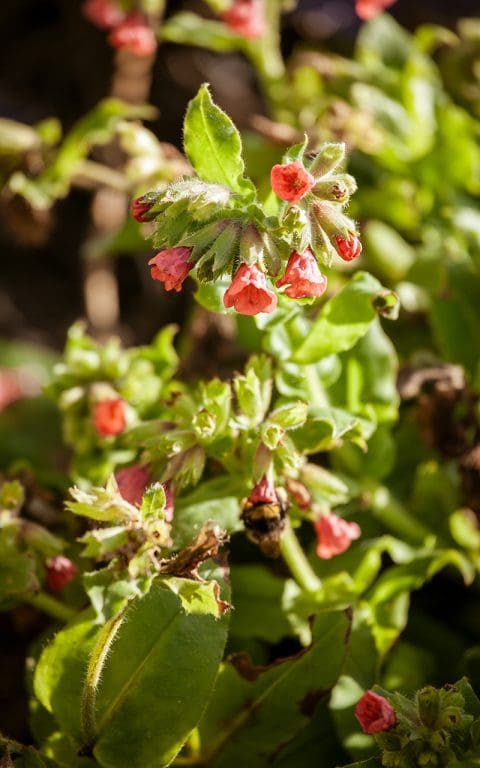
Pulmonaria rubra is a modest plant, with plain apple green foliage and soft coral red flowers that fade pleasantly, like well-washed fabric, as they age. With me it is up and in flower in December and completely evergreen and so reliably weed suppressing. Where most pulmonarias by nature are edge of woodland or damp pasture plants, on our heavy ground this is an easy lungwort and quite happy here out in the open. Retentive soil or a cool position is their favoured habitat and one that makes them very useful amongst summer plants that rise above or overshadow them later in the year.
At the Beth Chatto Symposium last August, I was interested to hear how committed Cassian Schmidt was to using early ground covering plants at Hermannshof to protect the soil and suppress weeds early in the season, as well as providing early flower interest. He had introduced a layer of Primula vulgaris and early bulbs so that the ground was always covered and occupied between later-appearing perennials. As time goes on I will introduce more bulbs, but the likes of the lungworts, alongside violets and primulas, will be ideal in helping to provide this layer with the aim to combine plants that are happy in each other’s company, not fighting or competing, much as they would do naturally on the forest floor.
Where the shrubby Salix gracilistyla blur the garden’s boundary with the field, I have been busily planting Pulmonaria ‘Blue Ensign’. This time last year we painstakingly removed the Galium odoratum that in just a season had run riot there on our hearty ground, threatening to engulf every perennial in its path. We threw the mats of bedstraw down under the crack willow on the ditch, where it has now found its place and is behaving much better with other native plants that are up for the competition. I left the area fallow during the summer to ensure I hadn’t missed a bedstraw tendril but, as autumn opened up the area again, I have replaced it with Pulmonaria ‘Blue Ensign’. This highly floriferous lungwort has an electric, gentian-blue flower, that first appears in February and continues to build in volume through March into early April. It also has a simple green leaf, coppery at first, smaller and fleshier than P. rubra. The plants are clump-forming and will survive for many years without splitting. New plants are put in at around a foot spacing and I expect them to touch and do their job of protecting the soil by autumn.
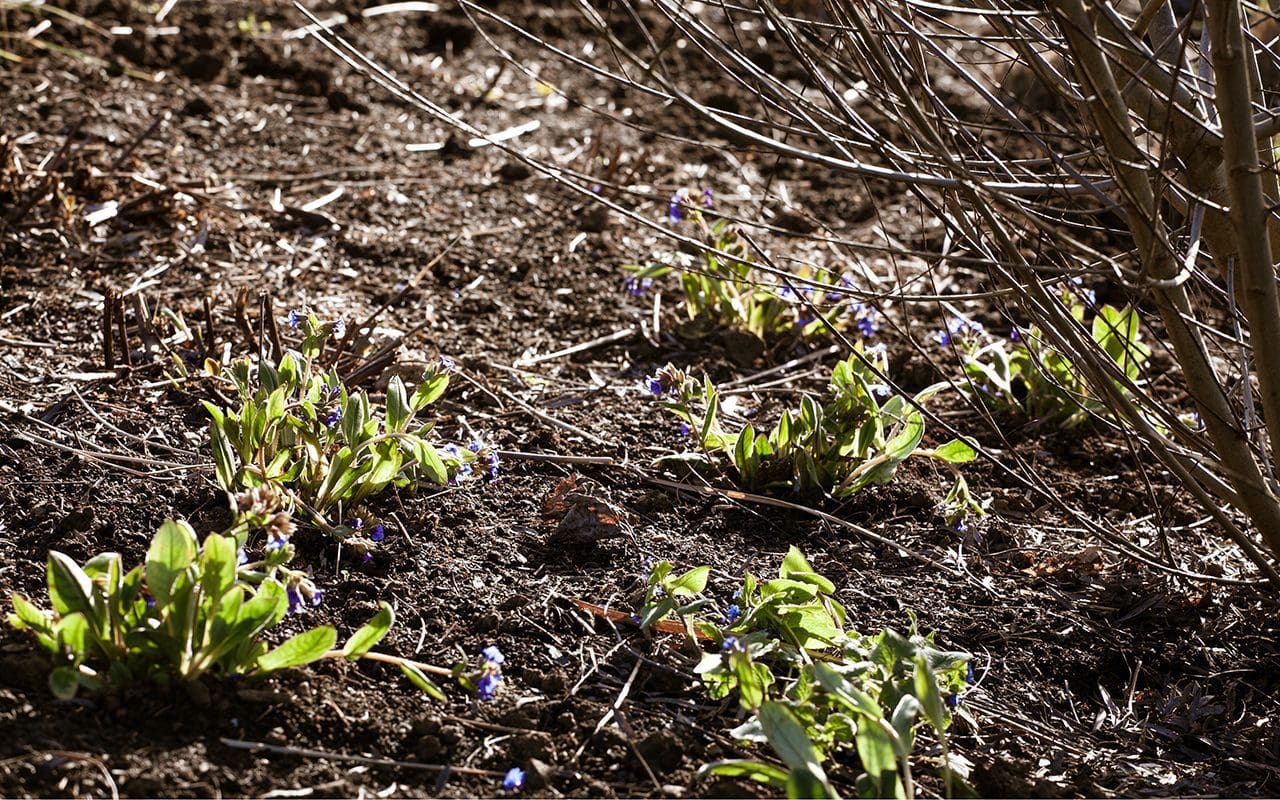
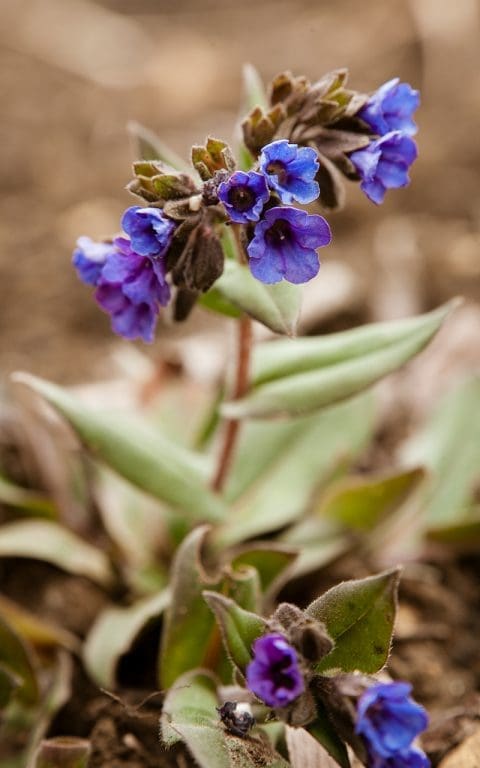
Though I initially introduced the lungworts here at Hillside with two that have plain, green foliage, a more typical characteristic is the mottled leaf which appears in some as a dappling of light-reflecting pearly spots, in others a more dramatic complete silvering. The Latin name is derived from pulmo, meaning lung, as the spotted leaf was thought to resemble an ulcerated lung and in early apothecary gardens it was used as a treatment accordingly. Silver plants are usually adapted to refract light in bright sunny conditions, but the silver-leaved pulmonarias are a welcome element to brighten the shadowy places.
The Pulmonaria officinalis selections and hybrids typically have the dappled leaf and offer a wide choice of colours ranging from white to pale blue to cobalt with ‘Sissinghurst White’, ‘Cotton Cool’ and ‘Highdown’ among commonly available varieties. Lungworts are promiscuous so you will soon find seedlings that show variation if you are growing several together, but it is worth seeking out the ones that fit the way you want a planting to feel. Pulmonaria saccharata is the most dramatic of the group, with forms showing much variability, but the silvered and spotted foliage is characteristic. I grew the straight species when I was a boy, having seen them used at Chelsea by Beth Chatto. They thrived in a cool position on our thin, acidic sand and proved their worth in illuminating a garden that needed sparkle once the trees provided shade.
Pulmonaria saccharata ‘Leopard’ (main image) is one of my all-time favourites. Again, early to start in February with flowers that age from soft brick red to dusky old rose. There is a lightness in the variation. ‘Leopard’ is a robust plant, easily reaching a foot and a half across and, as the flowers pass as spring gives way to summer, the heavily spotted foliage expands to become the focal point. I first grew it under leafy Tetrapanax papyrifer ‘Rex’ in our Peckham garden and found it prone to mildew in dry summers there, but moisture or a good mulch at the root will diminish this likelihood. Here on our hillside it is pooled under the mulberry where, as the heavy shade gathers, it keeps the darkness interesting. I hope that the erythronium that I’ve laced amongst it will favour me and not find our open hillside intimidating, and that the lungworts will help keep the microclimate more stable for them.
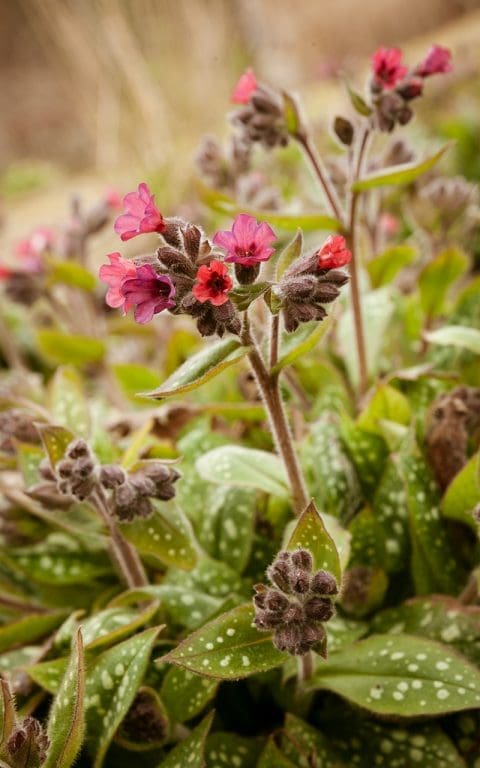
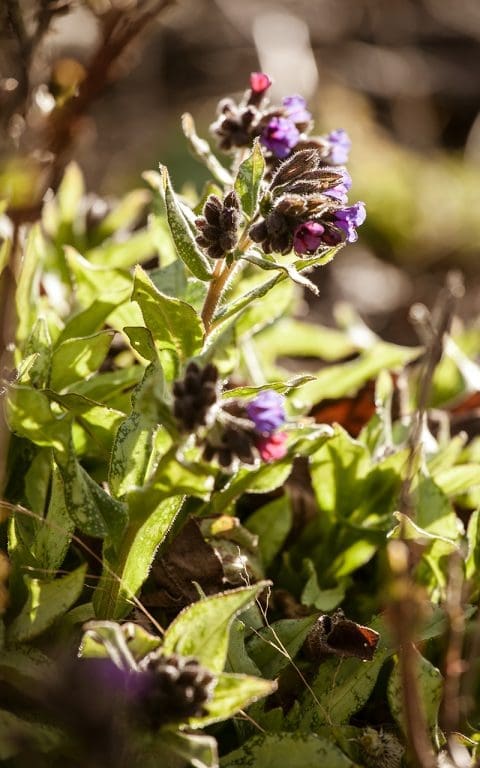
I’m using the silvered varieties carefully here for fear that their eye-catching foliage might prove too ornamental for the feel of the planting, but as a glint of light Pulmonaria ‘Diana Clare’ – which must have some saccharata in her blood – is a treasure as a complement to darker foliage. The flowers are dark plum taking on a violet cast as they age and are tightly clustered as the plant awakens from dormancy. I have them amongst Eurybia divaricata, which overshadows them later in the autumn, but provides a nice scale change. The lungwort with a simple elongated silver-green leaf, the aster fine, lacy and bottle green, ensuring that one end of the season works very nicely with the other so that the garden goes not in fits and starts, but flows between seasons.
Words: Dan Pearson / Photographs: Huw Morgan
Published 16 March 2019
Our hillside position comes with the weather and, perched as we are above the shelter of the woods below us, the wind is free to whistle. Our usual breeze, which brings most of the rain from the south-west, comes down the valley, whilst the chill winds that so often hit when the garden is coming to life, pushup the valley from the east. Unseen until you give it something to move through, the wind is something I set out to harness in the planting. The slopes behind us are allowed to run to meadow in the summer and the landform that we made to hold the buildings and the kitchen garden is also seeded to meadow. Look up the valley from the house and you can often see a breeze before it arrives, rippling towards us and making the wind visible.
The inclusion of ornamental grasses brings the meadows and their movement into the garden and it was important when trialling the grasses that they felt in tune and part of this setting. The deschampsia, molinia and panicum all had the modesty and grace I was looking for, but it was hard to have a grasses trial without including miscanthus. Silvergrass, clumping by nature and forming a distinctive mound of foliage before showy autumnal plumage, are not grasses that you use as a backdrop or a gauzy support. They are the stars when they are out and demand your attention.
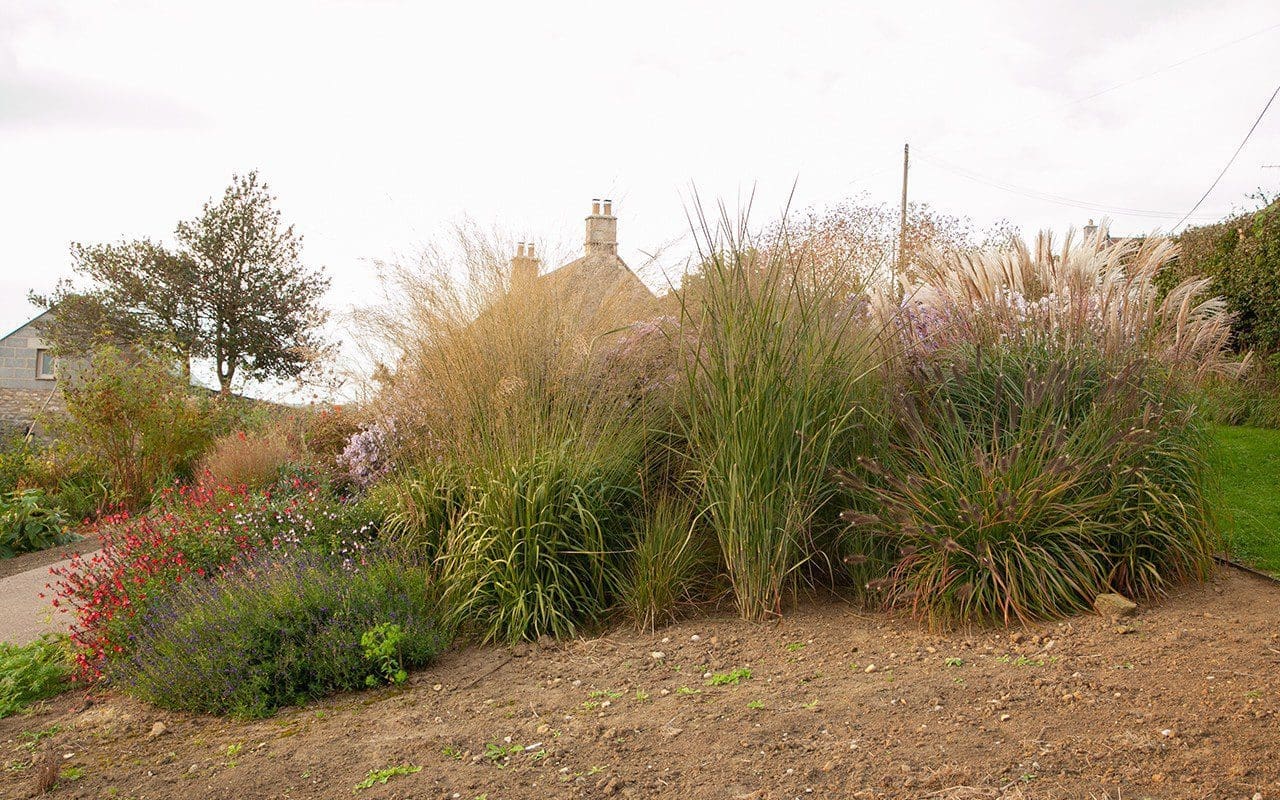 The grass trial in 2016 with the miscanthus to the right
When I first started gardening miscanthus were perhaps more fashionable and the domain of designers such as John Brookes and Oehme and Van Sweden. My first encounter as a teenager was with Miscanthus sinensis ‘Silberfeder’ and at home I teamed it with Rudbeckia laciniata ‘Herbstsonne’. Together they soared to two and a half metres to fill our kitchen windows with artificial sunlight. The golden flowered black-eyed-Susan and silver feathers of the miscanthus provided for a full three months of autumn. I have played with miscanthus fairly consistently since then, slowly working my way through a plethora of species and cultivars. In the early years Miscanthus sacchariflorus was a favourite for its three metre stands of rustling sugar-cane foliage and then M. sinensis ‘Zebrinus’ for its distinctive horizontal stripes of bright lime green. These plants were selected for their structural presence, but we are spoiled today with a wealth of forms selected for their silky flower.
When I had enough space of my own in our old Peckham garden I toyed with several different varieties over the fourteen years we were there. Getting to know a plant for three or four years and then moving on to try a new variety kept the garden moving and my knowledge and appetite replenished. Miscanthus nepalensis was perhaps the most exotic, a relatively tender species with pendant, burnished plumage like a golden fleece. Though beautiful it proved to be less reliable than others. This was possibly due to the fact that I tried to insert them when the planting was well-established, casting too much shade and competition. One of the great positives about miscanthus are that they are reliably clump forming and long-lived too, if you give them the room and the light they need to perform.
The best of those that I have experienced for myself combine a good balance of foliage and an ability to stand well once they come into flower. The lofty ‘Silberfeder’, for instance, leans as the flowers develop. Varieties such as ‘Yakushima Dwarf’ and ‘Kleine Silberspinne’ have been specifically selected not to take space, their fountain of foliage being neat and their flowers losing none of their grace for being upright and self-supporting. A good plant is one that you can leave more-or-less alone from the point it is taken back to base in February. It will pull away with a fresh mound of strappy leaf and then need no corralling as it comes into flower.
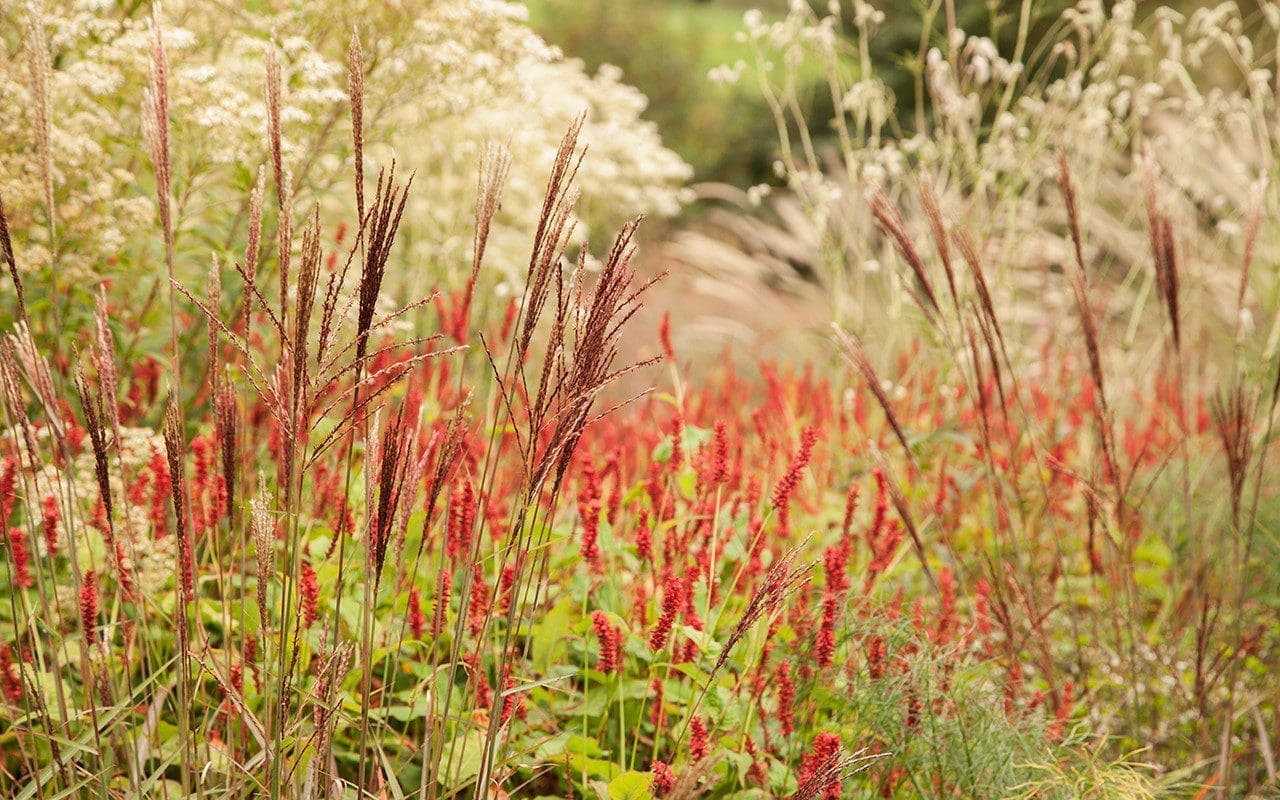 Miscanthus sinensis ‘Dronning Ingrid’ with Persicaria amplexicaulis ‘Blackfield’, Aster umbellatus and Sanguisorba ‘Stand-up Comedian’ in September
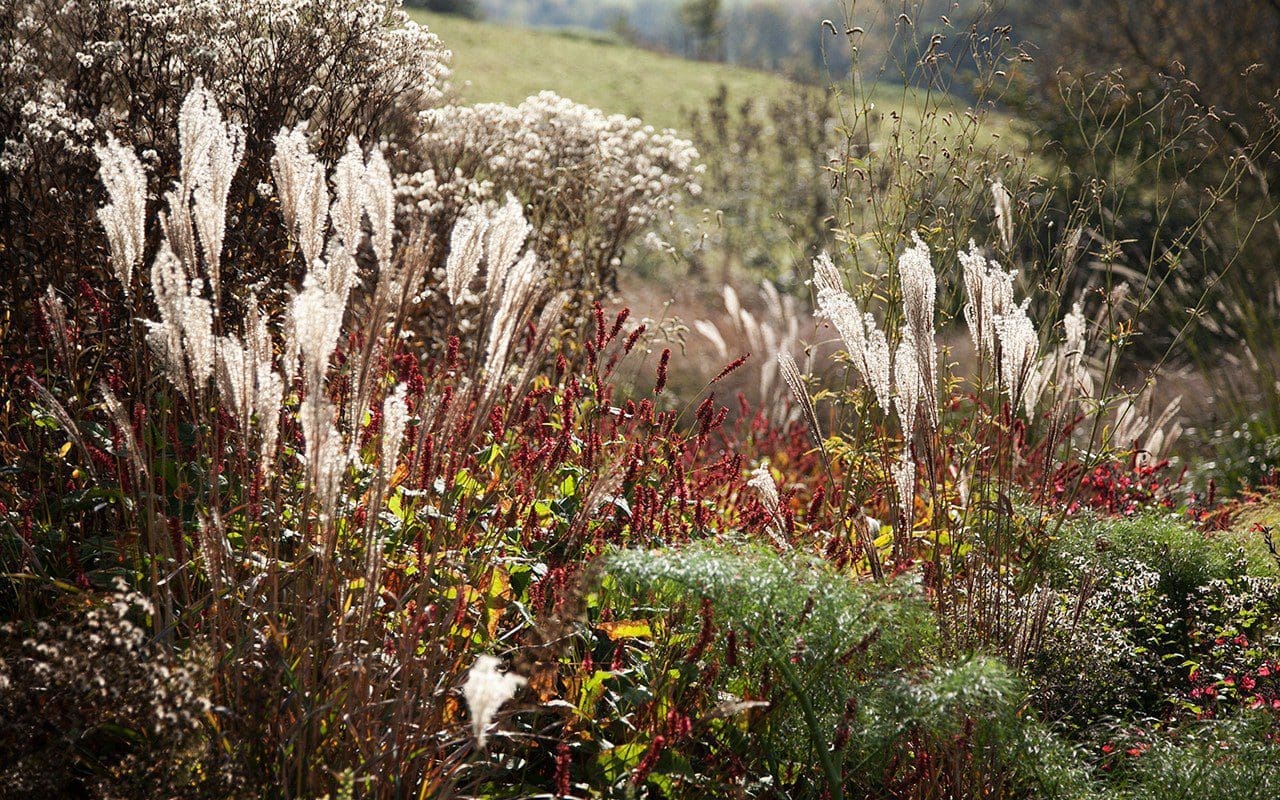 The same combination in late October
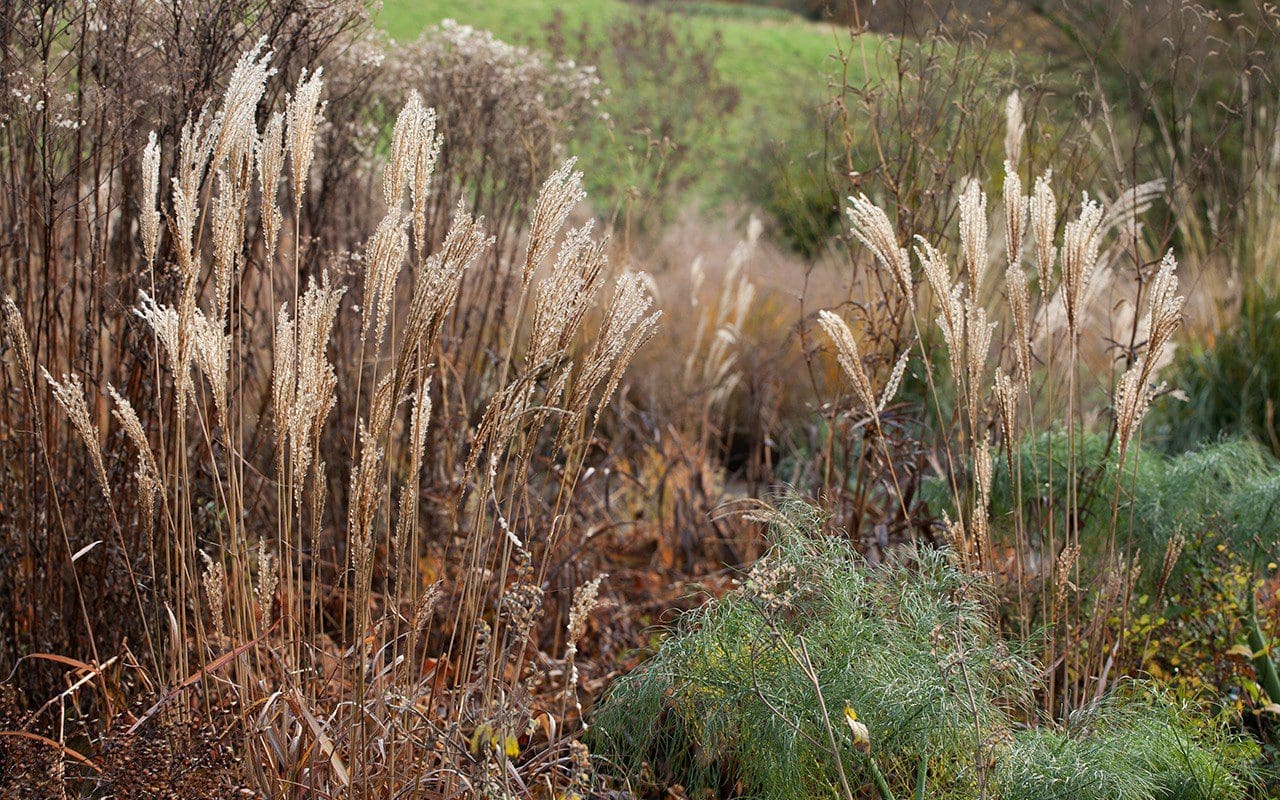 And again in late November
Whether they are tall or short, miscanthus always have a presence and it is no surprise that in Japan, where you will see their silvery plumage animating roadsides, they are celebrated as the harbinger of autumn. This is their real season and, though I always enjoy the reliable companionship of their foliage in summer, the moment their flowering stalks begin to rise, you know that the next season is in the air.
The flower colour of the named forms varies enormously, the silver plumage of the wild M. sinensis being the colour you see most often. Those selected for the pink in the flower, such as ‘Flamingo’, are undeniably beautiful, but they set a very particular tone, which is rather unnatural. My favourites are the darkest with thunderous reds and browns in the emerging flower. ‘Ferne Osten’ is one of the first to appear in August with dark red flowers, but this earliness brings the autumn feeling into the garden too soon, as the flowers ripen and pale in September. I am happy to see the flower spikes breaking free of the mounding foliage in August, but over the years I have come to prefer pushing autumn the other way and to only now be feeling that we have seen the last of it and that winter is upon us.
Of the five or six miscanthus I trialled for the garden here, I had to be strict. In fact I almost discounted them altogether as being too showy for this rural location. The ornamental mood of the Silvergrass requires them to be close to the buildings or where the garden can afford to feel less connected to the meadows beyond us. I kept two, the first to come to flower being ‘Dronning Ingrid’. This is a delightful plant (main image), good for being modestly sized both in the scale of the leaf and the mound it creates as it gathers in strength during the summer. The flowers started to push up in August here, showing their dark, wiry filaments by the end of the month, their upright form retaining space between the plumage. I like this very much because the flowers act as weather vanes, describing the wind in each of their outlines. The deep mahogany in the flower is set against pale Aster umbellatus and the redness picked up in an undercurrent of Persicaria amplexicaulis ‘Blackfield’. They retain a sleek darkness for the best part of six weeks, before the foliage reddens and the flower ripens and pales as it becomes more feathery.
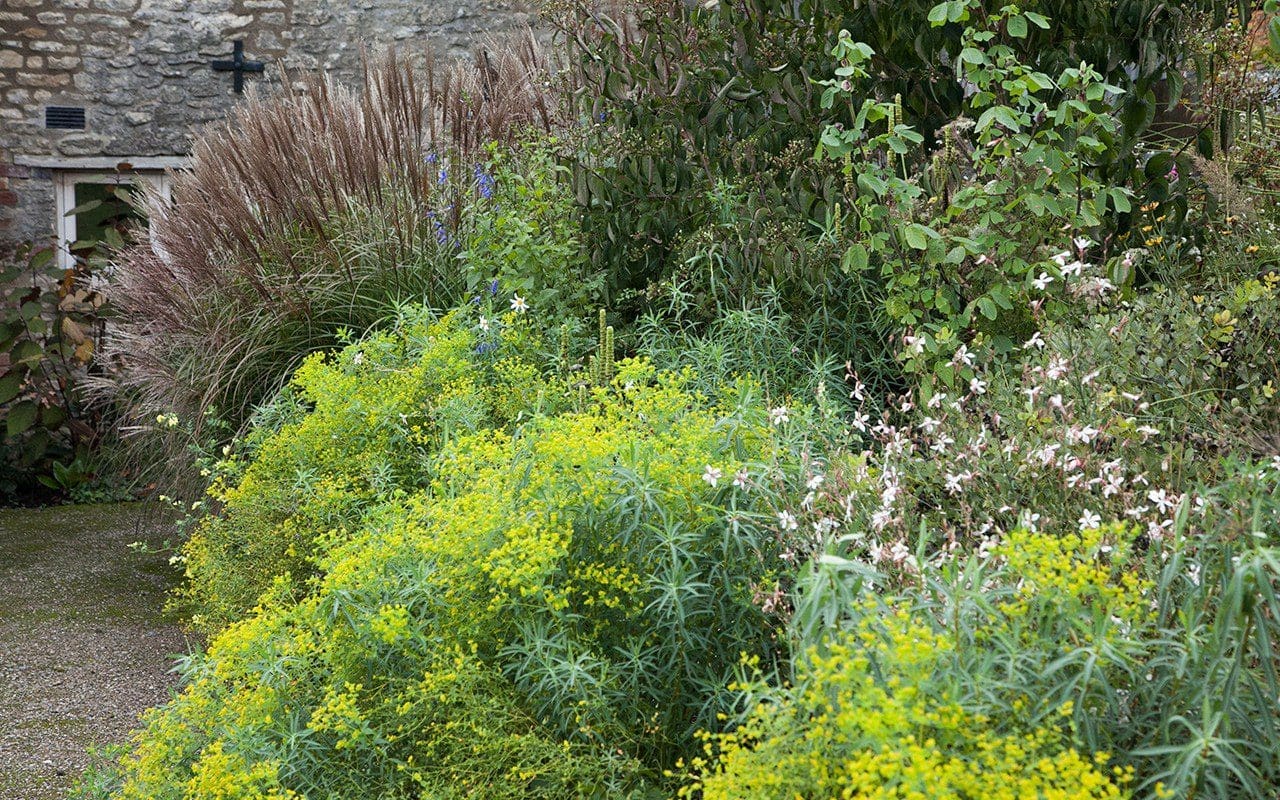 Miscanthus ‘Krater’ holds the bottom of the steps that lead down to the studio
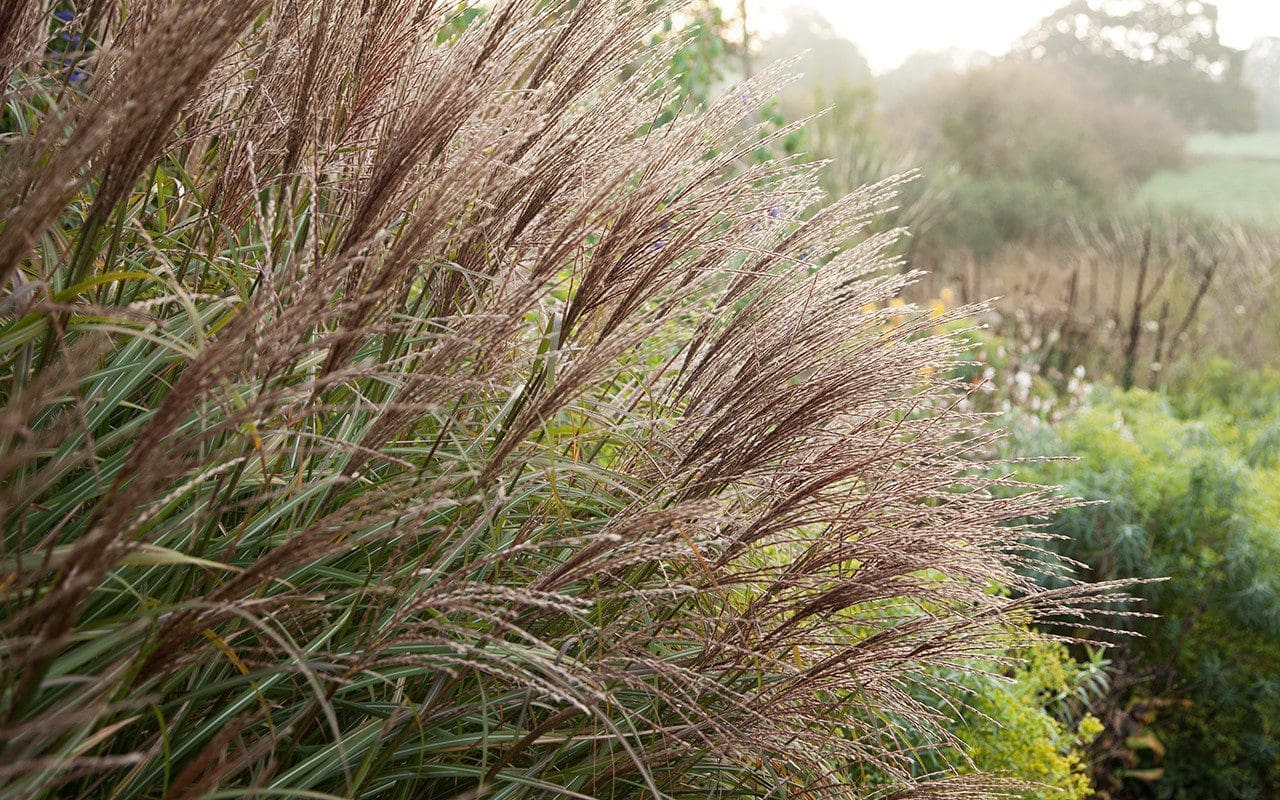 Miscanthus s. ‘Krater’ in early October
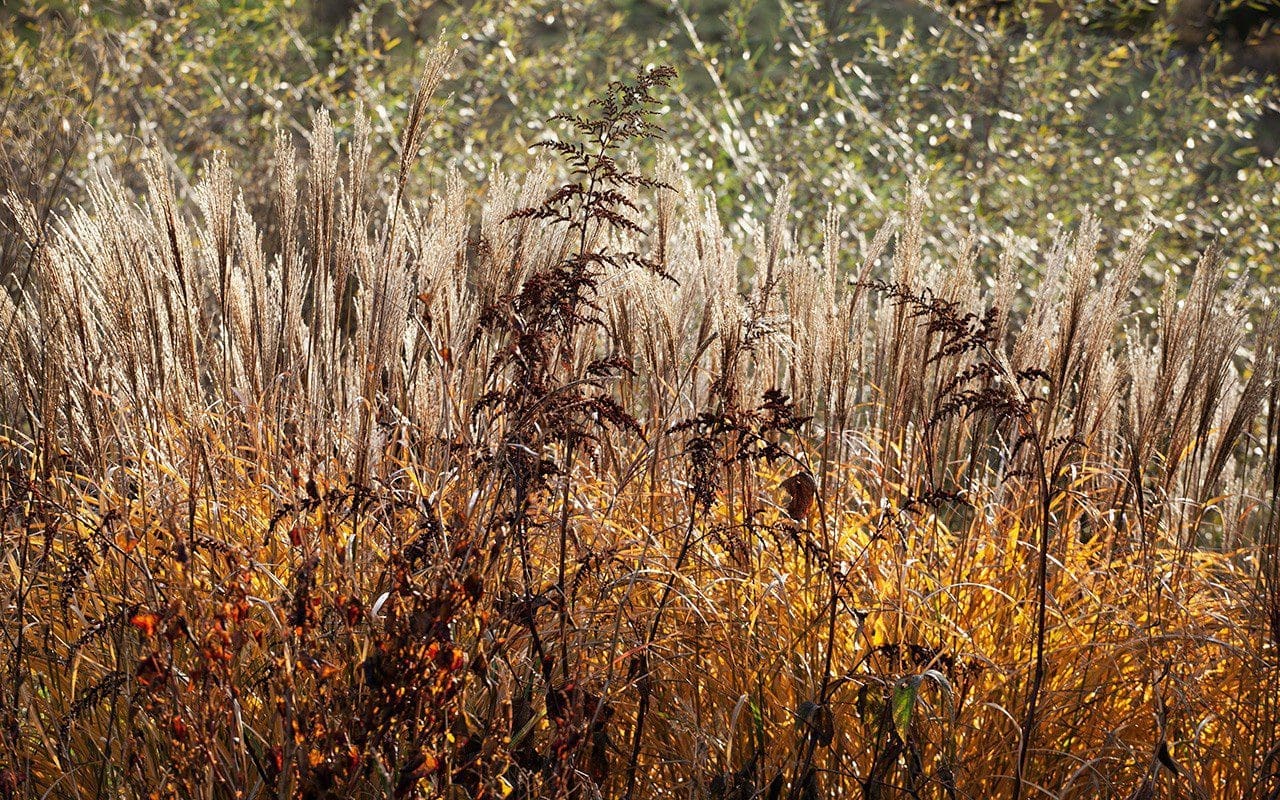 Miscanthus s. ‘Krater’ with the dark seedheads of Astilbe rivularis in November
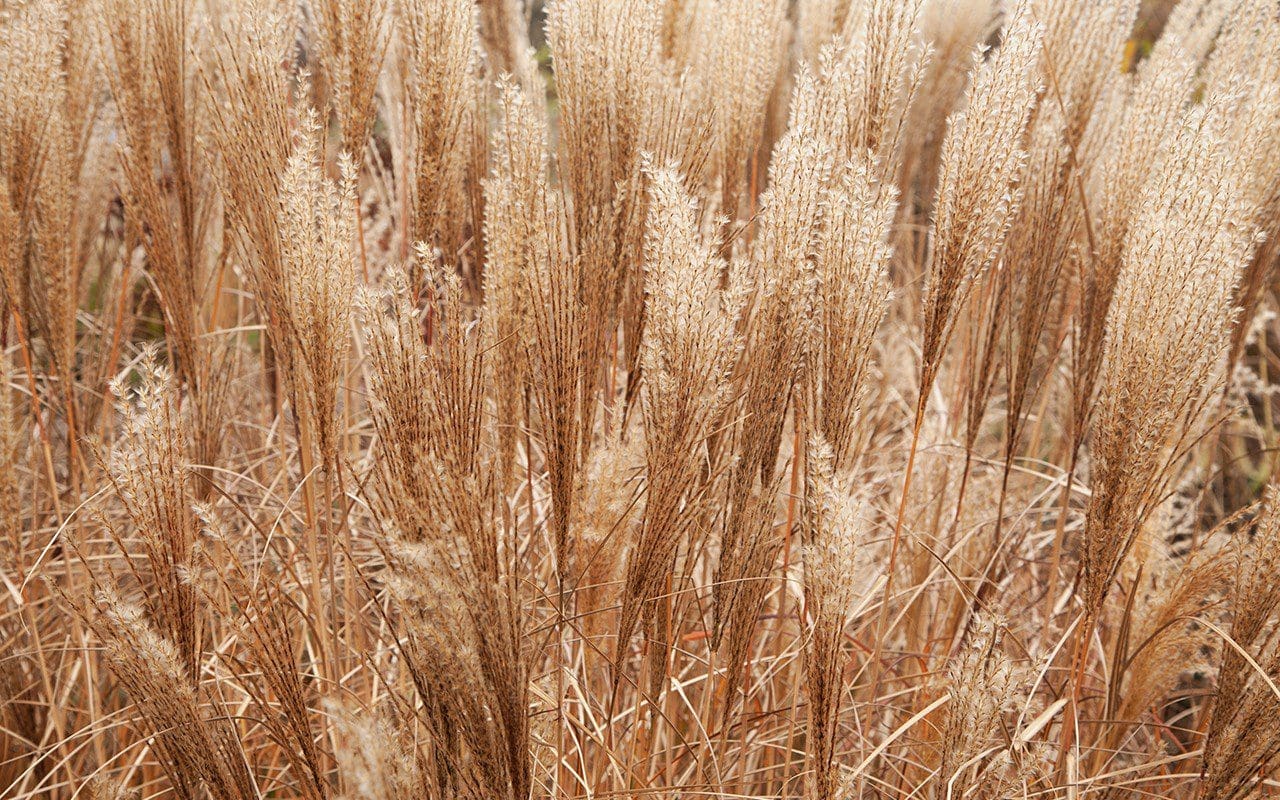 Miscanthus s. ‘Krater’ in early December
‘Krater’ is the bigger of the two, but still compact and orderly. It is planted here to hold the corner at the bottom of the steps down to the studio where the foliage mounds to waist height before pushing up flowers in September. The original clump was quartered two years ago (in March, the time to split grasses) and I do not expect to have to divide them again for seven or eight years. They take the full brunt of sunshine in this position and provide shadow for hellebores I’ve planted on their north side. This ability to use miscanthus like shrubs for structure and shade is one of their greatest assets. ‘Krater’ also starts dark and moody in flower, but the flowerheads are both a more subdued grey-brown and more open and tasselled than ‘Dronning Ingrid’. As the season progresses the foliage flares yellow and orange before bleaching to parchment for the winter. As the flowers age and the dark cloud silvers, they provide us with light catchers to arrest the low rays as they glance through the garden.
By the end of February, when we start to clear the perennials, I will have had enough and will take a serrated Turkish knife and fell them to the ground. This will mark the end of the period we are now just entering, a winter endured and mapped in a grass that I will always take time to make room for.
Words: Dan Pearson / Photographs: Huw Morgan Published 8 December 2018
A chill wind is pushing the weather through the valley, tossing the garden and tearing the colour from the trees. This late autumn feeling is distinct for being burned clear into our memory of arriving here exactly eight years ago. We sat on the banks below the house wrapped in blankets on the same chairs that, just the day before, were out on the deck in Peckham, where we had willingly left a well-loved garden behind. The feeling of the new and the excitement of a prospect is still very clear to me and the anniversary has given us cause to ponder all that has happened since. The unloved land, grazed to the bone and up to the very foundations of the buildings, is now softened by growth. We look up the slopes into a little wood – our first planting project that winter, where an empty field gave way to a broken hedge – and down onto a new orchard where the trees are fruiting and casting their own proper shade. It is time marked very tangibly in growth.
Our thoughts that first weekend had not yet formed this place, but today it is better and more giving than I could ever have imagined. The reward comes from both the continuity and the luxury of being able to build something for yourself and be witness to its evolution. Every month we have been here has revealed something new, but the garden has amplified our connection with the land and the seasons. It is just a year since we completed the planting of the garden proper, but it is safe to say that every week has been provided for and, on this last full day of British summertime, the garden is still a place we can be where the season doesn’t quite have the upper hand.
This last push of flower before the frost takes hold is important, for soon all will be gone. Though I do not miss it then, for flower soon starts to feel out of place amongst the skeletons. Some of these late performers, the asters for instance, have been biding their time as they have built up their resources, and the place they have occupied until now is a necessary one that I have learned to see as a foundation for autumn rather than space wasted for earlier performers. The backdrop they provide in foliage to earlier-flowering perennials has offered stability and constancy. The filigree foliage of the October-blooming Aster turbinellus, for instance, is as delicate as netting and the flower equally beautiful and finely-rayed. Rising to almost a metre in height, but leaning as it comes to flower, it remains one of my favourites for its bright, clean colour and its thoroughly reliable, clump-forming habit.
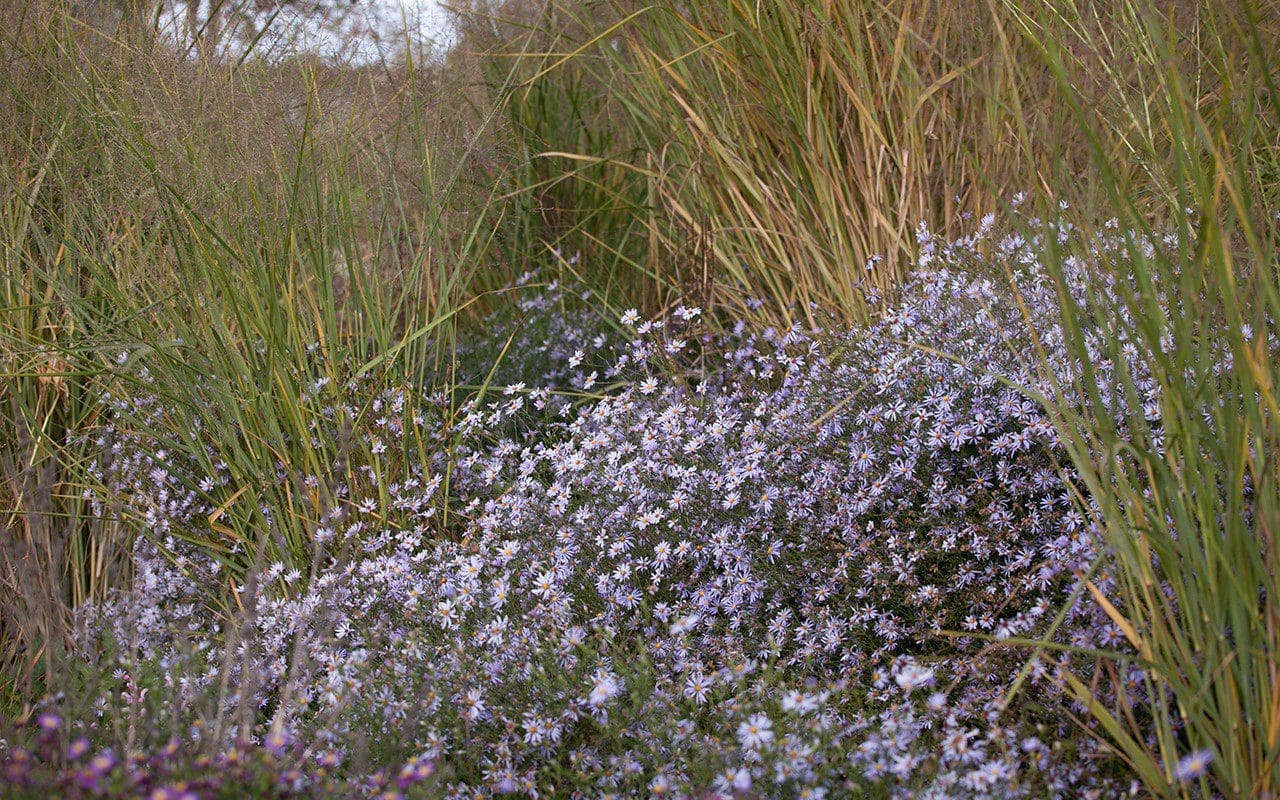 Aster turbinellus growing through Panicum virgatum ‘Cloud Nine’
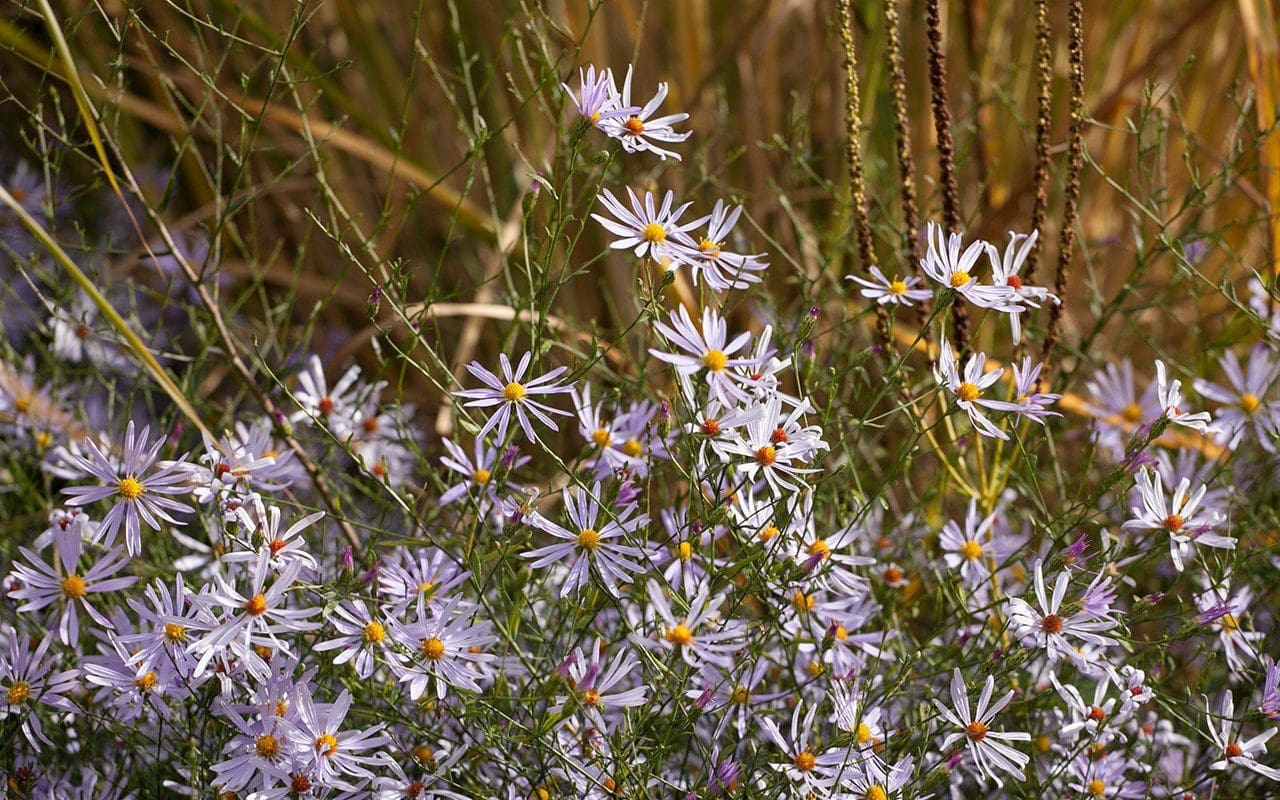 Aster turbinellus
I am not sure yet whether I can say the same for Aster ‘Ezo Murasaki’, which is bulking up steadily. Asters that stay put in a planting are important, but so far I have forgiven this Japanese native its lust for life. It has licorice-dark stems and serrated foliage which you might at first think belonged to a chrysanthemum and that colours with red tints as the temperature falls. It comes into flower in late September at about 60cm, and is at its zenith now. The flowers are single, with bright, violet centres, darkening towards the tips and ageing to royal purple, giving the mass of flower a variance in depth. They also have a bright gold eye which prevents them from feeling sombre. I have them paired with the muted tones of Teucrium hircanicum ‘Paradise Delight’ in an undercurrent beneath Molinia caerulea ssp. arundinacea ‘Transparent’. We will see in time if they creep too readily. Three years of growing them has shown me that they need to be watched, but not worried over like some asters.
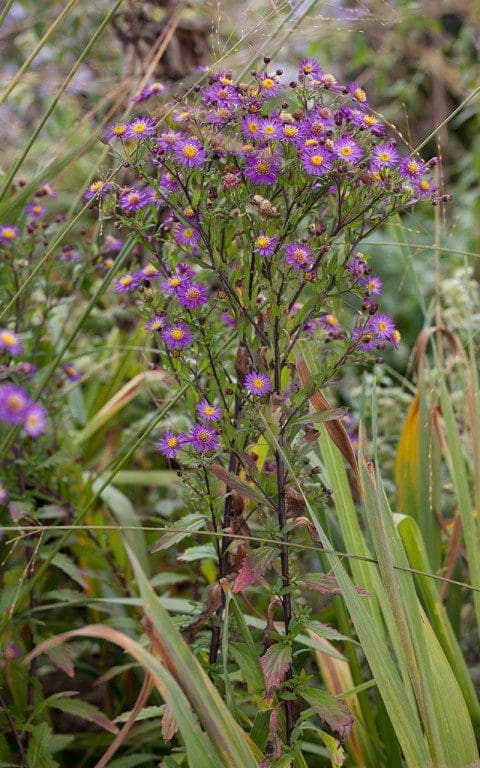
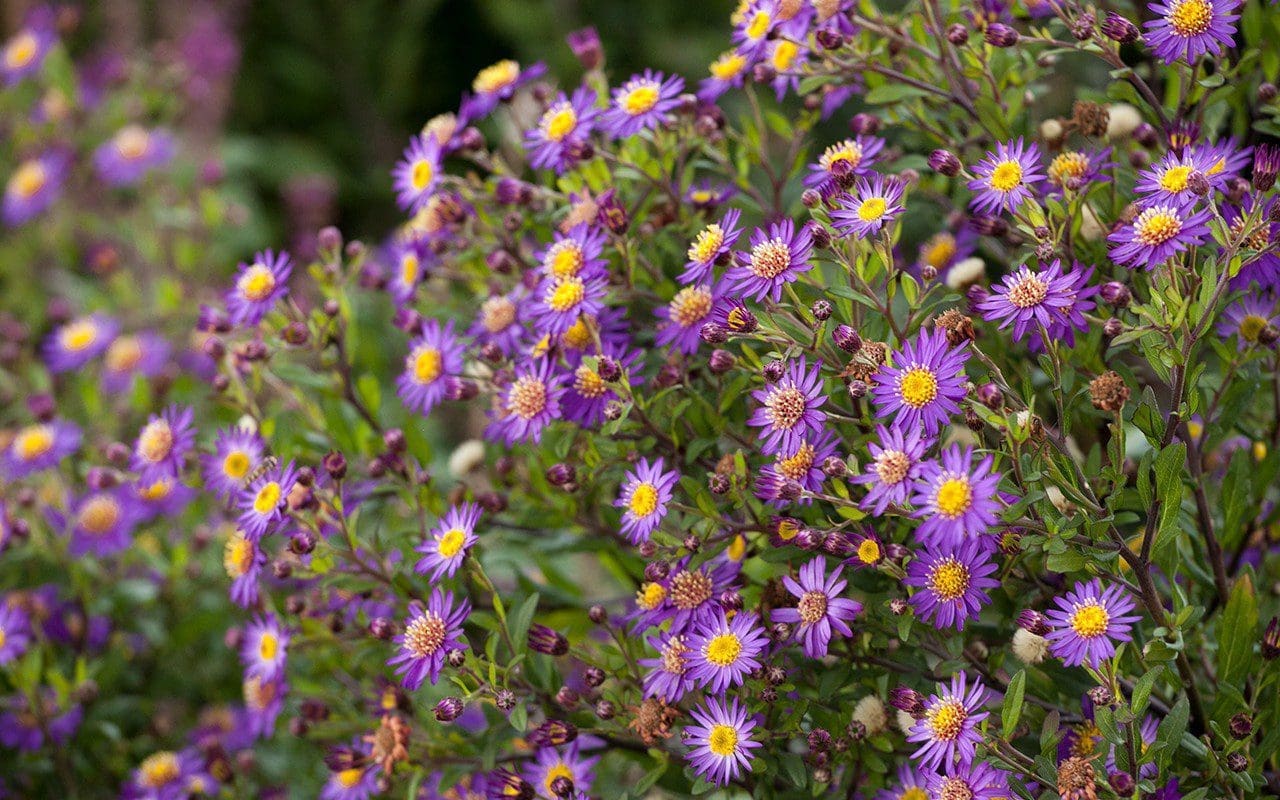 Aster trifoliatus subsp. ageratoides ‘Ezo Murasaki’
Close by, and doing better than I had imagined on our open slopes because our soil is retentive, is Tricyrtis formosana ‘Dark Beauty’. I have them grouped under a young crab apple, which will provide them the dappling they need and look better for in time. ‘Dark Beauty’ is a named form that retains the spotting that gives them their common name, the Toad Lily, and I prefer these to the plain selections without spots. However, it isn’t as dark as I had imagined and I’m on the look-out for a deeper-coloured selection having seen and remembered them from my time at The Edinburgh Botanic Garden. If they can be bettered, I will replace them. That said, for the past six weeks they have been a delight and will continue until they are felled by frost.
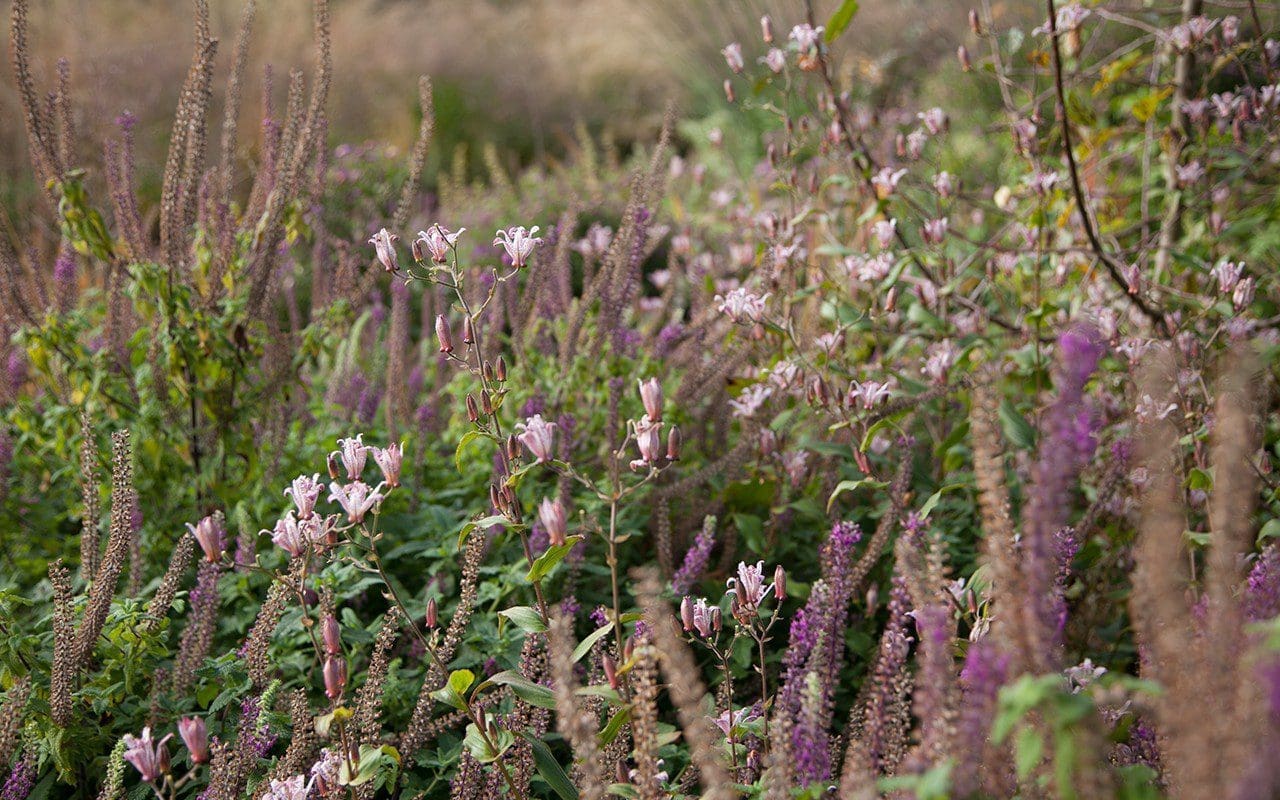 Tricyrtis formosana ‘Dark Beauty’ and Teucrium hircanicum ‘Paradise Delight’
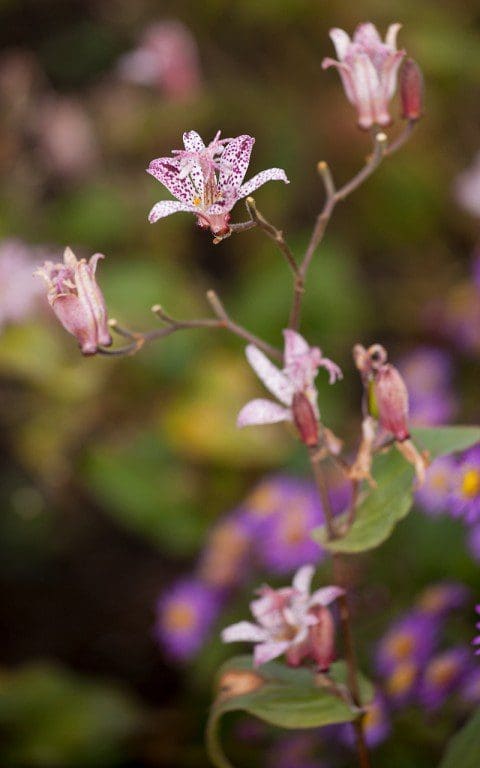 Tricyrtis formosana ‘Dark Beauty’
Also worth the wait if you can find it a place where the foliage doesn’t burn, are the actaea. A tribe of late-flowering perennials that occur both in Japan and North America, they prefer moisture or retentive soil and cool for their foliage. Where I have used them in the parterre at Lowther Castle, they thrive in the open with the wetter climate of Cumbria, whereas down here in the south, they prefer some shade. Although they are a long-standing favourite, they have often frustrated me in my own gardens over the years. They hated me in Peckham, where my ground was too dry and their leaves burned to a crisp. The dark, ferny foliage earlier in the season is half their appeal and in Actaea ‘Queen of Sheba’ (main image), the greater part of why they are worth the effort. If you can find them a place where they are happy, they never deviate from elegance, rising up tall and taking up no more space than they need in their ascent. ‘Queen of Sheba’ is distinct from the usual vertical line of most actaea, in that its flowers arc in beautifully drawn lines. Dark buds open from the bottom upward to form a wand of light-catching, highly-perfumed plumage that last until the dark nights are with us for sure and the flowers finally fade away.
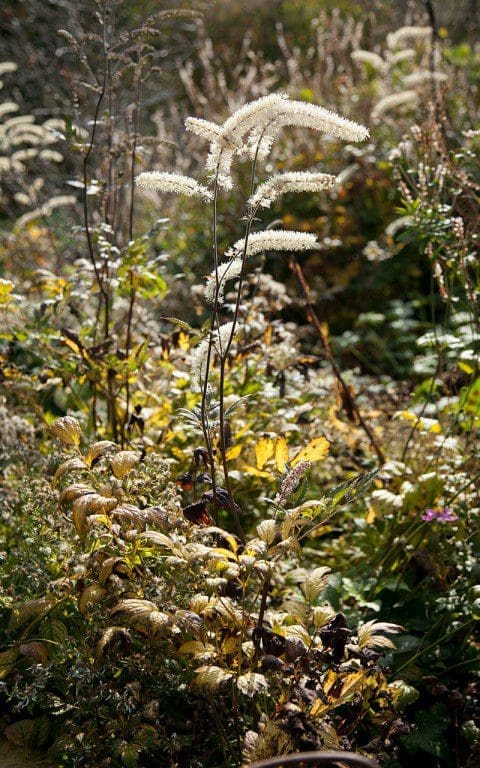 Actaea ‘Queen of Sheba’
Words: Dan Pearson / Photographs: Huw Morgan
Published 27 October 2018
We are sorry but the page you are looking for does not exist. You could return to the homepage