This is a particularly special moment of late garden and first autumn colour. On the front line to protect from the westerlies, I’ve planted the Scarlet Hawthorn (Crataegus coccinea) and a medlar. They both provide blossom and now fruit and, in the short time they have been there, a pool of stillness for the company that needs it at their feet.
Held and protected here, the Wood Oat, or aptly named Shimmer Grass, have found their niche amongst the wind anemones. I planted them throughout the bed. but towards the edges, so that we could enjoy their autumnal arc and mobility. To test their preference, because every garden has rules that do and don’t apply, a few were scattered to the windward side, because the breeze in their growth is what they need to shimmer. I know them to do best in a little shade, or more precisely on the edge of things, and sure enough those on the front line are a shadow of the plants that have thrived with the microclimate of company. Seeding about gently now, they have alighted where they tell me they want to be. On the leaward side and on the margins where, to be honest, they are most easily admired.
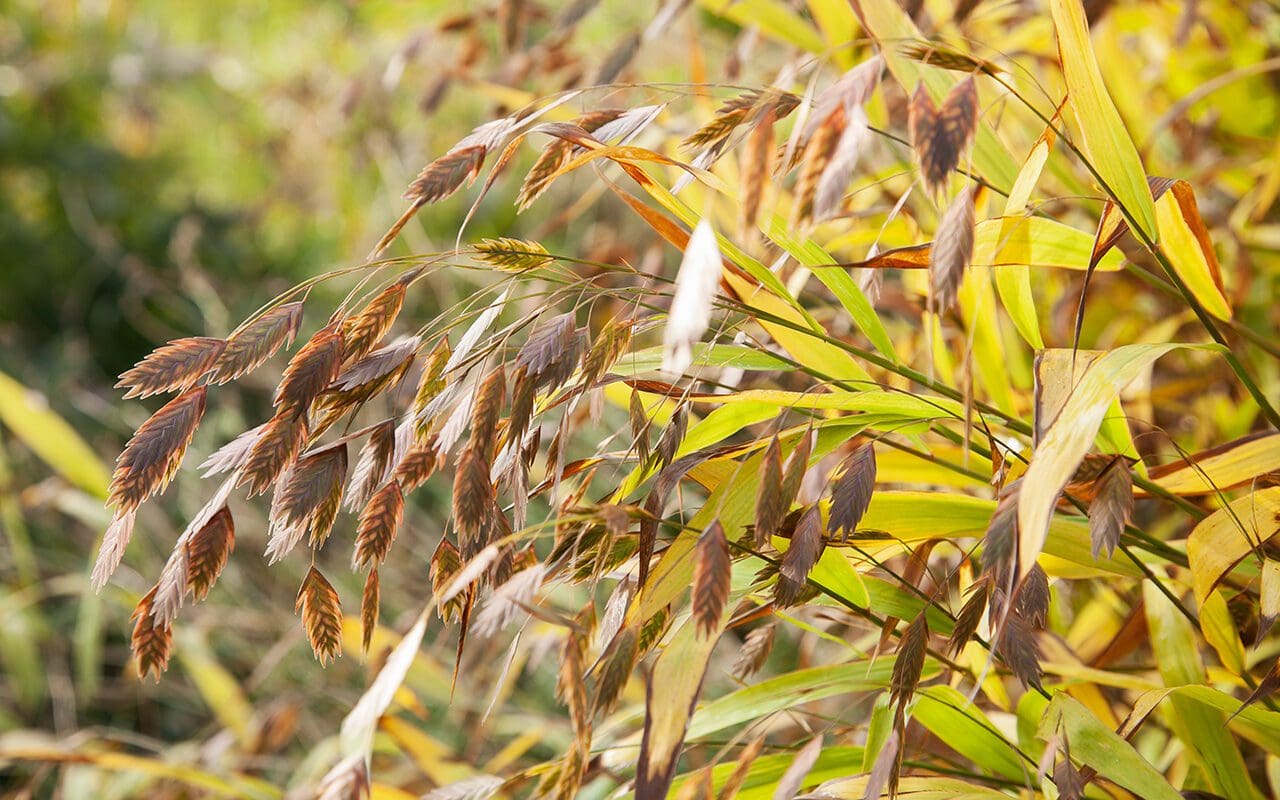
If you are to look Chasmathium up, their many common names probably result from their wide distribution, which dips into northern Mexico and travels north up the States in the shelter of wooded places. Though Wood Oats are certainly not of these shores they do not immediately make you think of somewhere else, like Miscanthus do of the orient. Feeling similar to our woodland Melica and preferring the same places I can see them becoming very much part of this garden. The sun loving Panicum virgatum ‘Shenandoah’ that have splayed over the paths this year where they have been overshadowed by plants that have done better than I thought, will be moved to make way for a more suitable grass. The Chasmanthium will be perfect here, happy to tick along in company and rewarding us with good behaviour and poise and well-paced growth that peaks so beautifully now.
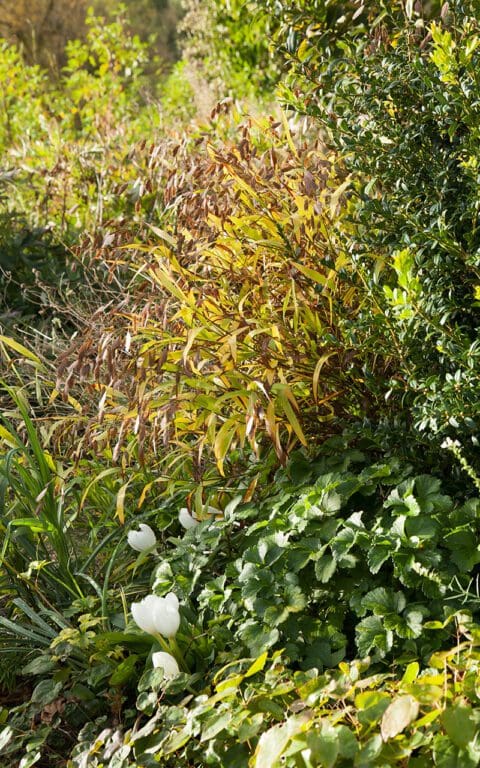
Clumping, not running and a reliably long-lived grass, I enjoy their windswept forms over the winter and cut them back to make way for snowdrops early in the new year. Wide blades, a finger’s width of a cool bright green, then stagger their way up dark stems to about knee height before they begin to throw flower in high summer. There is nothing ungainly about the Shimmer Grass and this is when they begin to, with the first sighting of flower. Firstly tiny darkened versions of what they are working towards and then slowly gaining more presence as the foliage colours butter yellow and the Asters, Colchicum and Anemone begin to provide their backdrop. Completely flat, as if they have been pressed between the leaves of a book and catching, they need the breeze, just enough to make them dart on their wire thin stems like shoals of fish darting and shimmering in the sea.
Words: Dan Pearson | Photographs: Huw Morgan
Published 10 October 2020
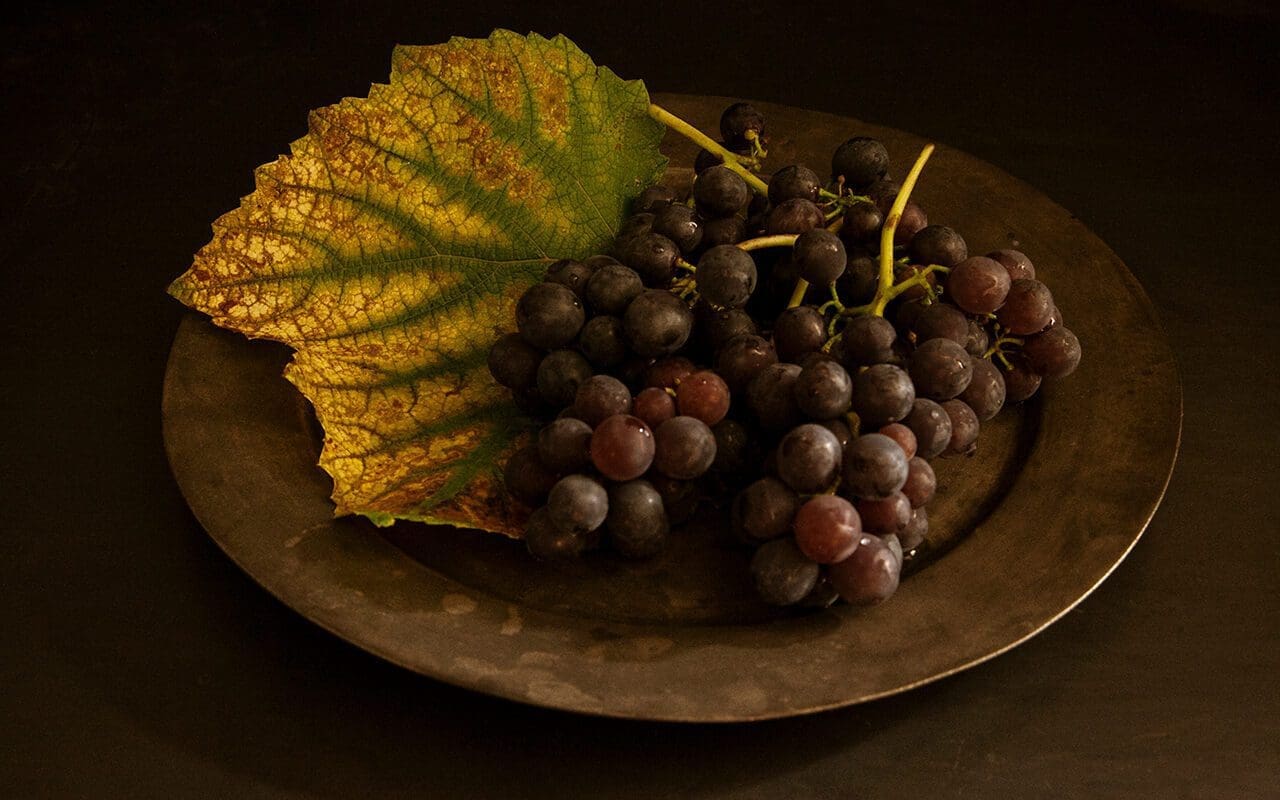
As I write, with the rain lashing down outside and not a break in the sky to suggest it will ever stop, I am conjuring sunshine. A last few days or even hours to help in ripening the Strawberry Grape, which are so very nearly, but not quite, ready for the picking.
Such is the way here when the weather turns in autumn and we find that it is now impossible to get onto the fields again until the spring. But the grape holds promise. In a good year, and I still haven’t given up hope, ‘Fragola’ is a reliable outdoor grape, a marker of summer and sunlight captured. Memories of sunnier climes and the dappled light beneath festooned bowers. The joy, in the cool damp of England, of reaching up and picking a bunch for the table.
My vine has a history, as most of the plants will have as time goes on in the garden, but this is one that I am particularly fond of. When I was starting out in my career making gardens, working out of the back of a yellow van to build, plant and then tend, Priscilla and Antonio Carluccio were some of my first clients. My great friend Frances, with whom I was making Home Farm, had introduced us, thinking we might be a good fit and knowing the rigour of Priscilla’s design eye she thought it would do me good. And she was right.
Their property was in Hampshire, not far from where I grew up, but in a totally different landscape high up on a flinty hill on the edge of downland. A thatched, low-slung cottage dating to the 1500’s set the scene and Priscilla approached everything with the care of ensuring that every mark we made felt right in this place. At the time she was the creative director of The Conran Shop and she had the rigour of her brother Terence. With her buyer’s eye everything was considered and she taught me about connections and going deep into an idea to find the thing that captures its essence. Antonio was also a central part of how the brief came together and the garden focused itself around a productive heart from which we later ate heartily. There was a simple hedged enclosure to provide shelter for a kitchen garden with fruits and herbs and hard to come by vegetables, an orchard, a nuttery and a yard full of lavender, tree lupins and oxeye daisies.

We would discuss plans and progress over a simple but delicious lunch cooked and often foraged by Antonio. Mushrooms and filberts from the woods in autumn, hop shoots and wild garlic in the spring. The conversation usually revolved around authenticity, of distilling the spirit of the place and its particularities, and of attention to detail. The curtains in the house were raw muslin and unhemmed, the paintwork just undercoat so that it looked chalky. Hazel we harvested ourselves from the coppice to weave a bower for the rose around the door or to cut stakes for the apples. Tree ties were made from hessian and nothing was used that wasn’t biodegradable. Over the five years we worked together I learned a lot in the doing whilst helping to make this place.
Antonio had a cutting of the Strawberry Grape given by a friend in Italy. He told me about the wine made from them called Fragolino and of the particular taste of the fruit eaten from the vine. I had never encountered it before, but we found a warm spot against the woodshed where it thrived and fruited well after just a couple of years. Sure enough, when darkened by late summer sun, the fruit yielded an unusual flavour. Something between strawberries and bubblegum and certainly not an obvious choice for a table grape. But its ease and readiness in our climate and its good clean behaviour have kept it a place in my heart.
At his invitation I took my own hardwood cuttings from Antonio’s plant as soon as the leaves dropped. The thickness of a pencil, but a little longer, with a sloping cut above a bud to throw the water off in winter and a horizontal cut immediately below a bud, the summer sugars will convert all their energy into root by springtime. In a year you have a new plant, which in two will be ready for its new home. That first plant scrambled over the roof of my flat in Bonnington Square, a cutting taken from that competed with Virginia creeper to smother the trellis at the end of our Peckham garden, and now I have a plant tucked in the most sheltered corner we have next to the outdoor kitchen, where we are encouraging it to grow up and soften the roofline of the building. Over the years I have passed on countless rooted cuttings from my own plant to friends and clients and always with the memory of that first gifting from Antonio, so they are given with the good feelings attached to that memory I describe here. All we need now is a little more sunshine to make good the promise.
Words: Dan Pearson | Photographs: Huw Morgan
Published 3 October 2020
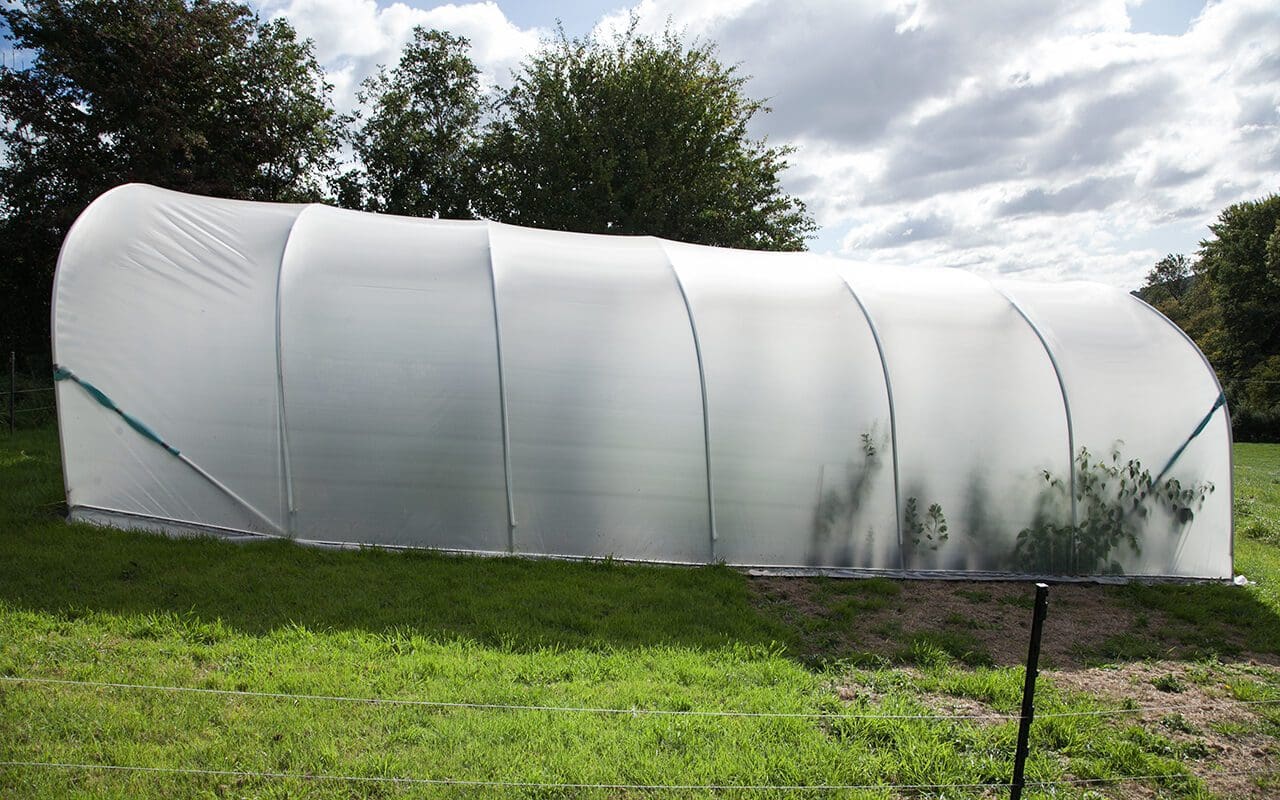
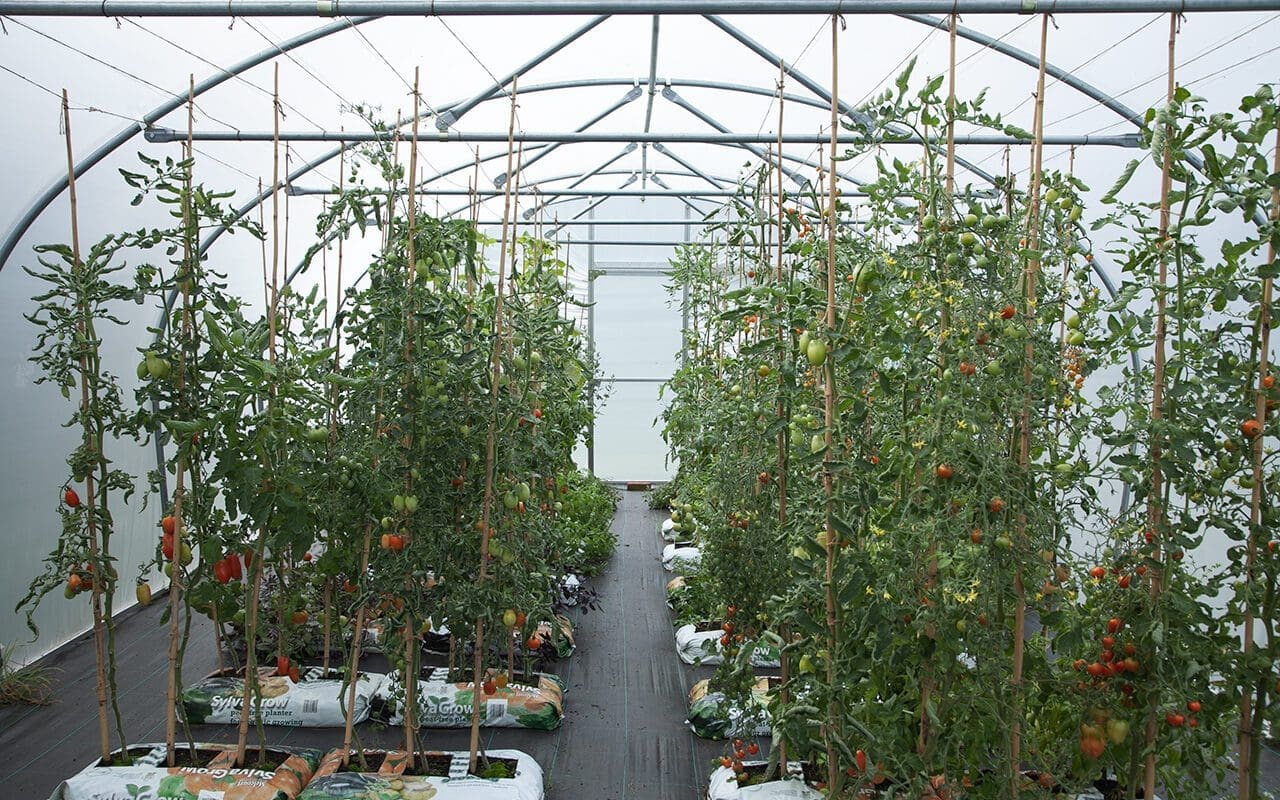
As I mentioned recently, one of our greatest challenges in the garden this year has been the new polytunnel. Having long discussed getting one, the prospect of being locked down in Somerset for the best part of the growing season meant that we were finally able to commit to the daily tending and watering requirements that weekending here meant we could never manage. Although the idea of this additional responsibility caused Dan’s mum, who was staying with us, some sleepless nights, the reality has been, in most ways, much easier than anticipated.
Our motivation for getting one was primarily to realise the unfulfilled desire to be more self-sufficient. We grow almost all of our own hardy fruit and vegetables, resorting to the greengrocers only for those things either grown under glass or imported. Although the novelty of being able to grow a whole range of tender fruit and vegetables was exciting, at the time we decided to go ahead there was a lockdown run on vegetable seeds, which meant that we weren’t able to source the everything we wanted to try. So we settled for what effectively became a trial of tomatoes. Having only grown very reliable outdoor varieties of tomato here previously, there has been much to learn and Dig Delve provides us with a means to record that learning for our future reference, as much as to share it with you.
Our first lesson was to discover that late March was very late to be sowing tomatoes under cover. We started the pots of seeds off on the airing rack above the range in the kitchen, where they were quick to germinate, before being moved to the cold frames.We were then lucky to have such good, warm weather in April, that the seedlings grew away strongly. However, because steel supplies were being diverted to make emergency hospital beds, every week the delivery date for the polytunnel would get pushed back by another fortnight. Very quickly the plants went from being just perfect to plant out to needing to be slowed down by moving them out of the frames.
Eventually, the polytunnel went up over a couple of days at the end of May and the tomatoes immediately went straight into grow bags. Having realised that there was not time to prepare and cultivate the section of pasture where the polytunnel was to be sited, we settled for organic grow bags and put down a membrane to suppress grass and weed growth. Next month we will take up the membrane and install a board edging to make two, low raised beds for cultivation over the winter and for the future. We have seen the effects of the late sowing and delayed planting out all through the growing season, with some varieties being slow to get going, and some just not cropping as heavily as we feel they ought to have done.
The next challenge, and one related directly to growing the plants in bags, was getting the watering regime right. When the plants are small their uptake of water is less predictable than when they are more mature and daily watering (twice daily in hot weather) is needed. This difficulty in judging when and how much to water in the early stages led to a combination of both under and over watering, which stressed the plants when they were around 90cm tall and just as they were starting to set their second trusses, which almost all aborted. None of them suffered from blossom end rot, though, which is also caused by erratic watering and so, with the benefit of hindsight, it became clear that things had also been exacerbated by the fact that I didn’t start with the potassium seaweed feed nearly soon enough. I now know that feeding should start as soon as the first truss has set and continue weekly through the whole growing season. The lateness in feeding also affected the ripening of some varieties, most notably the larger plum and beef tomatoes, which developed ‘greenback’, where the shoulders of the fruit fail to ripen, which is also caused by a lack of potash. Not all tomatoes are prone to this, however.
Although we had a heavy harvest of the first trusses in late July and early August, this meant that there was a significant gap in production during August, aggravated by the cold and cloudy weather that typified that month. It has only been since temperatures started to rise in early September that the ripening has started again. With some continued sun and the doors to the polytunnel kept closed night and day now, I am pretty confident that we will still have a good amount of ripe tomatoes to freeze and preserve for the winter.
Apart from those hurdles, the general maintenance of the plants has been very straightforward. The only puzzle was how to manage the plum tomato ‘Roma’, which I treated like all the other varieties, which indeterminate type. These are the cordon varieties that keep growing upwards and require pinching out and tying onto a support. Noting that it wasn’t responding as the others I did some Googling and discovered that it is a determinate or bush-forming variety, which should be allowed to grow freely. This may be what has been responsible for the very light crops with this variety.
We have had no pests to speak of and, when it did look as though there may be a risk of aphid proliferation, I quickly saw a polytunnel ecosystem establish itself with the arrival of ladybirds and hoverflies and, when the slugs arrived, I soon found that I was disturbing a frog and a toad while watering, as they sheltered in the damp protection of the grow bags.
Apart from the watering and feeding, all that has been required is a weekly session pinching out side shoots, tying the vines onto their canes, removing any yellowing foliage and giving the floor a sweep. In fact the thing that has taken the most time has been the harvesting, preparing and preserving of the fruits when the gluts, few as they have been so far, have come. As the autumn weather starts to turn from Indian summer heat to chill, I forsee only one more busy weekend of peeling, chopping and bottling ahead of me. That has been another learning experience which I will write more about another time.
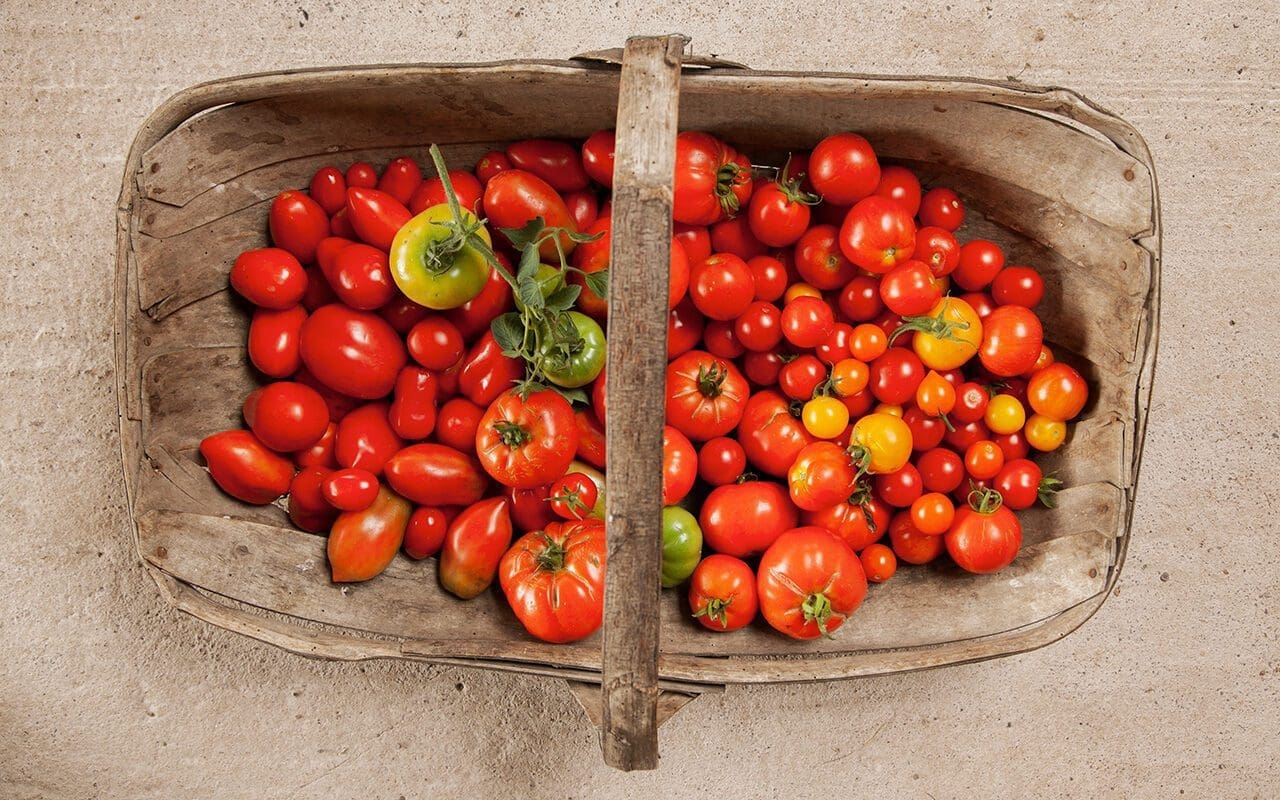
Due to the seed shortage the varieties we were able to get hold of in March were limited to the most widely grown and popular, some of which, like ‘Gardener’s Delight’ I remember my grandfather growing, and which, with ‘Sungold’, Dan and I have been growing since our days in Peckham. They are popular because they are easy, hardy and productive, and also delicious. Others, such as the beef tomato, ‘Marmande’, Dan has grown for clients, while others were new to us and were chosen to have a range of colours and sizes to choose from. On our list for next year are ‘Costoluto Fiorentino’, ‘Purple Ukraine’ and hardy Russian variety ‘Moskvich’.
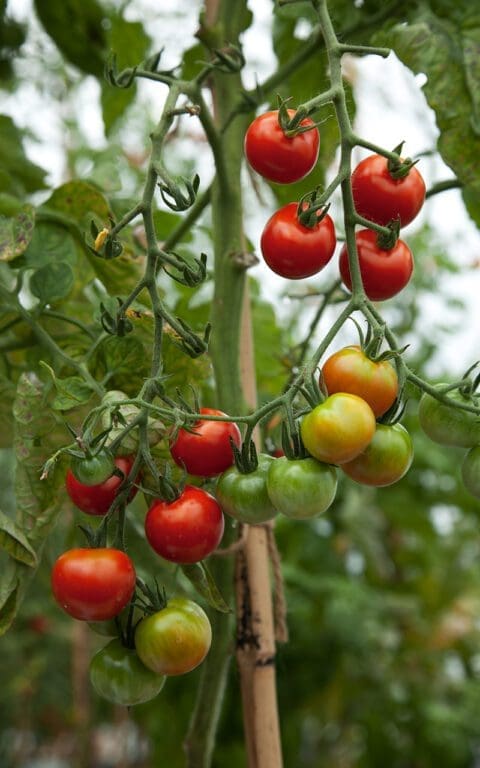
Gardener’s Delight
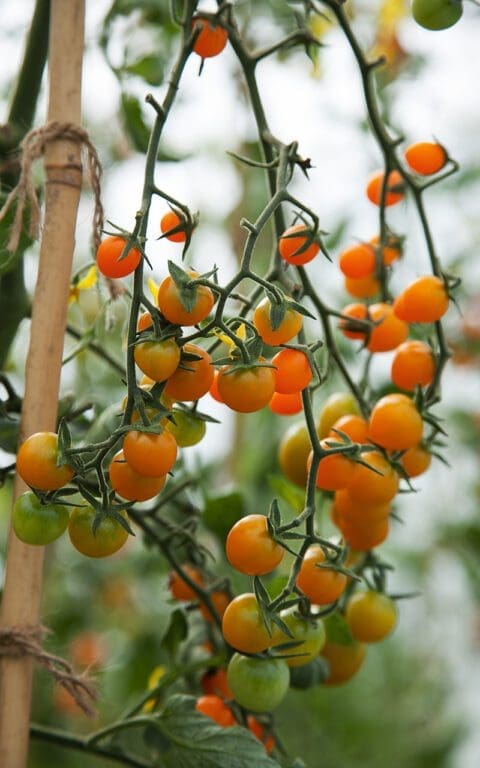
Sungold
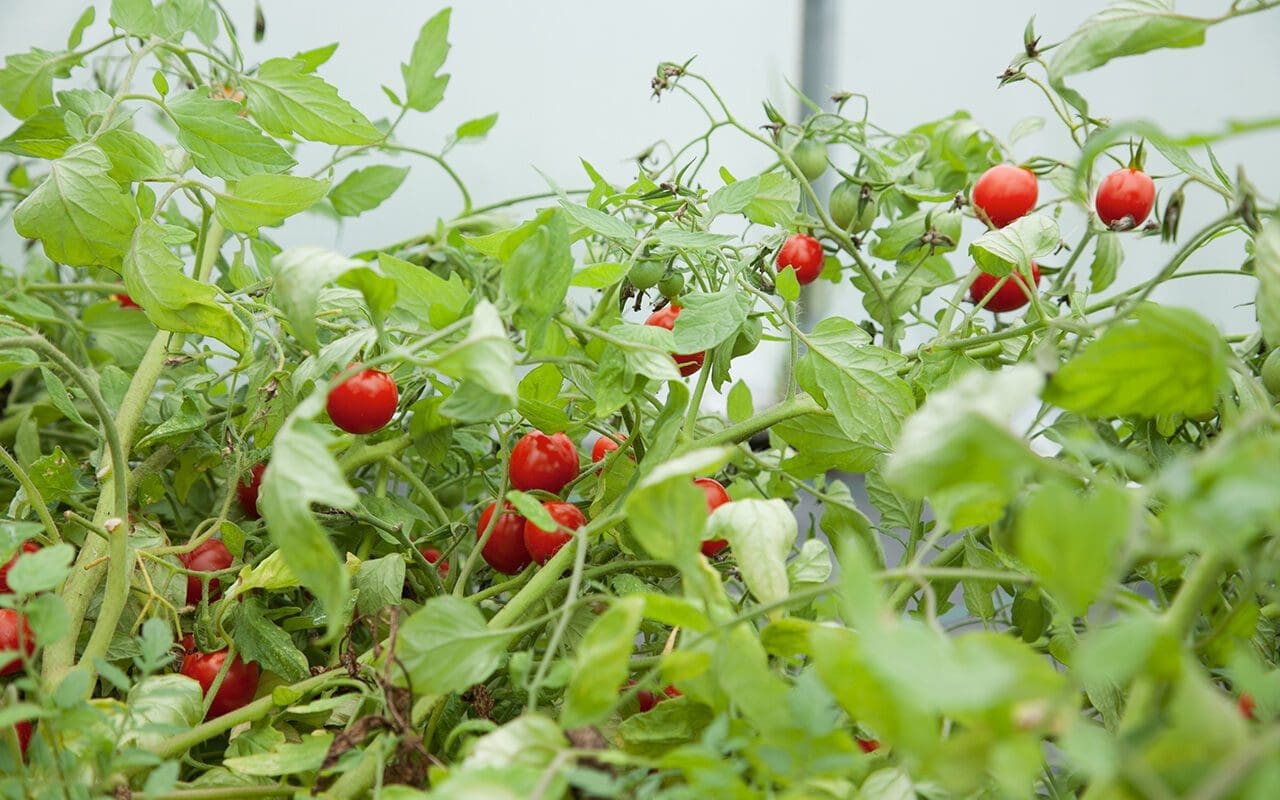
Tumbling Tom Red
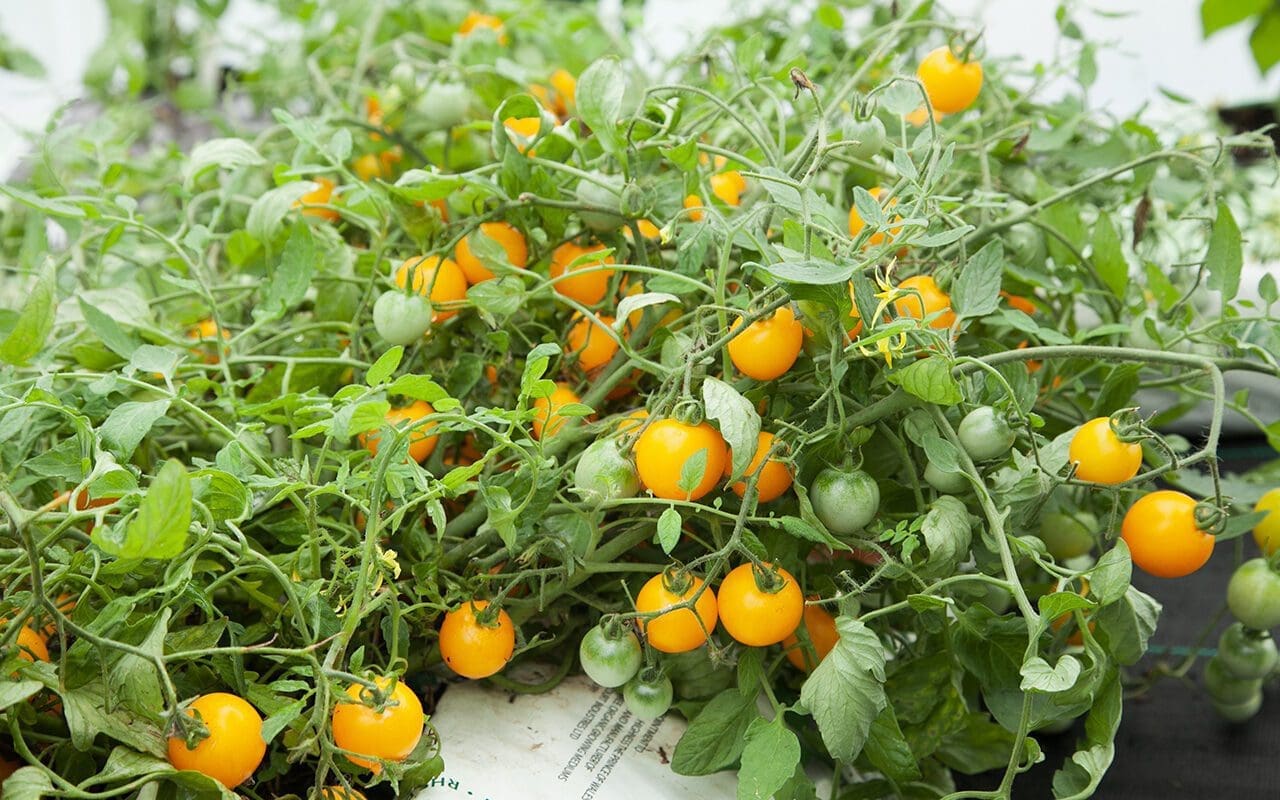
Tumbling Tom Yellow
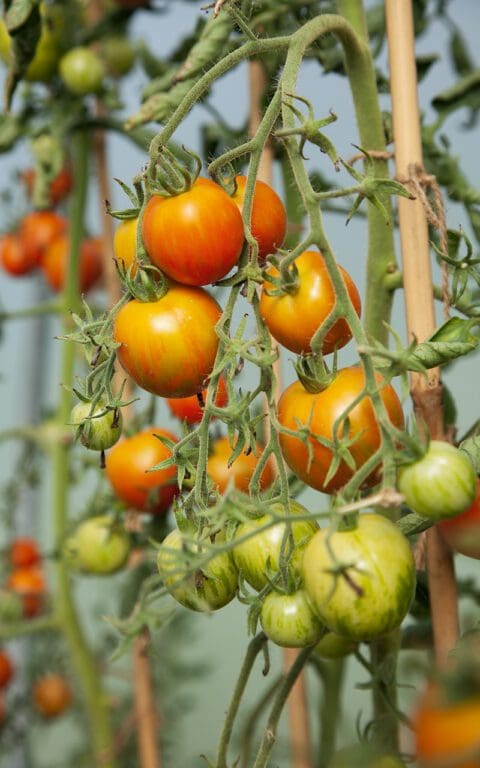
Tigerella
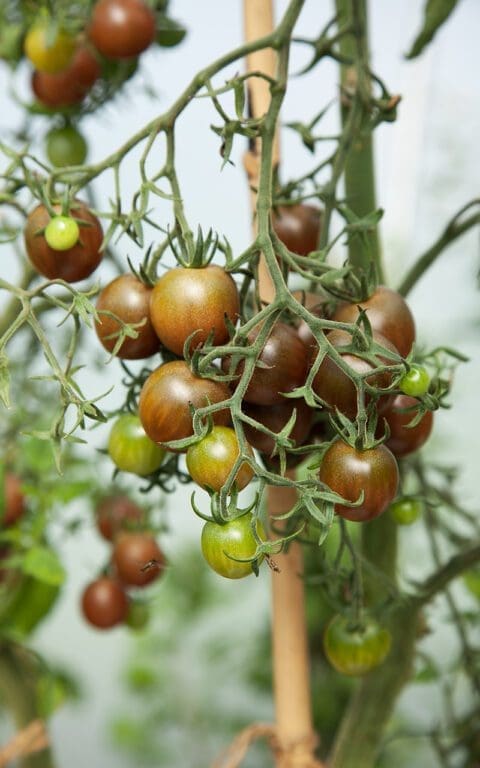
Black Opal
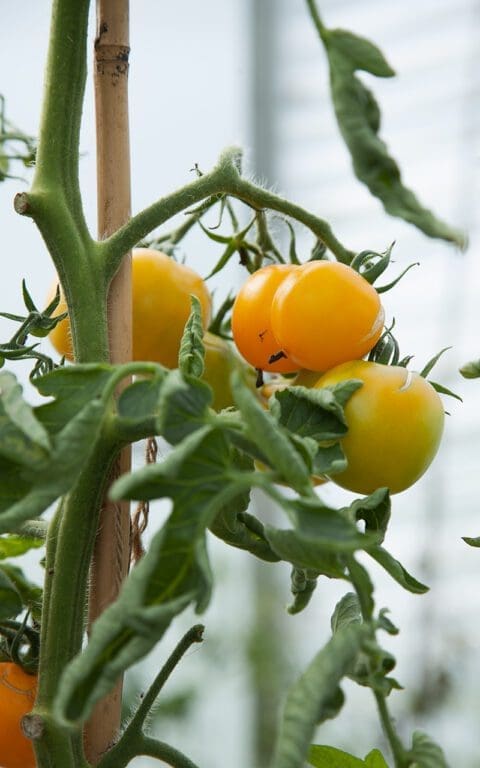
Golden Sunrise
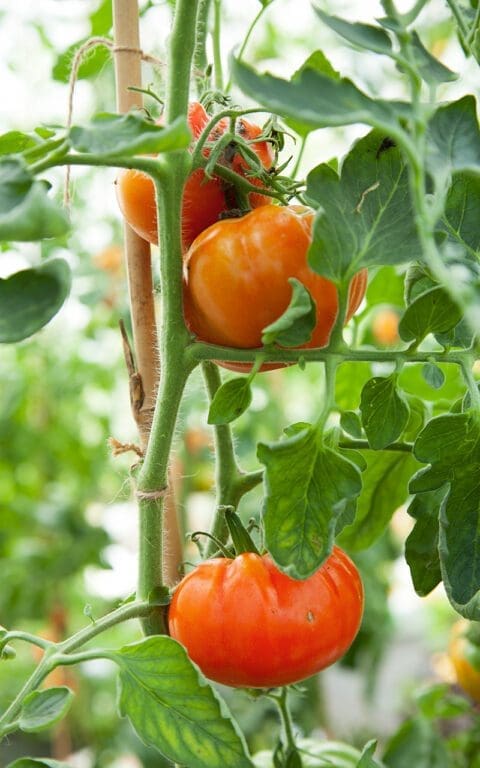
Marmande
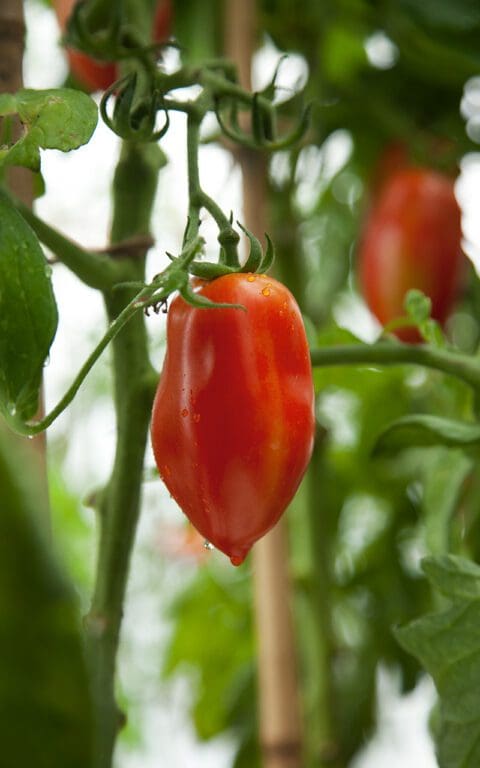
San Marzano
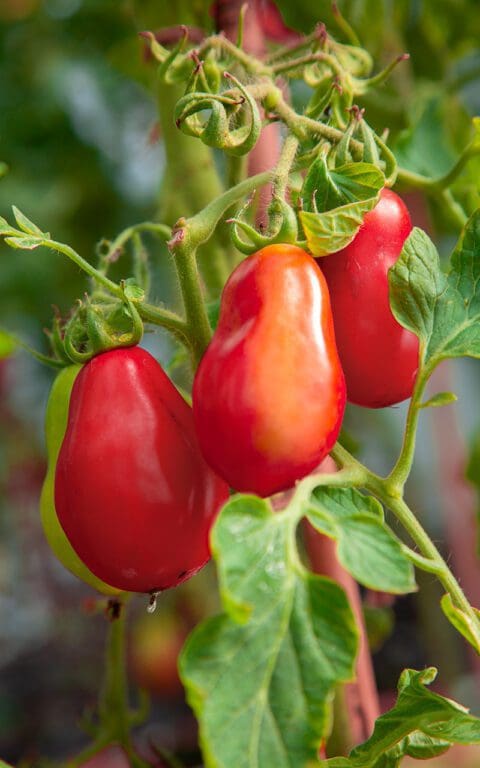
Roma
Words and photographs: Huw Morgan
Published 26 September 2020
The garden has just come through its third growing season. Three years in and we already have to push our way down the paths, which were made deliberately wide for exactly this moment. Two paces of width felt generous in the first year, but now I am pleased for the breathing space with the garden at its absolute fullest.
Three years will usually see the perennials enmeshed and what you had imagined of a composition. It takes around five for the trees and shrubs to start to register, to throw shadow and to rise above the seasonal plants that come and go. This is the first year we have enjoyed the arc of hips on the Rosa glauca and a taste of what the colouring Euonymus planipes will become once it is doubled in size again and casting a new and shadowy microclimate.
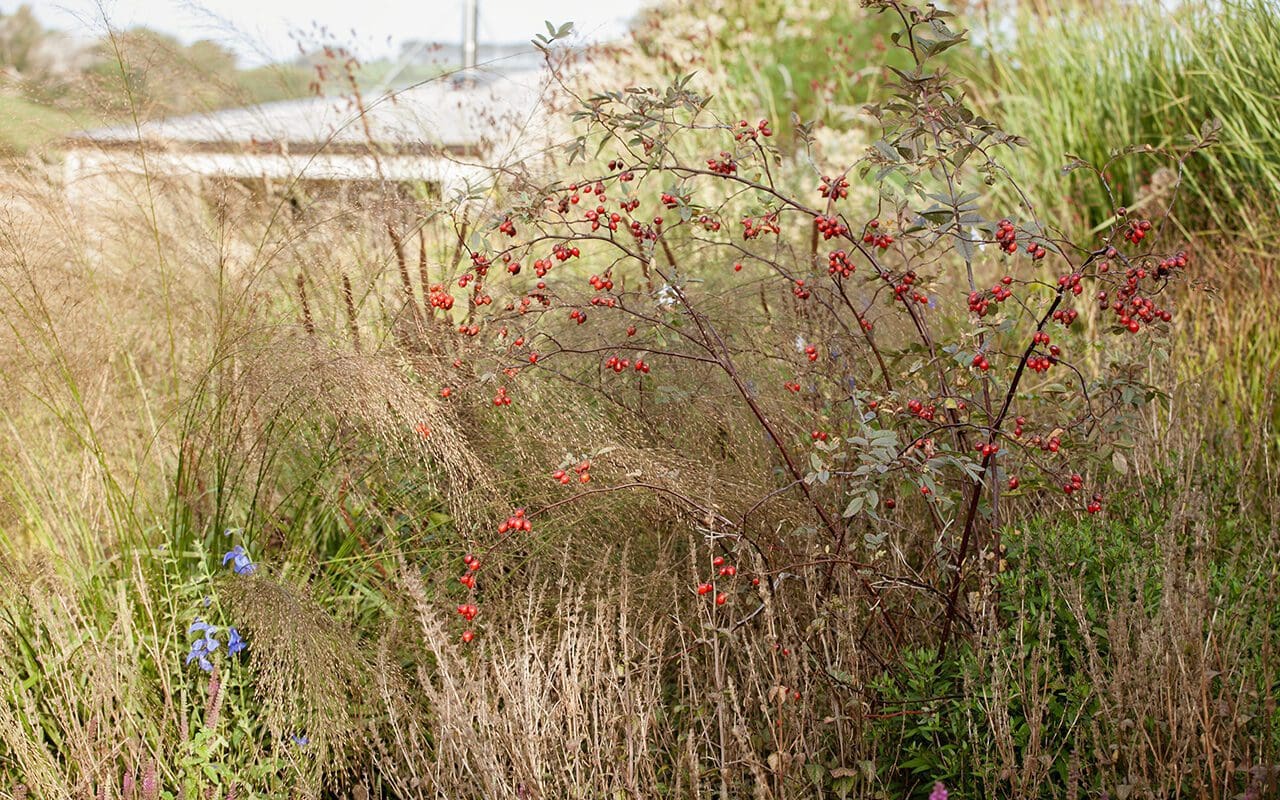


The fifth year after planting is usually a time of building in change to compensate for the newly cast shade of the woody plants or to revitalise the fastest growing perennials that might already need splitting. Not so here. Our hearty ground and sunny slopes have come with the challenge of plants performing faster and more furiously than usual and I am already thinking about my edits. Stepping into the beds from the open pathways and you are immediately dwarfed. Echinops which, to my surprise, were nine feet tall when I ventured in to cut them out to prevent them seeding. Actaea that I hadn’t seen all summer, happily sitting in the cool of towering sanguisorbas, yet all but invisible from the viewpoints of the paths.
The sanguisorbas are this year’s project. My three year trial, which sat on this very ground before the garden replaced the test beds, contained about fifteen different varieties of which half were retained as the best. My trial, with its regular rows and spacing to enable close observation of each singular plant, did not allow for the conditions now the garden has developed its own microclimate. The depth of the beds has allowed the community of plants to work together, protect the ground and diminish the weeds, but the community is never static and for it to remain in balance it is timely to plan some gentle intervention.
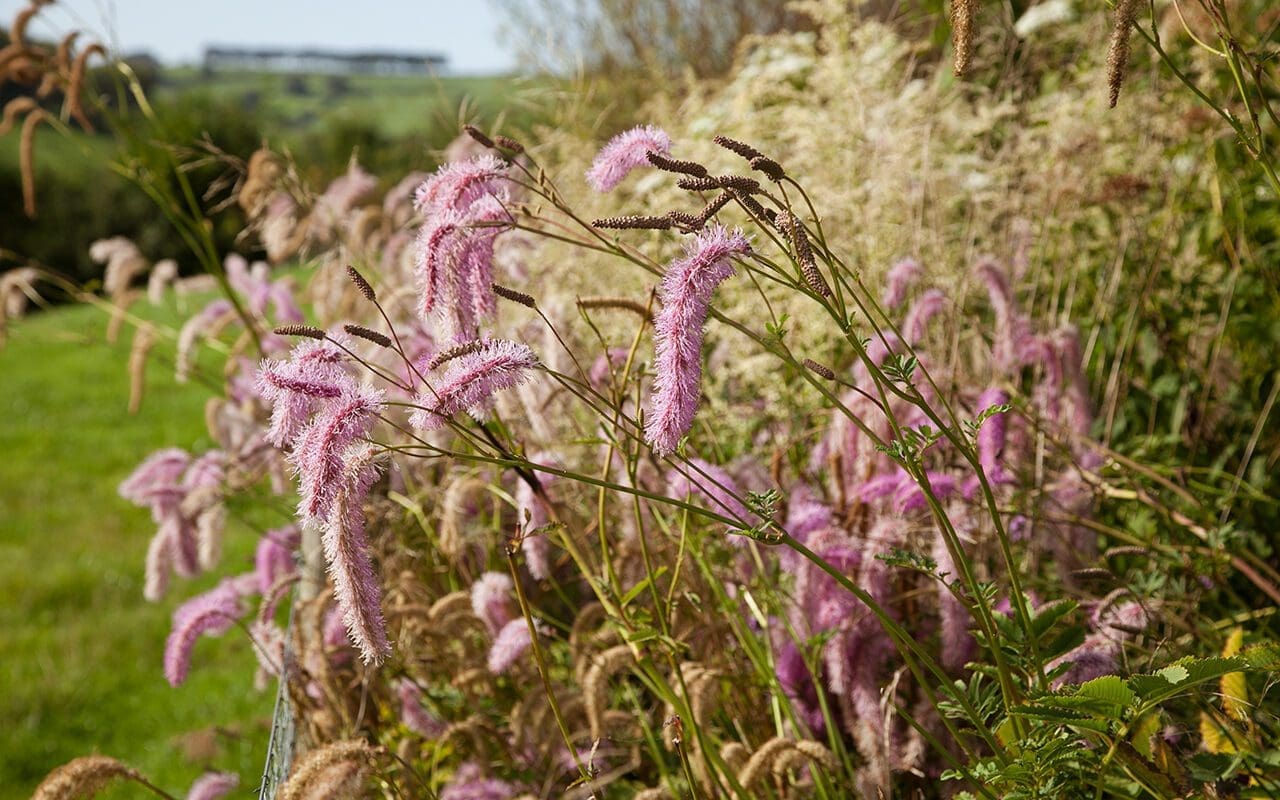
The sanguisorbas register well en masse with their suspended thimbles acting like a veil and atomising colour. Used liberally and in drifts they allow for more acute punches of concentrated colour to appear to hover in suspension; vernonia, now for instance, or a mass of aster. My plans worked well in the first year, but slowly, as the sanguisorbas have developed heft with our soil providing them with everything they need, they have become the largest person in the room and have started to lean upon their neighbours.
Sanguisorba officinalis ‘Red Thunder’ was the first to need more attention and last year I staked it, to prevent the weight of flower toppling after rain. I am trying to stake as minimally as possible here, so this year I tried an experiment, cutting half of the plants completely back to the ground once they started to ascend in the middle of May. A ‘Chelsea Chop’ would usually halve the height in the last week of May to promote sturdier regrowth, but I wanted to diminish their vigour and see if I could get lightness back into the second round of regrowth. It felt entirely wrong being this drastic when the garden looked so pristine in the first week of summer, but in no time they were back and have gone on to be lighter and less weighty than those that were left to do their thing.


Sanguisorba ‘Cangshan Cranberry’ has such handsome early foliage that it would be entirely wrong to attempt the same treatment, but the plants are nearly ten feet tall and leaning, each of them half their height into their neighbours. The plan come the spring is to remove about a third of the group to make more space for the Actaea cordifolia ‘Blickfang’ planted amongst them and then start a yearly round of splitting a third of them so that there are always three generations. The range of ages provides an immediate lightness, the younger plants standing straight and aspiring to the full-blown display provided by the elders. Sanguisorba tenuifolium ‘Korean Snow’ has similar habits and will be treated accordingly to see if my efforts avoid having to stake and retain the ‘air’ in the planting.


In making my notes for change, I am marking the plants with canes so that I am less reliant on my memory to open up breathing space come spring. So far S. ‘Blackthorn’, with its upright long-fingered thimbles and S. tenuifolia ‘Stand up Comedian’ are behaving better. As are the flamboyant S. hakusanensis. Midori, the head gardener at the Tokachi Millennium Forest, describes these plants as like large birds sitting in their nests and, indeed, you need the space to allow them to huddle low and to splay. The September assessment, and then the gentle changes that result from it, will be the way forward if I am to retain the balance and an engagement with change.
Words: Dan Pearson | Photographs: Huw Morgan
Published 19 September 2020
This year our pride and joy (as well as provider of steep learning curve) has been the polytunnel. As soon as we decamped to Somerset before lockdown in mid-March, we started to discuss the pros and cons of finally biting the bullet and getting one, which we have discussed at length and then shelved on several occasions. The reason to defer was always the same. We weren’t here enough and, once a polytunnel is up and running, it simply can’t be left for days untended. Suddenly we were compelled to be at Hillside for the foreseeable future and, with the thought of more complete vegetable self-sufficiency firmly in the forefront of our minds, we decided to take the plunge.
Our dreams of a cornucopia of tomatoes, peppers, aubergines, chillis, cucumbers and melons haven’t been fully realised due to a shortage of seed and plug plants immediately after lockdown, and the fact that the polytunnel couldn’t be delivered until the end of May. So our initial plan for a tomato trial with three plants of ten varieties quickly increased to twelve plants of each and so this year, although we have three chilli varieties and two of cucumber, the polytunnel has been pretty much dominated by them. I will write at more length about the polytunnel at a later date, once I have some more experience under my belt, but suffice to say that growing tomatoes in grow bags has this year taught me the importance of a regular watering regimen, the effects of lack of ventilation and the dangers of not starting to apply tomato feed early or regularly enough. We lost almost all the second trusses and, due to the cool August, the third and fourth trusses are only now just starting to ripen. Everyone will be getting Green Tomato Chutney for Christmas this year.
Apart from firm favourites ‘Sungold’ and ‘Gardener’s Delight’ I was keen to trial some plum tomatoes and chose the best known and most reliable varieties, ‘San Marzano’ and ‘Roma’. These are the varieties that are almost invariably in any tin of tomatoes you might buy at the shops. They were surprisingly productive at first and the mini-glut in early August produced ten large jars of bottled whole and chopped tomatoes, as well as several litres of passata and ketchup. Although ripening is definitely slowing down now, somewhat surprisingly it is still the plum tomatoes that are providing the largest usable harvests. This I don’t mind, since I cook with tomatoes pretty often in winter and the idea of being able to use my own preserved ones and not shop-bought is very appealing.
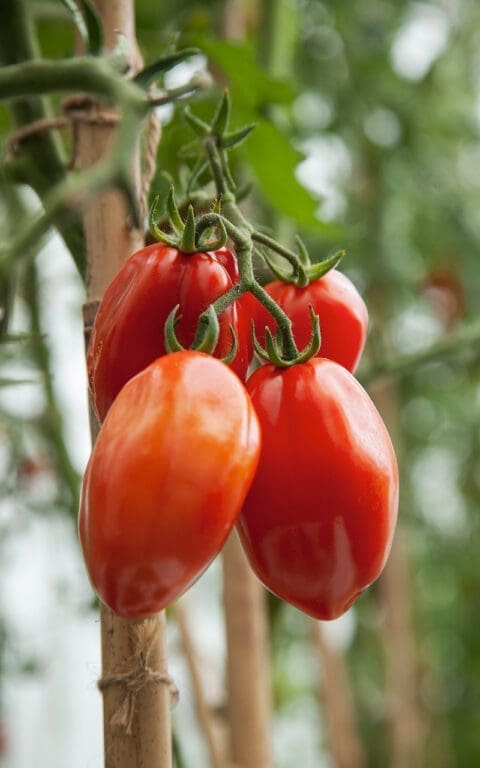
Despite their productivity only the best plum tomatoes are good enough for bottling, so there are always plenty left over. These end up as passata or a simple tomato sauce (which I either bottle or freeze depending on available storage space) and in ketchups, salsas and chutneys. Quite often, however, they end up in our dinner and one of my daily challenges of recent weeks has been ‘What can you make with any combination of courgettes, tomatoes and runner beans ?’. After many nights of making things up as I went along I have started to run out of inspiration and so this week there has been much rifling of recipe books.
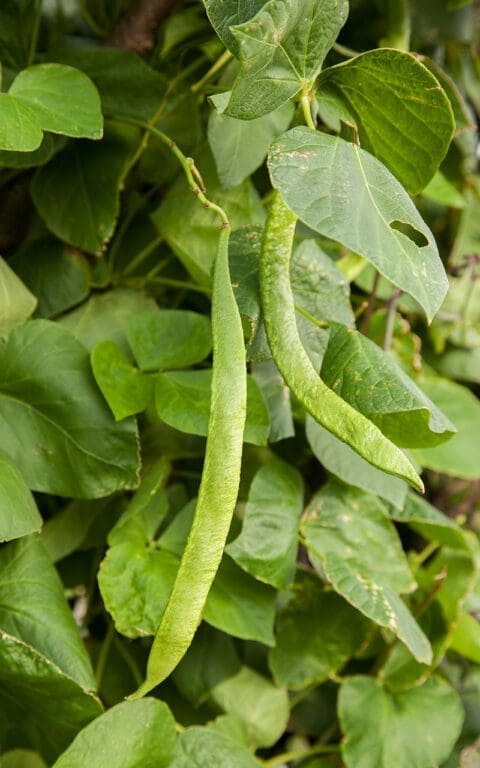
I very seldom present another cook’s recipes here, although my own are often tweaked and altered versions of dishes I have eaten or cooked from recipes in the past. However, when I came across this yesterday, it jumped out at me for the intriguing use of two of my main available ingredients in a previously completely unimagined form. What is in effect a tomato and bean pie is elevated in this recipe into a memorable dish of unctuous and exotic richness. Given the apparent humility of the primary ingredients I was unprepared for quite how delicious it is and feel that it is only right to share the original, untweaked, recipe with full credit to Maria Elia from whose excellent book of modern Greek cuisine, Smashing Plates, it is taken. As she says (and as I did myself) it is best to make the filling the day before you plan to assemble it so that the flavours can come together overnight. Of course, not everyone has access to vine-ripened plum tomatoes, so I weighed mine and they came to around 600 grams, equivalent to around two cans drained of their juice.
To balance the richness this would be good served with something fresh and bright such as a citrussy Greek cabbage and carrot coleslaw or a raw fennel, chicory, orange and watercress salad.
Serves 6-8 as a main, 8-12 as a small plate
100 ml olive oil
2 Spanish onions, halved and finely sliced
2 garlic cloves, finely chopped
2 tsp ground cinnamon
5 tbsp tomato purée
10 vine-ripened plum tomatoes, skinned and roughly chopped
500 g runner beans, stringed and cut into 4cm lengths
A pinch of sugar
1 bunch of dill (approx. 30 g), finely chopped, or 2 tbsp dried
1 packet of filo pastry (9 sheets)
100 g melted butter
100 g Medjool dates, stoned and finely sliced
250 g feta, crumbled
6 tbsp clear honey
Sea salt and freshly ground black pepper
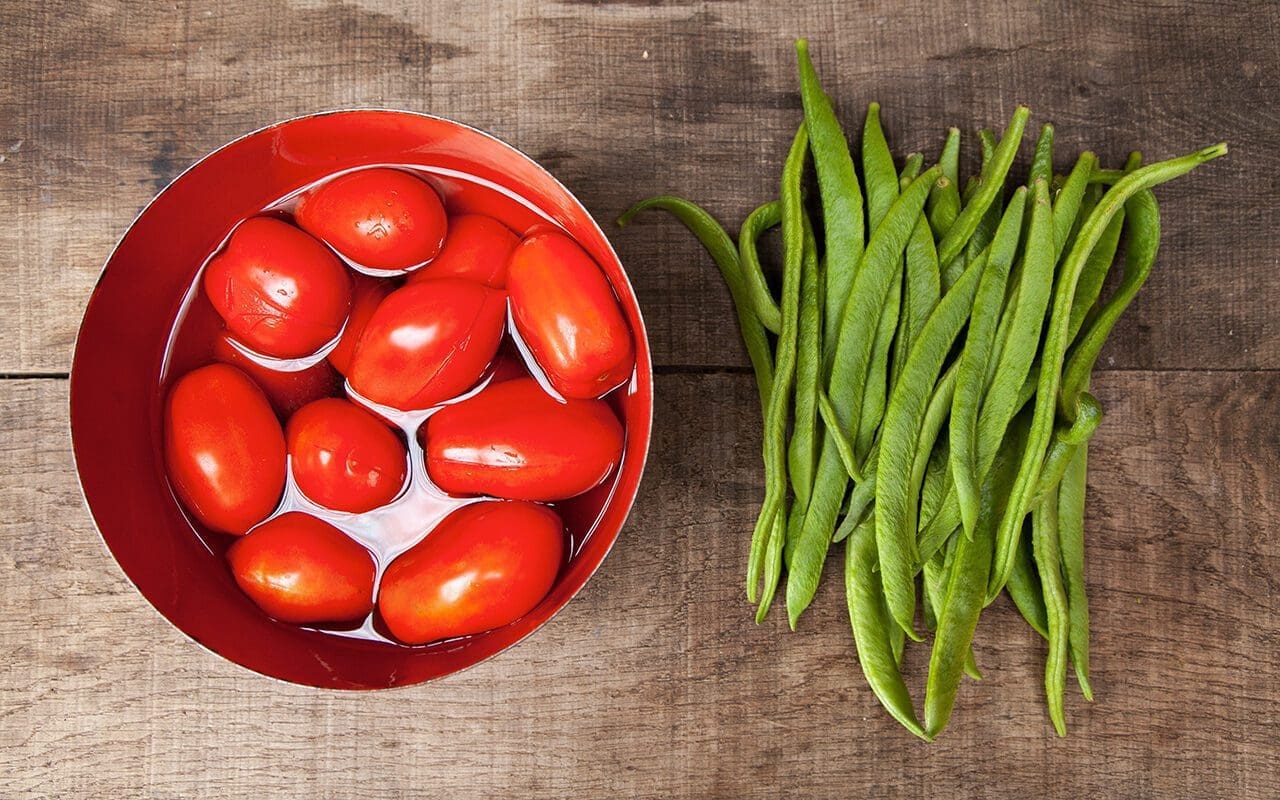
Heat the olive oil in a large, heavy-based pan over a low heat and sauté the onion until softened and sticky; this can take up to 20 minutes. Add the garlic, cinnamon and tomato purée and cook for a further 2 minutes. Add the tomatoes and their juices and cook over a medium heat for about 8 minutes, before adding the runner beans, sugar, dill, a pinch of sea salt and 150ml water.
Reduce the heat to a simmer, cover and cook the beans for about 40 minutes, stirring occasionally, until the beans are soft and the sauce is nice and thick. Check the seasoning and cool before assembling.
Preheat the oven to 180°C/gas mark 4. Unfold the pastry and cover with a damp cloth to prevent it from drying out. Brush a baking tray (approximately 30 x 20cm) with melted butter. Line the tin with a sheet of filo (cut to fit if too big), brush with butter and repeat until you have a three-layer thickness.
Spread half the tomato and bean mixture over the pastry, top with half each of the dates and feta. Sandwich another three layers of filo together with melted butter and place on top. Top with the remaining tomato mixture, dates and feta. Sandwich the remaining three filo sheets together as before and place on top.
Lightly score the top, cutting into diamonds. Brush with the remaining butter and splash with a little water. Cook for 35 – 45 minutes or until golden. Leave to cool slightly before serving, drizzling each portion with a little honey.

Words & photographs: Huw Morgan | Recipe: Maria Elia
Published 12 September 2020
Autumn came early this year and before the month of August was out. Refusing to go inside until bed time, we’ve been huddled in blankets, wondering if it is also too cold for the courgettes to throw one last crop and whether the tomatoes in the polytunnel will be more green than red now the evenings are shortening.
We have taken two weeks off to harvest. The last of August and this first week of the golden month. Timed perfectly to not miss the plums that escaped our late spring frosts, as those that did set fruit have been plentiful. ‘Warwickshire Drooper’, appropriately weighting the branches and a fine crop of damsons. Inky ‘Merryweather’ and ‘Shropshire Prune’, the smaller and ‘wilder’ of the two. The pears decided to drop in sequence, one fruit first, to warn you of the coming deluge and then suddenly, everything all on the ground. Get there on the day after the scout that fell and a quarter turn will yield the ripe ones the day before they drop and bruise. ‘Beth’ with her must-eat-immediately creaminess comes first and then ‘Williams’. Firm and then, when just perfect, melting. Countless numbers from the espaliers and fortunately a pause now before ‘Beurre Hardy’ and then a longer wait for the October ‘Doyenne du Comice’, the finest of all and the grand finale here.
The kitchen garden is now in its fifth summer and we have an embarrassment of riches. What to do with such plenty ? In times gone by we would have pulled together to bring in the fruits of the growing season, but in this unusual year, we are missing the many hands and accompanying banter of sharing this time picking and the community effort of preparing and preserving.
To stop and put aside the feeling of guilt that some of your efforts will inevitably go to waste is part of letting the autumn happen. Nothing really does get squandered and we have learned to step back at a certain point and try to take things in. The surfeit of pears and apples that lie strewn in the grass will not have time to moulder before the birds and the critters have them. You need to make time to take these moments in.
This is what this week’s mantlepiece is about. The beginnings of a winding down that will surely leave the growing season behind. Slowed, but far from static, the garden has plenty yet to give. Tagetes and morning glories arguably better than ever in the soft days. There are the autumn performers too, the flowers that are here to complement the senescence. Dahlias and cyclamen, schizostylis and amaranthus designed for now and making September their own. The last push of roses and a final flurry of clematis, surrounded already with a gathering backdrop of silken seed and the rewards of a growing season coming to a close.
Words: Dan Pearson | Photographs: Huw Morgan
Published 5 September 2020
I lay awake in the night trying not to worry about the garden. The house shuddered for the second time this week as rain-laden westerlies hit the end gable. In my mind’s eye the runner beans lay toppled and our old tin barns, held together with not much more than common sense and bailer twine, were strewn about the hillside. I imagined the garden, now at its fullest, with the weight of a wet storm pushing through it, tearing indiscriminately and leaving the footprints of an invisible giant.
It is not the first time I have awoken to find things ruffled yet still standing, but where, just a week ago, we were bathed in sunshine that liberated the perfume of lavender, the storms have invited the autumn in. The month of August leans always towards the next season, the ground wet again underfoot and the associated smells of spent growth rotting. Already there are cyclamen flowering in the shadows and the first of the asters marking the tipping point and shortening evenings.
Although it is a long and plentiful season, when planning a garden I always work back from autumn so that everything leads to something celebratory. Just about now, and providing a fresh and pristine complement to the plants that have come and gone or are starting to wane, is a wave of creams and whites. I have planted several that repeat and provide this levity.

The flat-topped aster, now named Doellingeria umbellata, has considerable presence, rising up to shoulder height before giving way to creamy flower. It stands well without staking and bounces back after a storm to provide a luminous horizontal. It is teamed with Sanguisorba tenuifolia ‘Stand Up Comedian’, which rise above and pepper the air around it. Throughout the seasons I like to walk up onto the Tump and look back on the garden and, in the month of August, the doellingeria hold the upper ground and provide light that runs from here to reappear in rivulets elsewhere.
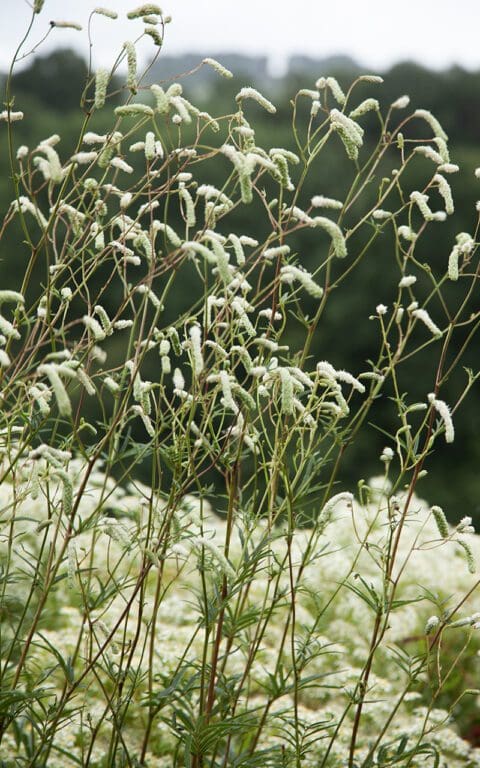
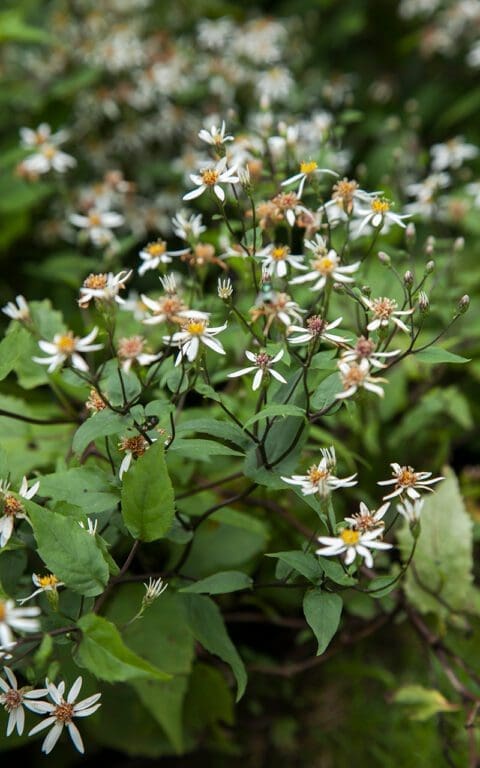
A spume of Eurybia divaricata lines the lower paths and provides a stop/start undercurrent. This is the more typical form which is brighter white and more mounding than a dark-stemmed form selected by Beth Chatto (and named after her) which I repeat along the length of the grass path at the top of the garden. Their foaming presence is rewarding on even the dullest of days and, being happy in shadow, they make a pale and light-giving understory. Both the flat-topped and wood aster keep perfect timing to ease the summer into the next season.
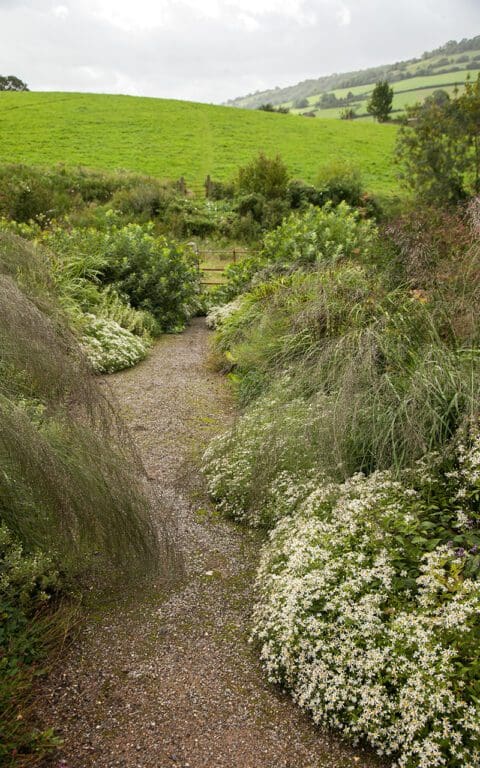
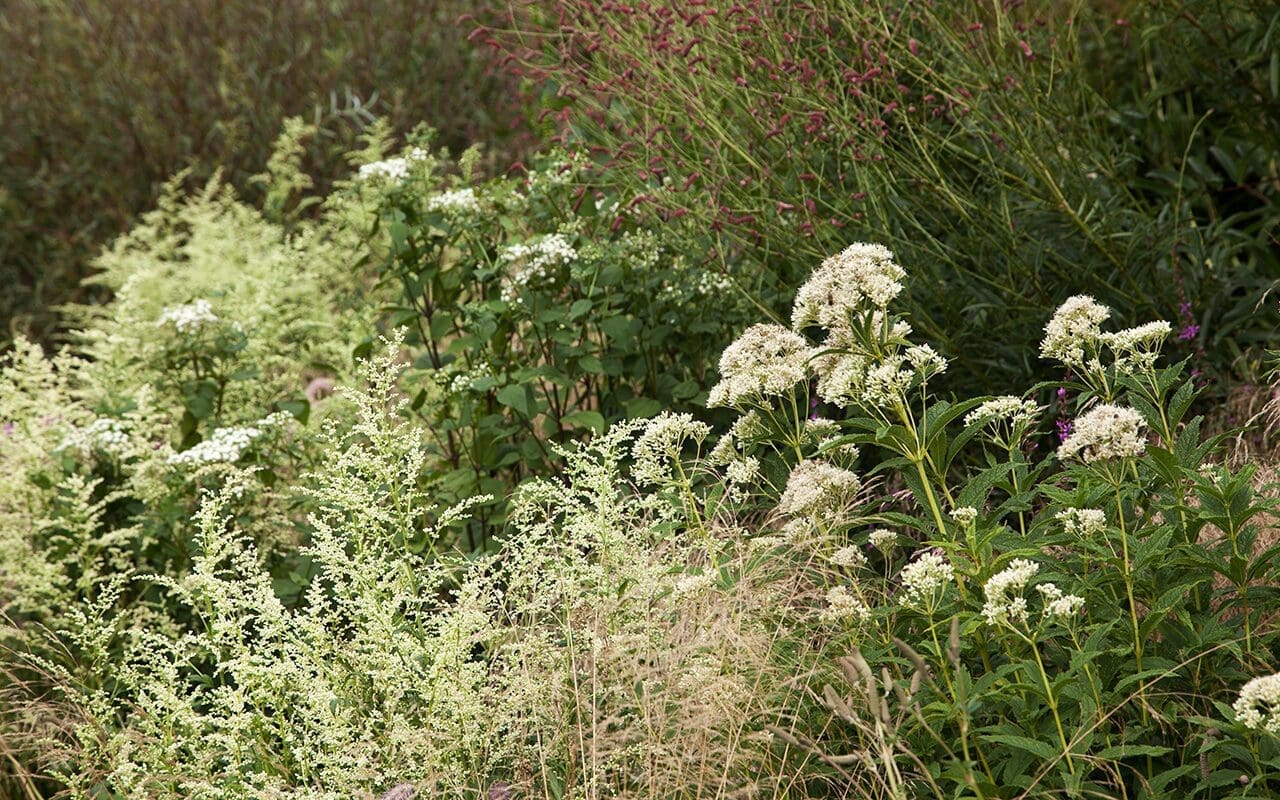
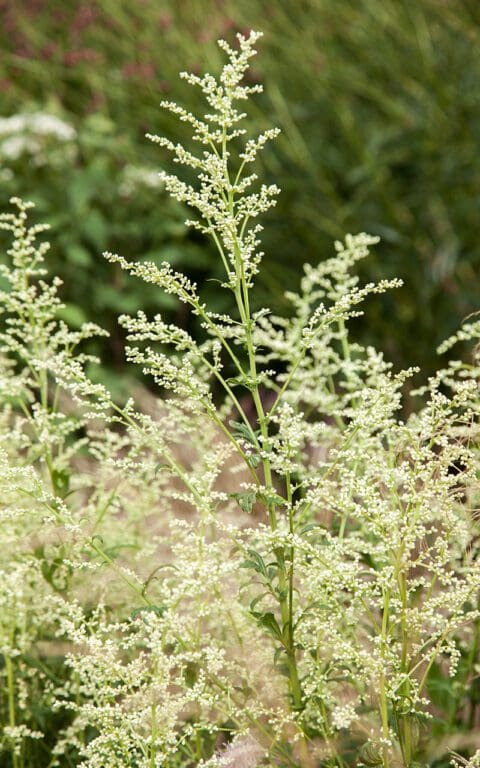
On the edges of the garden, and making a subliminal link to the run of the ditch with its meadowsweet, old man’s beard and white-flowered bindweed, I have grouped the creamy wormwood, Artemisia lactiflora ‘Elfenbein’ (meaning ‘ivory’). It is well placed here. Happy to take on the elements and standing tall and upright without ever needing support, it rises through the now spent Deschampsia cespitosa ‘Goldtau’ to bring a new wave of life and energy. When seen against the differing whites of two eupatorium nearby, the feathered plumes of the wormwood make interesting contrast for their creaminess. The ‘Elfenbein’ will flower for a good month whilst the shining white Anemone x hybrida ‘Honorine Jobert’ gather their strength for full blown autumn.
Words: Dan Pearson | Photographs: Huw Morgan
Published 22 August 2020
Angelica sylvestris mark the damp hollow and stand tall to either side of the ditch. The ground here is always damp, fed by springs which keep the water running even in the driest of summers. The mud close to the water’s edge is boot-grabbing and deep and the angelica are as happy there as they are in the firmer ground above it. But their preference is mapped clearly, the stems towering head height where they get the moisture they need and diminishing and then vanishing entirely where the wetland gives way to the drier pasture.
August is their season and when they are at their finely-spun best. A bolt of slender stem, leaves evenly spaced and then left behind as a tightly held fist of flower bolts up and then out to strike a series of horizontals. Creamy rays tinged with pink and receptive to all pollinating insects, they stand head and shoulders above the grasses that are now tawny around them.
Though this is their time, they have been present since late winter when we raked away the thatch and the tall woody skeletons of the ones that came before. They take two years to flower from seed. The seedlings bright and already forging a way before mud gives way to growth. Growth that will put them in the roughest of company. Marsh thistle and horsetail and tussocky grasses that it is hard to believe will tolerate company.


The seedlings disappear beneath the wetland growth and are happy to be eclipsed in shadow, but last year’s seedlings have sent down a strong tap root and from this they rear strong and early growth. Distinctly angelica, slender and reaching, some of the youngsters already show a variance in colour. The darkest are a rich plum purple and carry this through into their adult incarnation with flowers that are also stained dark throughout. ‘Vicar’s Mead’ or ‘Ebony’ are garden selections that maintain good colour and, though I would be happy to have them in the garden, I am more delighted to have their natural spontaneity in these wild places.


In the garden and to make the leap between the wildness of the ditch I have used the perennial Angelica anomala, which is easier to manage than the biennial Angelica sylvestris for knowing where it will appear every year. Too many self-seeders in the garden make for hours of editing in the spring, but the spontaneity of the wild angelica is delightful in the ditch for finding its own place, which from year to year is never the same.
In the lower parts of the water course and close to the fourth and final crossing that weaves a way back and forth in its descent, the angelicas appear amongst the Telekia speciosa. This robust perennial is strong enough to stand its own once established and it teams very handsomely with the angelica. Both revelling in the heavy wet ground, they take the feeling of the garden deep out into the landscape and, at this time of year, it is the angelicas that you follow to find yourself there.

Words: Dan Pearson | Photographs: Huw Morgan
Published 15 August 2020
So this is my lunch. No, really, it is. Or I should say, was. Yesterday’s to be exact. Dan has been away for the past three days, his first trip of any length away from here since lockdown was eased, and suddenly I have found how much there is to do here when you are here alone. So time has been at a premium and yesterday the solution to not giving myself more to do than was manageable was to make my real life lunch the subject of today’s recipe.
The Kitchen Garden provides one of the main focusses of attention right now, with a tidal wave of produce rapidly gathering momentum, which needs harvesting, preparing and preserving. Every day there is a new round of beans, courgettes and tomatoes to harvest and these ingredients have featured in some way or another in most of our meals for the last couple of weeks.

The bush beans, ‘Cupidon’ and ‘Aquilon’ (the first of which we grew for the first time last year, the latter of which was new to us this year) have been providing a steady stream of fine green beans for around a month now. Although you do have to crouch to pick them it is very easy to de-top them while picking by pinching the stalk end of the bean, and it is possible to amass quite enough for dinner for two in a matter of seconds. We have probably blanched and frozen around 5kg over the past couple of weeks, and probably eaten the same amount. Although they are now on the wane and showing signs of exhaustion the first of the climbing beans are just forming, so we should have a perfect handover.
The bean recipe features the first of our polytunnel tomatoes, of which we are inordinately proud. We are still at the point where we are just keeping on top of the harvest and managing to eat them all, but plans are afoot to dry, bottle and puree the tomato deluge when it arrives. The simple tomato ‘sauce’ here can be made in bulk, flavoured with any herbs you like such as thyme or fennel, and kept in a container in the fridge or frozen to add to any number of simply cooked vegetables when you like.
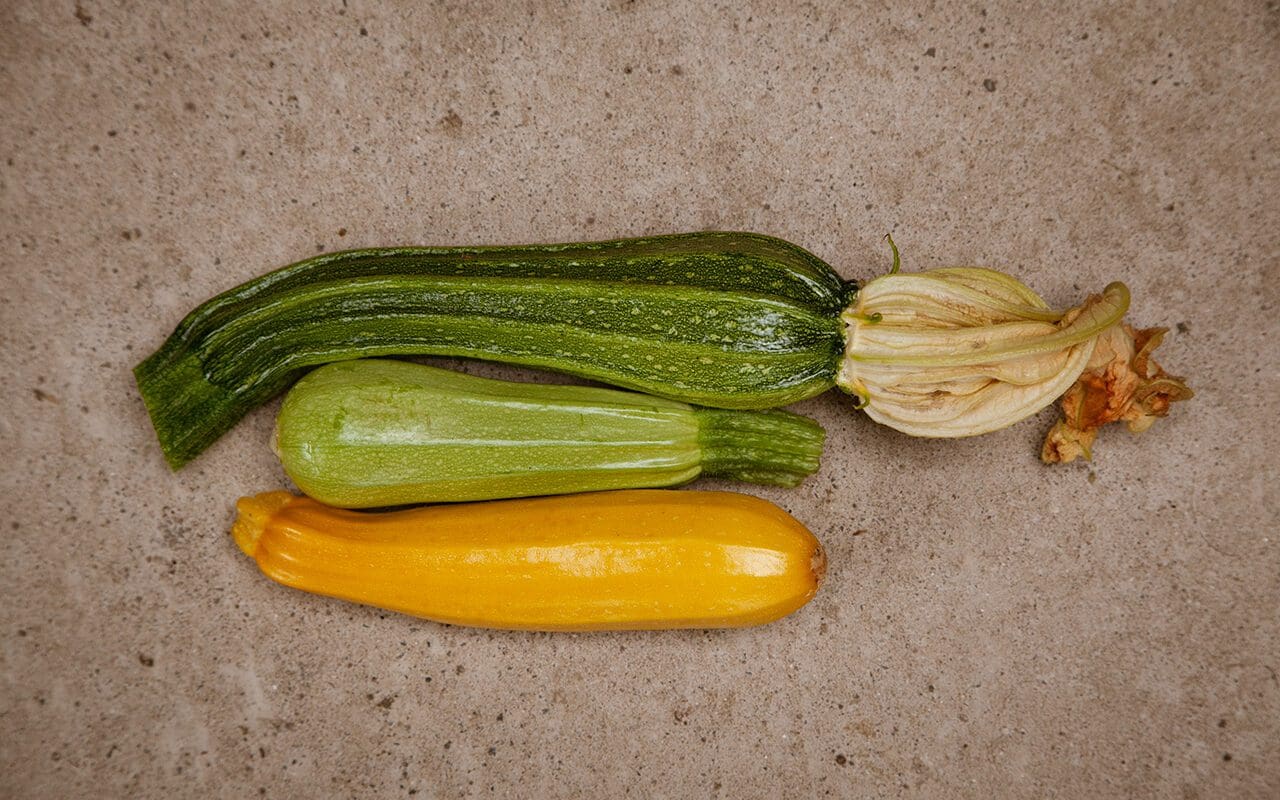
The Italian way of serving summer vegetables in a sweet and sour agrodolce dressing or sauce is a favourite summer way with anything from cauliflower to mushrooms to fennel and courgette. The sharp, salty flavours are good on a hot day, but work equally well warm from the pan or at room temperature if the weather takes a colder turn.
The vinegar and honey dressing can be flavoured with anything you feel like. I might use fennel seed, bay leaf, marjoram, cumin or pink peppercorns depending on what is available. Some sliced anchovy, finely grated lemon zest and toasted pine nuts would work well too.
When time is of the essence it is best to keep things simple in the kitchen. No more ingredients or food preparation than is absolutely necessary. I use whole herbs and spices and keep cooking methods the same for multiple dishes so that things can be cooked together. This has the added benefit of reducing washing up. The method below is written to make both dishes at the same time, as I did today, so that they arrive at the table together.
You will need a large saucepan, a small saucepan, a colander, a small bowl and two medium mixing/serving bowls.
These dishes are perfectly filling alone, but can easily be augmented with a tin of sardines, a boiled egg, a slab of feta cheese or a piece of grilled halloumi.
Serves 2

Green beans & tomatoes
200g fine green beans
200g cherry tomatoes, mixed colours are good
1 large clove garlic
A small handful of small fresh basil leaves
2 tbsp olive oil
Salt
Zucchini in agrodolce
1 medium or 2 small courgettes, around 350g
5 tbsp white wine or cider vinegar
3 tbsp honey
1 fat clove of garlic
1 tbsp currants
2 tbsp extrafine capers
¼ tsp dried chili flakes
½ tsp whole coriander seed
12 black olives, stoned
A couple of stalks of flat leaved parsley, leaves removed
A small handful of small, whole mint leaves
Salt
Fill the large saucepan with water and bring to the boil.
Make the agrodolce. Put the vinegar and honey into the small saucepan with the coriander seed, chili flakes and clove of garlic which you have crushed under the blade of a knife. Put over a low heat until the honey has melted and the mixture is hot. Take off the heat and pour over the currants in a small bowl. Leave to soak.
Put the courgettes and beans into the pan of boiling water. Bring back to a simmer and cook with the lid on. Remove the beans after 10 minutes, refresh under cold water and drain. After a further 5 minutes cooking carefully remove the courgettes from the pan and leave to drain on a plate until warm enough to handle.
While the courgettes are cooling put the olive oil into the cleaned small pan and put it back on the heat. Roughly crush the second clove of garlic and fry in the hot oil until lightly browned. Tip in all of the tomatoes, put the lid on the pan and turn the heat up high. Cook hard for 2 to 3 minutes, shaking the pan frequently, until the tomatoes are breaking down, but still retain some shape. Take off the heat. Season with salt. Scatter over the mint and parsley.
While the tomatoes are cooking cut the courgettes into chunky pieces and put into one of the mixing/serving bowls. Pour over the agrodolce mixture while the courgettes are still hot, add the capers and olives and mix gently so that all the pieces are coated. Leave to stand while you finish the beans.
Put the green beans into the other serving bowl and pour the still warm tomato sauce over them. Mix gently to combine. Pour over a little more olive oil if you like. Scatter over the basil leaves.

Recipes, words and photographs: Huw Morgan
Published 8 August 2020
We are sorry but the page you are looking for does not exist. You could return to the homepage