Planting the fruit orchard was one of our first major projects the winter we arrived here. I knew where I wanted to see it almost immediately, on the south-facing slopes beyond the barns to the west. Nestled into the hill, it was to continue the spine of productivity that runs along this contour. House, vegetable garden, barns, compost heaps and then orchard. It had a rhythm to it that felt comfortable.
Later, and after it was planted, neighbours told us that there had once been fruit trees growing on the same slopes, so it was right to have made the move so quickly. I’d been wanting to plant an orchard for myself for years and made my lists with relish, choosing West Country apples, both cookers and eaters, and a number of pears and plums. I paced out the planting stations in an offset grid with 8 metres between the trees. Doing it by eye meant that it went with the slope and the grid took on a more informal feeling that was less rigid.
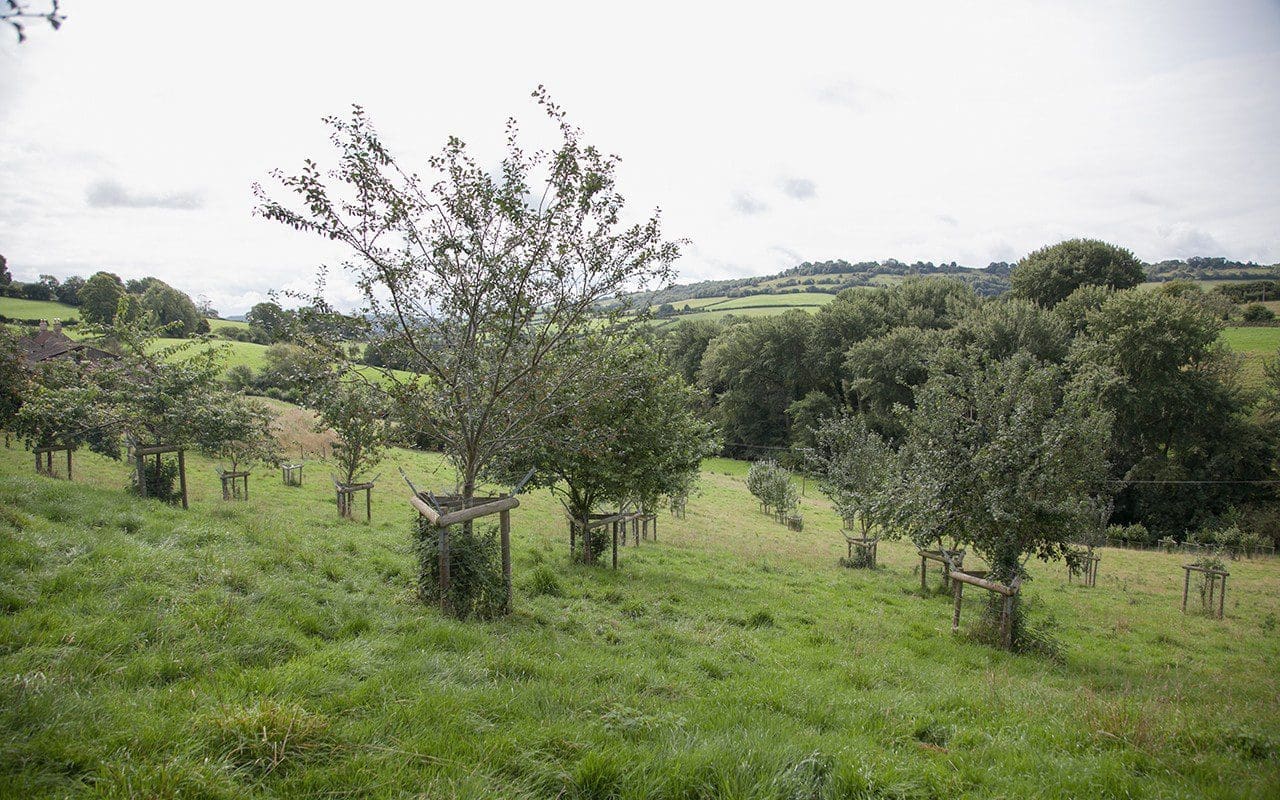 The Plum Orchard
Thirteen apples were set on their own on the lower slope, whilst five pears and then the plums sat above them. In making the decision as to how the orchard should step across the slope, I noted how the frost settled and where the cold air drained as it pooled lower in the hollow. The pears, which like a warm, sheltered position, were planted up close to the barns in the lea provided by the hedge and the buildings. The later-flowering apples were placed lower down the slope in the hope that the frosts, which tend to hang low, were mostly over by the time they were in blossom. The early-to-flower plum orchard was put on the highest ground that linked to the blossom wood in the next field above, as they also prefer a warm, free-draining position. Here they have so far escaped the frosts. To date, for there is still always time to learn, I am happy to have gone with my intuition.
The plum orchard is a loose term for the collection of a dozen or so trees that now inhabit this top corner of the field. I say loose because they all have different characteristics that are driven by the original species from which they have been selected, or from the cross between the edible species. So, to explain, the plum orchard includes true plums, mirabelle plums, damson plums and greengages. We also have two bullace, an old term for a wild plum. Three yellow ones, given to us by a local farmer who has them growing in the hedgerows above our land, are planted in the hedge between the plum orchard and the blossom wood. They may be ‘Shepherd’s Bullace’ or ‘Yellow Apricot Bullace’, two old named varieties that were once very commonly grown. These make a link to an ancient, gnarled tree by the barns, which is dark violet and eats like a damson. The cherry plums (Prunus cerasifera) sit in the blossom wood itself.
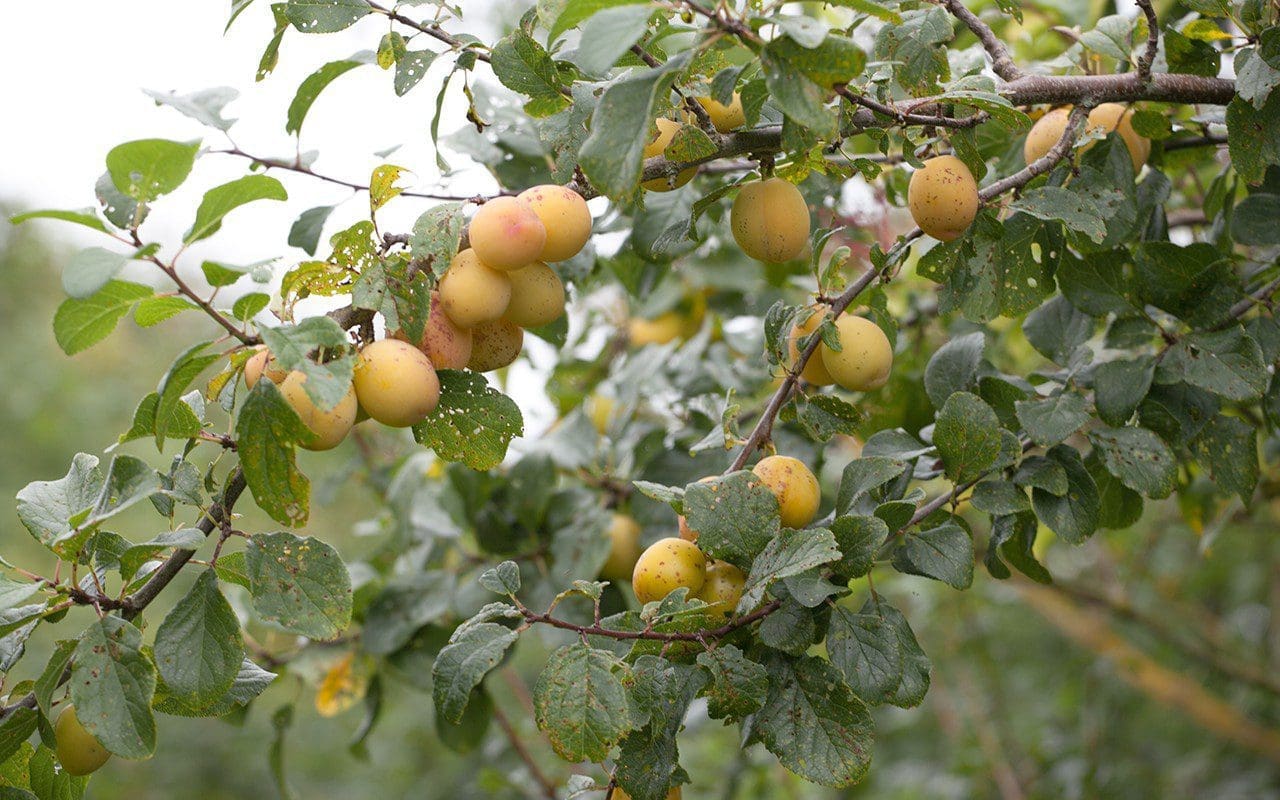 Yellow bullace
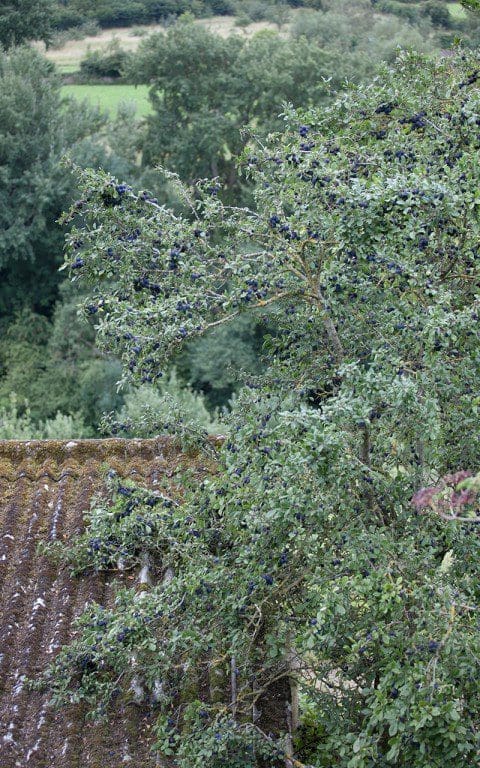
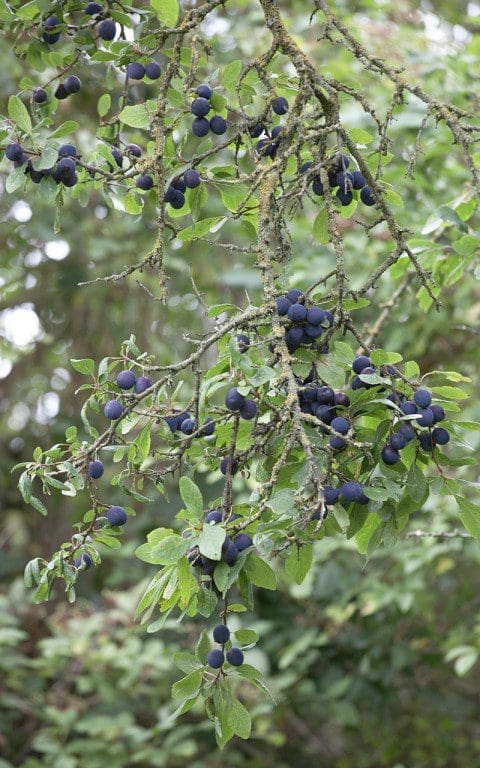 The old black bullace by the barns
First to flower, and indeed to fruit, are the cherry plums, which are good both for February blossom and jam making. Their flavour reminds me of the perfumed Japanese ume plums and we have in the past made a delicious plum brandy from them. In the orchard it is the mirabelle plums (first recommended to me by Nigel Slater, who grows them at the end of his garden) that are the first to flower and fruit. Originally from Eastern Europe, but grown to perfection in France, this is a small plum, usually with a tart flavour. Generally preferred for cooking, ‘Mirabelle de Nancy’ has marble sized, apricot-coloured fruit which are fragrant and sweet enough to eat off the tree if picked just before they drop. ‘Gypsy’, with larger red fruit, is a cooker and the earliest of them all, ripe almost a month ago. If I were to lose one, it would be ‘Golden Sphere’, whose flavour is bland in comparison, but it is a pretty plum, well-named for its colour.
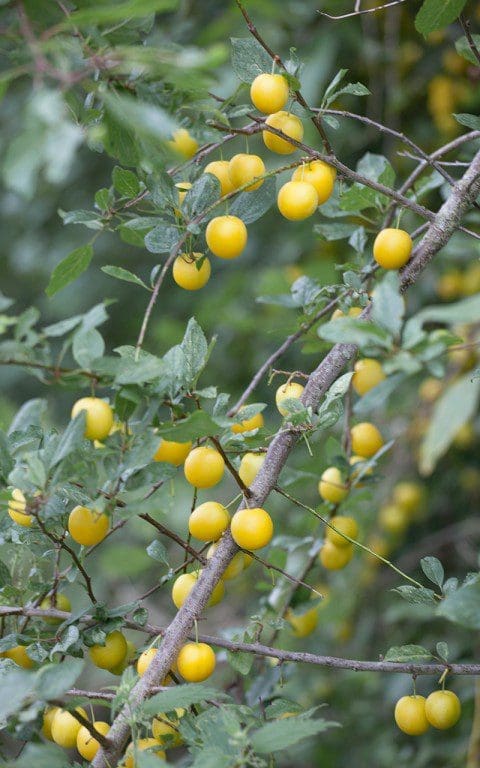 Cherry plums
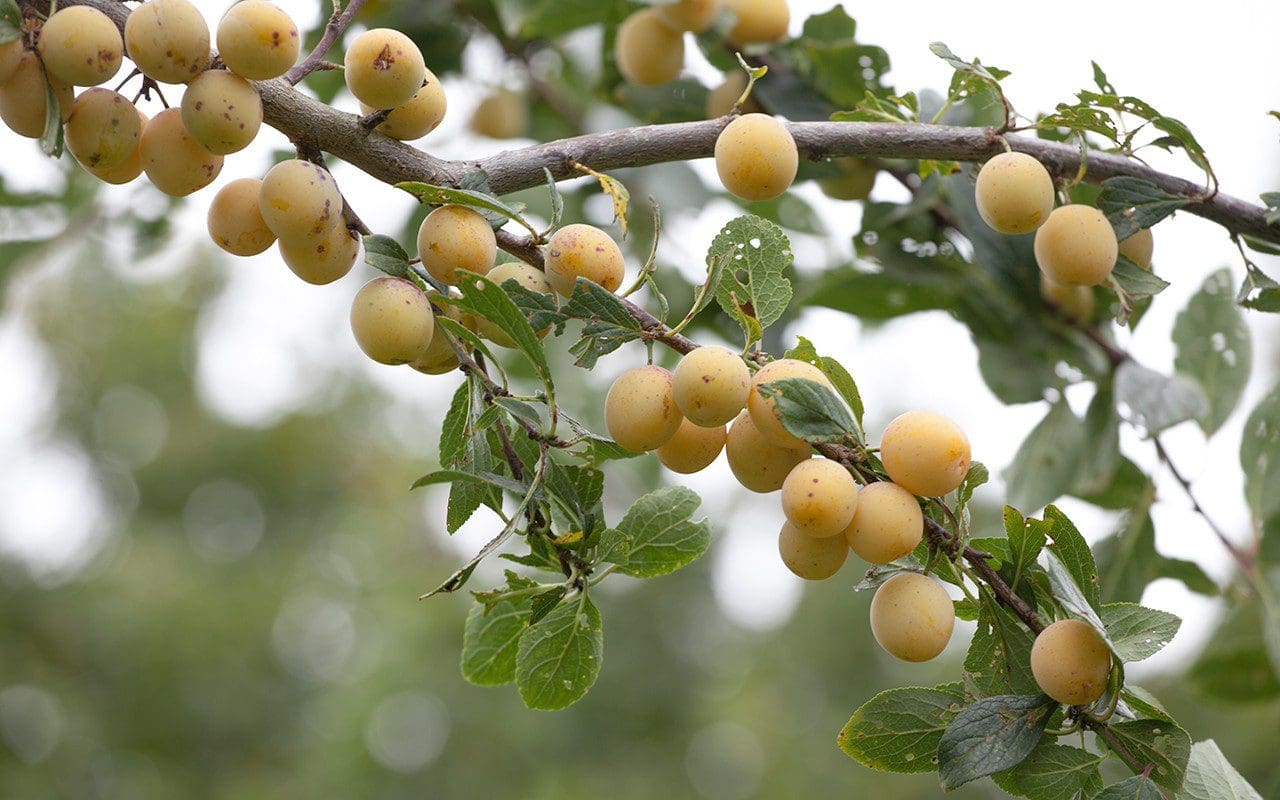 Mirabelle de Nancy
If I were only able to have one plum tree, it would be a greengage. As a rule, the yellow plums are said to have better flavour than the reds, but greengages are the most aromatic and, in our opinion, the most delicious. Of course, there is a small price to pay for such a delicacy, as greengages have a reputation for being shy to fruit. I have five in the orchard. ‘Early Transparent’ is the most reliable and has fruited plentifully. ‘Denniston’s Superb’ fruited well this year too and has the very best flavour. Despite the skins being less than perfect, the greengage perfume and the depth of flavour of this greengage is superlative – as refined and floral as a good ‘Doyenne de Comice’ pear or, if you were living in heat, a freshly picked white peach. I have three more greengages that are yet to prove themselves; ‘Reine Claude de Bavay’, which is famously shy to fruit, ‘Bryanston Gage’ and ‘Cambridge Gage’, which the sheep have managed to reach, pulled at and damaged, so I am waiting patiently for results next year.
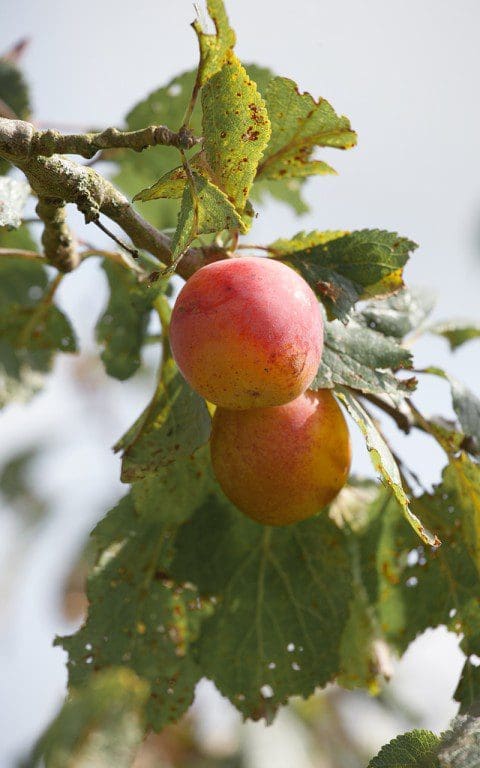 Gage ‘Early Transparent’
We have two true plums in the orchard. ‘Victoria (Willis Clone)’, a selection that is reputedly free of silverleaf, an airborne bacteria to which ‘Victoria’ is prone and which can infect broken branches in the summer. Plums, particularly the heavy fruited ‘Victoria’, are famous for snapping under the weight of their fruit, so I have taken to gently shaking the tree a little earlier in summer to lighten the load that the June Drop hasn’t done for. Though the ‘Victoria’ is a good looking plum – it is next to ripen after the greengages – it is nice but rather ordinary. It is, however, indispensable for freezing for winter crumbles. ‘Warwickshire Drooper’, a vigorous and amber-fruited plum, is better I think. Adaptable for being both an eater and a cooker, and not a plum you can buy off the shelf like ‘Victoria’. It is also a very heavy cropper and makes delicious jam.
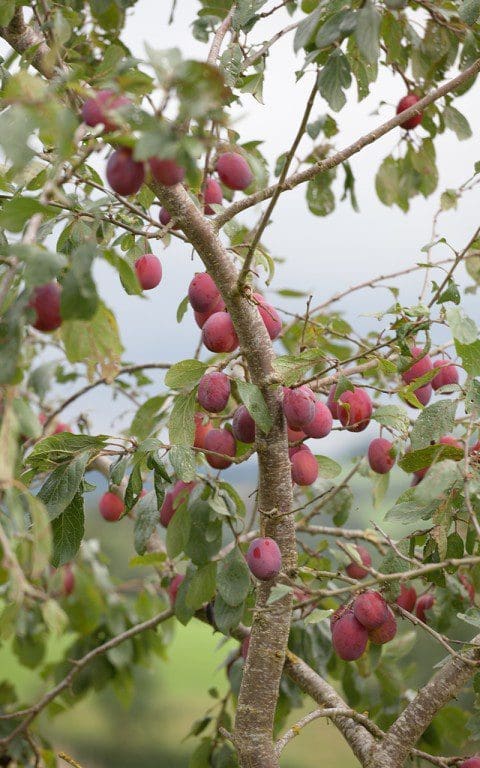 Plum ‘Victoria (Willis Clone)’
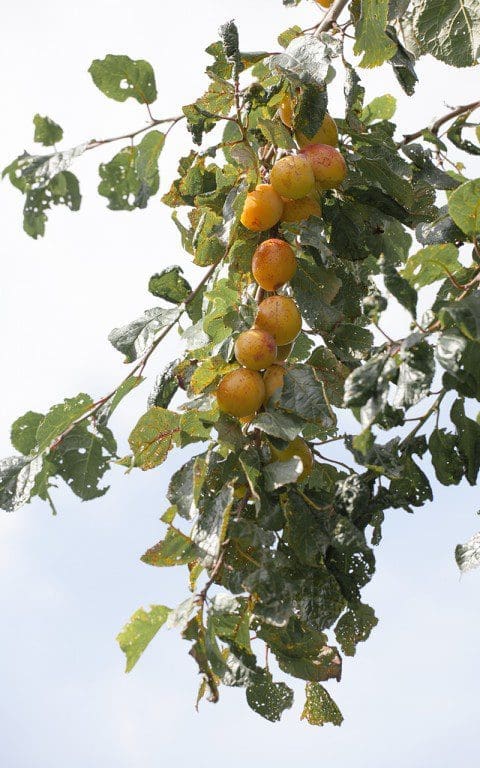 Plum ‘Warwickshire Drooper’
The damsons are perhaps the most beautiful, hanging dark and mysterious, with a violet-grey bloom that, when you reach out and brush the surface, reveals the depth of colour beneath. These are the last to fruit and this year I fear we will miss them in the fortnight we go away on holiday in early September. ‘Shropshire Prune’ (main image) has proven itself to be one of the most reliable fruiters with small, perfumed fruit that are firm and make the strongest flavoured jam. A little earlier and larger of fruit, ‘Merryweather’ also has very good flavour and is one of the only damsons sweet enough to eat from the tree if left to fully ripen.
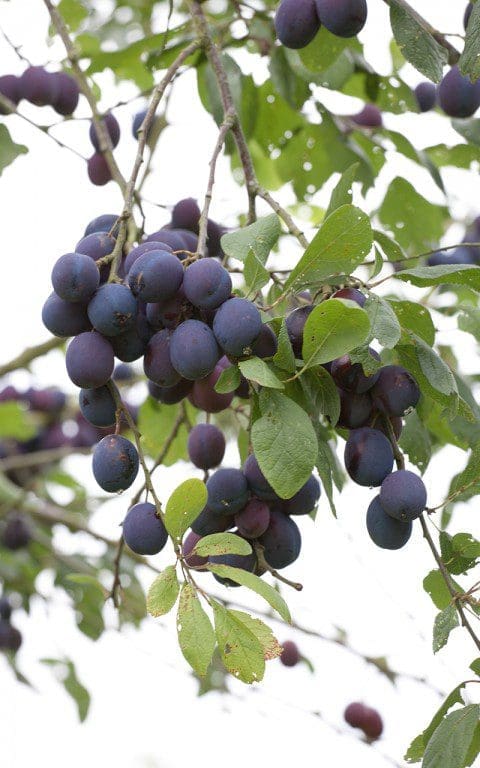 Damson ‘Merryweather’
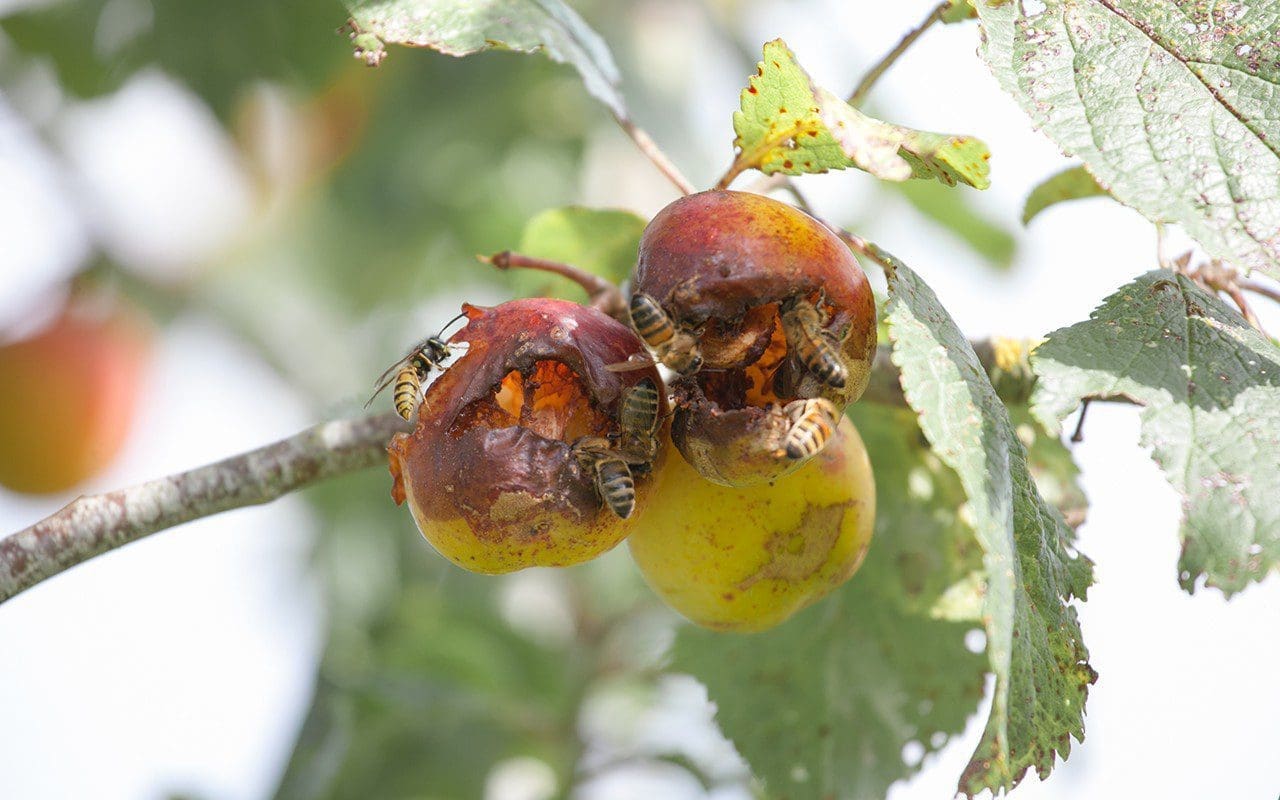
The plums are something you have to watch as they ripen, for they take some time to ready but, when they do, they all ripen over the space of a fortnight. The range of varieties in the plum orchard helps here in staggering the harvest, but getting to them before the wasps do is always a challenge. This year, however, we are bombarded with fruit which means there is plenty to go round, and I have been heartened to see that the rotting fruit also provides a late summer larder for honeybees and butterflies. I have a long, three-legged ladder with an adjustable third leg ideal for picking on our slopes but, for expediency, it has been quicker to lay down tarps on the hummocky grass and gently shake the trees. The fruit cascades around you and you can pluck the best without reaching into the branches to be stung by the competition.
Words: Dan Pearson / Photographs: Huw Morgan
Published 26 August 2017
The last week has seen a subtle shift, with a hint of the next season in the air. With cool nights and mist lolling in the hollows, the garden is between two seasons. The brilliant lythrum spires have finally run out of bud and, like sparklers fizzing their length, are suddenly extinguished. The dry days have been spun with the flock from the white rosebay willow herb caught on the breeze. I have planted it on the edges of the garden to blur the boundaries and, after weeks of flower, it is finally running to seed. I know it will need managing as it is a prodigious runner, but thank goodness it is not like our pink native Chamaenerion angustifolium, for the the seed is sterile.
This week’s bunch is a push against this mood, which can all too easily descend as summer runs out of steam and autumn is yet to take over. Over the years I’ve learned to plan for the between seasons lull and now no longer fear it. The Angelica sylvestris is a perfect example of a plant that steps in to fill the gap. In the ditch where we have cleared the damp ground of bramble they are now seeding freely. Although this wetland native has been wonderful since the spring, with it’s coppery foliage and architectural loftiness, the month of August is really its moment. It has been all but invisible for a while, with the grasses staking their position earlier on, but now the pristine umbels are held amongst their spent, tawny seedheads.
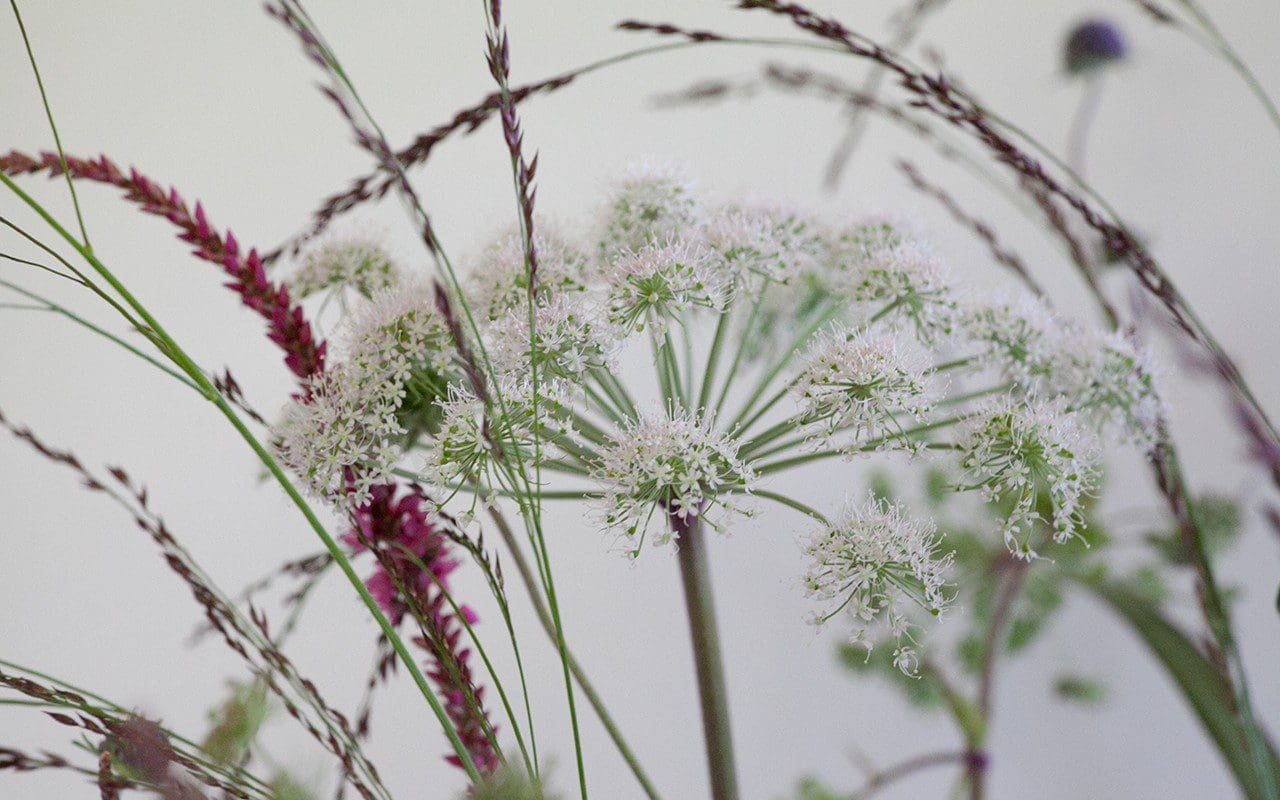 Angelica sylvestris
Some years, when we walk the ditch early in the season, you can spot a particularly fine form with dark, plum-coloured foliage. The dark stems are always a lovely feature of the Angelica but, coupled with dark leaves, they can not be bettered. Each year I mean to save seed of the best forms, but have never remembered to mark the plants before they are over and browned to skeletons. This autumn I plan to bring a selection called ‘Vicar’s Mead’ into the damper, lower slopes of the new garden. I have grown it without success in London, where it was too dry for it and mildew took its toll, but I trust the ground to be hearty enough here. Though biennial Angelica sylvestris will seed freely and, as long as you leave a number of seedlings, you will always get a succession.
In the garden, I have a particularly lovely form of the perennial Angelica edulis, which is planted through the white Persicaria amplexicaule. The substance and loftiness of the umbels with their horizontal conclusion is a good compliment to the finely drawn verticals, which echo the now spent grasses that surround the angelicas in the ditch. Persicaria is a mainstay of my plantings, which I have depended on for years. Happy with the cool of company at the root and with its head out in the sun, its lush foliage is an excellent team player. Good for the first half of the summer with its overlapping shield-shaped leaves, you know the season is progressing when the first spires arrive at the end of July. Again, August is their month, but they will sail through September and still be firing away in October with the asters. Here, for contrast with the blue, is a new favourite, Persicaria amplexicaule ‘September Spires’, which is tall enough to be making its way through the Verbena macdougalii ‘Lavender Spires’, and is an enlivening shade of hot pink.
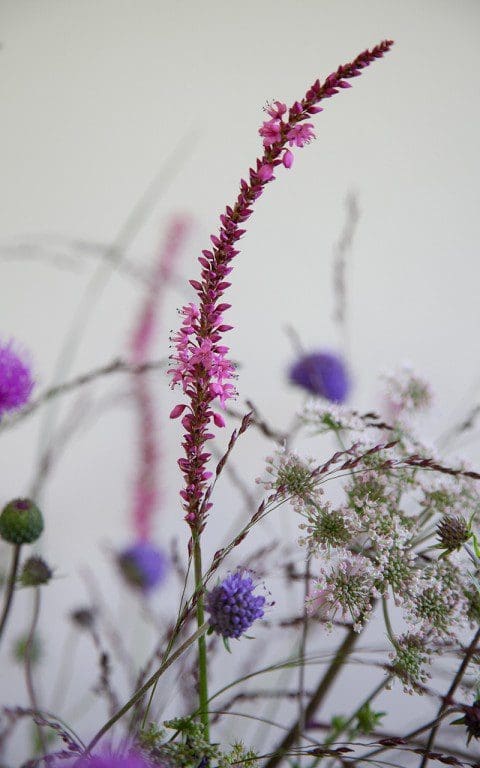 Persicaria amplexicaule ‘September Spires’
The Panicum virgatum ‘Rehbraun’ is a late-season grass. Slow to get started in the early summer and needing space early on so as not to be overwhelmed by early-into-leaf companions. An American native known as Switch Grass, it is happiest on lean ground and in bright conditions. Here it is better in soil that is drier or it will lean and topple. I have it on the upper, free-draining slopes where it is already showing colour with reddened tips to the foliage. The plum-coloured flowering panicles are so fine and delicate that you can see through their dusky framework. By the end of the month they will ascend to a final height of about a metre and will then go on to colour brilliantly in October, fiery and lit with their own inner light it seems.
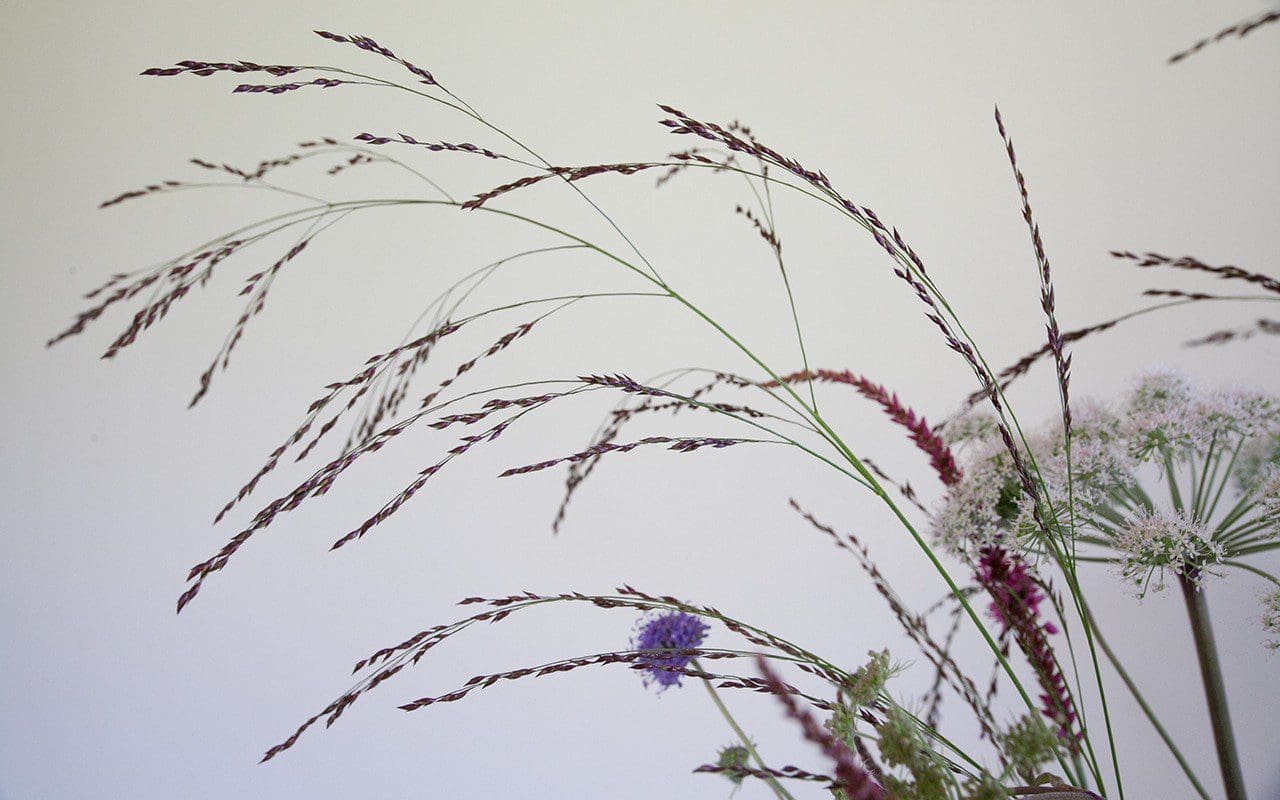 Panicum virgatum ‘Rehbraun’
I have them planted close, but not too close, to the Cirsium canum, which is as lush as the grass is fine. I bought this perennial thistle from Special Plants where Derry Watkins has it growing in her garden. She swore then that it wasn’t a seeder, as I had been stung by its similar cousin, the native Cirsium tuberosum. The latter has now been banished from the garden to the ditch banks for bad behaviour in the seeding department and, for the past three years, has been kept in check by the competition. When I last saw Derry and asked her if her C. canum had started to seed she said, “a little”, which was due caution, so I will raze my plants when the main show is over to avoid the inevitable. Their stature, reach and poise are beautiful though, the brilliant pink thimbles of flower spotting colour in mid-air just above our heads and humming with bees.
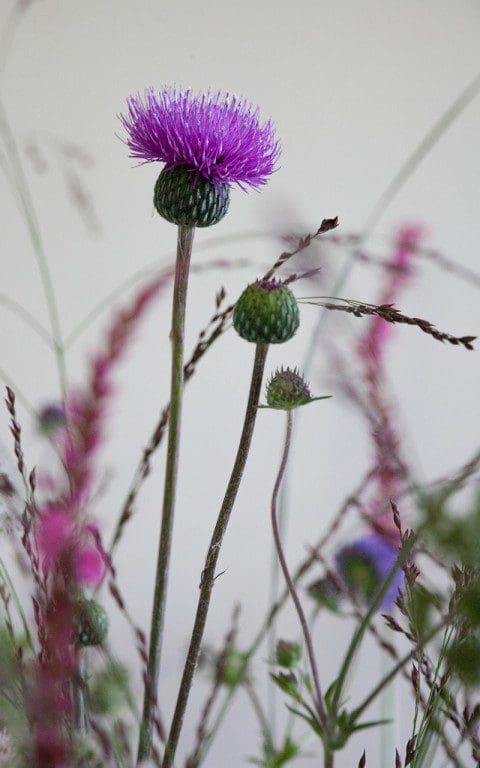 Cirsium canum
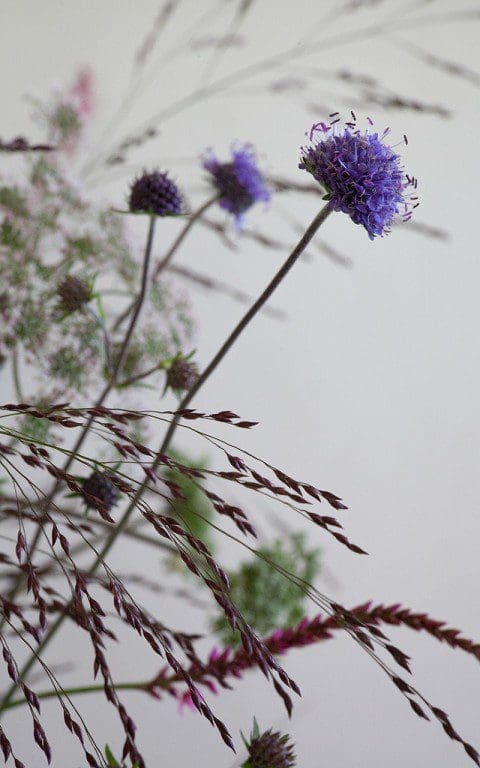 Succisa pratensis
Though at an altogether smaller scale, the Devil’s Bit Scabious has a similar feeling in the suspension of flower on wiry stems. Another native, Succisa pratensis is a late-performing meadow dweller, happiest where the soil is moist and picking up where many other natives have gone over in August. My original plant, a dark blue selection called ‘Derby Purple’ was the parent of the seedlings in this bunch. They came easily from seed, germinating the same autumn they were sown and flowering just a year later in the new plantings. Although the flowers are darker than the native, they are not as rich as their parent, but they are a wonderful thing to have hovering around in this between season moment. A neat rosette of foliage, that will slowly increase and clump, is easily combined in well-mannered company. I will keep them away from the Cirsium and run them instead through the openly spaced Switch Grass and be happy in the knowledge that their contribution will help to bridge the season.
Words: Dan Pearson / Photographs: Huw Morgan
Published 19 August 2017
The meadows that were cut for hay in the middle of July are already green and lush after the August rains. The hay needs to be cut before the goodness goes out of it, but we leave it until the yellow rattle rattles in its seedpods and has dropped enough seed for next year. With the cut go a host of summer wildflowers which have already set seed. Those that mature later are lost with the cut. So in the fields that are put to grazing when the grass regenerates after the hay cut, we will not see the scabious or the knapweeds. If they are present at all, they will not get the chance to seed and, if we were to have orchids, (one day, hopefully) their cycle would also be curtailed as they are only now ripening.
Where the land is too steep for the tractor, we find ourselves with rougher ground and other habitats. The steep slopes dipping away and down from The Tump are left uncut and, with the sheep shaping their ecology, they have become tussocked and home to a host of wildlife that has made this protected place home. The marsh thistle likes it there and can compete, and slowly we are seeing the first signs of woodland, with hawthorn and ash sheltering in the creep of bramble. We will have to make a decision as to where we apply a hand in preventing the woody growth from encroaching upon the grassland, as all the habitats have their merit.
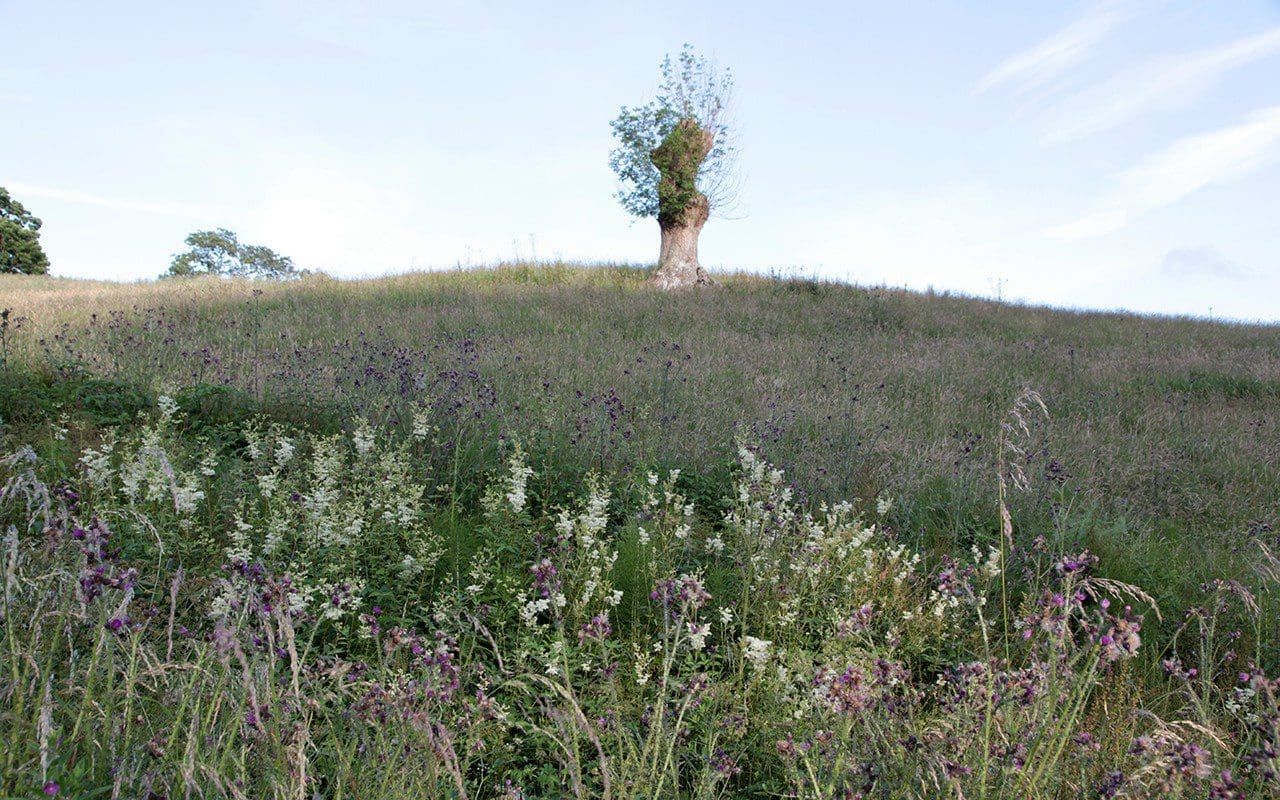 The lower slopes of the Tump above the ditch where the meadowsweet grows are colonised by marsh thistle
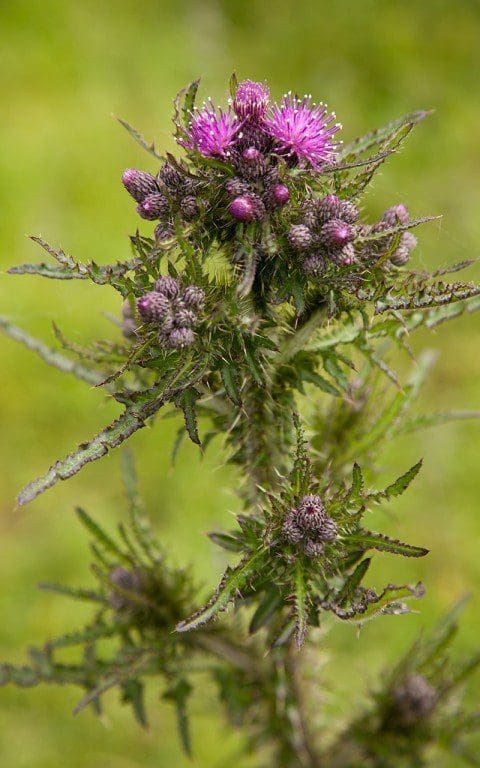 Marsh Thistle (Cirsium palustre)
The field that climbs steeply immediately behind the house is raked off by hand after the farmer mows it for us. It is too steep to bale so it is cut late to allow an August flush of meadow life. It is a task raking the cuttings to keep the fertility down, but one that is getting easier each year with concerted efforts to colonise the grass with the semi-parasitic rattle. This field and the newly seeded banks that sweep up to the house are valuable for being late and, as I write on a breezy bright day in a wet August, it is alive with the latecomers and the host of wildlife that retreats to find sanctuary there.
The ‘between places’ that are formed by banks that are just too steep to manage occur along the contours and below the hedges that run along them. The precipitous slope (main image) between our two top fields (The Tynings) has been something of a revelation and, seven summers in, we are seeing the rewards of making an effort with its management. A neighbour told us that every twenty years or so the farmer before us would fell the ash seedlings that took the banks as their domain. This must have last happened five or six years before we arrived and, although it was then covered in young ash and bramble, it was clear that this south-facing slope had the potential to be more than just scrub, and provide a contrast to the grazed meadows. The second winter we were here, we cleared the bramble, cutting off great mats and rolling them down to the bottom of the slope like thorny fleeces.
 The Tynings bank in April with cowslips showing
That spring the newly exposed ground immediately gave way to cowslips and violets that had been sheltering amongst the brambles. In the summer they were followed by smatterings of wild marjoram, field scabious, common St. John’s Wort, crow garlic, hedge bedstraw and agrimony, indicating the limey ground and the south-facing position.
Why the field levels vary so dramatically to either side of the contour-running hedge is intriguing. The ground in the valley is prone to slipping and the twenty-foot slope between these two fields suggests the occurrence of something of that nature in the past. The steepness of the bank and the shale and the clay that has been exposed in the underlying strata make it incredibly free-draining and the plants that have colonised here are specific and a contrast to those found on flatter ground. If you walk along the bank on a hot day now it is full of marjoram and you can hear it hum with life and crack and pop as vetch pods scatter their seed.
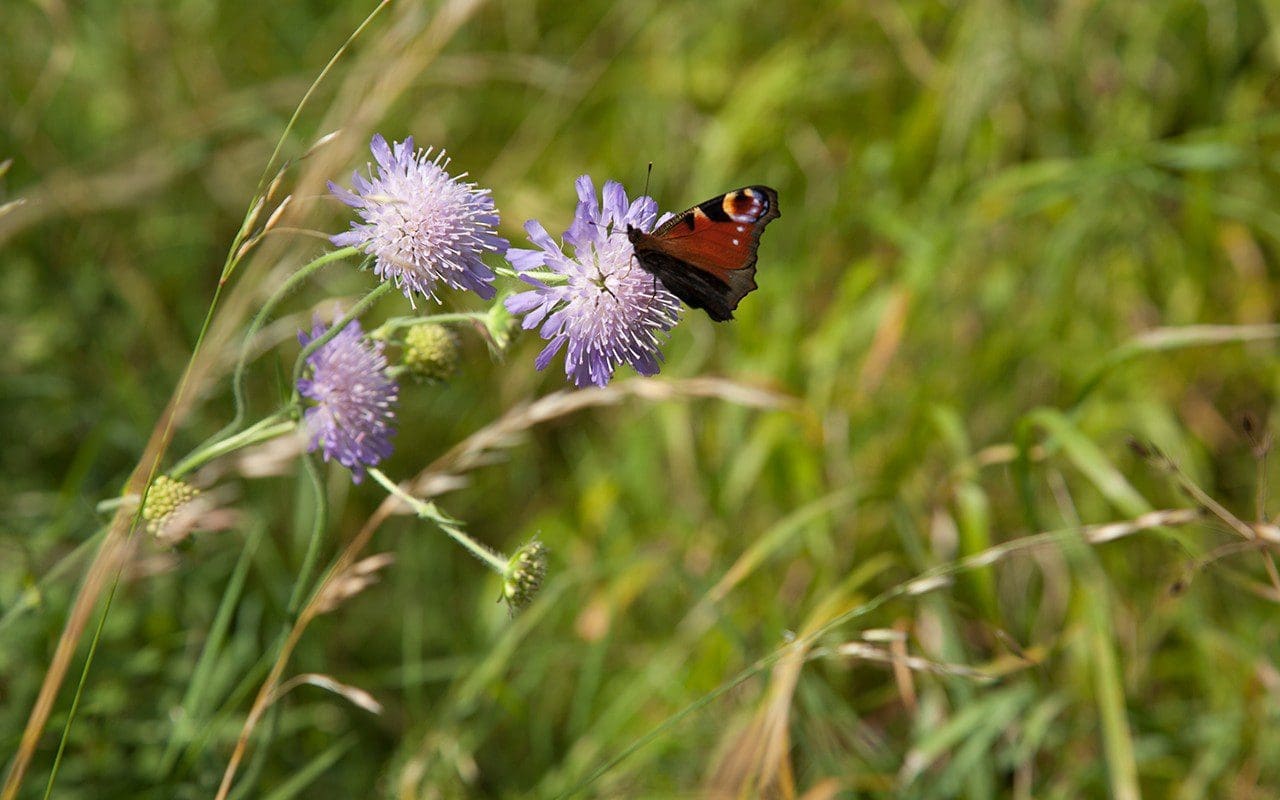
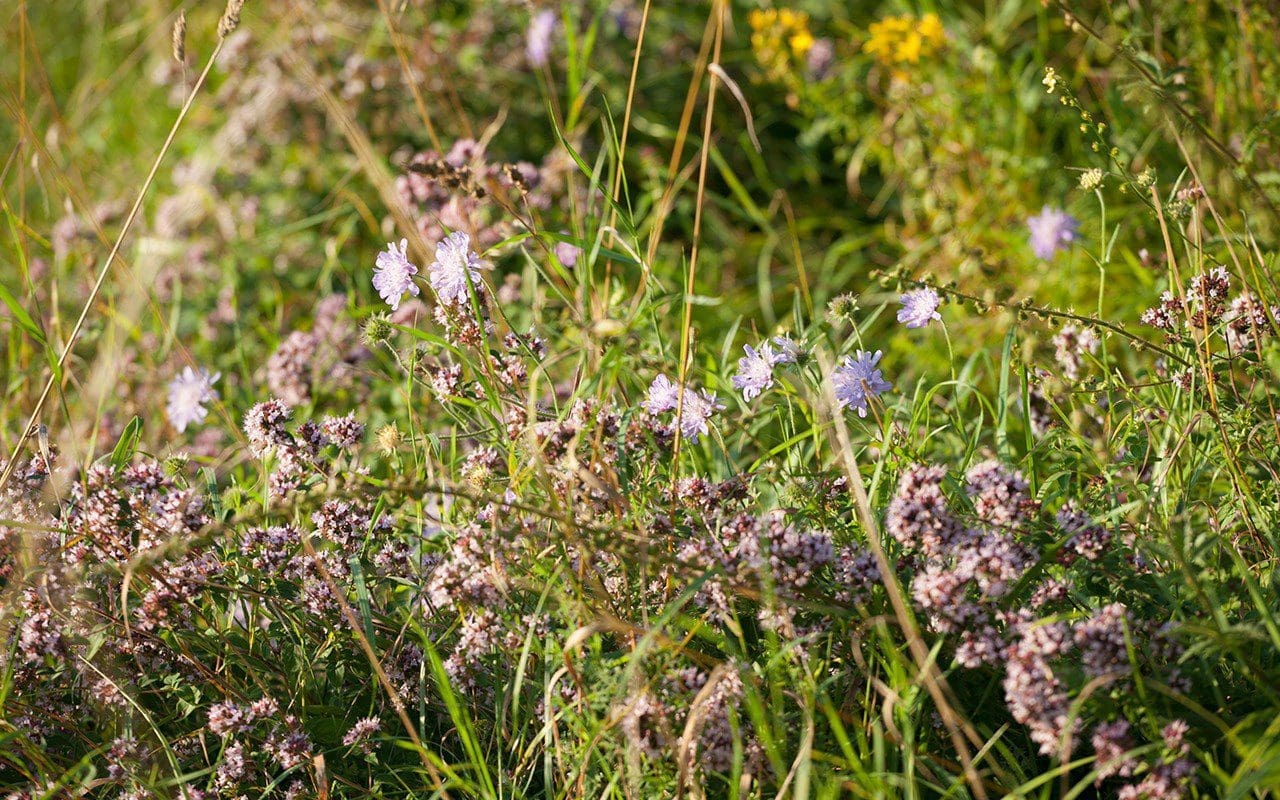 Field Scabious (Knautia arvensis) and Wild Marjoram (Origanum vulgare)
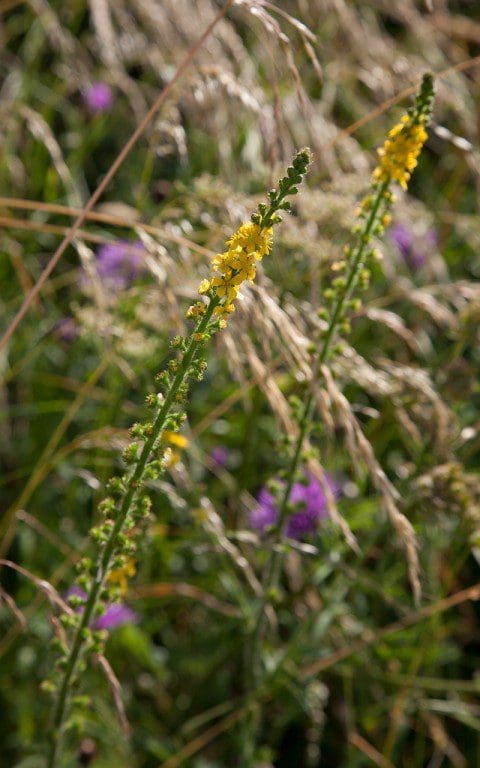 Agrimony (Agrimonia eupatoria)
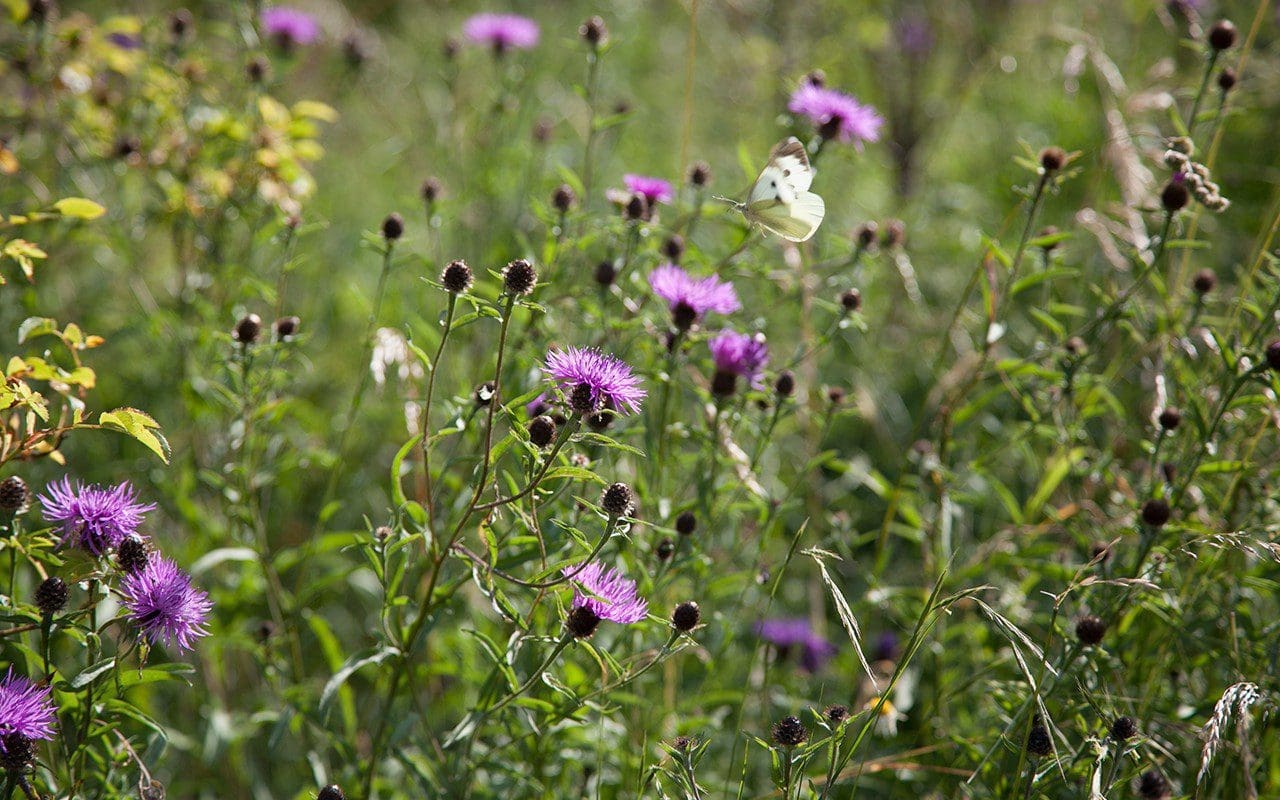 Common Knapweed (Centaurea nigra)
We have given the bank a ‘year on, year off’ cut, strimming in the depths of winter when the thatch is at its least resistant. All the cuttings are roughly raked to the bottom of the slope (and then burned) so that there is plenty of light and air for regeneration. We leave the spindle bushes, the wild rose and a handful of ash seedlings, but the sycamore seedlings that proliferate from the large trees in the hedgerow are cut to the base to keep them from getting away. After three cuts over six years the bank is now thick with marjoram and scabious, hedge bedstraw, common and greater knapweeds and this year, wild carrot, one of my favourite umbellifers for late summer. It is abuzz with honeybees, bumblebees, hoverflies and butterflies.
This bank has been the inspiration for the newly-seeded slopes around the house and last year I gathered seed from here to grow on as plugs to bulk up the St. Catherine’s seed mix that went down last September. The seed is sown fresh, as soon as it is gathered, into cells and left in a shady place for a year. I have not thinned the seedlings and have deliberately grown them tough so that they are able to cope with the competition. Last year’s batch was planted out not long after the banks were sown to add early interest, and some are visible and flowering already.
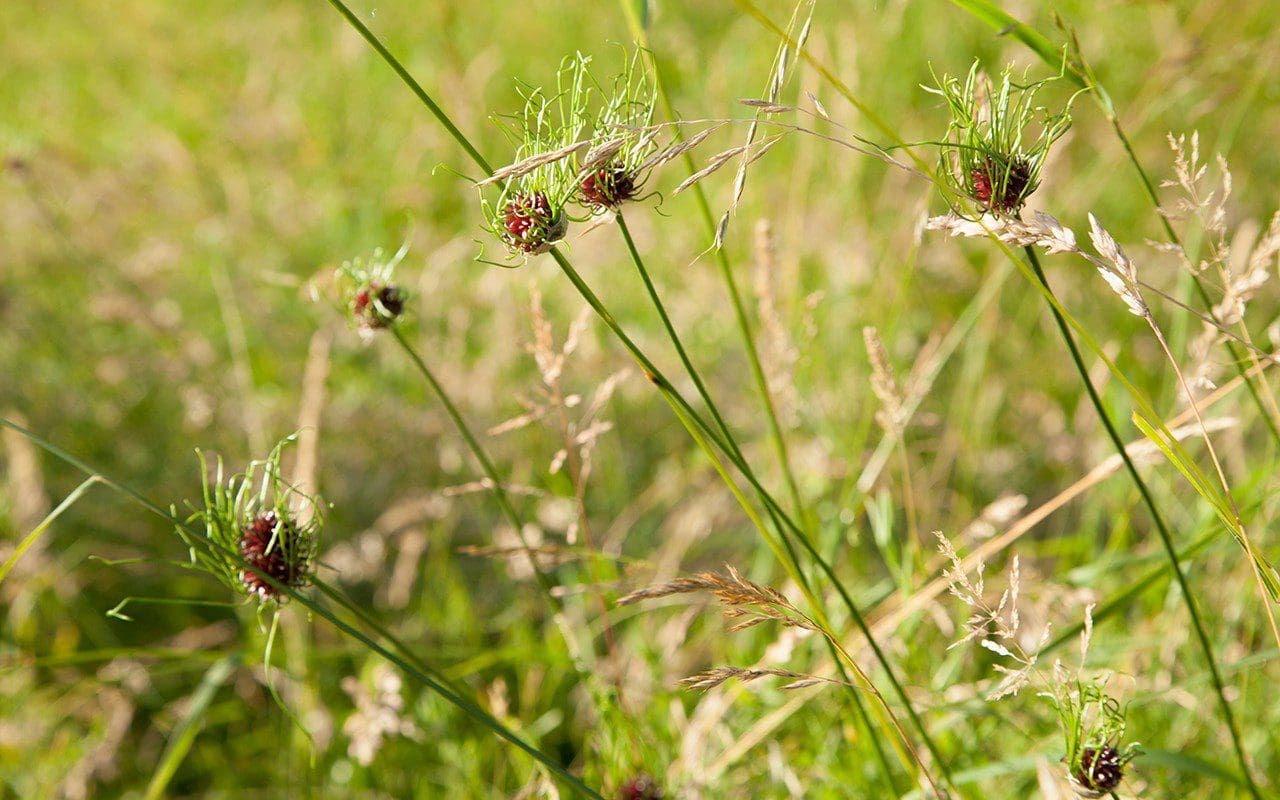 Crow garlic (Allium vineale)
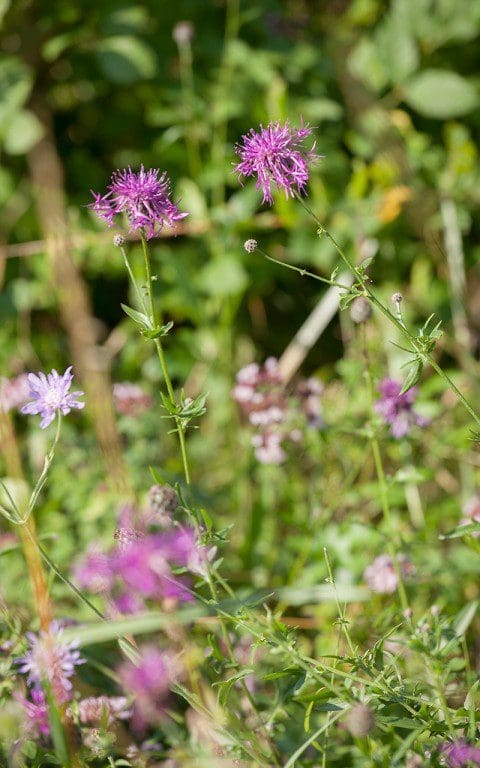 Greater Knapweed (Centaurea scabiosa)
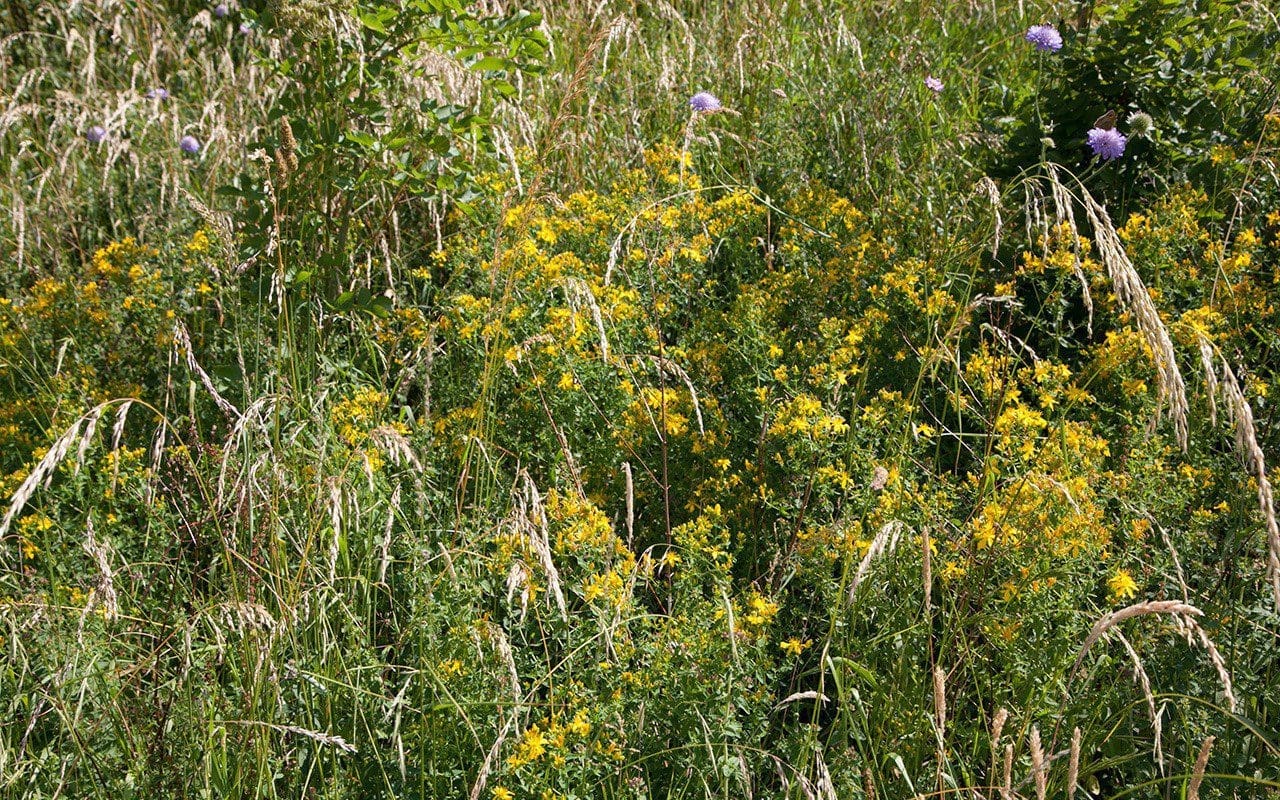 Common St. John’s Wort (Hypericum perforatum)
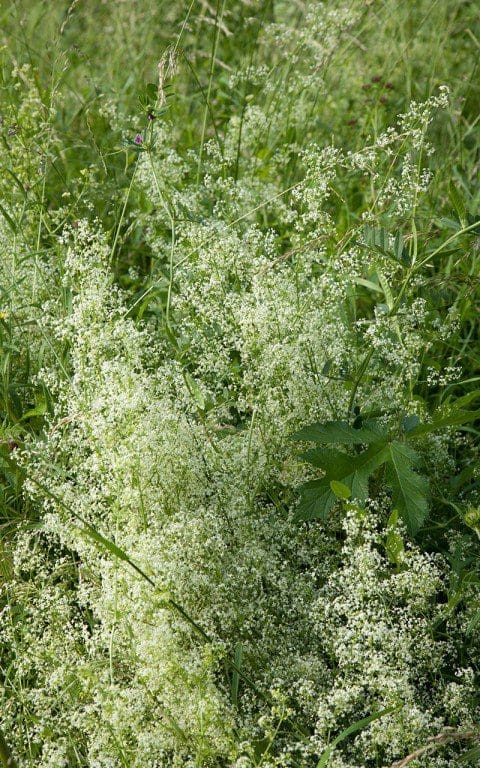 Hedge Bedstraw (Galium album)
This year’s plugs, which are destined for the late meadow behind the house, will be put out in September, straight after the banks have been cut. We have already seen a difference in the wildlife since creating these wilder spaces up close to the buildings, with more swallows than before swooping low for insects, the increased presence of a pair of breeding kestrels, a red kite that formerly kept itself to the farther end of the valley, more bats and, a couple of weeks ago, an exciting moment when a barn owl came sweeping low over the banks as dusk fell. Every year, with careful management, we will see a successive layer of change, and one year in the not too distant future, a sure but certain enrichment.
Words: Dan Pearson / Photographs: Huw Morgan
Published 12 August 2017
It’s not long now before we head back to Greece for our annual summer holiday. We are creatures of habit and have been going back to the same island for several years. We enjoy the routine of familiarity; the locals who now recognise us as we wander round town, the meditative walk to the black sand beach and the welcoming, energetic atmosphere of the panagyri, the numerous village festivals focussed on food and dancing. Food at the panagyri is free, and you eat what you are given, but this is no hardship as, without fail, everything is home-cooked and delicious.
One dish that always makes an appearance on the communal tables is skordalia, the thick garlic sauce that usually accompanies simple, boiled greens. These are most often beet greens, vlita (amaranthus) or horta, a mixture of foraged wild greens which can include purslane, dandelion, nettle, chicory, shepherd’s purse and sow thistle.
However, the first time we were served skordalia, it came to the table as a dip with breadsticks, and I was immediately reminded of an identical dish we used to eat every night at a beach restaurant on the Andalucian coast just on the edge of the Cabo de Gata Natural Park, the location of our last long-term holiday crush. When I asked, I was told that this garlic dip was called ajo blanco, which confused me, since I was familiar with the chilled soup of this name, sometimes called ‘white gazpacho’. It transpired that the ingredients were exactly the same – garlic, bread, almonds, oil and vinegar – it was just the proportion of ingredients that was different, and with less water added.
When I mentioned the similarity of this Spanish dish to the island locals they were really interested, and informed me that the skordalia on this island was unusual in that it was made with bread and almonds, whereas most traditional recipes are made either solely with potato, or bread and walnuts. Indeed, if you Google skordalia there is a huge range of differing recipes and, as with all such traditional dishes, although the core ingredients remain the same, every region has its own version, which also differs from family to family.
However, both the ajo blanco and skordalia of our holidays had a similarly light and creamy texture, which I knew in Spain was achieved through the addition of cold water as well as oil. So this recipe is the result of some experimentation in an attempt to match these two versions, and so may not be one for skordalia purists.
This is a great dish to foreground our recently harvested garlic and, given that skordalia is little more than a vehicle for it, the garlic you use for this should be as fresh and sweet as possible. We grew four varieties this year; Thermidrome, Germidour, Sprint and Printanor. We did a raw taste test immediately after harvesting and, of the four, we found Sprint to be the sweetest.
The quality of the bread is equally important, so use a sourdough with a good crumb, if possible. Cheap, white bread will turn to glue. Blanched almonds produce a whiter result, but the skins of unblanched almonds add an attractive, wholesome speckle to the dish.
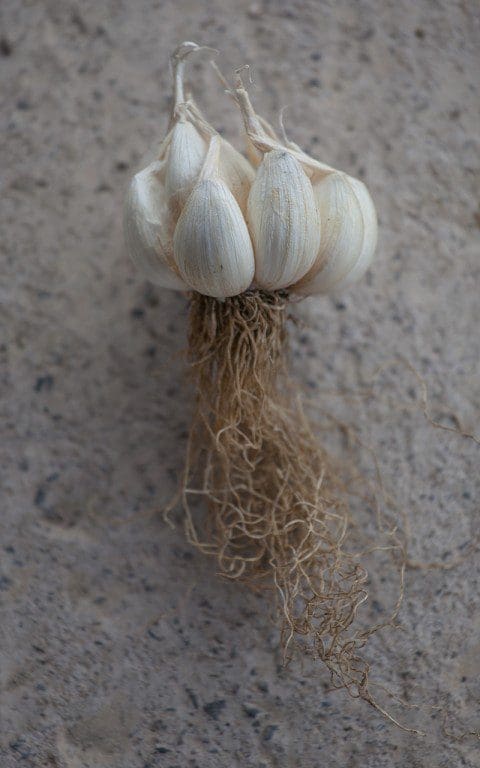 Garlic ‘Sprint’
INGREDIENTS
100g stale white bread, crusts removed
50g almonds, blanched or with skins
3 cloves garlic
1 teaspoon sea salt
1-2 tablespoons red wine vinegar
150ml olive oil, or more if required
Up to 175ml iced water
Serves 6 as an appetiser, 4 as an an accompaniment to a main course
METHOD
Soak the bread in cold water for 30 minutes then squeeze out as much water as possible.
Crush the garlic cloves with the salt in a mortar and pestle until you have a smooth paste.
Put the bread, garlic, almonds and vinegar in a food processor and blend until smooth, scraping down the bowl every now and again.
With the motor running on a high speed slowly add the oil until a smooth emulsion is formed. Then add the iced water until it reaches the consistency of fresh mayonnaise. Taste and adjust seasoning with additional salt and vinegar as required.
Transfer to a bowl. Cover with cling film and refrigerate until needed. Remove from the fridge immediately before serving and stir well. If the mixture has thickened considerably beat in a few more tablespoons of cold water.
Spoon the skordalia onto a dish and drizzle over a little more olive oil. Serve as an appetiser with breadsticks, or alongside boiled greens. Spinach, chard or young kale would be suitable replacements for the traditional beet greens or amaranthus.
Recipe & photographs: Huw Morgan
Published 5 August 2017
It is good to have the Inula back and finally given the domain they deserve. I have a vague memory about the provenance of my original plant, but am pretty sure it came from a trip that I made to see Piet Oudolf when he and his wife Anja were still running their nursery in Hummelo. My 1999 copy of Piet’s book Méér Droomplanten, which he signed for me at the time, has the words ‘THE BEST !’ written beneath the entry. By then we had already planted the greater majority of the garden at Home Farm, however, it was love at first sight, and so the inula were brought back without a specific home to go to.
Inula magnifica is native to the eastern Caucasus and I. m. ‘Sonnenstrahl’ (main image) is a selection originally made by Ernst Pagels (1913-2007), the influential German nurseryman responsible for the introduction of a huge number of garden cultivars, many of which have become synonymous with the new perennial movement, most notably those of Miscanthus sinensis and Salvia nemerosa. The Oudolf nursery was only about 100 miles away from Pagels’ nursery and the two became friends in the last twenty years or so of Pagels’ life, which must be how Piet came to know this cultivar.
Pagels chose this inula due to its vigour and the fact that it has particularly long rays to the flowers. Long enough to flutter in the wind and increase the already imposing feeling of the plant, where its wide branching flowerheads reach for the sky. This movement in the petals also adds a lightness and delicacy to a plant that is something of a giant. When you see ‘Sonnenstrahl’ alongside the straight species – more on that later – it has star quality. It is a plant that you want to make room for.
So, at Home Farm my original plants were given a space in the vegetable garden on the other side of the Barn Garden wall, whilst I wondered where they could go. Looking back at pictures of the Barn Garden now they peer a good head and shoulders above the wall, for they easily make two metres or more in stature and can take a couple of square metres at ground level with their relaxed splays of giant foliage. The growth is hoary to the touch and the paddle shaped leaves rasp as they brush upon themselves when you get close.
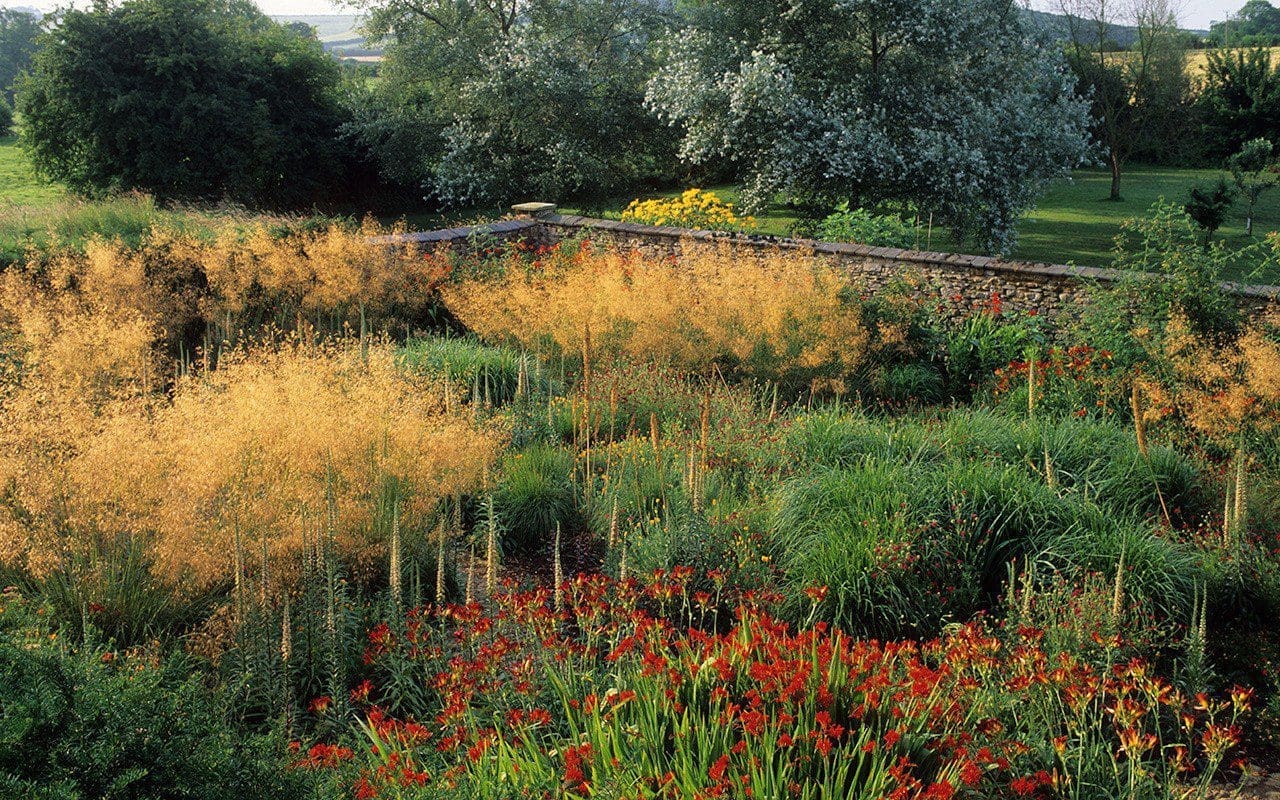 The Barn Garden at Home Farm in 1999. The Inula can be seen poking above the wall in the centre of the image.
Photo: Nicola Browne.
When Home Farm was sold in 2000, the plants were still in their position, waiting for a place to call home. I took a handful of favourite things from the garden of which they were one and, without the room to keep them myself, I gave the crown I dug up to Chris and Toby Marchant at Orchard Dene Nurseries, who kindly offered to foster it and give it a home in their stock beds. Although I am rarely fearful of big plants in small spaces, a single specimen would have taken far too much ground in the Peckham garden. I made do with visiting the wonderful grove of plants at Great Dixter that Fergus has set free in the grass in the lower reaches of the garden near the nursery and pined a little each time, until we moved here and once again had the opportunity of space.
About five years ago I made a return visit to Piet’s with my friend Midori from the Millennium Forest in Hokkaido and collected the seed of the plants he still had growing in the garden. The nursery had gone by then, but I was delighted with the seed until, three years later, they flowered in my stockbeds. It was hard to tell at first, because I only had memory as comparison, but the plants seemed inferior, not exactly a shadow of the parent selection, but certainly a poor cousin, with shorter rayed flowers and, consequently, less star quality. Nevertheless, when we were landscaping the new garden last summer, I dug up the seedlings with the help of a small excavator. It was summer so I cut the foliage and flowers back and split the vast crowns unceremoniously with a sharp spade into a dozen plants and potted them on for later.
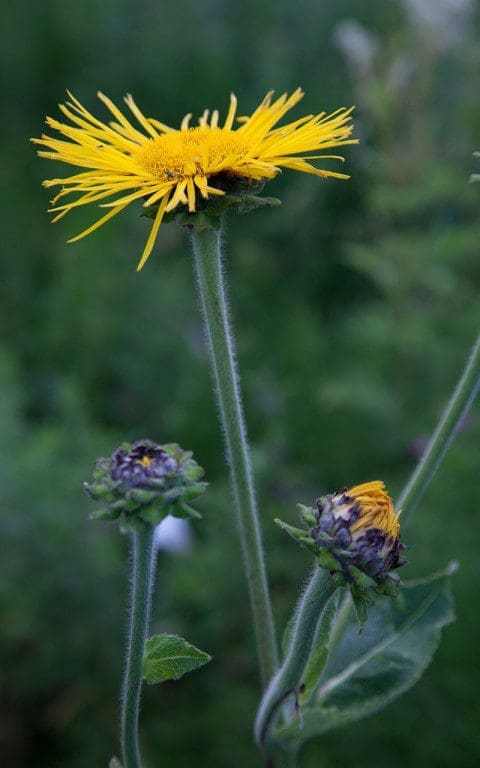 The shorter rayed flowers of the seed-raised inula
About the same time, we were invited to visit Shute House by Tania and Jamie Compton and afterwards, when we walked their own garden nearby, there was ‘Sonnenstrahl’ towering above us. The two of them have an eye for a good plant and, for sure, when I asked it was the superior beast. Jamie promised me a root cutting and, later, so did Toby Marchant from the original plant in their stock beds as a comparison. They both proved to be the same thing and so, eighteen years later, I have them once again, grouped around our cesspit so that their huge basal clumps of foliage will disguise this ungainly and ugly necessity. I have no fear that they will, nor any doubt that their presence will also make the cesspit something of a destination.
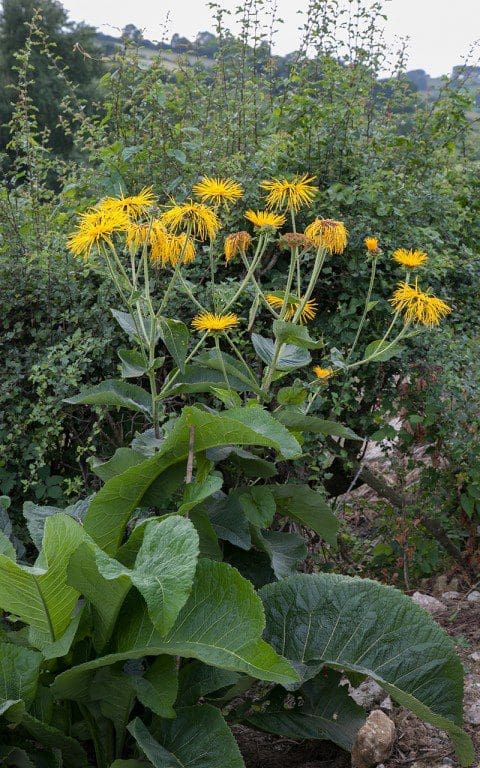 Inula magnifica ‘Sonnenstrahl’ by the cesspit
Close by, on the banks of the ditch, I have made space for my clutch of seedlings. The ground here is deep and moist from the spring water that feeds into the ditch. Although inula are known for their tolerance of damp conditions the splits, each filling a ten litre pot, were planted in the spring so that they wouldn’t sit wet. The growth around the base of the new plants has been kept clear by strimming to allow them the opportunity to get away and establish while they are still the newbies. Our grass in this country continues to grow in the winter and will overwhelm introductions that are not native and become winter dormant. Although their oversized foliage will compete once established, they need to get their strong taproots down and the reserve in the woody crown in the first year to be able to punch through and hold their own in the future.
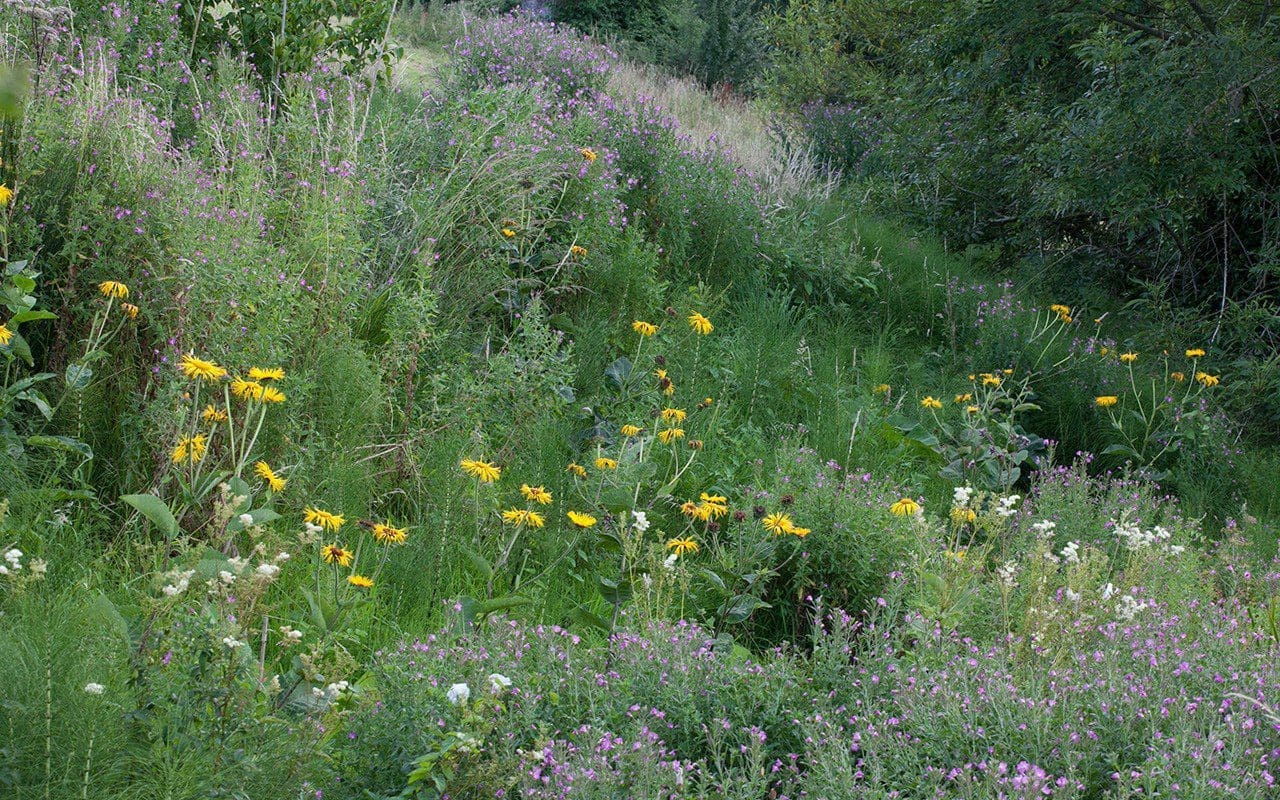 The seed-raised Inula magnifica on the banks of the ditch, growing with meadowsweet, great willowherb and horsetail
They have done well so far, the flowers rising up to carry the eye to the ditch banks beyond the garden and pump up the volume a little amongst the creamy meadowsweet and pink great willowherb. Sure enough the flowers are less dramatic and do not create the spectacle of the original plants nearby, but their lack of refinement feels more appropriate with the natives. Together with my gifted originals they help tell another chapter in the story.
Words: Dan Pearson / Photographs: Huw Morgan
Published 29 July 2017
Not long after moving here I planted a trial of bearded iris. I’d been inspired to do so by our hot, south-facing slopes and the possibilities that came with having space. At the time I was also in the process of replanting a Lutyens and Jekyll Arts and Crafts garden for a client. The iris felt right for the period when the garden had been in its heyday, so I made a research trip to Woottens of Wenhaston to see their famed collection. Their extensive fields fluttered with hundreds of varieties, which were thrown together as far as the eye could see. It was an unforgettable moment. Even with the exercise of some restraint, I still came away with a list of fifty-six that I wanted to trial. Of those divisions that arrived bare-root in their period of summer rest that July, three plants were of Benton heritage. I did not know it then, but the Bentons have refocussed and refined my iris eye. It is only when you grow plants for yourself that you get to know the best for your purpose and your true favourites. The trial revealed varieties that I had been seduced by in the field, but that in truth were easy to part with. And I did part with a lot. I was interested to find that of all the colours trialled it was the dark blues and purples, the colours with which bearded iris are perhaps most commonly associated, that looked most out of place in the landscape. I also dispensed with all those that felt overbred, with too much flounce, frill or rigidity to give the flowers real grace. However, once our focus fell upon the sophistication of the Bentons and we started to seek out more, the trial grew as quickly as it shrank.
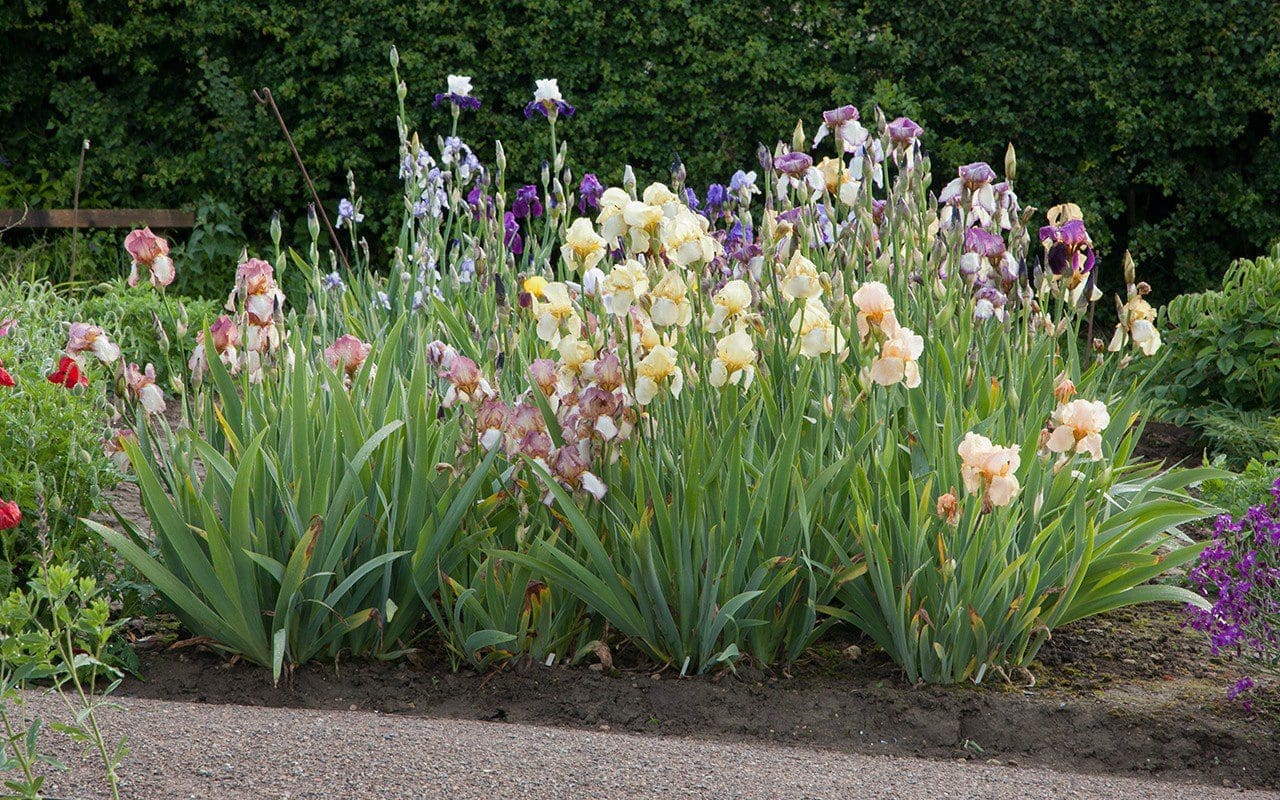 The iris trial bed in full flower in early June with the Bentons in the front
The Benton iris were bred by the artist and plantsman Cedric Morris at his home Benton End in Suffolk. Between 1934 and 1960 he raised thousands of bearded iris from seed, selecting some of the first pink, peach and yellow varieties that were widely acclaimed at The Chelsea Flower Show. Regularly growing as many as a thousand seedlings a year he named around 90 varieties, the greater majority of which have been lost to time as they went out of fashion or were left behind and then, as gardens changed hands, overwhelmed or their provenance forgotten. As timing would have it, Sarah Cook, the previous head gardener at Sissinghurst, had also fallen under their spell and had made it her mission to pull the lost collection together. She teamed up with Howards Nurseries and together they mounted one of the best stands in the Great Pavilion at the 2015 Chelsea Flower Show. Thanks to Sarah and her tireless hunt and research, twenty five or so are now available again and her quest to find still more is ongoing.
The iris trial bed in full flower in early June with the Bentons in the front
The Benton iris were bred by the artist and plantsman Cedric Morris at his home Benton End in Suffolk. Between 1934 and 1960 he raised thousands of bearded iris from seed, selecting some of the first pink, peach and yellow varieties that were widely acclaimed at The Chelsea Flower Show. Regularly growing as many as a thousand seedlings a year he named around 90 varieties, the greater majority of which have been lost to time as they went out of fashion or were left behind and then, as gardens changed hands, overwhelmed or their provenance forgotten. As timing would have it, Sarah Cook, the previous head gardener at Sissinghurst, had also fallen under their spell and had made it her mission to pull the lost collection together. She teamed up with Howards Nurseries and together they mounted one of the best stands in the Great Pavilion at the 2015 Chelsea Flower Show. Thanks to Sarah and her tireless hunt and research, twenty five or so are now available again and her quest to find still more is ongoing.
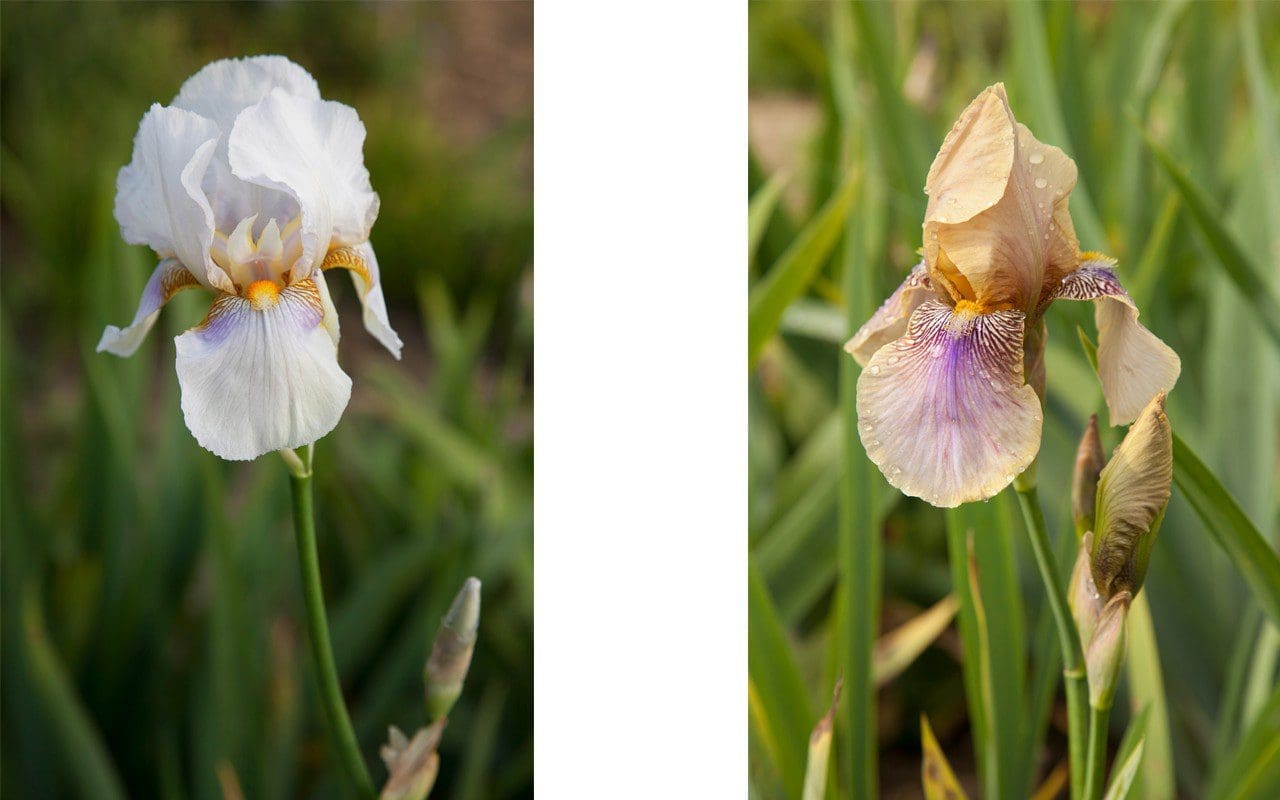 Iris ‘Benton Pearl’ and Iris ‘Benton Olive’
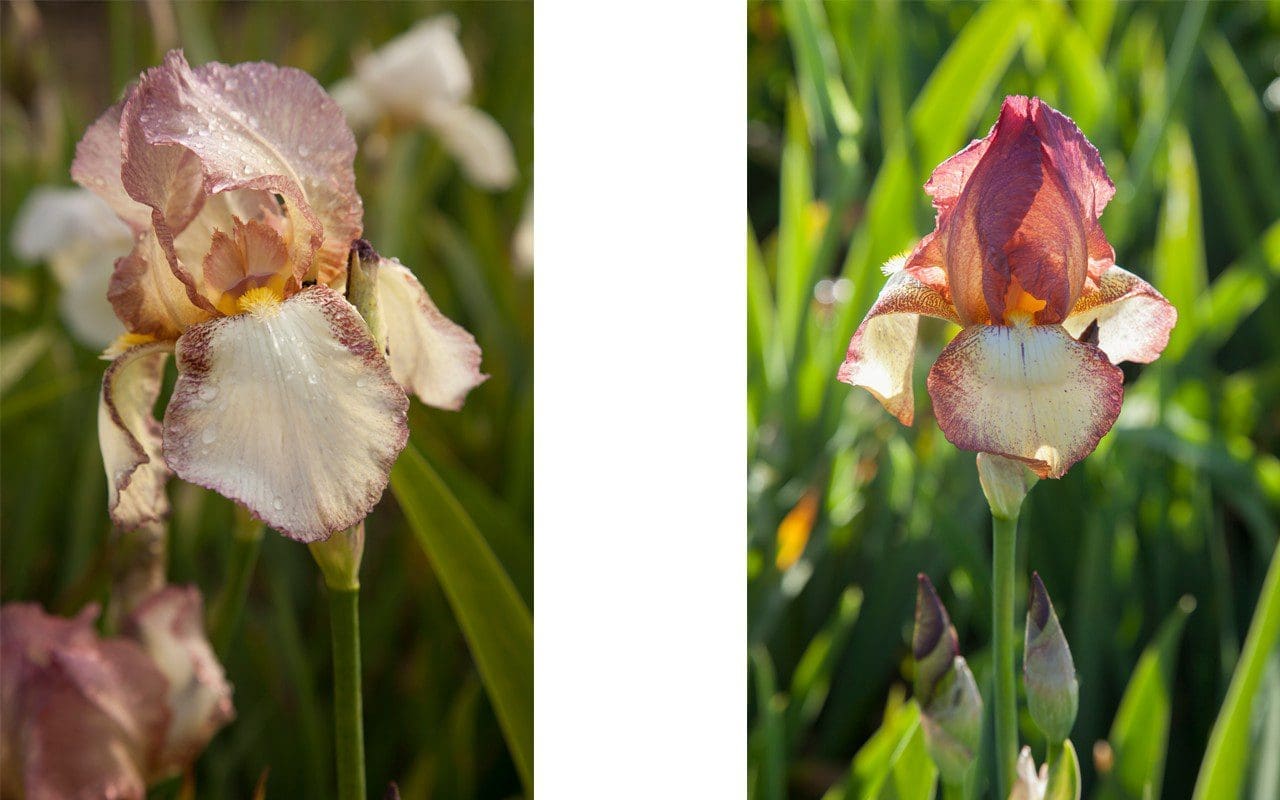 Iris ‘Benton Deidre’ and Iris ‘Benton Arundel’
I would love to have met Morris, for he obviously had an incredible eye and nose for a flower with poise, grace and perfect balance, despite its complexity. Thanks to his eye, I have now been able to strip the trial back to my true favourites, which include 20 of his selections and just a handful of others that feel right alongside them; chestnut brown ‘Kent Pride’ was bred in the ’50’s and has the same period feel, while the straw yellow ‘Glen Ellen’ is as graceful in form and unusual in its colouring. The only blues I have kept are pale and refined; the small-flowered picotee, ‘Madame Chereau’ and the ice-blue and white ‘Nassak’. Of the purples ‘Demi-deuil’ almost looks like a species iris with small, dark-veined flowers, while the truly almost-black ‘Anvil of Darkness’ was always a keeper, because to my eye no other iris has such depth of colour combined with such a light and refined flower form.
Iris ‘Benton Deidre’ and Iris ‘Benton Arundel’
I would love to have met Morris, for he obviously had an incredible eye and nose for a flower with poise, grace and perfect balance, despite its complexity. Thanks to his eye, I have now been able to strip the trial back to my true favourites, which include 20 of his selections and just a handful of others that feel right alongside them; chestnut brown ‘Kent Pride’ was bred in the ’50’s and has the same period feel, while the straw yellow ‘Glen Ellen’ is as graceful in form and unusual in its colouring. The only blues I have kept are pale and refined; the small-flowered picotee, ‘Madame Chereau’ and the ice-blue and white ‘Nassak’. Of the purples ‘Demi-deuil’ almost looks like a species iris with small, dark-veined flowers, while the truly almost-black ‘Anvil of Darkness’ was always a keeper, because to my eye no other iris has such depth of colour combined with such a light and refined flower form.
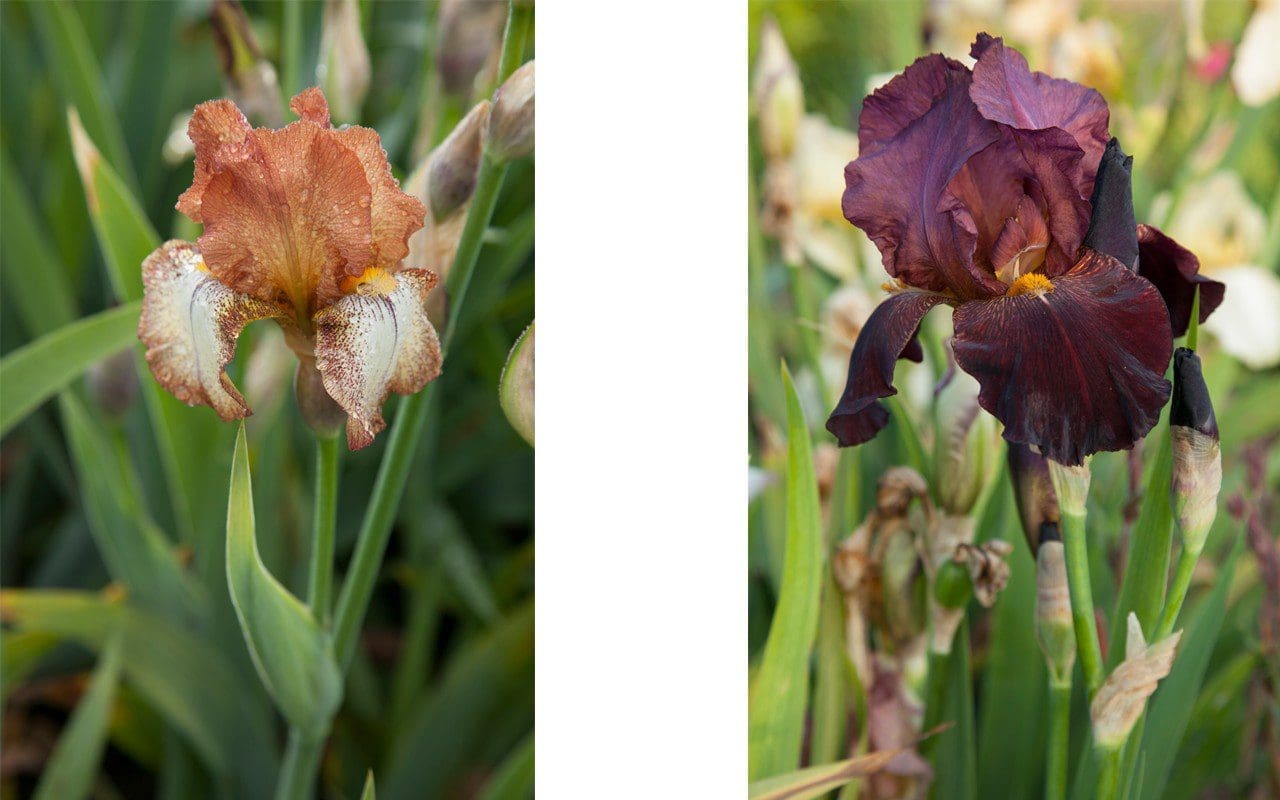 Iris ‘Benton Nutkin’ and Iris ‘Benton Caramel’
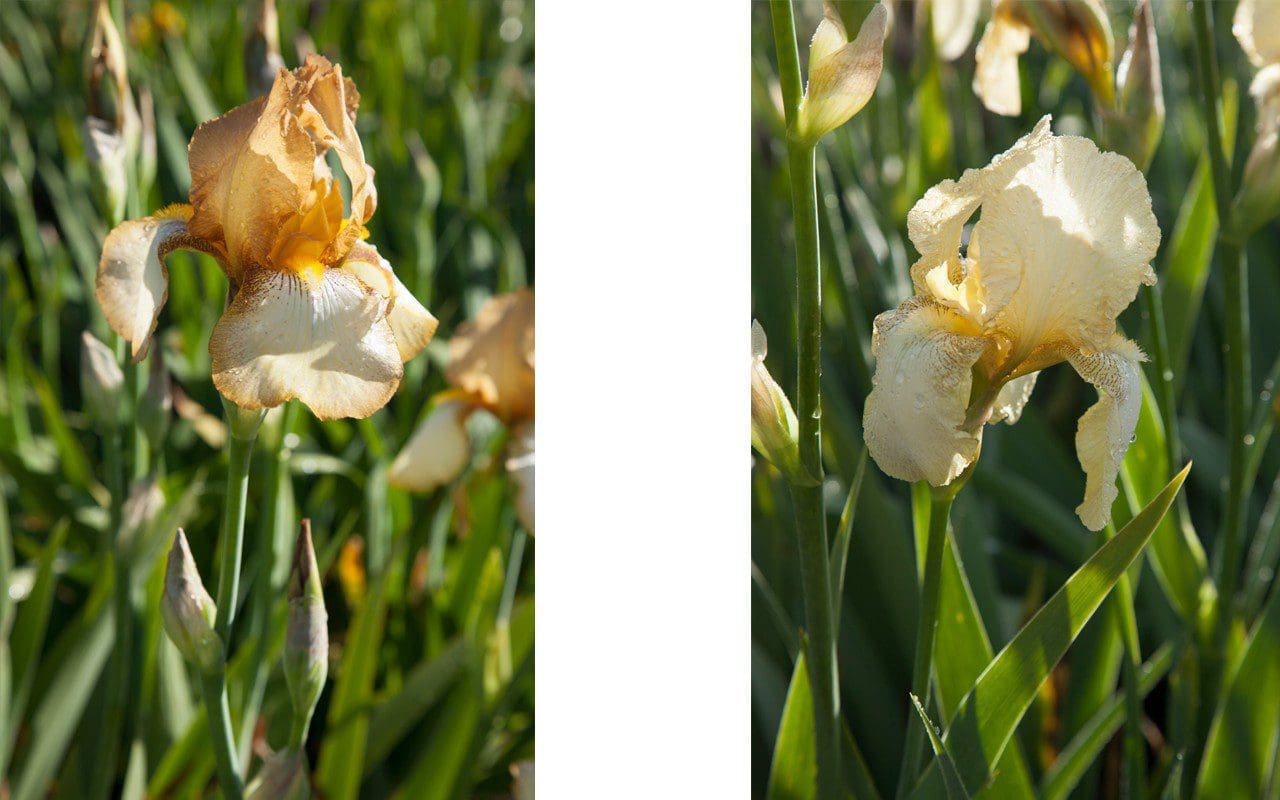 Iris ‘Benton Susan’ and Iris ‘Benton Duff’
The Bentons have their own particular beauty which is hard to put your finger on, but you know it when you see it. With more elongated flowers and space between the falls they have an ethereal, stately quality. There is a bruised, sophisticated complexity of colour, which conjures another period and you can see is the result of an artist’s eye; picotees in shades of plum, mauve and pink, silver grey, mother-of-pearl white, primrose yellow, true apricot, rich chocolate brown and papal purple. You completely trust in Morris’s eye when you see them and his choices were so particular that you can almost feel what it might have been like to know the man himself.
Iris ‘Benton Susan’ and Iris ‘Benton Duff’
The Bentons have their own particular beauty which is hard to put your finger on, but you know it when you see it. With more elongated flowers and space between the falls they have an ethereal, stately quality. There is a bruised, sophisticated complexity of colour, which conjures another period and you can see is the result of an artist’s eye; picotees in shades of plum, mauve and pink, silver grey, mother-of-pearl white, primrose yellow, true apricot, rich chocolate brown and papal purple. You completely trust in Morris’s eye when you see them and his choices were so particular that you can almost feel what it might have been like to know the man himself.
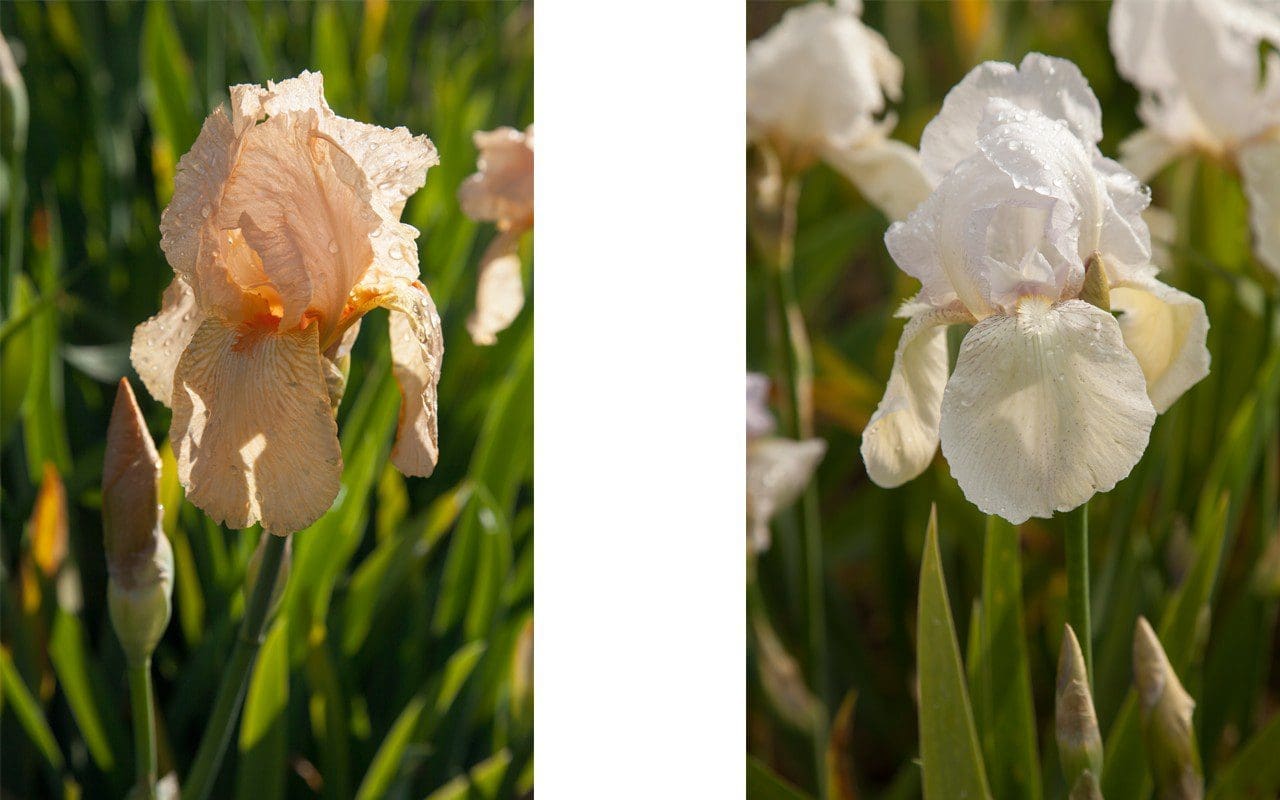 Iris ‘Benton Strathmore’ and Iris ‘Benton Opal’
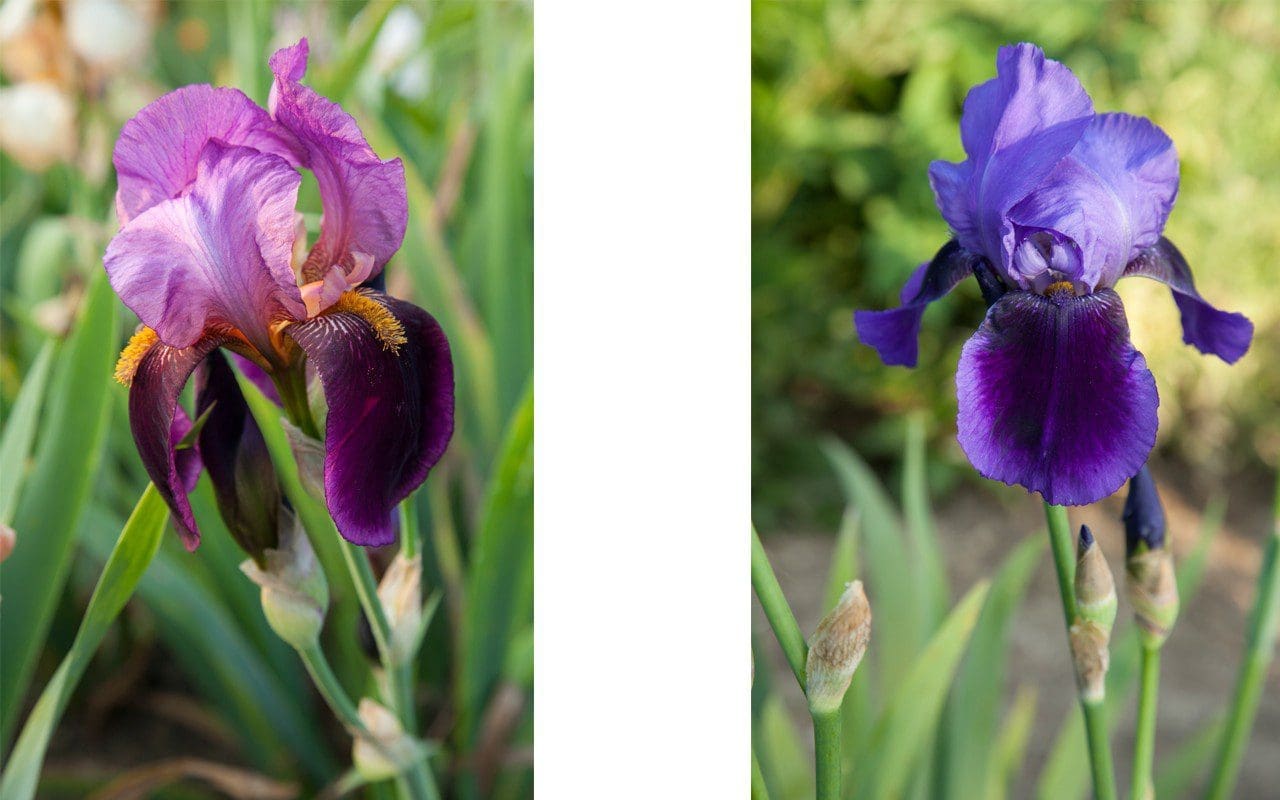 Iris ‘Benton Storrington’ and Iris ‘Benton Nigel’
I have been planning for this moment for several years, as the trial garden is now in the process of being liberated to make way for the remainder of the new garden. I have deliberately not included the bearded iris in the new plantings, partly because they are very hard to use in combination, needing full sun at the base and no competition, plus they are altogether too captivating and attention-grabbing when they are in flower in June. The chosen few have been found a special place against the hot wall behind the herb garden, where they can have all the attention they want. All being well, they will thrive there with the radiated heat from the blockwork and I plan for there to be no companions for this is the way that the germanica iris usually fail, as they are lost to competition.
Iris ‘Benton Storrington’ and Iris ‘Benton Nigel’
I have been planning for this moment for several years, as the trial garden is now in the process of being liberated to make way for the remainder of the new garden. I have deliberately not included the bearded iris in the new plantings, partly because they are very hard to use in combination, needing full sun at the base and no competition, plus they are altogether too captivating and attention-grabbing when they are in flower in June. The chosen few have been found a special place against the hot wall behind the herb garden, where they can have all the attention they want. All being well, they will thrive there with the radiated heat from the blockwork and I plan for there to be no companions for this is the way that the germanica iris usually fail, as they are lost to competition.
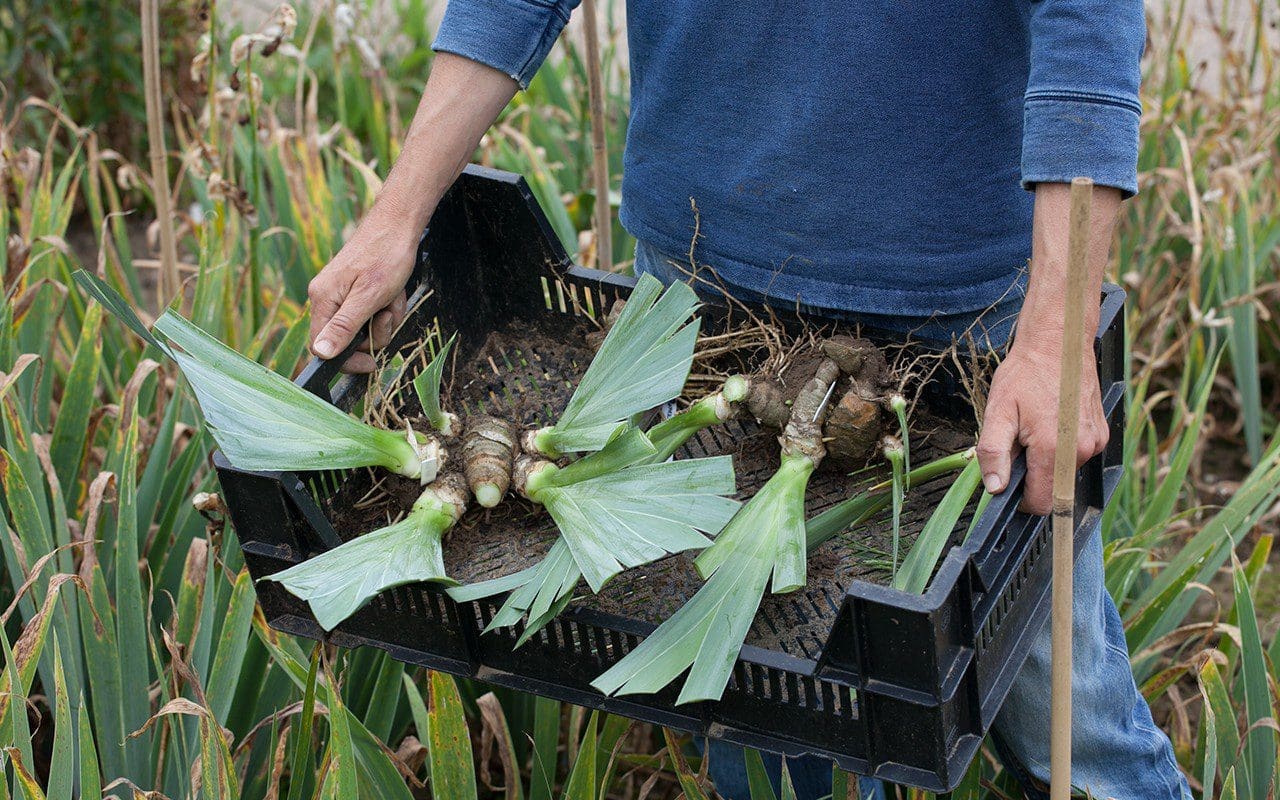 Iris rhizomes after lifting, splitting and trimming
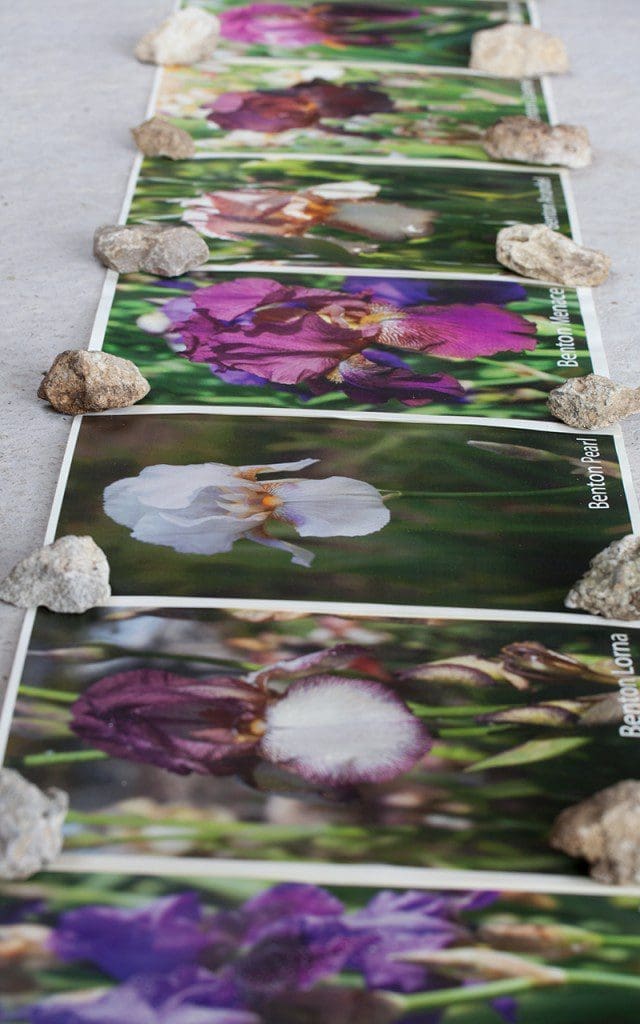 Print outs helped fine-tune the colour combinations of the Benton iris before planting
I lifted them in early July, as soon as they started to show signs of going into their period of summer dormancy. Splits were separated from the main clump with a carefully aimed border fork separating a healthy rhizome, with two fans of foliage and the energy in it to make good growth as soon as they start back into life later in the summer. The leaves were cut back into a fan in text-book fashion to reduce transpiration and to clean up any diseased foliage. The Bentons are well known for their health, but all the germanicas go into their scruffiest period in the middle of summer and the clean up feels good. The plants were replanted, the rhizomes facing south with the fan of foliage behind, like holidaymakers sunning themselves in deckchairs, to harvest all the light there is going. Our ground being damp in winter, I drew the limestone chippings from the path around their collars to help with free drainage and give them the best start at the beginning of this new and refined chapter.
Words: Dan Pearson / Photographs: Huw Morgan
Published 22 July 2017
Print outs helped fine-tune the colour combinations of the Benton iris before planting
I lifted them in early July, as soon as they started to show signs of going into their period of summer dormancy. Splits were separated from the main clump with a carefully aimed border fork separating a healthy rhizome, with two fans of foliage and the energy in it to make good growth as soon as they start back into life later in the summer. The leaves were cut back into a fan in text-book fashion to reduce transpiration and to clean up any diseased foliage. The Bentons are well known for their health, but all the germanicas go into their scruffiest period in the middle of summer and the clean up feels good. The plants were replanted, the rhizomes facing south with the fan of foliage behind, like holidaymakers sunning themselves in deckchairs, to harvest all the light there is going. Our ground being damp in winter, I drew the limestone chippings from the path around their collars to help with free drainage and give them the best start at the beginning of this new and refined chapter.
Words: Dan Pearson / Photographs: Huw Morgan
Published 22 July 2017 The herb garden lies between the house and the water troughs which screen and divide off the kitchen garden beyond. Its formation was part of last summer’s push to get the ground around the house squared up after the building works and in use again as a garden. The flat ground here was something we had dearly needed and it has made an enormous difference in how we negotiate the areas immediately around the house because, although the slopes provide their drama, it is so much easier to get around and to look when you don’t have to concentrate on your feet.
This garden is all about looking and I wanted the planting to hold your eye before it naturally travelled on and up the valley. It was the last area to be planted this spring, in part because I had inadvertently introduced horsetail when bringing up topsoil from further down in the field. I did not want a single trace of the horsetail in the garden and was happy to take the time over winter to track its growth back to the tiny slivers of black wiry root that were going to set it off in a new position if it wasn’t dealt with. The ground had also become compacted with the tracking of the diggers and I needed it to be free draining so that the herbs would be happy and not lie wet in our West Country winters. This required waiting until March to dig the ground over and introduce some sharp sand and grit.
The extra care that went into preparing the soil meant that the garden was not planted until the middle of April. Lavender, verbena, salvias, a cut-leaved fig and a willow-leaved bay laurel were planted small, with plenty of space so that the air could circulate and for the plants to have the opportunity to bake against the gravel mulch. The space between the plants will close over in the next year or so, but in the meantime I have inter-sown the gaps with a smattering of annuals to give the new planting a lived-in feeling in this prominent position.
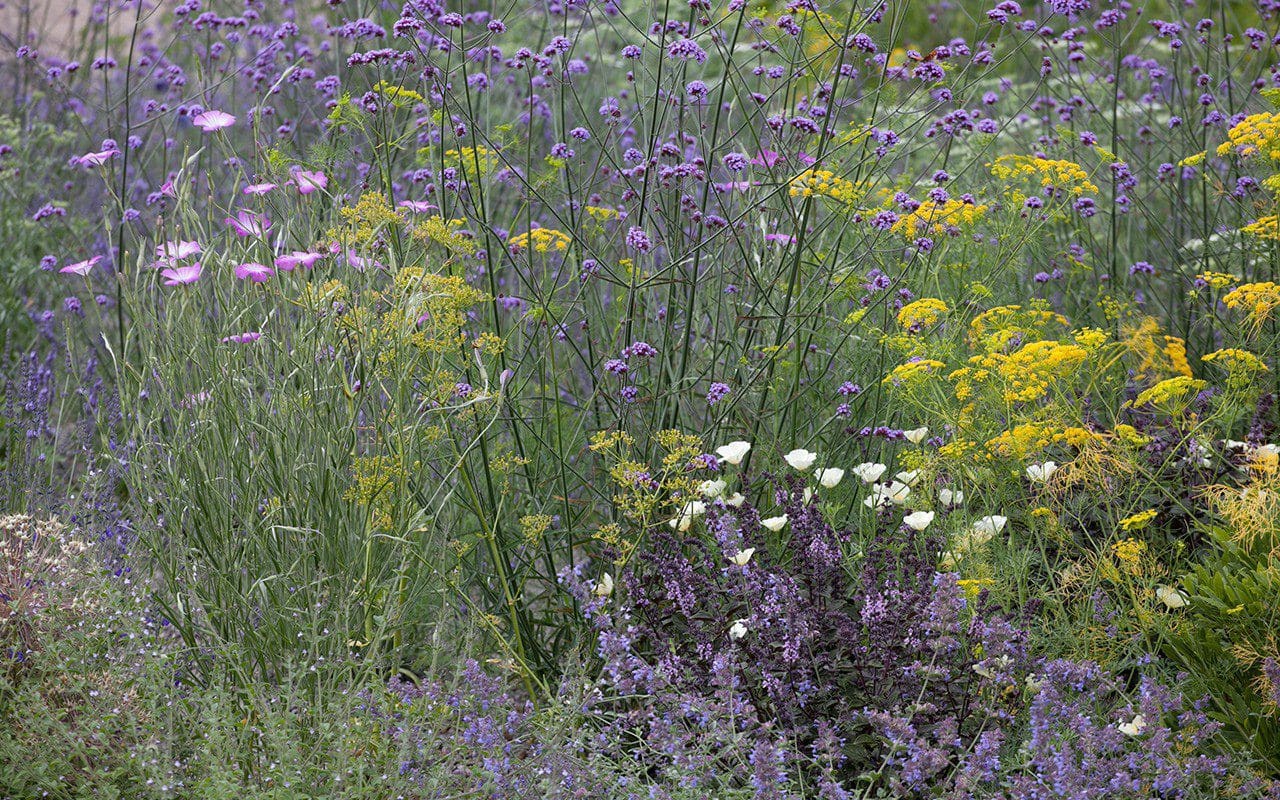 Part of the new herb garden planting with Agrostemma, Eschscholzia and Ridolfia
The opportunistic nature of annuals is something that I enjoy, particularly when they find their way by self-seeding and letting you know, sometimes a little too eagerly, that they like you. I am going to have to watch that here, because the majority of the herbs will hate to be overshadowed, their Mediterranean heritage not liking the damp that comes with close company or the lack of sunlight. So the annuals here may well be short-term and I will diminish the impact of their seeding by pulling them before they drop.
All of this year’s additions were sown direct from seed, a pinch to each planting station that was marked carefully with a cane so that the youngsters wouldn’t be trampled or mistakenly pulled when weeding. Seed is one of the most economical ways of introducing plants into the garden, but sowing is all in the timing. Sow too late with poppies, for instance, and unless we have a damp summer you will lose the energy of the spring and the bulking up they need to send flower soaring when the weather warms. But some are more adaptable and a succession of sowing can mean that, like salad, you have a relay as one generation goes over and is replaced by the next.
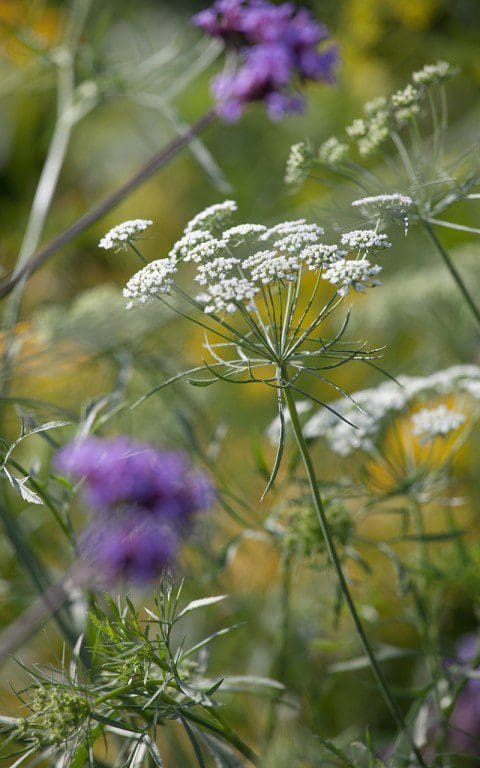 Ammi majus
The Ammi majus are a good example and two sowings – one in late March, the next a month later – will keep you in flower until the autumn. Otherwise known as Bishop’s weed, Ammi originates in the Nile Valley, but is adaptable to our climate and will repeat itself gently from year to year wherever the seedlings can find recently disturbed, bare ground. Though it is often used now as a cut flower, the sap can cause phytophotodermatitis, a chemical reaction which makes the skin hypersensitive to ultraviolet light causing burning, itching and, in severe cases, large blisters. So far I have not been susceptible but, having been burnt once after handling Giant Hemlock, I recognise the risk and work around it in long sleeves and on a dull day.
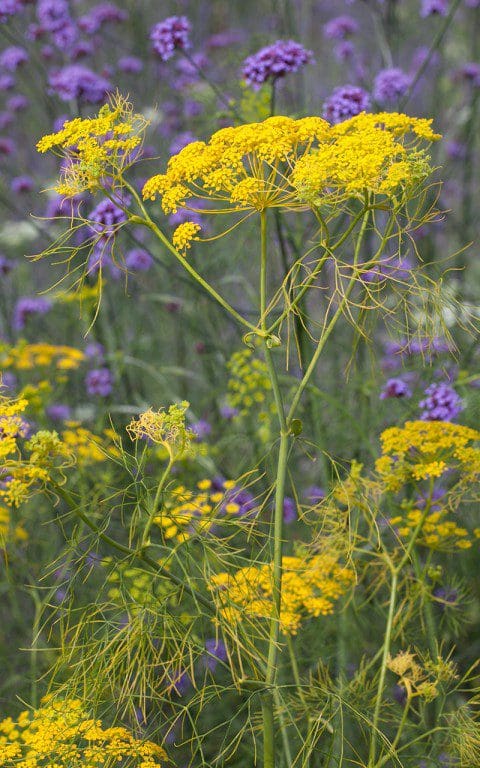 Ridolfia segetum
Risks aside, it is a beautiful thing, rising up tall on wiry stems, to a metre or 1.2m at full stretch. I like it for introducing light which is soft in tone into a planting, a sparkle that is repeated again, but rather differently, in the glowing, acid-yellow of Ridolfia segetum (main image) . This is the first year that we have grown the Corn Parsley. A Mediterranean annual that could easily be mistaken for dill, but its flowers are brighter and brightening still as the flowers mature. I like the zing and zest amongst the blues and the little bit of friction that prevents the Verbena from feeling too pretty. I want the planting to feel informal, but I want the colour to be sharp.
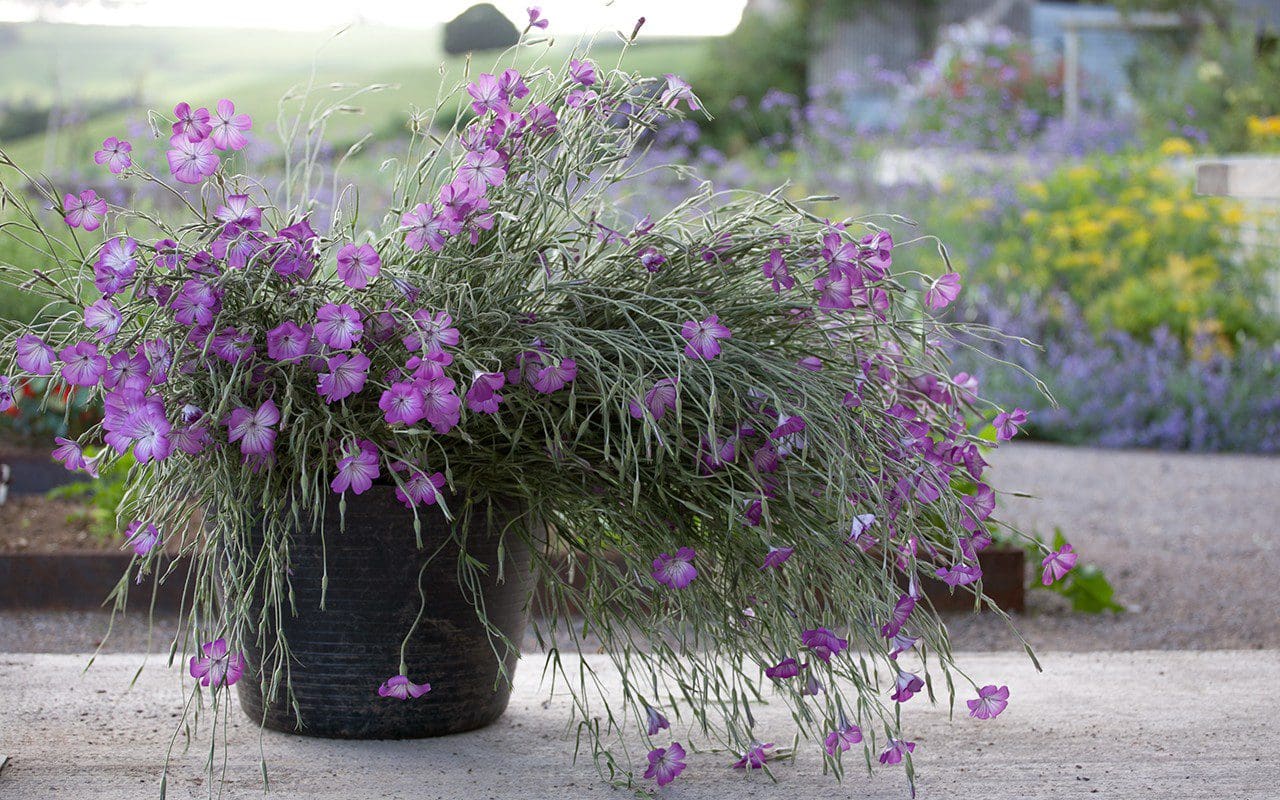
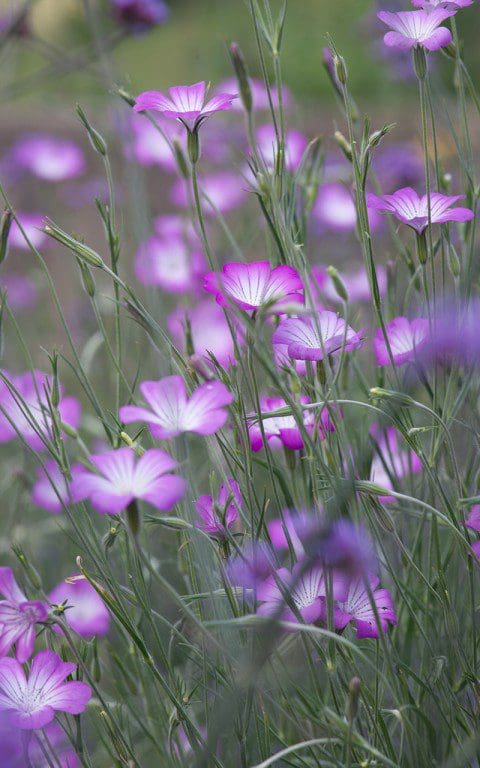 Agrostemma githago ‘Milas’
The Agrostemma githago ‘Milas Snow Queen’ are a case in point. We have enjoyed the willowy growth as it has raced up to flower, silvery-soft and catching the breeze to shimmer. I looked forward to the creaminess of the simple, upward-facing flowers, but the seed we were supplied must be ‘Milas’, its very pink and very showy cousin. Having grown them from seed I gave them the benefit of the doubt but, as the volume of flower has increased, the colour in the bed is altogether wrong and makes the couplings of lavenders, sages and delicate umbellifers saccharine and cottagey. They draw the eye from a palette which, although it has its contrasts, is harmonious in shades of blue, white and yellow. The white corncockle I had planned for would have added a shimmer and flutter without the confusion of another colour. Clarity has been regained easily enough as we have been cutting down whole plants and bringing them into the house for cut flowers. Today, however, the tipping point of pink was reached, and we took out the whole lot. Brutal perhaps, but it is important to be disciplined and stick to your vision, as a single element can all too easily change the mood and success of a planting entirely. Next year I shall try again undaunted with Agrostemma githago ‘Ocean Pearl’, which may also be better as it is smaller flowered.
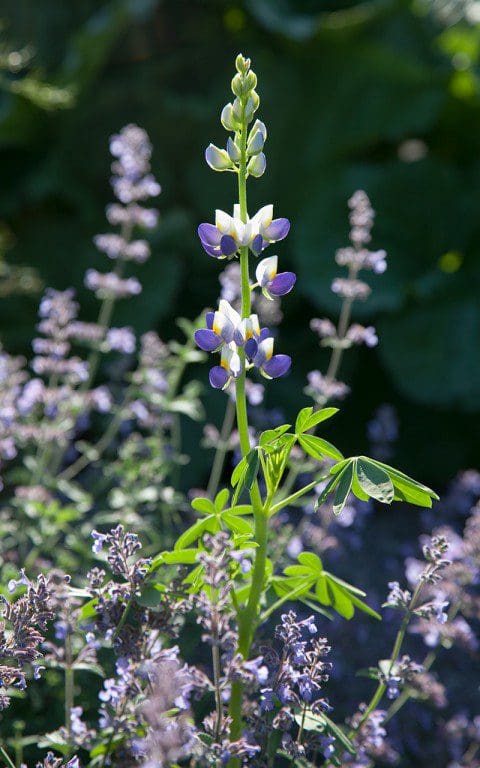 Lupinus ‘Blue Javelin’
The Lupinus ‘Blue Javelin’ have been beautiful in the planting and have been the making of the corner where they rise up through the catmint, Nepeta ‘Six Hills Giant’. However, next year I’d like to try the pure gentian blue of Lupinus pilosus. I first saw this remarkable plant as a spring ephemeral in Jerusalem and then, more latterly, amongst acid-green Smyrnium perfoliatum in Greece. The colour would be a better match to the indigo of Salvia x greggii ‘Blue Note’ and, combined with the Ridolfia, the electric contrast is something I want to keep up in the planting so that it has a charge.
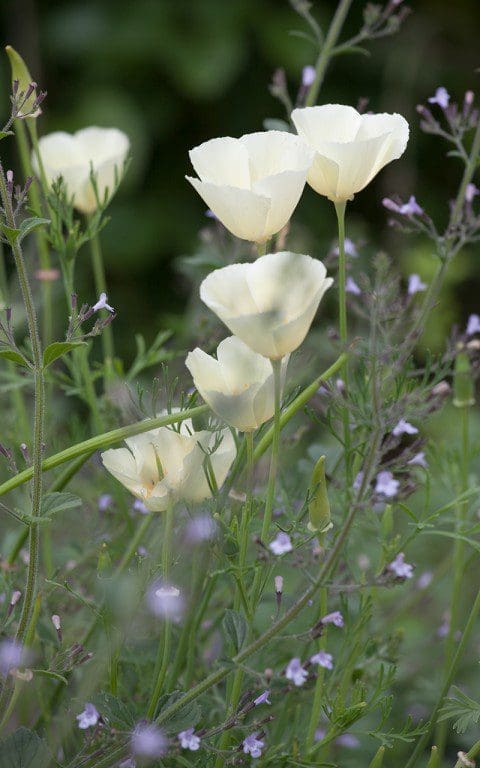 Eschscholzia californica ‘Ivory Castle’
The Eschscholzia californica ‘Ivory Castle’ were the last of the annuals to go into this planting, but one that I will certainly keep feathered at the margins in the future. This a good selection, creamy white and small-flowered and a pretty contrast when the sun prompts the flowers to unroll their scrolls revealing a buttery yellow centre. The scale of the flowers and their lightness is good with the tiny flowers of the Calamintha nepeta ‘Blue Cloud’, but you have to watch this apparently humble annual. Californian poppies take their position by stealth, slowly spreading over the season to smother their neighbours. Being a new planting, and grateful though I am for their immediate participation, I am watching out for their neighbours and keeping an eye on the balance between short and long term gains.
Words: Dan Pearson / Photographs: Huw Morgan
Published 15 July 2017
Last Friday I was honoured to speak at the University of Essex in support of The Beth Chatto Education Trust, of which I am a patron. My brief, to talk about the importance of education in horticulture, was an easy one to meet and that much more relevant with the Trust firmly up and running. Julia Boulton, Beth’s granddaughter and Managing Director of the Gardens and Director of the Trust, has made it her mission to utilise the garden as an educational resource and it was with much excitement that we met to celebrate the fact that the garden now has this important new future.
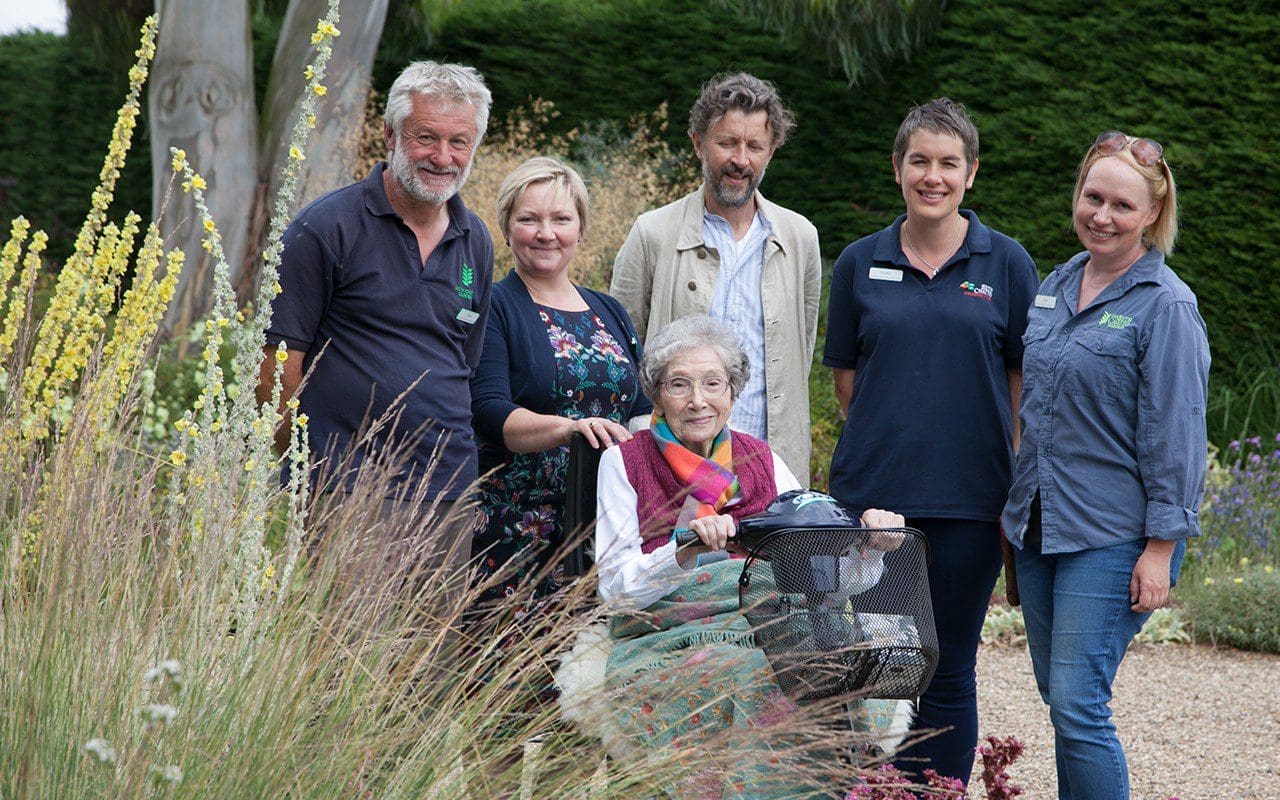 Beth Chatto (centre front) with behind (left to right) Dave Ward, Garden Director, Julia Boulton, Managing Director, Dan Pearson, Karalyn Foord, Education Trust Manager and Åsa Gregers-Warg, Head Gardener
Beth’s work has always been important and the garden is as relevant today as it ever has been. At the forefront of the naturalistic movement in this country, and instrumental in originating the ethos of ‘the right plant in the right place’, Beth’s displays at The Chelsea Flower Show were ground breaking in the 1970’s. I remember their singularity, for no one else at the show was using the plants that she was cultivating or combining them as intelligently; plants that were wild in feeling, always close to the species and grouped according to their habitat needs, not the whim of colour themes or border compositions. Apparently, in the early days, some show judges are said to have dismissed her displays as being nothing more than cultivated weeds, but the message to gardeners was strong, practical and consistent; put a plant where it wants to be and it will thrive. It is barely credible now that this approach should have been seen as unusual, but in the days of annual bedding, hybrid tea roses and prize dahlias Beth’s was a shock doctrine.
And she was far more than simply the nurserywoman who presented her wares at the show. You could also depend upon her not only for her impeccable taste, but also for her ability to educate you through her plantsmanship. For years Unusual Plants was the only place to go to get the plants I wanted to grow and I pored over the evocative descriptions in the catalogue. My borders in my parents’ garden were stocked with her treasures and it was through a love of her plants that I bonded with my first client, Frances Mossman, with whom I created the gardens at Home Farm. We had both fallen under the spell of Beth’s catalogue and I remember very clearly a key conversation about Beth’s description of Crambe maritima. A seaside wilding brought to life and into horticultural focus through words. A world of opportunity that was suddenly possible once you made the connections. When I started travelling to see native plants growing in the Himalayas, Israel and Europe in my ’20’s Beth’s ethos was plainly articulated in every plant community I saw and helped me make the connections between the wild and the cultivated.
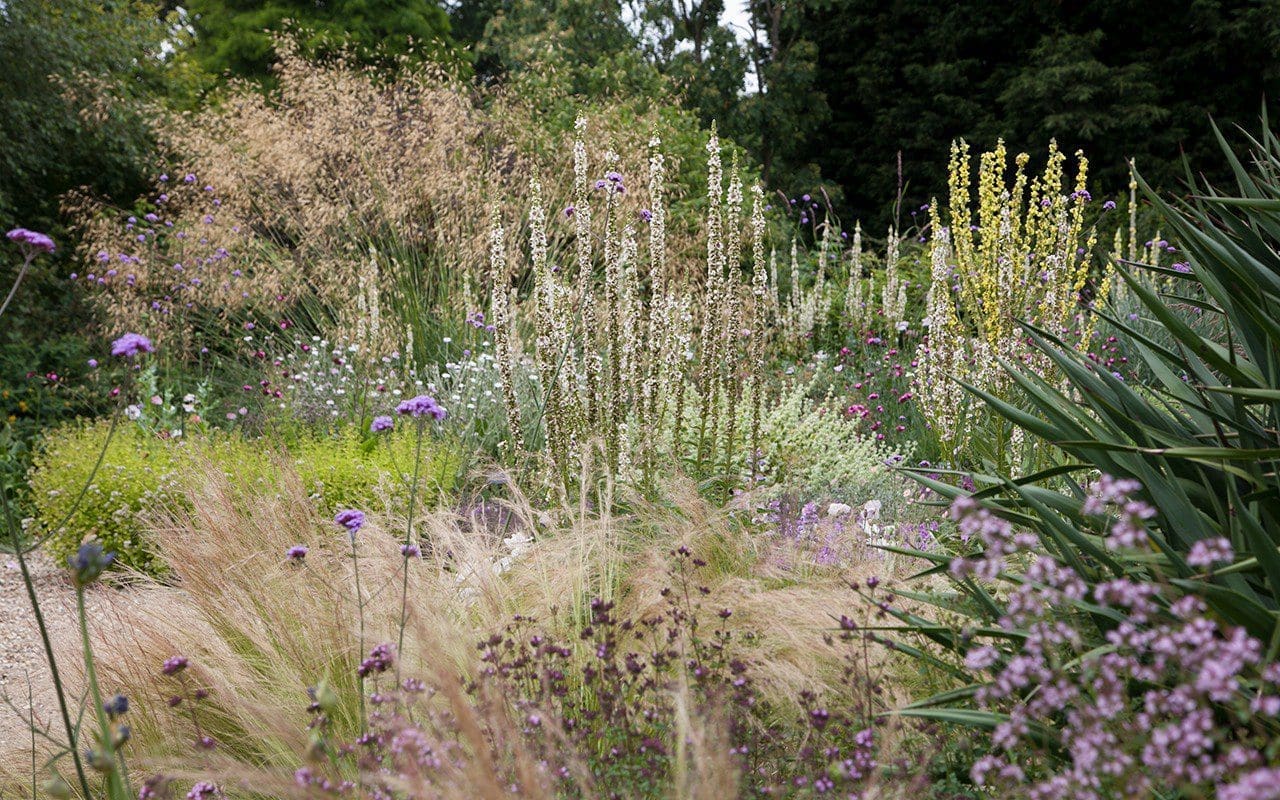
Earlier last Friday, before the talk, we took a tour of the gardens with Dave Ward, the Garden Director and long term member of the team. At the Gravel Garden (main image) we stopped to catch up with Beth, who had come out to greet us and marvel at the Romneya. Just two days after celebrating her 94th birthday she had lost none of her fervour for the importance of horticulture and was vocal about how good education and competitive salaries are essential to encourage young people into the profession. It was so good to see her in her environment and I remembered how she had once talked about being in New Zealand with Christopher Lloyd and had dreamed of making this garden after they had come across a dried up river bed.
Repeated Genista aetnensis set the mood, its peppered clouds of gold, luminous against the dark hedges. Nothing looked out of place, with all the plants chosen for their drought resistance and moving about in the gravel as if they had found their way there and their companions quite naturally.
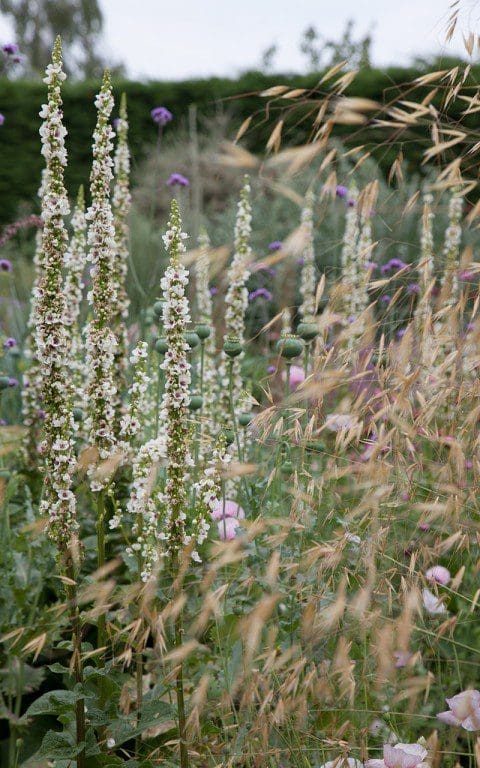 Verbascum chaixii ‘Album’ and Stipa gigantea
A repeat of vertical verbascum to arrest the eye; Verbascum chaixii ‘Album’, dull white and caught in a gauze of Stipa gigantea, with a smattering of pink Dianthus carthusianorum. Felted Verbascum bombyciferum standing alone and breaking free at the very edges of the planting. Romneya coulteri fluttering close to the path so that you could inspect the boss of golden stamens. A stand of Stipa barbata given their own space and floating like seaweed in the breeze.
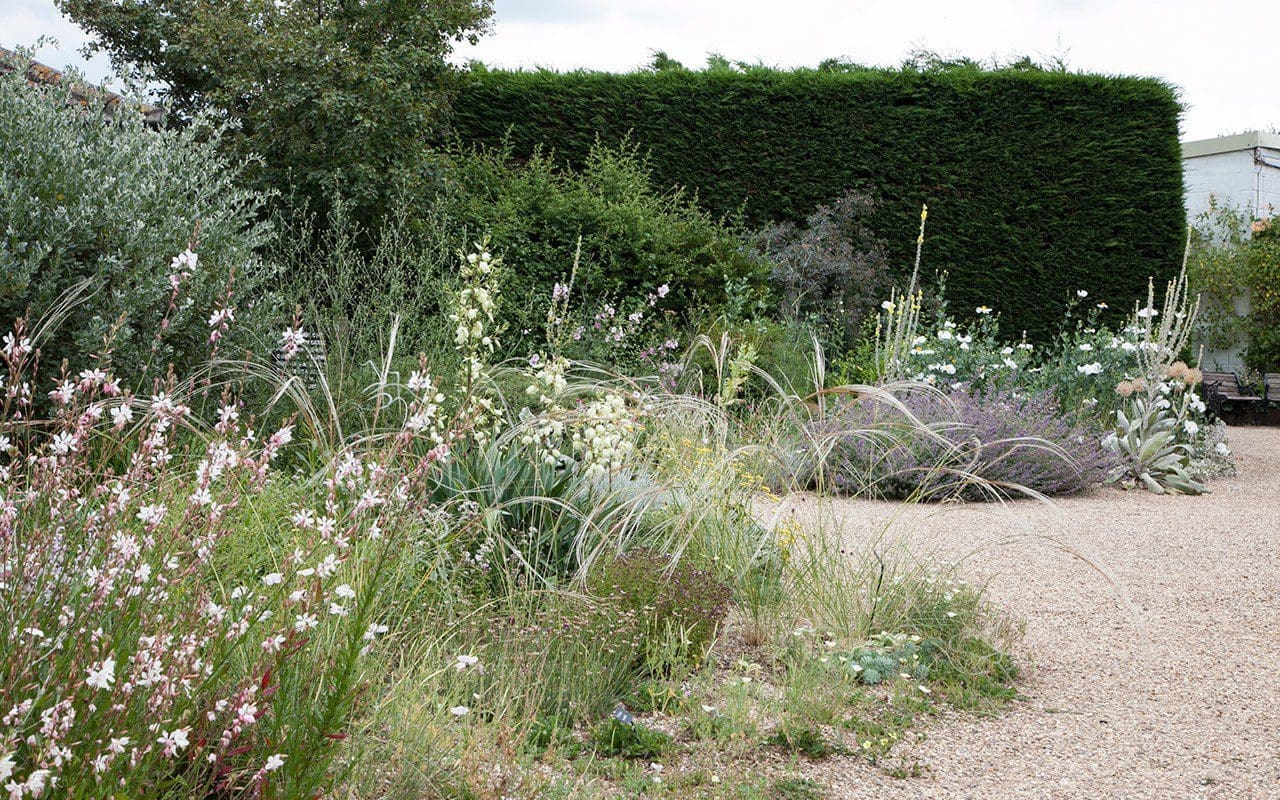 The feathered seedheads of Stipa barbata with Verbascum bombyciferum and Romneya coulteri against the hedge
There were many plants that I am using at home which Beth introduced me to as a child (Eryngium giganteum, Lychnis coronaria, Crambe maritima, Romneya coulteri, Stipa gigantea, Dianthus carthusianorum, Phlomis russelliana) and others that I have come to from other directions, but surely because of Beth’s influence. An acid-yellow mist of Bupleurum falcatum through which the dark orbs of Allium sphaerocephalon were suspended. Buttons of pale yellow Santolina pinnata subsp. neapolitana, hunkered down and throwing off light. Splashes of electric-blue Eryngium x zabelii, metallic and architecturally jagged amongst the softness.
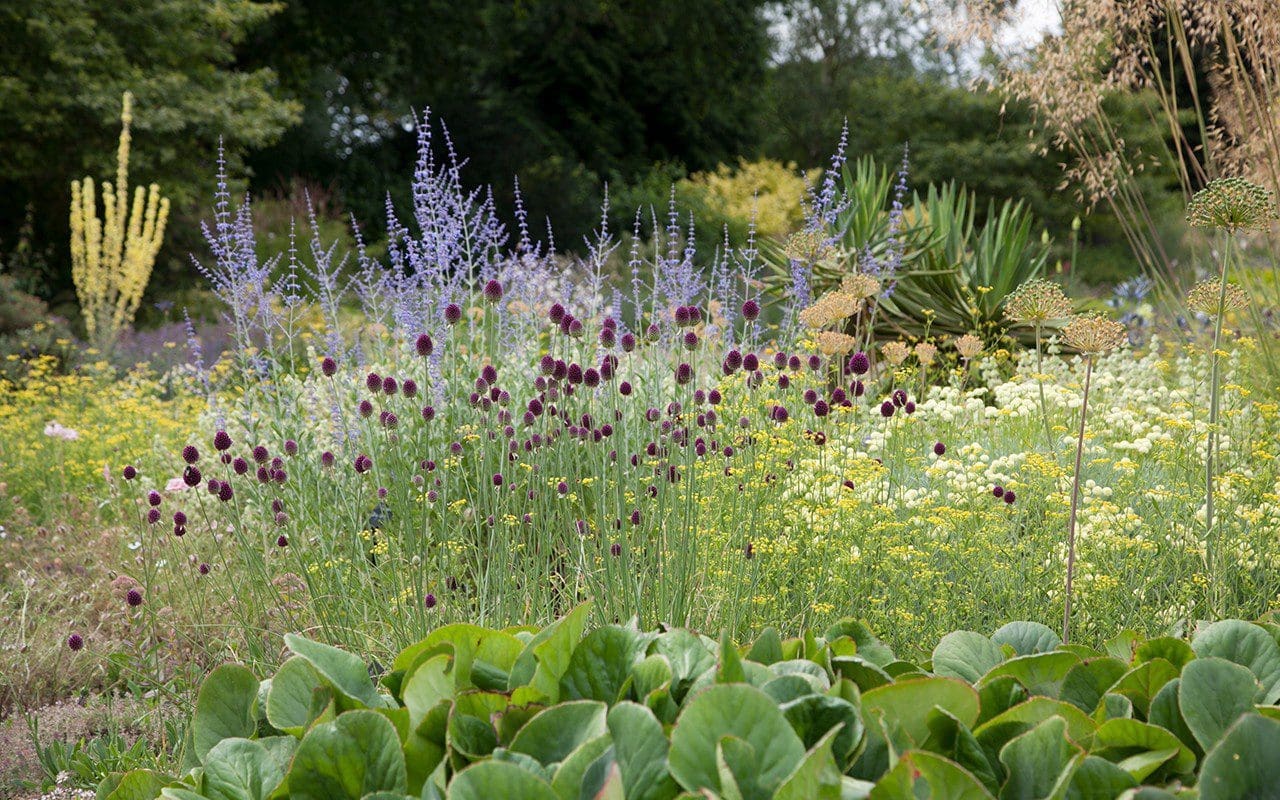 Allium sphaerocephalon, Santolina pinnata subsp. neapolitana, Bupleurum falcatum and Perovskia ‘Blue Spire’
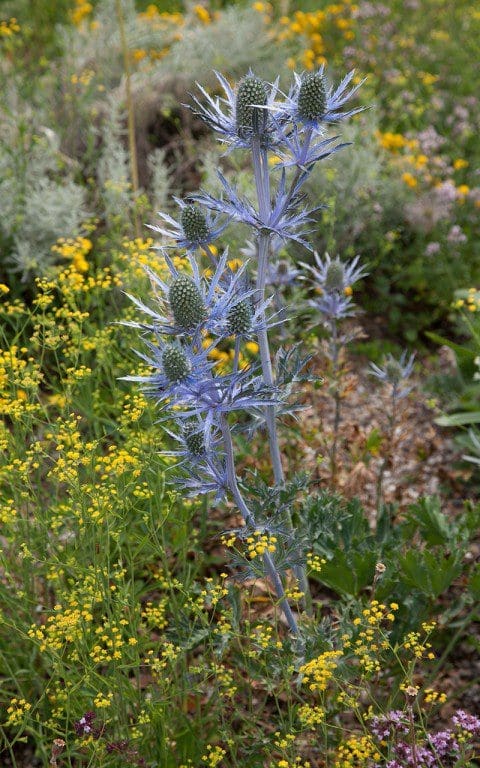 Eryngium x zabelii with Bupleurum falcatum
We moved from there into the lower sections of the garden where the compositions were driven by green and texture. Head Gardener, Åsa Gregers-Warg reminded us of Beth’s love of ikebana and the asymmetric triangle that repeats in her compositions. Watery reflections, plants adapted to their foothold, be it edge of the dry oak woodland or spearing Thalia dealbata amongst scale changing Alisma plantago-aquatica in the shallows of the ponds. Splashes of fiery candelabra primula amongst green umbrellas of Darmera peltata and in a narrowing on the way to the Reservoir Garden, the oversized creamy plates of Sambucus canadensis ‘Maxima’, a plant that I haven’t grown since I was a teenager. On enquiring about its availability (I had the nursery set firmly in my mind as a highlight of the day) Dave tipped me off. “You can get that at Great Dixter.” More connections from my early education. A plant I had all but forgotten about but, all these years later, am just as excited to be revisiting.
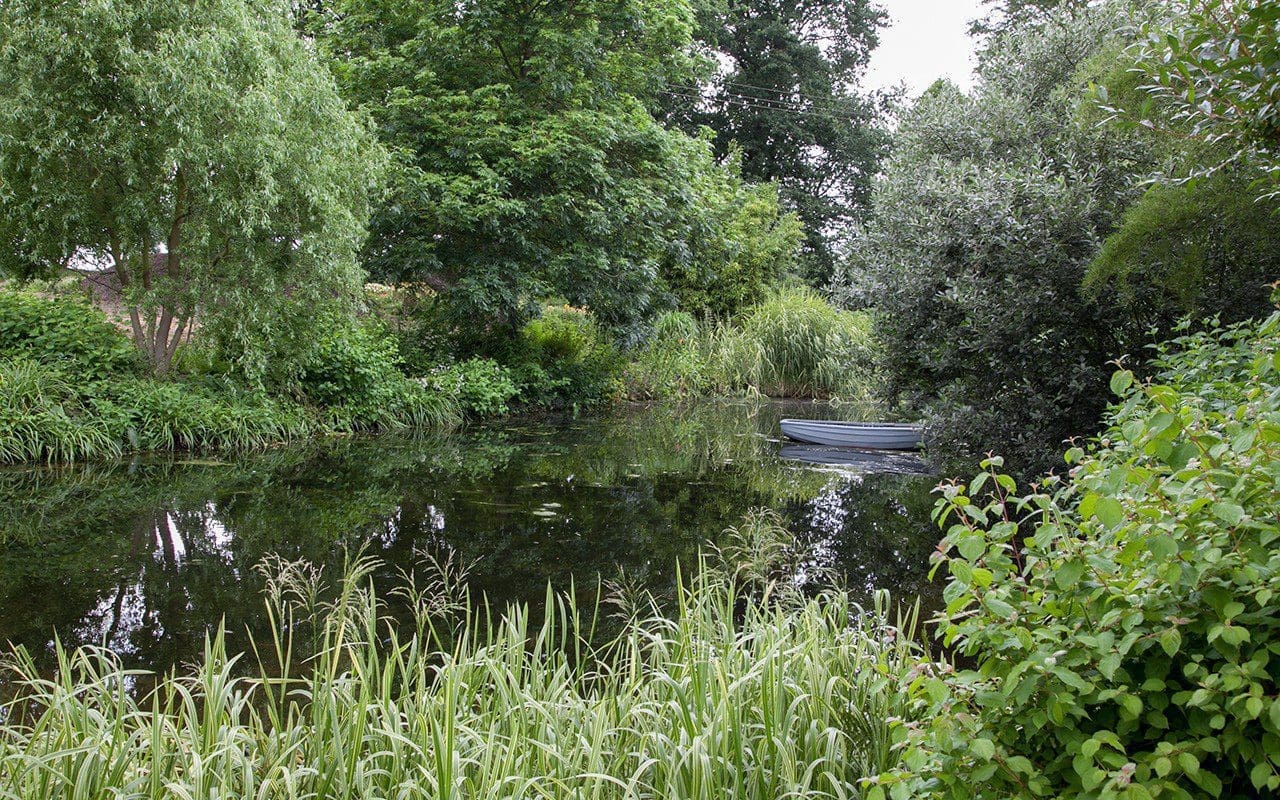
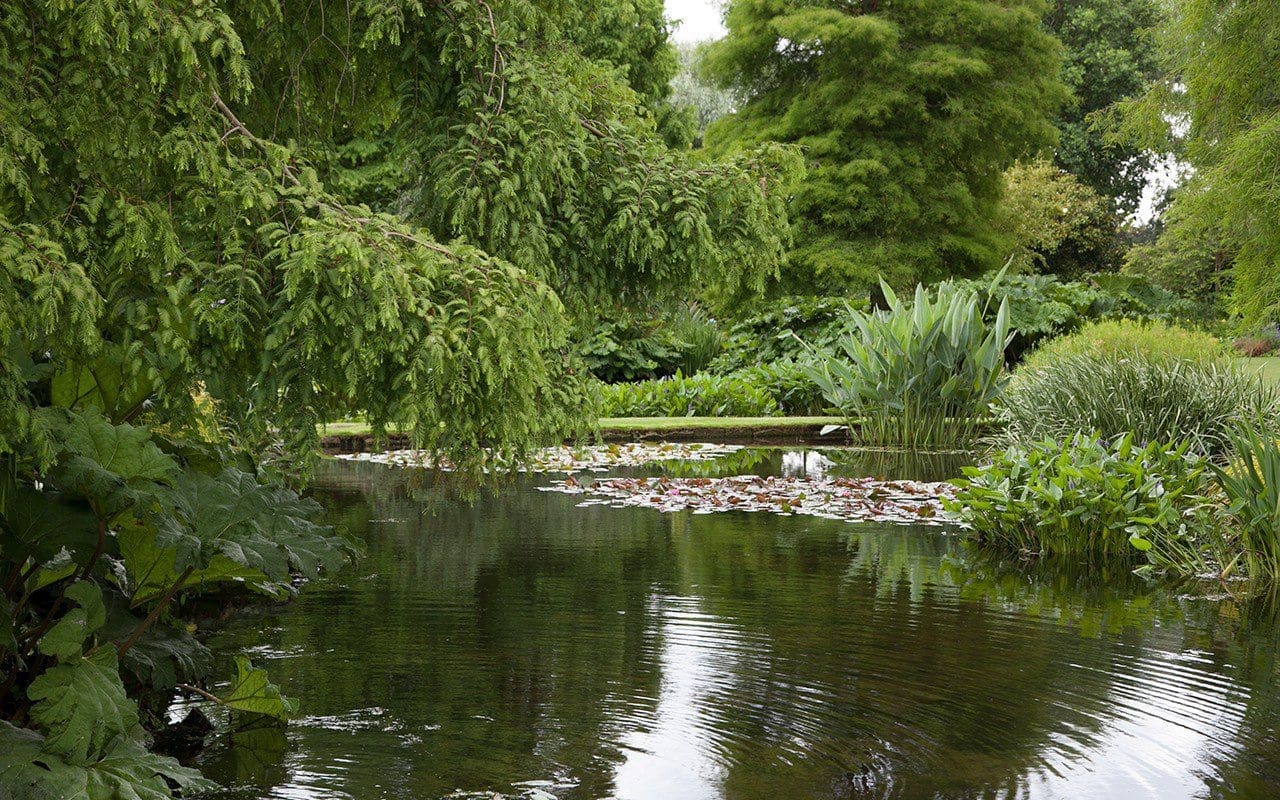 The Water Garden
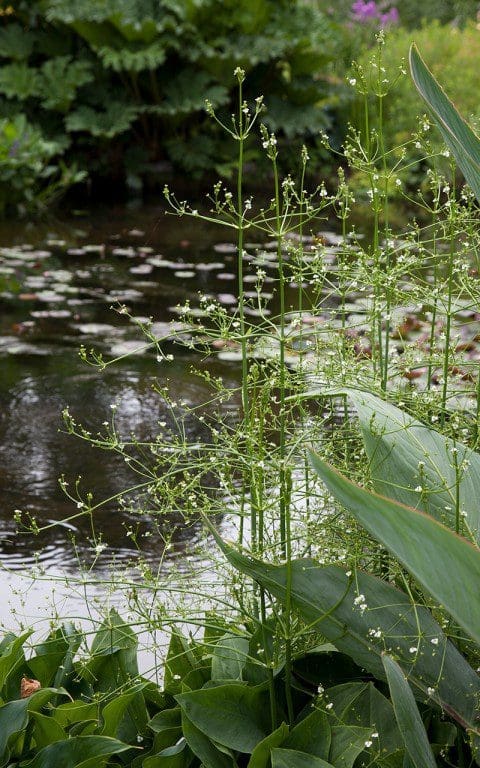 Alisma plantago-aquatica with foliage of Thalia dealbata on the right
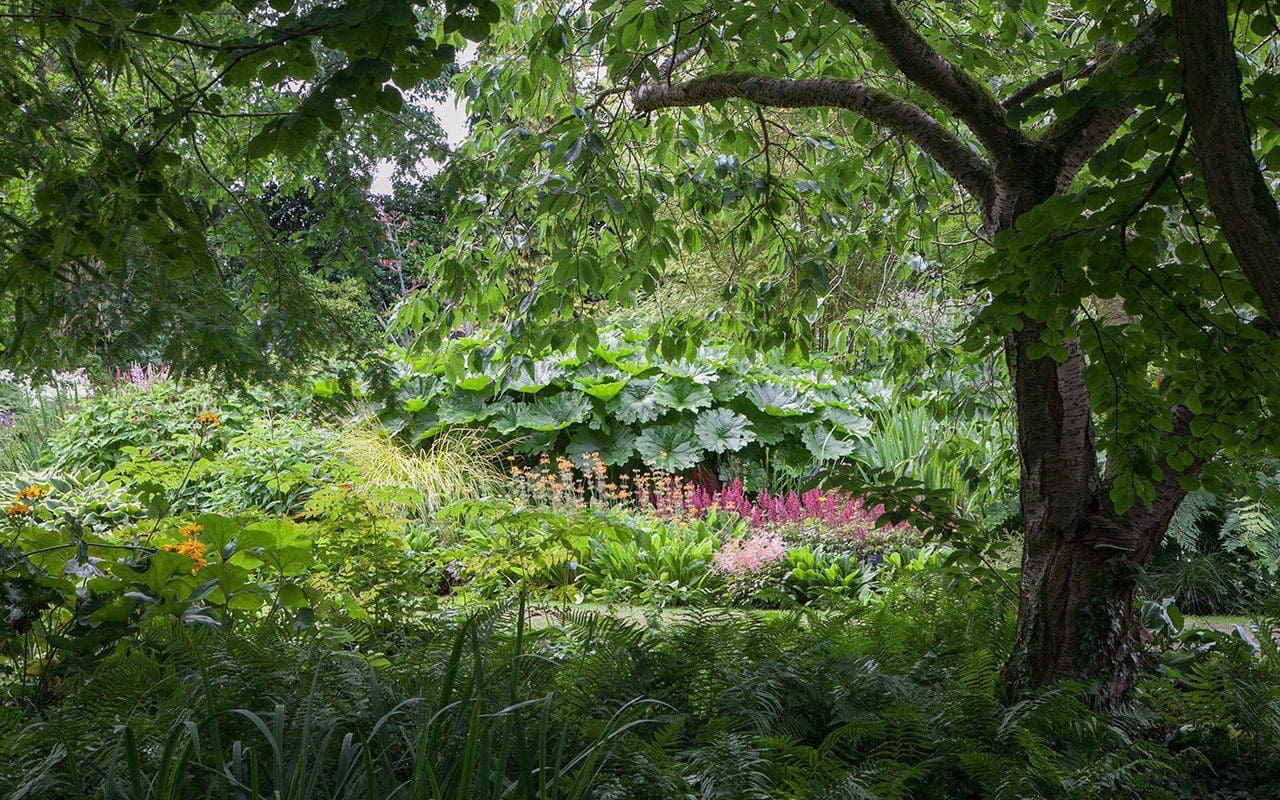
The best gardens are all about connections and the garden here at Elmstead Market is full of them. Talk to Beth and she will very quickly tell you about the importance of her husband, Andrew’s work as a botanist in identifying plants from all over the world that had the ability to grow together. She will tell you too about her friendship with Cedric Morris, and you will find his collections and selections in the garden if you dig a little and ask the right questions.
My notebook filled rapidly – the nine foot Allium ‘Purple Drummer’ and Agastache ‘Blue Boa’ amongst Deschampsia caespitosa ‘Schottland’ – and it continued to do so in the nursery where we had a behind the scenes look at the industry of the place and saw at close quarters all those treasures that have gone out into the world to fuel passions. My order of new-to-me and untested plants came together without hesitation. Deschampsia cespitosa ‘Schottland’, Eupatorium fistulosum f. albidum ‘Ivory Towers’, Nepeta ‘Blue Dragon’, Salvia verticillata ‘Hannay’s Blue’ and Teucrium hircanicum to name a handful. They have just arrived, within the week, beautifully packaged as ever, bringing all the excitement that has been coming to me from this inspirational place for the best part of forty years.
Words: Dan Pearson / Photographs: Huw Morgan
Published 8 July 2017
 The Woodland Garden
And so the balance has shifted. The energy of the race to the longest day of the year already dimming. It is a subtle change, but even now it is in evidence with the grasses going to seed in the meadows, May’s vibrant greens flattening and the first of the bindweed replacing the dogroses to light the hedgerows. The last few days of searing heat have pushed this high summer feeling still further and this bunch from the garden reflects something of the new mood.
It is with much excitement that the Romneya coulteri flowered for the first time this year, and no surprise that they chose to do so in weather that must have reminded them of home. See the Californian Tree Poppy in the southern parts of the state where it runs through the rubbly hillsides and you understand why it should be given the hottest, most free-draining position you can offer it. I have it here, facing south, at the base of the barn wall, where the soil is rarely damp for long. It is a choice position – and there are few on our hillside that offer such a baking – but it was not a difficult decision to give the space up to one of my all-time favourites.
I first saw the tree poppy growing in Brighton where it had taken over the tiny front garden of one of my father’s friends and had made the seaward-facing ground its home. Towering at eight feet or so above the pavement and all but obscuring the bay window (there was no need for curtains), from inside the house the crumpled, glistening petals were filled with summer light. The luminosity of the flowers is amplified by a yolk-yellow, globular boss of stamens which dust the petals with pollen as they flutter in the breeze. Hovering on long stalks reaching towards the sun, held amongst finely cut blue-grey foliage, they cannot help but capture all the light that is going. For me the mood they create is the epitome of summer. I have given it the space to claim this moment and have repeated it three times amongst jagged, silver cardoons and ethereal Althaea cannabina.
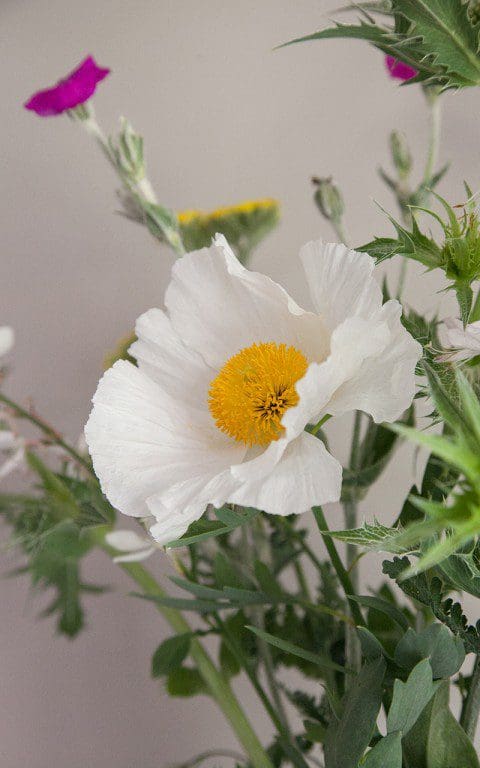 Romneya coulteri
Romneya hate disturbance, so you have to be sure you know where you want it and not succumb to the temptation of moving it, should it decide it likes you. I’ve found they are fickle and can easily succumb to verticillium wilt in our damp climate when they are young, so I usually build in loss and plant more than I need. Hence the repeat along the barn wall but, in this instance, all three plants have so far thrived, sulking a little in their first year, rising up to a metre or so, but remaining blind and without flower. This year they are looking much more like themselves and have begun to take their position. I’II expect them to attain full stature in a couple of years and we will see then if they start to run, as they can and do in search of new territory. However, they are easily curtailed as long as you slice the runners with a spade and are not tempted to pull the runner back to base and disturb the central root system. Although they will regenerate if the winter hasn’t been hard enough to floor last years growth, it is best to cut the stems hard to the base in March after the worst of the winter has run its course. New shoots are rapid and lush and altogether better looking.
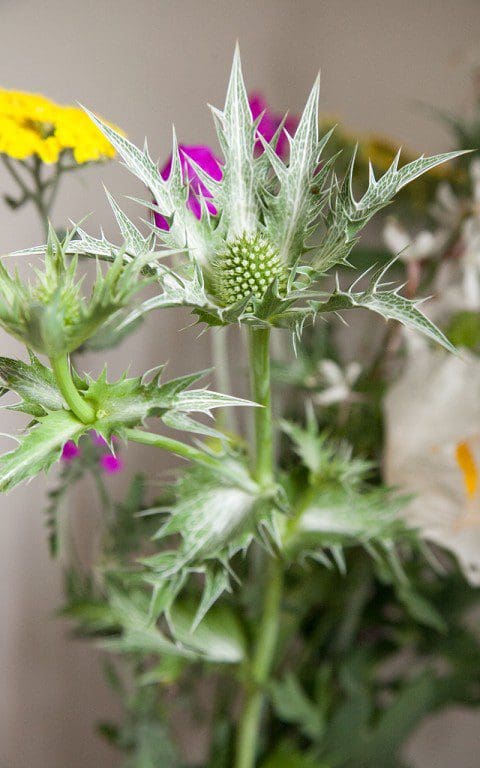 Eryngium giganteum ‘Silver Ghost’
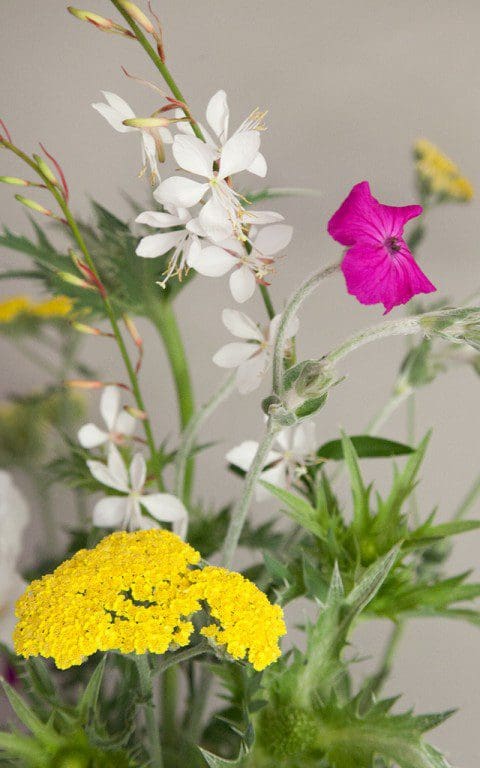 Gaura lindheimerei with Achillea ‘Moonshine’ & Lychnis coronaria
In the gravel, that surrounds the barns, I have been playing with a number of self-seeders to make the buildings feel like the garden has made its home there. Eryngium giganteum ‘Silver Ghost’ is one that I sowed directly from fresh seed given to me by Chris and Toby Marchant of Orchard Dene Nursery. I’d admired the plants at the nursery for their more acutely veined and crested flowers. It is showier than the species, without feeling like it has lost any charm. The common name for Eryngium giganteum, ‘Miss Willmott’s Ghost’, is attributed to Ellen Willmott, the English horticulturist, who was said to have carried seeds in her pockets at all times and distributed them in a trail throughout gardens she visited. If it finds a home that is to its liking, with plenty of sun and no competition to the basal rosette, this biennial is great for never being in the same place and for the chance happenings that come about when you let it find it’s own position. It is good here with the flutter of Gaura lindheimeri that creates a shimmering highlight of white, like the sparkle of light on water.
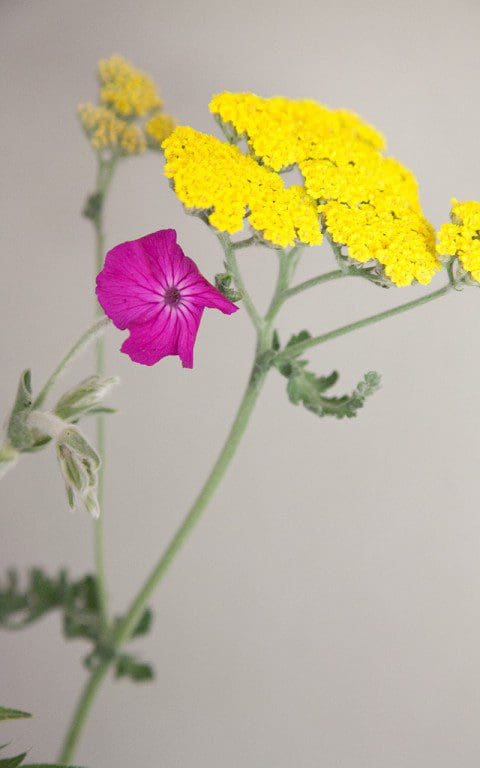 Lychnis coronaria & Achillea ‘Moonshine’
Achillea ‘Moonshine’ is a plant that I have not grown since I was a teenager, where I had it in my yellow border. It was short-lived there in the window of light that fell between the trees in our wooded garden, but I hope to keep it longer here on our sunny hillside despite its requirement for regular division. It is dancing now amongst the contrasting magenta of Lychnis coronaria in a strong wind that has kicked up after the past week’s heat, but is all but oblivious to the buffeting. Perfectly flat heads that huddle at about knee height are the ideal receptacle to harvest the high light and long days. The colour is the brightest, most vibrant sulphur yellow and, now that I see them together in a vase, its brightness further enriches the golden boss of the Romneya to saffron. A new combination for the future, perhaps (for they would surely like the same conditions) and one that would set the tone for the height of summer that is still ahead of us.
Words: Dan Pearson / Photographs: Huw Morgan
Published 24 June 2017
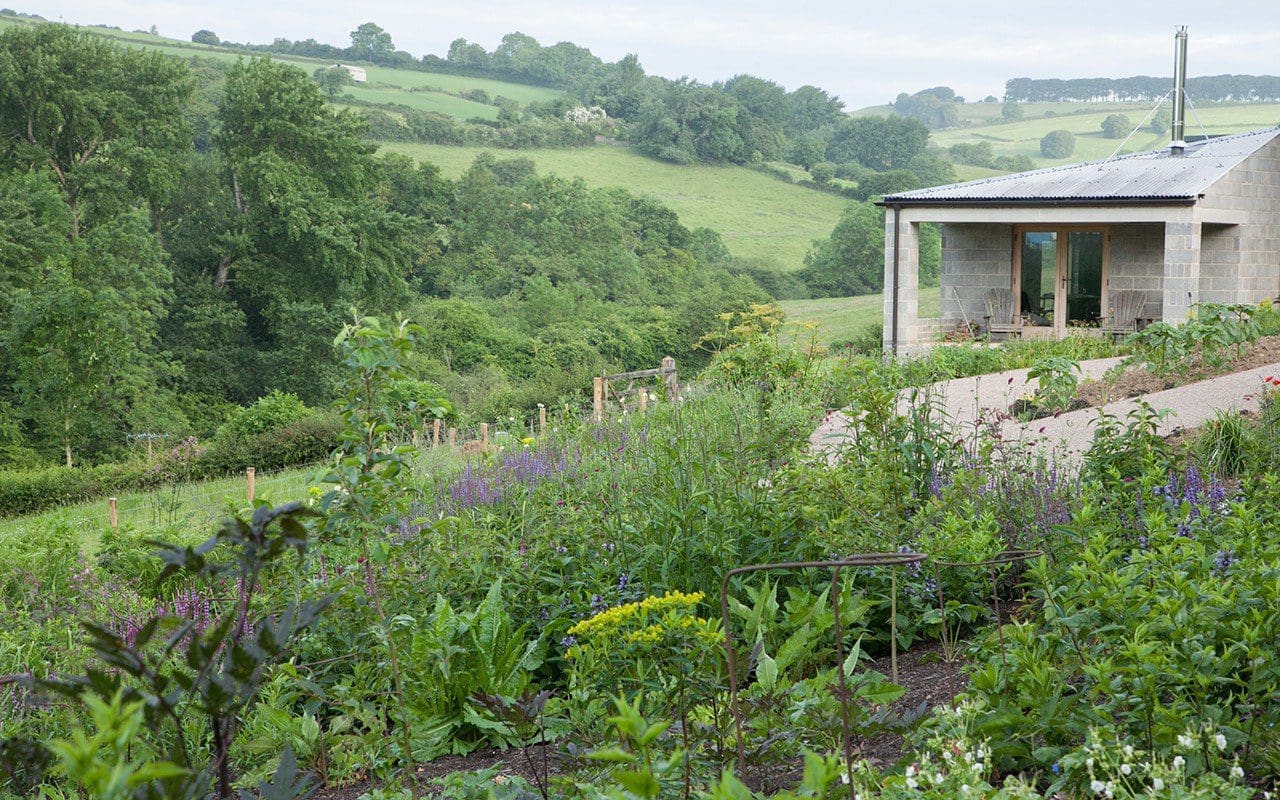
The new planting went in on the spring equinox, a week that saw the energy in the young plants shifting. Just seven days later the emerging fans of the hemerocallis were already splayed and flushed, and the signs were also there in the tightly-clasped crowns of the sanguisorba. The chosen few from my trial in the stock beds had to be split to make up the numbers I needed, but energy was on their side and, once in their new home, they seized life quickly to push new foliage.
We mulched the beds immediately after planting to keep the ground clean and to hold in the moisture whist the plants were establishing. Mulching saves so much time in weeding whilst a garden is young and there is more soil than knit of growth. This year I was also thankful because we went into five long weeks without rain. I watered just once, so that the roots would travel down in search of water, but once only so that they did not become reliant. The mulch held this moisture in the ground and the contrast to the old stock beds that went without has been is remarkable. Spring divisions that went without mulch have put on half as much growth and have needed twice as much water to get the same purchase. I can see the rigour of my Wisley training in this last paragraph, but good habits die as hard as bad ones.
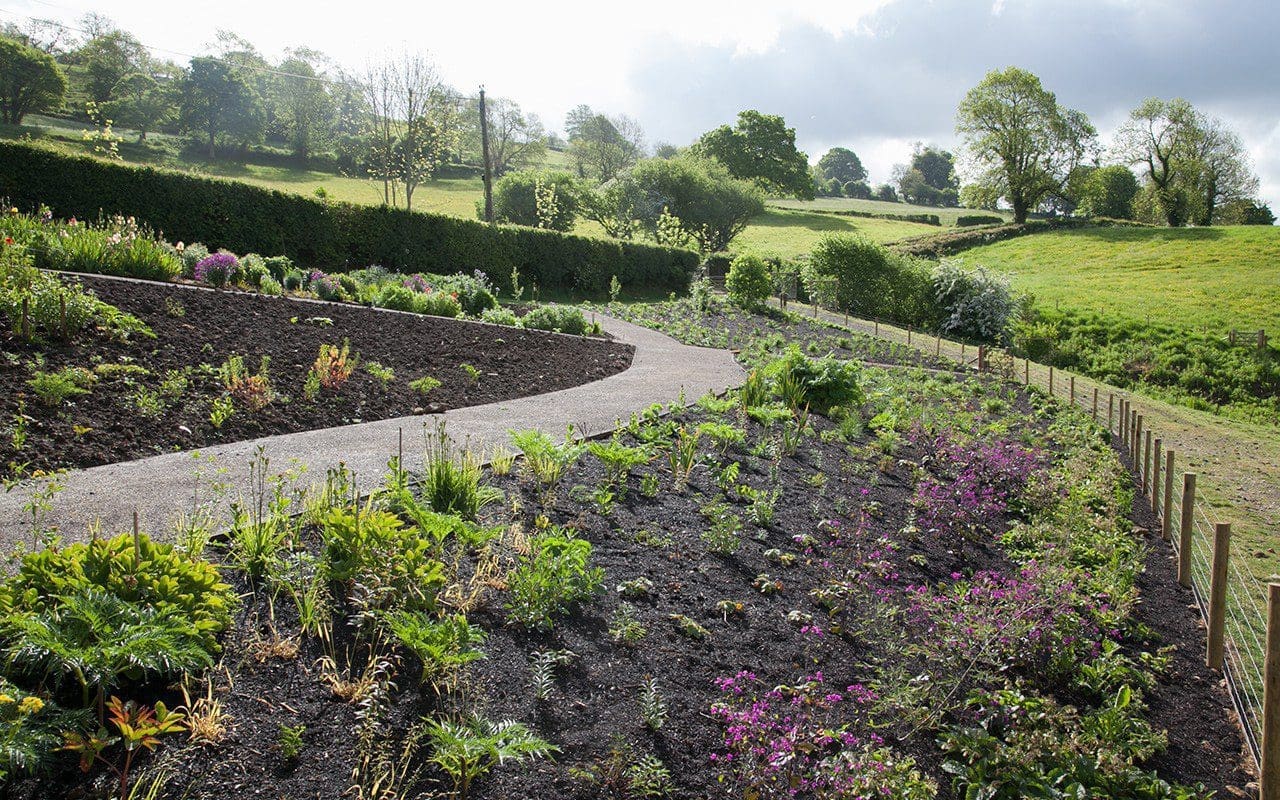 14 May 2017
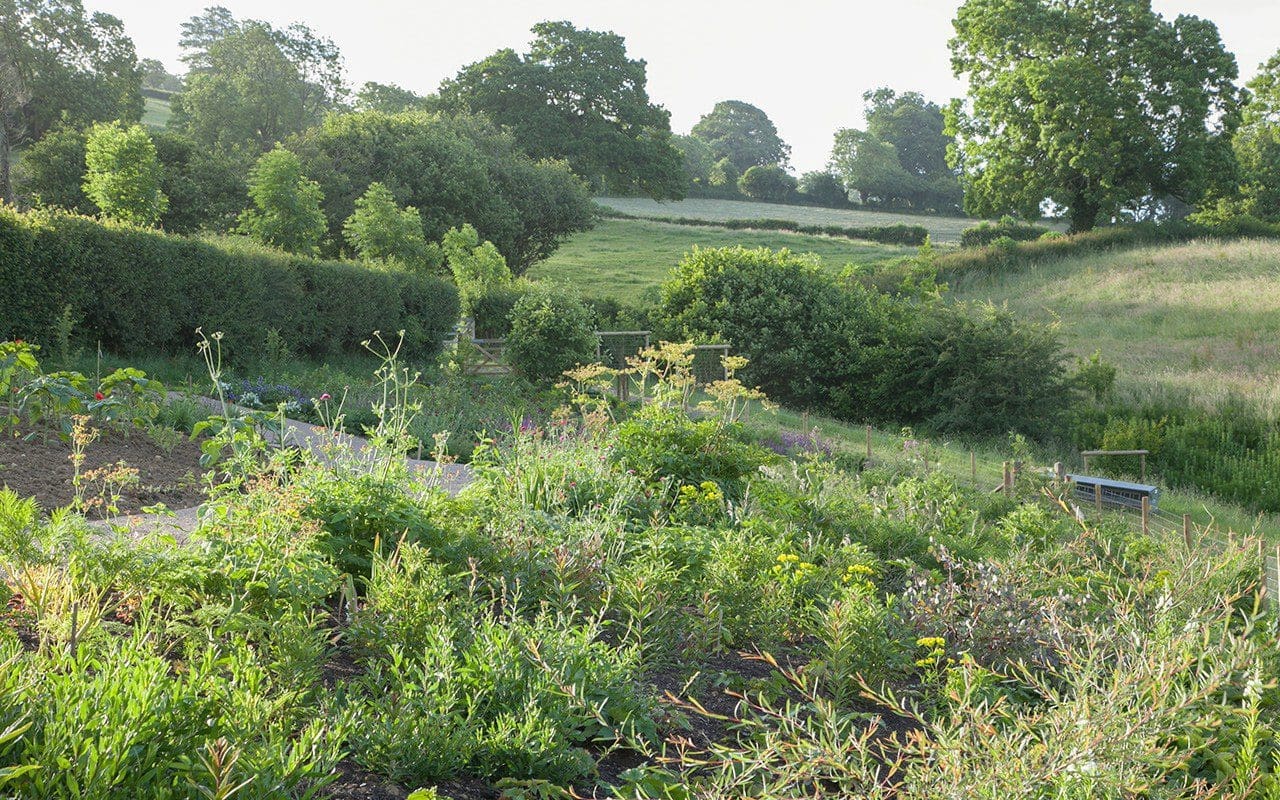 17 June 2017
Since it rained three weeks ago, the growth has burgeoned. As the summer solstice approaches the dots of newly planted green that initially hugged the contours of our slopes have become three dimensional as they have reared up and away into early summer. I have been keeping close vigil as the new bedfellows have begun to show their form, noting the new combinations and rhythms in the planting. Information that I’d had to hold in my head while laying out the hundreds of dormant plants and which, to my relief, is beginning to play out as I’d imagined.
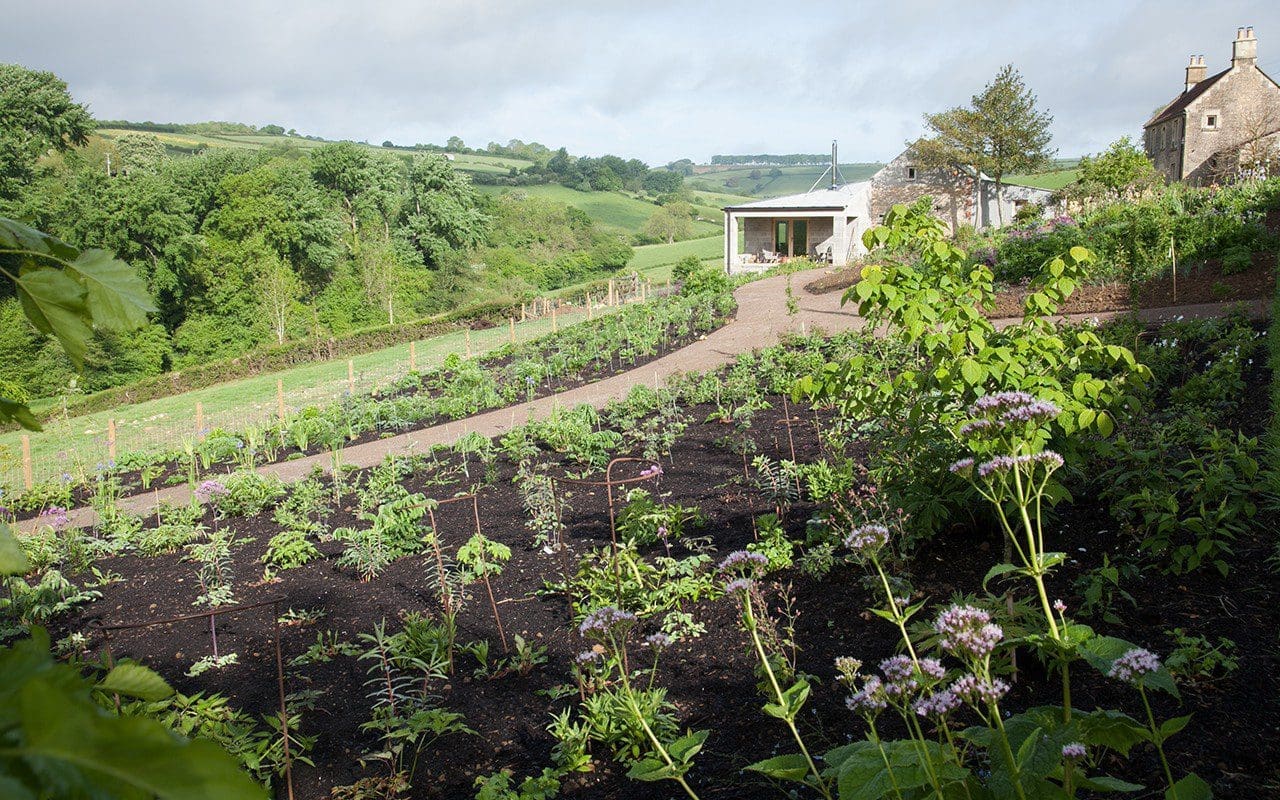 14 May 2017
 16 June 2017
Of course, there are gaps where I am waiting for plants that were not then available, and also where there were gaps in my thinking. There are combinations that I can see need another layer of interest, and places where the plants are already showing me where they prefer to be. The same plant thriving in the dip of a hollow, but not on a rise, or vice versa. Plants have a way of letting you know pretty quickly what they like. At the moment I am just observing and not reacting immediately because, as soon as the foliage touches, the community will begin to work as one, creating its own microclimate that will in turn provide influence and shelter. I lost my whole batch of Milium effusum ‘Aureum’, which I put down to the exposure on our south-facing slopes. However, most of them have managed to set seed, so I am hoping that next spring the seedlings will find their favoured positions to thrive in the shade of larger, more established perennials.
The wrap of weed-suppressing symphytum that I planted along the boundary fence is already knitting together, and I’m happy to have this buffer of evergreen foliage to help prevent the landscape from seeding in. However, a flotilla of dandelion seed sailed over the defence and are now germinating in the mulch. We saw them parachuting past one dry, breezy day in April as if seeking out this perfect seedbed. They are easy to weed before they get their taproot down and will be less of a problem this time next year when there will be the shade of foliage, but they will be a devil if they seed into the crowns of plants before they are established. A community of cover is what I am aiming for, so that the garden starts to work with me, and time spent protecting it now is time well spent.
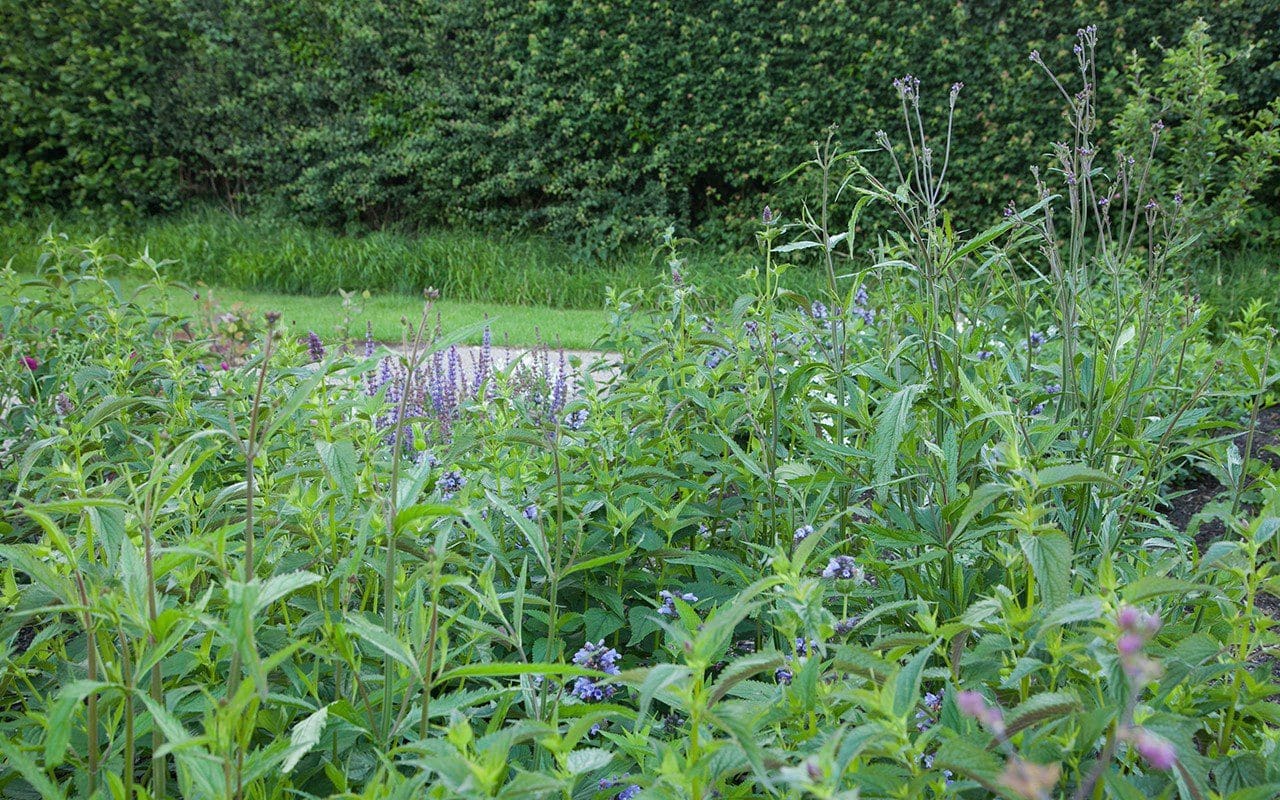
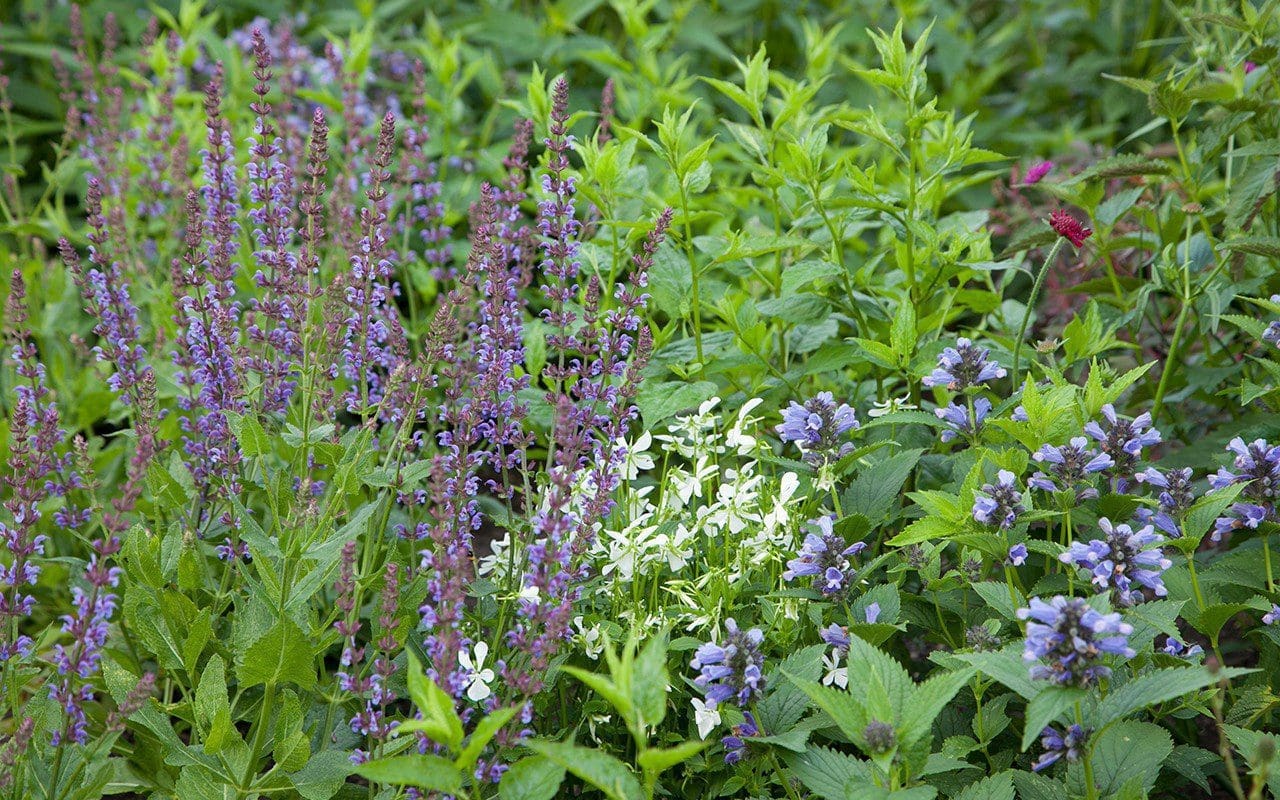 Salvia pratensis ‘Indigo’, Nepeta subsessilis ‘Washfield’, Viola cornuta ‘Alba’ & Knautia macedonica
The comfrey is planted in three drifts. Symphytum grandiflorum, S. ‘Hidcote Blue’ and S. g. ‘Sky Blue Pink’. The latter is new to me and I’m watching carefully that they aren’t too vigorous. I’ll have to keep an eye on the next ripple of plants that are feathered into the comfrey from deeper into the garden as the symphytum can also be an aggressive companion. The Sanguisorba hakusanensis should be able to hold their own, as they form a lush mound of foliage, and the Epilobium angustifolium ‘Album’ should be fine, punching through to take their own space. I’ll clear the young runners where the creep of the comfrey meets the gentler anemone and veronicastrum.
The ascendant plants were placed first when laying out and will form a skyline of towers through which the other layers wander. They are already standing tall and providing the planting with a sense of depth. Thalictrum ‘Elin’ is my height already, a smoky presence of foliage and stems picking up the grey in the young Rosa glauca and proving, so far, to not need staking. This is important, because our windy hillside provides its challenges on this front. Thalictrum aquilegifolium ‘Black Stockings’ has also provided immediate impact, its limbs inky dark and the mauve of the flowers giving early colour and contrast to the clear, clean blue of the Iris sibirica ‘Papillon’. Next year the garden will have knitted together so that the contrasts will work against foliage or each other, but for now the eye naturally focuses not on the gappiness, but where things are beginning to show promise.
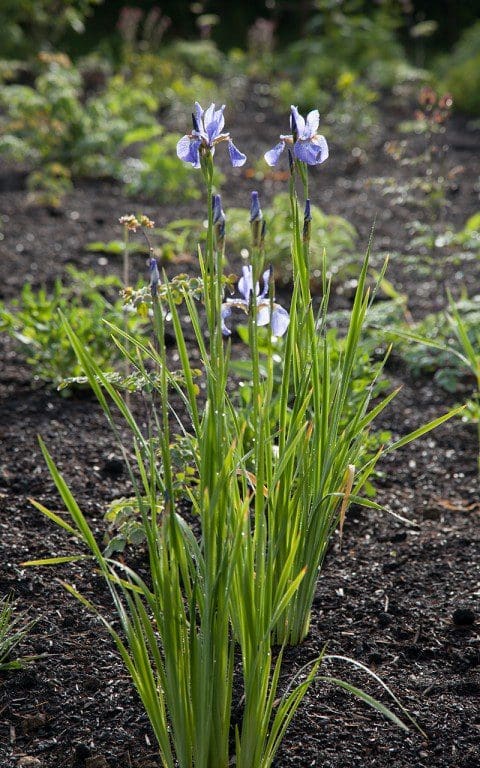 Iris sibirica ‘Papillon’
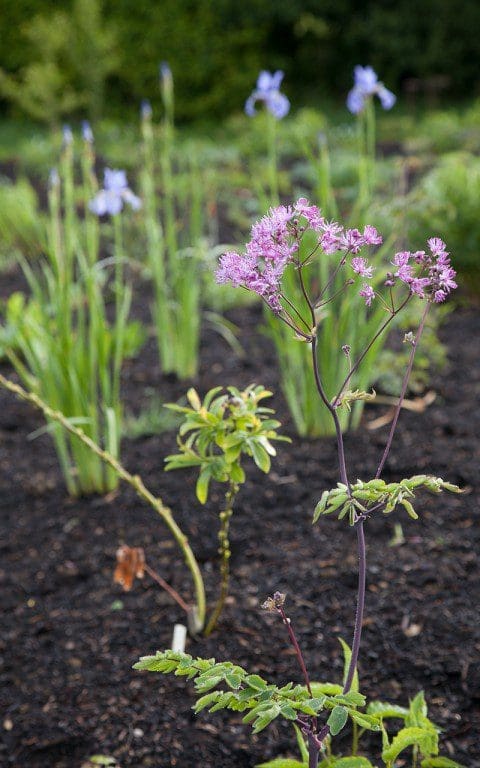 Thalictrum aquilegifolium ‘Black Stockings’ with Iris sibirica ‘Papillon’ behind
There have been a couple of surprises already, with a fortuitous mix up at the nursery reavealing a new combination I had not planned for with a drift of Salvia pratensis ‘Indigo’ coming up as S. nemorosa ‘Amethyst’. I am very particular about my choices and I’d planned for ‘Indigo’ since growing it in the stockbeds, but the unexpected arrival of ‘Amethyst’ has, after my initial perplexity, been a delight. I’ve not grown it before, and I like its earliness in the planting and how it contrasts with the clear blue of the Iris sibirica with a little friction that makes the eye react more definitely than with the blue of ‘Indigo’. I like a little contrast to keep zest in a planting. The Euphorbia cornigera, with their acid green flowering bracts, are also great for this reason with the first magenta of the Geranium psilostemon.
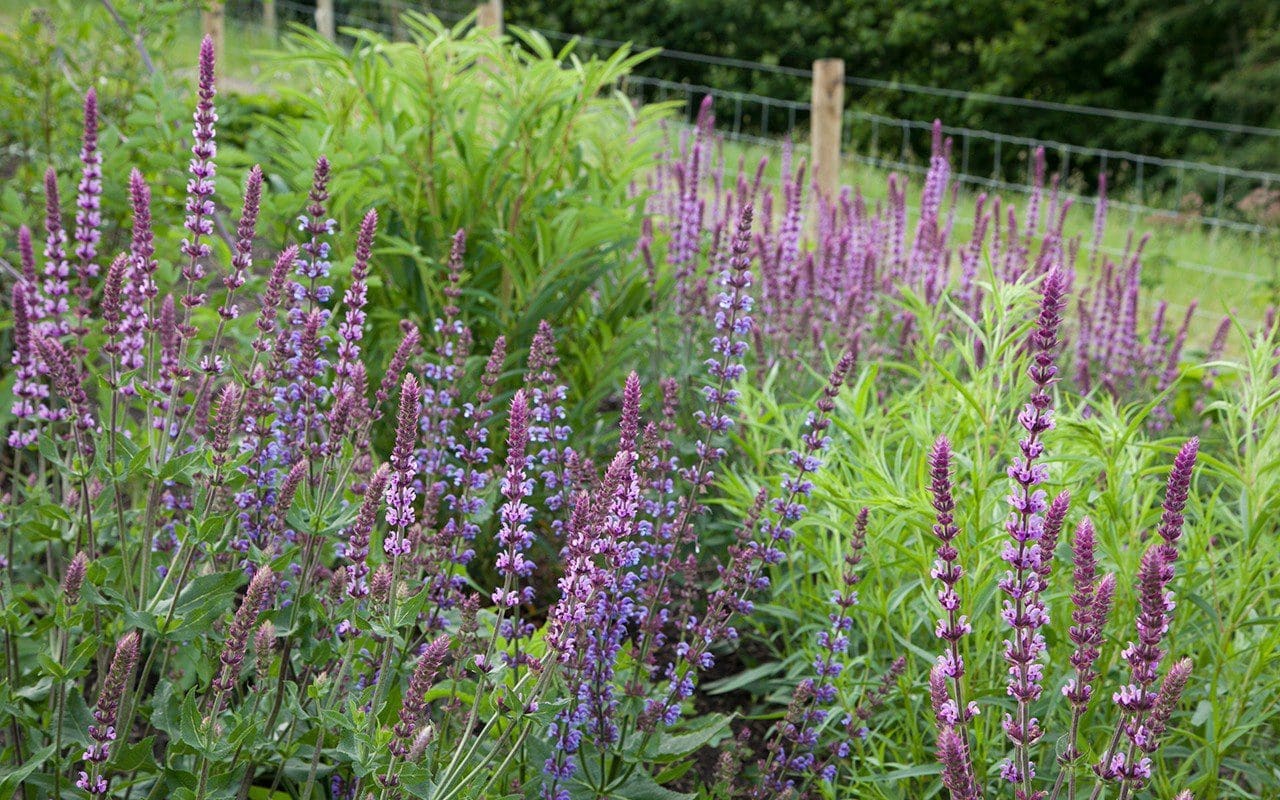 Salvia nemerosa ‘Amethyst’ and Salvia pratensis ‘Indigo’
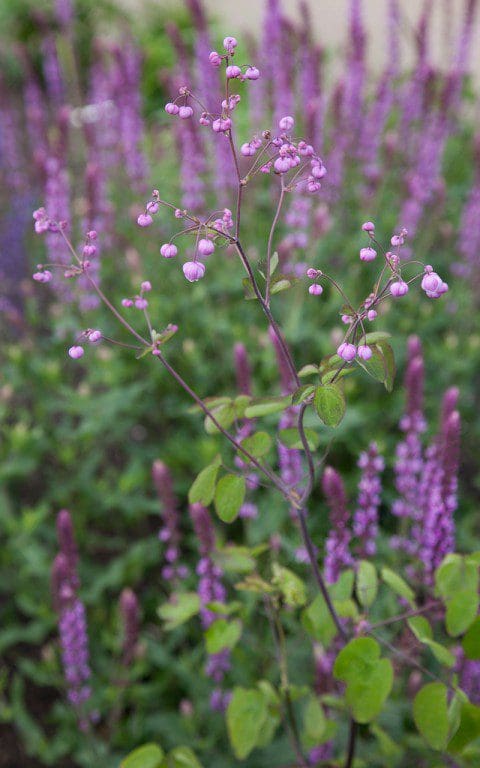 Thalictrum rochebrunianum with Salvia nemerosa ‘Amethyst’ behind
As the last few plants that weren’t ready in the nursery become available, I’m wading back into the beds again to find the markers I left there when setting out so that I can trace my original thinking. I am pleased to have done this, because it is very easy to start to reshuffle, but the original thinking is where cohesiveness is to be found. Changes will come later, after I’ve had a summer to observe and see where the planting is lacking or needing another seasonal lift. I can already see the original perennial angelica has doubled in diameter, and I’ve added eight new seedlings which, if left, will be far too many so a few removals will be necessary comer the autumn. Patience will be the making of this coming growing season, followed by action once I can see my plans emerging.
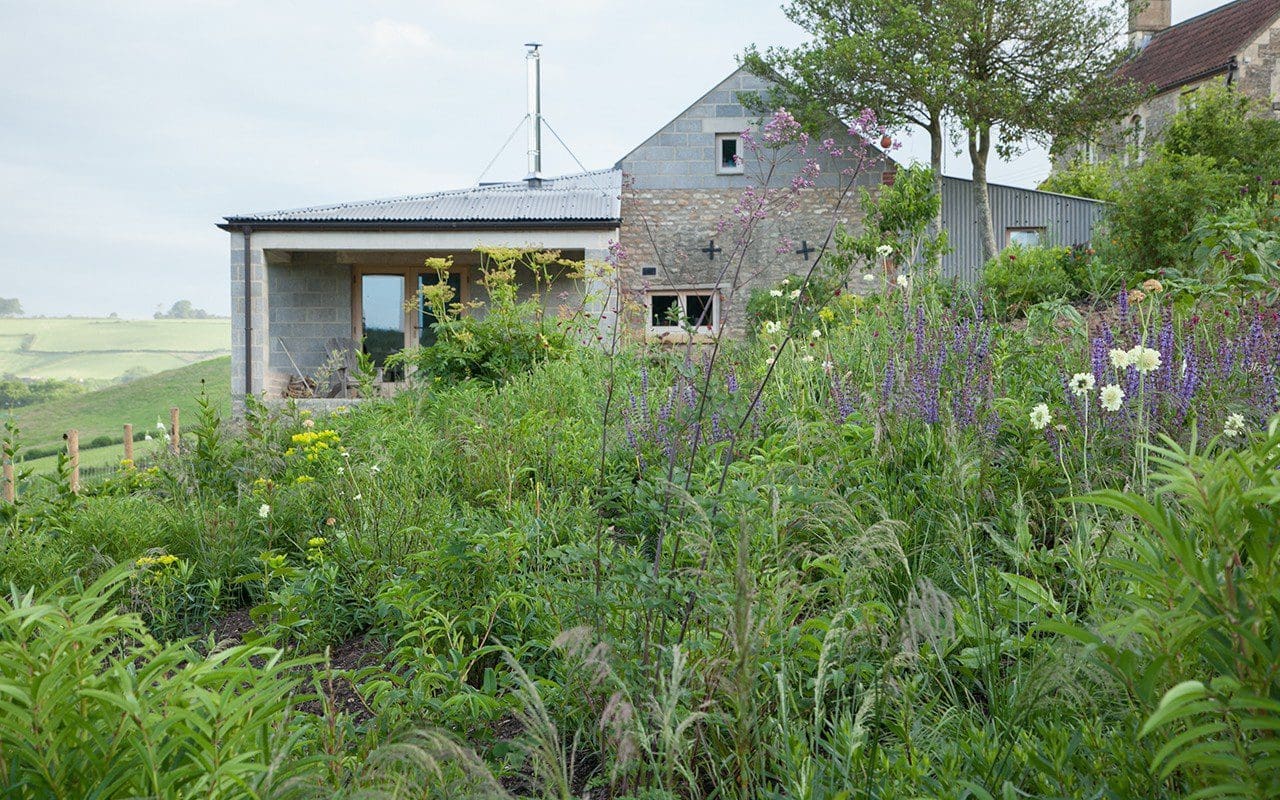
Words: Dan Pearson / Photographs: Huw Morgan
Published 17 June 2017
