It has been a long, slow start to spring, but at last we have movement. The snakeshead fritillaries are chequering the slopes behind the house and crossing over with early daffodils that this year were a whole two weeks late. The long wait will now see a rush as everything comes together, but reflecting the last few weeks of slim pickings we have kept things simple in this April gathering.
The wet weather has hit hard this year and Tulip Fire has run rampant through the tulip bed. We mass the tulips together in a random mix of six or seven varieties in the kitchen garden and experiment with a new colour palette and untried varieties every year. This year we planned for soft reds, pinks, oranges and apricots with an undercurrent of deep purples. However, we did not plan for the angst that has come with the mistake of replanting too soon in the same place. The Tulip Fire (Botrytis tulipae) probably came in with the bulbs that were grown in the same bed two years ago. A dry spring that year most likely limited its impact and it went unseen. This wouldn’t have been a problem if we’d not replanted in the same place for three to five years.
We will not be making the mistake again, for the majority of this year’s flowers are withered, pock-marked and streaked, the foliage melted on the worst affected. As soon as the flowers that are harvestable have been cut, we will dig up the bulbs and burn them on the bonfire. It has been a hard lesson after a long winter and one never to be forgotten, but we have managed to salvage enough to appreciate close up.
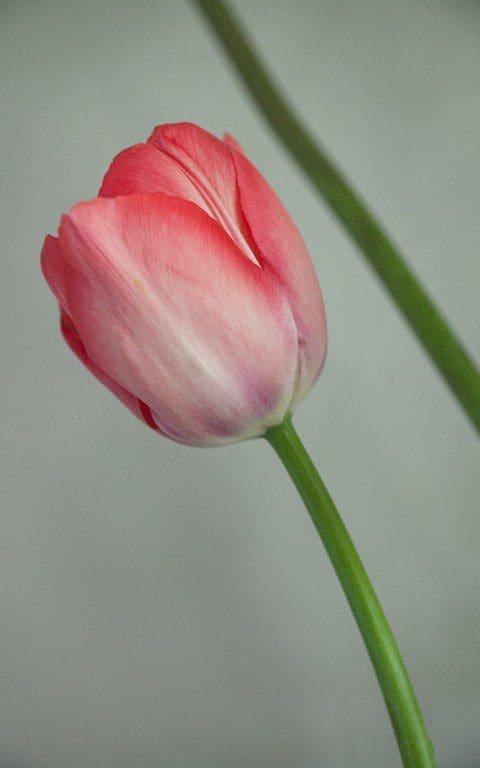 Tulipa ‘Van Eijk’
We will be trying Tulipa ‘Van Eijk’ again, for its faded pink exterior which conceals the surprise of a bright scarlet interior. The flowers enlarge and age gracefully, first to a strong lipstick pink before ending up a washed rose with the texture and shine of taffeta. It is said to be a variety that comes back for several years without the need for lifting, so next year I will try it by itself in some fresh ground. Planting in late November or early December when the weather is colder is said to diminish the impact of the botrytis should it already be in the ground. Grown on their own and not in the mass of different varieties, they may stand a better chance of staying clean. We have now kept a note to move our cutting tulips between beds on a five year rotation.
 Tulipa ‘Apricot Impression’
Tulips are remarkable for their ability to grow and adjust in a vase. The long-stemmed, large-flowered varieties exaggerate the quiet choreography that sees their initial placement becoming something entirely different as the flowers arc and sway. The complexity of colours in Tulipa ‘Apricot Impression’ is promising. The raspberry pink blush in the centre of each petal is quite marked to start with, but suffuses them as the flowers age creating an overall impression of strong coral pink bleeding out to true apricot. The insides are an intense, lacquered orange with large black blotches at the base and provide voluptuous drama as they splay open with abandon. Though our choice of tulips has been somewhat pared back this year, it is good to have enough to get a taste of the selections we’d planned.
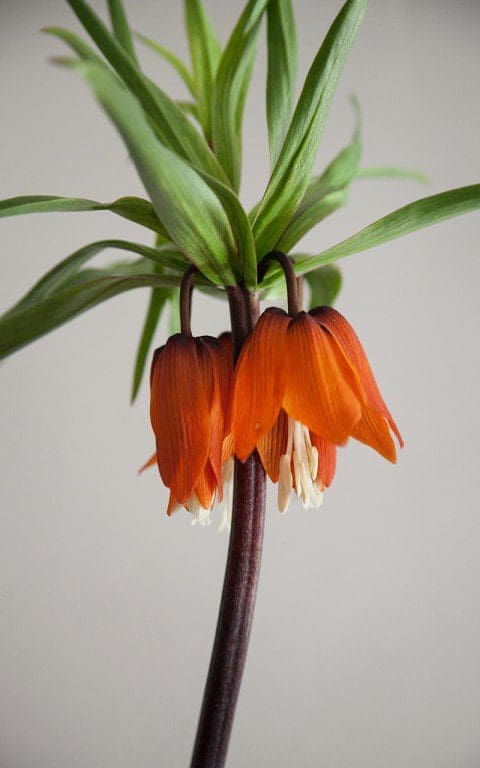 Fritillaria imperialis ‘Rubra’
This is the first time I have grown the Crown Imperial (Fritillaria imperialis) here, and their story has been entirely different. Up early, the reptilian buds spearing the soil in March, and quickly rearing above the dormant world around them, their glossy presence has been so very welcome. I have drifted them in number on the steep slopes at the entrance of the new garden amongst the rangy Paeonia delavayi. Fritillaria imperialis ‘Rubra’ has strong colouring with dark, bronze stems and rust orange flowers that work well with the emerging copper-flushed foliage of the peonies. Although there is an exotic air to the combination, it somehow works here up close to the buildings. It is a combination that you might imagine coming together through the Silk Route, China and the Middle East. However, plant hunters had already introduced the fritillaria from Persia in the mid 1500’s, and so it also has a presence that speaks of a particular kind of old English garden.
At the opening of the Cedric Morris exhibition at The Garden Museum this week Crown Imperials were a key component of Shane Connolly’s floral arrangements, scenting the nave with their appealingly foxy perfume. The smell is said to keep rodents and moles at bay and, though potent, is not unpleasant in my opinion. Morris’ painting Easter Bouquet (1934) captured them exuberantly in an arrangement from his garden at Benton End, which updates the still lives of the Dutch Masters with muscularity and vibrant colour. Rich, evocative and full of vigour, the paintings confirmed to me why we push against the odds to garden.
I planted half the bulbs on their side to see if it is true that they are less likely to rot, and the other half facing up. However, contrary to advice the two failures were bulbs planted on their sides. I also planted deep to encourage re-flowering in future years. The bulbs are as big as large onions, but it is worth planting them at three times their depth since they are prone to coming up blind when planted shallowly. In their homeland in the Middle East, they can be seen in the dry valleys in their thousands after the winter rains, so I am hoping that our hot, dry slopes here suit them. They are teamed with a late molinia and asters, to cover for the gap they will leave when they go into summer dormancy.
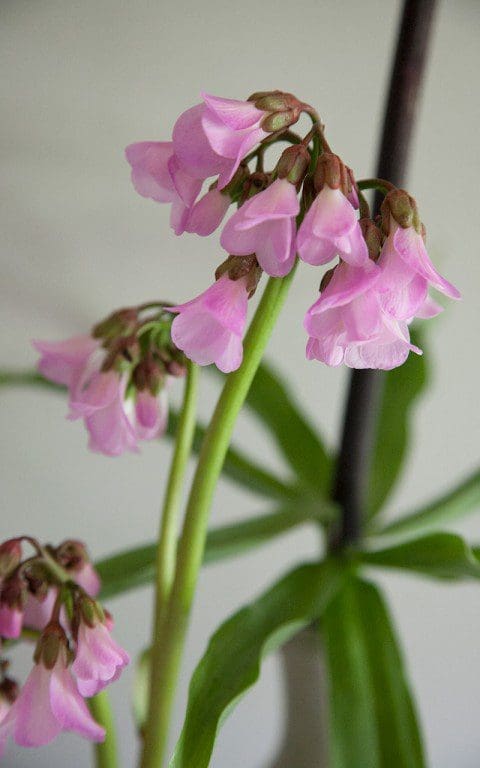 Bergenia emeiensis hybrid
The third component in this collection is a pink hybrid form of Bergenia emeinsis. It was given to me by Fergus Garret, who tells me it was handed down by the great nursery woman Elizabeth Strangman with the words that it was a “good plant”. Sure enough, despite its reputation for not being reliably hardy, it has done well for me and flowered prolifically for the first time this year amongst dark leaved Ranunculus ficaria ‘Brazen Hussy’. However, the combination was far from right, the sugary pink of the bergenia clashing unashamedly with the chrome yellow celandines. A combination Christopher Lloyd may well have admired, but not one that feels right here.
However, the elegant flowers are held on tall stems and the leaves are small and neat, so it has been found a new home in the shade at the studio garden in London, where it can be eye-catching when in season against a simple green backdrop. Though this recently introduced species from China grows in moist crevices in Sichuan, it is happy to adapt and is so prolific in flower that I had to find it a place where its early showiness feels right, rather than getting rid of a good plant. More lessons learned, and more to come now that the tide has finally turned.
Words: Dan Pearson / Photographs: Huw Morgan
Published 21 April 2018
In 1997 I witnessed my first and never to be forgotten hanami. I was in Japan filming a series for Channel 4 and we arrived there at cherry blossom season to witness this important cultural connection to the natural world. The blossom forecast or ‘cherry blossom front’ announced by the weather bureau charted the daily progress as the opening blossom moved up the archipelago, so that parties could be planned in celebration.
We arrived in Kyoto with perfect timing, just as the first buds were beginning to open. The streets in the old town were lined with the sakura trees and the beautifully manicured limbs reached from behind garden walls and dipped down to hover above the pavements. As the week went on and the buds opened, a skim of petals began to pool on the dark water of the tree-lined canals and, with the mounting crescendo of bloom, came the parties of people that gathered under the branches. During the day the sakura made pale, luminous cloudscapes of blossom in the parks. By evening, for the night viewing of yozakura, they were illuminated with lanterns. Picnic blankets, almost touching like towels on a crowded beach, shadowed the canopies of the trees and the Japanese partied with sake and merriment to welcome the spring.
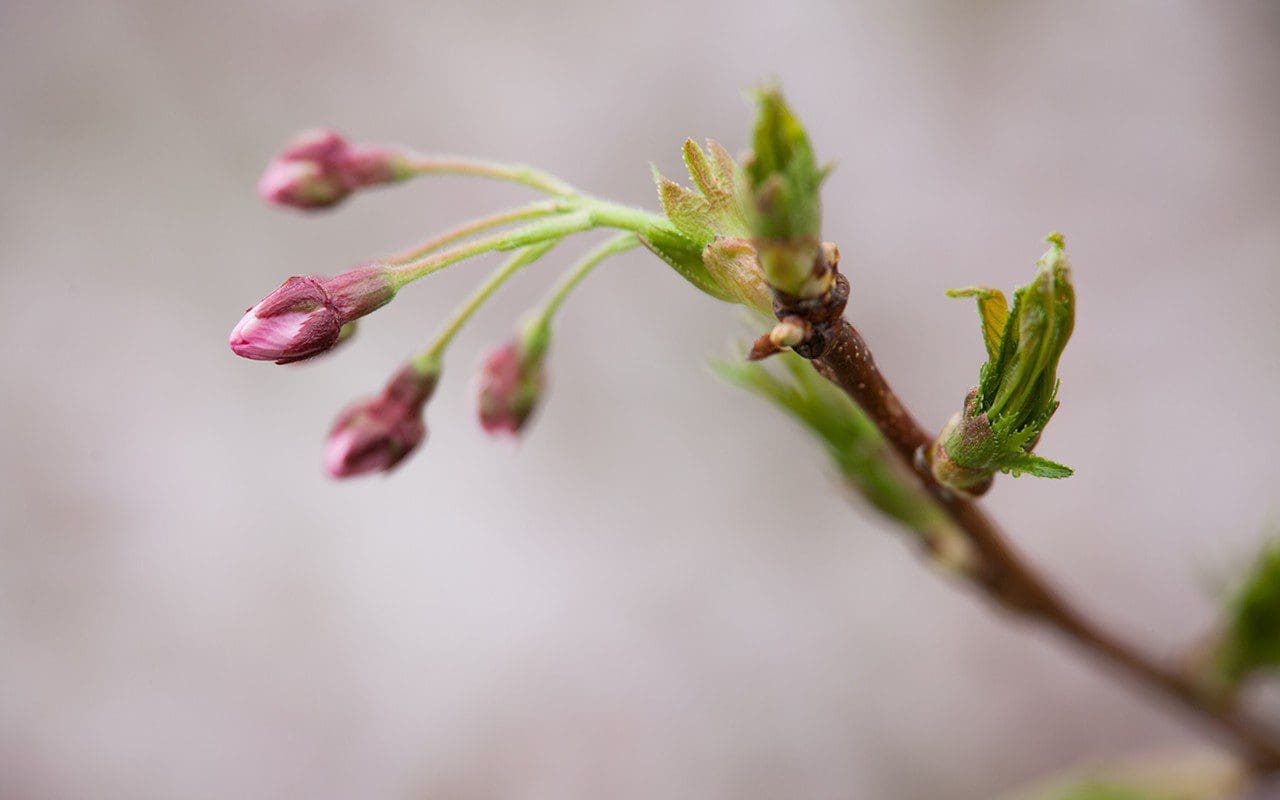
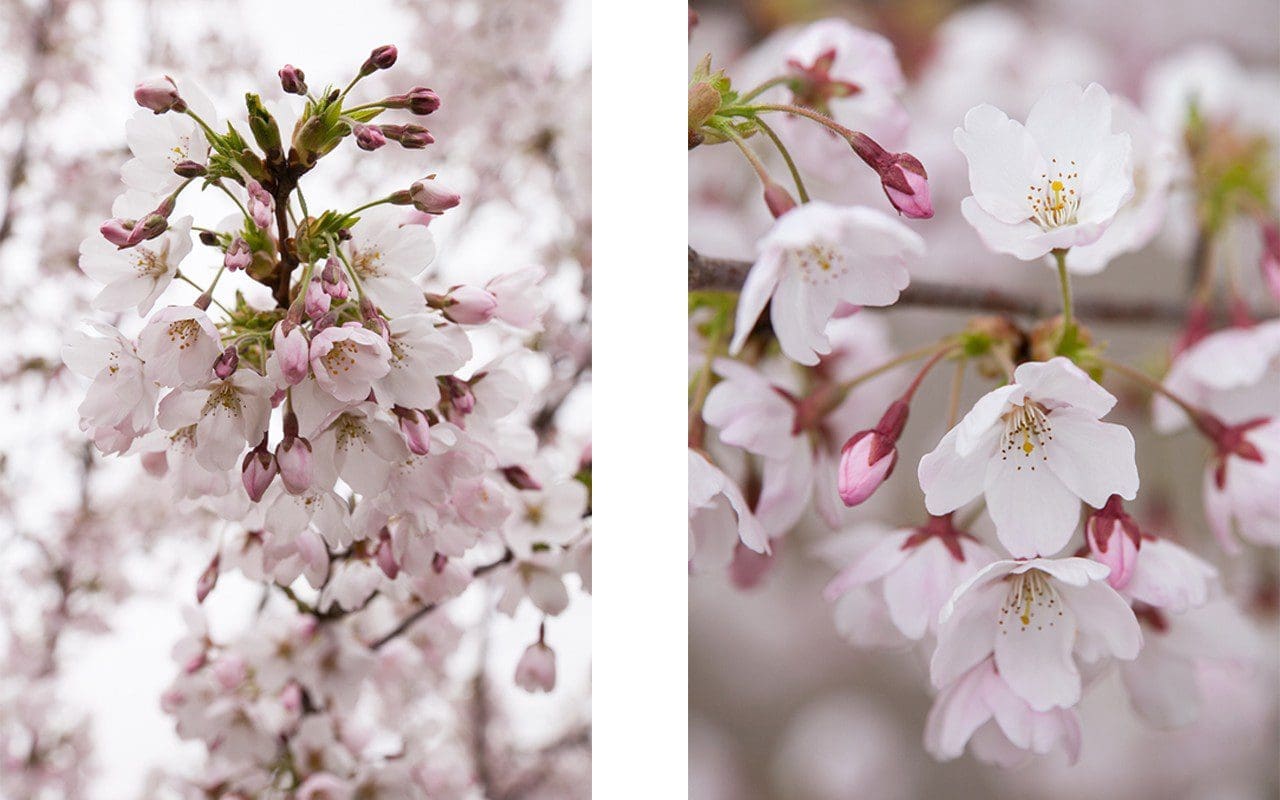
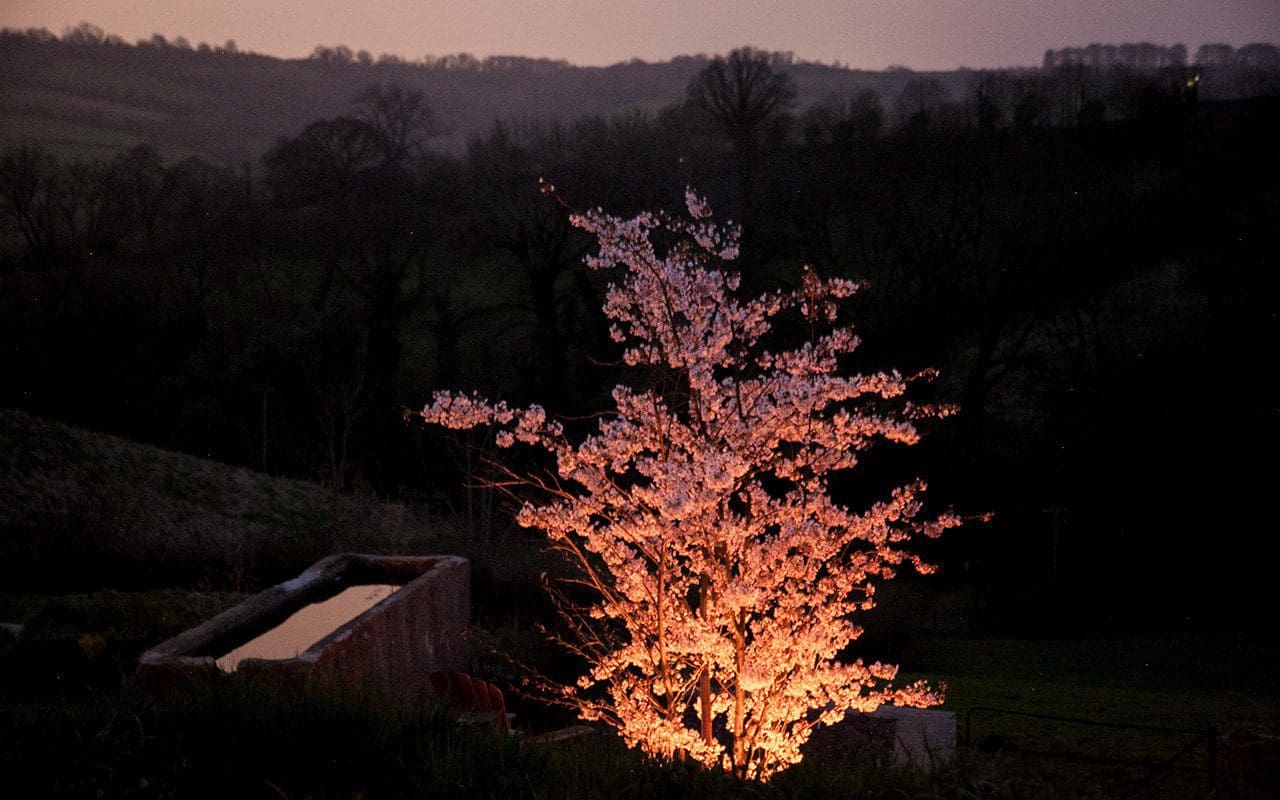
My most memorable blossom viewing was a trip we made to a cherry tree nursery. We had been instructed to visit in the afternoon to look at the trees in the fields and, with perfect timing, at dusk we were escorted to their king tree. This was their most magnificent Yoshino cherry, pruned over decades to form a wonderful canopy of limbs which were illuminated from below by a number of flaming braziers. The flickering light caught the first flower and, as darkness descended beyond the branches, we were held transfixed in a moment of absolute perfection. Sugary pink bud, a scattering of just opened flower and all the promise of what was yet to come in the season’s change. A metaphor for life that everyone there understood. Intense, breath-taking beauty, yet fleeting and ephemeral.
The Yoshino cherry (Prunus x yedoensis) is perhaps my favourite of all cherries and I have made room for one here, so that we too can celebrate the arrival of spring. Last weekend was our equivalent moment, with bud and expectation of flower. Today as I write, it is in full blossom and droning with honeybees. Though it is undoubtedly ornamental, with a live, bright pink to the bud, this rapidly pales as the flowers open. They are single, but massed on elegant growth, which reaches to form a widely-domed tree. I have planted a multi-stemmed tree here by the trough in front of the house so that, for the two weeks that it is in season, it is free to take centre stage. In time its limbs will reach out so that it can be doubly appreciated in the water. First in reflection and then with the petals scattered on the surface.
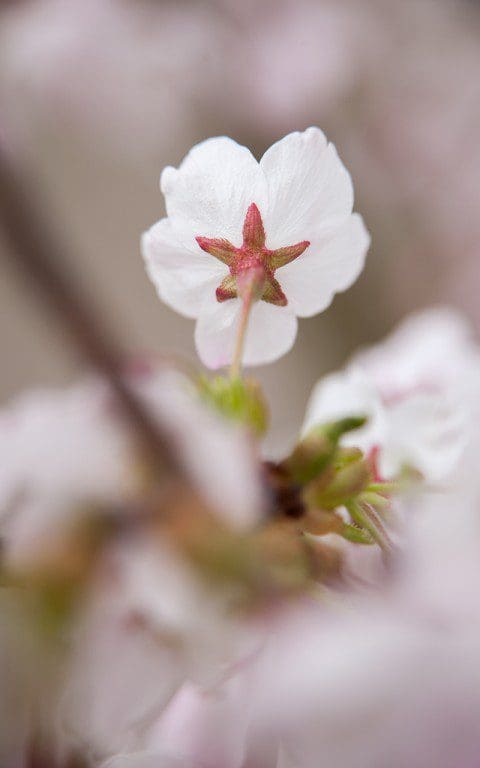

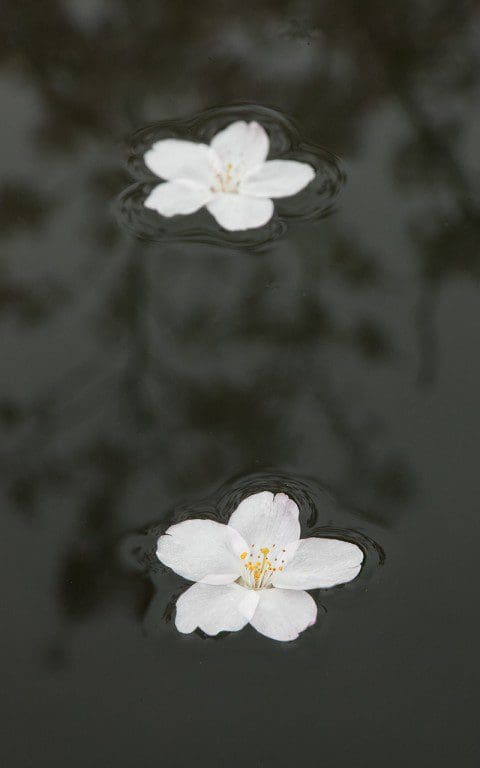
Although as a general rule I prefer to plant small, I invested in an air-pot grown specimen from Deepdale Trees for this key position. The airpot system encourages a dense and fibrous root system and, as a consequence, results in quick establishment. The Yoshino cherry is well-known for its wind tolerance and so far has done well here with our lack of shelter. Where the habit of some cherries can be stiff, the movement in the limbs and its arching growth make this a supremely elegant tree. It has a second season too with tiny cherries that the birds strip fast when they are ready and, in a good autumn, bright foliage of orange, russet and red.
It is important to dedicate some time to be with the tree when it has this moment. Stopping to look up into the energy caught in the blossom, take in the gentle perfume and the industry of the bees making the most of this early larder, time slows and the abundance and energy of spring are brought sharply into focus.
Words: Dan Pearson / Photographs: Huw Morgan
Published 14 April 2018
It has rained every day but one over the last fortnight. Not just a passing shower, but the whole day, like the ones you remember confining you to the house during the school holidays. The ground is wet, as saturated as it can be, and the stream has been rushing driftwood into dams, scouring the banks and rumbling stones into new places.
I have ventured carefully onto the beds just twice whilst we have been here over the Easter period to pull bittercress and winter-growing speedwells. They have seized the no-go zone and have made growth despite the cold. Hardy celandines have flushed the hedgerows with leaf, but they have not been showing their lacquered petals because the sun has stayed behind cloud. Elsewhere, there is half as much growth as this time last year and I find myself yearning for the chance to fill a jug with spring things, for the excitement of the new.
With the winter refusing to loosen its grip, the pickings have been slim, but this is compounded by the fact that this is a new garden. The tardy spring is a also a clear reminder that when you start from scratch, a garden is a commitment to waiting and though I know it will ease as soon as the weather warms, right now I am feeling the hunger.
I have started a list of early to bloom flowers that I’d like to see more of next year. The garden could take more pulmonarias in several places and in quantity for that early colour, and so that I can lace them with early bulbs. Right now, this is a garden without bulbs, because I like to feel settled for at least a year before introducing a layer that can complicate change if you need to make it early on. We have bulbs in the meadow banks that are slowly establishing, but their absence amongst the new life of the garden is stark. I want to see erythroniums where there will be a little shade, Ipheion where the sun can spring open their flowers and early Corydalis to make their way through the groundcovers as they mesh together.
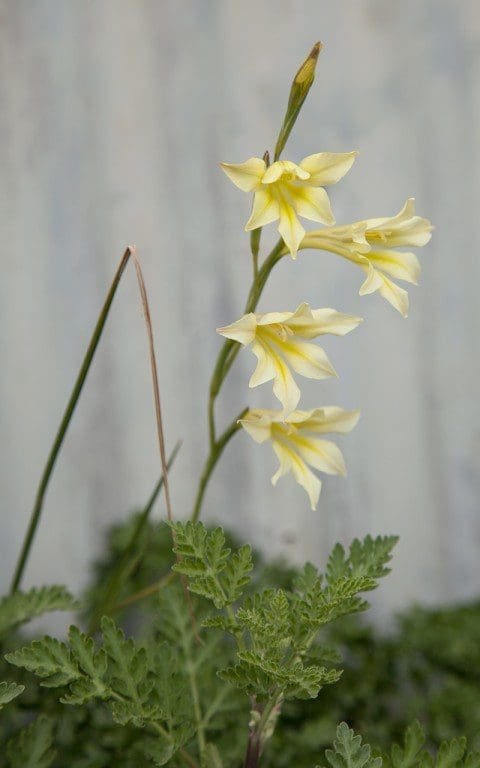 Gladiolus tristis
Up by the house and alongside the barn where we are a couple of years ahead and have already started to introduce the bulb layer, I have planted Crocus speciosus, Nerine bowdenii and Amaryllis belladonna for the autumn, but right now and rising above them all at the other end of winter is Gladiolus tristis. This willowy South African is a week or so later this year, but miraculous enough in its emerging form to stave off my hunger. Awakening from summer dormancy in the autumn, their needle like leaves push through the receding growth of their neighbours to stand tall already through the dark months. Reading will tell you that they need a sheltered spot and yes, I have seen this winter green foliage damaged in a frost pocket, but they have stood unscathed by this year’s winter on our exposed slopes. Literature will also tell you that the Marsh Afrikaner is to be found in wetland areas and on banks above streams in high grassland in the wild, but here free-draining ground and full sun provide their favoured position.
The flowers, which unfold themselves like bony fingers from their slender glove of foliage, are delicately balanced on almost invisible stems. Their necks tilt upward to suspend the flowers as they develop and there is room between each, flushing later in April first green then a luminous primrose to cream as they age. Standing at almost three feet by this point the hooded blooms will catch the slightest breeze to sway, tall and elegantly. At Great Dixter, where I first saw it in the Sunk Garden, I imagine its night perfume would be caught on still air held by the surrounding buildings. Here on our breezy slopes, we have it by the path so that you can dip your nose to the flowers at twilight.
Staking the rangy limbs is necessary if they strain and topple for light, so I like to grow it hard in a bright, airy place to keep strength in the limbs. Staking it once it is grown is almost impossible, however, as its foliage is every bit as delicate as the reeds it resembles and will bend irreparably once it falters. A network of hazel twigs, inserted if you can remember in the autumn, will allow it to grow into position and not to distract from its finely drawn outline. One that in every move of its early awakening will help in staving off the hunger pains brought on by a reluctant spring.
Words: Dan Pearson / Photographs: Huw Morgan
Published 7 April 2018
Easter is a time for baking, when the gently spiced scent of Simnel cake, hot cross buns, saffron buns and Easter biscuits fill the kitchen. This year, however, I have forgone the buns and fruit cake, which still have a whiff of Christmas about them, in favour of something lighter and more subtle based on an Easter cake traditional in Italy. Known there by various regional names including pastiera napoletana or pizza di ricotta, this is a baked cheesecake, often flavoured with orange flower water and studded with vine fruits soaked in marsala or chopped citron peel. Sometimes bitter chocolate chips are added.
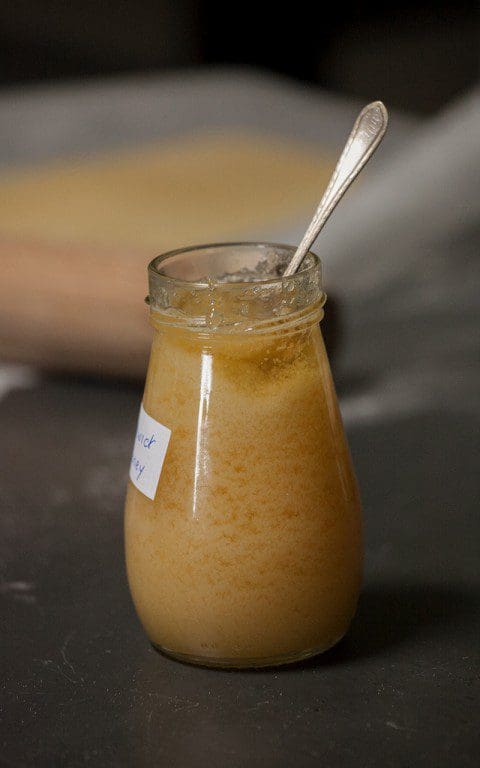
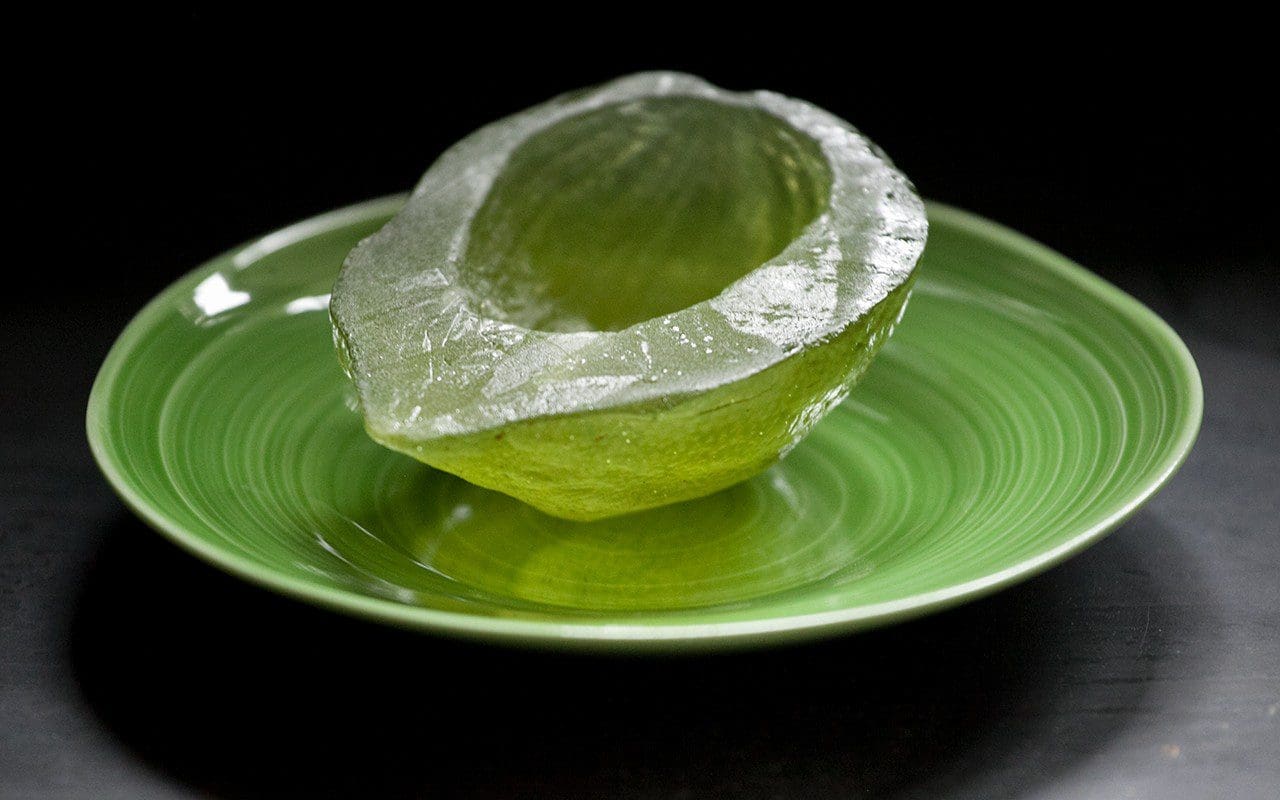
A friend brought me back half a candied citron from the market in Palermo last summer, she had been told of the local cakes it was used in and thought I would be able to find a use for it. I have been waiting all winter for the right moment. A translucent pale green, the colour of new spring foliage, I imagined it flecked through a primrose yellow custard coloured and flavoured with saffron, a spice with strong associations with Easter and spring, and a natural affinity with both cheese and honey, which I have used to sweeten the cake.
The honey was a gift from our neighbours, Josie and Rachel, who as well as keeping chickens, guinea fowl and a brace of beef cattle, have about ten hives on the their land in this valley. Every Christmas we look forward to the bag that they habitually leave by the back door containing a card, some ingots of beeswax and two jars of honey. As this local honey is so special I use it only where its floral flavour can really be appreciated and this cake is the perfect vehicle.
After the prolonged cold, grey and wet of the last few weeks, when we are pining for heat and warmth finally, a slice of this cheesecake is light and fresh and the colour of sunshine.
INGREDIENTS
Pastry
250g plain flour, preferably Tipo 100
125g unsalted butter, chilled
Pinch of salt
50g icing sugar
1 large egg yolk, retain white for filling
Iced water
Filling
500g ricotta
250g mascarpone
2 large eggs, separated
2 large eggs, whole
5 tablespoons honey
Generous pinch saffron – about 50 stamens
2 tablespoons milk
25g candied citron peel, coarsely chopped, or zest of 1 lemon
Serves 8-10
 METHOD
You will need a deep, fluted tart tin or springform cake tin 25cm in diameter.
Set the oven to 180°c.
In a very small pan scald the milk for the filling. Remove from the heat and add the saffron threads. Leave to stand until cool.
Make the pastry by sifting together the flour, salt and icing sugar. Cut the butter into small pieces and rub into the flour mixture until it resembles fine breadcrumbs. Whisk the egg yolk in a small bowl and add to the pastry mixture, stir through and then add just enough iced water to bring the dough together. Two to three tablespoons should be enough. Quickly and lightly form the dough into a ball without kneading. Wrap in clingfilm and chill in the fridge for 20 minutes.
Take the pastry from the fridge, unwrap it. On a lightly floured surface roll out until about 2 mm thick. Use the rolling pin to carefully lift the pastry over the tart tin. Gently press into the base and up the sides of the tin. Trim the overhanging pastry by tearing it away or use a knife if you prefer a tidier finish. Prick the base of the pastry with a fork. Line the pastry case with a piece of baking parchment, fill with baking beans and bake blind for 15 minutes. Remove the beans and baking parchment and return to oven for a further 5-7 minutes until it looks dry and pale gold in colour. Remove and allow to cool.
For the filling put the ricotta and mascarpone in a large bowl. Add the honey and stir well to dissolve. Add the saffron milk and stir well until the whole mixture is pale yellow.
In a bowl whisk together the two egg yolks and the two whole eggs. Add to the cheese mixture with the chopped citron peel and stir well.

In a clean metal bowl whisk the three egg whites (one retained from the egg used in the pastry) until they reach the soft peak stage. Add one tablespoon of white to the cheese mixture and gently fold in. Add the remaining egg white a tablespoon at a time. When folding in, bring the mixture up from the bottom of the bowl, until well combined.
Gently pour the filling into the pastry case. Bake in the oven for 60 to 75 minutes, until well risen and golden brown on top.
Remove from the oven and allow to cool. Do not be alarmed, the filling will sink.
Serve at room temperature.
Recipe & photographs: Huw Morgan
Published 31 March 2018
Although the snow from last weekend has all but gone, the drifts that stubbornly mark the lee of the hedges on the coldest slopes are a reminder that winter’s grip is still apparent. The primroses, however, have a schedule to keep and have responded with gentle defiance. The first flowers were out just days after the first thaw to light the dark bases of the hedgerows, and now they are set to make this first official week of spring their own.
Since arriving here, we have done our best to increase their domain. Although they stud the cool, steep banks of the lanes, they were all but absent on the land where the cattle had grazed them out. Save for the wet bank above the ditch where they were protected from the animals by a tangle of bramble. We noted that they appeared in this inaccessible crease with ragged robin, angelica and meadowsweet. Four years ago we fenced the ditch along its length to separate the grazing to either side and since then have done nothing more than strim the previous season’s growth in early January to keep the brambles at bay.
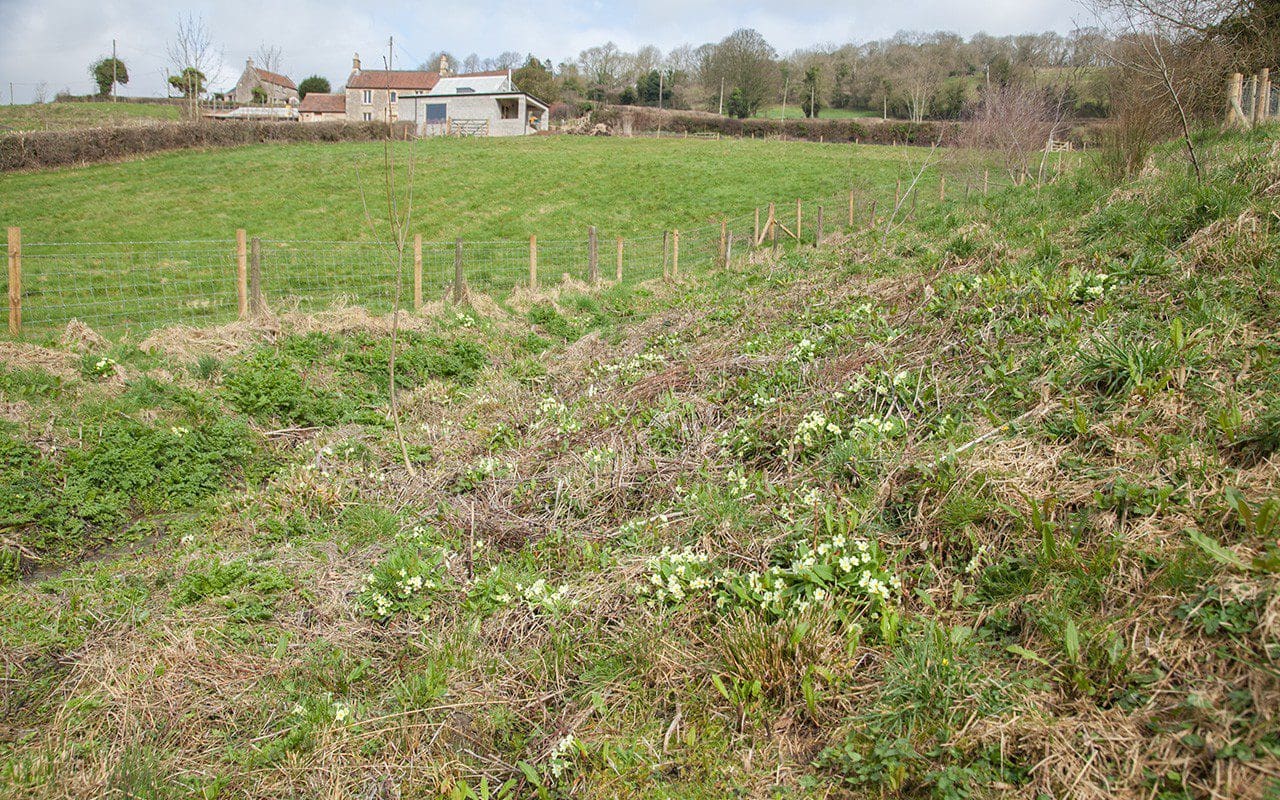
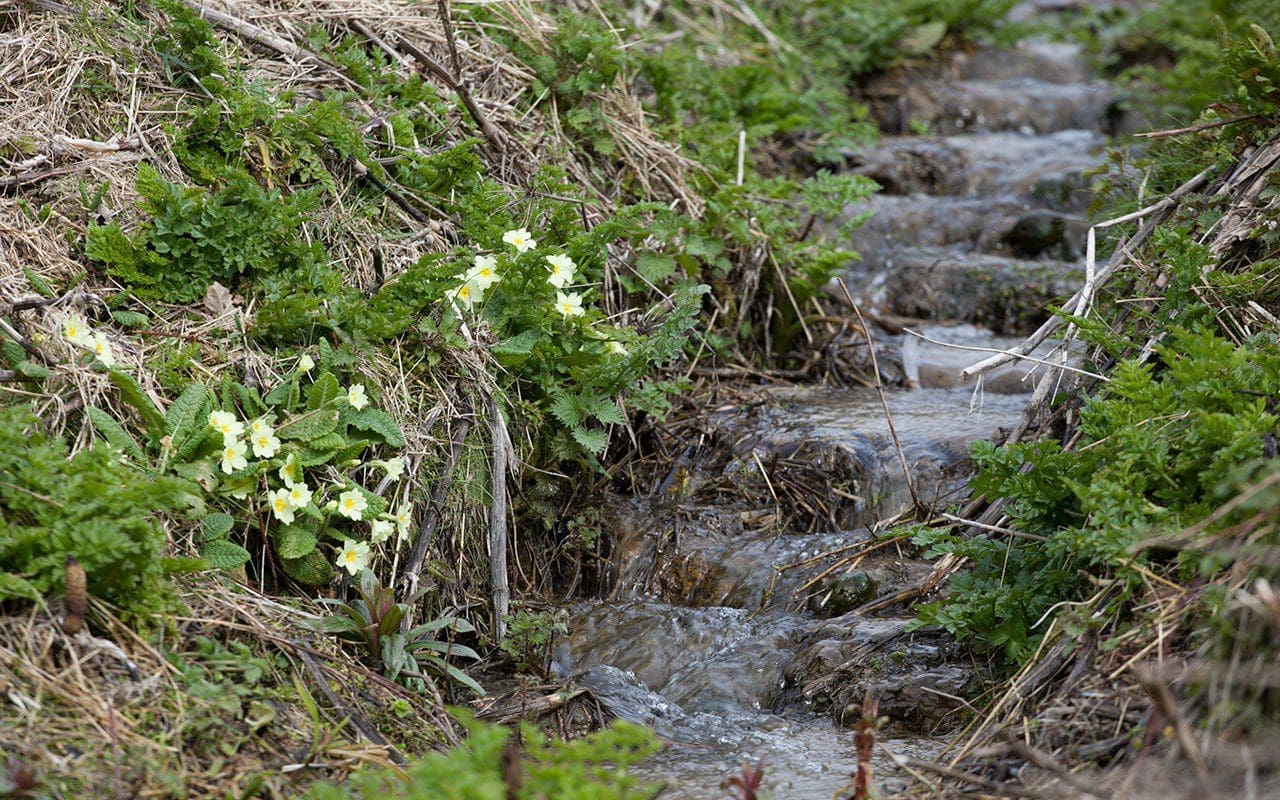
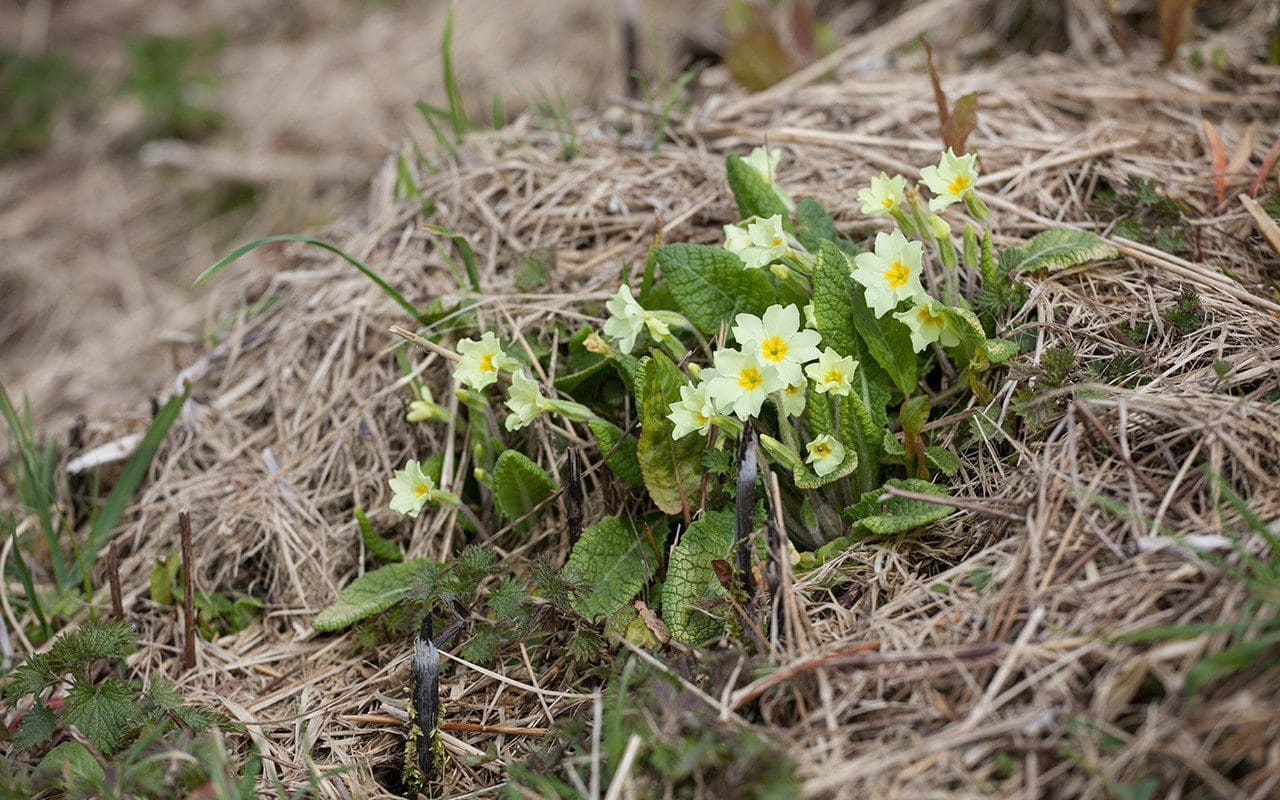 Primroses (Primula vulgaris) colonise the banks above the ditch
The new regime has seen a slow but gentle shift in favour of increased diversity. Though the brambles had protected them in the shade beneath their thorny cages, now that they have been given headroom the primroses have flourished. Their early start sees them coming to life ahead of their neighbours and, by the time they are plunged once more into the shade of summer growth, they have had the advantage. Four years on we can see them increasing. The mother colonies now strong, hearty and big enough to divide and distinct scatterings of younger plants that have taken in fits and starts where the conditions suit them.
Each year, as soon as we see the flowers going over, we have made a point of dividing a number of the strongest plants. It is easy to tease them from their grip in the moist ground with a fork. However, I always put back a division in exactly the same place, figuring they have thrived in this spot and that it is a good one. A hearty clump will yield ten divisions with ease, and we replant them immediately where it feels like they might take. Though they like the summer shade, the best colonies are where they get the early sunshine, so we have followed their lead and found them homes with similar conditions.
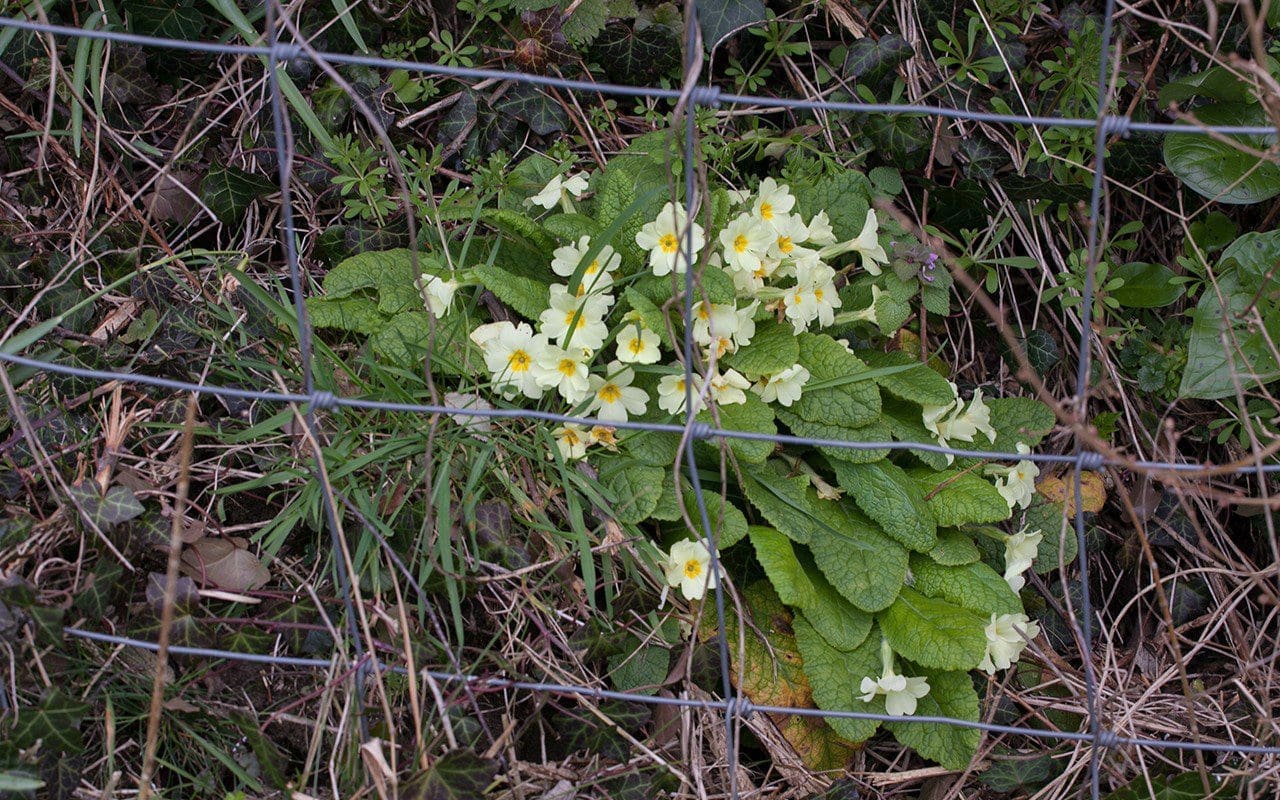
The divisions taken from the heavy wet ground of the ditch have been hugely adaptable. The first, now six years old and planted beneath a high, dry, south-facing hedgerow behind the house, have flourished with the summer shade of the hedge and cover of vegetation once the heat gets in the sun. It is my ambition to stud all the hedgerows where we have now fenced them and they have protection from the sheep. Last year’s divisions, fifty plants worked into the base of the hedge above the garden, have all come back despite a dry spring. Their luminosity, pale and bright in the shadows, will be a good opening chorus in the new garden. The tubular flowers can only be pollinated by insects with a long proboscis, so they make good forage for the first bumblebees, moths and butterflies.
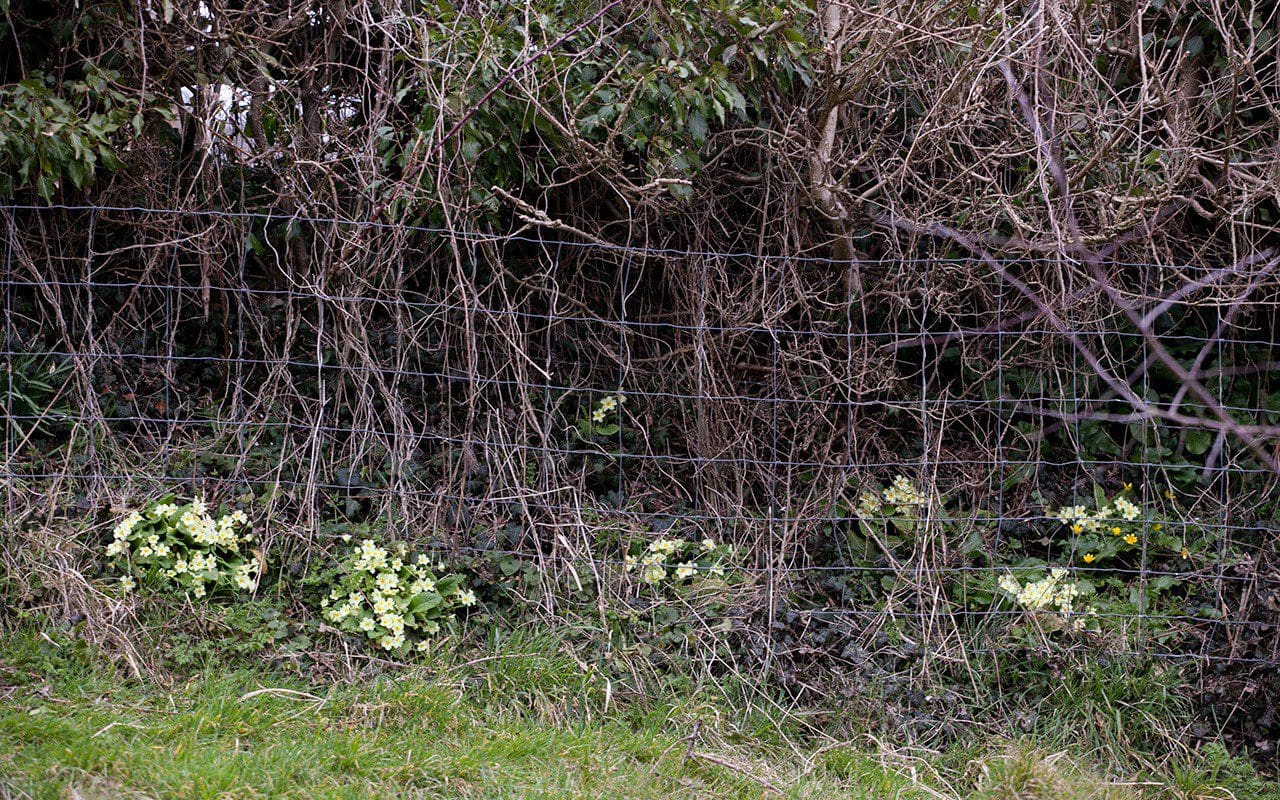
 The six year old divisions at the base of the south-facing hedge behind the house
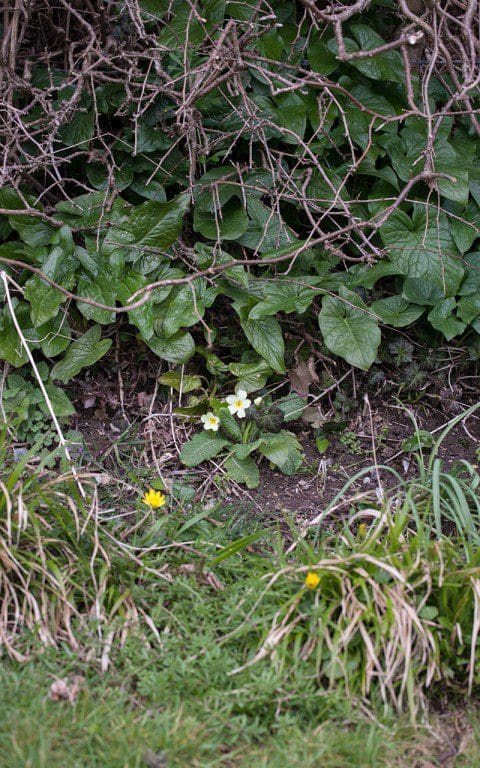 A one year old division at the base of the hedge above the garden
By the time the seed ripens in early summer, the primroses are usually buried beneath cow parsley and nettles, so harvesting is all too easily overlooked. However, last year I remembered and made a point of rootling amongst their leaves to find the ripened pods which are typically drawn back to the earth before dispersing. The seed, which is the size of a pinhead and easily managed, was sown immediately into cells of 50:50 loam and sharp grit to ensure good drainage. The trays were put in a shady corner in the nursery area up by the barns and the seedlings were up and germinating within a matter of weeks. As soon as the puckered first leaves gave away their identity, I remembered that it was a pod of primrose seed that had been my first sowing as a child. Though I cannot have been more than five, I can see the seedlings now, in a pool of dirt at the bottom of a yoghurt pot. The excitement and the immediate recognition that, yes, these were definitely primroses, was just as exciting last summer as it was then.
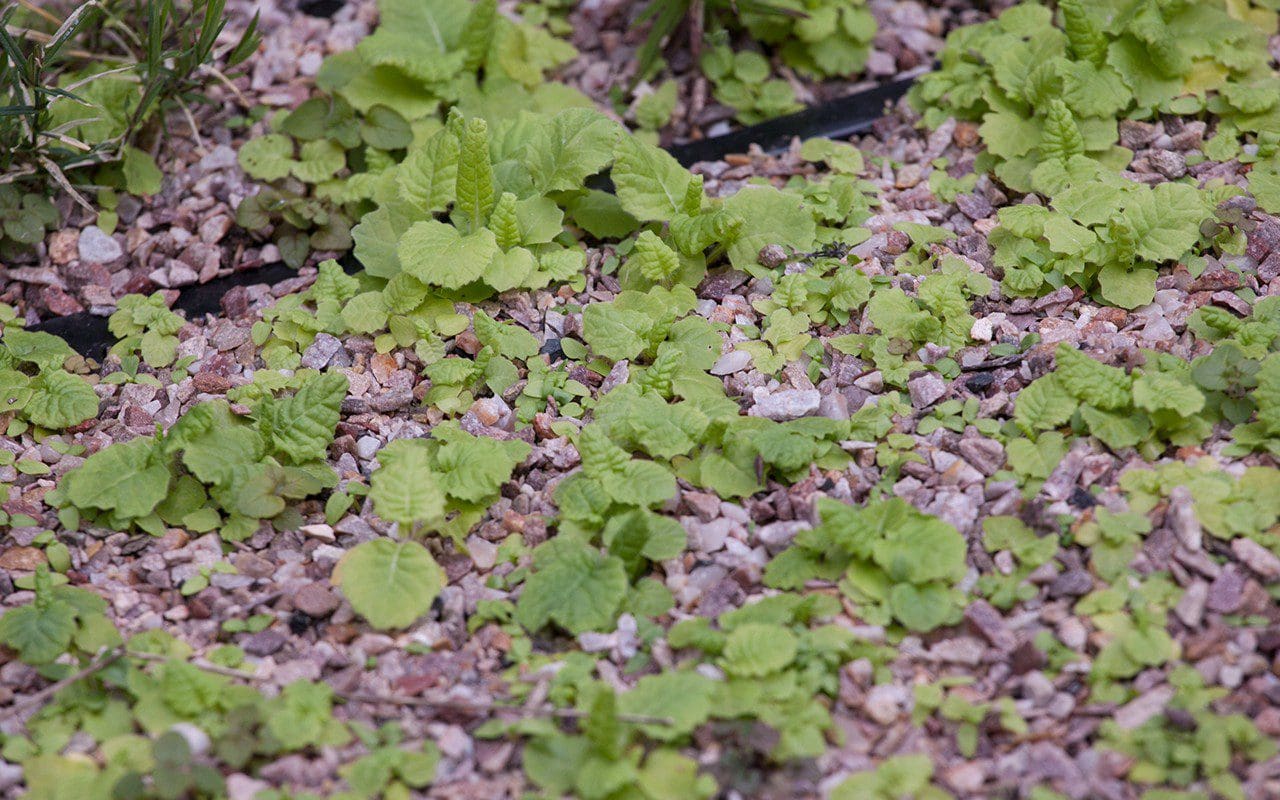 Primrose seedlings
The young plants will be grown on this summer and planted out this coming autumn with the promise of winter rain to help in their establishment. I will make a point of starting a cycle of sowings so that, every year until I feel they are doing it for themselves, we are introducing them to the places they like to call their own. The sunny slopes under the hawthorns in the blossom wood and the steep banks at the back of the house where it is easy to put your nose into their rosettes and breathe in their delicate perfume. I will plant them with violets and through the snowdrops and Tenby daffodils, sure in the knowledge that, whatever the weather, they will loosen the grip of winter.
Words: Dan Pearson / Photographs: Huw Morgan
Published 24 March 2018
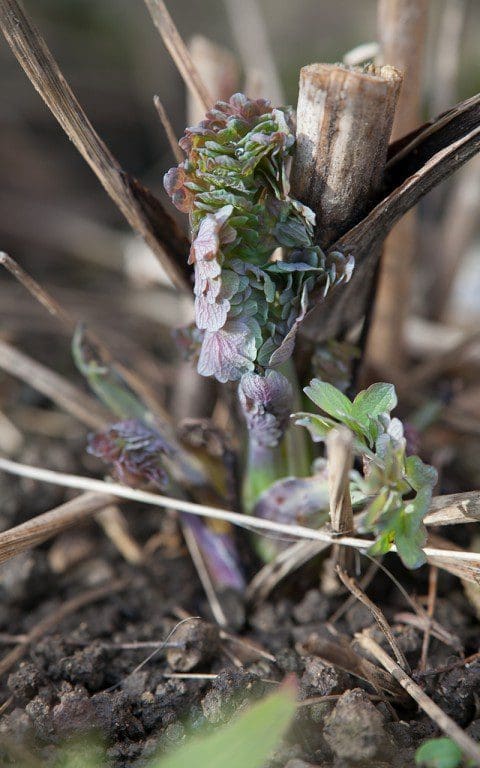
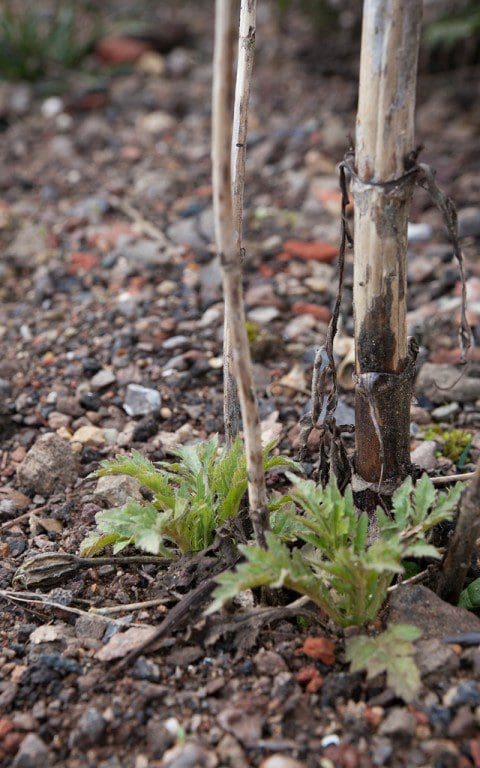
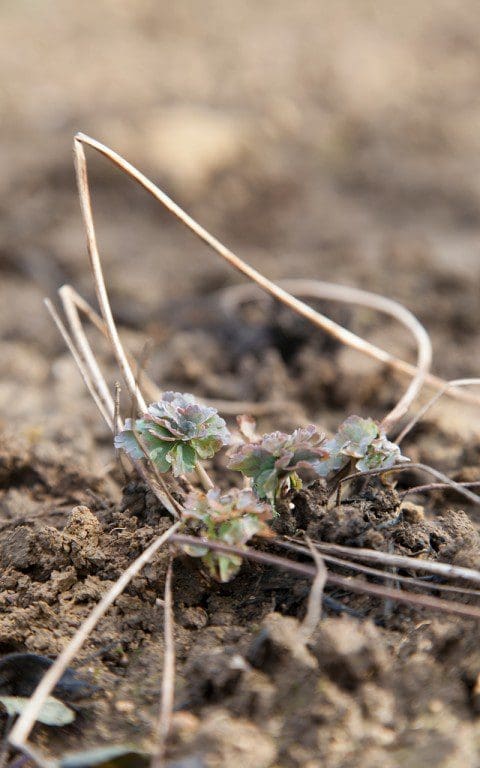
The last of the perennial skeletons have now been cut to the base to make way for the turn in the season. It is just in the nick of time. Where just a fortnight ago the newly cleared ground gave away no more than a hint of what had been there before, we now have the evidence that spring is finally here. Held tight and close still, the flushed rosettes of embryonic foliage are bursting with energy.
This new life is remarkable for its break with dormancy and so begins our morning routine of combing the border for change. Sometimes, in the case of the lipstick red shoots on the peonies, it is a moment that is arguably as good as what comes later. The colour is strong and meaty and welcome against the dark ground. Team their flaming shoots with ‘Brazen Hussy’ celandines, which are up early too and done by the time the peony foliage shades them out, and you have a moment that is worthy of the weeks we have waited for such activity.
There is also the excitement of the appearance of new things. The autumn-planted Fritillaria imperialis ‘Rubra’ (main image) have speared the bare soil of the new garden with priapic vigour. We will be watching them closely for the first sign of lily beetle, which makes its appearance much earlier than expected with the first warmth of the sun. I always try and plant those bulbs that are prone to beetle attack close to the paths so that it is possible to pick them off without trampling into the beds.
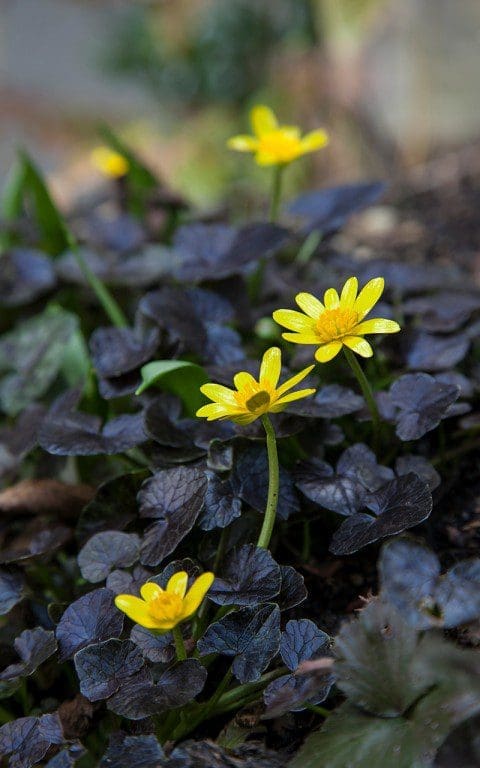 Ranunculus ficaria ‘Brazen Hussy
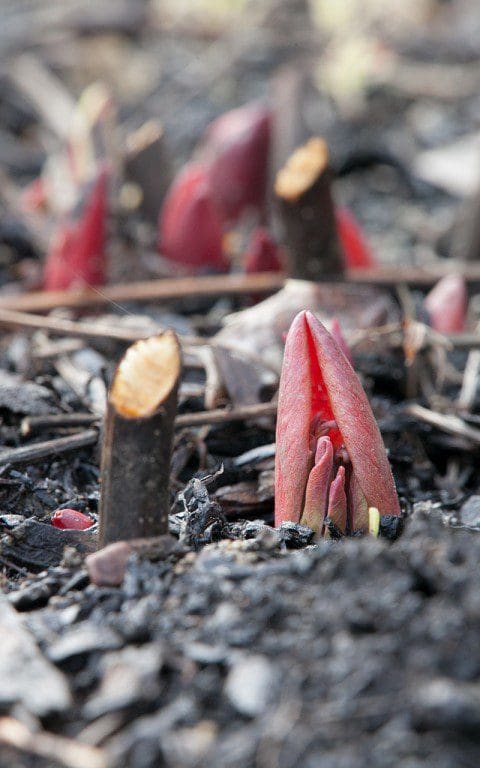 Paeonia mlokosewitschii
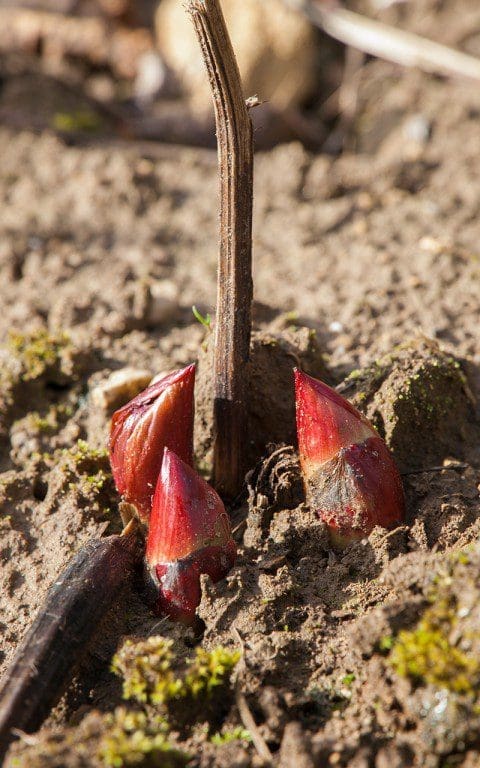 Paeonia mascula
The rhubarb are at their best too and showing us now the huge reserves that they have built and stored in their crowns. The leaves, flushed copper, puckered and ready to expand, the crimson stems just waiting to push them to the light and the warmth that will very soon be in the sun. The rhubarb was moved just eighteen months ago, the autumn before last, and though I should be leaving it to build another year before forcing, it is clear that it has the heft. A quarter of the crown has been covered so that we can enjoy some early spears.
It is also a time to check that everything has made it. Just a week ago the fickle agastache, which easily succumb to winter wet, were looking like they might have done just that, but this morning I could see they have mostly made it through. Embryonic clusters of shoots held tight to the old wood, blue-purple and intensified in colour, but clearly identifying the plant that is yet to come. The pigmentation in new foliage is richest this early in the year with coppers, purples, blacks, reds and pale citrus greens. In the case of the Iris x robusta ‘Dark Aura’, the inky new growth is almost its best moment. New life, concentrated and full of anticipation.
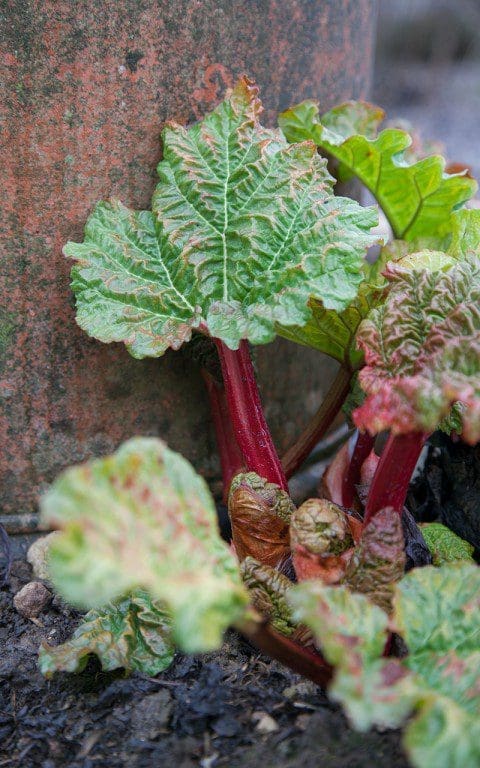 Rhubarb ‘Timperley Early’
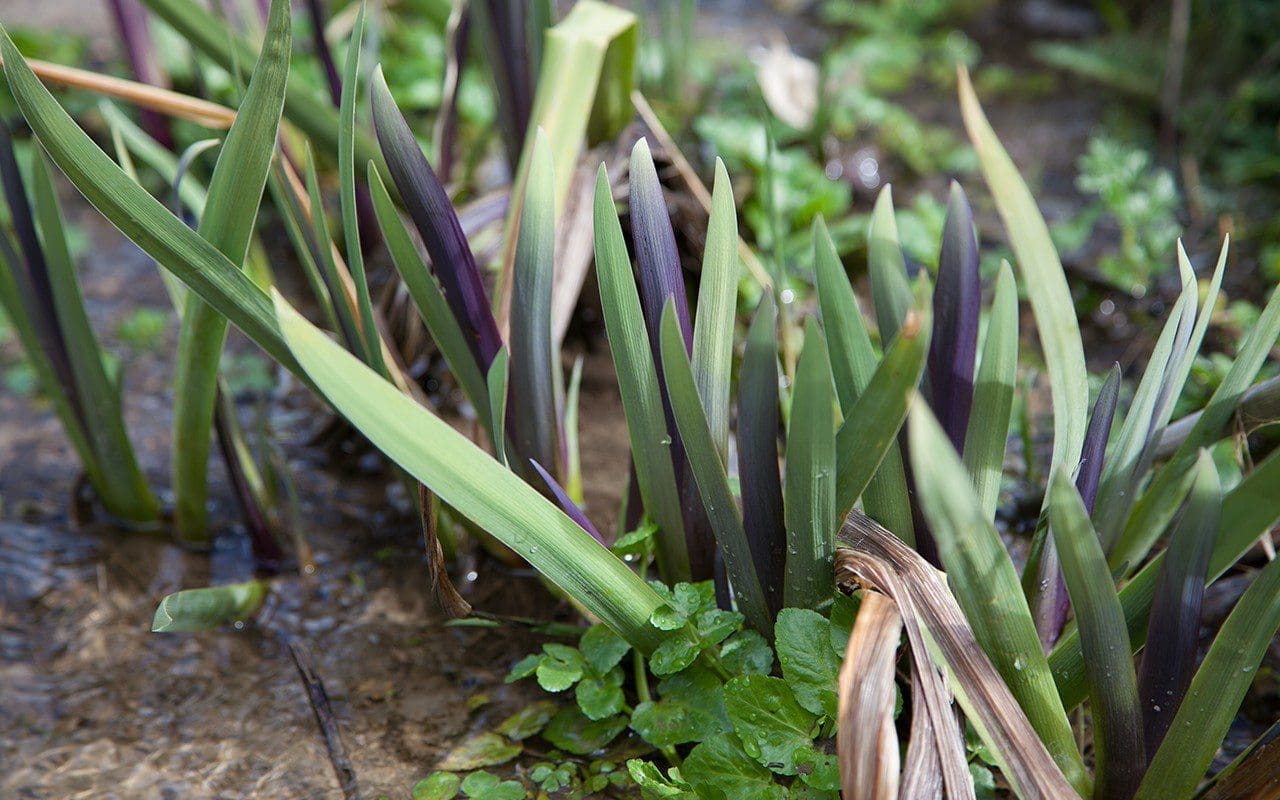 Iris x robusta ‘Dark Aura’
Other rosettes reveal an exponential increase, more than you can imagine might have been possible between autumn and now, but one that shows that the plants are happy. Coppery Zizia aurea doubled, if not trebled, in size from last year and angelicas erupting to let you know that they have got their roots down. This year, I can see it already, they mean business and in some cases will be sure to overwhelm their neighbours.
Understanding the rush of early season growth and the impact it can have on later-to-emerge neighbours is key to achieving balance when you are mingling plants. The late-season grasses for instance will see panicum smothered, if it is not teamed with neighbours that are also late risers – asters and rudbeckias – companions that will allow them the time to catch up. This early-season flush is wonderful for the way it marks the break with winter, but it can easily leave a hole when early energy is expended and there is still the bulk of the growing season to come. Although it feels far too soon to even be thinking about it, a late June cut-back of early geraniums and the Anthriscus sylvestris ‘Ravenswing’ will be sure to provide a second crop of foliage.
The shift, mapped in these fingers of new life, and the clues to the growing season ahead, is a gathering tide. One that, if we photographed the garden again next weekend, would reveal something altogether different. Although I have savoured it this year, it is good to feel that we have finally reached the end of winter. A new year awaits in the joy of observing.
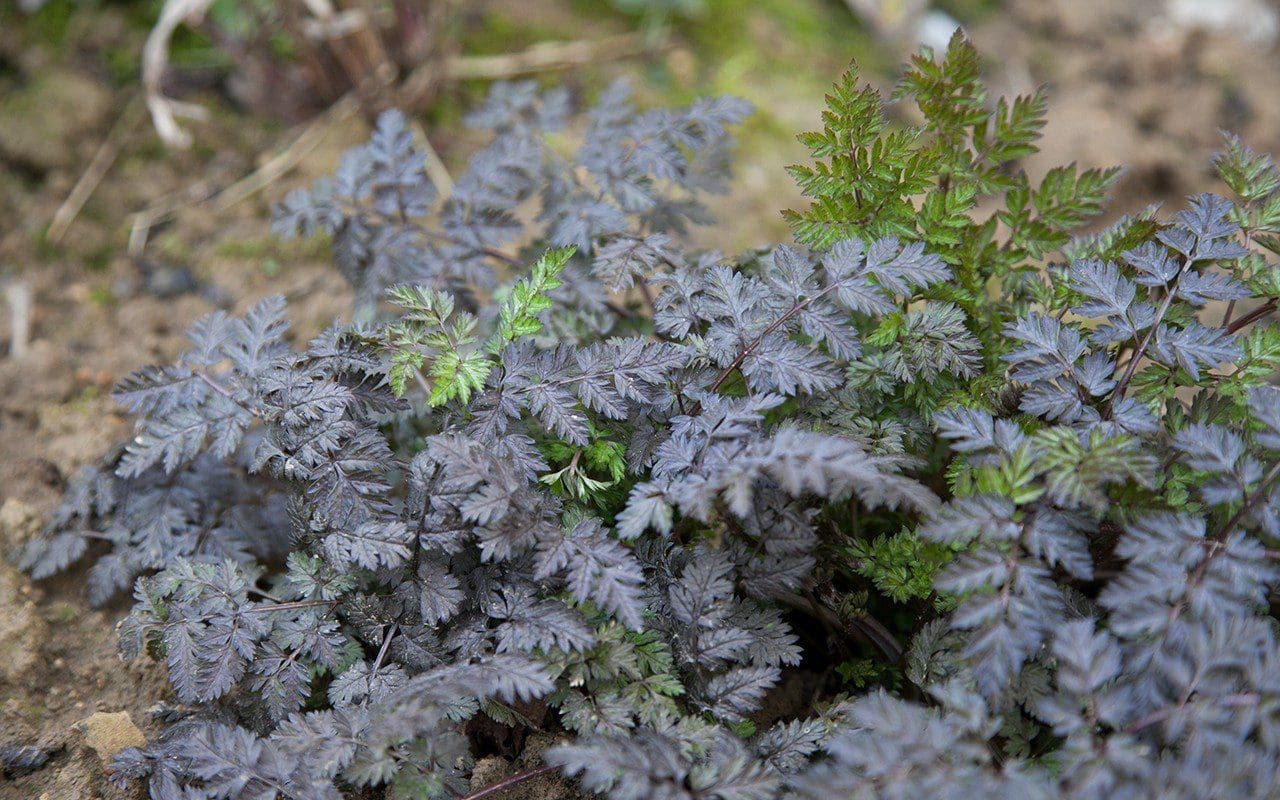 Anthriscus sylvestris ‘Ravenswing’
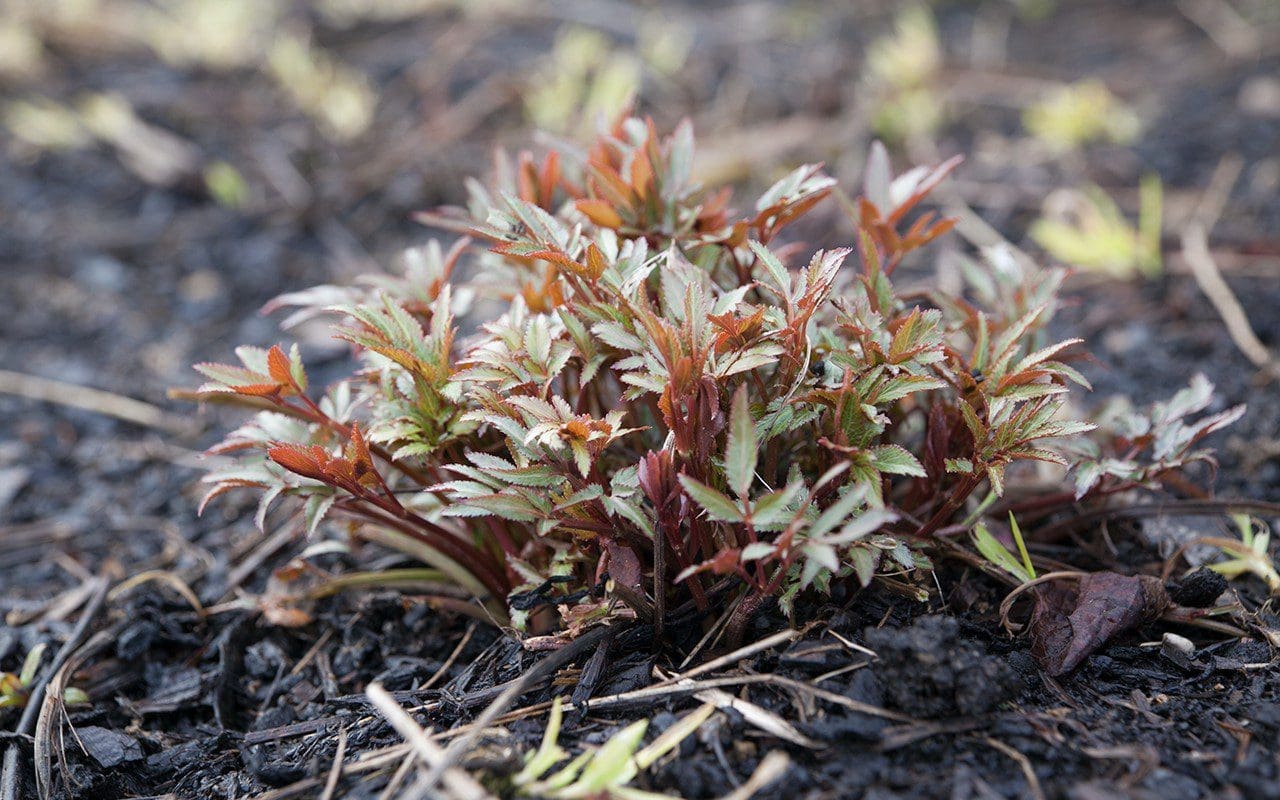 Zizia aurea
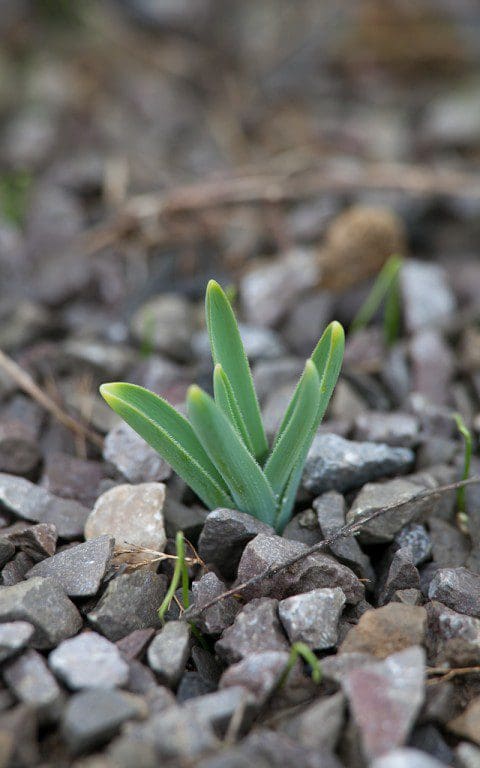 Allium christophii
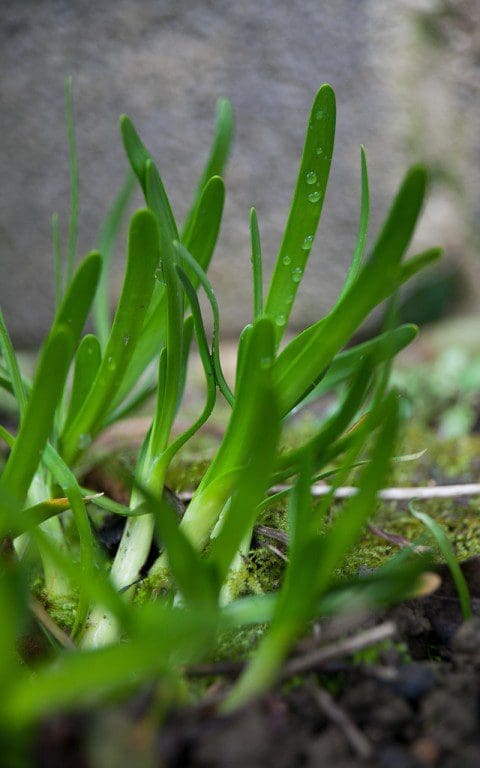 Allium angulosum
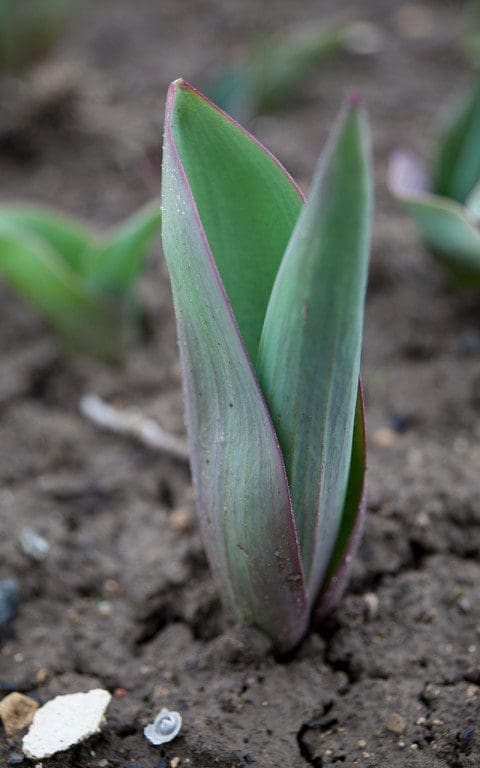 Tulip ‘Apricot Impression’
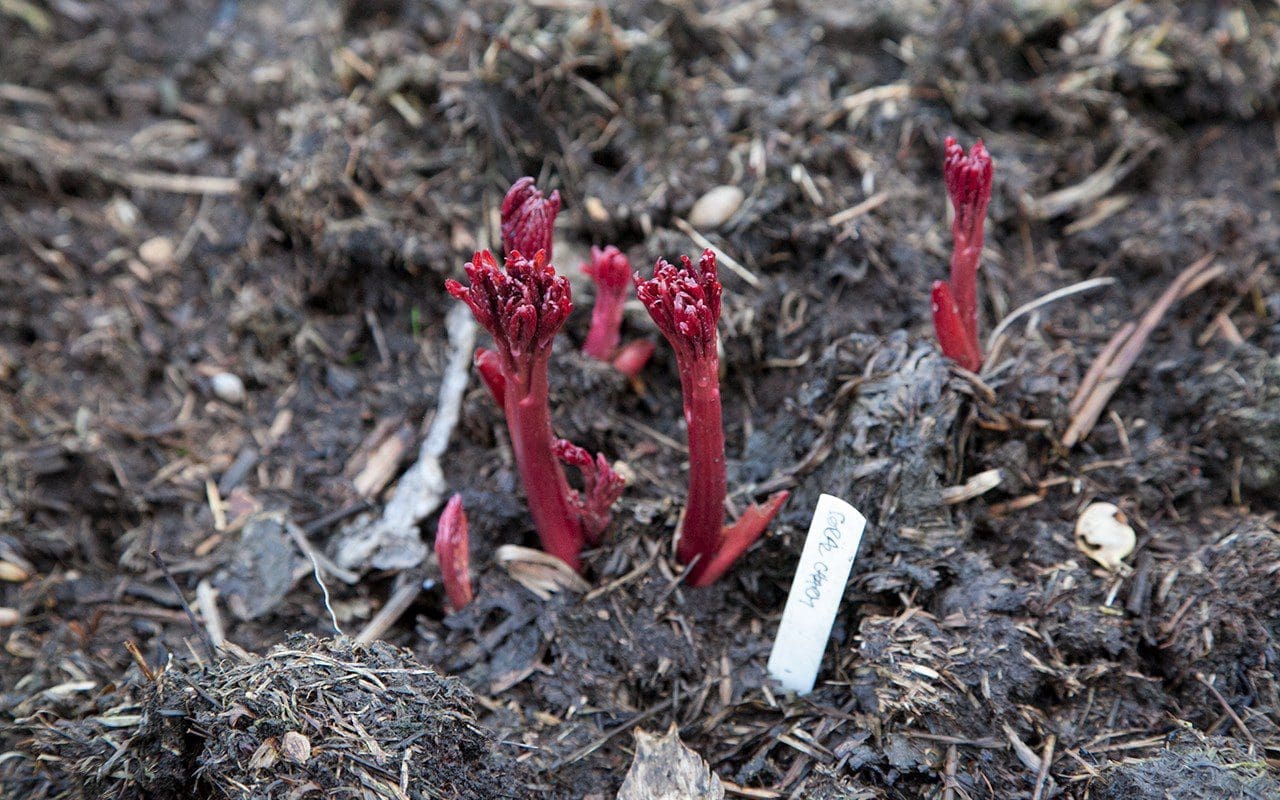 Paeonia ‘Coral Charm’
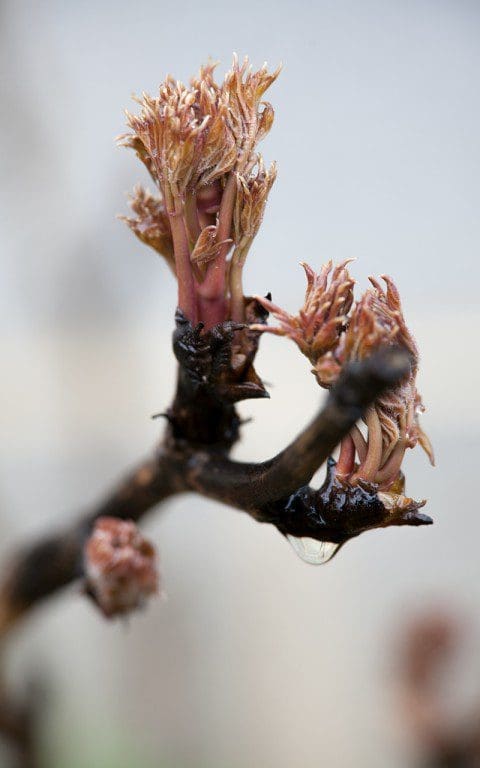 Paeonia rockii
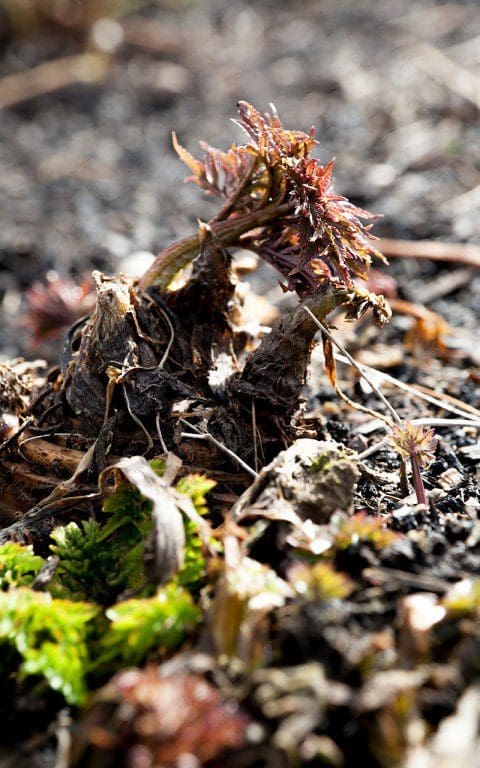 Angelica sp.
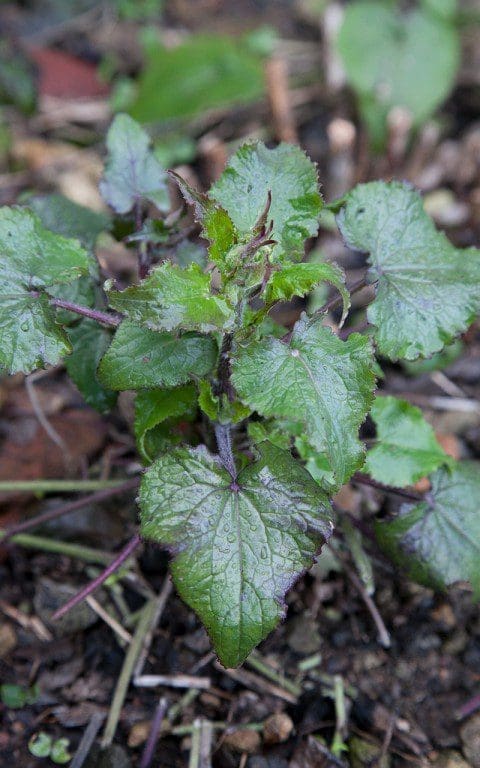 Lunaria annua ‘Corfu Blue’
 Thalictrum flavum ssp. glaucum
 Patrinia scabiosifolia
 Aquilegia chrysantha ‘Yellow Queen’
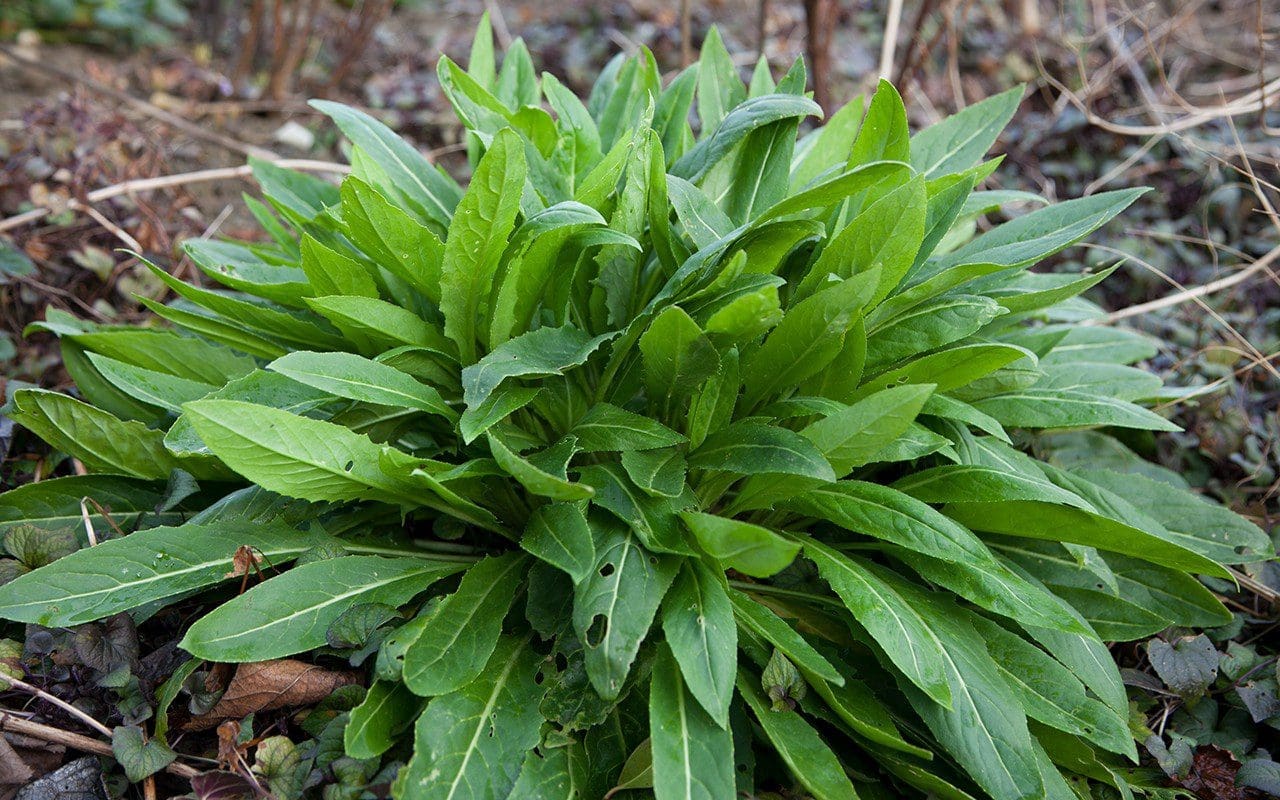 Hesperis matronalis var. albiflora
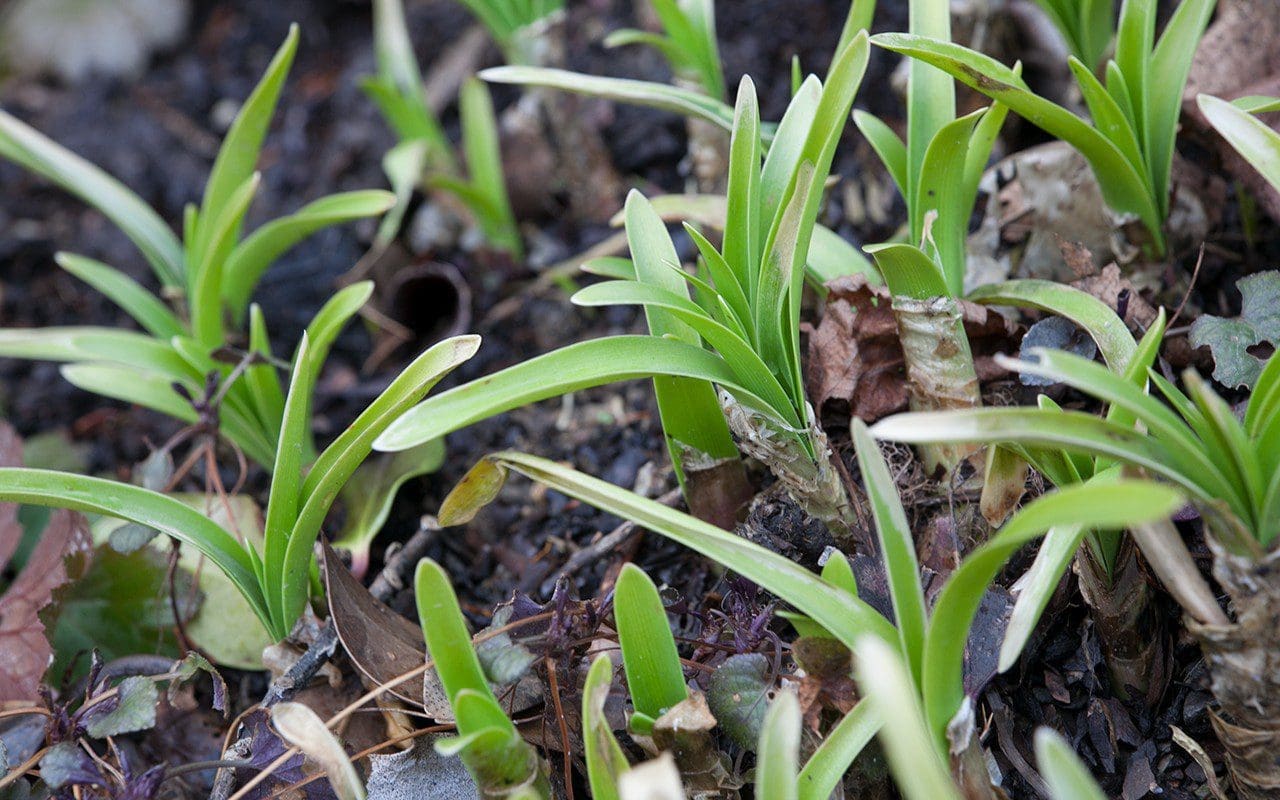 Nerine bowdenii
 Eryngium eburneum
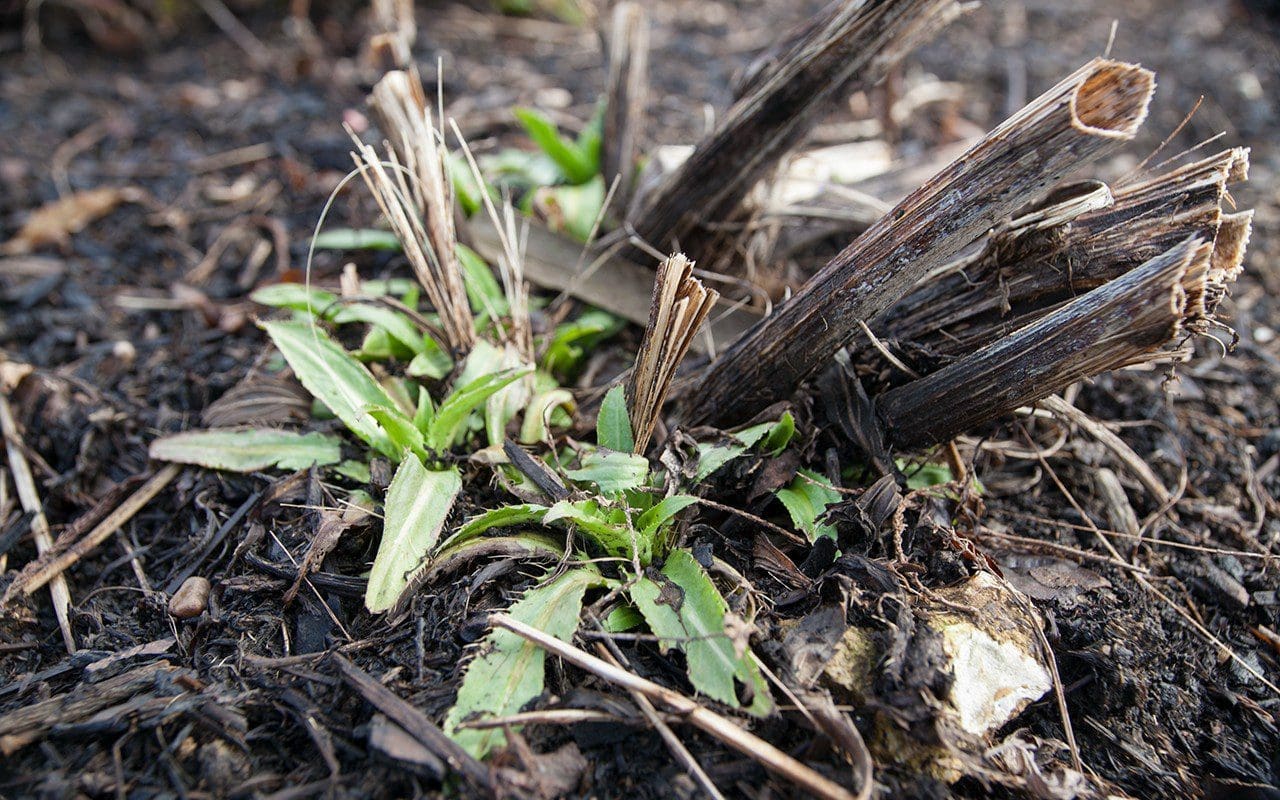 Cirsium canum
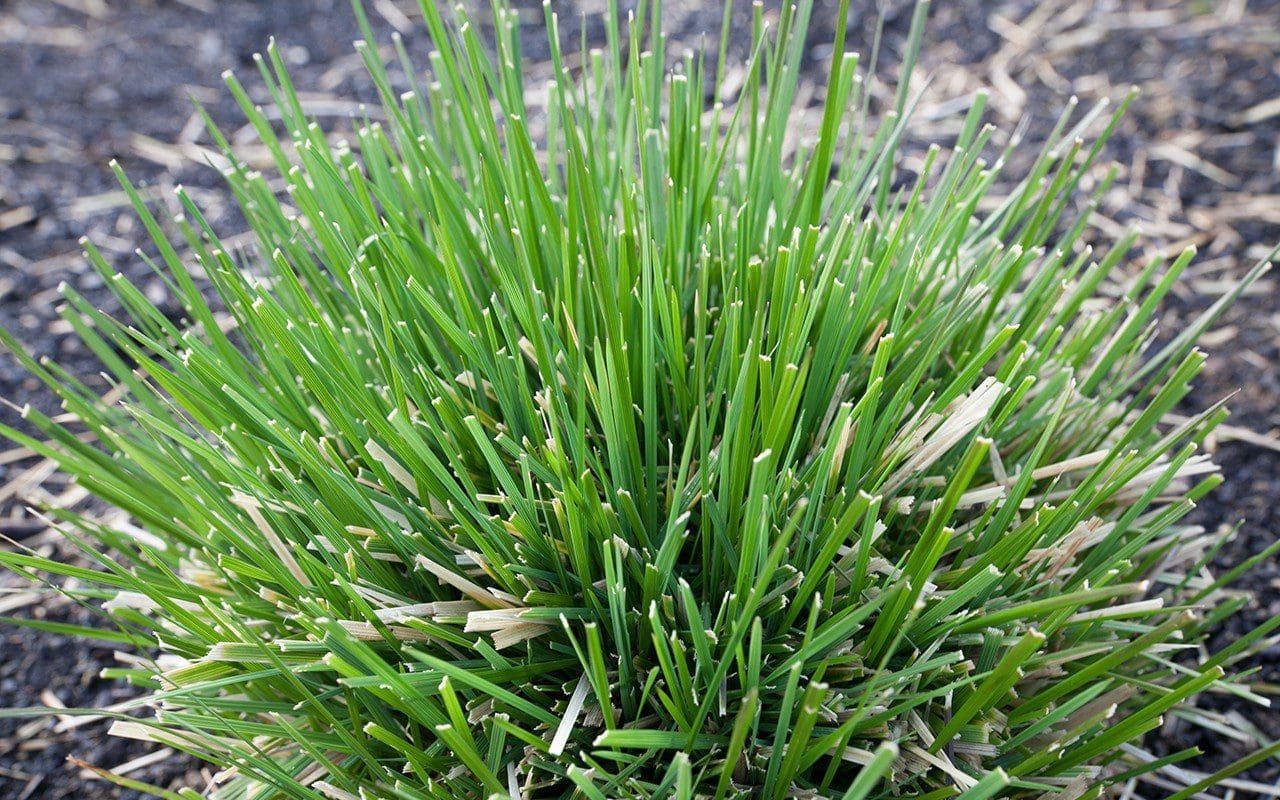 Deschampsia cespitosa ‘Goldschleier’
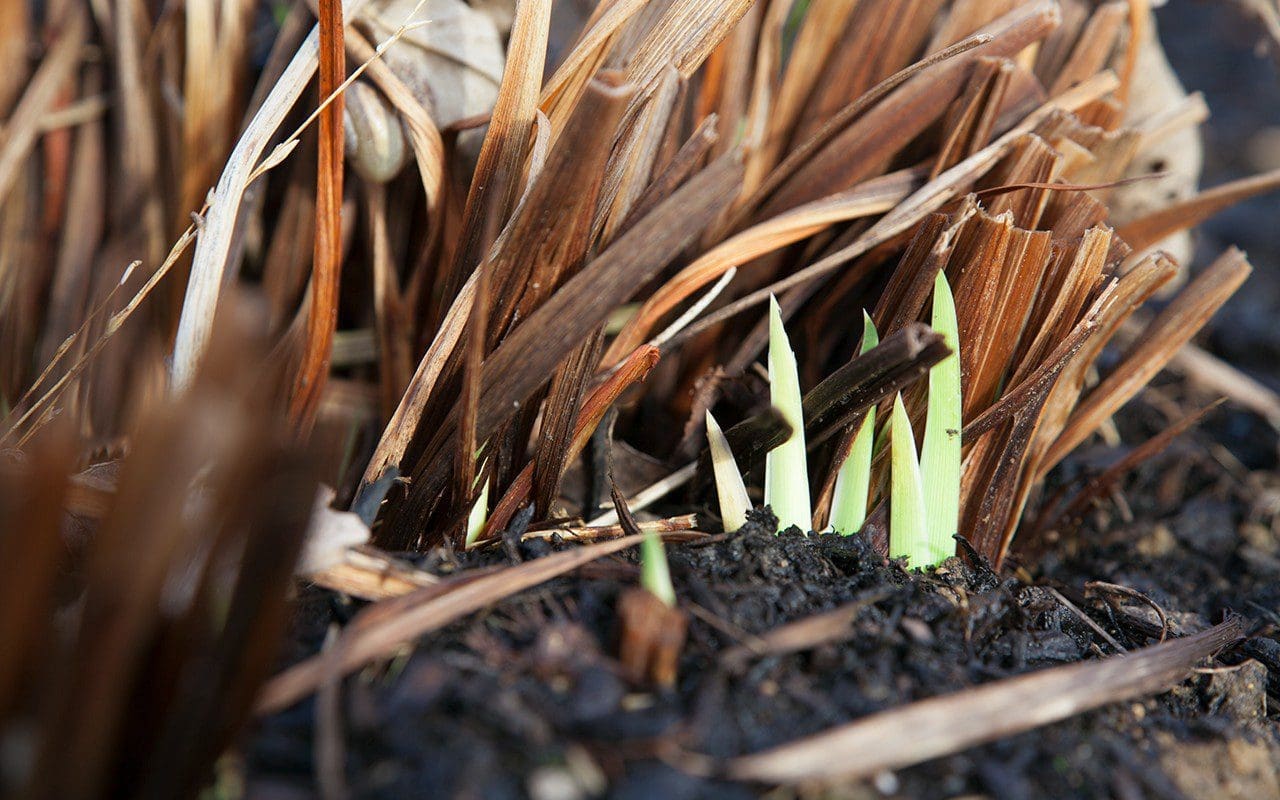 Iris sibirica ‘Papillon’
Words: Dan Pearson / Photographs: Huw Morgan
Published 17 March 2018
The first posy of March was picked last week, ahead of the cold north-easterlies and the snow that plunged us back into winter. The galanthus, the primroses and the wild narcissus that just last week were tilted in bud, are buried now in snowdrifts as March comes in, roaring like a lion. In the garden the hunt for new life has also been halted, but we have gained the time to seek out the minutiae of change. Newly visible buds, stark and green against the whiteout on the hawthorn and the Cornus mas in full and oblivious flower.
The Pulmonaria rubra stirred early in January and, beneath the snow they are already flushed with bloom. I was given a clump by our neighbour Jane and, having never grown it before, I can confirm that it is a doer. The silvered and spotted-leaved lungworts are arguably more dramatic, for they provide a textured foil and foliage that is easily as valuable as their spring show of flower. Give them shade and summer moisture and they will reward you, but the slightest sign of drought and they will sadly succumb to mildew. It is important, therefore, to find them a place that keeps cool. Pulmonaria rubra, however, seems altogether more adaptable and when the thaw comes they will flower unhalting until summer.
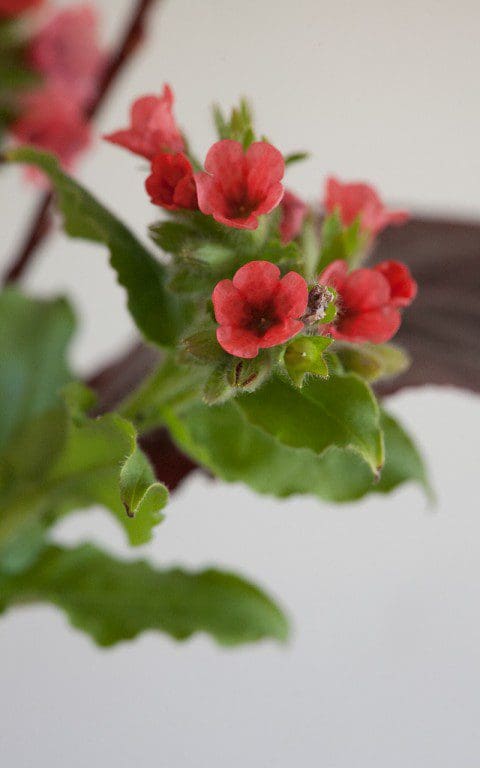 Pulmonaria rubra
Despite its modest presence – it has plain, green foliage and soft, coral flowers – I have enjoyed its willingness and ease on the sunny banks close to the studio where, from the veranda, you can hear the buzz of bumblebees. They love it, as do the first early honeybees and the heavy soil there suits it too. So far it has taken the sun and dry summer weather with no more than a little flagging in midday heat. I have planned for shade with the young Salix purpurea ‘Nancy Saunders’ that grow alongside and for there to be hellebores there when I have the shade for sure. The lungwort and the Lenten roses will be good in combination and we have experimented here in the bunch with a spotted dusky pink hybrid, whose colouring makes something more of the lungwort. This year it became clear that the red hellebores are just that bit later than the blacks, greens, yellows and picotees, whose earlier buds were ravaged by mice. Sometimes disasters teach you as much as triumphs.
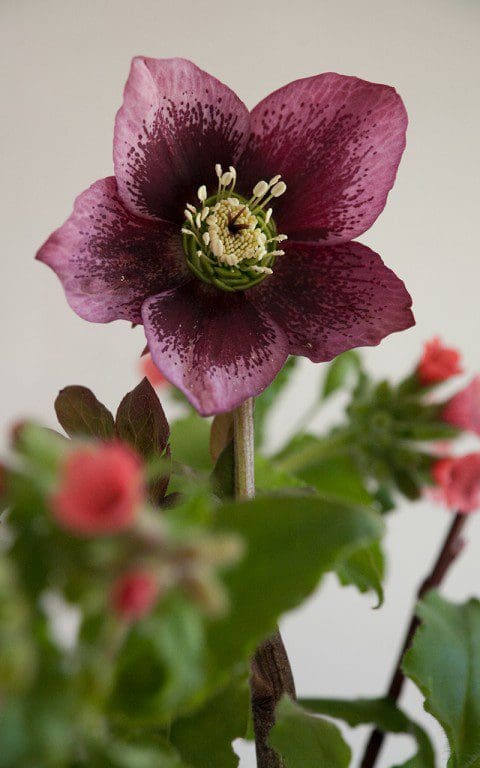 Helleborus x hybridus Single Pink Blotched
The last of the winter is held in the Bergenia purpurascens which colours from a deep, coppery green to the colour and shine of oxblood leather in the cold months. This form, which I first saw growing in Beth Chatto’s gravel garden, was initially called ‘Helen Dillon’ after the Irish plantswoman and gardener, but has now been renamed ‘Irish Crimson’. I like it for the scale of the leaf which is finely drawn and held upright to catch the winter sun.
Though bergenia are a stalwart of shade, it is worth finding Bergenia purpurascens a position in sunshine so that the leaves can be backlit in winter. The glowing foliage makes up for the absence of flower elsewhere and is a foil to the first bulbs. I have just one clump which is slowly increasing, but I plan to split it on a year on/year off basis to have enough to mingle it with fine stemmed Narcissus jonquilla and white violets. Though bergenias are tough and reliable, I have found that they are magnets for vine weevil. The tell-tale notches to the edge of the leaf are made by the adult and these signs will show you that there are grubs eating the roots. An autumn application of nematodes should help in controlling the problem if it develops.
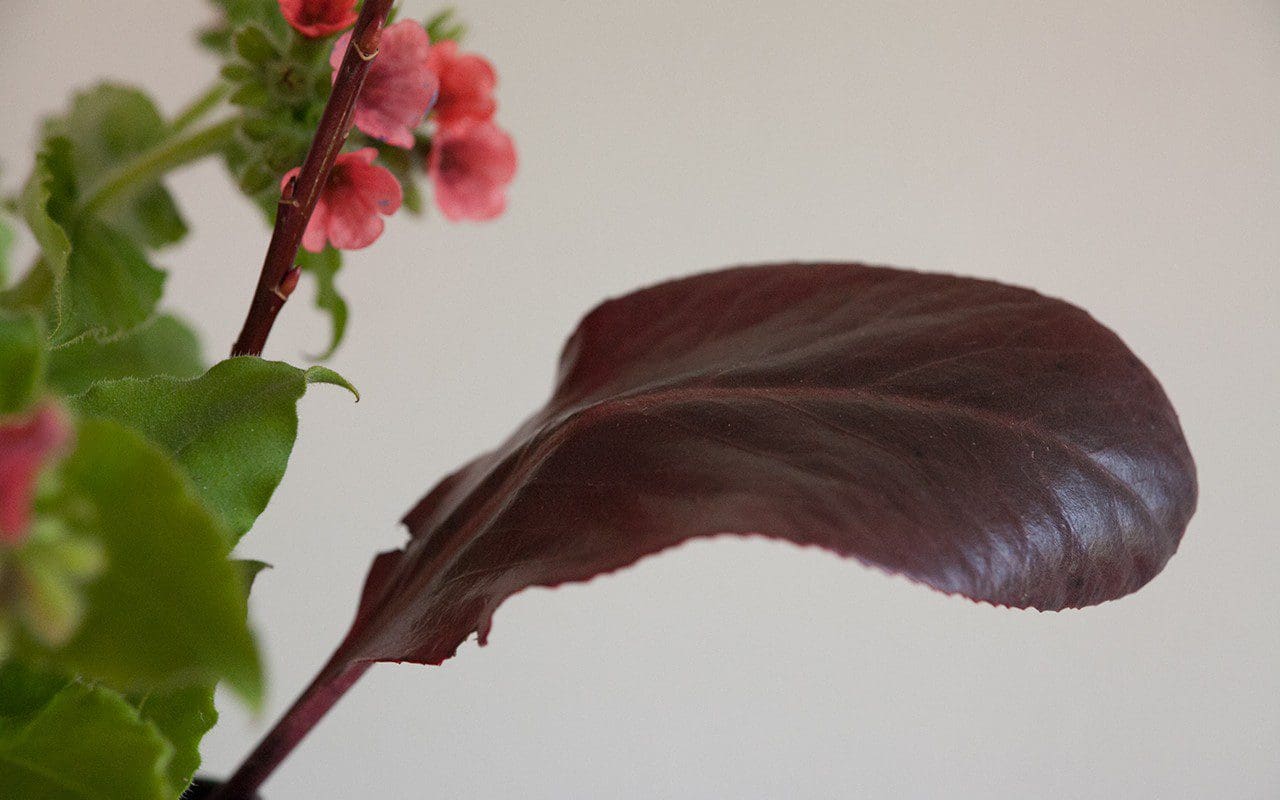 Bergenia purpurascens ‘Irish Crimson’
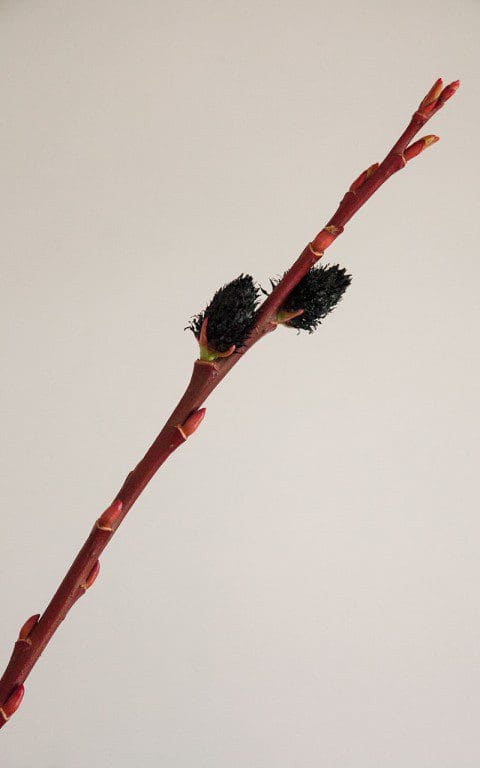 Salix gracilistyla ‘Melanostachys’
Salix gracilistyla ‘Melanostachys’ is an easy, compact plant which I’ve chosen to grow hard in the gravel surrounding the drive. It has lustrous stems that start out green before turning blood red and throwing out coal-black catkins from early February. They are a surprise and a delight and, some time in the next couple of weeks, each will push out a glowing halo of red anthers. For now, they are planted up at their base with Erigeron karvinskianus to cover until they bulk up. They won’t take long to reach a metre or so in all directions. As they shade out the erigeron, I have also included Viola odorata for its willingness to take their place in the shade. Next year I will add snowdrops to provide a contrast to the darkness of the willow. They will be easy to keep to a waist high bush with the longest growth being pruned out for catkins as an accompaniment to the last of the winter or the first of the spring pickings.
___________________________________
In memory of
Enid Brett Morgan
28 March 1937 – 28 February 2018
I picked this posy last Sunday with mum on my mind. My brother was looking after her, giving me a day’s respite from sharing the care of her at home at the end of her life. I didn’t know then that she would leave us so quickly this week. However, looking at the spareness and sombreness of this arrangement now, shows me that somewhere deep down I did. Mum loved hellebores. Coral and old rose were two of her favourite colours.
Huw Morgan
Words: Dan Pearson / Photographs: Huw Morgan
Published 3 March 2018
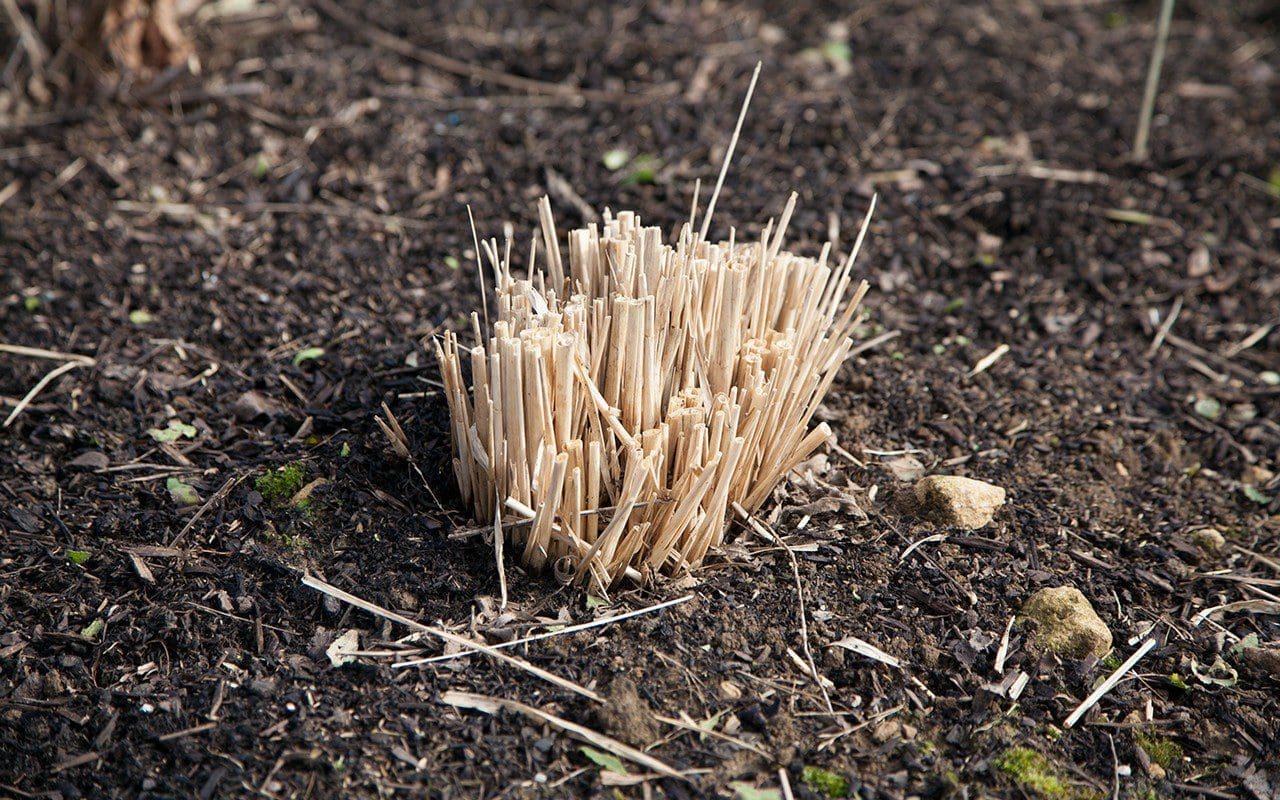
The winter form of last season’s skeletons has been easily as interesting as the first summer in the new garden. Though their muted presence is not the thing you plan for first, it is an aspect that is worth considering for the ghosts that are left behind. Some, the daylilies for instance, leave nothing more than the space they took in their fleshy growth period, but those that endure are arguably as good as they were in life. Without the distraction of a growing season, its pull of colour and the steer of upkeep, you are free to look at the dead, left-behind forms anew. Blacks and browns, sepia, cinnamon and parchment whites are far from monochrome and their structures and seedheads are worth planning for in combination.
Snow flurries and rain laden winds began the topple in January, but the garden endured and weekly we have observed it falling away, shifting, dropping back and thinning. The vernonia, with their biscuit seedheads, stood tall amongst the pale spent verticals of panicum and I welcomed the repeat of the finely tapered Verbena macdougalii ‘Lavender Spires’ together with the bottle-brushes of Agastache ‘Blackadder’. The birds loved them too and some days the garden has been alive with activity with the foraging for seed and overwintering insects looking for shelter. The black stems of the veronicastrum were good amongst the molinia stems, but their seeds were stripped by mice early on. The grasses have been key for their foil, their pale colouring bright on dry days, warm in the wet, and their plumage acting as light catchers when the sun has broken through.
The clearance required to make way for the new season has been carefully judged. There comes a point, some time when the bulbs are showing you that new life is on its way, that the skeletons begin to feel tired. We have also had to pace ourselves, for it has taken five man days to work through the areas that were planted almost a year ago and, this time next year, it will take another three when the areas of the garden that were planted last autumn are grown up.
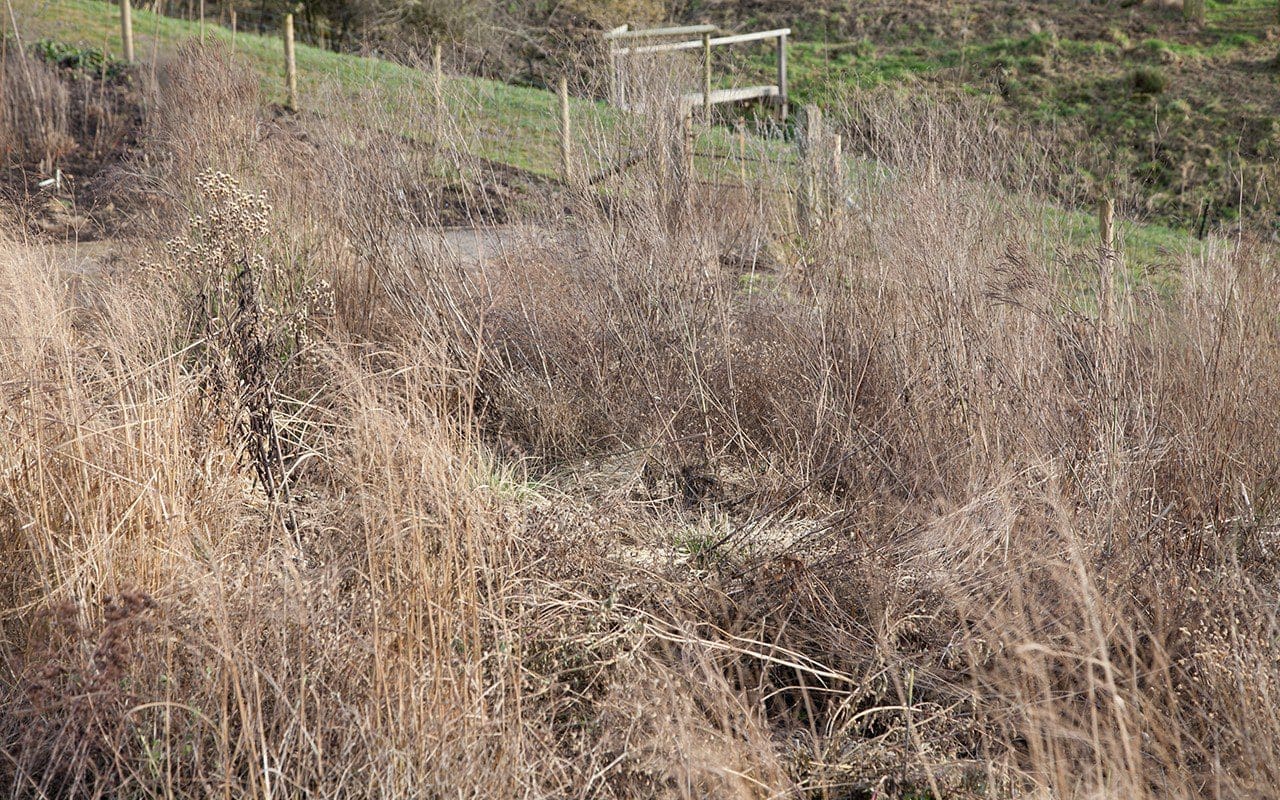 The lower bed before being cut back
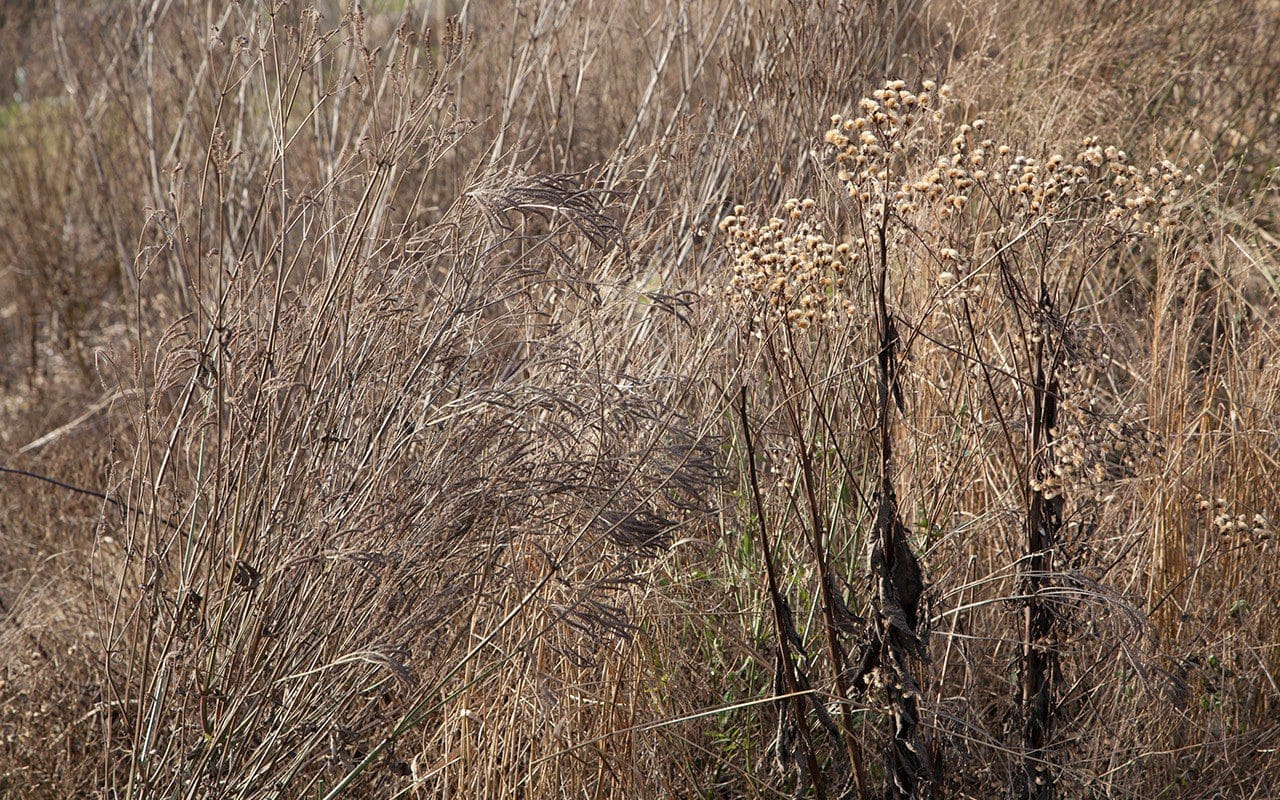 From left to right skeletons of Sanguisorba ‘Blackthorn’, Verbena macdougalii ‘Lavender Spires’ and Vernonia arkansana ‘Mammuth’
We made a start in early February, working from the high ground that drained most freely and sweeping round to the heavier low bed by the field in a second session a fortnight later. In just two weeks buds that had been thoroughly dormant were already showing at the base of the euphorbias and the first new shoots on the grasses signalled the shift and the need to move things forward.
Before we started, I waded into the beds and marked the plants that I knew I wanted to change, for there are always adjustments that need to be made in a new planting. The densely-flowered Lythrum salicaria ‘Swirl’ will be exchanged for the more finely tapered L. virgatum ‘Dropmore Purple’, while the Artemisia lactiflora ‘Elfenbein’ that read too strongly as a group once their pale flowers caught the eye were left standing so that I could find them again easily and redistribute them so that their presence is lighter this summer. The changes will be different every year, but it is good to have time in hand to make them whilst the plants are more or less dormant.
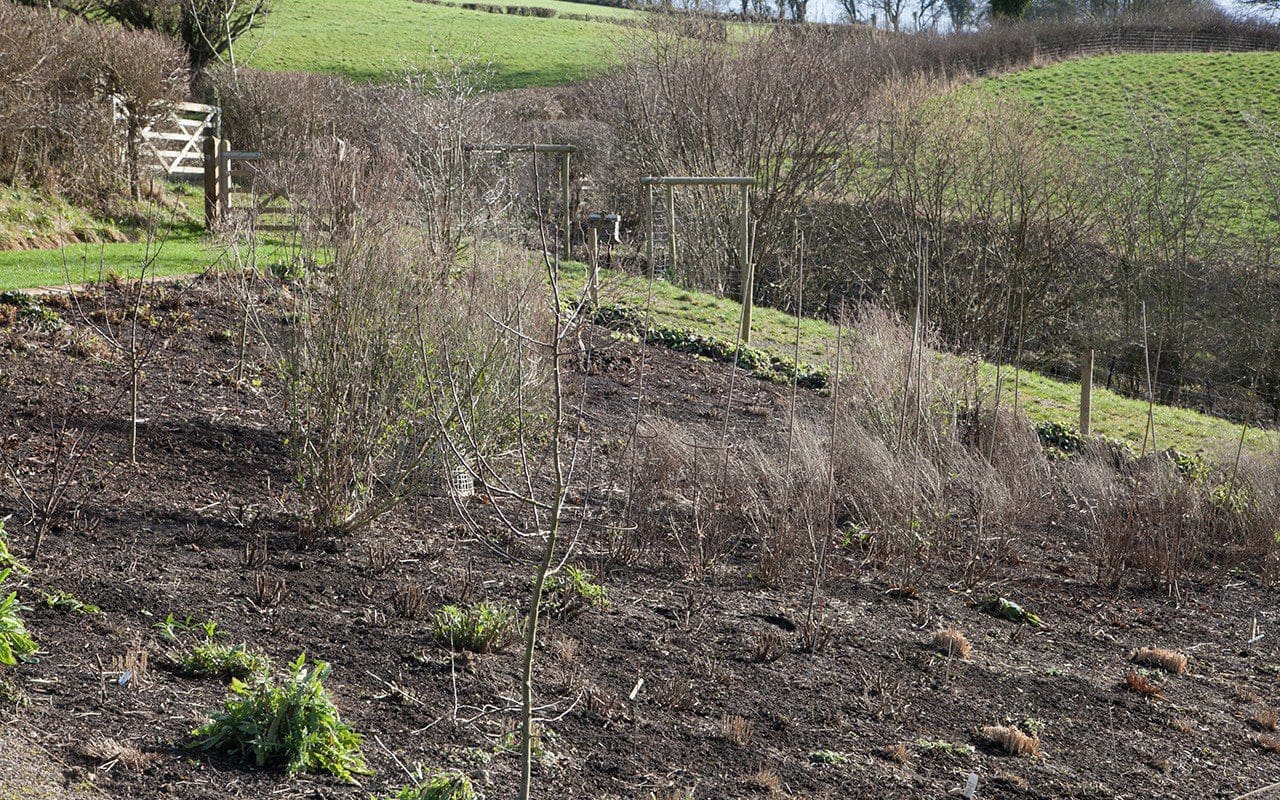 After clearance bamboo canes mark the remains of Lythrum salicaria ‘Swirl’ in the top bed
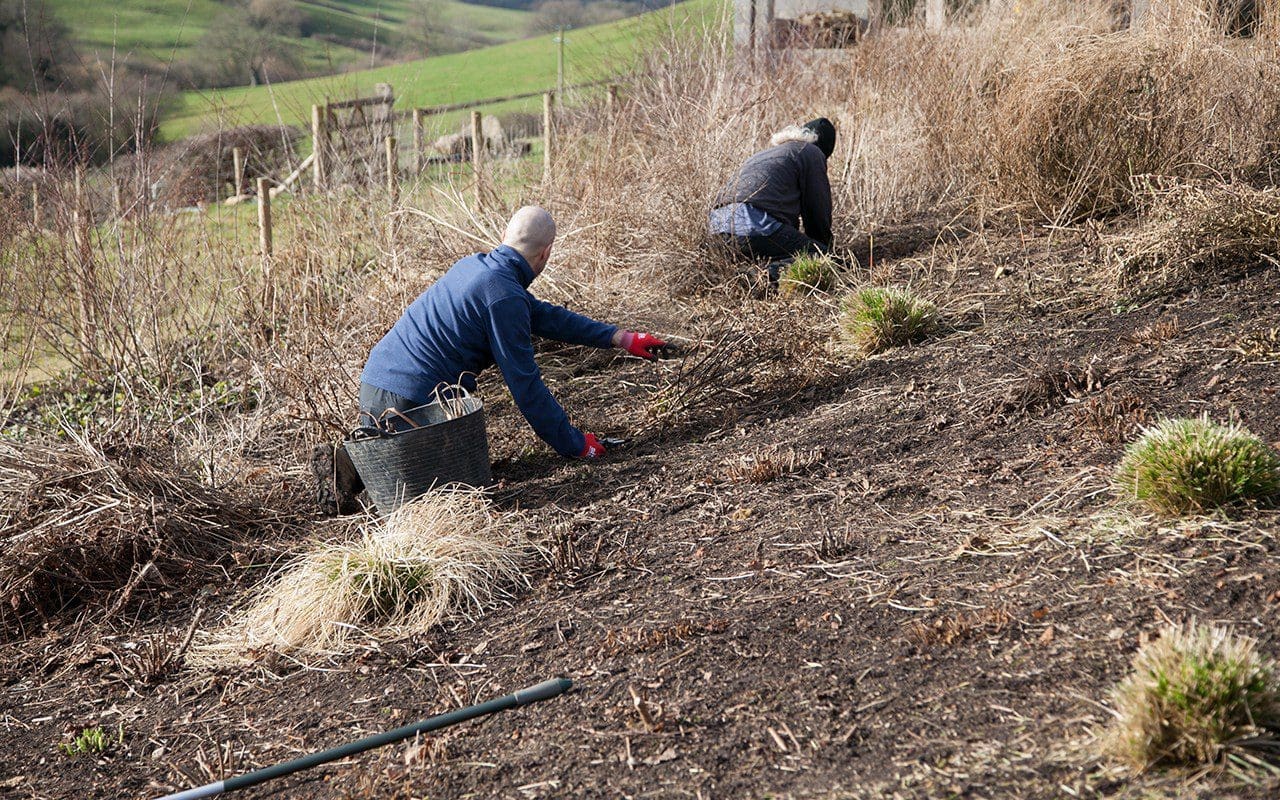 Ray and Jacky work their way through the lower bed
The feeling of working through and stripping away is always a mixed one. I would leave some plants standing for longer, indeed, I have with the liquorice and the fennel, but the spring clean is good. Underneath the tussocks of deschampsia we unearthed the nesting places of voles, which had already tunnelled out and made a winter feast of my inulas on the banks. We only found one, which scurried to safety and I was relieved to find that their damage hadn’t been greater. Last year when lifting the molinias from the stockbeds to split them in readiness for the new planting, I found them almost completely hollowed out, roots and crown all but gone under the protective thatch of winter cover. There are pros and cons to leaving the garden standing and, although I prefer to do so, it is a good feeling to see the clean sweep reveal the planting again in new nakedness. Tight clumps, indicating quite clearly now that they have broadened, how the combinations were set out on the spring solstice almost a year ago.
The dry, cut material was piled high on the compost heap where it will be topped by some of last year’s compost to help in rotting it back for the future. And at the end of the day, as light was dimming, we carefully raked between the plants so as not to disturb last year’s mulch. A couple of weeks later I combed through the beds again to winkle out any seedlings that we’d missed in the first pass. Dandelions already in evidence and ready to take hold in the crowns of the grasses and buttercups and nettles that been secretly travelling in shade under the cover of summer growth. The beds that were planted and mulched last year will only be topped up this year where they have been disturbed where I’ve made alterations. Hopefully growth will be sufficient to suppress all but the strongest of the interlopers. Although we are still waiting for the planting that went in during the autumn to show itself enough before mulching these new areas, it won’t be long now until the need to move will be upon us and the garden once again dictates the pace.
Words: Dan Pearson / Photographs: Huw Morgan
Published 24 February 2018
Adam Silverman is a potter living and working in Los Angeles. After initially studying and practising as an architect, in the early 1990’s he was one of the founders of cult skate wear company X-Large. Since 2002 he has been practising as a professional potter. As a keen amateur potter myself, two years ago I was inspired to write him a fan letter and was delighted to receive an email from him inviting me to visit him at his studio, which I did in October 2016. Adam generously gave me two days of his time, showing me his studio, his work and explaining his process. This March he has his first European solo exhibition in Brussels at Pierre Marie Giraud.
Adam, how did you come to work in ceramics ?
Ceramics is something that I started as a hobby when I was a teenager, around 15 or 16. Before that I did wood turning and glass blowing. Clay stuck and I continued taking classes as a hobby throughout high school and college. In college I studied architecture, but took ceramic classes whenever I had a free period. I never studied it per se just enjoyed doing it. I didn’t know anything about making glazes or firing kilns or the history, ancient nor modern. I continued making pots as my creative outlet after college and while I began my working life in Los Angeles, first as an architect and then as a partner in a clothing company.
In about 1995 I bought a small kiln and a wheel and set up my own studio in my garage at home and the hobby grew into more of a passion and then into a fantasy life change. In 2002 I attended the summer ceramics program at Alfred University in upstate New York with the intention of studying ceramics seriously for the first time. I wanted to learn about glazing, firing, history, etc. and to see what it felt like to work on ceramics full time, 8-10 hours a day, in a serious studio context, with feedback from people who weren’t friends or family. My idea was that at the end of the summer I would decide to either commit to working professionally as a studio potter, or give up the fantasy and acknowledge clay as my hobby but not my profession. It was a great summer and I returned to Los Angeles and set up a proper studio, outside of home, got a business license and went to work as a studio potter. I gave myself one year to see if I could make a living at it. That was fall 2002, so it’s been 15 years and in many ways I feel like I’m still just getting started.



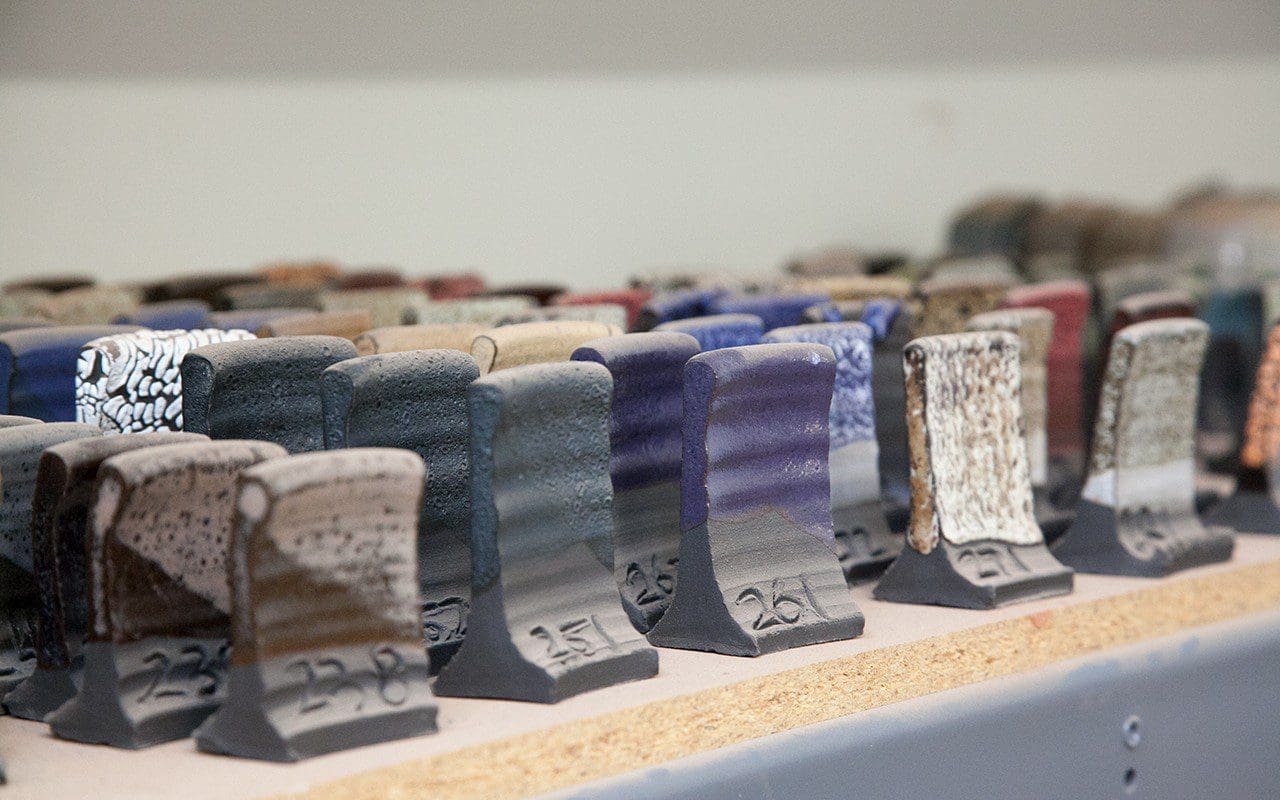
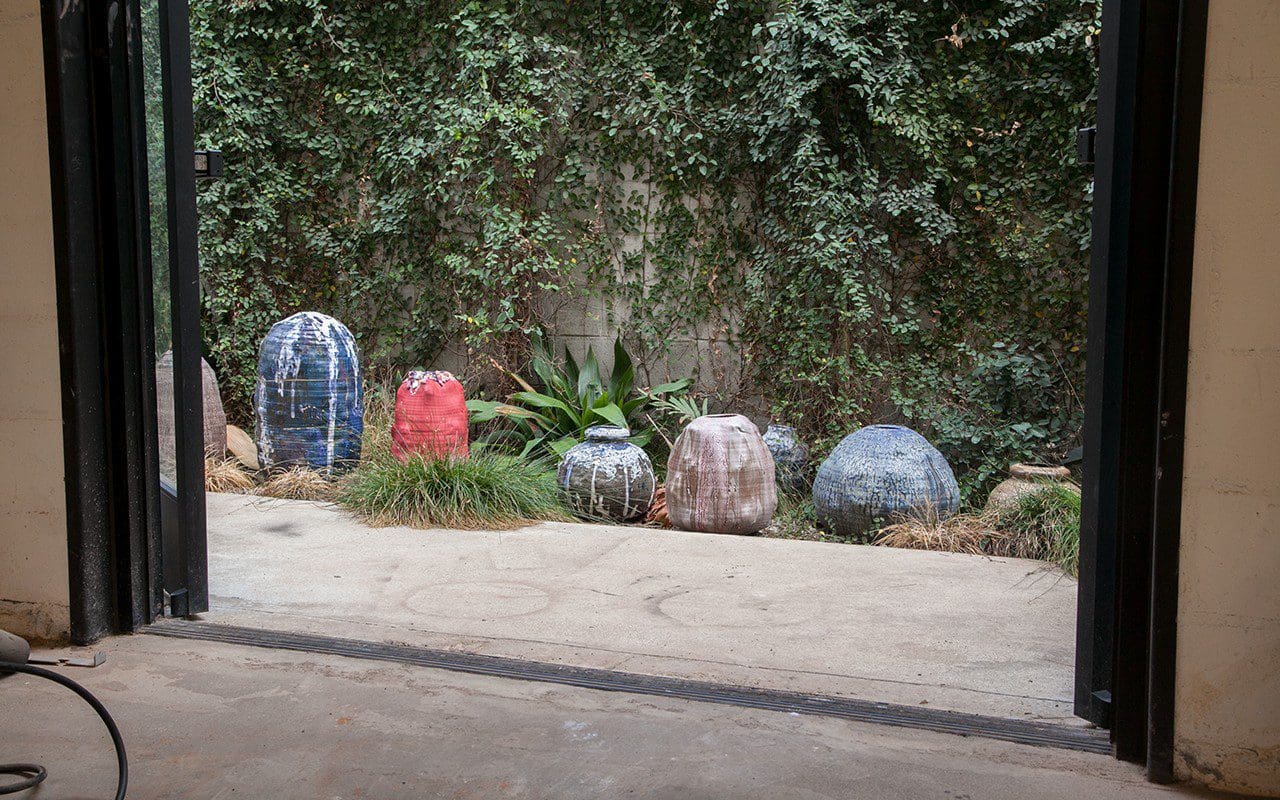
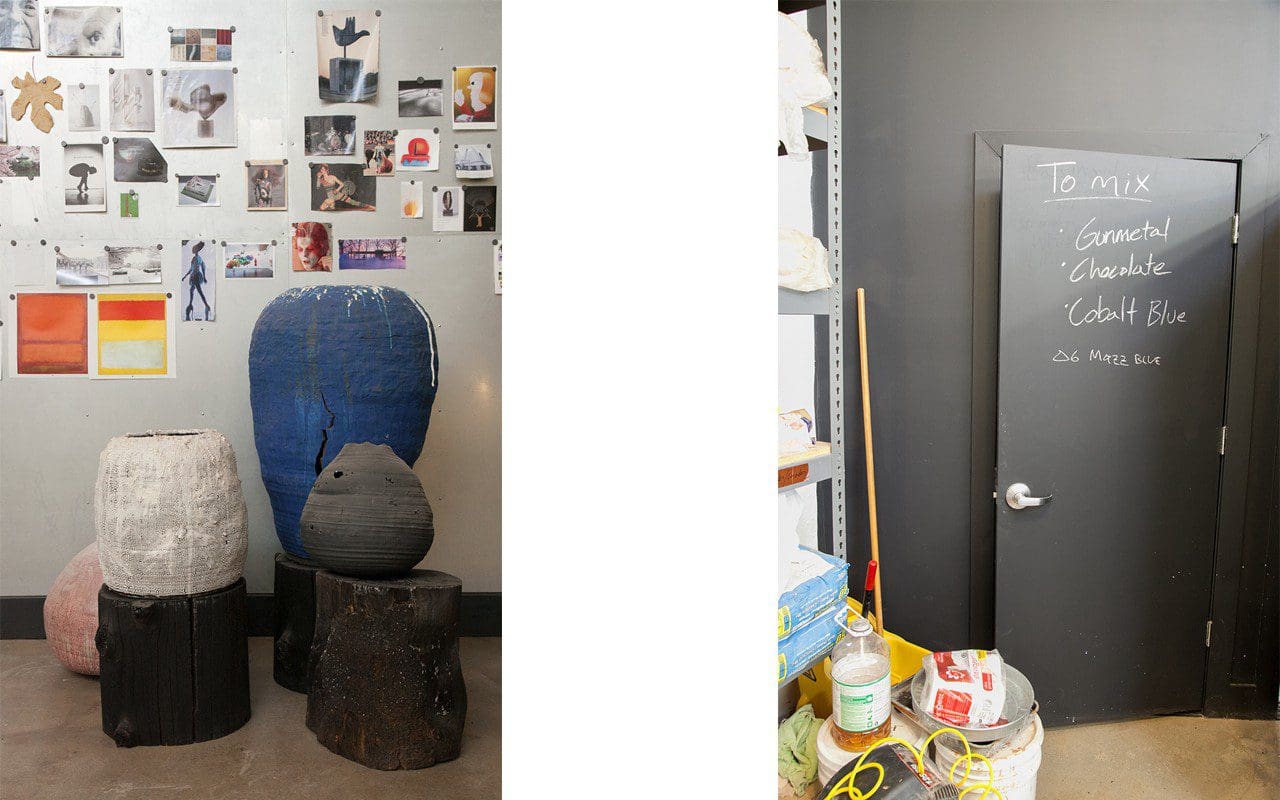 Adam’s Glendale studio in 2016. He has recently moved to a new studio in Atwater.
I’m interested in how you see the relationships between the seemingly unrelated disciplines of architecture, clothing design and production and ceramics.
Ceramics, clothing and architecture are all “functional arts” or at least can be. They are all made for and in many ways dependent upon the human body. They are all usually seen as “design” more than “art”. I moved from the hardest and most complicated (architecture) in terms of the amount of people and money needed to realize your work. Making clothing is very similar to making a building in terms of the process, but much faster and cheaper and less dangerous and less regulated. Ceramics I can and do make entirely alone. I have as much control over the process and results as I want. It is an amazing thing to come to work alone and be able to make what I want, when I want. This, in a way, is one of the reasons that I call myself an artist rather than a designer. I come to my studio and make what I want. I don’t have clients to service or problems to design solutions for. It’s not a service business that I am in. Anyway, you get my point I’m sure.
From 2008 to 2013 you worked as a studio director and production potter at Heath Ceramics, a tableware producer founded in the 1940’s with a distinctive Californian modernist aesthetic. What can you tell us about your time there ?
My time at Heath was great. I learned so many things, some about making ceramics and issues of production, some about design, some about running a growing business with a rapidly increasing number of employees and the associated complexities, and some about myself and what I wanted to be doing with my work and my life. It allowed me to work commercially and so not have to worry about money so much, while still giving me the freedom to both develop their homeware ranges with my aesthetic input while also producing more experimental work of my own.

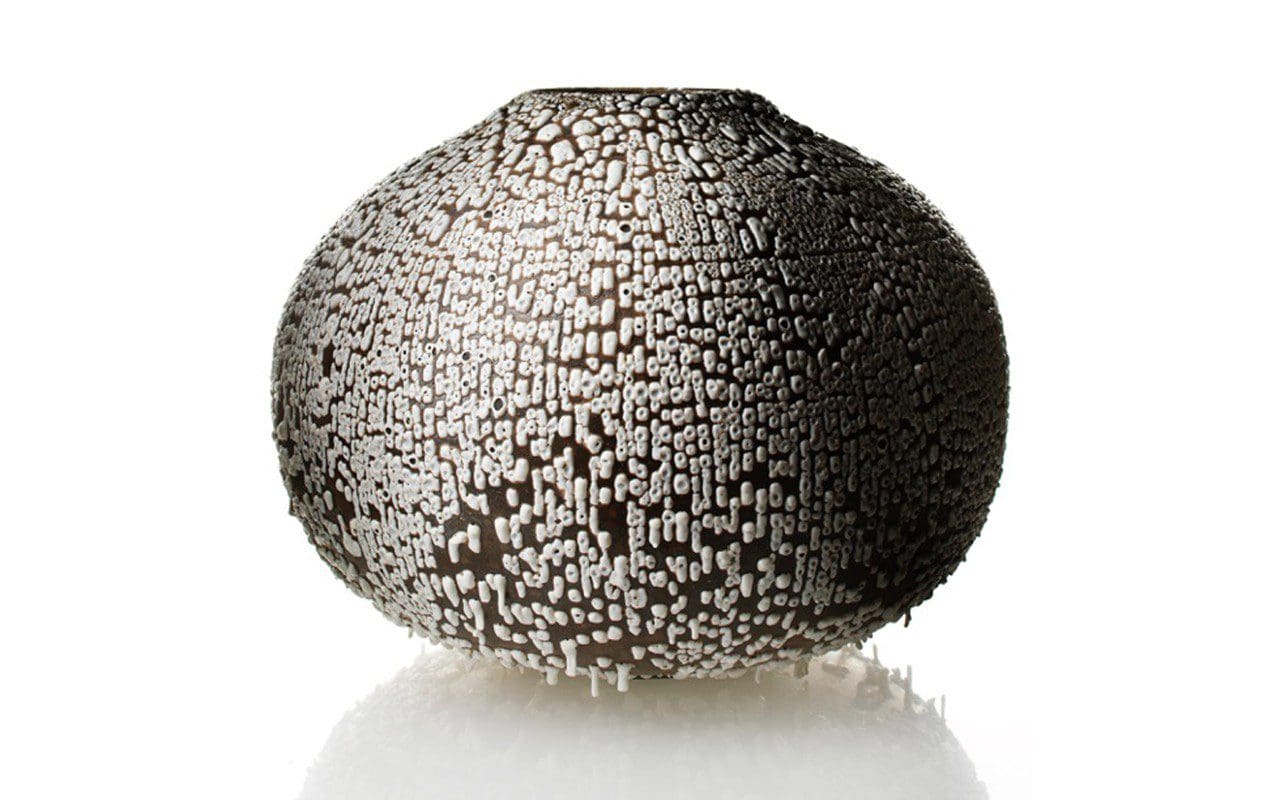
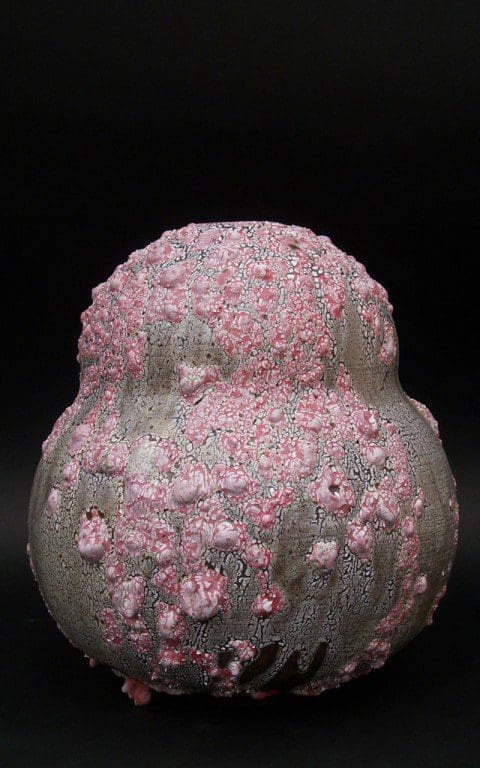 Pots produced during Adam’s time at Heath Ceramics. Photos courtesy Adam Silverman
When I first encountered your work the forms you were making were controlled and symmetrical and served as canvases for extreme textural glazes. Since then your work has become monumental, less controlled, more chaotic. How has your approach changed since you first started to pursue ceramics professionally ?
I think that I have been following a path without preconceptions of what I wanted my work to look like or be like. The evolution of the approach and the results have been very organic. The one consistent is the potter’s wheel. I love working on the wheel, that’s the foundation of my studio and, in a way, my life. The work has evolved from very clean and tight, reminiscent of modern Scandinavian ceramics, and into a much looser and freer interpretation of those same basic geometries, which are dictated, or at least implied, by the forces of the spinning wheel, circles, spheres, eggs.
I can say that there really isn’t a thought process per se behind the evolution. It is more of a physical evolution. There is a lot of improvisation on the wheel. I think as I’ve aged and become more confident as an artist, things have very naturally loosened up. In the early days I would on occasion think that I was too tight and needed to loosen up. I would intentionally try to make looser work and it always felt horrible, contrived and unnatural, and the results didn’t feel like my work. I felt that they were terrible to look at and touch.
You have developed your own glazes over many years. Can you explain how you do this ?
I am a total caveman when it comes to chemistry. I put stuff together and burn it and see what happens. I’ll find materials where I am working and use them to leave marks on the work. Usually I start by thinking about just a colour or group of colours that I want to use and then start making things and see where it goes. I use glaze recipe books, the internet, and sometimes commercially available glazes as a starting point, and then start altering them through experimenting. Also I multi-fire everything, often many times, to build up layers or to try to correct something. It’s all a bit of a mess honestly, and I can’t really repeat anything, which I like.
 An installation at Laguna Art Museum, 2013-14
Can you tell us about your Kimbell Art Museum project in 2012, which brought you back into the orbit of some of your architectural heroes ?
This was a commission to create a body of work celebrating the 40th anniversary of the opening of the Kimbell in 1972. It is one of architect, Louis Kahn’s, finest buildings. In 2010 construction began on a new Renzo Piano designed building, while behind the original Kahn building is The Fort Worth Modern Art Museum, designed by Tadao Ando. Both architects were much influenced by Kahn.
For me as an architecture student, and then a young architect, each of these three architects were very significant, and they continue to have a bearing on my practice as a potter. So to be given this opportunity to engage with the three of them was exhilarating and terrifying. I made three large pots using only materials harvested from the site, which included items gleaned from the partial demolition of the original Kahn building, rust shed from a Richard Serra sculpture and water from the pond at the Ando building.
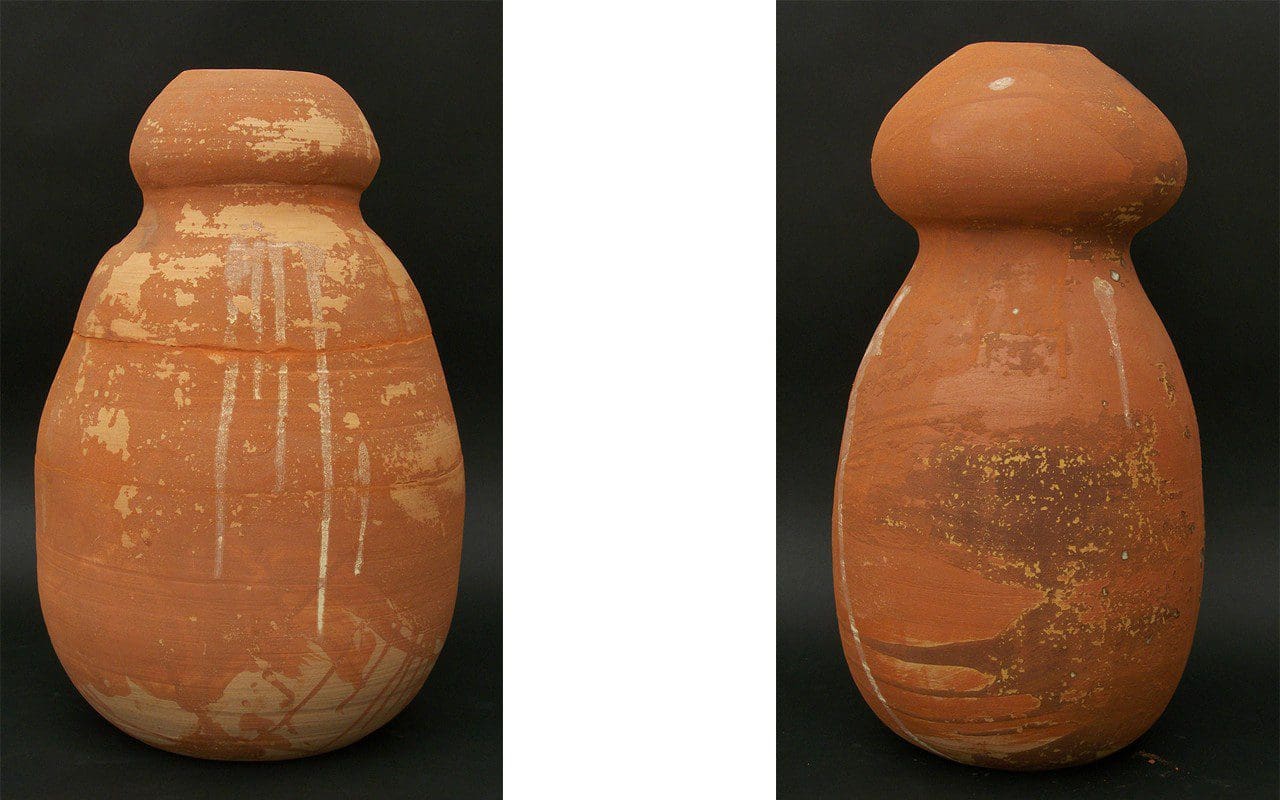
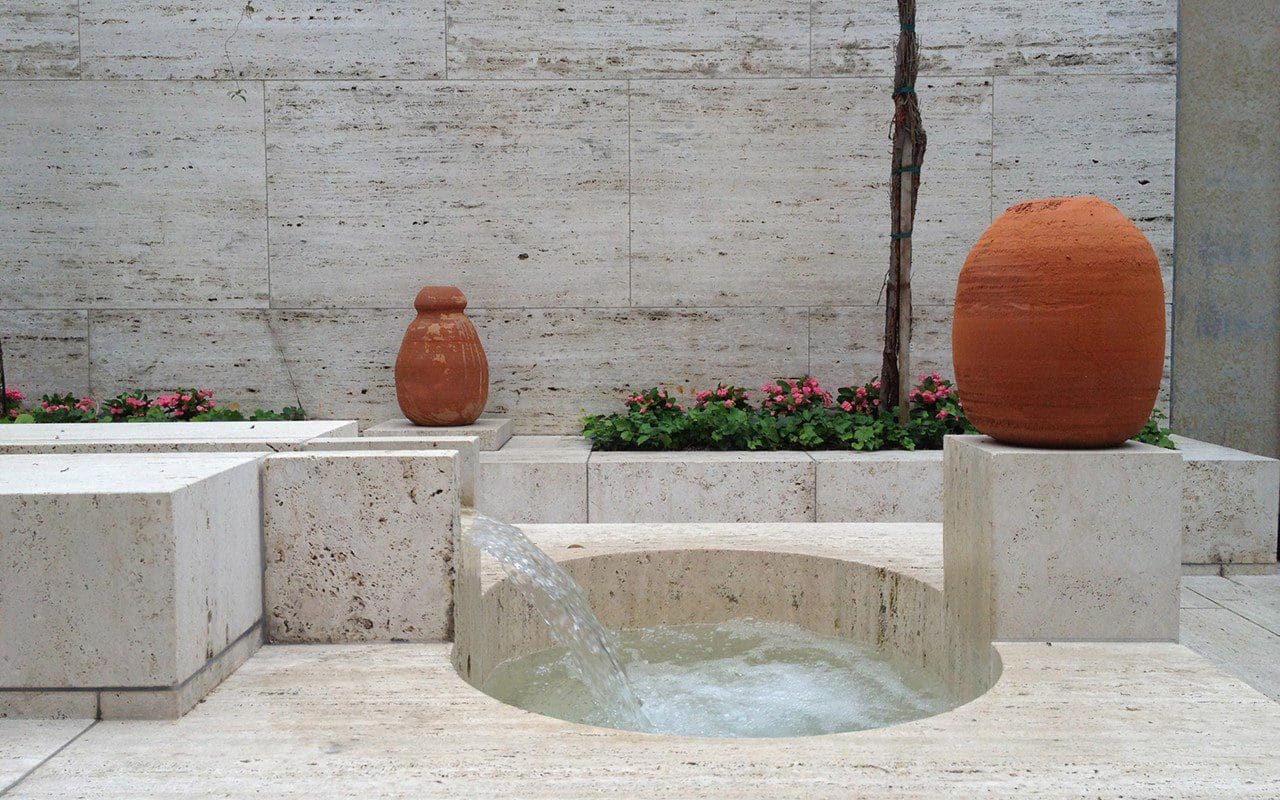 Pots produced for the Kimbell Art Museum and an installation view, 2012. Photos courtesy Adam Silverman
What attracted you to the Grafted project that you collaborated on with Japanese botanist Kohei Oda ?
This project was suggested and orchestrated by our mutual friend Tamotsu Yagi, who is a brilliant designer and art director. He also designed the book of the project as well as my Rizzoli book of a few years before the Grafted project.
Kohei creates ‘mutant’ cactus plants by grafting different species together. Tamotsu thought that I would be a good person to create pots for some of these plants and set us up on what was essentially an international blind date. I was reluctant to do pots for plants as I felt that I had moved past that part of my life and practice, but his work is so special and powerful that I couldn’t say no to Tamotsu. We did a few test pieces where I sent him a few pots and he sent me a few plants and the results were encouraging and exciting so we decided to do the two part show, one in Venice, California and one in Kyoto. We made a total of 100 pieces together over the course of a year. It was a pretty special project.
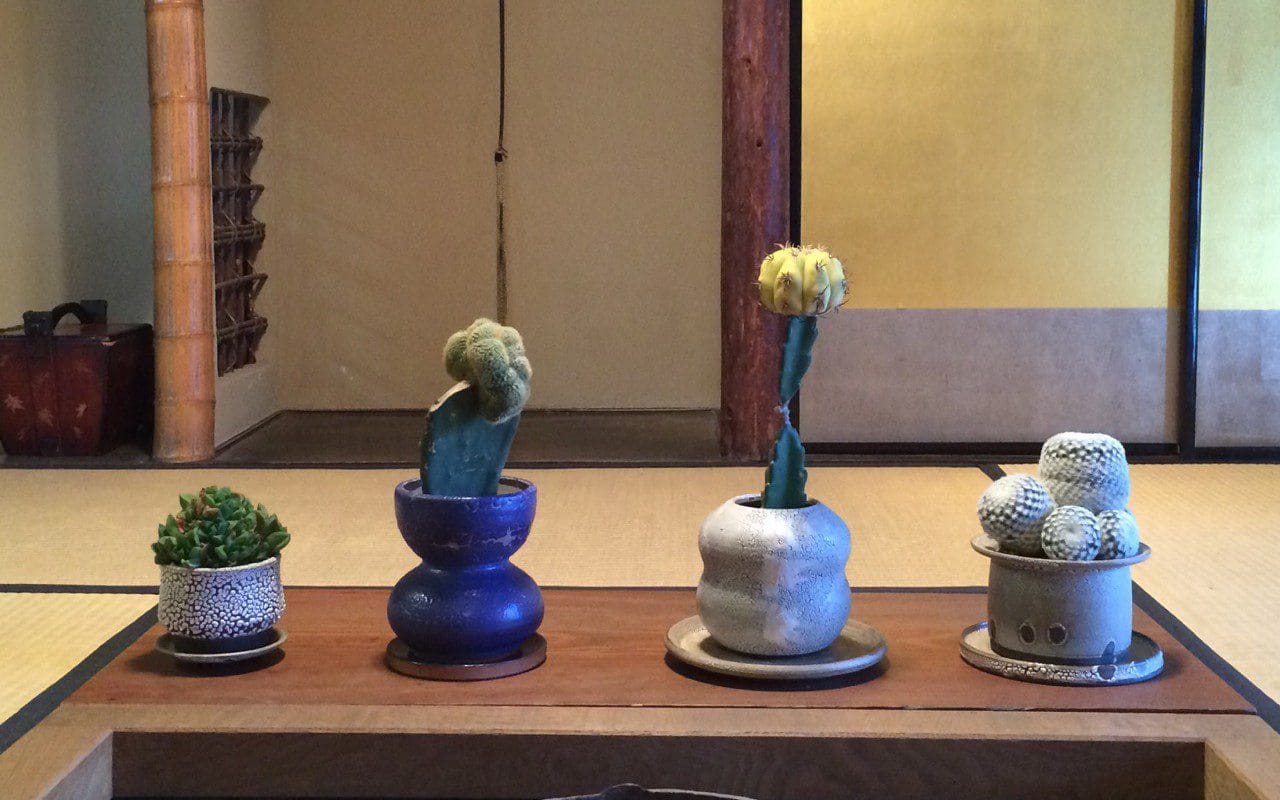 Installation view of Grafted, Kyoto, 2014
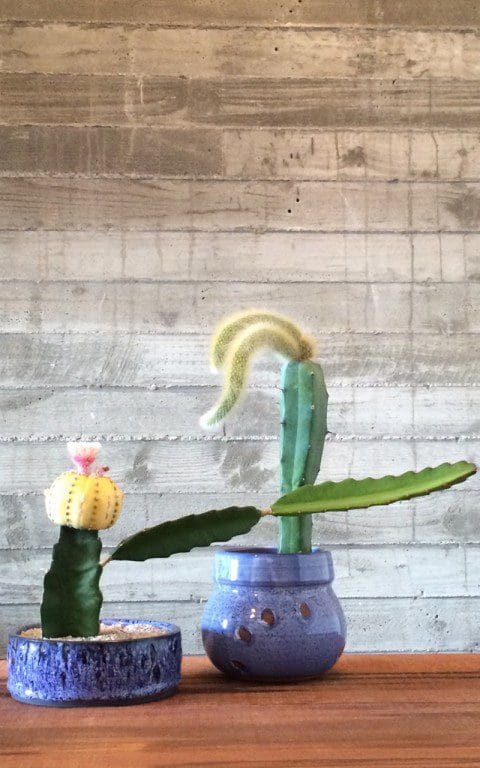 Installation view of Grafted, Venice CA, 2014
It is self-evident to say that the forms and surfaces of your pieces are organic in quality. What are your inspirations and intentions with these forms ? Your recent show at Cherry & Martin in L.A. was titled Ghosts. Can you explain why ?
In a way I prefer for the work to stand on its own without explanations of influences, intentions. I will tell you that I look a lot at painting, anything from Cy Twombly to Monet to Rothko to Philip Guston. I look a lot at architecture. And dance. But in the end none of that really matters, because I’m making pots and sculptures that must exist on their own in the world.
The title Ghosts (and, at my upcoming show at Pierre Marie Giraud, Fantômes) simply suggests the histories and lives that are inherent in the pieces. Living organisms in the clays and glazes, my hands and actions on the clay, gestures frozen. Lives stopped, but that also live on.

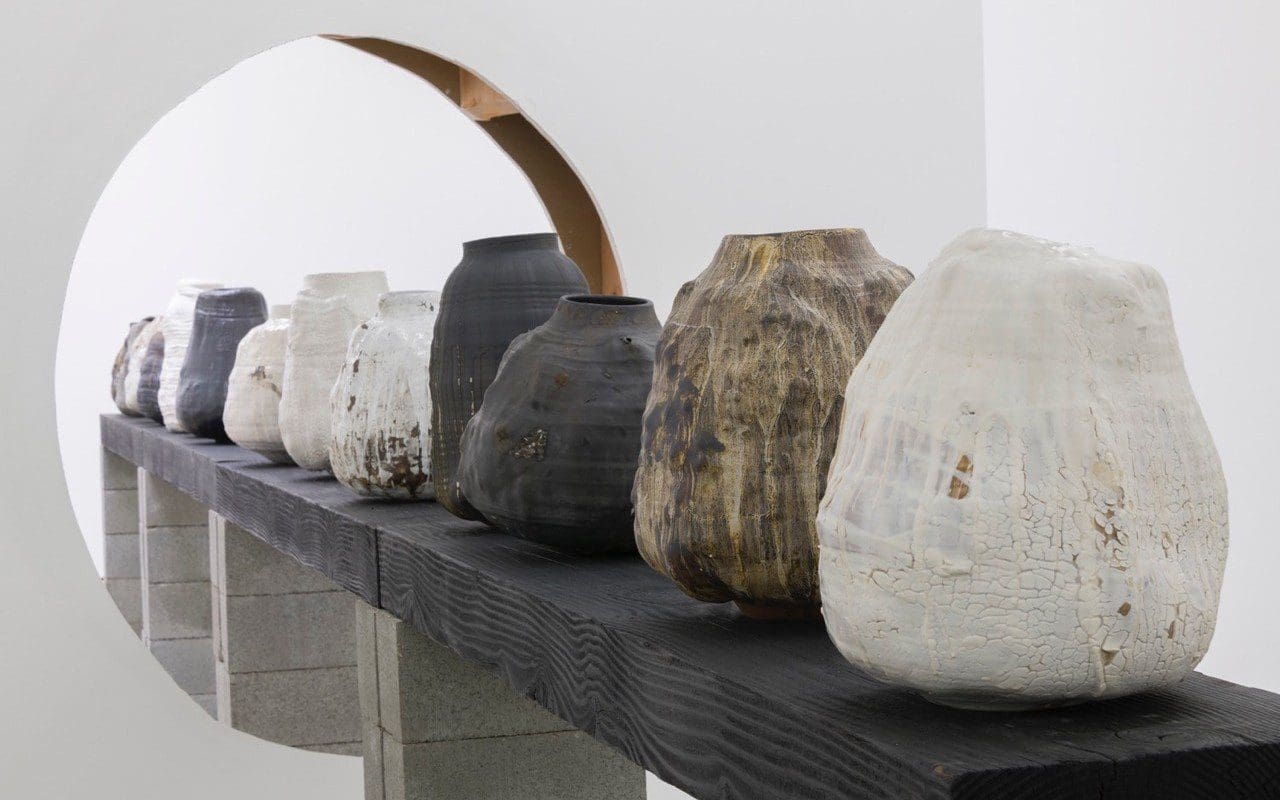 Installation views of Ghosts at Cherry & Martin, Los Angeles, 2017. Photos courtesy Adam Silverman
Landscapes, both urban and rural, are present in your work, and there appears to be a strong Japanese influence. What can you tell us about these ?
Yes there is a lot of this stuff in the work, and all mostly unconscious or not specifically intentional, beyond using materials harvested from my surroundings, both urban and rural. I like the idea of scars and marks coming from the place where I’m working. It’s abstract and people don’t need to know and usually don’t, but to me it feels like the place is in the work and the work is of the place and somehow it resonates and means something, even if it is unspoken and invisible.
Japan is deep in my heart and DNA. When I was in architecture school I was (and still am) a huge fan of Tadao Ando and my first trip to Japan in 1989 was specifically to look at Ando buildings. I’ve been going back there my entire adult life and have so many influences from there inside me that it’s hard to tell where it starts and ends.
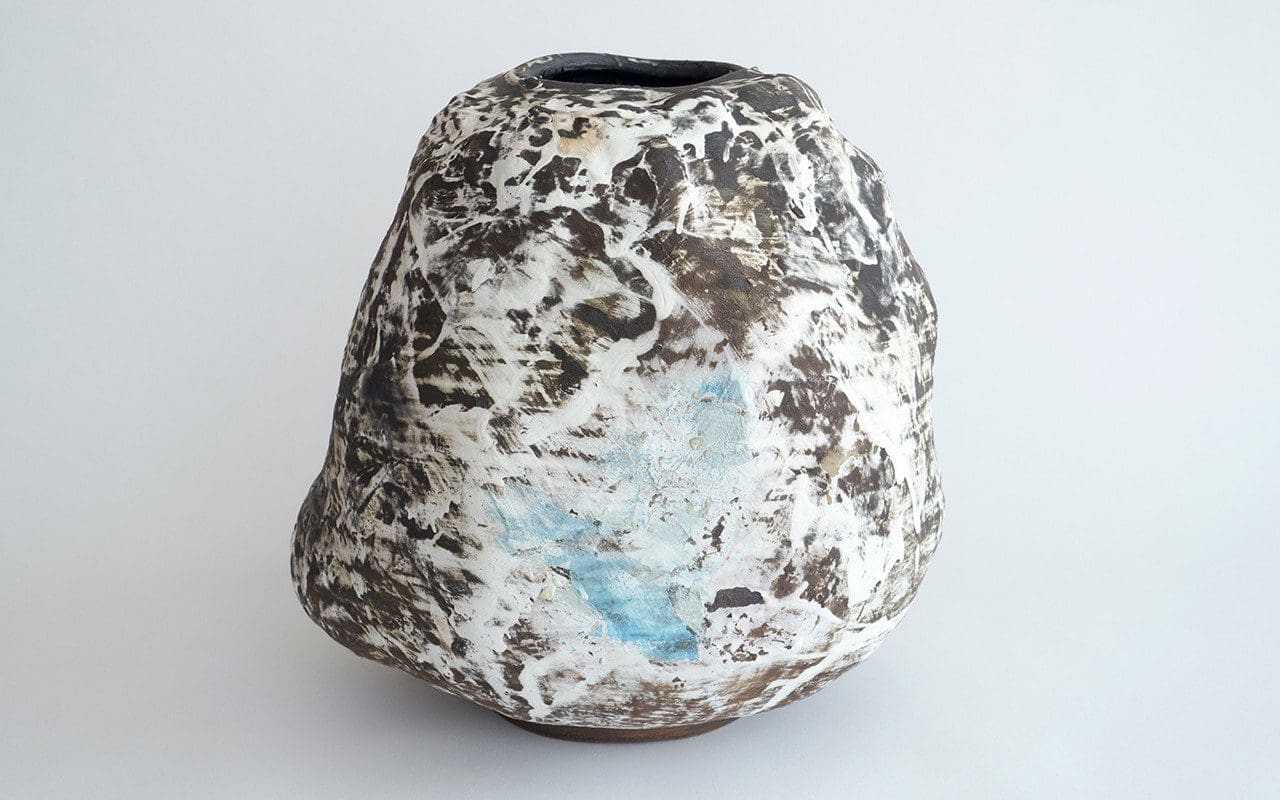
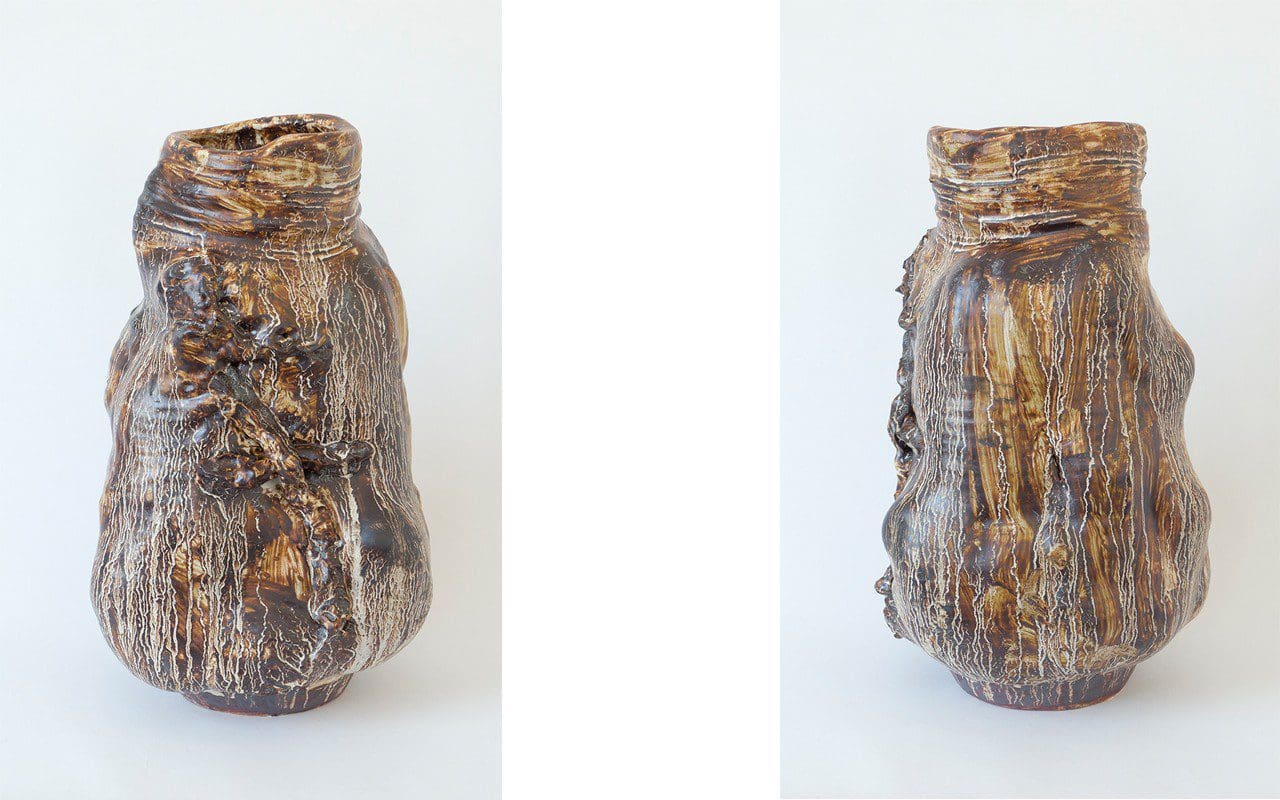
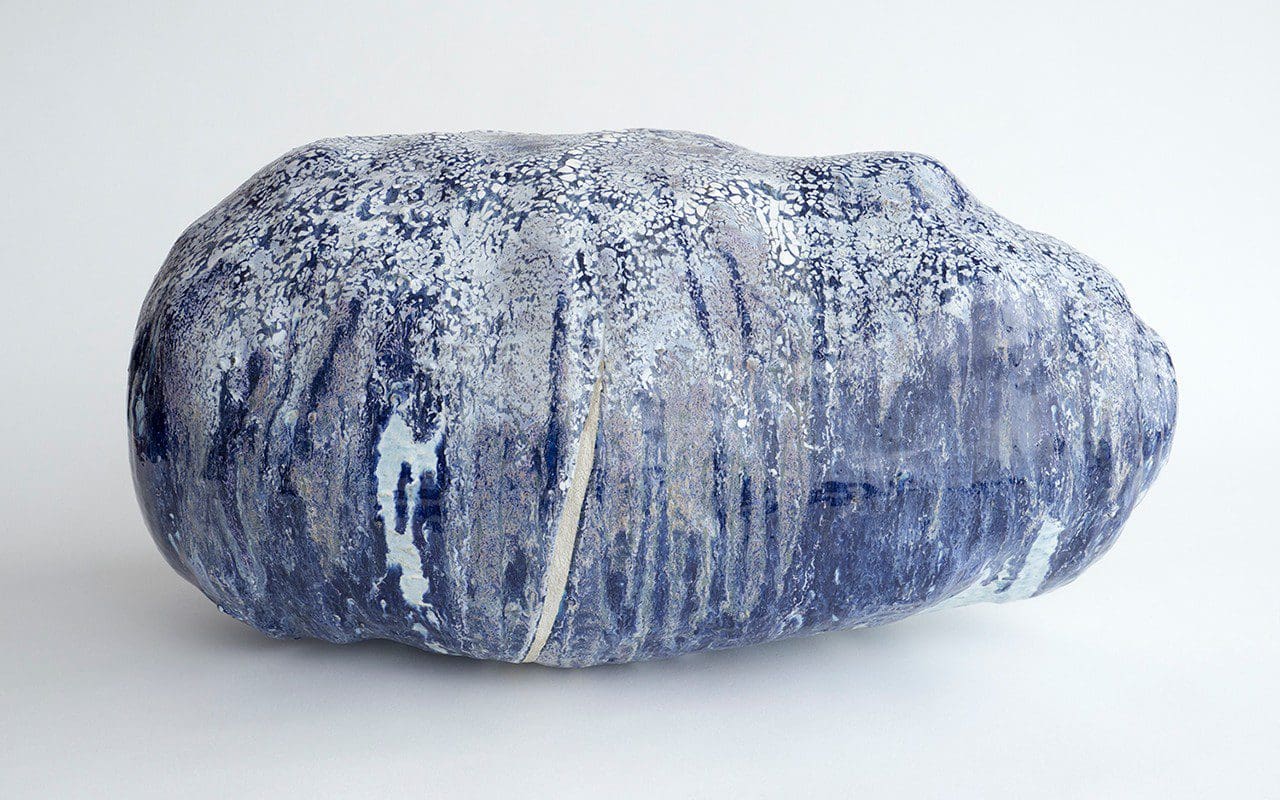 Pots for Fantômes, Pierre Marie Giraud, Brussels, 2018. Photos courtesy Adam Silverman
Fantômes is at Pierre Marie Giraud from March 8 – April 7 2018
Interview and all other photographs: Huw Morgan
Published 17 February 2018
The Lenten Rose was one of my first infatuations as a child, rising like a phoenix from the leaf mould when little else was braving winter. We had discovered a solitary plant in a wooded clearing of our derelict garden and, though it was nothing special by today’s standards, it had survived the forty years of neglect that had finally overwhelmed the previous owner. I remember the excitement, the elegant outline of the hooded flower and lifting the plum and green reverse to reveal the boss of sheltered stamens.
In the years since, the excitement of their reappearance each February has never dimmed. In fact I depend upon them as their energy gathers and pushes against the last of the winter. Close observation over time has allowed me the opportunity of getting to know them better; the places they like to be, their surprising resilience and longevity and where to use them so that they offer you their very best. I have also developed a keen eye, winkling out the ones that have been superseded in terms of colour and form, so that I am only growing my absolute favourites.
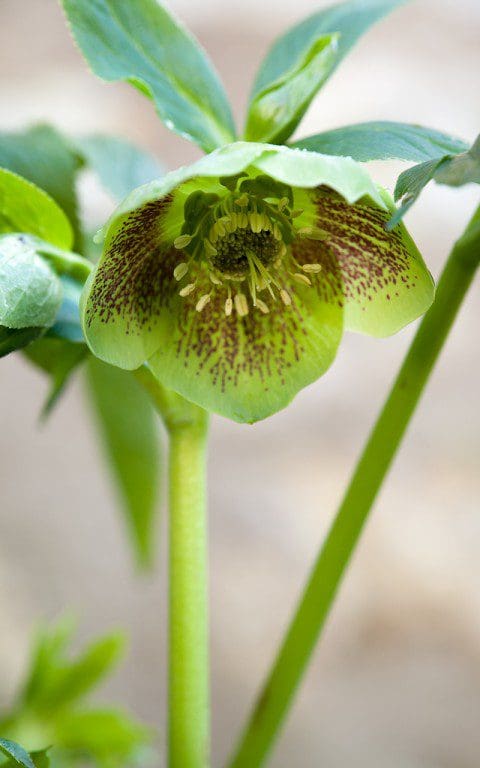 Helleborus x hybridus Single Green Spotted
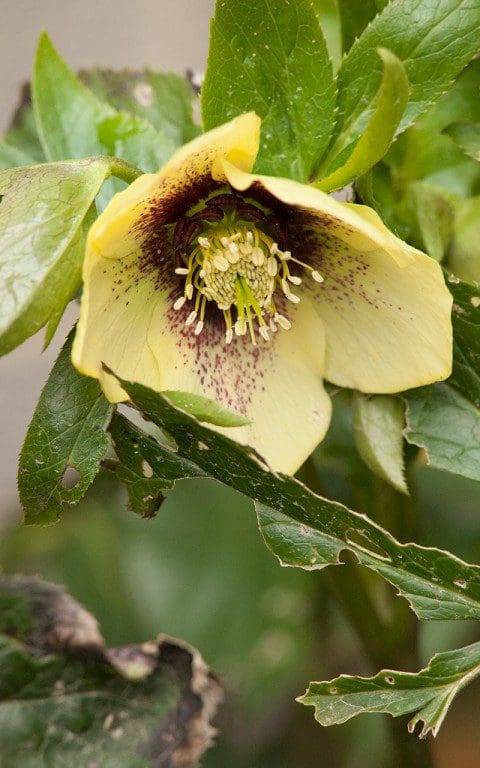 Helleborus x hybridus Single Yellow Spotted Dark Nectaries
I soon learned that it was important to hand select seed-raised Helleborus x hybridus since the variability is immense once they start to cross. Seedlings take about three to four years to flower if you are up for the gamble. The colours range from the darkest of slate-greys and plum purples through mauve and then on into a complexity of reds some of which err towards the pink end of the spectrum and others into apricot or the blush of ripe peaches. The yellows, perhaps the most prized due to their rarity, are a relatively recent development. The best hold a strong primrose for the duration of flower, whilst others fade to lime-green. The whites vary too, some clean, some limey, whilst others are infused palest pink. These base colours are sometimes overlaid with delicate veining or picotee edges of a darker tone, whilst the reverse may differ from the interior with a dusting of bloom or staining that gives away nothing of the world within. This is the stuff of obsession once you bend and cup a flower between your fingers to reveal a flash of another colour, a myriad spots or ink-dark nectaries.
An ark of hellebores came here with us from the Peckham garden. Planted on our south-facing slopes in the shade of a trial bed of shrubby willows, I expected them to struggle, but with summer shade they have loved the rich, deep ground and took some moving when they were relocated to their final positions the autumn before last. Moving Lenten Roses is easy if you do it in autumn, ahead of their period of main root activity. This is also the time to split your plants if you want to propagate a particular form, so that by the time they are pushing flowers they will have already found their feet.
The plants I brought with me were old favourites I have collected along the way. A purple as deep as damsons (main image), a slate-grey with bloom to the reverse and a particularly lovely green that has a freckling of burgundy spots within. I grew them all together in Peckham, the green lifting the darkness of the plum and a smattering of snowdrops to light them still further. I also have a fresh, clean white from Home Farm with green veins, and a creamy white picotee rimmed with deep red-violet and veined within. I parted with the dull reds and soft pinks once I’d visited Ashwood Nurseries and encountered the next level.
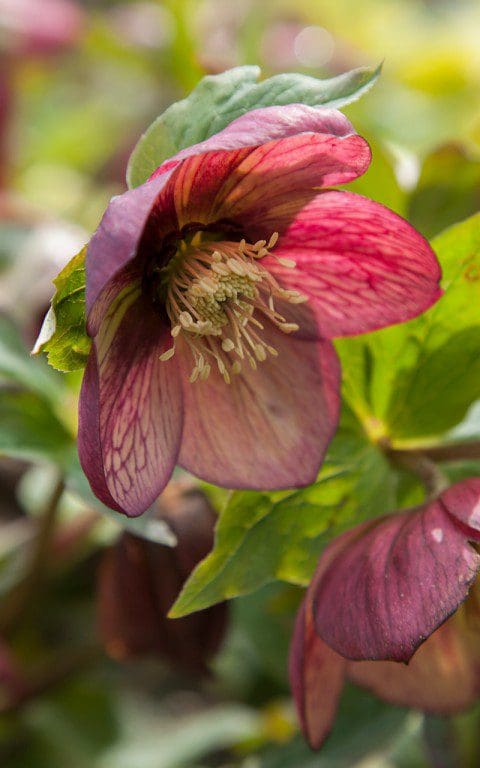 Helleborus x hybridus (Ashwood Evolution Group) Neon Shades
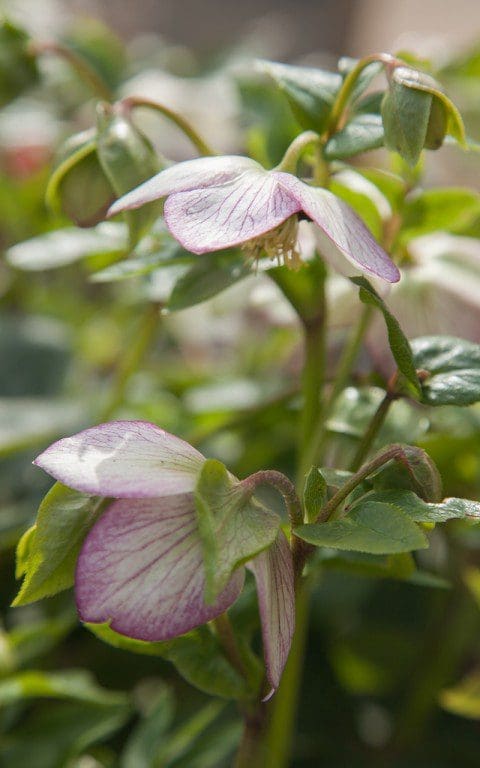 Helleborus x hybridus White Picotee Dark Nectaries
It was February, we had just had our offer accepted on Hillside, and the combination of winter weariness and the prospect of new ground inspired the journey to Ashwood. The nursery is famed for its hellebore selection programme and, within minutes of arriving, it was clear that these plants were far superior. The picotees were more finely drawn, pure whites overlaid with the merest lip of sugar pink, and there were pink and apricot picotees of even greater complexity. After several hours careful deliberation I came away with a number of yellows, selected for their dark plum nectaries, and some clean whites with the same interior stain. In the years since, I have added to the collection with green picotees, yellow spotteds and a number selected specifically for their veining.
As I do not have the luxury of shade, their favoured habitat, I have been winkling my collection in under shrubs or alongside tall, summer perennials that will throw them into cool when their foliage needs protection. Our slopes, however, are ideal for close observation and being able to look up into their blooms is a definite benefit. I have them grouped according to colour, the yellows and the whites alone and the greens and the darkest forms together. Under the medlar I have a collection of deep reds and warm-toned picotees to avoid the collection feeling too much like a sweet box and to allow me the opportunity of stumbling across something different as I move about the garden. Though I am not a fan of the doubles – they feel too cottagey here and too fussy in general – I do have one that is slate-grey which makes the flower very graphic and reminds me of a Louis Poulsen lamp. It has a place of its own under the wintersweet, where I can visit with a different mind-set.
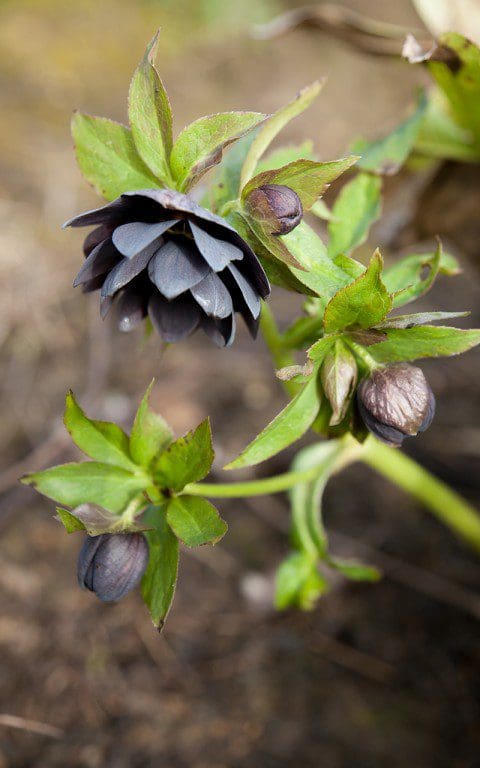 Helleborus x hybridus Double Black
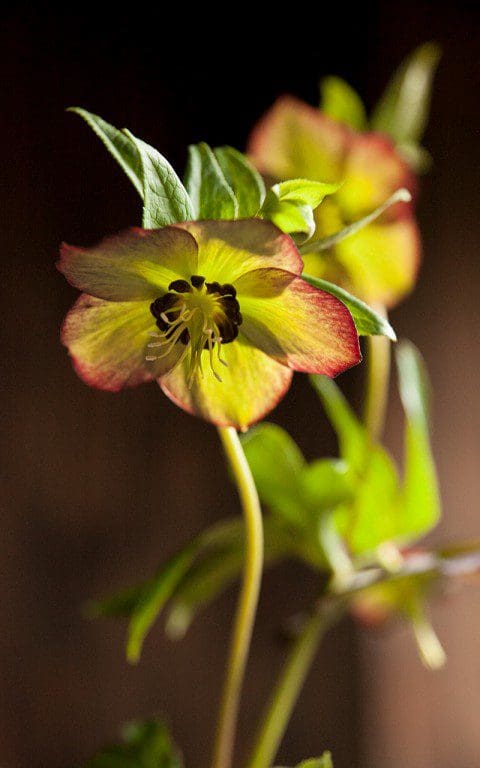 Helleborus x hybridus Single Green Picotee Shades Dark Nectaries
The Lenten Roses are sometimes affected by a blackening on the foliage caused by hellebore leaf spot, which can be debilitating if it gets a hold. Best advice is to remove the foliage in the early winter and burn any affected leaves before the flower stems appear in January. I prefer to let plants settle in for a year or two before removing any foliage, but stripping them back does allow you to see the flower against a clean backdrop. Mulching after the leaves are removed also helps keep the plants moist, but basal rot can be a problem in damp years, so I prefer not to mulch right around the growth to keep the base airy.
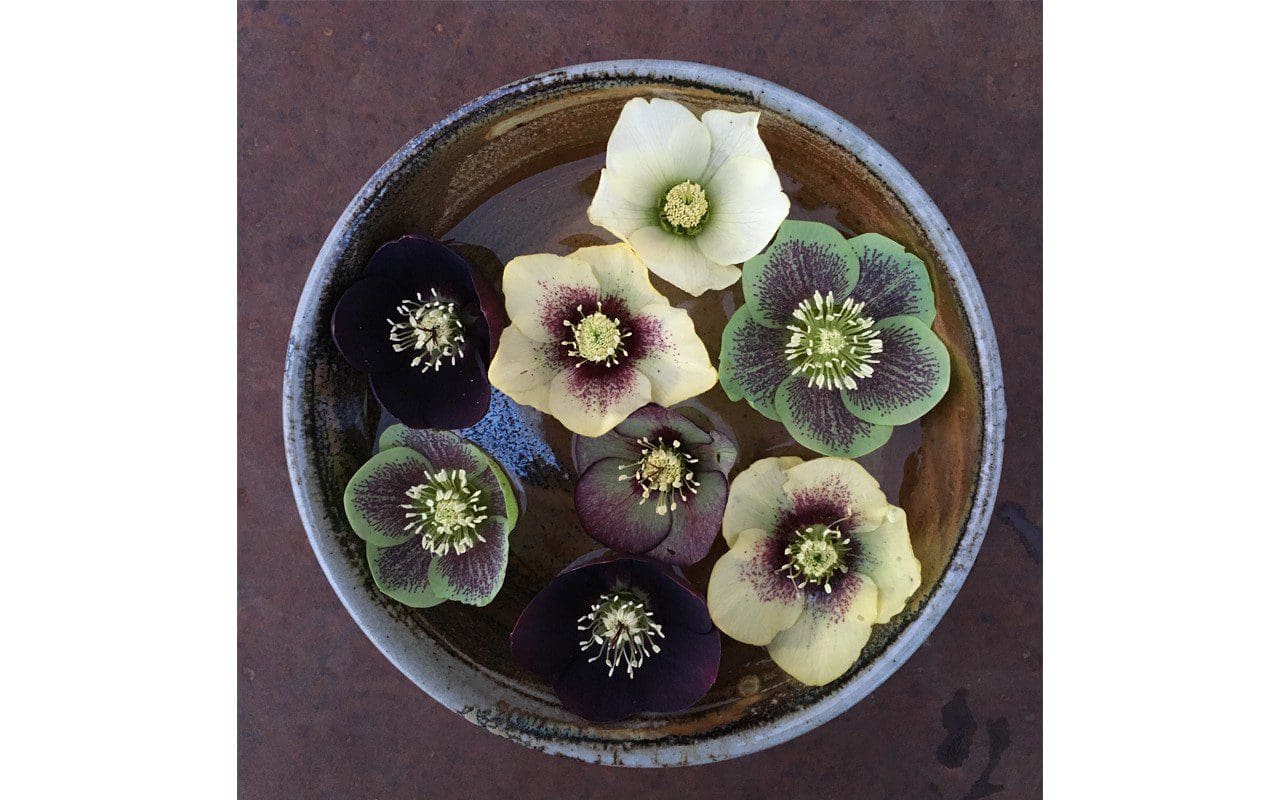
For the first time this year, we have been plagued by mice which have stripped the buds of the earliest flowers and robbed me of this year’s respite from the last of the winter. The discovery left me fuming, but there are just enough to pick and float in water. The Lenten rose is not a good cut flower, but the stems are less prone to the flagging if you steep them for thirty seconds in boiling water. We prefer to float the flowers like boats in a shallow dish of water where you can savour their interiors and appreciate the gift they provide in these last few weeks of the season.
Words: Dan Pearson / Photographs: Huw Morgan
Published 10 February 2018
We are sorry but the page you are looking for does not exist. You could return to the homepage