I had planned for Dierama here on our bright airy slopes from the beginning. Tall wands, spearing upright and silvery before arching over under the weight of developing flower, Angel’s Fishing Rods are aptly named. When cast at their furthest reach in early July, a single plant will dance and jostle, being still only on those rare occasions when the air is quietened.
Hailing from South Africa, where their corms dig deep into damp ground and their upright, evergreen foliage basks in sunlight, they are quite particular in their needs. Here, in our cool and usually damp climate, they like soil to drain and not sit wet in winter. Most importantly their spearing foliage should not be overshadowed or put into competition, and they will soon dwindle in the wrong company. They look best and do best head and shoulders above their neighbours.
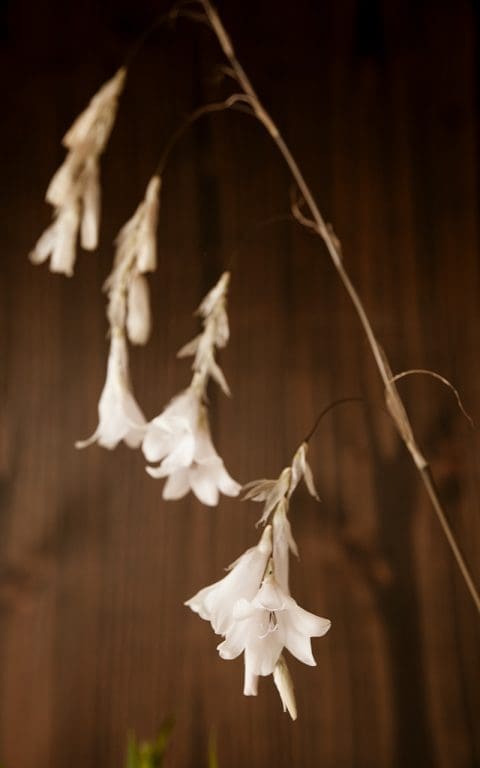
Though they seed freely into cracks in paving and make fine plants when they have found themselves a home, Dierama are slow to establish if conditions are not to their liking. They hate to be moved, so you need to put them in the right place the first time and not falter in your decision. Which is why, in the most part, I am smarting. Three years ago I planted a dozen from a supposedly good source along the path through the centre of the garden where they could hover over silvery Stachys byzantina and finely spun Scabiosa ochroleuca. I had chosen the named varieties, ‘Cosmos’, ‘Merlin’ and ‘Blackbird’, for their depth of colour or so I thought, but only one has come true. The remainder, bar one pure white seedling, are pale pink and mauve, so I will have to start again to keep the colour palette as I’d dreamed it. That said, the white is a delightful discovery. Early, bright and probably ‘Guinevere’, but I cannot be sure as the batch were so muddled and probably all seedlings.
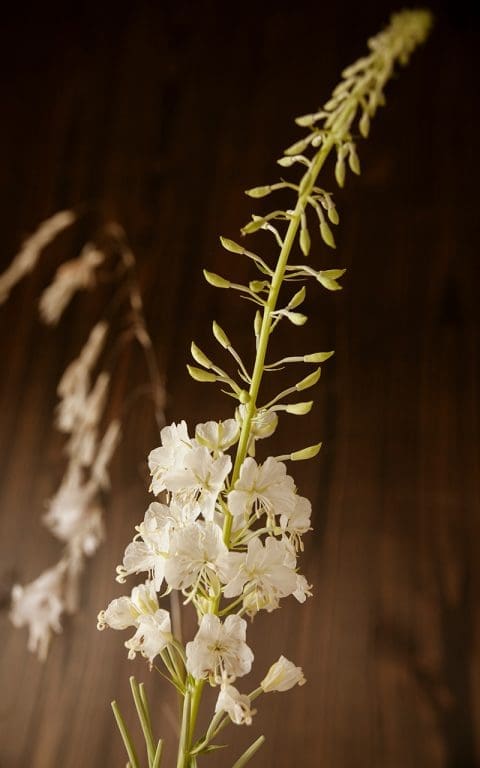
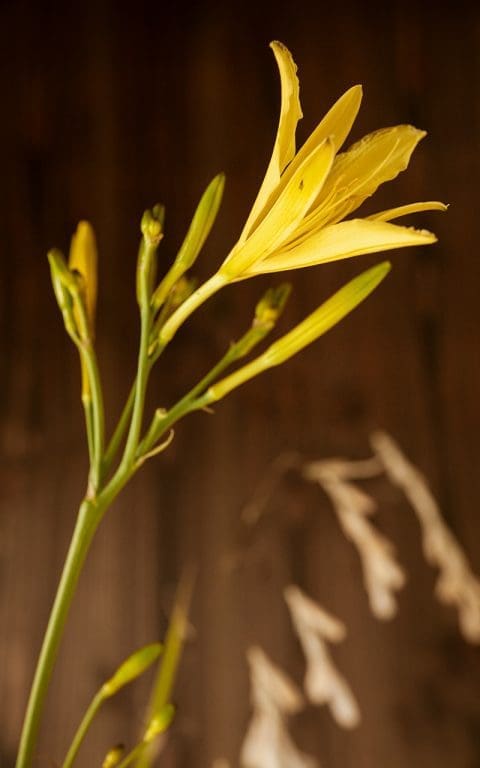
Surprisingly Dierama are good cut flowers. Sever a stem and the papery sheaths and petals rustle as you untangle them from their neighbours. Here we have teamed them with Hemerocallis citrina x (x ochroleuca), a coupling that works in the garden for the stature of its basal foliage and the airiness in the suspended flower. Though Chamaenerion angustifolium ‘Album’ (formerly Epilobium) teams well in the vases, its romping habit would not make it good company for either in the garden, and the Dierama would be swallowed up and lost in a season.
The rosebay willow herb grows here on the lowest slopes in the garden where it makes a fine visual link with the swathe of Meadowsweet (Filipendula ulmaria) that runs away into the distance in the ditch. The magenta form of this native plant is usually seen on railway sidings and is also known as Fireweed, since it was of the first plants to colonise the rubble of burnt out post-war London. It is not a plant you would want in the garden. Though it runs and needs to be curbed, the white form is sterile and a good garden plant if you have the room. That, of course, is the dilemma. Where the Dierama will sit where it is put and live for many years if it likes you, the willowherb will need to be watched. Pulling it when it is about knee height to keep it within bounds will see it kept in check if growth around it is competitive, but it will be back come the spring, one hundred percent and moving as quickly as it can to take more territory.
Words: Dan Pearson | Photographs: Huw Morgan
Published 13 July 2019
Marked in the trees on our westerly horizon, the sun came to its furthest reach exactly a fortnight ago. Long-awaited rains wet the ground deeply in the run up to midsummer’s eve and with it came the surge of exponential growth. A tangible feeling of opportunity and leaning into the light. Eglantines foamed pink where I’ve woven them into the hedgerows and the garden reared up, the layers suddenly asserting themselves and deepening.
The garden that wraps us close becomes increasingly important as the meadows dim and go to seed. Next week will see the start of the first being cut for hay and, as the fields simplify, we draw back from our meanders to count our first orchids and to check upon the spread of this year’s yellow rattle. It is then, as we pass into summer, that the garden becomes more complex, and deliberately so. First, waves of colour to hold your attention and then the layering of detail, which is planned to run from now through into late autumn.
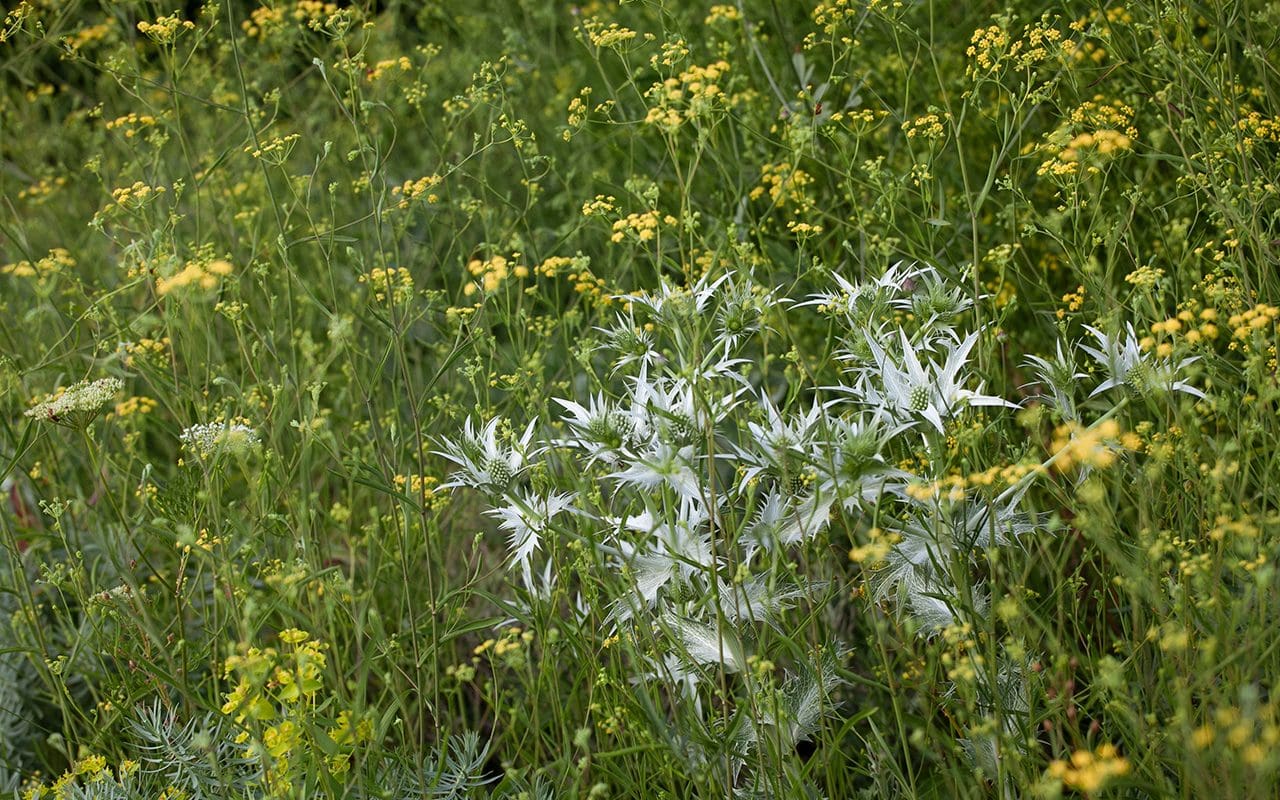
This is the first year that the garden is revealing what I have been planning for. Settled by four years of growth up by the barns, we can see the volumes emerging now. Baptisia the size of armchairs asserting themselves handsomely amongst the self-seeders around them. Bupleurum falcatum that has run riot in the gravel and Eryngium giganteum now showing that it has a hold and will be here to stay. The Crambe cordifolia have their roots down too and have shown it in clouds of flower that you have to crane your neck and look up into. This feeling of the planting being settled is good.
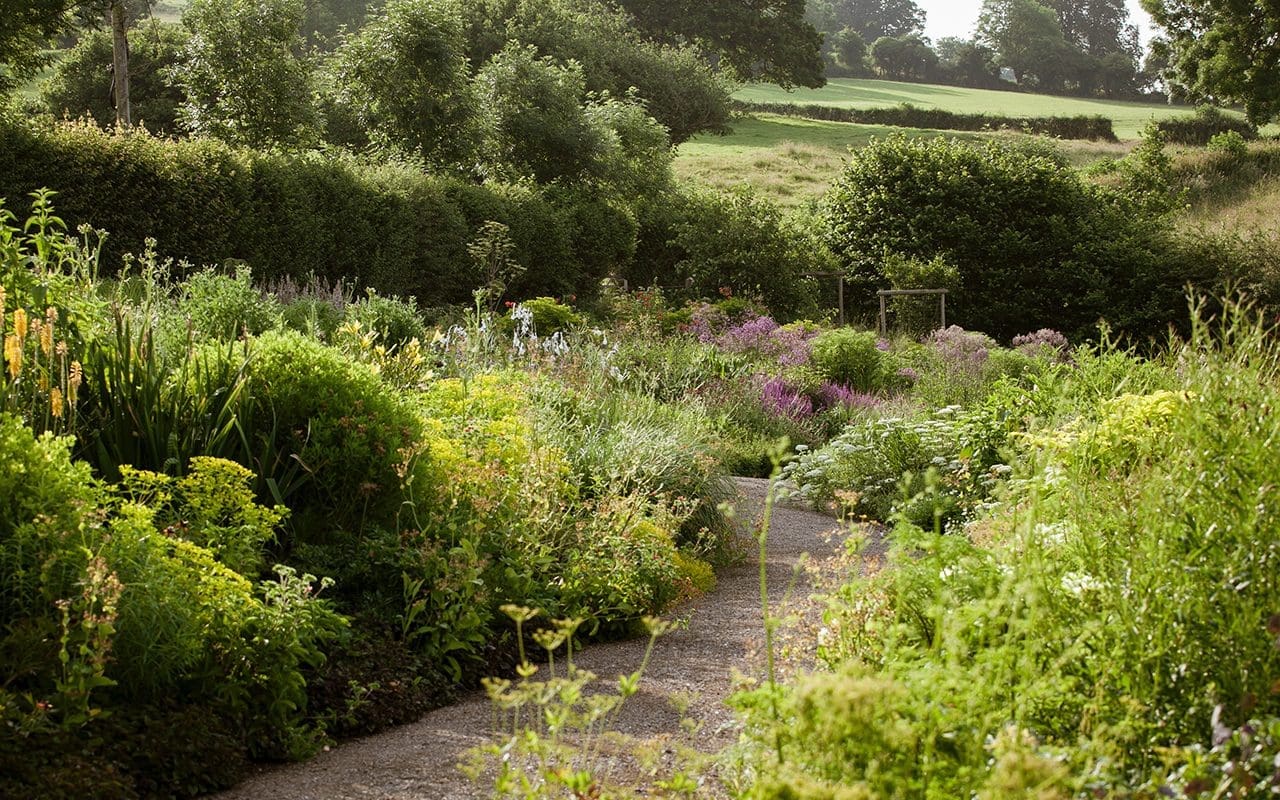
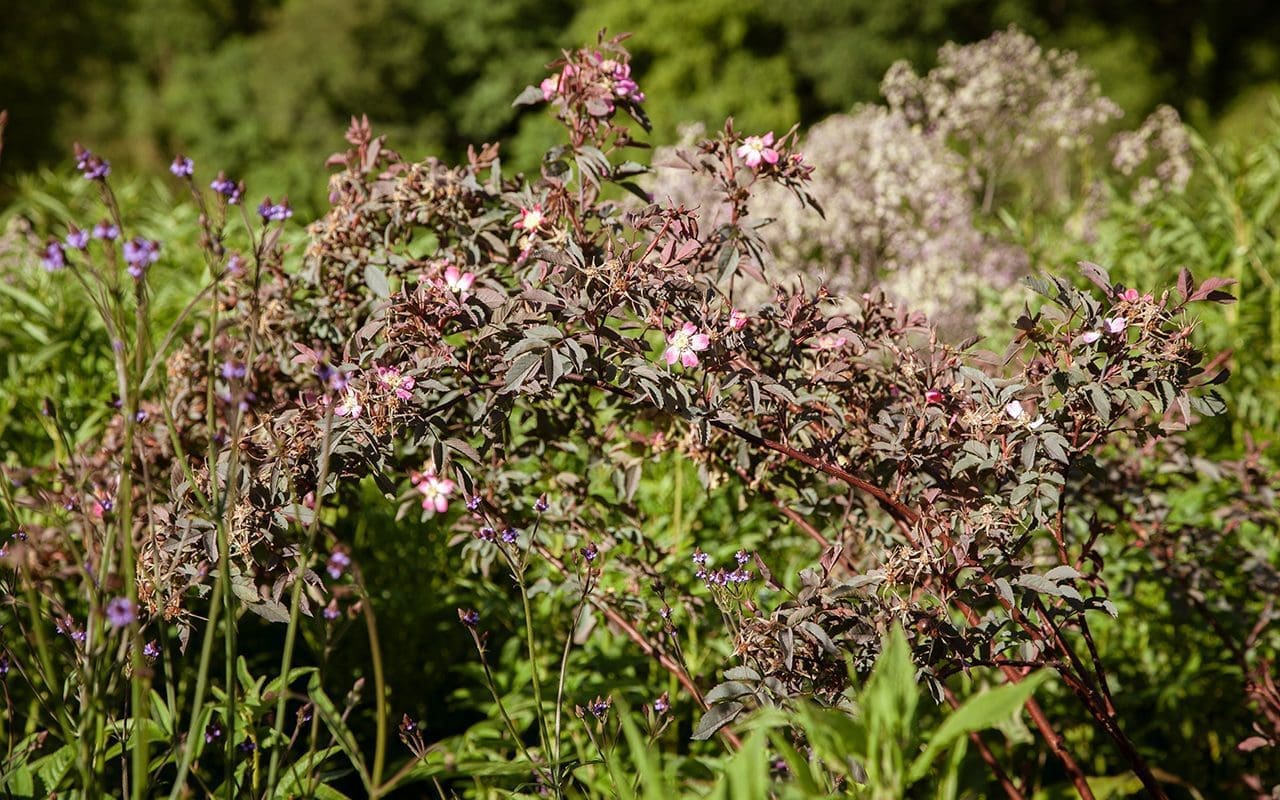
It will be another couple of years before the woody material in the garden starts to have a presence, but you can see the arch in the Rosa glauca now and start to imagine how these forms will provide an anchor point for the perennials around them and a more significant foil with their glaucous-pink foliage. This is the third summer in the outer ripple of the main garden and the second for the inner beds that were planted the October before last, but already the planting is mingled and presenting some long-awaited couplings.
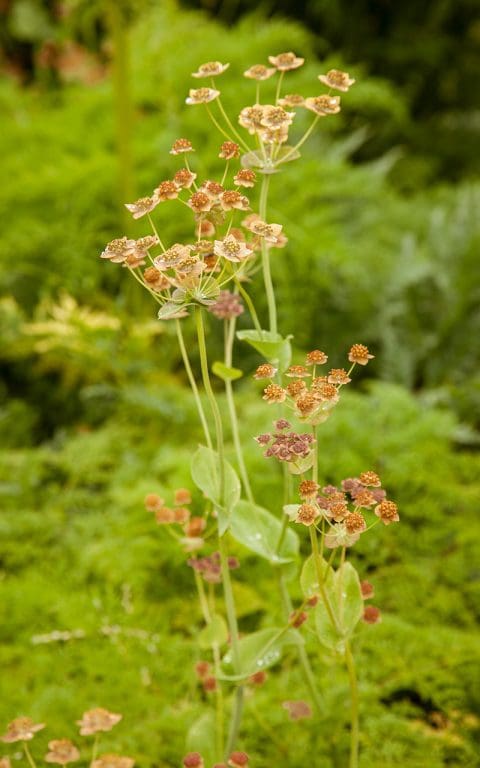
With the ground now covered and the gaps of last summer already forgotten, I can start to see how the plants are interacting. The community works well where there is a balance and the plants sit happy in each other’s company. Close to the path I have woven a ribbon of Bupleurum longifolium ‘Bronze Beauty’ to provide the way through with a layer of consistency. This delicate umbellifer pairs well with so many things for having a complexity of colours in its flowers – brown, sepia rust, saffron, lime green – and air in the plant too, so it that hovers. Out here on our hot, open slopes, the plants are failing where they are most exposed to a baking and tell me where they prefer to be by seeding into the cooler pockets. This is the best of educations and the best way for the garden to feel lived-in and truly naturalistic.
Trifolium repens ‘Quadrifolium Atropurpureum’ also lines the paths at the beginning of the garden where the colour is deliberately strongest and brightest. I have grown this dusky, four-leaved clover since I was a teenager and have never tired of its darkness and the welcome foil it provides. Here on our hearty soil it grows lush, the colour browner and less dark at a glance. Grow it harder and the leaves are smaller and deepest mahogany, the growth less full. Here I am surprised it has not eclipsed the basal rosettes of the Dianthus cruentus that I’ve marched through it, but they seem happy so far. A native of Greece, the brilliant pinpricks of crimson are held tightly together on wiry drumsticks and, although you almost loose the structure of the plant against the clover, the suspension of colour is dramatic and a feisty pairing with the Salvia ‘Jezebel’ with which is is also combined (image below).
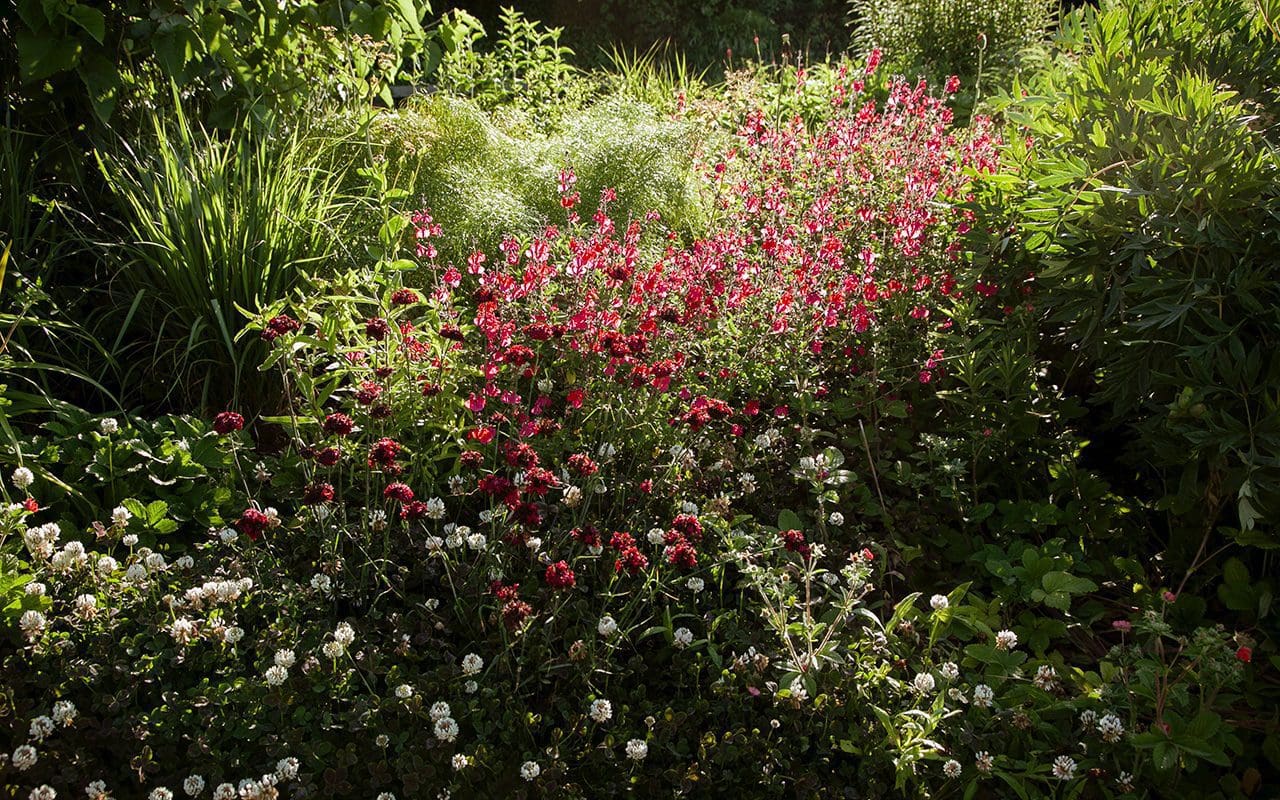
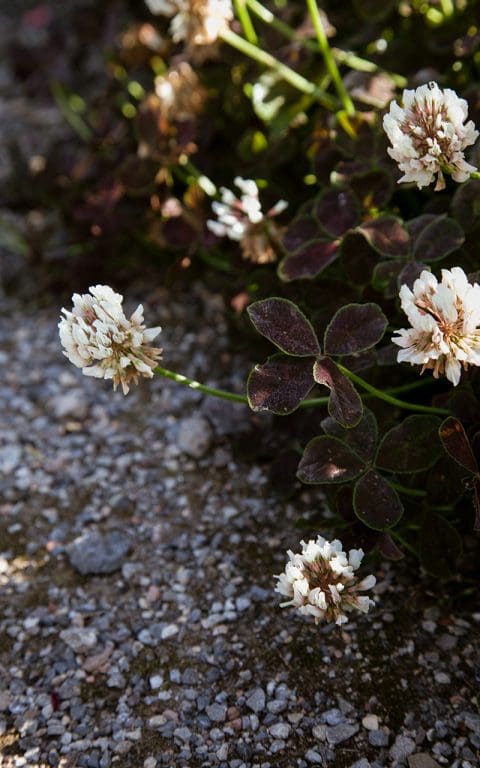
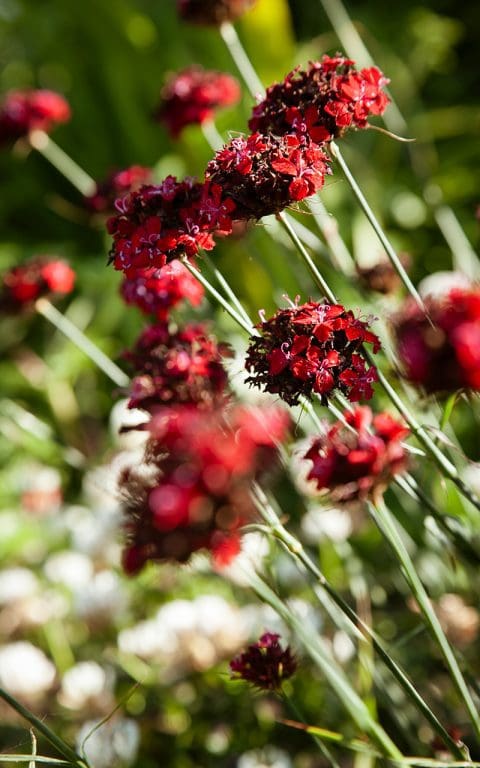
It will be interesting to see if the dianthus is able to seed amongst the lush growth of the clover. Thinking about its rubbly home in Greece I doubt it, so have planned ahead with a newly raised batch of easy-to-germinate seedlings. They take their first year gathering strength in a rosette of foliage and come to flower in their second year. Given a brightly lit aspect I expect them to be reasonably long lived. My original plants – now being lost to eryngium seedlings down by the barn – are in their fifth summer and showing no signs of tiring where they still have the room to breathe. A commodity that is rapidly becoming less available to all but the strongest and wiliest.
Words: Dan Pearson | Photographs: Huw Morgan
Published 6 July 2019
These tiny bonfires
burn high above the garden.
Leopard lily flames.
Words: Huw Morgan & Dan Pearson |Photograph: Huw Morgan
Published 29 June 2019
I don’t exactly remember when I first tasted elderflower cordial. Romantic though it would be to imagine, it didn’t feature in my childhood, when summer drinks ran the gamut from orange squash to lemon barley water to Coca Cola and back again. However, I have an inkling that it may have been at the country house of Stephen Keynes (a great-grandson of Darwin and nephew of John Maynard Keynes) who was my London landlord for a while when I was in my early ‘20’s. Stephen was a polymath; a banker, an intellectual, an historian, an appreciator of the arts, a raconteur, a patron, a naturalist, a naturist. Yet the thing I remember him best for was his love of good food and the ability to make it without fuss or fanfare.
Stephen cooked in a way which has become quite fashionable in recent years. Very basic, simple food – some might call it nursery food – redolent of a time of housekeepers, nannies and cooks, waste not, want not, rationing and grow your own. For breakfast he might serve an egg coddled with the top of the milk and a slice of good white, heavily buttered toast, lunch could be a poached kipper with floury boiled potatoes or a bacon and egg pie with his own greenhouse tomatoes, for dinner a pork chop with creamed spinach from the garden. Pudding would usually be a seasonal fruit tart or pie, with his own pastry and served with cream or custard. At Christmas he made the best mince pies I have ever eaten. He was also an expert preserver in the old tradition and so the pantry was always full of his home made jams, jellies, chutneys, pickles and syrups made from garden and hedgerow.
At his house near Newmarket (which at weekends was filled with the chatter and laughter of bright, young things) Stephen had a proper vegetable garden and greenhouse, as well as fruit cages and fruit trees, including the first medlar I had set eyes on. Every year he religiously made pounds of medlar jelly, and it is this memory of him standing (naked) at the Aga over a hot preserving pan which makes me think that it was probably he who was taking the time to make elderflower cordial for those long summer days we spent lounging around on the lawn by his oh-so-decadent swimming pool.
Despite the conspicuous lack of a pool here, I still enjoy a lounge on the grass on a hot summer’s day, and no summer is now complete without the ritual of making elderflower cordial. This isn’t always possible though, since elder flowers from the end of May until the end of June, a notoriously unsettled time weatherwise, so for several years I have been stymied in my desire to go elder picking by cold, heavy June drizzle. The past few weeks have been no different and so I seized the opportunity last weekend when the sun finally shone on Sunday morning.
Elder flowers should be picked early on a dry morning. Select the newest umbels that have not yet fully opened and pick the whole flowerhead, but not the coarse stalk. Gently shake them to dislodge any small insects and lay carefully in a trug. I used to cram carrier bags with the flowers, but since it is largely the pollen that flavours the cordial you lose too much of it collecting them this way. It is better to go gently, which makes the whole process more enjoyable.
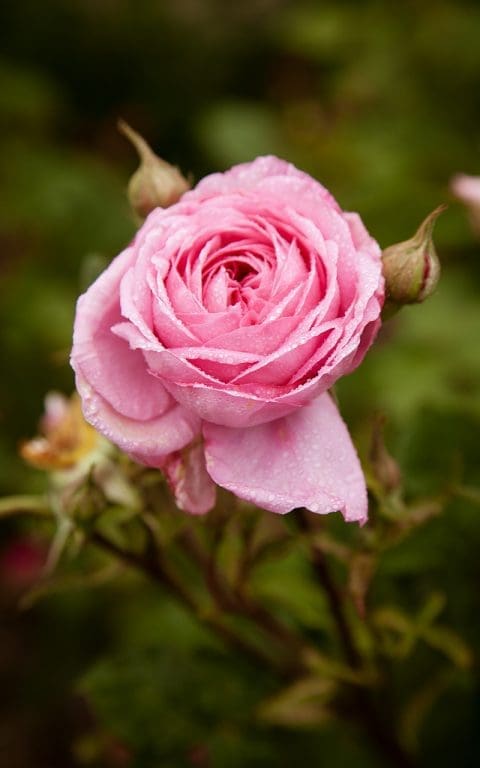
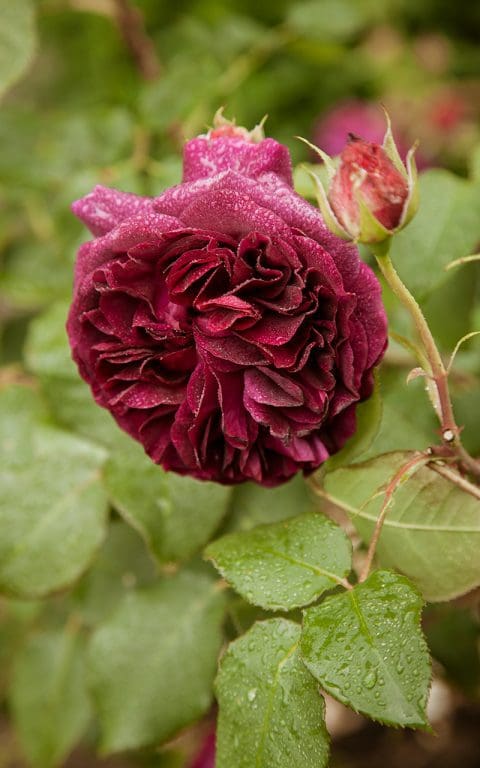
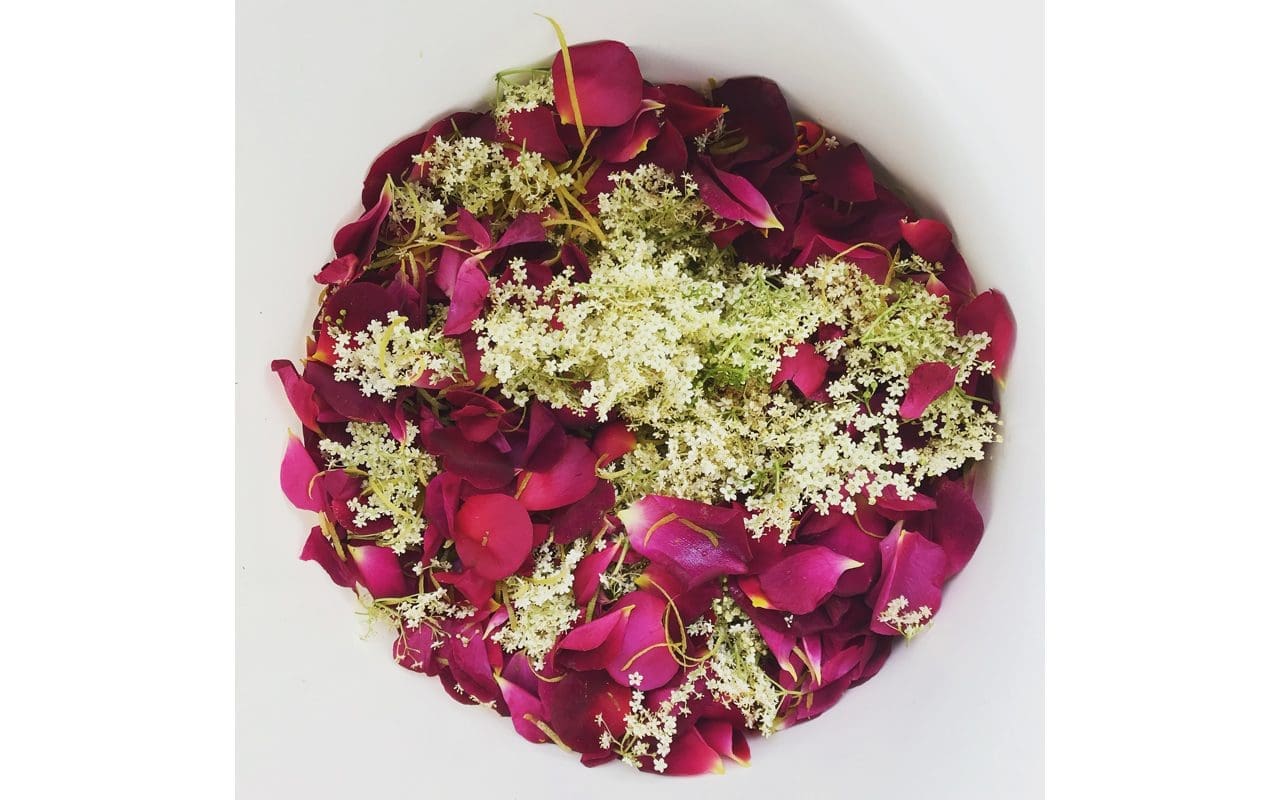
As Dan wrote last week I was inspired to make this cordial after seeing a dog rose growing through one of our largest elders a couple of weeks ago. However, our wild roses aren’t highly scented enough to bring much flavour, so I used the blooms of the most highly scented of our David Austin roses in the cutting garden, ‘Gertrude Jekyll’ and the dark, velvety ‘Munstead Wood’. Any highly scented rose will do, but the darker the rose the pinker the cordial will be. Of course, they must be absolutely free of pesticides, fungicides or other sprays. Pick flowers that are just opening, again early on a dry morning.
Over the years I have tried a number of different elderflower cordial recipes, many of which use whole lemons, pith and all, but I find these too bitter, so now only use the zest and juice. In others the proportion of sugar produces a syrup that is too sweet and deadens the floral flavour. The citric acid allows the cordial to be kept for 3-4 months in the refrigerator. If you leave it out it will keep for 3-4 weeks.
25 large heads of elderflower
5 large heavily scented roses
Grated zest and juice of 4 unwaxed lemons
1.5 litres water
1 kg sugar
1 heaped teaspoon citric acid
Remove all of the petals from the roses and put into a large ceramic or glass container with the elderflowers, lemon zest and juice.
Bring the water to the boil and add the sugar. Take off the heat and stir until dissolved. Leave to cool a little then, while still hot, pour the syrup over the flowers. Cover the container well so that no insects can get in and leave in a cool dark place – an outhouse is ideal – for 2-3 days.
Strain the syrup through a fine muslin. Transfer to a large saucepan and bring to a gentle simmer. Simmer for 3 minutes, then add the citric acid to dissolve.
Pour the hot cordial into sterilised bottles, seal immediately and allow to cool before storing.
Dilute to taste – a proportion of 1 part cordial to 5 parts water gives a good flavour without excessive sweetness. Sparkling water makes the rose flavour more pronounced.
Makes approximately 2 litres.
Recipe & Photographs: Huw Morgan
Published 23 June 2019
The elder is spilling from the hedgerows, creamy, heavy with flower and weighted by a deluge of June rain. This is their month and we can see them marching up the valley and foaming from the edges of the copses where they are happy to seed into shadow, but prefer to push out into the sun.
Elder is fast. Their shiny black berries, which are some of the first to be gorged on by birds in the autumn, are deposited wherever there has been a perch. I find them here under the woody shrubs in the garden and where there has been a perennial left standing that has provided a place for a pause. We even have a quite mature elder that has found its way into a humus laden crack high up in an old ash pollard to prove their ease in finding a niche.
They look innocent as seedlings and are easily weeded but if you miss one you will have a sturdy little plant that will jump up and out into the light in its second year and in the third already be demanding space that might have been promised to something else. They go on in life living fast and hungry and, if you have them in a hedge and leave it uncut, they will create a gap there by simply outcompeting their neighbours. They age quickly and fall apart with topweight, so opening up a wedge. It is into these gaps that you will find brambles seeding and then a whole new wave of succession.
I must admit to removing them where I have been repairing the hedges so that I can replace them with hedging plants that retain a more measured growth cycle. Hazel, hawthorn, dogwood, viburnum and eglantine rose. It is bad luck I know, but where I have done it I now have hedges that are opaque in winter and layered from the bottom up with three plants replacing the weight of the interloper. A cut piece of elder wood reveals why its old Anglo Saxon name aeld (meaning fire) was given, because the hollow stems were used to blow air directly into the heart of a fire. Although it is also unlucky to bring elder inside, I suppose there must be room for exceptions.
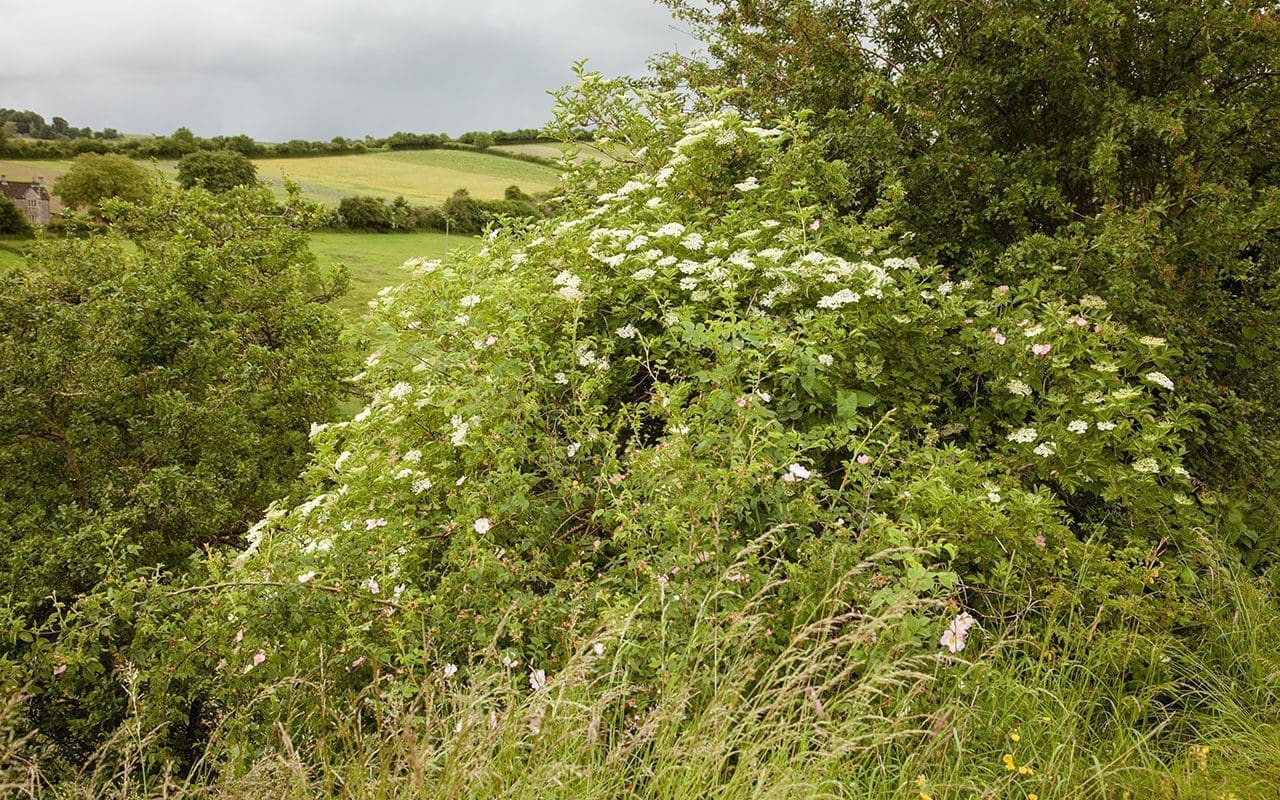
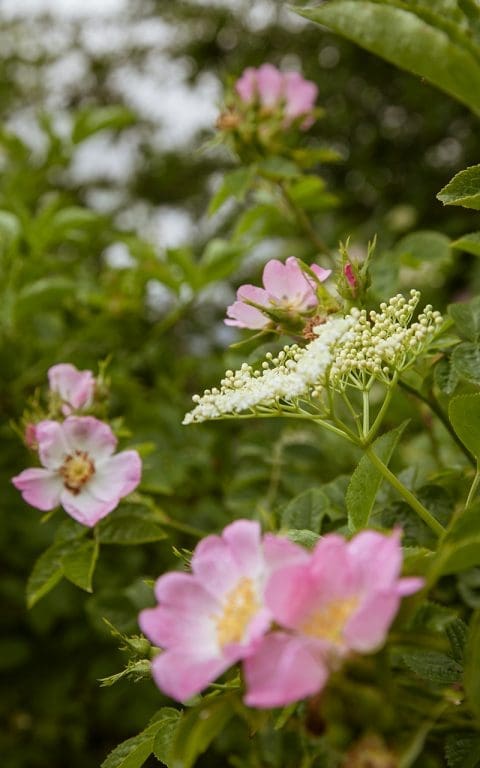
We are lucky enough to have room to let a number of elders have their head here and, only when June weather allows, we steep them and make cordial, since the flowers need to be dry when harvesting. Their heady, sweet perfume is completely distinctive and reminiscent of this time later in the year. A moment of fecund growth and dampness still in a young summer. Where we have let a hedge grow out to make a bat corridor on our high field, a plant that is easy to harvest is paired very beautifully with wild rose, the cream and pink heightened for their company. The coupling has been inspiration for a cordial that Huw is making this week with some of the first roses as a means of capturing this moment.
Where I want to make a quick impression in a garden that needs something evocative of a wilder place, or indeed to segue from garden to landscape, I will often use the cut-leaved Sambucus nigra f. laciniata. This is a lovely plant, strong but lighter on its feet than the straight species and already tall and making an impression in year two. More ornamental selections have given us good dark-leaved forms with cut foliage that are exquisite and easily used. The filigree of ‘Black Lace’ and ‘Eva’ are better I think than ‘Black Beauty’, which has a more simple leaf that can look heavy. The darkness in their genes spawns flowers that are as pink as the species is cream and are a strong influence in the June garden. I haven’t grown the yellow cut-leaved ‘Golden Tower’ which is said to be smaller in stature, but it could be nice in a little shadow to give the impression of artificial sunlight when June days are bringing us (welcome) rain and grey skies.
Words: Dan Pearson | Photos: Huw Morgan
Published 15 June 2019
It has been the most wonderful spring. Cool and nicely drawn out and kind to the irises for being dry during their magnificent three week flurry.
The garden is coming into its third summer in the greater part and its second in the remainder. Time enough for perennial planting to mesh and to have settled into serious growth as opposed to establishment. The roots are down and with it there has been a tidal surge that has been expressed most graphically in the Ferula communis. Fergus Garrett gave me two pots of seedlings four years ago. The straight F. communis and its more slender variant, F. communis ssp. glauca. They were potted on into long-toms to encourage a good deep root and kept in the frame for a winter before being planted out as yearlings.
Two growing seasons putting their roots down saw their filigree mound of foliage ballooning over the winter. They are usefully winter-green, providing a counterpoint to most of the world being in dormancy and, being on the front foot, by spring they were the trigger that let us know that the sap was rising. You could feel the energy mustering at ground level. A clenched fist at first when you parted the foliage to see what was coming, but soon a racing limb which soared skyward before branching and flowering against blue like an acid yellow firework. They have been quite the proclamation. One of optimism and joy and a garden that is finally coming together.
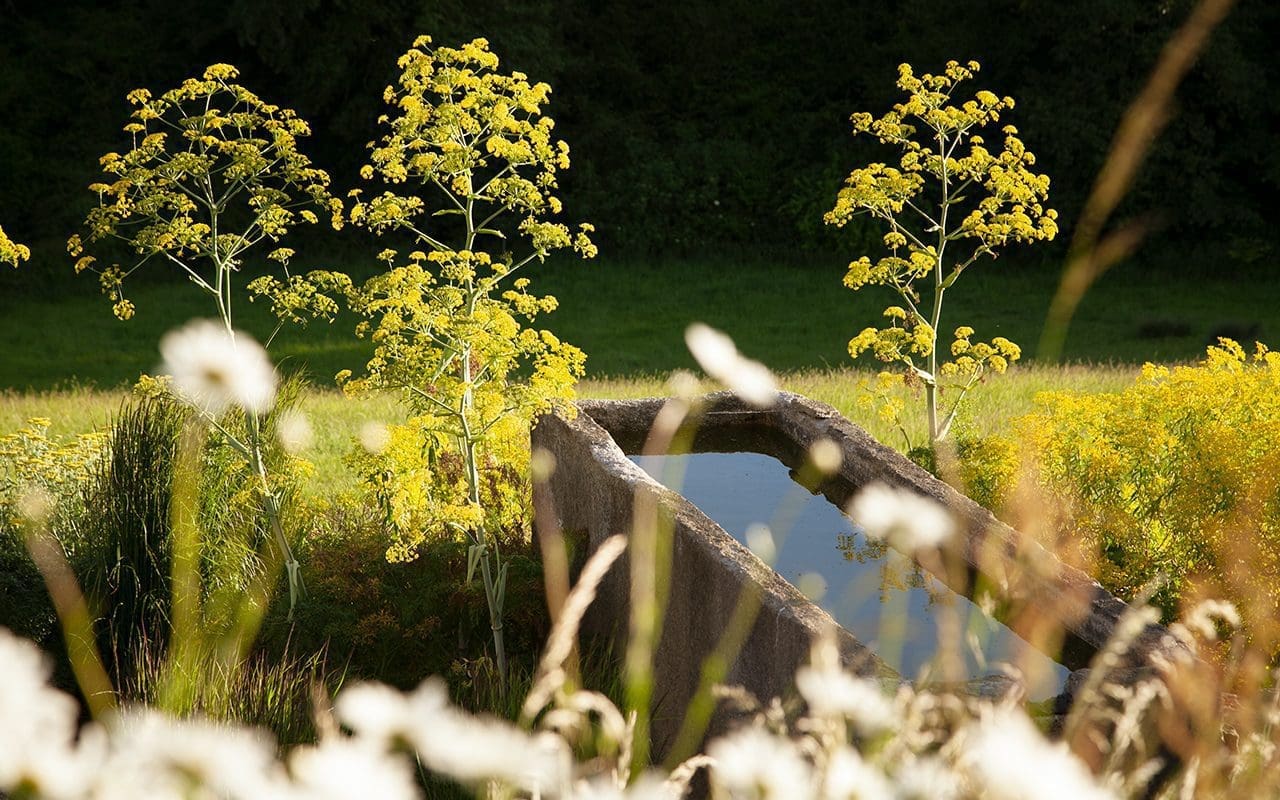
Ferula communis ssp. glauca
In the perennial garden where the outer planting is now coming into its third growing season, I can see how things are playing out. The giants in the mix, in this case Sanguisorba ‘Cangshan Cranberry’ and Thalictrum ‘Elin’, have already muscled out anything that does not have the stamina for competition. I moved the asters that were showing me they didn’t like it out to the edges and replaced the gaps with shade-loving Cimicifuga rubifolia ‘Blickfang’, which were sent from Hessenhof Nursery in Holland. I like responding when a planting tells you it needs change and the thought of using the tall growing plants in our exposed, brightly lit site to shelter those that naturally prefer the cool ground. We could probably not have got away with this in the first year without the cover to prevent the cimicifuga from burning.
The iris here in the perennial garden are selected for their spearing foliage and refined form of flower. Iris fulva, the copper iris, is shown to best effect amongst bright Zizia aurea, and Iris orientalis from Turkey towering architecturally above their companions whilst the planting around them is still low. Early spears are one of the aspects I enjoy most in the early garden and Iris sibirica ‘Papillon’ have been as strong and definite as you could ever wish a plant to be. In colour they have taken over neatly from the camassia,which were introduced this year. I like to wait a year or so before introducing bulbs so that I know where change might occur and can be sure they have the space to establish unhindered. I’ve learned though that camassia that are prone to seeding do not make good bedfellows in open ground, for they are profligate. Camassia leitchlinii ssp. suksdorfii ‘Electra’ is reputedly sterile and finishes just as the iris come into flower. Self-seeders have proven to be problematic on our rich ground so, when I am in doubt, I deadhead and leave a sample to see how seeding plays out.
This is exactly how I will manage the Allium atropurpureum, which are now worked into the planting in the middle of the garden. We planted fifty bulbs last autumn in the gaps between the Digitalis ferruginea. They have been wonderful for enlivening this area early in the season with the promise of leaf and bud and now height amongst the acid green euphorbia.
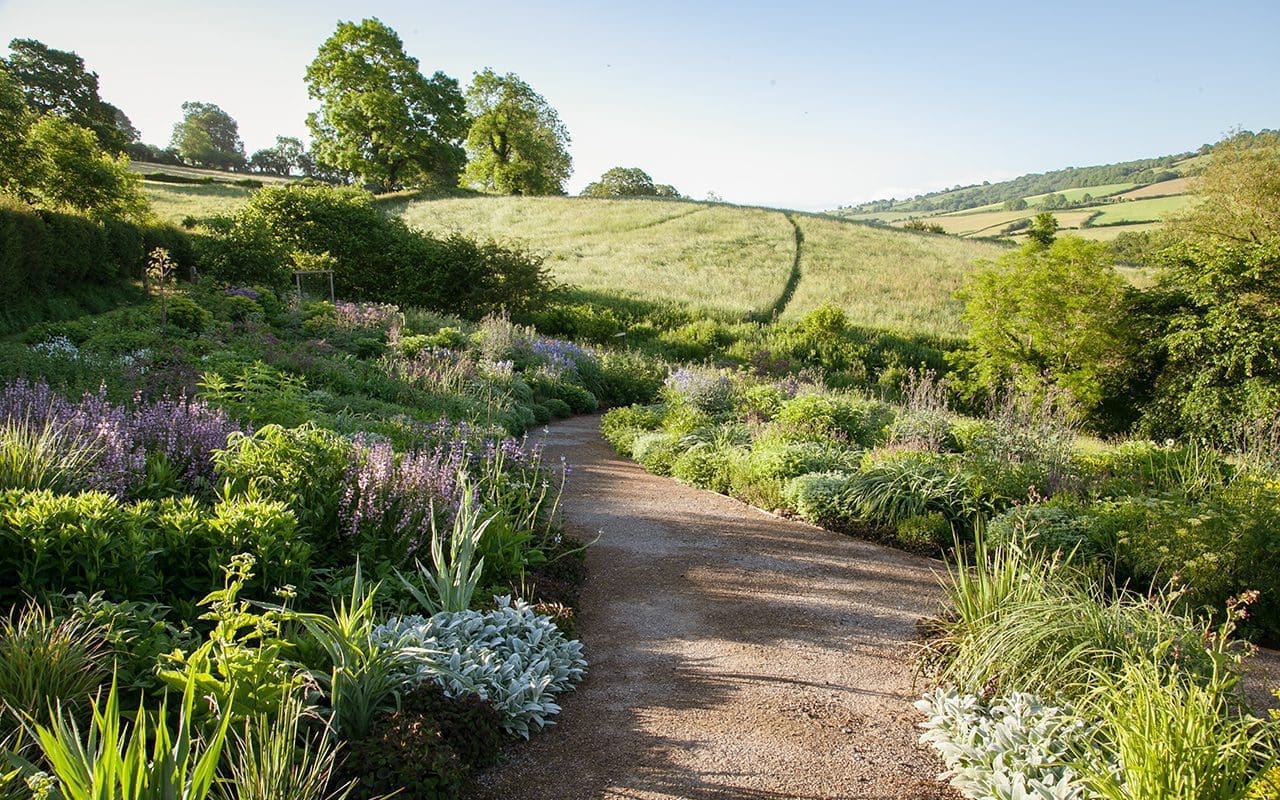
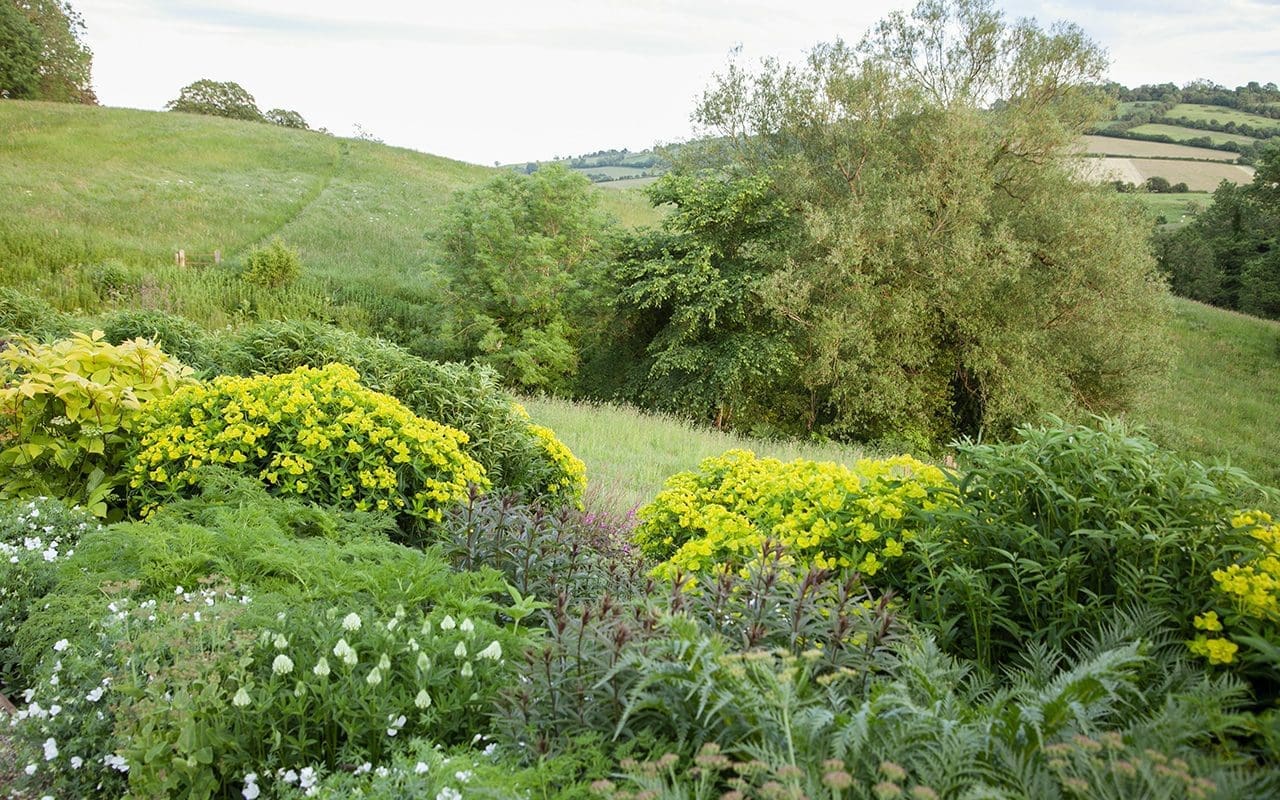
With summer firmly here but fresh still in its infancy, it is the moment of the euphorbias and they are mounding luminously throughout the planting. Standing back and looking down on the garden from The Tump, they remind me of my first sighting of the giant fennels in the Golan Heights when I was studying at the Jerusalem Botanical Gardens in the mid-eighties. It was forbidden territory, the minefields floriferous for being completely inaccessible. As far as you could see there was a march of giant fennel with euphorbia and searing red anemone at their feet. Perhaps this memory was etched into my mind when I planned for spring and early summer here, for I find myself looking on and seeing the similarities. Euphorbia cornigera with its dark red stems high up in the garden, E. wallichiii with its weight and volume to the lower slopes where the ground lies damper and in the high, dry centre the Euphorbia x ceratocarpa nestle the black alliums. Scarlet Papaver ‘Beauty of Livermere’ dot and brighten.
As I look out of the window to the first proper rain we have had in quite some time, I can see the plants exhaling. The greens are brighter – if that were possible – the garden plumper already and readying to push again. There is promise and it is amplified.
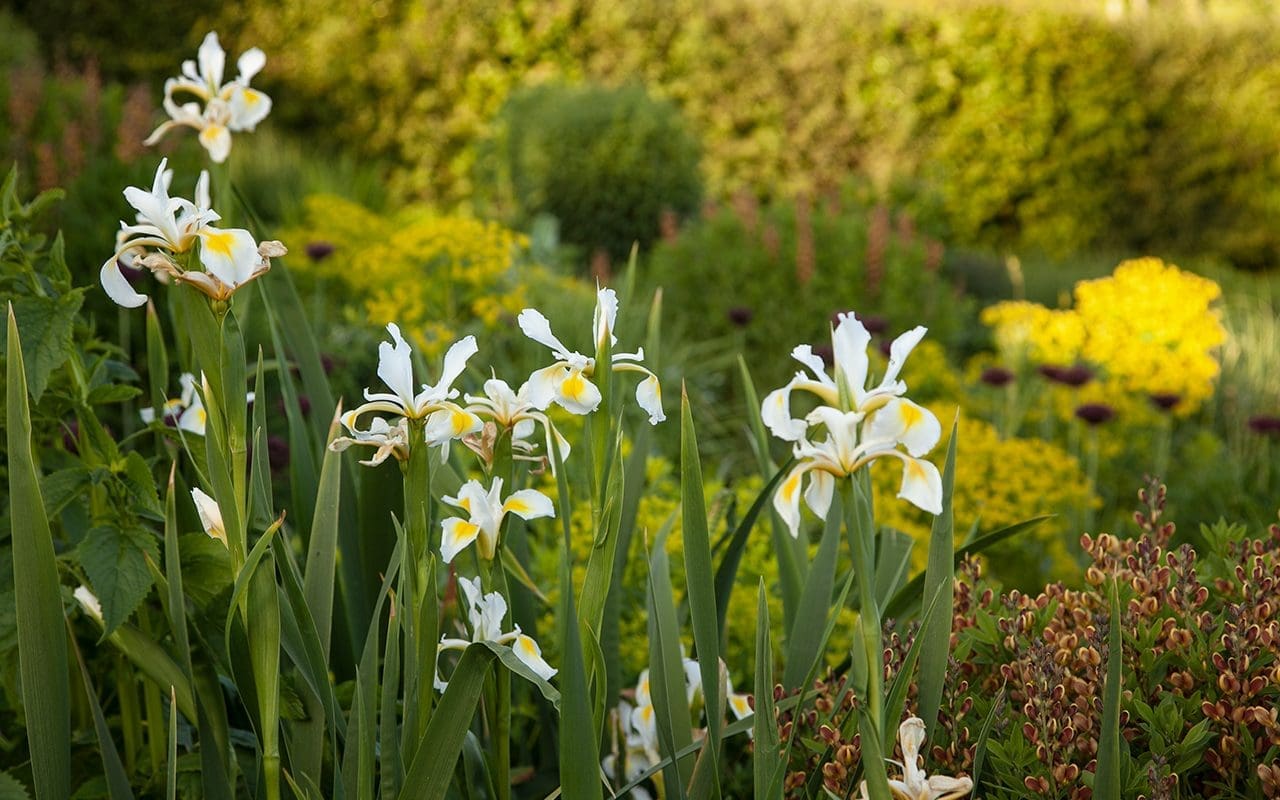
Iris orientalis
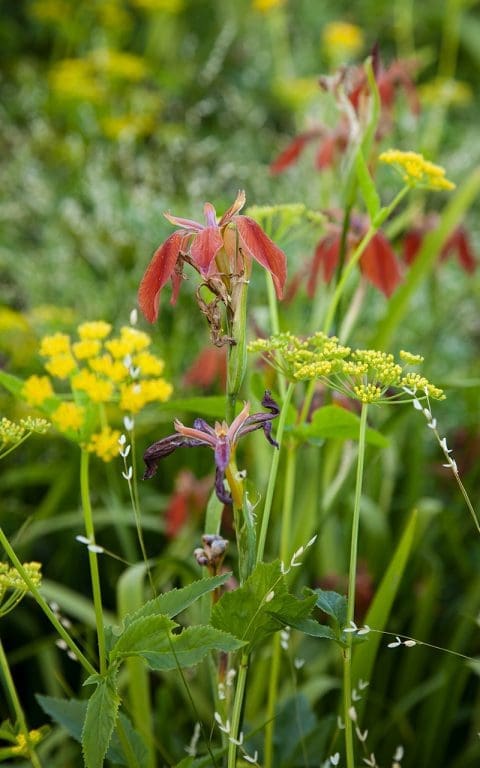 Iris fulva and Zizia aurea
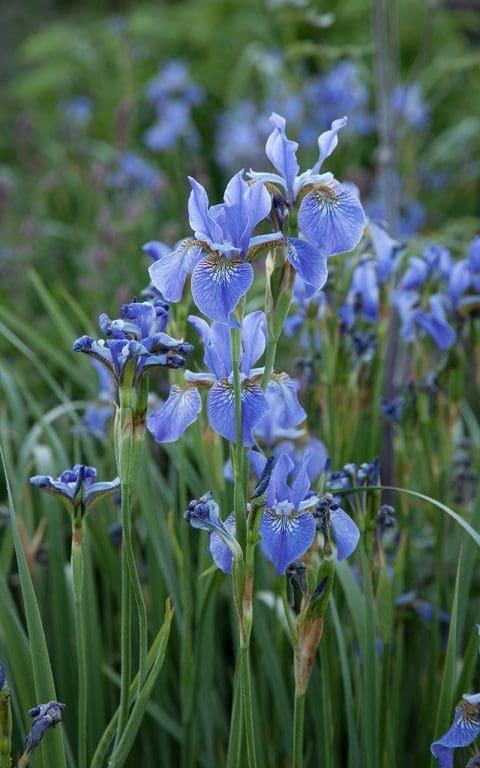 Iris sibirica ‘Papillon’
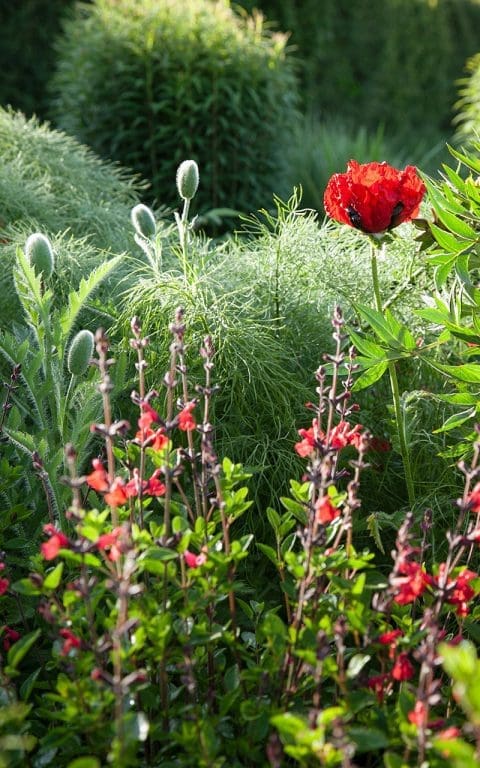 Papaver orientalis ‘Beauty of Livermere’ and Salvia ‘Jezebel’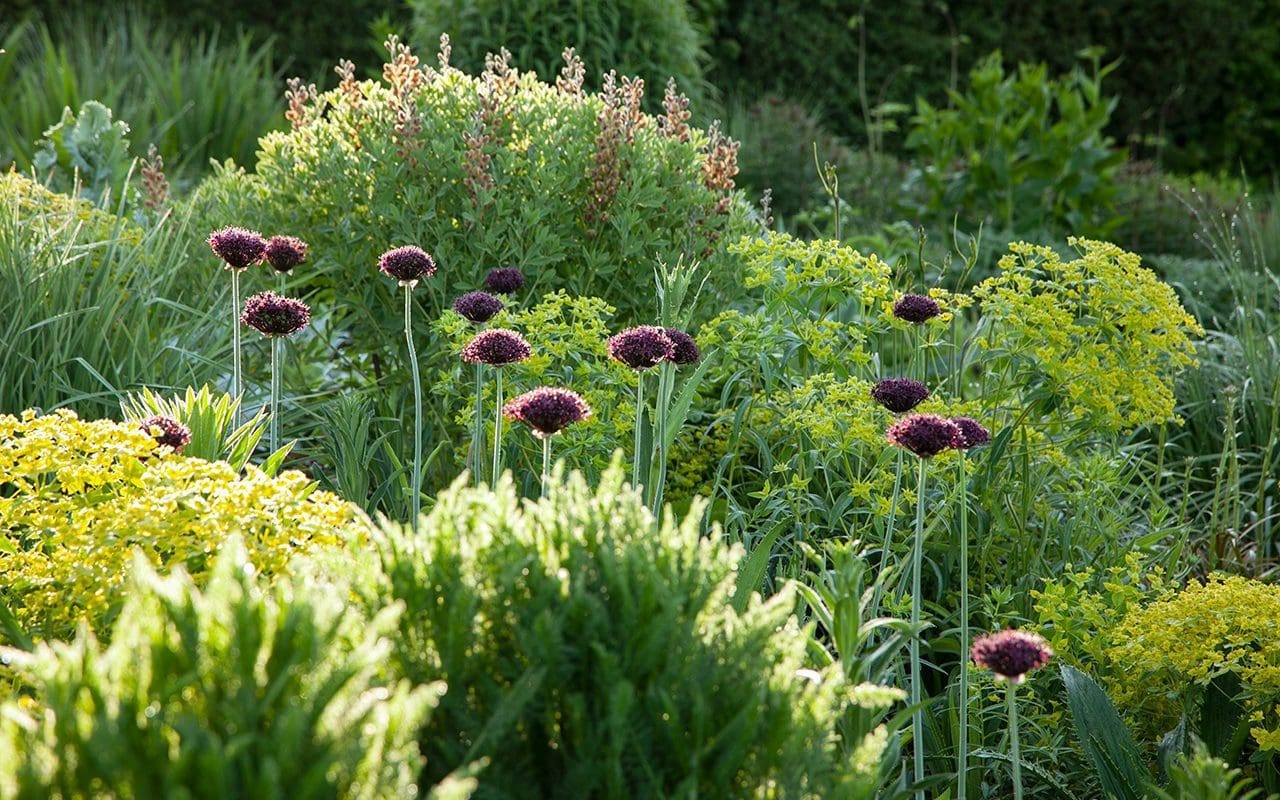
Allium atropurpureum with Euphorbia x ceratocarpa
There is so much to learn and remember about vegetable gardening – sowing times and distances, transplant times, successional sowing, water requirements, crop rotation, pests and diseases, optimum harvesting times, storage, seed saving, the list goes on. Each year with experience under the belt, I do feel more confident, but there are always new obstacles that throw themselves down as a challenge.
This spring the kitchen garden got off to a wobbly start. When we lifted the horticultural fleece we had put over the autumn sown broad beans we found they had been decimated by ground slugs, which had thrived in the shelter. An autumn sowing is usually perfectly hardy, but we had left it late last year and thought the fleece might encourage growth. However, it showed us that the blackbirds must help in keeping the slugs at bay, so we won’t be doing it again. The defeat continued with a second sowing made in early March falling prey to the vandalism of pheasants and collared doves. The third sowing has now been in flower for a week, but there are several more weeks before we harvest our first crop. It has been a similar story with the peas.
Sowings of landcress and mustard greens have been severely set back by flea beetle, as have our brassica seedlings. Fortunately we thought to protect the latter with enviromesh just in time and so, as long as we net from pigeons, we should be back on track. Happily, with a couple of weeks of warm weather, we are now self-sufficient in several different types of lettuce and salad leaf, but without a polytunnel or greenhouse to give us a head start, the ‘hungry gap’ is lasting longer than usual.
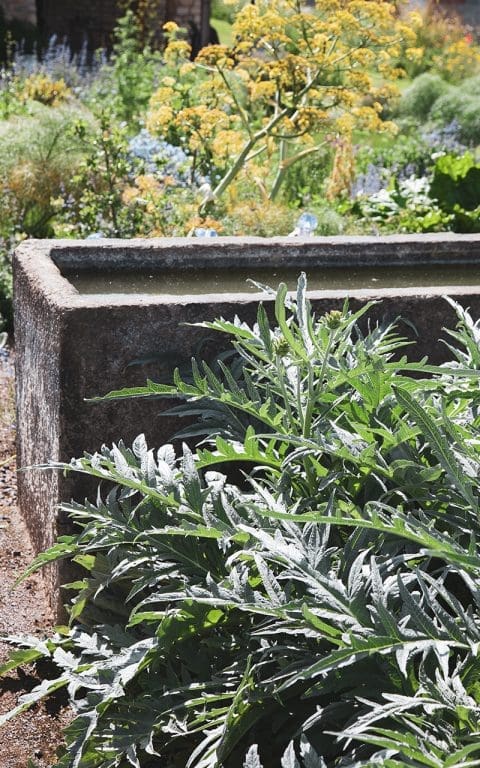
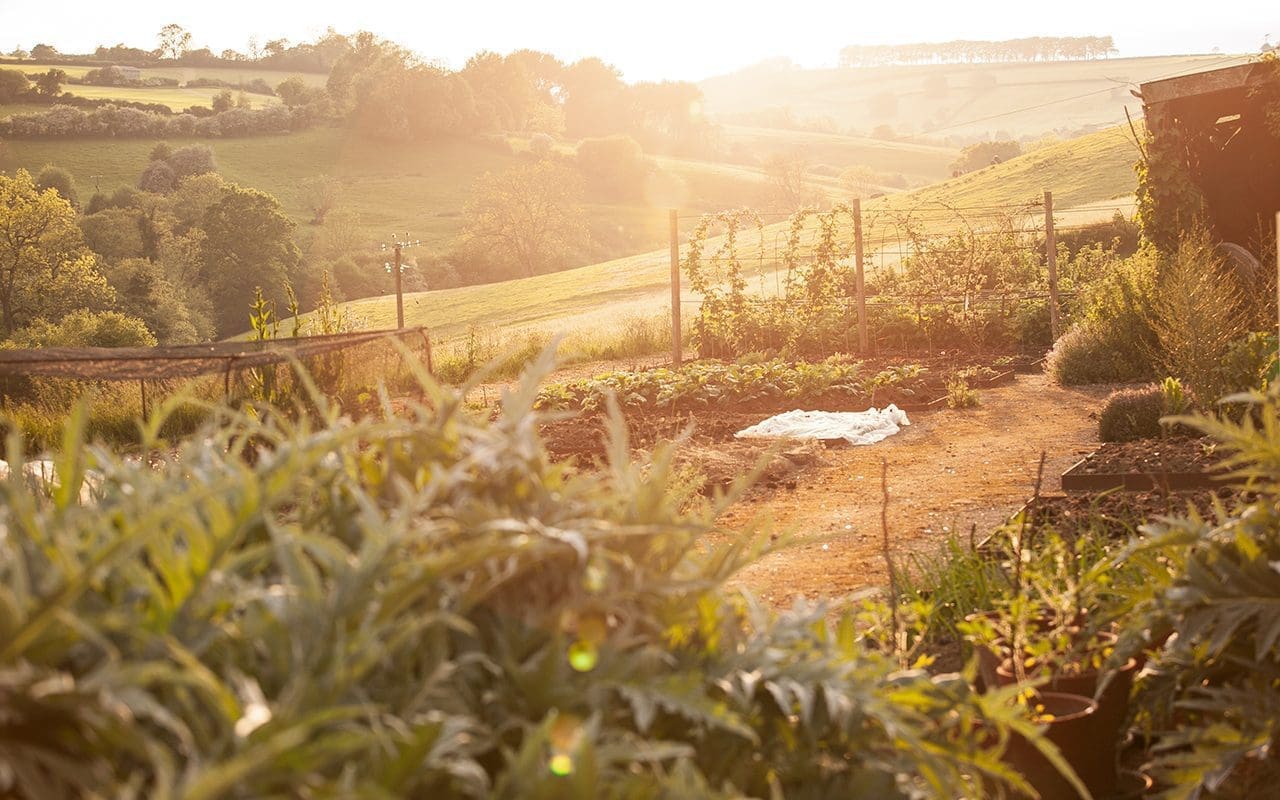
The gap between winter vegetables and the season’s first beetroot, chard, carrots and new potatoes is handsomely bridged by asparagus and the perennial artichokes. Before growing artichokes at Hillside my mental image and usual experience of them was plainly boiled with vinaigrette. Since having a dependable annual crop now that the garden is established, I have been surprised and happy to discover their unsuspected versatility. You can braise or stew them, roast or chargrill them, boil or deep fry them and their subtly resinous, nutty-grassy flavour works with everything from the simplest lemon and garlic to the richest onion, tomato, fennel and chilli slow braise.
Used raw here their greener flavour goes well with the sharp freshness of citrus and herbs, while the capers and parmesan accentuate their nuttiness. This salad can be varied in any number of ways depending on what’s available. Use mint in place of parsley, add wafer thin slices of chestnut mushroom, or small pieces of anchovy and green olive, or a handful of the tiniest raw, new garden peas and slivers of Parma ham. To take things up a level you can add shavings of white truffle and crushed, toasted hazelnuts. Quite plain it is delicious alongside some whipped ricotta, goat’s curd or burrata.
This salad must be made immediately before it is to be eaten, since the artichokes will discolour if left for too long. In fact they start to discolour as soon as the cut surface meets the air, so organise all of the other ingredients in advance of preparing the artichokes. These should be done as quickly as possible, before assembling and dressing the salad and taking it straight to the table.
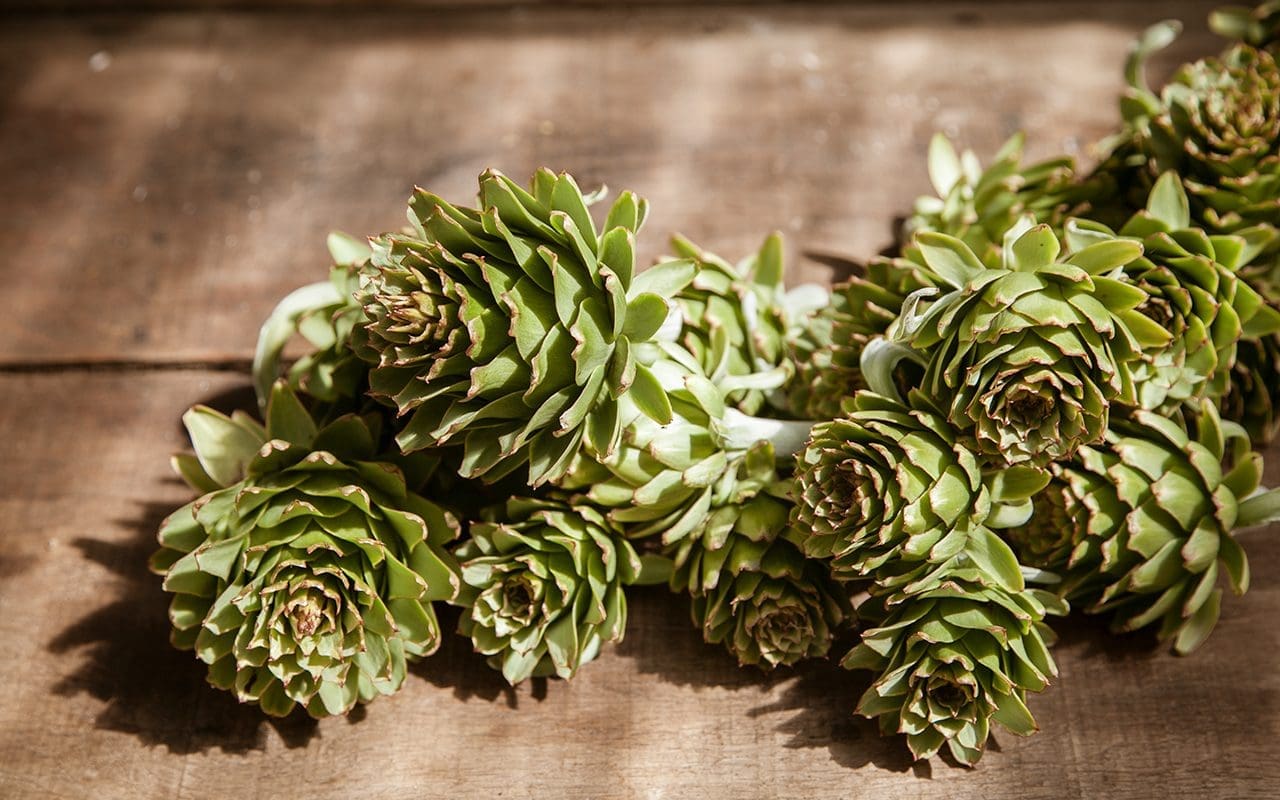
12-16 very small artichokes, or 8 larger ones, no wider than 6cm
2 lemons, juiced
½ a preserved lemon
1 tablespoon small capers, rinsed and drained
4 tablespoons olive oil
A small handful of flat leaf parsley, the stalks removed
A small handful of small rocket leaves, about 30 leaves
20g Parmesan cheese, shaved
Salt
Serves 4 as a starter
Wash and dry the rocket. Remove the leaves from the parsley. Squeeze the lemons. Rinse and drain the capers. Remove the pulp from the preserved lemon. Cut the lemon half into quarters vertically, then slice finely. Shave the parmesan.
Put the juice of one lemon in a medium mixing bowl with a litre of cold water.
Prepare the artichokes using a very sharp, small knife. Trim the stalk leaving about a centimetre. Hold the artichoke on the chopping board with the stalk end pointing away from you. Visualise the interior structure of the artichoke and where the heart is. Holding the knife at an angle remove the tougher outer, dark green leaves and reveal the pale leaves and creamy heart beneath. To start with you may need to use trial and error to remove as little as possible of the paler leaves. If you are concerned that you may be leaving some tough leaves, chew one of the trimmings
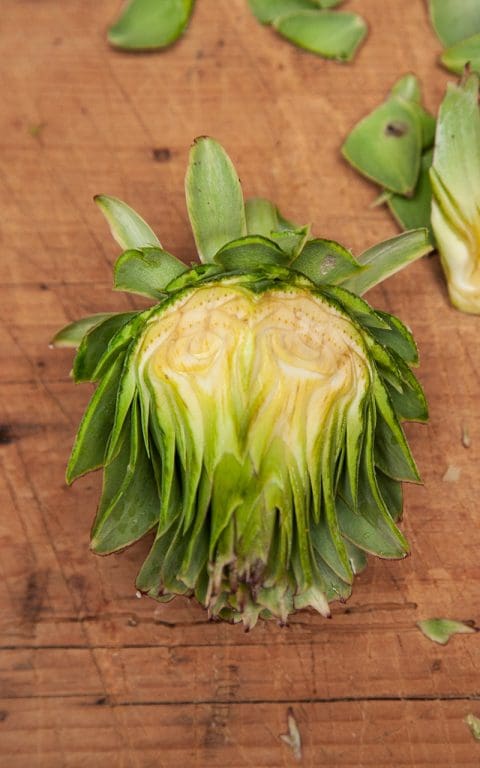
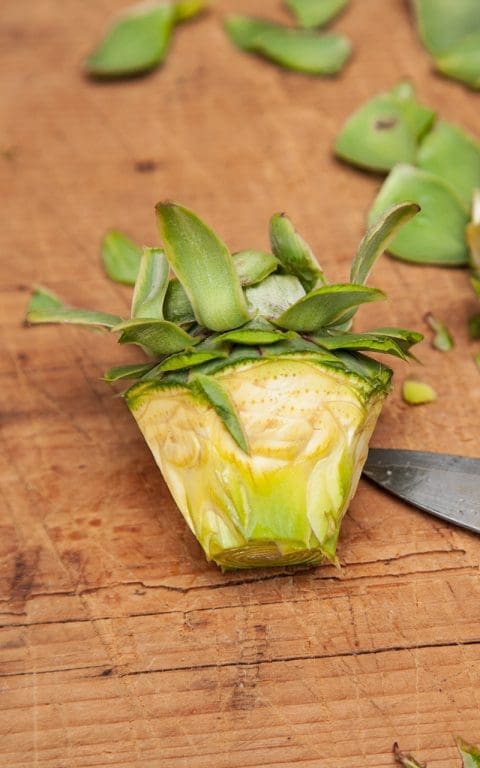
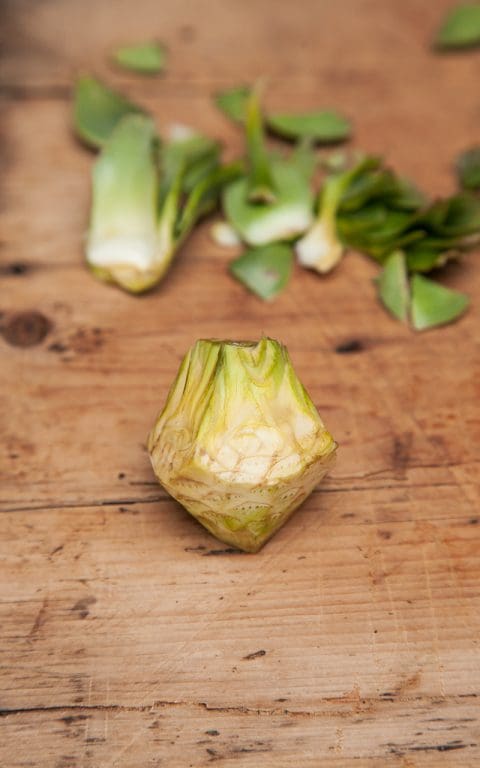
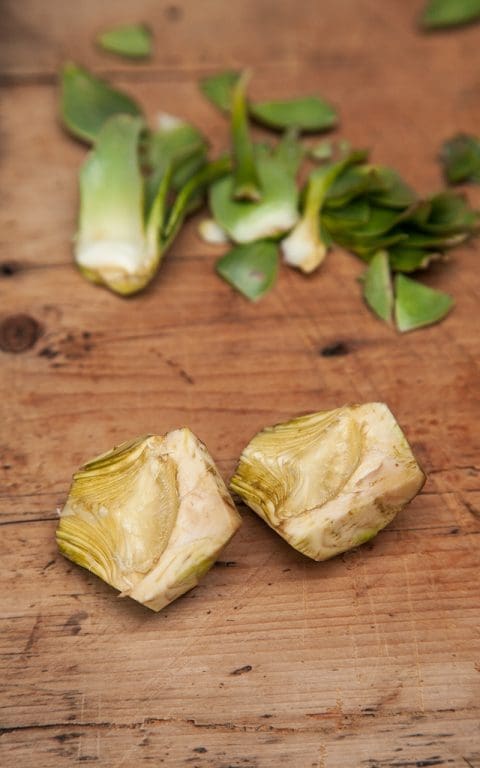
Slice the artichokes lengthways as finely as possible and immediately put into the bowl of acidulated water. If your artichokes are larger you will firstly need to cut them in half lengthways to check if the choke is too developed to eat. If so remove it with a sharp spoon.
As soon as all of the artichokes have been prepared quickly drain them. Pat the artichoke slices dry on a clean tea towel. Put them into a mixing bowl and pour over the remaining lemon juice. Quickly toss the artichoke in the lemon juice so that all is coated. Add the olive oil and salt and toss again. Then add the capers, preserved lemon peel, parsley and rocket and mix together quickly with your hands. Arrange the salad on a serving plate. Scatter over the shaved Parmesan. Serve immediately.
Recipe and photographs: Huw Morgan
Published 1 June 2019
In the last week of April we returned to an island in the Dodecanese that we have been drawn back to more than once. We had been bewitched by the April wildflowers there on our first visit seven years ago, but have never managed to catch them again with life unravelling the best made plans for a spring return. The news of a wet winter in the Mediterranean and encouragement from friends on the island that the flowers had never been better cemented our plans. So, with the garden already awoken and needing attention at Hillside, we did what we could to ready things for the season and left the asparagus crop and instructions to enjoy the blossom to friends who were house and dog sitting.
As the ferry neared, the now familiar outline of the island cleared and sharpened. The last time we had seen them the ancient terraces that scaled the hillsides were browned by summer heat, but the rocky contours were now shrouded and emerald with growth.
Once on shore, the week of wonderment began immediately. Gold and white chrysanthemum (Glebionis coronaria) flurried away into the distance, scaling the rocky outcrop of the monastery as if it were whipped with seahorses. Where we had become used to the sepia September island, the colour was switched back on and everywhere. Banks of perfumed broom (Spartium junceum), chrome yellow and jostling with lilac sea stock (Matthiola sinuata), took the sunny corners on our switchback journey up and out of town. Fluttering silver-pink Convolvulus althaeoides twisted into the chainlink of the school playground, whilst scarlet poppies, cobalt cornflowers and brilliant white daisies took the rough disturbed places. Little walkways leading between the terraces of olives and figs were cushioned by azure lupins and an electric coupling of acid green smyrnium. This was our first impression I might add; the first day when your eye takes in the big picture and not so much the detail.

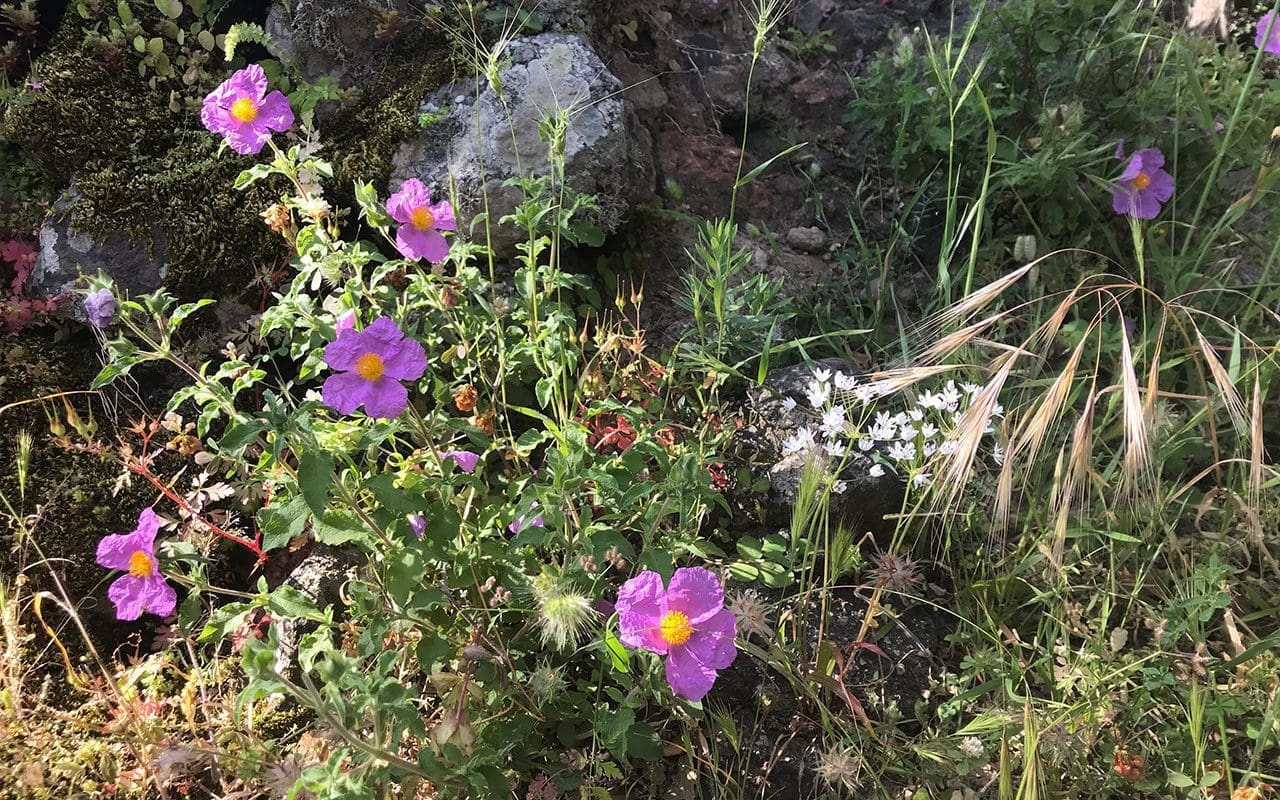

We were staying up and away from the town, a forty-minute walk at a regular pace along one of the narrow monopati that once were used by shepherds and farmers to tend their land. Land that became rougher and wilder and more delicate in its detail the further we walked from the managed influence of the terraces above the town.
The week we were there saw our eyes slowly tuning to a new and different way of seeing. One that was not about looking at a tended and manipulated place, but seeing a landscape that had become settled by neglect. We were surrounded by long disused terraces where the ground you could see had remained untouched for decades. It was clear that wild goats had got the upper hand, for the shrubby oaks had been goat pruned into extraordinary shapes which, with the abundance spawned from a wet winter, saw them hovering like topiaries in a sea of delicate ephemerals.
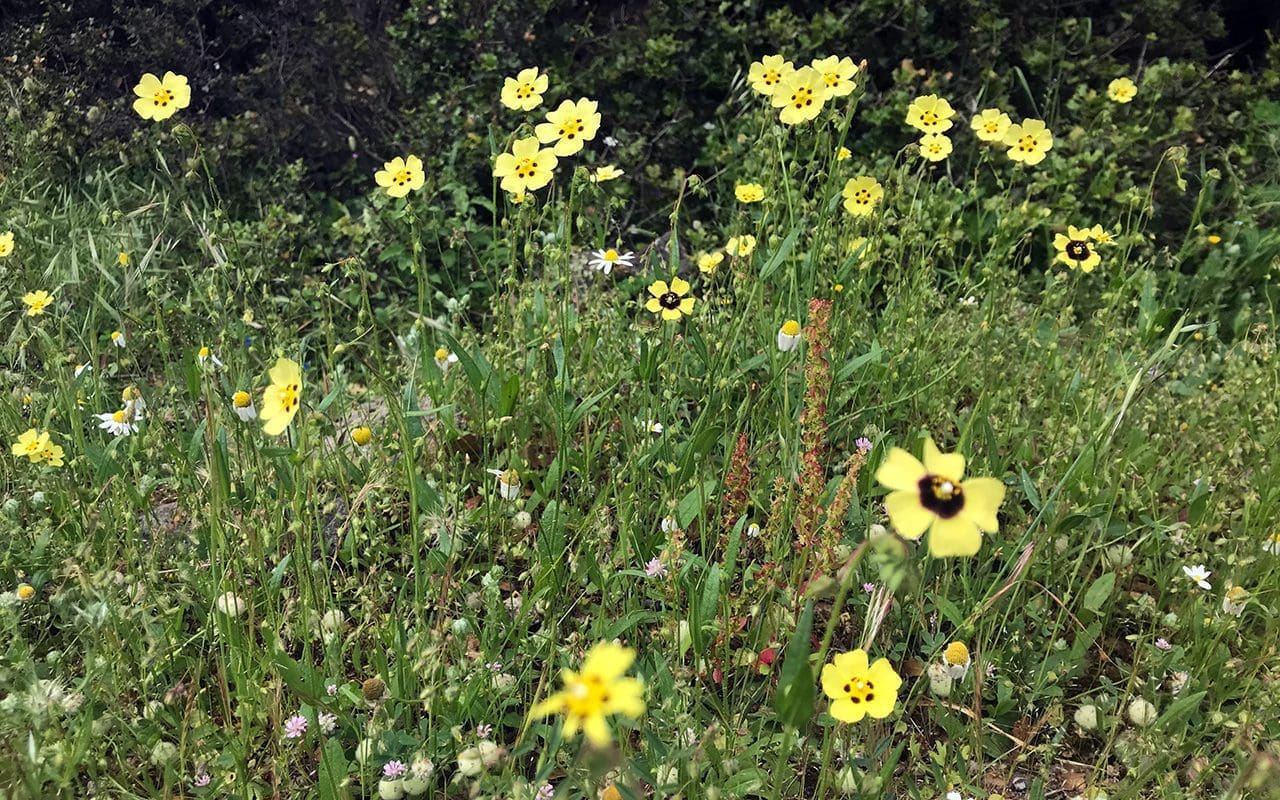
We had decided to travel light, leaving cameras behind and opening ourselves to the luxury of looking and not doing. The images we have pulled together here from our phones only touch on the magic of what we found. Miniature meadows so delicate that they were almost impossible to venture into. So delightful that we stood in each others footsteps to leave the lightest imprint possible. And the more we looked, the more finely spun the intricacy of the associations. Dancing Briza maxima, hovering over a silvered undertow of star clover (Trifolium stellatum). Pinpricks of the tiniest Silene, brilliant pink and suspended on needle thin stems. Fluttering Tuberaria guttata, a miniature yellow rock rose dotted sometimes with a dark central spot, other times simple and without.


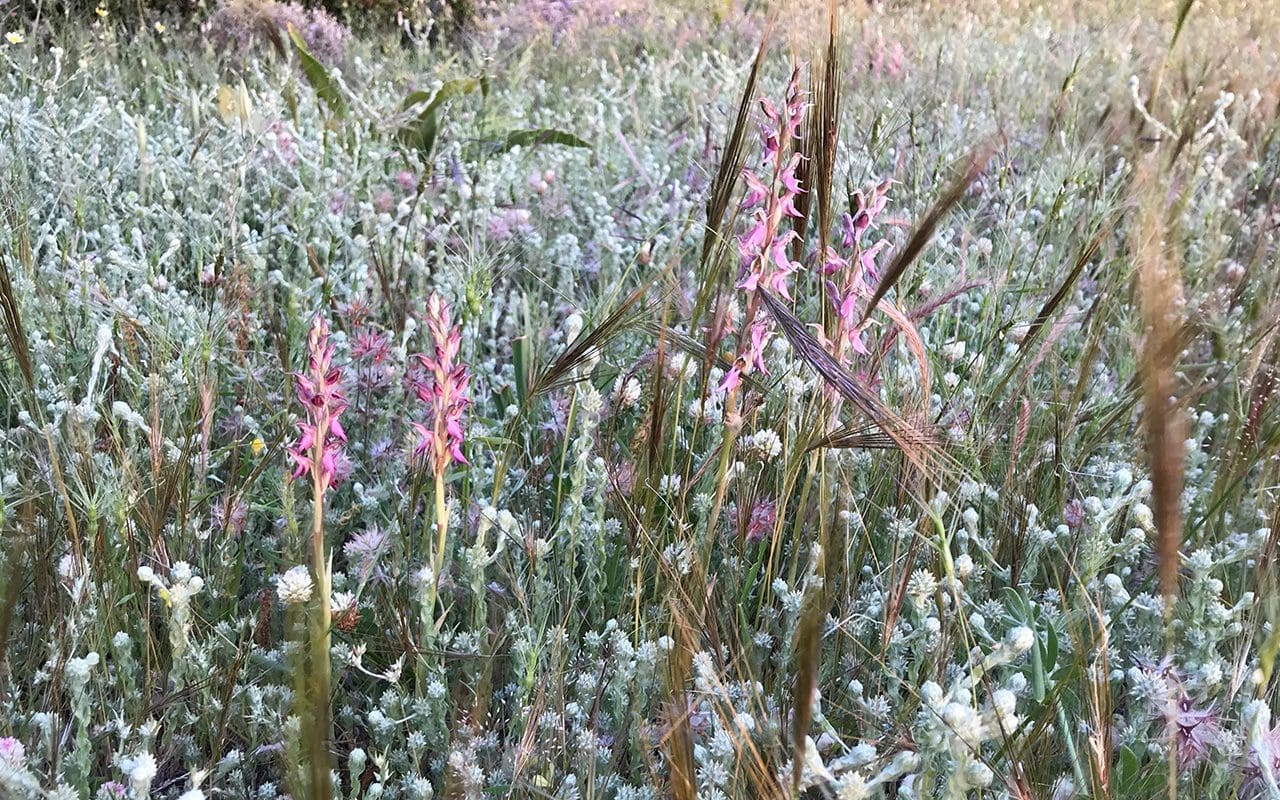
On the old, least accessible terraces there were fleets of Easter orchids (Anacamptis sancta). The childlike excitement of the first and then so many that you were afraid to take a step forwards or backwards.
The liberation of looking and not doing is a good discipline. One that as a trained and committed gardener I find it had to make the space for. But the clarity that comes through a meditation upon natural order runs deep and resonantly. The balance of a plant that has found its niche is not to be forgotten, nor the interdependency of a community that works for negotiating each other’s company and shining for it. The legacy of just a few days will charge the coming weeks of being back to reality. To a garden that needs tending and manipulating into position, but with the knowledge of a true order refreshed and reminded.

Words: Dan Pearson / Photographs: Dan Pearson & Huw Morgan
Published 25 May 2019
The party’s started.
In satin, taffeta and silk
Cedric’s gals arrive.
Words and photograph: Huw Morgan
Published: 18 May 2019
It has been good to have had rain in the last week. The water butts are brimming where they were running low and the spill of cow parsley is narrowing the lane. The late spring garden has responded accordingly. Plants never look better than immediately after a natural watering, the rain seemingly charged and the growth enlivened with a refreshed and tangible energy.
The changes now are exponential. Mayflower balloons in the hedgerows to stop-start them cream and electric green. The Tump, which rises behind the garden, is now dusted with dandelion clocks. Silver, where just a fortnight ago the dandelions rolled the hill in gold.
Things are happening fast in the garden too and we have been pleased to have a run of early peonies, which handsomely open the season. The Molly-the-witch (Paeonia mlokosewitschii) has lasted the best part of a fortnight where the weather has remained cool. A luxury this year compared to the usual week of flower. Paeonia ‘Claire de Lune’ has taken the baton almost perfectly, opening the first few blooms as Molly has dimmed. Though the pale, luminous colour is similar, ‘Claire de Lune’ is a different animal, rising up strongly with florists’ Paeonia lactiflora clearly in its blood. The foliage is dark and lustrous and upright to three foot or so with a plant that decides it likes you. Friends who were in residence at Stoneacre in Kent introduced it to me first. They had it combined with ‘Graham Thomas’ roses, which were to follow, but continued the memory of yellow. Together they welcomed you nicely by the front door.
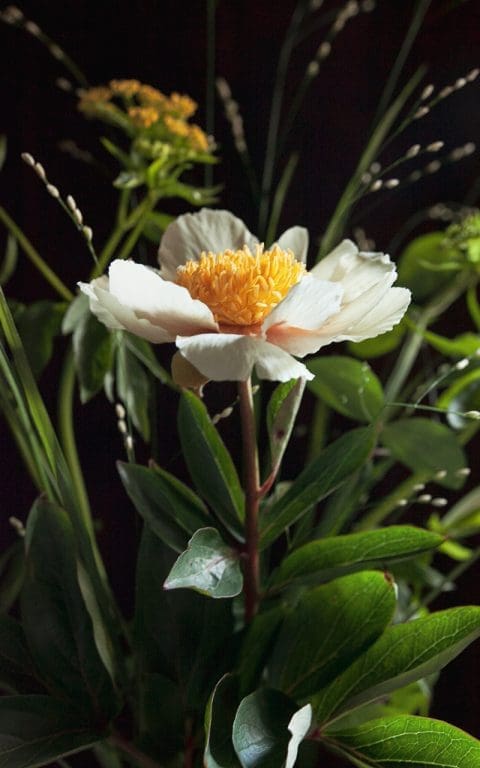
For now, my single plant resides in a slow-burning trial of a couple of dozen garden peonies in the cutting garden where their opulence can be enjoyed for what it is and not compete with the naturalism of the garden proper. When I know more – for peonies take a few years to really let you know what they are made of – ‘Claire de Lune’ has enough elegance and ease to find her way into the garden. The single, primrose yellow flowers pale as they age and if you bury your nose close to the yolky boss of stamens, you will be rewarded with a lemony perfume.
In the garden we have a run of Zizia aurea that follows the woody Paeonia delavayi that frame the entrance. Yellow is good at this time of year when things are fresh and the sombre mahogany red of the peonies benefits from the zesty injection provided by the Golden Alexanders. Marina Christopher of Phoenix Perennials introduced me to Zizia first and I am pleased it has taken well here to bob and hover at about knee height in the garden. In the Americas, where it grows in deep damp soils towards the edge of prairie grassland, Zizia is happy to adapt to sun or light shade. It is an adaptable plant here too, as long as the soil is retentive.
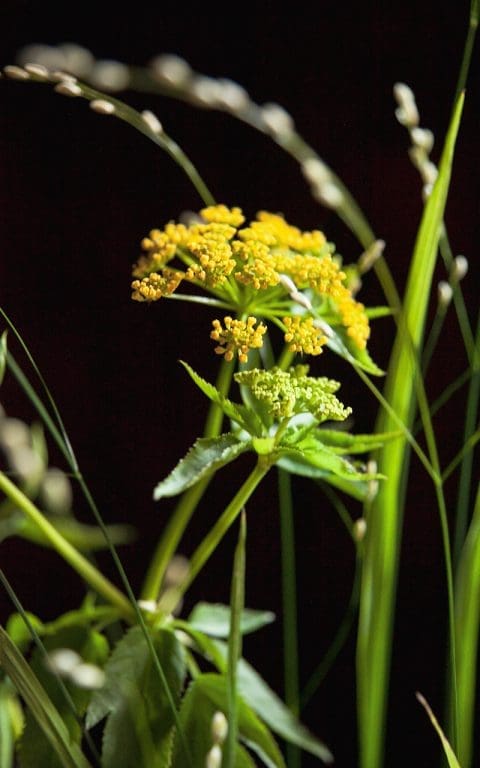
I combined this delicate umbellifer with scarlet Tulipa sprengeri in my Chelsea Flower Show garden in 2015, planted in wildflower turf to the edges of the Trout Stream. I am sure that in real-life our mild, damp winters would not allow it to grow in grassland here. Where prairie grasslands become completely dormant in cold American winters, our grasses continue to grow off-season and choke perennials that are not adapted to our plant community. In the garden I have teamed it with Aquilegia longissima and the beautiful Melica altissima ‘Alba’ which is happy in relaxed company and dances in the slightest breeze, the flowers pale, silvery and shimmering.
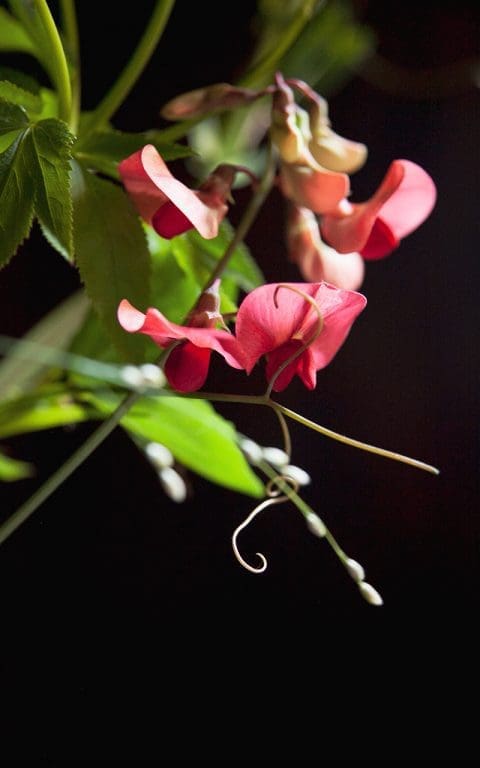
Last in the bunch is Lathyrus rotundifolius, the Everlasting Persian pea. Hailing from Turkey, but equally happy in our damper climate, it is up early and has already clambered to the top of a twiggy hazel support. My solitary plant is too far back in the bed to be appreciated so, rather than attempt to move it, I saved seed which was sown last autumn and germinated in the cold frame before the onset of winter.
As with sweet peas, which always make a better plant from an autumn sowing, I have a clutch of healthy young plants which will be found a home in the garden where I can get closer to admire their delicacy. Although it is without perfume, this pea is a treasure and being light of growth they make good companions. They will probably combine well with the tree peonies which, once they are over, will benefit from the patter and smattering of their brick red flower. I can see them now, trialled and tested for colour in this posy, making equally good bedfellows in the garden.
Words: Dan Pearson / Flowers & Photographs: Huw Morgan
Published 11 May 2019
We are sorry but the page you are looking for does not exist. You could return to the homepage