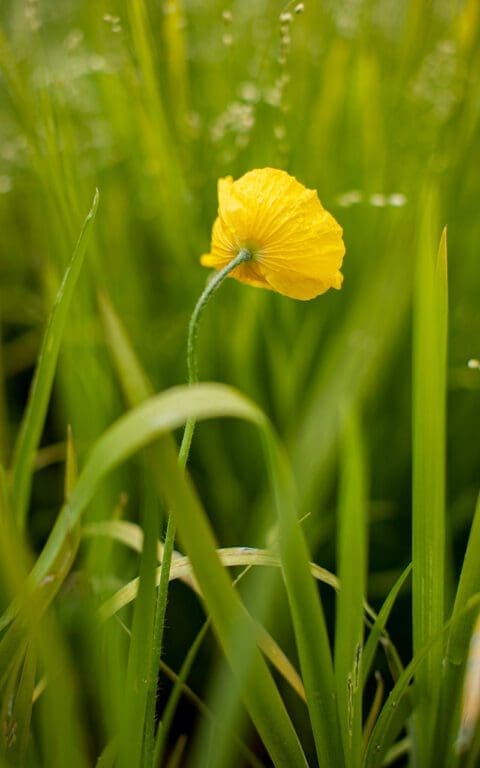
Bright as sunlight and illuminating these wet, windswept days, the Welsh poppies are dancing down the steps. This is their way, seeding into cracks and crevices and taking advantage of any window of opportunity. This is usually in bare ground but, being adaptable, it could also be in the centre of a later-to-emerge perennial. The seedlings, which are happy in cool shade, take the initiative, sending down a sturdy taproot and then bolting up unexpectedly the following year without you so much as noticing.
This is how they arrived here, as stowaways in the ark of plants that I brought with me from the Peckham garden. Probably wedged in the roots of the Molly-the-witch peonies or amongst the hellebores which, in turn, hitched a ride in the plants that I brought with me from Home Farm years before. Now that I cast my mind back, hopping and skipping from one garden to the other, I can trace them back to a trip I made to the Picos de Europa in northern Spain when I was in my early twenties. They were a highlight on the way there, growing with wild goat’s beard and Mourning Widow geranium on the cool, shaded side of the Pyrenees. Their bright, gold flowers were the reason we stopped and climbed amongst the rocks to see where they grew and with what companions. Beguiled, the seedpod I slipped into my pocket marked the beginning of their journey here.

Meconopsis cambrica is wide-spread in upland areas of Western Europe and appears here in south west England, parts of Ireland and Wales, hence our common name the Welsh Poppy. Though in the wild you will find it, as I did, in the cool crevices of rocky places, a garden setting can emulate these conditions readily. So readily sometimes that you have to be careful where you let it seed. One plant that I couldn’t bring myself to remove that had found its way into a crack in the concrete in my growing area behind the barns has seeded repeatedly into the trays of seedlings and pots nearby. This is how many of our plants have found their way into the garden.
Being thoroughly perennial and happy to find a niche, their spring to early summer flower is welcome now before the garden gets into full swing. From bright green, ferny foliage the fine yet sturdy stems rise and stand free in their own space. The hairy cases are cast aside as the buds tilt upright to reveal the crinkle of bright petals. Each flower lasts just a day or two, but there is a relay of buds that will throw colour for quite some time. The secret to keeping them within bounds is to cut them back, leaves and all before they seed. A second refreshed crop of foliage and sometimes flower will return and these are usually the plants that catch you out to throw their seed when your eye is then firmly set on the summer.
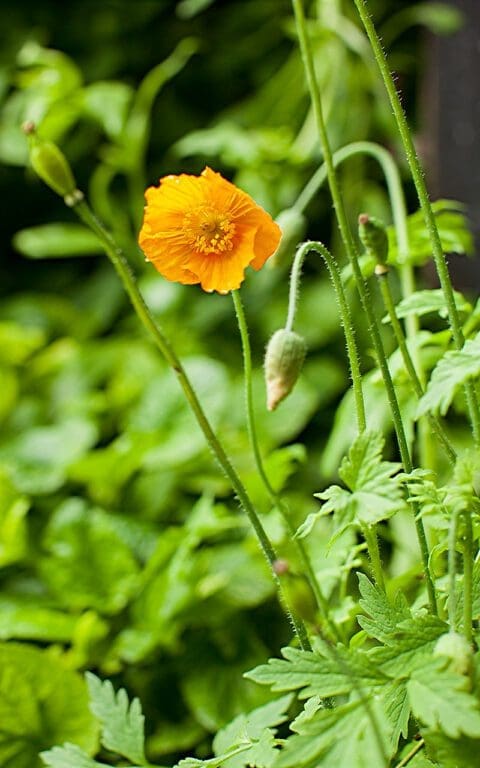
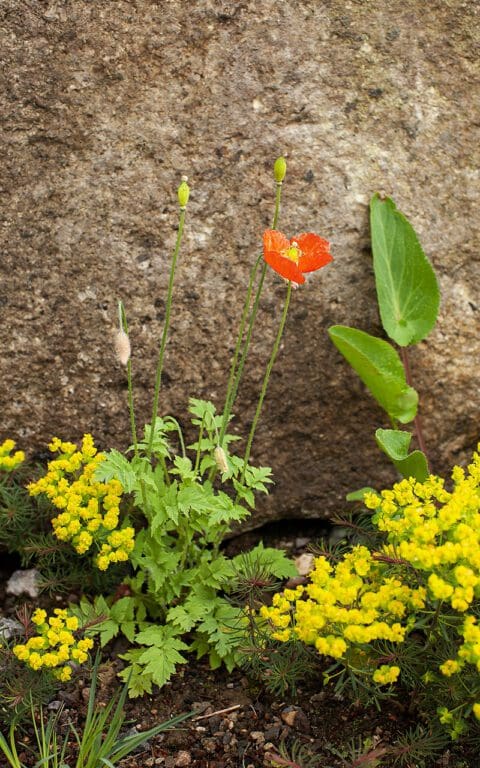
We have a naturally occurring soft orange form that I’ve let run on the other side of the barns, but I do not want it to pollute the pure chrome yellow of those that enliven the garden. Away from both, by the trough in the milking barn yard, I am building up a colony of the variety ‘Frances Perry’. Though more diminutive in stature, the dark tangerine flowers are quite my favourite thing of the moment. Flowering for a month to six weeks they coincide with the acid green of Euphorbia cyparissias ‘Fens Ruby’. Opposites on the colour wheel which vibrate one against the other.
Apparently, this form is less profligate as a self-seeder, but my pot of seedlings that were sown when ripe last summer and overwintered so they got the frost are looking like they are far from difficult. Difficult is not a word I would apply to the Welsh Poppy which, if it decides it likes you, will probably be with you for the long haul. Here and there and, if you are not a little careful, everywhere there is a cool corner and opportunity.
Words: Dan Pearson | Photographs: Huw Morgan
Published 22 May 2021
This week has seen a quantum shift happen all around us. The crab apples in full sail like cumulo nimbus and the meadows flashing chrome-yellow as the buttercups push above the sward. The lane has suddenly narrowed with the cow parsley rising up and racing to flower. It is that moment we have been waiting for, the ground wet again from rain, warmth finally in the sun and growth with no excuse but to burgeon.
The lanes here are miraculous for a fortnight. Walk them in the morning and the verges reach out to touch you, dripping from the night before and spangled with starry speedwell, stitchwort and the first pinpricks of campion. All suspended in an extraordinary moment of aptly named ‘Queen Anne’s Lace’. Fresh and reaching and smelling of newness this interlude between spring and summer is dashed by the local farmer who brings out the flail to raze the cow parsley as it comes into full bloom. It taints the milk he says, but since he no longer droves the cows along the lane I think it is more about order and control. The carnage makes me smart. He doesn’t touch the verge on our side – rules are rules – which we leave long and unkempt and brushing the windscreens.
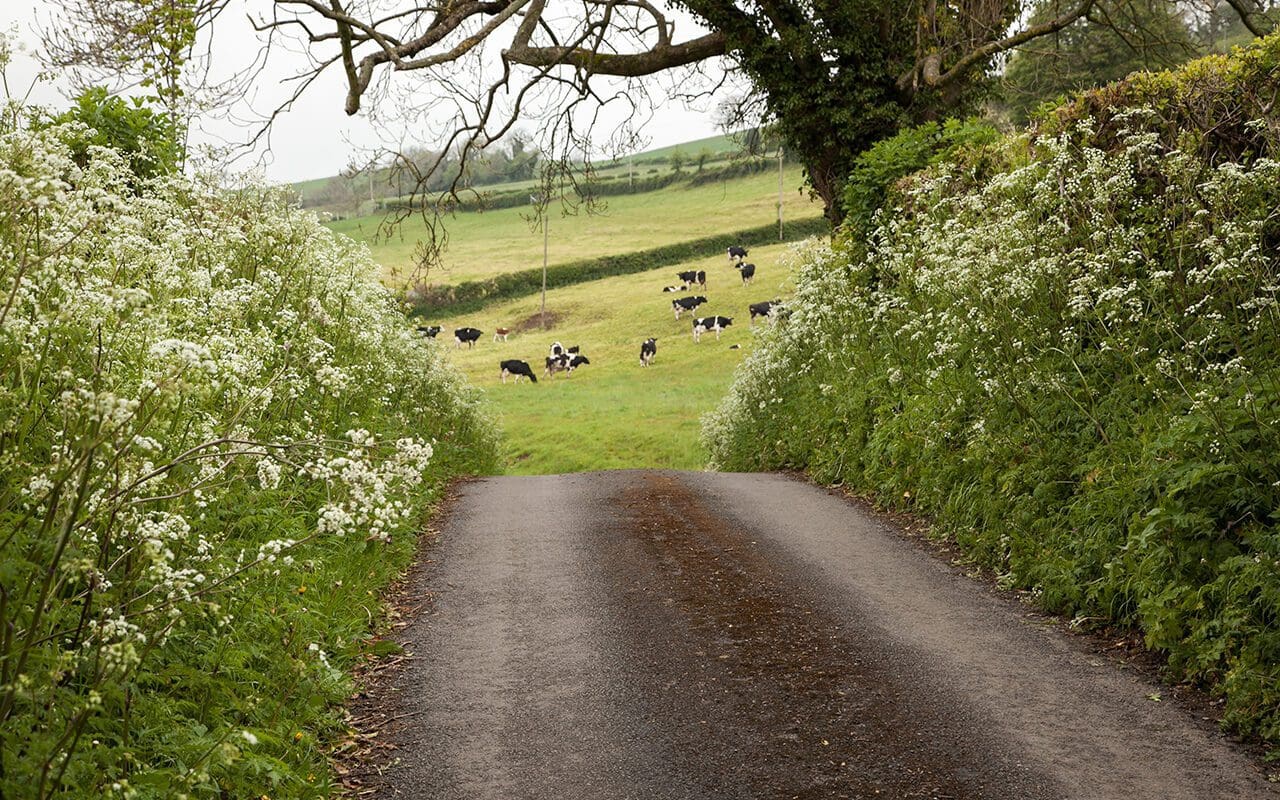
I have invited the cow parsley into the garden in its cultivated form Anthriscus sylvestris ‘Raven’s Wing’. Darker for the contrast of pale flower as they begin to expand and lace, I watch the new growth closely from the moment it begins to muster. This is usually just as the snowdrops fade and you become ready for something new. The filigree newness of ‘Raven’s Wing’ shows its true colours early and the best of the seedlings are dark from the moment they produce the first true leaves. Our lane-side population have their influence though and many seedlings begin their reversion back to type, turning first chocolatey instead of the deep plum purple and then green. The early vigil to winkle out the plants that revert is important so that I am marking the difference between the hedgerows and the garden proper. An echo of our surroundings, a segue and a gentle transition between the wild and the cultivated.
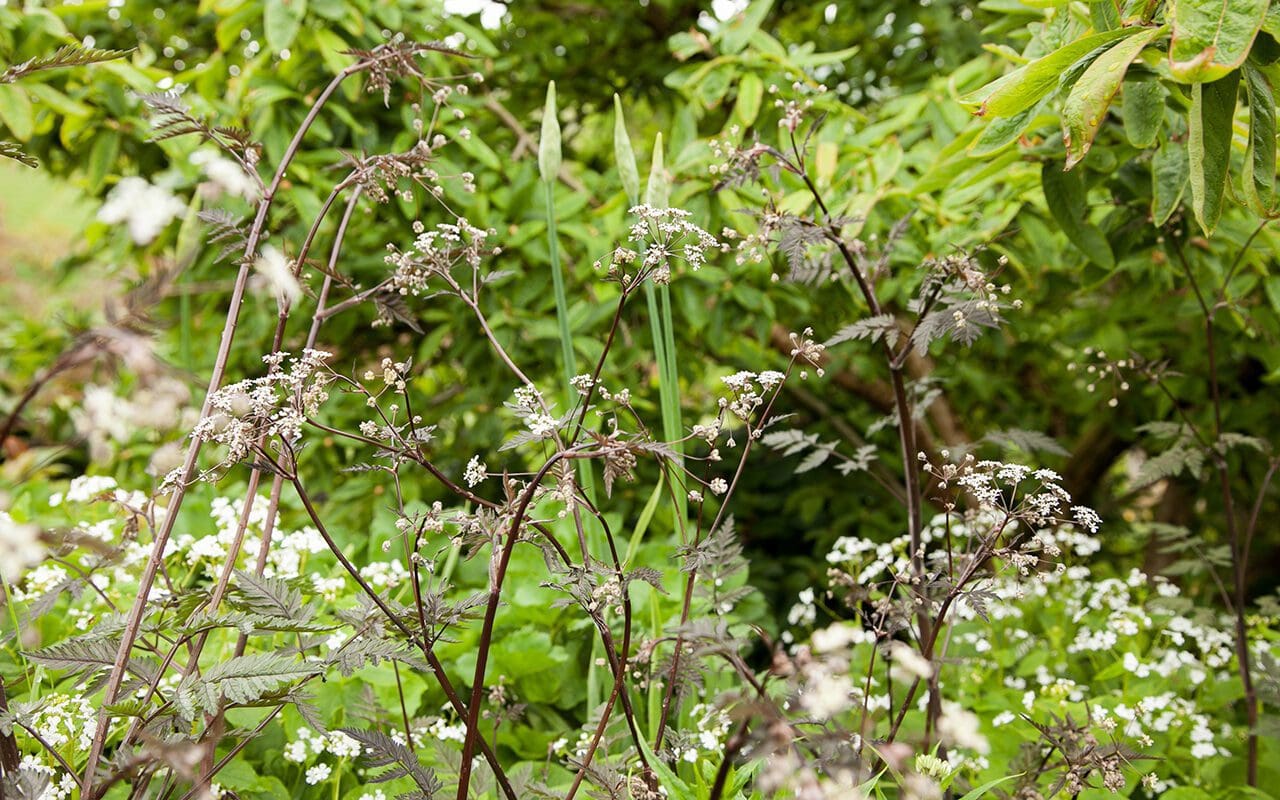
Derry Watkins has a darker version named Anthriscus sylvestris ‘Dial Park’, which I will try here too because cow parsley goes with almost anything. Go to Great Dixter at this particular zenith in a fortnight and you will see how extraordinary it is where Fergus has invited the wild form into the borders. I have to exercise control here, leaving just a single plant, the best of the dark-leaved forms to seed where I want the lace amongst slower-to-rise perennials. The majority are cut as soon as I see the seed ripening, since they are profligate seeders. Being hedgerow plants anthriscus are as happy in sun as they are in shade and use their tolerance of the latter to take their time under the cover of summer growth to send down taproots into the crowns of plants you’d rather they didn’t. Their early growth can be the undoing of a later-to-rise aster or sun-loving iris or nerine.
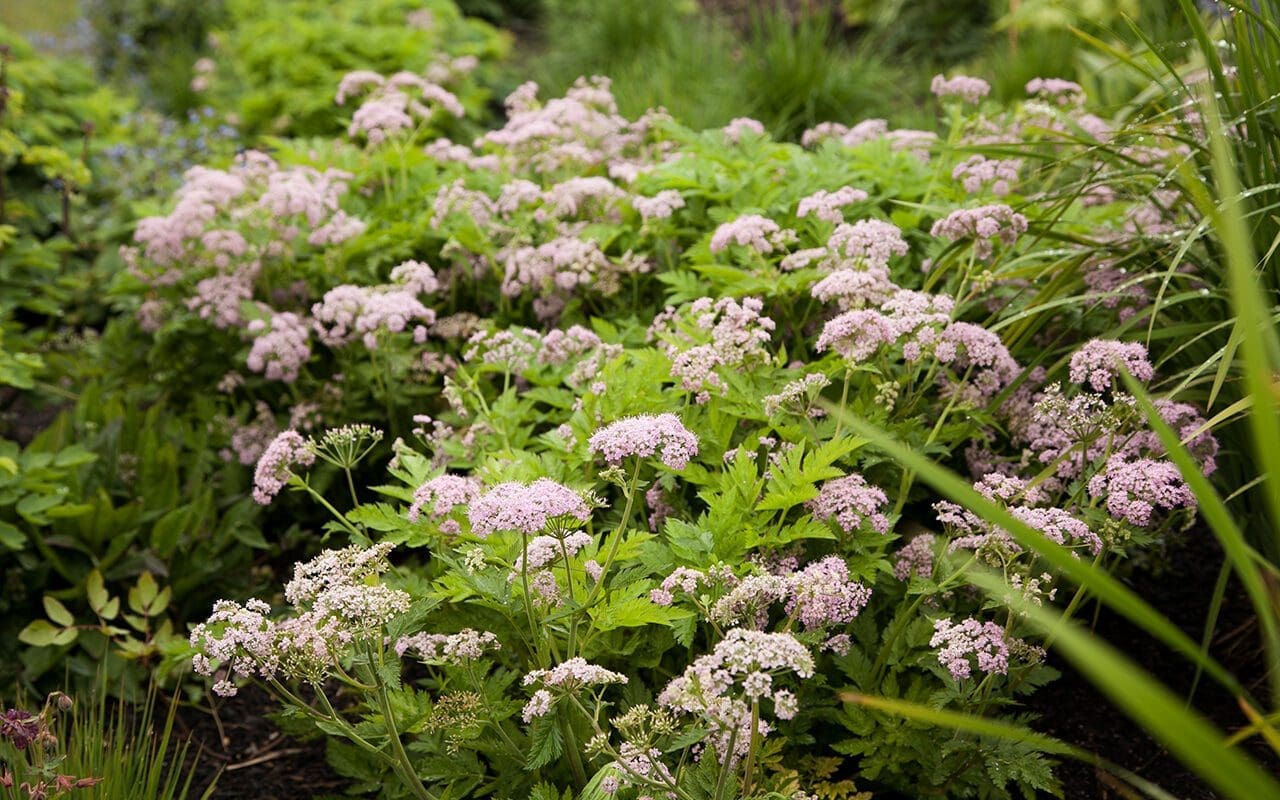
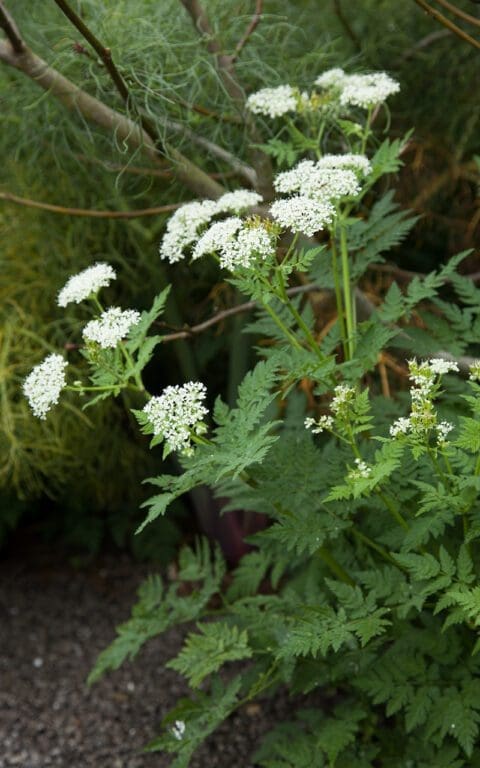
Cow parsley, also known as wild chervil, opens the season of umbellifers here and the laciness of the umbels is something I love and include for their loftiness and suspension. Chaerophyllum hirsutum ‘Roseum’ is already in flower too, a pink form of Hairy Chervil with a flowering season of about a month. The flowers start low and on a level with brunnera, but rise up to hip height to accompany the first of the Iris sibirica. Another related umbellifer which flowers at the same time is Myrrhis odorata. Before sugar was freely available the leaf and seed of Sweet Cicely were used to sweeten cakes. We have it here in the herb garden, where it is happy in the shadows of the Afghan fig and giant fennels. Its filigree of aromatic early growth is good beneath plants that take over later, but if you are not to have a thousand seedlings it is best to remove the seed heads once you have enjoyed them green and before they start to drop and conquer all they survey.
Words: Dan Pearson | Photographs: Huw Morgan
Published 15 May 2021
The spring this year has been slow. A wet winter finally giving way at the end of February to a long and testing period without rain. This came with a relenting fortnight of frosts that saw us fleecing the wall-trained fruit nightly and praying for the plum orchard, which at the time was in full and vulnerable flower. It has been too cold to direct sow in the kitchen garden and the self-sowers, which I like here to make the garden feel lived-in, are looking sparse, the seedlings dwindling without the water in the top layer of soil in this critical period.
We knew the garden would find the water with well-established roots searching it out, but new growth needs rain and it began to show it in tardiness and a reluctance to get out of the blocks. This spring we have pined for the burgeoning that is so much part of an April landscape.
Cue the tulips which, although slower to appear than usual, have sailed through unscathed and oblivious. Miraculous for their ability to cover for the pause between the narcissus waning and the cow parsley filling the hedgerows, we would not be without their impeccable timing.
Despite the hiatus in the garden and their ability to plug the gap, I have deferred from including tulips there due to their immediately ornamental nature. Preferring the slow unravelling of greens against our rural backdrop, we have, instead, grown the tulips in the kitchen garden for picking where, in this productive setting, their flamboyance can sing and not shout.
It was on a trip to see the Dutch bulb fields while a student at Kew that I first saw tulips jumbled together en masse. They were in an old orchard at the back of a bulb farm where the spares had been thrown and provided (for me at least, desperate for naturalism) a relief from the rigour of the regimented rows in the fields. It was an unforgettable sight. Free and liberated and multi-layered with colour and juxtaposition of forms. We grow them together here in homage to that memory and to ease the tulips’ innate formality.
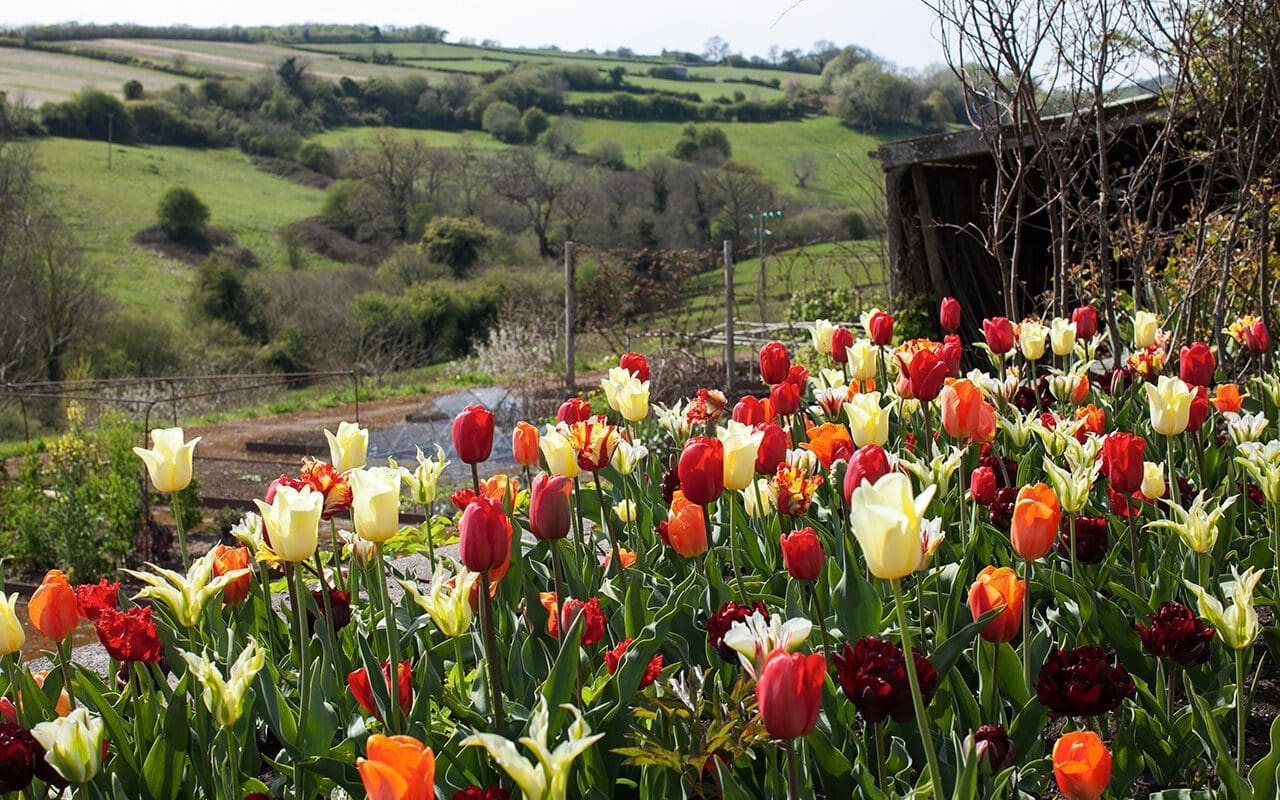
Each year we put together a collection that explores a particular colourway using early, mid-season and late varieties so that we have a month to six weeks of flower. Thirty of each and usually ten varieties planted randomly about 6” apart in November. We move the tulips from bed to bed so that they appear in a different place in the kitchen garden to avoid Tulip Fire, which builds up if you replant the tulips in the same ground repeatedly. A five to seven-year cycle means that the fungal disease goes without its host and, by the time they return to their original position, the ground should be ‘clean’ and ready to receive them again.
The annual selection sees us experimenting with new varieties, and returning to old ones that we favour. Inevitably, because one tulip bulb looks roughly like another, we curse the bulb suppliers who substitute one or two without letting us know so that there are some wild surprises. This would matter if you were planting them into a scheme, but it rarely matters in the mix and sometimes throws up an oddly welcome guest.
After ten years of enjoying growing the tulips in the knowledge that they provide us with a guaranteed respite after winter and a kickstart in spring, we are beginning to feel less easy about their disposability. We are particular here about reusing what we can and not more than we need and it goes against the grain to discard the bulbs, because we don’t have the room to keep them. So, a new place, which will be our equivalent of the Dutch orchard, will be found by the polytunnel for the bulbs to have another life and show us which ones have the potential to be recurring in our heavy, winter-wet ground. This may take some time, but it feels the right time to apply this rigour.
In the search for varieties that do well year after year, we are going to try a few in the garden, but only close to the buildings and used very sparingly so that they do not compete for attention. They will be worked in amongst the volume of the Paeonia delavayi at the garden’s entrance, so that the early flower coincides with the unfurling plum foliage of the tree peonies. We are referring back to our 2019 selection that focused on dark reds and plums. The moodiness of the almost brown ‘Continental’ and the glowing cardinal red of ‘National Velvet’ will sit well here. We will let you know next year how the association fairs amongst the peonies.
In order of flowering our selection was as follows:
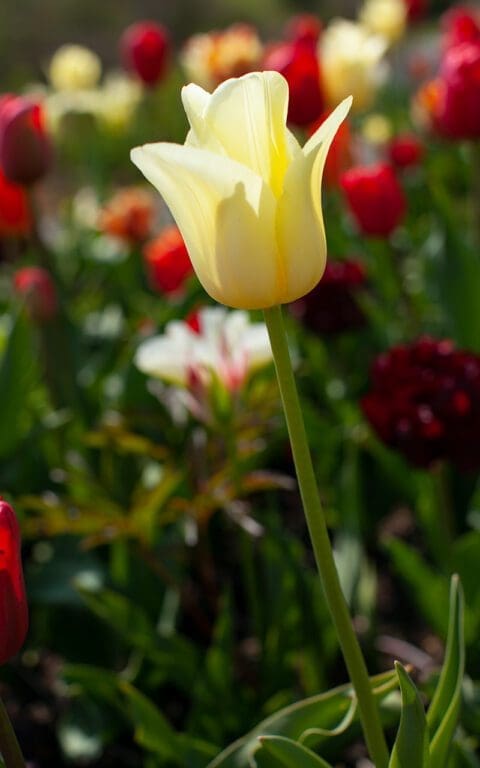
First to flower in early April and with a long season of over a month. Tall, straight stems. Uncommon shade of lemon sorbet yellow. Widely listed as growing to 40cm, we found it to be one of the tallest at 55-60cm.
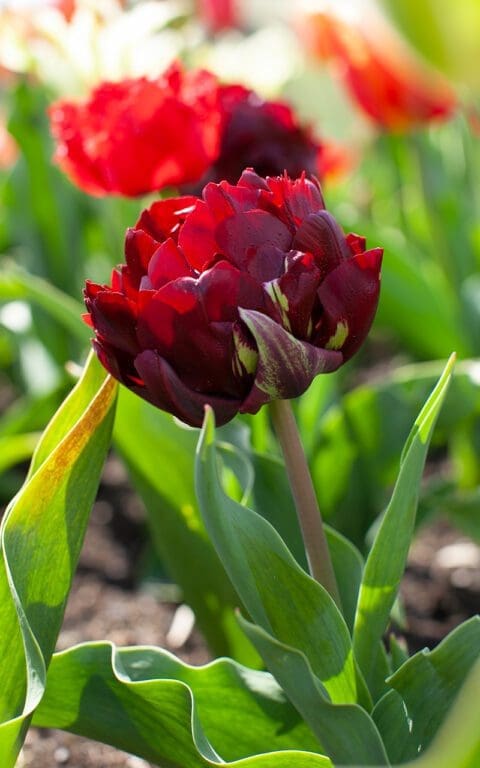
Difficult in a garden setting as the flower is so out of scale with the stem length, for cutting this wine-dark tulip is rich and lustrous. Almost as good as the peonies it precedes. Long flowering season. The shortest for us at 30cm, although listed at 45cm.
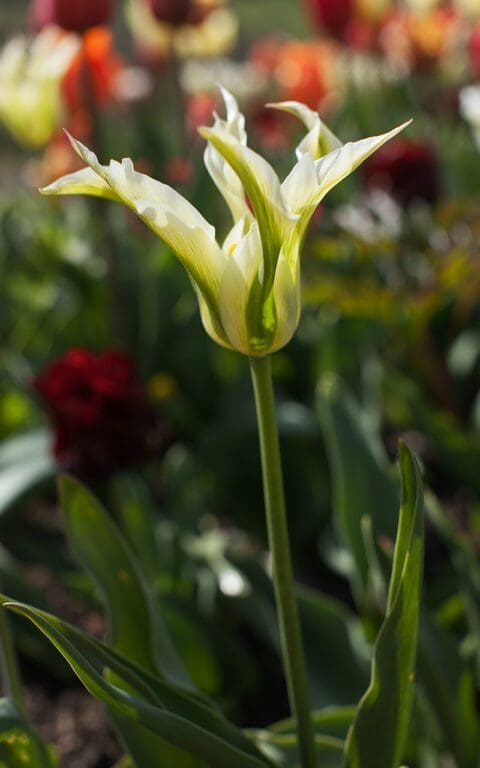
Opening primrose yellow with dramatic green flaming this lily-flowered tulip fades to cream and twists extravagantly as it ages. 40cm.
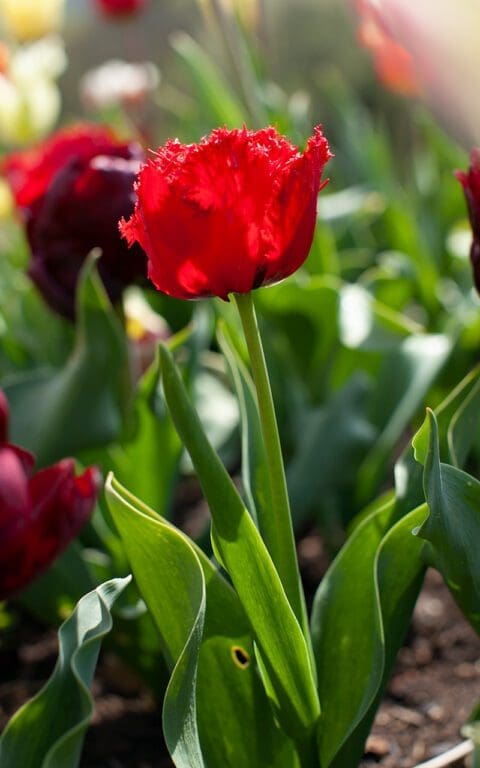
Another diminutive tulip better suited to a pot. A boxy shape we were not so keen on and a rather violent shade of scarlet in the garden. This mellows when cut and brought indoors though, where the exaggerated fringing and black eye can also be seen to best advantage. 30cm.
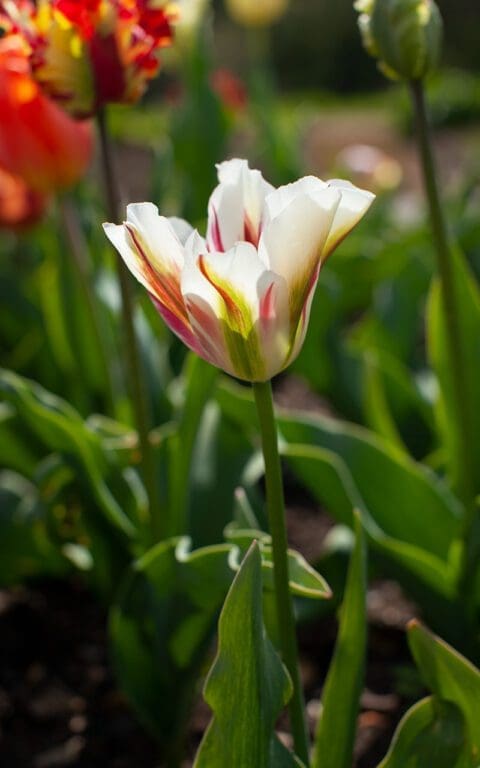
Delightfully elegant Viridiflora tulip with green flaming on gently waved petals of off-white, broadly streaked with raspberry red. 45cm.

Similar in colour to ‘Orange Sun’ which we have grown before, this Darwin tulip is taller and more elegant. The pure, citrus orange flowers have a satin sheen and a clear yellow centre, which is shown when the flower opens in sunshine. 50cm.

A more sombre shade of burnt orange which is accentuated by the matt petals, which age to faded apricot-gold at the margins. Deliciously sherbet-scented. For us this was the shortest lived at just two weeks. 45cm.
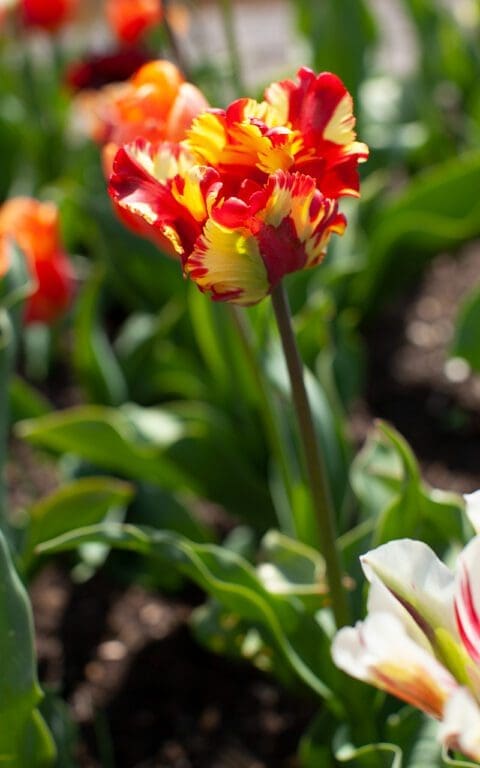
The court jester of parrot tulips. The flaming of primary red and yellow is utterly joyful. The yellow fades to a more subdued clotted cream as they age. 50cm.

Late and tall this tulip has huge flowers the size of a goose egg in a rich shade of deep crimson. With sturdy, ramrod straight stems it is ideal for a windy site such as ours or for picking. 55-60cm
The scarlet lily-flowered tulip in the main image is ‘Red Shine’, which we grew last year and would seem to be a good contender for perennial flowering.
Words: Dan Pearson | Photographs & captions: Huw Morgan
Published 8 May 2021
The poplars are the litmus. Standing tall and forming our backdrop, grey in all their parts and also in name, their ghostly stillness will let us know that spring is here when suddenly one day their catkins are caught by new light. That early, the wild garlic at their feet has already emerged to carpet the ground, shiny and lush and rushing whilst the wood is still open. Then, as spring gathers pace and the understory of hawthorn becomes green, the trees above assume their next chapter.
The last week of April this year is the moment you wish you could stall, the buds on the poplars breaking open in unison to shower the trees and once again define the extent of the of their canopies. You have to stop. Against a thunderous April sky, it is almost impossible to describe the colour, a mat aluminium. Chalky and luminous. Caught in the low evening light and with breeze in their limbs this backdrop is mercurial. Plumes of silvery ink dropped into water, shoals of fish; the mind tries to grapple for an image to describe the moment.
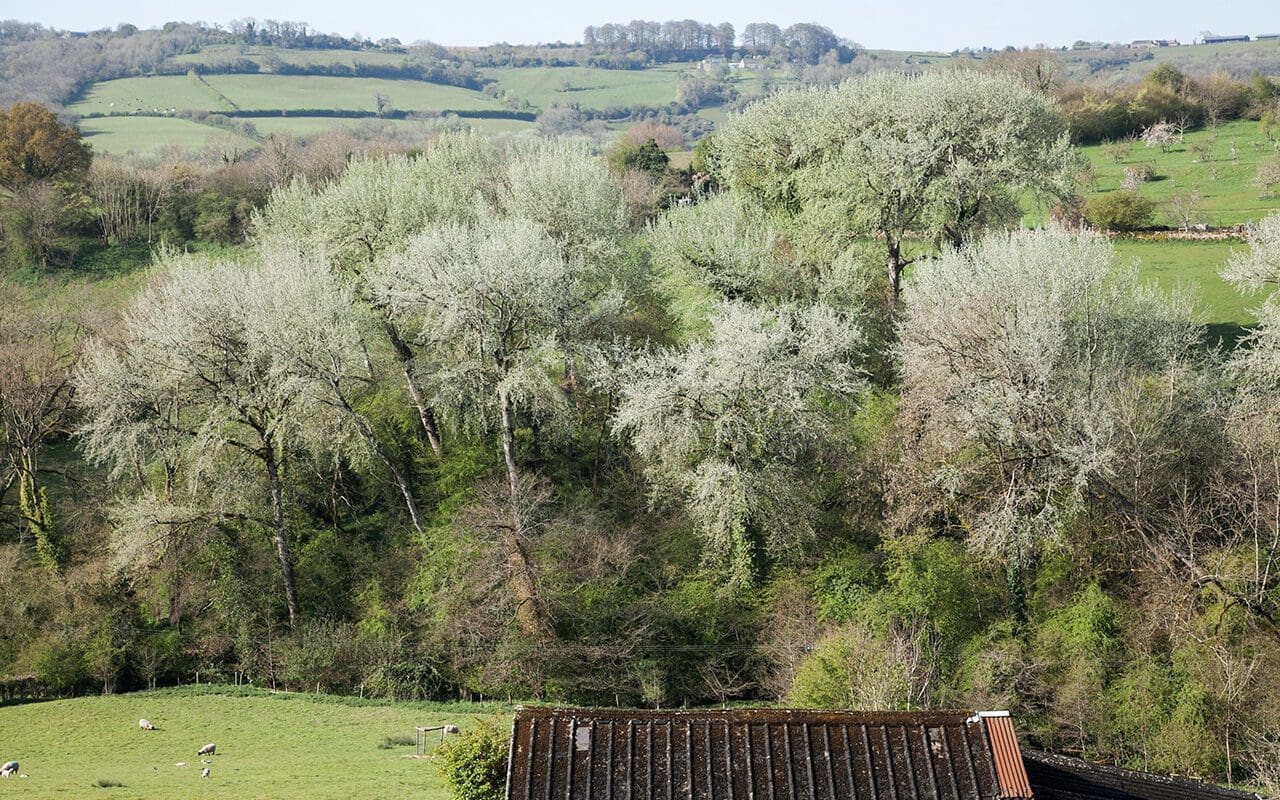

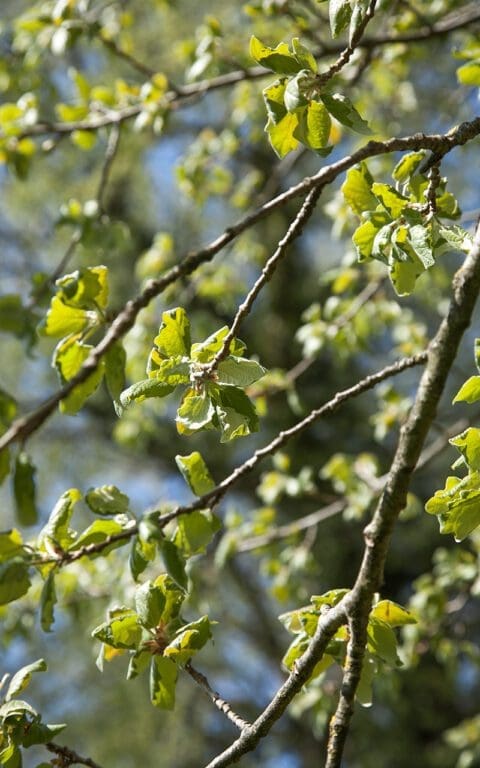
The truth is, the poplars are just doing their thing, at scale and in unison and marking a particular shift that we know now will take us rapidly through into early summer. One day the silveriness is sage-green and the leaves fill to tremble and hiss on the wind. With the unfurling, the now-flowering garlic is plunged into shadow, the bright white briefly brilliant, the wood smelling never more strongly as the understorey runs to seed.
The Grey Poplar, Populus x canescens, is a naturally occurring hybrid between the White Poplar, P. alba and the Aspen, P. tremula. The silver in the leaf from one parent and the flattened petiole from the other which allows the leaf to tremble and means that the poplars are rarely still in summer. Soaring with hybrid vigour to 30 metres they are loftier than either parent. They sucker up the hill and out into the light of the slopes to the other side and to date have not crossed the stream in their reach to conquer new ground. Living fast and outreaching themselves they do come crashing down, usually in full leaf and after an August rain. Once at night and just to the side of a camping party we were having on the bottom field by the stream. Everyone slept through it and came out unscathed. Another time one fell to take out the power lines which cracked and whipped like a snake in a snare.
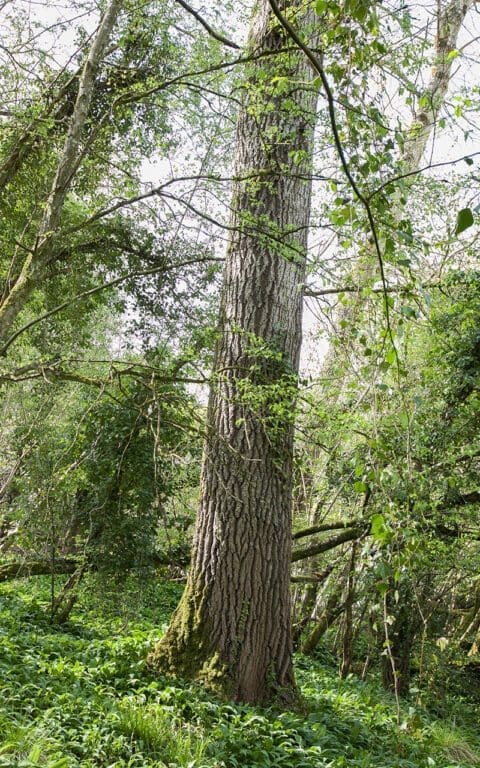
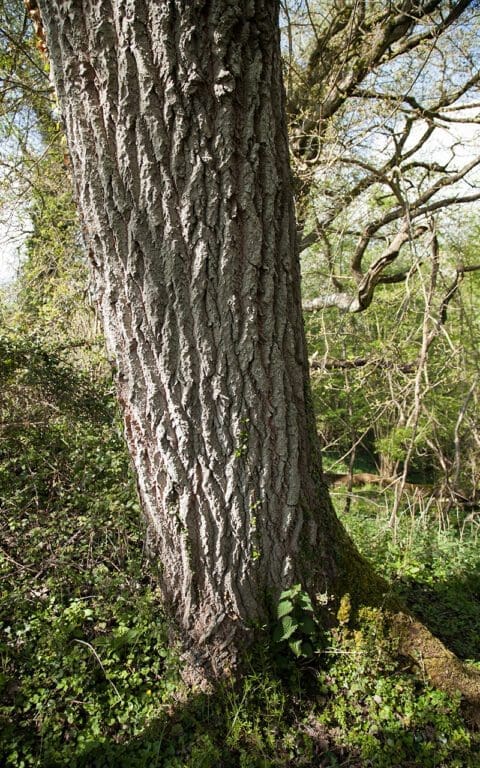

In the time we have been here there have now been three that have fallen. After they have been limbed for firewood, we have left the trunks as makeshift walk-the-plank bridges. A wild bee colony has taken up residence in the “party tree’, the first to topple ten years ago. We are pleased not to have been too hasty to clear and to tidy completely and it will be interesting to see how long it will be before the bridges collapse under their own weight and decomposition. Poplar wood, traditionally used for panelling rooms and for workshop floors, absorbs both the sound and the blow of a tool to protect it from breaking if it is dropped. It is a soft wood and as it burns hot and fast when it is dry, it is also used for matches. Maybe the bees have already found the fault in the trunk that will bring the first of the bridges down.
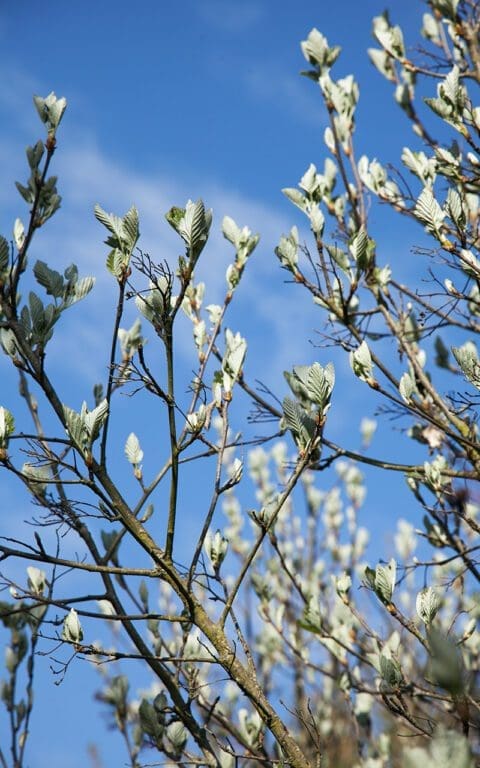
At altogether another scale and entirely more manageable, I planted the whitebeam, or what I believed to be whitebeam in the blossom wood to take the silver up onto our side. Sorbus aria also has a delectable moment which is no more than a week of awakening. The leaf buds light the tree silver before it dims to a pleasantly grey-green. Unbeknownst to me the whips I was supplied with were the Swedish Whitebeam, Sorbus x intermedia. A wonderful tree for a seaside setting or an exposed site, but here it is already being left behind as the Geans and the faster growing trees in the blossom wood outstrip it. No matter. We will enjoy the mistake whilst it lasts as we do the awakening of the poplars when they are in their moment.
Words: Dan Pearson | Photographs: Huw Morgan
Published 1 May 2021
We put the terracotta forcers over the crowns of ‘Timperley Early’ at the end of January and over the variety named ‘Champagne’ at the end of March, although it probably should have been a little earlier. Despite the fact that the ‘Timperley Early’ would have been good weeks ago, there has a lot been going on in life and we just haven’t had time to pick it. The stems and emerging foliage of both have now pushed the lids off the forcers and exposure to light has been threatening to undo all of the good that forcing does for vibrancy of colour and flavour. Consequently, we have a rhubarb glut and, with plenty already cooked and in the freezer, part of my recipe challenge for this week was to answer the repeating question, ‘So, what else can you do with rhubarb?’.
When I scrolled past a mouthwatering image of Diana Henry’s Luscious Lemon Bars (thickened lemon curd on a shortcake base) on Instagram last week I thought they would adapt well to the sourness of rhubarb and so compared a number of different recipes to get a feel for proportions before alighting on one which sounded simple, foolproof and delicious. I made a couple of adjustments, substituting ground almonds for some flour in the shortbread base and replaced the flour in the custard topping with cornflour. All of the other ingredients, proportions and cooking method were as per the original recipe.

On Thursday, in between ferrying aubergines, peppers and chillis to the polytunnel, watering everything in pots, and doing anything requiring the pair of hands that we’ve been missing after Dan’s hand surgery last week, I managed to get a tray of these luscious rhubarb bars into the oven. Except that is not what came out. Through the mysterious alchemy and chemistry of cooking what emerged was something completely different. A layer of buttery, crumble topping above a firm custard with a thin layer of jammy rhubarb in the middle. Though delicious they were not what I had imagined and clearly needed more work to produce what I had in mind.
In the knowledge that cooking, photographing and writing a recipe in one day is already quite a tall order, I had to come up with another rhubarb recipe overnight. I thought, ‘Keep it simple.’ and stuck with rhubarb curd instead. No baking, just measuring and stirring.
After consulting books and websites I decided to adapt a familiar recipe I have cooked many times, substituting rhubarb juice for orange in Sam & Sam Clark’s curd recipe for Seville orange tart.
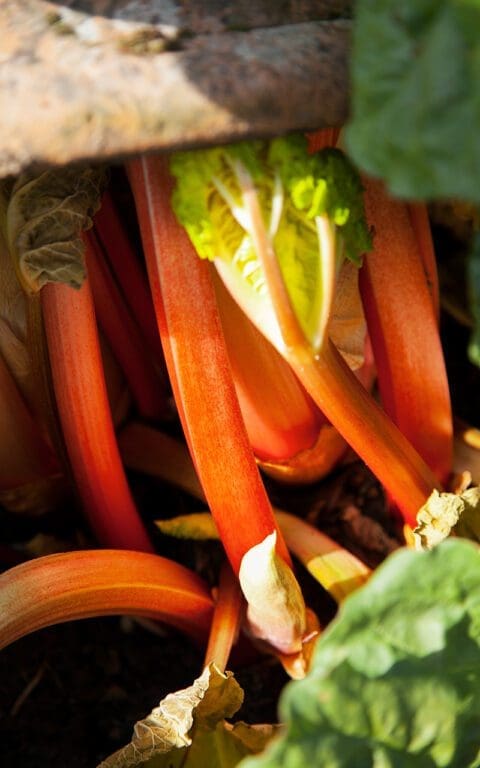
I finally settled down to cooking in the late morning and immediately the contemplative focus of cooking calmed my busy mind. The simplicity of just four ingredients and one pan. The repetition and order of cracking and separating eggs, cutting butter into cubes, weighing out sugar and measuring rhubarb juice. And then the close attention required to cook it carefully to ensure that the eggs don’t curdle.
It took over half an hour for the curd to start to thicken over the lowest heat possible and as, I stood there in the warmth of the range intently stirring, completely focussed on the activity before me, my mind went into the entranced meditative freefall that cooking shares with gardening.
Makes around 2 x 200ml jars
140g caster sugar
170ml rhubarb juice (see below)*
170g unsalted butter, cubed
4 large egg yolks
2 large eggs
*The rhubarb juice in this recipe is a by-product of rhubarb poached to go into the freezer. Around 500g of rhubarb should give you enough juice for this recipe. Cut the rhubarb into short lengths. Put them into a non-reactive pan with a tight-fitting lid and put in a medium oven (about 160°C) for around half an hour until soft. Strain off most of juice. Keep in the fridge and use in place of lemon juice or vinegar. It is particularly good in spring salad dressings.
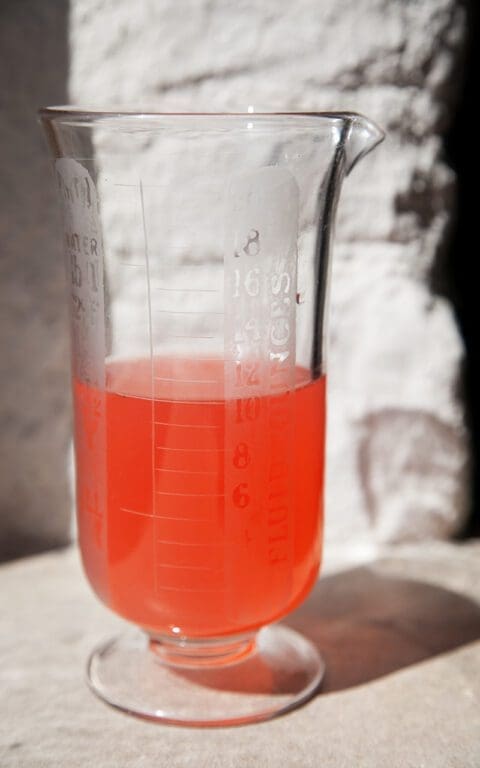
Lightly beat the egg yolks, eggs and sugar together in a medium pan. Add the rhubarb juice and butter.
Put the pan over a very low heat and stir continuously until the butter melts and the mixture starts to emulsify and becomes glossy and thick. Do not be tempted to turn up the heat or it will curdle. Once it attains the consistency of custard pour into warm, dry, sterilised jars. Seal, leave to cool and then refrigerate. Keeps in the fridge for up to two weeks.
The flavour of rhubarb is delicate, so don’t be tempted to add other flavourings to this curd or they will overwhelm it.
Delicious on warm scones, mixed with poached rhubarb and whipped cream or as a filling for a tart base.
Recipe and photographs: Huw Morgan
Published 24 April 2021
This is the fifth spring since Dan oversowed the newly landscaped banks at the front of the house with native meadow seed and now the cowslips (Primula veris) are really starting to show themselves. This year we have counted over fifty individuals on the bank immediately in front of the house.
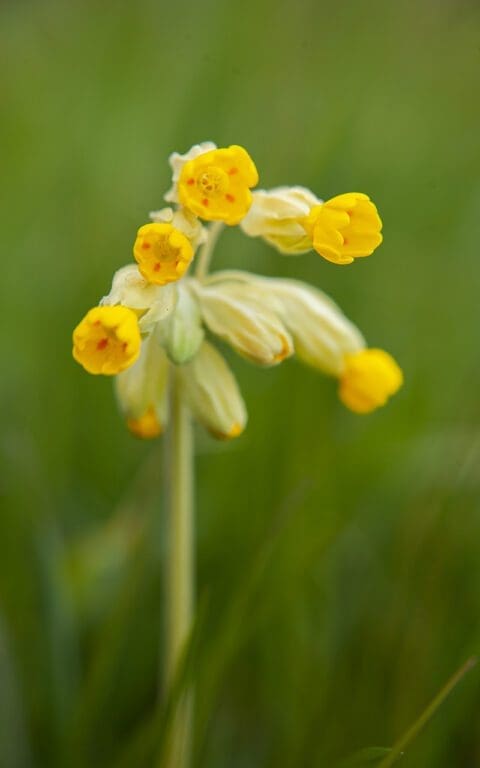
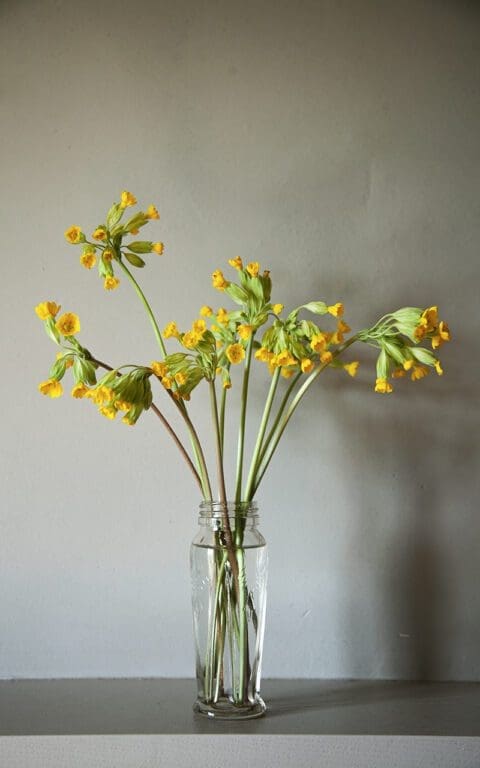
Their luminous, pale green calcyes, like tiny inflated bladders, announced their presence long before the golden flowers unfurled from within them. The sturdy, felted stems rise up from a basal rosette of heavily textured foliage and can hold up to thirty scalloped flowers, each marked with five orange spots, on wire-thin stalks in a loose umbel. Their resemblance to a bunch of keys gives them another common name of Key Flower. They have a notably long season of three to four weeks, as the flowers open in succession in each cluster and with a relay of flowering stems as newer ones rise up to replace those that fade. They come on stream just as their cousins, the primroses, start to dim and so continue to provide early nectar for long-tongued bees, butterflies and moths. I picked some last weekend and they have been unexpectedly long-lasting in a vase and with the most delicious spiced apricot scent. I imagine this perfume is one of the notable attractions of cowslip wine, the romance of which haunts the hedgerows of Thomas Hardy and Laurie Lee.
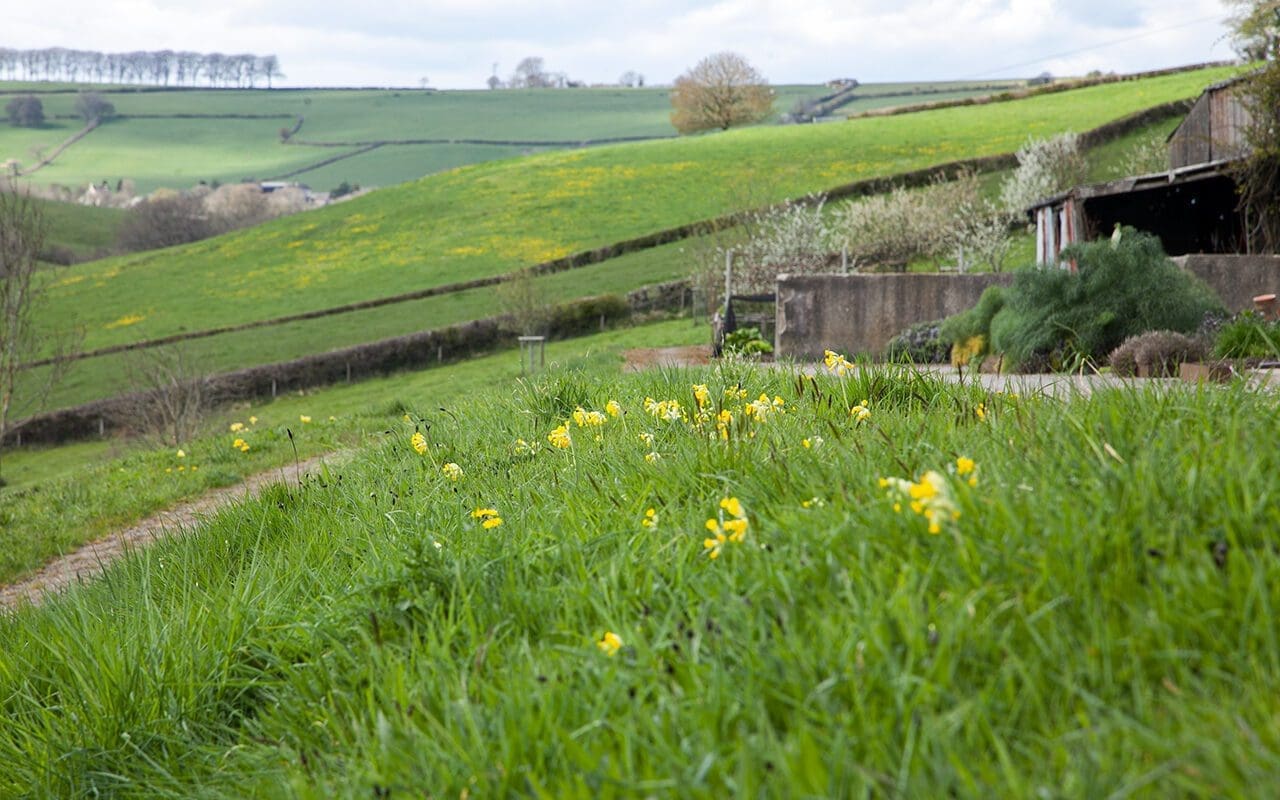
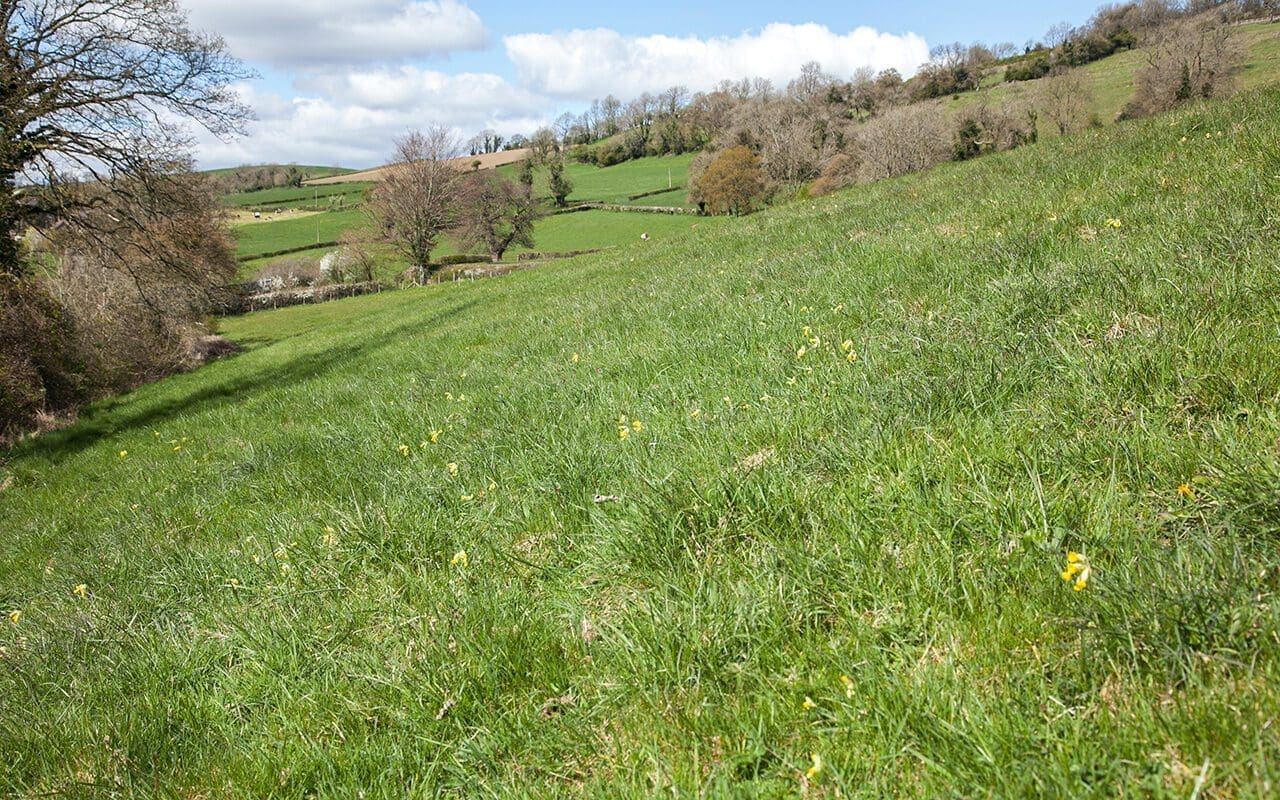
The farmer who lived here before us grazed the fields with cattle, but after we relaxed the grazing regime we were delighted to find that a large colony of cowslips was still intact in the Tynings, the fields that our neighbours call the Hospital Fields. Although the colony has not proliferated quickly we have seen definite evidence of an increase in numbers and the start of an expansion of the main colony. Fine-tuning the mowing and grazing regime to increase the presence of flowering plants such as these is one of our constant challenges.
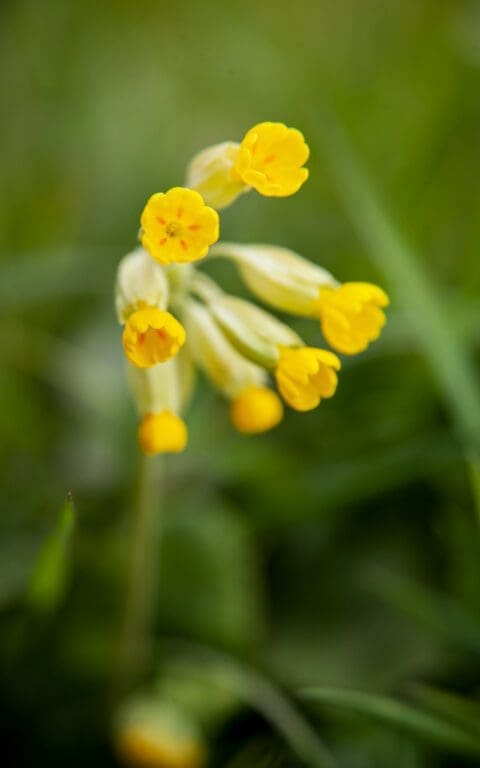
Due to bad agricultural practice in the 1970’s and ‘80’s the cowslip almost became an endangered species, but its inclusion in commercial meadow mixes over the last twenty years and more has seen it make a resurgence on motorway embankments and in new meadow creation schemes.
Plantlife, the British charity that supports native wild plant conservation, is currently running a Cowslip Survey. Cowslips come in two forms, ‘S-Morph’ and ‘L-Morph’. In the former the plural stamens (male) are presented foremost in the corolla, while in the latter form it is the singular stigma (female) that is seen. In healthy cowslip populations there should be around a 50/50 mix of forms, however this gets out of balance if there is a change in agricultural practice, land or habitat management. The survey has been launched to gain a broader understanding of how healthy British cowslip populations are and, consequently, the wider health of our native grasslands. On a cursory visual check today it would appear that our colonies, both new and long-established, are pretty well balanced, but I will definitely be taking a more detailed look for the survey to get a better understanding of how we can maximise the species diversity in our meadows.
Words and photographs: Huw Morgan
Published 17 April 2021
It’s my birthday so today I will be brief. There is a springtime out there to be part of. A moment of guaranteed awakening, coming to life and indecisive weather.
I know this time well. In observations that are marked by fresh growth. Snakeshead fritillaries chequered in shiny new grass, celandines blinking open in sunshine and the gold of marsh marigolds illuminating the wet hollows. The blossom trees billowing. Plums in full sail, pears just breaking and the cherries lighting up the still grey woodland.
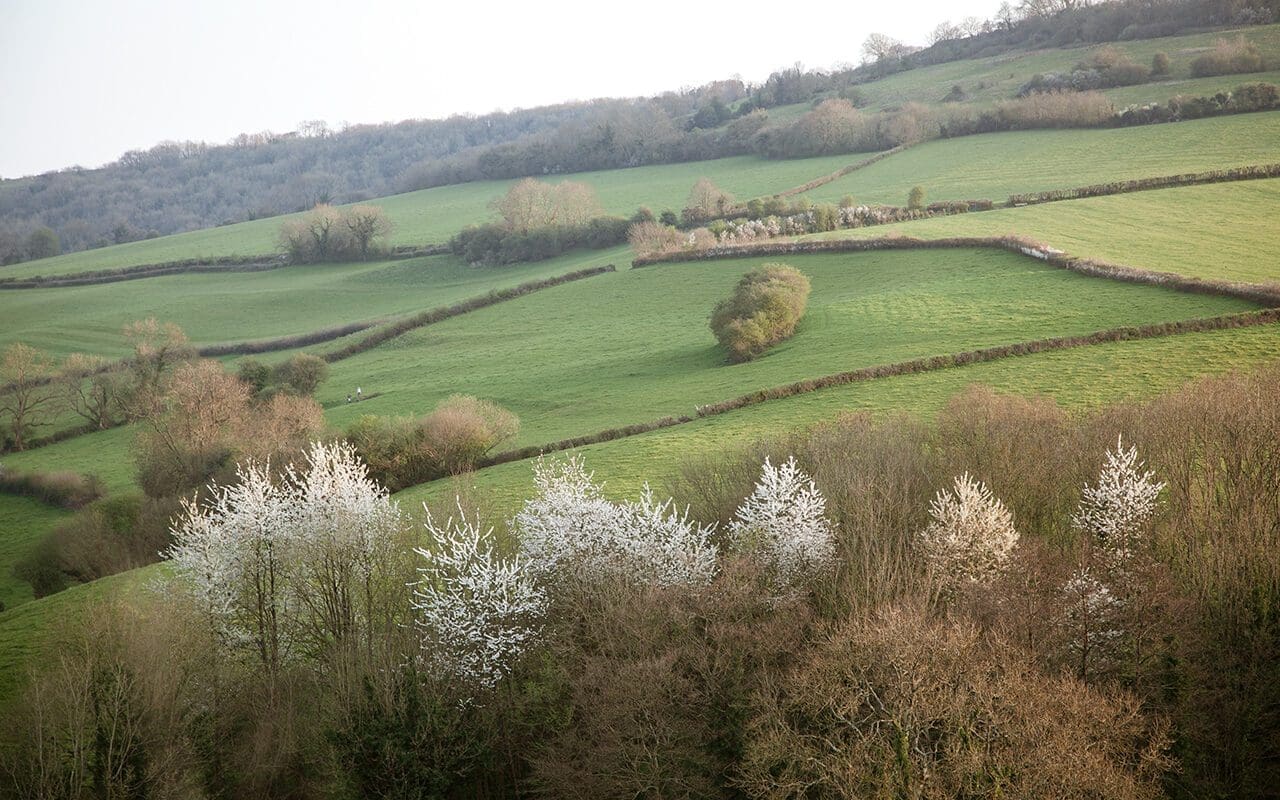
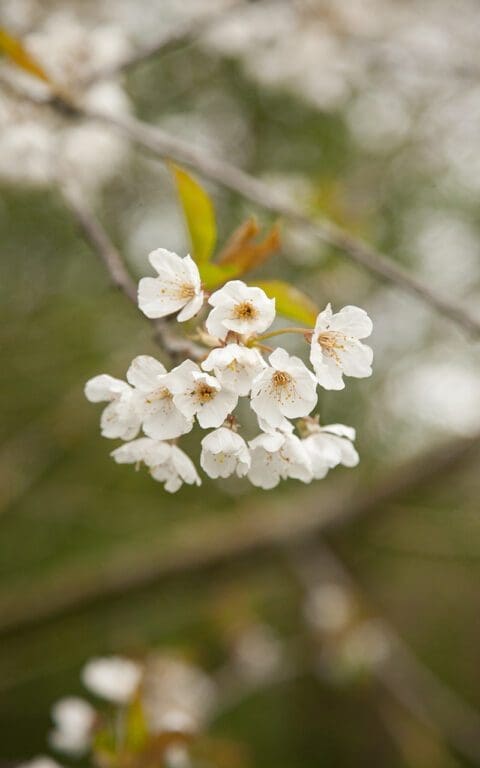
The Sweet Cherry, or Gean or Mazzard (and Massard) is a tree I have a long relationship with. First encountered in my childhood home, where they had outstripped a long-forgotten garden and towered thirty meters high. We would hug their dark, rough and peeling trunks which by that time were seventy years old and leaning rakishly in their last chapter. The dark limbs and roots running widely over the surface and the light above as the flowering branches flushed palest pink bud and then white against often grey skies. They were the first trees to come crashing down as we cleared the garden, our family spending weekends making inroads into the undergrowth. It was as if they sensed the end of an era and they leant down gently in the night. One first, then another following, without a sound or associated drama.
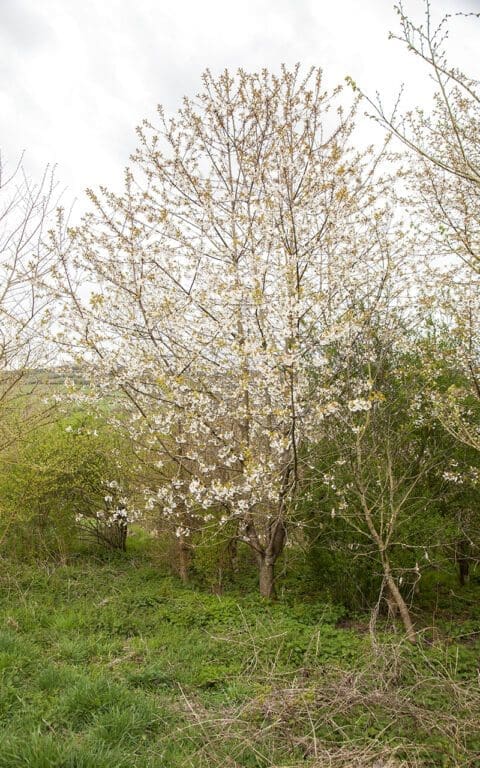
We have them here as a borrowed view down the valley, youthful trees pushing up though the alder woods which line the stream and provide the cherry blossom with a dusky undercurrent of bruised purple. I planted them in the Blossom Wood in our first winter here. Young whips, navel high and easily identified for their richly red bark and promising buds. Living fast and not for much longer than eighty years, they make a quick presence. Growing vigorously up and forming a pyramid of limbs that make their own space before racing skyward to claim an early loftiness in a young wood. Though the double form Prunus avium ‘Plena’ lasts a whole week longer in bloom, the Gean is brief, but no briefer than the plums. A fortnight of expectation as the buds swell and give way to a week or ten days in a cool April.
Following on in early summer, the fruits, held in drupes and often pairs, ripen early. A dark, rich red and tart enough for you to make the mistake of thinking another day will make them sweeter. The birds will get there first if you do and it is the birds that distribute them and give the tree its specific name, Prunus avium. An April wonder.
Words: Dan Pearson | Photographs: Huw Morgan
Published 10 April 2021
Flowers & photograph: Huw Morgan
Published 3 April 2021
It was exactly a year ago, in the first week of lockdown, that we committed to buying a polytunnel. That same week I placed a very late seed order primarily for tomatoes, but some chillis, aubergines and cucumbers came too and we started them off indoors at the end of March. This late start was further compounded by the delayed arrival of the polytunnel itself, so that the seedlings intended for it had to be held back by hardening them off in a makeshift structure of seed trays and pieces of glass, since the cold frames were full. Although they got a little leggy and had to be watched carefully to ensure their 9cm pots did not dry out, they escaped the very late frost we had on May 12th and were finally planted into their grow bags in the first week of June.
This year I sowed the tender veg a full month earlier in late February, starting them off on the airing rack above the kitchen range before moving them to a warm windowsill as soon as they started to germinate. We are always keen to try new varieties and this year, alongside our old favourites ‘Gardener’s Delight’ and ‘Sungold’, I made a selection from Real Seeds based on productivity and hardiness, and also a range from very earlies to lates to see if we can stretch the season and push the tomato harvest into early winter. ‘Amish Paste’ is a heavy-cropping, extra-large preserving tomato, which I am trying instead of ‘San Marzano’, ‘Feo di Rio Gordo’, a deeply ribbed Spanish beefsteak variety that is reputedly very early for its size, while two Ukrainian varieties, ‘Purple Ukraine’ and the peach-fleshed ‘Lotos’, have late seasons, the latter with a reputation as one of the latest-cropping tomatoes, with fruit still pickable in late December.
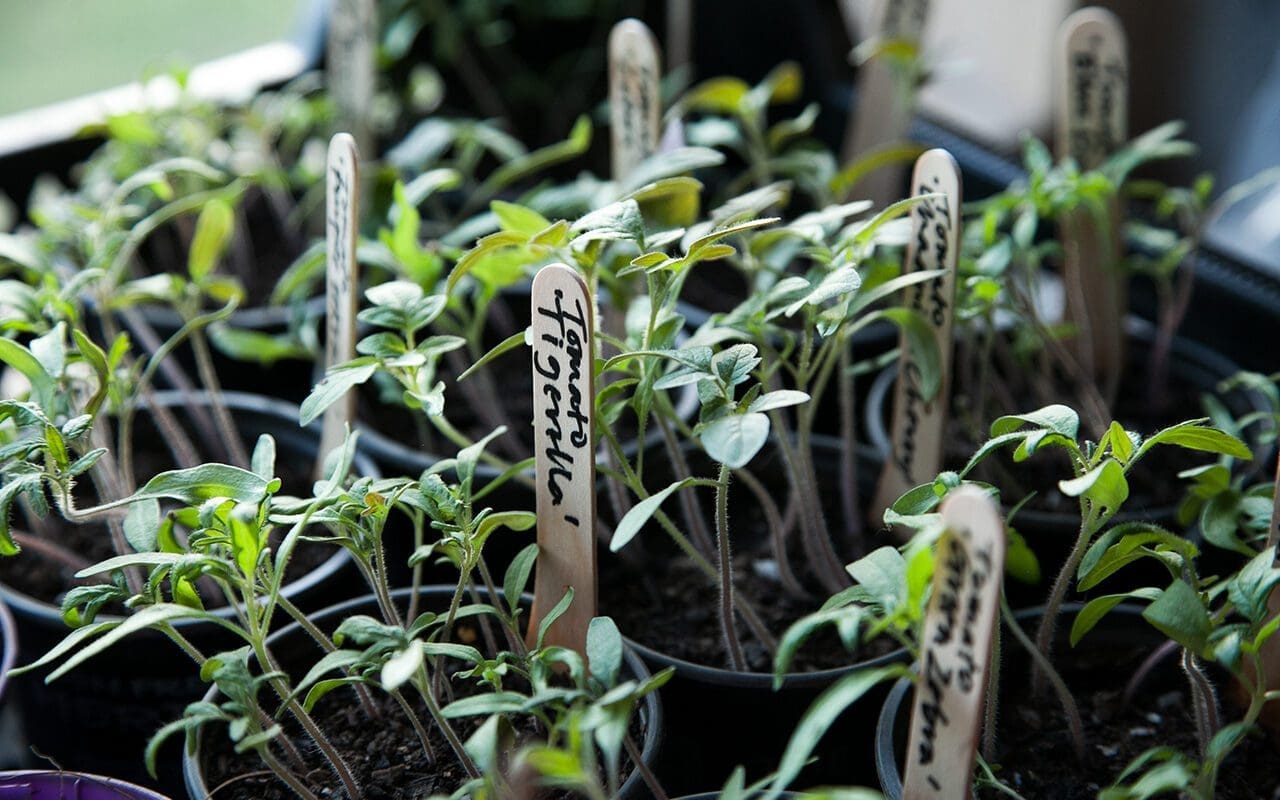
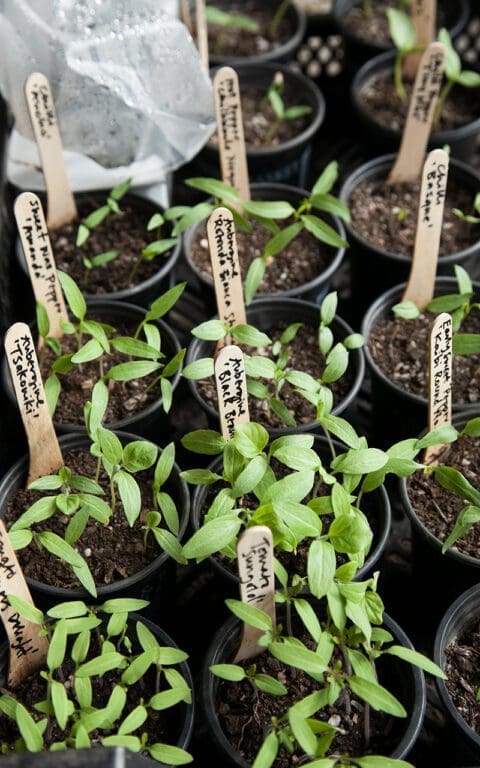
Last year’s aubergines suffered from not being planted out soon enough and failed in the frames so, determined to have a crop this year, we have three varieties on trial; ‘Black Beauty’, which has a reputation as the most reliable cropper in the UK climate, which it seemed to prove by being the first and most profligate to germinate and with the largest, heartiest seedlings. Germination of the other two varieties – ‘Tsakoniki’, a Greek heirloom variety and ‘Rotonda Bianca Sfumata di Rosa’, both from Thomas Etty – was a little patchier, but we have enough seedlings to have three plants of each and still have some left to give away to friends and neighbours.
As well as new chillis ‘Basque’ and ‘Chilhuacle Negro’ I have succeeded in germinating the seed of some tiny superheat red chilli bought at Kos market two summers ago and I’m trying sweet peppers for the first time (‘Kaibi Round No. 2’ and ‘Amanda Sweet Wax Pepper’, also from Real Seeds) as well as two varieties of melon (‘Petit Gris de Rennes’ and ‘Charentais’), which I’m hoping will get enough light and heat to provide us with something truly exotic in the fruit department this year. All of the above were sown in the last week of February and they are all, bar the melons, ready to be pricked out into larger pots this weekend.
The delay in planting out last year had a continuing knock-on effect, and the last of the tomatoes were harvested in late October so that we could remove the grow bags (which were were last year’s quick fix) to build four raised beds. These allowed us to build up the level and enrich the soil of the unimproved pasture on which the polytunnel is sited with well rotted manure. We intend to practice no dig with these beds and so the retaining edge will help to keep things tidy.
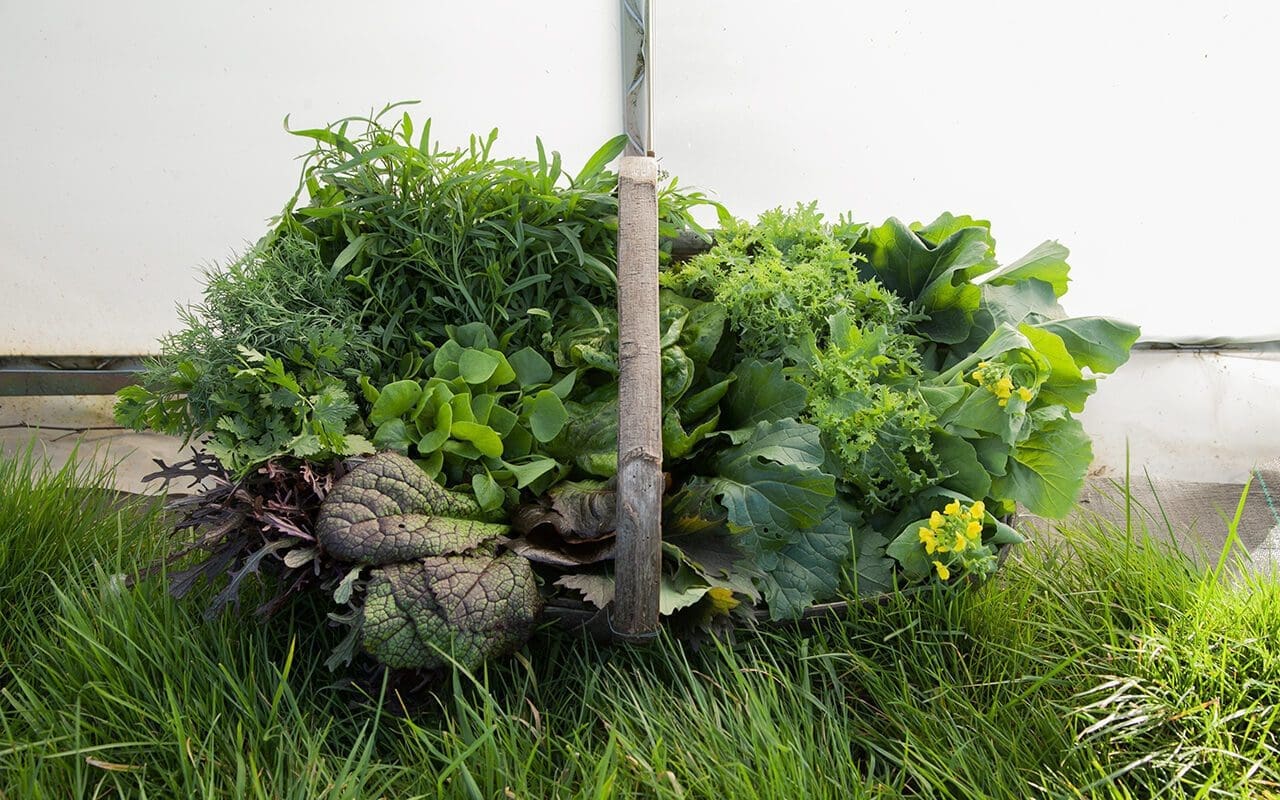
Although I had sown a variety of oriental greens, winter salads, chard, kale and soft herbs from the beginning of September and into October and November it soon became apparent that this was also too late since, by the time the raised beds were finished in early November, the days had shortened to the point that none of the seedlings would make no further growth before the end of the year. These plug plants sat rather reproachfully in the cold polytunnel until late January, when I finally planted them out as the days slowly started to lengthen. However, they have now been providing us with salad and greens for two weeks or more and have more parsley, coriander and dill than we know what to do with.
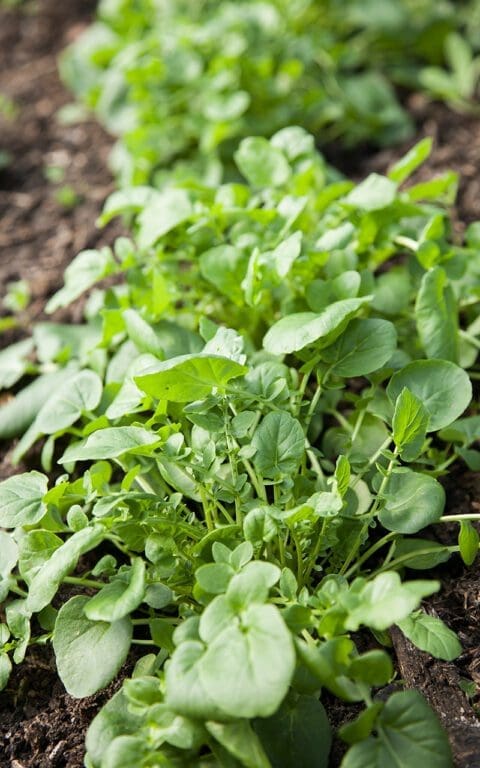
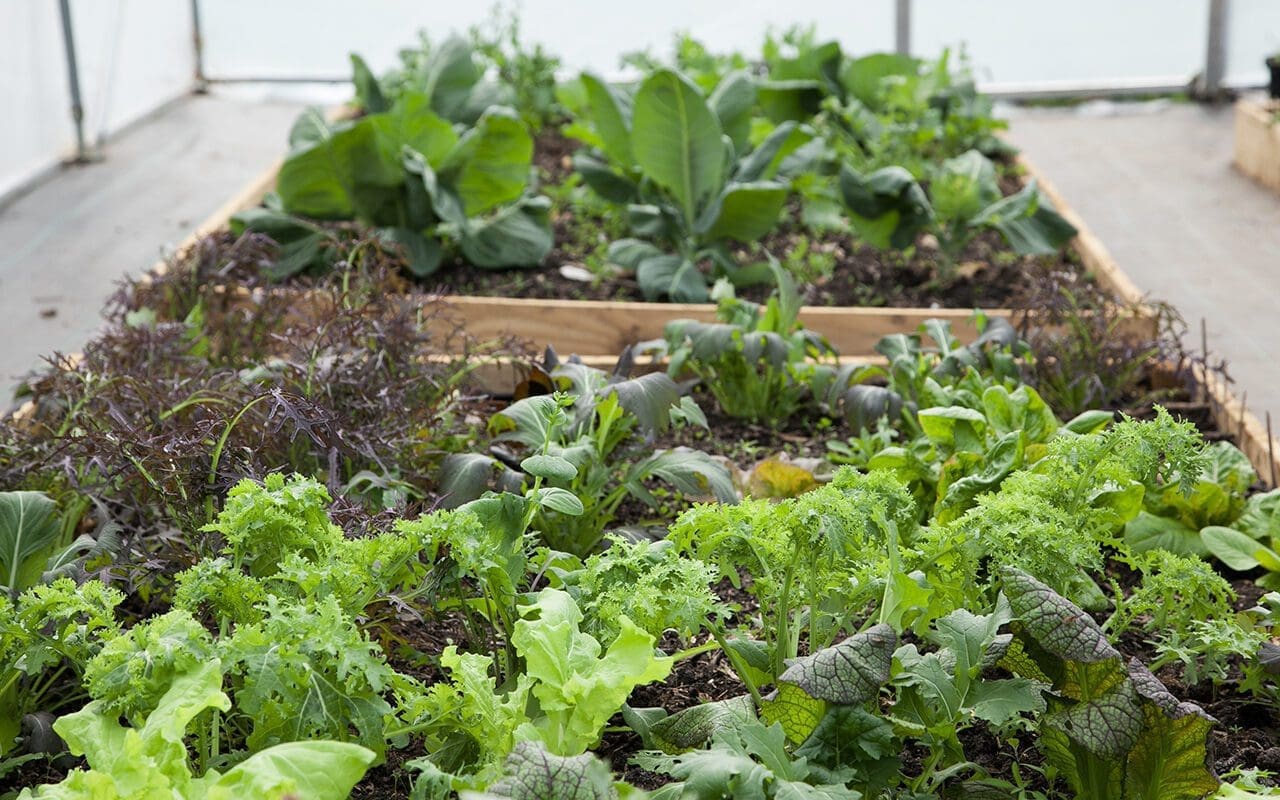
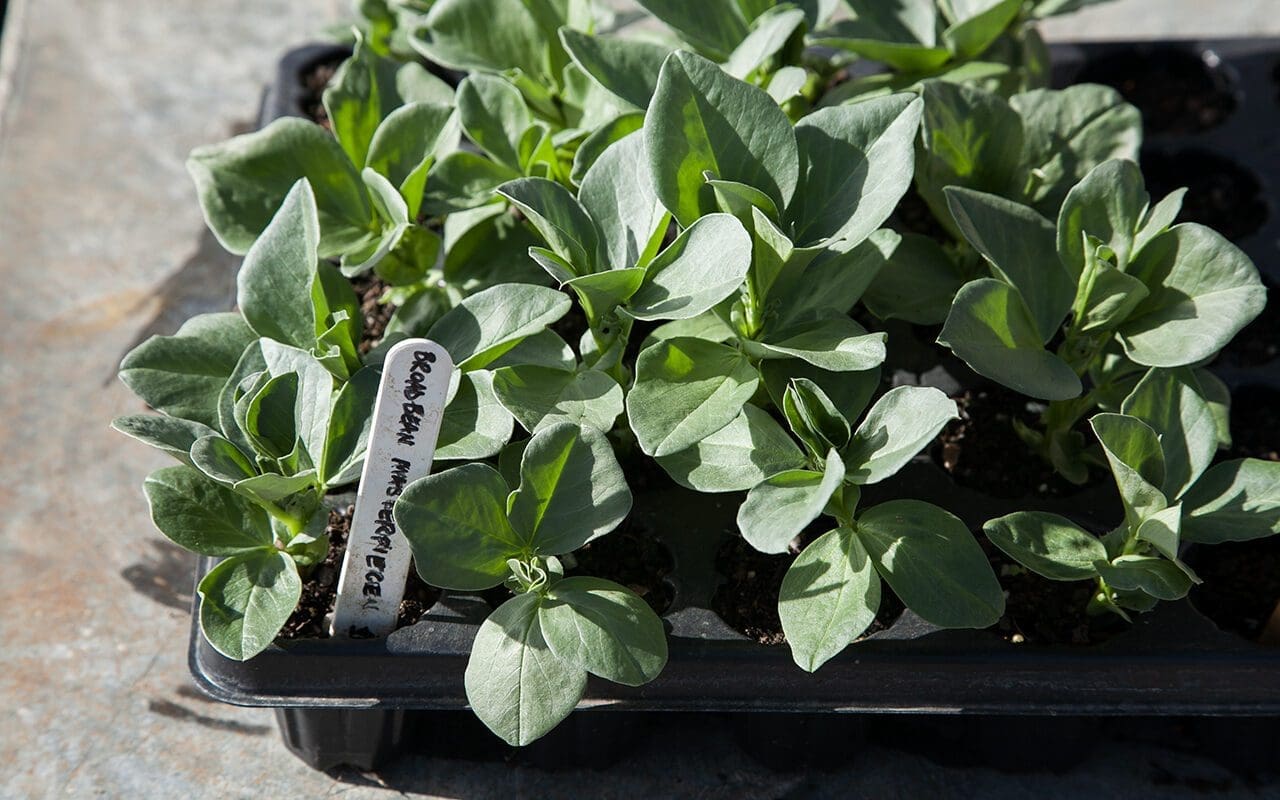
Despite the late start what has become immediately apparent is that, with well-timed sowing and transplanting, the polytunnel will allow us to close the ‘hungry gap’ of late winter and early spring. In addition to salad and oriental greens there has been a seamless handover from the waning kale and turnip greens in the kitchen garden to those that were sown in plugs in late November and have now taken up the baton. With this knowledge I am now planning two late summer sowings of winter greens and salads, turnips and beets for late July and late August to take us through the season. I started my first salad, beetroot and kohl rabi sowings off in the tunnel this year and they have responded well to the warmth and even light, but we are also planning to build a hotbed in the polytunnel this winter so that we can get even further ahead with early sowings and keep our most tender seedlings warm at night.
Alongside planning for future winter crops this is now the time to get moving outside. The broad beans that I sowed in modules in early March in the polytunnel have been hardened off for a couple of days this week, ready to be planted outside. And it is potato and onion weekend. The potatoes have been chitting in egg trays in the tool shed for the past three weeks or so and will be going into newly dug ground that we have enclosed around the polytunnel. This will free up more space in the kitchen garden to get a better successional rotation going, as well as allowing us to extend the range of vegetables we can grow, like Jerusalem artichokes which are very space hungry and freezer harvest crops like the ‘Cupidon’ beans of which we can eat any amount.
And I will also be pricking out the tomatoes, which is where this all started. Holding them carefully by their first cotyledons I will extricate their roots from one another, acutely aware of the time, energy and care that has got them this far. I will move slowly and carefully so that none are wasted. I will lower them into the soil of their own pots, give them a drink and then leave them to get on with it until it is their time to take the stage again.
Words & photographs: Huw Morgan
Published 27 March 2021
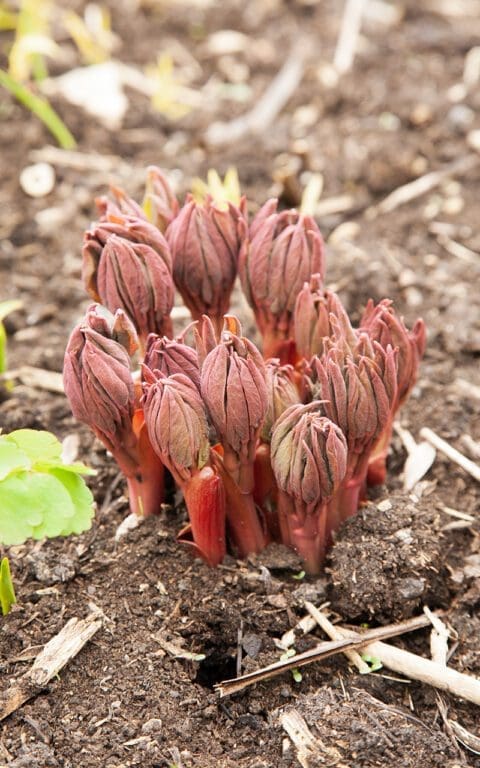
The garden is cleared now of last year’s growth and what has stood the winter. It is a process that runs over a month of weekends and witnesses the last grips of winter and the first of new life. The meaty red nosing of peonies, almost as good in shoot and anticipation as later in flower. Newness appearing around them daily. Lime green shoots on the hemerocallis, the visible inching of regrowth where the pennisetum were cut hard back just a week ago. It is a garden gathering pace and we need to keep moving now to ready it with final edits before mulching. The last big gesture and the equivalent of smoothing a quilt.
It is four years, almost to the day, since the first section was planted. The second half followed the autumn of that year and the two halves are all but indistinguishable now that they have grown in. Already we have made the first big splits, our hearty ground rearing unexpected bulking in some of the perennials. Sanguisorba that required a crowbar to lever them from their grip. One Amazonian hellebore, apparently with extra genes, did so well in every department it just looked out of place. After overwhelming its companions for four springs in as row, I finally went to battle last week and lifted it. The struggle took time and eventually I heaved it out with a huge rootball that had to be rolled into the wheelbarrow, for it was too heavy to lift. I put it, carefully bundled with a label saying ‘Please help yourself.’, out on the lane. Though it was a Sunday afternoon it had gone within the hour.
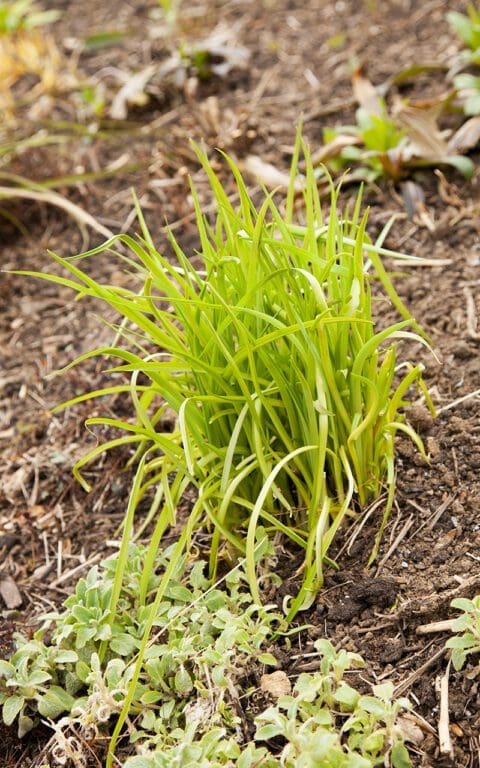
These changes make the difference. With half the sanguisorba split randomly, they will feel like a family with differing generations rather than a pack of heavies. And so the garden retains a feeling of having evolved here, with the weights of the plants in balance and differing much as they do in the meadows. Mother plants and their offspring.
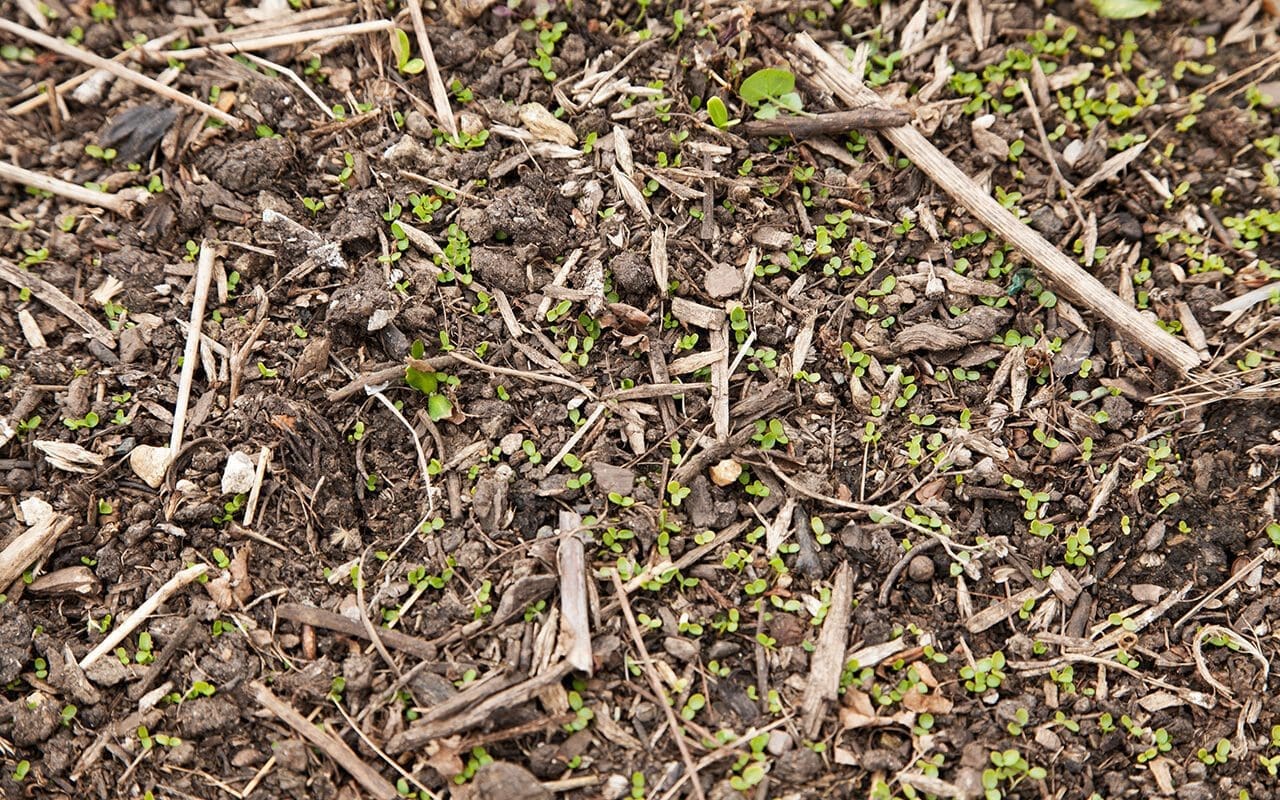
An evolving garden becomes more interesting for the weave that inevitably happens when you begin to see the self-seeding and my final edit before the mulch goes down is to manage this migration. Digitalis ferruginea that would rather be on the edges and not in the shadows of the middle of the beds. Their tall poker-black seed heads cast a million and one seedlings, not too far, but far enough to jump the path. The seedlings that fall into the crowns of anything that is slower off the mark, like panicum, will be winkled out. Those that fall into a gap where I can imagine their spires ascending will be left for the feeling of having arrived by themselves. Nothing makes a garden feel more lived in than an opportunist.
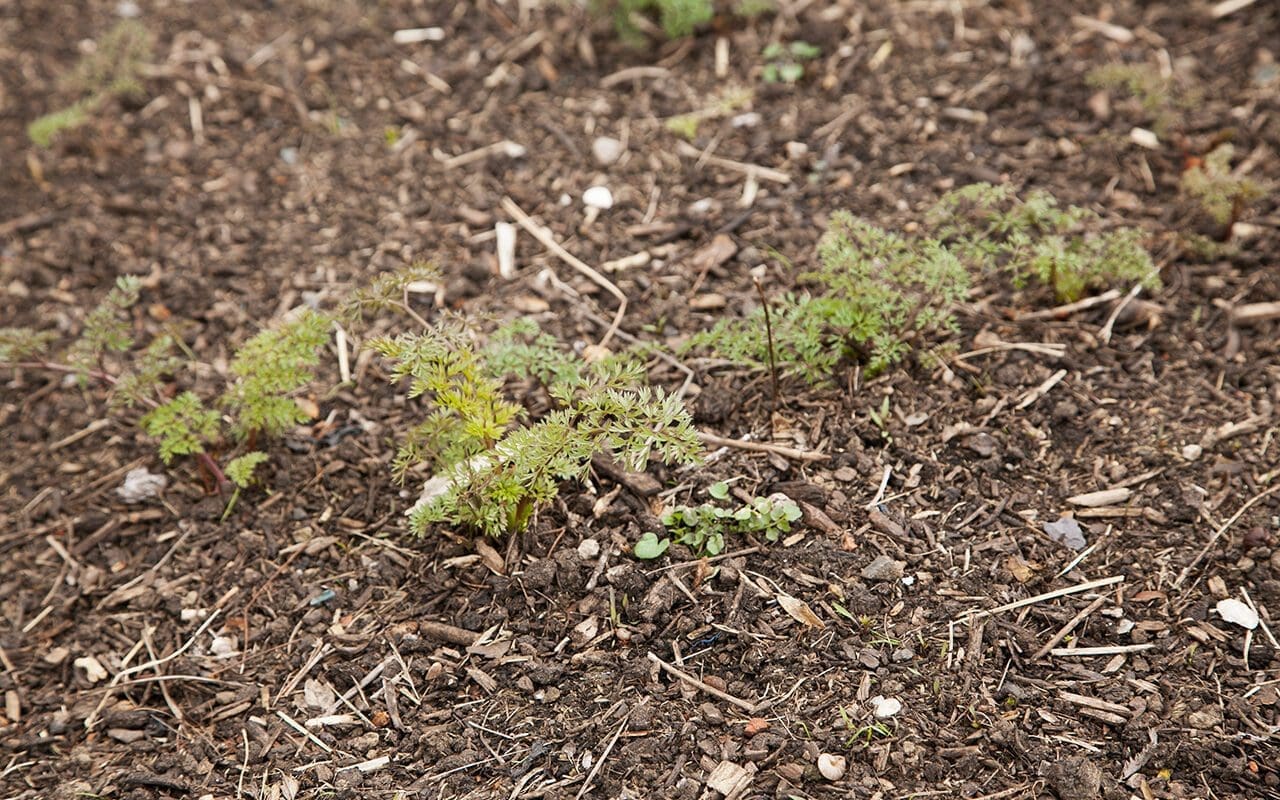
Not all the interlopers are welcome and the mulching will smother the majority of the seedlings. Where I feel we might need their presence – or that of black opium poppy or florist’s dill – we do “intelligent mulching”, a practice that Great Dixter’s Fergus Garrett told me about, where you spread the mulch more lightly or not at all where you want the seedlings and deep enough to smother where you don’t. The method works with self-seeding annuals like red orach and Californian poppies and short-lived perennials like Cenolophium denudatum. The beautiful creamy umbels are a good leveller in a planting, sitting easily amongst other perennials and, like the digitalis, feeling most comfortable where they have arrived by themselves.
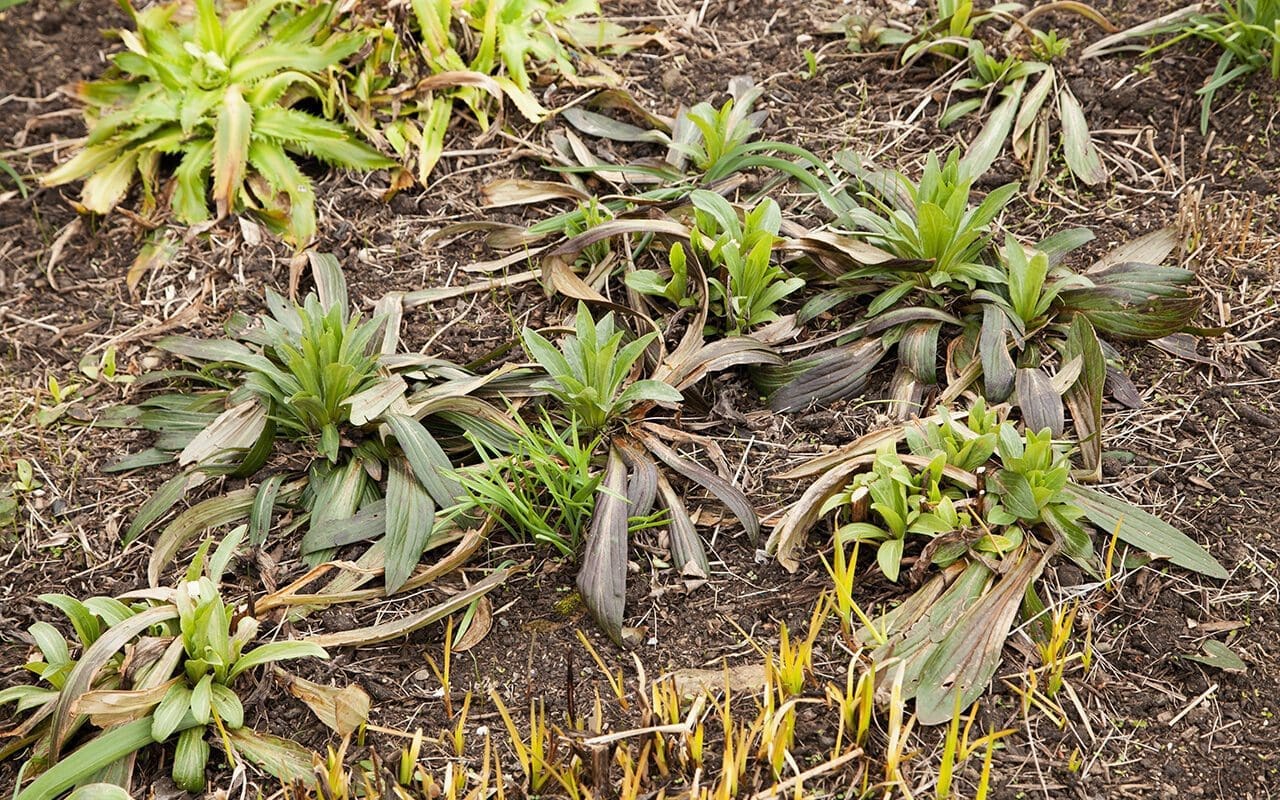
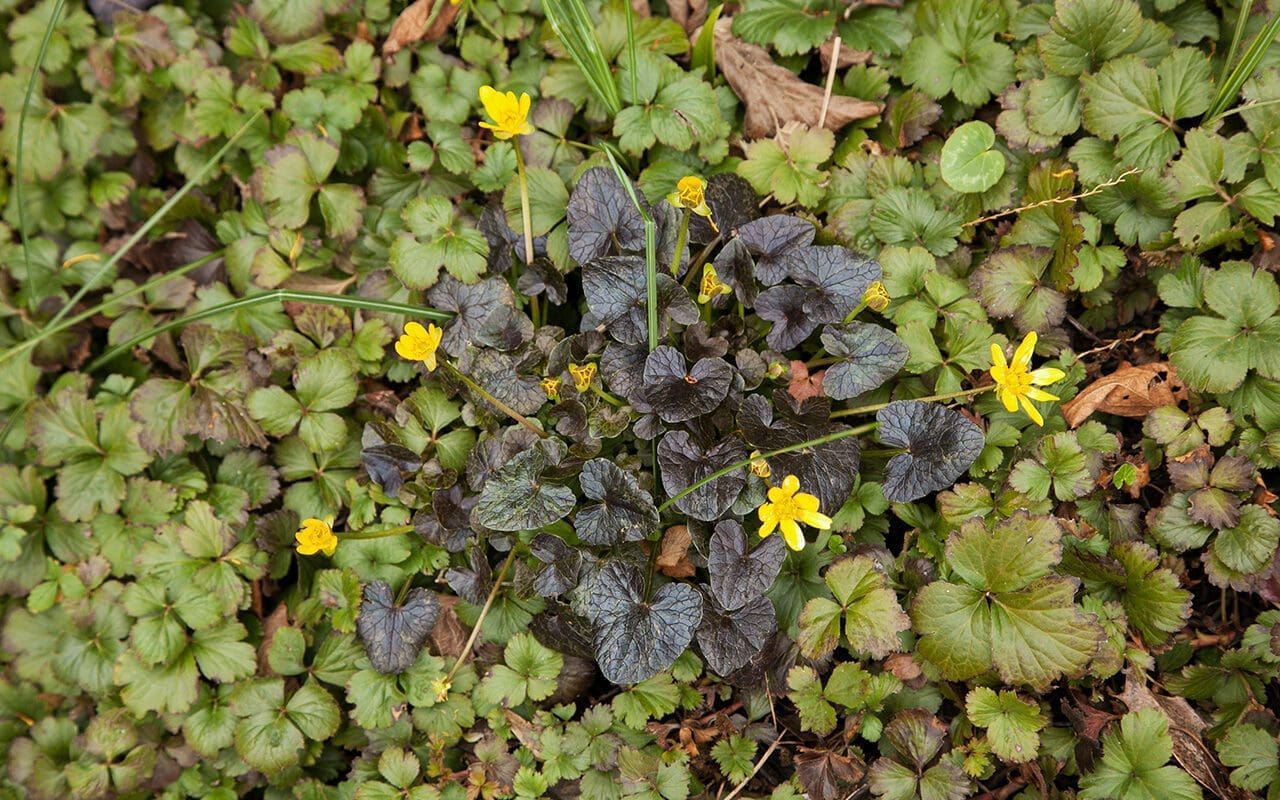
Some of the interlopers, such as the Ranunculus ficaria ‘Brazen Hussy’, are wilfully oblivious, setting seed after you have mulched and finding a crevice to set up a little tuber that goes completely un-noticed until suddenly there they are. I have had this plant since I was a teenager. It probably came from Great Dixter originally as it was selected by the great Christopher Lloyd himself, found in the surrounding woodland, and named appropriately. I do not mind it moving about and I have no idea how it moves so far, the seedlings sometimes springing up in another part of the garden entirely. Leaves as dark and iridescent as beetles’ wings and flowers as gold and uplifting as the very season they make their own. Let them move about as a ‘Brazen Hussy’ might, for they are gone and have not imposed themselves by the time the growth closes over around them.
Words: Dan Pearson | Photographs: Huw Morgan
Published 20 March 2021
We are sorry but the page you are looking for does not exist. You could return to the homepage