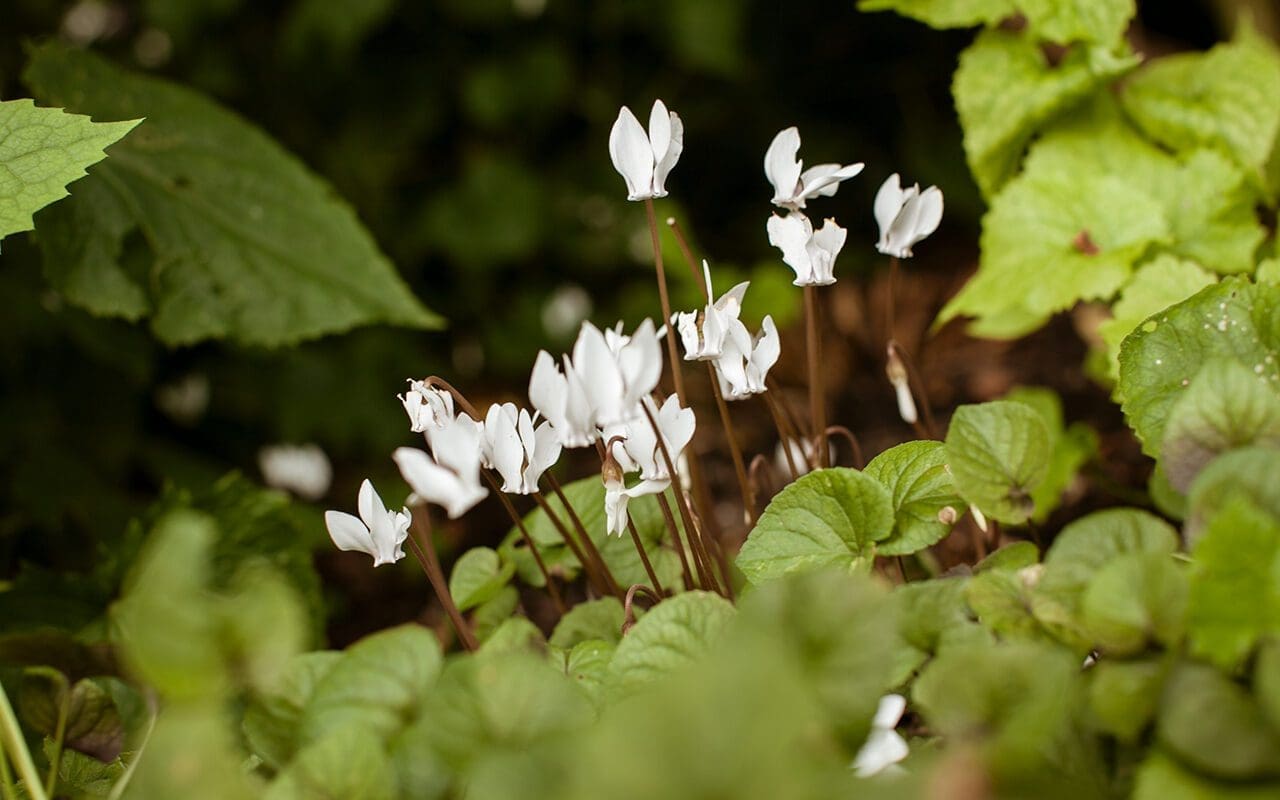
The first Cyclamen hederifolium are already in flower and letting us know that autumn isn’t far off. Although I love their coil from bare earth, their arrival always triggers a pang of melancholy. Surely it cannot already be this time and summer already waning ?
In truth I find August one of the most difficult of months and always have, time showing in the garden where you haven’t quite got it right or where you haven’t built in a degree of expectation to keep the energy up. Knowing myself, I have learned to not give the mood purchase and plan for it with an undercurrent of asters and a stride of late-flowering grasses that still have energy in them and are yet to come into their own.
Where we leave the meadows long on the banks beneath the house, they have mostly run to seed and lie akimbo after summer storms. Wild carrot, a good latecomer and a reason to leave the meadows long until the end of the month in places, offer their flat creamy heads for the wealth of life that still occupies this place. The late cut allows for the last of the scabious, the knapweed and the late-blooming wild origanum and I have added to the banks with a slow but measured introduction of everlasting peas.
Lathyrus latifolius is a long-lived perennial usually seen in a bright magenta and often taking hold on the sunny sides of railway embankments. Perhaps these plants, often seen with running asters, were originally an escapee, hurled over a fence for being too vigorous in garden company. They could just as easily have been flung over the fence naturally, their seedpods splitting on a hot day, cracking open and catapulting their contents.
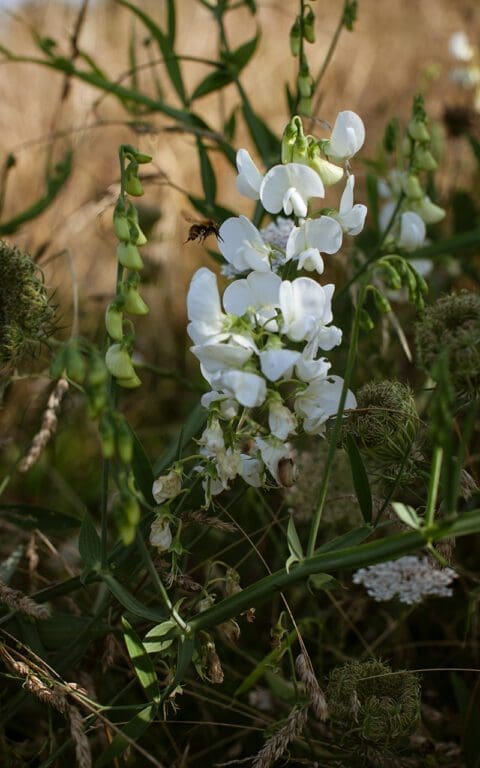
I have ‘White Pearl’, a clean creamy form here and I plan for there to be a flotsam of lathyrus to sit amongst the choppy hollows of the spent meadows. I plant twenty or so every year, which I raise from seed to extend their domain. You have to get to the seed as the pods dry and brown, but before they rupture and the seeds are jettisoned. Sown fresh they are often up in the autumn to overwinter in the frame to be the right size to plant out the following spring.
Being nitrogen fixing, the peas are happy to take to poor ground and where the company isn’t too vigorous on the dry banks they rise up and take hold as the meadows around them begin to fade. We have the narrow-leaved everlasting pea, Lathyrus sylvestris here also. The seed originally came as a gift from my friend Jane who collected it on the cliffs above Branscombe Bay in Devon. Though it is naturalised in many parts of Britain it is speculated that it wasn’t also an escapee originally. It is a pretty thing with small flowers of a dull rose-pink and growth that reminds me of a stick insect. Long, straight limbs to rise up and above the competition and tendrils that allow it to attach and suspend itself in a scaffolding of growth using nothing more than the spent stems of the grasses to provide purchase. Touch the plant and you can feel how structural its cage of growth becomes despite its delicate appearance.
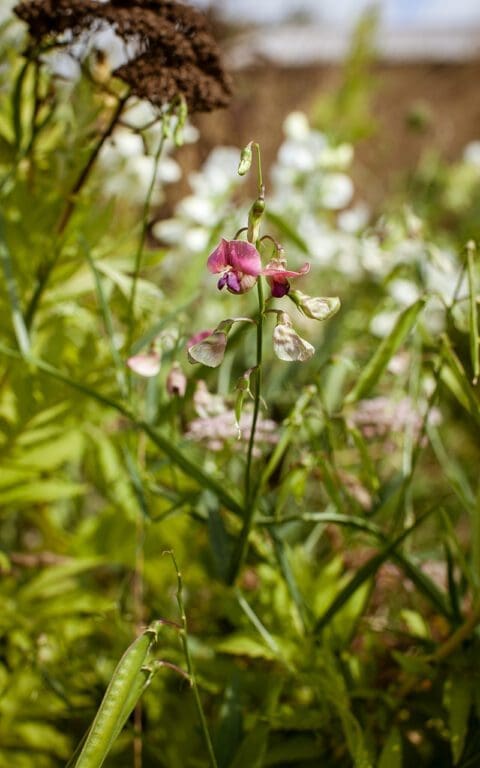
I would not plant either pea in the garden for fear of being over-run, as they are more than capable of growing to 2 metres in a season. Neither have scent, but this is a small price to pay for such a welcome interlude in the high and teetering summer.
Words: Dan Pearson | Photographs: Huw Morgan
Published 7 August 2021
Today’s In The Garden is the result of an extremely busy week. In fact, we almost thought about not doing Dig Delve today but, having thrown myself at work this morning, I took a deep breath after lunch and it has been a pleasure to gather all of the colour in the garden and arrange it on the mantelpiece for us and you. However busy I am, as soon as I put my head in the right space for flowers, everything else falls away.
First thought is, ‘What is the story?’ Despite the glowering cloud and torrential rain, it is the colour that draws me into the garden. Then, ‘Which containers?’ ‘More colour.’ I think. So down from the shelf in the boot room comes my collection of Italian, coloured glass vases, covered in months of dust and cobwebs. The first job was to wash and dry them, before arranging them on the mantelpiece, looking at a good distribution of form and colour, while also considering a range of heights spread evenly to ensure a good rhythm. Without anything in them this can be a bit hit and miss and, once the vases are in position and filled with water, with the first stems arranged, it can be nerve-wracking or foolhardy to try and re-arrange them.
Then the selecting and cutting of flowers. This takes longer than you might think. Judging whether a plant can spare the bloom. Should I just take one, or several? Sometimes one perfect flower means sacrificing several buds still to mature. Will it stand upright in the vase? If not, how will I get it to face the way I want it to? Then, how to get them back to the house undamaged? Some flowers are far more fragile than others. The hemerocallis are a case in point with their fleshy, snappable petals. Three ‘Stafford’ were cut to get the one perfect one in the arrangement, while I had to give up on the Hemerocallis altissima every one of which was broken just getting it into the trug. There were meant to be poppies, but they shed all their petals long before I could get them into position.
I picked a few at a time, going round the garden methodically, starting down by the barns and working my way through to the end of the main garden. Each trugful contained perhaps just five flowers to prevent squashing. I placed each batch where I felt they would start to create the right composition of colour and form. By chance the softer colours came first – blues, mauves, pinks – then the yellows, followed by the strong pinks, reds, saffrons and oranges.
Stand back and evaluate. Are any flowers hidden? Is there enough space to see most or all of them clearly? Is the colour rhythm working? Does it need more yellow? More red? More height? Are the vases pleasingly spaced? These questions come as observations, not concrete thoughts, and once they have been answered it is time to take the first photographs.
Picture this. I slip off my Birkenstocks and climb onto the dining table, over which hang two pendant lamps. The one at the mantelpiece end is right where I need to be to get my framing right. So I carefully balance it on the nape of my neck and then try not to make any sudden movements, otherwise it comes swinging round to hit the front of my face and my camera, and it is made of metal and has sharp edges. Years of practice mean that this fortunately seldom happens.
Then the light needs to be right. Today has been particularly gloomy, so I had to use a low aperture setting and high ISO to get the exposure right, but this also means the images are far more prone to camera shake. I can’t use a tripod, due to the dining table and pendant lamp issues, so I brace myself, keeping my elbows close to my sides as I grip the camera and hold steady while kneeling on the hard table top. Then I just keep shooting, making tiny adjustments to the framing and hoping that one of the images will be good enough.
I check the composition in the playback screen, but it is not until I download the images that I can see whether there is a problem with the arrangement, the composition or the image. If there is, further adjustments are made and then back up on the table to take some shots.
So, that is how the image you see at the top of this page came together today. It is how all of these mantel arrangements come into being. It took the best part of the afternoon, and I enjoyed every minute, but now, it’s time for a glass of wine.
Flowers, words and photograph: Huw Morgan
Published 31 July 2021
I have just returned from a week away working. Not much time in reality, but a sizable shift upon returning. When leaving, the meadows were still standing, alive with life and shifting constantly. Their energy had run to seed in a week or ten days and the farmer we knew was ready and waiting to harvest the hay before the goodness went out of it.
The official date to cut the meadows is July 15th and, as the day approached, the wet July cleared to blue skies and the dry winds and sun that make the cut viable. I knew this was going to happen whilst I was away, so we walked the fields one last time to soak them in. The Meadow Brown butterflies rose in front of us as we pushed our way through the track that we have walked into the Hospital Fields and my feeling of having to leave was part melancholy for being distanced from this place and part for losing the meadows to the season.
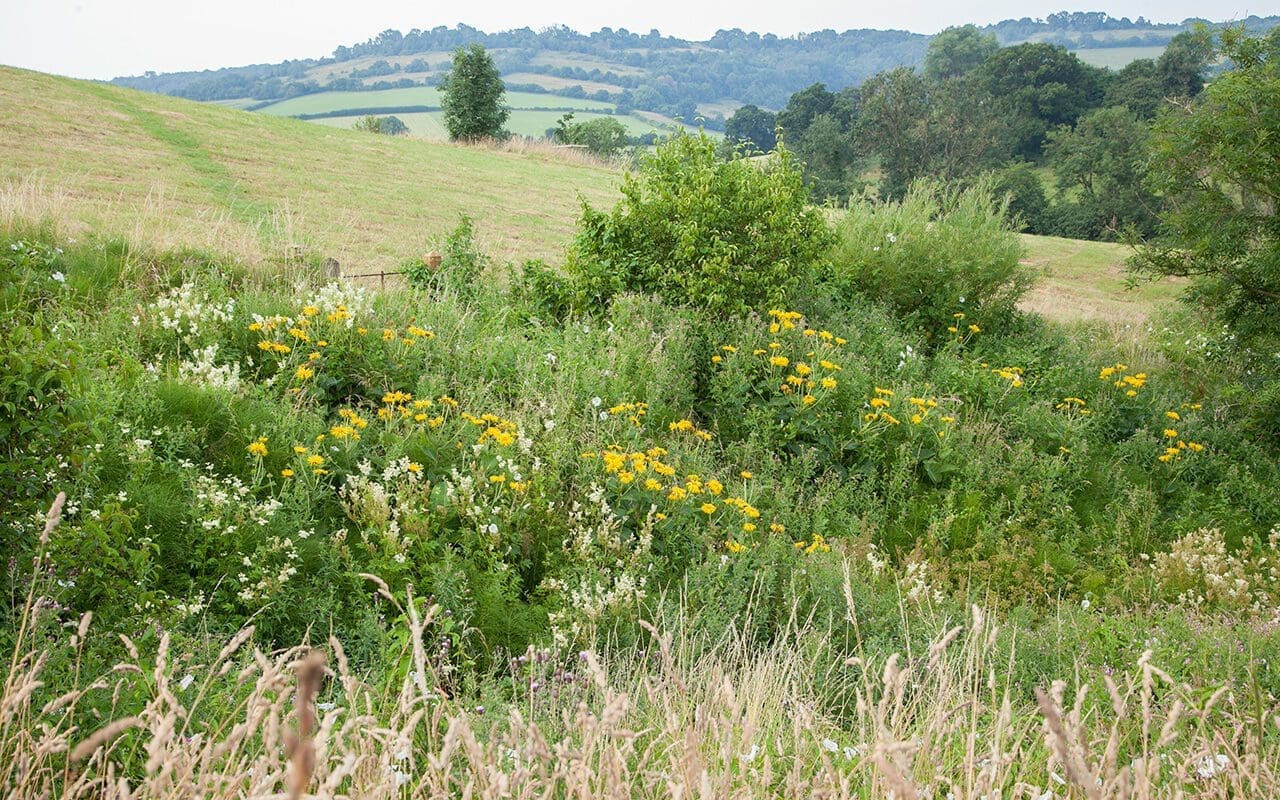
Huw sent images to keep me in touch and bang on time on the 15th, the hay was strewn and drying in the gold of evening sunshine. The next day the hay was windrowed in readiness for bailing. Windrowing or tedding is quite an art on our slopes, the fields transformed for one more day to dry and lined up as if they were braided or patterned in a giant corduroy. By the time I returned, the hay was bailed, the process done and the fields lying empty, still and temporarily silenced.
The aftermath of the cut is an interesting moment to be part of and one that sees the garden suddenly come into new focus. Our walks out and beyond are cut short for a while by the shock of the fields stripped bare and the jar between the garden and what lies beyond is immediately closer. Perhaps it has been a subliminal move on my part and a response to the fields being simplified, but the planting in turn kicks into another gear in the very same week. The colour pushes more strongly, and the floral content hits its stride to hold our attention whilst we adjust to the change.
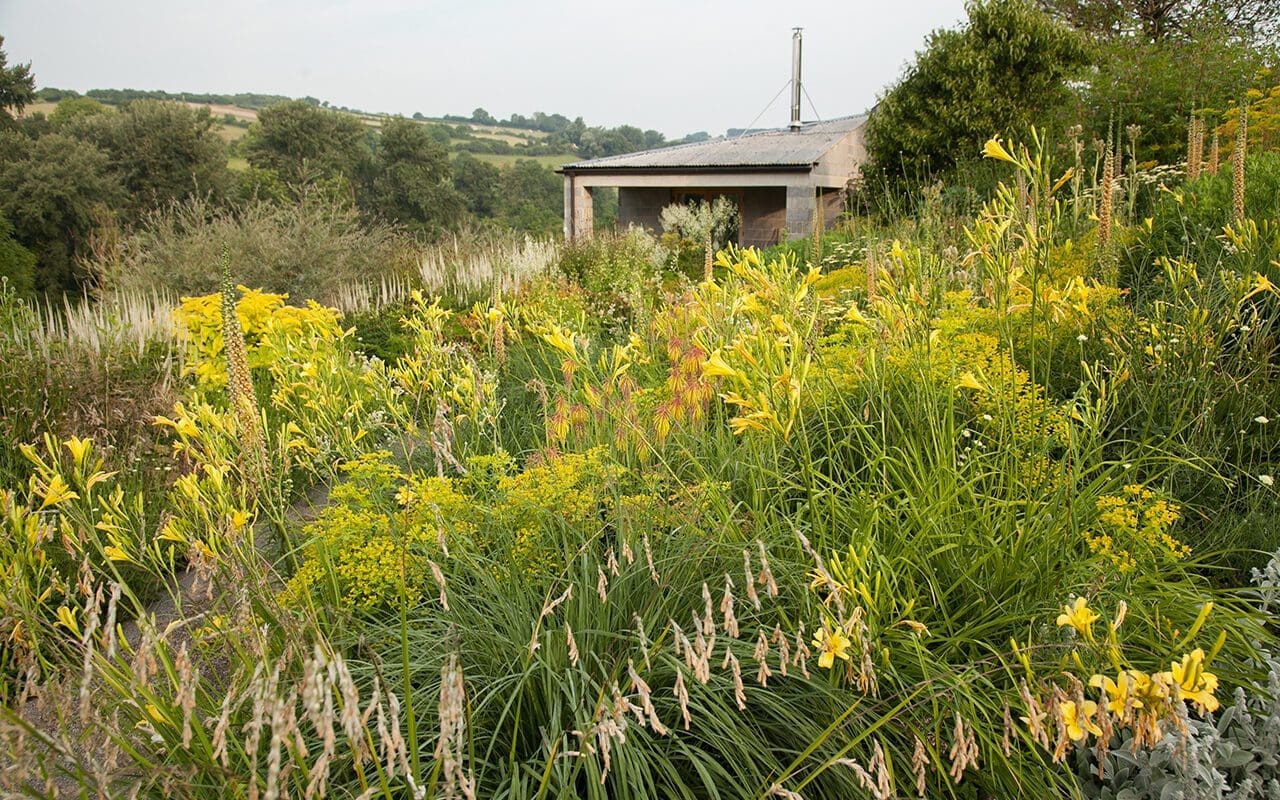
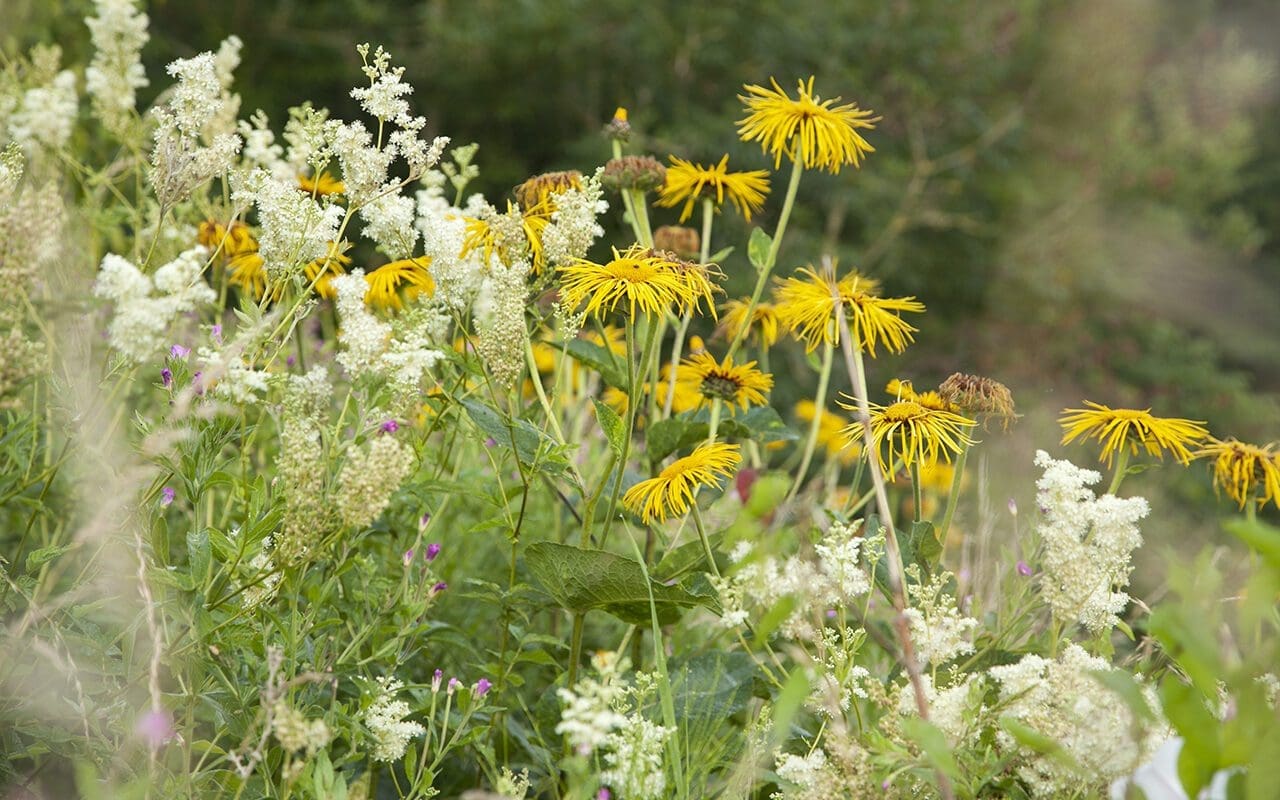
It is good to have separated the ditch from the land that is harvested for hay and although our backdrop is suddenly changed after the cut, the softness of this near environment keeps our boundaries blurred. I have planted into the ditch with perennials that bridge the two worlds and the Inula magnifica do so just at the right moment, lighting the near foreground and removing any melancholy. I have just visited to soak them in and their elongated petals are fluttering brightly amongst the meadowsweet. The butterflies, interestingly, are busy here this week, moved from the now empty meadow, perhaps, to live the summer out where we leave things long.
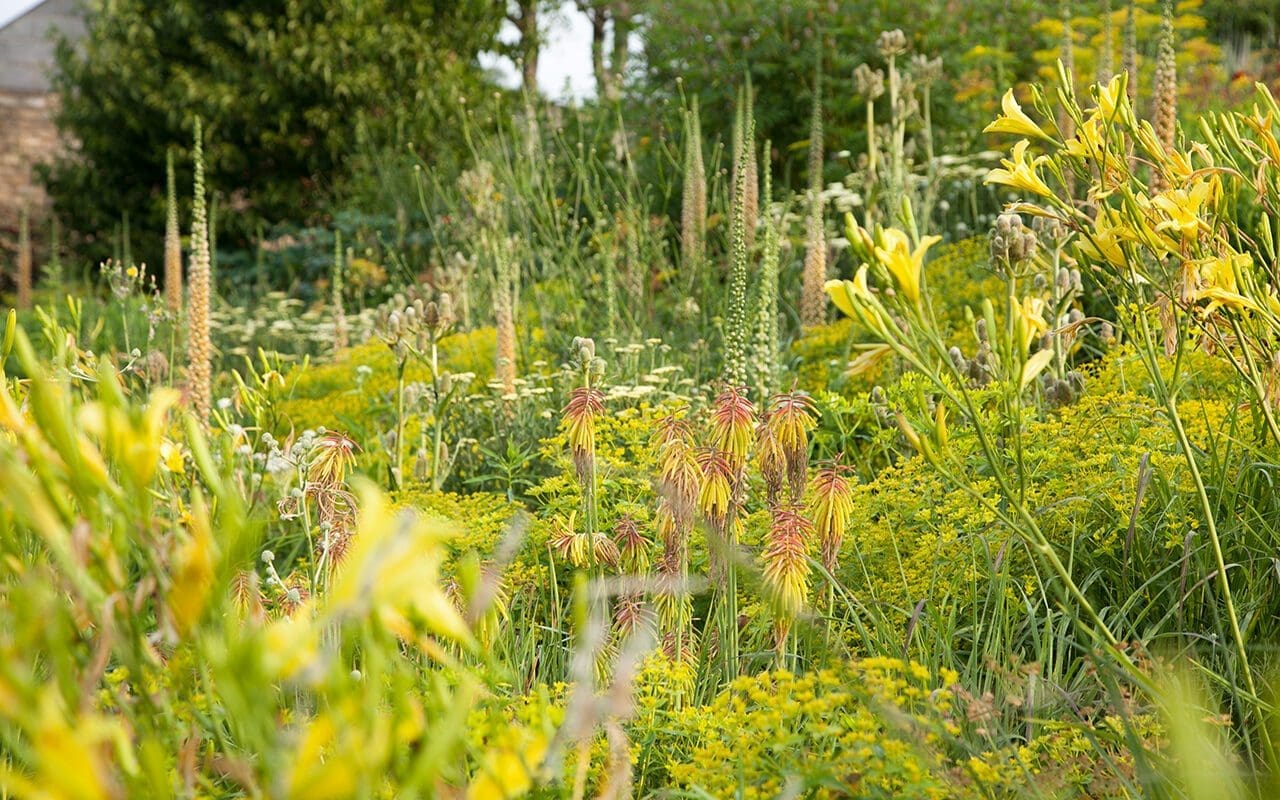
The ditch and its sense of profusion has been an inspiration for the garden and I have drawn the yellows up so that the inula and the garden proper can talk to each other. Night blooming Hemerocallis altissima, still open and perfumed in the morning, draws the moths into the nightscape garden. Where the cut meadow is quiet, the garden is a feasting ground as dusk descends and the spires of the Digitalis ferruginea are busied.
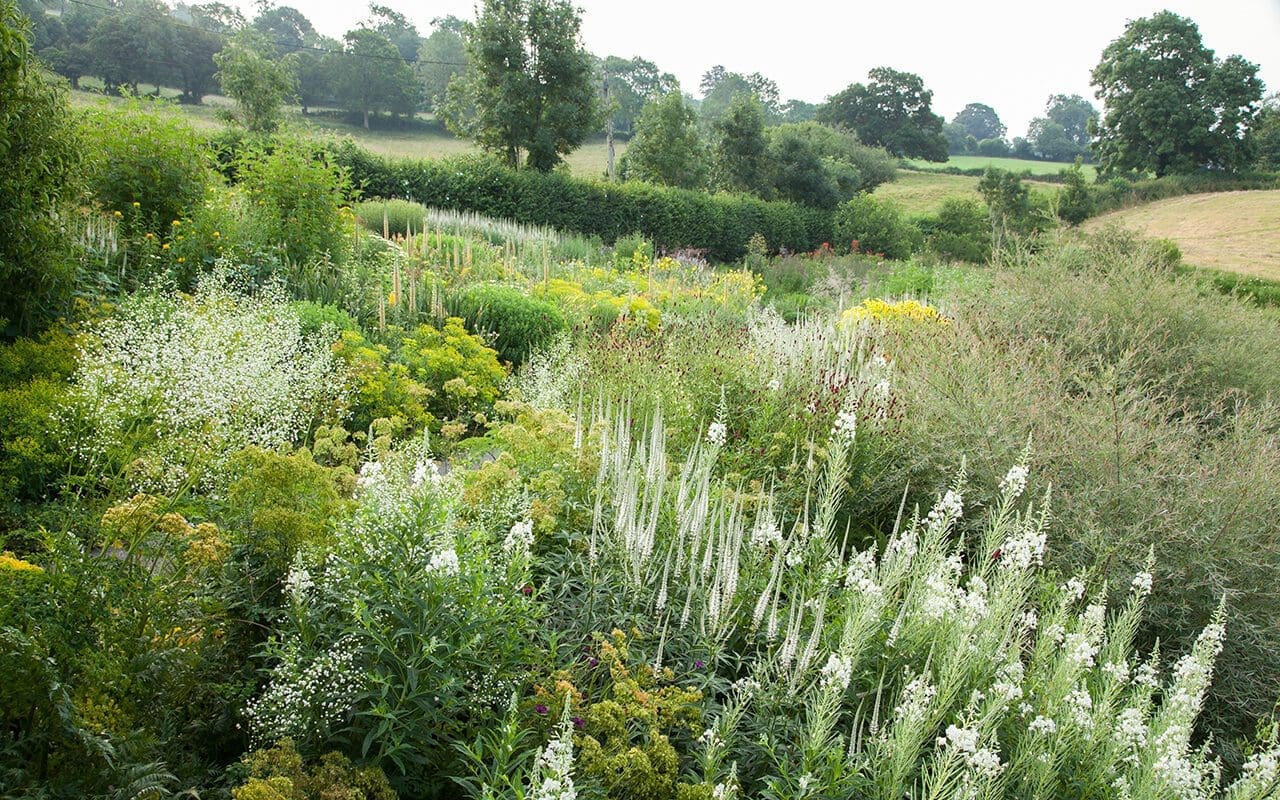
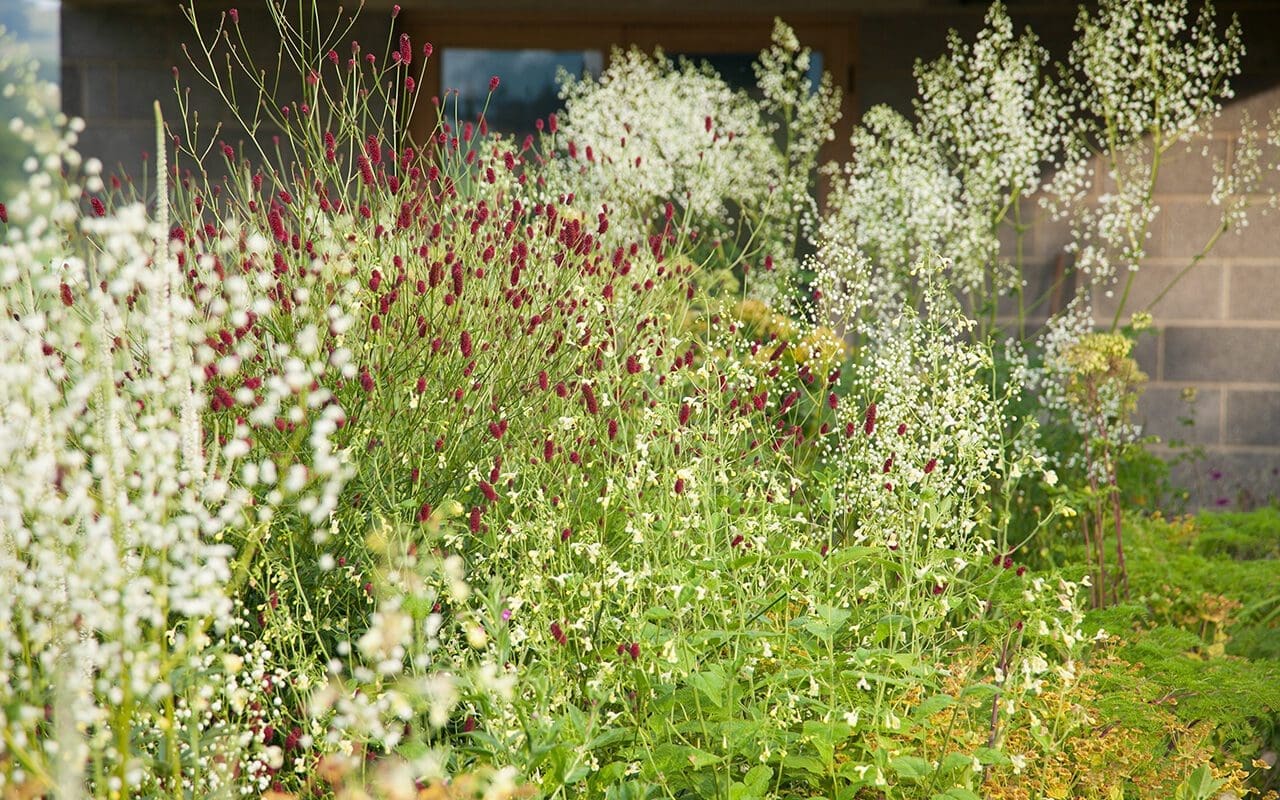
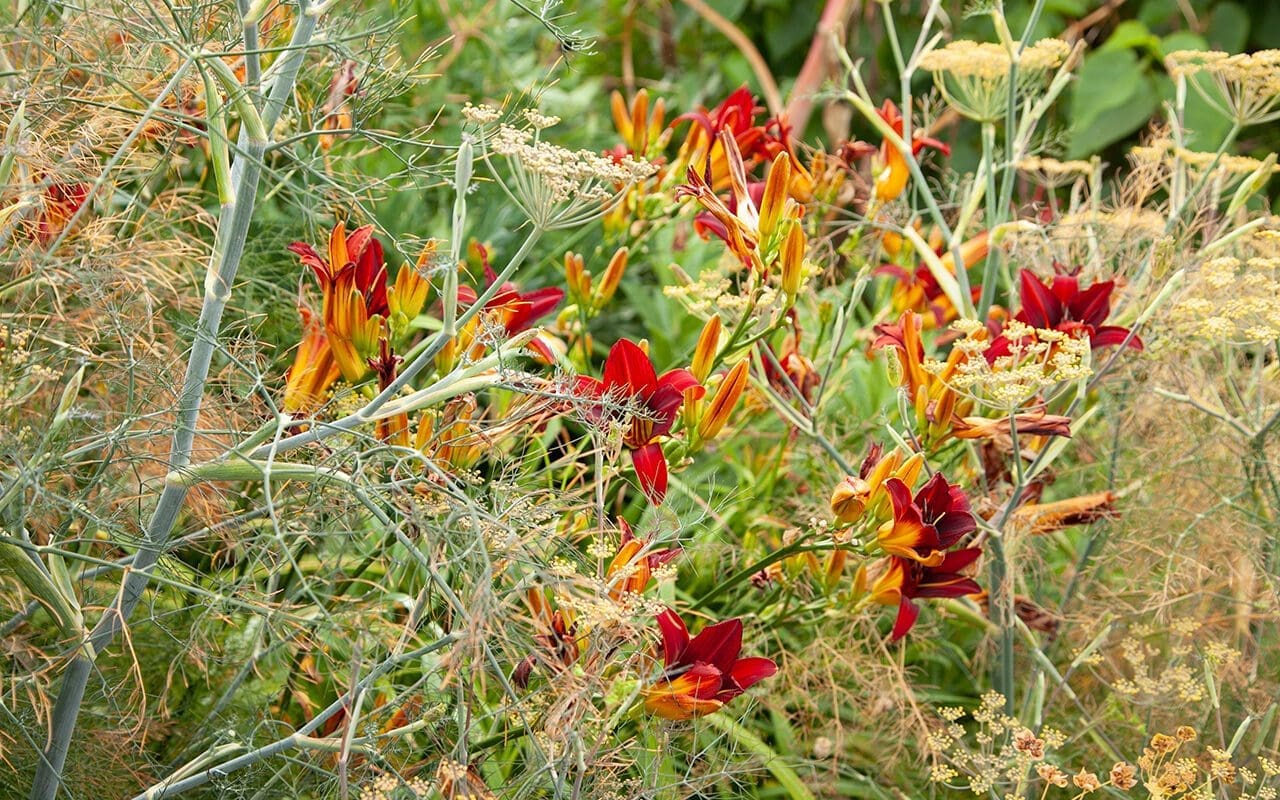
As the greens darken in the landscape acid yellow dill, run to flower, Euphorbia ceratocarpa and Euphorbia wallichiana provide the bright undercurrent within the intimacy of the garden. Fiery pinpricks of red enliven the immediate foreground and lead you along the inner paths. Potentilla ‘Gibson’s Scarlet’ and softer red Lobelia tupa, whilst a dance of Hemerocallis ‘Stafford, perhaps the best of the reds, reaches out towards you on their beautifully balanced stems. Bright now is good I find, the light suiting true colour, but I have kept things soft towards the edges so that, as the fields recover from their shearing, the garden does not jar. Pale willow herb, and Thalictrum ‘White Splendide’ which smatters a pure clean white and allows your eye to travel to the ditch, the meadowsweet and the sanctuary provided by the places that are allowed to be and escape the harvest.
Words: Dan Pearson | Photographs: Huw Morgan
Published 24 July 2021
Twenty six years ago I bought a newly published recipe book, which was to have a major impact on the way I cooked. It was the first River Café Cookbook. Throughout my university years I had been cooking from the books of Elizabeth David, Jane Grigson, Marcella Hazan, Richard Olney, Elisabeth Luard and Claudia Roden, but there was something strikingly different about Rose Gray and Ruthie Rogers’ approach to the Mediterranean kitchen.
Looking back, it is hard to imagine that their approach felt so new, so accustomed are we now to the ideas of seasonal eating and only using the best quality produce, but their minimal approach to preparation and presentation, so artfully expressed in the clean graphic design of the book itself, was not the norm and it was this simplicity of approach and insistence on the very best produce which still sets The River Café apart.
When I worked in film in the 1990s I was lucky enough to eat at The River Café on numerous occasions, my bill charged to various people’s expense accounts. Although it was, and still is, a glamorous destination the food was so memorable that after those heady days were over Dan and I would return whenever we wanted a meal to mark a special occasion; a fortieth birthday, a special friend visiting from overseas, a pre-marriage celebration, the purchase of Hillside. In the abstract, if you look at their menu, the food certainly looks expensive, but in all the years I have eaten there I have never once felt that the food is overpriced. The attention to detail in every aspect of the experience elevates it to a level that makes total sense of restaurant eating. If anyone ever comes to London and asks which is the best restaurant we can recommend I always answer, without hesitation, ‘The River Café’.
Several years ago, faced with this very question from Midori Shintani, head gardener at Tokachi Millennium Forest and an inveterate foodie, we booked ourselves a table. As the first plates were brought out I suddenly saw in the expression on Midori’s face that, although the ingredients may have been European and unusual to her, the care taken with the food was instantly comprehensible. Their restraint and reverence for seasonality and ingredients at their best and the honesty of presentation is comparable to that of domestic and commercial kitchens the length and breadth of Japan.
A favourite recipe from that first book, and one I have lost count of the number of times I have made, is for vignole, a Roman stew of fresh spring vegetables. Also known as vignarole, the vegetables traditionally used are artichokes, broad beans and peas. However, regardless of how good a spring we have or what countless restaurant kitchens would have you believe, these could never really be considered spring vegetables in Britain, so it is a dish I normally make in early summer. The vegetable garden got off to a very slow start this year and, although we have had artichokes for several weeks, it is only now that all three primary ingredients are cropping together. Given the lateness of the season we now also have the first Florence fennel, shallots, courgettes, bush beans and new season garlic, so this dish, based on the method used for vignole, uses everything that is at its best in the vegetable garden right now.
Recipes like this are infinitely adaptable. The only thing to remember is to add the vegetables to the pan in the order of those requiring the longest cooking first. Quartered baby turnips, carrots or the tiniest new potatoes near the start of the cooking time. Earlier in the season, asparagus spears make a fine addition. Add them at the same time as the broad beans. Young chard leaves or spinach can be added at the last minute or tiny radishes. Although mint is the customary herb to use for vignole, at this point in the year I like to combine it with basil which is growing in profusion in the polytunnel, the aniseed flavour of which complements the fennel well.
Serve warm to allow full appreciation of the different flavours and textures, this can be eaten alone as a starter with grilled bruschetta, accompanied perhaps with a melting burrata or fresh mozzarella or to accompany a piece of firm white fish such as halibut.
10 small artichokes with stalks
400g of peas in their pods or a mixture of peas and mange tout – 150g shelled weight
400g broad beans in their pods – 150g shelled weight
150g fine French beans
4 banana shallots – around 300g
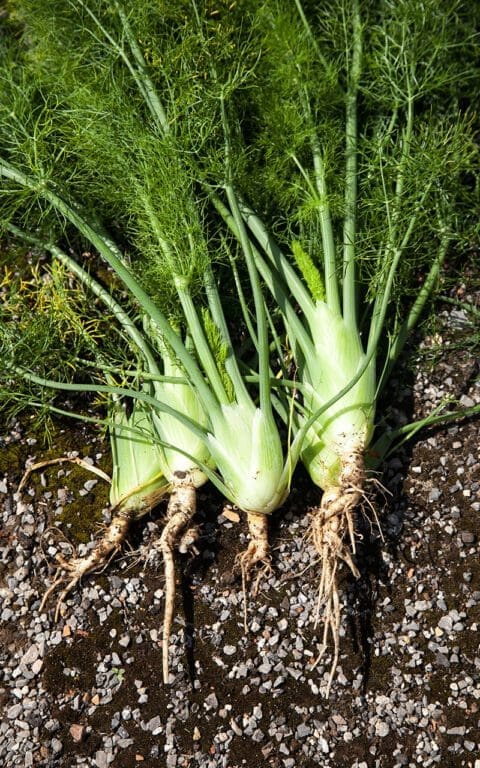
4 baby Florence fennel – around 125g
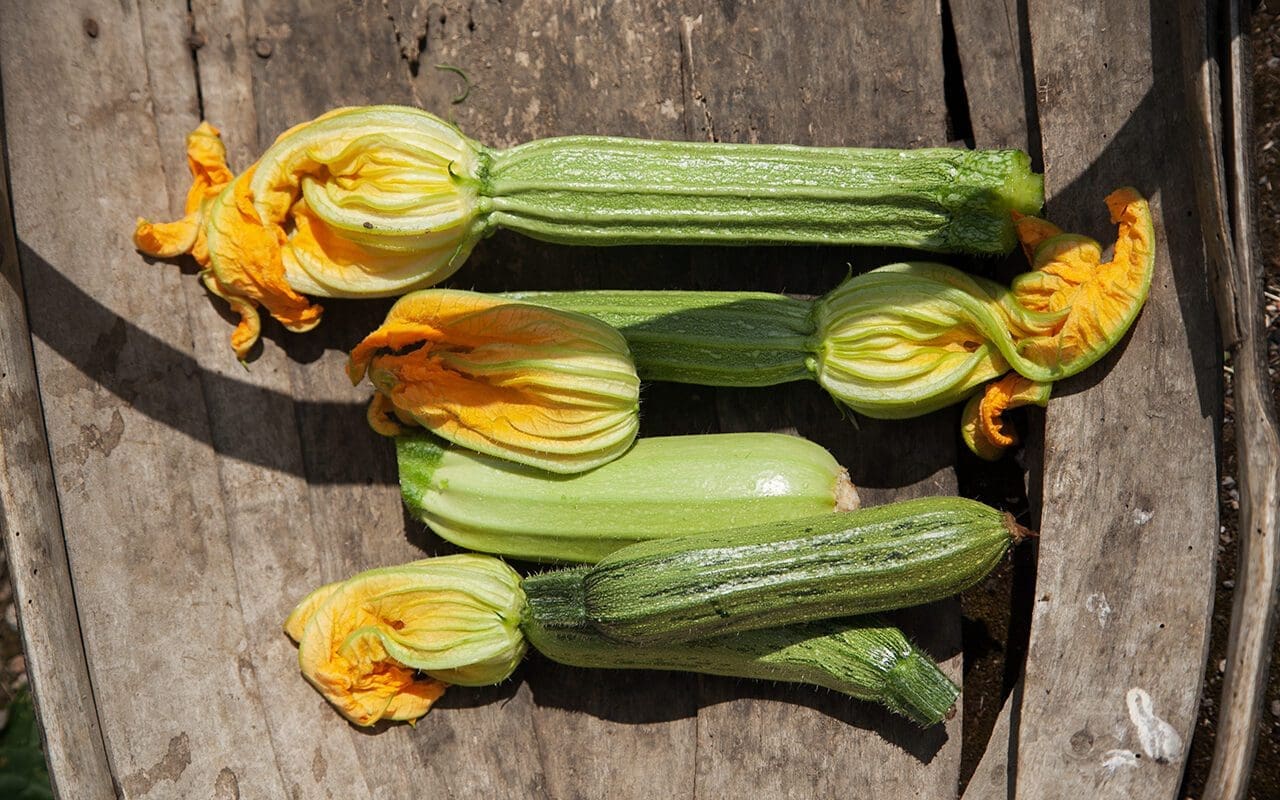
3 small courgettes with flowers – around 250g
2 Little Gem lettuces
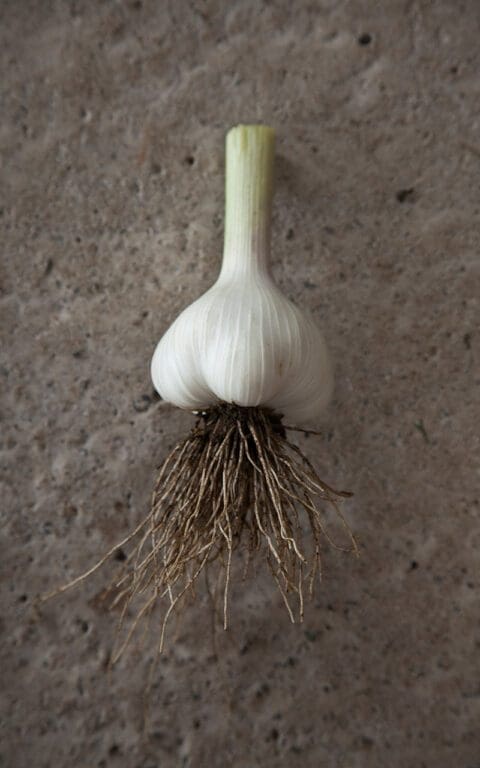
2 fat cloves of new season garlic
A small glass of dry white wine, water or stock – about 120ml
A small bunch of Genovese basil
A small bunch of fresh garden mint
The juice of two lemons
Serves 4 to 6
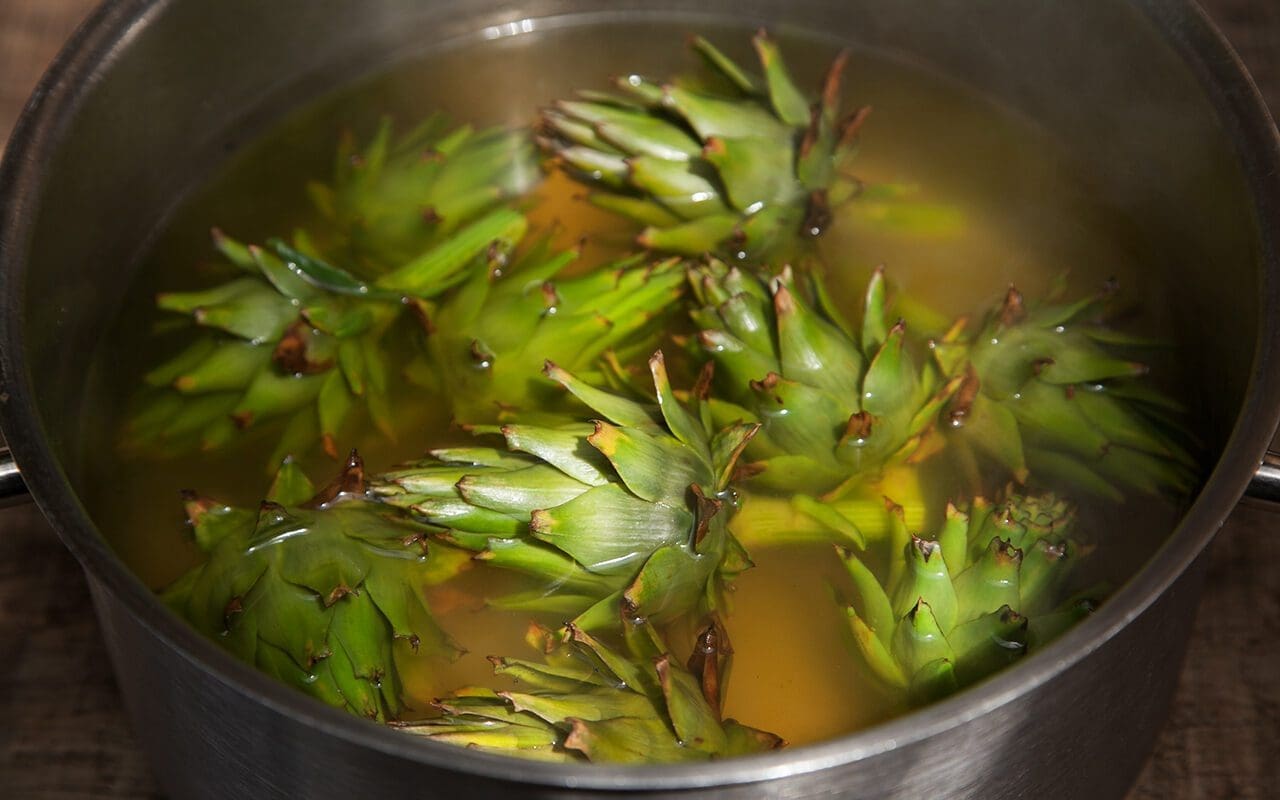
Bring a large pan of water to the boil. Cook the whole artichokes for 5 minutes. Drain and allow to cool.
Shell the peas and broad beans and put in a bowl.
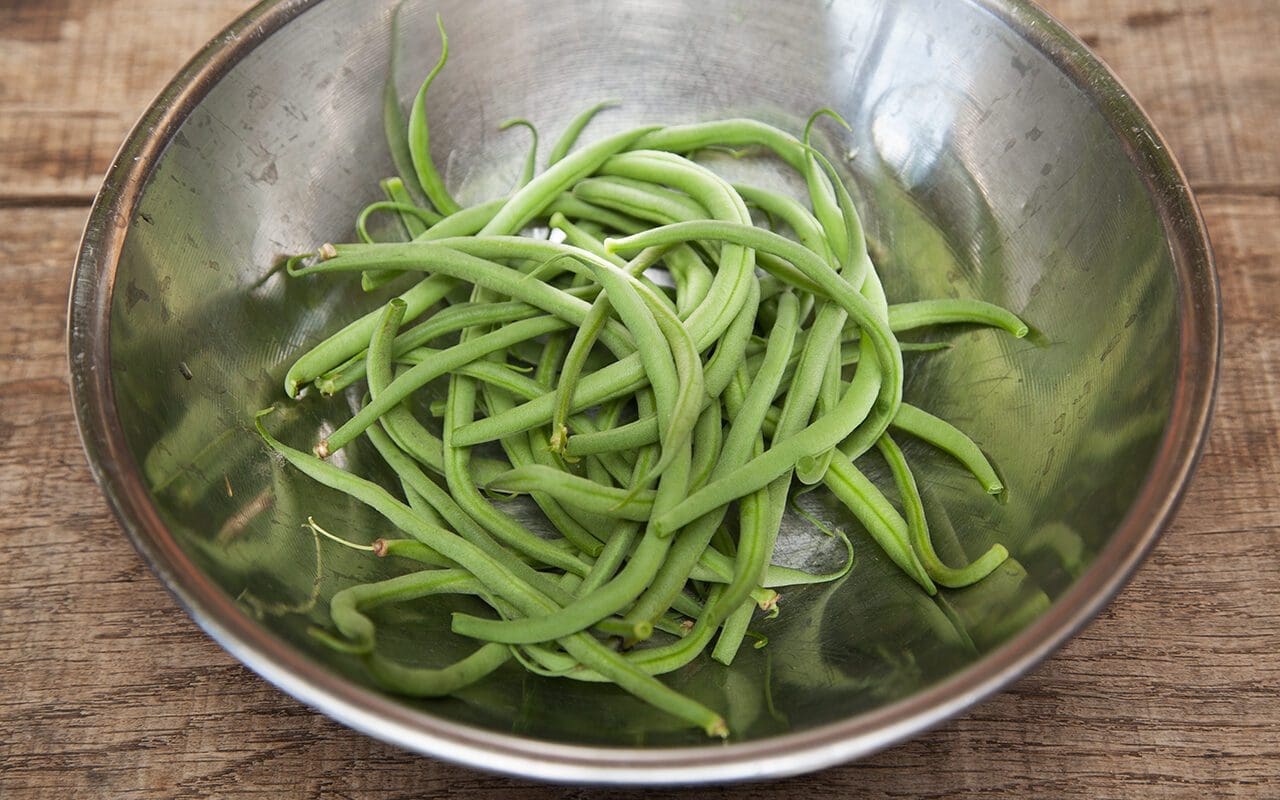
Cut off the stalk ends of the French beans.
Remove the roots, outer leaves, stems and foliage from the Florence fennel. Cut lengthways into eighths.
Peel the shallots and trim off the roots, retaining enough at the base, however, to hold the pieces together when cut lengthways into eighths.
Peel and finely chop the garlic.
Remove the flowers from the courgettes and retain. Cut off the top and bottom of the courgette. With the courgette lying horizontally on the chopping board cut off a diagonal piece from left to right. Roll the courgette a quarter turn away from you and make the same diagonal cut again. Keep turning and cutting until you have wedge shaped pieces of comparable size.
Remove the outer leaves from the lettuces until you are left with the hearts. Keep the leaves for a salad. Trim off any thick stalk, then cut the hearts lengthways into eighths.
In a heavy bottomed large pan gently heat the olive oil over a low heat.
Make a cartouche from a piece of dampened greaseproof paper large enough to cover the inside of the pan.
Add the shallot and garlic to the pan. Stir to coat with the oil. Lay the cartouche over the top, tucking it in to the sides so that no steam escapes. Put the lid on the pan and leave to cook on the lowest possible heat for about 10 minutes until the shallots are translucent and lightly coloured.
Remove the cartouche. Add the fennel and stir. Replace the cartouche and lid and cook for another 3 minutes
While the shallots and fennel are cooking remove the outer leaves from the artichokes and scrape any fibres from the stalk with the edge of a knife. Cut the spiny tops from the inner leaves. Cut the artichokes in half, remove the chokes with a teaspoon and then drop the hearts into a bowl of water to which you have added the juice of one lemon. When they are all done remove them from the water with a slotted spoon and add to the pan of shallots and fennel with the courgettes and French beans. Stir gently. Pour over the glass of wine. Replace the cartouche and lid again and cook for a further 3 minutes.
Lay the lettuce hearts on top of the other vegetables, add the broad beans and peas, replace the cartouche and lid and cook for another 3 minutes.
Remove the pan from the heat and allow to stand for 10 minutes to cool slightly. Then season with salt and lemon juice to taste. You can add some more olive oil now too if you like.
Coarsely chop the basil and mint. Remove the bases from the courgette flowers and discard. Slice the flowers lengthways into thin ribbons. Add all of these to the pan and stir everything together very gently so as not to break up the vegetables.
Leave to stand for another 5 minutes for the flavours to develop before serving.
Recipe and photographs | Huw Morgan
Published 17 July 2021
In 2014 I was appointed as Garden Advisor to Sissinghurst, which was then under the careful guiding hand of Head Gardener, Troy Scott-Smith. The role involved an annual walk round the gardens with Troy, acting as a sounding board for his plans to relax the garden and to steer it gently towards its original vision. Over time, and without the owners at the helm, the gardens had been managed to provide their very best for the swell of visitor numbers. I agreed they no longer resembled the gardens of Vita’s writings or her freedom of spirit.
Troy had spent hours immersing himself in Vita’s imaginings, hopes and plans for the gardens, and had written a manifesto that called for a return to a more relaxed and wild, romantic vision closer to Vita and her husband, Harold Nicolson’s, original intentions.
Every time I visited we skirted around Delos, a garden that had originally been built in response to a visit that Harold and Vita had made in 1935 to the ruins of the Greek island of this name in the Cyclades. The garden had been lost, planted in the wrong place, facing north on heavy Wealden clay. It was a place that had come to be more suited to the site and was now part woodland, part lawn with rose beds lining the boundary. The very name felt like an anomaly.
It was in 2018 that Troy asked me if I would work with him and his team to re-imagine the garden. It was daunting making changes to a garden as universally loved as Sissinghurst, but we set to and looked carefully into the history to understand why Harold and Vita had felt compelled to bring something of the ruined island back to Sissinghurst. Troy had sent two members of his team on a field trip to study the vegetation and record the mood of Delos. The time that I too have spent in Greece provided rich inspiration with regard to the planting. We worked carefully with the National Trust historians to test our ideas as they emerged and spent the best part of a year planning. Visiting a local quarry with Nigel Froggatt, the masterful craftsman who built the garden and taking time to mock up the walls so that they felt authentically of the island.
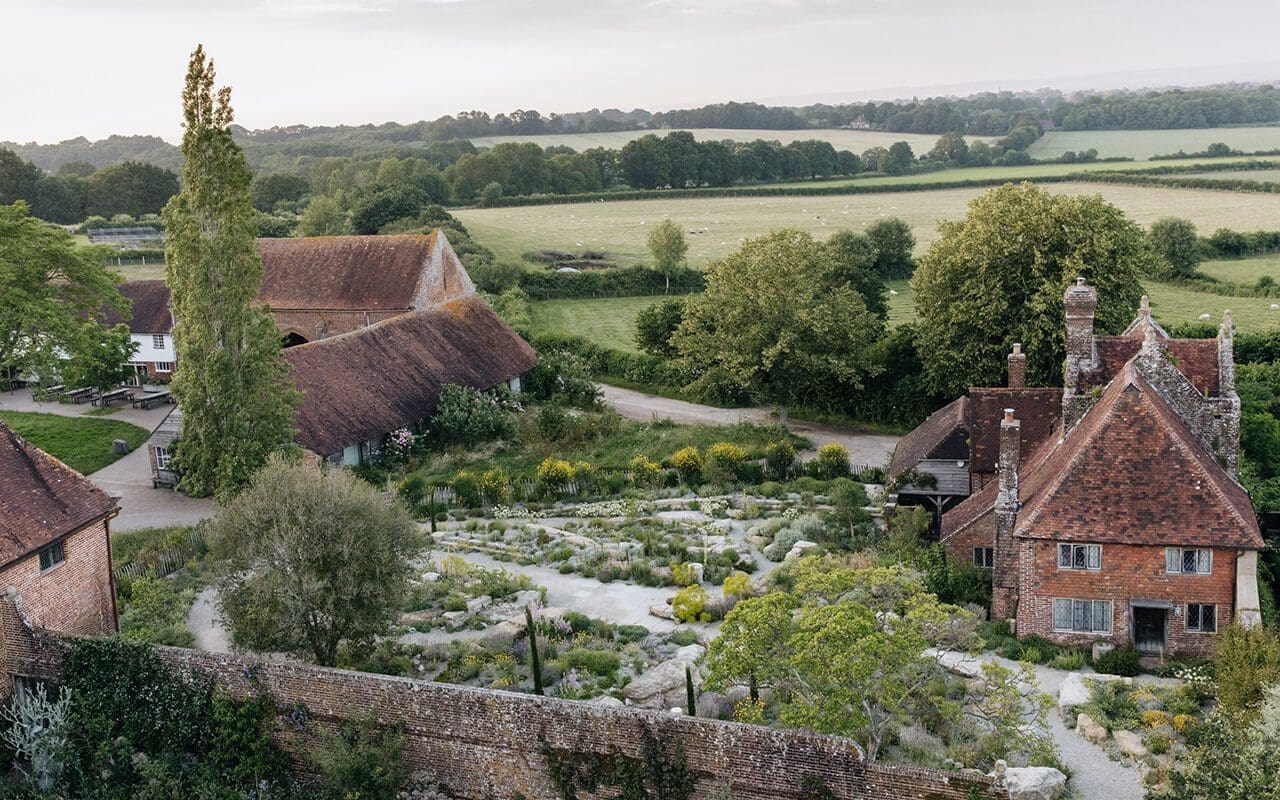
The design made some bold moves that perhaps Harold and Vita did not have the know-how to make at the time. We made light by editing the existing trees back to a Quercus coccifera from the original planting and harvested the sun by battering a number of terraced walls back into the sun to face south. The original axis was reworked to feel like the stepped ruins we had seen in photographs of the garden taken not long after it was made. The terraces that moved away from it became rougher to invoke the hillsides into which the ruins had fallen. We made the old well the centre of the garden, a communal meeting place as it would be in a Greek village and made a seating place amongst columns where Vita had imagined that the blue of the distance could conjure the sea.
I went on my own research trip to workshop the palette of Greek natives with Olivier Filippi at his nursery in the south of France. His knowledge and plant selection is superlative. Some plants were untested in this country, others entirely familiar. On returning to the UK I worked up the planting areas. Goat paths where the aromatic plants would brush your legs and shade-loving drought lovers that would sit happily in the shadow of Judas trees. A mature pomegranate forms a gateway from the White Garden. A fig and the rough twist of cork oaks will, in time, provide height and volume. Aromatic evergreens are already hugging the terraces and perfuming the garden on a hot day and the ephemerals, the annuals that make a Greek spring the spectacle it is, are already beginning to find their niches to make the garden feel lived-in.
Last week, over a year since my last visit for the final planting day in the week before the first lockdown, I returned for the official opening. The garden felt settled and possibly better for the enforced pause of the lockdown and Saffron Prentis, who has been in charge of the garden, has tended it beautifully. The volunteers who man the garden every day have been there to communicate the story behind it and its reimagining.
In 1953, Vita wrote of Delos, ‘This has not been a success so far, but perhaps someday it will come right.’ I know that the changes have not been liked by all who have seen the garden in the flesh or online, but when I returned last week with the planting already looking established after just 18 months, it was possible to see that Vita and Harold’s vision of a Grecian isle transported to the Kentish Weald is once again alive at Sissinghurst and coming right.
_._._._._._._._._._._._._._
When we first started work, Adam Nicolson, Vita and Harold’s grandson, was immensely helpful in facilitating our understanding of the deep-seated cultural motivations of both Harold and Vita to create this garden. At the opening last week he very kindly offered to write a piece giving his perspective on Delos, then and now and I am delighted to share it with you here.
Dan Pearson, Hillside, 8 July 2021
The official opening of the new Delos at Sissinghurst last week is only a beginning. The new cypresses will soon stretch and thicken, the new figs will sprawl and lounge across their neighbouring boulders and walls and the individual plants of Dianthus cruentus will spread and merge into rivers of deep pink, bee-happy colour. A long future awaits this garden, as something to take its place alongside the Purple Border and the White Garden as the brightest of stars in the Sissinghurst constellation.
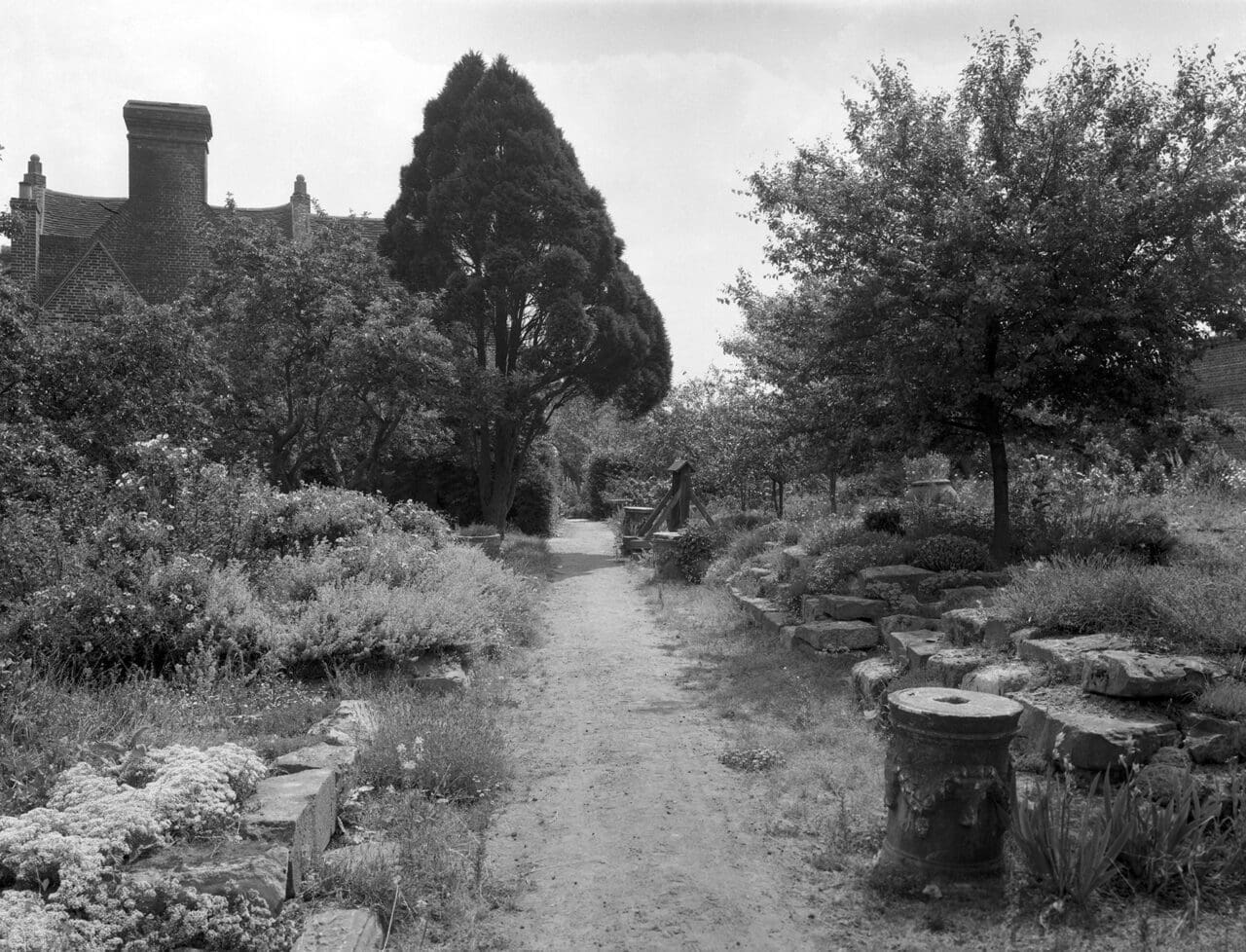
It has been a long time coming. Throughout my childhood at Sissinghurst, we always knew that in the 1930s Vita and Harold had wanted to make a Greek garden in this most unpromising of clay-wet, north-facing and very very Kentish corners. They attempted it, assembling some of the Elizabethan stones they found lying there into stepped platforms that vaguely recalled temple foundations in the drought of the Aegean. But the soil was wrong, the site was wrong and over the years a series of efforts were made to redeem it. My father removed all those stones to make the foundations of his gazebo; a very American grove of birch-like magnolias was planted to preside over a carpet of scillas and chionodoxias through which a few peonies poked their heads; new brick paths were laid. Delos had essentially been lost.
It has now been found and in the richest possible way: the silhouette of a flowery garrigue billows up in front of big country rocks; rubble-terrace walls firm up into what might be the foundations of buildings along the central street of this forgotten city; the half columns of an abandoned temple stand on the slope above.
It is pure theatre, as it was always intended to be, entirely dependent on a big, hidden drainage system and an especially free-running soil, with plenty of grit and crushed brick to make the Mediterranean plants feel at home. Clay is nowhere to be seen.
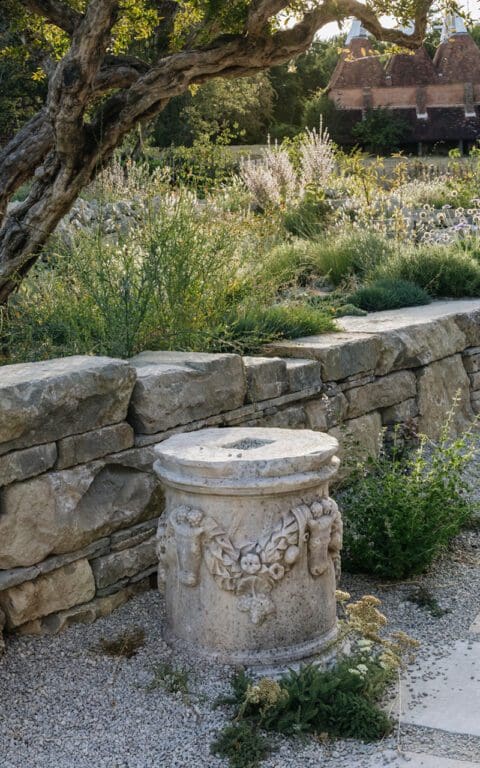
There is one element that reaches further back into history than the dreams of the 1930s: three cylindrical Greek marble altars, originally carved in the 3rd or 4th century BC, decorated around their waists with swags of grape, pomegranate and myrtle suspended between garlanded bull-heads — boukrania—which now stand at key intervals along the central street of the garden. Perhaps almost unnoticed among the blaze of life and colour around them, these altars remain the core of the garden and its meaning. They are the reason it is called Delos, as they came originally from that famous island in the Cyclades, sacred to Apollo, and represent an element of the story that was undoubtedly close to Harold Nicolson’s heart.
His mother’s grandfather was Commodore William Gawen Rowan Hamilton, a naval commander in the first years of the nineteenth century, a heroic and romantic figure and passionate Philhellene, who spent the years from 1820 onwards in the eastern Mediterranean, winning the title of ‘Liberator of Greece’ by protecting the Greek rebels against the Turks and spending much of his private fortune in their cause. There is still a street in Athens named after him in gratitude.
From time to time during his cruises attacking pirates and fending off the Turk, he would land on an island or a piece of the Turkish-occupied mainland and quietly liberate an antiquity or two, sending them back to his liberal father-in-law in Ireland, Major-General Sir George Cockburn, a flamboyant antiquary who had made a collection of Greek statuary at Shanganagh, his castle outside Dublin.
These Delian altars arrived there in the late 1820s, dripping with Greek-loving, liberty-loving significance, and when in 1832 the British government promised in the Great Reform Bill to democratise the corrupt state of British politics, Sir George erected them in a column to Liberty outside his front door. They stood there for six long years, during which the government entirely failed to reform the basis of British politics, and in rage and frustration, Cockburn had carved on the base of the monument the grand reproach: ALAS, TO THIS DATE A HUMBUG.
In 1936, when the contents of Shanganagh were sold up, Harold Nicolson bought the elements of his great-great-grandfather’s column and had them transported to Sissinghurst. The HUMBUG base and one altar is still in the orchard; the three others are in Dan’s new Delos, still in my mind radiating everything which that long, Rowan-Hamilton-Nicolson tradition valued most: a love of liberty; an internationalist, pan-European vision; a cosmopolitan grasp of and engagement with world culture; and a treasuring of those dry, beautiful, ruin-scattered landscapes sacred to Apollo which this Kentish garden now recalls.
Adam Nicolson, Perch Hill, 3 July 2021
Photographs | Eva Nemeth
Published 10 July 2021
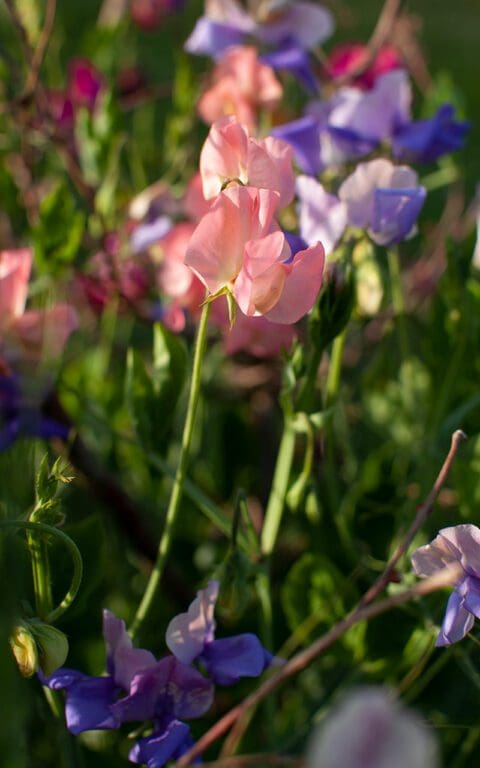
Nothing smells like early summer quite like a sweet pea. Fresh and intoxicating, innocent and sensual in equal measure. The scent of my grandparent’s garden, which wafted through the windows of my bedroom on hot summer nights in Swansea. The vines planted at the ends of the runner bean supports, which brought the sweet peas down to earth while exalting the beans. They were never cut for the house, just allowed free reign to scramble and scent the vegetable patch. Now that I grow my own the house is filled with their scent as long as I can keep up with picking them, although there is always a point in the summer where the stems get so short or you have better things to do (like bottling tomatoes, freezing soft fruit, making jams and chutneys) that it is finally better to leave them on the plant and allow them their natural decline.
This year, for the first time we got our sweet pea seeds sown early. Before the arrival of the polytunnel we had always waited until late March before sowing, but we got a head start this year and planted them in early-February. The seeds were soaked in cold water overnight, which is reputed to make them faster to germinate, although it is difficult to ascertain whether this is the case or not. Three seeds of each were sown in a 9cm pot with two pots of each variety and put into our unheated toolshed, which has the frost kept from it by virtue of also being where the boiler is located. When we posted news of the seed sowing on Instagram some queried why we weren’t using root trainers and, although it is true that all legumes tend to benefit from deep pots due to their searching root growth, we have never had an issue with pot-grown sweet peas, as long as you get them in the ground before they become pot-bound. That said we have been collecting the insides of our toilet rolls to use next year to see if it makes a difference.
As soon as the seeds started to germinate they went into the Milking Barn, where we have a dedicated propagation shelf set up in the picture window, which gets direct light for most of the day. A week after germination, to prevent them becoming etiolated, I would ferry them down to the polytunnel every morning to get as much light as possible, before bringing them back up to the heated barn every evening. By early March the polytunnel was warm enough to leave them in there overnight and soon they were large enough – with four sets of true leaves – to pinch out the tops, which encourages strong root growth and stockier plants.
Once the seedlings had reached a height of 15cm they were brought up to the cold frames by the barns and hardened off for a week before planting out. However, this was delayed by the prolonged frosts in late March and early April and so, when we did eventually get them in the ground in the second week of April, they were protected with fleece for a few days until the cold snap had passed. Sweet peas are hardier then they look and although one frost was hard enough to get through the fleece, despite their wilted appearance the plants recovered very quickly.
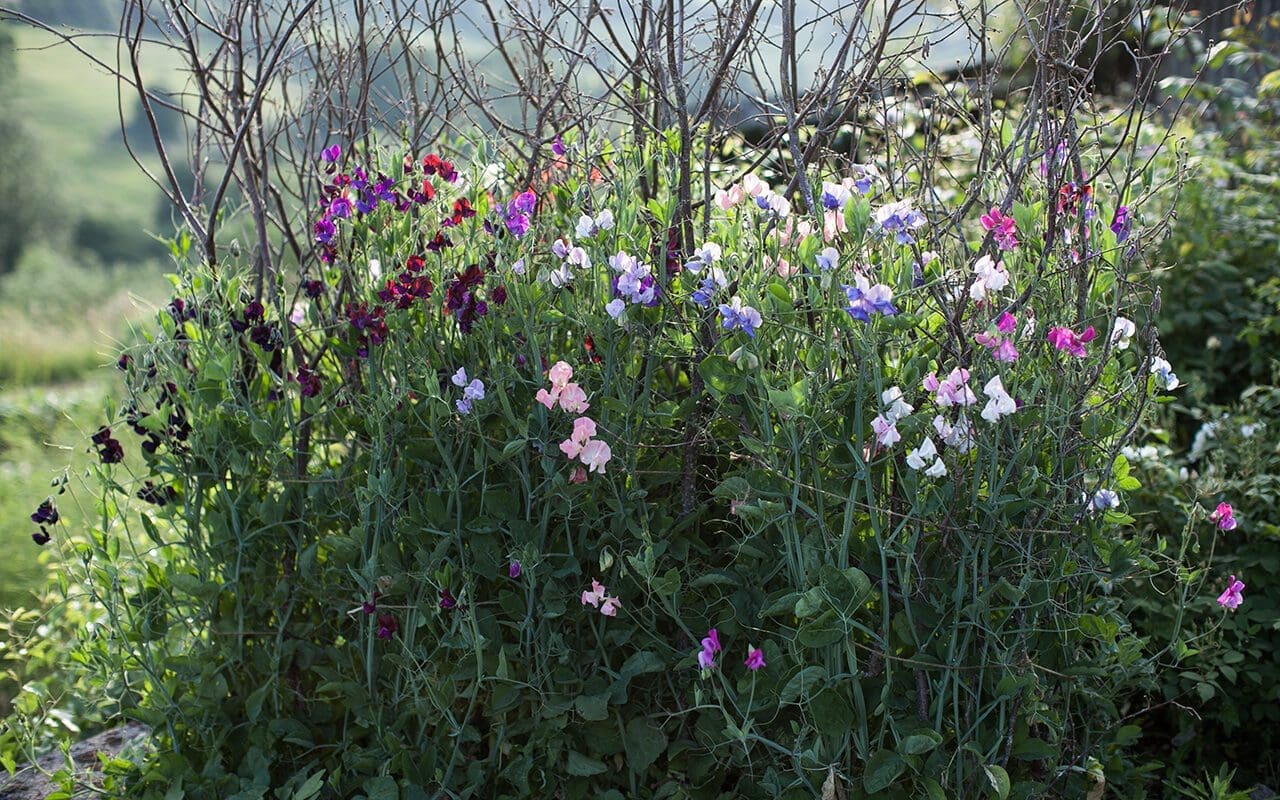
We have grown sweet peas every year since we moved here and have tried a wide range of varieties, but we always return to the Old Fashioneds and Grandifloras. These are the smaller flowered varieties, many of which are very old, and which have the strongest scent. They have a tendency to shorter stems, which means that they are not so popular with flower arrangers and florists, but I simply cut longer stems from the plants with leaves and tendrils intact. The Modern Grandiflora varieties were bred in the 20th century to provide the scent of the old varieties with the larger flowers and longer stem length of the more popular Spencer types, which have large, more ruffled flowers and long stems, but little scent. As with roses there seems little point in growing sweet peas unless they overpower with perfume.
I’ve tried several of the text book methods for prolonging the flowering season, including one year following the wisdom of the professionals and pinching out every single side shoot to encourage upward growth which, when it reaches the top of the hazel poles, is then trained down the neighbouring pole to double the height of the plant and, therefore, the number of flowers it produces. All very educational, but frankly life’s too short. Now I simply ensure that each time I pick a flower (and regular, daily, picking is the best way to ensure longevity) I snip out the side shoot that develops at its base, as the energy required for these prevents the main stem from reaching its full height and the flowers produced on them always have much shorter stems.
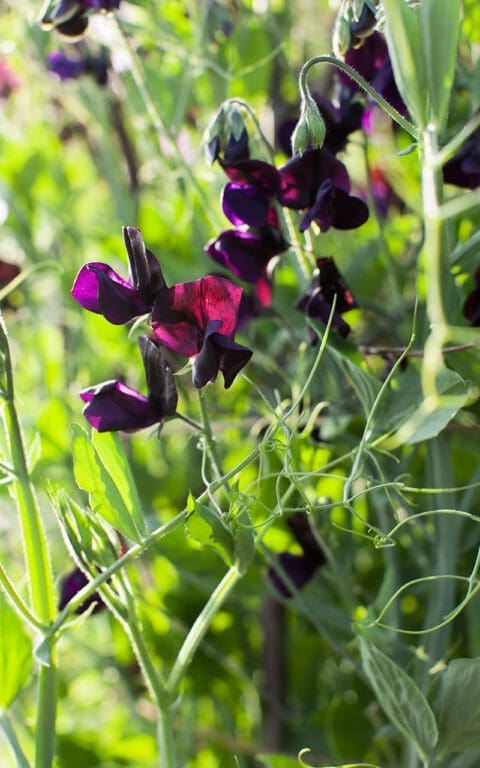
Each year we plant a range of colours and, although we have some stalwart favourites like ‘Cupani’, ‘Painted Lady’, ‘Almost Black’ and ‘Lord Nelson’, we always trial some new varieties. Here is this year’s selection.
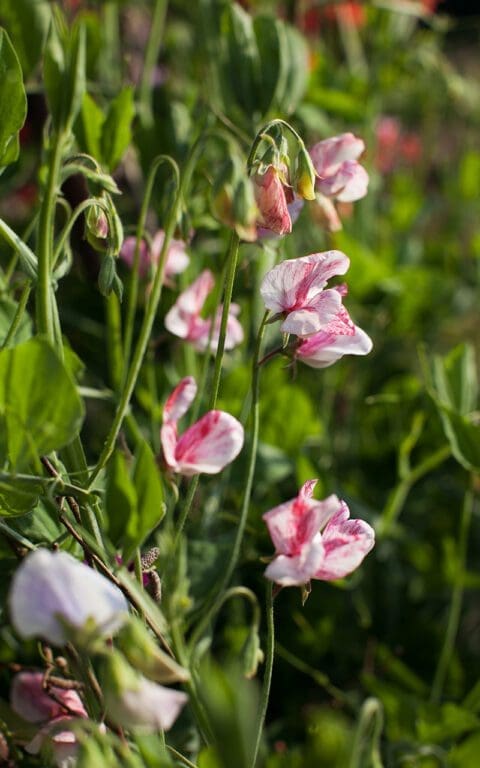
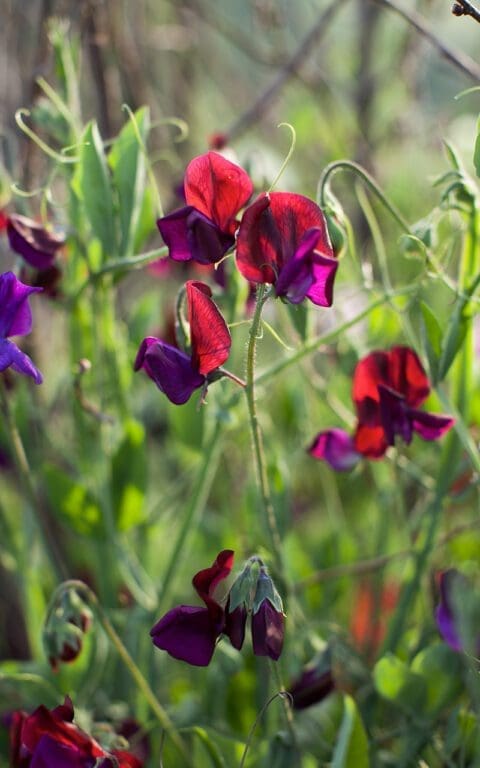
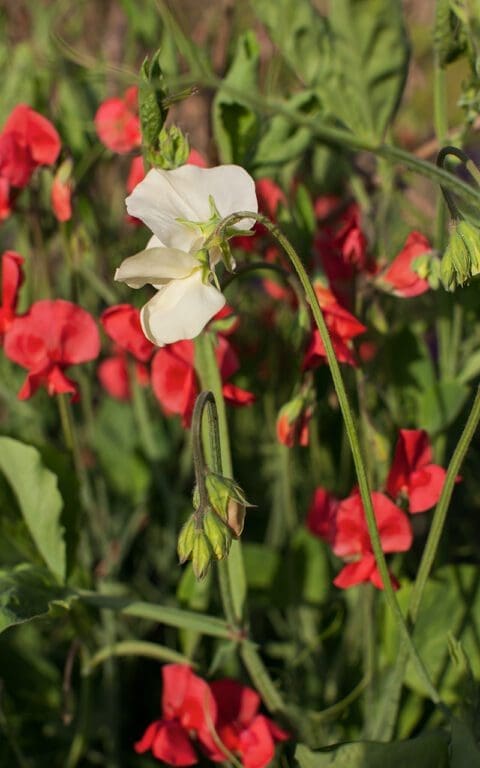
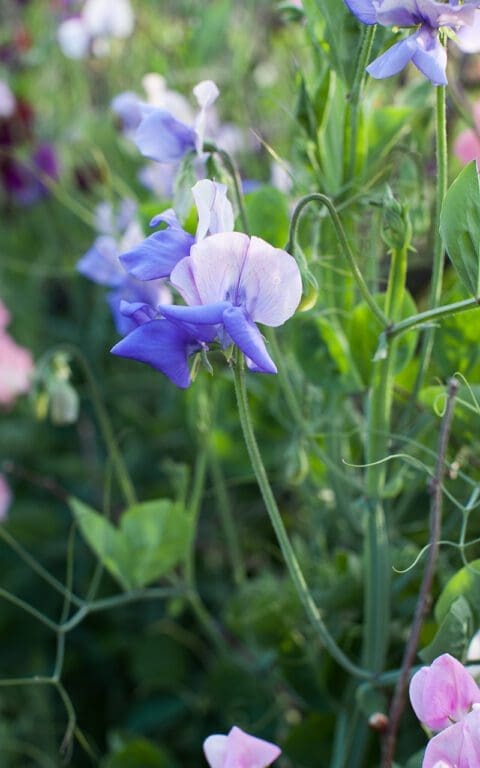
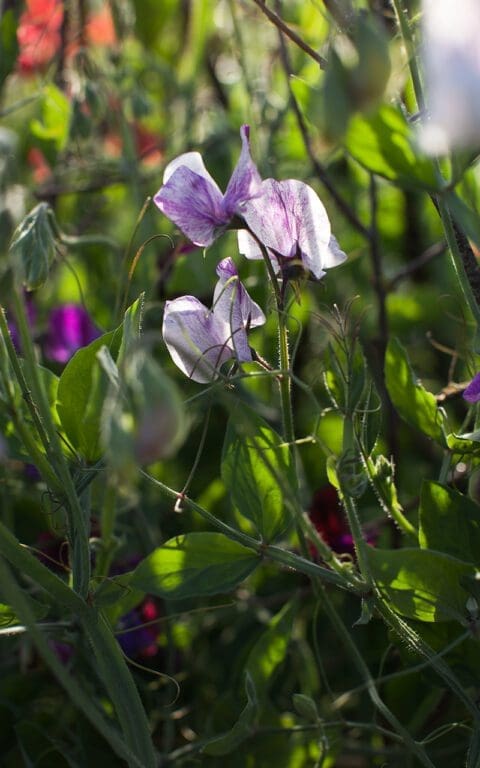
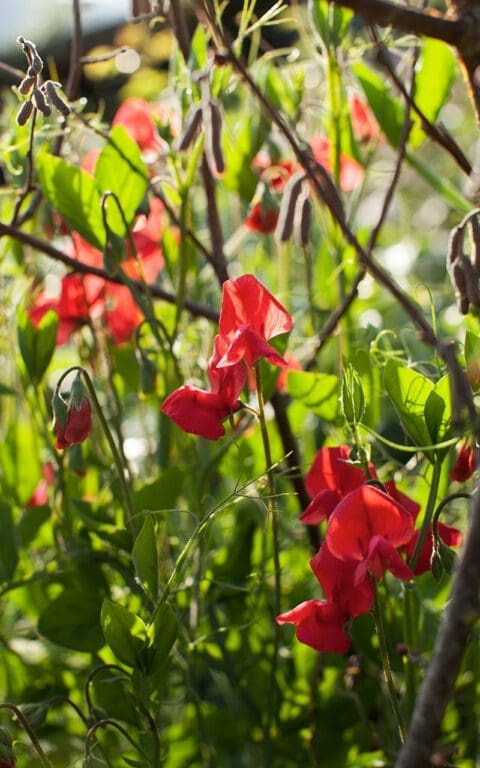
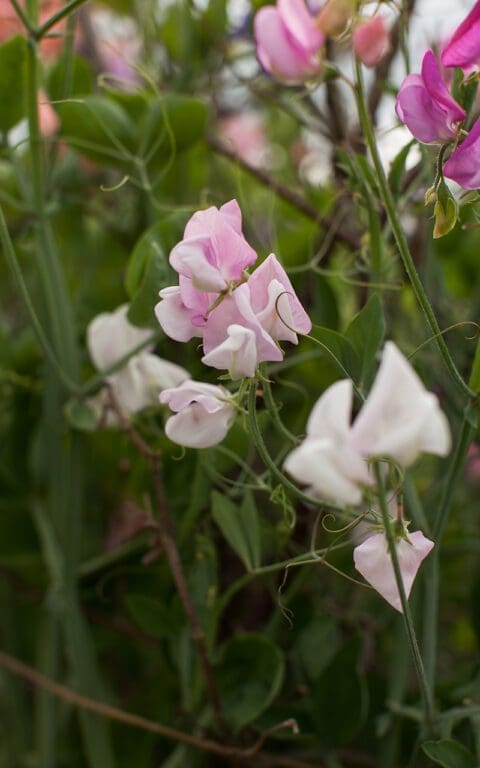
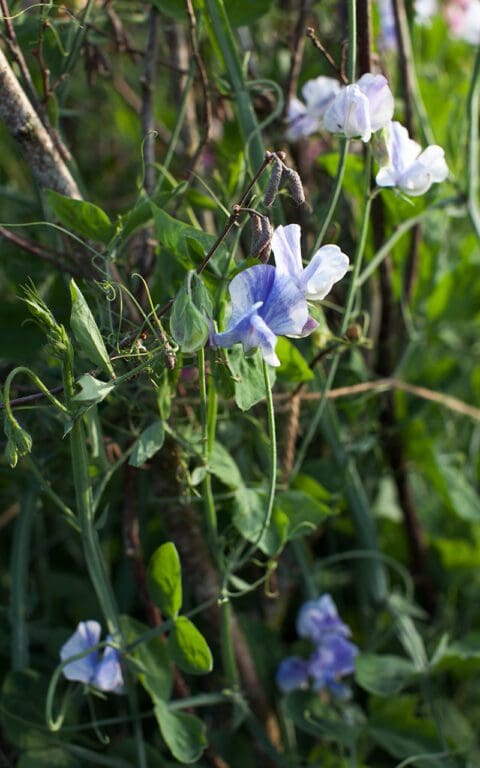
Words and photographs: Huw Morgan
Published 26 June 2021
The Giant Oat Grass inhabits high, dry ground in southern Europe and, although I have never seen it in the wild, I can imagine them rising above their companions in the steppe. This is how they like to be, in the company of plants that do not overshadow the tussock of evergreen foliage and where in the longest days of the year they take the light and hold it in a hovering suspension of coppery awns.
The stipa is an old favourite. I grew it first and en masse as an early emergent in the Barn Garden at Home Farm. We used the pockets amongst the old cobbles where previous buildings had been razed to the ground and allowed the oat grass to lead the mood in June. I let the Californian poppy seed through a sprawl of Potentilla ‘Gibson’s Scarlet’ at its feet and the rusty spears of Digitalis ferruginea ascended up into the cloud to score the vertical. I have the Stipa here too, also by our barns and growing in nothing but rubble and subsoil where they stand head and shoulders above their companions. To play on the dilapidated mood of the rusty buildings they are teamed with evening primrose and the tiny pinpricks of a wild dianthus.
Spearing at speed from the basal foliage as the days lengthen, the stipa are a litmus in this race to the longest day. Angling up and out so that there is sufficient room for the flowers to take their own space when they break the tall tapers, they head into a miraculous fortnight of flower. The panicles open out at head height to form a cage through which the wind can easily pass. The golden moment is the week the anthers furnish themselves with pollen, dangling free and on tiny hinges for mobility and ease of distribution for wind-blown pollen.
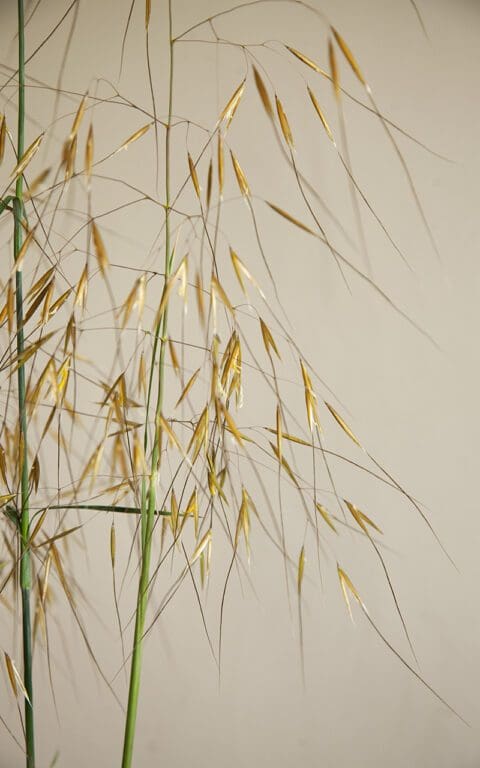
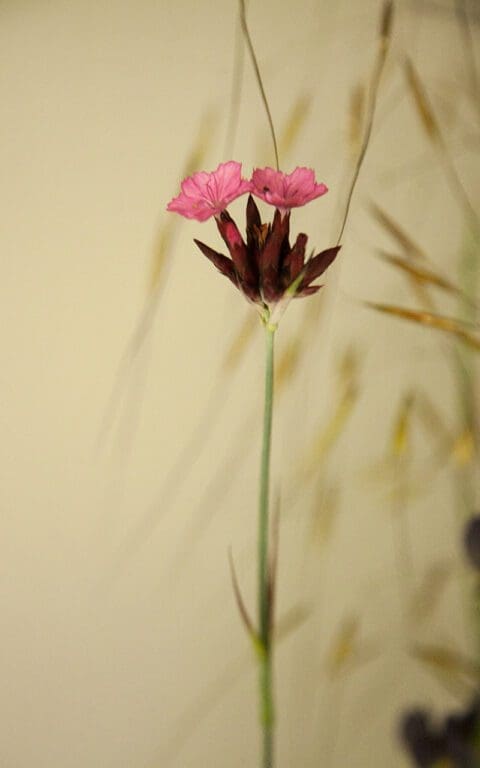
Though it strikes a particular mood of dry airiness in the garden, Stipa gigantea goes with almost anything if you pick it and bring it inside for closer observation. We have it here with a couple of neighbours from the planting. A tall Dianthus giganteus from the Balkans, which favours the same conditions and seeds about in the open places. It has proven to be long-lived here where the ground drains freely and has seeded easily but not annoyingly amongst but not into the crowns of neighbouring plants. Rising to almost a metre here, it is an easy companion, content to find its place on the edge of the planting and rising through the stipa to provide an undercurrent of colour. With blood red calyces and magenta buds that deepen the mood, the flowers open a soft rose-pink.
Close by, but very much in their own space, are the Baptisia x variicolor ‘Twilite Prairieblues’. Where many perennials are happy to be moved if you don’t find them the right position, you need to place the False Indigo in the right place the first time, because they like to put their feet down and hate disturbance thereafter. Being leguminous they fix their own nitrogen and are happy in the rubbly soil. As prairie-dwellers they hate to be overshadowed and will dwindle if a neighbour throws shade, but given a place they like with the surround of good light, they are long-lived and easy.
I have been experimenting with several of the hybrids for their longevity and their curious in-between colours and this one is a beauty. The female parent is the more usual indigo blue B. australis, but the male parent here is the yellow flowered B. sphaerocarpa and this provides the yellow keel. The colour of the standards is neither one thing nor another. A smoky violet-purple, without being muddied.
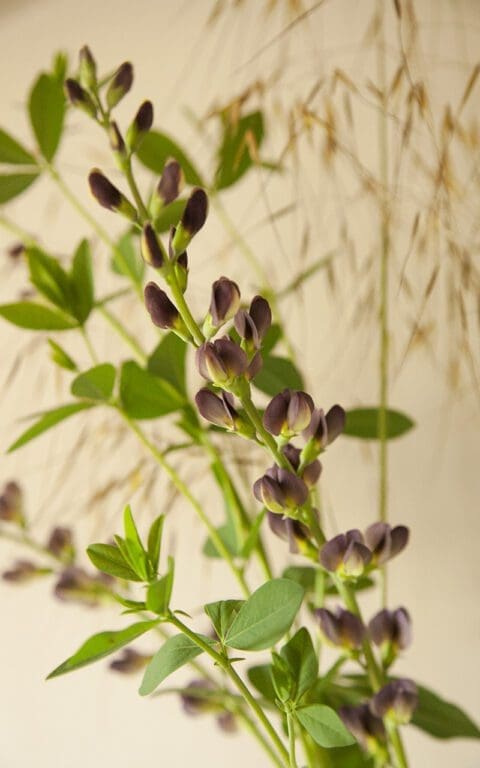
Rising fast and tall and again racing to the solstice, the lupin-like flowers strike a vertical accent whilst in flower. As they go to seed the plant becomes a rounded form that you need to allow room for as it fills out as it matures. The presence in summer is strong and definite, with good healthy glaucous foliage and, later, long-lasting seedpods that darken in winter to charcoal-black.
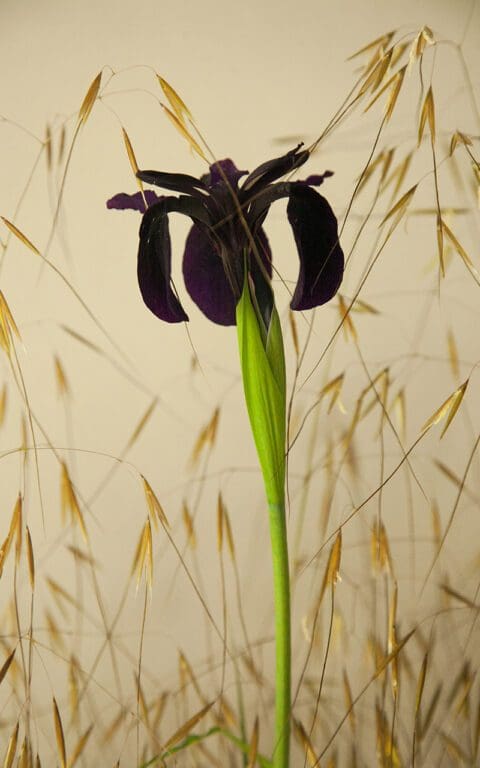
Though from the altogether different growing conditions of the cool damp meadows of southern China, the Iris chrysographes ‘Black Form’ refers here to the winter colours of those baptisia seedpods. Though iris could become a serious obsession, the reappearance of this one every June is always spellbinding. Black on first appearance, but the deepest royal purple on closer observation, they are worthy of a backdrop against which they will not be lost. In the garden they are allowed to hover in the paler suspension of Bowles’ Golden Grass, where their beautiful form is made all that much clearer. And here too, the stipa shows us that it is worth experimenting with associations you might not choose for their cultural compatability, but for what they might inspire beyond their place in the garden.
Words: Dan Pearson | Flowers and photographs: Huw Morgan
Published 19 June 2021
The oriental poppies have broken the green, rearing above the rush of June foliage. They are the first true colour in the garden, save the Tulipa sprengeri that teetered neatly on the last week of spring and preceeded them. Red is a jolt this early in our verdant landscape, but we are ready for it now, the first slash of summer.
I have planted the poppies in homage to several memories. The first, a plant I remember from being about the same height, gazing into their interiors in our childhood garden. It grew with ferns and sprawled beyond the borders to offer up bristly buds, the casing breaking into two under the pressure of soon to be uncrumpled flower. I am red-green colour blind, but not completely and those poppies are an early memory of being able to see red fully, for they present it without compromise. Luminous and as red as anything can be, heightened by black-blotched bases and turquoise stamens.
The second memory, and one that I have planted into this garden, refers not to poppies at all but to meeting scarlet Amenone pavonina flaring amongst euphorbia and the march of giant fennel on the Golan Heights in Israel. I was there for a year working in the Jerusalem Botanical Gardens and the brilliant Michael Avishai, then Director of the gardens, would take me on weekend excursions to look at the flora of Israel. A fearless and terrifying driver, we would leave at 4am, to arrive at a site, spot on time for a happening in the landscape. This one came with his advice to not stray too far from the road. If you stepped over the wire marked “Land mines. Do not enter !”… The red of anemone I can see too and I shall never forget its shimmer amongst its opposite acid greens and the sun rising over an army of fennel stretching into a dangerous distance.
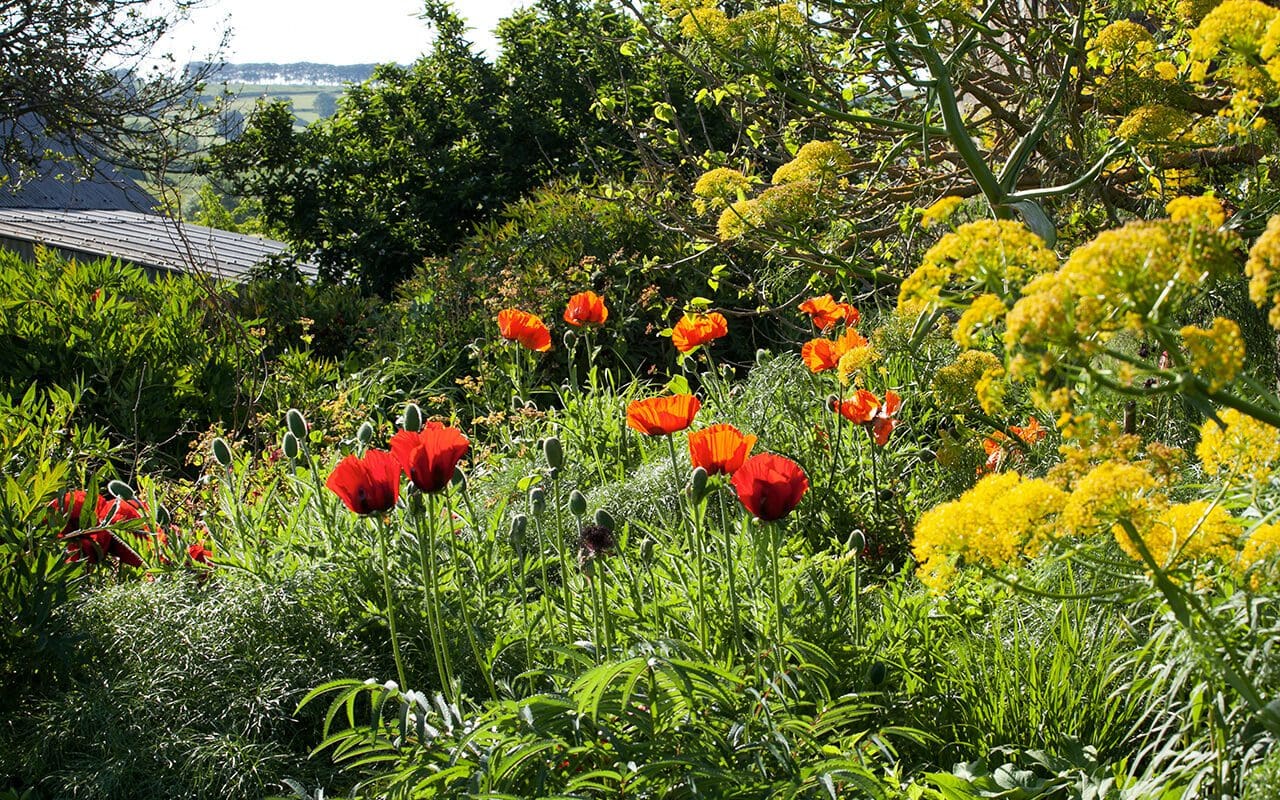
So, this particular memory comes with a charge and the oriental poppies that step through the giant fennels in the garden here take the place of the anemone. We have two varieties by default, not design. The requested ‘Beauty of Livermere’ (Goliath Group) are pillar box red, while there are three plants of a tangerine orange one that were substituted and planted without knowledge of their difference. I do not have the heart nor the desire to take out one or the other. The reds are good together and if I were to try and remove the plants to only have one, they would still likely regrow from root cuttings. This is the way to propagate oriental poppies for they do not come true from seed.
The rush into life in the spring, first with a mound of hairy, lime-green foliage and then the reach to flower is made possible by energy stored in thick, deeply searching roots. Hailing from Central Asia, their habit of disappearing once they have flowered and set seed is a survival mechanism against the drought of summer. The gap they leave will need to be negotiated by cutting the plants back to the base as soon as they begin to wane and in combining them with later-to-come perennials that will cover for the gap they leave behind. Asters and late flowering grasses make good couplings.
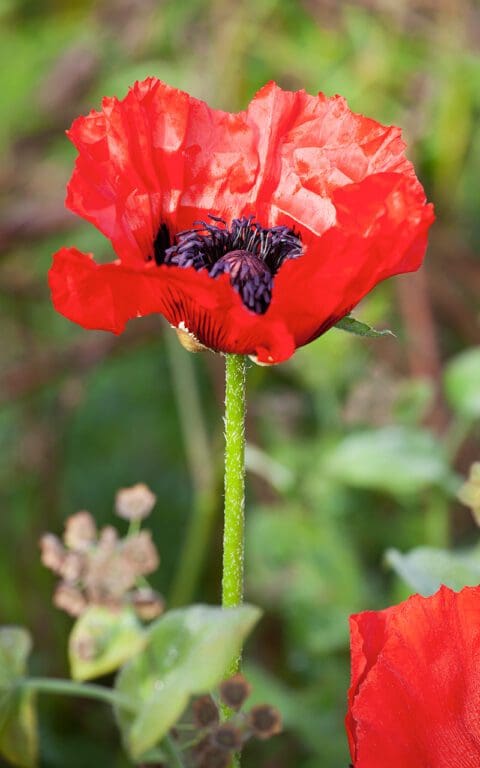
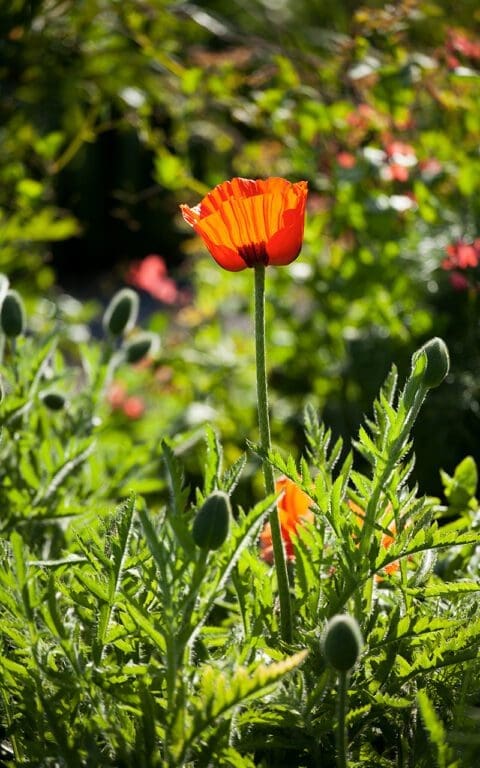
The reserve in the root can also be used to advantage in the fringe of the garden in rough grass and amongst cow parsley for the early growth will also outcompete grass in spring. The secret is to introduce them as established plants and keep them clear of competition in the first year whilst they are building their root system. Their dwindling summer growth will be disguised by the meadow and the autumn regrowth can be mowed around once it returns with summer rains.
Though I do not grow more varieties here, for the oriental poppies set an opulent tone and demand your attention whilst they are in flower, I have grown several in the past. At Home Farm I set ‘Perry’s White’, with its contrasting dark blotch, amongst gallica roses and inky bearded iris. I used the wood aster, Eurybia diviricata to cover for them later. For a while I also grew ‘Patty’s Plum’ for its thunderous bruised grey-mauve flower though it was never a keeper and dwindled for me. Then there was Saffron’, with wide open flowers of pale tangerine.
Burned into the June green, I will be there as I was aged five this coming weekend to witness their awakening. Never dimmed, always welcome.
Words: Dan Pearson | Photographs: Huw Morgan
Published 12 June 2021
The farmers around us are making the first haylage, harvesting this moment of energy in the pasture before the grasses race to seed. Meanwhile, we let our meadows grow and watch the energy change on a daily basis with the mown paths deepening as the growth pushes into June.
After the slow, cold spring and now the rush with the weather warmed, we find ourselves feeling as if the world around us is in fast forward. So full of life and never lusher.
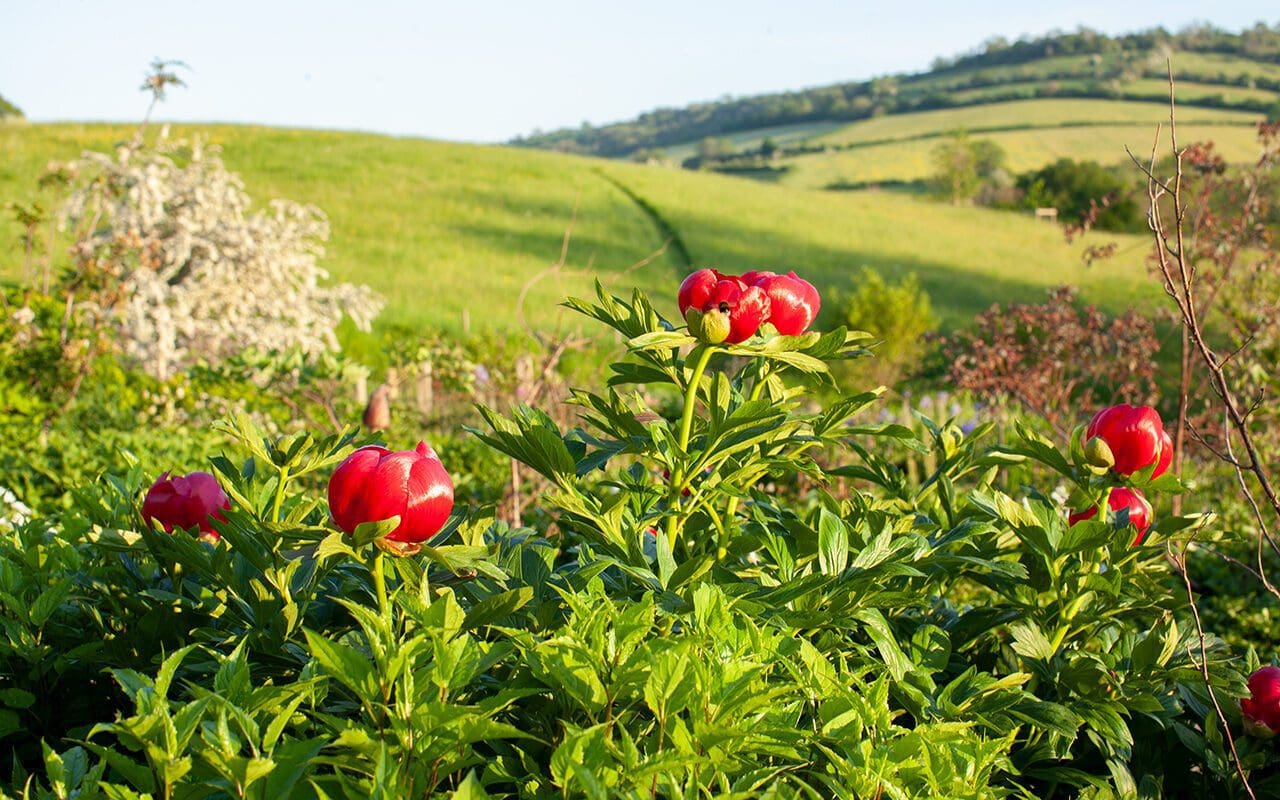
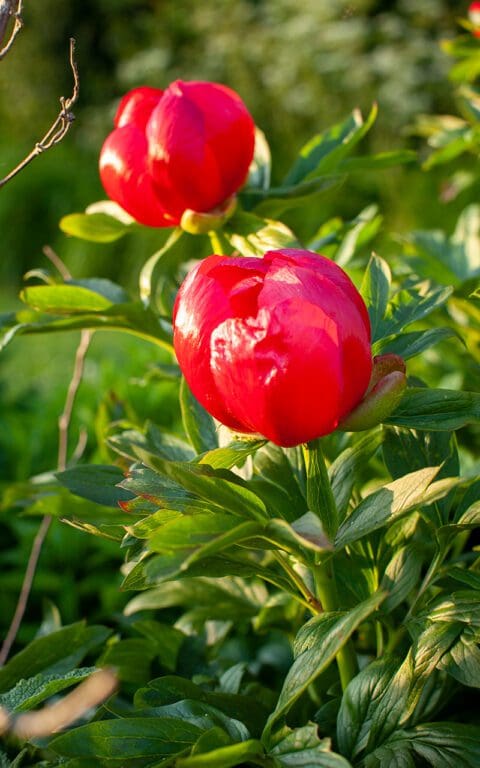
The Paeonia peregrina holding on with its perfectly spherical buds, glistening and burnished whilst it was cold still in May, were the perfect example this year. Despite the slow spring, the anticipation in their readying was as good as the moment they opened when the weather warmed earlier this week, the richly coloured goblets acting as sound boxes as the bees busied themselves inside. Pollinated and the business done, they were gone and on to the next part of their life cycle. Such is the way in these early summer days. You have to concentrate and make the time to look or you will have missed the moment.
The ephemerality of many of the plants that see in summer is made more acute for the rush. The first field poppies and evening primrose, each flower lasting just for a day. The creamy hawthorn or the flash of scarlet Tulipa sprengeri (main image). You have to put aside time to be with them as they move from one stage to the next. Miss a day and you will do as I did just last night and return to find the vivid tulips already dropped, their scarlet just a memory.
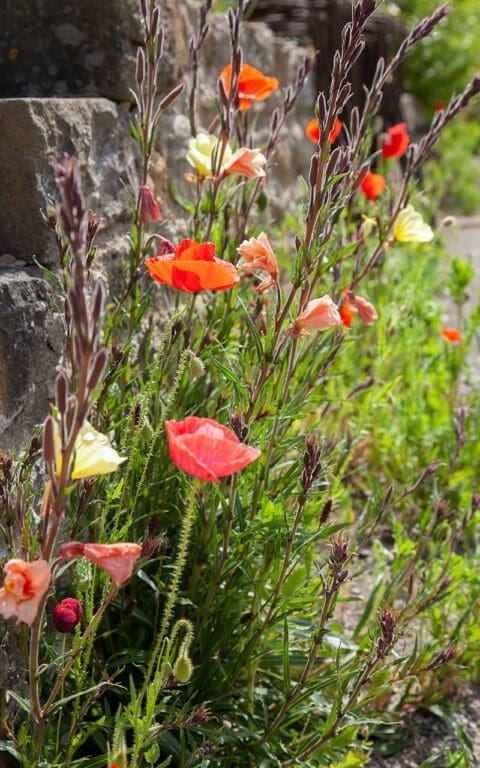
We try right now to spend time walking the meadows daily. The garden is deliberately planted to be slow whilst they are in their prime and to come into its own once they dim and lose their lustre. The daily visits out into the landscape chart the happenings. The week of the dandelion, the pause and then their clocks two weeks later, seeding and silvery as the first of the buttercups rise and put the sway into the meadow as it lifts and reaches skywards.
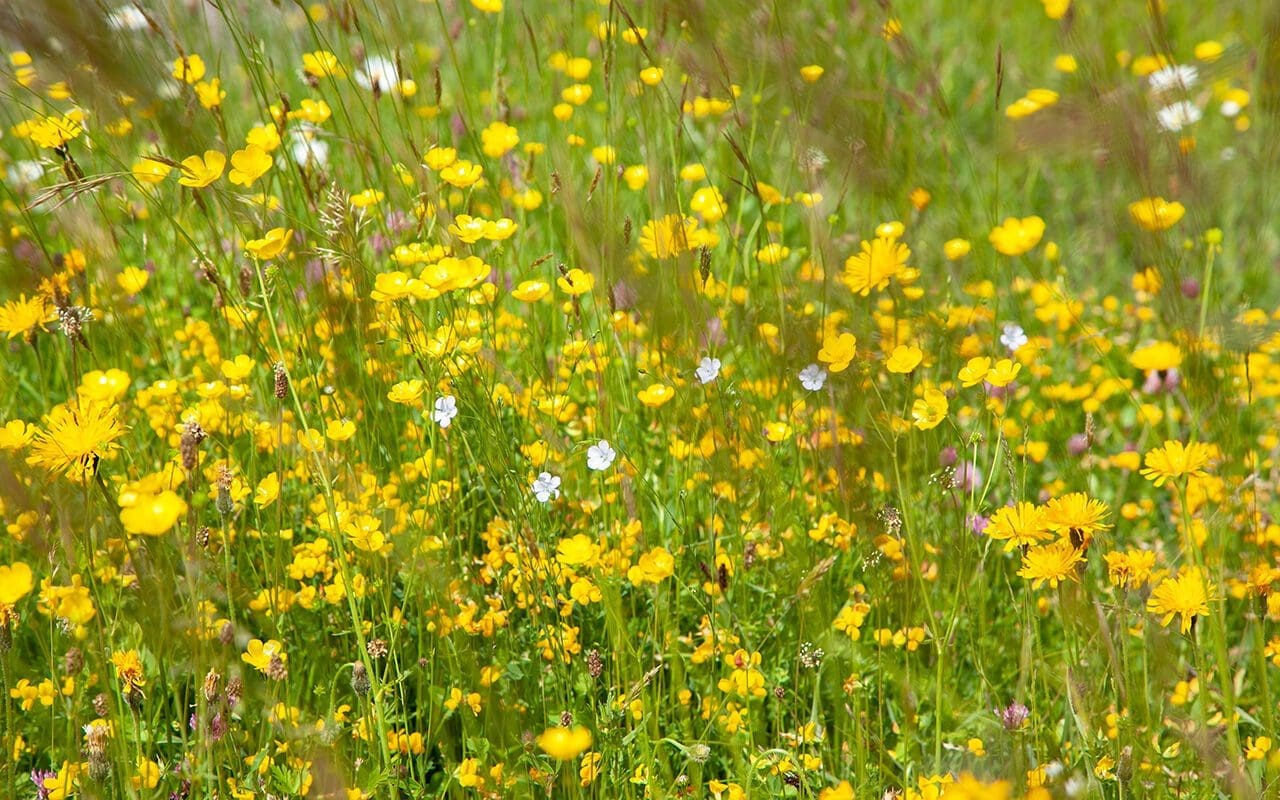
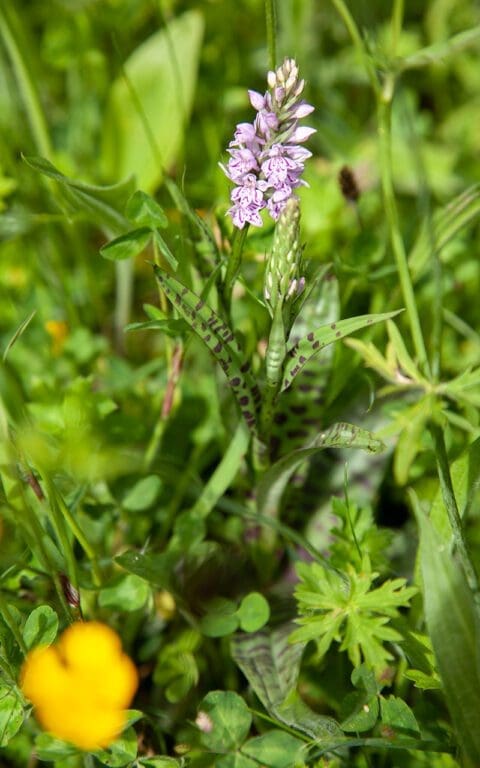
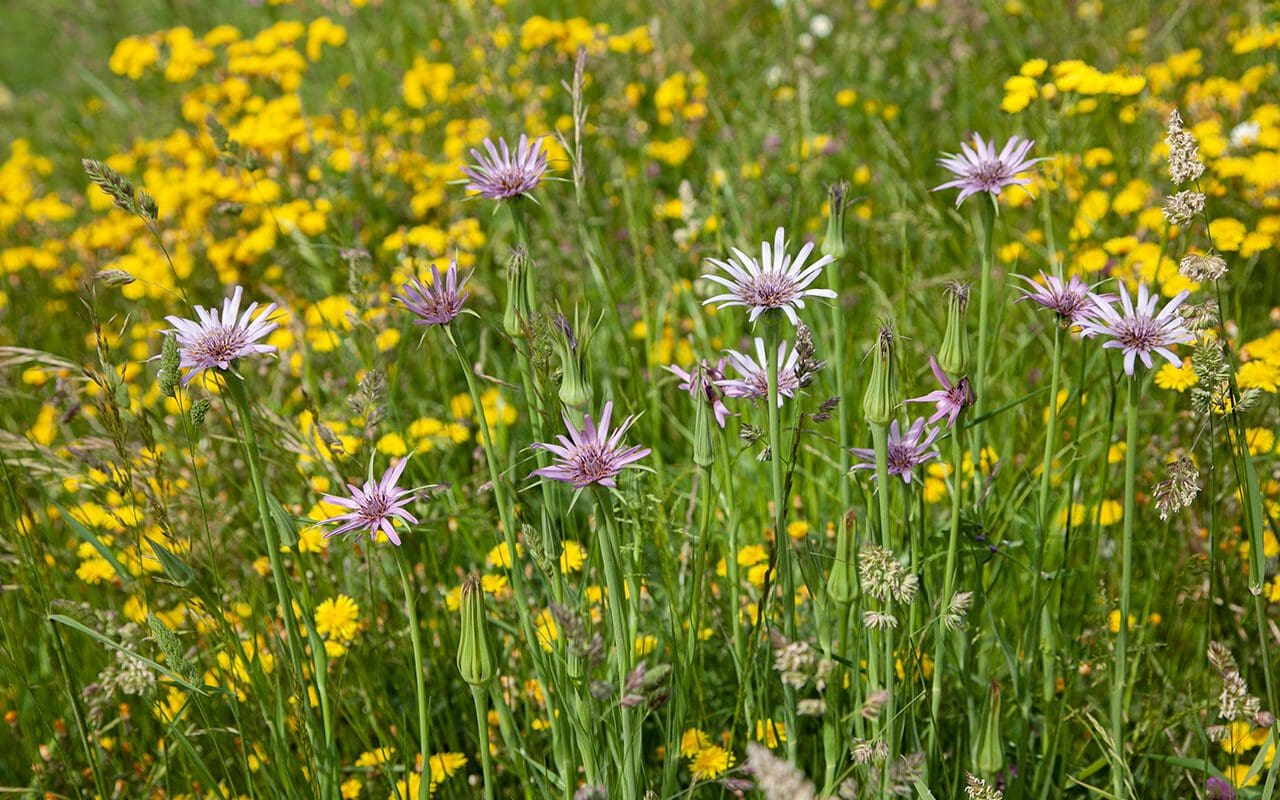
The dynamic nature of the meadows is what makes them captivating and our walks are slow as we follow one colony of plants or stumble upon the first orchids or the dainty, day-flowering Pale Flax, which has moved its place from the previous year. One year is different from the next as the balance addresses itself to the weather or the grazing or a window of opportunity as one species ebbs or migrates.
Right now it is the time of the mauve-grey Tragopogon porrifolius, which I introduced to the meadows to see if it would find a niche. Blinking open in morning sunshine and closing in the afternoon, the flowers also last just a short time, but they relay over three weeks or more with one flower rising from the grassy foliage to follow the next. Standing tall, a head or so above the crowd it will be the end of the month before their giant dandelion clocks are suddenly with us. Coppery and transparent and holding the light. The parachutes that help the seed travel will slowly further their reach as the seed itself is heavy. They are less invasive in a meadow than if you let them loose in the garden and they bridge the two and help blur the boundaries.
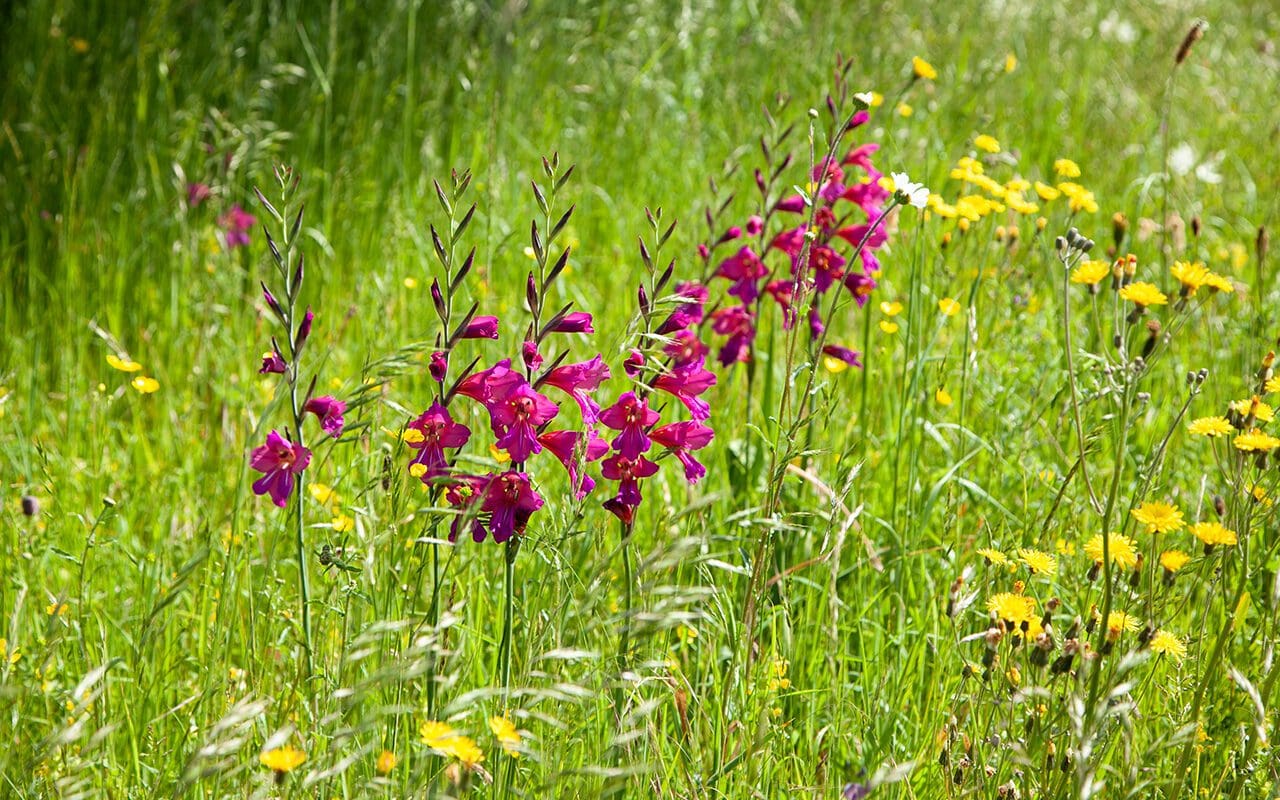
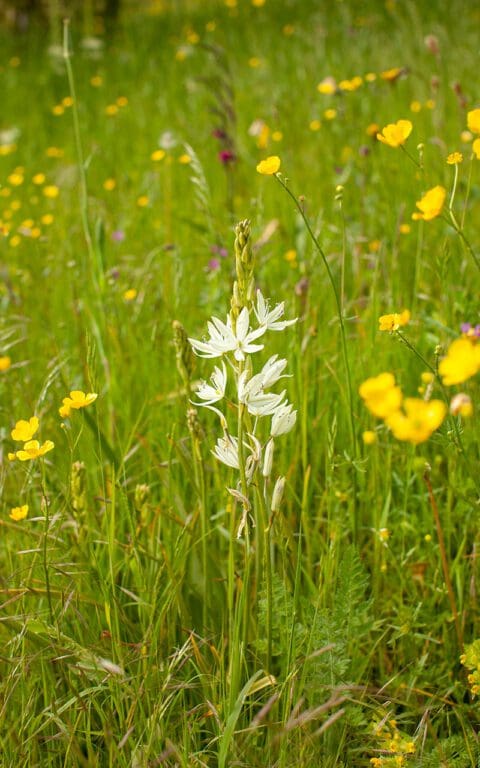
In these first few weeks of summer I often think that I will end up gardening in meadow one day rather than controlling to the degree I do in the garden. The pale Camassia leitchlinii ‘Alba’ is a nightmare seeder in a bed, but it is happy to find a niche in the meadow to follow on from Pheasant’s Eye Narccissus. The magenta Gladiolus communis subsp. byzantinus, which might steal the limelight in the green of an early summer garden, sit so comfortably in the shimmer of the first grasses. They accept the punch of this foreigner in the community and then eclipse them as they run to seed once the summer takes hold.
Words: Dan Pearson | Photographs: Huw Morgan
Published 5 June 2021
I look out of the window and all I see is green. The endless rainfall of the past weeks and the last few days of warmer, sunny weather have resulted in a sudden explosion of growth that threatens to bypass spring altogether and fast forward straight to summer. Racing growth everywhere. Everywhere, that is, apart from in the vegetable garden.
By this time of year I would usually expect to have planted out almost all of the tender veg – courgettes, pumpkins, sweetcorn, and bush beans – and would hope to be eating the very first broad beans, lettuces and beetroot. This spring has been so cold that my first sowings of carrots took a month to germinate. So tardy that it was only when remaking the seed drill last weekend to resow that I discovered they were just starting to emerge from their seed cases. Kohl rabi that I started in plugs in the polytunnel and planted out in March have only just started to swell and the first peas, sown in the third week of April, are only now sending out their first climbing tendrils. So, although we were able to extend the harvest season with the polytunnel this year, there has still been a yawning hungry gap that will take a few more weeks to fill.
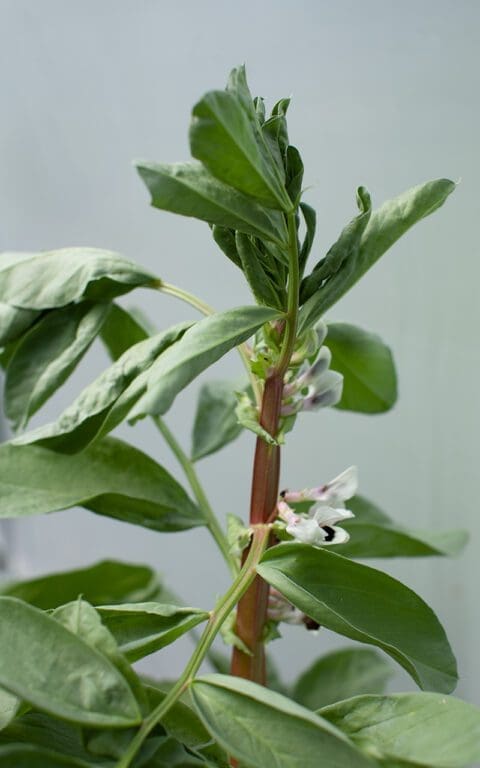
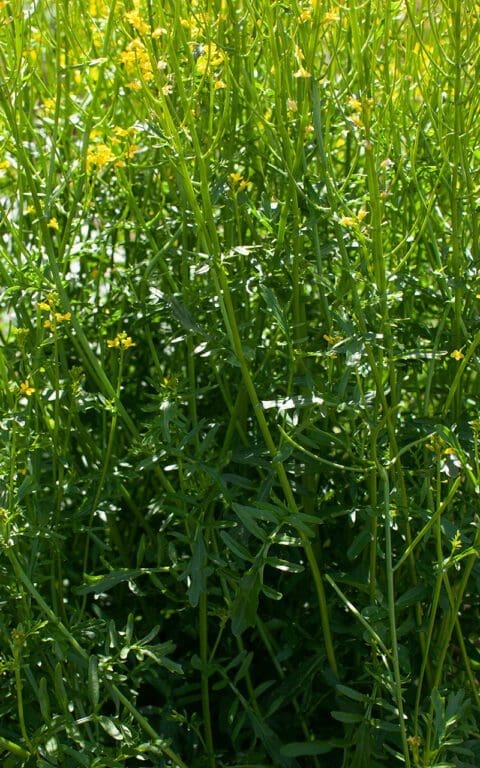
And so my eye has started wandering. I have been sizing up the broad bean tops and the kohl rabi and beet greens. The Swiss chard (which has to be the easiest, most reliable and productive green vegetable anyone can grow) has appeared in every guise imaginable – raw in a chopped salad, creamed with stewed shallots, pureed and added to ricotta for a green sformata and the stalks braised with saffron to waste not a thing. The land cress has gone to flower, but still has enough leaves to make it worth keeping and the fat hen seedlings that were missed and have matured in the polytunnel, transform from weeds into food with a simple change of perspective. As the plants of the woods and hedgerows have been burgeoning, seemingly less affected by the chill, damp weather I have been throwing garlic mustard and wild garlic into anything and everything and adding dandelion leaves, cow parsley and cleavers to salads.
Foraged wild greens would once have been a mainstay of the British kitchen at this time of year as we bridged the hungry gap without the benefit of greenhouse or polytunnel, but now they are only seen on the menus of upmarket restaurants. In Greece they are still firmly on the menus of anywhere you choose to eat and are easily found on market stalls in city and island villages the length of the country. Horta, as they are called, can comprise any foraged greens including nettle, dandelion, purslane, wild chervil, wild sorrel, sow thistle, shepherd’s purse, chicory and other wild greens that do not grow here. Most often these are served simply boiled and dressed with olive oil and lemon juice, but a favourite way to eat them is in a pie laden with fresh herbs, bought still warm from the village bakery and eaten straight from the oil-stained paper bag.
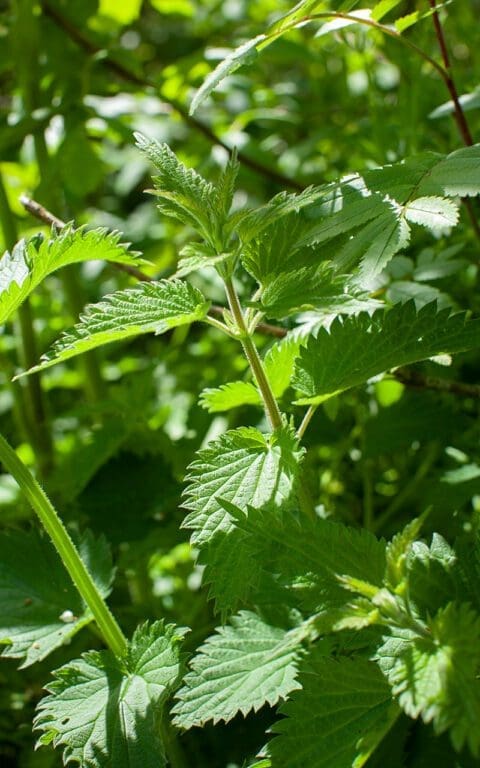
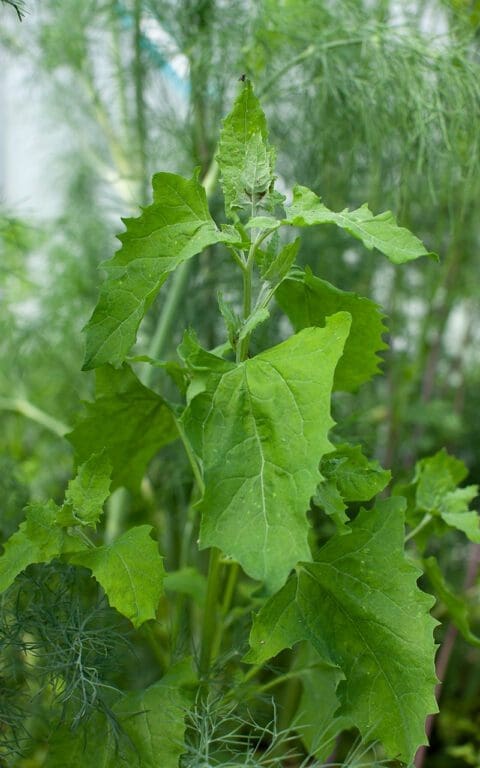
Foraging for greens doesn’t take nearly as long as you might think. The bagful I picked for this recipe took about thirty minutes, and it is an agreeable way to pass some time, providing an opportunity to slow down and look closely at plants that normally get a cursory glance or scowl. Both nettles and wild garlic are at the very end of their season now, so don’t pick the tops of nettles if they have started showing their flowers and choose the youngest, smallest garlic leaves. The older ones will be bitter.
When foraging for any wild plants remember to only take a little from each plant, do not gather from roadsides or anywhere that dogs have access and take a good wild plant identification guide. If wild greens are hard to come by they can be bulked out with chard, kale, chicory or beet tops. It can also be made with shop bought filo pastry and, divided evenly, makes 6 turnovers with a reduced cooking time of 20 to 25 minutes.
Today, eating a warm slice for lunch with a fresh chard salad in the long-awaited sunshine, we could almost feel the heat and smell the salt spray of Greece. Soon, we said, soon.
Pastry
350g plain flour
175g unsalted butter, cold from the fridge and cubed
1 whole egg, beaten
Salt
A little cold milk
Filling
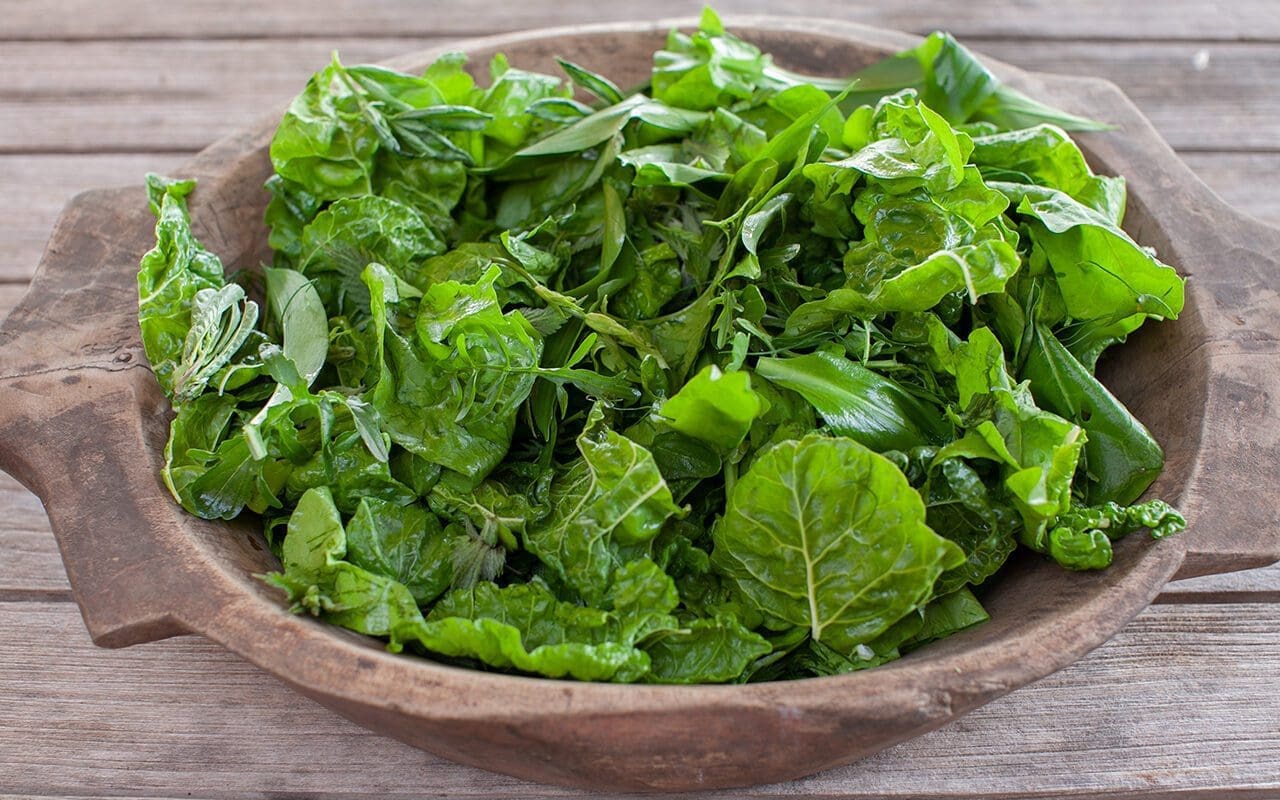
400g mixed foraged and cultivated greens – nettle tops, sorrel, dandelion, garlic mustard, wild garlic, fat hen, orache, wild chervil, wild hop shoots, broad bean tops, pea shoots, chicory, beet greens, chard, land cress, rocket
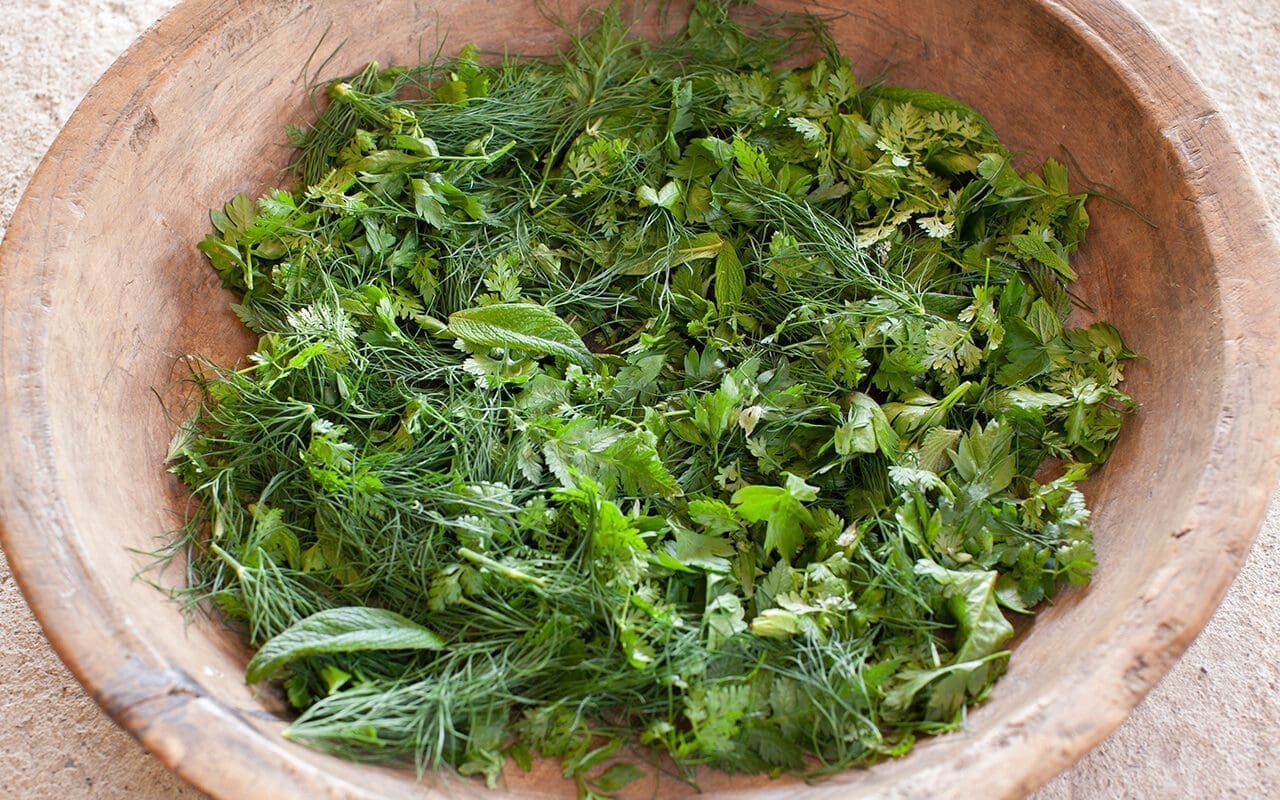
100g mixed fresh soft herbs – dill, parsley, chervil, mint, fennel, tarragon, coriander
180g shallots, leeks or spring onions, finely sliced
2 fat cloves of garlic, finely chopped
200g feta cheese
2 eggs, beaten
Olive oil
Freshly grated nutmeg
A little milk
Serves 8
Set oven to 180°C.
To make the pastry put the flour, butter and a good pinch of salt into a food processor. Process until the mixture resembles fine breadcrumbs. With the processor running, slowly add the beaten egg and enough milk to bring the dough together. Turn off the machine, tip the dough and any remaining loose mixture onto a worktop and quickly bring it together, kneading lightly, into a ball. Wrap in greaseproof paper and refrigerate for 30 minutes to an hour.
Heat a little olive oil in a saucepan over a medium heat. Add the shallots and garlic and sweat with the lid on for 15 minutes until soft and translucent. Remove from the heat and allow to cool.
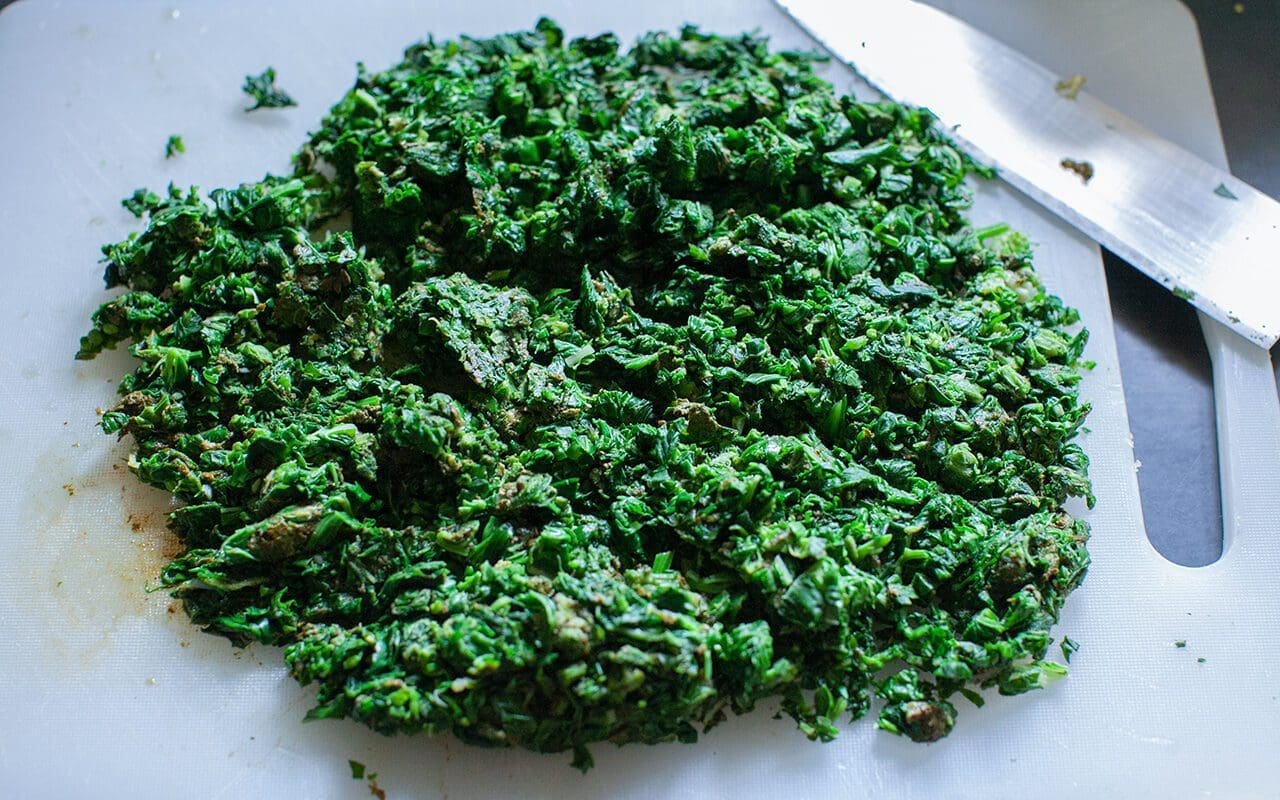
Bring a large pan of water to the boil. Blanch the greens for 1 minute, then drain and immediately refresh in cold water. Drain again and then squeeze out as much liquid as possible. Chop coarsely and put into a bowl. Chop the herbs fairly finely and add to the bowl. Add the cooled onions and garlic. Crumble the feta cheese into the bowl. Season with a little salt (the feta is salty), pepper and as much nutmeg as you like. Add the beaten eggs, reserving about a tablespoonful, then mix everything together thoroughly.
Divide the pastry into two almost equal halves. Roll out the larger half to line the bottom and sides of a 30 x 20cm rectangular metal tart tin or baking dish. Spoon in the filling and smooth out evenly ensuring that it is pressed into the corners.
Roll out the second piece of pastry to fit the top of the tart tin. Mix the reserved beaten egg with two tablespoons of milk and brush onto the edges of the pastry case. Lay the second piece of pastry on top and gently press the edges together with your fingers to seal. Trim off the excess pastry with a sharp knife.
Brush the remaining egg wash over the top of the pie. Make slashes in the top to let out steam. Put the pie onto a baking sheet and put into the oven for 30 to 40 minutes until golden brown and gently bubbling.
Serve warm.
Recipe & photographs: Huw Morgan
Published 29 May 2021
We are sorry but the page you are looking for does not exist. You could return to the homepage